Implementing a Multidisciplinary Bedside Handoff to Improve Communication and Reduce Errors in Surgical Transfers Natania Feliciano, BSN, RN; Kaylyn Bourne, DNP, APRN, FNP-C, David Phillippi, PhD Belmont University Doctor of Nursing Practice Program
PROBLEM
PROJECT DESIGN
Breakdowns in communication amongst team members leads to poor patient outcomes (Massa et al., 2021). Commonly cited barriers to communication include lack of standardization and time pressure (Abraham et al., 2023). Multidisciplinary handoffs are a strategy to overcoming barriers, improving team communication and promoting patient safety by 40% (Njambi et al., 2021).
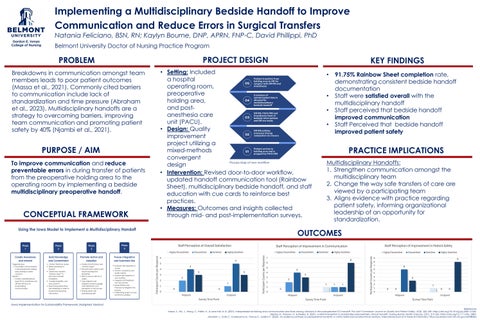
• Setting: Included a hospital operating room, preoperative holding area, and postanesthesia care unit (PACU). • Design: Quality improvement project utilizing a mixed-methods convergent Process Map of new workflow design • Intervention: Revised door-to-door workflow, updated handoff communication tool (Rainbow Sheet), multidisciplinary bedside handoff, and staff education with cue cards to reinforce best practices. • Measures: Outcomes and insights collected through mid- and post-implementation surveys.
PURPOSE / AIM To improve communication and reduce preventable errors in during transfer of patients from the preoperative holding area to the operating room by implementing a bedside multidisciplinary preoperative handoff.
CONCEPTUAL FRAMEWORK
KEY FINDINGS • • • •
91.75% Rainbow Sheet completion rate, demonstrating consistent bedside handoff documentation Staff were satisfied overall with the multidisciplinary handoff Staff perceived that bedside handoff improved communication Staff Perceived that bedside handoff improved patient safety
PRACTICE IMPLICATIONS Multidisciplinary Handoffs: 1. Strengthen communication amongst the multidisciplinary team 2. Change the way safe transfers of care are viewed by a participating team 3. Aligns evidence with practice regarding patient safety, informing organizational leadership of an opportunity for standardization.
OUTCOMES
Iowa implementation for Sustainability Framework (Adapted Version) References: Massa, S., Wu, J., Wang, C., Peifer, H., & Lane-Fall, M. B. (2021). Interprofessional training and communication practices among clinicians in the postoperative ICU handoff. The Joint Commission Journal on Quality and Patient Safety, 47(4), 242–249. https://doi.org/10.1016/j.jcjq.2020.12.004 Njambi, M., Rawson, H., & Redley, B. (2021). A brief intervention to standardize postanesthetic clinical handoff. Nursing & Health Sciences, 23(1), 219–226. https://doi.org/10.1111/nhs.12803 Abraham J., Duffy C., Kandasamy M., France D., Greilich P. (2023). An evidence synthesis on perioperative handoffs: A call for balanced sociotechnical solutions. International journ al of medical informatics. https://pubmed.ncbi.nlm.nih.gov/36948060/