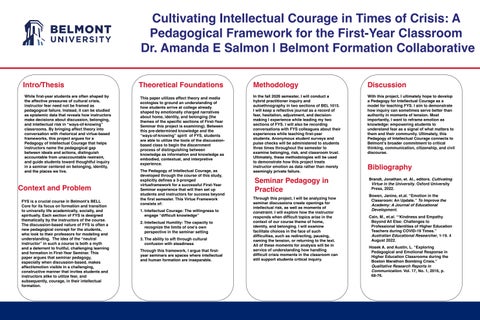
Cultivating Intellectual Courage in Times of Crisis: A Pedagogical Framework for the First-Year Classroom Dr. Amanda E Salmon | Belmont Formation Collaborative Intro/Thesis While first-year students are often shaped by the affective pressures of cultural crisis, instructor fear need not be framed as pedagogical failure. Instead, it can be studied as epistemic data that reveals how instructors make decisions about discussion, belonging, and intellectual risk in “ways-of-knowing” classrooms. By bringing affect theory into conversation with rhetorical and virtue-based frameworks, this project argues for a Pedagogy of Intellectual Courage that helps instructors name the pedagogical gap between ideals and actions, distinguish accountable from unaccountable restraint, and guide students toward thoughtful inquiry in a seminar centered on belonging, identity, and the places we live.
Context and Problem FYS is a crucial course in Belmont’s BELL Core for its focus on formation and transition to university life academically, socially, and spiritually. Each section of FYS is designed thematically by the instructors of the course. The discussion-based nature of FYS is often a new pedagogical concept for the students, who look to their professors for modeling and understanding. The idea of the “neutral instructor” in such a course is both a myth and a deterrent to fruitful, challenging learning and formation in First-Year Seminar. This paper argues that seminar pedagogy, especially when discussion-based, makes affect/emotion visible in a challenging, constructive manner that invites students and instructors alike to utilize fear, and subsequently, courage, in their intellectual formation.
Theoretical Foundations
Methodology
Discussion
This paper utilizes affect theory and media ecologies to ground an understanding of how students arrive at college already shaped by emotionally charged narratives about home, identity, and belonging (the themes of the specific sections of First-Year Seminar this project is examining). Between this pre-determined knowledge and the “ways-of-knowing” spirit of FYS, students are able to utilize the tools of the discussionbased class to begin the discernment process of distinguishing between knowledge as information and knowledge as embodied, contextual, and interpretive experience.
In the fall 2026 semester, I will conduct a hybrid practitioner inquiry and autoethnography in two sections of BEL 1015. I will keep a reflective journal as a record of fear, hesitation, adjustment, and decisionmaking I experience while leading my two sections of FYS. I will also be recording conversations with FYS colleagues about their experiences while teaching first-year students. Anonymous student surveys and pulse checks will be administered to students three times throughout the semester to examine belonging, risk, and classroom trust. Ultimately, these methodologies will be used to demonstrate how this project treats instructor emotion as data rather than merely seemingly private failure.
With this project, I ultimately hope to develop a Pedagogy for Intellectual Courage as a model for teaching FYS. I aim to demonstrate how inquiry can sometimes serve better than authority in moments of tension. Most importantly, I want to reframe emotion as knowledge: empowering students to understand fear as a signal of what matters to them and their community. Ultimately, this Pedagogy of Intellectual Courage connects to Belmont’s broader commitment to critical thinking, communication, citizenship, and civil discourse.
Seminar Pedagogy in Practice
Brandt, Jonathan, et. Al., editors. Cultivating Virtue in the University. Oxford University Press, 2022.
The Pedagogy of Intellectual Courage, as developed through the course of this study, explicitly defines a 3-pronged virtueframework for a successful First-Year Seminar experience that will then set up students and instructors for success beyond the first semester. This Virtue Framework consists of: 1. Intellectual Courage: The willingness to engage “difficult knowledge” 2. Intellectual Humility: The capacity to recognize the limits of one’s own perspective in the seminar setting 3. The ability to sift through cultural confusion with steadiness Through this framework, I argue that firstyear seminars are spaces where intellectual and human formation are inseparable.
Through this project, I will be analyzing how seminar discussions create openings for intellectual risk, as well as moments of constraint. I will explore how the instructor responds when difficult topics arise in the context of our course theme of home, identity, and belonging. I will examine facilitate choices in the face of such difficulties, such as redirecting, pausing, naming the tension, or returning to the text. All of these moments for analysis will be in service of understanding how handling difficult crisis moments in the classroom can still support students critical inquiry.
Bibliography
Bowen, Janine, et.al. “Emotion in the Classroom: An Update.” To Improve the Academy: A Journal of Educational Development. Cain, M., et.al. “‘Kindness and Empathy Beyond All Else: Challenges to Professional Identities of Higher Education Teachers during COVID-19 Times.” Australian Educational Researcher, 1-19. 4 August 2022. Hosek A. and Austin, L. “Exploring Pedagogical and Emotional Response in Higher Education Classrooms during the Boston Marathon Bombing Crisis.” Qualitative Research Reports in Communication. Vol. 17, No. 1, 2016, p. 68-76.