Belonging & Whole Person Formation in Graduate Education: A Conceptual Framework for Student Flourishing Cynthia Hickman, EdD, OTD, OTR/L, SIPT, CLT-LANA Background & Significance Graduate students experience substantial academic, personal, and professional demands that can contribute to stress and diminished well-being. Unlike undergraduate students, graduate students often develop their primary connections within their academic programs while also beginning to identify with an emerging profession. Consequently, graduate education provides two important contexts for belonging: the academic institution and the profession. Understanding how these forms of belonging develop may provide insight into how graduate education can support wholeperson formation and help students move beyond persistence toward flourishing.
Purpose To synthesize literature on institutional and professional belonging among graduate students and propose a conceptual framework illustrating how these forms of belonging may contribute to whole-person formation and flourishing.
Conceptual Framework
Proposed Framework
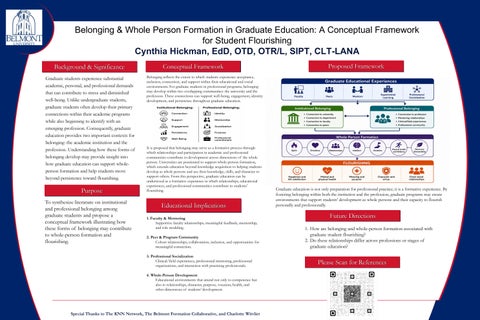
Belonging reflects the extent to which students experience acceptance, inclusion, connection, and support within their educational and social environments. For graduate students in professional programs, belonging may develop within two overlapping communities: the university and the profession. These connections can support well-being, engagement, identity development, and persistence throughout graduate education.
It is proposed that belonging may serve as a formative process through which relationships and participation in academic and professional communities contribute to development across dimensions of the whole person. Universities are positioned to support whole-person formation, which extends education beyond knowledge acquisition to helping students develop as whole persons and use their knowledge, skills, and character to support others. From this perspective, graduate education can be understood as a formative experience in which relationships, educational experiences, and professional communities contribute to students’ flourishing.
Educational Implications 1. Faculty & Mentoring Supportive faculty relationships, meaningful feedback, mentorship, and role modeling.
2. Peer & Program Community Cohort relationships, collaboration, inclusion, and opportunities for meaningful connection. 3. Professional Socialization Clinical/field experiences, professional mentoring, professional organizations, and interaction with practicing professionals. 4. Whole-Person Development Educational environments that attend not only to competence but also to relationships, character, purpose, vocation, health, and other dimensions of students' development.
Special Thanks to The KNN Network, The Belmont Formation Collaborative, and Charlotte Witvliet
Graduate education is not only preparation for professional practice; it is a formative experience. By fostering belonging within both the institution and the profession, graduate programs may create environments that support students' development as whole persons and their capacity to flourish personally and professionally.
Future Directions 1. How are belonging and whole-person formation associated with graduate student flourishing? 2. Do these relationships differ across professions or stages of graduate education?
Please Scan for References