Key changes at a glance
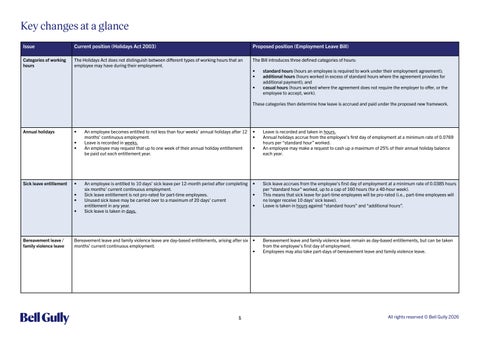
Categories of working hours
The Holidays Act does not distinguish between different types of working hours that an employee may have during their employment.
The Bill introduces three defined categories of hours:
• standard hours (hours an employee is required to work under their employment agreement);
• additional hours (hours worked in excess of standard hours where the agreement provides for additional payment); and
• casual hours (hours worked where the agreement does not require the employer to offer, or the employee to accept, work).
These categories then determine how leave is accrued and paid under the proposed new framework.
Annual holidays
Sick leave entitlement
• An employee becomes entitled to not less than four weeks’ annual holidays after 12 months’ continuous employment.
• Leave is recorded in weeks.
• An employee may request that up to one week of their annual holiday entitlement be paid out each entitlement year.
• Leave is recorded and taken in hours.
• Annual holidays accrue from the employee’s first day of employment at a minimum rate of 0.0769 hours per “standard hour” worked.
• An employee may make a request to cash up a maximum of 25% of their annual holiday balance each year.
Bereavement leave / family violence leave
• An employee is entitled to 10 days’ sick leave per 12-month period after completing six months’ current continuous employment.
• Sick leave entitlement is not pro-rated for part-time employees.
• Unused sick leave may be carried over to a maximum of 20 days’ current entitlement in any year.
• Sick leave is taken in days.
• Sick leave accrues from the employee’s first day of employment at a minimum rate of 0.0385 hours per “standard hour” worked, up to a cap of 160 hours (for a 40-hour week).
• This means that sick leave for part-time employees will be pro-rated (i.e., part-time employees will no longer receive 10 days’ sick leave).
• Leave is taken in hours against “standard hours” and “additional hours”.

Bereavement leave and family violence leave are day-based entitlements, arising after six months’ current continuous employment.
• Bereavement leave and family violence leave remain as day-based entitlements, but can be taken from the employee’s first day of employment.
• Employees may also take part-days of bereavement leave and family violence leave.
Otherwise working day test
Whether a day is an “otherwise working day” (OWD) requires a multi-factor assessment, taking into account matters such as the employee’s employment agreement, work patterns, and other relevant factors.
This assessment is often uncertain and the source of significant dispute for those employees with variable work patterns.
Leave payments Leave payment calculations vary depending on the type of leave taken.
Annual holidays are calculated using the greater of the employee’s ordinary weekly pay and average weekly earnings.
All other leave types (i.e., sick leave, bereavement leave, alternative holidays, and family violence leave) are calculated based on relevant daily pay (or average daily pay where relevant daily pay cannot be determined).
A new OWD formula applies to employees who do not have days of work (or a pattern of days of work) specified in their employment agreement.
A day is treated as an OWD if the employee has worked (or was on paid or unpaid leave) for 50% or more of the same day of the week as the public holiday in the preceding 13 weeks.
• All leave taken under the Bill is paid at an hourly rate.
• For salaried employees, this is the amount payable for one “standard hour’s” work; for waged employees, it is the lowest hourly rate payable for the day on which the leave is taken.
• Fixed allowances are paid in full during periods of leave.
• The same hourly leave pay rate is used for all types of leave, removing the need for multiple different calculations.
Leave compensation payment (LCP)
No equivalent mechanism exists.
Annual holiday pay for casual or intermittent employees, or (by agreement) employees whose fixed term is less than 12 months, is paid on the basis of pay-as-you-go at the rate of 8% of gross earnings.
A new LCP of 12.5% of the employee’s ordinary hourly rate is paid on all “additional hours” and “casual hours” worked, instead of the employee accruing annual holidays or sick leave on those hours.
This is intended to provide a simpler mechanism than applying complex accrual rules to irregular or unpredictable hours.
Public holiday entitlements
• An employee who works on a public holiday that is an OWD is entitled to: (a) time and a half for each hour actually worked on the public holiday; and (b) an alternative holiday (a whole day, even if the employee only worked for part of the public holiday).
• An alternative holiday may be exchanged for payment only after 12 months have passed since the entitlement arose.
• If an employee works on a public holiday that is an OWD, they are entitled to: (a) time and a half for each hour worked and paid leave for the unworked hours; and (b) alternative holiday hours that accrue at a rate of one hour for every hour worked on a public holiday.
• An alternative holiday may be taken on any day the employee could have worked under their employment agreement and may be cashed up at any time.
Pay statements No standalone statutory requirement for pay statements under the current Holidays Act (although separate requirements exist under the Employment Relations Act 2000).
Remediation of historical non-compliance
No formal remediation process exists. Employers face potential liability for historical underpayments.
A new requirement for employers to provide pay statements to employees for each pay period, setting out prescribed information regarding an employee’s leave entitlements. The pay statement must not include information relating to any family violence leave taken by an employee.
The Bill includes a remediation process which enables employers to elect to resolve any outstanding liability under the current Act by following a prescribed process, without requiring employees’ consent. Regulations specifying the remediation process may be made from the day after Royal assent.