Summary of proposed reform of Local Government
Responsible for:
• Local infrastructure (local roads, wastewater and water supply etc)
• Community services (libraries, parks, waste collection and swimming pools etc)
• Regulatory functions (building consents, landuse planning, local bylaws etc)
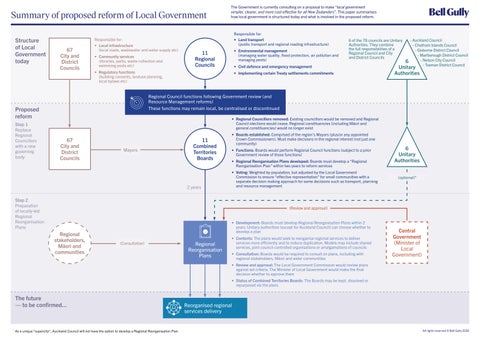
The Government is currently consulting on a proposal to make “local government simpler, clearer, and more cost-effective for all New Zealanders”. This paper summarises how local government is structured today and what is involved in the proposed reform.
Responsible for:
• Land transport (public transport and regional roading infrastructure)
• Environmental management (managing water quality, flood protection, air pollution and managing pests)
• Civil defence and emergency management
• Implementing certain Treaty settlements commitments
6 of the 78 councils are Unitary Authorities. They combine the full responsibilities of a Regional Council and City and District Councils
• Regional Councillors removed: Existing councillors would be removed and Regional Council elections would cease. Regional constituencies (including Māori and general constituencies) would no longer exist
• Boards established: Comprised of the region’s Mayors (plus/or any appointed Crown Commissioners). Must make decisions in the regional interest (not just one community)
• Functions: Boards would perform Regional Council functions (subject to a prior Government review of those functions)
• Regional Reorganisation Plans developed: Boards must develop a “Regional Reorganisation Plan” within two years to reform services
• Voting: Weighted by population, but adjusted by the Local Government Commission to ensure “effective representation” for small communities with a separate decision making approach for some decisions such as transport, planning and resource management
• Development: Boards must develop Regional Reorganisation Plans within 2 years. Unitary authorities (except for Auckland Council) can choose whether to develop a plan
• Contents: The plans would seek to reorganise regional services to deliver services more efficiently and to reduce duplication. Models may include shared services, joint council-controlled organisations or amalgamations of councils
• Consultation: Boards would be required to consult on plans, including with regional stakeholders, Māori and wider communities
• Review and approval: The Local Government Commission would review plans against set criteria. The Minister of Local Government would make the final decision whether to approve them
• Status of Combined Territories Boards: The Boards may be kept, dissolved or repurposed via the plans
- Auckland Council
- Chatham Islands Council
- Gisborne District Council
- Marlborough District Council
- Nelson City Council
- Tasman District Council
Summary of proposed reform of Local Government
The Government is consulting on proposed reforms to make local government simpler. If adopted, these reforms would:
Remove Regional Councillors
On day one, regional councillors would be removed, with functions transferred to Combined Territories Boards
Review Regional Council functions
The Government would conduct a review to determine which functions should continue, be removed, or transferred to Central Government or City and District Councils
Establish Combined Territories Boards Boards comprising City/District Mayors would replace Regional Councillors
Mandatory Reorganisation Plans
Each Combined Territories Board would develop a Regional Reorganisation Plan to reorganise regional services.* The plan will be reviewed against established criteria. The Minister of Local Government would make the final decision on approving the plans
* Unitary authorities are not required to have a plan
In addition to the primary proposal, the Government is also consulting on a number of alternatives:
Involvement of Crown Commissioners on Combined Territories Boards
Crown Commissioners also on Boards
The Government is considering Governmentappointed “Crown Commissioners” sitting on the Combined Territories Boards in addition to the Mayors. Crown Commissioners could:
• be observers;
• have veto powers based on the interests of New Zealand as a whole; or
• have majority votes for decisions of the Boards
Crown Commissioners replacing Boards
Alternatively, the Government is considering having no Combined Territories Boards at all. Commissioners would instead run Regional Councils in the short-term and develop Regional Reorganisation Plans
At this stage, there is limited information about the timeframes for the proposed reform. The Government has indicated the following timeline for the implementation of the reform:
The Government says that the proposal has been developed to make local government simpler, more efficient, and better value for money, noting that two things led to development of the proposal:
1. having two types of councils operating in the same area is complex, confusing, and costly; and
2. it is thinking of the future. The Government notes that its resource management reform and other changes (like water services reform and climate adaptation) will change how councils operate in the future.
The Government considers that, both of these issues mean it is a good time to review how our councils work to see if there are better ways to do things.
Voting and representation on Combined Territories Boards
Alternative voting systems and weightings
The Government is considering whether to adopt:
• a “One Mayor, One Vote” model or
• a “pure population model” for Combined Territories Boards, with specific weightings to protect smaller communities
Issues arise with both. The first allows the Mayors for smaller populations to have the same powers as the Mayors of large cities. The second allows Mayors of the largest city in each area to dominate
Cross-Boundary representation
The Government is considering different representation options for the small number of districts split between two regions:
• District Adoption: An isolated population is “adopted” by an adjacent district; or
• Additional Representation: A district gets specific representation/a voting share on all relevant Combined Territories Boards
The districts where this is relevant are:
- Rotorua
- Rangitikei
- Stratford
- Tararua
Reorganisation Plans review criteria — summary
fit; support national priorities, strategies and goals (like housing, infrastructure, and competitive business settings)
Affordable now and in the future; provide a financially responsible arrangement that will manage rates increases and support them to manage assets well
Local say; let decisions happen at the right local level. Does the plan provide fair and effective representation of communities of interest?
- Taupō
- Waitaki
- Waitomo
Treaty arrangements; show how all Treaty settlement commitments that are administered by councils and other agreements with iwi/Māori will be given effect to and/or improved
Can it be done; include a realistic plan for putting the plan into action (e.g., how council staff might be moved)
Submissions for public consultation due:
20 February 2026
March 2026 final proposal confirmed and legislation drafted
Combined Territories Boards established and Regional Councils abolished
Regional Reorganisation Plans developed
Regional services delivery reorganised