THE
PROSPECTUS Issue #02
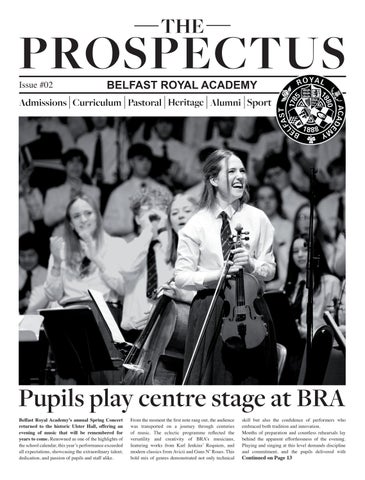
Pupils play centre stage at BRA Belfast Royal Academy’s annual Spring Concert returned to the historic Ulster Hall, offering an evening of music that will be remembered for years to come. Renowned as one of the highlights of the school calendar, this year’s performance exceeded all expectations, showcasing the extraordinary talent, dedication, and passion of pupils and staff alike.
From the moment the first note rang out, the audience was transported on a journey through centuries of music. The eclectic programme reflected the versatility and creativity of BRA’s musicians, featuring works from Karl Jenkins’ Requiem, and modern classics from Avicii and Guns N’ Roses. This bold mix of genres demonstrated not only technical
skill but also the confidence of performers who embraced both tradition and innovation. Months of preparation and countless rehearsals lay behind the apparent effortlessness of the evening. Playing and singing at this level demands discipline and commitment, and the pupils delivered with
Continued on Page 13
T
his year we continue our new take, a new perspective on the traditional prospectus. We hope the headlines contained tell you more about who we are and what Belfast Royal Academy stands for - a school rooted in history but passionate about its future. This is not like any other prospectus. It is
written to be read, leafed through and considered. Could it be that you will catch a glimpse of your own child’s potential in one of the headlines? Is there a headline missing and could your child be the one to write it? If those are your thoughts, then Belfast Royal Academy is the place where those hopes can become reality. It is a place where the glimpse of potential gets noticed and where the early talent of a Form 1 pupil finds the right soil in which to grow. We know that those who make headlines on a global stage have had their roots well developed at a young age. Schools who allow that to happen are great places of education and we believe we are that place. A normal prospectus cannot show you what we mean - The Prospectus can. Enjoy reading the prospectus of Belfast Royal Academy.
Belfast Royal Academy, 5-17 Cliftonville Road, Belfast, BT14 6JL / Telephone: 028 9074 0423 / Email: info@bfsra.belfast.ni.sch.uk / Website: belfastroyalacademy.com Principal, Mrs H. Woods / Warden (Chair) of the Board of Governors, Mr D. E. Porter
PRINCIPAL PROUD TO INTRODUCE SCHOOL W
hen Rev. Dr. James Crombie founded the Academy in 1785, his ambition was to provide an education of a high standard that would be of ‘unspeakable advantage’ not only to Belfast, but to the North of Ireland. 240 years later, Belfast Royal Academy remains one of Northern Ireland’s most successful grammar schools in which intellectual rigour and the pursuit of academic excellence remain constant. Speaking of her excitement of welcoming new pupils to Belfast Royal Academy, Principal, Mrs Woods, explained how the Academy’s history has shaped it as a school for the future. “We take great pride in our ethos and values honed
over the centuries, but we are equally proud of the inclusive community that makes the Academy such a unique and special place. Opportunities for learning and broadening horizons outside the classroom are abundant, providing an education that develops the whole person to be the best version of themselves.
values such as personal responsibility, respecting diversity and having a mind to be kind. Our motto, per vias sapiantae (along the paths of wisdom), reflects the potential that our pupils have to become the future leaders and thinkers who change the world.
Visitors to the Academy often remark on the strong relationships that exist between pupils and staff and we believe that this sense of community, when coupled with high aspirations and respect, is essential to allow pupils to flourish.
Our website and social media pages (Facebook and Instagram) will give you a snapshot of our vibrant and caring school and the wealth of opportunities that are available.
Our expectations for every pupil in terms of personal achievement, academic and otherwise, development of character and conduct are very high. We have an excellent pastoral care system that focuses on core
We look forward to welcoming you to our Open Events so that you can immerse yourself in our unique environment and experience for yourself everything that we have to offer.”
03
Vision Mission Values
Belfast Royal Academy Share their Ethos
What is your vision? The Academy’s vision, which has evolved over many years, is to ensure that all our pupils are given every opportunity and the support they need to fulfil their potential in school life.
How does your vision become reality through your mission? By stimulating intellectual curiosity, we create independent thinkers better equipped to contribute to and lead society. By offering every pupil the opportunity to explore a wide range of subjects, challenges and experiences, we help them discover passions, talents and interests that will stay with them for life. The essence of Belfast Royal Academy is a high standard of teaching coupled with deep levels of support. By nurturing self-confidence and selfworth, we reveal true potential in young people.
Which four values do you want to instil throughout this process? 1. We respect knowledge Academic, practical, artistic or general, we do not just impart knowledge, we teach the value of it as a currency. Pupils are taught by subject specialists and are encouraged to develop a deep love for learning. 2. We champion diversity We are, historically, an inclusive school. Understanding the nuances of all our differences widens our perspective, enriches our lives and helps us find a deeper appreciation of the wider world. 3. We are not afraid of hard work We aim high and achieve the results – academically, creatively and in sport. Success requires hard work inside and outside the classroom. We believe that hard work instils an ethic of determination and resilience and develops strength of character.
4. We have high standards Since the establishment of the Academy in 1785 by Rev. Dr. James Crombie, our school was established to provide “education of a high standard.” This remains our ethos over two centuries later, adding opportunities and experiences to our daily aspiration. Our holistic approach also embraces instilling high standards of behaviour and a culture of integrity and respect - things that make us what we are.
What is unique about your school? Our Vision, Mission and Values align our identity with our purpose as we serve our pupils, local community in North Belfast and the wider catchment area. Our identity as a diverse, co-educational, nondenominational and high achieving grammar school is not just unique, but something which fills us with tremendous pride.
Schooled in Admissions C
hoosing a school is one of the most important decisions you will make for your child’s future and we hope our prospectus gives you a sense of the vibrancy, fun and dynamism of the community in BRA. We are proud of the wealth of opportunities we offer and the high standard of pastoral care afforded to each pupil. We would encourage you to visit the Academy and meet staff and current pupils at one of our Open Nights to see first-hand and experience all that Belfast Royal Academy has to offer. Details of our Admissions Criteria can be found on our website:
belfastroyalacademy.com 04
Form 1 (Year 8)
Sixth Form (Years 13 & 14)
Each year we admit 200 pupils into Form 1. Pupils are admitted according to our Admissions Criteria and the application process is administered by the Transfer Office at the Education Authority. Our Admissions Criteria for entry into Form 1 is renewed annually by our Board of Governors and is uploaded on our website.
Being part of our Sixth Form is both a challenging and rewarding experience and we welcome talented and capable pupils into the Academy to complete the final stage of their schooling. At BRA we create an environment in which our pupils achieve excellent examination results whilst also developing their personal and leadership skills. It is important to make contact with us as soon as the GCSE results are published since there are a limited number of places available.
Forms 2 - 5 (Years 9-12) Occasionally a small number of places may become available in these year groups, depending on enrolment numbers at the start of the academic year. Details of our Admissions Criteria for entry can be viewed on our website. Applicants should submit the online application form and they will then be notified of the date of the Assessment Day.
Pupils wishing to join our Sixth Form will normally require a minimum of 12 points at GCSE (A* = 4 points, A = 3 points, B = 2 points, C* = 1.5 points, C = 1 point) and are expected to have achieved a Grade A or Grade B in the subject being taken at A-Level depending on the subject. Entry to Sixth Form is also dependent upon a pupil’s disciplinary record and school attendance.
“NO FEAR” - SAY FIRST FORM T
hree Form 1 pupils at Belfast Royal Academy, half way through their first year, agreed that there was no need to be worried or anxious about coming to BRA. Amelie Chada, Sylvie Campbell and Timothy Lee took time out of their Biology class to speak about what it was like to move from their primary school to “Big School”. Why did you choose BRA? Timothy: BRA had a really good reputation and I liked that. How did you feel when you got your SEAG results? Amelie: I felt really proud and to be honest very relieved! When did you get your uniform? Sylvie: It was quite close to my first day – I had some uniform from my sisters so this was easy. How did you feel the night before your first day? Amelie: I was a bit nervous but I was really excited at the same time. Sylvie: I was nervous. Nobody from my class were going here and I was worried that I wouldn’t make new friends. What was your first day like? Timothy: We had a great day! It was all team building and getting to know people quickly. We also had a quiz and it was brilliant in helping me meet new friends. The people I met on the first day are still my friends now. Amelie: On the team building day there were lots of tasks which really helped us get to know each other especially those of us in the same tutorial group. What was your first proper day like? Timothy: We got our timetables on the first full school day and it was good to start getting to know our way around. I was told it would be no time before I wouldn’t even see the buildings - I didn’t
believe them – after 1 week, I knew exactly what they meant. Amelie: Getting my timetable was really exciting and really useful. The rooms are named after the buildings they are in so it’s easier than you think to find your way around. Sylvie: The tour was really good and the Senior Pupils were really helpful. They formed a big double line and clapped us in as we walked in. That was brilliant. You now do 14 subjects – how has that been? Amelie: At primary school I only learnt Maths, English, PDMU and The World Around Us, so coming here was fantastic. We get to do French and Home Economics and French is my favourite subject – my teacher is so nice. Sylvie: When I first arrived all my subjects were new and I didn’t understand anything at all – it’s like the information went in one ear and out the other! After a while, however, I got used to it and it’s been ok since. At primary school, we were taught how to use a homework diary before coming here and that really helped. Timothy: We didn’t do too many other subjects at primary school. I think Covid was to blame! Since I’ve come here, I’ve really enjoyed all the new subjects. I really like Maths because I’m good at it. What has been your best day so far? Timothy: The first day we did PE! Getting the bus to Roughfort. Sylvie: I like hockey and after games, I stay to play hockey for Owls so I have time in-between when I eat a Pot Noodle. It’s just fun having time to relax and take time out before starting to play hockey again. Amelie: The first day was a really good day – a lot of fun. The December exams are coming up – how have you been preparing? Timothy: Flash cards have worked really well and I
use those a lot. Amelie: We’ve been taught really well how to learn, I use flash cards and mind maps but I find the flash cards better to use. Sylvie: I’m a bit nervous but all the teachers have been helping us revise and that has been really useful. Are you involved in any Extra-Curricular activities or clubs? Amelie: There are so many clubs and societies here. I play netball even though I hadn’t played that before. I also go to guitar lessons once a week. Timothy: I go to swimming and rugby and I also go to Comic Book Club, Board Game Club, Coding Club, Young Einstein and I’ve been to Inktober. I love getting involved! Sylvie: I didn’t know what I wanted to go to but I now go to hockey and since I was the only one of my friends who wanted to go to SU, I asked them to go so now we all go there on a Wednesday at lunch time and it is really good fun. What advice would you give to P6 or P7 pupils about picking a school? Amelie, Sylvie and Timothy all agreed: Go to the Open Nights and speak to the teachers to see if they are nice. Be careful with friends. Fake friends are best moved on from and just take each day as it comes. Our parents listened to the Principal’s talk and they really liked Mrs Woods’ talk. Lots of people are scared about having no friends but there is no need to worry; making new friends is easy because there are so many clubs to go to and you make friends there really easily. Thank you Amelie, Sylvie and Timothy for being so helpful.
05
Why Us? The extra-curricular offerings are excellent Our daughter has wanted to go to BRA since nursery school. We found the pastoral care to be very good for our older daughter when she attended. The community and a sense of belonging which BRA creates amongst the pupils, was really important to our daughter. BRA has strong individual Science subjects taught from Form 1 as well as Classics alongside Modern Languages. It has a robust Maths and English syllabi which were important to us.
School values, pupils were welcoming, knowledgeable, well spoken, the impression of the school and teachers on the Open Days confirmed what the school values stood for. Also, school prestige and recommendations amongst friends whose children attend/attended. A “good feeling”, convenient location and extensive extra-curricular activities available.
School values
...the great reputation the Academy has and how good the students grades are when they complete exams. It is a very well run grammar school.
It has an excellent reputation for supporting young children from all walks of life. My brother attended the school many years ago and believes he had an excellent educational journey. I believe that BRA will provide a space where my son will experience a positive education and will be supported through his personal development into young adulthood.
I attended BRA and always hoped my daughter would attend as I had a great experience - I am still associated with Academy RFC. It was her decision, however, and the Open Day was the best one we attended. She picked BRA as her first choice despite most of her peer group going elsewhere. Belfast Royal Academy was our first choice and we were delighted to have received a place for our daughter. She has settled very well and made friends already and we are confident she will have 7 great years.
...I liked the friendly, inclusive atmosphere... We live in the country near Ballymena but work in Belfast. My husband and I heard colleagues talk of the school fondly many years after attending. We never felt that way about our school days. This made us curious so we went to one of the presentations with our eldest when she was P6. No other talk compared. We attended again in P7 and felt the same. The school ethos, teacher/ pupil relationships, balance between hard work and a sense of fun is what makes BRA unique. I’ve no regrets by-passing more local schools and having to put in the extra effort getting my children to and from school and all the extra-curricular activies over the years as I think the school has prepared them well for life beyond. We’ve just come home from Prize Day and I’ve seen the kids leaving inspired. I just love it!
...great academic success with many transport links...
We chose Belfast Royal Academy as it has a great academic record but more importantly it is a very diverse school with a mixture of gender and religions - it had a very inclusive feel that our daughter and us felt suited her best out of all the schools.
It has an excellent reputation for supporting young children from all walks of life. I have two other older children currently at Belfast Royal Academy so this is one of the main reasons why I chose to send my youngest child. All are happy there and doing well academically and socially.
There are a large selection of GSCEs and A-Levels 06
Form 1 parents share why they chose BRA Great reputation We would pass the school each morning on our way to my son’s primary school. He always said one day ‘he would go to the castle’ - a simple comment which became a goal. We visited the Open Day in P6 and P7 and it was always his top choice as well as mine as a parent. Firstly, we noted the warmth from the pupils, everyone greeted us and seemed happy and confident as BRA pupils. The teachers we interacted with were approachable and down to earth. We also loved the range of subjects and facilities. My son was drawn in by it being heavy on sports although he really wishes football was introduced in Form 1, as outside of school it is a huge part of his life. We were impressed by pupil GCSE and A-Level results and by the time it came to him going to BRA, it already felt familiar and somewhere he would easily slot into. Thankfully he has.
The sporting facilities are an added bonus with many opportunities to join in, no matter what level. It was hugely important that the Academy was inclusive of all and progressive whilst retaining cultural aspects from its history. I think the parents’ events were personable even with the numbers in attendance and this reflected well. To be honest, BRA’s reputation was very influential to us. On a personal level, when looking at the school history and prospectus, it reminded me of my time at school and the fantastic, disciplined and professional education I got. I really wanted that for my daughter and was overjoyed when it was confirmed she got in.
Quality of education ...higher educational standards
Our son had been a pupil of the Academy for 5 years and has had a very positive experience so far. As parents we have also been very pleased with the school and have been impressed with how certain matters have been handled. The ethos and strong leadership qualities of Mrs Woods were also factors in our choice, as were the polite, respectful pupils at the four Open Nights we attended over the years. We also chose BRA over other local schools as it is co-ed. All my family have attended BRA and loved it. It has an amazing reputation for producing very kind and respectful young people.
It was ultimately her choice, and after we visited a few schools on their Open Nights, it was BRA that impressed her the most. However, I should also say that both parents are past pupils and we have very fond memories of BRA, not to mention having received a wonderful education, so this no doubt informed her choice too. The wide catchment and diversity within the school were very positive factors too. The extra curricular offerings are excellent, and even though she is only in her first term, she already feels part of the school community attending the Music Department and after school Art Club.
07
MEGAN PECKS UP UK FIRST PRIZE M
y name is Megan and last year I entered the Queen’s College Oxford’s annual Anthea Bell Translation Prize, not expecting anything to come of it. A few months later I was shocked to find out that I was not only the Northern Ireland winner but also the UK wide winner for German in my category. For the competition I was tasked with translating a passage from Imgard Kuen’s ‘Nach Mitternacht’ or ‘After Midnight’ in English. The book was banned by the Nazis as Keun wrote it while in exile from Nazi Germany. I found the task challenging but really enjoyable as translating prose was something I had never done before. I have always loved language learning, especially being able to practise speaking with native speakers. Off the back of the competition and thoroughly enjoying A-Level German, it only made sense that I would go to Germany to practise my German over the summer. Instead of taking a normal holiday, I decided to go to Dr Bell and ask him if I could go to Germany in June when my exams had finished. Luckily for me he agreed, and I signed up for the platform WWOOF which stands for Worldwide Organisation of Organic
Farms. Through this organisation, I began to apply to volunteer to work in German farms. A few months later in June, I found myself standing in the arrivals terminal at Stuttgart airport while Germany was in full Euros swing. Little did I know that from that point, not only would I speak almost exclusively German for the next 4 weeks, but I would also have the most amazing experiences making friends for life. On the farm I collected eggs everyday from their 600 strong flock. Whenever the end of June rolled around I also picked raspberries daily as raspberry season began. Between farm work and living with the family on the farm I began to expand my German skills rapidly, and make the best memories. My favourite days on the farm were definitely during
the ‘Hoffest’ or farm festival where over the course of a weekend hundreds of people visited the farm for music performances, stalls, food stands, wagon rides and games. The entire time I felt so welcomed by their community and hospitality. I also loved looking after the animals, the pigs - Ellie and Edgar, the Turkeys - Garfield and Coco, the horses and the goats. Another highlight for me was when 400 goslings arrived at the farm and I got to help immunise them. They were the cutest balls of fluff, but my word did they poo everywhere! Farm life wasn’t always glamorous, but I am so incredibly happy I got the opportunity to do something like this and am already planning my next trip back! The best part of doing this through WWOOF is that all I paid was the membership fee and my flights. While on the farm I was provided bed and board in return for my work. I only had to work a few hours each day but most of the time I chose to work from 7am until 5pm because I enjoyed it so much!
Aaron’s animation hits perfect key
B
RA was so proud of one of its talented pupils, Aaron Carter, who won 1st place in the INTO Film competition for his 3D animation film, “Keys”.
Aaron’s film emphasises the importance of relationships and family in our lives and also highlights the role that music has in bringing people together in difficult times. Aaron completed this film on a standard home computer during his spare time whilst completing his GCSEs. Unsurprisingly, Aaron decided to take up Moving Image Arts for A-Level. To watch “Keys”, scan the QR code opposite with your phone, and enjoy 2 minutes of emotive animation. 08
All roads lead to BRA
B
elfast Royal Academy is only two steps away for its pupils, ensuring that no matter where they come from - be it Lisburn, Bangor or Larne - getting to school is a seamless experience. With a robust transportation network that includes dedicated shuttle buses, the Academy is closer than ever for pupils across Greater Belfast.
The BRA shuttle buses operate regularly to and from the Yorkgate Station, providing a simple link for pupils travelling by public transport. “We understand how important it is for our pupils to have reliable transportation options,” said Vice Principal, Mr Hughes. “Our shuttle service is designed to make the journey to BRA as easy and stress-free as possible.” In addition to the main shuttle service, special buses cater to the needs of pupils from West Belfast, Jordanstown, and Glengormley, meaning that the Academy is easy to reach. The majority of pupils make use of the train and bus services, stepping off close to home and transferring to the waiting BRA bus at Yorkgate. For those involved in extra-curricular sports, the Academy arranges transportation to and from the pitches, taking pupils back to either BRA or Yorkgate Station after practices and matches at Roughfort. This ensures that our pupils can participate in a range of activities without the added worry of transportation. As Belfast Royal Academy continues to provide comprehensive transportation options, it is always ready to deepen the Academy’s commitment to accessibility and support for its pupils. “We want every child to feel that BRA is within reach, no matter where they live,” added Mr Hughes. The message is that BRA is only two steps away.
Scan to see how easy getting to BRA really is!
09
A CUR R IC U LU M
B
elfast Royal Academy aims to give its pupils a broad, balanced and relevant education. In the Junior School we seek to give equal opportunities to all pupils and the emphasis is on discovery and enjoyment. In these early years, we seek to instil in pupils good study skills and habits which will equip them for GCSE level and beyond. It is the Academy’s aim that the timetable should be constructed to meet the needs of its pupils. To that end, as much freedom of choice as possible is offered to pupils at KS3, GCSE, AS and A2-Level. We endeavour to continually evaluate the curriculum, introducing new subjects that, in our view, serve the needs and aspirations of our pupils. Key Stage 3 Curriculum Pupils in Key Stage 3 (Forms 1-3) follow a broad common curriculum, developing knowledge and skill across a wide range of subjects. In Forms 1 and 2 classes are not streamed. Pupils are divided into seven classes and are taught in this arrangement for non-practical subjects. The practical subjects, Art and Design, Home Economics, Computer Science, Music, Science and Technology and Design, are taught in smaller groups. During all Key Stage 3 years, the three Science subjects, Biology, Chemistry and Physics, are taught separately, each for two sixty minute periods per fortnight. In Form 3 pupils are partially streamed in Mathematics, but all other classes remain mixed. Pupils choose to study three subjects from the following choice of eight: Business Studies, Computer Science, Drama, German, Home Economics, Latin, Spanish and Technology. Each of these option subjects are studied for three periods per fortnight.
2 2
During all Key Stage 3 years, pupils follow a course in Learning for Life and Work which involves the three strands: Personal Development, Citizenship and Employability. In Form 3 pupils have one dedicated Careers period per fortnight. RSE is delivered in line with statutory guidance and makes use of CCEA resources. Pupils in Form 1 have one LORIC period per fortnight which is our programme for developing character and soft skills.
10
All pupils have 4 periods of games per fortnight and a tutorial period once a week. *Option subject, 3 periods per fortnight.
FOR EV E RY ON E Key Stage 4 Curriculum
Pupils in Key Stage 4 (Forms 4 and 5) follow a common core curriculum and then choose from a range of subject options. Pupils take a minimum of 8 and a maximum of 10 subjects at GCSE. Option block subjects are studied for five periods per fortnight. All pupils take GCSEs in English, Mathematics and Religious Studies. Approximately 85% of pupils take English Literature and approximately 30% take Further Mathematics. Most pupils take at least one Science subject at Triple Award standard. A small number of pupils follow a Single Award Science option. All pupils study at least one modern or classical language chosen from: French, German, Latin and Spanish. In addition, pupils have three other GCSE choices. Non-GCSE subjects taken by all pupils are PE and Games (Form 4) and Games (Form 5), and LLW, which includes the three strands: Personal Development, Citizenship and Employability. Pupils in Form 5 have a dedicated Careers period, and a dedicated Study Skills period. RSE is delivered in line with statutory guidance and makes use of CCEA resources. The table opposite gives the full list of the twenty-five subjects typically offered at GCSE. Sixth Form Curriculum All pupils in Lower Sixth study three or four subjects to AS-Level and most continue with three subjects in Middle Sixth to the full A-Level qualification. A number of pupils continue with four subjects to A2Level. About 15 pupils complete their A-Level Mathematics in one year, and a small number of these pupils may complete five A-Levels by the end of the Sixth Form. In their Lower Sixth Year, pupils have the option of some enrichment courses including choir and work experience in local primary schools. In addition, all pupils have a tutorial period once each week which includes elements of Religious Education and UCAS preparation as well as a devoted programme for our Oxbridge candidates. Games are optional for pupils in the Sixth Form. Pupils who do not participate in games have a Study period instead. The table opposite gives the full list of the twenty-nine subjects currently offered at AS and A2.
GCSE Curriculum (25 subjects on offer)
Subject Title (Awarding Body)
Subject Title (Awarding Body)
Art and Design (CCEA)
French (CCEA)
Business Studies (CCEA)
Geography (CCEA)
Computer Science (OCR)
History (CCEA)
Biology (CCEA)
Further Mathematics (CCEA)
Chemistry (CCEA)
German (CCEA)
Design and Technology (CCEA) Digital Technology (CCEA) Drama (CCEA)
Economics (CCEA)
English Language (CCEA)
English Literature (CCEA)
Food and Nutrition (CCEA)
Latin (OCR)
Mathematics (CCEA) Music (CCEA)
Physical Education (CCEA) Physics (CCEA)
Religious Education (CCEA)
Single Award Science (CCEA) Spanish (CCEA)
A-Level Curriculum (29 subjects on offer)
Subject Title (Awarding Body)
Subject Title (Awarding Body)
Art and Design (CCEA)
History (CCEA)
Business Studies (CCEA)
Mathematics (CCEA)
Biology (CCEA)
Chemistry (CCEA)
Digital Technology (CCEA)
Drama and Theatre Studies (AQA) Economics (WJEC)
English Language (AQA)
English Literature (CCEA) French (CCEA)
Further Mathematics (CCEA) Geography (CCEA) German (CCEA)
Government and Politics (CCEA) Health and Social Care (CCEA)
Latin (OCR)
Moving Image Arts (CCEA) Music (CCEA)
Nutrition and Food Science (CCEA) Physical Education (Pearson) Physics (CCEA)
Psychology (WJEC)
Religious Studies (CCEA) Sociology (WJEC)
Software Systems Development (CCEA) Spanish (CCEA)
Technology and Design (CCEA)
11
The School Day
O
ur day begins officially at 8:40am. However, the majority of pupils and staff arrive in school before this time.
except Tuesday, when it finishes at the earlier time of 2:15pm, to facilitate staff training and other school based activities.
Pupils go promptly to Registration for 8:40am and the Official Roll is taken at 8:45am. With the exception of Tuesday, each period is of one-hour duration. School finishes at 3:10pm on all days
MONDAY / WEDNESDAY / THURSDAY / FRIDAY
TUESDAY
TIME
DESTINATION
TIME
DESTINATION
08:40
REGISTRATION
08:40 - 09:10
REGISTRATION A / ASSEMBLY
08:45
OFFICIAL ROLL TAKEN
09:10 - 09:40
REGISTRATION B / ASSEMBLY (PERIOD 1)
08:55 - 10:00
PERIOD 1
09:40 - 10:35
PERIOD 2
10:00 - 11:05
PERIOD 2
10:35 - 10:50
BREAK
11:05 - 11:20
BREAK
10:50 - 11:45
PERIOD 3
11:20 - 12:25
PERIOD 3
11:45 - 12:40
PERIOD 4
12:25 - 01:05
LUNCH
12:40 - 01:20
LUNCH
01:05 - 02:05
PERIOD 4
01:20 - 02:15
PERIOD 5
02:05 - 03:10
PERIOD 5
02:15 - 03:30
STAFF TRAINING / ACTIVITIES
Introducing a couple of wise old birds P
erched high on the Crombie building sit Knowledge and Understanding, the two owls of Belfast Royal Academy who have been watching over BRA since 1880. Remarkably, while most of the area around BRA was destroyed or severely damaged during the Belfast Blitz in 1941 and despite 700 windows having to be replaced in the Crombie, the Owls emerged unscathed. They are quite shy and go largely unnoticed by most people who pass below them, but they have always played a large part in our school and ethos, standing tall as symbols of wisdom and learning. Knowledge and Understanding remind us that wisdom is the foundation of protected lives where good judgement and
12
actions result in fulfilment and joy, making it a treasure far greater than gold. Wisdom is gained from deeper learning, from skill, from knowledge and understanding, from rounded individuals who choose to stand for truth and who walk a path that is carved through a strong moral foundation. Knowledge and Understanding have silently watched as over 100,000 pupils have walked the corridors and halls below them. As these pupils have graduated, taking the first steps into their new futures, they emerge as grounded in an ethos we take pride in as our school motto – an ethos that is more than a fleeting phrase, but a life-long journey; “per vias sapientiae”, along the paths of wisdom.
Where will your journey take you? Our Learning Journey Along Paths of Wisdom
Seek out Have huge stretch and challenge Lifelong learning opportunities expectations
Apply to University / alternative courses Middle
6th
Show initiative Seek leadership opportunities
Learn survival Maintain healthy Learn to cooking manage finances lifestyles
Personal statement
Familiarise yourself with UCAS and post 18 options
L
Avail of Maintain good work based relationships learning course
Develop public speaking skills
Develop CV
Learn to be efficient with study periods
Maintain school - life balance Capable of Independent Work
Embrace the Raising Achievement Initiative
Lower
Preparation for Results day and AS modules interview with parents
Research post-GCSE options
Manage study leave
Healthy lifestyles
Research Universities
Do something out of your comfort zone
Aspire to potential Preparation for GCSE modules
Respect
Welcome new pupils
Work experience
Volunteering
Form 5
Apply to be a form 4 Prefect
Life Long Learning
6th
Resilience
Bridging the gap between form 5 and L6 Selecting A-Levels or other pathways
Seek new opportunities to represent your school
Develop effective independent study skills
Learn to manage stress
Reflect on aspirations Develop strong Subject self-management skills choices Learn to be organised
Participate in House Activities
Welcome Event
Develop effective routine Form 4
Attend Induction
Be a positive role model
Develop a love for reading
Make new friends and learn to be a good friend
Discover your strengths and weaknesses
Reflect on Charity & Community extra curricular involvement activities
2 or more extra curricular activities
Continue to read for pleasure
Learn good time management
Make wise GCSE choices
Develop Develop Volunteer for study skills open events LORIC Skills
Form 1 Primary School
Confirm & accept future pathways or scholarships Sit A-levels
Flexible to change
Road Safety
Stay connected and register as Alumni
Start September wisely Form 3 Adopt a healthy lifestyle
Sit first set of exams
Careers mapping Sign up for Widen circle Duke Of Edinburgh of friends
Develop independence and resilience
Develop a growth mindset
Form 2
Full attendance
Acts of kindness Make subject choices Represent your school
Maintain participation
Improve Earn house study skills points
per vias sapientiae Continued from Page 1
energy and joy. Their sense of belonging and pride was evident throughout, creating an atmosphere that resonated with the audience. Among the many standout moments, the solo performances were particularly memorable. Maria Watters’ interpretation of the M6 solo was a highlight of the night, earning a generous and well-deserved ovation. Her poise and musicality captured the essence of the piece, leaving a lasting impression on all present. Other soloists also shone, each bringing individuality and artistry to the stage. The success of the concert was a testament to the leadership and vision of BRA’s Music Department. Under the direction of Ms McMullan, supported by Mr Davison, Mrs McConnell, and a dedicated
team of peripatetic tutors, the department continues to nurture talent and inspire excellence. Special recognition goes to Mrs McCombe, whose work with the Boys’ Choir ensured a performance that was both polished and spirited. Pupils themselves played a vital role, leading the Senior and Junior Traditional Groups and accompanying various choral ensembles with skill and confidence. The Ulster Hall once again provided the perfect backdrop for this celebration of music. Its grandeur and acoustics enhanced every performance, while the technical team ensured flawless sound and lighting throughout the evening. The partnership between BRA and the venue reflects a shared commitment to cultural enrichment and artistic achievement.
Gratitude was also extended to parents and families, whose unwavering support underpins the success of events like this. Their encouragement and involvement help create an environment where young musicians can thrive. As spring heralds renewal and growth, the concert beautifully captured that spirit. It was more than a showcase of talent; it was a celebration of community, creativity, and the transformative power of music. For those in attendance, it was an evening that reaffirmed the importance of the arts in education and the joy they bring to our lives. With such a high standard set, anticipation for next year’s concert has already begun. If last night was any indication, the future of music at Belfast Royal Academy is bright indeed.
13
Extra-Curricular Activities prove foundational to Pupil Development I
14
n today’s fast-paced educational landscape, extra-curricular activities are proving to be a cornerstone of holistic pupil development. With a diverse array of clubs and programmes available, pupils at BRA have the opportunity to hone social skills, forge lasting friendships, and engage in a variety of interests outside the classroom. From music and drama to athletics and academic enrichment, these activities not only enrich pupil life but also foster essential life skills.
opinions and learn from each other.”
At the forefront of this provision is the Academy’s commitment to offering a wide range of extracurricular activities designed to cater to differing interests and abilities of all our pupils. This includes everything from the Duke of Edinburgh’s Award scheme to computer coding clubs and debating societies, ensuring that every pupil can find an avenue for personal growth and enjoyment. According to the Principal, Mrs Woods, “Our goal is to create an inclusive environment where pupils can explore their passions. We believe that these activities are crucial for developing teamwork, leadership, and resilience as well as being just good fun.”
BRA emphasises that participation is voluntary and encourages pupils to pursue what truly interests them and so a balanced approach is on offer; the key is to enjoy the experience rather than always needing to excel, although we see a lot of excellence! At BRA, pupils leave with memories and skills for years to come.
The variety offered allows pupils to face new challenges and take on responsibilities, whether through competitive sports or collaborative arts. “Participating in the debating club has not only improved my public speaking skills, but I’ve also made friends who share my interests,” shared Emily Warnock, a senior and active member of the club. “It’s a safe space where we can express our
Importantly, the Academy also acknowledges the significance of recreational activities in promoting wellbeing. Whether it’s the thrill of a competitive match or the gentle camaraderie of a casual arts workshop, the benefits are visible. These activities provide a balanced break from the class work and allow pupils to unwind, which is essential for mental health.
The breadth of extra-curricular activities available at the Academy is astonishing. This wide and deep provision is a product of the devotion of caring teachers who go the extra mile in providing the opportunities for pupils to explore and extend their interests, and to take the lessons learnt in class to new heights and in new directions. This not only enriches pupil life at the Academy but also shapes well-rounded individuals equipped with vital social skills. As pupils discover new passions and talents, the Academy remains steadfast in its mission to provide an inclusive and engaging environment, ensuring every pupil can thrive both within and beyond the classroom.
72 Clubs & Societies
15
The Heart of Pastoral Care at BRA I
n a time where pupil wellbeing is becoming increasingly complex, BRA’s adaptive pastoral care provision is designed to ensure that every pupil feels safe, valued, and empowered to become the best version of themselves. With a comprehensive approach that extends from the very first induction days through to ongoing daily support, the Academy emphasises the importance of a nurturing environment for all its pupils. The commitment to pupil well-being is evident in the collaborative efforts of teachers, Class Tutors, Heads of Year, and Senior Staff. Together, they create a supportive community that prioritises emotional health alongside academic achievements. “We believe that happy, secure children are more likely to thrive in and out of the classroom. Our focus is on values, character, integrity and kindness,” states Mr McCarey, Vice Principal and Head of Pastoral Care.
The Academy’s nurturing ethos is further reflected in its tailored approach to individual circumstances. Staff members demonstrate compassion and flexibility, helping pupils develop independence and personal responsibility. “Every child is unique, and our pastoral care adapts to meet their specific needs. We work closely with parents and guardians to find the way through the difficult situations, and we work hard at supporting our young people so they can be part of the solution,” adds Miss Ardis, Head of Form 4 Girls. While the Academy’s approach is deeply appreciated by parents, the world is ever changing and each day seems to bring a new challenge to young people. BRA staff, however, remain confident that their strategies can adapt to the future needs of their pupils and driven by their passionate belief that every child matters, BRA staff are committed to their own continuous professional development to ensure the effectiveness of their pastoral skills. By placing wellbeing at the core of its educational philosophy, the Academy not only prepares pupils academically but also equips them with the social and emotional tools necessary for lifelong success. As they continue to foster a caring environment, the Academy sets its own high standard as it prioritises pupil welfare.
Clear Lines of Communication
Mrs Barnett
Mr Rowntree (KS4)
Mrs Barnett
Mr McCarey
16
Mr McCarey
ACCESS ALL AREAS B
elfast Royal Academy has long since been a school which provides its pupils with spectacular venues to showcase their talents. From Prize Day at the Assembly Buildings, where Academy pupils share their academic accomplishments, to the stunning St. Anne’s Cathedral, pupils have unique opportunities to take centre stage. “Our pupils work hard in rehearsals and seeing them recognised in such beautiful venues makes it all worthwhile” said Mrs McMullan (Director of Music). The Carol Service at St. Anne’s Cathedral is a stunning venue in the Academy’s calendar. Filled with festive spirit, the acoustics of the cathedral provide the perfect setting for the school choirs. The Ulster Hall hosts the annual Spring Concert and stands out as the pinnacle of the musical calendar. This event showcases a wide array of performances that span multiple genres, reflecting the diverse talents of the Academy’s pupils. From classical strings to contemporary bands, the concert brings together the whole BRA community for an unforgettable evening. Belfast Royal Academy’s commitment to providing exceptional venues for its pupils fosters the perfect environment where talent can flourish. Clockwise from top left: St. Anne’s Cathedral, The Spring Concert in The Ulster Hall and the Assembly Buildings during Prize Day
Alumni that make a difference:
Former pupils play key role at The Academy
A
s Belfast Royal Academy embraces its future, it continues to uphold a legacy of academic excellence and community spirit, welcoming new pupils into a rich tradition that boasts a diverse and accomplished alumni network. With former pupils making impactful contributions across various fields, BRA not only nurtures individual talents but also fosters a dynamic community through its Alumni Association and the Friends of the Academy (FOTA).
Since 1785, Belfast Royal Academy has witnessed generations of scholars, artists, and athletes develop within its corridors. Notable alumni including Sir Henry Pottinger, the first Governor of Hong Kong, New York based fashion designer, Nicola Glass, and international rugby star Iain Henderson personify the Academy’s commitment to cultivating excellence and preparing pupils to play their role on a world stage. The Academy has always been a beacon of educational quality within the community of North Belfast and we are proud of our alumni who
continue to make headlines and shape society both locally and globally. Their achievements serve as an enduring inspiration for our current pupils.
Along with The Old Boys’ and Old Girls’ Associations, The Academy Alumni Association plays a vital role in connecting these former pupils to one another and to their school. It organises social events and reunions that allow alumni to renew old friendships, create new ones, and stay informed about the evolving dynamics of the school. These gatherings not only strengthen bonds but also enrich the school community, as alumni share their experiences, insights and opportunities. Additionally, the Friends of the Academy (FOTA) plays an integral part in promoting community spirit within the Academy. Comprised of parents and staff, both past and present, FOTA actively engages with the chool by supporting events such as Open Days, uniform sales and the annual Carol Service. Furthermore, they undertake fundraising initiatives to enhance facilities and resources for current pupils.
“FOTA truly embodies the spirit of community at Belfast Royal Academy,” noted Mrs Kim Burns, Chair of FOTA and parent of a past pupil. “Our fundraising efforts have made a tangible difference, whether it’s through providing drinking water dispensers or supporting the Merit Scheme. It’s heartening to see parents and staff coming together for the benefit of our children.” As Belfast Royal Academy continues to advance its educational legacy, the importance of community and alumni engagement remains paramount. The school invites current pupils and their families to connect with both the Alumni Association and FOTA, fostering an enduring sense of belonging and collective purpose. For further information on how to engage with the Academy’s alumni and community initiatives, please visit the Alumni section on the BRA website or contact the School Office directly.
17
Our core business Teaching excellence at The Academy
B
RA understands the deep satisfaction of academic study and appropriate challenge: of reading and discovering, debating and challenging, thinking and reflecting.
As a school which prides itself on excellence and ambition, the curriculum must be both rigorous and engaging, both academically and in terms of pupils’ personal development. The respectful and positive relationships between teacher and pupil is the foundation to success at the Academy and the committed and dedicated subject specialists provide opportunities and challenges inside and outside the classroom. Moving from one stage of education to the next is always a pivotal moment in a pupil’s school career and the quality of the taught curriculum will be a key factor in the choice of school. The curriculum at BRA is designed to not only challenge pupils, but also to present exciting new opportunities for learning and for developing new skills. Form 1 pupils will study a number of subjects that they may not have been previously introduced to
such as Latin, Modern Languages and the separate sciences of Biology, Chemistry and Physics, and will study other subject disciplines in greater depth.
The curriculum programme at BRA for pupils in Forms 1 – M6 is designed to facilitate academic rigour, to provide opportunities for pupils to study to a broad range of subjects and to assess and develop soft skills such as public speaking and team building. Practical subjects such as Drama, Home Economics, Music, and Physical Education sit alongside English, History, Mathematics, Modern Foreign Languages, Latin, the Sciences and Technology. Personal, Social and Health Education, Citizenship and RSE programmes enrich the curriculum and support personal and social development. At BRA emphasis is squarely placed on providing an outstanding, broad and balanced curriculum which fosters the pursuit of learning for its own sake, whilst ensuring that our pupils are gaining the skills they need to prepare them for higher education and for the work environment. The heritage of the Academy is one grounded in quality education. It has always been this way and it continues to be our main core business.
B
read Music at Oriel College, reflecting the school’s strength in the arts.
Heading to Cambridge are Megan Flood (Sullivan Upper Prep), who will read German and History at Sidney Sussex College, and Emily Warnock (Cavehill Primary School), who will read Law at Clare College—two disciplines that speak to the breadth of academic excellence nurtured at BRA.
From law and languages to classics and music, the quartet’s success showcases the range of talent emerging from BRA and offers inspiration to current pupils aiming for competitive university pathways.
Oxford will welcome Clara Walsh (Our Lady of Lourdes PS) to read Classics at St Hilda’s College, joining a tradition of humanities success, while Niall Blaskett (also Our Lady of Lourdes PS) will
18
BRA PUPILS 1ST & 3RD IN NORTHERN IRELAND AT A-LEVEL IN BIOLOGY, CHEMISTRY & PHYSICS
Well done to Riya Raghuram who received 1st place in Northern Ireland for combined scores in CCEA A-Level Chemistry, Biology and Physics. Congratulations also to Ryan Ferguson who received 3rd place in Northern Ireland for combined scores in CCEA A-Level Chemistry, Biology and Physics. Proud headlines indeed!
OXBRIDGE SUCCESS elfast Royal Academy is celebrating four students who have secured places at Oxford and Cambridge beginning this September, marking a standout year for the school’s aspiring scholars.
Riya and Ryan photographed with their teachers
The school extended warm congratulations to the pupils and their families, emphasising the dedication and hard work behind this achievement.
This year the school community is delighted to wish these young people the very best secure in the knowledge that ambition, preparation, and perseverance continue to open doors at the world’s most prestigious universities.
A Uniform to be proud of
A
t Belfast Royal Academy we take great pride in our pupils’ appearance and believe our school uniform is an important part of creating a sense of belonging to the Academy as well as setting the high standards we expect from all of our pupils. We encourage our pupils to wear their uniform with pride and we have high expectations of pupils with regards to wearing their uniform correctly, especially on the journey to and from school.
SCHOOL UNIFORM 1. A single-breasted navy-blue BRA blazer (or a Sixth Form blazer). 2. A BRA tie in House colours. 3. A white shirt. 4. School Jumpers – a jumper is not a compulsory item of uniform (a) Forms I, II and III: A regulation mid-grey V-neck pullover with stripe or a regulation navy-blue V-neck pullover with stripe. (b) Forms IV, V, LVI and MVI: A midgrey V-neck school pullover, stripe optional, or a plain mid-grey V-neck school cardigan. 5. Black trousers. Full length and regular fit with dark grey or black socks (not ankle or sports socks). Or Forms I, II and III: A regulation navy-blue skirt (mid-calf length) with plain black tights or black knee socks. Forms IV, V, LVI and MVI: A regulation grey skirt (mid-calf length) with plain black tights or black knee socks. 6. Plain black or brown leather shoes that are able to be polished. Patent shoes are acceptable.
A NEW LOOK AT SENIOR SCHOOL The uniform for Middle and Senior school pupils differs in the following ways: • Blazer: pocket shows the crest. • Tie: Sixth Form tie • Skirt: changes to grey. • Honours blazer: these may be awarded to Seniors for outstanding commitment to sport (maroon) or the arts (blue).
BRA official school outfitters
Warnocks Ltd., 791-793 Lisburn Road (100m from Balmoral traffic lights), BT9 7GX School Days NI Ltd, 434 Newtownards Rd, Belfast, BT4 1HJ School Days NI Ltd, 273 Antrim Rd, Glengormley, Newtownabbey, BT36 7QN Northend School Wear, 331 Antrim Road, Belfast, BT15 2HF Signature School, Carrick, 10A Green Street, Carrickfergus, BT38 7DT The Jeanery and the School Room, 2 Goland Buildings, Glencairn Park, Glengormley, BT36 5EN The Sports Company, 553 Antrim Road, Belfast, BT15 3BU Podium 4 Sport (Games/P.E. kit only), 40 Montgomery Road, Belfast, BT6 9HL
19
Our History, our Heritage S
ince 1785, the Academy has provided “unspeakable advantage” to its pupils.
alongside the Royal Arms, the Arms of the City of Belfast and those of the Province of Ulster.
The Rev. Dr. James Crombie founded the Belfast Academy to provide the sons of well-to-do merchants with an education of a high standard. The Academy was originally situated near St Anne’s Cathedral and consisted of four separate schools – the Classical School, the Mathematical School, the English School and the Writing School.
In 1900, girls were permitted to be educated in the senior school but were strictly segregated. Girls entered and left the Crombie building by the tower on the right hand side and boys were required to enter and leave by the tower on the left. They were forbidden to see each other during the school day and had separate recreation areas outside.
When the pupil population outgrew the original premises, a new building was constructed on the Cliftonville Road and opened in 1880. In 1888, Queen Victoria granted permission for the school to be named as Belfast Royal Academy. The school crest showcases these three key dates – 1785, 1880 and 1888 – with the rose, the thistle and the shamrock,
Headmaster Mr A. R. Foster reorganised the school on a co-educational basis in 1923, with boys and girls mixing for all academic lessons, and teaching organised by Department. Mr Foster also introduced the prefect system and rugby as a game for boys. The new Preparatory Department on the Castle
1880 1785
BRA was founded as The Belfast Academy
1785
The US Congress names their currency as the dollar and adopts decimal coinage
20
1865
Assassination of Abraham Lincoln, the 16th President of the United States
The school moved from Academy Street, near St. Anne’s Parish Church to its current location, Cliftonville Road
1879
Thomas A. Edison invents the incandescent electric light bulb
1884
To mark the Academy’s bicentenary, a new sports hall was built in 1985. Further major developments included a new Mathematics block in 2000 and the £4 million project in 2016 which provided a range of new facilities including a music suite, a learning support area, renovated classrooms and the Jackson Suite. We have been instilling academic excellence and developing self-confidence and character since 1785. Be part of the generations of young people who have benefited from an amazing BRA education for 240 years.
1900
1888
Queen Victoria grants permission for the Academy to be called Belfast Royal Academy
Oxford University Press publishes the ‘A’ volume of its New English Dictionary. It takes 37 years to reach ‘Z’
Grounds site was opened in 1965, a swimming pool was opened in 1974 and Roughfort playing fields near Mallusk were developed in 1978.
1889
The completion of the Eiffel Tower, Paris, France
Girls, who were pupils in the Preparatory Department, could continue their education in the senior school, but they were strictly segregated from the boys
1896
The first occurrence of the modern Olympic Games takes place in Athens, Greece
1901
Guglielmo Marconi succeeds in sending the first radio transmission across the Atlantic Ocean
1965
The new Ben Madigan Preparatory Department on The Castle Grounds site was opened
1912
RMS Titanic sets sail from Belfast on the 2nd of April
1967
First human heart transplant, Cape Town, South Africa
Left: First hand-drawn edition of ‘The Owl’ dating from 1896. Above: The original prospectus published in the Belfast News Letter, 9 September 1785
2016
1985 1978
1974
The swimming pool was opened
1969
Concorde makes its first supersonic flight with maximum cruising speed of 1,354 mph
To mark the Academy’s bicentenary, a new sports hall was built, improving the teaching of PE and facilitating sports such as badminton, basketball, netball and volleyball
1976
CN Tower opens in downtown Toronto
Roughfort playing fields near Mallusk were developed
1976
US Viking 1 lands on Mars at Chryse Planitia, 1st Martian landing
1984
Apple Computer Inc. unveils its revolutionary Macintosh personal computer in a Super Bowl TV ad directed by Ridley Scott
1989 Fall of the Berlin Wall
A £4 million project provided a range of new facilities including a highly innovative music suite, modern learning support area, renovated classrooms and enhanced dining facilities
1996
Dolly the sheep is cloned
2001
Terrorists attack the World Trade Center in New York City and the Pentagon outside Washington, D.C.
2017
Mrs Hilary Woods was appointed as Principal - the first female Principal of Belfast Royal Academy in its 232 year history
2016
United Kingdom votes in the Brexit referendum to leave the European Union
2019
The COVID-19 pandemic began with an outbreak in Wuhan, China
21
I remember when...
Left: Ken with Basel. Above: Ken as a pupil wearing his Owl badge.
I
t was a cold dark November day when a dear friend of BRA arrived through the school gates. Back once again to a place he knows so well, a place intertwined with who he was and who he is. Mr Ken Knox, a past pupil, a parent, retired governor and past Warden, has many a story to tell about when he was a pupil here at the Academy. Tasked with helping to unpack his story is Basel Aidaroos, a Form 2 boy, interested in how things used to be. Basel wasted no time in getting to know Ken.
You are a past pupil of BRA, so when were you here? Now, we’re going back a few years, Basel but I was here from 1957 to 1968 so 12 years in school years. If you’re wondering why 12 years when Form 1 to M6 is 7 years; I actually attended Wingfield Preparatory Department which was on this site and I was there for 5 years. That was before it was called Ben Madigan having moved up to the Castle Grounds. As a matter of fact, my old classroom is now the Principal’s office and we used the doorway in the turret to go in and out of our classroom. Why did you decide to come to BRA and what were the pupils like? My parents made the decision for me to go to BRA. My brother and sister both went here so BRA was very much part of our family. I had to do the 11+ and to be honest I struggled a bit to begin with, so my parents had to pay for me to attend in Form 1 but then, having proudly passed the resit paper, I earned my way into Form 2, never looking back. I actually knew quite a few of the pupils in my year already because they were at my primary school, about 50 of them, but I made friends quickly with the other 70 or so pupils I didn’t know. How did you get to school? Getting to school was easy. My mother or father usually gave us a lift and we also shared lifts with a neighbour who also went here. Going home was more involved and a journey that offered an interesting business proposition! To get home, I had to take the bus and each journey was 3d which my parents would entrust to me for the journey (1p in today’s money). Now I realised that if I walked home and if
22
I did that twice, then I would have 6d, the exact cost of a bottle of Coca-Cola. I walked home a fair few times! On the days I had sport, things were different. I had to make my way home from the Castle Grounds and remember that was before the sports pitches were out at Roughfort. For swimming classes, we didn’t have the swimming pool so we went to the Falls Baths and I would walk home with my uniform and cap on through the Falls and the Shankill without any trouble or worry, except of course, if I forgot my cap, something Mr Darbyshire, the Principal, took very seriously indeed. What was your favourite subject and who was our favourite teacher? History - because it was taught by Mr Lord, my favourite teacher. He just told the story of history so well as we learnt about Henry VIII and Elizabeth I. He always took exception to a habit I had of not including the first ‘r’ in February. Let’s just say I had to learn quickly! I don’t make that mistake anymore.
What subject did you like the least? Latin – enough said about that! I think everybody was in agreement that Latin was not my strength so I was allowed to drop as soon as I could. Were you involved in sport or the arts? Yes I was and I loved it. I played rugby in the winter and athletics in the summer and we trained really hard. At primary school I was the captain of the football team but I got sick and after getting better I moved on to play rugby and that was the start of a long commitment to the rugby club here at BRA. Was there a most memorable day and why? That would be the day we beat Regent House in the semi-final of the Schools’ Cup – that win took us to Ravenhill and I loved that feeling. I scored a try in that match and it really was a special day. I don’t recall an academically successful day in the same way! What did you do after BRA? After BRA, I had already decided that I would join the family business and so that is what I did. I worked there, building the business from 1968 to 2019 when Covid arrived and I decided that it was time to retire. My two sons now run the business and it just seems to keep on growing.
Above: A copy of The Owl signed by the members in his class on his last day of school. Right: A photo of his team during the Ulster Cup competition.
Get involved in school life as much as you can and do it as soon as you arrive.
Looking back now, how significant was your time at BRA? Well, sport was a big part of what I learnt at BRA, not just how to play the game, but the lessons of teamwork and commitment. We trained four days a week with a match every Saturday. Mathematics and English lessons were really useful for my business; in those days, there were no computers to do all the hard work. I was also in the Scouts Troop where I learnt a lot of skills. I can make a canoe out of wood and canvas and it will even float, believe it or not. We would spend hours in the basement under the Crombie making our own canoes and, after getting over the smell of the glue, we would take them to the Fermanagh Lakes on our camping weekends. We had great memories with George McConnell and Robin Reid on those weekends; these memories stay with you for a life time and that makes them significant – they become who you are. Did you stay in touch with BRA? Oh yes. My three children all went here and I’ve currently got three grandchildren here with another hoping to join also. In 1988, I joined the Board of Governors and I’ve only just retired from the Board in February 2024, serving for over 35 years. Have you stayed in touch with people you knew at school? Yes. I’m a member of the Old Boys’ Association and it is a very active meeting every month for dinner. There will be 30 to 40 of us who meet and then once a year there is a larger meeting with about 130 – 140 people at that. We also have an annual dinner in Edinburgh and in London. So this really helps with keeping in touch with those who went to BRA.
What has changed the most? Probably the site itself. When I was here, there was playing space where the Jackson Building and the Assembly Hall are now. There was so much more room and with fewer pupils – remember there were only about 120 in each year group, now there is over 200. There has been a lot of growth and a lot of building. As a Governor I’ve seen the building of the Technology block, English block and the Mathematics building. The number of subjects and staff have increased and the expertise of the staff in this school are surely second to none. What advice would you give a new F1 pupil coming to BRA? I have 3 pieces of advice: Get to know your way around the Academy as quickly as you can. Get involved in school life as much as you can and do it as soon as you arrive. Ask for help – just as quickly as a need arrives, ask for help. What is the best thing about BRA? The opportunities it provides. It is a school which really does look out for each and every one of its pupils and it provides an education both inside and outside of the classroom which will take pupils, who are prepared to work hard, to anywhere in the world and to any job in the world. It’s also my old school. A final word from Basel: Thank you, Mr Knox, for sharing your memories with me and for all you have done to support and grow BRA to the school that it is today. Basel Aidaroos (Form 2).
23
C JAMIE MAKES LATIN AN IRISH NEWS HEADLINE
ongratulations to Jamie O’Kane, who took our tag line and made it reality making literal headlines in the Irish News.
During work experience he was given the opportunity to write an article of his choice and it certainly hit the mark, being published in January. For Jamie, this was easy as his love for Latin and the written word led him to write an article bursting with his passion. Jamie has applied to read Classics at Oxford from September.
20
LIFE
MONDAY JANUARY 13 2025
What has learning Latin ever done for us? JAMIE O’KANE
A
s a sixth form student at Belfast Royal Academy, I can still remember some of the things that drew me to the school in the first place. These included the excellent standard of teaching, the wide extracurricular activities available in areas beyond sport, but most of all the impressive number of subjects that weren’t available elsewhere. One of these subjects was Latin, taught in the dedicated Classics department. I found myself loving the subject, and actively looking forward to each lesson. There was something about the beauty of the language, the interactive teaching from the Cambridge Classics Course and the ancient myths that made me fall in love with this subject. You could imagine my shock, then, when I found out that Queen’s University here in Belfast had dropped its Classics course. This is part of a trend which has also seen Latin being faded out of schools all over the world. Today, just over 2% of all schools in the UK teach Latin and it has fallen out of favour in Grammars too, with only half now offering the subject. In Northern Ireland, according to a Language Trends Report conducted by the British Council, fewer than 10% of postprimary schools had Latin timetabled. Perhaps it’s
24
surprising it’s even that high - the NI curriculum doesn’t even support Ancient Languages. I have always wondered why Latin has such a bad reputation, not only with my peers but also with, it seems, almost everyone else. That’s why, in the spirit of classical inquiry, I chose to listen to the other side and see why Latin has become so maligned. One major argument I’ve seen against learning Latin is that studying it in order to learn languages more easily - which is often given as a reason to learn Latin isn’t worth the effort. I actually agree with this. You shouldn’t learn Latin to learn another language. But that doesn’t mean its not helpful. In fact, during my time learning German, I’ve found that Latin has offered me a framework to understand other languages easier. If it helps me in this way for a Germanic language, which is so far removed from Latin, imagine the help it could give for the languages that come straight from Latin; the romance languages of French, Spanish, Portuguese, Italian and
“
Romanian. This help has also applied to my English skills, as around 40% of English words come from Latin roots, if not directly pulled from the language itself. Learning Latin has made my life so much easier; when I see a new word, there’s no need to scramble for Google, or dust off an old dictionary, et cetera, as chances are it comes straight from the Romans. Another reason I have seen for not teaching Latin is the supposed ‘uselessness’ of it, due to its status as a dead language. Why learn the language of people from thousands of years ago, when we could easily learn others that would help us more, such as Mandarin Chinese, Polish or other modern languages? I find this argument against Latin ad hominem; that is to say, missing the point. As well as its unparalleled usefulness in helping to learn other languages, Latin can open up many pathways that these other languages simply cannot. While yes, they may help you speak with people from those
Learning Latin has made my life so much easier; when I see a new word, there’s no need to scramble for Google, or dust off an old dictionary, et cetera, as chances are it comes straight from the Romans
Jamie O’Kane argues that studying Latin is worthwhile
regions, or allow for easier travel, what they cannot do is give you a fundamental understanding of subjects like Geography, Law or Medicine by simply knowing the language most words in those subjects use. There’s a reason why, when asked why he hired mainly classicists, the world’s richest man of the time, J. Paul Getty, answered: “They sell more oil.” Having knowledge in the classics gives you knowledge above other fields - certainly more than with French alone. Now we come to, quite possibly, the simplest argument that I’ve encountered against learning this amazing language and history; the most common objection to studying Latin, one that I’ve even heard from many of my close friends, is the blunt accusation that
it’s boring. ‘It is boring to sit in class.’ they argue. ‘and recite over and over the present tense, or translate one ancient myth after another, or hear about one more emperor in a class.’ After all, most people who’ve been in a Latin classroom have heard the rhyme: “Latin is dead, as dead as can be, first it killed the Romans and now it’s killing me.” I have only one question for these people: did we learn the same subject? In every Latin class, we would learn about the Roman gods, read the writings of Catullus and Cicero in ways translations can’t give you, find out about how these ancient people lived, how their concerns weren’t very different to our own and hear about Nero, Claudius and Julius Caesar. In no other class could
you receive this education. And if this argument really comes down to the subject being dull, then why do I never see maths or other so-called boring subjects treated the same? Anyone can find any subject boring; does resorting to this argument not therefore potentially invalidate all other subjects? Schools are going backwards, it seems clear to me. More schools should be offering Classics to students. We must give more people the chance to realise that we should not leave this language in the past but instead accept that Latin as a language, history and art form is one that needs brought into the future. Jamie O’Kane is a lower sixth pupil at Belfast Royal Academy who has been on work experience at The Irish News.
Deputy Head Duo’s Two-Decade Journey
B
elfast Royal Academy’s Deputy Head Girl, Clara Walsh, and Deputy Head Boy, Niall Blaskett, are set to continue a quite unbelievable shared academic journey that will
and so hard working. Their achievements reflect years of steady effort and leadership and the fact that they have been friends in education for this long is so unusual and we are so pleased for them, as they take this next step together at Oxford,” said Mrs H Woods, Principal, Belfast Royal Academy. As close family friends, the pair first began their joint journey in September 2011 at Our Lady of Lourdes Primary School, embarking on parallel pathways that would see them rise through the ranks together. In September 2018, they both secured places at Belfast Royal Academy, where they went on to earn senior leadership roles as Deputy Head Girl and Deputy Head Boy.
Clara and Niall in Primary School span over 20 years in education, culminating in new beginnings at the University of Oxford. “Clara and Niall have grown into outstanding ambassadors for our school - curious, committed,
Deputy Head Girl and Deputy Head Boy
Now, in September 2025, Clara will read Classics at St Hilda’s College, while Niall will read Music at Oriel College, marking the next chapter in a longrunning story of ambition, achievement, and shared purpose. From their first school days to stepping onto Oxford’s historic quads, Clara and Niall’s two separate journeys on the same pathway capture a uniquely compelling journey of dedication - one that’s inspired our pupils and teachers alike.
Metriculation at Oxford in 2025
Back‑to‑Back Blockbusters:
BRA Tops CCEA Moving Image Arts
B
elfast Royal Academy has clinched first place in Northern Ireland’s CCEA Moving Image Arts Showcase for the second consecutive year, underscoring a flourishing film culture within the school’s AS programme.
says it’s already gearing up for another strong showing as students develop fresh projects for the year ahead.
In 2024, Middle Sixth pupil Megan Flood won the AS‑Level Best Film award for Behind Closed Doors, praised by judges for its “stylish approach to lighting, camera and editing” and a “killer punchline” that sealed the win. The momentum continued in 2025, with Aaron Carter taking First Place and Ed Nethercott securing Second Place in the hotly contested AS Best Film category - an impressive one‑two that highlights both technical skill and confident storytelling. Staff credited the achievements to sustained collaboration between pupils and the Moving Image Arts team, led by Mrs McDevitt and Mrs Patterson (Subject Leader for MIA and Art). The department
Aaron 1st Place 2025 and Ed, 2nd Place Megan 1st Place 2024 with her MIA teacher
25
MAKE YOUR HOUSE A E HOME very pupil who attends Belfast Royal Academy is assigned to one of four ‘Houses’ which they represent during their time at the Academy. The four Houses are named after prominent people associated with the Academy. The coloured stripes on pupils’ ties indicate which house they belong to. The four houses are Cairns, Currie, Pottinger and Shaw. The House System gives our pupils the opportunity to be rewarded for efforts and achievements in all areas of school life and it promotes participation in a wide range of cultural, intellectual and physical activities. It develops teamwork and learning through experience and promotes leadership opportunities. It also provides an enjoyable competitive programme of events over the school year culminating in the annual award of the Evans Trophy to the winning House at Prize Day. As a mark of celebration at the end of each term, the flag of the winning House flies from the Crombie Tower. The House System complements and is in addition to the pastoral care structures within the Academy. House Assemblies are held once a month and inter-house competitions and activities provide opportunities for pupils to get involved in all aspect of our school, help out in the school and wider community and assume leadership roles in school. Each house have captains and vice captains who have been voted for by their fellow pupils. Pupils are involved in running the termly house meetings thus promoting pupil leadership and responsibility.
Who were they? Sir Hugh McCalmont Cairns 1819 - 1885 As a way to welcome our new pupils to the school family each year, the Old Boys’ and Old Girls’ Associations gift each pupil with a school tie. 26
Cairns House commemorates a most eminent old boy - Sir Hugh McCalmont Cairns, who studied Classics at Trinity College Dublin after school, before being called to the Bar to start his legal career. In 1852 he entered Parliament as a member for Belfast and became a QC in 1858. He was a senior Conservative in the House of Lords then went on to be appointed SolicitorGeneral and was knighted in 1858. In 1868 he was made Lord High Chancellor of Great Britain. The emblem for this house shows a Portcullis which has become the recognised symbol for Parliament.
Sir Donald Currie 1825 - 1909
Currie House is named after Sir Donald Currie. After leaving school he entered the shipping office of a relative in Greenock before moving to the Cunard Steamship Company where he later become Head of the cargo department and set up offices across Europe. In 1862 he founded The Castle Shipping Company, which later become the famous Union Castle Line and set up the first sailing ships between Liverpool and Calcutta on a regular basis. The anchor of the Currie emblem is a fitting reminder of his success in the shipping industry.
Sir Henry Pottinger 1789 - 1856 Pottinger House is named after Sir Henry Pottinger who negotiated the Treaty of Nanking by which Hong Kong was ceded to Britain. He was the first Governor of Hong Kong then later The Governor of Cape Colony and Governor of Madras. The Pottinger emblem depicts a chinese dragon to symbolise his tenure as Governor of Hong Kong.
Mr James Shaw The Shaw House commemorates Mr James Shaw who was known amongst his pupils as ‘Papa’ Shaw, was Head of the Classical School and latterly Vice-Principal until his retirement in 1923. He had taught at the Academy for 43 years and on his retirement at the age of 83 was probably the oldest serving schoolmaster in Ireland and Britain. The helmet of the Shaw House depicts those worn by the Ancient Greeks from which the Classical School is born.
Learning Supported at BRA B
Careers
elfast Royal Academy works hard at inclusive education by prioritising the needs of pupils with Learning Support Needs. With a dedicated Learning Support Co-ordinator (LSC), the school is ensuring that all pupils receive the support they require to thrive academically and socially.
The proactive approach to inclusivity means that concerns about pupils’ learning can swiftly be communicated to the Learning Support CoOrdinator, ensuring timely interventions. This structured method not only supports the individual needs of pupils but also cultivates a supportive school community.
The LSC leads a team of Classroom Assistants who play a crucial role in delivering personalised support to pupils facing learning challenges. This team not only focuses on academic assistance but also provides essential pastoral care, fostering an environment conducive to growth and wellbeing. Each pupil on the SEN register is carefully monitored, with Individual Education Plans (IEPs) developed annually for those with formal statements, outlining tailored targets that promote their academic progress.
Parents and teachers alike have acknowledged the positive impact of the Learning Support Team. As Belfast Royal Academy continues to enhance its learning support provision with a deep commitment enquiry based development as new and emerging practices are considered and integrated. This proactive and compassionate approach to learning supports and rewards every pupil, regardless of their challenges ensuring they have access to a rich and fulfilling educational experience at BRA.
“We believe that every pupil deserves an engaging and inspiring educational experience,” said Miss Brady, the LSC at Belfast Royal Academy. “Our Learning Support Team is integral to achieving this goal, as they help pupils build their independence and self-esteem.”
The Paradox of Choice
A
s pupils navigate the many options of higher education and career choices, Belfast Royal Academy provides clarity with a Careers Education, Information, Advice and Guidance (CEIAG) programme designed to empower pupils with the skills and knowledge necessary for future success. With a focus on the individual, BRA is dedicated to preparing its pupils for the exciting opportunities that lie ahead. We live in an age of abundance. From overflowing grocery aisles to endless streaming libraries, choice reigns supreme. This extends to our careers, where a multitude of careers call to our young people, each promising fulfilment and success. Yet, this very abundance can become a burden, paralysing pupils with indecision and feeding the paradox of choice: the more options pupils have, the harder it is to choose, and the less satisfied they may be with their decisions. In BRA, this challenge is met head on. The CEIAG framework at Belfast Royal Academy encompasses a wide range of integrated activities delivered by an experienced team of staff and external partners, including Unifrog and the Careers Service NI. Through tailored guidance and handson experiences, pupils are guided to make informed decisions about their futures, allowing them to unpick the paradox of choice.
“Supporting our pupils in achieving their aspirations is our top priority,” said Mr Murphy, Head of Careers at Belfast Royal Academy. “By collaborating with subject specialists, working with industry, alumni and parents across the labour market, we ensure pupils explore a wide range of career paths but in line with their interests, personality and ability. When they do this, they gain valuable insights into the world of work and themselves.” The Academy’s efforts have made a difference, with the vast majority of pupils securing places at their first-choice universities. This success can be attributed to BRA’s commitment to providing subject-specific guidance across all year groups, individual advice for their Form 5 pupils, and
workplace experiences for Sixth Form pupils. “It’s important to remember that it’s normal to feel uncertain about the future,” noted Mr Murphy. “The support we provide at Belfast Royal Academy makes it easier to navigate these decisions, equipping pupils with the skills to make sound choices and instilling in them the confidence to pursue their ambitions.” It’s clear that the pupils in BRA are prepared to thrive in higher education and beyond, ensuring they are ready to face the ever-changing landscape of local and global career opportunities.
27
FROM LABS TO LABELS: BOTTLING GLOBAL STRATEGY The Inspiring Journey of Madeline Hamill
W
hen Madeline Hamill (née Jackson) first walked through the gates of Belfast Royal Academy in 1972, she was a proud eleven-year-old, dressed smartly in her new uniform and thrilled to be placed in Shaw House - just like her cousins before her. Day one, however, was not a normal first day with a bomb scare at lunchtime, cutting short her new experiences almost before they had even begun. But even in that moment of disruption, Madeline’s journey had indeed begun, a journey that would take her from the class of 1G to the heights of global corporate leadership and entrepreneurship.
28
A Family Tradition and a Childhood Dream BRA wasn’t just a school choice—it was a dream rooted in family tradition. Madeline’s mother and aunts had all attended the Academy, and her
cousins, ten years older, had paved the way. “It was my dream from when I was a little girl,” she says. “BRA was always where I wanted to go.” That dream quickly became reality, and Madeline embraced school life with enthusiasm. She found joy not only in academics but in the vibrant extracurricular life that BRA offered. “I loved the opportunity to do lots of things outside the classroom,” she says. “There was a real sense of achievement, and disbelief, when I got prizes and became a prefect. Making lots of friends, some of whom I’m still close to today, made it all the more special.” A Passion for Latin, a Practical Path in Science Among her subjects, Latin stood out as a favourite. But when it came time to choose A-levels, Madeline followed the advice of her careers teacher who knew she liked the idea of medicine. “I took Physics, Chemistry, and Biology,” she explains. “My parents were advised by the careers department that for me
now a important annual event in the BRA calendar. Another lesson that stuck with Madeline was the value of hard work. “Having a good work ethic can take you a long way,” she explains. That ethic would become a cornerstone of her career. From Botany to Boardrooms After graduating with a First Class degree in Botany from QUB, Madeline’s path continued to twist and turn. Rejected from teacher training, she pivoted to research science, earning a Ph.D. in Agricultural Botany and working in plant genetic engineering. Her career then took a dramatic turn into the corporate world. “My career is split into two parts: 20 years in corporate life and 20 years as an entrepreneur,” she reflects. She began in Northern Ireland, but her company, Gallaher, soon moved her to the UK. There, she became the company’s first female production manager, running a department in a factory before transitioning into marketing. “Marketing is very like science,” Madeline says. “You have a hypothesis, you put a program in place to test it, you evaluate it, and then incorporate the learning within the next thing you do.” Her marketing career flourished. She worked for Bass in their Wines and Spirits division before joining The Coca-Cola Company, where she held roles in marketing, sponsorship, and strategy across Europe. Eventually, she moved to Atlanta to become Vice President of Global Strategy. On leaving CocaCola Madeline served on the boards of an airline and a school.
Madeline on her first day of BRA science was the best pathway to follow.” Her involvement in school life, however, extended far beyond academics. Madeline was active in the Community Service Group, Choir, Dramatic Society, Scripture Union, Hockey, and Orienteering. These experiences helped shape her character and instilled values that would guide her throughout her life. Yet, despite her dedication, Madeline faced a major setback: she didn’t get the grades needed to study medicine. “I progressed alternatively, to Queen’s University, Belfast to study science,” she recalls. “At the time, I didn’t realise it, but often when one door closes, it’s because there’s a better opportunity ahead.” Lessons in Resilience and Perspective BRA taught Madeline more than just academic knowledge - it taught her life lessons. One of the most profound came from a tragedy that struck during her time in Lower Sixth. Her friend David Gray broke his neck playing rugby and was left paralysed for life. “David’s fortitude and refusal to let his injury stop him doing anything was a lesson to us all,” Madeline says. “He showed us that the glass is half full, never half empty. We realised how lucky we were. Our year started a sponsored walk over Cave Hill to raise money for David. It showed what a community can do”. The Sponsored walk is
deserve to be seen on the world stage.” One such business is Playhuman, an innovative media and entertainment company building the first interactive network for creators. “There’s a BRA connection here too,” Madeline notes. “The CEO, Matthew Scott, has family who go to BRA, and Playhuman even sponsored the school’s rugby 1st XV a few years ago. It feels like my journey has come full circle.” Advice for the Next Generation As someone who’s lived through setbacks, breakthroughs, and global success, Madeline has valuable advice for today’s Form 1 pupils at BRA: “Work hard; a good work ethic will take you a long way.” “Be curious; it’s fun to keep learning new things.” “Be true to yourself; the values we learn at school, and in Northern Ireland, give us a firm foundation wherever we go and whatever we do. “Don’t give up; your plans may change, but there could be something more exciting around the corner.” From a proud Shaw House pupil to a global strategist and mentor, Madeline Hamill’s story is one of resilience, curiosity, and unwavering commitment to growth. Her journey reminds us that success isn’t always linear and that sometimes, the best paths are the ones we never planned to take. Thank you Madeline from your friends at BRA.
A Life of Travel and Global Impact Business took Madeline from Belfast to London, and then to the United States. She’s worked with people from over 200 countries and visited many more. “Being prepared to move is always a difficult decision,” she says. “You’re leaving your family and friends. But I could never have imagined the career I’ve had, or the opportunities that opened up, if I hadn’t moved.” Her time at Coca-Cola brought unforgettable experiences. She helped launch the music careers of Kylie Minogue, Jason Donovan, and Rick Astley through the Coca-Cola Hitman Tour, in collaboration with producer Pete Waterman. “Kylie was already famous from Neighbours, but no one knew she could sing,” Madeline recalls. “We gave her that platform.” She also worked on global sporting events, including the Olympics and the World Cup. “I actually got to hold the World Cup trophy when it came to our headquarters in Atlanta,” she says with a smile. On a personal level, Madeline and her husband have travelled the world following Ireland’s rugby team, attending World Cups in New Zealand, Japan, and France. Giving Back to Northern Ireland Today, Madeline is focused on helping businesses grow. She’s founded three consultancies and works with small companies to help them scale and build value. Her mission is clear: to help Northern Irish businesses make a global impact. “I’ve helped businesses in the US grow and become successful, and now I want to use my experience and skills in Northern Ireland”, she says. “There are so many talented people in Northern Ireland. They
29
Stay in touch Fees
Parents and guardians form a crucially important link in ensuring we realise our aim to meet individual pupils’ needs. Reports
Reports for all pupils are issued to parents / guardians following the winter examinations. Progress reports are uploaded via SIMS Parent App for pupils in Forms 4 - M6 at three key points in the year following the Tracking Assessments. An end of term report is produced for Forms 1 - 4 following the summer examinations.
Weekly Email The weekly emails of pupil notes keeps parents abreast of events and developments that occur.
Induction Meetings In September, there is an induction meeting for pupils and parents at the beginning of each Key Stage.
30
Online & Social Media The Academy’s website, Facebook page and Sports Instagram page reflect current news including pupils’ achievements, sporting events, forthcoming events and news updates. The Owl (our annual magazine) is published each autumn term and can be viewed online on our website.
T
he capital fee of £140 per pupil is a compulsory annual charge and should be paid at the beginning of each academic year. In addition, we also request a supplementary parental contribution of £350 per pupil.
The combined annual charge amounts to £490 per pupil, which is equivalent to a daily payment of less than £1.35, which is excellent value for money for the high quality, rounded education offered at our school.
Why your help matters?
SIMS Parent App BRA uses an online system called SIMS Parent to communicate key information with parents, accessed either through an app on your mobile device or via the website: (https://www.sims-parent.co.uk). This enables parents to access up-to -date information about their child’s school life as well as supporting their development and progress.
Parent/Teacher Consultation There is a parent / teacher consultation for each year group arranged once a year. Parents are also welcome to speak to Heads of Year, Key Stage Leaders, Class Tutors or subject teachers if they have any concerns which need to be addressed promptly. The Principal and Vice Principals are always available to discuss a pupil’s progress and pastoral well-being.
Social & Sporting Events A number of social and sporting events are arranged every year, often with the support of the Friends of the Academy, to enable staff, pupils and parents to meet less formally.
Whilst the supplementary parental contribution is not mandatory, this money goes towards our general school funds and greatly assists in alleviating the growing financial pressures faced by the Academy. In recent years, you will no doubt be aware of ongoing reductions in grant funding to schools in Northern Ireland. This funding has fallen further and further below the ordinary running costs of the Academy and the financial position is becoming increasingly difficult. The supplementary contributions we receive from parents are essential to fill the gap and allow the Academy to continue to provide a quality education for all its pupils and enable us to offer the wide range of subject choices, as well as the extensive programme of extra-curricular activities. The income provided by parental contributions helps to fund various other aspects of school life, including transport and the development and maintenance of our facilities.
Payment options To facilitate payments, the Academy operates a system of monthly direct debits for the collection of fees. This monthly direct debit system removes the inconvenience of arranging to pay bills, as the mandate will continue as long as the pupil remains at BRA. The annual fees are paid over a ten-month period from September to June (around the last working day of each month), thereby spreading the charge and making it more affordable.
No mobile phone reception at BRA
Seven Years of Mobile Phone-Free Education
I
n a bold move that defied societal norms, BRA has maintained a mobile phone-free environment for the past seven years, fostering a culture of genuine interaction among pupils. As recent studies begin to validate concerns over excessive smartphone use, BRA’s pioneering decision stands out as a testament to the importance of face-to-face communication in today’s digital age.
A live issue for debate. In November 2024, the House of Lords debated a motion addressing the increasing interest in mandating schools to become mobile phone free. What does the research say?
Our goal was to create a space where pupils could connect with each other beyond the screens.
“Our goal was to create a space where pupils could connect with each other beyond the screens. The change has seen stronger peer relationships”, explained one of school’s pastoral leaders. This sentiment is echoed by pupils, with many noting that the absence of mobile phones has encouraged deeper conversations. The constant access to social media can lead to feelings of inadequacy and isolation but schools like BRA that limit phone use are providing a necessary buffer for mental health.
It’s easy to see how the policy faced criticism from some who argue that mobile phones are essential for safety and communication outside of school hours. In response, the Academy has established systems which ensure their safety while still fostering an environment free from distractions. As BRA continues to follow its convictions, it serves as a beacon for other schools contemplating similar measures. With mounting evidence supporting the benefits of reduced screen time, BRA’s approach continues to shape the future of education and encourages all schools to follow in its footsteps.
Research suggests that the use of mobile phones in a classroom or study context has the potential to be distracting for the individual pupil. This reflects the challenges of multitasking on the phone, or between the phone and different tasks, and fear of missing out on messages and notifications1. This has led to bodies such as the United Nations Educational, Scientific and Cultural Organization (Unesco) to urge that mobile phones should only be used in schools when they clearly support learning objectives2.
Data from the Organisation for Economic Cooperation and Development’s (OECD) programme of international pupil assessment (PISA) found that on average, two-thirds of 15-year-olds across OECD countries reported being distracted using digital devices, including phones, in most or every maths class. In addition, around 60% of pupils got distracted by other pupils using digital devices3. The PISA data also showed a “tangible” association between the use of digital devices in schools and learning outcomes. Pupils who reported being distracted by peers using digital devices in some, most or every maths class scored significantly lower in maths tests, equivalent to three-quarters of a year’s worth of education.
Other studies have found that the use of smartphones in classrooms leads to pupils engaging in nonschool-related activities, which adversely affects recall and comprehension4. One study found that it can take pupils up to 20 minutes to refocus on what they were learning after engaging in a nonacademic activity5. Another study concluded that even a switched-off phone reduced cognitive capacity by occupying limited-capacity cognitive resources. In the authors’ view: Because the same finite pool of attentional resources supports both attentional control and other cognitive processes, resources recruited to inhibit automatic attention to one’s phone are made unavailable for other tasks, and performance on these tasks will suffer6. Surveys of school-age children have pointed to social media, which is often accessed via mobile phones, having an adverse effect on learning ability. In a survey of over 3,000 children and young people from 21 schools undertaken by the House of Commons Science and Technology Committee in 2019, over 45% thought social media had either a “somewhat” or “mostly” negative impact on their concentration, although 30% thought it had no impact at all7. The Department for Education’s (DfE) most recent national behaviour survey, published in April 2024, found that 20% of secondary school pupils said that mobile phones were used in most lessons without permission8. (Source: House of Lords Library, 2024)
References 1. Alexander Dontre, ‘The influence of technology on academic distraction: A review’, Human Behaviour and Emerging Technologies, July 2021, volume 3, issue 3, pp 347 – 459. 2. Unesco, ‘Smartphones in school? Only when they clearly support learning’ 26 July 2023. 3. The proportion topped 80% in Argentina, Brazil, Canada, Chile, Finland, Latvia, Mongolia, New Zealand and Uruguay, though was slightly under two-thirds in France. OECD Directorate for Education and Skills, ‘Students, digital devices and success’, 2024, p 4. 4. Aaron Kates et al, ‘The effects of mobile phone use on academic performance: A meta-analysis’, Computers and Education, December 2018, volume 127, pp 107–12. 5. Alexander Dontre, ‘The influence of technology on academic distraction: A review’, Human Behaviour and Emerging Technologies, July 2021, volume 3, issue 3, pp 347–459. 6. Adrian Ward et al, ‘Brain drain: The mere presence of one’s own smartphone reduces available cognitive capacity’, Journal of the Association for Consumer Research, 3 April 2017, volume 2, issue 2. 7. House of Commons Science and Technology Committee, ‘Impact of social media and screen-use on young people’s health’, 31 January 2019, HC 822 of session 2017–19, p 48. 8. Department for Education, ‘National behaviour survey: Findings from academic year 2022/23’, April 2024, p 58. 31
Around the world with BRA B
elfast Royal Academy is set to enrich the educational journeys of its pupils with an impressive line-up of trips and tours designed to broaden their horizons and minds. From the historic streets of Paris to the breathtaking landscapes of the Alps, the school emphasises that often experience is the best teacher, as pupils are given the opportunity to immerse themselves in diverse cultures and develop new perspectives. Each year Belfast Royal Academy plans a wide range of trips designed to not only inspire but challenge pupils. Recent highlights include a walking trip along the Camino de Santiago in Northern Spain organised by the Modern Languages Department, and an unforgettable history trip to Auschwitz, Poland. The Academy’s international provision has included destinations like New York, Sorrento and adventure-filled work experience projects in Malawi and Bangladesh. “Every trip we offer is an opportunity for our pupils to step outside their comfort zones,” said Dr. Bell, Vice Principal at Belfast Royal Academy. “These experiences are so important in helping our young people internationalise their education and to let them see that they can play a role on a global stage, ready to tackle the challenges of the world.” The array of trips extends beyond academic enrichment; they foster teamwork and resilience among friends. The annual ski trips, which have travelled to the Alps and North America, provide pupils with thrilling adventures, while the service teams such as the upcoming visit to Krakow for Senior Scripture Union pupils, deepen their understanding of the challenges and difficulties faced by some in the world, allowing them to share their faith in kind practical ways. BRA works hard to provide something for all its pupils with more local trips, such as the historical visit to Hadrian’s Wall for Form 1 pupils, ensuring that every pupil has access to enriching experiences regardless of age or experience. As Belfast Royal Academy continues to champion the importance of travel in education, the school community is convinced that pupils are not just learning about the world; they are becoming active participants in it, discovering their potential beyond the classroom.
32
33
THE HEADLINE MAKERS BRA PROUD OF PAST PUPIL SPORTING ACHIEVEMENTS Dominant Tom McKibbin wins Hong Kong Open to seal Masters spot
Etta Choi accepted onto the World Class Programme at GB Taekwondo
Erin Getty aiming to seize opportunity on her return to Ireland hockey set-up
Swimmer Conor Ferguson reaches the Olympics in Mens 4 x100m Relay
Head Girl hopes for top class Commonwealth Run Christine McMahon, gets a rousing send off from her classmates as she sets off for India to participate in the Commonwealth Games
Tom Stewart handed full Ireland debut at Hooker for final warm-up against Samoa
UNLOCKING POTENTIAL:
BRA’s Commitment to Sports Excellence I
n a world where personal development and teamwork are more essential than ever, Belfast Royal Academy has stepped up to the plate, offering an extensive array of sporting opportunities for pupils at both the Cliftonville Road site and the Roughfort Playing Fields. Whether your passion lies in swimming, netball, rugby, or cricket, BRA is prepared to foster both sporting excellence and lifelong friendships. With a deep commitment to sports, BRA encourages its pupils to explore their potential across various sporting disciplines. Each pupil is motivated to not only compete at the school level but also to strive for excellence, with opportunities to represent the Academy in district, Ulster, and even national and international competitions. “We believe that every pupil should have the chance to excel and find their place in the world of sports,” said Mrs McGrath, the Head of PE at BRA. “Whether they’re playing for fun or aiming for the top, we’re here to guide them.” BRA’s state-of-the-art facilities play a crucial role in nurturing young talent. The Academy boasts a sports hall equipped with indoor cricket nets, a newly refurbished strength and conditioning suite,
a 30m indoor swimming pool, and a gym featuring spin bikes. Outdoors, pupils can take advantage of six rugby pitches—including a floodlit option—an Astro-turf hockey pitch, two cricket squares, outdoor nets, and an athletics track. These facilities not only cater for competitive sports but also promote physical fitness and well-being among all pupils. Physical Education (PE) and games are not merely extracurricular activities at BRA; they serve as vital components of holistic education. They contribute significantly to the personal and social development of pupils, instilling values of discipline, resilience, and teamwork. “Sports teach invaluable life lessons. They help pupils grow not only as athletes but as individuals—learning to work together, handle setbacks, and celebrate victories,” noted Mrs McGrath. The Academy’s commitment to sports extends beyond participating in team events; it aims to instil a love for physical activity that lasts a lifetime. “We hope that every pupil walks away with an activity they will cherish well into adulthood,” Mrs McGrath added. Critics may argue that the emphasis on sports could
detract from academic pursuits; however, BRA finds a harmonious balance. By promoting sports alongside academics, the Academy enhances pupils’ overall well-being and prepares them for future challenges, both in their studies and in life. As BRA continues to expand its sporting programmes, the message is clear: every pupil has the opportunity to shine, whether on the field, in the pool, or in the gym. The Academy stands committed to nurturing the next generation of sports men and women, instilling values that extend far beyond the playing fields, and cultivating a community where teamwork and friendship thrive. At Belfast Royal Academy, the journey to excellence in sports mirrors that of personal growth, forging connections that last a lifetime. With world-class facilities and a dedicated staff, BRA is not just about competition; it’s about building character, resilience, and a love for sports that pupils can carry throughout their lives.
35
A year in sport
36
37
New beginnings forged T
he Roughfort Centre of Sporting Excellence celebrated a landmark occasion on January 27, 2024, with the official opening of The Foundry, designed to enhance the experience of visiting teams, staff, and pupils. The event brought together around 60 invited guests, including governors, current and former staff, and notable alumni, to commemorate a significant milestone in the Academy’s commitment to sporting excellence and education. The Foundry serves multiple purposes: a venue for hospitality during major sporting events, a teaching resource for in-depth game analysis, and a gathering space for visiting teams and distinguished guests. The Building and Estates Committee expressed their enthusiasm for the new facility, stating, “The Foundry embodies our vision of combining passion, determination, and skill. It is a place where a winning mentality can be forged, both on and off the field.” This sentiment was echoed by the Estates Manager, describing the building as the realisation of collective efforts. “This project has truly been a collaborative journey,” she noted, thanking the architect Jason Bosket from Whittaker & Watt and contractor Hugh Griffin & Sons for their excellent work in completing the project to such a high standard. The branding of The Foundry, conceptualised by Anthology directors Tim McVicker and Alan Beck, is rooted in the ethos of BRA. “The name reflects our commitment to excellence and the transformation
38
of individuals into champions,” stated the branding team during the ceremony. “We wanted a name that resonates with the values we hold dear and represents the spirit of BRA”. Highlighting BRA’s sporting history, the ceremony remembered notable alumnus Jack Kyle, a celebrated rugby player and humanitarian. Although Kyle did not train at Roughfort, his legacy as a former Head Boy and his contributions to both sports and global welfare were honoured on a dedicated wall of fame. “Jack Kyle exemplifies the values we strive to instil in our pupils. His integrity and dedication are an inspiration to all,” remarked Mrs Woods, Principal of BRA. The ribbon-cutting ceremony was performed by Mr Stephen Warke, a former international cricketer and current governor of the school, alongside Christine McMahon, a Commonwealth athlete. Mr Warke shared his enthusiasm for the significance of The Foundry, emphasising its potential to elevate Roughfort’s sporting programmes. As The Foundry officially opens its doors, the Roughfort Centre of Sporting Excellence stands poised to foster a new generation of athletes. With its innovative design, dedicated spaces for teaching, and connection to the community, The Foundry is more than just a building; it is a beacon of ambition for aspiring athletes. The Foundry marks a transformative chapter for Roughfort, blending tradition with modernity to create an environment where excellence in sport and education can thrive.
Empowering Future Generations at Belfast Royal Academy I
n the vibrant community of Belfast Royal Academy, the unwavering support of alumni, parents, staff, and friends has become the cornerstone of an enriching educational experience for pupils. With a legacy built on generosity, the Academy has successfully advanced numerous projects that enhance teaching, facilities, and extracurricular activities—achievements that could not have been realised without contributions beyond public funding. Over the years, initiatives like the establishment of the Sixth Form Centre, the creation of a dedicated Music Centre, and the enhancement of the Roughfort sporting complex have set new standards for education and personal development. Notably, international trips, professional sports coaching, and the acquisition of state-of-the-art teaching tools exemplify the Academy’s commitment to providing a holistic education. Each of these endeavours relies heavily on the philanthropy of a supportive network. “The difference made by alumni donations is palpable,” shares Principal Hilary Woods. “Every contribution, no matter the size, plays a vital role in shaping the academic and cultural experiences of our pupils. It’s about investing in the next generation and their unlimited potential.” Looking ahead, Belfast Royal Academy has ambitious plans for future development projects. Enhancing academic programmes and cultural initiatives is essential to maintaining BRA’s reputation for excellence. “We are committed to fostering an environment where pupils thrive both inside and outside the classroom,” adds Mr Eric Porter, Warden of the Board of Governors, “However, we frequently see how these projects benefit from the sustained support from our community of alumni.” While public funding provides a foundational framework, it often falls short in covering the costs of innovative programmes and facilities that elevate pupil experiences. Alumni support fills this gap, ensuring that the next wave of pupils can benefit from the same enriching environment experienced by their predecessors. With the establishment of the 1785 Foundation, Belfast Royal Academy welcomes gifts of any size, encouraging all alumni to consider becoming longterm supporters. “Joining the Foundation is not just about financial contributions; it’s about being part
of a community that believes in the power of education in its fullest sense,” said Chairperson of the Foundation, Martin Blake; “When you give, you are helping to create holistic opportunities that could change a child’s life forever.” As alumni reflect on their experiences and the impact of their education at Belfast Royal Academy, they are invited to help shape the future for current and future pupils. Your support can create transformative experiences that resonate for years to come. To make a difference today, consider donating or joining the 1785 Foundation at belfastroyalacademy.com/support-us Together, let’s empower the next generation of learners.
30
donors giving £10 a month with Gift Aid over 3 years will raise
£13,500 which could fund
200
When you give, you are helping to create holistic opportunities that could change a child’s life forever.
hours of pupil counselling a year 39
THE WILLIAM SILLERY BUILDING Mathematics
THE DARBYSHIRE BUILDING Assembly Hall Sixth Form Centres Learning Support Economics
THE MARY HYNDMAN BUILDING Home Economics
THE MUSIC SUITE
THE SWIMMING POOL
THE WINGFIELD BUILDING Drama Performance Studio
THE CROMBIE BUILDING Computer Science History Library Reception
THE SPORTS HALL
THE TECHNOLOGY & DESIGN SUITE
THE BRUCE BUILDING Chemistry Physics Biology Geography Religious Studies Careers Library Dining 1 Matron
THE JACKSON BUILDING French German Spanish Classics Politics Sociology Psychology Business Studies Health & Social Care The Jackson Suite (Dining 2)
THE GYM
THE POLLIN BUILDING Art & Design Moving Image Arts
THE LOUIS LORD BUILDING English Drama