I still remember the first time I traveled to Rome and made my way to St Peter’s Basilica. I was excited to finally see this extraordinary monument clearly etched in my mind after so many years of seeing it in pictures, the focus of countless documentaries, and at the center of fiercely contested debates about the oftentimes abusive means used to get it built. I confess from the moment I stepped in, I was fascinated.
Our tour guide walked us through the doors, stopped and warned us we would be overwhelmed with sensory overload. Our brains would not capture all the beauty contained inside the massive walls. Since normally one remembers best the last few things one sees, he directed us to move from our left up the side aisle and around the back in order to leave one particular image for the end. As I slowly made my way through columns of marble statues, colorful paintings, alabaster windows, and golden thrones, I finally reached the one image purported to make the greatest impression.
As I stood in front of the Pietà, I was transfixed. Our guide was absolutely correct. If there was one image, one work of art, one powerful statement I needed to leave with, it was this one. Michelangelo’s portrayal of that sorrowful and sacred moment when the Virgin Mary holds the lifeless body of her Son in her lap was so powerful that everything else seemed to pale in comparison. Not only was I in the presence of extraordinary artistic beauty and perfection, but I witnessed a powerful theological and catechetical statement. This young renaissance sculptor had communicated a lesson in Catholic theology more convincingly than any homily or theological treatise I had ever heard or read.
This was the moment I more fully appreciated the power of art. The ability to communicate through mediums such as sculpture, painting, and architecture has extraordinary potential. In
part I am convinced this is possible because the artist shares in one of God’s most precious attributes… creator. Men like Michelangelo were not simply masters of their artistic trade, they were also theologians who learned to use their craft to express it. It does not matter if the viewer can read or write, is a believer or non-believer, it is a lesson feasted with the eyes that makes its way into the heart.
This is why our exhibit, Faith, Beauty, and Devotion: Medieval, Renaissance, and Baroque Paintings, is such an important event in the history of Belen’s Olga M. & Carlos A. Saladrigas Art Gallery. In line with our vision of strengthening the Catholic-Jesuit identity of our school, this exhibit, made possible by so many generous sponsors and organized by Belen parents Federico Gandolfi Vannini and his wife Daisy Diaz, along with art gallery director Sylvie Daubar-San Juan, exposes our students and the general public to rare works of art that elegantly capture the beauty of our faith and will help inspire our devotion.
An exhibit such as this is rare in South Florida. For this reason, Belen Jesuit is proud to bring it to our community and allow our students to delve into an art form and style oftentimes only possible when traveling through Europe. This exhibit makes it accessible and allows the great masters of the past to continue to impact the hearts and minds of many in the present. We hope you enjoy this exhibit and allow the images to stir your heart and inspire your faith.
Auspice Maria,
Fr. Guillermo Garcia-Tuñon, S.J. ‘87
The visual arts are cultural gifts that are reflections of the individuals and societies that produce them. Galleries and museums provide unparalleled opportunities for adults and youth alike to directly engage with paintings, sculptures, and other media. While South Floridians are blessed that the region is teeming with global contemporary art, experiences that lead to face-to-face encounters with the work of Old Masters like Rubens and Tintoretto are rare, and an important reason why an exhibition like Faith, Beauty, and Devotion is truly a special occasion. In a very visual manner, works like the ones in this show remind us of our faith and assert that we are part of an extensive visual culture. Journeys to cultural institutions and exhibitions, both domestic and foreign, are best complemented by a broader arts education that enhances our comprehension of that culture.
Art history courses, as offered at Belen Jesuit Preparatory School and other secondary and higher education institutions, are an invaluable part of a well-rounded pedagogy. Tracing artistic traditions, synthesizing history and material culture, and visualizing cultural constructs happen best in the art history classroom. Where else can a student be exposed to both ancient Greek masterpieces and ready-mades, such as Marcel Duchamp’s Fountain? Art history classes are ripe with discourse and debate, truly encouraging minds to consider the societal circumstances that led to the creation of great religious monuments and then millennia later, non-representational abstract art made by dripping housepaint on unstretched canvas. Exposure to the circumstances that led Greek architects and Jackson Pollock to create their respective work provides a lens into history that is absent from other disciplines. Similarly, through the rich Western tradition of Medieval, Renaissance, and Baroque paintings, a deeper understanding of the art that represents seminal moments in the history of Christianity can intensify religious piety alongside developing a more profound comprehension of history.
In collaboration, gallery/museum visits and academic dialogue about the arts will ensure that in the rapidly changing world of technology and artificial intelligence, the visual arts will continue to be valued as mirrors of the individuals and cultures that created them. At Belen Jesuit, Faith, Beauty, and Devotion will trace hundreds of years of art history to complement our religious and historical awareness gathered through love, experience, and education.
Sylvie Daubar-San Juan, M.A. Saladrigas Gallery Director
The exhibition “Faith, Beauty and Devotion” on view in the Saladrigas Gallery at Belen Jesuit Preparatory School comprises 30 art works covering the period from the late 1200s to the middle of the 1700s. Until 1648, this historical period was marked by the political transformation of Western Europe. During the late 1500s the Arabs were driven out of Southwestern Europe. In the early 1600s dynastic families that controlled Northwestern territories without established borders through military force and by claiming a legitimacy conferred by the different branches of the Christian Church stopped fighting after 30 years.
The Peace of Westphalia refers to two accords between warring dynasties that culminated in 1648 resulting in the formation of modern secular states with established borders.
These artists mostly lived in what in the 1500s became the Spanish branch of the Hapsburg Empire during its formation, golden period and decline.
During this period, churches were the tallest building in the cities and towns and the place of refuge during wars and plagues. The literacy rate was less than 25%. Thus, art was used to communicate to the people since writing was not an alternative.
Consistent with the expulsion and suppression of the Muslims and Hebrews, whose religion prohibited the use of figurative images to fight idolatry, figurative religious art was placed in Catholic churches and schools to inspire devotion and teach the philosophy underlying Catholicism through remembrance of biblical events.
The principal image of the Western Church is the cross and the principal message is the passion of Christ. Passion now popularly refers to physical love. But passion then only meant sacrifice. Thus, the works should be viewed from the perspective of a church that was an integral part of the government of the state that was communicating the need to live, as St Ignatius said, “for others”.
Carlos M. de la Cruz, Sr.
Carlos and Rosa de la Cruz have a private museum of contemporary art, the de la Cruz Collection, located at 23 NE 41 Street, which can be viewed at www.DelaCruzCollection.org and visited free of charge.
It is with great pleasure and deep honor that, thanks to Belen Jesuit Preparatory School, we welcome you to this extraordinary exhibition featuring thirty paintings by Old Masters. I am pleased to have the opportunity to share these magnificent artworks with you, representing the artistic genius of renowned masters from the past, spanning from the 13th to the 18th century.
Since my youth, I have had the privilege of appreciating authentic masterpieces under the guidance of my grandfather, a renowned post-war art dealer. Growing up, I came to consider extraordinary works of art as something normal, a part of my everyday experience.
The decision to exhibit these paintings by Italian Old Masters at Belen Preparatory Jesuit School in Miami marks an important moment for me. This esteemed institution, with its commitment to academic excellence and the moral and spiritual development of its students, resonates deeply with my values. Moreover, this exhibition represents a significant contribution to the South Florida community, offering a unique opportunity to be immersed in the rich history of European art.
As you step through the doors of this exhibition, you will find yourself in a magical world where time stands still and art comes to life. The vibrant colors, meticulously painted details, and emotions captured on these antique canvases will enthrall you, transporting you on a journey through centuries of creativity and brilliance.
Over the years, I have devoted passion and dedication to acquiring and preserving these extraordinary artworks. Each painting is a testament to the unparalleled talent and vision of the artists who created them. I firmly believe that by sharing these masterpieces, we can foster a greater understanding of the artistic heritage that has shaped our cultural legacy.
The journey of collecting these paintings has been one of discovery and profound reverence for the past. Guided by my innate passion for art and deep respect for the master artists who came before us, I have diligently sought out these hidden treasures. Each painting has been carefully selected for its artistic merit, historical importance, and ability to captivate the viewer.
I hope that this exhibition will be an unforgettable experience for all of you and that the artworks displayed here will inspire and transport you to a world of boundless beauty and creativity.
I would like to express my sincerest gratitude to the President of the school, Father Willie, for the incredible opportunity to exhibit my collection in such a prestigious and meaningful venue, and to the Museum Director, Sylvie San Juan, for making all of this possible. With tireless dedication, she has turned a dream into reality.
Lastly, but certainly not least, I want to thank my wife, Daisy, who has never ceased to support me despite the demands of raising our four wonderful children. She has become increasingly involved in every project and has become the heart and soul of our collection.
In conclusion, I hope that this exhibition will be an extraordinary journey through the time and beauty of art, leaving an indelible mark on your hearts and inspiring you to seek creativity and excellence in every aspect of your lives. Welcome to the magic of Old Master art.
Federico Gandolfi Vannini
INTRODUCTION
Luca Fiorentino
The story of the Frascione family of professionals in the sphere of art collecting originated around the end of the 19th century with the passion for paintings of a forebear named Enrico who, in his travels to Naples, Florence and London, began buying artworks and became an antiques dealer. The exposition presented in this catalogue is intended to show a nucleus of works acquired by their ancestors, which the Frascione family has protected and cherished for decades, now displayed all together for the first time.
One cannot sell works of art unless one has first loved, conserved, collected, studied and understood them. It is unthinkable to let go of an artwork if we have not first fully possessed it, with our eyes, enchanted by its beauty and charm; and with our mind, seeking to understand not only its meanings, but also the intentions and the very soul of the person who produced it. Art is the most refined, unique, unrepeatable and mysterious human product because it is tied to the intellect, the soul, sentiments and technical skills. Artistic works can touch on virtually any intellectual sphere and convey multiple meanings in a single representation. Artworks are the testimony of a personal, human story, passing down the history of an epoch’s tastes, economic activities and interactions in multiple and multi-faceted contexts, representing religious faiths, fears and anxieties, dramas, mysteries, virtues and creativity.
The Frascione family is also exemplary in terms of having passed the calling down through generations: the 19th century progenitor Enrico initially taught his son Vittorio to love and collect artworks, and Vittorio transmitted the vocation to his son Enrico and grandson Federico (who has a different last name, being the son of one of the younger Enrico’s sisters). Enrico had his own children and grandchildren, one of whom, Edoardo, has worked alongside him with the same passion that distinguishes the entire family. Federico Gandolfi Vannini, now grown and an expert in the international art market and collecting, has his own gallery in Florence (Frascione Arte) and this year has also opened a gallery space in Miami, demonstrating his knowledge of developments in modern and contemporary as well as antique art. Collaborating on the American exhibition is his wife Daisy, who in recent years has become increasingly involved in the world of galleries and collections, establishing relationships with important institutions.
All of them are motivated by curiosity, learning, and a love of special, unique objects, attentively conserved and often bearing fascinating stories. Federico is constantly involved in searching for and acquiring works, and especially in transmitting knowledge; his great generosity is expressed in this capacity to engage his collaborators and his young children.
What motivates collectors is something much more profound that simply ordering objects and arranging them in a room, a house or a Wunderkammer. First and foremost, it involves becoming passionate about an object (whether a painting, sculpture or applied art) carefully chosen from
among many: in some cases, the choice is made more instinctively - with the heart, we might say - than with the mind. Often, heart and mind work together, albeit on different planes. In fact, our personal education guides our choices, allowing us to observe objects from many different perspectives. A specific characteristic of education and erudition is the evolution of the self, which changes, generating evolutions in our thinking, even altering our tastes, and thus reflected in future choices. Thus a collection becomes a mirror of its owner’s personality, attesting to his evolution, shifts in orientation, a sudden intuition, even an “intelligent” mistake in which an attribution proves to be incorrect (a fact discovered only after the purchase) but the quality, state of conservation and historical and intellectual importance of the object are nonetheless outstanding. Personal education orients collectors towards buried, unexplored worlds: the acquisition of lesser, underappreciated, sometimes forgotten masters is fundamental to a collector’s identity. Curiosity is always indicative of intelligence, and it leads to understanding of historical and artistic information, research, or the backing of research by specialists. While acquiring a minor master often means seeking out a refined object, something for connoisseurs, being able to acquire a great master means becoming a part of history - the history of collecting, of taste, but also of the work itself, which comes into a new “home” to be conserved and often sought out by important museums and exhibitions. Owning a great master means filling one’s heart, soul and intellect with wonder, and details, and comprehension of human ingenuity. And we need not hide the economic aspect of the buying and selling of a great master, which serves to gauge the market and even develop it in a given direction.
No true collector is without a personal library: the library is the intellectual map, and books the ports in which the collector has disembarked and at times gotten lost, daydreaming. And so, great subsets are formed on the shelves, or oftentimes in piles on the ground, teetering towers, or improvised side-tables (quite useless for serving five o’clock tea): monographs, exhibitions, city guides, catalogues of antique and modern collections, auctions and antiques dealers, sections on graphic design, painting, sculpture, architecture, large photographic atlases from various periods, dictionaries, art literature, art criticism. And the list could go on. Quantity is not important, often what matters is specificity. A collector of 16th and 17th century drawings will not have many books on 15th century sculpture, and a lover of neoclassical art will not amass volumes on early Roman Baroque, but may, perhaps, accumulate essays on Greco-Roman art alongside those on his specific subject area.
Collecting means loving, very often remembering, and sometimes suffering. Beyond falling in love with objects, we fall in love with the moment when we met and became fond of the people who shared our sentiment. And so we gain infinite memories of encounters, laughs and friendly chats, dinners and important phone calls, the sharing of discoveries and acquisitions. Acquiring something also means leaving a memory of oneself for others, for children and grandchildren - a cultural, spiritual and emotional inheritance, and often financial security as well. Because while we certainly can leave our loved ones objects of monetary value, it is equally important to leave something of intellectual value: a collection sparks conversations, shared explorations and research that often involve the whole family. And therein lies the best gift collectors can give, explaining the reasons that led them to buy works, the intellectual and spiritual engagement they had with them, so that one day their children can enjoy, appreciate and perhaps even grow the
collection. A collector suffers in several ways; very few people can afford to purchase extremely high-value objects, and perhaps none can afford to buy all of the highest-priced ones on the market. Each collector must thus come to terms with their limits, and must often let things go. Other times they suffer when they want to - or worse, must - sell something to be able to afford another object. Sometimes it happens that they suffer because that object, imbued with the sort of memories mentioned above, is the only tangible reminder of certain emotions and relationships, since by nature, humans are only passengers here on this earth.
The Frascione collection falls within the tradition of great collections of antique art: a few that come to mind include the collection of drawings accumulated by Giorgio Vasari (the pupil of Michelangelo and important historiographer), the Medici family’s acquisitions of works through Filippo Baldinucci and Niccolò Cassana in the 17th century, and Giuseppe Ghezzi’s constant intermediation in acquisitions for Father Resta as well as Queen Cristina of Sweden (Ghezzi was one of the most important figures at the San Luca Academy in Rome in the late 17th/early 18th century). Italian antiquarians’ collections that have been transformed into house-museums include those of Stefano Bardini, Elia Volpi for Palazzo Davanzati, and Pietro Accorsi in Turin for Fondazione Accorsi-Ometto. These are just a few Italian examples, and then of course there are the great American collectors (Paul Getty foremost among them) who had great national and international success: an entire Elia Volpi collection was sold very fruitfully at a New York auction in 1916.
Collections generate captivating stories, adventures and investigations; experiencing them firsthand is one of the privileges of our work in close contact with art historians, antiques dealers, collectors and museums.
1. Umbrian-Marches Painter
Painted Cross
2. Pacino di Buonaguida
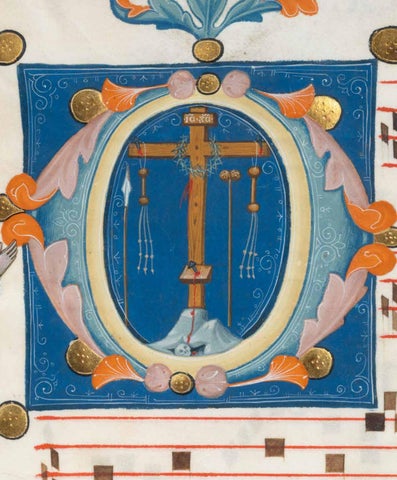
Initial letter O: the Instruments of the Passion venerated by the members of the Compagnia di Sant’Agnese
3. Master Francesco
Madonna and Child with saints
4. Nicolò Di Pietro
Lamentation over the Dead Christ
5. Francesco di Zanino and Zanino di Pietro
Mystical marriage of St Catherine
6. Benvenuto di Giovanni
Madonna with Child, St John the Baptist and St Jerome
7. Ludovico Urbani
Annunciation and the Miracle of the Eucharist
8. Giovanni di Ser Giovanni known as Lo Scheggia Birth salver
9. Jacopo di Arcangelo di Jacopo known as Jacopo del Sellaio
Madonna and Child with the Infant St John the Baptist and the Archangel Gabriel
10. School of Raphael (Evangelista di Pian di Meleto?)
Saint Sebastian
11. attr. Giuliano Bugiardini
Portrait of a lady
12. ‘Gallo Fiorentino’ or Master of the Campana Cassoni (Antonio di Jacopo Gallo)
The Nativity
13. Master of the Scandicci Lamentation
Madonna and Child
14. Ridolfo Bigordi known as Ridolfo del Ghirlandaio
Portrait of Pier Soderini
15. Venetian school
Saint Sebastian
16. Lombard school
Portrait of a man
17. Jacopo Tintoretto
Portrait of Vincenzo Morosini
18. Jacopo Chimenti known as L’empoli
Madonna and Child in a landscape
19. Louis Finson
Saint Sebastian
20. Circle of Michelangelo Merisi
da Caravaggio
Christ healing the sick
21. Pieter Paul Rubens and Jan Wildens
Act of devotion of Rudolph I of Habsburg
22. Giovanni Battista Vanni
David with Goliath’s head
23. Attr. Giovanni Francesco Barbieri known as Guercino
Neptune with trident
24. Girolamo Forabosco
Christ giving blessing
25. Carlo Dolci
Saint Benedict
26. Valerio Castello
The Virgin, God the Father and a Carmelite saint
27. Spanish school
San Diego de Alcalá
28. Cesare Gennari
Susanna and the Elders
29. Francesco Botti
Paris’ abduction of Helen
30. Francesco Conti
Holy family with St John, St Elizabeth and St Zachary
UMBRIAN-MARCHES PAINTER
end of the 13th century
Painted Cross ca. 1295
Tempera, gold and silver on panel, 160 x 119 cm - 63 x 46.8 in.
Inscriptions
INRI in the upper section
Exhibited
Florence, Galleria dell’Accademia, L’arte di Francesco. Capolavori d’arte italiana e terre d’Asia dal XIII al XV secolo, eds. A. Tartuferi and F. D’Arelli, 30 March - 11 October 2015; Perugia, Galleria Nazionale dell’Umbria, Francesco e la croce dipinta ed. M. Pierini, 30 October 2016 - 29 January 2017; Spoleto, Museo diocesano and Basilica di Sant’Eufemia, Museo nazionale del Ducato di Spoleto and Rocca Albornoziana (itinerant exhibition also held in Montefalco, Trevi and Scheggino), Capolavori del Trecento. Il cantiere di Giotto. Spoleto e l’Appennino, eds. V. Garibaldi and A. Delpriori, 24 June - 4 November 2018.
Bibliography
R. Longhi, Schede di pittura: una croce spoletina; contributo a Cimabue; Ghirladaio, ‘Il Vasari’, XXIV, 10, 1966, pp. 20-23; L.C. Marques, La peinture du Duecento en Italie centrale, Paris, 1987, p. 69; A. Tartuferi, in L’arte di Francesco. Capolavori d’arte italiana e terre d’Asia dal XIII al XV secolo, exhibition catalogue, eds. A. Tartuferi and F. D’Arelli, Florence, 2015, pp. 192-193: A. Delpriori, La scuola di Spoleto. Immagini dipinte e scolpite nel Trecento tra Valle Umbra e Valnerina Perugia, 2015, pp. 70-71; E. Zappasodi, La croce dipinta in Umbria al tempo di Giunta e di Giotto, tra eleganze dolorose e coinvolgimento emotivo, in Francesco e la croce dipinta, exhibition catalogue, ed. M. Pierini, Milan, 2016, pp. 91-92, n. 68; A. Delpriori, in Francesco e la croce dipinta op. cit., pp. 120-124; G. Spina, in Capolavori del Trecento. Il cantiere di Giotto. Spoleto e l’Appennino exhibition catalogue, eds. V. Garibaldi and A. Delpriori, Perugia, 2018, pp. 198-199.
A painter expresses ideas in images, articulating thoughts and sentences and entire discourses, often translating the Bible in its essential elements: the sublime concept of divine transcendence is revealed in the immediate multiplicity of subjects and emotional states. The quintessential Christian symbol, the cross, is interpreted as the locus in which to paint, explain and theatrically depict a number of extremely conceptual and difficult concepts through the simple use of line and color.
An anonymous Umbrian-Marches painter, for a commissioner unknown to us, had to explain to the population the meaning of love, forgiveness, sacrifice, devotion, sorrow and salvation. The symbol thus became a form of silent speech: in the wooden cross, a blue cross is painted on a silver ground (to
lend light to the overall composition, as if it were an apparition), and Christ with his reclining head is aware of and resigned to his purifying destiny. Alongside him the real, true, emotional drama plays out, a drama inherent to the earthly world: a mother mourns her dead son, and a friend looks on, terrified by the realization of the absence of the man he knew.
While on one hand, the modernity of Christ’s body is astonishing (everything is symbolic: the abdominal muscles, the hands, the legs are merely lines slashing the space) and we can compare it to the informal works of our day, on the other, the pursuit of spatiality and depth is moving.
In fact, we must understand how difficult it was, at the end of the 13th century, to depict these elements in painting as realistically as possible without possessing the basic mathematical knowledge of perspective used just a hundred years later during the Renaissance. The position of the legs - one further forward, with that foot, enormous compared to the other in a further-back position - is a trick to play up the forms, just as the swing of the hip and trunk in the area of the loincloth serves to suggest the space behind Christ’s body, and thus to highlight the shape of abdomen.
But the symbology is still the most important part of the composition as it was intended to speak to a humble, often illiterate audience which could understand, through the painting, the set of concepts mentioned above. It is not important that the Virgin and young St John are tiny in comparison with Christ; their presence symbolizes humanity wrestling with the mystery of faith, the ‘corpus christi’ like a consecrated host. Jesus’ face is the very image of the Suffering Christ (Christus Patiens), as he accepts his destiny as the redeemer: his hair resting on his shoulders, and above all the large halo, of wood successively decorated with gold leaf and engraving, are intended to create spatiality and the fiction of a physical presence projecting towards the faithful. It is extremely rare to find a surviving work from the late 13th century - a sort of ‘miracle,’
in fact. Moreover, in this instance, the Umbrian master once identified as Rinaldo di Ranuccio by Roberto Longhi (one of the greatest Italian art historians of the first half of the 20th century) tried his hand at an exceedingly rare - perhaps even unique up to the present moment - iconography, depicting St Francis and St Clare alongside the arms of the cross. The Franciscan figures explicitly declare the commission’s ties to that order so profoundly associated with Jesus’ teachings of love. The figurative language as a whole is on the one hand similar to the typical manner of 13th century Italian painting, but on the other displays some significant elements both in terms of morphology and style that might be defined as proto-14th century. This painted Cross should be compared with one painted by Rinaldo di Ranuccio and conserved at the Pinacoteca di Fabriano; the latter presents some very similar details in the way the loincloth twists around the waist, and in the position of the feet.
We should look at this work with a dual purpose: to understand the artist, who at the time made various efforts to seem modern; and to observe in silence the Christian mystery that the artist aimed to transmit with the utmost simplicity.
PACINO DI BUONAGUIDA
active in Florence between ca. 1303 and ca. 1347
Initial letter O: the Instruments of the Passion venerated by the members of the Compagnia di Sant’Agnese ca. 1340
Tempera and gold leaf on parchment, 37 x 34 cm - 14.5 x 13.3 in.
Inscriptions
Recto: LXXIII - [gal]lilea chol padre essendo / alla peschera giesu lo / sguardo chiara smera. / vochollo asse per grande / amore
Verso: Ognuomo / ad alta boce / laudi la vera croce. / Quante degna da lauda/re. Core no lo puo pensa/re. Lingua no lo puo...
Exhibited
Los Angeles, J. Paul Getty Museum; Toronto, Art Gallery of Ontario, Florence at the Dawn of the Renaissance. Painting and Illumination, 1300-1350 ed. C. Sciacca, Los Angeles, 13 November 2012 - 10 February 2013; Toronto, 16 March - 16 June 2013.
Bibliography
R. Offner, A critical and Historical Corpus of Florentine Painting Sect. 3, Vol. 6, New York, 1956, p. 194, pl. LIV; B. Drake Bohem, The laudario of the Compagnia di Sant’Agnese, in Paintings and Illumination in Early Renaissance Florence, 1300-1450 exhibition catalogue, ed. L. Kanter, New York, 1994, pp. 58-80; A. Ziino and F. Zimei, Quattro frammenti inediti del disperso laudario di Pacino di Bonaguida, ‘Rivista italiana di musicologia’, 34, n. 1, 1999, pp. 3-46; F. Pasut, Pacino di Bonaguida e le miniature della Divina Commedia: un percorso tra codici poco noti, in Da Giotto a Botticelli. Pittura fiorentina tra Gotico e Rinascimento symposium papers, eds. F. Pasut and J. Tripps, Florence, 2008, p. 47, fig. 9; C. Sciacca, Reconstructing the Laudario of Sant’Agnese, in Florence at the Dawn of the Renaissance. Painting and Illumination 1300-1350 exhibition catalogue, ed. C. Sciacca, Los Angeles, 2012, pp. 219-235, cat. 45.10.
This very well-preserved folio displays a lauda dedicated to the Holy Cross. The iconic interpretation of this subject matter, with the nails projecting from the cross and the crown of thorns atop it, also appears in the Lamentation panel in Pacino’s triptych in the Alana Collection.
This motif is influenced by Byzantine models, which testify to Pacino’s interest in experimenting with frequent iconographical channels. Richard Offner stated that the motif of nails left in the ends of the cross does not appear in the 13th century and is unusual in the 14th. As Agostino Ziino and Francesco Zimei have noted, the conception of this folio is slightly different from that of other Laudario folii. Owing to the absence of a large central miniature, the folio displays six musical staves and six lines of text, more than is typical, and the illuminated initial occupies only half the width of the text block. The composition of
The instruments of the Passion is closest to that of the St Andrew folio (Paris, Museè du Louvre, Inv. 9828).
At the same time, the folio displays an initial that is smaller than usual and does not contain the narrative scene typical of enlarged initials in the Laudario. In addition, while the resemble those in other Laudario folii in terms of their dress, their prayerful position, and their placement in the margin of the folio, other aspects do not match. For example, they are more numerous, larger in scale, and shown grouped tightly together rather than individually. Stylistically, the faces of these “compagnia” members are square-jawed and heavily outlined, and their flesh tones appear striated due to the unblended strokes used to model them. These aspects are reminiscent of the figures in the Last Communion of St Mary Magdalene illuminations (Cambridge, the Fitzwilliam Museum, Ms McClean 201.4).
MASTER FRANCESCO
active in Florence between the end of the 14th and the first decades of the 15th century
Madonna and Child with saints
ca. 1390-1400
Tempera and gold on panel, 91 x 50 cm - 35.8 x 19.7 in.
Inscriptions
Ave Maria Gratia Pl[en]a
Among the major art historians who have written of this petit maître (also known as Francesco Fiorentino) of late 14th century Florentine Gothic painting are Federico Zeri, Miklos Boskovits and Eve Borsook. Critics have identified the distinctive nature of the painting, comparing numerous works by the artist and noting that the works he was most often commissioned to paint were Madonnas with Child or Coronations of the Virgin (perhaps because he had ties to certain religious orders devoted to Marian worship). This Madonna with Child and saints respects the characteristics of his painting: nicely balanced, with exquisite gold decoration, delicately drawn with a steady hand. The Virgin is the central pilaster of the composition: her ample, well-delineated vertical presence offers the ideal background for the infant Christ, both as a counterpoint to brightness - the child
is dressed in gold, which stands out against his mother’s blue dress - and in terms of the sweet, affectionate gesture towards the Virgin, who looks lovingly at him. The expressive traits can be compared with the Madonna and Child in glory conserved at the Museo dell’Ospedale degli Innocenti in Firenze, but with our panel we are in a later phase of the artist’s career, and we can thus make an even better comparison with paintings like the Madonna and Child with St John the Baptist and St Nicholas of Bari from the church of Santa Maria in Quarto or the Crucifixion conserved at the Museum of Copenhagen (datable to the 1390s). The artist initially adhered to the style of Agnolo Gaddi, and later to that of the Master of San Martino a Mensola, from whom he learned and decodified a new way of lending roundness to forms and creating a delicate chiaroscuro using quick touches of light.
documented in Venice between 1394 and 1427
Lamentation over the Dead Christ
ca. 1420
Tempera and gold on panel, 21.5 x 28.5 cm - 8.5 x 11.25 in.
Bibliography
The powerfully concentrated qualities of this Lamentation, set at the foot of the Cross, inspired Roberto Longhi to write an appraisal dated 20 June 1965. Longhi was struck by the “potent pathos of the figures” and their “measured pauses”, but at the same time noted the “rhythms of the International Gothic, of Lorenzo Monaco and his kin”, thus declaring the likelihood of a sort of Late Gothic infancy for the great Masacciosomething he had denied, a priori, in his Fatti di Masolino e di Masaccio in 1940. The figures do have an emphatically Gothic cadence, swirling and swaying in the repetitive rhythms of the folds of their drapery, which descend like flower petals and curl in at the ends. At the same time, each character stands out with solitary intensity, forming an incisive and silent piece of sacred theatre. Yet we should understand what these flashing eyes mean, as well as the tremulousness expressed through gestures and poses, fostered by the free hand of the painter, darting about almost informally: a manner that is hard to reconcile with the plastic concentration that interested the young genius from the Valdarno at the outset of his career. The explanation for the “piercing eyes of the Magdalen” remarked on by Longhi may well be found in an entirely
different place, although his hypothetical dating, to around 1420, remains substantially the same: they are the vivid, penetrating eyes typical of the great protagonist of Late Gothic Venetian painting, Nicolò di Pietro, who once again reveals his superb prowess and startling - never banal - inventive qualities. Nicolò di Pietro is a painter who combines towering figures with an intimate frailty of gesture and gaze, as we can see in this exquisitely-narrated scene. The Virgin in his early masterpiece, the Belgarzone Madonna, signed and dated 1394 (Venice, Gallerie dell’Accademia, from the church of San Platone in Zara/Zadar), has a dome-like contour reflecting the more evolved forms of Paduan neo-Giottesque painting fashionable in those years in Padua, Treviso, Verona, Ferrara and even Bologna. One of the most striking elements in this Lamentation is the silence, the composed rendering of the sorrow of the onlookers who venerate Christ’s body like a relic, an altar over which the azure cross stands as the symbol of Christianity. The onlooker cannot help but join this band of people in adoration and prayer, folding his hands together and lowering his head like one of the women beneath the cross, in silence.
A. De Marchi, Nicolò di Pietro. A rediscovered Lamentation Florence, 2019.
FRANCESCO DI ZANINO
documented in Venice from 1408 to 1437
ZANINO DI PIETRO
documented in Bologna from 1389 to 1406 and then in Venice up to 1443
Mystical marriage of St Catherine
ca. 1430
Tempera and gold on panel, 56.5 x 45 cm - 22.2 x 17.7 in.
Bibliography
V.
The painting depicts a sort of hybrid between The mystical Marriage of St Catherine and The Madonna of humility, as the Virgin is sitting in a meadow. The painting was known by Federico Zeri who was the first historian to have recognised Zanino di Pietro and Giovanni di Francia as the same painter, an idea that was later supported and elaborated by Serena Padovani. The two works that mark the beginning and end of the painter’s artistic career are the Triptych of Rieti, in which the signature Caninus Petri appears, and the work from the Museum of Palazzo Venezia in Rome, signed Iohannes de Francia In the initial phase of the Rieti altarpiece, Zanino di Pietro demonstrates his knowledge of Jacopo Avanzi’s neo-Giottesque naturalism, albeit mellowed by a less-rigid handling of surfaces that suggest the influence of Gentile da Fabriano who was staying in Venice at the time. His later works, however, such as the one at Palazzo Venezia, show stylistic ties to the late phase of the Venetian gothic style. Zanino earliest efforts are documented during his stay in Bologna between 1389 and 1406, but he must have traveled to Bologna from Venice, and he probably already had a firm grasp on the rudiments of his art. In fact, his early works can be compared to those of Nicolò di Pietro, a pupil of Giovanni da Bologna. Zanino interwove Venetian stylistic elements with others from the hinterland, in particular Jacopo di Paolo’s heavy spatial elements, and Jacopo Avanzi’s variety of
foreshortened elements and profiles. Zanino’s return to Venice came at the right moment, and he was able to set up a prolific workshop following the example of Gentile da Fabriano.
The Crucifixion from the church of San Polo, painted at the beginning of the second decade of the 15th century, was the creative peak of that period.
During the third decade Zanino received important commissions such as the epistyle of the Cathedral of Torcello and the polyptych of the church of Mombaroccio in the Marches.
In this period his son Francesco, born in 1405, started his training in his father’s workshop as documented by his father’s 1408 will and by a 1431 contract with Marino Contarini to complete the façade of the Ca’ d’Oro in which Francesco is indicated as the head of the workshop. A large group of works for private commissions shows a slightly more developed style that can be associated with the master.
The painting analyzed here belongs to this group, along with one in a private collection depicting the Madonna with the Child and two saints They have a number of elements in common: the decoration of the arches in pastiglia, the Virgin’s pose and the gilded trim on her robes, the pattern of the fabrics and especially the flower-shaped punch marks produced by a single tool. For these reasons, we suggest that this work be attributed to Francesco di Zanino either based on one of his father Zanino di Pietro’s models or in collaboration with him.
Baradel, Zanino di Pietro. Un protagonista della pittura veneziana fra Tre e Quattrocento, Padova, 2019, pp. 228-229, fig. LX.
BENVENUTO DI GIOVANNI
1436 - Siena - 1518
Madonna with Child, St John the Baptist and St Jerome ca. 1475-1480
Tempera and gold on panel, 53.3 x 36.2 cm - 21 x 14.2 in.
Inscriptions
AVE GRATIA PLENA
Benvenuto di Giovanni was one of the major artists working in Siena in the second half of the 15th century. A student of Lorenzo di Pietro known as il Vecchietta, with whom he collaborated in 1453 to an extent as yet to be defined on the Baptistery of San Giovanni in Siena. This collaboration, which clearly had an influence on the younger artist, marked the beginning of a long career in which his style evolved over the years in an independent and often unconventional way. His first signed and dated work is the 1446 Annunciation painted for the church of San Girolamo in Volterra, a work that shows his ties to his master, but with innovative iconographic representations. In successive years his elegant style revealed his contact with miniature painters of the period, such as Liberale da Verona and Girolamo da Cremona, who were in Siena between 1466 and 1473 to carry out important commissions like, for example, the decoration
of choral and antiphonal books for the Cathedral.
The characteristics of the painting in question are, in fact, similar to those of a miniature in terms of lenticular expressive potency: precious materials, worked using multiple types of tools (punches) often created by the painters themselves, created the effect of broken, fractured light. While the circles around the halos are only intended to define the halos themselves, the punching around them defines light and its refraction to highlight the faces, sanctifying them and rendering them as pure luminous energy.
The Virgin’s mantle is the most delicatelyworked area: the myriad points of light of the lacquered red paint simulate the effect of brocade fabric, crowned by four large cabochon jewels.
Between 1480 and 1490, Benvenuto collaborated on the preparatory cartoons for
the decoration of the floor of the Cathedral of Siena, in particular for a Sybil and for the Expulsion of Herod, aided by his son, Girolamo di Benvenuto. His style in those years was a classical sort of formal spareness, a perception of forms that seemed a return to the past, to a classical Middle Ages of imagery that only partially conformed to reality. The panel in question dates to the artist’s peak period, and is comparable in terms of the arrangement of the figures with the Madonna with Child, St Jerome and St Bernardino of Siena conserved at the National Gallery of Art in
Washington, D.C., which dates to between 1480 and 1485 circa. There are also notable similarities with the shaping of the Madonna with Child in the Metropolitan Museum of New York, which dates to a slightly earlier period, and would thus place the panel being analyzed here at around 1475-80 circa. Observing this painting we can understand the symbolic value of gold in 15th century Sienese art: divine light spreads over the panel, shining with celestial glimmers, making the subjects incorporeal as they transcend and ascend to a divine world.
LUDOVICO URBANI
1460 - San Severino Marche - 1493
Annunciation and the Miracle of the Eucharist ca. 1480
Tempera on panel, 22 x 39 cm - 8.6 x 15.3 in.
Ludovico Urbani and Lorenzo D’Alessandro were without doubt the most important representatives of the Renaissance in the Marches region. We have few reliablyidentified works by Urbani, among which are the signed triptych depicting the Madonna enthroned with Child and angels with Saints Benedict and Sebastian conserved at the Museo Diocesano di Recanati (previously in that city’s Cathedral) and Madonna enthroned with Child and Saints Anthony the Abbot and Nicholas of Bari, on the market for some time but originally from the church of Santa Maria in Castelnuovo di Recanati. The former is datable via documents to around 1477, and the second around 1480.
A stylistic comparison with these two works allows us to confirm our painting’s attribution, observing the characteristics of the faces, the clothing and the setting of the scene. The work was surely part of the predella of an altarpiece, i.e. one of the small, horizontal paintings below the altarpiece itself that “explained” to the faithful the story of a saint through hagiographic elements, for example, or enriched the image in the altarpiece with descriptions of events that occurred prior to or following the one depicted above. In this specific case, Urbani divides the scene into two parts, taking full advantage of knowledge that became innovative and refined during the course of the Renaissance: the construction
of a perspective box within which figures can live and move about as if the viewer were observing the image through a window or an architectural aperture. The prelate on the right in adoration of the sacred host is in fact inside this “architectural construction” that divides the space of the story into two separate parts. On the left, the event of the Annunciation is illustrated inside a structure consisting of large arcades that allow us to see the setting in which the figures, much larger than the perspective scale would make them, experience the sacred moment. The two subjects are united for a specific purpose - to educate people about the mystery of the Eucharist: the Annunciation is the incarnation of the body of Christ who becomes man through the Virgin Mary. This iconographic element, depicted on the left, leads to the successive development on the right, where the prelate is in adoration of the Body of Christ symbolized by a large host hovering above the chalice from which blood of the Redeemer is drunk. We can thus hypothesize, observing the iconographic connection between the two parts, that the commissioner must have requested a Eucharist-themed subject, so the altarpiece above it may have depicted a Lamentation or a Crucifixion, thus celebrating the body of Christ and the parable of humanity’s redemption.
GIOVANNI DI SER GIOVANNI known as LO SCHEGGIA
1406 San Giovanni Valdarno - Florence 1486
Birth salver 1486
Tempera and gold on panel, Ø 63 cm - 24.8 in.
The painting is a rare birth salver (in Italy known as desco da parto), almost perfectly intact. Depicted on the front, in the middle of a flat frame with elegant trim, is a child sitting on the ground atop a cushion set in a flower-dotted meadow. He is holding a crown in his hand, which is clearly a gesture of good auspices for the life of the new infant. Above and below the central image, in clipei along the outer band of the frame, are the faces in chiaroscuro of an older man at the top, in three-quarter profile facing to the right, and a young adult man at the bottom, looking in the other direction. It is a lovely description of the three ages of man - childhood, adulthood and old age -, which can be taken as good wishes for a long life. This salver is not painted on the back; there is instead a raised part in the center, also trimmed and decorated with a gold band, which held the wooden rim a few centimeters off the surface it rested on, like a real tray. Salvers were widely used objects in Tuscany during the Renaissance. At the edges of the plate framing the depiction of the baby are two crests in silver, which can easily be recognized as those of the Capponi (on the left) and Alamanni (on the right) families, two of the most important Florentine families of the Medieval and Renaissances periods. There is little documentation about them, but we do know that in 1486 one of brothers of Gino, an illustrious member of the Capponi family, father of the important banker Ludovico Capponi, married a woman from the Alamanni family, Maddalena. We can imagine, unless further documentation is discovered that indicates other ties between the two families, that the salver must refer to an heir born of
this union. The style of the painting, in addition to the Florentine provenance ascertained from the two crests, leads to the same conclusion; in fact, it can immediately be recognised as an unusual but nonetheless fascinating work by Masaccio’s brother, Giovanni di ser Giovanni known as Scheggia, also known as Master of the cassoni Adimari. The painter’s catalogue, which is continuously growing thanks to the large number of objects for individual devotional use or other domestic contexts that often come onto the market, comprises painted and storiated chests, and other birth salvers. The most famous is one at the Metropolitan Museum in New York, painted for the birth of Lorenzo il Magnifico. The child’s face is particularly beautiful, sweet and expressive, and is quite reliably comparable with faces, for example, on the door panel of the organ at the Museo della Basilica di Santa Maria delle Grazie in San Giovanni Valdarno, although the painting of our work is more liquid and less sharply contoured, obviously due to the different chronology of the works. The same sort of comparison can also be proposed with the Baby Jesus in the Madonna’s arms in the lovely panel form the Musée du Petit Palais in Avignon. Our child’s blue eyes are a new element for the painter, but evidently must have depicted reality, perhaps copying the detail from one of the parents. Aside from this, interesting comparisons can be made with the birth salver from Palazzo Davanzati in Florence, not only in terms of the physiognomies of the figures, but also with regard to the flowered meadow at the bottom, which is substantially the same as the one that appears in our salver.
JACOPO DI ARCANGELO DI JACOPO
known as JACOPO DEL SELLAIO
ca. 1441 - Florence - 1493
Madonna and Child with the Infant St John the Baptist and the Archangel Gabriel
ca. 1490
Tempera on panel, Ø 86 cm - 33.8 in.
This tondo da camera is a particularly important example of a painting by Jacopo del Sellaio intended for domestic devotional use. The painter produced exquisite works of this kind, some of which were remarkably inventive. He primarily depicted the Madonna adoring the Christ Child in scenes based on the iconography of the Nativity. The present example, however, shows a “Madonna dell’Umiltà” (Madonna of Humility) viewed from the front and seated on a red cushion on the ground, so that the figure fits perfectly into the round format of the composition. The background is made up of an expansive river landscape flanked on both sides by rocks, with bluish tones fading into translucent veils on the horizon. The painter’s approach to the figures in this fantastical landscape, which extends horizontally, is suggestive of the final years of the master’s life, the period around 1490, when the influence of Perugino’s protoclassicism made itself more distinctly felt and a more austere and minimalist composition prevailed in works devoted to the adoration of the Child.
The Virgin and Child, still reminiscent of Botticelli’s compositions, express sweetness and tenderness in their gestures: as she tries to calm and restrain the child’s lively, kicking
legs, Christ leans against his mother’s chest in a way that seems extremely natural and typical of a hungry infant, although he is distracted by something happening outside the space of the painted scene. In fact, all of the main figures in the painting are looking outwards: we, the visitors, the onlookers, are the ones disturbing this sacred conversation between mother and son.
The young St John, with a gesture of blessing, presents the Christ child to us as if in a sacred image, and the border of the fabric that passes between the cross and his arm indicates him as he who takes away the sins of the world: ECCE AGNUS DEI QUI TOLLIS [peccatum mundi].
In 1490, Jacopo del Sellaio flaunted his mastery and awareness of his own capabilities, painting a landscape defined by a meandering river that lends depth and atmosphere to the scene, and gradually lightening the tones for the more distant planes. The ample drapery is also formally impressive with its depth, detailed on the sleeves, and transparent as well in the Virgin’s veil. This Madonna and Child looks out as if wanting to know us, observing us, presented by the young St John; Jacopo wants us to engage with his subjects as if with real people.
SCHOOL OF RAPHAEL (EVANGELISTA DI PIAN DI MELETO?)
end of the 15th and first decade of the 16th century
Saint Sebastian
ca. 1500
Oil on panel, 144 x 67 cm - 56.7 x 26.4 in.
Provenance
New York, Wildenstein, 1956 (source: Berenson Library, Photo library n. 8109975)
Bibliography
A. Delpriori, La preistoria di Raffaello e una luce su Evangelista di Pian di Meleto ‘Studi di Storia dell’Arte’, 31, 2020, pp. 67-92.
The formal and iconographic expression of this Saint Sebastian is exemplary: in the silence of a peaceful valley illuminated by late-afternoon sunlight, the Roman soldier Sebastian is transformed, via a martyrdom described by a single arrow, into a devout, humble, naked saint before the infinite love of the almighty God. Stylistic elements of the work, of exceptionally high quality in terms of drawing and nuance painting, suggest a date between 1498 and 1502: there are evident allusions to models by Giovanni Santi (Raphael’s father), Luca Signorelli, Pinturicchio and Perugino, for example in the background with those stylized trees, and in the warmth of the light. The face and the precise yet elegant pose of the saint, sketched with very delicate shading, also help us to compare this painting with Perugino’s more famous St Sebastian against a column, conserved at the Musée du Louvre, which demonstrates a grace that recalls models from antique sculpture portrayed in lustrous, luminous painting. We can hypothesize that the young Raphael - perhaps supported and guided by a painter dear to his father, a certain Evangelista di Pian di Meleto (ca. 1458 Piandimeleto - Urbino 1549) who was then working in the elder Santi’s workshop - may have participated in this refined, “idealized,” painting, transcending Perugino’s style and
keeping pace with more modern painters like Pinturicchio, but elevating his work to a purer form, characterized by clearly-drawn lines, anatomy that stands out in relief thanks to his modulation of the light, a marked complicity with and extensive study of drawing (in the archive of the family that owns that painting, a letter from Roberto Longhi attributes the work to Raphael). In addition to the iconographic restraint of the saint pierced by a single arrow from which a trickle of blood springs encapsulates in this scene all the best of the central-Italian Renaissance that could have been taken as a model at that moment.
While on one hand the anatomical study and the turgor of the flesh are highlighted with delicate reddish brushstrokes in the cheeks, elbows, knees and feet, on the other hand, the structure of Saint Sebastian himself is the pictorial translation of an antique statue, a Greco-Roman Apollo rising above the simplicity of the landscape: there are numerous azure fields that contribute to spotlighting the marble-like figure; the haze of the landscape in the background does not dull the telescopic view of the little town along the shore of the lack in the distance; we can almost hear the tolling from that bell tower if we have ever had the pleasure of strolling through the sunny countryside of central Italy.
attr. GIULIANO BUGIARDINI
1476 - Florence - 1555
Portrait of a lady
ca. 1510-1515
Oil on panel, 41 x 28.5 cm - 16.1 x 11.2 in.
The lady is in an imaginary, painted space, ideally set somewhere between art and fantasy, but she is nonetheless psychologically present, thanks to the painter’s decision to depict her in threequarters view. The pose was used very frequently, not only by Bugiardini, but in nearly all portraiture from the late 15th - early 16th century, as it grabs the viewer’s attention by suggesting movement, and imparts greater psychological intensity than portraits in profile.
The panel can be compared with a slightly larger, more figure-filled one in the Galleria Nazionale delle Marche di Urbino, best known as Portrait of a Gentlewoman (La muta). The three-quarters view, the monochromatic background (green in our painting, black in the Urbino one) drawn from Flemish portraiture, the style that shines through in the meticulous rendering of details and the glossy compactness of the painted surface are all clues to a fairly early dating for the work, around 1510-15. The combination of portrait and frame as a whole place the work in relation with many other portraits by Bugiardini, who was often inspired by the delicate smile and facial movements of Leonardo’s Gioconda. The greenish background is a very interesting choice made by the artist to heighten the contrast with the subject’s hair and better portray the features of her face, which cinematically “pops” off the surface of the painting.
Bugiardini is famous for having done a portrait of Michelangelo Buonarroti; the two were good friends. In his account of Giuliano’s life (the biography dates to the 1568 edition of the Vite), Vasari offers an amusing anecdote: Ottaviano de’ Medici had ordered a portrait of the master, who Giuliano called to pose for two hours while he distracted his friend by speaking about his favorite subjects. Michelangelo got up to have a look at Giuliano’s work and, to tease him, said that he had made one eye too close to the temple. Bugiardini set to work again with renewed fervor, but had to admit that he did not find the error in his work, so Michelangelo acknowledged that it may have been a natural defect of his, adding “continue and do not forgive the brush, nor art”. With this very human story, Vasari intended to highlight the importance of always improving in one’s work and never surrendering in the face of nature’s flaws. We can thus imagine the passion and effort that lies behind our portrait: the attention to detail in the clothes and jewels, the choice of background color that makes the woman appear at her best, the delicate veiling of brushstrokes that add the best possible light and sophistication of form in the eyes, the lips and the shading. Looking at this portrait and thinking back on Vasari’s anecdote, the observer finds himself in a dialogue with the woman, interpreting her thoughts through the mute painting.
‘GALLO FIORENTINO’ OR MASTER OF THE CAMPANA CASSONI (ANTONIO DI JACOPO GALLO)
documented in Florence from 1503 to 1527
The Nativity ca. 1510-1515
Tempera on panel, 68 x 52 cm - 26.7 x 20.4 in.
Bibliography
A. Bernacchioni, in Grassi Studio. Italian Paintings, Tefaf 2013 New York, 2013, pp. 40-42; L. Mattedi, Un plagiario di genio? Nuove indagini sul profilo artistico del Maestro dei pannelli Campana ‘Arte Cristiana’, CX, 926, 2021, p. 365 fig. 2f and p. 373; L. Mattedi, «Un curieux exemple d’émigration»: le Maître des panneaux Campana, in Les merveilleuses histoires de Thésée exhibition catalogue, ed. D. Vingtain, Avignon 2023 (eBook), p. 22.
The name Master of the Campana Cassoni originates from a 1976 article by Federico Zeri, in which the scholar reconstructed the artistic personality of this painter, describing him as being from “the other side of the Alps”. The name is derived from four wood panels which at the time of naming the artist, were believed to be decorations for cassoni or wedding chests. They are currently conserved along with the entire Campana Collection at the Musée du Petit Palais in Avignon. Another important scholar who came to a similar conclusion as Zeri, also in 1976, was Everett Fahy. Recently, Annamaria Bernacchioni proposed recognizing Antonio di Jacopo Gallo, a French painter, as the anonymous Master of the Campana Cassoni.
Antonio was documented as being in Florence between 1503 and 1527, a chronological period that would match Master Campana’s production and stylistic influences. In the meantime, the master’s catalogue has increased considerably, which has contributed to a better comprehension of his stylistic development. Two dates are certain: 1519 for the altarpiece of Montebicchieri (at the Museo Diocesano di San Miniato al Tedesco, Pisa) and 1522-1525 for the predella of the altar of the Oratorio del Loretino, in the Comune di San Miniato. If we consider the fairytale-esque, gothic style buildings of the Frascione painting, the French origin of the anonymous painter seems certain. The link between this painting and another of the
same subject now at the Fogg Art Museum in Cambridge (Inv. 1962-288) is unquestionable, although the one in Boston has a more naïve tone. The state of preservation of the Frascione painting is excellent and one can fully observe all of the artist’s technique and stylistic qualities, which are evident in the background with its fairy-tale landscape, the swollen eyes of some of the figures, and the stereotypical faces reminiscent of the master himself. The Frascione Nativity has strong similarities not only with the Fogg Museum’s painting, but also with other paintings from around 1515, like those in the Gerini Collection in Florence and the Stössel collection in Zurich, or even the Signorini
Corsi paintings in L’Aquila. The Frascione composition can be dated to the middle of the second decade of the 16th century, a proposal supported by the highlighting and chromatic features of the painting (in particular the landscape and the forest). This is a clear reference to paintings by Piero di Cosimo, an indispensable model for Florentine painters in the first decades of the century. In terms of composition, the painting clearly references Domenico Ghirlandaio and Lorenzo di Credi. The Frascione painting reveals an artist who was able to quite thoroughly assess the most important artists of his time who were working in Florence and emulate what he had learned with a unique, personal style.
MASTER OF THE SCANDICCI LAMENTATION
active in Florence between the end of the 15th and the first decades of the 16th century
Madonna and Child
ca. 1510-1520
Tempera on panel, 75 x 57 cm - 29.5 x 22.4 in.
Provenance
Possibly Maffeo Barberini (Pope Urban VIII), thence by descent to Carlo Barberini (17th century), Palazzo Barberini, Roma: una Mad.a in tavola d’Innocenzo da Imola con cornice a fogliame dorate con la bandinella rossa; Possibly Cardinal Antonio Barberini, Palazzo de’ Giubbonari, Roma: Un quadro grande p.m. 3, e 2 1/2 in tavola rappresenta una Madonna, che tiene il Bambino in Braccio, mano di Inn.o da Imola, con Cornice d’orata intagliata no. 1 - 50 scudi; Cardinal Carlo Barberini, Palazzo Barberini, Roma: Una Madonna in tavola col Bambino al: p.mi 3:1:2 Cornice nera, e oro d’Innocenzo da Imola; in the 20th century: Private collection, England (?); Lorenzelli collection, Bergamo; Private collection, Munich; Private collection, England.
The Madonna and Child in a landscape has an extraordinarily well-preserved surface: details like the thickness of the brushstrokes, the gradation of the shadows and the highlights in the landscape teeming with grasses and little figures can still be fully appreciated. This painting fits well in the oeuvre of an artist who remains anonymous and whose meager body of painted work is gathered under the name of Master of the Scandicci Lamentation. Everett Fahy was the first scholar to identify a number of paintings similar to the Lamentation with Saints John the Evangelist, Joseph of Arimathea, Sebastian, Nicodemus, Agatha and Magdalen in the church of San Bartolo in Tuto in Scandicci. The works had been variously attributed to Ridolfo del Ghirlandaio or to an artist close to Francesco Granacci, a true “deus ex machina” of the expressive tendencies undermining Florentine classicism in the early 16th century. To understand the attribution of this group of works to the same artist, we need only compare the face of the St Agatha of the altarpiece in Scandicci with that of the Madonna in our painting, which although of much higher quality, it fits well into the artist’s corpus and with a dating in the first half of the second decade of the 16th century. From the late 1510s to the late 1520s,
many artists from the workshops of Domenico Ghirlandaio, Piero di Cosimo and Filippino Lippi began criticizing and dismantling the restraint and the equilibrium of classicism prevalent at the beginning of the century. The most bizarre of these masters (Giovanni di Lorenzo Larciani, Antonio di Donnino del Mazziere, the Master Allegro and the Master of Serumido) were grouped together by Federico Zeri, who identified their common stylistic excesses, analyzed in two masterful 1962 articles entitled “Eccentrici fiorentini”.
The Master of the Scandicci Lamentation had not yet been identified in 1962 but would have fit easily into this group, with his critical view of a tradition that continued to impose tired repetitions of old models. The anonymous master’s works achieved a very high level of quality immediately after the completion of the Scandicci altarpiece. At that time, the Master of the Scandicci Lamentation reelaborated Raphaelesque or Leonardesque examples, bringing in modern and eccentric influences. This turned into a dialogue with some of the oddest and most novel artists of the second decade of the 16th century, in particular Larciani for his landscapes and Granacci, in his most Michelangelesque period, for figures. In addition to these varied sources,
the Master of the Scandicci Lamentation also aimed for an enchanted atmosphere derived from the School of San Marco. There is also a distant echo of Leonardesque landscapes translated into modern language which had begun to inspire the “Florentine eccentrics” by the second decade of the 16th century. This made way for stylistic influences from northern Europe, discovered through exposure to German engravings. The most likely dating is between the first and the second decades of the century, due to the evident influence of Raphael’s Madonna del Granduca, a composition that seems to have been revisited here, reversing the spatial relationship between Madonna and Child, depicted in a pose that is both unnatural and more dynamic thanks to the intertwining of the child’s legs and the mother’s hands. It is also quite significant
that the verso of this work bears the emblem of Cardinal Carlo Barberini, from one of the most important noble families in Rome and Italy both in terms of ecclesiastical appointments and art collecting. In fact, the Barberini family had great influence in Rome and among all of the artists who worked there in the 17th century, not only in terms of quantity - they commissioned an astonishing number of works - but also quality, thanks to the importance and grandiosity of the commissions and the great artists they engaged. Among the many who worked for the Barberini clan were - to name just a few - Pietro da Cortona, Gianlorenzo Bernini and Francesco Borromini. The family’s collections amassed both works from their day and antique ones, as this painting tangibly demonstrates.
Detail of the back of painting, with the seal of Barberini family
RIDOLFO
1483 - Florence - 1561
Portrait of Pier Soderini
ca. 1515
Oil on panel, 66.5 x 52 cm - 26.1 x 20.4 in.
Exhibited
Genoa, Palazzo Ducale, appartamento del Doge, Michelangelo. Divino artista eds. C. Acidini with A. Cecchi and E. Capretti, 21 October 2020 - 14 February 2021.
Bibliography
L. Goldenberg Stoppato, in Ghirlandaio. Una famiglia di pittori del Rinascimento tra Firenze e Scandicci, exhibition catalogue, ed. A. Bernacchioni, Florence, 2010, pp. 117-119; S. Bellesi, in Immaginifico viaggio dipinto in sette quadri e una miniatura attraverso l’Italia: XV-XX secolo with introduction by C. Sisi, Florence, 2015, pp. 28-30 fig. 1; Michelangelo. Divino artista, exhibition catalogue, eds. C. Acidini with A. Cecchi and E. Capretti, Genoa, 2020, pp. 244-245.
The portrait presented here exemplifies the Renaissance quintessence of the genre: the figure, a half-bust three-quarter view with highly individualized facial features, cinematically “pops” from the wooden panel on which it is painted, forcefully and incisively entering our space. Ridolfo del Ghirlandaio’s capacity to utilize Flemish-style naturalism and the characteristic elements of Italian portraiture make this painting an outstanding example of the Renaissance portrait. Like the Gioconda, for example, Pier Soderini is depicted with a parapet behind him (as if he were sitting on a balcony or a loggia), and in the background an expansive landscape in which natural elements, roads, towers and fortresses are meticulously illustrated. The work’s attribution to Ridolfo goes back to Roberto Longhi’s well-known manuscript from April 23, 1957, but this painting has been published several times with the same indication by eminent scholars including Lisa Goldenberg Stoppato, Sandro Bellesi and Elena Capretti. The interpretation of Flemish painting united with a language that tended to delineate very distinctive faces (as in Ridolfo’s Portrait of Girolamo Benivieni at the National Gallery in London, or the Portrait of a man at the Clark Institute in Williamstown, MA) is indicative of Ridolfo’s painting characterized by subjects with wrinkled flesh, sharp, penetrating eyes and a lively expressivity.
The subject of this portrait, Piero di Tommaso Soderini, was born in Florence in 1451 and was a member of an illustrious Florentine family who held prestigious public offices by 1481. After a difficult and politically turbulent period in Florence (the rise of Savonarola and the temporary expulsion of the Medici), in 1502 he was named a lifelong gonfalonier of the Florentine Republic alongside important figures including Marcello Virgilio Adriani and Niccolò Macchiavelli.
One of the grand undertakings Soderini organized for the city of Florence was the decoration of the Great Council Chamber above the residence of the Signoria: Leonardo da Vinci and Michelangelo Buonarroti were asked to create wall paintings of the Battle of Anghiari and the Battle of Cascina respectively (the paintings never came to fruition). Soderini was also responsible for the placement in Piazza della Signoria of Michelangelo’s grandiose David, a gigantic emblem of virtue, love for the populace and faith in God. With the Medici’s return and the end of the Florentine Republic, Soderini was sentenced to exile (1512), although a year later he managed to obtain a pardon from Pope Leo X Medici in Rome, where he died in 1522.
VENETIAN SCHOOL
mid 16th century
Saint Sebastian
ca. 1520-1530
In an architectural niche where the umbra shadow cone of the imposing St Sebastian falls on the pavement and bends into the concave wall behind him, the story of the saint is summed up in the arrow still piercing his shapely body, and in the decision to depict the young Roman soldier as an ancient sculpture. The idea arose in the atelier of one of the most important Italian Renaissance painters, internationally known then as now: the workshop of Titian. The prototype is the altarpiece for the church of San Niccolò dei Frari in Venice (now in Vatican Museum, Rome), a canvas of exceptional size (over four meters high and three meters wide) with a highly developed composition on two planes: above, the Virgin with Child and angels, and below them six saints in various poses and from different points of view, from profile to a view from behind. In the middle, the signature Tizianus Faciebat stands out, inscribed in an architectural scroll in relief with respect to the apse where the mystical event takes place. Our canvas is certainly antique, and we can presume that some esteemed pupils worked on it, having available an unfinished canvas, some of the master’s drawings, or some notes taken during the creation of the altarpiece (painted, according to scholars, between 1521 and 1522). Titian had previously painted a pose similar to that of the saint a few years earlier for an altarpiece depicting St Mark with Saints Cosmas and Damian, Roch and St Sebastian for the church of Santa Maria della Salute in Venice, but this canvas
demonstrates a significant similarity with the saint from the San Niccolò dei Frari painting, not only in terms of the pose (nearly identical in the two Titian altarpieces cited) but especially in the study of light and the architectural setting.
The light comes from the left side, generating a play of chiaroscuros in the niche, creating the shadow of the architectural element which intersects that of the saint, and lending a warm tone to the flesh. Delicately colored shadows define the anatomy and the second lights for the face, in keeping with the best of Veneto tradition, passed down from Giovanni Bellini, through Giorgione, to Titian and his workshop, shading, shaping and invigorating musculature and rendering the figure threedimensional, projecting outwards toward the viewer.
Among St Sebastian’s most significant attributes are arrows, often piercing his flesh, which testify to one of his most important martyrdoms: a Roman soldier converted to Christianity was condemned to death by Diocletian and shot with innumerable barbs. But the saint did not die on that occasion: one of the depictions in his hagiography is Sebastian tended by Irene, the woman who kept him alive. Sebastian then had the courage to go back to Diocletian and accuse him of persecuting Christians, for which he was arrested and condemned to death by flogging, and his body thrown into the Cloaca Maxima (another event from the saint’s life often painted in the 16th and 17th centuries).
LOMBARD SCHOOL
first half of the 16th century
Portrait of a man
ca. 1540
Oil on canvas, 36 x 36 cm - 14.2 x 14.2 in.
A mocking expression, the upturned corners of the mouth suggesting an enigmatic smile, a bulbous eyeball and a pronounced nose, high cheekbones and veins in the head slightly accentuated at the temples all tell us that we are looking at a real person who actually existed, although we are not yet able to establish his identity.
The portrait’s small format and meticulously detailed dermal description of the subject place the canvas in northern Italy, in the zone between Milan, Bergamo and Venice. The figure is not completely in profile, but in a just-barely-three-quarters view intended to simulate a sort of movement, as if the person were about to turn towards us. While the painting is descriptive and meticulously detailed, it neither possesses nor aims to copy the type of precision found in Flemish art (in the manner of Hans Holbein or Hans Memling, for example), but if anything draws inspiration from it to construct a real, psychologically and theatrically present individual, making use of the shadow brought in on the left and projected against the green background.
Among the major artists who possessed the qualities and intelligence to interpret Flemish painting, Italianize it and make it their own, Lorenzo Lotto (Venice 1480Loreto 1557) was certainly one from northern Italy who could have developed such an appealing presentation for a small portrait.
An artist with classical training and modern culture, Lotto developed portraiture into a formula that had not previously been seen in Italian art, trying different poses each time, expressing the subject’s psychology and mood in often distinctive ways, always adding variations (three-quarters view, full figure, half-bust, head only).
This canvas surprises us with the strong characterization of the subject and the unusual pose for the 1540s.
The painting of the black clothing is also quite charming, with color nuances and chiaroscuro still intact and clearly perceptible, and the white point of light on the raised shirt collar, almost like a modern photographic lightdiffuser to lend greater intensity to the light on the face.
JACOPO TINTORETTO
1518 - Venice - 1594
Portrait of Vincenzo Morosini
ca. 1580
Oil on canvas, 118 x 99 cm - 46.4 x 39 in.
Among the most powerful and influential Venetian families, Vincenzo Morosini’s (Venice 1511-1588) could be defined as one of the richest and oldest. Vincenzo had a dazzling career: a knight of the Order of the Golden Stole (an honor accessible only to a few patrician families with members in the Senate or highly prestigious military ranks), he was elected to the Venetian Senate in 1565 with military and financial responsibilities, and in 1571 he was tasked with leading military actions to defend the lagoon against the Turkish invasion. His institutional importance grew even further the following year when he represented Venice during the coronation of Pope Gregorio XIII; it was very likely that year that he received his knighthood.
The portrait presented here shows Morosini elegantly robed, wearing the decorated golden stole of his order and holding his gloves in his right hand, his penetrating, haughty gaze directed at viewers as if about to interrogate them as to the reasons for their presence. There are three known paintings by Jacopo Tintoretto depicting Morosini: one in the National Gallery in London (considered a sort of study model for the other two), the large one in the Palazzo Ducale in Venice on which
his name and the date 1580 are written, and the altarpiece for the family chapel in the church of San Giorgio Maggiore in which he is depicted as a donor.
The close relationship and the esteem Morosini had for Jacopo Tintoretto must be underscored: Carlo Ridolfi (art writer and biographer and a painter himself) notes in the family collection a Virgin with Child, a Vulcan, and a canvas depicting St Lawrence, all by the famed Venetian artist.
In this painting, the figure of Vincenzo Morosini stands out from the silvery background, advancing towards us threedimensionally, thanks to the power and beguiling capacity for illusion of Tintoretto’s painting. We seem to be looking at a tempest of lights: the figure advances from one plane to the next, becoming flesh, a real presence, thanks to an astonishing technique we see only as flashes of light darting across the red toga (slightly shaded, the color deepening depending on the depth), the hands (pink and lilac veins) and the face.
The three-quarters position not only contributes to the illusion of the figure advancing into the space (the slightly raised left hand also alludes to forward
movement), but is also important for the subject’s physiognomy and psychological thrust. The rapid, resolute, decisive touches of color in the face become a mosaic of light and shadow which, at the right distance, are recomposed to constitute a pictorial unicum of great expressive force and emotional impact: Vincenzo Morosini is standing before us, questioning us, haughty and impenetrable; he has a life of his own, which comes through in the pulsing veins of his hand, the slow
gesture of his left hand, the gloves that fold in his grip. His beard, although long, leaves a glimpse of the contour of his face; the reddish threads move slightly, dartingly, with his confident step. The observer must have a certain reverence before this portrait, feeling its power, the strong character of its subject and of its painter. We are around 1580; Vincenzo Morosini still considers himself strong and invincible, and so Tintoretto presents him to us.
JACOPO CHIMENTI known as L’EMPOLI
1551 - Florence - 1640
Madonna and Child in a landscape ca. 1595-1605
Oil on canvas, 58.5 x 46.5 cm - 23 x 18.3 in.
This fine painting depicts a tranquil composition stylistically in keeping with the Raphaelesque classicism that was a typical mode of expression in a specific cultural period in late 16th century Florence, following the completion of the Gallerie degli Uffizi in 1584. This architectural treasure trove gathered paintings by Pontormo, Bronzino, Andrea del Sarto and Raphael. The artists who witnessed the museification of these masters absorbed a purist and classicist style in those few years, consistent with the dictates of the Counter-Reformation. The champions of this revival were Santi di Tito and Jacopo Chimenti da Empoli. This painting can therefore be compared to a series of small allegorical figures that were once attributed to Santi di Tito, but have now been recognized as the work of Empoli in the forthcoming catalogue for the Fesch Museum in Ajaccio. The stylistic unity of the entire group leads us to consider the paintings as a whole, although a slight chronological progression seems to differentiate some paintings from others. The five Fesch paintings, and a sixth in a private collection, like this Madonna and Child, present some general similarities with the work of Santi di Tito at first glance, but upon careful observation, we notice that all the figures have similar features, such as a rounded nose with a sloping tip, oval eyes, and hands with
graceful fingers and small almond-shaped nails. The combination of these elements, along with the statuesque presence of the figures, the delicacy of the color combinations and the atmospheric nature of the landscape in the background, which we also find in the painting under consideration here, are clear evidence that the author of this work is an artist who manages to outshine Santi di Tito. If we look at a painting like the Glaucus and Scylla at the Museo Civico di Sansepolcro, which was previously attributed to Santi di Tito but then rightly ascribed to Jacopo Chimenti, we discover the key to demonstrating that the latter is the creator of this set of exquisite purist works. In the five Fesch paintings, as in this Madonna and Child, the figures stand alone in an atmospheric landscape that reflects the taste for restrained and harmonious landscape backgrounds so common to the artists of the early sixteenth century. In Empoli’s work, this was almost a conscious reutilization of the Leonardism of the young Andrea del Sarto and the Florentine Raphael. Looking at the 1609 Annunciation by Jacopo Chimenti in the church of the Santa Trinita from 1609 and the face of Frascione Madonna, the similarity is clear. This comparison allows us to confidently date this work between the end of the 16th century and the first years of the 17th.
LOUIS FINSON
1580 Bruges - Amsterdam 1617
Saint Sebastian
ca. 1607
Oil on canvas, 113 x 79 cm - 44.5 x 31.1 in.
Sources
Inventory of Cardinal Filomarino (12 May 1634), published in G. Labrot, Documents for the History of Collecting: Italian Inventories 1. Collections of Painting in Naples 1600-1780, Munich, 1992, p. 24.
Madrid, Museo Thyssen-Bornemisza, Caravaggio y los pintores del norte ed. G. J. van der Smann, 21 June 2016 - 18 September 2016.
Bibliography
G. Papi, Un precoce ‘San Sebastiano’ di Finson ‘Paragone’, LXVI, n. 120, 781, 2015, pp. 17-21; G. Papi, in Caravaggio y los pintores del norte, exhibition catalogue, ed. G. J. van der Smann, Madrid, 2016, pp. 188-189.
A painting very much in attunement with the works of Caravaggio, this St Sebastian by Louis Finson can be chronologically placed during his first sojourn in Naples, between 1605 and 1612. Sources attest that Louis was friendly with Merisi, who resided in Naples between 1606 and 1607 and from 1609 to 1610.
The saint’s iconographical characteristics are canonical: standing tied to a tree, he is pierced by numerous arrows, with a white loincloth around his hips. Finson demonstrates his knowledge of the main stylistic features of Caravaggio’s art, not only with regard to his handling of colors and light, but also the capacity for dramatic interpretation. In fact, we can note that the painter chose to paint a certain device that
we might call theatrical: the arrow on the left is not piercing the ribcage, but rather, on closer inspection, is about to strike the body, from which blood is already gushing. A dramatic effect; a trick to render the moment of martyrdom an event happening before the viewer’s very eyes; a clever means of bringing the composition alive. Thus we can understand how much attention Finson must have dedicated to observing Caravaggio’s paintings (one of which, the Madonna of the Rosary now in the Kunsthorisches Museum in Vienna, he personally carried with him in his northern European peregrinations): from the semi-darkness, a flash of light strikes St Sebastian, his head slightly bent, nearly moribund, and his body still tensed from the pain of the arrows piercing it. His right hand
seems to be trying to free itself, reacting to the tightness of the rope that highlights the folds on his belly. Textural and pulsating, the paint follows the movement of the saint’s skin, wrinkling and darkening into deep black dabs, as ruby-red drops seem to ooze from his skin and veins, and the light flares in the purer white of the loincloth. A follower of the Caravaggio revolution, Finson can be defined as one of the master’s true acolytes and apostles: this canvas can be compared with one from the Whitfield collection in terms of the rendering of the skin and the dense paste
of the paint, but not in terms of interpretation of the subject (the Whitfield St Sebastian is lying on the ground). The pronounced naturalism is highlighted, for example, by the clear light, the description of the folds of skin, and the realism of the ropes. A detail that further aids in the attribution to Finson are the long, slender fingers with drawn nails and the typical touch of light at the ends. Scholars have noted the work’s possible provenance from the Filomarino collection in Naples, as its 1634 Inventory recorded a ‘San Sebastiano’ by Finson.
CIRCLE OF MICHELANGELO MERISI DA CARAVAGGIO
1571 Milan - Porto Ercole 1610
Christ healing the sick
ca. 1610
Oil on canvas, 194.4 x 145 cm - 76.5 x 57 in.
Bibliography
M. Marini, Io Michelangelo da Caravaggio Rome, 1974, pp. 256-259, n. 81; E. Borea, Caravaggio e la Spagna: osservazioni su una mostra a Siviglia, ‘Bollettino d’Arte’, vol. 1-2, 1974, pp. 45-46, note 12, fig. 2; B. Nicolson, The international caravaggesque movement Oxford, 1979, p. 38; B. Contardi, Caravaggio Rome, 1979, fig. 26; M. Cinotti, Michelangelo Merisi detto il Caravaggio. Tutte le opere Bergamo, 1983, p. 569; M. Marini, Caravaggio. Michelangelo Merisi da Caravaggio «pictor praestantissimus». La tragica esistenza, la raffinata cultura, il mondo sanguigno del primo Seicento, nell’iter pittorico completo di uno dei massimi rivoluzionari dell’arte di tutti tempi Rome, 1989, pp. 214-215, 469-471, n. 55; M. Marini, Caravaggio «pictor praestantissimus». L’iter artistico completo di uno dei massimi rivoluzionari dell’arte di tutti i tempi, Rome, 2001 (first edition 1964), pp. 256-257, 485-487, n. 64; M. Marini, “Intendo che è capitato [in Ascoli] il Caravaggio, pittore eccellentissimo et di molto valore, anzi il primo che oggi dì sia in Roma, et per quanto intendo si fermerà”: Caravaggio, il Seicento e le Marche in Meraviglie del Barocco nelle Marche. 1. San Severino e l’alto maceratese, exhibition catalogue, eds. V. Sgarbi and S. Papetti, Milan, 2010, pp. 39-45, see in particular p. 40 fig. 2; F. Scaletti, La ridda delle attribuzioni, in Caravaggio Vero, ed. C. Strinati, Reggio Emilia, 2014; C. Strinati, Un enigma caravaggesco, in Una vita per la storia dell’arte. Scritti in onore di Maurizio Marini ed. P. Loreto, Rome-Foligno, 2015, pp. 389-393, fig. 1; F. Scaletti, Caravaggio. Catalogo ragionato delle opere autografe, attribuite e controverse, Naples, 2017, pp. 90-91, 216-217, n. D11.
The colossal canvas with the dramatic evangelical scene in which Christ heals the lame has interested many eminent scholars over the past 50 years, including Maurizio Marini, Fritz Heinemann, Giuliano Briganti and Didier Bodart. Published in 1974 by Maurizio Marini as Caravaggio in his most extreme, Sicilian phase, it later earned the favor of critics who attributed it to the master’s southern followers.
Two contrasting forces are juxtaposed in this canvas: the harsh light from the upper left which defines the surfaces of the bodies and the depth of folds in their robes, and the majestic power of Christ on the right, who with a simple but eloquent gesture performs the miracle of healing.
While the group on the left shows numerous similarities with the Lombard master, critics have most recently preferred prudence and, as mentioned, now attribute the canvas to a master from southern Italy. The most
convincing comparisons are with figures painted by Battistello Caracciolo (Naples 1578-1635), which present the same facial characteristics, derived from Caravaggio but summarized and rendered in the handling of the paint and the skin, and the sharp contrast of the chiaroscuro, particularly in the deep shadows of clothing and anatomical delineations.
The subject also suggests that the artist was among those most well-versed in works by Caravaggio and his closest followers, as Christ’s miraculous healings would seem to be very much in line with, for example, the Seven acts of mercy, or the gesture with the raised arm in the Calling of St Matthew
The thaumaturgical characterization of the raised arm lends a diagonal thrust to the composition, giving the scene a sense of direction as well as a boundary above which none of the figures on the left dare surpass in height: from the almost-frightened face
of the old woman to the pleading eyes of the boy closest to Christ’s red tunic. The draping of that raised arm is in penumbra, and the luminous counterpoint is the hand from which light seems to shoot, as well as the ridges of the red drapery beneath that delineate it thanks to the consequent lines of alternating shadow and light.
Although we are not yet able to demonstrate a certain association with the names of the best-known artists close to Caravaggio, the canvas - perhaps in part thanks to this air of mystery - is still a work of great impact and fascination.
PIETER PAUL RUBENS
1577 Siegen - Antwerp 1640
JAN WILDENS
1585/86 - Antwerp - 1653
Act of devotion of Rudolph I of Habsburg
ca. 1616
Oil on canvas, 184.8 x 271.8 cm - 72.7 x 107 in.
Provenance
Don Diego Messía Felípez de Guzmán, First Marquis of Leganés (1580-1655); Spencer-Churchill, Northwick Park, ante 1864; sale, Christie’s of London, October 29, 1965.
Exhibited
Genoa, Palazzo Ducale, appartamento del Doge, Rubens a Genova eds. N. Bütter and A. Orlando, 6 October 2022 - 22 January 2023.
Bibliography
Catalogue of the Pictures... at Northwick Park 1864, n. 77; [T. Borenius], Catalogue of the Collection of Pictures at Northwick Park, London, 1921, n. 157; W. Adler, Jan Wildens, der Landschaftsmitarbeiter des Rubens Fridingen, 1980, pp. 30, 99, n. G.27, p. 159 fig. 43; D. Bodart, Rubens Milan, 1985, p. 173 n. 420a; M. Díaz Padrón, El siglo de Rubens en el Museo del Prado. Catálogo razonado de pintura flamenca del siglo XVII 3 vols., Barcelona, 1995, vol. 2 p. 1110; E. McGrath, Rubens. Subjects from History (Corpus Rubenianum LB, XIII), 2 vols., ed. A. Balis, London, 1997, vol. 2 pp. 311-312 entry n. 56; J. J. Pérez Preciado, El Marqués de Leganés y las artes PhD thesis, 2 vols., Universidad Complutense de Madrid, 2008, vol. 2 p. 95; N. Büttner, in Rubens a Genova, exhibition catalogue, eds. N. Büttner and A. Orlando, Milan, 2022, pp. 359-361.
In a forest at dusk, Rudolph I of Habsburg (1218-1291), out riding, comes across a priest who at that moment is carrying the Blessed Sacrament; as proof of his devotion, the prince decides to let the priest ride on horseback and accompany him on foot. The illustration of this subject, which was oft-used at the time of the Catholic Reformation as an emblem of the sovereign and the Habsburg dynasty, is rendered with great acuity in a majestic, theatrical scene. Various versions of the subject are known from documentation but now lost; the most similar currently viewable is conserved at the Museo Nacional del Prado, and differs from the one presented here in a few of the naturalistic details, and in Rudolph I’s suit, which in the Spanish
museum’s painting is light-colored. Critics know well that in order to satisfy his many prestigious commissions, Rubens needed reliable collaborators in his workshop, one of whom was Jan Wildens, who we know helped Rubens particularly with landscape elements.
Considered the father of the European Baroque, Rubens was extremely talented not only from the artistic point of view, but also in terms of his gifts as a marketer and salesman, which allowed him to build relationships and friendships with people who had connections to his most important commissioners. He traveled a great deal and had a special bond with Italy, where he stayed for eight years, some of the time in Venice (where he was steeped in the work of great 16th century
Veneto painters, Titian first and foremost). In 1601 he became a painter at the court of the Duke of Mantua, a position he held until 1608 when he left for Antwerp. He of course visited Rome, and was thus able to see the painting of Michelangelo and Raphael first-hand, and especially to familiarize himself with the work of Caravaggio and Annibale Carracci. His ties with Italy remained strong even after he returned to his homeland, and his muchsought-after painting was considered both contemporary and classic, innovative and stunning.
This imposing canvas shows his interpretation of how the great Veneto painters used light, and at the same time, the magniloquence and drama of the composition in themselves create a Baroque ambiance: an expansive, airy space where the imposing figures make broad, pondered gestures, the slightly ragged-edged and impetuous painting (quick and liquid in some spots, textured and light-filled in others) enlivens the scene with a virtuoso technique in which the silver-gray preparation enhances the chiaroscuro. Some parts, like the highlydelineated and richly-detailed faces of the figures, are of extremely high quality, the sort of touches that only the master could have added to finish and perfect the painting. The group of dogs on the left display the quick, cursive brush strokes that only the great Baroque painters could master (the Genoese above all). The layers of paint achieve a superb effect especially in spots where, when the paint was nearly dry, the master added the final, precious touches of light. It is important to underscore the provenance of this painting, which in 1642 was owned by Diego Messía Felípez de Guzmán, First Marquis of Leganés (1580-1655), a well-known collector engaged by Philip IV as a special envoy to the Low Countries. In 1628 the Marquis married Polissena Spinola and became the son-in-law of Ambrogio Spinola, Marquis of Balbases (1569-1630), general of Albert of Habsburg’s troops and a friend of Rubens.
GIOVANNI BATTISTA VANNI
1599 Florence - Pistoia 1660
1623
This exquisite sketch depicts the triumph of David, the biblical hero venerated in Florence since the earliest days of the Florentine Republic. One of the cardinal achievements of Giovanni Battista Vanni’s artistic career, the work is indissolubly linked to - in fact constituting a bold and clearly inspiring
antecedent of - the large canvas (132 x 117 cm - 52 x 46 in.) conserved in Galleria di Palazzo Alberti (Prato), a masterpiece painted by the young Florentine painter which is not only of sublime artistic quality, but also has a valuable inscription that documents the artist and the date of its creation:
David with Goliath’s head
Oil on panel, 22 x 18 cm - 8.6 x 7 in.
Giovan Battista Vanni, David with Goliath’s head, Prato, Galleria di Palazzo Alberti
“GIO BATTISTA VANNI FEDI NEL 1623”.
In that period, Vanni had not long before left the studio of his master Cristofano Allori, who had died two years earlier, and was preparing to leave Florence for his first sojourn in Rome, where he stayed for several years, coming into the good graces of the Barberini, the family of the thenreigning Pope. The basis of this quickly-done compositional study was his apprenticeship with the younger Allori. The latter was in fact the creator of some of the most significant sketches and studies of the Florentine school, and his style clearly left an indelible mark on the young Vanni’s style. Among Allori’s many oil studies, we must mention, for the sake of comparison with the work under consideration here, the exemplar of the same subject at the Gallerie degli Uffizi (inv. 1890, n. 586), executed, like ours, with efficient splotches of color and, like his apprentice’s work, efficaciously handled with Baroque-style perspective and diagonals. Cristofano’s Susanna and the Elders in the same museum (inv. 1890, n. 7605) is indicative of the evident relationship between the two artists, demonstrating a noteworthy stylistic similarity with our sketch, in particular in the way the heads are outlined.
Indications that Vanni trained with Allori had already been noted by Francesca Baldassari in describing the final painting, conserved in Galleria di Palazzo Alberti. The scholar pointed out that in that painting there was an evident “influence of master Cristofano
Allori in the clumpy use of paint for the pinkembroidered white sash and in the sketch-like rapidity with which the battle scene in the background is handled”.
Another element of interest in this rediscovered preparatory canvas stems from the dearth of examples of Vanni’s work in this particular artistic specialty. The only known preparatory sketch that has been found up to now was in fact one preliminary to the creation of St Benedict chasing the devil from a rock, an episode painted by Giovanni Battista Vanni from a series dedicated to the saint created by various artist in 1620-1621 for the company of San Benedetto Bianco. In the work under examination, the clash between the horsemen on the right does not take place in the distance as in the final canvas. In fact, the initial idea seems to have entailed combat taking place much closer to the victorious hero, alongside whom appear - very schematically sketched nearby on the same side - the same standard identifiable in the distance in Galleria di Palazzo Alberti painting and the outlines of a few armed men. An element of exceptional impact in the painting under examination here, and perhaps not as much so in the larger work, is the effective depiction of the soldier with the helmet, whose face emerges from the shadow with the highly-charged features typical of Cigoli-esque tradition. The armed man holds up the giant’s head, perhaps about to be thrown into the sack hinted at with a dark splotch along David’s side.
Attr. GIOVANNI FRANCESCO BARBIERI
known as GUERCINO
1591 Cento - Bologna 1666
Neptune with trident ca. 1630-1640
Oil on canvas, 133 x 112 cm - 52.4 x 44 in.
Bibliography
Kept in a private collection since time immemorial, the Neptune with trident has always been considered, by scholars who have had the good fortune to see the painting in person, to be a signed work by the master from Cento, Giovanni Francesco Barbieri known as Guercino. One of the most important Italian and international art historians of the 20th century, Roberto Longhi, asserted this attribution in a letter from 1963 (a hand-written document in which the work is dated to 1635, conserved in the private archive of the family that owns the painting). Giuliano Briganti, perhaps one of Longhi’s most talented students in the field of connoisseurship, also expressed his affirmative opinion in a brief text (private archive of the family that owns the painting).
The canvas reflects Guercino’s style at the beginning of his mature phase: the sea god rises majestically from the water fiercely brandishing his trident; the sea in the foreground is foamy, but becomes calm in the background, blending with the whitemisted sky on the horizon. The god’s head is markedly Guercinesque, recalling the series of bearded apostles from the 1630s, or one of
the henchmen from one of his character-filled depictions of martyrdom.
The strong chiaroscuro, which almost seems to suggeest a flash of light emanating from a time and place outside the scene, underscores the work’s sculptural power: the three-quarter-view bust of the god and the impetuous gesture with which he brandishes his trident catapult him beyond the twodimensional surface of the painting, making him a concrete presence in the viewer’s space. The bit of shadow on his left shoulder, the gradual slide of light over the chest, and the well-defined anatomy with chiaroscuro contrasts all exemplify the painting prowess of the Bolognese master, one of the most representative of the Italian 17th century, the painter who perhaps more than any other was able to realistically render flesh and the pulsing blood beneath it.
The remarkable modulation of light and shadow, as described above, is typical of the master’s works from the 1630s, when he had on one hand assimilated the lessons of the Carracci family, and on the other could draw on a wealth of inspirations from his Roman period. Guercino’s handling of chiaroscuro
L. Salerno (with D. Mahon), I dipinti del Guercino Rome, 1988, p. 425 entry n. 378.
involved different planes, on which he skillfully blended and softened shadows; thus he was able to play with lines in Neptune’s face, as well as his hair, so full and richly painted with a texture that seems to be created with saltmist and soot.
Guercino was active as an artist on several fronts; he certainly did not lack ecclesiastical commissions, including one of the most important, which must be mentioned here: the gigantic altarpiece dedicated to Santa Petronilla commissioned by Pope Gregorio XV for one of the altars in Basilica di San Pietro at the Vatican. Guercino’s brief Roman period, from 1621 to 1623, was for him an extremely important milestone from the artistic and personal points of view. During that time, he had opportunities to engage with compatriots like Francesco Albani and Giovanni Lanfranco, and above all to familiarize himself with the sculpture of the young Gian Lorenzo Bernini and with the first wave of Caravaggesque painters who were all the rage in Rome in that third decade of the century. Although always true to himself - an extremely important point in that he never betrayed his own art and essence -, Guercino grafted these influences into his style, enhancing it with deep dark zones, unexpected flashes of light, the bravado and boldness of his figures’ bearing, and the irrepressible touch of a paint-laden brushstroke. And still, throughout his career the artist managed to maintain the melancholy of textural-blue dusks shot through with lapis lazuli and the harsh whites of a frosty dawn or late eventide: horizons that could carry the viewer away, enfolded in their hazy blueish light. This painting gives us a taste of that atmosphere: fraught with energy in the foreground and serene in the background, it strikes every chord of our thoughts and emotions.
GIROLAMO FORABOSCO
ca. 1605 Venice - Padua 1679
Christ giving blessing
ca. 1640
Oil on gold leaf applied to panel, 42 x 32 cm - 16.5 x 12.6 in.
Matter and soul, light and shadow, body and spirit. Inseparable dualisms and binomials, in everyday reality as well as in so many world religions. Girolamo Forabosco, one of the major exponents of mid-17th century Veneto painting and an exceptional portrait artist, interpreted this dualism, surely at the behest of a wealthy commissioner, by painting on gold leaf spread on a wooden panel. Gold is a precious material, and naturally this choice was dictated by the requestor’s financial means, but this metal has always symbolized divine light (particularly in 14th century gold backgrounds).
In this case, as the base for an oil painting, it is even more important as it lends greater light-reflective properties to the painting. In fact, the metal surface gives the work a splendor that oil painting alone, for all its sheen, cannot emanate; the paint, just a few thousandths of a millimeter thick, allows light to partially penetrate, and if the background surface is metallic, the refraction bounces back to the viewer’s eye, affording a radiant luminosity. A painterly trick worthy of a cinematic special effect, as the face, when
struck by light, seems to shine from within, thus creating a mystic, holy effect.
The canvas was probably hung above a piece of furniture of a type known as a pregadio placed in the private rooms of a noble or affluent family for quiet prayer; the format was in fact typical of a bedroom or a small private chapel.
The canvas presented here can be compared with one of the same subject conserved at Staatliche Museen in Berlin, of very similarly atmospheric and richly detailed. It is quite interesting to note that Forabosco may have conceived the facial features of this Christ observing his own image, transforming his portrait into the Redeemer’s face; on this point see the Self-portrait in old age conserved at the Gallerie degli Uffizi.
A final technical observation, interesting for the purposes of an overall interpretation of the work: observing the border between the gilded support and the frame, we note that these elements were created all together as a whole on the artist’s wishes, and the completely gilded frame was, symbolically, an ideal continuation of Christ’s golden aura.
CARLO DOLCI
1616 - Florence - 1687
Saint Benedict
ca. 1650
Provenance
The sincere devotion emanating from the image in this excellently-conserved painting, as well as its refined style, allow us to identify the artist as Carlo Dolci. His talent for naturalism is evident in the realism of the hands, the red velvet book cover, the folds of the drapery, the slightly parted full lips, and finally in every single lock of the beard and hair.
From a dark room, St Benedict emerges in a warm light: Dolci uses this effect to create a highly-detailed, almost miniaturistic painting of exceptional realism, intended for meditation and concentration in prayer. In fact, Dolci was commissioned to do this type of painting by brothers of the company of San Benedetto Bianco or people with close ties to it. The simplicity of the image, consisting of the single figure against the dark background, must have certainly been expedient for moments of quiet contemplation. The saint seems to be in the act of praying, which would have induced the faithful to meditate and listen to the word of God in ascetic silence.
The bundle of rods he holds in his hand along with the book were used to remind the monks about the concept of strength; in the painting, the saint here thus seems to remind the observer.
The patron saint of the company of San Benedetto Bianco, the Florentine religiouslygrounded lay institution to which Carlo Dolci himself was devoted, is represented with the usual elements of his iconography. Comparison of this painting reveals close affinities with many works by Carlo Dolci, in particular the St Peter in the Bob Jones University Museum and Gallery in Greenville, which shares the evocative gaze and the features delineated with great mastery and realism. The folds of the drapery recall those of the St Andrew the Apostle in the Statens Museum for Kunst in Copenhagen. This work might be the painting of a half figure of St Benedict - the ‘mezza figura al naturale’ - described by Filippo Baldinucci as one of Dolci’s works painted for his personal physician Antonio Lorenzi.
Oil on canvas, 87 x 72 cm - 34.2 x 28.3 in.
Probably collection of Antonio Lorenzi, Florence, until 1670; Collection of Paul Methuen, London, 1761; Methuen collection, Corsham Court, until ca. 1840; London, Christie’s, p. 19 n. 58, 1840; Private collection, Stockholm, 20th century.
VALERIO CASTELLO
1624 - Genoa - 1659
The Virgin, God the Father and a Carmelite saint ca. 1650-1655
Oil on canvas, 122 x 99 cm - 48 x 39 in.
Provenance
Collection of Angelo Costa, Genoa, 20th century
Bibliography
G. Biavati, Valerio Castello: tra manierismo e rococò, ‘Emporium’, September 1962, pp. 100, 102, fig. 4; M. Bonzi, Pellegro Piola e Bartolomeo Biscaino Genoa, 1963 (s. p.); Dipinti del XVII e XVIII secolo Genoa, Rubinacci Antichità, 1968, n. 5; C. Manzitti, Valerio Castello, Genoa, 1972, entry 81, p. 158; A. Orlando, Dipinti già Costa. Una prima schedatura, in Genova e il collezionismo del Novecento. Studi nel centenario di Angelo Costa (1901-1976) ed. A. Orlando, Turin, 2001, p. 166, n. 33, fig. 113; C. Manzitti, Valerio Castello, Turin, 2004, pp. 144-145, n. 119; C. Manzitti, Valerio Castello, Turin, 2008, pp. 144-145, n. 119.
This exquisite canvas with its extraordinarily sumptuous blues and reds was first presented by Giuliana Biavati in 1962, when it was in the collection of the Genoese ship owner Angelo Costa. The painting is considered fundamental to understanding Valerio Castello’s inventive transition to an early Baroque style, and consequently his great influence in guiding Ligurian painting in Liguria towards modernity. The canvas depicting The Virgin, God the Father and a Carmelite saint is the size of paintings typically meant for a private chapel in a noble palace. The Carmelite order had a significant presence in Genoa, thanks to Nicolò Doria (1539-1594) who founded the
first Discalced Carmelite convent in the city. Thus we might hypothesize a possible, although not yet documented, Doria patronage.
The composition is a perfect example of the finest Italian and International Baroque style, based on the dynamics of diagonal lines. The rhythm of the gestures, the proliferation of gazes, the drapery and the little angels flying about heighten the dynamism of the scene.
Valerio expresses genius in the instinctive brushwork and the intensity of those reds and blues: master strokes in the rendering of a scene that is simultaneously lifelike and magical, real and unreal, creating a dreamlike setting for the mystical vision.
SPANISH SCHOOL
17th century
San Diego de Alcalá
1660
Like a wanderer lost in thought, the Franciscan friar walks slowly beneath the weight of the burden he has chosen to carry: a very simple cross, its two axes nailed together, the quintessential symbol of Christianity, of redemption, of Christ’s love for humanity. The Saint is acknowledged to be one of the most important saints venerated in Spain and throughout the Americas: St Didacus - in Spanish, Diego - of Alcalà, who lived in Spain in the first half of the 15th century (and for whom the city of San Diego, California is named). The blue-grey sky, which recalls the sort of marbleized paper used for valuable tomes, makes the depiction timeless. There is no background or differentiating light, no landscape, no detailed description of place: time has stopped in this hushed canvas, offering us time to reflect, to imagine God’s love, as well as that friar’s love of God, a binomial that exemplifies Christian faith. This powerful representation, consummately characterized by the beam of light emanating from the upper left of the painting, by the brushstrokes - dense in the light areas and more liquid and rapid in the half-tones and dark areas -, and by the anti-academic rendering of reality in the young friar’s slightly cross-eyed look, guide the work’s attribution to the Spanish area, and specifically to just after the middle of the 17th century. One of the most important Spanish painters of that epoch, and in general, was Bartolomè Murillo (1618 Sevilla - Cadiz 1682) who can be considered a full-fledged Baroque painter. Although his early style was Caravaggesque
but not wholly so, as it was mitigated in terms of colors and light/shadow contrast (a Caravaggism with the mediation of Diego Velázquez), during his mature period Murillo developed a colorism that tended more towards lighting and atmospheric effects that can be defined as Baroque, that is, more inclined to revisit subjects in a Venetian key. He was also interested in describing human poverty and misfortune, depicting penurious youths, sometimes derelict, sometimes engaged in humble activities: far ahead of his time, he was able to build scenes around common folk, magnifying them and transforming them into authentic subjects in their own right (anticipating, for example, the paintings of Giacomo Ceruti).
His religious subjects from the 1650s were in fully Baroque style, with jubilant putti bathed in bright light mixed with azure triumphantly parading with saints, the Virgin and Christ in glory.
Murillo had a vast following and great success, and his impact on his coeval painters was enormous; hence, not yet having found works with specific similarities, we have chosen not to hypothesize a name to attach to the canvas presented here, but to highlight, for the moment, its great stylistic quality, highly charged with pathos and in some ways halfway between naturalistic description of the subject (note the eyes, the ears and the reddened lips) and his tonal interpretation in the almost monochromatic part of the tunic and the figure levitating in an undefined space.
CESARE GENNARI
1637 Cento - Bologna 1688
Susanna and the Elders
1670-1675
Oil on canvas, 108.8 x 146.3 cm - 42.8 x 57.6 in.
Provenance
Bologna, Giuseppe Carlo Ratta Garganelli (prob. ante 1679); Private collection, Florence (around 1960).
Bibliography
N. Clerici Bagozzi, Benedetto e Cesare Gennari rivisitati, ‘Nuovi Studi’, 15, 2009, pp. 255-268, fig. 293.
The painting has recently been published by Nora Clerici Bagozzi as a work by Cesare Gennari, one of the most prominent artists among the close followers of Giovanni Francesco Barbieri known as Guercino. Gennari was responsible for forging the stylistic qualities that have only recently come into focus in greater detail: a new wave of vitalism, a delicate chromatic range and a new atmosphere that pervades the work are clearly the result of his hand.
After having sought to emulate his uncle’s prototypes and started along a path of robust and synthetic realism, in the 1670s, Cesare began referring to models proposed by Domenico Maria Canuti and Lorenzo Pasinelli, slightly changing the connotations of his work and veering towards a warmer ‘neo-Venetian’ and Baroque manner. These sensibilities can be found in this painting with its intense chiaroscuro effects used to achieve a rational arrangement of the space depicted. Certain refined details similar to those found in Pasinelli can also be noted, along with a varied range of colors, especially in the dark and light tones of Susanna’s flesh. There is a particularly intense combination of sensually rich flesh tones juxtaposed with pallid ones that seem to be touched by moonlight. The reflected shadows and the half-lights effectively emphasize the gestures
and poses, lending solidity to the characters’ desires and fears. The subject certainly calls for such a rendering of the gestures, colors and lighting: the Biblical episode from the Book of Daniel tells the story of a very beautiful and pious woman, Susanna, who is spied upon while bathing by two old men in her husband’s house. These two men, judges in the Hebrew community, try to bribe the young lady, threatening to tell her husband that she is unfaithful - which they know to be a lie - unless she gives herself to them. The young woman’s refusal leads them to bring her to trial. Only Daniel’s intervention saves the young lady from the sentence of stoning. This painting of Susanna and the Elders by Cesare Gennari can be considered a masterpiece of the 1670s, an homage to Guercino and other painters emerging during those years, such as the aforementioned Pasinelli. In terms of some stylistic details, Cesare Gennari seems to anticipate the great Ubaldo Gandolfi.
Nora Clerici Bagozzi notes that the painting might have been part of the collection of Giuseppe Carlo Ratta Garganelli. In the 1679 inheritance inventory of his possessions we read: “Un Quadro ovato di Susana Nuda, con panno bianco con i due Vecchi, e veduta di Paese e Fontane di Cesare Gennari, alta onze 35, larga onze 48”.
FRANCESCO BOTTI
1645 - Florence - 1711
Paris’ abduction of Helen
ca. 1670-1680
Oil on canvas, 115 x 147.5 cm - 45.3 x 58 in.
Two lovers flee in the moonlit night, as a sailing ship awaits them in the distance, ready to cast off towards new adventures. The man is dressed like a Roman warrior of antiquity, with an elegant plumed helmet, while she is still in déshabillé and is leaving her room a bit reluctantly. The scene, painted with quick, short brush strokes that well represent the fugaciousness of the moment, is presented as a theatrical set with a large red curtain just pulled aside by a flying cupid, a symbol of the passion that unites the two young lovers. It is a timeless story, as only the ancient writers and painters knew how to tell: the couple is clearly Paris and Helen, whose love caused the outbreak of the Trojan War. Helen, daughter of Zeus and Leda, known far and wide for her incomparable beauty, married Menelaus and became queen of Sparta. On a diplomatic mission for the king of Troy, Paris saw Helen and managed to seduce her with Venus’s aid, and to abduct her when Menelaus was momentarily absent. The abduction triggered the war with Troy.
Francesco Botti depicts this scene with great pathos and mischievous interpretative languor, encapsulating in a single image
a night of love and the abduction at the same time. The style and the features of the composition are unequivocally typical of the Florentine painter, who apprenticed first with his father Giacinto and later with one of the most important Tuscan painters at the time, Simone Pignoni. It was common practice for young painters to travel and sojourn in other cities, and among Francesco Botti’s travels, Venice must have influenced him enough that he sought to imitate the characteristics of a few painters like Sebastiano Mazzoni and Antonio Carneo, creators of atmospheric scenes bathed in or dusky twilight or moonlight. Our painting can be placed in the early part of the painter’s prime, and must be considered one of the greatest achievements in his oeuvre, and of non-religious Florentine painting of the second half of the 17th century. The figure of the woman can be compared with the Sophonisba in the Museo Civico di Montepulciano and the Veronica in the Royal Windsor Collection. The figure of Paris can be juxtaposed with one in a painting depicting Venus and Mars which belong to the Florentine galleries but is on loan to Palazzo di Montecitorio in Rome.
FRANCESCO CONTI
1682 - Florence - 1760
Holy family with St John, St Elizabeth and St Zachary
ca. 1705-1710
Oil on canvas, cm. 88 x 129 - 34.6 x 50.8 in.
A very important piece of the puzzle in reconstructing Francesco Conti’s early career, the central part of this horizonal altarpiece depicting the families of Christ and the Baptist has ties to a known work by the Florentine painter, the Madonna with Child (oil on canvas, 145 x 116 cm - 57 x 45,6 in) owned by Intesa Sanpaolo Bank. In a recent study a relationship to and analogies with works by Andrea del Sarto had been observed. Conti’s profound meditation on Andrea’s renowned works, venerated in Florence by generations of artists down to the 19th century, is all the more evident in the painting presented here, which can be considered an authentic homage to the painter “without flaws”. In particular, in this rediscovered composition by the 18th century artist, the allusion to Andrea’s Madonna of the Harpies, now at the Gallerie degli Uffizi, is clear not only in the arrangement and in the facial features of Mary and the Child, as in the Intesa Sanpaolo Bank Madonna with Child, but also in the Virgin’s position in a niche, similarly framed by slightly projecting
pilasters and with a semi-circular podium.
Our canvas is distinguished, by rigid, voluminous drapery, with a fairly austere color palette indicative of Conti’s admiration for the works of Francesco Trevisani, reported in the late 18th century by Luigi Lanzi. The influence of that Veneto artist active in Rome is verifiable in works painted prior to the 1715 Adoration of the Magi for the Monastero Nuovo (Florence, Montedomini), a resplendent riot of lights and colors marking a true turning point in the painter’s career.
Our painting can in fact be placed within the first decade of the 18th century, perhaps just after Conti - a pupil of Simone Pignoni in his youth - returned from a long Roman sojourn between 1699 and 1705, made possible thanks to the protection of the powerful Riccardi family.
The painting presented here demonstrates a deep knowledge of the classical world: the composition of the figures, the elongated and flat nose of the Virgin and the balanced drapery are a shining example of 18th century Florentine painting.
This book was published on the occasion of the Faith, Beauty and Devotion exhibition at the Belen Jesuit Preparatory School, Miami
Exhibition dates
Olga M. & Carlos A. Saladrigas Art Gallery
Belen Jesuit Preparatory School, Miami 14 September - 16 December 2023
Editor
Sylvie Daubar-San Juan, M.A.
Scientific supervisor
Luca Fiorentino
Translation
Theresa Davis
Design
Francesco Taddei, De Stijl Art Publishing - Florence
Photos
Foto Giusti Claudio; Industrialfoto; Mariano Costa Peuser, Miami
p. 1 Initial letter O: the Instruments of the Passion venerated by the members of the Compagnia di Sant’Agnese (cat. 2)
p. 2 Madonna and Child with the Infant St John the Baptist and the Archangel Gabriel (cat. 9)
pp. 4-5 Initial letter O: the Instruments of the Passion venerated by the members of the Compagnia di Sant’Agnese (cat. 2)
p. 6 Madonna with Child, St John the Baptist and St Jerome (cat. 6) p. 8 The Virgin, God the Father and a Carmelite saint (cat. 26)
p. 10 Saint Sebastian (cat. 15)
pp. 12-13 Christ healing the sick (cat. 20)
p. 14 Neptune with trident (cat. 23)
p. 17 The Nativity (cat. 12)
Special thanks to Emanuele Zappasodi and Federico Berti for their help.
The Saladrigas Gallery is grateful for the unwavering support and collaboration demonstrated by Fr. Guillermo Garcia-Tuñon ‘87, Jose Roca ‘84, Idanet Gonzalez, Felipe Fernandez ‘94, Teresa Martinez, Lisa Morales, Thomas de Quesada ‘94, Isidora Ulloa, Wilfred Cruz, and Lino Ayala.
Immense gratitude is extended to Federico Gandolfi Vannini and Daisy Diaz for their passion for this project.