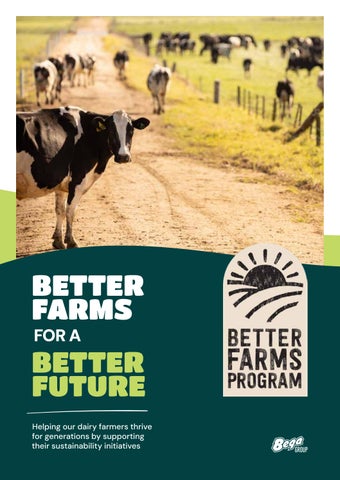
BETTER FARMS FOR A
BETTER FUTURE Helping our dairy farmers thrive for generations by supporting their sustainability initiatives
Bega Group has been part of the Australian farming story for 125 years. We understand the future of the Australian dairy industry depends on the long-term success of our dairy farming communities. We have developed the Bega Better Farms Program (Better Farms) to support our dairy farmers,* by encouraging the adoption of efficient, sustainable and economically sound farming practices. Better Farms seeks to further the circular economy principles of optimising resource use, reducing waste and enhancing natural ecological processes, whilst maximising farm profitability.
*Australian dairy farmers with milk supply agreements with Bega Cheese Limited, Tatura Milk Industries Pty Ltd, BDD Australia Pty Ltd or Dairy Farmers Milk Cooperative.
What does Better Farms do? The Better Farms Program is designed to provide our dairy farmers with: •
a means of measuring and monitoring farm performance over time;
• farm specific performance data and regional benchmarks to inform decisions around resource optimisation and practice change that may lead to improved resource use efficiency, lower emissions, enhanced natural ecological processes and improved farm profitability; •
access to targeted training programs; and
• up to $5,000 in grant support to encourage the adoption of improved farming practices. The Better Farms Program will also assist the Bega Group to understand its Scope 3 emissions profile and assist with mandatory reporting obligations.
How is Better Farms implemented? Our milk supply team implement the Better Farms Program across Australia, where the first step in the Program is often the Better Farms Survey. Data from the Better Farms Survey is used to calculate farm performance indicators including their estimated greenhouse gas (GHG) emissions number that is provided back to each farmer in a Better Farms Report. The emissions number is calculated using the farm data, industry assumptions and the Australian Dairy Carbon Calculator. Dairy farmers completing the Better Farms Survey receive a $500 payment and are eligible to apply for a Better Farms grant of up to $5,000, matched 1:1 by the dairy farmer, to support the implementation of on farm capital works needed to improve farming practices.
TELL US WHAT YOU KNOW AND
$500 *Dairy farmers must complete a Bega Better Farms Survey with their milk supply officer to receive the grant. Maximum $500 (plus GST, if applicable) payment per dairy farm per financial year. Subject to eligibility criteria and availability, terms and conditions apply.
How Better Farms is helping the dairy farmers of today? Our goal with Better Farms is to support the implementation of science led circular practices that benefit both the economic and resource efficiency outcomes of our dairy farms whilst enhancing ecological processes and the natural resource base. In doing so, we collaborate with our dairy farmers, industry and research leaders to identify new effective circular solutions.
• Labour optimisation, • Livestock pathway optimisation, • Waste plastic reduction. Dairy farm participants in the Program receive a confidential Better Farms Report containing performance data relating to each of the key focus areas. The report provides valuable insight to farmers to support them to make informed management decisions and future technology investments. We highlight the performance data in the report is indicative only and we encourage participating farms to seek independent advice before making changes to their business operation based on the report.
To improve resource efficiency and economic outcomes for dairy farmers, while enhancing natural processes on farm, Better Farms focuses on supporting improved practices in the following key areas: • GHG emissions reduction, • Purchased feed optimisation,
The farm performance data also enhances the Bega Group’s ability to develop and provide targeted training and grant support opportunities for dairy suppliers.
• Homegrown feed optimisation,
PRACTICES R A CUL CIR Labour Input Purchased Feed Input
Milk Production & Income Diversification
Livestock Pathways Waste Plastics GHG Emissions
Homegrown Feed Input
Other Inputs
NATURAL RESOURCE BASE Land, Soil, Water, Biodiversity
DAIRY FARM
ECOLOGICAL PROCESSES Including carbon & nutrient cycles
CIRCULAR
E TIC C A PR
Enhance
S
Optimise Reduce/Replace
A Better Farms Case Study – GHG emission focus Here’s how Better Farms has helped inform one dairy farmer Our case study dairy farm milks 220 cows on dryland pasture with supplementary irrigation, producing 1,495,000 litres of milk each year.
Based on their Better Farms Report we recommended the farmer seek independent agronomy and nutritional advice to:
Their Better Farms Report indicated their GHG emission intensity was high in comparison to other farms in their region - 1.04kg of CO2e/kg FPCM*.
• Improve homegrown feed utilisation,
! Compared to other farms, their Better Farms Report showed the dairy farmer relied heavily on purchased feed and their homegrown feed utilisation was low.
Improvements in these areas can increase milk production and profitability as well as reduce GHG emissions.
! Additionally, compared to other farms, their herd feed conversion efficiency indicator was also low. P O n the positive side, the farm’s electricity efficiency use was better than many other farms in the same region.
220 1,495,000
• Refine purchased feed inputs, • Improve herd feed conversion efficiency.
We also highlighted they could access up to $5,000 in Better Farms grant support to implement improvements on farm, such as upgrade their: dairy feed system, fencing and stock water infrastructure or to plant trees for stock shade and shelter. With Better Farms and by seeking independent advice the farmer could: P R educe their purchased feed costs by utilising more quality homegrown feed. P I ncrease milk production whilst lowering enteric methane emissions. P I ncrease carbon sequestration through tree planting. P R educe their emission intensity. P I ncrease the profitability of their business.
1.04
KG
OF CO2e/KG FPCM
EMISSION INTENSITY
*GHG Emission intensity measure. Carbon dioxide equivalents (CO2e) is a unit used to compare emissions from different greenhouse gasses based on their global warming potential over a specific time period. Fat and protein corrected milk (FPCM) is a kg of milk standardised to 4.0% fat and 3.3% protein to allow comparison of milk with varying fat and protein percentages.
How Better Farms is contributing to creating ‘Great Food for a Better Future’ ‘Great Food for a Better Future’ is the Bega Group’s sustainability ambition. By supporting our dairy farmers with on-farm resource efficiency and natural resource initiatives, the Better Farms Program makes an important contribution to the Great Food for a Better Future vision. Outlined below are the sustainability targets from the Bega Group’s sustainability strategy that the Better Farms Program contributes to achieving.
Interested in learning more?
VISIT THE BEGA GROUP WEBSITE FOR MORE INFORMATION