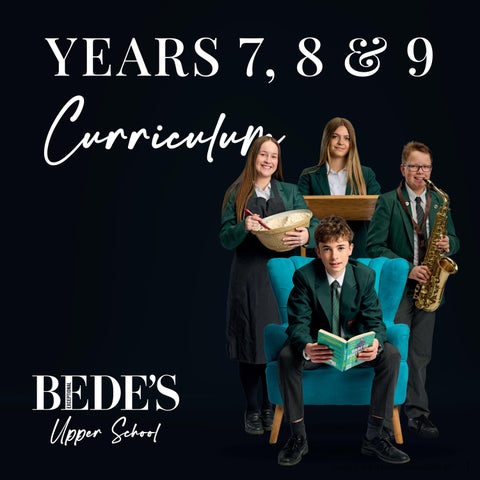
YEARS 7, 8 & 9
Curriculum
Years 7, 8 & 9 Curriculum 2026-27
1
Introduction from the Head of the Upper School Welcome to Bede’s Upper School ‘where every child feels a sense of belonging and finds joy in their pursuit of brilliance.’ Bede’s is a vibrant, energetic and forward-thinking school, which focuses on promoting learning, personal growth and development. We provide pupils with a curriculum that is broad, stimulating and designed to facilitate the highest possible levels of attainment by those who follow it - programmes of study that imbue children with a wealth of skills, a depth of knowledge and an irrepressible curiosity. Every pupil will achieve personal excellence within a happy, safe and stimulating environment. Our core values of compassion, courage, conscientiousness and curiosity shape a pupil’s educational experience. A Bede’s education is based upon academic rigour through excellent teaching, encouraging our pupils to explore, question, take risks, and develop their creativity, communication and teamwork – all central to successful life-long learning. Our kind-hearted community is underpinned by generosity of spirit, mutual respect, warmth and compassion. By providing a festival of opportunities, we enable our pupils to discover new passions and develop new talents motivating them to be the best versions of themselves. Pupils are recognised and appreciated for who they are as individuals. They are supported and nurtured by teachers who really care. Our exceptional pastoral care is evidenced as happy pupils who are engaged in their learning and actively involved in the wider life of the school embracing every opportunity provided to them. Pupils who are kind to themselves and each other and are gracious about success and failure. Bede’s provides an all-round education where academic pursuits are supported by wonderful co-curricular opportunities and where pupils learn lessons that books cannot give; courage and joy, resilience and self belief, developing into confident globally-minded young people. I am incredibly proud to belong to such an amazing community where pupils and staff feel empowered, supported and valued. I very much hope that you will visit us and I look forward to welcoming you in person to share the exciting and vibrant experience enjoyed by all our pupils.
Leigh-Anne Morris
Head of Bede’s Prep & Upper School
Years 7, 8 & 9 Curriculum 2026-27
3
Welcome from the Head of Academics At Bede’s, our academic vision in Years 7, 8 and 9 is rooted in providing a curriculum of rich breadth, rigour and flexibility. We appreciate that every pupil’s educational journey is distinct, and as such our provision offers carefully tailored pathways to stretch high potential while providing support whenever needed. Central to our core curriculum is our signature Discover programme running across Years 7, 8 and 9, which is an innovative cross-curricular framework designed to challenge pupils beyond traditional subject boundaries. Delivered through a modular carousel across the academic year, pupils experience distinct teaching styles, fresh topics, and novel challenges each term, which progressively build, deepen and extend from Year 7, through Years 8 and 9. Pupils are encouraged to question assumptions, navigate real-world challenges and, crucially, articulate complex ideas with influence and clarity. Our outstanding staff excel at inspiring our pupils with a joy for learning, helping them to discover their passion through tailored pathways - whether in STEM, languages, humanities, sports or the arts. Through an exciting calendar of visits, workshops, visiting speakers and overseas trips, we broaden horizons, deepen enrichment and forge vital connections to real-world experiences. We are fortunate to be situated in a beautiful location by the coast and foot of the Downs, which allows us to fully connect classroom theory with real-world exploration - whether investigating the biodiverse ecosystems of the South Downs in Science or using our coastline for creative writing workshops. In addition, as pupils progress into Year 9, outdoor challenge and character education are further forged through the Duke of Edinburgh’s Award. As well as a bespoke curriculum and an outstanding co-curricular programme, our pupils develop crucial skills including curiosity, leadership qualities as well as, crucially, a resilient and independent spirit that lasts beyond their journey with us at Bede’s. As we hope you will discover in this booklet, there is a rich breadth offered in our curriculum and co-curriculum that challenges and empowers our young thinkers with the knowledge and skills to be responsible, thoughtful and creative individuals.
Sherry Wilson
Head of Academics
4
Bede’s Upper School
Our Vision
Where every child finds joy in their pursuit of brilliance
Our Mission
We continue to craft a more joyful education. Cultivating a vibrant learning experience, motivating us to pursue our individual best. Providing a festival of opportunity, enabling us to discover new passions and develop new talents. Building a kind-hearted community, inspiring us to enhance the lives of others.
Our Values
Be Compassionate
Because a caring community fosters belonging.
We expect our community to show kindness to people of all ages, genders and ethnicities, maintaining campuses where every person feels joyful and energised.
Be Courageous Because fortune favours the brave.
We challenge our community to stand up for what is right, providing them with a safe environment where they can take bold action in pursuit of brilliance.
Be Curious Because wisdom can be found off the beaten track.
We encourage our community to discover unlikely passions and hidden niches, releasing them into a wealth of opportunities inside and outside the classroom.
Be Conscientious Because dedication is a spearhead of success.
We ask our community to throw themselves wholeheartedly into every endeavour, taking responsibility for their journey and inspiring others to do the same.
Years 7, 8 & 9 Curriculum 2026-27
5
PA S T O R A L
... turn Ambition into Reality
6
PUTTING INDIVIDUAL WELLBEING AT THE HEART OF EDUCATION
CRAFTING BELONGING AND ENCOURAGING AMBITION
At Bede’s Upper School, every child’s emotional and physical wellbeing sits firmly at the forefront of our educational mission. Our overarching philosophy balances academic development with personal growth, ensuring that each pupil’s distinct talents, emotional needs and personal achievements are recognised both within and beyond the classroom walls. Through our holistic “school within a school” framework, we create an inclusive community where individual differences are actively celebrated. This dedicated structure prioritises personalised care, active pupil involvement and personal growth, encouraging young people to manage their own study schedules, develop self-reliance and step up to take genuine responsibility within the wider school environment.
Our pastoral framework is designed to support every child by honouring their individuality and creating a warm, inclusive environment where they feel a sense of belonging. While achieving academic progress and reaching target grades remain essential priorities, we firmly believe these outcomes are only possible when pupils feel genuinely happy, secure, challenged and sustained. We encourage our young people to discover their passions and boldly venture outside their comfort zones, safe in the knowledge that our staff are alongside them through every milestone. Beyond their academic commitments, pupils are continually encouraged to immerse themselves in the vast array of co-curricular opportunities available across the school.
Bede’s Upper School
TAILORED GUIDANCE AND DAILY MENTORING The cornerstone of our pastoral care rests with the Form Tutor, who oversees every aspect of a pupil’s growth, spanning academic progress and extra-curricular participation. Serving as the primary contact for families, the tutor collaborates closely with parents to monitor their child’s overall wellbeing, offering practical guidance on managing workload and balancing commitments. Form Tutors meet with pupils on a daily basis for one-to-one mentoring and academic oversight, providing essential support during a crucial stage of development when young people are actively cultivating self-regulation, building personal resilience and learning to navigate the wider world.
Years 7, 8 & 9 Curriculum 2026-27
7
PA S T O R A L
TARGETED NURTURE CARE AND LAYERED SUPPORT SYSTEMS To complement our small class sizes; which guarantee focused attention for both academic and personal needs, our dedicated nurture provision offers specialised guidance for pupils who benefit from targeted intervention to strengthen their social and emotional skills. Delivered by qualified practitioners, these structured sessions provide a safe, reassuring environment to address specific concerns, enhancing overall wellbeing and positively impacting classroom performance. The entire pastoral network and our Learning Enhancement department work in close, continuous collaboration to provide complete wrap-around emotional care.
8
Bede’s Upper School
ACTIVE PUPIL VOICE AND SHARED EXPERIENCES This strong sense of community thrives well outside the classroom. Pupils are actively empowered to influence school culture through structured Pupil Champions, school council, peer listeners and a pupil-led Year 11 Prefect body. Prefects act as key role models, leading charitable initiatives that foster empathy and support local causes, while chairing pupil committees that directly connect the Senior Leadership Team with the wider pupil body. Through these channels, pupils drive important conversations on social topics such as mental health awareness, gender equality and diversity. Shared experiences further deepen these connections. At the start of the academic year, pupils take part in team-building challenges to build a strong year-group identity. This foundation is enriched by a wide range of trips and educational outings, ranging from local geographical fieldwork at the Cuckmere to immersive language courses in Spain and France, helping pupils form lasting friendships that endure throughout their time at Bede’s and beyond. By maintaining close personal oversight and fostering healthy rivalry through inter-House competitions, we give every child the tools to fulfill their academic potential and develop the resilience to succeed in whatever path they choose.
Years 7, 8 & 9 Curriculum 2026-27
9
T H E B E D E ’ S E X P E R I E N C E I N Y E A R S 7, 8 A N D 9
At Bede’s Upper School, Eastbourne, every pupil’s path is uniquely theirs. Personal tutors uncover what makes each individual thrive and actively pave the way for their success. With dedicated guidance during their initial half-term, every young Bedian meets one-toone with their tutor to explore the vast array of opportunities on offer. For some, these conversations yield immediate, practical goals; for others, they ignite a broader journey of personal discovery. While individual mentorship has always defined the Bede’s ethos, we have formalised this framework to ensure consistent progress. Parents are kept close to the journey through regular tutor updates, quarterly reports alongside one yearly parent consultation, highlighting key aspects of their child’s development.
10
Bede’s Upper School
We hold the very highest of ambitions for our pupils underpinned by our supportive educational environment ensuring that every pupil has the opportunity to be outstanding. Bolstered by our co-curricular programme where every pupil must engage in a service, creative and action-themed activity and our enrichment programme such as our Leadership Awards, DofE and HPQ. Tutors will also work with pupils to identify the most productive, relevant or useful activities available to them from the options available at Bede’s Upper School. Our mission is clear: to guide, inspire and help young people discover exactly who they want to become through an exceptional, tailored education.
Curriculum Subjects ENGLISH
PSHE
MATHS
RELIGION & PHILOSOPHY
SCIENCE
ENGLISH AS AN ADDITIONAL LANGUAGE
MODERN FOREIGN LANGUAGES ART AND DESIGN
LEARNING ENHANCEMENT
COMPUTING GEOGRAPHY HISTORY DRAMA DANCE MUSIC PHYSICAL EDUCATION
Years 7, 8 & 9 Curriculum 2026-27
11
English OVERVIEW Our English curriculum in Years 7 and 8 is all about sparking a genuine love and curiosity for language and literature, building beautifully on the knowledge and skills the children have learned in earlier years. Here at Bede’s, we’ve crafted an exciting, enriching curriculum that stretches and challenges young minds through a vibrant mix of lively debates, brilliant books and creative writing across every genre imaginable. Our team of specialist English teachers are experts at recognising and nurturing each pupil’s unique creative talents. We love encouraging that spark of curiosity, guiding thoughtful reading and helping them polish their expression so every individual can flourish.
WHAT SKILLS WILL MY CHILD DEVELOP? • • • • •
Love of language and literature across diverse forms Confident communication Crafted and impactful writing Critical and independent thinking Independent learning through the iPQ
HINTS & TIPS FOR HOME Reading Booktalk: Encourage your child to reflect on their reading by discussing the plot, characters and structure. Ask openended questions to spark thoughtful responses. Expose your child to a variety of fiction and non-fiction texts. Websites such as bookstrust.org.uk and lovereading4kids.co.uk offer age-appropriate and useful book recommendations. Communication Create opportunities for discussion that involve critical thinking and reasoning; model the use of rich, expressive vocabulary. Make it fun by playing with language. Word games such as Scrabble, Bananagrams and Boggle are entertaining ways to engage with vocabulary building. Writing Encourage writing for pleasure through journalling, letter writing or short creative pieces that help develop fluency and confidence. Websites such as bbc.co.uk/ bitesize.co.uk offer interactive resources to consolidate key skills in grammar and spelling.
12
Bede’s Upper School
In the Autumn Term of Year 7, pupils explore World War I through poetry, contrasting the imagined glory of war with its harsh realities. Studying writers like Wilfred Owen develops close reading and bias-analysis skills across poetry, letters, and articles. Next, pupils examine Victorian inequality through Charles Dickens’ A Christmas Carol. Utilising the novel, playscripts, and film, they analyse how Dickens constructs atmosphere and transforms characters, inspiring their own creative writing. Running alongside English is the ISEB-accredited Independent Project Qualification (iPQ), which guides pupils to research a personal passion - from historical fashion to scientific inventions. Weekly lessons build skills in research, citation, and critical thinking, culminating in confident peer presentations. Outstanding projects may be published in SHAPE or Mind’s Eye magazines. In the Spring Term, a contemporary novel sparks critical discussion on modern themes while expanding vocabulary and grammar. Pupils deepen their close reading and symbolic analysis, learning to write formal essays with embedded quotations that connect modern narratives to archetypal literary traditions. In the Summer Term, pupils explore the interplay of culture using The Odyssey as a foundational text. By comparing traditional translations with modern re-interpretations, they discover how epic journeys evolve across cultures and time. Pupils apply these insights to persuasive essays and creative viewpoint pieces, such as writing from the Cyclops’ perspective. In Year 8, pupils are introduced to Shakespeare’s comedies and tragedies. Through performance, media studies, and close reading, they analyze plots, characters, and themes to craft critical essays. They also stretch their creativity by writing from a character’s viewpoint, adapting scenes for film, and participating in the English Speaking Union’s ‘Performing Shakespeare’ competition. In the second half of the term, pupils revisit Gothic literature. By studying archetypal settings, mystery, and the supernatural, they explore the development of the genre, writing alternative openings and shifting narrative viewpoints. During the Spring Term, the focus shifts to writing and performing a mini-TED talk. By analyzing iconic speeches and non-fiction texts, pupils identify powerful rhetorical devices, learning how to structure persuasive arguments before presenting their talks in the school theatre. Later
in the term, pupils explore diverse poetry centered on the themes of nature and place. They develop critical evaluation skills by comparing poems across different eras and craft their own poetry inspired by the forms and techniques studied. In the Summer Term, pupils read Zara Fraillon’s The Bone Sparrow, using the novel to sensitively explore topical issues such as human rights, refugees, and justice. Through active discussion and written analysis, they examine how the author builds narrative structure and character development. Pupils apply these insights by writing a new chapter in Fraillon’s distinctive style and drafting persuasive pieces inspired by the book’s themes. Throughout the year, we foster independent thinking, encouraging pupils to express balanced, evidence-based opinions while instilling a lasting love for literature and self-expression. Year 9 will build the foundations for the challenges of Key Stage 4. Pupils will study a play, novel and an ambitious range of poetry, based on the natural world and inspired by our unique location. All of this will help build empathy and compassion as well as helping pupils to sharpen and hone skills developed in the earlier years. They will analyse characters, relationships and language whilst considering the wider themes of each text - relating these to the world around them. Pupils will continue to develop their own voices as writers as well as enriching the curriculum through powerful discussions. Throughout the year, alongside their English curriculum, pupils will also complete the Higher Project Qualification, which is at GCSE standard. This project develops skills of leadership and independence, as well as further enhancing skills of planning, research and reflection; key critical thinking skills. In addition, pupils will build further confidence at public speaking and will embark upon their GCSE journey by completing the speaking element of the course. We are lucky to live in an area which is immersed in a literary and artistic heritage and are thrilled to welcome visiting authors, take class trips to the theatre as well as organising Head of English readings and recitals.
Sarah Jones
Years 7, 8 & 9 Curriculum 2026-27
13
Maths OVERVIEW At Bede’s Upper School, our maths adventures for Years 7 and 8 are all about building on those fantastic early foundations while diving into exciting new challenges and clever problem-solving techniques! We are committed to creating a vibrant, supportive space where pupils can connect with numbers, sharpen their critical thinking skills and discover just how much fun maths can be. Our approach brings maths to life by blending essential theory with hands-on, practical applications, helping pupils see how these skills connect to the real world around them. From team challenges and interactive activities to tech tools, we use a mix of teaching styles to make sure everyone stays engaged, inspired and learning in a way that suits them best. Our curriculum explores a mix of topics, from algebra and geometry to statistics and number theory. We’re all about boosting logical reasoning and building the confidence to tackle tricky puzzles, setting our pupils up for future success while sparking a genuine, lifelong love for mathematics!
WHAT SKILLS WILL MY CHILD DEVELOP? • • • • •
Resilience and Reflection: Pupils reflect on work, embrace challenges, and learn that perseverance drives mathematical success. Advanced Understanding: Pupils will delve into algebra, functions, geometry, statistics, and number theory for deeper insight. Problem-Solving: Approach problems systematically and creatively by breaking down complex tasks into manageable steps. Logical Reasoning: Enhance reasoning to connect mathematical concepts and understand underlying principles. ApplicationApply concepts through practical, real-world projects and innovative tasks.
HINTS & TIPS FOR HOME • • • •
14
Regular Revision and Practice: Encourage consistent practice. Use DrFrostMaths and CorbettMaths for exercises, video tutorials, and interactive questions tailored to different topics. Real-World Applications: Show maths everyday relevance through hands-on activities like budgeting, event planning, or analyzing sports statistics. Encourage Independent Study: Foster independent study habits with regular homework time, encouraging your child to explore topics and seek extra challenges. Support and Feedback: Provide constructive feedback, discuss their thought processes, and help identify areas for improvement to maintain motivation.
Bede’s Upper School
At Bede’s Upper School, our mathematics curriculum is designed to bridge the gap between primary education and the rigorous demands of secondary study. Delivered through the renowned White Rose Maths approach, we embrace a mastery model of learning that ensures pupils develop a deep, secure, and highly adaptable understanding of mathematical concepts. By carefully sequencing our curriculum to increase in complexity, we equip pupils with the precise tools, fluency, and problem-solving skills needed to transition seamlessly toward future academic success. In Year 7, pupils transition into more advanced mathematical thinking by building directly upon their primary foundations. The curriculum spans essential areas including number, algebra, geometry, and statistics. Pupils deepen their grasp of integers, fractions, decimals, and percentages, whilst simultaneously developing key algebraic skills such as simplifying expressions, solving linear equations, and navigating inequalities. In geometry, they explore the properties of 2D and 3D shapes alongside angle facts, learning to justify and communicate their geometric reasoning. By introducing ratio and proportion through practical, real-world contexts, Year 7 inspires pupils to explain their thinking clearly and approach unfamiliar mathematical challenges with confidence.
extended, two-year Algebra programme; the Accelerated Pathway - Edexcel Level 2 Algebra Award For pupils in Year 7 Set 1. This rigorous pathway culminates in pupils sitting the Edexcel Level 2 Algebra Award in May of Year 8. This nationally recognised qualification bolsters algebraic fluency and provides early experience with formal examinations, giving pupils a distinct advantage as they head toward GCSEs. Year 9 will mark the official commencement of the GCSE mathematics pathway. Building seamlessly upon the foundations of the earlier years, this curriculum shifts focus toward the academic rigour of Key Stage 4. Pupils will explore high-level topics across algebra, geometry, ratio and proportion, statistics, and probability, with a strong emphasis on mathematical communication, accuracy, and robust exam technique. By focusing on depth of understanding and nurturing independent problem-solving, the Year 9 program ensures pupils are thoroughly prepared to excel in their formal examinations and beyond.
In Year 8, pupils consolidate and extend their skills, fostering greater independence and mathematical fluency. Algebra progresses to include more sophisticated concepts, such as solving simultaneous equations and working with complex sequences and expressions. Pupils continue to apply their knowledge of fractions, decimals, and percentages to increasingly intricate scenarios. In geometry, the focus shifts to multi-step problems involving area, perimeter, volume, and unit conversions. Additionally, pupils delve deeper into statistics and probability, learning to interpret data sets, calculate averages, and evaluate likelihoods. By the end of Year 8, pupils emerge as resilient, confident learners with an incredibly secure foundation, fully prepared for the next stage of their academic journey. We offer an enhanced mathematics curriculum designed to stretch and challenge high achievers. Alongside the standard curriculum, these pupils embark on an
Shamara Brown
Head of Maths Years 7, 8 & 9 Curriculum 2026-27
15
Science OVERVIEW With three well-resourced labs and the expert support of our dedicated Science technician, our specialist teachers foster a vibrant, child-centered environment across every year group. We are on a mission to spark curiosity and ignite a lifelong excitement for the wonders of the natural world. Practical investigations sit at the heart of our teaching, complemented by our enviable position at the foot of the South Downs and steps from the sea - serving as the ultimate outdoor classroom.
WHAT SKILLS WILL MY CHILD DEVELOP? • • • •
Scientific Inquiry: Pupils recognise that scientific ideas rely on empirical evidence, learning how scientists think, test hypotheses, and apply mathematical reasoning. Investigative Planning: Pupils learn lab safety, isolate control variables, and design fair experiments to solve realworld problems. Data Analysis: Pupils collect precise measurements, present findings through structured tables and graphs, and draw clear conclusions using scientific vocabulary. Critical Evaluation: Pupils reflectively refine their practical techniques while learning to spot bias, misleading graphs, and “bad science”.
HINTS & TIPS FOR HOME • • • • •
16
educake.co.uk: An online quizzing and homework platform used to test understanding, consolidate classroom learning, and track progress. bbc.co.uk/bitesize: Interactive questions and short video clips covering key topics. senecalearning.com: Topic slides and self-checking quizzes tailored to Key Stage 3. Doc Brown’s Chemistry: Targeted quizzes across Physics, Chemistry, and Biology. Science for Common Entrance Revision Guide 13+: An excellent reference text to consolidate core knowledge and check understanding.
Bede’s Upper School
Year 7: Launching Our New Career-Led Curriculum Year 7 pupils are embarking on an exciting new curriculum sequentially mapped around real-world enquiries and scientific careers. Pupils journey through these sequential modules together across the terms: Terms 1 & 2 (Foundations): Pupils begin with “How to be a Good Scientist,” mastering lab safety and experimental design. They then step into the foundational roles of Biologist, Chemist, and Physicist - exploring cell theory, specialised cells, atomic structures, periodic trends, force diagrams, and energy transfers. Term 3 (Space & Human Life): Pupils explore physics and human biology through two specific lenses. As Astronomers, they build scale solar systems, explore gravity, and investigate optics and telescopes. As Midwives, they examine human growth, genetics, diffusion, and foetal development. Term 4 (Ecosystems & Energy): Applied science takes center stage. As Gardeners, pupils investigate plant adaptations, photosynthesis, and interdependence. As Electricians, they construct series and parallel circuits, explore electromagnets, and analyze household energy costs. Term 5 (Health & Construction): Stepping into the roles of Dentist and Builder, pupils apply science to human health and structural engineering. As Dentists, they investigate acids, the pH scale, how evolution shapes teeth, and the biomechanics of bite pressure. As Builders, they focus on material chemistry, exploring ceramics, extracting metals from ores, the limestone cycle, and testing the energy efficiency of insulation. Term 6 (Human Performance & Emergency Science): The year concludes with high-energy applications. As Athletes, pupils study respiration, antagonistic muscle pairs, and test foods for proteins to understand the biology of exercise and stamina. As Firefighters, they tackle exothermic and endothermic reactions, changes of state, and specific heat capacity - investigating reaction rates and discovering exactly how and why water cools things down. Year 8: Academic Continuity & Enhanced Opportunities Year 8 pupils continue on their established curriculum path to ensure secure academic progression. They dive into inheritance, climate science, metal reactivity, and
the biodiverse ecosystems of the South Downs. Practical highlights include the hydrogen “squeaky pop” test, exploring energy transfers through calorimetry and the spectacular “whoosh bottle” demonstration, and investigating sound waves using a Rubens’ tube and Doppler ball. To ensure Year 8 pupils share in the exciting trajectory of our new curriculum, elements of the careerfocused framework - such as specialized STEM workshops - are integrated into our co-curricular provision. Year 9: Official GCSE Commencement In Year 9, pupils officially begin their GCSE journey. Tailored to pupil aptitude and choice, pupils follow either the AQA Combined Science: Trilogy or AQA Triple Science pathway. This ensures every child receives the exact blend of academic rigour, practical technique, and examination preparation required to thrive in Key Stage 4. Extracurricular Science Co-curricular enrichment extends far beyond the timetable. During national Science Week, pupils across all year groups engage in dynamic, project-style challenges and hands-on activities that foster teamwork and creative problem-solving. Additionally, our science clubs offer opportunities to investigate advanced real-world topics - from palaeontology, forensic archaeology, and oceanography to discussions surrounding stem cell ethics and science
George Filsell
Head of Science Years 7, 8 & 9 Curriculum 2026-27
17
Modern Foreign Languages OVERVIEW At Bede’s Upper School, we wholeheartedly agree with the National Curriculum’s view that “learning a foreign language is a liberation from insularity and provides an opening to other cultures.” We design our language lessons to spark pupils’ curiosity and broaden their horizons. Through our teaching, pupils discover how to express their thoughts and ideas in French or Spanish, while learning to confidently speak and write with native speakers. We enjoy opening doors to practical communication, encouraging fresh ways of thinking and introducing pupils to the joy of literature in its original language. Ultimately, our language program builds a fantastic foundation for the future, setting pupils up for exciting adventures in study and work around the globe! A highlight of the course is our immersive trip to France or Spain, running every two years for Year 7 or 8 pupils; it’s an unforgettable chance to experience the culture and put their skills to the test firsthand!.
WHAT SKILLS WILL MY CHILD DEVELOP? • • • •
Pupils develop their listening skills through listening to authentic materials as well as the target language spoken by their teacher. Pupils practice speaking in class and presentations. Pupils work on their reading skills with authentic and textbook materials. Pupils improve their writing skills through presentations at the end of each module.
HINTS & TIPS FOR HOME • • • •
18
The children have access to online textbooks on www.pearsonactivelearn.com/app/Home www.bbc.co.uk/bitesize https://www.youtube.com/@BookboxFrench https://www.youtube.com/@BookBoxSpanish
Bede’s Upper School
Pupils embark on an exciting linguistic journey, selecting either French or Spanish to study. The curriculum across all years is beautifully crafted to build confidence, fluency and academic rigour, ensuring pupils develop a deep cultural appreciation alongside strong skills in listening, speaking, reading and writing. In Year 7, pupils establish robust grammatical foundations through our interactive courses, ‘Studio’ for French and ‘Viva’ for Spanish. French pupils explore themes such as holidays (incorporating different tenses), leisure activities (TV, films, books, sports), tourism in Paris and descriptive language (using a range of adjectives). Meanwhile, Spanish pupils dive into engaging topics including “Mi ciudad” (“My city”), “Mis vacaciones”(“My holidays”), “Todo sobre mi vida”(“All about my life”), “¡A comer!” (“To eat!”), and “¿Qué hacemos?” (“What do we do?”), learning to integrate the present, past, and future tenses alongside reflexive verbs. Across both languages, pupils build pronunciation confidence and spontaneous speaking skills, which are brought to life during our exciting biannual language immersion trips to France and Spain. In Year 8, pupils consolidate their learning and broaden their vocabulary to express and justify opinions on wider topics. French pupils expand their skills by studying talents, self-description, social media, health and future plans. In Spanish, pupils tackle advanced grammatical structures like comparatives, superlatives, and imperatives through modules such as “Operación verano” (“Summer plans”), “Somos así” (“We are that way”), “¡Oriéntate!” (job-related vocabulary and the past tense), and “En forma” (diet and healthy habits). To ensure pupils are well-prepared for the future, progress is assessed evenly across all four skills - listening, speaking, reading and writing, each contributing 25%; culminating in a final end-of-year examination. In Year 9, the curriculum transitions into Key Stage 4, marking the official commencement of the GCSE journey. Building upon the strong foundations of earlier years, pupils manipulate more complex grammatical structures, including voice and mood. They engage with diverse authentic literary texts, such as stories, songs and poems, to deepen cultural understanding and stimulate creative expression. With an increasing emphasis on translation accuracy, sophisticated discussions, and robust exam technique, Year 9 ensures pupils develop the high level of competency required for ultimate GCSE success and beyond.
Alexandra Cazorla Torres Head of MFL
Years 7, 8 & 9 Curriculum 2026-27
19
Art and Design OVERVIEW Art and Design is all about creating a vibrant, creative studio space where imagination takes flight! We dive into intelligent making, big thinking and collaborative creating, where we all learn from each other and teachers and pupils share the joy of discovery together. “Reach for the stars!” We want every pupil to know their ideas have real value and that they are fully capable of mastering exciting new skills. Celebrating everyone’s individual sparks of creativity is at the heart of what we do. To us, being “creative” isn’t just about what you can draw, it’s about how you think, solve problems and make decisions every day. We don’t believe creativity is a rare gene reserved for a lucky few; it’s a superpower inside everyone just waiting to be explored! Pupils get to play and create with everything from ceramics, printmaking, painting and collage to digital media, textiles, sculpture, illustration and drawing. We don’t just stay in the classroom, we explore art, craft and design out in the local community, diving into different cultures and styles through museum visits, gallery trips and digital exploration.
WHAT SKILLS WILL MY CHILD DEVELOP? • • • • • •
Spiritual development, through helping pupils to explore ideas, feelings and meanings in their own creative work and to make connections with the experiences of others. Moral development, by helping pupils to identify and discuss how artists represent moral issues in their work. Social development, through helping pupils to learn to value different ideas and contributions and develop respect for the ideas and opinions of others. Cultural development, through helping pupils to recognise how images and artefacts can have an influence on the way people think and feel. Through comparing ideas, methods and approaches of their own and others, pupils will learn to self-evaluate as well as learn peer evaluation skills. Collaboration through ideas and expression is also key and pupils learn to value the ideas of others.
HINTS & TIPS FOR HOME
20
• • • • • • • •
Towner Art Gallery National Gallery Peggy Guggenheim Collection Washington D.C National Gallery The National Portrait Gallery The Tate Online Young at Art Tate Kids Bede’s Upper School
townereastbourne.org.uk nationalgallery.org.uk guggenheim-venice.it/inglese/default.html nga.gov/content/ngaweb/education/kids.html About.com/NationalPortraitGallery tate.org.uk youngatart.co.uk tate.org.uk/kids
In Year 7, artists begin their journey by diving into the world of Pablo Picasso, training their eyes with viewfinders to master the rules of proportion before boldly breaking them. Embracing Cubism, pupils experiment with abstract features and vibrant palettes to create colourful wonky faces, bridging 2D and 3D by translating these fragmented drawings into tactile 3D faces. The exploration of the human form continues with Alberto Giacometti, where pupils study anatomy and capture dynamic movement by sculpting iconic, elongated figures using wire. Pupils then shift their focus to capturing the unpredictable beauty of the natural world. Starting on the coastline, they use graphite and charcoal to sketch horizons before mastering atmospheric depth with soft, layered acrylic clouds. This landscape study culminates in highly textured pen and ink drawings and a dramatic final piece capturing the churning energy and power of the wave. Returning to tactile media, pupils observe the intricate geometry of organic structures, analysing shell patterns and the elegant lines of animal bones. They translate these observations into illustrations on smooth rock surfaces to mimic traditional scrimshaw work, whilst studying famous illustrators to practice diverse markmaking techniques. The year concludes with a thoughtprovoking investigation into the revolutionary movements of modern culture, posing the ultimate question: What is art? By exploring the concept of found objects, pupils learn how everyday items can be recontextualised into statements of high art, challenging traditional aesthetics and beautifully expanding their creative horizons. In Year 8, artists deepen their expressive journey by exploring diverse cultures, iconic movements, and dynamic media. Pupils begin by diving into the world of Amedeo Modigliani and the rich heritage of African Art, studying traditional portraiture and ceremonial masks. Capturing distinctive elongated forms, they transform these insights into striking acrylic portraits and tactile 3D masks. The focus then shifts to local heritage and urban landscapes with L.S. Lowry. Studying architecture, colour swatches, and Lowry’s signature “matchstick cats and dogs,” pupils construct their own “Local Lowry” scenes to capture the distinct spirit of their surroundings. Reconnecting with organic textures, pupils explore Natural Forms. By observing the surfaces of shells, fruits, and vegetables, they draw inspiration from Giuseppe Arcimboldo to compose imaginative vegetable portraits,
blending nature with human likeness. Next, pupils shine a light on the Impressionists, examining the groundbreaking views of Manet and Monet alongside the vivid scenes of “Tiger Tiger” and the precision of Pointillism to master light and optical blending. The year’s global journey culminates in Japan, where pupils analyze historic prints and the iconic works of Hokusai, experimenting with painting using brushes and fingers before carving detailed lino cuts. Across every unit, pupils refine a rich repertoire of technical skills - mastering pen and ink, watercolour, pastel, pencil, acrylics, ceramics, and lino printing - to dramatically broaden their creative capabilities. In Year 9 our pupils look at graphic design thinking about lettering, album design and posters. We will also create a page from a graphic novel in monotone. From here we will move on to individual projects in which children will choose from a selection of briefs in a similar format to the GCSE syllabus. Should pupils choose to take GCSE Art and Design we will follow the Edexcel syllabus which is 60% coursework and 40% final examination piece. Pupils can select a brief from a list which enables them to fully explore their artistic creativity.
Will Atkinson
Head of Art & Design
Years 7, 8 & 9 Curriculum 2026-27
21
Computing OVERVIEW In the exciting world of Computing, pupils build the skills and tech-savviness they need to thrive and innovate in our fast-changing world. At its heart, our curriculum blends clever computational thinking with creative design thinking, shaping a new generation of enthusiastic problem-solvers who use coding, robotics and digital skills to bring their best ideas to life! Pupils love discovering how to write the logical instructions that bring technology to life as they develop, they begin mastering Python, crafting clever algorithms, play with variables, master advanced control structures and manage data like pros, while learning the art of patient debugging and the joy of tweaking their work until it’s just right. Our curriculum really shines when it comes to hands-on robotics and electronics, where pupils get the thrill of seeing their designs and code jump into action through real, programmable devices. Building on what they’ve already learned, pupils apply the principles of Design Thinking (Inspiration, Ideation, Implementation) to real-world challenges, like a drone search-and-rescue mission. They’ll practice empathising with user needs, brainstorming wild ideas, prototyping, testing and refining their designs to perfection. Through these projects, pupils get fantastic experience with cool robot features, including smart sensors (like proximity, camera, ultrasonic, and temperature) to gather environmental data for navigation and obstacle avoidance. They also discover how to harness motors to bring mechanical motion to life, using versatile mini-computers like the Micro:bit alongside our incredible lineup of kits like Lego Spike, VEX robotics, Bitbot, Kitronik, and Elecfreaks.
WHAT SKILLS WILL MY CHILD DEVELOP? • • • • • •
Secure knowledge of advanced e-safety techniques, including cybersecurity practices to protect personal data Fluency in all core office applications and competency with online collaborative tools. Experience of a variety of programming environments. Familiarity with the development of computing solutions over the years and how best to steer a path through future technological growth. An understanding of the technical abilities of devices, using computational thinking approaches to consider how the ‘brain’ of a modern computer functions, and how it can be programmed to perform specific actions. Knowledge of how Artificial Intelligence and Machine Learning systems operate
HINTS & TIPS FOR HOME • • • •
22
•
bbc.co.uk/news/technology: Stay updated on advancements in AI, robotics, and emerging technologies. Canva.com: Experiment with AI-powered design tools for graphics, presentations, and creative projects. microbit.org: Explore projects and support for the BBC Micro:bit and related robotics tools as well as the official Python Web Editor to practice coding physical projects and test them using the digital on-screen simulator. snakify.org: A fantastic, step-by-step interactive platform packed with mini-challenges to reinforce Python fundamentals like loops and variables. codecombat.com: Play through programming-themed game levels that require typing real Python code to control characters and solve puzzles. Bede’s Upper School
Pupils begin their computing journey in Year 7 with hands-on robotics, applying precise instruction structures (sequential, conditional, repetitive) alongside essential concepts such as variables and control flow. They explore core communication technologies like Wi-Fi and Bluetooth while establishing proactive cybersecurity habits - learning to counter phishing, malware and social engineering. Pupils also develop digital creation skills using collaborative online tools and AI-driven platforms like Canva. Building on these foundations, Year 8 pupils engage in dedicated drone modules, utilising online simulators to program flight paths and address real-world control scenarios. They bring digital concepts into the physical realm by using 3D printing software (Tinkercad) to design custom robotic parts. Additionally, pupils study the mechanics, societal impacts and ethical implications of Artificial Intelligence and Machine Learning, preparing them for an increasingly information-driven world. In Year 9, pupils make a profound leap from block-based coding to professional text-based software engineering. Using the BBC micro:bit as a physical bridge, they program onboard sensors, LED grids and radio communication, observing how abstract logic directly interacts with hardware before moving to desktop environments. As the year progresses, the focus shifts entirely to mastering pure Python programming. Pupils learn to write, debug and optimise complex text-based applications from scratch. Rather than just memorising syntax, they are taught to think like developers: decomposing intricate problems, tracing variables systematically, and engineering robust algorithms. This rigorous curriculum successfully demystifies text-based coding and equips our pupils with the authentic problem-solving resilience, logical fluency, and practical confidence required to seamlessly excel at GCSE Computer Science and beyond.
Neville Sheridan
Head of Computing
Years 7, 8 & 9 Curriculum 2026-27
23
Geography OVERVIEW Geography is all about exploring how our amazing planet, its diverse cultures and its bustling societies all connect. It’s the ultimate study of how we interact with the world around us! Our main goal is to help pupils get to know their surroundings, sparking a sense of wonder, empathy and a deep appreciation for the complex web of human relationships. Geography is the perfect launchpad for tackling big ideas like sustainability, inspiring a genuine love and responsibility for protecting our environment. Ultimately, we want to set our pupils up for an exciting journey into geography well beyond Key Stage 3. By the time they finish their journey with us, we want them to have had a blast and to see just how much geography matters to their everyday lives. They’ll walk away with a fantastic toolkit of skills to make sense of the world, find their unique place in it and understand how we connect with nature and each other. Our pupils will look at the world and all the incredible processes happening above, on and below its surface with fresh, enthusiastic and analytical eyes! Perhaps the legendary Michael Palin put it best when he said, “Geography explains the past, illuminates the present and prepares us for the future. What could be more important than that?” ultimate outdoor classroom.
WHAT SKILLS WILL MY CHILD DEVELOP? • • • • •
Examine real situations (especially through examination case studies). Use, interpret and draw maps of all types and scales. Use and analysis of photographs. Selection, comparison and classification of information. Development of literacy, numeracy, graphicacy (visual literacy), oral and ICT presentation skills.
HINTS & TIPS FOR HOME • • • •
24
geographyinthenews.rgs.org bbc.co.uk/weather airpano.com A few recommended iPad Apps: Google Earth, Planet Earth 3D, EarthViewer, CountryStats, World Figures, WorldFactbook, QuakeFeed, I Am Learning: KS2 Geography, KS3 Geography, Geo Map Tap, TapQuiz Maps, Geomaster Plus, Fotopedia Heritage, National Geographic World Atlas
Bede’s Upper School
In the Autumn Term of Year 7, geography pupils explore rivers from source to mouth. Leveraging Bede’s enviable location, they bring classroom learning to life through field trips along the nearby Cuckmere River. This physical geography study is enriched with creative, hands-on activities, from modelling drainage basins with playdough and baking valley cakes to physically acting out erosion and transportation. In the second half of the term, pupils move onto to looking at flooding. During the Spring Term, the focus shifts to Transport and Industry. Pupils examine the global and local impacts of infrastructure, debating high-profile, complex projects like HS2 and Heathrow’s third runway to understand conflicting stakeholder views. They investigate industrial classification and global economic development, using OS maps to analyse industrial location factors and studying the Apple iPhone as a case study in globalised production. In the Summer Term, the curriculum turns to coasts. Taking full advantage of our proximity to the sea, pupils visit local beaches and the dramatic cliffs of Birling Gap to observe weathering, erosion and the formation of caves, arches and stacks firsthand. Through this, they evaluate coastal defense strategies and grapple with the socio-environmental ethics of which areas are protected and why. Year 8 begins with the theme of ‘Weather and Climate’, which starts with understanding the important differences between the two and what ‘elements’ make up the weather and how these are observed and recorded. We move on to climatic factors and how they combine to create patterns of temperature and rainfall across the British Isles, whilst making important comparisons with other parts of the world with contrasting climates. Children learn about the influence of air masses on our weather before contrasting depressions with anticyclones. In the Spring Term, the focus shifts to Plate Tectonics. Pupils study the Earth’s structure and plate boundaries through powerful, real-world case studies of earthquakes and volcanic eruptions, contrasting how natural hazards impact developed versus developing nations. Previously these have been the eruption of Eyjafjalljökull, Iceland in 2010 and the Nepal Earthquake of 2015. Finally, the Summer Term explores global population dynamics. Pupils investigate how birth and death rates drive population change and density, culminating in an in-depth case study of India’s rapid growth, its socio-economic causes and potential future solutions. Culminating with a case study of India’s rapid population growth; its causes, effects and possible solutions. In Year 9, there will be significant emphasis on building the written and practical skills needed for KS4, whilst attempting to access the wonderful local area for field work. Field work can be used to collect data, make reports and produce arguments. There will be specific attention given to the natural world and how it impacts people, and vice versa, and sustainability. Surveys, questionnaires and map work will be mastered.
Phil Betts
Head of Geography
Years 7, 8 & 9 Curriculum 2026-27
25
History OVERVIEW History at Bede’s is a dynamic, fast-paced adventure! We’re all about challenging our pupils to think big, question everything and build crucial life skills along the way. From crafting essays to sharp-shooting arguments and masterfully handling evidence to effectively present ideas, we’re setting them up for success far beyond the classroom. By diving into the past, our pupils get a much clearer look at the world they’re living in today. But our real secret ingredient? We want them to fall in love with learning. We don’t memorise lists by heart; we care about encouraging the amazing thinking skills and develop the confidence they build throughout the journey. Our classes are led by absolute history geniuses who bring their genuine passion for teaching into the classroom every single day, supporting our pupils to understand how we uncover the past and how to analyse evidence. History is built on incredible stories. It’s these wild, true tales that spark the imagination and ignite a lifelong curiosity about real people and how their choices shape our present and future. As Mark Twain so perfectly put it: “History does not repeat itself, but it often rhymes.”
WHAT SKILLS WILL MY CHILD DEVELOP? • • • • •
A lifelong love of history Analytical skills Life skills such as essay writing The articulation of arguments How to use evidence effectively
HINTS & TIPS FOR HOME • • • • • •
26
Share- either using books at home, or alternatively through the school or your local library. Keep an eye out for historical documentaries or movies on TV. Tell them about your family history! You may have stories to do with what they are studying. Even if the stories don’t match the topics- still share! Once these tales are gone, they are gone! Visit local historical sites - many of them are free and have incredible back stories. Introduce them to useful historical websites. Ask them about what they are studying in class.
Bede’s Upper School
In Year 7, in conjunction with English, we study World War One, including the causes of the war, the key alliances and the assassination of Franz Ferdinand as well as the experiences of those who fought in the trenches as well as the changes in technology with the arrival of tank warfare. This allows pupils to start analysing the quality and utility of the plethora of source material available to us. In the Spring Term, we link our work with World War One and the Year 7 Geography topic of Transport and Industry by looking at the years preceding 1914 by studying the Industrial Revolution and life in late Victoria era cities. This helps to explain the technological advances facing those heading to war and also compares how industry and cities have changed over the last two centuries. We end the year by starting our medieval project, which continues into Year 8, by studying the Wars of the Roses, an investigation into Richard III and the Princes in the Tower, and how the Tudor reign began. In Year 8 we begin by studying Henry VIII, including his ‘Great Matter’ and the subsequent reformation of the Church. We deep-dive into investigations about Henry’s character, his wives and his problems, including an investigation of the Mary Rose sinking. We also cover Edward VI, Mary I and then the reign of Queen Elizabeth I, including the difficulties of her rule, the concept of a female queen, the Act of Supremacy and religious settlement, Mary Queen of Scots and the Spanish Armada. As pupils cover these topics, they will develop a range of skills including evidence collection; covering the provenance of source and considering the limitations and usefulness of different historical evidence. Examination skills will be developed and pupils will learn how to reach judgements on examination questions, structure their answers and analyse two sides of the argument. Pupils in Year 8 will prepare for and sit an examination assessment designed to provide experience and practise akin to what will be expected moving towards KS4. In Year 9, we will take the opportunity to develop and sharpen analytical writing and source evaluation by studying crisis and conflict in the 20th Century, including modern political and social change, alongside some infamous stand alone events. Topics will include the Titanic, the suffrage movement and international nations in the early 1900s.
Phil Betts
Head of History
Years 7, 8 & 9 Curriculum 2026-27
27
Drama OVERVIEW At Bede’s, we want everyone to experience the pure joy of drama and theatre, both inside and outside of the classroom! We believe in “Drama for All,” which means there is a spotlight ready for everyone, no matter your experience level. Pupils dive into fun skills and techniques during lessons, and we encourage them to seize every chance to take the stage. Our department is fueled by a passion for performance, collaboration and a shared mission to inspire the same in our pupils. We are so lucky to have a team of drama specialists leading our curriculum, activities and LAMDA sessions. As our pupils grow, we love developing their ambition, bringing even more exciting skills, bigger productions and richer scripts to life through the pieces we study. Drama is a wonderful art form, it’s hands-on, emotionally rich and a fantastic workout for the mind. At its heart, it’s all about connection, shared moments and stepping into someone else’s shoes. We create a safe, welcoming space where pupils can bring imagined characters and stories to life. Just like all the arts, drama helps children make sense of their world and discover their own place within it. It gives them the freedom to express themselves creatively and imaginatively, building vital communication skills for school and future public life. Beyond the stage, it’s a brilliant confidence booster that teaches empathy and respect for different cultures and perspectives. Best of all, drama makes learning unforgettable; because rolling up your sleeves and acting things out is one of the most powerful and fun ways to bring any subject to life.
WHAT SKILLS WILL MY CHILD DEVELOP? • • • • • •
Developing confidence Team building and collaboration Development of empathy and an awareness of others Presentation skills and transferable ‘life’ skills Development and improvement of creativity. Become critical thinkers
HINTS & TIPS FOR HOME •
28
For LAMDA information: lamda.ac.uk/lamda-exams/our-exams
Bede’s Upper School
Drama at Key Stage 3 is designed to build progressively on foundational performance skills, while developing the confidence, creativity, communication, collaboration and critical-thinking skills that are essential both on and beyond the stage. Through practical exploration, performance and reflection, pupils learn how to communicate ideas verbally and physically, work effectively with others, respond creatively to challenges and take increasing ownership of their work. In Year 7, pupils establish and develop their core performance skills through a range of practical and engaging schemes of work. They explore mime and movement, developing physical awareness, expression and the ability to communicate without words. They then investigate tension and atmosphere, learning how performance choices, space, movement, voice and interaction can influence an audience. Pupils are also introduced to puppetry, encouraging them to develop imagination, characterisation and precise physical control. Alongside these practical explorations, pupils begin their introduction to Shakespeare, developing confidence in approaching challenging texts and exploring how language can be brought to life through performance. Throughout the year, pupils work collaboratively in a supportive and respectful environment, building the confidence to take creative risks and perform for others. In Year 8, pupils build on these foundations and are challenged to apply their skills in increasingly sophisticated ways. Stage combat develops physical precision, trust, focus and discipline, while the study of Greek Theatre introduces pupils to the origins and conventions of theatrical performance. Through melodrama, they explore heightened characterisation, physicality and the relationship between performer and audience. Pupils return to Trestle masks, developing their understanding of physical theatre and non-verbal performance, before progressing to devised theatre, where they create original material collaboratively. This year places increasing emphasis on pupils taking ownership of the creative process, developing leadership, directorial and problem-solving skills alongside their performance abilities. In Year 9, pupils continue to develop their confidence and foundational stage skills through improvisation and devised theatre, learning to generate, shape and refine their own performance ideas. They explore the process of taking text from page to stage, developing an
understanding of how interpretation, characterisation, staging and directorial choices can transform a written script into a compelling performance. Pupils then explore physical theatre, including the work of Frantic Assembly, considering how movement and ensemble work can communicate meaning. The study of verbatim theatre introduces pupils to the power of real voices and experiences in performance, while Blood Brothers provides an opportunity to explore character, context, themes and theatrical style through a substantial dramatic text. For our budding thespians who wish to pursue Drama further, there are extensive opportunities to develop their skills beyond the classroom. The department provides pupils with opportunities to perform in professional venues, including The Royal Hippodrome Theatre, giving them valuable experience of working in professional performance spaces. Extensive LAMDA training supports pupils who wish to develop their individual performance skills, while our pupil-led Theatre Production team provides opportunities for pupils to take responsibility for the technical and organisational elements of productions, including lighting and sound. This enables pupils to discover and develop their strengths both on stage and behind the scenes. The smallest step in confidence can define progress, yet there are ample opportunities for those who wish to continue their dramatic studies to excel at a higher level. From building foundational confidence at Key Stage 3 to pursuing GCSE Drama or a vocational BTEC in Performing Arts, the curriculum is designed to balance rigorous performance with technical expertise. Whether pupils discover a passion for performing, directing, devising, technical theatre or simply become more confident communicators, Drama provides them with the skills, resilience and creative mindset to make their mark.
Dan Garnham
Head of Drama Years 7, 8 & 9 Curriculum 2026-27
29
Dance OVERVIEW At Bede’s Upper School Dance, there is a rhythm for everyone! We offer a fantastic mix of styles for all children, available through our specialised daytime Dance Programme or our energetic after-school clubs and activities. Dancers can leap into everything from Ballet, Contemporary and Modern/Jazz to Tap, Street Dance, Musical Theatre and Choreography. Whether they want to groove purely for fun or are aiming for a shimmering career in the Performing Arts, Bede’s Upper School Dance gives them all the tools they need to make their dreams take flight! Every single class is led by professional dance specialists who bring the highest standards and a whole lot of passion to the dance studio. For our dancers, the goal is all about sharpening technique, boosting skills and falling even deeper in love with dance.
WHAT SKILLS WILL MY CHILD DEVELOP? • • • • •
Strong dance technique Self discipline and strong work ethic Creativity Confidence and self belief Independence and teamwork
HINTS & TIPS FOR HOME • •
30
istd.org royalacademyofdance.org
Bede’s Upper School
Welcome to Bede’s Upper School Dance Programme! Designed for pupils with a genuine passion and talent for dance, our programme is all about nurturing skills, building confidence and celebrating creativity. At the heart of our programme are weekly classes in three core disciplines, each offering unique benefits to our dancers: Ballet (RAD and ATAP Syllabus): As the foundation of all dance, Ballet builds a strong classical technique that supports all other styles and promotes a healthy lifestyle. The Royal Academy of Dance syllabus focuses on developing innovative, artistic dancers. The Royal Ballet’s new ATAP syllabus has a very pupil-centred approach to learning and allows the pupils to be creative as well as build upon their fundamental Ballet technique. Modern (ISTD Syllabus): This thoughtfully planned syllabus blends modern, jazz, and contemporary styles to create highly disciplined, versatile dancers with a professional attitude. Tap (ISTD Syllabus & Medal Tests): Internationally recognized for excellence, our tap classes focus heavily on rhythm, timing, and dynamic, percussive movement. For those looking to dive deeper, our full Dance Programme offers intensive training that seamlessly blends formal exam preparation with creative free work. To experience even more time in the studio, pupils can join the Legat Associates on Saturdays. They will train in beautiful, professional spaces and get the chance to perform in the annual Legat show alongside the senior company. We believe performance is where the magic truly happens! Every year, our dancers look forward to three major events: • The Annual Dance Showcase: A massive highlight in our calendar! Every dancer in our programmes and clubs gets to perform specially choreographed routines for friends and family. Run like a professional production, it teaches teamwork, performance quality, and gives pupils a real taste of the theatre world. • Let’s Dance: A chance to perform at the Congress Theatre in Eastbourne. Bede’s pupils get to perform alongside other local schools in a fantastic celebration of Dance! • The Choreography Competition: Open to all Bede’s pupils, this is a chance for dancers to let their imaginations run wild. Pupils choreograph their own solo, duet, or group piece, choosing their own music and costumes. It’s a fantastic confidence builder and a joy for teachers to see our pupils’ freedom of expression. We cannot wait to watch your child grow, create, and shine on stage!
Nicci Ullah
Head of Dance
Years 7, 8 & 9 Curriculum 2026-27
31
Music OVERVIEW In the senior years at Bede’s Upper School, we love tapping into our pupils’ own musical tastes and unique perspectives to get them inspired and motivated. Our music lessons dive deep into how music is structured and organised, focusing mostly on the fresh, contemporary genres that pupils actually love listening to. By bringing technology into the mix, we give them the opportunity to produce the exact styles of music they enjoy and explore how it brings other entertainment to life; like the epic soundtracks in films and video games. Learning to compose and evaluate music are super key skills we love building at this stage. There are also opportunities for pupils to step into the spotlight, whether playing solo or as a band, including our highlights like the super-popular Inter-Section ‘Perform’ Competition and our beautiful Carol Service! Throughout Music, pupils will not only sharpen their technical skills but also learn to tweak and polish their work based on professional feedback, setting them up to shine in the performing arts world!
WHAT SKILLS WILL MY CHILD DEVELOP? • • • •
Pupils learn how pop songs have mass appeal across all age ranges and in a variety of contexts. Pupils learn to use different scales and modes while making their own ‘cover songs’ in a folk style. Pupils learn about the characteristics and features of polyrhythmic music and make connections with contemporary minimalist styles. Pupils learn how Foley (sound effects) and musical suggestion can be used to accompany music in films and on TV and make their own soundtracks
HINTS & TIPS FOR HOME • • • • • •
32
The most useful way to support your children at this stage is to support their instrumental studies (but consider that repetitive practice and pieces that fail to capture their interest can sap their passion). Help create a practice environment free from competing distractions, such as electronics, phones and other interruptions. Try to capture their interest and engage their creative spark by finding music which inspires them to mastery; some children set overly high standards for themselves and become frustrated and self critical if they fail to achieve them. Encourage them to enjoy the journey and offer exposure to as much music as possible along the way. Encourage your child to sing and make music with others for enjoyment. There are many apps for music making that pupils often enjoy using, which they have access to via the ‘Composing tools’ post in Google Classroom. Pupils have ‘blended’ lessons in school and can usually choose to use either instruments (including the keyboard suite) or apps on devices to complete tasks in the way that suits them best.
Bede’s Upper School
Pupils begin Year 7 exploring the core elements of pop music - riffs, lyric integration, song structure, and memorable melodies, alongside the role of interactive music videos. They analyse cover versions to understand how modes and folk scales reshape existing material, before examining jazz chord sequences, walking bass lines and stage/screen applications. Later, pupils explore cyclical patterns and polyrhythms through African drumming and Minimalist compositions. In the Summer Term, they tackle composing to a brief for special occasions, culminating in an exploration of the Nile Delta; combining event music with regional instruments, free and metrical rhythms, and call-andresponse textures. Year 8 opens with film music, focusing on how background scores, sound effects and character motifs influence scene interpretation. Pupils then investigate Impressionist music, learning how whole-tone scales, chromaticism, non-Western scales and chord clusters evoke specific places and moods. The curriculum then emphasises improvisation across diverse musical genres. Pupils experiment with melodic decoration, minor scales and ragas to perform and improvise with stylistic awareness. They finish by exploring unique scale patterns and night-themed music, examining how nocturnes, programme music and expressive devices convey the atmosphere of the night.
investigation into Minimalism and dance music, where pupils experiment with repeating cells and phaseshifting techniques. Finally, pupils explore film scoring by analysing how soundtracks, mood, and leitmotifs bring characters and movement to life, concluding the year by composing an original score for a film trailer. Many pupils who have individual or paired instrumental or vocal lessons are reaching higher grades by this stage. Some pupils may choose to apply for a music scholarship to their next school, and are supported throughout this process by the music department. There are many musical performances in a typical year, including instrumental or instrumental family concerts, the carol service, inter-section ‘Perform’, open mornings, year group plays, choral and orchestral days and many other concerts. Pupils also frequently take their music making out into the local community to support charities. There are many ensembles and activities available for pupils at higher grades in these years. Music theory lessons are available for musicians at higher grades to support their practical music making.
In Year 9, pupils build essential foundations for Key Stage 4 by combining practical performance, digital sound design, and creative composition across a wide spectrum of musical styles. The Autumn Term begins with consolidating keyboard skills, reading notation, and playing in steady time using riffs, ostinatos, and ground bass. Pupils then dive into the historical roots of Rock ‘n’ Roll, learning to construct walking bass lines and master the 12-bar blues structure. In the Spring Term, the curriculum explores the social origins of Reggae, focusing on syncopation and offbeat chord patterns. Pupils also transition into music technology and media, using digital software like Soundtrap to layer, arrange, and compose commercial jingles.
Alex Farley
Head of Music
The year culminates in the Summer Term with an Years 7, 8 & 9 Curriculum 2026-27
33
Physical Education OVERVIEW PE at Bede’s is all about a fun, energetic journey that gets our pupils perfectly primed for the transition to senior school! We dive into a fantastic variety of activities that bring a fresh contrast and complement to our main games programme. The year rolls through five modules: Fitness, Basketball, Gymnastics, Racket Sports and Athletics. These modules are designed to help everyone taste success, whether they are hitting personal bests on their own or cheering each other on in groups and teams all while taking proud ownership of their own health and fitness. Inside the department, we love sparking a deeper understanding of how our bodies work, from nutrition and diet to overall wellbeing. This ties beautifully into the ethos shared across our Schools, which celebrates taking holistic care of both body and mind. At Bede’s, we don’t just want our pupils to be fit for the school fields; we want to inspire a lifelong love for staying active! We do this by giving everyone the right tools to succeed, matching every fitness level, body type and personal sporting preference. Ultimately, our biggest goal is to cheer on and nurture healthy, positive and happy attitudes toward fitness in both body and mind!
WHAT SKILLS WILL MY CHILD DEVELOP? • • • • •
34
Pupils learn the specific functions of the cardiovascular and respiratory systems in relation to different types of fitness training. Pupils develop their understanding of hand/eye coordination through the skill acquisition required to play basketball. Pupils will learn rules and key techniques for a variety of different racquet sports. Pupils develop and build core strength, agility and flexibility whilst practising and performing gymnastic routines, using the vault and on the trampoline. Pupils develop agility, speed, coordination and balance and improve fitness levels.
Bede’s Upper School
Our senior pupils at the prep experience a more focussed, theoretical element to enhance the very practical nature of the subject. In a world very much governed by the ‘visual’, our pupils are under more pressure than ever to conform to unrealistic ideals. Positive experiences in PE are a key way to support body image. It is the one subject that can help pupils to focus on how their bodies move and value what their bodies can do rather than how they look. With ever growing connections between the healthy body and healthy mind, our curriculum works to enable our pupils to take ownership of their physical and mental health by encouraging them to understand that there are many ways to exercise and how best to link the process to the desired outcome - and enjoy themselves on the way. At Bede’s Upper School we are fortunate in the geography of our site; the shingle beaches and hill runs of the South Downs provide not just a stunning setting but the very practical terrain to enhance the first Fitness Module. Within the fitness module we look at the different types of fitness training such as interval training, circuit training, cardiovascular endurance, flexibility, muscular strength and speed training. All these different components of fitness work together to build a complete athletic foundation. Within each lesson pupils will get the chance to train each component through a variety of different challenges and worksheets. Basketball is a great team game to focus on the progression of hand eye coordination through the various skills and combinations required to play the game, from shooting, lay ups, passing, dribbling and ball handling, footwork, pivoting and jab steps, rebounding, defense and offense. Footwork drills, core work, speed drills, hand-eye-feet coordination and working with reaction balls are all beneficial. Learning to play basketball in PE lends transitional skills to the core sports that we focus on in our games sessions and helps build camaraderie and teamwork as well as being really good fun. Gymnastics is synonymous with movement and in the senior years the pupils consolidate their learning from previous years as well as strength, agility, technique, control,balance and other basic motor skills. The development of fundamental movement skills is essential and our curriculum can cater for the ranging abilities within our classes in order to extend everyone with achievable activities on floor and vault. In addition to the
fitness attributes of gymnastics there are also positive associations between FMS and a child’s social skills, selfesteem and academic performance - so it is important for overall wellbeing and development, not to mention being an outlet for choreography and expression through movement. In our racquet sports lessons, pupils develop skills such as strategy and competitive doubles and singles play. Within the latter stages of the years children learn and progress techniques from previous years through gameplay scenarios playing lots of different types of matches. Pupils will learn scoring systems for each of the sports played and then implement into different games. Within this part of the curriculum we aim to give the pupils more freedom to play and express themselves through matches, this allows them to work on the techniques learnt and really excel. The strand units of our Athletics curriculum include running, jumping, throwing as well as developing an understanding and appreciation of athletics more broadly. The emphasis in the Athletics programme is on providing opportunities for the pupil to challenge him/herself to run faster or for a longer period, to throw an implement further and to jump further or higher. Pupils now also have the opportunity to represent the school at different athletics events showcasing the talent we have within the school, including 2 pupils in our first year reaching national finals. Our PE Curriculum outlines the specifics of each of the strands and encourages the success of the individual, with the aim to compete against oneself as much as anybody else in order to improve; the lessons we learn about being competitive in sport are so important and emulate so much of what we experience in our wider lives - to win and lose graciously are such important testaments to the character of our pupils. What we hope to instill in our Bedians, is the desire to keep trying and never give up.
David Caryer
Director of Sport Years 7, 8 & 9 Curriculum 2026-27
35
PSHE OVERVIEW In the older years at Bede’s Eastbourne, we follow the “Life Lessons” curriculum to help bring our big conversations to life. It’s a beautifully joined-up approach that blends PSHE topics, essential Relationships and Health Education for Years 7-11 as well as Relationships, Sex and Health Education. Along the way, we weave in emotional literacy, mindfulness, social skills and spiritual growth. Every single year group explores the same theme at the same time, tailored perfectly to their own level. Throughout the school year, the children will complete the following units: Understanding Myself - Health and Wellbeing • Wellbeing • Health Choices • My Body and Me Self with Others - Relationships • Healthy Relationships • Healthy Intimate Relationships Self within the World - Living in the Wider World • Identity and Community • Digital Lives • Aspiration and Money To make things even more exciting, our partnership with “Votes for Schools” regularly gives our children a mega-phone on the issues that matter to them most. It’s a fantastic, hands-on way for them to learn all about British values, rights and responsibilities, while discovering what it means to be part of our wonderfully diverse society.
HINTS & TIPS FOR HOME • • • • • •
36
Encourage your child to manage their own hygiene, for example showering regularly as their body changes and they go through puberty. Provide a homework station resourced with a computer, printer and also materials, such as craft materials, reflecting your child’s interests. Encourage your child to help you plan and cook healthy recipes. Take them shopping and involve them in decisions Make time for simple activities such as board games to encourage teamwork and help children learn about turntaking and resilience when they do not win. Give plenty of positive encouragement and praise to build self-esteem, and when they do something wrong, help them reflect on why their behaviour was dangerous/unkind/selfish/rude and think of how they could have handled the situation instead. Use documentaries and other media to discuss issues around our place and responsibilities in society. Also, use the Votes for Schools and PSHE materials posted in your child’s Google Classroom to discuss topical issues. Bede’s Upper School
BEDE’S AIMS TO: •
Develop pupils’ love of learning and work with a purpose
•
Teach the children to respect the ideas and beliefs of others and to develop a sense of curiosity, enterprise and fun
•
Teach pupils that in school, as in life, the more they put in, the more they take out
•
Give pupils the knowledge, skills and understanding they need to lead confident, healthy, independent lives and to become informed, active and responsible citizens
•
Support them to thrive as individuals, family members and members of society
•
Equip the children with skills to build positive relationships and stay safe in these relationships, including online
•
Prepare them to manage many of the most critical opportunities, challenges and responsibilities they will face growing up in such rapidly changing and challenging times
•
Help them to connect and apply the knowledge and understanding they learn in all subjects to practical, real-life situations while helping them to feel safe and secure enough to fulfil their academic potential
•
Give pupils the opportunity to learn about themselves as growing and changing individuals with their own experiences and ideas, and as members of their communities
•
Help them to become more mature, independent and self-confident.
•
Teach pupils about the wider world and the interdependence of communities within it
•
Develop their sense of social justice and moral responsibility and begin to understand that their own choices and behaviour can affect local, national or global issues and political and social institutions
•
Learn how to take part more fully in school and local community activities.
•
Support and encourage the children as they begin to develop into young adults, facing the changes of puberty and transfer to their senior school, building skills for resilience
•
Understanding of how to keep themselves safe from relevant risks such as abuse, sexual exploitation and extremism, including when using the internet and social media
•
Learn how to make more confident and informed choices about their health and environment; to take more responsibility, individually and as a group, for their own learning
•
Guide the children, to positively support those around them, empathise and resist bullying.
Years 7, 8 & 9 Curriculum 2026-27
37
Philosophy & Religion OVERVIEW Philosophy and Religion are the ultimate spark plugs for a great education. As thought-provoking and wonderfully deep subjects with topics such as capital punishment, euthanasia and themes of freedom and leadership, they offer an incredible journey of learning. Importantly, they challenge our pupils to ask the big, exciting questions about the very nature of our existence, where we come from and what it all means. Our goal isn’t to tell pupils what to think, but to give them the superpower to build their own well-reasoned, evidence backed arguments. Our passionate and knowledgeable teachers love diving deep into these big ideas themselves and can’t wait to share that enthusiasm with the classroom, helping every pupil form their own thoughtful perspective on the world.
WHAT SKILLS WILL MY CHILD DEVELOP? • • • •
Creative Thinking: Relating concepts and speculating on their implications. Critical Thinking: Questioning assumptions and evaluating evidence. Caring Thinking: Listening attentively and valuing diverse viewpoints. Collaborative Thinking: Communicating effectively and building on each other’s ideas.
•
HELPFUL RESOURCES • • • • •
38
Encourage your child to read beyond the classroom and find out more about religions or societal attitudes Discuss current affairs with your child. Explain how actions around the world can impact a variety of different people. Watch documentaries or programmes that explore differences between individuals. Visit places of cultural importance, such as places of worship or sites of historical significance. Read through your child’s homework or class books, challenging their assumptions and supporting them at times of confusion.
Bede’s Upper School
At Bede’s Upper School, we believe that Philosophy and Religion are central to a well-rounded education, crucial for fostering pupils’ self-expression, empathy, and critical thinking skills. Together, these subjects challenge pupils intellectually, encouraging deep reflection on fundamental questions about human existence, origins, and meaning. Through the rigorous study of Philosophy and Religion, pupils continually refine their analytical capabilities, debate skills, and capacity for structured philosophical inquiry. In our Philosophy curriculum, pupils explore the vital role and relevance of philosophy in understanding complex moral and societal issues. They tackle enduring questions about morality, societal rules, and ethical judgments. By engaging directly with key philosophical theories and landmark debates; including discussions on stereotypes, the rule of law, and traditional arguments for and against religion. Pupils learn to formulate, structure, and defend evidencebased arguments while cultivating genuine respect for differing viewpoints. Crucially, pupils master the rules of civil, respectful debate, enabling them to mature intellectually, broaden their horizons, and become open-minded thinkers. The Religion component is seamlessly interwoven with Philosophy. Pupils study a diverse range of religious beliefs, teachings, and practices, examining both their underlying philosophical frameworks and their modern real-world expressions. This integrated approach allows pupils to comprehend how global religions have historically shaped, and continue to influence, contemporary cultures, ethics, and geopolitical landscapes. By comparing and contrasting varied worldviews, pupils enhance their ability to thoughtfully appreciate and evaluate diverse perspectives in an increasingly interconnected world. Beyond the classroom, this dual discipline equips pupils with transferable intellectual tools essential for higher education and future leadership. By learning to dissect complex arguments, navigate ethical ambiguity, and construct coherent counterpoints, pupils develop a resilient, adaptable cognitive toolkit. Whether evaluating modern societal dilemmas, engaging with global citizenship, or pursuing university disciplines ranging from Law to Medicine and Humanities, our pupils develop into articulate, nuanced thinkers. They possess not only the confidence to question the world around them, but also the empathy to engage constructively with the diverse voices within it.
Miriam McDonell
Head of Philosophy & Religion Years 7, 8 & 9 Curriculum 2026-27
39
English as an Additional Language OVERVIEW At Bede’s Upper School, we embrace and value welcoming pupils who speak English as an additional language. The rich cultures, languages and stories they bring make our school community so much brighter. Our biggest goal is to make sure every single child has a happy and fulfilling adventure here, both in their studies and their everyday school life. We know that diving into a brand-new language and culture can feel like a big leap. Sometimes, it can be a little frustrating when you have amazing ideas in your head but are still figuring out how to say them in English! That’s exactly why we are here; our mission is to give these pupils the perfect tools and encouragement to unlock their full potential. We want every EAL pupil to feel completely at home, comfortable and confident at Bede’s. We are here to help them blossom into fluent, high-flying English speakers, listeners, readers and writers so they can dive headfirst into all the exciting things school life has to offer! To help our new EAL pupils settle in quickly and feel confident, we begin with a warm welcome and a gentle assessment of their reading, writing, speaking, and listening skills. This allows us to understand their individual strengths and identify how to support them best. From here, we create a tailored Learning Plan and Individual Provision Map for every pupil, ensuring all teachers are equipped to help them thrive and shine in the classroom. Our EAL specialist teachers work hand-in-hand with subject teachers to ensure lessons are accessible and fun. Additionally, for pupils who would benefit from a little extra, targeted boost, we offer specialised one-to-one lessons. These tailored sessions are arranged in consultation with parents to support each child’s unique learning journey.
WHAT SKILLS WILL MY CHILD DEVELOP? Through our EAL programme, pupils will significantly develop their English reading, writing, speaking, and listening skills.
FOR ADDITIONAL SUPPORT AND PRACTICE, WE RECOMMEND: • •
earnenglishteens.britishcouncil.org bbc.co.uk/learningenglish
Jess Wells EAL Lead 40
Bede’s Upper School
Learning Enhancement OVERVIEW At Bede’s Upper School, we believe that every pupil has unique strengths and the ability to achieve their very best. Our Learning Enhancement department is here to ensure that no hurdle is too big and no talent goes unnoticed. Throughout Years 7, 8 and 9 we integrate support into the daily routine, creating a strong framework that helps pupils face schoolwork with confidence. By identifying an individuals’ needs early, we make sure teachers work together to support your child as they move through different subjects. We give our staff practical classroom strategies so that every lesson is accessible and matches your child’s needs. We also keep our teaching teams updated on each pupil’s progress, ensuring that every success - big or small - is celebrated. In close partnership with subject teachers and the Head of Academics, we keep a close eye on your child’s progress to ensure they are always moving forward. We guide our pupils to become resilient learners who take independent ownership of their studies, learn how to revise effectively, and understand how they learn best. Above all, we know that a confident pupil is a successful learner, so we focus on building self-esteem and wellbeing during these important years of growth. Because you know your child best, we work closely with you every step of the way. Underpinning all of this is our expert guidance, ensuring our care always follows the official guidelines set out in the SEN Code of Practice. The Graduated Approach is a step-by-step way schools support children who need extra help with their learning or wellbeing. How the Steps Work: • Assess: We look closely at your child’s strengths and where they might be struggling. We gather information from their class teacher, school assessments, you as parents, and your child. •
Plan: Together with you, we agree on clear goals for your child and map out the specific support, extra help, or adaptations that will help them succeed.
•
Do: The teacher and support staff put the plan into action during regular school days and specialised support sessions.
•
Review: Observe and discuss the progress your child has made. Based on how things are going, we update the plan - adding new goals, trying different strategies, or stepping down support if they no longer need it.
At Bede’s, we work hand-in-hand with you to ensure your child’s time in the Upper School builds the academic confidence, independence, and exam readiness needed for success at GCSE.
Jess Wells
Head of Learning Enhancement Years 7, 8 & 9 Curriculum 2026-27
41
Academic Enrichment Programme Our Academic Enrichment Programme (AEP) is a fantastic opportunity for our pupils to stretch their wings and dive into some exciting challenges. This innovative programme is designed specially for those with a higher learning potential, giving them the perfect launchpad to discover just how amazing they can be in an intellectually and adventurous academic environment. Pupils on the AEP journey learn together as a dedicated group within our Discover Programme carousel of activities. While exploring similar themes to their peers, the programme weaves seamlessly into Bede’s broad and balanced curriculum, which is already packed with challenge and inspiration for everyone. The big difference? These sessions offer the freedom to explore big ideas at a much deeper level, helping pupils think outside the box and achieve ambitious, high-flying goals they can be incredibly proud of.
42
Bede’s Upper School
OVERVIEW Pupils receive specialist teaching across all academic subjects designed around 21st Century skills: critical thinking, creative thinking, communicating and collaborating (the 4 C’s). Oracy plays a pivotal role in unlocking our pupils’ academic potential. By combining higher order thinking skills with careful planning and confident delivery,pupils learn to express complex ideas with clarity and conviction. Year 7 pupils have the opportunity to learn Latin through the expertise of a subject specialist teacher. Latin provides the basis to empower pupils when studying languages; it is the language of law, government, logic and theology and it requires a discipline and order which appeals to those pupils who have a true thirst for knowledge. This is why we consider it a key component of the AEP and an excellent way to start the programme. Meanwhile, Year 8 pupils learn about the Model United Nations, participating in an inter-school delegation. This aims to inspire communication, critical thinking and deepen knowledge. They will use this experience, and their newly acquired knowledge to host a Model United Nations debate within the classroom. In Year 9, we offer an ambitious, forward-facing environmental project that combines academic inquiry and leadership qualities with urgent ecological issues. Pupils cultivate high-level critical thinking by formulating hypotheses, conducting active research to test their ideas. Working collaboratively, pupils analyse their findings and present their evidence-based proposals to expert panels. Championing STEM as a key vehicle for academic stretch, we deliver tailored extension for AEP pupils alongside those displaying exceptional talent in specific subjects. Pupils engage critically with emerging technologies, mastering advanced digital tools while evaluating the transformative power of artificial intelligence to innovate and solve complex problems.
Years 7, 8 & 9 Curriculum 2026-27
43
Green Flag Award Winner Bede’s Upper School’s Eco Committee, comprising enthusiastic representatives from across the school, boasts a remarkable three-year legacy of progress in enhancing the school’s environmental practices. Their relentless dedication empowers pupils to effect change not only within the school but also in the broader community and beyond. At the core of the Eco Committee’s endeavors lies the youthled Eco Schools program. Bede’s proudly holds the prestigious Green Flag Award (with Distinction) for five consecutive years. This achievement is a source of immense satisfaction, underscoring our collective commitment to positive action. The Green Flag accreditation from Eco-Schools serves as a well-deserved recognition, celebrating the environmental achievements of our pupils. It instills confidence and motivation, reinforcing their lifelong engagement with ecological issues. Moreover, it positions Bede’s as a forward-thinking institution dedicated to environmental education. The Eco Committee’s initiatives encompass beach cleanups, local litter removal, energy monitoring, and compelling eco-awareness campaigns. They have orchestrated fundraisers for environmental charities, recycling campaigns, run an Eco Stall at our Christmas Fayre - hand making sustainable items and raising funds for local wildlife charities as well as impactful events like the electrifying ‘Black Out’ day. Through these efforts, Bede’s Upper School is fostering responsible stewards of the environment while leaving an enduring mark on sustainability.
Eco Literacy
At Bede’s School, eco-literacy is at the heart of our educational ethos, seamlessly integrated into our curriculum across all subject areas. Our approach ensures that pupils encounter environmental themes consistently throughout their learning journey. Whether they are dissecting texts in English that delve into ecological issues, crafting persuasive letters to address government policies, investigating coastal erosion and pollution in Geography, or delving into the intricate science of global warming, environmental awareness is a recurring and vital element. Nestled in an exceptionally picturesque location, with the breathtaking Downs nearby and the serene sea within reach, we recognize the paramount importance of engaging with our local environment. Outdoor learning is not just encouraged but celebrated, fostering a deep connection to nature. Our thriving Forest School and Beach School sessions bear testament to this commitment, consistently captivating our pupils. Through our eco-literate curriculum, Bede’s empowers pupils with the knowledge and skills to become environmentally responsible citizens. They emerge not only academically accomplished but also as passionate advocates for sustainability, poised to make meaningful contributions to our community and the wider world. Our curriculum equips them to navigate complex environmental challenges and drive positive change.
44
Bede’s Upper School
Miriam McDonell Eco Lead
The Discover Programme The Discover Programme is an innovative cross-curricular series of lessons that provides challenging learning opportunities for all pupils in years 7, 8 and 9. The programme aims to challenge pupils’ thinking, encouraging independence and problem-solving. Pupils are encouraged to see beyond the imagined parameters of individual subject areas and to apply practical skills to a broad range of challenges and topics, building confidence by nurturing creativity and sparking new ways of thinking. Taught in a carousel of four blocks of learning, pupils will experience a new teaching style and fresh approach each term. Pupils will apply twenty-first century skills in the classroom. Through the carousel of teaching, pupils will be encouraged to think ‘outside the box’, using teamwork, leadership and oracy in order to develop their competencies as problem solvers and big picture thinkers. They will use a range of presentation methods, from public speaking to digital media and will take increasing autonomy for their own learning. In these lessons, we are encouraging a joy in drawing on skills from across the curriculum and helping create pupils who are excited to tackle real world challenges.
Years 7, 8 & 9 Curriculum 2026-27
45
BLOXELS
Many pupils dream of writing a song or book or directing a movie or play, and lots enjoy solving puzzles. Making games is like doing all of those things at once. Pupils identify what makes a good game, they then go on to design the player character, sketch a storymap and make their background and assets before putting everything together and making their game, which others then playtest and evaluate.
GRAPHIC DESIGN
We are surrounded by digital media every day, but how do designers make a message truly stand out? In these lessons, pupils will uncover the secrets of effective visual communication using the digital design platform, Canva. Pupils will develop essential digital literacy skills as they learn to balance alignment, contrast, and imagery to capture an audience’s attention. Unleashing their imaginations, they will collaborate or work independently to design their own professional-looking assets. By turning their creative ideas into structured digital layouts, pupils will learn the value of a strong visual identity before showcasing and evaluating their finished designs as a class.
CLASSICAL CIVILISATION
In years 7 and 8, pupils will explore the ancient Greek and Roman civilisations through mythology, literature, art and architecture. They will be encouraged to approach the material critically to gain a deeper and richer understanding of the cultures and languages we still draw upon today. The connection with modern narratives which reference these traditions will spark a fascination with a past which still shapes us in so many ways.
DEBATING
During this series of lessons, pupils engage with challenging moral, social and political topics, helping to develop an understanding of citizenship and agency. Pupils will learn the format for a structured debate as well as gaining an insight into the function of the United Nations and the importance of debating on an international scale. Pupils then prepare and host formal debates and develop a powerful argument to support challenging topical causes.
PECHA KUCHA
PechaKucha is a Japanese word for ‘chit-chat’. It is a fast-paced presentation style that has expanded since it started in 2003. The format is simple: the presenters show 20 slides, each containing an image with no text, and have 20 seconds to talk about each slide. PechaKucha teaches pupils to summarise effectively, create succinct presentations and promote collective learning through creative development. The format forces pupils to think about the message each slide portrays. It’s cerebrally engaging for the presenter, as well as for the other pupils listening.
VOICES FOR CHANGE
In this dynamic and thought-provoking Drama unit, pupils will explore how performance can be used as a powerful tool for social change. Through the medium of devised forum theatre, they will collaborate to create original pieces based on real-world issues that matter to them. Pupils will take on multiple roles as they experiment with audience intervention and explore how different choices can shape outcomes. This unit develops critical thinking, creativity, and empathy, while building confidence in performance and communication.
46
Bede’s Upper School
THE DUKE OF EDINBURGH AWARDS - YEAR 9
At Bede’s, education goes far beyond the classroom. The Duke of Edinburgh’s Award (DofE) is fully integrated into school life and its mission to encourage personal discovery, self-reliance and responsibility lies at the heart of Bede’s values. The DofE programmes are structured to allow pupils to progress through levels to achieve Bronze, Silver or Gold DofE Awards. All Year 9 pupils undertake the DofE Bronze Award as an integral part of their co-curricular programme. This shared experience ensures every pupil builds confidence and teamwork as well as discovering new passions and opportunities along their Bede’s journey. Pupils select and set objectives in each of the following areas: • • • •
Volunteering - service to others or the community; making a positive difference and fostering Physical - improving fitness, health and well-being through sport or dance Skills - developing a personal hobby, practical skill or academic interest Expedition - planning, training for and completing a self-sufficient, two-day outdoor venture.
Through their personalised DofE journeys, pupils find joy in adventure, connect deeply with nature, build teamwork and leadership capabilities as well as boosting resilience, adaptability, self-belief and independence. Furthermore, as a nationally recognised award, DofE achievements are highly respected by universities and employers, significantly strengthening CVs and future applications.
THE DOFE PATHWAY: FROM BRONZE TO GOLD The DofE is structured to challenge pupils progressively. Upon successful completion of the Bronze Award, pupils have the exciting opportunity to progress to the higher levels during Years 10 and 11: • •
Silver Award: Deepens commitment across the Volunteering, Physical, and Skills sections, culminating in a threeday expedition. Gold Award: The ultimate challenge. In addition to more advanced targets in the four core sections, Gold participants undertake a unique Residential experience, spending five days away from home working on a shared project with new people.
Whilst all pupils will work towards similar outcomes, there will be additional academic challenge opportunities for those pupils selected for the Academic Enrichment Group. Through the Discover Programme, we look to offer additional enriching experiences for pupils throughout the academic year.
Years 7, 8 & 9 Curriculum 2026-27
47
Young Leader Awards OVERVIEW The Young Leader Award offers an exciting and empowering stepping stone for pupils eager to discover their leadership potential and step into roles of responsibility. Through this hands-on programme, pupils gain valuable practical experience in planning, organising and running engaging activities for their peers. As they lead sessions and inspire those around them, pupils cultivate essential life skills, including clear communication, creative problem-solving, teamwork and thoughtful event management. By taking charge of activities in a supportive environment, pupils watch their confidence bloom and experience the reward of encouraging others. The award not only nurtures self-belief but also inspires pupils to become positive, vibrant role models within the school community - building a fantastic foundation for future leadership roles both in and out of the classroom.
CONTACT Sherry Wilson Head of Academics sherry.wilson@bedes.org
48
Bede’s Upper School
Environment Leaders Programme OVERVIEW Care about our planet and eager to drive positive change for a brighter future? The Level 2 Environment Leader Award, developed in partnership with the WWF and RSPB, empowers pupils to become passionate champions for the natural world! As part of our dynamic co-curricular programme, pupils bridge ecological awareness with inspiring community action. From planting trees to leading creative environmental workshops for younger pupils, learners design, implement and evaluate their own green initiatives. Along the way, they cultivate vital skills in leadership, communication, teamwork and problem-solving. Whether sparked by a personal passion for nature or an ambition to pursue environmental studies and rewarding careers in the sustainability sector, this programme provides a fantastic foundation. It equips pupils with the confidence, tools, and enthusiasm to lead positive, lasting change for our world!
ASSESSMENT TBC
EXAM BOARD AND SPECIFICATION Leadership Skills Foundation
CONTACT Miriam Mcdonell Eco Lead miriam.mcdonell@bedes.org
Years 7, 8 & 9 Curriculum 2026-27
49
Foreign Language Leader Award OVERVIEW The Foreign Language Leaders Award offers an inspiring opportunity for pupils aged 13 and above to develop vibrant life skills through their love of languages. This flexible and rewarding 30-hour programme seamlessly fits into the curriculum or operates as an exciting enrichment club, with completion spread over the three years, making it ideal for Years 9 and 10. The course focuses on nurturing vital, transferable talents like communication, creative problem-solving, organisation and teamwork. Using adaptable, supportive resources, pupils learn how to plan, prepare and deliver engaging language activities and taster sessions for peers or local primary pupils. Ultimately, this uplifting programme sparks selfbelief, public speaking flair and leadership confidence through hands-on, community-focused projects, wonderfully enhancing both personal growth and academic profiles.
ASSESSMENT N/A
EXAM BOARD AND SPECIFICATION Leadership Skills Foundation
CONTACT Alexandra Cazorla Torres Head of Languages alexandra.cazorla@bedes.org
50
Bede’s Upper School
STEM Leadership Award OVERVIEW The STEM Leadership Award offers an exciting opportunity for pupils to cultivate essential leadership skills through the world of Science, Technology, Engineering and Mathematics! As part of Bede’s co-curricular programme, this Ofqual-regulated qualification (Levels 1 and 2) empowers young people to plan, deliver and evaluate creative STEM activities. Whether assisting with single hands-on projects or leading their own dynamic clubs, pupils tailor the award to their personal strengths. Through a supportive blend of theory and active learning, pupils document their progress in a flexible Learning Evidence Record while building vital skills like teamwork, communication and innovative problem-solving. The Level 1 qualification is open to learners aged 11 and over, while Level 2 is for learners aged 13 and over. They are designed to develop core leadership capabilities in young people. Both pathways focus on building five essential transferable skills: communication, organisation, teamwork, problem solving, and self-belief By sharing their love for STEM, pupils gain priceless practical experience and confidence - providing a fantastic foundation for further education and bright future pathways.
ASSESSMENT Mandatory Learner Evidence Record (LER) that evaluates theoretical knowledge and practical application Grading is awarded on a Pass or Defer basis
EXAM BOARD AND SPECIFICATION Leadership Skills Foundation
CONTACT Shamara Brown Head of STEM Faculty shamara.brown@bedes.org
Years 7, 8 & 9 Curriculum 2026-27
51
Sports Leadership Award OVERVIEW Part of the Leadership Skills Foundation, the Sports Leadership Programme offers nationally recognised Level 1 (Year 9) qualification that brings leadership to life through sport. Level 1 - A basic introduction to help beginners learn simple leadership and communication skills through games and activities. Pupils will discover the inspiring roles and responsibilities of a sports leader. Through hands-on experiences, pupils learn to design, plan and lead engaging physical activities for others across our school and local community. Along the way, they build core life skills including communication, creative problem-solving, self-management and teamwork. Learners capture their journey in a personalised Learning Evidence Record (LER), presenting their activity plans, observations and reflections. Aligned with professional standards, these rewarding qualifications boost confidence, celebrate initiative and stand out on future CVs and applications.
ASSESSMENT Level 1 - Practical Observation, Written tasks (Worksheets) and Plans/evaluations.
EXAM BOARD AND SPECIFICATION Leadership Skills Foundation
CONTACT Jamie Francis PE & Lead Hockey Coach jamie.francis@bedes.org
52
Bede’s Upper School
Dance Leadership Award OVERVIEW Perfect for dance enthusiasts, the Dance Leadership Award allows pupils to turn their passion for movement into vibrant leadership skills. Blending theory with hands-on practice, this nationally recognised programme empowers pupils to safely organise and run creative dance activities. Structured by experience, Level 1 (Year 9) builds confidence through small leadership tasks, preparing pupils for their Level 2 in Years 10–11 where they begin to take on greater responsibility. Pupils capture their journey in a personalised Learner Evidence Record, gathering plans, practical tasks and reflections. Celebrating creativity, teamwork and communication, this rewarding qualification builds fantastic self-belief while strengthening CVs and applications for future pathways in dance, sports and the creative arts!
ASSESSMENT Mandatory Learner Evidence Record (LER) that shows practical observation, written tasks and plans and evaluations.
EXAM BOARD AND SPECIFICATION Leadership Skills Foundation
CONTACT Nicci Ullah Head of Dance nicci.ullah@bedes.org
Years 7, 8 & 9 Curriculum 2026-27
53
54
Bede’s Upper School
Years 7, 8 & 9 Curriculum 2026-27
55
We are WHERE EVERY CHILD FINDS JOY IN THEIR PURSUIT OF BRILLIANCE.
Bede’s Upper School Eastbourne East Sussex BN20 7XL
56
Bede’s Upper School
T 01323 734222 upper.school@bedes.org bedes.org