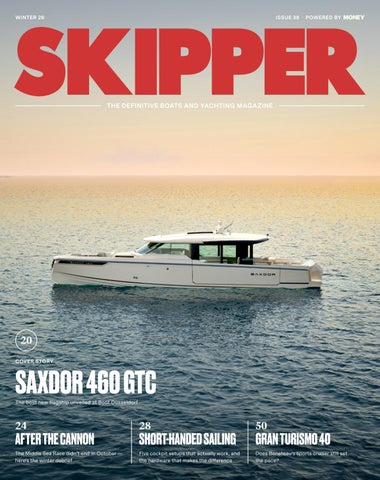
Winter doesn’t end sailing in Malta — it sharpens it. Shorter days, livelier fronts, crews trimmed to two, and the odd squall that turns a routine hop into a small systems test. This issue leans into that reality: practical upgrades, clean debriefs, and a cover boat that treats “speed with comfort” as a design brief, not a contradiction.
Saxdor’s new 460 GTC headlines for precisely that reason. It’s the brand stepping up in size without losing the lively DNA that made its smaller models fun in the first place — folding terraces, a calm wheelhouse, and that feeling that the boat would happily sprint if you asked. Inside the fleet piece, we also map the 400-Series logic for owners who split time between brisk shoulder-season boating and summer raft-ups.
Locally, the Malta Boat Show’s expansion across the Three Cities was the right kind of ambition — not louder, just better knit. The added bridge, a clearer evening programme, and stronger partner coordination turned Dockyard Creek into a proper showground rather than a line of pontoons. It’s a hint at where our marine scene can go when logistics match enthusiasm.
For real-world sailing, the short-handed setups feature is built for couples, owner-plusteen, or skipper-plus-novice. It’s about moving the boring jobs back into the cockpit and making reefing unremarkable. Pair that with the Skipper Gear edit — heaters that actually keep up, dehumidifiers that work in cool cabins, and canvas that sheds water instead of patience — and January suddenly feels less heroic and more enjoyable.
Finally, the builders series sits exactly where it should: on craft. Chaudron’s race-toproduction loop is a Maltese calling card — proof that when standards stay higher than volume, reputations travel further than budgets. That’s a lesson worth carrying into spring.
See you on the quay.
Skipper is exclusively distributed at the Birgu, Gardens Yacht Marina, Kalkara, Manoel Island, Marina di Valletta, Mgarr, Msida, Ta’ Xbiex (Creek), and Roland Marina in Malta and Porto Turistico Marina di Ragusa in Sicily; all boating and sailing-affiliated businesses, embassies, five-star hotels and boutique guest houses, waiting areas, business centres and executive lounges, and sailing clubs.
Editor Anthony P. Bernard anthony@bemags.com
Design BE.
Print
Print It
Distribution
MaltaPost
For promotions and advertising, contact BE. on (+356) 9949 0886 or skipper@bemags.com
Skipper is published by Be Communications Ltd. 36/1, Amery Street Sliema SLM1702, Malta
becommunications.com
All rights reserved. The content of this magazine, including articles, images, designs, and any intellectual property, is owned and protected by Be Communications Ltd. Unauthorised reproduction, distribution, or transmission of any part of this magazine is strictly prohibited without prior written permission. Be Communications Ltd. retains all intellectual property rights in the content published in this magazine, including but not limited to copyrights, trademarks, and patents. Any unauthorised use, reproduction, or commercial exploitation of this content violates applicable laws and may result in legal action. Opinions expressed in this magazine are those of the respective contributors and do not necessarily reflect the editor's or publisher's views. While every effort is made to ensure accuracy, Be Communications Ltd. assumes no responsibility for errors or omissions in the magazine's content, advertisements, or related materials and disclaims liability for the accuracy, legality, or originality of content provided by clients.
THE NEW BMW iX3
THE FIRST OF A NEW ERA.
CHAUDRON: RACING DNA, REAL-WORLD BOATS
From race podiums to production hulls, Chaudron translates championship data into everyday speed, strength and reliability. In this Skipper series on Malta’s boat builders, founderracer Aaron Ciantar explains how an island brand competes with giants while protecting standards and heritage.
MALTA BOAT SHOW
Dockyard Creek turns into a proper waterfront rendezvous.
COVER STORY THE SAXDOR FLEET
Built for boaters who want speed without sacrificing comfort, this Scandinavian brand continues to reshape the premium day-boat segment. Its growing fleet now spans from compact performers to a flagship yacht signalling serious intent at the top end.
THE MIDDLE SEA RACE THAT DIDN’T FINISH IN OCTOBER
Why the 2025 edition is best understood as a winter debrief — and a blueprint for how Mediterranean offshore sailing is changing.
SHORT-HANDED SAILING: 5 SETUPS THAT ACTUALLY WORK
For couples, owner + teen, and skipper + novice, with the hardware that makes the difference.
SKIPPER WATCHLIST
Winter is where seasons are won—through planning, refit choices, weather study, and honest debriefs. This Watchlist skips the hype and spotlights credible follows and winter circuits that deliver practical value, so your spring sailing starts sharper, calmer, and faster.
BOOT TO MIAMI 2026: 10 LAUNCHES
From Düsseldorf debuts to Miami buzz, we spotlight the new yachts shaping the next boating season.
SKIPPER GEAR: WINTER UPGRADES THAT ACTUALLY WORK
Malta doesn’t have an “off-season”— just cooler, wetter sailing that rewards innovative kit. This winter edit focuses on upgrades that keep cabins dry, crews warm, and systems reliable, with trusted brand examples to guide buyers (not sponsors). You'll feel the difference.
QUIET FLEX, DONE PROPERLY
From shearling bombers to selvedge denim and a GMT-Master II, this edit nails effortless luxury with edge and restraint.
BIG BOY TOYS: FOUR WINTER TECH THRILLS
IN REVIEW:
» AZIMUT FLY 82
» BENETEAU GT40
» DE ANTONIO D60
Short days don’t have to be slow. These four toys bring joy to Maltese winters—compact, useful, and great for photos. Imagine silent “flying,” cinematic reveals, underwater scouting, and serene moonlit entries.
CHAUDRON
Racing DNA, real-world boats
From race podiums to production hulls, Chaudron translates championship data into everyday speed, strength and reliability. In this Skipper series on Malta’s boat builders,
founder-racer Aaron Ciantar explains how an island brand competes with giants while protecting standards and heritage.
Founded and led by racer-builder Aaron Ciantar, Chaudron sits at the sharp end of Malta’s performance boatbuilding. The brand’s identity was forged on the racecourse, where design decisions are proven at full load in unforgiving conditions. That loop—learn under pressure, then build for customers— defines the Chaudron approach: racederived layups, carefully tuned hull forms, and rigging choices aimed at dependable high speed, not brochure numbers.
Three decades on, the company focuses on limited, high-quality production rather than scale for its own sake, pairing meticulous construction with direct, owner-level after-sales. The racing pedigree helps the boats sell themselves, but commercial discipline underpins the craft: strict QC, conservative claims, and a willingness to keep volumes low to protect standards.
Internationally, Chaudron competes against far larger American and Italian names with deeper dealer networks and marketing budgets. Europe remains
Buyers know they are getting championship experience, proven strength, and personal attention.
the easiest market—thanks to shorter shipping routes and simpler costs— while U.S. sales are constrained mainly by logistics. On the technical horizon, tighter rules on emissions and noise point to cleaner, quieter powertrains without abandoning performance. The bigger strategic challenge is human: finding and training skilled hands. For Malta to cement a reputation in performance boatbuilding, Aaron argues, apprenticeships and craft pathways matter as much as composites R&D.
You’ve raced at the very top, and you build fast boats for customers—how does competition data translate into layup, hull form, and rigging decisions for production craft?
One of the company’s greatest successes has been transferring the knowledge and technology from our racing experience into our production boats.
Racing proves the true quality of a craft because, in extreme conditions, you simply cannot afford failure; the boat must
perform at 100%. We took what we learned from building race boats —construction methods, materials, and design principles — and applied it directly to our pleasure boats. By using the same building techniques, our customers enjoy pleasure craft that are not only strong and reliable but also fast and high-performing.
In export markets dominated by larger American and Italian names, what convinces a buyer to choose a Maltesebuilt Chaudron—and what still holds you back?
As boat builders, we are proud to be 10-time world champions, and we credit our racing history for helping our company grow. Over the past 30 years, we have built a strong reputation for quality and reliability; we have never had failures with our boats or with our customers. Just as necessary, we always put our customers first, and that level of service and care really sets us apart.
What convinces many buyers to choose a Chaudron is that they know they are getting a boat built with championship »
experience, proven strength, and personal attention.
At the same time, there are challenges.
Selling boats in Europe is easier for us because buyers benefit from lower shipping and duty costs. For American customers, logistics and shipping costs make it more difficult, which is why our sales in the U.S. are smaller than in Europe.
Certification, emissions, and noise limits are tightening globally. Where do high-performance hulls go next to stay both compliant and genuinely quick?
We build a limited number each year on purpose: quality over quantity, every time.
Modern engines are already being developed with lower emissions and reduced noise levels, while still delivering high performance. This progress allows high-performance hulls to remain compliant with regulations without sacrificing speed and efficiency.
Beyond trophies, what’s been the hardest commercial lesson from the
racing circuit—distribution, after-sales, or scaling production without diluting quality?
Our racing career was very valuable commercially, as it brought us strong visibility and many sales. At the same time, one of the hardest lessons has been finding the right balance between demand and production. To protect our standards,
we deliberately build a limited number of boats each year rather than moving into mass production. For us, quality will always matter more than quantity.
If Malta wants to be known for performance boatbuilding, what ecosystem pieces are missing— apprenticeships, composites R&D, test facilities, finance, or is it simply market access?
What is really missing are apprenticeships and skilled workers. It is becoming increasingly complex to find people who want to learn and dedicate themselves to this type of craft. Without new talent entering the field, it’s a challenge to sustain and grow Malta’s position in performance boatbuilding.
DE ANTONIO YACHTS D42 OPEN TECHNICAL SPECIFICATIONS
Malta Boat Show stretches across the Three Cities as Dockyard Creek turns into a proper waterfront rendezvous
The Malta Boat Show, hosted by Yachting Malta, returned to Dockyard Creek, Cottonera, with a noticeably bigger footprint and a clearer ambition: to turn the Grand Harbour’s working waterfront into a serious Mediterranean boat-show setting. In its second edition under Yachting Malta’s stewardship, the event pushed beyond Cospicua and into Vittoriosa and Senglea, effectively knitting the Three Cities into one walkable showground and bringing fresh energy to their quaysides.
On the trade side, growth was tangible. The show expanded to include 47 new exhibitors alongside 32 returning exhibitors from 2024, with international participation also edging up through three foreign exhibitors — two from Italy and one from France — signalling a gradual widening of the show’s reach beyond Malta. For visitors, the bigger footprint translated into more variety: boats and superyachts, marine toys and services, alongside the corporate, legal, and lifestyle brands that now typically orbit modern boat shows.
A few practical upgrades improved the on-the-ground experience. A new bridge helped visitors move more easily between the two sides of the show. At the same time, “The Dome” introduced a dedicated focal point that carried the evening programme, with sets by local DJs including The Element, CF1, Glenn Frantz, and Miriana Belfiore. Public attendance also increased substantially from the previous year, underlining a growing appetite for a large-format marine showcase in the heart of the harbour.
The event’s expansion relied heavily on coordination within a tight, historic environment. Yachting Malta credited the Government of Malta, led by the Ministry for Transport, Infrastructure and Public Works under Hon. Dr Chris Bonett, alongside Transport Malta and Infrastructure Malta, for
supporting operations, safety, and infrastructure planning across the site.
Key partners also played a visible role in shaping the show’s layout and atmosphere. Palumbo Shipyards and the American University of Malta provided access to premises that enabled the scale, while Grand Harbour Marina hosted a significant segment
of the superyacht display. The Malta Food Agency strengthened the on-site offering—an underrated factor in keeping visitors on-site longer and in encouraging the show to feel like a full-day harbour experience rather than a quick walk-through.
One of the most evident signs the show is maturing was the launch of the Enemed VIP Experience, a premium hospitality concept offering reserved lounge access, dedicated hosting, and elevated vantage points across the show. The initiative proved popular quickly, pointing to a market for higher-end
Photos by Andrea Azzopardi / Yachting Malta
visitor experiences alongside the trade and public elements.
International media presence also stepped up. Foreign press, including IBI News (United Kingdom), Yacht Revue (Austria) and Barche Magazine (Italy), attended, met with stakeholders and covered the show — a valuable marker for an event positioning itself as a regional date on the yachting calendar, not just a local showcase.
year’s scale-up suggests the show is becoming a meaningful commercial and cultural platform for Malta’s marine ecosystem. With 2025 now wrapped, Yachting Malta CEO Michael Mifsud confirmed that planning for the 2026 edition is already on the horizon, with the organisation aiming to build further on this year’s momentum.
The 2025 Malta Boat Show was supported by the Ministry for
Speaking after the event, Yachting Malta Chairman Hon. Mr Chris Agius said the expansion across the Three Cities, record attendance, and widening international interest reflected the event’s growing significance, adding that collaboration between government, industry, and the wider maritime community was key to maintaining global standards.
While refreshed with new formats, the Malta Boat Show is also building on its legacy. The setting — steeped in Malta’s maritime history — remains one of its strongest assets, and this
Transport, Infrastructure and Public Works, Transport Malta, Infrastructure Malta, the American University of Malta, Grand Harbour Marina, Enemed, Enemalta, Palumbo Shipyards, and the Malta Food Agency, with additional support from the Cospicua, Senglea and Vittoriosa Local Councils and the Cottonera Foundation.
For more information, visit www.yachtingmalta.org or follow Yachting Malta on social media for updates and highlights.
The SAXDOR FLEET
Built for boaters who want speed without sacrificing comfort, this Scandinavian brand continues to reshape the premium day-boat segment. Its growing fleet now spans from compact performers to a flagship yacht signalling serious intent at the top end.
Saxdor is for those who enjoy cruising but don’t see speed as something to apologise for. Across the range, the philosophy is consistent: modern Scandinavian design, smart use of space, and performance that’s always waiting in reserve.
← Saxdor 460 GTC: The flagship all-rounder
The 460 GTC sits at the top of the Saxdor line-up and marks a significant step forward for the brand, moving confidently into a larger and more refined class of yacht while staying true to its core identity. Rather than simply building a bigger boat, Saxdor has focused on delivering a complete and immersive on-water experience, bringing together its design thinking, engineering, and technology on a new scale.
Developed as a natural evolution of the successful 400 Series, the 460 GTC builds on owner feedback and realworld experience across the fleet. The result is a yacht that elevates Saxdor’s signature strengths — clever space utilisation, strong performance, and close contact with the surroundings — while introducing a level of comfort and finish more often associated with larger yachts.
At first glance, it’s a refined enclosed wheelhouse yacht with clean lines, generous proportions, and a calm, contemporary feel. Yet, at the press of a button, the character changes completely. Sliding glass panels, an opening roof, and folding side terraces transform the boat into a wide, open entertaining platform that blurs the line between indoors and outside.
Below deck, the 460 GTC is more than just a day boat. A forward master cabin, a twin mid-cabin, a proper bathroom with a separate shower, and an optional aft cabin mean up to three cabins are available — an impressive layout for a
yacht that still looks ready to sprint away from the marina.
The 400 Series
One hull, three personalities
The Saxdor 400 range shows just how flexible a well-designed platform can be. All three models share the same stepped hull and performance DNA, but each delivers a distinctly different experience.
↓ 400 GTO: Performance-focused and open
The 400 GTO is designed for owners who prioritise speed and open-air boating. »
It doesn’t so much cruise as stride confidently across the sea. Built around a twin-stepped hull and powered by twin outboards, it delivers quick acceleration, efficient cruising, and a composed, confident feel at pace.
A full-beam wheelhouse provides the interior with surprising volume, while folding side terraces expand usable deck space at anchor. It strikes a balance between relaxed cruising and spirited driving — comfortable enough for long days, yet engaging enough to keep things interesting.
The 400 GTC takes the same capable hull and adds a fully enclosed, insulated wheelhouse. Bright, warm, and reassuring, it shrugs off wind and cooler conditions that would send lesser boats back to the marina café. Large glass panels flood the interior with light while maintaining excellent protection from the elements.
It feels equally at home on brisk spring mornings or short passages in unsettled weather, without sacrificing the option to fully open up and enjoy the terraces when conditions allow. Practical, comfortable, and just as quick.
→ 400 GTS: Open, social, sun-focused
This is open boating in its purest form. A walkaround layout, minimal
glass protection at the helm, and sun everywhere define the experience. Designed for Mediterranean conditions and social boating, it offers generous lounging areas and an open feel.
Sharing the same sharp, stepped hull, the GTS remains lively and responsive when the throttles are advanced. Flexible seating and folding terraces allow the deck to adapt easily, whether anchoring for the afternoon or moving between destinations. Performance remains firmly part of the picture.
↓ 320 GTO: The popular choice
The 320 GTO has earned its popularity by offering a well-judged mix of performance and usability. With powerful outboards, it delivers high cruising speeds with ease while remaining stable and predictable.
A sociable cockpit, a comfortable cabin for overnight stays, and a compact galley make it suitable for both day trips and
short getaways. It’s a boat that adapts easily — relaxed when you want it to be, energetic when you don’t. A balance of “let’s take it easy” and “hold my beer, watch this”.
↑
Saxdor 270 GTO: Compact and capable
The 270 GTO proves that size isn’t everything. Its twin-stepped hull, lightweight construction, and sharp deadrise make this pocket rocket agile and efficient, with a ride that handles chop confidently.
Easy to manage and surprisingly capable, it delivers strong performance without feeling demanding. It’s a practical choice for owners who want the boating equivalent of a hot hatch — compact, cheeky, and far more capable than it strictly needs to be.
The verdict
Saxdor doesn’t really do boring. The fleet is defined by smart design, efficient use of space, and performance that feels integral rather than excessive. From the adaptable 460 GTC to the versatility of the 400 Series and the smaller spirited models, every boat is designed to be engaging, practical, and enjoyable without ever feeling ordinary.
The 400 GTO, 270 GTO, and 320 GTO are all available now from stock at Promarine Ltd.
↑ 400 GTC: Comfort in any conditions
THE MIDDLE SEA RACE THAT DIDN’T FINISH IN OCTOBER
Why the 2025 edition is best understood as a winter debrief — and a blueprint for how Mediterranean offshore sailing is changing.
Balthasar, overall winner of the 2025 RMSR
Photo by Kurt Arrigo
By January, the Rolex Middle Sea Race has usually been filed away as “last season”: a highlight reel of Valletta’s cannon start, a few drone shots off Stromboli, then the familiar roll-call of winners. But the 2025 race (46th edition) is the kind you don’t truly understand until you’ve had time to replay it, not on YouTube, but in the quiet, slightly obsessive way sailors do: in routing screenshots, in a salt-stained notebook, in that one sail change you still argue about over coffee.
Because the unique story of 2025 isn’t that it produced a worthy winner — it did — or that it attracted a serious international fleet — it did — but that it exposed a truth many Mediterranean programmes still try to ignore: offshore here is no longer “big breeze or no breeze”. It’s variability as a constant. It’s raining where you don’t expect it. It’s pressure systems that refuse to behave politely. And it’s a race won by the team that treated uncertainty as the primary opponent.
The scoreboard tells one story— the delta tells the real one
On paper, the headline is clean: Balthasar, the Mills 72 skippered by Louis Balcaen, took overall victory on IRC. And if you want the pure speed narrative, you’ve got it, too: the results list Black Jack 100 as the monohull line honours winner.
But the “January angle” is this: 2025 was a race of gaps — gaps between forecasts and reality, between what the instrument numbers promised and what the sail wardrobe could actually deliver, between a fast boat’s best-case plan and the messy, soaked, stop-start truth of a 606-mile lap of the Middle Sea.
↑ Valletta is the starting point for the historic 606-nautical mile RMSR
In October, those gaps feel like drama. In January, they look like data. Owners who are honest with themselves will recognise the uncomfortable part: the winner wasn’t simply the boat with the most horsepower or the deepest bench. The winner was the programme that could keep making correct decisions when the Mediterranean did what it does best — shift the terms midsentence.
The weather wasn’t “bad”— it was instructive
One of the race updates captured it neatly: the fleet avoided a repeat of the previous year’s worst opening night — but everyone still paid in discomfort, with frequent heavy downpours and a primarily north-easterly flow after a low-pressure system moved through the course area.
That line matters because it describes a modern Middle Sea dynamic that’s increasingly common: the “not a storm” storm. The conditions aren’t dramatic enough to trigger heroic storytelling. »
Still, they are disruptive enough to punish lazy systems: soggy sail handling, compromised night visibility,
poor hydration/feeding discipline, and the quiet fatigue that turns a small error into a cascade.
It’s also where the Mediterranean has become a more complex arena than many crews admit. You can’t just be “good in light airs” or “good in a mistral”. You have to be good at transitions. Good at keeping your speed when the world goes grey and wet, and the breeze swings five degrees, and your best sail suddenly becomes almost the right sail.
In January, that becomes a checklist: better deck drainage; less romantic, more ruthless sail-change choreography; more conservative gear choices that keep working when the crew stops being fresh.
The race’s most useful hero is rarely the biggest boat
Every Middle Sea has its superyacht gravity — and 2025 had an appropriately varied fleet, with strong representation across nations (Italy leading entries, with France and Malta also heavily present).
But the stories that actually make sailors better are often found deeper in the results and class battles — the moments where a “normal” boat, with usual constraints, makes one unusually sharp sequence of calls and turns it into a result.
A perfect example sits in the official race reporting: Ton Ton Laferla, Jonathan Gambin’s Maltese Dufour 44, surfacing as a class leader after a chaotic few hours of finishes and corrected-time swings.
That’s the Middle Sea lesson Skipper readers can use: the race doesn’t only reward budgets. It rewards coherence. A boat that is well-prepped, well-sailed, and well-routed can still have a day — sometimes a whole race — where the game tilts toward discipline and timing rather than raw rating muscle.
So what do we take into 2026? Three winter debrief truths
1. “Fast” is no longer a single gear. The modern Middle Sea is a series of micro-episodes. Your target speed is only helpful if you can maintain it through transitions — squalls, header lifts, coastline effects, and fatigue.
2. Rain is now a performance variable. You don’t need a survival storm to lose hours. You just need hours of wetness: slower manoeuvres, fogged-
↓ Allegra, one of the competing multihulls
Photo by Kurt Arrigo
↓ Ton Ton Laferla claims IRC Class 4 victory
Photo by Andrea Azzopardi
up comms, slippery decks, miserable crew energy. 2025 made that painfully clear.
3. The trophy is won in programme design, not race-week bravado. Balthasar’s overall win is the obvious proof-point — but the deeper point is that corrected-time success in this race still hinges on decision quality sustained over days.
← Black Jack 100 is the largest yacht competing in the 2025 RMSR
by Kurt Arrigo
↓ Stromboli offers an alluring backdrop as Zen completes her rounding of the island
Photo by Kurt Arrigo
The most honest way to remember 2025
If you’re writing the season plan right now — which sails to service, which electronics to trust, which crew to invest in — the 2025 Rolex Middle Sea Race is less a memory and more a diagnostic tool. It showed that the Mediterranean offshore identity is evolving: not softer, not wilder, just less predictable in a way that demands better systems.
And that’s the unique January truth: the race didn’t really finish when the last yacht docked. It’s still finishing now — in the choices serious owners make this winter, while everyone else is simply reminiscing.
Photo
SHORT-HANDED SAILING: 5 SETUPS THAT ACTUALLY WORK
For couples, owner + teen, and skipper + novice, with the hardware that makes the difference.
Crew is the new luxury. Between work, school, and the reality that “maybe I’ll join” often turns into “sorry, can’t”, more owners are discovering that the boat has to be run by two people — sometimes by one and a half. The good news is you don’t need to turn your yacht into a floating power station to sail shorthanded. You need the right systems, the right lead angles, and a cockpit that lets you do the boring jobs (reefing, trimming, anchoring) without leaving the safe zone.
Below are five short-handed setups that genuinely work in the real world — not just on brochure day — including hardware choices that reduce workload, protect confidence, and keep the boat moving when the wind (or the crew list) drops.
Self-tacking jib
1) The “Two-Adults, No Drama” cruiser
Best for: couples cruising and weekend hopping
Core idea: make the boat behave as if it had three extra crew: selftacking headsail, lead aft control lines, and a dependable autopilot.
This is the simplest short-handed win: remove the need for perfect tacks and minimise foredeck trips.
What it looks like
Self-tacking jib on a proper track (not a compromise barberhaulier). It turns short tacking lanes and harbour exits into a one-person job.
Lines led aft for reefs, vang/kicker, outhaul and (if possible) Cunningham. The goal is simple: to reef without leaving the cockpit.
Autopilot you trust, sized correctly for displacement and sea state, not just “it came with the boat”.
Hardware that earns its keep
Deck organisers + rope clutches sized for modern line diameters and loads, with fair leads to the winches. If clutches slip, you’ll avoid reefing. That’s how gear becomes a safety issue.
German mainsheet (double-ended mainsheet to each side of cockpit) if you often sail with just two aboard; it keeps trimming practical from either helm position.
A tidy traveller solution: if your boat has a traveller in an
awkward spot, consider relocating controls aft or using a bridle with fine-tune.
How it sails short-handed
Tacking becomes “turn the wheel, trim once”.
• Reefing becomes “autopilot on, ease, hook, grind, done”. Your cockpit stays the command centre — not a staging point for risky trips forward.
2) Owner + Teen: The confidence-building family rig
Best for: parent sailing with a teenage son/daughter (or any younger crew)
Core idea: reduce loads, simplify roles, and make the teen’s job precise, repeatable, and safe.
Teens can be brilliant crew — strong, fast learners — but only if the boat doesn’t punish small mistakes. Your setup should make success easy.
What it looks like
• Single-line or two-line reefing, friction-managed and labelled.
Complexity kills momentum.
Furling headsail (or self-tacker) that can be reefed early without debate.
• A “safe zone” cockpit workflow: halyards, reefs, vang, and furling line all reachable without gymnastics.
Hardware that helps
Colour-coded line system (or at least consistent tails and labels). A teen should never have to guess which rope is which in a gust.
Boom preventer led aft (or a simple boom brake system) to make downwind calmer and reduce the fear factor.
How you split roles
Owner handles helm and big-picture calls.
• Teen handles one job at a time: “ease traveller”, “grind reef”, “furl to the mark”.
Your boat becomes a learning platform, not an exam.
3) Skipper + Novice: The “Training Wheels” cockpit
Best for: experienced skipper sailing with a partner/friend who’s keen but green
Core idea: remove intimidation and build a workflow that’s hard to mess up.
A novice doesn’t need more information — they need fewer critical decisions. The setup should let them contribute safely while the skipper stays in control.
What it looks like
Self-tacking jib or a small, easily furled headsail. If every tack requires a perfect release and re-trim, the novice will freeze. Main-first sailing: a manageable mainsail with easy reefs does more for short-handed control than a giant genoa.
• Centralised control lines led aft so the skipper can “drive and manage”.
Hardware that helps
• Autopilot with a cockpit remote (wired or wireless). Being able to nudge the course while reefing is a genuine shorthanded multiplier.
• Clear clutch layout: group by function (halyards/reefs/ controls), not by “whatever fit where”. »
Non-slip + handholds where novices actually stand: companionway, coachroof edges, and the path to the winches.
The result
• The novice becomes useful fast (“press this, ease that”), and the skipper stays relaxed.
Confidence builds, and short-handed stops no longer feel like “skipper plus passenger”.
4) The “Anchor Without an Argument” coastal setup
Best for: couples and small crews doing frequent stops Core idea: anchoring is where short-handed cruising becomes stressful — fix that, and everything feels easier.
Short-handed sailing often goes fine… until it’s time to anchor in a crosswind with other boats watching. The solution is control, visibility, and repeatability.
What it looks like
Remote windlass control in the cockpit (plus a foredeck foot switch as backup).
Chain counter visible from the helm if possible. Knowing you’ve deployed 25m (not “about that much”) stops mistakes.
• A proper bridle/snubber setup is ready for quick deployment.
Hardware that helps
• Remote windlass (wired remote or helm switch) and a sensible circuit with correct breakers.
Bow camera can be a game-changer on some boats, but even a simple, clear sightline and marked chain does the job.
• Good deck lighting for winter afternoons and early nights (bow and foredeck work lights).
Short-handed anchoring workflow
• Helm holds position into the wind under the engine while the other crew deploys, or the skipper does it with remote control and autopilot/engine balancing.
Once set, you snub correctly, shut down the chaos, and the boat becomes a home again.
5) The “Fast but Forgiving” performance short-handed rig
Best for: owners who want pace without the full race-crew circus Core idea: keep the boat quick by making sail changes less frequent and trimming less physical.
Performance short-handed fails when everything requires a sail change. It works when you carry a versatile wardrobe and control it from the cockpit.
What it looks like
Smaller, efficient headsail plan with furling and a shape that still works partially furled.
Code sail on a furler (top-down for asymmetrics, conventional for Code 0-style sails) to add range without full foredeck dramas.
Reef early, sail flatter: short-handed speed is about consistency, not hero moments.
Hardware that helps
Electric winch (even one): make the primary winch electric, and suddenly trimming and hoists become realistic with two aboard.
Tidy running rigging: low-friction rings where appropriate, quality blocks, and fair leads that don’t chew lines.
• Autopilot again — but here, it must steer well downwind too, not just on a flat reach.
The reality check
The best short-handed performance upgrade isn’t carbon — it’s reducing the number of times you have to leave the cockpit in a hurry.
The short-handed rule that never changes
If you remember one thing: short-handed sailing is won on calm days in the marina. It’s won by running every line cleanly, labelling what matters, servicing clutches and winches, and practising one reef routine until it’s boring. Because when it’s cold, gusty, and the sun drops early, boring is exactly what you want.
BUILT ON LEGACY, ENHANCED FOR TODAY
OCEANIS 47
SKIPPER WATCHLIST
Winter prep, real skills, and the follows that matter
Winter is where seasons are won—through planning, refit choices, weather study, and honest debriefs. This Watchlist skips the hype and spotlights credible follows and winter circuits that deliver practical value, so your spring sailing starts sharper, calmer, and faster.
Winter in the Med has a habit of exposing what summer forgives. Fronts arrive fast, daylight disappears early, and shorthanded sailing becomes the default rather than the exception.
It’s also the season when serious crews do their best work—quietly—through refit decisions, weather study, and honest debriefs that strip out excuses. While the marina feels sleepy, campaigns are being built: systems simplified, deck plans refined, routines rehearsed, and
races pencilled in. This Watchlist is your shortcut through the noise—credible follows and winter storylines that deliver practical value now, so the first sail of spring feels calmer, cleaner, and faster.
1) The winter weather desk: follow the people who reduce surprises
If there’s one area where winter content pays back immediately, it’s weather literacy — because your best decisions happen before you slip lines.
PredictWind webinar library is an easy entry point: recorded sessions on weather, routing, and passage planning that are practical rather than theoretical. It’s especially relevant if you’re building confidence in offshore planning or want to stop guessing what the models are really saying. www.predictwind.com
For structured learning, WeatherSchool’s Sailing Weather School (live online) is designed specifically for sailors and built to make meteorology usable, which is exactly what you want before the first big winter front catches you mid-channel. weatherschool.co.uk
2) The race-room voices: analysis you can actually apply
You don’t need another highlight reel. You need debriefs, context, and straight answers.
Shirley Robertson’s Sailing Podcast (YouTube) remains one of the best windows into elite sailing — interviews that go beyond the press release and into “what we learned” territory.
It’s a strong winter listen because you
can absorb a season’s worth of lessons without leaving the sofa. www.youtube.com/c/ ShirleyRobertsonsSailingPodcast
On the racing-only side, Yacht Racing Life / The Yacht Racing Podcast (Justin Chisholm) is worth following for the breadth: SailGP weekends, match racing, offshore, and the kind of industry detail most outlets skip. www.yachtracinglife.com
3) Foiling’s front line: SailGP’s winter reset
If you want the sharpest modern reference for manoeuvre timing, role discipline, and decision-making at speed, SailGP is the league to track — and winter is where the storylines pivot.
SailGP’s 2026 calendar runs 13 events, starting in Perth (16–17 Jan 2026) and closing with the Abu Dhabi Grand Final (28–29 Nov 2026).
Two winter threads to watch closely: • Emirates GBR’s crew change: the signing of Stuart Bithell for 2026 reunites him with helm Dylan Fletcher (their Olympic partnership), the sort of combo that can quickly raise a team’s ceiling.
Artemis SailGP (Sweden) is entering as the 13th team, led by Iain Percy with Nathan Outteridge as driver, and named Swedish talents joining the roster — a proper programme, not a token entry.
4) Short-handed credibility: the campaigns that teach you seamanship
Winter also belongs to the short-handed crowd — because fatigue, systems, and judgment are the real “performance upgrades”.
Globe40 (Class40, double-handed) is a standout watch through 2025–26: a sixleg circumnavigation finishing in Lorient in April 2026. It’s compelling because it’s not just speed — it’s reliability, repair culture, and decision-making under pressure. www.globe40.com
A crew to keep an eye on: Germany’s Lennart Burke & Melwin Fink (“Team Germany”), widely covered as a young, ambitious pairing in the race. Their progress is a masterclass in how quickly things offshore change — and how teams respond. »
Lennart Burke & Melwin Fink
Shirley Robertson
Iain Percy
Stuart Bithell
2026 RORC Transatlantic Race - Andrew and Sam Hall's J/125 Jackknife
Image by Deea Buzdugan
5) The winter offshore bucket list: the races that set the tone
Even if you’re not entering, follow the events your favourite crews are training for.
RORC Transatlantic Race (Lanzarote to Antigua) sits on the early 2026 programme — a strong bellwether for anyone who is serious about offshore miles. www.rorctransatlantic.rorc.org
RORC Caribbean 600 starts Monday, 23 February 2026, from Antigua — one of the cleanest “offshore, but manageable” formats for teams stepping up.
6) The next wave: youth fleets where future pros are already visible
For pure talent-spotting, winter gives you one of the best signposts on the calendar: The 2026 ILCA Under-21 World Championships run 17–24 January 2026 in Playa Blanca, Lanzarote, with restricted entry (a capped fleet). If you want names before they become Olympic regulars, this is where to look.
7) Refit-season follow: the people making boats quieter, cleaner, and smarter
Winter is refit season — and the most useful creators are the ones showing the work.
Sailing Uma has become a reference point for owners curious about modern systems and electrification, documenting an all-electric rebuild with the kind of detail that helps you ask better questions of your yard, electrician, or surveyor. www.sailinguma.com
8) Pathways and progress: follow the programme builders
If you care about who gets opportunities (and how), The Magenta Project is worth tracking this winter. Its mentoring programme and broader initiatives are increasingly structured — practical pathways, not slogans — and the 2025/26 cycle has been widely reported as a major edition. www.themagentaproject.org
Skipper takeaway: build a winter feed that makes you better by March — weather literacy, debrief culture, one foiling reference, one offshore campaign, and one refit/systems channel. The rest is noise.
Kika and Dan, Sailing Uma
The Magenta Project
POWER, RELIABILITY, AND PEACE OF MIND: ENGINE CARE BY UNEC
Owning a yacht is a passion, an investment, and a source of unforgettable experiences on the water, and very possibly a source of income. To preserve that joy and protect your valuable vessel, proactive maintenance is not just recommended, it's essential. UNEC, the authorised dealers for Baudouin, Caterpillar and Cummins Onan marine engines, understand that keeping your yacht in peak condition demands expert care, attention to detail and timely intervention. Here's why proactive maintenance is the smartest choice for your boat and how UNEC can be your trusted partner in safeguarding your investment.
Why proactive maintenance matters
Marine Engines are complex machines engineered for performance and reliability. However, even the most advanced machines are subject to wear and tear, corrosion, and mechanical stress from exposure to harsh marine environments. Left unchecked, minor issues can escalate into major malfunctions that compromise safety, lead to costly repairs and reduce your yacht's overall value.
Proactive maintenance means regular inspections and service designed to catch minor problems before they turn into emergencies. This approach ensures that your vessel operates efficiently, your
engines run smoothly and all systems perform as intended, giving you peace of mind every time you set sail.
UNEC provides expertise you can trust
As the official authorised dealer for Baudouin, Caterpillar and Cummins Onan marine engines, UNEC offers unmatched expertise backed by manufacturer certification and training. Our technicians are highly skilled, well-qualified professionals who undergo continuous training to stay current with the latest technological advances and service requirements.
Unlike general marine freelance technicians, only UNEC technicians have access to the latest diagnostic tools and up-to-date service bulletins and recommended upgrades from the aforementioned manufacturers and principals. This means any repair or maintenance work we undertake is based on the most current and accurate information, ensuring your engines receive the precise care they need.
Original parts and accurate guidance
Using genuine parts is critical to maintain engine integrity and vessel safety. UNEC guarantees the use of original manufacturer parts, avoiding the risks associated with inferior or counterfeit components. We also offer the best prices in Malta on genuine Baudouin, Caterpillar
Cylinder head tune up carried out by UNEC servicing.
and Cummins Onan parts, ensuring cost efficiency without compromising quality or compliance. Moreover, we provide expert guidance on identifying necessary parts before an order is placed, helping you avoid unnecessary expenses and delivery delays. Our proactive approach ensures that every replacement and repair is performed correctly the first time, saving you downtime and additional costs down the line.
Delicate works carried out by expert UNEC technicians
Fast, reliable service when you need it
Yachting seasons are time sensitive, and we know and appreciate how important your time and boating plans are.
That's why UNEC pledges to have a qualified technician on-site within just three working days of your service request.
UNEC's authorised technicians deliver precise maintenance for vessels ranging from day cruisers to container ships, encompassing routine oil and filter changes through to extensive overhauls of Baudouin, Caterpillar and Cummins Onan engines. This professional service ensures optimal performance, vessel safety, and regulatory compliance. Irrespective of the service call, our team arrives promptly with all the tools and parts to get the job done efficiently, minimising disruption to your schedule.
Service schedules based on expertise
Each manufacturer provides specific service schedules tailored to their
engines' design and performance characteristics. UNEC's deep knowledge and access to the latest information on Baudouin, Caterpillar and Cummins Onan service requirements allow us to recommend and adhere to precise maintenance intervals that optimise your engine's reliability and lifespan.
Regular scheduled maintenance prevents unexpected breakdowns and maximises fuel efficiency, ultimately saving you money over your yacht's lifetime.
Warranty registration and compliance
It is key to register the engine with the relevant global network to activate warranty coverage, record service activities and adhere to manufacturer specifications, thereby mitigating repair delays and operational disruptions. Authorised dealers such as UNEC guarantee these standards at all times.
Cost-effective maintenance with exclusive offers
Proactive servicing is a wise investment that reduces long-term repair costs and preserves your yacht's resale value.
UNEC also makes proactive maintenance even more accessible and affordable with special offers for new clients:
Enjoy five free callouts of up to 2 hours each when you contract us for regular servicing.
Receive a 15% discount on all parts and lubricants purchased alongside your annual servicing.
Benefit from a discounted labour rate on servicing jobs.
These exclusive incentives are designed to welcome new yacht owners into the UNEC family and provide exceptional value without compromising quality.
For more information, contact our Marine Operations Manager, Kenneth Azzopardi, on (+356) 7984 9809 or kenneth.azzopardi@unecservicing.com.
Kenneth Azzopardi
BOOT TO MIAMI 2026
10 brand-new launches worth chasing this show season
1) Sunseeker Manhattan 56
World premiere (boot Düsseldorf)
Sunseeker knows precisely what it’s doing here: take one of its most recognisable family names and refresh it in the 50–60ft bracket where realworld owners actually buy. The Manhattan 56 is being positioned as a “new chapter” for the range, and boot is the perfect stage—serious buyers, serious competitors, and nowhere to hide under Mediterranean sunshine glamour. Expect the crowds to fixate on how Sunseeker balances modern beachclub living with the practicalities that make a 56 work week in, week out.
2) SAXDOR 460 GTC
World premiere (boot Düsseldorf)
This is Saxdor planting a flag. The 460 GTC is billed for its first public showing at boot, and it matters
because the premium outboard sector is now mature enough that “big” has to be clever, not just loud. The talking points will be the brand’s signature side terraces/walkaround usability, plus how well the enclosed “GTC” concept delivers year-round comfort without killing the open-boat feeling that made Saxdor hot in the first place.
3) Greenline 42
World premiere (boot Düsseldorf)
Greenline’s new 42 is not a minor tweak; it’s a statement model—two years in development, explicitly billed as a world premiere at boot, and wrapped in the brand’s “responsible yachting” logic: hybrid potential, serious solar integration, and efficiency-led design. What makes it anticipated isn’t just the green story—it’s whether Greenline can keep the premium feel while pushing the tech forward in a size that suits Mediterranean weekending and longer hops.
Boot is the season’s starting gun. In Düsseldorf, brands don’t just “show boats” — they reset expectations: bigger beach-club sterns, smarter owner-operator layouts, cleaner propulsion stories, and cabins that feel less like compromise and more like purpose-built living. If you’re buying, refitting, or simply tracking where the market is heading, these launches matter because they’ll shape what you’ll see on the water by summer. Here are ten genuinely new 2026 debuts — the models drawing the queues at boot and carrying that momentum into Miami — and why each one deserves a proper look.
World premiere (boot Düsseldorf)
A 70-footer that’s openly framed around extended autonomy and long-range comfort lands at precisely the right moment: owners want bigger water time,
fewer “logistics” days, and layouts that don’t fall apart when you’re actually living aboard. Solaris Power has tied the 70 Long Range to a boot world premiere, and the industry will be watching whether the Long Range series feels like a genuine new direction (seakeeping, storage, usability), not just a marketing subtitle on an existing template.
5)
World premiere (boot Düsseldorf)
Every show season needs a boat that’s unapologetically about style—and still backs it up with space and usability. The Astondoa 577 Coupe is billed as a boot world premiere, and it’s designed to attract buyers who want the sporty coupé silhouette without sacrificing comfort. Watch the stern and the social zones: modern coupés win or lose on how well they do “Med day” living—shade, access to the water, and that effortless indoor/outdoor flow. »
4) Solaris Power 70 Long Range
Astondoa 577 Coupe
6) Nord Star 49+
Show premiere (boot Düsseldorf)
Nord Star is the antidote to fashion. The 49+ is slated to debut at boot, and it’ll appeal to the owner who wants a boat that doesn’t get nervous when the weather turns, and doesn’t need a perfect forecast to justify leaving the marina. Expect the discussion to centre on the wheelhouse / all-weather cruising proposition—how it’s laid out for real passagemaking, how it’s ventilated and lit, and whether it can still feel like a luxury escape when it’s being used as intended.
7) Hallberg-Rassy 370
World premiere (boot Düsseldorf)
For sailors, this is a headline launch. Hallberg-Rassy doesn’t chase novelty; it chases refinement—
incremental changes that add up to boats people keep for a long time. The new 370 will be scrutinised for the unsexy things that matter most offshore: deck hardware logic, cockpit protection, engineering access, and whether the interior feels designed for living underway, not just looking good at the dock. In a hall full of “new”, this is the kind of new that lasts.
8) Saffier SE 28 Leopard
World premiere (boot Düsseldorf)
Saffier’s SE 28 Leopard is a classic boot crowdpuller: compact enough to feel attainable, sharp
enough to look like it escaped from a concept studio. Saffier is positioning it as a fresh step in its daysailer line, with an interior that still supports real weekends—berths and basic liveability—without
dulling the boat’s performance-first DNA. Expect this to be one of the most talked-about “small boats” of the show, precisely because it looks fast standing still.
9) Pure 42
World premiere (boot Düsseldorf)
Pure Yachts is aiming straight at the modern longrange performance cruiser: aluminium construction, deck-saloon thinking, and the promise of serious passage comfort without drifting into heavy, dull design. The Pure 42’s world premiere at boot will attract the buyer who’s done the miles and now wants a boat that feels engineered for extended living aboard—light, visibility, ergonomics, and systems access—rather than just another variation of the same interior template. It’s a “new yard, big ambition” moment.
10) Fountaine Pajot Samana 59 OD Sea+
World premiere (Miami, 11–15 Feb 2026)
Miami is where momentum becomes market reality, and Fountaine Pajot is using it for a clear statement: the Samana 59 ODSea+ will make its world premiere there, with ODSea+ framed around hybrid-electric “responsible cruising”. In big cats, the energy conversation is no longer theoretical—owners care about quieter anchoring, load management, and absolute autonomy without compromising the “floating villa” experience. Whether you’re a convert or sceptic, this is a must-board launch because it signals direction, not just product.
SKIPPER GEAR
1) Heat that actually keeps up Diesel air heaters remain the gold standard for safe, dry heat underway or at anchor. Think Webasto Air Top, Eberspächer/Espar Airtronic, or budget-friendly Autoterm (Planar). In-marina, a tipover-safe ceramic fan heater (e.g., De’Longhi, Dimplex) is fine for quick warm-ups, but fit an RCD and never run it unattended. Add thermal curtains (e.g., Oceanair/ DEX OPL materials) to cut condensation.
2) Dehumidify like you mean it
In cool cabins, desiccant units outperform compressor types. Look at Meaco DD8L/Arete, EcoAir DD1, or Mitsubishi Electric MJ-series. Run a timed cycle (smart plug: TP-Link Kasa) with a drain to the sink; crack a hatch for airflow. No shore power? Use passive moisture traps (Bison, UniBond Aero 360) in lockers and schedule airing days.
3) Foul-weather that you’ll actually wear
Go for a 3-layer shell with a high collar and a hood that turns with your head. Proven options: Musto MPX/BR2, Helly Hansen Ægir/Salt, Gill OS2/OS1, Zhik INS100/INS200. Layer with synthetic or merino mid-layers (Icebreaker, Arc’teryx, Rab). For line handling: grippy gloves from Gill, Hestra (Sailing), or Atlas (rubber-coated). Keep a dry spare set in a zip bag.
4) Power that keeps batteries smiling
Protect batteries with a smart, temperature-compensated charger: Victron Blue Smart, Mastervolt Chargemaster, Sterling ProCharge Ultra. Add a 50–100 W trickle solar (Renogy, SunPower flexible, Solbian) to offset standby loads. For DIY yard days, a compact power station like EcoFlow River/Delta, Jackery Explorer, or Bluetti EB/AC keeps tools running without spaghetti shore leads.
Winter upgrades that actually work
Malta doesn’t have an “off-season”—just cooler, wetter sailing that rewards innovative kit. This winter edit focuses on upgrades that keep cabins dry, crews warm, and systems reliable, with trusted brand examples to guide buyers (not sponsors). Mix one or two of these now, and you’ll feel the difference on your next blustery January hop.
5) Eyes on the boat from your phone
A marine IoT hub with bilge, voltage and temp/humidity alerts is cheap insurance: Siren Marine MTC/3 Pro, Yacht Sentinel, BoatOfficer, or Glomex ZigBoat. For a discreet cabin cam, look at Reolink or Arlo with a physical privacy shutter. If you’re moored in surge, a heel/motion sensor (integrated with Siren/Yacht Sentinel) can warn of chafe before the marina rings you.
6) Winter lines that don’t squeal or chafe
Upsize and double your springs. Quality mooring lines from Marlow, Liros, or Robline last and handle well—fit rubber snubbers from Forsheda, Unimer, or Clamcleat’s Shocklestyle solutions. Add chafe guards (Spinlock protectors, Davis leather/webbing, or stitched leather from a local sailmaker)—colour-code eyes/ lengths for fast re-rigs in rain.
7) Canvas that sheds water, not patience
Clean gently, then re-proof with 303 Fabric Guard, Star brite Waterproofing, or Nikwax Tent & Gear (for acrylics). Lubricate zips with a dry product (McLube OneDrop, Star brite Snap & Zipper Lube). Check window stitching— UV kills the thread before you see it; restitch now, not in May (UV-resistant PTFE thread). A breathable overall cover (Oceansouth SeaCover, custom canvas makers) beats plastic tarps that trap moisture.
8) Safety you’ll never regret buying
Short days and cold water sharpen the risk profile. Fit AIS MOB beacons to key lifejackets: Ocean Signal rescueME MOB1 or ACR AISLink pair well with Spinlock Deckvest, Crewsaver ErgoFit, or Baltic Legend jackets. Test DSC on a reliable fixed set (Icom M330/510, Standard Horizon GX-series). A wide-beam head torch with red mode—Petzl Actik/ Swift, Black Diamond Spot/ Storm—keeps foredeck jobs sane. Pack a deck-accessible “get warm” pouch (a Buff/ SealSkinz hat, thin wool gloves, chemical warmers like HotHands).
DEFENDER BRINGS ITS ‘REFINED ADVENTURE’ ETHOS TO GOZO
This December, Defender translated its mix of modern luxury and rugged capability into an invitation-only experience set against Gozo’s dramatic, unfiltered landscapes — the kind of backdrop that doesn’t need staging. The aim was simple: create a day that felt genuinely local, while
still reflecting the brand’s core promise of refined adventure.
Designed for a select group of Defender owners and guests, the Defender Experience took participants beyond the polished showroom narrative and into the
terrain the vehicle is built for. Rather than treating offroad driving as a stunt, the programme framed it as a form of exploration: a chance to experience Gozo’s quieter routes, varied surfaces, and hidden corners — and to see how the Defender balances comfort, confidence, and control as conditions shift.
The day began with a guided convoy to Gozo, setting the tone from the start: organised, considered, and social. Once on the island, guests followed a tailormade off-road trail that showcased Gozo’s diverse character — from coastal stretches with open views to historic inland routes that feel a world away from the main roads. Along the journey, participants were introduced to the stories behind the places visited, adding context and a sense of connection to the landscape. It wasn’t just about where the vehicle could go, but why those locations mattered.
Throughout the experience, Defender’s values were woven into the day without forcing the message. Capability was evident in the way the route was handled — uneven surfaces, changing gradients, and rugged tracks — while the overall tone remained easy and elevated. Informal discussions and shared
insights into the vehicle’s features and performance allowed guests to engage with the brand in a relaxed, authentic setting. At the same time, owners swapped notes with fellow enthusiasts, and guests got a clearer sense of what living with a Defender actually feels like.
The journey concluded with a refined late lunch at Mgarr Marina, offering a slower moment to reflect on the day and take in Gozo’s harbour views — an elegant close to an experience rooted in movement and discovery.
More than a drive, the Defender Experience positioned itself as a celebration of community and storytelling: bringing together existing owners and like-minded guests, strengthening emotional ties to the brand, and showcasing how Defender fits naturally into the Maltese lifestyle — adventurous, tasteful, and deeply grounded in place. The December edition of the experience marks another chapter in Defender’s ongoing commitment to creating immersive moments that go beyond the road and leave a lasting impression.
AZIMUT FLY 82
The Fly Series grows up — and opens out
Azimut’s Fly range has always been about delivering proper Mediterranean volume without drifting into “mini-superyacht” faff. The new Fly 82 takes that familiar promise and tightens it into something more deliberate: sharper exterior surfacing from Alberto Mancini, a calmer, more architectural interior language from Fabio Fantolino, and—crucially—a stern arrangement that finally treats the cockpit as more than a passageway to the tender.
Exterior: sculpted, taut, and less try-hard Mancini’s lines on the 82 read like they’ve been pulled tight by apparent wind—creased, defined, and confident without needing gimmicks. The profile has that “moving even when moored” look that Azimut is chasing. However, the proportions still feel practical: big glass for daylight, a flybridge that looks substantial rather than perched, and an aft zone that’s clearly designed around people, not just varnished symmetry.
Deck2Deck: when the cockpit becomes the main event
The headline innovation is Deck2Deck™, first seen on the Grande 26M and now brought into the Fly Series. In simple terms, the opening transom rises to align with the aft edge of the main deck, extending the usable footprint and turning the cockpit into a proper terrace at the waterline.
Why does that matter? Because on real owner boats, the stern is where days happen: shoes off, towels down, drinks poured, kids jumping in, someone always half-watching the tender. Deck2Deck makes that zone feel less like a “back porch” and more like the social hub it actually is—wider, flatter, and better connected to the saloon. It’s a layout move that suits how owners use an 80-footer in Malta, Sicily, or the
Interior: Fantolino’s softer confidence
Fantolino’s third Fly project keeps steering Azimut away from shouty, high-gloss theatre and towards something more composed. The saloon’s centrepiece is a generous round dining table—an intentional “gather here” cue that makes the space feel like a
Côte d’Azur: anchored, stern-to, or drifting off a bay with the afternoon turning into evening.
home, not a showroom. The palette is mostly soft and neutral, but it’s punctuated with an orange-brown accent that adds warmth and character without turning the boat into a trend piece.
Azimut leans on contrasts—warm/cool, matte/ reflective, welcoming materials against more resilient ones—so the vibe stays upscale but liveable. Big panoramic windows do the heavy lifting: they don’t just brighten the saloon, they make the boat feel less “interior volume” and more “connected to sea”— which is the point of a flybridge cruiser in the first place.
Accommodation and the “owner’s boat” logic
The Fly 82 is laid out with four guest cabins plus crew space (Azimut lists four cabins and crew
accommodation, with berths for eight guests). The owner’s suite is full-beam and aft—exactly where you want it on a planing yacht: quieter, wider, and less interrupted by foot traffic.
This is the part that matters for winter cruising, too. When the weather turns, and you’re spending more time inside—longer dinners, slower mornings, more time reading at anchor—layout and light beat flashy décor every time. The Fly 82 seems designed with that reality in mind: distinct zones, a clear social centre, and enough separation that a full house doesn’t feel like a shared apartment.
Performance: triple IPS, modern efficiency, real pace
Power is via triple Volvo Penta IPS—standard listed as IPS 1200 (900hp each) with an IPS 1350 option (1,000hp each). Claimed figures put her at up to 32 knots top speed and around 25 knots cruise. In other words: fast enough to make the distance between islands feel casual, but still in the sweet spot for comfortable, confident running in normal Mediterranean conditions.
Azimut also lists “GRP + Carbon Fibre” in the build approach, consistent with the brand’s push to
TECH TALK
manage weight and keep efficiency in check as boats get larger.
Verdict: The Azimut Fly 82 feels like the Fly Series at its most mature: sleek, sociable and genuinely liveable. Deck2Deck transforms the stern, while Fantolino’s interior brings calm luxury to serious, fast Mediterranean cruising.
For more information, email the Azimut Yachts Malta team at sales@esprityachting.com, call (+356) 9944 2122, or visit esprityachting.com.
BENETEAU GT40
A
coupé built for Mediterranean days
Beneteau’s Gran Turismo line has always been about that sweet spot between day-boat freedom and proper weekend capability — and the Gran Turismo 40 Coupé might be one of the clearest expressions of that idea yet. It’s low, sleek and modern, with the kind of profile that looks fast even at anchor, thanks to Beneteau’s signature “light blade” detailing and subtle lighting accents that give the boat a premium, after-dark presence.
a boat might start as a daytime social hub and end as a sunset cruiser — that flexibility matters.
Step on board, and the boat immediately feels designed around how people actually live at sea. The aft cockpit is an entertainer’s dream, built around an L-shaped lounge and an aft-facing wet bar that keeps the host connected to the party rather than trapped behind a console. It’s the sort of layout that makes
But the real story here is choice. Beneteau isn’t forcing owners into a single “correct” spec. Instead, the GT40 Coupé offers multiple personalities in one platform: outboards or sterndrives, and an open-plan or enclosed cabin setup depending on how you like to use your boat in a Mediterranean context — where
sense for Malta: short hops, long lunches, and a boat that’s always “open for business” the moment guests step on deck.
Forward, the foredeck sunpad adds another dimension — not just a flat mattress, but a clever
space with sunken flip-up seating that lets you face the sea, feet up, drink in hand, and actually stay there for hours. The GT40 doesn’t just give you places to sit; it gives you reasons to move around the boat depending on wind, sun, and mood.
Under the bonnet, the choice is equally telling. The outboard setup pairs twin Mercury Verado 400s with 1,200 litres of petrol, pushing the boat past 35 knots — ideal for owners who love that instant throttle response and prefer the simplicity of outboards. The sterndrive option runs twin Yanmar 8LV 320s with 805 litres of diesel, offering 32+ knots and a
more traditional feel, with the kind of efficiency and cruising confidence Mediterranean owners still appreciate.
At the helm, the Gran Turismo DNA comes through: a driving position that’s made to be used, not admired. Beneteau’s own product manager describes an “enhanced driving experience” with comfort, efficiency and handling at the centre of the brief — and it tracks with what the GT range has been chasing for years: confident control, without the hard-edged attitude of a pure sportsboat.
Below deck, the mood shifts to calm. The interior leans into ambient lighting and a minimalist design ethos — what Beneteau references as “Kanso” (simplicity) — while the exterior aims for “Yugen” (gracefulness). Big words, sure, but the concept
lands: this is a boat that wants to feel composed, not cluttered.
Verdict: the Gran Turismo 40 Coupé is a modern Mediterranean express cruiser that doesn’t force compromises — it simply lets you decide what kind of owner you are. Social day-boater? Weekend escape machine? Fast outboard rocket? Refined diesel cruiser? The GT40 is ready for all of it.
For more information, contact the Mediterranean Yacht Sales team by email at info@medyachtsales.com or on (+356) 2134 6461.
Porto Turistico Marina di Ragusa
Porto Turistico Marina di Ragusa is a welcoming marina in the centre of the Mediterranean; it offers modern facilities, a well-equipped boatyard, mooring assistance, and 700 berths for yachts up to 55m.
Amenities include free fibre-powered Wi-Fi, water and electricity connections, which can now be managed remotely, parking, surveillance, a helipad, and a 24/7 fuel station equipped with a selfservice machine. Additional services
include reception, meeting rooms, ATMs, laundry facilities, beach access, and vehicle rentals. VAT of 10% applies to berthing and services.
The marina is protected from prevailing winds and provides weather forecasts upon request. A nearby bicycle lane offers access to attractions. The boatyard provides technical assistance, shipbuilding technologies, and a 160-ton travel lift. Services such as maintenance, carpentry, rigging, and refrigeration are
Porto Turistico Marina di Ragusa, Via Livorno, Marina di Ragusa
available. The yard is also a Volvo Pentaauthorised service centre and an official Raymarine dealer.
Entertainment options encompass dedicated restaurants, a lounge bar, a gelateria, grocery shopping, jewellery shops, retail outlets, and a hair salon.
Porto Turistico Marina di Ragusa is close to the seaside village of Ragusa, a UNESCO World Heritage Site known for its well-preserved Sicilian baroque architecture.
Latitude: 36° 42' 52'' N, longitude: 14° 32' 48'' E
DE ANTONIO D60
The flagship that hides its muscle
De Antonio has never been shy about rewriting the rulebook — sleek lines, walk-around freedom, and that signature trick of hiding serious outboard power inside the hull. With the new D60, the Spanish builder doesn’t just evolve the formula… it scales it up into a full-blown flagship statement, marking its move into the 18m+ class with confidence.
At first glance, the D60 is pure De Antonio: low, clean, and aggressively modern, with a profile that feels more “Mediterranean supercar” than traditional cruiser. But the big headline is what you don’t see. Under the sunpad sit four hidden Mercury V12 600hp outboards — a setup designed to deliver the punch and simplicity of outboards, while keeping the deck aesthetics and space advantages of an inboard layout. The numbers are equally bold: over 45 knots top speed, with a low-consumption cruise around
30 knots, making it as capable on longer hops as it is for fast coastal runs.
On deck, the D60’s layout is split into three seamlessly linked zones — and it’s built for proper entertaining. The stern is a complete chill-out solarium with a table and central ice bucket: a small detail, but the kind that tells you this boat is designed around real social habits, not brochure fantasy. Midships, there’s a shaded dining terrace that comfortably hosts 10+ guests, while the bow offers multiple configurations — including the party-piece: a jacuzzi hidden beneath a sliding solarium lid.
The hardtop area is where flexibility becomes a theme. It can be fully glassed in for climate control, or opened with large side windows and sliding aft doors, turning it into an airy indoor-outdoor lounge depending on the day and season.
Below, De Antonio goes for something more architectural than expected. A mid-level galley sits between the main deck and cabins, functioning either as a separate service zone or as an integrated
space via sliding openings. A loft-style central passage leads to a generous suite with a sofa, a desk, a separate shower, and a dressing room. Forward, the layout can be two cabins or one larger VIP cabin, plus a guest day-head. There’s also a
two-berth crew cabin with a bathroom, accessed independently from the bow.
Verdict: The D60 isn’t just a “bigger De Antonio”. It’s a flagship that feels sharper, smarter, and properly grown-up — without losing the brand’s adrenaline edge.
For more information, contact Strand Marine Ltd on +356 2147 2337 or info@strandmarinemalta.com.
QUIET FLEX, DONE PROPERLY
From shearling bombers to selvedge denim and a GMT-Master II, this edit nails effortless luxury with edge and restraint.
Short days don’t have to be slow. These four toys bring joy to Maltese winters—compact, useful, and great for photos. Imagine silent “flying,” cinematic reveals, underwater scouting, and serene moonlit entries.
Manta5 SL3 — the hydrofoil water-bike Pedal-assist on carbon foils transforms a flat January morning into lift-off. The SL3 excels at low speed, carving quietly and packing away in minutes—perfect for calm coves or a smooth Santa Marija day.
Boat fit: Hangs off rail mounts or lies along a side deck; one-person carry in sections.
Good to know: Practice is clear of swimmers and traffic; rinse foil surfaces regularly; store the battery at a warm temperature and partially charged.
Ballpark: €7,000–€10,000 depending on spec.
www.manta5.com
Chasing M2 S — underwater drone (ROV)
James-Cameron, your own anchorages. This tethered ROV provides live 4K video, powerful lighting, and agile control for hull checks, sand scouting, or reef filming—all without getting wet. Stay warm on deck while exploring Blue/Crystal like a pro, even in winter.
Boat fit: Briefcase-size case; deploy from the stern; fly from a tablet or controller.
Good to know: Mind surge and the tether near props; avoid fishermen’s gear; freshwater rinse after salt use; keep spare desiccant packs in the case.
Cinematic Comino from a palm-sized drone delivers impressive footage under 250g, simplifying rules. With decent obstacle sensing, it excels in soft winter light with fewer boats.
Boat fit: Foredeck launch; hand-catch with gloves; packs in a galley drawer.
Good to know: Respect airspace and privacy; keep VLOS; set dynamic home point and turn off “return-to-home over water” so it doesn’t try to land where you launched.
Ballpark: €800–€1,100 (Fly More kits vary). www.dji.com
SIONYX Nightwave — colour night vision for small boats
Moonlit entries become clearer with Nightwave, which displays pier heads, mooring lines, and obstacles in colour at low light. It’s not radar, but it greatly boosts confidence during dusk returns to Grand Harbour or Marsamxett.
Boat fit: Mount on the pulpit or arch with a clean horizon; wire to 12/24 V and your display/tablet.
Good to know: Dim deck and instrument lights to prevent washout; keep proper lookout; thermal (e.g., FLIR) sees heat, Nightwave sees light—different tools, different jobs.
Ballpark: €1,700–€2,200. www.maritronix.eu
Avantech showcases imaging excellence at the Middle Sea Race
Avantech hosted the 4th edition of its Middle Sea Race experience event on 18 October 2025, welcoming around 300 guests. The audience included a strong mix of Avantech’s corporate customers and a large community of professional and amateur photographers, brought together by a shared passion for worldclass sailing and cutting-edge imaging technology.
Med Yacht Sales champions the new Wellcraft 28 in exclusive representation
Med Yacht Sales, the official representatives for Wellcraft through their established Beneteau partnership, is proud to spotlight the all-new Wellcraft 28. The latest 28-foot series marks a bold expansion of Wellcraft’s lineup, blending performance, versatility and modern cruising appeal to meet the diverse needs of today’s boaters.
Unveiled with three distinct models — the Speedster, T-Top and Explorer — the Wellcraft 28 range is engineered around an advanced hull design that delivers thrilling performance, confident handling and comfort on every voyage. Designed in collaboration with stepped-hull specialist Navia, these models offer outstanding acceleration, superior efficiency, and
A key addition for 2025 was the Cinema EOS experience. A dedicated ProVideo gazebo showcased Canon’s video capabilities, including an auto-tracking PTZ camera and VR headsets that immersed guests in cinematic footage captured during the event. Content by Canon Ambassador Clive Booth brought the race and its surroundings to life through compelling visual storytelling.
Canon played a central role in this year’s event, with guests enjoying hands-on access to 30 professional cameras and around 50 high-end lenses, including flagship super-telephoto options. This practical setup allowed photographers to test speed, precision and performance in real race conditions.
Hospitality was relaxed and welcoming, with food and drinks served throughout the day, enhanced by sponsors Lavazza (premium coffee) and Häagen-Dazs (ice cream).
The event continues to celebrate the intersection of sport, creativity and technology, strengthening the wider creative community while showcasing Canon’s imaging and video innovation.
dependable stability, with configurations tailored for everything from high-speed outings to family cruising to offshore exploration.
Each new model features a highly adaptable aft cockpit with multiple layouts, including the social “Lounge” setting and the fishing-ready “Barracuda,” underlining Wellcraft’s commitment to
versatility and lifestyle-driven boating.
With Med Yacht Sales bringing this dynamic new series to market, the Wellcraft 28 is set to become a compelling choice for Mediterranean boaters seeking performance, innovation and shared adventure on the water.
www.mys.mt
Your place in history
Annual, seasonal and visitor berthing available throughout the year
Located in the Central Mediterranean where East meets West, step into old world charm with the luxury benefits of a modern-day superyacht marina, a perfect home port.
Set against the picturesque, historic backdrop of a UNESCO World Heritage site, Grand Harbour Marina will take your breath away –by day or by night.
With 5* yacht and yacht services available throughout the year, as well as impeccable shore side facilities, including;
For all enquiries, please contact
Tel: 00 35 621 800700
Email: info@ghm.com.mt
Web: www.cnmarinas.com
VHF: Channel 13
24/7 Berthing assistance
Finger moorings for yachts up to 15m
Water and Electricity
Free Wifi Internet
Garbage disposal
Washrooms and Laundry machine
Smooth sailing with Paymix Pro Smooth sailing with Paymix Pro
From international payments to crew payroll, Paymix Pro is designed to streamline your operations.
Paymix Pro is brought to you by Finance Incorporated Limited, which is licensed by the MFSA as a financial institution in terms of the Financial Institutions Act (Chapter 376 of the Laws of Malta).