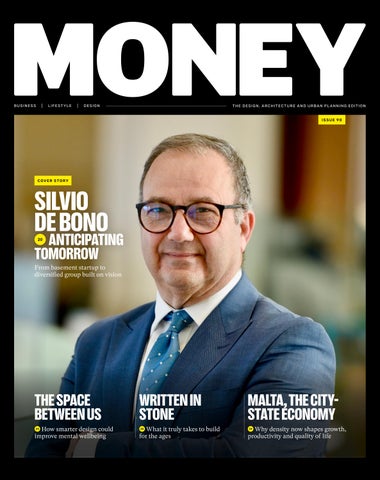
MONEY ISSUE 90

Page 1


24 How smarter design could improve mental wellbeing THE SPACE BETWEEN US

28

34 Why density now shapes growth, productivity and quality of life MALTA, THE CITYSTATE ECONOMY

Speak to an advisor today.

Sparkasse Bank Malta public limited company (the ‘Bank” is a public limited liability company registered in Malta with registration number C27152 and registered ofice at 101 Townsquare, Ix-Xat ta’ Qui-si-Sana, Sliema SLM3112, Malta. Sparkasse Bank Malta public limited company is licensed by the Malta Financial Services Authority to carry out the business of banking in terms of the Banking Act (Cap. 371 of the Laws of Malta), to provide investment services and custody and depositary services in terms of the Investment Services Act (Cap. 370 of the Laws of Malta), and is authorised to act as custodian of retirement schemes in terms of the Retirement Pensions Act (Cap. 514 of the Laws of Malta).

Designing what comes next — There was a time when architecture was often treated as a fnishing touch — something visual, something to admire once the real decisions had already been made. Today, that view feels increasingly outdated.

Design is no longer cosmetic. It is strategic.

The way we plan streets, shape skylines, restore heritage, design ofces, build homes, and connect communities now infuences far more than appearances. It afects productivity, mental well-being, tourism value, environmental resilience, investment confdence, and, ultimately, the quality of everyday life.

In a compact, ambitious and fast-moving country like Malta, these questions matter more than ever.

Our islands are living a paradox. We have seen growth, confdence and development on a scale few would have predicted a generation ago. Yet success also brings pressure: denser towns, heavier trafc, rising expectations, strained infrastructure, and a growing public demand for places that feel better to live in — not just more proftable to build in.

On our front cover, Dr Silvio De Bono, founder of IDEA Group, refects on leadership, education, care, and the philosophy of anticipating tomorrow. His journey from a basement consultancy to a diversifed organisation spanning multiple sectors is a reminder that sustainable growth is rarely accidental. It is built through foresight, discipline, and the willingness to evolve.

Inside, we also explore how tourism must move from volume to value, why Malta increasingly behaves like a city-state economy, how

design impacts mental health, what makes buildings endure, and why governance remains inseparable from the built environment. We meet thinkers, creators and operators shaping projects, places and conversations that will outlast the current cycle.

This edition is not anti-growth. Nor is it nostalgia disguised as criticism. It is a case for better growth. Because the next phase of Malta’s success will not be measured only by GDP, cranes, permits or visitor numbers, it will be measured by whether we create places people genuinely want to live in, work in, invest in and pass on.

The best architecture always does more than occupy land. It creates value around it. The smartest planning does more than regulate development. It aligns ambition with quality. And the strongest economies understand that built environments are not side issues. They are competitive advantages.

Malta has talent. Malta has a capital. Malta has momentum. The real question is whether we now have the vision to match it.

For promotion and advertising: bemags.com/money-pitch hello@bemags.com · becommunications.com

DESIGN BE.

PRINTING Print It DISTRIBUTION MaltaPost

MONEY is hand-delivered to Malta’s businesses, including managers and directors of the country’s top blue-chip companies, iGaming companies, all -star hotels, including their business centres, executive lounges and rooms (where allowed), all foreign embassies and Maltese embassies abroad (Rome, Brussels, London, Vienna and Madrid). All government ministries and entities.

MONEY is published by Be Communications Ltd. All rights reserved. The content of this magazine, including articles, images, designs, and any intellectual property, is owned and protected by Be Communications Ltd. Unauthorised reproduction, distribution, or transmission of any part of this magazine is strictly prohibited without prior written permission. Be Communications Ltd. retains all intellectual property rights in the content published in this magazine, including but not limited to copyrights, trademarks, and patents. Any unauthorised use, reproduction, or commercial exploitation of this content violates applicable laws and may result in legal action. Opinions expressed in this magazine are those of the respective contributors and do not necessarily refect the editor's or publisher's views. While every efort is made to ensure accuracy, Be Communications Ltd. assumes no responsibility for errors or omissions in the magazine's content, advertisements, or related materials and disclaims liability for the accuracy, legality, or originality of content provided by clients.

By design or by default

In this analysis, Justin Mizzi argues that Malta’s tourism sector has outgrown its growth model. As arrivals surge, the challenge is no longer expansion—but aligning regulation, design, and strategy to deliver value.

The anatomy

of 2,370

decisions

Written in stone

In this reflective account, architect Danica Cachia Mifsud, partner at AP Valletta, takes us behind the construction of the new St John's Co-Cathedral Museum façade, a project in which 2,370 carved stones, digital precision, and centuries-old craft converge at one of Valletta's most historically sensitive sites. 12 16 24 38 34

Archaeologist and cultural heritage specialist Edward Calleja reads buildings the way others read history — through material, memory, and time. He speaks with Lea Hogg about what Malta's evolving skyline gets right, what it risks losing, and what it truly takes to build for the ages.

The space between us

Your o ce layout, your commute, the view from your window — all quietly shaping your mental state. Psychotherapist Danjela Falzon tells Dayna Clarke Camilleri why the spaces we inhabit matter far more than we realise, and what better design could change.

Anticipating tomorrow

Dayna Camilleri Clarke sits down with Dr Silvio De Bono, the founder who built IDEA Group from a basement o ce into a diversified organisation spanning consulting, education and care, all driven by one belief: true leadership means anticipating tomorrow. 20

Malta, the city-state economy

Economist JP Fabri argues that Malta's future depends on recognising a simple reality: economically, the island behaves more like a dense city than a country. Growth, competitiveness and quality of life will increasingly hinge on how intelligently Malta designs its urban environment.

28 32

Redesigning the game: inside the new Portomaso Casino

Keith Pillow, founder and creative director of DAAA Haus, breaks down the thinking behind the Portomaso Casino refurbishment— an intentional shift away from excess towards restraint, flow, and experience, redefining what a modern casino can feel like in Malta's evolving hospitality landscape.

The cost of good design— and the value we tend to overlook

As Malta's construction industry accelerates, a deeper question emerges: are we building for immediate returns or long-term value? Steven Risiott explores how cost, design, and decision-making shape not just properties, but the performance, identity, and future of our built environment.

42

Karolina Pelc on the strategy behind a high-value exit

From casino floors to boardrooms, Karolina Pelc's journey to founding and exiting her startup BeyondPlay is anything but conventional. Now stepping into a new chapter as an investor, in an interview with Lea Hogg Pelc reflects on the realities of building under pressure and navigating acquisition strategy.

The robot next door

Forget the flashy humanoids grabbing headlines in Silicon Valley. The robotics revolution reshaping businesses is quieter, smarter, and far more practical — and some of its most compelling work is happening right here in Malta, as Lea Hogg discovers in conversation with engineer James Attard Kingswell.

Planning and power: the business cost of weak government

Manuel Delia asserts that Malta's planning debate is not merely about skylines or aesthetics. At its core lies governance: how rules are enforced, discretion exercised, and legality upheld, factors that ultimately shape market confidence, investment risk, and longterm economic credibility.

Overbuilt, not overdeveloped: rethinking density for Malta's future

Malta's development debate often centres on emotion rather than strategy. The real issue is not growth itself, but how it is executed. Matthew Rostkowski examines why, when poorly coordinated, density risks eroding property values and Malta's long-term economic competitiveness. '2 '4 '8

44 48 60

Post-tensioned concrete: the silent concept redefining Malta's skyline

As Malta builds higher, faster, and denser, the engineering behind its skyline is quietly evolving. Stephen Mallia examines how post-tensioned concrete is transforming construction, delivering lighter structures, faster projects, and smarter buildings in an increasingly constrained island market.

Work, reimagined: the design of GO Campus

As companies rethink how and where people work, o ce design is undergoing a quiet transformation. MONEY looks at the GO Campus headquarters in Żejtun, designed by A Collective with architecture by AP Valletta, and how the project reflects the evolution of the modern Maltese workplace.

The i3 that changes everything

BMW has done something bold—again. The new i3, built on its all-new Neue Klasse platform, isn’t a revival of the quirky carbonfibre city car we once knew. It’s something far more important: the electric reimagining of the 3 Series, arguably BMW’s most defining model.

The new rules of talent: why Malta’s salary landscape is changing

As Managing Director of Boston Link Malta, Lourens Pahud de Mortanges shares insights from the firm’s latest salary survey, examining how regulation, consolidation, and shifting talent priorities are reshaping compensation, leadership expectations, and long-term workforce strategy across Malta’s iGaming and financial services sectors.

62 64

Quiet power: the new codes of modern luxury

A refined wardrobe built on texture, precision and intent—where craftsmanship replaces logos, silhouettes stay sharp, and every piece signals confidence, discretion and a deeper understanding of modern luxury dressing.

66

In the news:

» Project Green pushes 10-minute walk vision

» Msida Creek remains Malta’s most-watched urban test case

» Paris continues to redesign the modern city

BY DESIGN OR BY DEFAULT

Malta’s tourism reckoning

In this analysis, Justin Mizzi argues that Malta’s tourism sector has outgrown its growth model. As arrivals surge, the challenge is no longer expansion— but aligning regulation, design, and strategy to deliver value.

Fo r decades, Malta’s hospitality sector has been shaped by its ability to respond to external demand. Historically, the islands hosted foreign military presences; over time, this evolved into a modern tourism industry, formally recognised in the early th century.

Following independence, the s marked a decisive pivot. Supported by the Aids to Industries Ordinance ( ) and related policy measures, Malta transitioned from a fortress economy into a mass-market summer destination. This period saw the emergence of large-scale hotels such as the Corinthia Palace, Hilton, and Sheraton - laying the foundations for sustained sectoral growth. Yet this expansion was largely uncoordinated. While successive governments signalled an intention to prioritise quality over quantity, development often outpaced planning. The

result has been persistent concerns about overdevelopment, spatial disorder, and overtourism, which risk eroding the very asset base that underpins the industry.

Today, Malta stands at a diferent infexion point. With tourist arrivals surpassing four million by , the national conversation has shifted from recovery to the more complex challenge of managing success. The sector has achieved notable gains: stronger international branding through global operators, improved connectivity, and extended seasonality.

However, these gains are increasingly constrained by structural pressuresparticularly infrastructure capacity, urban density, and the rapid expansion of bed stock. The ambition articulated in the Malta Tourism Strategy – , and Malta Vision —

to position Malta as a premium destination— now hinges less on growth in arrivals and more on holistic quality: of visitors, experiences, services, and, critically, the built environment itself.

TAR 2025: A Regulatory Pivot

The Draft Tourism Accommodation Regulations (TAR ), published in November , represent the frst substantive attempt to realign the sector with a value-driven model under the “Recover, Rethink, Revitalise” framework.

At the centre of the proposal is the Tourism Policy Compliance Certifcate (TPCC) - a pre-planning regulatory flter that requires

developments to demonstrate their ability to “add value” and enhance the visitor experience before proceeding to a formal application. The framework also restricts new developments to three-, four-, and fve-star categories, reinforcing the quality mandate.

Key measures include:

• A -room cap on new hotels and extensions;

• Strict adherence to height limitations in local plans;

• A ban on new all-inclusive developments;

• Prescriptive spatial standards, including minimum frontage and courtyard dimensions;

• Locality-based supply controls, linked to existing bed stock, and

• Encouragement of international brand afliations.

Collectively, these measures signal a clear policy shift - from expansion to selectivity.

Where the framework falls short

Despite its intent, TAR risks constraining the very outcomes it seeks to promote, becoming an obstacle to both high-quality design and hotel investments.

. Insufcient analytical rigour

The requirement for only a “high-level business plan” to obtain a TPCC is a critical weakness. In an increasingly saturated market, evaluating “added value” demands robust, data-driven feasibility assessments

As arrivals surge, the challenge is no longer growth—but how Malta manages it
Malta’s tourism story is no longer one of expansion, but of alignment.

aligned with international standards. Without this, regulators lack the tools to diferentiate between genuinely transformative projects and conventional developments.

This gap points to a broader need for market transparency. A national tourism dashboard - integrating real-time data on supply, performance indicators, and infrastructure capacity - would enable both

policymakers and investors to make informed decisions grounded in evidence rather than assumptions.

. Discretion without defnition

The provision allowing authorities to depart from established criteria for “compelling reasons” introduces signifcant uncertainty. In the absence of clearly defned benchmarks for “public interest,” “quality,” or “added value,”

such discretion risks inconsistent application— undermining investor confdence and policy credibility.

. Prescriptive Standards vs Design Excellence

Luxury hospitality is inherently experiential and diferentiated. Rigid spatial requirements— such as minimum frontage widths and courtyard dimensions—risk enforcing uniformity at the expense of creativity.

This is particularly problematic in Urban Conservation Areas (UCAs) like Valletta, where historic plot confgurations are narrow and irregular. Here, adaptive reuse depends on bespoke architectural solutions. (

A one-size-fts-all regulatory approach may inadvertently discourage heritage-led development in favour of generic new builds.

. The -Key Straitjacket and the Speculative Mechanism of Building Height

The blanket -room limit fails to account for the needs of the MICE segment, where scale is often a prerequisite. Without the ability to accommodate large international groups, Malta risks ceding ground to competing Mediterranean destinations ofering integrated, high-capacity resorts.

Similarly, the strict removal of discretionary height allowances - while addressing past speculative practices - eliminates opportunities for integrated design optimisation. Height, when incorporated from the outset, can support higher-quality, more coherent architectural outcomes than incremental additions.

Finally, uncertainty remains for existing assets. Investors, operators, and fnanciers require clarity on how legacy properties— particularly those exceeding current

Memorable quotes and key insights included:

• We need to protect what is sacred[...] We are confused as a nation. What do we really want to be, a mix of everything?

— Michael Warrington, who also mentioned the need for having clear, specifc zoning and policies for luxury and wellness tourism areas in Malta

• The answer to how we attract the right tourists is the same as the answer to what kind of country we want to live in ourselves.

— Winston J. Zahra

• Malta is not damned. But without a strategy, we are leaving our greatest advantages underutilised.

— Reuben Xuereb

• It’s all about branding: what do we want to be known for?

— Reuben Xuereb

These perspectives highlight a fundamental limitation of TAR : regulatory constraints alone cannot turn a destination into a luxury one. Quality emerges from the interaction between infrastructure, service standards, environmental management, and brand coherence.

Regulation alone cannot create a luxury destination—quality is

built through infrastructure, design, and identity.

thresholds—will be treated in future redevelopment or refurbishment scenarios.

Rethinking the luxury proposition

The limitations of the current approach were echoed during a January Malta Business Network panel featuring industry leaders Michael Warrington, Reuben Xuereb, and Winston Zahra.

A central theme emerged: Malta’s strategy remains overly focused on arrivals, lacking the ecosystem required to sustain a genuine luxury positioning. While perspectives varied on the pace of transition, there was consensus on the need for a clearer, more coherent national vision.

Internationally, leading destinations are moving toward performance-based frameworks. For example, Croatia’s Tourism Act emphasises environmental sustainability and outcome-based metrics— such as guest satisfaction and carbon performance—over purely quantitative controls.

The future of Maltese tourism lies in experience-led, context-driven design—not scale alone

The Path to Alignment

Malta is entering a new phase of tourism development, marked by the arrival of highprofle luxury brands such as Six Senses and Hard Rock. These projects signal a shift toward experiential, high-yield tourism—beyond traditional mid-market positioning. To support this transition, the regulatory framework must evolve accordingly.

A system overly reliant on fxed, prescriptive rules (like height compliance, room caps, and courtyard dimensions) risks producing architectural mediocrity—standardised developments that fail to refect Malta’s distinct identity. By contrast, premium destinations are characterised by design excellence, contextual sensitivity, and innovation.

Achieving alignment requires a more balanced approach, built on four pillars:

1. Outcome-based regulation: shifting from rigid inputs (e.g., room caps, dimensions) to measurable outputs (e.g., sustainability, guest experience)

2. Data transparency: establishing a national platform for real-time monitoring of supply, demand, and infrastructure capacity

. Strategic clarity: defning a coherent tourism brand and aligning policy instruments accordingly

4. Design fexibility: enabling high-quality, site-specifc solutions—particularly in heritage contexts.

Ultimately, Malta’s tourism story is no longer one of expansion, but of alignment: aligning growth with carrying capacity, regulation with market realities, and development with national identity.

Malta is entering a new phase of tourism development...

As Alan Arrigo of The Malta Chamber aptly mentioned during the recent presentation launch of the Malta Chamber “Rediscover to Align” report:“When government and authorities align planning and enforcement, operators compete on quality and authenticity, and communities are respected partners, success becomes sustainable: happier residents, higher-value visitors, cleaner and better-kept places, and a healthier year-round rhythm.”

Justin is a partner (real estate advisory and valuation) at QP.

WRITTEN IN STONE

Archaeologist and cultural heritage specialist Edward Calleja reads buildings the way others read history — through material, memory, and time. He speaks with Lea Hogg about what Malta's evolving skyline gets right, what it risks losing, and what it truly takes to build for the ages.

There is something quietly refective about Edward Calleja. He speaks softly, as though weighing each thought before it settles into conversation. His tone is calm but assured, the kind of confdence that comes from years spent observing, researching, and understanding the story of the Maltese landscape.

Calleja is not an architect. His training is in archaeology, a discipline that teaches patience, perspective and the slow reading of time through fragments of stone and structure. After graduating in archaeology in , he built his career around cultural heritage and feld research, eventually leading archaeological work that later became part of a design and engineering consultancy, where he now heads the Cultural Heritage discipline.

Archaeologists like Calleja are often present before construction even begins, monitoring excavations, documenting

discoveries, and ensuring that whatever lies beneath the ground is understood before foundations are laid. Perhaps that is why his viewpoint on buildings feels diferent. When we talk about design in Maltese architecture, the discussion quickly moves beyond trends or aesthetics. Calleja looks for context and permanence.

Design in limestone

Which of the structures in Malta today will still matter in a hundred years? For Calleja, enduring architecture is rarely accidental.

Edward Calleja
The real measure of a building is not how it looks on the day it opens, but how it continues to function decades later.

"Buildings that last," he says, "are usually the ones that belong to their place. They use the materials of the island, they respect the scale of their surroundings, and they age with dignity rather than against it."

For Calleja, what survives is rarely just what was built well.

Structures such as St John's Co-Cathedral, the fortifcations of Valletta, and the historic urban fabric of Mdina are clear examples of buildings that have demonstrated extraordinary resilience. "Their longevity lies not only in their architectural beauty, but in their deep relationship with place," Calleja explains.

"The use of local limestone, the careful proportions of buildings, and the way these structures engage with the surrounding landscape create environments that feel both coherent and timeless. These are places where architecture, urban planning, and craftsmanship work together to form a lasting cultural identity." (

Historical signifcance, he believes, gives architecture its cultural depth and continuity. It is not style or decoration alone that is lasting, but strategy, planning, and a deep understanding of context. Calleja references the era of the Knights of St John. Figures like Cassar, Laparelli, and Gafà combined military engineering, urban planning, and architectural elegance to create structures and cities that remain relevant centuries later. "They show us that enduring architecture is rarely about decoration alone. It's strategy, planning, and a deep understanding of place," he observes.

Malta's modern skyline

Calleja is also deeply engaged with Malta's contemporary architectural evolution. The island's skyline has shifted dramatically in the past two decades, yet the question of which structures will endure, architecturally and culturally, remains open. Large regeneration developments are beginning to hint at possibilities for impactful urban design. Projects such as Mercury Towers, the Zaha Hadid-designed high-rise development in St Julian's, where multidisciplinary teams have transformed underused sites into mixed urban quarters,

changing lifestyles, Calleja notes. Their architectural language is unapologetically modern. "The real measure of a building," Calleja remarks, "is not how it looks on the day it opens, but how it continues to function decades later and whether people still want to live there, walk through it, meet in its spaces." Architecture, he suggests, becomes less about the object itself and more about the life that unfolds around it.

Some of the most compelling projects are not entirely new. Regeneration initiatives such as Ta' Qali Artisan Village reveal a quieter but equally powerful architectural approach, one that respects what already exists, says Calleja. By restoring industrial structures and weaving contemporary interventions through them, the project reconnects craft, heritage, and modern use in a way that feels both rooted and forward-looking. It is here, perhaps, that Calleja's archaeological instincts surface most clearly. "The buildings that are resilient are often the ones that understand where they stand in the story of a place," he says.

refect a broader shift in Maltese development thinking. Rather than isolated buildings, these schemes aim to create ecosystems where residential, commercial, and public life overlap.

Residential complexes such as Townsquare, a mixed-use development in Sliema centred around a -storey residential tower, landscaped public spaces, retail areas, and the restored th-century Villa Drago, and Shoreline Residences, a waterfront housing project in SmartCity, embody a generation of developments responding to denser urban realities and

What makes architecture last If predicting a building's longevity sounds speculative, Calleja approaches it with the calm pragmatism of someone used to thinking in centuries. Endurance rarely comes from spectacle or architectural bravado. More often, it emerges from a careful equilibrium between heritage and innovation, between understanding what a place already is and imagining what it might become.

"Buildings that last usually interpret their surroundings rather than imitate them," he says thoughtfully. "They respect the character of a place, but they're not afraid to introduce new ideas. When that balance is right,

architecture feels both grounded and forward-looking."

On an island like Malta, that relationship with place is often written directly into the material itself. For centuries, local limestone has shaped the character of towns and villages, lending buildings a colour and texture inseparable from the surrounding landscape. Yet materials are only part of the story. Architecture must also respond to climate, light, and the patterns of human activity.

"The structures that people remember," Calleja says, "are the ones that continue to serve their communities. They adapt, they weather, and they remain useful. That's what ultimately keeps a building alive."

Everyday heritage and context

Beyond grand monuments, Calleja is concerned with a quieter, oftenoverlooked layer of architecture. Traditional townhouses, vernacular homes, and modest civic structures are increasingly at risk from redevelopment pressures. "These buildings may seem ordinary," he observes, "but they form the backbone of our towns. Lose them, and you lose the subtle story of everyday life and the way people lived, worked, and built their communities."

"There's wisdom in the ordinary," he adds. "It teaches us how to build well, without having to reinvent the wheel."

Calleja emphasises that architecture is never an isolated act. Buildings endure when they integrate seamlessly with their surroundings, contributing to a coherent urban environment. "A structure on its own might impress," he refects, "but it's the streets, squares, and public spaces around it that determine whether it really lives." Largescale master planning, in his view,

allows architecture to perform as part of a larger system, enhancing both longevity and public value.

Malta's architectural evolution, he notes, has always been a negotiation between preservation and innovation. "The island's history encourages conservation, yet the future demands creativity," he says. "The projects that endure are those that respect the past while embracing new design and technology. Balance is everything."

When asked what advice he would give today's architects aspiring to timelessness, he smiles. "Design with environment, climate, and culture in mind. Don't chase trends or visual spectacle. Build for people, and build to last. Architecture and design become timeless when they serve their community and grow into the life around them."

There's wisdom in the ordinary. It teaches us how to build well, without having to reinvent the wheel.

Design for communities

For Calleja, public perception and cultural relevance are equally decisive. Buildings are ultimately measured by the relationships they foster with the people who inhabit them. "Architecture and design belong to its community," he says. "Those that resonate socially and culturally are the ones that get remembered, protected, and loved by generations to come."

Unsurprisingly, his favourite period remains the Knights of St John, whose vision still dominates Valletta's streets and plazas. "It's a perfect example of how urban planning, engineering, and architecture can combine to create something both functional and lasting," he says.

"Every building is a conversation across time," he concludes. "The ones that endure are those that listen to what came before, respond to the life around them, and leave space for the future."

Lea is a Malta-based journalist and author, known for her TV programme which focuses on current a )airs, cultural news and in-depth interviews on geopolitics and global issues.

ANTICIPATING TOMORROW

Dayna Camilleri Clarke sits down with Dr Silvio De Bono, the founder who built IDEA Group from a basement o ce into a diversified organisation spanning consulting, education and care, all driven by one belief: true leadership means anticipating tomorrow.

Two decades ago, the foundations of IDEA Group were laid in a modest basement ofce at its founder's home. Today, the organisation spans consulting, higher education and care services, serving businesses, professionals and communities both locally and internationally. For Dr Silvio De Bono, the philosophy behind that journey has always remained constant.

The idea was never just to build a business, but to create something that could contribute to society.

"Good leaders don't manage today. They manage tomorrow. They keep the horizon in mind."

Yet for Dr De Bono, the most important part of this journey is not the organisation's scale, but the purpose that has guided it since its earliest days. "I always wanted to do things diferently," he says. "The idea was never just to build a business, but to create something that could contribute to society."

From a basement idea to a growing group

IDEA Group was founded in as a management consultancy frm, at a time when a handful of traditional players dominated Malta's consulting landscape. From the outset, Dr De Bono sought to distinguish the company through a more collaborative model. "We never presented ourselves as a know-it-all consultancy," he explains. "Our approach was always about partnering with clients. Together we identify challenges, and together we develop solutions."

Growth came sooner than expected. After months spent carefully planning and laying

the foundations, the small consultancy began expanding rapidly, forcing the team to move into larger ofces much earlier than anticipated. "It started in a basement, and I still treasure the time I spent there on my own thinking and trying to foresee the future," he recalls. "But eventually we had to move because the growth was happening faster than we imagined."

What followed was a series of defning milestones that would transform the organisation into a diversifed group. Over time, IDEA expanded into digital services and education, and most recently into the care sector. Today, the group operates through three main pillars: consulting through IDEA Advisory, education through IDEA College, and specialised care services. While these divisions may appear distinct, Dr De Bono insists a single strategic vision binds them.

"At their core, all three pillars are about identifying gaps in society and helping to address them," he explains. "Whether we are advising businesses, educating professionals or providing care services, the objective is the same: creating opportunities and contributing to societal development."

Education as a catalyst for transformation

The most transformative moment in IDEA Group's evolution was the launch of its educational arm, now known as IDEA College. What began as leadership training programmes eventually grew into a fully-fedged private higher education institution ofering qualifcations ranging from certifcates to doctoral programmes.

For Dr De Bono, however, the true impact of IDEA College lies not in academic credentials, but in the lives it has changed. "The development of IDEA Academy was one of the most meaningful parts of our journey," he says. "Not only as a business, but because it gave opportunities to people who believed their career had reached a dead end."

Many of the students who enrol are mid-career professionals juggling demanding jobs, family responsibilities and the desire to improve their prospects. Traditionally, pursuing tertiary education at this stage of life was difcult (

due to rigid academic pathways and entry requirements. IDEA College sought to change that.

"We created opportunities for people who could not pursue their dreams earlier in life," Dr De Bono explains. "Today, many professionals have returned to study, changed career paths or achieved promotions because of the education they received here."

During graduation ceremonies, he says, it is not uncommon for students to tell him that enrolling at the institution allowed them to fulfl a lifelong ambition. "Those are the moments that remind you why you started."

Leadership beyond the present

Central to Dr De Bono's philosophy is a concept he describes as anticipatory leadership. Over the past century, leadership theories have evolved from traditional management models to transformational and transactional approaches. For Dr De Bono, however, leadership ultimately comes down to foresight. "In my management teaching, I often speak about anticipatory leadership," he explains. "It is the idea that the leader today must defne the organisation of tomorrow."

This perspective emphasises the distinction between management and leadership. "Managing people focuses on today," he says. "Leadership focuses on tomorrow. When you lead properly, you prepare the organisation for the future so that tomorrow you can manage the day after."

It is a philosophy that has shaped IDEA Group's approach to navigating change, from technological shifts in education to emerging opportunities in sectors such as healthcare and digital innovation.

At the heart of this approach lies a set of personal values that Dr De Bono considers non-negotiable: honesty, transparency and commitment. "When I recruit people, I do not necessarily look for those with the best degrees," he says. "What I look for are individuals who are honest, who challenge me, and who are fully committed to what they do."  He is particularly wary of surrounding himself with individuals who simply echo his views. "I do not want to be surrounded by yes-men,"

he says frmly. "Anyone who agrees simply because I have asked something to be done does not belong in the organisation."

The challenge of people management

If leadership is about anticipating the future, people management remains one of its most complex dimensions. For Dr De Bono, the greatest challenge is not hiring talent but building an environment where individuals feel empowered to speak openly and think independently. "In many organisations, and particularly in closed societies, people sometimes hold back because they worry about what others will think," he says.

Encouraging authenticity and critical thinking is therefore essential. "One of the biggest challenges today is motivating people to express what they truly believe rather than what they think others want to hear." By promoting an open management culture, he believes organisations can unlock greater innovation and stronger collaboration. "The last thing I want is people who are an extension of myself. I want people who bring their own perspectives and ideas."

A shifting economic landscape

Beyond the internal dynamics of leadership, Dr De Bono closely observes the broader economic and societal trends shaping Malta and the global economy.

One of the most pressing issues, he believes, is the need to strengthen skills development. "Education systems must place greater emphasis not only on academic subjects but also on numeracy, fnancial literacy and values," he says. Without strong personal values, he warns, professionals risk losing direction. "Competence alone is not enough. If individuals lack personal values, they can easily lose focus, vision and the right attitude."

At a national level, he believes governments must also exercise greater discipline in economic planning. "Many countries have lived beyond their means," he says. "Proft has sometimes been prioritised over the well-being of people."

At the same time, global challenges such as climate change are increasingly shaping economic decision-making. "Global warming will have a signifcant impact on national economies and individuals alike," he notes. For businesses, this means adapting strategies to navigate both economic uncertainty and societal transformation.

The future of care

One area where these shifts are particularly visible is the care sector. Like many European countries, Malta is experiencing demographic changes that are placing increased pressure on healthcare and social services. Ageing populations and workforce shortages are creating new challenges for policymakers and providers alike.

Through its care initiatives, IDEA Group seeks to address some of these gaps by developing services focused on rehabilitation, respite care, senior wellness, and support

for persons with disabilities. For Dr De Bono, the motivation is not purely commercial. "In the healthcare sector, we are not simply building a business," he says. "We are creating opportunities while flling a real gap in society."

Private operators, he believes, can play an important role in supporting national systems, provided they operate responsibly and with the right values. "The focus must always remain on quality, sustainability and the wellbeing of the individuals we serve."

Competing through vision

Despite operating in increasingly competitive sectors, Dr De Bono believes long-term success depends less on imitation and more on understanding local contexts. "What works in one place does not necessarily work in another," he explains.

Businesses must therefore invest time in studying markets, identifying emerging needs and forming partnerships with organisations

that share similar values. "Hard work, perseverance and commitment are essential," he says. "But equally important is the ability to anticipate what others may not yet see."

Even after years of leadership experience, uncertainty remains part of the process. "I still have doubts," he admits. "But having doubts is part of success. Making decisions in uncertain situations is part of the journey." Academic training, he adds, helped him move away from emotional decision-making towards a more rational approach to strategy and leadership.

Dream big, start small

Looking ahead, Dr De Bono believes the next chapter for IDEA Group will involve continued growth across its three pillars, while maintaining the values that have guided the organisation since its earliest days.

"The future is bright," he says. "We will continue expanding not only our services but

also the opportunities we provide to students, professionals and communities." Yet even as the organisation evolves, the fundamental lessons of entrepreneurship remain unchanged. His advice to aspiring leaders is simple. "Be ready to fail, but never give up," he says. And while ambition is essential, it must be grounded in reality.

"Do not just think big. Dream big, but start working within your own environment," he

Hard work, perseverance and commitment are essential. But equally important is the ability to anticipate what others may not yet see.

adds. "If you try to swim in the ocean when you can barely swim, you risk drowning."

For Dr Silvio De Bono, the lesson is clear: leadership is not about managing what exists today, but about building what will exist tomorrow. And for those willing to keep their eyes on the horizon, the possibilities are limitless.

Dayna is a senior speech and language therapist, and the founder of Malta Speech Therapy. She is a former editor at the Malta Business Weekly and a prolific writer whose work spans health, neurodiversity and travel. Her pieces are known for their clarity, curiosity and practical insight, making her a familiar voice to readers across Malta and beyond.

THE SPACE BETWEEN US

Your o ce layout, your commute, the view from your window — all quietly shaping your mental state. Psychotherapist Danjela Falzon tells Dayna Clarke Camilleri why the spaces we inhabit matter far more than we realise, and what better design could change.

From a psychological perspective, how does the built environment influence stress levels and overall mental wellbeing?

The built environment refers to the physical spaces we live in, such as our homes, workplaces, and schools, as well as the external environments, including the physical layout of our cities and residential areas. Research has found that living in clean, aesthetically pleasing surroundings has a positive efect on our overall wellbeing. For instance, views of nature from a window have been found to reduce stress and improve mood.

Other aspects, such as lighting, colour choices, and access to spaces that promote movement and connection with neighbours, colleagues, and family members, have been found to impact wellbeing, either exacerbating or reducing stress levels and anxiety.

What are the most common mental health impacts you see that are linked to people's living or working environments?

People's living or working environments can have a huge impact on their mental health and overall wellbeing. Such factors include the general environment,

including the culture and general atmosphere within a home or workplace (i.e. ranging from highly supportive to toxic), as well as the physical environment, including factors such as temperature, lighting, noise, access to open spaces, access to private spaces, whether ofces are open plan or having a private layout, and so on. Such factors then coincide with our individual diferences in terms of overall temperament, needs and coping mechanisms. For instance, introverts have been found to experience high levels of stress and anxiety if working in open-plan environments, utilise fuorescent lighting, are excessively noisy and have a constant fow of movement around them.

How do factors like noise, light, density and lack of green space a ect cognitive performance and emotional regulation?

Cognitive performance and emotional regulation are directly afected by factors such as noise, light, density, and a lack of green space, as these factors infuence cortisol levels, attention, and energy levels. High levels of trafc noise, for instance, cause fatigue, impair working memory, and raise cortisol levels. Likewise, high population density and overcrowding are directly linked to

increased stress, anxiety, and loss of control over one's environment, causing frustration and emotional overwhelm. Since density can increase cognitive load, we may feel emotionally overwhelmed and mentally overloaded, which can reduce our ability to focus and maintain productivity.

Access to green spaces has a huge impact on physical and mental wellbeing, with studies showing a % or more increased risk of stress among those living over km from nature. The World Health Organisation highlights the importance of access to green spaces for overall wellbeing. They note that environments such as parks, playgrounds, and public gardens can enhance both mental and physical health and help reduce illness and premature death. These benefts come from ofering opportunities for (

psychological restoration and stress relief, encouraging social connection, supporting regular physical activity, and reducing exposure to air pollution, noise, and excessive heat.

In your experience, how does poor urban planning contribute to burnout, anxiety or reduced productivity?

Poor urban planning signifcantly afects both mental and physical wellbeing. In my work, I've met many clients who describe how the surge in construction across the Maltese islands has taken a toll on them, from constant noise and worsening air quality to the distress caused by rapid, often disorienting changes to the urban landscape. Many also speak about the fear of losing remaining green spaces, the environmental harm caused by overdevelopment, and the loss of buildings with

Design for wellbeing: 6 principles

1. Build in choice

that matter
Many clients work in open-plan offices surrounded by constant movement and noise, yet wonder why they feel drained and stressed by mid-morning.

historical or cultural signifcance.

A recurring theme is the sense of helplessness and loss of control people feel as these changes unfold around them. The stress and anxiety triggered by poorly planned construction and road infrastructure often spill into daily life, making routine tasks more difcult. When stress levels remain high, cognitive and emotional functioning can be signifcantly

Create fexible spaces that allow people to move between quiet, private areas and more open, social environments.

. Prioritise natural light

Maximise daylight and avoid harsh artifcial lighting to support mood, focus and energy levels.

. Control noise and fow

Reduce distractions through good acoustics and thoughtful layouts that minimise unnecessary movement and disruption.

. Bring nature closer

Incorporate green spaces, plants, and natural views to reduce stress and restore mental balance.

. Design for people, not just density

Favour walkable, human-centred environments over cardominated, overcrowded spaces.

. Reduce cognitive overload

Avoid excessive noise, brightness and visual clutter—spaces should calm the mind, not overwhelm it.

afected, reducing productivity and making it harder to cope with everyday challenges.

Are there specific design elements that consistently support better mental health outcomes in workplaces or residential areas?

In the workplace, several design elements can be incorporated to improve mental health

natural light and natural elements such as plants. Design elements could also include measures to ensure the smooth fow of team members, minimising distractions when moving from work areas to social or functional areas, such as bathrooms and kitchen water dispensers.

In terms of residential planning, the rate of mental health issues amongst young people is quite concerning, and although several factors are at play, the lack of open, green spaces cannot be overlooked. Living in trafc-flled, chaotic urban environments without access to green spaces such as parks and public gardens deprives us of the opportunity to interact socially, engage in physical activity, and experience the calming and restorative aspects of spending time in green spaces. Spending time in nature helps reduce stress, anxiety

outcomes. These include providing varied workspaces so employees can move between open, social spaces and quiet, private spaces. Lighting, colour schemes and temperature can either promote or detract from wellbeing. Therefore, design elements would need to include warm, soft lighting, acoustically treated areas that minimise noise, calming colours, and access to

and low mood, whilst boosting concentration and productivity.

How important is a sense of control or autonomy in physical spaces, and how can design either support or undermine that?

A sense of control and autonomy in physical spaces is hugely important, as many public

spaces are designed in ways that fail to recognise our individual diferences. Take the example of introverts and extroverts, who thrive in very diferent environments: introverts are recharged in quiet solitude, whilst extroverts are recharged in group settings. Incorporating fexible workspaces into design, for instance, could enable introverts and extroverts to move between private and more open spaces, thereby boosting performance, concentration, and overall wellbeing. The same goes for people who are highly sensitive or neurodivergent, who would greatly beneft from choice in their living and working environments.

Do you see measurable psychological di erences between people working in thoughtfully designed spaces versus poorly designed ones?

To answer this question, it would be useful for each of us to refect for a moment on the type of environment we live or work in, or the places we visit from time to time, and really think about whether such spaces calm or stress us. Many of my clients work in open-plan ofces, for instance, surrounded by constant movement and noise, yet wonder why they feel drained and stressed by mid-morning. The psychological impact of trying to block out excessive stimuli so you can focus on the task at hand leads to anxiety and fatigue, which in turn afects mental and physical health. Tired, stressed employees do not work to their full potential and take more sick leave, meaning that poor design is costing workplaces fnancially, as well as the obvious human impact.

Can architects and urban planners better collaborate with mental health professionals during the design process?

Studies show a 50% or more increased risk of stress among those living over 1km from nature.

Yes, most defnitely. Such collaboration would go a long way to creating environments which foster greater health and wellbeing for people of all ages.

From a preventative mental health standpoint, what design mistakes do you think cities and developers most often underestimate?

I believe the current focus is on short-term, quick design solutions with a 'quantity over quality' approach. What's missing is careful, thoughtful planning which prioritises the wellbeing of the community, including that of future generations. Green design could incorporate green walls, street trees, and green parks rather than concrete-laden ones. In Malta, particularly, designers forget about pedestrians and prioritise vehicles, when more pedestrianised areas and safer, well-lit walkways would encourage walking locally when possible. Inside and outside, I believe we underestimate the sheer cognitive overload we face daily, including bright lights, poor soundproofng, and a lack of appreciation for the calming impact of colour schemes and indoor planting. With increased loneliness and reduced social integration also impacting mental health, designers and planners could create indoor and outdoor spaces that facilitate coming together and promote

known for using vertical gardens, green roofs, and connector parks to reduce urban heat and stress. Various communitycentred initiatives have also been introduced, such as Therapeutic Horticulture programmes that bring together people living in the city to garden to boost wellbeing. Likewise, Copenhagen has incorporated extensive bicycle networks and pedestrian-

social cohesion and a sense of community.

Looking ahead, how important will mental wellbeing become as a factor in how cities and commercial spaces are designed?

Urbanisation is increasing, but so is awareness of the importance of taking care of our mental health; for this reason, I believe this will eventually be refected in how cities and commercial spaces are designed. Many cities around the world are already doing this. Singapore, for instance, is well

friendly streets into its city design, promoting healthy living and environmentally friendly transport.

It would be great if Malta could also incorporate similar initiatives into its planning and design.

Danjela Falzon has been practising as a psychotherapist since 2011, supporting adults with anxiety, stress, trauma, relationship di culties and personal growth. She also works with groups, teaching mindfulness to reduce stress and anxiety. danjfalz@gmail.com

Dayna is a senior speech and language therapist, and the founder of Malta Speech Therapy. She is a former editor at the Malta Business Weekly and a prolific writer whose work spans health, neurodiversity and travel. Her pieces are known for their clarity, curiosity and practical insight, making her a familiar voice to readers across Malta and beyond.

MALTA, THE CITY-STATE ECONOMY

Economist JP Fabri argues that Malta's future depends on recognising a simple reality: economically, the island behaves more like a dense city than a country. Growth, competitiveness and quality of life will increasingly hinge on how intelligently Malta designs its urban environment.

Malta is often discussed as a country. Yet in economic terms, it behaves much more like a city. Its population density rivals that of major urban centres, its economy is driven overwhelmingly by services, and its physical space is limited, forcing difcult choices about how land,

infrastructure and communities interact. Once we begin to see Malta through this urban lens, the conversation about design, architecture and planning changes dramatically. These disciplines are no longer simply aesthetic or environmental concerns. They become an economic strategy. (

The relationship between cities and economic performance has long fascinated economists. One of the most infuential voices in this debate is Edward Glaeser, the Harvard economist whose work on urban economics has helped reshape policymakers' thinking about cities. Glaeser's central argument is deceptively simple: cities succeed because they bring people, knowledge and opportunity close together. Density creates productivity. When people interact more frequently, ideas spread faster, businesses innovate more quickly, and economic activity intensifes.

Malta is already experiencing the economic consequences of this phenomenon. Over the past decade, the island has experienced remarkable economic growth. The economy has grown rapidly, employment has surged, and entire sectors have deepened. But with that expansion has come an equally rapid increase in density. More people, more activity and more economic interactions are taking place within a fnite geographical space.

This creates both opportunity and tension.

On the one hand, density can be one of Malta's greatest economic advantages. In urban economics, proximity reduces transaction costs. Businesses cluster together. Talent becomes easier to match with opportunity. Infrastructure can serve more people within shorter distances. Knowledge spillovers occur when professionals, entrepreneurs, and institutions operate in proximity. These dynamics are precisely why cities from London to Singapore continue to dominate the global economic landscape.

On the other hand, density can quickly turn into congestion if poorly managed. Without coherent planning, the very forces that drive

productivity can begin to erode quality of life. Trafc congestion increases the cost of movement. Fragmented urban design weakens public spaces. Poorly integrated infrastructure strains utilities and services. In such environments, density becomes a burden rather than an advantage.

This is the central paradox Malta now faces. The island has efectively become a dense economic hub, yet it is still often planned and governed as if it were a dispersed territory. If Malta is to continue growing while preserving quality of life, it must begin to think about itself explicitly as a high-performance urban system.

Architecture and urban design, therefore, become economic instruments. The layout of streets, the integration of public transport, the design of mixed-use developments, the availability of green spaces and the efciency of buildings all infuence economic performance in ways that are often underestimated.

A well-designed urban environment does more than look attractive. It enhances productivity. Consider mobility. In dense environments, time lost in transit becomes an economic cost. Efcient transport systems do not simply move people more quickly; they increase the efective size of the labour market. When commuting becomes easier, workers can access more opportunities, and businesses can draw from a wider talent pool.

This matching efect is one of the fundamental drivers of urban productivity.

Housing is another example. If housing supply is constrained or poorly integrated into the urban fabric, the cost of living rises. High housing costs can limit labour mobility, discourage young talent, and reduce a location's attractiveness to international professionals. Conversely, well-designed residential developments that integrate community, services and accessibility can strengthen economic dynamism.

Public spaces also matter more than we often realise. Cities that encourage interaction tend to generate stronger knowledge networks. Cafés, cultural venues, pedestrian areas and public squares are not merely lifestyle amenities. They are part of the infrastructure

through which ideas circulate. Silicon Valley, London and Berlin have all demonstrated how urban design can reinforce innovation ecosystems.

Malta's compact scale means these interactions can occur even more intensively. In theory, the island should beneft from the same clustering efects that power the world's most dynamic cities. Yet realising this potential requires a deliberate approach to architecture and planning.

Too often, the discussion around development in Malta is framed narrowly in terms of individual buildings or planning permits. The debate focuses on height, volume or aesthetics without fully considering how projects ft within a broader urban system. But cities are not collections of isolated structures. They are networks.

A building afects the streets around it, the trafc patterns nearby, the demand for utilities and the social dynamics of neighbourhoods. When planning decisions are made in isolation, the system gradually becomes fragmented.

High-performing cities do the opposite. They integrate architecture, transport, infrastructure and economic strategy into a coherent vision. Singapore is perhaps the most striking example. Its urban planning approach aligns housing development with transportation corridors, green spaces and economic zones. The result is an environment where density is not perceived as overcrowding but as efciency.

Malta does not need to replicate Singapore's scale or governance model to learn from its logic. The lesson is simply that density must be designed.

The concept of a high-performance island, therefore, begins with recognising that space is Malta's most valuable and limited resource. Every planning decision has longterm economic consequences. Buildings that maximise short-term returns but undermine long-term urban functionality ultimately reduce the island's competitiveness.

This is where architecture intersects directly with economic policy.

High-quality architecture is not a luxury. It is a form of infrastructure. Well-designed buildings are more energy-efcient, more adaptable to technological change, and more resilient to environmental pressures. They can reduce businesses' operating costs, enhance

This constraint can become an advantage if it is managed intelligently.

The island has the potential to serve as an integrated urban ecosystem in which infrastructure, design, and economic activity reinforce one another. Compact geography allows for shorter distances, faster interactions and stronger networks. But this only works when planning decisions are coordinated and aligned with long-term strategy.

In recent years, conversations around sustainable mobility, regeneration of public spaces, and more integrated planning have become more prominent. Yet the pace of transformation must match the scale of the challenge.

Building a high-performance island requires moving beyond reactive planning toward a proactive urban vision.

neighbourhoods that encourage interaction and invest in infrastructure that supports sustainable density.

It would also recognise that economic performance and urban quality are inseparable. A city that functions well attracts investment, retains talent and fosters innovation. A city that struggles with congestion, fragmentation and poor design gradually erodes its own competitiveness.

Malta stands at an important crossroads. The island's economic success over the past decade has brought prosperity and opportunity, but it has also intensifed the pressures associated with density. The next phase of development will depend on whether these pressures are managed through deliberate design or allowed to accumulate through incremental decisions.

Seeing Malta as a city rather than a country changes the entire perspective. It shifts the

Density creates productivity — when people interact more frequently, ideas spread faster, and businesses innovate more quickly.

residents' comfort, and strengthen urban identity.

Similarly, thoughtful urban design can improve mobility, reduce congestion and increase the attractiveness of public spaces. These elements directly infuence a frm's ability to attract talent and investment.

Increasingly, global talent chooses locations not only based on salaries but on quality of life. Professionals evaluate cities based on livability, accessibility, environmental quality, and cultural vibrancy. Architecture and urban planning, therefore, play a crucial role in shaping a country's economic competitiveness.

For Malta, this challenge is particularly acute because the island cannot expand geographically. Unlike larger countries that can disperse development across vast territories, Malta must intensify activity within a relatively small footprint.

Such a vision would treat architecture not simply as construction but as a tool for shaping economic and social outcomes. It would prioritise mixed-use developments that reduce commuting pressures, design

focus from expansion to optimisation, from quantity to quality and from isolated projects to integrated systems.

Architecture, urban planning and economic strategy must therefore move in tandem.

The goal is not simply to build more structures. It is to build a high-performance island where space, design and economic activity combine to create a vibrant, resilient and competitive urban environment.

If Malta succeeds in this transformation, density will not be its greatest challenge. It will become its greatest strength.

JP is a founding partner at Seed, a multidisciplinary advisory practice.

REDESIGNING THE GAME

Inside the new Portomaso Casino

Keith Pillow, founder and creative director of DAAA Haus, breaks down the thinking behind the Portomaso Casino refurbishment—an intentional shift away from excess towards restraint, flow, and experience, redefining what a modern casino can feel like in Malta's evolving hospitality landscape.

The Portomaso Casino refurbishment introduces a much more refined, almost lounge-like atmosphere. What was the core concept driving the redesign, and how did you want players to feel when entering the space?

The core idea was to move away from the typical casino language of glitz, gold, and dark reds and instead create a more refned, loungelike environment. We wanted a space that feels consistent both day and night, calm, elegant, and immersive rather than overwhelming.

Given the casino's unique location within Portomaso Marina, we drew inspiration from a marine and yachting context. The palette, materials, and detailing reference what you would typically fnd in luxury superyachts: rich timbers, soft textures, and controlled lighting.

The intention was for players to feel relaxed, comfortable, and engaged, more like entering a sophisticated members' lounge than a traditional casino.

Casino environments are typically intense and high-

energy, yet your design introduces softer lighting, curves, and a more intimate spatial rhythm. Was this a deliberate shift away from traditional casino design typologies?

Yes, very much so. It was a deliberate continuation of the idea of moving away from the traditional casino typologies.

Instead of creating an intense, overstimulating environment, we focused on softening the experience through lighting, materiality, and spatial fow. Curves replace rigid layouts, lighting is layered and controlled, and spaces are broken down into more intimate zones rather than one large gaming foor.

The aim was not only to enhance the player experience but also to reposition the casino as a destination for a night out, even for non-players. By introducing a more relaxed, lounge-like atmosphere, the space becomes social, approachable, and versatile, a place you can enjoy regardless of whether you are there to play or simply to spend time.

There's a strong emphasis on materiality—from marble flooring to brushed metals and sculptural lighting features. How did you select and balance these elements to elevate the space without overwhelming it?

The idea of fow always guided materiality. We drew inspiration from the movement of waves breaking on a reef, using soft, continuous curves to guide people naturally through the space's diferent areas.

Rather than creating contrast through separation, we allowed materials to blend into one another, forming layers, depth, and subtle transitions. Marble,

brushed metals, and lighting elements are not competing features, but part of a continuous composition.

At the same time, the detailing, particularly in the custom furniture, draws on high-end superyacht interiors, adding a refned sense of luxury without becoming excessive. The balance comes from restraint, allowing each element to contribute without overwhelming the whole.

From a functional perspective, casinos are highly operational spaces with strict requirements around flow, visibility, and security. How did these constraints shape the design decisions behind the layout?

From the outset, we approached the project as a highly collaborative process, working closely with a wide team of technical experts, including operations managers and customer care, as well as security, AV, lighting, and M&E consultants.

Casino environments are complex, and every element, from the positioning of tables to lighting levels and camera coverage,

needs to function seamlessly without conficting with one another. These constraints didn't limit the design; they helped inform it.

The experience of Tumas Group was fundamental in this process. Their operational knowledge allowed us to balance fow, visibility, and security while maintaining the integrity of the design. The result is a space that feels efortless to the guest but is highly coordinated behind the scenes to ensure smooth, efcient operation.

The VIP and gaming areas feel distinctly curated, almost theatrical. How important was it to create di erentiated experiences within the casino, and how did design help reinforce that hierarchy?

Creating diferentiated experiences was very important, but we approached it with subtlety rather than separation.

The VIP and special gaming areas are designed to blend seamlessly with the casino's overall language, yet are discreetly positioned and enriched with higher levels

and hospitality landscape—and what role does design play in that evolution?

For us, the result was to create a high-quality gaming and entertainment experience that goes beyond the design itself.

The design plays a key role in helping Tumas diferentiate Portomaso Casino from other venues in the market. It repositions the casino as a more refned, contemporary destination, not just for gaming, but for a complete night-out experience.

We hope it will be enjoyed by both

Design here isn't decoration; it allows the casino to function seamlessly behind the scenes.

of detailing, comfort, and privacy. High-value players are often accustomed to the best environments and typically prefer more intimate, controlled spaces, so the goal was not just to meet but to exceed those expectations.

At the same time, these areas are designed to be fexible and multifunctional. During major international tournaments, they can expand and integrate with the main casino foor or operate as exclusive breakout spaces. This allows the design to support both everyday operations and larger-scale events without compromising the overall experience.

Looking at the final result, how do you see the Portomaso Casino repositioning itself within Malta's entertainment

regular guests and new audiences over the coming years. At the same time, high-trafc venues like this require continuous evolution. Tumas Group understands this very well. They are never afraid to reinvest, push standards, and set new benchmarks within the industry.

THE ANATOMY OF 2,370 DECISIONS

In this reflective account, architect Danica Cachia Mifsud, partner at AP Valletta, takes us behind the construction of the new St John's Co-Cathedral Museum

façade, a project in which 2,370 carved stones, digital precision, and centuries-old craft converge at one of Valletta's most historically sensitive sites.

Photos by Julian Vassallo

Architecture in a city like Valletta is never a solo performance; it is an act of collective stewardship. Here, architecture is less about walls and more about fabric — the layered urban texture that binds centuries of history into a living city.

At the St John's Co-Cathedral Museum, where a monumental reliquary has been constructed for the Rubens tapestries, that fabric is composed of , individually carved stones. On paper, the number reads like a feat of digital parametricism. Yet on Merchants Street, those blocks represent something else entirely: , moments of human accountability.

To the passer-by, the new façade appears as a melodic relief — a rhythmic composition of rotated pilasters and deep-set niches that echo the Mannerist sobriety of the Cathedral. Yet behind the hoarding that once surrounded the site, each stone posed a riddle. Building within a UNESCO World Heritage site means the ground is never simply ground; it is a layered archive of archaeological memory.

The robotic and the raw There is a compelling friction in the way these stones came to life. Their geometry emerged from a synthesis of high-resolution digital modelling and the ancient Mediterranean craft of stereotomy — the art of cutting solids.

Robotic arms carved the precise angles of the rotated surfaces, yet it was the human eye that watched over the 'franka' limestone, ensuring the stone's character was not lost to the machine. Every block began as a data point in a digital model. On site, however, each block became a physical weight that had to be lifted, aligned and set by hand.

The project team, architects, engineers and artisans, gradually became custodians of a

shared narrative. The work extended beyond calculating structural tolerances. It involved negotiating with a city that has been evolving since the sixteenth century.

A stone rotated by only a few degrees to capture the Maltese sun can create a shadow that did not exist the day before. That shadow is a decision. It is the quiet signature of the people shaping the city's skyline.

The weight of responsibility

Intervening within historic fabric carries a particular psychological weight. For the architects involved in the project, the challenge lay in balancing two forces: the desire to contribute something contemporary and the humility demanded by heritage.

For many team members, this awareness did not come all at once. It began with drawings, coordination packages and technical specifcations. Gradually, however, the magnitude of the undertaking became clear: this monument was being shaped in dialogue with builders who had worked here centuries earlier.

Every intervention, therefore, required surgical precision. The hesitation before the frst cut into stone carried the awareness that the work would one day be examined with the same scrutiny now applied to the historic masters of Valletta.

Architecture in this context becomes part of a continuum. The current generation of (

architects and artisans represents only a moment in the building's long life.

Architecture as a public contract

In a city as dense with history — and opinion — as Valletta, architecture inevitably becomes a project of relationships. Every line drawn for a historic site must navigate a complex network of stakeholders: the Superintendence of Cultural Heritage, ICOMOS, national authorities, engineers, contractors and a public that regards St John's Co-Cathedral as central to Malta's cultural identity.

The , stones can therefore be understood as the physical expression of a negotiated truce.

Each design decision balances contemporary needs with collective memory. In this sense, architecture becomes a social document — one that allows the city to evolve without losing its identity.

Those 2,370 blocks represent 2,370 moments of human accountability.

The architect's role shifts from that of creator to mediator, translating technical possibilities into solutions that respect both heritage and modern requirements.

A symphony of di erent eras

The construction process revealed a dialogue between centuries. On-site, the contrast of tools and knowledge was striking.

A veteran master mason could read the franka limestone with his fngertips, sensing subtle faults invisible to machines. Nearby, digital models mapped the irregularities of seventeenth-century walls with millimetre precision, ensuring that robotically carved stones aligned perfectly with historic masonry.

This convergence of intuition and algorithm created what might be described as a symphony of eras — a collaboration in which ancient craft and digital technology worked together to shape a façade that belongs simultaneously to the past and the present.

The theatre of the site meeting

The weekly site meeting often became a

theatre where practical challenges collided with historical constraints.

How can climate control for priceless artefacts be installed without disturbing a barrelvaulted ceiling?

How can modern structural systems anchor themselves within centuries-old masonry?

Solutions rarely emerged from textbooks. Instead, they grew from discussion — sometimes intense — between architects,

engineers, conservation authorities and artisans.

Behind every elegant architectural gesture lies a series of decisions shaped by debate, compromise and collective responsibility.

The legacy of the hand

Even in a project employing advanced digital fabrication, the fnal act remains profoundly human. Someone must manoeuvre a heavy stone block around an unforgiving steel bracket. Someone must hand-fnish a joint so

Architecture is never just construction— it is negotiation with history.

that its texture merges seamlessly with the surrounding masonry. Someone must judge, in the moment, whether a tolerance measured in millimetres feels right within a centuries-old wall. This is the quiet legacy of the hand.

It is also the reason architecture in historic contexts remains as much about judgment as about technology.

A monumental reliquary

Ultimately, the , stones form the protective casing of a reliquary — a structure designed to house and celebrate the Rubens tapestries, which had long been without a permanent home.

The museum's façade does more than shelter a collection. It frames a dialogue between heritage and the present, between preservation and evolution.

When the fnal stone was set and the scafolding removed, the intense human infrastructure behind the project — the debates, calculations, fatigue and pride — quietly disappeared.

What remains is a silent composition in limestone.

Yet for those who shaped it, every block still carries the imprint of the human decisions that brought it into place. Valletta's architectural story continues to unfold not only through monuments, but also through the care with which each generation adds its own chapter to the city's enduring fabric.

Danica, partner at AP Valletta, combines architecture and structural engineering expertise, leading complex projects such as Montenegro Smokvica, Phoenicia Hotel, Farsons Brewery, and the St. John’s Co-Cathedral extension.

THE COST OF GOOD DESIGN— AND THE VALUE WE TEND TO OVERLOOK

As Malta's construction industry accelerates, a deeper question emerges: are we building for immediate returns or long-term value? Steven Risiott explores how cost, design, and decision-making shape not just properties, but the performance, identity, and future of our built environment.

In Malta, the way we build has undergone a quiet but signifcant transformation. A few decades ago, property development was often a far more hands-on endeavour. Developers were closely involved in the process, sometimes even taking on fnishing works themselves. It was labour-intensive and timeconsuming, but it also created

a direct relationship between decisions made on paper and the reality on site.

Today, that relationship is more fragmented. Construction has become specialised, as it should, and we rely on contractors and consultants to deliver efciency and technical expertise. At the same time, the pace of life has

accelerated. Time is scarce, and most stakeholders are balancing multiple demands. Delegation is no longer a choice but a necessity.

Within this context, however, another shift has taken place—one that is less visible but equally consequential. As construction costs continue to rise, driven by both infation and the intensity of development activity, there is increasing pressure to control expenditure at every stage. Projects are often awarded to the lowest bidder, or gradually adjusted through small compromises to meet fnancial targets. Nowhere is this more evident than in properties intended for resale or rental, many of which are marketed as "fnished to high standards," despite ofering little more than ceramic tile fooring and plastered walls.

And yet, there are early signs of a change in direction. As

Precision in detailing enhances everyday use without relying on excess.

Photo by Alex Attard
Simplicity, when intentional, delivers clarity, longevity and quiet confdence. Photo by Ramon Portelli
Good design is not about increasing budgets, but about directing them where they matter most.

property prices climb, buyers are becoming more selective. Several developers are beginning to recognise that thoughtful investment in design and construction does not simply increase cost; it enhances value. In a market that is slowly maturing, this distinction becomes more important.

One challenge in this conversation is the persistent belief that good design is inherently expensive. In reality, the role of the architect is not to infate budgets, but to work within them intelligently.

Designing is, at its core, a prioritisation exercise—deciding where investment will have the greatest impact and where it can be reduced without compromising the overall quality of the space.

This often means focusing on what is not immediately visible. Robust detailing, for instance, can signifcantly improve durability and long-term performance, while more economical choices can be made in fnishes or furnishings. The imbalance arises when this logic is reversed: when projects prioritise visual impact while

neglecting the underlying quality of the building and the spaces it creates. The result is a growing number of properties that may appear convincing at frst glance, yet underperform in everyday use.

These are not simply aesthetic concerns. Short-term savings frequently translate into longterm costs. Decisions regarding waterproofng, insulation, shading, ventilation, and material selection directly afect how a building performs over time. In Malta's climate, where solar exposure and humidity are constant factors, disregarding these considerations often leads to increased reliance on mechanical cooling, higher energy consumption, and reduced comfort.

This highlights a fundamental disconnect in how cost is understood. Developers tend to measure it in euros per (

Light and shadow shape atmosphere while passively regulating heat. Photo by Alex Attard

square metre, while users experience it through energy bills, maintenance, and the day-to-day quality of the spaces they inhabit. The diference between these two perspectives is where many false economies take root.

Time, too, has become an infuential factor. In a fastmoving market, speed is often prioritised—whether in design decisions, regulatory processes, or construction timelines. Choosing the quickest route can be efcient in the short term, but it often limits the opportunity for refection and refnement. When decisions are made under pressure, long-term consequences are rarely part of the calculation.

In this sense, good design in Malta should not be seen as a luxury, but as a means to refne performance. Passive design strategies such as orientation,

The real cost of a building is not measured at sale, but in how it performs over time.

shading, and cross-ventilation are neither new nor expensive, yet they remain underutilised. When they are absent, buildings must compensate by installing retroftted cooling and heating systems and by increasing energy use. When they are integrated from the outset, they reduce both operational costs and environmental impact. The diference lies not in how much is spent, but in how carefully decisions are made.

Part of the difculty in achieving this lies in the industry's

structure. Developers, architects, contractors, and buyers each operate within their own set of priorities, which are not always aligned. Developers may focus on return and timelines, contractors on efciency and buildability, while buyers often lack the technical tools to assess aspects of a property that are not immediately visible.

This creates a situation in which quality is sometimes understood but not always rewarded. Buyers can easily compare square metres and price points, but are

less equipped to evaluate spatial quality or long-term performance. As a result, the market tends to favour what is superfcially visible at the point of sale rather than what endures over time.

There is an opportunity here to rethink when and how professional input is sought. Engaging an architect before purchasing a property, rather than after, can provide clarity on whether a space truly meets a client's needs and whether it can be adapted efectively within a given budget. It shifts the process from reactive to strategic, often preventing costly adjustments later on.

Beyond the individual project, the cumulative impact of these decisions becomes increasingly signifcant. In a small and densely built country like Malta, buildings rarely exist in isolation. They shape streetscapes, infuence

Good design is felt, not seen—driven by light, proportion and material restraint. Photo by Ramon Portelli

microclimates, and contribute to a place's overall experience. Small compromises, repeated across multiple developments, can gradually erode the quality of the urban environment.

Well-designed buildings tend to age more gracefully. They remain adaptable, require less maintenance, and retain their appeal. Poorly designed ones, by contrast, can date quickly and become less desirable, afecting not only individual property values but the character of entire neighbourhoods. Over time, this has broader economic implications.

It is also important to recognise that compliance alone does not guarantee quality. Planning

frameworks are essential, but they tend to prioritise measurable parameters such as height, setbacks, and foor area over spatial or experiential considerations. When design is reduced to a checklist, the outcome is often predictable. Innovation and critical thinking require both time and investment, and when these are constrained, the architect's role risks becoming procedural rather than strategic.

A similar pattern can be observed in discussions on sustainability. Increasingly, sustainability is presented as a feature— something that can be added or certifed. In practice, its most meaningful impact comes from design decisions made at the earliest stages. Buildings that are

adaptable, durable, and efcient in their operation are inherently more sustainable than those that rely on added technologies to compensate for fundamental shortcomings.

In this sense, the most sustainable building is not necessarily the most complex, but the one that continues to perform well over time.

There is also a less tangible, but equally important, dimension to consider: identity. As traditional dwellings are replaced by increasingly standardised apartment blocks designed to maximise development potential, the risk is not simply aesthetic—it is cumulative.

Individually, these buildings may meet market demand. Still, collectively they can produce streets that feel anonymous, spaces that prioritise yield over experience, and environments which are harder to relate to over time.

Thoughtful human-centric design ofers an alternative approach. It allows new development to remain efcient and contemporary while still responding to its context, contributing to streets that people recognise, navigate comfortably, and ultimately value as places to live, not just assets to own.

Ultimately, the conversation around cost is, in many ways, a question of perspective. When design is seen purely as an expense, it is often minimised.

When it is understood as a contributor to long-term value, it becomes a strategic tool.

Developers who invest in design quality are not simply delivering a product; they are building a reputation. Their projects tend to attract more discerning buyers, maintain their value more efectively, and contribute positively to the wider environment in which they sit. Over time, this creates a form of competitive advantage that extends beyond individual developments.

This is not to suggest that budgets should be expanded indiscriminately. Rather, it points to the importance of making informed decisions about where investment is most impactful. Some of the most efective design moves are not the most expensive ones—they are the result of careful thinking, coordination, and a willingness to look beyond immediate returns.

Improving the quality of the built environment in Malta is a shared responsibility. It requires alignment among all those involved, as well as a broader understanding of what constitutes value.

If we begin to assess buildings not only by how efciently they are delivered, but by how well they perform over time, the discussion shifts. And with it, the potential to create spaces that are not only commercially viable but also enduring, adaptable, and genuinely worthwhile.

Steven Risiott is a Maltese architect and co-founder of A Collective, specialising in sustainable, contextdriven design with a strong focus on spatial quality, heritage preservation, and contemporary architectural expression.

A contemporary take on the Maltese townhouse—balancing heritage, privacy and climate through a layered, high-performing facade. Photo by Alex Attard

KAROLINA PELC ON THE STRATEGY BEHIND A HIGH-VALUE EXIT

From casino floors to boardrooms, Karolina Pelc's journey to founding and exiting her startup

BeyondPlay is anything but conventional. Now stepping into a new chapter as an investor, she is set

to be in Malta in June, marking the start of her European roadshow. In an interview with Lea Hogg, Pelc reflects on the realities of building under pressure and navigating acquisition strategy.

How did your early experience shape building a company that was of interest to global players?

When I was not yet , working on the casino foor was simply a way to pay for university. But this shaped how I operate under pressure. It was a highstakes, male-dominated environment where performance was expected.

You learn quickly to read people, stay composed, and make decisions. I didn't have the option to walk away when things were uncomfortable, and that builds resilience.

Over time, resilience becomes confdence, built through repeated exposure to difcult situations. Startups are no diferent. They're uncertain and messy. Most people step back when things become difcult. Founders don't.

What made your company an attractive acquisition target for a top gaming giant?

From the outside, it can look like timing, or even luck. In reality, it was a combination of positioning, product strategy and talent that made the diference.

We intentionally made ourselves highly visible for a company of our size. We also invested early in brand and presence. We also built a dual-product portfolio. One was highly innovative and had long-term potential. The other addressed a clear and immediate market gap. We therefore revived a proven model that had efectively disappeared after a previous acquisition, despite continued demand from the market. This decision stretched the team and pushed the business to the brink. But it left no doubt that we could generate value today, not just promise it tomorrow.

We built a team that combined deep domain expertise with the ability to execute at speed. That's rare, and it's one of the frst things an acquirer looks for, because it's the hardest thing to rebuild post-acquisition. So yes, timing mattered. But timing only rewards companies that have already done the hard work and are ready when the moment arrives.

When did you know it was time to sell BeyondPlay?

I wasn't trying to time the market. But I built with an exit in mind from day one. I identifed potential acquirers, and I made decisions that kept my path open.

When the opportunity for an acquisition came, it wasn't about perfect timing. It was about recognising alignment. The ofer was strong fnancially, but more importantly, it allowed

the product to scale within one of the largest gaming groups in the world, something that would have taken us signifcantly longer independently. It created security for the team, and it was a brand I respected. And that's the shift most founders struggle with. You need to avoid asking, "How far can we take this alone?" and start asking, "What's the most powerful way this can grow?" They are not always the same answer.

What's the best lesson from negotiating your exit?

The outcome is determined by how you position the business and how many options you've created beforehand. Most founders lose their leverage before they even enter negotiations. It was a planned strategy. We continued to operate at full speed throughout, strengthening our sales and customer relationships, pitching fundraising discussions, and maintaining dialogue with alternative buyers. If you are dependent on a single outcome, the negotiation is no longer balanced. And at that point, you're not negotiating but reacting.

What drives a startup's value?

It depends entirely on the startup's stage. At an early stage, value is assessed, and at later stages, value is measured on revenue, growth and efciency. In our case, the acquisition was not based on fnancial performance. One of our products wasn't even live. We were valued on potential value and strategic ft. What mattered was whether what we had built could scale and if it could accelerate a larger organisation's roadmap. And ultimately, if the team could deliver on that promise.

At that stage, it's not just about buying a business but about acquiring its potential.

How did you balance risk and strategy in building the company?

I don't see risk and strategy as opposing forces. Risk is the decision to move; strategy is how you execute once you've made that decision.

What people often call luck is usually the result of a series of decisions made without guarantees. You move, you test, you adapt and over time, that builds momentum.

That principle sits at the core of my book Her Play. Not as a theory, but as a pattern I've seen consistently across my own journey and in the founders I now work with. You don't wait for clarity. You create it.

What separates companies that exit from those that don't?

At an early stage, it comes down to the founder's vision, how strongly they believe in the idea, and how quickly they can adapt when reality doesn't match strategy. The ones that succeed combine clarity, conviction, and adaptability. A lot of people have ideas. Fewer can maintain direction when things get difcult. Even fewer can adjust without losing momentum.

Execution is expected, and what diferentiates outcomes is how long that execution can be sustained under pressure. This is something I see consistently in both the companies I back and the founders and leadership teams I work with.

How is Her Play relevant for founders and investors?

It's essentially an answer to a question I kept getting after the exit: how did that happen so quickly? From the outside, it looks like a threeyear story. In reality, it was a -year strategy.

The book connects those years and the decisions, the risks, the reinventions and frames them through a mindset lens rather than a traditional playbook.

It's less about what to do and more about how people operate when there are no guarantees. What's been interesting is how consistently that resonates. Whether I'm speaking to earlystage founders or experienced investors, the patterns are recognised almost immediately.

Because ultimately, you're not just building or backing businesses. You're backing decisions.

What are you focusing on now?

I've moved from building one company to backing many. Today, I invest in early-stage founders, pairing capital with hands-on operating experience. I also actively mentor, including through work with NGOs, with a focus on advancing female entrepreneurship.

My main focus, however, is my work as an author and speaker. I treat it as a startup in its own right - building, testing, and scaling a very diferent kind of product.

The book launches across Europe on June, with preorders available through Agenda Bookshop in Malta and leading retailers across Europe and the US. Around it, I'm building a roadshow of keynotes, book signings, and corporate workshops. And then there's the personal shift: learning to slow down.

Order 'Her Play' here.

Lea is a Malta-based journalist and author, known for her TV programme which focuses on current a )airs, cultural news and in-depth interviews on geopolitics and global issues.

NEXT DOOR

Forget the flashy humanoids grabbing headlines in Silicon Valley. The robotics revolution reshaping businesses is quieter, smarter, and far more practical — and some of its most compelling work is happening right here in Malta, as Lea Hogg discovers in conversation with engineer James Attard Kingswell.

Wh ile Silicon Valley dazzles with humanoid spectacles, some of the most consequential robotics work is unfolding quietly in Malta. Engineer James Attard Kingswell is building robots not for show, but for usefulness. His machines move, grip, and adapt with almost human intuition, designed to solve real-world problems rather than impress audiences.

Attard Kingswell champions a simple yet radical idea: robotics should not be locked in labs; they should augment human work. From prosthetic hands capable of complex grips to intelligent automation systems that operate reliably under real-world conditions, his focus is on machines that function—not just fascinate.

A new AI control system, developed with researchers from the Massachusetts Institute of Technology, allows soft robots to learn movements once and instantly adjust to new conditions. "A system is not just hardware, software, or algorithms," Attard Kingswell observes. "It is a machine interacting with practical scenarios. Reliability, safety, and maintainability are critical." True innovation, he notes, is measured not by theoretical capability, but by consistent performance outside the laboratory.

From lab to solutions

Robotics is often framed as futuristic or unattainable. Attard Kingswell challenges that perception. "When people think about robotics, they imagine laboratories or machines that

only large corporations can aford. We're breaking that perception," he says. Applied robotics solves real business problems today: improving productivity, supporting staf, and automating repetitive tasks. Sometimes the most powerful innovation is simply solving a common problem better. For example, his teams' industrial robots have reduced manual handling times in warehouses by up to %, freeing staf to focus on decision-making tasks.

This philosophy mirrors broader trends in the feld. At the Robotics Summit in Boston, experts from Boston Dynamics showcased humanoid robots performing industrial tasks, including navigating warehouses and factories, while meeting operational and safety requirements. Alberto Rodriguez,

Associate Professor at MIT, notes that practical, problem-solving robots, rather than fashy prototypes, deliver value today.

Automation, Attard Kingswell insists, need not be expensive or complicated. "Robotics can start small, solve real problems, and scale over time without massive investment." Clara Mulligan of West Cork-based HomeBot echoes this approach, producing real-world robots such as vacuums, mowers, and other tools that simplify daily life. These examples show robotics shifting from perceived luxury to necessity, linking everyday practicality to strategic business advantages.

Strategic value for leadership

For leadership teams, robotics is not merely a technical choice, but a strategic lever.

"Automation is not about replacing people; it's about enabling them to focus on higher-value work," Attard Kingswell explains. Having held both technical and commercial leadership roles, he emphasises that robotics allows businesses to restructure work, ofoading repetitive or physically demanding tasks so human teams can concentrate on creativity, client engagement, and decision-making. Leaders who adopt robotics early gain measurable advantages: "Efciency and consistency are no longer abstract concepts. They become outcomes that shape how a business scales." Attard Kingswell adds. "Applied robotics is never about the machine itself; the robot isn't the story, the business outcome is." (

James Attard Kingswell

This perspective frames robotics as a tool to transform efciency, resilience, and scalability into tangible results.

Bridge to reality

Even the most elegant designs face hurdles outside controlled environments. "The biggest challenge is bridging the gap between controlled environments and real-world complexity," Attard Kingswell explains. In simulations, systems behave predictably. In reality, environments shift, people interact unpredictably, and operational constraints emerge. Pilot projects are essential because they allow systems to be refned through real use and collaboration with the organisations that deploy them. "A robot that works in a lab is interesting. A robot that works reliably in the real world is valuable."

For companies unsure how robotics could ft into operations, Attard Kingswell advocates a process-frst approach. "We begin by analysing workfows rather than technology. Instead of asking where a robot could be placed, we look for bottlenecks, repetitive tasks, or physically demanding work." This often uncovers overlooked opportunities where automation can assist employees, improve efciency, and reduce friction. "An external perspective can help organisations see solutions that exist in other industries but haven't been considered internally."

Expanding across sectors

While manufacturing and logistics remain strong adopters due to high reliance on automation and labour challenges, interest in robotics is expanding into hospitality,

retail, healthcare, and facility management. "These sectors face labour shortages and rising operational costs. Service robotics is evolving rapidly, and when businesses see a robot solving a real operational challenge, automation suddenly becomes practical rather than theoretical." Early adoption can translate into measurable impact. For instance, pilot deployments in hospitals have reduced repetitive delivery tasks by – %, allowing nurses and staf to focus on patient care.

Collaboration, not replacement

At the heart of Attard Kingswell's philosophy is collaboration. "Robots excel at repetitive, precise, or physically demanding tasks. Humans are far better at judgment, communication, and problem-solving. When robotics is implemented correctly, it removes the most tedious parts of work, allowing people to focus on higher-value activities and improving job satisfaction."

Automation is not about replacing people; it's about enabling them to focus on higher-value work.

This approach positions robotics as an enabler, lifting the burden of monotonous tasks while enhancing creativity and decision-making. Unlike the spectacle of humanoid robots, the real value lies in how people interact with them to achieve measurable outcomes.

Malta, small steps, big impact

Malta has emerged as an unlikely but highly efective testbed for robotics. Its size allows AI and robotics to move from concept to realworld deployment quickly. Attard Kingswell highlights the value of local collaboration. "Despite its small size, Malta has a strong network of universities, researchers, startups, and established companies that we tap into with ongoing projects."

Robotics is evolving from predictable automation to fexible, human-aware collaboration. AI is giving robots brains, not just instructions. Recent advances in machine learning and large language models enable

robots to interpret data, read surroundings, and adapt on the fy. Early pilots are crucial for understanding human interaction, refning both technology and implementation, and ensuring real operational value.

Road ahead

Looking forward, Attard Kingswell envisions practical, scalable, and accessible robotics. "Our goal is to make robotics useful for organisations of all sizes. We turn advanced robotics into solutions that boost productivity, support teams, and help businesses scale. Malta could become a hub where robotics isn't just designed in labs, but tested and deployed in real industries. Often, the frst step is simply a conversation about where robotics can genuinely support a business."

On society and employment, he is clear: "Automation has always changed the nature of work, but it does not eliminate the need for people. In many industries, the challenge is labour shortages. Robotics can fll gaps in repetitive, physically demanding, or difcultto-staf tasks. The goal is to augment human capability, not replace it. The future workplace will be humans working with robots."

Lea is a Malta-based journalist and author, known for her TV programme which focuses on current a )airs, cultural news and in-depth interviews on geopolitics and global issues.

The business cost of weak governance PLANNING AND POWER

Manuel Delia asserts that Malta's planning debate is not merely about skylines or aesthetics. At its core lies governance: how rules are enforced, discretion exercised, and legality upheld, factors that ultimately shape market confidence, investment risk, and long-term economic credibility.

Ma lta's built environment is often discussed as if it were just a matter of taste: too many foors, too little light, streets that seem narrower each year. But the forces that shape our towns are not mainly aesthetic. They are institutional. The real story is not only what gets built, but also how decisions are made, how rules are bent, and how enforcement is delayed until it no longer matters.

That reality has become increasingly difcult to ignore. Government planning reform proposals sparked an unusually widespread backlash because they revealed what many already suspected: that the system risks being redesigned not to create better places, but to deliver safer outcomes for those who beneft most from discretion. At the time, we were compelled to question whether reform would "shift the goalposts" in a way that could efectively neutralise appeals. For business, this was never a niche policy debate. Planning governance is market infrastructure. When it weakens, it causes uncertainty, uneven competition, distorted land values, and a reputational decline that no glossy masterplan can ofset.

A credible planning system signifes a genuine commitment. It assures investors, residents, and businesses that rules will be enforced predictably, decisions can be legitimately challenged, and outcomes will be upheld. In Malta, enforcement has historically been the weak link on which everything depends. When illegalities are tolerated or indefnitely postponed, the message to the market becomes damaging: compliance appears optional, and time is exploited as leverage.

Earlier this year, unpaid planning fnes were reported to have risen to € . million. This fgure is not just an administrative embarrassment; it also serves as a record of tolerated non-compliance. From a business perspective, the implications are clear: if the costs of illegality are uncertain, delayed, or avoidable, the market rewards wrong behaviour. Those who comply with the rules price themselves out, while those who can absorb risk or plan to regularise later beneft from the advantages. This issue extends beyond environmental concerns; it becomes a competition problem that disadvantages long-term operators and favours speculative strategies.

Every planning system depends on professional judgment. Malta's recurring issue is discretion that is loosely bounded, inconsistently applied, and hard to justify transparently. Over time, that discretion becomes a form of currency: valuable precisely because it can be exchanged for advantage. Policy matters less than proximity. Outcomes become negotiable.

The controversy surrounding recent planning bills has highlighted this issue. Critics cautioned that proposals to limit the courts' ability to revoke permits directly, while directing disputes back through administrative channels,

In Malta, enforcement has historically been the weak link on which everything depends.

would weaken efective oversight and reduce fnality. The legal details are important, but the broader governance message is more impactful. When a system is redesigned to make reversals harder, appeals riskier, and oversight more procedural than substantive, it encourages pushing boundaries. For businesses, lenders, and insurers, this means increased legal risk, longer timelines, and higher fnancing costs.

Calls by the architectural profession for reform "from frst principles" refected a deeper institutional fatigue with patchwork fxes. The Commissioner for Environment and Planning within the Ofce of the Ombudsman also warned that reform must deliver a system that is transparent, accountable, enforceable, and fair to third parties. Commentary increasingly framed the debate not as a clash between development and conservation, but as a question of the rule of law and access to justice.

That framing resonates beyond planning circles. Integrity forms the foundation of predictability, and predictability enables frms to price risk accurately, boards to approve projects with confdence, and lenders to commit capital without relying on defensive assumptions about infuence and outcome management.

Few policy choices infuence market behaviour as strongly as how illegality is treated. When systems repeatedly create routes to legalise what was once illegal, they condition the market to view rules as provisional. The government has argued that certain reforms would bring clarity, including stopping development during pending appeals and tightening decision timelines. On paper, that seems like (

certainty. In reality, certainty isn't just about speed; it relies on credible enforcement and real consequences.

Critics warned that the broader reform package risked dismantling safeguards while increasing discretionary power, especially through policy overrides and legal notices. From a market view, the issue is not ideological but behavioural. If regularisation windows and concessions are wide enough, they efectively act as an amnesty. They indicate to the market that illegality is a temporary problem, solvable later through fees, process, and patience.

The downstream consequences are foreseeable. Land values increase based on speculative expectations of future permissions. Capital moves towards high-risk, highreward strategies rather than long-term quality. Compliant operators face an "honesty premium" or withdraw completely. The penalty is ultimately socialised through infrastructure pressures, reduced amenities, and a built environment prioritising extraction over durability.

Appeals are often seen as a democratic safeguard. They also act as a stabiliser for commerce. Businesses plan, fnance, and carry out projects based on foreseeable outcomes. When decisions can be challenged for years, or when oversight becomes less efective, risk increases, and fnancing costs rise. Banks account for uncertainty in their pricing. Insurers do the same. Listed companies increasingly need to explain this to boards and shareholders.

Concerns raised even within the profession about limited consultation on key legislative changes emphasise how fragile confdence has become. It is tempting to frame this as a confict between growth and restraint. The more accurate distinction is between a rules-based system and a discretion-based one. A rules-based system is not antibusiness. It is investable.

Markets do not only price projects; they also price jurisdictions. When international observers see planning environments characterised by enforcement arrears, controversy over judicial oversight, and recurring mechanisms for regularisation, they interpret it as a governance indicator. This becomes part of a background risk premium quietly applied to Malta, infuencing due diligence questions, valuation assumptions, and investment committee decisions.

This is where planning governance intersects with ESG –environmental, social, and governance criteria used by investors and lenders to evaluate long-term risk and value. Governance failures in planning do not remain confned to skylines; they spill into broader assessments of regulatory culture: procurement integrity, licensing credibility, antimoney laundering controls, and the basic expectation that a permit means what it says.

If Malta aims for a built environment that promotes long-term prosperity, businesses should stop viewing planning as a contest over skylines.

In practice, this manifests as higher contingencies, slower deal closures, and more defensive legal structuring. The same frms assessing planning approvals are also questioning whether approvals are solid, whether enforcement is credible, and whether decisions will hold up under scrutiny. When the state struggles to enforce its own rules openly, honest businesses are left unable to answer simple questions about risk confdently.

If Malta aims for a built environment that promotes long-term prosperity, businesses should stop viewing planning as a contest over skylines. Planning is governance infrastructure. A pro-business planning system isn't about saying "yes" more often; it's about saying "yes" credibly, "no" consistently, and enforcing both with equal seriousness.

That requires rebuilding trust in the institutional chain: clear rules, transparent reasons, meaningful review, and genuine enforcement. Malta's urban form will follow, not because we suddenly agree on taste, but because the system will fnally reward quality over proximity to power. That is a civic outcome. It is also a commercial one, and the diference between an economy built for short-term extraction and one capable of sustaining value over time.

Manuel is a civil society activist and writer.

OVERBUILT, NOT OVERDEVELOPED

Rethinking density for Malta's future

Malta's development debate often centres on emotion rather than strategy. The real issue is not growth itself, but how it is executed. Matthew Rostkowski examines why, when poorly coordinated, density risks eroding property values and Malta's long-term economic competitiveness.

Malta is often described as "overdeveloped." The word gets thrown around in cafés, on social media, and in boardrooms. But that word is lazy. The real issue is not development itself. It is how we are building, what we are building, and why we are building it.

Malta is not sufering from development. It is sufering from overbuilding. There is a diference. Development is strategic. It responds to economic growth, housing demand, infrastructure capacity and longterm national goals. Overbuilding is reactive. It maximises short-term gain at the expense of urban quality, environmental impact, and long-term value.

Density, on its own, is not the enemy. In fact, density is essential for a small island state. We cannot aford urban sprawl. Compact cities reduce infrastructure costs, support public transport, and make services accessible. Well-planned density can create vibrant communities. Poorly executed density creates visual chaos, trafc pressure, overheating, and declining property quality.

The problem is not how many people we accommodate. The problem is how intelligently we do it. Look at areas like St. Julian's, Gżira,

Sliema, and parts of Msida. Towers rise next to mid-rise blocks. Balconies clash. Streets are narrow, but buildings are tall. Pavements struggle to hold pedestrians, let alone greenery. Infrastructure lags behind the scale of construction. The skyline grows, but the urban experience at street level often deteriorates.

Projects such as Mercury Tower and other high-rise developments can be architecturally ambitious and redefne a skyline, signalling economic confdence. They attract international brands and investors. But the question is not whether towers are good or bad. The question is whether they sit within a coherent urban strategy.

When height is approved in isolation rather than within a structured masterplan, the result is fragmentation. You do not get a district. You get a cluster of individual investments competing for attention. And competition for attention is not the same as urban quality. From a business perspective, this matters more than many developers admit. Property value is not determined only by square metres and sea views. It is infuenced by context. Investors assess surroundings. Tenants evaluate accessibility, trafc congestion, air quality, and the character of

the neighbourhood. Long-term value is linked to liveability.

When an area becomes visually chaotic, congested, and overheated, it slowly erodes its own premium. Buyers become cautious. Renters demand higher-quality fnishes to compensate for poor surroundings. Developers increase internal luxury to mask external dysfunction. That is not sustainable economics. That is defensive marketing.

Malta's planning framework, led by the Planning Authority, operates within an evolving policy framework. Height limitations have been revised. Local plans have been adjusted. In some cases, fexibility has been interpreted as an opportunity. But fexibility without a clear national architectural vision creates inconsistency.

We have pockets of excellence. We also have stretches of mediocrity. Density done well requires coordination between urban planners, architects, engineers, transport authorities and environmental strategists.

It is not just about approving additional foors. It is about ensuring that sewage systems can cope, that roads are not already saturated, that public space expands proportionally, and that greenery ofsets increased heat retention from concrete.

Urban heat is not theoretical. Malta's summers are intensifying. More concrete means more heat absorption. Narrow streets with tall buildings trap warmth. Air-conditioning demand increases. Energy consumption rises. Sustainability targets become harder to achieve. Suddenly, density becomes an energy issue.

Now consider the property market. Malta's real estate sector has been one of the main engines of economic growth over the past decade. Foreign investment, rental demand, short-term rentals, and commercial expansion have driven construction at a rapid pace. Speed generates supply. Supply generates GDP. But if quality does not keep pace, the market eventually corrects itself.

International investors are sophisticated. They compare Malta to other Mediterranean jurisdictions. They assess long-term stability, infrastructure resilience, and urban quality. A market built purely on rapid construction risks losing its competitive edge.

We must ask an uncomfortable question: Are we building assets or inventory? Assets appreciate because they are desirable within a functioning urban ecosystem. Inventory moves quickly but may not hold value in the long term. Malta cannot aford to be an inventory-driven market.

The argument is often framed emotionally. "We are losing our character." "The skyline is ruined." These statements may carry truth, but they lack economic precision. The more strategic argument is this: inconsistent density harms Malta's brand.

Brand Malta is not just about tourism campaigns. It is the lived experience of residents, expatriates, entrepreneurs and investors. If the daily experience involves trafc bottlenecks, limited green space, construction noise, and aesthetic disorder, that perception travels internationally.

Quality urban environments attract high-value industries. Finance, tech, and creative sectors prioritise environments where employees want to live. Urban design infuences talent retention. Talent retention infuences GDP.

Overbuilding undermines that chain. So what does rethinking density actually mean? It means shifting from plot-by-plot approvals to district-level planning. It means designing clusters with coordinated heights, consistent materials, and integrated public space. It means increasing density while simultaneously increasing amenity.

High-density districts around the world succeed when they combine vertical

development with accessible green areas, pedestrian priority, retail integration, and transport solutions. Density must be accompanied by infrastructure scaling. Without that, density feels oppressive.

Malta's small size is not a disadvantage. It is an opportunity. A compact nation can implement coordinated urban reform faster than larger countries. Strategic zoning could concentrate higher density in clearly defned commercial corridors while protecting residential areas from uncontrolled escalation.

Density is not the enemy. The problem is how we accommodate it.

Architectural quality must also rise. When buildings are compressed together, design matters more, not less. Facade articulation, proportion, shadow studies, and material selection infuence how light enters streets and how spaces feel at the human scale. Design is not decoration. It is urban psychology.

The construction industry must also address execution standards. Rapid building cycles increase the risk of compromised quality. If Malta wants long-term property resilience, structural integrity and fnish durability cannot be secondary considerations.

Sustainability should not be an afterthought used in marketing brochures. It should drive early-stage planning decisions. Green roofs, permeable paving, shading systems, and renewable integration should become baseline expectations rather than premium upgrades.

This is not anti-development rhetoric. Malta needs housing. It needs commercial expansion. It needs investment. But development without strategy becomes selfdefeating.

The phrase "overbuilt, not overdeveloped" forces clarity. It shifts the conversation from emotional resistance to structural analysis.

It invites policymakers, developers, and designers to think in decades, not quarters.

Imagine a Malta where density is organised. Where generous public squares balance high-rise districts. Where street-level retail thrives because pedestrians are prioritised. Where new buildings respect climate realities. Where property value grows because context improves.

That scenario is not utopian. It requires coordination, discipline, and long-term vision.

Malta's next phase of growth will determine whether we mature into a design-led economy or continue to react to immediate demand. The built environment is not neutral. It shapes productivity, health, social cohesion, and investment confdence.

Overbuilding is easy. Strategic development is difcult. But only one of them secures Malta's future competitiveness. The real question is not whether we build more. It is whether we build intelligently enough to ensure that density becomes an asset rather than a liability.

Malta does not need less ambition. It needs better alignment between ambition and planning. When density is guided by vision rather than opportunity alone, it stops feeling like pressure and becomes progress.

Matthew Rostkowski, founder of Tabone Design Studio, is an interior designer specialising in bespoke spaces for residential, commercial, and retail projects.

POST-TENSIONED CONCRETE

The silent concept redefining Malta's skyline

As Malta builds higher, faster, and denser, the engineering behind its skyline is quietly evolving. Stephen Mallia examines how post-tensioned concrete is transforming construction, delivering lighter structures, faster projects, and smarter buildings in an increasingly constrained island market.

Malta's skyline is rising fast — but the most important transformation is not visible in the glass façades or the cranes that dominate the horizon. It is happening inside the concrete itself.

Across the island, a quiet shift in engineering practice is reshaping how buildings are designed, fnanced, and constructed.

A growing number of developments are turning to post-tensioned concrete slabs and structural systems, a technology that allows buildings to be lighter, more efcient, and faster to deliver. On a small island where land is scarce and development pressures are intense, this structural innovation is beginning to infuence not just how buildings stand but also how projects are planned and valued.

From residential towers and commercial complexes to mixed-use developments, post-tensioning is increasingly recognised not only as a structural technique but also as a strategic tool for modern construction in Malta.

The structural logic behind post-tensioning For decades, traditional reinforced concrete has been the backbone of Maltese construction. The method is familiar, reliable, and well understood by contractors and engineers alike. It has served the island well during an era when buildings were generally lower, plots were larger, and design requirements were less demanding.

However, the realities of today's development landscape are very diferent. Land scarcity,

denser urban environments, and higher expectations from investors and occupants are pushing the construction industry to rethink traditional approaches.

Post-tensioning ofers a compelling solution. Rather than relying solely on passive steel reinforcement, post-tensioned systems incorporate high-strength steel tendons that are tensioned after the concrete has hardened sufciently. This process introduces a carefully controlled compressive force within the slab, counteracting the tensile stresses that normally cause cracking or defection.

The result is a structural system that allows concrete — naturally strong in compression but weak in tension — to perform far more efciently. Buildings can achieve the same or

TENSIONED CONCRETE

greater load-carrying capacity while using less material and thinner slabs.

In practical terms, this translates into structures that are lighter, more efcient, and more adaptable to modern architectural demands.

Why developers are paying attention

While the engineering behind post-tensioning is elegant, the real driver behind its growing adoption in Malta lies in its commercial advantages.

Developers today are seeking buildings that

maximise usable space, allow fexible layouts, and respond quickly to market demand. Posttensioned slabs enable signifcantly longer spans, reducing the need for intermediate columns and beams. This opens up foorplates, allowing architects and designers to create more fexible interior layouts.

For residential buildings, it means larger, uninterrupted living areas.

For ofces, it means adaptable foorplans.

For retail spaces, it allows tenants to subdivide or combine units with ease.

In a market where every square metre carries signifcant value, this fexibility becomes a major asset.

The system also produces cleaner ceiling lines with fewer downstand beams, simplifying the routing of mechanical and electrical services while improving interior aesthetics.

Perhaps even more importantly, posttensioned slabs can be signifcantly thinner than conventional reinforced concrete slabs for the same span and load conditions. (

When multiplied across multiple storeys, these height reductions can be transformative. Within Malta's strict planning regulations, saving even a few centimetres per foor can determine whether an additional storey can be incorporated into a project.

For developers, this diference can have substantial fnancial implications.

Lighter structures for a complex urban environment

The benefts of post-tensioning become even clearer when viewed against Malta's unique geological and urban context.

Much of the island's construction takes place in tight urban areas or on variable rock formations. Lighter superstructures place reduced loads on foundations, often allowing for more economical foundation designs and less extensive excavation.

In constrained sites surrounded by existing buildings, utilities, and infrastructure, this can signifcantly reduce construction complexity.

Basement construction also benefts from thinner slabs and shallower beams, improving headroom while reducing excavation volumes. In urban locations where underground parking and service areas are essential, these gains can make projects more feasible and costefective.

The philosophy of post-tensioning is simple: doing more with less — lighter slabs, longer spans, and greater architectural freedom.

When combined with the reduced quantities of concrete and steel required, post-tensioning becomes more than a structural refnement. It becomes a tool for leaner, faster, and more adaptable construction suited to Malta's dense development environment.

Faster construction and programme e ciency

Time remains one of the most critical variables in any construction project.

Developers operate within tight timelines driven by fnancing schedules, tourism cycles, and market demand. Post-tensioned foor systems can signifcantly improve construction efciency.

With proper planning and trained site crews, foor-to-foor construction cycles can be shortened. This allows buildings to reach structural completion more quickly, enabling interior works and fnishing stages to begin earlier.

In addition, thinner slabs typically require less propping than heavily reinforced conventional slabs. This can free up working space on lower levels sooner, improving site logistics and safety.

For project stakeholders seeking to balance speed, cost control, and quality, the alignment between structural efciency and accelerated construction programmes is a powerful advantage.

Durability in a coastal climate Malta's environment presents specifc durability challenges. Buildings are exposed to humidity, salt-laden air, and temperature

variations that can accelerate deterioration if structural systems are not properly designed.

The pre-compression introduced by posttensioning helps minimise cracking within the concrete. By reducing the pathways through which moisture and aggressive agents can penetrate, the system enhances long-term durability.

When combined with proper detailing, corrosion-protected tendons, and rigorous quality control during construction, posttensioned structures can achieve excellent long-term performance.

For building owners and facility managers, this translates into reduced maintenance interventions and greater confdence in the longevity of structural assets.

Supporting sustainability goals

Sustainability is increasingly shaping how buildings are designed, fnanced, and regulated across Europe. Post-tensioned systems align naturally with these goals.

Because the system allows thinner slabs and lighter structures, it reduces the overall volume of concrete and reinforcement required. This leads directly to lower embodied carbon, a key consideration in environmentally responsible construction.

Cleaner ceilings, fewer columns and flexible layouts give developers the one thing most scarce in Malta's market: usable space.

Reduced material usage also means fewer transportation movements, less congestion around construction sites, and lower on-site storage requirements.

Another important sustainability advantage lies in the fexibility of post-tensioned structures. Larger spans and adaptable foorplates make buildings easier to repurpose over time — from residential to ofce use, or from ofce to hospitality. This adaptability extends the life cycle of buildings and reduces the need for demolition and reconstruction.

As European climate targets become increasingly stringent, these efciencies

will play an important role in shaping future construction strategies.

A structural shift for Malta's future skyline Historically, Malta's construction sector has tended to favour established methods and familiar techniques. However, as projects grow larger and more complex, the industry is gradually embracing more performancedriven solutions.

A growing number of developments are demonstrating that post-tensioned systems can successfully support ambitious architectural designs while responding to Malta's geotechnical conditions and urban constraints.

A strengthening ecosystem of expertise also supports this progress. Structural engineers, independent checkers, and specialist contractors are increasingly familiar with international design standards governing post-tensioned systems. Improved training, better supervision, and rigorous quality control are helping ensure these systems are implemented safely and efectively.

Looking ahead, the potential applications extend far beyond residential towers. Parking structures, public buildings, healthcare facilities, and educational complexes can all beneft from the same principles of material efciency and structural optimisation.

In a country where land is scarce and every additional square metre carries enormous value, structural efciency is no longer a purely technical consideration. It is a strategic advantage.

As Malta continues to build upward and outward, post-tensioned construction is quietly emerging as one of the technologies shaping the island's next skyline — delivering smarter, lighter, and more resilient buildings for the decades ahead.

Stephen is a freelance product regulatory compliance expert and mechanical engineer with over years of experience in the feld.

WORK, REIMAGINED

The design of GO Campus

As companies rethink how and where people work, o ce design is undergoing a quiet transformation. MONEY looks at the GO Campus headquarters in Żejtun, designed by A Collective with architecture by AP Valletta, and how the project reflects the evolution of the modern Maltese workplace.

Across Europe, the traditional ofce is being redefned. Hybrid work, talent competition and employee wellbeing are pushing companies to reconsider the environments in which people spend most of their day. In Malta, where corporate workspaces have historically prioritised efciency over experience, projects like GO Campus suggest a shift in thinking.

The GO Campus headquarters in Żejtun spans roughly , square metres and refects a growing emphasis on fexibility, collaboration and employee wellbeing in contemporary workplaces. Rather than imposing a rigid ofce hierarchy of corridors, desks and meeting rooms, the

design introduces a more fuid workplace ecosystem, one that allows employees to move between focused work, informal interaction and collaborative discussion.

The reception space sets the tone immediately. Custom-milled orange terrazzo introduces the company’s visual identity, but it also signals something broader: workplaces today are expected to communicate culture and brand from the moment a visitor enters.

At the centre of each foor lies a shared social hub inspired by the idea of a courtyard. These spaces function as internal gathering points where conversations, quick meetings and informal exchanges occur naturally. In an era where remote work has reduced spontaneous interaction, such shared areas are increasingly becoming the social engine of the ofce.

Workstations line the building’s northfacing glazed façades, maximising natural daylight and improving visual comfort for employees. Above them, a suspended steel framework integrates lighting and acoustic elements — a practical response

to one of the most common challenges of open-plan environments: noise control.

Meeting spaces of varying sizes are distributed across the campus, supporting everything from private discussions to larger team sessions. The canteen, meanwhile, acts as a social anchor within the building, featuring communal tables and a distinctive tiled bar counter that encourages employees to gather beyond formal work settings.

Even circulation areas have been treated as opportunities for design expression. Staircases and transitional spaces feature terrazzo fnishes and mesh balustrades that reinforce the building’s material language and create visual continuity throughout the campus.

Taken together, GO Campus refects a broader shift underway in workplace architecture. Ofces are no longer simply places to perform tasks. Increasingly, they are environments designed to support collaboration, reinforce company culture and ofer something remote work cannot: the human experience of shared space.

THE i3 THAT CHANGES EVERYTHING

BMW has done something bold—again. The new i , built on its all-new Neue Klasse platform, isn’t a revival of the quirky carbon-fbre city car we once knew. It’s something far more important: the electric

reimagining of the Series, arguably BMW’s most defning model.

And that shift matters.

From the outset, the i signals

a clean break. This isn’t a combustion car converted to electric—it’s a ground-up EV, engineered to reset BMW’s direction. The proportions refect that: longer wheelbase, shorter overhangs, and a

more aerodynamic, saloonlike silhouette that leans into efciency without abandoning BMW’s visual DNA. The signature kidney grille remains, but reinterpreted—sleeker, illuminated, and less aggressive.

Underneath, the real story unfolds.

The Neue Klasse architecture introduces BMW’s sixthgeneration eDrive system, paired with an -volt electrical setup—bringing ultra-fast charging into the mainstream. Expect up to kW charging capability, translating into hundreds of kilometres of range in minutes rather than hours.

across the windscreen, paired with a central touchscreen angled toward the driver. Physical buttons are largely gone, replaced by a clean, software-driven interface. It’s futuristic, yes—but whether it’s intuitive in daily use remains to be seen.

More interesting is what BMW calls its digital “superbrains”—a new electronic architecture with signifcantly more computing

Range, in fact, is where BMW is clearly aiming to dominate. Early fgures suggest up to – km (WLTP) depending on confguration—putting it ahead of many current rivals and squarely in Tesla-challenging territory.

Performance doesn’t take a back seat either. The dual-motor i xDrive pushes close to hp, delivering acceleration fgures that edge into M-car territory—without the theatre of combustion, but with all the immediacy of electric torque.

Inside, BMW has taken a similarly radical approach.

The cabin is dominated by the new Panoramic iDrive system—a full-width display projected

driving dynamics, infotainment, and driver assistance systems. It’s clear BMW isn’t just building

i is fast or efcient—it clearly is. The real question is whether it still feels like a BMW.

a car—it’s building a platform for the next decade.

Yet, for all its innovation, the i walks a delicate line. In chasing Tesla and emerging Chinese competitors, BMW risks losing some of its analogue charm— the tactile engagement that defned its driving experience for decades.

power than previous models, enabling real-time processing of

The question isn’t whether the

Early indications suggest it might. Because beneath the screens, software, and sustainability claims lies a familiar ambition: to build the ultimate driver’s car—just powered diferently.

If BMW gets the balance right, the i won’t just be another EV. It will be the car that redefnes what a BMW is in the electric age.

THE NEW RULES OF TALENT

Why Malta’s salary landscape is changing

As

Managing Director of Boston Link Malta, Lourens Pahud de

Mortanges

shares insights from the firm’s latest salary survey, examining how regulation, consolidation, and shifting talent priorities are reshaping compensation, leadership expectations, and long-term workforce strategy across Malta’s iGaming and financial services sectors.

Malta’s economy remains resilient, outperforming much of Europe, and fnancial services continue to play a central role — contributing over % of GDP and employing more than , professionals. At the same time, iGaming remains one of the island’s most internationally connected and strategically important industries. Both sectors are navigating rapid change: tighter regulation, European consolidation, digital transformation, and cross-border expansion. In that context, static or outdated salary data simply is not sufcient.

We produce these reports annually because compensation trends are among the clearest real-time indicators of how industries are shifting — structurally, strategically, and culturally.

From what we are seeing on the ground, Malta has entered a more mature phase across both sectors. In iGaming, the so-called “grey zone” has largely disappeared. Companies are now clearly operating within regulated frameworks or positioning themselves outside them — and that distinction has a direct impact on hiring patterns, salary structures and talent retention. In fnancial services, regulatory oversight, governance standards and reporting requirements continue to intensify,

particularly across banking, payments, asset management, insurance and corporate services.

One of the most notable shifts we are observing is in candidate priorities. Professionals today are placing greater emphasis on stability, structured career progression and long-term security rather than short-term fnancial gain. Employer reputation, governance standards and leadership credibility carry more weight than ever before.

This is refected in talent fows — we are seeing experienced professionals gravitating toward

organisations that demonstrate operational discipline and regulatory maturity.

At the senior end of the market, salary pressure remains strongest in leadership, compliance, risk, product and technology functions. In iGaming, C-level executives with multi-market responsibility and full P&L ownership are typically positioned at € , -€ , +, particularly when regulatory exposure spans multiple jurisdictions. These roles have evolved signifcantly; CEOs and senior leaders today must combine commercial strategy with regulatory fuency and cross-border operational oversight.

In fnancial services, a similar pattern is emerging. CFOs within banking, payments and asset management typically range from € , to € , +, depending on complexity and regulatory scope. Heads of Compliance and MLROs can command up to € , +, while senior legal and risk professionals continue to see steady upward movement. What is consistent across both sectors is that leadership roles have broadened. Consolidation across Europe has reduced the number of top positions overall, but those that remain now carry greater accountability — integration mandates, digital

Lourens Pahud de Mortanges

transformation projects, governance reform and international expansion.

Mid-level hiring tells a slightly diferent story. Growth in traditional middle management has fattened somewhat, particularly where organisations have streamlined structures post-consolidation. However, demand for specialist expertise remains strong. In fnancial services, we continue to see shortages in compliance, AML, risk, actuarial and senior fnance roles.

In iGaming and fntech-linked environments, cloud engineers, DevOps specialists, cybersecurity professionals, data engineers and data scientists are among the hardest roles to fll.

These positions sit at the intersection of regulation, operational risk and advanced technology — and local supply remains limited. As a result, frms are increasingly hiring internationally, using skilled work permit frameworks and benchmarking compensation against global markets rather than purely Maltese peers. The Maltese workforce has become more international year by year, particularly in areas such as FP&A, compliance leadership, product, payments and digital infrastructure.

Compensation trends are among the clearest realtime indicators of how industries are shifting.

Another clear trend we are seeing is convergence between industries. New iGaming verticals — including social casino models and prediction-led platforms — are drawing heavily from fntech, consumer tech and data science talent pools. At the same time, fnancial services frms are investing signifcantly in product development, analytics, automation and digital transformation. Salary ranges for product managers, data specialists, cloud engineers and cybersecurity experts are increasingly aligned with international technology benchmarks rather than traditional sector norms.

For employers, we strongly believe salary benchmarking should be treated as a strategic

planning tool, not simply a hiring reference. Competitive remuneration is essential, but it is no longer sufcient on its own. The organisations that consistently secure and retain top-tier professionals are those that combine market-aligned pay with clear progression frameworks, structured hybrid working models, upskilling initiatives and a strong governance culture. In a market as interconnected as Malta, reputation travels quickly.

For professionals, the message is equally clear. Long-term value sits where regulatory understanding, data capability, operational depth and cross-market exposure intersect. The market is rewarding expertise, adaptability and strategic thinking — not just speed of movement.

Looking ahead to – , we expect continued European consolidation, sustained international hiring into Malta and growing infuence from data-driven and complianceled business models. Leadership expectations will continue to rise, blending commercial growth with regulatory discipline and people strategy. In our view, organisations that align talent planning with regulatory and growth strategy will be best positioned for the next phase of Malta’s economic evolution.

QUIET POWER

A refined wardrobe built on texture, precision and intent—where craftsmanship replaces logos, silhouettes stay sharp, and every piece signals confidence, discretion and a deeper understanding of modern luxury dressing.

[All items available from mrporter.com, unless otherwise specified]

1. LOEWE

Puzzle large panelled leather tote bag • €2,000

2. VISVIM

Brigadier Folk suede lace-up boots • €1,225

3. LOEWE

Anagram 3.5cm reversible leather belt • € 450

4. TOM FORD EYEWEAR

Sam aviator-style tortoiseshell acetate sunglasses • €360

5. KITON
Padded shell overshirt • €2,810
6. LORO PIANA
Darcy Pecora Nera® wool-felt overshirt • € 4,500
7. RICK OWENS
Geth straight-leg organic cotton-blend canvas trousers • € 675
8. SAINT LAURENT
Straight-leg organic jeans • € 790
9. LOEWE
Logo-embroidered cotton-jersey T-shirt • €520
10. CELINE
Wool and cashmere-blend sweater • €950
11. ROLEX
Land-Dweller 40, Oyster, 40 mm, platinum € 65,400 • elcol.com

Project Green pushes 10-minute walk vision

Malta’s urban planning conversation is increasingly shifting from roads and buildings to quality of life, with Project Green promoting a long-term vision in which every resident lives within a -minute walk of an open green space.

Speaking recently, Project Green CEO Joseph Cuschieri said the agency is working towards a network of parks, gardens and public spaces connected through future green corridors — routes designed to link communities with safer, healthier and more walkable environments.

“We want every person in Malta to be within a short walk of open space,” Cuschieri said, outlining a model that would bring greenery closer to everyday life rather than concentrating it in isolated zones.

The concept refects a wider global shift in urban thinking. Access to parks and shaded public areas is increasingly associated with lower stress levels, better mental wellbeing, stronger communities and healthier lifestyles. In denser countries such as Malta, these benefts become even more valuable.

There is also an economic case. Attractive public spaces can enhance nearby property values, strengthen local retail activity

and improve the appeal of towns for residents, workers and visitors alike.

As development pressure continues, Malta’s next phase of growth may depend not only on what gets built, but on how intelligently space is shared, connected and made more liveable.

Msida Creek remains Malta’s most-watched urban test case

As works continue, the Msida Creek project remains one of Malta’s most visible examples of how infrastructure and urban design now intersect.

The multi-phase scheme is intended to reduce congestion while improving trafc fow between Msida, Gżira, Ta’ Xbiex, and the University area. Earlier milestones included the opening of a new fyover.

Yet public debate has gone beyond trafc. Questions about pedestrian access, walkability, landscaping, and whether Malta is solving mobility primarily through road engineering continue to shape the discussion. Recent reports on contractor restrictions brought the project back into the headlines.

The bigger question is whether future infrastructure can move people more efciently while also creating better places. In that sense, Msida Creek is more than a junction project — it is a benchmark for Malta’s next generation of public works.

decade reshaping streets around people rather than cars.

Recent international coverage has highlighted the city’s expansion of cycling lanes, greener boulevards, pedestrian-frst zones and reclaimed riverside public space — changes that have altered how millions move through the capital each day.

What began as a controversial policy agenda has become an increasingly global case study in modern city planning. Supporters point to cleaner air, healthier mobility, stronger neighbourhood commerce and a more liveable

Paris continues to redesign the modern city

Paris remains one of Europe’s most closely watched urban transformation stories, with fresh attention this month on how the French capital has spent the past

public realm. Critics continue to cite congestion and transition challenges.

The broader philosophy has remained consistent: cities should prioritise accessibility, daily convenience and quality of life over vehicle dominance. Paris Mayor Anne Hidalgo previously described the goal as creating a city that is “more breathable, more liveable, more human.”

For compact and densely populated places such as Malta, the lessons are relevant. As land becomes scarcer and expectations rise, future competitiveness may depend less on expanding outward and more on redesigning existing streets and spaces more intelligently.

Turn static files into dynamic content formats.

Create a flipbook
MONEY ISSUE 90 by BE MAGS - Issuu