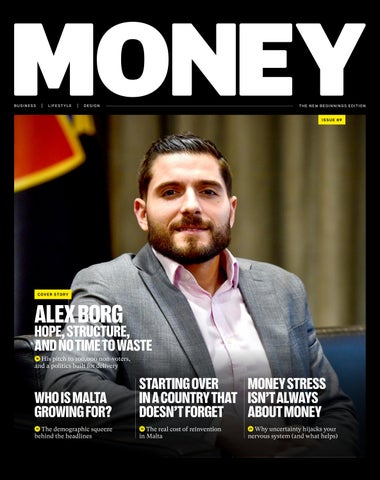
MONEY ISSUE 89

Page 1


18 His pitch to 100,000 non-voters, and a politics built for delivery

32 The real cost of reinvention in Malta WHO IS MALTA GROWING FOR? STARTING OVER IN A COUNTRY THAT DOESN’T FORGET

14 The demographic squeeze behind the headlines

28 Why uncertainty hijacks your nervous system (and what helps)

Speak to an advisor today.

Sparkasse Bank Malta public limited company (the ‘Bank” is a public limited liability company registered in Malta with registration number C27152 and registered office at 101 Townsquare, Ix-Xatt ta’ Qui-si-Sana, Sliema SLM3112, Malta. Sparkasse Bank Malta public limited company is licensed by the Malta Financial Services Authority to carry out the business of banking in terms of the Banking Act (Cap. 371 of the Laws of Malta), to provide investment services and custody and depositary services in terms of the Investment Services Act (Cap. 370 of the Laws of Malta), and is authorised to act as custodian of retirement schemes in terms of the Retirement Pensions Act (Cap. 514 of the Laws of Malta).

Editor’s letter — New Beginnings is usually sold as a clean reset: a new job title, a new routine, a new year and a new you. We love the idea because it feels modern — adaptable, decisive, in control. But most people don’t actually get a blank page. They get a page already inked with past choices, reputations, obligations, bills, family expectations, and the quiet weight of “what people will say”.

This issue is our attempt to tell the truth about that.

Because a new beginning isn’t always a personal reinvention, sometimes it’s structural. Malta is still growing — but it’s also tightening. The island’s demographic shift has become the engine of the economy, and that comes with pressure: housing strain, service strain, workforce strain, and cohesion strain. The real question isn’t whether growth is happening. It’s who it’s happening for, and whether our systems can carry it without cracking. If we want a real reset, it won’t come from slogans. It’ll come from productivity, enforcement, infrastructure, and a social contract that can survive reality — not just election cycles.

And speaking of election cycles: our cover story features Alex Borg, the Nationalist Party’s new leader, entering the ring with a message built on structure, transparency, and urgency. Whether you agree with him or not, Malta is heading into a serious political year — and seriousness is precisely what the country is craving: less theatre, more competence, more delivery.

But the most overlooked “new beginnings” are the quiet ones — the private pivots nobody applauds. The founder who realises their business won’t survive unless succession is planned early, honestly, and without ego. The professional who wants to switch careers but

needs to treat it like a financial strategy, not a motivational poster. The person whose stress isn’t caused by low income, but by uncertainty — the endless loop of checking, delaying, avoiding, controlling.

And in Malta, there’s an extra layer. Reinvention is harder here because the island remembers. The past follows you into rooms before you even walk in. Starting again can feel less like freedom and more like negotiation — with perception, politics, and fear.

So this edition isn’t here to romanticise change. It’s here to map it. The costs, the trade-offs, the buffers you need, the structures that matter — and the courage it takes to begin again, even when the conditions aren’t perfect.

Because new beginnings don’t belong to the lucky, they belong to the deliberate.

For promotion and advertising: bemags.com/money-pitch hello@bemags.com FACEBOOK-SQUARE LINKEDIN · becommunications.com

PRINTING Print It DISTRIBUTION MaltaPost DESIGN BE.

MONEY is hand-delivered to Malta’s businesses, including managers and directors of the country’s top blue-chip companies, iGaming companies, all 5-star hotels, including their business centres, executive lounges and rooms (where allowed), all foreign embassies and Maltese embassies abroad (Rome, Brussels, London, Vienna and Madrid). All government ministries and entities.

MONEY is published by Be Communications Ltd. All rights reserved. The content of this magazine, including articles, images, designs, and any intellectual property, is owned and protected by Be Communications Ltd. Unauthorised reproduction, distribution, or transmission of any part of this magazine is strictly prohibited without prior written permission. Be Communications Ltd. retains all intellectual property rights in the content published in this magazine, including but not limited to copyrights, trademarks, and patents. Any unauthorised use, reproduction, or commercial exploitation of this content violates applicable laws and may result in legal action. Opinions expressed in this magazine are those of the respective contributors and do not necessarily reflect the editor's or publisher's views. While every effort is made to ensure accuracy, Be Communications Ltd. assumes no responsibility for errors or omissions in the magazine's content, advertisements, or related materials and disclaims liability for the accuracy, legality, or originality of content provided by clients.

Z4 THE

Who is Malta growing for?

Malta is still growing — but the island is also tightening. MONEY explores the demographic squeeze behind the headlines: migration-driven labour, an ageing workforce beneath the surface, and a country testing its limits in housing, services, and cohesion.

Succession planning

Vanessa Macdonald looks at why Malta's family businesses struggle to survive the handover. Succession isn't a box-tick—it's a high-stakes transition shaped by timing, governance, valuation and family dynamics. Plan early, talk honestly, and protect the legacy.

Hope, structure, and no time to waste

It's only been months since Hon. Alex Borg took the helm of the Nationalist Party, but the countdown to an election year has already started. In this interview with Vanessa Macdonald, he lays out his pitch to Malta's 100,000 non-voters, his plan to rebuild trust, and why the PN must act like a "government in waiting" — not an Opposition on pause.

14 22 26 44 52

48 40 18

Money stress isn’t always about money

Money anxiety often hides behind “responsible” habits — checking apps, avoiding statements, delaying decisions. Dayna Clarke Camilleri speaks to psychotherapist Charlene Veneziani about why uncertainty hijacks the nervous system, and how self-understanding can restore financial calm.

Starting over in a country that doesn't forget

In Malta, reinvention isn't a lifestyle refresh—it's a negotiation with a country that remembers. Manuel Delia traces how public controversy, political undercurrents, and the economics of fear can freeze reputations in time.

32 36

Calculating a career change: What reinvention really costs

In a world that sells career change as passion and bravery, AJ Aberford's story is colder — and more useful. Lea Hogg tracks how a lawyerturned-banker sequenced exits, built buffers, absorbed crashes, and reinvented without pretending risk disappears.

Hype, hedge or hub: What the UAE’s gaming move means for Malta’s iGaming future

Ras Al Khaimah isn’t trying to be Malta overnight. It’s trying to be next. Lea Hogg explains the UAE’s disciplined play: tight licences, strong banking, fast-aligned regulation — and why the smartest Malta firms won’t relocate, they’ll hedge. Malta’s challenge is adaptation.

The rise of the side hustle

In Malta, the side hustle is no longer a hobby — it's a second track. Stephen Mallia unpacks the rise of the "employee-owner": professionals building businesses after hours while juggling tax, mortgages, and the fear of betting personal savings on an unproven idea. The takeaway is practical: Malta's support schemes are built to lower the risk and turn a 5-to-9 grind into a credible new beginning.

Scaling care without losing trust

New beginnings in healthcare aren't about new platforms — they're about new judgment. Dr Dylan Attard argues that one rushed procurement or unclear data decision can ripple system-wide, and calls for a reset: lifecycle thinking, visible governance, and workforce-first implementation that protects.

The 10,000 trap: The most common mistakes first-time investors make

Saving your first €10,000 feels like a financial milestone. Investing often becomes an emotional minefield. From crypto hype to panic selling and fee blindness, first-time investors in Malta repeatedly fall into the same behavioural traps. Paul Rostkowski explains why.

Beyond the boom

Malta mastered growth — but the next phase won’t be powered by volume alone. MONEY explores why the country is hitting hard limits in talent, cost and capacity, and why a real “new beginning” now means a pivot: from busy to better, and from expansion to value.

After Caracas: Power, precedent, and the new rulebook

Caracas rewrote the mood. Greenland widened the crack. MONEY examines how power is being exercised in 2026 — through force, energy flows and economic pressure — and why Europe is quietly arming itself with tools like the EU’s “trade bazooka”. The new rulebook is forming in real time, and the risk premium is rising.

More isn’t better anymore

At the Malta Business Network’s 2025 Christmas lunch, one message cut through the optimism: Malta’s next phase must look beyond volumedriven success and be quality-led. MONEY reports on why productivity, standards and long-term resilience matter more than headline numbers — and what “success” needs to mean next.

Quiet luxury, loud intent

A clean, elevated edit of winter essentials— tailoring, denim, footwear and investment pieces—for men who dress with quiet confidence. These are MONEY's picks for the season.

1 Dayna is a senior speech and language therapist, and the founder of Malta Speech Therapy. She is a former editor at the Malta Business Weekly and a prolific writer whose work spans health, neurodiversity and travel. Her pieces are known for their clarity, curiosity and practical insight, making her a familiar voice to readers across Malta and beyond.

2 Lea is a Malta-based journalist and author, known for her TV programme which focuses on current affairs, cultural news and in-depth interviews on geopolitics and global issues.

3 Manuel is a civil society activist and writer.

4 Paul is part of a multidisciplinary advisory firm specialising in private clients, high-networth individuals, and family offices.

5 Stephen is a freelance product regulatory compliance expert and mechanical engineer with over 13 years of experience in the field.

6 Vanessa had every intention of retiring but so far has been caught up by exciting freelance projects and voluntary work.

WHO IS MALTA GROWING FOR?

Malta is still growing — but the island is also tightening. MONEY explores the demographic squeeze behind the headlines: migration-driven labour, an ageing workforce beneath the surface, and a country testing its limits in housing, services, and cohesion. New Beginnings starts with an honest question: Who is Malta growing for?

Malta's growth story is often told in numbers: GDP, employment, arrivals, cranes, investment, and confidence. It's the language of an economy that has learned how to stay busy and keep moving.

But the deeper story — the one shaping daily life, boardroom decisions, politics, and longterm sustainability — is demographic.

Malta is not simply growing. Malta is changing who it is, at speed, and under strain.

Official estimates put Malta's population at 574,250 at the end of 2024, up 1.9% on the previous year, driven mainly by net migration of 10,614 people. A year earlier, the population reached 563,443 at the end of 2023, with a larger net migration figure of 20,960.

These are not abstract figures. They translate into the queue at Mater Dei, the rent you negotiate, the commute that eats your morning, the staffing crisis in hospitality, the pressure on schools, the pace of change in neighbourhoods, and the way employers plan — or can't plan.

And here's the crucial point: Malta has been treating this demographic shift as a byproduct of growth. In reality, it has become the model's engine.

The honest baseline: Malta runs on migration

If you want to understand Malta's labour market, you start here: the scale of foreign labour is no longer marginal.

Jobsplus reports that, at the end of 2024, the number of employed foreign nationals in Malta and Gozo amounted to 123,772. That is not a niche workforce. It is a structural pillar.

The Central Bank of Malta has been even more direct about the transformation. In a 2025 policy note, it observed that Malta's population growth since 2000 has been driven mainly by a rise in the foreign working-age population, and that the share of foreign nationals in Malta's working-age population rose from 2.5% in 2000 to 31.8% in 2023. It also warns, in projections, that by 2035 the share of foreigners in the working-age population could climb to 45.9% from 30.4% in 2023.

This is the demographic squeeze in one sentence: Malta's economy has been sustained by younger foreign workers, while the native Maltese population ages underneath.

So the national question isn't "do we like migration?" That's too simplistic, and it's often where debate dies.

The real question is: do we have a model that can handle the scale of change we've already chosen?

Capacity is now a competitiveness issue

The most dangerous assumption in Malta's public debate is that capacity is a "quality of life" issue, while competitiveness is purely economic.

That's no longer true. Capacity is competitiveness. When housing becomes unaffordable, recruitment gets harder. When transport becomes unreliable, productivity bleeds out. When services strain, trust erodes. When rules feel optional, the serious investor recalculates.

Malta's growth has collided with limits: physical (space, roads), social (integration, cohesion), and institutional (enforcement, systems, delivery). This is not pessimism. It is the lived reality of an island.

Housing: the pressure valve that keeps breaking

Housing is where demographic change becomes personal. For decades, Malta's identity was high home ownership and intergenerational stability. But the rental market has expanded rapidly, and affordability pressure has become a defining concern — one acknowledged institutionally, with the Housing Authority explicitly framing "improving rental affordability" as a core pillar of its work.

The point isn't whether Malta has schemes. The fact is whether policy is keeping up with the scale of demand.

When population growth is significantly driven by net migration, housing becomes the pressure valve. If that valve fails — if rents outpace wages, if supply doesn't match demand, if rules are unclear or unenforced — then the social contract frays: residents feel displaced, newcomers feel exploited, employers feel trapped, and politics becomes reactive.

A new beginning here isn't an argument about whether people should come. It is an argument about whether Malta will build a credible housing framework that protects fairness and stability for everyone.

Malta isn't just growing. It's changing who it is — at speed, and under strain.

The labour market paradox: we need people, but the model needs fewer people

Malta's labour market tells a paradoxical story. On the one hand, businesses genuinely struggle to find staff. On the other hand, the country's long-term sustainability depends on reducing reliance on ever-increasing headcount.

The Central Bank policy note makes the logic

explicit: improving productivity and shifting toward a more capital-intensive economy could moderate population growth by slowing net foreign migration flows.

This is the unspoken trade-off: if Malta continues to grow primarily through labour inflows, population growth will remain high, and capacity pressure will become a permanent feature rather than a temporary phase.

Business organisations have also been blunt about Malta's dependence on foreign labour and the need to confront productivity realities.

In 2025, the Malta Chamber warned that debates like a four-day work week must be grounded in Malta's actual conditions: low unemployment, significant reliance on foreign labour, and low productivity.

New beginnings, in this context, mean changing the base model: paying people more because output is higher, not simply because the labour market is tight; running sectors with better systems; and rewarding firms that invest in skills and technology rather than scaling through volume. →

Ageing: the quiet force underneath everything

Ageing is often treated as tomorrow's problem. Malta's data suggests it is a problem today, partly masked by migration.

That's the real pivot. Not ideology — arithmetic.

Integration: the part Malta avoids until it becomes a problem

Migration policy is often framed as a labour

If productivity doesn't rise, the demographic maths turns into a fight over resources.

The Central Bank notes that the native Maltese population is ageing, with a relatively low share of young cohorts and a higher share of older cohorts. In another Central Bank analysis, it's observed that the Maltese workforce has aged considerably, with those over 50 constituting 31% of all Maltese in employment, and that inflows of younger foreign workers have counteracted the underlying ageing dynamic in several sectors.

This matters because ageing changes the country's cost structure: healthcare, pensions, care work, and the need for a productive base strong enough to carry it.

If Malta doesn't raise productivity, the burden becomes a political fight over resources. If it does increase productivity, ageing becomes manageable.

tool. That misses the human dimension—and the strategic one as well.

If Malta's workforce and population are increasingly diverse, integration is not a "soft" issue. It's operational. It affects workplace stability, social cohesion, and public confidence in institutions.

The most telling detail in the NSO migration data is not only scale, but composition. In 2024, non-EU nationals accounted for 76.6% of net migration. In 2023, the share was even higher: 93.1% of total net migrants.

That implies greater cultural distance, potentially more vulnerability to exploitation, and greater responsibility on the state and employers to ensure standards are enforced.

If Malta wants the benefits of labour inflows without the societal backlash, it needs rules that protect people and protect the country's legitimacy: enforce labour standards, crack down on abuse, and build integration mechanisms that are real rather than symbolic.

Public sector gravity: when the state becomes the talent magnet

Another pressure point is internal competition for talent. When the public sector grows, it can pull people from the "productive" private economy — not because public work is less

valuable, but because wage structures, stability and hours shape incentives.

NSO-linked reporting indicates that Malta's public sector employed 54,398 full-time workers as of June 2025, accounting for about 18.3% of the total workforce.

This matters because Malta's new beginning is not just about attracting talent — it's about deploying talent well. A country cannot complain about productivity while structuring its incentives to drain specific sectors, or while allowing other sectors to operate on lowvalue-added volume.

So what is the "new social contract"?

A social contract is the agreement — sometimes explicit, often implied — about what a country offers and what it expects in return.

For Malta's next chapter, the social contract needs to be clearly stated, because the old one (grow, build, hire, repeat) is hitting its limits.

Here are five pillars that would make it real.

1) Productivity as national policy, not a lecture Reward value creation. Make it easier for firms to automate, digitise, train, and export. Stop celebrating headcount as the primary marker of success.

2) A housing system that protects stability

If Malta wants growth, it must protect fundamental fairness: rental clarity, enforcement, and affordability tools that don't merely chase the problem.

3) Labour standards that are actually enforced

A migration-driven model without enforcement becomes a reputational and political time bomb. Fair rules protect locals, protect newcomers, and protect serious business.

4) Infrastructure that respects time Time is economic output. The commute is not a

lifestyle issue — it's a productivity tax.

5) Integration that is practical, not performative

Language access, basic civic orientation, pathways to stability for those who contribute, and clear consequences for abuse. The aim is not assimilation — it's cohesion.

The uncomfortable conclusion: Malta must choose the kind of country it is becoming

Demography is destiny, but it is not fate.

Malta has already chosen a growth path that depends heavily on foreign labour and migration-driven population change.

The question is whether it will now build the systems, rules, and capacity to make that model sustainable — or whether it will continue improvising until social cohesion becomes collateral damage.

A new beginning doesn't mean slowing down for the sake of it.

It means growing with intention: fewer vulnerabilities, better wages through productivity, and a society that can absorb change without losing trust in itself.

Because the real risk isn't diversity, the real risk is drift: a country changing faster than its institutions can hold, and calling it success because the numbers still look good.

HOPE, STRUCTURE, AND NO TIME TO WASTE

It's only been months since Hon. Alex Borg took the helm of the Nationalist Party, but the countdown to an election year has already started. In this wide-ranging interview with Vanessa Macdonald, he lays out his pitch to Malta's 100,000 non-voters, his plan to rebuild trust through structure and transparency, and why the PN must act like a "government in waiting" — not an Opposition on pause.

What gives you the most headaches? The Labour Party, the voters, or your own party members?

Nothing gives me headaches. I see it more as a challenge, and I believe that every job has its challenges. The important thing is whether you can face them and overcome them. That is the most critical aspect.

When I first considered standing for leadership, there were many questions and pros and cons. But I decided to go ahead and, today, in this position – one of the highest Constitutional ones in our country – you do face various challenges. But if you have the determination and political will, and do it for the right reasons, I believe we can achieve an excellent result.

Since I became leader, our first goals have been to restructure internally, and we have even created new positions, including a CEO whose remit includes restructuring the party's financial structure.

We can overcome them if we work together and have already made progress. In fact, a few weeks ago, we published the party's accounts from 2021 to 2024, which were pending, within our first 100 days.

We were also able to collect more than €1 million, no mean feat, and I think that we managed to do this collectively – I cannot take all the credit. It comes from my team, our parliamentary group, our sectional committees and even those people out there who are now coming round to believe in the party and want to invest in it. It gives us a solid basis on which to work.

You haven't answered my first question. Which one is the biggest challenge? The Labour Party, the voters, or your own members?

About 100,000 people do not vote, and they are not partisan; they weigh everything up and decide who offers the best vision for the country. And they also consider the 10-15-year horizon and which party provides a concrete vision to tackle the problems the country is facing.

Alex, you're saying 100,000 people don't vote.

However, while there will always be floating voters and those who have never voted before, is there an element of disgruntled Labour or Nationalist voters? Including diehards.

There are various groups, not only disgruntled ones, but also youths who are apolitical or have no faith in the country's political system. I meet a lot of youths, and my age makes

I want Malta to win — not one party to lose.

them relate to me. I want our measures and initiatives to win back their trust. These youths form a significant part of those thousands of non-voters. Professionals also evaluate the situation and feel that they are political orphans. It is a challenge, but I believe that we can overcome it.

Since Laurence Gonzi lost the 2013 general election, the PN has had four leaders. Simon Busuttil, Adrian Dalia, Bernard Grech, and now you. Why will you succeed where they have failed?

This is the new way of doing politics. They all played their role, and each one did some good. Each has its qualities, and we are still benefiting from what they did. But now we need to grab the bull by its horns and make decisions for the party and for the country.

Even when we were talking about the accounts, many had doubts, while others felt I was too young and might not succeed. But I was determined to deliver on all the promises I made during the election – specific KPIs – and to do so within the timeframe I had indicated.

I believe the party's internal structures should operate on a corporate basis. I come from the commercial sector and understand how companies work. And I know how taking the right decisions can turn a downward trend into a positive one.

This is why I wanted to focus on discipline and structure during my first few months as a leader. There is still plenty more to

be done, and we need to keep the current momentum. People have renewed hope, and we need to keep strengthening this with quality candidates who, together with the parliamentary group, are seen as an alternative government.

We need new proposals and concrete visions that address the specific problems people face. All these factors will help us to win people's trust.

In your budget speech, you made 50 proposals. It's a great list – however, without enforcement, it's all for nothing...

These 50 proposals are only the beginning. I wanted to give a feel of what we can provide as an alternative government – and not as an Opposition! We are a government in waiting, and as such, we need to offer solutions to the problems facing the country while also providing a vision that delivers on people's ambitions, including those of our youth.

That has always been the formula for success: from an independent country to a European one, joining the eurozone, and achieving substantial economic growth. These are things that we need to resurrect.

Very often, people ask what new initiatives we could pursue. But the reality is that we do not need to reinvent the wheel… We merely need to strengthen what we already have.

Take the maritime sector, there is so much more than we can do. 14,000 ships go through our territorial waters every year, many of which need to stop somewhere for refuelling. If we improve our fuel bunkering infrastructure and add new fuels like LNG, hydrogen and ammonia – which many vessels use nowadays – we will be like a 'petrol station' in the centre of the Mediterranean. Imagine the potential.

Take aircraft leasing. It is a niche our country has begun to investigate. Still, it is not yet sufficiently regulated, and we have not yet created a niche that can deliver sufficient added value.

And tourism: if we attract quality tourists by offering a tourism product that generates more revenue for all involved, the revenue they leave behind will increase. Unfortunately, the present government is going after quantity, →

announcing every year how many millions have arrived. Why not target quality, which would, for example, allow hotels to increase their Average Room Rate, currently one of the lowest in Europe?

This would leave far more money in the pockets of local businesses, who could then reinvest. The ripple effect would be to create more economic power.

These are some of the things we are looking at as an alternative government and form part of the economic vision we will be rolling out. It will show that we are ready to run a government that is credible, transparent and accountable.

Let me pick up on your mention of accountability… Corruption is a central recurring theme in Maltese politics. Unfortunately, many voters believe that this is just inevitable after a certain number of years in power. Either politicians are accused of lining their own pockets or of funnelling contracts to their contacts. How can you make sure that your party does not fall into this trap?

I have spoken about party financing. The time has come to talk about this in depth. I have set up a working group drafting legislation that would ensure parties are not obligated to anyone.

Great – but what about the corruption of individuals?

You have to look at the source: why does corruption tempt politicians… Greed?

What if there were a system that strengthened their autonomy? Has the time come to discuss politicians' wages? I am in no way accepting corruption, but I face the same temptations and will not allow myself to get into a situation where I would become corrupt.

But a system that is rigid and prevents this, by raising the wages of ministers and politicians? Regulations and strict guidelines would ensure that those who are guilty face serious repercussions.

How can you have a prime minister who earns €60,000-€70,000 while the person

who reports to him earns twice that amount? Something does not add up.

But these discussions are needed if we are to show that we are a serious country. By raising salaries, you not only reduce corruption but also attract quality. In a democratic country, how can you attract people to politics if the wages are miserly and far lower than those in

We don’t need to reinvent the wheel. We need to strengthen what already works.

the private sector? We must not shy away from discussing this if we want a more transparent country.

I had asked Adrian Delia, when he became head of the party, whether he was ruthless enough to be a leader. My question instead took him aback. From what you're saying now about a zero tolerance for corruption, are you ruthless enough?

We have already shown that we are not afraid of certain uncomfortable discussions.

In the few months I have been a leader, we have spoken about several things that people may have preferred to ignore, but I am not afraid. And this also applies to the other side of the political spectrum.

For example, different countries are discussing the four-day work week, but I did not hold back from discussing it. We may find that it cannot be introduced, but let us at least examine whether it could work in Malta.

I am also bringing back into the fold people who left the party. It does not necessarily mean they will be candidates, but we need to start reaching out to them, for example, Edwin Vassallo and Franco DeBono. Various others from the party moved away. I want to reassure them that the door is open, and these are not just words; these are facts.

If we talk about internal matters, one of the main issues is the party's unity. Divisiveness was an issue that held the party back, and my predecessor had already begun trying to heal it and reintroduce harmony and unity. I am trying to continue with this, to create a more compact and united party. Unless your own people are aligned, you can never win the government. Only then can you start winning others over.

You spoke about the party's finances. However, let's get to the nitty-gritty: MediaLink has been a dramatic financial drain. You want things to be transparent and accountable, but we're talking about a company which apparently hasn't even published its accounts since 2004. It's hardly setting the right example.

One of the first things I did was to bring our house into order. As a party, financing is one of our obligations with the Electoral Commission. One of the most important things, and one that gives me great satisfaction, is that as a party we have more assets than liabilities, which gives us the flexibility to keep functioning. MediaLink is a private company which has its own obligations under the Malta Business Register. It has challenges, but it does not mean that we will sweep things under the carpet. We have a financial team working to restructure MediaLink and make it more efficient and effective.

We also need to look beyond what it already does to social media and podcasts, which will rejuvenate the company.

This is a challenge which both parties are facing. One Productions has not published its accounts for about the same length of time as MediaLink. It also faces challenges with its debts.

So both parties are facing this, but that does not mean that, in Opposition, I can do the same just because the government is… Two wrongs don't make a right. This is why the experts I appointed are working to strengthen the party's media arm.

Let's take a step back and ask maybe a more basic question. Do we actually need political television stations? Are they just preaching to the converted? And that applies to your newspaper as well.

The reality is that, as a party, without Net TV, we would not have a voice.

You yourself just mentioned social media, which is a lot more cost-effective.

The only way the party can get its message across in traditional media is through its television station. The Labour Party in

government has PBS and One. So if we reduce Net TV, we will lose the audience who hears our message through traditional outreach.

You've got 100,000 floating voters. Do they get their message from Net or One?

As soon as I became the leader, I instructed the party to set up a social media office, and there are now two people working there. Our communications head and his team are amalgamating and strengthening our presence on social media. Before, we relied on press conferences and press releases, but now we use reels, which drive much more youth engagement.

You have to get your message across and, even on an international level, this is the approach being adopted.

As a party, I had vowed to be the first party to have political podcasts. We used crowdfunding to raise €15,000 over a few days, and we will soon launch the first political party podcast in Malta.

Social media nowadays spans a broad spectrum – Facebook, Instagram, TikTok, LinkedIn – each with its own audience, so you need to tailor your message to each one. We are investing heavily in social media to make sure it reaches everyone.

You have a list of 50 proposals regarding how you see the economy developing. Do you believe we should be aiming for economic growth or well-being? Can you actually have both?

You can have both, yes, but the economy has continued to grow at a specific rate, and you have to understand at what cost. The economic vision of this government was to achieve growth, but it was based on the importation of third-country nationals. You cannot simply throw them out, as specific sectors rely on them.

The problem is that this vision was not achieved over a decade or so, but just over five years, which means our infrastructure could not cope. It is affecting the quality of life. Traffic is a daily issue, and if you go to Mater Dei Hospital, you wait hours – sometimes up to 12 – to be seen. And the same applies to overdevelopment and lack of open spaces. This is the reality, and this is why we believe wholeheartedly that we need to work towards a better standard of living, even as we continue to pursue economic growth.

You recently spoke about the need for political – or non-partisan – consensus. Wow.

Some significant projects will never get off the ground unless we sit down together to discuss them. We cannot only look at a five-year horizon. Take mass transportation – whichever solution we go with, from metro to monorail – cannot be done in one legislative session. It will take two, if not three, and it could be started by a Labour government but finished by a Nationalist one. Hence, the importance of both parties getting together and agreeing on these big projects.

I have made the offer to Prime Minister Robert Abela and the Labour government to sit down with them to discuss, for example, mass transport and even sign a memorandum of understanding in which we agree that no matter who starts and finishes it, we would agree with the consultants and technocrats

on the way forward. We also believe the healthcare sector requires a joint agreement on where we want to go. It is not enough to cover up the problems.

The government has not yet responded, but the door remains open. I want to see things happening with the national interest in mind, and with a strong vision to reduce the problems faced by the population in Malta and Gozo.

Even when we talk about planning, we need to decide on the way forward. Do we want sustainability? We do not want to stifle growth, but we cannot have endless growth without looking at its impact on our identity, something that taps into quality, even a plan for open spaces.

Propaganda will not get us there. The day after my Budget speech, the prime minister announced that he would develop White Rocks as open space, but where is the line item in the Budget that specifies how much he will spend on it?

And what does he mean by a national park? National parks are not defined in our legislation. Does it mean kiosks everywhere? Or trees? Or animals? Or commercialisation? I think we first need clarity on what a national park is, and only then can we start talking about them.

There is a dire need for national parks and open spaces in our country – but this should be a real project, backed by agreement, not just propaganda to tick the boxes!

Last question: Is Labour going to lose the next election, or are you going to win it?

I want to see Malta win. It is not about one party or the other losing. Without being partisan, I want a party that works for the whole of Malta.

We want a better Malta. A just, fair, sustainable Malta. Where everyone gets a chance to progress, no matter which party they support. And a better ecosystem where we go for quality. I believe that what we, as a party, offer over the coming months will win the faith of those who want to see Malta improve.

The interview was conducted in Maltese and has been edited for clarity.

MONEY STRESS ISN’T ALWAYS ABOUT MONEY

In Malta, money anxiety often hides behind “responsible” habits — checking apps, avoiding statements, delaying decisions. Dayna Clarke Camilleri speaks to psychotherapist Charlene Veneziani about why uncertainty hijacks the nervous system, and how self-understanding can restore financial calm.

Most people know roughly what’s in their bank account. And yet, many of us still check. Before buying something small, before a night out, sometimes just before going to bed, as if the number might have changed on its own. The relief is brief. A few minutes later, the unease returns.

T his loop is so familiar that it barely registers as a problem. It’s framed as being careful, responsible, and sensible. But psychologists and behavioural economists describe it differently, as a pattern driven by uncertainty and the way our minds respond to it rather than by ignorance or laziness.

“Money anxiety often shows up subtly rather than as overt distress,” says Charlene Veneziani, a warranted family psychotherapist working with individuals and couples in Malta.

At its core, this anxiety is less about numbers and more about safety, security, and fear of loss.

“Even when finances are stable, people may feel constant pressure, engage in ‘what if’ thinking, or struggle to relax around spending.” In practice, she adds, this can lead to overcorrecting behaviours, such as aggressively paying off debt, which may reduce anxiety briefly but create ongoing strain. “At its core, this anxiety is less about numbers and more about safety, security, and fear of loss.”

Although money anxiety looks different from person to person, it tends to follow a few recognisable patterns. Some people respond by constantly checking. Banking apps, spreadsheets and budgeting tools become →

Charlene Veneziani

a way to reassure themselves in the moment, even if the reassurance never quite lasts.

“These patterns are very common,” Veneziani explains. “Some people repeatedly check balances or accounts for reassurance, while others avoid decisions because money feels emotionally overwhelming.”

Others respond oppositely. Statements remain unopened. Emails from banks or service providers sit unread for weeks. Decisions are postponed until they can no longer be ignored. “These behaviours are not flaws,” she says. “They are the nervous system’s attempts to manage uncertainty and regain control.” Then

there are those who know what needs to be done but wait for the perfect moment, the correct rate, the clearest horizon, the most certain outcome. “Decision paralysis often affects conscientious individuals who feel intense pressure to make the ‘right’ decision,” Veneziani notes. “Money feels emotionally overwhelming, so delaying becomes a form of self-protection.”

What these patterns have in common is not a lack of knowledge, but a shared response to uncertainty. Research into financial distress consistently shows that anxiety is not only about how much money someone has, but about perceived threat and lack of control.

This helps explain why financially stable people can still feel persistently on edge.

“Uncertainty is more destabilising for the nervous system than known difficulty,” Veneziani says. “When income is predictable, people can plan and adapt. Uncertainty keeps the body in a constant state of alert, making it hard to relax.” This, she explains, is why people with sufficient resources can feel more anxious than those with fewer but more predictable circumstances.

In Malta, that uncertainty is often amplified by proximity. It is a small country where lives

People rarely talk about money stress, so others’ calm can make us feel behind or inadequate.

are visible, and comparisons are constant, even when unspoken. Someone else’s renovation, new car or career move becomes a quiet benchmark. “In small communities like Malta, everyone seems to notice everything,” Veneziani says. “Homes, cars, weddings, even children’s school choices. These visible markers can quietly fuel comparison and pressure to ‘keep up,’ even when finances are stable.”

The tricky part, she adds, is the gap between private worry and public appearance. “People rarely talk about money stress, so others’ calm can make us feel behind or inadequate. In a tight-knit society, this can make money anxiety feel isolating, though in reality, it’s something many silently share.”

Faced with this pressure, many people respond by doubling down on responsibility: tighter budgets, more tracking, more restraint. On paper, it looks sensible. Emotionally, it can become exhausting. “Yes,” Veneziani says, “for some, financial responsibility becomes tied to identity and self-worth. When responsibility

turns rigid, money feels like a measure of adequacy rather than a tool. This can create constant vigilance, fear of mistakes, and difficulty enjoying financial stability.”

This is also why practical financial advice often fails to calm money anxiety. “Money anxiety is rarely about lacking knowledge,” Veneziani explains. “Most people already know what they should do, but the anxiety lives at an emotional and physiological level, often shaped by past experiences. Practical advice alone can even increase pressure if the underlying emotional meaning of money isn’t addressed.”

Therapeutic work, instead, focuses on loosening the relationship between anxiety and behaviour. “Shifting from self-correction to understanding is often key,” Veneziani says. “Becoming curious about where money fears come from, and noticing bodily reactions without immediately acting on them, can reduce intensity. Over time, flexibility, self-compassion, and a sense of internal safety matter more than perfect systems.”

Money anxiety thrives on isolation and selfblame, on the quiet belief that everyone else has figured it out while you are somehow behind.

Recognising the pattern can change that internal narrative. “Money anxiety is not a personal failing but a human response to uncertainty and responsibility,” Veneziani says. “Feeling anxious does not mean someone is incompetent. If the anxiety feels persistent or restrictive, speaking with a therapist can help create space between feelings and behaviours. Reaching out is a supportive and thoughtful step.”

For many people, relief does not come from earning more or working harder. It comes from understanding that their anxiety is not a flaw, but a response. And that understanding alone can begin to loosen the grip.

Charlene Veneziani is a warranted family psychotherapist working with individuals and couples to support resilience, healthy relationships, and sustainable personal growth. With a background in psychology lecturing, she brings strong academic and clinical expertise

SUCCESSION PLANNING

Beating the odds

Vanessa Macdonald looks at why Malta's family businesses struggle to survive the handover. Succession isn't a box-tick—it's a high-stakes transition shaped by timing, governance, valuation and family dynamics. Plan early, talk honestly, and protect the legacy.

For decades, Malta's economy has been driven by its SMEs, but there is another aspect: how many of them are family-owned? There are very few statistics, but the accepted percentage seems to hover around 75%. That means an impressive 45,000 companies are family-owned.

T hese may range from small shops to small businesses, but some accumulate enough wealth and goodwill to merit passing on to the next generation.

And this is where it gets tricky. The owner may have children who are not interested in taking over the company. The children may not be the best qualified to take on the responsibility or role. The company's founder may face numerous decisions – not all of which are optimal or successful. The owner may opt to sell the company to an individual or company outside the family, so the issue then becomes disposal rather than succession. Probably the most common circumstance is that the owner and the family have put off even considering how to address the eventual succession of the business, leaving a stressful, likely complicated situation when it inevitably occurs.

The issue, thorny as it may be, obviously requires planning.

Most international surveys report that under a third of family-owned businesses survive into the second generation. The news gets worse with each generation: only 12% survive into the third, and only about 3% into the next generation and beyond. Sobering numbers!

Statistics for Malta are indicative, even though the available figures are slightly outdated: a 2018 survey by the Malta Chamber of Commerce, Enterprise and Industry found that an estimated 16.9% of family businesses were inherited. And although 82.9% of family business members would prefer to pass the company to the next generation, around 8% would prefer to sell it to an outsider.

The major, large family-owned companies in Malta are now entering their second century, and they have chosen different paths. Indeed, KPMG Malta reported in 2023 that several business families were at a crucial phase in their succession planning, with a high volume of wealth being transferred between the second and third generations.

Bear in mind that the obstacles to a successful transition are tremendous: there is no 'one size fits all' formula, but the key principle seems to be timing: the earlier a company starts planning, the better.

The issue of succession is by no means a Maltese one. The Malta Stock Exchange Institute was the lead of a six-country project team that successfully bid to create an Erasmus programme to identify ways to address this. NextSME already has its own website, www.nextgensmes. eu, that offers free online training covering six aspects of

succession planning for family-run businesses. The project is in the hands of Cliff Pace, who explained that it forms part of the MSE's financial literacy programme, tackling an aspect of business often overlooked.

"This will become even more important going forward as there is a large number of entrepreneurs who created their companies during periods of economic expansion, and who are now approaching retirement.

"The project highlighted that in Germany, for example, 30% of SME owners are aged 60 or more, while in France one in ten SME leaders is 65 or older," he said.

Many Maltese businesses are still heavily ownerdependent— an instant red flag for buyers.

— Thomas Cremona

One particular aspect of Malta is the dearth of merger and acquisition opportunities, which makes succession planning harder and disposal much less likely. Thomas Cremona, the founder of idisav, explained that in an ideal acquisition scenario, a buyer would target a company with minimal dependence on its owner.

"However, many Maltese businesses remain heavily owner-dependent because founders either continue to run the enterprise long after they could have afforded professional managers, or the business was not profitable enough to sustain a professional management structure. This dependence creates a material risk for acquirers, who are often unwilling to take it on without applying a substantial discount to the asking price," he explained. →

Pricing continues to pose a significant challenge: in addition to the structural constraints of the local market, many owners expect the sale of their business to fully finance their retirement. Yet most Maltese enterprises do not justify such elevated valuations.

"In practice, many exits will provide owners with time and liquidity to consider their next financial steps, rather than fully funding retirement plans," he added.

The lack of liquidity on the Malta Stock Exchange limits the practicality of public market exits for Malta's larger corporate groups, he said.

"A sale through the exchange is generally either too gradual to be meaningful or too costly to justify. Furthermore, Malta lacks an active private equity ecosystem. The pool of potential acquirers is therefore concentrated among synergistic buyers such as competitors, high net worth individuals or groups of them, and the established Maltese corporate groups that continue to expand across local industries."

One entity with international experience in this topic is KPMG, and its senior partner for KPMG Malta, David Pace, stressed the importance of good planning.

"It has been shown (and we have had the opportunity to witness directly) that should family businesses plan the transition of Management, Income, Control, and Equity (MICE) effectively, in due time, the next generation has less to fear and more to look forward to.

"MICE encapsulates what matters most to family members in connection with their family business. Yet often they are shrouded under a veil of silence and/or are not given their dedicated focus, with succession seen to merely relate to the passing over of the shareholding interest.

"When families have engaged in proper succession planning, discussing these matters, capturing principles, sharing these and creating the forums to keep the discussion ongoing, then as family members go through their life stages (kids coming of age, marriages, next gen's being born, retiring of older gen, etc) you can see how this helps produce healthy, timely, discussions.

"By way of example we have witnessed cases where the parents wish to have family members take over the business but none of the family members appear keen to in their eyes... to then discover – when we engage in succession discussions with the children – that one or more of these family members would have been interested

to get involved in the business but this topic was never discussed, leading them to believe that their parents didn't wish them involved... And then the parents tell us they never discussed it with the kids, as they didn't want to impose!"

A 5% tax bill is manageable. Getting succession wrong can cost the other 95% in conflict and court.

— David Pace

"Invest time and resources to work through these matters: the tax bill at the most is often 5% in Malta, but getting the succession plan wrong (like tying two siblings in a business they should never be co-owners of) could lead to seeing the 95% go up in legal battles and other dysfunctional behaviour – not to mention loss of the family bonds too!"

Another important consideration is that succession planning is sometimes viewed as a one-time event, revisited only when it's time to transfer the business again. Indeed, just as family members go through life stages, the company too has its own lifecycle—what worked 10 years ago might need to evolve alongside contextual realities and as new challenges and opportunities present themselves.

He also stressed the importance of communication: "Simply put, the best succession plan is one that works for the next generation as much as it works for the present owners. Anyone who has tried to tackle a sensitive matter with someone close, with whom other pressures exist, is at risk of this new matter being confounded with the overarching tensions.

"Similarly, in family business, three distinct systems play out: the family system, the business system, and the

ownership/shareholder system. You need to deliberately create dedicated spaces to allow topics to be discussed in their own right."

There is no doubt that ensuring a smooth succession is a challenge. Founders have worked hard to build a company, and it is often not just a source of income but also their legacy. But this is precisely why a founder should invest to ensure that what they have built can continue for generations to come.

1. Keep in mind the impact on employees

The issue of succession affects those who already work for the company. Even if a family successor has been on the cards for some time, it does not always follow that employees welcome the change. They may embrace the new head as representing the family's continuing belief in the company – or they may resent the new appointee, especially if they have not worked their way up the ranks or proved themselves. Bear in mind that no matter who is appointed, someone will feel overlooked or have their career path blocked.

This makes it all the more critical for the appointee to have a deep understanding of the company and its values, which is often best achieved by working at different levels and across various sectors. It is also essential to ensure communication, not just with senior levels but with the entire hierarchy. A leader is only as strong as those who follow them.

2. Avoiding discrimination and bias

Ensure the succession plan does not contain any hidden biases that could affect the selection of the best possible successor. The days of everything going to the eldest son may be long gone – but there are still cultural assumptions that need to be managed.

For example, a German study from 2015 found that when both a son and a daughter were available, the daughter was chosen in only 19% of the surveyed companies. When looking for a successor, the family should focus on qualifications and leadership qualities, not gender.

3. Keep an open mind

The head of a company should not assume that a family member will take over their role. Their offspring may have different careers in mind, and even those ready to take over from their parents may have different timing in mind, depending on their own life journey.

This may mean that the leader has to reconsider when they want to take a step back, for example, either doing so earlier or later, neither of which may be optimal. And although some period of handover would be recommended, the head needs to be ready to take a complete step backwards. →

The family dynamics are also essential to keep in mind: if one sibling is chosen, what about the others? What are their expectations? It is not only a matter of giving each a fair share of the accumulated wealth: they may also want a role within the company.

Again, communication is key…

4. Succession is not just about leadership

Bear in mind that there are various legal and fiscal considerations. Apart from transferring ownership of the company, review the shareholder agreement and voting rights to avoid disputes further down the line.

There are also governance issues, especially when the company or group has a board of directors. This may

involved family member has a say in the issues affecting the company. Think of the council as a board of directors, but rather than focusing on strategy and operations, it prioritises family values and dynamics.

6. Embrace the emotional side!

It is not all about laws and technical details. Deciding when to step down and appointing a successor is, first and foremost, an emotional transition. This may negatively affect how you handle issues, whether we are talking about taking rational decisions or succumbing to peer pressure and family expectations.

Case Study #1

M. Demajo Group

4th generation

We anchor leadership selection to role requirements, performance and values — merit-based and gender-neutral.

— JJ Miceli Demajo

require administrative changes – or even more substantial ones.

5. Manage complex structures

As more generations become involved, a company or group's structure becomes more complex, and the risk of conflict increases. There are various ways to ensure that all family members are kept up to date and empowered to participate in future decisions.

Consider setting up a family charter that clearly outlines the future and each person's place in the setup, while establishing a clear mandate for any existing or future board of directors. The charter would outline the roles and expectations of both family and non-family members, and establish mechanisms for resolving conflicts. This can be complemented by a family council, where each

Founded in 1910 by Michel Demajo, the M. Demajo Group has evolved across four generations of family ownership and leadership.

In recent years, succession has become more deliberate and structured. Planning begins early, with potential successors exposed to several group businesses and mentored by seasoned executives. At the shareholder level, a family council acts as a liaison and advisory body, ensuring the family's interests remain aligned with those of the business. This sits alongside formal board committees such as finance, nominations, and audit.

Our approach is always focused towards merit-based and gender-neutral. We anchor leadership selection to role requirements, performance and values, and we pair transitions with clear communication and onboarding plans so that everyone involved understands the rationale and feels part of the journey. Our ongoing Group HR strategy work supports this.

On portfolio stewardship, we prioritise long-term resilience: we invest in growth areas and review non-core activities with discipline. Over the years, we have exited or consolidated selected lines when strategic fit or risk profile warranted it.

What has helped us endure? A few principles: start succession planning well before you need it; separate family governance from business governance while keeping them in dialogue; insist on merit; communicate early and often; stay diversified but focused; and, above all, our most important element is our values. We cascade our values of care, reputation, trust, and family throughout

everything we do. These practices have allowed the Group to adapt through Malta's economic transformations while maintaining continuity of purpose and performance.

Case Study #2

The Vassallo family business traces its origins to 1946, when our late grandfather, Piju Vassallo, then a farmer, recognised an opportunity in the aftermath of the Second World War. With only a truck, initially used for farming, as his single asset, he began clearing war debris, marking the start of the family's entrepreneurial journey.

As Piju's five sons matured, they joined the business and, in 1971, officially registered the company as Vassallo Builders Company (registration number C2448). At this pivotal moment, our father Nazzareno, one of Piju's five sons, was appointed managing director while his older brother became chairman. During the late 1970s, two brothers exited the business, selling their shares to the remaining four shareholders.

In 1985, after Piju Vassallo's retirement, the remaining three shareholders decided to pursue separate business paths. Our father purchased the shares of the original company, Vassallo Builders Limited, while other business interests were divided among the two remaining uncles as part of the agreement. With this transition, my dad and mum became the sole shareholders of what would become the Vassallo Group, which is set to celebrate 80 years since its founding.

Dad made it clear from early on that all five siblings would join the business as equal shareholders upon turning 18. This clarity in succession planning, regardless of gender, laid a strong foundation for the family's continued involvement.

Currently, the business is owned by seven equal shareholders. In addition, our parents required that each child attain a university education before joining the family enterprise.

While the essential principles of a family business constitution were discussed and understood, a formal document has yet to be executed. The next step is to draft a constitution to safeguard the business for future generations, a process requiring trust, transparency,

and expert guidance. To support this effort, the family has joined the Global Family Business Network, an organisation of 5,000 business families, and we are collaborating with a seasoned family business expert to guide the drafting of our constitution and other succession measures.

One key element under consideration is that future generations must complete a university degree and gain external work experience before becoming eligible to join the family business. The aim is to ensure that competence aligns with the business's requirements.

Reflecting on our journey, we acknowledge that succession planning may have started later than it should have for the next generation. The advice for

Good governance matters — including nonexecutive and non-family members on the board strengthens long-term prospects.

Pio Vassallo

other family businesses is to initiate these discussions early, recognising that succession is a gradual process rather than a single event. Keeping top executives informed throughout helps prevent unnecessary or false speculation. It is also vital to communicate the business's values and purpose to heirs at an age when they are old enough to understand.

Although exit strategies for our heirs have not yet been discussed, it may be beneficial to consider them so that no one feels trapped in the future. Good governance is essential, and a crucial aspect is the inclusion of both non-executive and non-family members on the board. This practice, insisted upon by dad, has been carried forward by the next generation since he retired four years ago, strengthening the company's leadership and longterm prospects.

Starting over in a country that doesn't forget

In Malta, reinvention isn't a lifestyle refresh—it's a negotiation with a country that remembers. Manuel Delia traces how public controversy, political undercurrents, and the economics of fear can freeze reputations in time, and what it really costs to start again.

When people discuss "new beginnings," they usually refer to a career change, a new role, or a personal reset. We like the idea of starting over. It makes us feel contemporary, adaptable, and unafraid of change.

However, the reality is that Malta is a challenging place to reinvent yourself, especially if your past was lived openly. Reinvention demands a kind of forgetting, and Malta is a country with a long memory and a small territory. People do not forget. And sometimes, they do not forgive.

I learned this in my late thirties, when a chapter of my life closed, and I realised that turning the page was not something I could do alone.

Starting again isn't just about polishing a CV or changing sectors. It is an economic, social, and psychological negotiation with a country that archives every public moment and keeps

it ready for reuse. I went straight from university into senior political roles and spent fourteen years working at the centre of government. It was intensive, compressed work. I learned quickly, took on responsibilities early, and lived with a constant sense of urgency. Politics in Malta often functions like that: sink or swim, and keep swimming.

In the final years, I became the public face of one of Malta's most significant policy reforms in decades: the overhaul of the bus system. Although a necessary reform, its implementation faced serious setbacks. The system's mechanics improved over time, but reputations, unlike public transport, do not follow published timetables. They stagnate at the moment of crisis; for many, public memory ended with the failures. As a result, I was seen by the public as the person responsible for explaining them away.

When the government changed in 2013, my political career

Starting again isn't just about polishing a CV—it's an economic, social, and psychological negotiation.

naturally came to an end. I was 36 years old, with fourteen years of senior-level experience behind me, and no clear path ahead in the country where I had built my entire professional identity. I sent out applications, met potential employers, and engaged in polite conversations. But Malta's labour market is small, cautious, and heavily influenced by political undercurrents. It is also risk-averse in ways people rarely admit openly. Hiring someone associated with a public controversy, even one long resolved, feels like inviting inherited problems into your organisation. No one ever states this directly. Instead, the phone simply stops ringing.

It took time to understand what was happening. The uncomfortable truth was that employability here had very little to do with skills and almost everything to do with perception. Competence is portable, but reputation is not. It follows you into every interview room and →

sits there, uninvited, whispering reminders of your worst day on the job. Eventually, I found work elsewhere, not physically abroad but with foreign companies and international projects whose leaders did not know or care about Maltese political baggage. It was a strange form of exile: living in Malta while being professionally outside it. The practical problem was solved, but the deeper questions remained.

In 2017, when Daphne Caruana Galizia was killed, all the stability

I had built up fell apart. I left my financially secure private-sector job and dedicated myself entirely to civic activism. It wasn't a deliberate choice. It was a moral decision, and I understood the consequences even as I accepted them. You can't measure dignity in pounds, but you can count the cost of choosing it.

The civic space in Malta is intentionally fragile. There is very little formal philanthropy, almost no institutional support, and a public sector that regards

watchdogs and critics as nuisances rather than essential to democratic health. Money is a constant source of worry. Organisations struggle to survive each month. Individuals live on tight budgets, driven more by conviction than comfort.

There is also the quieter dimension that people rarely name. Even outside government, many employers fear that being associated with those who challenge authority may lead to difficulties. No law states this

openly. No regulation spells it out. But enough people believe it could be true that it has an effect on real lives. Fear becomes an economic force in its own right, narrowing choices and reducing opportunities without ever needing to be written down.

People often talk about starting over at 40 as if it were a lifestyle choice, a kind of midlife reinvention pursued for fulfilment. The reality is more brutal. Reinvention is not glamorous; it is hard work. It involves trading stability for uncertainty and accepting that the narrower income you receive is not due to failure or incompetence, but to choices that Malta does not reward.

I am now 49. The past decade has shown me that starting again is not a single event. It is a long series of attempts, setbacks, recalibrations, and stubborn persistence. It is the repeated act of convincing others, including yourself, that the chapter you left

behind does not define the one you are trying to write.

I do not share this as a personal confession, nor as a plea for sympathy. I share it because what happened to me is not unusual.

It is a heightened example of what many people in Malta experience when they step out of line, fall from favour, or simply find themselves on the wrong side of a political narrative. This is a country where visibility is quick, and consequences can last indefinitely, where professional identities are as permanent as tattoos, where networks often matter more than CVs, and where the courage to speak out comes with an unspoken understanding that you might pay a heavy price.

If we are serious about honestly discussing new beginnings, we must accept that they are not equally accessible. Some people can change direction easily because their past is simple or aligned with the prevailing power.

Others rebuild on ground that has already been contested. They start again, not on blank pages, but on pages already marked by interpretations they did not choose.

And yet reinvention remains possible. It requires stubbornness rather than optimism. It requires accepting that Malta will not forget your past and choosing to build anyway. It requires living with the knowledge that dignity has its own unforgiving economy, and that sometimes you decide

Competence is portable, but reputation is not.

to work within it because the alternative is impossible to live with.

A new beginning is not a clean slate. It is a decision, often renewed daily, to pursue a life aligned with your conscience even when the country around you would prefer that you stay quiet, compliant, and forgettable.

I did not choose the easiest path. But I did choose the one I can stand by. And that too is a beginning.

CALCULATING CAREER

What reinvention really costs

In a world that sells career change as passion and bravery, AJ Aberford's story is colder — and more useful. Lea Hogg tracks how a lawyer-turned-banker sequenced exits, built buffers, absorbed crashes, and reinvented without pretending risk disappears.

Today, AJ Aberford writes crime novels. His "Inspector George Zammit" series is published, steady-selling, and grounded in the politics, corruption, and money flows he observed firsthand. But the path from law and banking to novelist in Malta wasn't a leap of passion but a careful calculation in risk, timing, and financial buffers.

Career reinvention is often sold as an emotional story: burnout, passion, escape. In reality, it is a financial decision, governed by timing and a clear understanding of downside risk. For investors, founders and senior professionals, changing direction mid-career is less about courage than balance

sheets: when income becomes optional, when volatility is tolerable, and when autonomy is worth more than marginal returns.

AJ Aberford's career offers a rare, unsentimental case study, not of radical reinvention, but of sequenced exits, absorbed losses, and the quiet arithmetic that determines who can afford to change course and who cannot. What follows is an account of how careers, like portfolios, evolve across cycles.

When an institutional trajectory breaks Financial concerns are the most significant barrier to career change: a Forbes survey

CALCULATING A CAREER CHANGE

found 73% of people considering a switch cited money worries, while only 8% felt financially confident enough to leap.

Aberford's career followed a recognisable path for his generation. Trained as a lawyer, he moved into banking during the 1990s, when

deregulation and globalisation dismantled barriers in finance. Institutions grew bigger; rewards followed scale.

"I realised I was tired of big organisations," he says. "The best ideas take months to happen, and change is always a threat to somebody. I wanted to work somewhere smaller, do something different, or apply what you'd learned directly."

The bank where he worked was eventually absorbed into Santander. With a young family and little desire for a full-time City role, Aberford reached a conclusion many mid-career professionals recognise but few act on: the trajectory no longer suited him. What followed was not reinvention so much as recalibration.

Risk looks different once you've seen it up close

With a partner and funding from Deutsche Bank, Aberford left corporate finance to build a business buying and managing distressed property assets - a move that kept him close to capital, decision-making, and downside, but on his own terms.

Then came 2008 and the financial crisis.

Aberford sold the business to a major UK property company while retaining assets. When markets collapsed, those assets rapidly lost value.

"We went from buying distressed property to owning it," he says. "That's a very sobering position to be in."

Rather than chase a quick recovery, he adopted a defensive strategy: sell low-value assets, hold others for the long term, and step back from active trading. It took seven years to recover the capital lost in the crash. By 2015, the company was solvent but effectively inactive.

That moment reframes Aberford's later decisions. Reinvention did not come from optimism alone; it came from absorbing a complete market cycle and choosing caution over bravado.

"My business partner and I both had time on our hands," he says. "That's a luxury, but it forces many questions."

From abstract capital to physical work While his business partner went on to chair →

a UK regional bank, Aberford took a less conventional route. After travelling in the US and observing the craft beer boom, he returned to university and obtained a qualification in Brewing Science.

"I'd always sat behind a desk, moving paper and money," he says. "The idea of designing something physical, manufacturing it, and taking it to market fascinated me."

The brewery was no hobby. It became a national supplier to supermarkets and hospitality, employed over 40 people, and contract-bottled beer for some of the largest craft breweries in northern England.

Financially, it was a step down.

"I didn't make as much money as a banker or a lawyer," he says. "But I had more freedom and a better lifestyle than I ever did as a lawyer or banker."

For a period, the trade-off worked. The business sat at the centre of its local community. The work was tangible. The pace was demanding, but human.

Then Covid-19 arrived. Hospitality shut down for 16 months. Inflation followed. Energy, glass, packaging, and malt sourced from Ukraine became scarce and expensive. At the same time, younger consumers changed their habits.

"The craft beer boom stalled. What had once felt creative became fragile," he says. In 2023, Aberford sold the business to a large corporate group.

"It stopped being fun," he says. "That's usually the signal."

Malta and the mechanics of exit

Years earlier, Aberford and his partner had structured their investment business with an exit in mind, including becoming non-UK residents to protect capital. His partner chose the Isle of Man; Aberford and his wife chose Malta, mainly for family and lifestyle reasons.

"My wife didn't fancy an island in the Irish Sea," he says, dryly.

For the past decade, the couple have lived in St Julian's. Malta offered EU access, proximity

"I noticed how formulaic a lot of crime fiction had become," he says. "I thought I'd see if I could do something different."

Malta provided material. Corruption, organised crime, geopolitics, and money intersect in ways rarely fictionalised. By 2022, the first three "Inspector George Zammit" novels were published. Six have now been released.

"No one should write novels expecting to get rich," Aberford says. "There are very few exceptions, and I'm not one of them."

The books sell steadily rather than spectacularly. They provide purpose more than profit.

"What writing gave me was structure and autonomy," he says. "Not income replacement."

Every transition I made came after building buffers.

to Italy, where Janet, his wife, was originally from, and a lower cost base than the UK—but Aberford punctures illusions.

"Malta isn't cheap anymore," he says. "And post-Brexit, it's certainly not frictionless. The bureaucracy is real, and you need good advice."

The move worked not because Malta replaced income, but because it reduced the pressure on it. That distinction is central to Aberford's story and often missed in relocation narratives.

"People talk about moving abroad as if it's an income strategy," he says. "It isn't. It's a cost and lifestyle strategy."

Writing as a third act, not a windfall

During the Covid-19 pandemic, as Aberford and his wife travelled between Malta and the UK to care for their ill parents, he began writing fiction. Long hours in transit and enforced isolation created conditions he had postponed for years.

The real arithmetic of reinvention Aberford is candid about the financial rollercoasting behind his transitions. Writing alone would not support most households. Brewing worked until macro shocks made it untenable. Malta's lower earnings were sustainable only because of earlier capital.

"I didn't jump at 30 with a mortgage and young children," he says. "Every transition I made came after building buffers."

This is where Aberford's story diverges from popular narratives. There was no single leap. Exits were planned, structures designed for flexibility, and trade-offs accepted.

"What you're really buying is time," he says. "And control over how you use it. That has value, but it isn't free."

Post-Brexit, moves like his will become harder. Tax planning is more complex, residency rules are tighter, and costs are rising.

"Reinvention isn't about escape," he says. "It's about risk management. You don't burn bridges, but you need to build exits."

Was it worth it?

He pauses.

"Yes," he says. "But only because I waited until it was."

SCALING CARE WITHOUT LOSING TRUST

Malta's next healthcare chapter needs better decisions, not just better tech

New beginnings in healthcare aren't about new platforms — they're about new judgment. Dr Dylan Attard argues that one rushed procurement or unclear data decision can ripple system-wide, and calls for a reset: lifecycle thinking, visible governance, and workforce-first implementation that protects.

In Malta, healthcare decisions don't fail quietly. In a small, highly connected system, the ripple from one rushed procurement, one poorly governed dataset, or one "pilot" that never correctly lands can be felt across wards, clinics, and homes — fast. That's why the next chapter in health innovation can't be defined by what we buy, but by how we decide.

Technology is now woven into the everyday reality of care: booking systems, imaging, prescribing, triage, monitoring, and the growing presence of decisionsupport tools. But the real differentiator isn't the solution's novelty. It's whether leaders treat adoption as a strategic choice with consequences for trust, workload, and patient outcomes — or as a box-ticking upgrade.

New beginnings, in other words, are not about more tools. They're about better judgment: procurement that looks beyond price, governance that earns confidence, and implementation that respects the people delivering care.

Scaling care in a small, interconnected system

Scaling healthcare in Malta is fundamentally different from

scaling in larger countries. No multiple regional systems are operating in parallel, nor large buffers that allow experimentation without systemwide impact. Decisions taken at a national level are felt quickly and consistently across hospitals, clinics, and communities.

This interconnectedness can be a

strength. When innovation aligns with clinical practice and patient expectations, benefits can be realised rapidly and equitably. Consistency of care becomes easier to achieve, and learning can be shared across the system without delay.

At the same time, this reality places a premium on foresight. →

Dylan Attard

In Malta, scaling care is less about expansion and more about refinement. Innovation works best when it reflects local workflows, workforce capacity, and cultural expectations. Precision matters. Introducing the right solution at the right time can strengthen the entire system; introducing it at the wrong moment can create friction that takes years to resolve.

Three non-negotiables for scaling health innovation in Malta

1. Buy for the full lifecycle, not the launch. The lowest price on day one can become the most expensive choice by year three — through customisations, vendor lock-in, downtime, and the hidden costs of workarounds. Contracts should reward reliability, interoperability, and measurable outcomes, with clear exit routes and support baked in.

2. Make trust visible. In a small population, perceptions travel faster than policies. Patients and clinicians need to know who can access data, for what purpose, and under what oversight. Transparent governance, plain-language communication, and independent accountability aren't "nice-to-haves" — they're the foundation for data-driven care that people will actually accept.

3. Design around the workforce and the relationship. If a tool adds clicks, duplicates documentation, or shifts risk onto clinicians without support, it will fail — quietly at first, then loudly. Adoption works when it reduces friction, includes training, engages clinical champions, and protects the human core

of care: time, empathy, and continuity. Roll out in phases, measure impact, then refine.

Malta can move faster than bigger systems — but only if it's disciplined: set success metrics upfront, publish what worked (and what didn't), and be willing to pause initiatives that erode trust.

Procurement as a strategic decision

Healthcare procurement has evolved from an administrative function into a strategic lever. Today's procurement choices shape how clinicians work, how information flows, and how adaptable the system remains over time. In Malta, where procurement decisions often have national reach, their impact extends well beyond initial implementation.

In Malta, procurement decisions don't just select a product — they set a workflow, a dependency, and a cost structure for years. The temptation is to optimise for the headline price and call it "value for money", but the lowest upfront cost can quickly become the most expensive choice once the realworld bill arrives: integration work, customisations, support gaps, training debt, and the operational drag of workarounds. If a tool adds steps, duplicates documentation,

Lowest price on day one can become the most expensive choice by year three.

or forces clinicians to keep parallel systems "just in case", the cost isn't theoretical — it shows up in lost time, higher burnout, and poorer consistency of care. The smarter question isn't "what does it cost to buy?" but "what does it cost to run — and to live with?"

This creates an opportunity to be selective and deliberate. Rather than prioritising breadth of functionality, procurement can focus on fit, flexibility, and interoperability. Technologies that integrate smoothly with existing systems, adapt to changing clinical needs, and allow for future evolution are particularly valuable in a small system.

Engaging clinicians and operational teams early in the

procurement process strengthens outcomes. Their insight helps ensure that solutions support real-world practice rather than idealised workflows. When procurement is informed by everyday experience, adoption becomes more natural and longterm value is easier to sustain.

Importantly, procurement should consider the full lifecycle of a system. Ongoing maintenance, training, and adaptability matter as much as initial deployment. In a compact healthcare environment, thoughtful procurement lays the groundwork for stability and resilience.

Data governance as a source of confidence

As healthcare becomes increasingly data-driven, Malta has an opportunity to demonstrate leadership in responsible data governance. Health data offers powerful insights for planning, research, and quality improvement, but its use must be anchored in public confidence.

But in Malta, the limiting factor often isn't the technology — it's trust.

Trust in a small system is unusually fragile — and unusually powerful. A single rumour about who can access data, or why it's being used, can undo months of progress, even when governance exists on paper. That's why governance can't sit quietly in policy documents; it has to be visible, written in plain language, and auditable. Patients and clinicians need clear answers: what data is collected, who can see it, for what purpose, under what oversight, and what happens when something goes wrong. If transparency is treated as an afterthought, people will default to scepticism and consent-bycompliance rather than genuine

confidence. In practice, "datadriven care" only scales when trust scales with it.

In a small population, data sensitivity is heightened. Patients are acutely aware of how easily information can feel personal, even when safeguards are in place. Clear communication about how data is used, protected, and overseen is therefore essential.

Effective data governance provides reassurance. Transparent rules on access and accountability help patients understand the public value of data use while maintaining privacy. Clinicians benefit from clarity about how data supports care delivery and system planning, rather than being used in ways that undermine professional judgment.

When governance frameworks are visible and consistent, data becomes a shared resource that strengthens trust. Oversight structures that include clinical, technical, and ethical perspectives help ensure that data use remains aligned with societal expectations.

Technology as a support for clinical judgment

Decision-support technologies are increasingly present in clinical settings, offering guidance based on patterns, evidence, and historical data. In Malta's healthcare system, these tools can play a valuable role when introduced with clear intent and defined boundaries.

The most effective technologies are those that enhance, rather than replace, clinical judgment. By highlighting risks, supporting consistency, and reducing cognitive load, decision-support tools can complement professional

Data-driven care only scales when trust scales with it.

expertise. Clear guidance on how recommendations are generated and applied reinforces accountability and confidence.

Continuous evaluation is critical in small systems. Tools developed for larger or more diverse populations may perform differently in Malta's context. Regular review and feedback help refine systems, ensuring relevance and accuracy over time.

This approach fosters trust among clinicians and patients alike. When technology is clearly positioned as a support, not a substitute, it strengthens care rather than complicating it.

Innovation that reflects workforce reality Malta's healthcare workforce is one of its greatest strengths. Innovation succeeds when it aligns with the realities of clinical practice and respects the time and expertise of healthcare professionals.

Digital tools are most effective when they reduce duplication, streamline communication, and support coordination across care settings. Solutions that integrate seamlessly into existing workflows are more likely to deliver lasting benefits.

Early and meaningful engagement with clinicians enhances design and implementation. In a small system, collaboration has a powerful effect. When healthcare professionals contribute to shaping innovation, they become partners in its success. This shared ownership supports smoother adoption and continuous improvement.

Training and support also matter. Innovation should be accompanied by investment in skills and confidence, enabling the workforce to use new tools effectively and comfortably.

Preserving the patient relationship

Patient trust has long been a defining feature of Malta's healthcare system. As care becomes more digital, preserving this trust requires intentional effort and clear communication. Innovation should enhance the patient experience, not distance it. Digital access, remote monitoring, and data-enabled care can improve convenience and continuity when implemented thoughtfully. At the same time, patients value personal interaction and reassurance.

Clear explanations of why changes are being introduced, how they benefit patients, and what safeguards are in place help maintain confidence. Transparency builds realistic expectations and reduces uncertainty.

In a close-knit society, trust

grows through understanding. When patients feel informed and respected, they are more likely to embrace innovation as a positive development.

Governance as an enabler of progress

Across procurement, data governance, clinical practice, and patient engagement, one principle consistently emerges: good governance enables sound decisions. Governance provides structure, accountability, and continuity, allowing innovation to progress at a pace that the system can absorb.

Malta's scale makes strong governance achievable. Crossdisciplinary collaboration, clear roles, and regular review ensure that innovation remains aligned with healthcare priorities and public values.

Governance also supports learning. By monitoring outcomes and incorporating feedback, the system can adapt and improve over time. This flexibility is particularly valuable in a rapidly evolving healthcare landscape.

A healthcare chapter defined by judgment and care

Malta does not need to choose between innovation and trust. With thoughtful decision-making, both can be strengthened. The next chapter of healthcare offers an opportunity to scale care in ways that enhance efficiency, support clinicians, and maintain public confidence.

Better technology will play a role, but better decisions will shape the outcome. By prioritising judgment, transparency, and collaboration, Malta can continue to deliver high-quality care while embracing innovation that reflects its unique strengths and values.

HYPE, HEDGE OR HUB

What the UAE’s gaming move means for Malta’s iGaming future

Ras Al Khaimah isn’t trying to be Malta overnight. It’s trying to be next. Lea Hogg explains the UAE’s disciplined play: tight licences, strong banking, fast-aligned regulation — and why the smartest Malta firms won’t relocate, they’ll hedge. Malta’s challenge is adaptation.

The United Arab Emirates issued its firstever iGaming licence, formally ushering the country into a global industry it had long kept at arm’s length.

The licence was granted by the Emirate of Ras Al Khaimah (RAK), not Dubai or Abu Dhabi, and it is no coincidence. Smaller, quieter and strategically insulated, RAK is positioning itself as the testing ground for what could become the most consequential new gaming

jurisdiction in a generation.

I went to Ras Al Khaimah last year, curious to see the Wynn casino development for myself.

The drive through the desert strips away the hype quickly, moving from Dubai’s commercial hub, regional tech headquarters, banks and fintech firms into long, empty stretches of desert, before a heavily guarded construction site comes into view. →

The scale of the new integrated casino is already unmistakable. Vast steel frames were rising from the sand, construction moving steadily at the site of what will become the UAE’s first regulated casino.

Representatives from the Ras Al Khaimah Tourism Development Authority spoke with a clear sense of deliberation and responsibility about the project. Their message focused on long-term sustainability rather than rapid expansion or short-term gains. RAK is not being positioned as a rush for quick wins, but as a thoughtfully planned and well-structured entry into a new market.

A new kind of market entry

What makes the UAE’s move distinctive is not simply that it has entered the gaming arena, but how it has done so. Over the past decade, new jurisdictions have tended to open their doors cautiously or partially, often burdened by political compromise or regulatory ambiguity. Ras Al Khaimah is different. It is presenting itself as premium by design.

Licensing is expected to be scarce. Banking access, which has been a “choke point” for gaming firms, is robust. The broader ecosystem of fintech, AI-driven services, payments infrastructure, and compliance technology is already established and mature within the UAE’s wider economic strategy. Gaming is not an experiment bolted onto the side of the economy; it is being built carefully into the market infrastructure.

This matters because scarcity changes behaviour. In a market that openly limits the

number of licences it will issue, speed alone is not the prize. Credibility is. Early movers are not those who rush in noisily, but those who understand how to position themselves quietly and compliantly, often years before any meaningful revenue materialises.

Is Malta under threat?

Through conversations I had with a wide range of industry stakeholders across multiple jurisdictions, it has become clear that there is a temptation to frame current developments in RAK as a contest - Malta versus the UAE, West versus East, incumbent versus newcomer. This framing, however, misses the broader strategic reality and risks oversimplifying what is, in fact, a more complementary and evolutionary shift within the global market.

“I don’t think developments in the UAE will impact Malta directly,” says Dr Joe Borg, a specialist in global gaming law with offices in both the UAE and Malta. “It’s a completely different region, coming from a very conservative approach and slowly opening up in a structured way. You have to be patient, but you have to be there for the long term. When things kick off properly, it will be too late to go in then.”

According to Borg, cultural and economic dynamics across the GCC point not to disruption, but to opportunity. “Culturally, the GCC region is very warm and similar to the Mediterranean. There’s interest in entertainment and gambling, maybe with

lower limits than in Northern Europe. But if you understand the purchasing power of the region, and their native familiarity with crypto, it’s beautiful.”

There is no evidence of a mass exodus from Malta. Offices will not empty overnight. Licence surrenders are not piling up. What is happening instead is subtler and arguably more significant. Executives are commuting. Satellite offices are opening. “Optional presence” is quietly becoming “strategic hedge”.

Borg also points to the regulatory groundwork already in place. “The UAE was brilliant in regulating crypto, starting in 2018, just like Malta. Then, Dubai introduced VARA. Today, they are at par with Europe in crypto regulation and are aiming to be well advanced in gambling regulation as well. That’s why one should look at the jurisdiction now, before it’s too late.”

While timelines remain measured, Borg is clear on direction. “Most definitely, there will be B2B and B2C online licenses in the UAE. We don’t know when. I suspect in 2026, we will see something, but things will be slower before Wynn opens.”

For consumer-facing operators, the pathway will be narrower, but for suppliers, it is clear. “For B2Cs, it’s a different story, as licenses will be limited and require partnership with an emirate. But for B2Bs, the first port of call is clearly Ras Al Khaimah, which is already equipped to service and support these operators.”

Malta’s strengths remain substantial. Its regulator is respected. Its legal and compliance expertise is profound. Its talent pool, while stretched, is still among the most experienced globally. But the pressures are real. Housing costs and infrastructure strain are increasingly part of the conversation in boardrooms.

Against this backdrop, Ras Al Khaimah is not yet a replacement, but it is a mirror, a

In a market that openly limits the number of licences it will issue, speed alone is not the prize. Credibility is.

continuity. It reflects what Malta once was to many firms: agile, cost-effective and aligned with growth. The risk for Malta is not displacement, but complacency.

Real first-mover advantage

The greatest beneficiaries of Ras Al Khaimah’s opening are unlikely to be mass-market operators chasing immediate scale. Instead, the first real winners are infrastructure players: platform providers, compliance specialists, payments firms, data and risk companies, and suppliers who understand that proximity to regulators matters as much as proximity to players.

For many iGaming firms currently headquartered in Malta, this presents a strategic dilemma. Malta remains one of the world’s most credible gaming jurisdictions, and it is also mature. However, costs are rising, and the talent competition is intense. Ras Al Khaimah, by contrast, offers something

Malta no longer can: the opportunity to shape a system from the inside.

Dubai’s gravitational pull

In markets where regulation is tight and licences are few, suppliers often gain a disproportionate advantage. They become embedded early, shape technical standards, and build relationships that later entrants find difficult to replicate. In RAK, this advantage is magnified by the UAE’s broader economic appeal - tax efficiency, capital access, worldclass logistics and a regulatory culture that prioritises execution.

Part of Ras Al Khaimah’s appeal lies not in what it is but in what it is near. Dubai’s global connectivity, lifestyle and concentration of capital give the region an advantage that few jurisdictions can match. Executives can live in Dubai if they wish, work in RAK and operate globally with minimal friction.

This proximity matters particularly for younger firms and technology-led suppliers, for whom talent mobility and quality of life are central. It also matters politically. The UAE’s ability to align regulation, banking and infrastructure at speed is a competitive advantage in itself. While Malta’s regulatory processes are thorough, they are also slower, shaped by EU frameworks and consultative obligations. RAK, by contrast, can move with a coherence that older jurisdictions often struggle to match.

Hype versus reality

None of this is to suggest that Ras Al Khaimah will instantly become a global gaming capital. The hype, particularly on social media, far outpaces the facts. Licences remain few. The regulatory framework is still evolving.

Most stakeholders who are enthusiastic about the UAE are also the most cautious in private. They visit, they network, they establish optionality - but they stop short of relocation. This is rational behaviour. New markets reward patience as much as enthusiasm.

Yet dismissing the move as hype would be equally short-sighted. The UAE is not experimenting for novelty’s sake. It is building an ecosystem designed to attract high-quality, low-risk participants over the long term. That alone makes it the most serious new entrant into global regulated gaming in more than a decade.

What Malta must do next

For Malta, the correct response is neither defensiveness nor denial. It is an adaptation. Regulatory agility will be key. Incentive structures may need to be rethought, particularly for high-value suppliers and technology firms. Cost pressures, especially around housing and staffing, can no longer be treated as secondary policy issues. Talent retention must matter as much as talent attraction.

Most importantly, Malta must lean into what it already does well: credibility and stability. New markets can be fast and attractive, but they are also untested. Malta’s value lies in its maturity.

Opportunity, warning, or both?

The industry is not abandoning Malta, but it is tilting east. For Malta, RAK is both an opportunity and a warning. The opportunity lies in partnership, dual-hub strategies and renewed relevance. The warning lies in assuming permanence in an industry that has never stood still.

“If I were a B2B and wanted to set up shop in the UAE, the first place I would explore would definitely be Ras Al Khaimah,” concludes Dr Joseph F Borg. “RAK has a dedicated department within the tourism development authority focused on gambling. They guide and support operators. They also have RAK Bank, which has pledged openness to companies that set up locally and employ people.”

New markets always promise first wins. Ras Al Khaimah’s question is not whether it will win but who will recognise the shift early enough to win with it.

Wynn Resort

The rise of the side hustle

In Malta, the side hustle is no longer a hobby — it's a second track. Stephen Mallia unpacks the rise of the "employee-owner": professionals building businesses after hours while juggling tax, mortgages, and the fear of betting personal savings on an unproven idea. The takeaway is practical: Malta's support schemes — Digitalise Your SME, the Business Development Grant and Micro Invest — are built to lower the risk and turn a 5-to-9 grind into a credible new beginning.

The Maltese professional landscape is undergoing a quiet revolution. It is no longer defined strictly by the 9-to-5, but by what happens between 5-to-9. Across the island, accountants are coding apps, engineers are prototyping devices, and researchers are commercialising data, all while keeping their day jobs.

But for many, this "New Beginning" stalls at the

psychological and financial precipice: the fear of draining personal savings to fund a dream that might fail.

For decades, the Maltese narrative of success was linear: graduate, secure a stable job, buy a property, and retire. Entrepreneurship was a separate track, reserved for those with family businesses or significant capital. Today, that line is blurring. We are seeing the rise of the "Employee-Owner", a hybrid professional who uses the stability of employment to fuel the volatility of a startup.

Yet, this hybrid state comes with a unique anxiety; a feeling of "Imposter syndrome." You are a manager by day, but a novice founder by night. You have a salary, yes, but you also have a mortgage. You have an idea, but you lack the €10,000 for the high-end workstation or the specialised software license needed to build it. This is where the "armour" goes up; we protect ourselves from risk by staying small.

The reality, however, is that specific government instruments are designed precisely to lower the stakes for this vulnerability. They are not just for the "unicorns"; they are for the side-hustlers. Among the dizzying array of funds, three stand out not just for their value, but for their accessibility: Digitalise Your SME, the Business Development Grant, and the Micro Invest scheme.

The immediate toolkit: Digitalise your SME

In the language of habit formation, your environment is the invisible hand that shapes your behaviour. If your "5-to-9" involves fighting with a slow computer or pirated software, the friction is too high, and the habit of building your business will fail. If you are building a tech-enabled side hustle,

whether it's an architectural rendering service, a new e-commerce platform, or a data consultancy, your first barrier is usually hardware and software. You need a powerful laptop, a cloud subscription, or a Customer Relationship Management (CRM) system.

Buying these out of your taxed salary hurts. This is where the Digitalise Your SME scheme becomes your first line of defence.

Unlike complex R&D grants that require scientific whitepapers, this scheme is pragmatic. It acknowledges that to compete, you need digital tools. Managed by the Measures and Support Division (MSD), it offers non-repayable grants to part-finance investment in digital technologies.

» The respite: It typically covers 50% of eligible costs (up to 60% for investments in Gozo).

» The hustler's edge: If you need to spend €6,000 on a specialised workstation and software suite to start your evening business, this grant effectively puts €3,000 back in your pocket. It does more than save money; it optimises your environment. It lowers the barrier to entry from "impossible" to "inevitable," allowing you to professionalise your setup without depleting your savings account.

The growth engine: Business development grant

Once your side hustle moves past the "bedroom phase" and starts looking like an honest company, you face a new set of costs: relocation, hiring your first employee, or engaging professional consultants to help you scale. This is the "Valley of Death" for many startups, where you are too big to be a hobby but too small to be profitable. →

This is where you must shift your mindset from "doing everything" to "buying leverage."

The Business Development Grant by Malta Enterprise is the bridge across this valley. While often overlooked by early-stage hustlers who assume it's only for factories, this scheme is explicitly designed to facilitate "value-added projects," including new business initiatives and startups.

» The respite: This is not just about buying things; it's about funding growth. It can support costs related to relocating industrial operations, wage costs for new jobs created, and even costs associated with business re-engineering.

» The hustler's edge: For the employeeowner ready to leap, this grant acts as a strategic partner. It allows you to buy speed. If your side hustle requires you to finally rent a small office or hire a junior developer so you can focus on revenuegenerating activities (sales and marketing),

Malta's workday doesn't end at 5pm — that's when the next economy clocks in.

technologies, and even the wage costs of new employees.

» The hustler's edge: This is the ultimate "cash flow" tool. If you spend €10,000 setting up your business this year, you could receive a €4,500 tax credit. This credit doesn't just disappear; it can be used to offset your income tax bill for future years. For an employee-owner, this is a massive psychological safety net. It validates your risk. It means that nearly half of every Euro you invest in your dream is effectively returned to you in the form of tax relief, allowing you to reinvest that money into growing the business.

the Business Development Grant helps absorb those structural costs. It signals that the government is willing to bet on your transition from "freelancer" to "employer."

The safety net: Micro Invest

If there is one scheme that every Maltese sidehustler should have on their radar, it is Micro Invest. Think of this less as a grant and more as a reward for your courage.

Taxation is often the silent killer of early-stage motivation. You work all day, pay tax on your salary, earn a little extra from your business, and then pay tax on that too. Micro Invest changes this calculus. It offers a 45% tax credit on eligible expenditure (rising to 65% for undertakings in Gozo).

» The respite: Eligible costs include furnishing your business premises, purchasing machinery, investing in new

To truly understand the value of these funds, one must look beyond the generic label of "startup support." These instruments are not new experiments; they are established pillars of the Maltese industrial strategy, operating primarily under the De Minimis Regulation. This legal framework is crucial for the "employeeowner" because it simplifies the bureaucracy. Unlike major GBER (General Block Exemption Regulation) funds, which require complex state-aid audits, De Minimis aid (recently capped at €300,000 over three years per undertaking) allows for faster processing and greater flexibility in how funds are used.

Beyond tech: A tool for every trade

While often associated with software, these funds are sector-agnostic.

» Manufacturing & Artisans: A carpenter starting a bespoke furniture business uses Micro Invest to purchase a computerguided machine or a modern edge-bander.

» Retail & Commerce: A boutique owner in Valletta uses Digitalise Your SME to integrate an AI-driven inventory system that syncs their physical stock with a new

online store.

» Professional Services: An architect or engineer uses the Business Development Grant to fund the relocation to a larger office as they hire their first draughtsman.

In a crowded market, trust is your most valuable currency. Becoming a "Key Person of Influence" in your niche requires that you operate at a higher standard than the "cowboys."

A frequently overlooked aspect of these schemes is their role in product safety and evaluation. For entrepreneurs developing physical products, from food items to electronic devices, compliance with EU regulations is a massive financial hurdle.

This effectively de-risks the regulatory compliance process. A founder can invest in ensuring their product is safe and legal for the European market, knowing that a portion of that compliance cost will be recovered. This transforms "compliance" from a burden into a competitive asset.

These are not flash-in-the-pan incentives. Micro Invest, for instance, has been a staple of the Maltese business ecosystem for over a decade. It has been repeatedly reinstated and amended to reflect economic realities, most recently extended to cover costs incurred through 2026, providing a stable planning horizon. Similarly, Digitalise Your SME is part of the robust European Regional Development Fund (ERDF) operational programmes, ensuring its availability through rolling calls until funds are exhausted or the programme cycle ends (typically 2026/2027). This longevity gives the "employee-owner" the confidence to plan a multi-year transition, knowing the safety net won't disappear overnight.

Most side hustles don't die from lack of ambition. They die from friction.

While the three schemes above represent the most accessible entry points, they are not the only tools in the shed. The Maltese ecosystem is deep, but the deeper you go, the more effort it takes to swim.

» Xjenza Malta's TDP (Technology Development Programme): If your side hustle involves genuine scientific innovation, like a new chemical compound or a proprietary engineering mechanism, the FUSION TDP is the gold standard. It offers significantly larger funds (up to €300,000+), but it demands rigorous "Technology Readiness Level" (TRL) assessments and scientific validation. It is not for a simple app; it is for deep tech.

» Business Enhance (ERDF Schemes): These are larger, EU-funded heavyweights. They are excellent for substantial capital expenditure, such as buying industrial machinery or retrofitting a hotel. However, the administrative burden is higher. They require detailed business plans,

strict compliance with EU procurement rules, and a level of reporting that can be overwhelming for a solo founder working evenings.

The narrative of the "starving artist" or the "broke entrepreneur" is a romanticised myth that benefits no one. It is an excuse to stay in the comfort zone. In Malta, the infrastructure exists to ensure you don't have to starve to build.

The Digitalise Your SME scheme buys you the tools to remove friction. The Business Development Grant helps you leverage. Micro Invest ensures you survive the risk.

For the Maltese professional staring at the ceiling at 2 am, wondering if their idea is worth the risk, the answer from the ecosystem is a resounding "Yes." The financial precipice is not as steep as it looks. The government has already built the bridge; you just have to be brave enough to walk across it.

THE 10,000 TRAP

The most common mistakes first-time investors make

Saving your first €10,000 feels like a financial milestone. Investing often becomes an emotional minefield. From crypto hype to panic selling and fee blindness, first-time investors in Malta repeatedly fall into the same behavioural traps. Paul Rostkowski explains why the most significant risk isn't markets — it's decision-making.

Punchy truth: The first loss usually isn't market risk — it's decision risk. For many Maltese savers, the first €10,000 feels like a lot. It's the moment where saving turns into "real money". The moment friends start giving advice. The moment social media algorithms sense blood in the water and flood your feed with trading gurus, crypto prophets and "passive income" fantasies.

It should be the beginning of wealth-building. Instead, it often becomes the beginning of expensive lessons.

After years of working with investors at different stages, one pattern keeps repeating: people don't lose money because markets are cruel. They lose

money because human behaviour is predictable — and predictably flawed.

Here are the most common traps first-time investors in Malta fall into, and how to avoid turning your first investment milestone into a financial regret.

Mistake #1: Treating €10,000 like a lottery ticket

When people finally build their first meaningful pot, they don't think "portfolio". They think "opportunity".

They want something exciting. Something that moves fast, that they can brag about. This is how €10,000 becomes a casino chip.

Instead of asking, "What role should this money play in my long-term plan?" the question becomes, "What can double this quickly?"

This mindset is dangerous because it reframes investing as entertainment. Markets reward patience, boring consistency and risk control — not adrenaline. Your first €10,000 is not meant to change your life overnight. It's intended to teach your money how to work for you. That difference matters.

Mistake #2: Crypto FOMO and trend chasing

The hype around digital assets hasn't helped investor discipline.

Every cycle produces the same behaviour:

• People buy after headlines peak

• They enter after prices have

already surged

• They panic when volatility hits

• They sell at the bottom

• They swear off investing altogether

Crypto itself isn't the problem. Behaviour is.

First-time investors often allocate far too much to speculative assets because the upside story is emotionally attractive. They ignore probability and focus on possibility.

A basic rule: if an investment makes you excited, you're probably overexposed. Highrisk assets should sit on the edges of a portfolio — not at its centre. When they become the foundation, emotional decisionmaking takes over.

Mistake #3: Overconfidence after one good trade

Nothing builds false confidence faster than beginner's luck. Someone buys a stock, ETF or token. It goes up. Suddenly, they feel skilled. This creates

a dangerous illusion: I now understand markets.

In reality, markets move for thousands of reasons unrelated to your decision. But the brain credits itself.

Overconfidence leads to:

• Increasing position sizes too fast

• Ignoring diversification

• Doubling down on losses

• Rejecting advice

• What success actually looks like

• What would make you exit

Without this, every market move feels personal. Red days create panic. Green days create greed. You react instead of managing.

Your first €10,000 isn't a lottery ticket — it's a training ground.

• Taking bigger risks than income can support

Professional investors spend careers managing ego. Beginners often let it run wild after one green chart. Remember: winning once doesn't make you an investor. It makes you lucky.

Mistake #4: Investing without a plan

Most Maltese first-time investors start with a platform — not a strategy. They download an app. Open an account. Browse products. Click buy. What's missing is the framework.

Before investing a single euro, you should know:

• Why you're investing

• How long the money is locked in for

• How much volatility can you emotionally tolerate

A plan doesn't need to be complicated. It does need to exist.

Mistake #5: Panic selling during the first market drop

Every investor remembers their first crash. It could be a 10% correction. A bad earnings season. A geopolitical shock. A crypto dip. A sudden red week. For beginners, it feels catastrophic. They refresh apps constantly. They check prices at work. At night. During dinner. Anxiety takes over. And then comes the worst decision: selling to "stop the bleeding".

The irony? Markets historically recover. Panic sellers lock in losses while patient investors benefit from rebounds. The emotional pain of seeing money drop temporarily feels worse than the financial damage of selling permanently — but the long-term cost is real. Volatility is not a malfunction of markets. It is the price of admission. →

Mistake #6: Ignoring fees because they feel small

In Malta, many investors underestimate the silent killer: fees. 0.5% here. 1% there. Platform charges. Fund management fees. Transaction costs. FX conversion spreads. They look harmless individually. Over decades, they compound brutally.

A portfolio earning 7% annually with 2% total fees effectively earns 5%. Over 30 years, that difference can mean tens of thousands of euros lost — without a single market crash.

First-time investors often focus obsessively on returns and ignore cost structure. Savvy investors control what they can control. Fees are controllable.

Mistake #7: Putting

all

€10,000 into one bet

Concentration feels powerful. "One strong stock." "One property bond." "One trending sector."

It feels decisive. It feels confident. It is also risky.

Diversification isn't about being

boring. It's about survival. It protects against being wrong, which everyone eventually is. Your first €10,000 should not depend on any one company, industry, or theme. The goal isn't maximum upside. It's staying in the game long enough for compounding to work.

Mistake #8: Confusing social proof with good advice

In Malta's tight social circles, financial advice spreads fast. Friends share wins loudly. Losses quietly. Someone mentions doubling money on a trade. Suddenly, everyone wants in. Nobody asks about risk, timing or long-term sustainability.

Most beginners don't buy a strategy. They buy a story.

Social proof feels safe. If others are doing it, it must be smart, right? Not necessarily. Most people giving investment tips are repeating information rather than analysing it. They talk about outcomes, not probabilities. Your financial decisions shouldn't be crowdsourced from WhatsApp groups.

Mistake #9: Forgetting cash flow and emergency buffers

Another common trap: investing before building stability. People invest their entire €10,000 and

then face unexpected expenses — car repairs, medical costs, job changes. They are forced to sell investments at the worst possible time.

Investing works best when money is truly long-term. If you might need it next year, it shouldn't be fully exposed to market volatility. A solid emergency buffer is not wasted money. It's what keeps your investments invested.

• Regular contributions

• Rebalancing

• Staying invested

• Controlling behaviour

• Ignoring noise

The first €10,000 matters not because of what it earns this year, but because it trains your habits for the next €100,000.

So what should new investors actually do?

Long-term growth? Different goals require different strategies.

3. Automate good behaviour: Set systems that reduce emotional decision-making. Regular investing beats emotional timing.

4. Keep costs low: Fees compound negatively. Simplicity often outperforms complexity.

5. Accept that boring wins: Slow, steady, diversified investing rarely makes headlines. It quietly builds wealth.

Ego is expensive. Discipline is profitable.

The real trap isn't €10,000 — it's ego

The most significant danger isn't market crashes or bad years. It's ego. The belief that you can outsmart markets quickly. That you're different. Those rules don't apply to you.

Successful investing is mostly about humility. Accepting uncertainty. Respecting risk. Letting time do the heavy lifting. Your first €10,000 is not a test of intelligence. It's a test of discipline.

Mistake #10: Expecting fast results instead of building systems

First-time investors often check performance weekly. Sometimes daily. They measure success emotionally: "Am I up yet?"

Real wealth doesn't come from checking balances.

It comes from systems:

Let's simplify. If you're starting with €10,000 in Malta, your priorities should look like this:

1. Protect your downside first: Before chasing returns, reduce unnecessary risk. That means diversification, sensible asset allocation and avoiding concentrated bets.

2. Build a clear objective: Is this money for retirement? A future property deposit?

Final thought

New beginnings aren't about dramatic moves. They're about better decisions repeated consistently. The first loss usually isn't market risk — it's decision risk.

If you avoid behavioural traps, control your emotions, stay diversified, and keep perspective, your €10,000 doesn't become a trap. It becomes a foundation. And foundations matter more than fireworks.

This December, Defender translated its mix of modern luxury and rugged capability into an invitation-only experience set against Gozo’s dramatic, unfiltered landscapes — the kind of backdrop that doesn’t need staging. The aim was simple: create a day that felt genuinely local, while still reflecting the brand’s core promise of refined adventure.

message. Capability was evident in the way the route was handled — uneven surfaces, changing gradients, and rugged tracks — while the overall tone remained easy and elevated. Informal discussions and shared insights into the vehicle’s features and performance allowed guests to engage with the brand in a relaxed, authentic setting. At the same time, owners swapped notes with fellow

Designed for a select group of Defender owners and guests, the Defender Experience took participants beyond the polished showroom narrative and into the terrain the vehicle is built for. Rather than treating off-road driving as a stunt, the programme framed it as a form of exploration: a chance to experience Gozo’s quieter routes, varied surfaces, and hidden corners — and to see how the Defender balances comfort, confidence, and control as conditions shift.

The day began with a guided convoy to Gozo, setting the tone from the start: organised, considered, and social. Once on the island, guests followed a tailor-made off-road trail that showcased Gozo’s diverse character — from coastal stretches with open views to historic inland routes that feel a world away from the main roads. Along the journey, participants were introduced to the stories behind the places visited, adding context and a sense of connection to the landscape. It wasn’t just about where the vehicle could go, but why those locations mattered.

Throughout the experience, Defender’s values were woven into the day without forcing the

enthusiasts, and guests got a clearer sense of what living with a Defender actually feels like.

The journey concluded with a refined late lunch at Mgarr Marina, offering a slower moment to reflect on the day and take in

Gozo’s harbour views — an elegant close to an experience rooted in movement and discovery.

More than a drive, the Defender Experience positioned itself as a celebration of community and storytelling: bringing together existing owners and like-minded guests, strengthening emotional ties to the brand, and showcasing how Defender fits naturally into the Maltese lifestyle — adventurous, tasteful, and deeply grounded in place. The December edition of the experience marks another chapter in Defender’s ongoing commitment to creating immersive moments that go beyond the road and leave a lasting impression.

BEYOND THE BOOM

Malta’s new beginning

Malta mastered growth — but the next phase won’t be powered by volume alone. MONEY

explores why the country is hitting hard limits in talent, cost and capacity, and why a real “new beginning” now means a pivot: from busy to better, and from expansion to value.

Malta has become very good at growth. We’ve learnt how to attract business, scale tourism, sustain employment, and keep the economy moving even when the world looks shaky. That is nothing. But “good at growth” is not the same as “good at the next stage”.

Because the next stage is already here, and it doesn’t feel like a boom. It feels like a ceiling. You can hear it in the day-today: employers who can’t find (or keep) the right people; families priced out of the kind of life they assumed was normal; roads that turn productivity into brake lights; public services trying to stretch without snapping; businesses that are busy, but not necessarily building lasting value. The engine is still running. The question is whether we’re still going somewhere or just burning fuel to stay in place.

This is where New Beginnings gets real. Not the motivational-poster version. The uncomfortable version: a country has to admit that the model that got us here won’t automatically get us there.

The hidden cost of “full employment”

When unemployment is low,

we like to tell ourselves we’ve solved the problem. But low unemployment can also mask a different reality: a labour market that’s tight, expensive, and increasingly misaligned with what modern businesses need.

If you’re in hospitality, construction, care, logistics, retail, or even basic admin-heavy services, you’ve lived this: wages edging up, turnover rising, skills gaps widening, and recruitment turning into a permanent side hustle. If you’re in finance, tech, iGaming, professional services, or advanced manufacturing, the pain looks different in each. However, it’s still painful: competition for talent, salary inflation, and a constant sense that you’re one resignation away from operational chaos.

A tight labour market is not a moral victory. It’s an operational constraint. And Malta is taking a brutal hit.

New beginnings here mean shifting the national conversation away from “more workers” and towards “better work”: productivity, training, automation where it makes sense, and roles that create value rather than just volume.

The productivity problem we don’t like naming Malta has been growing through activity — more projects, more visitors, more transactions, more headcount. But activity is not

productivity. A packed calendar doesn’t automatically mean a stronger economy.

Productivity is the quiet metric that separates countries that

get richer from countries that just get busier. It’s what allows higher wages without destroying competitiveness. It’s what funds better healthcare and education without turning every budget into a fire drill. It’s what gives businesses breathing space to innovate instead of hustling to survive.

If we’re honest, Malta’s productivity story is mixed. We have excellent pockets — firms and sectors that are worldclass. But we also have too much of the economy stuck in a low-productivity loop: labourintensive models, thin margins, and a dependence on constant expansion.

The danger is subtle: when productivity stalls, the country doesn’t stop working. It just

starts feeling poorer. You see it in costs, congestion, stress, and a creeping sense that “we’re doing well, so why does life feel harder?”

Infrastructure is not “nice to have” — it’s your margin For years, we treated infrastructure like background scenery. But infrastructure is not scenery. It’s a business input.

Transport is time. Time is output. Output is margin.

When commutes become unpredictable, meetings slip, deliveries are delayed, staff arrive drained, and productivity bleeds out in micro-doses every day. Add pressure on utilities, public services, and housing, and you’ve got a competitiveness problem dressed up as “normal island life”.

crack if you keep loading them the same way.

Malta cannot win a race to the bottom on price, not with our space constraints, wage pressures, and quality-of-life expectations.

The real question is whether we can build a yield strategy — a tourism model that earns more per visitor, supports better jobs, and protects the product we’re selling: the islands themselves.

That means being honest about trade-offs. You don’t get “quality tourism” through speeches. You get it through choices: standards, enforcement, visitor management, product development, and a refusal to treat every short-term spike in arrivals as success.

Malta isn’t running out of ambition. It’s running into a ceiling.

teams, adopt tools that raise productivity, improve customer experience, and create differentiated products — not just “another option”.

This is where leadership gets tested. Anyone can grow when the tide is high. The next decade rewards companies that can grow without swallowing the whole coastline.

What government should do: stop rewarding volume, start rewarding value

Policy can’t create talent overnight, and it can’t magic away constraints. But it can change incentives.

A serious new-beginnings agenda would ask:

» Are we rewarding investment that raises productivity or adds headcount?

» Are we funding skills that match tomorrow’s economy or yesterday’s shortages?

» Are we measuring success through GDP headlines or through wages, affordability, services, and quality of life?

» Are we making it easier to build credible, exportable businesses or easier to stay small, busy, and vulnerable?

The future isn’t “less growth”. It’s better growth.

If Malta wants a new beginning that isn’t just PR, infrastructure must be framed as an economic strategy, not a political headache. Not just roads — public transport reliability, digital systems that actually reduce bureaucracy, energy resilience, water management, and a planning system that rewards quality outcomes rather than rushing volume.

Tourism’s pivot: from numbers to yield (or we lose the plot) Tourism is a pillar. But pillars can

New beginnings here are not antitourism. It’s pro-Malta.

What businesses should do next: build defensively, invest offensively

The firms that will lead Malta’s next chapter will do two things at once:

1. Build defensively: streamline operations, reduce dependency on constant hiring, tighten governance, and invest in systems that make the business less fragile.

2. Invest offensively: upskill

The real reset

Malta doesn’t need a reinvention story. It requires a maturity story.

The next chapter is about moving from expansion to execution: doing fewer things better, choosing outcomes over optics, and building an economy that can pay people more without breaking the system that supports them.

That’s the new beginning worth printing: not a fresh coat of paint — a stronger foundation.

AFTER CARACAS

Power,

precedent, and the new rulebook

Caracas rewrote the mood. Greenland widened the crack. MONEY examines how power is being exercised in 2026 — through force, energy flows and economic pressure — and why Europe is quietly arming itself with tools like the EU’s “trade bazooka”. The new rulebook is forming in real time, and the risk premium is rising.

On 3 January 2026, the United States carried out strikes in and around Caracas and captured Venezuelan leader Nicolás Maduro, flying him and his wife to New York to face US charges.

Even if you believe Maduro’s removal is justified, the method matters — because it signals something bigger than Venezuela: a more unilateral, enforcement-by-force approach to power, framed as “security”, backed by capability, and defended after the fact.

Markets, allies and smaller countries are reacting in the only way they can: by recalculating risk.

When “rules-based” becomes “results-based”

The immediate US political aftershock showed how unusual this was. On 8 January, the Senate advanced a War Powers Resolution intended to restrict further action in Venezuela without congressional approval — a rare bipartisan flare in a moment that, politically, should have been an easy victory lap.

But the warning flare didn’t last. Within days, the pushback was politically absorbed. The exact parliamentary mechanics matter less than the trajectory: something extraordinary happened, the system flinched, and then it stabilised.

That arc is the point. The line between military action and law enforcement has blurred — and then normalised. Precedent didn’t just appear. It survived.

And once the world believes the strongest players will act first and justify later, everything downstream becomes more expensive: capital, trade, insurance, fuel, compliance — stability itself.

Oil is back at the centre of the story — openly

The second signal is that Venezuela is being treated not only as a security theatre, but as an energy strategy with enforcement teeth.

Caracas wasn’t just an event. It was a precedent.

This isn’t a sanctions story confined to documents and press conferences. The “control of flows” theme has played out physically, through continuing US moves to intercept tankers linked to Venezuelan oil exports as part of a broader effort to dominate routes and distribution.

That distinction matters. Paper sanctions are a warning. Enforcement at sea is a message. It tells markets that compliance is no longer a theoretical risk — it is operational, visible, and backed by hard power.

Alongside that enforcement campaign sits the longer play: rebuilding and monetising Venezuelan oil capacity at scale, with figures as high as $100 billion floated in the background of restoration talk. The stated

logic is reconstruction and stability. The strategic reality is leverage.

This is also where the petrodollar theory surfaces, because it fits the mood of 2026: oil, force, finance, and the return of great-power muscle. But Venezuela’s barrels don’t “save” the dollar in any neat, cinematic sense. What they do reinforce is more practical: control of flows, tanker networks, sanctions compliance, and who gets paid — and how.

Less romance, more plumbing.

In this era, energy isn’t simply an input to the economy. It is leverage again—and it is being applied in public.

Europe’s nervousness has a name: Greenland

Europe watched Caracas and heard something else: not Latin American politics, but a warning about method. Then came Greenland — and suddenly the anxiety had a NATO-shaped outline.

The damage isn’t limited to whether force is used. It’s that “acquisition talk” has returned as a serious instrument of pressure inside an alliance

— and it forces Europe into contingency thinking: not “will the US lead?”, but “on what terms — and at what cost to predictability?”

This is modern geopolitics: not always tanks, often leverage — applied at the level of territory, trade, tariffs, and negotiations framed like business deals. Greenland turns Venezuela into something Europe can’t quarantine as “over there”. Caracas was the precedent for the method. Greenland is the stress test inside the alliance itself.

Europe’s answer isn’t military first — it’s economic

For years, Europe’s reflex was to regulate rather than retaliate. That posture is shifting. Quietly, the EU has built a tool designed for precisely this era: the Anti-Coercion Instrument — widely nicknamed the “trade bazooka”.

Regulation (EU) 2023/2675, which entered into force on 27 December 2023, provides the EU with a framework for responding when a third country uses or threatens to impose trade or investment measures to pressure the EU or a Member State into changing a policy choice.

For Malta, the practical question is how you operate when geopolitical shockwaves travel faster than policy can react.

The toolbox is intentionally broad: tariffs, import restrictions, limits on access to EU public procurement, services, investment, and other market-access measures. The point isn’t to trigger it daily. The fact is deterrence — the ability to respond if economic pressure becomes a standing tactic.

It marks a shift in Europe’s mindset: from assuming disputes remain diplomatic to preparing for an era in which pressure is applied through markets—and must be answered in the same language.

The small-country reality: you don’t get a vote, but you get the bill For Malta — and for any small, trade-dependent jurisdiction — the practical question is not whether you support one side or another. It’s how you operate when geopolitical shockwaves travel faster than policy can react. Three channels matter immediately:

Energy and inflation: When flows are enforced rather than merely monitored, volatility carries a geopolitical premium. That premium quickly filters into transport, food, and household confidence. Trade, shipping, and insurance: Interdictions and escalation risk increase perceived route risk, which raises insurance costs, increases compliance friction, and heightens delay risk across supply chains. Compliance as strategy: In a world where sanctions enforcement expands and legal categories blur, the safest competitive advantage is boring competence: documentation, controls, transparent counterparties, and rapid risk review. The countries and firms that win are the ones that can still say “yes” to business — because they can prove it’s clean.

The temptation: thinking this is “over” because Maduro is gone It won’t be. Even “successful” interventions leave a tail: legal battles, retaliation risk, regional instability, and an energy market that now knows enforcement isn’t theoretical.

So the real “new beginning” here isn’t Venezuela’s. It is the world’s: a shift toward a more transactional era, where sovereignty, energy, territory and economic pressure are tangled — and where the rules are increasingly interpreted by those strong enough to enforce their interpretation.

For business, that doesn’t mean panic. It implies discipline: scenario planning, diversified exposure, tighter compliance, and a sober acceptance that geopolitical risk is no longer a once-a-decade surprise.

It is a standing operating condition.

MORE ISN’T BETTER ANYMORE

At the Malta Business Network’s 2025 Christmas lunch, one message cut through the optimism: Malta’s next phase must be quality-led. MONEY reports on why productivity, standards and long-term resilience matter more than headline numbers — and what “success” needs to mean next.

Malta’s economic story is still strong. But the mood at the Malta Business Network’s annual Christmas lunch was clear: the country can’t keep leaning on “more” as its default setting. More people, more beds, more traffic, more strain — and then a clean-up job afterwards. The argument now is for better: higher standards, sharper benchmarking, and a more precise definition of what “success” actually looks like.

Malta International Airport CEO Alan Borg framed the shift through tourism. Visitor volumes may remain robust, he suggested, but future competitiveness will increasingly depend on quality and consistency — the kind you can measure, compare, and improve. He pointed to the impact of the Michelin Guide on Malta’s restaurant scene as a practical example of what happens when a sector gets clear external benchmarks: ambition rises, expectations sharpen, and standards follow.

The same logic, Borg argued, should be applied across the wider visitor experience — from accommodation and transport to public spaces, attractions and service quality. A more structured, data-led assessment of the “visitor journey” could help industry and policymakers identify gaps, track progress, and

align around a long-term vision for a higher-value tourism model.

Deputy Prime Minister Ian Borg, the event’s guest of honour, widened the lens to Malta’s international engagement — pointing to new and upcoming aviation routes, outreach to emerging markets, and education

Alan Borg

initiatives designed to deepen Malta’s global footprint. Among the examples cited was the launch of an Institute of Tourism Studies campus in Shanghai, signalling a longer game: relationships and capabilitybuilding, not just transactional wins.

Closing remarks from David Pace, Partner at KPMG, moved the conversation from sectors to systems. He described the

Maltese economy as a cake that keeps rising — even as the country constantly debates the ingredients and method. On the numbers, he noted, Malta remains one of the EU’s stronger performers, with solid GDP growth, low unemployment, stabilising inflation and recent tax reductions — at a moment when much of Europe is tightening fiscal belts.

But Pace’s warning landed

where it matters: GDP is not the full scorecard. Drawing on the concept of “planetary wealth”, he argued that lasting prosperity depends on balancing six forms of capital — social, institutional, natural, human, knowledge and physical — and building a virtuous cycle that supports resilience and long-term value creation.

He also flagged a structural vulnerability: Malta’s growth model has leaned heavily on labour importation rather than productivity gains—an approach that looks increasingly exposed to global forces such as ageing populations, climate change, artificial intelligence, and rising protectionism. For small island economies, Pace argued, reality demands more coordinated, forward-looking decisions — especially on infrastructure, skills, and environmental stewardship.

The takeaway from the room was straightforward: Malta’s future will be judged less by how fast it grows, and more by how well it grows — through quality, trust, capability and sustainability.

Hon. Ian Borg and Joe Zammit Tabona
David Pace

QUIET LUXURY, LOUD INTENT

A clean, elevated edit of winter essentials—tailoring, denim, footwear and investment pieces— for men who dress with quiet confidence.

[All items available from mrporter.com, unless otherwise specified]

1. BRUNELLO CUCINELLI

Slim-fit stretch-cotton twill trousers • €630

2. GUCCI

Horsebit 1953 leather loafers • €890

3. LORO PIANA

Ivy cashmere baseball cap • €590

4. LOEWE

Ballet Runner 2.0 logo-appliquéd shell, suede and leather sneakers • €700

5. MÉTIER

Nomad leather weekend bag • €4,450

6. THE ELDER STATESMAN
Cotton and cashmere-blend sweater • €575
7. NN07
Austin 8225 virgin wool-blend coat • €445
8. JAMES PERSE
Combed cotton-jersey t-shirt • €100
9. ORSLOW 105 selvedge denim jeans • €245
10. NN07 Gael 8267 brushed wool-blend jacket • €470
11. ROLEX
Land-Dweller 40, Oyster, 40 mm, platinum € 65,400 • elcol.com

Malta’s capital markets get a “new year” reset

Malta’s capital markets are getting a quiet but meaningful upgrade. The MFSA has rolled out a revised Sponsor regime, applicable from 1 January 2026, aimed at raising standards at the very first gate of the listing process. A Sponsor is an MFSA-registered investment services firm that guides a company through the admissibility-to-listing process on a regulated market — an early gatekeeper that helps ensure issuers meet the rules before securities are admitted to trading.

The updated framework is designed to strengthen discipline, improve application quality, and build investor confidence as part of the MFSA’s wider Capital

Markets Strategy. It’s the kind of reform that won’t trend on social media — but it’s precisely the sort of structural tightening that signals maturity: fewer shortcuts, more transparent accountability, and a market that’s taken seriously by serious money.

Budget 2026: “New beginnings” with real tools for SMEs

If Malta’s 2026 budget has a business theme, it’s this: build capability, not just comfort. Measures include a stronger push for SMEs and start-ups — from expanded incentives to practical access to technology that used to feel out of reach. One standout: support for Malta’s European Digital Innovation Hub,

giving smaller enterprises access to AI tools, high-performance computing, and cloud resources — the sort of infrastructure that usually requires a hefty spend or outsourcing abroad.

Budget 2026 also leans into competitiveness through enhanced SME measures (including expanded MicroInveststyle incentives highlighted by local advisory firms) and initiatives that frame innovation as an everyday business decision—not a luxury for tech companies only.

The EU’s “Green Tariff” is now live

Europe has officially switched on its most disruptive climatetrade tool yet: the Carbon Border Adjustment Mechanism (CBAM).

From 1 January 2026, highcarbon imports — including steel, cement, aluminium, fertilisers, electricity and hydrogen — move from a reporting exercise to compliance. In plain terms: if a product’s emissions profile is ugly, it gets more expensive to bring into the EU.

For Malta, the impact isn’t theoretical. Construction-heavy economies feel this first because “embedded carbon” is embedded in everyday inputs: rebar, aluminium systems, cementbased products, and fertiliserlinked supply chains.

The message for 2026 is simple: carbon is now a line item on the invoice — and procurement will start favouring suppliers who can prove their footprint, not just quote a lower unit cost.

Turn static files into dynamic content formats.

Create a flipbook
Issuu converts static files into: digital portfolios, online yearbooks, online catalogs, digital photo albums and more. Sign up and create your flipbook.