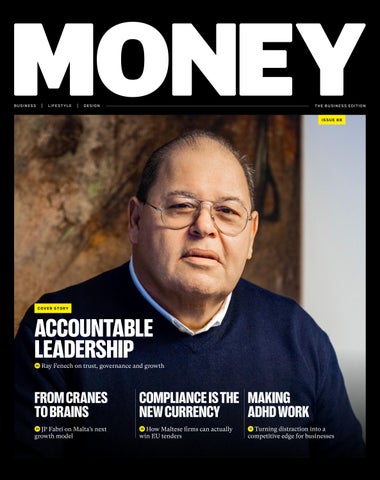
30 How Maltese firms can actually win EU tenders FROM CRANES TO BRAINS
COMPLIANCE IS THE NEW CURRENCY
34 JP Fabri on Malta’s next growth model
12 Turning distraction into a competitive edge for businesses
Speak to an advisor today.
Sparkasse Bank Malta public limited company (the ‘Bank” is a public limited liability company registered in Malta with registration number C27152 and registered office at 101 Townsquare, Ix-Xatt ta’ Qui-si-Sana, Sliema SLM3112, Malta. Sparkasse Bank Malta public limited company is licensed by the Malta Financial Services Authority to carry out the business of banking in terms of the Banking Act (Cap. 371 of the Laws of Malta), to provide investment services and custody and depositary services in terms of the Investment Services Act (Cap. 370 of the Laws of Malta), and is authorised to act as custodian of retirement schemes in terms of the Retirement Pensions Act (Cap. 514 of the Laws of Malta).
Editor’s letter — Cash, people, customers, reputation
If you drive from Valletta to St Julian’s today, you can almost read Malta’s business story from the skyline alone. Cranes, scaffolding, hotel hoardings, “now leasing” banners on shiny office blocks.
On paper, it all looks like progress. In real life, the question is simpler: are we building value, or just adding volume?
This Business Edition of MONEY leans hard into that question.
Our cover story with Ray Fenech is not a nostalgia tour of Hilton lobbies and Tumas milestones. It’s a conversation about what stays standing when the cycle turns: governance, reputation, and the quiet discipline of doing things properly over decades. Quality tourism, for him, is not a slogan – it’s pricing that reflects experience, developments that respect their context, and assets like The Quad that are built to last, not flip.
That long view runs through the rest of the issue. JP Fabri aims our national addiction to concrete and asks what it would look like to move from cranes to brains – from propertyfuelled liquidity to patient capital that actually grows productivity. Manuel Delia shows how “clean” governance is no longer just good manners; it’s how Maltese firms can start winning EU tenders on more than price.
On the people side, Dayna Camilleri Clarke and Professor Nigel Camilleri unpack adult ADHD at work – not as a buzzword, but as a real management test. If talent is scarce, wasting neurodiverse strengths is a luxury Malta can’t afford. Lea Hogg’s piece on cosmopoesis
examines founders who don’t just run companies but build worlds their teams can actually grow in.
And yes, we turn the camera on ourselves. “Hacked” is my own account of what happens when a single compromised profile can knock out an entire media business on Meta – and what every owner should fix before that email lands in their inbox.
If there’s a thread through all this, it’s control. Not the illusion of it, but the boring, grown-up kind. Control of how we build, how we treat people, how we show up in tenders, and how dependent we are on platforms we don’t own.
Malta doesn’t need bigger numbers. It needs better habits.
Cash, people, customers, reputation. Get those four calm, and the rest is just noise.
Happy Festivities!
EDITOR Anthony P. Bernard
For promotion and advertising: bemags.com/money-pitch hello@bemags.com FACEBOOK-SQUARE LINKEDIN · becommunications.com
DESIGN BE.
PRINTING Print It DISTRIBUTION MaltaPost
MONEY is hand-delivered to Malta’s businesses, including managers and directors of the country’s top blue-chip companies, iGaming companies, all 5-star hotels, including their business centres, executive lounges and rooms (where allowed), all foreign embassies and Maltese embassies abroad (Rome, Brussels, London, Vienna and Madrid). All government ministries and entities.
MONEY is published by Be Communications Ltd. All rights reserved. The content of this magazine, including articles, images, designs, and any intellectual property, is owned and protected by Be Communications Ltd. Unauthorised reproduction, distribution, or transmission of any part of this magazine is strictly prohibited without prior written permission. Be Communications Ltd. retains all intellectual property rights in the content published in this magazine, including but not limited to copyrights, trademarks, and patents. Any unauthorised use, reproduction, or commercial exploitation of this content violates applicable laws and may result in legal action. Opinions expressed in this magazine are those of the respective contributors and do not necessarily reflect the editor's or publisher's views. While every effort is made to ensure accuracy, Be Communications Ltd. assumes no responsibility for errors or omissions in the magazine's content, advertisements, or related materials and disclaims liability for the accuracy, legality, or originality of content provided by clients.
Building growth, enabling success
Making ADHD work
As more and more Maltese workplaces wake up to the reality of adult ADHD, Dayna Camilleri Clarke speaks to Professor Nigel Camilleri to uncover how practical, low-cost adjustments can unlock talent, strengthen teams, and build more resilient organisations.
Cosmopoesis and how it redefines leadership in the 21st century
In the 21st century, leadership is less about control or metrics and more about creating environments where people can think, build and grow. For Lea Hogg, who has followed Malta’s entrepreneurs for years, SiGMA offers a valuable case study in a new mode of leadership she explores: cosmopoesis, the art of world-making.
When Meta breaks
When the Facebook account of Anthony P. Bernard, Be Communications' managing director and editor, was hacked, he expected a recovery process — not a digital maze. What followed was months of conflicting decisions, vanished business pages, a fictitious Instagram "violation", a fake hacker appeal link, and support loops that led nowhere. He explains how one hack spiralled into a full-blown business risk — and why he's still fighting for accountability.
28
Cash. People. Customers... Everything else is noise
Run a tighter ship: a note to Malta’s business owners.
Accountable leadership
The governance premium
Manuel Delia shows how Maltese firms can turn ISO standards, whistleblowing, and audit trails into a tender advantage.
From record visitor numbers to record scrutiny, Malta's tourism model is at a turning point. In this MONEY cover story, Tumas Group's Ray Fenech talks quality over volume, governance and reputation, sustainability, and the next generation of leaders shaping how Malta competes – and wins – in the decade ahead. 12 24 48 40 44 30 34 16 20
From cranes to brains
Malta’s skyline booms while productivity stalls. JP Fabri calls a pivot from property-fuelled liquidity to patient, mission-driven capital— crowding in innovation, skills and industry to convert short-term gains into durable prosperity.
Branding Malta’s hotels
For sixty years, hotels have been the scaffolding of Malta’s tourism success. But with record arrivals, planning reforms, and global brands circling the islands, the game is changing fast. Justin Mizzi and Kris Bartolo trace how Malta’s hotel landscape has evolved – and why the next era will be defined by brand, experience, and value.
Don't chase—choose: A simple way to pick funds without FOMO
In Malta’s tight-knit investment scene, it doesn’t take much for a “hot fund” to become the talk of the Sunday lunch table. But while double-digit returns make great small talk, they can quietly derail long-term plans. Paul Rostkowski offers a simple 3P framework Maltese investors can use to choose funds with clarity, not panic.
Malta’s comeback moment: EY’s FDI barometer swings back to “attractive”
For the first time in years, Malta’s FDI story reads like a recovery with direction. In EY’s 21st Attractiveness Survey – Malta, 79% of foreignowned companies say the country is attractive for investment—up from 54% last year—while twothirds judge Malta as attractive or more attractive than rival European locations.
The 4-day week: promise, proof, then policy
The Opposition's four-day work week pitch is bold; government caution is warranted. Lea Hogg cuts through the noise: treat the four-day week as R&D. Game Lounge's experience hints at what could work in Malta's context; the next step is evidence, not ideology.
Scammed in Malta
If you’ve clicked, paid or shared details, don’t spiral. Act with intent. This is MONEY’s playbook for your first hour, who to call, and how to build a case banks and investigators take seriously.
Certify to compete
Stephen Mallia argues Europe's new rulebook— GPSR, CPR with Digital Product Passports, Machinery Regulation and cyber mandates—turns compliance into pricing power. Maltese firms that prove it ship faster, win trust, and command better terms.
From grants to ground game
Startups are sold as romance: big ideas, bigger exits, and the promise of going from zero to one. The reality is far messier – especially in Malta. Simon Theuma argues that money alone won't build a real ecosystem.
Quiet luxury for loud lives
From suede boat shoes and cashmere rollnecks to a steel Black Bay that means business, this is menswear at its most discreetly powerful.
1 Dayna is a senior speech and language therapist, and the founder of Malta Speech Therapy. She is a former editor at the Malta Business Weekly and a prolific writer whose work spans health, neurodiversity and travel. Her pieces are known for their clarity, curiosity and practical insight, making her a familiar voice to readers across Malta and beyond.
2 JP is a founding partner at Seed, a multi-disciplinary advisory practice.
3 Lea is a Malta-based journalist and author, known for her TV programme which focuses on current affairs, cultural news and in-depth interviews on geopolitics and global issues.
4 Manuel is a civil society activist and writer.
5 Paul is part of a multidisciplinary advisory firm specialising in private clients, high-networth individuals, and family offices.
6 Simon enables startup founders to cut months of wasted effort by finding the fastest path to their real goals. He is also the head of Malta Startup Space, a group for up-andcoming startup founders, employees and supporters of the local startup scene.
7 Stephen is a freelance product regulatory compliance expert and mechanical engineer with over 13 years of experience in the field.
MONEY's columnists —
MAKING ADHD WORK A neurodiversity roadmap for Maltese workplaces
As more and more Maltese workplaces wake up to the reality of adult ADHD, Dayna Camilleri
Clarke speaks to Professor Nigel Camilleri to uncover how practical, low-cost adjustments can unlock talent, strengthen teams, and build more resilient organisations.
Awareness of adult ADHD has grown, yet many Maltese workplaces still overlook both the challenges and the exceptional strengths that employees with ADHD bring.
For employers, leaders and HR teams, understanding this cognitive profile supports inclusivity and also strengthens innovation, wellbeing and long-term organisational resilience.
Professor Nigel Camilleri, Consultant Psychiatrist and Clinical Lead at TAASC, notes that local businesses are increasingly recognising the prevalence of adult ADHD.
“Many adults with ADHD are already thriving in professional roles in Malta, and their strengths become far more visible when employers understand how to support them. Once companies begin to appreciate the breadth of ADHD traits, they often realise that they already have talented individuals in their workforce who simply need a few thoughtful
adjustments to perform at their highest level. As awareness improves, workplaces are shifting towards practices that allow this talent to flourish sustainably.”
Professionals with ADHD often excel in areas modern organisations value. They think creatively, solve problems quickly and spot patterns others may miss. In sectors such as finance, gaming, healthcare, hospitality and logistics, this kind of rapid, flexible thinking can give companies a meaningful advantage. Employees with ADHD also tend to remain calm under pressure and show strong perseverance when engaged in meaningful work.
Professor Camilleri explains that these strengths often go unseen for environmental rather than personal reasons. “The difficulty is that these strengths can be masked by environments that do not fit how the ADHD brain works. Noise, clutter, unclear priorities
and constant context switching can drain mental resources. What appears to be a lack of motivation is usually a mismatch between a person and their surroundings. When this mismatch is ignored, performance drops and burnout becomes a real risk.”
Many adequate supports are straightforward. Flexible starting times help employees avoid sensory overwhelm during peak traffic. Hybrid or at-home working reduces interruptions— written summaries after meetings ease the load on working memory. Mini deadlines, stepby-step task outlines, visual reminders, quiet workspaces, noise-cancelling headphones, movement breaks, and clear calendars can make day-to-day work far more manageable.
Professor Camilleri stresses that these adjustments are more accessible than many organisations assume. “Most changes that help adults with ADHD are simple and
inexpensive. A few tweaks to structure or communication can transform an employee’s ability to focus and deliver. These supports often benefit the wider team as well, because clarity and flexibility are universally useful. Companies worry that accommodating ADHD requires heavy investment or complicated programmes, but in reality, it is about small, steady changes that make the workplace more humane and more effective.”
Emotional dynamics matter too. Many adults with ADHD experience heightened sensitivity to criticism, sometimes linked to rejectionsensitive dysphoria, where even mild feedback can feel overwhelming. This is not immaturity but a neurological response. Managers do not need to soften feedback, but offering clear reasoning, concrete examples, and a balanced view helps employees stay receptive and engaged.
Burnout is another hidden vulnerability explained by Professor Camilleri. “Hyperfocus can drive exceptional output, but it also makes it easy to push beyond healthy limits. HR teams can help by maintaining realistic workloads, holding regular check-ins and encouraging rest when needed. Steady, sustainable productivity is far healthier than cycling between intense effort and exhaustion.”
Meetings deserve particular attention—many individuals with ADHD struggle to think and speak clearly in crowded, fast-moving discussions. Sensory overload and rapid internal processing can block their ability to contribute, even when their ideas are strong. Sending materials in advance and inviting written input beforehand gives
Hyperfocus can drive exceptional output, but it also makes burnout a very real risk.
every employee an equal chance to influence decisions. Several Maltese companies that have adopted this approach report richer discussions and a broader range of ideas. The business case for supporting ADHD is clear. Organisations gain greater creativity, better problem-solving, stronger loyalty, and
lower turnover. Staff wellbeing improves, and communication becomes more precise. In a small economy where talent is precious, these advantages matter.
Professor Camilleri observes this shift firsthand. “When companies step away from
outdated assumptions, they begin to see just how much adults with ADHD can contribute to strategic thinking, crisis management and innovation. I am seeing increasing numbers of Maltese employers who want to understand neurodiversity properly, not as a trend but as a serious investment in people. The pace varies between organisations, but the direction is unmistakable. We are moving towards workplaces that value diversity of thought and recognise the competitive advantage it brings.”
Beyond individual adjustments, there is a broader cultural shift that Maltese organisations can embrace. Culture →
Dr Nigel Camilleri
shapes how safe people feel when raising difficulties or asking for clarity. In fastpaced environments where performance is prioritised above all else, employees with ADHD may hide their struggles for fear of being judged. This silence can be more damaging than the condition itself. When leaders welcome questions and normalise
careless when they are navigating a different cognitive pattern. Understanding this reduces frustration and supports smoother collaboration. Several Maltese workplaces that have introduced neurodiversity training report stronger teamwork across the board. Professor Camilleri notes that demand for these programmes is growing.
Wasting neurodiverse strengths is a luxury Malta cannot afford.
different working styles, people feel more confident explaining what they need.
This cultural shift appears in practical habits. Consistency in expectations, clear communication about changes and following through on commitments all reduce uncertainty. For adults with ADHD, uncertainty can be mentally draining. A stable framework allows employees to focus on the work itself rather than interpreting shifting expectations. Managers also benefit, gaining clearer insight into bottlenecks and workload imbalances.
Training plays a key role. Even short workshops introducing ADHD concepts can change how teams interpret behaviour. A colleague who misses details or shifts between tasks may otherwise be judged as
Recognising competence publicly also matters. Many adults with ADHD have heard more about their difficulties than their strengths.
When employers highlight their contributions, confidence grows, motivation rises, and employees are more likely to take initiative. Small acknowledgements, such as celebrating creative ideas or noting progress, reinforce a sense of belonging.
All these developments point towards a more adaptable and forward-looking approach to management. Malta’s economy continues to move towards knowledge-based work, digital services and highly collaborative industries. These fields thrive on diverse thinking styles that can respond quickly to new challenges. ADHD fits well within this landscape when workplaces are willing to accommodate it thoughtfully.
Supporting employees with ADHD is not about lowering standards or offering special treatment. It is about designing environments that recognise how different minds operate and creating conditions that allow every employee to perform at their best. Organisations that understand this will retain talent, attract new hires, and build reputations as progressive, employee-centred employers. In time, this approach strengthens teams, sparks innovation and contributes to a more resilient national workforce.
When Meta breaks
A
Maltese publisher's account vanishes, support collapses, and the fight begins
When the Facebook account of Anthony P. Bernard, Be Communications' managing director and editor, was hacked, he expected a recovery process — not a digital maze. What followed was months of conflicting decisions, vanished business pages, a fictitious Instagram "violation", a fake hacker appeal link, and support loops that led nowhere. He explains how one hack spiralled into a fullblown business risk — and why he's still fighting for accountability.
For twenty years, Facebook was just there in the background of my work. It was never the star of the show, just the stage light that was always on. My company, Be Communications Ltd, runs several magazine brands – Money, Skipper, Techmag, FM, Foodist – and all of them relied on my personal Facebook profile to exist in Meta's world: one login, one ad account, one quiet bit of infrastructure connecting everything.
O n 27 August 2024, that light went out.
It started with a routine email from Facebook, the kind you almost swipe away without reading: "Someone may have accessed your account." Annoying, but familiar. Nine minutes later, a second email arrived, this time claiming there had been a login from Mosta at 19:59. The email itself was time-stamped 14:59. Unless Malta had quietly shifted its timezone by five hours, something was already off.
I tried to log in and hit a wall. My account was suddenly suspended. No warning, no countdown, no "are you sure?" Just gone. And the reason was even stranger: according to Facebook, my profile had been linked
to an Instagram account with the handle "nvh7u0v16tlqpr3y".
If you're reading that twice, so did I. It doesn't look like a name. It looks like a password generator had a stroke. I had never seen it before. Yet Meta's system insisted that this nonsense handle was now my Instagram account – and that "I" had broken the rules there.
The screen told me I could appeal, but only by logging into that Instagram account. When I clicked the link, expecting to land on some weird profile, it took me instead to my own real Instagram – the one I actually use and still control. There were no warnings, no violations, no appeal forms. Nothing to fix because, on that side of the fence, nothing was broken.
So I was trapped in a loop. Facebook said I was guilty because of an Instagram that wasn't mine. The appeal link pointed me to my real Instagram, which wasn't guilty of anything. And there was no way to tell the system it had simply got the wrong person.
At first, I thought this was some brand-new
hack targeting me personally. Then I did what everyone does: went down a late-night Reddit rabbit hole. It didn't take long to realise that this was not new at all. People had been describing the same pattern for years: bogus, machine-generated Instagram handles suddenly attached to their Facebook accounts; appeal links that led nowhere; support loops that went in circles. It's a known exploit, widely discussed, with victims swapping screenshots like war stories – and yet Meta has never publicly admitted it, let alone patched it.
That was unsettling enough. What made it worse was the timing. In the months before the hack, I had been posting quite a bit of pro-Palestine content. Some of the videos had their audio stripped without explanation, the kind of quiet censorship many creators experienced during that period before Meta slightly relaxed its stance. I can't prove that my content and the hack are connected. But it's hard to ignore the coincidence: a known backdoor exploit that's been allowed to linger for years, plus people inside or around Meta offering "paid recovery services", plus accounts that are not exactly toeing the line getting suddenly wiped out of the system. →
When the suspension hit, it didn't just take my personal account. It took the entire backbone of my digital business. The main ad account went down with it. Access to the Money, Skipper, Foodist, FM, Techmag, Be Communications and Flip Flop Store pages vanished. I couldn't post, couldn't schedule, couldn't boost, couldn't see analytics, couldn't respond to messages. To the outside world, the pages were still there. They may as well have been on another planet.
What followed was less a support experience and more a stress test of how much bureaucracy a human being can take. Case after case was opened with Meta. I lost count of how many times I uploaded my ID. I sent company registration documents, invoices showing the ad account billed to Be Communications, screenshots of the pages, and proof that the domains in the page info pointed to my servers. I even subscribed to Meta Verified on a new profile, hoping it would unlock a more competent level of assistance.
It unlocked more conversations, that much is true. But not solutions.
The conversations blurred into each other: "We're reviewing your case." "Please be patient." "We could not verify." "Please upload your ID again." It felt like trying to explain a complex medical condition to a chatbot that only knows how to prescribe paracetamol.
And then came the email that completely changed the tone. On 22 November, I received
a message from a Gmail address using the name of a Meta Tier-3 support agent. The person quoted my correct phone number, referenced my existing case, and attached a screenshot from what was clearly Meta's internal support dashboard. The offer was blunt and straightforward: they could fix my problem, quickly, in exchange for a payment of '1-2k USD negotiable'.
This wasn't just a hack. It was a total collapse of Meta's support ecosystem.
Up to that point, I had assumed incompetence. That email introduced something darker: the idea that the chaos might be profitable for someone. I obviously refused and reported it through official channels. I never received a proper explanation. The case ticket moved on as if nothing unusual had happened.
Months passed. Then, finally, one of the support cases came back with a clear
admission: Meta confirmed that my account and the connected pages had indeed been compromised. It was almost a relief to see it in writing. The problem is that confirmation did not lead to action. Nothing was restored. Access was not returned. The pages remained unreachable.
Later, another case concluded with the exact opposite statement: that there was "no evidence of compromise". Same account, same history, same screenshots, same everything – two incompatible decisions from the same company. It felt like dealing with a bank that both confirms and denies your card has been stolen in the same letter.
When Meta's internal mechanisms clearly weren't working, I escalated it to the outside. The Malta Communications Authority reviewed the situation and forwarded it to Ireland, where Meta is based. There, Coimisiún na Meán – Ireland's Digital Services Coordinator – passed it to ADROIT, an EU-certified dispute body under the Digital Services Act. ADROIT declared the complaint admissible and, in a very frank email, admitted they were facing "significant challenges" getting cooperation from some platforms. Meta was one of them.
By this point, almost a year had passed since the original hack. I had already decided to seek full legal representation. But there was one last twist before we crossed that line.
Meta escalated my case to a WhatsApp-based verification process – a kind of last-chance
saloon in their recovery system. Through WhatsApp, they asked me to submit my ID again. They repeatedly confirmed that it matched their records. They sent me unlock links with expiry timestamps. I clicked one, and for the first time in nearly a year, I was able to log back into my old profile.
For about one minute.
Then the suspension notice returned, identical to the first one: my account was once again being penalised because of the same fictitious Instagram handle, the same machinegenerated nonsense name that had never belonged to me. The system had accepted that I was me, then immediately punished me for being someone else.
That was the moment the frustration turned into something colder: resolve. Because by then I had spoken to enough people to know that others in my position had eventually succeeded. Some Maltese businesses that went the legal route did get their pages and ad accounts back, even after months of being told nothing could be done. It doesn't erase the disruption; it does prove that persistence and pressure work.
So I haven't stopped. The legal letter is drafted. Regulators are informed. ADROIT has my file. I'm still publishing, still running my magazines through new pages and fresh structures, but I've also accepted a hard lesson that every business owner should hear. If your company lives entirely on someone else's platform, then
How to protect your business pages before a hack happens
1. Add multiple trusted admins
Never rely on a single personal profile. One lockout = entire business gone.
2. Separate personal and business identities
Use a Business Manager with role-based access, not your primary account login.
3. Backup 2FA codes physically
The most common failure point in account recovery is two-factor lockout.
4. Keep domain and email ownership updated Meta uses DNS and email verification to confirm ownership during disputes.
5. Maintain your own platforms Website, newsletter, database — your real assets. Social media is a rented space.
6. Monitor for suspicious login alerts
Many hacks show "Chrome on Windows" or unfamiliar regions — investigate immediately.
7. Document everything
Screenshots, timestamps, case numbers — this evidence becomes vital if recovery collapses into legal escalation.
you are a tenant, not an owner.
This isn't just a story about a hack. It's about a system that can misidentify you, lock you out, contradict itself, ignore you, offer you a bribe through the back door, and then tell you there is "no evidence" of anything wrong.
It's about a loophole that has existed for years, documented in public forums, affecting real livelihoods, and still somehow not treated as urgent.
And it's about refusing to accept that this is just how things are.
My access may be gone, for now. My patience may be thinner than it used to be. But my fight with Meta isn't over. If anything, it's only now getting to the interesting part – the part where they finally have to answer, on the record, how a fictitious Instagram handle and a broken appeal system were allowed to override a real person, an honest company and a very real business for this long.
If anything, this ordeal clarified one thing: owning your platforms — your website, your mailing list, your subscriber base — is no longer optional.
Until Meta fixes the cracks in its system, small businesses in Malta need backup plans, shared-access structures, and a healthier relationship with where they build their digital homes.
Because once that front door slams shut, getting back inside is nothing short of a saga.
ACCOUNTABLE LEADERSHIP
Ray Fenech on trust, governance and growth
From record visitor numbers to record scrutiny, Malta's tourism model is at a turning point. In this MONEY cover story, Tumas Group's Ray Fenech talks quality over volume, governance and reputation, sustainability, and the next generation of leaders shaping how Malta competes – and wins – in the decade ahead.
You've argued Malta must recalibrate its tourism strategy beyond headline arrivals. What does "quality" mean in practice— product mix, pricing power, seasonality—and what policy shifts would unlock it?
Quality tourism is about more than arrival numbers. Quality tourism is about the experience we offer and the long-term value it generates for our Islands.
"Quality tourism" is a phrase that is often used but not always understood. To us, it means something far more meaningful than simply attracting larger arrival numbers. For Malta to continue positioning itself as a leading Mediterranean destination, the focus must shift from counting heads to shaping experiences. True quality tourism is about the depth of value we create, both for visitors and for the islands themselves and the long-term sustainability that follows.
What does this look like in practice? It is a tourism strategy that places equal importance on luxury, culture, lifestyle, and authenticity.
It is a model in which pricing reflects the product's quality and exclusivity rather than volume. And it is a year-round calendar that embraces seasonality intelligently, rather than one that pushes operators to compromise standards in the name of filling beds. Seasonality should not be an excuse
Seasonality should not be an excuse for inconsistency; it's a rhythm we understand, respect, and plan around.
for inconsistency; it should be a rhythm we understand, respect, and plan around.
Quality tourism also means a balanced diversification of visitor profiles. It is about attracting travellers who appreciate gastronomy, heritage, events, wellness, sport, and nature, basically what we have to offer and visitors who seek meaningful experiences and leave with a genuine connection to Malta. These travellers tend to stay longer, spend more, and contribute positively to the fabric of our communities.
However, achieving this balance requires alignment between policy, industry, and operators. It calls for policies that incentivise high-quality developments and disincentivise projects that undermine the islands' longterm positioning. It requires continuous investment in infrastructure, transport, public spaces, cleanliness, digital systems, and environmental protection, which directly influence visitor perception. Most importantly, it demands collaboration across hospitality, transport, culture, and entertainment→
sectors. Tourism cannot operate in silos; the visitor experience is holistic.
I remain more than hopeful, and in fact, I am confident, that if this is genuinely embraced as the way forward, every visitor will leave Malta with a premium, memorable, and proudly Maltese experience. That is what quality tourism truly means.
What are the two operating metrics you personally check weekly that tell you whether Tumas is outperforming—one for hospitality/gaming and one for property—and what's the red flag that triggers intervention?
Business success is not a stroke of luck; it is hard work and discipline. Staying on top of the game requires an acute awareness of what is happening around you, the trends shaping industries, the methods being used by leading markets, the innovations taking root elsewhere, and the behaviours of both consumers and competitors.
Today's business environment constantly evolves, and the moment you stop observing, adapting, and refining, you fall behind.
But there is one principle that, in my view, outweighs all others: surround yourself with people who are better than you in every possible way. No entrepreneur, executive, or leader succeeds alone. The best-performing organisations are built on teams whose expertise, intelligence, and dedication exceed that of any single individual. When you create an environment where talented people not only join but stay, you see and touch the real secret of long-term success.
I am immensely proud that within our group, we have colleagues who have been with us for over 20, 30, and even 40 years. This is not accidental. Longevity at this scale is earned through mutual respect, trust, well-being, fair treatment, and the belief that one's work is genuinely valued. It means that people see a future with us, not just a job.
This continuity creates something priceless: institutional knowledge, deep expertise, a shared culture, and an unwavering commitment to excellence. It also ensures that, as the world changes, we evolve from a foundation of experience rather than starting from scratch.
To stay on top of the game, you need systems, ambition, and resilience, but above all, you need people who believe in where you're going and actively help you get there.
2019 forced a hard reset in public trust. What concrete governance changes (board composition, risk, disclosures) did you institute, and how do you measure whether reputation has truly recovered with partners, banks and guests?
Reputation is one of the most potent yet intangible assets any business can possess. It does not sit on a balance sheet, but it directly influences everything from financing to partnerships to long-term sustainability. Measuring reputation can be subtle, but the evidence is always visible to those who know where to look.
You see it in the trust partners extend to us year after year as they continue to collaborate with us. You see it in banks that offer financing on market terms because they recognise the strength of the business, the soundness of our governance, and the reliability of our track record. You see it in clients and stakeholders who repeatedly choose us, not out of necessity, but out of confidence.
That, to me, is the clearest and most honest indicator of resilience. And I can say, hand on heart, that despite changing landscapes, new challenges, and different economic cycles, those fundamentals have never shifted.
Trust is built slowly, sometimes over decades, but when appropriately earned, it withstands the test of time.
The bestperforming organisations are built on people who are better than you in every possible way.
Strong governance sits at the centre of this. It ensures transparency, accountability, and discipline in decision-making. It protects the business's integrity, strengthens relationships with external stakeholders, and reinforces the culture internally. Governance is not a formality; it is a safeguard for the future.
Critics say Maltese conglomerates have historically benefited from proximity to the state. How do you ensure arm'slength dealings today—and would stricter procurement and planning rules make Malta more, not less, competitive?
Malta is evolving rapidly. Expectations are changing, regulations are tightening, and public scrutiny is stronger than ever. Markets are more competitive, and long-term planning must reflect a far more complex reality. But change does not intimidate us; in many ways, we have prepared for it long before it arrived.
I am proud to say that as a group, we have consistently stayed ahead of the curve. Many of the standards now becoming the norm were already implemented internally years ago. This is because we believe in doing things correctly from the start. We have multiple layers of scrutiny: structured boards, audit committees, compliance checks, internal controls, and experienced individuals who vet every significant decision with precision.
Arm's-length dealings are non-negotiable.
Procurement is formal, transparent, and market-based. Approvals are structured and documented. Decisions are taken with objectivity, data, and long-term thinking. This discipline is one of the reasons we have been able to grow with confidence, even in uncertain economic environments.
Malta may be changing, but we have never feared change. We have embraced it, anticipated it, and aligned ourselves with it because that is how you build a business designed to last, and that's what we do at Tumas Group.
With projects like The Quad earning top sustainability credentials, how materially do green standards change your development economics—capex, rents, yields—and will every new Tumas build target similar certifications by default?
Projects like The Quad, which earned LEED Platinum certification, represent the future of development in Malta. These are not just real estate investments; they are statements of long-term ambition. High environmental standards lead to improved operational efficiency, higher tenant satisfaction, stronger yields, and a more competitive product in global markets.
Sustainability is no longer a "nice to have." It is inseparable from long-term value. Every
new Tumas development is designed with this principle at its core. Whether it's energy efficiency, responsible material sourcing, reduced emissions, or improved user wellness, we aim to build assets that remain relevant for decades, not just years.
A future-proof development anticipates tomorrow's needs. It appeals to global tenants, international investors, and future generations of users who expect responsibility, innovation, and efficiency from the spaces they occupy.
This approach strengthens our portfolio and reinforces our commitment to shaping highquality environments in Malta.
You've led through loss, crisis and renewal. What's your succession philosophy—roles you're actively delegating now, capabilities you're hiring for—and what will the next-gen Tumas leader do differently from you?
Every generation brings something new, new ways of thinking, new tools, new ambitions, and new expectations. The next generation of Tumas leaders will build on the foundations we have set, but they will take us even further.
They will be more data-driven, leveraging analytics to support every strategic decision. They will be more globally connected, engaging with international markets, partnerships, and opportunities. They will be more agile, adapting faster to emerging challenges and capitalising on evolving trends. But at the core of all this progress, one thing must remain unchanged: our values.
Service. Integrity. Vision. These are the principles that have guided us for decades, and they are the compass that the next
We've never feared change; we've anticipated it, aligned with it, and built a business designed to last.
generation will continue to follow.
With that in mind, I genuinely believe the future looks very bright.
When you look at Malta ten years from now –as a place to visit, invest, and live – what kind of country do you want Tumas Group to have helped build, and what will need to change between now and then to get there?
The group has always invested heavily locally, believed in Malta, and built here on the islands with a long-term strategy. That is a sign of trust and belief in the islands and their people.
The country we want to help shape is one where people feel proud to visit, confident to invest, and happy to live in. A country that is defined by quality, by excellence and above all by standards.
We want Malta to be known for an elevated, consistent experience, cleaner, more connected, culturally richer, and an island that is truly aligned with the level of destinations we compare ourselves to, but keeping in mind that we are unique on so many levels.
For investors, we want a market guided by clarity and solid governance. These are fundamentals that allow serious investment to take root and flourish.
For residents, we want a country where quality of life, mobility, sustainability, and community spaces match the ambitions we all talk about.
To get there, several things need to evolve.
Standards must become non-negotiable. Policy must increasingly reward long-term value over short-term wins. Infrastructure needs sustained, uninterrupted investment. As a business community, we all need to work together, sharing expertise, safeguarding the country, and holding ourselves accountable for the Malta we are helping create.
Our role in all this is straightforward: continue building responsibly, operate with strong governance, insist on quality, and invest in projects that elevate Malta's positioning. If we remain disciplined in that direction, I believe we will have helped build a Malta that is more resilient, more competitive, and more aligned with the ambitions of the next generation.
COSMOPOESIS AND HOW IT REDEFINES LEADERSHIP IN THE 21ST CENTURY
In the 21st century, leadership is less about control or metrics and more about creating environments where people can think, build and grow. For Lea Hogg, who has followed Malta’s entrepreneurs for years, SiGMA offers a valuable case study in a new mode of leadership she explores: cosmopoesis, the art of world-making.
At SiGMA Central Europe in Rome, screens stretched across arenas, logistics teams moved with practised coordination, and the atmosphere felt closer to a cultural festival than a trade show. For the 30,000 delegates present, this is an ecosystem built for them – a universe created with intent, not accident.
One of the people behind that universe is Eman Pulis, a founder who didn’t just scale an events business but helped shape a broader platform. In a world where leadership is often reduced to efficiency metrics and OKR templates, his work offers a valuable lens on something more instinctive: cosmopoesis – the art of worldmaking. →
In philosophy and literary theory, cosmopoesis refers to the creation of worlds with their own logic, values, and ways of being. Italian scholar Giuseppe Mazzotta describes it as a generative, creative force. Applied to business, cosmopoesis reframes leadership: a firm founder is not only a manager of resources but a world-builder who shapes mental, emotional, and operational environments others can inhabit and develop.
Pulis is one example of this approach. More importantly, the concept itself may offer a wider blueprint for 21st-century leadership.
From Malta to a broader ecosystem Pulis’s story started at university, coorganising parties. When 4,000 people showed up – 3,000 of them personally brought in by him – he realised how a simple idea, if framed well, could create a temporary “world” people wanted to enter.
That instinct, to create environments where people feel part of something larger, became the seed of SiGMA.
What began as a one-day event in Malta eventually expanded into a series of events and platforms across iGaming, tech, education, and medical innovation. The growth wasn’t inevitable. It relied on timing, regulatory conditions, and a global industry looking for focal points. But behind the numbers sat a leadership style that quietly encouraged others inside the organisation to build their own worlds too.
Founder routines as a creative discipline Cosmopoesis isn’t all blue-sky thinking. Every “world” that works in real life rests on discipline.
For Pulis, part of that discipline was forged in sport. As a competitive track-and-field athlete, he once aimed to represent Malta in the Olympics as a triple jumper – a path cut short not by ambition but by limited resources. That experience, of pushing hard against structural
limits, stayed with him.
Today, his routines mirror an athlete’s discipline: early starts, regular training, and periods of uninterrupted focus. “Consistency,” he says, built SiGMA more than any romantic idea of entrepreneurship.
By 2018, as SiGMA scaled, he noticed teams adopting their own versions of that discipline. When one team swapped ad hoc checkins for a short daily meeting followed by focused work blocks, its event prep timeline dropped by almost 30%. Stress levels eased, communication improved, and mistakes fell.
These are not headline-grabbing changes. They are small, repeatable tweaks – the kind of operational rituals that quietly underpin any “world” that claims to be well run.
From founder vision to shared cosmopoesis
A common trap for founders is to remain the centre of gravity indefinitely – the sun around which everything must orbit. Cosmopoesis, taken seriously, pushes in the opposite direction: a world that only functions in the presence of its creator is not a world, it’s a stage set.
Inside SiGMA, small teams were encouraged to operate as semi-autonomous units, with clear accountability for their slice of the ecosystem. “He didn’t hand us tasks. He handed us projects and told us to build,” recalls one employee. That doesn’t mean there were no constraints, budgets, or pressure – only that ownership sat closer to the edges than in many traditional hierarchies.
As the organisation grew, Pulis stepped sideways from some roles. A CEO was brought in to professionalise operations. The group moved into AI through AIBC, co-founded Med Tech World with Dr Dylan Attard, and evolved Gaming Academy into a skills-driven learning hub. Each strand came with its own risks, overheads, and learning curve, but together they formed a network of related “worlds”
If everything still needs the founder’s approval, you haven’t built a universe – you’ve built a bottleneck with good branding.
rather than a single flagship event.
The cosmopoetic test here is simple: can different teams continue to build, adapt, and occasionally fail without everything being dragged back to the founder’s desk?
Small-island creativity at scale
Malta has built an economic strategy around finding and owning niches: iGaming, blockchain regulation, ship and aircraft registries, and fintech sandboxes. For a small country with limited domestic demand, the ability to imagine new niches – and then make them real – is not a luxury; it’s survival.
Growing up in a family of modest means, Pulis learned early that a small nation competes globally through focus and initiative, not just cost advantages. SiGMA’s mindset reflects that: think internationally from day one, and treat Malta not as a limitation, but as a launchpad.
The point, however, is larger than one company or founder. Small-island creativity is a pattern: constrained resources, high exposure to global trends, and a need to punch above weight. Cosmopoesis gives language to a habit many Maltese entrepreneurs already practise –imagining worlds beyond the shoreline and then steadily building the infrastructure to support them.
How founders build worlds, not just companies
The idea of the “world-building founder” isn’t unique to Malta. Brian Chesky helped turn Airbnb from a booking platform into a global hospitality culture. Tony Hsieh treated culture as a product at Zappos. Marc Benioff pushed Salesforce to fuse cloud software with a particular moral narrative about capitalism. In each case, the company became a world larger than the founder but still bearing their imprint.
Business strategist Michael G. Jacobides has argued that competitive advantage increasingly lies in designing ecosystems –networks of value creation that behave like mini-worlds. Where Jacobides speaks about orchestration, cosmopoesis emphasises the creative act: designing narratives, cultures, and psychological spaces as deliberately as you create a balance sheet.
Not every founder wants – or needs – to
operate at that scale. But the pattern matters: the organisations that travel farthest are those that give people a coherent world to work in, not just a job description.
Why cosmopoesis matters for 21st-century leadership
The 20th century rewarded great managers: tight control, clear reporting lines, efficient processes. Those skills still matter. But in an economy defined by networks, platforms, and constant change, they are no longer enough on their own.
Today’s companies function as fluid ecosystems of partners, creators, communities, technologies, and distributed teams. Innovation is less a department and more a survival trait. In that context:
• Hierarchy alone is too slow.
• KPIs without narrative feel hollow.
• Culture without structure becomes noise.
Cosmopoesis brings these pieces together. It asks leaders to pay attention to the worlds they are creating – the stories people tell themselves at work, the rituals that fill their days, and the degree of freedom they have to shape their corner of the map.
A founder’s legacy, under this lens, is measured less by personal control and more by the worlds they enable others to create.
A business that outlives its founder
At SiGMA Europe, as delegates move through booths and stages and the familiar rhythm of a large-scale event, Pulis is often found at the edges: observing, adjusting when needed, but not orchestrating every detail.
The real test of leadership is not whether a founder can stand at the centre of the action, but whether the “world” they helped design continues to function when they step aside, take a break, or eventually move on. Teams empowered to build their own worlds, a company that grows by imagination as much as replication, and a culture resilient enough to outlast its origin story – that is cosmopoesis in practice.
For founders in Malta and beyond, the challenge is clear: don’t just ask what business you’re in. Ask what world you’re building –and whether others can genuinely make it their own.
EVERYTHING ELSE IS NOISE Cash. People. Customers.
Run
a tighter ship: a note to Malta’s business owners
If we cut the buzzwords, most Malta businesses are wrestling with three things: people, prices, and peace of mind. People—because hiring is tight and the best ones have choices. Prices—because costs move, and you can’t keep absorbing. Peace of mind—because cash flow is the difference between sleeping and staring at the ceiling. This is a letter from the editor’s desk to your Monday morning: clear, practical, and short on ceremony.
1) People: hire for attitude, teach for skill
Skills matter, but you can’t coach warmth. If you’re stuck waiting for the perfect CV, you’ll run short when you need hands most. The move is simple: hire the decent human who turns up on time, then scaffold their first month. Day one should be calm, kind and helpful—uniform ready, passwords working, a human tour, a buddy who actually shows up. Week one should be about learning the customer, not the filing system. Week four should prove they can do the job alone, safely and confidently.
A word to managers: your calendar is a cultural artefact. If every one-to-one is “pushed to next week”, your team learns that their growth is optional. Block ten minutes. Keep it. Praise one thing, coach one thing. Repeat. It’s not HR wizardry. It’s adulthood.
Malta, in one paragraph: Our bottlenecks are practical: permits take time, housing is tight, public transport isn’t always aligned with shifts, and the English/Maltese mix matters on the floor. Start paperwork early, help newcomers with a sensible commute or a shared flat lead, and pair every new hire with a local buddy for the first month. Train in clear English, but keep key phrases in Maltese for service moments. Build rotas that respect feast days and school runs—you’ll keep people longer.
service extra that saves time. Negotiate quietly with suppliers, but don’t pass on every win—let customers feel a share of the upside. When the experience improves first, a later price change feels like keeping pace rather than moving the goalposts.
isn’t about being clever. It’s about being
2) Value before price: earn the raise, then take it Customers forgive higher prices when they feel more—more reliability, more care, more usefulness. Before you touch the numbers, simplify the offer so every choice is a good one. Trim the slow sellers, upgrade one or two ingredients/materials where it’s noticed, and fix the small frictions (waiting, callbacks, unclear returns). Make bundles that feel clever, not sneaky: pair a popular staple with something margin-friendly, or add a small
Malta, in one paragraph: Word travels here—one good (or bad) experience can cross the island by dinner. Make value obvious in small, visible ways: clearer opening hours around festas, posted return rules at the till, WhatsApp ordering or confirmations that actually reply, and a “locals’ staple” you keep steady as long as you can (the everyday coffee, the basic trim, the entry service). With shipping and energy costs jumping, show where you’ve absorbed something, not just where you’ve added cents. Fairness is remembered.
3) Cash: rhythm over drama Profit is theory; cash is truth. If payday is an adventure, you don’t need a new spreadsheet; you need rhythm. Send invoices at
the same time each week (Fridays before 3pm works for many). Make deposits normal—especially for “urgent” or bespoke jobs. Offer a small discount for early payment if it truly speeds up cash flow. And speak to your bank before you need a favour. Calm calls get better terms than panicked ones. If you sell on 30 days, chase on day 31 with grace and consistency. If you keep saying “it’s fine, we understand,” your debtor learns that you do. You’re
not a bank. You’re a business with people to pay.
Malta, in one paragraph: B2B timelines can slip—especially around Santa Marija week, Christmas shutdowns and endquarter VAT rushes. Protect yourself: standardise deposits on bespoke/urgent work, split large jobs into milestones, and use same-bank or instant transfers when timing matters. Schedule your chasers for the day after
Make the experience better first, then the maths will make sense.
terms expire, not “when you get a minute”. August and late December are slow; plan cash cushions for those weeks.
Culture: kindness as a system
“Be nice” isn’t a strategy, but kindness reduces refunds, makes feedback shareable, and keeps good staff. It’s also free. A warm “we’ve got you” on a delay goes
further than a paragraph of policy. When you write training notes, write them as if the reader is your cousin. When you leave a voicemail, smile; people can hear it.
Your next moves
People: run a 30-minute “day one” audit. Fix the passwords, the logins, the tour, the buddy.
Value audit: remove one weak item, improve one high-visibility element, fix one friction point (queue, reply time, or returns).
Smart bundle: create one bundle that pairs a beloved item with a margin-friendly add-on.
Supplier chat: call one supplier for a small, quick win (better lead time or a modest rebate) to fund the upgrade.
Cash: set a weekly invoice time, a deposit rule for urgent jobs, and a polite day-31 follow-up.
This quarter doesn’t need a manifesto. It requires small, boring, generous routines that outlast the week. Cash, people, customers—get those three calm, and the noise turns down.
THE GOVERNANCE
GOVERNANCE PREMIUM
How ‘clean’ Maltese firms
win EU contracts
EU buyers now score integrity alongside price. Manuel Delia shows how Maltese firms can turn ISO standards, whistleblowing, and audit trails into a tender advantage.
In European public procurement, the cleanest hands often shake the winning deal. For businesses competing beyond Malta's borders, credibility is no longer a soft factor. It is a crucial asset. Regulations have adapted to reward not just the lowest bid but also the bidder that can demonstrate reliability, transparency, and control over corruption risks. In an era when reputation travels faster than paperwork, a Maltese firm's best competitive advantage may well be its capacity to show integrity in a structured, auditable manner.
Across the EU, tenders are now routinely assessed under the procurement rules' most economically advantageous tender (MEAT) formula, which balances price with quality, risk management, sustainability, and governance. This means that buyers no longer focus solely on how cheaply a contract can be delivered, but also on how safely and predictably it can be delivered. In that process, compliance evidence has become a form of insurance.
When a contracting authority compares bidders, it considers not only "Who offers
the best value?" but also "Who is least likely to embarrass us?" A company that can demonstrate certified anti-bribery systems, functioning whistleblowing channels, and documented internal controls enters the race with fewer question marks. These are not abstract ethical niceties; they directly translate into higher technical scores and a lower perceived risk of contract failure or investigation.
Public authorities and large private clients are aligning on a standard checklist of →
integrity signals. The most recognisable are international standards that can be independently verified: ISO 37001 for AntiBribery Management Systems, which covers risk assessment, due diligence, and controls; ISO 37301 for Compliance Management Systems, a broader certification demonstrating that policies, training, and corrective actions are incorporated throughout the organisation; and ISO 37002 for Whistleblowing Management Guidance, which assists organisations in establishing safe, confidential reporting channels. Additionally, the EU Whistleblower Directive (2019/1937), transposed into every Member State, requires companies with 50 or more employees to have internal reporting procedures.
Alongside these standards, evaluators expect to see conflict-of-interest registers, supplier due diligence logs, gifts and hospitality policies, and audit trails of staff training. When these documents are prepared and up to date, they reduce verification time and indicate maturity. When they are absent or unclear, evaluators begin assigning risk points.
Several Member States already use integrity certification as a scoring criterion. In Italy, following guidance from the national anticorruption authority ANAC, contracting authorities can award bonus points to bidders certified under ISO 37001. The aim is to encourage prevention rather than punishment, and firms that invested early in certification report shorter vetting times and fewer clarifications requested during evaluation. In Portugal, major public companies in the energy and transport sectors incorporate anti-corruption and compliance performance indicators into supplier assessments. A verified compliance framework is treated as a quality attribute, alongside technical capacity and sustainability.
In Scandinavia, procurement agencies link "trust ratings" and third-party compliance audits to supplier frameworks: a demonstrably low-risk partner faces lighter administrative checks and can be pre-qualified for future competitions. These examples show that integrity has become measurable. The businesses that treat it as an operational system, not a PR statement, are reaping the rewards in tender efficiency and access.
For Maltese bidders, the reputational challenge is more pronounced. The island's recent grey-listing incident and ongoing scrutiny of governance mean that prejudice remains a significant factor: even when a Maltese company is fully compliant, evaluators abroad may exercise extra caution. This makes transparency not only an ethical obligation but also a market necessity. Being compliant is not enough; one must also demonstrate transparency. This does not require public self-flagellation but rather a disciplined approach to presentation. A transparent, verifiable record of compliance— supported by recognised certification—helps to reduce lingering suspicion. Conversely, a lack of transparency can lead to longer vetting processes, additional declarations, or outright rejection based on risk. It would be unfortunate if a Maltese SME with the right capabilities were to miss out on an EU-wide opportunity simply because its documentation did not inspire enough confidence. Precision in administration has become a key competitive advantage.
Preparing for EU-wide procurement isn't about hiring a law firm every time a tender arises.
It's about creating a permanent, modular compliance package that can be quickly adapted to each opportunity. A practical roadmap starts with establishing the baseline: assessing exposure to bribery, conflict of interest, and supplier risk scenarios, assigning responsibilities, and documenting existing controls. The next step is to adopt recognised standards. Even partial alignment with ISO 37001 or 37301 demonstrates to evaluators that governance is systematic. Certification by an accredited body is ideal, but structured self-declaration provides a credible initial step.
A functioning whistleblowing channel is essential. A basic online or outsourced reporting tool, supported by a nonretaliation policy and clear procedures, satisfies EU requirements and shows accountability. Evidence must then be recorded, including training attendance sheets, supplier due diligence records, conflict-of-interest forms, and corrective action logs. The aim is traceability: proof that controls are adequate in practice.
Procurement documents should be prepared in advance. Filling out an ESPD (European Single Procurement Document) template with current information on tax, social security, and legal compliance saves time. At the same time, eCertis can verify which Maltese certificates meet each Member State's requirements. Lastly, the system should be tested and maintained. Conducting a mock tender helps identify gaps and bottlenecks; after each actual tender, a brief post-mortem ensures the file stays up to date. This preparation shortens turnaround times and lowers the risk of clerical errors under deadline pressure—the kind that can disqualify an otherwise firm offer.
The advantages of integrity systems go beyond securing contracts. A whistleblowing mechanism can uncover operational inefficiencies or conflicts before they escalate into scandals. Supplier screening can avoid costly interruptions. Training sessions often expose procedural shortcuts that quietly diminish profit. Compliance, in other words, functions as a process enhancement.
Furthermore, a strong governance reputation benefits the company's image. Once a firm proves it can operate effectively under EU-level scrutiny, banks and investors begin to see it as lower risk.
Certified antibribery systems remove question marks before they appear.
This can lead to better financing terms, another benefit of good governance. Malta's business environment has spent recent years addressing the regulatory impacts of its reputational crisis. The next step is to turn compliance into a competitive advantage rather than merely a defensive measure. For small economies, agility is a key asset: a Maltese SME can implement ISO standards or set up whistleblowing procedures more quickly than a multinational bureaucracy can revise its manuals. If Maltese firms collectively improve their governance, they can compete more effectively internationally and help restore the country's credibility where it counts most —in everyday transactions that shape its economic reputation.
Clean governance is no longer a moral afterthought. It is a measurable component of value, priced into contracts, credit terms, and partnerships across Europe. For Malta, whose name still carries both admiration and doubt, it is also a reputational hedge: a way of turning scrutiny into an edge. Integrity now has a return on investment, and the market is paying attention.
FROM CRANES TO BRAINS
Malta’s skyline booms while productivity stalls. JP Fabri calls a pivot from property-fuelled liquidity to patient, mission-driven capital—crowding in innovation, skills and industry to convert short-term gains into durable prosperity.
In M alta, cranes have become the new national symbol. They rise above our towns like metallic monuments to a culture of concrete; a culture that equates economic success with the next apartment block or hotel permit. The skyline tells a story of ambition, but also of addiction: a country hooked on short-term returns, where wealth is measured not in innovation or ideas, but in floor space.
The irony is that this apparent prosperity hides a fragile foundation. Beneath the noise of construction sites lies an economy trapped in a self-reinforcing cycle: one that rewards speculation over creation, and rent-seeking over risk-taking. It is an economy built on liquidity, not on productivity. And while property has delivered impressive numbers on paper, it has simultaneously hollowed out our capacity to make anything truly lasting.
Our capital market today reflects this imbalance. Lending is dominated by property. Banks, insurers, and investors all chase the same collateralised returns because the system rewards them for it. The property mentality has infected our financial DNA. Every euro invested is measured against the quick gains of construction, making patient investment—the kind that fuels innovation, deepens skills, and builds industries—the exception rather than the norm.
For years, property has provided a convenient growth narrative. It has attracted foreign capital, sustained employment, and delivered visible economic output. But it has also distorted our labour market and inflated costs to the point that the very model now feeds off itself. The property boom relies increasingly on low-wage foreign labour, as Maltese workers move away from sectors that no longer offer →
competitive returns. What we are witnessing is a dependency cycle: a property-driven economy built on a transient workforce of third-country nationals, whose spending power is limited and whose contribution to long-term productivity is, by nature, temporary.
This dynamic has dangerous implications. We have created an illusion of growth without depth; one that masks structural weaknesses in innovation, skills, and capital formation. Productivity—the proper driver of prosperity— has flatlined. Real wages are increasingly out of sync with the cost of living. The gap between nominal success and real value has never been wider.
To break this cycle, we need a new kind of capital: patient, purposeful, and mission-
Bank must evolve. Established to fill market gaps, it now needs to embrace a more strategic and proactive role —one that mobilises private investment, takes calculated risks, and helps crowd in capital to support innovation and green transformation. The MDB should not behave like a commercial bank; it should be the country’s catalyst for patient finance. Its lending decisions should reflect missions such as mobility, climate resilience, digital transformation, and life sciences, rather than just collateral value.
The Malta Venture Capital Fund offers a glimpse of what this could look like. By backing early-stage firms and supporting the startup ecosystem, it has shown that we do not lack ideas; we lack capital structures that give those ideas time to grow. These examples need to be scaled, integrated into national
The MDB should be Malta’s catalyst, not another commercial bank.
oriented. The kind that dares to wait for impact rather than chase quarterly returns. This is not about moralising against property, but about recognising that every economy eventually hits a ceiling when it mistakes speculation for progress. Malta has reached that point.
“Patient capital” is not a slogan. It is an investment philosophy that lays the foundations for sustainable growth. It is what allows a country to nurture innovation ecosystems, back early-stage technologies, and create industries that can survive global competition. It is how economies move from imitation to invention. The UK’s Institute for Innovation and Public Purpose has long argued that patient capital requires the state to play an entrepreneurial role —not as a passive lender but as a market shaper.
In Malta, this is where the Malta Development
policy, and supported by tax and procurement reforms that reward long-termism.
This shift is not just economic; it is cultural. Malta has grown comfortable with liquidity but uncomfortable with risk. We need to rebuild a national appetite for innovation —one that views investment not as speculation but as stewardship. A society that celebrates the entrepreneur who builds, not just the developer who sells.
The 2026 Budget presents an opportunity to start this transition. Fiscal prudence remains important, but discipline should not mean inertia. The state must invest its surpluses strategically, leveraging them to crowd in private capital rather than crowd it out. Malta’s next chapter depends on our ability to channel public finance into purpose-driven projects that expand our productive base, from
renewable energy and digital infrastructure to cultural industries and scientific research.
There is a broader truth here: no economy can sustain long-term prosperity on imported labour and property rents alone. Both are inherently finite. When global conditions tighten, such models crumble under their own weight. If we want to build a resilient Malta, we must make an economy that rewards knowledge, creativity, and value creation, not just asset appreciation.
But to do this, we must tackle the incentives that drive behaviour. Today, our fiscal and regulatory framework still favours property speculation over enterprise. Entrepreneurs face higher risk and fewer financing options, while property developers can access cheap credit and fast-track approvals. The outcome
the institutional bones to do the same. What it needs now is conviction.
We must also recognise the demographic and social undercurrents shaping this challenge. The influx of third-country nationals has been both a symptom and a consequence of our current model. While they have sustained our construction and service sectors, they also reveal the model’s fragility: without constant inflows, the system slows. A future built on patient capital would instead focus on building skills, technology, and innovation capacity that raise productivity, so that growth is driven by value, not volume.
This is not a call to abandon property or foreign labour. It is a call to restore balance and direction. The same entrepreneurial energy that built Malta’s skyline must now be
A property mentality has infected our financial DNA.
is predictable: more cranes, fewer patents.
Redirecting this trajectory requires courage. It means rethinking tax policy, banking regulation, and even pension investment rules to promote productive capital flows. It means creating incentives for institutional investors to back innovation and sustainability funds. And it means reforming the property market itself; not to destroy it, but to rebalance it. A healthy economy needs a dynamic property sector, but not one that dictates its destiny.
Patient capital is the bridge between the Malta we have and the Malta we could build. It is what transforms short-term wealth into long-term wellbeing. The countries that have mastered this art — from Germany’s KfW model to Singapore’s Temasek — have done so through public institutions that partner with private capital to finance the future. Malta has
channelled into building its future economy. The capital we need is not trapped in foreign banks or offshore accounts; it is trapped in our mindset.
Breaking the concrete ceiling will not be easy. It will require the courage to prioritise longterm impact over immediate applause, and to see investment as a tool for transformation, not just accumulation. But the alternative — another decade of speculative growth, rising inequality, and stagnant productivity — is far riskier.
The accurate measure of progress is not how many cranes we have, but how many ideas we nurture. Malta’s future prosperity depends on whether we can replace the logic of property with the patience of purpose. The question is no longer whether we can afford to change. It is whether we can afford not to.
AGENCY FEES VS HIDDEN HR COSTS
Why outsourcing recruitment pays off
In Malta’s tight labour market, the real question isn’t “Can HR handle it?” but “What’s the cost of not using specialists?”
In most Maltese boardrooms, recruitment is still treated as something the HR department “handles”. They post a vacancy, sift through CVs, sit through a few interviews – and on paper, it looks cheaper than paying an agency fee. But in a labour market where the best candidates are already working, already being courted, and often never touch a job board, that logic quietly caps a company’s growth.
The real comparison isn’t “agency vs HR”. It’s outsourcing a specialist function to experts for a fraction of a full-time salary, rather than asking a busy internal team to be strategists, headhunters, copywriters, interviewers, and negotiators on the side. A good recruitment agency brings reach, speed and
market intelligence that most in-house teams simply don’t have the time or networks to build. The fee is visible; the cost of an unfilled role, a bad hire, or a missed opportunity is not.
Think of it this way: your HR people are already juggling payroll, attendance issues, disciplinaries, performance reviews, policies, wellness initiatives and a steady stream of “Have you got a minute?” conversations. Recruitment becomes another fire to put out. Vacancies stay open for months, managers “settle” for second best, and strong candidates lose interest after a clunky process.
An agency lives in a different rhythm. Their day is built around mapping talent, talking to
candidates, understanding who might be open to move and what it would take. They work with active candidates and, crucially, passive ones – the people your job ad will never reach. They know which salary ranges are realistic, which skills are scarce, and how your employer brand is perceived in the market because they hear it unfiltered.
From a cost perspective, owners often compare agency fees with “free” in-house recruitment. But nothing about in-house is free. Add up the HR hours spent screening irrelevant CVs, the interviewing time of senior managers, the cost of advertising, the risk of probation failures and the impact on teams carrying vacancies. In many cases, a single failed hire costs more than an agency fee would have.
For SMEs in particular, it rarely makes sense to hire a full-time talent acquisition specialist. Outsourcing to an agency gives you that level of expertise on demand. You plug into a readymade network, proven screening processes, and a team whose KPIs are directly tied to getting the right person into the proper role, fast.
Ultimately, using a recruitment agency is not an admission that HR isn’t doing its job. It’s a strategic choice to let HR focus on culture, retention and development, while specialists handle the hunt. In a small, competitive market like Malta, where the best people have options, that division of labour can be the difference between slowly filling seats and confidently building a team that moves the business forward.
If you’re rethinking how you hire, this is the moment to sensecheck your approach. Talk to M Recruitment about how agency support can complement – not replace – your HR team and turn your following vacancy into an opportunity, not a risk. Find out more at mrecruitment.eu.
BRANDING MALTA’S HOTELS
Diversification, global names and the next chapter
For sixty years, hotels have been the scaffolding of Malta’s tourism success. But with record arrivals, planning reforms, and global brands circling the islands, the game is changing fast. Justin Mizzi (QP) and Kris Bartolo (Zampa Partners) trace how Malta’s hotel landscape has evolved – and why the next era will be defined less by room counts and more by brand, experience, and value.
For more than six decades, Malta’s hospitality industry has been a central pillar of national economic development, evolving from modest origins in the mid-1960s into a mature, diversified tourism ecosystem. Visitor arrivals in 2025 are once again expected to break records, edging close to the Malta Vision 2050 Strategy’s target of 4.5 million visitors by 2035.
This success, however, brings the sector to a critical juncture. Concerns around saturation and carrying capacity have become prominent, highlighted in The Malta Chamber’s 2021 report, Rediscover and the MHRA–Deloitte Carrying Capacity Study in 2022. More recently, Finance Minister Clyde Caruana echoed these concerns, cautioning that Malta may be approaching its tourism limits.
As international competition intensifies and traveller expectations evolve, the market is shifting from a growth-driven model toward one centred on quality, differentiation, and sustainability. Today’s travellers seek curated experiences, elevated design, environmental responsibility, and consistent service excellence. These trends are increasingly reflected in the arrival of prestigious global hotel brands to Malta.
Government policy is also aligning with this recalibration. Proposed reforms - currently under consultation - introduce caps on hotel size and restrict height extensions, reinforcing a move away from
capacity expansion and towards safeguard¬ing destination equity. Complemented by the National Tourism Strategy and the Malta 2050 Vision, these measures underscore a strategic pivot: from maximising volume to enhancing value.
Despite ongoing debate and frequent negative sentiment surrounding the sector, investor confidence in Malta’s long-term repositioning remains strong. Recent proposals - such as Six Senses for the new Comino Hotel, Nobu for Valletta’s Evans Building, and Accor’s Fairmont, Emblems, and Sofitel brands at the Villa Rosa development - signal that both international names and seasoned local investors recognise Malta’s renewed potential.
Exploring the history and development of hotels and hotel brands in Malta provides valuable insight into the market’s past trajectory and the emerging focus on higher-value tourism in the years ahead.
First era of hotel brands and hotels: 1960s to 1970s
Although hotels existed in Malta before the 1960s, including The Phoenicia, the British Hotel, and the Xara Palace, the modern hotel industry truly emerged during this decade. The period coincided with rising international air travel, Malta’s independence, and the first coordinated efforts to develop a tourism economy, which included significant tax credits for developments of hotels with more than 150 keys. Milestones included the establishment of the Malta Hotels and
Restaurants Association in 1958 and the launch of the national airline in 1973. This era represented the exploration and early involvement stages of the Tourism Area Life Cycle, laying the groundwork for what would become a central pillar of the Maltese economy.
Both local and foreign entrepreneurs began shaping the new hospitality landscape. Many of today’s familiar four-star coastal hotels - such as the Ramla Bay, Dolmen, Cavallieri, Preluna, Excelsior, Comino, Paradise Bay, Selmun, and Mellieħa Bay Hotels - were founded during this period, though in much smaller forms, with none exceeding 200 keys.
A standout success was Corinthia. Beginning with the Attard Hotel in 1968, it expanded from a single property into Malta’s leading homegrown hospitality group, eventually building a global presence and elevating the country’s reputation.
International brands also started recognising Malta’s potential, about two decades after similar trends abroad. The Sheraton (later redeveloped as the Westin), the original Hilton (rebuilt in the late 1990s), and the Holiday Inn in Sliema signalled the arrival of major global operators. These 5-star properties raised service standards and strengthened Malta’s international positioning.
This first era was defined by steady investment, the formation of early hotel clusters (primarily the St. Julian’s, St. Paul’s Bay, and Mellieha areas), and the beginnings of Malta’s identity as a Mediterranean
destination. While capacity and infrastructure were still limited, the strategic groundwork laid during this period paved the way for the larger expansion cycles and the growing diversity of brands that characterised the decades that followed.
Second era of brands and hotels: Late 1980s to early 2000s expansion
After a slowdown in the early to mid-1980s, Malta’s hotel sector entered a new phase of expansion in the late 1980s, driven by economic liberalisation, infrastructure upgrades, and growing international visibility. The expansion of Malta International Airport in 1992 greatly improved accessibility, while the establishment of the Malta Tourism Authority in 1999 marked the start of more coordinated marketing efforts. Together, these developments fuelled stronger demand and attracted both local investors and global hotel brands.
This period saw the arrival of several prominent operators that reshaped Malta’s standing in the Mediterranean market. Although the Holiday Inn closed during this time, many established hotels underwent major refurbishments or full-scale redevelopments. Notable transformations included the Westin Dragonara Hotel, which replaced the former Sheraton, and the new Hilton, ushering in a wave of larger hotels with more than 400 keys.
Additional international brands entered the market, reinforcing Malta’s ambitions at the higher end of the regional tourism spectrum. Radisson, InterContinental, and Kempinski were among the most significant newcomers. →
Kempinski’s arrival in Gozo in 1999, along with the renovation of the Xara Palace and its later joining of Relais & Châteaux in 2001, introduced a deeper luxury presence and showcased investor confidence beyond Malta’s main island.
Collectively, these developments marked a clear transition from the island’s early industry formation to a more mature and competitive phase. Hotel supply expanded substantially, international brand representation grew, and Malta strengthened its position as a credible destination within the Mediterranean hospitality landscape.
Third era of brands and hotels: Late 2000s to mid-2020s: Brand Boom and Diversification
The third significant development phase - continuing to this day - began in the late 2000s, following Malta’s accession to the EU in 2004 and the rapid transformation of global travel dynamics. The rise of online travel agencies, the growth of low-cost airlines, and a surge in international connectivity significantly broadened Malta’s reach. Combined with stronger destination marketing by the Malta Tourism Authority and more flexible planning policies introduced in the mid-2010s, the country saw an unprecedented wave of hotel development (whether new builds or extensions), with some new properties exceeding 600 keys.
This era ushered in a substantial influx of international brands, particularly after 2017. New entrants included ME by Meliá, Voco, DoubleTree by Hilton (replacing the Dolmen), Barceló, Mercure, Best Western, Novotel, Marriott (replacing Le Méridien), and Hyatt, among others. Unlike earlier eras, when brands were primarily limited to the upper- and luxury-market segments, international affiliations now span all market segments. In the mid-scale tier, brands such as Holiday Inn Express (2017) and Ibis (2021) were among the first to achieve notable international brand status.
Affiliations also became increasingly relevant for existing properties. Corinthia joined the Global Hotel Alliance in 2014; Phoenicia joined
As supply keeps rising, hotels can no longer hide behind sea views and square metres; brand, service and story are the new competitive edge.
Leading Hotels of the World in 2016; and the Cavallieri joined the Radisson Individuals collection in 2020. These moves reflected a broader trend toward leveraging global networks for distribution, visibility, and service consistency.
Local hotel groups also rose to prominence during this period. Corinthia continued its international expansion (starting in the previous era in the late 1980s). It launched a new brand (Verdi Hotels in 2024), while homegrown groups and brands such as AX, DB, ST, and the Neu Collection gained traction by investing in quality, brand identity, and operational sophistication. The recent opening of the Novotel by the ST Group illustrates how domestic operators increasingly blend local ownership with international brand partnerships.
Collectively, this era marked Malta’s transition into a highly diversified and competitive hospitality market. Supply grew rapidly, international brand presence expanded, and further openings - including Moxy, Ruby, and Hard Rock - are expected in 2026, showing no signs of the sector slowing down.
However, this boom, which also coincided with a property boom, also exposed growing pains: capacity pressures, infrastructure strain, and rising concerns about long-term sustainability.
These dynamics set the stage for the next chapter in Malta’s tourism evolution - one defined by consolidation, strategic repositioning, and a shift from volume toward value. As supply continues to increase, hotels face intensifying pressure to refine their brand identity, elevate service standards, and deliver distinctive guest experiences.
This shift raises fundamental questions: What does a hotel brand truly represent? How does it shape guest expectations? And why is it good for business?
The following section explores the concept of branding in hospitality and its role in shaping the future of Malta’s hotel sector.
Understanding hotel brands
A hotel brand is more than a name or logo - it is a promise of consistency, quality, and distinctive guest experience. For guests, it provides a shortcut to trust; for operators and investors, it offers operational frameworks, global visibility, and commercial advantages.
At their core, hotel brands fulfil three key functions:
1. Signalling quality and consistency: Guests book a branded property with confidence, knowing that service standards, amenities, and experiences will meet expectations, reducing perceived risk.
2. Creating emotional connection: Hospitality is about more than accommodation; intense brands craft experiences and narratives that resonate with guest lifestyles and aspirations, fostering loyalty beyond price.
3. Driving commercial performance: Affiliation with a global brand grants access to distribution networks, loyalty programmes, and marketing platforms. While partnerships come with costs, they often translate into the following advantages: higher occupancy, stronger ADRs, reduced execution and operational risk, improved margins, and enhanced asset value for investors.
Brands can be classified by drivers (from unique, quality-focused to value-oriented), style (lifestyle vs. classic), and segment (ultimate luxury to budget). As noted throughout this article, in Malta, strategies vary: some hotels build homegrown brand equity, while others align with international affiliations or brands through management or franchise agreements.
Regardless of the model, strong branding has become essential for differentiation, guest loyalty, and long-term value creation - especially
as supply continues to expand, foreign competition increases, and traveller expectations evolve.
The next era of brands and hotels in Malta
While Malta’s hotel stock approaches capacity and the quality of the built environment remains uneven, strategic opportunities persist. Seasonality is no longer a significant constraint, new connectivityincluding proposed direct flights to New York - enhances accessibility, and the island’s growing high-end offerings, from Michelin-starred dining to lifestyle experiences, strengthen its appeal.
This environment paves the way for ultra-luxury and upper-upscale brands such as Six Senses to establish a presence, further elevating Malta’s global profile. As the market enters a mature, consolidationdriven phase, luxury, quality, and differentiation define both investment strategy and destination positioning.
The next wave of openings, if realised, will do more than add roomsthey will create lifestyle statements, enhance Malta’s identity, and keep its place in the international hospitality hierarchy. This is vital as the success of the next era will not be defined by the growth of hotel stock or inbound tourists, but by growth in tourist spending and satisfaction. In this landscape, successful operators will focus not only on physical assets but also on the intangible: the brand story, emotional resonance, and promise of memorable experiences.
DON'T CHASE— CHOOSE
A simple way to pick funds without FOMO
In Malta’s tight-knit investment scene, it doesn’t take much for a “hot fund” to become the talk of the Sunday lunch table. But while double-digit returns make great small talk, they can quietly derail long-term plans. Paul Rostkowski unpacks how FOMO (fear of missing out) distorts decision-making – and offers a simple 3P framework Maltese investors can use to choose funds with clarity, not panic.
In investing, excitement is not a strategy.
Pic ture this: you’re at a family lunch in Sliema when your cousin proudly announces, “I just invested in this tech fund — it’s up 30% this year!” Suddenly, your heart races. Should you jump in, too? After all, who wants to be the only one missing out?
That feeling has a name: FOMO — Fear of Missing Out. And in investing, FOMO is one of the most expensive emotions you can have.
In a world where financial news is instant, WhatsApp groups feel like investment clubs, and markets swing faster than pastizzi sell out at a festa, it’s easy for Maltese investors to fall into the trap of chasing whatever fund is “flying” now. But here’s the truth: chasing yesterday’s winners is one of the quickest ways to get tomorrow’s disappointments.
Why chasing the “hot fund” can burn you Rushing into a fund because it has gone up
recently is like driving while staring only in the rear-view mirror. You’re looking at what has happened — not what’s coming.
1. Markets move in cycles
What soared in 2025 might stumble in 2026. Sectors like tech, clean energy and biotech rise and fall — often right after everyone piles in. By the time the story reaches your Sunday lunch in Malta, a lot of growth is already priced in.
2. You end up buying high
By the time you hear about a fund doing well, the best gains are often gone. You’re buying near the peak, not the starting line. If the market then corrects — as it regularly does — you’re left with an uncomfortable paper loss, and many investors respond by selling at precisely the wrong time.
3. You react emotionally instead of strategically
When FOMO takes over, you’re no longer investing in line with your goals, time horizon, or risk profile. You’re reacting to noise. A friend shares a screenshot, a pundit talks up a sector, a fund appears at the top of a performance table, and suddenly you feel behind.
4. Your portfolio becomes a messy collection of trends
Five tech funds, three bond funds, two thematic ETFs, a crypto play — and no idea what your overall risk actually is. On paper, it looks “diversified” because there are lots of line items. In reality, they may all rise and fall together because they’re exposed to the same underlying risks. In investing, excitement is not a strategy.
The Maltese investor reality
Investors in Malta face a mix of circumstances that can make FOMO worse if it isn’t recognised and managed. →
If you’re buying a fund because everyone is talking about it, that’s not investing –that’s FOMO.
The Malta Stock Exchange is relatively narrow, so most investors can’t get proper diversification by buying a handful of local shares. In practice, many rely on UCITS funds, ETFs and discretionary portfolios for global exposure. That makes the choice of funds crucial: if you’re building your whole investment engine on funds, picking based only on last year’s returns is dangerous.
Word also travels fast. In a small island community, one fund having a good year can instantly become the talk of the office, the gym, or the bocci club. Investment ideas don’t just come from bankers and advisers; they come from neighbours, colleagues and family chats. That social pressure intensifies FOMO. It’s not just “this fund did well”; it’s “everyone I know is in it — why amn’t I?”
On top of this, many investors choose from the limited range of products offered by local banks or institutions and assume these are
the safest or only options. In reality, banks provide a curated shelf: some excellent products, some more expensive ones, some that fit specific client segments. “Available at my bank” is not the same as “right for my goals” or “the only way to invest”.
Finally, private equity, private credit, infrastructure and other alternative strategies are becoming more accessible through licensed advisers and platforms. They’re still less widely understood, so without proper guidance, investors may either ignore them entirely or rush in for the wrong reasons.
The 3 Ps: a simple framework for choosing funds
You don’t need a finance degree to pick funds sensibly. You need a framework. Think of this as your investment recipe — easy to follow, repeatable and calm. Call it the 3 Ps: Purpose, Profile, Plan.
1. Purpose — start with your “why” Before picking any fund, ask: “What am I investing for?” Your purpose shapes your portfolio. The same fund can be perfect for one person and totally wrong for another.
Saving for a home in 3–5 years requires stability and liquidity, not aggressive equity risk. If retirement is 20+ years away, growth matters more than short-term drops, and you can tolerate more volatility. For children’s education or general long-term wealth building, you want a mix of growth, income and diversification.
Investing without clear goals is like sailing without a compass. You might stay afloat, but you won’t know where you’re going — and any wave of FOMO can knock you off course. Once your purpose is clear, every fund you consider has to answer one question: “Does this help me move towards that purpose?” If not, it’s noise.
2. Profile — how much risk can you really handle?
Your risk profile is not just a questionnaire your adviser makes you fill in. It’s a mix of time horizon, financial capacity for loss, emotional tolerance for volatility and your responsibilities — children, mortgages, business commitments, health considerations.
If a 20% market drop keeps you awake at night, an aggressive portfolio is not for you, no matter what your friends are buying. If you’re young with time on your side, being overly cautious may significantly limit your long-term growth.
In Malta, many investors lean conservative, which is understandable — we’re a small market and people worry about capital loss. But sometimes that caution goes too far: all cash deposits, no inflation protection, and a belief that “if I don’t lose anything, I’m winning”. In reality, inflation quietly erodes purchasing power.
The goal isn’t fear or bravado. The goal is balance. Enough risk to grow your capital over time; not so much risk that you panic and sell at the worst moment.
3. Plan — build the core first, then add the fun
Imagine building a house. You start with the foundation, not the furnishings. Your portfolio works the same way.
Your Core should generally consist of a global equity fund, a global bond or flexible income fund, a balanced multi-asset fund and one or two diversified UCITS ETFs. This core gives you sensible growth, income potential, stability and global exposure in a handful of positions.
Only once this foundation is in place should you think about Satellite ideas: thematic
ETFs (AI, robotics, clean energy), emerging markets, sector-specific funds, high-yield or alternative strategies. Satellite positions are where you express views, interests or higherrisk ideas — with small allocations that won’t derail your long-term plan if they disappoint. Most Maltese investors do this backwards — they start with the satellite ideas and skip the core entirely. A good portfolio isn’t 10 flashy things. It’s one or two solid things and a few supporting additions.
Two questions that can save you money
Whenever you feel tempted to buy a fund because “everyone is into it”, pause and ask:
Would I still buy this if nobody told me about it? Would I still buy it if I couldn’t see last year’s returns?
If the honest answer to either question is “no”, your decision is being driven by FOMO, not strategy.
In Malta’s small market, popularity can create a lot of noise. Don’t confuse what’s trending with what’s suitable for your goals.
Stick to regulated products such as UCITS funds, ETFs and MFSA-approved funds, which provide transparency and investor protection. And remember: professional guidance is not just for the ultra-wealthy — even smaller investors can benefit from structured advice that helps maintain discipline and long-term focus.
Keeping FOMO in check
If you want a straightforward process, it’s this: write down your goal in numbers and years, choose funds that match your risk profile instead of the latest story, and review your portfolio periodically rather than constantly. Markets move every day; your life plans don’t.
The calm investor advantage
The best investors are not the ones who chase the most ideas. They are the ones who make thoughtful, consistent choices and ignore the background noise.
In a fast-moving world filled with hype, trends and constant alerts, staying calm is not a weakness; it’s a superpower.
Don’t chase. Choose.
MALTA’S COMEBACK MOMENT
FDI barometer swings back to “attractive”
For the first time in years, Malta’s FDI story reads like a recovery with direction.
Executive summary
In EY’s 21st Attractiveness Survey – Malta, 79% of foreign-owned companies say the country is attractive for investment—up from 54% last year—while two-thirds judge Malta as attractive or more attractive than rival European locations.
1
Current attractiveness
Confidence rebounds: execution now critical — competitiveness hinges on talent depth and physical capacity.
The rebound is broad-based and rooted in familiar strengths: a competitive tax framework, social stability and strong digital connectivity. The question is no longer whether confidence is returning, but whether Malta can translate renewed sentiment into long-run capacity—skills, infrastructure and predictability that keep companies investing through the cycle.
The rebound is real—because the fundamentals still matter
EY’s dataset shows a marked reset in mood. Four in five respondents now consider Malta attractive for FDI (up 25 percentage points), and 67% benchmark the island as on par with or ahead of European peers for location choice. That competitive perception aligns with the specific factors investors cite as pull factors: corporate taxation (78%), stability of the social climate (70%), and telecommunications infrastructure (68%) lead the table.
In parallel, Malta continues to be viewed as costadvantaged against the continent: taxes (62%), energy (58%) and payroll (48%) are all rated lower or significantly lower than comparable jurisdictions. Together, these drivers underpin solid near-term commitment: 90% of FDI firms plan to maintain or expand investment over the next 12 months. None of this is accidental; it is the compounding effect of policy continuity, sectoral experience in services, and an infrastructure backbone in networks and data that still punches above the island’s size.
Malta FDI appeal witnesses a broad-based recovery in sentiment after last year’s dip:
Malta FDI appeal witnesses a broad-based recovery in sentiment after last year’s dip: Top three country FDI attractors:
Confidence with caveats: the 10-year test
If the next 12 months look assured, the decade view is more conditional. Only 61% of investors are confident their long-term future (10 years) remains in Malta, with roughly a third unable to commit to that horizon. Notably, reputation concerns—so prominent in recent cycles—have eased, dropping 15 points year-on-year to 27%. The risks investors prioritise today are practical and execution-led: skills shortages (60%) top the list, followed by international tax reform (48%) and cost competitiveness (42%).
In other words, sentiment has recovered, but companies are scrutinising whether Malta can supply the capacity— human and physical—that sustained growth requires.
Areas that need improvement:
Malta FDI appeal witnesses a broad-based recovery in sentiment after last year’s dip:
Top three country FDI attractors:
Where the shoe pinches: talent and transport
Malta FDI appeal witnesses a broad-based recovery in sentiment after last year’s dip: Top three country FDI attractors:
Under the surface of the headline optimism sits a sharper message about the enabling environment. Investors give comparatively weak ratings to the availability of skills (34%) and labour costs (33%) as FDI parameters, a signal that the tight labour market and wage drift are starting to bite. The pipeline question becomes more acute when you examine the technology lens: AI is both a near-term investment focus and the single standout long-term bet for Malta’s growth potential, ahead of tourism (12%), aviation
Malta’s R&D and innovation environment, and its transport and logistics infrastructure, remain Malta’s least attractive FDI parameters. The FDI attractiveness of labor costs and local labor skills level is increasingly challenged:
Skills first, infrastructure close behind. Predictability turns first bets into expansions.
Areas that need improvement: Malta’s R&D and innovation environment, and its transport and logistics infrastructure, remain Malta’s least attractive FDI parameters. The FDI attractiveness of labor costs and local labor skills level is increasingly challenged: of investors view Malta as attractive for FDI.
The top risks to Malta’s FDI attractiveness over the next three years:
Skills shortages overtakes tax reform as the greatest risk to FDI.
(10%) and fintech (8%). Yet the ability to staff AI and data roles at scale is precisely where many companies feel constrained, pointing to a looming execution gap unless talent development accelerates. In terms of physical capacity, R&D/innovation (20%) and transport & logistics (18%) are ranked as Malta’s least attractive attributes. For an island economy whose edge is speed, connection and specialisation, creaking roads, logistics friction and slow permitting can dilute the very advantages that attract investors in the first place.
When choosing an economic development model, quality-led growth is becoming more relevant:
When choosing an economic development model, quality-led growth is becoming more relevant: better and less economic growth and output
Sector mix: services still lead, value is shifting
Future attractiveness
Malta competes creditably with EU peers for their investments:
say Malta is as, or more attractive, than other European locations.
although gaming is identified as a future growth driver, 18% of respondents also see it as the sector most at risk of decline—an early warning that regulatory drift, reputation management and talent churn could erode momentum unless actively managed. The broader takeaway is that Malta’s next leg of growth will likely be services-plus: services as the base, augmented by deeper technology, analytics and productisation capabilities that raise productivity per employee and widen the country’s valueadd footprint.
say Malta is as, or more attractive, than other European locations.
A preference for “better” growth
One of the survey’s more telling shifts is philosophical. Asked about Malta’s model, investors tilt toward quality-led
Future attractiveness
Selective acceleration: AI emerges as a growth bet; infrastructure challenges and skills shortages remain.
Malta’s costs base are lower than other jurisdictions, especially for taxes and energy: Taxes Energy Payroll
The growth map remains anchored in services, with tourism & leisure (70%) and gaming (58%) viewed as key engines, while payments/fintech (48%) and AI (47%) show where higher value can compound. There is nuance:
Selective acceleration: AI emerges as a growth bet; infrastructure challenges and skills shortages remain.
Investment horizon: of companies’ investment plans over the next 12 months include either maintenance or expansion. Nearterm commitment is strong.
believe their longterm future (in 10 years time) is in
Investment horizon: of companies’ investment plans over the next 12 months include either maintenance or expansion. Nearterm commitment is strong.
Sectors leading Malta’s long-term growth: Tourism Gaming Payments and FinTech AI
Sectors leading Malta’s long-term growth:
6 Future realized ey.com/attractiveness
Single sectors with the greatest growth and decline potential:
Services remain core: tourism, gaming and fin-tech all significantly important. Engines of long-term growth include:
believe their longterm future (in 10 years time) is in Malta. An additional one in three are unable to commit to this horizon.
growth—either “better and less” (growing within limits) or “better and more” (higher productivity with expansion)— with little appetite for volume at any cost. Nearly half also back a diversified, FDI-driven economy spanning services, industry and tourism. Read together, the data suggest a maturing view of what “winning” looks like: not the number of cranes or permits, but the degree to which Malta can deepen capabilities, climb the value chain and improve the experience of doing business for firms and the people they employ.
Services remain core: tourism, gaming and fin-tech all significantly important. Engines of long-term growth include: of investors believe AI is the single standout longterm bet, chosen as the sector with the greatest growth potential, followed by tourism, aviation and FinTech. Tourism Aviation 10% FinTech 8%
Gaming Payments and FinTech AI
Single sectors with the greatest
with the greatest
What moves the needle on mandates and reinvestment Investors are explicit about decision levers. The top four factors shaping new mandates and expansions are tax →
and
Despite being one of the key sectors seen to be driving Malta’s growth in the future, gaming is seen by one in five investors as the sector at most risk of decline. Various subsectors of the broader manufacturing
are also cited.
of investors view Malta as attractive for FDI. from 2024
Confidence
is back. Capacity will decide who stays for the decade.
When choosing an economic development model, quality-led growth is becoming more relevant:
and
economic growth and
Future attractiveness
competes creditably with EU peers for their investments:
The litmus test: can a growth firm hire 30 data, software and product specialists in under six months without exhausting the local market or blowing its cost base? Solve that, and Malta’s attractiveness compounds.
2) Infrastructure that keeps pace with population and ambition
Low scores in transport and logistics are both a warning and an opportunity. If Malta’s edge is agility, the daily experience of moving people and goods must be seamless.
Prioritise reliable public transport, de-bottleneck freight to and from ports, and slash permit and inspection lead times via transparent, digital-by-default workflows. Housing supply matters too: a sustainable range of options keeps teams scalable without wage spirals that erode the cost edge. Visible, bankable delivery in these enabling systems is what turns 12-month intent into a decade-long commitment.
Malta’s costs base are lower than other jurisdictions, especially for taxes and energy:
3) Keep tax competitive, make regulation predictably boring
Tax remains a cornerstone advantage. Preserve it within evolving global frameworks while turning regulation into an asset. Predictability isn’t laxity; it’s clarity, speed and proportionate enforcement. In practice: stable roadmaps
Selective acceleration: AI emerges as a growth bet; infrastructure challenges and skills shortages remain.
Skills shortages overtakes tax reform as the greatest risk to FDI. 6 Future realized ey.com/attractiveness
competitiveness (55%), workforce availability and quality (52%), a predictable regulatory environment (41%), and labour/input costs (39%). The first is familiar ground and remains a differentiator even as global rules evolve. The second and third are the swing variables: scale the talent base and keep the rulebook boring—in the best sense of the word—and Malta can keep compounding.
Investment horizon: of companies’ investment plans over the next 12 months include either maintenance or expansion. Nearterm commitment is strong.
Predictability in planning, permitting and digital government processes matters just as much as tax rates when projects move from board slides to ground truth.
The MONEY take: convert sentiment into capacity
1) Talent as national infrastructure
believe their longterm future (in 10 years time) is in Malta. An additional one in three are unable to commit to this horizon.
If skills shortages are the top risk, talent deserves the same urgency as power or ports. Start with a tighter fit between tertiary output and market demand: more seats, targeted scholarships, and faster curriculum refresh in data, AI, software engineering, cybersecurity, digital product and compliance. Build conversion routes for mid-career workers, expand dual-education and apprenticeship models with industry partners, and cofund corporate academies tied to real tech stacks. Use immigration as a precision tool: fast-track visas for critical roles, align recognition of overseas qualifications, and create smooth study-to-work pathways.
Sectors leading Malta’s long-term growth:
Services remain core: tourism, gaming and fin-tech all significantly important. Engines of long-term growth include:
Single sectors with the greatest growth and decline potential:
investors believe AI is the single standout longterm bet, chosen as the sector with the greatest growth potential, followed by tourism, aviation and FinTech.
Despite being one of the key sectors seen to be driving Malta’s growth in the future, gaming is seen by one in five investors as the sector at most risk of decline. Various subsectors of the broader manufacturing sector are also cited.
aligning growth grow, the trends and and readiness concern for described preparedness for “inadequate” last year’s common margin. Only 15% of planning to be this issue consistent year-onmovement at spectrum. Just 13% planning was “very 3% called it
on corporate taxation; consistent sectoral rules (gaming, fintech, aviation); clear, time-bound approvals; and digital front doors where requirements and status are always visible. Certainty rewards patience—and patience is how first investments become expansions.
believe their longterm future (in 10 years time) is in Malta. An additional one in three are unable to commit to this horizon.
4) Aim for “services-plus” with AI as a force multiplier Tourism stays a pillar; gaming remains material; fintech/ payments and AI are where productivity jumps. Don’t abandon the base—upgrade it. Deploy AI and data across
investors believe AI is the single standout longterm bet, chosen as the sector with the greatest growth potential, followed by tourism, aviation and FinTech.
In a world learning to grow within limits, the Maltese advantage will lie in specialisation and execution.
Despite being one of the key sectors seen to be driving Malta’s growth in the future, gaming is seen by one in five investors as the sector at most risk of decline. Various subsectors of the broader manufacturing sector are also cited.
Malta’s economic structure over the next 10 years:
Nearly half choose FDI-driven economy model with services, industry and tourism included.
of investors expect economic continuity.
see a shift to higher value services.
a lifestyle-led model.
ey.com/attractiveness
Figure 23
The topmost location choice factors are:
How would you rate Malta’s planning and preparedness for population growth in terms of infrastructure development?
5) Compete on the experience of doing business
The soft stuff isn’t soft. From immigration touchpoints to planning portals and dispute resolution, the cumulative experience of operating in Malta is part of the product. A predictable, courteous, digital-first state that resolves issues quickly differentiates as powerfully as tax. Investors have told Malta where to focus—talent, transport/logistics, innovation capacity. Deliver there, and the rest—stability, connectivity, cost—does the compounding.
Bottom line
Source: all 2024–25 respondents.
services to raise value added per employee, open highermargin niches (payments infrastructure, RegTech, safetycritical AI), and build exportable capabilities. Position Malta as a doer’s hub: smaller than the giants, faster than the bureaucracies, with specialist skills, transparent governance and credible testbeds.
Malta has retaken the initiative. The 79% attractiveness rating, the 67% peer benchmark and the 90% near-term commitment would be enviable numbers for any small state competing for FDI. But they are a starting gun, not a victory lap. The decade test currently sits at 61%; crossing that threshold requires a country-level pivot from sentiment management to capacity building. The good news is that the playbook is clear and investor-endorsed: skills first, infrastructure close behind, tax clarity always, regulation predictably boring. In a world learning to grow within limits, the Maltese advantage will lie in specialisation and execution. The survey says investors are ready to back both—if Malta is, too.
THE 4-DAY WEEK
Promise, proof, then policy
The Opposition's four-day work week pitch is bold; government caution is warranted. Lea Hogg cuts through the noise: treat the four-day week as R&D. Run targeted pilots, link policy to productivity, and publish the data—output per hour, turnover, sick days, SLAs. Game Lounge's experience hints at what could work in Malta's context; the next step is evidence, not ideology.
When Alex Borg, leader of the Opposition, proposed a four-day working week in Malta's public sector, it sparked a nationwide debate on labour and productivity. The government responded cautiously. As Parliamentary Secretary for Social Dialogue, Andy Ellul explained: "The government's responsibility is to find a balance between the rights of workers and the productivity of employers."
This is more than a political debate. It is a test of whether Malta, a small, service-heavy economy with known productivity constraints, can adopt the globally discussed 100-80-100 model: 100% pay, 80% hours, 100% output.
Drawing on international trials and local business realities, Malta's path to a four-day work week hinges on precision. To understand what works, I analysed multiple international studies. I spoke with Malta-based CEO Richard Dennys, who has trialled the four-day workweek for two consecutive years at his company.
Global evidence: encouraging but conditional
The UK pilot from June to December 2022, across 61 companies and 2,900 workers, provides a striking example: 92% of firms continued with the model after the trial, 71% of participants reported reduced burnout, and average revenue rose by around
The government's responsibility is to find a balance between the rights of workers and the productivity of employers. — Andy Ellul
1.4%. Stress dropped by 39% and staff turnover fell by 57%. Analysts caution, however, that sectoral differences, national labour-market structures, and careful realignment of processes are crucial to replicating such success.
Closer to home, the Malta Employers' Association has expressed caution, with Finance Minister Clyde Caruana highlighting the need for careful assessment before adoption. Yet local innovators are testing the waters: Richard Dennys, CEO of
Game Lounge, a Tier 1 iGaming affiliate, has found that measured output, rather than office hours, is the accurate metric of productivity. His experience offers locally grounded insight into what a four-day workweek might realistically look like on the island.
What works in Iceland is not a universal solution
Iceland's public-sector trials between 2015 and 2019, covering roughly 2,500 workers, reduced weekly hours from 40 to 35–36 while maintaining pay. Productivity remained stable or improved, stress dropped, and workers reported better work-life balance. About 86% of Icelandic employees subsequently gained the right to reduce hours.
These trials relied on careful organisational adjustments and benefited from Iceland's coordinated economy, welfare system, and labour-market structure. Malta's service-heavy economy, reliance on foreign workers, and fixed-location sectors make direct replication unlikely.
Any attempt to shorten hours must therefore be paired with process redesign, careful measurement, and sector-specific adaptation.
Malta's reality
Malta faces structural challenges: labour shortages, reliance on foreign workers, and lower productivity per hour than some EU peers. The Malta Employers' Association warns that a "shift to a four-day work week would have significant negative effects, including productivity, output, labour costs and international competitiveness." Finance Minister Clyde Caruana echoed: "A shorter working week is not feasible under current conditions. When productivity goes up, I would consider it, but not now."
Without sectoral differentiation, careful pilot design, and rigorous measurement, a blanket policy risks creating a two-tier labour market, undermining morale and competitiveness.
Four-day week in practice
Game Lounge provides a practical example. CEO Richard Dennys ran a pilot from July to August 2024 and repeated it this year. Employees kept full pay while working eight fewer hours per
Balance isn't just about hours worked; it's about how that time is spent.
— Richard Dennys
data is needed: "Only with a full year of results can we truly understand the impact."
He also notes that not all sectors can adapt: "If you have to be physically located somewhere, in restaurants, shops, fields, you can't necessarily make that day more efficient."
Policy lessons: measured, targeted, transparent Malta should neither rush nor dismiss the four-day work week. Knowledge-intensive, digitally enabled firms are most likely to benefit, as Richard Dennys
week. Dennys reports that 97% of employees were happier, and 98% felt equally or more productive. "Balance isn't just about hours worked; it's about how that time is spent," he explains.
Dennys cautions that long-term
demonstrates. Structured pilots should be time-bound and measured against productivity, well-being, turnover, and sick days. Public-sector implementation needs to be carefully calibrated to avoid creating a two-tier labour market.
Policy must link to productivity. Malta's €100 million investment in technology and employer support points the way. In sectors like manufacturing, tourism, or healthcare, a fourday work week may require shift redesign, automation, or compressed hours while maintaining five-day coverage.
Transparency is key: framing trials as structured experiments with clear metrics builds trust among workers, employers, and policymakers. Dennys notes: "Yes, and it's fantastic for staff retention, because they really like it. We have so many positive stories about what people do with their Fridays."
Verdict: ambitious but grounded
The four-day work week is no longer fringe. It is a credible model, but not a one-size-fitsall solution. Malta's Opposition proposal is ambitious but underspecified; the government's caution is justified. The balanced path is a credible, visible pilot drawing on firms like Game Lounge, social partners, and transparent monitoring.
As Dennys puts it: "When people feel valued and trusted, they're more motivated to bring their best selves to work." Malta's challenge is to measure outcomes, not just hours. Done right, the debate is less about shorter weeks and more about smarter work. Done poorly, it risks becoming just another headline promise in a tight labour market.
SCAMMED IN MALTA
Move
first, think clearly, get your money back
From fake bank texts to courier links and “guaranteed” crypto, online scams have gone mainstream in Malta. If you’ve clicked, paid or shared details, don’t spiral. Act with intent. This is MONEY’s playbook for your first hour, who to call, and how to build a case banks and investigators take seriously.
You notice the first red flag only after the second. The link in the message wasn’t your bank’s domain. The tone—shrill, officious— was unlike anything you’ve had from a real branch. Yet the page looked convincing, and your thumbs were faster than your scepticism. If money has moved, you’ll feel an urge to tidy up—delete the text, close the tab, bury the mistake. Resist it. This is the moment to act like an investigator, not a victim.
Your first hour—do this, in order:
• Freeze the payment path: lock the card in-app; if it’s a transfer, call your bank and say “suspected fraud—payment recall.”
• Secure the front door: change your email password first (from a clean device), then your banking passwords and anything that reuses the same password; switch on 2FA (Two-Factor Authentication).
• Start the paper trail: log times, names, and case/reference numbers for bank, police, and regulator.
Treat the first hour like an emergency—speed is your
leverage.
Now shift from damage control to due process. Online fraud is a crime in Malta; report it to the Police Cyber Crime Unit. If what snared you was a “platform” or anything that claimed to offer financial services— investments, trading signals, “account verification”—notify the MFSA’s consumer channels as well. This does two things at once: it strengthens your bank’s internal case file and it helps regulators flag patterns that catch the next victim before the hook lands. Where a trader is involved— goods that never arrive, a marketplace seller who evaporates—the MCCAA’s conciliation route is worth the effort; it’s more effective than arguing in a chat thread. And if you shared identity documents or customer data—yours or, if you run a business, anyone else’s—review the IDPC guidance on what happens next. For organisations with compromised mailboxes or systems, loop in CSIRTMalta/MITA early; they’re built for precisely this.
Refunds aren’t binary. Card fraud (unauthorised) is handled differently from an “authorised push payment” where you were manipulated into sending money. The line can be thin; your timeline and evidence make it thicker. Banks triage fast; a crisp file saves days of back-and-forth.
Make your case hard to refuse:
• One-page timeline: what happened, when you acted, amounts, where funds went, who you called.
Some scams in Malta keep the same rhythm. The smishing text threatens account closure unless you “verify now.” The remote-access call from a “support agent” who needs you to install a screen-sharing tool to fix a payment block. The marketplace buyer who “overpays” and begs for a partial refund to a new IBAN, saying the balance will clear “any moment.” The copycat platform is promising effortless returns and sprinkling EU-sounding acronyms like confetti. In each case, the counter-move is prosaic: slow down; use a channel you control. Type your bank’s URL yourself; call the number printed on your card, not the one texted to you; keep marketplace payments on-platform; verify licences on official registers before a single euro moves. When your stomach tells you it’s urgent, treat that feeling as a siren—not a green light.
Counter-moves that work:
• Type your bank’s URL yourself; never tap links in messages.
• Call numbers on your card/app, not in texts or emails.
• Keep marketplace payments on-platform; wait for cleared funds.
• Verify firms on official registers before a euro moves.
Clicked and paid? You still have options—freeze, recall, report. If it’s urgent, emotional or guaranteed, slow down and verify.
If you run a business, treat a successful scam as an incident, not an embarrassment. Quarantine the device used to click the link or install the tool; don’t keep working from a tainted mailbox. Rotate passwords for email, banking, cloud and admin consoles. If client data might be at
risk—such as invoice threads or ID scans—document your assessment and notify the IDPC if required. Tell affected clients early and plainly; transparency protects them and your brand. If your domain or systems were used to phish others, CSIRTMalta/MITA can help coordinate the response and harden the weak points you’ve just discovered.
Later—after the calls and the paperwork—you’ll want to future-proof. The unglamorous basics work.
Two-hour hardening (today, not someday):
• Password manager + Two-factor Authentication on email, banking, socials, and cloud.
• Transaction alerts for every card and transfer.
• SIM-swap PIN/porting lock with your mobile provider.
• A low-limit “online card” for subscriptions and riskier buys.
• Update devices; remove saved cards from browsers; review who has access to shared drives.
• Monthly “pause & verify” drill at home or work.
Keep this to hand
The emotional sting fades. The lesson stays. You clicked because you’re human; you recovered because you acted.
In Malta, the system can work for you—banks, police, regulators, consumer champions—if you give it clean facts, prompt calls and a paper trail. That’s how you stop the damage, tilt the odds of a refund, and make sure the same script misses the next person.
Your bank’s fraud line: Use the number in your banking app or on your card (ignore numbers in texts/links).
FROM GRANTS TO GROUND GAME
How Malta's startup scene really goes from 0 to 1
Startups are sold as romance: big ideas, bigger exits, and the promise of going from zero to one. The reality is far messier – especially in Malta, where "support" often stops at grants, schemes, and photo ops. Simon Theuma argues that money alone won't build a real ecosystem. Malta's unfair advantage isn't another fund; it's proximity, culture, and community. The real work happens from the bottom up – in shared spaces, candid chats and even WhatsApp groups where founders stop feeling alone.
Doing what we already know how to do takes the world from 1 to n, adding more of something familiar. But every time we create something new, we go from 0 to 1.
This quote, from Peter Thiel's seminal book Zero to One, neatly describes the startup and innovation phenomenon in a nutshell. Decades prior, Carl Sagan also captured the sentiment in a somewhat pedantic fashion: "If you wish to make an apple pie from scratch, you must first invent the universe."
All this to say, making new stuff is hard. From the outside looking
in, reshaping the future in one's image seems exciting, romantic and a noble use of one's time. Combine that with the potential of a life-changing payout, and you start to ask why everyone isn't doing it. The reality, on the other hand, is somewhat stark – the vast majority of startups fail within the first couple of years. While the effort is always commendable, there is no prize for failure – you leap, and you either land safely with a golden parachute, or they have to scrape you off the ground with a spatula.
There are myriad reasons why startups go wrong: bad ideas, bad timing, poor financial management, poor team dynamics, and so on. In truth, these calamities can befall any business, but they are →
Peter Thiel Carl Sagan
magnified in startups. When there's no product, no customers, and no funds, where does a founder start creating their apple pie from scratch? And how do they ensure that they don't starve en route?
In this vein, calling startups a "risky proposition" is an understatement. Why would anyone in their right mind in Malta invest in a startup rather than that most magnificent of investment vehicles, the 4+1 block of flats? Simply put, they buy into the founders' vision and the founders' ability to deliver, which is why, when raising funds in certain circles, an inordinate amount of effort is placed on perfecting the pitch, with other fundamentals almost being an afterthought when held up next to the "dream" and the upside. But the risk is ever-present, and managing it has become less and less the purview of private enterprise and more a burden borne by the state.
On paper, governments like to project themselves as startupfriendly. Malta likes to do this more than most and does not hesitate to jump into new sectors to either certify excellence or simply try to be the nexus of something new, for better or for worse. From a broader perspective, the EU faces overwhelming competition from opposing sides of the map – the USA to the west and China to the East. Still, we are lucky enough to live in an age where innovations happen in days, not decades.
Caught up in all the hype, every career politician probably dreams of being the one to introduce and cut the ribbon on what can become the next billiondollar unicorn, like Facebook or ChatGPT. So governments do what governments do best: they throw money at the problemfunds, grants and incentives to
soften the blow or sweeten the deal to get your startup project off the ground. All well and good. But very often, that's it.
The truth that nobody wants to accept is that money alone is not enough to build an ecosystem.
People will most certainly come for the money, especially if some of the incentives are designed to attract foreign startups rather than harbour local ones. But the million-dollar question is, will they stay? Are these measures more akin to indirect tourism, where we "pay" people money in the hope that they will spend more in the economy than they receive?
Another inconvenient truth is that community building is often an unprofitable exercise. It takes a lot of effort and a long time to reap the benefits, and it leaves the builders open to competition from other communities or even simply from different players who move in to monetise.
But it has to be done. When every country is happy to throw money at its founders and entrepreneurs, we need a unique selling point that transcends funding. For example, what is very often overlooked by us Maltese is proximity - we all know that Malta is small. Still, foreign founders highly value the fact that key
You don't build an ecosystem with grants; you build it with people who feel like they belong.
stakeholders are just minutes away, rather than a 2-hour commute. What tends to suffocate the locals is a breath of fresh air for the expats, and having everything and everyone at arm's reach is an edge that other larger countries cannot offer without the cosmopolitan prices.
So why are we not capitalising on this idea? Probably because policies and funding, first and foremost, are a top-down approach - the result of market research, consultancies and meetings with "key stakeholders". Somebody unknown who's building software or drones in their apartment is hardly going to be considered as such. Still, those are the kinds of people who ultimately hold the keys to the kingdom - and are also the kind of people who are turned off by "business breakfasts" and "roundtable discussions".
By contrast, startups exist in the realm of memes, candid conversations, casual attire and a lack of regard for traditional authority figures.
Instead of letting them come to us, we need to go to them: speak their language, wear their clothing and partake in their values. A bottom-up approach is potentially less costly and also resonates better with the talent that we are trying to attract or cultivate locally. It helps foster the right culture, one that runs counter to the Maltese mindset of absolute secrecy and other mental blocks that we have put up for ourselves. But most importantly, it helps a founder feel like they're part of something bigger - the idea that their experiences, no matter how small, are contributing to the overall success of the ecosystem - and that they are not alone in their struggles.
As the curator of the Malta
Startups exist in the realm of memes and a lack of regard for traditional authority figures.
Startup Space, I get a lot of questions from larger entities about our secret sauce and how we went from 0 to hundreds of locally based, hyper-engaged founders, investors, and supporters in a few short months. On reflection, I think the key is in the word "space": we've created an environment where people feel comfortable enough to be themselves, where entry is free, and where everyone's opinion is welcome. An image that resonates with many of our founders is that we're more like a massive group of friends who just happen to run startups than a business network.
While this might feel out of scope for more formal or governmentbased groups, in terms of the bottom line, it's working. There's a wide range of expertise, and founders can get half a dozen
consultancies in a matter of minutes simply by sharing what they're working on or asking a question. That kind of feedback loop is vital to the startup process and cannot be replicated by simply paying people to do it.
Going from zero to one sounds like a microscopic step and seems hardly worth the effort. When it feels like other countries are leaps and bounds ahead due to their size, resources and human capital, it's tempting just to skip the basics. Starting from zero is an opportunity to reflect on what our country can truly offer to the world of startups and innovation.
Just being present is not enough, so how can we lead the charge?
Sometimes the answer is as simple as creating a WhatsApp community for founders.
Sometimes building a startup nation starts with something as unsexy as a WhatsApp group.
Certify to compete
The new product rulebook for Maltese exporters
Stephen Mallia argues Europe's new rulebook—GPSR, CPR with Digital Product Passports, Machinery Regulation and cyber mandates—turns compliance into pricing power. Maltese firms that prove it ship faster, win trust, and command better terms.
Malta's business landscape has always been defined by its ability to adapt, innovate, and build bridges far beyond its shores. In the world of business-tobusiness trade, a new reality is taking shape: credibility in compliance and the strategic use
of certifications are becoming fundamental in determining whether Maltese companies win tenders and secure partnerships abroad. This article explores how compliance is being transformed from a legal formality into a core element of Malta's international reputation, especially in the light of recent and upcoming EU legislative changes, and how local businesses can harness this shift to their advantage.
In recent years, global markets have become more risk-conscious and more heavily regulated. Buyers and partners are no longer satisfied with generic assurances or superficial paperwork; they are demanding concrete evidence that suppliers can meet or exceed the ever-evolving standards set by the European Union and other major markets. For local businesses, this means that compliance is no longer just about avoiding fines or ticking boxes. It is about building trust, opening doors, and future-proofing operations in an environment where the rules are constantly being rewritten.
The EU has been at the forefront of tightening and modernising product compliance frameworks. Within the past year, we have seen the introduction and enforcement of several landmark regulations that directly impact how Maltese exporters, manufacturers, and service providers operate. Among the most significant is the General Product Safety Regulation (GPSR) (EU) 2023/988, which came into force to replace the previous directive. The GPSR brings sweeping changes: it applies uniformly across all EU member states. It mandates that almost all consumer products placed on the EU market must have a designated "Responsible Person" within the EU. For Maltese businesses, especially importers and distributors dealing with non-EU suppliers,
this means assuming a new level of legal liability and accountability. The regulation also expands the definition of product safety to include digital risks such as cybersecurity and AI-driven functionality, reflecting the realities of today's interconnected world.
Simultaneously, the EU's Construction Products Regulation (CPR) (EU) 2024/3110, which entered into force in January 2025, is reshaping the construction sector. A significant innovation is the Digital Product Passport (DPP), which will soon become a requirement for many construction products. The DPP provides a digital record of a product's materials, performance, safety data, and environmental impact, accessible via QR code. This move towards digitalisation and transparency is an opportunity for Maltese companies to stand out. By embracing the DPP, local manufacturers and importers can demonstrate a commitment to traceability and sustainability that is increasingly prized in international business offers.
Legislation is also driving a new focus on sustainability and environmental responsibility. The phased implementation of sustainability requirements under the CPR means that, starting in January 2026, manufacturers must declare the Global Warming Potential (GWP) for specific products. By 2030, additional sustainability indicators will become mandatory, and by 2032, the full suite of metrics, ranging from eco-toxicity to land use, must be declared. For Maltese exporters, this is a "must have" requirement not only to abide on a local level but also to compete on a European level.
The EU Machinery Regulation (EU) 2023/1230 is another game-changer, particularly for SMEs and the machinery sector, including →
Maltese technical services. This regulation harmonises safety standards across member states, introduces uniform penalties, and, crucially, integrates digital compliance requirements. Manufacturers must now ensure that embedded software and AI systems in machinery are not only safe but also secure against cyber threats. The regulation also mandates ongoing risk assessments throughout the machine's lifecycle and requires that digital instructions and updates be managed appropriately throughout the machine's lifetime. This can be considered an opportunity. Those who can demonstrate robust cybersecurity and digital compliance are better positioned to win trust beyond our borders, especially in other like markets where these issues are under intense scrutiny.
The Cyber Resilience Act and related regulations further underscore the importance of cybersecurity as a compliance issue. In an era where a single software
vulnerability can compromise entire supply chains, buyers are increasingly looking for partners who can prove not only that their products are safe, but that they are secure. This is particularly relevant in sectors where Malta has a growing presence, such as electronics, smart electrical devices, and industrial automation. By investing in cybersecurity compliance, Maltese firms can take this opportunity to demonstrate compliance with the CRA and leverage it as a powerful selling point.
All of these legislative changes share a common thread: they raise the bar for what it means to be "compliant." Self-declarations and generic certificates are no longer enough. Buyers in Europe are demanding verified test reports, comprehensive technical files, and ongoing post-market surveillance audits. They want to see a culture of compliance, not just a paper trail.
For many Maltese businesses, this represents a significant shift. Historically, Malta's value proposition in B2B has centred on agility, cost-effectiveness, and a willingness to go the extra mile. While these qualities remain essential, they are no longer sufficient on their own. Instead, the companies that are thriving internationally are those that treat compliance as a strategic asset. They invest in training, keep up to date with regulatory changes, and work with product compliance agencies to ensure their certifications are bulletproof.
This approach is already yielding results. In recent years, several Maltese exporters have won major contracts not because they were the cheapest, but because they could provide a level of compliance documentation and transparency that larger competitors could not match.
By 2026, sustainability data becomes a ticket to the game; by 2030, it's table stakes. Start measuring now, or start losing later.
The ripple effects extend beyond tenders. International partners, whether agents, distributors, or joint venture collaborators, are increasingly using compliance as a litmus test for reliability. Due diligence processes now focus as much on a company's approach to compliance as on its financials or operational capacity. For Maltese businesses, this means that investing in compliance is not just about winning contracts; it is about building relationships and reputational capital that will pay dividends for years to come.
Locally, Maltese firms can take several steps to stay ahead of the curve. First, it is essential to move beyond minimal compliance and embrace a proactive approach. This means conducting regular gap analyses, building and maintaining comprehensive technical files, and investing in digital tools that support traceability and documentation control. Second, companies should seek out training and regulatory intelligence, either through industry associations or by subscribing to
specialist newsletters and agencies. This will keep them up to date with the latest EU legislation.
Third, transparency is critical. Maltese companies should be prepared to share not only certificates, but also the underlying test reports, risk assessments, and audit trails that underpin them. This is especially important when dealing with partners in markets where regulatory enforcement is tightening. Beyond Europe, in regions such as North Africa and the Middle East, Europeancompliant documentation is increasingly seen as a mark of quality. It can open doors that would otherwise remain closed.
Fourth, it's essential to view certification as an investment, not a cost. While upfront expenses can be significant, especially for SMEs, the long-term benefits—access to new markets, reduced risk of recalls or penalties, and enhanced brand reputation — far outweigh the initial outlay. In fact, several local companies have found that their investment in compliance has enabled them to command higher prices and secure more stable, long-term contracts.
educational institutions. By fostering a culture of compliance and providing training and regulatory intelligence resources, Malta can position itself as a hub for trustworthy, future-ready B2B enterprises. Initiatives such as industry conferences, trade fairs, and public-private partnerships can help raise awareness and build the networks needed to support this shift.
Finally, Maltese businesses should not overlook the importance of post-market surveillance and ongoing support. Compliance does not end once a product is placed on the market; it is an ongoing duty. Companies that provide continuous product support, monitor new regulatory developments, and are willing to adapt when issues arise are seen as more reliable partners. This is particularly relevant given the EU's increasing focus on market surveillance and the growing trend towards joint liability throughout the supply chain.
On a national level, there is also a role for local authorities, industry bodies, and
The future of the Maltese brand in B2B will be defined by its ability to turn compliance and certification into strategic assets.
As the EU and global markets continue to raise the bar, Maltese companies that embrace this new reality by investing in training, prioritising transparency, and treating certification as a value proposition will not only win more opportunities and partnerships abroad but also build a reputation that stands the test of time. In an era where trust is the ultimate currency, compliance is Malta's passport to international success.
QUIET LUXURY FOR LOUD LIVES
From suede boat shoes and cashmere rollnecks to a steel Black Bay that means business, this is menswear at its most discreetly powerful.
[All items available from mrporter.com, unless otherwise specified]
1. ALTEA
Jared straight-leg pleated wool-blend flannel drawstring trousers • €322
8. LOEWE + Albers Puzzle Edge large logo-debossed leather messenger bag • €3,700
9. TOM FORD
Cashmere rollneck sweater • €2,050
10. BARENA
Ribbed wool half-zip sweater • €264
11. VISVIM
Virgil distressed leather lace-up boots • €1,670
12. ACNE STUDIOS
2021M wide-leg jeans • €390
13. TUDOR
Black Bay stainless steel • € 5,710 elcol.com
Christie’s Malta rebrands for global reach
Malta’s official Christie’s International Real Estate affiliate will now trade as Christie’s International Real Estate Malta, aligning its identity with the global network and reinforcing its role as the archipelago’s gateway to international luxury property markets.
The rebrand follows four years of partnership. Since becoming a Christie’s affiliate in 2021, the firm has connected Maltese properties with buyers in over 50 countries, while also assisting local clients with transactions in cities such as London, New York, Dubai and Lisbon.
“The clearer name reflects where we are today,” said Managing Director Miguel Bonello. “We’ve evolved from a boutique local agency
Highlights from Digital Transformation:
The AI Affect Conference
On 26 November, Xara Lodge hosted the biannual Digital Transformation: The AI Affect conference, drawing more than 120 attendees and over 15 local and international speakers. Framed around the latest shifts in digital
to Malta’s representative within one of the world’s most respected luxury brands. It’s a two-way street – we market Maltese properties globally, and we also support Maltese clients who want to buy or sell abroad. The Christie’s Malta name makes those connections instant.”
Listings with Christie’s International Real Estate Malta are syndicated to leading platforms, including The Wall Street Journal,
transformation and AI, the full-day programme delivered a packed agenda of trends, strategies, and real-world use cases shaping the next chapter of business and technology.
Attendees were given a clear, practical view of where digital transformation and artificial intelligence are heading. Avantech’s Managing Director, Nick Camilleri, and Director of Technology, Steve Casaletto, outlined how new tools for document capture, management, and automation are being reimagined with AI to improve customer journeys and streamline operations. Their sessions highlighted how even incremental changes in workflow can unlock meaningful gains in efficiency,
Financial Times, Barron’s and JamesEdition, reaching high-net-worth individuals worldwide.
With offices at Portomaso and Tower Road in Sliema, the family-run firm serves international buyers seeking Mediterranean properties and Maltese clients requiring worldwide property services.
christiesrealestatemalta.com
accuracy, and customer satisfaction. AI specialist Prof. Alexiei Dingli followed with an engaging look at current AI research and reallife applications, highlighting how businesses can deploy AI to stay competitive today while preparing for what comes next. Case studies, best-practice sessions, and open Q&As helped keep the discussions grounded in day-to-day realities.
The day closed with a fast-paced panel featuring eight speakers showcasing different digital transformation solutions. Scan2x Intelligent Data Capture, Therefore DMS, Namirial eSignatures and Trust Services, PlanetPress, Canon hardware and Cleverbit all shared how their technologies are already reshaping how organisations work, from frontoffice interactions to back-office processing.
To learn more about the conference and explore Avantech’s portfolio of digital transformation and AI-powered document solutions, visit www. digitaltransformationevent.com and www. avantech.com.mt.