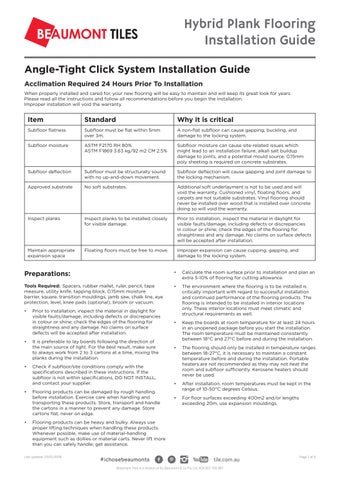
Hybrid Plank Flooring Installation Guide Angle-Tight Click System Installation Guide Acclimation Required 24 Hours Prior To Installation When properly installed and cared for, your new flooring will be easy to maintain and will keep its great look for years. Please read all the instructions and follow all recommendations before you begin the installation. Improper installation will void the warranty.
Item
Standard
Why it is critical
Subfloor flatness
Subfloor must be flat within 5mm over 3m.
A non-flat subfloor can cause gapping, buckling, and damage to the locking system.
Subfloor moisture
ASTM F2170 RH 80% ASTM F1869 3.63 kg/92 m2 CM 2.5%
Subfloor moisture can cause site-related issues which might lead to an installation failure, alkali salt buildup damage to joints, and a potential mould source. 0.15mm poly sheeting is required on concrete substrates.
Subfloor deflection
Subfloor must be structurally sound with no up-and-down movement.
Subfloor deflection will cause gapping and joint damage to the locking mechanism.
Approved substrate
No soft substrates.
Additional soft underlayment is not to be used and will void the warranty. Cushioned vinyl, floating floors, and carpets are not suitable substrates. Vinyl flooring should never be installed over wood that is installed over concrete doing so will void the warranty.
Inspect planks
Inspect planks to be installed closely for visible damage.
Prior to installation, inspect the material in daylight for visible faults/damage, including defects or discrepancies in colour or shine; check the edges of the flooring for straightness and any damage. No claims on surface defects will be accepted after installation.
Maintain appropriate expansion space
Floating floors must be free to move.
Improper expansion can cause cupping, gapping, and damage to the locking system.
Preparations:
•
Calculate the room surface prior to installation and plan an extra 5-10% of flooring for cutting allowance.
Tools Required: Spacers, rubber mallet, ruler, pencil, tape measure, utility knife, tapping block, 0.15mm moisture barrier, square, transition mouldings, jamb saw, chalk line, eye protection, level, knee pads (optional), broom or vacuum.
•
Prior to installation, inspect the material in daylight for visible faults/damage, including defects or discrepancies in colour or shine; check the edges of the flooring for straightness and any damage. No claims on surface defects will be accepted after installation.
The environment where the flooring is to be installed is critically important with regard to successful installation and continued performance of the flooring products. The flooring is intended to be installed in interior locations only. These interior locations must meet climatic and structural requirements as well.
•
It is preferable to lay boards following the direction of the main source of light. For the best result, make sure to always work from 2 to 3 cartons at a time, mixing the planks during the installation.
Keep the boards at room temperature for at least 24 hours in an unopened package before you start the installation. The room temperature must be maintained consistently between 18°C and 27°C before and during the installation.
•
The flooring should only be installed in temperature ranges between 18-27°C, it is necessary to maintain a constant temperature before and during the installation. Portable heaters are not recommended as they may not heat the room and subfloor sufficiently. Kerosene heaters should never be used.
•
After installation, room temperatures must be kept in the range of 10-50°C degrees Celsius.
•
For floor surfaces exceeding 400m2 and/or lengths exceeding 20m, use expansion mouldings.
•
•
•
Check if subfloor/site conditions comply with the specifications described in these instructions. If the subfloor is not within specifications, DO NOT INSTALL, and contact your supplier.
•
Flooring products can be damaged by rough handling before installation. Exercise care when handling and transporting these products. Store, transport and handle the cartons in a manner to prevent any damage. Store cartons flat, never on edge.
•
Flooring products can be heavy and bulky. Always use proper lifting techniques when handling these products. Whenever possible, make use of material-handling equipment such as dollies or material carts. Never lift more than you can safely handle; get assistance.
Last updated: 23/01/2026
Page 1 of 8 Beaumont Tiles is a division of RJ Beaumont & Co Pty Ltd. ACN 007 703 997