


MONDAY, APRIL 20-APRIL 26, 2026
MONDAY, APRIL 20-APRIL 26, 2026
By Joe Taglieri joet@beaconmedianews.com
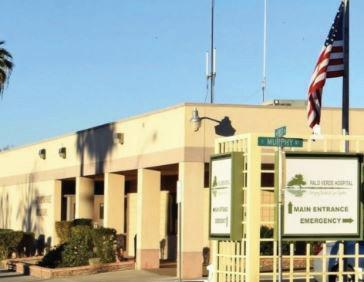
CEO Sandra Anaya of bankrupt Palo Verde Hospitalannounced resignation plans Wednesday.
Her last day on the job after 13 years will be April 23, according to the Palo Verde Healthcare District, the business entity that runs the fiscally strapped hospital.
It was unclear if district and county officials would seek a replacement chief executive.
The hospital’s finances began to steadily decline over the last 10 years, however no one has attributed the losses to decision by Anaya on any other individual member of the hospital’s management staff.
In February, the Riverside County Board of Supervisors OK’d a six-month rescue plan in an attempt to keep the hospital’s emergency room open — it is the only component of the facility that still operates and the only available emergency room within 70 miles of Blythe.
“Anaya’s departure does not change the terms of the management services agreement with the county,” PVHD officials said in a statement. “Ownership of the hospital does not change, and the district remains the licensed hospital operator and retains all regulatory, licensure and emergency medical treatment and Labor Act responsibilities. Hospital employees remain employees of the district.”
As part of the new management agreement, supervisors in March authorized $3.44 million from the county’s General Fund as payment to the California Department of Health Services on behalf of the hospital. County spokeswoman Brooke Federico said the payment covered the PVHD’s obligation to the California Voluntary Rate Range Program, which is part
of Medi-Cal and administered by the state Department of Health Care Services.
The “intergovernmental transfer” payment enabled the district to access over $9 million in taxpayer-backed credit available through Medi-Cal to support hospital operations.
DHCS spokesman Anthony Cava said in a statement that the agency “understands the serious challenges facing Palo Verde Hospital and the concern this creates for the community. After a thorough review, DHCS determined that the funds provided by the Palo Verde Healthcare District to participate in the Voluntary Rate Range Program did not meet federal and state requirements for permissible funding sources.”
The federal government requires that the nonfederal portion of Medi-Cal funding comes from allowable sources, Cava said.
“In this case, the Intergovernmental Transfer contribution was funded through a loan that required repayment using Medi-Cal payments that were funded with the IGT, a structure prohibited by federal rules,” he said.
“DHCS worked with Palo Verde Healthcare District several times — first to explain which funding sources were allowed before any funds were transferred, and later to review the situation before declining to accept the IGT to protect Medi-Cal’s integrity and ensure compliance with federal law,” according to Cava.
The county Board of Supervisors also authorized a “strike team” of medical professionals from the Riverside University Health System that initiated reform measures Feb. 23 intended to stabilize the Blythe hospital’s emergency care capability. The RUHS team was added to a $1 million stabilization loan the board OK’d in January for the fiscally struggling facility.
County supervisors have also filled one of two vacancies on the PVHD Board of Directors with the appointment last month of Palo Verde College administrator Jaclyn Randall. Voters will choose who fills the other vacant seat in the November general election.
Under the management services agreement, RUHS staff are tasked with
implementing all necessary processes connected to the county’s 180-day strike team support plan, with the primary goal of maintaining emergency operations at the hospital. Without Palo Verde Hospital’s emergency room, the area’s nearly 20,000 residents would lose access to “timely treatment for lifethreatening conditions where minutes matter,” according to a county statement in January.
The agreement between the county and PVHD specifies the county will have “first priority” among creditors and will not be liable for any of the district’s debts.
In late September, the PVHD board voted to pursue federal Chapter 9 bankruptcy protection amid efforts to reduce financial losses. Administrators said the hospital had struggled to remain solvent since the start of the current decade, with revenue streams declining despite patient loads remaining unchanged.
The California Health Facilities Financing Authority provided $8.5 million from the Distressed Hospital Program in 2023, but that turned out to be a short-term fix, according to the PVHD.
Officials also expressed frustration about the inability to find a chief financial officer who would remain in place to solve the financial woes — the district had four CFOs in an 18-month span.
The county’s initial $1 million loan will cover hospital staff salaries and benefits, pharmaceuticals, equipment purchases, utilities, billing operations and some legal expenses associated with Chapter 9 proceedings.
The possibility of a wholesale county takeover of the hospital’s emergency department has not been ruled out publicly.
Inside Trump’s effort to ‘take over’ the midterm elections
By Doug Bock Clark and Jen Fifield, ProPublica
In mid-December 2020, federal officials responsible for protecting American elections from fraud converged in a windowless, dim, fortified room at the Justice Department’s downtown Washington, D.C., headquarters.
They had been summoned by Attorney General William Barr.
Over the preceding weeks, Donald Trump’s claims that the presidential election had been stolen from him had reached a crescendo. He’d become obsessed with a conspiracy theory that voting machines in Antrim County, Michigan, had switched votes from him to Joe Biden.
With each day, Trump ratcheted up the pressure to unleash the might of the federal government to undo his defeat.
Barr interrogated experts from the Cybersecurity and Infrastructure Security Agency, crammed in beside top FBI officials around a cheap table. He needed the group of around 10 to answer a crucial question: Was it really possible the 2020 presidential vote had been hacked?
ProPublica’s description of the previously unreported meeting comes from several people who were in the room or were briefed on the gathering. Everyone understood that the meeting represented an important moment for the nation, they said. Barr, who did not respond to requests for comment, had walked a delicate line with Trump, instructing the FBI to investigate allegations of election irregularities while declaring publicly there had been no
evidence “to date” of widespread fraud.
The nonpartisan specialists from CISA, backed by their FBI counterparts, explained they’d unravelled what had happened in Antrim County. A clerk had made a mistake when updating ballot styles on machines, leading to a software problem that initially transferred votes from Republicans to Democrats, they said. There was no fraud, just human error — which would soon be publicly confirmed through a hand count of the county’s ballots.
Listening intently, Barr seemed to understand both the truth and that telling it to the president would almost certainly cost him his job.
At the end of the meeting, Barr turned to his top deputy, made hand motions as if he was tying on a bandana and said he was going to “kamikaze” into the White House.
What happened next is well known. When Barr met with Trump in the Oval Office on Dec. 14, the president launched into a monologue about how the events in Antrim County were “absolute proof” that the election had been stolen. Barr waited to get a word in edgewise before telling his boss what the experts from CISA had told him.
Then Barr offered his resignation letter, which Trump accepted. Barr left believing he’d done his part to preserve democratic norms.
“I was saddened,” Barr wrote of Trump in his memoir. “If he actually believed this stuff he had become
By City News Service
The Board of Supervisors on Tuesday authorized the Riverside County Park & Open Space District to extend its contract with the San Bernardino Valley Municipal Water District until 2029, deploying rangers along the Santa Ana River channel network to ensure spawning and foraging areas for a threatened species aren’t damaged.
In a 5-0 vote without comment, the board signed off on the park district’s agreement with the water agency, retroactive to last September and continuing until June 30, 2029.
The two entities first formed a compact in 2022, under which the park district deployed three uniformed rangers and a
part-time field maintenance technician to take care of segments of the Santa Ana that tie into the Hidden Valley wetlands, Louis Rubidoux Parkland marsh and surrounding locations.
The deployment was for the benefit of the San Bernardino Municipal Valley Water District’s “Upper Santa Ana River Tributaries Restoration Project,” which is well underway.
The project has been aimed at safeguarding habitat for the Santa Ana sucker fish, which is native to the river and has been listed as “threatened” aquatic life on the U.S. Endangered Species Act going back a quarter century. Some area water agencies have challenged the listing in federal court, but the designation hasn’t

changed, despite disruptions to fresh water access
stemming from the protections.
Under the new agreement between SBVMWD and the park district, the water agency will increase annual funding to ensure there are four uniformed rangers and a full-time field maintenance tech working around the tributaries on a regular basis.
The annual cost for the personnel will be $1.017 million, all of which will come from the water district, according to the agreement.
San Bernardino County Regional Parks, along with the office of Fourth District Supervisor Curt Hagman, welcomed the completion of Prado Regional Park’s newly renovated gatehouse, monument sign, food court and boat dock on April 8 with a ribbon-cutting ceremony.
As part of a larger master plan to modernize and bring new amenities to Prado Regional Park, the gatehouse, boat dock and food court areas are just the beginning of more improvements that aim to uplift the park with new features and amenities for residents to enjoy, including future sports courts, expansion of the campground to include glamping, and adding new campground restrooms and showers.
As the county continues to invest in Regional Parks, Hagman said the vision for investing in the park is to become a destination location and build a sense of community where families can explore the outdoors and spend leisure time together, supported by the Countywide Vision.
“At Prado Regional Park, these improvements are really about what our visitors and community have been looking forward to. A place where families can come together and create lasting memories, whether that’s fishing, kayaking, grabbing a snack
or relaxing by the lake. All of this is possible thanks to strong federal partnerships and continued county investment. Together, we’re delivering the kind of park our community deserves,” said Hagman.
For Regional Parks Director Beahta Davis, the ceremony symbolizes more than the new infrastructure; it symbolizes easier park access for everyone who passes through the front gate.
“The new gatehouse makes it easier for people who come in. When you turn into the park now, instead of it being a two-lane road, now there is a three to four-lane road, so when we have those larger events, we can open up four lanes and get people off Euclid Avenue and into the park sooner,” said Davis.
Additional improvements at Prado include the new food court and patio area, boat dock, pier and ADA path of travel from around the snack bar to the playground.
“The food court not only offers a place for people to get food, but also a place where you can sit in the serene area and just enjoy the lake and nature all around us,” said Davis. “It provides another area where families can gather to enjoy lunch, dinner or a pedal boat ride on the lake.”
Congresswoman Norma Torres, representing California’s 35th District, who secured federal funding for
Improvements to riparian spaces connected to the Santa Ana involve multiple agencies, including the Riverside County Flood Control & Water Conservation District, which is upgrading the levee system.
The Santa Ana River bottom is a magnet for the homeless, who erect encampments on an ongoing basis. Brush fires and other environmental impacts are often blamed on them.
“Because of the ecological sensitivity of these sites and their proximity to developed urban areas, additional patrols and proactive management efforts are necessary to prevent damage from improper land use,” the park district said. “The ongoing presence of uniformed rangers conducting patrols in marked vehicles has effectively reduced illegal dumping, unauthorized encampments, trespassing and vegetation clearing, helping to protect conservation objectives.”
By Sta
the new food court, was on-site to present Regional Parks with a certificate of recognition and spoke about the importance of collaboration and community investment.
“As an appropriator, I was proud to secure more than $3.13 million in federal funding to improve Prado Regional Park and expand access for families across San Bernardino County. This investment is helping rehabilitate the park’s food court area to not only meet modern health and accessibility standards, but to give park visitors a natural space to sit and enjoy the beautiful lake view while dining outdoors,” said Torres.
Antonio Davila, a Chino resident who attended the ceremony with his daughter, Diana, said this was his first time visiting Prado and said he is considering getting an annual pass now.
“On Easter Sunday, we were at Guasti Regional and we really like all the amenities there, but being a Chino resident, this is my first time here and I am looking at the splash pad and I said… this is so beautiful … I am looking into the annual pass now,” said Davila. “I live right across the street and I am so mad this is my first time here in four years. The tax dollars are being used very well here.”
Another project nearing completion is the campground restroom and

shower facility. In addition to the food court project, Torres also provided federal funding in 2024 for a new restroom and shower facility at Prado Regional Park’s campground. The project is in progress and is expected to be completed by Memorial Day.
“Delivering a brandnew restroom and shower facility at the campground is a critical upgrade for visitors to fully enjoy extended stays at the park,” said Torres. “These projects are about more than infrastructure, they are about ensuring our public spaces are safe, accessible and welcoming for everyone in our community. I look forward to cele-
brating these improvements with our local partners and the families who will benefit for years to come.”
During the ceremony, Davis added Regional Parks provides a cost-effective way for families to come together and enjoy nature and create memories, which is why the Prado master plan is vital to meeting the needs of the residents and expanding communities.
“What’s next for Prado Regional Park are some new sports courts that are going to be over on the soccer fields. When completed we invite everyone to come on out to play some pickleball, tennis or maybe even some basketball,” said Davis.
Regional Parks received several certificates of recognition, including one from Torres, as well as others from the city of Chino, presented by Councilmember Christopher Flores; Sen. Susan Rubio, 22nd District, presented by Anthony Moreno; Chino Valley Fire District, presented by District President and Regional Parks Commissioner Michael Kreeger; and Assemblymember Phillip Chen, 59th District, presented by Newton Viengkhou. After the ribbon-cutting ceremony, attendees were treated to refreshments at the food court area and free use of the pedal boats on the lake.
Editorial editorial@beaconmedianews.com
editor@hlrmedia.com
Graphics/Production production@beaconmedianews.com production@hlrmedia.com
Advertising advertising@beaconmedianews.com advertising@hlrmedia.com
Legal Advertising legals@beaconmedianews.com legals@hlrmedia.com
Business accounting@beaconmedianews.com accounting@hlrmedia.com
BEACON MEDIA ADDRESS: 820 S. Myrtle Ave. Monrovia, CA 91016
PHONE: (626) 301-1010
WEBSITE www.beaconmedianews.com
HLR MEDIA ADDRESS: 820 S. Myrtle Ave. Monrovia, CA 91016
PHONE: (626) 301-1010
www.HLRmedia.com
PRESS
editor@beaconmedianews.com editor@hlrmedia.com














By City News Service
Cal State Northridge anthropologistand an international team of researchers have found that a lack of genetic diversity among the last Neanderthals in Europe may have contributed to their extinction, according to a study announced Tuesday.
The research, led by CSUN’s Helene Rougier, found that late Neanderthals descended from a single genetic lineage following a sharp population decline linked to a major ice age.
Using DNA analysis and archaeological evidence from bone fragments, some no larger than a finger, researchers determined that Neanderthal populations contracted significantly after a period of climate deterioration beginning roughly 75,000 years ago.

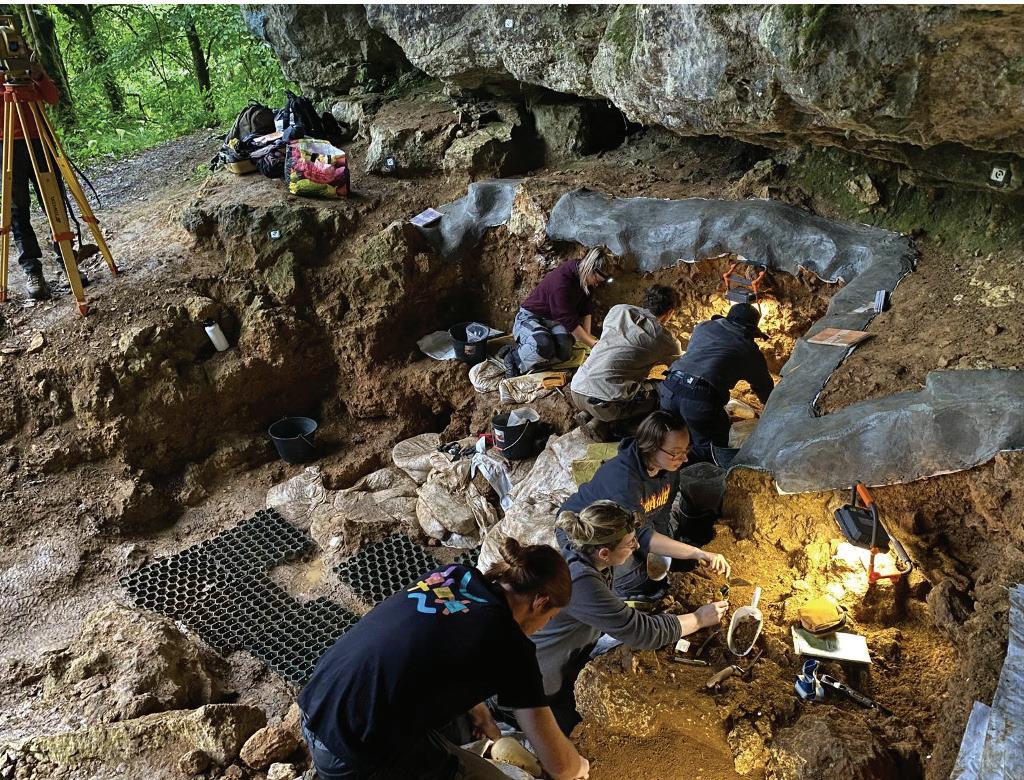
“Combining the genetic data with the archaeological data, we were able to see a contraction in the distribution of Neanderthal sites that corresponded to a dramatic change in the climate, an ice age,” Rougier said. “The data shows that some of the Neanderthals found refuge in southwestern Europe, taking shelter in the valleys of southwestern France, while dying out in the rest of the continent.”
However, by that time, they shared a much more limited gene pool, Rougier added.
Researchers said the population later experienced a rapid collapse between roughly 45,000 and 42,000 years ago.
“It was like they went off a cliff,” Rougier said. “The population just collapsed. In about 2,000 years they were gone.”
Rougier said the decline coincided with the arrival of early Homo sapiens in Europe, raising the possibility that competition for resourc-
es may have played a role. She added that reduced genetic diversity may have made Neanderthals more vulnerable to environmental pressures and other threats. The findings were published in the journal Proceedings of the National Academy of Sciences.
By Suzanne Potter, Producer, Public News Service











Organizations wanting greater awareness of end-of-lifeoptions wereamplifyingtheir message in California, especially as National Healthcare Decisions Day approached on Thursday.
April is also Minority Health Month, and experts say messaging around advanced planning options is vital in the Black community, which is underserved when it comes to hospice and palliative care.
The Rev. Madison Shockley, pastor at Pilgrim United Church of Christ in Carlsbad and a board member of the nonprofit Compassion & Choices, noted that planning ahead can prevent conflict.
“When the person writes their health-care directive and shares it with their family,” Shockley said, “the benefits are tremendous because then they can focus on loving one another and
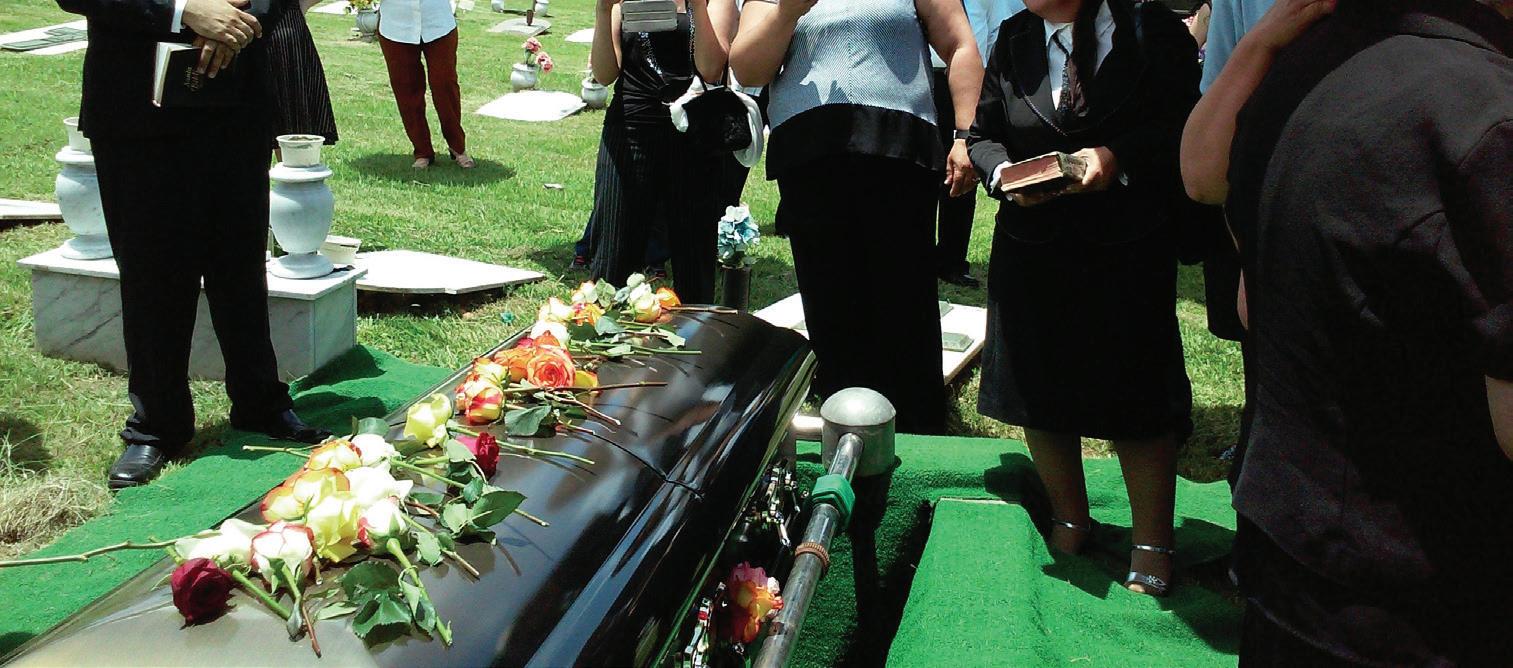
not debating what the care should be.”
Data show that compared with white peers, Hispanic, Asian American and North American Native patients are also less likely to use hospice. And AAPI, Black, and Hispanic and Latino adults are less likely to have an advance directive.
Shockley advised people
to write down their wishes, designating someone to make medical decisions on their behalf. He adds it should be made clear whether they want doctors to take artificial life-sustaining measures if they’re terminally ill and incapacitated.
“I have always thought of death as on the other side. But death is actually on this
side. It’s part of life,” Shockley said. “And so in that sense, we live our deaths with the same autonomy, purpose, and clarity with which we lived our lives.”
The Compassion & Choices website offers a number of tools to help people explore their values and address end-of-life concerns.
By City News Service

Phil Collins, Billy Idol and Iron Maiden are among the artists who will be inducted into the Rock & Roll Hall of Fame at a November ceremony in downtown Los Angeles.
Other artists who will be inducted into the hallowed hall at the Nov. 14 ceremony at the Peacock Theater are Joy Division/New Order, Oasis, Sade, Luther Vandross and Wu-Tang Clan in the performer category. Early Influence Award honorees will be Celia Cruz, Fela Kuti, Queen Latifah, MC Lyte and Gram Parsons. Receiving the Musical Excellence Award
will be Linda Creed, Arif Mardin, Jimmy Miller and Rick Rubin. Legendary TV host Ed Sullivan will be inducted and receive the Ahmet Ertegun Award.
The inductees were announced last week by Ryan Seacrest and 2022 inductee Lionel Richie during a Rock & Roll Hall of Fame-themed episode of “American Idol.”
“Induction into the Rock & Roll Hall of Fame is music’s highest honor. We look forward to celebrating these remarkable artists at this year’s ceremony. It’s going to be an unforgettable night,” John Sykes, chairman
of the Rock & Roll Hall of Fame, said in a statement.
To be eligible for induction, an individual artist or band must have released their first commercial recording at least 25 years prior to the year of nomination. Collins, Vandross and Wu-Tang Clan are first-time nominees, while Idol, Iron Maiden, Joy Division/New Order, Oasis and Sade have been nominated previously. Collins was previously inducted into the hall as a member of Genesis.
This year’s ceremony will be recorded and shown later on ABC and Disney+ in December.

UCLA researchers are partnering with The Nature Conservancy to use advanced genetic analysis to help preserve California’s oak trees, which are increasingly threatened by climate change and habitat loss, university officials announced Wednesday.
The effort uses wholegenome sequencing to identify which oak populations are best suited to survive future climate conditions, with the goal of guiding conservation and restoration efforts across the state, according to project scientists.
In three recent studies, UCLA scientists and The NatureConservancy analyzed the full genetic code of hundreds of oak trees -- some of which can live more than 500 years -- to determine which are best adapted to a changing climate.
“We’re now putting this science into practice across California,” Scott Butterfield, land program lead scientist for The Nature Conservancy, said in a statement. “By using genomic data to guide restoration ... we can test whether trees predicted to be more climate-resilient actually perform better on the ground.”
Scientists said the research is already being applied in restoration efforts, including relocating acorns from trees adapted to warmer climates into areas expected to face similar conditions in the future.
“Genomics is the missing link between laboratory science and effective land management,” said Victoria Sork, a UCLA distinguished professor of ecology and evolutionary biology. “By mapping the patterns of
By City News Service

genetic variation underlying how different populations respond to heat and drought, my research team provides the scientific framework for the strategic movement of climate-resilient seeds to new areas.”
Oak trees play a critical role in California ecosystems, supporting thousands of plant and animal species while also helping remove carbon from the atmosphere, officials said.
The research is intended to guide large-scale conservation strategies by identifying which tree populations are most resilient to future climate conditions and where they are most likely to thrive.
Scientists said the approach could help improve restoration efforts, particu-
larly in areas damaged by wildfires, by ensuring seeds are planted in environments suited to their long-term survival.
The work also supports California’s goal of conserving 30% of its lands and coastal waters by 2030, with oak woodlands representing a significant portion of the state’s unprotected ecosystems.
“Thisgroundbreaking effort by UCLA and the Nature Conservancy has tremendous potential for the future of reforestation efforts,” said Jimi Scheid, deputy chief of reforestation services for Cal Fire. “This research can assist forest landowners ... by helping to identify suitable seed sources that are forecasted to be adapted to a changing climate.”

significantly detached from reality.”
Barr was one of many federal officials — most of them Trump appointees — who refused to bend to the president’s demands, which only intensified after Barr was gone. Although rioters inspired by Trump managed to delay the certification of his defeat by storming the Capitol on Jan. 6, 2021, ultimately the institutional guardrails of American democracy held — barely.
But if faced with the same tests today, the guardrails and people that held the line would largely be missing, an examination by ProPublica found.
ProPublica scrutinized what happened the last time Trump lost a national election. Some of that happened in plain sight: After a cascade of defeats in court, Trump began pressuring state and local officials to overturn the results. But more happened behind the scenes, like the meeting that helped persuade Barr to hold the line.
Our reporting uncovered previously undisclosed aspects of a federal effort to safeguard the results of the 2020 vote, which involved at least 75 people across several agencies. Today, nearly all of those people are gone, having resigned, been fired or been reassigned, particularly in the departments of Justice and Homeland Security. That included the cybersecurity specialists who had established that the Antrim County allegations were false and reported their findings to Barr.
The people we identified as resisting attempts to overturn the 2020 results have been replaced by roughly two dozen people Trump has installed in positions that could affect elections. Ten of them actively worked to reverse the 2020 vote, and the rest are associates of
such people. In some cases, ProPublica found, officials have been hired from activist groups that are pillars of the election denial movement. Experts warn that shows the movement has merged with the federal government.
These new officials could influence how Trump reacts to the upcoming midterms as polling shows Republicans are approaching what could be a significant electoral loss, with the president’s approval rating nearing record lows, and public concern growing about the weak economy, the administration’s mass deportation effort and the war on Iran.
Seemingly in preparation to head off such a blow, Trump has stepped up his efforts to “nationalize” the 2026 elections, saying that Republicans need “to take over” the midterms. Democrats who monitored Trump’s attempts to block his 2020 loss have begun to question whether he will allow a “blue wave,” particularly if it flips control of a House of Representatives that impeached him twice in his first term.
ProPublica’s examination reveals new details on how the president has unleashed his loyalists to transform elections. This includes the background of this year’s FBI raid in Georgia to seize 2020 election materials and how they are using federal resources to search for noncitizens voting. Ultimately, ProPublica’s reporting shows how thoroughly and expansively the Trump administration has overhauled the federal government into what some fear is a vehicle for making sure elections go his way.
ProPublica’s reporting is based on interviews with roughly 30 current or former executive branch officials familiar with the work of Trump loyalists installed in election roles. Most spoke on condition of anonymity
because they fear retribution, including those knowledgeable about the December 2020 Barr meeting.
The Trump administration maintains its actions will make U.S. elections fairer and more secure — and keep those prohibited from voting, such as noncitizens, from doing so.
“Election integrity has always been a top priority for President Trump,” White House spokesperson Abigail Jackson said in a statement. “The President will do everything in his power to defend the safety and security of American elections and to ensure that only American citizens are voting in them.”
Spokespeople for the DOJ and DHS emphasized that their departments are focused on ensuring elections are free and fair, and that they are working closely with the states to achieve those goals. Contentions to the contrary, they say, are false.
A few guardrails have endured, preventing Trump from fully realizing his agenda for elections. Judges have blocked key parts of a March 2025 executive order in which Trump attempted to exert greater federal control over aspects of voting, and some Republican state officials have fought back against Justice Department lawsuits demanding state voter rolls.
Late last month, Trump issued another executive order on elections that attempts to exert unparalleled federal control over mail-in voting and voter eligibility, which Democrats and voting rights groups are challenging in court.
Experts say 2026 will serve as an unprecedented stress test of the integrity of American elections.
“Our election system withstood” Trump’s “attacks following the 2020 election,” said Sen. Alex Padilla, a
Parsons Transportation Group Inc. has an opening for Senior Technical Consultant, Signal Engineering in Pasadena, CA.
Job Duties Include: Perform Signal, Positive Train Control and Communications Based Train Control Engineering, including design, design review, proposal support, data engineering, remote troubleshooting. Position requires travel. May Telecommute.
Salary: $189,520 to $231,400. Contact: Apply online at jobs.parsons.com. Must reference job 11863.525.6/R178980
California Democrat who has led the pushback to the administration’s actions on elections, “but this will be an even tougher test, with more election deniers having access to federal power than ever before.”
The Dismantling Barr has said that in the high-stakes days following the 2020 election, he felt like he was playing Whac-A-Mole with Trump’s “avalanche” of false election claims.
The investigators at DHS’ Cybersecurity and Infrastructure Security Agency supplied intelligence that disproved many of them, not just those involving Antrim County.
CISA was created by Trump in his first term to counter cyber threats in the aftermath of Russia’s efforts to influence the 2016 vote. It soon came to provide crucial expertise and support to thousands of local election officials grappling with increasingly sophisticated attacks.
After the 2020 election, it also played a crucial part in puncturing fallacies spread by Trump supporters, producing a “Rumor Control” website to rebut them. And it partnered with state officials and technology vendors to release a statement calling the election “the most secure in American history.” Trump swiftly fired Chris Krebs, whom he had appointed to lead CISA, but Krebs’ defense of the election’s soundness reverberated widely in the media and on Capitol Hill.
Among Trump’s first actions upon returning to the Oval Office was eviscerating CISA.
Starting in February 2025, DHS leadership put employees focused on countering disinformation and helping safeguard elections on leave. The leadership also froze the agency’s other election security work, which included assessing local
election offices for physical and cybersecurity risks, and disseminating sensitive intelligence information on threats. Eventually, all three dozen or so CISA employees specializing in elections were fired or transferred to work in other areas.
“It took years of dedicated, bipartisan, cross-sector partnership to build the security infrastructure we’ve had, and dismantling CISA leaves a gaping hole,” said Kathy Boockvar, an elections security expert who served as Pennsylvania’s secretary of state from 2019 to 2021. “We are making the job of securing our democracy exponentially harder.”
A DHS spokesperson told ProPublica that the changes at CISA were in response to “a ballooning budget concealing a dangerous departure from its statutory mission,” which included “electioneering instead of defending America’s critical infrastructure.” The spokesperson said that CISA’s mission is still to coordinate protection of critical infrastructure, including by supporting local partners against cyber threats.
It isn’t just CISA that’s been gutted.
The Trump administration has discarded or diminished other federal initiatives with roles in protecting election integrity or blocking foreign interference. While many of these actions have been reported, together they reveal the full sweep of the changes.
First, the administration got rid of the National Security Council’s election security group, which convened departmental leaders to coordinate federal actions related to voting. Then in August, the administration dismantled the Foreign Malign Influence
Center, a branch of the Office of the Director of National Intelligence that had stymied efforts by Russia, China and Iran to interfere in the 2024 election.
A spokesperson for ODNI said the center was redundant and that its functions were folded into other parts of the office’s intelligence apparatus in ways that “arguably makes our ability to monitor and address threats from foreign adversaries stronger, more efficient and more effective.”
However, former national security officials, including one who had worked at the center, told ProPublica that its functions had largely ceased. Caitlin Durkovich, who led the NSC’s election security work during the Biden administration, said that under Trump the federal government has “abandoned” its traditional role in preserving election integrity and security.
“Nearly every program and capability to stop bad actors and support election administrators has been dismantled,” she said. “Heading into the midterms, this leaves states and localities exposed, without the intelligence support or federal coordination they need to detect and respond to threats in real time — precisely when the stakes are highest.”
The early months of the second Trump administration also brought seismic changes to three parts of federal law enforcement with central roles in elections.
Kash Patel, the FBI’s new director, dismantled the public corruption team, which had been deployed in previous administrations to help monitor possible criminal activity on Election Day. The Foreign Influence Task Force, which aimed to
combat foreign influence in U.S. politics, was also disbanded. (An FBI spokesperson said the bureau “remains committed to detecting and countering foreign influence efforts by adversarial nations.”)
Furthermore, the Justice Department substantially reduced the role of its Public Integrity Section, which had been responsible for making sure the department’s inquiries weren’t improperly influenced by politics.
After the 2020 election, senior lawyers in the section warned against having the FBI investigate fraud claims raised by Trump allies, saying that the agency’s involvement could damage its reputation and appear motivated by partisanship. In this instance, they were overruled by Barr and his deputies, but former officials said this was a rare case in which their guidance was ignored. The need to directly overrule the unit, they said, made it a roadblock — one that no longer exists.
A month after Trump returned to the Oval Office, the unit’s top staff resigned when agency leaders directed them to dismiss corruption charges against then-New York City Mayor Eric Adams. More resigned later or were transferred. The 36-person section was reduced to two. The administration no longer mandates that it review politically sensitive cases, according to multiple people familiar with the matter.
Another key DOJ office, the Civil Rights Division’s voting section, had enforced federal laws that protect voting rights, particularly those that combat racial discrimination. In December 2020, the assistant attorney general overseeing the Civil Rights Division was one of the many department leaders who said they would resign if Trump promoted Jeffrey Clark, a leader who supported Trump’s efforts to overturn the election results, to head the department after Barr’s resignation. This mass threat of resignation ultimately led Trump to not promote Clark.
But now, nearly all of the section’s roughly 30 career lawyers have resigned or been moved. This largely started last spring after Harmeet Dhillon, Trump’s assistant attorney general for civil rights, put out a memo saying their mission would shift from ensuring voting rights to enforcing Trump’s executive order on elections.
The Trump administration then filled the section with conservative lawyers who are now litigating against the lawyers they
replaced. At least four of those newly appointed lawyers participated in challenging the 2020 vote or have worked with people who helped Trump try to overturn the 2020 election.
“It’s just a shocking and depressing reversal of the federal government’s role in making real the promise of nondiscrimination in voting and racial equality,” said Anna Baldwin, an appellate attorney for the Civil Rights Division who resigned last year and is now one of those litigating against the Justice Department in a new role at Campaign Legal Center.
The Justice Department didn’t respond to specific questions about the dismantling of the Public Integrity Section or the change in mission for the Civil Rights Division.
In all, at least 75 career officials who’d played important roles in elections work at DHS, DOJ and other departments have left or been fired, ProPublica found.
Team America
Late last summer, after the Trump administration had forced out most of the career specialists, a small group of political appointees began convening at the Department of Homeland Security’s headquarters.
The group — which once called itself “Team America,” according to sources familiar with the matter — looked for federal levers it could pull to make Trump’s March executive order about elections a reality, an effort that has not been previously reported.
They represented the new type of people running the show.
Its core members included David Harvilicz, a DHS assistant secretary tasked with overseeing the security of election infrastructure, including voting machines, and three of his top staffers. As ProPublica has reported, Harvilicz had co-founded an AI company with an architect of Trump’s claims about Antrim County.
Despite the setbacks the executive order had met with in court, there “was not a whole lot of discussion or disagreement” about acting on the directive from Harvilicz or one of his deputies, said a former federal official who interacted with group members. “It was just us saluting to do it.”
This small group was part of a wider team at DHS, DOJ and the White House seeking to push forward the president’s agenda. Some of Trump’s new guard are well known: After the 2020 election, Patel pressured military officials to help investigate a conspiracy theory about
voting machines, according to a former Justice Department official. (Patel did not respond to a request for comment but claimed in congressional testimony that he did not recall the event.) Others, like Harvilicz, are more obscure but still wield consequential powers.
These newcomers are seeking to carry out Trump’s executive orders and are unlikely to push back against his false claims that American elections are rife with fraud.
Team America members have echoed or spread such material themselves.
Heather Honey, who serves under Harvilicz in a newly created position focused on elections, falsely asserted that there were more ballots cast in Pennsylvania than voters in the 2020 presidential election. Trump cited this claim, which has been traced back to her, while exhorting his followers to march on the Capitol on Jan. 6, 2021.
At least 11 administration appointees, including Honey, have ties to the Election Integrity Network, a conservative grassroots organization seeking to transform American elections. It is led by Cleta Mitchell, a lawyer who tried to help Trump overturn the 2020 election. Gineen Bresso, who holds a top job in the White House counsel’s office, coordinated with the network’s leadership in 2024 as the Republican National Committee’s election integrity chair, ProPublica has reported. Since moving into government, Honey has maintained close ties to Mitchell’s organization, and she and at least two other federal officials have given its members private briefings.
Experts say these former activists who helped forge a movement built on the idea that the 2020 election was stolen from Trump are seeking to make sure that does not happen again.
“The election denial movement is now interwoven within the federal government, and they are working together toward a shared goal of reshaping elections” in ways that undermine the freedom to vote, said Brendan Fischer, a director at the Campaign Legal Center, a nonpartisan, pro-democracy legal organization. “It’s not just lastminute slapdash attempts to overturn the results” as in 2020, “but more systematic efforts to influence how elections are run months ahead of time.”
In response to questions sent to DHS, Harvilicz and Honey, a DHS spokesperson
disputed that they were seeking to use the department’s powers to advantage Trump, writing that its employees “are focused on keeping our elections safe, secure, and free” and working to “implement the President’s policies.” In response to questions about their ties to the election denial movement, the spokesperson wrote, “To meet the diverse and evolving challenges the Department faces, we hire experts with diverse backgrounds who go through a rigorous vetting process.”
Mitchell did not respond to detailed questions from ProPublica. The White House answered questions sent to Bresso about her connection to Mitchell’s network by reiterating its commitment to making American elections secure.
Through the fall and winter, as the Justice Department demanded that states turn over confidential voter roll information, Team America worked to solve problems hindering the use of digital tools to comb the lists for noncitizens who had illegally registered to vote. Honey and others ironed out the technical details of merging information from different agencies and crafted data-sharing contracts. When Honey or others hit roadblocks, they’d go to the White House or senior DHS leaders who “would come in hot” to clear her path, said officials who interacted with them.
Initially, the plan was to run voter information obtained by DOJ through a Homeland Security tool called the Systematic Alien Verification for Entitlements system.
More recently, according to two people familiar with
the matter, Team America has worked to harness a more powerful tool used by another branch of DHS, Homeland Security Investigations, to increase its ability to search for noncitizen voters and bring criminal charges against them.
While DHS told ProPublica that SAVE has identified more than 21,000 potential noncitizens on voter rolls in the past year, officials who have checked those results in detail have found vast inaccuracies, as ProPublica has reported. Most states — including those with millions of voters — have eventually marked only a few to a few hundred potential noncitizens as registered to vote, and far less have ever voted. The DHS spokesperson also called SAVE “secure and reliable.”
As the election approaches, current and former officials and election security experts expressed concerns that Harvilicz and Honey, who’ve espoused debunked conspiracy theories about elections, are in positions to control the narrative around the vote’s soundness.
It’s hard to debunk false claims “coming with the seal of the federal government,” said Derek Tisler, counsel and manager with the Brennan Center for Justice’s elections and government program. “I certainly worry what damage that could do to voters’ confidence.”
Red Flags
Perhaps nothing better reflects the breakdown of the guardrails that thwarted Trump’s rashest impulses in 2020 than his creation last fall of a special White House post reinvestigating his loss
to Biden.
In December 2020, just days after Barr rebuffed Trump’s Antrim County claims, lawyers in the White House counsel’s office helped prevent the president from heeding activists’ call to essentially declare martial law to seize voting machines. This multihour shouting and cussing match has been called the craziest meeting of the first Trump administration.
But the lawyer whom Trump hired in 2025 as his director of election security and integrity, Kurt Olsen, had worked to overturn Trump’s loss in court in 2020 and was later sanctioned by judges, including for making baseless allegations about Arizona elections.
Olsen’s work in the second Trump administration has breached the firewall between the White House and DOJ officials, established after Watergate to prevent law enforcement officers from making decisions based on political pressure, said Gary Restaino, a former U.S. attorney in Arizona.
“This is not a constitutional or even a statutory requirement,” Restaino said, “but it’s a democracy requirement to make sure that citizens throughout America understand that decisions about life and liberty are being made in an objective and consistent manner.”
In a previously unreported series of events, around the end of 2025, Olsen flew to Georgia to meet with Paul Brown, the head of the FBI’s Atlanta field office, according to people familiar with the matter.
By City News Service
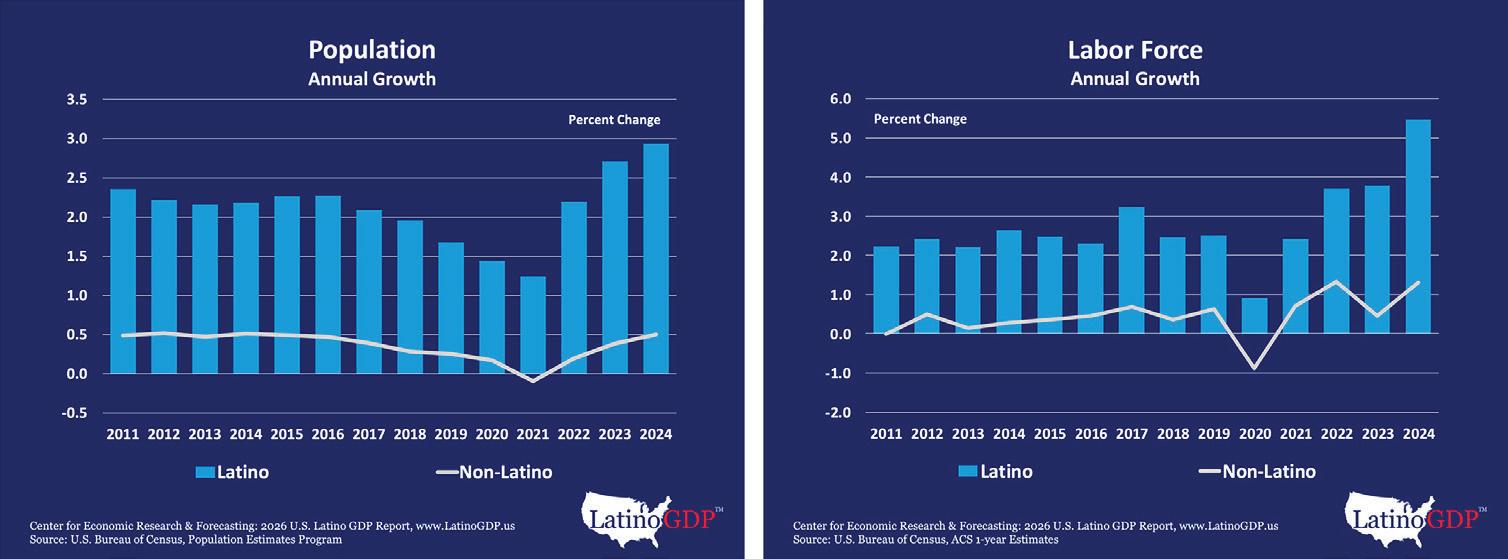
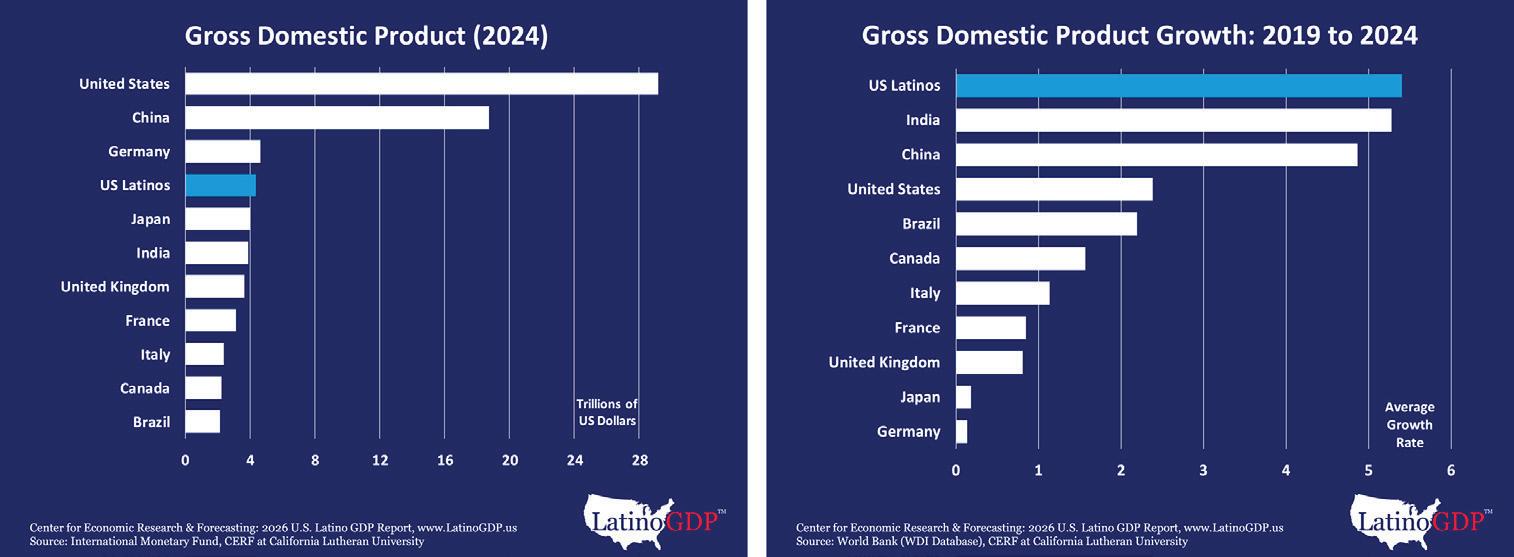
The U.S. Latino economy reached $4.4 trillion in 2024, surpassing Japan to become the fourth-largest gross domestic product in the world, according to a report announced Thursday by researchers at UCLA and California Lutheran University.
The findings are part of the 2026 U.S. Latino GDP
Report, which is scheduled for full release in May.
Researchers said Latino economic output not only grew in size but also outpaced broader U.S. economic growth, with real Latino GDP increasing 6.4% in 2024 compared to 2.4% for non-Latino GDP.
“New data indicate that the U.S. Latino GDP was
not only larger and growing faster in 2024, but it shattered records for economic vibrancy,” Dr. David HayesBautista, UCLA professor and co-author of the report, said in a statement. “Latinos are key to a bright future for the United States.”
The report found that Latinos now account for one
in five U.S. residents, with a population exceeding 68 million. The Latino labor force reached 35.1 million in 2024, growing significantly faster than the non-Latino workforce.
“Now surpassing the GDP of Japan, the U.S. Latino GDP illustrates just how vital Latino strength and resilience
Olsen wanted the FBI to seize 2020 ballots from Fulton County, a Democratic stronghold, and gave Brown a report he claimed would justify the extraordinary action. Brown and his team emphasized to Olsen that any investigation his team did would be independent and fair.
When Brown and his team examined the report, they found that Georgia’s election board had already looked into its allegations, dismissing many altogether, and concluding that others came down to human error, not criminal wrongdoing. The report had been assembled by a longtime ally of Olsen’s and participant in the Election Integrity Network who had a history of discredited claims, ProPublica has reported.
Based on their own investigation, Brown’s team submitted an affidavit to their superiors at DOJ that did not make a strong enough case to move forward with what Olsen wanted.
Soon after, Brown was offered a choice: retire or be moved to a new office, people with knowledge of the exchange told ProPublica.
Olsen did not respond to requests for comment.
An FBI spokesperson said that Brown “elected to retire” and that its “work in the election security space is entirely consistent with the law.”
Brown’s ouster after
refusing to carry out the seizure of 2020 election materials has been reported, but Olsen’s involvement and the details of their interactions leading to Brown’s retirement have not been previously disclosed.
With Brown gone, the case moved ahead under his replacement.
Trump administration officials also took another step to keep control of the investigation.
Then-Attorney General Pam Bondi chose Thomas Albus, whom Trump had appointed as U.S. attorney for the Eastern District of Missouri, to prosecute the case even though it fell far outside his usual regional jurisdiction. Albus had been meeting with Olsen since around the time the White House lawyer was hired, ProPublica has reported. (Albus declined a request for comment.)
In late January, the FBI carried out an unprecedented raid in Fulton County — and the agency’s affidavit, put together by Albus and Brown’s replacement, cited a version of the report Olsen gave to Brown as evidence supporting the seizure. ProPublica was part of a news coalition that sued to unseal the affidavit.
An FBI spokesperson said that its agents “followed all procedure to ensure everything was in proper order, and FBI evidence team had the necessary court-authorized search warrant before they arrived on site.”
Ryan Crosswell, who worked in the Justice Department’s Public Integrity Section for around half a decade, handling a number of election cases, called Brown’s replacement and Albus’ involvement a “red flag” because of the unusual circumstances of their appointments.
“They’re just moving through people until they find someone who’s willing to do exactly what they want,” Crosswell said.
The Justice Department did not respond to a question about Crosswell’s comment.
The extraordinary raid was also enabled in a previously unreported way by the destruction of the DOJ’s Public Integrity Section.
Multiple former lawyers for the section said they likely would have tried to block the Fulton County investigation because it lacked strong evidence, had a clear political slant and went against department directives that actions should not be taken “for the purpose of giving an advantage or disadvantage to any candidate or political party.”
Crosswell said, “Based on everything we know, if PIN was still there, we’d say no.”
John Keller was principal deputy chief of the Public Integrity Section from 2020 to 2025 and was acting chief when he resigned in early 2025. He worries that allegations of irregularities in the upcoming election will be
handled on a partisan basis.
“Without that review and without apolitical, objective, honest brokers involved in the process, there is a much greater risk for intentional manipulation or inadvertent interference,” Keller said.
“Dismantling the Brain”
The week the FBI seized Fulton County’s ballots, about half of the nation’s secretaries of state converged on Washington, D.C., for their winter conference.
They had urgent questions about elections for Bondi, then-DHS Secretary Kristi Noem and other luminaries who had promised to appear at the event. But none of the headline names showed, leaving conference attendees staring at an empty podium, until the session was abruptly canceled.
The breakdown was emblematic of a widening chasm between state officials and the parts of the federal government that had, until recently, worked with them to secure American elections.
Shenna Bellows, Maine’s Democratic secretary of state, said in an interview that the trust between the Trump administration and states is “absolutely demolished.”
This loss of trust reflects that election deniers have assumed so many top roles at federal agencies. Honey
are for the nation’s economy,” said Dr. Matthew Fienup, executive director of the Center for Economic Research & Forecasting at Cal Lutheran and a co-author of the report.
Researchers said strong population growth and high labor force participation rates have been key drivers of the expansion.
“The strong labor force growth demonstrates a Latino demographic resilience that has truly driven the country’s overall economic growth,” said Dr. Paul Hsu of UCLA. The report is part of an ongoing research series examining the economic contributions of Latinos in the United States.
sometimes represents DHS on cross-departmental conference calls with state election chiefs, an unsettling reality for those who spent years countering the false claims she made from outside the government.
On a February call, state officials expressed confusion about whether the Cybersecurity and Infrastructure Security Agency would still assess their election systems for physical and cyber vulnerabilities. Honey said it would, but Bellows said she’d been told it wouldn’t.
Two DHS officials told ProPublica CISA’s remaining staff avoids election work, afraid they could lose their jobs if they engage with state and local officials. “In CISA, elections are a toxic poison,” one said.
A DHS spokesperson said state and federal officials are still working together “every single day” to protect elections and that “The claim that DHS has a broken partnership with states and made our elections less secure is simply false.”
The cuts to career election specialists and their divisions have eliminated information channels that spotlighted threats as voting took place, including Election Day command posts run by the Justice Department and FBI. Another information channel, which DHS used to fund, will still operate but will be available only to state and local
election offices, not the federal government.
Jessica Cadigan, a former FBI intelligence analyst who investigated Election Day threats, said FBI headquarters’ command post was critical to her cases.
“That is dismantling the brain, if you will,” she said. “They are the ones that piece the whole thing together.”
An FBI spokesperson said the agency will still have capabilities to monitor the situation on the ground through designated election crimes coordinator experts in all its field offices.
Jena Griswold, Colorado’s Democratic secretary of state, has come to see the federal government as adversarial to elections and election administration, rather than a partner.
Colorado is one of around 30 states the Justice Department has sued for confidential voter roll information. At least four courts that have fully considered those cases so far have dismissed them, although the Justice Department has appealed most of the decisions. (The others are pending.) Griswold told ProPublica she has added another lawyer to her staff to fight whatever comes next from the Trump administration.
“Donald Trump,” she said, “has made American elections less safe.”
Republished with Creative Commons License (CC BY-NC-ND 3.0).
By Staff
Riverside City Manager
MikeFutrellhas accepted his appointment to become Pasadena’s next chief executive, officials announced Wednesday.
His expected start date in Pasadena is May 13.
Futrell brings more than 30 years of public-sector experience, including 18 years in executive chief administrative and city management roles, Pasadena officials said. Prior to his post in Riverside, he was city manager of South San Francisco, chief administrative officer for the city and county of Baton Rouge, state director in the U.S. Senate, executive vice president at Hawaii Gas and elected offices in the Louisiana House of Representatives and Baton Rouge Metropolitan Council.
Futrell is also a retired U.S. Navy captain who served 26 years on active duty and in the reserves.
He has overseen major capital projects, complex public-private partnerships, innovative economic development strategies and large municipal operations that include utilities, airports, convention centers and fullservice city departments. Futrell’s experience includes leading city-owned electric and water utilities that serve as many as 200,000 customers, and also “regulatory, customer service, rate-setting and intergovernmental functions,” officials said.
In South San Francisco, Futrell led the city’s transformation into a biotech economic powerhouse,generating funding for housing, transit, and sustainability initiatives. He also led the restoration of the South San Francisco Bay waterfront, in a $3 billion public-private partnership.
In Riverside, he has steered major economic expansions in green technology, aerospace, and life sciences; delivered landmark capital projects; and strengthened community engagement and transparency. His background also includes significant work in strategic planning, public safety, emergency management, financial recovery, labor relations, communications, and organizational development.
The appointment follows an extensive national search process and reflects the City Council’s commitment to selecting a seasoned, innovative, community-centered leader to guide Pasadena into its next chapter.
“On behalf of the entire City Council, I want to express our deep appreciation to outgoing City Manager Miguel Márquez for his dedicated and effective service to the people of Pasadena,” Mayor Victor Gordo said in a statement. “His leadership has helped guide our city through important challenges and opportunities, and we are grateful for his commitment.
“I also want to acknowledge the many highly qualified and talented candidates who stepped forward throughout this process. They brought forward thoughtful ideas and diverse perspectives, and the City Council benefited greatly from the depth of experience and vision they shared.
“Today, we welcome Mike Futrell and his wife, Susan Freeman, to our great city,” Gordo said. “Mike is a seasoned, proven city manager whose experience, collaborative approach, and steady leadership will serve Pasadena well. He brings
Research led by UCLA suggestsclimate change and natural disasters are driving increases in homelessness across the United States, with experts warning that housing stability must be a central focus of disaster response, it was announced Thursday.
The findings come from four recently published peerreviewed studies examining homelessness nationwide and in Los Angeles County, including the impact of the 2025 wildfires and broader links between displacement and housing loss, according to researchers.
a skill set that will help us confront the complex issues facing our community — both now and in the years ahead — and support the dedicated staff who work every day to make Pasadena a better place for all.”
Futrell said he is honored to have been selected for the opportunity to serve Pasadena.
“I have spent my life in public service, from the U.S. Navy to elected office to leadership roles at the federal, state, and local levels,” Futrell said in a statement. “The unique blend of experiences I’ve gained has prepared me to lead a dynamic and forward-looking city like Pasadena. Pasadena holds a special place in my family’s life. My wife Susan and I have spent many years visiting and enjoying Pasadena, and we plan to be active in the community. I look forward to collaborating with the Council, staff, and community members to advance the City’s priorities and ensure Pasadena’s continued success.”
Futrell’s initial focus areas in Pasadena will include major citywide initiatives such as the Reconnecting Pasadena 710 Vision Plan, Eaton Fire Recovery, Pasadena’s transition to carbon-free electricity by the end of 2030, and continued financial sustainability, along with long-term commitments to community engagement, public safety, and organizational excellence.
Futrell currently is working towards a Ph.D. at the University of CaliforniaMerced’s College of Engineering, Management of Complex Systems. He holds a law degree from Louisiana State University Law School, a master’s in business administration from University of MassachusettsAmherst, a bachelor of science degree in business and public administration from Louisiana State University, and completed a two-year certification in corporate innovation at Stanford University Graduate School of Business.
In his free time, Futrell enjoys spending time with Susan visiting cultural desti-
nations and experiencing outdoor spaces.
He also volunteers in the community, often alongside his wife who is an active Rotary Club member and Rotary District DEI Chair, as well as a CEO, a published author and educator. He has four adult children: son, James who is a Naval Officer in San Diego and part of the recovery team for the Artemis II crew and capsule upon splash down; daughter Grace, who served in the Peace Corps in Ukraine and is a senior executive in the Defense Counterintelligence Agency; daughter Madeline who is an artist and scientist; daughter Julia who is an engineer; and a rescue cat named, “MaLou.”
Futrell reflected on his time working for the city of Riverside.
“Riverside is a wonderful city on the rise. Leading this city staff and working with Mayor Patricia Lock Dawson and the City Council has been the honor of a lifetime,” Futrell said in a statement.
“City Manager Futrell has served Riverside well for more than three years, and I am grateful for the many things we accomplished together,” Lock Dawson said in a statement. “I wish him the best in his new role in the city of Pasadena.”
Futrell led Riverside out of the post-COVID era, strengthening city finances and reaffirming the City’s AA+ credit rating, while improving the quality of life with investments in parks, libraries, public works, refuse operations and affordable housing, Riverside officials said. He moved the Inland Empire city forward with major projects such as funding and construction of a new library
“Each home lost to climate-related events, per 10,000 people, was associated with a significant, 1 percentage point greater increase in homelessness,” Dr. Kathryn Leifheit, assistant professor in the UCLA Fielding School’s Department of Health Policy and Management, said in a statement.
“Our findings underscore the reality that homelessness can be seen as a predictable consequence of climate disasters, so governments should focus on housing stabilization in their disaster response plans, while dedicating adequate funding to provide
By City News Service
housing-specific services.”
In Los Angeles County, where more than 52,000 people are unsheltered on any given night, researchers said the 2025 wildfires displaced roughly 200,000 residents and severely affected people already living on the streets.
“The wildfires were among the most devastating urban wildfires in history, and as traumatic as they have been for those who lost their homes, those living on the street suffered as well,” said Dr. Randall Kuhn, professor in the UCLA Fielding Department of Community Health Sciences.
Researchers said policies aimed at preventing evictions and stabilizing housing can significantly reduce homelessness.
“If states and local governments had allowed evictions to proceed during that period, we estimate that the average increase would have been nearly 20%,” said Dr. Craig Pollack, a professor at the Johns Hopkins Bloomberg School of Public Health.
Additional findings showed that enforcement measures such as homeless encampment sweeps and laws targeting behaviors like sleeping in public are linked
on the Eastside, the new Northside Agricultural Innovation Center, renovation and expansion of the historic Museum of Riverside, and a new headquarters for the Riverside Police Department.
“Mike Futrell understood the potential of Riverside’s economic assets, particularly our airport and emerging innovation sectors, and worked to align the organization around that vision,” Mayor Pro Tem Steven Robillard said in a statement.
“His leadership helped move forward projects that will have lasting impact on our local economy. We’re grateful for his contributions and the progress made under his tenure. As we move ahead, we remain focused on executing and delivering results. I wish him the best in his next role.”
Futrell’s focus on public safety resulted in 100% police staffing for the first time in 20 years and cumulatively a 35% reduction in crime, plus investments and new leadership in the Riverside Fire Department, officials said. Futrell expanded the City’s economic development efforts resulting in multiple new companies opening in Riverside, over $4 billion in new investment, and Riverside’s economy expanding in the areas of green tech, aerospace, medical and life sciences.
“During the last three years our City has fared well thanks to the leadership of the Mayor and City Council,” Futrell added. “This City is resilient and will continue to level up. I look forward to watching its continued success.”
Riverside officials are now conducting a search for Futrell’s replacement.
to worse physical and mental health outcomes.
“Policing doesn’t work,” said Dr. Benjamin Henwood, a researcher at the USC Suzanne Dworak-Peck School of Social Work. “The physical and mental health damage is both immediate and cumulative, and in many cases, just moves the individual from one spot to another -- it doesn’t really solve the problem.”
The research also highlighted the need for stronger collaboration between emergency response systems and homeless services.
“These findings, and the realities that climate
change is very likely to lead to even more of these sorts of disasters, highlights the need for even more coordination between emergency response systems and homeless services, to ensure that everyone is adequately protected during future disasters,” Kuhn said. The studies were published in the April editions of the Journal of the American Medical Association’s JAMA Network Open and the American Journal of Public Health, as well as the March editions of Health Affairs Scholar and Social Science & Medicine.
Thesocioeconomic landscape for Gen Z and Gen Alpha has undergone a noticeable shift since 2020. We already know how the pandemic disrupted schools and first jobs, but a secondary, more persistent health crisis is now coming into focus. Beyond the broad economic headlines, the data is signaling a sharp surge in behavioral health struggles— specifically in how adolescents are handling the mixture of social and academic pressure.
At the center of this is the rising prevalence of eating disorders. It’s a trend that reflects a compounded risk profile for today’s teenagers, one where old-school peer pressure is supercharged by algorithmic tech and a hyper-competitive “alwayson” academic culture.
Treatment provider Victory Bay takes a look at the data behind this shift and why this “social pressure pandemic” is finally starting to lose its invisibility.
Rising Diagnoses
The phenomenon of rapid increases in eating disorders is both national and global. Data from the Journal of Pediatrics shows that in the wake of COVID-19, prevalence among 6- to 18-year-olds rose by approximately 40%. Eating disorders can not be discussed without mentioning that they have one of the highest mortality rates of all psychiatric diagnoses.
At the population level, around 7.8% of people have an eating disorder. Among those aged 18 and under, the proportion is 22.36%, and it is continuing to grow.
According to a 2025 metaanalysis of 52 studies, health care utilization for eating disorders increased by 54% during the pandemic. Public health researchers estimated that in 2025, there were roughly 250,000-300,000 encounters related to eating
By Andrea Papa, D.O. for

disorders among adolescents aged 12-18 in the U.S.
Another impact of this trend is that there is greater demand for dedicated treatment for anorexia nervosa and bulimia nervosa. Data from treatment providers confirms a surge in patient admissions, highlighting the operational strain on recovery services as they scale to meet this demographic shift. Treatment centers are stepping in to meet this demand. However, it’s clear that while tackling eating disorders on an individual level is possible, the broader social pressure exerted upon teens must be addressed with a wider response.
Rampant Peer Pressure
Peer comparison drives eating disorders, and has been doing so for decades. However, teens are now exposed to a vastly more
intense form of this, with social media acting as a lightning rod for all their insecurities and anxieties around body image.
Seeing idealized posts from friends is bad enough. The pervasiveness of influencer culture, where unrealistic standards are the norm and a lack of regulatory oversight compounds the problem, exposes vulnerable young people to content that catalyzes the spread of eating disorders. Again, there is clear evidence to support this. Internal testing from Instagram parent company Meta, as covered by Reuters, indicated that algorithmic recommendation engines disproportionately serve “eating disorder adjacent” content to users with pre-existing body image concerns, accounting for 10.5% of the content shown
to them, compared with 3.3% for teens who are happier with their bodies.
Eating disorder adjacent content is not the only harmful content social media algorithms push towards children with body image issues. The collective proportion of potentially damaging content in their feeds accounts for 27% of the total, again according to Meta’s own testing. Their more self-assured peers are exposed to just 13.6% by comparison.
Social media usage has its own relationship with body image concerns. Teens using these platforms for 4 hours a day or more are at the greatest risk of developing body dissatisfaction and dysmorphia (BDD). It is important to note that roughly 1 in 3 people with body dysmorphia will also develop an eating disorder.
The correlation between high-platform usage and clinical symptoms is increasingly documented.
Stress and Academics
Outside of social media and influencer culture’s hold over eating disorder trends, there’s also a correlation between the social pressure of expected academic excellence and dietary dilemmas. Students face continuous performance pressure throughout their educational careers. Now that the job market is even more competitive post-graduation, this pressure ratchets up higher. Again, there’s research showing this link. Nineteen percent of students sit at the highest end of the perceived stress scale (PSS), and their food intake suffers as a result. Poor dietary choices and disordered eating behaviors are disproportion-
ately prevalent in this group. Moreover, 65% of students exhibit moderate stress, so there’s clear pressure felt by the majority, even if the minority have proven eating issues as a result.
Addressing an Invisible Pandemic
It’s apparent that the proliferation of eating disorders, especially since 2020, has serious implications for young people today, and for society as a whole, as they move from education into the world of work and beyond. Conditions such as anorexia and bulimia pose both acute health problems and leave longer-term marks, influencing everything from mental health to fertility. Failing to contend with this modern phenomenon is not an option.
Given the circumstances surrounding the rise in body image issues and disordered eating, there can be no silver bullet solution. Regulation of social media, particularly algorithmic content recommendations, is increasingly necessary. Legislative responses, such as the enforced age-gating in Australia and the proposed “duty of care” standards in the UK, represent a global shift toward platform accountability.
Academic stress is a niche-specific problem that can hopefully be managed sensitively by the institutions involved. Although again, top-level regulations could prove the best option here.
Whatever action is taken, paying close attention to the data when changes get rolled out is just as important. This is the only way to ensure that teen eating disorders don’t continue to climb.
This story was produced by Victory Bay and reviewed and distributed by Stacker.
By City News Service
The Producers Guild of America on Wednesday released a sustainability tool kit aimed at helping film, television and media producers adopt more environmentally and economically sustainable practices. The tool kit is designed to guide producers in demonstrating the business case for sustainability, incorporating climate awareness into story-
telling and engaging production crews in implementing environmentally conscious solutions, according to the guild.
The resource includes four main sections focused on production practices, storytelling, communication strategies and practical resources such as checklists and calculators.
The production section
outlines ways to reduce fuel use, materials and waste, while the storytelling component encourages integrating climate awareness throughout development, production, post-production and marketing.
Additional communication guides are intended to help producers work with creative teams and crews to adopt sustainable practices,
while the resource section provides tools to support more efficient productions.
“Whether you’re just getting started or ready to go deeper, there’s something for every film, television, and emerging media producer, including tips to help make the case to financiers, studios, and other collaborators that having sustainable productions can also be good for the
bottom line,” the PGA said in a statement. The tool kit was developed in collaboration with the InterGuild and Union Sustainability Alliance, a coalition of more than 20 entertainment industry unions and organizations.
Officials said the release marks the latest effort by the guild to promote sustainability in the entertainment
industry, following years of initiatives including training programs, workshops and advocacy for cleaner energy use in production.
The PGA represents more than 8,400 members working across film, television and emerging media. More information and access to the tool kit are available at sustainability. producersguild.org
By City News Service
Concludingaclosely watchedtrialwith potentiallyfarreaching implications for concert-goers, a federal jury in New York found Wednesday that Beverly Hills-based Live Nation Entertainment and subsidiary Ticketmaster orchestrated an illegal monopoly of the concertticketing industry.
Live Nation has repeatedly and vehemently denied it was maintaining an unlawful dominance of the ticketing industry.
The verdict came in a lawsuit originally filed by the U.S. Department of Justice and dozens of attorneys general from multiple states, including California. The DOJ settled its portion of the antitrust lawsuit in March, but the states declined to join the settlement and took the allegations to trial.
“A jury today found Live Nation/Ticketmaster liable for anticompetitive conduct that harmed the music industry and included overcharging consumers,” California Attorney General Rob Bonta said in a statement. “This is a historic and resounding victory for artists, fans, and the venues that support them.
“In the face of dwindling antitrust enforcement by the Trump administration, this verdict shows just how far states can go to protect our residents from big corporations that are using their power to illegally raise prices and rip-off Americans. We are incredibly proud
of today’s outcome -- and especially proud of our coalition made up of red and blue states alike who understood we needed to come together to protect our consumers, businesses, and state economies from Live Nation’s illegal conduct.”
Live Nation issued a statement Wednesday insisting the case is not over, noting that it has a series of motions pending regarding liability issues that the judge “deferred until after the jury returned its verdict.” There is also a motion pending to strike “damages testimony on which the jury’s award was based.”
“Of course, Live Nation can and will appeal any unfavorable rulings on these motions,” according to the company. “The jury’s award of $1.72 per ticket applies to a limited number of tickets -- those sold at 257 venues, which represent about 20% of total tickets -- and only to purchases by fans (excluding brokers) in certain states over the past five years. Based on that scope, we believe the aggregate single damages figure would be below $150 million, which would be trebled. In connection with the DOJ settlement, Live Nation has already accrued $280 million toward state damages and civil penalty claims.
“Injunctive relief will be determined by the Court after the states make a remedy proposal, which we expect in the coming

weeks. In the meantime, the Tunney Act proceedings regarding the DOJ settlement will continue.
We remain confident that the ultimate outcome of the states’ case will not be materially different than what is envisioned by the DOJ settlement.”
The allegations in the case originally stemmed from a probe into the November 2022 ticket presale debacle for Taylor Swift’s Eras Tour. Ticketmaster, which controls more than 70% of the market for ticketing and live events, crashed during the first day
of sales for the Swift tour, leaving millions of fans ticketless or left to seek higher-priced tickets on the secondary market.
The lawsuit, filed two years ago in federal court in the Southern District of New York, accused the company of creating a monopoly over the live entertainment market that has harmed music fans, artists and promoters around the United States through higher prices and frustrating consumer experiences.
Plaintiffs contended that Live Nation sought to lock out competitors by using restrictive contracts and exclusive agreements with venues, allegedly preventing concert halls from switching to rival ticketing systems.
When the lawsuit was filed, Live Nation denied the company controls the market. The company said the lawsuit “ignores everything that is actually responsible for higher ticket prices, from increasing production costs to artist popularity, to 24/7 online ticket scalping that reveals the public’s willingness to pay far more than primary tickets cost.”
The suit “blames Live Nation and Ticketmaster for high service charges, but ignores that Ticketmaster retains only a modest portion of those fees. In fact, primary ticketing is one of the least expensive digital distributions in the economy,” the company contended at the time.
In March, the DOJ
settled its portion of the case with Live Nation and Ticketmaster. As part of that settlement, the company agreed to divest its 13 exclusive booking agreements with amphitheaters nationwide. All owned and operated amphitheaters will continue to be operated by Live Nation as open venues, promoting competition and maximizing show volume, according to a statement issued by the company at the time.
“Today marks a major step in improving the concert experience for artists and fans throughout the United States,” Michael Rapino, Live Nation’s president and chief executive, said in a statement in March. “Live Nation is proud to lead the way enhancing this experience with our amphitheaters, which will be open to all promoters, allowing these promoters to decide how best to distribute up to 50% of the tickets, and capping ticketing service fees at 15%.
“By giving artists greater flexibility in choosing their promotional partners and ticketing strategy while also keeping the cost of a concert more affordable for fans, we are putting more power where it should be -- with artists and fans.”
Following the jury’s verdict Wednesday, the case will go back before the judge in New York to determine damages, penalties and restitution, and other possible “injunctive relief,” according to Bonta’s office.
By City News Service
Gubernatorial candidate
and former Los Angeles
Mayor Antonio Villaraigosa pledged Tuesday that he will only serve one term if elected.
“I am committed to only seeking one term for governor of California. With so much uncertainty in California and across the country, I want to be the leader who gets things done and provides proven leadership,”Villaraigosa said in a statement. “I would rather be transformative and successfully lead our state in the next four years, than be mediocre for the next eight.
I’m making this pledge for one reason: so every day I
serve is about delivering for the people of this state.”
Villaraigosa is also a former speaker of the state Assembly, and is one of nine major candidates running in the June 2 primary.
The race received a major shakeup April 12 when Rep. Eric Swalwell, D-Dublin, withdrew amid allegations of sexual assault, sexual misconduct and other wrongdoing. Swalwell resigned his U.S. House seat a day later.
Aside from Villaraigosa, the other Democrats in the race are Xavier Becerra, former U.S. Health and Human Services secre-
tary and former California attorney general; San Jose Mayor Matt Mahan, former Rep. Katie Porter, entrepreneur Tom Steyer, State Superintendent of Public Instruction Tony Thurmond and former state Controller Betty Yee.
The two Republicans in the race are Riverside County Sheriff Chad Bianco and Steve Hilton, a Fox News contributor and former adviser to British prime minister David Cameron.
The top two finishers in the primary, regardless of party, will advance to the general election in November.
The Planning Commission is holding a public hearing on the project described below. You are receiving this notice because your property is located near the project, the project may directly, or indirectly affect you, or because you have requested to be notified.
Project Citywide, City of Temple City, County of Los Angeles Location:
Project: PL 26-5318: An Ordinance to amend Section 9-1T-21 (Urban Dwellings and Urban Lot Splits) of the Temple City Municipal Code. The proposed amendment will update the City’s Urban Dwellings and Urban Lot Splits Ordinance to implement policies of the City’s Housing Element and to reflect changes in State law, as mandated by the California Department of Housing and Community Development. The Planning Commission will review and make a recommendation to the City Council. The City Council will make the final decision on this project at a future public hearing.
Applicant: City of Temple City, 9701 Las Tunas Drive, Temple City, CA 91780
Environmental This Ordinance is not subject to environmental review Review: under the California Environmental Quality Act (“CEQA”) pursuant to Sections 15060(c)(2) (activities that will not result in physical change in the environment) and 15162 (subsequent environmental review) of the CEQA Guidelines.
The Planning Commission Public Hearing will be held:
Meeting Date & Time: Tuesday, May 12, 2026, at 7:00 P.M. Meeting Location: City Council Chambers, 5938 Kauffman Avenue, Temple City, CA 91780
If you have a request for reasonable modification or accommodation due to a disability covered by the Americans with Disabilities Act please contact staff 48 hours in advance of the meeting at planning@templecityca.gov or (626) 656-7316.
For questions or concerns regarding this project, or if you wish to review the project file, please contact:
Project Planner: Andrew Coyne, AICP, Associate Planner (626) 285-2171, extension 4344 acoyne@templecityca.gov or visit the Community Development Department offices at City Hall located at: 9701 Las Tunas Drive, Temple City, CA 91780 Monday – Thursday: 8:00 a.m. to 5:00 p.m. Friday: 8:00 a.m. to 4:00 p.m.
A separate public hearing for the project will be held before the City Council. When scheduled, the hearing will be separately noticed. If you challenge any of the foregoing actions in court, you may be limited to raising only those issues you or someone else raised at the public hearing or in written correspondence delivered to the hearing body at, or prior to, the public hearing.
Date: April 20, 2026
Signature: Andrew Coyne, AICP Associate Planner
Publish April 20, 2026
TEMPLE CITY TRIBUNE
NOTICE OF PETITION TO ADMINISTER ESTATE OF:
OLGA T. NIEBLAS AKA
OLGA TORRES NIEBLAS CASE NO. 26STPB03627
To all heirs, beneficiaries, creditors, contingent creditors, and persons who may otherwise be interested in the WILL or estate, or both of OLGA T. NIEBLAS AKA OLGA TORRES NIEBLAS.
A PETITION FOR PROBATE has been filed by SAUL TORRES NIEBLAS in the Superior Court of California, County of LOS ANGELES.
THE PETITION FOR PROBATE requests that SAUL TORRES NIEBLAS be appointed as personal representative to administer the estate of the decedent.
THE PETITION requests authority
hearing and state your objections or file written objections with the court before the hearing. Your appearance may be in person or by your attorney.
IF YOU ARE A CREDITOR or a contingent creditor of the decedent, you must file your claim with the court and mail a copy to the personal representative appointed by the court within the later of either (1) four months from the date of first issuance of letters to a general personal representative, as defined in section 58(b) of the California Probate Code, or (2) 60 days from the date of mailing or personal delivery to you of a notice under section 9052 of the California Probate Code. Other California statutes and legal authority may affect your rights as a creditor. You may want to consult with an attorney knowledgeable in California law.
YOU MAY EXAMINE the file kept by the court. If you are a person interested in the estate, you may file with the court a Request for Special Notice (form DE-154) of the filing of an inventory and appraisal of estate assets or of any petition or account as provided in Probate Code section 1250. A Request for Special Notice form is available from the court clerk.
Attorney for Petitioner
PAUL HORN, ESQ. - SBN 243227
PAUL HORN LAW GROUP, PC 11404 SOUTH STREET
CERRITOS CA 90703
Telephone (800) 380-7076
BSC 228292
4/13, 4/16, 4/20/26
CNS-4031585# AZUSA BEACON
NOTICE OF PETITION TO ADMINISTER ESTATE OF ROBERT ALEXANDER McMASTER aka ROBERT A. McMASTER
Case No. 26STPB03787
To all heirs, beneficiaries, creditors, contingent creditors, and persons who may otherwise be interested in the will or estate, or both, of ROBERT ALEXANDER McMASTER aka ROBERT A. McMASTER
A PETITION FOR PROBATE has been filed by Arlene Gonzales McMaster in the Superior Court of California, County of LOS ANGELES.
THE PETITION FOR PROBATE requests that Arlene Gonzales McMaster be appointed as personal representative to administer the estate of the decedent.
THE PETITION requests authority to administer the estate under the Independent Administration of Estates Act. (This authority will allow the personal representative to take many actions without obtaining court approval. Before taking certain very important actions, however, the personal representative will be required to give notice to interested persons unless they have waived notice or consented to the proposed action.) The independent administration authority will be granted unless an interested person files an objection to the petition and shows good cause why the court should not grant the authority.
A HEARING on the petition will be held on May 7, 2026 at 8:30 AM in Dept. No. 67 located at 111 N. Hill St., Los Angeles, CA 90012.
IF YOU OBJECT to the granting of the petition, you should appear at the hearing and state your objections or file written objections with the court before the hearing. Your appearance may be in person or by your attorney.
Attorney for petitioner: TROY WERNER ESQ SBN 265907
GRACE LIM-AYRES ESQ SBN 321004
THE WERNER LAW FIRM 27433 TOURNEY RD STE 200 SANTA CLARITA CA 91355 CN126336 MCMASTER Apr 16,20,23, 2026 SAN GABRIEL SUN
NOTICE OF PETITION TO ADMINISTER ESTATE OF CHRISTINE OOI
Case No. 24STPB03191
To all heirs, beneficiaries, creditors, contingent creditors, and persons who may otherwise be interested in the will or estate, or both, of CHRISTINE OOI
A PETITION FOR PROBATE has been filed by Kuokai Cheah in the Superior Court of California, County of LOS ANGELES.
THE PETITION FOR PROBATE requests that Kuokai Cheah be appointed as personal representative to administer the estate of the decedent.
THE PETITION requests the decedent’s will and codicils, if any, be admitted to probate. The will and any codicils are available for examination in the file kept by the court.
THE PETITION requests authority to administer the estate under the Independent Administration of Estates Act. (This authority will allow the personal representative to take many actions without obtaining court approval. Before taking certain very important actions, however, the personal representative will be required to give notice to interested persons unless they have waived notice or consented to the proposed action.) The independent administration authority will be granted unless an interested person files an objection to the petition and shows good cause why the court should not grant the authority.
A HEARING on the petition will be held on May 14, 2026 at 8:30 AM in Dept. No. 62 located at 111 N. Hill St., Los Angeles, CA 90012.
IF YOU OBJECT to the granting of the petition, you should appear at the hearing and state your objections or file written objections with the court before the hearing. Your appearance may be in person or by your attorney.
IF YOU ARE A CREDITOR or a contingent creditor of the decedent, you must file your claim with the court and mail a copy to the personal representative appointed by the court within the later of either (1) four months from the date of first issuance of letters to a general personal representative, as defined in section 58(b) of the California Probate Code, or (2) 60 days from the date of mailing or personal delivery to you of a notice under section 9052 of the California Probate Code. Other California statutes and legal authority may affect your rights as a creditor. You may want to consult with an attorney knowledgeable in California law.
THE PETITION requests the decedent’s lost WILL and codicils, if any, be admitted to probate. The lost WILL and any codicils are available for examination in the file kept by the court.
THE PETITION requests authority to administer the estate under the Independent Administration of Estates Act. (This authority will allow the personal representative to take many actions without obtaining court approval. Before taking certain very important actions, however, the personal representative will be required to give notice to interested persons unless they have waived notice or consented to the proposed action.)
The independent administration authority will be granted unless an interested person files an objection to the petition and shows good cause why the court should not grant the authority.
A HEARING on the petition will be held in this court as follows: 05/08/26 at 8:30AM in Dept. 9 located at 111 N. HILL ST., LOS ANGELES, CA 90012
IF YOU OBJECT to the granting of the petition, you should appear at the hearing and state your objections or file written objections with the court before the hearing. Your appearance may be in person or by your attorney.
IF YOU ARE A CREDITOR or a contingent creditor of the decedent, you must file your claim with the court and mail a copy to the personal representative appointed by the court within the later of either (1) four months from the date of first issuance of letters to a general personal representative, as defined in section 58(b) of the California Probate Code, or (2) 60 days from the date of mailing or personal delivery to you of a notice under section 9052 of the California Probate Code. Other California statutes and legal authority may affect your rights as a creditor. You may want to consult with an attorney knowledgeable in California law.
YOU MAY EXAMINE the file kept by the court. If you are a person interested in the estate, you may file with the court a Request for Special Notice (form DE-154) of the filing of an inventory and appraisal of estate assets or of any petition or account as provided in Probate Code section 1250. A Request for Special Notice form is available from the court clerk. Attorney for Petitioner SILVIO NARDONI - SBN 48395 ARCHIMEDES LAW GROUP, LLP 333 S. GRAND AVE., STE. 3310 LOS ANGELES CA 90071
Telephone (818) 550-1800 4/16, 4/20, 4/23/26 CNS-4032410# ARCADIA WEEKLY
NOTICE OF PETITION TO ADMINISTER ESTATE OF CHING TUENN LAI Case No. 26STPB03993
To all heirs, beneficiaries, creditors, contingent creditors, and persons who may otherwise be interested in the will or estate, or both, of CHING TUENN LAI
the court before the hearing. Your appearance may be in person or by your attorney. IF YOU ARE A CREDITOR or a contingent creditor of the decedent, you must file your claim with the court and mail a copy to the personal representative appointed by the court within the later of either (1) four months from the date of first issuance of letters to a general personal representative, as defined in section 58(b) of the California Probate Code, or (2) 60 days from the date of mailing or personal delivery to you of a notice under section 9052 of the California Probate Code. Other California statutes and legal authority may affect your rights as a creditor. You may want to consult with an attorney knowledgeable in California law.
YOU MAY EXAMINE the file kept by the court. If you are a person interested in the estate, you may file with the court a Request for Special Notice (form DE-154) of the filing of an inventory and appraisal of estate assets or of any petition or account as provided in Probate Code section 1250. A Request for Special Notice form is available from the court clerk. Attorney for petitioner: VERLAND
to administer the estate under the Independent Administration of Estates Act. (This authority will allow the personal representative to take many actions without obtaining court approval. Before taking certain very important actions, however, the personal representative will be required to give notice to interested persons unless they have waived notice or consented to the proposed action.) The independent administration authority will be granted unless an interested person files an objection to the petition and shows good cause why the court should not grant the authority.
A HEARING on the petition will be held in this court as follows: 05/04/26 at 8:30AM in Dept. 308 located at 111 N. HILL ST., LOS ANGELES, CA 90012
IF YOU OBJECT to the granting of the petition, you should appear at the
IF YOU ARE A CREDITOR or a contingent creditor of the decedent, you must file your claim with the court and mail a copy to the personal representative appointed by the court within the later of either (1) four months from the date of first issuance of letters to a general personal representative, as defined in section 58(b) of the California Probate Code, or (2) 60 days from the date of mailing or personal delivery to you of a notice under section 9052 of the California Probate Code. Other California statutes and legal authority may affect your rights as a creditor. You may want to consult with an attorney knowledgeable in California law.
YOU MAY EXAMINE the file kept by the court. If you are a person interested in the estate, you may file with the court a Request for Special Notice (form DE-154) of the filing of an inventory and appraisal of estate assets or of any petition or account as provided in Probate Code section 1250. A Request for Special Notice form is available from the court clerk.
YOU MAY EXAMINE the file kept by the court. If you are a person interested in the estate, you may file with the court a Request for Special Notice (form DE-154) of the filing of an inventory and appraisal of estate assets or of any petition or account as provided in Probate Code section 1250. A Request for Special Notice form is available from the court clerk. Attorney for petitioner: JARED A BARRY, ESQ SBN 221988 BARRY LAW GROUP 16633 VENTURA BLVD SUITE 1000 ENCINO CA 91436 CN126352 OOI Apr 16,20,23, 2026 DUARTE DISPATCH
NOTICE OF PETITION TO ADMINISTER ESTATE OF: MOLLY WOLVECK
CASE NO. 26STPB03912
To all heirs, beneficiaries, creditors, contingent creditors, and persons who may otherwise be interested in the lost WILL or estate, or both of MOLLY WOLVECK.
A PETITION FOR PROBATE has been filed by SILVIO NARDONI in the Superior Court of California, County of LOS ANGELES. THE PETITION FOR PROBATE requests that SILVIO NARDONI be appointed as personal representative to administer the estate of the decedent.
A PETITION FOR PROBATE has been filed by Jeff Wilson Lai and Nancy Chen Lai in the Superior Court of California, County of LOS ANGELES.
THE PETITION FOR PROBATE requests that Jeff W. Lai and Nancy Chen Lai be appointed as personal representative to administer the estate of the decedent.
THE PETITION requests the decedent’s will and codicils, if any, be admitted to probate. The will and any codicils are available for examination in the file kept by the court.
THE PETITION requests authority to administer the estate under the Independent Administration of Estates Act. (This authority will allow the personal representative to take many actions without obtaining court approval. Before taking certain very important actions, however, the personal representative will be required to give notice to interested persons unless they have waived notice or consented to the proposed action.)
The independent administration authority will be granted unless an interested person files an objection to the petition and shows good cause why the court should not grant the authority.
A HEARING on the petition will be held on May 13, 2026 at 8:30 AM in Dept. No. 29 located at 111 N. Hill St., Los Angeles, CA 90012.
IF YOU OBJECT to the granting of the petition, you should appear at the hearing and state your objections or file written objections with
NOTICE OF PETITION TO ADMINISTER ESTATE OF TSUI WUAN SU LAI Case No. 26STPB03998
To all heirs, beneficiaries, creditors, contingent creditors, and persons who may otherwise be interested in the will or estate, or both, of TSUI WUAN SU LAI A PETITION FOR PROBATE has been filed by Jeff Wilson Lai and Nancy Chen Lai in the Superior Court of California, County of LOS ANGELES.
THE PETITION FOR PROBATE requests that Jeff W. Lai and Nancy Chen Lai be appointed as personal representative to administer the estate of the decedent.
THE PETITION requests the decedent’s will and codicils, if any, be admitted to probate. The will and any codicils are available for examination in the file kept by the court. THE PETITION requests authority to administer the estate under the Independent Administration of Estates Act. (This authority will allow the personal representative to take many actions without obtaining court approval. Before taking certain very important actions, however, the personal representative will be required to give notice to interested persons unless they have waived notice or consented to the proposed action.) The independent administration authority will be granted unless an interested person files an objection to the petition and shows good cause why the court should not grant the authority.
A HEARING on the petition will be held on May 11, 2026 at 8:30 AM in Dept. No. 99 located at 111 N. Hill St., Los Angeles, CA 90012.
IF YOU OBJECT to the granting of the petition, you should appear at the hearing and state your objections or file written objections with the court before the hearing. Your appearance may be in person or by your attorney.
IF YOU ARE A CREDITOR or a contingent creditor of the decedent, you must file your claim with the court and mail a copy to the personal representative appointed by the court within the later of either (1) four months from the date of first issuance of letters to a general personal representative, as defined in section 58(b) of the California Probate Code, or (2) 60 days from the date of mailing or personal delivery to you of a notice under section 9052 of the California Probate Code. Other California statutes and legal authority may affect your rights as a creditor. You may want to consult with an attorney knowledgeable in California law.
YOU MAY EXAMINE the file kept by the court. If you are a person interested in the estate, you may file with the court a Request for Special Notice (form DE-154) of the filing of an inventory and appraisal of estate assets or of any petition or account as provided in Probate Code section
NOTICE OF PUBLIC HEARING TO CONSIDER ZONING TEXT AMENDMENT AMD-26-04, AMENDING TITLE 23 (ZONING) OF THE ALHAMBRA MUNICIPAL CODE TO ADDRESS NEW STATE LAWS, ELIMINATE INCONSISTENCIES, CLARIFY AMBIGUOUS PROVISIONS, CORRECT TYPOGRAPHICAL AND FORMATTING ERRORS, AND MODIFY USE ALLOWANCES
NOTICE IS HEREBY GIVEN that on Monday, May 11, 2026 at 6:00 p.m., or as soon thereafter as the matter may be heard, in the Council Chambers of the Alhambra City Hall, 111 South First Street, Alhambra, California, the Alhambra City Council will hold a public hearing to consider an ordinance approving a Zoning Text Amendment amending various sections of Title 23 (Zoning) of the Alhambra Municipal Code, as well as adding new sections, to address new State legislation, eliminate inconsistencies, clarify ambiguous provisions, correct typographical and formatting errors, and modify use allowances. The proposed amendments and additions include, but are not limited to, the following:
• Establishment of regulations and development standards for Urban Dwelling units (also known as SB-9 units);
• Establishment of regulations, development standards, and Conditional Use Permit requirement specifically for new “Vape & Smoke Retail Sales” and “Poolrooms & Billiard Rooms” use classifications;
•Establishment of Minor Use Permit requirement for new “Alcohol Beverage, Off-Sales” use classification;
•Amend existing land use regulations to allow tandem parking meeting certain requirements;
•Use classifications for Data Centers;
•Updates to ADU definitions, development standards, and review timelines;
•Clarification of Fences and Freestanding Walls standards;
•Clarification of Security Devices in Non-Residential Zones standards;
• Amendment of Review Authority for RPD Permits and Conditional Use Permits for qualifying housing projects subject to streamlined review procedures pursuant to AB 130;
•Clarification and revisions to Artificial Turf definition and standards;
•Clarification of Yard definitions;
•Clarification to Parking and Loading standards; and
•Clarification of Common Procedures.
This meeting will be held in person in the Council Chambers of City Hall located at 111 S. First St., Alhambra, CA but viewing and participation will also be available via Zoom. Details regarding how to listen to and participate in the meeting will be outlined in the agenda posted for the May 11, 2026 meeting or please contact the City Clerk’s Office at (626) 570-5090.
ADDRESS: Citywide
APPLICANT: City of Alhambra FILE NO.:AMD-26-04
Pursuant to the California Environmental Quality Act, staff has conducted an initial review of the project application and has determined that the above referenced project is exempt from the California Environmental Quality Act (CEQA) unless otherwise noted above.
Further details and legal descriptions relating to the above ordinance is on file and may be viewed in the Community Development Department or City Clerk’s Office in the Alhambra City Hall during normal business hours (7:00 a.m. to 5:30 p.m., Monday thru Thursday).
Any person wishing to be heard on this matter is invited to attend the public hearing and speak to the Council at the time and place stated. Pursuant to California Public Resources Code Section 21177, no action or proceeding may be brought in court unless the alleged grounds for noncompliance with the California Environmental Quality Act were presented to the Council orally or in writing by any person and no person shall maintain an action or proceeding unless that person objected to the approval of the Project orally or in writing to the Council.
p.m.
At a public hearing on April 15, 2026, following a public meeting (study session held on April 1, 2026, the Planning Commission recommended that the City Council adopt the proposed ordinance, with comments and suggested amendments related to the Common Open Space Amenity area regulations, permitted projections for balconies, a new articulation modulation option (“architectural banding”), and the proposed elimination of the Public Right-of-Way and Access Improvements requirements for commercial corridors.
The May 12, 2026 City Council public hearing can be viewed on Charter Cable Channel 6 or streamed online at: https://www.glendaleca.gov/government/departments/management-services/gtv6/livevideo-stream.
For public comments and questions during the hearing call 818-937-8100. City staff will be submitting these questions and comments in real time to the appropriate person during the City Council meeting.
If you desire more information on the Project or wish to submit comments prior to the hearing, please contact Vilia Zemaitaitis, AICP, Deputy Director of Long Range Planning, in the Community Development Department at (818) 937-8154 or email: VZemaitaitis@ GlendaleCA.gov.
Any person having an interest in the subject Project may participate in the hearing, in person or by phone as outlined above, and may be heard in support of his/her opinion. Any person protesting may file a duly signed and acknowledged written protest with the Director of Community Development not later than the hour set for public hearing before the Planning Commission. “Acknowledged” shall mean a declaration of property ownership (or occupant if not owner) under penalty of perjury. If you challenge the decision of this Project in court, you may be limited to raising only those issues you or someone else raised at the public hearing described in this notice, or in written correspondence delivered to the City of Glendale, at or prior to the public hearing. In compliance with the Americans with Disabilities Act (ADA) of 1990, please notify the Community Development Department at least 48 hours (or two business days) for requests regarding sign language translation and Braille transcription services.
Staff reports are accessible prior to the meeting through hyperlinks in the ‘Agendas and Minutes’ section. Website Internet Address: www.glendaleca.gov/agendas
Dr. Suzie Abajian The City Clerk of the City of Glendale
RELATING THE APPROVAL OF THE ANNUAL ACTION PLAN (2026)
The City of Pasadena announces that the draft Annual Action Plan (2026) as required by the Department of Housing and Urban Development (HUD) will be available on or about April 16, 2026, for public review and comment. This action if approved is exempt from the California Environmental Quality Act (CEQA) pursuant to State CEQA Guidelines per Section 15061(b)(3).
The Annual Action Plan (2026) functions as an annual application for federal funds under HUD formula grant programs, specifically, the Community Development Block Grant (CDBG), Emergency Solutions Grant (ESG), and Home Investment Partnership Act (HOME) and any other HUD entitlement programs potentially available to the City of Pasadena. The Annual Action Plan describes the strategy to carry out federal programs, indicates the general priorities for allocating funds and describes the basis for assigning the funding to each priority. The document includes a description of the proposed activities, funded with the HUD Community Development formula grant funds during the upcoming program year (July 1, 2026 – June 30, 2027) to address priorities.
The Pasadena City Council and Housing Department are vitally interested in improving and increasing communication with Pasadena citizens in the areas of housing, community development, and economic development. The draft Annual Action Plan is available for a public comment starting April 16, 2026, on the Housing Department website at: https://www.cityofpasadena.net/housing/. Citizens wishing to submit written comments during the public review and comment period may mail them, postmarked no later than May 14, 2026, to the following:
City of Pasadena
Housing Department
Attention: Randy Mabson, Program Coordinator
199 S. Los Robles Ave. #450 Pasadena, CA 91101
The public hearing will be held at the following location and time:
City Council - Public Hearing
Monday, May 18, 2026, at 6:00 p.m.
Pasadena City Hall – City Council Chambers
100 N. Garfield Avenue Pasadena, CA 91109
During the meeting and prior to the close of the public hearing, members of the public may provide public comment. Please refer to the agenda when posted as to whether the hearing will be held electronically or in person, and how to provide public comment. If you challenge the matter in Court, you may be limited to raising those issues you or someone else raised at the public hearing, or in written correspondence sent to the City Clerk at, or prior to, the public hearing.
MATTHEW E. HAWKESWORTH, Interim City Manager
P.O. Box 7115 Pasadena, CA 91109
Publish April 20, 2026 PASADENA PRESS
PROJECT DESCRIPTION: The Planning & Community Development Department has prepared a new Specific Plan for Fair Oaks Orange Grove, to replace the prior version (2002). The proposed Fair Oaks Orange Grove Specific Plan (FOOG) will result in refined vison, goals, policies, permitted uses, development and public realm standards, and guidelines that will shape the built environment for the FOOG area and implement General Plan Land Use policies.
The Proposed Specific Plan will require the following approvals: General Plan Map Amendment, Specific Plan Amendment, and Zoning Map and Text Amendments. You may find documents related to the Proposed Plan at www.ourpasadena.org/FOOG-PCHR-042226.
PROJECT LOCATION: The proposed FOOG is generally located along Fair Oaks Avenue and Orange Grove Boulevard and bounded by Woodbury Road to the north, Raymond Avenue and Oakland Avenue to the east, Maple Street to the south and Lincoln Avenue, Morton Avenue, Sunset Avenue, and Linder Alley to the west (Exhibit 1).
ENVIRONMENTAL DETERMINATION: An addendum to the 2015 Pasadena General Plan Environmental Impact Report (GP EIR) (State Clearinghouse No. 2013091009) to address the potential site-specific environmental impacts associated with the proposed FOOG has been prepared in accordance with the California Environmental Quality Act of 1970 (CEQA) (Cal. Public Resources Code Section 21000, et. seq., as amended) and its implementing guidelines (Cal. Code Regs., Title 14, Section 15000 et. seq., 2016). This Addendum has been prepared and will be processed consistent with CEQA Guidelines (Cal. Code Regs., Title 14, Section 15162 and Section 15164). The addendum found that the proposed FOOG will not result in any potentially significant impacts that were not already analyzed.
APPROVALS NEEDED: The Planning Commission will conduct a public hearing and consider the proposed amendments and addendum to the GP EIR. The Planning Commission recommendation will be forwarded to the City Council, who will make a final decision at a separately noticed public hearing.
NOTICE IS HEREBY GIVEN that the Planning Commission will hold a public meeting to review the latest update to the FOOG. The meeting is scheduled for:
Date: Wednesday, April 22, 2026
Time: 6:30 p.m.
Place: Council Chambers, Pasadena City Hall 100 North Garfield Avenue, Room S249. The meeting agenda will be posted by April 17, 2026 at www.cityofpasadena.net/commissions/plan ning-commission.
PUBLIC INFORMATION: Any interested party or their representative may appear at the meeting and comment on the project. Prior to the start of the meeting, written correspondence may be emailed to commentsPC@cityofpasadena.net or mailed to the address below (note that this email address will not be checked once the meeting starts).
Contact Person: Ani Garibyan, Planner
Phone: (626) 744-6743
E-mail: agaribyan@cityofpasadena.net
Website: www.cityofpasadena.net/planning
Mailing Address:
Planning & Community Development Department
Planning Division, Community Planning Section 175 North Garfield Avenue, Pasadena, CA 91101
ADA: To request a disability-related modification or accommodation necessary to facilitate meeting participation, please contact the Planning & Community Development Department as soon as possible at (626) 744-4009 or (626) 744-4371 (TDD) or agaribyan@
cityofpasadena.net. Providing at least 72 hours advance notice will help ensure availability. Language translation services may also be requested with 72-hour advance notice by calling (626) 744-4009
Exhibit 1: Proposed Fair Oaks Orange Grove Specific Plan Area
Exhibit 1: Proposed Fair Oaks Orange Grove Specific Plan Area Published on April 2, 13, 20, 2026
LOS ANGELES. THE PETITION FOR PROBATE requests that DANIEL R. GEORGIADES AND SARAH ERNST be appointed as personal representative to administer the estate of the decedent.
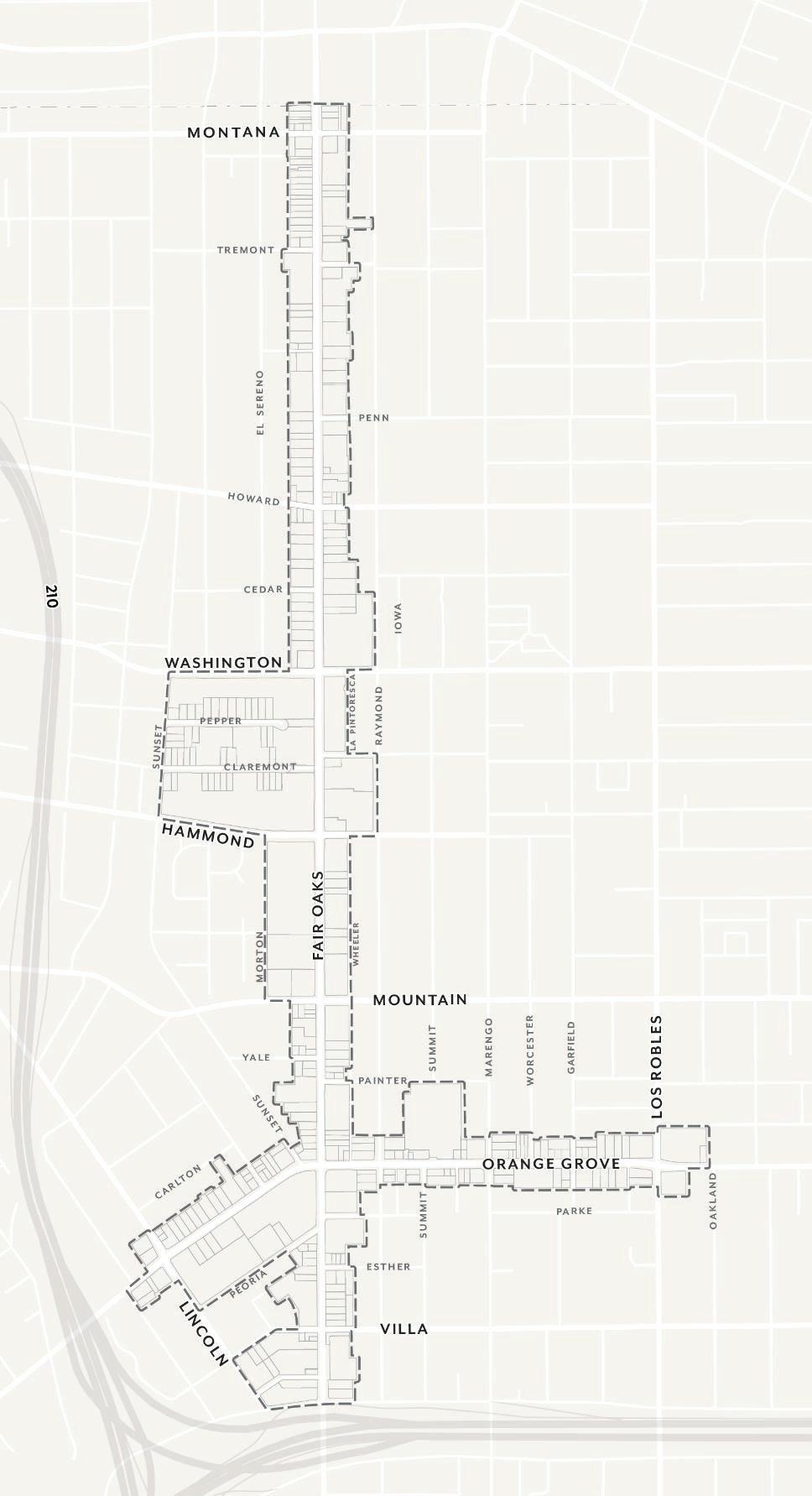
NOTICE OF PETITION TO ADMINISTER ESTATE OF DAVID PAUL NEEDLES
CASE NO. 26STPB03651
To all heirs, beneficiaries, creditors, contingent creditors, and persons who may otherwise be interested in the will or estate, or both, of: DAVID PAUL NEEDLES
A Petition for Probate has been filed by GILLIAN BAGWELL in the Superior Court of California, County of LOS ANGELES. The Petition for Probate requests that GILLIAN BAGWELL be appointed as personal representative to administer the estate of the decedent.
The Petition requests authority to administer the estate under the Independent Administration of Estates Act. (This authority will allow the personal representative to take many actions without obtaining court approval. Before taking certain very important actions, however, the personal representative will be required to give notice to interested persons unless they have waived notice or consented to the proposed action.)
The independent administration authority will be granted unless an interested person files an objection to the petition and shows good cause why the court should not grant the authority.
A hearing on the petition will be held in this court on 5/4/2026 at 8:30 A.M. in Dept. 4 Room N/A located at 111 NORTH HILL STREET, LOS ANGELES, CA 90012.
If you object to the granting of the petition, you should appear at the hearing and state your objections or file written objections with the court before the hearing. Your appearance may be in person or by your attorney.
If you are a creditor or a contingent creditor of the decedent, you must
THE PETITION requests the decedent’s WILL and codicils, if any, be admitted to probate. The WILL and any codicils are available for examination in the file kept by the court.
THE PETITION requests authority to administer the estate under the Independent Administration of Estates Act. (This authority will allow the personal representative to take many actions without obtaining court approval. Before taking certain very important actions, however, the personal representative will be required to give notice to interested persons unless they have waived notice or consented to the proposed action.)
The independent administration authority will be granted unless an interested person files an objection to the petition and shows good cause why the court should not grant the authority.
A HEARING on the petition will be held in this court as follows: 05/08/26 at 8:30AM in Dept. 29 located at 111 N. HILL ST., LOS ANGELES, CA 90012
IF YOU OBJECT to the granting of the petition, you should appear at the hearing and state your objections or file written objections with the court before the hearing. Your appearance may be in person or by your attorney.
IF YOU ARE A CREDITOR or a contingent creditor of the decedent, you must file your claim with the court and mail a copy to the personal representative appointed by the court within the later of either (1) four months from the date of first issuance of letters to a general personal representative, as defined in section 58(b) of the California Probate Code, or (2) 60 days from the date of mailing or personal delivery to you of a notice under section 9052 of the California Probate Code.
Other California statutes and legal authority may affect your rights as a creditor. You may want to consult with an attorney knowledgeable in California law.
YOU MAY EXAMINE the file kept by the court. If you are a person interested in the estate, you may file with the court a Request for Special Notice (form DE-154) of the filing of an inventory and appraisal of estate assets or of any petition or account as provided in Probate Code section 1250. A Request for Special Notice form is available from the court clerk. Attorney for Petitioner
KEVIN CHIU - SBN 249479
file your claim with the court and mail a copy to the personal representative appointed by the court within the later of either (1) four months from the date of first issuance of letters to a general personal representative, as defined in section 58(b) of the California Probate Code, or (2) 60 days from the date of mailing or personal delivery to you of a notice under section 9052 of the California Probate Code.
Other California statutes and legal authority may affect your rights as a creditor. You may want to consult with an attorney knowledgeable in California law. You may examine the file kept by the court. If you are a person interested in the estate, you may file with the court a Request for Special Notice (form DE-154) of the filing of an inventory and appraisal of estate assets or of any petition or account as provided in Probate Code section 1250. A Request for Special Notice form is available from the court clerk.
Attorney for Petitioner: G. FRANCHESCA CALLEJO, 1831 SOLANO AVENUE, NO. 7328, BERKELEY, CA 94707, Telephone: 510-526-7209 4/9, 4/13, 4/20/26 CNS-4030311# PASADENA PRESS
NOTICE OF PETITION TO ADMINISTER ESTATE OF: REBECCA F. WHITE CASE NO. 26STPB03922
To all heirs, beneficiaries, creditors, contingent creditors, and persons who may otherwise be interested in the WILL or estate, or both of REBECCA F. WHITE. A PETITION FOR PROBATE has been filed by DANIEL R. GEORGIADES AND SARAH ERNST in the Superior Court of California, County of
authority. A HEARING on the petition will be held in this court as follows: 05/08/26 at 8:30AM in Dept. 217 located at 111 N. HILL ST., LOS ANGELES, CA 90012
IF YOU OBJECT to the granting of the petition, you should appear at the hearing and state your objections or file written objections with the court before the hearing. Your appearance may be in person or by your attorney.
IF YOU ARE A CREDITOR or a contingent creditor of the decedent, you must file your claim with the court and mail a copy to the personal representative appointed by the court within the later of either (1) four months from the date of first issuance of letters to a general personal representative, as defined in section 58(b) of the California Probate Code, or (2) 60 days from the date of mailing or personal delivery to you of a notice under section 9052 of the California Probate Code. Other California statutes and legal authority may affect your rights as a creditor. You may want to consult with an attorney knowledgeable in California law.
YOU MAY EXAMINE the file kept by the court. If you are a person interested in the estate, you may file with the court a Request for Special Notice (form DE-154) of the filing of an inventory and appraisal of estate assets or of any petition or account as provided in Probate Code section 1250. A Request for Special Notice form is available from the court clerk. Attorney for Petitioner
JULIA L. BIRKEL - SBN 115429
JORDAN C. PARR - SBN 332114
HILL FARRER & BURRILL LLP
515 S. FLOWER ST., 7TH FLOOR LOS ANGELES CA 90071
Telephone (213) 621-0460 4/16, 4/20, 4/23/26 CNS-4032574# PASADENA PRESS
NOTICE OF PETITION TO ADMINISTER ESTATE OF SHIZUYA HAYAKAWA MADERE, AKA SHIZUYA MADERE CASE NO. 30-2026-01560763-PR-LACMC
To all heirs, beneficiaries, creditors, contingent creditors, and persons who may otherwise be interested in the will or estate, or both, of: SHIZUYA HAYAKAWA MADERE, AKA SHIZUYA MADERE.
HART, MIERAS & MORRIS, INC. 255 E. SANTA CLARA ST., #300 PASADENA CA 91006 Telephone (626) 607-1411 4/13, 4/16, 4/20/26 CNS-4032865# PASADENA PRESS
NOTICE OF PETITION TO ADMINISTER ESTATE OF: DRURY SHERROD AKA DRURY R. SHERROD III CASE NO. 26STPB00822
To all heirs, beneficiaries, creditors, contingent creditors, and persons who may otherwise be interested in the WILL or estate, or both of DRURY SHERROD AKA DRURY R. SHERROD III.
A PETITION FOR PROBATE has been filed by ROBERT YOUNG in the Superior Court of California, County of LOS ANGELES.
THE PETITION FOR PROBATE requests that ROBERT YOUNG be appointed as personal representative to administer the estate of the decedent.
THE PETITION requests the decedent’s WILL and codicils, if any, be admitted to probate. The WILL and any codicils are available for examination in the file kept by the court.
THE PETITION requests authority to administer the estate under the Independent Administration of Estates Act. (This authority will allow the personal representative to take many actions without obtaining court approval. Before taking certain very important actions, however, the personal representative will be required to give notice to interested persons unless they have waived notice or consented to the proposed action.)
The independent administration authority will be granted unless an interested person files an objection to the petition and shows good cause why the court should not grant the
A Petition for Probate has been filed by SHARON TUCKER, SUSAN ANESI, AND SANDY GUIDICIANNE in the Superior Court of California, County of ORANGE. The Petition for Probate requests that SHARON TUCKER, SUSAN ANESI, AND SANDY GUIDICIANNE be appointed as personal representative to administer the estate of the decedent. The Petition requests authority to administer the estate under the Independent Administration of Estates Act. (This authority will allow the personal representative to take many actions without obtaining court approval. Before taking certain very important actions, however, the personal representative will be required to give notice to interested persons unless they have waived notice or consented to the proposed action.) The independent administration authority will be granted unless an interested person files an objection to the petition and shows good cause why the court should not grant the authority.
A hearing on the petition will be held in this court on June 17, 2026 at 1:30 p.m. in Dept. CM08 located at 3390 Harbor Boulevard, Costa Mesa, CA 92626, Costa Mesa Justice Complex.
If you object to the granting of the petition, you should appear at the hearing and state your objections or file written objections with the court before the hearing. Your appearance may be in person or by your attorney.
If you are a creditor or a contingent creditor of the decedent, you must file your claim with the court and mail a copy to the personal representative appointed by the court within the later of either (1) four months from the date of first issuance of letters to a general personal representative, as defined in section 58(b) of the California Probate Code, or (2) 60 days from the date of mailing or personal delivery to you of a notice under section 9052 of the California
recorded in Book 10, Page 39 of Deeds. Also except therefrom one-half of all oil, gas and other hydrocarbon substances in and under said land, as reserved in Deed recorded in Book D2253, Page 119, Official Records. Parcel 2: Nonexclusive easements and rights for access, ingress and egress and other purposes, as set forth in the Declaration of Covenants, Conditions, Restrictions and Reservation of Easements for Claybourne ridge, recorded on November 9, 2000 as Instrument No. 2000-1760136, Official Records of said county, and any amendments thereto (“The Declaration”). EXHIBIT “B’ Personal Property All equipment, fixtures, and other articles of personal property now or hereafter owned by Trustor, and now or hereafter attached or affixed to the Real Property; together with all accessions, parts, and additions to, all replacements of, and all substitutions for, any of such property; and together with all proceeds (including without limitation all insurance proceeds and refunds of premiums) from any sale or other disposition of the Property. Please Publish 959171 / 2025-100893, West Covina- West Covina Press, 04-202026,04-27-2026,05-04-2026
Name of Registrant(s): COASTAL FAMILY MEDICINE, INC (CA, 17360 Brookhurst St, Fountain Valley, CA 92708. This business is conducted by an corporation. WOODBRIDGE WALK-IN MEDICAL GROUP, INC.. /s/ DAVID S. KIM, CEO (Chief Executive Officer). This statement was filed with the County Clerk on March 19, 2026. Published in: Anaheim Press 03/30/2026, 04/06/2026, 04/13/2026, 04/20/2026
The following person(s) is (are) doing business as (1). Axios Enterprises (2). AXIOS ENGRAVING (3). AXIOS RECOGNITION SYSTEMS 33410 Rancho California Rd Temecula, CA 92591 Riverside County Mailing Address, 33410 Rancho California Road, Temecula, CA 92591. Riverside County CELEBRATION CELLARS LLC (CA, 33410 Rancho California Road, Temecula, CA 92591 Riverside County
FICTITIOUS BUSINESS NAME STATEMENT File No. FBN20260002292
The following persons are doing business as: CERTIFIED AUTO ELECTRIC, 1201 E Foothill Blvd, Upland, CA 91786. Mailing Address, 1201 E Foothill Blvd, Upland, CA 91786. ANDREW ALKATIME. County of Principal Place of Business: San Bernardino This business is conducted by: a individual. Registrant commenced to transact business under the fictitious business name or names listed herein on February 20, 2026. By signing below, I declare that I have read and understand the reverse side of this form and that all information in this statement is true and correct. A registrant who declares as true any material matter pursuant to Section 17913 of the Business and Professions Code that the registrant knows to be false is guilty of a misdemeanor punishable by a fine not to exceed one thousand dollars ($1,000). I am also aware that all information on this statement becomes Public Record upon filing pursuant to the California Public Records Act (Government Code Sections 6250- 6277). /s/ ANDREW ALKATIME, Owner. This statement was filed with the County Clerk of San Bernardino on March 18, 2026 Notice- In accordance with subdivision (a) of Section 17920. A Fictitious Name Statement generally expires at the end of five years from the date on which it was filed in the office of the County Clerk, except, as provided in subdivision (b) of Section 17920, where it expires 40 days after any change in the facts set forth in the statement pursuant to Section 17913 other than a change in the residence address of a registered owner. A new Fictitious Business Name Statement must be filed before the expiration. The filing of this statement does not of itself authorize the use in this state of a fictitious business name in violation of the rights of another under federal, state, or common law (see Section 14411 et seq., Business and Professions Code) File#: FBN20260002292 Pub: 03/30/2026, 04/06/2026, 04/13/2026, 04/20/2026 San Bernardino Press
STATEMENT OF ABANDONMENT OF USE OF FICTITIOUS BUSINESS NAME 20266738622. The following person(s) has(have) abandoned the use of the Fictitious Business Name: COSTA MESA URGENT CARE, 660 BAKER ST SUITE A-102, COSTA MESA, CA 92626. Mailing Address, 17360 Brookhurst St, Fountain Valley, CA 92708. The Fictitious Business Name referred to above was filed in Orange County on: February 14, 2024. FILE NO. 20246683001 Full Name of Registrant(s): COASTAL FAMILY MEDICINE, INC (CA, 17360 Brookhurst St, Fountain Valley, CA 92708. This business is conducted by an corporation. COSTA MESA URGENT CARE. /s/ DAVID S. KIM, CEO (Chief Executive Officer). This statement was filed with the County Clerk on March 19, 2026. Published in: Anaheim Press 03/30/2026, 04/06/2026, 04/13/2026, 04/20/2026
STATEMENT OF ABANDONMENT OF USE OF FICTITIOUS BUSINESS NAME 20266738621. The following person(s) has(have) abandoned the use of the Fictitious Business Name: WOODBRIDGE WALK-IN MEDICAL GROUP, INC., 4950 BARRANCA PKWY SUITE 104, IRVINE, CA 92604. Mailing Address, 17360 Brookhurst St, Fountain Valley, CA 92708 . The Fictitious Business Name referred to above was filed in Orange County on: February 14, 2024. FILE NO. 20246682989 Full
This business is conducted by: a limited liability company (llc). Registrant has not yet begun to transact business under the fictitious business name or names listed herein. I declare that all the information in this statement is true and correct. (A registrant who declares as true any material matter pursuant to Section 17913 of the Business and Professions Code, that the registrant knows to be false, is guilty of a misdemeanor punishable by a fine not to exceed one thousands dollars ($1000).)
s. CANE VANDERHOOF, Manager, CEO Statement filed with the County of Riverside on March 23, 2026
NOTICE: In accordance with subdivision (a) of section 17920, a fictitious name statement generally expires at the end of the five years from the date on which it was filed in the office of the county clerk, except, as provided in subdivision (b) of section 17920, where it expires 40 days after any changes in the facts set forth in the statement pursuant to section 17913 other than a change in the residence address of a registered owner. A new Fictitious Business Name Statement must be filed before the expiration. The filing of this statement does not of itself authorize the use this state of a fictitious business name in violation of the rights of another under federal, state, or common law (see Section 14411 Et Seq., business and professions code). I hereby certify that this copy is a correct copy of the original statement on file in my office.
Peter Aldana, County, Clerk File# R-202604237 Pub. 03/30/2026, 04/06/2026, 04/13/2026, 04/20/2026 Riverside Independent
The following person(s) is (are) doing business as Legend Massage 24490 Sunnymead Blvd, Suite 118 Moreno Valley, CA 92553 Riverside County Shaohua He, 24490 Sunnymead Blvd, Suite 118, Moreno Valley, CA 92553 Riverside County
This business is conducted by: a individual. Registrant has not yet begun to transact business under the fictitious business name or names listed herein. I declare that all the information in this statement is true and correct. (A registrant who declares as true any material matter pursuant to Section 17913 of the Business and Professions Code, that the registrant knows to be false, is guilty of a misdemeanor punishable by a fine not to exceed one thousands dollars ($1000).)
s. Shaohua He Statement filed with the County of Riverside on March 10, 2026 NOTICE: In accordance with subdivision (a) of section 17920, a fictitious name statement generally expires at the end of the five years from the date on which it was filed in the office of the county clerk, except, as provided in subdivision (b) of section 17920, where it expires 40 days after any changes in the facts set forth in the statement pursuant to section 17913 other than a change in the residence address of a registered owner. A new Fictitious Business Name Statement must be filed before the expiration. The filing of this statement does not of itself authorize the use this state of a fictitious business name in violation of the rights of another under federal, state, or common law (see Section 14411 Et Seq., business and professions code). I hereby certify that this copy is a correct copy of the original statement on file in my office. Peter Aldana, County, Clerk File# R-202603403 Pub. 03/30/2026, 04/06/2026, 04/13/2026, 04/20/2026 Riverside Independent
The following person(s) is (are) doing business as IDC HOMES 1152 Kendrick Court Corona, CA 92881
Riverside County Ghina Itani, 1152 Kendrick Court, Corona, CA 92881
Riverside County
This business is conducted by: a individual. Registrant has not yet begun to transact business under the fictitious business name or names listed herein. I declare that all the information in this statement is true and correct. (A registrant who declares as true any material matter pursuant to Section 17913 of the Business and Professions Code, that the registrant knows to be false, is guilty of a misdemeanor punishable by a fine not to exceed one thousands dollars ($1000).)
s. Ghina Itani
Statement filed with the County of Riverside on March 18, 2026
NOTICE: In accordance with subdivision (a) of section 17920, a fictitious name statement generally expires at the end of the five years from the date on which it was filed in the office of the county clerk, except, as provided in subdivision (b) of section 17920, where it expires 40 days after any changes in the facts set forth in the statement pursuant to section 17913 other than a change in the residence address of a registered owner. A new Fictitious Business Name Statement must be filed before the expiration. The filing of this statement does not of itself authorize the use this state of a fictitious business name in violation of the rights of another under federal, state, or common law (see Section 14411 Et Seq., business and professions code). I hereby certify that this copy is a correct copy of the original statement on file in my office.
Peter Aldana, County, Clerk File# R-202603906
Pub. 03/30/2026, 04/06/2026, 04/13/2026, 04/20/2026 Riverside Independent
The following person(s) is (are) doing business as 2S: TRUE CRIME QUARTERS 28039 Scott Rd STE. D #263 Murrieta, CA 92563
Riverside County Michael Santana, 28039 Scott Rd STE D #263, Murrieta, CA 92563
Riverside County
This business is conducted by: a individual. Registrant has not yet begun to transact business under the fictitious business name or names listed herein. I declare that all the information in this statement is true and correct. (A registrant who declares as true any material matter pursuant to Section 17913 of the Business and Professions Code, that the registrant knows to be false, is guilty of a misdemeanor punishable by a fine not to exceed one thousands dollars ($1000).)
s. Michael Santana Statement filed with the County of Riverside on March 17, 2026
NOTICE: In accordance with subdivision (a) of section 17920, a fictitious name statement generally expires at the end of the five years from the date on which it was filed in the office of the county clerk, except, as provided in subdivision (b) of section 17920, where it expires 40 days after any changes in the facts set forth in the statement pursuant to section 17913 other than a change in the residence address of a registered owner. A new Fictitious Business Name Statement must be filed before the expiration. The filing of this statement does not of itself authorize the use this state of a fictitious business name in violation of the rights of another under federal, state, or common law (see Section 14411 Et Seq., business and professions code). I hereby certify that this copy is a correct copy of the original statement on file in my office.
Peter Aldana, County, Clerk File# R-202603840 Pub. 03/30/2026, 04/06/2026, 04/13/2026, 04/20/2026 Riverside Independent
FICTITIOUS BUSINESS NAME STATEMENT 20266738269. The following person(s) is (are) doing business as: Julie’s Barber, 10515 Mcfadden Ave Ste 103, Garden Grove, CA 92843. Full Name of Registrant(s) Julie Trinh, 10515 Mcfadden Ave Ste 103, Garden Grove, CA 92843. This business is conducted by a individual. Registrant commenced to transact business under the fictitious business name or names listed herein on December 1, 2005. /S/ Julie Trinh. This statement was filed with the County Clerk of Orange County on March
17, 2026. Publish: Anaheim Press 04/06/2026, 04/13/2026, 04/20/2026, 04/27/2026s sc
FICTITIOUS BUSINESS NAME STATEMENT File No. FBN20260001541
The following persons are doing business as: (1). Nova Intelligence (2). BEU Institute AI (3). Business Elevation University (BEU) (4). AI Wealth Shift (5). Fiscal Roots (6). WealthKen (7). Prompt Profits (8). Tax Optimization Blueprint (9). AI Wealth Tools Accelerator (10). Key Money Club (11). BEU Institute (12). BEUInstitute.AI , 3350 Shelby St Ste 200, Ontario, CA 91764. Mailing Address, 3350 Shelby St Ste 200, Ontario, CA 91764. # of Employees 1. Nova intelligence. inc (CA-B20260054142, 3350 Shelby St Ste 200, Ontario, CA 91764; Remy S Chikasu, CEO. County of Principal Place of Business: San Bernardino This business is conducted by: a corporation. Registrant has not yet begun to transact business under the fictitious business name or names listed herein. By signing below, I declare that I have read and understand the reverse side of this form and that all information in this statement is true and correct. A registrant who declares as true any material matter pursuant to Section 17913 of the Business and Professions Code that the registrant knows to be false is guilty of a misdemeanor punishable by a fine not to exceed one thousand dollars ($1,000). I am also aware that all information on this statement becomes Public Record upon filing pursuant to the California Public Records Act (Government Code Sections 6250- 6277). /s/ Remy S Chikasu, CEO. This statement was filed with the County Clerk of San Bernardino on February 27, 2026 Notice- In accordance with subdivision (a) of Section 17920. A Fictitious Name Statement generally expires at the end of five years from the date on which it was filed in the office of the County Clerk, except, as provided in subdivision (b) of Section 17920, where it expires 40 days after any change in the facts set forth in the statement pursuant to Section 17913 other than a change in the residence address of a registered owner. A new Fictitious Business Name Statement must be filed before the expiration. The filing of this statement does not of itself authorize the use in this state of a fictitious business name in violation of the rights of another under federal, state, or common law (see Section 14411 et seq., Business and Professions Code) File#: FBN20260001541 Pub: 04/06/2026, 04/13/2026, 04/20/2026, 04/27/2026 San Bernardino Press
The following person(s) is (are) doing business as WESTCOAST AUTO BROKERS 11801 Pierce St Suite 265 Riverside, CA 92505 Riverside County WESTCOAST AUTO BROKERS, llc (CA, 9754 Foxglove Dr, Riverside, CA 92503 Riverside County
This business is conducted by: a limited liability company (llc). Registrant has not yet begun to transact business under the fictitious business name or names listed herein. I declare that all the information in this statement is true and correct. (A registrant who declares as true any material matter pursuant to Section 17913 of the Business and Professions Code, that the registrant knows to be false, is guilty of a misdemeanor punishable by a fine not to exceed one thousands dollars ($1000).)
s. GILBERTO A PUON MAZARIEGOS, MEMBER
Statement filed with the County of Riverside on March 16, 2026
NOTICE: In accordance with subdivision (a) of section 17920, a fictitious name statement generally expires at the end of the five years from the date on which it was filed in the office of the county clerk, except, as provided in subdivision (b) of section 17920, where it expires 40 days after any changes in the facts set forth in the statement pursuant to section 17913 other than a change in the residence address of a registered owner. A new Fictitious Business Name Statement must be filed before the expiration. The filing of this statement does not of itself authorize the use this state of a fictitious business name in violation of the rights of another under federal, state, or common law (see Section 14411 Et Seq., business and professions code). I hereby certify that this copy is a correct copy of the original statement on file in my office. Peter Aldana, County, Clerk
File# R-202603754 Pub. 04/06/2026, 04/13/2026, 04/20/2026, 04/27/2026 Riverside Independent
FICTITIOUS BUSINESS NAME STATEMENT File No. FBN20260002799
The following persons are doing business as: West Coast Sourdough Ontario, 2780 E Riverside Dr Suite A, Ontario, CA 91761. Mailing Address, 603 S Milliken Ave, Suite F, Ontario, Ca 91761. # of Employees 12. WCS Ontario Inc (CA, 603 S Milliken Ave F, Ontario, CA 91761; Caleb Cabrera, President. County of Principal Place of Business: San Bernardino This business is conducted by: a corporation. Registrant commenced to transact business under the fictitious business name or names listed herein on February 6, 2026. By signing below, I declare that I have read and understand the reverse side of this form and that all information in this statement is true and correct. A registrant who declares as true any material matter pursuant to Section 17913 of the Business and Professions Code that the registrant knows to be false is guilty of a misdemeanor punishable by a fine not to exceed one thousand dollars ($1,000). I am also aware that all information on this statement becomes Public Record upon filing pursuant to the California Public Records Act (Government Code Sections 6250- 6277). /s/ Caleb Cabrera, President. This statement was filed with the County Clerk of San Bernardino on April 2, 2026 Notice- In accordance with subdivision (a) of Section 17920. A Fictitious Name Statement generally expires at the end of five years from the date on which it was filed in the office of the County Clerk, except, as provided in subdivision (b) of Section 17920, where it expires 40 days after any change in the facts set forth in the statement pursuant to Section 17913 other than a change in the residence address of a registered owner. A new Fictitious Business Name Statement must be filed before the expiration. The filing of this statement does not of itself authorize the use in this state of a fictitious business name in violation of the rights of another under federal, state, or common law (see Section 14411 et seq., Business and Professions Code) File#: FBN20260002799 Pub: 04/13/2026, 04/20/2026, 04/27/2026, 05/04/2026 San Bernardino Press
FICTITIOUS BUSINESS NAME STATEMENT 2026739916. The following person(s) is (are) doing business as: Utility Consultants of Orange County, 23101 Moulton Pkwy #202, Laguna Hills, CA 92653. Full Name of Registrant(s) Mike Schneider Inc (CA, 23101 Moulton Pkwy #202, Laguna Hills, CA 92653. This business is conducted by a corporation. Registrant commenced to transact business under the fictitious business name or names listed herein on March 1, 1989. Utility Consultants of Orange County. /S/ Michael Schneider, President. This statement was filed with the County Clerk of Orange County on April 7, 2026. Publish: Anaheim Press 04/20/2026, 04/27/2026, 05/04/2026, 05/11/2026
FICTITIOUS BUSINESS NAME STATEMENT File No. FBN20260003489
The following persons are doing business as: Ridge 909, 6371 haven ave ste 3 #52, Rancho Cucamonga, CA 91737. Mailing Address, 6371 haven ave ste 3 #52, Rancho Cucamonga, CA 91737. # of Employees 0. Gabriel Treuhaft. County of Principal Place of Business: San Bernardino This business is conducted by: a individual. Registrant commenced to transact business under the fictitious business name or names listed herein on April 8, 2026. By signing below, I declare that I have read and understand the reverse side of this form and that all information in this statement is true and correct. A registrant who declares as true any material matter pursuant to Section 17913 of the Business and Professions Code that the registrant knows to be false is guilty of a misdemeanor punishable by a fine not to exceed one thousand dollars ($1,000). I am also aware that all information on this statement becomes Public Record upon filing pursuant to the California Public Records Act (Government Code Sections 6250- 6277). /s/ Gabriel Treuhaft, Owner. This statement was filed with the County Clerk of San Bernardino on April 14, 2026 Notice- In accordance with subdivision (a) of Section 17920. A Fictitious Name Statement generally expires at the end of five years from the date on which it was filed in the office of the County Clerk, except, as provided in subdivision (b) of Section 17920, where it expires
40 days after any change in the facts set forth in the statement pursuant to Section 17913 other than a change in the residence address of a registered owner. A new Ficti-
ness and Professions Code) File#: FBN20260003489 Pub: 04/20/2026, 04/27/2026, 05/04/2026, 05/11/2026 San Bernardino Press
FICTITIOUS BUSINESS NAME STATEMENT File No. FBN20260003525 The following persons are doing business as: Empire Apartments, 3132 Triumph Lane, Ontario, CA 91764. Mailing Address, PO Box 1919, Rancho Cucamonga, CA 91727. VMA Apartments 1, LLC (CA, 3595 Inland Empire Blvd BLDG 2 #2100, Ontario, CA 91764; Victor M Martinez, Managing member. County of Principal Place of Business: San Bernardino This business is conducted by: a limited liability company (llc). Registrant commenced to transact business under the fictitious business name or names listed herein on April 9, 2026. By signing below, I declare that I have read and understand the reverse side of this form and that all information in this statement is true and correct. A registrant who declares as true any material matter pursuant to Section 17913 of the Business and Professions Code that the registrant knows to be false is guilty of a misdemeanor punishable by a fine not to exceed one thousand dollars ($1,000). I am also aware that all information on this statement becomes Public Record upon filing pursuant to the California Public Records Act (Government Code Sections 6250- 6277). /s/ Victor M Martinez, Managing member. This statement was filed with the County Clerk of San Bernardino on April 15, 2026 Notice- In accordance with subdivision (a) of Section 17920. A Fictitious Name Statement generally expires at the end of five years from the date on which it was filed in the office of the County Clerk, except, as provided in subdivision (b) of Section 17920, where it expires 40 days after any change in the facts set forth in the statement pursuant to Section 17913 other than a change in the residence address of a registered owner. A new Fictitious Business Name Statement must be filed before the expiration. The filing of this statement does not of itself authorize the use in this state of a fictitious business name in violation of the rights of another under federal, state, or common law (see Section 14411 et seq., Business and Professions Code) File#: FBN20260003525 Pub: 04/20/2026, 04/27/2026, 05/04/2026, 05/11/2026 San Bernardino Press
FILE NO. FBN20260003378 FILED: April 13, 2026 FICTITIOUS BUSINESS NAME STATEMENT ABANDONMENT: County of Original Filing: San Bernardino
Date of Original Filing: April 13, 2022
File No.: FBN20220003383 Fictitious Business Name(s): Brow Bar threading studio 12200B Central Avenue Chino, CA 91710 San Bernardino County Mailing Address, 12200 B Central Ave, Chino, CA 92880. San Bernardino County Name of Registrant: (1). Kalpana Bogati (2). Radha Dhami This business is/was conducted by: a general partnership Registrant commenced to transact business under the fictitious business name or names listed herein on March 1, 2022 BY SIGNING BELOW, I DECLARE THAT I HAVE READ AND UNDERSTAND THE REVERSE SIDE OF THIS FORM AND THAT ALL INFORMATION IN THIS STATEMENT IS TRUE AND CORRECT. (A registrant who declares as true any material matter pursuant to Section 17913 of the Business and Professions Code that the registrant knows to be false is guilty of a misdemeanor punishable by a fine not to exceed one thousand dollars ($1,000).) I am also aware that all information on this statement becomes public record upon filing pursuant to the California Public Records Act (Government Code Sections 6250-6277). FBN20260003378 /s/ Kalpana Bogati, Owner 04/20/2026, 04/27/2026, 05/04/2026, 05/11/2026 San Bernardino Press
By Staff
This May, San Bernardino County Library branches will transform into immersive battlegrounds of imagination during “Intergalactic Fan Wars,” an all-ages celebration, inviting the community to take part in the ultimate sci-fi showdown: Star Wars vs. Star Trek.
Blending reading incentives with fandom excitement, the program encourages patrons to explore the library’s collections while pledging allegiance to their favorite universe. Whether inspired by the Force or captivated by the final frontier, patrons can earn themed rewards simply by reading.
Throughout the month, patrons who check out 30 items will have the opportunity to select a special incentive aligned with their chosen fandom.
“‘Intergalactic Fan Wars’ is about more than choosing sides — it’s about bringing people together through stories that have inspired generations,” said Assistant County Librarian Kristin Stevens. “We’re excited to create an experience where reading becomes a shared adventure, and every checkout fuels the fun.”
In addition to literacybased activities, select events
will feature face painters and balloon artists, giving children the chance to transform into their favorite intergalactic heroes, villains and explorers.
As part of the celebration, patrons who meet their branch’s checkout requirements during Intergalactic Fan Wars will earn a themed reward aligned with their chosen universe, along with an opportunity to win a grand prize. All events are free and open to the public.
Programs are designed primarily for children and families, though fans of all ages are welcome to attend.
Plan your mission and join the action—explore the event schedule to find your nearest Intergalactic Fan Wars experience.
Twentynine Palms Branch
6078 Adobe Road, Twentynine Palms
Saturday, May 2 | 1 to 3 p.m.
Muscoy Baker Family Learning Center
2818 Macy St., Muscoy Saturday, May 2 | 2 to 4 p.m.
Joshua Tree Branch Library 6465 Park Blvd., Joshua Tree
Thursday, May 7 | 12:30 to 1:30 p.m.
Barstow Branch
304 E. Buena Vista St.,
Barstow
Saturday, May 9 | 2 to 4 p.m.
Chino Hills James S. Thalman Branch
14020 City Center Drive, Chino Hills
Tuesday, May 12 | 3 to 6
p.m.
Apple Valley Newton T. Bass Branch
14901 Dale Evans Parkway, Apple Valley Tuesday, May 12 | 4 to 6 p.m.
Yucaipa Branch 12040 5th St., Yucaipa
Tuesday, May 12 | 4 to 6 p.m.
Grand Terrace Branch 22795 Barton Road, Grand Terrace
Wednesday, May 13 | 3:30 to 5:30 p.m.
Montclair Branch 9955 Fremont Ave., Montclair
Friday, May 15 | 4 to 5 p.m.
Adelanto Branch 11497 Bartlett Ave., Adelanto
Saturday, May 16 | 2 to 4 p.m.
Lake Arrowhead Branch 27235 Highway 189, Blue Jay Tuesday, May 19 | 4 to 5:30 p.m.
Bloomington Branch 18028 Valley Blvd., Bloomington Wednesday, May 20 | 3 to 5

p.m.
Chino Branch 13180 Central Ave., Chino Wednesday, May 20 | 4 to 6 p.m.
Crestline Branch 24105 Lake Gregory Drive, Crestline Wednesday, May 20 | 4 to 6 p.m.
Hesperia Branch 9650 7th Ave., Hesperia Thursday, May 21 | 4:30 to 6:30 p.m.
Loma Linda Branch 25581 Barton Rd., Loma Linda
Tuesday, May 26 | 3 to 5 p.m.
Big Bear Lake Branch 41930 Garstin Drive, Big Bear Lake Tuesday, May 26 | 4 to 6 p.m.
Fontana Lewis Library and Technology Center 8437 Sierra Ave., Fontana Tuesday, May 26 | 4 to 7 p.m.
Highland Sam J. Racadio Library and Environmental Learning Center 7863 Central Ave., Highland
Wednesday, May 27 | 4 to 6 p.m.
Mentone Senior Center and Library 1331 Opal Ave., Mentone
Thursday, May 28 | 3 to 5 p.m. Phelan Memorial Library 9800 Clovis Road, Phelan Thursday, May 28 | 4:30 to 5:30 p.m.
For more information about the San Bernardino County Library system, visit library.sbcounty.gov or call 909-387-2220.
By City News Service
Awoman partly responsible for supplying a deadly dose of fentanyl to a 35-year-old Riverside man was sentenced Tuesday to 12 years, four months in state prison.
Jaclyn Christine Sherman, 32, of Riverside, pleaded guilty in February to one count each of voluntary manslaughter and transportation of controlled substances for sale. The pretrial agreement with the Riverside County District Attorney’s Office led to the dismissal of two related charges.
Sherman was one of three people involved in the death of Christopher Nicholas Lucia in 2023.
During a hearing at the Riverside Hall of Justice Tuesday, Superior Court Judge Joshlyn Pulliam certified the terms of the plea deal and imposed the stipulated sentence on Sherman.
Her co-defendants — Miguel Garcia, 39, of Riverside, and David Ray Mullins,
48, of Jurupa Valley — were both previously sentenced to six-year prison terms under separate plea agreements with prosecutors. Each man admitted to charges of involuntary manslaughter, possession of drugs for sale and transportation of controlled substances for sale.
Sherman and Garcia delivered the fentanyl that killed Lucia. Mullins was the original source of the synthetic opioid, prosecutors said. According to an arrest declaration affidavit filed by Riverside Police Department Detective Scott Levesque, Garcia and Sherman were partners in narcotics sales to a stream of purchasers throughout the Riverside metropolitan area.
In the predawn hours of Nov. 8, 2023, they met Lucia after he contacted Sherman via text requesting two grams of fentanyl, the affidavit said. While sitting in the back of Garcia’s Honda Element
compact crossover SUV, the victim consumed the drug as his girlfriend waited for him in his car, parked nearby on Stony Brooke Circle.
Lucia returned to his vehicle moments later and got behind the wheel, Levesque said.
“Since he was already becoming irritable and sick, it’s possible he used a larger dose (of fentanyl) than normal, which could cause a higher-than- normal amount of the drug to enter the blood stream,” the detective said.
Lucia drove a short distance before falling unconscious, prompting his girlfriend, whose name wasn’t disclosed, to call 911. Lucia lingered in a coma for five days, then died.
Garcia and Sherman were soon identified as the sellers, and a search warrant was obtained and served at their shared residence in the 4900 block of Gardena Drive.
“Detectives located and seized more than three-

quarter pounds of powdered fentanyl, as well as evidence these suspects continued selling fentanyl after Christopher’s death,” Riverside Police Department spokesman Officer Ryan Railsback said at the time.
The defendants’ supplier was identified as Mullins, and a search warrant was executed at his property at 7226 Front Ave., where officers seized “scales, baggies, white residue and other items consistent with sales of fentanyl,” according to the affidavit.
Court records show
Sherman had documented prior convictions for petty theft and driving on a suspended license. Mullins had priors that were not listed in court documents. Garcia had no priors in Riverside County.
Since February 2021, prosecutors have charged over three dozen people in connection with fentanyl poisonings. Two prosecutions resulted in murder convictions.
Preliminary health department statistics indicated there were 229 suspected fentanylrelated fatalities countywide
in 2025, compared to 351 confirmed poisonings in 2024, a roughly 40% decline. Fentanyl is manufactured in overseas labs, principally in China, according to the U.S. Drug Enforcement Administration, which says the opioid is smuggled across the U.S.Mexico border by cartels. It’s 80 to 100 times more potent than morphine and can be mixed into any number of street narcotics and prescription drugs, without a recipient knowing what he or she is consuming. Ingestion of only 2 milligrams can be fatal.
The Board of Supervisors on Tuesday formally approved a resolution authorizing eminent domain proceedings for properties abutting Airport Boulevard in Thermal in order to facilitate a bridge improvement project.
The Transportation and Land Management Agency is overseeing the Airport Boulevard Bridge Replacement Project and requires 10 temporary and permanent easements connected to the enterprise.
“The project will increase the safety and capacity of the bridge,” county Department of Transportation Director Dennis Acuna told the board. “It will raise it up for a higher clearance over the water.”
The board previously signed off on initiation of the project. The unanimous vote Tuesday cleared the way for negotiations over the rightof-way easements, three of which are permanent, requiring acquisitions via
the government’s eminent domain authority, and seven are temporary easements, spanning the estimated 42-month duration of the project.
Documents posted to the board’s agenda stated that monetary offers had been extended to property owners, who include the Coachella Valley Water District, and the amounts were “consistent with local current property values ... based on fair market value appraisals.”
Specific figures weren’t disclosed. No residential or commercial displacements are associated with the project.
Acuna told the board the CVWD had expressed support for the bridge modifications over the last 18 months, but one of the hang-ups for the agency was whether it had clear title to the parcels at issue. Another stumbling block stems from the fact that the listed owner of record of several
By City News Service
parcels died, apparently without heirs.
“This (eminent domain process) is a way for us to sort out the ownership questions,” Acuna said.
Officials said the current two-lane Airport Boulevard span, which intersects Orange Street to the west and Desert Cactus Drive to the east, requires upgrades for long-term maintenance. Reconstruction will entail raising the bridge where it crosses the Whitewater River by two to three feet, as well as expanding and resurfacing lanes, widening sidewalks and fortifying retaining walls.
The city of Coachella is partnering with the county on the project and will be committing funds, documents stated.
As of now, $81,500 has been allocated by the county for eminent domain proceedings, but most of that has originated from the state Highway Bridge
AJune 23 trial date was confirmed Thursday for a Hemet man accused of gunning down a 30-year-old woman during an argument at their shared residence.
Koron LeKeith Lowe, 28, allegedly killed Asasha Lache Hall of Hemet in 2022.
Lowe is charged with firstdegree murder, two counts of attempted murder, assault on a police canine, resisting arrest and sentence-enhancing gun and great bodily injury allegations.
During a pretrial hearing at the Banning Justice Center Thursday, Riverside County Superior Court Judge Sylvia Luttrell conferred with the prosecution and defense regarding scheduling, and both sides agreed to prepare for trial proceedings in the last week of June.
Lowe is being held in lieu of $2 million bail at the Benoit Detention Center.
He allegedly killed Hall
during a confrontation with her and other unnamed parties on the first floor of their residence in the 3000 block of Greengable Lane, near Lavender Lane, at 6:15 a.m. on Jan. 25, 2022, according to Hemet police Lt. Nathan Miller and court documents.
Specific details regarding the conflict were not disclosed.
Miller said that, in addition to Hall and Lowe, three other adults resided at the home, along with two children, then ages 5 and 6 years old. There were also two visitors in the house that morning. They were in the line of fire.
The victims’ identities were not disclosed.
When the gunfire erupted, the mother of the two kids grabbed them and hid in an upstairs room, calling 911, according to Miller, who added two other people fled out of the garage.
Patrol officers converged on the location minutes later

Fund. No county General Fund appropriations will be required, officials said.
There was no word on when the project — the total cost of which hasn’t been confirmed — might get
By City News Service
and discovered Hall gravely wounded. She died at the scene. No one else was hurt.
Surrounding properties were evacuated as a precaution as SWAT members conducted a thorough search of the Greengable house and the immediate area. The search ended after several hours, and detectives turned their attention to Lowe, Miller said.
He said investigators worked 24 hours, determining the defendant was likely in the Banning Pass.
On the afternoon of Jan. 26, 2022, the investigative team found him in a parking lot in Cabazon, where he was holed up in his vehicle, Miller alleged.
“Investigators attempted to negotiate with Lowe, but he refused to surrender and get out of the parked car,” the lieutenant said. “Hemet police canine `Bosco’ was used to arrest Lowe and get him out of the car. Bosco
underway once the easements have been secured, provided there’s no litigation.

sustained injuries during the arrest when Lowe violently fought the dog and struck it with a sharp piece of wood.”
The defendant suffered unspecified minor injuries while allegedly resisting
arrest, but the dog’s actions enabled officers and sheriff’s deputies to wrestle Lowe into custody, according to Miller.
Bosco was taken to a veterinary clinic for treatment and later recovered. Lowe was also treated and released from the hospital the same day. The defendant has no documented prior felony convictions in Riverside County.