
Rosemead Reader
ICE insists Westlake man who died in custody wasn’t denied medical care
By City News Service
Federalimmigration officialsWednesday refuted allegations that a Westlake man who died in custody last month was denied medical care, saying he was transferred to a hospital after he reported feeling ill while being held in Adelanto.
Alberto Gutierrez Reyes, 48, died Feb. 27 at Victor Valley Global Medical Center in Victorville, according to U.S. Immigration and Customs Enforcement.
ICE officials, who said Gutierrez Reyes reported no significant health concerns when he was brought to the Adelanto ICE Processing Center on Jan. 12, reported feeling faint on Feb. 25.
“An on-site medical provider ordered him transferred to Victor Valley Global Medical Center for evaluation, where he was admitted for chest pain and shortness of breath,” according to a statement from ICE on Wednesday. “Early Feb. 27, he became unresponsive and medical staff-initiated life-saving measures. He was pronounced dead at 12:58 a.m.”
ICE officials insisted in the statement that the agency “is committed to ensuring that all those in custody reside in safe, secure and humane environments.”
“Comprehensive medical care is provided from the moment individuals arrive and throughout the entirety of their stay,” according to ICE. “All people in ICE custody receive medical, dental and mental health intake screenings within 12 hours of arriving at each detention facility; a full health assessment within 14 days of entering ICE custody or arrival at a facility; access to medical appointments; and 24-hour emergency care. At no time during detention is a detained alien denied emergency care.

“This is the best healthcare than many aliens have received in their entire lives.” Critics, however, contend that Gutierrez Reyes was denied medical attention.
A GoFundMe page established on behalf of his family contends that he began to feel seriously, and “despite his repeated requests for medical attention, he was denied the care he desperately needed.”
His wife Patricia Martinez Hernandez told ABC7 her husband had diabetes and high cholesterol, but he
received no medication.
“He would say that he wasn’t feeling well. He wasn’t feeling well,” she said. “When my son went to go see him Sunday, my son goes every Sunday, he would tell me, `Mom, dad’s skin is yellow. His face is yellow.’ Last week, the Sunday before, he told me, ‘Mom, his eyes are yellow.’”
Los Angeles City Councilwoman Eunisses Hernandez said in a social media post over the weekend that Gutierrez Reyes is the ninth person known to have died
in ICE custody this year. She contended he had been “denied medical care.”
“The Trump administration does not value human life,” Hernandez wrote. “They are using our federal tax dollars to bankroll detention and a deadly deportation machine instead of funding healthcare, food, housing, education, and the systems that actually keep people alive.
A system rooted in white supremacy and designed to cage, torture, neglect, and dehumanize human beings cannot be reformed. It must be abolished.”
GutierrezReyeswas arrested Jan. 9 during an immigrationenforcement operation in Echo Park.
According to ICE, “Gutierrez entered the United States at an unknown date and location without inspection. Gutierrez was arrested by the Los Angeles Police Department March 25, 2010, for inflicting corporal injury on a spouse or cohabitant. He was convicted March 29, 2010, and sentenced to diversion.”
The GoFundMe page states that he was “a devoted husband, a loving father and the main source of support for his family.”
“Alberto’s family is now left to navigate this heartbreaking time without the person they depended on most,” according to the page. “The sudden loss has brought not only emotional pain but also financial hardship, as Alberto was the sole provider for his wife and son. We are raising funds to help cover his funeral expenses and to support his family as they try to manage the many challenges ahead.”
The page — gofundme. com/f/justice-for-albertogutierrez — had raised just nearly $15,000 as of Thursday morning.
Bass urges careful withdrawal from
Populous counties, including 4 in SoCal, struggling to implement CARE Act
By Sta
State officials on March 2 announced ramped up efforts and more funding to help the most populous counties implement legislation that expands supportive housing and behavioral health services for mentally ill Californians experiencing unsheltered homelessness.
Touting the first statewide drop in unsheltered homelessness in more than 15 years — a 9% decline — Gov. Gavin Newsom also noted new accountability measures to speed up the adoption of CARE Court and awarded $291 million to expand supportive housing and behavioral health services.
The Community Assistance, Recovery, and Empowerment Act is intended to accelerate housing and treatment expansion under voter-approved Proposition 1. Supporters of the legislation say it aims to move mentally ill people out of the criminal justice system, off the streets and into treatment and supportive housing.
State funding for the initiative also comes from the Homeless Housing, Assistance and Prevention, or HHAP program.
Newsom designated 10 counties that are leading the state in successful implementation and identified another 10 — including Los Angeles, Orange, Riverside and San Bernardino counties — that are not effectively implementing CARE Act services to help get chronically mentally ill people off the streets and into supportive housing facilities.
“Care and accountability go hand in hand — full stop. Through CARE Court, we have seen inspirational stories of recovery and resilience, but many counties continue to lag behind their peers,” Newsom said in a statement.
“Local leaders have a moral and legal obligation to deliver this transformational tool for those who need it most. We will not accept failure and excuses when lives are on the line.”
The CARE Act took effect in 2023 and is a first-in-thenation approach to empower individuals with untreated or undertreated schizophrenia and other psychotic disorders to receive the treatment and housing needed to recover and thrive, officials said. Navigating the mental health system and maintaining a consistent treatment plan is difficult for many people suffering from mental health disorders.
The CARE Act enables mentally ill people to connect with a team of support providers, under the guidance of a civil court judge, to ensure those who need voluntary treatment do not have to go through the process alone.
Officials said that while CARE Court is overseen by a civil court judge, it is not punitive, but instead structured to optimize chances for the CARE participant’s success. The A petition submitted by the individual, a family member, first responder or mental health professional starts the process for process for receiving assistance from the program.
Eight counties, including Los Angeles, Orange and Riverside, initiated programs in 2023, and all 58 counties in the state started programs by December 2024.
Since then, over 3,800 CARE Act petitions have been submitted to courts, according to Newsom’s office. Counties have reported more than 4,000 CARE diversions, which are cases involving individuals considered for CARE who have connected with services
Alberto Gutierrez Reyes. | Photo courtesy of Karina Cruz/ GoFundMe
Minimum wage ordinance impacting LA hotels, industry report says
By Jose Herrera, City News Service
Anew survey of 92 hotels showed that 6% of jobs were eliminated after a minimum wage ordinance went into effect for tourism workers in the city, Hotel Association of Los Angeles officials said Tuesday.
The survey of 92 hotel owners -- conducted by the Hospitality Education and Research Organization, a project of the association -found hotels lost 6% of jobs after the minimum wage ordinance went into effect in September 2025.
Of the 92 respondents, about 76 reported employment impacts. About 62% of surveyed hotels said they plan to reduce staff hours in 2026.
Jackie Filla, president and CEO of the Los Angeles Hotel Association, told City News Service in a telephone interview the group commissioned the survey -with the findings compiled into a 22-page report -- to document the impacts of the ordinance on hoteliers. She said the results showed that hotel owners are feeling strain from the “financial burden.”
Filla urged Mayor Karen Bass and the City Council to repeal or amend the wage ordinance, and to work on initiatives to better promote tourism to Los Angeles.
“That would be helpful,” Fillia told CNS. “The living wage ordinance has a phased implementation and we are just looking at the first phase. For hotels, the most expensive increase actually takes place in July. So looking at what we’re already seeing in impacts. We say this is a good opportunity for the city to take a pause, take a look and make
adjustments.”
Key findings of the association’s report showed the following:
-- Hotels reported the elimination or expected loss of 6% of positions, or about 650 jobs;
-- Hotels reported reduced operating hours with nearly two-thirds of survey respondents planning to reduce staff hours in 2026;
-- About 14 respondents said they expect to close down their hotel restaurants;
-- Parking operators at hotels expect to raise prices at least 10% to meet the requirements of the wage ordinance;
-- Half of respondents said they were likely to close food and beverage outlets, gift shops or other on-site businesses.
Additionally, the report found that L.A. hotels entered 2026 with weak demand growth, limited pricing power and rising financial stress.
In December 2024, the L.A. City Council approved the Living Wage Ordinance and Hotel Worker Minimum Wage Ordinance, providing incremental wage increases for hotel and airport workers with the goal of reaching $30 per hour by July 1, 2028.
The Hotel Worker Minimum Wage Ordinance applies to hotels with 60 or more hotel rooms within the city limits, which covers approximately 150 hotels totaling 40,000 guest rooms.
Saba Waheed, director of the UCLA Labor Center, has 20 years of experience conducting research on working conditions in low wage industries. Waheed said tourism was seeing a rebound going into 2022 and 2023. The tourism
industry was seeing a rise in employment coming out of the COVID-19 losses, as well.
Workers in L.A.’s tourism industry grew from 434,200 in 2021 to 547,500 in 2024, according to data from the Los Angeles County Economic Development Corporation. There was a contraction in 2025 when the figure declined to 536,000.
Waheed said the tourism industry experienced unprecedented events in 2025 that impacted the region, which included L.A.’s wildfires, federal immigration enforcement activity and general federal policies that deterred visitors.
State officials have forecasted a 4% decline in overseas visitors and an 18% drop in visitors from Canada.
“Yet, the state is still expecting a modest rise in total tourism in 2025, accelerating in 2026,” Waheed said in an email to City News Service, adding that hotel occupancy in major cities such as Los Angeles is expected to grow over the next few years due to mega events such as the World Cup and 2028 Olympic Games.
Several studies have found that employment effects are small from minimum wage increases, according to Waheed.
In 2024, California raised the fast-food minimum wage to $20 an hour. A report from the Institute for Research on Labor and Employment found there was no major impact on employment or number of fast food restaurants, though there were modest price increases.
“Regarding the HMWO, we need to see a more

in-depth analysis similar to the fast food study that reviews employment data (and accounts for seasonal changes) and relevant industry data sources,” Waheed told CNS in an email. “That kind of rigorous methodology is important to adequately understand the impacts on employment and the industry, as well include the benefits of higher wages for workers and their communities, indirect and direct impacts, and local and community benefits.”
Meanwhile, Kurt Petersen, co-president of Unite Here Local 11, the labor union representing thousands of hotel workers, criticized the hotel association’s report and findings. The union lobbied the City Council to approve the wage ordinances.
“The claim that paying hotel workers $22.50 an hour -- about $46,800 a year -- is “destroying” the industry is absurd, Petersen said in a statement.
“What’s truly out of
Health Net grants $31.25M for housing developments, including LA County projects
By City News Service
Managedcare provider Health Net announced Tuesday it has awarded $31.25 million in grants for housing projects across the state, including several in Los Angeles County, an effort expected to help more than 900 families secure stable housing.
The grants represent about 84% of the company’s planned $37 million housing investment this year, officials said. Since 2020, the health plan said
it has committed about $93 million toward housing and homelessness-related initiatives statewide.
The funding will support 10 housing developments in Los Angeles, Sacramento, San Joaquin and Stanislaus counties aimed at expanding low-income housing and addressing homelessness, officials said.
“Every day we’re reminded that creating a pathway to stable housing is about more than bricks and mortar --
it’s about restoring hope, dignity and opportunity to our neighbors who need it most,” Dorothy Seleski, Health Net’s Medi-Cal president, said in a statement.
Los Angeles County projects receiving funding are the LA4LA Guarantee Tool program, which received $10 million; The People Concern’s Fountain Apartments development, which received $3.7 million; and Eleos 5637 Broadway project, which received
$550,000.
“This investment helps us transform lives by advancing innovative housing solutions our communities so urgently need,” Sarah Dusseault, LA4LA lead strategist, said in a statement.
Health Net, which serves more than 3 million members statewide through its network of providers, said about $6 million remains available for additional housing investments planned for later this year.
whack is that CEOs of Delta Air Lines, Marriott, Hyatt Hotels, and Hilton each earn more than $30 million a year -- over 500 times a hotel worker’s pay. If there’s pressure in this industry, it isn’t coming from housekeepers and cooks. It’s coming from runaway executive compensation and boardroom decisions made far from Los Angeles,” Petersen added.
Petersen noted the union’s data showed the opposite of the association’s study, finding that hotel employees are working more hours.
He said the L.A. region is expected to see an economic boom from mega events such as the eight World Cup games to be played in Inglewood’s SoFi Stadium over the summer, followed by the Super Bowl next year and the 2028 Olympics and Paralympics.
“Paying a living wage doesn’t close hotels. It stabilizes the workforce and strengthens our local
economy. If overpaid CEOs choose to close properties instead of investing ahead of the biggest tourism surge in modern history, that’s a business decision -- not a wage problem,” Peterson said in a statement.
Filla raised concerns about mega events coming to LA, citing potential boycotts. She emphasized that several hotels have reported their businesses lagging behind last January, which was impacted by the wildfires in Los Angeles County.
“We certainly haven’t seen an uptick. We were last in Covid-recovery for the country as a tourism market. When you look at all these national trends, it’s a macro issue, but Los Angeles tends to be more dependent on the international customer than a lot of other markets,” Filla told CNS.
“So, when international travel for the nation sneezes, Los Angeles gets pneumonia,” Filla added.

| Photo courtesy of UNITE HERE Local 11 / Facebook
Top left image, from left to right: Mary Abad, Self Help Venture Fund; Isela Gracian, Office of Supervisor Holly Mitchell; Claudia Monterrosa, Office of Mayor Karen Bass; David Aghaei, Eleos; Dorothy Seleski, Health Net; Ambar Quintanilla, Office of Senator Lola Smallwood Cuevas; Daniel Dayan, Eleos; Joe Iniguez, HTA Construction at Eleos groundbreaking. | Photo courtesy of Health Net
Editorial editorial@beaconmedianews.com
editor@hlrmedia.com
Graphics/Production production@beaconmedianews.com production@hlrmedia.com
Advertising advertising@beaconmedianews.com advertising@hlrmedia.com
Legal Advertising legals@beaconmedianews.com legals@hlrmedia.com
Business accounting@beaconmedianews.com accounting@hlrmedia.com
BEACON MEDIA ADDRESS: 820 S. Myrtle Ave. Monrovia, CA 91016
PHONE: (626) 301-1010
WEBSITE www.beaconmedianews.com
HLR MEDIA ADDRESS: 820 S. Myrtle Ave. Monrovia, CA 91016
PHONE: (626) 301-1010
www.HLRmedia.com
PRESS
editor@beaconmedianews.com editor@hlrmedia.com














without needing to engage the court. More than 1,851 people have continued through the CARE Court process.
“The CARE Act reflects California’sbeliefthat compassion and accountability must go hand in hand,” California Health and Human Services Agency Secretary Kim Johnson said in a statement. “It offers people living with severe mental illness a real path to treatment and stability, while making clear that every county has a responsibility to deliver. When CARE is implemented effectively, lives change, and we are committed to ensuring that promise is realized statewide.”
The governor designated 10 counties as “CARE Champions”:
• Humboldt
• Tuolumne
• Marin
• Napa
• Merced
• Sutter
• Alameda
• Santa Barbara
• San Mateo
• Imperial

These counties have successfully implemented the CARE Court and have the highest rates of petitions on a per capita basis for the 12 months of 2025, the first full year in which all 58 counties were required to participate in the legislation’s requirements, according to Newsom.
Newsom also identified 10 underperforming counties slated to get additional support through the state’s CARE Improvement and Coordination Unit.
LA P3, story’s 1st column, replace the lower bullet point list with -
• Santa Clara
• San Bernardino
• Orange
• Los Angeles
• Kern
• Riverside
• Yolo
• Monterey
• Fresno











San FranciscoReferring to “decades of neglect” dating back to Gov. Ronald Reagan’s administration closing state hospitals with “no adequate alternative provided, leaving people most in need of help to fall into the criminal justice system or homelessness,” Newsom’s office noted the “generational impact.” Individuals with untreated psychosis are 10 times more likely to experience homelessness and 16 times more likely to be incarcerated, officials reported.
CARE Act
Residents can track how their community is addressing mental health, homelessness and housing issues online at accountability.ca.gov. The website also contains new information about CARE Act implementation by county.
Alameda County’s CARE program led by Judge Sandra Bean serves as an example of proactively implementing the CARE Act, according to the governor’s office.
Judge Bean provided a recent update on a CARE Court participant and the wraparound services provided to her.
“Since she’s been in CARE court, there has been a dramatic turnaround, and she’s just really doing well, and it was so nice to hear her talk about how much she trusted and cared about her caseworker, and she felt really that her needs were met,” Bean said in a statement. “And frankly, the one turnaround point, I think, for her was getting housing, and that individual was helping her get her Social Security, so she could have income, and they were applying for low-income housing, and so just having someone really advocate for her that she perceived as being as part of the court system just really, really changed this person’s life.”
The CARE Act combines with other efforts to improve California’sbehavioral health system. Proposition 1, advanced by Newsom and approved by voters in 2024, aims to help local communities provide vital care and housing for those with mental health disorders or need substance use treatment. Prop 1 provides a $6.4
billion Behavioral Health Bond for housing, services and treatment for veterans and people experiencing homelessness. Proposition 1 funding also goes to the Homekey+ program, providing $2.25 billion to serve individuals with mental health or substance use challenges and veterans.
Officials estimate funding from Proposition 1 bonds will create 6,800 residential treatment beds and 26,700 outpatient treatment slots for behavioral health through the California Department of Health Services.
Newsom also announced Monday $131.8 million in Homekey+ awards for eight affordable housing communities to create 443 additional homes with on-site managers for Californians, including veterans, experiencing or at risk of homelessness and living with behavioral health challenges. The projects are located in the cities of Stockton and Santa Fe Springs and Los Angeles, Contra Costa, Tehama and Yuba counties.
“Homekey+ and Proposition 1 programs continue to expand the availability of affordable homes and vital supportive services for Veterans and Californians who are experiencing homelessness and living with behavioral health challenges,” Business, Consumer Services and Housing Agency Secretary Tomiquia Moss said in a statement. “The supportive housing projects being awarded today will greatly improve lives and ensure that they have a home where they can thrive.”
CalVet Secretary Lindsey
Sin said in a statement, “These new Homekey+ projects are helping turn the promise we make to our veterans into something tangible: a place to heal, rebuild, and belong. This work reflects California’s deep commitment to those who served, and the strength of our partnerships in delivering real solutions. ... Every new Homekey+ project brings us closer to a future where every veteran has the stability, dignity, and support they deserve.”
Also announced Monday, $159 million in HHAP Round 6 funding is going to 20 regions in the state, adding to the $419 million granted earlier this year to the Los Angeles, San Diego and San Francisco regions. A total of $578.9 million was awarded over the last year as part of HHAP Round 6, and another $181 million is expected to be awarded in the coming weeks.
HHAP grants come with requirements that municipalities have a compliant housing element and mechanisms to withhold funding from local governments that fail to demonstrate progress, officials said.
HHAP Round 7 totaling $500 million is set for fiscal year 2026-27, contingent on further enhanced accountability and performance requirements.
“HHAP Round 7 will build accountability metrics further to ensure grantees make meaningful investments in housing solutions and adopt housing policies that will increase downstream housing supply, a critical tool in preventing future homelessness,” according to the governor’s office.
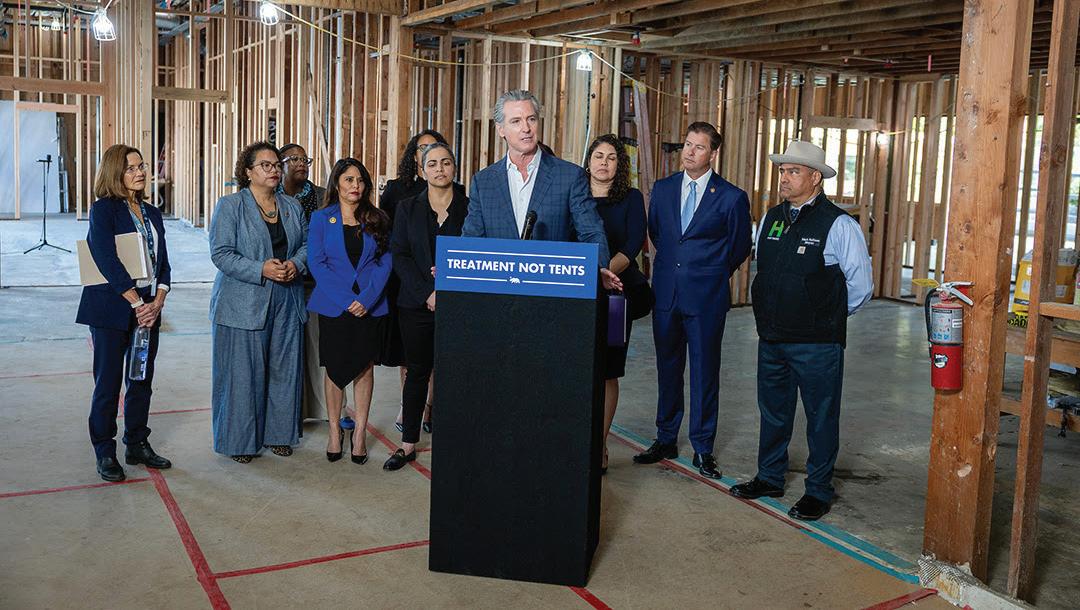
Gov. Gavin Newsom and officials announce nearly $300 million to better implement the CARE Act to address homelessness and mental illness. | Photo courtesy of the governor’s office




UCLA forecast: California growth outpaces nation, but jobs lag
By City News Service

California’seconomy continues to outpace the nation in overall output growth but remains constrained by sluggish hiring and an unemployment rate that has stayed elevated for nearly two years, according to a UCLA forecast released Wednesday.
The Spring 2026 UCLA Anderson Forecast finds that while California has grown faster than the United States for four consecutive quarters, hiring has not kept pace with production, creating what economists described as a structural imbalance in the economy.
“Normally, one would expect employment to grow in step with output and income; however, the opposite has occurred,” UCLA Anderson Forecast Director Jerry Nickelsburg wrote in his report on the state’s economy.
Using a monthly gross domestic product methodology developed by the UCLA Anderson Forecast, economists estimate California’s fourth-quarter growth at 3.8% annualized, well above the nation’s initial 1.4% estimate for the same period.
Despite that output strength, payroll employment declined in 2025, marking the first sustained contraction since the pandemic, Nickelsburg wrote. The state’s unemployment rate stood
at 5.5% in December and has remained above 5% for nearly two years.
The forecast characterized California as operating within a “new bifurcated economy,” driven by highproductivity sectors such as artificial intelligence and aerospace on one side, and slower-growing industries including construction, retail and segments of leisure and hospitality on the other.
According to the report, nearly 70% of U.S. venture capital funding flowed to California in early 2026. Hiring has begun to recover in aerospace and computer systems design, and goods movement indicators — including port activity and air cargo volumes — have rebounded to or exceeded pre-pandemic levels.
If the gains continue, those sectors could help drive stronger job growth in 2027 and 2028, according to the forecast. Housing construction, however, remains constrained by labor shortages, tariffrelated material costs and financing conditions.
“Lower mortgage rates may spur some additional activity, but permit levels remain subdued and multifamily development is not expected to accelerate materially in the near term,” Nickelsburg wrote.
The forecast projects California’s unemployment
rate to average 5.6% in 2026, declining to 4.8% in 2027 and 4.4% in 2028.
Total employment growth is expected to reach 0.9% this year, increasing to 1.8% in 2027 and 2.1% in 2028.
Real personal income growth is projected at 1.9% in 2026, rising to 2.8% in 2027 and 2.7% in 2028.
Nationally, the forecast said the balance of risks has shifted since late 2025 from stagnation toward reacceleration in 2026.
The U.S. economy expanded 2.2% in 2025 despite tariff hikes, supply chain disruptions and a prolonged federal government shutdown. GDP growth is projected to approach 3% in 2026, supported by income tax cuts, fiscal expansion and continued capital spending on artificial intelligence infrastructure, the report said.
Capital expenditures on AI are expected to reach roughly $660 billion in 2026, or about 2% of GDP. While the labor market stalled in 2025, the unemployment rate has edged down to 4.3% from a late-2025 high of 4.5%.
The forecast cautioned that the primary national risk has shifted from contraction toward potential overheating as fiscal stimulus, AI investment and improving labor conditions converge.
The Anderson School of Management at UCLA. | Photo courtesy of Simon Cobb/Wikimedia Commons (CC0 1.0)
Estate of Michael Jackson sued in LA for alleged child sex trafficking
By City News Service
Four adult siblings are suing the estate of Michael Jackson for alleged child sex trafficking, claiming in Los Angeles federal court that the late entertainer abused them when they were children at the homes of Elizabeth Taylor, Elton John and elsewhere, according to court papers obtained March 2.
The lawsuit filed Feb. 27 by siblings Edward, Dominic, Marie-Nicole and Aldo Cascio alleges that Jackson “groomed and brainwashed” them using his wealth, celebrity status and network of employees and advisers from the 1990s onward.
Jackson died in June 2009 in Los Angeles at age 50 from an overdose of propofol and other prescription painkillers.
The 23-page suit says Jackson met the Cascio siblings through their father, who worked at a luxury hotel Jackson visited multiple times. The family contends
that the singer won the family’s trust by offering them gifts, affection and attention, and isolated them from adults, fed them drugs and alcohol, exposed them to pornography and individually abused them.
“Jackson groomed and brainwashed each plaintiff,” the lawsuit alleges.
“After the abuse started, he isolated them emotionally, and sometimes physically, from responsible adults and from each other. He plied them with drugs and alcohol. He showed them pornography, including pictures of unclothed children, to normalize the abuse and desensitize them.
“He made them fear and distrust others by convincing them that not only his life, but also their lives and the lives of their family members, would be destroyed if anyone found out what he was doing to them.”
The filing claims the alleged incidents took place
during the “Dangerous” and “HIStory” world tours in the 1990s, at Neverland Ranch and at the homes of Taylor in Switzerland and John in England. The lawsuit does not indicate that the celebrities were aware of the alleged abuse.
A fifth sibling, Frank Cascio, has made similar sex abuse claims in a separate pending legal proceeding.
Marty Singer, an attorney for the Jackson estate, described the lawsuit as “a desperate money grab” and linked it to the plaintiffs’ brother Frank. Singer described the suit as a “transparent forum-shopping tactic in their scheme to obtain hundreds of millions of dollars from Michael’s estate and companies.”
The Cascios, who grew up with Jackson and have referred to themselves as his “second family,” were once public defenders of the pop star against pedophilia claims. However, after

HBO’s “Leaving Neverland” documentary in 2019, the five now-adult siblings claim they were all abused by Jackson as minors.
Without admitting any wrongdoing, the Jackson estate signed a multimillion-dollar settlement with the Cascios in 2019
Lin exchange for a release of all claims and a promise of confidentiality. But the siblings have since sought to reopen the matter, leading the estate to bring extortion claims against Frank Cascio in arbitration in 2024.
Jackson was never convicted or held legally
liable for any accusation of child sex abuse during his lifetime. He settled a civil claim in 1994 without admitting any wrongdoing, and he was acquitted at a criminal trial in 2005.
The Cascios live in South Carolina and San Bernardino, according to the suit.
Report reveals major banks are failing Latino homebuyers across California
atinoProsperityon
Wednesdayreleased
“Mapping Access and Exclusion: Latino Home Purchase Lending Across California’s Major Metropolitan Markets, 2018–2024,” an analysis of Home Mortgage Disclosure Act data that reveals a gap between traditional banks and nonbank lenders in serving Latino homebuyers across California’s major metropolitan markets.
The report finds that while Latinos represent 37.7% of California’s adult population, they received
only 31% of home purchase loans in 2024, a gap that has narrowed but remains.
Among California’s top 25 lenders, the six major banks directed just 11.4% of their loans to Latino borrowers, compared to 30.5% among nonbank lenders.
Orson Aguilar, president and CEO of LatinoProsperity, said, “Latino families are driving homeownership demand across California, yet the data make clear that major banks have largely turned their backs on this community. This is not just a lending imbalance. It is a
By Staff
structural threat to Latino wealth building and intergenerational mobility.”
Citibank posted the lowest Latino lending rate among major banks at just 5.3%, with Wells Fargo at 6.8%—less than one-quarter of the nonbank average. JP Morgan Chase led the banks with a 21% lending rate to Latino homebuyers.
In the San Francisco Bay Area, the most exclusionary market analyzed, Latino borrowers received just 8.6% of loans. Traditional banks there served Latino borrowers at a 4.7% rate, less than

one-third the nonbank rate of 13.7%.
The Inland Empire and Fresno showed the strongest Latino lending rates (38.6% and 38.7%, respectively), yet traditional banks were largely absent even in these more affordable markets.
In Los Angeles, home to the largest concentration of Latino households in California, Latinos received just 19% of loans from the top 25 lenders.
The report calls on banks to re-establish a meaningful presence in Latino-

majority neighborhoods and commit to publicly measurable goals to increase Latino home-purchase lending. It also urges state and federal
Michael Jackson sits in a limousine with the Cascio family in 1992. | Photo courtesy of mjcollections844/Instagram
| Photo courtesy of National Cancer Institute/Unsplash
Documents reveal a web of financial ties between Trump officials and the industries they help regulate
By Corey G. Johnson, Brandon Roberts and Al Shaw, ProPublica
Thousandsofcompanies are jockeying for billions of dollars in Defense Department contracts to build a shield designed to intercept and destroy missiles launched against the United States.
But amid the intense competition, a handful of firms have an important inside connection.
At least four of the companies awarded contracts so far are owned by Cerberus Capital Management, a private equity firm founded by billionaire Steve Feinberg, who until last year ran the company and is now the deputy secretary of defense — the secondhighest-ranking official in the Pentagon.
Feinberg oversees the office in charge of the Golden Dome for America project, which is modeled on Israel’s Iron Dome missile defense system.
Feinberg filed paperwork saying he divested from Cerberus and its related businesses. But his government ethics records contain an unusual clause: He is allowed to continue contracting with the company for tax compliance and accounting services as well as health care coverage, a financial relationship that documents show could continue indefinitely.
Feinberg’s financial statements and ethics agreement are part of a trove of nearly 3,200 disclosure records that ProPublica made public Thursday. The disclosures, which can be viewed in a searchable online tool, detail the finances of more than 1,500 federal officials appointed by President Donald Trump. Records for Trump and Vice President JD Vance are also included.
The documents reveal a web of financial ties between senior government officials and the industries they help regulate — relationships that have drawn scrutiny as Trump has dismantled ethics safeguards designed to prevent conflicts of interest.
On his first day back in office, Trump rescinded an executive order signed by President Joe Biden that required his appointees to comply with an ethics pledge. The pledge barred them from working on issues related to their former lobbying topics or clients for two years. Weeks later, Trump fired 17
inspectors general charged with investigating fraud, corruption and conflicts of interest across the federal government. Around the same time, he removed the head of the Office of Government Ethics, the agency that oversees ethics compliance throughout the executive branch. The office is currently without a head or a chief of staff.
Against that backdrop, ProPublica has, over the past year, used the disclosure records to investigate how personal financial interests have intersected with government decisionmaking inside the Trump administration.
The documents helped show that senior executive branch officials, including Attorney General Pam Bondi, made well-timed securities trades, at times selling stocks just before markets plunged because Trump announced new tariffs. (The officials either did not respond to requests for comment or said they had no insider information before they made their trades.)
Other disclosures revealed that two highranking scientists at the Environmental Protection Agency who recently helped downgrade the agency’s assessment of the health risks of formaldehyde had previously held senior positions at the chemical industry’s leading trade group. (The EPA said the scientists had obtained ethics advice approving their work on the project.)
In December, ProPublica reported that Trump has appointed more than 200 people who collectively owned — either by themselves or with their spouses — between $175 million and $340 million in cryptocurrency investments at the time they filed their disclosures. Some of those appointees now hold positions overseeing or influencing regulation of the crypto industry. Among them are Todd Blanche, Trump’s former criminal defense attorney and now the second-highest-ranking official in the Justice Department.
Blanche’s disclosure records show that he owned at least $159,000 in cryptorelated assets last year when he shut down investiga-
tions into crypto companies, dealers and exchanges.
After ProPublica reported on Blanche’s actions, six Democratic senators accused him of a “glaring” conflict of interest, and a watchdog group asked the Justice Department’s inspector general to investigate. A Justice Department spokesperson has said Blanche upholds the highest ethical standards and that his crypto orders were “appropriately flagged, addressed and cleared in advance,” but she did not respond to questions asking who had cleared his actions.
Conflicts of interest have long plagued both Democratic and Republican administrations. But ethics experts say Trump’s second term marks a sharp break from modern norms.
Trump has openly defended his family’s financial enrichment while he is in office, including through cryptocurrency deals that critics say allow investors, including foreign entities, to curry favor by boosting the president’s personal wealth.
“I found out nobody cared, and I’m allowed to,” Trump told The New York Times, referring to his family’s business dealings.
Trump also remains unapologetic about accepting a Boeing 747 worth about $400 million from the Qatari government and transferring nearly $1 billion from a nuclear weapons program to retrofit it. Virginia Canter, chief counsel for ethics and corruption at Democracy Defenders Fund, a nonprofit governmental watchdog group, cited Trump’s new plane as a brazen example of self-dealing.
“Ethics is in the toilet,” said Canter, who served as an ethics lawyer at the White House, Treasury Department and Securities and Exchange Commission during the presidencies of George H.W. Bush, Bill Clinton, George W. Bush and Barack Obama.
White House spokesperson Anna Kelly defended the president and his appointees. “President Trump is leading the most transparent administration in history,” Kelly said. “He has also nominated highly-qualified individuals across the Executive Branch who have a wide range of public and private sector backgrounds.”
The idea of a space-

missile defense shield has persisted ever since President Ronald Reagan proposed his own version nicknamed “Star Wars.”
Trump rekindled the idea on the campaign trail. His Golden Dome for America imagines a battery of weapons, deployed from land, sea and space, able to destroy missiles launched at the U.S.
In December, the Defense Department started selecting companies for the project, for which it has allocated as much as $151 billion. So far, the agency has granted awards to more than 2,000 firms. Cerberus owns or is a majority investor in at least four of them: North Wind, Stratolaunch, Red River Technology and NetCentrics Corp.
Citing national security concerns, defense officials have not publicized the amounts of each contract or the products or services the companies are providing. (The Defense Department is required by law to publicly announce only contracts worth more than $9 million.)
Feinberg, who co-founded Cerberus in 1992, listed assets worth at least $2 billion when he was nominated by Trump last year. In his ethics agreement, Feinberg said he would divest his stake in the firm, potentially giving assets to irrevocable trusts benefiting his adult children — a maneuver that is legal under federal conflict-of-interest law but one that ethics experts say undermines its
intent.
Feinberg also told ethics officials that he needed to contract with Cerberus for accounting, tax and health care services in the short term but would find other providers by April 2026. However, at Feinberg’s request, Defense Department officials approved an extension earlier this year, allowing the financial relationship to continue without an end date. In an amendment to his ethics agreement, he said he would “pay customary and reasonable fees” for Cerberus’ services but did not say how much those would be.
It’s unclear what role Feinberg has played — or will play — in deciding which firms receive Golden Dome contracts. In response to questions from ProPublica, the Defense Department said Feinberg does not “have direct responsibility for any Golden Dome acquisitions” but did not elaborate. The department would not comment on whether Feinberg or anyone in his office had met with any contractor representatives.
What is not disputed is Feinberg’s oversight of the Golden Dome initiative. Space Force Gen. Michael Guetlein, who heads the project, reports directly to him.
Richard Painter, a former White House ethics lawyer under President George W.Bush, said Feinberg’s ongoing relationship with
Cerberus creates at least a perception of a conflict of interest that could undermine confidence in the fairness of the contracting process.
“This is what President Eisenhower worried about in the 1960s” when he railed against the military-industrial complex, Painter said of Eisenhower’s farewell address warning of the risks of a too-close relationship between the military and private defense businesses. In response to questions from ProPublica, a Cerberus spokesperson said in an email: “Mr. Feinberg divested his stake in Cerberus and any funds that it manages, and is not involved with the operations of Cerberus or any of its portfolio companies in any way.” The spokesperson added that the administrative services provided to Feinberg “are unrelated to any investment activities or operations of Cerberus or its funds and were preapproved by the Department of War’s Ethics Office and the Office of Government Ethics.”
Another top official in the department is Marc Berkowitz, who was confirmed in December as assistant secretary of defense for space policy. During his confirmation, Berkowitz described the Golden Dome project as one of his top priorities. Berkowitz previously worked as a space industry
based
This story was originally published by ProPublica. ProPublica is a nonprofit newsroom that investigates abuses of power. Sign up to receive The Big Story newsletter as soon as it is published
Stephen Feinberg, at right, of Cerberus Capital Management. | Photo courtesy of Dow Jones Events/Flickr (CC BY-ND 2.0)
California Credit Union accepting applications for 2026 Summer Internship Program
California Credit Union is now accepting applications for its 2026 Summer Internship Program, offering paid professional experience for local college students. Now in its fifth year, the program provides students with hands-on experience and mentoring across multiple credit union departments, including accounting, electronic services, facilities/ purchasing and human resources.
“At California Credit Union, we believe investing in students today helps strengthen our communities tomorrow,” said California Credit Union President/ CEO Steve O’Connell. “Our Summer Internship Program gives college students the opportunity to gain realworld experience, develop professional skills and build meaningful connections that can shape their future careers. We are proud to open our doors and provide a supportive environment
consultant and vice president for strategic planning at Lockheed Martin. The giant defense and aerospace company was among the firms awarded Golden Dome contracts days before Berkowitz’s confirmation.
Lockheed is likely to compete for a large role in the project. The company has set up a webpage dedicated to the Golden Dome, and Reuters reported that Lockheed is one of several firms that received contracts to build competing prototypes of the missile defense system.
In his financial disclosure documents, Berkowitz reported receiving two monthly pensions from Lockheed and owning between $1 million and $5 million worth of stock in the firm.
Berkowitz agreed to divest by March 18, documents show. During his confirmation hearing, he downplayed any potential role he would have in Golden Dome contract decisions, noting that his position was more about policy.
A senior Defense Department official told ProPublica that Berkowitz is recusing himself from matters involving Lockheed until his remaining shares are sold.
Pentagon spokesperson Sean Parnell said the department’s ethics framework is “rigorous” and that Feinberg and Berkowitz are in full compliance with the law.
“Any claims to the contrary are fake news,” Parnell said.
Other agencies have similar industry links. Across the administration, former lobbyists and corporate executives now occupy influential
positions, including Bondi, White House Chief of Staff Susie Wiles and Transportation Secretary Sean Duffy. Their ties to former clients have made national headlines, but ProPublica’s searchable online tool provides the public an important glimpse into the financial relationships of a powerful and often hidden cadre of presidential appointees within the federal bureaucracy.
Reports show that after being nominated to head the National Highway Traffic Safety Administration, Jonathan Morrison revealed he served for two years as a director of the Autonomous Vehicle Industry Association, the trade group that represents companies that make and use self-driving cars. He left the position in February 2024.
At his confirmation hearing last year, Morrison said he wanted the NHTSA to set national standards and play a leading role in the industry’s development of self-driving vehicles.
Sean Rushton, an NHTSA spokesperson, said Morrison doesn’t have to recuse himself from matters involving the autonomous vehicle group because he left the organization long before the presidential election and his nomination as highway traffic safety administrator.
Most political appointees and senior officials in the executive branch are required by law to file public financial disclosure reports. These documents detail their financial assets, the positions they hold outside government, their
By Staff
where emerging talent can grow and thrive.”
The nine-week program is designed to help students bridge the gap between the classroom and the workplace by immersing them in real-world projects and cross-functional collaboration.
College students can learn more and apply for the internships through the credit union’s website at ccu.com/summer-internship-program/.

and will be based at the credit
Glendale headquarters from June 15 through August 14, 2026.
Financial ties
spouse’s holdings, their liabilities and their recent financial transactions (such as buying or selling stock) during a defined reporting period. For the most part, the law does not require appointees to provide exact financial values but instead a range.
At least a dozen appointees withheld the identities of previous clients, ProPublica found.
Appointees are allowed to keep the name of former clients confidential under exceptional circumstances, such as when the identity is protected by a court order or revealing the name would violate the rules of a professional licensing organization. In New York and Washington, D.C., for example, the organizations that license attorneys prohibit them from revealing confidential information about a client in most situations, including if doing so would be embarrassing or is likely to be detrimental to the client. While the relationship between a client and an attorney is often made public, in some cases — if, for instance, an appointee had conducted legal defense work for a client during a nonpublic criminal investigation — the client’s identity could be withheld from the financial disclosure.
Guidelines issued by the Office of Government Ethics say that such situations are unusual and “it is extremely rare for a filer to rely on this exception for more than a few clients.”
But at the Office of the U.S. Trade Representative, which is responsible for

tariff policy, the head of the agency, Jamieson Greer, withheld the names of more than 50 former clients from his time at King & Spalding, one of the nation’s most influential law firms. In his disclosure, Greer cited the New York and D.C. bar rules for not identifying the clients.
Greer’s senior adviser in the federal agency, Kwan Kim, previously worked as an international trade lawyer for Covington & Burling. From October 2020 to February 2025, Kim helped businesses win federal exemptions from steel and aluminum tariffs and defended companies accused by investigators of import-related crimes, according to a Covington biography that has since been taken down. Kim kept the names of 52 compa-
nies he represented secret, citing the D.C. Bar rules, the disclosure documents show.
The U.S. Trade Representative office did not respond to ProPublica’s request for comment.
When the names of former clients are withheld, it becomes virtually impossible for the public to know if an official’s actions in government benefit a former client. Kedric Payne, ethics director at the nonpartisan watchdog group Campaign Legal Center, said the lack of disclosure is concerning.
“When you see these types of close connections between the regulated community and the new regulators, it raises a yellow flag,” Payne said. “Because these officials are walking an ethical tightrope where any meeting or communication with their former
employer and client could become a serious conflict of interest.”
ProPublica’s journalists have been gathering these records for more than a year. We obtained all of the disclosures that were available from the Office of Government Ethics. Those consist of the top appointees who require Senate confirmation. To get records for people working in lower-level positions, we made requests to individual federal agencies. Some didn’t respond or responded partially; records we requested for about 1,200 people weren’t provided. Still, ProPublica’s online tool is the most comprehensive public source of financial disclosures from across the executive branch. Republished with Creative Commons License (CC BY-NC-ND 3.0).
President Donald Trump with Attorney General Pam Bondi during a press conference on Oct. 15 in the Oval Office. | Photo courtesy of Molly Riley/The White House/Flickr
union’s
California Credit Union logo. | PRNewsfoto/California Credit Union
INSIDE
THE NEGOTIATION ROOM:
Outlining Our Edison Settlement Strategy


PM – 6:30
Hear directly from lead trial attorney Mikal Watts1 about where the lawsuit against Edison stands, what comes next, and what you should be doing now to protect and strengthen your claim. Topics Include:
• Individual Mediation Process: One-on-one case resolution
• Group Settlement Templates: Streamlined frameworks
WEDNESDAY, MARCH 18 TH
• Special Master Proceedings: How court-appointed mediators expedite resolution Staffed Resource Tables: • Personal
Professional Code).
Pub. Monrovia Weekly 03/09/2026, 03/16/2026, 03/23/2026, 03/30/2026
FICTITIOUS BUSINESS NAME STATEMENT FILE NO. 2026049506
NEW FILING.
The following person(s) is (are) doing business as LA MEXICANA MEAT
MARKET, 5392 Poplar Blvd, Los Angeles, CA 90032. This business is conducted by a corporation. Registrant commenced to transact business under the fictitious business name or names listed herein on March 2026. Signed: FATIMA MART INC (CA-B20250367828, 5392 Poplar Blvd, Los Angeles, CA 90032; SYED ANDLEEB ZAIDI, PRESIDENT. The statement was filed with the County Clerk of Los Angeles on March 4, 2026.
NOTICE: This fictitious business name statement expires five years from the date it was filed in the office of the County Clerk. A new fictitious business name statement must be filed prior to that date. The filing of this statement does not of itself authorize the use in this state of a fictitious business name in violation of the rights of another under federal, state or common law (See Section 14400 et seq., Business and Professional Code).
Pub. Monrovia Weekly 03/09/2026, 03/16/2026, 03/23/2026, 03/30/2026
FICTITIOUS BUSINESS NAME STATEMENT FILE NO. 2026031521 NEW FILING.
The following person(s) is (are) doing business as Find Insight Geospatial, 1629 Shepherd Drive, Duarte, CA 91010. This business is conducted by a individual. Registrant has not yet begun to transact business under the fictitious business name or names listed herein.
Signed: Jonathan Alexander Main, 1629 Shepherd Drive, Duarte, CA 91010 (Owner). The statement was filed with the County Clerk of Los Angeles on February 11, 2026. NOTICE: This fictitious business name statement expires five years from the date it was filed in the office of the County Clerk. A new fictitious business name statement must be filed prior to that date. The filing of this statement does not of itself authorize the use in this state of a fictitious business name in violation of the rights of another under federal, state or common law (See Section 14400 et seq., Business and Professional Code).
Pub. Monrovia Weekly 03/09/2026, 03/16/2026, 03/23/2026, 03/30/2026
FICTITIOUS BUSINESS NAME STATEMENT FILE NO. 2026047461 NEW FILING.
The following person(s) is (are) doing business as Of Good Cheer, 3901 6th Ave., Los Angeles, CA 90008-2730. This business is conducted by a individual. Registrant commenced to transact business under the fictitious business name or names listed herein on March 2026. Signed: Marisol Vargas, 3901 6th Ave., Los Angeles, CA 90008-2730 (Owner). The statement was filed with the County Clerk of Los Angeles on March 3, 2026. NOTICE: This fictitious business name statement expires five years from the date it was filed in the office of the County Clerk. A new fictitious business name statement must be filed prior to that date. The filing of this statement does not of itself authorize the use in this state of a fictitious business name in violation of the rights of another under federal, state or common law (See Section 14400 et seq., Business and Professional Code). Pub. Monrovia Weekly 03/09/2026, 03/16/2026, 03/23/2026, 03/30/2026
FICTITIOUS BUSINESS NAME STATEMENT FILE NO. 2026049411 NEW FILING.
The following person(s) is (are) doing business as Sierra Print Marketing Solutions, 5719 Tilden Avenue B, Los Angeles, CA 91401. This business is conducted by a individual. Registrant commenced to transact business under the fictitious business name or names listed herein on March 2026. Signed: Cristian R Videla, 5719 Tilden Avenue B, Los Angeles, CA 91401 (Owner). The statement was filed with the County Clerk of Los Angeles on March 4, 2026. NOTICE: This fictitious business name statement expires five years from the date it was filed in the office of the County Clerk. A new fictitious business name statement must be filed prior to that date. The filing of this statement does not of itself authorize the use in this state of a fictitious business name in violation of the rights of another under federal, state or common law (See Section 14400 et seq., Business and Professional Code). Pub. Monrovia Weekly 03/09/2026, 03/16/2026, 03/23/2026, 03/30/2026
FICTITIOUS BUSINESS NAME STATEMENT FILE NO. 2026048315 NEW FILING.
The following person(s) is (are) doing business as Qazzyna, 5520 Wilshire Blvd 612, Los Angeles, CA 90036. This business is conducted by a limited liability company (llc). Registrant commenced to transact business under the fictitious business name or names listed herein on February 2026. Signed: ZZ Infinite LLC (CA-B20260072970, 5520 Wilshire Blvd 612, Los Angeles, CA 90036; Zhuldyz Otarbay, Ceo. The statement was filed with the County Clerk of Los Angeles on March 3, 2026. NOTICE: This fictitious business name statement expires five years from the date it was filed in the office of the County Clerk. A new fictitious business name statement must be filed prior to that date. The filing of this statement does not of itself authorize the use in this state of a fictitious business name in violation of the rights of another
under federal, state or common law (See Section 14400 et seq., Business and Professional Code). Pub. Monrovia Weekly 03/09/2026, 03/16/2026, 03/23/2026, 03/30/2026
FICTITIOUS BUSINESS NAME STATEMENT FILE NO. 2026043014 NEW FILING. The following person(s) is (are) doing business as Rigalos y raíces de Guatemala, 1116 N Hacienda Blvd, La Puente, CA 91744. This business is conducted by a individual. Registrant commenced to transact business under the fictitious business name or names listed herein on January 2026. Signed: Kristina Rigalos, 1116 N Hacienda Blvd, La Puente, CA 91744 (Owner). The statement was filed with the County Clerk of Los Angeles on February 24, 2026. NOTICE: This fictitious business name statement expires five years from the date it was filed in the office of the County Clerk. A new fictitious business name statement must be filed prior to that date. The filing of this statement does not of itself authorize the use in this state of a fictitious business name in violation of the rights of another under federal, state or common law (See Section 14400 et seq., Business and Professional Code). Pub. Monrovia Weekly 03/09/2026, 03/16/2026, 03/23/2026, 03/30/2026
FICTITIOUS BUSINESS NAME STATEMENT FILE NO. 2026048752 NEW FILING.
The following person(s) is (are) doing business as Rebel Girl Nails, 708 W Duell St, Azusa, CA 91702. This business is conducted by a individual. Registrant commenced to transact business under the fictitious business name or names listed herein on February 2026. Signed: Jennifer Perez Garcia, 708 W Duell St, Azusa, CA 91702 (Owner). The statement was filed with the County Clerk of Los Angeles on March 4, 2026. NOTICE: This fictitious business name statement expires five years from the date it was filed in the office of the County Clerk. A new fictitious business name statement must be filed prior to that date. The filing of this statement does not of itself authorize the use in this state of a fictitious business name in violation of the rights of another under federal, state or common law (See Section 14400 et seq., Business and Professional Code). Pub. Monrovia Weekly 03/09/2026, 03/16/2026, 03/23/2026, 03/30/2026
FICTITIOUS BUSINESS NAME STATEMENT FILE NO. 2026049033 NEW FILING.
The following person(s) is (are) doing business as Allthingsmini, 42452 71st. West, Lancaster, CA 93536. This business is conducted by a individual. Registrant commenced to transact business under the fictitious business name or names listed herein on March 2026. Signed: Jose Luis Chavira Jr, 42452 71st. West, Lancaster, CA 93536 (Owner). The statement was filed with the County Clerk of Los Angeles on March 4, 2026. NOTICE: This fictitious business name statement expires five years from the date it was filed in the office of the County Clerk. A new fictitious business name statement must be filed prior to that date. The filing of this statement does not of itself authorize the use in this state of a fictitious business name in violation of the rights of another under federal, state or common law (See Section 14400 et seq., Business and Professional Code). Pub. Monrovia Weekly 03/09/2026, 03/16/2026, 03/23/2026, 03/30/2026
FICTITIOUS BUSINESS NAME STATEMENT FILE NO. 2026038201 NEW FILING.
The following person(s) is (are) doing business as Rosan Collective LLC, 238 S Arroyo Pkwy Ste 110, Pasadena, CA 91105. This business is conducted by a limited liability company (llc). Registrant has not yet begun to transact business under the fictitious business name or names listed herein. Signed: Rosan Collective LLC (CA-B20250429825, 2108 N St Ste N, Sacramento, Ca 95816; Rosannie Weijia Zeng, Managing Member. The statement was filed with the County Clerk of Los Angeles on February 19, 2026. NOTICE: This fictitious business name statement expires five years from the date it was filed in the office of the County Clerk. A new fictitious business name statement must be filed prior to that date. The filing of this statement does not of itself authorize the use in this state of a fictitious business name in violation of the rights of another under federal, state or common law (See Section 14400 et seq., Business and Professional Code). Pub. Monrovia Weekly 03/09/2026, 03/16/2026, 03/23/2026, 03/30/2026
FICTITIOUS BUSINESS NAME STATEMENT FILE NO. 2026048619 NEW FILING. The following person(s) is (are) doing business as NeuroBloom, 216 East Cherry Ave, Monrovia, CA 91016. This business is conducted by a individual. Registrant commenced to transact business under the fictitious business name or names listed herein on March 2026. Signed: Ashley Trigueros, 216 East Cherry Ave, Monrovia, CA 91016 (Owner). The statement was filed with the County Clerk of Los Angeles on March 4, 2026. NOTICE: This fictitious business name statement expires five years from the date it was filed in the office of the County Clerk. A new fictitious business name statement must be filed prior to that date. The filing of this statement does not of itself authorize the use in this state of a fictitious business name in violation of the
LEGALS
rights of another under federal, state or common law (See Section 14400 et seq., Business and Professional Code).
Pub. Monrovia Weekly 03/09/2026, 03/16/2026, 03/23/2026, 03/30/2026
FICTITIOUS BUSINESS NAME STATEMENT FILE NO. 2026049049 NEW FILING.
The following person(s) is (are) doing business as Novay collision center, 635 e live oak ave, arcadia, CA 91006. This business is conducted by a corporation. Registrant has not yet begun to transact business under the fictitious business name or names listed herein.
Signed: Novay Enterprises Inc (CAB20250119072, 635 e live oak ave, arcadia, CA 91006; avo joseph margarian, president. The statement was filed with the County Clerk of Los Angeles on March 4, 2026. NOTICE: This fictitious business name statement expires five years from the date it was filed in the office of the County Clerk. A new fictitious business name statement must be filed prior to that date. The filing of this statement does not of itself authorize the use in this state of a fictitious business name in violation of the rights of another under federal, state or common law (See Section 14400 et seq., Business and Professional Code).
Pub. Monrovia Weekly 03/09/2026, 03/16/2026, 03/23/2026, 03/30/2026
FICTITIOUS BUSINESS NAME STATEMENT FILE NO. 2026048705
NEW FILING.
The following person(s) is (are) doing business as JHN TRUCKING, 1142 Stanley Ave # 15, Glendale, CA 91206. This business is conducted by a individual. Registrant commenced to transact business under the fictitious business name or names listed herein on March 2026. Signed: Jack Hakop Nagapetian, 1142 Stanley Ave # 15, Glendale, CA 91206 (Owner). The statement was filed with the County Clerk of Los Angeles on March 4, 2026. NOTICE: This fictitious business name statement expires five years from the date it was filed in the office of the County Clerk. A new fictitious business name statement must be filed prior to that date. The filing of this statement does not of itself authorize the use in this state of a fictitious business name in violation of the rights of another under federal, state or common law (See Section 14400 et seq., Business and Professional Code).
Pub. Monrovia Weekly 03/09/2026, 03/16/2026, 03/23/2026, 03/30/2026
FICTITIOUS BUSINESS NAME
STATEMENT FILE NO. 2026046192
NEW FILING.
The following person(s) is (are) doing business as Vintage Alley, 158 W 3rd St, Pomona, CA 91766. This business is conducted by a married couple. Registrant has not yet begun to transact business under the fictitious business name or names listed herein. Signed: (1). Mella Francis, 120 E Monterey ave Unit A236, Pomona, Ca 91767 (2). Kacou Francis, 120 E Monterey ave Unit A236, Pomona, Ca 91767(husband).
The statement was filed with the County Clerk of Los Angeles on March 2, 2026.
NOTICE: This fictitious business name statement expires five years from the date it was filed in the office of the County Clerk. A new fictitious business name statement must be filed prior to that date.
The filing of this statement does not of itself authorize the use in this state of a fictitious business name in violation of the rights of another under federal, state or common law (See Section 14400 et seq., Business and Professional Code).
Pub. Monrovia Weekly 03/09/2026, 03/16/2026, 03/23/2026, 03/30/2026
FICTITIOUS BUSINESS NAME STATEMENT FILE NO. 2026047828
NEW FILING.
The following person(s) is (are) doing business as Parking System, 1730 S second Ave, Arcadia, CA 91006. This business is conducted by a corporation. Registrant commenced to transact business under the fictitious business name or names listed herein on March 2023. Signed: Parking System (CA923351643, 1730 S second Ave, Arcadia, CA 91006; Muna Alousta, President. The statement was filed with the County Clerk of Los Angeles on March 3, 2026.
NOTICE: This fictitious business name statement expires five years from the date it was filed in the office of the County Clerk. A new fictitious business name statement must be filed prior to that date. The filing of this statement does not of itself authorize the use in this state of a fictitious business name in violation of the rights of another under federal, state or common law (See Section 14400 et seq., Business and Professional Code).
Pub. Monrovia Weekly 03/09/2026, 03/16/2026, 03/23/2026, 03/30/2026
FICTITIOUS BUSINESS NAME STATEMENT FILE NO. 2026034130 NEW FILING.
The following person(s) is (are) doing business as Jr auto lights, 11100 Sepulveda Blvd. #8 pmb 2073, mission hills, CA 91345. This business is conducted by a individual. Registrant has not yet begun to transact business under the fictitious business name or names listed herein. Signed: luiz a zelaya, 11100 Sepulveda Blvd. #8 pmb 2073, mission hills, CA 91345 (Owner). The statement was filed with the County Clerk of Los Angeles on February 13, 2026. NOTICE: This fictitious business name statement expires five years from the date it was filed in the office of the County Clerk. A new fictitious business name statement must be filed prior to that date. The
filing of this statement does not of itself authorize the use in this state of a fictitious business name in violation of the rights of another under federal, state or common law (See Section 14400 et seq., Business and Professional Code).
Pub. Monrovia Weekly 03/09/2026, 03/16/2026, 03/23/2026, 03/30/2026
FICTITIOUS BUSINESS NAME STATEMENT FILE NO. 2026021413 NEW FILING. The following person(s) is (are) doing business as Promesa In Action, 2240 Westminster Ave, Alhambra, CA 91803. This business is conducted by a individual. Registrant commenced to transact business under the fictitious business name or names listed herein on January 2026. Signed: Julie A Delgadillo, 2240 Westminster Ave, Alhambra, CA 91803 (Owner). The statement was filed with the County Clerk of Los Angeles on January 29, 2026. NOTICE: This fictitious business name statement expires five years from the date it was filed in the office of the County Clerk. A new fictitious business name statement must be filed prior to that date. The filing of this statement does not of itself authorize the use in this state of a fictitious business name in violation of the rights of another under federal, state or common law (See Section 14400 et seq., Business and Professional Code).
Pub. Monrovia Weekly 03/09/2026, 03/16/2026, 03/23/2026, 03/30/2026
FICTITIOUS BUSINESS NAME STATEMENT FILE NO. 2026048179
NEW FILING.
The following person(s) is (are) doing business as Corazon Compass Psychiatry & Wellness, 517 S Ivy Avenue, Monrovia, CA 91016. This business is conducted by a corporation. Registrant commenced to transact business under the fictitious business name or names listed herein on March 2026. Signed: Corazon Compass Psychiatry & Wellness A Nursing Corporation (CA-B20250392982, 517 S Ivy Avenue, Monrovia, CA 91016; Adriana Hernandez, CEO. The statement was filed with the County Clerk of Los Angeles on March 3, 2026. NOTICE: This fictitious business name statement expires five years from the date it was filed in the office of the County Clerk. A new fictitious business name statement must be filed prior to that date. The filing of this statement does not of itself authorize the use in this state of a fictitious business name in violation of the rights of another under federal, state or common law (See Section 14400 et seq., Business and Professional Code).
Pub. Monrovia Weekly 03/09/2026, 03/16/2026, 03/23/2026, 03/30/2026
FICTITIOUS BUSINESS NAME STATEMENT FILE NO. 2026041577
NEW FILING.
The following person(s) is (are) doing business as AL Financial Services, 3733 Rosemead Boulevard Ste. 201, Rosemead, CA 91770. This business is conducted by a individual. Registrant commenced to transact business under the fictitious business name or names listed herein on December 2025. Signed: Anita Yukpo Leung, 3733 Rosemead Boulevard. Ste. 201, Rosemead, CA 91770 (Owner). The statement was filed with the County Clerk of Los Angeles on February 23, 2026. NOTICE: This fictitious business name statement expires five years from the date it was filed in the office of the County Clerk. A new fictitious business name statement must be filed prior to that date. The filing of this statement does not of itself authorize the use in this state of a fictitious business name in violation of the rights of another under federal, state or common law (See Section 14400 et seq., Business and Professional Code).
Pub. Monrovia Weekly 03/09/2026, 03/16/2026, 03/23/2026, 03/30/2026
FICTITIOUS BUSINESS NAME STATEMENT FILE NO. 2026047980 NEW FILING.
The following person(s) is (are) doing business as GOLDEX MORTGAGE, 20165 Lake Canyon Drive, Walnut, CA 91789. This business is conducted by a corporation. Registrant commenced to transact business under the fictitious business name or names listed herein on March 2026. Signed: GOLDEN OLIVE INC (CA-3819583, 20165 Lake Canyon Drive, Walnut, CA 91789; NICK CHANG, ceo. The statement was filed with the County Clerk of Los Angeles on March 3, 2026. NOTICE: This fictitious business name statement expires five years from the date it was filed in the office of the County Clerk. A new fictitious business name statement must be filed prior to that date. The filing of this statement does not of itself authorize the use in this state of a fictitious business name in violation of the rights of another under federal, state or common law (See Section 14400 et seq., Business and Professional Code).
Pub. Monrovia Weekly 03/09/2026, 03/16/2026, 03/23/2026, 03/30/2026
FICTITIOUS BUSINESS NAME STATEMENT FILE NO. 2026047474
NEW FILING.
The following person(s) is (are) doing business as (1). Reveal Films (2). Reveal , 623 Indiana Terrace, South Pasadena, CA 91030. This business is conducted by a corporation. Registrant has not yet begun to transact business under the fictitious business name or names listed herein. Signed: Patomic Inc (CA4176288, 623 Indiana Terrace, South Pasadena, CA 91030; Thomas Camarda, President. The statement was filed with the County Clerk of Los Angeles on March
3, 2026. NOTICE: This fictitious business name statement expires five years from the date it was filed in the office of the County Clerk. A new fictitious business name statement must be filed prior to that date. The filing of this statement does not of itself authorize the use in this state of a fictitious business name in violation of the rights of another under federal, state or common law (See Section 14400 et seq., Business and Professional Code).
Pub. Monrovia Weekly 03/09/2026, 03/16/2026, 03/23/2026, 03/30/2026
FICTITIOUS BUSINESS NAME STATEMENT FILE NO. 2026021222
NEW FILING.
The following person(s) is (are) doing business as Arielle Levy Physical Therapy, 12078 Guerin St 208, Studio City, CA 91604. This business is conducted by a individual. Registrant commenced to transact business under the fictitious business name or names listed herein on April 2024. Signed: Arielle Levy, 12078 Guerin St 208, Studio City, CA 91604 (Owner). The statement was filed with the County Clerk of Los Angeles on January 28, 2026. NOTICE: This fictitious business name statement expires five years from the date it was filed in the office of the County Clerk. A new fictitious business name statement must be filed prior to that date. The filing of this statement does not of itself authorize the use in this state of a fictitious business name in violation of the rights of another under federal, state or common law (See Section 14400 et seq., Business and Professional Code). Pub. Monrovia Weekly 03/09/2026, 03/16/2026, 03/23/2026, 03/30/2026
FICTITIOUS BUSINESS NAME STATEMENT FILE NO. 2026048096 NEW FILING. The following person(s) is (are) doing business as (1). Grand Avenue Insurance Agency (2). Caulfield Insurance Services , 49 South Baldwin Avenue Suite I, Sierra Madre, CA 91024. This business is conducted by a general partnership. Registrant commenced to transact business under the fictitious business name or names listed herein on June 2000. Signed: (1). Caulfield Business Group, Inc, 49 South Baldwin Avenue Suite I, Sierra Madre, CA 91024 (2). The Caulfield Group, Inc, 3742 Highland Road, Lafayette, Ca 94549 (3). Caulfield Insurance Services, 49 South Baldwin Avenue Suite I, Sierra Madre, CA 91024 (John Caulfield, General Partner). The statement was filed with the County Clerk of Los Angeles on March 3, 2026.
NOTICE: This fictitious business name statement expires five years from the date it was filed in the office of the County Clerk. A new fictitious business name statement must be filed prior to that date. The filing of this statement does not of itself authorize the use in this state of a fictitious business name in violation of the rights of another under federal, state or common law (See Section 14400 et seq., Business and Professional Code).
Pub. Monrovia Weekly 03/09/2026, 03/16/2026, 03/23/2026, 03/30/2026
FICTITIOUS BUSINESS NAME STATEMENT FILE NO. 2026034931
NEW FILING.
The following person(s) is (are) doing business as Les Soeurettes, 10416 Mildred St, El Monte, CA 91733. This business is conducted by a individual. Registrant has not yet begun to transact business under the fictitious business name or names listed herein. Signed: Yanley Rinero Lopez, 10416 Mildred St, El Monte, CA 91733 (Owner). The statement was filed with the County Clerk of Los Angeles on February 13, 2026.
NOTICE: This fictitious business name statement expires five years from the date it was filed in the office of the County Clerk. A new fictitious business name statement must be filed prior to that date. The filing of this statement does not of itself authorize the use in this state of a fictitious business name in violation of the rights of another under federal, state or common law (See Section 14400 et seq., Business and Professional Code).
Pub. Monrovia Weekly 03/09/2026, 03/16/2026, 03/23/2026, 03/30/2026
FICTITIOUS BUSINESS NAME STATEMENT FILE NO. 2026047558
NEW FILING.
The following person(s) is (are) doing business as Grassroots POV, 210 Vía El Toro, Redondo Beach, CA 90277. This business is conducted by a individual. Registrant commenced to transact business under the fictitious business name or names listed herein on February 2026. Signed: Kyle Connell, 210 Vía El Toro, Redondo Beach, CA 90277 (Owner). The statement was filed with the County Clerk of Los Angeles on March 3, 2026. NOTICE: This fictitious business name statement expires five years from the date it was filed in the office of the County Clerk. A new fictitious business name statement must be filed prior to that date. The filing of this statement does not of itself authorize the use in this state of a fictitious business name in violation of the rights of another under federal, state or common law (See Section 14400 et seq., Business and Professional Code).
Pub. Monrovia Weekly 03/09/2026, 03/16/2026, 03/23/2026, 03/30/2026
Pasadena City Notices

NOTICE
OF SOLICITATION OF
NOTICE OF SOLICITATION OF APPLICATIONS TO FILL A VACANCY OF A TENANT MEMBER POSITION REPRESENTING COUNCIL DISTRICT 2 FOR AN UNEXPIRED TERM ON THE PASADENA RENTAL HOUSING BOARD
APPLICATIONS
TO FILL A VACANCY OF A TENANT MEMBER POSITION
REPRESENTING COUNCIL DISTRICT 2 FOR AN UNEXPIRED TERM ON THE PASADENA RENTAL HOUSING BOARD
In accordance with Pasadena City Charter, Section 1811, a Pasadena Rental Housing Board has been established to administer and enforce Article XVIII of the City Charter, “The Pasadena Fair and Equitable Housing Charter Amendment”. The Board is comprised of eleven (11) members consisting of seven (7) Tenant Members, and four (4) At-Large Members. In addition, there are two (2) alternates, one serving as the alternate for the Tenant Members and one serving as the alternate for the At-Large Members.
Notice is hereby given that there an unscheduled vacancy has occurred in the Tenant Member seat representing Council District 2 resulting from the resignation of Dianne Romero Chavez. The City will begin soliciting applications from District 2 residents seeking to fill this vacancy on Monday, March 9, 2026 to serve the remaining balance of the unexpired term, with the term set to end on May 24, 2027.
The Pasadena City Council and Housing Department are vitally interested in improving and increasing communication with Pasadena citizens in the areas of housing, community development, and economic development. This amendment is available for a public review starting March 5, 2026, on the Housing Department website at: https://www.cityofpasadena.net/housing/. Citizens wishing to submit written comments during the public review and comment period may mail them, postmarked no later than March 20, 2026, to the following:
City of Pasadena
Housing Department
In accordance with Pasadena City Charter, Section 1811, a Pasadena Rental HousingBoard has been established to administer and enforce Article XVIII ofthe City Charter, “ The Pasadena Fair and Equitable Housing Charter Amendment ”. The Board is comprised of eleven (11) members consisting of seven (7) TenantMembers, and four (4) At -Large Members. In addition, there are two (2) alternates, one serving as the alternate forthe TenantMembers and one serving as the alternate for the At -Large Members.
Notice is herebygiven that there an unscheduledvacancy has occurred in the Tenant Member seat representing CouncilDistrict 2 resulting from the resignation of Dianne Romero Chavez. The City will begin soliciting applications from District 2 residents seeking tofill thisvacancy on Monday, March 9, 2026 to serve the remaining balance of the unexpired term, with the term set toend on May 24, 2027
Pursuant to City Charter Section 1811(k), an unscheduled vacancy for a Tenant Member seat shall be appointed by the Councilmember representing the vacant District seat on the Pasadena Rental Housing Board. Applicants interested in serving as the Tenant Member to represent Council District 2 shall reside in Council District 2, and shall be a Tenant. Tenant members, and members of their Extended Families, may not have owned, managed, or had a 5% or greater ownership stake in rental units in Los Angeles County in the three years before they apply.
The Board’s duties include making rules and regulations to implement Article XVIII of the City Charter, setting allowable rent increases, determining and publicizing the Annual General Adjustment in rents, appointing hearing officers, conducting hearings on petitions for rent adjustments for individual properties, establishing a budget, pursuing civil remedies against those who violate Article XVIII of the City Charter, holding public hearings, establishing a schedule of penalties for violations of Article XVIII of the City Charter, and establishing and maintaining a registry of rental housing in Pasadena.
Attention: Randy Mabson, Program Coordinator 199 S. Los Robles Ave. Suite 499 Pasadena, CA 91101
The public hearing will be held at the following location and time:
City Council - Public Hearing Monday, March 23, 2026, at 6:00 p.m.
Pasadena City Hall – City Council Chambers 100 N. Garfield Avenue Pasadena, CA 91109
Pursuant to City Charter Section1811(k), an unscheduledvacancy for a TenantMember seat shallbe appointed by the Councilmember representing thevacant District seat on the Pasadena Rental Housing Board. Applicants interested in serving as the Tenant Memberto representCouncil District 2 shall reside in Council District 2, and shall be a Tenant Tenant members, and members of their Extended Families, may not have owned,managed, orhad a 5% or greater ownership stake in rentalunits inLos Angeles County in the three years beforethey apply.
The Board’s duties include making rules and regulations to implement Article XVIII ofthe City Charter, settingallowable rent increases, determining and publicizingthe Annual General Adjustment in rents, appointing hearing officers, conducting hearings on petitions for rent adjustments forindividualproperties, establishing a budget, pursuing civilremedies against those whoviolate Article XVIII ofthe City Charter , holding publichearings, establishing a schedule of penalties for violations of Article XVIII of the City Charter , and establishing and maintaining a registry of rental housing inPasadena.
The City encourages interested residents to apply for appointment to the Board. In addition to a completed application, applicants must circulate a nomination petition and gather a minimum of 25 qualified signatures from residents living in the same Pasadena Council District as the applicant. A declaration of financial interests of the applicant, and of their Extended Family members (related to interests in real property), is also required and will be a public record. Nomination petitions and application materials are available in the City Clerk’s Office.
The application period for this appointment will open on Monday, March 9, 2026 at 8:00 a.m. with a deadline to submit forms by Thursday, April 9, 2026 by 5:00 p.m. Application forms can be obtained by contacting the Pasadena City Clerk’s Office during regular business hours, Monday through Friday, 7:30 a.m. – 5:30 p.m. (appointments recommended):
During the meeting and prior to the close of the public hearing, members of the public may provide public comment. Please refer to the agenda when posted as to whether the hearing will be held electronically or in person, and how to provide public comment. If you challenge the matter in Court, you may be limited to raising those issues you or someone else raised at the public hearing, or in written correspondence sent to the City Clerk at, or prior to, the public hearing.
MIGUEL MÁRQUEZ, City Manager
P.O. Box 7115 Pasadena, CA 91109
AVISO PÚBLICO DE LA CIUDAD DE PASADENA DE UNA AUDIENCIA PÚBLICA PROGRAMADA POR EL CONCEJO MUNICIPAL
AVISOPÚBLICODE LA CIUDAD DEPASADENA DE UNAAUDIENCIA PÚBLICA PROGRAMADAPORELCONCEJO MUNICIPAL RELACIONADA CON UNAENMIENDASUSTANCIAL ALPLAN DE ACCIÓN ANUAL2025 PARAELPROGRAMA HOME INVESTMENT PARTNERSHIP
RELACIONADA CON UNA ENMIENDA SUSTANCIAL AL PLAN DE ACCIÓN ANUAL 2025 PARA EL PROGRAMA HOME INVESTMENT PARTNERSHIP
The City encouragesinterested residents to apply for appointment to the Board. In addition to a completed application, applicants must circulate a nomination petition and gather a minimumof 25 qualified signatures from residents living in the same Pasadena Council District as the applicant A declarationoffinancial interests of the applicant, and of their ExtendedFamily members (relatedto interests in realproperty), is alsorequired and will be a public record. Nomination petitions andapplication materials are available in the City Clerk’s Office
The application period for this appointment will open on Monday, March 9, 2026 at 8:00 a.m. with a deadline to submit forms by Thursday, April 9, 2026 by5:00 p.m Application forms can beobtained by contacting thePasadena City Clerk’s Office during regular business hours, Monday through Friday, 7:30 a.m. – 5:30 p.m. (appointments recommended): City of Pasadena,Office of the City Clerk 100 North Garfield Avenue, Room S228 Pasadena, California 91101 (626) 744-4124, cityclerk@cityofpasadena.net Mark Jomsky City Clerk To be Publishedand Posted : Monday, March 9, 2026
City of Pasadena, Office of the City Clerk 100 North Garfield Avenue, Room S228 Pasadena, California 91101 (626)744-4124, cityclerk@cityofpasadena.net
Mark Jomsky City Clerk
To be Published and Posted: Monday, March 9, 2026 PASADENA PRESS
www.Notiecfiling.com
Esta es una enmienda al Plan de Acción Anual 2025 de la Ciudad de Pasadena para otorgar $512,146 en fondos no utilizados del programa Home Investment Partnership Act (HOME) provenientes de la asignación anual del Departamento de Vivienda y Desarrollo Urbano de los Estados Unidos (HUD). Esta acción, si es aprobada, está exenta de la Ley de Calidad Ambiental de California (CEQA) conforme a las Directrices de CEQA Sección 15061(b)(3) (Exención de Sentido Común).
Esta esuna enmienda alPlan de Acción Anual 2025 de laCiudad de Pasadena para otorgar $512,146 en fondos no utilizados del programa Home Investment Partnership Act (HOME) provenientes de la asignación anual del Departamento de Vivienda y Desarrollo Urbano de los Estados Unidos (HUD). Esta acción, si es aprobada, está exenta de la Ley deCalidadAmbientalde California (CEQA)conforme a lasDirectricesde CEQASección 15061(b)(3) (Exención de Sentido Común).
Enmiendas al Plan de Acción
Descripción Agencia Implementadora Monto de la Asignación Acción Ramona Senior Housing Project Proyecto de Vivienda para Personas Mayores Ramona – Proporciona financiamiento para construir un proyecto de vivienda multifamiliar de alquiler asequible de 100 unidades, ubicado en 280 Ramona Street, Pasadena, CA 91101.
National Core $512,146
Incremento del presupuesto a $2,756,073
El Concejo Municipal de Pasadena y el Departamento de Vivienda están profundamente interesados en mejorar y aumentar la comunicación con los residentes de Pasadena en las áreas de vivienda, desarrollo comunitario y desarrollo económico. Esta enmienda estará disponible para revisión pública a partir del 5 de marzo de 2026 en el sitio web del Departamento de Vivienda:: https://www.cityofpasadena.net/housing/ Los residentes que deseen presentar comentarios por escrito durante el período de revisión pública pueden enviarlos por correo, con matasellos a más tardar el 20 de marzo de 2026, a la siguiente dirección:
El Concejo Municipal de Pasadena y el Departamento de Vivienda están profundamente interesados en mejorar y aumentar la comunicación con los residentes de Pasadena en las áreas de vivienda, desarrollo comunitario y desarrollo económico. Esta enmienda estará disponible para revisión pública a partir del 5 de marzo de 2026 en el sitio web del Departamento de Vivienda:: https://www.cityofpasadena.net/housing/. Los residentes que deseen presentar comentarios por escrito durante el período de revisión pública pueden enviarlos por correo, con matasellos a más tardar el 20 de marzo de 2026, a la siguiente dirección:
City of Pasadena
City of Pasadena
Housing Department
Housing Department
Attention: Randy Mabson, Program Coordinator
199 S. Los Robles Ave. Suite 499 Pasadena, CA 91101
Attention: Randy Mabson, Program Coordinator 199 S. Los Robles Ave. Suite 499 Pasadena, CA 91101
Audiencia Pública
Audiencia Pública
La audiencia pública se llevará a cabo en el siguiente lugar y horario:
La audiencia pública se llevará a cabo en el siguiente lugar y horario:
PUBLICNOTICE BY THE CITYOFPASADENA OFASCHEDULED PUBLICHEARING BY THE CITY COUNCIL RELATING TO A SUBSTANTIAL AMENDMENT TO2025 ANNUAL ACTION PLAN FOR HOME INVESTMENT PARTNERSHIP ACT
PUBLIC NOTICE BY THE CITY OF PASADENA OF A SCHEDULED PUBLIC HEARING BY THE CITY COUNCIL RELATING TO A SUBSTANTIAL AMENDMENT TO 2025 ANNUAL ACTION PLAN FOR HOME INVESTMENT PARTNERSHIP ACT
City Council - Public Hearing
Monday, March 23, 2026, at6:00 p.m.
PasadenaCity Hall – City CouncilChambers
City Council - Public Hearing Monday, March 23, 2026, at 6:00 p.m.
100 N. Garfield Avenue Pasadena, CA 91109
This is an amendment to the 2025 Annual Action Plan for the City ofPasadena to award $512,146 in unspent Home Investment Partnership Act (HOME) funding from the U.S. Department of Housing and Urban Development (HUD)annual allocation This action, if approved, is exempt from the California Environmental Quality Act (CEQA) pursuant to CEQA Guidelines Section 15061(b)(3) (Common Sense Exemption)
This is an amendment to the 2025 Annual Action Plan for the City of Pasadena to award $512,146 in unspent Home Investment Partnership Act (HOME) funding from the U.S. Department of Housing and Urban Development (HUD) annual allocation. This action, if approved, is exempt from the California Environmental Quality Act (CEQA) pursuant to CEQA Guidelines Section 15061(b)(3) (Common Sense Exemption).
at 280 Ramona Street, Pasadena, CA 91101.
Pasadena City Hall – City Council Chambers 100 N. Garfield Avenue Pasadena, CA 91109
Durante la reunión y antes del cierre de la audiencia pública, los miembros del público podrán presentar comentarios. Consulte la agenda cuando sea publicada para determinar si la audiencia se llevará a cabo de manera electrónica o presencial, así como las instrucciones para proporcionar comentarios públicos.
Durante la reunión y antes del cierre de la audiencia pública, los miembros del público podrán presentar comentarios. Consulte la agenda cuando sea publicada para determinar si la audiencia se llevará a cabo de manera electrónica o presencial, así como las instrucciones para proporcionar comentarios públicos.
Si usted impugna este asunto ante un tribunal, podría estar limitado a plantear únicamente aquellos temas que usted u otra persona hayan presentado durante la audiencia pública o mediante correspondencia escrita enviada al Secretario Municipal, antes o durante la audiencia pública.
MIGUEL MÁRQUEZ, City Manager P.O. Box 7115 Pasadena, CA 91109
Publish March 9, 2026 PASADENA PRESS
Probate Notices
NOTICE OF PETITION TO ADMINISTER ESTATE OF:
HAZEL MAVIS LEVESLEY MICHELSON
CASE NO. 26STPB01945
To all heirs, beneficiaries, creditors, contingent creditors, and persons who may otherwise be interested in the WILL or estate, or both of HAZEL MAVIS LEVESLEY MICHELSON.
A PETITION FOR PROBATE has been filed by ALEXANDRA G. MATEJIC in the Superior Court of California, County of LOS ANGELES.
THE PETITION FOR PROBATE requests that ALEXANDRA G. MATEJIC be appointed as personal representative to administer the estate of the decedent.
THE PETITION requests authority to administer the estate under the Independent Administration of Estates Act. (This authority will allow the personal representative to take many actions without obtaining court approval. Before taking certain very important actions, however, the personal representative will be required to give notice to interested persons unless they have waived notice or consented to the proposed action.) The independent administration authority will be granted unless an interested person files an objection to the petition and shows good cause why the court should not grant the authority.
A HEARING on the petition will be held in this court as follows: 04/03/26 at 8:30AM in Dept. 2D located at 111 N.HILL ST., LOS ANGELES, CA 90012
IF YOU OBJECT to the granting of the petition, you should appear at the hearing and state your objections or file written objections with the court before the hearing. Your appearance may be in person or by your attorney.
IF YOU ARE A CREDITOR or a contingent creditor of the decedent, you must file your claim with the court and mail a copy to the personal representative appointed by the court within the later of either (1) four months from the date of first issuance of letters to a general personal representative, as defined in section 58(b) of the California Probate Code, or (2) 60 days from the date of mailing or personal delivery to you of a notice under section 9052 of the California Probate Code. Other California statutes and legal authority may affect your rights as a creditor. You may want to consult with an attorney knowledgeable in California law.
YOU MAY EXAMINE the file kept by the court. If you are a person interested in the estate, you may file with the court a Request for Special Notice (form DE-154) of the filing of an inventory and appraisal of estate assets or of any petition or account as provided in Probate Code section 1250. A Request for Special Notice form is available from the court clerk. Attorney for Petitioner BRITTANY DUKE - SBN 279489
BARBARO, CHINEN, PITZER & DUKE, LLP
301 EAST COLORADO BOULEVARD, SUITE 700 PASADENA CA 91101-1911
Telephone (626) 793-5196 3/5, 3/9, 3/12/26 CNS-4017469# PASADENA PRESS
NOTICE OF PETITION TO ADMINISTER ESTATE OF:
OZZIE LEE JONES, SR. CASE NO. 26STPB02006
To all heirs, beneficiaries, creditors, contingent creditors, and persons who may otherwise be interested in the WILL or estate, or both of OZZIE LEE JONES, SR.
A PETITION FOR PROBATE has been filed by CASSANDRA MIXON in the Superior Court of California, County of LOS ANGELES. THE PETITION FOR PROBATE requests that CASSANDRA MIXON be appointed as personal representative to administer the estate of the decedent. THE PETITION requests authority to administer the estate under the Independent Administration of Estates Act. (This authority will allow the personal representative to take many actions without obtaining court approval. Before taking certain very important actions, however, the personal representative will be required to give notice to interested persons unless they have waived notice or consented to the proposed action.) The independent administration authority
will be granted unless an interested person files an objection to the petition and shows good cause why the court should not grant the authority.
A HEARING on the petition will be held in this court as follows: 04/06/26 at 8:30AM in Dept. 18 located at 111 N.HILL ST., LOS ANGELES, CA 90012-3117
IF YOU OBJECT to the granting of the petition, you should appear at the hearing and state your objections or file written objections with the court before the hearing. Your appearance may be in person or by your attorney. IF YOU ARE A CREDITOR or a contingent creditor of the decedent, you must file your claim with the court and mail a copy to the personal representative appointed by the court within the later of either (1) four months from the date of first issuance of letters to a general personal representative, as defined in section 58(b) of the California Probate Code, or (2) 60 days from the date of mailing or personal delivery to you of a notice under section 9052 of the California Probate Code. Other California statutes and legal authority may affect your rights as a creditor. You may want to consult with an attorney knowledgeable in California law.
YOU MAY EXAMINE the file kept by the court. If you are a person interested in the estate, you may file with the court a Request for Special Notice (form DE-154) of the filing of an inventory and appraisal of estate assets or of any petition or account as provided in Probate Code section 1250. A Request for Special Notice form is available from the court clerk.
Attorney for Petitioner BRITTANY DUKE, ESQ. - SBN 279489 BARBARO, CHINEN, PITZER & DUKE LLP
301 E. COLORADO BLVD., #700 PASADENA CA 91101
Telephone (626) 793-5196
3/5, 3/9, 3/12/26
CNS-4018082# PASADENA PRESS
NOTICE OF PETITION TO ADMINISTER ESTATE OF: ERLINDA CORTEZ MENDOZA CASE NO. 26STPB02043
To all heirs, beneficiaries, creditors, contingent creditors, and persons who may otherwise be interested in the WILL or estate, or both of ERLINDA CORTEZ MENDOZA.
A PETITION FOR PROBATE has been filed by GRACE MENDOZA in the Superior Court of California, County of LOS ANGELES. THE PETITION FOR PROBATE requests that GRACE MENDOZA be appointed as personal representative to administer the estate of the decedent.
THE PETITION requests authority to administer the estate under the Independent Administration of Estates Act. (This authority will allow the personal representative to take many actions without obtaining court approval. Before taking certain very important actions, however, the personal representative will be required to give notice to interested persons unless they have waived notice or consented to the proposed action.) The independent administration authority will be granted unless an interested person files an objection to the petition and shows good cause why the court should not grant the authority.
A HEARING on the petition will be held in this court as follows: 04/02/26 at 8:30AM in Dept. 44 located at 111 N.HILL ST., LOS ANGELES, CA 90012
IF YOU OBJECT to the granting of the petition, you should appear at the hearing and state your objections or file written objections with the court before the hearing. Your appearance may be in person or by your attorney.
IF YOU ARE A CREDITOR or a contingent creditor of the decedent, you must file your claim with the court and mail a copy to the personal representative appointed by the court within the later of either (1) four months from the date of first issuance of letters to a general personal representative, as defined in section 58(b) of the California Probate Code, or (2) 60 days from the date of mailing or personal delivery to you of a notice under section 9052 of the California Probate Code. Other California statutes and legal authority may affect your rights as a creditor. You may want to consult with an attorney knowledgeable in California law.
YOU MAY EXAMINE the file kept by the court. If you are a person interested in the estate, you may file with the court a Request for Special
LEGALS
Notice (form DE-154) of the filing of an inventory and appraisal of estate assets or of any petition or account as provided in Probate Code section 1250. A Request for Special Notice form is available from the court clerk. Attorney for Petitioner
SARAH M. GUBLER - SBN 272135
GUBLER WINN TRUSTS & ESTATES
1531 GRAND AVE., SUITE D SAN MARCOS CA 92078
Telephone (760) 280-2460
BSC 228125
3/5, 3/9, 3/12/26
CNS-4018454# WEST COVINA PRESS
NOTICE OF PETITION TO ADMINISTER ESTATE OF:
JOSEPH KOUSER
CASE NO. 26STPB00401
To all heirs, beneficiaries, creditors, contingent creditors, and persons who may otherwise be interested in the WILL or estate, or both of JOSEPH KOUSER.
A PETITION FOR PROBATE has been filed by LEOR KOUSER in the Superior Court of California, County of LOS ANGELES.
THE PETITION FOR PROBATE requests that LEOR KOUSER be appointed as personal representative to administer the estate of the decedent.
THE PETITION requests authority to administer the estate under the Independent Administration of Estates Act. (This authority will allow the personal representative to take many actions without obtaining court approval. Before taking certain very important actions, however, the personal representative will be required to give notice to interested persons unless they have waived notice or consented to the proposed action.) The independent administration authority will be granted unless an interested person files an objection to the petition and shows good cause why the court should not grant the authority.
A HEARING on the petition will be held in this court as follows: 07/23/26 at 8:30AM in Dept. 9 located at 111 N.HILL ST., LOS ANGELES, CA 90012
IF YOU OBJECT to the granting of the petition, you should appear at the hearing and state your objections or file written objections with the court before the hearing. Your appearance may be in person or by your attorney.
IF YOU ARE A CREDITOR or a contingent creditor of the decedent, you must file your claim with the court and mail a copy to the personal representative appointed by the court within the later of either (1) four months from the date of first issuance of letters to a general personal representative, as defined in section 58(b) of the California Probate Code, or (2) 60 days from the date of mailing or personal delivery to you of a notice under section 9052 of the California Probate Code. Other California statutes and legal authority may affect your rights as a creditor. You may want to consult with an attorney knowledgeable in California law.
YOU MAY EXAMINE the file kept by the court. If you are a person interested in the estate, you may file with the court a Request for Special Notice (form DE-154) of the filing of an inventory and appraisal of estate assets or of any petition or account as provided in Probate Code section 1250. A Request for Special Notice form is available from the court clerk. Attorney for Petitioner LLOYD KIRSCHBAUM, ESQ. - SBN 113612
LAW OFFICES OF LLOYD KIRSCHBAUM
222 N. PACIFIC COAST HIGHWAY, SUITE 2000 EL SEGUNDO CA 90245
Telephone (310) 441-5200
3/5, 3/9, 3/12/26
CNS-4018538# BURBANK INDEPENDENT
NOTICE OF PETITION TO ADMINISTER ESTATE OF:
JOSEFA CAPULONG CHICO
CASE NO. PROSB2200783
To all heirs, beneficiaries, creditors, contingent creditors, and persons who may otherwise be interested in the WILL or estate, or both of JOSEFA CAPULONG CHICO.
A PETITION FOR PROBATE has been filed by CARINA CHICO in the Superior Court of California, County of SAN BERNARDINO.
THE PETITION FOR PROBATE requests that CARINA CHICO be appointed as Special Administrator with general powers to administer the estate of the decedent.
THE PETITION requests authority to administer the estate under the Independent Administration of Estates Act. (This authority will allow the personal representative to take many actions without obtaining court approval. Before taking certain very important actions, however, the personal representative will be required to give notice to interested persons unless they have waived notice or consented to the proposed action.) The independent administration authority will be granted unless an interested person files an objection to the petition and shows good cause why the court should not grant the authority.
A HEARING on the petition will be held in this court as follows: 03/20/26 at 9:00AM in Dept. F2 located at 17780 ARROW BLVD., FONTANA, CA 92335
IF YOU OBJECT to the granting of the petition, you should appear at the hearing and state your objections or file written objections with the court before the hearing. Your appearance may be in person or by your attorney. IF YOU ARE A CREDITOR or a contingent creditor of the decedent, you must file your claim with the court and mail a copy to the personal representative appointed by the court within the later of either (1) four months from the date of first issuance of letters to a general personal representative, as defined in section 58(b) of the California Probate Code, or (2) 60 days from the date of mailing or personal delivery to you of a notice under section 9052 of the California Probate Code. Other California statutes and legal authority may affect your rights as a creditor. You may want to consult with an attorney knowledgeable in California law.
YOU MAY EXAMINE the file kept by the court. If you are a person interested in the estate, you may file with the court a Request for Special Notice (form DE-154) of the filing of an inventory and appraisal of estate assets or of any petition or account as provided in Probate Code section 1250. A Request for Special Notice form is available from the court clerk. Attorney for Petitioner
M. DAMIEN HOLCOMB - SBN 239406
EMILY T. STEWART - SBN 346960
LURIE, ZEPEDA, SCHMALZ, HOGAN & MARTIN, APC 1875 CENTURY PARK EAST, SUITE 2100 LOS ANGELES CA 90067
Telephone (310) 274-8700 3/5, 3/9, 3/12/26 CNS-4019206# ONTARIO NEWS PRESS
NOTICE OF PETITION TO ADMINISTER ESTATE OF RALPH JAMES BAKER Case No. 26STPB02119
To all heirs, beneficiaries, creditors, contingent creditors, and persons who may otherwise be interested in the will or estate, or both, of RALPH JAMES BAKER
A PETITION FOR PROBATE has been filed by Margo Madden in the Superior Court of California, County of LOS ANGELES.
THE PETITION FOR PROBATE requests that Margo Madden be appointed as personal representative to administer the estate of the decedent.
THE PETITION requests authority to administer the estate under the Independent Administration of Estates Act. (This authority will allow the personal representative to take many actions without obtaining court approval. Before taking certain very important actions, however, the personal representative will be required to give notice to interested persons unless they have waived notice or consented to the proposed action.) The independent administration authority will be granted unless an interested person files an objection to the petition and shows good cause why the court should not grant the authority.
A HEARING on the petition will be held on April 8, 2026 at 8:30 AM in Dept. No. 5 located at 111 N. Hill St., Los Angeles, CA 90012.
IF YOU OBJECT to the granting of the petition, you should appear at the hearing and state your objections or file written objections with the court before the hearing. Your appearance may be in person or by your attorney.
IF YOU ARE A CREDITOR or a contingent creditor of the decedent, you must file your claim with the court and mail a copy to the personal representative appointed by the court within the later of either (1) four months from the date of first issuance of letters to a general personal repre-
sentative, as defined in section 58(b) of the California Probate Code, or (2) 60 days from the date of mailing or personal delivery to you of a notice under section 9052 of the California Probate Code. Other California statutes and legal authority may affect your rights as a creditor. You may want to consult with an attorney knowl-edgeable in California law. YOU MAY EXAMINE the file kept by the court. If you are a person interested in the estate, you may file with the court a Request for Special Notice (form DE-154) of the filing of an inventory and appraisal of estate assets or of any petition or account as provided in Probate Code section 1250. A Request for Special Notice form is available from the court clerk.
Attorney for petitioner:
TROY WERNER ESQ SBN 265907
GRACE LIM-AYRES ESQ SBN 321004
THE WERNER LAW FIRM 27433 TOURNEY RD STE 200
SANTA CLARITA CA 91355
CN124856 BAKER Mar 9,12,16, 2026 MONTEREY PARK PRESS
NOTICE OF PETITION TO ADMINISTER ESTATE OF Jerold Synnesyn Johnstone Case No. PRR12600482
To all heirs, beneficiaries, creditors, contingent creditors, and persons who may otherwise be interested in the will or estate, or both, of Jerold Synnesyn Johnstone
A PETITION FOR PROBATE has been filed by Eric S. Johnstone and Karl E. Johnstone in the Superior Court of California, County of RIVERSIDE.
THE PETITION FOR PROBATE requests that Eric S. Johnstone and Karl E. Johnstone be appointed as personal representative to administer the estate of the decedent.
THE PETITION requests the decedent’s will and codicils, if any, be admitted to probate. The will and any codicils are available for examination in the file kept by the court.
THE PETITION requests authority to administer the estate under the Independent Administration of Estates Act. (This authority will allow the personal representative to take many actions without obtaining court approval. Before taking certain very important actions, however, the personal representative will be required to give notice to interested persons unless they have waived notice or consented to the proposed action.) The independent administration authority will be granted unless an interested person files an objection to the petition and shows good cause why the court should not grant the authority.
A HEARING on the petition will be held on April 2, 2026 at 8:30 AM in Dept. 12. located at 4050 Main Street, Riverside, Ca 92501.
IF YOU OBJECT to the granting of the petition, you should appear at the hearing and state your objections or file written objections with the court before the hearing. Your appearance may be in person or by your attorney.
IF YOU ARE A CREDITOR or a contingent creditor of the decedent, you must file your claim with the court and mail a copy to the personal representative appointed by the court within the later of either (1) four months from the date of first issuance of letters to a general personal representative, as defined in section 58(b) of the California Probate Code, or (2) 60 days from the date of mailing or personal delivery to you of a notice under section 9052 of the California Probate Code. Other California statutes and legal authority may affect your rights as a creditor. You may want to consult with an attorney knowledgeable in California law.
YOU MAY EXAMINE the file kept by the court. If you are a person interested in the estate, you may file with the court a Request for Special Notice (form DE-154) of the filing of an inventory and appraisal of estate assets or of any petition or account as provided in Probate Code section 1250. A Request for Special Notice form is available from the court clerk.
Attorney for petitioner: Jeffrey B. Soderborg 264666
BARNES & BARNES 1900 State St Suite M Santa Barbara, Ca 93101 March 9, 12, 16, 2026
RIVERSIDE INDEPENDENT
A copy of this Order to Show Cause shall be published at least once each week for four successive weeks prior to the day set for hearing on the petition in the following newspaper of general circulation, printed in this county: Alhambra Press DATED: February 6, 2026 Roberto Longoria JUDGE
name should not be granted. Any person objecting to the name changes described above must file a written objection that includes the reason for the objection at least two court days before the matter is scheduled to be heard and must appear at the hearing to show cause why the petition should not be granted. If no written objection is timely filed, the court may grant the petition without a hearing NOTICE OF HEARING a. Date: 04/15/2026 Time: 8:30AM Dept: F53. The address of the court is same as noted above. 3. a. A copy of this Order to Show Cause shall be published at least once each week for four successive weeks prior to the day set for hearing on the petition in the following newspaper of general circulation, printed in this county: Pasadena Press DATED: February 11, 2026 David B. Gelfound JUDGE OF THE SUPERIOR COURT Pub. February 16, 23, March 2, 9, 2026 PASADENA PRESS
ORDER TO SHOW CAUSE FOR CHANGE OF NAME PETITION OF Yanting Feng FOR CHANGE OF NAME CASE NUMBER: 26PSCP00057 Superior Court of California, County of Los Angeles 400 Civic Center Plaza, Pomona, Ca 91766, East Judicial District TO ALL INTERESTED PERSONS: 1. Petitioner Yanting Feng filed a petition with this court for a decree changing names as follows: Present name a.OF Yanting Feng to Proposed name Charlene Feng 2. THE COURT ORDERS that all persons interested in this matter shall appear before this court at the hearing indicated below to show cause, if any, why the petition for change of name should not be granted. Any person objecting to the name changes described above must file a written objection that includes the reason for the objection at least two court days before the matter is scheduled to be heard and must appear at the hearing to show cause why the petition should not be granted. If no written objection is timely filed, the court may grant the petition without a hearing NOTICE OF HEARING a.Date: 04/17/2026 Time: 9:00AM Dept: A.The address of the court is same as noted above. 3. a. A copy of this Order to Show Cause shall be published at least once each week for four successive weeks prior to the day set for hearing on the petition in the following newspaper of general circulation, printed in this county: Alhambra Press DATED: February 9, 2026 Bryant Y.Yang JUDGE OF THE SUPERIOR COURT Pub. February 23, March 2, 9, 16, 2026 ALHAMBRA
LA County supervisor calls for study of impacts of Warner Bros.-Paramount merger
By City News Service
CountySupervisor LindseyHorvath introduced a motion Tuesday calling on the county to study the potential economic and workforce impacts of the proposed Paramount Skydance purchase of Warner Bros. Discovery.
The motion, which will be considered by the Board of Supervisors on March 17, would direct the county’s Department of Economic Opportunity to analyze the possible effects of the merger on entertainment industry workers in the county and develop a plan to support those impacted by the deal, including possible job-training and placement programs.
“Despite best intentions, prior studio mergers have resulted in fewer films,” the motion states. “In fact, when Skydance purchased Paramount for $8 billion in August 2025, layoffs followed. Many in the industry are concerned about possible workforce layoffs, decreased wages, and less competition, which can result in lower quality of product and lower price. Paramount Skydance indicates it can close the deal by the end of September; therefore, time is of the essence

to engage a consultant and complete an analysis of the economic impact.”
Paramount emerged victorious last month in its competition with Netflix to purchase Warner Bros.
Detectiveswere continuingtheir investigation Tuesday into a shooting incident in Pasadena that resulted in the death of an allegedly armed suspect and the wounding of a police officer.
Officers responded to a 911 call in the area of Sierra Madre Metro Station around 7:30 p.m. March 2, according to the Pasadena Police Department.
Upon arrival, officers found an adult victim suffering from a gunshot wound and immediately rendered medical aid. While police were assessing the scene, additional responding officers
Discovery, with the Warner board concluding Paramount’s roughly $111 billion bid to be superior to Netflix’s $83 billion offer. Netflix quickly declined to revise its offer, effectively withdraw-
ing from the competition.
Netflix and Paramount had jockeyed for months over the sale of Warner Bros. Discovery’s studios and HBO Max streaming business in a deal closely watched
Suspect killed, Pasadena officer wounded in gunfight
By Staff
observed an individual believed to be the suspect, and a pursuit on foot ensued.
During the chase, the suspect and the officers exchanged gunfire, police said. An officer sustained an injury during the incident, and the suspect was pronounced dead at the scene.
The initial gunshot victim and Officer Bryan Vasquez, a five-year veteran of the Police Department, were transported to a local hospital, police said. Vasquez is currently listed in stable but guarded condition. Information on the wounded adult was not immediately available.
Authorities have not
released the suspect’s name, but family members at the scene of the shooting identified him as 32-year-old Malcom Buchanan.
A woman who identified herself as Buchanan’s grandmother said he might have stopped taking his mental health medication, ABC7 reported.
“Our officer is out of critical surgery and is stable at this time. We are incredibly grateful to the medical team for their swift and skilled care,” PPD Chief Gene Harris said in a statement. “Our Pasadena Police Department family, along with our extended public safety
community, is standing beside his loved ones, supporting them in every way possible. We know this will be a long road to recovery, but we will remain by his side throughout his healing journey for our officer — a dedicated public servant who put his life on the line to protect the community he serves.”
The gunfire exchange remains under active investigation, authorities said.
Anyone with information about the incident was encouraged to call Pasadena police at 626-744-4241 or report information anonymously via Crime Stoppers, 800-222-8477. To submit
Tthroughout the entertainment industry.
Netflix’s offer was to purchase WBD but not all of its cable channels, while PSKY wants to buy the whole company. Warner was planning to spin off its cable channels into a separate company.
Horvath’s motion would also call on county attorneys to submit formal comments to the U.S. Department of Justice relating to anti-trust concerns with the proposed merger.
“The entertainment industry is once again facing a merger that could hurt competition, limit the diversity of storytellers, and send ripple effects across our signature industry,” Horvath said in a statement. “I look forward to bringing this discussion to the board about how Los Angeles County can take action to assess the full economic impact, protect jobs, support local businesses, and ensure Los Angeles remains the global capital of entertainment.”

tips via mobile phone, download the P3 Tips mobile app on Google play or the Apple App Store, or visit LACrimeStoppers.org to submit tips.
San Gabriel Valley Housing Trust awarded $250K for affordable housing
he San Gabriel Valley RegionalHousing Trust has been awarded
$250,000 in federal funding to support the planning and development of affordable housing for low-income and unhoused residents, it was announced Tuesday.
Officials said the grant will help the housing trust partner with local cities and developers to advance projects, supporting earlystage planning, project development and financing strategies aimed at moving affordable housing
By City News Service
proposals from concept to construction.
The funding was included in the Consolidated Appropriations Act, 2026, and was secured with assistance from Rep. Judy Chu, D-Monterey Park, and Sen. Adam Schiff,
D-California, according to officials.
“Housing is more than a policy issue -- it is a fundamental human need. A safe, stable home is the foundation for health, education, and economic opportunity,”
SGVRHT Chair Jed Leano
said in a statement. Officials said the funding will also help strengthen applications for additional state and local grants by improving project financing packages and planning efforts. Since 2020, the San Gabriel Valley Regional Housing Trust has helped fund construction of more than 900 units of affordable housing and 130 interim housing shelter units for low-income and unhoused residents across the region, officials said.
| Photo courtesy of Hannah Wernecke/Unsplash
| Image courtesy of the Pasadena Police Department/Facebook
Bass urges careful withdrawal from homelessness agency
By Joe Taglieri joet@beaconmedianews.com
In the wake of the county’s withdrawalfromLos Angeles Homeless Services Authority, LA Mayor Karen Bass on Wednesday called for the city’s gradual disconnection from the defunded and staff-reduced agency.
LAHSA is a joint venture to address homelessness by LA County and city.
“The County’s decision to establish its own department and withdraw from LAHSA has created a funding and operational gap, which the City must immediately address in order to ensure life-saving services for unhoused Angelenos are not disrupted,” Bass said in a statement. “We know that the City must build the internal capacity needed to address homelessness on our own. Withdrawing from LAHSA too quickly, without a plan and without the capacity, will no doubt cause unintended consequences that will leave more Angelenos to die on our streets.
“Over the past several years, the City has built significant infrastructure to address homelessness by expanding permanent supportive and interim housing and creating outreach, hygiene, and sani-
tation programs to respond directly to this humanitarian crisis,” the mayor said. “We have made progress — homelessness is down for two years in a row, a first in City history. But our work is not done.”
Bass noted the new LA County Department of Homeless Services and Housing that she said “created a $300 million gap, which they had to close by prioritizing bureaucracy rather than services.”
Combined with funding cuts at the state and federal level for programs to address homelessness — including a 50% cut to the state’s Homeless Housing, Assistance and Prevention Grant and the federal government’s slashing of homelessness funding and attempts to revoke housing vouchers — Bass said city officials “must continue prioritizing services to Angelenos in need, with the ultimate goal of ending street homelessness for good.”
She called for “a serious, thoughtful transition plan — the last thing we need is a new department and more bureaucracy. In the

last budget cycle, we created a Homelessness Bureau within the LA Housing
Department, solely focused on ensuring oversight, accountability and results.
We need to continue investing in oversight capacity over time while we develop a comprehensive transition plan.”
Bass’ proposed budget for fiscal year 2026-27 “will prioritize streamlining operations and improving efficiency within LAHSA to continue the progress made thus far,” she said. “We need to continue putting people and services first.”
LAHSA spokesman Ahmad Chapman said the agency “is aware of and following the discussions on how the city will contract for its homeless services and stands ready to collaborate with the city once it has chosen a path forward.”
The LA County Board of Supervisors on Tuesday OK’d a motion by District 3 Supervisor Lindsey Horvath calling on the county to directly oversee payment of funds to LAHSA contractors who provide services to county residents experiencing homelessness.
The move came days after county officials announced a review of the LAHSA’s financial and operational practices due to what the county called
LA Metro promotes ‘enhanced service’ for World Cup
By City News Service
With about 100 days leftbeforethe World Cup, Metro Wednesday said it will provide limited parking availability at several of its rail stations and partnership sites to connect customers with a direct trip to soccer matches in the summer.
“Metro is the smartest, safest, easiest, and most fun way to get to the World Cup,” Fernando Dutra, Metro Board chair and Whittier city councilman, said in a statement. “Instead of paying for some of the most expensive stadium parking or sitting in traffic, people can focus on what matters most -- celebrating the love of soccer with fellow fans from around the world while going to and from the games.”
The international soccer tournament is set to begin in the summer with eight games to be played at
SoFi Stadium in Inglewood. Residents and visitors can choose to park their vehicles at Metro locations and take a ride on the rail system. Metro will provide limited parking at several of its locations and partner sites such as: Crenshaw Station, downtown Long Beach, El Camino College, Harbor Gateway Transit Center, Hawthorne/Lennox Station, LA Union Station, LAX/Metro Transit Center Station, North Hollywood Station and Pierce College.
Additional locations will be announced in the coming months, according to the transit agency.
Metro’s World Cup service will get fans to the Los Angeles Stadium up to three hours before kickoff and the last service will depart up to 90 minutes after the match ends.
Fares for the enhanced service will be the same as
regular Metro fares, $1.75 one-way and $3.50 roundtrip.
Parking reservations are now available, which can be booked at metro. net/worldcup. Pricing will differ by location.
Early-bird pricing is currently in effect, ranging from $55 to $95, plus a service fee. Compared to the other parking pricing where rates will be more than two and three times the Metro rates, fans are encouraged to make their plans and book early for discounted Metro parking rates.
“The World Cup is more than just a popular tournament, it’s a moment of national and global significance,” Metro CEO Stephanie Wiggins said in a statement. “And it’s a transformative moment for Metro. We are ready to be the first choice for transportation for those enjoying
World Cup matches in Los Angeles, delivering fast, safe and easy transit tailored to the scale of this event.”
Metro is partnering with more than 10 regional transit providers and charter companies to deliver the service, including Long Beach Transit.
“Public transportation is a powerful force that connects communities on a truly global stage during the World Cup,” Long Beach Transit CEO Kenneth McDonald said in a statement. “At Long Beach Transit, we’re proud to welcome the world by delivering dependable mobility that brings fans, families and cultures together.”
Metro is expected to place new signage in multiple languages to help customers navigate the system. The agency also has plans to deploy extra ambassadors, volunteers and security to aid riders.
“serious gaps” in oversight. According to Horvath’s motion, there are “significant balances of county funding still to be processed by LAHSA and distributed to providers contracted to perform county-funded programming through June 30, 2026.”
The motion directs county administrators to “develop and directly oversee” a plan to pay service providers until all county funds have been paid to the contracted agencies.
LAHSA CEO Gita O’Neill said the agency takes its responsibility seriously, and is moving “aggressively to get these resources into providers’ hands as quickly as possible.”
“We are confident that the Auditor-Controller Office’s review of our aging payables will show the same pain points in our invoice payment processes that LAHSA is already identifying,” O’Neill said in a statement following the county supervisors’ vote. “We look forward to its insight and assistance as we move forward with planned changes to this process.”
More information on LAHSA is on the agency’s website lahsa.org.
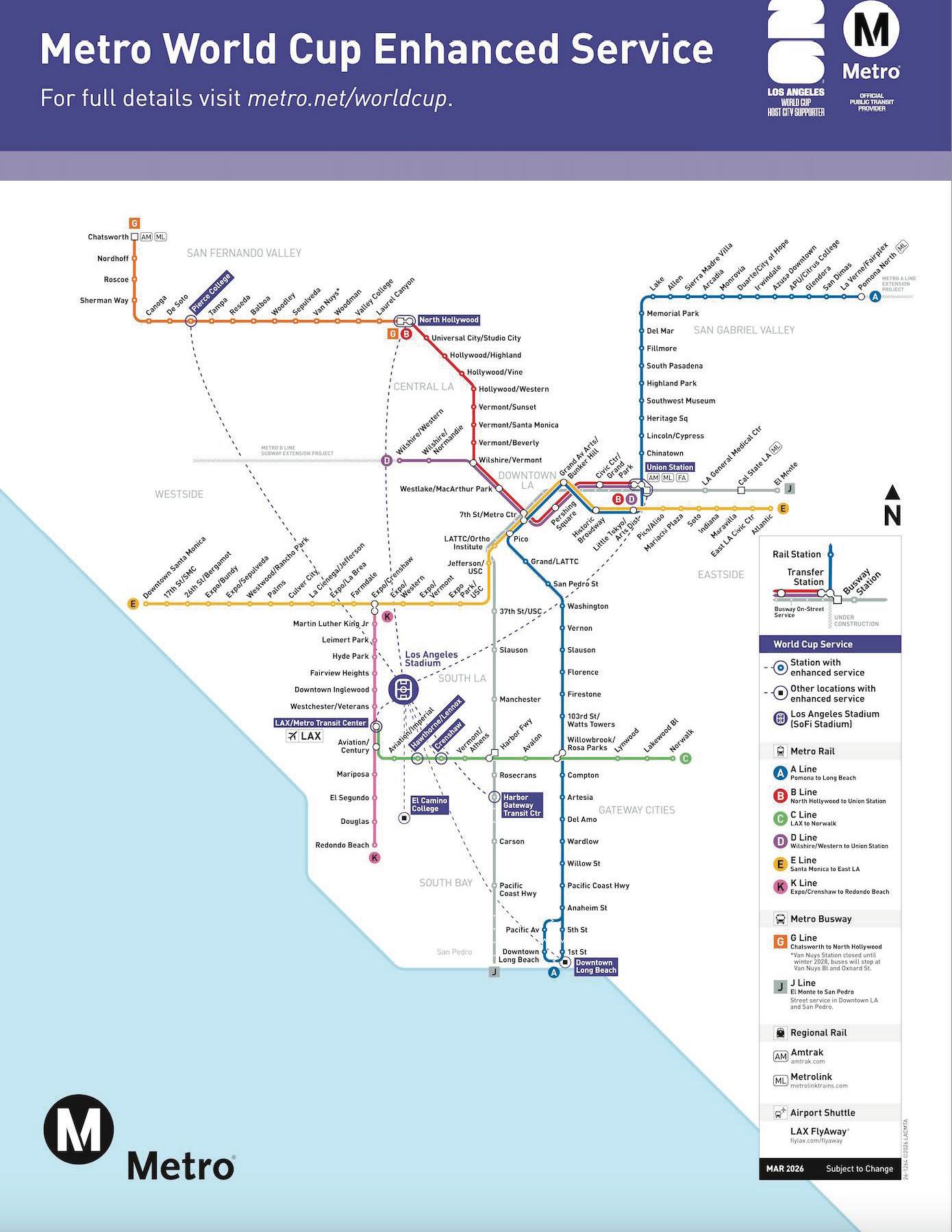
Los Angeles City Hall looms over a nearby homeless encampment. | Photo courtesy of Ron Reiring/Wikimedia Commons (CC BY-SA 2.0)