
Rosemead Reader
E ort to recall Arcadia Councilman David Fu fails
By Joe Taglieri joet@beaconmedianews.com
An attempt to gather enough signatures to force a recall vote for Arcadia City Councilman David Fu has failed, recall organizers announced Wednesday.
After weeks of voter canvassing throughout Council District 1, recall supporters fell short of the 1,600 signatures needed for a place on the ballot, according to organizers. The effort garnered 1,450 signatures, Councilwoman Sharon Kwan said.
“In the process of gathering signatures, our team connected with a large number of District 1 voters and heard widespread concerns about accountability, transparency, and leadership,” according to April Verlato, who led the recall effort and represented CD1 from 2016-24. “Many residents also expressed fear of retaliation if they signed the petition. The fact that so many people still chose to engage with us — despite those fears — speaks volumes about the depth of discontent in the district.”
Fu did not respond to a request for comment.
In a rebuttal to the recall notice, he called the effort “a third fabricated attempt by a former councilmember who desperately wants to regain power. It’s a cynical effort to undo the results of a fair election.”
Recall supporters launched the signature drive after Fu led a council censure action against then-Mayor Sharon Kwan.
“My job is to do the right thing for Arcadia,” Fu wrote in his rebuttal. “In this case, the right thing was to reprimand unprofessional, dishonest behavior by the Mayor. That’s what a censure is: a reprimand for unacceptable conduct.
“The public overwhelmingly supported the censure, as did every member of the council except the Mayor,” according to Fu.
Deputy City Manager
Justine Bruno confirmed that the deadline to submit the recall petition elapsed on Wednesday and the recall process has concluded.
She added that the City Manager’s Office “treats allegations of intimidation seriously. We have no written or verbal reports indicating that any District 1 voters feared retaliation for signing the recall petition,” Bruno wrote in an email to HeySoCal. com. “Had a petition been submitted, all voter information and signatures would be confidential and exempt from disclosure under applicable elections and public records laws. Such information would only be accessible by the City Clerk’s Office and the City Attorney’s Office, and not to Council Member Fu or any other external parties.”
Recall proponents say their effort stems from Fu’s alleged “pattern of retaliation, misuse of authority, fiscal recklessness, and disregard for the City Charter,” according to the campaign’s notice of intent filed in November.
In a mass email Wednesday, Verlato said recall supporters hope that voters remember the alleged fear of reprisals when Fu runs for reelection.
“We don’t want a representative that we can’t trust and who is willing to put the unions’ money grab before the residents who live here and pay the taxes that fund those unions’ salaries,” Verlato wrote.
Fu was elected to a fouryear term in November 2024. Arcadia council members can serve for a maximum of two terms in office.
The total number of signatures gathered since last fall was unclear.
At the Aug. 19 council meeting, Fu initiated efforts to censure and remove Kwan.
According to recall proponents, the next day Kwan was scheduled to meet with an investigator regarding a sexual harassment complaint she filed against Fu.
“The timing raises serious concerns of retaliation and abuse of power,” the notice document states.
An independent investigation firm contracted by the city found none of Kwan’s harassment allegations were sustained, according to Fu at the March 3 council meeting.
I want to be very clear. An investigation result does not always reflect what actually happened,” Kwan said in an email to HeySoCal.com. “In situations like this, especially involving sexual harassment, the truth is often only known by two people, the person who did it and the person who experienced it.
“Women rarely get full justice in these situations. And in many cases, the person responsible is not held accountable. That is not because nothing happened. It is because these cases are difficult to prove within a system that relies heavily on witnesses and third party accounts.”
Kwan said investigators relied heavily on interviews they conducted “with people within Councilman Fu’s circle, his colleagues and those close to him. That raises serious concerns about objectivity,” the District 2 councilwoman said.
“I spent hours sharing my experience in detail. I know what I experienced, and I stand by it.
“After I filed the complaint, what followed was retaliation. The pattern was clear. Instead of addressing the behavior, there was defensiveness, hostility, and repeated efforts to undermine my credibility.
“During public comment, residents raised concerns about his personal history, and he himself stated publicly that he is on his third
LA County warns residents of E. coli outbreak linked to raw farm cheddar
This DHS official oversees the security of federal elections. He wants to ban voting machines.
By Doug Bock Clark, ProPublica
to receive The Big Story newsletter as soon as it’s published.
In his top post at the Department of Homeland Security, David Harvilicz sets policy on protecting the nation’s elections infrastructure, including voting machines.
He’s also the co-founder of a company with James Penrose, who helped hatch debunked conspiracy theories blaming hacked voting machines for Donald Trump’s loss in the 2020 presidential election. Penrose assisted in a push to seize voting machines to overturn Trump’s defeat.
On social media, Harvilicz has called for doing away with voting machines, saying they are “eminently vulnerable to exploitation.” In a March post, he wrote that “DHS needs to ban voting machines for all federal elections. The time is now.” He also has repeatedly questioned the validity of Democratic electoral victories and pushed for Republicans to overhaul electoral systems to their advantage.
Election experts as well as current and former DHS officials say Harvilicz’s central role in overseeing the security of electoral systems and voting machines is especially concerning at a time when the administration is taking unprecedented steps to relitigate Trump’s baseless claims that the 2020 election was stolen. That includes the FBI’s seizure of 2020 voting records from Fulton County, Georgia, and having a team working for Tulsi Gabbard, the director of national intelligence, take custody of voting machines used in Puerto Rico in 2020.
“The security of our election infrastructure depends on leadership that is trusted, impartial and grounded in evidence — not individuals who have promoted conspiracy theories about the very systems they are now responsible for protecting,” said Danielle Lang, vice president for voting rights and the rule of law at the Campaign Legal Center, a nonpartisan pro-democracy organization. “Placing someone with that background in charge of policies affecting election security can undermine public confidence in our elections at a time when trust is already fragile.”
DHS didn’t answer detailed questions about Harvilicz or his team, providing a more general statement about the work done by the agency. “DHS and its employees are focused on keeping our elections safe, secure, and free,” it said. “Every single day appointees at the Department of Homeland Security work to implement the President’s policies and keep our Homeland safe.”
Harvilicz didn’t respond to questions about his DHS role. Harvilicz’s X account notes his post as DHS’ assistant secretary for cyber, infrastructure, risk and resilience policy but says he’s been detailed to the Defense Department. (Such temporary assignments are typically done in 120-day increments.)
Harvilicz was appointed to the DHS job around July, taking on a role that in the past has largely focused on shaping policy to protect the nation’s critical infrastructure, including its election
This story was originally published by ProPublica. ProPublica is a nonprofit newsroom that investigates abuses of power. Sign up
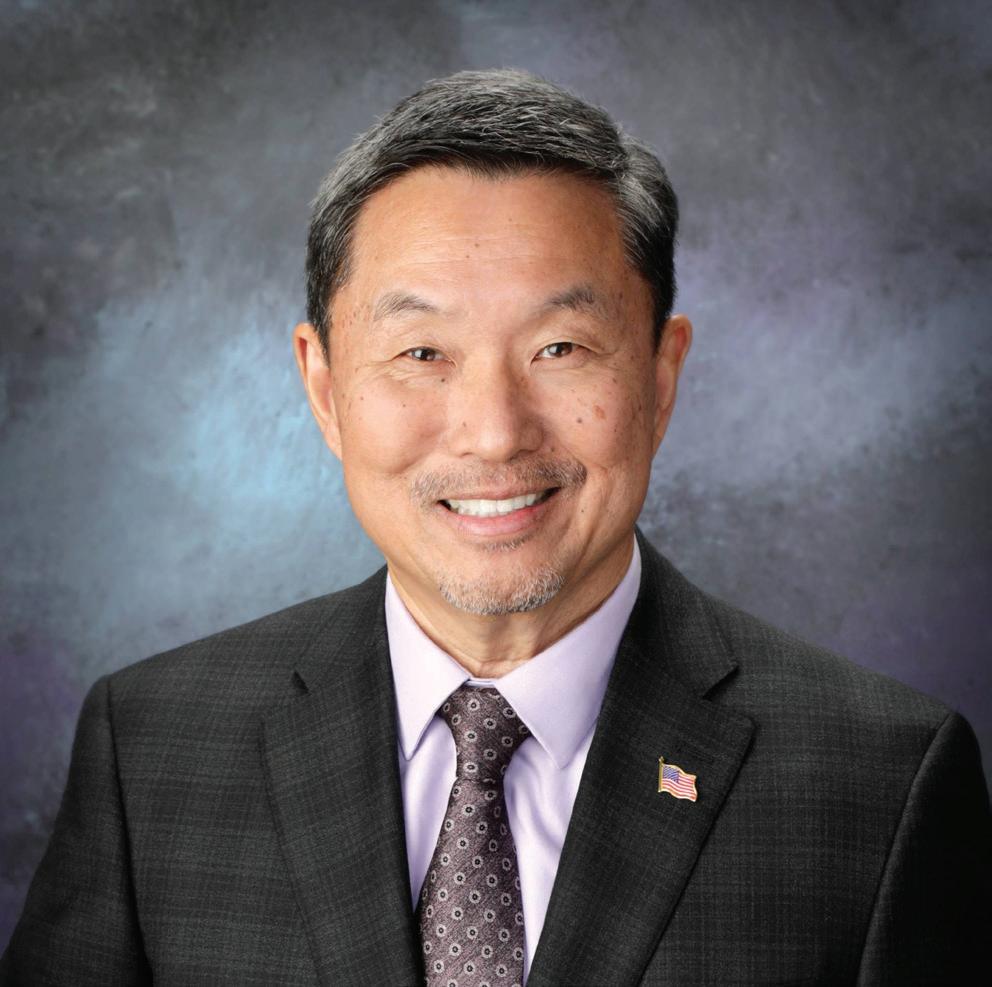
Arcadia City Councilman David Fu. | Photo courtesy of the city of Arcadia
State wildlife authorities euthanize mother bear in Monrovia
By Joe Taglieri joet@beaconmedianews.com
State wildlife authorities euthanizedamother bear with two cubs in Monrovia after the bear swiped at a woman’s leg, officials said Wednesday.
The cubs are healthy and were in the process of being relocated Wednesday with the intention of eventually returning them to the wild, according to the California Department of Fish and Wildlife.
Monrovia City Manager Dylan Feik said state officials told him Tuesday that the mother bear had been euthanized despite a request from the Monrovia City Council for the animal to be relocated to the Angeles National Forest.
“By the time we were able to speak with state officials involved in the decisionmaking, the decision to euthanize was already made,” Feik said in a statement.
Wildlife officials captured the bear Monday. According to the CDFW, the animal clawed a Monrovia woman on Saturday while she was walking her dog. The woman was not seriously injured. A neighbor helped scare the bear away, and the cubs were not present during the attack.
According to Feik, state wildlife officials told him
DNA testing confirmed that the bear was involved in a previous incident in June 2025. An elderly Monrovia resident was sitting on his enclosed porch when the bear approached and swiped at him.
“A caretaker witnessed the incident and helped scare the bear away while the resident received treatment,” Feik said.
The injured man recovered, and authorities could not locate the bear following that incident.
“The bear DNA from Saturday’s incident matches the bear DNA from the June 2025 incident,” Feik said.
“Local CDFW officials, as well as those working at state offices in Sacramento, determined the two incidents which caused human injury were sufficient justification to euthanize the bear, according to state policy.”
Over 3,000 people had signed a petition to relocate rather than kill the bear, which some said was just exhibiting the natural instinct of a mother protecting her offspring.
On Wednesday afternoon, a CDFW statement defended officials’ decision to euthanize the bear.
“Anytime there is human-

wildlife conflict, the California Department of Fish and Wildlife’s foremost responsibility is the protection of
human life and ensuring public safety,” according to agency. “With that priority in mind, the black bear respon-
sible for the March 14 attack on a resident in Monrovia, Los Angeles County, has been determined by CDFW law enforcement officers to be a public safety ... (threat).
The decision to euthanize the bear came after a “thorough assessment of the bear’s behavior and the circumstances of the incident,” according to state wildlife officials, who added that killing an animal “is used only as a last resort when an animal poses a risk to public safety and cannot be safely returned to the wild.”
According to the CDFW, the deadly outcome and similar incidents “underscore the importance of prevention.”
“Bears are highly adaptable and will seek out food and shelter when opportunities are present,” officials said. “Securing crawl spaces, removing food attractants such as unsecured trash or pet food and eliminating access to sheltered areas around homes are critical steps residents must take to reduce the likelihood of conflict and habituation. These actions help keep both people and wildlife safe and bears wild.”
The statement went on
to say that mother bears teach their foraging methods to cubs, which can learn to associate people and homes with food, leading to potentially dangerous encounters.
“Relocation may seem like a solution, but is not an option when it could put public safety at risk,” according to the CDFW. “Bears have strong spatial memory and often return to familiar areas. When translocated long distances, they recreate the same conflict behavior or struggle to survive in unfamiliar habitat. Without humans taking steps to reduce attractants and access to urbanized shelter, the underlying issue remains.”
Area residents opposed to the euthanasia gathered more than 3,700 signatures for a petition that sought relocation for the mother bear, who they named Blondie, and her cubs. A “Community Honor Walk” vigil is planned for 9 a.m. Saturday at Monrovia Library, 321 S. Myrtle Ave. Organizers said the event “is not a protest. This is a space for reflection, respect, and community.” Attendees “are welcome to bring a small sign, note, or message for Blondie or what she taught you.”
New era begins at Disney as Iger steps down as CEO, Josh D’Amaro takes over
By City News Service
It was the end of an era Wednesday at the Burbank-basedWalt Disney Co., as long-time CEO Bob Iger stepped down and handed the company keys to Josh D’Amaro.
D’Amaro was elected to succeed Iger by a unanimous vote of the Walt Disney Co. Board of Directors in February. His appointment became effective Wednesday, coinciding with the company’s annual meeting. Iger had retired from the Walt Disney Company in 2021 after 16 years at the helm. He returned as CEO in 2022 after the ouster of Bob Chapek. He will remain a board member and senior company adviser until his retirement, which is scheduled to take place Dec. 31. In a pre-taped message played for shareholders during Wednesday’s virtual meeting, Iger said “people had lost confidence” in the company in 2022, when he was brought back as CEO.
“Today, everywhere I turn, I sense confidence and excitement about what lies ahead,” Iger, 74, said. “So, as I step away, I do so with enormous gratitude and real optimism. I believe deeply in this company’s future, because I believe in Josh D’Amaro, and the people who will help him shape it next.”
Iger said the company has “experienced extraordinary change” over the years, while dealing with “real challenges.”
“That was particularly profound in the last three years,” he said. “It was daunting at times, but through it all, what sustained me was the passion I saw every day from great storytellers. innovators, leaders, and people around the world who care so deeply about what they do and want to just get it right. That commitment,resilience, passion, and heart will make this company what it is.”
Iger later appeared at the virtual meeting and offered support to his successor, saying, “I believe in Josh D’Amaro.”
D’Amaro, 55, previously led the Disney Experiences segment of the company, which includes Disney’s theme parks, resorts, cruise ships, consumer products, retail and licensing. In a statement in February, the Disney board noted that D’Amaro was “the architect of the largest global expansion in Disney Experiences history,” while leading the segment “to new heights financially, creatively and in guest satisfaction.”
D’Amaro heaped praise on Iger as he took the reins of the company.
“Bob, on behalf of our employees, cast members, shareholders, and fans around the world, thank you so much for your tremendous leadership, your steadfast support, and your countless contributions to

The Walt Disney Company,” he said. “You’ve set an incredible example for all of us. And personally, I can’t thank you enough for your mentorship and friendship through the years. You will be missed.”
D’Amaro talked about his upbringing in a “Disney family,” and saying he visited Disneyland with
his family for the first time at 10 years old. He said he was “deeply honored and profoundly grateful” for the chance to lead the company.
He also made reference to the pending merger of Paramount Skydance and Warner Bros. Discovery.
“While others in our industry are consolidating
just to compete, or struggling to be relevant in a fragmented and disrupted world, Disney is in a category of one,” he said. “... And this next chapter will be driven by staying focused on world-class creativity, enhanced by technology, bringing unforgettable stories to audiences wherever they are.”
This flyer directs community members to a vigil that took place Saturday in honor of the euthanized Monrovia bear. | Photo courtesy of poorbearlife/Instagram
Disney executives, from left, Chairman James Gorman, new CEO Josh D’Amaro, former CEO Bob Iger
Editorial editorial@beaconmedianews.com editor@hlrmedia.com
Graphics/Production production@beaconmedianews.com production@hlrmedia.com
Advertising advertising@beaconmedianews.com advertising@hlrmedia.com
Legal Advertising legals@beaconmedianews.com legals@hlrmedia.com
Business accounting@beaconmedianews.com accounting@hlrmedia.com
BEACON MEDIA ADDRESS: 820 S. Myrtle Ave. Monrovia, CA 91016
PHONE: (626) 301-1010
WEBSITE www.beaconmedianews.com
HLR MEDIA ADDRESS: 820 S. Myrtle Ave. Monrovia, CA 91016
PHONE: (626) 301-1010 www.HLRmedia.com PRESS
editor@beaconmedianews.com editor@hlrmedia.com















systems.
But current and former DHS officials say Harvilicz and his team have transformed their functions to become more hands-on. They’ve been deeply engaged with facilitating multiple administration data-gathering efforts aimed at scouring voter rolls for noncitizens, the officials said. ProPublica has reported on one such effort, which has led to hundreds of citizens being incorrectly flagged as potential noncitizens.
Harvilicz’s team includes Heather Honey, the deputy assistant secretary of election integrity. ProPublica has reported that Honey was previously a leader in the Election Integrity Network, a conservative group that has challenged the legitimacy of American election systems. Honey worked closely with Cleta Mitchell, the network’s leader, who played a prominent role in helping Trump try to overturn his 2020 loss.
Also reporting directly to Harvilicz is Samantha Anderson, a data specialist who previously worked to elect Trump through the advocacy arm of the America First Policy Institute, a think tank closely associated with the president.
Voting machines
ment, with Penrose, and they are listed on its 2025 patents as developing its systems together.
The Duarte Dispatchhas been adjudicated as a newspaper of general circulation in court case number GS 013893 City of Duarte, County of Los Angeles, State of California.
Rosemead Readerhas been adjudicated as a newspaper of general circulation in court case number GS 048894 City
newspaper of general circulation in court case number KS017174 City of Baldwin Park, County of Los Angeles, State of California. The Burbank Independent has been adjudicated as a newspaper of general circulation in court case number ES016728 City of Burbank, County of Los Angeles, State of California.
The











Multiple officials and elections experts said they were worried that Harvilicz and Honey would have prominent parts in assessing and describing the cybersecurity of the coming election, both to the public and to administration leaders. They also expressed concern that if Trump again wanted to get control of voting machines after the election, perhaps if Republicans lose seats in the midterms, that Harvilicz is ideally positioned to help them do so.
“It would be super easy for them to get the voting machines,” a current DHS official said, adding they can “describe it as they want, if they don’t like the results.”
Harvilicz co-founded Tranquility AI, which has developed an artificial intelligence tool for law enforce-
Penrose, a former intelligence officer, played a leading role in the campaign to help Trump in his failed bid to overturn the 2020 election, ProPublica has reported. Penrose also participated in multiple attempts to clandestinely seize voting machines, including in Michigan, where prosecutors accused him of breaking into some of the machines. (Penrose wasn’t charged in the case.) He appeared to be an unindicted co-conspirator in the failed Georgia prosecution in which Trump was accused of conspiring to overturn the election results, according to The Washington Post.
Penrose didn’t respond to a request for comment for this article.
One of the purported uses of Tranquility AI’s product is for “election integrity,” according to the company’s website. It didn’t provide more details in response to a question from ProPublica.
Tranquility AI’s tools, which help law enforcement agents process data and assemble cases, have been employed by New Orleans’ district attorney,
and the company says it has partnered with dozens of law enforcement agencies nationwide. In July 2025, a large government IT contractor announced a partnership with Tranquility AI.
Harvilicz started his career working at law firms on Wall Street and in tech. Then, in 2004, when he was 29, he launched a losing bid for a Maryland congressional seat. After that, he helped lead a crowdfunding company, a movie marketing business, a film production business that worked with former intelligence officers and several cyber security ventures (including one at which he worked with Penrose). He also did a stint in the first Trump administration, serving as cybersecurity official in the Department of Energy.
In advance of Harvilicz getting the DHS position, Tranquility AI made a $100,000 donation to Trump’s inaugural fund through a newly created nonprofit based at Harvilicz’s home address, according to The Intercept. In response to questions from The Intercept, Harvilicz said the donation was designed to help them meet administration policymakers. The
Intercept first reported his ties to Penrose in connection with the donation.
Harvilicz has posted prolifically to social media, sharing hundreds of posts of conservative content. After Trump won a second presidential term, he wrote: “We will now dismantle the near communist takeover of America and return her to greatness.”
In 2020, Harvilicz purchased a $3.3 million home outside of Los Angeles.
After the Palisades Fire destroyed it around the beginning of Trump’s second term, Harvilicz stood on a roadside to greet the president’s tour of the disaster area with his young son on his shoulders. His son held aloft a picture of a bloodied Trump punching the air after surviving an assassin’s bullet.
Even then, elections were not far from his mind. He told a reporter for the Los Angeles Times that he supported Trump making disaster aid conditional on the Democratic state implementing voter ID.
“I hope he saw us,” Harvilicz told the Times reporter.
Republished with Creative Commons License (CC BY-NC-ND 3.0).
Aldi is recalling frozen spinach bites over possible rodent hair contamination
By Colby Droscher, Stacker
If you’ve bought frozen spinach bites from Aldi recently, check your freezer before eating them.
The FDA has classified a recall of Simply Nature Spinach Bites, sold exclusively at Aldi locations in Maryland and Pennsylvania. The recall was initiated on January 16, 2026, by Dr. Praeger’s Sensible Foods Inc. of Elmwood Park, New Jersey, and received its official Class II classification from the FDA on
March 16. The products may be contaminated with rodent hair. No illnesses or hospitalizations have been reported.
The product is a childoriented frozen snack — the bites are shaped like dinosaurs and stars — sold in 12-ounce boxes with an inner plastic bag. Consumers can identify recalled units by the following infor-
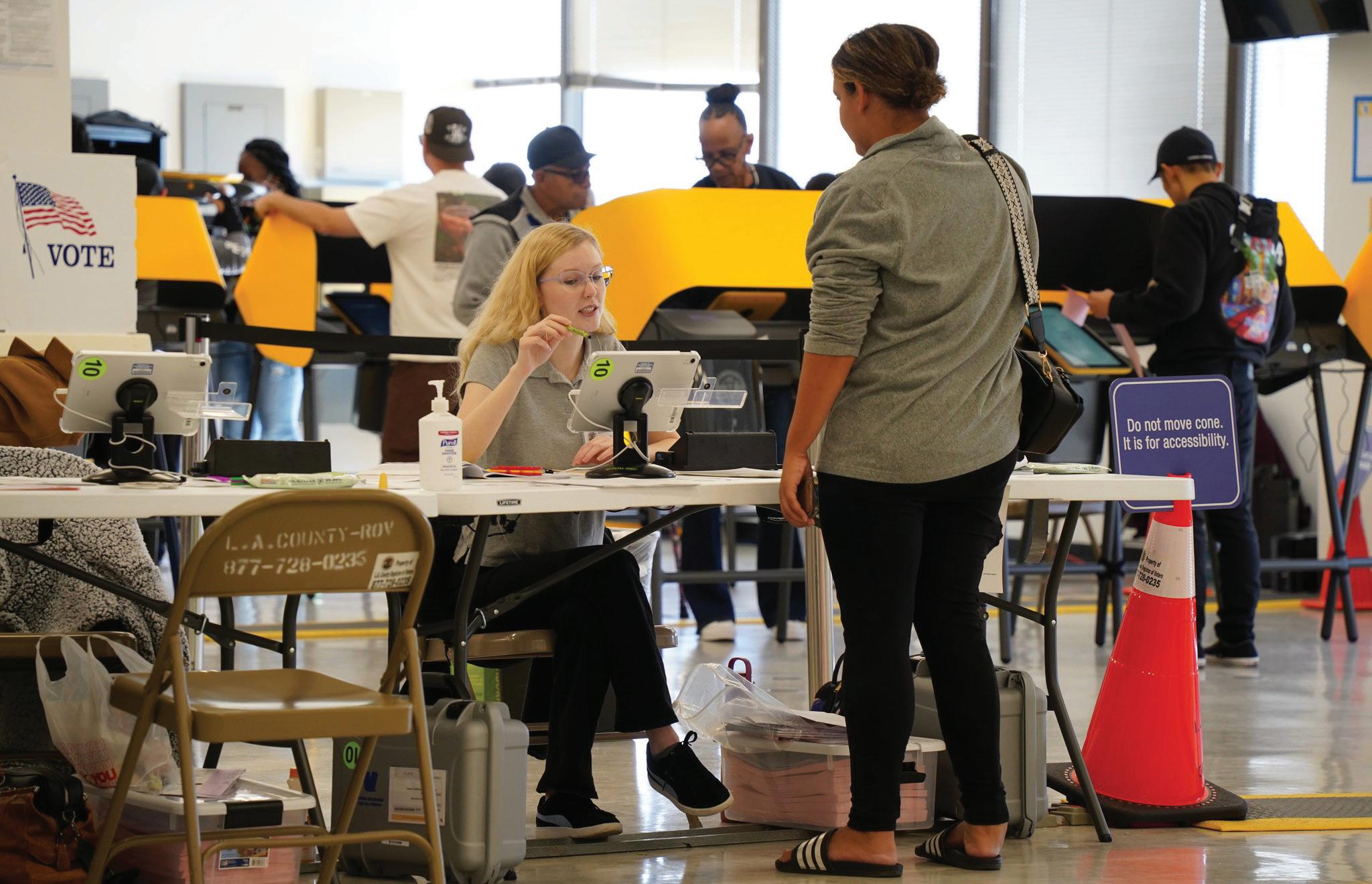
Election workers helping voters. | Photo courtesy of L.A. County Registrar-Recorder / Facebook




Civil rights groups call on police to respect laws on use of force
By Suzanne Potter, Public News Service

Ncalling on local police agencies to follow the law on use of force.
Last month, two more protesters filed lawsuits against the Los Angeles Police Department and the Sheriff’s Department, alleging they were shot in the head with so-called “less lethal” projectiles despite not posing a threat. The authorities say some people in the crowd threw objects while protesting ICE enforcement.
JohnLindsay-Poland, co-director of the California Healing Justice Program of the nonprofit American Friends Service Committee, said police have also resorted to using tear gas and rubber bullets on peaceful protestors and journalists.
“Militarized equipment has become very normalized,”
he said. “Often, it’s made to sound like de-escalation tools. I mean, that phrase is frequently used for armored vehicles and launchers of rubber bullets.”
Police agencies say they need advanced weapons to fight drug gangs.
In 2021, California passed Assembly Bill 48, which restricts the use of chemical agents and impact projectiles such as rubber bullets in crowd control to situations where there is a direct threat to public safety. They must issue warnings, only target people who are creating the danger, and refrain from shooting at a person’s head.
indsay-Poland noted that a second law, Assembly Bill 481, is supposed to improve transparency. It’s meant to allow people to lobby local city councils to estab-
lish policies on the use of weapons of war.
“This law requires every single law enforcement agency to disclose what militarized weaponry they have, what their policies are, report on that use annually, and get approval of local elected officials,” he said.
The American Friends ServiceCommittee published a report last fall that found many departments are evading the transparency law, using loopholes to conceal the extent of their stockpile. Researchers obtained inventory lists of weapons through public information requests from 30 county sheriff’s departments. They compared the data to those counties’ annual reports to the state, and found that they had under-reported the number of assault weapons by 67%.
mation printed on the box:
- Lot number G25CF-02B - Product number AL-SP - UPC 4099100247992
A total of 7,894 units are affected.
A Class II recall indicates the FDA has determined that use of or exposure to the product may cause temporary or medically reversible adverse health effects, and that the probability of serious harm is considered remote. It is the middle tier of the FDA’s three-level recall classification system.


The recall has not appeared on Aldi’s own recall page as of this week. Shoppers should check their packages directly against the lot number and UPC above
Aldi’s website features Simply Nature Spinach Kids Bites. | Screenshot courtesy of Stacker
ine months after the immigration crackdown in Los Angeles, peace activists are
Protestors in Los Angeles last summer alleged indiscriminate use of force against protestors and journalists covering unrest sparked by ICE raids across the region. | Photo courtesy of Wikimedia Commons
The micro-adventure resolution: How Americans plan one-hour outdoor escapes in 2026
By Luca West for Retrospec via Stacker
Whenanewyear begins, Americans tend to aim high. Gym memberships spike, planners fill up, and ambitious routines promise a better version of everyday life. By February, many of those plans collide with reality: long workdays, family obligations, and the quiet pull of the couch.
That tension shows up clearly in how people think about time. According to a survey of 1,000 people conducted by Retrospec on Jan. 29, 2026, 32.5% of Americans say they spend their unexpected free hour scrolling on their phones. The gap between intention and action is not about motivation alone. It is about friction.
Looking into 2026, many Americans appear ready to resolve that gap with smaller commitments. Instead of training plans or weekend excursions, they are embracing micro-adventures. These are short, one-hour outdoor escapes that feel achievable, affordable, and easy to repeat.
Key Findings
- 32.5% of Americans spend an unexpected free hour scrolling on their phone.
- 88% say having one or more one-hour micro-adventures in a week makes them feel proud.
- 72% say a walk or easy hike is the most doable adventure near home.
- 45% would travel just one to three miles for a one-hour outdoor escape.
- 44% feel guilty, anxious, or disappointed when they stay inside instead of going out.
- 32% say owning a bike or e-bike would most increase their odds of getting outside weekly.
The One-Hour Problem
Time scarcity is not new,
but the way people experience it has changed. A free hour no longer feels like a gift. It feels undecided. Without a clear plan, that hour often defaults to screens, with 32.5% of Americans spending an unexpected free hour scrolling on their phone.
Phones have become both a placeholder and a saboteur. When time opens up unexpectedly, it often lands between obligations rather than before rest. Starting anything that requires preparation can feel risky, while scrolling feels neutral.
That friction is amplified by awareness. One in 10 Americans believes their phone will derail their outdoor plans almost every time, showing how easily good intentions dissolve when effort feels too high.
Micro-adventures attempt to solve this problem by shrinking the decision itself. When the goal fits neatly into an hour, the barrier to starting drops. There is no packing list, no scheduling puzzle, and no sense of wasted effort if plans change.
Pride Over Performance
What stands out is how quickly these short outings carry emotional weight. 88% of respondents say completing one or more one-hour micro-adventures in a week makes them feel proud.
That pride is not tied to distance, intensity, or performance. It comes from follow-through. In days dominated by reactive tasks and nonnegotiable responsibilities, doing something intentionally, even briefly, feels significant. A short bike ride, for instance, or a simple walk around the block can create a clear mental break.
Many modern routines leave little room for personal
wins. Micro-adventures fill that gap by offering proof that something was chosen, not just managed. In a culture long focused on extremes, that quieter reward appears to be enough to keep people coming back.
Close to Home, by Design
Ambition drops quickly as distance increases. Nearly half of Americans (45%) say they would only go one to three miles from home for a one-hour adventure.
Geography is not the issue. It is about protecting the hour itself. Travel time, parking, and unfamiliar routes quietly turn a reset into a project. Staying close preserves flexibility and control.
That preference helps explain why simplicity dominates. 72% point to walks or easy hikes as the most doable option near home, while short bike rides resonate with certain groups, including 20% of men who cite quick e-bike rides as their top choice.
The takeaway is practical. Instead of looking for novelty, people are looking for proximity. The closer an experience feels, the more likely it is to happen.
When Staying in Feels Worse Than Going Out
Skipping an outdoor plan does not always bring relief. 44% of Americans say they feel guilty, anxious, or disappointed when they realize they stayed inside instead of going out.
That response reflects a growing awareness of what outdoor time provides. With more conversation around mental health, movement, and burnout, staying sedentary now feels like a missed opportunity rather than a neutral choice.
When micro-adventures


do not happen, they are often replaced by passive habits. 32% say they usually stream TV or movies instead, reinforcing the difference between rest and restoration.
Micro-adventures sit in a psychological middle ground. They are small enough to feel doable, which means skipping them does not come with a convenient excuse. When the bar is low, the emotional stakes rise.
Mental Health as Motivation
For Americans earning under $50,000, the appeal of micro-adventures goes beyond fitness or fun. 42% say their primary motivation for getting outside is mental health breaks.
That distinction matters. Many wellness options feel financially or logistically out of reach. Therapy, gym memberships, classes, and retreats all carry costs that are not easily absorbed.
Outdoor time, by contrast, remains accessible. Short rides, park loops, and quick paddles offer relief without
added pressure. In this context, micro-adventures function less as leisure and more as maintenance. They create brief pauses that help regulate stress and mental fatigue.
The Power of Being Asked
Motivation does not always come from within.
33% of Americans say a friend asking them to go would make them more likely to do a micro-adventure this week.
An invitation simplifies the decision. It removes planning effort and replaces internal debate with momentum. Saying yes becomes easier than initiating.
That effect is even stronger among younger adults. 30% of Gen Z respondents say a friend is the most likely factor to get them out the door, reflecting a generation shaped by shared experiences and social cues. For many, movement feels more natural when it is collective.
A micro-adventure does not just fit into a schedule. It fits into a conversation.
Summary
The data points to a quiet shift: Americans are not abandoning the outdoors. They are resizing it. Faced with limited time, rising stress, and constant digital distraction, many are choosing progress over perfection.
One hour is enough to change how a day feels. Enough to feel proud. Enough to step outside the scroll. In 2026, the most sustainable resolutions are the ones that fit into real life.
Methodology
This survey of U.S. adults examined attitudes toward short, one-hour outdoor activities, motivations, emotional responses, and barriers to participation. Results were analyzed across demographic groups, including age, income, gender, and parental status, to identify broader behavioral patterns and differences.
This story was produced by Retrospec and reviewed and distributed by Stacker.
Re-published with CC BY-NC 4.0 License.
| Photo courtesy of NEOM/Unsplash
Next-gen geothermal aims to greatly expand clean power
By Stephen Battersby for
the Proceedings of the National Academy of Sciences.
Broadcast version by Suzanne Potter for California News Service reporting for the Pulitzer Center-Public News Service Collaboration.
In 1904, the Italian town of Larderello saw the world’s first trickle of electrical power generated from the heat of the Earth. It was enough to make five lightbulbs glow. By 1913, Larderello had a full-scale plant producing up to 250 kilowatts of electricity, using steam from natural hydrothermal vents to drive a turbine connected to a generator. Yet, despite this pioneering success over 100 years ago, geothermal power has remained a niche endeavor, largely because it’s limited to volcanic areas where natural steam or hot water is readily available. Today, it amounts to only about 0.5% of global electricity generation.
Far more planet power might be harvested using a suite of emerging technologies, broadly known as next-generation (next-gen) geothermal. They generally aim to extract heat from deep rock formations by creating artificial hydrothermal systems. That enables power stations to run in areas that are not volcanic, vastly expanding the range of potential sites. Some forms of next-gen geothermal aim to operate at much higher temperatures than traditional plants, potentially making them more efficient and economically appealing.
This power source could be an ideal partner for intermittent renewable sources such as wind and solar, as it offers a steady supply of power and may also be able to ramp up and down to cover any shortfalls. “Geothermal could be the backbone to providing a clean, affordable, reliable, low-cost grid,” says Katrina McLaughlin at the World Resources Institute, a nonprofit sustainability research organization based in Washington, DC.
In the past few years, next-gen geothermal has been spurred on by drilling methods developed in the oil and gas industry and by the increasingly urgent need for sustainable power. In 2024, an International Energy Agency report (1) forecast that it could meet 15% of global electricity demand by 2050, with costs falling to $50 per megawatthour by 2035, on par with the cheapest solar power. “In principle, geothermal is an amazing technology that can deliver on all your energy dreams,” says Lev Ring, president of geother-
mal startup Sage Geosystems, based in Houston, Texas.
But the industry needs expensive infrastructure, with high upfront costs and financial risks that may deter investors. And the rockfracturing processes used by many next-gen geothermal systems can cause earthquakes, which may restrict its use to sparsely populated areas.
That puts pressure on the startup companies developing these technologies. Failure could stymie geothermal development for years to come; success could open a wave of fresh investment that reshapes the global energy mix.
Drill Skill
Next-gen geothermal traces its origins back to the early 1970s, with landmark experiments at the Fenton Hill test site in New Mexico. The idea was to drill deep into the Earth, reaching rocks at roughly 200 °C that were hot enough for a practical geothermal power system. At these depths, the rocks tend to be tight-knit and impermeable, with any cracks squeezed shut. But as the Fenton Hill researchers showed, forcing highpressure fluid into such rock formations can make them permeable, opening preexisting cracks or creating new ones. Water can then be passed through the cracks to draw heat to the surface— the basis of a technique now known as enhanced geothermal systems (EGS).
In Beaver County, Utah, Fervo Energy is building an EGS plant called Cape Station that it expects to
produce up to 100 megawatts of electrical power in 2026 and 400 megawatts in 2028, with permits to go up to 2 gigawatts. The company is using techniques first developed in the oil and gas industry and adapted for geothermal with the help of the nearby Utah Frontier Observatory for Research in Geothermal Energy (FORGE), an underground laboratory sponsored by the US Department of Energy. These techniques include drilling around corners. One approach involves putting a slight bend in the final section of the drilling pipe, with hydraulic pressure from above driving the drill bit. This allows a rig to bore several wells that start just a few meters apart on the surface but then splay out toward different volumes of hot rock. That reduces the need for surface pipework and saves time because the rig doesn’t have to be moved far.
Drilling around the bend also means that boreholes can plunge to the needed depth and then turn horizontal. After drilling a pair of horizontal channels in the deep rock, Fervo pumps in high-pressure water to create cracks between the two. Then, once the plant is running, water sent into the lower channel will percolate through these cracks into the upper channel, gathering heat as it goes. Returning to the surface, the hot water will vaporize a volatile fluid, forming a highpressure gas that drives a turbine. Cape Station is the world’s biggest EGS project. “Everyone is watching Fervo
to see how they do,” says Roland Horne, a geophysicist at Stanford University in California, who taught Fervo’s founders and is on the company’s advisory board.
Meanwhile, Sage Geosystems is using similar drilling techniques in a different way. They also drill two boreholes, but then create fracture networks that branch out from each borehole and do not connect. Engineers pump water back and forth between the two wells, picking up heat each time in a process the company calls “huff-n-puff.”
Unlike Fervo’s EGS, this approach enables Sage to avoid using gritty additives called proppants. These are used to hold open the cracks, but they can also impede the flow of water, Ring explains. He believes this will prove to be a more efficient system, although the huff-n-puff approach also uses higher pressures than Fervo’s plant, requiring additional equipment to manage the water at the surface. Sage is now teaming up with Ormat Technologies to build a pilot generation project, which aims to generate 4 megawatts of electricity by 2027 and 150 megawatts by 2028.
Buried Treasure
Whichever EGS system is used, the potential power supply is enormous. A 2025 study by Ring and colleagues calculated that next-gen geothermal, deployed at depths down to 5 kilometers in the contiguous United States (2), could produce more than 5 terawatts— roughly four times total US generating capacity today.
are zero power plants operating with this technology.” Induced seismicity could be another barrier. Hydraulic fracturing can release built-up forces in Earth’s crust, and so trigger earthquakes. In 2009, an EGS project near Basel, Switzerland, was canceled after it caused quakes up to magnitude 3.4; and in 2017, a project in Pohang, South Korea, was responsible for a much bigger 5.5-magnitude quake. This may be a tolerable risk in some regions, and several other projects have not produced any noticeable seismicity, Horne says. “Nonetheless, to reduce the risk further, it is likely that in the nearterm, EGS projects are likely to concentrate on areas with low population density,” he says.
How far and how fast this resource gets exploited will come down to economics. In 2024, Horne and his Stanford colleague Mohammad Aljubran estimated the price of electricity from EGS plants using Fervotype technology (3). They found that almost 90% of the United States could have access to geothermal energy at a cost of less than $80 per megawatt-hour, comparable to some existing forms of firm (nonintermittent) generation such as nuclear power and biomass. “And it is actually cheaper than solar with batteries, which is what they need to provide firm power,” Horne says. The Department of Energy projects that average EGS costs will fall below $70 per megawatt-hour by 2030 and predicts that US next-gen geothermal capacity could reach 90 gigawatts or more by 2050 (4). That would supply more than 10% of the clean firm power required to complement intermittent renewables in a zero-emissions grid.
Not everyone is so optimistic. A 2025 report by certification body Det Norske Veritas anticipates that a shortage of investment could stall US geothermal at only about 15 gigawatt capacity (5). Ring agrees that getting projects financed remains one of the main barriers for next-gen geothermal. “Banks are not keen on providing capital,” he says, because it is unproven at commercial scale. “At the moment, there
Canadian company Eavor thinks that a different kind of geothermal technology could avoid earthquake risks. In Geretsried, Germany, it is drilling a system of boreholes to circulate water (along with some proprietary additives) to a depth of 5 kilometers, then horizontally through the rock and back up again. This closed-loop system does not require any rock fracturing, so there is negligible risk of induced seismicity. However, each well only provides a small contact area with the unfractured rock, which means lower power per borehole. Eavor gets around this by drilling a lot of holes, but that takes a lot of cash. “The economics of closed loop are behind EGS and conventional geothermal by an order of magnitude,” Horne says.
Robert Winsloe, co-founder of Eavor, insists that the investment will pay off overall. The Geretsried plant is designed to generate 8 megawatts of electricity, which will cost much more than other conventional power sources. But in winter, it will instead supply about 64 megawatts of heat to a planned district heating system in the town, at a more affordable level. Many other towns in Germany have existing district heating that similar plants could feed. “The path to geothermal is paved with district heating in Europe,” Winsloe says.
Hotter Stuff
All these projects exploit strata no warmer than a home oven, around 200 °C.
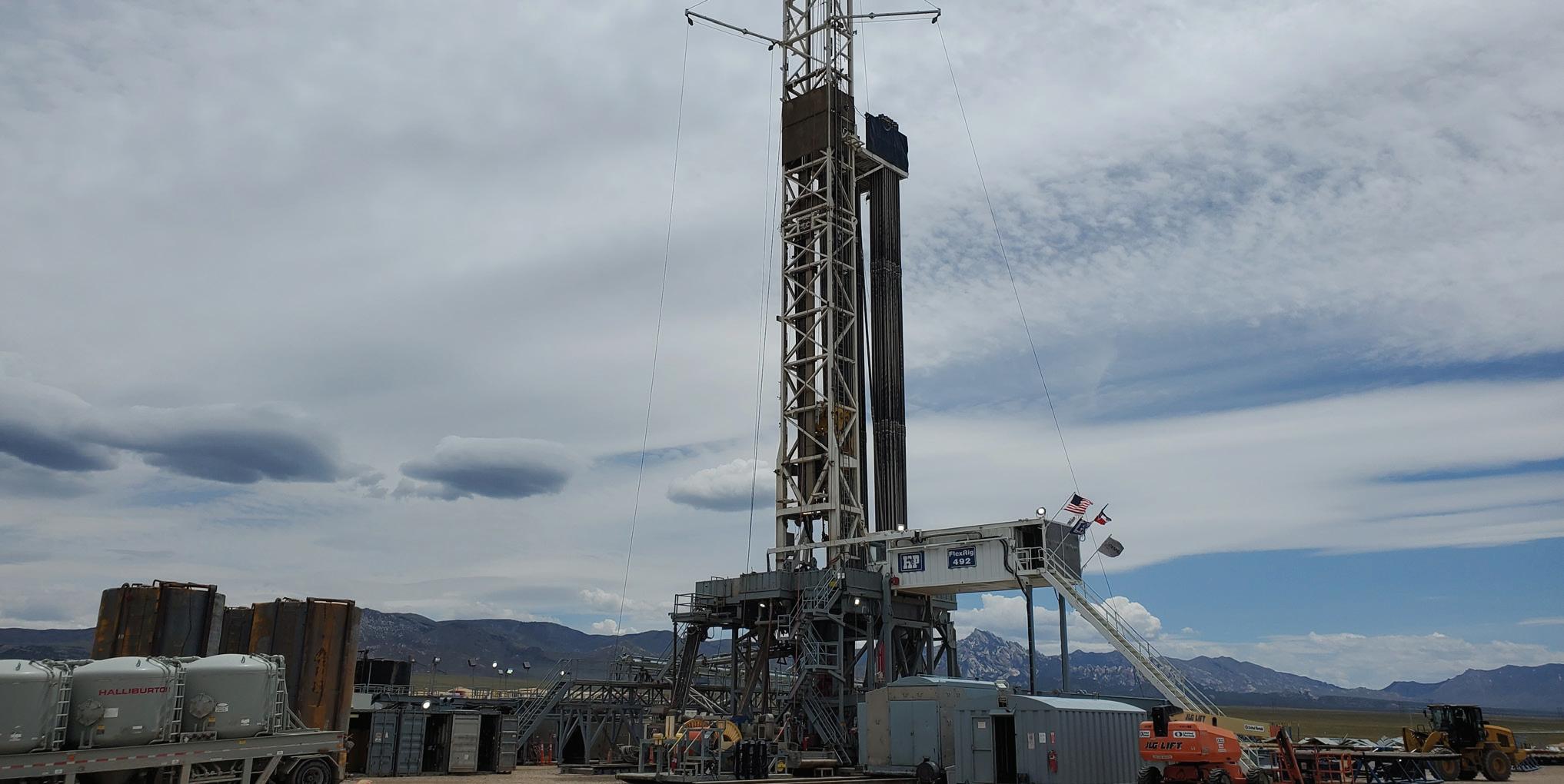
Fervo’s Cape Station geothermal rig in Utah expects to produce up to 100 megawatts of electrical power in 2026 and 400 megawatts in 2028, with permits to go up to 2 gigawatts. | Photo courtesy of Fervo Energy
How much is a dollar worth? Why the weakening US currency matters for your wallet
By Chris Taylor for Current via Stacker
Sorry to be the bearer of bad news, but for every dollar you earn, there are a number of different factors eating away at it.
There are taxes, for one, not far away with April 15 on the horizon. Then there is inflation: Even though it has moderated from the years of the COVID-19 pandemic, it is still eroding the value of our money to the tune of almost 3% a year.
And now there is a new worry: The U.S. dollar, which has sunk to a multiyear low against other currencies, is down around 10% compared to the beginning of last year.
Put all those factors together, and your cash isn’t packing a whole lot of punch when you go to the grocery store. Instead, it seems a little weak and dazed, like a boxer at the end of a 12-round fight. In this article, Current, a consumer fintech banking platform, explains how a weaker dollar affects everyday finances and what consumers can do about it.
“It manifests in imported goods and foreign travel, while subtly chipping away at general affordability as costs for goods and services rise and asset
prices are pushed higher,” says Mike Casey, a planner with AE Advisors in Alexandria, Virginia. “For the average consumer, imported essentials like electronics, clothing, and oil become pricier.”
In other words, the purchasing power of that buck in your wallet is under extreme pressure. Not exactly what we needed, in an era when affordability for households has become so challenging.
Seen from one angle, there’s not a lot average consumers can do about a weaker dollar. Its strength is determined by larger factors outside of our control, such as the level of interest rates set by the Federal Reserve.
But in another sense, there are targeted action steps we can take to maximize the value of our money. A few specific areas that a weaker dollar should make you consider: Foreign travel. On a daily basis, we may not realize how much the dollar has slumped. But when we go abroad, we most definitely will.
“Personally, the dollar hitting multiyear lows is affecting my travel budget,”

says Theresa Pablos, a planner with Equalis Financial in Los Angeles. “I’m planning a trip to Europe this fall, and I’ve intentionally padded my travel budget because I know the dollar won’t go quite as far on hotels, meals, and activities as in past trips. To make up for the difference in cost, I’m looking for other ways to save, such as flying budget airlines and getting a new travel card with cashback perks.”
Practically speaking, it means international travelers should be choosier about
destinations. It could also mean deliberately saving more in advance of such a trip, as Pablos did — or even delaying those big expenses altogether, until such a time when exchange rates look more attractive.
Imported goods. This area is a double whammy for consumers: Not only has a weak dollar pushed the price of imports up, but some have been slapped with tariffs as well, due to the current administration’s trade policies.
One way around that is to be more intentional about
Clean power
Tapping much hotter rocks, above 300 °C, would yield a lot more power from each well, potentially bringing down electricity costs and overcoming the investment barrier. “If superhot geothermal is achievable, it is going to provide commercial rates of return comparable to the oil and gas industry,” Ring says.
A startup called Mazama is testing superhot technology in Oregon, as is the Iceland Deep Drilling Project (IDDP) in the middle of the North Atlantic. In such volcanically active territory, engineers don’t need to go deep to reach high temperatures. The first IDDP well happened to hit a magma chamber only 2.1 kilometers down, releasing steam that would have been enough to generate 36 megawatts, which is 5 to 10 times the power from most conven-
tional geothermal wells, says project scientist Sigurður Hafsteinn Markússon. However, taming such high temperatures is difficult. As the IDDP has discovered, extreme thermal expansion can break conventional drill casings, which are based on steel pipe surrounded by cement. The project aims to counter that by using advanced cement formulas and flexible couplings between stretches of pipework. Fluids from these deep rocks also tend to be corrosive and laced with hydrochloric acid, so the project will investigate new alloys and protective titanium layers for its pipes. Markússon also expects that an initial dose of cold water down the wells should cause the rocks to crack without needing the high pressures of conventional hydrofracking. “We are hoping to look
into developing power plants with this technology from around 2030,” he says.
While superhot rock may be less than 5 kilometers down in Iceland or Oregon, it lies much deeper in most other parts of the world. That puts it under very high pressure, as well as high temperatures, and one concern is that under these conditions rock may become too plastic for fracking to work properly. Recent research seems promising, however. Small samples of granite were subjected to pressures of 1,500 atmospheres and temperatures up to 800 °C and then deformed (6). Despite being somewhat plastic, the rock seemed to develop high permeability, with many microcracks instead of a few big ones. This suggests that permeability could be created in superhot, super-
deep rock, although the lead author of the research, Gabriel Meyer at the Laboratory of Experimental Rock Mechanics in Lausanne, Switzerland, urges caution, saying it’s not clear how long the cracks would remain open.
And drilling will be challenging. Some entirely new methods are being explored. A company called Quaise Energy is developing a method to melt through rock using microwaves, for example. But less radical technology might be able to do the job.
Sage aims to reach depths of at least 10 kilometers and temperatures above 300 °C by using dense fracking fluids that send cracks downward through the rock. Eavor hopes to go down to 15 kilometers and 450 °C, using new cooling methods and other tech-
buying American-made products when possible, as you will avoid the exchange rates and tariffs that have pushed some prices higher.
Cash holdings. Everyone knows that investing involves risk, but there is also risk involved in standing pat with your money. If your cash isn’t earning anything, inflation marches on, and the dollar is declining, then you are essentially losing a little bit of ground every day. That’s a long-term risk, too.
That’s why, at a minimum, you should ensure that your cash is earning something significant. “For savings, shift to high-yield accounts,” suggests Casey.
That way, you can outpace some of these larger macroeconomic issues dragging down the currency. That’s easily done by checking your current rates and opting for accounts generating superior interest.
Card rewards. In an era when every penny counts, probably the easiest layup is maximizing the rewards programs attached to whatever cards you use on a daily basis. And yet, according to one Bankrate survey,
almost a quarter of rewards card users haven’t even cashed in any benefits in the past year. That’s puzzling, because it’s basically leaving money on the table.
International investments. If you have a percentage of foreign stocks in your portfolio, congratulations: All else being equal, the value of those holdings has likely risen, simply by virtue of being denominated in foreign currencies.
For those investors, a weak dollar is actually a good thing. “We have loved the dollar weakening,” says David Demming, a financial planner in Aurora, Ohio. “It has enhanced our overweight in international funds, with emerging markets both the cheapest and best performing last year.”
If you don’t have many international stocks yet, this weak-dollar era brings home the importance of diversifying and having some global exposure in your portfolio. That way, you won’t have all your eggs in one basket. This story was produced by Current and reviewed and distributed by Stacker. Re-published with CC BY-NC 4.0 License.
nologies that remain under wraps. Still, those superdeep, superhot systems may turn out to be impractical or remain many years in the future.
For now, the EGS plants being developed by Fervo and Sage benefit from a favorable political environment. The current US administration has streamlined permitting for geothermal and maintained tax credits for the industry, while removing those benefits for wind and solar. More policy nudges might be needed, says McLaughlin—for example, to cut delays in connecting to the grid, delays that are currently hindering all forms of generation.
What happens next could hinge on the results from these projects over the next few years. Horne hopes that more startups
will follow Fervo’s lead to develop large EGS plants, not least because widespread investment might need more than one or two successes. McLaughlin says it is important to show that this technology works in geographically diverse sites, not only in the western US states where traditional geothermal thrives. Among the big questions yet to be answered, she says, “Can it go east of the Mississippi?”
How the oil and gas industry responds may be crucial. It has the money and muscle to turn this promising trickle of next-gen geothermal into a flood. “Oil companies are hanging around the door,” Horne says, “deciding whether or not to join in.”
Stephen Battersby wrote this article for the Proceedings of the National Academy of Sciences.
| Photo courtesy of Kenny Eliason/Unsplash
How gas prices have changed in California in the last week
By Stacker

Stacker compiled statistics on gas prices in California using data from AAA. Gas prices are as of March 16. California by the numbers
- Gas current price: $5.53
- Week change: +$0.32 (+6.2%)
- Year change: +$0.87 (+18.7%)
- Historical expensive gas price: $6.44 (6/14/22)
- Diesel current price: $6.44
- Week change: +$0.48 (+8.1%)
- Year change: +$1.42 (+28.3%)
- Historical expensive diesel price: $7.01 (6/18/22) Metros with most expensive gas in California
#1. Napa: $5.71
#2. San Rafael: $5.70
#3. San Francisco: $5.69
#4. Santa Rosa: $5.68
#5. San Luis Obispo-Atas-
cadero-Paso Robles: $5.65
#6. Salinas: $5.62 #7. Los Angeles-Long Beach: $5.62 #8. San Diego: $5.58 #9. Orange County: $5.57 #10. Oakland: $5.55 #11. Ventura: $5.55 #12. San Jose: $5.53 #13. Madera-Chowchilla: $5.50 #14. San Bernardino: $5.50 #15. Riverside: $5.50 #16.Vallejo-Fairfield: $5.48
#17. Visalia-Tulare-Porterville: $5.45
#18. Fresno: $5.45 #19. Bakersfield: $5.45 #20. Sacramento: $5.44 #21. Santa Cruz-Watsonville: $5.43
#22. Santa Barbara-Santa Maria-Lompoc: $5.42 #23. Merced: $5.40 #24. Yolo: $5.37 #25. Stockton-Lodi: $5.37 #26. Hanford-Corcoran:
$5.36
#27. Modesto: $5.34
#28. Chico-Paradise: $5.34
#29. El Centro: $5.28
#30. Redding: $5.28
#31. Yuba City: $5.22
States with the least expensive gas
#1. Kansas: $3.15
#2. North Dakota: $3.20
#3. Oklahoma: $3.22
#4. Arkansas: $3.24
#5. Missouri: $3.25
Read on to see which states have the most expensive gas prices.
#5. Oregon
- Regular gas price: $4.49
#4. Nevada
- Regular gas price: $4.59
#3. Washington
- Regular gas price: $4.92 #2. Hawaii
- Regular gas price: $4.96
#1. California
- Regular gas price: $5.53
Re-published with CC BY-NC 4.0 License.
Legal experts speak out on statewide staffing industry fraud
By Suzanne Potter, Public News Service

The temporary staffing industry in California is plagued by wage and insurance fraud, with cases piling up in recent years, according to legal experts.
In January, a judge fined a company called Man Staffing in Ventura $650,000 for failing to provide workers’ compensation insurance. The feds prosecuted California staffing agencies for tax evasion in 2018, and again in May and December of last year.
Attorney Shaddi Kamiabipour, who spent 14 years with the Orange County District Attorney’s Office rooting out employment fraud, said many lowincome workers are suffer-
North Torrance High School grad Chuck Norris dead at 86
By City News Service
Film and television tough guy Chuck Norris, who was raised in Torrance, was being remembered for his illustrious martial arts and acting career following his death at the age of 86. Norris, who rose to fame as a martial artist and actor who appeared in such films as “The Way of the Dragon,” in which he fought Bruce Lee, and had an extended run with television show “Walker, Texas Ranger,” died in Hawaii on Thursday, according to his family.
The six-time unde -
feated World Profession Middleweight Karate title holder was a native of Ryan, Oklahoma and moved with his family to Torrance when he was 12.
He joined the Air Force after graduating in 1958 from North High School in Torrance, where he played halfback on the school football team and also participated in gymnastics. According to the Associated Press, Norris began his martial arts career during a deployment to South Korea.
He later became the focus of Internet memes that celebrated his special brand of machismo with often exaggerated claims like “Chuck Norris built the hospital he was born in,” and “When Chuck Norris went to college he told his father you’re the man of the house now.”
Norris ran a martial arts studio for a time, training notables including Steve McQueen, who, according to the Associated Press, encouraged him to launch an acting career.
Some of his other
movies include “The Delta Force,” and “Sidekicks.”
He also appeared in the comedy “Dodgeball: A True Underdog Story.”
Norris, who celebrated his 86th birthday last week, is survived by his five children.
His family issued a statement on social media saying Norris’ passing was sudden.
“While we would like to keep the circumstances private, please know that he was surrounded by his family and was at peace,” the statement read.
ing.
“They don’t pay them the prevailing wage if it’s a prevailing-wage contract,” she said. “They discourage them from filing a work comp claims if they’re injured on the job. There’s a lot of retaliation.”
Part of the problem is a lack of regulation. State lawmakers are now considering the Staffing Agency Fair Employment (SAFE) Act. The bill would require temp agencies to register with the state and prove they have workers’ comp insurance. Supporters argue this would level the playing field, since fraudulent agencies who don’t pay for insurance have been undercutting legitimate staffing
businesses.
Kamiabipour said the new standards would lay the groundwork for future prosecutions by establishing a basis for accountability.
“At the very least,” she added, “they are certifying, under the penalty of perjury, that they are aware of what their obligations are to these employees; what they’re going to be held accountable for.”
She noted that in the future, California may see more state-level prosecutions of bad actors in the staffing industry, explaining more DA offices are making use of a state grant that allows them to hire more attorneys who specialize in workers’ comp fraud.

Photo by Sebastian Enrique on Unsplash
Photo by Josh Hild on Unsplash
Chuck Norris in the 1986 action film “The Delta Force.” | Photo courtesy of Yoni S. Hamenahem/Tomer T/Wikimedia Commons (CC BY-SA 3.0)
Temple City City Notices
SUMMARY OF ORDINANCE AS REQUIRED BY GOVERNMENT CODE SECTION 36933(c)
NOTICE IS HEREBY GIVEN THAT AT ITS REGULARLY SCHEDULED CITY COUNCIL MEETING ON TUESDAY, MARCH 17, 2026, THE CITY COUNCIL ADOPTED: ORDINANCE NO. 25-1084
AN ORDINANCE OF THE CITY OF TEMPLE CITY, CALIFORNIA, ESTABLISHING A TRANSACTIONS AND USE (SALES) TAX BY ADDING ARTICLE F (TRANSACTIONS AND USE TAX OF 2025) IS HEREBY ADDED TO CHAPTER 3 (BUSINESS TAXES) OF TITLE 5 (BUSINESS LICENSES AND REGULATIONS) OF THE TEMPLE CITY MUNICIPAL CODE.
THE FOLLOWING SUMMARIZES ORDINANCE 25-1084
The adopted ordinance contains the provisions/text of a Transactions and Use Tax Measure (Measure TC) that was approved by voters at the March 3, 2026, General Municipal Election.
Ordinance No. 25-1084 was introduced for first reading at the City Council Regular Meeting of November 18, 2025, and adopted at the City Council Regular Meeting of March 17, 2026, by the following vote:
AYES: Councilmember- Chavez, Sternquist, Chen, Man NOES: Councilmember- None
ABSENT: Councilmember- Yu
RECUSED: Councilmember- None
A certified copy of the full text of the ordinance is available for review on the City’s website, templecityca.gov. Anyone having questions may contact the City Clerk at (626) 285-2171.
Dated: March 18, 2026
Published: Monday March 23, 2026
TEMPLE CITY TRIBUNE
Probate Notices
NOTICE OF PETITION TO ADMINISTER ESTATE OF:
THOMAS KENT CARTER
CASE NO. 26STPB02521
To all heirs, beneficiaries, creditors, contingent creditors, and persons who may otherwise be interested in the WILL or estate, or both of THOMAS KENT CARTER.
A PETITION FOR PROBATE has been filed by LOIS JEAN GASTON in the Superior Court of California, County of LOS ANGELES.
THE PETITION FOR PROBATE requests that LOIS JEAN GASTON AND HAROLD K. CARTER, JR. be appointed as personal representative to administer the estate of the decedent.
THE PETITION requests authority to administer the estate under the Independent Administration of Estates Act with limited authority. (This authority will allow the personal representative to take many actions without obtaining court approval. Before taking certain very important actions, however, the personal representative will be required to give notice to interested persons unless they have waived notice or consented to the proposed action.) The independent administration authority will be granted unless an interested person files an objection to the petition and shows good cause why the court should not grant the authority.
A HEARING on the petition will be held in this court as follows: 04/09/26 at 8:30AM in Dept. 44 located at 111 N. HILL ST., LOS ANGELES, CA 90012
IF YOU OBJECT to the granting of the petition, you should appear at the hearing and state your objections or file written objections with the court before the hearing. Your appearance may be in person or by your attorney.
IF YOU ARE A CREDITOR or a contingent creditor of the decedent, you must file your claim with the court and mail a copy to the personal representative appointed by the court within the later of either (1) four months from the date of first issuance of letters to a general personal representative, as defined in section 58(b) of the California Probate Code, or (2) 60 days from the date of mailing or personal delivery to you
LEGALS
important actions, however, the personal representative will be required to give notice to interested persons unless they have waived notice or consented to the proposed action.) The independent administration authority will be granted unless an interested person files an objection to the petition and shows good cause why the court should not grant the authority.
A HEARING on the petition will be held on April 10, 2026 at 8:30 AM in Dept. No. 29 located at 111 N. Hill St., Los Angeles, CA 90012.
IF YOU OBJECT to the granting of the petition, you should appear at the hearing and state your objections or file written objections with the court before the hearing. Your appearance may be in person or by your attorney.
IF YOU ARE A CREDITOR or a contingent creditor of the decedent, you must file your claim with the court and mail a copy to the personal representative appointed by the court within the later of either (1) four months from the date of first issu-ance of letters to a general personal representative, as defined in section 58(b) of the California Probate Code, or (2) 60 days from the date of mailing or personal delivery to you of a notice under section 9052 of the California Probate Code.
Other California statutes and legal authority may affect your rights as a creditor. You may want to consult with an attorney knowledgeable in California law.
YOU MAY EXAMINE the file kept by the court. If you are a person interested in the estate, you may file with the court a Request for Special Notice (form DE-154) of the filing of an inventory and appraisal of estate assets or of any petition or account as provided in Probate Code section 1250. A Request for Special Notice form is available from the court clerk.
Attorney for petitioner:
JARED A BARRY, ESQ SBN 221988 BARRY LAW GROUP 16633 VENTURA BLVD SUITE 1000 ENCINO CA 91436
CN125398 OOL Mar 19,23,26, 2026 DUARTE DISPATCH
of a notice under section 9052 of the California Probate Code. Other California statutes and legal authority may affect your rights as a creditor. You may want to consult with an attorney knowledgeable in California law.
YOU MAY EXAMINE the file kept by the court. If you are a person interested in the estate, you may file with the court a Request for Special Notice (form DE-154) of the filing of an inventory and appraisal of estate assets or of any petition or account as provided in Probate Code section 1250. A Request for Special Notice form is available from the court clerk. Attorney for Petitioner LINDA MCLARNAN-DUGAN - SBN 169190
LAW OFFICES OF LINDA MCLARNAN-DUGAN
150 N. SANTA ANITA AVE., SUITE 300 ARCADIA CA 91006
Telephone (626) 296-8670 3/16, 3/19, 3/23/26 CNS-4022156# DUARTE DISPATCH
NOTICE OF PETITION TO ADMINISTER ESTATE OF EESONG OOL aka JAMES EESONG OOL
Case No. 26STPB02510
To all heirs, beneficiaries, creditors, contingent creditors, and persons who may otherwise be interested in the will or estate, or both, of EESONG OOL aka JAMES EESONG OOL
A PETITION FOR PROBATE has been filed by Kuokai Cheah in the Superior Court of California, County of LOS ANGELES. THE PETITION FOR PROBATE requests that Kuokai Cheah be appointed as personal representative to administer the estate of the decedent.
THE PETITION requests the decedent’s will and codicils, if any, be admitted to probate. The will and any codicils are available for examination in the file kept by the court.
THE PETITION requests authority to administer the estate under the Independent Administration of Estates Act. (This authority will allow the personal representative to take many actions without obtaining court approval. Before taking certain very
issu-ance of letters to a general personal representative, as defined in section 58(b) of the California Probate Code, or (2) 60 days from the date of mailing or personal delivery to you of a notice under section 9052 of the California Probate Code. Other California statutes and legal authority may affect your rights as a creditor. You may want to consult with an attorney knowl-edgeable in California law. YOU MAY EXAMINE the file kept by the court. If you are a person interested in the estate, you may file with the court a Request for Special Notice (form DE-154) of the filing of an inventory and appraisal of estate assets or of any petition or account as provided in Probate Code section 1250. A Request for Special Notice form is available from the court clerk. Attorney for petitioner: JUSTIN A SHIAU ESQ SBN 229097
ATHLON LEGAL APC 14 N FAIR OAKS AVE STE 503 PASADENA CA 91103
CN125418 MANUEL Mar 19,23,26, 2026 ARCADIA WEEKLY
NOTICE OF AMENDED PETITION TO ADMINISTER ESTATE OF:
NUBIA HILDA SANCHEZ CASE NO. 25STPB07071
To all heirs, beneficiaries, creditors, contingent creditors, and persons who may otherwise be interested in the WILL or estate, or both of NUBIA HILDA SANCHEZ.
AN AMENDED PETITION FOR PROBATE has been filed by OSCAR RENGIFO in the Superior Court of California, County of LOS ANGELES. THE AMENDED PETITION FOR PROBATE requests that OSCAR RENGIFO be appointed as personal representative to administer the estate of the decedent.
26PSCP00101 Superior Court of California, County of Los Angeles 400 Civic Center Plaza, Pomona, Ca 91766, East Judicial District TO ALL INTERESTED PERSONS: 1. Petitioner Quay Chan Chuong filed a petition with this court for a decree changing names as follows: Present name a. OF Quay Chan Chuong to Proposed name Simon Quay Chuong 2. THE COURT ORDERS that all persons interested in this matter shall appear before this court at the hearing indicated below to show cause, if any, why the petition for change of name should not be granted. Any person objecting to the name changes described above must file a written objection that includes the reason for the objection at least two court days before the matter is scheduled to be heard and must appear at the hearing to show cause why the petition should not be granted. If no written objection is timely filed, the court may grant the petition without a hearing NOTICE OF HEARING a. Date: 05/22/2026 Time: 9:00AM Dept: O. Room: 5th Floor The address of the court is same as noted above. 3. a. A copy of this Order to Show Cause shall be published at least once each week for four successive weeks prior to the day set for hearing on the petition in the following newspaper of general circulation, printed in this county: El Monte Examiner DATED: March 10, 2026 Christian R. Gullon JUDGE OF THE SUPERIOR COURT Pub. March 16, 23, 30, April 6, 2026 EL MONTE EXAMINER
Trustee Notices
mortgage or deed of trust on the property.
NOTICE TO PROPERTY OWNER: The sale date shown on this notice of sale may be postponed one or more times by the mortgagee, beneficiary, trustee,
NOTICE OF PETITION TO ADMINISTER ESTATE OF ALGIE L. MANUEL aka ALGIE LEE MANUEL, JR. aka ALGIE LEE MANUEL
Case No. 26STPB02829
To all heirs, beneficiaries, creditors, contingent creditors, and persons who may otherwise be interested in the will or estate, or both, of ALGIE L. MANUEL aka ALGIE LEE MANUEL, JR. aka ALGIE LEE MANUEL
A PETITION FOR PROBATE has been filed by Nichole M. Patterson in the Superior Court of California, County of LOS ANGELES.
THE PETITION FOR PROBATE requests that Nichole M. Patterson be appointed as personal representative to administer the estate of the decedent.
THE PETITION requests the decedent’s will and codicils, if any, be admitted to probate. The will and any codicils are available for examination in the file kept by the court.
THE PETITION requests authority to administer the estate under the Independent Administration of Estates Act. (This authority will allow the personal representative to take many actions without obtaining court approval. Before taking certain very important actions, however, the personal representative will be required to give notice to interested persons unless they have waived notice or consented to the proposed action.) The independent administration authority will be granted unless an interested person files an objection to the petition and shows good cause why the court should not grant the authority.
A HEARING on the petition will be held on April 13, 2026 at 8:30 AM in Dept. No. 67 located at 111 N. Hill St., Los Angeles, CA 90012.
IF YOU OBJECT to the granting of the petition, you should appear at the hearing and state your objections or file written objections with the court before the hearing. Your appearance may be in person or by your attorney.
IF YOU ARE A CREDITOR or a contingent creditor of the decedent, you must file your claim with the court and mail a copy to the personal representative appointed by the court within the later of either (1) four months from the date of first
THE AMENDED PETITION requests authority to administer the estate under the Independent Administration of Estates Act with limited authority. (This authority will allow the personal representative to take many actions without obtaining court approval. Before taking certain very important actions, however, the personal representative will be required to give notice to interested persons unless they have waived notice or consented to the proposed action.) The independent administration authority will be granted unless an interested person files an objection to the petition and shows good cause why the court should not grant the authority.
A HEARING on the petition will be held in this court as follows: 05/07/26 at 8:30AM in Dept. 29 located at 111 N. HILL ST., LOS ANGELES, CA 90012
IF YOU OBJECT to the granting of the petition, you should appear at the hearing and state your objections or file written objections with the court before the hearing. Your appearance may be in person or by your attorney.
IF YOU ARE A CREDITOR or a contingent creditor of the decedent, you must file your claim with the court and mail a copy to the personal representative appointed by the court within the later of either (1) four months from the date of first issuance of letters to a general personal representative, as defined in section 58(b) of the California Probate Code, or (2) 60 days from the date of mailing or personal delivery to you of a notice under section 9052 of the California Probate Code. Other California statutes and legal authority may affect your rights as a creditor. You may want to consult with an attorney knowledgeable in California law.
YOU MAY EXAMINE the file kept by the court. If you are a person interested in the estate, you may file with the court a Request for Special Notice (form DE-154) of the filing of an inventory and appraisal of estate assets or of any petition or account as provided in Probate Code section 1250. A Request for Special Notice form is available from the court clerk. Attorney for Petitioner
JUVENTINO B. CASAS, JR. - SBN 44445
LAW OFFICE OF J.B. CASAS, JR. 2520 W. BEVERLY BLVD. MONTEBELLO CA 90640
Telephone (323) 726-3200 3/19, 3/23, 3/26/26
CNS-4023936# ROSEMEAD READER
T.S. No. 118328-CA APN: 5777-008-011 NOTICE OF TRUSTEE’S SALE IMPORTANT NOTICE TO PROPERTY OWNER: YOU ARE IN DEFAULT UNDER A DEED OF TRUST, DATED 6/15/2006. UNLESS YOU TAKE ACTION TO PROTECT YOUR PROPERTY, IT MAY BE SOLD AT A PUBLIC SALE. IF YOU NEED AN EXPLANATION OF THE NATURE OF THE PROCEEDING AGAINST YOU, YOU SHOULD CONTACT A LAWYER On 4/14/2026 at 10:30 AM, CLEAR RECON CORP, as duly appointed trustee under and pursuant to Deed of Trust recorded 6/27/2006 as Instrument No. 06 1414930 of Official Records in the office of the County Recorder of Los Angeles County, State of CALIFORNIA executed by: ANGELA PALACIOS, A SINGLE WOMAN WILL SELL AT PUBLIC AUCTION TO HIGHEST BIDDER FOR CASH, CASHIER’S CHECK DRAWN ON A STATE OR NATIONAL BANK, A CHECK DRAWN BY A STATE OR FEDERAL CREDIT UNION, OR A CHECK DRAWN BY A STATE OR FEDERAL SAVINGS AND LOAN ASSOCIATION, SAVINGS ASSOCIATION, OR SAVINGS BANK SPECIFIED IN SECTION 5102 OF THE FINANCIAL CODE AND AUTHORIZED TO DO BUSINESS IN THIS STATE; BEHIND THE FOUNTAIN LOCATED IN CIVIC CENTER PLAZA, 400 CIVIC CENTER PLAZA, POMONA, CA 91766 all right, title and interest conveyed to and now held by it under said Deed of Trust in the property situated in said County and State described as: LOT 14 OF TRACT NO. 13177, IN THE CITY OF ARCADIA, COUNTY OF LOS ANGELES, STATE OF CALIFORNIA, AS PER MAP RECORDED IN BOOK 261 PAGES 36 AND 37 OF MAPS, IN THE OFFICE OF THE COUNTY RECORDER OF SAID COUNTY. The street address and other common designation, if any, of the real property described above is purported to be: 415 CORTEZ ROAD, ARCADIA, CA 91007 The undersigned Trustee disclaims any liability for any incorrectness of the street address and other common designation, if any, shown herein. Said sale will be held, but without covenant or warranty, express or implied, regarding title, possession, condition, or encumbrances, including fees, charges and expenses of the Trustee and of the trusts created by said Deed of Trust, to pay the remaining principal sums of the note(s) secured by said Deed of Trust. The total amount of the unpaid balance of the obligation secured by the property to be sold and reasonable estimated costs, expenses and advances at the time of the initial publication of the Notice of Sale is: $806,531.65 If the Trustee is unable to convey title for any reason, the successful bidder’s sole and exclusive remedy shall be the return of monies paid to the Trustee, and the successful bidder shall have no further recourse. The beneficiary under said Deed of Trust heretofore executed and delivered to the undersigned a written Declaration of Default and Demand for Sale, and a written Notice of Default and Election to Sell. The undersigned or its predecessor caused said Notice of Default and Election to Sell to be recorded in the county where the real property is located. NOTICE TO POTENTIAL BIDDERS: If you are considering bidding on this property lien, you should understand that there are risks involved in bidding at a trustee auction. You will be bidding on a lien, not on the property itself. Placing the highest bid at a trustee auction does not automatically entitle you to free and clear ownership of the property. You should also be aware that the lien being auctioned off may be a junior lien. If you are the highest bidder at the auction, you are or may be responsible for paying off all liens senior to the lien being auctioned off, before you can receive clear title to the property. You are encouraged to investigate the existence, priority, and size of outstanding liens that may exist on this property by contacting the county recorder’s office or a title insurance company, either of which may charge you a fee for this information. If you consult either of these resources, you should be aware that the same lender may hold more than one
Peggy Kuo, City Clerk
Fictitious
LEGALS
Pasadena City Notices
NOTICE OF NOMINEES FOR PUBLIC OFFICE CITY OF PASADENA
NOTICE IS HEREBY GIVEN that the following persons listed in ballot order have been nominated for the offices hereinafter mentioned to be filled at the consolidated Municipal Primary Election to be held in the City of Pasadena on Tuesday, June 2, 2026:
City Council – District 3 (Full Term) Vote for One
Erica Margarita Muñoz Housing Navigator
Justin L. Jones City Councilmember/Engineer
City Council – District 5 (Full Term) Vote for One
Jess Rivas Councilmember/Attorney
City Council – District 7 (Full Term) Vote for One
Jason Lyon City Councilmember/Attorney
Alethea O’Toole Business Owner, Accountant
All inquiries pertaining to the above-referenced election should be directed to the City Clerk, City of Pasadena, 100 North Garfield Avenue, Room S228, Pasadena, California 91109, (626) 744-4124.
Mark Jomsky City Clerk
QUALIFIED CANDIDATES AND BALLOT DESIGNATIONS (In Ballot Order Based on Random Drawing by the Secretary of State)
CITY COUNCIL, DISTRICT 3
Name Ballot Designation
Phone No.
Erica Margarita Muñoz Housing Navigator (626) 630-8269
Justin L. Jones City Councilmember/Engineer (626) 773-6408
CITY COUNCIL, DISTRICT 5
Name Ballot Designation
Phone No.
Jess Rivas Councilmember/Attorney (626) 344-7693
CITY COUNCIL, DISTRICT 7
Name Ballot Designation
Phone No.
Jason Lyon City Councilmember/Attorney (626) 491-5220
Alethea O’Toole Business Owner, Accountant (213) 393-5064
Publish March 23, 26, 2026 PASADENA PRESS
Alhambra City Notices
CITY OF ALHAMBRA
NOTICE OF PUBLIC HEARING TO CONSIDER ZONING TEXT AMENDMENT AMD-26-03 TO AMEND TITLE 23 (ZONING) OF THE ALHAMBRA MUNICIPAL CODE TO UPDATE CHAPTER 23.15 (INCLUSIONARY HOUSING) CONSISTENT WITH THE OBJECTIVES OF THE CITY’S ADOPTED 2021-2029 HOUSING ELEMENT
NOTICE IS HEREBY GIVEN that on Monday, April 13, 2026 at 6:00 p.m., or as soon thereafter as the matter may be heard, in the Council Chambers of the Alhambra City Hall, 111 South First Street, Alhambra, California, the Alhambra City Council will hold a public hearing to consider an ordinance approving a Zoning Text Amendment to amend Title 23 (Zoning) of the Alhambra Municipal Code to update Chapter 23.15 (Inclusionary Housing) consistent with the objectives of the City’s adopted 20212029 Housing Element. The proposed updates include modifying the Inclusionary Housing affordability requirements to further the City’s objectives of providing affordable housing for all segments of the population.
This meeting will be held in person in the Council Chambers of City Hall located at 111 S. First St., Alhambra, CA but viewing and participation will also be available via Zoom. Details regarding how to listen to and participate in the meeting will be outlined in the agenda posted for the April 13, 2026 meeting or please contact the City Clerk’s Office at (626) 570-5090.
ADDRESS: Citywide
APPLICANT: City of Alhambra
FILE NO.:AMD-26-03
Pursuant to the California Environmental Quality Act, staff has conducted an initial review of the project application and has determined that the above referenced project is exempt from the California Environmental Quality Act (CEQA) unless otherwise noted above.
Further details and legal descriptions relating to the above ordinance is on file and may be viewed in the Community Development Department or City Clerk’s Office in the Alhambra City Hall during normal business hours (7:00 a.m. to 5:30 p.m., Monday thru Thursday).
Any person wishing to be heard on this matter is invited to attend the public hearing and speak to the Council at the time and place stated. Pursuant to California Public Resources Code Section 21177, no action or proceeding may be brought in court unless the alleged grounds for noncompliance with the California Environmental Quality Act were presented to the Council orally or in writing by any person and no person shall maintain an action or proceeding unless that person objected to the approval of the Project orally or in writing to the Council.
LAUREN MYLES, CMC CITY CLERK
Notice No. N2M26-34
File No. F2M18-35
Publish & Post: 3-23-26
Publish March 23, 2026 ALHAMBRA PRESS
Glendale City Notices
NOTICE INVITING BIDS
NOTICE is hereby given that the City of Glendale (“City”) will receive sealed Bids, before
the Bid Deadline established below for the following work of improvement: Fire Station #27 Renovations Project SPECIFICATION NO. 4011
Bid Deadline: Submit before 2:00 p.m. on Wednesday, April 15, 2026 (“the Bid Deadline”)
Original plus one (1) copy of Bid to be submitted to: Office of City Clerk 613 E. Broadway, Room 110 Glendale, CA 91206
Bid Opening: 2:00 p.m. on Wednesday, April 15, 2026 City Council Chambers 613 E. Broadway, 2nd Floor Glendale, CA 91206
NO LATE BIDS WILL BE ACCEPTED.
Bidding Documents Available: Tuesday, March 24, 2026, on City of Glendale Website
Pre-Bid Conference: Date: Wednesday, April 1, 2026 Time: 9:00 am Location: Fire Station #27 1127 Western Avenue Glendale, CA 91201
Note: • All Contractors planning to attend the job walk on April 1st, shall RSVP prior to 4 pm on March 31st by email to cminas@glendaleca.gov or by calling (818) 937-8305.
City of Glendale Contact Person: Celina Minas, Project Manager Phone: 818-937-8305 E-mail: cminas@glendaleca.gov
Mandatory Qualifications for Bidder and Designated Subcontractors:
A Bid may be rejected as non-responsive if the Bid fails to document that Bidder meets the essential requirements for qualification. As part of the Bidder’s Statement of Qualifications, each Bid must provide satisfactory evidence that:
Bidder: Satisfactorily completed at least Three ( 3 ) prevailing wage public contracts in California; each comparable in scope and scale to this Project, within Five ( 5 ) years prior to the Bid Deadline and with a dollar value in excess of the Bid submitted for this Project.
General Scope of Work: Contractor shall furnish labor, materials, equipment, services, and specialized skills to perform work involved in the Project. The Work in the Bid is defined in the Specifications and will generally include the materials needed for the renovation of 1,300 square foot tenant improvements and exterior façade alterations to the existing 4,000 square foot fire station. The proposed partial tenant improvement includes seven new dormitories and three unisex restrooms to support the staffing needs of both fire department and ambulatory personnel. The project will incorporate Title 24 energy-efficiency upgrades, required fire and life safety improvements, and upgrades in electrification and ventilation to bring all affected areas into compliance with current accessibility standards. In addition, the scope includes exterior building façade modifications necessary to meet fire and life safety requirements associated with the new dormitory configuration.
Other Bidding Information:
1.Bidding Documents: Bids must be made on the Bidder’s Proposal form contained herein. Bidding Documents may be obtained by visiting City of Glendale’s website.
2.Completion: This Work must be completed within One Hundred Eighty (180) calendar days from the Date of Commencement as established by the City’s written Notice to Proceed.
3.Acceptance or Rejection of Bids. The City reserves the right to reject any and all Bids, to award all or any individual part/item of the Bid, and to waive any informalities, irregularities or technical defects in such Bids and determine the lowest responsible Bidder, whichever may be in the best interests of the City. No late Bids will be accepted, nor will any oral, facsimile or electronic Bids be accepted by the City.
4.Pre-Bid Conference and Job Walk. A pre-bid conference and job walk will be held at the project site at 9:00 a.m. on Wednesday, April 1st at Fire Station #27, located at 1127 Western Avenue, Glendale, CA 91201
5.Contractors License. At the time of the Bid Deadline and at all times during performance of the Work, including full completion of all corrective work during the Correction Period, the Contractor must possess a California contractor’s license or licenses, current and active, of the classification required for the Work, in accordance with the provisions of Chapter 9, Division 3, Section 7000 et seq. of the Business and Professions Code. In compliance with Public Contract Code Section 3300, the City has determined that the Bidder must possess the following license(s): Class “B”. The successful Bidder will not receive a Contract award if the successful Bidder is unlicensed, does not have all of the required licenses, or one or more of the licenses are not current and active. If the City discovers after the Contract’s award that the Contractor is unlicensed, does not have all of the required licenses, or one or more of the licenses are not current and active, the City may cancel the award, reject the Bid, declare the Bid Bond as forfeited, keep the Bid Bond’s proceeds, and exercise any one or more of the remedies in the Contract Documents. Subcontractors’ Licenses and Listing. At the time of the Bid Deadline and at all times during performance of the Work, each listed Subcontractor must possess a current and active California contractor license or licenses appropriate for the portion of the Work listed for such Subcontractor and shall hold all specialty certifications required for such Work. When the Bidder submits its Bid to the City, the Bidder must list each Subcontractor whom the Bidder must disclose under Public Contract Code Section 4104 (Subcontractor Listing Law), and the Bidder must provide all of the Subcontractor information that Section 4104 requires (name, the location (address) of the Subcontractor’s place of business, California Contractor license number, California Department of Industrial Relations contractor registration number, and portion of the Work). In addition, the City requires that the Bidder list the dollar value of each Subcontractor’s labor or services. The City’s disqualification of a Subcontractor does not disqualify a Bidder. However, prior to and as a condition to award of the Contract, the successful Bidder shall substitute a properly licensed and qualified Subcontractor— without an adjustment of the Bid Amount.
www.Notiecfiling.com
6. Permits, Inspections, Plan Checks, Governmental Approvals, Utility Fees and Similar Authorizations: The City has applied and paid for the following Governmental Approvals and Utility Fees: City of Glendale Building Permits and Inspections
7. All other Governmental Approvals and Utility Fees shall be obtained and paid for by Contractor and will be reimbursed based on Contractor’s actual direct cost without markup. See Instructions to Bidders Paragraph 14, and General Conditions Paragraph 1.01 for definitions and Paragraph 1.03 for Contractor responsibilities.
8. Bid Forms and Bid Security: Each Bid must be made on the Bid Forms obtainable at the Public Works Facilities Management
into a valid contract with the City for said Work in accordance with the Contract Documents.
9. Bid Irrevocability. Bids shall remain open and valid for ninety (90) calendar days after the Bid Deadline.
10. Substitution of Securities. Pursuant to California Public Contract Code Section 22300, substitution of securities for withheld funds is permitted in accordance therewith.
11. Prevailing Wages. This Project is subject to the provisions of California Labor Code Section 1720. Contractor awarded this Contract and all Subcontractors of any tier shall not pay less than the minimum prevailing rate of per diem wages for each craft, classification, or type of worker needed to perform the Work. The Director of Industrial Relations of the State of California, pursuant to the California Labor Code, and the United States Secretary of Labor, pursuant to the Davis-Bacon Act, have determined the general prevailing rates of wages in the locality in which the Work is to be performed. The rates determined by the California Director of Industrial Relations are available online at www.dir.ca.gov/DLSR/PWD/. Davis-Bacon wage rates are included in this Specification and are available online at www.wdol.gov/. To the extent that there are any differences in the federal and state prevailing wage rates for similar classifications of labor, Contractor and its Subcontractors shall pay the highest wage rate. California Department of Industrial Relations Public Works Contractor Registration.
Beginning July 1, 2014, under the Public Works Contractor Registration Law (California Senate Bill No. 854 - See Labor Code Section 1725.5), contractors must register and meet requirements using the online application https:// www.dir.ca.gov/Public-Works/Contractor-Registration.html before bidding on public works contracts in California. The application also provides agencies that administer public works programs with a searchable database of qualified contractors. Application and renewal are completed online with a nonrefundable fee of $400 (updated as of July 1, 2017). More information is available at the following links: https://www.dir.ca.gov/Public-Works/PublicWorkssb854.html https://www.dir.ca.gov/Public-Works/Contractor-Registration.html
Beginning April 1, 2015, the City must award public works projects only to contractors and subcontractors who comply with the Public Works Contractor Registration Law.
Notice to Bidders and Subcontractors:
• No contractor or subcontractor may be listed on a Bid proposal for a public works project (submitted on or after March 1, 2015) unless registered with the Department of Industrial Relations pursuant to Labor Code section 1725.5 [with limited exceptions from this requirement for bid purposes only under Labor Code section 1771.1(a)].
• No contractor or subcontractor may be awarded a contract for public work on a public works project (awarded on or after April 1, 2015) unless registered with the Department of Industrial Relations pursuant to Labor Code section 1725.5.
• This Project is subject to compliance monitoring and enforcement by the Department of Industrial Relations.
• The prime contractor must post job site notices prescribed by regulation. (See 8 Calif. Code Reg. Section 16451(d) for the notice that previously was required for projects monitored by the DIR Compliance Monitoring Unit.)
Furnishing of Electronic Certified Payroll Records to Labor Commissioner. For all new projects awarded on or after April 1, 2015, contractors and subcontractors must furnish electronic certified payroll records directly to the Labor Commissioner (aka Division of Labor Standards Enforcement).
Dated this day of ________________, 2026, City of Glendale, California.
Dr. Suzie Abajian, PhD., City Clerk of the City of Glendale
Publish March 23, 2026
GELDNALE INDEPENDENT
NOTICE OF PLANNING COMMISSION PUBLIC HEARING CITY OF GLENDALE GLENDALE MUNICIPAL CODE AMENDMENT
NOTICE IS HEREBY GIVEN:
Project Description
The Planning Commission will make a recommendation to the City Council regarding proposed amendments to Title 30 of the Glendale Municipal Code, 1995 (Zoning Code Amendment), specifically to GMC Chapter 30.11 Residential Districts (R-3050, R-2250, R-1650, and R-1250) regarding multi-family development standards, and to GMC Chapter 30.12 Commercial Districts (C1, C2, C3, CR and CH) regarding multi-family and residential mixed-use development standards in commercial zones, introduction of a new Zoning Code chapter - GMC 30.17 Objective Design Standards (ODS), and other related Zoning Code updates (Zoning Code Amendment Case Nos. PZC-0007-2023 and PZC-00082023).
Environmental Determination
The proposed zoning code amendments are exempt from the California Environmental Quality Act (CEQA) pursuant to CEQA Guidelines Section 15061(b)(3) and 15305 because the project involves minor changes to land use regulations which do not result in any changes to land use or density, and because there is no possibility that the project may have a significant effect on the environment.
The proposed ordinance will not result in any increase in residential density or building height beyond what is currently allowed in residential or residential mixed-use zoning districts. The amendments update certain development standards and establish objective design standards to ensure that proposed multi-family residential and residential mixed-use developments comply with consistent design requirements. The allowable multi-family residential densities (units per acre) would remain unchanged, and the adoption of objective design standards would not result in any environmental impacts.
Any future development projects subject to the proposed ordinance would continue to be reviewed individually for potential environmental impacts in accordance with CEQA.
Public Hearing The proposed amendments to the Zoning Code will be considered at a public hearing before the Planning Commission at the Municipal Services Building, 633 East Broadway, Room 105, Glendale, CA 91206, on Wednesday, April 15, 2026, at or after the hour of 5:00 p.m. The Planning Commission will make a recommendation to the City Council concerning this matter. A study session on the proposed amendments is scheduled for Planning Commission on Wednesday, April 1, 2026, at or after the hour of 5:00 p.m., in the same location. This study session is for informational purposes only, and no action will be taken. The hearing and study session will be open to the public. For public comments and questions during the meeting, call 818-937-8100. City staff will be submitting these questions
and comments in real time to the appropriate person during the Planning Commission meeting.
The meetings can be viewed on Charter Cable Channel 6 or streamed online at: https://www. glendaleca.gov/government/departments/management-services/gtv6/live-videostream.
Staff reports are accessible prior to the meeting through hyperlinks in the “Agendas and Minutes” section. Website: www.glendaleca.gov/agendas
If you desire more information on the proposal or wish to submit comments prior to the hearing, please contact Vilia Zemaitaitis, AICP, Deputy Director of Long Range Planning, in the Community Development Department at (818) 937-8154 or email: VZemaitaitis@ GlendaleCA.gov.
Any person having an interest in the subject project may participate in the hearing, in person or by phone as outlined above, and may be heard in support of his/her opinion.
Any person protesting may file a duly signed and acknowledged written protest with the Director of Community Development not later than the hour set for public hearing before the Planning Commission. “Acknowledged” shall mean a declaration of property ownership (or occupant if not owner) under penalty of perjury. If you challenge the decision of this project in court, you may be limited to raising only those issues you or someone else raised at the public hearing described in this notice, or in written correspondence delivered to the City of Glendale, at or prior to the public hearing. In compliance with the Americans with Disabilities Act (ADA) of 1990, please notify the Community Development Department at least 48 hours (or two business days) for requests regarding sign language translation and Braille transcription services.
Dated: March 23, 2026
Dr. Suzie Abajian
The City Clerk of the City of Glendale
Publish March 23, 2026
GLENDALE INDEPENDENT
CITY OF MONTEREY PARK
AN ORDINANCE AMENDING THE MONTEREY PARK MUNICIPAL CODE ESTABLISHING A LIFELINE UTILITY RATE PROGRAM AND UPDATING PROCEDURES FOR UTILITY BILLING, COLLECTION, AND SERVICE DISCONNECTIONS
The Monterey Park City Council introduced an Ordinance at the March 18, 2026 regular City Council meeting.
If adopted, this ordinance would create a “lifeline” utility rate program that allows the City Council each year to approve discounted rates for City utility services—such as water and wastewater—to help qualifying low-income seniors, people with disabilities, and other low-income households. To qualify, a customer must live at the service address, be the customer of record, and either meet federal “very low income” limits for Monterey Park or be enrolled in certain existing assistance programs such as the CARE energy discount or the California telephone Lifeline program; the City Council would decide annually which utilities are covered, who is eligible, and the amount of the discount.
The ordinance would also update and clarify procedures for how the City bills for utilities, applies late charges and deposits, offers payment plans, and disconnects and restores service when bills are not paid. Property owners and utility customers would both remain responsible for unpaid utility charges, and the City could use tools such as deposits, liens, and other lawful collection methods to recover amounts owed. Before service is shut off, the ordinance requires advance written notices, extra protections for seniors, dependent adults, and customers with serious medical needs, and special procedures for tenants in apartments, mobilehome parks, and similar multi-unit housing so they can keep service or become customers if a landlord fails to pay.
Adoption of the proposed Ordinance is scheduled to take place at the April 1, 2026 regular City Council meeting at 6:30 p.m., in the City of Monterey Park, California, or as soon thereafter as possible.
For a copy of the proposed Ordinance, please contact the City Clerk’s office at (626) 307-1359 or via email at MPClerk@montereypark.ca.gov.
Approved as submitted above:
Karl H. Berger, City Attorney
ATTEST:
Maychelle Yee, City Clerk
Publish March 23, 2026 MONTEREY PARK PRESS
Probate Notices
NOTICE OF PETITION TO ADMINISTER ESTATE OF MARINA LEONARDO
Case No. 26STPB02463
To all heirs, beneficiaries, creditors, contingent creditors, and persons who may otherwise be interested in the will or estate, or both, of MARINA LEONARDO
A PETITION FOR PROBATE has been filed by Buenaflor S. Leonardo in the Superior Court of California, County of LOS ANGELES. THE PETITION FOR PROBATE requests that Buenaflor S. Leonardo be appointed as personal
thority will be granted unless an interested person files an objection to the petition and shows good cause why the court should not grant the authority.
A HEARING on the petition will be held on April 13, 2026 at 8:30 AM in Dept. No. 9 located at 111 N. Hill St., Los Angeles, CA 90012.
IF YOU OBJECT to the granting of the petition, you should appear at the hearing and state your objections or file written objections with the court before the hearing. Your appearance may be in person or by your attorney.
IF YOU ARE A CREDITOR or a contingent creditor of the decedent, you must file your claim with the court and mail a copy to the personal representative appointed by the court within the later of either (1) four months from the date of first issuance of letters to a general personal representative, as defined in section 58(b) of the California Probate Code, or (2) 60 days from the date of mailing or personal delivery to you of a notice under section 9052 of the California Probate Code.
Other California statutes and legal authority may affect your rights as a creditor. You may want to consult with an attorney knowledgeable in California law.
YOU MAY EXAMINE the file kept by the court. If you are a person interested in the estate, you may file with the court a Request for Special Notice (form DE-154) of the filing of an inventory and appraisal of estate assets or of any petition or account as provided in Probate Code section 1250. A Request for Special Notice form is available from the court clerk.
Attorney for petitioner: RICHARD MIYAMOTO ESQ SBN 217754
TABATABAI & MIYAMOTO APC 10940 WILSHIRE BLVD STE 1600 LOS ANGELES CA 90024
CN125387 LEONARDO Mar 16,19,23, 2026
GLENDALE INDEPENDENT
NOTICE OF PETITION TO ADMINISTER ESTATE OF CONCHITA GOMEZ Case No. 26STPB02624
To all heirs, beneficiaries, creditors, contingent creditors, and persons who may otherwise be interested in the will or estate, or both, of CONCHITA GOMEZ
A PETITION FOR PROBATE has been filed by Patricia Gomez in the Superior Court of California, County of LOS ANGELES. THE PETITION FOR PROBATE requests that Patricia Gomez be appointed as personal representative to administer the estate of the decedent.
THE PETITION requests authority to administer the estate under the Independent Administration of Estates Act. (This authority will allow the personal representative to take many actions without obtaining court approval. Before taking certain very important actions, however, the personal representative will be required to give notice to interested persons unless they have waived notice or consented to the proposed action.)
The independent administration authority will be granted unless an interested person files an objection to the petition and shows good cause why the court should not grant the authority.
A HEARING on the petition will be held on April 13, 2026 at 8:30 AM in Dept. No. 18 located at 111 N. Hill St., Los Angeles, CA 90012.
IF YOU OBJECT to the granting of the petition, you should appear at the hearing and state your objections or file written objections with the court before the hearing. Your appearance may be in person or by your attorney.
interested in the estate, you may file with the court a Request for Special Notice (form DE-154) of the filing of an inventory and appraisal of estate assets or of any petition or account as provided in Probate Code section 1250. A Request for Special Notice form is available from the court clerk. Attorney for petitioner: ANDREW M WARD ESQ SBN 221825
DERRYBERRY & ASSOCIATES LLP 41240 11TH ST WEST STE A PALMDALE CA 93551-1448 CN125393 GOMEZ Mar 19,23,26, 2026 BURBANK INDEPENDENT
NOTICE OF PETITION TO ADMINISTER ESTATE OF: KENNETH RAY HARRELL CASE NO. 26STPB02655 To all heirs, beneficiaries, creditors, contingent creditors, and persons who may otherwise be interested in the WILL or estate, or both of KENNETH RAY HARRELL.
A PETITION FOR PROBATE has been filed by KENNETH L. SCHWARTZ in the Superior Court of California, County of LOS ANGELES. THE PETITION FOR PROBATE requests that KENNETH L. SCHWARTZ be appointed as personal representative to administer the estate of the decedent. THE PETITION requests authority to administer the estate under the Independent Administration of Estates Act. (This authority will allow the personal representative to take many actions without obtaining court approval. Before taking certain very important actions, however, the personal representative will be required to give notice to interested persons unless they have waived notice or consented to the proposed action.) The independent administration authority will be granted unless an interested person files an objection to the petition and shows good cause why the court should not grant the authority.
A HEARING on the petition will be held in this court as follows: 04/10/26 at 8:30AM in Dept. 44 located at 111 N. HILL ST., LOS ANGELES, CA 90012
IF YOU OBJECT to the granting of the petition, you should appear at the hearing and state your objections or file written objections with the court before the hearing. Your appearance may be in person or by your attorney.
IF YOU ARE A CREDITOR or a contingent creditor of the decedent, you must file your claim with the court and mail a copy to the personal representative appointed by the court within the later of either (1) four months from the date of first issuance of letters to a general personal representative, as defined in section 58(b) of the California Probate Code, or (2) 60 days from the date of mailing or personal delivery to you of a notice under section 9052 of the California Probate Code. Other California statutes and legal authority may affect your rights as a creditor. You may want to consult with an attorney knowledgeable in California law. YOU MAY EXAMINE the file kept by the court. If you are a person interested in the estate, you may file with the court a Request for Special Notice (form DE-154) of the filing of an inventory and appraisal of estate assets or of any petition or account as provided in Probate Code section 1250. A Request for Special Notice form is available from the court clerk. Attorney for Petitioner RONALD BERMAN - SBN 079775 BERMAN & BERMAN,
representative to administer the estate of the decedent.
THE PETITION requests the decedent’s will and codicils, if any, be admitted to probate. The will and any codicils are available for examination in the file kept by the court.
THE PETITION requests authority to administer the estate under the Independent Administration of Estates Act. (This authority will allow the personal representative to take many actions without obtaining court approval. Before taking certain very important actions, however, the personal representative will be required to give notice to interested persons unless they have waived notice or consented to the proposed action.)
The independent administration au-
IF YOU ARE A CREDITOR or a contingent creditor of the decedent, you must file your claim with the court and mail a copy to the personal representative appointed by the court within the later of either (1) four months from the date of first issuance of letters to a general personal representative, as defined in section 58(b) of the California Probate Code, or (2) 60 days from the date of mailing or personal delivery to you of a notice under section 9052 of the California Probate Code.
Other California statutes and legal authority may affect your rights as a creditor. You may want to consult with an attorney knowledgeable in California law.
YOU MAY EXAMINE the file kept by the court. If you are a person
Monterey Park City Notices
BERTO PELAYO.
A PETITION FOR PROBATE has been filed by REBECA MENDEZ in the Superior Court of California, County of LOS ANGELES.
THE PETITION FOR PROBATE requests that REBECA MENDEZ be appointed as personal representative to administer the estate of the decedent.
THE PETITION requests authority to administer the estate under the Independent Administration of Estates Act. (This authority will allow the personal representative to take many actions without obtaining court approval. Before taking certain very important actions, however, the personal representative will be required to give notice to interested persons unless they have waived notice or consented to the proposed action.)
The independent administration authority will be granted unless an interested person files an objection to the petition and shows good cause why the court should not grant the authority.
A HEARING on the petition will be held in this court as follows: 04/10/26 at 8:30AM in Dept. 62 located at 111 N. HILL ST., LOS ANGELES, CA 90012
IF YOU OBJECT to the granting of the petition, you should appear at the hearing and state your objections or file written objections with the court before the hearing. Your appearance may be in person or by your attorney.
IF YOU ARE A CREDITOR or a contingent creditor of the decedent, you must file your claim with the court and mail a copy to the personal representative appointed by the court within the later of either (1) four months from the date of first issuance of letters to a general personal representative, as defined in section 58(b) of the California Probate Code, or (2) 60 days from the date of mailing or personal delivery to you of a notice under section 9052 of the California Probate Code. Other California statutes and legal authority may affect your rights as a creditor. You may want to consult with an attorney knowledgeable in California law.
YOU MAY EXAMINE the file kept by the court. If you are a person interested in the estate, you may file with the court a Request for Special Notice (form DE-154) of the filing of an inventory and appraisal of estate assets or of any petition or account as provided in Probate Code section 1250. A Request for Special Notice form is available from the court clerk.
Attorney for Petitioner CATALINA REYNOSO, ESQ. - SBN 314864
CATALINA REYNOSO LAW 4401 ATLANTIC AVENUE, #200 LONG BEACH CA 90807
Telephone (562) 984-2052 3/19, 3/23, 3/26/26 CNS-4022947# WEST COVINA PRESS
NOTICE OF PETITION TO ADMINISTER ESTATE OF: JULIA GOODMAN CASE NO. PROVA2600173
To all heirs, beneficiaries, creditors, contingent creditors, and persons who may otherwise be interested in the WILL or estate, or both of JULIA GOODMAN.
A PETITION FOR PROBATE has been filed by LISA FERGUSON in the Superior Court of California, County of SAN BERNARDINO.
THE PETITION FOR PROBATE requests that LISA FERGUSON be appointed as personal representative to administer the estate of the decedent.
THE PETITION requests authority to administer the estate under the Independent Administration of Estates Act. (This authority will allow the personal representative to take many actions without obtaining court approval. Before taking certain very important actions, however, the personal representative will be required to give notice to interested persons unless they have waived notice or consented to the proposed action.)
The independent administration authority will be granted unless an interested person files an objection to the petition and shows good cause why the court should not grant the authority.
A HEARING on the petition will be held in this court as follows: 04/20/26 at 9:00AM in Dept. F2 located at 17780 ARROW BLVD., FONTANA, CA 92335
IF YOU OBJECT to the granting of the petition, you should appear at the hearing and state your objections or
file written objections with the court before the hearing. Your appearance may be in person or by your attorney.
IF YOU ARE A CREDITOR or a contingent creditor of the decedent, you must file your claim with the court and mail a copy to the personal representative appointed by the court within the later of either (1) four months from the date of first issuance of letters to a general personal representative, as defined in section 58(b) of the California Probate Code, or (2) 60 days from the date of mailing or personal delivery to you of a notice under section 9052 of the California Probate Code. Other California statutes and legal authority may affect your rights as a creditor. You may want to consult with an attorney knowledgeable in California law.
YOU MAY EXAMINE the file kept by the court. If you are a person interested in the estate, you may file with the court a Request for Special Notice (form DE-154) of the filing of an inventory and appraisal of estate assets or of any petition or account as provided in Probate Code section 1250. A Request for Special Notice form is available from the court clerk. Attorney for Petitioner
RYAN E. FENDER - SBN 315532
LAW OFFICE OF RYAN E. FENDER, APC
300 E. STATE ST., SUITE 200 REDLANDS CA 92373
Telephone (909) 726-9580 3/19, 3/23, 3/26/26 CNS-4023205# ONTARIO NEWS PRESS
NOTICE OF PETITION TO ADMINISTER ESTATE OF JANET IRENE CAPPS
Case No. 26STPB02900
To all heirs, beneficiaries, creditors, contingent creditors, and persons who may otherwise be interested in the will or estate, or both, of JANET IRENE CAPPS
A PETITION FOR PROBATE has been filed by Stephanie Zavala in the Superior Court of California, County of LOS ANGELES.
THE PETITION FOR PROBATE requests that Stephanie Zavala be appointed as personal representative to administer the estate of the decedent.
THE PETITION requests authority to administer the estate under the Independent Administration of Estates Act. (This authority will allow the personal representative to take many actions without obtaining court approval. Before taking certain very important actions, however, the personal representative will be required to give notice to interested persons unless they have waived notice or consented to the proposed action.)
The independent administration authority will be granted unless an interested person files an objection to the petition and shows good cause why the court should not grant the authority.
A HEARING on the petition will be held on April 15, 2026 at 8:30 AM in Dept. No. 2D located at 111 N. Hill St., Los Angeles, CA 90012.
IF YOU OBJECT to the granting of the petition, you should appear at the hearing and state your objections or file written objections with the court before the hearing. Your appearance may be in person or by your attorney.
IF YOU ARE A CREDITOR or a contingent creditor of the decedent, you must file your claim with the court and mail a copy to the personal representative appointed by the court within the later of either (1) four months from the date of first issuance of letters to a general personal representative, as defined in section 58(b) of the California Probate Code, or (2) 60 days from the date of mailing or personal delivery to you of a notice under section 9052 of the California Probate Code. Other California statutes and legal authority may affect your rights as a creditor. You may want to consult with an attorney knowledgeable in California law.
YOU MAY EXAMINE the file kept by the court. If you are a person interested in the estate, you may file with the court a Request for Special Notice (form DE-154) of the filing of an inventory and appraisal of estate assets or of any petition or account as provided in Probate Code section 1250. A Request for Special Notice form is available from the court clerk. Attorney for petitioner: LINDA ELIANA PAQUETTE ESQ SBN 122370
LAW OFFICE OF
LEGALS
LINDA ELIANA PAQUETTE
847 S GRAND AVE
PASADENA CA 91105
CN125681 CAPPS
Mar 23,26,30, 2026 WEST COVINA PRESS
NOTICE OF PETITION TO ADMINISTER ESTATE OF XINWEI JIANG
CASE NO. 26STPB00366
To all heirs, beneficiaries, creditors, contingent creditors, and persons who may otherwise be interested in the will or estate, or both, of: XINWEI JIANG
A PETITION FOR PROBATE has been filed by CHENYAN ZHANG in the Superior Court of California, County of Los Angeles.
THE PETITION FOR PROBATE requests that CHENYAN ZHANG be appointed as personal representative to administer the estate of the decedent.
THE PETITION requests authority to administer the estate under the Independent Administration of Estates Act with full authority . (This authority will allow the personal representative to take many actions without obtaining court approval. Before taking certain very important actions, however, the personal representative will be required to give notice to interested persons unless they have waived notice or consented to the proposed action.) The independent administration authority will be granted unless an interested person files an objection to the petition and shows good cause why the court should not grant the authority.
A HEARING on the petition will be held on 06/23/26 at 08:30 AM in Dept. 79 located at 111 N. Hill Street Los Angeles CA 90012 Central Branch .
IF YOU OBJECT to the granting of the petition, you should appear at the hearing and state your objections or file written objections with the court before the hearing. Your appearance may be in person or by your attorney.
IF YOU ARE A CREDITOR or a contingent creditor of the decedent, you must file your claim with the court and mail a copy to the personal representative appointed by the court within the later of either (1) four months from the date of first issuance of letters to a general personal representative, as defined in section 58(b) of the California Probate Code, or (2) 60 days from the date of mailing or personal delivery to you of a notice under section 9052 of the California Probate Code. Other California statutes and legal authority may affect your rights as a creditor. You may want to consult with an attorney knowledgeable in California law.
YOU MAY EXAMINE the file kept by the court. If you are a person interested in the estate, you may file with the court a Request for Special Notice (DE-154) of the filing of an inventory and appraisal of estate assets or of any petition or account as provided in Probate Code section 1250. A Request for Special Notice form is available from the court clerk.
Attorney for Petitioner:
CHENYAN ZHANG - SBN 295899
ZHANG & ZHANG LAW OFFICE, APC
505 S. VILLA REAL, SUITE 116 ANAHEIM CA 92807
Telephone: (626) 600-2990 3/23, 3/26, 3/30/26
CNS-4008137#
BALDWIN PARK PRESS
NOTICE OF PETITION TO ADMINISTER ESTATE OF:
WAN TJIN TJOE
CASE NO. 26STPB02799
To all heirs, beneficiaries, creditors, contingent creditors, and persons who may otherwise be interested in the WILL or estate, or both of WAN TJIN TJOE.
A PETITION FOR PROBATE has been filed by IMELDA BARLI in the Superior Court of California, County of LOS ANGELES. THE PETITION FOR PROBATE requests that IMELDA BARLI be appointed as personal representative to administer the estate of the decedent.
THE PETITION requests authority to administer the estate under the Independent Administration of Estates Act with limited authority. (This authority will allow the personal representative to take many actions without obtaining court approval. Before taking certain very important actions, however, the personal representa-
tive will be required to give notice to interested persons unless they have waived notice or consented to the proposed action.) The independent administration authority will be granted unless an interested person files an objection to the petition and shows good cause why the court should not grant the authority.
A HEARING on the petition will be held in this court as follows: 04/15/26 at 8:30AM in Dept. 9 located at 111 N. HILL ST., LOS ANGELES, CA 90012
IF YOU OBJECT to the granting of the petition, you should appear at the hearing and state your objections or file written objections with the court before the hearing. Your appearance may be in person or by your attorney.
IF YOU ARE A CREDITOR or a contingent creditor of the decedent, you must file your claim with the court and mail a copy to the personal representative appointed by the court within the later of either (1) four months from the date of first issuance of letters to a general personal representative, as defined in section 58(b) of the California Probate Code, or (2) 60 days from the date of mailing or personal delivery to you of a notice under section 9052 of the California Probate Code. Other California statutes and legal authority may affect your rights as a creditor. You may want to consult with an attorney knowledgeable in California law.
YOU MAY EXAMINE the file kept by the court. If you are a person interested in the estate, you may file with the court a Request for Special Notice (form DE-154) of the filing of an inventory and appraisal of estate assets or of any petition or account as provided in Probate Code section 1250. A Request for Special Notice form is available from the court clerk. Attorney for Petitioner MICHAEL G. EBINER, ESQ. - SBN 183499 EBINER LAW OFFICE
100 N. CITRUS ST., #520 WEST COVINA CA 91791
Telephone (626) 918-9000 3/19, 3/23, 3/26/26 CNS-4023822# WEST COVINA PRESS
NOTICE OF PETITION TO ADMINISTER ESTATE OF: GABRIEL QUINONEZ CASE NO. PROVA2600159
To all heirs, beneficiaries, creditors, contingent creditors, and persons who may otherwise be interested in the WILL or estate, or both of GABRIEL QUINONEZ.
A PETITION FOR PROBATE has been filed by ESTELLA QUINONES AND KIARA ROJAS in the Superior Court of California, County of SAN BERNARDINO.
THE PETITION FOR PROBATE requests that ESTELLA QUINONES AND KIARA ROJAS be appointed as personal representative to administer the estate of the decedent. THE PETITION requests authority to administer the estate under the Independent Administration of Estates Act with limited authority. (This authority will allow the personal representative to take many actions without obtaining court approval. Before taking certain very important actions, however, the personal representative will be required to give notice to interested persons unless they have waived notice or consented to the proposed action.) The independent administration authority will be granted unless an interested person files an objection to the petition and shows good cause why the court should not grant the authority.
A HEARING on the petition will be held in this court as follows: 04/15/26 at 9:00AM in Dept. F1 located at 17780 ARROW BLVD., FONTANA, CA 92335
IF YOU OBJECT to the granting of the petition, you should appear at the hearing and state your objections or file written objections with the court before the hearing. Your appearance may be in person or by your attorney.
IF YOU ARE A CREDITOR or a contingent creditor of the decedent, you must file your claim with the court and mail a copy to the personal representative appointed by the court within the later of either (1) four months from the date of first issuance of letters to a general personal representative, as defined in section 58(b) of the California Probate Code, or (2) 60 days from the date of mailing or personal delivery to you of a notice under section 9052 of the California Probate Code.
Other California statutes and legal authority may affect your rights as a creditor. You may want to consult with an attorney knowledgeable in California law. YOU MAY EXAMINE the file kept by the court. If you are a person interested in the estate, you may file with the court a Request for Special Notice (form DE-154) of the filing of an inventory and appraisal of estate assets or of any petition or account as provided in Probate Code section 1250. A Request for Special Notice form is available from the court clerk.
Attorney for Petitioner ILIANA MADRIGAL, ESQ. - SBN 278590
CHAVEZ LAW GROUP 13225 PHILADELPHIA ST., SUITE A2
WHITTIER CA 90601
Telephone (323) 506-3142
3/23, 3/26, 3/30/26
CNS-4024499#
ONTARIO NEWS PRESS
NOTICE OF PETITION TO ADMINISTER ESTATE OF JOYCE ELIZABETH JEWELL aka JOYCE JEWEL, JOTCE E.JEWELL
Case No. 26STPB02748
To all heirs, beneficiaries, creditors, contingent creditors, and persons who may otherwise be interested in the will or estate, or both, of JOYCE ELIZABETH JEWELL aka JOYCE JEWEL, JOTCE E. JEWELL
A PETITION FOR PROBATE has been filed by Los Angeles County Public Administrator in the Superior Court of California, County of LOS ANGELES.
THE PETITION FOR PROBATE requests that Los Angeles County Public Administrator be appointed as personal representative to administer the estate of the decedent.
THE PETITION requests authority to administer the estate under the Independent Administration of Estates Act. (This authority will allow the personal representative to take many actions without obtaining court approval. Before taking certain very important actions, however, the personal representative will be required to give notice to interested persons unless they have waived notice or consented to the proposed action.)
The independent administration authority will be granted unless an interested person files an objection to the petition and shows good cause why the court should not grant the authority.
A HEARING on the petition will be held on April 15, 2026 at 8:30 AM in Dept. No. 29 located at 111 N. Hill St., Los Angeles, CA 90012.
IF YOU OBJECT to the granting of the petition, you should appear at the hearing and state your objections or file written objections with the court before the hearing. Your appearance may be in person or by your attorney.
IF YOU ARE A CREDITOR or a contingent creditor of the decedent, you must file your claim with the court and mail a copy to the personal representative appointed by the court within the later of either (1) four months from the date of first issuance of letters to a general personal representative, as defined in section 58(b) of the California Probate Code, or (2) 60 days from the date of mailing or personal delivery to you of a notice under section 9052 of the California Probate Code.
Other California statutes and legal authority may affect your rights as a creditor. You may want to consult with an attorney knowledgeable in California law. YOU MAY EXAMINE the file kept by the court. If you are a person interested in the estate, you may file with the court a Request for Special Notice (form DE-154) of the filing of an inventory and appraisal of estate assets or of any petition or account as provided in Probate Code section 1250. A Request for Special Notice form is available from the court clerk.
Attorney for petitioner: SUSAN LONG
PRIN DEP COUNTY COUNSEL
DAWYN HARRISON
OFFICE OF COUNTY COUNSEL
500 WEST TEMPLE ST STE 648 LOS ANGELES CA 90012 CN125409 JEWELL Mar 23,26,30, 2026
GLENDALE INDEPENDENT
ORDER TO SHOW CAUSE FOR CHANGE OF NAME PETITION OF Katrina Lynn Barnes FOR CHANGE OF NAME CASE NUMBER: 26PSCP00065 Superior Court of California, County of Los Angeles 400 Civic Center Plaza, Pomona, Ca 91766, East Judicial District TO ALL INTERESTED PERSONS: 1. Petitioner Katrina Lynn Barnes filed a petition with this court for a decree changing names as follows:
to Show Cause shall be published at least once each week for four successive weeks prior to the day set for hearing on the petition in the following newspaper of general circulation, printed in this county: Pasadena Press DATED: February 19, 2026 Bryant Y. Yang JUDGE OF THE SUPERIOR COURT Pub.
NAME Taina Mirian Lamas PROPOSED NAME Taina Mirian Lopez. The Court Orders that all persons interested in this matter shall appear before this court at the hearing indicated below to show cause, if any, why the petition for change of name should not be granted. Any person objecting to the name changes described above must file a written objection that includes the reasons for the objection at least two court days before the matter is scheduled to be heard and must appear at the hearing to show cause why the petition should not be granted. If no written objection is timely filed, the court may grant the petition without a hearing. Notice Of Hearing Date: 04/02/2026 Time: 1:30pm Dept. D100 REMOTE HEARING The address of the court is Central Justice Center, 700 W. Civic Center Drive, Santa ana, Ca 92701. A copy of this Order to Show Cause shall be published at least once each week for four successive weeks prior to the date set for hearing on the petition in the following newspaper of general circulation, printed in this county: Anaheim Press Date: February 20, 2026 David J. Hesseltines Judge of the Superior Court Pub Dates March 2, 9, 16, 23, 2026 ANAHEIM PRESS ORDER TO SHOW CAUSE FOR CHANGE OF NAME PETITION OF Cynthia Naomi Inouye FOR CHANGE OF NAME CASE NUMBER: 26STCP00358 Superior Court of California, County of Los Angeles 111 North Hill Street, Room 118, Los Angeles, Ca 90012, Central Judicial District TO ALL INTERESTED PERSONS: 1. Petitioner Cynthia Naomi Inouye filed a petition with this court for a decree changing names as follows: Present name a. OF Cynthia Naomi Inouye to Proposed name Cynthia Naomi Inouye-Young 2. THE COURT ORDERS that all persons interested in this matter shall appear before this court at the hearing indicated below to show cause, if any, why the petition for change of name should not be granted. Any person objecting to the name changes described above must file a written objection that includes the reason for the objection at least two court days before the matter is scheduled to be heard and must appear at the hearing to show cause why the petition should not be granted. If no written objection is timely filed, the court may grant the petition without
four successive weeks prior to the day set for hearing on the petition in the following newspaper of general circulation, printed in this county: Alhambra Press DATED: January 26, 2026 Virginia Keeny JUDGE OF THE SUPERIOR COURT Pub. March 2, 9, 16, 23, 2026 ALHAMBRA PRESS ORDER TO SHOW CAUSE FOR CHANGE OF NAME PETITION OF Thi Ben Ngu Le FOR CHANGE OF NAME CASE NUMBER: 26NNCP00133 Superior Court of California, County of Los Angeles 150 W Commonwealth ave, Alhambra, Ca 91801, Northeast Judicial District TO ALL INTERESTED PERSONS: 1. Petitioner Thi Ben Ngu Le filed a petition with this court for a decree changing names as follows: Present name a. OF Thi Ben Ngu Le to Proposed name Lena Le 2. THE COURT ORDERS that all persons interested in this matter shall appear before this court at the hearing indicated below to show cause, if any, why the petition for change of name should not be granted. Any person objecting to the name changes described above must file a written objection that includes the reason for the objection at least two court days before the matter is scheduled to be heard and must appear at the hearing to show cause why the petition should
Following decline in stage occupancy, FilmLA reports steady rate in 2025
By City News Service
The use of sound stages in the Los Angeles region remained steady at about 62% during the first six months of 2025 after a significant decrease in such occupancy that began in 2023, a new report showed Wednesday.
On Wednesday, FilmLA Research published its eighth annual Sound Stage Production Report, analyzing the occupancy of sound stages by 17 studio participants in the study, which includes all the major legacy studios and larger independents, representing approximately 75% of the current 6.9 million square feet of certified stage space in the L.A. market.
In the county, occupancy of sound stage peaked from 2016 through 2022 in the mid-90th percentile range, then declined to 69% in 2023 and further to 63% in 2024.
The total number of projects shot on participant
stages increased slightly by 5% from 1,225 to 1,287 projects between 2023 and 2024, according to FilmLA Research. At the same time, the total number of shoot days declined by 8% from 8,671 to 7,940.
The group attributed the decline to a drop in scripted television projects, which fell by 23% on participant stages between 2023 and 2024.
Though scripted television series experienced a decline, participant stages reported an increase in both projects and shoot days for feature films, commercials, music videos and other non-traditional uses such as special events and rehearsals, among other things.
Two new sound stage facilities opened in Los Angeles during the first quarter of 2026 with the East End Studios’ five-stage Mission Campus in Boyle Heights, as well as Cinespace
Studios’ six-stage Woodland Hills facility.
FilmLA Research is tracking another seven planned studio builds or renovations with the closest to completion being Sylmar Studios’ six-stage facility.
As of March, L.A. County remains the world leader in available sound stage space with 8.3 million square feet of total certified and uncertified space, according to the report.
The county does face challenges from competing jurisdictions such as the United Kingdom and New York, which have doubled their studio spaces over the past five years. They also provide highly competitive tax incentives.
The California Soundstage Filming Tax Credit Program provides tax credits to qualified films and television projects filming on a certified sound stage that is newly constructed, renovated

or converted. The program is funded over a 10-year period, from 2022 through 2032, for a total of $150 million. More information on the program can be found at
soundstageincentive@film. ca.gov.
FilmLA Research is a program of the FilmLA Foundation, a nonprofit organization established in 2025, which bills itself as a way to “support a thriving film economy in California.” FilmLA is the official film office for the city and county of Los Angeles, as well as cities across the region.
Port of Long Beach reports ‘solid’ cargo volume in February
By City News Service
The Port of Long Beach processed 767,525 cargo containers in February, an increase of 0.3% from the same month in 2025, despite ongoing uncertainty over federal tariffs and the conflict in the Middle East, officials reported Wednesday.
During an online media briefing, Port CEO Noel Hacegaba announced that cargo volume remained “solid.” Year-over-year imports were down 0.2% to 368,060 twentyfoot equivalent units, while exports increased by 8.2% to 97,422 TEUs, according to Hacegaba.
Emptycontainers processed by the port declined by 0.15% to 302,044 TEUs.
“Cargo volumes at the Port of Long Beach remained positive in February,” Hacegaba
said in his remarks. “Despite growing uncertainty fueled by the conflict in the Middle East, cargo continues to move fluidly, planned shipments are on schedule and the Port of Long Beach remains a safe harbor in the sea of trade and geopolitical uncertainty.”
The CEO said the port is closely watching developments in the Middle East and the impact of last month’s U.S. Supreme Court ruling on the International Emergency Economic Powers Act, or IEEPA, when the court ruled that about two-thirds of President Donald Trump’s tariffs imposed last year were unconstitutional.
“The conflict in the Middle East has added more uncertainty to global trade
and triggered broad market conditions and reactions from parties across the supply chain,” Hacegaba said, but he added that operations at the Port “continue without disruption. All terminals are open and cargo continues to move fluidly.”
About 20% of the world’s oil supply is transported through the Strait of Hormuz, where traffic has slowed to a trickle since the conflict in Iran began, according to port officials.
“The disruption at the Strait of Hormuz has already triggered a rapid rise in oil prices,” Hacegaba said. “When the price of oil goes up, the cost of shipping increases and consumers pay more at the gas pump and for many everyday goods.”
Despite the higher gas prices, Hacegaba said the port has not seen any impact to cargo movement since the port mainly moves goods via the trans- Pacific trade route with Asia.
He warned if the conflict continues it is likely to disrupt global supply chains as companies will have higher fuel and vessel operating costs, or seek alternative shipping routes.
“The Port of Long Beach continues to be a strategically important seaport in the global market and a reliable option for customers,” Long Beach Harbor CommissionPresident Frank Colonna said in a statement. “We are ready to accept additional cargo if shippers need to pivot.”
Recall

marriage. I did not introduce that. It was already part of the public record.
“Hearing those comments, and seeing the intensity of his reaction, it became clear to me that this situation struck a nerve.
“The response was not professional. It was personal. And when a public official responds that way, it raises serious concerns about judgment and leadership.”
Kwan added, “In speaking with many residents, especially within the Asian community, I heard a consistent concern. Many have shared with me that they are afraid of retaliation and do not feel safe speaking out publicly.
“In our culture, people are often taught to endure, to stay quiet, and to avoid conflict, especially when there is fear of consequenc-
es. That silence should not be mistaken for support. It is often fear.
“That fear is real. I am experiencing it myself,” Kwan said. “That is what I have heard directly from residents, and it is something we should take seriously.”
Residents seeking Fu’s removal contend he “brought accusations against the Mayor despite no proof and no public demand for a censure.”
Fu along with councilmen Paul Cheng and Dr. Michael Cao then called for a special meeting on Aug. 26, which recall proponents say suggests possible Brown Act violations. The state’s Brown Act prohibits officials from making decisions outside a public hearing.
“These actions undermine transparency and public trust,” according to the recall notice.
“Fu also attempted to remove the Mayor from office despite being advised by legal counsel that such action is prohibited under the Arcadia City Charter,” recall proponents argued.
“Residents are now suing the city to overturn his attempt, which could cost taxpayers significantly.
“His actions diverted staff time, delayed city business, exposed the city to litigation, and reflect fiscally reckless behavior that harms residents,” the notice concluded. “This conduct creates division and erodes confidence in local government.”
Council members Eileen Wang, Cao and Cheng did not respond to requests for comment on the recall’s end. Video of Arcadia city council meetings are available on the city’s website via tinyurl.com/sr9nedyh.
| Photo courtesy of Caleb Oquendo/Pexels
Port of Long Beach. | Photo courtesy of Port of Long Beach / Facebook
LA County warns residents of E. coli outbreak linked to raw farm cheddar
By City News Service
The Los Angeles Department of Public Health
Tuesday warned residents of an ongoing outbreak of Shiga toxin-producing E. coli linked to Raw Farm-brand cheddar cheese.
As of March 14, the DPH said there have been seven confirmed infections across three states, including five in California with two cases in L.A. County. Two patients have been hospitalized, but no deaths have been reported.
This type of bacteria can cause stomach cramps, diarrhea, fever and might lead to severe disease including kidney problems, which may require hospitalization and can be life-threatening, according to county officials.
Raw milk cheese is made from dairy that has not been processed or pasteurized, a process that heats the product
and destroys bacteria.
Local and state public health officials interviewed affected individuals, all of whom reported consuming Raw Farm-brand cheddar cheese productions.
Epidemiologic and laboratory investigation indicates a strong link between the illnesses and these products, officials said. Whole genome sequencing of samples from cases confirm that the E. coli strains are closely related, supporting a common source of infection.
The U.S. Food and Drug Administration has issued guidance to consumers, retailers and food service providers regarding the outbreak. The FDA recommended that Raw Farm LLC voluntarily remove its raw cheese products from the market, but the company has declined.
In a video posted on social media, a spokesman for Raw Farm said “Absolutely no, we disagree based on the evidence, and based on the facts that we’ve reviewed since [March 13] when we heard about this.”
“That is why, for the first time in our company history, we declined a voluntary recall,” the spokesman said.
Raw Farm tests “every single batch of cheese,” among other routine tests on their products, according to company officials. Headquartered in Fresno, Raw Farm is owned by Mark McAfee, and is one of the country’s leading raw milk producers. The company’s raw milk was tied to dozens of salmonella cases in 2024.
The county health department is advising residents not to eat or serve Raw Farm-
brand cheddar cheese, and to throw it away or return it to the place of purchase.
If residents have Raw Farm-brand cheddar cheese, the DPH urged them to carefully clean and sanitize anything touched by the product, following the FDA’s safe handling guidance to prevent cross-contamination such as countertops, utensils, containers or other surfaces.
The DPH advises those who have consumed the product to watch for symptoms such as diarrhea (sometimes bloody), stomach cramps or vomiting.
Officials urged residents to seek medical attention if symptoms develop. Children, older adults, pregnant women and those with weakened immune systems are particularly at higher risk of severe illness if infected.

Altadena’s largest mural underway
By Staff
Altadena-based muralist and film
editor Austin Scott is currently painting what will become the largest mural in Altadena, a 700-square-foot artwork titled “From Rails to Trails: Echo Mountain” near the base of the Sam Merrill Trail.
Stretching 85 feet long and averaging 8 feet high, the hand-painted mural tells the story of Echo Mountain and the Mt. Lowe Pacific Railway that used to carry riders to its peak. The colorful, playful piece features illustrated animals, hidden details, and local
landmarks including Cobb Estate, the ruins of Echo Mountain Resort, and Ye Alpine Tavern.
Commissionedby Altadena home builder and resident Waleed Delawari, the mural is being painted on the back of his family’s rebuilt home facing the Altadena Crest Trail, making it visible to hikers and the public. The Delawari family’s previous home was lost in the Eaton Canyon Fire, and the mural is intended as a gift to the community as rebuilding continues.
Scott spent six days drawing the massive design
onto the wall before beginning the painting process, which is now underway with the help of community volunteers including realtor Teresa Fuller. Once completed, the mural will remain permanently viewable, inviting hikers and locals to experience a visual journey through the area’s past while celebrating the community’s resilience and renewal.
This mural follows the success of Scott’s previous work in the community. He became well-known in the area last year after creating an artwork called “Altadena
Pasadena Humane welcomes 17 dogs, puppies from Stockton
By City News Service
Pasadena Humane has taken in 17 dogs and puppies from an overcrowded Central Valley shelter, officials announced Wednesday, part of a collaborative effort to ease capacity issues and find the animals new homes in Southern California.
The animals were transferred from Stockton Animal Services, which recently sought help as it faced overcrowding at its facility, according to the organization. Pasadena
Humane agreed to take in the group to free up space and provide additional care and adoption opportunities.
The transfer includes a mix of adult dogs and young puppies, all of whom are undergoing medical evaluations and behavioral assessments, officials said.
“These kinds of partnerships are critical to saving more lives,” Izzy Nidetz, director of placement at Pasadena Humane, said in a statement.
“When shelters work together, we can create space where it’s needed most and give animals a better chance at finding loving homes.”
Officials said the dogs and puppies are expected to become available for adoption in the coming days or weeks, once evaluations are complete.
Pasadena Humane encouraged prospective adopters to monitor its website, pasadenahumane.org, for updates on when the animals will be ready.


| Photo courtesy of FDA
Forever” which celebrated the many businesses lost to
the Eaton Fire. Since then he has painted three public murals in Altadena and has several others in the works.
Aerial view of progress on the mural. | Photo courtesy of Austin Scott
| Photo courtesy of Pasadena Humane / Facebook