FREE
Coachella Valley blood drive to be held later this month
More than dozen arrested during Riverside police crackdown at park
Pg 02
Pg 23
MONDAY, SEPTEMBER 07-SEPTEMBER 13, 2026
VISIT HEYSOCAL.COM
Band-Aid, not a cure — federal Colorado River plan leaves states guessing every two years By Rachel Becker, CalMatters
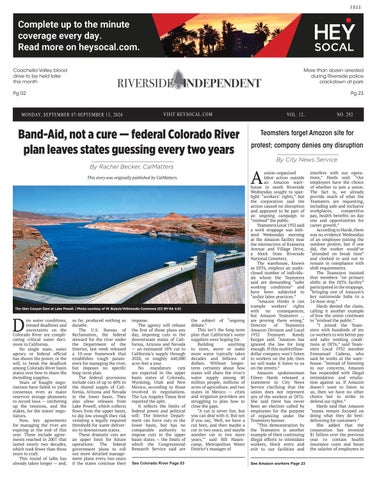
The Glen Canyon Dam at Lake Powell. | Photo courtesy of W. Bulach/Wikimedia Commons (CC BY-SA 4.0)
D
so far, produced nothing so durable. The U.S. Bureau of Reclamation, the federal steward for the river under the Department of the Interior, last week released a 10-year framework that establishes rough parameters for managing the river, but imposes no specific long-term plan. The federal provisions include cuts of up to 40% to the shared supply of California, Arizona and Nevada in the lower basin. They also allow releases from Lake Powell, which collects flows from the upper basin, to dip low enough they risk violating a legally required threshold for water deliveries to downstream states. These dramatic cuts are an upper limit for future operations: The federal government plans to roll out more detailed management plans every two years if the states continue their
impasse. The agency will release the first of those plans any day, imposing cuts in the downstream states of California, Arizona and Nevada — an estimated 10% cut to California’s supply through 2028, or roughly 440,000 acre-feet a year. No mandatory cuts are expected in the upper basin states of Colorado, Wyoming, Utah and New Mexico, according to those involved in negotiations. The Los Angeles Times first reported the split. It reflects the limits of federal power and political will: The Interior Department can force cuts in the lower basin, but has no comparable authority to impose cuts in the upper basin states — the limits of which the Congressional Research Service said are See Colorado River Page 03
the subject of “ongoing debate.” This isn’t the long-term plan that California’s water suppliers were hoping for. Building anything to store, move or make more water typically takes decades and billions of dollars. Without longerterm certainty about how states will share the river’s water supply among 40 million people, millions of acres of agriculture, and two states in Mexico — cities and irrigation providers are struggling to plan how to close the gaps. “A cut is never fun, but you can deal with it. But not if you say, ‘Well, we have a cut here, and then maybe a cut in two years, and maybe another cut in two more years,’” said Bill Hasencamp, Metropolitan Water District’s manager of
NO. 292
Teamsters target Amazon site for protest; company denies any disruption By City News Service
A
This story was originally published by CalMatters.
ire water conditions, missed deadlines and uncertainty on the Colorado River are complicating critical water decisions in California. No single state, water agency or federal official has shown the power, or the will, to break the deadlock among Colorado River basin states over how to share the dwindling supplies. Years of fraught negotiations have failed to yield consensus even as major reservoir storage plummets to record lows — ratcheting up the tensions, and the stakes, for the states’ negotiators. Now, key agreements for managing the river are expiring at the end of this year. These include agreements reached in 2007 that lasted nearly two decades, which took fewer than three years to craft. This round of talks has already taken longer — and,
VOL. 12,
union-organized labor action outside an Amazon warehouse in south Riverside Wednesday sought to spotlight “workers’ rights,” but the corporation said the action caused no disruption and appeared to be part of an ongoing campaign to “mislead” the public. Teamsters Local 1932 said a work stoppage was initiated Wednesday morning at the Amazon facility near the intersection of Krameria Avenue and Village Drive, a block from Riverside National Cemetery. The warehouse, known as DJT6, employs an undisclosed number of individuals whom the Teamsters said are demanding “safer working conditions” and have been subjected to “unfair labor practices.” “Amazon thinks it can trample workers’ rights with no consequences, but Amazon Teamsters ... are proving them wrong,” Director of Teamsters Amazon Division and Local 1932 Treasurer Randy Korgan said. “Amazon has ignored the law for long enough. If this multitrilliondollar company won’t listen to workers on the job, then we will make it listen to us on the streets.” Amazon spokeswoman Eileen Hards released a statement to City News Service clarifying that the union does not represent any of the workers at DJT6. She said there has never been an election called by employees for the purpose of organizing under the Teamsters banner. “This demonstration by the Teamsters is another example of their continuing illegal efforts to intimidate workers, block entry and exit to our facilities and See Amazon workers Page 23
interfere with our operations,” Hards said. “Our employees have the choice of whether to join a union. The fact is, we already provide much of what the Teamsters are requesting, including safe and inclusive workplaces, competitive pay, health benefits on day one and opportunities for career growth.” According to Hards, there was no evidence Wednesday of an employee joining the outdoor protest, but if one did, the worker would’ve “attended on break time” and clocked in and out to remain in compliance with shift requirements. The Teamsters insisted that members “on primary shifts at the DJT6 facility” participated in the stoppage, “bringing one of Amazon’s key nationwide hubs to a 24-hour stop.” Hards denied the claim, calling it another example of how the union continues to “mislead the public.” “I joined the Teamsters with hundreds of my co-workers to win better pay and safer working conditions at DJT6,” said Teamsters Local 1932 member Emmanuel Cadena, who said he works at the warehouse. “Instead of listening to our concerns, Amazon has responded with illegal intimidation and retaliation against us. If Amazon doesn’t want to listen to us, then we have no other choice but to strike to defend our rights.” Hards said that Amazon “teams remain focused on doing what they do best: delivering for customers.” She added that the corporation has invested $1 billion over the previous year to contain health insurance costs and boost the salaries of employees in