San Bernardino council chooses developer for commercial site near 210 Freeway
Numerous ceremonies planned countywide for 25th anniversary of 9/11
Pg 02
Pg 16
VISIT HEYSOCAL.COM
Thursday, September 10-September 16, 2026
Local. Relevant. Trusted.
California could be first in the nation to create smoke-damage standards
VOL. VOL. 10, 12,
NO. 292
San Bernardino County backs desert motel expansion, OKs housing aid
By Levi Sumagaysay, CalMatters
By Staff
This story was originally published by CalMatters.
T
wo smoke-damage bills awaiting the governor’s signature address a longstanding issue brought to the fore by the Los Angeles County fires: When is it safe for wildfire survivors to move back into their homes? After the deadly January 2025 fires, which destroyed more than 16,000 structures, the state Insurance Department estimates that more than 13,000 out of 40,000 claims involved smoke damage. The fires burned for nearly a month. Debris and emissions contained a mixture of trees, brush and manufactured materials made up of plastics, metals and more — raising concerns about toxic contents left in homes that are still standing but may be dangerous to live in. Many survivors with homes that did not burn down have yet to return to them 21 months later. Their homes reeked of smoke and they found ash, soot and char inside. They await test results for things such as lead and asbestos. They wait for homes to be repaired, cleaned up and cleared of toxic materials after months of back-and-forth with their insurance companies. Along the way, fire survivors, experts and insurers have all pointed to the lack of standards around smoke damage. Assembly Bill 1642 will set “a first-in-the-nation standard for testing and
Paul Toomey, a planning manager for the county, and Planning Chief Paul Gonzales brief the Board of Supervisors last week on the proposed Lonely Dove Motel expansion. | Screenshot courtesy of San Bernardino County/YouTube
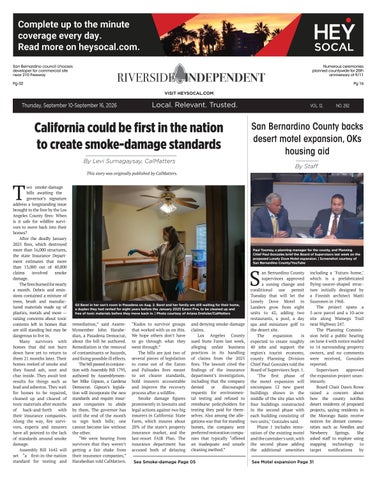
S Gil Barel in her son’s room in Pasadena on Aug. 2. Barel and her family are still waiting for their home, a duplex they had rented for eight years before the January 2025 Eaton Fire, to be cleaned up and free of toxic materials before they move back in. | Photo courtesy of Ariana Drehsler/CalMatters
remediation,” said Assemblymember John Harabedian, a Pasadena Democrat, about the bill he authored. Remediation is the removal of contaminants or hazards, and fixing possible ill effects. The bill passed in conjunction with Assembly Bill 1795, authored by Assemblymember Mike Gipson, a Gardena Democrat. Gipson’s legislation will incorporate the new standards and require insurance companies to abide by them. The governor has until the end of the month to sign both bills; one cannot become law without the other. “We were hearing from survivors that they weren’t getting a fair shake from their insurance companies,” Harabedian told CalMatters.
“Kudos to survivor groups that worked with us on this. We hope others don’t have to go through what they went through.” The bills are just two of several pieces of legislation to come out of the Eaton and Palisades fires meant to set clearer standards, hold insurers accountable and improve the recovery process after a wildfire. Smoke damage figures prominently in lawsuits and legal actions against two big insurers in California: State Farm, which insures about 20% of the state’s property insurance market, and the last-resort FAIR Plan. The insurance department has accused both of delaying
and denying smoke-damage claims. Los Angeles County sued State Farm last week, alleging unfair business practices in its handling of claims from the 2025 fires. The lawsuit cited the findings of the insurance department’s investigation, including that the company denied or discouraged requests for environmental testing and refused to reimburse policyholders for testing they paid for themselves. Also among the allegations was that for standing homes, the company sent preferred restoration companies that typically “offered an inadequate and unsafe cleaning method.”
See Smoke-damage Page 05
an Bernardino County supervisors approved a zoning change and conditional use permit Tuesday that will let the Lonely Dove Motel in Landers grow from eight units to 42, adding two restaurants, a pool, a day spa and miniature golf to the desert site. The expansion is expected to create roughly 40 jobs and support the region's tourist economy, county Planning Division Chief Paul Gonzales told the Board of Supervisors Sept. 1. "The first phase of the motel expansion will encompass 12 new guest buildings shown in the middle of the site plan with four buildings constructed in the second phase with each building consisting of two units," Gonzales said. Phase 1 includes restoration of the existing motel and the caretaker's unit, with the second phase adding the additional amenities
including a "Futuro home," which is a prefabricated flying-saucer-shaped structure initially designed by a Finnish architect Matti Suuronen in 1968. The project spans a 5-acre parcel and a 10-acre site along Wamego Trail near Highway 247. The Planning Commission held a public hearing on June 4 with notice mailed to 14 surrounding property owners, and no comments were received, Gonzales reported. Supervisors approved the expansion project unanimously. Board Chair Dawn Rowe raised a concern about how the county notifies desert residents of proposed projects, saying residents in the Morongo Basin receive notices for distant communities such as Needles and Newberry Springs. She asked staff to explore using mapping technology to target notifications by
See Motel expansion Page 31