Intense heat through week could bust temp records
Strength of El Niño not definite, but signs point to intense storm season
Pg 18
Pg 36
VISIT HEYSOCAL.COM
Thursday, August 27-September 02, 2026
Local. Relevant. Trusted.
VOL. VOL. 10, 12,
NO. 290
California justices seem skeptical of Sheriff Chad Bianco’s defense in ballot seizure case
Riverside County supervisors formally approve revised shortterm rental regulations
By Ben Christopher, CalMatters
By City News Service
This story was originally published by CalMatters.
T
C
alifornia’s Supreme Court justices appeared skeptical on Monday that Riverside Sheriff Chad Bianco was acting within his legal rights when he seized more than 650,000 ballots from that county’s top election administrator in March. In back-to-back hearings in downtown San Francisco, Bianco’s attorney, Bradley Hertz, argued that local law enforcement officers have the right to take ballots after obtaining a warrant, regardless of state laws detailing how election challenges, recalls and investigations should be handled. He also argued, in the second case, that California’s attorney general does not have the power to issue orders to county sheriffs like Bianco. Deputies seized the ballots as part of Bianco’s investigation into alleged voter fraud in California’s November special election on redistricting after activists alleged the ballots were undercounted. Riverside’s registrar of voters has said repeatedly those claims were based on a basic misinterpretation of preliminary vote count data. Bianco grabbed national headlines at a time he was mounting his ultimately unsuccessful bid for governor and amid President Donald Trump’s efforts to undermine faith in the outcome of the 2020 elections and nationalize election administration. The ballot seizure drew two legal challenges, both of
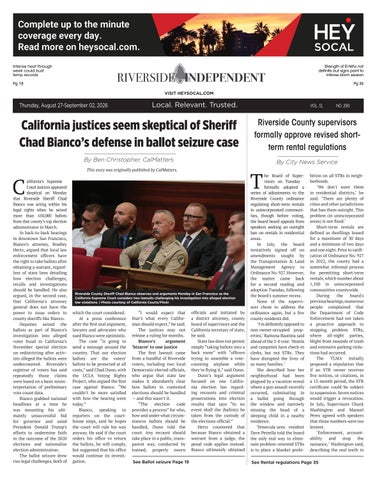
Riverside County Sheriff Chad Bianco observes oral arguments Monday in San Francisco as the California Supreme Court considers two lawsuits challenging his investigation into alleged election law violations. | Photo courtesy of California Courts/Flickr
which the court considered. At a press conference after the first oral argument, lawyers and advocates who sued Bianco were optimistic. The case “is going to send a message around the country. That our election ballots are the voters’ ballots to be protected at all costs,” said Chad Dunn, with the UCLA Voting Rights Project, who argued the first case against Bianco. “We couldn’t be more satisfied with how the hearing went today.” Bianco, speaking to reporters on the courthouse steps, said he hopes the court will rule his way anyway. He said if the court orders his office to return the ballots, he will comply, but suggested that his office would continue its investigation.
“I would expect that that’s what every Californian should expect,” he said. The justices may not release a ruling for months. Bianco’s argument ‘bizarre’ to one justice The first lawsuit came from a handful of Riverside voters, including two local Democratic elected officials, who argue that state law makes it abundantly clear how ballots in contested elections should be handled — and this wasn’t it. “The election code provides a process” for who, how and under what circumstances ballots should be handled, Dunn told the court. Any recount should take place in a public, transparent way, conducted by trained, properly sworn See Ballot seizure Page 19
officials and initiated by a district attorney, county board of supervisors and the California secretary of state, he said. State law does not permit simply “taking ballots into a back room” with “officers trying to assemble a votecounting airplane while they’re flying it,” said Dunn. Dunn’s legal argument focused on one California election law regarding recounts and criminal prosecutions into election results that says “In no event shall the (ballots) be taken from the custody of the elections official.” Hertz countered that because Bianco obtained a warrant from a judge, the penal code applies instead. Bianco ultimately obtained
he Board of Supervisors on Tuesday formally adopted a series of adjustments to the Riverside County ordinance regulating short-term rentals in unincorporated communities, though before voting, the board heard appeals from speakers seeking an outright ban on rentals in residential areas. In July, the board tentatively signed off on amendments sought by the Transportation & Land Management Agency to Ordinance No. 927. However, the matter came back for a second reading and adoption Tuesday, following the board's summer recess. None of the supervisors chose to address the ordinance again, but a few county residents did. "I'm definitely opposed to non-owner-occupied properties," Ramona Bautista said ahead of the 5-0 vote. "Hotels and campsites have check-in clerks, but not STRs. They have disrupted the lives of so many families." She described how her neighborhood had been plagued by a vacation rental where a gun assault recently occurred, culminating in a bullet going through the window and narrowly missing the head of a sleeping child in a nearby residence. Temecula-area resident Dave Petrella told the board the only real way to eliminate problem-oriented STRs is to place a blanket prohi-
bition on all STRs in neighborhoods. "We don't want them in residential districts," he said. "There are plenty of cities and other jurisdictions that ban them outright. This problem (in unincorporated areas) is not fixed." Short-term rentals are defined as dwellings leased for a maximum of 30 days and a minimum of two days and one night. Prior to ratification of Ordinance No. 927 in 2022, the county had a somewhat informal process for permitting short-term rentals, which number about 1,100 in unincorporated communities countywide. During the board's previous hearings, numerous people complained that the Department of Code Enforcement had not taken a proactive approach to stopping problem STRs, where all-night parties, blight from mounds of trash and extensive parking violations had occurred. The TLMA initially proposed a stipulation that if an STR owner receives five notices, or citations, in a 12-month period, the STR certificate could be subject to suspension. Seven notices would trigger a revocation. In July, Supervisors Chuck Washington and Manuel Perez agreed with speakers that those numbers were too lenient. "Enforcement, accountability and stop the nuisance," Washington said, describing the real teeth in
See Rental regulations Page 35