FREE
Case against man who brought guns to Trump rally in Coachella resolved
Report: Inland Empire inflation 3.2% higher over previous year
Pg 02
Pg 23
MONDAY, AUGUST 17-AUGUST 23, 2026
VISIT HEYSOCAL.COM
Almost nowhere in California is building enough, according to the state — here’s why By Ben Christopher, CalMatters This story was originally published by CalMatters. Sign up for their newsletters.
E
very eight years, state housing regulators give cities and counties across California an especially dreaded homework assignment: Make a plan for a bunch of new homes. Gov. Gavin Newsom’s administration assigns localities goals to hit at four different affordability levels. Collectively, the numbers represent the housing department’s best estimate of the number of new homes needed to match any expected population growth and to chip away at the state’s decades-in-themaking shortage of affordable places to live. With these targets meted out to each region on a rolling basis, this summer, a massive chunk of the state, including all of Southern California, passed its halfway mark. So in the spirit of a mid-term exam, how are cities and counties doing? Bad news, California. If this were graded, the state would abound in D’s and F’s. Less than a third of cities and counties are on track to permit enough “above moderate” units, the category that typically refers to market-rate housing, according to data submitted by locals to the state housing department. The progress report for more affordable types of housing is even bleaker. Only 32 jurisdictions — less than 6% — are on track to hit their “very low” targets. That refers to housing within financial reach of anyone earning less than half the typical local income. After years of nudging, political trolling and litigating, most cities and counties now have state-approved plans in place. But as the production numbers show,
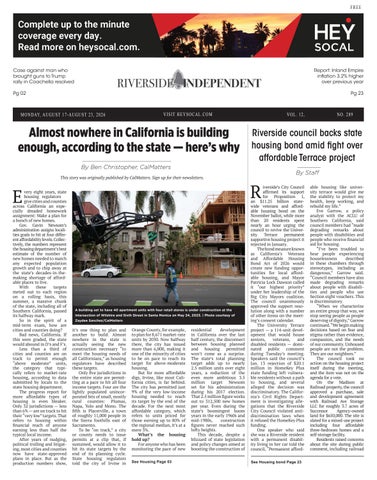
A building set to have 40 apartment units with four retail stores is under construction at the intersection of Wilshire and Sixth Street in Santa Monica on May 24, 2023. | Photo courtesy of Zaydee Sanchez/CalMatters
it’s one thing to plan and another to build. Almost nowhere in the state is actually seeing the new construction necessary “to meet the housing needs of all Californians,” as housing regulators have described these targets. Only five jurisdictions in the entire state are permitting at a pace to hit all four income targets. Four are the lightly populated unincorporated bits of small, mostly rural counties: Plumas, Napa, Yolo and Mono. The fifth is Placerville, a town of roughly 11,000 people in the Sierra foothills east of Sacramento. To be “on track,” a city or county needs to issue permits at a clip that, if sustained, would allow it to hit its state targets by the end of its planning cycle. State housing regulators told the city of Irvine in
Orange County, for example, to plan for 8,671 market-rate units by 2030. Now halfway there, the city has issued more than 6,000, making it one of the minority of cities to be on pace to reach its target for above-moderate housing. But for more affordable digs, Irvine, like most California cities, is far behind. The city has permitted just 9% of the very low-income housing needed to reach its target by the end of the decade. For the next most affordable category, which refers to units priced for those earning up to 80% of the regional median, it’s at a mere 3%. What’s the housing hold up? For anyone who has been monitoring the pace of new See Housing Page 03
residential development in California over the last half century, the disconnect between housing planned and housing permitted won’t come as a surprise. The state’s total planning target adds up to nearly 2.5 million units over eight years, a reduction of the even more ambitious 3.5 million target Newsom set for his administration during his 2017 election. That 2.5 million figure works out to 312,500 new homes per year. Even during the state’s boomingest boom years in the early 1960s and mid-1980s, construction figures never reached such lofty heights. This decade, despite a blizzard of state legislation and policy changes aimed at boosting the construction of
NO. 289
VOL. 12,
Riverside council backs state housing bond amid fight over affordable Terrace project By Staff
R
iverside’s City Council affirmed its support for Proposition 1, an $11.25 billion statewide veterans and affordable housing bond on the November ballot, while more than 20 residents spent nearly an hour urging the council to revive the University Terrace permanent supportive housing project it rejected in January. The bond measure known as California’s Veterans and Affordable Housing Bond Act of 2026 would create new funding opportunities for local affordable housing, and Mayor Patricia Lock Dawson called it “our highest priority” under her leadership of the Big City Mayors coalition. The council unanimously approved the support resolution along with a number of other items on the meeting’s consent calendar. The University Terrace project — a 114-unit development that would house seniors, veterans, and disabled residents — dominated public comment during Tuesday’s meeting. Speakers said the council’s Jan. 13 rejection of $20.1 million in HomeKey Plus state funding left vulnerable residents without a path to housing, and several alleged the decision was discriminatory. The California’s Civil Rights Department is investigating allegations that the Riverside City Council violated antidiscrimination laws when it refused the HomeKey Plus funding. One speaker who said she was a Riverside resident with a permanent disability living in her car told the council, “Permanent affordSee Housing bond Page 23
able housing like university terrace would give me the stability to protect my health, keep working, and rebuild my life.” Eve Garrow, a policy analyst with the ACLU of Southern California, said council members had “made degrading remarks about people with disabilities and people who receive financial aid for housing. “I’ve been troubled to hear people experiencing houselessness described in these chambers through stereotypes, including as dangerous,” Garrow said. “Council members have also made degrading remarks about people with disabilities and people who use Section eight vouchers. This is discriminatory. “When we characterize an entire group that way, we stop seeing people as people deserving of dignity,” Garrow continued. “We begin making decisions based on fear and stigma rather than evidence, compassion, and the needs of our community. Unhoused people are not the problem. They are our neighbors.” The council took no action on the housing project itself during the meeting, and the item was not on the agenda for a vote. On the Madison at Railroad property, the council approved a purchase, sale and development agreement with Railroad Ave Storage LLC for roughly 3.7 acres of Successor Agency-owned land for $650,000. The site is slated for a mixed-use project including four affordable three-bedroom homes and a self-storage facility. Residents raised concerns about the site during public comment, including railroad