By Joe Taglieri joet@beaconmedianews.com
TheSanBernardino
County Board of SupervisorsonTuesday
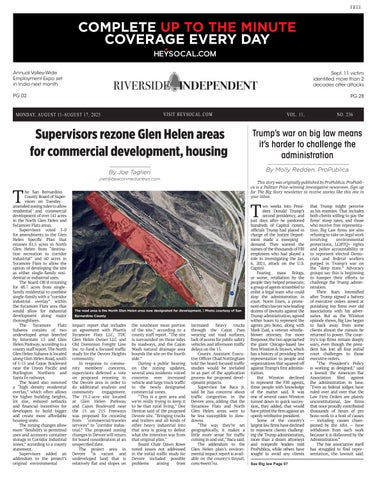
amended zoning rules to allow residential and commercial development of over 141 acres in the North Glen Helen and Sycamore Flats areas.
Supervisors voted 5-0 for amendments to the Glen Helen Specific Plan that rezones 81.5 acres in North Glen Helen from “destination recreation to corridor industrial” and 60 acres in Sycamore Flats to allow the option of developing the site as either single-family residential or industrial uses.
The board OK’d rezoning for 48.7 acres from singlefamily residential to combine single-family with a “corridor industrial overlay” within the Sycamore Flats area that would allow for industrial development along major thoroughfares.
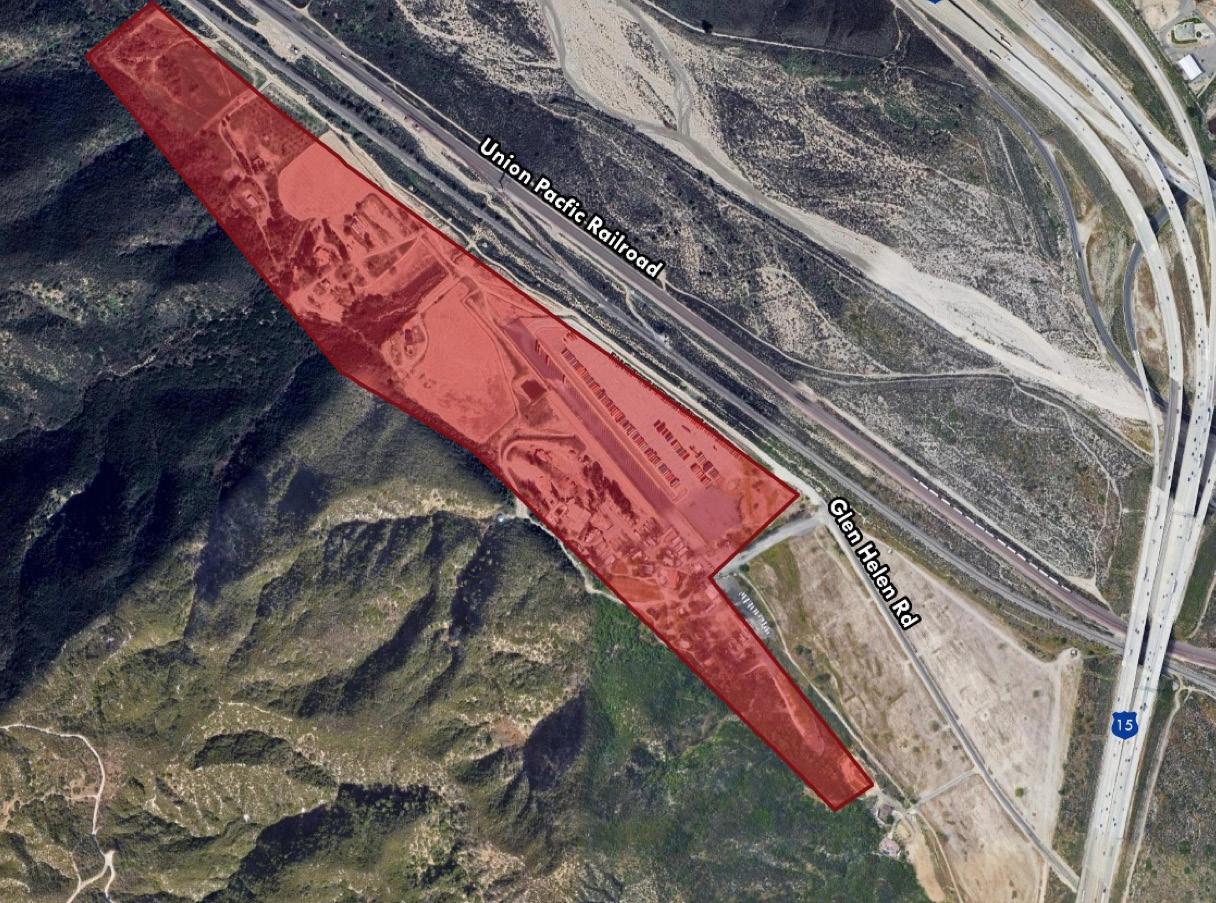
The Sycamore Flats Subarea consists of two undeveloped areas bisected by Interstate 15 and Glen Helen Parkway, according to a county staff report. The North Glen Helen Subarea is located along Glen Helen Road, south of I-15 and Cajon Boulevard near the Union Pacific and Burlington Northern and Santa Fe railways.
The board also removed a “high density residential overlay,” which often allows for higher building heights, lot size, reduced setbacks and financial incentives for developers to build bigger and create more affordable housing units.
The zoning changes allow more “flexibility in permitted uses and accessory container storage in Corridor Industrial zones,” according to a county statement.
Supervisors added an addendum to the project’s originalenvironmental
impact report that includes an agreement with Pharris Sycamore Flats LLC, TDC Glen Helen Owner LLC and Old Dominion Freight Line Inc. to fund a focused traffic study for the Devore Heights community.
In response to community members’ concerns, supervisors deferred a vote on proposed rezoning in the Devore area in order to do additional analysis and community engagement.
The 19.2-acre site located at Glen Helen Parkway and Cajon Boulevard near the 15 an 215 Freeways was proposed for rezoning from “commercial/traveler services” to “corridor industrial.” The proposed zoning changes in Devore will return for board consideration at an unspecified date.
The project area in Devore “is vacant and undeveloped land that is relatively flat and slopes on
the southeast most portion of the site,” according to a county staff report. “The site is surrounded on three sides by roadways, and the Cajon Wash natural drainage area bounds the site on the fourth side.”
During a public hearing on the zoning updates, several area residents voiced concerns over increased vehicle and large truck traffic in the newly designated commercial zones.
“This is a gem area and we’re really trying to keep it to be that rural living,” Dee Denton said of the proposed Devore site. “Bringing trucks and trailers and all kinds of other heavy industrial into that area is going to defeat what the intention was from that original plan.”
Board Chair Dawn Rowe noted issues not addressed in the initial traffic study for Devore included possible problems arising from
increased heavy trucks through the Cajon Pass wearing out road surfaces, lack of access for public safety vehicles and afternoon traffic delays on the 15.
County Assistant Executive Officer Chad Nottingham told the board focused traffic studies would be included in as part of the application process for proposed development projects.
Supervisor Joe Baca Jr. said he has concerns about traffic congestion in the Devore area, adding that the Sycamore Flats and North Glen Helen areas were to be less susceptible to slowdowns.
“The way they’re set geographically, it makes a little more sense for traffic coming in and out,” Baca said.
The addendum to the Glen Helen plan’s environmental impact report is available on the county’s tinyurl. com/4wext7xz.
Sept. 11 victim identified more than 2 decades after attacks
Trump’s war on big law means it’s harder to challenge the administration
By Molly Redden, ProPublica
Two weeks into President Donald Trump’s second presidency, and just days after he pardoned hundreds of Capitol rioters, officials Trump had placed in charge of the Justice Departmentmadeasweeping demand. They wanted the names of the thousands of FBI employees who had played a role in investigating the Jan. 6, 2021, attack on the U.S. Capitol.
Fearing mass firings, or worse, retaliation by the people they helped prosecute, a group of agents scrambled to enlist a legal team who could stop the administration in court. Norm Eisen, a prominent ethics lawyer now leading dozens of lawsuits against the Trump administration, agreed within hours to represent the agents pro bono, along with Mark Zaid, a veteran whistleblower attorney. For more firepower, the two approached the giant Chicago-based law firm Winston & Strawn, which has a history of providing free representation to people and organizations that squared off against Trump’s first administration.
But Winston declined to represent the FBI agents, three people with knowledge of the matter said. It was one of several cases Winston turned down in quick succession, they added, that would have pitted the firm against an openly retributive president.
Some of the country’s largest law firms have declined to represent clients challenging the Trump administration, more than a dozen attorneys and nonprofit leaders told ProPublica, while others have sought to avoid any clients
that Trump might perceive as his enemies. That includes both clients willing to pay the firms’ steep rates, and those who receive free representation. Big Law firms are also refusing to take on legal work involving environmental protections, LGBTQ+ rights and police accountability or to represent elected Democrats and federal workers purged in Trump’s war on the “deep state.” Advocacy groups say this is beginning to hamper their efforts to challenge the Trump administration.
Their fears intensified after Trump signed a battery of executive orders aimed at punishing top firms over old associations with his adversaries. But as the Winston episode shows, Big Law began to back away from some clients almost the minute he returned to power. The country’s top firms remain deeply wary, even though the president has lost all four initial court challenges to those executive orders.
“The President’s Policy is working as designed,” said a lawsuit the American Bar Association filed against the administration in June.
“Even as federal judges have ruled over and over that the Law Firm Orders are plainly unconstitutional, law firms that once proudly contributed thousands of hours of pro bono work to a host of causes — including causes championed by the ABA — have withdrawn from such work because it is disfavored by the Administration.”
The bar association itself has struggled to find representation, the lawsuit said.
By City News Service
Withtemperatures climbing well above 100 degrees in the Coachella Valley and other parts of Riverside County last week, health officials Wednesday highlighted the perils of heat-related illnesses, and offered the public prevention tips to protect themselves.
“Extreme heat can be dangerous for everyone, especially for those who work outdoors, as well as for older adults, young children, pregnant women, those with heart disease and individuals who have other chronic medical conditions,” county Public Health Officer Jennifer Chevinsky said.
The latest public health figures show 550 heat-related emergency visits and two deaths were reported in the county this year, officials said. Last year, there were 1,627 emergency visits and 65 deaths, according to Riverside University Health System.
Highs were expected to reach 119 degrees last Thursday in Palm Desert
and Indio, and 115 in Palm Springs. The nighttime and early morning hours will offer little relief, with most lows hovering in the 80s in the desert.
An extreme heat warning was in effect for Coachella Valley deserts until at least 8 p.m. Friday, according to the National Weather Service. The agency said areas affected in the heat warning includes La Quinta, Coachella, Indio, Palm Desert, Palm Springs and Cathedral City.
The most serious heatrelated illness that can occur is heat stroke, which happens when the body is no longer able to control its temperature. Warning signs include confusion, loss of consciousness, hot and dry skin and seizures. When a person is experiencing heat stroke, officials said someone should dial 911, move the person to a cooler area and apply cold, wet cloths in order to lower body temperature.
A less severe but still dangerous illness is heat
exhaustion, with symptoms including headaches, nausea, dizziness, weakness, thirst, heavy sweating and irritability. Treatments applied to a person experiencing heat exhaustion are moving to a cool, shaded area, removing unnecessary clothing and drinking cool water.
The agency offered a number of prevention tips including drinking plenty of water throughout the day, wearing lightweight, light-colored, loose- fitting clothing, avoiding strenuous activity outdoors, and checking on elderly neighbors.
Most importantly, children and pets must never be left inside a vehicle without air conditioning on for even a minute, as death can occur quickly.
“These are easy steps to protect yourself and it starts with limiting your time outdoors during the hottest part of the day,” Chevinsky said.
Officials also advised people to utilize cooling centers if necessary.
By City News Service
Job seekers in the Coachella Valley and across the region will be able to explore career opportunities with more than 20 different agencies during the 30th annual Valley-Wide Employment Expo next month in Indio.
The free event will be held from 9 a.m. to 1 p.m. Sept. 17 at Fantasy Springs Resort Casino’s Special Event Center, located at 84-245 Indio Springs Parkway.
With an estimated 32 job recruiters from numerous industries, participants will include Altura Credit Union, Coachella Valley Behavioral Health, Desert Arc, Entravision Palm Desert, Desert Preschool Academy, Eisenhower Health, Indio Police Department, Riverside County Superior Court, Walgreens and Riviera Resort and Spa.
In addition, free transportation can be provided from SunLine Transit Station, at 83255 CA-11, to the event by calling 760-863-7277. The deadline to register for the shuttle service must be made by Sept.12, organizers said.
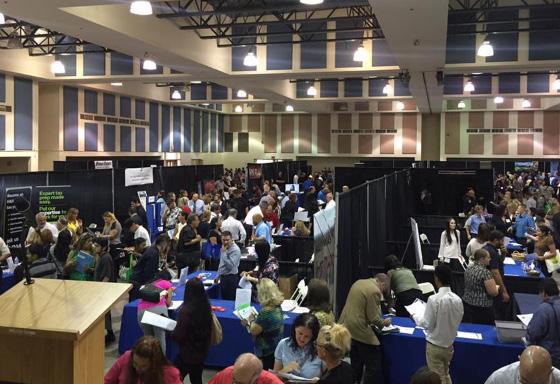
Valley-Wide Employment Expo. | Photo courtesy of Riverside County Department of Housing & Workforce Solutions / Facebook
On Sept. 11, pre-expo workshops will be held for job seekers looking for guidance on resumes and wardrobe advice.
An English workshop will take place from 10-11 a.m., and another at 2:30 p.m. to 3:30 p.m. A Spanish-speaking workshop will take place from 11:15 a.m. to 12:15 p.m., and another from 1:15 p.m. to 2:15 p.m. Both workshops will be held at Indio Workforce Development Center, located at 44-199 Monroe

“Cool centers provide a safe place to cool down and can also help residents reduce energy costs during extreme heat,” Executive Director of Community
Action Partnership Karla Lopez del Rio said. There are more than 50 cooling centers throughout the county, and they can be found in libraries, community center and malls among other places. Hours and availability differ. Center sites can be found at capriverside.org/ cool-centers.
St. Louis encephalitis virus found in 3 positive mosquito samples in Oasis
Three mosquito samples from the Oasis community tested positive for St. Louis encephalitis virus, the Coachella Valley Mosquito and Vector Control District said Thursday.
The samples were collected near the intersections of Johnson Street and Avenue 81, Avenue 82 and Avenue 84.
Street, room 402.
“Employment services counselors will be on had to assist with resumes and share tips on how to successfully navigate the expo. Additionally, Desert Best Friend’s Closet will provide advice on appropriate wardrobe choices to help attendees make a great impression,” according to an expo statement. Registration for the expo can be made at desertjobexpo.com. Walk-in applicants will be welcomed.
“Detections like this should serve as a reminder to wear insect repellent when outdoors,” Public Information Manager for the district Robert Gaona said. “Repellent with at least 30% of an active ingredient like DEET, picaridin, oil of lemon eucalyptus or IR3535.”
St. Louis encephalitis virus spreads when a female mosquito bites an infected bird and that mosquito can become a carrier to transmit to people, the district said. If a person becomes infected, symptoms could develop with fever, headaches, body aches and in some rare cases, death.
There is no human vaccine for a mosquito-borne virus.
With the addition of the three positive samples from Oasis, the number of positive

mosquito-borne viruses in the Coachella Valley increased to five this year. However, no human cases of any mosquitorelated viruses were reported in the state.
The agency urges the public to take precaution to reduce the risk of mosquito bites, which includes to dump and drain standing water around homes where the insects can breed and to use EPA-registered insect repellents when outdoors, especially at dawn or dusk.
In addition, to ensure any window and door screen were in good repair and to report any mosquito problems to the district.
District officials said they will deploy additional technicians to the affected areas to conduct treatment using truck-mounted applications in order to prevent further spread of the virus and reduce mosquito populations.
More information can be found at cvmosquito.org.
Editorial editorial@beaconmedianews.com
editor@hlrmedia.com
Graphics/Production production@beaconmedianews.com production@hlrmedia.com
Advertising advertising@beaconmedianews.com advertising@hlrmedia.com
Legal Advertising legals@beaconmedianews.com legals@hlrmedia.com
Business accounting@beaconmedianews.com accounting@hlrmedia.com
BEACON MEDIA ADDRESS: 820 S. Myrtle Ave. Monrovia, CA 91016
PHONE: (626) 301-1010
WEBSITE www.beaconmedianews.com
HLR MEDIA ADDRESS: 820 S. Myrtle Ave. Monrovia, CA 91016
PHONE: (626) 301-1010 www.HLRmedia.com
PRESS
editor@beaconmedianews.com editor@hlrmedia.com







ICalifornia.
The Duarte Dispatchhas been adjudicated as a newspaper of general circulation in court case number GS 013893 City of Duarte, County of Los Angeles, State of California. The Rosemead Readerhas been adjudicated as a newspaper of general circulation in court case number GS 048894
a newspaper of general circulation in court case number KS017174 City of Baldwin Park, County of Los Angeles, State of California. The Burbank Independent has been adjudicated as a newspaper of general circulation in court case number ES016728 City of Burbank, County of Los Angeles, State of California. The Glendale Independent has been adjudicated as a newspaper of general circulation in court case number ES016579 City of Glendale, County of Los Angeles, State of California.
Monterey Park Press has been adjudicated as a newspaper of general circulation in court case number ES016580 City of Monterey







By Stacey Rosen for Northwell Health via Stacker
t isn’t easy to surprise a cardiologist who’s been in practice for more than 30 years, treating a wide range of patients with every type of medical challenge. Still, sometimes patients and physicians face the unexpected.
Northwell Health shares some surprising truths faced in cardiology practices.
Young people can have heart attacks
There’s this idea that only old, overweight, cigarsmoking men have heart attacks, but even a 52-yearold runner and nonsmoker in (seemingly) good shape could be at risk. It was a sobering reminder — both to doctors and patients — to question what they think they know about the demographics of patients and remember that optimizing heart health requires paying close attention to our bodies.
This truth brings us back to the basics: Doctors and patients need to identify risk factors early, control lifestyle factors such as eating and exercise, and, of course, listen for subtle warnings. When something “doesn’t feel right,” it’s a conversation with a clinician, not dismissing care because your age makes it seem unlikely.
In fact, while the average age for men to have a heart attack is about 65 and for women is 72, 1 in 5 heart attack deaths occur in patients younger than age 64. The proportion of people under 50 having heart attacks rose by 2% between 2000 and 2016, and 20% of people in the under-50 heart attack category were 40 or younger.
Sleep (really) matters
Patients are sometimes surprised to learn there’s a connection between sleep quality and patterns and heart health. Science does not support burning the candle at both ends or accepting poor sleep longterm. Sufficient, quality sleep is critical. One in 3 adults reports not getting

the approximately seven hours of recommended sleep per night. That may be sustainable for a couple of nights, but over time, poor sleep may lead patients to develop high blood pressure, Type 2 diabetes, and obesity, raising the risk of a heart attack. Some patients experience stress associated with not sleeping well or enough and find it difficult to have the energy to make heart-healthy choices about fitness and nutrition.
Together, patients and doctors can discuss sleep hygiene and habits, uncovering whether patients might be experiencing sleep apnea, when the airway is repeatedly blocked during sleep, or insomnia, trouble falling asleep, staying asleep, or both. Addressing sleep-related conditions goes a long way to improving cardiovascular health.
Kidney and heart function are intertwined
This is for patients who are surprised when asked about their urine and kidney function: The heart and kidneys depend on each other. In fact, kidney disease and heart disease have common risk factors.
Here’s how it works: The heart pumps oxygenrich blood throughout the body, supplying the kidneys with resources needed to filter waste and excess
fluid, regulating blood pressure, supporting red blood cell production, and maintaining bone health. In turn, healthy kidneys are crucial for proper heart function, as they maintain a balanced blood volume and pressure. If either organ is compromised, it can trigger a cascade of issues — cardiovascular disease, kidney disease, and metabolic disorders like diabetes and obesity (called cardiorenal-metabolic or cardiovascular-kidney-metabolic syndrome). There’s even an online calculator that includes questions about kidney function to help predict the future risk of heart disease and stroke.
Pregnancy history is a bellwether for cardiac health
Many patients express surprise when asked about the health of their pregnancies, sometimes decades later — but a patient’s reproductive history has an impact on future heart health.
Pregnancy often is described as a stress-test on the body; that’s certainly true when it comes to the heart, which pumps about 50% more blood during pregnancy, labor, delivery and the postpartum period. While many people’s hearts adapt and then return to pre-pregnancy cardiovascular health within months of deliver-
ing, sometimes pregnancy can worsen underlying heart conditions, reveal previously undiagnosed ones, or lead to complications, including high blood pressure, preeclampsia, gestational diabetes, a weakened heart (cardiomyopathy) and irregular heartbeats (arrhythmias).
A complicated pregnancy doesn’t guarantee future heart problems, but it does offer patients and their physicians a chance to address controllable cardiovascular risk factors. The field of cardio-obstetrics is taking a much-needed look at the heart health of those progressing through pregnancy.
Patients sometimes avoid easy solutions
Whether patients’ reluctance stems from uncertainty, anxiety, or even misinformation, seek open collaboration about how to keep hearts healthy. Together, doctors and patients can address concerns to avoid a few cardiovascular surprises.
Stacey Rosen is the executive director of Northwell Health’s Katz Institute for Women’s Health and president of the American Heart Association.
This story was produced by Northwell Health and reviewed and distributed by Stacker.
Re-published with CC BY-NC 4.0 License.


By City News Service

ESPN, a subsidiary of the Burbank-based Walt Disney Co., announced a deal with the NFL Tuesday to acquire the NFL Network and related properties, including the popular RedZone Channel.
Exact financial terms were not disclosed, but the NFL will receive a 10% equity stake in ESPN as part of the deal.
“Today’s announcement paves the way for the world’s leading sports media brand and America’s most popular sport to deliver an even more compelling experience for NFL fans, in a way that only ESPN and Disney can,” Disney CEO Robert A. Iger said in a statement. “Commissioner (Roger) Goodell and the NFL have built outstanding media assets, and these transactions will add to consumer choice, provide viewers with even greater convenience and quality, and expand the breadth and value proposition of Disney’s streaming ecosystem.”
Goodell added in a statement, “Since its launch in 2003, NFL Network has provided millions of fans unprecedented access to the sport they love. Whether it was debuting Thursday Night Football, televising the Combine, or telling incredible football stories through original shows and breaking news, NFL Network has delivered. The network’s sale to ESPN will build on this remarkable legacy, providing more NFL football for more fans in new and innovative ways.”
The deal gives ESPN control of NFL Network, as well as NFL Fantasy Football -- which will merge with ESPN Fantasy Football -- and the RedZone Channel, which provides rotating live look-ins at concurrent NFL games.
Also as part of the deal, ESPN will license three additional NFL games per season to air on the NFL Network, and ESPN will adjust its overall league schedule to move four games to the NFL Network.

By Shalina Chatlani for Stateline via Stacker
Twenty-eight-year-old
Michaela Bonner has been working 12-hour shifts as an emergency medical technician in Norfolk, Virginia, for the past four years, while attending and paying for college to finish her prerequisites for medical school.
But now that President Donald Trump’s signature tax and spending law bars students from borrowing more than $50,000 annually in unsubsidized federal loans for medical school, Bonner is worried her dream of becoming a doctor is financially out of reach, Stateline reports.
“I get told, ‘Well, we really need you. We have a physician shortage, and you’ve done all this work leading up to this point,’ and that’s true as well, and it’s not that I want to quit,” Bonner said in a recent interview. “But there are no systems in place that I can rely on to support me now that I can’t take out the full cost of living through loans.”
The tax and spending law includes provisions that significantly alter the student loan process for higher education. The law halts current student loan repayment plans for loans that are granted on or after July 1, 2026. On that date, the law also terminates Grad PLUS loans, which have helped people pay for their higher education degrees and the total cost of attendance. Current borrowers will be grandfathered in.
The federal law gives current borrowers enrolled in loan repayment plans for students based on income — such as those plans known as SAVE or IBR — until July 1, 2028, to switch to a new plan. Interest collection will resume Aug. 1 for students enrolled in the Biden-era SAVE plan.
At the same time, medical or law school students hoping to get unsubsidized federal loans — in which the borrower is responsible for paying the interest at all times rather than the government — will only be able to borrow $50,000 per year, with a $200,000
lifetime cap. Those seeking advanced degrees in areas such as history or philosophy have a $100,000 lifetime cap.
The average yearly cost of medical school for the 2024-25 academic year ranged from around $42,000 to $72,000, depending on whether the school was private or public and whether the student was a resident or nonresident, according to the Association of American Medical Colleges.
Some congressional Republicans say that students need to be working harder to pay for higher education, like medical school, on their own. Others say the caps put the onus back on colleges and universities to rein in the rising cost of tuition. But critics of this legislation say the loan caps are only going to harm students, especially from lower-income backgrounds, and will exacerbate physician shortages.
In recent years states have tried to ease physician shortages by implementing various policy solutions. Since 2023, at least nine states have made it easier for doctors trained in other countries to get medical licenses. States have also participated in interstate licensing compacts, allowing nurses and physician assistants to travel across state lines to work, so long as they are licensed in one state within the compact.
For student loan relief, more than 20 states have enacted legislation to address student loan forgiveness, according to the National Conference of State Legislatures, a group that tracks state policies. Georgia passed a measure that will expand a cancelable loan program for physicians working in rural and underserved areas. Idaho also created the Rural Nursing Loan Repayment Program, offering nurses $25,000 in forgivable loans after three years of service in a rural area.
McKenzie Richards, a health care policy fellow at the conservative think tank Cicero Institute who has been studying the pace of physician shortages, told Stateline that the national physician

shortage could potentially exceed 100,000 by 2034. At the end of 2024, that projected number was closer to 64,000 physicians.
Richards said states will be looking toward more policy solutions should the student loan changes exacerbate physician shortages.
“We know what’s going to be happening coming down the line in just five years, so I think policies that states can adopt to get out of this are really important to be looking at now,” she said.
“The hope is that by capping [federal loans], it will encourage schools to lower tuition prices,” Richards added. “Then maybe they need to be admitting more students, which would have a great downstream effect for getting more doctors through.”
Other students will be in the same boat, said Lesley Turner, an associate professor of public policy at the University of Chicago and an economist.
“This is going to hit some students worse than others,” Turner told Stateline. “Those [students] in more expensive programs tend to borrow more, and so for those students they will need to return to private student loans or other ways of financing their graduate education.”
Many students were already questioning their capacity to go to medical school before the student loan
caps, said Shannon Jimenez, dean of the Arkansas College of Osteopathic Medicine.
“I expect that this bill, this cap, is going to push people out of primary care and into specialties to help pay off those higher interest rate loans,” Jimenez told Stateline. She added that caps will likely deter students from lower socioeconomic statuses from going into primary care — important in places like Arkansas, where she says there is a “maldistribution of physicians.”
“Many schools like us try to attract those students, because they’re more likely to go into primary care and serve in underserved areas. So it’s going to tie our hands in a lot of ways.”
Large states and more rural states will feel the gaps more deeply, said Richards, of the Cicero Institute. Louisiana, for example, is projected to be short almost 5,000 doctors from a variety of specialties by 2030, including close to 400 primary care doctors. Already more than a third of Louisiana physicians are close to retirement age — similar to the situation in neighboring Arkansas.
As for whether schools will just be able to lower tuition, Jimenez said, “it makes no sense.”
“We still function in a somewhat market-driven economy and have to compete with other schools around us, so our cost is based mostly on what we have to pay our faculty, and that’s not going to go down,” she said. The annual cost of attendance at her school is between $80,000 and $85,000.
Bonner, the EMT, holds a political communications degree from Regent University and is now studying biomedical sciences at Old Dominion University. She already has $20,000 in loans, she said, and for the rest of college tuition, she has paid out of pocket. Since she’s supporting herself, she hasn’t been able to save much.
She’d planned to take the medical school entrance exam next spring, but now worries about how she’d pay for living expenses while attending.
“Medical school scheduling doesn’t allow for working, so you have to take out loans for living expenses,” she said.
“A lot of people, I feel, would be panicked if you had worked for eight to 10 years of your life and found out that all the systems that you were banking on in a really academically challenging space are disappearing,” Bonner said.
“I don’t see a path forward for certain, but I’m fighting to make one.”
This story was produced by Stateline and reviewed and distributed by Stacker. Re-published with CC BY-NC 4.0 License.

Undocumented children will no longer qualify for federally funded preschool through the Head Start program under a major policy shift the Trump administration announced July 31.
In a news release, the Department of Health and Human Services said it was rescinding a nearly 30-yearold interpretation of federal law issued under President Bill Clinton that allowed undocumented immigrants to access certain programs because they were not considered “federal public benefits.”
As President Donald Trump pursues his antiimmigrant agenda, this change may be the most direct and far-reaching effort to target children after his attempts to end birthright citizenship. His administration has also ramped up immigration enforcement and deportations, withheld funding for English learners, and threatened to punish states that offer in-state tuition to undocumented college students.
Administration officials have said they hope many immigrants will “self-deport” if the United States makes life here more uncomfortable. Health and Human Services leaders cast the change as a way to protect benefits for Americans.
“For too long, the government has diverted hardworking Americans’ tax dollars to incentivize illegal immigration,” Health and Human Services Secretary Robert F. Kennedy Jr. said in a press release. “Today’s action changes that — it restores integrity to federal social programs, enforces the rule of law, and protects vital resources for the American people.”
Early childhood education advocates, meanwhile, condemned the change as violating both the spirit and the letter of the 1965 law that authorized Head Start. They also warned the change could scare away eligible families, Chalkbeat reports.
“This decision undermines the fundamental commitment that the country has made to children,” Yasmina Vinci, the executive director of the National Head Start Association, a nonprofit that represents Head Start staff and families, said in a written statement. “Head Start programs strive to make
By Kalyn Belsha for Chalkbeat, Norah Rami for Chalkbeat, via Stacker
every child feel welcome, safe, and supported, and reject the characterization of any child as ‘illegal.’”
The change is also at odds with how the Supreme Court has treated K-12 education. In the landmark Plyler v. Doe decision from 1982, the justices ruled that children have a right to a free public education regardless of immigration status. However, the courts have upheld laws restricting immigrants’ access to welfare benefits.
Head Start provided preschool to over 544,000 children from low-income families, according to the latest federal data from the 2022-23 school year, while Early Head Start served more than 186,000 infants, toddlers, and expectant parents.
The program, which is celebrating its 60th anniversary this year, has reached 40 million children but has recently faced a number of challenges, from federal staff layoffs to threats of eliminating the program.
Head Start will now be considered a public benefit, the Trump administration said, because it offers services that are similar to welfare. Officials said the change aligns with Trump’s executive orders, including a February order titled “Ending Taxpayer Subsidization of Open Borders.”
“While Head Start provides for school readiness, it also provides low-income children and their families with ‘health, educational, nutritional, and social and other services, that are determined based on family needs assessment,’” federal officials wrote in a notice announcing the change. “Further, it may serve as child care for parents of young children.”
Classifying Head Start as welfare, rather than education, could be a Trump administration strategy to avoid having to address whether the protections extended to undocumented children in Plyler apply here, said Nate Ela, an assistant professor of law at Temple University, in an email.
Reflecting Trump’s America First agenda, Health and Human Services officials said in their press release that Head Start will be “reserved for American citizens from now on.”
But a spokesperson for the Administration for
Children and Families clarified that U.S. citizen children and “qualified” immigrant children would be eligible for Head Start. Under federal law, that includes legal permanent residents, children who’ve been granted asylum, refugees, and children with humanitarian parole.
In its statement, the National Head Start Association said providers were alarmed that programs would have to check the citizenship or immigration status of children before they could enroll. The law that governs Head Start has never required documentation of immigration status as a condition to enroll, the organization said, and “attempts to impose such a requirement threaten to create fear and confusion among all families.”
It is unclear exactly how the new rules will be enforced. Guidance based on the new legal interpretation is forthcoming, the Administration for Children and Families spokesperson said.
“Are they going to monitor us when they come out for their federal review?” asked Lauri Morrison-Frichtl, the executive director of the Illinois Head Start Association. “Will there be something attached to our grant that we have to certify?”
The latest version of the law governing who is eligible for Head Start says nothing about immigration status, but it does say that the program can use federal funds to train staff, counsel children, and provide other services that are “necessary to address the challenges of children from immigrant, refugee, and asylee families, homeless children, children in foster care, limited English proficient children, children of migrant or seasonal farmworker families, [and] children from families in crisis.”
The law says that children who are experiencing homelessness or whose families have incomes below the federal poverty line qualify. The Migrant Seasonal Head Start program also guarantees child care for the children of farm workers and seasonal workers.
This is not the first attempt to roll back educational rights for immigrant children and families. A number of Republican state legislators have backed bills that would limit enrollment

for immigrant children or track their immigration status in ways that could intimidate families. So far, none has been successful. Meanwhile, the author of a brief from the conservative Heritage Foundation that called on states to charge undocumented children tuition to attend public school now works in the Education Department.
Restricting Head Start access could have ripple effects
Federal officials estimated that the Head Start change would free up $374 million a year for U.S. citizens and qualified immigrants to access Head Start, which represents about 3% of the program’s annual budget in recent years.
But keeping children out of Head Start could lead to more costs down the road for public schools, advocates warned. Kindergartners who don’t go to preschool may need more help with basics like learning their ABCs, colors, and how to work with classmates. They also may have missed out on health screenings.
“We’re really shortchanging our community by cutting them off from strong early childhood programs that are going to put them on the right path to be successful in K-12 schools where they have a guaranteed right to attend,” said Xilonin Cruz-Gonzalez, co-founder of the National Newcomer Network and deputy director of Californians Together, groups that advocate for immigrant rights in education.
There are typically many more children in poverty
who qualify for Head Start than the program has funding to serve. A 2024 Government Accountability Office report found, for example, that for every 100 young children in poverty, there were typically 28 Head Start seats, with much larger gaps in some states.
Keeping out immigrant children wouldn’t necessarily close those gaps. The main factor limiting Head Start seats is a lack of trained teachers, said Diane Schilder, a senior fellow at the Urban Institute, a public policy think tank.
“A lot of programs are having challenges hiring teachers in preschool and infant-toddler classrooms who meet the requirements because the wages are not adequate,” Schilder said.
Low-income families are less likely to have documents proving their children are citizens, Schilder said, and anti-immigrant sentiment can scare away even eligible families from applying. Parents are less likely to work when they don’t have access to child care. The effects of these changes would be felt most strongly in urban areas and in communities with a large agricultural workforce.
Head Start providers worry that verifying children’s immigration status will create more administrative work and could make it harder for all families to enroll. Federal officials estimated the cost of assembling documents and reviewing paperwork would be an additional $21 million a year.
And there would be more transition costs to change Head Start protocols, the
federal notice stated. Federal officials said the change would take effect as soon as it is published in the Federal Register. It has not been published, but has been submitted, the Trump administration said. The public will have 30 days to submit comments.
For now, Heather Frenz, the executive director of the Colorado Head Start Association, said her organization is telling Head Start providers to wait for further instructions before un-enrolling any children.
Reconsidering the eligibility or enrollment of children who are already attending Head Start would be expensive and timeconsuming, Frenz said. The process involves everything from measuring children’s height and weight to drawing up individual plans.
And if undocumented children miss out on preschool and other services Head Start provides, Frenz said it could “put a lot of strain” on other public entities when those children get older.
“They may not speak English or have never seen a dentist,” Frenz said. “That’s going to be a heavy load on the public school education system.”
Chalkbeat New York reporter Michael ElsenRooney, Chalkbeat Philadelphia bureau chief Carly Sitrin, Chalkbeat Chicago bureau chief Becky Vevea, and Colorado bureau chief Melanie Asmar contributed reporting. This story was produced by Chalkbeat and reviewed and distributed by Stacker.
Re-published with CC BY-NC 4.0 License.
One unnamed firm, which has represented the association since the 1980s in lawsuits related to ABA’s accreditation of law schools, “is no longer willing to represent the ABA in any litigation against or potentially adverse to the Administration and its policies.” Sidley Austin, the sixth-ranked corporate firm by revenue in the world, has represented the ABA in at least five lawsuits over its accreditation practices since 1989.
The ABA and Susman Godfrey, which is representing the association in its lawsuit against the administration, declined to comment. Winston, Sidley and the White House did not respond to questions sent in writing.
Trump’s grievances with Big Law stem partly from its role in blocking his firstterm agenda. In his executive order targeting Jenner & Block, a firm with close ties to the Democratic Party that fought Trump on transgender rights and immigration, he assailed the firm for allegedly “abus[ing] its pro bono practice to engage in activities that undermine justice.” Another firm, WilmerHale, was where former Special Counsel Robert Mueller worked before and after leading the Russian interference investigation.
The executive orders barred attorneys working for the firms from entering federal buildings where they represent clients, terminated the firms’ government contracts, revoked partners’ security clearances and required government contractors to disclose if they work with the targeted firms. Perkins Coie, one of Trump’s first targets, began to lose business “within hours,” its suit said. The judge who halted the executive order against WilmerHale wrote that the firm “faces crippling losses and its very survival is at stake.”
“I just think that the law firms have to behave themselves,” Trump said at a press conference in late March.
Nine corporate law firms behaved themselves in the form of reaching public settlements with Trump. The deals require them to provide $940 million in total of pro bono support for Trump-approved causes. There has been no public indication of the White House calling on them to perform specific work, and Trump has not released any new executive orders against firms since April.
Yet organizations that challenge the government are still feeling the chill.
“There’s been a real, noticeable shift,” said Lauren Bonds, the executive director of the National Police Accountability Project, a national nonprofit that brings
lawsuits over alleged police abuse and was a frequent pro bono client of Big Law.
In November, as soon as Trump won reelection, a top firm that was helping NPAP develop a lawsuit against a city’s police force abruptly stopped attending all planning calls, Bonds said. Later, the firm became one of the nine that struck a deal with Trump, after which the firm half-heartedly told Bonds, she said, that it would reconsider the case in the future. Bonds declined to identify the firm.
Activist nonprofits have long relied on free representation because they typically lack the resources to mount major lawsuits on their own. Civil rights cases in particular are complex undertakings usually lasting years. Many call for hundreds of hours spent deposing witnesses and performing research, as well as upfront costs of tens of thousands of dollars. Big Law, with its deep ranks of attorneys and paying clients to subsidize their volunteer work, is in a unique position to help. In exchange, the work burnishes the firm’s reputation and serves as a draw for idealistic young associates.
“I know that [cases] have been shot down that in Trump Administration 1, firms would crawl over each other to get our name at the top of the case so that we could get the New York Times headline,” said a Big Law partner whose firm has not been one of Trump’s targets. “That’s the environment. What’s become radioactive has grown from a very small number of things to anything this administration and Trump might notice and get angry about.”
Jill Collen Jefferson, the president and founder of Julian, a small nonprofit that investigates civil rights violations, has felt the chill too.
Three years ago, Julian partnered with the elite law firm Wachtell, Lipton, Rosen & Katz, the country’s No. 1 corporate firm most years by per-partner revenue, to bring lawsuits against the town of Lexington, Mississippi, and its police force for racial discrimination.
“It wasn’t hard at all to get help,” she recalled. George Floyd’s death had raised public support for police accountability, and the details Julian was exposing in Lexington were especially grim. The police chief was secretly recorded promising to cover for a fellow officer if he killed someone “in cold blood.” A DOJ investigation released in 2024 found Lexington police operated in “a system where officers can relentlessly violate the law.” (The town’s board fired the chief, Sam Dobbins, over the recording. In a court filing, Dobbins said he was not guilty of “any actionable conduct”

and denied Julian’s characterization of the recording, asserting that “the recording speaks for itself.” Julian’s litigation is still ongoing.)
Since January, when Trump began gutting police accountability measures, Jefferson’s efforts to recruit pro bono help have yielded almost no commitments. The official explanation many firms offer is that they lack the capacity to help, she said, though lawyers at those firms have privately told her that was false. Wachtell did not respond to a request for comment.
Jefferson now doubts Julian’s ability to bring a police abuse lawsuit it had planned to file before the statute of limitations expires this month.
“It’s been a nightmare,” she said. “People don’t want to stand up, and because of that, people are suffering.”
NPAP ultimately joined forces with another civil rights organization to salvage the case after its co-counsel disappeared from planning calls last November. But the suit will be “less robust” without the firepower of a major law firm, Bonds said. And NPAP’s capacity to file future suits is in question. Civil rights attorneys in NPAP’s network have developed novel legal theories for challenging arrests by Immigration and Customs Enforcement under state constitutions, but they lack enough outside partnerships.
“There are cases that aren’t being brought at a time when civil rights abuses are maybe at the highest they’ve been in modern times,” Bonds said.
Big Law was often in the vanguard of fighting Trump’s first administration. After he signed the 2017 travel ban affecting several predominantly Muslim countries, partners from Kirkland & Ellis and Davis Polk rushed alongside hundreds of other lawyers to international airports to help travelers stuck in limbo. Kirkland teamed up with the LGBTQ+ legal advocacy organization Lambda Legal to challenge Trump’s transgender military ban.
Now, Davis Polk is among
am also pleased to report that Winston dedicated 30% of our pro bono hours to racial justice and equity matters in 2023,” nearly double its share in 2020, wrote Angela Smedley, the pro bono committee chair.
The 2024 report, published after Trump’s reelection, contained zero mentions of “equity” and spotlighted attorneys who helped small nonprofits navigate “complex mergers and business challenges.”
the many firms that are avoiding pro bono immigration cases, The New York Times reported. Kirkland, by some measures the top moneymaker in Big Law, entered a deal with Trump to provide $125 million in pro bono work, and the firm is notably absent from Lambda’s nearly identical challenge to Trump’s reinstated ban on transgender military service members. Kirkland and Davis Polk did not respond to requests for comment.
Winston & Strawn’s annual pro bono reports show how its focus — or at least, its language — has changed. The firm’s 2023 impact report highlighted its advocacy on behalf of a transgender competitive marathoner. “I
Eisen and Zaid, the lawyers representing the FBI agents, themselves became the target of a presidential memorandum in March that revoked their access to classified material. Both have aggravated Trump for years.
Zaid represented a whistleblower who helped bring about Trump’s first impeachment.
Zaid sued to restore his security clearance in May, in a case that is ongoing. His lawyer, Abbe Lowell, is a highprofile defense attorney who left Winston this spring in order to form his own firm.
Lowell said his goal is to represent those “unlawfully and inappropriately targeted.”
New York Attorney General Letitia James, who won a fraud judgment against Trump and is now a target of his DOJ, was one of his first clients.
“The Administration’s
attempt at retribution against Mark for doing his job — representing whistleblowers without regard to politics — is as illegal as its similar efforts against law firms that have been enjoined in every case,” Lowell wrote in an email to ProPublica.
Good-government groups and small and mid-sized law firms have stepped into the breach, helping to file hundreds of lawsuits against the Trump administration. And the four firms that sued Trump over his executive orders are devoting thousands of pro bono hours to others challenging the administration. Perkins Coie, for example, has replaced Kirkland as Lambda Legal’s partner in challenging Trump’s transgender military ban.
But until they build up the capacity to fully replace Big Law, Bonds said, some of the administration’s legally dubious actions will go unchallenged.
“There’s a financial resources piece that we’re really missing when we can’t engage a firm,” Bonds said. “Even if there’s a big case and we feel really confident about it, we’ll just have to pass on it.”
Republished with Creative Commons License (CC BY-NC-ND 3.0).

“SAN GABRIEL BOULEVARD SEWER REHABILITATION PROJECT” CONTRACT NO. 25-09
Date of Bid Opening: Notice is hereby given that sealed bids for the “SAN GABRIEL BOULEVARD SEWER REHABILITATION PROJECT” will be received at the office of the City Clerk of the City of San Gabriel, 425 South Mission Drive, San Gabriel, CA 91776, California, until 3:00 p.m. on Tuesday, September 2, 2025. At 3:05 p.m., they will be opened and read aloud in the Council Chamber of San Gabriel City Hall.
There is no pre-bid meeting for the project.
Description of Work: The work to be done consists of furnishing all materials, equipment, tools, labor, transportation, and incidentals as required by the Plans and Specifications, and contract documents. The general scope of work includes, but is not limited to, rehabilitating various-sized sanitary sewer pipes utilizing trenchless cure-in-place-pipe (CIPP) lining technology on San Gabriel Boulevard (from Angelino Ave to Marshall St). The contractor will also be required to furnish all labor, equipment, materials, tools, and appurtenances to clean and pre-video the sewer pipelines, reinstate all service connections, and post-video the sewer pipelines, which shall include all necessary temporary by-pass pumping system and surface restoration of existing improvements after the required sewer rehabilitation work is completed.
The contract is to be executed within 14 calendar days after the award of contract by City Council. Time for completion of the work is sixty (60) working days for all work from the date of the Notice to Proceed.
Contract Documents: To obtain the project documents please contact San Gabriel Public Works Project Manager, Alan Mai, at (626) 308-2825 or email: amai@sgch.org
Bid Security: Each bid shall be accompanied by a certified or cashier's check, cash, or Bid Bond in the amount of ten percent (10%) of the total bid price payable to City of San Gabriel as a guarantee that the awarded bidder will execute the Contract and provide the required bonds, certificates of insurance, and endorsements within 7 calendars days of the of the award of contract by City Council.
Award of Contract: The City reserves the right after opening bids to reject any or all bids, to waive any informality (non-responsiveness) in a bid, or to make award to the lowest responsive, responsible bidder, and reject all other bids, as it may best serve the interest of the City. The Bidder shall guarantee the Total Bid Price for a period of 90 calendar days from the date of bid opening.
Labor Code Compliance: Attention is directed to the provisions of Labor Code § 1725.5: No contractor or subcontractor may be listed on a bid proposal for a public works project (submitted on or after March 1, 2015) unless registered with the Department of Industrial Relations (with limited exceptions for this requirement for bid purposes only under Labor Code Section 1771.1a). No contractor or subcontractor may be awarded a contract for public work on a public works project (awarded on or after April 1, 2015) unless registered with the Department of Industrial Relations. All contractors and subcontractors must furnish electronic certified payroll records to the Labor Commissioner for all new projects awarded on or after April 1, 2015. The Labor Commissioner may excuse contractors and subcontractors on a project that is under the jurisdiction of one of the four legacy DIR-approved labor compliance programs (Caltrans, City of Los Angeles, Los Angeles Unified School District and County of Sacramento) or that is covered by a qualified project labor agreement. This project is subject to compliance monitoring and enforcement by the Department of Industrial Relations.
Any contract entered into pursuant to this Notice will incorporate the provisions of the State Labor. Pursuant to the provisions of Section 1773.2 of the Labor Code of the State of California, the minimum prevailing rate of per diem wages for each craft, classification, or type of workman needed to execute the contract shall be those determined by the Director of Industrial Relations of the State of California, which are on file in the Office of the City Clerk, City of San Gabriel and are available to any interested party on request.
Attention is directed to the provisions of Sections 1777.5 and 1777.6 of the Labor Code concerning the employment of apprentices by the Contractor or any subcontractor under them. The Contractor or any subcontractor shall comply with the requirements of said sections in the employment of apprentices. Information relative to apprenticeship standards and administration of the apprenticeship program may be obtained from the Director of Industrial Relations, San Francisco, CA, or the Division of Apprenticeship Standards and its branch offices.
All bidders shall be licensed in accordance with provisions of the Business and Professions Code and shall possess a Class “A” State Contractor’s License at the time this contract is awarded. The Successful Contractor and his/her subcontractors will be required to possess business licenses from the City of San Gabriel and maintain current until completion of the project. Business licenses can be purchased or renewed at the Finance Department in City Hall, 425 S Mission Drive, San Gabriel, CA.
Questions: All questions relative to this project prior to the opening of bids shall be in writing or email and received no later than 4:00 p.m. on Tuesday, August 26, 2025, and shall be directed to: Public Works Project Manager, Alan Mai, at email: amai@sgch.org.
Published August 11, 18, 25, 2025 SAN GABRIEL SUN
NOTICE OF PETITION TO ADMINISTER ESTATE OF: DAWEI MIAO AKA DA WEI MIAO CASE NO. 25STPB08582
To all heirs, beneficiaries, creditors, contingent creditors, and persons who may otherwise be interested in the WILL or estate, or both of DAWEI MIAO AKA DA WEI MIAO.
A PETITION FOR PROBATE has been filed by ANDREW MIAO in the Superior Court of California, County of LOS ANGELES. THE PETITION FOR PROBATE requests that ANDREW MIAO be appointed as personal representative to administer the estate of the decedent.
THE PETITION requests authority to administer the estate under the Independent Administration of Estates Act. (This authority will allow the personal representative to take many actions without obtaining court approval. Before taking certain very important actions, however, the personal representative will be required to give notice to interested persons unless they have waived notice or consented to the proposed action.) The independent administration authority will be granted unless an interested person files an objection to the petition and shows good cause why the court should not grant the authority.
A HEARING on the petition will be held in this court as follows: 08/28/25 at 8:30AM in Dept. 99 located at 111 N. HILL ST., LOS ANGELES, CA 90012
IF YOU OBJECT to the granting of the petition, you should appear at the hearing and state your objections or file written objections with the court before the hearing. Your appearance may be in person or by your attorney.
IF YOU ARE A CREDITOR or a contingent creditor of the decedent, you must file your claim with the court and mail a copy to the personal representative appointed by the court within the later of either (1) four months from the date of first issuance of letters to a general personal representative, as defined in section 58(b) of the California Probate Code, or (2) 60 days from the date of mailing or personal delivery to you of a notice under section 9052 of the California Probate Code. Other California statutes and legal authority may affect your rights as a creditor. You may want to consult with an attorney knowledgeable in California law.
YOU MAY EXAMINE the file kept by the court. If you are a person interested in the estate, you may file with the court a Request for Special Notice (form DE154) of the filing of an inventory and appraisal of estate assets or of any petition or account as provided in Probate Code section 1250. A Request for Special Notice form is available from the court clerk.
Attorney for Petitioner
DANIEL B. BURBOTT SBN 279759
GAUDY LAW INC.
267 D STREET
UPLAND CA 91786
Telephone (909) 9823199
8/4, 8/7, 8/11/25
CNS3953598# EL MONTE EXAMINER
NOTICE OF PETITION TO ADMINISTER ESTATE OF: FREDERICK ANDREW WILLIAMS CASE NO. 25STPB08608
To all heirs, beneficiaries, creditors, contingent creditors, and persons who may otherwise be interested in the WILL or estate, or both of FREDERICK ANDREW WILLIAMS.
A PETITION FOR PROBATE has
been filed by KIMBERLY SEGO in the Superior Court of California, County of LOS ANGELES.
THE PETITION FOR PROBATE requests that KIMBERLY SEGO be appointed as personal representative to administer the estate of the decedent.
THE PETITION requests authority to administer the estate under the Independent Administration of Estates Act. (This authority will allow the personal representative to take many actions without obtaining court approval. Before taking certain very important actions, however, the personal representative will be required to give notice to interested persons unless they have waived notice or consented to the proposed action.)
The independent administration authority will be granted unless an interested person files an objection to the petition and shows good cause why the court should not grant the authority.
A HEARING on the petition will be held in this court as follows: 08/29/25 at 8:30AM in Dept. 5 located at 111 N. HILL ST., LOS ANGELES, CA 90012
IF YOU OBJECT to the granting of the petition, you should appear at the hearing and state your objections or file written objections with the court before the hearing. Your appearance may be in person or by your attorney. IF YOU ARE A CREDITOR or a contingent creditor of the decedent, you must file your claim with the court and mail a copy to the personal representative appointed by the court within the later of either (1) four months from the date of first issuance of letters to a general personal representative, as defined in section 58(b) of the California Probate Code, or (2) 60 days from the date of mailing or personal delivery to you of a notice under section 9052 of the California Probate Code. Other California statutes and legal authority may affect your rights as a creditor. You may want to consult with an attorney knowledgeable in California law.
YOU MAY EXAMINE the file kept by the court. If you are a person interested in the estate, you may file with the court a Request for Special Notice (form DE-154) of the filing of an inventory and appraisal of estate assets or of any petition or account as provided in Probate Code section 1250. A Request for Special Notice form is available from the court clerk. Attorney for Petitioner LARRY D. STRATTON - SBN 116955, LAW OFFICE OF LARRY D. STRATTON 35 N. LAKE AVE., STE. 710 PASADENA CA 91101
Telephone (626) 447-1446 8/4, 8/7, 8/11/25 CNS-3953541# ARCADIA WEEKLY
NOTICE OF PETITION TO ADMINISTER ESTATE OF: EDWARD VINCENT OLIVA CASE NO. 25STPB08622
To all heirs, beneficiaries, creditors, contingent creditors, and persons who may otherwise be interested in the WILL or estate, or both of EDWARD VINCENT OLIVA.
A PETITION FOR PROBATE has been filed by VINCENT P. OLIVA in the Superior Court of California, County of LOS ANGELES.
THE PETITION FOR PROBATE requests that VINCENT P. OLIVA be appointed as personal representative to administer the estate of the decedent.
THE PETITION requests the decedent’s WILL and codicils, if any, be admitted to probate. The WILL and any codicils are available for examination in the file kept by the court. THE PETITION requests authority to
administer the estate under the Independent Administration of Estates Act with limited authority. (This authority will allow the personal representative to take many actions without obtaining court approval. Before taking certain very important actions, however, the personal representative will be required to give notice to interested persons unless they have waived notice or consented to the proposed action.) The independent administration authority will be granted unless an interested person files an objection to the petition and shows good cause why the court should not grant the authority.
A HEARING on the petition will be held in this court as follows: 09/09/25 at 8:30AM in Dept. 11 located at 111 N. HILL ST., LOS ANGELES, CA 90012
IF YOU OBJECT to the granting of the petition, you should appear at the hearing and state your objections or file written objections with the court before the hearing. Your appearance may be in person or by your attorney.
IF YOU ARE A CREDITOR or a contingent creditor of the decedent, you must file your claim with the court and mail a copy to the personal representative appointed by the court within the later of either (1) four months from the date of first issuance of letters to a general personal representative, as defined in section 58(b) of the California Probate Code, or (2) 60 days from the date of mailing or personal delivery to you of a notice under section 9052 of the California Probate Code.
Other California statutes and legal authority may affect your rights as a creditor. You may want to consult with an attorney knowledgeable in California law.
YOU MAY EXAMINE the file kept by the court. If you are a person interested in the estate, you may file with the court a Request for Special Notice (form DE-154) of the filing of an inventory and appraisal of estate assets or of any petition or account as provided in Probate Code section 1250. A Request for Special Notice form is available from the court clerk.
Attorney for Petitioner SYBIL YVONNE BURRELL - CSB 183383
101 N. CITRUS AVE., SUITE 2B COVINA CA 91723
Telephone (213) 572-3700 8/4, 8/7, 8/11/25
CNS-3954075# EL MONTE EXAMINER
NOTICE OF PETITION TO ADMINISTER ESTATE OF: STACY CHEN CASE NO. 25STPB08725
To all heirs, beneficiaries, creditors, contingent creditors, and persons who may otherwise be interested in the WILL or estate, or both of STACY CHEN.
A PETITION FOR PROBATE has been filed by MICHAEL CHEN in the Superior Court of California, County of LOS ANGELES. THE PETITION FOR PROBATE requests that MICHAEL CHEN be appointed as personal representative to administer the estate of the decedent.
THE PETITION requests authority to administer the estate under the Independent Administration of Estates Act. (This authority will allow the personal representative to take many actions without obtaining court approval. Before taking certain very important actions, however, the personal representative will be required to give notice to interested persons unless they have waived notice or consented to the proposed action.)
The independent administration authority will be granted unless an interested person files an objection to the petition and shows good cause why the court should not grant the authority.
A HEARING on the petition will be held in this court as follows: 09/15/25 at 8:30AM in Dept. 99 located at 111 N. HILL ST., LOS ANGELES, CA 90012
IF YOU OBJECT to the granting of the petition, you should appear at the hearing and state your objections or file written objections with the court before the hearing. Your appearance may be in person or by your attorney.
IF YOU ARE A CREDITOR or a contingent creditor of the decedent, you must file your claim with the court and mail a copy to the personal representative appointed by the court within the later of either (1) four months from the date of first issuance of letters to a general personal representative, as defined in sec-
tion 58(b) of the California Probate Code, or (2) 60 days from the date of mailing or personal delivery to you of a notice under section 9052 of the California Probate Code. Other California statutes and legal authority may affect your rights as a creditor. You may want to consult with an attorney knowledgeable in California law. YOU MAY EXAMINE the file kept by the court. If you are a person interested in the estate, you may file with the court a Request for Special Notice (form DE-154) of the filing of an inventory and appraisal of estate assets or of any petition or account as provided in Probate Code section 1250. A Request for Special Notice form is available from the court clerk. Attorney for Petitioner ELIZABETH APODACA - SBN 220578 MY ATTORNEY LA, PROF. CORP. 13601 WHITTIER BLVD. #101 WHITTIER CA 90605 Telephone (562) 693-5027 8/7, 8/11, 8/14/25 CNS-3954533# EL MONTE EXAMINER
NOTICE OF PETITION TO ADMINISTER ESTATE OF: RICHARD ALEXANDER JOHNSON CASE NO. 25STPB08594 To all heirs, beneficiaries, creditors, contingent creditors, and persons who may otherwise be interested in the WILL or estate, or both of RICHARD ALEXANDER JOHNSON. A PETITION FOR PROBATE has been filed by RICARDO W. JOHNSON in the Superior Court of California, County of LOS ANGELES. THE PETITION FOR PROBATE requests that RICARDO W. JOHNSON be appointed as personal representative to administer the estate of the decedent. THE PETITION requests authority to administer the estate under the Independent Administration of Estates Act. (This authority will allow the personal representative to take many actions without obtaining court approval. Before taking certain very important actions, however, the personal representative will be required to give notice to interested persons unless they have waived notice or consented to the proposed action.) The independent administration authority will be granted unless an interested person files an objection to the petition and shows good cause why the court should not grant the authority.
A HEARING on the petition will be held in this court as follows: 08/28/25 at 8:30AM in Dept. 5 located at 111 N. HILL ST., LOS ANGELES, CA 90012
IF YOU OBJECT to the granting of the petition, you should appear at the hearing and state your objections or file written objections with the court before the hearing. Your appearance may be in person or by your attorney.
IF YOU ARE A CREDITOR or a contingent creditor of the decedent, you must file your claim with the court and mail a copy to the personal representative appointed by the court within the later of either (1) four months from the date of first issuance of letters to a general personal representative, as defined in section 58(b) of the California Probate Code, or (2) 60 days from the date of mailing or personal delivery to you of a notice under section 9052 of the California Probate Code. Other California statutes and legal authority may affect your rights as a creditor. You may want to consult with an attorney knowledgeable in California law.
YOU MAY EXAMINE the file kept by the court. If you are a person interested in the estate, you may file with the court a Request for Special Notice (form DE-154) of the filing of an inventory and appraisal of estate assets or of any petition or account as provided in Probate Code section 1250. A Request for Special Notice form is available from the court clerk. Attorney for Petitioner GUSTAVO GAVILANES - SBN 317273
LAW OFFICES OF GUSTAVO GAVILANES, APC 543 E. SAN BERNARDINO RD., SUITE C COVINA CA 91723
Telephone (626) 600-5134
8/7, 8/11, 8/14/25 CNS-3954560# AZUSA BEACON
NOTICE OF PETITION TO ADMINISTER ESTATE OF:
NOTICE OF PETITION TO ADMINISTER ESTATE OF VILIAM J. FURDIK
Case No. 25STPB08417
To all heirs, beneficiaries, creditors, contingent creditors, and persons who may otherwise be interested in the will or estate, or both, of VILIAM J. FURDIK
A PETITION FOR PROBATE
has been filed by Augusto Rivadeneira in the Superior Court of California, County of LOS ANGELES.
THE PETITION FOR PROBATE requests that Augusto Rivadeneira be appointed as special administrator to administer the estate of the decedent.
THE PETITION requests authority to administer the estate under the Independent Administration of Estates Act. (This authority will allow the personal representative to take many actions without obtaining court approval. Before taking certain very important actions, however, the personal representative will be required to give notice to interested persons unless they have waived notice or consented to the proposed action.) The independent administration authority will be granted unless an interested person files an objection to the petition and shows good cause why the court should not grant the authority.
A HEARING on the petition will be held on Oct. 23, 2025 at 8:30 AM in Dept. No. 11 located at 111 N. Hill St., Los Angeles, CA 90012.
IF YOU OBJECT to the granting of the petition, you should appear at the hearing and state your objections or file written objections with the court before the hearing. Your appearance may be in person or by your attorney.
IF YOU ARE A CREDITOR or a contingent creditor of the decedent, you must file your claim with the court and mail a copy to the personal representative appointed by the court within the later of either (1) four months from the date of first issuance of letters to a general personal representative, as defined in section 58(b) of the California Probate Code, or (2) 60 days from the date of mailing or personal delivery to you of a notice under section 9052 of the California Probate Code.
Other California statutes and legal authority may affect your rights as a creditor. You may want to consult with an attorney knowledgeable in California law.
YOU MAY EXAMINE the file kept by the court. If you are a person interested in the estate, you may file with the court a Request for Special Notice (form DE-154) of the filing of an inventory and appraisal of estate assets or of any petition or account as provided in Probate Code section 1250. A Request for Special Notice form is available from the court clerk. Attorney for petitioner: JENNIFER E LAROSSA ESQ SBN 195328
MORRISON LAROSSA PRICE & ITURRIOZ
3711 LONG BEACH BL STE 801 LONG BEACH CA 90807 CN118878 FURDIK
Aug 4,7,11, 2025 BURBANK INDEPENDENT
NOTICE OF PETITION TO ADMINISTER ESTATE OF DARLENE R. EATON Case No. 25STPB08465
To all heirs, beneficiaries, creditors, contingent creditors, and persons who may otherwise be interested in the will or estate, or both, of DARLENE R. EATON A PETITION FOR PROBATE has been filed by Gary J. Galanda and Sherri Carlin in the Superior Court of California, County of LOS ANGELES. THE PETITION FOR PROBATE requests that Gary J. Galanda and Sherri Carlin be appointed as personal representative to administer the estate of the decedent.
THE PETITION requests the decedent’s will and codicils, if any, be admitted to probate. The will and any codicils are available for examination in the file kept by the court.
THE PETITION requests authority to administer the estate under the Independent Administration of Estates Act. (This authority will allow the personal representative to take many actions without obtaining
court approval. Before taking certain very important actions, however, the personal representative will be required to give notice to interested persons unless they have waived notice or consented to the proposed action.) The independent administration authority will be granted unless an interested person files an objection to the petition and shows good cause why the court should not grant the authority.
A HEARING on the petition will be held on August 29, 2025 at 8:30 AM in Dept. No. 11 located at 111 N. Hill St., Los Angeles, CA 90012.
IF YOU OBJECT to the granting of the petition, you should appear at the hearing and state your objections or file written objections with the court before the hearing. Your appearance may be in person or by your attorney.
IF YOU ARE A CREDITOR or a contingent creditor of the decedent, you must file your claim with the court and mail a copy to the personal representative appointed by the court within the later of either (1) four months from the date of first issu-ance of letters to a general personal representative, as defined in section 58(b) of the California Probate Code, or (2) 60 days from the date of mailing or personal delivery to you of a notice under section 9052 of the California Probate Code.
Other California statutes and legal authority may affect your rights as a creditor. You may want to consult with an attorney knowledgeable in California law.
YOU MAY EXAMINE the file kept by the court. If you are a person interested in the estate, you may file with the court a Request for Special Notice (form DE-154) of the filing of an inventory and appraisal of estate assets or of any petition or account as provided in Probate Code section 1250. A Request for Special Notice form is available from the court clerk.
Attorney for petitioner: ANTHONY C GROSSMAN ESQ SBN 175408 SCHOFIELD & GROSSMAN APC 201 S LAKE AVE STE 403 PASADENA CA 91101 CN118877 EATON Aug 4,7,11, 2025 WEST COVINA PRESS
NOTICE OF PETITION TO ADMINISTER ESTATE OF:
JAMES HAROLD HEINE
CASE NO. 25STPB08508
To all heirs, beneficiaries, creditors, contingent creditors, and persons who may otherwise be interested in the WILL or estate, or both of JAMES HAROLD HEINE.
A PETITION FOR PROBATE has been filed by SUSAN HEINE in the Superior Court of California, County of LOS ANGELES.
THE PETITION FOR PROBATE requests that SUSAN HEINE be appointed as personal representative to administer the estate of the decedent.
THE PETITION requests authority to administer the estate under the Independent Administration of Estates Act. (This authority will allow the personal representative to take many actions without obtaining court approval. Before taking certain very important actions, however, the personal representative will be required to give notice to interested persons unless they have waived notice or consented to the proposed action.) The independent administration authority will be granted unless an interested person files an objection to the petition and shows good cause why the court should not grant the authority.
A HEARING on the petition will be held in this court as follows: 08/27/25 at 8:30AM in Dept. 29 located at 111 N. HILL ST., LOS ANGELES, CA 90012
IF YOU OBJECT to the granting of the petition, you should appear at the hearing and state your objections or file written objections with the court before the hearing. Your appearance may be in person or by your attorney.
IF YOU ARE A CREDITOR or a contingent creditor of the decedent, you must file your claim with the court and mail a copy to the personal representative appointed by the court within the later of either (1) four months from the date of first issuance of letters to a general personal representative, as defined in section 58(b) of the California Probate Code, or (2) 60 days from the date of mailing or personal delivery to
you of a notice under section 9052 of the California Probate Code. Other California statutes and legal authority may affect your rights as a creditor. You may want to consult with an attorney knowledgeable in California law.
YOU MAY EXAMINE the file kept by the court. If you are a person interested in the estate, you may file with the court a Request for Special Notice (form DE-154) of the filing of an inventory and appraisal of estate assets or of any petition or account as provided in Probate Code section 1250. A Request for Special Notice form is available from the court clerk.
Attorney for Petitioner
TORI J. FREEBORN, ESQ. - SBN 293750
EICK & FREEBORN LLP
2604 FOOTHILL BLVD., SUITE C LA CRESCENTA CA 91214
Telephone (818) 248-0050
8/4, 8/7, 8/11/25
CNS-3953175# GLENDALE INDEPENDENT
NOTICE OF PETITION TO ADMINISTER ESTATE OF:
JANICE MARIE OGLE AKA
JANICE OGLE
CASE NO. 22STPB11005
To all heirs, beneficiaries, creditors, contingent creditors, and persons who may otherwise be interested in the WILL or estate, or both of JANICE MARIE OGLE AKA JANICE OGLE.
A PETITION FOR PROBATE has been filed by RALPH SIMON in the Superior Court of California, County of LOS ANGELES.
THE PETITION FOR PROBATE requests that RALPH SIMON be appointed as personal representative to administer the estate of the decedent.
THE PETITION requests authority to administer the estate under the Independent Administration of Estates Act. (This authority will allow the personal representative to take many actions without obtaining court approval. Before taking certain very important actions, however, the personal representative will be required to give notice to interested persons unless they have waived notice or consented to the proposed action.) The independent administration authority will be granted unless an interested person files an objection to the petition and shows good cause why the court should not grant the authority.
A HEARING on the petition will be held in this court as follows: 08/20/25 at 8:30AM in Dept. 2D located at 111 N. HILL ST., LOS ANGELES, CA 90012
IF YOU OBJECT to the granting of the petition, you should appear at the hearing and state your objections or file written objections with the court before the hearing. Your appearance may be in person or by your attorney.
IF YOU ARE A CREDITOR or a contingent creditor of the decedent, you must file your claim with the court and mail a copy to the personal representative appointed by the court within the later of either (1) four months from the date of first issuance of letters to a general personal representative, as defined in section 58(b) of the California Probate Code, or (2) 60 days from the date of mailing or personal delivery to you of a notice under section 9052 of the California Probate Code. Other California statutes and legal authority may affect your rights as a creditor. You may want to consult with an attorney knowledgeable in California law.
YOU MAY EXAMINE the file kept by the court. If you are a person interested in the estate, you may file with the court a Request for Special Notice (form DE-154) of the filing of an inventory and appraisal of estate assets or of any petition or account as provided in Probate Code section 1250. A Request for Special Notice form is available from the court clerk.
Attorney for Petitioner
ANDREW DAVIS, ESQ. - SBN 315556
FIRST CLASS COUNSEL
620 NEWPORT CENTER DR., SUITE 1100
NEWPORT BEACH CA 92660
Telephone (949) 682-8550
BSC 227225 8/4, 8/7, 8/11/25 CNS-3953371# BELMONT BEACON
NOTICE OF PETITION TO ADMINISTER ESTATE OF
FRANCINA GERTRUDE SWINEY
Case No. 25STPB08454
To all heirs, beneficiaries, creditors, contingent creditors, and persons who may otherwise be interested in the will or estate, or both, of FRANCINA GERTRUDE SWIN-
EY
A PETITION FOR PROBATE has been filed by D’Shone Swiney in the Superior Court of California, County of LOS ANGELES. THE PETITION FOR PROBATE requests that D’Shone Swiney be appointed as personal representative to administer the estate of the decedent.
THE PETITION requests authority to administer the estate under the Independent Administration of Estates Act. (This authority will allow the personal representative to take many actions without obtaining court approval. Before taking certain very important actions, however, the personal representative will be required to give notice to interested persons unless they have waived notice or consented to the proposed action.) The independent administration authority will be granted unless an interested person files an objection to the petition and shows good cause why the court should not grant the authority.
A HEARING on the petition will be held on August 27, 2025 at 8:30 AM in Dept. No. 29 located at 111 N. Hill St., Los Angeles, CA 90012.
IF YOU OBJECT to the granting of the petition, you should appear at the hearing and state your objections or file written objections with the court before the hearing. Your appearance may be in person or by your attorney.
IF YOU ARE A CREDITOR or a contingent creditor of the decedent, you must file your claim with the court and mail a copy to the personal representative appointed by the court within the later of either (1) four months from the date of first issu-ance of letters to a general personal representative, as defined in section 58(b) of the California Probate Code, or (2) 60 days from the date of mailing or personal delivery to you of a notice under section 9052 of the California Probate Code.
Other California statutes and legal authority may affect your rights as a creditor. You may want to consult with an attorney knowledgeable in California law.
YOU MAY EXAMINE the file kept by the court. If you are a person interested in the estate, you may file with the court a Request for Special Notice (form DE-154) of the filing of an inventory and appraisal of estate assets or of any petition or account as provided in Probate Code section 1250. A Request for Special Notice form is available from the court clerk.
Attorney for petitioner: MARTHA PATTERSON ESQ SBN 108322
GEISLER PATTERSON LAW 1400 N KRAEMER BLVD STE #1494 PLACENTIA CA 92871 CN118871 SWINEY Aug 4,7,11, 2025 WEST COVINA PRESS
NOTICE OF PETITION TO ADMINISTER ESTATE OF: MARY R. PALMER CASE NO. 25STPB08558
To all heirs, beneficiaries, creditors, contingent creditors, and persons who may otherwise be interested in the WILL or estate, or both of MARY R. PALMER. A PETITION FOR PROBATE has been filed by GREGORY E. PALMER AND DIANA M. DONAN in the Superior Court of California, County of LOS ANGELES. THE PETITION FOR PROBATE requests that GREGORY E. PALMER AND DIANA M. DONAN be appointed as personal representative to administer the estate of the decedent. THE PETITION requests the decedent’s WILL and codicils, if any, be admitted to probate. The WILL and any codicils are available for examination in the file kept by the court.
THE PETITION requests authority to administer the estate under the Independent Administration of Estates Act. (This authority will allow the personal representative to take many actions without obtaining court approval. Before taking certain very important actions, however, the personal representative will be required to give notice to interested persons unless they have waived notice or consented to the proposed
action.) The independent administration authority will be granted unless an interested person files an objection to the petition and shows good cause why the court should not grant the authority.
A HEARING on the petition will be held in this court as follows: 08/28/25 at 8:30AM in Dept. 99 located at 111 N. HILL ST., LOS ANGELES, CA 90012
IF YOU OBJECT to the granting of the petition, you should appear at the hearing and state your objections or file written objections with the court before the hearing. Your appearance may be in person or by your attorney.
IF YOU ARE A CREDITOR or a contingent creditor of the decedent, you must file your claim with the court and mail a copy to the personal representative appointed by the court within the later of either (1) four months from the date of first issuance of letters to a general personal representative, as defined in section 58(b) of the California Probate Code, or (2) 60 days from the date of mailing or personal delivery to you of a notice under section 9052 of the California Probate Code. Other California statutes and legal authority may affect your rights as a creditor. You may want to consult with an attorney knowledgeable in California law.
YOU MAY EXAMINE the file kept by the court. If you are a person interested in the estate, you may file with the court a Request for Special Notice (form DE-154) of the filing of an inventory and appraisal of estate assets or of any petition or account as provided in Probate Code section 1250. A Request for Special Notice form is available from the court clerk.
Attorney for Petitioner ADAM D. BECKER - SBN 240723 CALLISTER, BROBERG & BECKER
700 N. BRAND BLVD., SUITE 560 GLENDALE CA 91203
Telephone (818) 500-1890 8/4, 8/7, 8/11/25 CNS-3953577# PASADENA PRESS
NOTICE OF PETITION TO ADMINISTER ESTATE OF: BERNARDO MONTENEGRO
CASE NO. PROVA2500307
To all heirs, beneficiaries, creditors, contingent creditors, and persons who may otherwise be interested in the WILL or estate, or both of BERNARDO MONTENEGRO.
A PETITION FOR PROBATE has been filed by MARTHA ISABEL MONTENEGRO in the Superior Court of California, County of SAN BERNARDINO.
THE PETITION FOR PROBATE requests that MARTHA ISABEL MONTENEGRO be appointed as personal representative to administer the estate of the decedent.
THE PETITION requests authority to administer the estate under the Independent Administration of Estates Act. (This authority will allow the personal representative to take many actions without obtaining court approval. Before taking certain very important actions, however, the personal representative will be required to give notice to interested persons unless they have waived notice or consented to the proposed action.) The independent administration authority will be granted unless an interested person files an objection to the petition and shows good cause why the court should not grant the authority.
A HEARING on the petition will be held in this court as follows: 10/10/25 at 9:00AM in Dept. F1 located at 17780 ARROW BLVD., FONTANA, CA 92335
IF YOU OBJECT to the granting of the petition, you should appear at the hearing and state your objections or file written objections with the court before the hearing. Your appearance may be in person or by your attorney. IF YOU ARE A CREDITOR or a contingent creditor of the decedent, you must file your claim with the court and mail a copy to the personal representative appointed by the court within the later of either (1) four months from the date of first issuance of letters to a general personal representative, as defined in section 58(b) of the California Probate Code, or (2) 60 days from the date of mailing or personal delivery to you of a notice under section 9052 of the California Probate Code. Other California statutes and legal authority may affect your rights as
a creditor. You may want to consult with an attorney knowledgeable in California law. YOU MAY EXAMINE the file kept by the court. If you are a person interested in the estate, you may file with the court a Request for Special Notice (form DE-154) of the filing of an inventory and appraisal of estate assets or of any petition or account as provided in Probate Code section 1250. A Request for Special Notice form is available from the court clerk.
Attorney for Petitioner
PRISCILLA C. SOLARIO, ESQ.SBN 259607 LAW OFFICES OF PRISCILLA C. SOLAR-IO 9431 HAVEN AVE., STE. 108 RANCHO CUCAMONGA CA 91730 Telephone (909) 529-1011 8/7, 8/11, 8/14/25 CNS-3954202# ONTARIO NEWS PRESS
NOTICE OF PETITION TO ADMINISTER ESTATE OF: DAVID RANDALL RUBY CASE NO. 25STPB07706 To all heirs, beneficiaries, creditors, contingent creditors, and persons who may otherwise be interested in the WILL or estate, or both of DAVID RANDALL RUBY.
A PETITION FOR PROBATE has been filed by HANNAH RUBY in the Superior Court of California, County of LOS ANGELES. THE PETITION FOR PROBATE requests that HANNAH RUBY be appointed as personal representative to administer the estate of the decedent.
THE PETITION requests authority to administer the estate under the Independent Administration of Estates Act. (This authority will allow the personal representative to take many actions without obtaining court approval. Before taking certain very important actions, however, the personal representative will be required to give notice to interested persons unless they have waived notice or consented to the proposed action.) The independent administration authority will be granted unless an interested person files an objection to the petition and shows good cause why the court should not grant the authority.
A HEARING on the petition will be held in this court as follows: 09/09/25 at 8:30AM in Dept. 2D located at 111 N. HILL ST., LOS ANGELES, CA 90012
IF YOU OBJECT to the granting of the petition, you should appear at the hearing and state your objections or file written objections with the court before the hearing. Your appearance may be in person or by your attorney.
IF YOU ARE A CREDITOR or a contingent creditor of the decedent, you must file your claim with the court and mail a copy to the personal representative appointed by the court within the later of either (1) four months from the date of first issuance of letters to a general personal representative, as defined in section 58(b) of the California Probate Code, or (2) 60 days from the date of mailing or personal delivery to you of a notice under section 9052 of the California Probate Code. Other California statutes and legal authority may affect your rights as a creditor. You may want to consult with an attorney knowledgeable in California law.
YOU MAY EXAMINE the file kept by the court. If you are a person interested in the estate, you may file with the court a Request for Special Notice (form DE-154) of the filing of an inventory and appraisal of estate assets or of any petition or account as provided in Probate Code section 1250. A Request for Special Notice form is available from the court clerk.
Attorney for Petitioner RICHARD L. CHINEN, ESQ. - SBN 105407 BARBARO, CHINEN, PITZER & DUKE LLP
301 EAST COLORADO BOULEVARD, SUITE 700 PASADENA CA 91101- 1911
Telephone (626) 793-5196
8/11, 8/14, 8/18/25 CNS-3952723# GLENDALE INDEPENDENT
NOTICE OF PETITION TO ADMINISTER ESTATE OF: SHARON CHRISTINE STOCKTON CASE NO. 25STPB08591 To all heirs, beneficiaries, creditors,
contingent creditors, and persons who may otherwise be interested in the WILL or estate, or both of SHARON CHRISTINE STOCKTON.
A PETITION FOR PROBATE has been filed by CAMILLE ALLISON in the Superior Court of California, County of LOS ANGELES.
THE PETITION FOR PROBATE requests that CAMILLE ALLISON be appointed as personal representative to administer the estate of the decedent.
THE PETITION requests authority to administer the estate under the Independent Administration of Estates Act. (This authority will allow the personal representative to take many actions without obtaining court approval. Before taking certain very important actions, however, the personal representative will be required to give notice to interested persons unless they have waived notice or consented to the proposed action.) The independent administration authority will be granted unless an interested person files an objection to the petition and shows good cause why the court should not grant the authority.
A HEARING on the petition will be held in this court as follows: 08/29/25 at 8:30AM in Dept. 2D located at 111 N. HILL ST., LOS ANGELES, CA 90012
IF YOU OBJECT to the granting of the petition, you should appear at the hearing and state your objections or file written objections with the court before the hearing. Your appearance may be in person or by your attorney.
IF YOU ARE A CREDITOR or a contingent creditor of the decedent, you must file your claim with the court and mail a copy to the personal representative appointed by the court within the later of either (1) four months from the date of first issuance of letters to a general personal representative, as defined in section 58(b) of the California Probate Code, or (2) 60 days from the date of mailing or personal delivery to you of a notice under section 9052 of the California Probate Code. Other California statutes and legal authority may affect your rights as a creditor. You may want to consult with an attorney knowledgeable in California law.
YOU MAY EXAMINE the file kept by the court. If you are a person interested in the estate, you may file with the court a Request for Special Notice (form DE-154) of the filing of an inventory and appraisal of estate assets or of any petition or account as provided in Probate Code section 1250. A Request for Special Notice form is available from the court clerk.
Attorney for Petitioner
PHILLIP ROITMAN, ESQ. - SBN 141431 LAW OFFICE OF PHILLIP ROITMAN A PROFESSIONAL CORPORATION 2013 BROADVIEW DRIVE GLENDALE CA 91208 Telephone (818) 369-7676 8/7, 8/11, 8/14/25 CNS-3954469# GLENDALE INDEPENDENT
NOTICE OF PETITION TO ADMINISTER ESTATE OF Irene Jimenez
Case No. PROVA2500598
To all heirs, beneficiaries, creditors, contingent creditors, and persons who may otherwise be interested in the will or estate, or both, of Irene Jimenez
A PETITION FOR PROBATE has been filed by Alma Yolanda Jimenez in the Superior Court of California, County of SAN BERNARDINO. THE PETITION FOR PROBATE requests that Alma Yolanda Jimenez be appointed as personal representative to administer the estate of the decedent.
THE PETITION requests the decedent’s will and codicils, if any, be admitted to probate. The will and any codicils are available for examination in the file kept by the court.
THE PETITION requests authority to administer the estate under the Independent Administration of Estates Act. (This authority will allow the personal representative to take many actions without obtaining court approval. Before taking certain very important actions, however, the personal representative will be required to give notice to interested persons unless they have waived notice or consented to the proposed action.)
The independent administration authority will be granted unless an interested person files an objection to
the petition and shows good cause why the court should not grant the authority.
A HEARING on the petition will be held on September 10, 2025 at 9:00 AM in Dept. F1. located at 17780 Arrow Boulevard, Fontana, Ca 92335.
IF YOU OBJECT to the granting of the petition, you should appear at the hearing and state your objections or file written objections with the court before the hearing. Your appearance may be in person or by your attorney.
IF YOU ARE A CREDITOR or a contingent creditor of the decedent, you must file your claim with the court and mail a copy to the personal representative appointed by the court within the later of either (1) four months from the date of first issuance of letters to a general personal representative, as defined in section 58(b) of the California Probate Code, or (2) 60 days from the date of mail-ing or personal delivery to you of a notice under section 9052 of the California Probate Code. Other California statutes and legal authority may affect your rights as a creditor. You may want to consult with an attorney knowledgeable in California law.
YOU MAY EXAMINE the file kept by the court. If you are a person interested in the estate, you may file with the court a Request for Special Notice (form DE-154) of the filing of an inventory and appraisal of estate assets or of any petition or account as provided in Probate Code section 1250. A Request for Special Notice form is available from the court clerk.
Attorney for petitioner: KRISTINE M. BORGIA (SB#276777) 3963 11TH STREET SUITE 202 RIVERSIDE, CA 92501 (909) 823-5138
AUGUST 7, 11, 14, 2025
SAN BERNARDINO PRESS
NOTICE OF PETITION TO ADMINISTER ESTATE OF: MARIA NDUATI AKA MARIA KALONDU NDUATI AKA MARIA KALONDU MASAI CASE NO. 24STPB14029
To all heirs, beneficiaries, creditors, contingent creditors, and persons who may otherwise be interested in the WILL or estate, or both of MARIA NDUATI AKA MARIA KALONDU NDUATI AKA MARIA KALONDU MASAI.
A PETITION FOR PROBATE has been filed by ANDREW NGUMBA in the Superior Court of California, County of LOS ANGELES.
THE PETITION FOR PROBATE requests that ANDREW NGUMBA be appointed as personal representative to administer the estate of the decedent.
THE PETITION requests authority to administer the estate under the Independent Administration of Estates Act. (This authority will allow the personal representative to take many actions without obtaining court approval. Before taking certain very important actions, however, the personal representative will be required to give notice to interested persons unless they have waived notice or consented to the proposed action.) The independent administration authority will be granted unless an interested person files an objection to the petition and shows good cause why the court should not grant the authority.
A HEARING on the petition will be held in this court as follows: 09/12/25 at 8:30AM in Dept. 4 located at 111 N. HILL ST., LOS ANGELES, CA 90012
IF YOU OBJECT to the granting of the petition, you should appear at the hearing and state your objections or file written objections with the court before the hearing. Your appearance may be in person or by your attorney.
IF YOU ARE A CREDITOR or a contingent creditor of the decedent, you must file your claim with the court and mail a copy to the personal representative appointed by the court within the later of either (1) four months from the date of first issuance of letters to a general personal representative, as defined in section 58(b) of the California Probate Code, or (2) 60 days from the date of mail-ing or personal delivery to you of a notice under section 9052 of the California Probate Code. Other California statutes and legal authority may affect your rights as a creditor. You may want to consult with an attorney knowledgeable in California law.
YOU MAY EXAMINE the file kept by the court. If you are a person interested in the estate, you may file with the court a Request for Special Notice (form DE-154) of the filing of an inventory and appraisal of estate assets or of any petition or account as provided in Probate Code section 1250. A Request for Special Notice form is available from the court clerk.
Attorney for Petitioner
LINDA M. VARGA - SBN 149988
MORAVEC, VARGA & MOONEY
2233 HUNTINGTON DRIVE, SUITE 17 SAN MARINO CA 91108
Telephone (626) 793-3210
8/7, 8/11, 8/14/25
CNS-3955254# PASADENA PRESS
NOTICE OF PETITION TO ADMINISTER ESTATE OF: GARY L. OMOTOY
CASE NO. PROVA2500586
To all heirs, beneficiaries, creditors, contingent creditors, and persons who may otherwise be interested in the WILL or estate, or both of GARY L. OMOTOY.
A PETITION FOR PROBATE has been filed by DENISE GONZALES in the Superior Court of California, County of SAN BERNARDINO. THE PETITION FOR PROBATE requests that DENISE GONZALES be appointed as personal representative to administer the estate of the decedent.
THE PETITION requests authority to administer the estate under the Independent Administration of Estates Act. (This authority will allow the personal representative to take many actions without obtaining court approval. Before taking certain very important actions, however, the personal representative will be required to give notice to interested persons unless they have waived notice or consented to the proposed action.) The independent administration authority will be granted unless an interested person files an objection to the petition and shows good cause why the court should not grant the authority.
A HEARING on the petition will be held in this court as follows: 09/10/25 at 9:00AM in Dept. F3 located at 17780 ARROW BLVD, FONTANA, CA 92335
IF YOU OBJECT to the granting of the petition, you should appear at the hearing and state your objections or file written objections with the court before the hearing. Your appearance may be in person or by your attorney.
IF YOU ARE A CREDITOR or a contingent creditor of the decedent, you must file your claim with the court and mail a copy to the personal representative appointed by the court within the later of either (1) four months from the date of first issuance of letters to a general personal representative, as defined in section 58(b) of the California Probate Code, or (2) 60 days from the date of mailing or personal delivery to you of a notice under section 9052 of the California Probate Code. Other California statutes and legal authority may affect your rights as a creditor. You may want to consult with an attorney knowledgeable in California law.
YOU MAY EXAMINE the file kept by the court. If you are a person interested in the estate, you may file with the court a Request for Special Notice (form DE-154) of the filing of an inventory and appraisal of estate assets or of any petition or account as provided in Probate Code section 1250. A Request for Special Notice form is available from the court clerk.
Attorney for Petitioner
PRISCILLA C. SOLARIO, ESQ.SBN 259607
LAW OFFICES OF PRISCILLA C. SOLARIO 9431 HAVEN AVE., #108
RANCHO CUCAMONGA CA 91730
Telephone (909) 529-1011
8/11, 8/14, 8/18/25 CNS-3955775# ONTARIO NEWS PRESS
NOTICE OF PETITION TO ADMINISTER ESTATE OF:
MARY CATHERINE CRAIG
CASE NO. 25STPB08862
To all heirs, beneficiaries, creditors, contingent creditors, and persons who may otherwise be interested in the WILL or estate, or both of MARY
CATHERINE CRAIG.
A PETITION FOR PROBATE has
been filed by DAVID CRAIG in the Superior Court of California, County of LOS ANGELES.
THE PETITION FOR PROBATE requests that DAVID CRAIG be appointed as personal representative to administer the estate of the decedent.
THE PETITION requests the decedent’s WILL and codicils, if any, be admitted to probate. The WILL and any codicils are available for examination in the file kept by the court.
THE PETITION requests authority to administer the estate under the Independent Administration of Estates Act. (This authority will allow the personal representative to take many actions without obtaining court approval. Before taking certain very important actions, however, the personal representative will be required to give notice to interested persons unless they have waived notice or consented to the proposed action.) The independent administration authority will be granted unless an interested person files an objection to the petition and shows good cause why the court should not grant the authority.
A HEARING on the petition will be held in this court as follows: 09/12/25 at 8:30AM in Dept. 79 located at 111 N. HILL ST., LOS ANGELES, CA 90012
IF YOU OBJECT to the granting of the petition, you should appear at the hearing and state your objections or file written objections with the court before the hearing. Your appearance may be in person or by your attorney.
IF YOU ARE A CREDITOR or a contingent creditor of the decedent, you must file your claim with the court and mail a copy to the personal representative appointed by the court within the later of either (1) four months from the date of first issuance of letters to a general personal representative, as defined in section 58(b) of the California Probate Code, or (2) 60 days from the date of mailing or personal delivery to you of a notice under section 9052 of the California Probate Code. Other California statutes and legal authority may affect your rights as a creditor. You may want to consult with an attorney knowledgeable in California law.
YOU MAY EXAMINE the file kept by the court. If you are a person interested in the estate, you may file with the court a Request for Special Notice (form DE-154) of the filing of an inventory and appraisal of estate assets or of any petition or account as provided in Probate Code section 1250. A Request for Special Notice form is available from the court clerk.
Attorney for Petitioner
DONALD E. BOSS - SBN 145551, LAW OFFICE OF DONALD E. BOSS 908 S VILLAGE OAKS DR COVINA CA 91721, Telephone (626) 966-9231 8/11, 8/14, 8/18/25 CNS-3955786# BALDWIN PARK PRESS
Order To Show Cause For Change of Name Case No. 25FL000723 To All Interested Persons: Adan Alvarado and Brenda Ponce on behalf of Yamileth Alvarado a minor filed a petition with this court for a decree changing names as follows: PRESENT NAME Yamileth Alvarado
PROPOSED NAME Yamileth Alvarado Ponce. The Court Orders that all persons interested in this matter shall appear before this court at the hearing indicated below to show cause, if any, why the petition for change of name should not be granted. Any person objecting to the name changes described above must file a written objection that includes the reasons for the objection at least two court days before the matter is scheduled to be heard and must appear at the hearing to show cause why the petition should not be granted. If no written objection is timely filed, the court may grant the petition without a hearing.
Notice Of Hearing Date: 10/06/2025 Time: 1:30pm Dept. L74 REMOTE HEARING The address of the court is Lamoreaux Justice Center, 341 The City Drive South, Orange, Ca 92868. A copy of this Order to Show Cause shall be published at least once each week for four successive weeks prior to the date set for hearing on the petition in the following newspaper of general circulation, printed in this county: Anaheim Press Date: July 8, 2025 Eric J. Wersching Judge of the Superior Court Pub Dates: July 21, 28, August 4, 11, 2025 ANAHEIM PRESS
ORDER TO SHOW CAUSE FOR CHANGE OF NAME PETITION OF Naomi Kimberly Mae, Liongco, Ong FOR CHANGE OF NAME CASE NUMBER: 25PSCP00376 Superior Court of California, County of Los Angeles 400 Civic Center Plaza, Pomona, Ca 91766, East Judicial District TO ALL INTERESTED
PERSONS: 1. Petitioner Naomi Kimberly Mae, Liongco, Ong filed a petition with this court for a decree changing names as follows: Present name a. OF Naomi Kimberly Mae, Liongco, Ong to Proposed name Kelly Mae, Ong, Lopez 2. THE COURT ORDERS that all persons interested in this matter shall appear before this court at the hearing indicated below to show cause, if any, why the petition for change of name should not be granted. Any person objecting to the name changes described above must file a written objection that includes the reason for the objection at least two court days before the matter is scheduled to be heard and must appear at the hearing to show cause why the petition should not be granted. If no written objection is timely filed, the court may grant the petition without a hearing NOTICE OF HEARING a. Date: 09/12/2025 Time: 9:00AM Dept: A. The address of the court is same as noted above. 3. a. A copy of this Order to Show Cause shall be published at least once each week for four successive weeks prior to the day set for hearing on the petition in the following newspaper of general circulation, printed in this county: West Covina Press DATED: July 9, 2025 Bryant Y. Yang JUDGE OF THE SUPERIOR COURT Pub. July 21, 28, August 4, 11, 2025 WEST COVINA PRESS
Notice of Public Auction NOTICE IS HEREBY GIVEN that the undersigned intends to sell the personal property described below to enforce a lien imposed on said property pursuant to sections 21700 - 21716 of the CA Business and Professions Code, CA Commercial Code Section 2328, Section 1812.600 - 1812.609 and Section 1988 of CA Civil Code, 353 of the Penal Code. The undersigned will sell at public sale by competitive bidding on the 19th day of August 2025 at 10:30 A.M., on Storagetreasures. com household goods, tools, electronics, and personal effects that have been stored and which are located at Trojan Storage of Glendale LLC, 620 W Elk Avenue, Glendale, CA, 91204, County of Los Angeles, State of California, the following: Customer Name: Unit #: Kirsten Steven 1001; Marlon Roberts 2140; Sasha Horne 1246; Ronald Hall 3657; Juliana Krejer 2650; Vahe Mehdikhanian 1429; Jerome E Hill 2532; Eduardo Garcia 3453; Claire Carmouche 3818; Juliana Krejer 3439; Yazmin Rijos 2525; Edward Melchor 3681; William Newsom 3491; Lani Johns 2241; Zulma Arevalo 2153; Eli Lamar Rogers L142; Chal Fueconcillo 1501. Purchases must be paid for at the time of purchase in cash only. All purchased items are sold as is, where is and must be removed at the time of sale. Sale subject to cancellation in the event of settlement between owner and obligated party. Andasol Management, Inc. Bond #: 791831C (818) 791-0712 CN118952 08-19-2025 Aug 4,11, 2025 GLENDALE INDEPENDENT
NOTICE OF LIEN SALE
STORQUEST SELF STORAGE –
Notice is hereby given, StorQuest Self Storage-12530 Magnolia Ave, Riverside Ca 92503 will sell at public sale by competitive bidding the personal property of: Name: Herman Maurer, Alexis Johnson, Mathew Au, Desiree Clem, Dylan Ramirez, Ronneice Charles, Scott Walz, Brittany Mcglory, Julian Garcia
Property to be sold: Misc. household goods,appliances, furniture, clothes, toys, tools,boxes & contents. Auction Company: www.storagetreasures.com . The Sale ends at 2:00 PM on August 19th, 2025. Goods must be paid in CASH and removed at the time of the sale. Sale is subject to cancellation in the event of settlement between owner and obligated party.
Publish August 4, 2025 & August 11, 2025 IN THE RIVERSIDE INDEPENDENT
Order To Show Cause For Change of Name Case No.30-2025-01500270 To All Interested Persons: Aarav Pranav Rawal filed a petition with this court for a decree changing names as follows: PRESENT NAME Aarav Pranav Rawal PROPOSED NAME Aarav Rawal . The Court Orders that all persons interested in this matter shall appear before this court at the hearing indicated below to show cause, if any, why the petition for change of name should not be granted. Any person objecting to the name changes described above must file a written objection that includes the reasons for the objection at least two court days before the matter is scheduled to be heard and must appear at the hearing to show cause why the petition should not be granted. If no written objection is timely filed, the court may grant the petition without a hearing. Notice Of Hearing Date: 10/07/2025 Time: 1:30pm Dept. D-100 REMOTE HEARING The address of the court is Central Justice Center, 700 Civic Center, Santa ANA CA 92701-4045. A copy of this Order to Show Cause shall be published at least once each week for four successive weeks prior to the date set for hearing on the petition in the following newspaper of general circulation, printed in this county: Anaheim Press Date: July 30, 2025 Gassia Apkarian Judge of the Superior Court Pub Dates: August 4, 11, 18, 25, 2025 ANAHEIM PRESS
Notice of Public Sale Notice is hereby given pursuant to California Civil Code Section 798.56a and California Commercial Code Section 7210 that the following described property will be sold by Samoa Village #1, LLC(Warehouseman) at public auction to the highest bidder for cash, in lawful money of the United States, or a ca
location of the property may be obtained by sending a written request to the beneficiary within 10 days of the date of first publication of this Notice of Sale. NOTICE TO POTENTIAL BIDDERS: If you are considering bidding on this property lien, you should understand that there are risks involved in bidding at a trustee auction. You will be bidding on a lien, not on the property itself. Placing the highest bid at a trustee auction does not automatically entitle you to free and clear ownership of the property. You should also be aware that the lien being auctioned off may be a junior lien. If you are the highest bidder at the auction, you are or may be responsible for paying off all liens senior to the lien being auctioned off, before you can receive clear title to the property. You are encouraged to investigate the existence, priority, and size of outstanding liens that may exist on this property by contacting the county recorder’s office or a title insurance company, either of which may charge you a fee for this information. If you consult either of these resources, you should be aware that the same lender may hold more than one mortgage or deed of trust on the property.
NOTICE TO PROPERTY OWNER: The sale date shown on this notice of sale may be postponed one or more times by the mortgagee, beneficiary, trustee, or a court, pursuant to Section 2924g of the California Civil Code. The law requires that information about trustee sale postponements be made available to you and to the public, as a courtesy to those not present at the sale. If you wish to learn whether your sale date has been postponed, and, if applicable, the rescheduled time and date for the sale of this property, you may call 866-266-7512 or visit this Internet Web site www.elitepostandpub.com using the file number assigned to this case 220019721 CA. Information about postponements that are very short in duration or that occur close in time to the scheduled sale may not immediately be reflected in the telephone information or on the Internet Web site. The best way to verify postponement information is to attend the scheduled sale. NOTICE TO TENANT: You may have a right to purchase this property after the trustee auction pursuant to Section 2924m of the California Civil Code. If you are an “eligible tenant buyer,” you can purchase the property if you match the last and highest bid placed at the trustee auction. If you are an “eligible bidder,” you may be able to purchase the property if you exceed the last and highest bid placed at the trustee auction. There are three steps to exercising this right of purchase. First, 48 hours after the date of the trustee sale, you can call 866-266-7512 or visit this Internet Web site www.elitepostandpub.com using the file number assigned to this case 22001972-1 CA to find the date on which the trustee’s sale was held, the amount of the last and highest bid, and the address of the trustee. Second, you must send a written notice of intent to place a bid so that the trustee receives it no more than 15 days after the trustee’s sale. Third, you must submit a bid so that the trustee receives it no more than 45 days after the trustee’s sale. If you think you may qualify as an “eligible tenant buyer” or “eligible bidder,” you should consider contacting an attorney or appropriate real estate professional immediately for advice regarding this potential right to purchase. Dated: 07/29/2025 ZBS Law, LLP, as Trustee 30 Corporate Park, Suite 450 , Irvine, CA 92606For Non-Automated Sale Information, call: (714) 848-7920For Sale Information: 866-266-7512 or www. elitepostandpub.com Michael Busby, Trustee Sale Officer This office is enforcing a security interest of your creditor. To the extent that your obligation has been discharged by a bankruptcy court or is subject to an automatic stay of a bankruptcy, this notice is for informational purposes only and does not constitute a demand for payment or any attempt to collect such obligation. EPP 44650 Pub Dates 08/11, 08/18, 08/25/2025 WEST COVINA PRESS
T.S. No.: 25-14146 Loan No.: ******2510 APN: 5608-007-011,5608-007008,5608-007-009 NOTICE OF TRUSTEE’S SALE YOU ARE IN DEFAULT UNDER A DEED OF TRUST DATED 2/27/2024. UNLESS YOU TAKE ACTION TO PROTECT YOUR PROPERTY, IT MAY BE SOLD AT A PUBLIC SALE. IF YOU NEED AN EXPLANATION OF THE NATURE OF THE PROCEEDING AGAINST YOU, YOU SHOULD CONTACT A LAWYER.
A public auction sale to the highest bidder for cash, cashier’s check drawn on a state or national bank, check drawn by a state or federal credit union, or a check drawn by a state or federal savings and loan association, or savings association, or savings bank specified in Section 5102 of the Financial Code and authorized to do business in this state will be held by the duly appointed trustee as shown below, of all right, title, and interest conveyed to and now held by the trustee in the hereinafter described property under and pursuant to a Deed of Trust described below. The sale will be made, but without covenant or warranty, expressed or implied, regarding title, possession, or encumbrances, to pay the remaining principal sum of the note(s) secured by the Deed of Trust, with interest and late charges thereon, as provided in the note(s), advances, under the terms of the Deed of Trust, interest thereon, fees, charges and expenses of the Trustee for the total amount (at the time of the initial publication of the Notice of Sale) reasonably estimated to be set forth below. The amount may be greater on the day of sale.
Trustor: ALEKSANDR KLEVTSOV, A SINGLE MAN
Duly Appointed Trustee: Prestige Default Services, LLC Recorded 3/4/2024 as Instrument No. 20240138247 of Official Records in the office of the Recorder of Los Angeles County, California, Date of Sale: 9/4/2025 at 9:00 AM Place of Sale: Vineyard Ballroom Doubletree Hotel Los Angeles-Norwalk, 13111 Sycamore Drive, Norwalk, CA 90650
Amount of unpaid balance and other charges: $1,235,083.09
Street Address or other common designation of real property: 1266 Country Club Drive Burbank, California 91501 A.P.N.: 5608-007-011,5608-007008,5608-007-009
The undersigned Trustee disclaims any liability for any incorrectness of the street address or other common designation, if any, shown above. If no street address or other common designation is shown, directions to the location of the property may be obtained by sending a written request to the beneficiary within 10 days of the date of first publication of this Notice of Sale.
NOTICE TO POTENTIAL BIDDERS: If you are considering bidding on this property lien, you should understand that there are risks involved in bidding at a trustee auction. You will be bidding on a lien, not on the property itself. Placing the highest bid at a trustee auction does not automatically entitle you to free and clear ownership of the property. You should also be aware that the lien being auctioned off may be a junior lien. If you are the highest bidder at the auction, you are or may be responsible for paying off all liens senior to the lien being auctioned off, before you can receive clear title to the property. You are encouraged to investigate the existence, priority, and size of outstanding liens that may exist on this property by contacting the county recorder’s office or a title insurance company, either of which may charge you a fee for this information. If you consult either of these resources, you should be aware that the same lender may hold more than one mortgage or deed of trust on the property. All checks payable to Prestige Default Services, LLC. NOTICE TO PROPERTY OWNER: The sale date shown on this notice of sale may be postponed one or more times by the mortgagee, beneficiary, trustee, or a court, pursuant to Section 2924g of the California Civil Code. The law requires that information about trustee sale postponements be made available to you and to the public, as a courtesy to those not present at the sale. If you wish to learn whether your sale date has been postponed, and, if applicable, the rescheduled time and date for the sale of this property, you may call (800) 793-6107 or visit this Internet Website www.auction.com, using the file number assigned to this case 2514146. Information about postponements that are very short in duration or that occur close in time to the scheduled sale may not immediately be reflected in the telephone information or on the Internet Web site. The best way to verify postponement information is to attend the scheduled sale. NOTICE TO TENANT: You may have a right to purchase this property after the trustee auction pursuant to Section 2924m of the California Civil Code. If you are an “eligible tenant buyer,” you can purchase the property if you match the last and high-
est bid placed at the trustee auction. If you are an “eligible bidder,” you may be able to purchase the property if you exceed the last and highest bid placed at the trustee auction. There are three steps to exercising this right of purchase. First, 48 hours after the date of the trustee sale, you can call (800) 793-6107, or visit this internet website www.auction.com, using the file number assigned to this case 25-14146 to find the date on which the trustee’s sale was held, the amount of the last and highest bid, and the address of the trustee. Second, you must send a written notice of intent to place a bid so that the trustee receives it no more than 15 days after the trustee’s sale. Third, you must submit a bid so that the trustee receives it no more than 45 days after the trustee’s sale. If you think you may qualify as an “eligible tenant buyer” or “eligible bidder,” you should consider contacting an attorney or appropriate real estate professional immediately for advice regarding this potential right to purchase. Date: 8/4/2025 Prestige Default Services, LLC 1920 Old Tustin Ave. Santa Ana, California 92705 Questions: 949-427-2010 Sale Line: (800) 793-6107 Patricia Sanchez Foreclosure Manager PPP#25-005271
Burbank Independent 08/11/2025, 08/18/2025, 08/25/2025
The following person(s) is (are) doing business as Liberty Real Estate Services 43950 Margarita Road, Suite E Temecula, CA 92592
Riverside County Corporation Styner Enterprises, Inc (CALIFORNIA 43950 Margarita Road, Suite E, Temecula, CA 92592
Riverside County
This business is conducted by: a corporation. Registrant has not yet begun to transact business under the fictitious business name or names listed herein. I declare that all the information in this statement is true and correct. (A registrant who declares as true any material matter pursuant to Section 17913 of the Business and Professions Code, that the registrant knows to be false, is guilty of a misdemeanor punishable by a fine not to exceed one thousands dollars ($1000).)
s. Deborah A. Styner, Chief executive officer Statement filed with the County of Riverside on July 22, 2025
NOTICE: In accordance with subdivision (a) of section 17920, a fictitious name statement generally expires at the end of the five years from the date on which it was filed in the office of the county clerk, except, as provided in subdivision (b) of section 17920, where it expires 40 days after any changes in the facts set forth in the statement pursuant to section 17913 other than a change in the residence address of a registered owner. A new Fictitious Business Name Statement must be filed before the expiration. The filing of this statement does not of itself authorize the use this state of a fictitious business name in violation of the rights of another under federal, state, or common law (see Section 14411 Et Seq., business and professions code).
I hereby certify that this copy is a correct copy of the original statement on file in my office.
Peter Aldana, County, Clerk File# R-202509006
Pub. 07/28/2025, 08/04/2025, 08/11/2025, 08/18/2025
Riverside Independent
The following person(s) is (are) doing business as Turning Toward Therapy 32605 Temecula Parkway Suite 303 Temecula, CA 92592
Riverside County Tonya marie Pan-Weisz, 32605 Temecula Parkway Suite 303, Temecula, CA 92592
Riverside County
This business is conducted by: a individual. Registrant has not yet begun to transact business under the fictitious business name or names listed herein. I declare that all the information in this statement is true and correct. (A registrant who declares as true any material matter pursuant to Section 17913 of the Business and Professions Code, that the registrant knows to be false, is guilty of a misdemeanor punishable by a fine not to exceed one thousands dollars ($1000).)
s. Tonya marie Pan-Weisz Statement filed with the County of Riverside on July 22, 2025 NOTICE: In accordance with subdivision (a) of section 17920, a fictitious name statement generally expires at the end of the five years from the date on which it was filed in the office of the county clerk, except, as provided in subdivision (b) of section 17920, where it expires 40 days after any changes in the facts set forth in the statement pursuant to section 17913 other than a change in the residence address of a registered owner.
A new Fictitious Business Name Statement must be filed before the expiration. The filing of this statement does not of itself authorize the use this state of a fictitious business name in violation of the rights of another under federal, state, or common law (see Section 14411 Et Seq., business and professions code).
I hereby certify that this copy is a correct copy of the original statement on file in my office. Peter Aldana, County, Clerk File# R-202508978 Pub. 07/28/2025, 08/04/2025, 08/11/2025, 08/18/2025 Riverside Independent
FICTITIOUS BUSINESS
NAME STATEMENT File No. FBN20250007021
The following persons are doing business as: Good Water Source, 1721 S Vineyard Ave #J, Ontario, CA 91761. Mailing Address, 4918 South Avocado Trail, ONTARIO, CA 91762-7291. Arashinder Singh. County of Principal Place of Business: San Bernardino This business is conducted by: a individual. Registrant has not yet begun to transact business under the fictitious business name or names listed herein. By signing below, I declare that I have read and understand the reverse side of this form and that all information in this statement is true and correct. A registrant who declares as true any material matter pursuant to Section 17913 of the Business and Professions Code that the registrant knows to be false is guilty of a misdemeanor punishable by a fine not to exceed one thousand dollars ($1,000). I am also aware that all information on
this statement becomes Public Record upon filing pursuant to the California Public Records Act (Government Code Sections 6250- 6277). /s/ arashinder Singh, Owner. This statement was filed with the County Clerk of San Bernardino on July 25, 2025 Notice- In accordance with subdivision (a) of Section 17920. A Fictitious Name Statement generally expires at the end of five years from the date on which it was filed in the office of the County Clerk, except, as provided in subdivision (b) of Section 17920, where it expires 40 days after any change in the facts set forth in the statement pursuant to Section 17913 other than a change in the residence address of a registered owner. A new Fictitious Business Name Statement must be filed before the expiration. The filing of this statement does not of itself authorize the use in this state of a fictitious business name in violation of the rights of another under federal, state, or common law (see Section 14411 et seq., Business and Professions Code) File#: FBN20250007021 Pub: 08/04/2025, 08/11/2025, 08/18/2025, 08/25/2025 San Bernardino Press
FICTITIOUS BUSINESS NAME STATEMENT 20256721792. The following person(s) is (are) doing business as: (1). America’s Best Property Management (2). Escrow 1 (3). Escrow One (4). National Realty Group (5). National Realty Group – Riverside (6). NRG Commercial Brokerage , 6700 Indiana Ave STE 130, Riverside, CA 92506. Full Name of Registrant(s) National One Mortgage Corp (CA, 6700 Indiana Ave STE 130, Riverside, CA 92506. This business is conducted by a corporation. Registrant commenced to transact business under the fictitious business name or names listed herein on October 31, 1991. (1). America’s Best Property Management (2). Escrow 1 (3). Escrow One (4). National Realty Group (5). National Realty Group – Riverside (6). NRG Commercial Brokerage . /S/ Jeff Maas, President. This statement was filed with the County Clerk of Orange County on July 31, 2025. Publish: Anaheim Press 08/11/2025, 08/18/2025, 08/25/2025, 09/01/2025
The following person(s) is (are) doing business as Servlegacy Cooling and Heating 6686 Van Buren Blvd Riverside, CA 92503 Riverside County Servlegacy Inc (CA, 6686 Van Buren Blvd, Riverside, CA 92503 Riverside County This business is conducted by: a corporation. Registrant has not yet begun to transact business under the fictitious business name or names listed herein. I declare that all the information in this statement is true and correct. (A registrant who declares as true any material matter pursuant to Section 17913 of the Business and Professions Code, that the registrant knows to be false, is guilty of a misdemeanor punishable by a fine not to exceed one thousands dollars ($1000).)
s. Jose Pinedo, CEO Statement filed with the County of Riverside on July 24, 2025 NOTICE: In accordance with subdivision (a) of section 17920, a fictitious name statement generally expires at the end of the five years from the date on which it was filed in the office of the county clerk, except, as provided in subdivision (b) of section 17920, where it expires 40 days after any changes in the facts set forth in the statement pursuant to section 17913 other than a change in the residence address of a registered owner. A new Fictitious Business Name Statement must be filed before the expiration. The filing of this statement does not of itself authorize the use this state of a fictitious business name in violation of the rights of another under federal, state, or common law (see Section 14411 Et Seq., business and professions code). I hereby certify that this copy is a correct copy of the original statement on file in my office. Peter Aldana, County, Clerk File# R-202509223 Pub. 08/11/2025, 08/18/2025, 08/25/2025, 09/01/2025 Riverside Independent
The following person(s) is (are) doing business as Bridal & Bridesmaid Alterations 3931 Chestnut St Riverside, CA 92501 Riverside County Elvira Esparza, 3931 Chestnut St, Riverside, CA 92501 Riverside County
This business is conducted by: a individual. Registrant has not yet begun to transact business under the fictitious business name or names listed herein. I declare that all the information in this statement is true and correct. (A registrant who declares as true any material matter pursuant to Section 17913 of the Business and Professions Code, that the registrant knows to be false, is guilty of a misdemeanor punishable by a fine not to exceed one thousands dollars ($1000).) s. Elvira Esparza Statement filed with the County of Riverside on August 6, 2025 NOTICE: In accordance with subdivision (a) of section 17920, a fictitious name statement generally expires at the end of the five years from the date on which it was filed in the office of the county clerk, except, as provided in subdivision (b) of section 17920, where it expires 40 days after any changes in the facts set forth in the statement pursuant to section 17913 other than a change in the residence address of a registered owner. A new Fictitious Business Name Statement must be filed before the expiration. The filing of this statement does not of itself authorize the use this state of a fictitious business name in violation of the rights of another under federal, state, or common law (see Section 14411 Et Seq., business and professions code). I hereby certify that this copy is a correct copy of the original statement on file in my office. Peter Aldana, County, Clerk File# R-202509715 Pub. 08/11/2025, 08/18/2025, 08/25/2025, 09/01/2025 Riverside Independent
By City News Service
The Palm Springs Animal Shelter is not taking in any cats or kittens until next week due to a contagious virus in the facility.
The shelter said a temporary pause was instituted on July 31 because of an outbreak of oral ulcers present only in cats.
Oral ulcers, or stomatitis, were described as sores in the tongue, gums or inner cheeks, and most commonly spread if a feline isn’t vaccinated or an underlying cause isn’t treated in time.
A staff member told City News Service on Wednesday that the virus was present only at the Palm Sprints shelter, and spread quickly due to overcrowding. It was not affecting operations at the four shelters run by Riverside County Department of Animal Services.
Normal operations at the Palm Springs shelter should resume by Aug. 13, officials said.
Residents who find cats within the city before then were advised to contact the admissions team at
760-416-5718, and they will provide additional options for the feline.
Like other shelters in Southern California, the Palm Springs facility continues to experience overcrowding, and will host a Clear the Shelters event to battle overpopulation for large dogs and cats, which will take place from 10 a.m. to 5 p.m. on Aug. 16-17 at 4575 E. Mesquite Ave.
All adoption fees will be waived that weekend due to generous members of the Coachella Valley commu-
As the Rosa Fire forced evacuations in the region,Riverside County Department of Animal Services worked around the clock to provide safe shelter for displaced animals. As of Thursday, 54 animals impacted by the fires had been evacuated to RCDAS-run shelters.
Animal Services is caring for 12 dogs at Coachella Valley Animal Campus and 12 dogs, 14 horses, seven goats and five turkeys at Jacinto Valley Animal Campus.
With all four Riverside County Animal Services shelters operating well over capacity, the department is urging the public to help by fostering shelter dogs to make space for these and other potential evacuated
Snity.
In addition, NBC Palm Springs will broadcast the event, and all adoptions will come with two free tickets to the Living Desert Zoo and Gardens in Palm Desert and an adoption package from Tailwaggers Pet Food and Supplies.
Officials said kennels currently house about three dogs each and face overcrowding especially with larger dogs.
More information can be found at psanimalshelter. org.

pets. Free cat and dog adoptions are also continuing through the end of August at all shelter locations and include spay/neuter, microchip, vaccinations, and engraved ID tag. On Wednesdays, the shelters are open until 7 p.m.
“This is one of those moments when a simple act like opening your home to a dog has a massive impact,” said Fourth District Supervisor V. Manuel Perez. “It clears a kennel for a displaced family’s pet. It supports our first responders. And it’s a powerful reminder of what community looks like in a crisis. I’m grateful to every person who steps up.”
“Our priority is making sure every displaced pet
has a safe place to go,” said RCDAS Assistant Director Dr. Kimberly Youngberg. “But we can’t do this alone. If you can foster or adopt, please come directly to any of our shelters. We are relying on our community to help make space so we can keep responding to the growing needs of evacuated families.”
Shelter hours are Wednesdays from 10 a.m. to 7 p.m., and Tuesdays to Sundays from 10 a.m. to 4 p.m. Shelters are closed Mondays. Western Riverside County/City Animal Shelter is located at 6851 Van Buren Blvd. in Riverside, the San Jacinto Valley Animal Campus is located at 581 S. Grand Ave. in San Jacinto, the Coachella Valley
By Staff By Staff
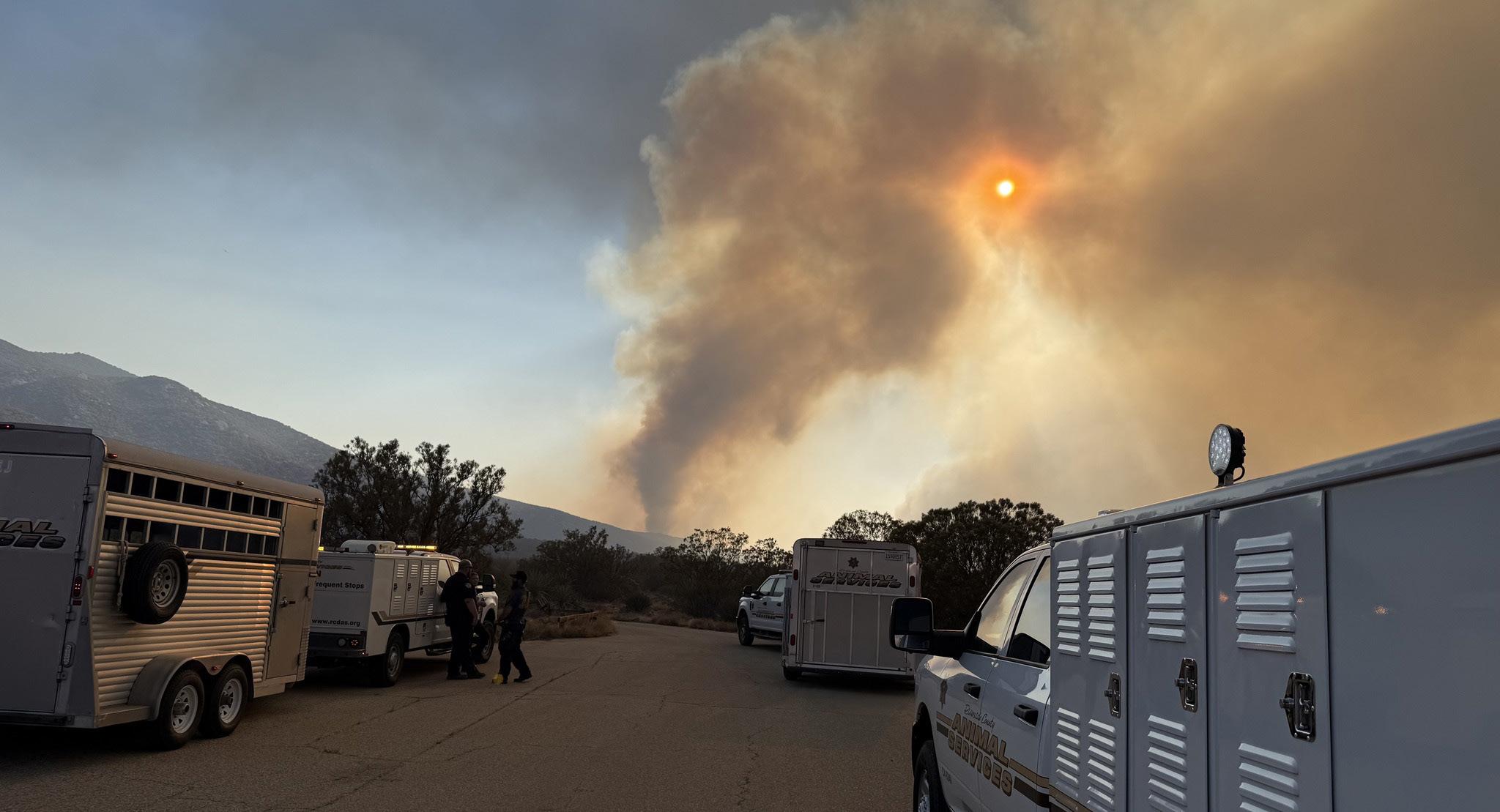
an Bernardino County Museum will host its first annual educator open house on Thursday, Aug. 21, from 5 to 7 p.m. at the museum in Redlands. This free event is open to all K-12 educators, school administrators, curriculum coordinators and homeschool networks throughout the Inland Empire and beyond.
Designed with educators in mind, the open house offers a hands-on introduction to the museum’s wide range
of field trip opportunities, loan kits, STEAMbased programming and educational partnerships. Attendees will have the chance to preview interactive exhibits, explore classroom resources, and engage directly with education staff to learn how to integrate museum content into their lesson plans.
“This event is our way of thanking educators for the work they do and showing them how the museum can be a partner in their class-
rooms,” said Erica Watkins, museum educator at SBCM.
“We’re excited to share new programs and tools that bring local culture, history, and science to life for students.”
Highlights include:
- Exploring exhibits and cart talk programs
- Connecting with community resource vendors
- Networking with fellow educators
- Participating in a museum resource raffle
- Enjoying light refresh-
ments
Educators are encouraged to RSVP at tinyurl. com/544p6usk. Admission is free with valid school ID or district email.
The San Bernardino County Museum is located at 2024 Orange Tree Lane, at the California Street exit from Interstate 10 in Redlands. Parking is free and the museum is accessible to people with disabilities. For more information, visit museum.sbcounty. gov.

By City News Service
A72-year-oldPalm Springswoman aboard one of the airliners that crashed into the World Trade Center on Sept. 11, 2001, was identified through forensic evidence using advanced DNA verification methods, officials confirmed Thursday.
Barbara Keating was a passenger on American Airlines Flight 11, which authorities say slammed into the North Tower shortly before 9 a.m. within an hour of departing Boston, marking the start of airborne mayhem that fateful day.
According to the New York Post, the New York City
Office of the Chief Medical Examiner has continued investigations over the last 24 years to ascertain the identities of all those who perished, despite in many cases having only bare minimum trace evidence.
Keating, along with 26-year-old Ryan Fitzgerald of Floral Park, New York, were the latest casualties positively identified, bringing the total number of World Trade Center victims whose remains have been publicly confirmed to 1,653, officials said.

Keating’s son, Paul, told a media outlet that his mother suffered many losses when she was killed, including “all the moments (she) could have had” with her grandchildren. Flight 11 had been
bound for Los Angeles International Airport.
Three other airliners were lost that day following takeovers — United Airlines Flight 175. United Flight 93 and American Flight 77 — according to federal investigators.
“As a former law enforcement officer who served our city on 9/11, I understand deeply the feeling of loss so many families have experienced,” New York Mayor Eric Adams said. “We hope the families receiving answers from the Office of Chief Medical Examiner can take solace in the city’s tireless dedication to this mission.”
The Office of the Medical Examiner’s pathologists have, over the last several years, relied on enhanced genetic sequencing of DNA recoveries to verify victims’ identities, officials said.
“Each new identification testifies to the promise of science and sustained outreach to families despite the passage of time,” Chief Medical Examiner Dr. Jason Graham said in a public statement. “We continue this work as our way of honoring the lost.”
Despite recent successes, he said around 1,100 victims, or 40% of those killed in New York City, remain unidentified.
By City News Service
Apreliminary hearing is slated next week for a parolee and his girlfriend accused of putting a runaway girl to work as a prostitute in Riverside and surrounding locations.
Michael Jay Johnson, 28, of Los Angeles, and 23-yearold Bonnie Edney Fingerson of Santa Clara were arrested last week following a Riverside Police Department investigation.
Johnson and Fingerson are both charged with human trafficking and pimping, while Johnson alone is charged with lewd acts on a minor and being a felon in possession of a firearm. Fingerson is separately charged with recruiting a minor for sex trafficking.
They were jointly
arraigned Monday, each entering not guilty pleas before Riverside County Superior Court Judge Gary Polk, who scheduled a preliminary hearing for Aug. 13 at the Riverside Hall of Justice. The hearing will establish whether there are sufficient grounds to bound the pair over for trial.
Johnson was being held in lieu of $200,000 bail at the Robert Presley Jail. Fingerson was being held on $85,000 bail at the Smith Correctional Facility.
According to the Riverside Police Department, in May, Vice Squad investigators came into contact with two teenage girls who ran away from a group home and said that, during the time they were on the streets, they had encountered
Johnson and Fingerson.
One of the victims, whose identity was not disclosed, was allegedly coerced into working for the duo in an on-call sex services operation, Officer Ryan Railsback said.
“The reality is that when teens run away, they face immediate and serious risks,” police Lt. Matt Lackey said. “Within hours, they can become targets for predators, fall victim to human trafficking, or be subjected to other violent crimes.”
Detectives gathered sufficient evidence to procure arrest warrants for Johnson and Fingerson.
He was taken into custody without incident on Wilmington Avenue in Los Angeles on July 29. She was transferred from the Santa

Clara County Jail on July 31. Court records did not specify Johnson’s prior felony convictions, and it was unclear whether Finger-
By Staff
On Aug. 1, Corona police responded to a call of an unknown problem in the 1200 block of West Eighth Street and 42-yearold Corona resident Michael Hughes with significant stab wounds to the abdomen.
Corona Fire Department personnel pronounced
Hughes deceased at the scene.
Officers interviewed family members and determined that Hughes sustained his injuries during an argument with his wife, 33-year-old Malena Johnson of Corona. Johnson remained at the location and officers detained her
without incident. Detectives assumed control of the investigation and arrested Malena for murder. She was later transported to the Robert Presley Detention Center.
Based on the information gathered, this appears to be an isolated incident
and there are no outstanding suspects or danger to the community, according to the Corona Police Department. If you have information about this investigation, call Detective Ryan Eddy at 951-739-4869 or email Ryan.Eddy@CoronaCA.gov.
son had any priors.
“We urge parents, guardians and community members to talk with their teens about dangers, report
and work closely with law enforcement to help ensure their safe return,”