FREE
Eastvale seventh grader ties for 10th in National Spelling Bee
Desert Healthcare District board terminates CEO Christensen
PG 02
PG 27
VISIT HEYSOCAL.COM
MONDAY, JUNE 01-JUNE 07, 2026
NO. 278
VOL. 12,
Follow the money: Who’s backing California’s next governor — and why
San Bernardino receives $1.15M from feds for disaster prep
By Jeanne Kuang and Jeremia Kimelman, CalMatters
By Staff
This story was originally published by CalMatters.
C
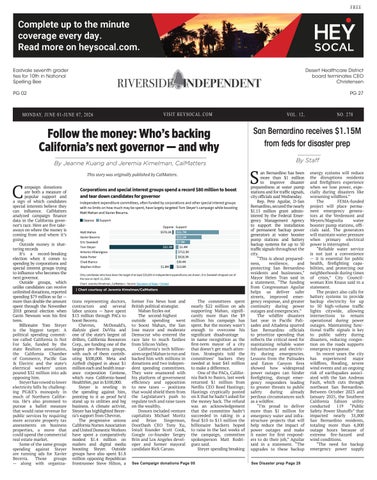
ampaign donations are both a measure of popular support and a sign of which candidates special interests believe they can influence. CalMatters analyzed campaign finance data in the California governor’s race. Here are five takeaways on where the money is coming from and where it’s going. Outside money is shattering records It’s a record-breaking election when it comes to spending by corporations and special interest groups trying to influence who becomes the next governor. Outside groups, which unlike candidates can receive unlimited donations, reported spending $79 million so far — more than double the amount spent through the November 2018 general election when Gavin Newsom won his first term. Billionaire Tom Steyer is the biggest target: A political spending committee called California Is Not For Sale, funded by the state Realtors association, the California Chamber of Commerce, Pacific Gas & Electric and the state’s electrical workers’ union poured $32 million into ads opposing him. Steyer has vowed to lower electricity bills by challenging PG&E’s monopoly in much of Northern California. He’s also promised to pursue a ballot measure that would raise revenue for public services by requiring more accurate property tax assessments on business properties, a move that could upend the commercial real estate market. Some of the same groups spending against Steyer are running ads for Xavier Becerra. Those groups — along with organiza-
| Chart courtesy of Jeremia Kimelman/CalMatters
tions representing doctors, contractors and several labor unions — have spent $13 million through PACs to boost Becerra. Chevron, McDonald’s, dialysis giant DaVita and one of the state’s largest oil drillers, California Resources Corp., are funding one of the largest pro-Becerra groups, with each of them contributing $500,000. Meta and AirBnB chipped in about $1 million each and health insurance corporation Centene, which runs California-based HealthNet, put in $100,000. Steyer is reveling in the spending against him, pointing to it as proof he’d stand up to utilities and big business. A climate activist, Steyer has highlighted Becerra’s support from Chevron. The progressive unions California Nurses Association and United Domestic Workers have spent a comparatively modest $1.4 million on mailers and digital media boosting Steyer. Outside groups have also spent $1.8 million opposing Republican frontrunner Steve Hilton, a
former Fox News host and British political strategist. Mahan fizzles out The second-highest outside spending went to boost Mahan, the San Jose mayor and moderate Democrat who entered the race late to much fanfare from Silicon Valley. California’s tech billionaires urged Mahan to run and backed him with millions in donations and two independent spending committees. They were enamored with his platform of government efficiency and opposition to new taxes — positions that would shield them from the Legislature’s push to regulate tech and raise taxes on the wealthy. Donors included venture capitalists Michael Moritz and Brian Singerman, DoorDash CEO Tony Xu, Intuit founder Scott Cook, Google co-founder Sergey Brin and Los Angeles developer and former mayoral candidate Rick Caruso.
The committees spent nearly $22 million on ads supporting Mahan, significantly more than the $9 million his campaign has spent. But the money wasn’t enough to overcome his significant disadvantage in name recognition as the first-term mayor of a city that doesn’t get much attention. Strategists told the committees’ backers they needed at least $45 million to make a difference. One of the PACs, California Back to Basics, last week returned $1 million from Netflix CEO Reed Hastings; Hastings cryptically posted on X that he hadn’t asked for the money back. The refund was an acknowledgement that the committee hadn’t succeeded in raking in a final $10 to $15 million the billionaire backers hoped to raise in the last weeks of the campaign, committee spokesperson Matt Rodriguez said. Steyer spending breaking
See Campaign donations Page 05
S
an Bernardino has been more than $1 million to improve disaster preparedness at water pump stations and for traffic signals, city officials said Wednesday. Rep. Pete Aguilar, D-San Bernardino, secured the nearly $1.15 million grant administered by the Federal Emergency Management Agency to support the installation of permanent backup power generators at water booster pump stations and battery backup systems for up to 50 traffic signals throughout the city. “This is about preparedness, resilience, and protecting San Bernardino residents and businesses,” Mayor Helen Tran said in a statement. “The funding from Congressman Aguilar helps us deliver safer streets, improved emergency response, and greater continuity during power outages and emergencies.” The wildfire disasters last year in Pacific Palisades and Altadena spurred San Bernardino officials to prioritize spending that reflects the critical need for maintaining reliable water infrastructure and electricity during emergencies. Lessons from the Palisades and Eaton Canyon fires showed how widespread power outages can hinder firefighting, disrupt emergency responders leading to greater threats to public safety during already perilous circumstances such as a wildfire. “I’m proud to deliver more than $1 million for emergency water and infrastructure projects that will help reduce the impact of power outages and make it easier for first responders to do their job,” Aguilar said in a statement. “The upgrades to these backup See Disaster prep Page 28
energy systems will reduce the disruptions residents and firefighters experience when we lose power, especially during disasters like worsening wildfires.” The FEMA-funded project will place permanent emergency generators at the Verdemont and Meyers/Magnolia water booster pump stations, officials said. The generators will maintain water pressure when primary electrical power is interrupted. “Reliable water service is not just a convenience — it is essential for public health, firefighting capabilities, and protecting our neighborhoods during times of crisis,” City Councilwoman Kim Knaus said in a statement. The project also calls for battery systems to provide backup electricity for up to 50 high-volume traffic lights citywide, allowing intersections to remain operational during power outages. Maintaining functional traffic signals is key to public safety during disasters, reducing congestion on the roads supports emergency response. In recent years the city has experienced major wildfires, flooding, severe wind events and an ongoing risk of earthquakes associated with the San Andreas Fault, which cuts through northeast San Bernardino. Between October 2023 and January 2025, the Southern California Edison utility conducted 119 “Public Safety Power Shutoffs” that impacted nearly 35,000 San Bernardino residents, totaling more than 4,000 outage hours because of extreme fire-hazard and wind conditions. “The need for backup emergency power supply
HEYSOCAL.COM
2 JUNE 01-JUNE 07, 2026
Eastvale seventh grader ties for 10th in National Spelling Bee By City News Service
A
seventh grader from Dr. Augustine Ramirez Intermediate School in Eastvale was among 15 spellers tying for 10th place in the National Spelling Bee in Washington Wednesday. Victoria Li was eliminated in the ninth round when she misspelled “zinke,” a German noun meaning prong or spike. She gave A as the final letter. The nine spellers who spelled their ninth-round words correctly advanced to Thursday’s finals at Constitution Hall. Victoria began the semifinals by correctly spelling “lupulon,” then answered a vocabulary question correctly. Victoria began Wednesday’s quarterfinals by correctly spelling “theatrocracy,” a noun meaning government by the people assembled in their theater, as in the
Athenian democracy, according to the Merriam-Webster Collegiate Dictionary. Victoria then correctly answered the multiple-choice vocabulary question, “a profusion is,” by selecting “an overpowering quantity.” A vocabulary question is asked in the second round in each of the bee’s four segments. “Parisienne,” Victoria’s sixth-round word, is a noun meaning a Parisian woman or girl. Victoria began the competition Tuesday by correctly spelling hoi polloi, a plural noun meaning the general populace. She was then asked the vocabulary question, “Opacity means?” and correctly chose “lack of transparency or translucency.” Victoria then joined the other spellers who advanced to the third round in taking a 30-question spelling and
vocabulary test, with each correct answer worth one point. Under bee rules, spellers are grouped by their number of correct answers. The number of spellers to advance are determined by identifying the group whose minimum score results in as close to 100 quarterfinalists as possible. Spellers with a least 13 points were assured of advancing to the quarterfinals, officials announced. The test reduced the field from 167 to 95. Individual scores were not disclosed. Victoria qualified for the national competition by winning the Riverside County Spelling Bee for the second consecutive year, correctly spelling “ejecta” — meaning to expel an object, as from an eruption — as her final word. She was eliminated in the sixth round of the 2025
Victoria Li celebrates her local victory before moving on to the National Spelling Bee in the nation’s capital. | Photo courtesy of the Riverside County Office of Education
National Spelling Bee when she misspelled “ablegate,” giving the fourth letter of the noun meaning a papal envoy on a special mission as an “i”
instead of an “e.” Victoria was among the 16 spellers tying for 58th. The bee is limited to students who have not passed
beyond the eighth grade or an international equivalent on or before Aug. 31, 2025 and who were born on Sept. 1, 2010 or later.
Remote participation to begin for San Bernardino County Board of Supervisors meetings By Staff
R
esidents will be able to provide public comments at San Bernardino County Board of Supervisors meetings remotely by telephone during meetings following July 1. More information on the remote public comment process and how to register to speak during the board meetings will be available at publiccomments.cob.sbcounty.gov. Board meetings are held in the Covington Chambers on the first floor of the County Government Center, located at 385 N. Arrowhead Ave. in San Bernardino. Regular Board of Supervisors meetings are held on Tuesdays and begin with closed session at 9 a.m. and public session at 10 a.m.
View the annual calendar of meetings for scheduled meetings. Any exceptions to the location or start time of the meeting will be publicly noticed pursuant to the Brown Act and included on the posted Board of Supervisors’ agenda. Board meeting agendas contain a brief general description of each item of business to be conducted or discussed during the board meeting and are generally available for review by the close of business on the Friday before the Tuesday meeting. Live and archived board meeting videos are available online through the SB County Broadcast Network. Written public comments may be submitted:
- Via email at BoardMeetingComments@cob. sbcounty.gov. - Online at publiccomments.cob.sbcounty.gov. - Via U.S. mail to San Bernardino County Clerk of the Board of Supervisors, 385 N. Arrowhead Ave., 2nd Fl., San Bernardino, CA 92415. Written comments received after the posting of the agenda and prior to the start of the board meeting will be forwarded to the board for review. Comments relating to matters subject to board consideration or discussion will also be posted online at cob. sbcounty.gov/brown-actwritings-received. Any written comments received after the meeting begins and through the
| Photo courtesy of Onur Binay/Unsplash
conclusion of the meeting will be provided to the board after the meeting adjourns.
Comments received outside of this timeframe will be forwarded to the board as
Augustine Casino to host grand opening of new coffee shop this week By City News Service
A
ugustine Casino announced Thursday that a new coffee shop will open inside the facility this week in partnership with Saguaro Coffee. “We wanted to create a coffee destination that has a true connection to the Coachella Valley,” Matt Noe, a food and beverage director, said in a statement. “Part-
nering with Saguaro Coffee allows us to champion local craftsmanship and treat our guests to a premium, personalized service experience that highlights the very best of our community.” A grand opening of “The Grind” will be held from 10 a.m. to noon Monday at 84-001 Avenue 54 in Coachella. The event will feature
prizes and special discounts, and attendees will be able to “Meet the Roaster” with the team behind Saguaro Coffee. Regular hours for the coffee shop will be from 7 a.m. to 9 p.m. daily. Officials said the partnership with Saguaro Coffee will introduce guests to ethically sourced, small-batch beans roasted locally.
| Photo courtesy of Nathan Dumlao/Unsplash
general correspondence and not included in the meeting record.
HEYSOCAL.COM
JUNE 01-JUNE 07, 2026 3
Lawmakers stripped the Board of Equalization of
Publisher Civic News Group COO Andrea Olivas Tange Vice President Sam Kubert Editorial editorial@civicnewsgroup.com Fabiola Diaz Joe Taglieri Designer/ Production production@civicnewsgroup.com Renia Barouni Contributors May S. Ruiz Sales advertising@civicnewsgroup.com Raquel Mc Laughlin Legal Advertising legals@civicnewsgroup.com Annette Reyes Crystal Cortez Accounting accounting@civicnewsgroup.com
power. Now they’re fighting to join it By Cayla Mihalovich and Adam Ashton, CalMatters This story was originally published by CalMatters.
C
All Inquiries info@civicnewsgroup.com
CIVIC NEWS GROUP
118 W Lime, Ste 126 Monrovia, CA 91016 (626) 566-2149 www.heysocal.com
PRESS RELEASE SUBMISSIONS editor@civicnewsgroup.com Submissions Policy
Civic News Group, Inc. All contents herein are copyrighted and may not be reproduced in any manner, either in whole or in part, without the express written consent of the publisher. The Views and opinions expressed in this paper are not necessarily that of the management and staff at Civic News Group, Inc.
Rosemead Reader A Beacon Media, Inc. Publication
AI in the Newsroom
SanGabriel Sun
The Arcadia Weekly has been adjudicated as a newspaper of general circulation in court case number GS 004333 for the City of Arcadia, County of Los Angeles, State of California.
Temple Tribune
HeySoCal editors periodically utilize HeyWire AI’s tools for research and writing assistance for some articles. No article is ever published without human editorial supervision and approval.
City
The Monrovia Weekly has been adjudicated as a newspaper of General Circulation in Court Case GS 004759 City of Monrovia, County of Los Angeles, State of California. The Temple City Tribune has been adjudicated as a newspaper of general circulation in court case number GS 012440 City of Temple City, County of Los Angeles, State of California. The El Monte Examiner has been adjudicated as a newspaper of general circulation in court case number KS 015872 City of El Monte, County of Los Angeles, State of California. The Azusa Beacon has been adjudicated as a newspaper of general circulation in court case number KS 015970 City of Azusa, County of Los Angeles, State of California. The San Gabriel Sun has been adjudicated as a newspaper of general circulation in court case number GS 013808 City of San Gabriel, County of Los Angeles, State of California. The Duarte Dispatch has been adjudicated as a newspaper of general circulation in court case number GS 013893 City of Duarte, County of Los Angeles, State of California. The Rosemead Reader has been adjudicated as a newspaper of general circulation in court case number GS 048894 City of Rosemead, County of Los Angeles, State of California.
Belmont Beacon
The Alhambra Press has been adjudicated as a newspaper of general circulation in court case number ES016581 City of Alhambra, County of Los Angeles, State of California. The Baldwin Park Press has been adjudicated as a newspaper of general circulation in court case number KS017174 City of Baldwin Park, County of Los Angeles, State of California. The Burbank Independent has been adjudicated as a newspaper of general circulation in court case number ES016728 City of Burbank, County of Los Angeles, State of California. The Glendale Independent has been adjudicated as a newspaper of general circulation in court case number ES016579 City of Glendale, County of Los Angeles, State of California. The Monterey Park Press has been adjudicated as a newspaper of general circulation in court case number ES016580 City of Monterey Park, County of Los Angeles, State of California. The West Covina Press has been adjudicated as a newspaper of general circulation in court case number KS017304 City of West Covina, County of Los Angeles, State of California. The San Bernardino Press has been adjudicated as a newspaper of general circulation in court case number CIVDS 1506881 City of San Bernardino, County of San Bernardino, State of California. The Riverside Independent has been adjudicated as a newspaper of general circulation in court case number RIC1505351 City of Riverside, County of Riverside, State of California. The Pasadena Press has been adjudicated as a newspaper of general circulation in court case number ES018815 City of Pasadena, County of Los Angeles, State of California. The Belmont Beacon has been adjudicated as a newspaper of general circulation in court case number NSO30275 City of Long Beach, County of Los Angeles, State of California. The Anaheim Press has been adjudicated as a newspaper of general circulation in court case number 30-2017-00942735-CU-PT-CJC City of Anaheim, County of Orange, State of California. The Ontario News Press has been adjudicated as a newspaper of general circulation in court case number CIVDS 1506881 City of Ontario, County of San Bernardino, State of California.
San Bernardino Press
alifornia’s Board of Equalization is a coveted spot once again for state lawmakers looking for a new gig almost a decade after then-Gov. Jerry Brown signed a law gutting the organization of any serious governing responsibility. This year, three current state lawmakers are competing for seats on the nation’s only elected tax board. They’re among some two dozen candidates on the ballot for its four elected positions, which are divided by geographic districts. The board has long been a launching pad to higher offices in California politics — Fiona Ma served on it before becoming state treasurer, as did Betty Yee and Malia Cohen before each being elected state controller. The agency itself is a throwback to the 19th Century. It’s rooted in an 1879 constitutional amendment that created it and charged it with “equalizing” county property tax assessments statewide. From that narrow mandate, it swelled to become a juggernaut that collected a third of the state’s tax revenue and provided a venue for people and businesses to contest their tax bills in front of the elected board. It survived numerous efforts by governors to kill it outright, including attempts by Pete Wilson and Arnold Schwarzenegger. That is until 2017, when a cascade of allegations about board members misusing the office to promote themselves led to an authoritative state audit that lawmakers could not ignore. Brown signed a law stripping the agency of any powers beyond what voters gave it in 1879 and created two new departments that report to the governor instead of the elected board: one to collect sales and use taxes and another to hear taxpayer appeals. After that, Board of Equalization elections tended to be lower profile contests. Ted Gaines, a former Republican state lawmaker from the Sacramento area, won a seat. Former Democratic Assemblymember Sally Lieber is up for reelection on the board this year. The other members had experience in local politics instead of inside the Capitol. “We’re lean but we’re not mean,” said Lieber, the incumbent for District 2, which includes 19 counties centered
The state Capitol on March 28, 2025. | Photo courtesy of Miguel Gutierrez Jr./CalMatters
on the Bay Area. “I think the Board of Equalization is the right size in the system right now…I do really believe that the board has a role to play in being a forum for taxpayers to come forward to.” This year voters will see more contentious elections for the tax board: - In District 1 representing inland California, Republican state Sen. Shannon Grove of Bakersfield has more than $900,000 in a campaign account and name recognition from her representing the San Joaquin Valley in the Legislature since 2010. Democrats are putting up a fight for the district. Fresno City Councilmember Nelson Esparza is running with the party’s support. - In District 2 representing coastal California north of Los Angeles, incumbent Lieber faces San Mateo Community College District Trustee John Pimentel. Lieber has the Democratic Party’s endorsement, but a number of Bay Area Democratic leaders are backing Pimentel, including state Treasurer Ma and San Jose Mayor Matt Mahan. - In District 3 representing the Los Angeles area, former Monterey Park City Councilmember Yvonne Yiu put up $760,000 of her own money and has about $1 million on hand. The race has another heavyweight in Assemblymember Mike Gipson, a Democrat from Gardena who has served in the Legislature since 2014. - District 4 representing the San Diego area has an especially crowded race with Democratic state Sen. Tom Umberg of Santa Ana, San Ysidro school board member Martín Arias, San Diego Unified School District board member Cody Peterson, and Denis Bilodeau, a Republican supported by San Diego Assemblymember Carl DeMaio’s Reform California
organization. A forum for California taxpayers The board was always popular among taxpayer advocacy groups, who liked that it provided a forum to focus on tax issues in a capital where debates often center on labor and business. “It’s a very useful elected body that answers to the voters,” said Susan Shelley, vice president of communications for the Howard Jarvis Taxpayers Association. Some of this year’s candidates are thinking of ways to make the most of the agency. Arias believes the board could do more to assist homeowners and potential homeowners. As a taxpayer advocate in the San Diego County Assessor’s Office, he says he works with the Board of Equalization every day and has a front seat to how the system works. “I think there’s a bigger opportunity here to make the Board of Equalization the constitutional office that it is — that it should be,” he said. “There’s a clear opportunity here for us to start advocating at the state level for all of our taxpayers, including those that don’t speak English.” Umberg said he’d like the board to have more investigative power and resources. Citing instances in which San Bernardino and Los Angeles assessors have been arrested on felony charges, he said he’s most interested in the board’s oversight of property tax assessors. “Although it’s not a high-profile job, it’s a critically important job, especially when we’ve got so many revenue challenges in California,” Umberg said in an interview with CalMatters. Questioning BOE’s relevance Advocating for the board’s expansion has drawn criticism from former board members
and employees. Yee, a board member from 2004 to 2014, has been vocal about abolishing the board entirely because she believes that its limited responsibilities could be easily transferred to another department or agency. “I just really do question how this board continues to have relevance,” she told CalMatters. “I sometimes feel like the board is really doing a lot of work in search of finding problems to solve. …I know with each of the board members, they feel very strongly about being a taxpayer advocate. But frankly, every public official should be a taxpayer advocate. ”Democrats stopped short of killing the agency entirely because they would have had to put that question to voters. “They should have just chopped the head of the snake off and done away with the Board of Equalization altogether,” said Mark DeSio, a former communications director for the board. “They didn’t do that. They left enough of the cancer to grow back.” He cooperated with the audit that revealed misspending at the agency that appeared intended to promote its elected members as well as another that showed widespread nepotism in its hiring practices. He then lost his job in the reorganization and filed a whistleblower retaliation lawsuit against the state. DeSio believes lawmakers want seats on the Board of Equalization because it allows them to maintain a high profile until they can run for office again. “That was the recipe for disaster a few years back,” he said. “Somebody better watch these guys. They’re not there for the policy. It’s for the exposure.” Cayla Mihalovich is a California Local News fellow.
HEYSOCAL.COM
4 JUNE 01-JUNE 07, 2026
Schedule for 2028 Paralympic Games revealed
Queen Mary marks 90th anniversary with free event, lounge debut
By City News Service
By City News Service
L
A28 unveiled its full Paralympic competition schedule Wednesday, outlining more than 1,100 hours of competition across 14 days during Los Angeles’ first-ever Paralympic Games in 2028. The Games will feature a record 560 medal events across 23 sports and nearly 20 venues throughout the Los Angeles region, making it the largest Paralympic Games since Seoul 1988, according to organizers. “The Paralympic Games are a must-see elite sporting event,” LA28 Chief Athlete Officer Janet Evans said in a statement. “As the world’s third largest sporting event, they celebrate athletic excellence at the highest level, demonstrating relentless determination and the limitless potential and power of sport. With more sports and days of competition than ever before, LA28 is setting the stage for a legendary Paralympic Games.” The Paralympic Opening Ceremony is scheduled for Aug. 15, 2028, at SoFi Stadium, with the Closing Ceremony set for Aug. 27. LA28 officials said the Games will mark the Paralympic debut of Para Climbing, which was added to the sports program in 2024 and will feature 80 athletes competing across eight medal events. Wheelchair Rugby competition will begin two days before the Opening Ceremony, marking the first time Paralympic competition will begin before the Games officially open, officials said. Boccia -- a precision ball sport -- is scheduled to begin one day before the ceremony. LA28 also announced new medal events in Para Table Tennis, Para Triathlon
T
| Photo courtesy of LA28/Facebook
and Para Swimming aimed at improving gender parity and expanding opportunities for athletes with intellectual impairments. The final weekend of competition is expected to be among the busiest in Paralympic history, with organizers planning more than 50 gold medal events across sports including wheelchair basketball, sitting volleyball, para swimming, para cycling, para archery and wheelchair tennis during the Aug. 26 “Super Saturday” competition schedule. “We have the opportunity to break barriers and redefine what the Paralympic Movement and disability
representation can mean for the next generation,” said Ileana Rodriguez, LA28 vice president of Paralympic Strategy and Relations. “We have the chance to shine a brighter light on more Paralympians than ever before, and I cannot wait for fans everywhere to witness the extraordinary athleticism and unforgettable moments that their performances are sure to bring.” Organizers also highlighted expanded women’s participation and improved gender parity, noting women will account for 45% of athlete quota places -- up from 42% at the 2024 Paris Games.
he Queen Mary celebrated the 90th anniversary of its historic maiden voyage with a free, daylong celebration Wednesday, featuring special events, tours and the debut of a revived onboard lounge. The event coincided with the exact date the iconic ocean liner first set sail in 1936 and is part of a broader, yearlong anniversary program honoring the ship’s legacy, according to organizers. Festivities began at noon, when ship officers welcomed guests near the vessel’s bell, followed by access to exhibits, art displays, anniversary tours and interactive activities throughout the ship. An official program was scheduled for 2 p.m. in the Queen’s Salon, featuring remarks from ship leadership, a Long Beach city representative and other speakers, along with a performance and award presentation, organizers said. A lecture by maritime historian Dik Barton was planned for 3:30 p.m., with daytimeprogramming concluding at 5 p.m. Organizers said the celebration also included a ceremonial christening of the ship to commemorate the milestone. The day’s events lead into the debut of the Starlight Lounge, a one-night-only ticketed experience inspired by the ship’s original Star-
| Photo courtesy of The Queen Mary/Facebook
light Club, once a popular nightlife destination during its transatlantic voyages, organizers said. The revived venue, located in the former Verandah Grill, featured live music, dancing and a threecourse meal inspired by 1930s-era menus. “Bringing back the Starlight Lounge for the 90th anniversary is a powerful way to celebrate this milestone year,” Steve Caloca, managing director of the
Queen Mary, said in an earlier statement. “Giving guests a glimpse of this for the 90th allows us to honor that history while creating a new signature experience for today’s visitors as part of our anniversary,” he added. First launched in 1936, the Queen Mary is now permanently docked in Long Beach and remains one of the most recognizable ocean liners in the world.
The White House intervened to get a $620M deal for a company tied to Donald Trump Jr. By Robert Faturechi, ProPublica
W
This story was originally published by ProPublica. ProPublica is a nonprofit newsroom that investigates abuses of power. Sign up to receive their biggest stories as soon as they’re published.
hen the Pentagon announced a $620 million loan last year to a small North Carolina startup linked to Donald Trump Jr., defense officials and the company tried to tamp down suspicions of cronyism. The president’s eldest son said through a spokesperson that he wasn’t involved. The Pentagon said Trump Jr. played no role in the recordsetting deal. And the startup’s founder told reporters that his company, Vulcan Elements, received no political favoritism. But interviews and Defense Department records reviewed by ProPublica show
that the request to loan hundreds of millions of dollars to the firm linked to Trump Jr. was made by Peter Navarro, a White House adviser to President Donald Trump and a friend of Trump Jr.’s. Of the dozens of companies the Pentagon was considering funding at the time, Vulcan’s was the only deal initiated by a top aide to the president, said an official at the Pentagon who was not authorized to speak publicly. After defense officials got the White House request, they asked Pentagon staff to move at an unusually rapid pace, See Trump Jr. Page 06
said another person who was involved in the deal at the Pentagon but not authorized to speak about it. The staff worked late nights and with little sleep to get the loan through in a matter of weeks, the source said. “The call came from the White House: We have to get this done,” the person said. The deal is one of many actions by the Trump administration that have helped companies in which the Trump family holds stakes. Government contracts and other benefits have gone to various Trump-linked compa-
HEYSOCAL.COM
JUNE 01-JUNE 07, 2026 5
Yosemite overrun with tourists after reservation system scrapped By Suzanne Potter, Public News Service
V
isitors reported long lines, crowded trails and parking problems at Yosemite National Park over Memorial Day weekend after the National Park Service ended its reservation system. Staff are having a hard time keeping up with the crowds after the Trump administration cut almost 25% of permanent jobs at the National Park Service since January of last year. Mark Rose, Sierra Nevada senior program manager for the National Parks Conservation Association, said the chaos is hurting the visitor experience and the environment. “One- to two-hour-long lines to get into the parks and long lines to get on shuttle buses,” Rose said. “A lot of people parking on
ing reservation systems at Yosemite, Arches and Glacier national parks to increase recreational access. Rose said he suspects the
administration is ignoring environmental concerns to boost the tourism industry. “Here under this administration,” Rose said, “they’re placing private interests of hotel owners who run the hotels outside of the park and letting them really dictate the management of parks like Yosemite.” The Yosemite Conservancy advises people to consider visiting during the week and arriving early in the day. It also suggests parking only once and using the shuttle afterward, and visiting areas outside Yosemite Valley, including Wawona and Hetch Hetchy. July and August are Yosemite’s busiest months, with an average of 600,000 visitors.
host seeks to slash state environmental regulations, build housing on undeveloped suburban land and cut income taxes for the middle class. He received a slight uptick in donations after President Donald Trump endorsed him on April 6. Katie Porter, the Democratic former congressmember from Orange County and consumer protection attorney, had the secondhighest number of donors, with more than 15,000. She also has the highest share of donors outside Cali-
fornia, reflecting her relative national fame from her headline-grabbing time grilling corporate CEOs in Congress. But fundraising stalled for the onetime progressive darling, who touts her reliance on grassroots donors and refusal to take corporate contributions. From April 18 through May 19 she brought in less money than Mahan. This article was originally published by CalMatters and was republished under the Creative Commons Attribution-NonCommercialNoDerivatives license.
Visitors crowd the Yosemite Valley overlook in February during the “Firefall” event. | Photo courtesy of Mark Rose/Public News Service
meadows, on roadsides, on tree roots, causing significant resource damage.” Rose said morale is down among park staff. He also
worries the crush of vehicles could affect emergency response times. Visitors reported overcrowding on trails, leading
some people to hike offtrail. In February, the Department of the Interior announced it was eliminat-
Campaign donations its own records Yet despite his opponents’ deep-pocketed donors, no one has matched the $213 million Steyer has spent on his own campaign, allowing him to blanket the airwaves with ads, pay influencers to post videos with him and send billboard trucks to drive around gas stations highlighting Becerra’s Chevron support. That makes his the most expensive primary campaign in California gubernatorial history, exceeding that of former eBay executive
Meg Whitman, a Republican who spent about $94 million in the June 2010 primary — about $142 million in today’s dollars — spending tens of millions more before losing to Jerry Brown in the general election. Swalwell donors flocked to Becerra DaVita, the California Medical Association and the California Professional Firefighters Association all supported former Rep. Eric Swalwell’s gubernatorial bid before he dropped out over sexual assault allegations.
They were among the biggest Swalwell backers to quickly switch to Becerra, who has enjoyed surging support from social media and the Democratic establishment. Small donors made a similar leap. The CalMatters analysis found that after Swalwell dropped out, more than 500 of his campaign donors went on to contribute to Becerra’s campaign. No other candidate received that much support from former Swalwell donors. Swalwell, who has also
since resigned from Congress, continues to use his gubernatorial campaign to pay more than $313,000 to attorney Sara Azari, who is defending him against the allegations. He has also refunded about $250,000 to nearly 50 donors. Republican Steve Hilton had the most donors The Republican frontrunner amassed the highest number of campaign donors in the race: more than 20,000. Nearly a quarter of them live outside California. The former Fox News
USC researchers develop self-taught piano-playing robot By City News Service
U
SC researchers announced Wednesday they have developed a robotic hand capable of teaching itself to play simple piano melodies by ear after just minutes of practice, a breakthrough scientists say could eventually help improve rehabilitation technology and treatment for movement disorders such as Parkinson’s disease. The system, dubbed the “Musician Hand,” was developed by researchers at the USC Viterbi School of Engineering. The findings were published in the Journal of the Royal Society Interface. Unlike traditional robots that rely heavily on pre-programmed instructions and massive training datasets, the robotic hand learned through a process researchers compared to the way infants experiment with
movement while developing motor skills. For roughly two minutes, the robot randomly pressed piano keys while recording the sounds produced and the finger movements needed to create them, according to USC researchers. After the brief practice period, the hand was able to hear and reproduce an unfamiliar melody of about 30 notes without corrections or sheet music. Researchers said the robotic system became advanced enough to perform before two music judges who listened blindly to recordings from the robot alongside performances by four human pianists. “The Achilles’ heel of traditional robotics is the assumption that perfect information is necessary to act well,” Francisco Valero-Cuevas, a
USC professor of biomedical engineering, aerospace and mechanical engineering, said in a statement. “Animals don’t work that way. They perceive; they guess, usually correctly; and they adapt. We wanted to show a robot could do the same.” The hand uses four tendon-driven fingers controlled by small electric motors designed to mimic the mechanics of the human hand, while neural networks analyze melodies and convert them into finger movements. Researchers said the project could eventually lead to advances in prosthetics, wearable robotic exoskeletons and physical therapy systems capable of adapting to how individuals naturally move. “Imagine if, when you were first diagnosed, you wore
| Photo courtesy of Possessed Photography/Unsplash
an exoskeleton -- a wearable robotic suit -- and it learned how you move with only a few days of training,” Valero-
Cuevas said in describing possible applications for Parkinson’s patients. The research was support-
ed by the National Science Foundation and the Defense Advanced Research Projects Agency.
HEYSOCAL.COM
6 JUNE 01-JUNE 07, 2026
Trump nies, prompting allegations of self-dealing by Democratic lawmakers and good government experts. But ProPublica’s reporting on the Vulcan loan represents the first time the awarding of a contract from a federal agency has been directly linked to White House intervention. The loan was a massive financial commitment from the Pentagon in its effort to fund companies that could help the U.S. reduce dependence on China’s critical mineral supply chains. The deal was a dramatic win for Vulcan, a North Carolina rare-earth magnet company launched just two years earlier. Estimates of its valuation grew tenfold after the deal was announced. It was also a win for Trump Jr.’s venture capital firm, which took a stake of undisclosed size in Vulcan about three months before the Pentagon announced the deal. And there may be more good news on the way for the president’s eldest son. Among other companies under review for a Pentagon loan was a drone parts manufacturer that Trump Jr. advises and owns a stake in, according to one of the defense officials who spoke to ProPublica. Navarro, who served as trade adviser in Trump’s first term, and Trump Jr. have formed a close bond in recent years. The president’s son visited Navarro in prison while he served time for defying a subpoena from lawmakers investigating the Jan. 6, 2021, Capitol riot. Trump Jr. was one of the small group of people Navarro dedicated his latest book to for having “my back when it was against the wall.” And a week before the Vulcan deal was announced, Trump Jr. hosted Navarro — now the president’s senior counselor for trade and manufacturing — on his streaming show, encouraging his nearly 2 million subscribers to buy Navarro’s book. That interview was not long after word came down from Navarro to Pentagon staff to make the massive loan to Vulcan, one of the defense officials involved in the deal said. Navarro did not respond to questions from ProPublica sent to him directly. Neither did Vulcan. A White House spokesperson said in a statement that the administration is working “in the best interest of the American people,” adding, “The President’s entire team, including Senior Counselor Navarro and officials at the Department of War, is working together and with private industry to secure America’s critical mineral supply chain at Trump Speed.” Trump Jr.’s spokesperson said the president’s son does not discuss companies he
has invested in with federal government officials and did not speak to Navarro about Vulcan. He “has no knowledge about how this deal came together,” the spokesperson said. A spokesperson for 1789 Capital, the venture firm where Trump Jr. is a partner, said it also played no role in Vulcan getting the loan and did not learn about the deal before it was public. “No company receives preferential treatment,” a Pentagon spokesperson said. “Outside affiliations, investors, or political connections play absolutely no role in the Department’s funding decisions.” Richard Painter, the chief White House ethics lawyer during the George W. Bush administration, said aides to the president should not be intervening in contracting and lending decisions by agencies, particularly in matters that financially benefit the president’s family. “This is our money they’re spending,” Painter said. “This is corruption we pay for.” The Office of Strategic Capital, the Pentagon division that made the deal with Vulcan, aims to address a bipartisan concern: that China’s grip on rare-earth elements and other critical minerals threatens national security. It is hard to overstate the country’s dominance in this arena. As of last year, for example, China produced the world’s entire supply of samarium, an obscure rareearth metal that is an essential component of magnets that help guide Tomahawk missiles and start the engines in F-35 fighter jets. Other rare earths are central to the manufacturing of a vast array of commercial and military products, from car parts and semiconductors to drones. Finding the raw materials is generally not hard, but separating them from other materials they’re bonded to is, and it’s that process that China largely dominates. Virtually every advanced military in the world depends directly or indirectly on the country’s supply chain of rare earths. The danger of relying so heavily on a single supplier for these essential materials was underscored last year when China announced it was restricting exports of some rare-earth metals. The Office of Strategic Capital, started under the Biden administration, funds private companies that are working in this space or developing certain military technologies so that the U.S. can stop relying on its top rival to equip its own military. The Trump administration supersized the effort, expanding its lending authority from about $1 billion to
Donald Trump Jr. speaks at the 2025 AmericaFest in Phoenix, Arizona. | Photo by Gage Skidmore/Flickr CC BY-SA 4.0
$200 billion. It also radically changed how the office operated, according to interviews with more than a dozen people who worked there or interacted with it from the private sector or other parts of the government. The Biden administration had set up an open application process for interested companies, with each firm to be vetted methodically, a process meant to ensure good bets — but one that people involved acknowledged was set up to be slow and bureaucratic. “The Trump administration is more interested in going out into the market and finding what it wants. We’re not going to wait for people to apply to us,” said one former Office of Strategic Capital official. The Trump Pentagon handed the reins to hardcharging former Wall Street executives, who have been recruiting others to make the leap from finance to government. A leaked presentation from a headhunter seemed to suggest they could parlay their tour in government into future riches: “If you ever want to raise your own fund, you will gain access to fundraising channels that include royal families and foreign sovereign contacts.” (It’s unclear whether the Pentagon approved the presentation.) The office’s new leaders aim to make as many deals as possible, including loans and investments in exchange for ownership stakes, people who have worked with the office say. They said the new officials are relying more on their own personal networks, not applications, to choose companies to fund. So far, outside of Vulcan, a small number of other companies have been selected, including Korea Zinc, a metal refiner; MP Materials, a Nevada rareearth mining company; and ReElement Technologies, an Indiana producer of rare-earth elements and battery metals that partners with Vulcan. The
Pentagon’s announcement said the loans to Vulcan and ReElement were conditional on the firms fulfilling certain legal and financial requirements but did not detail them. Last month, Bloomberg reported that the Pentagon may ultimately not lend to ReElement because of concerns over the company’s revenue projections and ability to scale up its technology that were discovered after the conditional loan was announced. Because of its size and connection to Trump Jr., the Vulcan deal has drawn the most scrutiny. A group of Democratic senators demanded that the Pentagon provide an accounting of how the company was awarded the loan, writing that the Trump family’s conflicts of interest could be “resulting in a waste of taxpayer dollars and a threat to national security.” (The Pentagon’s response did not address how Vulcan was selected, explaining only how the department addresses conflicts that arise from its employees’ financial holdings, not those of the president’s family.) Democrats in the House tried to subpoena Trump Jr. to testify on the Vulcan deal but were blocked by Republicans. “Donald Trump Jr. must be made to answer whether the president’s son illegally profited from his father’s presidency,” Oregon Rep. Maxine Dexter said earlier this year. Vulcan was launched in 2023 by a student at Harvard Business School. The private company quickly began securing a series of relatively small defense contracts, beginning during the Biden administration. Its first manufacturing facility opened in March 2025; according to an interview with its founder published that month, the firm’s funding around that time was less than $10 million. The kind of rare-earth magnets the company focuses
on are needed for critical military technologies, including drones and satellites. In August 2025, Vulcan announced $65 million in investments, including from 1789 Capital, the venture firm that Trump Jr. joined as a partner after his father was elected to a second term. Neither 1789 nor Vulcan has publicly disclosed how much of a stake the venture firm has taken. Staff in the Office of Strategic Capital learned of the White House request to give a loan to Vulcan around September or October, an official involved said. It’s unclear how the White House request was delivered or if it was presented as an order or a recommendation. Companies considered for funding are generally vetted for many months, the person said, but this deal was completed in a matter of weeks because they were told it was a White House priority. Asked about the Vulcan deal being expedited, the Pentagon spokesperson said defense officials balance “lightning speed with rigorous diligence to close high-impact deals that directly strengthen America’s defense and empower our warfighters.” In November, the Pentagon announced its plans to lend $620 million to the company and another $80 million to its partner, ReElement. The company would also get $50 million in incentives from the Commerce Department. In exchange, the government would take a $50 million stake in Vulcan with the right to buy more later. Vulcan, which at the time had fewer than 50 employees, said it would use the windfall to build a large new facility that would churn out thousands of tons of magnets a year. It said it planned to ramp up in the coming years, adding hundreds of new jobs. The deal was good news for Vulcan’s investors, including Trump Jr.’s firm. Estimates of Vulcan’s valuation went from around $200 million near the time 1789 Capital first invested, according to Bloomberg, to around $2 billion. Navarro’s role in initiating the deal was not publicly disclosed. Even if he didn’t discuss it with Trump Jr., the loan represented a win for someone Navarro considered a dear friend. In an October episode of Trump Jr.’s streaming show, “Triggered,” the two showed a close bond. The president’s son called Navarro “my boy” and complimented him on the “jacked” physique he developed while in prison. Navarro called Trump Jr. “brother” and thanked him for his support “in my hardest of times.” (Navarro had argued he was
wrongly imprisoned for not complying with a congressional subpoena because he was protected by executive privilege.) Although Vulcan was not mentioned, the two spoke about rare earths, a topic Navarro has frequently discussed publicly. “China has revealed itself with this rare-earth issue as a country which is using the weaponization of their manufacturing floor, their supply chains, to exert pressure, not just on the United States, but to every other country that might do something that gets in the way of the Chinese dream of world domination,” Navarro said. “That’s what we’re fighting now.” The Office of Strategic Capital is expected to deploy billions more in loans in the coming months to critical mineral and military technology companies. Among the companies under review was Unusual Machines, a Florida drone parts maker, a Defense official said. Trump Jr. sits on the company’s advisory board and holds millions of dollars worth of shares. The Pentagon was accused of cronyism last year when it awarded the company a contract to make drone engines for the Army. Executives at other companies hoping for Pentagon loans or other types of investments are scrambling to figure out how to get in front of the right people. Brodie Sutherland, CEO of Nevada-based tungsten mining company Patriot Critical Minerals, said his firm hired a lobbyist. That person knew someone who was previously connected to the Office of Strategic Capital and was able to introduce the company to a current staffer. “It’s like any industry: A lot of what it is,” Sutherland said, “is who you know.” Speaking to ProPublica last month, he said his company had had conversations with Pentagon staff and he was optimistic the firm could get funding. “Whether you need someone on the inside track to get it across the line I don’t know,” he said. “We’re hopeful you don’t need to be chums with Trump Jr. to get a project across.” Defense Department records reviewed recently by ProPublica show Sutherland’s company had already been considered for a loan but was rejected. The records did not say why. Sutherland said he still hoped his company could secure some kind of Pentagon funding in the future. Republished with Creative Commons License (CC BY-NC-ND 3.0).
This No granted
APPLIC
REQUE
ENVIR DETER
APPLIC
PROJE
HEARI
HEARI
AVAILA
LEGALS
HEYSOCAL.COM
further information regarding this application, please contact the Planning Division at (626) 9325565, or by email at planning@ monroviaca.gov.
Austin Arnold, Assistant Planner
tenance; 4. Enforcement of the City’s tree protection regulations; 5. Urban forest planning, including developing and maintaining an Urban Forest Management Plan; 6. Ensuring that all work complies with certain professional standards and best practices; and 7. Providing technical guidance and promoting best practices in tree care and preservation. The measure would require the review and written determination of the City Arborist or Urban Forester before the approval of a development permit affecting protected or significant trees. The measure would also require the City Arborist to prepare an annual public report on tree removals and replacements, tree removal permits, tree canopy coverage trends, enforcement actions, and urban forest health recommendations. The proposed measure would require the City to provide the funding necessary to implement this measure.
Publish June 1, 2026 MONROVIA WEEKLY
Publish June 1, 2026 MONROVIA WEEKLY
File your DBA with us at filedba.com Monrovia City Notices
Este aviso es para informarle sobre una junta pública acerca de la propiedad indicada más arriba. Si necesita información adicional en español, favor de ponerse en contacto con el Departamento de Planificación al número (626) 932-5565 o planning@monroviaca.gov.
NOTICE OF PUBLIC HEARING MONROVIA PLANNING COMMISSION This Notice is to inform you of a public hearing to determine whether or not the following project should be granted under Title 16 and/ or 17 of the Monrovia Municipal Code: APPLICATION:
Tentative Tract Map No. 85208 (TTM2026-0002)
REQUEST:
Approve Tentative Tract Map No. 85208 (TTM2026-0002) to subdivide one lot into 6 airspace condominium units, in conjunction with a proposed 6-unit, two-story residential condominium project. The property is located in the RH (Residential High Density) zone.
Initiative Measure to be Directly Submitted to the Voters
The City Attorney has prepared the following title and summary of the chief purpose and points of the proposed measure: INITIATIVE MEASURE TO ADOPT A TREE PROTECTION ORDINANCE If adopted by the voters, this proposed ballot measure (“measure”) Additional information regarding would replace the City of Monrovia’s existing Oak Tree Preservathis HEARING request may be found on the NOTICE OF PUBLIC City’s website at https://www.mon- tion Ordinance, which currently protects oak trees of 10 inches or MONROVIA PLANNING COMMISSION more in diameter in multi-family, commercial, or industrial zones, as roviaca.gov/projectsunderreview well as those in the front, or street-facing side, yards of single-famiotice is to inform you of a public hearing to determine whether or not the following project should be ly residential properties. The measure defines “Protected trees” as: ENVIRONMENTAL d under Title 16 and/or 17 of the Monrovia Municipal Code: 1. Specified oak species; DETERMINATION: This project is Categorically Exempt CATION: Tentative Tract Map No. 85208 2. Other native trees with a trunk measured at 8 inches or more from the (TTM2026-0002) California Environmental in diameter, or with multi-trunks of 12 inches or more combined, Quality Act (CEQA) pursuant to § EST: Approve Tentative Tract Map No. 85208 (TTM2026-0002) to subdivide measured at 4 ½ feet above natural grade; 15332 (Class 32 – In-Fill Developone lot into 6 airspace condominium units, in conjunction with a proposed 3. “Landmark Trees,” which are those trees deemed to be of historment condominium Projects), asproject. it consists of an is located 6‑unit, two‑story residential The property ic, cultural, ecological, or community significance based on criteria. in the RH (Residentialin-fill High residential Density) zone.development proj“Landmark trees” could be designated by the City Council, or based ect on a site less than five acres Additional informationthat regarding this request maythe be applicafound on the on City’s the petition of a property owner or community group. Designated is consistent with website at https://www.monroviaca.gov/projectsunderreview “Landmark Trees,” regardless of species, would be protected in all ble General Plan designation and areas of the City with the “highest level of protection,” and could not zoning regulations, has no habitat RONMENTAL be removed except in cases of unavoidable public safety necessity value for sensitive creates RMINATION: This project is Categorically Exempt from species, the California Environmental or where no feasible alternative to removal exists; no significant environmental effects Quality Act (CEQA) pursuant to § 15332 (Class 32 – In-Fill Development Trees,” which would be larger trees or stands of trees, related traffic, noise, air quality, Projects), as it consists of an to in-fill residential development project4.on“Legacy a site less than five acres is consistent Generalregardless Plan of species, based on size criteria; or that water quality, with andthe is applicable adequately designation and zoning regulations, no habitat valueand for sensitive 5. City-owned trees; and served by all has required utilities species, creates no significant environmental effects related to traffic, 6. “[R]eplacement trees of any trunk diameter.” public services. noise, air quality, or water quality, and is adequately served by all required The measure would apply to all “Protected trees” on public or priutilities and public services. vate property, trees on parkways, vacant lots, hillsides, commercial APPLICANT: Feng Xiao Architect, Inc. (Feng CANT: Feng Xiao Architect, Xiao) Inc. (Feng Xiao) parcels, and institutional land, and to all development, grading, or construction activity, or any action that may damage or remove a ECT ADDRESS: 1219 South Magnolia Avenue “Protected tree.” A Tree Protection Permit would be required to rePROJECT ADDRESS: 1219 South Magnolia Avenue move a “Protected tree,” or for significant pruning or root mass removal, or construction, grading, trenching, or soil compaction within the “Tree Protection Zone.” The City could approve a Tree Protection Permit only if specified criteria are met. An arborist’s report is required with each permit application, and the burden of proof lies with the applicant. The measure also specifies certain tree-related activities that are prohibited. The measure establishes ratios and standards for the replacement of “Protected trees” that are removed, as well as construction requirements and guidelines to protect trees during the development process. Certain activities and trees would be exempt from the measure, including trees that are determined to be a hazard, or threat to public safety or personal property, and specified nonnative trees. A tree posing an imminent danger could be removed without a permit only if the property owner notifies the City within N 72 hours, a certified arborist provides a hazard report, and photographic evidence of the hazard is submitted. The measure includes appeal and enforcement authority, and esHEARING DATE AND TIME: Wednesday, June 10, 2026, at 7:30 ING DATE AND TIME: Wednesday, June 10, 2026, at 7:30 p.m. tablishes new penalties and remedies for violations. It establishes p.m. an “Urban Forest Fund” to support replacement tree planting, mainING LOCATION: Monrovia City Hall (Council Chambers), 415 South Ivy Avenue, Monrovia, California 91016 tenance, community education, and monitoring. “In-lieu fees” and HEARING LOCATION: Monrovia City Hall (Council Champenalties would be deposited into that Fund. The measure would bers), 415 South Ivy Avenue, MonABILITY: The Staff Report for this project will be available on require the City to publish an annual public report. rovia, California 91016 online after 4:00 p.m. Thursday, June 4, 2026, at the following https://www.monroviaca.gov/your-government/boards-and-
AVAILABILITY:commissions/planning-commission/agendas-minutes The Staff Report for this project will . be available online after 4:00 p.m. on Thursday, June 4, 2026, at the following hyperlink: https://www. monroviaca.gov/your-government/ boards-and-commissions/planningcommission/agendas-minutes . PUBLIC COMMENTS:
Public comments regarding this item may be stated in person at the hearing, or submitted in writing. Written comments must be submitted by 5:00 p.m. on June 10, 2026, to ensure that the Planning Commissioners have time to review.
If you challenge this application in court, you may be limited to raising only those issues you or someone else raised at the public hearing described in this notice, or in written correspondence delivered to the Planning Division at, or prior to, the public hearing. ADDITIONAL INFORMATION: This application will not alter the zoning status of your property. For
JUNE 01-JUNE 07, 2026 7
hyperlink:
Publish June 1, 2026 MONROVIA WEEKLY Initiative Measure to be Directly Submitted to the Voters The City Attorney has prepared the following title and summary of the chief purpose and points of the proposed measure: INITIATIVE MEASURE TO ADOPT AN ORDINANCE ESTABLISHING A CITY ARBORIST OR URBAN FORESTER POSITION IN THE CITY OF MONROVIA If adopted by the voters, this proposed ballot measure (“measure”) would adopt an ordinance requiring the City of Monrovia to establish and maintain a City Arborist or Urban Forester position. The measure would provide the City Arborist or Urban Forester with certain duties as part of the City’s existing administrative and development review processes, including: 1. The review and approval of tree-related permits, such as permits for the removal of protected or significant trees; 2. Development oversight regarding tree protection, including the review of development applications for tree impacts and the approval of tree protection plans; 3. Public tree management, including selection, planting and main-
Arcadia City Notices NOTICE OF PUBLIC HEARING BEFORE THE ARCADIA CITY COUNCIL NOTICE IS HEREBY given that on Tuesday, June 16, 2026, at 7:00 p.m. or soon thereafter, in the Arcadia City Council Chambers, 240 West Huntington Drive, Arcadia, California 91007, the City Council will hold a public hearing for the adoption of the 2025 Urban Water Management Plan and Water Shortage Contingency Plan in acNOTICE OF PUBLIC cordance with Government Code SectionHEARING 6066 and Water Code BEFORE THE Section 10642. ARCADIA CITY COUNCIL In compliance with the with Disabilities Act, at if you NOTICE IS HEREBY givenAmericans that on Tuesday, June 16, 2026, 7:00 need p.m. or soon thereafter, in the Arcadia City Council Chambers, 240 Westmeeting, Huntingtonplease Drive, Arcadia, special assistance to participate in a City Council Californiathe 91007, City Council willathold a public hearing for adoption contact CitytheClerk’s office (626) 574-5455 at the least three of (3)the 2025 Urban Water Management and Water Shortage Plan inare accordance working days before thePlan meeting or time whenContingency special services with Government Code Section 6066 and Water Code Section 10642. needed. This notification will help City staff in making reasonable arrangements tothe provide you with withDisabilities access to the meeting. In compliance with Americans Act, if you need special assistance to
participate in a City Council meeting, please contact the City Clerk’s office at (626) 574-
5455 at least three (3) working days before theCity’s meeting or time when special services are A draft is available for review on the website at www.Arcaneeded. This notificationPrint will help City staff making reasonable arrangements to provide diaCA.gov/UWMP. copies areinavailable at the Public Works you with access to the meeting. Services Department located at 11800 Goldring Rd., Arcadia, CA 91006. A draft is available for review on the City’s website at www.ArcadiaCA.gov/UWMP. Print copies are available at the Public Works Services Department located at 11800 Goldring
For further CA information, contact the City of Arcadia Public Works Rd., Arcadia, 91006. Services Department at (626) 254-2700 Monday through Thursday For further the information, City and of Arcadia Services Department at between hours contact of 6:45the a.m. 5:00 Public p.m.,Works and alternate Fri(626) 254-2700 Monday through Thursday between the hours of 6:45 a.m. and 5:00 p.m., days 6:45 a.m. and 4:00 p.m., closed alternate Fridays. and alternate Fridays 6:45 a.m. and 4:00 p.m., closed alternate Fridays. ____________________ City Clerk Date: May 2026 Date: May28,28, 2026
Publish Date: June 1, 2026
Publish Date: June 1, 2026 ARCADIA WEEKLY
Probate Notices NOTICE OF PETITION TO ADMINISTER ESTATE OF: BARBARA SUSAN ASMUNDSON CASE NO. 26STPB05556
To all heirs, beneficiaries, creditors, contingent creditors, and persons who may otherwise be interested in the WILL or estate, or both of BARBARA SUSAN ASMUNDSON. A PETITION FOR PROBATE has been filed by CHRISTOPHER L. WALKER in the Superior Court of California, County of LOS ANGELES. THE PETITION FOR PROBATE requests that CHRISTOPHER L. WALKER be appointed as personal representative to administer the estate of the decedent. THE PETITION requests the decedent’s WILL and codicils, if any, be admitted to probate. The WILL and any codicils are available for examination in the file kept by the court. THE PETITION requests authority to administer the estate under the Independent Administration of Estates Act. (This authority will allow the personal representative to take many actions without obtaining court approval. Before taking certain very important actions, however, the personal representative will be required to give notice to interested persons unless they have waived notice or consented to the proposed action.) The independent administration authority will be granted unless an interested person files an objection to the petition and shows good cause why the court should not grant the authority.
A HEARING on the petition will be held in this court as follows: 06/17/26 at 8:30AM in Dept. 614 located at 111 N. HILL ST., LOS ANGELES, CA 90012 IF YOU OBJECT to the granting of the petition, you should appear at the hearing and state your objections or file written objections with the court before the hearing. Your appearance may be in person or by your attorney. IF YOU ARE A CREDITOR or a contingent creditor of the decedent, you must file your claim with the court and mail a copy to the personal representative appointed by the court within the later of either (1) four months from the date of first issuance of letters to a general personal representative, as defined in section 58(b) of the California Probate Code, or (2) 60 days from the date of mailing or personal delivery to you of a notice under section 9052 of the California Probate Code. Other California statutes and legal authority may affect your rights as a creditor. You may want to consult with an attorney knowledgeable in California law. YOU MAY EXAMINE the file kept by the court. If you are a person interested in the estate, you may file with the court a Request for Special Notice (form DE-154) of the filing of an inventory and appraisal of estate assets or of any petition or account as provided in Probate Code section 1250. A Request for Special Notice form is available from the court clerk. Attorney for Petitioner PAULA M. TAN - SBN 306773 GIFFORD, DEARING & ABERNATHY, LLP 515 S. FIGUEROA ST., STE. 2060 LOS ANGELES CA 90071
LEGALS
8 JUNE 01-JUNE 07, 2026 Telephone (213) 626-4481 5/25, 5/28, 6/1/26 CNS-4045132# EL MONTE EXAMINER
NOTICE OF PETITION TO ADMINISTER ESTATE OF IGNACIO ARTURO FLORES AKA IGNACIO A. FLORES AKA IGNACIO FLORES CASE NO. 26STPB05300
To all heirs, beneficiaries, creditors, contingent creditors, and persons who may otherwise be interested in the will or estate, or both, of: IGNACIO ARTURO FLORES AKA IGNACIO A. FLORES AKA IGNACIO FLORES A Petition for Probate has been filed by ARTHUR J. FLORES in the Superior Court of California, County of LOS ANGELES. The Petition for Probate requests that ARTHUR J. FLORES be appointed as personal representative to administer the estate of the decedent. The Petition requests authority to administer the estate under the Independent Administration of Estates Act. (This authority will allow the personal representative to take many actions without obtaining court approval. Before taking certain very important actions, however, the personal representative will be required to give notice to interested persons unless they have waived notice or consented to the proposed action.) The independent administration authority will be granted unless an interested person files an objection to the petition and shows good cause why the court should not grant the authority. A hearing on the petition will be held in this court on June 12, 2026 at 10:30 AM in Dept. 614 located at 111 North Hill Street, Los Angeles, CA 90012, Stanley Mosk Courthouse. If you object to the granting of the petition, you should appear at the hearing and state your objections or file written objections with the court before the hearing. Your appearance may be in person or by your attorney. If you are a creditor or a contingent creditor of the decedent, you must file your claim with the court and mail a copy to the personal representative appointed by the court within the later of either (1) four months from the date of first issuance of letters to a general personal representative, as defined in section 58(b) of the California Probate Code, or (2) 60 days from the date of mailing or personal delivery to you of a notice under section 9052 of the California Probate Code. Other California statutes and legal authority may affect your rights as a creditor. You may want to consult with an attorney knowledgeable in California law. You may examine the file kept by the court. If you are a person interested in the estate, you may file with the court a Request for Special Notice (form DE-154) of the filing of an inventory and appraisal of estate assets or of any petition or account as provided in Probate Code section 1250. A Request for Special Notice form is available from the court clerk. Attorney for Petitioner: GEOFFREY J. FARWELL, ESQ., WEINER LAW, 12626 HIGH BLUFF DR., SUITE 440, SAN DIEGO, CA 92130, Telephone: (858) 356-9070 5/21, 5/25, 6/1/26 CNS-4043084# ARCADIA WEEKLY
NOTICE OF PETITION TO ADMINISTER ESTATE OF: TERESA MANAUSA CASE NO. 26STPB05576
To all heirs, beneficiaries, creditors, contingent creditors, and persons who may otherwise be interested in the WILL or estate, or both of TERESA MANAUSA. A PETITION FOR PROBATE has been filed by ROBERT MANAUSA in the Superior Court of California, County of LOS ANGELES. THE PETITION FOR PROBATE requests that ROBERT MANAUSA be appointed as personal representative to administer the estate of the decedent. THE PETITION requests authority to administer the estate under the Independent Administration of Estates Act. (This authority will allow the personal representative to take many actions without obtaining court approval. Before taking certain very important actions, however, the personal representative will be required to give notice to interested persons
unless they have waived notice or consented to the proposed action.) The independent administration authority will be granted unless an interested person files an objection to the petition and shows good cause why the court should not grant the authority. A HEARING on the petition will be held in this court as follows: 06/18/26 at 8:30AM in Dept. 610 located at 111 N. HILL ST., LOS ANGELES, CA 90012 IF YOU OBJECT to the granting of the petition, you should appear at the hearing and state your objections or file written objections with the court before the hearing. Your appearance may be in person or by your attorney. IF YOU ARE A CREDITOR or a contingent creditor of the decedent, you must file your claim with the court and mail a copy to the personal representative appointed by the court within the later of either (1) four months from the date of first issuance of letters to a general personal representative, as defined in section 58(b) of the California Probate Code, or (2) 60 days from the date of mailing or personal delivery to you of a notice under section 9052 of the California Probate Code. Other California statutes and legal authority may affect your rights as a creditor. You may want to consult with an attorney knowledgeable in California law. YOU MAY EXAMINE the file kept by the court. If you are a person interested in the estate, you may file with the court a Request for Special Notice (form DE-154) of the filing of an inventory and appraisal of estate assets or of any petition or account as provided in Probate Code section 1250. A Request for Special Notice form is available from the court clerk. Attorney for Petitioner ANNA VALIENTE GOMEZ - SBN 246661 OHANA LEGACIES, CORP. 2146 BONITA AVENUE LA VERNE CA 91750 Telephone (909) 593-1388 BSC 228527 5/28, 6/1, 6/4/26 CNS-4045228# SAN GABRIEL SUN
NOTICE OF PETITION TO ADMINISTER ESTATE OF JOSEPH L. VALENZUELA aka JOSEPH L. VALENSUELA Case No. 26STPB05867
To all heirs, beneficiaries, creditors, contingent creditors, and persons who may otherwise be interested in the will or estate, or both, of JOSEPH L. VALENZUELA aka JOSEPH L. VALENSUELA A PETITION FOR PROBATE has been filed by County of Los Angeles Public Administrator in the Superior Court of California, County of LOS ANGELES. THE PETITION FOR PROBATE requests that County of Los Angeles Public Administrator be appointed as personal representative to administer the estate of the decedent. THE PETITION requests authority to administer the estate under the Independent Administration of Estates Act. (This authority will allow the personal representative to take many actions without obtaining court approval. Before taking certain very important actions, however, the personal representative will be required to give notice to interested persons unless they have waived notice or consented to the proposed action.) The independent administration authority will be granted unless an interested person files an objection to the petition and shows good cause why the court should not grant the authority. A HEARING on the petition will be held on June 26, 2026 at 8:30 AM in Dept. No. 246 located at 111 N. Hill St., Los Angeles, CA 90012. IF YOU OBJECT to the granting of the petition, you should appear at the hearing and state your objections or file written objections with the court before the hearing. Your appearance may be in person or by your attorney. IF YOU ARE A CREDITOR or a contingent creditor of the decedent, you must file your claim with the court and mail a copy to the personal representative appointed by the court within the later of either (1) four months from the date of first issuance of letters to a general personal representative, as defined in section 58(b) of the California Probate Code, or (2) 60 days from the date of mailing or personal delivery to you of a notice under section 9052 of the
California Probate Code. Other California statutes and legal authority may affect your rights as a creditor. You may want to consult with an attorney knowledgeable in California law. YOU MAY EXAMINE the file kept by the court. If you are a person interested in the estate, you may file with the court a Request for Special Notice (form DE-154) of the filing of an inventory and appraisal of estate assets or of any petition or account as provided in Probate Code section 1250. A Request for Special Notice form is available from the court clerk. Attorney for petitioner: TERI YIN DEPUTY COUNTY COUNSEL SBN240471 COUNTY OF LOS ANGELES OFFICE OF COUNTY COUNSEL 500 WEST TEMPLE ST SIXTH FLOOR LOS ANGELES CA 90012 CN127519 VALENZUELA Jun 1,4,8, 2026 ARCADIA WEEKLY
Public Notices ORDER TO SHOW CAUSE FOR CHANGE OF NAME. PETITION OF SARANGOO BOLDBAT FOR CHANGE OF NAME. CASE NUMBER: 26CHCP00148. Superior Court of California, County of Los Angeles, 9425 Penfield Avenue, Room 1200, Chatsworth, CA 91311, North Valley Judicial District. TO ALL INTERESTED PERSONS: 1. Petitioner Sarangoo Boldbat filed a petition with this court for a decree changing a name to Sarah Sarangoo Boldbat. 2. THE COURT ORDERS that all persons interested in this matter shall appear before this court at the hearing indicated below to show cause, if any, why the petition for change of name should not be granted. Any person objecting to the name changes described above must file a written objection that includes the reason for the objection at least two court days before the matter is scheduled to be heard and must appear at the hearing to show cause why the petition should not be granted. If no written objection is timely filed, the court may grant the petition without a hearing. NOTICE OF HEARING. Date: 06/17/2026 Time: 8:30AM Dept: F43. The address of the court is same as noted above. A copy of this Order to Show Cause shall be published at least once each week for four successive weeks prior to the day set for hearing on the petition in the following newspaper of general circulation, printed in this county: Monrovia Weekly. DATED: April 22, 2026 David B. Gelfound JUDGE OF THE SUPERIOR COURT Pub. May 11, 18, 25, June 1, 2026 MONROVIA WEEKLY ORDER TO SHOW CAUSE FOR CHANGE OF NAME PETITION OF Quinn Alan Cavin FOR CHANGE OF NAME CASE NUMBER: 26VECP00235 Superior Court of California, County of Los Angeles 6230 Sylmar Ave, Van Nuys, Ca 91401, Northwest Judicial District TO ALL INTERESTED PERSONS: 1. Petitioner Quinn Alan Cavin filed a petition with this court for a decree changing names as follows: Present name a. OF Quinn Alan Cavin to Proposed name Quinn Alan Pinto Cavin 2. THE COURT ORDERS that all persons interested in this matter shall appear before this court at the hearing indicated below to show cause, if any, why the petition for change of name should not be granted. Any person objecting to the name changes described above must file a written objection that includes the reason for the objection at least two court days before the matter is scheduled to be heard and must appear at the hearing to show cause why the petition should not be granted. If no written objection is timely filed, the court may grant the petition without a hearing NOTICE OF HEARING a. Date: 06/26/2026 Time: 8:30AM Dept: W. Room: 610 The address of the court is same as noted above. 3. a. A copy of this Order to Show Cause shall be published at least once each week for four successive weeks prior to the day set for hearing on the petition in the following newspaper of general circulation, printed in this county: Arcadia Weekly DATED: May 11, 2026 Shirley K. Watkins JUDGE OF THE SUPERIOR COURT Pub. May 18, 25, June 1, 8, 2026 ARCADIA WEEKLY Superior Court of California, County of Riverside 4175 Main St Riverside, Ca 92501 Case Number: DVRI2506414 Request for Domestic Violence Restraining Order 1. Person Asking for Protection a. Your Name: Suzanne Bovee Ream b. Your age: 64 c. !Address where you can receive court papers (This address will be used by the court and by the person in (2) to send you official court dates, orders, and papers. For privacy, you may use another address like a post office box, a Safe at Home address, or another person’s address, if you have their permission and can get your mail regularly. If you have a lawyer, give their information.) Address: 2667 Camino Del Rio S., STE 108 City: San Diego State: CA Zip: 92108
d. !Your contact information (optional) (The court could use this information to contact you. If you don’t want the person in(2) to have this information, leave it blank or provide a safe phone number or email address. If you have a lawyer, give their information.) Telephone: 833-931-1615 Fax: 833-931-1615 Email Address: gerard@bsslegal.com e. Your lawyer’s information (if you have one) Name: Gerard Arcilla State Bar No.: 317555/ 332762 Firm Name: Burgos Santoyo Smith, Inc. 2. Person You Want Protection From a. Full name: William Robert Wolf b. Age (give estimate if you do not know exact age): 38 c. Date of birth (if known): 10/25/1986 d. Gender: M c. Race: Caucasian 3. Your Relationship to the Person in 2 (If you do not have one of these relationships with the person in (2), do not complete the rest of this form. You may be eligible for another type of restraining order. Learn more at https://selfhelp. courts.ca.gov/restraining-orders.) (Check all that apply) f. We are related. The person in 2 is my, Child, stepchild, or legally adopted child g. we live together or used to live together. Have you lived together with the person on 2 as a family or household (more than just roommates)? Yes. 4. Other restraining orders and court cases a. Are there any restraining orders currently in place or that have expired in the last six months (examples: Did the police give you a restraining order that lasts a few days? Do you have one from the criminal court?) No. b. Are you involved in any other court case with the person in 2? No. Describe Abuse 5.Most Recent Abuse a. Date of abuse (give an estimate if you don’t know the exact date): 07/04/2025 b. Did anyone else hear or see what happened on this day? Yes: Unknown sex worker c. Did the person in (2) use or threaten to use a gun or other weapon? No d. Did the person on (2) cause you any emotional or physical harm? Yes. I thought he would hurt me. I was very fearful of him because he grabbed my phone and broke it. e. Did the police come? Yes f. Give more details about how the person in (2) was abusive on this day. Details can include what was said, done, or sent to you (examples: text messages, emails, or pictures), how often something happened, etc. My son was under the influence of multiple drugs, including ecstasy and cocaine and was so impaired he could no talk. He had a prostitute over as well. He was waiving his arms around threatening and trying to break my smart phone in my possession and I called the police. g. How often has the person in (2) abused you like this? Weekly Give dates or estimates of when it happened, if known: 02/22/2025, 05/31/2025, 04/13/2025, 03/12/2025, 12/04/2024, 10/31/2024, 08/31/2024, 2021, 2018 6 Has this person in (2) abused you in a different way from the abuse you described in 5? If yes, describe below. 2. Date of Abuse (give an estimate if you don’t known the exact date: 06/22/2025 b. Did anyone else hear or see what happened on this day? Yes: Unknown (sex worker) c. Did the person in (2) use or threaten to use a gun or weapon? No d. Did the person in (2) cause you any emotional or physical harm? Yes. My son broke the television by hitting it, and threatening to rape me e. Did the police come? Yes f. Give more details about how the person in (2) was abusive on this day. Details can include what was said, done or sent to you (examples: text messages, emails, or pictures), how often something happened, etc. My son was under the influence of multiple drugs, including ecstasy and cocaine and had a prostitute at the house My son was hitting the television and broke it which scared me as a was fearful for my life. so I called the police. I feared that my son was going to sexually assault or rape me as he kept telling me. to “suck his cock” My son is also mentally ill and has been diagnosed as a chronic paranoid schizophrenic. I vehemently refused saying that, “I cannot have sex with my son.” g. How often has the person in (2) abused you like this? Weekly Give dates or estimates of when it happened, if known: 06/22/2025, 05/31/2025, 0/13/2025, 03/12/2025, 12/04/2024, 10/31/2024, 08/31/2024, 2021, 2018 Check this box if you need more space to describe the abuse. You can use form DV-101, Description of Any abuse, and turn it in with this form. You can also use a separate sheet of paper, write “describe Abuse” abuse at the top, and turn it in with this form. 8. Other Protected People Do you want the restraining order to protect your children, family, or someone you live with? a. No 9. Does person in (2) have firearms (guns), firearms parts, or ammunition? (A firearm includes a handgun, rifle, shotgun, and assault weapon. A firearm
HEYSOCAL.COM part meads a receiver or frame or any item that me be used as or easily turned into a receiver or frame. Ammunition includes bullets, shells, cartridges, and clips). No Choose the orders that you want a judge to make (10) Order to Not Abuse I ask the judge to order the person in (2) to not do the following things to me or anyone listed in (8): Harass, attack, strike, threaten, assault (sexually or otherwise), hit, follow, stalk, molest, destroy personal property, keep under surveillance, impersonate (on the internet, electronically, or otherwise), block movements, annoy by phone or other electronic means (including repeatedly contact), or disturb the peace. (For more information on what “disturbing the peace” means, read form DV-500-INFO, Can A Domestic Violence Restraining Order Help Me?) (11) No-Contact Order I ask the judge to order the person in (2) to not contact me or anyone listed in (8). (12) Stay-Away Order a. I ask the judge to order the person in (2) to stay away from (check all that apply); [x] Me. [x] My home. [x] My vehicle. b. How far do you want the person to stay away from all the places you checked above? [x] 100 yards (300 feet) c. Do you and the person in (2) live together or live close to each other? [X]Yes (If yes, check one): [X] Live together (If you live together, you can ask that the person in (2) move out in 13.) d. Do you and the person in (2) have the same workplace or go to the same school? [X] No (13) Order to Move Out a. I ask the judge to order the person in (2) to move out of the home, located at: (Give address): 3745 Huron Circle, Corona CA 92881 b. I have a right to live at this address because: (Check all that apply) [x] I own the home. [x] I have lived at this address for 25 Years (16) Protect Animals a. (You may ask the court to protect your animals, your children’s animals, or the person in (2)’s animals.) Name (or other way to ID animal) (1) Mitt Type of animal : Cat Breed (if known) : Alley Cat Color : Striped, grey/black... b. I ask the judge to protect the animals listed above by ordering the person in (2) to: (Check all that apply) (1) [x] Stay away from the animals by at least: [x]100 yards (300 feet) (2) [x] Not take, sell, hide, molest, attack, strike, threaten, harm, get rid of, transfer, or borrow against the animals. (3) [x] Give me sole possession, care, and control of the animals because (check all that apply): [x] Person in (2) abuses the animals. [x] I purchased these animals. [x] I take care of these animals. (19) Record Communications I ask the judge to allow me to record calls or communications the person in (2) makes to me, when those calls or communications violate this restraining order. (20) Property Restraint (Only if you are married or a registered domestic partner with the person in (2).) A ask the judge to order the person in (2) not to borrow against, sell, hide, or get rid of or destroy any possessions or property, except in the usual course of business of for the necessities of life. I also ask the judge to order the person in (2) to notify me of any new or big expenses and to explain them to the court. (27) Batterer Intervention Program I ask the judge to order the person listed in (2) to go to a 52-week batterer intervention program. (The goal of this program is to stop abuse. There are weekly classes on accountability, abuse effects, and gender roles. If ordered, the person in (2) has to show the judge that they enrolled and completed the program.) Automatic Orders if the Judge Grants Restraining Order In this section are orders that the person in (2) would have to follow if the judge grants a restraining order. (29) No Firearms (Guns), Firearm Parts, or Ammunition • Cannot own, possess, or buy firearms (guns), firearm parts, and ammunition. • Must turn in, sell, or store any firearms (guns), firearm parts, or ammunition that they have or control. (30) No Body Armor • Cannot own, possess, or buy body armor. Must relinquish any body armor in their possession. (31) Cannot Look for Protected People Cannot look for the address or location of any person protected by the restraining order, unless the court finds good cause not to make this order. (32) Additional Pages If you used additional paper or forms, enter the number of extra pages attached to this form: 4 (33) Your Signature I declare under penalty of perjury under the laws of the State of California that the information above is true and correct. Date: 8/27/2025 Suzanne Bovee Ream /s/. Suzanne Bovee Ream (34) Your Lawyer’s Signature (if you have one) Date: 8/27/2025 Gerard Arcilla, Esq. Lawyer’s name /s/. Gerard Arcilla SUPERIOR COURT OF THE STATE OF
CALIFORNIA IN AND FOR THE COUNTY OF RIVERSIDE - MAIN STREET COURTHOUSE Case No. DVRI2506414 [Family Law Division] ATTACHMENT TO DESCRIPTION OF ABUSE
DV-100:
SUZANNE BOVEE REAM, Petitioner, v. WILLIAM ROBERT WOLF, Respondent. 1. I, SUZANNE BOVEE REAM, am the Petitioner in this matter and declare as follows: 2. I have personal knowledge of all matters stated herein and if called as a witness could competently testify thereto, except as to those matters stated upon information and belief, and as to those matters, I believe them to be true. 3. I request this Court grant a restraining order against Respondent, who is my son as he has threatened to kill me and rape me on multiple occasions. He is at a treatment facility and has access to leave when he wishes. I fear that without a protective Court order, he will attempt to kill me or sexually assault me as he has tried in the past. 4. I also request a move out order for Respondent and an order to protect my cat, Mitt which he has abused in the past. Respondent’s Mental Health 5. Respondent has been diagnosed as a chronic paranoid schizophrenic. Respondent also frequently drinks and does drugs such as cocaine and ecstasy. A combination of these factors have led to many occurrences in which he physically threatens to kill me, and to sexually assault me. I believe he struggles with coping with his illness but it is to a point where my safety is being 6 || jeopardized. Moreover, law enforcement is familiar with our family given the amount of times I have been forced to call for my safety including police standoffs, him being tased, and among other things, destruction of property. I am scared and frustrated because I have refrained from escalating this against my son as I love him, but I do believe this is necessary or else will make good on his threats against me. I sincerely hope that he gets the proper assistance to control his illnesses and to seize control of his life back. 6. I am a recovering cancer survivor and my health is not ideal. I am an easy target for my son as he is also physically imposing and much stronger than me which is why I do need an order 14 of protection. History of Abuse: 16 July 4, 2025 7. My son was under the influence of multiple drugs, including ecstasy and cocaine and was so impaired he could not talk. He had a prostitute over as well. He was waving his arms around threateningly and tried to break my smart phone in my possession and I called the police. June 22, 2025 8. My son was under the influence of multiple drugs, including ecstasy and cocaine and had a prostitute at the house. My son was hitting the television and broke it which scared me as I was. fearful for my life so I called the police. I feared that my son was going to sexually assault or rape me as he kept telling me to “suck his cock.” I vehemently refused saying that, “I cannot have sex with my son.” May 31, 2025 9. I was on the phone wishing my brother a happy birthday. When I got off the phone, my son had knives in his hands and was waving the knives at me threateningly. I feared he would kill me so I was forced to seize the weapons from his hands. April 13, 2025 10. Respondent has physically abused my cat, Mitt which went so far that Mitt runs away to avoid danger from Respondent. March 12, 2025 11. Respondent also exerts complete control of the house and tries to financially control me to pay for the sex workers he frequents. He will not let me open any windows in the house, and often tries to take control of the phone we share (not currently in his possession). December 4, 2024 12. Respondent was drinking and doing drugs. Out of nowhere and on his own, Respondent called the police and told them he “wanted to be killed executioner style.” Simultaneously, he was waiving two knives in his hands and I feared he would self-harm or harm me. To avoid conflict, I left the house and waited outside for the police. Police officers mobilized in full force, aiming rifles at him to drop the knives which he did not. There was a police standoff that lasted for hours. A police tank was forced to drive up to him and fire a projectile at him. Thereafter, he was taken to the hospital. August 31, 2024 13. My son was stark naked and ran to our neighbor’s house, acting strangely. I called the police who knew that he is mentally ill. October 31, 2024 14. Respondent was drinking heavily and started to smash my dining room table into pieces, and kicked a hole in my wall. After, he tried to sexually assault me by getting into my bed and grabbed my pajamas. I said, “get out” and ran out of the room. 15. Respondent’s conduct has persisted in the past, even prior to 2018, but has escalated more in recent years. However he has threatened to kill me multiple times in the past. He had verbally told me he, “Wished he had killed me a
HEYSOCAL.COM long time ago, by suffocating me with a pillow, or by purchasing a gun to kill me. He often writes “666” and other Satanic themes on walls which I have had to paint over. 16. In 2021, he also failed the gun safety test that needs to be passed before purchasing a gun, and tried to grab the gun from the case and run away. Respondent was arrested and taken to jail. 17. In sum, I respectfully request this court for the following orders in order to protect myself from Respondent’s continual physical and sexual threats against me: a. Grant my request for a restraining order; b. Grant an order of protection for my cat, Mitt; c. Grant orders for Respondent to move out of my home. I declare under penalty of perjury under the laws of the State of California that the foregoing is true and correct. Respectfully submitted, Dated: 8/27/2025 /s/. Suzanne Bovee Ream Suzanne Bovee Ream, Petitioner Order on Request to Continue Court Hearing (1) Protected Party: Suzanne Bovee Ream (2) Restrained Party: William Robert Wolf (3) Next Court Date: b. The request to reschedule the court date is granted: The new court date is listed below: See (4) – (9) for more information. New Court Date Date: 4-24-2026 Time: 8:30am Dept: F502 (5) Temporary Restraining Order Warning and Notice to Restrained Party: If (5) b is checked, a domestic violence restraining order has been issued against you. You must follow the orders until they expire. b. A Temporary Restraining Order (TRO) is in full force and effect because: 1. The court extends the TRO previously granted on (date): 8-29-2025 It now expires on (date): 4-24-2026 (if no expiration date is listed, the TRO expires at the end of the court date listed in (3)b). (6) Reason Court Date is Rescheduled a. There is good cause to reschedule the court date 1. The protected party has not served the restrained party. (7) Serving (Giving) Order to other Party The request to reschedule was made by the: a. Protected Party 5. Other: Publication (10) attached pages (all of the attached pages are part of this order) a. Number of pages attached to this threepage form: 9 b. Attachments include forms: DV-110 Judge’s aignature Date: Feb 27, 2026 Mona M Nemat Judges or Judicial Officer Request for Accommodations Assistive listening systems, computerassisted real-time captioning, or sign language interpreter services are available if you ask at least five days before the hearing. Contact the clerk’s office or go to www.courts.ca.gov/forms.htm for Disability Accommodation Request (form MC-410), (Civil Code section 54.8.) Instructions to Clerk If the hearing is rescheduled and the court extended, modified, or terminated a temporary restraining order, then the court must enter this order into CLETS or send this order to law enforcement to enter into CLETS. This must be done within one business day from the day the order is made. -Clerk’s CertificateI certify that this Order on Request to Continue Court Hearing (Temporary Restraining Order) (CLETS-TRO) (form DV-116) is a true and correct copy of the original on file in the court. Date: FEB 27 2026 Clerk, by: Sheila Vickroy, Deputy DV-100Temporary Restraining Order Original Order Instruction: The person asking for a restraining order must complete (1), (2), and (3) only. The court will complete the rest of this form. (1) Protected Person (name): Suzanne Bovee Ream (2) Restrained Person *Full Name: William Robert Wolf *Gender: M *Race: Caucasian *Age: 38 (estimate, if age unknown) Date of Birth: 10/25/1986 Height: 6’1 Weight: 175 Hair Color: Reddish-Brown Eye Color: Green Relationship to person in (1): Son Address of restrained person: 20200 Gilmore St. City: Winnetka State: CA Zip: 91306 Firearms, firearm parts, or ammunition that restrained person may have: (Include information from DV-100, item 9) N/A (4) Your Hearing Date (Court Date) This order expires at the end of the hearing listed below: Hearing Date: 9/22/25 Time: 8:30 a.m To the Person in (2) The judge bas granted temporary orders. See 5 through (20). If you do not obey these orders, you can be charged with a crime, go to jail or prison, and/or pay a
fine. It is a felony to take or hide a child in violation of this order. (5) No Firearms (Guns), Firearm Parts, or Ammunition a. You cannot own, possess, have, buy or try to buy, receive or try to receive, or in any other way get any prohibited item listed below in b. b. Prohibited items are: (1) Firearms (guns); (2) Firearm parts, meaning receivers, frames, and any item that may be used as or easily turned into a receiver or frame (see Penal Code section 16531); and (3) Ammunition. c. Within 24 hours of receiving this order, you must sell to or store with a licensed gun dealer, or turn in to law enforcement, any prohibited items you have in your immediate possession or control. d. If law enforcement asks you for your prohibited items, you must turn them over immediately. e. Within 48 hours of receiving this order, you must file a receipt with the court that proves all prohibited items have been turned in, sold, or stored. (You may use form DV-800/JV-270, Receipt for Firearms, Firearm Parts, and Ammunition.) If law enforcement served you with the restraining order, you must give a copy of the receipt to that law enforcement agency. (9) Order to Not Abuse: Granted as follows: You must not do the following things to the person in and any person listed in (3): • Harass, attack, strike, threaten, assault (sexually or otherwise), hit, follow, stalk, molest, destroy personal property, keep under surveillance, impersonate (on the internet, electronically, or otherwise), block movements, annoy by phone or other electronic means (including repeatedly contact), or disturb the peace. • “Disturb the peace” means to destroy someone’s mental or emotional calm. This can be done directly or indirectly, such as through someone else. This can also be done in any way, such as by phone, over text, or online, Disturbing the peace includes coercive control. • “Coercive control” means a number of acts that unreasonably limit the free will and individual rights of any person protected by this restraining order. Examples include isolating them from friends, relatives, or other support; keeping them from food or basic needs; controlling or keeping track of them, including their movements, contacts, actions, money, or access to services; and making them do something by force, threat, or intimidation, including threats based on actual or suspected immigration status. Coercive control includes reproductive coercion meaning controlling someone’s reproductive choices, such as using force, threat, or intimidation to pressure someone to be or not be pregnant, and to control or interfere with someone’s contraception, birth control, pregnancy, or access to health information. (10) No-Contact Order : Granted as follows: a. You must not contact [x] the persons in (1) directly or indirectly, by any means, including by telephone, mail, email, or other electronic means. (11) Stay-Away Order: Granted as follows: A You must stay at least (specify): 100 yards away from (check all that apply): [x] Person in (1) [x] home of person in (1) [x] Vehicle of person in (1) (12) Order to move Out: Granted as follows: You must take only personal clothing and belongings needed until the hearing and move out immediately from (address): 3745 Huron Circle, Corona, Ca 92881 (13) Other Orders: Not requested (14) Child custody and visitation: Not requested (15) Protect Animals: Granted as follows: a. you must stay at least 100 yards away from the animals listed below. a. you must not take, sell, hide, molest, attack, strike, threaten, harm, get rid of, transfer, or borrow against the animals. c. The person in (1) is given the sole possession, care, and control of the animals listed below. Name (or other wat to ID animal: Mitt Type of animal: Cat Breed (if known): Alley Color: Stripped Blk/Gry (16) Control of Property: Not requested (17) Health and Other Insurance: Not requested (18) Record Communications: Granted as follows: The person on (1) may record communication made by the person in (2) that violate this order. (19) Property Restraint: Not requested (20) Pay Debts Owed for Property: Not requested (21) Orders that may be made at the hearing Date (Court Date) If the person in (1) checked any of these orders on form DV-100, a judge could grant them at your court date. • Child Support • Spousal support • Lawyer’s fees and costs • Pay expenses caused by Abuse • Batter intervention program • Transfer of Wireless phone account (22) No fee to service (Notify) Restrained Person The sheriff or Marshal will serve this order for free. If you want the sheriff to serve your papers, complete form SER-001, Request for Sheriff to Serve Court Papers. Give SER-001 and a copy of this order to the sheriff. Judge’s Signature Date: 8/29/25 /s/: Randall Pacheco Randall Pacheco
LEGALS
Certificate of Compliance With VAWA This temporary protective order meets all “full faith and credit” requirements of the Violence Against Women Act, 18 U.S.C. section 2265 (1994) (VAWA), upon notice of the restrained person. This court has jurisdiction over the parties and the subject matter; the restrained person has been or will be afforded notice and a timely opportunity to be heard as provided by the laws of this jurisdiction. This order is valid and entitled to enforcement in each jurisdiction throughout the 50 states of the United States, the District of Columbia, all tribal lands, and all U.S. territories, commonwealths, and possessions and shall be enforced as if it were an order of that jurisdiction. Warnings and Notices to the Restrained Person in (2)
Your Address to Receive Court Orders If the judge makes a restraining order at the hearing (court date), which has the same orders as in this Temporary Restraining Order, you will get a copy of that order by mail at your last known address, which is written in (2) on page 1. If your address was not listed on this form or is incorrect, contact the court. If you did not attend your hearing and want to know if the judge granted a restraining order against you, contact the court. Child Custody, Visitation, and Support • Child custody and visitation: If you do not attend your hearing (court date), the judge can make custody and visitation orders for your children without hearing from you. • Child support: The judge can order child support based on the income of both parents. The judge can also have that support taken directly from a parent’s paycheck. Child support can be a lot of money, and usually you have to pay until the child is age 18. File and serve form FL-150, Income and Expense Declaration, or form FL-155, Financial Statement (Simplified), if you want the judge to have information about your finances. Otherwise, the court may make support orders without hearing from you. • Spousal support: File and serve form FL150, Income and Expense Declaration, so the judge will have information about your finances. Otherwise, the court may make support orders without hearing from you. Firearms (Guns), Firearm Parts, and Ammunition Under California law, you cannot have any firearms (guns), certain firearm parts, or ammunition. (Family Code sections 6216 and 6389(a)). Ask the court for information on how to properly turn in, sell, or store these items in your city or county. You can also contact your local police department for instructions. Instructions for Law Enforcement This order is effective when made, It is enforceable by any law enforcement agency that has received the order, is shown a copy of the order, or has verified its existence on the California Law Enforcement Telecommunications System (CLETS). If the law enforcement agency has not received proof of service on the restrained person, and the restrained person was not present at the court hearing, the agency shall advise the restrained person of the terms of the order and then shall enforce it. Violations of this order are subject to criminal penalties. Duties of Officer Serving This Order The officer who serves this order on the Restrained Person must do the following: • Ask if the Restrained Person is in possession of any of the prohibited items listed in 6), or has custody or control of any that they have not already turned in. • Order the Restrained Person to immediately surrender to you all prohibited items. • Issue a receipt to the Restrained Person for all prohibited items that have been surrendered. • Complete a proof of personal service and file it with the court. You may use form DV200 for this purpose. Within one business day of service, submit the proof of service directly into the California Restraining and Protective Order System (CARPOS), including the serving officer’s name and law enforcement agency. Arrest Required if Order Is Violated If an officer has probable cause to believe that the restrained person had notice of the order and has disobeyed the order, the officer must arrest the restrained person. (Penal Code sections 836(c)(1), 13701(b).) A violation of the order may be a violation of Penal Code section 166 or 273.6. If the Protected Person Contacts the Restrained Person Even if the protected person invites or consents to contact with the restrained person, the orders remain in effect and must be enforced. The protected person cannot be arrested for inviting or consenting to contact with the restrained person. The orders can be changed only by another court order. (Penal Code section 13710(b).) Child Custody and Visitation Child custody and visitation orders are listed on form DV-140 or another attached form. If the judge made these orders, look at 10 and 11 of this order to see if the judge granted an exception for brief and peaceful contact with the person in as needed to follow court-ordered visits. Contact by the person in that is not brief and peaceful is a violation of this order. Forms DV-100 and DV-105 are not orders. Do not enforce them. Conflicting Orders-Priorities for Enforcement If more than one restraining order has been issued protecting the protected person from the restrained person, the orders must be enforced in the following priority
(see Penal Code section 136.2 and Family Code sections 6383(h)(2), 6405(b)): 1. Emergency Protective Order (EPO): If one of the orders is an Emergency Protective Order (form EPO-001), provisions (e.g., stay away order) that are more restrictive than in the other restraining/protective orders must be enforced. Provisions of another order that do not conflict with the EPO must be enforced. 2. No-Contact Order: If a restraining/ protective order includes a no-contact order, the no-contact order must be enforced. Item (10) is an example of a nocontact order. 3. Criminal Protective Order (CPO): If none of the orders include an EPO or a no-contact order, the most recent CPO must be enforced. (Family Code sections 6383(h)(2) and 6405(b).) Additionally, a CPO issued in a criminal case involving charges of domestic violence, Penal Code sections 261, 261.5, or former 262, or charges requiring sex offender registration must be enforced over any civil court order. (Penal Code section 136.2(e)(2).) All provisions in the civil court order that do not conflict with the CPO must be enforced. 4. Civil Restraining Orders: If there is more than one civil restraining order (e.g., domestic violence, juvenile, elder abuse, civil harassment), then the order that was issued last must be enforced. Provisions that do not conflict with the most recent civil restraining order must be enforced. -Clerk’s CertificateI certify that this Temporary Restraining Order is a true and correct copy of the original on file in the court Date: Feb 27, 2026 Clerk, by /s/ Sheila Vickroy, Deputy Sheila Vickroy Gerard Arcilla, ESQ SBN: 31755 BURGOS SANTOYOS SMITH, INC 2667 Camino Del Rio South Ste 108 San Diego, Ca 92108 Telephone: (833) 931-1615 Publish May 25, June 1, 8, 15, 2026 ARCADIA WEEKLY ORDER TO SHOW CAUSE FOR CHANGE OF NAME PETITION OF Yih Hsiu Chen FOR CHANGE OF NAME CASE NUMBER: 26PSCP00215 Superior Court of California, County of Los Angeles 1427 West Covina Parkway, West Covina, Ca 91790, East Judicial District TO ALL INTERESTED PERSONS: 1. Petitioner Yih Hsiu Chen filed a petition with this court for a decree changing names as follows: Present name a. OF Yih Hsiu Chen to Proposed name Teresa Chen 2. THE COURT ORDERS that all persons interested in this matter shall appear before this court at the hearing indicated below to show cause, if any, why the petition for change of name should not be granted. Any person objecting to the name changes described above must file a written objection that includes the reason for the objection at least two court days before the matter is scheduled to be heard and must appear at the hearing to show cause why the petition should not be granted. If no written objection is timely filed, the court may grant the petition without a hearing NOTICE OF HEARING a. Date: 07/31/2026 Time: 8:30AM Dept: 1. Room: 117 The address of the court is same as noted above. 3. a. A copy of this Order to Show Cause shall be published at least once each week for four successive weeks prior to the day set for hearing on the petition in the following newspaper of general circulation, printed in this county: San Gabriel Sun DATED: May 27, 2026 Benjamin P. Hernandez-Stern JUDGE OF THE SUPERIOR COURT Pub. June 1, 8, 15, 22, 2026 SAN GABRIEL SUN NOTICE TO CREDITORS OF BULK SALE (UCC Sec. 6105) Escrow No. 31520-JY NOTICE IS HEREBY GIVEN that a bulk sale is about to be made. The name(s) and business address(es) of the seller(s) are: TUNOD INC 1021 1/2 S. BALDWIN AVENUE, ARCADIA, CA 91007 Doing Business as: DOMO ARCADIA All other business name(s) and address(es) used by the seller(s) within the past three years, as stated by the seller(s), is/are: NONE The location in California of the chief executive office of the seller(s) is: SAME The name(s) and address of the buyer(s) is/are: EVRION CORP, 1021 1/2 S. BALDWIN AVENUE, ARCADIA, CA 91007 The assets being sold are generally described as: FURNITURE, FIXTURE AND EQUIPMENT, GOODWILL, LEASE, LEASEHOLD IMPROVEMENT, COVENANT NOT TO COMPETE and are located at: 1021 1/2 S. BALDWIN AVENUE, ARCADIA, CA 91007 The bulk sale is intended to be consummated at the office of: CENTRAL ESCROW LA, INC., 3660 WILSHIRE BLVD., SUITE 612 LOS ANGELES, CA 90010 and the anticipated sale date is JUNE 17, 2026 This Bulk Sale is subject to California Uniform Commercial Code Section 6106.2. The name and address of the person with whom claims may be filed is: CENTRAL ESCROW LA, INC., 3660 WILSHIRE BLVD., SUITE 612 LOS ANGELES, CA 90010 and the last date for filing claims shall be JUNE 16, 2026, which is the business day before the sale date specified above. EVRION CORP, Buyer(s) 5242673-PP ARCADIA WEEKLY 6/1/26
JUNE 01-JUNE 07, 2026 9
Fictitious Business Name Filings FICTITIOUS BUSINESS NAME STATEMENT FILE NO. 2026029521 NEW FILING. The following person(s) is (are) doing business as (1). Villa Monterey Apartments (2). Vincent Village Apartments (3). School St. Apartments , PO Box 1238, Guasti, CA 91743. This business is conducted by a joint venture. Registrant commenced to transact business under the fictitious business name or names listed herein on February 2026. Signed: (1). Behrouz Rajaee, 876 N. Mountain Avenue, Suite 200M, Upland, Ca 91768 (2). Kevin Aussef, 200 Spectrum Center Drive, Ste 300, Irvine, Ca 92618 (3). Platinum Property Management Inc, 876 N. Mountain Avenue, Suite 200M, Upland, Ca 91768 (Behrouz Rajaee , General Partner). The statement was filed with the County Clerk of San Bernardino on February 9, 2026. NOTICE: This fictitious business name statement expires five years from the date it was filed in the office of the County Clerk. A new fictitious business name statement must be filed prior to that date. The filing of this statement does not of itself authorize the use in this state of a fictitious business name in violation of the rights of another under federal, state or common law (See Section 14400 et seq., Business and Professional Code). Pub. Monrovia Weekly 03/02/2026, 03/09/2026, 03/16/2026, 03/23/2026 STATEMENT OF ABANDONMENT OF USE OF FICTITIOUS BUSINESS NAME 2026070655. The following person(s) have abandoned the use of the fictitious business name: Nino Divino LLC, 11899 Firebrand Cir, Garden Grove, CA 92840. The fictitious business name referred to above was filed on: November 24, 2025 in the County of Los Angeles. Original File No. 2025263985. Signed: Nino divino LLC (CA-202030410240, 11899 Firebrand Cir, Garden Grove, CA 92840; Maribel Cruz, Manager (Owner). This business is conducted by: a Limited Liability Company . This statement was filed with the Los Angeles County Registrar-Recorder on March 21, 2026. Pub. Monrovia Weekly 04/09/2026, 04/16/2026, 04/23/2026, 04/30/2026 FICTITIOUS BUSINESS NAME STATEMENT FILE NO. 2026070219 NEW FILING. The following person(s) is (are) doing business as AAAA Demo and Hauling Trash Removal Plumbing Electrical Flooring, 12327 222nd St, Hawaiian Gardens, CA 90716. This business is conducted by a individual. Registrant commenced to transact business under the fictitious business name or names listed herein on December 2025. Signed: Alfredo Trinidad Gracian, 12327 222nd St, Hawaiian Gardens, CA 90716 (Owner). The statement was filed with the County Clerk of Los Angeles on March 31, 2026. NOTICE: This fictitious business name statement expires five years from the date it was filed in the office of the County Clerk. A new fictitious business name statement must be filed prior to that date. The filing of this statement does not of itself authorize the use in this state of a fictitious business name in violation of the rights of another under federal, state or common law (See Section 14400 et seq., Business and Professional Code). Pub. Monrovia Weekly 04/06/2026, 04/13/2026, 04/20/2026, 04/27/2026 FICTITIOUS BUSINESS NAME STATEMENT FILE NO. 2026 066591 NEW FILING. The following person(s) is (are) doing business as Streamline Parts, 1728 W Valley Blvd, Alhambra, CA 91803. This business is conducted by a individual. Registrant commenced to transact business under the fictitious business name or names listed herein on February 2017. Signed: Leticia S Leon Yu, 1728 W Valley Blvd, Alhambra, CA 91803 (Owner). The statement was filed with the County Clerk of Los Angeles on March 25, 2026. NOTICE: This fictitious business name statement expires five years from the date it was filed in the office of the County Clerk. A new fictitious business name statement must be filed prior to that date. The filing of this statement does not of itself authorize the use in this state of a fictitious business name in violation of the rights of another under federal, state or common law (See Section 14400 et seq., Business and Professional Code). Pub. Monrovia Weekly 04/06/2026, 04/13/2026, 04/20/2026, 04/27/2026 FICTITIOUS BUSINESS NAME STATEMENT FILE NO. 2026085493 NEW FILING. The following person(s) is (are) doing business as (1). Megatronsbaby (2). Jelly Made Studio , 3340 E Villa Knolls Dr, Pasadena, CA 91107. Mailing Address, 3340 E Villa Knolls Dr, Pasadena, CA 3340 E Villa Knolls Dr. This business is conducted by a Corporation (corp). Registrant commenced to transact business under the fictitious business name or names listed herein on April 2026. Signed: Ratgame co (CA-4620014, 3340 E Villa Knolls Dr, Pasadena, CA 91107; Megan Hsu, President. The statement was filed with the County Clerk of Los Angeles on April 20, 2026. NOTICE:
This fictitious business name statement expires five years from the date it was filed in the office of the County Clerk. A new fictitious business name statement must be filed prior to that date. The filing of this statement does not of itself authorize the use in this state of a fictitious business name in violation of the rights of another under federal, state or common law (See Section 14400 et seq., Business and Professional Code). Pub. Monrovia Weekly 04/23/2026, 04/30/2026, 05/07/2026, 05/14/2026 FICTITIOUS BUSINESS NAME STATEMENT FILE NO. 2026054786 NEW FILING. The following person(s) is (are) doing business as Volt Electric, 9815 Carmenita Rd #B, Whittier, CA 90605. This business is conducted by a corporation. Registrant commenced to transact business under the fictitious business name or names listed herein on May 2021. Signed: Volt Electrical Solutions, Inc (CA-5760728, 9815 Carmenita Rd #B, Whittier, CA 90605; Vincent Rubalcava, owner. The statement was filed with the County Clerk of Los Angeles on March 11, 2026. NOTICE: This fictitious business name statement expires five years from the date it was filed in the office of the County Clerk. A new fictitious business name statement must be filed prior to that date. The filing of this statement does not of itself authorize the use in this state of a fictitious business name in violation of the rights of another under federal, state or common law (See Section 14400 et seq., Business and Professional Code). Pub. Monrovia Weekly 04/23/2026, 04/30/2026, 05/07/2026, 05/14/2026 FICTITIOUS BUSINESS NAME STATEMENT FILE NO. 2026083877 FIRST FILING. The following person(s) is (are) doing business as Aleo Lighting and Controls, 10988 Bloomfield Ave, Santa Fe Springs, CA 90670. This business is conducted by a corporation. Registrant has not yet begun to transact business under the fictitious business name or names listed herein. Signed: Aleo Lighting, Inc. (CA-3883589, 10988 Bloomfield Ave, Santa Fe Springs, CA 90670; Paul Huang, Secretary. The statement was filed with the County Clerk of Los Angeles on April 16, 2026. NOTICE: This fictitious business name statement expires five years from the date it was filed in the office of the County Clerk. A new fictitious business name statement must be filed prior to that date. The filing of this statement does not of itself authorize the use in this state of a fictitious business name in violation of the rights of another under federal, state or common law (See Section 14400 et seq., Business and Professional Code). Pub. Monrovia Weekly 04/23/2026, 04/30/2026, 05/07/2026, 05/14/2026 FICTITIOUS BUSINESS NAME STATEMENT FILE NO. 2026087341 NEW FILING. The following person(s) is (are) doing business as (1). 720 Security (2). 720 Security Solutions (3). 720 Security Services , 403 S Central Ave Unit 8, Glendale, CA 91204. This business is conducted by a co-partners. Registrant commenced to transact business under the fictitious business name or names listed herein on September 2025. Signed: (1). Reza Nia, 403 S Central Ave Unit 8, Glendale, CA 91204 (2). Antoine Yadgar, 403 S Central Ave Unit 8, Glendale, CA 91204 (General Partner). The statement was filed with the County Clerk of Los Angeles on April 21, 2026. NOTICE: This fictitious business name statement expires five years from the date it was filed in the office of the County Clerk. A new fictitious business name statement must be filed prior to that date. The filing of this statement does not of itself authorize the use in this state of a fictitious business name in violation of the rights of another under federal, state or common law (See Section 14400 et seq., Business and Professional Code). Pub. Monrovia Weekly 04/27/2026, 05/04/2026, 05/11/2026, 05/18/2026 _______________ FICTITIOUS BUSINESS NAME STATEMENT 2026069140 The following person(s) is/are doing business as: FA JANITORIAL SERVICES, 2445 E DEL MAR BLVD 207, PASADENA, CA 91107 LOS ANGELES. Mailing address if different: N/A. The full name(s) of registrant(s) is/are: FERNANDO ANGUIANO, 2445 E DEL MAR BLVD 207, PASADENA, CA 91107. This business is conducted by: INDIVIDUAL. I declare that all information in this statement is true and correct. (A registrant who declares as true information which he or she knows to be false is guilty of a crime.) Signed: FERNANDO ANGUIANO, OWNER. The registrant commenced to transact business under the fictitious business name listed above on (date): 03/2026. This statement was filed with the County Clerk of Los Angeles County on (Date) 03/27/2026. NOTICE: This fictitious name statement expires five years from the date it was filed in the office of the county clerk. A new fictitious business name statement must be filed before that time. The filing of this statement does not of itself authorize the use in this state of a fictitious business name in violation of the rights of another under federal, state, or common law (see Section 14411 et seq. Business and Professions Code). Publish: 05/11/2026,
10 JUNE 01-JUNE 07, 2026 05/18/2026, 05/25/2026, 06/01/2026. ARCADIA WEEKLY. AAA1462953. FICTITIOUS BUSINESS NAME STATEMENT 2026069330 The following person(s) is/are doing business as: SAZÓN PILATES STUDIO, 9750 FLOWER STREET, BELLFLOWER, CA 90706 LOS ANGELES. Mailing address if different: N/A. The full name(s) of registrant(s) is/are: SAZON PILATES LLC, 11408 BENFIELD AVE, NORWALK, CA 90650 (State of Incorporation/ Organization: CA). This business is conducted by: LIMITED LIABILITY COMPANY. I declare that all information in this statement is true and correct. (A registrant who declares as true information which he or she knows to be false is guilty of a crime.) Signed: MICHELLE MYRA ARCHILA, OWNER. The registrant commenced to transact business under the fictitious business name listed above on (date): 03/2024. This statement was filed with the County Clerk of Los Angeles County on (Date) 03/27/2026. NOTICE: This fictitious name statement expires five years from the date it was filed in the office of the county clerk. A new fictitious business name statement must be filed before that time. The filing of this statement does not of itself authorize the use in this state of a fictitious business name in violation of the rights of another under federal, state, or common law (see Section 14411 et seq. Business and Professions Code). Publish: 05/11/2026, 05/18/2026, 05/25/2026, 06/01/2026. ARCADIA WEEKLY. AAA1463082. FICTITIOUS BUSINESS NAME STATEMENT 2026074680 The following person(s) is/are doing business as: 99 SOLVED PROBLEMS, 31361 THE OLD RD UNIT D, CASTAIC, CA 91384 LOS ANGELES. Mailing address if different: N/A. The full name(s) of registrant(s) is/are: JERROLD THOMPSON, 31361 THE OLD ROAD UNIT D, CASTAIC, CA 91384. This business is conducted by: INDIVIDUAL. I declare that all information in this statement is true and correct. (A registrant who declares as true information which he or she knows to be false is guilty of a crime.) Signed: JERROLD THOMPSON, OWNER. The registrant commenced to transact business under the fictitious business name listed above on (date): 10/2021. This statement was filed with the County Clerk of Los Angeles County on (Date) 04/06/2026. NOTICE: This fictitious name statement expires five years from the date it was filed in the office of the county clerk. A new fictitious business name statement must be filed before that time. The filing of this statement does not of itself authorize the use in this state of a fictitious business name in violation of the rights of another under federal, state, or common law (see Section 14411 et seq. Business and Professions Code). Publish: 05/11/2026, 05/18/2026, 05/25/2026, 06/01/2026. ARCADIA WEEKLY. AAA1465590. FICTITIOUS BUSINESS NAME STATEMENT 2026075356 The following person(s) is/are doing business as: THE MASTER’S CONSTRUCTION GROUP, 637 HARDIN DR. UNIT 3, INGLEWOOD, CA 90302 LOS ANGELES. Mailing address if different: N/A. The full name(s) of registrant(s) is/are: ELISEO E HERNANDEZ, 637 HARDIN DR. UNIT 3, INGLEWOOD, CA 90302. This business is conducted by: INDIVIDUAL. I declare that all information in this statement is true and correct. (A registrant who declares as true information which he or she knows to be false is guilty of a crime.) Signed: ELISEO E HERNANDEZ, OWNER. The registrant commenced to transact business under the fictitious business name listed above on (date): 04/2026. This statement was filed with the County Clerk of Los Angeles County on (Date) 04/06/2026. NOTICE: This fictitious name statement expires five years from the date it was filed in the office of the county clerk. A new fictitious business name statement must be filed before that time. The filing of this statement does not of itself authorize the use in this state of a fictitious business name in violation of the rights of another under federal, state, or common law (see Section 14411 et seq. Business and Professions Code). Publish: 05/11/2026, 05/18/2026, 05/25/2026, 06/01/2026. ARCADIA WEEKLY. AAA1465633. FICTITIOUS BUSINESS NAME STATEMENT 2026076258 The following person(s) is/are doing business as: LIFT THEM UP, 10636 WOODLEY AVE #28, GRANADA HILLS, CA 91344 LOS ANGELES. Mailing address if different: N/A. The full name(s) of registrant(s) is/are: LASHERRY WILLIAMSON, 10636 WOODLEY AVE 28, GRANADA HILLS, CA 91344. This business is conducted by: INDIVIDUAL. I declare that all information in this statement is true and correct. (A registrant who declares as true information which he or she knows to be false is guilty of a crime.) Signed: LASHERRY WILLIAMSON, OWNER. The registrant commenced to transact business under the fictitious business name listed above on (date): 04/2026. This statement was filed with the County Clerk of Los Angeles County on (Date) 04/07/2026. NOTICE: This fictitious name statement expires five years from the date it was filed in the office of the county clerk. A new fictitious business
name statement must be filed before that time. The filing of this statement does not of itself authorize the use in this state of a fictitious business name in violation of the rights of another under federal, state, or common law (see Section 14411 et seq. Business and Professions Code). Publish: 05/11/2026, 05/18/2026, 05/25/2026, 06/01/2026. ARCADIA WEEKLY. AAA1465824. FICTITIOUS BUSINESS NAME STATEMENT 2026081468 The following person(s) is/are doing business as: SOUTHBAY CHRYSLER JEEP DODGE RAM, 20900 HAWTHORNE BLVD, TORRANCE, CA 90503 LOS ANGELES. Mailing address if different: N/A. The full name(s) of registrant(s) is/are: SOUTHBAY AUTOS LLC, 9655 FIRESTONE BLVD, DOWNEY, CA 90241 (State of Incorporation/Organization: CA). This business is conducted by: LIMITED LIABILITY COMPANY. I declare that all information in this statement is true and correct. (A registrant who declares as true information which he or she knows to be false is guilty of a crime.) Signed: PAUL ANTEPARA, MANAGER. The registrant commenced to transact business under the fictitious business name listed above on (date): N/A. This statement was filed with the County Clerk of Los Angeles County on (Date) 04/14/2026. NOTICE: This fictitious name statement expires five years from the date it was filed in the office of the county clerk. A new fictitious business name statement must be filed before that time. The filing of this statement does not of itself authorize the use in this state of a fictitious business name in violation of the rights of another under federal, state, or common law (see Section 14411 et seq. Business and Professions Code). Publish: 05/11/2026, 05/18/2026, 05/25/2026, 06/01/2026. ARCADIA WEEKLY. AAA1469547. FICTITIOUS BUSINESS NAME STATEMENT 2026081474 The following person(s) is/are doing business as: 1. CHRISTIE WORLDWIDE, 2. SOFT FALL STUDIO, 234 S FIGUEROA ST 1240, LOS ANGELES, CA 90012 LOS ANGELES. Mailing address if different: N/A. The full name(s) of registrant(s) is/ are: CHUKUMA LARDGE, 234 S FIGUEROA ST 1240, LOS ANGELES, CA 90012. This business is conducted by: INDIVIDUAL. I declare that all information in this statement is true and correct. (A registrant who declares as true information which he or she knows to be false is guilty of a crime.) Signed: CHUKUMA LARDGE, OWNER. The registrant commenced to transact business under the fictitious business names listed above on (date): 06/2025. This statement was filed with the County Clerk of Los Angeles County on (Date) 04/14/2026. NOTICE: This fictitious name statement expires five years from the date it was filed in the office of the county clerk. A new fictitious business name statement must be filed before that time. The filing of this statement does not of itself authorize the use in this state of a fictitious business name in violation of the rights of another under federal, state, or common law (see Section 14411 et seq. Business and Professions Code). Publish: 05/11/2026, 05/18/2026, 05/25/2026, 06/01/2026. ARCADIA WEEKLY. AAA1469553. FICTITIOUS BUSINESS NAME STATEMENT 2026083619 The following person(s) is/are doing business as: TRUECLEAN CO., 4265 MARINA CITY DR #111, MARINA DEL REY, CA 90292 LOS ANGELES. Mailing address if different: N/A. The full name(s) of registrant(s) is/are: LIUBOV KOVINEVA MENDOZA, 4265 MARINA CITY DR #111, MARINA DEL REY, CA 90292. This business is conducted by: INDIVIDUAL. I declare that all information in this statement is true and correct. (A registrant who declares as true information which he or she knows to be false is guilty of a crime.) Signed: LIUBOV KOVINEVA MENDOZA, OWNER. The registrant commenced to transact business under the fictitious business name listed above on (date): 04/2026. This statement was filed with the County Clerk of Los Angeles County on (Date) 04/16/2026. NOTICE: This fictitious name statement expires five years from the date it was filed in the office of the county clerk. A new fictitious business name statement must be filed before that time. The filing of this statement does not of itself authorize the use in this state of a fictitious business name in violation of the rights of another under federal, state, or common law (see Section 14411 et seq. Business and Professions Code). Publish: 05/11/2026, 05/18/2026, 05/25/2026, 06/01/2026. ARCADIA WEEKLY. AAA1469872. FICTITIOUS BUSINESS NAME STATEMENT 2026085863 The following person(s) is/are doing business as: RCMAYA SOLUTIONS, 11414 BARTEE AVE., MISSION HILLS, CA 91345 LOS ANGELES. Mailing address if different: N/A. The full name(s) of registrant(s) is/are: ROBERTO C MAYA, 11414 BARTEE AVE., MISSION HILLS, CA 91345. This business is conducted by: INDIVIDUAL. I declare that all information in this statement is true and correct. (A registrant who declares as true information which he or she knows to be false is guilty of a crime.) Signed: ROBERTO C MAYA, OWNER. The registrant commenced
LEGALS
to transact business under the fictitious business name listed above on (date): N/A. This statement was filed with the County Clerk of Los Angeles County on (Date) 04/20/2026. NOTICE: This fictitious name statement expires five years from the date it was filed in the office of the county clerk. A new fictitious business name statement must be filed before that time. The filing of this statement does not of itself authorize the use in this state of a fictitious business name in violation of the rights of another under federal, state, or common law (see Section 14411 et seq. Business and Professions Code). Publish: 05/11/2026, 05/18/2026, 05/25/2026, 06/01/2026. ARCADIA WEEKLY. AAA1472664.
FICTITIOUS BUSINESS NAME STATEMENT 2026086478 The following person(s) is/are doing business as: THE GOOD GUYS POOL & SPA, 4255 W 182ND ST APT.E, TORRANCE, CA 90504 LOS ANGELES. Mailing address if different: N/A. The full name(s) of registrant(s) is/are: ROBERT CARRIERI, 4255 W 182ND ST APT.E, TORRANCE, CA 90504. This business is conducted by: INDIVIDUAL. I declare that all information in this statement is true and correct. (A registrant who declares as true information which he or she knows to be false is guilty of a crime.) Signed: ROBERT CARRIERI, OWNER. The registrant commenced to transact business under the fictitious business name listed above on (date): 04/2026. This statement was filed with the County Clerk of Los Angeles County on (Date) 04/21/2026. NOTICE: This fictitious name statement expires five years from the date it was filed in the office of the county clerk. A new fictitious business name statement must be filed before that time. The filing of this statement does not of itself authorize the use in this state of a fictitious business name in violation of the rights of another under federal, state, or common law (see Section 14411 et seq. Business and Professions Code). Publish: 05/11/2026, 05/18/2026, 05/25/2026, 06/01/2026. ARCADIA WEEKLY. AAA1472847. FICTITIOUS BUSINESS NAME STATEMENT 2026086283 The following person(s) is/are doing business as: LA JEFA PIZZERIA, 521 SOUTH FREMONT AVENUE, ALHAMBRA, CA 91801 LOS ANGELES. Mailing address if different: N/A. The full name(s) of registrant(s) is/are: ANDRES CORALI GONZALEZ, 521 SOUTH FREMONT AVENUE, ALHAMBRA, CA 91801. This business is conducted by: INDIVIDUAL. I declare that all information in this statement is true and correct. (A registrant who declares as true information which he or she knows to be false is guilty of a crime.) Signed: ANDRES CORALI GONZALEZ, OWNER. The registrant commenced to transact business under the fictitious business name listed above on (date): N/A. This statement was filed with the County Clerk of Los Angeles County on (Date) 04/20/2026. NOTICE: This fictitious name statement expires five years from the date it was filed in the office of the county clerk. A new fictitious business name statement must be filed before that time. The filing of this statement does not of itself authorize the use in this state of a fictitious business name in violation of the rights of another under federal, state, or common law (see Section 14411 et seq. Business and Professions Code). Publish: 05/11/2026, 05/18/2026, 05/25/2026, 06/01/2026. ARCADIA WEEKLY. AAA1472849. FICTITIOUS BUSINESS NAME STATEMENT 2026086538 The following person(s) is/are doing business as: 1. MANILA SOUND, 2. MANILA SOUND LA, 5073 COLLEGE VIEW AVE, LOS ANGELES, CA 90041 LOS ANGELES. Mailing address if different: N/A. The full name(s) of registrant(s) is/are: MANILA SOUND LLC, 5073 COLLEGE VIEW AVE, LOS ANGELES, CA 90041 (State of Incorporation/Organization: CA). This business is conducted by: LIMITED LIABILITY COMPANY. I declare that all information in this statement is true and correct. (A registrant who declares as true information which he or she knows to be false is guilty of a crime.) Signed: SUSAN BYSTROM, MANAGING MEMBER. The registrant commenced to transact business under the fictitious business names listed above on (date): N/A. This statement was filed with the County Clerk of Los Angeles County on (Date) 04/21/2026. NOTICE: This fictitious name statement expires five years from the date it was filed in the office of the county clerk. A new fictitious business name statement must be filed before that time. The filing of this statement does not of itself authorize the use in this state of a fictitious business name in violation of the rights of another under federal, state, or common law (see Section 14411 et seq. Business and Professions Code). Publish: 05/11/2026, 05/18/2026, 05/25/2026, 06/01/2026. ARCADIA WEEKLY. AAA1472883. STATEMENT OF ABANDONMENT OF USE OF FICTITIOUS BUSINESS NAME 2026086545 The following person(s) has abandoned the use of the fictitious business name(s): EZ PHONE REPAIR #2, 1611 DURFEE AVE, SOUTH EL MONTE, CA 91733 . The fictitious business
name(s) referred to above was filed on: JULY 31, 2023 in the County of Los Angeles. Original File No. 2023164946. Full name of Registrant(s): REYR CORPORATION, 1611 DURFEE AVE, SOUTH EL MONTE, CA 91733 (State of Incorporation/Organization: CALIFORNIA). This business is conducted by: CORPORATION. I declare that all information in this statement is true and correct. (A registrant who declares as true, information which he or she knows to be false, is guilty of a crime.) Signed: YOSENDY ALMAZAN-REYES, PRESIDENT. This statement was filed with the Los Angeles County Clerk on 04/21/2026. Publish: 05/11/2026, 05/18/2026, 05/25/2026, 06/01/2026. ARCADIA WEEKLY. AAA1472886. FICTITIOUS BUSINESS NAME STATEMENT 2026088028 The following person(s) is/are doing business as: 1. CORNER & CO., 2. CORNER COFFEE, 3. CORNER & CO. COFFEE, 10750 TUJUNGA CANYON BLD, TUJUNGA, CA 91042 LOS ANGELES. Mailing address if different: N/A. The full name(s) of registrant(s) is/ are: CORNER & CO, 10750 TUJUNGA CANYON BLVD, TUJUNGA, CA 91042 (State of Incorporation/Organization: CA). This business is conducted by: CORPORATION. I declare that all information in this statement is true and correct. (A registrant who declares as true information which he or she knows to be false is guilty of a crime.) Signed: VAHAN HOVSEPYAN, PRESIDENT. The registrant commenced to transact business under the fictitious business names listed above on (date): 04/2026. This statement was filed with the County Clerk of Los Angeles County on (Date) 04/22/2026. NOTICE: This fictitious name statement expires five years from the date it was filed in the office of the county clerk. A new fictitious business name statement must be filed before that time. The filing of this statement does not of itself authorize the use in this state of a fictitious business name in violation of the rights of another under federal, state, or common law (see Section 14411 et seq. Business and Professions Code). Publish: 05/11/2026, 05/18/2026, 05/25/2026, 06/01/2026. ARCADIA WEEKLY. AAA1473124. FICTITIOUS BUSINESS NAME STATEMENT 2026088394 The following person(s) is/are doing business as: VIVA LAS VEGAS ROCKABILLY WEEKEND, 4400 W. RIVERSIDE DR STE 1102243, BURBANK, CA 91505 LOS ANGELES. Mailing address if different: N/A. Articles of Incorporation or Organization Number: B20260099291. The full name(s) of registrant(s) is/ are: A DELUXE PRODUCTION INC., 4400 W. RIVERSIDE DR STE 1102243, BURBANK, CA 91505 (State of Incorporation/Organization: CA). This business is conducted by: CORPORATION. I declare that all information in this statement is true and correct. (A registrant who declares as true information which he or she knows to be false is guilty of a crime.) Signed: ROBBYN BUKOWSKI, PRESIDENT. The registrant commenced to transact business under the fictitious business name listed above on (date): 04/2026. This statement was filed with the County Clerk of Los Angeles County on (Date) 04/22/2026. NOTICE: This fictitious name statement expires five years from the date it was filed in the office of the county clerk. A new fictitious business name statement must be filed before that time. The filing of this statement does not of itself authorize the use in this state of a fictitious business name in violation of the rights of another under federal, state, or common law (see Section 14411 et seq. Business and Professions Code). Publish: 05/11/2026, 05/18/2026, 05/25/2026, 06/01/2026. ARCADIA WEEKLY. AAA1473187. FICTITIOUS BUSINESS NAME STATEMENT 2026087772 The following person(s) is/are doing business as: DIALOGUE BRANDING, 1200 S SHENANDOAH ST, PICO ROBERTSON, CA 90035 LOS ANGELES. Mailing address if different: N/A. The full name(s) of registrant(s) is/are: ASGARIE DIAS, 1200 S SHENANDOAH ST, PICO ROBERTSON, CA 90035. This business is conducted by: INDIVIDUAL. I declare that all information in this statement is true and correct. (A registrant who declares as true information which he or she knows to be false is guilty of a crime.) Signed: ASGARIE DIAS, OWNER. The registrant commenced to transact business under the fictitious business name listed above on (date): 04/2026. This statement was filed with the County Clerk of Los Angeles County on (Date) 04/22/2026. NOTICE: This fictitious name statement expires five years from the date it was filed in the office of the county clerk. A new fictitious business name statement must be filed before that time. The filing of this statement does not of itself authorize the use in this state of a fictitious business name in violation of the rights of another under federal, state, or common law (see Section 14411 et seq. Business and Professions Code). Publish: 05/11/2026, 05/18/2026, 05/25/2026, 06/01/2026. ARCADIA WEEKLY. AAA1473203. FICTITIOUS BUSINESS NAME STATEMENT 2026088574 The following person(s) is/are doing
HEYSOCAL.COM business as: SM FINISHES & DESIGN, 389 E MARKLAND DR, MONTEREY PARK, CA 91755 LOS ANGELES. Mailing address if different: N/A. The full name(s) of registrant(s) is/ are: SAMANTHA MALE, 389 E MARKLAND DR, MONTEREY PARK, CA 91755. This business is conducted by: INDIVIDUAL. I declare that all information in this statement is true and correct. (A registrant who declares as true information which he or she knows to be false is guilty of a crime.) Signed: SAMANTHA MALE, OWNER. The registrant commenced to transact business under the fictitious business name listed above on (date): 04/2026. This statement was filed with the County Clerk of Los Angeles County on (Date) 04/22/2026. NOTICE: This fictitious name statement expires five years from the date it was filed in the office of the county clerk. A new fictitious business name statement must be filed before that time. The filing of this statement does not of itself authorize the use in this state of a fictitious business name in violation of the rights of another under federal, state, or common law (see Section 14411 et seq. Business and Professions Code). Publish: 05/11/2026, 05/18/2026, 05/25/2026, 06/01/2026. ARCADIA WEEKLY. AAA1473275. FICTITIOUS BUSINESS NAME STATEMENT 2026089318 The following person(s) is/are doing business as: 1. MIRACLE HOUSE OF POMONA, 2. MIRACLE HOUSE OF THE INLAND EMPIRE, 507 CHESTER PLACE, POMONA, CA 91768 LA COUNTY. Mailing address if different: 507 CHESTER PL, POMONA, CA 91768. The full name(s) of registrant(s) is/are: ONNA MARIE ROBINSON MOORE, 507 CHESTER PLACE, POMONA, CA 91768. This business is conducted by: INDIVIDUAL. I declare that all information in this statement is true and correct. (A registrant who declares as true information which he or she knows to be false is guilty of a crime.) Signed: ONNA MARIE ROBINSON MOORE, OWNER. The registrant commenced to transact business under the fictitious business names listed above on (date): 12/2018. This statement was filed with the County Clerk of Los Angeles County on (Date) 04/23/2026. NOTICE: This fictitious name statement expires five years from the date it was filed in the office of the county clerk. A new fictitious business name statement must be filed before that time. The filing of this statement does not of itself authorize the use in this state of a fictitious business name in violation of the rights of another under federal, state, or common law (see Section 14411 et seq. Business and Professions Code). Publish: 05/11/2026, 05/18/2026, 05/25/2026, 06/01/2026. ARCADIA WEEKLY. AAA1473360. FICTITIOUS BUSINESS NAME STATEMENT 2026088866 The following person(s) is/are doing business as: CREATIVE DEVELOPMENTS, 45403 BARRYMORE AVENUE, LANCASTER, CA 93534 LA. Mailing address if different: N/A. The full name(s) of registrant(s) is/ are: GENESIS M CARRASCO, 45403 BARRYMORE AVENUE, LANCASTER, CA 93534. This business is conducted by: INDIVIDUAL. I declare that all information in this statement is true and correct. (A registrant who declares as true information which he or she knows to be false is guilty of a crime.) Signed: GENISES M CARRASCO, OWNER. The registrant commenced to transact business under the fictitious business name listed above on (date): 10/2023. This statement was filed with the County Clerk of Los Angeles County on (Date) 04/23/2026. NOTICE: This fictitious name statement expires five years from the date it was filed in the office of the county clerk. A new fictitious business name statement must be filed before that time. The filing of this statement does not of itself authorize the use in this state of a fictitious business name in violation of the rights of another under federal, state, or common law (see Section 14411 et seq. Business and Professions Code). Publish: 05/11/2026, 05/18/2026, 05/25/2026, 06/01/2026. ARCADIA WEEKLY. AAA1473401. FICTITIOUS BUSINESS NAME STATEMENT 2026090423 The following person(s) is/are doing business as: HH LEGAL DOCUMENT AND NOTARY SOLUTIONS, 420 E 11TH STREET SUITE #201, LOS ANGELES, CA 90015 LOS ANGELES. Mailing address if different: N/A. The full name(s) of registrant(s) is/are: HH LEGAL DOCUMENT ASSISTANT AND NOTARY LLC, 420 E 11TH STREET SUITE #201, LOS ANGELES, CA 90015 (State of Incorporation/ Organization: CA). This business is conducted by: LIMITED LIABILITY COMPANY. I declare that all information in this statement is true and correct. (A registrant who declares as true information which he or she knows to be false is guilty of a crime.) Signed: HYUN JONG HUH, CEO. The registrant commenced to transact business under the fictitious business name listed above on (date): 04/2026. This statement was filed with the County Clerk of Los Angeles County on (Date) 04/24/2026. NOTICE: This fictitious name statement expires five years from the date it was filed in the office of the county clerk. A new fictitious business name statement must be filed before that time. The filing of this statement does not of
itself authorize the use in this state of a fictitious business name in violation of the rights of another under federal, state, or common law (see Section 14411 et seq. Business and Professions Code). Publish: 05/11/2026, 05/18/2026, 05/25/2026, 06/01/2026. ARCADIA WEEKLY. AAA1473668. FICTITIOUS BUSINESS NAME STATEMENT 2026091319 The following person(s) is/are doing business as: ARIE ROSE, 14320 VENTURA BLVD 420, SHERMAN OAKS, CA 91423 LOS ANGELES. Mailing address if different: N/A. The full name(s) of registrant(s) is/are: ERIKA MARTINEZ, 14320 VENTURA BLVD 420, SHERMAN OAKS, CA 91423. This business is conducted by: INDIVIDUAL. I declare that all information in this statement is true and correct. (A registrant who declares as true information which he or she knows to be false is guilty of a crime.) Signed: ERIKA MARTINEZ, OWNER. The registrant commenced to transact business under the fictitious business name listed above on (date): 01/2012. This statement was filed with the County Clerk of Los Angeles County on (Date) 04/27/2026. NOTICE: This fictitious name statement expires five years from the date it was filed in the office of the county clerk. A new fictitious business name statement must be filed before that time. The filing of this statement does not of itself authorize the use in this state of a fictitious business name in violation of the rights of another under federal, state, or common law (see Section 14411 et seq. Business and Professions Code). Publish: 05/11/2026, 05/18/2026, 05/25/2026, 06/01/2026. ARCADIA WEEKLY. AAA1474970. FICTITIOUS BUSINESS NAME STATEMENT 2026092126 The following person(s) is/are doing business as: 1. APOLLO CARNIVAL AND ENTERTAINMENT, 2. LOS ANGELS PARTYWORKS, 3. PARTYWORKS INTERACTIVE, 4. LA PARTYWORKS, 5. PARTYWORKS, 9712 ALPACA STREET, SOUTH EL MONTE, CA 91733 LOS ANGELES. Mailing address if different: N/A. Articles of Incorporation or Organization Number: CALIFORNIA. The full name(s) of registrant(s) is/are: LOS ANGELS PARTYWORKS, INC., 9712 ALPACA STREET, SOUTH EL MONTE, CA 91733 (State of Incorporation/Organization: CA). This business is conducted by: CORPORATION. I declare that all information in this statement is true and correct. (A registrant who declares as true information which he or she knows to be false is guilty of a crime.) Signed: ERIC ELKAIM, PRESIDENT. The registrant commenced to transact business under the fictitious business names listed above on (date): 08/1989. This statement was filed with the County Clerk of Los Angeles County on (Date) 04/28/2026. NOTICE: This fictitious name statement expires five years from the date it was filed in the office of the county clerk. A new fictitious business name statement must be filed before that time. The filing of this statement does not of itself authorize the use in this state of a fictitious business name in violation of the rights of another under federal, state, or common law (see Section 14411 et seq. Business and Professions Code). Publish: 05/11/2026, 05/18/2026, 05/25/2026, 06/01/2026. ARCADIA WEEKLY. AAA1475176. FICTITIOUS BUSINESS NAME STATEMENT 2026092977 The following person(s) is/are doing business as: AGAPE INTERNATIONAL SHIPPING, 11515 1/2 S INGLEWOOD AVENUE, HAWTHORNE, CA 90250 LOS ANGELES. Mailing address if different: N/A. The full name(s) of registrant(s) is/are: HORACIO SEGURA, 11515 1/2 S INGLEWOOD AVENUE, HAWTHORNE, CA 90250. This business is conducted by: INDIVIDUAL. I declare that all information in this statement is true and correct. (A registrant who declares as true information which he or she knows to be false is guilty of a crime.) Signed: HORACIO SEGURA, OWNER. The registrant commenced to transact business under the fictitious business name listed above on (date): 04/2026. This statement was filed with the County Clerk of Los Angeles County on (Date) 04/28/2026. NOTICE: This fictitious name statement expires five years from the date it was filed in the office of the county clerk. A new fictitious business name statement must be filed before that time. The filing of this statement does not of itself authorize the use in this state of a fictitious business name in violation of the rights of another under federal, state, or common law (see Section 14411 et seq. Business and Professions Code). Publish: 05/11/2026, 05/18/2026, 05/25/2026, 06/01/2026. ARCADIA WEEKLY. AAA1475187. FICTITIOUS BUSINESS NAME STATEMENT 2026093080 The following person(s) is/are doing business as: ENVISION DEVELOPMENT GROUP, 9725 BROCK AVE, DOWNEY, CA 90240 LOS ANGELES. Mailing address if different: N/A. The full name(s) of registrant(s) is/are: ENVISION DEVELOPMENT GROUP, 9725 BROCK AVE, DOWNEY, CA 90240 (State of Incorporation/Organization: CA). This business is conducted by: CORPORATION. I declare that all information in this statement is true
HEYSOCAL.COM and correct. (A registrant who declares as true information which he or she knows to be false is guilty of a crime.) Signed: ALONDRA GUEVARA, CEO. The registrant commenced to transact business under the fictitious business name listed above on (date): N/A. This statement was filed with the County Clerk of Los Angeles County on (Date) 04/28/2026. NOTICE: This fictitious name statement expires five years from the date it was filed in the office of the county clerk. A new fictitious business name statement must be filed before that time. The filing of this statement does not of itself authorize the use in this state of a fictitious business name in violation of the rights of another under federal, state, or common law (see Section 14411 et seq. Business and Professions Code). Publish: 05/11/2026, 05/18/2026, 05/25/2026, 06/01/2026. ARCADIA WEEKLY. AAA1475267.
EFORCE DIGITAL, 5812 TEMPLE CITY BLVD, SUITE 130, TEMPLE CITY, CA 91780 . The fictitious business name(s) referred to above was filed on: JUNE 09, 2021 in the County of Los Angeles. Original File No. 2021129725. Full name of Registrant(s): EFORCE SUCCESS, INC., 5812 TEMPLE CITY BLVD, SUITE 130, TEMPLE CITY, CA 91780 (State of Incorporation/Organization: CALIFORNIA). This business is conducted by: CORPORATION. I declare that all information in this statement is true and correct. (A registrant who declares as true, information which he or she knows to be false, is guilty of a crime.) Signed: TUCK LIM, VICE PRESIDENT. This statement was filed with the Los Angeles County Clerk on 05/06/2026. Publish: 05/11/2026, 05/18/2026, 05/25/2026, 06/01/2026. ARCADIA WEEKLY. AAA1475962.
FICTITIOUS BUSINESS NAME STATEMENT 2026093197 The following person(s) is/are doing business as: THE STORY OF MUSIC, 609 W SIERRA MADRE BLVD 12, SIERRA MADRE, CA 91024 LOS ANGELES. Mailing address if different: N/A. The full name(s) of registrant(s) is/are: FORREST EVERETT, 609 W SIERRA MADRE BLVD 12, SIERRA MADRE, CA 91024. This business is conducted by: INDIVIDUAL. I declare that all information in this statement is true and correct. (A registrant who declares as true information which he or she knows to be false is guilty of a crime.) Signed: FORREST EVERETT, OWNER. The registrant commenced to transact business under the fictitious business name listed above on (date): 04/2026. This statement was filed with the County Clerk of Los Angeles County on (Date) 04/28/2026. NOTICE: This fictitious name statement expires five years from the date it was filed in the office of the county clerk. A new fictitious business name statement must be filed before that time. The filing of this statement does not of itself authorize the use in this state of a fictitious business name in violation of the rights of another under federal, state, or common law (see Section 14411 et seq. Business and Professions Code). Publish: 05/11/2026, 05/18/2026, 05/25/2026, 06/01/2026. ARCADIA WEEKLY. AAA1475326.
FICTITIOUS BUSINESS NAME STATEMENT 2026097510 The following person(s) is/are doing business as: MAYORDOMIA SAN JUAN BAUTISTA, 2147 S REDONDO BLVD, LOS ANGELES, CA 90016 LOS ANGELES. Mailing address if different: N/A. The full name(s) of registrant(s) is/are: JAIME GARCIA PLATAS, 2147 S REDONDO BLVD, LOS ANGELES, CA 90016, ZENAIDA MARTINEZ GARCIA, 2147 S REDONDO BLVD, LOS ANGELES, CA 90744, MARIA DE JESUS GARCIA AQUINO, 2147 S REDONDO BLVD, LOS ANGELES, CA 90016. This business is conducted by: GENERAL PARTNERSHIP. I declare that all information in this statement is true and correct. (A registrant who declares as true information which he or she knows to be false is guilty of a crime.) Signed: JAIME GARCIA PLATAS, GENERAL PARTNER. The registrant commenced to transact business under the fictitious business name listed above on (date): N/A. This statement was filed with the County Clerk of Los Angeles County on (Date) 05/04/2026. NOTICE: This fictitious name statement expires five years from the date it was filed in the office of the county clerk. A new fictitious business name statement must be filed before that time. The filing of this statement does not of itself authorize the use in this state of a fictitious business name in violation of the rights of another under federal, state, or common law (see Section 14411 et seq. Business and Professions Code). Publish: 05/11/2026, 05/18/2026, 05/25/2026, 06/01/2026. ARCADIA WEEKLY. AAA1476026.
FICTITIOUS BUSINESS NAME STATEMENT 2026094576 The following person(s) is/are doing business as: NEW MATERIALS, 100 N BARRANA ST STE 110, WEST COVINA, CA 91791 LOS ANGELES. Mailing address if different: N/A. The full name(s) of registrant(s) is/are: PACIFIC PROPERTY & WEALTH, LLC, 100 N BARRANA ST STE 110, WEST COVINA, CA 91791 (State of Incorporation/Organization: CA). This business is conducted by: LIMITED LIABILITY COMPANY. I declare that all information in this statement is true and correct. (A registrant who declares as true information which he or she knows to be false is guilty of a crime.) Signed: YUE LING YAO, PRESIDENT. The registrant commenced to transact business under the fictitious business name listed above on (date): 04/2026. This statement was filed with the County Clerk of Los Angeles County on (Date) 04/29/2026. NOTICE: This fictitious name statement expires five years from the date it was filed in the office of the county clerk. A new fictitious business name statement must be filed before that time. The filing of this statement does not of itself authorize the use in this state of a fictitious business name in violation of the rights of another under federal, state, or common law (see Section 14411 et seq. Business and Professions Code). Publish: 05/11/2026, 05/18/2026, 05/25/2026, 06/01/2026. ARCADIA WEEKLY. AAA1475423. FICTITIOUS BUSINESS NAME STATEMENT 2026094036 The following person(s) is/are doing business as: POKE RICH TC, 9567 BLUFORD AVE, WHITTIER, CA 90605 LOS ANGELES. Mailing address if different: N/A. The full name(s) of registrant(s) is/are: RICHARD VICTOR ARROYAS JR, 9567 BLUFORD AVE, WHITTIER, CA 90605. This business is conducted by: INDIVIDUAL. I declare that all information in this statement is true and correct. (A registrant who declares as true information which he or she knows to be false is guilty of a crime.) Signed: RICHARD VICTOR ARROYAS JR, OWNER. The registrant commenced to transact business under the fictitious business name listed above on (date): 04/2026. This statement was filed with the County Clerk of Los Angeles County on (Date) 04/29/2026. NOTICE: This fictitious name statement expires five years from the date it was filed in the office of the county clerk. A new fictitious business name statement must be filed before that time. The filing of this statement does not of itself authorize the use in this state of a fictitious business name in violation of the rights of another under federal, state, or common law (see Section 14411 et seq. Business and Professions Code). Publish: 05/11/2026, 05/18/2026, 05/25/2026, 06/01/2026. ARCADIA WEEKLY. AAA1475517. STATEMENT OF ABANDONMENT OF USE OF FICTITIOUS BUSINESS NAME 2026099996 The following person(s) has abandoned the use of the fictitious business name(s):
FICTITIOUS BUSINESS NAME STATEMENT 2026097534 The following person(s) is/are doing business as: APL, 9701 WILSHIRE BLVD., SUITE 1000, BEVERLY HILLS, CA 90212 LOS ANGELES. Mailing address if different: N/A. Articles of Incorporation or Organization Number: 200906410267. The full name(s) of registrant(s) is/are: ATHLETIC PROPULSIOON LABS LLC, 9701 WILSHIRE BLVD., SUITE 1000, BEVERLY HILLS, CA 90212 (State of Incorporation/Organization: CA). This business is conducted by: LIMITED LIABILITY COMPANY. I declare that all information in this statement is true and correct. (A registrant who declares as true information which he or she knows to be false is guilty of a crime.) Signed: NJ FALK, MANAGING MEMBER. The registrant commenced to transact business under the fictitious business name listed above on (date): 03/2009. This statement was filed with the County Clerk of Los Angeles County on (Date) 05/04/2026. NOTICE: This fictitious name statement expires five years from the date it was filed in the office of the county clerk. A new fictitious business name statement must be filed before that time. The filing of this statement does not of itself authorize the use in this state of a fictitious business name in violation of the rights of another under federal, state, or common law (see Section 14411 et seq. Business and Professions Code). Publish: 05/11/2026, 05/18/2026, 05/25/2026, 06/01/2026. ARCADIA WEEKLY. AAA1476032. FICTITIOUS BUSINESS NAME STATEMENT 2026097541 The following person(s) is/are doing business as: PROLIFIC RECORDS, 2342 20TH ST. FRONT, SANTA MONICA, CA 90405 LOS ANGELES. Mailing address if different: N/A. The full name(s) of registrant(s) is/ are: DEREK LIPMAN, 2342 20TH ST. FRONT, SANTA MONICA, CA 90405. This business is conducted by: INDIVIDUAL. I declare that all information in this statement is true and correct. (A registrant who declares as true information which he or she knows to be false is guilty of a crime.) Signed: DEREK LIPMAN, OWNER. The registrant commenced to transact business under the fictitious business name listed above on (date): 05/2026. This statement was filed with the County Clerk of Los Angeles County on (Date) 05/04/2026. NOTICE: This fictitious name statement expires five years from the date it was filed in the office of the county clerk. A new fictitious business name statement must be filed before that time. The filing of this statement does not of itself authorize the use in this state of a fictitious business name in violation of the rights of another under federal, state, or common law (see Section 14411 et seq. Business and Professions Code). Publish: 05/11/2026, 05/18/2026, 05/25/2026, 06/01/2026.
LEGALS
ARCADIA WEEKLY. AAA1476038.
FICTITIOUS BUSINESS NAME STATEMENT 2026096968 The following person(s) is/are doing business as: SLAY INK N BEAUTY, 10349 BALBOA BLVD 205 ROOM 4, GRANADA HILLS, CA 91344 LOS ANGELES. Mailing address if different: N/A. The full name(s) of registrant(s) is/ are: SLAY BABE ENTERPRISES, 16129 LASSEN ST, NORTH HILLS, CA 91343 (State of Incorporation/Organization: CA). This business is conducted by: CORPORATION. I declare that all information in this statement is true and correct. (A registrant who declares as true information which he or she knows to be false is guilty of a crime.) Signed: CLAUDIA MERINO, CEO. The registrant commenced to transact business under the fictitious business name listed above on (date): 06/2024. This statement was filed with the County Clerk of Los Angeles County on (Date) 05/04/2026. NOTICE: This fictitious name statement expires five years from the date it was filed in the office of the county clerk. A new fictitious business name statement must be filed before that time. The filing of this statement does not of itself authorize the use in this state of a fictitious business name in violation of the rights of another under federal, state, or common law (see Section 14411 et seq. Business and Professions Code). Publish: 05/11/2026, 05/18/2026, 05/25/2026, 06/01/2026. ARCADIA WEEKLY. AAA1476069. FICTITIOUS BUSINESS NAME STATEMENT 2026097900 The following person(s) is/are doing business as: KERYGMA FASHION, 4171 WALL ST, LOS ANGELES, CA 90011 LOS ANGELES. Mailing address if different: N/A. The full name(s) of registrant(s) is/are: SAMUEL ELIAS RENOJ, 4171 WALL ST, LOS ANGELES, CA 90011. This business is conducted by: INDIVIDUAL. I declare that all information in this statement is true and correct. (A registrant who declares as true information which he or she knows to be false is guilty of a crime.) Signed: SAMUEL ELIAS RENOJ, OWNER. The registrant commenced to transact business under the fictitious business name listed above on (date): N/A. This statement was filed with the County Clerk of Los Angeles County on (Date) 05/04/2026. NOTICE: This fictitious name statement expires five years from the date it was filed in the office of the county clerk. A new fictitious business name statement must be filed before that time. The filing of this statement does not of itself authorize the use in this state of a fictitious business name in violation of the rights of another under federal, state, or common law (see Section 14411 et seq. Business and Professions Code). Publish: 05/11/2026, 05/18/2026, 05/25/2026, 06/01/2026. ARCADIA WEEKLY. AAA1476078. FICTITIOUS BUSINESS NAME STATEMENT 2026097228 The following person(s) is/are doing business as: TRENDY JEMS, 4136 RANIER PL, QUARTZ HILL, CA 93536 LOS ANGELES. Mailing address if different: N/A. The full name(s) of registrant(s) is/are: NIKESHA DULL, 4136 RANIER PL, QUARTZ HILL, CA 93536. This business is conducted by: INDIVIDUAL. I declare that all information in this statement is true and correct. (A registrant who declares as true information which he or she knows to be false is guilty of a crime.) Signed: NIKESHA DULL, OWNER. The registrant commenced to transact business under the fictitious business name listed above on (date): 05/2026. This statement was filed with the County Clerk of Los Angeles County on (Date) 05/04/2026. NOTICE: This fictitious name statement expires five years from the date it was filed in the office of the county clerk. A new fictitious business name statement must be filed before that time. The filing of this statement does not of itself authorize the use in this state of a fictitious business name in violation of the rights of another under federal, state, or common law (see Section 14411 et seq. Business and Professions Code). Publish: 05/11/2026, 05/18/2026, 05/25/2026, 06/01/2026. ARCADIA WEEKLY. AAA1476104. FICTITIOUS BUSINESS NAME STATEMENT 2026097000 The following person(s) is/are doing business as: KB GOLF, 2512 HATHAWAY AVENUE, ALHAMBRA, CA 91803 LOS ANGELES. Mailing address if different: N/A. The full name(s) of registrant(s) is/are: KEVIN BOGNOT, 2512 HATHAWAY AVENUE, ALHAMBRA, CA 91803. This business is conducted by: INDIVIDUAL. I declare that all information in this statement is true and correct. (A registrant who declares as true information which he or she knows to be false is guilty of a crime.) Signed: KEVIN BOGNOT, OWNER. The registrant commenced to transact business under the fictitious business name listed above on (date): 05/2026. This statement was filed with the County Clerk of Los Angeles County on (Date) 05/04/2026. NOTICE: This fictitious name statement expires five years from the date it was filed in the office of the county clerk. A new fictitious business name statement must be filed before that time. The filing of this statement does not of itself authorize the use in this state of a fictitious business name in violation of the rights of another
under federal, state, or common law (see Section 14411 et seq. Business and Professions Code). Publish: 05/11/2026, 05/18/2026, 05/25/2026, 06/01/2026. ARCADIA WEEKLY. AAA1476107. FICTITIOUS BUSINESS NAME STATEMENT 2026098269 The following person(s) is/are doing business as: 1. BAYSHORE FISH & GRILL, 2. BAYSHORE FISH MARKET, 3. RUDY’S BREAKFAST & LUNCH, 11936 FOOTHILL BLVD, SYLMAR, CA 91342 LOS ANGELES. Mailing address if different: N/A. The full name(s) of registrant(s) is/are: BAYSHORE FOODS LLC, 11936 FOOTHILL BLVD, SYLMAR, CA 91342 (State of Incorporation/Organization: CA). This business is conducted by: LIMITED LIABILITY COMPANY. I declare that all information in this statement is true and correct. (A registrant who declares as true information which he or she knows to be false is guilty of a crime.) Signed: JORGE CANTU, MANAGING MEMBER. The registrant commenced to transact business under the fictitious business names listed above on (date): 04/2025. This statement was filed with the County Clerk of Los Angeles County on (Date) 05/05/2026. NOTICE: This fictitious name statement expires five years from the date it was filed in the office of the county clerk. A new fictitious business name statement must be filed before that time. The filing of this statement does not of itself authorize the use in this state of a fictitious business name in violation of the rights of another under federal, state, or common law (see Section 14411 et seq. Business and Professions Code). Publish: 05/11/2026, 05/18/2026, 05/25/2026, 06/01/2026. ARCADIA WEEKLY. AAA1476227. FICTITIOUS BUSINESS NAME STATEMENT 2026098257 The following person(s) is/are doing business as: FILAMENT LIGHTING L.A., 3578 EAGLE ROCK BLVD., LOS ANGELES, CA 90065 LOS ANGELES. Mailing address if different: N/A. The full name(s) of registrant(s) is/are: JAMES SCHENCK, 3578 EAGLE ROCK BLVD., LOS ANGELES, CA 90065. This business is conducted by: INDIVIDUAL. I declare that all information in this statement is true and correct. (A registrant who declares as true information which he or she knows to be false is guilty of a crime.) Signed: JAMES SCHENCK, OWNER. The registrant commenced to transact business under the fictitious business name listed above on (date): N/A. This statement was filed with the County Clerk of Los Angeles County on (Date) 05/05/2026. NOTICE: This fictitious name statement expires five years from the date it was filed in the office of the county clerk. A new fictitious business name statement must be filed before that time. The filing of this statement does not of itself authorize the use in this state of a fictitious business name in violation of the rights of another under federal, state, or common law (see Section 14411 et seq. Business and Professions Code). Publish: 05/11/2026, 05/18/2026, 05/25/2026, 06/01/2026. ARCADIA WEEKLY. AAA1476379. FICTITIOUS BUSINESS NAME STATEMENT 2026098873 The following person(s) is/are doing business as: E-TAX PRO SERVICES, 11401 VALLEY BL STE 202, EL MONTE, CA 91731 LA COUNTY. Mailing address if different: N/A. The full name(s) of registrant(s) is/are: EDWIN R ALONZO, 11401 VALLEY BL STE 202, EL MONTE, CA 91731. This business is conducted by: INDIVIDUAL. I declare that all information in this statement is true and correct. (A registrant who declares as true information which he or she knows to be false is guilty of a crime.) Signed: EDWIN R ALONZO, OWNER. The registrant commenced to transact business under the fictitious business name listed above on (date): N/A. This statement was filed with the County Clerk of Los Angeles County on (Date) 05/05/2026. NOTICE: This fictitious name statement expires five years from the date it was filed in the office of the county clerk. A new fictitious business name statement must be filed before that time. The filing of this statement does not of itself authorize the use in this state of a fictitious business name in violation of the rights of another under federal, state, or common law (see Section 14411 et seq. Business and Professions Code). Publish: 05/11/2026, 05/18/2026, 05/25/2026, 06/01/2026. ARCADIA WEEKLY. AAA1476429. FICTITIOUS BUSINESS NAME STATEMENT 2026099375 The following person(s) is/are doing business as: DESERT-COAST LUXURY GROUP, 13412 VENTURA BLVD STE 350, SHERMAN OAKS, CA 91423 LOS ANGELES. Mailing address if different: N/A. The full name(s) of registrant(s) is/are: DREAM TEAM REAL ESTATE CONSULTANTS, INC., 13412 VENTURA BLVD STE 350, SHERMAN OAKS, CA 91423 (State of Incorporation/Organization: CA). This business is conducted by: CORPORATION. I declare that all information in this statement is true and correct. (A registrant who declares as true information which he or she knows to be false is guilty of a crime.) Signed: ALI KETABCHI, CEO. The registrant commenced to transact business under
JUNE 01-JUNE 07, 2026 11 the fictitious business name listed above on (date): 04/2026. This statement was filed with the County Clerk of Los Angeles County on (Date) 05/05/2026. NOTICE: This fictitious name statement expires five years from the date it was filed in the office of the county clerk. A new fictitious business name statement must be filed before that time. The filing of this statement does not of itself authorize the use in this state of a fictitious business name in violation of the rights of another under federal, state, or common law (see Section 14411 et seq. Business and Professions Code). Publish: 05/11/2026, 05/18/2026, 05/25/2026, 06/01/2026. ARCADIA WEEKLY. AAA1476452. FICTITIOUS BUSINESS NAME STATEMENT 2026100355 The following person(s) is/are doing business as: 1. THE PROCESSING MIND, 2. CREATIVE PROCESSES, 3. CREATIVE OUTLOOKS, 4. SOILEDROOT, 5. NONLINEAR YOU, 6. FILM RESPONDER, 2064 W AVE J 214, LANCASTER, CA 93536 LOS ANGELES. Mailing address if different: N/A. The full name(s) of registrant(s) is/are: BROOKE SPRING-LAUREL FERRUFINO, 2064 W AVE J 214, LANCASTER, CA 93536. This business is conducted by: INDIVIDUAL. I declare that all information in this statement is true and correct. (A registrant who declares as true information which he or she knows to be false is guilty of a crime.) Signed: BROOKE SPRINGLAUREL FERRUFINO, OWNER. The registrant commenced to transact business under the fictitious business names listed above on (date): 05/2025. This statement was filed with the County Clerk of Los Angeles County on (Date) 05/06/2026. NOTICE: This fictitious name statement expires five years from the date it was filed in the office of the county clerk. A new fictitious business name statement must be filed before that time. The filing of this statement does not of itself authorize the use in this state of a fictitious business name in violation of the rights of another under federal, state, or common law (see Section 14411 et seq. Business and Professions Code). Publish: 05/11/2026, 05/18/2026, 05/25/2026, 06/01/2026. ARCADIA WEEKLY. AAA1477841. FICTITIOUS BUSINESS NAME STATEMENT 2026101065 The following person(s) is/are doing business as: LITTLE FARMERS MARKET, 619 S ATLANTIC BLVD, LOS ANGELES, CA 90022 LOS ANGELES. Mailing address if different: N/A. Articles of Incorporation or Organization Number: B20260135494. The full name(s) of registrant(s) is/are: LITTLE FARMERS MARKET INC, 619 S ATLANTIC BLVD, LOS ANGELES, CA 90022 (State of Incorporation/ Organization: CALIFORNIA). This business is conducted by: CORPORATION. I declare that all information in this statement is true and correct. (A registrant who declares as true information which he or she knows to be false is guilty of a crime.) Signed: FAHD ASHKAR, PRESIDENT. The registrant commenced to transact business under the fictitious business name listed above on (date): N/A. This statement was filed with the County Clerk of Los Angeles County on (Date) 05/07/2026. NOTICE: This fictitious name statement expires five years from the date it was filed in the office of the county clerk. A new fictitious business name statement must be filed before that time. The filing of this statement does not of itself authorize the use in this state of a fictitious business name in violation of the rights of another under federal, state, or common law (see Section 14411 et seq. Business and Professions Code). Publish: 05/11/2026, 05/18/2026, 05/25/2026, 06/01/2026. ARCADIA WEEKLY. AAA1477924. FICTITIOUS BUSINESS NAME STATEMENT 2026101135 The following person(s) is/are doing business as: 1. EREWHON GLENDALE, 2. EREWHON, 520 N. GLENDALE AVE, GLENDALE, CA 91206 LOS ANGELES. Mailing address if different: N/A. Articles of Incorporation or Organization Number: 202463711485. The full name(s) of registrant(s) is/are: NOWHERE GLENDALE LLC, 1800 EAST MARTIN LUTHER KING JR. BLVD., LOS ANGELES, CA 90058 (State of Incorporation/Organization: CA). This business is conducted by: LIMITED LIABILITY COMPANY. I declare that all information in this statement is true and correct. (A registrant who declares as true information which he or she knows to be false is guilty of a crime.) Signed: ABBY WONG, MANAGER. The registrant commenced to transact business under the fictitious business names listed above on (date): 05/2026. This statement was filed with the County Clerk of Los Angeles County on (Date) 05/07/2026. NOTICE: This fictitious name statement expires five years from the date it was filed in the office of the county clerk. A new fictitious business name statement must be filed before that time. The filing of this statement does not of itself authorize the use in this state of a fictitious business name in violation of the rights of another under federal, state, or common law (see Section 14411 et seq. Business and Professions Code). Publish: 05/11/2026, 05/18/2026, 05/25/2026, 06/01/2026. ARCADIA WEEKLY. AAA1477930. FICTITIOUS
BUSINESS
NAME
STATEMENT 2026100578 The following person(s) is/are doing business as: ORIUM CREATIVE, 15535 WYANDOTTE ST, VAN NUYS, CA 91406 LOS ANGELES. Mailing address if different: N/A. The full name(s) of registrant(s) is/are: REVITAL KREMER, 15535 WYANDOTTE ST, VAN NUYS, CA 91406. This business is conducted by: INDIVIDUAL. I declare that all information in this statement is true and correct. (A registrant who declares as true information which he or she knows to be false is guilty of a crime.) Signed: REVITAL KREMER, OWNER. The registrant commenced to transact business under the fictitious business name listed above on (date): N/A. This statement was filed with the County Clerk of Los Angeles County on (Date) 05/07/2026. NOTICE: This fictitious name statement expires five years from the date it was filed in the office of the county clerk. A new fictitious business name statement must be filed before that time. The filing of this statement does not of itself authorize the use in this state of a fictitious business name in violation of the rights of another under federal, state, or common law (see Section 14411 et seq. Business and Professions Code). Publish: 05/11/2026, 05/18/2026, 05/25/2026, 06/01/2026. ARCADIA WEEKLY. AAA1477936. FICTITIOUS BUSINESS NAME STATEMENT 2026100738 The following person(s) is/are doing business as: HERNANDEZ PROCLEAN SOLUTIONS, 1927 E 77TH STREET, LOS ANGELES, CA 90001 LOS ANGELES. Mailing address if different: N/A. The full name(s) of registrant(s) is/are: SONIA IZABEL HERNANDEZ GARCIA, 1927 E 77TH STREET, LOS ANGELES, CA 90001. This business is conducted by: INDIVIDUAL. I declare that all information in this statement is true and correct. (A registrant who declares as true information which he or she knows to be false is guilty of a crime.) Signed: SONIA IZABEL HERNANDEZ GARCIA, OWNER. The registrant commenced to transact business under the fictitious business name listed above on (date): 05/2026. This statement was filed with the County Clerk of Los Angeles County on (Date) 05/07/2026. NOTICE: This fictitious name statement expires five years from the date it was filed in the office of the county clerk. A new fictitious business name statement must be filed before that time. The filing of this statement does not of itself authorize the use in this state of a fictitious business name in violation of the rights of another under federal, state, or common law (see Section 14411 et seq. Business and Professions Code). Publish: 05/11/2026, 05/18/2026, 05/25/2026, 06/01/2026. ARCADIA WEEKLY. AAA1477937. FICTITIOUS BUSINESS NAME STATEMENT 2026100615 The following person(s) is/are doing business as: TRUE FIX, 7814 SHOSHONE AVE, NORTHRIDGE, CA 91325 LOS ANGELES. Mailing address if different: N/A. The full name(s) of registrant(s) is/are: F PRO BUILDERS, 7814 SHOSHONE AVE, NORTHRIDGE, CA 91325 (State of Incorporation/Organization: CA). This business is conducted by: CORPORATION. I declare that all information in this statement is true and correct. (A registrant who declares as true information which he or she knows to be false is guilty of a crime.) Signed: LUIS SANCHEZ FIGUEROA, CEO. The registrant commenced to transact business under the fictitious business name listed above on (date): 04/2026. This statement was filed with the County Clerk of Los Angeles County on (Date) 05/07/2026. NOTICE: This fictitious name statement expires five years from the date it was filed in the office of the county clerk. A new fictitious business name statement must be filed before that time. The filing of this statement does not of itself authorize the use in this state of a fictitious business name in violation of the rights of another under federal, state, or common law (see Section 14411 et seq. Business and Professions Code). Publish: 05/11/2026, 05/18/2026, 05/25/2026, 06/01/2026. ARCADIA WEEKLY. AAA1477972. FICTITIOUS BUSINESS NAME STATEMENT FILE NO. 2026099389 NEW FILING. The following person(s) is (are) doing business as T-STAR ELECTRONICS, 13527 Larwin Cir, Santa Fe Springs, CA 90670. This business is conducted by a corporation. Registrant has not yet begun to transact business under the fictitious business name or names listed herein. Signed: G-STAR TRADING INC (CA-4089117, 13527 Larwin Cir, Santa Fe Springs, CA 90670; SAIF HAMADA, CFO. The statement was filed with the County Clerk of Los Angeles on May 5, 2026. NOTICE: This fictitious business name statement expires five years from the date it was filed in the office of the County Clerk. A new fictitious business name statement must be filed prior to that date. The filing of this statement does not of itself authorize the use in this state of a fictitious business name in violation of the rights of another under federal, state or common law (See Section 14400 et seq., Business and Professional Code). Pub. Monrovia Weekly 05/11/2026, 05/18/2026, 05/25/2026, 06/01/2026 FICTITIOUS BUSINESS NAME STATEMENT FILE NO. 2026099515
12 JUNE 01-JUNE 07, 2026 NEW FILING. The following person(s) is (are) doing business as The Book Launch Club, 2916 N Buena Vista St, Burbank, CA 91504. This business is conducted by a general partnership. Registrant commenced to transact business under the fictitious business name or names listed herein on April 2026. Signed: (1). Meredith Bohling, 2916 N Buena Vista St, Burbank, CA 91504 (2). Erin La Rosa, 703 N Orchard Drive, Burbank, Ca 91506 (General Partner). The statement was filed with the County Clerk of Los Angeles on May 6, 2026. NOTICE: This fictitious business name statement expires five years from the date it was filed in the office of the County Clerk. A new fictitious business name statement must be filed prior to that date. The filing of this statement does not of itself authorize the use in this state of a fictitious business name in violation of the rights of another under federal, state or common law (See Section 14400 et seq., Business and Professional Code). Pub. Monrovia Weekly 05/11/2026, 05/18/2026, 05/25/2026, 06/01/2026 FICTITIOUS BUSINESS NAME STATEMENT FILE NO. 2026098906 NEW FILING. The following person(s) is (are) doing business as threesixdelta consulting, 3559 Vineland Ave, Baldwin Park, CA 91706. This business is conducted by a individual. Registrant commenced to transact business under the fictitious business name or names listed herein on May 2026. Signed: Ariel Pena, 3559 Vineland Ave, Baldwin Park, CA 91706 (Owner). The statement was filed with the County Clerk of Los Angeles on May 5, 2026. NOTICE: This fictitious business name statement expires five years from the date it was filed in the office of the County Clerk. A new fictitious business name statement must be filed prior to that date. The filing of this statement does not of itself authorize the use in this state of a fictitious business name in violation of the rights of another under federal, state or common law (See Section 14400 et seq., Business and Professional Code). Pub. Monrovia Weekly 05/11/2026, 05/18/2026, 05/25/2026, 06/01/2026 FICTITIOUS BUSINESS NAME STATEMENT FILE NO. 2026100518 NEW FILING. The following person(s) is (are) doing business as HTE Media, 2205 N Manning St, Burbank, CA 915051315. This business is conducted by a individual. Registrant commenced to transact business under the fictitious business name or names listed herein on May 2026. Signed: Hector SerpasLone, 2205 N Manning St, Burbank, CA 91505-1315 (Owner). The statement was filed with the County Clerk of Los Angeles on May 6, 2026. NOTICE: This fictitious business name statement expires five years from the date it was filed in the office of the County Clerk. A new fictitious business name statement must be filed prior to that date. The filing of this statement does not of itself authorize the use in this state of a fictitious business name in violation of the rights of another under federal, state or common law (See Section 14400 et seq., Business and Professional Code). Pub. Monrovia Weekly 05/11/2026, 05/18/2026, 05/25/2026, 06/01/2026 FICTITIOUS BUSINESS NAME STATEMENT FILE NO. 2026100580 NEW FILING. The following person(s) is (are) doing business as Elijah Wordsmith, 14 Sagebrush Way, Azusa, CA 91702. This business is conducted by a individual. Registrant commenced to transact business under the fictitious business name or names listed herein on April 2026. Signed: Elijah Shoesmith, 14 Sagebrush Way, Azusa, CA 91702 (Owner). The statement was filed with the County Clerk of Los Angeles on May 7, 2026. NOTICE: This fictitious business name statement expires five years from the date it was filed in the office of the County Clerk. A new fictitious business name statement must be filed prior to that date. The filing of this statement does not of itself authorize the use in this state of a fictitious business name in violation of the rights of another under federal, state or common law (See Section 14400 et seq., Business and Professional Code). Pub. Monrovia Weekly 05/11/2026, 05/18/2026, 05/25/2026, 06/01/2026 FICTITIOUS BUSINESS NAME STATEMENT FILE NO. 2026100802 NEW FILING. The following person(s) is (are) doing business as Aqumed, 701 W Harvard St, Glendale, CA 91204. This business is conducted by a corporation. Registrant commenced to transact business under the fictitious business name or names listed herein on April 2010. Signed: PC Perfect Enterprises Inc (CA-2093157, 701 W Harvard St, Glendale, CA 91204; Arthur Keshishyan, CEO. The statement was filed with the County Clerk of Los Angeles on May 7, 2026. NOTICE: This fictitious business name statement expires five years from the date it was filed in the office of the County Clerk. A new fictitious business name statement must be filed prior to that date. The filing of this statement does not of itself authorize the use in this state of a fictitious business name in violation of the rights of another under federal, state or common law (See Section 14400 et seq., Business and Professional Code). Pub. Monrovia Weekly 05/11/2026,
05/18/2026, 05/25/2026, 06/01/2026 FICTITIOUS BUSINESS NAME STATEMENT FILE NO. 2026080175 NEW FILING. The following person(s) is (are) doing business as Beetle Tarps, 11305 Medina Ct, El Monte, CA 91731. This business is conducted by a individual. Registrant has not yet begun to transact business under the fictitious business name or names listed herein. Signed: Luis Landeros Flores, 11305 Medina Ct, El Monte, CA 91731 (Owner). The statement was filed with the County Clerk of Los Angeles on April 13, 2026. NOTICE: This fictitious business name statement expires five years from the date it was filed in the office of the County Clerk. A new fictitious business name statement must be filed prior to that date. The filing of this statement does not of itself authorize the use in this state of a fictitious business name in violation of the rights of another under federal, state or common law (See Section 14400 et seq., Business and Professional Code). Pub. Monrovia Weekly 05/11/2026, 05/18/2026, 05/25/2026, 06/01/2026 FICTITIOUS BUSINESS NAME STATEMENT FILE NO. 2026100660 NEW FILING. The following person(s) is (are) doing business as OaxacaHouse, 350 S Santa Anita Ave, Pasadena, CA 911075202. This business is conducted by a individual. Registrant commenced to transact business under the fictitious business name or names listed herein on May 2026. Signed: Sarah Mostajeran, 350 S Santa Anita Ave, Pasadena, CA 91107-5202 (Owner). The statement was filed with the County Clerk of Los Angeles on May 7, 2026. NOTICE: This fictitious business name statement expires five years from the date it was filed in the office of the County Clerk. A new fictitious business name statement must be filed prior to that date. The filing of this statement does not of itself authorize the use in this state of a fictitious business name in violation of the rights of another under federal, state or common law (See Section 14400 et seq., Business and Professional Code). Pub. Monrovia Weekly 05/11/2026, 05/18/2026, 05/25/2026, 06/01/2026 FICTITIOUS BUSINESS NAME STATEMENT FILE NO. 2026097005 NEW FILING. The following person(s) is (are) doing business as (1). Stormi Applied Computation Design Co. (2). Stormi ACDC (3). Stormi Co. , 4335 Lima St, Los Angeles, CA 90011. This business is conducted by a individual. Registrant commenced to transact business under the fictitious business name or names listed herein on May 2018. Signed: Angela B. Chinn, 1237 N. Edgemont St, Apt 311, Los Angeles, Ca 90029 (Owner). The statement was filed with the County Clerk of Los Angeles on May 4, 2026. NOTICE: This fictitious business name statement expires five years from the date it was filed in the office of the County Clerk. A new fictitious business name statement must be filed prior to that date. The filing of this statement does not of itself authorize the use in this state of a fictitious business name in violation of the rights of another under federal, state or common law (See Section 14400 et seq., Business and Professional Code). Pub. Monrovia Weekly 05/11/2026, 05/18/2026, 05/25/2026, 06/01/2026 FICTITIOUS BUSINESS NAME STATEMENT FILE NO. 2026099138 NEW FILING. The following person(s) is (are) doing business as The Doggo Scoop, 155 N Lake Ave Suite 800, Pasadena, CA 91101. This business is conducted by a limited liability company (llc). Registrant commenced to transact business under the fictitious business name or names listed herein on February 2026. Signed: Ortega & Co LLC (CA-B20260199059, 155 N Lake Ave Suite 800, Pasadena, CA 91101; Elias Ortega, Member. The statement was filed with the County Clerk of Los Angeles on May 5, 2026. NOTICE: This fictitious business name statement expires five years from the date it was filed in the office of the County Clerk. A new fictitious business name statement must be filed prior to that date. The filing of this statement does not of itself authorize the use in this state of a fictitious business name in violation of the rights of another under federal, state or common law (See Section 14400 et seq., Business and Professional Code). Pub. Monrovia Weekly 05/11/2026, 05/18/2026, 05/25/2026, 06/01/2026 FICTITIOUS BUSINESS NAME STATEMENT FILE NO. 2026099463 NEW FILING. The following person(s) is (are) doing business as Roof Repair Pros, 126 N Curtis Ave, Alhambra, CA 91801. This business is conducted by a limited liability company (llc). Registrant commenced to transact business under the fictitious business name or names listed herein on May 2026. Signed: Actively Athletic LLC (CA202023710305, 126 N Curtis Ave, Alhambra, CA 91801; Andy Martinez, CEO. The statement was filed with the County Clerk of Los Angeles on May 5, 2026. NOTICE: This fictitious business name statement expires five years from the date it was filed in the office of the County Clerk. A new fictitious business name statement must be filed prior to
LEGALS
that date. The filing of this statement does not of itself authorize the use in this state of a fictitious business name in violation of the rights of another under federal, state or common law (See Section 14400 et seq., Business and Professional Code). Pub. Monrovia Weekly 05/11/2026, 05/18/2026, 05/25/2026, 06/01/2026
FICTITIOUS BUSINESS NAME STATEMENT FILE NO. 2026099470 NEW FILING. The following person(s) is (are) doing business as SONGJI STYLE, 440 S OCCIDENTAL BLVD APT 303, LOS ANGELES, CA 90057. This business is conducted by a individual. Registrant commenced to transact business under the fictitious business name or names listed herein on April 2026. Signed: SONGJI BAIK, 440 S OCCIDENTAL BLVD APT 303, LOS ANGELES, CA 90057 (Owner). The statement was filed with the County Clerk of Los Angeles on May 5, 2026. NOTICE: This fictitious business name statement expires five years from the date it was filed in the office of the County Clerk. A new fictitious business name statement must be filed prior to that date. The filing of this statement does not of itself authorize the use in this state of a fictitious business name in violation of the rights of another under federal, state or common law (See Section 14400 et seq., Business and Professional Code). Pub. Monrovia Weekly 05/11/2026, 05/18/2026, 05/25/2026, 06/01/2026 FICTITIOUS BUSINESS NAME STATEMENT FILE NO. 2026099600 NEW FILING. The following person(s) is (are) doing business as Juramed Medico-Legal Psychiatry, 440 N Barranca Ave Ste 5150, Covina, CA 91723. This business is conducted by a corporation. Registrant commenced to transact business under the fictitious business name or names listed herein on May 2026. Signed: Fayaz Ibrahim, MD, A Medical Corporation (TX-B20260180417, 440 N Barranca Ave Ste 5150, Covina, CA 91723; Fayaz Ibrahim, President. The statement was filed with the County Clerk of Los Angeles on May 6, 2026. NOTICE: This fictitious business name statement expires five years from the date it was filed in the office of the County Clerk. A new fictitious business name statement must be filed prior to that date. The filing of this statement does not of itself authorize the use in this state of a fictitious business name in violation of the rights of another under federal, state or common law (See Section 14400 et seq., Business and Professional Code). Pub. Monrovia Weekly 05/11/2026, 05/18/2026, 05/25/2026, 06/01/2026 FICTITIOUS BUSINESS NAME STATEMENT FILE NO. 2026098503 NEW FILING. The following person(s) is (are) doing business as Envision West Covina Ford, 2000 E Garvey Ave S, West Covina, CA 91791. This business is conducted by a limited liability company (llc). Registrant commenced to transact business under the fictitious business name or names listed herein on May 2026. Signed: Envision WC FD Auto, LLC (CA-10587031, 2000 E Garvey Ave S, West Covina, CA 91791; Andrew Baeza, Vice President. The statement was filed with the County Clerk of Los Angeles on May 5, 2026. NOTICE: This fictitious business name statement expires five years from the date it was filed in the office of the County Clerk. A new fictitious business name statement must be filed prior to that date. The filing of this statement does not of itself authorize the use in this state of a fictitious business name in violation of the rights of another under federal, state or common law (See Section 14400 et seq., Business and Professional Code). Pub. Monrovia Weekly 05/11/2026, 05/18/2026, 05/25/2026, 06/01/2026 FICTITIOUS BUSINESS NAME STATEMENT FILE NO. 2026099535 NEW FILING. The following person(s) is (are) doing business as (1). Build (2). Build Lift Club , 182 S Raymond Avenue, Pasadena, CA 91105. This business is conducted by a limited liability company (llc). Registrant commenced to transact business under the fictitious business name or names listed herein on May 2026. Signed: Build Fitness LLC (CA-B20260179301, 182 S Raymond Avenue, Pasadena, CA 91105; Monica Mao Tatum, Partner. The statement was filed with the County Clerk of Los Angeles on May 6, 2026. NOTICE: This fictitious business name statement expires five years from the date it was filed in the office of the County Clerk. A new fictitious business name statement must be filed prior to that date. The filing of this statement does not of itself authorize the use in this state of a fictitious business name in violation of the rights of another under federal, state or common law (See Section 14400 et seq., Business and Professional Code). Pub. Monrovia Weekly 05/11/2026, 05/18/2026, 05/25/2026, 06/01/2026 FICTITIOUS BUSINESS NAME STATEMENT FILE NO. 2026081092 NEW FILING. The following person(s) is (are) doing business as Pretty Petals And Things, 1308 E Colorado Blvd Suite 581, Pasadena, CA 91106. This business is conducted by a individual. Registrant commenced to transact business under
HEYSOCAL.COM
the fictitious business name or names listed herein on March 2026. Signed: Weneal Towns, 1308 East Colorado Blvd Suite 581, Pasadena, CA 91106 (Owner). The statement was filed with the County Clerk of Los Angeles on April 13, 2026. NOTICE: This fictitious business name statement expires five years from the date it was filed in the office of the County Clerk. A new fictitious business name statement must be filed prior to that date. The filing of this statement does not of itself authorize the use in this state of a fictitious business name in violation of the rights of another under federal, state or common law (See Section 14400 et seq., Business and Professional Code). Pub. Monrovia Weekly 05/11/2026, 05/18/2026, 05/25/2026, 06/01/2026 FICTITIOUS BUSINESS NAME STATEMENT FILE NO. 2026099773 NEW FILING. The following person(s) is (are) doing business as Golden Future, 150 N Santa Anita Ave 585, Arcadia, CA 91006. This business is conducted by a individual. Registrant commenced to transact business under the fictitious business name or names listed herein on May 2026. Signed: Lindy Bell, 150 N Santa Anita Ave 585, Arcadia, CA 91006 (Owner). The statement was filed with the County Clerk of Los Angeles on May 6, 2026. NOTICE: This fictitious business name statement expires five years from the date it was filed in the office of the County Clerk. A new fictitious business name statement must be filed prior to that date. The filing of this statement does not of itself authorize the use in this state of a fictitious business name in violation of the rights of another under federal, state or common law (See Section 14400 et seq., Business and Professional Code). Pub. Monrovia Weekly 05/11/2026, 05/18/2026, 05/25/2026, 06/01/2026 FICTITIOUS BUSINESS NAME STATEMENT FILE NO. 2026099804 NEW FILING. The following person(s) is (are) doing business as (1). Pixel Patch Repair (2). PPR , 11012 Ventura Blvd #1, Studio City, CA 91604. This business is conducted by a limited liability company (llc). Registrant has not yet begun to transact business under the fictitious business name or names listed herein. Signed: Pixel Patch Repair LLC (CAB20260193150, 11012 Ventura Blvd #1, Studio City, CA 91604; Juan Carlos Corona, Manager. The statement was filed with the County Clerk of Los Angeles on May 6, 2026. NOTICE: This fictitious business name statement expires five years from the date it was filed in the office of the County Clerk. A new fictitious business name statement must be filed prior to that date. The filing of this statement does not of itself authorize the use in this state of a fictitious business name in violation of the rights of another under federal, state or common law (See Section 14400 et seq., Business and Professional Code). Pub. Monrovia Weekly 05/11/2026, 05/18/2026, 05/25/2026, 06/01/2026 FICTITIOUS BUSINESS NAME STATEMENT FILE NO. 2026093539 NEW FILING. The following person(s) is (are) doing business as BRAVO NISSAN OF DUARTE, 1125 Central Ave, Duarte, CA 91010. This business is conducted by a corporation. Registrant commenced to transact business under the fictitious business name or names listed herein on April 2026. Signed: DJ AUTOMOTIVE INC (CA-B20260126142, 1100 W. Main Street, Alhambra, Ca 91801; DOUGLAS BRAVO, PRESIDENT. The statement was filed with the County Clerk of Los Angeles on April 29, 2026. NOTICE: This fictitious business name statement expires five years from the date it was filed in the office of the County Clerk. A new fictitious business name statement must be filed prior to that date. The filing of this statement does not of itself authorize the use in this state of a fictitious business name in violation of the rights of another under federal, state or common law (See Section 14400 et seq., Business and Professional Code). Pub. Monrovia Weekly 05/11/2026, 05/18/2026, 05/25/2026, 06/01/2026 FICTITIOUS BUSINESS NAME STATEMENT FILE NO. 2026099899 NEW FILING. The following person(s) is (are) doing business as PIZZARTINI, 334 S Glenoaks Blvd, Burbank, CA 91502. This business is conducted by a corporation. Registrant commenced to transact business under the fictitious business name or names listed herein on May 2026. Signed: PIZZA MAN HE DELIVERS, INC. (CA-4078626, 334 S Glenoaks Blvd, Burbank, CA 91502; ARTIN YOUSEFIAN, PRESIDENT. The statement was filed with the County Clerk of Los Angeles on May 6, 2026. NOTICE: This fictitious business name statement expires five years from the date it was filed in the office of the County Clerk. A new fictitious business name statement must be filed prior to that date. The filing of this statement does not of itself authorize the use in this state of a fictitious business name in violation of the rights of another under federal, state or common law (See Section 14400 et seq., Business and Professional Code). Pub. Monrovia Weekly 05/11/2026, 05/18/2026, 05/25/2026, 06/01/2026 FICTITIOUS
BUSINESS
NAME
STATEMENT FILE NO. 2026099893 NEW FILING. The following person(s) is (are) doing business as Insking Insurance Services, 680 E Colorado Blvd suite 180, Pasadena, CA 91101. This business is conducted by a limited liability company (llc). Registrant commenced to transact business under the fictitious business name or names listed herein on July 2021. Signed: Insking International Limited LLC (CA-202106110565, 680 E Colorado Blvd suite 180, Pasadena, CA 91101; Hyunjin Seo, Managing Member. The statement was filed with the County Clerk of Los Angeles on May 6, 2026. NOTICE: This fictitious business name statement expires five years from the date it was filed in the office of the County Clerk. A new fictitious business name statement must be filed prior to that date. The filing of this statement does not of itself authorize the use in this state of a fictitious business name in violation of the rights of another under federal, state or common law (See Section 14400 et seq., Business and Professional Code). Pub. Monrovia Weekly 05/11/2026, 05/18/2026, 05/25/2026, 06/01/2026 _____________ FICTITIOUS BUSINESS NAME STATEMENT 2026074176 The following person(s) is/are doing business as: MS. P’S SOUTHERN STYLE SOUL FOOD, 649 EAST 81ST STREET, LOS ANGELES, CA 90001 LOS ANGELES. Mailing address if different: N/A. The full name(s) of registrant(s) is/are: PAMELA MECHELLE HEMPHILL, 649 EAST 81ST STREET, LOS ANGELES, CA 90001. This business is conducted by: INDIVIDUAL. I declare that all information in this statement is true and correct. (A registrant who declares as true information which he or she knows to be false is guilty of a crime.) Signed: PAMELA MECHELLE HEMPHILL, OWNER. The registrant commenced to transact business under the fictitious business name listed above on (date): 04/2026. This statement was filed with the County Clerk of Los Angeles County on (Date) 04/03/2026. NOTICE: This fictitious name statement expires five years from the date it was filed in the office of the county clerk. A new fictitious business name statement must be filed before that time. The filing of this statement does not of itself authorize the use in this state of a fictitious business name in violation of the rights of another under federal, state, or common law (see Section 14411 et seq. Business and Professions Code). Publish: 05/18/2026, 05/25/2026, 06/01/2026, 06/08/2026. ARCADIA WEEKLY. AAA1465429. FICTITIOUS BUSINESS NAME STATEMENT 2026075750 The following person(s) is/are doing business as: MAD MONKEY SCTY., 1316 S LOS ANGELES ST STE B, LOS ANGELES, CA 90015 LOS ANGELES. Mailing address if different: N/A. The full name(s) of registrant(s) is/are: MR BUFF INC, 16633 CIRCLE HILL LANE, HACIENDA HEIGHTS, CA 91745-5511 (State of Incorporation/Organization: CA). This business is conducted by: CORPORATION. I declare that all information in this statement is true and correct. (A registrant who declares as true information which he or she knows to be false is guilty of a crime.) Signed: HUGO VALVERDE, CEO. The registrant commenced to transact business under the fictitious business name listed above on (date): N/A. This statement was filed with the County Clerk of Los Angeles County on (Date) 04/07/2026. NOTICE: This fictitious name statement expires five years from the date it was filed in the office of the county clerk. A new fictitious business name statement must be filed before that time. The filing of this statement does not of itself authorize the use in this state of a fictitious business name in violation of the rights of another under federal, state, or common law (see Section 14411 et seq. Business and Professions Code). Publish: 05/18/2026, 05/25/2026, 06/01/2026, 06/08/2026. ARCADIA WEEKLY. AAA1465681. FICTITIOUS BUSINESS NAME STATEMENT 2026076187 The following person(s) is/are doing business as: NDC SERVICES, 651 SALEM ST., A, GLENDALE, CA 91203 LA. Mailing address if different: N/A. The full name(s) of registrant(s) is/are: NEHEMIAS T. CABOG, 651 SALEM ST., #A, GLENDALE, CA 91203. This business is conducted by: INDIVIDUAL. I declare that all information in this statement is true and correct. (A registrant who declares as true information which he or she knows to be false is guilty of a crime.) Signed: NEHEMIAS T. CABOG, OWNER. The registrant commenced to transact business under the fictitious business name listed above on (date): N/A. This statement was filed with the County Clerk of Los Angeles County on (Date) 04/07/2026. NOTICE: This fictitious name statement expires five years from the date it was filed in the office of the county clerk. A new fictitious business name statement must be filed before that time. The filing of this statement does not of itself authorize the use in this state of a fictitious business name in violation of the rights of another under federal, state, or common law (see Section 14411 et seq. Business and
Professions Code). Publish: 05/18/2026, 05/25/2026, 06/01/2026, 06/08/2026. ARCADIA WEEKLY. AAA1465778. FICTITIOUS BUSINESS NAME STATEMENT 2026078857 The following person(s) is/are doing business as: FLORES LANDSCAPE & CONSTRUCTION, 9611 GULLO AVE, ARLETA, CA 91331 LOS ANGELES. Mailing address if different: N/A. The full name(s) of registrant(s) is/are: OSCAR FLORES, 9611 GULLO AVE, ARLETA, CA 91331. This business is conducted by: INDIVIDUAL. I declare that all information in this statement is true and correct. (A registrant who declares as true information which he or she knows to be false is guilty of a crime.) Signed: OSCAR FLORES, OWNER. The registrant commenced to transact business under the fictitious business name listed above on (date): 04/2026. This statement was filed with the County Clerk of Los Angeles County on (Date) 04/09/2026. NOTICE: This fictitious name statement expires five years from the date it was filed in the office of the county clerk. A new fictitious business name statement must be filed before that time. The filing of this statement does not of itself authorize the use in this state of a fictitious business name in violation of the rights of another under federal, state, or common law (see Section 14411 et seq. Business and Professions Code). Publish: 05/18/2026, 05/25/2026, 06/01/2026, 06/08/2026. ARCADIA WEEKLY. AAA1467587. FICTITIOUS BUSINESS NAME STATEMENT 2026082081 The following person(s) is/are doing business as: MARIACHI MASTER SERIES, 4966 W. 124TH ST, HAWTHORNE, CA 90250-3567 LOS ANGELES. Mailing address if different: N/A. The full name(s) of registrant(s) is/are: ELIZABETH UPTON, 4966 W. 124TH ST, HAWTHORNE, CA 90250-3567, ADRIAN VACA, 4966 W. 124TH ST, HAWTHORNE, CA 902503567. This business is conducted by: MARRIED COUPLE. I declare that all information in this statement is true and correct. (A registrant who declares as true information which he or she knows to be false is guilty of a crime.) Signed: ELIZABETH UPTON, WIFE. The registrant commenced to transact business under the fictitious business name listed above on (date): 08/2025. This statement was filed with the County Clerk of Los Angeles County on (Date) 04/14/2026. NOTICE: This fictitious name statement expires five years from the date it was filed in the office of the county clerk. A new fictitious business name statement must be filed before that time. The filing of this statement does not of itself authorize the use in this state of a fictitious business name in violation of the rights of another under federal, state, or common law (see Section 14411 et seq. Business and Professions Code). Publish: 05/18/2026, 05/25/2026, 06/01/2026, 06/08/2026. ARCADIA WEEKLY. AAA1469586. FICTITIOUS BUSINESS NAME STATEMENT 2026082264 The following person(s) is/are doing business as: SHOWROOM FLOOR COMPLETE AUTOMOTIVE DETAILING, 661 N HARBOR BLVD 93, SAN PEDRO, CA 90731 LOS ANGELES. Mailing address if different: N/A. The full name(s) of registrant(s) is/ are: RAY RANDALL, 661 N HARBOR BLVD 93, SAN PEDRO, CA 90731. This business is conducted by: INDIVIDUAL. I declare that all information in this statement is true and correct. (A registrant who declares as true information which he or she knows to be false is guilty of a crime.) Signed: RAY RANDALL, OWNER. The registrant commenced to transact business under the fictitious business name listed above on (date): N/A. This statement was filed with the County Clerk of Los Angeles County on (Date) 04/14/2026. NOTICE: This fictitious name statement expires five years from the date it was filed in the office of the county clerk. A new fictitious business name statement must be filed before that time. The filing of this statement does not of itself authorize the use in this state of a fictitious business name in violation of the rights of another under federal, state, or common law (see Section 14411 et seq. Business and Professions Code). Publish: 05/18/2026, 05/25/2026, 06/01/2026, 06/08/2026. ARCADIA WEEKLY. AAA1469638. FICTITIOUS BUSINESS NAME STATEMENT 2026085109 The following person(s) is/are doing business as: CHOICE OBSERVATION SERVICES, 8504 FIRESTONE BLVD #318, DOWNEY, CA 90241 LOS ANGELES. Mailing address if different: N/A. The full name(s) of registrant(s) is/are: CHOICE OBSERVATION SERVICES, 8504 FIRESTONE BLVD #318, DOWNEY, CA 90241 (State of Incorporation/Organization: CA). This business is conducted by: CORPORATION. I declare that all information in this statement is true and correct. (A registrant who declares as true information which he or she knows to be false is guilty of a crime.) Signed: CESAR BARRIOS, PRESIDENT. The registrant commenced to transact business under the fictitious business name listed above on (date): 04/2026. This statement was filed with the County Clerk of Los Angeles County on (Date) 04/17/2026. NOTICE: This fictitious name statement expires five years from
HEYSOCAL.COM the date it was filed in the office of the county clerk. A new fictitious business name statement must be filed before that time. The filing of this statement does not of itself authorize the use in this state of a fictitious business name in violation of the rights of another under federal, state, or common law (see Section 14411 et seq. Business and Professions Code). Publish: 05/18/2026, 05/25/2026, 06/01/2026, 06/08/2026. ARCADIA WEEKLY. AAA1470196. FICTITIOUS BUSINESS NAME STATEMENT 2026085525 The following person(s) is/are doing business as: YACHTCUTERIE, 1323 E GROVECENTER ST, WEST COVINA, CA 91790 LOS ANGELES. Mailing address if different: N/A. The full name(s) of registrant(s) is/are: CASSANDRA JOHNSON STEWART, 1323 E GROVECENTER ST, WEST COVINA, CA 91790. This business is conducted by: INDIVIDUAL. I declare that all information in this statement is true and correct. (A registrant who declares as true information which he or she knows to be false is guilty of a crime.) Signed: CASSANDRA JOHNSON STEWART, OWNER. The registrant commenced to transact business under the fictitious business name listed above on (date): N/A. This statement was filed with the County Clerk of Los Angeles County on (Date) 04/20/2026. NOTICE: This fictitious name statement expires five years from the date it was filed in the office of the county clerk. A new fictitious business name statement must be filed before that time. The filing of this statement does not of itself authorize the use in this state of a fictitious business name in violation of the rights of another under federal, state, or common law (see Section 14411 et seq. Business and Professions Code). Publish: 05/18/2026, 05/25/2026, 06/01/2026, 06/08/2026. ARCADIA WEEKLY. AAA1472622. FICTITIOUS BUSINESS NAME STATEMENT 2026086386 The following person(s) is/are doing business as: MICRO SYSTEMS CONCEPTS, 9836 WHITE OAK AVENUE SUITE 112, NORTHRIDGE, CA 91325 LOS ANGELES. Mailing address if different: N/A. The full name(s) of registrant(s) is/are: KEVIN HUGHES CROWELL, 9836 WHITE OAK AVENUE SUITE 112, NORTHRIDGE, CA 91325. This business is conducted by: INDIVIDUAL. I declare that all information in this statement is true and correct. (A registrant who declares as true information which he or she knows to be false is guilty of a crime.) Signed: KEVIN HUGHES CROWELL, OWNER. The registrant commenced to transact business under the fictitious business name listed above on (date): N/A. This statement was filed with the County Clerk of Los Angeles County on (Date) 04/21/2026. NOTICE: This fictitious name statement expires five years from the date it was filed in the office of the county clerk. A new fictitious business name statement must be filed before that time. The filing of this statement does not of itself authorize the use in this state of a fictitious business name in violation of the rights of another under federal, state, or common law (see Section 14411 et seq. Business and Professions Code). Publish: 05/18/2026, 05/25/2026, 06/01/2026, 06/08/2026. ARCADIA WEEKLY. AAA1472943. FICTITIOUS BUSINESS NAME STATEMENT 2026090640 The following person(s) is/are doing business as: GONZALEZ POOL & SPA SERVICE, 30293 BARCELONA RD, CASTAIC, CA 91384 LOS ANGELES. Mailing address if different: N/A. The full name(s) of registrant(s) is/ are: DANIEL KENNETH GONZALEZ, 30293 BARCELONA RD, CASTAIC, CA 91384. This business is conducted by: INDIVIDUAL. I declare that all information in this statement is true and correct. (A registrant who declares as true information which he or she knows to be false is guilty of a crime.) Signed: DANIEL KENNETH GONZALEZ, OWNER. The registrant commenced to transact business under the fictitious business name listed above on (date): N/A. This statement was filed with the County Clerk of Los Angeles County on (Date) 04/24/2026. NOTICE: This fictitious name statement expires five years from the date it was filed in the office of the county clerk. A new fictitious business name statement must be filed before that time. The filing of this statement does not of itself authorize the use in this state of a fictitious business name in violation of the rights of another under federal, state, or common law (see Section 14411 et seq. Business and Professions Code). Publish: 05/18/2026, 05/25/2026, 06/01/2026, 06/08/2026. ARCADIA WEEKLY. AAA1473643. FICTITIOUS BUSINESS NAME STATEMENT 2026091107 The following person(s) is/are doing business as: HEHE HAT CO, 918 EMERALD ST, REDONDO BEACH, CA 90277 REDONDO BEACH. Mailing address if different: N/A. The full name(s) of registrant(s) is/ are: SOPHIA CANGIALOSI, 918 EMERALD ST, REDONDO BEACH, CA 90277. This business is conducted by: INDIVIDUAL. I declare that all information in this statement is true and correct. (A registrant who declares as true information which he or she knows to be false is guilty of a crime.) Signed:
LEGALS
SOPHIA CANGIALOSI, OWNER. The registrant commenced to transact business under the fictitious business name listed above on (date): N/A. This statement was filed with the County Clerk of Los Angeles County on (Date) 04/27/2026. NOTICE: This fictitious name statement expires five years from the date it was filed in the office of the county clerk. A new fictitious business name statement must be filed before that time. The filing of this statement does not of itself authorize the use in this state of a fictitious business name in violation of the rights of another under federal, state, or common law (see Section 14411 et seq. Business and Professions Code). Publish: 05/18/2026, 05/25/2026, 06/01/2026, 06/08/2026. ARCADIA WEEKLY. AAA1474866.
OWNER. The registrant commenced to transact business under the fictitious business name listed above on (date): 04/2026. This statement was filed with the County Clerk of Los Angeles County on (Date) 05/01/2026. NOTICE: This fictitious name statement expires five years from the date it was filed in the office of the county clerk. A new fictitious business name statement must be filed before that time. The filing of this statement does not of itself authorize the use in this state of a fictitious business name in violation of the rights of another under federal, state, or common law (see Section 14411 et seq. Business and Professions Code). Publish: 05/18/2026, 05/25/2026, 06/01/2026, 06/08/2026. ARCADIA WEEKLY. AAA1475831.
FICTITIOUS BUSINESS NAME STATEMENT 2026094740 The following person(s) is/are doing business as: ONE SPOT LIGHTING, 2748 CLEARWATER ST, LOS ANGELES, CA 90039 LA COUNTY. Mailing address if different: N/A. The full name(s) of registrant(s) is/are: RAUL A REYES, 17701 AVALON BLVD SPACE 112, CARSON, CA 90746, JEANNETTE X OSORIO DE REYES, 17701 AVALON BLVD SPACE 112, CARSON, CA 90746. This business is conducted by: MARRIED COUPLE. I declare that all information in this statement is true and correct. (A registrant who declares as true information which he or she knows to be false is guilty of a crime.) Signed: RAUL A REYES, OWNER. The registrant commenced to transact business under the fictitious business name listed above on (date): 06/2021. This statement was filed with the County Clerk of Los Angeles County on (Date) 04/29/2026. NOTICE: This fictitious name statement expires five years from the date it was filed in the office of the county clerk. A new fictitious business name statement must be filed before that time. The filing of this statement does not of itself authorize the use in this state of a fictitious business name in violation of the rights of another under federal, state, or common law (see Section 14411 et seq. Business and Professions Code). Publish: 05/18/2026, 05/25/2026, 06/01/2026, 06/08/2026. ARCADIA WEEKLY. AAA1475629.
FICTITIOUS BUSINESS NAME STATEMENT 2026095946 The following person(s) is/are doing business as: LE BRUN FLORALS, 2101 HUNTINGTON DR APARTMENT A, SOUTH PASADENA, CA 91030 LOS ANGELES. Mailing address if different: N/A. The full name(s) of registrant(s) is/are: THE BLOOMING BRU LLC, 2101 HUNTINGTON DR A, SOUTH PASADENA, CA 91030 (State of Incorporation/Organization: CA). This business is conducted by: LIMITED LIABILITY COMPANY. I declare that all information in this statement is true and correct. (A registrant who declares as true information which he or she knows to be false is guilty of a crime.) Signed: NOHEMY AVILA, MANAGER. The registrant commenced to transact business under the fictitious business name listed above on (date): N/A. This statement was filed with the County Clerk of Los Angeles County on (Date) 05/01/2026. NOTICE: This fictitious name statement expires five years from the date it was filed in the office of the county clerk. A new fictitious business name statement must be filed before that time. The filing of this statement does not of itself authorize the use in this state of a fictitious business name in violation of the rights of another under federal, state, or common law (see Section 14411 et seq. Business and Professions Code). Publish: 05/18/2026, 05/25/2026, 06/01/2026, 06/08/2026. ARCADIA WEEKLY. AAA1475870.
FICTITIOUS BUSINESS NAME STATEMENT 2026094925 The following person(s) is/are doing business as: SUSTAINED SOLACE, 11715 ANTWERP AVE, LOS ANGELES, CA 90059 LOS ANGELES. Mailing address if different: N/A. The full name(s) of registrant(s) is/are: GEORGINA HORTENCIA SOLARES, 11715 ANTWERP AVE, LOS ANGELES, CA 90059. This business is conducted by: INDIVIDUAL. I declare that all information in this statement is true and correct. (A registrant who declares as true information which he or she knows to be false is guilty of a crime.) Signed: GEORGINA HORTENCIA SOLARES, OWNER. The registrant commenced to transact business under the fictitious business name listed above on (date): N/A. This statement was filed with the County Clerk of Los Angeles County on (Date) 04/30/2026. NOTICE: This fictitious name statement expires five years from the date it was filed in the office of the county clerk. A new fictitious business name statement must be filed before that time. The filing of this statement does not of itself authorize the use in this state of a fictitious business name in violation of the rights of another under federal, state, or common law (see Section 14411 et seq. Business and Professions Code). Publish: 05/18/2026, 05/25/2026, 06/01/2026, 06/08/2026. ARCADIA WEEKLY. AAA1475718. STATEMENT OF ABANDONMENT OF USE OF FICTITIOUS BUSINESS NAME 2026095867 The following person(s) has abandoned the use of the fictitious business name(s): ESSENTIAL NUTS AND CANDY CO, 19431 BUSINESS CENTER DR #20, NORTHRIDGE, CA 91324- LOS ANGELES. The fictitious business name(s) referred to above was filed on: in the County of Los Angeles. Original File No. . Full name of Registrant(s): KELVIN DANG, 22015 BALTAR ST., CANOGA PARK, CA 91304. This business is conducted by: INDIVIDUAL. I declare that all information in this statement is true and correct. (A registrant who declares as true, information which he or she knows to be false, is guilty of a crime.) Signed: KELVIN DANG, OWNER. This statement was filed with the Los Angeles County Clerk on 04/30/2026. Publish: 05/18/2026, 05/25/2026, 06/01/2026, 06/08/2026. ARCADIA WEEKLY. AAA1475792. FICTITIOUS BUSINESS NAME STATEMENT 2026095908 The following person(s) is/are doing business as: CALVAREZ MOBILE NOTARY, 3922 E 3RD ST, LOS ANGELES, CA 90063-2406 LOS ANGELES. Mailing address if different: N/A. The full name(s) of registrant(s) is/ are: CINDY LIZBETT ALVAREZ VEJAR, 3922 E 3RD ST, LOS ANGELES, CA 90063-2406. This business is conducted by: INDIVIDUAL. I declare that all information in this statement is true and correct. (A registrant who declares as true information which he or she knows to be false is guilty of a crime.) Signed: CINDY LIZBETT ALVAREZ VEJAR,
FICTITIOUS BUSINESS NAME STATEMENT 2026096858 The following person(s) is/are doing business as: PET LOVERS VETERINARY TRAINING ACADEMY, 5211 ATLANTIC AVE., LONG BEACH, CA 90805 LOS ANGELES. Mailing address if different: N/A. The full name(s) of registrant(s) is/are: JYC PORVIDA INC., 5211 ATLANTIC AVE., LONG BEACH, CA 90805 (State of Incorporation/Organization: CA). This business is conducted by: CORPORATION. I declare that all information in this statement is true and correct. (A registrant who declares as true information which he or she knows to be false is guilty of a crime.) Signed: CARIDAD CASILLAS, SECRETARY. The registrant commenced to transact business under the fictitious business name listed above on (date): N/A. This statement was filed with the County Clerk of Los Angeles County on (Date) 05/01/2026. NOTICE: This fictitious name statement expires five years from the date it was filed in the office of the county clerk. A new fictitious business name statement must be filed before that time. The filing of this statement does not of itself authorize the use in this state of a fictitious business name in violation of the rights of another under federal, state, or common law (see Section 14411 et seq. Business and Professions Code). Publish: 05/18/2026, 05/25/2026, 06/01/2026, 06/08/2026. ARCADIA WEEKLY. AAA1475991. FICTITIOUS BUSINESS NAME STATEMENT 2026097597 The following person(s) is/are doing business as: EDDY’S MINI MARKET, 5151 S VERMONT AVE, LOS ANGELES, CA 90037 LOS ANGELES. Mailing address if different: N/A. The full name(s) of registrant(s) is/ are: EDDY D BUCUP PUAC, 5151 S VERMONT AVE, LOS ANGELES, CA 90037. This business is conducted by: INDIVIDUAL. I declare that all information in this statement is true and correct. (A registrant who declares as true information which he or she knows to be false is guilty of a crime.) Signed: EDDY D BUCUP PUAC, OWNER. The registrant commenced to transact business under the fictitious business name listed above on (date): 04/2026. This statement was filed with the County Clerk of Los Angeles County on (Date) 05/04/2026. NOTICE: This fictitious name statement expires five years from the date it was filed in the office of the county clerk. A new fictitious business name statement must be filed before that time. The filing of this statement does not of itself authorize the use in this state of a fictitious business name in violation of the rights of another under federal, state, or common law (see Section 14411 et seq. Business and Professions Code). Publish: 05/18/2026, 05/25/2026, 06/01/2026, 06/08/2026. ARCADIA WEEKLY. AAA1476074. FICTITIOUS BUSINESS NAME STATEMENT 2026097038 The following person(s) is/are doing business as: PLAY TO GROW PEDIATRIC OCCUPATIONAL THERAPY, 11144 CREWE ST, NORWALK, CA 90650 LA. Mailing
address if different: N/A. The full name(s) of registrant(s) is/are: PLAY TO GROW PEDIATRIC DEVELOPMENT LLC, 11144 CREWE ST, NORWALK, CA 90650 (State of Incorporation/ Organization: CA). This business is conducted by: LIMITED LIABILITY COMPANY. I declare that all information in this statement is true and correct. (A registrant who declares as true information which he or she knows to be false is guilty of a crime.) Signed: JACQUELINE RAMIREZ, MEMBER. The registrant commenced to transact business under the fictitious business name listed above on (date): N/A. This statement was filed with the County Clerk of Los Angeles County on (Date) 05/04/2026. NOTICE: This fictitious name statement expires five years from the date it was filed in the office of the county clerk. A new fictitious business name statement must be filed before that time. The filing of this statement does not of itself authorize the use in this state of a fictitious business name in violation of the rights of another under federal, state, or common law (see Section 14411 et seq. Business and Professions Code). Publish: 05/18/2026, 05/25/2026, 06/01/2026, 06/08/2026. ARCADIA WEEKLY. AAA1476143. FICTITIOUS BUSINESS NAME STATEMENT 2026098614 The following person(s) is/are doing business as: HILL GROVE WHOLESALE NURSERY, 8466 HELLMAN AVE, ROSEMEAD, CA 91770 LOS ANGELES. Mailing address if different: N/A. The full name(s) of registrant(s) is/are: RAUL MEJIA, 336 W KIRKWALL RD, GLENDORA, CA 91740. This business is conducted by: INDIVIDUAL. I declare that all information in this statement is true and correct. (A registrant who declares as true information which he or she knows to be false is guilty of a crime.) Signed: RAUL MEJIA, OWNER. The registrant commenced to transact business under the fictitious business name listed above on (date): 05/2026. This statement was filed with the County Clerk of Los Angeles County on (Date) 05/05/2026. NOTICE: This fictitious name statement expires five years from the date it was filed in the office of the county clerk. A new fictitious business name statement must be filed before that time. The filing of this statement does not of itself authorize the use in this state of a fictitious business name in violation of the rights of another under federal, state, or common law (see Section 14411 et seq. Business and Professions Code). Publish: 05/18/2026, 05/25/2026, 06/01/2026, 06/08/2026. ARCADIA WEEKLY. AAA1476289. FICTITIOUS BUSINESS NAME STATEMENT 2026098954 The following person(s) is/are doing business as: SOUTH GATE MOTORS, 3382 FIRESTONE BLVD, SOUTH GATE, CA 90280 LOS ANGELES. Mailing address if different: N/A. The full name(s) of registrant(s) is/are: PERUSA MOTORS INC, 3382 FIRESTONE BLVD, SOUTH GATE, CA 90280 (State of Incorporation/Organization: CA). This business is conducted by: CORPORATION. I declare that all information in this statement is true and correct. (A registrant who declares as true information which he or she knows to be false is guilty of a crime.) Signed: WILLIAM A AQUIJE, VICE PRESIDENT. The registrant commenced to transact business under the fictitious business name listed above on (date): 05/2026. This statement was filed with the County Clerk of Los Angeles County on (Date) 05/05/2026. NOTICE: This fictitious name statement expires five years from the date it was filed in the office of the county clerk. A new fictitious business name statement must be filed before that time. The filing of this statement does not of itself authorize the use in this state of a fictitious business name in violation of the rights of another under federal, state, or common law (see Section 14411 et seq. Business and Professions Code). Publish: 05/18/2026, 05/25/2026, 06/01/2026, 06/08/2026. ARCADIA WEEKLY. AAA1476334. FICTITIOUS BUSINESS NAME STATEMENT 2026099073 The following person(s) is/are doing business as: E.L. FIBERGLASS POOLS, 20730 E. CREST LANE UNIT D, WALNUT, CA 91789 LOS ANGELES. Mailing address if different: N/A. The full name(s) of registrant(s) is/are: GARY LOPEZ, 20730 E. CREST LANE UNIT D, WALNUT, CA 91789. This business is conducted by: INDIVIDUAL. I declare that all information in this statement is true and correct. (A registrant who declares as true information which he or she knows to be false is guilty of a crime.) Signed: GARY LOPEZ, OWNER. The registrant commenced to transact business under the fictitious business name listed above on (date): 05/2026. This statement was filed with the County Clerk of Los Angeles County on (Date) 05/05/2026. NOTICE: This fictitious name statement expires five years from the date it was filed in the office of the county clerk. A new fictitious business name statement must be filed before that time. The filing of this statement does not of itself authorize the use in this state of a fictitious business name in violation of the rights of another under federal, state, or common law (see Section 14411 et seq. Business and Professions Code). Publish: 05/18/2026, 05/25/2026, 06/01/2026, 06/08/2026. ARCADIA WEEKLY. AAA1477708.
JUNE 01-JUNE 07, 2026 13
FICTITIOUS BUSINESS NAME STATEMENT 2026099867 The following person(s) is/are doing business as: DANGERFIELD TALENT & LITERARY, 13500 VENTURA BLVD, SHERMAN OAKS, CA 91423 LOS ANGELES. Mailing address if different: N/A. The full name(s) of registrant(s) is/are: MARY DANGERFIELD, 2258 1/2 NORTH BEACHWOOD, LOS ANGELES, CA 90068. This business is conducted by: INDIVIDUAL. I declare that all information in this statement is true and correct. (A registrant who declares as true information which he or she knows to be false is guilty of a crime.) Signed: MARY DANGERFIELD, OWNER. The registrant commenced to transact business under the fictitious business name listed above on (date): N/A. This statement was filed with the County Clerk of Los Angeles County on (Date) 05/06/2026. NOTICE: This fictitious name statement expires five years from the date it was filed in the office of the county clerk. A new fictitious business name statement must be filed before that time. The filing of this statement does not of itself authorize the use in this state of a fictitious business name in violation of the rights of another under federal, state, or common law (see Section 14411 et seq. Business and Professions Code). Publish: 05/18/2026, 05/25/2026, 06/01/2026, 06/08/2026. ARCADIA WEEKLY. AAA1477804. FICTITIOUS BUSINESS NAME STATEMENT 2026101715 The following person(s) is/are doing business as: DEEP CLEANING TH, 8217 RHEA AVE, RESEDA, CA 91335 LOS ANGELES. Mailing address if different: N/A. The full name(s) of registrant(s) is/are: ELMER ALBERTO ALVAREZ ZAPET, 8217 RHEA AVE, RESEDA, CA 91335. This business is conducted by: INDIVIDUAL. I declare that all information in this statement is true and correct. (A registrant who declares as true information which he or she knows to be false is guilty of a crime.) Signed: ELMER ALBERTO ALVAREZ ZAPET, OWNER. The registrant commenced to transact business under the fictitious business name listed above on (date): 05/2026. This statement was filed with the County Clerk of Los Angeles County on (Date) 05/07/2026. NOTICE: This fictitious name statement expires five years from the date it was filed in the office of the county clerk. A new fictitious business name statement must be filed before that time. The filing of this statement does not of itself authorize the use in this state of a fictitious business name in violation of the rights of another under federal, state, or common law (see Section 14411 et seq. Business and Professions Code). Publish: 05/18/2026, 05/25/2026, 06/01/2026, 06/08/2026. ARCADIA WEEKLY. AAA1478268. FICTITIOUS BUSINESS NAME STATEMENT 2026102047 The following person(s) is/are doing business as: STUDIO ALBAZI, 544 S ST ANDREWS PLACE 402, LOS ANGELES, CA 90020 LOS ANGELES. Mailing address if different: N/A. The full name(s) of registrant(s) is/are: ALBA FERNANDA CLEMONS, 544 S ST ANDREWS PLACE 402, LOS ANGELES, CA 90020. This business is conducted by: INDIVIDUAL. I declare that all information in this statement is true and correct. (A registrant who declares as true information which he or she knows to be false is guilty of a crime.) Signed: ALBA FERNANDA CLEMONS, OWNER. The registrant commenced to transact business under the fictitious business name listed above on (date): 04/2026. This statement was filed with the County Clerk of Los Angeles County on (Date) 05/08/2026. NOTICE: This fictitious name statement expires five years from the date it was filed in the office of the county clerk. A new fictitious business name statement must be filed before that time. The filing of this statement does not of itself authorize the use in this state of a fictitious business name in violation of the rights of another under federal, state, or common law (see Section 14411 et seq. Business and Professions Code). Publish: 05/18/2026, 05/25/2026, 06/01/2026, 06/08/2026. ARCADIA WEEKLY. AAA1478316. FICTITIOUS BUSINESS NAME STATEMENT 2026102138 The following person(s) is/are doing business as: HILLSIDE HOUSE GARDEN AND PANTRY, 18965 HARNETT ST, PORTER RANCH, CA 91326 LOS ANGELES. Mailing address if different: N/A. The full name(s) of registrant(s) is/are: CRYSTAL BERNSTEIN, 18965 HARNETT ST, PORTER RANCH, CA 91326. This business is conducted by: INDIVIDUAL. I declare that all information in this statement is true and correct. (A registrant who declares as true information which he or she knows to be false is guilty of a crime.) Signed: CRYSTAL BERNSTEIN, OWNER. The registrant commenced to transact business under the fictitious business name listed above on (date): 05/2026. This statement was filed with the County Clerk of Los Angeles County on (Date) 05/08/2026. NOTICE: This fictitious name statement expires five years from the date it was filed in the office of the county clerk. A new fictitious business name statement must be filed before that time. The filing of this statement
does not of itself authorize the use in this state of a fictitious business name in violation of the rights of another under federal, state, or common law (see Section 14411 et seq. Business and Professions Code). Publish: 05/18/2026, 05/25/2026, 06/01/2026, 06/08/2026. ARCADIA WEEKLY. AAA1478342. FICTITIOUS BUSINESS NAME STATEMENT 2026103336 The following person(s) is/are doing business as: ALVARADO TAX SERVICE & IMMIGRATION CONSULTANT, 6938 BALBOA BLVD, LAKE BALBOA, CA 91406 LOS ANGELES. Mailing address if different: N/A. The full name(s) of registrant(s) is/are: LIDIA ALVARADO, 6938 BALBOA BLVD, LAKE BALBOA, CA 91406. This business is conducted by: INDIVIDUAL. I declare that all information in this statement is true and correct. (A registrant who declares as true information which he or she knows to be false is guilty of a crime.) Signed: LIDIA ALVARADO, OWNER. The registrant commenced to transact business under the fictitious business name listed above on (date): 05/2026. This statement was filed with the County Clerk of Los Angeles County on (Date) 05/11/2026. NOTICE: This fictitious name statement expires five years from the date it was filed in the office of the county clerk. A new fictitious business name statement must be filed before that time. The filing of this statement does not of itself authorize the use in this state of a fictitious business name in violation of the rights of another under federal, state, or common law (see Section 14411 et seq. Business and Professions Code). Publish: 05/18/2026, 05/25/2026, 06/01/2026, 06/08/2026. ARCADIA WEEKLY. AAA1478575. FICTITIOUS BUSINESS NAME STATEMENT 2026103897 The following person(s) is/are doing business as: TURDALIEV LEGACY, 3686 BARHAM BLVD APT H303, LOS ANGELES, CA 90068 LOS ANGELES. Mailing address if different: N/A. The full name(s) of registrant(s) is/ are: GIYOSIDDIN TURDALIEV, 3686 BARHAM BLVD APT H303, LOS ANGELES, CA 90068. This business is conducted by: INDIVIDUAL. I declare that all information in this statement is true and correct. (A registrant who declares as true information which he or she knows to be false is guilty of a crime.) Signed: GIYOSIDDIN TURDALIEV, OWNER. The registrant commenced to transact business under the fictitious business name listed above on (date): 05/2026. This statement was filed with the County Clerk of Los Angeles County on (Date) 05/12/2026. NOTICE: This fictitious name statement expires five years from the date it was filed in the office of the county clerk. A new fictitious business name statement must be filed before that time. The filing of this statement does not of itself authorize the use in this state of a fictitious business name in violation of the rights of another under federal, state, or common law (see Section 14411 et seq. Business and Professions Code). Publish: 05/18/2026, 05/25/2026, 06/01/2026, 06/08/2026. ARCADIA WEEKLY. AAA1478670. FICTITIOUS BUSINESS NAME STATEMENT 2026104812 The following person(s) is/are doing business as: SAGE STRENGTH RESET, 5176 GLORIA AVE, ENCINO, CA 91436 LOS ANGELES. Mailing address if different: N/A. The full name(s) of registrant(s) is/are: SAGE LIFESTYLE PRESS LLC, 5176 GLORIA AVE, ENCINO, CA 91436 (State of Incorporation/Organization: CA). This business is conducted by: LIMITED LIABILITY COMPANY. I declare that all information in this statement is true and correct. (A registrant who declares as true information which he or she knows to be false is guilty of a crime.) Signed: JEANNE PHARES, MANAGING MEMBER. The registrant commenced to transact business under the fictitious business name listed above on (date): 05/2026. This statement was filed with the County Clerk of Los Angeles County on (Date) 05/12/2026. NOTICE: This fictitious name statement expires five years from the date it was filed in the office of the county clerk. A new fictitious business name statement must be filed before that time. The filing of this statement does not of itself authorize the use in this state of a fictitious business name in violation of the rights of another under federal, state, or common law (see Section 14411 et seq. Business and Professions Code). Publish: 05/18/2026, 05/25/2026, 06/01/2026, 06/08/2026. ARCADIA WEEKLY. AAA1478872. FICTITIOUS BUSINESS NAME STATEMENT 2026105182 The following person(s) is/are doing business as: 1. AGENT X REALTY, 2. AGENT X REAL ESTATE, 3. AGENT X, 4. BROKER X REAL ESTATE, 5. BROKER X REALTY GROUP, 6. EXCLUSIVE GROUP, 7. EXCLUSIVE GROUP REALTY, 8. BROKER X, 9. BROKER X REALTY, 303 N GLEN OAKS BLVD STE 200, BURBANK, CA 91502 LOS ANGELES. Mailing address if different: N/A. The full name(s) of registrant(s) is/are: CHRISTOPHER JONES, 578 WASHINGTON BLVD 525, MARINA DEL REY, CA 90292. This business is conducted by: INDIVIDUAL. I declare that all information in this statement is true and correct. (A registrant who declares as true
14 JUNE 01-JUNE 07, 2026 information which he or she knows to be false is guilty of a crime.) Signed: CHRISTOPHER JONES, OWNER. The registrant commenced to transact business under the fictitious business names listed above on (date): 05/2026. This statement was filed with the County Clerk of Los Angeles County on (Date) 05/12/2026. NOTICE: This fictitious name statement expires five years from the date it was filed in the office of the county clerk. A new fictitious business name statement must be filed before that time. The filing of this statement does not of itself authorize the use in this state of a fictitious business name in violation of the rights of another under federal, state, or common law (see Section 14411 et seq. Business and Professions Code). Publish: 05/18/2026, 05/25/2026, 06/01/2026, 06/08/2026. ARCADIA WEEKLY. AAA1478873. FICTITIOUS BUSINESS NAME STATEMENT 2026105204 The following person(s) is/are doing business as: FLOWERS BY MARGO, 805 PALM AVENUE, WEST HOLLYWOOD, CA 90069 LA COUNTY. Mailing address if different: N/A. The full name(s) of registrant(s) is/are: THE PURPLE ROSE, INC, 805 PALM AVENUE, WEST HOLLYWOOD, CA 90069 (State of Incorporation/ Organization: CA). This business is conducted by: CORPORATION. I declare that all information in this statement is true and correct. (A registrant who declares as true information which he or she knows to be false is guilty of a crime.) Signed: MARGARITA VARDANIAN, PRESIDENT. The registrant commenced to transact business under the fictitious business name listed above on (date): 04/2026. This statement was filed with the County Clerk of Los Angeles County on (Date) 05/12/2026. NOTICE: This fictitious name statement expires five years from the date it was filed in the office of the county clerk. A new fictitious business name statement must be filed before that time. The filing of this statement does not of itself authorize the use in this state of a fictitious business name in violation of the rights of another under federal, state, or common law (see Section 14411 et seq. Business and Professions Code). Publish: 05/18/2026, 05/25/2026, 06/01/2026, 06/08/2026. ARCADIA WEEKLY. AAA1478874. FICTITIOUS BUSINESS NAME STATEMENT 2026105590 The following person(s) is/are doing business as: SOCAL LANDSCAPE, 2233 N. CASITAS AVENUE, ALTADENA, CA 91001 LOS ANGELES. Mailing address if different: N/A. The full name(s) of registrant(s) is/are: SOCAL LANDSCAPE AND TREES, 2233 N. CASITAS AVENUE, ALTADENA, CA 91001 (State of Incorporation/ Organization: CA). This business is conducted by: CORPORATION. I declare that all information in this statement is true and correct. (A registrant who declares as true information which he or she knows to be false is guilty of a crime.) Signed: SANTIAGO GIOVANNI BANUELOS NUNEZ, PRESIDENT. The registrant commenced to transact business under the fictitious business name listed above on (date): N/A. This statement was filed with the County Clerk of Los Angeles County on (Date) 05/13/2026. NOTICE: This fictitious name statement expires five years from the date it was filed in the office of the county clerk. A new fictitious business name statement must be filed before that time. The filing of this statement does not of itself authorize the use in this state of a fictitious business name in violation of the rights of another under federal, state, or common law (see Section 14411 et seq. Business and Professions Code). Publish: 05/18/2026, 05/25/2026, 06/01/2026, 06/08/2026. ARCADIA WEEKLY. AAA1478875. FICTITIOUS BUSINESS NAME STATEMENT 2026105524 The following person(s) is/are doing business as: LITTLE SAIGON SHUTTLE SERVICE, 8920 GRANDVILLE CIRCLE, WESTMINSTER, CA 92683 ORANGE. Mailing address if different: N/A. The full name(s) of registrant(s) is/are: JERRY LE, 8920 GRANDVILLE CIRCLE, WESTMINSTER, CA 92683. This business is conducted by: INDIVIDUAL. I declare that all information in this statement is true and correct. (A registrant who declares as true information which he or she knows to be false is guilty of a crime.) Signed: JERRY LE, OWNER. The registrant commenced to transact business under the fictitious business name listed above on (date): N/A. This statement was filed with the County Clerk of Los Angeles County on (Date) 05/13/2026. NOTICE: This fictitious name statement expires five years from the date it was filed in the office of the county clerk. A new fictitious business name statement must be filed before that time. The filing of this statement does not of itself authorize the use in this state of a fictitious business name in violation of the rights of another under federal, state, or common law (see Section 14411 et seq. Business and Professions Code). Publish: 05/18/2026, 05/25/2026, 06/01/2026, 06/08/2026. ARCADIA WEEKLY. AAA1478878. FICTITIOUS BUSINESS NAME STATEMENT 2026105988 The following person(s) is/are doing business as: MONARCH DIRECT
MARKETING, 2025 EDEN AVE, GLENDALE, CA 91206 LOS ANGELES. Mailing address if different: N/A. The full name(s) of registrant(s) is/ are: EKI DESIGNS INC., 2025 EDEN AVE, GLENDALE, CA 91206 (State of Incorporation/Organization: CA). This business is conducted by: CORPORATION. I declare that all information in this statement is true and correct. (A registrant who declares as true information which he or she knows to be false is guilty of a crime.) Signed: ERIC TIMA, PRESIDENT. The registrant commenced to transact business under the fictitious business name listed above on (date): N/A. This statement was filed with the County Clerk of Los Angeles County on (Date) 05/13/2026. NOTICE: This fictitious name statement expires five years from the date it was filed in the office of the county clerk. A new fictitious business name statement must be filed before that time. The filing of this statement does not of itself authorize the use in this state of a fictitious business name in violation of the rights of another under federal, state, or common law (see Section 14411 et seq. Business and Professions Code). Publish: 05/18/2026, 05/25/2026, 06/01/2026, 06/08/2026. ARCADIA WEEKLY. AAA1478887. FICTITIOUS BUSINESS NAME STATEMENT 2026106024 The following person(s) is/are doing business as: P&R CARPET CARE, 20355 ACRE, ORANGE, CA 92869 ORANGE. Mailing address if different: N/A. The full name(s) of registrant(s) is/are: DNA SOLUTIONS INC, 18520 BURBANK BLVD 211, TARZANA, CA 91356 (State of Incorporation/ Organization: CA). This business is conducted by: CORPORATION. I declare that all information in this statement is true and correct. (A registrant who declares as true information which he or she knows to be false is guilty of a crime.) Signed: MISHEL KHANDADASH, PRESIDENT. The registrant commenced to transact business under the fictitious business name listed above on (date): 01/2026. This statement was filed with the County Clerk of Los Angeles County on (Date) 05/13/2026. NOTICE: This fictitious name statement expires five years from the date it was filed in the office of the county clerk. A new fictitious business name statement must be filed before that time. The filing of this statement does not of itself authorize the use in this state of a fictitious business name in violation of the rights of another under federal, state, or common law (see Section 14411 et seq. Business and Professions Code). Publish: 05/18/2026, 05/25/2026, 06/01/2026, 06/08/2026. ARCADIA WEEKLY. AAA1478888. FICTITIOUS BUSINESS NAME STATEMENT 2026105284 The following person(s) is/are doing business as: 1. CODISE-IT, 2. CODISE, 7927 FOOTHILL BLVD, SUNLAND, CA 91040 LA. Mailing address if different: N/A. The full name(s) of registrant(s) is/are: KEVINKUMAR MEHTA, 7927 FOOTHILL BLVD, SUNLAND, CA 91040. This business is conducted by: INDIVIDUAL. I declare that all information in this statement is true and correct. (A registrant who declares as true information which he or she knows to be false is guilty of a crime.) Signed: KEVINKUMAR MEHTA, OWNER. The registrant commenced to transact business under the fictitious business names listed above on (date): 02/2021. This statement was filed with the County Clerk of Los Angeles County on (Date) 05/13/2026. NOTICE: This fictitious name statement expires five years from the date it was filed in the office of the county clerk. A new fictitious business name statement must be filed before that time. The filing of this statement does not of itself authorize the use in this state of a fictitious business name in violation of the rights of another under federal, state, or common law (see Section 14411 et seq. Business and Professions Code). Publish: 05/18/2026, 05/25/2026, 06/01/2026, 06/08/2026. ARCADIA WEEKLY. AAA1478937. FICTITIOUS BUSINESS NAME STATEMENT 2026083529 The following person(s) is/are doing business as: VIKIN’ REALTY, 540 N MONTEBELLO BLVD SUITE B, MONTEBELLO, CA 90640 LOS ANGELES. Mailing address if different: N/A. The full name(s) of registrant(s) is/are: VGS INVESTMENTS, INC., 540 N MONTEBELLO BLVD SUITE B, MONTEBELLO, CA 90640 (State of Incorporation/Organization: CA). This business is conducted by: CORPORATION. I declare that all information in this statement is true and correct. (A registrant who declares as true information which he or she knows to be false is guilty of a crime.) Signed: VICKEN SERAYDARIAN, CEO. The registrant commenced to transact business under the fictitious business name listed above on (date): 04/2026. This statement was filed with the County Clerk of Los Angeles County on (Date) 04/16/2026. NOTICE: This fictitious name statement expires five years from the date it was filed in the office of the county clerk. A new fictitious business name statement must be filed before that time. The filing of this statement does not of itself authorize the use in this state of a fictitious business name in violation of the rights of another under federal, state, or common law (see Section 14411 et seq. Business and
LEGALS
Professions Code). Publish: 05/18/2026, 05/25/2026, 06/01/2026, 06/08/2026. ARCADIA WEEKLY. AAA1469944.
FICTITIOUS BUSINESS NAME STATEMENT 2026089461 The following person(s) is/are doing business as: DEFOE STUDIOS, 13243 DE FOE AVE, SYLMAR, CA 91342 LOS ANGELES. Mailing address if different: N/A. The full name(s) of registrant(s) is/are: RAYMUNDO HORTA JR, 13243 DE FOE AVE, SYLMAR, CA 91342. This business is conducted by: INDIVIDUAL. I declare that all information in this statement is true and correct. (A registrant who declares as true information which he or she knows to be false is guilty of a crime.) Signed: RAYMUNDO HORTA JR, OWNER. The registrant commenced to transact business under the fictitious business name listed above on (date): N/A. This statement was filed with the County Clerk of Los Angeles County on (Date) 04/23/2026. NOTICE: This fictitious name statement expires five years from the date it was filed in the office of the county clerk. A new fictitious business name statement must be filed before that time. The filing of this statement does not of itself authorize the use in this state of a fictitious business name in violation of the rights of another under federal, state, or common law (see Section 14411 et seq. Business and Professions Code). Publish: 05/18/2026, 05/25/2026, 06/01/2026, 06/08/2026. ARCADIA WEEKLY. AAA1473437. FICTITIOUS BUSINESS NAME STATEMENT 2026091152 The following person(s) is/are doing business as: OLD NO.13 BRAND, 7024 LANTO ST, COMMERCE, CA 90040 LOS ANGELES. Mailing address if different: N/A. The full name(s) of registrant(s) is/are: ADRIAN FERNANDEZ, 7024 LANTO ST, COMMERCE, CA 90040. This business is conducted by: INDIVIDUAL. I declare that all information in this statement is true and correct. (A registrant who declares as true information which he or she knows to be false is guilty of a crime.) Signed: ADRIAN FERNANDEZ, OWNER. The registrant commenced to transact business under the fictitious business name listed above on (date): N/A. This statement was filed with the County Clerk of Los Angeles County on (Date) 04/27/2026. NOTICE: This fictitious name statement expires five years from the date it was filed in the office of the county clerk. A new fictitious business name statement must be filed before that time. The filing of this statement does not of itself authorize the use in this state of a fictitious business name in violation of the rights of another under federal, state, or common law (see Section 14411 et seq. Business and Professions Code). Publish: 05/18/2026, 05/25/2026, 06/01/2026, 06/08/2026. ARCADIA WEEKLY. AAA1474884. FICTITIOUS BUSINESS NAME STATEMENT 2026093524 The following person(s) is/are doing business as: FINE AIR HEATING AND COOLING, 1501 LOCUST ST, PASADENA, CA 91106 LOS ANGELES. Mailing address if different: N/A. The full name(s) of registrant(s) is/are: JORGE ROBERTO GARCIA JR., 1501 LOCUST ST, PASADENA, CA 91106. This business is conducted by: INDIVIDUAL. I declare that all information in this statement is true and correct. (A registrant who declares as true information which he or she knows to be false is guilty of a crime.) Signed: JORGE ROBERTO GARCIA JR., OWNER. The registrant commenced to transact business under the fictitious business name listed above on (date): 04/2026. This statement was filed with the County Clerk of Los Angeles County on (Date) 04/28/2026. NOTICE: This fictitious name statement expires five years from the date it was filed in the office of the county clerk. A new fictitious business name statement must be filed before that time. The filing of this statement does not of itself authorize the use in this state of a fictitious business name in violation of the rights of another under federal, state, or common law (see Section 14411 et seq. Business and Professions Code). Publish: 05/18/2026, 05/25/2026, 06/01/2026, 06/08/2026. ARCADIA WEEKLY. AAA1475443. FICTITIOUS BUSINESS NAME STATEMENT 2026095910 The following person(s) is/are doing business as: VELVET JAZZ RADIO, 1745 CAMINO PALMERO, LOS ANGELES, CA 90046 LOS ANGELES. Mailing address if different: N/A. The full name(s) of registrant(s) is/are: MARIANNA STOPCHAK, 1745 CAMINO PALMERO ST. 319, LOS ANGELES, CA 90046. This business is conducted by: INDIVIDUAL. I declare that all information in this statement is true and correct. (A registrant who declares as true information which he or she knows to be false is guilty of a crime.) Signed: MARIANNA STOPCHAK, OWNER. The registrant commenced to transact business under the fictitious business name listed above on (date): 04/2026. This statement was filed with the County Clerk of Los Angeles County on (Date) 05/01/2026. NOTICE: This fictitious name statement expires five years from the date it was filed in the office of the county clerk. A new fictitious business name statement must be filed before that time. The filing of this statement
does not of itself authorize the use in this state of a fictitious business name in violation of the rights of another under federal, state, or common law (see Section 14411 et seq. Business and Professions Code). Publish: 05/18/2026, 05/25/2026, 06/01/2026, 06/08/2026. ARCADIA WEEKLY. AAA1475834. FICTITIOUS BUSINESS NAME STATEMENT 2026097667 The following person(s) is/are doing business as: ASPECO APPLIANCE REPAIR, 10245 SOMERSET BLVD 14, BELLFLOWER, CA 90706 LOS ANGELES. Mailing address if different: N/A. The full name(s) of registrant(s) is/are: STANISLAV NOSKIN, 10245 SOMERSET BLVD 14, BELLFLOWER, CA 90706. This business is conducted by: INDIVIDUAL. I declare that all information in this statement is true and correct. (A registrant who declares as true information which he or she knows to be false is guilty of a crime.) Signed: STANISLAV NOSKIN, OWNER. The registrant commenced to transact business under the fictitious business name listed above on (date): 05/2026. This statement was filed with the County Clerk of Los Angeles County on (Date) 05/04/2026. NOTICE: This fictitious name statement expires five years from the date it was filed in the office of the county clerk. A new fictitious business name statement must be filed before that time. The filing of this statement does not of itself authorize the use in this state of a fictitious business name in violation of the rights of another under federal, state, or common law (see Section 14411 et seq. Business and Professions Code). Publish: 05/18/2026, 05/25/2026, 06/01/2026, 06/08/2026. ARCADIA WEEKLY. AAA1476109. FICTITIOUS BUSINESS NAME STATEMENT 2026098883 The following person(s) is/are doing business as: FRESH START CLEANING SERVICES, 10045 PARK ST., BELLFLOWER, CA 90706 LOS ANGELES. Mailing address if different: N/A. The full name(s) of registrant(s) is/are: SHANTELL JENNINGS, 10045 PARK ST., BELLFLOWER, CA 90706. This business is conducted by: INDIVIDUAL. I declare that all information in this statement is true and correct. (A registrant who declares as true information which he or she knows to be false is guilty of a crime.) Signed: SHANTELL JENNINGS, OWNER. The registrant commenced to transact business under the fictitious business name listed above on (date): 05/2026. This statement was filed with the County Clerk of Los Angeles County on (Date) 05/05/2026. NOTICE: This fictitious name statement expires five years from the date it was filed in the office of the county clerk. A new fictitious business name statement must be filed before that time. The filing of this statement does not of itself authorize the use in this state of a fictitious business name in violation of the rights of another under federal, state, or common law (see Section 14411 et seq. Business and Professions Code). Publish: 05/18/2026, 05/25/2026, 06/01/2026, 06/08/2026. ARCADIA WEEKLY. AAA1476435. FICTITIOUS BUSINESS NAME STATEMENT 2026101012 The following person(s) is/are doing business as: MARTINEZ DUMPSTERS, 2163 ANN ARBOR AVE., POMONA, CA 91766 LOS ANGELES. Mailing address if different: N/A. The full name(s) of registrant(s) is/are: MARTINEZ JUNK REMOVAL LLC, 2163 ANN ARBOR AVE., POMONA, CA 91766 (State of Incorporation/Organization: CA). This business is conducted by: LIMITED LIABILITY COMPANY. I declare that all information in this statement is true and correct. (A registrant who declares as true information which he or she knows to be false is guilty of a crime.) Signed: MARIO MARTINEZ, MANAGER. The registrant commenced to transact business under the fictitious business name listed above on (date): 05/2026. This statement was filed with the County Clerk of Los Angeles County on (Date) 05/07/2026. NOTICE: This fictitious name statement expires five years from the date it was filed in the office of the county clerk. A new fictitious business name statement must be filed before that time. The filing of this statement does not of itself authorize the use in this state of a fictitious business name in violation of the rights of another under federal, state, or common law (see Section 14411 et seq. Business and Professions Code). Publish: 05/18/2026, 05/25/2026, 06/01/2026, 06/08/2026. ARCADIA WEEKLY. AAA1478045. FICTITIOUS BUSINESS NAME STATEMENT 2026101751 The following person(s) is/are doing business as: SHINE LA CAR WASH, 2570 BEVERLY BOULEVARD, LOS ANGELES, CA 90057 LOS ANGELES. Mailing address if different: N/A. The full name(s) of registrant(s) is/ are: ANTHONY PIERRE CHAHOUD, 2570 BEVERLY BOULEVARD, LOS ANGELES, CA 90057. This business is conducted by: INDIVIDUAL. I declare that all information in this statement is true and correct. (A registrant who declares as true information which he or she knows to be false is guilty of a crime.) Signed: ANTHONY PIERRE CHAHOUD, OWNER. The registrant commenced to transact business under the fictitious business name listed above on (date): 05/2026. This statement was filed with the County Clerk of Los
HEYSOCAL.COM Angeles County on (Date) 05/08/2026. NOTICE: This fictitious name statement expires five years from the date it was filed in the office of the county clerk. A new fictitious business name statement must be filed before that time. The filing of this statement does not of itself authorize the use in this state of a fictitious business name in violation of the rights of another under federal, state, or common law (see Section 14411 et seq. Business and Professions Code). Publish: 05/18/2026, 05/25/2026, 06/01/2026, 06/08/2026. ARCADIA WEEKLY. AAA1478295. FICTITIOUS BUSINESS NAME STATEMENT 2026104442 The following person(s) is/are doing business as: CANARY MID CENTURY CONSTRUCTION, 9042 SYCAMORE AVE #111, MONTCLAIR, CA 91763 LA. Mailing address if different: N/A. Articles of Incorporation or Organization Number: B20260019072. The full name(s) of registrant(s) is/are: CANARY MID CENTURY CONSTRUCTION, LLC, 9042 SYCAMORE AVENUE #111, MONTCLAIR, CA 91763 (State of Incorporation/Organization: CA). This business is conducted by: LIMITED LIABILITY COMPANY. I declare that all information in this statement is true and correct. (A registrant who declares as true information which he or she knows to be false is guilty of a crime.) Signed: ROBERT GRAVES, MANAGING MEMBER. The registrant commenced to transact business under the fictitious business name listed above on (date): N/A. This statement was filed with the County Clerk of Los Angeles County on (Date) 05/12/2026. NOTICE: This fictitious name statement expires five years from the date it was filed in the office of the county clerk. A new fictitious business name statement must be filed before that time. The filing of this statement does not of itself authorize the use in this state of a fictitious business name in violation of the rights of another under federal, state, or common law (see Section 14411 et seq. Business and Professions Code). Publish: 05/18/2026, 05/25/2026, 06/01/2026, 06/08/2026. ARCADIA WEEKLY. AAA1478736. FICTITIOUS BUSINESS NAME STATEMENT 2026107067 The following person(s) is/are doing business as: LUCKY MASSAGE, 14209 INGLEWOOD AVE, HAWTHORNE, CA 90250 LA COUNTY. Mailing address if different: N/A. The full name(s) of registrant(s) is/are: YEEMAY BEAUTY AND HEALTH INC, 2531 FALLING LEAF AVE, ROSEMEAD, CA 91770. This business is conducted by: CORPORATION. I declare that all information in this statement is true and correct. (A registrant who declares as true information which he or she knows to be false is guilty of a crime.) Signed: FANG XIA, PRESIDENT. The registrant commenced to transact business under the fictitious business name listed above on (date): 05/2026. This statement was filed with the County Clerk of Los Angeles County on (Date) 05/14/2026. NOTICE: This fictitious name statement expires five years from the date it was filed in the office of the county clerk. A new fictitious business name statement must be filed before that time. The filing of this statement does not of itself authorize the use in this state of a fictitious business name in violation of the rights of another under federal, state, or common law (see Section 14411 et seq. Business and Professions Code). Publish: 05/18/2026, 05/25/2026, 06/01/2026, 06/08/2026. ARCADIA WEEKLY. AAA1479146. FICTITIOUS BUSINESS NAME STATEMENT FILE NO. 2026105406 NEW FILING. The following person(s) is (are) doing business as El Gato Verde Barber Shop, 3737 Baldwin Park Blvd, Baldwin Park, CA 91706. This business is conducted by a individual. Registrant has not yet begun to transact business under the fictitious business name or names listed herein. Signed: Alma Delia Garcia, 12831 Hensel St, Baldwin Park, Ca 91706 (Owner). The statement was filed with the County Clerk of Los Angeles on May 13, 2026. NOTICE: This fictitious business name statement expires five years from the date it was filed in the office of the County Clerk. A new fictitious business name statement must be filed prior to that date. The filing of this statement does not of itself authorize the use in this state of a fictitious business name in violation of the rights of another under federal, state or common law (See Section 14400 et seq., Business and Professional Code). Pub. Monrovia Weekly 05/18/2026, 05/25/2026, 06/01/2026, 06/08/2026 FICTITIOUS BUSINESS NAME STATEMENT FILE NO. 2026100334 NEW FILING. The following person(s) is (are) doing business as 1 Day Appraiser, 320 W Madison Ave Unit C, Montebello, CA 90640. This business is conducted by a individual. Registrant has not yet begun to transact business under the fictitious business name or names listed herein. Signed: Sonia Azizyan, 320 W Madison Ave Unit C, Montebello, CA 90640 (Owner). The statement was filed with the County Clerk of Los Angeles on May 6, 2026. NOTICE: This fictitious business name statement expires five years from the date it was filed in the office of the County Clerk. A new fictitious business name statement
must be filed prior to that date. The filing of this statement does not of itself authorize the use in this state of a fictitious business name in violation of the rights of another under federal, state or common law (See Section 14400 et seq., Business and Professional Code). Pub. Monrovia Weekly 05/18/2026, 05/25/2026, 06/01/2026, 06/08/2026 FICTITIOUS BUSINESS NAME STATEMENT FILE NO. 2026102411 NEW FILING. The following person(s) is (are) doing business as INNER HARMONY THERAPY, 10940 W Oak Mountain Pl, Shadow Hills, CA 91040. This business is conducted by a corporation. Registrant has not yet begun to transact business under the fictitious business name or names listed herein. Signed: INNER HARMONY THERAPY, A PROFESSIONAL LICENSED CLINICAL SOCIAL WORKER (CA-B20250205337, 10940 W Oak Mountain Pl, Shadow Hills, CA 91040; Aida Grigorian, President. The statement was filed with the County Clerk of Los Angeles on May 8, 2026. NOTICE: This fictitious business name statement expires five years from the date it was filed in the office of the County Clerk. A new fictitious business name statement must be filed prior to that date. The filing of this statement does not of itself authorize the use in this state of a fictitious business name in violation of the rights of another under federal, state or common law (See Section 14400 et seq., Business and Professional Code). Pub. Monrovia Weekly 05/18/2026, 05/25/2026, 06/01/2026, 06/08/2026 FICTITIOUS BUSINESS NAME STATEMENT FILE NO. 2026104717 NEW FILING. The following person(s) is (are) doing business as Lotus One Therapy, 1820 Normandie Avenue Unit 10, Los Angeles, CA 90027. This business is conducted by a individual. Registrant has not yet begun to transact business under the fictitious business name or names listed herein. Signed: YonniSheila Han, 1820 Normandie Avenue Unit 10, Los Angeles, CA 90027 (Owner). The statement was filed with the County Clerk of Los Angeles on May 12, 2026. NOTICE: This fictitious business name statement expires five years from the date it was filed in the office of the County Clerk. A new fictitious business name statement must be filed prior to that date. The filing of this statement does not of itself authorize the use in this state of a fictitious business name in violation of the rights of another under federal, state or common law (See Section 14400 et seq., Business and Professional Code). Pub. Monrovia Weekly 05/18/2026, 05/25/2026, 06/01/2026, 06/08/2026 FICTITIOUS BUSINESS NAME STATEMENT FILE NO. 2026106100 NEW FILING. The following person(s) is (are) doing business as Skyline Capital Investments, 21825 Erwin St 1125, woodland hills, CA 91367. This business is conducted by a limited liability company (llc). Registrant has not yet begun to transact business under the fictitious business name or names listed herein. Signed: Prestige Enterprise Consulting Group, LLC (CA-333035682, 21825 Erwin St 1125, woodland hills, CA 91367; Alev Sharma, CEO. The statement was filed with the County Clerk of Los Angeles on May 13, 2026. NOTICE: This fictitious business name statement expires five years from the date it was filed in the office of the County Clerk. A new fictitious business name statement must be filed prior to that date. The filing of this statement does not of itself authorize the use in this state of a fictitious business name in violation of the rights of another under federal, state or common law (See Section 14400 et seq., Business and Professional Code). Pub. Monrovia Weekly 05/18/2026, 05/25/2026, 06/01/2026, 06/08/2026 FICTITIOUS BUSINESS NAME STATEMENT FILE NO. 2026085736 NEW FILING. The following person(s) is (are) doing business as GT Motors, 6340 Coldwater Canyon Ave Suite 203A, North Hollywood, CA 91606. This business is conducted by a limited liability company (llc). Registrant has not yet begun to transact business under the fictitious business name or names listed herein. Signed: Golden Titian Motors LLC (CA-B20260128989, 6340 Coldwater Canyon Ave Suite 203A, North Hollywood, CA 91606; Aram Avetyan, Member. The statement was filed with the County Clerk of Los Angeles on April 20, 2026. NOTICE: This fictitious business name statement expires five years from the date it was filed in the office of the County Clerk. A new fictitious business name statement must be filed prior to that date. The filing of this statement does not of itself authorize the use in this state of a fictitious business name in violation of the rights of another under federal, state or common law (See Section 14400 et seq., Business and Professional Code). Pub. Monrovia Weekly 05/18/2026, 05/25/2026, 06/01/2026, 06/08/2026 FICTITIOUS BUSINESS NAME STATEMENT FILE NO. 2026106037 NEW FILING. The following person(s) is (are) doing business as Fancyness Revival, 850 W Orange Grove Avenue, Arcadia, CA 91006. This business is conducted by
HEYSOCAL.COM a individual. Registrant commenced to transact business under the fictitious business name or names listed herein on April 2026. Signed: Shannon Englishis, 850 W Orange Grove Avenue, Arcadia, CA 91006 (Owner). The statement was filed with the County Clerk of Los Angeles on May 13, 2026. NOTICE: This fictitious business name statement expires five years from the date it was filed in the office of the County Clerk. A new fictitious business name statement must be filed prior to that date. The filing of this statement does not of itself authorize the use in this state of a fictitious business name in violation of the rights of another under federal, state or common law (See Section 14400 et seq., Business and Professional Code). Pub. Monrovia Weekly 05/18/2026, 05/25/2026, 06/01/2026, 06/08/2026 FICTITIOUS BUSINESS NAME STATEMENT FILE NO. 2026105226 NEW FILING. The following person(s) is (are) doing business as (1). Make Life Easy Soft (2). MELKOM SYSTEMS , 1630 Calle Vaquero APT 208, Glendale, CA 91206. This business is conducted by a individual. Registrant has not yet begun to transact business under the fictitious business name or names listed herein. Signed: Jizel Nazari, 1630 Calle Vaquero APT 208, Glendale, CA 91206 (Owner). The statement was filed with the County Clerk of Los Angeles on May 13, 2026. NOTICE: This fictitious business name statement expires five years from the date it was filed in the office of the County Clerk. A new fictitious business name statement must be filed prior to that date. The filing of this statement does not of itself authorize the use in this state of a fictitious business name in violation of the rights of another under federal, state or common law (See Section 14400 et seq., Business and Professional Code). Pub. Monrovia Weekly 05/18/2026, 05/25/2026, 06/01/2026, 06/08/2026 FICTITIOUS BUSINESS NAME STATEMENT FILE NO. 2026081251 NEW FILING. The following person(s) is (are) doing business as SoCal Heat Softball, 45 S Arroyo Parkway, Pasadena, CA 91105. This business is conducted by a corporation. Registrant has not yet begun to transact business under the fictitious business name or names listed herein. Signed: Seven Innings (CAB20260069926, 45 S Arroyo Parkway, Pasadena, CA 91105; Lenwood House, CEO. The statement was filed with the County Clerk of Los Angeles on April 13, 2026. NOTICE: This fictitious business name statement expires five years from the date it was filed in the office of the County Clerk. A new fictitious business name statement must be filed prior to that date. The filing of this statement does not of itself authorize the use in this state of a fictitious business name in violation of the rights of another under federal, state or common law (See Section 14400 et seq., Business and Professional Code). Pub. Monrovia Weekly 05/18/2026, 05/25/2026, 06/01/2026, 06/08/2026 FICTITIOUS BUSINESS NAME STATEMENT FILE NO. 2026105577 NEW FILING. The following person(s) is (are) doing business as Susie flowers and decors, 3958 Walnut St, Baldwin Park, CA 91706. This business is conducted by a individual. Registrant commenced to transact business under the fictitious business name or names listed herein on May 2026. Signed: Susie Sokheng Chheth, 3958 Walnut St, Baldwin Park, CA 91706 (Owner). The statement was filed with the County Clerk of Los Angeles on May 13, 2026. NOTICE: This fictitious business name statement expires five years from the date it was filed in the office of the County Clerk. A new fictitious business name statement must be filed prior to that date. The filing of this statement does not of itself authorize the use in this state of a fictitious business name in violation of the rights of another under federal, state or common law (See Section 14400 et seq., Business and Professional Code). Pub. Monrovia Weekly 05/18/2026, 05/25/2026, 06/01/2026, 06/08/2026 FICTITIOUS BUSINESS NAME STATEMENT FILE NO. 2016105390 NEW FILING. The following person(s) is (are) doing business as (1). Nova Lane Media (2). Nova Lane Studios , 734 Callita St, Arcadia, CA 91007. This business is conducted by a individual. Registrant commenced to transact business under the fictitious business name or names listed herein on May 2026. Signed: Lisa Longo, 734 Callita St, Arcadia, CA 91007 (Owner). The statement was filed with the County Clerk of Los Angeles on May 13, 2026. NOTICE: This fictitious business name statement expires five years from the date it was filed in the office of the County Clerk. A new fictitious business name statement must be filed prior to that date. The filing of this statement does not of itself authorize the use in this state of a fictitious business name in violation of the rights of another under federal, state or common law (See Section 14400 et seq., Business and Professional Code). Pub. Monrovia Weekly 05/18/2026, 05/25/2026, 06/01/2026, 06/08/2026 FICTITIOUS BUSINESS NAME STATEMENT FILE NO. 2026104739 NEW FILING.
The following person(s) is (are) doing business as Smarty Pants Productions, 4179 Fulton Ave, Sherman Oaks, CA 91423. This business is conducted by a individual. Registrant commenced to transact business under the fictitious business name or names listed herein on May 2026. Signed: Jennifer Sims, 4179 Fulton Ave, Sherman Oaks, CA 91423 (Owner). The statement was filed with the County Clerk of Los Angeles on May 12, 2026. NOTICE: This fictitious business name statement expires five years from the date it was filed in the office of the County Clerk. A new fictitious business name statement must be filed prior to that date. The filing of this statement does not of itself authorize the use in this state of a fictitious business name in violation of the rights of another under federal, state or common law (See Section 14400 et seq., Business and Professional Code). Pub. Monrovia Weekly 05/18/2026, 05/25/2026, 06/01/2026, 06/08/2026 FICTITIOUS BUSINESS NAME STATEMENT FILE NO. 2026097273 NEW FILING. The following person(s) is (are) doing business as ELC Electric, 13957 Lakeside St, Sylmar, CA 91342. This business is conducted by a individual. Registrant has not yet begun to transact business under the fictitious business name or names listed herein. Signed: Edgar Ledesma Cano, 13957 Lakeside St, Sylmar, CA 91342 (Owner). The statement was filed with the County Clerk of Los Angeles on May 4, 2026. NOTICE: This fictitious business name statement expires five years from the date it was filed in the office of the County Clerk. A new fictitious business name statement must be filed prior to that date. The filing of this statement does not of itself authorize the use in this state of a fictitious business name in violation of the rights of another under federal, state or common law (See Section 14400 et seq., Business and Professional Code). Pub. Monrovia Weekly 05/18/2026, 05/25/2026, 06/01/2026, 06/08/2026 STATEMENT OF ABANDONMENT OF USE OF FICTITIOUS BUSINESS NAME 2026101385. The following person(s) have abandoned the use of the fictitious business name: Butler Software Labs, 56 S Craig Ave 4, Pasadena, CA 91107. The fictitious business name referred to above was filed on: January 29, 2026 in the County of Los Angeles. Original File No. 2026021526. Signed: David William Butler, 56 S CRAIG AVE, Unit 4, PASADENA, CA 91107 (Owner). This business is conducted by: a individual. This statement was filed with the Los Angeles County Registrar-Recorder on May 7, 2026. Pub. Monrovia Weekly 05/18/2026, 05/25/2026, 06/01/2026, 06/08/2026 FICTITIOUS BUSINESS NAME STATEMENT FILE NO. 2026100687 NEW FILING. The following person(s) is (are) doing business as Divergent Systems, 2108 N St N, Sacramento, CA 95816. This business is conducted by a limited liability company (llc). Registrant has not yet begun to transact business under the fictitious business name or names listed herein. Signed: Butler Software Labs LLC (CA-B20260200710, 2108 N St N, Sacramento, CA 95816; David Butler, CEO. The statement was filed with the County Clerk of Sacramento on May 7, 2026. NOTICE: This fictitious business name statement expires five years from the date it was filed in the office of the County Clerk. A new fictitious business name statement must be filed prior to that date. The filing of this statement does not of itself authorize the use in this state of a fictitious business name in violation of the rights of another under federal, state or common law (See Section 14400 et seq., Business and Professional Code). Pub. Monrovia Weekly 05/18/2026, 05/25/2026, 06/01/2026, 06/08/2026 FICTITIOUS BUSINESS NAME STATEMENT FILE NO. 2026105256 NEW FILING. The following person(s) is (are) doing business as (1). Ediciones Aguamiel (2). ByTheWater Media (3). BUKKIO , 5717 Laurel Canyon Blvd Apt 206, Valley Village, CA 91607-5201. This business is conducted by a limited liability company (llc). Registrant commenced to transact business under the fictitious business name or names listed herein on October 2025. Signed: Watchalo Media LLC (CAB20250331221, 5717 Laurel Canyon Blvd Apt 206, Valley Village, CA 916075201; Edgardo Ochoa Garaicoechea, Managing Member. The statement was filed with the County Clerk of Los Angeles on May 13, 2026. NOTICE: This fictitious business name statement expires five years from the date it was filed in the office of the County Clerk. A new fictitious business name statement must be filed prior to that date. The filing of this statement does not of itself authorize the use in this state of a fictitious business name in violation of the rights of another under federal, state or common law (See Section 14400 et seq., Business and Professional Code). Pub. Monrovia Weekly 05/18/2026, 05/25/2026, 06/01/2026, 06/08/2026 FICTITIOUS BUSINESS NAME STATEMENT FILE NO. 2026105184 NEW FILING. The following person(s) is (are) doing
LEGALS
business as ITF Capital Strategies, 1698 S Coast Hwy 3182, Laguna Beach, CA 92651. This business is conducted by a limited liability company (llc). Registrant commenced to transact business under the fictitious business name or names listed herein on February 2024. Signed: In The Fold Concepts LLC (CA-202460912952, 1698 S Coast Hwy 3182, Laguna Beach, CA 92651; Jason Michael Agraz, CEO. The statement was filed with the County Clerk of Los Angeles on May 12, 2026. NOTICE: This fictitious business name statement expires five years from the date it was filed in the office of the County Clerk. A new fictitious business name statement must be filed prior to that date. The filing of this statement does not of itself authorize the use in this state of a fictitious business name in violation of the rights of another under federal, state or common law (See Section 14400 et seq., Business and Professional Code). Pub. Monrovia Weekly 05/18/2026, 05/25/2026, 06/01/2026, 06/08/2026
FICTITIOUS BUSINESS NAME STATEMENT FILE NO. 2026103929 NEW FILING. The following person(s) is (are) doing business as AG SOURCE LOGISTICS, 8132 Walnut Dr, Los Angeles, CA 90001. This business is conducted by a individual. Registrant has not yet begun to transact business under the fictitious business name or names listed herein. Signed: Alejandro Gomez, 8132 Walnut Dr, Los Angeles, CA 90001 (Owner). The statement was filed with the County Clerk of Los Angeles on May 12, 2026. NOTICE: This fictitious business name statement expires five years from the date it was filed in the office of the County Clerk. A new fictitious business name statement must be filed prior to that date. The filing of this statement does not of itself authorize the use in this state of a fictitious business name in violation of the rights of another under federal, state or common law (See Section 14400 et seq., Business and Professional Code). Pub. Monrovia Weekly 05/18/2026, 05/25/2026, 06/01/2026, 06/08/2026 FICTITIOUS BUSINESS NAME STATEMENT FILE NO. 2026104935 NEW FILING. The following person(s) is (are) doing business as ITP Beauty, 645 Pacific Ave #315, Long Beach, CA 90802. This business is conducted by a limited liabilty partnership. Registrant commenced to transact business under the fictitious business name or names listed herein on May 2026. Signed: In the pynk, llc (CA-B20260183967, 645 Pacific Ave #315, Long Beach, CA 90802; Oni Auer, CEO. The statement was filed with the County Clerk of Los Angeles on May 12, 2026. NOTICE: This fictitious business name statement expires five years from the date it was filed in the office of the County Clerk. A new fictitious business name statement must be filed prior to that date. The filing of this statement does not of itself authorize the use in this state of a fictitious business name in violation of the rights of another under federal, state or common law (See Section 14400 et seq., Business and Professional Code). Pub. Monrovia Weekly 05/18/2026, 05/25/2026, 06/01/2026, 06/08/2026 FICTITIOUS BUSINESS NAME STATEMENT FILE NO. 2026088878 NEW FILING. The following person(s) is (are) doing business as Ittai Travel, 4761 191st St, Torrance, CA 90503. This business is conducted by a corporation. Registrant commenced to transact business under the fictitious business name or names listed herein on April 2026. Signed: Ittai Travel, Inc (CA-B20260062716, 4761 191st St, Torrance, CA 90503; Edith Sloss, President. The statement was filed with the County Clerk of Los Angeles on April 23, 2026. NOTICE: This fictitious business name statement expires five years from the date it was filed in the office of the County Clerk. A new fictitious business name statement must be filed prior to that date. The filing of this statement does not of itself authorize the use in this state of a fictitious business name in violation of the rights of another under federal, state or common law (See Section 14400 et seq., Business and Professional Code). Pub. Monrovia Weekly 05/18/2026, 05/25/2026, 06/01/2026, 06/08/2026 FICTITIOUS BUSINESS NAME STATEMENT FILE NO. 202684039 NEW FILING. The following person(s) is (are) doing business as Mohawk Construction Co., 1818 Garvey Ave Suite A, Alhambra, CA 91803. This business is conducted by a individual. Registrant commenced to transact business under the fictitious business name or names listed herein on May 2001. Signed: Mark Kaiming Sea, 1818 Garvey Ave Suite A, Alhambra, CA 91803 (Owner). The statement was filed with the County Clerk of Los Angeles on April 16, 2026. NOTICE: This fictitious business name statement expires five years from the date it was filed in the office of the County Clerk. A new fictitious business name statement must be filed prior to that date. The filing of this statement does not of itself authorize the use in this state of a fictitious business name in violation of the rights of another under federal, state or common law (See Section 14400 et seq., Business and Professional Code). Pub. Monrovia Weekly 05/18/2026, 05/25/2026, 06/01/2026, 06/08/2026
FICTITIOUS BUSINESS NAME STATEMENT FILE NO. 2026104376 NEW FILING. The following person(s) is (are) doing business as Super Store #2, 320 Alhambra Rd, Alhambra, CA 91801. This business is conducted by a corporation. Registrant commenced to transact business under the fictitious business name or names listed herein on May 2026. Signed: MEGA LIQUOR WAREHOUSE No 2, Inc (CA-C2852112, 320 Alhambra Rd, Alhambra, CA 91801; GEORGE MAIDA, PRESIDENT. The statement was filed with the County Clerk of Los Angeles on May 12, 2026. NOTICE: This fictitious business name statement expires five years from the date it was filed in the office of the County Clerk. A new fictitious business name statement must be filed prior to that date. The filing of this statement does not of itself authorize the use in this state of a fictitious business name in violation of the rights of another under federal, state or common law (See Section 14400 et seq., Business and Professional Code). Pub. Monrovia Weekly 05/18/2026, 05/25/2026, 06/01/2026, 06/08/2026 FICTITIOUS BUSINESS NAME STATEMENT FILE NO. 20266100647 NEW FILING. The following person(s) is (are) doing business as Kawaii Klaws, 140 W Valley Blvd Unit #122, San Gabriel, CA 91776. This business is conducted by a limited liability company (llc). Registrant has not yet begun to transact business under the fictitious business name or names listed herein. Signed: Klaws SG LLC (CA-B20260123961, 17853 Santiago Blvd Unit #274, Villa Park, Ca 92861; Helen Lac, President. The statement was filed with the County Clerk of Los Angeles on May 7, 2026. NOTICE: This fictitious business name statement expires five years from the date it was filed in the office of the County Clerk. A new fictitious business name statement must be filed prior to that date. The filing of this statement does not of itself authorize the use in this state of a fictitious business name in violation of the rights of another under federal, state or common law (See Section 14400 et seq., Business and Professional Code). Pub. Monrovia Weekly 05/18/2026, 05/25/2026, 06/01/2026, 06/08/2026 FICTITIOUS BUSINESS NAME STATEMENT FILE NO. 2026097779 NEW FILING. The following person(s) is (are) doing business as kara bento, 3365 Walnut Grove Ave suite b, Rosemead, CA 91770. This business is conducted by a limited liability company (llc). Registrant commenced to transact business under the fictitious business name or names listed herein on May 2026. Signed: next bite group llc (CA-421818692, 3365 Walnut Grove Ave suite b, Rosemead, CA 91770; huiqi chen, president. The statement was filed with the County Clerk of Los Angeles on May 4, 2026. NOTICE: This fictitious business name statement expires five years from the date it was filed in the office of the County Clerk. A new fictitious business name statement must be filed prior to that date. The filing of this statement does not of itself authorize the use in this state of a fictitious business name in violation of the rights of another under federal, state or common law (See Section 14400 et seq., Business and Professional Code). Pub. Monrovia Weekly 05/18/2026, 05/25/2026, 06/01/2026, 06/08/2026 FICTITIOUS BUSINESS NAME STATEMENT FILE NO. 2026104448 NEW FILING. The following person(s) is (are) doing business as CCG Inc, 130 W Eulalia St Ste 201, Glendale, CA 91204. This business is conducted by a corporation. Registrant commenced to transact business under the fictitious business name or names listed herein on June 2016. Signed: CAPITAL CONSULTING GROUP, INC (CA-3919378, 606 E Glenoaks Blvd Ste 110, Glendale, Ca 91207; ARMEN HARUTYUNYAN, CEP. The statement was filed with the County Clerk of Los Angeles on May 12, 2026. NOTICE: This fictitious business name statement expires five years from the date it was filed in the office of the County Clerk. A new fictitious business name statement must be filed prior to that date. The filing of this statement does not of itself authorize the use in this state of a fictitious business name in violation of the rights of another under federal, state or common law (See Section 14400 et seq., Business and Professional Code). Pub. Monrovia Weekly 05/18/2026, 05/25/2026, 06/01/2026, 06/08/2026 FICTITIOUS BUSINESS NAME STATEMENT FILE NO. 2026098439 NEW FILING. The following person(s) is (are) doing business as XIN’S FIVE-STAR FAMILY KITCHEN, 1109 Walnut St, San Gabriel, CA 91776. This business is conducted by a limited liability company (llc). Registrant has not yet begun to transact business under the fictitious business name or names listed herein. Signed: XIN’S FIVE-STAR FOOD WHOLESALE LLC (CA-B20260180269, 1109 Walnut St, San Gabriel, CA 91776; ZESONG LUO, Manager. The statement was filed with the County Clerk of Los Angeles on May 5, 2026. NOTICE: This fictitious business name statement expires five years from the date it was filed in
JUNE 01-JUNE 07, 2026 15 the office of the County Clerk. A new fictitious business name statement must be filed prior to that date. The filing of this statement does not of itself authorize the use in this state of a fictitious business name in violation of the rights of another under federal, state or common law (See Section 14400 et seq., Business and Professional Code). Pub. Monrovia Weekly 05/18/2026, 05/25/2026, 06/01/2026, 06/08/2026 _______________________ FICTITIOUS BUSINESS NAME STATEMENT 2026079225 The following person(s) is/are doing business as: YOUR FRAMER KJ, 8145 LANGDON AVE APT 215, VAN NUYS, CA 91406 LOS ANGELES. Mailing address if different: N/A. The full name(s) of registrant(s) is/ are: KRISTINE JANAE JAVAR, 8145 LANGDON AVE APT 215, VAN NUYS, CA 91406. This business is conducted by: INDIVIDUAL. I declare that all information in this statement is true and correct. (A registrant who declares as true information which he or she knows to be false is guilty of a crime.) Signed: KRISTINE JANAE JAVAR, OWNER. The registrant commenced to transact business under the fictitious business name listed above on (date): 04/2026. This statement was filed with the County Clerk of Los Angeles County on (Date) 04/10/2026. NOTICE: This fictitious name statement expires five years from the date it was filed in the office of the county clerk. A new fictitious business name statement must be filed before that time. The filing of this statement does not of itself authorize the use in this state of a fictitious business name in violation of the rights of another under federal, state, or common law (see Section 14411 et seq. Business and Professions Code). Publish: 05/25/2026, 06/01/2026, 06/08/2026, 06/15/2026. ARCADIA WEEKLY. AAA1467651. FICTITIOUS BUSINESS NAME STATEMENT 2026110403 The following person(s) is/are doing business as: CHEESE LOUISE PIZZA, 11919 MAYFIELD AVE APT 3, LOS ANGELES, CA 90049 LOS ANGELES. Mailing address if different: N/A. Articles of Incorporation or Organization Number: 5113460. The full name(s) of registrant(s) is/are: DRIVER PICKS THE MUSIC, 11919 MAYFIELD AVE APT 3, LOS ANGELES, CA 90049 (State of Incorporation/Organization: CALIFORNIA). This business is conducted by: CORPORATION. I declare that all information in this statement is true and correct. (A registrant who declares as true information which he or she knows to be false is guilty of a crime.) Signed: BRIAN GOODMAN, CFO. The registrant commenced to transact business under the fictitious business name listed above on (date): 01/2021. This statement was filed with the County Clerk of Los Angeles County on (Date) 05/19/2026. NOTICE: This fictitious name statement expires five years from the date it was filed in the office of the county clerk. A new fictitious business name statement must be filed before that time. The filing of this statement does not of itself authorize the use in this state of a fictitious business name in violation of the rights of another under federal, state, or common law (see Section 14411 et seq. Business and Professions Code). Publish: 05/25/2026, 06/01/2026, 06/08/2026, 06/15/2026. ARCADIA WEEKLY. AAA1469151. FICTITIOUS BUSINESS NAME STATEMENT 2026080315 The following person(s) is/are doing business as: RABU SQUEEZE CO., 10358 LEOLANG AVE, SUNLAND, CA 91040 LOS ANGELES. Mailing address if different: N/A. The full name(s) of registrant(s) is/are: MARIFE ACOMPANADO AGHAKIAN, 10358 LEOLANG AVE, SUNLAND, CA 91040. This business is conducted by: INDIVIDUAL. I declare that all information in this statement is true and correct. (A registrant who declares as true information which he or she knows to be false is guilty of a crime.) Signed: MARIFE ACOMPANADO AGHAKIAN, OWNER. The registrant commenced to transact business under the fictitious business name listed above on (date): N/A. This statement was filed with the County Clerk of Los Angeles County on (Date) 04/13/2026. NOTICE: This fictitious name statement expires five years from the date it was filed in the office of the county clerk. A new fictitious business name statement must be filed before that time. The filing of this statement does not of itself authorize the use in this state of a fictitious business name in violation of the rights of another under federal, state, or common law (see Section 14411 et seq. Business and Professions Code). Publish: 05/25/2026, 06/01/2026, 06/08/2026, 06/15/2026. ARCADIA WEEKLY. AAA1469200. FICTITIOUS BUSINESS NAME STATEMENT 2026085557 The following person(s) is/are doing business as: 1. THE ROYAL HIGHWAY, 2. ROYAL HIGHWAY, 3. THE ROYAL HIGHWAY AGENCY, 4. THE ROYAL HIGHWAY CREATIVE, 5. ROYAL HIGHWAY CREATIVE, 15766 LA FORGE ST. SUITE 108, WHITTIER, CA 90605 LOS ANGELES. Mailing address if different: N/A. The full name(s) of registrant(s) is/are: IMLVH,LLC, 8425 VERDOSA DRIVE, WHITTIER, CA 90605 (State of Incorporation/
Organization: CA). This business is conducted by: LIMITED LIABILITY COMPANY. I declare that all information in this statement is true and correct. (A registrant who declares as true information which he or she knows to be false is guilty of a crime.) Signed: LIZBETH HERNANDEZ INCLAN, MEMBER. The registrant commenced to transact business under the fictitious business names listed above on (date): N/A. This statement was filed with the County Clerk of Los Angeles County on (Date) 04/20/2026. NOTICE: This fictitious name statement expires five years from the date it was filed in the office of the county clerk. A new fictitious business name statement must be filed before that time. The filing of this statement does not of itself authorize the use in this state of a fictitious business name in violation of the rights of another under federal, state, or common law (see Section 14411 et seq. Business and Professions Code). Publish: 05/25/2026, 06/01/2026, 06/08/2026, 06/15/2026. ARCADIA WEEKLY. AAA1472638. FICTITIOUS BUSINESS NAME STATEMENT 2026086348 The following person(s) is/are doing business as: HONEST HEATING & AIR CONDITIONING, 3106 HIGHLAND VIEW DRIVE, BURBANK, CA 91504 LOS ANGELES. Mailing address if different: N/A. The full name(s) of registrant(s) is/ are: JONATHAN BAKCHELLIAN, 3106 HIGHLAND VIEW DRIVE, BURBANK, CA 91504. This business is conducted by: INDIVIDUAL. I declare that all information in this statement is true and correct. (A registrant who declares as true information which he or she knows to be false is guilty of a crime.) Signed: JONATHAN BAKCHELLIAN, OWNER. The registrant commenced to transact business under the fictitious business name listed above on (date): 04/2026. This statement was filed with the County Clerk of Los Angeles County on (Date) 04/21/2026. NOTICE: This fictitious name statement expires five years from the date it was filed in the office of the county clerk. A new fictitious business name statement must be filed before that time. The filing of this statement does not of itself authorize the use in this state of a fictitious business name in violation of the rights of another under federal, state, or common law (see Section 14411 et seq. Business and Professions Code). Publish: 05/25/2026, 06/01/2026, 06/08/2026, 06/15/2026. ARCADIA WEEKLY. AAA1472903. FICTITIOUS BUSINESS NAME STATEMENT 2026090320 The following person(s) is/are doing business as: POLISH BEVERLY HILLS, 9857 S. SANTA MONICA BLVD., BEVERLY HILLS, CA 90212 LOS ANGELES. Mailing address if different: N/A. The full name(s) of registrant(s) is/ are: J LANE LLC, 433 NORTH PALM DRIVE UNIT 205, BEVERLY HILLS, CA 90210 (State of Incorporation/ Organization: CA). This business is conducted by: LIMITED LIABILITY COMPANY. I declare that all information in this statement is true and correct. (A registrant who declares as true information which he or she knows to be false is guilty of a crime.) Signed: JULIE LANE, CEO. The registrant commenced to transact business under the fictitious business name listed above on (date): 04/2026. This statement was filed with the County Clerk of Los Angeles County on (Date) 04/24/2026. NOTICE: This fictitious name statement expires five years from the date it was filed in the office of the county clerk. A new fictitious business name statement must be filed before that time. The filing of this statement does not of itself authorize the use in this state of a fictitious business name in violation of the rights of another under federal, state, or common law (see Section 14411 et seq. Business and Professions Code). Publish: 05/25/2026, 06/01/2026, 06/08/2026, 06/15/2026. ARCADIA WEEKLY. AAA1473590. FICTITIOUS BUSINESS NAME STATEMENT 2026092346 The following person(s) is/are doing business as: EVERLASTING_ CREATIONG.03, 37732 SMOKETREE STR, PALMDALE, CA 93552 LOS ANGELES. Mailing address if different: N/A. The full name(s) of registrant(s) is/are: ITZAMNA SANCHEZ, 37732 SMOKETREE STR, PALMDALE, CA 93552. This business is conducted by: INDIVIDUAL. I declare that all information in this statement is true and correct. (A registrant who declares as true information which he or she knows to be false is guilty of a crime.) Signed: ITZAMNA SANCHEZ, OWNER. The registrant commenced to transact business under the fictitious business name listed above on (date): 02/2026. This statement was filed with the County Clerk of Los Angeles County on (Date) 04/28/2026. NOTICE: This fictitious name statement expires five years from the date it was filed in the office of the county clerk. A new fictitious business name statement must be filed before that time. The filing of this statement does not of itself authorize the use in this state of a fictitious business name in violation of the rights of another under federal, state, or common law (see Section 14411 et seq. Business and Professions Code). Publish: 05/25/2026, 06/01/2026, 06/08/2026, 06/15/2026. ARCADIA WEEKLY. AAA1475226. FICTITIOUS
BUSINESS
NAME
LEGALS
16 JUNE 01-JUNE 07, 2026 STATEMENT 2026092349 The following person(s) is/are doing business as: XOCHITL PROFESSIONAL SERVICES, 18422 NAPA ST #13, NORTHRIDGE, CA 91325 LOS ANGELES. Mailing address if different: N/A. The full name(s) of registrant(s) is/are: XOCHITL RODRIGUEZ, 18422 NAPA ST #13, NORTHRIDGE, CA 91325. This business is conducted by: INDIVIDUAL. I declare that all information in this statement is true and correct. (A registrant who declares as true information which he or she knows to be false is guilty of a crime.) Signed: XOCHITL RODRIGUEZ, OWNER. The registrant commenced to transact business under the fictitious business name listed above on (date): 04/2026. This statement was filed with the County Clerk of Los Angeles County on (Date) 04/28/2026. NOTICE: This fictitious name statement expires five years from the date it was filed in the office of the county clerk. A new fictitious business name statement must be filed before that time. The filing of this statement does not of itself authorize the use in this state of a fictitious business name in violation of the rights of another under federal, state, or common law (see Section 14411 et seq. Business and Professions Code). Publish: 05/25/2026, 06/01/2026, 06/08/2026, 06/15/2026. ARCADIA WEEKLY. AAA1475229. FICTITIOUS BUSINESS NAME STATEMENT 2026093679 The following person(s) is/are doing business as: LONG TERM PRINT, 2344 ROSEWOOD AVE, LANCASTER, CA 93535 LA COUNTY. Mailing address if different: N/A. The full name(s) of registrant(s) is/are: EMMA MAEVE DIRGO, 2344 ROSEWOOD AVE, ROSAMOND, CA 93535. This business is conducted by: INDIVIDUAL. I declare that all information in this statement is true and correct. (A registrant who declares as true information which he or she knows to be false is guilty of a crime.) Signed: EMMA MAEVE DIRGO, OWNER. The registrant commenced to transact business under the fictitious business name listed above on (date): 04/2021. This statement was filed with the County Clerk of Los Angeles County on (Date) 04/29/2026. NOTICE: This fictitious name statement expires five years from the date it was filed in the office of the county clerk. A new fictitious business name statement must be filed before that time. The filing of this statement does not of itself authorize the use in this state of a fictitious business name in violation of the rights of another under federal, state, or common law (see Section 14411 et seq. Business and Professions Code). Publish: 05/25/2026, 06/01/2026, 06/08/2026, 06/15/2026. ARCADIA WEEKLY. AAA1475394. FICTITIOUS BUSINESS NAME STATEMENT 2026093682 The following person(s) is/are doing business as: OUT THE MIX DESSERTS, 5800 SOUTH ST 115, LAKEWOOD CA, CA 90713 LA. Mailing address if different: N/A. The full name(s) of registrant(s) is/are: ZIONNA HINES, 5800 SOUTH ST 115, LAKEWOOD CA, CA 90713. This business is conducted by: INDIVIDUAL. I declare that all information in this statement is true and correct. (A registrant who declares as true information which he or she knows to be false is guilty of a crime.) Signed: ZIONNA HINES, OWNER. The registrant commenced to transact business under the fictitious business name listed above on (date): 03/2026. This statement was filed with the County Clerk of Los Angeles County on (Date) 04/29/2026. NOTICE: This fictitious name statement expires five years from the date it was filed in the office of the county clerk. A new fictitious business name statement must be filed before that time. The filing of this statement does not of itself authorize the use in this state of a fictitious business name in violation of the rights of another under federal, state, or common law (see Section 14411 et seq. Business and Professions Code). Publish: 05/25/2026, 06/01/2026, 06/08/2026, 06/15/2026. ARCADIA WEEKLY. AAA1475397. FICTITIOUS BUSINESS NAME STATEMENT 2026095297 The following person(s) is/are doing business as: THE PLANT WITCHERY, 261 S HUDSON AVE APT 12, PASADENA, CA 91101 LOS ANGELES. Mailing address if different: N/A. The full name(s) of registrant(s) is/are: L SERATA LLC, 261 S HUDSON AVE APT 12, PASADENA, CA 91101 (State of Incorporation/Organization: CA). This business is conducted by: LIMITED LIABILITY COMPANY. I declare that all information in this statement is true and correct. (A registrant who declares as true information which he or she knows to be false is guilty of a crime.) Signed: LINDSEY SERATA, CEO. The registrant commenced to transact business under the fictitious business name listed above on (date): 12/2022. This statement was filed with the County Clerk of Los Angeles County on (Date) 04/30/2026. NOTICE: This fictitious name statement expires five years from the date it was filed in the office of the county clerk. A new fictitious business name statement must be filed before that time. The filing of this statement does not of itself authorize the use in this state of a fictitious business name in violation of the rights of another under federal, state, or common law (see Section 14411 et seq. Business and
Professions Code). Publish: 05/25/2026, 06/01/2026, 06/08/2026, 06/15/2026. ARCADIA WEEKLY. AAA1475681. FICTITIOUS BUSINESS NAME STATEMENT 2026097591 The following person(s) is/are doing business as: ETEL LOADING AND UNLOADING SERVICES, 2702 GALLIO AVE, ROWLAND HEIGHTS, CA 91748 LOS ANGELES. Mailing address if different: N/A. The full name(s) of registrant(s) is/are: ETELVINA CANTOR YOS, 2702 GALLIO AVE, ROWLAND HEIGHTS, CA 91748. This business is conducted by: INDIVIDUAL. I declare that all information in this statement is true and correct. (A registrant who declares as true information which he or she knows to be false is guilty of a crime.) Signed: ETELVINA CANTOR YOS, OWNER. The registrant commenced to transact business under the fictitious business name listed above on (date): N/A. This statement was filed with the County Clerk of Los Angeles County on (Date) 05/04/2026. NOTICE: This fictitious name statement expires five years from the date it was filed in the office of the county clerk. A new fictitious business name statement must be filed before that time. The filing of this statement does not of itself authorize the use in this state of a fictitious business name in violation of the rights of another under federal, state, or common law (see Section 14411 et seq. Business and Professions Code). Publish: 05/25/2026, 06/01/2026, 06/08/2026, 06/15/2026. ARCADIA WEEKLY. AAA1476068. FICTITIOUS BUSINESS NAME STATEMENT 2026098674 The following person(s) is/are doing business as: G AND M HOUSEKEEPING, 701 EAST 115TH STREET, LOS ANGELES, CA 90059 LOS ANGELES. Mailing address if different: N/A. The full name(s) of registrant(s) is/are: CAROLINA RAMIREZ GARCIA, 701 EAST 115TH STREET, LOS ANGELES, CA 90059. This business is conducted by: INDIVIDUAL. I declare that all information in this statement is true and correct. (A registrant who declares as true information which he or she knows to be false is guilty of a crime.) Signed: CAROLINA RAMIREZ GARCIA, OWNER. The registrant commenced to transact business under the fictitious business name listed above on (date): 03/2026. This statement was filed with the County Clerk of Los Angeles County on (Date) 05/05/2026. NOTICE: This fictitious name statement expires five years from the date it was filed in the office of the county clerk. A new fictitious business name statement must be filed before that time. The filing of this statement does not of itself authorize the use in this state of a fictitious business name in violation of the rights of another under federal, state, or common law (see Section 14411 et seq. Business and Professions Code). Publish: 05/25/2026, 06/01/2026, 06/08/2026, 06/15/2026. ARCADIA WEEKLY. AAA1476325. FICTITIOUS BUSINESS NAME STATEMENT 2026098443 The following person(s) is/are doing business as: ALICIA MARIE PHOTOGRAPHY, 3913 N VIRGINIA RD UNIT 108, LONG BEACH, CA 90807 LOS ANGELES. Mailing address if different: N/A. The full name(s) of registrant(s) is/are: ALICIA MARIE MUNOZ, 3913 N VIRGINIA RD UNIT 108, LONG BEACH, CA 90807. This business is conducted by: INDIVIDUAL. I declare that all information in this statement is true and correct. (A registrant who declares as true information which he or she knows to be false is guilty of a crime.) Signed: ALICIA MARIE MUNOZ, OWNER. The registrant commenced to transact business under the fictitious business name listed above on (date): 04/2026. This statement was filed with the County Clerk of Los Angeles County on (Date) 05/05/2026. NOTICE: This fictitious name statement expires five years from the date it was filed in the office of the county clerk. A new fictitious business name statement must be filed before that time. The filing of this statement does not of itself authorize the use in this state of a fictitious business name in violation of the rights of another under federal, state, or common law (see Section 14411 et seq. Business and Professions Code). Publish: 05/25/2026, 06/01/2026, 06/08/2026, 06/15/2026. ARCADIA WEEKLY. AAA1476368. FICTITIOUS BUSINESS NAME STATEMENT 2026099194 The following person(s) is/are doing business as: THIEN LAKE ACUPUNCTURE, 1703 TERMINO AVE STE 110, LONG BEACH, CA 90804 LOS ANGELES. Mailing address if different: N/A. Articles of Incorporation or Organization Number: 5881861. The full name(s) of registrant(s) is/ are: RONIZZY INC, 17218 MAURICE AVE, CERRITOS, CA 90703 (State of Incorporation/Organization: CA). This business is conducted by: CORPORATION. I declare that all information in this statement is true and correct. (A registrant who declares as true information which he or she knows to be false is guilty of a crime.) Signed: HUONG THIEN HOANG, CEO. The registrant commenced to transact business under the fictitious business name listed above on (date): 01/2022. This statement was filed with the County
Clerk of Los Angeles County on (Date) 05/05/2026. NOTICE: This fictitious name statement expires five years from the date it was filed in the office of the county clerk. A new fictitious business name statement must be filed before that time. The filing of this statement does not of itself authorize the use in this state of a fictitious business name in violation of the rights of another under federal, state, or common law (see Section 14411 et seq. Business and Professions Code). Publish: 05/25/2026, 06/01/2026, 06/08/2026, 06/15/2026. ARCADIA WEEKLY. AAA1477722.
FICTITIOUS BUSINESS NAME STATEMENT 2026099360 The following person(s) is/are doing business as: ANTOJITOS DE MI TIERRA, 5204 ORANGE AV, LONG BEACH, CA 90805 LOS ANGELES. Mailing address if different: N/A. The full name(s) of registrant(s) is/are: LA CHIVA COLOMBIAN RESTAURANT INC, 6029 BEACH BLVD STE A, BUENA PARK, CA 90621 (State of Incorporation/Organization: CA). This business is conducted by: CORPORATION. I declare that all information in this statement is true and correct. (A registrant who declares as true information which he or she knows to be false is guilty of a crime.) Signed: MIGUEL A HENRIQUEZ RIVERA, PRESIDENT. The registrant commenced to transact business under the fictitious business name listed above on (date): N/A. This statement was filed with the County Clerk of Los Angeles County on (Date) 05/05/2026. NOTICE: This fictitious name statement expires five years from the date it was filed in the office of the county clerk. A new fictitious business name statement must be filed before that time. The filing of this statement does not of itself authorize the use in this state of a fictitious business name in violation of the rights of another under federal, state, or common law (see Section 14411 et seq. Business and Professions Code). Publish: 05/25/2026, 06/01/2026, 06/08/2026, 06/15/2026. ARCADIA WEEKLY. AAA1477793. FICTITIOUS BUSINESS NAME STATEMENT 2026100078 The following person(s) is/are doing business as: CHURROS LOS PRIMOS, 40579 171 ST ST EAST, LANCASTER, CA 93535 LA COUNTY. Mailing address if different: N/A. The full name(s) of registrant(s) is/are: CAROLINA GARCIA DE PEREZ, 40579 171ST ST EAST, LANCASTER, CA 93535, JUAN RENE PEREZ, 40579 171ST E STREET, LANCASTER, CA 93535. This business is conducted by: MARRIED COUPLE. I declare that all information in this statement is true and correct. (A registrant who declares as true information which he or she knows to be false is guilty of a crime.) Signed: CAROLINA GARCIA DE PEREZ, WIFE. The registrant commenced to transact business under the fictitious business name listed above on (date): 05/2026. This statement was filed with the County Clerk of Los Angeles County on (Date) 05/06/2026. NOTICE: This fictitious name statement expires five years from the date it was filed in the office of the county clerk. A new fictitious business name statement must be filed before that time. The filing of this statement does not of itself authorize the use in this state of a fictitious business name in violation of the rights of another under federal, state, or common law (see Section 14411 et seq. Business and Professions Code). Publish: 05/25/2026, 06/01/2026, 06/08/2026, 06/15/2026. ARCADIA WEEKLY. AAA1477896. FICTITIOUS BUSINESS NAME STATEMENT 2026100956 The following person(s) is/are doing business as: 1. A.N. ABELL AUCTION CO., 2. A.N. ABELL AUCTION, 3. A.N. ABELL AUCTION COMPANY, 4. ABELL AUCTION, 5. ABELL AUCTION COMPANY, 6. ABELL’S AUCTION, 7. ABELL’S AUCTION COMPANY, 8. ABELL, 9. ABELLS, 10. ABELL AUCTION CO., 11. AN ABELL AUCTION CO., 12. AN ABELL AUCTION COMPANY, 2613 YATES AVE, COMMERCE, CA 90040 LOS ANGELES. Mailing address if different: N/A. The full name(s) of registrant(s) is/ are: A .N. ABELL AUCTION CO., 2613 YATES AVE, COMMERCE, CA 90040 (State of Incorporation/Organization: CA). This business is conducted by: CORPORATION. I declare that all information in this statement is true and correct. (A registrant who declares as true information which he or she knows to be false is guilty of a crime.) Signed: SEAN ABELL, VICE PRESIDENT. The registrant commenced to transact business under the fictitious business names listed above on (date): N/A. This statement was filed with the County Clerk of Los Angeles County on (Date) 05/07/2026. NOTICE: This fictitious name statement expires five years from the date it was filed in the office of the county clerk. A new fictitious business name statement must be filed before that time. The filing of this statement does not of itself authorize the use in this state of a fictitious business name in violation of the rights of another under federal, state, or common law (see Section 14411 et seq. Business and Professions Code). Publish: 05/25/2026, 06/01/2026, 06/08/2026, 06/15/2026. ARCADIA WEEKLY. AAA1478018. FICTITIOUS BUSINESS STATEMENT 2026100704
NAME
The following person(s) is/are doing business as: AA DESSERTS, 634 EAST ELMWOOD AVENUE, BURBANK, CA 91501 LOS ANGELES. Mailing address if different: N/A. The full name(s) of registrant(s) is/are: ARPINE ASSADOURIAN, 634 EAST ELMWOOD AVENUE, BURBANK, CA 91501. This business is conducted by: INDIVIDUAL. I declare that all information in this statement is true and correct. (A registrant who declares as true information which he or she knows to be false is guilty of a crime.) Signed: ARPINE ASSADOURIAN, OWNER. The registrant commenced to transact business under the fictitious business name listed above on (date): 04/2026. This statement was filed with the County Clerk of Los Angeles County on (Date) 05/07/2026. NOTICE: This fictitious name statement expires five years from the date it was filed in the office of the county clerk. A new fictitious business name statement must be filed before that time. The filing of this statement does not of itself authorize the use in this state of a fictitious business name in violation of the rights of another under federal, state, or common law (see Section 14411 et seq. Business and Professions Code). Publish: 05/25/2026, 06/01/2026, 06/08/2026, 06/15/2026. ARCADIA WEEKLY. AAA1478026. FICTITIOUS BUSINESS NAME STATEMENT 2026100562 The following person(s) is/are doing business as: TACO DAY DTLA, 1335 WILLOW STREET UNIT LD, LOS ANGELES, CA 90012 LOS ANGELES. Mailing address if different: N/A. The full name(s) of registrant(s) is/are: TACO DAY INDUSTRIES, LLC, 720 E 2ND ST, LOS ANGELES, CA 90012 (State of Incorporation/Organization: CA). This business is conducted by: LIMITED LIABILITY COMPANY. I declare that all information in this statement is true and correct. (A registrant who declares as true information which he or she knows to be false is guilty of a crime.) Signed: MICHAEL SHELTON, MEMBER. The registrant commenced to transact business under the fictitious business name listed above on (date): N/A. This statement was filed with the County Clerk of Los Angeles County on (Date) 05/07/2026. NOTICE: This fictitious name statement expires five years from the date it was filed in the office of the county clerk. A new fictitious business name statement must be filed before that time. The filing of this statement does not of itself authorize the use in this state of a fictitious business name in violation of the rights of another under federal, state, or common law (see Section 14411 et seq. Business and Professions Code). Publish: 05/25/2026, 06/01/2026, 06/08/2026, 06/15/2026. ARCADIA WEEKLY. AAA1478091. FICTITIOUS BUSINESS NAME STATEMENT 2026101800 The following person(s) is/are doing business as: 626 BOOKKEEPING & PAYROLL, 22632 GOLDEN SPRINGS DR SUITE 330, DIAMOND BAR, CA 91765 LOS ANGELES. Mailing address if different: N/A. The full name(s) of registrant(s) is/are: JING LI, 22632 GOLDEN SPRINGS DR SUITE 330, DIAMOND BAR, CA 91765. This business is conducted by: INDIVIDUAL. I declare that all information in this statement is true and correct. (A registrant who declares as true information which he or she knows to be false is guilty of a crime.) Signed: JING LI, OWNER. The registrant commenced to transact business under the fictitious business name listed above on (date): N/A. This statement was filed with the County Clerk of Los Angeles County on (Date) 05/08/2026. NOTICE: This fictitious name statement expires five years from the date it was filed in the office of the county clerk. A new fictitious business name statement must be filed before that time. The filing of this statement does not of itself authorize the use in this state of a fictitious business name in violation of the rights of another under federal, state, or common law (see Section 14411 et seq. Business and Professions Code). Publish: 05/25/2026, 06/01/2026, 06/08/2026, 06/15/2026. ARCADIA WEEKLY. AAA1478184. FICTITIOUS BUSINESS NAME STATEMENT 2026101876 The following person(s) is/are doing business as: 1. SIMPLE TOLL FREE, 2. TOLLFREECONFERENCECALL. COM, 3. FREE CONFERENCE CALL GLOBAL, 4. FCC GLOBAL,LLC, 5. HUDDLE, 6. HD TANDEM, 4300 E PACIFIC COAST HWY, LONG BEACH, CA 90804 LOS ANGELES. Mailing address if different: N/A. The full name(s) of registrant(s) is/are: CARRIERX, LLC, 4300 E PACIFIC COAST HWY, LONG BEACH, CA 90804 (State of Incorporation/Organization: DE). This business is conducted by: LIMITED LIABILITY COMPANY. I declare that all information in this statement is true and correct. (A registrant who declares as true information which he or she knows to be false is guilty of a crime.) Signed: DAVID ERICKSON, MANAGING MEMBER. The registrant commenced to transact business under the fictitious business names listed above on (date): 01/2016. This statement was filed with the County Clerk of Los Angeles County on (Date) 05/08/2026. NOTICE: This fictitious name statement expires five years from the date it was filed in the office of the county clerk. A new fictitious business name statement must
HEYSOCAL.COM be filed before that time. The filing of this statement does not of itself authorize the use in this state of a fictitious business name in violation of the rights of another under federal, state, or common law (see Section 14411 et seq. Business and Professions Code). Publish: 05/25/2026, 06/01/2026, 06/08/2026, 06/15/2026. ARCADIA WEEKLY. AAA1478221. FICTITIOUS BUSINESS NAME STATEMENT 2026102232 The following person(s) is/are doing business as: CANYON COAST JEWELRY, 8030 SELMA AVE, LOS ANGELES, CA 90046 LOS ANGELES. Mailing address if different: N/A. The full name(s) of registrant(s) is/are: DEBORAH RICKMAN, 8030 SELMA AVE, LOS ANGELES, CA 90046. This business is conducted by: INDIVIDUAL. I declare that all information in this statement is true and correct. (A registrant who declares as true information which he or she knows to be false is guilty of a crime.) Signed: DEBORAH RICKMAN, OWNER. The registrant commenced to transact business under the fictitious business name listed above on (date): N/A. This statement was filed with the County Clerk of Los Angeles County on (Date) 05/08/2026. NOTICE: This fictitious name statement expires five years from the date it was filed in the office of the county clerk. A new fictitious business name statement must be filed before that time. The filing of this statement does not of itself authorize the use in this state of a fictitious business name in violation of the rights of another under federal, state, or common law (see Section 14411 et seq. Business and Professions Code). Publish: 05/25/2026, 06/01/2026, 06/08/2026, 06/15/2026. ARCADIA WEEKLY. AAA1478261. FICTITIOUS BUSINESS NAME STATEMENT 2026101972 The following person(s) is/are doing business as: LEGACY COMMERCE, 11408 PRUESS AVE., DOWNEY, CA 90241 DOWNEY. Mailing address if different: N/A. The full name(s) of registrant(s) is/are: RUBEN MARTINEZ, 11408 PRUESS AVE., DOWNEY, CA 90241. This business is conducted by: INDIVIDUAL. I declare that all information in this statement is true and correct. (A registrant who declares as true information which he or she knows to be false is guilty of a crime.) Signed: RUBEN MARTINEZ, OWNER. The registrant commenced to transact business under the fictitious business name listed above on (date): N/A. This statement was filed with the County Clerk of Los Angeles County on (Date) 05/08/2026. NOTICE: This fictitious name statement expires five years from the date it was filed in the office of the county clerk. A new fictitious business name statement must be filed before that time. The filing of this statement does not of itself authorize the use in this state of a fictitious business name in violation of the rights of another under federal, state, or common law (see Section 14411 et seq. Business and Professions Code). Publish: 05/25/2026, 06/01/2026, 06/08/2026, 06/15/2026. ARCADIA WEEKLY. AAA1478284. FICTITIOUS BUSINESS NAME STATEMENT 2026102768 The following person(s) is/are doing business as: 1. ATHLETIC CAMP DIRECTORY, 2. ATHLETIC DIRECTORY, 5325 ELKHORN BLVD #111, SACRAMENTO, CA 958422138 SACRAMENTO. Mailing address if different: N/A. The full name(s) of registrant(s) is/are: REYNA JOHNSON, 5640 LANCELOT DR, SACRAMENTO, CA 95842-2138. This business is conducted by: INDIVIDUAL. I declare that all information in this statement is true and correct. (A registrant who declares as true information which he or she knows to be false is guilty of a crime.) Signed: REYNA JOHNSON, OWNER. The registrant commenced to transact business under the fictitious business names listed above on (date): 05/2026. This statement was filed with the County Clerk of Los Angeles County on (Date) 05/11/2026. NOTICE: This fictitious name statement expires five years from the date it was filed in the office of the county clerk. A new fictitious business name statement must be filed before that time. The filing of this statement does not of itself authorize the use in this state of a fictitious business name in violation of the rights of another under federal, state, or common law (see Section 14411 et seq. Business and Professions Code). Publish: 05/25/2026, 06/01/2026, 06/08/2026, 06/15/2026. ARCADIA WEEKLY. AAA1478417. FICTITIOUS BUSINESS NAME STATEMENT 2026102578 The following person(s) is/are doing business as: JBC SERVICES, 2044 N MAPLE ST, BURBANK, CA 91505 LA COUNTY. Mailing address if different: N/A. The full name(s) of registrant(s) is/are: JUAN B CONTRERAS, 2044 N MAPLE ST, BURBANK, CA 91505. This business is conducted by: INDIVIDUAL. I declare that all information in this statement is true and correct. (A registrant who declares as true information which he or she knows to be false is guilty of a crime.) Signed: JUAN B CONTRERAS, OWNER. The registrant commenced to transact business under the fictitious business name listed above on (date): N/A. This statement was filed with the County
Clerk of Los Angeles County on (Date) 05/08/2026. NOTICE: This fictitious name statement expires five years from the date it was filed in the office of the county clerk. A new fictitious business name statement must be filed before that time. The filing of this statement does not of itself authorize the use in this state of a fictitious business name in violation of the rights of another under federal, state, or common law (see Section 14411 et seq. Business and Professions Code). Publish: 05/25/2026, 06/01/2026, 06/08/2026, 06/15/2026. ARCADIA WEEKLY. AAA1478437. FICTITIOUS BUSINESS NAME STATEMENT 2026102594 The following person(s) is/are doing business as: KRIS MOBIL AUTO ELECTRIC, 7410 WOODMAN AVE APT 109, VAN NUYS, CA 91405 LOS ANGELES. Mailing address if different: N/A. The full name(s) of registrant(s) is/are: KRISTHEL ORESTES CASTELLANOS ROJAS, 7410 WOODMAN AVE APT 109, VAN NUYS, CA 91405. This business is conducted by: INDIVIDUAL. I declare that all information in this statement is true and correct. (A registrant who declares as true information which he or she knows to be false is guilty of a crime.) Signed: KRISTHEL ORESTES CASTELLANOS ROJAS, OWNER. The registrant commenced to transact business under the fictitious business name listed above on (date): 04/2026. This statement was filed with the County Clerk of Los Angeles County on (Date) 05/08/2026. NOTICE: This fictitious name statement expires five years from the date it was filed in the office of the county clerk. A new fictitious business name statement must be filed before that time. The filing of this statement does not of itself authorize the use in this state of a fictitious business name in violation of the rights of another under federal, state, or common law (see Section 14411 et seq. Business and Professions Code). Publish: 05/25/2026, 06/01/2026, 06/08/2026, 06/15/2026. ARCADIA WEEKLY. AAA1478446. FICTITIOUS BUSINESS NAME STATEMENT 2026102828 The following person(s) is/are doing business as: 1. ONMI SPORTS, 2. OMNI SPORTS, 970 W. 19TH STREET 2, SAN PEDRO, CA 90731 LA. Mailing address if different: N/A. The full name(s) of registrant(s) is/are: ABRAHAM MANZO, 970 W. 19TH STREET 2, SAN PEDRO, CA 90731. This business is conducted by: INDIVIDUAL. I declare that all information in this statement is true and correct. (A registrant who declares as true information which he or she knows to be false is guilty of a crime.) Signed: ABRAHAM MANZO, OWNER. The registrant commenced to transact business under the fictitious business names listed above on (date): N/A. This statement was filed with the County Clerk of Los Angeles County on (Date) 05/11/2026. NOTICE: This fictitious name statement expires five years from the date it was filed in the office of the county clerk. A new fictitious business name statement must be filed before that time. The filing of this statement does not of itself authorize the use in this state of a fictitious business name in violation of the rights of another under federal, state, or common law (see Section 14411 et seq. Business and Professions Code). Publish: 05/25/2026, 06/01/2026, 06/08/2026, 06/15/2026. ARCADIA WEEKLY. AAA1478477. FICTITIOUS BUSINESS NAME STATEMENT 2026102703 The following person(s) is/are doing business as: 1. SHOPDAYLA, 2. COULDNOOK, 3240 E 26TH ST, VERNON, CA 90058 LOS ANGELES COUNTY. Mailing address if different: N/A. The full name(s) of registrant(s) is/are: IRIS FASHION LLC, 3240 E 26TH ST, VERNON, CA 90058 (State of Incorporation/Organization: CA). This business is conducted by: LIMITED LIABILITY COMPANY. I declare that all information in this statement is true and correct. (A registrant who declares as true information which he or she knows to be false is guilty of a crime.) Signed: NICOLE LYNN MOON, CEO. The registrant commenced to transact business under the fictitious business names listed above on (date): N/A. This statement was filed with the County Clerk of Los Angeles County on (Date) 05/08/2026. NOTICE: This fictitious name statement expires five years from the date it was filed in the office of the county clerk. A new fictitious business name statement must be filed before that time. The filing of this statement does not of itself authorize the use in this state of a fictitious business name in violation of the rights of another under federal, state, or common law (see Section 14411 et seq. Business and Professions Code). Publish: 05/25/2026, 06/01/2026, 06/08/2026, 06/15/2026. ARCADIA WEEKLY. AAA1478546. FICTITIOUS BUSINESS NAME STATEMENT 2026110401 The following person(s) is/are doing business as: INDIGO EXPRESSION ART STUDIO, 5719 LAKE LINDERO DR, AGOURA HILLS, CA 91301 LOS ANGELES. Mailing address if different: N/A. The full name(s) of registrant(s) is/are: CHANTAL ANDREE BERCLAZ, 5719 LAKE LINDERO DR, AGOURA HILLS, CA 91301. This business is conducted by: INDIVIDUAL. I declare that all information in this statement is true and correct. (A registrant who
LEGALS
HEYSOCAL.COM declares as true information which he or she knows to be false is guilty of a crime.) Signed: CHANTAL ANDREE BERCLAZ, OWNER. The registrant commenced to transact business under the fictitious business name listed above on (date): N/A. This statement was filed with the County Clerk of Los Angeles County on (Date) 05/19/2026. NOTICE: This fictitious name statement expires five years from the date it was filed in the office of the county clerk. A new fictitious business name statement must be filed before that time. The filing of this statement does not of itself authorize the use in this state of a fictitious business name in violation of the rights of another under federal, state, or common law (see Section 14411 et seq. Business and Professions Code). Publish: 05/25/2026, 06/01/2026, 06/08/2026, 06/15/2026. ARCADIA WEEKLY. AAA1478613. FICTITIOUS BUSINESS NAME STATEMENT 2026103865 The following person(s) is/are doing business as: EL SUAVE POOL CLEANING SERVICE, 2010 W AVE K 243, LANCASTER, CA 93536 LOS ANGELES. Mailing address if different: N/A. The full name(s) of registrant(s) is/are: EL SUAVE LLC, 2010 W AVE K 243, LANCASTER, CA 93536 (State of Incorporation/Organization: CA). This business is conducted by: LIMITED LIABILITY COMPANY. I declare that all information in this statement is true and correct. (A registrant who declares as true information which he or she knows to be false is guilty of a crime.) Signed: JESSE BERNAL, CEO. The registrant commenced to transact business under the fictitious business name listed above on (date): 04/2026. This statement was filed with the County Clerk of Los Angeles County on (Date) 05/12/2026. NOTICE: This fictitious name statement expires five years from the date it was filed in the office of the county clerk. A new fictitious business name statement must be filed before that time. The filing of this statement does not of itself authorize the use in this state of a fictitious business name in violation of the rights of another under federal, state, or common law (see Section 14411 et seq. Business and Professions Code). Publish: 05/25/2026, 06/01/2026, 06/08/2026, 06/15/2026. ARCADIA WEEKLY. AAA1478648. FICTITIOUS BUSINESS NAME STATEMENT 2026104451 The following person(s) is/are doing business as: SLOW STREET, 989 S GLENDORA AVE UNIT 15, WEST COVINA, CA 91790 LOS ANGELES. Mailing address if different: N/A. The full name(s) of registrant(s) is/are: FOISON INC, 980 REED DRIVE, CLAREMONT, CA 91711 (State of Incorporation/ Organization: CA). This business is conducted by: CORPORATION. I declare that all information in this statement is true and correct. (A registrant who declares as true information which he or she knows to be false is guilty of a crime.) Signed: WEIYI CAO, CFO. The registrant commenced to transact business under the fictitious business name listed above on (date): 05/2026. This statement was filed with the County Clerk of Los Angeles County on (Date) 05/12/2026. NOTICE: This fictitious name statement expires five years from the date it was filed in the office of the county clerk. A new fictitious business name statement must be filed before that time. The filing of this statement does not of itself authorize the use in this state of a fictitious business name in violation of the rights of another under federal, state, or common law (see Section 14411 et seq. Business and Professions Code). Publish: 05/25/2026, 06/01/2026, 06/08/2026, 06/15/2026. ARCADIA WEEKLY. AAA1478744. FICTITIOUS BUSINESS NAME STATEMENT 2026104987 The following person(s) is/are doing business as: 1. SANTA MONICA FAMILY DENTISTRY, 2. ALAN RUBENSTEIN DDS, 947 S. ANAHEIM BLVD. SUITE 110, SANTA MONICA, CA 90404 LA COUNTY. Mailing address if different: N/A. The full name(s) of registrant(s) is/are: STEVEN P. THEODOSIS DENTAL CORPORATION, 34145 PACIFIC COAST HIGHWAY SUITE 674, DANA POINT, CA 92629 (State of Incorporation/Organization: CA). This business is conducted by: CORPORATION. I declare that all information in this statement is true and correct. (A registrant who declares as true information which he or she knows to be false is guilty of a crime.) Signed: BARBARA MARRA, VICE PRESIDENT. The registrant commenced to transact business under the fictitious business names listed above on (date): 05/2026. This statement was filed with the County Clerk of Los Angeles County on (Date) 05/12/2026. NOTICE: This fictitious name statement expires five years from the date it was filed in the office of the county clerk. A new fictitious business name statement must be filed before that time. The filing of this statement does not of itself authorize the use in this state of a fictitious business name in violation of the rights of another under federal, state, or common law (see Section 14411 et seq. Business and Professions Code). Publish: 05/25/2026, 06/01/2026, 06/08/2026, 06/15/2026. ARCADIA WEEKLY. AAA1478908. FICTITIOUS BUSINESS STATEMENT 2026105807
NAME
The following person(s) is/are doing business as: DRAGON DAISIES, 795 W. ALTADENA DRIVE, ALTADENA, CA 91001 LOS ANGELES. Mailing address if different: N/A. The full name(s) of registrant(s) is/are: ALCENA SARAH LOUISE HOAGUE, 795 W.ALTADENA DRIVE, ALTADENA, CA 91001, CHARLOTTE LANIER, 511 S. BALDWIN AVE. APTB, ARCADIA, CA 91001. This business is conducted by: COPARTNERS. I declare that all information in this statement is true and correct. (A registrant who declares as true information which he or she knows to be false is guilty of a crime.) Signed: ALCENA SARAH LOUISE HOAGUE, GENERAL PARTNER. The registrant commenced to transact business under the fictitious business name listed above on (date): 05/2026. This statement was filed with the County Clerk of Los Angeles County on (Date) 05/13/2026. NOTICE: This fictitious name statement expires five years from the date it was filed in the office of the county clerk. A new fictitious business name statement must be filed before that time. The filing of this statement does not of itself authorize the use in this state of a fictitious business name in violation of the rights of another under federal, state, or common law (see Section 14411 et seq. Business and Professions Code). Publish: 05/25/2026, 06/01/2026, 06/08/2026, 06/15/2026. ARCADIA WEEKLY. AAA1479073. FICTITIOUS BUSINESS NAME STATEMENT 2026105943 The following person(s) is/are doing business as: DL TRUCKING, 1056 LARIMORE AVE APT B, LA PUENTE, CA 91744 LOS ANGELES. Mailing address if different: N/A. The full name(s) of registrant(s) is/are: FELIPE ANTONIO DE LEON-ANDRADE, 1056 LARIMORE AVE APT B, LA PUENTE, CA 91744. This business is conducted by: INDIVIDUAL. I declare that all information in this statement is true and correct. (A registrant who declares as true information which he or she knows to be false is guilty of a crime.) Signed: FELIPE ANTONIO DE LEONANDRADE, OWNER. The registrant commenced to transact business under the fictitious business name listed above on (date): N/A. This statement was filed with the County Clerk of Los Angeles County on (Date) 05/13/2026. NOTICE: This fictitious name statement expires five years from the date it was filed in the office of the county clerk. A new fictitious business name statement must be filed before that time. The filing of this statement does not of itself authorize the use in this state of a fictitious business name in violation of the rights of another under federal, state, or common law (see Section 14411 et seq. Business and Professions Code). Publish: 05/25/2026, 06/01/2026, 06/08/2026, 06/15/2026. ARCADIA WEEKLY. AAA1479100. FICTITIOUS BUSINESS NAME STATEMENT 2026105978 The following person(s) is/are doing business as: 1. DREAM CUT, 2. M.S STUDIO, 12910 SHERMAN WAY, N HOLLYWOOD, CA 91605 LA. Mailing address if different: N/A. The full name(s) of registrant(s) is/are: HAIR FORCE ONE, 12910 SHERMAN WAY, NORTH HOLLYWOOD, CA 91605 (State of Incorporation/Organization: CA). This business is conducted by: CORPORATION. I declare that all information in this statement is true and correct. (A registrant who declares as true information which he or she knows to be false is guilty of a crime.) Signed: SAMVEL ALOYAN, PRESIDENT. The registrant commenced to transact business under the fictitious business names listed above on (date): 05/2026. This statement was filed with the County Clerk of Los Angeles County on (Date) 05/13/2026. NOTICE: This fictitious name statement expires five years from the date it was filed in the office of the county clerk. A new fictitious business name statement must be filed before that time. The filing of this statement does not of itself authorize the use in this state of a fictitious business name in violation of the rights of another under federal, state, or common law (see Section 14411 et seq. Business and Professions Code). Publish: 05/25/2026, 06/01/2026, 06/08/2026, 06/15/2026. ARCADIA WEEKLY. AAA1479105. FICTITIOUS BUSINESS NAME STATEMENT 2026106033 The following person(s) is/are doing business as: CAPTIVATE ENTERTAINMENT, 1800 GRISMER AVE. APT 217, BURBANK, CA 91504 LOS ANGELES. Mailing address if different: N/A. The full name(s) of registrant(s) is/are: HEAL8LLC, 1800 GRISMER AVE. APT 217, BURBANK, CA 91504 (State of Incorporation/ Organization: CA). This business is conducted by: LIMITED LIABILITY COMPANY. I declare that all information in this statement is true and correct. (A registrant who declares as true information which he or she knows to be false is guilty of a crime.) Signed: DOMINIQUE NAPOLITANO, MEMBER. The registrant commenced to transact business under the fictitious business name listed above on (date): N/A. This statement was filed with the County Clerk of Los Angeles County on (Date) 05/13/2026. NOTICE: This fictitious name statement expires five years from the date it was filed in the office of the county clerk. A new fictitious business name statement must be filed before
that time. The filing of this statement does not of itself authorize the use in this state of a fictitious business name in violation of the rights of another under federal, state, or common law (see Section 14411 et seq. Business and Professions Code). Publish: 05/25/2026, 06/01/2026, 06/08/2026, 06/15/2026. ARCADIA WEEKLY. AAA1479133. FICTITIOUS BUSINESS NAME STATEMENT 2026106400 The following person(s) is/are doing business as: CYAN INK WORKS, 4463 MURIETTA AVENUE APT 22, SHERMAN OAKS, CA 91423 LOS ANGELES. Mailing address if different: N/A. The full name(s) of registrant(s) is/are: JESSICA LISSETTE ALDANAHUEZO, 4463 MURIETTA AVENUE APT 22, SHERMAN OAKS, CA 91423. This business is conducted by: INDIVIDUAL. I declare that all information in this statement is true and correct. (A registrant who declares as true information which he or she knows to be false is guilty of a crime.) Signed: JESSICA LISSETTE ALDANA-HUEZO, OWNER. The registrant commenced to transact business under the fictitious business name listed above on (date): N/A. This statement was filed with the County Clerk of Los Angeles County on (Date) 05/14/2026. NOTICE: This fictitious name statement expires five years from the date it was filed in the office of the county clerk. A new fictitious business name statement must be filed before that time. The filing of this statement does not of itself authorize the use in this state of a fictitious business name in violation of the rights of another under federal, state, or common law (see Section 14411 et seq. Business and Professions Code). Publish: 05/25/2026, 06/01/2026, 06/08/2026, 06/15/2026. ARCADIA WEEKLY. AAA1479176. FICTITIOUS BUSINESS NAME STATEMENT 2026106327 The following person(s) is/are doing business as: 1. GEORGE’S FURNITURE, 2. MOJICA EVENT SERVICES, 16716 EDWARDS RD, CERRITOS, CA 90703 LOS ANGELES. Mailing address if different: N/A. The full name(s) of registrant(s) is/are: MOJICA GROUP LLC, 16716 EDWARDS RD, CERRITOS, CA 90703 (State of Incorporation/Organization: CA). This business is conducted by: LIMITED LIABILITY COMPANY. I declare that all information in this statement is true and correct. (A registrant who declares as true information which he or she knows to be false is guilty of a crime.) Signed: MOJICA GROUP LLC, MANAGING MEMBER. The registrant commenced to transact business under the fictitious business names listed above on (date): N/A. This statement was filed with the County Clerk of Los Angeles County on (Date) 05/13/2026. NOTICE: This fictitious name statement expires five years from the date it was filed in the office of the county clerk. A new fictitious business name statement must be filed before that time. The filing of this statement does not of itself authorize the use in this state of a fictitious business name in violation of the rights of another under federal, state, or common law (see Section 14411 et seq. Business and Professions Code). Publish: 05/25/2026, 06/01/2026, 06/08/2026, 06/15/2026. ARCADIA WEEKLY. AAA1479269.
information in this statement is true and correct. (A registrant who declares as true, information which he or she knows to be false, is guilty of a crime.) Signed: OIYTHIP LAOKHANE, MEMBER. This statement was filed with the Los Angeles County Clerk on 05/15/2026. Publish: 05/25/2026, 06/01/2026, 06/08/2026, 06/15/2026. ARCADIA WEEKLY. AAA1479409. FICTITIOUS BUSINESS NAME STATEMENT 2026107381 The following person(s) is/are doing business as: HOMECARE APPLIANCE REPAIR, 4042 LIBERTY AVE UNIT 3, GLENDALE, CA 91214 LOS ANGELES. Mailing address if different: N/A. The full name(s) of registrant(s) is/are: FMX GLOBAL INC, 8151 N PAULA AVE, FRESNO, CA 93720 (State of Incorporation/Organization: CA). This business is conducted by: CORPORATION. I declare that all information in this statement is true and correct. (A registrant who declares as true information which he or she knows to be false is guilty of a crime.) Signed: ARTUR SAGHATELYAN, PRESIDENT. The registrant commenced to transact business under the fictitious business name listed above on (date): N/A. This statement was filed with the County Clerk of Los Angeles County on (Date) 05/15/2026. NOTICE: This fictitious name statement expires five years from the date it was filed in the office of the county clerk. A new fictitious business name statement must be filed before that time. The filing of this statement does not of itself authorize the use in this state of a fictitious business name in violation of the rights of another under federal, state, or common law (see Section 14411 et seq. Business and Professions Code). Publish: 05/25/2026, 06/01/2026, 06/08/2026, 06/15/2026. ARCADIA WEEKLY. AAA1479412. FICTITIOUS BUSINESS NAME STATEMENT 2026107984 The following person(s) is/are doing business as: TPG TALENT, 12614 MORRISON ST, VALLEY VILLAGE, CA 91607 LOS ANGELES. Mailing address if different: N/A. The full name(s) of registrant(s) is/are: STEPHANIE MASSMAN-DURRER, 2920 SHADOW BROOK LN, WESTLAKE VILLAGE, CA 91361. This business is conducted by: INDIVIDUAL. I declare that all information in this statement is true and correct. (A registrant who declares as true information which he or she knows to be false is guilty of a crime.) Signed: STEPHANIE MASSMAN-DURRER, OWNER. The registrant commenced to transact business under the fictitious business name listed above on (date): 05/2026. This statement was filed with the County Clerk of Los Angeles County on (Date) 05/15/2026. NOTICE: This fictitious name statement expires five years from the date it was filed in the office of the county clerk. A new fictitious business name statement must be filed before that time. The filing of this statement does not of itself authorize the use in this state of a fictitious business name in violation of the rights of another under federal, state, or common law (see Section 14411 et seq. Business and Professions Code). Publish: 05/25/2026, 06/01/2026, 06/08/2026, 06/15/2026. ARCADIA WEEKLY. AAA1479447.
FICTITIOUS BUSINESS NAME STATEMENT 2026107521 The following person(s) is/are doing business as: EARTH WAVE WELLNESS, 283 N LOWENA DR, LONG BEACH, CA 90803 LOS ANGELES. Mailing address if different: N/A. The full name(s) of registrant(s) is/are: JOSHUA BOHRER, 283 N LOWENA DR, LONG BEACH, CA 90803. This business is conducted by: INDIVIDUAL. I declare that all information in this statement is true and correct. (A registrant who declares as true information which he or she knows to be false is guilty of a crime.) Signed: JOSHUA BOHRER, OWNER. The registrant commenced to transact business under the fictitious business name listed above on (date): 05/2026. This statement was filed with the County Clerk of Los Angeles County on (Date) 05/15/2026. NOTICE: This fictitious name statement expires five years from the date it was filed in the office of the county clerk. A new fictitious business name statement must be filed before that time. The filing of this statement does not of itself authorize the use in this state of a fictitious business name in violation of the rights of another under federal, state, or common law (see Section 14411 et seq. Business and Professions Code). Publish: 05/25/2026, 06/01/2026, 06/08/2026, 06/15/2026. ARCADIA WEEKLY. AAA1479376.
FICTITIOUS BUSINESS NAME STATEMENT 2026107716 The following person(s) is/are doing business as: JULIAN’S CONSTRUCTION, 921 S CHARLOTTE AVE APT E, SAN GABRIEL, CA 91776 LOS ANGELES. Mailing address if different: N/A. The full name(s) of registrant(s) is/are: EDUARDO MARTINEZ RAMIREZ, 921 S CHARLOTTE AVE APT E, SAN GABRIEL, CA 91776. This business is conducted by: INDIVIDUAL. I declare that all information in this statement is true and correct. (A registrant who declares as true information which he or she knows to be false is guilty of a crime.) Signed: EDUARDO MARTINEZ RAMIREZ, OWNER. The registrant commenced to transact business under the fictitious business name listed above on (date): 05/2026. This statement was filed with the County Clerk of Los Angeles County on (Date) 05/15/2026. NOTICE: This fictitious name statement expires five years from the date it was filed in the office of the county clerk. A new fictitious business name statement must be filed before that time. The filing of this statement does not of itself authorize the use in this state of a fictitious business name in violation of the rights of another under federal, state, or common law (see Section 14411 et seq. Business and Professions Code). Publish: 05/25/2026, 06/01/2026, 06/08/2026, 06/15/2026. ARCADIA WEEKLY. AAA1479476.
STATEMENT OF ABANDONMENT OF USE OF FICTITIOUS BUSINESS NAME 2026107380 The following person(s) has abandoned the use of the fictitious business name(s): KINARA SPA LLC, 13521 VENTURA BLVD, SHEMAN OAKS, CA 91423 . The fictitious business name(s) referred to above was filed on: FEBRUARY 23, 2026 in the County of Los Angeles. Original File No. 2026041910. Full name of Registrant(s): KINARA SPA LLC, 13521 VENTURA BLVD, SHEMAN OAKS, CA 91423 (State of Incorporation/Organization: CA). This business is conducted by: LIMITED LIABILITY COMPANY. I declare that all
FICTITIOUS BUSINESS NAME STATEMENT 2026108163 The following person(s) is/are doing business as: AYLA HEALING, 3201 SHEFFIELD AVE, LOS ANGELES, CA 90032 LOS ANGELES. Mailing address if different: N/A. The full name(s) of registrant(s) is/are: DANIELLE MILLER, 3201 SHEFFIELD AVE, LOS ANGELES, CA 90032. This business is conducted by: INDIVIDUAL. I declare that all information in this statement is true and correct. (A registrant who declares as true information which he or she knows to be false is guilty of a crime.) Signed: DANIELLE MILLER, OWNER. The registrant commenced to transact
JUNE 01-JUNE 07, 2026 17 business under the fictitious business name listed above on (date): 05/2026. This statement was filed with the County Clerk of Los Angeles County on (Date) 05/15/2026. NOTICE: This fictitious name statement expires five years from the date it was filed in the office of the county clerk. A new fictitious business name statement must be filed before that time. The filing of this statement does not of itself authorize the use in this state of a fictitious business name in violation of the rights of another under federal, state, or common law (see Section 14411 et seq. Business and Professions Code). Publish: 05/25/2026, 06/01/2026, 06/08/2026, 06/15/2026. ARCADIA WEEKLY. AAA1479559. FICTITIOUS BUSINESS NAME STATEMENT 2026110316 The following person(s) is/are doing business as: 1. RAZA RICOS RASPADOS, 2. TROPICAL FROSTY, 14650 PARTHENIA ST, PANORAMA CITY, CA 91402 LA COUNTY. Mailing address if different: N/A. Articles of Incorporation or Organization Number: 3661400. The full name(s) of registrant(s) is/are: RAZA RICOS RASPADOS INC., 8348 DEERING AVE, CANOGA PARK, CA 91304 (State of Incorporation/Organization: CA). This business is conducted by: CORPORATION. I declare that all information in this statement is true and correct. (A registrant who declares as true information which he or she knows to be false is guilty of a crime.) Signed: MARTIN RODRIGUEZ, PRESIDENT. The registrant commenced to transact business under the fictitious business names listed above on (date): N/A. This statement was filed with the County Clerk of Los Angeles County on (Date) 05/19/2026. NOTICE: This fictitious name statement expires five years from the date it was filed in the office of the county clerk. A new fictitious business name statement must be filed before that time. The filing of this statement does not of itself authorize the use in this state of a fictitious business name in violation of the rights of another under federal, state, or common law (see Section 14411 et seq. Business and Professions Code). Publish: 05/25/2026, 06/01/2026, 06/08/2026, 06/15/2026. ARCADIA WEEKLY. AAA1479819. FICTITIOUS BUSINESS NAME STATEMENT 2026110140 The following person(s) is/are doing business as: ORION, 5331 CORTEEN PLACE #214, VALLEY VILLAGE, CA 91607 LA. Mailing address if different: N/A. The full name(s) of registrant(s) is/are: MGER KARAPETIAN, 5331 CORTEEN PLACE #214, VALLEY VILLAGE, CA 91607. This business is conducted by: INDIVIDUAL. I declare that all information in this statement is true and correct. (A registrant who declares as true information which he or she knows to be false is guilty of a crime.) Signed: MGER KARAPETIAN, OWNER. The registrant commenced to transact business under the fictitious business name listed above on (date): 05/2026. This statement was filed with the County Clerk of Los Angeles County on (Date) 05/19/2026. NOTICE: This fictitious name statement expires five years from the date it was filed in the office of the county clerk. A new fictitious business name statement must be filed before that time. The filing of this statement does not of itself authorize the use in this state of a fictitious business name in violation of the rights of another under federal, state, or common law (see Section 14411 et seq. Business and Professions Code). Publish: 05/25/2026, 06/01/2026, 06/08/2026, 06/15/2026. ARCADIA WEEKLY. AAA1479824. FICTITIOUS BUSINESS NAME STATEMENT 2026109730 The following person(s) is/are doing business as: LIXEN.AI, 14769 CARMENITA RD, NORWALK, CA 90650 LOS ANGELES. Mailing address if different: N/A. The full name(s) of registrant(s) is/are: ROB LEE, 14769 CARMENITA RD, NORWALK, CA 90650 (State of Incorporation/ Organization: CA), RENNXAI LLC, 14769 CARMENITA RD, NORWALK, CA 90650. This business is conducted by: GENERAL PARTNERSHIP. I declare that all information in this statement is true and correct. (A registrant who declares as true information which he or she knows to be false is guilty of a crime.) Signed: ROB LEE, GENERAL PARTNER. The registrant commenced to transact business under the fictitious business name listed above on (date): N/A. This statement was filed with the County Clerk of Los Angeles County on (Date) 05/19/2026. NOTICE: This fictitious name statement expires five years from the date it was filed in the office of the county clerk. A new fictitious business name statement must be filed before that time. The filing of this statement does not of itself authorize the use in this state of a fictitious business name in violation of the rights of another under federal, state, or common law (see Section 14411 et seq. Business and Professions Code). Publish: 05/25/2026, 06/01/2026, 06/08/2026, 06/15/2026. ARCADIA WEEKLY. AAA1479831. FICTITIOUS BUSINESS NAME STATEMENT 2026110973 The following person(s) is/are doing business as: PCS COMPANY, 10107 ROSE AVENUE, EL MONTE, CA 91731 LOS ANGELES. Mailing address
if different: N/A. The full name(s) of registrant(s) is/are: THE PRECISION COIL SPRING COMPANY, 10107 ROSE AVENUE, EL MONTE, CA 91731 (State of Incorporation/Organization: CA). This business is conducted by: CORPORATION. I declare that all information in this statement is true and correct. (A registrant who declares as true information which he or she knows to be false is guilty of a crime.) Signed: ALBERT WH GOERING, PRESIDENT. The registrant commenced to transact business under the fictitious business name listed above on (date): 05/2026. This statement was filed with the County Clerk of Los Angeles County on (Date) 05/20/2026. NOTICE: This fictitious name statement expires five years from the date it was filed in the office of the county clerk. A new fictitious business name statement must be filed before that time. The filing of this statement does not of itself authorize the use in this state of a fictitious business name in violation of the rights of another under federal, state, or common law (see Section 14411 et seq. Business and Professions Code). Publish: 05/25/2026, 06/01/2026, 06/08/2026, 06/15/2026. ARCADIA WEEKLY. AAA1480082. FICTITIOUS BUSINESS NAME STATEMENT 2026111456 The following person(s) is/are doing business as: ANSWERING365, 12100 WILSHIRE BLVD SUITE 800, LOS ANGELES, CA 90025 LOS ANGELES. Mailing address if different: N/A. The full name(s) of registrant(s) is/are: CONCORDE COMMUNICATIONS, 12100 WILSHIRE BLVD. SUITE 800, LOS ANGELES, CA 90025 (State of Incorporation/Organization: CA). This business is conducted by: LIMITED LIABILITY COMPANY. I declare that all information in this statement is true and correct. (A registrant who declares as true information which he or she knows to be false is guilty of a crime.) Signed: YULIA RONSKAYA, VICE PRESIDENT. The registrant commenced to transact business under the fictitious business name listed above on (date): N/A. This statement was filed with the County Clerk of Los Angeles County on (Date) 05/20/2026. NOTICE: This fictitious name statement expires five years from the date it was filed in the office of the county clerk. A new fictitious business name statement must be filed before that time. The filing of this statement does not of itself authorize the use in this state of a fictitious business name in violation of the rights of another under federal, state, or common law (see Section 14411 et seq. Business and Professions Code). Publish: 05/25/2026, 06/01/2026, 06/08/2026, 06/15/2026. ARCADIA WEEKLY. AAA1480242.
FICTITIOUS BUSINESS NAME STATEMENT FILE NO. 2026099811 NEW FILING. The following person(s) is (are) doing business as Big Sister Pictures, 641 North Plymouth Boulevard Apt 4, Los Angeles, CA 90004. This business is conducted by a individual. Registrant has not yet begun to transact business under the fictitious business name or names listed herein. Signed: Arianne Kraiman, 641 North Plymouth Boulevard Apt 4, Los Angeles, CA 90004 (Owner). The statement was filed with the County Clerk of Los Angeles on May 6, 2026. NOTICE: This fictitious business name statement expires five years from the date it was filed in the office of the County Clerk. A new fictitious business name statement must be filed prior to that date. The filing of this statement does not of itself authorize the use in this state of a fictitious business name in violation of the rights of another under federal, state or common law (See Section 14400 et seq., Business and Professional Code). Pub. Monrovia Weekly 05/25/2026, 06/01/2026, 06/08/2026, 06/15/2026 FICTITIOUS BUSINESS NAME STATEMENT FILE NO. 2026112407 NEW FILING. The following person(s) is (are) doing business as Kinletics Performance, 201 N Brand Blvd 200, Glendale, CA 91203. This business is conducted by a limited liability company (llc). Registrant commenced to transact business under the fictitious business name or names listed herein on May 2026. Signed: Kinletics LLC (CA-B20260211820, 201 North Brand Boulevard 200, Glendale, CA 91203; Gevork Arzumanyan, managing member. The statement was filed with the County Clerk of Los Angeles on May 21, 2026. NOTICE: This fictitious business name statement expires five years from the date it was filed in the office of the County Clerk. A new fictitious business name statement must be filed prior to that date. The filing of this statement does not of itself authorize the use in this state of a fictitious business name in violation of the rights of another under federal, state or common law (See Section 14400 et seq., Business and Professional Code). Pub. Monrovia Weekly 05/25/2026, 06/01/2026, 06/08/2026, 06/15/2026 FICTITIOUS BUSINESS NAME STATEMENT FILE NO. 2026104820 NEW FILING. The following person(s) is (are) doing business as A AND E MARBLE GRANITE DESIGN, 4601 Brazil Street, Los Angeles, CA 90039. This business is conducted by a individual. Registrant commenced to transact business under
LEGALS
18 JUNE 01-JUNE 07, 2026 the fictitious business name or names listed herein on May 2026. Signed: Norair Antonyan, 4601 Brazil Street, Los Angeles, CA 90039 (Owner). The statement was filed with the County Clerk of Los Angeles on May 12, 2026. NOTICE: This fictitious business name statement expires five years from the date it was filed in the office of the County Clerk. A new fictitious business name statement must be filed prior to that date. The filing of this statement does not of itself authorize the use in this state of a fictitious business name in violation of the rights of another under federal, state or common law (See Section 14400 et seq., Business and Professional Code). Pub. Monrovia Weekly 05/25/2026, 06/01/2026, 06/08/2026, 06/15/2026 FICTITIOUS BUSINESS NAME STATEMENT FILE NO. 2026112104 NEW FILING. The following person(s) is (are) doing business as Patina Design, 1250 Philadelphia St., Pomona, CA 91766. This business is conducted by a corporation. Registrant commenced to transact business under the fictitious business name or names listed herein on May 2026. Signed: Siena Decor, Inc. (CA-3489068, 1250 Philadelphia St., Pomona, CA 91766; Hoang Do, President. The statement was filed with the County Clerk of Los Angeles on May 21, 2026. NOTICE: This fictitious business name statement expires five years from the date it was filed in the office of the County Clerk. A new fictitious business name statement must be filed prior to that date. The filing of this statement does not of itself authorize the use in this state of a fictitious business name in violation of the rights of another under federal, state or common law (See Section 14400 et seq., Business and Professional Code). Pub. Monrovia Weekly 05/25/2026, 06/01/2026, 06/08/2026, 06/15/2026 FICTITIOUS BUSINESS NAME STATEMENT FILE NO. 2026112050 NEW FILING. The following person(s) is (are) doing business as Miru Clinical, 253 Irvine Lane, Stevenson Ranch, CA 91381. This business is conducted by a limited liability company (llc). Registrant has not yet begun to transact business under the fictitious business name or names listed herein. Signed: Medforma Wellness LLC (CA-B20260184952, 253 Irvine Lane, Stevenson Ranch, CA 91381; elizabeth hwang, CEO. The statement was filed with the County Clerk of Los Angeles on May 21, 2026. NOTICE: This fictitious business name statement expires five years from the date it was filed in the office of the County Clerk. A new fictitious business name statement must be filed prior to that date. The filing of this statement does not of itself authorize the use in this state of a fictitious business name in violation of the rights of another under federal, state or common law (See Section 14400 et seq., Business and Professional Code). Pub. Monrovia Weekly 05/25/2026, 06/01/2026, 06/08/2026, 06/15/2026 FICTITIOUS BUSINESS NAME STATEMENT FILE NO. 2026111955 NEW FILING. The following person(s) is (are) doing business as Poppy Plumbing, 1527 Abbot Avenue Unit C, San Gabriel, CA 91776. This business is conducted by a limited liability company (llc). Registrant commenced to transact business under the fictitious business name or names listed herein on May 2026. Signed: JXJ Plumbing Group LLC (CA-B20250339174, 1527 Abbot Avenue Unit C, San Gabriel, CA 91776; Xiao Yu Wang, Manager. The statement was filed with the County Clerk of Los Angeles on May 21, 2026. NOTICE: This fictitious business name statement expires five years from the date it was filed in the office of the County Clerk. A new fictitious business name statement must be filed prior to that date. The filing of this statement does not of itself authorize the use in this state of a fictitious business name in violation of the rights of another under federal, state or common law (See Section 14400 et seq., Business and Professional Code). Pub. Monrovia Weekly 05/25/2026, 06/01/2026, 06/08/2026, 06/15/2026 FICTITIOUS BUSINESS NAME STATEMENT FILE NO. 2026106442 NEW FILING. The following person(s) is (are) doing business as Mon Dieu Entertainment, 1090 walnut avenue apt 9, Long Beach, CA 90813-3824. This business is conducted by a limited liability company (llc). Registrant commenced to transact business under the fictitious business name or names listed herein on May 2026. Signed: Mon Dieu, LLC (CA202464615365, 1090 walnut avenue apt 9, Long Beach, CA 90813-3824; Mauricio Correa Barboza, Managing Member. The statement was filed with the County Clerk of Los Angeles on May 14, 2026. NOTICE: This fictitious business name statement expires five years from the date it was filed in the office of the County Clerk. A new fictitious business name statement must be filed prior to that date. The filing of this statement does not of itself authorize the use in this state of a fictitious business name in violation of the rights of another under federal, state or common law (See Section 14400 et seq., Business and Professional Code). Pub. Monrovia Weekly 05/25/2026, 06/01/2026, 06/08/2026, 06/15/2026
FICTITIOUS BUSINESS NAME STATEMENT FILE NO. 2026111771 NEW FILING. The following person(s) is (are) doing business as Pillar Fleet Services, 1100 Wall Street Unit 303, Los Angeles, CA 90015. This business is conducted by a individual. Registrant commenced to transact business under the fictitious business name or names listed herein on April 2026. Signed: Mathew Cabral, 5323 Monte Vista St 2, Los Angeles, Ca 90042 (Owner). The statement was filed with the County Clerk of Los Angeles on May 20, 2026. NOTICE: This fictitious business name statement expires five years from the date it was filed in the office of the County Clerk. A new fictitious business name statement must be filed prior to that date. The filing of this statement does not of itself authorize the use in this state of a fictitious business name in violation of the rights of another under federal, state or common law (See Section 14400 et seq., Business and Professional Code). Pub. Monrovia Weekly 05/25/2026, 06/01/2026, 06/08/2026, 06/15/2026 FICTITIOUS BUSINESS NAME STATEMENT FILE NO. 2026110152 NEW FILING. The following person(s) is (are) doing business as Happy Feet Mobile, 640 S San Vicente Bl 584, Los Angeles, CA 90048. This business is conducted by a corporation. Registrant has not yet begun to transact business under the fictitious business name or names listed herein. Signed: Dianne Bedford, NP, A Professional Nursing Corp (CAB20250278604, 640 S San Vicente Bl 584, Los Angeles, CA 90048; Dianne Bedford, President. The statement was filed with the County Clerk of Los Angeles on May 19, 2026. NOTICE: This fictitious business name statement expires five years from the date it was filed in the office of the County Clerk. A new fictitious business name statement must be filed prior to that date. The filing of this statement does not of itself authorize the use in this state of a fictitious business name in violation of the rights of another under federal, state or common law (See Section 14400 et seq., Business and Professional Code). Pub. Monrovia Weekly 05/25/2026, 06/01/2026, 06/08/2026, 06/15/2026 FICTITIOUS BUSINESS NAME STATEMENT FILE NO. 2026109169 NEW FILING. The following person(s) is (are) doing business as Senator event, 17400 Burbank Blvd Unit 122, Encino, CA 91316. This business is conducted by a individual. Registrant commenced to transact business under the fictitious business name or names listed herein on May 2026. Signed: Daniyal Abdi, 17400 Burbank Blvd Unit 122, Encino, CA 91316 (Owner). The statement was filed with the County Clerk of Los Angeles on May 18, 2026. NOTICE: This fictitious business name statement expires five years from the date it was filed in the office of the County Clerk. A new fictitious business name statement must be filed prior to that date. The filing of this statement does not of itself authorize the use in this state of a fictitious business name in violation of the rights of another under federal, state or common law (See Section 14400 et seq., Business and Professional Code). Pub. Monrovia Weekly 05/25/2026, 06/01/2026, 06/08/2026, 06/15/2026 FICTITIOUS BUSINESS NAME STATEMENT FILE NO. 2026103830 NEW FILING. The following person(s) is (are) doing business as KITCHEN LOPEZ BEACH PLACE, 1501 OCEAN FRONT WALK N 10, VENICE, CA 90291. This business is conducted by a individual. Registrant commenced to transact business under the fictitious business name or names listed herein on April 2026. Signed: JAVIER CARRASCO LOPEZ, 2481 W 18th Street, Los Angeles, Ca 90019 (Owner). The statement was filed with the County Clerk of Los Angeles on May 12, 2026. NOTICE: This fictitious business name statement expires five years from the date it was filed in the office of the County Clerk. A new fictitious business name statement must be filed prior to that date. The filing of this statement does not of itself authorize the use in this state of a fictitious business name in violation of the rights of another under federal, state or common law (See Section 14400 et seq., Business and Professional Code). Pub. Monrovia Weekly 05/25/2026, 06/01/2026, 06/08/2026, 06/15/2026 FICTITIOUS BUSINESS NAME STATEMENT FILE NO. 2026111720 NEW FILING. The following person(s) is (are) doing business as HM Handyman, 8912 Greenbush Ave, Arleta, CA 91331. This business is conducted by a individual. Registrant commenced to transact business under the fictitious business name or names listed herein on April 2026. Signed: Hugo Moran, 8912 Greenbush Ave, Arleta, CA 91331 (Owner). The statement was filed with the County Clerk of Los Angeles on May 20, 2026. NOTICE: This fictitious business name statement expires five years from the date it was filed in the office of the County Clerk. A new fictitious business name statement must be filed prior to that date. The filing of this statement does not of itself authorize the use in this state of a fictitious business name in violation of
the rights of another under federal, state or common law (See Section 14400 et seq., Business and Professional Code). Pub. Monrovia Weekly 05/25/2026, 06/01/2026, 06/08/2026, 06/15/2026 FICTITIOUS BUSINESS NAME STATEMENT FILE NO. 2026112074 NEW FILING. The following person(s) is (are) doing business as Jiuxin Insurance Services, 388 E Valley Blvd Ste 210, Alhambra, CA 91801. This business is conducted by a corporation. Registrant commenced to transact business under the fictitious business name or names listed herein on May 2026. Signed: 9 Fortunes Insurance Services, Inc. (CA-4686407, 388 E Valley Blvd Ste 210, Alhambra, CA 91801; Guno Sutiono, Secretary. The statement was filed with the County Clerk of Los Angeles on May 21, 2026. NOTICE: This fictitious business name statement expires five years from the date it was filed in the office of the County Clerk. A new fictitious business name statement must be filed prior to that date. The filing of this statement does not of itself authorize the use in this state of a fictitious business name in violation of the rights of another under federal, state or common law (See Section 14400 et seq., Business and Professional Code). Pub. Monrovia Weekly 05/25/2026, 06/01/2026, 06/08/2026, 06/15/2026 FICTITIOUS BUSINESS NAME STATEMENT FILE NO. 2026109325 NEW FILING. The following person(s) is (are) doing business as Barnyard Bunch Books, 5119 Bakman Avenue, North Hollywood, CA 91601. This business is conducted by a individual. Registrant commenced to transact business under the fictitious business name or names listed herein on May 2026. Signed: Jeremy Schaye, 5119 Bakman Avenue, North Hollywood, CA 91601 (Owner). The statement was filed with the County Clerk of Los Angeles on May 18, 2026. NOTICE: This fictitious business name statement expires five years from the date it was filed in the office of the County Clerk. A new fictitious business name statement must be filed prior to that date. The filing of this statement does not of itself authorize the use in this state of a fictitious business name in violation of the rights of another under federal, state or common law (See Section 14400 et seq., Business and Professional Code). Pub. Monrovia Weekly 05/25/2026, 06/01/2026, 06/08/2026, 06/15/2026 FICTITIOUS BUSINESS NAME STATEMENT FILE NO. 2026099829 NEW FILING. The following person(s) is (are) doing business as DMS Clean Up, 4834 Marion Ave, Baldwin Park, CA 91706. This business is conducted by a General Partnership. Registrant has not yet begun to transact business under the fictitious business name or names listed herein. Signed: (1). Lucia Ruiz, 4834 Marion Ave, Baldwin Park, CA 91706 (2). Cynthia Sanchez, 4834 Marion Ave, Baldwin Park, CA 91706 (General Partner). The statement was filed with the County Clerk of Los Angeles on May 6, 2026. NOTICE: This fictitious business name statement expires five years from the date it was filed in the office of the County Clerk. A new fictitious business name statement must be filed prior to that date. The filing of this statement does not of itself authorize the use in this state of a fictitious business name in violation of the rights of another under federal, state or common law (See Section 14400 et seq., Business and Professional Code). Pub. Monrovia Weekly 05/25/2026, 06/01/2026, 06/08/2026, 06/15/2026 FICTITIOUS BUSINESS NAME STATEMENT FILE NO. 2026109663 NEW FILING. The following person(s) is (are) doing business as Stella Amundson Creative, 8001 Chase Ave, Los Angeles, CA 90045-2705. This business is conducted by a individual. Registrant commenced to transact business under the fictitious business name or names listed herein on May 2026. Signed: Stella Amundson, 8001 Chase Ave, Los Angeles, CA 90045-2705 (Owner). The statement was filed with the County Clerk of Los Angeles on May 18, 2026. NOTICE: This fictitious business name statement expires five years from the date it was filed in the office of the County Clerk. A new fictitious business name statement must be filed prior to that date. The filing of this statement does not of itself authorize the use in this state of a fictitious business name in violation of the rights of another under federal, state or common law (See Section 14400 et seq., Business and Professional Code). Pub. Monrovia Weekly 05/25/2026, 06/01/2026, 06/08/2026, 06/15/2026 FICTITIOUS BUSINESS NAME STATEMENT FILE NO. 2026110894 NEW FILING. The following person(s) is (are) doing business as Tito’s Flowers, 815 N Adams St, Glendale, CA 91206-2508. This business is conducted by a individual. Registrant commenced to transact business under the fictitious business name or names listed herein on April 2026. Signed: Liliana Bazikiyan, 815 N Adams St, Glendale, CA 912062508 (Owner). The statement was filed with the County Clerk of Los Angeles on May 20, 2026. NOTICE: This fictitious business name statement expires
five years from the date it was filed in the office of the County Clerk. A new fictitious business name statement must be filed prior to that date. The filing of this statement does not of itself authorize the use in this state of a fictitious business name in violation of the rights of another under federal, state or common law (See Section 14400 et seq., Business and Professional Code). Pub. Monrovia Weekly 05/25/2026, 06/01/2026, 06/08/2026, 06/15/2026 FICTITIOUS BUSINESS NAME STATEMENT FILE NO. 2026109183 NEW FILING. The following person(s) is (are) doing business as N & K ELECTRIC, 6622 Bakman Ave Apt 2, North Hollywood, CA 91606. This business is conducted by a individual. Registrant has not yet begun to transact business under the fictitious business name or names listed herein. Signed: JOSE DANILO MATIAS MACHON, 6622 Bakman Ave Apt 2, North Hollywood, CA 91606 (Owner). The statement was filed with the County Clerk of Los Angeles on May 18, 2026. NOTICE: This fictitious business name statement expires five years from the date it was filed in the office of the County Clerk. A new fictitious business name statement must be filed prior to that date. The filing of this statement does not of itself authorize the use in this state of a fictitious business name in violation of the rights of another under federal, state or common law (See Section 14400 et seq., Business and Professional Code). Pub. Monrovia Weekly 05/25/2026, 06/01/2026, 06/08/2026, 06/15/2026 FICTITIOUS BUSINESS NAME STATEMENT FILE NO. 2026108521 NEW FILING. The following person(s) is (are) doing business as La Madera, 215 N Toland Ave, West Covina, CA 91790. This business is conducted by a individual. Registrant has not yet begun to transact business under the fictitious business name or names listed herein. Signed: Jade Alexander Flamenco, 215 N Toland Ave, West Covina, CA 91790 (Owner). The statement was filed with the County Clerk of Los Angeles on May 18, 2026. NOTICE: This fictitious business name statement expires five years from the date it was filed in the office of the County Clerk. A new fictitious business name statement must be filed prior to that date. The filing of this statement does not of itself authorize the use in this state of a fictitious business name in violation of the rights of another under federal, state or common law (See Section 14400 et seq., Business and Professional Code). Pub. Monrovia Weekly 05/25/2026, 06/01/2026, 06/08/2026, 06/15/2026 FICTITIOUS BUSINESS NAME STATEMENT FILE NO. 2026109349 NEW FILING. The following person(s) is (are) doing business as GV Accounting and Financial Services, 603 W 40th St, SAN PEDRO, CA 90731-7107. This business is conducted by a individual. Registrant commenced to transact business under the fictitious business name or names listed herein on January 2026. Signed: Gelson Vieira, 603 W 40th St, SAN PEDRO, CA 90731-7107 (Owner). The statement was filed with the County Clerk of Los Angeles on May 18, 2026. NOTICE: This fictitious business name statement expires five years from the date it was filed in the office of the County Clerk. A new fictitious business name statement must be filed prior to that date. The filing of this statement does not of itself authorize the use in this state of a fictitious business name in violation of the rights of another under federal, state or common law (See Section 14400 et seq., Business and Professional Code). Pub. Monrovia Weekly 05/25/2026, 06/01/2026, 06/08/2026, 06/15/2026 FICTITIOUS BUSINESS NAME STATEMENT FILE NO. 2026106594 NEW FILING. The following person(s) is (are) doing business as Fortune Ink, 12137 South St, Artesia, CA 90701. This business is conducted by a limited liability company (llc). Registrant has not yet begun to transact business under the fictitious business name or names listed herein. Signed: Fc Partners LLC (CA-B20260041763, 12137 South St, Artesia, CA 90701; Adam Foreman, Member. The statement was filed with the County Clerk of Los Angeles on May 14, 2026. NOTICE: This fictitious business name statement expires five years from the date it was filed in the office of the County Clerk. A new fictitious business name statement must be filed prior to that date. The filing of this statement does not of itself authorize the use in this state of a fictitious business name in violation of the rights of another under federal, state or common law (See Section 14400 et seq., Business and Professional Code). Pub. Monrovia Weekly 05/25/2026, 06/01/2026, 06/08/2026, 06/15/2026 FICTITIOUS BUSINESS NAME STATEMENT FILE NO. 2026109369 NEW FILING. The following person(s) is (are) doing business as Art Attack Films, 2699 1/2 N Beachwood Dr 4113, Los Angeles, CA 90068. This business is conducted by a corporation. Registrant commenced to transact business under the fictitious business name or names listed herein on May 2026. Signed: Jen Dessinger
HEYSOCAL.COM Photography, Inc. (CA-5176457, 2699 1/2 N Beachwood Dr #4113, Los Angeles, CA 90068; Jennifer Dessinger, President. The statement was filed with the County Clerk of Los Angeles on May 18, 2026. NOTICE: This fictitious business name statement expires five years from the date it was filed in the office of the County Clerk. A new fictitious business name statement must be filed prior to that date. The filing of this statement does not of itself authorize the use in this state of a fictitious business name in violation of the rights of another under federal, state or common law (See Section 14400 et seq., Business and Professional Code). Pub. Monrovia Weekly 05/25/2026, 06/01/2026, 06/08/2026, 06/15/2026 FICTITIOUS BUSINESS NAME STATEMENT FILE NO. 2026089832 NEW FILING. The following person(s) is (are) doing business as James L Company, 111 N Avenida Alipaz, Walnut, CA 91789. This business is conducted by a individual. Registrant commenced to transact business under the fictitious business name or names listed herein on April 2026. Signed: YUE LUO, 111 N Avenida Alipaz, Walnut, CA 91789 (Owner). The statement was filed with the County Clerk of Los Angeles on April 24, 2026. NOTICE: This fictitious business name statement expires five years from the date it was filed in the office of the County Clerk. A new fictitious business name statement must be filed prior to that date. The filing of this statement does not of itself authorize the use in this state of a fictitious business name in violation of the rights of another under federal, state or common law (See Section 14400 et seq., Business and Professional Code). Pub. Monrovia Weekly 05/25/2026, 06/01/2026, 06/08/2026, 06/15/2026 _______________ FICTITIOUS BUSINESS NAME STATEMENT 2026114836 The following person(s) is/are doing business as: 1. TENSHOU JAPANESE OMAKASE COLLECTION, 2. TERUZUSHI, 3. SUSHI KOMA, 4. KIKUZUSHI, 5. TAKIYA, 6. AO BY MINEMURA, 7. JOTAKI, 8. KATAORI, 9. MAKITORI SHINKOBE, 10. BAR CENTIFOLIA, 8497 W SUNSET BLVD, WEST HOLLYWOOD, CA 90069 LOS ANGELES. Mailing address if different: N/A. Articles of Incorporation or Organization Number: 6258615. The full name(s) of registrant(s) is/ are: ROUND ONE DELICIOUS USA, INC., 17215 STUDEBAKER RD STE 320, CERRITOS, CA 90703 (State of Incorporation/Organization: DELAWARE). This business is conducted by: CORPORATION. I declare that all information in this statement is true and correct. (A registrant who declares as true information which he or she knows to be false is guilty of a crime.) Signed: SHINTARO KAJI, CEO. The registrant commenced to transact business under the fictitious business names listed above on (date): N/A. This statement was filed with the County Clerk of Los Angeles County on (Date) 05/26/2026. NOTICE: This fictitious name statement expires five years from the date it was filed in the office of the county clerk. A new fictitious business name statement must be filed before that time. The filing of this statement does not of itself authorize the use in this state of a fictitious business name in violation of the rights of another under federal, state, or common law (see Section 14411 et seq. Business and Professions Code). Publish: 06/01/2026, 06/08/2026, 06/15/2026, 06/22/2026. ARCADIA WEEKLY. AAA1404566. FICTITIOUS BUSINESS NAME STATEMENT 2026085939 The following person(s) is/are doing business as: 1. CLOVERLEAF TP, 2. CLOVERLEAF TRAILER PARK, 5908 GAGE AVENUE, BELL GARDENS, CA 90201 LOS ANGELES. Mailing address if different: N/A. The full name(s) of registrant(s) is/are: AMERICAN BENEFIT ENTERPRISES CORP., 3780 KILROY AIRPORT WAY SUITE 200, LONG BEACH, CA 90806 (State of Incorporation/Organization: CA). This business is conducted by: CORPORATION. I declare that all information in this statement is true and correct. (A registrant who declares as true information which he or she knows to be false is guilty of a crime.) Signed: ADOLFO RIGOBERTO PAZ, CFO. The registrant commenced to transact business under the fictitious business names listed above on (date): N/A. This statement was filed with the County Clerk of Los Angeles County on (Date) 04/20/2026. NOTICE: This fictitious name statement expires five years from the date it was filed in the office of the county clerk. A new fictitious business name statement must be filed before that time. The filing of this statement does not of itself authorize the use in this state of a fictitious business name in violation of the rights of another under federal, state, or common law (see Section 14411 et seq. Business and Professions Code). Publish: 06/01/2026, 06/08/2026, 06/15/2026, 06/22/2026. ARCADIA WEEKLY. AAA1472701. FICTITIOUS BUSINESS NAME STATEMENT 2026090899 The following person(s) is/are doing business as: MANNANGEL
PRODUCTS, 20821 ARLINE AVE, LAKEWOOD, CA 90715 LOS ANGELES. Mailing address if different: N/A. The full name(s) of registrant(s) is/are: GRACIELA DEL ROSARIO BORJA HIDALGO, 20821 ARLINE AVE, LAKEWOOD, CA 90715, EDGAR VILLAVICENCIO, 20821 ARLINE AVE, LAKEWOOD, CA 90715. This business is conducted by: GENERAL PARTNERSHIP. I declare that all information in this statement is true and correct. (A registrant who declares as true information which he or she knows to be false is guilty of a crime.) Signed: GRACIELA DEL ROSARIO BORJA HIDALGO, GENERAL PARTNER. The registrant commenced to transact business under the fictitious business name listed above on (date): 04/2026. This statement was filed with the County Clerk of Los Angeles County on (Date) 04/24/2026. NOTICE: This fictitious name statement expires five years from the date it was filed in the office of the county clerk. A new fictitious business name statement must be filed before that time. The filing of this statement does not of itself authorize the use in this state of a fictitious business name in violation of the rights of another under federal, state, or common law (see Section 14411 et seq. Business and Professions Code). Publish: 06/01/2026, 06/08/2026, 06/15/2026, 06/22/2026. ARCADIA WEEKLY. AAA1474830. FICTITIOUS BUSINESS NAME STATEMENT 2026091128 The following person(s) is/are doing business as: GRANNY HAZEL’S KITCHEN, 44557 3RD STREET E, LANCASTER, CA 93535 LOS ANGELES. Mailing address if different: N/A. The full name(s) of registrant(s) is/are: SYLVIA MARTIN, 44557 3RD STREET E, LANCASTER, CA 93535. This business is conducted by: INDIVIDUAL. I declare that all information in this statement is true and correct. (A registrant who declares as true information which he or she knows to be false is guilty of a crime.) Signed: SYLVIA MARTIN, OWNER. The registrant commenced to transact business under the fictitious business name listed above on (date): N/A. This statement was filed with the County Clerk of Los Angeles County on (Date) 04/27/2026. NOTICE: This fictitious name statement expires five years from the date it was filed in the office of the county clerk. A new fictitious business name statement must be filed before that time. The filing of this statement does not of itself authorize the use in this state of a fictitious business name in violation of the rights of another under federal, state, or common law (see Section 14411 et seq. Business and Professions Code). Publish: 06/01/2026, 06/08/2026, 06/15/2026, 06/22/2026. ARCADIA WEEKLY. AAA1474874. FICTITIOUS BUSINESS NAME STATEMENT 2026091462 The following person(s) is/are doing business as: KOHA, 5068 LA MADERA AVENUE, EL MONTE, CA 91732 LA. Mailing address if different: N/A. The full name(s) of registrant(s) is/are: DOKHOA H DINH, 5068 LA MADERA AVENUE, EL MONTE, CA 91732. This business is conducted by: INDIVIDUAL. I declare that all information in this statement is true and correct. (A registrant who declares as true information which he or she knows to be false is guilty of a crime.) Signed: DOKHOA H DINH, OWNER. The registrant commenced to transact business under the fictitious business name listed above on (date): N/A. This statement was filed with the County Clerk of Los Angeles County on (Date) 04/27/2026. NOTICE: This fictitious name statement expires five years from the date it was filed in the office of the county clerk. A new fictitious business name statement must be filed before that time. The filing of this statement does not of itself authorize the use in this state of a fictitious business name in violation of the rights of another under federal, state, or common law (see Section 14411 et seq. Business and Professions Code). Publish: 06/01/2026, 06/08/2026, 06/15/2026, 06/22/2026. ARCADIA WEEKLY. AAA1474910. FICTITIOUS BUSINESS NAME STATEMENT 2026092695 The following person(s) is/are doing business as: A & E SERVICES, 11146 BURTON ST, SUN VALLEY, CA 91352 LOS ANGELES. Mailing address if different: N/A. The full name(s) of registrant(s) is/are: ELVIA MENA, 11146 BURTON S, SUN VALLEY, CA 91352. This business is conducted by: INDIVIDUAL. I declare that all information in this statement is true and correct. (A registrant who declares as true information which he or she knows to be false is guilty of a crime.) Signed: ELVIA MENA, OWNER. The registrant commenced to transact business under the fictitious business name listed above on (date): 04/2026. This statement was filed with the County Clerk of Los Angeles County on (Date) 04/28/2026. NOTICE: This fictitious name statement expires five years from the date it was filed in the office of the county clerk. A new fictitious business name statement must be filed before that time. The filing of this statement does not of itself authorize the use in this state of a fictitious business name in violation of the rights of another under federal, state, or common law (see Section 14411 et seq. Business and Professions Code). Publish: 06/01/2026, 06/08/2026,
LEGALS
HEYSOCAL.COM 06/15/2026, 06/22/2026. WEEKLY. AAA1475268.
ARCADIA
FICTITIOUS BUSINESS NAME STATEMENT 2026092443 The following person(s) is/are doing business as: TENNELLE ACCOUNTING SERVICES, 3500 WEST MANCHESTER BLVD UNIT 471, INGLEWOOD, CA 90305 LOS ANGELES. Mailing address if different: N/A. The full name(s) of registrant(s) is/ are: DERA CALDERON, 3500 WEST MANCHESTER BLVD UNIT 471, INGLEWOOD, CA 90305. This business is conducted by: INDIVIDUAL. I declare that all information in this statement is true and correct. (A registrant who declares as true information which he or she knows to be false is guilty of a crime.) Signed: DERA CALDERON, OWNER. The registrant commenced to transact business under the fictitious business name listed above on (date): 04/2026. This statement was filed with the County Clerk of Los Angeles County on (Date) 04/28/2026. NOTICE: This fictitious name statement expires five years from the date it was filed in the office of the county clerk. A new fictitious business name statement must be filed before that time. The filing of this statement does not of itself authorize the use in this state of a fictitious business name in violation of the rights of another under federal, state, or common law (see Section 14411 et seq. Business and Professions Code). Publish: 06/01/2026, 06/08/2026, 06/15/2026, 06/22/2026. ARCADIA WEEKLY. AAA1475278. FICTITIOUS BUSINESS NAME STATEMENT 2026095398 The following person(s) is/are doing business as: ILLUMINATED STAGE, 630 VENICE WAY #303 APT. 303, INGLEWOOD, CA 90302 LOS ANGELES. Mailing address if different: N/A. The full name(s) of registrant(s) is/ are: JESSICA ALVARADO, 630 VENICE WAY #303 APT. 303, INGLEWOOD, CA 90302. This business is conducted by: INDIVIDUAL. I declare that all information in this statement is true and correct. (A registrant who declares as true information which he or she knows to be false is guilty of a crime.) Signed: JESSICA ALVARADO, OWNER. The registrant commenced to transact business under the fictitious business name listed above on (date): N/A. This statement was filed with the County Clerk of Los Angeles County on (Date) 04/30/2026. NOTICE: This fictitious name statement expires five years from the date it was filed in the office of the county clerk. A new fictitious business name statement must be filed before that time. The filing of this statement does not of itself authorize the use in this state of a fictitious business name in violation of the rights of another under federal, state, or common law (see Section 14411 et seq. Business and Professions Code). Publish: 06/01/2026, 06/08/2026, 06/15/2026, 06/22/2026. ARCADIA WEEKLY. AAA1475717. FICTITIOUS BUSINESS NAME STATEMENT 2026097665 The following person(s) is/are doing business as: CJ INTERPRETING, 1220 N 3RD ST APT C, BURBANK, CA 91504 LOS ANGELES. Mailing address if different: N/A. The full name(s) of registrant(s) is/are: CAMILLE JOHNSON, 1220 N 3RD ST APT C, BURBANK, CA 91504. This business is conducted by: INDIVIDUAL. I declare that all information in this statement is true and correct. (A registrant who declares as true information which he or she knows to be false is guilty of a crime.) Signed: CAMILLE JOHNSON, OWNER. The registrant commenced to transact business under the fictitious business name listed above on (date): 04/2026. This statement was filed with the County Clerk of Los Angeles County on (Date) 05/04/2026. NOTICE: This fictitious name statement expires five years from the date it was filed in the office of the county clerk. A new fictitious business name statement must be filed before that time. The filing of this statement does not of itself authorize the use in this state of a fictitious business name in violation of the rights of another under federal, state, or common law (see Section 14411 et seq. Business and Professions Code). Publish: 06/01/2026, 06/08/2026, 06/15/2026, 06/22/2026. ARCADIA WEEKLY. AAA1476105. FICTITIOUS BUSINESS NAME STATEMENT 2026097261 The following person(s) is/are doing business as: CAPTO, 27140 SILVER OAK LN #1823, CANYON COUNTRY, CA 91387 LOS ANGELES. Mailing address if different: N/A. The full name(s) of registrant(s) is/are: TAPQUIP LLC, 27140 SILVER OAK LN 1823, CANYON COUNTRY, CA 91387 (State of Incorporation/Organization: CA). This business is conducted by: LIMITED LIABILITY COMPANY. I declare that all information in this statement is true and correct. (A registrant who declares as true information which he or she knows to be false is guilty of a crime.) Signed: SERVIN KHODAVIRDIAN, CEO. The registrant commenced to transact business under the fictitious business name listed above on (date): 05/2026. This statement was filed with the County Clerk of Los Angeles County on (Date) 05/04/2026. NOTICE: This fictitious name statement expires five years from the date it was filed in the office of the county clerk. A new fictitious business
name statement must be filed before that time. The filing of this statement does not of itself authorize the use in this state of a fictitious business name in violation of the rights of another under federal, state, or common law (see Section 14411 et seq. Business and Professions Code). Publish: 06/01/2026, 06/08/2026, 06/15/2026, 06/22/2026. ARCADIA WEEKLY. AAA1476120. FICTITIOUS BUSINESS NAME STATEMENT 2026098367 The following person(s) is/are doing business as: ECO GRIZZLY POOLS, 7811 ALABAMA AVE UNIT #110, CANOGA PARK, CA 91304 LOS ANGELES. Mailing address if different: N/A. Articles of Incorporation or Organization Number: 4666996. The full name(s) of registrant(s) is/are: ECO GRIZZLY INC, 7811 ALABAMA AVE UNIT #10, CANOGA PARK, CA 91304 (State of Incorporation/Organization: CA). This business is conducted by: CORPORATION. I declare that all information in this statement is true and correct. (A registrant who declares as true information which he or she knows to be false is guilty of a crime.) Signed: MOSHE OR TORGEMAN, PRESIDENT. The registrant commenced to transact business under the fictitious business name listed above on (date): N/A. This statement was filed with the County Clerk of Los Angeles County on (Date) 05/05/2026. NOTICE: This fictitious name statement expires five years from the date it was filed in the office of the county clerk. A new fictitious business name statement must be filed before that time. The filing of this statement does not of itself authorize the use in this state of a fictitious business name in violation of the rights of another under federal, state, or common law (see Section 14411 et seq. Business and Professions Code). Publish: 06/01/2026, 06/08/2026, 06/15/2026, 06/22/2026. ARCADIA WEEKLY. AAA1476297. FICTITIOUS BUSINESS NAME STATEMENT 2026098388 The following person(s) is/are doing business as: LUCKY 7 SMOKE, 3012 EAST 7TH STREET, LONG BEACH, CA, LONG BEACH, CA 90814 LOS ANGELES. Mailing address if different: N/A. Articles of Incorporation or Organization Number: B20260000954. The full name(s) of registrant(s) is/ are: HABASHY INC, 3012 EAST 7TH STREET, LONG BEACH, CA, LONG BEACH, CA 90814 (State of Incorporation/Organization: CA). This business is conducted by: CORPORATION. I declare that all information in this statement is true and correct. (A registrant who declares as true information which he or she knows to be false is guilty of a crime.) Signed: PISHOY HABASHY, PRESIDENT. The registrant commenced to transact business under the fictitious business name listed above on (date): 04/2026. This statement was filed with the County Clerk of Los Angeles County on (Date) 05/05/2026. NOTICE: This fictitious name statement expires five years from the date it was filed in the office of the county clerk. A new fictitious business name statement must be filed before that time. The filing of this statement does not of itself authorize the use in this state of a fictitious business name in violation of the rights of another under federal, state, or common law (see Section 14411 et seq. Business and Professions Code). Publish: 06/01/2026, 06/08/2026, 06/15/2026, 06/22/2026. ARCADIA WEEKLY. AAA1476316. FICTITIOUS BUSINESS NAME STATEMENT 2026103140 The following person(s) is/are doing business as: APEX MOBILE AUTO PAINT PROS, 700 ORANGE GROVE AVENUE 307, SOUTH PASADENA, CA 91030 LOS ANGELES. Mailing address if different: N/A. The full name(s) of registrant(s) is/are: RAY RUEDA, 700 ORANGE GROVE AVENUE 307, SOUTH PASADENA, CA 91030. This business is conducted by: INDIVIDUAL. I declare that all information in this statement is true and correct. (A registrant who declares as true information which he or she knows to be false is guilty of a crime.) Signed: RAY RUEDA, OWNER. The registrant commenced to transact business under the fictitious business name listed above on (date): 05/2026. This statement was filed with the County Clerk of Los Angeles County on (Date) 05/11/2026. NOTICE: This fictitious name statement expires five years from the date it was filed in the office of the county clerk. A new fictitious business name statement must be filed before that time. The filing of this statement does not of itself authorize the use in this state of a fictitious business name in violation of the rights of another under federal, state, or common law (see Section 14411 et seq. Business and Professions Code). Publish: 06/01/2026, 06/08/2026, 06/15/2026, 06/22/2026. ARCADIA WEEKLY. AAA1478463. FICTITIOUS BUSINESS NAME STATEMENT 2026103909 The following person(s) is/are doing business as: A & R SERVICES, 7540 KESTER AVE, VAN NUYS, CA 91405 LA COUNTY. Mailing address if different: N/A. The full name(s) of registrant(s) is/are: ABIGAIL VIRREY VILLARIEZ, 7540 KESTER AVE, VAN NUYS, CA 91405. This business is conducted by: INDIVIDUAL. I declare that all information in this statement is true and correct. (A registrant who declares as
true information which he or she knows to be false is guilty of a crime.) Signed: ABIGAIL VIRREY VILLARIEZ, OWNER. The registrant commenced to transact business under the fictitious business name listed above on (date): 08/2021. This statement was filed with the County Clerk of Los Angeles County on (Date) 05/12/2026. NOTICE: This fictitious name statement expires five years from the date it was filed in the office of the county clerk. A new fictitious business name statement must be filed before that time. The filing of this statement does not of itself authorize the use in this state of a fictitious business name in violation of the rights of another under federal, state, or common law (see Section 14411 et seq. Business and Professions Code). Publish: 06/01/2026, 06/08/2026, 06/15/2026, 06/22/2026. ARCADIA WEEKLY. AAA1478681. FICTITIOUS BUSINESS NAME STATEMENT 2026103911 The following person(s) is/are doing business as: UNQ DRINKS, 21010 ANZA AVE 21, LOS ANGELES, CA 90503 LA. Mailing address if different: N/A. The full name(s) of registrant(s) is/ are: ISAIH CONSULTING SERVICES LLC, 21010 ANZA AVE 21, LOS ANGELES, CA 90503 (State of Incorporation/Organization: CA). This business is conducted by: LIMITED LIABILITY COMPANY. I declare that all information in this statement is true and correct. (A registrant who declares as true information which he or she knows to be false is guilty of a crime.) Signed: JORGE HUERTA, MANAGING MEMBER. The registrant commenced to transact business under the fictitious business name listed above on (date): 05/2026. This statement was filed with the County Clerk of Los Angeles County on (Date) 05/12/2026. NOTICE: This fictitious name statement expires five years from the date it was filed in the office of the county clerk. A new fictitious business name statement must be filed before that time. The filing of this statement does not of itself authorize the use in this state of a fictitious business name in violation of the rights of another under federal, state, or common law (see Section 14411 et seq. Business and Professions Code). Publish: 06/01/2026, 06/08/2026, 06/15/2026, 06/22/2026. ARCADIA WEEKLY. AAA1478684. FICTITIOUS BUSINESS NAME STATEMENT 2026104217 The following person(s) is/are doing business as: ANTIQUITY BAKEHOUSE, 24445 LISA KELTON PLACE, NEWHALL, CA 91321 LOS ANGELES. Mailing address if different: N/A. The full name(s) of registrant(s) is/are: AMY TEOLI, 24445 LISA KELTON PLACE, NEWHALL, CA 91321. This business is conducted by: INDIVIDUAL. I declare that all information in this statement is true and correct. (A registrant who declares as true information which he or she knows to be false is guilty of a crime.) Signed: AMY TEOLI, OWNER. The registrant commenced to transact business under the fictitious business name listed above on (date): 05/2026. This statement was filed with the County Clerk of Los Angeles County on (Date) 05/12/2026. NOTICE: This fictitious name statement expires five years from the date it was filed in the office of the county clerk. A new fictitious business name statement must be filed before that time. The filing of this statement does not of itself authorize the use in this state of a fictitious business name in violation of the rights of another under federal, state, or common law (see Section 14411 et seq. Business and Professions Code). Publish: 06/01/2026, 06/08/2026, 06/15/2026, 06/22/2026. ARCADIA WEEKLY. AAA1478833. FICTITIOUS BUSINESS NAME STATEMENT 2026104594 The following person(s) is/are doing business as: LUPITA’S BAR, 2205 N BROADWAY, LOS ANGELES, CA 90031 LOS ANGELES. Mailing address if different: N/A. The full name(s) of registrant(s) is/are: DILCIA GUADALUPE ROMERO BOMILLA, 2205 N BROADWAY, LOS ANGELES, CA 90031. This business is conducted by: INDIVIDUAL. I declare that all information in this statement is true and correct. (A registrant who declares as true information which he or she knows to be false is guilty of a crime.) Signed: DILCIA GUADALUPE ROMERO BOMILLA, OWNER. The registrant commenced to transact business under the fictitious business name listed above on (date): 01/2025. This statement was filed with the County Clerk of Los Angeles County on (Date) 05/12/2026. NOTICE: This fictitious name statement expires five years from the date it was filed in the office of the county clerk. A new fictitious business name statement must be filed before that time. The filing of this statement does not of itself authorize the use in this state of a fictitious business name in violation of the rights of another under federal, state, or common law (see Section 14411 et seq. Business and Professions Code). Publish: 06/01/2026, 06/08/2026, 06/15/2026, 06/22/2026. ARCADIA WEEKLY. AAA1478834. FICTITIOUS BUSINESS NAME STATEMENT 2026105263 The following person(s) is/are doing business as: 12 TOWERS ENGINEERING, 3730 S. HILL ST., LOS ANGELES, CA 90007 LOS ANGELES. Mailing address if different: N/A. The
full name(s) of registrant(s) is/are: KYU WHANG, 3730 S. HILL ST., LOS ANGELES, CA 90007. This business is conducted by: INDIVIDUAL. I declare that all information in this statement is true and correct. (A registrant who declares as true information which he or she knows to be false is guilty of a crime.) Signed: KYU WHANG, OWNER. The registrant commenced to transact business under the fictitious business name listed above on (date): 05/2026. This statement was filed with the County Clerk of Los Angeles County on (Date) 05/13/2026. NOTICE: This fictitious name statement expires five years from the date it was filed in the office of the county clerk. A new fictitious business name statement must be filed before that time. The filing of this statement does not of itself authorize the use in this state of a fictitious business name in violation of the rights of another under federal, state, or common law (see Section 14411 et seq. Business and Professions Code). Publish: 06/01/2026, 06/08/2026, 06/15/2026, 06/22/2026. ARCADIA WEEKLY. AAA1478927. FICTITIOUS BUSINESS NAME STATEMENT 2026105599 The following person(s) is/are doing business as: GET WHOLESALE ACCESS, 5250 W CENTURY BLVD STE 311, LOS ANGELES, CA 90045 LOS ANGELES. Mailing address if different: N/A. The full name(s) of registrant(s) is/are: SHMULO LLC, 5250 W CENTURY BLVD STE 311, LOS ANGELES, CA 90045 (State of Incorporation/Organization: CA). This business is conducted by: LIMITED LIABILITY COMPANY. I declare that all information in this statement is true and correct. (A registrant who declares as true information which he or she knows to be false is guilty of a crime.) Signed: STEPHANIE MATHE, MANAGER. The registrant commenced to transact business under the fictitious business name listed above on (date): N/A. This statement was filed with the County Clerk of Los Angeles County on (Date) 05/13/2026. NOTICE: This fictitious name statement expires five years from the date it was filed in the office of the county clerk. A new fictitious business name statement must be filed before that time. The filing of this statement does not of itself authorize the use in this state of a fictitious business name in violation of the rights of another under federal, state, or common law (see Section 14411 et seq. Business and Professions Code). Publish: 06/01/2026, 06/08/2026, 06/15/2026, 06/22/2026. ARCADIA WEEKLY. AAA1478942. FICTITIOUS BUSINESS NAME STATEMENT 2026105170 The following person(s) is/are doing business as: SOFT LIFE WELLNESS, 10012 S ST ANDREWS PL, LOS ANGELES, CA 90047 LOS ANGELES. Mailing address if different: N/A. The full name(s) of registrant(s) is/are: CLEARLY FREE INC, 10012 S ST ANDREWS PL, LOS ANGELES, CA 90047. This business is conducted by: CORPORATION. I declare that all information in this statement is true and correct. (A registrant who declares as true information which he or she knows to be false is guilty of a crime.) Signed: CLEARLY FREE INC, OWNER. The registrant commenced to transact business under the fictitious business name listed above on (date): N/A. This statement was filed with the County Clerk of Los Angeles County on (Date) 05/12/2026. NOTICE: This fictitious name statement expires five years from the date it was filed in the office of the county clerk. A new fictitious business name statement must be filed before that time. The filing of this statement does not of itself authorize the use in this state of a fictitious business name in violation of the rights of another under federal, state, or common law (see Section 14411 et seq. Business and Professions Code). Publish: 06/01/2026, 06/08/2026, 06/15/2026, 06/22/2026. ARCADIA WEEKLY. AAA1479003. FICTITIOUS BUSINESS NAME STATEMENT 2026106375 The following person(s) is/are doing business as: ASTER PIE, 1420 N ALTA VISTA BOULEVARD APT 116, LOS ANGELES, CA 90046 LOS ANGELES. Mailing address if different: N/A. The full name(s) of registrant(s) is/are: JUSTON GRABER, 1420 N ALTA VISTA BOULEVARD APT 116, LOS ANGELES, CA 90046. This business is conducted by: INDIVIDUAL. I declare that all information in this statement is true and correct. (A registrant who declares as true information which he or she knows to be false is guilty of a crime.) Signed: JUSTON GRABER, OWNER. The registrant commenced to transact business under the fictitious business name listed above on (date): 05/2026. This statement was filed with the County Clerk of Los Angeles County on (Date) 05/14/2026. NOTICE: This fictitious name statement expires five years from the date it was filed in the office of the county clerk. A new fictitious business name statement must be filed before that time. The filing of this statement does not of itself authorize the use in this state of a fictitious business name in violation of the rights of another under federal, state, or common law (see Section 14411 et seq. Business and Professions Code). Publish: 06/01/2026, 06/08/2026, 06/15/2026, 06/22/2026. ARCADIA WEEKLY. AAA1479162.
JUNE 01-JUNE 07, 2026 19 FICTITIOUS BUSINESS NAME STATEMENT 2026106377 The following person(s) is/are doing business as: THE ONE ROOFTOP, 603 N. LA CIENEGA BLVD, WEST HOLLYWOOD, CA 90069 LOS ANGELES. Mailing address if different: N/A. Articles of Incorporation or Organization Number: B20260215326. The full name(s) of registrant(s) is/are: LIVING THE DREAM HOSPITALITY GROUP INC., 128 N. LAUREL AVE, LOS ANGELES, CA 90048 (State of Incorporation/Organization: CA). This business is conducted by: CORPORATION. I declare that all information in this statement is true and correct. (A registrant who declares as true information which he or she knows to be false is guilty of a crime.) Signed: RUDY MALKA, SECRETARY. The registrant commenced to transact business under the fictitious business name listed above on (date): 05/2026. This statement was filed with the County Clerk of Los Angeles County on (Date) 05/14/2026. NOTICE: This fictitious name statement expires five years from the date it was filed in the office of the county clerk. A new fictitious business name statement must be filed before that time. The filing of this statement does not of itself authorize the use in this state of a fictitious business name in violation of the rights of another under federal, state, or common law (see Section 14411 et seq. Business and Professions Code). Publish: 06/01/2026, 06/08/2026, 06/15/2026, 06/22/2026. ARCADIA WEEKLY. AAA1479164. FICTITIOUS BUSINESS NAME STATEMENT 2026106318 The following person(s) is/are doing business as: 1. ALGORITHM MATHELOGICAL SCHOOL, 2. BRIGANTINA CHESS CLUB, 17929 VENTURA BLVD SUITE 3, ENCINO, CA 91316 LOS ANGELES. Mailing address if different: N/A. Articles of Incorporation or Organization Number: B20260207376. The full name(s) of registrant(s) is/are: TREASURE ISLAND KIDS ENRICHMENT CENTER INC, 17929 VENTURA BLVD SUITE 3, ENCINO, CA 91316 (State of Incorporation/Organization: CA). This business is conducted by: CORPORATION. I declare that all information in this statement is true and correct. (A registrant who declares as true information which he or she knows to be false is guilty of a crime.) Signed: SERGEY JACOB LEVIN, PRESIDENT. The registrant commenced to transact business under the fictitious business names listed above on (date): N/A. This statement was filed with the County Clerk of Los Angeles County on (Date) 05/13/2026. NOTICE: This fictitious name statement expires five years from the date it was filed in the office of the county clerk. A new fictitious business name statement must be filed before that time. The filing of this statement does not of itself authorize the use in this state of a fictitious business name in violation of the rights of another under federal, state, or common law (see Section 14411 et seq. Business and Professions Code). Publish: 06/01/2026, 06/08/2026, 06/15/2026, 06/22/2026. ARCADIA WEEKLY. AAA1479263. FICTITIOUS BUSINESS NAME STATEMENT 2026106598 The following person(s) is/are doing business as: 1. KUTTCO BARBERSHOP, 2. KUTTCO, 807 TORRANCE BLVD., REDONDO BEACH, CA 90277 LOS ANGELES. Mailing address if different: N/A. The full name(s) of registrant(s) is/are: KUT KULT LLC, 807 TORRANCE BLVD., REDONDO BEACH, CA 90277 (State of Incorporation/Organization: CA). This business is conducted by: LIMITED LIABILITY COMPANY. I declare that all information in this statement is true and correct. (A registrant who declares as true information which he or she knows to be false is guilty of a crime.) Signed: JONATHAN RAMIREZ, MEMBER. The registrant commenced to transact business under the fictitious business names listed above on (date): 05/2026. This statement was filed with the County Clerk of Los Angeles County on (Date) 05/14/2026. NOTICE: This fictitious name statement expires five years from the date it was filed in the office of the county clerk. A new fictitious business name statement must be filed before that time. The filing of this statement does not of itself authorize the use in this state of a fictitious business name in violation of the rights of another under federal, state, or common law (see Section 14411 et seq. Business and Professions Code). Publish: 06/01/2026, 06/08/2026, 06/15/2026, 06/22/2026. ARCADIA WEEKLY. AAA1479296. FICTITIOUS BUSINESS NAME STATEMENT 2026107081 The following person(s) is/are doing business as: OFFER ACCEPTED ESCROW, A NON-INDEPENDENT BROKER ESCROW, 10835 DOWNEY AVE, DOWNEY, CA 90241 LOS ANGELES. Mailing address if different: N/A. The full name(s) of registrant(s) is/are: THE AVE, 10835 DOWNEY AVE, DOWNEY, CA 90241 (State of Incorporation/Organization: CALIFORNIA). This business is conducted by: CORPORATION. I declare that all information in this statement is true and correct. (A registrant who declares as true information which he or she knows to be false is guilty of a crime.) Signed: EMMA VICTORIA ESTEVEZ, SECRETARY.
The registrant commenced to transact business under the fictitious business name listed above on (date): N/A. This statement was filed with the County Clerk of Los Angeles County on (Date) 05/14/2026. NOTICE: This fictitious name statement expires five years from the date it was filed in the office of the county clerk. A new fictitious business name statement must be filed before that time. The filing of this statement does not of itself authorize the use in this state of a fictitious business name in violation of the rights of another under federal, state, or common law (see Section 14411 et seq. Business and Professions Code). Publish: 06/01/2026, 06/08/2026, 06/15/2026, 06/22/2026. ARCADIA WEEKLY. AAA1479331. FICTITIOUS BUSINESS NAME STATEMENT 2026107292 The following person(s) is/are doing business as: JNA BOOKKEEPING SERVICES, 18209 E. PAYSON ST., AZUSA, CA 91702 LOS ANGELES. Mailing address if different: N/A. The full name(s) of registrant(s) is/are: JNA SERVICES LLC, 18209 E. PAYSON ST., AZUSA, CA 91702 (State of Incorporation/Organization: CA). This business is conducted by: LIMITED LIABILITY COMPANY. I declare that all information in this statement is true and correct. (A registrant who declares as true information which he or she knows to be false is guilty of a crime.) Signed: JUAN J ALMERAYA, CEO. The registrant commenced to transact business under the fictitious business name listed above on (date): N/A. This statement was filed with the County Clerk of Los Angeles County on (Date) 05/14/2026. NOTICE: This fictitious name statement expires five years from the date it was filed in the office of the county clerk. A new fictitious business name statement must be filed before that time. The filing of this statement does not of itself authorize the use in this state of a fictitious business name in violation of the rights of another under federal, state, or common law (see Section 14411 et seq. Business and Professions Code). Publish: 06/01/2026, 06/08/2026, 06/15/2026, 06/22/2026. ARCADIA WEEKLY. AAA1479373. FICTITIOUS BUSINESS NAME STATEMENT 2026108016 The following person(s) is/are doing business as: 1. KROWNKASTLE, 2. PRINTKABOOM, 3. KROWNKASTLE LLC, 10336 WOODLEY AVENUE, GRANADA HILLS, CA 91344 LOS ANGELES. Mailing address if different: N/A. Articles of Incorporation or Organization Number: KROWNKASTLE. The full name(s) of registrant(s) is/are: KROWNKASTLE LLC, 10336 WOODLEY AVENUE, GRANADA HILLS, CA 91344 (State of Incorporation/Organization: CA). This business is conducted by: LIMITED LIABILITY COMPANY. I declare that all information in this statement is true and correct. (A registrant who declares as true information which he or she knows to be false is guilty of a crime.) Signed: ERIC MARK JACOBSON, PRESIDENT. The registrant commenced to transact business under the fictitious business names listed above on (date): 05/2020. This statement was filed with the County Clerk of Los Angeles County on (Date) 05/15/2026. NOTICE: This fictitious name statement expires five years from the date it was filed in the office of the county clerk. A new fictitious business name statement must be filed before that time. The filing of this statement does not of itself authorize the use in this state of a fictitious business name in violation of the rights of another under federal, state, or common law (see Section 14411 et seq. Business and Professions Code). Publish: 06/01/2026, 06/08/2026, 06/15/2026, 06/22/2026. ARCADIA WEEKLY. AAA1479456. FICTITIOUS BUSINESS NAME STATEMENT 2026114839 The following person(s) is/are doing business as: PAIN FREE LIFE, 18531 ROSCOE BLVD STE 215, NORTHRIDGE, CA 91324 LOS ANGELES. Mailing address if different: N/A. Articles of Incorporation or Organization Number: 3267443. The full name(s) of registrant(s) is/ are: TEPELEKIAN CHIROPRACTIC, INC., 18531 ROSCOE BLVD STE 215, NORTHRIDGE, CA 91324 (State of Incorporation/Organization: CALIFORNIA). This business is conducted by: CORPORATION. I declare that all information in this statement is true and correct. (A registrant who declares as true information which he or she knows to be false is guilty of a crime.) Signed: EDMOND DERAVANESSIAN, CFO. The registrant commenced to transact business under the fictitious business name listed above on (date): 01/2026. This statement was filed with the County Clerk of Los Angeles County on (Date) 05/26/2026. NOTICE: This fictitious name statement expires five years from the date it was filed in the office of the county clerk. A new fictitious business name statement must be filed before that time. The filing of this statement does not of itself authorize the use in this state of a fictitious business name in violation of the rights of another under federal, state, or common law (see Section 14411 et seq. Business and Professions Code). Publish: 06/01/2026, 06/08/2026, 06/15/2026, 06/22/2026. ARCADIA WEEKLY. AAA1479542. FICTITIOUS
BUSINESS
NAME
LEGALS
20 JUNE 01-JUNE 07, 2026 STATEMENT 2026109339 The following person(s) is/are doing business as: GELLY BAR NAIL STUDIO, 18800 AMAR RD STE C-01, WALNUT, CA 91789 LOS ANGELES. Mailing address if different: N/A. The full name(s) of registrant(s) is/are: GELLY BAR BEAUTY LLC, 18800 AMAR RD STE C-01, WALNUT, CA 91789 (State of Incorporation/Organization: CA). This business is conducted by: LIMITED LIABILITY COMPANY. I declare that all information in this statement is true and correct. (A registrant who declares as true information which he or she knows to be false is guilty of a crime.) Signed: PHOEBE CHANG, MANAGING MEMBER. The registrant commenced to transact business under the fictitious business name listed above on (date): 05/2026. This statement was filed with the County Clerk of Los Angeles County on (Date) 05/18/2026. NOTICE: This fictitious name statement expires five years from the date it was filed in the office of the county clerk. A new fictitious business name statement must be filed before that time. The filing of this statement does not of itself authorize the use in this state of a fictitious business name in violation of the rights of another under federal, state, or common law (see Section 14411 et seq. Business and Professions Code). Publish: 06/01/2026, 06/08/2026, 06/15/2026, 06/22/2026. ARCADIA WEEKLY. AAA1479766. FICTITIOUS BUSINESS NAME STATEMENT 2026109749 The following person(s) is/are doing business as: MKW HOMES INC, 254 N LAKE AVE #325, PASADENA, CA 91101 LOS ANGELES. Mailing address if different: N/A. The full name(s) of registrant(s) is/are: MKW HOMES INC, 254 N LAKE AVE #325, PASADENA, CA 91001 (State of Incorporation/ Organization: CA). This business is conducted by: CORPORATION. I declare that all information in this statement is true and correct. (A registrant who declares as true information which he or she knows to be false is guilty of a crime.) Signed: MICHAEL GLYN WARD, CEO. The registrant commenced to transact business under the fictitious business name listed above on (date): 02/2026. This statement was filed with the County Clerk of Los Angeles County on (Date) 05/19/2026. NOTICE: This fictitious name statement expires five years from the date it was filed in the office of the county clerk. A new fictitious business name statement must be filed before that time. The filing of this statement does not of itself authorize the use in this state of a fictitious business name in violation of the rights of another under federal, state, or common law (see Section 14411 et seq. Business and Professions Code). Publish: 06/01/2026, 06/08/2026, 06/15/2026, 06/22/2026. ARCADIA WEEKLY. AAA1479897. FICTITIOUS BUSINESS NAME STATEMENT 2026110476 The following person(s) is/are doing business as: LUXELANE MOBILITY, 720 EAST COMPTON BLVD 53, RANCHO DOMINGUEZ, CA 90220 LOS ANGELES. Mailing address if different: N/A. The full name(s) of registrant(s) is/ are: OLGA LIZBETH OCEGUEDA, 720 EAST COMPTON BLVD 53, RANCHO DOMINGUEZ, CA 90220. This business is conducted by: INDIVIDUAL. I declare that all information in this statement is true and correct. (A registrant who declares as true information which he or she knows to be false is guilty of a crime.) Signed: OLGA LIZBETH OCEGUEDA, OWNER. The registrant commenced to transact business under the fictitious business name listed above on (date): N/A. This statement was filed with the County Clerk of Los Angeles County on (Date) 05/19/2026. NOTICE: This fictitious name statement expires five years from the date it was filed in the office of the county clerk. A new fictitious business name statement must be filed before that time. The filing of this statement does not of itself authorize the use in this state of a fictitious business name in violation of the rights of another under federal, state, or common law (see Section 14411 et seq. Business and Professions Code). Publish: 06/01/2026, 06/08/2026, 06/15/2026, 06/22/2026. ARCADIA WEEKLY. AAA1480010. FICTITIOUS BUSINESS NAME STATEMENT 2026110635 The following person(s) is/are doing business as: LUXURY LABEL AUTO GROUP, 27740 AVENUE HOPKINS, VALENCIA, CA 91355 LA. Mailing address if different: N/A. Articles of Incorporation or Organization Number: 23424223. The full name(s) of registrant(s) is/are: THE ARCHIVE PRODUCTIONS LLC, 27740 AVENUE HOPKINS, VALENCIA, CA 91355 (State of Incorporation/Organization: CA). This business is conducted by: LIMITED LIABILITY COMPANY. I declare that all information in this statement is true and correct. (A registrant who declares as true information which he or she knows to be false is guilty of a crime.) Signed: SALVADOR NAVA, SECRETARY. The registrant commenced to transact business under the fictitious business name listed above on (date): 07/2022. This statement was filed with the County Clerk of Los Angeles County on (Date) 05/19/2026. NOTICE: This fictitious name statement expires five years from the date it was filed in the office of the county clerk. A new fictitious business
name statement must be filed before that time. The filing of this statement does not of itself authorize the use in this state of a fictitious business name in violation of the rights of another under federal, state, or common law (see Section 14411 et seq. Business and Professions Code). Publish: 06/01/2026, 06/08/2026, 06/15/2026, 06/22/2026. ARCADIA WEEKLY. AAA1480099. FICTITIOUS BUSINESS NAME STATEMENT 2026111114 The following person(s) is/are doing business as: MY MULBERRY EYE, 2019 HARRIMAN LANE UNIT A, REDONDO BEACH, CA 90278 LA COUNTY. Mailing address if different: N/A. The full name(s) of registrant(s) is/are: SHARLENE LURIE, 2019 HARRIMAN LANE UNIT A, REDONDO BEACH, CA 90278. This business is conducted by: INDIVIDUAL. I declare that all information in this statement is true and correct. (A registrant who declares as true information which he or she knows to be false is guilty of a crime.) Signed: SHARLENE LURIE, OWNER. The registrant commenced to transact business under the fictitious business name listed above on (date): 06/2021. This statement was filed with the County Clerk of Los Angeles County on (Date) 05/20/2026. NOTICE: This fictitious name statement expires five years from the date it was filed in the office of the county clerk. A new fictitious business name statement must be filed before that time. The filing of this statement does not of itself authorize the use in this state of a fictitious business name in violation of the rights of another under federal, state, or common law (see Section 14411 et seq. Business and Professions Code). Publish: 06/01/2026, 06/08/2026, 06/15/2026, 06/22/2026. ARCADIA WEEKLY. AAA1480201. FICTITIOUS BUSINESS NAME STATEMENT 2026111692 The following person(s) is/are doing business as: BEAUTY AND BODY, 1238 E ECKERMAN AVE, WEST COVINA, CA 91790 LA COUNTY. Mailing address if different: 2190 E. CYPRESS ST, COVINA, CA 91724. The full name(s) of registrant(s) is/ are: CHRISTINA C DENIS, 1238 E ECKERMAN AVE, WEST COVINA, CA 91790. This business is conducted by: INDIVIDUAL. I declare that all information in this statement is true and correct. (A registrant who declares as true information which he or she knows to be false is guilty of a crime.) Signed: CHRISTINA C DENIS, OWNER. The registrant commenced to transact business under the fictitious business name listed above on (date): 07/2021. This statement was filed with the County Clerk of Los Angeles County on (Date) 05/20/2026. NOTICE: This fictitious name statement expires five years from the date it was filed in the office of the county clerk. A new fictitious business name statement must be filed before that time. The filing of this statement does not of itself authorize the use in this state of a fictitious business name in violation of the rights of another under federal, state, or common law (see Section 14411 et seq. Business and Professions Code). Publish: 06/01/2026, 06/08/2026, 06/15/2026, 06/22/2026. ARCADIA WEEKLY. AAA1480322. FICTITIOUS BUSINESS NAME STATEMENT 2026111787 The following person(s) is/are doing business as: CHELA’S DESSERTS, 3318 WALNUT ST, HUNTINGTON PARK, CA 90255 LOS ANGELES. Mailing address if different: N/A. The full name(s) of registrant(s) is/are: GRACIELA ELIZABETH MARQUEZ, 3318 WALNUT ST, HUNTINGTON PARK, CA 90255, ALFREDO GARCIA, 3318 WALNUT ST, HUNTINGTON PARK, CA 90255. This business is conducted by: MARRIED COUPLE. I declare that all information in this statement is true and correct. (A registrant who declares as true information which he or she knows to be false is guilty of a crime.) Signed: GRACIELA MARQUEZ, PARTNER. The registrant commenced to transact business under the fictitious business name listed above on (date): N/A. This statement was filed with the County Clerk of Los Angeles County on (Date) 05/20/2026. NOTICE: This fictitious name statement expires five years from the date it was filed in the office of the county clerk. A new fictitious business name statement must be filed before that time. The filing of this statement does not of itself authorize the use in this state of a fictitious business name in violation of the rights of another under federal, state, or common law (see Section 14411 et seq. Business and Professions Code). Publish: 06/01/2026, 06/08/2026, 06/15/2026, 06/22/2026. ARCADIA WEEKLY. AAA1480383. FICTITIOUS BUSINESS NAME STATEMENT 2026112057 The following person(s) is/are doing business as: MOTION LAB CHIROPRACTIC AND PERFORMANCE, 12912 PHILADELPHIA STREET, WHITTIER, CA 90601 LOS ANGELES COUNTY. Mailing address if different: N/A. The full name(s) of registrant(s) is/are: CORLETTO AND PERI CHIROPRACTIC CORPORATION, 12912 PHILADELPHIA ST, WHITTIER, CA 90601 (State of Incorporation/ Organization: CA). This business is conducted by: CORPORATION.
I declare that all information in this statement is true and correct. (A registrant who declares as true information which he or she knows to be false is guilty of a crime.) Signed: DESTINY CORLETTO, CEO. The registrant commenced to transact business under the fictitious business name listed above on (date): 05/2026. This statement was filed with the County Clerk of Los Angeles County on (Date) 05/21/2026. NOTICE: This fictitious name statement expires five years from the date it was filed in the office of the county clerk. A new fictitious business name statement must be filed before that time. The filing of this statement does not of itself authorize the use in this state of a fictitious business name in violation of the rights of another under federal, state, or common law (see Section 14411 et seq. Business and Professions Code). Publish: 06/01/2026, 06/08/2026, 06/15/2026, 06/22/2026. ARCADIA WEEKLY. AAA1480399. FICTITIOUS BUSINESS NAME STATEMENT 2026112284 The following person(s) is/are doing business as: SO CAL IMPORTS, 6831 N PARAMOUNT BLVD., LONG BEACH, CA 90805 LOS ANGELES. Mailing address if different: N/A. Articles of Incorporation or Organization Number: 1786589. The full name(s) of registrant(s) is/are: SO. CAL. AUTO PARTS, 6831 N PARAMOUNT BLVD, LONG BEACH, CA 90805 (State of Incorporation/Organization: CA). This business is conducted by: CORPORATION. I declare that all information in this statement is true and correct. (A registrant who declares as true information which he or she knows to be false is guilty of a crime.) Signed: CANDACE LYNN SHOUSE, VICE PRESIDENT. The registrant commenced to transact business under the fictitious business name listed above on (date): 11/2015. This statement was filed with the County Clerk of Los Angeles County on (Date) 05/21/2026. NOTICE: This fictitious name statement expires five years from the date it was filed in the office of the county clerk. A new fictitious business name statement must be filed before that time. The filing of this statement does not of itself authorize the use in this state of a fictitious business name in violation of the rights of another under federal, state, or common law (see Section 14411 et seq. Business and Professions Code). Publish: 06/01/2026, 06/08/2026, 06/15/2026, 06/22/2026. ARCADIA WEEKLY. AAA1480401. FICTITIOUS BUSINESS NAME STATEMENT 2026111810 The following person(s) is/are doing business as: MISHA’S HOUSE, AN INDEPENDENT LIVING FACILITY FOR SENIORS, 3110 W. 134TH PL, HAWTHORNE, CA 90250 LOS ANGELES. Mailing address if different: N/A. The full name(s) of registrant(s) is/are: NURSE4LIFE CORPORATION, 3110 W. 134TH PL, HAWTHORNE, CA 90250 (State of Incorporation/ Organization: CA). This business is conducted by: CORPORATION. I declare that all information in this statement is true and correct. (A registrant who declares as true information which he or she knows to be false is guilty of a crime.) Signed: SHERRI A WATKINS, PRESIDENT. The registrant commenced to transact business under the fictitious business name listed above on (date): N/A. This statement was filed with the County Clerk of Los Angeles County on (Date) 05/21/2026. NOTICE: This fictitious name statement expires five years from the date it was filed in the office of the county clerk. A new fictitious business name statement must be filed before that time. The filing of this statement does not of itself authorize the use in this state of a fictitious business name in violation of the rights of another under federal, state, or common law (see Section 14411 et seq. Business and Professions Code). Publish: 06/01/2026, 06/08/2026, 06/15/2026, 06/22/2026. ARCADIA WEEKLY. AAA1480404. FICTITIOUS BUSINESS NAME STATEMENT 2026112469 The following person(s) is/are doing business as: WATCH OUT CONSULTING, 601 DURWOOD DR., LA CANADA FLINTRIDGE, CA 910112664 LOS ANGELES. Mailing address if different: N/A. The full name(s) of registrant(s) is/are: BRANDON HOLZ, 601 DURWOOD DR, LA CANADA FLINTRIDGE, CA 91011. This business is conducted by: INDIVIDUAL. I declare that all information in this statement is true and correct. (A registrant who declares as true information which he or she knows to be false is guilty of a crime.) Signed: BRANDON HOLZ, OWNER. The registrant commenced to transact business under the fictitious business name listed above on (date): 05/2026. This statement was filed with the County Clerk of Los Angeles County on (Date) 05/21/2026. NOTICE: This fictitious name statement expires five years from the date it was filed in the office of the county clerk. A new fictitious business name statement must be filed before that time. The filing of this statement does not of itself authorize the use in this state of a fictitious business name in violation of the rights of another under federal, state, or common law (see Section 14411 et seq. Business and Professions Code). Publish: 06/01/2026, 06/08/2026, 06/15/2026, 06/22/2026. ARCADIA WEEKLY.
AAA1480514. FICTITIOUS BUSINESS NAME STATEMENT 2026112562 The following person(s) is/are doing business as: HUGO TOW SERVICES, 1931 1/2 ARAPAHOE ST, LOS ANGELES, CA 90007 LOS ANGELES. Mailing address if different: N/A. The full name(s) of registrant(s) is/ are: HUGO M IRAHETA, 1931 1/2 ARAPAHOE ST, LOS ANGELES, CA 90007. This business is conducted by: INDIVIDUAL. I declare that all information in this statement is true and correct. (A registrant who declares as true information which he or she knows to be false is guilty of a crime.) Signed: HUGO M IRAHETA, OWNER. The registrant commenced to transact business under the fictitious business name listed above on (date): 09/2005. This statement was filed with the County Clerk of Los Angeles County on (Date) 05/21/2026. NOTICE: This fictitious name statement expires five years from the date it was filed in the office of the county clerk. A new fictitious business name statement must be filed before that time. The filing of this statement does not of itself authorize the use in this state of a fictitious business name in violation of the rights of another under federal, state, or common law (see Section 14411 et seq. Business and Professions Code). Publish: 06/01/2026, 06/08/2026, 06/15/2026, 06/22/2026. ARCADIA WEEKLY. AAA1480533. FICTITIOUS BUSINESS NAME STATEMENT 2026112568 The following person(s) is/are doing business as: MR HUSSAM ALZUBI INTERNATIONAL PRESIDENCY CENTER, 150 E AVENUE R, APT 312 APT 312, PALMDALE, CA 93550 LA. Mailing address if different: N/A. The full name(s) of registrant(s) is/are: HUSSAM AHMED ALZUBI, 150 E AVENUE R, APT 312 APT 312, PALMDALE, CA 93550. This business is conducted by: INDIVIDUAL. I declare that all information in this statement is true and correct. (A registrant who declares as true information which he or she knows to be false is guilty of a crime.) Signed: HUSSAM AHMED ALZUBI, OWNER. The registrant commenced to transact business under the fictitious business name listed above on (date): 05/2026. This statement was filed with the County Clerk of Los Angeles County on (Date) 05/21/2026. NOTICE: This fictitious name statement expires five years from the date it was filed in the office of the county clerk. A new fictitious business name statement must be filed before that time. The filing of this statement does not of itself authorize the use in this state of a fictitious business name in violation of the rights of another under federal, state, or common law (see Section 14411 et seq. Business and Professions Code). Publish: 06/01/2026, 06/08/2026, 06/15/2026, 06/22/2026. ARCADIA WEEKLY. AAA1480535. FICTITIOUS BUSINESS NAME STATEMENT 2026113603 The following person(s) is/are doing business as: 1. BELLESCAPE DESIGN AND BUILD, 2. BELLESCAPE DESIGNS, 2666 CHESTNUT AVE, LONG BEACH, CA 90806 LOS ANGELES. Mailing address if different: N/A. The full name(s) of registrant(s) is/are: MARIN RAMIREZ, 2666 CHESTNUT AVE, LONG BEACH, CA 90806. This business is conducted by: INDIVIDUAL. I declare that all information in this statement is true and correct. (A registrant who declares as true information which he or she knows to be false is guilty of a crime.) Signed: MARIN RAMIREZ, OWNER. The registrant commenced to transact business under the fictitious business names listed above on (date): 05/2026. This statement was filed with the County Clerk of Los Angeles County on (Date) 05/22/2026. NOTICE: This fictitious name statement expires five years from the date it was filed in the office of the county clerk. A new fictitious business name statement must be filed before that time. The filing of this statement does not of itself authorize the use in this state of a fictitious business name in violation of the rights of another under federal, state, or common law (see Section 14411 et seq. Business and Professions Code). Publish: 06/01/2026, 06/08/2026, 06/15/2026, 06/22/2026. ARCADIA WEEKLY. AAA1480695. FICTITIOUS BUSINESS NAME STATEMENT 2026113612 The following person(s) is/are doing business as: 1. THE LENDING LADY POWERED BY AUGUSTA FINANCIAL, 2. THE LENDING LADY, 25129 THE OLD ROAD SUITE 350, SANTA CLARITA, CA 91381 LOS ANGELES. Mailing address if different: N/A. The full name(s) of registrant(s) is/are: AUGUSTA FINANCIAL, INC., 25129 THE OLD ROAD SUITE 350, SANTA CLARITA, CA 91381 (State of Incorporation/Organization: CALIFORNIA). This business is conducted by: CORPORATION. I declare that all information in this statement is true and correct. (A registrant who declares as true information which he or she knows to be false is guilty of a crime.) Signed: MICHAEL MEENA, PRESIDENT. The registrant commenced to transact business under the fictitious business names listed above on (date): 05/2026. This statement was filed with the County Clerk of Los Angeles County on (Date) 05/22/2026. NOTICE: This fictitious
HEYSOCAL.COM name statement expires five years from the date it was filed in the office of the county clerk. A new fictitious business name statement must be filed before that time. The filing of this statement does not of itself authorize the use in this state of a fictitious business name in violation of the rights of another under federal, state, or common law (see Section 14411 et seq. Business and Professions Code). Publish: 06/01/2026, 06/08/2026, 06/15/2026, 06/22/2026. ARCADIA WEEKLY. AAA1480702. FICTITIOUS BUSINESS NAME STATEMENT 2026113365 The following person(s) is/are doing business as: GUANATOS TACOS, 8401 VAN NUYS BLVD, PANORAMA CITY, CA 91402 LOS ANGELES. Mailing address if different: N/A. Articles of Incorporation or Organization Number: B20260203881. The full name(s) of registrant(s) is/are: AY TAQUITOS CORP, 8401 VAN NUYS BLVD, PANORAMA CITY, CA 91402 (State of Incorporation/Organization: CA). This business is conducted by: CORPORATION. I declare that all information in this statement is true and correct. (A registrant who declares as true information which he or she knows to be false is guilty of a crime.) Signed: LOURDES NEGRETE, PRESIDENT. The registrant commenced to transact business under the fictitious business name listed above on (date): N/A. This statement was filed with the County Clerk of Los Angeles County on (Date) 05/22/2026. NOTICE: This fictitious name statement expires five years from the date it was filed in the office of the county clerk. A new fictitious business name statement must be filed before that time. The filing of this statement does not of itself authorize the use in this state of a fictitious business name in violation of the rights of another under federal, state, or common law (see Section 14411 et seq. Business and Professions Code). Publish: 06/01/2026, 06/08/2026, 06/15/2026, 06/22/2026. ARCADIA WEEKLY. AAA1480727. FICTITIOUS BUSINESS NAME STATEMENT 2026113407 The following person(s) is/are doing business as: BATTAL TEMPS HVAC SERVICES, 1576 YSRELLA AVE, SIMI VALLEY, CA 93065 VENTURA. Mailing address if different: N/A. The full name(s) of registrant(s) is/are: LA BATALLA LLC, 1576 YSRELLA AVE, SIMI VALLEY, CA 93065 (State of Incorporation/Organization: CA). This business is conducted by: LIMITED LIABILITY COMPANY. I declare that all information in this statement is true and correct. (A registrant who declares as true information which he or she knows to be false is guilty of a crime.) Signed: ROBERT WILLIAMS, CEO. The registrant commenced to transact business under the fictitious business name listed above on (date): 05/2026. This statement was filed with the County Clerk of Los Angeles County on (Date) 05/22/2026. NOTICE: This fictitious name statement expires five years from the date it was filed in the office of the county clerk. A new fictitious business name statement must be filed before that time. The filing of this statement does not of itself authorize the use in this state of a fictitious business name in violation of the rights of another under federal, state, or common law (see Section 14411 et seq. Business and Professions Code). Publish: 06/01/2026, 06/08/2026, 06/15/2026, 06/22/2026. ARCADIA WEEKLY. AAA1480742. FICTITIOUS BUSINESS NAME STATEMENT 2026114823 The following person(s) is/are doing business as: YOUR SHORT SALE SPECIALIST, 2820 HONOLULU AVE, VERDUGO CITY, CA 91046 LOS ANGELES. Mailing address if different: N/A. Articles of Incorporation or Organization Number: 4282002. The full name(s) of registrant(s) is/are: YOUR ADVOCATES INC., 2820 HONOLULU AVE, VERDUGO CITY, CA 91046 (State of Incorporation/Organization: CA). This business is conducted by: CORPORATION. I declare that all information in this statement is true and correct. (A registrant who declares as true information which he or she knows to be false is guilty of a crime.) Signed: ANI SIMONIAN, CEO. The registrant commenced to transact business under the fictitious business name listed above on (date): 05/2026. This statement was filed with the County Clerk of Los Angeles County on (Date) 05/26/2026. NOTICE: This fictitious name statement expires five years from the date it was filed in the office of the county clerk. A new fictitious business name statement must be filed before that time. The filing of this statement does not of itself authorize the use in this state of a fictitious business name in violation of the rights of another under federal, state, or common law (see Section 14411 et seq. Business and Professions Code). Publish: 06/01/2026, 06/08/2026, 06/15/2026, 06/22/2026. ARCADIA WEEKLY. AAA1482739. FICTITIOUS BUSINESS NAME STATEMENT 2026115426 The following person(s) is/are doing business as: DARE PROPERTY MANAGEMENT, 13351 RIVERSIDE DR., SUITE # D - 358, SHERMAN OAKS, CA 91423 LOS ANGELES. Mailing address if different: N/A. The full name(s) of registrant(s) is/ are: RHYTON CAPITAL INC., 13351 RIVERSIDE DR., SUITE # D- 358,
SHERMAN OAKS, CA 91423-2542 (State of Incorporation/Organization: CA). This business is conducted by: CORPORATION. I declare that all information in this statement is true and correct. (A registrant who declares as true information which he or she knows to be false is guilty of a crime.) Signed: DOREEN ALAJOV, CEO. The registrant commenced to transact business under the fictitious business name listed above on (date): 03/2026. This statement was filed with the County Clerk of Los Angeles County on (Date) 05/27/2026. NOTICE: This fictitious name statement expires five years from the date it was filed in the office of the county clerk. A new fictitious business name statement must be filed before that time. The filing of this statement does not of itself authorize the use in this state of a fictitious business name in violation of the rights of another under federal, state, or common law (see Section 14411 et seq. Business and Professions Code). Publish: 06/01/2026, 06/08/2026, 06/15/2026, 06/22/2026. ARCADIA WEEKLY. AAA1482978. FICTITIOUS BUSINESS NAME STATEMENT 2026115114 The following person(s) is/are doing business as: VIDA AL NATURAL, 1600 E. HOLT BLVD., POMONA, CA 91767 LOS ANGELES. Mailing address if different: N/A. The full name(s) of registrant(s) is/are: JOAQUINA TACHIN, 265712 NORMANDALE DR APT 2H, LAKE FOREST, CA 92630. This business is conducted by: INDIVIDUAL. I declare that all information in this statement is true and correct. (A registrant who declares as true information which he or she knows to be false is guilty of a crime.) Signed: JOAQUINA TACHIN, OWNER. The registrant commenced to transact business under the fictitious business name listed above on (date): N/A. This statement was filed with the County Clerk of Los Angeles County on (Date) 05/26/2026. NOTICE: This fictitious name statement expires five years from the date it was filed in the office of the county clerk. A new fictitious business name statement must be filed before that time. The filing of this statement does not of itself authorize the use in this state of a fictitious business name in violation of the rights of another under federal, state, or common law (see Section 14411 et seq. Business and Professions Code). Publish: 06/01/2026, 06/08/2026, 06/15/2026, 06/22/2026. ARCADIA WEEKLY. AAA1482979. FICTITIOUS BUSINESS NAME STATEMENT 2026115526 The following person(s) is/are doing business as: JLS LIMOUSINE SERVICE, 12219 SLATER AVENUE, LOS ANGELES, CA 90059-2939 LOS ANGELES. Mailing address if different: N/A. Articles of Incorporation or Organization Number: 2396777. The full name(s) of registrant(s) is/are: JOSAR ENTERPRISES, INC., 12219 SLATER AVENUE, LOS ANGELES, CA 90059-2939 (State of Incorporation/ Organization: CALIFORNIA). This business is conducted by: CORPORATION. I declare that all information in this statement is true and correct. (A registrant who declares as true information which he or she knows to be false is guilty of a crime.) Signed: JOSE SARMIENTO, CEO. The registrant commenced to transact business under the fictitious business name listed above on (date): 08/2016. This statement was filed with the County Clerk of Los Angeles County on (Date) 05/27/2026. NOTICE: This fictitious name statement expires five years from the date it was filed in the office of the county clerk. A new fictitious business name statement must be filed before that time. The filing of this statement does not of itself authorize the use in this state of a fictitious business name in violation of the rights of another under federal, state, or common law (see Section 14411 et seq. Business and Professions Code). Publish: 06/01/2026, 06/08/2026, 06/15/2026, 06/22/2026. ARCADIA WEEKLY. AAA1482980. FICTITIOUS BUSINESS NAME STATEMENT 2026115727 The following person(s) is/are doing business as: ELKA NAIL, 1241 BOYNTON ST UNIT 15, GLENDALE, CA 91205 LOS ANGELES. Mailing address if different: N/A. The full name(s) of registrant(s) is/are: ELLADA MELKONYAN, 1241 BOYNTON ST UNIT 15, GLENDALE, CA 91205. This business is conducted by: INDIVIDUAL. I declare that all information in this statement is true and correct. (A registrant who declares as true information which he or she knows to be false is guilty of a crime.) Signed: ELLADA MELKONYAN, OWNER. The registrant commenced to transact business under the fictitious business name listed above on (date): N/A. This statement was filed with the County Clerk of Los Angeles County on (Date) 05/27/2026. NOTICE: This fictitious name statement expires five years from the date it was filed in the office of the county clerk. A new fictitious business name statement must be filed before that time. The filing of this statement does not of itself authorize the use in this state of a fictitious business name in violation of the rights of another under federal, state, or common law (see Section 14411 et seq. Business and Professions Code). Publish: 06/01/2026, 06/08/2026, 06/15/2026, 06/22/2026. ARCADIA WEEKLY. AAA1483111.
LEGALS
HEYSOCAL.COM
FICTITIOUS BUSINESS NAME STATEMENT 2026116664 The following person(s) is/are doing business as: NEST AND KEY PROPERTY MANAGEMENT, 17434 BELLFLOWER BLVD. STE. 200248, BELLFLOWER, CA 90706 LOS ANGELES. Mailing address if different: N/A. Articles of Incorporation or Organization Number: B20260238985. The full name(s) of registrant(s) is/ are: FINNEGAN’S PROPERTIES, LLC, 13337 SOUTH STREET 720, CERRITOS, CA 90703 (State of Incorporation/Organization: CA). This business is conducted by: LIMITED LIABILITY COMPANY. I declare that all information in this statement is true and correct. (A registrant who declares as true information which he or she knows to be false is guilty of a crime.) Signed: JESSICA TAKIMOTO, MANAGING MEMBER. The registrant commenced to transact business under the fictitious business name listed above on (date): 05/2026. This statement was filed with the County Clerk of Los Angeles County on (Date) 05/28/2026. NOTICE: This fictitious name statement expires five years from the date it was filed in the office of the county clerk. A new fictitious business name statement must be filed before that time. The filing of this statement does not of itself authorize the use in this state of a fictitious business name in violation of the rights of another under federal, state, or common law (see Section 14411 et seq. Business and Professions Code). Publish: 06/01/2026, 06/08/2026, 06/15/2026, 06/22/2026. ARCADIA WEEKLY. AAA1483196.
FICTITIOUS BUSINESS NAME STATEMENT FILE NO. 2026101670 NEW FILING. The following person(s) is (are) doing business as Concentra Urgent Care, 16300 Roscoe Boulevard Suite 1-A, Van Nuys, CA 91406. This business is conducted by a corporation. Registrant commenced to transact business under the fictitious business name or names listed herein on March 2019. Signed: American Current Care of California, A Medical Corporation (TX-3010123, 5080 Spectrum Dr. 1200 W Tower, Addison, TX 75001; Timothy F. Ryan, Secretary. The statement was filed with the County Clerk of Los Angeles on May 7, 2026. NOTICE: This fictitious business name statement expires five years from the date it was filed in the office of the County Clerk. A new fictitious business name statement must be filed prior to that date. The filing of this statement does not of itself authorize the use in this state of a fictitious business name in violation of the rights of another under federal, state or common law (See Section 14400 et seq., Business and Professional Code). Pub. Monrovia Weekly 06/01/2026, 06/08/2026, 06/15/2026, 06/22/2026 FICTITIOUS BUSINESS NAME STATEMENT FILE NO. 2026101667 NEW FILING. The following person(s) is (are) doing business as Concentra Urgent Care, 6520 N. Irwindale Ave. Suite 100, Irwindale, CA 91702. This business is conducted by a corporation. Registrant commenced to transact business under the fictitious business name or names listed herein on February 2019. Signed: American Current Care of California, A Medical Corporation (TX-3010123, 5080 Spectrum Dr. 1200 W Tower, Addison, TX 75001; Timothy F Ryan, Secretary. The statement was filed with the County Clerk of Los Angeles on May 7, 2026. NOTICE: This fictitious business name statement expires five years from the date it was filed in the office of the County Clerk. A new fictitious business name statement must be filed prior to that date. The filing of this statement does not of itself authorize the use in this state of a fictitious business name in violation of the rights of another under federal, state or common law (See Section 14400 et seq., Business and Professional Code). Pub. Monrovia Weekly 06/01/2026, 06/08/2026, 06/15/2026, 06/22/2026 FICTITIOUS BUSINESS NAME STATEMENT FILE NO. 2026101664 NEW FILING. The following person(s) is (are) doing business as Concentra Urgent Care, 15768 Arrow Hwy, Irwindale, CA 91706. This business is conducted by a corporation. Registrant commenced to transact business under the fictitious business name or names listed herein on October 2021. Signed: American Current Care of California, A Medical Corporation (TX-3010123, 5080 Spectrum Dr. 1200 W Tower, Addison, TX 75001; Timothy F. Ryan, Secretary. The statement was filed with the County Clerk of Los Angeles on May 7, 2026. NOTICE: This fictitious business name statement expires five years from the date it was filed in the office of the County Clerk. A new fictitious business name statement must be filed prior to that date. The filing of this statement does not of itself authorize the use in this state of a fictitious business name in violation of the rights of another under federal, state or common law (See Section 14400 et seq., Business and Professional Code). Pub. Monrovia Weekly 06/01/2026, 06/08/2026, 06/15/2026, 06/22/2026 FICTITIOUS
BUSINESS
NAME
STATEMENT FILE NO. 2026101709 NEW FILING. The following person(s) is (are) doing business as Concentra Urgent Care, 17487 E. Hurley Street, City of Industry, CA 91744. This business is conducted by a corporation. Registrant commenced to transact business under the fictitious business name or names listed herein on February 2019. Signed: American Current Care of California, a Medical Corporation (TX-3010123, 5080 Spectrum Dr. 1200 W Tower, Addison, TX 75001; Timothy F Ryan, Secretary. The statement was filed with the County Clerk of Los Angeles on May 7, 2026. NOTICE: This fictitious business name statement expires five years from the date it was filed in the office of the County Clerk. A new fictitious business name statement must be filed prior to that date. The filing of this statement does not of itself authorize the use in this state of a fictitious business name in violation of the rights of another under federal, state or common law (See Section 14400 et seq., Business and Professional Code). Pub. Monrovia Weekly 06/01/2026, 06/08/2026, 06/15/2026, 06/22/2026 FICTITIOUS BUSINESS NAME STATEMENT FILE NO. 2026101694 NEW FILING. The following person(s) is (are) doing business as Concentra Urgent Care, 420 E. 3rd St. Ste 600, Los Angeles, CA 90013. This business is conducted by a corporation. Registrant commenced to transact business under the fictitious business name or names listed herein on February 2019. Signed: American Current Care of California, A Medical Corporation (TX-3010123, 5080 Spectrum Dr. 1200 W Tower, Addison, TX 75001; Timothy F. Ryan, Secretary. The statement was filed with the County Clerk of Los Angeles on May 7, 2026. NOTICE: This fictitious business name statement expires five years from the date it was filed in the office of the County Clerk. A new fictitious business name statement must be filed prior to that date. The filing of this statement does not of itself authorize the use in this state of a fictitious business name in violation of the rights of another under federal, state or common law (See Section 14400 et seq., Business and Professional Code). Pub. Monrovia Weekly 06/01/2026, 06/08/2026, 06/15/2026, 06/22/2026 FICTITIOUS BUSINESS NAME STATEMENT FILE NO. 2026101691 NEW FILING. The following person(s) is (are) doing business as Concentra Urgent Care, 6033 W. Century Blvd. Ste 200, Los Angeles, CA 90045. This business is conducted by a corporation. Registrant commenced to transact business under the fictitious business name or names listed herein on January 2023. Signed: American Current Care of California, A Medical Corporation (TX-3010123, 5080 Spectrum Dr. 1200 W Tower, Addison, TX 75001; Timothy F. Ryan, Secretary. The statement was filed with the County Clerk of Los Angeles on May 7, 2026. NOTICE: This fictitious business name statement expires five years from the date it was filed in the office of the County Clerk. A new fictitious business name statement must be filed prior to that date. The filing of this statement does not of itself authorize the use in this state of a fictitious business name in violation of the rights of another under federal, state or common law (See Section 14400 et seq., Business and Professional Code). Pub. Monrovia Weekly 06/01/2026, 06/08/2026, 06/15/2026, 06/22/2026 FICTITIOUS BUSINESS NAME STATEMENT FILE NO. 2026101688 NEW FILING. The following person(s) is (are) doing business as Concentra Urgent Care, 3851 Soto Street, Vernon, CA 90058. This business is conducted by a corporation. Registrant commenced to transact business under the fictitious business name or names listed herein on March 2019. Signed: American Current Care of California, A Medical Corporation (TX-3010123, 5080 Spectrum Dr. 1200 W Tower, Addison, TX 75001; Timothy F. Ryan, Secretary. The statement was filed with the County Clerk of Los Angeles on May 7, 2026. NOTICE: This fictitious business name statement expires five years from the date it was filed in the office of the County Clerk. A new fictitious business name statement must be filed prior to that date. The filing of this statement does not of itself authorize the use in this state of a fictitious business name in violation of the rights of another under federal, state or common law (See Section 14400 et seq., Business and Professional Code). Pub. Monrovia Weekly 06/01/2026, 06/08/2026, 06/15/2026, 06/22/2026 FICTITIOUS BUSINESS NAME STATEMENT FILE NO. 2026101685 NEW FILING. The following person(s) is (are) doing business as Concentra Urgent Care, 21081 S Western Ave Ste 150, Torrance, CA 90501. This business is conducted by a corporation. Registrant commenced to transact business under the fictitious business name or names listed herein on February 2019. Signed: American Current Care of California, A Medical Corporation (TX-3010123, 5080 Spectrum Dr. 1200 W Tower, Addison, TX 75001; Timothy F. Ryan, Secretary. The statement was filed with the County
Clerk of Los Angeles on May 7, 2026. NOTICE: This fictitious business name statement expires five years from the date it was filed in the office of the County Clerk. A new fictitious business name statement must be filed prior to that date. The filing of this statement does not of itself authorize the use in this state of a fictitious business name in violation of the rights of another under federal, state or common law (See Section 14400 et seq., Business and Professional Code). Pub. Monrovia Weekly 06/01/2026, 06/08/2026, 06/15/2026, 06/22/2026 FICTITIOUS BUSINESS NAME STATEMENT FILE NO. 2026101682 NEW FILING. The following person(s) is (are) doing business as Concentra Urgent Care, 10400 Norwalk Blvd. Suite #100, Santa Fe Springs, CA 90670. This business is conducted by a corporation. Registrant commenced to transact business under the fictitious business name or names listed herein on February 2019. Signed: American Current Care of California, A Medical Corporation (TX-3010123, 5080 Spectrum Dr. 1200 W Tower, Addison, TX 75001; Timothy F. Ryan, Secretary. The statement was filed with the County Clerk of Los Angeles on May 7, 2026. NOTICE: This fictitious business name statement expires five years from the date it was filed in the office of the County Clerk. A new fictitious business name statement must be filed prior to that date. The filing of this statement does not of itself authorize the use in this state of a fictitious business name in violation of the rights of another under federal, state or common law (See Section 14400 et seq., Business and Professional Code). Pub. Monrovia Weekly 06/01/2026, 06/08/2026, 06/15/2026, 06/22/2026 FICTITIOUS BUSINESS NAME STATEMENT FILE NO. 2026101679 NEW FILING. The following person(s) is (are) doing business as Concentra Urgent Care, 9700 De Soto Avenue, Chatsworth, CA 91311. This business is conducted by a corporation. Registrant commenced to transact business under the fictitious business name or names listed herein on March 2019. Signed: American Current Care of California, A Medical Corporation (TX-3010123, 5080 Spectrum Dr. 1200 W Tower, Addison, TX 75001; Timothy F. Ryan, Secretary. The statement was filed with the County Clerk of Los Angeles on May 7, 2026. NOTICE: This fictitious business name statement expires five years from the date it was filed in the office of the County Clerk. A new fictitious business name statement must be filed prior to that date. The filing of this statement does not of itself authorize the use in this state of a fictitious business name in violation of the rights of another under federal, state or common law (See Section 14400 et seq., Business and Professional Code). Pub. Monrovia Weekly 06/01/2026, 06/08/2026, 06/15/2026, 06/22/2026 FICTITIOUS BUSINESS NAME STATEMENT FILE NO. 2026101676 NEW FILING. The following person(s) is (are) doing business as Concentra Urgent Care, 21515 Soledad Canyon Road Suite 101, Santa Clarita, CA 91350. This business is conducted by a corporation. Registrant commenced to transact business under the fictitious business name or names listed herein on March 2019. Signed: American Current Care of California, A Medical Corporation (TX-3010123, 5080 Spectrum Dr. 1200 W Tower, Addison, TX 75001; Timothy F. Ryan, Secretary. The statement was filed with the County Clerk of Los Angeles on May 7, 2026. NOTICE: This fictitious business name statement expires five years from the date it was filed in the office of the County Clerk. A new fictitious business name statement must be filed prior to that date. The filing of this statement does not of itself authorize the use in this state of a fictitious business name in violation of the rights of another under federal, state or common law (See Section 14400 et seq., Business and Professional Code). Pub. Monrovia Weekly 06/01/2026, 06/08/2026, 06/15/2026, 06/22/2026 FICTITIOUS BUSINESS NAME STATEMENT FILE NO. 2026101673 NEW FILING. The following person(s) is (are) doing business as Concentra Urgent Care, 25733 Rye Canyon Road, Valencia, CA 91355. This business is conducted by a corporation. Registrant commenced to transact business under the fictitious business name or names listed herein on March 2019. Signed: American Current Care of California, A Medical Corporation (TX-3010123, 5080 Spectrum Dr. 1200 W Tower, Addison, TX 75001; Timothy F. Ryan, Secretary. The statement was filed with the County Clerk of Los Angeles on May 7, 2026. NOTICE: This fictitious business name statement expires five years from the date it was filed in the office of the County Clerk. A new fictitious business name statement must be filed prior to that date. The filing of this statement does not of itself authorize the use in this state of a fictitious business name in violation of the rights of another under federal, state or common law (See Section 14400 et seq., Business and Professional Code). Pub. Monrovia Weekly 06/01/2026, 06/08/2026, 06/15/2026, 06/22/2026
FICTITIOUS BUSINESS NAME STATEMENT FILE NO. 2026112278 NEW FILING. The following person(s) is (are) doing business as Erica’s Cleaning, 7709 Garvey Ave apt 21, Rosemead, CA 91770. This business is conducted by a individual. Registrant commenced to transact business under the fictitious business name or names listed herein on May 2026. Signed: Erica Gutierrez, 7709 Garvey Ave apt 21, Rosemead, CA 91770 (Owner). The statement was filed with the County Clerk of Los Angeles on May 21, 2026. NOTICE: This fictitious business name statement expires five years from the date it was filed in the office of the County Clerk. A new fictitious business name statement must be filed prior to that date. The filing of this statement does not of itself authorize the use in this state of a fictitious business name in violation of the rights of another under federal, state or common law (See Section 14400 et seq., Business and Professional Code). Pub. Monrovia Weekly 06/01/2026, 06/08/2026, 06/15/2026, 06/22/2026 FICTITIOUS BUSINESS NAME STATEMENT FILE NO. 2026114954 NEW FILING. The following person(s) is (are) doing business as Sophie Rose Flower House, 869 East San Felipe, Azusa, CA 91702. This business is conducted by a individual. Registrant commenced to transact business under the fictitious business name or names listed herein on May 2026. Signed: Kelli Lu, 869 East San Felipe Hill, Azusa, CA 91702 (Owner). The statement was filed with the County Clerk of Los Angeles on May 26, 2026. NOTICE: This fictitious business name statement expires five years from the date it was filed in the office of the County Clerk. A new fictitious business name statement must be filed prior to that date. The filing of this statement does not of itself authorize the use in this state of a fictitious business name in violation of the rights of another under federal, state or common law (See Section 14400 et seq., Business and Professional Code). Pub. Monrovia Weekly 06/01/2026, 06/08/2026, 06/15/2026, 06/22/2026 FICTITIOUS BUSINESS NAME STATEMENT FILE NO. 2026116439 NEW FILING. The following person(s) is (are) doing business as Corazon Compass Psychiatry & Wellness, 517 S Ivy Avenue, Monrovia, CA 91016. This business is conducted by a corporation. Registrant has not yet begun to transact business under the fictitious business name or names listed herein. Signed: Corazon Compass Psychiatry & Wellness A Nursing Corporation (CA, 517 S Ivy Avenue, Monrovia, CA 91016; Adriana Hernandez, President. The statement was filed with the County Clerk of Los Angeles on May 27, 2026. NOTICE: This fictitious business name statement expires five years from the date it was filed in the office of the County Clerk. A new fictitious business name statement must be filed prior to that date. The filing of this statement does not of itself authorize the use in this state of a fictitious business name in violation of the rights of another under federal, state or common law (See Section 14400 et seq., Business and Professional Code). Pub. Monrovia Weekly 06/01/2026, 06/08/2026, 06/15/2026, 06/22/2026 FICTITIOUS BUSINESS NAME STATEMENT FILE NO. 2026115325 NEW FILING. The following person(s) is (are) doing business as ATP Creative, 1521 Dixon Street, Glendale, CA 91205. This business is conducted by a corporation. Registrant commenced to transact business under the fictitious business name or names listed herein on May 2026. Signed: Tapley Creative Inc (CA4776483, 1521 Dixon Street, Glendale, CA 91205; April Marie Tapley, CFO. The statement was filed with the County Clerk of Los Angeles on May 27, 2026. NOTICE: This fictitious business name statement expires five years from the date it was filed in the office of the County Clerk. A new fictitious business name statement must be filed prior to that date. The filing of this statement does not of itself authorize the use in this state of a fictitious business name in violation of the rights of another under federal, state or common law (See Section 14400 et seq., Business and Professional Code). Pub. Monrovia Weekly 06/01/2026, 06/08/2026, 06/15/2026, 06/22/2026 FICTITIOUS BUSINESS NAME STATEMENT FILE NO. 2026108252 NEW FILING. The following person(s) is (are) doing business as MedCodeStudio, 5621 Radford Ave, Valley Village, CA 91607. This business is conducted by a individual. Registrant has not yet begun to transact business under the fictitious business name or names listed herein. Signed: Erik Lickerman, 5621 Radford Ave, Valley Village, CA 91607 (Owner). The statement was filed with the County Clerk of Los Angeles on May 15, 2026. NOTICE: This fictitious business name statement expires five years from the date it was filed in the office of the County Clerk. A new fictitious business name statement must be filed prior to that date. The filing of this statement does not of itself authorize the use in this state of a fictitious business name
JUNE 01-JUNE 07, 2026 21 in violation of the rights of another under federal, state or common law (See Section 14400 et seq., Business and Professional Code). Pub. Monrovia Weekly 06/01/2026, 06/08/2026, 06/15/2026, 06/22/2026 FICTITIOUS BUSINESS NAME STATEMENT FILE NO. 2026115376 NEW FILING. The following person(s) is (are) doing business as FIRST AID PLUS MORE, 420 S. LEMON AVENUE, WALNUT, CA 91789. This business is conducted by a limited liability company (llc). Registrant commenced to transact business under the fictitious business name or names listed herein on May 2026. Signed: MJ8 CREATIONS, LLC (CA-201116610266, 420 S. LEMON AVENUE, WALNUT, CA 91789; GEORGE RIVERA, PRESIDENT. The statement was filed with the County Clerk of Los Angeles on May 27, 2026. NOTICE: This fictitious business name statement expires five years from the date it was filed in the office of the County Clerk. A new fictitious business name statement must be filed prior to that date. The filing of this statement does not of itself authorize the use in this state of a fictitious business name in violation of the rights of another under federal, state or common law (See Section 14400 et seq., Business and Professional Code). Pub. Monrovia Weekly 06/01/2026, 06/08/2026, 06/15/2026, 06/22/2026 FICTITIOUS BUSINESS NAME STATEMENT FILE NO. 2026115454 NEW FILING. The following person(s) is (are) doing business as MGR MANAGEMENT, 4305 N. SUNFLOWER AVENUE, Covina, CA 91724. This business is conducted by a individual. Registrant commenced to transact business under the fictitious business name or names listed herein on May 2026. Signed: GEORGE RIVERA, 385 S. Lemon Avenue Suite E-191, Walnut, Ca 91789 (Owner). The statement was filed with the County Clerk of Los Angeles on May 27, 2026. NOTICE: This fictitious business name statement expires five years from the date it was filed in the office of the County Clerk. A new fictitious business name statement must be filed prior to that date. The filing of this statement does not of itself authorize the use in this state of a fictitious business name in violation of the rights of another under federal, state or common law (See Section 14400 et seq., Business and Professional Code). Pub. Monrovia Weekly 06/01/2026, 06/08/2026, 06/15/2026, 06/22/2026 FICTITIOUS BUSINESS NAME STATEMENT FILE NO. 2026112472 NEW FILING. The following person(s) is (are) doing business as KLAD, 17480 Colima Rd 113, Rowland Heights, CA 91748. This business is conducted by a individual. Registrant commenced to transact business under the fictitious business name or names listed herein on February 2026. Signed: KEVIN T LEE, 17480 Colima Rd 113, Rowland Heights, CA 91748 (Owner). The statement was filed with the County Clerk of Los Angeles on May 21, 2026. NOTICE: This fictitious business name statement expires five years from the date it was filed in the office of the County Clerk. A new fictitious business name statement must be filed prior to that date. The filing of this statement does not of itself authorize the use in this state of a fictitious business name in violation of the rights of another under federal, state or common law (See Section 14400 et seq., Business and Professional Code). Pub. Monrovia Weekly 06/01/2026, 06/08/2026, 06/15/2026, 06/22/2026 FICTITIOUS BUSINESS NAME STATEMENT FILE NO. 2026113775 NEW FILING. The following person(s) is (are) doing business as Nine Treasures Yoga, 1716 Preuss Rd, Los Angeles, CA 90035. This business is conducted by a individual. Registrant commenced to transact business under the fictitious business name or names listed herein on May 2026. Signed: Tej Khalsa, 1716 Preuss Rd, Los Angeles, CA 90035 (Owner). The statement was filed with the County Clerk of Los Angeles on May 22, 2026. NOTICE: This fictitious business name statement expires five years from the date it was filed in the office of the County Clerk. A new fictitious business name statement must be filed prior to that date. The filing of this statement does not of itself authorize the use in this state of a fictitious business name in violation of the rights of another under federal, state or common law (See Section 14400 et seq., Business and Professional Code). Pub. Monrovia Weekly 06/01/2026, 06/08/2026, 06/15/2026, 06/22/2026 FICTITIOUS BUSINESS NAME STATEMENT FILE NO. 2026115490 NEW FILING. The following person(s) is (are) doing business as Jremoval, 19535 Nordhoff St apt 509, Northridge, CA 91324. This business is conducted by a corporation. Registrant commenced to transact business under the fictitious business name or names listed herein on May 2026. Signed: Vikart INC (CA202358614037, 19535 Nordhoff St apt 509, Northridge, CA 91324; Artem Viktorov, President. The statement was filed with the County Clerk of Los Angeles on May 27, 2026. NOTICE: This fictitious business name statement
expires five years from the date it was filed in the office of the County Clerk. A new fictitious business name statement must be filed prior to that date. The filing of this statement does not of itself authorize the use in this state of a fictitious business name in violation of the rights of another under federal, state or common law (See Section 14400 et seq., Business and Professional Code). Pub. Monrovia Weekly 06/01/2026, 06/08/2026, 06/15/2026, 06/22/2026 FICTITIOUS BUSINESS NAME STATEMENT FILE NO. 2026108610 NEW FILING. The following person(s) is (are) doing business as The Marrows, 987 S Glendora Ave Unit #5, West Covina, CA 91790. This business is conducted by a limited liability company (llc). Registrant has not yet begun to transact business under the fictitious business name or names listed herein. Signed: Urban Dining LLC (CA-B20260208232, 615 Harding Ave, Monterey Park, Ca 91754; Ying Kin Yuen, Manager. The statement was filed with the County Clerk of Los Angeles on May 18, 2026. NOTICE: This fictitious business name statement expires five years from the date it was filed in the office of the County Clerk. A new fictitious business name statement must be filed prior to that date. The filing of this statement does not of itself authorize the use in this state of a fictitious business name in violation of the rights of another under federal, state or common law (See Section 14400 et seq., Business and Professional Code). Pub. Monrovia Weekly 06/01/2026, 06/08/2026, 06/15/2026, 06/22/2026 FICTITIOUS BUSINESS NAME STATEMENT FILE NO. 2026103588 NEW FILING. The following person(s) is (are) doing business as Authorized Cornwell Tool Dealer, 16431 Amber Valley Dr, Whittier, CA 90604. This business is conducted by a individual. Registrant has not yet begun to transact business under the fictitious business name or names listed herein. Signed: Robert William Paisley, 16431 Amber Valley Dr, Whittier, CA 90604 (Owner). The statement was filed with the County Clerk of Los Angeles on May 11, 2026. NOTICE: This fictitious business name statement expires five years from the date it was filed in the office of the County Clerk. A new fictitious business name statement must be filed prior to that date. The filing of this statement does not of itself authorize the use in this state of a fictitious business name in violation of the rights of another under federal, state or common law (See Section 14400 et seq., Business and Professional Code). Pub. Monrovia Weekly 06/01/2026, 06/08/2026, 06/15/2026, 06/22/2026 FICTITIOUS BUSINESS NAME STATEMENT FILE NO. 2026100965 NEW FILING. The following person(s) is (are) doing business as Hacienda Heights Pharmacy, 17170 Colima Rd Ste F, Hacienda Heights, CA 91745. This business is conducted by a corporation. Registrant commenced to transact business under the fictitious business name or names listed herein on June 2006. Signed: Rx Now Inc (CA205075153, 17170 Colima Rd Ste F, Hacienda Heights, CA 91745; Stacy Taing, Secretary. The statement was filed with the County Clerk of Los Angeles on May 7, 2026. NOTICE: This fictitious business name statement expires five years from the date it was filed in the office of the County Clerk. A new fictitious business name statement must be filed prior to that date. The filing of this statement does not of itself authorize the use in this state of a fictitious business name in violation of the rights of another under federal, state or common law (See Section 14400 et seq., Business and Professional Code). Pub. Monrovia Weekly 06/01/2026, 06/08/2026, 06/15/2026, 06/22/2026 FICTITIOUS BUSINESS NAME STATEMENT FILE NO. 2026115089 NEW FILING. The following person(s) is (are) doing business as (1). CHIBO (2). CHIBO USA (3). CHIBO TORRANCE (4). CHIBO LOS ANGELES TORRANCE , 3665 Pacific Coast Hwy Unit 1, Torrance, CA 90505. This business is conducted by a limited liability company (llc). Registrant commenced to transact business under the fictitious business name or names listed herein on May 2026. Signed: International Food Creations LLC (CA202034410261, 2390 Crenshaw Blvd, Ste 803, Torrance, Ca 90501; Timothy Cheng, manager. The statement was filed with the County Clerk of Los Angeles on May 26, 2026. NOTICE: This fictitious business name statement expires five years from the date it was filed in the office of the County Clerk. A new fictitious business name statement must be filed prior to that date. The filing of this statement does not of itself authorize the use in this state of a fictitious business name in violation of the rights of another under federal, state or common law (See Section 14400 et seq., Business and Professional Code). Pub. Monrovia Weekly 06/01/2026, 06/08/2026, 06/15/2026, 06/22/2026
LEGALS
22 JUNE 01-JUNE 07, 2026
NOTICE OF CANCELLATION OF PUBLIC HEARING Substantial Amendment to the FY 2025-2026 Annual Action Plan ORIGINAL HEARING DATE: June 2, 2026 The public hearing regarding the Substantial Amendment to the FY 2025-2026 Annual Action Plan, originally scheduled for Tuesday, June 2, 2026, has been cancelled. This amendment proposed the allocation of $683,361 in HOME funds through a Community Housing Development Organization (CHDO) to support the rehabilitation and expansion of an existing affordable housing facility in Glendale into permanent supportive housing for low-income residents. With Phases 1 and 2 of the rehabilitation project being fully incorporated into the upcoming Fiscal Year 2026-2027 Annual Action Plan, effective July 1, 2026, a substantial amendment to the prior year plan is not required. The funding appropriation for Phase 3 of the project will instead be considered as a separate item at a rescheduled Joint Housing Authority and City Council hearing on June 30, 2026. All written comments received during the public comment period for this Substantial Amendment have been recorded by staff and will be maintained as part of the official administrative record for the project. Publish June 1, 2026 GLENDALE INDEPENDENT
Baldwin Park City Notices City of Baldwin Park Notice of Public Hearing and Notice of Intent to Adopt an Initial Study-Mitigated Negative Declaration for the Bassett Villas Project In accordance with the California Environmental Quality Act (CEQA) and the CEQA Guidelines, City Staff prepared a Draft Initial StudyMitigated Negative Declaration (IS-MND) that identifies and evaluates the environmental impacts of the Bassett Villas Project. The purpose of this notice is to announce that the public review and comment period for the Draft IS-MND has been extended. The original review and comment period was set to end on June 3, 2026. The review and comment period has been extended to June 30, 2026, and the new public hearing date is July 22, 2026. Project Location The project site is located at 1314 Le Borgne Avenue in the City of Baldwin Park. The project site includes three parcels, identified by Assessor Parcel Numbers (APNs) 8558-023-905, -910, and 8558015-900. Project Description
www.Notiecfiling.com
Glendale City Notices
Storm Properties, Inc. (Applicant) is requesting approval of the development of the Bassett Villas Project. The City of Baldwin Park is the Lead Agency for this project, which involves the development of 20 two-story, 27-foot tall, multi-family residential buildings, totaling 104 townhome units with private two-car garages on the vacant portion of the project site. The project would not involve demolition of any existing buildings on the project site. The project also involves the development of a leasing office and recreational building that would include a pool and jacuzzi. Other amenities would include barbeque areas, a privately owned public park, dog park, common open spaces, and guest surface parking. The proposed project would provide a total of 37,693 square feet of open space, consisting of both private, common, and public space. Specifically, the proposed project would include 10,000 square feet of private open space, 27,693 square feet of common open space, a 3,384 square foot recreation area, an 11,080 square foot privately owned public park, an 8,891 square foot main paseo and barbeque area, and 4,338 square feet of miscellaneous open space. The project site would be landscaped to include ground cover, shrubs, and trees. The public park would include trellis, benches, and usable landscape. The project would include a total of 243 parking spaces (208 private garage spaces, 11 parallel parking spaces, and 24, 90-degree parking spaces, including two ADA accessible spaces and 104 low power Level 2 EV charging receptacles). Project ingress and egress would be provided through the driveway on the southern portion of the project site. In addition to incorporating an internal roadway network, the project would modify the existing private driveway, Le Borgne Avenue, which transverses the southwestern portion of the project site. Upon implementation of the proposed project, Le Borgne Avenue would include three speed cushions approved by Los Angeles County Fire Department, 28 parallel parking spaces and 25, 90-degree parking spaces, including one ADA accessible space. Construction activities would include demolition, site preparation, grading, building construction, asphalt paving, and architectural coating. Construction of the proposed project is anticipated to occur in two phases over an approximately 19 month-period from November 2026 to June 2028. The project would demolish and export approximately 15,340 square feet of asphalt and 1,600 square feet of concrete. Construction would typically occur Monday through Friday between the hours of 7:00 a.m. and 6:00 p.m. pursuant to the Baldwin Park Municipal Code construction standards. Construction work could occasionally occur on Saturdays as well, dependent on scheduling and specific demands. The proposed project would re-
HEYSOCAL.COM quire a re-zoning of the project site from Open Space to High Density Multi-Family Residential (R-3) and a change in land use designation from Public Facilities to Multi-Family Residential (MFR). Hazardous Materials Statement The project site is not listed on any of the lists enumerated under Section 65962.5 of the Government Code including, but not limited to lists of hazardous waste facilities, land designated as hazardous waste property, and hazardous waste disposal sites. Extended Comment Period The City of Baldwin Park Planning Department invites written comments on issues related to potential environmental impacts during the extended public comment period, which started on May 4, 2026, and will now conclude on June 30, 2026. Due to the time limits mandated by State law, responses must be sent at the earliest possible time but no later than 5:00 PM on June 30, 2026. Please send written/typed comments (including a name, telephone number, email, and any other contact information) to the following: Nick Baldwin, City Planner City of Baldwin Park, Planning Division, Department of Community Development 14403 East Pacific Avenue, 2nd Floor Baldwin Park, California 91706 Responses may also be emailed to nbaldwin@baldwinparkca.gov. For public agency comments, please provide the name of a contact person. A physical copy of the environmental document and its appendices will be available for public review at Baldwin Park City Hall located at 14403 East Pacific Avenue, 2nd Floor, Baldwin Park, California 91706. A digital version of the environmental document is available on the Planning page of the City’s website at https://www.baldwinpark.com/DocumentCenter/View/4688/20264-29-Bassett-Villas-1314-Le-Borgne-Public-Draft-Review-ISMND Public Hearing The Planning Commission of the City of Baldwin Park intends to hold a public hearing on Wednesday July 22, 2026, at 7:00 p.m. held at the City Hall Council Chambers located at: 14403 East Pacific Avenue, Baldwin Park, California 91706. The purpose of the public hearing is to consider adoption of an IS-MND for the Bassett Villas Project pursuant to CEQA. Publish June 1, 2026 BALDWIN PARK PRESS
Probate Notices NOTICE OF PETITION TO ADMINISTER ESTATE OF WILLIAM WAI LUN TSUI aka WILLIAM TSU aka WILLIAM WAI TSUI Case No. 26STPB05409
To all heirs, beneficiaries, creditors, contingent creditors, and persons who may otherwise be interested in the will or estate, or both, of WILLIAM WAI LUN TSUI aka WILLIAM TSU aka WILLIAM WAI TSUI A PETITION FOR PROBATE has been filed by County of Los Angeles Public Administrator in the Superior Court of California, County of LOS ANGELES. THE PETITION FOR PROBATE requests that County of Los Angeles Public Administrator be appointed as personal representative to administer the estate of the decedent. THE PETITION requests authority to administer the estate under the Independent Administration of Estates Act. (This authority will allow the personal representative to take many actions without obtaining court approval. Before taking certain very important actions, however, the personal representative will be required to give notice to interested persons unless they have waived notice or consented to the proposed action.) The independent administration authority will be granted unless an interested person files an objection to the petition and shows good cause why the court should not grant the authority. A HEARING on the petition will be held on July 10, 2026 at 8:30 AM in Dept. No. 236 located at 111 N. Hill St., Los Angeles, CA 90012. IF YOU OBJECT to the granting of the petition, you should appear at the hearing and state your objections or file written objections with the court before the hearing. Your appearance may be in person or by your attorney. IF YOU ARE A CREDITOR or a contingent creditor of the decedent, you must file your claim with the court and mail a copy to the personal representative appointed by the court within the later of either (1) four months from the date of first issu-
ance of letters to a general personal representative, as defined in section 58(b) of the California Probate Code, or (2) 60 days from the date of mailing or personal delivery to you of a notice under section 9052 of the California Probate Code. Other California statutes and legal authority may affect your rights as a creditor. You may want to consult with an attorney knowledgeable in California law. YOU MAY EXAMINE the file kept by the court. If you are a person interested in the estate, you may file with the court a Request for Special Notice (form DE-154) of the filing of an inventory and appraisal of estate assets or of any petition or account as provided in Probate Code section 1250. A Request for Special Notice form is available from the court clerk. Attorney for petitioner: DEBORAH P MOGIL DEP CO COUNSEL OFFICE OF THE LOS ANGELES COUNTY COUNSEL 500 WEST TEMPLE ST 6TH FL LOS ANGELES CA 90012 CN127474 TSUI May 28, Jun 1,4, 2026 MONTEREY PARK PRESS
NOTICE OF PETITION TO ADMINISTER ESTATE OF: KING LAU CASE NO. 26STPB05592
To all heirs, beneficiaries, creditors, contingent creditors, and persons who may otherwise be interested in the WILL or estate, or both of KING LAU. A PETITION FOR PROBATE has been filed by WING LAU in the Superior Court of California, County of LOS ANGELES. THE PETITION FOR PROBATE requests that WING LAU be appointed as personal representative to administer the estate of the decedent. THE PETITION requests authority to administer the estate under the Independent Administration of Estates Act. (This authority will allow the personal representative to take many actions without obtaining court approval. Before taking certain very important actions, however, the personal representative will be required to give notice to interested persons unless they have waived notice or
LEGALS
HEYSOCAL.COM consented to the proposed action.) The independent administration authority will be granted unless an interested person files an objection to the petition and shows good cause why the court should not grant the authority. A HEARING on the petition will be held in this court as follows: 07/10/26 at 8:30AM in Dept. 236 located at 111 N. HILL ST., LOS ANGELES, CA 90012 IF YOU OBJECT to the granting of the petition, you should appear at the hearing and state your objections or file written objections with the court before the hearing. Your appearance may be in person or by your attorney. IF YOU ARE A CREDITOR or a contingent creditor of the decedent, you must file your claim with the court and mail a copy to the personal representative appointed by the court within the later of either (1) four months from the date of first issuance of letters to a general personal representative, as defined in section 58(b) of the California Probate Code, or (2) 60 days from the date of mailing or personal delivery to you of a notice under section 9052 of the California Probate Code. Other California statutes and legal authority may affect your rights as a creditor. You may want to consult with an attorney knowledgeable in California law. YOU MAY EXAMINE the file kept by the court. If you are a person interested in the estate, you may file with the court a Request for Special Notice (form DE-154) of the filing of an inventory and appraisal of estate assets or of any petition or account as provided in Probate Code section 1250. A Request for Special Notice form is available from the court clerk. Attorney for Petitioner GREGORY J. LEDERMAN, ESQ. SBN 217508 CHRISTAL JOY PORTER, ESQ. SBN 334946 RODNUNSKY & ASSOCIATES 5959 TOPANGA CANYON BLVD., #220 WOODLAND HILLS CA 91367 Telephone (818) 737-1090 5/28, 6/1, 6/4/26 CNS-4045390# PASADENA PRESS
NOTICE OF PETITION TO ADMINISTER ESTATE OF: GEORGANNE ALDRICH HELLER CASE NO. 26STPB05529
To all heirs, beneficiaries, creditors, contingent creditors, and persons who may otherwise be interested in the WILL or estate, or both of GEORGANNE ALDRICH HELLER. A PETITION FOR PROBATE has been filed by JULIANNE DECHAINE in the Superior Court of California, County of LOS ANGELES. THE PETITION FOR PROBATE requests that JULIANNE DECHAINE be appointed as personal representative to administer the estate of the decedent. THE PETITION requests the decedent’s WILL and codicils, if any, be admitted to probate. The WILL and any codicils are available for examination in the file kept by the court. THE PETITION requests authority to administer the estate under the Independent Administration of Estates Act. (This authority will allow the personal representative to take many actions without obtaining court approval. Before taking certain very important actions, however, the personal representative will be required to give notice to interested persons unless they have waived notice or consented to the proposed action.) The independent administration authority will be granted unless an interested person files an objection to the petition and shows good cause why the court should not grant the authority. A HEARING on the petition will be held in this court as follows: 06/17/26 at 8:30AM in Dept. 614 located at 111 N. HILL ST., LOS ANGELES, CA 90012 IF YOU OBJECT to the granting of the petition, you should appear at the hearing and state your objections or file written objections with the court before the hearing. Your appearance may be in person or by your attorney. IF YOU ARE A CREDITOR or a contingent creditor of the decedent, you must file your claim with the court and mail a copy to the personal representative appointed by the court within the later of either (1) four months from the date of first issu-
ance of letters to a general personal representative, as defined in section 58(b) of the California Probate Code, or (2) 60 days from the date of mailing or personal delivery to you of a notice under section 9052 of the California Probate Code. Other California statutes and legal authority may affect your rights as a creditor. You may want to consult with an attorney knowledgeable in California law. YOU MAY EXAMINE the file kept by the court. If you are a person interested in the estate, you may file with the court a Request for Special Notice (form DE-154) of the filing of an inventory and appraisal of estate assets or of any petition or account as provided in Probate Code section 1250. A Request for Special Notice form is available from the court clerk. Attorney for Petitioner WILLIAM F. KRUSE - SBN 90231 LAGERLOF, LLP 155 N. LAKE AVENUE, 11TH FLOOR PASADENA CA 91101 Telephone (626) 793-9400 BSC 228540 5/28, 6/1, 6/4/26 CNS-4046252# GLENDALE INDEPENDENT
NOTICE OF PETITION TO ADMINISTER ESTATE OF: MICHAEL LORENZANA CASE NO. PROVA2600211
To all heirs, beneficiaries, creditors, contingent creditors, and persons who may otherwise be interested in the WILL or estate, or both of MICHAEL LORENZANA. A PETITION FOR PROBATE has been filed by CLAUDIA JAZMIN GARCIA in the Superior Court of California, County of SAN BERNARDINO. THE PETITION FOR PROBATE requests that CLAUDIA JAZMIN GARCIA be appointed as personal representative to administer the estate of the decedent. THE PETITION requests authority to administer the estate under the Independent Administration of Estates Act with limited authority. (This authority will allow the personal representative to take many actions without obtaining court approval. Before taking certain very important actions, however, the personal representative will be required to give notice to interested persons unless they have waived notice or consented to the proposed action.) The independent administration authority will be granted unless an interested person files an objection to the petition and shows good cause why the court should not grant the authority. A HEARING on the petition will be held in this court as follows: 07/10/26 at 9:00AM in Dept. F2 located at 17780 ARROW BLVD., FONTANA, CA 92335 IF YOU OBJECT to the granting of the petition, you should appear at the hearing and state your objections or file written objections with the court before the hearing. Your appearance may be in person or by your attorney. IF YOU ARE A CREDITOR or a contingent creditor of the decedent, you must file your claim with the court and mail a copy to the personal representative appointed by the court within the later of either (1) four months from the date of first issuance of letters to a general personal representative, as defined in section 58(b) of the California Probate Code, or (2) 60 days from the date of mailing or personal delivery to you of a notice under section 9052 of the California Probate Code. Other California statutes and legal authority may affect your rights as a creditor. You may want to consult with an attorney knowledgeable in California law. YOU MAY EXAMINE the file kept by the court. If you are a person interested in the estate, you may file with the court a Request for Special Notice (form DE-154) of the filing of an inventory and appraisal of estate assets or of any petition or account as provided in Probate Code section 1250. A Request for Special Notice form is available from the court clerk. In Pro Per Petitioner CLAUDIA JAZMIN GARCIA 15945 DEODAR COURT FONTANA CA 92335 BSC 228551 5/28, 6/1, 6/4/26 CNS-4046731# ONTARIO NEWS PRESS
NOTICE OF PETITION TO ADMINISTER ESTATE OF:
EDWARD CLIFTON NUHFER CASE NO. 26STPB05777
To all heirs, beneficiaries, creditors, contingent creditors, and persons who may otherwise be interested in the WILL or estate, or both of EDWARD CLIFTON NUHFER. A PETITION FOR PROBATE has been filed by DEREK EDWARD NUHFER in the Superior Court of California, County of LOS ANGELES. THE PETITION FOR PROBATE requests that DEREK EDWARD NUHFER be appointed as personal representative to administer the estate of the decedent. THE PETITION requests authority to administer the estate under the Independent Administration of Estates Act. (This authority will allow the personal representative to take many actions without obtaining court approval. Before taking certain very important actions, however, the personal representative will be required to give notice to interested persons unless they have waived notice or consented to the proposed action.) The independent administration authority will be granted unless an interested person files an objection to the petition and shows good cause why the court should not grant the authority. A HEARING on the petition will be held in this court as follows: 06/25/26 at 8:30AM in Dept. 418 located at 111 N. HILL ST., LOS ANGELES, CA 90012 IF YOU OBJECT to the granting of the petition, you should appear at the hearing and state your objections or file written objections with the court before the hearing. Your appearance may be in person or by your attorney. IF YOU ARE A CREDITOR or a contingent creditor of the decedent, you must file your claim with the court and mail a copy to the personal representative appointed by the court within the later of either (1) four months from the date of first issuance of letters to a general personal representative, as defined in section 58(b) of the California Probate Code, or (2) 60 days from the date of mailing or personal delivery to you of a notice under section 9052 of the California Probate Code. Other California statutes and legal authority may affect your rights as a creditor. You may want to consult with an attorney knowledgeable in California law. YOU MAY EXAMINE the file kept by the court. If you are a person interested in the estate, you may file with the court a Request for Special Notice (form DE-154) of the filing of an inventory and appraisal of estate assets or of any petition or account as provided in Probate Code section 1250. A Request for Special Notice form is available from the court clerk. Attorney for Petitioner TATIANNA Y. METTERS - CSB 243998 LAW OFFICES OF TATIANNA Y. METTERS, APC 1631 BEVERLY BOULEVARD LOS ANGELES CA 90026 Telephone (213) 250-9315 5/28, 6/1, 6/4/26 CNS-4046735# BURBANK INDEPENDENT
NOTICE OF PETITION TO ADMINISTER ESTATE OF: LYDIA SOTO CASE NO. PROVA2600264
To all heirs, beneficiaries, creditors, contingent creditors, and persons who may otherwise be interested in the WILL or estate, or both of LYDIA SOTO. A PETITION FOR PROBATE has been filed by DAVID ARCINIEGA in the Superior Court of California, County of SAN BERNARDINO. THE PETITION FOR PROBATE requests that DAVID ARCINIEGA be appointed as personal representative to administer the estate of the decedent. THE PETITION requests authority to administer the estate under the Independent Administration of Estates Act. (This authority will allow the personal representative to take many actions without obtaining court approval. Before taking certain very important actions, however, the personal representative will be required to give notice to interested persons unless they have waived notice or consented to the proposed action.) The independent administration authority will be granted unless an interested person files an objection to the petition and shows good cause why the court should not grant the authority.
A HEARING on the petition will be held in this court as follows: 07/10/26 at 9:00AM in Dept. F2 located at 17780 ARROW BLVD., FONTANA, CA 92335 IF YOU OBJECT to the granting of the petition, you should appear at the hearing and state your objections or file written objections with the court before the hearing. Your appearance may be in person or by your attorney. IF YOU ARE A CREDITOR or a contingent creditor of the decedent, you must file your claim with the court and mail a copy to the personal representative appointed by the court within the later of either (1) four months from the date of first issuance of letters to a general personal representative, as defined in section 58(b) of the California Probate Code, or (2) 60 days from the date of mailing or personal delivery to you of a notice under section 9052 of the California Probate Code. Other California statutes and legal authority may affect your rights as a creditor. You may want to consult with an attorney knowledgeable in California law. YOU MAY EXAMINE the file kept by the court. If you are a person interested in the estate, you may file with the court a Request for Special Notice (form DE-154) of the filing of an inventory and appraisal of estate assets or of any petition or account as provided in Probate Code section 1250. A Request for Special Notice form is available from the court clerk. Attorney for Petitioner RANDAL P. HANNAH - SBN 138778 LAW OFFICE OF RANDAL P. HANNAH 489 N. CENTRAL AVENUE UPLAND CA 91786 Telephone (909) 608-1220 5/28, 6/1, 6/4/26 CNS-4046592# ONTARIO NEWS PRESS
NOTICE OF PETITION TO ADMINISTER ESTATE OF: EDWIN C. BLACKMORE CASE NO. 30-2026-01569549-PR-LACMC
To all heirs, beneficiaries, creditors, contingent creditors, and persons who may otherwise be interested in the WILL or estate, or both of EDWIN C. BLACKMORE. A PETITION FOR PROBATE has been filed by AMARIS BLACKMORE in the Superior Court of California, County of ORANGE. THE PETITION FOR PROBATE requests that AMARIS BLACKMORE be appointed as personal representative to administer the estate of the decedent. THE PETITION requests authority to administer the estate under the Independent Administration of Estates Act. (This authority will allow the personal representative to take many actions without obtaining court approval. Before taking certain very important actions, however, the personal representative will be required to give notice to interested persons unless they have waived notice or consented to the proposed action.) The independent administration authority will be granted unless an interested person files an objection to the petition and shows good cause why the court should not grant the authority. A HEARING on the petition will be held in this court as follows: 07/23/26 at 1:30PM in Dept. CM07 located at 3390 HARBOR BLVD., COSTA MESA, CA 92626 NOTICE IN PROBATE CASES The court is providing the convenience to appear for hearing by video using the court’s designated video platform. This is a no cost service to the public. Go to the Court’s website at The Superior Court of California - County of Orange (occourts.org) to appear remotely for Probate hearings and for remote hearing instructions. If you have difficulty connecting or are unable to connect to your remote hearing, call 657-622-8452 for assistance. If you prefer to appear in-person, you can appear in the department on the day/ time set for your hearing. IF YOU OBJECT to the granting of the petition, you should appear at the hearing and state your objections or file written objections with the court before the hearing. Your appearance may be in person or by your attorney. IF YOU ARE A CREDITOR or a contingent creditor of the decedent, you must file your claim with the court and mail a copy to the personal rep-
JUNE 01-JUNE 07, 2026 23 resentative appointed by the court within the later of either (1) four months from the date of first issuance of letters to a general personal representative, as defined in section 58(b) of the California Probate Code, or (2) 60 days from the date of mailing or personal delivery to you of a notice under section 9052 of the California Probate Code. Other California statutes and legal authority may affect your rights as a creditor. You may want to consult with an attorney knowledgeable in California law. YOU MAY EXAMINE the file kept by the court. If you are a person interested in the estate, you may file with the court a Request for Special Notice (form DE-154) of the filing of an inventory and appraisal of estate assets or of any petition or account as provided in Probate Code section 1250. A Request for Special Notice form is available from the court clerk. Attorney for Petitioner MICHAEL G. EBINER, ESQ. - SBN 183499 EBINER LAW OFFICE 100 N. CITRUS STREET, #520 WEST COVINA CA 91791 Telephone (626) 918-9000 6/1, 6/4, 6/8/26 CNS-4046798# ANAHEIM PRESS
NOTICE OF PETITION TO ADMINISTER ESTATE OF: ROBERT RICHARD TOMER CASE NO. 26STPB05489
To all heirs, beneficiaries, creditors, contingent creditors, and persons who may otherwise be interested in the Non-Domicillary WILL or estate, or both of ROBERT RICHARD TOMER. A PETITION FOR PROBATE has been filed by ANN M. GAYOU in the Superior Court of California, County of LOS ANGELES. THE PETITION FOR PROBATE requests that ANN M. GAYOU be appointed as personal representative to administer the estate of the decedent. THE PETITION requests the decedent’s Non-Domicillary WILL and codicils, if any, be admitted to probate. The Non-Domicillary WILL and any codicils are available for examination in the file kept by the court. THE PETITION requests authority to administer the estate under the Independent Administration of Estates Act. (This authority will allow the personal representative to take many actions without obtaining court approval. Before taking certain very important actions, however, the personal representative will be required to give notice to interested persons unless they have waived notice or consented to the proposed action.) The independent administration authority will be granted unless an interested person files an objection to the petition and shows good cause why the court should not grant the authority. A HEARING on the petition will be held in this court as follows: 06/17/26 at 8:30AM in Dept. 614 located at 111 N. HILL ST., LOS ANGELES, CA 90012 IF YOU OBJECT to the granting of the petition, you should appear at the hearing and state your objections or file written objections with the court before the hearing. Your appearance may be in person or by your attorney. IF YOU ARE A CREDITOR or a contingent creditor of the decedent, you must file your claim with the court and mail a copy to the personal representative appointed by the court within the later of either (1) four months from the date of first issuance of letters to a general personal representative, as defined in section 58(b) of the California Probate Code, or (2) 60 days from the date of mailing or personal delivery to you of a notice under section 9052 of the California Probate Code. Other California statutes and legal authority may affect your rights as a creditor. You may want to consult with an attorney knowledgeable in California law. YOU MAY EXAMINE the file kept by the court. If you are a person interested in the estate, you may file with the court a Request for Special Notice (form DE-154) of the filing of an inventory and appraisal of estate assets or of any petition or account as provided in Probate Code section 1250. A Request for Special Notice form is available from the court clerk. Attorney for Petitioner ROBERT R. BOWNE II - SBN 179960 ROBERT R. BOWNE II, ESQ.
4421 W. RIVERSIDE DR., #200 BURBANK CA 91505 Telephone (818) 846-0170 6/1, 6/4, 6/8/26 CNS-4047617# BURBANK INDEPENDENT
Public Notices CASE NUMBER: (Numero del Caso): 30-2025-01501864-CU-PA-CJC Assigned for All Purposes Judge Lee Gabriel SUMMONS (CITACION JUDICIAL) NOTICE TO DEFENDANT: (AVISO AL DEMANDADO): Ryan Gates; and DOES 1 to 100, inclusive YOU ARE BEING SUED BY PLAINTIFF: (LO ESTA DEMANDANDO EL DEMANDANTE): Claudia Villegas-Silva NOTICE! You have been sued. The court may decide against you without your being heard unless you respond within 30 days. Read the information below. You have 30 CALENDAR DAYS after this summons and legal papers are served on you to file a written response at this court and have a copy served on the plaintiff. A letter or phone call will not protect you. Your written response must be in proper legal form if you want the court to hear your case. There may be a court form that you can use for your response. You can find these court forms and more information at the California Courts Online Self-Help Center (www.courtinfo.ca.gov/ selfhelp), your county law library, or the courthouse nearest you. If you cannot pay the filing fee, ask the court clerk for a fee waiver form. If you do not file your response on time, you may lose the case by default, and your wages, money, and property may be taken without further warning from the court. There are other legal requirements. You may want to call an attorney right away. If you do not know an attorney, you may want to call an attorney referral service. If you cannot afford an attorney, you may be eligible for free legal services from a nonprofit legal services program. You can locate these nonprofit groups at the California Legal Services Web site (www.lawhelpcalifornia.org), the California Courts Online Self-Help Center (www. courtinfo.ca.gov/selfhelp), or by contacting your local court or county bar association. NOTE: The court has a statutory lien for waived fees and costs on any settlement or arbitration award of $10,000 or more in a civil case. The court’s lien must be paid before the court will dismiss the case. ¡AVISO! Lo han demandado. Si no responde dentro de 30 días, la corte puede decidir en su contra sin escuchar su versión. Lea la información a continuación. Tiene 30 DÍAS DE CALENDARIO después de que le entreguen esta citación y papeles legales para presentar una respuesta por escrito en esta corte y hacer que se entregue una copia al demandante. Una carta o una llamada telefónica no lo protegen. Su respuesta por escrito tiene que estar en formato legal correcto si desea que procesen su caso en la corte. Es posible que haya un formulario que usted pueda usar para su respuesta. Puede encontrar estos formularios de la corte y más información en el Centro de Ayuda de las Cortes de California (www.sucorte.ca.gov), en la biblioteca de leyes de su condado o en la corte que le quede más cerca. Si no puede pagar la cuota de presentación, pida al secretario de la corte que le dé un formulario de exención de pago de cuotas. Si no presenta su respuesta a tiempo, puede perder el caso por incumplimiento y la corte le podrá quitar su sueldo, dinero y bienes sin más advertencia. Hay otros requisitos legales. Es recomendable que llame a un abogado inmediatamente. Si no conoce a un abogado, puede llamar a un servicio de remisión a abogados. Si no puede pagar a un abogado, es posible que cumpla con los requisitos para obtener servicios legales gratuitos de un programa de servicios legales sin fines de lucro. Puede encontrar estos grupos sin fines de lucro en el sitio web de California Legal Services, (www.lawhelpcalifornia. org), en el Centro de Ayuda de las Cortes de California, (www.sucorte.ca.gov) o poniéndose en contacto con la corte o el colegio de abogados locales. AVISO: Por ley, la corte tiene derecho a reclamar las cuotas y los costos exentos por imponer un gravamen sobre cualquier recuperación de $10,000 ó más de valor recibida mediante un acuerdo o una concesión de arbitraje en un caso de derecho civil. Tiene que pagar el gravamen de la corte antes de que la corte pueda desechar el caso. The name and address of the court is: (El nombre y direccion de la corte es): Orange County Superior Court, 700 Civic Center Drive West, Santa Ana, Ca 92701 The name, address and telephone Hinumber of plaintiff’s attorney, or plaintiff without an attorney is: (El nombre, la direccion y el numero de telefono del abogado del demandante, o del demandante que no tiene abogado, es): Kenneth H. Szeto, Emergent LLP, 3857 Birch Street, Suite 301, Newport Beach, Ca 92660 949.478.0059 Date: (Fecha) 01/05/2026 David H. Yamasaki, Clerk (Secretario) By: A. Burton, Deputy (Adjunto) May 11, 18, 25, June 1, 2026 ANAHEIM PRESS Notice of Lawsuit TO: Xian Bo Lu Case name: Rodolfo Velasco Jimenez v. Xin Bo Lu, Xin Yun Travel Inc., and DOES
LEGALS
24 JUNE 01-JUNE 07, 2026 1 through 25, inclusive. Case No.: 25STCV32757 Court: Superior Court of California, County of Los Angeles - Central District (Stanley Mosk Courthouse) Case Type: Personal Injury, unlimited jurisdiction NOTICE: Please be advised that a lawsuit was filed against you on November 10, 2025, by plaintiff Rodolfo Velasco Jimenez regarding personal injuries sustained in a motor vehicle accident on April 9, 2024. Plaintiffs are seeking damages excess of $35,000.00 in this matter according to proof. This notice constitutes service on you by publication. The court may decide against you without your being heard unless you respond within 30 days. You have 30 CALENDAR DAYS after this summons and legal papers are served on you to file a written response at this court and have a copy served on the plaintiff. A letter or phone call will not protect you. Your written response must be in proper legal form if you want the court to hear your case. There may be a court form that you can use for your response. You can find these court forms and more information at the California Courts Online Self-Help Center (www.courtinfo.ca.gov/selfhelp), your county law library, or the courthouse nearest you. If you cannot pay the filing fee, ask the court clerk for a fee waiver form. If you do not file your response on time, you may lose the case by default, and your wages, money, and property may be taken without further warning from the court. May 18, 25, June 1, 8, 2026 MONTEREY PARK PRESS ORDER TO SHOW CAUSE FOR CHANGE OF NAME PETITION OF Shadel Shelly Ann Ffrench FOR CHANGE OF NAME CASE NUMBER: 26NNCP00337 Superior Court of California, County of Los Angeles 150 West Commonwealth Avenue, Alhambra, Ca 91801, Northeast Judicial District TO ALL INTERESTED PERSONS: 1. Petitioner Shadel Shelly Ann Ffrench filed a petition with this court for a decree changing names as follows: Present name a. OF Shadel Shelly Ann Ffrench to Proposed name Shadel Shelly Ann Parker-Ffrench 2. THE COURT ORDERS that all persons interested in this matter shall appear before this court at the hearing indicated below to show cause, if any, why the petition for change of name should not be granted. Any person objecting to the name changes described above must file a written objection that includes the reason for the objection at least two court days before the matter is scheduled to be heard and must appear at the hearing to show cause why the petition should not be granted. If no written objection is timely filed, the court may grant the petition without a hearing NOTICE OF HEARING a. Date: 07/31/2026 Time: 8:30AM Dept: V. The address of the court is same as noted above. 3. a. A copy of this Order to Show Cause shall be published at least once each week for four successive weeks prior to the day set for hearing on the petition in the following newspaper of general circulation, printed in this county: Burbank Independent DATED: May 19, 2026 Sarah J. Heidel JUDGE OF THE SUPERIOR COURT Pub. May 25, June 1, 8, 15, 2026 BURBANK INDEPENDENT Order To Show Cause For Change of Name Case No. 30-2026 01570697 To All Interested Persons: Stephen Jim Park filed a petition with this court for a decree changing names as follows: PRESENT NAME Stephen Jim Park PROPOSED NAME Sungjin James Park. The Court Orders that all persons interested in this matter shall appear before this court at the hearing indicated below to show cause, if any, why the petition for change of name should not be granted. Any person objecting to the name changes described above must file a written objection that includes the reasons for the objection at least two court days before the matter is scheduled to be heard and must appear at the hearing to show cause why the petition should not be granted. If no written objection is timely filed, the court may grant the petition without a hearing. Notice Of Hearing Date: 07/07/2026 Time: 1:30pm Dept. D100 REMOTE HEARING The address of the court is Central Justice Center, 700 Civic Center Drive West, Santa Ana, Ca 92701. A copy of this Order to Show Cause shall be published at least once each week for four successive weeks prior to the date set for hearing on the petition in the following newspaper of general circulation, printed in this county: Anaheim Press Date: May 19, 2026 David J. Hesseltine Judge of the Superior Court Pub Dates: May 25, June 1, 8. 15, 2026 ANAHEIM PRESS NOTICE OF LIEN SALE StorQuest– Pomona/ Towne Center Dr. Notice is hereby given, StorQuest Self Storage– 863 Towne Center Dr., Pomona, CA 91767 will sell at public sale by competitive bidding the personal property of: Charles Alexander, Aryanna Hosek, James Gibson, Verdell Martin, Brandon Moorhead. Property to be sold: Misc. household goods, furniture, tools, clothes, boxes, personal contents. Auctioneer Company: www.storagetreasures.com. The Sale will conclude at 11am on June 18, 2026. Goods must be paid in CASH and removed at time of sale. Sale is subject to cancellation in the event of settlement between owner and obligated party. Published May 25, 2026 & June 1, 2026 in the WEST COVINA PRESS
Notice of Public Auction NOTICE IS HEREBY GIVEN that the undersigned intends to sell the personal property described below to enforce a lien imposed on said property pursuant to sections 21700 - 21716 of the CA Business and Professions Code, CA Commercial Code Section 2328, Section 1812.600 - 1812.609 and Section 1988 of CA Civil Code, 353 of the Penal Code. The undersigned will sell at public sale by competitive bidding on the 16th day of June 2026 at 10:30 A.M., on Storagetreasures.com household goods, tools, electronics, and personal effects that have been stored and which are located at Trojan Storage of Glendale LLC, 620 W Elk Avenue, Glendale, CA, 91204, County of Los Angeles, State of California, the following: Customer Name: Unit #: Jose Camejo 3247; Linus J Almazan 3735; Christopher Cross 2136; Robin La Due 3102; Jerome E Hill 2532; Stephan F Beazer 2723; Valerie August L205; Paul Stuart 2808; Jerni Mcfadden 1624. Purchases must be paid for at the time of purchase in cash only. All purchased items are sold as is, where is and must be removed at the time of sale. Sale subject to can-cellation in the event of settlement between owner and obligated party. Dated 1st of June & 8th of June 2026. Andasol Management, Inc. Bond #: 791831C, (818) 791.0712 CN127763 06-16-2026 Jun 1,8, 2026 GLENDALE INDEPENDENT Notice of Sale of Real Property at Private Sale Case No. PRRI2302240
In the Superior Court of the State of California, for the County of Riverside In the Matter of The Estate of Kenneth D. Herron, deceased. Notice is hereby given that the undersigned will sell at Private Sale, to the highest and best bidder, subject to confirmation of said Superior Court, on or after the 8th day of June, 2026, at the office of Oldman, Gordon & Rosenblat, L.L.P., 16133 Ventura Blvd., Penthouse, Encino, CA 91436 (818) 986-8080, all the right, title and interest of said Administrator in that certain real property, situated in the County of San Bernardino, State of California, and particularly described as follows: A portion of Lot 3, Block 127, Villa Plots, South Side Tract, as per recorded in Book 6 of Maps, Page 11, Records of San Bernardino County more particularly described as follows: Beginning on the North line of said Lot 3, at a point 253.2 feet West of the Northwest corner of Lot 2, said Block 127, thence West along the North line of said Lot 3, 50 feet; then South parallel to the West line of said Lot 3, to a point on the South line of said Lot 3; thence East along the South line of said Lot 3, 50 feet; thence North to the point of beginning. Excepting all crude oil, petroleum, gas, brea, asphaltum, and all kindred substances and minerals under the land without the right of entry at a depth of less than 500 feet from the surface. Assessor’s parcel number: 1049322-04 More commonly known as: 545 E. California Street, Ontario, CA 91761 Terms of sale are cash in lawful money of the United States on confirmation of sale, or part cash and balance upon such terms and conditions as are acceptable to the personal representative. Ten percent (10%) (or less) of amount of bid and/ or terms acceptable to Administrator to be deposited with bid. Bids or offers to be in writing and will be received at the aforesaid office at any time after the first publication hereof and before date of sale. All inquries are to be directed to: Brad Wallace, Keller Williams Empire Estates, 10839 La Reina Avenue, Suite 1009483 Haven Avenue, Suite 100, Rancho Cucamonga, CA 91730 Dated Cindy Stonehouse Administrator Attorney(s) at Law: Oldman, Gordon & Rosenblat, L.L.P. 16133 Ventura Blvd., Penthouse Encino, CA 91436 5/28, 6/1, 6/4/26 CNS-4045775# ONTARIO NEWS PRESS NOTICE OF LIEN SALE StorQuest –Diamond Bar Notice is hereby given, StorQuest Self Storage – 21320 Golden Springs Dr. Diamond Bar, CA 91789 will sell at public sale by competitive bidding the personal property of: Delilah Knox Rios and Ana Elvia Pesqueira to be sold: Misc. household goods, furniture, tools, clothes, boxes, & personal contents. Auctioneer Company: www.storagetreasures.com. The Sale will conclude at 2:00pm on 6/16/2026 Goods must be paid in CASH and removed at time of sale. Sale is subject to cancellation in the event of settlement between owner and
obligated party. Publish June 1, 2026 & June 8, 2026 in the WEST COVINA PRESS NOTICE OF LIEN SALE STORQUEST SELF STORAGE – Notice is hereby given, StorQuest Self Storage-12530 Magnolia Ave, Riverside Ca 92503 will sell at public sale by competitive bidding the personal property of: Name: Kara Randall, Valenz Auto Body, Lolis Valenzuela, Kyle Conde, Deshaun Carr, Deanza Perez, Leona Goodman Property to be sold: Misc. household goods,appliances, furniture, clothes, toys, tools,boxes & contents. Auction Company: www.storagetreasures.com . The Sale ends at 2:00 PM on June 18th 2026 . Goods must be paid in CASH and removed at the time of the sale. Sale is subject to cancellation in the event of settlement between owner and obligated party. Publish June 1, 2026 & June 8, 2026 in THE RIVERSIDE INDEPENDENT NOTICE TO CREDITORS OF BULK SALE (UCC Sec. 6105) Escrow No. 26-17419-TN NOTICE IS HEREBY GIVEN that a bulk sale is about to be made. The name(s), business address(es) to the Seller(s) are: FNT GROUP INC, 13916 BROOKHURST ST, #D, GARDEN GROVE, CA 92843 Doing Business as: KHOI RESTAURANT (CLOSED BUSINESS) All other business name(s) and address(es) used by the Seller(s) within three years, as stated by the Seller(s), is/ are: NONE The name(s) and address of the Buyer(s) is/are: 13916 D&E LLC, 13916 BROOKHURST ST, #D, GARDEN GROVE, CA 92843 The assets to be sold are described in general as: ALL FURNITURES, FIXTURES AND EQUIPMENT, GOODWILL, LEASEHOLD IMPROVEMENTS and are located at: 13916 BROOKHURST ST, #D, GARDEN GROVE, CA 92843 The bulk sale is intended to be consummated at the office of: LUCKY TEAM ESCROW, INC., 12966 EUCLID ST, #110, GARDEN GROVE, CA 92840 and the anticipated sale date is JUNE 17, 2026 The bulk sale is subject to California Uniform Commercial Code Section 6106.2. [If the sale is subject to Sec. 6106.2, the following information must be provided] The name and address of the person with whom claims may be filed is: LUCKY TEAM ESCROW, INC., 12966 EUCLID STREET, SUITE 110, GARDEN GROVE, CA 92840 and the last date for filing claims shall be JUNE 16, 2026, which is the business day before the sale date specified above. Dated: 5/11/26 BUYER: 13916 D&E LLC ORD-5240492 ANAHEIM PRESS 6/1/26 ORDER TO SHOW CAUSE FOR CHANGE OF NAME CASE # CIV SB 2615113 TO ALL INTERESTED PERSONS: Petitioner: Sierra Taylor Hall, filed a petition with this court for a decree changing names as follows: Present Name(s): Sierra Taylor Hall to Proposed name: Sierra Taylor Lawrence 2, THE COURT ORDERS that all persons interested in this matter appear before this court at the hearing indicated below to show cause, if any, why the petition for change of name should not be granted. Any person objecting to the name changes described above must file a written objection that includes the reasons for the objection at least two court days before the matter is scheduled to be heard and must appear at the hearing to show cause why the petition should be granted. If no written objection is timely filed, the court may grant the petition without a hearing. NOTICE OF HEARING Date: 07/15/2026 Time: 8:30 am Dept.: S22l The address of the court is: Superior Court of California, County of San Bernardino, San Bernardino District Civil Division 247 West Third Street, San Bernardino, CA 92415-0210 A copy of this Order to Show Cause shall be published at least once a week for four successive weeks prior to the date set for hearing on the petition in the following newspaper of general circulation printed in this county: San Bernardino Press Newspaper. Date: May 22, 2026 STAMPED/s/: Joseph T. Ortiz, Judge of the Superior Court Publish Dates: May 28, June 4, 11, 18, 2026 SAN BERNARDINO PRESS ORDER TO SHOW CAUSE FOR CHANGE OF NAME PETITION OF Milan Smith FOR CHANGE OF NAME CASE NUMBER: 26CHCP00173 Superior Court of California, County of Los Angeles 9425 Penfield Ave, Chatsworth, Ca 91311, North Valley Judicial District TO ALL INTERESTED PERSONS: 1. Petitioner Milan Smith filed a petition with this court for a decree changing names as follows: Present name a. OF Milan Smith to Proposed name Milan Nicollette Henderson 2. THE COURT ORDERS that all persons interested in this matter shall appear before this court at the hearing indicated below to show cause, if any, why the petition for change of name should not be granted. Any person objecting to the name changes described above must file a written objection that includes the reason for the objection at least two court days before the matter is scheduled to be heard and must appear at the hearing to show cause why the petition should not be granted. If no written objection is timely filed, the court may grant the petition without a hearing NOTICE OF HEARING a. Date: 07/01/2026 Time: 8:30AM Dept: F46. The address of the court is same as
noted above. 3. a. A copy of this Order to Show Cause shall be published at least once each week for four successive weeks prior to the day set for hearing on the petition in the following newspaper of general circulation, printed in this county: Glendale Independent DATED: May 6, 2026 Bernie C. LaForteza JUDGE OF THE SUPERIOR COURT Pub. June 1, 8, 15, 22, 2026 GLENDALE INDEPENDENT
Trustee Notices T.S. No.: 26-17928 Loan No.: **2892 APN: 2459-041-034 NOTICE OF TRUSTEE’S SALE YOU ARE IN DEFAULT UNDER A DEED OF TRUST DATED 4/6/2023. UNLESS YOU TAKE ACTION TO PROTECT YOUR PROPERTY, IT MAY BE SOLD AT A PUBLIC SALE. IF YOU NEED AN EXPLANATION OF THE NATURE OF THE PROCEEDING AGAINST YOU, YOU SHOULD CONTACT A LAWYER. A public auction sale to the highest bidder for cash, cashier’s check drawn on a state or national bank, check drawn by a state or federal credit union, or a check drawn by a state or federal savings and loan association, or savings association, or savings bank specified in Section 5102 of the Financial Code and authorized to do business in this state will be held by the duly appointed trustee as shown below, of all right, title, and interest conveyed to and now held by the trustee in the hereinafter described property under and pursuant to a Deed of Trust described below. The sale will be made, but without covenant or warranty, expressed or implied, regarding title, possession, or encumbrances, to pay the remaining principal sum of the note(s) secured by the Deed of Trust, with interest and late charges thereon, as provided in the note(s), advances, under the terms of the Deed of Trust, interest thereon, fees, charges and expenses of the Trustee for the total amount (at the time of the initial publication of the Notice of Sale) reasonably estimated to be set forth below. The amount may be greater on the day of sale. Trustor: Garush Manukyan, A Single Man Duly Appointed Trustee: Prestige Default Services, LLC Recorded 4/11/2023 as Instrument No. 20230230055 of Official Records in the office of the Recorder of Los Angeles County, California, Date of Sale: 6/8/2026 at 11:00 AM Place of Sale: Behind the fountain located in Civic Center Plaza 400 Civic Center Plaza, Pomona, CA 91766 Amount of unpaid balance and other charges: $1,177,880.39 Street Address or other common designation of real property: 422 East Harvard Road Unit C Burbank, California 91501 A.P.N.: 2459-041-034 The undersigned Trustee disclaims any liability for any incorrectness of the street address or other common designation, if any, shown above. If no street address or other common designation is shown, directions to the location of the property may be obtained by sending a written request to the beneficiary within 10 days of the date of first publication of this Notice of Sale. NOTICE TO POTENTIAL BIDDERS: If you are considering bidding on this property lien, you should understand that there are risks involved in bidding at a trustee auction. You will be bidding on a lien, not on the property itself. Placing the highest bid at a trustee auction does not automatically entitle you to free and clear ownership of the property. You should also be aware that the lien being auctioned off may be a junior lien. If you are the highest bidder at the auction, you are or may be responsible for paying off all liens senior to the lien being auctioned off, before you can receive clear title to the property. You are encouraged to investigate the existence, priority, and size of outstanding liens that may exist on this property by contacting the county recorder’s office or a title insurance company, either of which may charge you a fee for this information. If you consult either of these resources, you should be aware that the same lender may hold more than one mortgage or deed of trust on the property. All checks payable to Prestige Default Services, LLC. NOTICE TO PROPERTY OWNER: The sale date shown on this notice of sale may be postponed one or more times by the mortgagee, beneficiary, trustee, or a court, pursuant to Section 2924g of the California Civil Code. The law requires that information about trustee sale postponements be made available to you and to the public, as a courtesy to those not present at the sale. If you wish to learn whether your sale date has been postponed, and, if applicable, the rescheduled time and date for the sale of this property, you may call (949) 776-4697 or visit this Internet Website https://prestigepostandpub.com, using the file number assigned to this case 26-17928. Information about postponements that are very short in duration or that occur close in time to the scheduled sale may not immediately be reflected in the telephone information or on the Internet Web site. The best way to verify postponement information is to attend the scheduled sale. NOTICE TO TENANT: You may have a right to purchase this property after the trustee auction pursuant to Section 2924m of the California Civil Code. If you are an “eligible tenant buyer,” you can purchase the property if you match the last and highest bid placed at the trustee auction. If you are an “eligible bidder,” you may be able to purchase the property if you exceed the last and highest bid placed at the trustee auction. There are three steps to exercising this right of purchase. First, 48 hours after the date of the trustee sale, you can call (949) 776-4697, or visit this internet website https://prestigepostandpub.com,
HEYSOCAL.COM using the file number assigned to this case 26-17928 to find the date on which the trustee’s sale was held, the amount of the last and highest bid, and the address of the trustee. Second, you must send a written notice of intent to place a bid so that the trustee receives it no more than 15 days after the trustee’s sale. Third, you must submit a bid so that the trustee receives it no more than 45 days after the trustee’s sale. If you think you may qualify as an “eligible tenant buyer” or “eligible bidder,” you should consider contacting an attorney or appropriate real estate professional immediately for advice regarding this potential right to purchase. Date: 5/7/2026 Prestige Default Services, LLC 1920 Old Tustin Ave. Santa Ana, California 92705 Questions: 949-427-2010 Sale Line: (949) 776-4697 Nida Taylor, Foreclosure Coordinator PPP #26-004920 5/18/26, 5/25/26, 6/1/26 BURBANK INDEPENDENT NOTICE OF TRUSTEE’S SALE TS No. CA-19-853204-AB Order No.: DEF496763 YOU ARE IN DEFAULT UNDER A DEED OF TRUST DATED 7/17/2006. UNLESS YOU TAKE ACTION TO PROTECT YOUR PROPERTY, IT MAY BE SOLD AT A PUBLIC SALE. IF YOU NEED AN EXPLANATION OF THE NATURE OF THE PROCEEDING AGAINST YOU, YOU SHOULD CONTACT A LAWYER. A public auction sale to the highest bidder for cash, or cash equivalent if deemed acceptable to the trustee, cashier’s check drawn on a state or national bank, check drawn by state or federal credit union, or a check drawn by a state or federal savings and loan association, or savings association, or savings bank specified in Section 5102 to the Financial Code and authorized to do business in this state, will be held by duly appointed trustee. The sale will be made, but without covenant or warranty, expressed or implied, regarding title, possession, or encumbrances, to pay the remaining principal sum of the note(s) secured by the Deed of Trust, with interest and late charges thereon, as provided in the note(s), advances, under the terms of the Deed of Trust, interest thereon, fees, charges and expenses of the Trustee for the total amount (at the time of the initial publication of the Notice of Sale) reasonably estimated to be set forth below. The amount may be greater on the day of sale. BENEFICIARY MAY ELECT TO BID LESS THAN THE TOTAL AMOUNT DUE. Trustor(s): Hasmik Yaghobyan an unmarried woman Recorded: 7/31/2006 as Instrument No. 06 1683517 of Official Records in the office of the Recorder of LOS ANGELES County, California; Date of Sale: 7/14/2026 at 10:00 AM Place of Sale: Behind the fountain located in Civic Center Plaza, 400 Civic Center Plaza, Pomona, CA 91766 Amount of unpaid balance and other charges: $2,268,534.29 The purported property address is: 2241 FLINTRIDGE DRIVE, GLENDALE, CA 91206 Assessor’s Parcel No. : 5658-036-006 All bidders, at the date, time, and place of the scheduled sale, will be required to show satisfactory support to the auctioneer of their ability to pay the amount they intend to bid, unless arrangements have been made with the trustee prior to the scheduled sale. NOTICE TO POTENTIAL BIDDERS: If you are considering bidding on this property lien, you should understand that there are risks involved in bidding at a trustee auction. You will be bidding on a lien, not on the property itself. Placing the highest bid at a trustee auction does not automatically entitle you to free and clear ownership of the property. You should also be aware that the lien being auctioned off may be a junior lien. If you are the highest bidder at the auction, you are or may be responsible for paying off all liens senior to the lien being auctioned off, before you can receive clear title to the property. You are encouraged to investigate the existence, priority, and size of outstanding liens that may exist on this property by contacting the county recorder’s office or a title insurance company, either of which may charge you a fee for this information. If you consult either of these resources, you should be aware that the same lender may hold more than one mortgage or deed of trust on the property. NOTICE TO PROPERTY OWNER: The sale date shown on this notice of sale may be postponed one or more times by the mortgagee, beneficiary, trustee, or a court, pursuant to Section 2924g of the California Civil Code. The law requires that information about trustee sale postponements be made available to you and to the public, as a courtesy to those not present at the sale. If you wish to learn whether your sale date has been postponed, and, if applicable, the rescheduled time and date for the sale of this property, you may call 800-758-8052 for information regarding the trustee’s sale or visit this internet website http://www.qualityloan.com, using the file number assigned to this foreclosure by the Trustee: CA-19-853204-AB. Information about postponements that are very short in duration or that occur close in time to the scheduled sale may not immediately be reflected in the telephone information or on the internet website. The best way to verify postponement information is to attend the scheduled sale. NOTICE TO TENANT: You may have a right to purchase this property after the trustee auction pursuant to Section 2924m of the California Civil Code. If you are an “eligible tenant buyer,” you can purchase the property if you match the last and highest bid placed at the trustee auction. If you are an “eligible bidder,” you may be able to purchase the property if you exceed the last and highest bid placed at the trustee auction. There are three steps to exercising this right of purchase. First, 48 hours after the date of the trustee sale, you can call 866-645-7711, or visit this internet website
http://www.qualityloan.com, using the file number assigned to this foreclosure by the Trustee: CA-19-853204-AB to find the date on which the trustee’s sale was held, the amount of the last and highest bid, and the address of the trustee. Second, you must send a written notice of intent to place a bid so that the trustee receives it no more than 15 days after the trustee’s sale. Third, you must submit a bid so that the trustee receives it no more than 45 days after the trustee’s sale. If you think you may qualify as an “eligible tenant buyer” or “eligible bidder,” you should consider contacting an attorney or appropriate real estate professional immediately for advice regarding this potential right to purchase. NOTICE TO PROSPECTIVE OWNER-OCCUPANT: Any prospective owner-occupant as defined in Section 2924m of the California Civil Code who is the last and highest bidder at the trustee’s sale shall provide the required affidavit or declaration of eligibility to the auctioneer at the trustee’s sale or shall have it delivered to QUALITY LOAN SERVICE CORPORATION by 5 p.m. on the next business day following the trustee’s sale at the address set forth in the below signature block. NOTICE TO PROSPECTIVE POST-SALE OVER BIDDERS: For post-sale information in accordance with Section 2924m(e) of the California Civil Code, use file number CA19-853204-AB and call (866) 645-7711 or login to: http://www.qualityloan.com. The above statutorily mandated notices to Tenant, Prospective Owner-Occupant, and Prospective Post-Sale Over Bidders are brief summaries of what may be required under Section 2924m of the California Civil Code. Compliance with all relevant provisions will be required. The undersigned Trustee disclaims any liability for any incorrectness of the property address or other common designation, if any, shown herein. If no street address or other common designation is shown, directions to the location of the property may be obtained by sending a written request to the beneficiary within 10 days of the date of first publication of this Notice of Sale. If the sale is set aside for any reason, including if the Trustee is unable to convey title, the Purchaser at the sale shall be entitled only to a return of the monies paid to the Trustee. This shall be the Purchaser’s sole and exclusive remedy. The purchaser shall have no further recourse against the Trustor, the Trustee, the Beneficiary, the Beneficiary’s Agent, or the Beneficiary’s Attorney. If you have previously been discharged through bankruptcy, you may have been released of personal liability for this loan in which case this letter is intended to exercise the note holders right’s against the real property only. Date: QUALITY LOAN SERVICE CORPORATION 2763 Camino Del Rio S San Diego, CA 92108 866-645-7711 For NON SALE information only Sale Line: 800-758-8052 Or Login to: http://www. qualityloan.com Post-Sale Information (CCC 2924m(e)): (866) 645-7711 Reinstatement or Payoff Line: (866) 645-7711 Ext 5318 QUALITY LOAN SERVICE CORPORATION TS No.: CA-19-853204-AB IDSPub #0314926 5/25/2026 6/1/2026 6/8/2026 GLENDALE INDEPENDENT APN: 0142-344-25-0-000 TS No.: 2509694CA TSG Order No.: 260227324 NOTICE OF TRUSTEE SALE UNDER DEED OF TRUST YOU ARE IN DEFAULT UNDER A DEED OF TRUST DATED JANUARY 3, 2022. UNLESS YOU TAKE ACTION TO PROTECT YOUR PROPERTY, IT MAY BE SOLD AT A PUBLIC SALE. IF YOU NEED AN EXPLANATION OF THE NATURE OF THE PROCEEDING AGAINST YOU, YOU SHOULD CONTACT A LAWYER. Affinia Default Services, LLC, as the duly appointed Trustee, under and pursuant to the power of sale contained in that certain Deed of Trust Recorded January 10, 2022 as Document No.: 2022-0011305 of Official Records in the office of the Recorder of San Bernardino County, California, executed by: Marc Torres, a single man and Nemessis Gutierrez Franco, a single woman, as joint tenants, as Trustor, will be sold AT PUBLIC AUCTION TO THE HIGHEST BIDDER for cash (payable in full at time of sale by cash, a cashier’s check drawn by a state or national bank, a check drawn by a state or federal credit union, or a check drawn by a state or federal savings and loan association, savings association, or savings bank specified in section 5102 of the Financial Code and authorized to do business in this state). All right, title and interest conveyed to and now held by it under said deed of trust in the property situated in said county and state, and as more fully described in the above referenced deed of trust. As more fully described in the attached legal description. See Exhibit A. Sale Date: June 23, 2026 Sale Time: 09:00 AM Sale Location: Northwest Entrance in the Courtyard Chino Municipal Court, 13260 Central Avenue, Chino, CA 91710 2 File No.:25-09694CA The street address and other common designation, if any, of the real property described above is purported to be: 2885 W Etiwanda Ave, San Bernardino, CA 92376. The undersigned Trustee disclaims any liability for any incorrectness of the street address and other common designation, if any, shown herein. Said sale will be made in an “AS IS” condition, but without covenant or warranty, expressed or implied, regarding title, possession, or encumbrances, to pay the remaining principal sum of the note(s) secured by said Deed of Trust, with interest thereon, as provided in said note(s), advances, if any, under the terms of the Deed of Trust, estimated fees, charges and expenses of the Trustee and of the trusts created by said Deed of Trust, to-wit: $472,077.93 (Estimated). Accrued interest and additional advances, if any, will increase this figure prior to sale. It is possible that at the time of sale the opening bid may be less than the total indebtedness due.
LEGALS
HEYSOCAL.COM NOTICE TO POTENTIAL BIDDERS: If you are considering bidding on this property lien, you should understand that there are risks involved in bidding at a trustee auction. You will be bidding on a lien, not on the property itself. Placing the highest bid at a trustee auction does not automatically entitle you to free and clear ownership of the property. You should also be aware that the lien being auctioned off may be a junior lien. If you are the highest bidder at the auction, you are or may be responsible for paying off all liens senior to the lien being auctioned off, before you can receive clear title to the property. You are encouraged to investigate the existence, priority, and size of outstanding liens that may exist on this property by contacting the county recorder’s office or a title insurance company, either of which may charge you a fee for this information. If you consult either of these resources, you should be aware that the same lender may hold more than one mortgage or deed of trust on the property. NOTICE TO PROPERTY OWNER: The sale date shown on this notice of sale may be postponed one or more times by the mortgagee, beneficiary, trustee, or a court, pursuant to Section 2924g of the California Civil Code. The law requires that information about trustee sale postponements be made available to you and to the public, as a courtesy to those not present at the sale. If you wish to learn whether your sale date has been postponed, and, if applicable, the rescheduled time and date for the sale of this property, you may call, (800) 280-2832 for information regarding the trustee’s sale or visit this internet website, www.auction. com, for information regarding the sale of this property, using the file number assigned to this case, T.S.# 25-09694CA. Information about postponements that are very short in duration or that occur close in time to the scheduled sale may not immediately be reflected in the telephone information or on the internet website. The best way to verify postponement information is to attend the scheduled sale. NOTICE TO TENANT: You may have a right to purchase this property after the trustee auction pursuant to Section 2924m of the California Civil Code. If you are an “eligible tenant buyer,” you can purchase the property if you match the last and highest bid placed at the trustee auction. If you are an “eligible bidder,” you may be able to purchase the property if you exceed the last and highest bid placed at the trustee auction. There are three steps to exercising this right of purchase. First, 48 hours after the date of the trustee sale, you can call (800) 280-2832, or visit this internet website www.auction.com, using the file number assigned to this case 25-09694CA to find the date on which the trustee’s sale was held, the amount of the last and highest bid, and the address of the trustee. Second, you must send a written notice of intent to place a bid so that the trustee receives it no more than 15 days after the trustee’s sale. Third, you must submit a bid so that the trustee receives it no more than 45 days after the trustee’s sale. If you think you may qualify as an “eligible tenant buyer” or “eligible bidder,” you should consider contacting an attorney or appropriate real estate professional immediately for advice regarding this potential right to purchase. 3 File No.:25-09694CA If the Trustee is unable to convey title for any reason, the successful bidder’s sole and exclusive remedy shall be the return of monies paid to the Trustee and the successful bidder shall have no further recourse. For Pre Sale Information Log On To: www.auction.com or Call: (800) 2802832. For Post Sale Results please visit www.affiniadefault.com or Call (866) 9320360 Dated: May 12, 2026 By: Omar Solorzano Foreclosure Associate Affinia Default Services, LLC 301 E. Ocean Blvd., Suite 1720 Long Beach, CA 90802 (833) 290-7452 4 File No.:25-09694CA LEGAL DESCRIPTION EXHIBIT A PARCEL 1 OF PARCEL MAP NO. 14476 IN THE CITY OF SAN BERNARDINO, COUNTY OF SAN BERNARDINO, STATE OF CALIFORNIA, AS PER MAP RECORDED IN BOOK 178 PAGES 24 AND 25, OF PARCEL MAPS, IN THE OFFICE OF THE COUNTY RECORDER OF SAID COUNTY. NPP0489074 To: SAN BERNARDINO PRESS 06/01/2026, 06/08/2026, 06/15/2026 SAN BERNARDINO PRESS APN: 8469-007-033 TS No.: 25-09339CA TSG Order No.: 260070529 NOTICE OF TRUSTEE SALE UNDER DEED OF TRUST YOU ARE IN DEFAULT UNDER A DEED OF TRUST DATED FEBRUARY 25, 2017. UNLESS YOU TAKE ACTION TO PROTECT YOUR PROPERTY, IT MAY BE SOLD AT A PUBLIC SALE. IF YOU NEED AN EXPLANATION OF THE NATURE OF THE PROCEEDING AGAINST YOU, YOU SHOULD CONTACT A LAWYER. Affinia Default Services, LLC, as the duly appointed Trustee, under and pursuant to the power of sale contained in that certain Deed of Trust Recorded March 2, 2017 as Document No.: 20170245309 of Official Records in the office of the Recorder of Los Angeles County, California, executed by: Cho Wing Cheng, a married man, as his sole and separate property, as Trustor, will be sold AT PUBLIC AUCTION TO THE HIGHEST BIDDER for cash (payable in full at time of sale by cash, a cashier’s check drawn by a state or national bank, a check drawn by a state or federal credit union, or a check drawn by a state or federal savings and loan association, savings association, or savings bank specified in section 5102 of the Financial Code and authorized to do business in this state). All right, title and interest conveyed to and now held by it under said deed of trust in the property situated in said county and state, and as more fully described in the above referenced deed of trust. Sale Date: June 25, 2026 Sale Time: 09:00 AM Sale Location: Vineyard Ballroom Doubletree Hotel Los
Angeles-Norwalk, 13111 Sycamore Drive, Norwalk, CA 90650 2 File No.:25-09339CA The street address and other common designation, if any, of the real property described above is purported to be: 1159 S Evanwood Ave, West Covina, CA 91790. The undersigned Trustee disclaims any liability for any incorrectness of the street address and other common designation, if any, shown herein. Said sale will be made in an “AS IS” condition, but without covenant or warranty, expressed or implied, regarding title, possession, or encumbrances, to pay the remaining principal sum of the note(s) secured by said Deed of Trust, with interest thereon, as provided in said note(s), advances, if any, under the terms of the Deed of Trust, estimated fees, charges and expenses of the Trustee and of the trusts created by said Deed of Trust, to-wit: $526,608.92 (Estimated). Accrued interest and additional advances, if any, will increase this figure prior to sale. It is possible that at the time of sale the opening bid may be less than the total indebtedness due. NOTICE TO POTENTIAL BIDDERS: If you are considering bidding on this property lien, you should understand that there are risks involved in bidding at a trustee auction. You will be bidding on a lien, not on the property itself. Placing the highest bid at a trustee auction does not automatically entitle you to free and clear ownership of the property. You should also be aware that the lien being auctioned off may be a junior lien. If you are the highest bidder at the auction, you are or may be responsible for paying off all liens senior to the lien being auctioned off, before you can receive clear title to the property. You are encouraged to investigate the existence, priority, and size of outstanding liens that may exist on this property by contacting the county recorder’s office or a title insurance company, either of which may charge you a fee for this information. If you consult either of these resources, you should be aware that the same lender may hold more than one mortgage or deed of trust on the property. NOTICE TO PROPERTY OWNER: The sale date shown on this notice of sale may be postponed one or more times by the mortgagee, beneficiary, trustee, or a court, pursuant to Section 2924g of the California Civil Code. The law requires that information about trustee sale postponements be made available to you and to the public, as a courtesy to those not present at the sale. If you wish to learn whether your sale date has been postponed, and, if applicable, the rescheduled time and date for the sale of this property, you may call, (800) 280-2832 for information regarding the trustee’s sale or visit this internet website, www.auction. com, for information regarding the sale of this property, using the file number assigned to this case, T.S.# 25-09339CA. Information about postponements that are very short in duration or that occur close in time to the scheduled sale may not immediately be reflected in the telephone information or on the internet website. The best way to verify postponement information is to attend the scheduled sale. NOTICE TO TENANT: You may have a right to purchase this property after the trustee auction pursuant to Section 2924m of the California Civil Code. If you are an “eligible tenant buyer,” you can purchase the property if you match the last and highest bid placed at the trustee auction. If you are an “eligible bidder,” you may be able to purchase the property if you exceed the last and highest bid placed at the trustee auction. There are three steps to exercising this right of purchase. First, 48 hours after the date of the trustee sale, you can call (800) 280-2832, or visit this internet website www.auction.com, using the file number assigned to this case 25-09339CA to find the date on which the trustee’s sale was held, the amount of the last and highest bid, and the address of the trustee. Second, you must send a written notice of intent to place a bid so that the trustee receives it no more than 15 days after the trustee’s sale. Third, you must submit a bid so that the trustee receives it no more than 45 days after the trustee’s sale. If you think you may qualify as an “eligible tenant buyer” or “eligible bidder,” you should consider contacting an attorney or appropriate real estate professional immediately for advice regarding this potential right to purchase. 3 File No.:25-09339CA If the Trustee is unable to convey title for any reason, the successful bidder’s sole and exclusive remedy shall be the return of monies paid to the Trustee and the successful bidder shall have no further recourse. For Pre Sale Information Log On To: www.auction.com or Call: (800) 2802832. For Post Sale Results please visit www.affiniadefault.com or Call (866) 9320360 Dated: May 21, 2026 By: Omar Solorzano Foreclosure Associate Affinia Default Services, LLC 301 E. Ocean Blvd., Suite 1720 Long Beach, CA 90802 (833) 290-7452 NPP0489382 To: WEST COVINA PRESS 06/01/2026, 06/08/2026, 06/15/2026 WEST COVINA PRESS T.S. No.: 25-00198 Title Order: 92361510 Loan No.: HM20240426000 APN: 2479002-016 NOTICE OF TRUSTEE’S SALE YOU ARE IN DEFAULT UNDER A DEED OF TRUST DATED 6/5/2024. UNLESS YOU TAKE ACTION TO PROTECT YOUR PROPERTY, IT MAY BE SOLD AT A PUBLIC SALE. IF YOU NEED AN EXPLANATION OF THE NATURE OF THE PROCEEDING AGAINST YOU, YOU SHOULD CONTACT A LAWYER. On 6/23/2026 at 10:00 AM, Real Property Trustee, Inc., as duly appointed or substituted Trustee, under that certain Deed of Trust executed by ANDREW KRAYNDLER, AN UNMARRIED MAN, as Trustor, to secure obligations in favor of OLEG ATROSHENKO, as Beneficiary, recorded on 6/14/2024 as Instrument No. 20240391357 in book xxx, page xxx of Official Records of the office of the County Recorder of Los Angeles County, California, WILL SELL AT PUBLIC
AUCTION TO THE HIGHEST BIDDER FOR CASH (payable at time of sale in lawful money of the United States, by cash, a cashier’s check drawn on a state or national bank, check drawn by a state or federal credit union, or a check drawn by a state or federal savings and loan association, or savings association, or savings bank specified in Section 5102 of the Financial Code and authorized to do business in this state), In the Courtyard located in Civic Center Plaza, 400 Civic Center Plaza, Pomona, CA 91766, all right, title, and interest conveyed to and now held by it under and pursuant to said Deed of Trust in and to the following described real property situated in the aforesaid County and State, to wit: AS MORE FULLY DESCRIBED IN SAID DEED OF TRUST. The property heretofore described is being sold “as is.” The street address and other common designation, if any, of the real property described herein is purported to be: 611 N Buena Vista St, Burbank, CA 91505. A.P.N.: 2479-002-016. The undersigned Trustee disclaims any liability for any incorrectness of the street address or other common designation, if any, shown herein. Said sale will be made, but without covenant or warranty, expressed or implied, regarding title, possession, or encumbrances, to pay the remaining principal sum of the note(s) secured by said Deed of Trust, with interest thereon, as provided in the note(s), advances, if any, under the terms of the Deed of Trust, estimated fees, charges and expenses of the Trustee and of the trusts created by said Deed of Trust, to wit: $387,211.02 estimated, accrued interest and additional advances, fees, charges and expenses, if any, will increase this figure prior to sale. The beneficiary under said Deed of Trust heretofore executed and delivered to the undersigned a written Declaration of Default and Demand for Sale, and a written Notice of Default and Election to Sell. The undersigned Trustee, or predecessor Trustee, has caused said Notice of Default and Election to Sell to be recorded in the county where the real property is located and more than three months have elapsed since such recordation. NOTICE TO POTENTIAL BIDDERS: If you are considering bidding on this property lien, you should understand that there are risks involved in bidding at a trustee auction. You will be bidding on a lien, not on the property itself. Placing the highest bid at a trustee auction does not automatically entitle you to free and clear ownership of the property. You should also be aware that the lien being auctioned off may be a junior lien. If you are the highest bidder at the auction, you are or may be responsible for paying off all liens senior to the lien being auctioned off, before you can receive clear title to the property. You are encouraged to investigate the existence, priority, and size of outstanding liens that may exist on this property by contacting the county recorder’s office or a title insurance company, either of which may charge you a fee for this information. If you consult either of these resources, you should be aware that the same lender may hold more than one mortgage or deed of trust on the property. Please be advised that the trustee may require entity or trust bidders at this trustee’s sale to provide information, documentation and/or certification of the vesting instructions and the data required to be reported pursuant to FinCEN regulations effective for transfers of residential real property to covered transferees on or after March 1, 2026. The required information must be provided to the trustee before a trustee’s deed upon sale will be issued for covered transfers. Additional information regarding these regulations and the required transferee information and certifications can be found at https://www.federalregister.gov/ documents/2024/08/29/2024-19198/antimoney-laundering-regulations-for-residential-real-estate-transfers and https://www. fincen.gov/rre-faqs#D_5 NOTICE TO PROPERTY OWNER: The sale date shown on this notice of sale may be postponed one or more times by the mortgagee, beneficiary, trustee, or a court, pursuant to Section 2924g of the California Civil Code. The law requires that information about trustee sale postponements be made available to you and to the public, as a courtesy to those not present at the sale. If you wish to learn whether your sale date has been postponed, and, if applicable, the rescheduled time and date for the sale of this property, you may call (916) 939-0772 or visit this internet website www.nationwideposting.com, using the file number assigned to this case 25-00198. Information about postponements that are very short in duration or that occur close in time to the scheduled sale may not immediately be reflected in the telephone information or on the internet website. The best way to verify postponement information is to attend the scheduled sale. NOTICE TO TENANT: You may have a right to purchase this property after the trustee auction pursuant to Section 2924m of the California Civil Code. If you are an “eligible tenant buyer,” you can purchase the property if you match the last and highest bid placed at the trustee auction. If you are an “eligible bidder,” you may be able to purchase the property if you exceed the last and highest bid placed at the trustee auction. There are three steps to exercising this right of purchase. First, 48 hours after the date of the trustee sale, you can call (916) 939-0772, or visit this internet website www.nationwideposting.com, using the file number assigned to this case 25-00198 to find the date on which the trustee’s sale was held, the amount of the last and highest bid, and the address of the trustee. Second, you must send a written notice of intent to place a bid so that the trustee receives it no more than 15 days after the trustee’s sale. Third, you must submit a bid so that the trustee receives it no more than 45 days after the trustee’s sale. If you think you may qualify as an “eligible tenant buyer” or “eligible bidder,” you should consider contacting an attorney or appropriate real estate profes-
sional immediately for advice regarding this potential right to purchase. PLEASE TAKE NOTICE THAT if the Trustee is unable to convey title for any reason, the successful bidder’s sole and exclusive remedy shall be return of monies paid to the Trustee, and the successful bidder shall have no further recourse. Further, if the foreclosure sale is set aside for any reason, the purchaser at the sale shall be entitled only to a return of the deposit paid and shall have no further recourse or remedy against the Mortgagor, Mortgagee, or Trustee herein. If you have previously been discharged in bankruptcy, you may have been release of personal liability for this loan in which case this notice is intended to exercise the note holder’s rights against the real property only. As required by law, you are notified that a negative credit reporting may be submitted to a credit report agency if you fail to fulfill the terms of your credit obligation. For Trustee’s Sale dates, bid and postponement information, please call (916) 939-0772 or visit www.nationwideposting.com. For any other inquiries, including litigation or bankruptcy matters, please call or fax to (877) 770-2132. Date: 5/20/2026 Real Property Trustee, Inc. Mike Kemel, Trustee Sale Officer Real Property Trustee, Inc. 9100 Wilshire Blvd., Suite 725E Beverly Hills, CA 90212 NPP0489516 To: BURBANK INDEPENDENT 06/01/2026, 06/08/2026, 06/15/2026 BURBANK INDEPENDENT T.S. No.: 2026-00083-CA A.P.N.:389861003 Property Address: 19553 HANGING ROCK ROAD, LAKE ELSINORE, CA 92532 NOTICE OF TRUSTEE’S SALE PURSUANT TO CIVIL CODE § 2923.3(a) and (d), THE SUMMARY OF INFORMATION REFERRED TO BELOW IS NOT ATTACHED TO THE RECORDED COPY OF THIS DOCUMENT BUT ONLY TO THE COPIES PROVIDED TO THE TRUSTOR. NOTE: THERE IS A SUMMARY OF THE INFORMATION IN THIS DOCUMENT ATTACHED 注:本文件包含一个信息摘要 참고사항: 본 첨부 문서에 정보 요약서가 있습니다 NOTA: SE ADJUNTA UN RESUMEN DE LA INFORMACIÓN DE ESTE DOCUMENTO TALA: MAYROONG BUOD NG IMPORMASYON SA DOKUMENTONG ITO NA NAKALAKIP LƯU Ý: KÈM THEO ĐÂY LÀ BẢN TRÌNH BÀY TÓM LƯỢC VỀ THÔNG TIN TRONG TÀI LIỆU NÀY IMPORTANT NOTICE TO PROPERTY OWNER: YOU ARE IN DEFAULT UNDER A DEED OF TRUST DATED 10/25/2023. UNLESS YOU TAKE ACTION TO PROTECT YOUR PROPERTY, IT MAY BE SOLD AT A PUBLIC SALE. IF YOU NEED AN EXPLANATION OF THE NATURE OF THE PROCEEDING AGAINST YOU, YOU SHOULD CONTACT A LAWYER. Trustor: CARMEN SANCHEZ AND ANGEL FERNANDO SANCHEZ, WIFE AND HUSBAND AS JOINT TENANTS Duly Appointed Trustee: Western Progressive, LLC Deed of Trust Recorded 10/26/2023 as Instrument No. 2023-0317502 in book ---, page--- and of Official Records in the office of the Recorder of Riverside County, California, Date of Sale: 06/25/2026 at 09:00 AM Place of Sale: IN THE COURTYARD OF THE HISTORIC CIVIC CENTER LOCATED AT 815 W SIXTH ST, CORONA, CA 92882 Estimated amount of unpaid balance, reasonably estimated costs and other charges: $ 689,999.89 NOTICE OF TRUSTEE’S SALE THE TRUSTEE WILL SELL AT PUBLIC AUCTION TO HIGHEST BIDDER FOR CASH, CASHIER’S CHECK DRAWN ON A STATE OR NATIONAL BANK, A CHECK DRAWN BY A STATE OR FEDERAL CREDIT UNION, OR A CHECK DRAWN BY A STATE OR FEDERAL SAVINGS AND LOAN ASSOCIATION, A SAVINGS ASSOCIATION OR SAVINGS BANK SPECIFIED IN SECTION 5102 OF THE FINANCIAL CODE AND AUTHORIZED TO DO BUSINESS IN THIS STATE: All right, title, and interest conveyed to and now held by the trustee in the hereinafter described property under and pursuant to a Deed of Trust described as: More fully described in said Deed of Trust. Street Address or other common designation of real property: 19553 HANGING ROCK ROAD, LAKE ELSINORE, CA 92532 A.P.N.: 389861003 The undersigned Trustee disclaims any liability for any incorrectness of the street address or other common designation, if any, shown above. The sale will be made, but without covenant or warranty, expressed or implied, regarding title, possession, or encumbrances, to pay the remaining principal sum of the note(s) secured by the Deed of Trust with interest thereon, as provided in said note(s), advances, under the terms of said Deed of Trust, fees, charges and expenses of the Trustee and of the trusts created by said Deed of Trust. The total amount of the unpaid balance of the obligation secured by the property to be sold and reasonable estimated costs, expenses and advances at the time of the initial publication of the Notice of Sale is: $ 689,999.89. Note: Because the Beneficiary reserves the right to bid less than the total debt owed, it is possible that at the time of the sale the opening bid may be less than the total debt. If the Trustee is unable to convey title for any reason, the successful bidder’s sole and exclusive remedy shall be the return of monies paid to the Trustee, and the successful bidder shall have no further
JUNE 01-JUNE 07, 2026 25 recourse. The beneficiary of the Deed of Trust has executed and delivered to the undersigned a written request to commence foreclosure, and the undersigned caused a Notice of Default and Election to Sell to be recorded in the county where the real property is located. NOTICE OF TRUSTEE’S SALE NOTICE TO POTENTIAL BIDDERS: If you are considering bidding on this property lien, you should understand that there are risks involved in bidding at a trustee auction. You will be bidding on a lien, not on the property itself. Placing the highest bid at a trustee auction does not automatically entitle you to free and clear ownership of the property. You should also be aware that the lien being auctioned off may be a junior lien. If you are the highest bidder at the auction, you are or may be responsible for paying off all liens senior to the lien being auctioned off, before you can receive clear title to the property. You are encouraged to investigate the existence, priority, and size of outstanding liens that may exist on this property by contacting the county recorder’s office or a title insurance company, either of which may charge you a fee for this information. If you consult either of these resources, you should be aware that the same lender may hold more than one mortgage or deed of trust on this property. Please be advised that the trustee may require entity or trust bidders at this trustee’s sale to provide information, documentation and/or certification of the vesting instructions and the data required to be reported pursuant to FinCEN regulations effective for transfers of residential real property to covered transferees on or after March 1, 2026. The required information must be provided to the trustee before a trustee’s deed upon sale will be issued for covered transfers. Additional information regarding these regulations and the required transferee information and certifications can be found at https://www.federalregister.gov/ documents/2024/08/29/2024-19198/antimoney-laundering-regulations-for-residential-real-estate-transfers and https://www. fincen.gov/rre-faqs#d_5 NOTICE TO PROPERTY OWNER: The sale date shown on this notice of sale may be postponed one or more times by the mortgagee, beneficiary, trustee, or a court, pursuant to Section 2924g of the California Civil Code. The law requires that information about trustee sale postponements be made available to you and to the public, as a courtesy to those not present at the sale. If you wish to learn whether your sale date has been postponed, and, if applicable, the rescheduled time and date for the sale of this property, you may call (866)-960-8299 or visit this Internet Web site https://www. altisource.com/loginpage.aspx using the file number assigned to this case 202600083-CA. Information about postponements that are very short in duration or that occur close in time to the scheduled sale may not immediately be reflected in the telephone information or on the Internet Web site. The best way to verify postponement information is to attend the scheduled sale. NOTICE OF TRUSTEE’S SALE NOTICE TO TENANT: You may have a right to purchase this property after the trustee auction, if conducted after January 1, 2021, pursuant to Section 2924m of the California Civil Code. If you are an “eligible tenant buyer,” you can purchase the property if you match the last and highest bid placed at the trustee auction. If you are an “eligible bidder,” you may be able to purchase the property if you exceed the last and highest bid placed at the trustee auction. There are three steps to exercising this right of purchase. First, 48 hours after the date of the trustee sale, you can call (855)-882-1314, or visit this internet website https://www.hubzu.com/, using the file number assigned to this case 202600083-CA to find the date on which the trustee’s sale was held, the amount of the last and highest bid, and the address of the trustee. Second, you must send a written notice of intent to place a bid so that the trustee receives it no more than 15 days after the trustee’s sale. Third, you must submit a bid, by remitting the funds and affidavit described in Section 2924m(c) of the Civil Code, so that the trustee receives it no more than 45 days after the trustee’s sale. If you think you may qualify as an “eligible tenant buyer” or “eligible bidder,” you should consider contacting an attorney or appropriate real estate professional immediately for advice regarding this potential right to purchase. Date: May 26, 2026 Western Progressive, LLC, as Trustee for beneficiary C/o 1500 Palma Drive, Suite 238 Ventura, CA 93003 Sale Information Line: (866) 960-8299 https://www.altisource.com/loginpage. aspx __________ Trustee Sale Assistant. Run Dates: 06/01/2026, 06/08/2026, 06/15/2026 RIVERSIDE INDEPENDENT
Fictitious Business Name Filings The following person(s) is (are) doing business as (1). ReloPath (2). Vector Real Estate 33175 Temecula Pkwy A508 Temecula, CA 92592 Riverside County Donohue Group, Inc (CA, 33175 Temecula Pkwy A508, Temecula, CA 92592 Riverside County This business is conducted by: a corporation. Registrant has not yet begun to transact business under the fictitious business name or names listed herein. I declare that all the information in this statement is true and correct. (A registrant who declares as true any material matter pursuant to Section 17913 of the
Business and Professions Code, that the registrant knows to be false, is guilty of a misdemeanor punishable by a fine not to exceed one thousands dollars ($1000).) s. William Robert Donohue, CEO Statement filed with the County of Riverside on April 15, 2026 NOTICE: In accordance with subdivision (a) of section 17920, a fictitious name statement generally expires at the end of the five years from the date on which it was filed in the office of the county clerk, except, as provided in subdivision (b) of section 17920, where it expires 40 days after any changes in the facts set forth in the statement pursuant to section 17913 other than a change in the residence address of a registered owner. A new Fictitious Business Name Statement must be filed before the expiration. The filing of this statement does not of itself authorize the use this state of a fictitious business name in violation of the rights of another under federal, state, or common law (see Section 14411 Et Seq., business and professions code). I hereby certify that this copy is a correct copy of the original statement on file in my office. Peter Aldana, County, Clerk File# R-202605718 Pub. 04/27/2026, 05/04/2026, 05/11/2026, 05/18/2026 Pasadena Press The following person(s) is (are) doing business as Tortilleria Mi Rancho Mexican Food 19248 Harvill Ave, Suite C Perris, CA 92570 Riverside County NIcolas Hernandez Lagunas, 19248 Harvill Ave Suite C, Perris, CA 92570 Riverside County This business is conducted by: a individual. Registrant has not yet begun to transact business under the fictitious business name or names listed herein. I declare that all the information in this statement is true and correct. (A registrant who declares as true any material matter pursuant to Section 17913 of the Business and Professions Code, that the registrant knows to be false, is guilty of a misdemeanor punishable by a fine not to exceed one thousands dollars ($1000).) s. NIcolas Lagunas Statement filed with the County of Riverside on April 23, 2026 NOTICE: In accordance with subdivision (a) of section 17920, a fictitious name statement generally expires at the end of the five years from the date on which it was filed in the office of the county clerk, except, as provided in subdivision (b) of section 17920, where it expires 40 days after any changes in the facts set forth in the statement pursuant to section 17913 other than a change in the residence address of a registered owner. A new Fictitious Business Name Statement must be filed before the expiration. The filing of this statement does not of itself authorize the use this state of a fictitious business name in violation of the rights of another under federal, state, or common law (see Section 14411 Et Seq., business and professions code). I hereby certify that this copy is a correct copy of the original statement on file in my office. Peter Aldana, County, Clerk File# R-202606201 Pub. 04/27/2026, 05/04/2026, 05/11/2026, 05/18/2026 Riverside Independent FICTITIOUS BUSINESS NAME STATEMENT File No. FBN20260003737 The following persons are doing business as: A1 Canvas, 8448 loma pl, upland, CA 91786. Mailing Address, 8448 loma pl, upland, CA 91786. louis G valentine. County of Principal Place of Business: San Bernardino This business is conducted by: a individual. Registrant commenced to transact business under the fictitious business name or names listed herein on January 1, 2007. By signing below, I declare that I have read and understand the reverse side of this form and that all information in this statement is true and correct. A registrant who declares as true any material matter pursuant to Section 17913 of the Business and Professions Code that the registrant knows to be false is guilty of a misdemeanor punishable by a fine not to exceed one thousand dollars ($1,000). I am also aware that all information on this statement becomes Public Record upon filing pursuant to the California Public Records Act (Government Code Sections 6250- 6277). /s/ louis G valentine, OWNER. This statement was filed with the County Clerk of San Bernardino on April 21, 2026 Notice- In accordance with subdivision (a) of Section 17920. A Fictitious Name Statement generally expires at the end of five years from the date on which it was filed in the office of the County Clerk, except, as provided in subdivision (b) of Section 17920, where it expires 40 days after any change in the facts set forth in the statement pursuant to Section 17913 other than a change in the residence address of a registered owner. A new Fictitious Business Name Statement must be filed before the expiration. The filing of this statement does not of itself authorize the use in this state of a fictitious business name in violation of the rights of another under federal, state, or common law (see Section 14411 et seq., Business and Professions Code) File#: FBN20260003737 Pub: 04/27/2026, 05/04/2026, 05/11/2026, 05/18/2026
26 JUNE 01-JUNE 07, 2026 San Bernardino Press FICTITIOUS BUSINESS NAME STATEMENT File No. FBN20260003295 The following persons are doing business as: LA RESERVA DEL CORTE, 16200 Arrow Blvd #119E, Fontana, CA 92335. Mailing Address, 16200 Arrow Blvd #119E, Fontana, CA 92335. GEEARTS Legacy Holdings, LLC (CAB20260154191, 16200 Arrow Blvd 102D, Fontana, CA 92335; MARIA D TORRES, Managing Member. County of Principal Place of Business: San Bernardino This business is conducted by: a limited liability company (llc). Registrant has not yet begun to transact business under the fictitious business name or names listed herein. By signing below, I declare that I have read and understand the reverse side of this form and that all information in this statement is true and correct. A registrant who declares as true any material matter pursuant to Section 17913 of the Business and Professions Code that the registrant knows to be false is guilty of a misdemeanor punishable by a fine not to exceed one thousand dollars ($1,000). I am also aware that all information on this statement becomes Public Record upon filing pursuant to the California Public Records Act (Government Code Sections 6250- 6277). /s/ MARIA D TORRES, Managing Member. This statement was filed with the County Clerk of San Bernardino on April 10, 2026 Notice- In accordance with subdivision (a) of Section 17920. A Fictitious Name Statement generally expires at the end of five years from the date on which it was filed in the office of the County Clerk, except, as provided in subdivision (b) of Section 17920, where it expires 40 days after any change in the facts set forth in the statement pursuant to Section 17913 other than a change in the residence address of a registered owner. A new Fictitious Business Name Statement must be filed before the expiration. The filing of this statement does not of itself authorize the use in this state of a fictitious business name in violation of the rights of another under federal, state, or common law (see Section 14411 et seq., Business and Professions Code) File#: FBN20260003295 Pub: 04/27/2026, 05/04/2026, 05/11/2026, 05/18/2026 San Bernardino Press FICTITIOUS BUSINESS NAME STATEMENT File No. FBN20260003379 The following persons are doing business as: LN Eyebrow Threading, 12200B Central Ave, Chino, CA 91710. Mailing Address, 1220 W San Bernardino Rd, Apt 115, Covina, CA 91722. Dhana Thapa. County of Principal Place of Business: San Bernardino This business is conducted by: a individual. Registrant commenced to transact business under the fictitious business name or names listed herein on April 1, 2026. By signing below, I declare that I have read and understand the reverse side of this form and that all information in this statement is true and correct. A registrant who declares as true any material matter pursuant to Section 17913 of the Business and Professions Code that the registrant knows to be false is guilty of a misdemeanor punishable by a fine not to exceed one thousand dollars ($1,000). I am also aware that all information on this statement becomes Public Record upon filing pursuant to the California Public Records Act (Government Code Sections 6250- 6277). /s/ Dhana Thapa, Owner. This statement was filed with the County Clerk of San Bernardino on April 13, 2026 Notice- In accordance with subdivision (a) of Section 17920. A Fictitious Name Statement generally expires at the end of five years from the date on which it was filed in the office of the County Clerk, except, as provided in subdivision (b) of Section 17920, where it expires 40 days after any change in the facts set forth in the statement pursuant to Section 17913 other than a change in the residence address of a registered owner. A new Fictitious Business Name Statement must be filed before the expiration. The filing of this statement does not of itself authorize the use in this state of a fictitious business name in violation of the rights of another under federal, state, or common law (see Section 14411 et seq., Business and Professions Code) File#: FBN20260003379 Pub: 04/27/2026, 05/04/2026, 05/11/2026, 05/18/2026 San Bernardino Press _________________ FICTITIOUS BUSINESS NAME STATEMENT File No. FBN20260003981 The following persons are doing business as: Aggie D Clough DBA Wienerschnitzel 467, 9421 Foothill Blvd, Rancho Cucamonga, CA 91730. Mailing Address, 5783 Shea Ct, Fontana, CA 5783 Shea Ct. Aggie D Davis Clough. County of Principal Place of Business: San Bernardino This business is conducted by: a individual. Registrant has not yet begun to transact business under the fictitious business name or names listed herein. By signing below, I declare that I have read and understand the reverse side of this form and that all information in this statement is true and correct. A registrant who declares as true any material matter pursuant to Section 17913 of the Business and Professions Code that the registrant knows to be false is guilty of a misde-
meanor punishable by a fine not to exceed one thousand dollars ($1,000). I am also aware that all information on this statement becomes Public Record upon filing pursuant to the California Public Records Act (Government Code Sections 6250- 6277). /s/ Aggie D Davis Clough, Owner. This statement was filed with the County Clerk of San Bernardino on April 29, 2026 Notice- In accordance with subdivision (a) of Section 17920. A Fictitious Name Statement generally expires at the end of five years from the date on which it was filed in the office of the County Clerk, except, as provided in subdivision (b) of Section 17920, where it expires 40 days after any change in the facts set forth in the statement pursuant to Section 17913 other than a change in the residence address of a registered owner. A new Fictitious Business Name Statement must be filed before the expiration. The filing of this statement does not of itself authorize the use in this state of a fictitious business name in violation of the rights of another under federal, state, or common law (see Section 14411 et seq., Business and Professions Code) File#: FBN20260003981 Pub: 05/04/2026, 05/11/2026, 05/18/2026, 05/25/2026 San Bernardino Press The following person(s) is (are) doing business as (1). Squeaky Clean Mobile Car Wash (2). Shine on Wheels Mobile Wash 33071 Jamieson St Lake Elsinore, CA 92530 Riverside County (1). Vianey Bernal Salas, 33071 Jamieson St, Lake Elsinore, CA 92530 (2). Jaydon Bernal Sanchez, 33071 Jamieson St, Lake Elsinore, CA 92530 Riverside County This business is conducted by: a General Partnership. Registrant has not yet begun to transact business under the fictitious business name or names listed herein. I declare that all the information in this statement is true and correct. (A registrant who declares as true any material matter pursuant to Section 17913 of the Business and Professions Code, that the registrant knows to be false, is guilty of a misdemeanor punishable by a fine not to exceed one thousands dollars ($1000).) s. Vianey Bernal Salas Statement filed with the County of Riverside on April 9, 2026 NOTICE: In accordance with subdivision (a) of section 17920, a fictitious name statement generally expires at the end of the five years from the date on which it was filed in the office of the county clerk, except, as provided in subdivision (b) of section 17920, where it expires 40 days after any changes in the facts set forth in the statement pursuant to section 17913 other than a change in the residence address of a registered owner. A new Fictitious Business Name Statement must be filed before the expiration. The filing of this statement does not of itself authorize the use this state of a fictitious business name in violation of the rights of another under federal, state, or common law (see Section 14411 Et Seq., business and professions code). I hereby certify that this copy is a correct copy of the original statement on file in my office. Peter Aldana, County, Clerk File# R-202605358 Pub. 05/11/2026, 05/18/2026, 05/25/2026, 06/01/2026 Riverside Independent ______________ The following person(s) is (are) doing business as Rivera Realty 20883 Dekalb St Riverside, CA 92508 Riverside County Mailing Address 20883 Dekalb St Riverside, CA 92508 Joshua Rivera, 20883 Dekalb St, Riverside, CA 92508 Riverside County This business is conducted by: a individual. Registrant has not yet begun to transact business under the fictitious business name or names listed herein. I declare that all the information in this statement is true and correct. (A registrant who declares as true any material matter pursuant to Section 17913 of the Business and Professions Code, that the registrant knows to be false, is guilty of a misdemeanor punishable by a fine not to exceed one thousands dollars ($1000).) s. Joshua Rivera Statement filed with the County of Riverside on May 11, 2026 NOTICE: In accordance with subdivision (a) of section 17920, a fictitious name statement generally expires at the end of the five years from the date on which it was filed in the office of the county clerk, except, as provided in subdivision (b) of section 17920, where it expires 40 days after any changes in the facts set forth in the statement pursuant to section 17913 other than a change in the residence address of a registered owner. A new Fictitious Business Name Statement must be filed before the expiration. The filing of this statement does not of itself authorize the use this state of a fictitious business name in violation of the rights of another under federal, state, or common law (see Section 14411 Et Seq., business and professions code). I hereby certify that this copy is a correct copy of the original statement on file in my office. Peter Aldana, County, Clerk
File# R-202606939 Pub. 05/18/2026, 06/01/2026, 06/08/2026 Riverside Independent
LEGALS 05/25/2026,
The following person(s) is (are) doing business as (1). PATENT CATEGORY (2). AIAINAI (3). PATENTCATEGORY.COM (4). AIAINAI.AI 41775 Elm St ste 202 Murrieta, CA 92562 Riverside County Mailing Address, 382 n Lemon Ave #189, Walnut, CA 91789. Riverside County AZOOCA INC (CA, 382 n Lemon Ave #189, Walnut, CA 91789 Riverside County This business is conducted by: a corporation. Registrant has not yet begun to transact business under the fictitious business name or names listed herein. I declare that all the information in this statement is true and correct. (A registrant who declares as true any material matter pursuant to Section 17913 of the Business and Professions Code, that the registrant knows to be false, is guilty of a misdemeanor punishable by a fine not to exceed one thousands dollars ($1000).) s. Li LI, CFO Statement filed with the County of Riverside on April 16, 2026 NOTICE: In accordance with subdivision (a) of section 17920, a fictitious name statement generally expires at the end of the five years from the date on which it was filed in the office of the county clerk, except, as provided in subdivision (b) of section 17920, where it expires 40 days after any changes in the facts set forth in the statement pursuant to section 17913 other than a change in the residence address of a registered owner. A new Fictitious Business Name Statement must be filed before the expiration. The filing of this statement does not of itself authorize the use this state of a fictitious business name in violation of the rights of another under federal, state, or common law (see Section 14411 Et Seq., business and professions code). I hereby certify that this copy is a correct copy of the original statement on file in my office. Peter Aldana, County, Clerk File# R-202605867 Pub. 05/18/2026, 05/25/2026, 06/01/2026, 06/08/2026 Riverside Independent The following person(s) is (are) doing business as Project X Corrosion Engineering 22095 Palomar St Wildomar, CA 92595 Riverside County Mailing Address, 29727 Maxmillian ave, Murrieta, CA 92563. Riverside County Project X Engineers Inc. (CA, 22095 Palomar St Wildomar, Wildomar, CA 92595 Riverside County This business is conducted by: a corporation. Registrant commenced to transact business under the fictitious business name or names listed herein on September 5, 2014. I declare that all the information in this statement is true and correct. (A registrant who declares as true any material matter pursuant to Section 17913 of the Business and Professions Code, that the registrant knows to be false, is guilty of a misdemeanor punishable by a fine not to exceed one thousands dollars ($1000).) s. Hanna Sorasahi Hernandez, CFO Statement filed with the County of Riverside on May 11, 2026 NOTICE: In accordance with subdivision (a) of section 17920, a fictitious name statement generally expires at the end of the five years from the date on which it was filed in the office of the county clerk, except, as provided in subdivision (b) of section 17920, where it expires 40 days after any changes in the facts set forth in the statement pursuant to section 17913 other than a change in the residence address of a registered owner. A new Fictitious Business Name Statement must be filed before the expiration. The filing of this statement does not of itself authorize the use this state of a fictitious business name in violation of the rights of another under federal, state, or common law (see Section 14411 Et Seq., business and professions code). I hereby certify that this copy is a correct copy of the original statement on file in my office. Peter Aldana, County, Clerk File# R-202606889 Pub. 05/18/2026, 05/25/2026, 06/01/2026, 06/08/2026 Riverside Independent FICTITIOUS BUSINESS NAME STATEMENT File No. FBN20260004200 The following persons are doing business as: Blue Star, 3921 BOYER ST, Chino, CA 91710-1577. Mailing Address, 3921 BOYER ST, Chino, CA 91710. # of Employees 0. Richard Lee. County of Principal Place of Business: San Bernardino This business is conducted by: a individual. Registrant commenced to transact business under the fictitious business name or names listed herein on April 29, 2026. By signing below, I declare that I have read and understand the reverse side of this form and that all information in
this statement is true and correct. A registrant who declares as true any material matter pursuant to Section 17913 of the Business and Professions Code that the registrant knows to be false is guilty of a misdemeanor punishable by a fine not to exceed one thousand dollars ($1,000). I am also aware that all information on this statement becomes Public Record upon filing pursuant to the California Public Records Act (Government Code Sections 6250- 6277). /s/ Richard Lee, Owner. This statement was filed with the County Clerk of San Bernardino on May 6, 2026 Notice- In accordance with subdivision (a) of Section 17920. A Fictitious Name Statement generally expires at the end of five years from the date on which it was filed in the office of the County Clerk, except, as provided in subdivision (b) of Section 17920, where it expires 40 days after any change in the facts set forth in the statement pursuant to Section 17913 other than a change in the residence address of a registered owner. A new Fictitious Business Name Statement must be filed before the expiration. The filing of this statement does not of itself authorize the use in this state of a fictitious business name in violation of the rights of another under federal, state, or common law (see Section 14411 et seq., Business and Professions Code) File#: FBN20260004200 Pub: 05/18/2026, 05/25/2026, 06/01/2026, 06/08/2026 San Bernardino Press FICTITIOUS BUSINESS NAME STATEMENT File No. FBN20260004070 The following persons are doing business as: TINTED STRANDS HAIR SALON, 2416 S Grove Ave SUITE 18, Ontario, CA 91761. Mailing Address, 1510 Vía Santiago APT 2, Corona, CA 92882. # of Employees 1. MARILYN CARRILLO. County of Principal Place of Business: San Bernardino This business is conducted by: a individual. Registrant has not yet begun to transact business under the fictitious business name or names listed herein. By signing below, I declare that I have read and understand the reverse side of this form and that all information in this statement is true and correct. A registrant who declares as true any material matter pursuant to Section 17913 of the Business and Professions Code that the registrant knows to be false is guilty of a misdemeanor punishable by a fine not to exceed one thousand dollars ($1,000). I am also aware that all information on this statement becomes Public Record upon filing pursuant to the California Public Records Act (Government Code Sections 6250- 6277). /s/ MARILYN CARRILLO, Owner. This statement was filed with the County Clerk of San Bernardino on May 4, 2026 Notice- In accordance with subdivision (a) of Section 17920. A Fictitious Name Statement generally expires at the end of five years from the date on which it was filed in the office of the County Clerk, except, as provided in subdivision (b) of Section 17920, where it expires 40 days after any change in the facts set forth in the statement pursuant to Section 17913 other than a change in the residence address of a registered owner. A new Fictitious Business Name Statement must be filed before the expiration. The filing of this statement does not of itself authorize the use in this state of a fictitious business name in violation of the rights of another under federal, state, or common law (see Section 14411 et seq., Business and Professions Code) File#: FBN20260004070 Pub: 05/18/2026, 05/25/2026, 06/01/2026, 06/08/2026 San Bernardino Press FICTITIOUS BUSINESS NAME STATEMENT File No. FBN20260003959 The following persons are doing business as: Paul Toor & Associates, 762 Concord Lane, Redlands, CA 92374. Mailing Address, 762 Concord Lane, Redlands, CA 92374 . # of Employees 1. Virpal S Toor. County of Principal Place of Business: San Bernardino This business is conducted by: a individual. Registrant has not yet begun to transact business under the fictitious business name or names listed herein. By signing below, I declare that I have read and understand the reverse side of this form and that all information in this statement is true and correct. A registrant who declares as true any material matter pursuant to Section 17913 of the Business and Professions Code that the registrant knows to be false is guilty of a misdemeanor punishable by a fine not to exceed one thousand dollars ($1,000). I am also aware that all information on this statement becomes Public Record upon filing pursuant to the California Public Records Act (Government Code Sections 6250- 6277). /s/ Virpal S Toor, Principal. This statement was filed with the County Clerk of San Bernardino on April 28, 2026 Notice- In accordance with subdivision (a) of Section 17920. A Fictitious Name Statement generally expires at the end of five years from the date on which it was filed in the office of the County Clerk, except, as provided in subdivision (b) of Section 17920, where it expires 40 days after any change in the facts set forth in the statement pursuant to Section 17913 other than a change in the residence address of a registered owner. A new Fictitious Business Name Statement must be filed before the expiration. The filing of this statement does not of itself
HEYSOCAL.COM authorize the use in this state of a fictitious business name in violation of the rights of another under federal, state, or common law (see Section 14411 et seq., Business and Professions Code) File#: FBN20260003959 Pub: 05/18/2026, 05/25/2026, 06/01/2026, 06/08/2026 San Bernardino Press FICTITIOUS BUSINESS NAME STATEMENT File No. FBN20260004503 The following persons are doing business as: SAVE MORE AI, 6309 Camelback Lane, Fontana, CA 92336. Mailing Address, 6309 Camelback Lane, Fontana, CA 92336. # of Employees1. Abhimanue N Na. County of Principal Place of Business: San Bernardino This business is conducted by: a individual. Registrant commenced to transact business under the fictitious business name or names listed herein on May 13, 2026. By signing below, I declare that I have read and understand the reverse side of this form and that all information in this statement is true and correct. A registrant who declares as true any material matter pursuant to Section 17913 of the Business and Professions Code that the registrant knows to be false is guilty of a misdemeanor punishable by a fine not to exceed one thousand dollars ($1,000). I am also aware that all information on this statement becomes Public Record upon filing pursuant to the California Public Records Act (Government Code Sections 6250- 6277). /s/ Abhimanue N Na, Owner. This statement was filed with the County Clerk of San Bernardino on May 14, 2026 Notice- In accordance with subdivision (a) of Section 17920. A Fictitious Name Statement generally expires at the end of five years from the date on which it was filed in the office of the County Clerk, except, as provided in subdivision (b) of Section 17920, where it expires 40 days after any change in the facts set forth in the statement pursuant to Section 17913 other than a change in the residence address of a registered owner. A new Fictitious Business Name Statement must be filed before the expiration. The filing of this statement does not of itself authorize the use in this state of a fictitious business name in violation of the rights of another under federal, state, or common law (see Section 14411 et seq., Business and Professions Code) File#: FBN20260004503 Pub: 05/18/2026, 05/25/2026, 06/01/2026, 06/08/2026 San Bernardino Press FICTITIOUS BUSINESS NAME STATEMENT File No. FBN20260003446 The following persons are doing business as: Hijos del carbon Taqueria & Mezcaleria, 11400 4th St. 105, Rancho Cucamonga, CA 91730. Mailing Address, 8605 Santa monica Blvd #633269, west hollywood, CA 90069. # of Employees 15. Raices Foods LLC (CA, 8605 Santa monica Blvd #633269, west hollywood, CA 90069; Rigoberto Espinoza Romero, Manager. County of Principal Place of Business: San Bernardino This business is conducted by: a limited liability company (llc). Registrant has not yet begun to transact business under the fictitious business name or names listed herein. By signing below, I declare that I have read and understand the reverse side of this form and that all information in this statement is true and correct. A registrant who declares as true any material matter pursuant to Section 17913 of the Business and Professions Code that the registrant knows to be false is guilty of a misdemeanor punishable by a fine not to exceed one thousand dollars ($1,000). I am also aware that all information on this statement becomes Public Record upon filing pursuant to the California Public Records Act (Government Code Sections 6250- 6277). /s/ Rigoberto Espinoza Romero, Manager. This statement was filed with the County Clerk of San Bernardino on April 14, 2026 Notice- In accordance with subdivision (a) of Section 17920. A Fictitious Name Statement generally expires at the end of five years from the date on which it was filed in the office of the County Clerk, except, as provided in subdivision (b) of Section 17920, where it expires 40 days after any change in the facts set forth in the statement pursuant to Section 17913 other than a change in the residence address of a registered owner. A new Fictitious Business Name Statement must be filed before the expiration. The filing of this statement does not of itself authorize the use in this state of a fictitious business name in violation of the rights of another under federal, state, or common law (see Section 14411 et seq., Business and Professions Code) File#: FBN20260003446 Pub: 05/18/2026, 05/25/2026, 06/01/2026, 06/08/2026 San Bernardino Press _________________ The following person(s) is (are) doing business as Grizzly’s Unique Toys 2220 TREEMONT PLACE PT 107 CORONA, CA 92879 Riverside County JONATHON DAVID JONES, 2220 TREEMONT PLACE PT 107, CORONA, CA 92879 Riverside County This business is conducted by: a individual. Registrant has not yet begun to transact business under the fictitious
business name or names listed herein. I declare that all the information in this statement is true and correct. (A registrant who declares as true any material matter pursuant to Section 17913 of the Business and Professions Code, that the registrant knows to be false, is guilty of a misdemeanor punishable by a fine not to exceed one thousands dollars ($1000).) s. JONATHON DAVID JONES Statement filed with the County of Riverside on May 18, 2026 NOTICE: In accordance with subdivision (a) of section 17920, a fictitious name statement generally expires at the end of the five years from the date on which it was filed in the office of the county clerk, except, as provided in subdivision (b) of section 17920, where it expires 40 days after any changes in the facts set forth in the statement pursuant to section 17913 other than a change in the residence address of a registered owner. A new Fictitious Business Name Statement must be filed before the expiration. The filing of this statement does not of itself authorize the use this state of a fictitious business name in violation of the rights of another under federal, state, or common law (see Section 14411 Et Seq., business and professions code). I hereby certify that this copy is a correct copy of the original statement on file in my office. Peter Aldana, County, Clerk File# R-202607397 Pub. 05/25/2026, 06/01/2026, 06/08/2026, 06/15/2026 Riverside Independent __________________ FICTITIOUS BUSINESS NAME STATEMENT File No. FBN20260004657 The following persons are doing business as: CHARLII’S DESERT RISE, 61745 Navajo Trail, Joshua Tree, CA 92252. Mailing Address, 61745 Navajo Trail, Joshua Tree, CA 92252. APRIL B CABRERA. County of Principal Place of Business: San Bernardino This business is conducted by: a individual. Registrant commenced to transact business under the fictitious business name or names listed herein on May 12, 2026. By signing below, I declare that I have read and understand the reverse side of this form and that all information in this statement is true and correct. A registrant who declares as true any material matter pursuant to Section 17913 of the Business and Professions Code that the registrant knows to be false is guilty of a misdemeanor punishable by a fine not to exceed one thousand dollars ($1,000). I am also aware that all information on this statement becomes Public Record upon filing pursuant to the California Public Records Act (Government Code Sections 6250- 6277). /s/ APRIL B CABRERA. This statement was filed with the County Clerk of San Bernardino on May 19, 2026 Notice- In accordance with subdivision (a) of Section 17920. A Fictitious Name Statement generally expires at the end of five years from the date on which it was filed in the office of the County Clerk, except, as provided in subdivision (b) of Section 17920, where it expires 40 days after any change in the facts set forth in the statement pursuant to Section 17913 other than a change in the residence address of a registered owner. A new Fictitious Business Name Statement must be filed before the expiration. The filing of this statement does not of itself authorize the use in this state of a fictitious business name in violation of the rights of another under federal, state, or common law (see Section 14411 et seq., Business and Professions Code) File#: FBN20260004657 Pub: 06/01/2026, 06/08/2026, 06/15/2026, 06/22/2026 San Bernardino Press FICTITIOUS BUSINESS NAME STATEMENT 20266742580. The following person(s) is (are) doing business as: Cafe Val Mesa by our Nest, 100 Valencia Mesa, Fullerton, CA 92835. Mailing Address, 11232 Larrylyn, Whittier, CA 90602. Full Name of Registrant(s) JP & S Entertainment, Inc (CA, 11232 Larrylyn, Whittier, CA 90602. This business is conducted by a corporation. Registrant has not yet begun to transact business under the fictitious business name or names listed herein. Cafe Val Mesa by our Nest. /S/ Jon Paul Ugay, Secretary. This statement was filed with the County Clerk of Orange County on May 8, 2026. Publish: Anaheim Press 06/01/2026, 06/08/2026, 06/15/2026, 06/22/2026 FICTITIOUS BUSINESS NAME STATEMENT 20266742579. The following person(s) is (are) doing business as: (1). Our nest restaurant & Bar (2). D.I.S.H.@ our nest , 732 N Brea Blvd, Brea, CA 92821. Mailing Address, 11232 Larrylyn, Whittier, CA 90602. Full Name of Registrant(s) Our Nest #2, Inc (CA, 732 N Brea Blvd, Brea, CA 92821. This business is conducted by a corporation. Registrant has not yet begun to transact business under the fictitious business name or names listed herein. /S/ Jon Paul Ugay, CFO ( Chief Financial Officier). This statement was filed with the County Clerk of Orange County on May 8, 2026. Publish: Anaheim Press 06/01/2026, 06/08/2026, 06/15/2026, 06/22/2026
HEYSOCAL.COM
JUNE 01-JUNE 07, 2026 27
Police: Probationer posing as contractor scammed senior, maybe others By City News Service
P
olice continued to ask that potential victims of a probationer who is accused of pretending to be a licensed contractor and stealing funds from a Riverside senior who hired him for a plumbing job that he never completed to come forward. Police suspect he may have victimized others locally and asked anyone who may have information relevant to the ongoing investigation to contact the Economic Crimes Unit at 951-353-7118. Christian Derek Arellano, 32, of Fontana, is charged with identity theft, embezzlement from an elder, contracting without a license, performing work under false pretenses and requiring a down payment in excess of the state maximum for retention of a contractor. Arellano pleaded not guilty during an arraignment last week before Riverside County Superior Court Judge Gail O’Rane, who scheduled a felony settlement conference for June 2 at the Riverside Hall of Justice.
She ordered Arellano held in lieu of $150,000 bail at the Robert Presley Jail. According to the Riverside Police Department,
RPD Detective Steve Espinosa said that, last month, an 80-year-old Riverside resident, whose identity was not disclosed, hired Arellano
Christian Derek Arellano. | Photo courtesy of the Riverside Police Department
the defendant represented himself as the owner of Prime Plumbing & Sewer in Fontana and advertised with a state license allegedly swiped from a legitimate contractor.
to handle a plumbing repair job at his property, and shortly after starting the project, the defendant disappeared — with the $1,000 that he’d required the victim to provide as an initial
Unfinished work allegedly by a suspect who defrauded victims including an 80-year-old Riverside resident. | Photo courtesy of the Riverside Police Department
payment. “Repeated attempts by the victim to have Arellano complete the work or return the money were unsuccessful,” Espinosa said.
The senior conducted an online search and discovered that the defendant had a criminal record, at which point the victim contacted the police department’s
Economic Crimes Unit for help, according to the detective. After confirming that Arellano had been using a contractor license number belonging to a business in Nuevo, investigators “learned he was on active felony probation in both Los Angeles and San Bernardino counties for similar crimes,” Espinosa said. “Detectives also located three outstanding felony warrants for contractor fraud-related crimes in Idaho, as well as a misdemeanor warrant for contractor fraud in Riverside County,” the policeman said. The defendant was tracked down and taken into custody without incident on Wyndham Lane in Fontana on May 18. “The police department reminds the public to always check a contractor’s license status online at cslb. ca.gov before contracting for services,” Espinosa said. “Using an unlicensed contractor may create liability for the customer, as well as a lack of recourse for recovery of lost or stolen funds.”
Desert Healthcare District board terminates CEO Christensen
New man takes top spot at Menifee Police Department
By City News Service
By City News Service
D
esert Healthcare District was searching for a new CEO Wednesday, following a board decision to remove Chris Christensen from the post. The district’s board voted Tuesday night to terminate Christensen. “The board in closed session voted unanimously (to) terminate the CEO without cause in accordance with the terms of his contract,” the board’s legal counsel said during the meeting. Board President Kimberly Barraza raised concerns about his judgment and ethics, and Christensen defended himself against those claims during the meeting, KESQ reported. “These decisions are never easy. We wish Mr. Christensen well. The board remains united in its commitment to serving the healthcare needs for our community,” Barraza said in a statement. Christensen, who could not be reached for comment Wednesday, addressed the board and defended himself against Barraza’s concerns, according to KESQ. He also said his annual performance review began in March but was then delayed several
O
Chris Christensen. | Photo courtesy of the Desert Healthcare District/Facebook
times, leading to concerns about a lack of respect and possible harassment, the station reported. “For me, I prefer to maintain my integrity, and respect and trust are earned, not demanded,” Christensen told the board, according to KESQ. Christensen served as
interim CEO of the district starting in September 2023 and was appointed to the full-time post the following spring. Chief Program Officer Donna Craig, who has been with the organization for 21 years, was named interim CEO pending a search for a permanent successor.
ne of the original members of the Menifee Police Department will now serve as the agency’s chief, it was announced Thursday. Capt. Dave Gutierrez, who has been with the department since it began operations in 2020, was formally selected this week by Menifee City Manager Armando Villa to take the helm. “I am honored and humbled to be appointed as the next chief of police for this amazing city,” Gutierrez said. “I am excited to continue to serve alongside the hardworking and dedicated members of this department and remain committed to building strong community partnerships and ensuring the highest level of public safety.” Gutierrez has served as interim chief since the retirement in February of then-Chief Chris Karrer. “Chief Gutierrez has been a vital member of the police department and was part of the management team that developed it into one of the premier law enforcement agencies in the region,” Villa said. “We believe that he is the right person to continue
Capt. Dave Gutierrez. | Photo courtesy of Menifee Police Department/Facebook
leading the department’s positive trajectory.” Menifee established a standalone law enforcement agency after more than a decade of contracting with the Riverside County Sheriff’s Department for public safety services. Gutierrez has served in a variety of capacities, including MPD public informa-
tion officer, patrol services supervisor, investigations detail, professional standards training and code enforcement. He is a graduate of the California Police Chiefs’ Executive Leadership Institute and holds a bachelor’s degree in criminal justice, along with a master’s degree in public administration.
HEYSOCAL.COM
28 JUNE 01-JUNE 07, 2026
Public’s help sought identifying woman killed, dumped in desert decades ago
Submit Route 66 photos for a chance to win a San Bernardino County Regional Parks, Big Bear Alpine Zoo annual pass
By City News Service
By Staff
T
hanks to forensic technology, cold case investigators may be closer to identifying a woman killed more than 30 years ago and dumped in the desert east of Palm Springs, but authorities said Tuesday the public’s help remains vital to confirm who the victim was and solve the crime. The woman’s remains were located by utility workers in open desert near Eagle Mountain Road, roughly a half-mile north of Interstate 10 in Desert Center, on Oct. 20, 1994, according to the Riverside County District Attorney’s Office. The agency said Regional Cold Case Homicide Team personnel, composed of investigators from the DA’s Office, Riverside County Sheriff’s Department and Riverside Police Department, reopened the case three years ago and submitted genetic samples to Woodlands, Texasbased Othram Labs, resulting in a DNA profile, and in 2024, Parabon Nanolabs was able to create a photographic representation of the victim. She was confirmed to be Southeast Asian, between 25 and 35 years old, just over 5-feet tall and about 130 to 150 pounds, with brown eyes, shoulder-length black hair and a light brown complexion. The image can be viewed at rivcoda.org/1994_cold_case.
| Graphic courtesy of San Bernardino County
| Image courtesy of the Riverside County District Attorney’s Office
In addition to the physical attributes, detectives said there was a yellow necklace on the victim, onto which was attached a medallion in the shape of a ship’s wheel bearing an anchor in the middle. “To assist with this investigation, the Regional Cold Case Homicide Team is asking the community to contact investigators with any information about the identification of the victim, her jewelry, or knowledge about her disappearance or death,” according to the DA’s Office. The agency said anyone
who feels the victim could be a relative, or in some other way connected to them, should consider submitting DNA samples to an ancestry database with an established record of good conduct, including Family Tree DNA and GedMatch. “Voluntary DNA submissions help ... bring longawaited answers to families,” officials said. Anyone who may have information relevant to the investigation was urged to contact cold case detectives at coldcaseunit@rivcoda.org or 951-955-0257.
Man, 39, arrested in Moreno Valley fatal shooting case
I
n honor of Route 66 celebrating 100 years, San Bernardino County is launching a Route 66 photo contest to highlight iconic places along America’s most famous highway. Entries may include sites such as Elmer’s Bottle Tree Ranch in Oro Grande, the Bagdad Cafe in Newberry Springs, Roy’s Motel & Cafe in Amboy, Cucamonga Service Station in Rancho Cucamonga, the McDonald’s Museum in San Bernardino, the Madonna of the Trail in Upland, and other Route 66 roadside stops and landmarks across the county. Selected photos will be posted to the county’s Instagram, X and Facebook pages. The top two winners will be determined by the total number of likes across all three platforms.
- The photo cannot exceed 5MB and should be in JPG format. The photo must have a minimum resolution of 300 dpi. - The photo cannot contain people. - Include a caption, photographer credit and any other pertinent information about the photo in the submission form. - Do not submit a photo that has been heavily edited or created by AI. Submissions will be accepted through June 26. Photos that do not meet the guidelines may not be shared on city platforms. If a photo is selected, entrants will be notified by email. All photos will be posted on July 10 and may receive like through July 17. Questions can be emailed to communications@cao.sbcounty.gov.
Disaster prep
By City News Service
A
convicted felon accused of gunning down a 32-year-old man during a premeditated attack in Moreno Valley almost two years ago was charged Wednesday with first-degree murder and other offenses. Jeffrey Donnell Hendrix III, 39, of Moreno Valley, was arrested last week following an investigation by the Riverside County Sheriff’s Department into the slaying of Scott Leflore, also of Moreno Valley. Along with murder, Hendrix is charged with a special circumstance allegation of lying in wait and sentence-enhancing gun and great bodily injury allegations. The defendant, who is being held without bail at the Robert Presley Jail, was slated to make his initial court appearance Wednesday afternoon at the Riverside Hall of Justice. According to sheriff’s Sgt. Carlos Mendoza, on the
The photo that receives the most likes will win a San Bernardino County Regional Parks annual pass for one vehicle, including admission to CucamongaGuasti Regional Park, Glen Helen Regional Park, Mojave Narrows Regional Park, Prado Regional Park and Yucaipa Regional Park (this pass does not include Moabi, Lake Gregory or Calico). Additionally, the entry with the second highest number of likes will win one Big Bear Alpine Zoo annual pass. Photo guidelines - Entrants must own the photo they submit. - All Route 66 photos must be taken within San Bernardino County. - Photos from any date may be submitted. - Each participant may submit only one photo.
Jeffrey Donnell Hendrix III. | Photo courtesy of the Riverside County Sheriff’s Department
night of July 26, 2024, Hendrix ambushed Leflore in a residential area in the 24000 block of Fawn Street, near Heacock Street, a few blocks from downtown Moreno Valley. The victim was mortally wounded during the shooting, after which the assailant fled the scene, Mendoza alleged. He said Leflore was rushed to nearby Riverside University Medical Center, where he was pronounced dead on arrival. Central Homicide Unit
detectives took over the investigation and spent months tracking down leads that ultimately pointed to Hendrix as the alleged shooter. A possible motive was not disclosed. The defendant was taken into custody without incident on Renaissance Parkway in Rialto shortly after 10 a.m. Friday. Court records indicated that he has two prior felony convictions, but they were not specified.
Officials ceremoniously fund disaster preparedness in San Bernardino. | Photo courtesy of the city of San Bernardino
is expected to grow as severe fire and wind conditions become more frequent,” Miguel Guerrero, general manager of the San Bernardino Municipal Water Department, said in a statement. “It is critical that water systems acquire onsite alternative power sources as part of contin-
gency planning.” Officials described the project as “a proactive and cost-effective investment to protect lives, property, and critical infrastructure while reducing long-term disaster recovery costs.” Improving crucial infrastructure such as traffic signals and water pumps ahead of emergen-
cies will reduce service disruptions, improve emergency response capabilities while also lessening the city’s reliance on future federal disaster assistance. The city’s Office of Emergency Services provides public information on local disaster preparedness via its website.