FREE
Coachella announces search for new mayor following conviction of former one
Moreno Valley animal control joins probe into vicious attacks on donkeys
PG 02
PG 32
VISIT HEYSOCAL.COM
MONDAY, MARCH 30-APRIL 05, 2026
Annual county summit spotlights strategies for reducing homelessness
State warns 15 cities, including 1 in SoCal, to comply with housing law
By Staff
By Joe Taglieri
G
overnment officials and service providers from the nonprofit community across San Bernardino County gathered earlier this month for the annual Homeless Summit with a focus on longterm, innovative strategies to support youth and adults experiencing homelessness, the county announced Thursday. This year’s theme was “The Cure for Homelessness is a Home” for the summit hosted by the county Office of Homeless Service and the county Homeless Partnership. The summit assembles service providers and community partners each year for networking, education and discussions about homelessness and ongoing efforts to get people housed and connected with supportive services. Attendees discuss strategies and best practices while getting familiar with new initiatives to address the needs of county residents experiencing homelessness. “The Homeless Summit reflects our shared commitment to improving outcomes for people experiencing homelessness,” Board of Supervisors Vice Chair and 5th District Supervisor Joe Baca Jr. said in a statement. “By bringing our partners together, we strengthen our ability to support people experiencing homelessness and move closer to a community where everyone has a safe and stable place to call home,” said Baca, who also chairs the local Continuum of Care Board of Directors. The 2026 summit, held March 5 at the DoubleTree Hotel in San Bernardino, opened with a keynote address by Jevon Wilkes, executive director of the nonprofit California Coalition for Youth. Wilkes shared lessons from his advocacy work, as well as his personal experience with homeless-
NO. 270
VOL. 12,
joet@beaconmedianews.com
G
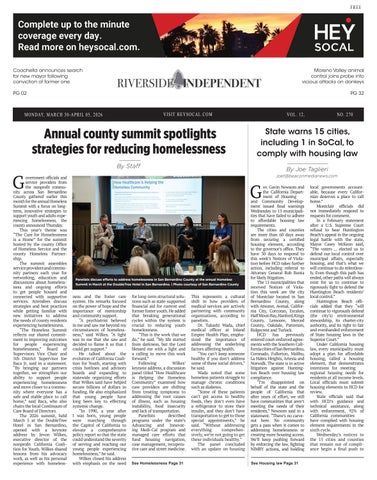
Panelists discuss efforts to address homelessness in San Bernardino County at the annual Homeless Summit in March at the DoubleTree Hotel in San Bernardino. | Photo courtesy of San Bernardino County
ness and the foster care system. His remarks focused on the power of hope and the importance of mentorship and community support. “A psychiatrist believed in me and saw me beyond my circumstances of homelessness,” said Wilkes. “A light was in me that she saw and decided to flame it so that I could get support.” He talked about the evolution of California Coalition for Youth, starting with crisis hotlines and advisory boards and expanding to statewide organizing efforts that Wilkes said have helped secure billions of dollars in funding. He also emphasized that young people have long been key to effecting systemic change. “In 1990, a year after I was born, young people were marching through the Capitol of California to elevate a comprehensive policy report so that the state could understand the severity of serving and reaching our young people experiencing homelessness,” he said. Wilkes closed his address with emphasis on the need
for long-term structural solutions such as state-supported financial aid for current and former foster youth. He added that breaking generational cycles within the system is crucial to reducing youth homelessness. “This is the work that we do,” he said. “My life started from darkness, but the Lord blessed me with a light and a calling to move this work forward.” Following Wilkes’ keynote address, a discussion panel titled “How Healthcare is Helping the Homeless Community” examined how care providers are shifting from treating symptoms to addressing the root causes of illness, such as housing instability, food insecurity and lack of transportation. Panelists described programs under the state’s Advancing and Innovating Medi-Cal program and managed care efforts that fund housing navigation, case management, recuperative care and street medicine. See Homelessness Page 31
This represents a cultural shift in how providers of medical services are actively partnering with community organizations, according to panelists. Dr. Takashi Wada, chief medical officer at Inland Empire Health Plan, emphasized the importance of addressing the underlying factors affecting health. “You can’t keep someone healthy if you don’t address some of these social drivers,” he said. Wada noted that some homeless patients struggle to manage chronic conditions such as diabetes. “Some of these patients can’t get access to healthy foods, they don’t even have a refrigerator to store their insulin, and they don’t have transportation to get to those special appointments,” he said. “Without addressing everything comprehensively, we’re not going to get these individuals healthy.” The panel concluded with an update on housing
ov. Gavin Newsom and the California Department of Housing and Community Development issued final warnings Wednesday to 15 municipalities that have failed to adhere to affordable housing law requirements. The cities and counties are more than 60 days away from securing a certified housing element, according to the governor’s office. They have 30 days to respond to this week’s Notices of Violation before HCD takes further action, including referral to Attorney General Rob Bonta for likely litigation. The 15 municipalities that received Notices of Violation this week are the city of Montclair located in San Bernardino County, along with Atwater, Avenal, California City, Corcoran, Escalon, Half Moon Bay, Hanford, Kings County, Lemoore, Merced County, Oakdale, Patterson, Ridgecrest and Turlock. HCD has previously entered court-enforced agreements with the Southern California cities of San Bernardino, Coronado, Fullerton, Malibu, La Habra Heights, Artesia and Norwalk. The state is in active litigation against Huntington Beach over housing law compliance. “I’m disappointed on behalf of the state and the people of California that after years of effort, we still have communities that aren’t meeting the needs of their residents,” Newsom said in a statement. “There’s no carveout here. No community gets a pass when it comes to addressing homelessness or creating more housing access. We’ll keep pushing forward by enforcing the law, fighting NIMBY actions, and holding See Housing law Page 31
local governments accountable, because every Californian deserves a place to call home.” Montclair officials did not immediately respond to requests for comment. In a February statement after a U.S. Supreme Court refusal to hear Huntington Beach’s appeal in the ongoing legal battle with the state, Mayor Casey McKeon said, “The voters ... elected us to defend our local control over municipal affairs, especially housing, and that’s what we will continue to do relentlessly. Even though this path has ended, other paths will always exist for us to continue to rigorously fight to defend the Huntington Beach residents’ local control.” Huntington Beach officials added that they “will continue to vigorously defend (the city’s) environmental stewardship, its charter-city authority, and its right to fair and evenhanded enforcement of State housing laws in the Superior Court.” Under California housing law, every municipality must adopt a plan for affordable housing, called a housing element, that demonstrates intentions for meeting regional housing needs for residents at all income levels. Local officials must submit housing elements to HCD for review. State officials said that with HCD’s guidance and technical assistance, along with enforcement, 92% of California communities have complied with housing element requirements in the sixth cycle. Wednesday’s notices to the 15 cities and counties that remain out of compliance begin a final push to
HEYSOCAL.COM
2 MARCH 30-APRIL 05, 2026
Coachella announces search for new mayor following conviction of former one By City News Service
M
embers of the Coachella City Council were in the process Wednesday of identifying suitable candidates to fill the mayor’s seat following the resignation of ex-Mayor Steven Andrew Hernandez, who admitted perpetrating a felony. “While an unfortunate situation for the people involved, the council and city staff remain committed to providing the best quality of service to our community,” Interim City Manager Gabriel Gonzalez said Wednesday. Hernandez, 43, formally submitted his resignation Tuesday after pleading guilty to felony conflict of interest in a government contract. The admission was part of a pretrial agreement with the Riverside County District Attorney’s Office, which in turn dropped eight related charges against the defendant, including perjury and conflict of interest by a public official. During the hearing at the Larson Justice Center in Indio, Superior Court Judge
Dean Benjamini sentenced Hernandez to two years’ probation and 200 hours of community service. The defendant is now prohibited from holding elected office in California. Coachella’s four City Council members will decide how best to fill the vacancy until an election can be held and residents can vote for a replacement. Councilman Frank Figueroa said the council’s “focus is on a smooth transition and continuing to serve our community.” The charges against Hernandez were revealed in October after a Riverside County Grand Jury indictment was unsealed. “The conflict-of-interest charges relate to Hernandez’s vote to approve a contract between ... Coachella and the Coachella Valley Association of Governments’ `Housing First Program,’ as well as his votes and advocacy related to downtown Coachella development programs,” according to a District Attorney’s Office statement in October. “The perjury charges relate
to claims made by Hernandez on his `Statement of Economic Interests’ public disclosure forms.” Those documents fall under the designation Form 700 by the California Fair Political Practices Commission, which says they’re necessary for the public to know “about an official’s personal financial interests, to ensure that officials are making decisions in the best interest of the public and not enhancing their personal finances.” According to the indictment, the first offense occurred in November 2021 and involved Hernandez’s efforts to direct federal American Rescue Plan Act relief funds toward a rehabilitation project involving the downtown fire station, “in which the defendant knew, or had a reason to know, he had a financial interest.” The document leveled the same allegations regarding a January 2022 vote on the Fountainhead Plaza, a May 2022 vote on the Tripoli Mixed-Use Project, the
Coachella City Hall. | Photo courtesy of Visitor7/Wikimedia Commons (CC BY-SA 3.0)
May 2023 vote on CVAG’s Housing First Program and a July 2023 vote on Sunline Transit Agency Hub upgrades. The perjury charges were tied to prevarications stemming from “gross income received (from) 52280 Calle Camacho,” according to
court papers. That property is a single-story house, in which the defendant was apparently invested. The direct monetary or other benefits Hernandez reaped from the activity were not disclosed. Soon after the charges were announced,
Riverside County Supervisor Manuel Perez confirmed that Hernandez, who had been his chief of staff for about a decade, had been placed on “indefinite” leave. Hernandez was first elected to the council in 2006 and elected mayor in 2014.
Forest Service warns outdoor enthusiasts to watch for rattlers
Man accused of stealing numerous devices from school district arraigned
By City News Service
By City News Service
T
he arrival of spring will bring rattlesnakes out of the lairs throughout the San Bernardino National Forest, prompting rangers Wednesday to remind hikers and other outdoor enthusiasts to be extra careful while navigating trails in the preserve. “As temperatures rise, rattlesnakes become more active in the forest,” according to a U.S. Forest Service statement. “Stay alert, watch where you step and keep pets close.” There already have been snake encounters reported in Riverside County. A hiker was bitten by a rattler on a trail north of Moreno Valley near the beginning of the month. The victim was airlifted to a hospital for treatment and survived. “If you encounter a rattlesnake, give it plenty of space and calmly move away,” the USFS stated. “Never attempt to touch or disturb wildlife.” Elevated temperatures and sunny conditions routinely draw rattlesnakes out of their winter beds every March and April in the
A
A rattlesnake coils on a bed of rocks. | Photo courtesy of the U.S. Forest Service
800,000-acre San Bernardino National Forest, which is split between Riverside and San Bernardino counties, and other locations. The snakes can use their full length — sometimes over 5 feet — to strike. Anyone bitten by a rattler should not move, if possible, but stay put and apply a tourniquet to the wound. If a trekker is in an area with cell phone reception, rangers
advised calling 911 immediately and giving the best description possible of where he or she is located to aid emergency services. If first responders cannot get there in a reasonable amount of time, the patient or a fellow hiker may have to initiate emergency lifesaving treatment. Additional information is available online via tinyurl. com/3ya35wb2.
Moreno Valley Unified School District employee accused of stealing numerous computers and other devices from his employer pleaded not guilty Tuesday to embezzlement and related charges. Abdul Sheriff Kamara, 70, of Moreno Valley, was arrested Thursday night following a Riverside County Sheriff’s Department investigation that began earlier this month. Along with two counts of embezzlement by an employee, Kamara is charged with burglary and a sentenceenhancing white collar crime allegation. The defendant was arraigned Tuesday before Superior Court Judge Gail O’Rane, who scheduled a felony settlement conference for June 10 at the Riverside Hall of Justice. Kamara is being held in lieu of $250,000 bail at the Robert Presley Jail. According to sheriff’s Sgt. Jeff Hammond, school district resource officers — deputies hired to work security for campuses — were informed in
| Photo courtesy of Peter Griffin/PublicDomainPictures.net (CC0)
the first half of March that a series of thefts had occurred. The investigation soon pointed to Kamara as the alleged thief, though no other details were disclosed, including his specific position within the district. Hammond said sufficient evidence was gathered for a search warrant, which was served Thursday at the defendant’s residence in the 26000 block of Regency Way, near Eucalyptus Avenue. “Deputies recovered stolen laptops and additional items that belonged to the school district,” the sergeant said. “The items included
hundreds of different types of electronic devices and thousands of various pieces of equipment.” It was unclear whether Kamara may have intended to sell the loot. “The total value of the recovered items was estimated over $750,000,” Hammond said. The defendant was taken into custody without incident. He has been placed on administrative leave from his job. Kamara has no documented prior felony or misdemeanor convictions in Riverside County.
HEYSOCAL.COM
MARCH 30-APRIL 05, 2026 3
Editorial editorial@beaconmedianews.com editor@hlrmedia.com
Consumer Watchdog: California oil refiners raking in more than $1.50 per gallon in profit; Newsom needs to bring back price gouging penalty
Graphics/Production production@beaconmedianews.com production@hlrmedia.com Advertising advertising@beaconmedianews.com advertising@hlrmedia.com
By Staff
Legal Advertising legals@beaconmedianews.com legals@hlrmedia.com Business accounting@beaconmedianews.com accounting@hlrmedia.com
BEACON MEDIA ADDRESS:
820 S. Myrtle Ave. Monrovia, CA 91016 PHONE: (626) 301-1010 WEBSITE
SanGabriel Sun A Beacon Media, Inc. Publication
www.beaconmedianews.com
HLR MEDIA ADDRESS:
820 S. Myrtle Ave. Monrovia, CA 91016 PHONE: (626) 301-1010 www.HLRmedia.com
PRESS RELEASE SUBMISSIONS editor@beaconmedianews.com editor@hlrmedia.com
Rosemead Reader A Beacon Media, Inc. Publication
SUBMISSIONS POLICY
Beacon Media, Inc. and HLR Media, LLC All contents herein are copyrighted and may not be reproduced in any manner, either in whole or in part, without the express written consent of the publisher. The Views and opinions expressed in this paper are not necessarily that of the management and staff at Beacon Media, Inc. or HLR Media, LLC.
The California Energy Commission’s price breakdown and margins versus the Consumer Watchdog projection based on OPIS reporting. | Graph courtesy of Consumer Watchdog
N
AI IN THE NEWSROOM
HeySoCal editors periodically utilize HeyWire AI’s tools for research and writing assistance for some articles. No article is ever published without human editorial supervision and approval. The Arcadia Weekly has been adjudicated as a newspaper of general circulation in court case number GS 004333 for the City of Arcadia, County of Los Angeles, State of California. The Monrovia Weekly has been adjudicated as a newspaper of General Circulation in Court Case GS 004759 City of Monrovia, County of Los Angeles, State of California. The Temple City Tribune has been adjudicated as a newspaper of general circulation in court case number GS 012440 City of Temple City, County of Los Angeles, State of California. The El Monte Examiner has been adjudicated as a newspaper of general circulation in court case number KS 015872 City of El Monte, County of Los Angeles, State of California.
Alhambra PRESS Baldwin Park
The Azusa Beacon has been adjudicated as a newspaper of general circulation in court case number KS 015970 City of Azusa, County of Los Angeles, State of California. The San Gabriel Sun has been adjudicated as a newspaper of general circulation in court case number GS 013808 City of San Gabriel, County of Los Angeles, State of California.
INDEPENDENT
The Duarte Dispatch has been adjudicated as a newspaper of general circulation in court case number GS 013893 City of Duarte, County of Los Angeles, State of California. The Rosemead Reader has been adjudicated as a newspaper of general circulation in court case number GS 048894 City of Rosemead, County of Los Angeles, State of California. The Alhambra Press has been adjudicated as a newspaper of general circulation in court case number ES016581 City of Alhambra, County of Los Angeles, State of California. The Baldwin Park Press has been adjudicated as a newspaper of general circulation in court case number KS017174 City of Baldwin Park, County of Los Angeles, State of California. The Burbank Independent has been adjudicated as a newspaper of general circulation in court case number ES016728 City of Burbank, County of Los Angeles, State of California.
INDEPENDENT
ew data shows that California oil refiners have been making more than a dollar per gallon more than they made in January from every gallon of gasoline. By contrast, the cost of crude oil has pushed up gas prices by 66 cents. As of March 20, oil refiners’ gross margins were approximately $1.50 per gallon, according to the crack spreads reported by the Oil Price Information Service (OPIS), and have grown since. By contrast, refiners’ gross refining margins were 51 cents in January, as reported by the California Energy Commission. Gross refining margins are the standard industry measure for profit, what
The West Covina Press has been adjudicated as a newspaper of general circulation in court case number KS017304 City of West Covina, County of Los Angeles, State of California. The San Bernardino Press has been adjudicated as a newspaper of general circulation in court case number CIVDS 1506881 City of San Bernardino, County of San Bernardino, State of California. The Riverside Independent has been adjudicated as a newspaper of general circulation in court case number RIC1505351 City of Riverside, County of Riverside, State of California. The Pasadena Press has been adjudicated as a newspaper of general circulation in court case number ES018815 City of Pasadena, County of Los Angeles, State of California. The Belmont Beacon has been adjudicated as a newspaper of general circulation in court case number NSO30275 City of Long Beach, County of Los Angeles, State of California. The Anaheim Press has been adjudicated as a newspaper of general circulation in court case number 30-2017-00942735-CU-PT-CJC City of Anaheim, County of Orange, State of California. The Ontario News Press has been adjudicated as a newspaper of general circulation in court case number CIVDS 1506881 City of Ontario, County of San Bernardino, State of California. The Corona News Press has been adjudicated as a newspaper of general circulation in court case number RIC1723524 City of Corona, County of Riverside, State of California.
Commission to issue emergency regulations or he is as culpable for this jump at the pump as Trump.” Oil companies point to state taxes and environmental fees as the reason for the high gasoline prices, but they total 87 cents per gallon. As of March 23, California refining margins are nearly double that amount. Crude costs are roughly $2.26 per gallon, which comes to $95 per barrel. The crack spread for refiners in Los Angeles, the difference between the cost of crude oil and what they can charge for gasoline, was $64 per refined barrel, or $1.52 per gallon. The daily price of gasoline has grown
from March 20’s $5.67 per gallon price to $5.79, suggesting refiners margins have gone up another 10 cents over the weekend. “This is a crisis at the pump and California oil refiners are treating consumers like an ATM because they can,” said Court. “Now is the time for Governor Newsom to use the tools the legislature gave him to rein in their profiteering and tame pump prices. The numbers don’t lie. Oil refiners are taking advantage of the moment and appeasement in Sacramento to rip us off just like they did in 2022 and 2023. Newsom has a choice. He can be Churchill or he can be Chamberlain.”
Cal State Dominguez Hills launches free tuition program By City News Service
The Glendale Independent has been adjudicated as a newspaper of general circulation in court case number ES016579 City of Glendale, County of Los Angeles, State of California. The Monterey Park Press has been adjudicated as a newspaper of general circulation in court case number ES016580 City of Monterey Park, County of Los Angeles, State of California.
refiners keep after taking out the cost of crude, environmental fees and taxes. It’s approximated by the crack spread. “This is a pig at the trough moment for California oil refiners,” said Jamie Court, president of the nonprofit group Consumer Watchdog. “Governor Newsom needs to call for emergency regulations on refiners’ resupply obligations, minimum inventory requirements and a price gouging penalty. The legislature authorized these rules in 2023 and 2024 and the California Energy Commission hasn’t written them. Newsom needs to stand up for Californians and direct his Energy
C
al State Dominguez Hills announced Tuesday a new initiative guaranteeing free tuition and mandatory fees for eligible students beginning in fall 2026. The program, known as the Toro Tuition Pledge, will cover four years of tuition for first-time freshmen and two years for transfer students, university officials said. The pledge is available to California residents who qualify for federal Pell Grants or have a comparable level of financial need. Officials said students must enroll full-time and maintain satisfactory academic
progress to remain eligible. “CSUDH’s mission is rooted in affordability and accessibility, and the Toro Tuition Pledge builds on our longstanding work of expanding opportunity to ensure every student can succeed,” Interim President Mary Ann Villarreal said in a statement. “This effort reaffirms our commitment to transforming students’ lives and economic prospects.” University officials said the program will rely largely on existing financial aid resources, supplemented by institutional funding to ensure tuition and required fees are fully covered for
The south wing of the Leo F. Cain University Library. | Photo courtesy of CSU Dominguez Hills/Wikimedia Commons (CC BY-SA 4.0)
eligible students. The pledge does not cover
other costs such as housing, parking or textbooks.
HEYSOCAL.COM
4 MARCH 30-APRIL 05, 2026
Meta, YouTube found liable in LA social media trial By Bill Hetherman, City News Service
Y
ouTube and Meta, the parent company of Facebook and Instagram, were both found liable Wednesday in a landmark lawsuit accusing the social media companies of using addictive practices that allegedly hooked children on the sites and contributed to mental health and other harms. The jury awarded a total of $3 million in compensatory damages to the 20-yearold plaintiff, with Meta directed to pay 70% of that amount, and YouTube 30%. The panel, which found the companies acted with malice, then reconvened and heard evidence on whether either or both companies should pay punitive damages. After a brief period of deliberations, the jury decided to award $3 million in punitive damages, with roughly the same percentage split between the two companies. In California, punitive damages, also called exemplary damages, represent additional compensation awarded in civil lawsuits levied to punish a defendant for highly reprehensible conduct and to deter similar future acts. A judge
can change the amount of punitive damages awarded by a ruling from the bench or on a motion from the affected parties. The verdicts came at the start of the jury’s ninth day of deliberations in downtown Los Angeles. The case was being closely watched as a possible bellwether of the fate of thousands of similar lawsuits that are still pending. The lawsuit involved a plaintiff known only as K.G.M., who testified during the trial that she began using social media sites when she was as young as 6 years old. Plaintiff’s attorney Mark Lanier argued that his young client, who had uploaded hundreds of videos before she was even a teenager, became vulnerable to the Meta and YouTube platforms. He referred to the social media companies as “behemoths,” and compared them to a lion stalking a pack of vulnerable gazelles. The advantages of the lion, Lanier told the Los Angeles Superior Court jury, is a legitimate comparison to what Meta and YouTube did to K.G.M., a Chico resident who is now 20 years old. Referring to what he called “engineered addiction,” Lanier also equated
Meta products. | Photo courtesy of Shutter Speed/Unsplash
the content of the platforms to a Trojan horse, saying users are drawn in by the content’s “wonderful and great” appearance, but find themselves taken over by the reels on their devices. Lanier said after the initial verdict that plaintiffs’ attorneys put the net worth of both social media companies in front of the jury, in hopes they would take those figures into account when deciding on punitive damages. He said he did not ask for any specific punitive damages amount, but he noted that the value of Google -- parent company of YouTube -- was placed at $415 billion. “How on earth do you ever fine that entity for what behavior we’re talking about here?” Lanier told reporters.
“So I just took a jar of M&Ms that had 415 M&Ms in it. I showed it to the jury. I said, you grab a handful out. You don’t even notice they’re gone. But that’s 20, that’s $20 billion to these companies.” Lanier said the jury’s verdict finding the companies liable was a victory for K.G.M., but also “it’s of very great importance to a generation of people who have been affected.” “There are so many families who’ve been tragically hurt through the addiction of social media,” he said. “And while we’ve never been able to talk about the content of what these social media platforms can do -- that’s protected under the judge’s rulings -- we have been able to talk about the features. And we’ve sent a message with this that you will be held accountable for the features. Regardless of whether the children are getting sent pornographic pictures, regardless of whether they’re being sexploitated, regardless of those types of issues -- just because of the features alone that drive addiction, these companies can be held accountable. That’s a huge message for these companies.” TikTok and Snap were originally defendants in the lawsuit, but both reached settlements before the trial began in the courtroom of Judge Carolyn Barbara Kuhl. Hundreds of similar lawsuits are still pending, with this initial trial being closely watched by industry experts. The social media companies strongly denied all allegations in K.G.M.’s lawsuit and maintained they are committed to the well-being of their young users. Attorneys have questioned the concept of social media being an addiction, and suggested that other factors in K.G.M’s life -- including alleged verbal and physical abuse by her parents -- led to her mental health struggles. Following the verdict Wednesday, Meta issued a statement saying, “We respectfully disagree with the verdict and are evaluating our legal options.”
YouTube officials said they plan to appeal the ruling. “This case misunderstands YouTube, which is a responsibly built streaming platform, not a social media site,” according to the company. During his closing argument, Meta lawyer Paul Schmidt showed jurors a video which appeared to show the plaintiff’s mother yelling at her, attempting to drive home the point of family strife. YouTube lawyer Luis Li, meanwhile, pointed to K.G.M.’s own testimony during the trial, in which she said her interest in YouTube faded as she got older. “Ask whether anybody suffering from addiction could say, `Yeah I kinda lost interest.’ What does your common sense tell you about that?” Li asked the jury. Meta CEO Mark Zuckerberg testified earlier in the trial that while pre- teens are barred from using the company’s services, some minors still break the rules to do so. Zuckerberg told jurors that minors under age 13 are not permitted to use the Meta platforms, but there are individuals who will do so anyway. He said the company removes users who are found to be underage. K.G.M. was under the age limit when she began using the products, and Zuckerberg suggested it is up to users to read the terms. That drew a rebuke from a plaintiff’s attorney who questioned whether Meta actually expected young children to read the rules regarding the platform’s use. Attorneys for K.G.M. contend that despite the platform’s prohibition of preteen users, as many as 4 million such children access Meta’s Instagram. Zuckerberg also took issue with the idea that social media is intentionally addictive or harmful, describing it as a tool that is provides vital information and interaction, and as such, people are naturally inclined to use it more frequently. Instagram CEO Adam Mosseri testified earlier that just because someone binges on something, such as he did in watching a Netflix show late one night, that kind of attention to a subject is not tantamount to an addiction. He also said that profit comes with protecting minors and not in exploiting them. In her testimony, K.G.M. said that as a child, she wanted to be on social media sites “all the time,” feeling that if she was not logged on she would “miss out on something,” which would send her “into a panic.”
K.G.M. said she believed she had uploaded more than 200 videos to YouTube by age 10, but her attorney corrected her and said it was actually more than 300. She said she began using Instagram at about 9 years old, and her addiction to social media led her to develop body-image issues, due in part to filters used to aesthetically enhance photos on the site. She also said she gave up on hobbies and other activities so she could focus on social media sites, which also made it difficult for her to make friends at school since she was so focused on her phone. K.G.M. said the oftenenhanced images she would see on the sites would make her “feel very depressed,” leaving her insecure about her own looks. She said she ultimately was unable to sleep and began contemplating suicide. She said she began cutting herself as a “coping mechanism.” Various groups that advocate for internet and social-media safety for children issued statements hailing the jury’s verdict. “For the parents whose children died as a result of social media harms, today’s verdict is a huge step toward truth, justice, and accountability,” Sarah Gardner, CEO of the Washington, D.C.-based Heat Initiative, said in a statement. “This verdict is social media’s Big Tobacco moment -- the harm these companies intentionally cause children has been proven in a court of law. The hard truth is the design features at the heart of this trial are still running, right now, on the phones of millions of children, and there are thousands of other families still waiting for their day in court. This is only the beginning of the fight to keep kids safe online, but we will win.” Nikki Iyer, co-chair of Design It For Us, also applauded the decision, calling it a “major milestone for every young person and family whose pain has been minimized by Big Tech.” “Today’s decision ends an era of plausible deniability -- Meta and YouTube knew their products were harming us, and now so does every legislature, parent and young person in America,” Iyer said. On Tuesday, a jury in New Mexico found that Meta’s social media platforms were harmful to children, in violation of state statutes, and ordered the company to pay $375 million. Meta officials quickly said they plan to appeal.
HEYSOCAL.COM
MARCH 30-APRIL 05, 2026 5
10 best things to watch on streaming this week By Colby Droscher, Stacker
T
he streaming calendar doesn’t always cooperate. Most weeks, it’s a few decent options buried under a landfill of algorithmic filler. This week is different. Three major platforms dropped tentpole titles on the same Friday, a longdormant cult classic returned for its final season, and a Marvel series with genuine momentum premiered Tuesday. The backlog cleared, the heavy hitters showed up, and the couch is suddenly the best seat in any room. Whether you want Tommy Shelby’s last ride, a prank show that somehow got better in its second season, a suburban murder mystery that’s funnier than it has any right to be, or a documentary about professional bowling that will make you rethink everything you thought you knew about professional bowling, this week has it. Ten picks, zero filler. Here’s what to watch. Jury Duty Presents: Company Retreat Prime Video | Reality prank comedy The premise was already absurd once. Somehow, they pulled it off twice. Jury Duty: Company Retreat debuted with a perfect 100% on Rotten Tomatoes, which is the kind of number that sounds made up until you start watching and realize, no, this show really is that good. The new mark is Anthony Norman, a 25-year-old temp who thinks he’s landed a gig helping a hot sauce company with its annual retreat. He has no idea that every colleague, every crisis, and every disastrous dinner theater night has been scripted around him. Anthony goes out of his way to ensure that each person he encounters feels welcome and seen, and that intelli-
gence, care, and curiosity is something rarely found in unscripted television. New episodes drop Fridays. Peaky Blinders: The Immortal Man Netflix | Crime drama film Thirteen years. Six seasons. One Oscar in between. Cillian Murphy is back as Tommy Shelby, and the man still wears a newsboy cap like it’s a threat. The film jumps to 1940, with German bombers targeting Birmingham and Tommy now gray-haired and isolated on a crumbling country estate, but Barry Keoghan joins as Tommy’s illegitimate son, Duke, who’s taken over the Peaky Blinders and is running them directly into a Nazi counterfeit currency scheme. The film is uneven in places (the two-hour format can’t breathe the way the show’s seasons did), but it captures the essence of what made the series special while giving Tommy Shelby a final chapter that feels both powerful and personal. For the faithful, it’s a proper farewell. For newcomers, it’s a very stylish entry point into a mythology 13 years deep. DTF St. Louis HBO/Max | Dark comedy limited series The name is exactly what it sounds like, and the show is nothing like what you’d expect. Jason Bateman plays Clark, a St. Louis weatherman; David Harbour plays Floyd, his new best friend, an ASL interpreter who feels like life has passed him over; and Linda Cardellini plays Carol, Floyd’s wife, who enters a covert arrangement with Clark that becomes the center of a murder investigation. The murder is almost beside the point. What makes DTF St. Louis addictive is that viewers are never entirely certain whose perspective to trust or who to
root for in this love triangle. It holds an 88% on Rotten Tomatoes and has become HBO’s most-watched show of the month (which, given that The Pitt exists, says something). Catch up before the April finale. Wicked: For Good Peacock | Musical film The one that completed the cultural moment. Wicked: For Good made its streaming debut on March 20, with Cynthia Erivo’s Elphaba working in the shadows to expose the Wizard’s plan, while Ariana Grande’s Glinda reigns in Emerald City, haunted by their estrangement. The film brought in two brandnew songs from original composer Stephen Schwartz, and the Peacock debut comes loaded with bonus content for the fan who wants to live inside Oz for a full weekend. The sequel grossed $533.7 million worldwide, meaning a lot of people already have opinions. Now you can form yours from the couch. Daredevil: Born Again Season 2 Disney+ | Superhero drama series The premiere landed Tuesday and Hell’s Kitchen is about to get complicated again. Season 2 follows Matt Murdock’s attempts to oust Wilson Fisk as Mayor of New York City, with eight weekly episodes running through mid-May. The showrunners have promised they’ll lean harder into the show’s street-level brutality (the stuff that made the original Netflix run a genre benchmark) and the season reunites several Defenders alumni, including Jessica Jones. For Marvel fans burned by the franchise’s uneven streaming output over the past few years, this one has the pedigree to be different.
Cillian Murphy as Thomas Shelby. | Photo courtesy of Netflix
The Comeback Season 3 HBO/Max | Cult comedy series Lisa Kudrow’s Valerie Cherish has been anticipating this moment for 21 years. Season 1 premiered in 2005, satirizing reality TV two years before the Kardashians made it a way of life. Season 2 arrived in 2014, skewering prestige cable. Season 3, the final one, finds Valerie offered the lead in a new sitcom written by AI, which she’s hesitant to accept. The joke writes itself, but the execution is Kudrow’s alone. If you’ve never seen The Comeback, start at the beginning. If you have, you already know: Valerie Cherish doesn’t just want the room. She needs it. Deadloch Season 2 Prime Video | Australian crime comedy The mismatched detectives of Deadloch deserve to be as well known as Sherlock Holmes and Kay Scarpetta, and Season 2 picks up with Dulcie Collins and Eddie Redcliffe investigating the death of Eddie’s former policing partner. The Australian crime-comedy landed
quietly during its first run but earned a devoted following for its sharp writing and genuinely funny central dynamic. If you slept on Season 1, now is a good time to catch up. Something Very Bad Is Going to Happen Netflix | Horror series The title is the premise. An atmospheric horror series following a bride (Camila Morrone) and groom (Adam DiMarco) in the week leading up to their ill-fated nuptials, with Jennifer Jason Leigh co-starring. All eight episodes dropped March 19, making it a full binge-watch weekend if the premise hooks you in the first episode. If you need your horror to feel inevitable from the opening credits, this is for you. The Count of Monte Cristo PBS | Period drama series Sam Claflin plays Edmond Dantès, the young sailor falsely accused of treason and imprisoned without trial on a grim island fortress off Marseille, France, with Jeremy Irons co-starring in this latest adaptation of the
Alexandre Dumas classic. Dumas wrote the original as a serialized revenge fantasy, and it still works as one. PBS period dramas are a particular kind of patient, well-dressed pleasure, and this one arrives at exactly the right moment, right when you’re tired of everything moving too fast. Born to Bowl HBO/Max | Documentary series Last but not least, the best documentary on streaming this week and the most unexpected recommendation on this list. Professional bowling is no longer airing weekly on network television or minting champions whose career earnings rival those of the NHL or NBA, but there are still plenty of characters who make the sport intriguing, many of whom are the subjects of this docuseries. Liev Schreiber’s narration belies both a fondness and a level of amusement with the eccentrics at the top of the field. The sport is weirder than you remember. The people are weirder than the sport. Watch it. Republished with CC BY-NC 4.0 license.
Subscribe to our newsletter for local news, giveaways, and updates
HEYSOCAL.COM
6 MARCH 30-APRIL 05, 2026
DOGE goes nuclear: How Trump invited Silicon Valley into America’s nuclear power regulator By Avi Asher-Schapiro, ProPublica This story was originally published by ProPublica. ProPublica is a nonprofit newsroom that investigates abuses of power. Sign up to receive The Big Story newsletter as soon as it’s published.
L
ast summer, a group of officials from the Department of Energy gathered at the Idaho National Laboratory, a sprawling 890-squaremile complex in the eastern desert of Idaho where the U.S. government built its first rudimentary nuclear power plant in 1951 and continues to test cutting-edge technology. On the agenda that day: the future of nuclear energy in the Trump era. The meeting was convened by 31-year-old lawyer Seth Cohen. Just five years out of law school, Cohen brought no significant experience in nuclear law or policy; he had just entered government through Elon Musk’s Department of Government Efficiency team. As Cohen led the group through a technical conversation about licensing nuclear reactor designs, he repeatedly downplayed health and safety concerns. When staff brought up the topic of radiation exposure from nuclear test sites, Cohen broke in. “They are testing in Utah. … I don’t know, like 70 people live there,” he said. “But … there’s lots of babies,” one staffer pushed back. Babies, pregnant women and other vulnerable groups are thought to be potentially more susceptible to cancers brought on by low-level radiation exposure, and they are usually afforded greater protections. “They’ve been downwind before,” another staffer joked. “This is why we don’t use AI transcription in meetings,” another added. ProPublica reviewed records of that meeting, providing a rare look at a dramatic shift underway in one of the most sensitive domains of public policy. The Trump administration is upending the way nuclear energy is regulated, driven by a desire to dramatically increase the amount of energy available to power artificial intelligence. Career experts have been forced out and thousands of pages of regulations are being rewritten at a sprint. A new generation of nuclear energy companies — flush with Silicon Valley cash and boasting strong political connections — wield increasing influence over policy. Figures like Cohen are forcing a “move fast and break things” Silicon Valley ethos on one of the country’s most important regulators. The Trump administra-
| Photo courtesy of Lukáš Lehotský/Unsplash
tion has been particularly aggressive in its attacks on the Nuclear Regulatory Commission, the bipartisan independent regulator that approves commercial nuclear power plants and monitors their safety. The agency is not a household name. But it’s considered the international gold standard, often influencing safety rules around the world. The NRC has critics, especially in Silicon Valley, where the often-cautious commission is portrayed as an impediment to innovation. In an early salvo, President Donald Trump fired NRC Commissioner Christopher Hanson last June after Hanson spoke out about the importance of agency independence. It was the first time an NRC commissioner had been fired. During that Idaho meeting, Cohen shot down any notion of NRC independence in the new era. “Assume the NRC is going to do whatever we tell the NRC to do,” he said, records reviewed by ProPublica show. In November, Cohen was made chief counsel for nuclear policy at the Department of Energy, where he oversees a broad nuclear portfolio. The aggressive moves have sent shock waves through the nuclear energy world. Many longtime promoters of the industry say they worry recklessness from the Trump administration could discredit responsible nuclear energy initiatives.
“The regulator is no longer an independent regulator — we do not know whose interests it is serving,” warned Allison Macfarlane, who served as NRC chair during the Obama administration. “The safety culture is under threat.” A ProPublica analysis of staffing data from the NRC and the Office of Personnel Management shows a rush to the exits: Over 400 people have left the agency since Trump took office. The losses are particularly pronounced in the teams that handle reactor and nuclear materials safety and among veteran staffers with 10 or more years of experience. Meanwhile, hiring of new staff has proceeded at a snail’s pace, with nearly 60 new arrivals in the first year of the Trump administration compared with nearly 350 in the last year of the Biden administration. Some nuclear power supporters say the administration is providing a needed level of urgency given the energy demands of AI. They also contend the sweeping changes underway aren’t as dangerous or dire as some experts suggest. “I think the NRC has been frozen in time,” said Brett Rampal, the senior director of nuclear and power strategy at the investment and strategy consultancy Veriten. “It’s a great time to get unfrozen and aim to work quickly.” The White House referred most of ProPublica’s ques-
tions to the Department of Energy, where spokesperson Olivia Tinari said the agency is committed to helping build more safe, high-quality nuclear energy facilities. “Thanks to President Trump’s leadership, America’s nuclear industry is entering a new era that will provide reliable, abundant power for generations to come,” she wrote. The DOE is “committed to the highest standards of safety for American workers and communities.” Cohen did not respond to multiple requests for comment. The NRC declined to comment. Blindsided by DOGE The U.S. has not had a serious nuclear incident since the Three Mile Island partial meltdown in 1979, a track record many experts attribute to a rigorous regulatory environment and an intense safety culture. Major nuclear incidents around the world have only strengthened the resolve of past regulators to stay independent from industry and from political winds. A chief cause of Japan’s Fukushima accident, investigators found, was the cozy relationship between the country’s industry and oversight body, which opened the door for thin safety assessments and inaccurate projections overlooking the possible impact of a major tsunami. “We knew regulatory capture led directly to Fukushima and to Chernobyl,” said Kathryn Huff, who was
assistant secretary for the Office of Nuclear Energy during the Biden administration. The U.S. has barely built any nuclear power plants in recent decades. Only three new reactors have been completed in the last 25 years, and since 1990 the U.S has barely added any net new nuclear electricity to its grid. Though about 20% of U.S. energy is supplied by nuclear power plants, the fleet is aging. Some experts blame the slow build-out on the challenging economics of financing a multibilliondollar project and the uncertainty of accessing and disposing of nuclear fuels. But an increasingly vocal group of industry voices and deregulation advocates have blamed the slow build-out on overly cautious and inefficient regulators. Among the most powerful exponents of this view are billionaires Peter Thiel and Marc Andreessen; both venture capitalists have their own investments in the nuclear energy sector and are influential Trump supporters. Andreessen camped out at Mar-a-Lago, Trump’s private club in Florida, after Trump won the 2024 election, helping pick staff for the new administration. In late 2024, Thiel personally vetted at least one candidate for the Office of Nuclear Energy, according to people familiar with the conversaSee DOGE Page 07
tions. Neither responded to requests for comment. Four months into his second term, Trump signed a series of executive orders designed to supercharge nuclear power build-out. “It’s a hot industry, it’s a brilliant industry,” said Trump, flanked by nuclear energy CEOs in the Oval Office. He added: “And it’s become very safe.” Under those orders, the NRC was directed to reduce its workforce, speed up the timeline for approving nuclear reactors and rewrite many of its safety rules. The DOE — which has a vast nuclear portfolio, including waste cleanup sites and government research labs — was tasked with creating a pathway for so-called advanced nuclear companies to test their designs. The goal, Trump said, was to quadruple nuclear energy output and provide new power to the data centers behind the AI boom. As DOGE gutted agencies, departures mounted in the nuclear sector. Career experts in nuclear regulations and safety departed or were forced out. When Trump fired Hanson, a Democratic NRC commissioner, the president’s team explained the move by saying, “All organizations are more effective when leaders are rowing in the same direction.” In an unsigned email to ProPublica, the White House press office wrote: “All commissioners are presidential appointees and can be fired just like any other appointee.” In August, the NRC’s top attorney resigned and was replaced by oil and gas lawyer David Taggart, who had been working on DOGE cuts at the DOE. In all, the nuclear office at the DOE had lost about a third of its staff, according to a January 2026 count by the Federation of American Scientists, a nonprofit focused on science and technology policy. That summer, Cohen and a team of DOGE operatives touched down at the NRC offices, a series of nondescript towers across from a Dunkin’ in suburban Maryland. He was joined by Adam Blake, an investor who had recently founded an AI medical startup and has a background in real
HEYSOCAL.COM
MARCH 30-APRIL 05, 2026 7
DOGE estate and solar energy, and Ankur Bansal, president of a company that created software for real estate agents. Neither would comment for this story. Many career officials who spoke with ProPublica were blindsided: The new Trump officials at the NRC seemed to have no experience with the intricacies of nuclear energy policy or law, they said. One NRC lawyer who briefed some of the new arrivals decided to resign. “They were talking about quickly approving all these new reactors, and they didn’t seem to care that much about the rules — they wanted to carry out the wishes of the White House,” the official said. At one point, Cohen began passing out hats from nuclear energy startup Valar Atomics, one of the companies vying to build a new reactor, according to sources familiar with the matter and records seen by ProPublica. NRC staffers balked; they were supposed to monitor companies like Valar for safety violations, not wear its swag. NRC ethics officials warned Cohen that the hat handout was a likely violation of conflict rules. It betrayed a misunderstanding of the safety regulator’s role, said a former official familiar with the exchange. “Imagine you live near a nuclear power plant, and you find out a supposedly independent safety regulator — the watchdog — is going around wearing the power plant’s branded hats,” the official said. “Would that make you feel safe?” The NRC and Cohen did not respond to requests for comment about the hat incident. Valar counts Trump’s Silicon Valley allies as angel investors. They include Palmer Luckey, a technology executive and founder of the defense contractor Anduril, and Shyam Sankar, chief technology officer of Palantir, the software company helping power Immigration and Customs Enforcement’s deportation raids. It was among three nuclear reactor companies that sued the NRC last year in an attempt to strip it of its authority to regulate its reactors and replace it with a state-level regulator. Before the Trump administration came into office, lawyers
watching the case were confident the courts would quickly dismiss the suit, as the NRC’s authority to regulate reactors is widely acknowledged. But new Trump appointees pushed for a compromise settlement — which is still being negotiated. The career NRC lawyer working on the case quietly left the agency. Valar and its executives did not reply to requests for comment. “Going So Fast” The deregulatory push is the culmination of mounting pressure — both political and economic — to make it easier to build nuclear power in the U.S. Over the years, a bipartisan coalition supporting nuclear expansion brought together environmentalists who favor zero-carbon power and defense hawks focused on abundant domestic energy production. Anti-nuclear activists still argue that renewable energy like wind and solar are safer and more economical. But streamlining the NRC has been a bipartisan priority as well. The latest major reform came in 2024, when President Joe Biden signed into law the ADVANCE Act, which went as far as changing the mission statement of the NRC to ensure it “does not unnecessarily limit” nuclear energy development. Some nuclear power supporters say the Trump administration is merely accelerating these changes. They cite instances in which the current regulations appear out of sync with the times. The NRC’s byzantine rules are designed for so-called large light-water reactors — massive facilities that can power entire cities — and not the increasingly in vogue smaller advanced reactor designs popular among Silicon Valleybacked firms. Rules that require fences of certain heights might make little sense for new reactors buried in the earth; and rules that require a certain number of operators per reactor could be a bad fit for a cluster of smaller reactors with modern controls. Advances in sensors, modeling and safety technologies, they say, should be taken into account across the board. The NRC has said it expects over two dozen new
license requests from small modular and advanced reactor companies in coming years. Many of those requests are likely to come from new, Silicon Valleybased nuclear firms. “There was a missing link in the innovation cycle, and it was very difficult to build something and test it in the U.S. because of mostly licensing and site availability constraints in the past,” said Adam Stein of the pro-nuclear nonprofit Breakthrough Institute. The regulatory changes are in flux: This spring, the NRC is starting to release thousands of pages of new rules governing everything from the safety and emergency preparedness plans reactor companies are required to submit to the procedures for objecting to a reactor license. “It’s hard to know if they are getting rid of unnecessary processes or if it’s actually reducing public safety,” said one official working on reactor licensing, who, like others, spoke on the condition of anonymity for fear of retaliation from the Trump administration. “And that’s just the problem with going so fast — everything just kind of gets lost in a mush.” Lawyers from the Executive Office of the President have been sent to the NRC to keep an eye on the new rules, a move that further raised alarms about the agency’s independence. Nicholas Gallagher — a relatively recent New York University law school graduate and conservative writer whom ProPublica previously identified as a DOGE operative at the General Services Administration — has been involved in conversations about overhauling environmental rules. He’s working alongside Sydney Volanski, a 30-year-old recent law school graduate who rose to national attention while she was in high school for her campaign against the Girl Scouts of America, which she accused of promoting “Marxists, socialists and advocates of same-sex lifestyle.” NRC lawyers working on the rules were told last October that Gallagher and Volanski would be joining them, and they both appear on the regular NRC rule-
making calendar invite. The White House maintains, however, that “zero lawyers from the Executive Office of the President have been dispatched to work on rulemaking.” Neither Gallagher nor Volanski replied to requests for comment. The administration is routing the new rules through an office overseen by Trump’s cost-cutting guru Russell Vought, a move that was previously unheard of for an independent regulator like the NRC. The White House spokesperson noted that, under a recent executive order, this process is now required for all agencies. Political operatives have been “inserted into the senior leadership team to the point where they could significantly influence decision-making,” said Scott Morris, who worked at the NRC for more than 32 years, most recently as the No. 2 career operations official. “I just think that would be a dangerous proposition.” Morris voted for Trump twice and broadly supports the goals of deregulating and expanding nuclear energy, but he has begun speaking out against the administration’s interference at the NRC. He retired in May 2025 as part of a wave of retirements and firings. At a recent hearing before the Atomic Safety and Licensing Board — an independent body that helps adjudicate nuclear licensing — NRC lawyers withdrew from the proceedings, citing “limited resources.” The judge remarked that it was the first time in over 20 years the NRC had done so. Meanwhile, some staff members, other career officials say, are afraid to voice dissenting views for fear of being fired. “It feels like being a lobster in a slowly boiling pot,” one NRC official who has been working on the rule changes told ProPublica, describing the erosion of independence. The official was one of three who compared their recent experience at NRC to being in a pot of slowly boiling water. “If somebody is raising something that they think that the industry or the White House would have a problem with, they think twice,” the official said. Inside the NRC, the steering committee overseeing the changes includes Cohen, Taggart and Mike
King, a career NRC official who is the newly installed executive director for operations. The former director, Mirela Gavrilas, a 21-year veteran of the agency, retired after getting boxed out of decision-making, according to a person familiar with her departure. Gavrilas did not respond to a request for comment. Any final changes will be approved by the NRC’s five commissioners, three of whom are Republicans. In September, the two Democratic commissioners told a Senate committee they might be fired at any time if they get crosswise with Trump — including over revisions to safety rules. Draft rules being circulated inside the NRC propose drastic rollbacks of security and safety inspections at nuclear facilities. Those include a proposed 56% cut in emergency preparedness inspection time, CNN reported in March. Even some pro-nuclear groups are troubled by the emerging order. Some have tried to backchannel to their contacts in the Trump administration to explain the importance of an independent regulator to help maintain public support for nuclear power. Without it, they risk losing credibility. “You have to make sure you don’t throw out the baby with the bathwater,” said Judi Greenwald, president and CEO of the Nuclear Innovation Alliance, a nonprofit that promotes nuclear energy and supports many of the regulatory changes being proposed by the Trump administration. Greenwald’s group favors faster timelines for approving nuclear reactors, but she worries that the agency’s fundamental independence has been undermined. “We would prefer that they yield back more of NRC independence,” she said. “Nuke Bros” in Silicon Valley One Trump administration priority has been making it easier for so-called advanced reactor companies to navigate the regulatory process. These firms, mostly backed by Silicon Valley tech and venture money, are often working on designs for much smaller reactors that they hope to mass produce See DOGE Page 08
DO YOU WANT TO START A BUSINESS? GO TO FILEDBA.COM
in factories. “There are two nuclear industries,” said Macfarlane, the former NRC chair. “There are the actual people who use nuclear reactors to produce power and put it on the grid … and then there are the ‘nuke bros’” in Silicon Valley. Trump’s Silicon Valley allies have loomed large over his nuclear policy. One prospective political appointee for a top DOE nuclear job got a Christmas Eve call from Thiel, the rare Silicon Valley leader to back Trump in 2016. Thiel, whose Founders Fund invested in a nuclear fuel startup and an advanced reactor company, quizzed the would-be official about deregulation and how to rapidly build more nuclear energy capacity, said sources familiar with the conversation. Nuclear energy startups jockeyed to spend time at Mara-Lago in the months before the start of Trump’s second term. Balerion Space Ventures, a venture capital firm that has invested in multiple companies, convened an investor summit there in January 2025, according to an invitation viewed by ProPublica. Balerion did not reply to a request for comment. A few months later, when Trump was drawing up the executive orders, leaders at many of those nuclear companies were given advanced access to drafts of the text — and the opportunity to provide suggested edits, documents viewed by ProPublica show. Those orders created a new program to test out experimental reactor designs, addressing a common complaint that companies are not given opportunities to experiment. There are currently about a dozen advanced reactor companies planning to participate. Each has a concierge team within the DOE to help navigate bureaucracy. As NPR reported in January, the DOE quietly overhauled a series of safety rules that would apply to these new reactors and shared the new regulations with these companies before making them public. Secretary of Energy Chris Wright — who served on the board of one of those companies, Oklo — has said
HEYSOCAL.COM
8 MARCH 30-APRIL 05, 2026
LA28 unveils visual identity for 2028 Olympic, Paralympic Games By City News Service
O
rganizers of the 2028 Olympic and Paralympic Games last week unveiled the official visual identity for the Los Angeles Games, a design system inspired by Southern California’s natural superbloom phenomenon. The “Look of the Games,” as it is known, will guide the color palettes, graphics and branding used across venues, signage, digital platforms and other elements tied to the 2028 Games, according to LA28 officials. Organizers said the design draws from the superbloom, a rare natural phenomenon -- occurring roughly once a decade -- in which wildflowers bloom simultaneously across the region under the right
conditions, primarily in climates such as Southern California. “The Superbloom mirrors the spirit of the Olympic and Paralympic Games,” Ric Edwards, LA28 vice president of brand design and executive design director, said in a statement. “Athletes train their entire lives for a moment on the greatest stage in sports. When the conditions are right, everything comes together and something extraordinary happens.” The visual identity incorporates bright, varied colors influenced in part by the Bird of Paradise, the official flower of Los Angeles, along with design elements intended to reflect the region’s geography,
culture and neighborhoods, organizers said. “We wanted the Look to feel like Los Angeles itself,” LA28 Head of Brand Design Geoff Engelhardt said. “LA is a city of incredible creativity, sitting at the intersection of sport and entertainment, and the Games will bring the world together here in 2028. By embracing abstraction and emotion, we created something people can interpret in their own way and see themselves reflected in.” Organizers said the system was designed to be adaptable across a range of uses, from large-scale stadium displays to smaller items such as credentials, while maintaining visibility and minimizing distrac-
tions for athletes during competition. The design also incorporates typography influenced by everyday signage across Los Angeles and was calibrated to account for the region’s lighting conditions, from daytime to nighttime events, according to LA28. Officials said the branding will be rolled out gradually across competition venues, fan areas and citywide installations as Los Angeles prepares to host the Games in 2028. Los Angeles will become the third city to host the Summer Olympics three times, following the 1932 and 1984 Games, and will host the Paralympics for the first time.
LA28 Superbloom Collection. | Photo courtesy of LA28 / Facebook
DOGE fast nuclear build-out is a priority: “We are moving as quickly as we can to permit, build and enable the rapid construction of as much nuke capacity as possible,” he told CNBC last fall. Oklo noted that Wright stepped down from the board when he was confirmed. The Trump administration hopes some of the companies would have their reactors “go critical” — a key first step on the way to building a functioning power plant — by July 2026. Then the NRC, which signs off on the safety designs of commercial nuclear power plants, could be expected to quickly OK these new reactors to get to market. According to people familiar with the conversations, at least one nuclear energy startup CEO personally recruited potential members of the DOGE nuclear team, though it’s not clear if Cohen was brought aboard this way. Cohen has told colleagues and industry contacts that he reports to Emily Underwood, one of Trump adviser Stephen Miller’s top aides for economic policy. He is perceived inside government as a key avatar of the White House’s nuclear agenda. In its email to ProPublica, the White House said, “Seth Cohen is a Depart-
ment of Energy employee and does not report to Emily Underwood or Stephen Miller in any capacity.” The DOE spokesperson added, “Seth’s role at the Department of Energy is to support the Trump administration’s mission to unleash American Energy Dominance.” Cohen has been pushing to raise the legal limit of radiation that nuclear energy companies are allowed to emit from their facilities. One nuclear industry insider, who spoke on the condition of anonymity, said many firms are fixating on changing these radiation rules: Their business model requires moving nuclear reactors around the country, often near workers or the general public. Building thick, expensive shielding walls can be prohibitively expensive, they said. Valar CEO Isaiah Taylor has called limits on exposure to radiation a top barrier to industry growth. A recent DOE memo seen by ProPublica cites cost savings on shielding for Valar’s reactor to justify changing those limits. “Shielding-related cost reductions,” the memo said, “could range from $1-2 million per reactor.” The debate over the precise rule change is ongoing. The DOE has been
considering a fivefold increase to the limit for public exposure to radiation, which will allow some nuclear reactor companies to cut costs on these expensive safety shields, internal DOE documents seen by ProPublica show. A presentation prepared by DOE staffers in their Idaho offices that has circulated inside the department makes the “business case” for changing the radiation dose rules: It could cut the cost of some new reactors by as much as 5%. These more relaxed standards are likely to be adopted by the NRC and apply to reactors nationwide, documents show. In February, Wright accompanied Valar’s executive team on a first-of-itskind flight, as a U.S. military plane was conscripted to fly the company’s reactor from Los Angeles to Utah. Valar does not yet have a working nuclear reactor, and a number of industry sources told ProPublica they viewed the airlift as a PR exercise. Internal government memos justified the airlift by designating it as “critical” to the U.S. “national security interests.” Cohen posted smiling pictures of himself from the cargo bay of the military plane.
Cohen told an audience at the American Nuclear Society that the rapid build-out was essential to powering Silicon Valley’s AI data centers. He framed the policy in existential terms: “I can’t emphasize this strongly enough that losing the AI war is an outcome akin to the Nazis developing the bomb before the United States.” As it deliberated rule changes, the DOE has cut out its internal team of health experts who work on radiation safety at the Office of Environment, Health, Safety and Security, said sources familiar with the decision. The advice of outside experts on radiation protection has been largely cast aside. The DOE spokesperson said its radiation standards “are aligned with Gold Standard Science … with a focus on protecting people and the environment while avoiding unnecessary bureaucracy.” The department has already decided to abandon the long-standing radiation protection principle known as “ALARA” — the “As Low As Reasonably Achievable” standard — which directs anyone dealing with radioactive materials to minimize exposure. It often pushes exposure well below legal thresh-
VISIT HEYSOCAL.COM
olds. Many experts agreed that the ALARA principle was sometimes applied too strictly, but the move to entirely throw it out was opposed by many prominent radiation health experts. Whether the agencies will actually change the legal thresholds for radiation exposure is an open question, said sources familiar with the deliberations. Internal DOE documents arguing for changing dose rules cite a report produced at the Idaho National Laboratory, which was compiled with the help of the AI assistant Claude. “It’s really strange,” said Kathryn Higley, president of the National Council on Radiation Protection and Measurements, a congressionally chartered group studying radiation safety. “They fundamentally mistake the science.” John Wagner, the head of the Idaho National Laboratory and the report’s lead author, acknowledged to ProPublica that the science over changing radiation exposure rules is hotly contested. “We recognize that respected experts interpret aspects of this literature differently,” he wrote. His analysis was not meant to be the final word, he said, but was “intended
to inform debate.” The impact of radiation levels at very low doses is hard to measure, so the U.S. has historically struck a cautious note. Raising dose limits could put the U.S. out of step with international standards. For his part, Cohen has told the nuclear industry that he sees his job as making sure the government “is no longer a barrier” to them. In June, he shot down the notion of companies putting money into a fund for workplace accidents. “Put yourself in the shoes of one of these startups,” he said. “They’re raising hundreds of millions of dollars to do this. And then they would have to go to their VCs and their board and say, listen, guys, we actually need a few hundred million dollars more to put into a trust fund?” He also suggested that regulators should not fret about preparing for so-called 100-year events — disasters that have roughly a 1% chance of taking place but can be catastrophic for nuclear facilities. “When SpaceX started building rockets, they sort of expected the first ones to blow up,” he said. Republished with Creative Commons License (CC BY-NC-ND 3.0).
HEYSOCAL.COM
Probate Notices NOTICE OF PETITION TO ADMINISTER ESTATE OF LUPE MICHELE JASO URIAS Case No. 25STPB13326
To all heirs, beneficiaries, creditors, contingent creditors, and persons who may otherwise be interested in the will or estate, or both, of LUPE MICHELE JASO URIAS A PETITION FOR PROBATE has been filed by Jonathan M. Urias in the Superior Court of California, County of LOS ANGELES. THE PETITION FOR PROBATE requests that Jonathan M. Urias be appointed as personal representative to administer the estate of the decedent. THE PETITION requests authority to administer the estate under the Independent Administration of Estates Act. (This authority will allow the personal representative to take many actions without obtaining court approval. Before taking certain very important actions, however, the personal representative will be required to give notice to interested persons unless they have waived notice or consented to the proposed action.) The independent administration authority will be granted unless an interested person files an objection to the petition and shows good cause why the court should not grant the authority. A HEARING on the petition will be held on Sept. 2, 2026 at 9:30 AM in Dept. No. 44 located at 111 N. Hill St., Los Angeles, CA 90012. IF YOU OBJECT to the granting of the petition, you should appear at the hearing and state your objections or file written objections with the court before the hearing. Your appearance may be in person or by your attorney. IF YOU ARE A CREDITOR or a contingent creditor of the decedent, you must file your claim with the court and mail a copy to the personal representative appointed by the court within the later of either (1) four months from the date of first issuance of letters to a general personal representative, as defined in section 58(b) of the California Probate Code, or (2) 60 days from the date of mailing or personal delivery to you of a notice under section 9052 of the California Probate Code. Other California statutes and legal authority may affect your rights as a creditor. You may want to consult with an attorney knowledgeable in California law. YOU MAY EXAMINE the file kept by the court. If you are a person interested in the estate, you may file with the court a Request for Special Notice (form DE-154) of the filing of an inventory and appraisal of estate assets or of any petition or account as provided in Probate Code section 1250. A Request for Special Notice form is available from the court clerk. Attorney for petitioner: WILLIAM G CORT ESQ SBN 50326 LAW OFFICES OF WILLIAM G CORT 9040 TELEGRAPH RD STE 206 DOWNEY CA 90240 CN125697 URIAS Mar 26,30, Apr 2, 2026 EL MONTE EXAMINER
NOTICE OF PETITION TO ADMINISTER ESTATE OF: SUSANA GUZMAN CASE NO. 26STPB02817
To all heirs, beneficiaries, creditors, contingent creditors, and persons who may otherwise be interested in the WILL or estate, or both of SUSANA GUZMAN. A PETITION FOR PROBATE has been filed by VALERIE IBARRA in the Superior Court of California, County of LOS ANGELES. THE PETITION FOR PROBATE requests that VALERIE IBARRA be appointed as personal representative to administer the estate of the decedent. THE PETITION requests authority to administer the estate under the Independent Administration of Estates Act with limited authority. (This authority will allow the personal representative to take many actions without obtaining court approval. Before taking certain very important actions, however, the personal representative will be required to give notice to interested persons unless they have waived notice or consented to the proposed action.) The independent administration authority will be
granted unless an interested person files an objection to the petition and shows good cause why the court should not grant the authority. A HEARING on the petition will be held in this court as follows: 04/14/26 at 8:30AM in Dept. 44 located at 111 N. HILL ST., LOS ANGELES, CA 90012 IF YOU OBJECT to the granting of the petition, you should appear at the hearing and state your objections or file written objections with the court before the hearing. Your appearance may be in person or by your attorney. IF YOU ARE A CREDITOR or a contingent creditor of the decedent, you must file your claim with the court and mail a copy to the personal representative appointed by the court within the later of either (1) four months from the date of first issuance of letters to a general personal representative, as defined in section 58(b) of the California Probate Code, or (2) 60 days from the date of mailing or personal delivery to you of a notice under section 9052 of the California Probate Code. Other California statutes and legal authority may affect your rights as a creditor. You may want to consult with an attorney knowledgeable in California law. YOU MAY EXAMINE the file kept by the court. If you are a person interested in the estate, you may file with the court a Request for Special Notice (form DE-154) of the filing of an inventory and appraisal of estate assets or of any petition or account as provided in Probate Code section 1250. A Request for Special Notice form is available from the court clerk. Attorney for Petitioner JAMES G. BEIRNE - SBN 163755 LAW OFFICE OF JAMES G. BEIRNE 16633 VENTURA BLVD., STE. 900 ENCINO CA 91436 Telephone (818) 224-4500 3/26, 3/30, 4/2/26 CNS-4025012# AZUSA BEACON
NOTICE OF PETITION TO ADMINISTER ESTATE OF: BIBIANA CHAN CASE NO. 26STPB02999
To all heirs, beneficiaries, creditors, contingent creditors, and persons who may otherwise be interested in the WILL or estate, or both of BIBIANA CHAN. A PETITION FOR PROBATE has been filed by KYLE WARWICK in the Superior Court of California, County of LOS ANGELES. THE PETITION FOR PROBATE requests that KYLE WARWICK be appointed as personal representative to administer the estate of the decedent. THE PETITION requests authority to administer the estate under the Independent Administration of Estates Act. (This authority will allow the personal representative to take many actions without obtaining court approval. Before taking certain very important actions, however, the personal representative will be required to give notice to interested persons unless they have waived notice or consented to the proposed action.) The independent administration authority will be granted unless an interested person files an objection to the petition and shows good cause why the court should not grant the authority. A HEARING on the petition will be held in this court as follows: 04/17/26 at 8:30AM in Dept. 9 located at 111 N. HILL ST., LOS ANGELES, CA 90012 IF YOU OBJECT to the granting of the petition, you should appear at the hearing and state your objections or file written objections with the court before the hearing. Your appearance may be in person or by your attorney. IF YOU ARE A CREDITOR or a contingent creditor of the decedent, you must file your claim with the court and mail a copy to the personal representative appointed by the court within the later of either (1) four months from the date of first issuance of letters to a general personal representative, as defined in section 58(b) of the California Probate Code, or (2) 60 days from the date of mailing or personal delivery to you of a notice under section 9052 of the California Probate Code. Other California statutes and legal authority may affect your rights as a creditor. You may want to consult with an attorney knowledgeable in California law. YOU MAY EXAMINE the file kept by the court. If you are a person in-
LEGALS
terested in the estate, you may file with the court a Request for Special Notice (form DE-154) of the filing of an inventory and appraisal of estate assets or of any petition or account as provided in Probate Code section 1250. A Request for Special Notice form is available from the court clerk. Attorney for Petitioner SARA POLINSKY - SBN 198637 LAW OFFICE OF SARA POLINSKY 14011 VENTURA BLVD. SHERMAN OAKS CA 91423 Telephone (818) 906-9900 3/26, 3/30, 4/2/26 CNS-4025284# SAN GABRIEL SUN
NOTICE OF PETITION TO ADMINISTER ESTATE OF Barbara Keiko Mosier Case No. 26STPB03087
To all heirs, beneficiaries, creditors, contingent creditors, and persons who may otherwise be interested in the will or estate, or both, of Barbara Keiko Mosier A PETITION FOR PROBATE has been filed by Charles William Mosierin the Superior Court of California, County of LOS ANGELES. THE PETITION FOR PROBATE requests that Charles William Mosier be appointed as personal representative to administer the estate of the decedent. THE PETITION requests the decedent’s will and codicils, if any, be admitted to probate. The will and any codicils are available for examination in the file kept by the court. A HEARING on the petition will be held on April 21, 2026 at 8:30 AM in Dept. 44. located at 111 N. Hill St., Los Angeles, CA 90012. IF YOU OBJECT to the granting of the petition, you should appear at the hearing and state your objections or file written objections with the court before the hearing. Your appearance may be in person or by your attorney. IF YOU ARE A CREDITOR or a contingent creditor of the decedent, you must file your claim with the court and mail a copy to the personal representative appointed by the court within the later of either (1) four months from the date of first issuance of letters to a general personal representative, as defined in section 58(b) of the California Probate Code, or (2) 60 days from the date of mailing or personal delivery to you of a notice under section 9052 of the California Probate Code. Other California statutes and legal authority may affect your rights as a creditor. You may want to consult with an attorney knowledgeable in California law. YOU MAY EXAMINE the file kept by the court. If you are a person interested in the estate, you may file with the court a Request for Special Notice (form DE-154) of the filing of an inventory and appraisal of estate assets or of any petition or account as provided in Probate Code section 1250. A Request for Special Notice form is available from the court clerk. Petitioner: Charles William Mosier 521 S. Alta Vista Monrovia, California 91016 (808) 227-8699 March 26, 30, April 2, 2026 DUARTE DISPATCH
NOTICE OF PETITION TO ADMINISTER ESTATE OF SHIH JU CHANG aka SHIH-JU CHANG aka SHIHJU CHANG Case No. 26STPB03026
To all heirs, beneficiaries, creditors, contingent creditors, and persons who may otherwise be interested in the will or estate, or both, of SHIH JU CHANG aka SHIH-JU CHANG aka SHIHJU CHANG A PETITION FOR PROBATE has been filed by Hsiang Yu Chang in the Superior Court of California, County of LOS ANGELES. THE PETITION FOR PROBATE requests that Hsiang Yu Chang be appointed as personal representative to administer the estate of the decedent. THE PETITION requests authority to administer the estate under the Independent Administration of Estates Act. (This authority will allow the personal representative to take many actions without obtaining court approval. Before taking certain very important actions, however, the personal representative will be required to give notice to interested persons unless they have waived notice or consented to the proposed action.) The independent administration authority will be granted unless an in-
terested person files an objection to the petition and shows good cause why the court should not grant the authority. A HEARING on the petition will be held on April 21, 2026 at 8:30 AM in Dept. No. 2D located at 111 N. Hill St., Los Angeles, CA 90012. IF YOU OBJECT to the granting of the petition, you should appear at the hearing and state your objections or file written objections with the court before the hearing. Your appearance may be in person or by your attorney. IF YOU ARE A CREDITOR or a contingent creditor of the decedent, you must file your claim with the court and mail a copy to the personal representative appointed by the court within the later of either (1) four months from the date of first issuance of letters to a general personal representative, as defined in section 58(b) of the California Probate Code, or (2) 60 days from the date of mailing or personal delivery to you of a notice under section 9052 of the California Probate Code. Other California statutes and legal authority may affect your rights as a creditor. You may want to consult with an attorney knowledgeable in California law. YOU MAY EXAMINE the file kept by the court. If you are a person interested in the estate, you may file with the court a Request for Special Notice (form DE-154) of the filing of an inventory and appraisal of estate assets or of any petition or account as provided in Probate Code section 1250. A Request for Special Notice form is available from the court clerk. Attorney for petitioner: CATHERINE KEN ESQ SBN 186470 LAW OFFICES OF CATHERINE KEN APC 805 W DUARTE RD STE 104 ARCADIA CA 91007 CN125720 CHANG Mar 26,30, Apr 2, 2026 ARCADIA WEEKLY
NOTICE OF PETITION TO ADMINISTER ESTATE OF Leonard Herman Romo aka Leonard H. Romo aka Leonard Romo Case No. 26STPB02958
To all heirs, beneficiaries, creditors, contingent creditors, and persons who may otherwise be interested in the will or estate, or both, of Leonard Herman Romo aka Leonard H. Romo aka Leonard Romo A PETITION FOR PROBATE has been filed by Steven Romo in the Superior Court of California, County of LOS ANGELES. THE PETITION FOR PROBATE requests that Steven Romo be appointed as personal representative to administer the estate of the decedent. THE PETITION requests the decedent’s will and codicils, if any, be admitted to probate. The will and any codicils are available for examination in the file kept by the court. THE PETITION requests authority to administer the estate under the Independent Administration of Estates Act. (This authority will allow the personal representative to take many actions without obtaining court approval. Before taking certain very important actions, however, the personal representative will be required to give notice to interested persons unless they have waived notice or consented to the proposed action.) The independent administration authority will be granted unless an interested person files an objection to the petition and shows good cause why the court should not grant the authority. A HEARING on the petition will be held on April 20, 2026 at 8:30 AM in Dept. 18. located at 111 North. Hill St., Los Angeles, CA 90012. IF YOU OBJECT to the granting of the petition, you should appear at the hearing and state your objections or file written objections with the court before the hearing. Your appearance may be in person or by your attorney. IF YOU ARE A CREDITOR or a contingent creditor of the decedent, you must file your claim with the court and mail a copy to the personal representative appointed by the court within the later of either (1) four months from the date of first issuance of letters to a general personal representative, as defined in section 58(b) of the California Probate Code, or (2) 60 days from the date of mailing or personal delivery to you of a notice under section 9052 of the California Probate Code.
MARCH 30-APRIL 05, 2026 9 Other California statutes and legal authority may affect your rights as a creditor. You may want to consult with an attorney knowledgeable in California law. YOU MAY EXAMINE the file kept by the court. If you are a person interested in the estate, you may file with the court a Request for Special Notice (form DE-154) of the filing of an inventory and appraisal of estate assets or of any petition or account as provided in Probate Code section 1250. A Request for Special Notice form is available from the court clerk. Attorney for petitioner: Kierre Coghill Esq. 17330 Bear Valley Road, Suite 102 Victorville, CA 92395 March 26, 30, April 2, 2026 ARCADIA WEEKLY
NOTICE OF PETITION TO ADMINISTER ESTATE OF: JUANITA MOLINA CASE NO. 26STPB03162
To all heirs, beneficiaries, creditors, contingent creditors, and persons who may otherwise be interested in the WILL or estate, or both of JUANITA MOLINA. A PETITION FOR PROBATE has been filed by ANDRINA OLIVER in the Superior Court of California, County of LOS ANGELES. THE PETITION FOR PROBATE requests that ANDRINA OLIVER be appointed as personal representative to administer the estate of the decedent. THE PETITION requests the decedent’s WILL and codicils, if any, be admitted to probate. The WILL and any codicils are available for examination in the file kept by the court. THE PETITION requests authority to administer the estate under the Independent Administration of Estates Act. (This authority will allow the personal representative to take many actions without obtaining court approval. Before taking certain very important actions, however, the personal representative will be required to give notice to interested persons unless they have waived notice or consented to the proposed action.) The independent administration authority will be granted unless an interested person files an objection to the petition and shows good cause why the court should not grant the authority. A HEARING on the petition will be held in this court as follows: 04/23/26 at 8:30AM in Dept. 79 located at 111 N. HILL ST., LOS ANGELES, CA 90012 IF YOU OBJECT to the granting of the petition, you should appear at the hearing and state your objections or file written objections with the court before the hearing. Your appearance may be in person or by your attorney. IF YOU ARE A CREDITOR or a contingent creditor of the decedent, you must file your claim with the court and mail a copy to the personal representative appointed by the court within the later of either (1) four months from the date of first issuance of letters to a general personal representative, as defined in section 58(b) of the California Probate Code, or (2) 60 days from the date of mailing or personal delivery to you of a notice under section 9052 of the California Probate Code. Other California statutes and legal authority may affect your rights as a creditor. You may want to consult with an attorney knowledgeable in California law. YOU MAY EXAMINE the file kept by the court. If you are a person interested in the estate, you may file with the court a Request for Special Notice (form DE-154) of the filing of an inventory and appraisal of estate assets or of any petition or account as provided in Probate Code section 1250. A Request for Special Notice form is available from the court clerk. Attorney for Petitioner VICTORIA KO - SBN 282539 LAW OFFICES OF VICTORIA KO 28202 CABOT RD., STE. 300 LAGUNA NIGUEL CA 92677 Telephone (949) 596-9070 3/26, 3/30, 4/2/26 CNS-4027016# SAN GABRIEL SUN
NOTICE OF PETITION TO ADMINISTER ESTATE OF ASHLEY WANDSCHNEIDER CASE NO. 26STPB02851
To all heirs, beneficiaries, creditors, contingent creditors, and persons who may otherwise be interested in the will or estate, or both, of: ASH-
LEY WANDSCHNEIDER A PETITION FOR PROBATE has been filed by ROBIN STIEGELMAR in the Superior Court of California, County of Los Angeles. THE PETITION FOR PROBATE requests that ROBIN STIEGELMAR be appointed as personal representative to administer the estate of the decedent. THE PETITION requests authority to administer the estate under the Independent Administration of Estates Act with full authority . (This authority will allow the personal representative to take many actions without obtaining court approval. Before taking certain very important actions, however, the personal representative will be required to give notice to interested persons unless they have waived notice or consented to the proposed action.) The independent administration authority will be granted unless an interested person files an objection to the petition and shows good cause why the court should not grant the authority. A HEARING on the petition will be held on 04/16/2026 at 8:30am in Dept. 79 located at 111 N. HILL ST. LOS ANGELES CA 90012 STANLEY MOSK COURTHOUSE. IF YOU OBJECT to the granting of the petition, you should appear at the hearing and state your objections or file written objections with the court before the hearing. Your appearance may be in person or by your attorney. IF YOU ARE A CREDITOR or a contingent creditor of the decedent, you must file your claim with the court and mail a copy to the personal representative appointed by the court within the later of either (1) four months from the date of first issuance of letters to a general personal representative, as defined in section 58(b) of the California Probate Code, or (2) 60 days from the date of mailing or personal delivery to you of a notice under section 9052 of the California Probate Code. Other California statutes and legal authority may affect your rights as a creditor. You may want to consult with an attorney knowledgeable in California law. YOU MAY EXAMINE the file kept by the court. If you are a person interested in the estate, you may file with the court a Request for Special Notice (DE-154) of the filing of an inventory and appraisal of estate assets or of any petition or account as provided in Probate Code section 1250. A Request for Special Notice form is available from the court clerk. Attorney for Petitioner: Dmitriy Aristov SBN 298467 Forward Estate Planning, A Law Corporation 222 N. Pacific Coast Hwy., Suite 2000 El Segundo, CA 90245 Telephone: (424) 259-3550 3/30, 4/2, 4/6/26 CNS-4027523# AZUSA BEACON
Public Notices ORDER TO SHOW CAUSE FOR CHANGE OF NAME PETITION OF Quay Chan Chuong FOR CHANGE OF NAME CASE NUMBER: 26PSCP00101 Superior Court of California, County of Los Angeles 400 Civic Center Plaza, Pomona, Ca 91766, East Judicial District TO ALL INTERESTED PERSONS: 1. Petitioner Quay Chan Chuong filed a petition with this court for a decree changing names as follows: Present name a. OF Quay Chan Chuong to Proposed name Simon Quay Chuong 2. THE COURT ORDERS that all persons interested in this matter shall appear before this court at the hearing indicated below to show cause, if any, why the petition for change of name should not be granted. Any person objecting to the name changes described above must file a written objection that includes the reason for the objection at least two court days before the matter is scheduled to be heard and must appear at the hearing to show cause why the petition should not be granted. If no written objection is timely filed, the court may grant the petition without a hearing NOTICE OF HEARING a. Date: 05/22/2026 Time: 9:00AM Dept: O. Room: 5th Floor The address of the court is same as noted above. 3. a. A copy of this Order to Show Cause shall be published at least once each week for four successive weeks prior to the day set for hearing on the petition in the following newspaper of general circulation, printed in this county: El Monte Examiner DATED: March 10, 2026 Christian R. Gullon JUDGE OF THE SUPERIOR COURT Pub. March 16, 23, 30, April 6, 2026 EL MONTE EXAMINER NOTICE TO CREDITORS OF BULK SALE (UCC Sec. 6105) Escrow No. 825991-JT NOTICE IS HEREBY GIVEN that a bulk sale is about to be made. The name(s), business address(es) to the Seller(s), are: FRANCISQUITO HOMES, LLC, a Califor-
LEGALS
10 MARCH 30-APRIL 05, 2026 nia limited liability company 15704 E. FRANCISQUITO AVE., LA PUENTE, CA 91744 Doing Business as: FRANCISQUITO HOMES All other business name(s) and address(es) used by the Seller(s) within three years, as stated by the Seller(s), is/ are: NONE The location in California of the Chief Executive Officer of the Seller(s) is: NONE The name(s) and address of the Buyer(s) is/are: RHEA ORTIZ-LUIS, RAINIER M. CORRALES AND FHAMMELA Z. CORRALES 19256 LA PUENTE ROAD, WEST COVINA, CA 91792 The assets to be sold are described in general as: ALL FURNITURE, FIXTURES AND EQUIPMENT and are located at: 15704 E. FRANCISQUITO AVE., LA PUENTE, CA 91744 The bulk sale is intended to be consummated at the office of: Central Escrow Group, Inc., 1675 Hanover Road, City of Industry, CA 91748 and the anticipated sale date is 04/15/26. The bulk sale is subject to California Uniform Commercial Code Section 6106.2 YES The name and address of the person with whom claims may be filed is: Central Escrow Group, Inc., 1675 Hanover Road, City of Industry, CA 91748 and the last date for filing claims shall be 04/14/26 which is the business day before the sale date specified above. Dated: 12/22/2024 Buyer: S/ RHEA ORTIZ LUIS S/ FHAMMELA Z. CORRALES S/ RAINIER M. CORRALES 3/30/26 CNS-4027116# EL MONTE EXAMINER NOTICE TO CREDITORS OF BULK SALE (Division 6 of the Commercial Code) Escrow No. 261658-JP (1) Notice is hereby given to creditors of the within named Seller(s) that a bulk sale is about to be made on personal property hereinafter described. (2) The name and business addresses of the seller are: BOY’S CLEANERS EAST, THE BUSINESS LOCATED 1806 EAST ROUTE 66 #B, GLENDORA, CA 91740 (3) The location in California of the chief executive office of the Seller is: THE BUSINESS LOCATED 1806 EAST ROUTE 66 #B, GLENDORA, CA 91740 (4) The names and business address of the Buyer(s) are: KOULL CORP., 1162 E COLORADO BLVD, PASADENA, CA 91106 (5) The location and general description of the assets to be sold are: FILINGS, FIXTURES AND EQUIPMENT, GOODWILL, INVENTORY AND ALL OTHER ASSETS OF THE BUSINESS of that certain business located at: THE BUSINESS LOCATED 1806 EAST ROUTE 66 #B, GLENDORA, CA 91740 (6) The business name used by the seller(s) at said location is: BOY’S CLEANERS EAST (7) The anticipated date of the bulk sale is APRIL 17, 2026, at the office of PASADENA ESCROW, INC, 615 UNION ST, PASADENA, CA 91101, Escrow No.: 261658-JP, Escrow Officer: JEANNETTE PINEDA (8) Claims may be filed Same as “7” above. (9) The last date for filing claims is: APRIL 16, 2026 (10) This Bulk Sale is subject to Section 6106.2 of the Uniform Commercial Code. (11) As listed by the Seller, all other business names and addresses used by the Seller within three years before the date such list was sent or delivered to the Buyer are: NONE DATED: MARCH 17, 2026 TRANSFEREES: KOULL CORP., A CALIFORNIA CORPORATION 5130275-PP AZUSA BEACON 3/30/26 NOTICE TO CREDITORS OF BULK SALE (Sec. 6104,6105 U.C.C.) Escrow No. 9899-JB NOTICE IS HEREBY GIVEN that a bulk sale is about to be made. The name(s) and business address(es) of the seller(s) is/are: CAA CIG INC, 2237 HUNTINGTON DR, DUARTE, CA 91010 Doing business as: DUARTE SMOKE SHOP All other business name(s) and address(es) used by the seller(s) within the past three years, as stated by the seller(s), is/are: NONE The location in California of the chief executive office of the seller(s) is: SAME AS ABOVE The name(s) and business address of the buyer(s) is/are: DUARE SMOKE SHOP INC, 17148 VISTA CIELO CT, FONTANA, CA 92337 The assets being sold are generally described as: FIXTURES, EQUIPMENT, FURNITURE & GOODWILL and are located at: DUARTE SMOKE SHOP, 2237 HUNTINGTON DR, DUARTE, CA 91010 The bulk sale is intended to be consummated at the office of: BENNETT ESCROW SERVICES INC, 332 N. RIVERSIDE AVE, RIALTO, CA 92376 and the anticipated sale date is 04/17/2026 The bulk sale is subject to California Uniform Commercial Code Section 6106.2. The name and address of the person with whom claims may be filed is: BENNETT ESCROW SERVICES INC, 332 N. RIVERSIDE AVE, RIALTO, CA 92376 and the last day for filing claims by any creditor shall be 04/16/2026, which is the business day before the anticipated sale date specified above. Dated: 3/25/26 DUARE SMOKE SHOP INC, Buyer(s) 5131463-PP MONROVIA WEEKLY 3/30/26
Trustee Notices T.S. No.: 250411301 Notice of Trustee’s Sale Loan No.: 19548 Order No. 95531356 APN: 8515-015-053 Property Address: 206 East Fig Avenue Monrovia, CA 91016 You Are In Default Under A Deed Of Trust Dated 4/12/2024. Unless You Take Action To Protect Your Property, It May Be Sold At A Public Sale. If You Need An Explanation Of The Nature Of The Proceeding Against You, You Should Contact A Lawyer. A public auction sale to the highest bidder for cashier's check drawn on a state or national bank, cashier’s check drawn by a state or federal credit union, or a cashier’s check drawn by a state or federal savings and loan association, or savings association, or savings bank specified in Section 5102 of the Financial Code and authorized to do business in this state will be held by the duly appointed trustee as shown below, of all right, title, and interest conveyed to and now held by the trustee in the hereinafter described property under and pursuant to a Deed of Trust described below. The sale will be made, but without covenant or warranty, expressed or implied, regarding title, possession, or encumbrances, to pay the remaining principal sum of the note(s) secured by the Deed of Trust, with interest and late charges thereon, as provided in the note(s), advances, under the terms of the Deed of Trust, interest thereon, fees, charges and expenses of the Trustee for the total amount (at the time of the initial publication of the Notice of Sale) reasonably estimated to be set forth below. The amount may be greater on the day of sale. No cashier’s checks older than 60 days from the day of sale will be accepted. Trustor: Laquisha V. Smith, a single woman Duly Appointed Trustee: Total Lender Solutions, Inc Recorded 4/18/2024 as Instrument No. 20240255157 in book N/A, page N/A of Official Records in the office of the Recorder of Los Angeles County, California, Date of Sale: 4/21/2026 at 11:00 AM Place of Sale: in the courtyard of the Civic Center Plaza 400 Civic Center Plaza, Pomona Amount of unpaid balance and other charges: $119,184.31 Street Address or other common designation of real property: 206 East Fig Avenue Monrovia, CA 91016 Legal Description: Please See Attached Exhibit “A” The undersigned Trustee disclaims any liability for any incorrectness of the street address or other common designation, if any, shown above. If no street address or other common designation is shown, directions to the location of the property may be obtained by sending a written request to the beneficiary within 10 days of the date of first publication of this Notice of Sale. Notice To Potential Bidders: If you are considering bidding on this property lien, you should understand that there are risks involved in bidding at a trustee auction. You will be bidding on a lien, not on the property itself. Placing the highest bid at a trustee auction does not automatically entitle you to free and clear ownership of the property. You should also be aware that the lien being auctioned off may be a junior lien. If you are the highest bidder at the auction, you are or may be responsible for paying off all liens senior to the lien being auctioned off, before you can receive clear title to the property. You are encouraged to investigate the existence, priority, and size of outstanding liens that may exist on this property by contacting the county recorder's office or a title insurance company, either of which may charge you a fee for this information. If you consult either of these resources, you should be aware that the same lender may hold more than one mortgage or deed of trust on the property. Notice To Property Owner: The sale date shown on this notice of sale may be postponed one or more times by the mortgagee, beneficiary, trustee, or a court, pursuant to Section 2924g of the California Civil Code. The law requires that information about trustee sale postponements be made available to you and to the public, as a courtesy to those not present at the sale. If you wish to learn whether your sale date has been postponed, and, if applicable, the rescheduled time and date for the sale of this property, you may call (877) 440-4460 or visit this Internet website www.mkconsultantsinc.com, using the file number assigned to this case 250411301. Information about postponements that are very short in duration or that occur close in time to the scheduled sale may not immediately be reflected in the telephone information or on the Internet Web site. The best way to verify postponement information is to attend the scheduled sale. Notice To Tenant: You may have a right to purchase this property after the trustee auction pursuant to Section 2924m of the California Civil Code. If you are an “eligible tenant buyer,” you can purchase the property if you match the last and highest bid placed at the trustee auction. If you are an “eligible bidder,” you may be able to purchase the property if you exceed the last and highest bid placed at the trustee auction. There are three steps to exercising this right of purchase. First, 48 hours after the date of the trustee sale, you can call (877) 440-4460, or visit this internet website www.mkconsultantsinc.com, using the file number assigned to this case 250411301 to find the date on which the trustee’s sale was held, the amount of the last and highest bid, and the address of the trustee. Second, you must send a written notice of intent to place a bid so that the trustee receives it no more than 15 days after the trustee’s sale. Third, you must submit a bid so that the trustee receives it no more than 45 days after the trustee’s sale. When submitting funds for a bid subject to Section 2924m, please make the funds payable to “Total Lender Solutions, Inc. Holding Account”. If you think you may qualify as an “eligible tenant buyer” or “eligible bidder,” you should consider contacting an attorney or appropriate real estate professional immediately for advice regarding this potential right to purchase.
Please be advised that the trustee may require entity or trust bidders at this trustee's sale to provide information, documentation and/or certification of the vesting instructions and the data required to be reported pursuant to FinCEN regulations effective for transfers of residential real property to covered transferees on or after March 1, 2026. The required information must be provided to the trustee before a trustee’s deed upon sale will be issued for covered transfers. Additional information regarding these regulations and the required transferee information and certifications can be found at https://www.federalregister.gov/ documents/2024/08/29/2024-19198/antimoney-laundering-regulations-for-residential-real-estate-transfers and https://www. fincen.gov/rre-faqs#D_5 Date: 3/20/2026 Total Lender Solutions, Inc 10505 Sorrento Valley Road, Suite 125 San Diego, CA 92121 Phone: 866-535-3736 Sale Line: (877) 440-4460 By: Rachel Seropian, Trustee Sale Officer Exhibit “A” Legal Description That Portion Of Lot 3 In Block E Of Subdivision Of Bradbury's Addition To The City Of Monrovia, In The City Of Monrovia, County Of Los Angeles, State Of California, As Per Map Recorded In Book 43, Page(S) 86 Of Miscellaneous Records, Lying West Of The West Line Of The Land Conveyed To Albert C. Jones And Marie Jones, In Deed Torrens Registration, Registered April 28, 1948 As Document No. 9219-0 Except That Portion Of Said Land Lying Northerly Of The Southerly Line Of Tract No. 12615, As Per Map Recorded In Book 264 Pages 16 And 17 Of Maps, In The Office Of The County Recorder Of Said County Also Except From The Above Described Land The Southerly 135 Feet Also Except Therefrom That Portion Of Said Land Included Within The Following Described Lines: Beginning At A Point On The North Line Of Central Avenue, Being Also The South Line Of Said Lot 3, Distant Thereon South 89 Degrees 30 Minutes 20 Seconds West 905.00 Feet From The Southeast Corner Of Lot 5 Of Said Block E, Thence North 0 Degrees 30 Minutes 20 Seconds West 300.00 Feet To The South Line Of Tract 12615, As Shown On Map Recorded In Book 264 Page 16 Of Maps, Records Of Said County, And The True Point Of Beginning, Thence South 0 Degrees 30 Minutes 20 Seconds East 30 Feet To The Point On A Line Parallel With The South Line Of Said Tract 12615 And Distant Therefrom (Measured At Right Angles) 30 Feet From The South Lines Of Tract 12615; Thence South 89 Degrees 30 Minutes 20 Seconds West Along Said Parallel Line 50.96 Feet To The Beginning Of A Tangent Curve Concave To The Southeast And Having A Radius Of 15 Feet; Thence Westerly And Southerly Along Said Curve Through A Central Angle Of 89 Degrees 69 Minutes 35 Seconds And An Arc Distance Of 23.56 Feet To A Point On A Line Parallel With And Distant (Measured At Right Angles) 30 Feet Easterly From The East Line Of Tract 11003, As Shown On Map Recorded In Book 239 Page 21 Of Maps, In The Office Of The County Recorder Of Said County; Thence South 0 Degrees 25 Minutes 15 Seconds East Along Said Parallel Line 240 Feet To The Beginning Of A Tangent Curve Concave To The Northeast And Having A Radius Of 15 Feet, Thence Southerly Along Said Curve Through A Central Angle Of 36 Degrees 52 Minutes 36 Seconds And An Arc Distance Of 9.65 Feet To A Point On A Line Having A Bearing Of South 0 Degrees 30 Minutes 20 Seconds East And Passing Through A Point On The North Line Of Central Avenue, Distant Thereon 967.80 Feet From The Southeast Corner Of Lot 5 Of Said Block E, Thence South 90 Degrees 30 Minutes 20 Seconds East Along Said Line 5.00 Feet To A Point On The South Line Of Central Avenue, Thence South 89 Degrees 30 Minutes 20 Seconds West, A Distance Of 33 Feet To The East Line Of Said Tract 11003; Thence North 0 Degrees 29 Minutes 15 Seconds West Along To The East Line 330.00 Feet To The Southwest Corner Of Said Tract 12615, Thence North 89 Degrees 30 Minutes 20 Seconds East Along Said Line 95.96 Feet To The True Point Of Beginning. total250411301. 3/30/2026, 4/6/2026, 4/13/2026 MONROVIA WEEKLY
Fictitious Business Name Filings FICTITIOUS BUSINESS NAME STATEMENT FILE NO. 2026007706 NEW FILING. The following person(s) is (are) doing business as (1). Lin Realty Group (2). Eva Lin , 910 San Pasqual Street, Pasadena, CA 91106. This business is conducted by a corporation. Registrant commenced to transact business under the fictitious business name or names listed herein on January 2015. Signed: Yess Investments, Inc. (CA-3493654, 910 San Pasqual Street, Pasadena, CA 91106; Joseph Rock, CFO. The statement was filed with the County Clerk of Los Angeles on January 13, 2026. NOTICE: This fictitious business name statement expires five years from the date it was filed in the office of the County Clerk. A new fictitious business name statement must be filed prior to that date. The filing of this statement does not of itself authorize the use in this state of a fictitious business name in violation of the rights of another under federal, state or common law (See Section 14400 et seq., Business and Professional Code). Pub. Monrovia Weekly 02/23/2026, 03/02/2026, 03/09/2026, 03/16/2026 STATEMENT OF ABANDONMENT OF USE OF FICTITIOUS BUSINESS NAME 2026038911. The following person(s) have
abandoned the use of the fictitious business name: ACE PELIZON PLUMBING, 138 E Badillo St, Covina, CA 91723. The fictitious business name referred to above was filed on: August 10, 2022 in the County of Los Angeles. Original File No. 2022178059. Signed: PELLYO SERVICES INC (CA2318099, 138 E Badillo St, Covina, CA 91723; JOHN N PELLIZZON, PRES. This business is conducted by: a corporation. This statement was filed with the Los Angeles County RegistrarRecorder on February 19, 2026. Pub. Monrovia Weekly 02/23/2026, 03/02/2026, 03/09/2026, 03/16/2026 FICTITIOUS BUSINESS NAME STATEMENT FILE NO. 2026033314 NEW FILING. The following person(s) is (are) doing business as Callasso, 6285 E Spring St Suite 600, Long Beach, CA 90808. This business is conducted by a limited liability company (llc). Registrant has not yet begun to transact business under the fictitious business name or names listed herein. Signed: Creative Juices Bottling Company, LLC (CA201209610069, 6285 E Spring St Suite 600, Long Beach, CA 90808; Douglas Jones, Managing member. The statement was filed with the County Clerk of Los Angeles on February 12, 2026. NOTICE: This fictitious business name statement expires five years from the date it was filed in the office of the County Clerk. A new fictitious business name statement must be filed prior to that date. The filing of this statement does not of itself authorize the use in this state of a fictitious business name in violation of the rights of another under federal, state or common law (See Section 14400 et seq., Business and Professional Code). Pub. Monrovia Weekly 02/26/2026, 03/05/2026, 03/12/2026, 03/19/2026 ___________________ FICTITIOUS BUSINESS NAME STATEMENT 2026016777 The following person(s) is/are doing business as: D BAKER’S LAB HALOHALO CAFE, 441 E CARSON ST. SUITE M, CARSON, CA 90745 LOS ANGELES. Mailing address if different: N/A. The full name(s) of registrant(s) is/ are: D’ BAKER’S LAB BY ANJ L.L.C., 8155 VAN NUYS BLVD UNIT 106, PANORAMA CITY, CA 91402 (State of Incorporation/Organization: CA). This business is conducted by: LIMITED LIABILITY COMPANY. I declare that all information in this statement is true and correct. (A registrant who declares as true information which he or she knows to be false is guilty of a crime.) Signed: JERICKSON LOREZCO, MANAGER. The registrant commenced to transact business under the fictitious business name listed above on (date): N/A. This statement was filed with the County Clerk of Los Angeles County on (Date) 01/23/2026. NOTICE: This fictitious name statement expires five years from the date it was filed in the office of the county clerk. A new fictitious business name statement must be filed before that time. The filing of this statement does not of itself authorize the use in this state of a fictitious business name in violation of the rights of another under federal, state, or common law (see Section 14411 et seq. Business and Professions Code). Publish: 03/09/2026, 03/16/2026, 03/23/2026, 03/30/2026. ARCADIA WEEKLY. AAA1441545. FICTITIOUS BUSINESS NAME STATEMENT 2026016608 The following person(s) is/are doing business as: 1. WANDERLUST JUNCTION, 2. TRAVEL BY DEBBIE, 3. WANDERLUST JUNCTION TRAVEL CO., 4859 STRATFORD RD., LOS ANGELES, CA 90042 LOS ANGELES. Mailing address if different: N/A. The full name(s) of registrant(s) is/are: DEBORAH LYNNE SCOTT-RUSSELL, 4859 STRATFORD RD., LOS ANGELES, CA 90042. This business is conducted by: INDIVIDUAL. I declare that all information in this statement is true and correct. (A registrant who declares as true information which he or she knows to be false is guilty of a crime.) Signed: DEBORAH LYNNE SCOTTRUSSELL, OWNER. The registrant commenced to transact business under the fictitious business names listed above on (date): 02/2025. This statement was filed with the County Clerk of Los Angeles County on (Date) 01/23/2026. NOTICE: This fictitious name statement expires five years from the date it was filed in the office of the county clerk. A new fictitious business name statement must be filed before that time. The filing of this statement does not of itself authorize the use in this state of a fictitious business name in violation of the rights of another under federal, state, or common law (see Section 14411 et seq. Business and Professions Code). Publish: 03/09/2026, 03/16/2026, 03/23/2026, 03/30/2026. ARCADIA WEEKLY. AAA1441613. FICTITIOUS BUSINESS NAME STATEMENT 2026017046 The following person(s) is/are doing business as: RB AUTO DETAILING, 50 PARADISE VLY S, CARSON, CA 90745 LOS ANGELES. Mailing address if different: N/A. The full name(s) of registrant(s) is/are: RUBEN LIMA CRUZ, 50 PARADISE VLY S, CARSON, CA 90745. This business is
HEYSOCAL.COM conducted by: INDIVIDUAL. I declare that all information in this statement is true and correct. (A registrant who declares as true information which he or she knows to be false is guilty of a crime.) Signed: RUBEN LIMA CRUZ, OWNER. The registrant commenced to transact business under the fictitious business name listed above on (date): 01/2025. This statement was filed with the County Clerk of Los Angeles County on (Date) 01/23/2026. NOTICE: This fictitious name statement expires five years from the date it was filed in the office of the county clerk. A new fictitious business name statement must be filed before that time. The filing of this statement does not of itself authorize the use in this state of a fictitious business name in violation of the rights of another under federal, state, or common law (see Section 14411 et seq. Business and Professions Code). Publish: 03/09/2026, 03/16/2026, 03/23/2026, 03/30/2026. ARCADIA WEEKLY. AAA1442195. FICTITIOUS BUSINESS NAME STATEMENT 2026019579 The following person(s) is/are doing business as: TRUSTED INTERIORS, 2830 WABASH, LOS ANGELES, CA 90033 LOS ANGELES. Mailing address if different: N/A. The full name(s) of registrant(s) is/are: CRYSTAL OROZCO, 2830 WABASH AVE., LOS ANGELES, CA 90033. This business is conducted by: INDIVIDUAL. I declare that all information in this statement is true and correct. (A registrant who declares as true information which he or she knows to be false is guilty of a crime.) Signed: CRYSTAL OROZCO, OWNER. The registrant commenced to transact business under the fictitious business name listed above on (date): 11/2020. This statement was filed with the County Clerk of Los Angeles County on (Date) 01/27/2026. NOTICE: This fictitious name statement expires five years from the date it was filed in the office of the county clerk. A new fictitious business name statement must be filed before that time. The filing of this statement does not of itself authorize the use in this state of a fictitious business name in violation of the rights of another under federal, state, or common law (see Section 14411 et seq. Business and Professions Code). Publish: 03/09/2026, 03/16/2026, 03/23/2026, 03/30/2026. ARCADIA WEEKLY. AAA1443373. FICTITIOUS BUSINESS NAME STATEMENT 2026021678 The following person(s) is/are doing business as: HEALING TOUCH BY TASHA, 5444 YOLANDA AVE SUITE 107, TARZANA, CA 91356 LOS ANGELES. Mailing address if different: N/A. The full name(s) of registrant(s) is/ are: ANOINTED HANDS OF HEALING LLC, 5444 YOLANDA AVE SUITE 107, TARZANA, CA 91356 (State of Incorporation/Organization: CA). This business is conducted by: LIMITED LIABILITY COMPANY. I declare that all information in this statement is true and correct. (A registrant who declares as true information which he or she knows to be false is guilty of a crime.) Signed: TASHA BRUER, PRESIDENT. The registrant commenced to transact business under the fictitious business name listed above on (date): 01/2026. This statement was filed with the County Clerk of Los Angeles County on (Date) 01/29/2026. NOTICE: This fictitious name statement expires five years from the date it was filed in the office of the county clerk. A new fictitious business name statement must be filed before that time. The filing of this statement does not of itself authorize the use in this state of a fictitious business name in violation of the rights of another under federal, state, or common law (see Section 14411 et seq. Business and Professions Code). Publish: 03/09/2026, 03/16/2026, 03/23/2026, 03/30/2026. ARCADIA WEEKLY. AAA1443852. FICTITIOUS BUSINESS NAME STATEMENT 2026022624 The following person(s) is/are doing business as: SAME DAY WEDDING CHAPEL, 18399 VENTURA BOULEVARD SUITE 11, TARAZANA, CA 91356 LOS ANGELES. Mailing address if different: N/A. The full name(s) of registrant(s) is/are: PANDA ENTERPRISE GROUP LLC, 2029 CENTURY PARK EAST SUITE 400, LOS ANGELES, CA 90067 (State of Incorporation/Organization: CA). This business is conducted by: LIMITED LIABILITY COMPANY. I declare that all information in this statement is true and correct. (A registrant who declares as true information which he or she knows to be false is guilty of a crime.) Signed: ALEXANDER ITKIS, CEO. The registrant commenced to transact business under the fictitious business name listed above on (date): 01/2026. This statement was filed with the County Clerk of Los Angeles County on (Date) 01/30/2026. NOTICE: This fictitious name statement expires five years from the date it was filed in the office of the county clerk. A new fictitious business name statement must be filed before that time. The filing of this statement does not of itself authorize the use in this state of a fictitious business name in violation of the rights of another under federal, state, or common law
(see Section 14411 et seq. Business and Professions Code). Publish: 03/09/2026, 03/16/2026, 03/23/2026, 03/30/2026. ARCADIA WEEKLY. AAA1444086. FICTITIOUS BUSINESS NAME STATEMENT 2026047200 The following person(s) is/are doing business as: PALS-PAWS, 11730 BEVERLY DR, WHITTIER, CA 90601 LOS ANGELES. Mailing address if different: N/A. The full name(s) of registrant(s) is/are: MARY ARANDA, 11730 BEVERLY DR, WHITTIER, CA 90601. This business is conducted by: INDIVIDUAL. I declare that all information in this statement is true and correct. (A registrant who declares as true information which he or she knows to be false is guilty of a crime.) Signed: MARY ARANDA, OWNER. The registrant commenced to transact business under the fictitious business name listed above on (date): 05/2025. This statement was filed with the County Clerk of Los Angeles County on (Date) 03/02/2026. NOTICE: This fictitious name statement expires five years from the date it was filed in the office of the county clerk. A new fictitious business name statement must be filed before that time. The filing of this statement does not of itself authorize the use in this state of a fictitious business name in violation of the rights of another under federal, state, or common law (see Section 14411 et seq. Business and Professions Code). Publish: 03/09/2026, 03/16/2026, 03/23/2026, 03/30/2026. ARCADIA WEEKLY. AAA1444256. FICTITIOUS BUSINESS NAME STATEMENT 2026023884 The following person(s) is/are doing business as: 1. REDONDO BEACH GRILL, 2. REDONDO BEACH BAR AND GRILL, 3. REDONDO BEACH BAR & GRILL, 525 S PACIFIC COAST HWY, REDONDO BEACH, CA 90277 LOS ANGELES. Mailing address if different: N/A. The full name(s) of registrant(s) is/are: RAGIN CAJUN CAFE REDONDO BEACH LLC, 525 S PACIFIC COAST HWY, REDONDO BEACH, CA 90277 (State of Incorporation/Organization: CA). This business is conducted by: LIMITED LIABILITY COMPANY. I declare that all information in this statement is true and correct. (A registrant who declares as true information which he or she knows to be false is guilty of a crime.) Signed: STEPHEN HODGES, MANAGING MEMBER. The registrant commenced to transact business under the fictitious business names listed above on (date): 01/2026. This statement was filed with the County Clerk of Los Angeles County on (Date) 02/02/2026. NOTICE: This fictitious name statement expires five years from the date it was filed in the office of the county clerk. A new fictitious business name statement must be filed before that time. The filing of this statement does not of itself authorize the use in this state of a fictitious business name in violation of the rights of another under federal, state, or common law (see Section 14411 et seq. Business and Professions Code). Publish: 03/09/2026, 03/16/2026, 03/23/2026, 03/30/2026. ARCADIA WEEKLY. AAA1444327. FICTITIOUS BUSINESS NAME STATEMENT 2026024254 The following person(s) is/are doing business as: SUKIYAKI COWBOY PRODUCTIONS, 8625 DELMONICO AVE, WEST HILLS, CA 91304-1303 LOS ANGELES. Mailing address if different: N/A. The full name(s) of registrant(s) is/are: SAMUEL KOJI HALE, 8625 DELMONICO AVE, WEST HILLS, CA 91304-1303, MITCH WATSON, 3018 PADDINGTON RD, GLENDALE, CA 91206. This business is conducted by: GENERAL PARTNERSHIP. I declare that all information in this statement is true and correct. (A registrant who declares as true information which he or she knows to be false is guilty of a crime.) Signed: SAMUEL KOJI HALE, GENERAL PARTNER. The registrant commenced to transact business under the fictitious business name listed above on (date): 01/2026. This statement was filed with the County Clerk of Los Angeles County on (Date) 02/02/2026. NOTICE: This fictitious name statement expires five years from the date it was filed in the office of the county clerk. A new fictitious business name statement must be filed before that time. The filing of this statement does not of itself authorize the use in this state of a fictitious business name in violation of the rights of another under federal, state, or common law (see Section 14411 et seq. Business and Professions Code). Publish: 03/09/2026, 03/16/2026, 03/23/2026, 03/30/2026. ARCADIA WEEKLY. AAA1444484. FICTITIOUS BUSINESS NAME STATEMENT 2026025069 The following person(s) is/are doing business as: REAL DOUGLAS, 23264 CUESTPORT DR, VALENCIA, CA 91354 LOS ANGELES. Mailing address if different: N/A. The full name(s) of registrant(s) is/are: DOUGLAS KEITH MITCHELL, 23264 CUESTPORT DR, VALENCIA, CA 91354. This business is conducted by: INDIVIDUAL. I declare that all information in this statement is true and correct. (A registrant who declares as true information which
HEYSOCAL.COM he or she knows to be false is guilty of a crime.) Signed: DOUGLAS KEITH MITCHELL, OWNER. The registrant commenced to transact business under the fictitious business name listed above on (date): 01/2026. This statement was filed with the County Clerk of Los Angeles County on (Date) 02/03/2026. NOTICE: This fictitious name statement expires five years from the date it was filed in the office of the county clerk. A new fictitious business name statement must be filed before that time. The filing of this statement does not of itself authorize the use in this state of a fictitious business name in violation of the rights of another under federal, state, or common law (see Section 14411 et seq. Business and Professions Code). Publish: 03/09/2026, 03/16/2026, 03/23/2026, 03/30/2026. ARCADIA WEEKLY. AAA1446023. FICTITIOUS BUSINESS NAME STATEMENT 2026049223 The following person(s) is/are doing business as: OMUSUBI, 970 W 190TH ST STE 330, TORRANCE, CA 90502 LOS ANGELES. Mailing address if different: N/A. Articles of Incorporation or Organization Number: B20250251803. The full name(s) of registrant(s) is/are: HYAKUNOUSHA USA, INC., 970 W 190TH ST STE 330, TORRANCE, CA 90502 (State of Incorporation/Organization: CALIFORNIA). This business is conducted by: CORPORATION. I declare that all information in this statement is true and correct. (A registrant who declares as true information which he or she knows to be false is guilty of a crime.) Signed: MUNEO NISHIDA, CEO. The registrant commenced to transact business under the fictitious business name listed above on (date): 01/2026. This statement was filed with the County Clerk of Los Angeles County on (Date) 03/04/2026. NOTICE: This fictitious name statement expires five years from the date it was filed in the office of the county clerk. A new fictitious business name statement must be filed before that time. The filing of this statement does not of itself authorize the use in this state of a fictitious business name in violation of the rights of another under federal, state, or common law (see Section 14411 et seq. Business and Professions Code). Publish: 03/09/2026, 03/16/2026, 03/23/2026, 03/30/2026. ARCADIA WEEKLY. AAA1446073. FICTITIOUS BUSINESS NAME STATEMENT 2026025970 The following person(s) is/are doing business as: 1. THE MOONLIT QUEST, 2. THE MOONLIT QUEST NAIL ATELIER, 17621 PIONEER BLVD, ARTESIA, CA 90701 LOS ANGELES. Mailing address if different: N/A. The full name(s) of registrant(s) is/are: THE MOONLIT QUEST LLC, 17621 PIONEER BLVD, ARTESIA, CA 90701 (State of Incorporation/Organization: CA). This business is conducted by: LIMITED LIABILITY COMPANY. I declare that all information in this statement is true and correct. (A registrant who declares as true information which he or she knows to be false is guilty of a crime.) Signed: SUMANA KHIM, MANAGING MEMBER. The registrant commenced to transact business under the fictitious business names listed above on (date): N/A. This statement was filed with the County Clerk of Los Angeles County on (Date) 02/04/2026. NOTICE: This fictitious name statement expires five years from the date it was filed in the office of the county clerk. A new fictitious business name statement must be filed before that time. The filing of this statement does not of itself authorize the use in this state of a fictitious business name in violation of the rights of another under federal, state, or common law (see Section 14411 et seq. Business and Professions Code). Publish: 03/09/2026, 03/16/2026, 03/23/2026, 03/30/2026. ARCADIA WEEKLY. AAA1446235. FICTITIOUS BUSINESS NAME STATEMENT 2026026374 The following person(s) is/are doing business as: RICK OWENS, 8 CROSBY STREET 3RD FLOOR, NEW YORK, NY 10013 NEW YORK. Mailing address if different: N/A. Articles of Incorporation or Organization Number: 201410410372. The full name(s) of registrant(s) is/are: OWENSCORP USA LLC, 8 CROSBY STREET 3RD FLOOR, NEW YORK, NY 10013 (State of Incorporation/Organization: NEW YORK). This business is conducted by: LIMITED LIABILITY COMPANY. I declare that all information in this statement is true and correct. (A registrant who declares as true information which he or she knows to be false is guilty of a crime.) Signed: DANIELA SOTO, MANAGER. The registrant commenced to transact business under the fictitious business name listed above on (date): 01/2026. This statement was filed with the County Clerk of Los Angeles County on (Date) 02/04/2026. NOTICE: This fictitious name statement expires five years from the date it was filed in the office of the county clerk. A new fictitious business name statement must be filed before that time. The filing of this statement does not of itself authorize the use in this state of a fictitious business name in violation of the rights of another
under federal, state, or common law (see Section 14411 et seq. Business and Professions Code). Publish: 03/09/2026, 03/16/2026, 03/23/2026, 03/30/2026. ARCADIA WEEKLY. AAA1446293. FICTITIOUS BUSINESS NAME STATEMENT 2026030373 The following person(s) is/are doing business as: AIR PRESS COMPRESSORS SERVICE, 8258 CLYBOURN AVE, SUN VALLEY, CA 91352 LOS ANGELES. Mailing address if different: N/A. The full name(s) of registrant(s) is/are: JONATHAN VARELA, 8258 CLYBOURN AVE, SUN VALLEY, CA 91352. This business is conducted by: INDIVIDUAL. I declare that all information in this statement is true and correct. (A registrant who declares as true information which he or she knows to be false is guilty of a crime.) Signed: JONATHAN VARELA, OWNER. The registrant commenced to transact business under the fictitious business name listed above on (date): N/A. This statement was filed with the County Clerk of Los Angeles County on (Date) 02/09/2026. NOTICE: This fictitious name statement expires five years from the date it was filed in the office of the county clerk. A new fictitious business name statement must be filed before that time. The filing of this statement does not of itself authorize the use in this state of a fictitious business name in violation of the rights of another under federal, state, or common law (see Section 14411 et seq. Business and Professions Code). Publish: 03/09/2026, 03/16/2026, 03/23/2026, 03/30/2026. ARCADIA WEEKLY. AAA1448459. FICTITIOUS BUSINESS NAME STATEMENT 2026030605 The following person(s) is/are doing business as: JAROCHO TIRES, 1311 S ATLANTIC BLVD, LOS ANGELES, CA 90022 LOS ANGELES. Mailing address if different: N/A. The full name(s) of registrant(s) is/are: PEDRO AVILA SANCHEZ, 1311 S ATLANTIC BLVD, 1311 S ATLANTIC BLVD, CA 90022. This business is conducted by: INDIVIDUAL. I declare that all information in this statement is true and correct. (A registrant who declares as true information which he or she knows to be false is guilty of a crime.) Signed: PEDRO AVILA SANCHEZ, OWNER. The registrant commenced to transact business under the fictitious business name listed above on (date): 02/2026. This statement was filed with the County Clerk of Los Angeles County on (Date) 02/10/2026. NOTICE: This fictitious name statement expires five years from the date it was filed in the office of the county clerk. A new fictitious business name statement must be filed before that time. The filing of this statement does not of itself authorize the use in this state of a fictitious business name in violation of the rights of another under federal, state, or common law (see Section 14411 et seq. Business and Professions Code). Publish: 03/09/2026, 03/16/2026, 03/23/2026, 03/30/2026. ARCADIA WEEKLY. AAA1448503. FICTITIOUS BUSINESS NAME STATEMENT 2026033010 The following person(s) is/are doing business as: DRAKE THE LAWYER, 19935 VENTURA BOULEVARD 3RD FLOOR, WOODLAND HILLS, CA 913649605 LOS ANGELES. Mailing address if different: N/A. The full name(s) of registrant(s) is/are: DRAKE LAW FIRM, CORP., 19935 VENTURA BLVD. THIRD FLOOR, WOODLAND HILLS, CA 91364 (State of Incorporation/Organization: CA). This business is conducted by: CORPORATION. I declare that all information in this statement is true and correct. (A registrant who declares as true information which he or she knows to be false is guilty of a crime.) Signed: BENJAMIN DRAKE, PRESIDENT. The registrant commenced to transact business under the fictitious business name listed above on (date): 01/2026. This statement was filed with the County Clerk of Los Angeles County on (Date) 02/12/2026. NOTICE: This fictitious name statement expires five years from the date it was filed in the office of the county clerk. A new fictitious business name statement must be filed before that time. The filing of this statement does not of itself authorize the use in this state of a fictitious business name in violation of the rights of another under federal, state, or common law (see Section 14411 et seq. Business and Professions Code). Publish: 03/09/2026, 03/16/2026, 03/23/2026, 03/30/2026. ARCADIA WEEKLY. AAA1448895. FICTITIOUS BUSINESS NAME STATEMENT 2026033039 The following person(s) is/are doing business as: 1. A8B SERVICES, 2. A8B, 2631 BARTLETT AVE, ROSEMEAD, CA 91770 LOS ANGELES. Mailing address if different: N/A. The full name(s) of registrant(s) is/are: LILIBETH C BERNARDO, 2631 BARTLETT AVE, ROSEMEAD, CA 91770. This business is conducted by: INDIVIDUAL. I declare that all information in this statement is true and correct. (A registrant who declares as true information which he or she knows to be false is guilty of a crime.) Signed: LILIBETH C BERNARDO, OWNER. The registrant
LEGALS
commenced to transact business under the fictitious business names listed above on (date): N/A. This statement was filed with the County Clerk of Los Angeles County on (Date) 02/12/2026. NOTICE: This fictitious name statement expires five years from the date it was filed in the office of the county clerk. A new fictitious business name statement must be filed before that time. The filing of this statement does not of itself authorize the use in this state of a fictitious business name in violation of the rights of another under federal, state, or common law (see Section 14411 et seq. Business and Professions Code). Publish: 03/09/2026, 03/16/2026, 03/23/2026, 03/30/2026. ARCADIA WEEKLY. AAA1448909.
FICTITIOUS BUSINESS NAME STATEMENT 2026032781 The following person(s) is/are doing business as: VALLEYVIXENRESINCO., 9269 ROSLYNDALE AVE., ARLETA, CA 91331 LOS ANGELES. Mailing address if different: N/A. The full name(s) of registrant(s) is/are: KRISTINA LEWIS, 9269 ROSLYNDALE AVE, ARLETA, CA 91331. This business is conducted by: INDIVIDUAL. I declare that all information in this statement is true and correct. (A registrant who declares as true information which he or she knows to be false is guilty of a crime.) Signed: KRISTINA LEWIS, OWNER. The registrant commenced to transact business under the fictitious business name listed above on (date): 02/2026. This statement was filed with the County Clerk of Los Angeles County on (Date) 02/11/2026. NOTICE: This fictitious name statement expires five years from the date it was filed in the office of the county clerk. A new fictitious business name statement must be filed before that time. The filing of this statement does not of itself authorize the use in this state of a fictitious business name in violation of the rights of another under federal, state, or common law (see Section 14411 et seq. Business and Professions Code). Publish: 03/09/2026, 03/16/2026, 03/23/2026, 03/30/2026. ARCADIA WEEKLY. AAA1448912. FICTITIOUS BUSINESS NAME STATEMENT 2026033193 The following person(s) is/are doing business as: TREASURE TROVE TRADING POST, 7036 W AVENUE L11, LANCASTER, CA 93536 LOS ANGELES. Mailing address if different: N/A. The full name(s) of registrant(s) is/are: CHELSEA DEANNE THOMAS, 7036 W AVENUE L11, LANCASTER, CA 93536. This business is conducted by: INDIVIDUAL. I declare that all information in this statement is true and correct. (A registrant who declares as true information which he or she knows to be false is guilty of a crime.) Signed: CHELSEA DEANNE THOMAS, OWNER. The registrant commenced to transact business under the fictitious business name listed above on (date): N/A. This statement was filed with the County Clerk of Los Angeles County on (Date) 02/12/2026. NOTICE: This fictitious name statement expires five years from the date it was filed in the office of the county clerk. A new fictitious business name statement must be filed before that time. The filing of this statement does not of itself authorize the use in this state of a fictitious business name in violation of the rights of another under federal, state, or common law (see Section 14411 et seq. Business and Professions Code). Publish: 03/09/2026, 03/16/2026, 03/23/2026, 03/30/2026. ARCADIA WEEKLY. AAA1448978. FICTITIOUS BUSINESS NAME STATEMENT 2026034671 The following person(s) is/are doing business as: ESSENTIAL NOTARY & TAX SERVICES, 9629 1/2 CEDAR ST, BELLFLOWER, CA 90706 LOS ANGELES. Mailing address if different: N/A. The full name(s) of registrant(s) is/are: LAKEISHA MCCOY, 9629 1/2 CEDAR ST, BELLFLOWER, CA 90706. This business is conducted by: INDIVIDUAL. I declare that all information in this statement is true and correct. (A registrant who declares as true information which he or she knows to be false is guilty of a crime.) Signed: LAKEISHA MCCOY, OWNER. The registrant commenced to transact business under the fictitious business name listed above on (date): 09/2025. This statement was filed with the County Clerk of Los Angeles County on (Date) 02/13/2026. NOTICE: This fictitious name statement expires five years from the date it was filed in the office of the county clerk. A new fictitious business name statement must be filed before that time. The filing of this statement does not of itself authorize the use in this state of a fictitious business name in violation of the rights of another under federal, state, or common law (see Section 14411 et seq. Business and Professions Code). Publish: 03/09/2026, 03/16/2026, 03/23/2026, 03/30/2026. ARCADIA WEEKLY. AAA1449158. FICTITIOUS BUSINESS NAME STATEMENT 2026034092 The following person(s) is/are doing business as: GLM COMPLETE LANDSCAPE SERVICES, 13902 S. VERMONT AVE, GARDENA, CA 90247
LOS ANGELES. Mailing address if different: N/A. The full name(s) of registrant(s) is/are: ALFREDO GOMEZ JR., 13902 S. VERMONT AVE, GARDENA, CA 90247. This business is conducted by: INDIVIDUAL. I declare that all information in this statement is true and correct. (A registrant who declares as true information which he or she knows to be false is guilty of a crime.) Signed: ALFREDO GOMEZ JR., OWNER. The registrant commenced to transact business under the fictitious business name listed above on (date): N/A. This statement was filed with the County Clerk of Los Angeles County on (Date) 02/13/2026. NOTICE: This fictitious name statement expires five years from the date it was filed in the office of the county clerk. A new fictitious business name statement must be filed before that time. The filing of this statement does not of itself authorize the use in this state of a fictitious business name in violation of the rights of another under federal, state, or common law (see Section 14411 et seq. Business and Professions Code). Publish: 03/09/2026, 03/16/2026, 03/23/2026, 03/30/2026. ARCADIA WEEKLY. AAA1449209. FICTITIOUS BUSINESS NAME STATEMENT 2026034823 The following person(s) is/are doing business as: ROAMING ROOTS, 5758 CEDAR AVE, LONG BEACH, CA 90805 LA. Mailing address if different: N/A. The full name(s) of registrant(s) is/are: JIMMY RODRIGUEZ, 5758 CEDAR AVE, LONG BEACH, CA 90805. This business is conducted by: INDIVIDUAL. I declare that all information in this statement is true and correct. (A registrant who declares as true information which he or she knows to be false is guilty of a crime.) Signed: JIMMY RODRIGUEZ, OWNER. The registrant commenced to transact business under the fictitious business name listed above on (date): N/A. This statement was filed with the County Clerk of Los Angeles County on (Date) 02/13/2026. NOTICE: This fictitious name statement expires five years from the date it was filed in the office of the county clerk. A new fictitious business name statement must be filed before that time. The filing of this statement does not of itself authorize the use in this state of a fictitious business name in violation of the rights of another under federal, state, or common law (see Section 14411 et seq. Business and Professions Code). Publish: 03/09/2026, 03/16/2026, 03/23/2026, 03/30/2026. ARCADIA WEEKLY. AAA1449281. FICTITIOUS BUSINESS NAME STATEMENT 2026047196 The following person(s) is/are doing business as: PIPELINE PERFORMANCE CONSULTING, 1303 FAIRPLAIN AVE, WHITTIER, CA 90601 LOS ANGELES. Mailing address if different: N/A. The full name(s) of registrant(s) is/are: FERNANDO MAESE, 1303 FAIRPLAIN AVE, WHITTIER, CA 90601. This business is conducted by: INDIVIDUAL. I declare that all information in this statement is true and correct. (A registrant who declares as true information which he or she knows to be false is guilty of a crime.) Signed: FERNANDO MAESE, OWNER. The registrant commenced to transact business under the fictitious business name listed above on (date): 01/2026. This statement was filed with the County Clerk of Los Angeles County on (Date) 03/02/2026. NOTICE: This fictitious name statement expires five years from the date it was filed in the office of the county clerk. A new fictitious business name statement must be filed before that time. The filing of this statement does not of itself authorize the use in this state of a fictitious business name in violation of the rights of another under federal, state, or common law (see Section 14411 et seq. Business and Professions Code). Publish: 03/09/2026, 03/16/2026, 03/23/2026, 03/30/2026. ARCADIA WEEKLY. AAA1449292. FICTITIOUS BUSINESS NAME STATEMENT 2026035167 The following person(s) is/are doing business as: E WAREHOUSE, 12605 VENTURA BLVD #1131, STUDIO CITY, CA 91604 LOS ANGELES. Mailing address if different: N/A. The full name(s) of registrant(s) is/ are: MICHAEL PARROTT, 12605 VENTURA BLVD #1131, STUDIO CITY, CA 91607. This business is conducted by: INDIVIDUAL. I declare that all information in this statement is true and correct. (A registrant who declares as true information which he or she knows to be false is guilty of a crime.) Signed: MICHAEL PARROTT, OWNER. The registrant commenced to transact business under the fictitious business name listed above on (date): 02/2026. This statement was filed with the County Clerk of Los Angeles County on (Date) 02/17/2026. NOTICE: This fictitious name statement expires five years from the date it was filed in the office of the county clerk. A new fictitious business name statement must be filed before that time. The filing of this statement does not of itself authorize the use in this state of a fictitious business name in violation of the rights of another under federal, state, or common law (see Section 14411 et seq. Business
MARCH 30-APRIL 05, 2026 11 and Professions Code). Publish: 03/09/2026, 03/16/2026, 03/23/2026, 03/30/2026. ARCADIA WEEKLY. AAA1450753. FICTITIOUS BUSINESS NAME STATEMENT 2026035181 The following person(s) is/are doing business as: 1. SYNERGY CHIROPRACTIC AND PHYSICAL THERAPY, 2. SYNERGY CHIROPRACTIC AND PHYSICAL THERAPY, 31360 VIA COLINAS DR. SUITE 104, WESTLAKE VILLAGE, CA 91362 LOS ANGELES. Mailing address if different: N/A. The full name(s) of registrant(s) is/are: RYAN RUBIN CHIROPRACTIC INCORPORATED, 31360 VIA COLINAS DR. SUITE 104, WESTLAKE VILLAGE, CA 91362 (State of Incorporation/Organization: CA). This business is conducted by: CORPORATION. I declare that all information in this statement is true and correct. (A registrant who declares as true information which he or she knows to be false is guilty of a crime.) Signed: RYAN RUBIN, PRESIDENT. The registrant commenced to transact business under the fictitious business names listed above on (date): N/A. This statement was filed with the County Clerk of Los Angeles County on (Date) 02/17/2026. NOTICE: This fictitious name statement expires five years from the date it was filed in the office of the county clerk. A new fictitious business name statement must be filed before that time. The filing of this statement does not of itself authorize the use in this state of a fictitious business name in violation of the rights of another under federal, state, or common law (see Section 14411 et seq. Business and Professions Code). Publish: 03/09/2026, 03/16/2026, 03/23/2026, 03/30/2026. ARCADIA WEEKLY. AAA1450759. FICTITIOUS BUSINESS NAME STATEMENT 2026035212 The following person(s) is/are doing business as: MADHU SIKAND EVANS, 11956 WHITEWATER LN, MALIBU, CA 90265 LOS ANGELES. Mailing address if different: N/A. The full name(s) of registrant(s) is/are: MADHU SIKAND, 11956 WHITEWATER LN, MALIBU, CA 90265. This business is conducted by: INDIVIDUAL. I declare that all information in this statement is true and correct. (A registrant who declares as true information which he or she knows to be false is guilty of a crime.) Signed: MADHU SIKAND, OWNER. The registrant commenced to transact business under the fictitious business name listed above on (date): 04/2008. This statement was filed with the County Clerk of Los Angeles County on (Date) 02/17/2026. NOTICE: This fictitious name statement expires five years from the date it was filed in the office of the county clerk. A new fictitious business name statement must be filed before that time. The filing of this statement does not of itself authorize the use in this state of a fictitious business name in violation of the rights of another under federal, state, or common law (see Section 14411 et seq. Business and Professions Code). Publish: 03/09/2026, 03/16/2026, 03/23/2026, 03/30/2026. ARCADIA WEEKLY. AAA1450767. FICTITIOUS BUSINESS NAME STATEMENT 2026035657 The following person(s) is/are doing business as: FUSION KIDS ART SCHOOL, 732 CORPORATE CENTER DR SUITE 101, POMONA, CA 91768 LA. Mailing address if different: N/A. The full name(s) of registrant(s) is/are: NOWFAITH LLC, 1547 GREYSTONE CT, SAN DIMAS, CA 91773 (State of Incorporation/Organization: CA). This business is conducted by: LIMITED LIABILITY COMPANY. I declare that all information in this statement is true and correct. (A registrant who declares as true information which he or she knows to be false is guilty of a crime.) Signed: CUI YU, MEMBER. The registrant commenced to transact business under the fictitious business name listed above on (date): 02/2026. This statement was filed with the County Clerk of Los Angeles County on (Date) 02/17/2026. NOTICE: This fictitious name statement expires five years from the date it was filed in the office of the county clerk. A new fictitious business name statement must be filed before that time. The filing of this statement does not of itself authorize the use in this state of a fictitious business name in violation of the rights of another under federal, state, or common law (see Section 14411 et seq. Business and Professions Code). Publish: 03/09/2026, 03/16/2026, 03/23/2026, 03/30/2026. ARCADIA WEEKLY. AAA1450868. FICTITIOUS BUSINESS NAME STATEMENT 2026036055 The following person(s) is/are doing business as: ARCHIVE-35, 25944 COLERIDGE PL, STEVENSON RANCH, CA 91381 LOS ANGELES. Mailing address if different: N/A. The full name(s) of registrant(s) is/are: WOLFGANG GUSTAVO SCHRAM, 25944 COLERIDGE PL, STEVENSON RANCH, CA 91381. This business is conducted by: INDIVIDUAL. I declare that all information in this statement is true and correct. (A registrant who declares as true information which he or she knows to be false is guilty
of a crime.) Signed: WOLFGANG GUSTAVO SCHRAM, OWNER. The registrant commenced to transact business under the fictitious business name listed above on (date): N/A. This statement was filed with the County Clerk of Los Angeles County on (Date) 02/17/2026. NOTICE: This fictitious name statement expires five years from the date it was filed in the office of the county clerk. A new fictitious business name statement must be filed before that time. The filing of this statement does not of itself authorize the use in this state of a fictitious business name in violation of the rights of another under federal, state, or common law (see Section 14411 et seq. Business and Professions Code). Publish: 03/09/2026, 03/16/2026, 03/23/2026, 03/30/2026. ARCADIA WEEKLY. AAA1450872. FICTITIOUS BUSINESS NAME STATEMENT 2026035414 The following person(s) is/are doing business as: RAMONS GARDENING SERVICE, 942 N FRIES AVE, WILMINGTON, CA 90744 LOS ANGELES. Mailing address if different: N/A. The full name(s) of registrant(s) is/are: RAMON I ESCOBAR ORTEGA, 942 N FRIES AVE, WILMINGTON, CA 90744. This business is conducted by: INDIVIDUAL. I declare that all information in this statement is true and correct. (A registrant who declares as true information which he or she knows to be false is guilty of a crime.) Signed: RAMON I ESCOBAR ORTEGA, OWNER. The registrant commenced to transact business under the fictitious business name listed above on (date): 02/2026. This statement was filed with the County Clerk of Los Angeles County on (Date) 02/17/2026. NOTICE: This fictitious name statement expires five years from the date it was filed in the office of the county clerk. A new fictitious business name statement must be filed before that time. The filing of this statement does not of itself authorize the use in this state of a fictitious business name in violation of the rights of another under federal, state, or common law (see Section 14411 et seq. Business and Professions Code). Publish: 03/09/2026, 03/16/2026, 03/23/2026, 03/30/2026. ARCADIA WEEKLY. AAA1450873. FICTITIOUS BUSINESS NAME STATEMENT 2026037277 The following person(s) is/are doing business as: ROLLING HILLS REALTY, 4621 REESE RD, TORRANCE, CA 90505 LOS ANGELES. Mailing address if different: N/A. The full name(s) of registrant(s) is/are: TWILA FERN HUGHES, 4621 REESE RD, TORRANCE, CA 90505. This business is conducted by: INDIVIDUAL. I declare that all information in this statement is true and correct. (A registrant who declares as true information which he or she knows to be false is guilty of a crime.) Signed: TWILA FERN HUGHES, OWNER. The registrant commenced to transact business under the fictitious business name listed above on (date): 05/1998. This statement was filed with the County Clerk of Los Angeles County on (Date) 02/18/2026. NOTICE: This fictitious name statement expires five years from the date it was filed in the office of the county clerk. A new fictitious business name statement must be filed before that time. The filing of this statement does not of itself authorize the use in this state of a fictitious business name in violation of the rights of another under federal, state, or common law (see Section 14411 et seq. Business and Professions Code). Publish: 03/09/2026, 03/16/2026, 03/23/2026, 03/30/2026. ARCADIA WEEKLY. AAA1451115. FICTITIOUS BUSINESS NAME STATEMENT 2026036936 The following person(s) is/are doing business as: HAIR BY RAMO, 1960 S GARTH AVE. 02, LOS ANGELES, CA 90034 LOS ANGELES. Mailing address if different: N/A. The full name(s) of registrant(s) is/are: RAMONA AVRAM CRUZ, 1960 S GARTH AVE 02, LOS ANGELES, CA 90034. This business is conducted by: INDIVIDUAL. I declare that all information in this statement is true and correct. (A registrant who declares as true information which he or she knows to be false is guilty of a crime.) Signed: RAMONA AVRAM CRUZ, OWNER. The registrant commenced to transact business under the fictitious business name listed above on (date): 02/2026. This statement was filed with the County Clerk of Los Angeles County on (Date) 02/18/2026. NOTICE: This fictitious name statement expires five years from the date it was filed in the office of the county clerk. A new fictitious business name statement must be filed before that time. The filing of this statement does not of itself authorize the use in this state of a fictitious business name in violation of the rights of another under federal, state, or common law (see Section 14411 et seq. Business and Professions Code). Publish: 03/09/2026, 03/16/2026, 03/23/2026, 03/30/2026. ARCADIA WEEKLY. AAA1451124. FICTITIOUS BUSINESS NAME STATEMENT 2026037297 The following person(s) is/are doing business as: SUNRISE SOLUTIONS, 5142 E MEZZANINE WAY, LONG
12 MARCH 30-APRIL 05, 2026 BEACH, CA 90808 LOS ANGELES COUNTY. Mailing address if different: N/A. Articles of Incorporation or Organization Number: 201920510298. The full name(s) of registrant(s) is/ are: SUMMERLAND INVESTMENTS LLC, 5142 E MEZZANINE WAY, LOND BEACH, CA 90808 (State of Incorporation/Organization: CALIFORNIA). This business is conducted by: LIMITED LIABILITY COMPANY. I declare that all information in this statement is true and correct. (A registrant who declares as true information which he or she knows to be false is guilty of a crime.) Signed: STEVE LOVELL, MEMBER. The registrant commenced to transact business under the fictitious business name listed above on (date): 12/2025. This statement was filed with the County Clerk of Los Angeles County on (Date) 02/18/2026. NOTICE: This fictitious name statement expires five years from the date it was filed in the office of the county clerk. A new fictitious business name statement must be filed before that time. The filing of this statement does not of itself authorize the use in this state of a fictitious business name in violation of the rights of another under federal, state, or common law (see Section 14411 et seq. Business and Professions Code). Publish: 03/09/2026, 03/16/2026, 03/23/2026, 03/30/2026. ARCADIA WEEKLY. AAA1451133. FICTITIOUS BUSINESS NAME STATEMENT 2026037631 The following person(s) is/are doing business as: ZAS PACKAGING, 330 WALL STREET UNIT 3, LOS ANGELES, CA 90015 LOS ANGELES. Mailing address if different: N/A. The full name(s) of registrant(s) is/are: TN GROUP FUNDING INC, 317 N PALM DR APT 4C, BEVERLY HILLS, CA 90210. This business is conducted by: CORPORATION. I declare that all information in this statement is true and correct. (A registrant who declares as true information which he or she knows to be false is guilty of a crime.) Signed: MASOUD ISAAC KAHROBAIE, PRESIDENT. The registrant commenced to transact business under the fictitious business name listed above on (date): 02/2026. This statement was filed with the County Clerk of Los Angeles County on (Date) 02/18/2026. NOTICE: This fictitious name statement expires five years from the date it was filed in the office of the county clerk. A new fictitious business name statement must be filed before that time. The filing of this statement does not of itself authorize the use in this state of a fictitious business name in violation of the rights of another under federal, state, or common law (see Section 14411 et seq. Business and Professions Code). Publish: 03/09/2026, 03/16/2026, 03/23/2026, 03/30/2026. ARCADIA WEEKLY. AAA1451150. FICTITIOUS BUSINESS NAME STATEMENT 2026036972 The following person(s) is/are doing business as: HOME AT SAN DIMAS, 2034 TERREBONNE AVE, SAN DIMAS, CA 91773 LOS ANGELES. Mailing address if different: N/A. The full name(s) of registrant(s) is/are: SAN DIMAS ELDER CARE SERVICES, INC., 2034 TERREBONNE AVE, SAN DIMAS, CA 91773 (State of Incorporation/ Organization: CA). This business is conducted by: CORPORATION. I declare that all information in this statement is true and correct. (A registrant who declares as true information which he or she knows to be false is guilty of a crime.) Signed: MICHAEL TORRES, PRESIDENT. The registrant commenced to transact business under the fictitious business name listed above on (date): N/A. This statement was filed with the County Clerk of Los Angeles County on (Date) 02/18/2026. NOTICE: This fictitious name statement expires five years from the date it was filed in the office of the county clerk. A new fictitious business name statement must be filed before that time. The filing of this statement does not of itself authorize the use in this state of a fictitious business name in violation of the rights of another under federal, state, or common law (see Section 14411 et seq. Business and Professions Code). Publish: 03/09/2026, 03/16/2026, 03/23/2026, 03/30/2026. ARCADIA WEEKLY. AAA1451156. FICTITIOUS BUSINESS NAME STATEMENT 2026038414 The following person(s) is/are doing business as: GOD’S LOVE, 5412 1/2 PERCY ST, LOS ANGELES, CA 90022 LOS ANGELES. Mailing address if different: N/A. The full name(s) of registrant(s) is/are: DIANA YAZMIN DUARTE, 5412 1/2 PERCY ST, LOS ANGELES, CA 90022. This business is conducted by: INDIVIDUAL. I declare that all information in this statement is true and correct. (A registrant who declares as true information which he or she knows to be false is guilty of a crime.) Signed: DIANA YAZMIN DUARTE, OWNER. The registrant commenced to transact business under the fictitious business name listed above on (date): N/A. This statement was filed with the County Clerk of Los Angeles County on (Date) 02/19/2026. NOTICE: This fictitious name statement expires five years from the date it was filed in the office
of the county clerk. A new fictitious business name statement must be filed before that time. The filing of this statement does not of itself authorize the use in this state of a fictitious business name in violation of the rights of another under federal, state, or common law (see Section 14411 et seq. Business and Professions Code). Publish: 03/09/2026, 03/16/2026, 03/23/2026, 03/30/2026. ARCADIA WEEKLY. AAA1451325. FICTITIOUS BUSINESS NAME STATEMENT 2026038212 The following person(s) is/are doing business as: MIXD ELEMENTS, 5843 VINELAND AVE, NORTH HOLLYWOOD, CA 91601 LOS ANGELES. Mailing address if different: N/A. The full name(s) of registrant(s) is/ are: VINH BUI, 5843 VINELAND AVE, NORTH HOLLYWOOD, CA 91601. This business is conducted by: INDIVIDUAL. I declare that all information in this statement is true and correct. (A registrant who declares as true information which he or she knows to be false is guilty of a crime.) Signed: VINH BUI, OWNER. The registrant commenced to transact business under the fictitious business name listed above on (date): 01/2013. This statement was filed with the County Clerk of Los Angeles County on (Date) 02/19/2026. NOTICE: This fictitious name statement expires five years from the date it was filed in the office of the county clerk. A new fictitious business name statement must be filed before that time. The filing of this statement does not of itself authorize the use in this state of a fictitious business name in violation of the rights of another under federal, state, or common law (see Section 14411 et seq. Business and Professions Code). Publish: 03/09/2026, 03/16/2026, 03/23/2026, 03/30/2026. ARCADIA WEEKLY. AAA1451329. FICTITIOUS BUSINESS NAME STATEMENT 2026038339 The following person(s) is/are doing business as: 92ND RECYCLING CENTER, 9119 S CENTRAL AVE, LOS ANGELES, CA 90002 LOS ANGELES. Mailing address if different: N/A. Articles of Incorporation or Organization Number: 5857047. The full name(s) of registrant(s) is/are: LIQUOR & MORE, INC., 959 E 92ND STREET, LOS ANGELES, CA 90002 (State of Incorporation/Organization: CA). This business is conducted by: CORPORATION. I declare that all information in this statement is true and correct. (A registrant who declares as true information which he or she knows to be false is guilty of a crime.) Signed: STEVE YUN, SECRETARY. The registrant commenced to transact business under the fictitious business name listed above on (date): N/A. This statement was filed with the County Clerk of Los Angeles County on (Date) 02/19/2026. NOTICE: This fictitious name statement expires five years from the date it was filed in the office of the county clerk. A new fictitious business name statement must be filed before that time. The filing of this statement does not of itself authorize the use in this state of a fictitious business name in violation of the rights of another under federal, state, or common law (see Section 14411 et seq. Business and Professions Code). Publish: 03/09/2026, 03/16/2026, 03/23/2026, 03/30/2026. ARCADIA WEEKLY. AAA1451445. FICTITIOUS BUSINESS NAME STATEMENT 2026038092 The following person(s) is/are doing business as: SOL BABE, 13902 OTSEGO STREET, SHERMAN OAKS, CA 91423 LOS ANGELES. Mailing address if different: N/A. The full name(s) of registrant(s) is/are: SOL BABE FOODS LLC, 13902 OTSEGO STREET, SHERMAN OAKS, CA 91423 (State of Incorporation/Organization: CA). This business is conducted by: LIMITED LIABILITY COMPANY. I declare that all information in this statement is true and correct. (A registrant who declares as true information which he or she knows to be false is guilty of a crime.) Signed: SONJA BOYCE, CEO. The registrant commenced to transact business under the fictitious business name listed above on (date): 02/2026. This statement was filed with the County Clerk of Los Angeles County on (Date) 02/18/2026. NOTICE: This fictitious name statement expires five years from the date it was filed in the office of the county clerk. A new fictitious business name statement must be filed before that time. The filing of this statement does not of itself authorize the use in this state of a fictitious business name in violation of the rights of another under federal, state, or common law (see Section 14411 et seq. Business and Professions Code). Publish: 03/09/2026, 03/16/2026, 03/23/2026, 03/30/2026. ARCADIA WEEKLY. AAA1451458. FICTITIOUS BUSINESS NAME STATEMENT 2026038353 The following person(s) is/are doing business as: PT SUPPLY LAB, 22722 CERISE AVE, TORRANCE, CA 90505 LOS ANGELES. Mailing address if different: N/A. The full name(s) of registrant(s) is/are: SHAUN MICHAEL VALERIO VIDAL, 22722 CERISE AVE, TORRANCE, CA 90505. This business is conducted by: INDIVIDUAL. I declare
LEGALS
that all information in this statement is true and correct. (A registrant who declares as true information which he or she knows to be false is guilty of a crime.) Signed: SHAUN MICHAEL VALERIO VIDAL, OWNER. The registrant commenced to transact business under the fictitious business name listed above on (date): 02/2026. This statement was filed with the County Clerk of Los Angeles County on (Date) 02/19/2026. NOTICE: This fictitious name statement expires five years from the date it was filed in the office of the county clerk. A new fictitious business name statement must be filed before that time. The filing of this statement does not of itself authorize the use in this state of a fictitious business name in violation of the rights of another under federal, state, or common law (see Section 14411 et seq. Business and Professions Code). Publish: 03/09/2026, 03/16/2026, 03/23/2026, 03/30/2026. ARCADIA WEEKLY. AAA1451464.
FICTITIOUS BUSINESS NAME STATEMENT 2026039035 The following person(s) is/are doing business as: 1. NACHO DRIPP, 2. NACHO DRIPP LLC, 332 E GLEASON ST, MONTEREY PARK, CA 91755 LOS ANGELES. Mailing address if different: N/A. The full name(s) of registrant(s) is/are: NACHO DRIPP LLC, PO BOX 6026, ALHAMBRA, CA 91802 (State of Incorporation/Organization: CA). This business is conducted by: LIMITED LIABILITY COMPANY. I declare that all information in this statement is true and correct. (A registrant who declares as true information which he or she knows to be false is guilty of a crime.) Signed: PRISCILLA KARAY PETERSEN, CEO. The registrant commenced to transact business under the fictitious business names listed above on (date): 03/2022. This statement was filed with the County Clerk of Los Angeles County on (Date) 02/19/2026. NOTICE: This fictitious name statement expires five years from the date it was filed in the office of the county clerk. A new fictitious business name statement must be filed before that time. The filing of this statement does not of itself authorize the use in this state of a fictitious business name in violation of the rights of another under federal, state, or common law (see Section 14411 et seq. Business and Professions Code). Publish: 03/09/2026, 03/16/2026, 03/23/2026, 03/30/2026. ARCADIA WEEKLY. AAA1451562. FICTITIOUS BUSINESS NAME STATEMENT 2026048214 The following person(s) is/are doing business as: OPALUXE JEWELRY, 254 N LAKE AVE #146, PASADENA, CA 91101 LOS ANGELES. Mailing address if different: N/A. Articles of Incorporation or Organization Number: 5077586. The full name(s) of registrant(s) is/are: JU-LOY, 254 N LAKE AVE #146, PASADENA, CA 91101 (State of Incorporation/ Organization: CALIFORNIA). This business is conducted by: CORPORATION. I declare that all information in this statement is true and correct. (A registrant who declares as true information which he or she knows to be false is guilty of a crime.) Signed: NICHOLAS SUCHIASEAN, CEO. The registrant commenced to transact business under the fictitious business name listed above on (date): 01/2024. This statement was filed with the County Clerk of Los Angeles County on (Date) 03/03/2026. NOTICE: This fictitious name statement expires five years from the date it was filed in the office of the county clerk. A new fictitious business name statement must be filed before that time. The filing of this statement does not of itself authorize the use in this state of a fictitious business name in violation of the rights of another under federal, state, or common law (see Section 14411 et seq. Business and Professions Code). Publish: 03/09/2026, 03/16/2026, 03/23/2026, 03/30/2026. ARCADIA WEEKLY. AAA1451580. FICTITIOUS BUSINESS NAME STATEMENT 2026049220 The following person(s) is/are doing business as: THE NOTIFIER, 2785 PACIFIC COAST HWY #312, TORRANCE, CA 90505 LOS ANGELES. Mailing address if different: N/A. Articles of Incorporation or Organization Number: 201915610541. The full name(s) of registrant(s) is/are: HAPA WILLOW LLC, 2785 PACIFIC COAST HWY #312, TORRANCE, CA 90505 (State of Incorporation/ Organization: CALIFORNIA). This business is conducted by: LIMITED LIABILITY COMPANY. I declare that all information in this statement is true and correct. (A registrant who declares as true information which he or she knows to be false is guilty of a crime.) Signed: HAROLD MACKENZIE, MANAGING MEMBER. The registrant commenced to transact business under the fictitious business name listed above on (date): N/A. This statement was filed with the County Clerk of Los Angeles County on (Date) 03/04/2026. NOTICE: This fictitious name statement expires five years from the date it was filed in the office of the county clerk. A new fictitious business name statement must be filed before that time. The filing of this
statement does not of itself authorize the use in this state of a fictitious business name in violation of the rights of another under federal, state, or common law (see Section 14411 et seq. Business and Professions Code). Publish: 03/09/2026, 03/16/2026, 03/23/2026, 03/30/2026. ARCADIA WEEKLY. AAA1451583. FICTITIOUS BUSINESS NAME STATEMENT 2026039256 The following person(s) is/are doing business as: NUNLEY SOLUTIONS, 10608 SANTA MONICA BLVD 203, LOS ANGELES, CA 90025 LOS ANGELES. Mailing address if different: N/A. The full name(s) of registrant(s) is/are: NICHOLAS MICHAEL NUNLEY, 10608 SANTA MONICA BLVD 203, LOS ANGELES, CA 90025. This business is conducted by: INDIVIDUAL. I declare that all information in this statement is true and correct. (A registrant who declares as true information which he or she knows to be false is guilty of a crime.) Signed: NICHOLAS MICHAEL NUNLEY, OWNER. The registrant commenced to transact business under the fictitious business name listed above on (date): 02/2026. This statement was filed with the County Clerk of Los Angeles County on (Date) 02/19/2026. NOTICE: This fictitious name statement expires five years from the date it was filed in the office of the county clerk. A new fictitious business name statement must be filed before that time. The filing of this statement does not of itself authorize the use in this state of a fictitious business name in violation of the rights of another under federal, state, or common law (see Section 14411 et seq. Business and Professions Code). Publish: 03/09/2026, 03/16/2026, 03/23/2026, 03/30/2026. ARCADIA WEEKLY. AAA1451659. FICTITIOUS BUSINESS NAME STATEMENT 2026039817 The following person(s) is/are doing business as: YOUR MENOPAUSE CONCIERGE, 4709 BEETHOVEN ST, LOS ANGELES, CA 90066 LOS ANGELES. Mailing address if different: N/A. Articles of Incorporation or Organization Number: 932532735. The full name(s) of registrant(s) is/ are: THE HORMONE CONCIERGE A NURSING CORP., 4709 BEETHOVEN ST,, LOS ANGELES, CA 90066 (State of Incorporation/Organization: CA). This business is conducted by: CORPORATION. I declare that all information in this statement is true and correct. (A registrant who declares as true information which he or she knows to be false is guilty of a crime.) Signed: LISA ARSHAWSKY, PRESIDENT. The registrant commenced to transact business under the fictitious business name listed above on (date): N/A. This statement was filed with the County Clerk of Los Angeles County on (Date) 02/20/2026. NOTICE: This fictitious name statement expires five years from the date it was filed in the office of the county clerk. A new fictitious business name statement must be filed before that time. The filing of this statement does not of itself authorize the use in this state of a fictitious business name in violation of the rights of another under federal, state, or common law (see Section 14411 et seq. Business and Professions Code). Publish: 03/09/2026, 03/16/2026, 03/23/2026, 03/30/2026. ARCADIA WEEKLY. AAA1451708. FICTITIOUS BUSINESS NAME STATEMENT 2026040116 The following person(s) is/are doing business as: 1. BUDS MUFFLER, 2. THE MUFF SHOP, 551 E EDNA PL UNIT B, COVINA, CA 91723 LOS ANGELES. Mailing address if different: N/A. The full name(s) of registrant(s) is/are: GODSEND INVESTMENTS LLC, 551 E EDNA PL UNIT B, COVINA, CA 91723 (State of Incorporation/Organization: CA). This business is conducted by: LIMITED LIABILITY COMPANY. I declare that all information in this statement is true and correct. (A registrant who declares as true information which he or she knows to be false is guilty of a crime.) Signed: JESUS ANTONIO CARREON SR., CEO. The registrant commenced to transact business under the fictitious business names listed above on (date): 07/2008. This statement was filed with the County Clerk of Los Angeles County on (Date) 02/20/2026. NOTICE: This fictitious name statement expires five years from the date it was filed in the office of the county clerk. A new fictitious business name statement must be filed before that time. The filing of this statement does not of itself authorize the use in this state of a fictitious business name in violation of the rights of another under federal, state, or common law (see Section 14411 et seq. Business and Professions Code). Publish: 03/09/2026, 03/16/2026, 03/23/2026, 03/30/2026. ARCADIA WEEKLY. AAA1451753. FICTITIOUS BUSINESS NAME STATEMENT 2026039604 The following person(s) is/are doing business as: BACK2PROD, 123 HACKETT PL, LOS ANGELES, CA 90042 LOS ANGELES. Mailing address if different: N/A. The full name(s) of registrant(s) is/are: LETICIA SHAABAN ELNAGGAR, 123 HACKETT PL, LOS ANGELES, CA 90042. This business is conducted by: INDIVIDUAL. I declare
HEYSOCAL.COM that all information in this statement is true and correct. (A registrant who declares as true information which he or she knows to be false is guilty of a crime.) Signed: LETICIA SHAABAN ELNAGGAR, OWNER. The registrant commenced to transact business under the fictitious business name listed above on (date): 10/2025. This statement was filed with the County Clerk of Los Angeles County on (Date) 02/20/2026. NOTICE: This fictitious name statement expires five years from the date it was filed in the office of the county clerk. A new fictitious business name statement must be filed before that time. The filing of this statement does not of itself authorize the use in this state of a fictitious business name in violation of the rights of another under federal, state, or common law (see Section 14411 et seq. Business and Professions Code). Publish: 03/09/2026, 03/16/2026, 03/23/2026, 03/30/2026. ARCADIA WEEKLY. AAA1451777. FICTITIOUS BUSINESS NAME STATEMENT 2026039929 The following person(s) is/are doing business as: SHUTTER STORK STUDIO, 1068 TEMPLE AVE 7, LONG BEACH, CA 90804 LOS ANGELES. Mailing address if different: N/A. Articles of Incorporation or Organization Number: 202250417972. The full name(s) of registrant(s) is/ are: INVESTMENTS RAM LLC, 1068 TEMPLE AVE 7, LONG BEACH, CA 90804 (State of Incorporation/ Organization: CA). This business is conducted by: LIMITED LIABILITY COMPANY. I declare that all information in this statement is true and correct. (A registrant who declares as true information which he or she knows to be false is guilty of a crime.) Signed: JOSE G. RAMIREZ, PRESIDENT. The registrant commenced to transact business under the fictitious business name listed above on (date): 01/2026. This statement was filed with the County Clerk of Los Angeles County on (Date) 02/20/2026. NOTICE: This fictitious name statement expires five years from the date it was filed in the office of the county clerk. A new fictitious business name statement must be filed before that time. The filing of this statement does not of itself authorize the use in this state of a fictitious business name in violation of the rights of another under federal, state, or common law (see Section 14411 et seq. Business and Professions Code). Publish: 03/09/2026, 03/16/2026, 03/23/2026, 03/30/2026. ARCADIA WEEKLY. AAA1451787. FICTITIOUS BUSINESS NAME STATEMENT 2026040198 The following person(s) is/are doing business as: FLINTRIDGE ROOF COMPANY, 694 MARIPOSA AVENUE, SIERRA MADRE, CA 91024-2204 LOS ANGELES. Mailing address if different: N/A. The full name(s) of registrant(s) is/ are: JOHN A. BUCHOK, 694 MARIPOSA AVENUE, SIERRA MADRE, CA 910242204. This business is conducted by: INDIVIDUAL. I declare that all information in this statement is true and correct. (A registrant who declares as true information which he or she knows to be false is guilty of a crime.) Signed: JOHN A. BUCHOK, OWNER. The registrant commenced to transact business under the fictitious business name listed above on (date): N/A. This statement was filed with the County Clerk of Los Angeles County on (Date) 02/20/2026. NOTICE: This fictitious name statement expires five years from the date it was filed in the office of the county clerk. A new fictitious business name statement must be filed before that time. The filing of this statement does not of itself authorize the use in this state of a fictitious business name in violation of the rights of another under federal, state, or common law (see Section 14411 et seq. Business and Professions Code). Publish: 03/09/2026, 03/16/2026, 03/23/2026, 03/30/2026. ARCADIA WEEKLY. AAA1451797. FICTITIOUS BUSINESS NAME STATEMENT 2026039630 The following person(s) is/are doing business as: CANYON PRODUCTION, 13340 SATICOY ST. UNIT #M, NORTH HOLLYWOOD, CA 91605 LOS ANGELES. Mailing address if different: N/A. The full name(s) of registrant(s) is/are: LARA BILEMJIAN, 5323 HAZELTINE AVENUE, SHERMAN OAKS, CA 91401. This business is conducted by: INDIVIDUAL. I declare that all information in this statement is true and correct. (A registrant who declares as true information which he or she knows to be false is guilty of a crime.) Signed: LARA BILEMJIAN, OWNER. The registrant commenced to transact business under the fictitious business name listed above on (date): N/A. This statement was filed with the County Clerk of Los Angeles County on (Date) 02/20/2026. NOTICE: This fictitious name statement expires five years from the date it was filed in the office of the county clerk. A new fictitious business name statement must be filed before that time. The filing of this statement does not of itself authorize the use in this state of a fictitious business name in violation of the rights of another under federal, state, or common law (see Section 14411 et seq. Business and Professions Code). Publish:
03/09/2026, 03/16/2026, 03/30/2026. ARCADIA AAA1451798.
03/23/2026, WEEKLY.
FICTITIOUS BUSINESS NAME STATEMENT 2026039992 The following person(s) is/are doing business as: BENTITS RETIREMENT VILLA, 1301 N BIRCHNELL AVE, SAN DIMAS, CA 91773 LOS ANGELES. Mailing address if different: N/A. The full name(s) of registrant(s) is/are: MARALIT RESIDENTIAL VILLA, INCORPORATED, 1301 N BIRCHNELL AVE, SAN DIMAS, CA 91773. This business is conducted by: CORPORATION. I declare that all information in this statement is true and correct. (A registrant who declares as true information which he or she knows to be false is guilty of a crime.) Signed: TERESITA MARALIT, PRESIDENT. The registrant commenced to transact business under the fictitious business name listed above on (date): 07/2019. This statement was filed with the County Clerk of Los Angeles County on (Date) 02/20/2026. NOTICE: This fictitious name statement expires five years from the date it was filed in the office of the county clerk. A new fictitious business name statement must be filed before that time. The filing of this statement does not of itself authorize the use in this state of a fictitious business name in violation of the rights of another under federal, state, or common law (see Section 14411 et seq. Business and Professions Code). Publish: 03/09/2026, 03/16/2026, 03/23/2026, 03/30/2026. ARCADIA WEEKLY. AAA1451823. FICTITIOUS BUSINESS NAME STATEMENT 2026047202 The following person(s) is/are doing business as: WILLOW BROOK PRODUCTIONS, 4350 WILLOW BROOK AVE, LOS ANGELES, CA 90029 LOS ANGELES. Mailing address if different: N/A. The full name(s) of registrant(s) is/are: TIFFANY PLUNKETT, 4350 WILLOW BROOK AVE, LOS ANGELES, CA 90029. This business is conducted by: INDIVIDUAL. I declare that all information in this statement is true and correct. (A registrant who declares as true information which he or she knows to be false is guilty of a crime.) Signed: TIFFANY PLUNKETT, OWNER. The registrant commenced to transact business under the fictitious business name listed above on (date): N/A. This statement was filed with the County Clerk of Los Angeles County on (Date) 03/02/2026. NOTICE: This fictitious name statement expires five years from the date it was filed in the office of the county clerk. A new fictitious business name statement must be filed before that time. The filing of this statement does not of itself authorize the use in this state of a fictitious business name in violation of the rights of another under federal, state, or common law (see Section 14411 et seq. Business and Professions Code). Publish: 03/09/2026, 03/16/2026, 03/23/2026, 03/30/2026. ARCADIA WEEKLY. AAA1451846. FICTITIOUS BUSINESS NAME STATEMENT 2026048212 The following person(s) is/are doing business as: MORDRAKE RENTALS, 1720 GRISMER AVE APT N, BURBANK, CA 91504 LOS ANGELES. Mailing address if different: N/A. The full name(s) of registrant(s) is/are: MICHAEL JOHN RAPUANO, 1720 GRISMER AVE APT N, BURBANK, CA 91504. This business is conducted by: INDIVIDUAL. I declare that all information in this statement is true and correct. (A registrant who declares as true information which he or she knows to be false is guilty of a crime.) Signed: MICHAEL JOHN RAPUANO, OWNER. The registrant commenced to transact business under the fictitious business name listed above on (date): 11/2021. This statement was filed with the County Clerk of Los Angeles County on (Date) 03/03/2026. NOTICE: This fictitious name statement expires five years from the date it was filed in the office of the county clerk. A new fictitious business name statement must be filed before that time. The filing of this statement does not of itself authorize the use in this state of a fictitious business name in violation of the rights of another under federal, state, or common law (see Section 14411 et seq. Business and Professions Code). Publish: 03/09/2026, 03/16/2026, 03/23/2026, 03/30/2026. ARCADIA WEEKLY. AAA1451850. FICTITIOUS BUSINESS NAME STATEMENT 2026040497 The following person(s) is/are doing business as: SAD GIRL LAB, 329 N ORANGE GROVE AVE APT 1/2, LOS ANGELES, CA 90036 LOS ANGELES. Mailing address if different: N/A. The full name(s) of registrant(s) is/are: AYANO SWISHER, 329 N ORANGE GROVE AVE APT 1/2, LOS ANGELES, CA 90036. This business is conducted by: INDIVIDUAL. I declare that all information in this statement is true and correct. (A registrant who declares as true information which he or she knows to be false is guilty of a crime.) Signed: AYANO SWISHER, OWNER. The registrant commenced to transact business under the fictitious business name listed above on (date): N/A. This statement was filed with the County Clerk of Los Angeles County on (Date)
HEYSOCAL.COM 02/23/2026. NOTICE: This fictitious name statement expires five years from the date it was filed in the office of the county clerk. A new fictitious business name statement must be filed before that time. The filing of this statement does not of itself authorize the use in this state of a fictitious business name in violation of the rights of another under federal, state, or common law (see Section 14411 et seq. Business and Professions Code). Publish: 03/09/2026, 03/16/2026, 03/23/2026, 03/30/2026. ARCADIA WEEKLY. AAA1451948. FICTITIOUS BUSINESS NAME STATEMENT 2026040731 The following person(s) is/are doing business as: ANDERSON PHARMACY, 2700 E FOOTHILL BLVD STE 205, PASADENA, CA 91107 LOS ANGELES. Mailing address if different: N/A. Articles of Incorporation or Organization Number: C4773326. The full name(s) of registrant(s) is/are: NTEGROUS CORE CORPORATION, 1137 CORDOVA AVE, GLENDALE, CA 91207-1732 (State of Incorporation/ Organization: CA). This business is conducted by: CORPORATION. I declare that all information in this statement is true and correct. (A registrant who declares as true information which he or she knows to be false is guilty of a crime.) Signed: MARVA ANDERSON BRANNUM, CEO. The registrant commenced to transact business under the fictitious business name listed above on (date): N/A. This statement was filed with the County Clerk of Los Angeles County on (Date) 02/23/2026. NOTICE: This fictitious name statement expires five years from the date it was filed in the office of the county clerk. A new fictitious business name statement must be filed before that time. The filing of this statement does not of itself authorize the use in this state of a fictitious business name in violation of the rights of another under federal, state, or common law (see Section 14411 et seq. Business and Professions Code). Publish: 03/09/2026, 03/16/2026, 03/23/2026, 03/30/2026. ARCADIA WEEKLY. AAA1451996. FICTITIOUS BUSINESS NAME STATEMENT 2026040911 The following person(s) is/are doing business as: PODISON, 325. WEST LONGDEN AVE., ARCADIA, CA 91007 LOS ANGELES. Mailing address if different: N/A. The full name(s) of registrant(s) is/are: ROBERT SUAREZ JR, 325. WEST LONGDEN AVE., ARCADIA, CA 91007. This business is conducted by: INDIVIDUAL. I declare that all information in this statement is true and correct. (A registrant who declares as true information which he or she knows to be false is guilty of a crime.) Signed: ROBERT SUAREZ JR, OWNER. The registrant commenced to transact business under the fictitious business name listed above on (date): 02/2026. This statement was filed with the County Clerk of Los Angeles County on (Date) 02/23/2026. NOTICE: This fictitious name statement expires five years from the date it was filed in the office of the county clerk. A new fictitious business name statement must be filed before that time. The filing of this statement does not of itself authorize the use in this state of a fictitious business name in violation of the rights of another under federal, state, or common law (see Section 14411 et seq. Business and Professions Code). Publish: 03/09/2026, 03/16/2026, 03/23/2026, 03/30/2026. ARCADIA WEEKLY. AAA1452111. FICTITIOUS BUSINESS NAME STATEMENT 2026048223 The following person(s) is/are doing business as: 1. EMPERIA, 2. DELUXITY, 2450 E VERNON AVE, VERNON, CA 90058 LOS ANGELES. Mailing address if different: N/A. Articles of Incorporation or Organization Number: 5894176. The full name(s) of registrant(s) is/are: BLUSH INC, 2450 E VERNON AVE, VERNON, CA 90058 (State of Incorporation/Organization: CALIFORNIA). This business is conducted by: CORPORATION. I declare that all information in this statement is true and correct. (A registrant who declares as true information which he or she knows to be false is guilty of a crime.) Signed: YI HONG, VICE PRESIDENT. The registrant commenced to transact business under the fictitious business names listed above on (date): 01/2026. This statement was filed with the County Clerk of Los Angeles County on (Date) 03/03/2026. NOTICE: This fictitious name statement expires five years from the date it was filed in the office of the county clerk. A new fictitious business name statement must be filed before that time. The filing of this statement does not of itself authorize the use in this state of a fictitious business name in violation of the rights of another under federal, state, or common law (see Section 14411 et seq. Business and Professions Code). Publish: 03/09/2026, 03/16/2026, 03/23/2026, 03/30/2026. ARCADIA WEEKLY. AAA1452175. FICTITIOUS BUSINESS NAME STATEMENT 2026048220 The following person(s) is/are doing business as: 1. EMPERIA, 2. DELUXITY, 3. MALIANDLILI,
2450 E VERNON AVE, VERNON, CA 90058 LOS ANGELES. Mailing address if different: N/A. Articles of Incorporation or Organization Number: B20260073099. The full name(s) of registrant(s) is/are: STYLE WORKS CO., 2450 E VERNON AVE, VERNON, CA 90058 (State of Incorporation/ Organization: CALIFORNIA). This business is conducted by: CORPORATION. I declare that all information in this statement is true and correct. (A registrant who declares as true information which he or she knows to be false is guilty of a crime.) Signed: YI HONG, VICE PRESIDENT. The registrant commenced to transact business under the fictitious business names listed above on (date): 01/2026. This statement was filed with the County Clerk of Los Angeles County on (Date) 03/03/2026. NOTICE: This fictitious name statement expires five years from the date it was filed in the office of the county clerk. A new fictitious business name statement must be filed before that time. The filing of this statement does not of itself authorize the use in this state of a fictitious business name in violation of the rights of another under federal, state, or common law (see Section 14411 et seq. Business and Professions Code). Publish: 03/09/2026, 03/16/2026, 03/23/2026, 03/30/2026. ARCADIA WEEKLY. AAA1452176. FICTITIOUS BUSINESS NAME STATEMENT 2026041783 The following person(s) is/are doing business as: EBM, INC., 25350 MAGIC MOUNTAIN PARKWAY SUITE 340, VALENCIA, CA 91355 LOS ANGELES. Mailing address if different: N/A. The full name(s) of registrant(s) is/are: EBM, INC., 25350 MAGIC MOUNTAIN PARKWAY SUITE 340, VALENCIA, CA 91355 (State of Incorporation/ Organization: CA). This business is conducted by: CORPORATION. I declare that all information in this statement is true and correct. (A registrant who declares as true information which he or she knows to be false is guilty of a crime.) Signed: ALEX WANG, CEO. The registrant commenced to transact business under the fictitious business name listed above on (date): N/A. This statement was filed with the County Clerk of Los Angeles County on (Date) 02/23/2026. NOTICE: This fictitious name statement expires five years from the date it was filed in the office of the county clerk. A new fictitious business name statement must be filed before that time. The filing of this statement does not of itself authorize the use in this state of a fictitious business name in violation of the rights of another under federal, state, or common law (see Section 14411 et seq. Business and Professions Code). Publish: 03/09/2026, 03/16/2026, 03/23/2026, 03/30/2026. ARCADIA WEEKLY. AAA1452185. FICTITIOUS BUSINESS NAME STATEMENT 2026042204 The following person(s) is/are doing business as: KD PROFESSIONAL SERVICES, 18000 STUDEBAKER ROAD SUITE 700, CERRITOS, CA 90703 LOS ANGELES. Mailing address if different: N/A. The full name(s) of registrant(s) is/are: KLAIRE MARIEH C. DY, 18000 STUDEBAKER ROAD SUITE 700, CERRITOS, CA 90703. This business is conducted by: INDIVIDUAL. I declare that all information in this statement is true and correct. (A registrant who declares as true information which he or she knows to be false is guilty of a crime.) Signed: KLAIRE MARIEH C. DY, OWNER. The registrant commenced to transact business under the fictitious business name listed above on (date): 02/2026. This statement was filed with the County Clerk of Los Angeles County on (Date) 02/24/2026. NOTICE: This fictitious name statement expires five years from the date it was filed in the office of the county clerk. A new fictitious business name statement must be filed before that time. The filing of this statement does not of itself authorize the use in this state of a fictitious business name in violation of the rights of another under federal, state, or common law (see Section 14411 et seq. Business and Professions Code). Publish: 03/09/2026, 03/16/2026, 03/23/2026, 03/30/2026. ARCADIA WEEKLY. AAA1452300. FICTITIOUS BUSINESS NAME STATEMENT 2026042547 The following person(s) is/are doing business as: ANNIKA’S HOME CARE, 1312 E MOUNTAIN VIEW AVENUE, GLENDORA, CA 91741 LOS ANGELES. Mailing address if different: N/A. The full name(s) of registrant(s) is/are: TMM HOME CARE, 1312E MOUNTAIN VIEW AVE, GLENDORA, CA 91773. This business is conducted by: CORPORATION. I declare that all information in this statement is true and correct. (A registrant who declares as true information which he or she knows to be false is guilty of a crime.) Signed: TERESITA MARALIT, CEO. The registrant commenced to transact business under the fictitious business name listed above on (date): 02/2026. This statement was filed with the County Clerk of Los Angeles County on (Date) 02/24/2026. NOTICE: This fictitious name statement expires five years from the date it was filed in
LEGALS
the office of the county clerk. A new fictitious business name statement must be filed before that time. The filing of this statement does not of itself authorize the use in this state of a fictitious business name in violation of the rights of another under federal, state, or common law (see Section 14411 et seq. Business and Professions Code). Publish: 03/09/2026, 03/16/2026, 03/23/2026, 03/30/2026. ARCADIA WEEKLY. AAA1452326. FICTITIOUS BUSINESS NAME STATEMENT 2026042613 The following person(s) is/are doing business as: HISTORIC PRESERVATION PARTNERS, 419 CONCORD AVENUE, MONROVIA, CA 91016 LOS ANGELES. Mailing address if different: N/A. The full name(s) of registrant(s) is/are: VANESSA WITHERS, 419 CONCORD AVENUE, MONROVIA, CA 91016. This business is conducted by: INDIVIDUAL. I declare that all information in this statement is true and correct. (A registrant who declares as true information which he or she knows to be false is guilty of a crime.) Signed: VANESSA WITHERS, OWNER. The registrant commenced to transact business under the fictitious business name listed above on (date): 02/2026. This statement was filed with the County Clerk of Los Angeles County on (Date) 02/24/2026. NOTICE: This fictitious name statement expires five years from the date it was filed in the office of the county clerk. A new fictitious business name statement must be filed before that time. The filing of this statement does not of itself authorize the use in this state of a fictitious business name in violation of the rights of another under federal, state, or common law (see Section 14411 et seq. Business and Professions Code). Publish: 03/09/2026, 03/16/2026, 03/23/2026, 03/30/2026. ARCADIA WEEKLY. AAA1452353.
FICTITIOUS BUSINESS NAME STATEMENT 2026042756 The following person(s) is/are doing business as: SHINING SHINING CLEANING, 1924 DENTON AVE APT B, SAN GABRIEL, CA 91776 LOS ANGELES. Mailing address if different: N/A. The full name(s) of registrant(s) is/are: BIN FENG, 1924 DENTON AVE APT B, SAN GABRIEL, CA 91776. This business is conducted by: INDIVIDUAL. I declare that all information in this statement is true and correct. (A registrant who declares as true information which he or she knows to be false is guilty of a crime.) Signed: BIN FENG, OWNER. The registrant commenced to transact business under the fictitious business name listed above on (date): N/A. This statement was filed with the County Clerk of Los Angeles County on (Date) 02/24/2026. NOTICE: This fictitious name statement expires five years from the date it was filed in the office of the county clerk. A new fictitious business name statement must be filed before that time. The filing of this statement does not of itself authorize the use in this state of a fictitious business name in violation of the rights of another under federal, state, or common law (see Section 14411 et seq. Business and Professions Code). Publish: 03/09/2026, 03/16/2026, 03/23/2026, 03/30/2026. ARCADIA WEEKLY. AAA1452394. FICTITIOUS BUSINESS NAME STATEMENT 2026042934 The following person(s) is/are doing business as: MARAVILLA LOCKSMITH SERVICES, 1473 E 22ND ST, LOS ANGELES, CA 90011 UNITED STATES. Mailing address if different: N/A. The full name(s) of registrant(s) is/are: JM LOCKSMITH SERVICES, 1473 E 22ND ST, LOS ANGELES, CA 90011 (State of Incorporation/Organization: CA). This business is conducted by: CORPORATION. I declare that all information in this statement is true and correct. (A registrant who declares as true information which he or she knows to be false is guilty of a crime.) Signed: JEHONADAB MARAVILLA, CEO. The registrant commenced to transact business under the fictitious business name listed above on (date): N/A. This statement was filed with the County Clerk of Los Angeles County on (Date) 02/24/2026. NOTICE: This fictitious name statement expires five years from the date it was filed in the office of the county clerk. A new fictitious business name statement must be filed before that time. The filing of this statement does not of itself authorize the use in this state of a fictitious business name in violation of the rights of another under federal, state, or common law (see Section 14411 et seq. Business and Professions Code). Publish: 03/09/2026, 03/16/2026, 03/23/2026, 03/30/2026. ARCADIA WEEKLY. AAA1452459. FICTITIOUS BUSINESS NAME STATEMENT 2026042943 The following person(s) is/are doing business as: LEGATO INSURANCE, 38 BARNHART COURT, POMONA, CA 91766 LOS ANGELES. Mailing address if different: N/A. The full name(s) of registrant(s) is/are: ELLE CHENG, 38 BARNHART COURT, POMONA, CA 91766. This business is conducted by: INDIVIDUAL. I declare that all information in this statement
is true and correct. (A registrant who declares as true information which he or she knows to be false is guilty of a crime.) Signed: ELLE CHENG, OWNER. The registrant commenced to transact business under the fictitious business name listed above on (date): 11/2025. This statement was filed with the County Clerk of Los Angeles County on (Date) 02/24/2026. NOTICE: This fictitious name statement expires five years from the date it was filed in the office of the county clerk. A new fictitious business name statement must be filed before that time. The filing of this statement does not of itself authorize the use in this state of a fictitious business name in violation of the rights of another under federal, state, or common law (see Section 14411 et seq. Business and Professions Code). Publish: 03/09/2026, 03/16/2026, 03/23/2026, 03/30/2026. ARCADIA WEEKLY. AAA1452467. FICTITIOUS BUSINESS NAME STATEMENT 2026043408 The following person(s) is/are doing business as: POMONA PRIDE CENTER, 235 W MISSION BLVD, POMONA, CA 91766 LOS ANGELES. Mailing address if different: N/A. The full name(s) of registrant(s) is/ are: POMONA VALLEY PRIDE, 235 W MISSION BLVD, POMONA, CA 91766 (State of Incorporation/Organization: CA). This business is conducted by: CORPORATION. I declare that all information in this statement is true and correct. (A registrant who declares as true information which he or she knows to be false is guilty of a crime.) Signed: FRANK C. GUZMAN, CEO. The registrant commenced to transact business under the fictitious business name listed above on (date): 07/2019. This statement was filed with the County Clerk of Los Angeles County on (Date) 02/25/2026. NOTICE: This fictitious name statement expires five years from the date it was filed in the office of the county clerk. A new fictitious business name statement must be filed before that time. The filing of this statement does not of itself authorize the use in this state of a fictitious business name in violation of the rights of another under federal, state, or common law (see Section 14411 et seq. Business and Professions Code). Publish: 03/09/2026, 03/16/2026, 03/23/2026, 03/30/2026. ARCADIA WEEKLY. AAA1452472. FICTITIOUS BUSINESS NAME STATEMENT 2026043276 The following person(s) is/are doing business as: SALINAS CUSTOM CABINETS, 3336 E 14TH ST., LOS ANGELES, CA 90023 LOS ANGELES. Mailing address if different: N/A. The full name(s) of registrant(s) is/are: MARY & JUSTIN CORPORATION, 3336 E 14TH ST., LOS ANGELES, CA 90023 (State of Incorporation/Organization: CA). This business is conducted by: CORPORATION. I declare that all information in this statement is true and correct. (A registrant who declares as true information which he or she knows to be false is guilty of a crime.) Signed: JUSTINO SALINAS, CFO. The registrant commenced to transact business under the fictitious business name listed above on (date): 02/2026. This statement was filed with the County Clerk of Los Angeles County on (Date) 02/25/2026. NOTICE: This fictitious name statement expires five years from the date it was filed in the office of the county clerk. A new fictitious business name statement must be filed before that time. The filing of this statement does not of itself authorize the use in this state of a fictitious business name in violation of the rights of another under federal, state, or common law (see Section 14411 et seq. Business and Professions Code). Publish: 03/09/2026, 03/16/2026, 03/23/2026, 03/30/2026. ARCADIA WEEKLY. AAA1452578. FICTITIOUS BUSINESS NAME STATEMENT 2026043649 The following person(s) is/are doing business as: WALKING WITH ALEX FOUNDATION, 490 SOUTH ROSEMEAD BOULEVARD SUITE 6, PASADENA, CA 91107 LOS ANGELES. Mailing address if different: N/A. The full name(s) of registrant(s) is/are: AMERICAN ADVANCING GROUP INC., 490 SOUTH ROSEMEAD BOULEVARD SUITE 6, PASADENA, CA 91107 (State of Incorporation/Organization: CA). This business is conducted by: CORPORATION. I declare that all information in this statement is true and correct. (A registrant who declares as true information which he or she knows to be false is guilty of a crime.) Signed: CAROL GHANEM, CEO. The registrant commenced to transact business under the fictitious business name listed above on (date): 10/2017. This statement was filed with the County Clerk of Los Angeles County on (Date) 02/25/2026. NOTICE: This fictitious name statement expires five years from the date it was filed in the office of the county clerk. A new fictitious business name statement must be filed before that time. The filing of this statement does not of itself authorize the use in this state of a fictitious business name in violation of the rights of another under federal, state, or common law (see Section 14411 et seq. Business
MARCH 30-APRIL 05, 2026 13 and Professions Code). Publish: 03/09/2026, 03/16/2026, 03/23/2026, 03/30/2026. ARCADIA WEEKLY. AAA1452643. FICTITIOUS BUSINESS NAME STATEMENT 2026043696 The following person(s) is/are doing business as: THE BODY SUIT, 29782 WOODBROOK DRIVE, AGOURA HILLS, CA 91301 LOS ANGELES. Mailing address if different: N/A. The full name(s) of registrant(s) is/are: SYDELIA LLC, 29782 WOODBROOK DRIVE, AGOURA HILLS, CA 91301 (State of Incorporation/Organization: CA). This business is conducted by: LIMITED LIABILITY COMPANY. I declare that all information in this statement is true and correct. (A registrant who declares as true information which he or she knows to be false is guilty of a crime.) Signed: RANIA SHENOUDA, CEO. The registrant commenced to transact business under the fictitious business name listed above on (date): N/A. This statement was filed with the County Clerk of Los Angeles County on (Date) 02/25/2026. NOTICE: This fictitious name statement expires five years from the date it was filed in the office of the county clerk. A new fictitious business name statement must be filed before that time. The filing of this statement does not of itself authorize the use in this state of a fictitious business name in violation of the rights of another under federal, state, or common law (see Section 14411 et seq. Business and Professions Code). Publish: 03/09/2026, 03/16/2026, 03/23/2026, 03/30/2026. ARCADIA WEEKLY. AAA1452655. FICTITIOUS BUSINESS NAME STATEMENT 2026043908 The following person(s) is/are doing business as: ZADIG & VOLTAIRE, 23401 CIVIC CENTER WAY STE 450, MALIBU, CA 90265 LA. Mailing address if different: N/A. The full name(s) of registrant(s) is/are: Z&V LLC, 515 MADISON AVENUE SUITE 204, NEW YORK, NY 10022 (State of Incorporation/Organization: CA). This business is conducted by: LIMITED LIABILITY COMPANY. I declare that all information in this statement is true and correct. (A registrant who declares as true information which he or she knows to be false is guilty of a crime.) Signed: ROY SINGER, MANAGER. The registrant commenced to transact business under the fictitious business name listed above on (date): N/A. This statement was filed with the County Clerk of Los Angeles County on (Date) 02/25/2026. NOTICE: This fictitious name statement expires five years from the date it was filed in the office of the county clerk. A new fictitious business name statement must be filed before that time. The filing of this statement does not of itself authorize the use in this state of a fictitious business name in violation of the rights of another under federal, state, or common law (see Section 14411 et seq. Business and Professions Code). Publish: 03/09/2026, 03/16/2026, 03/23/2026, 03/30/2026. ARCADIA WEEKLY. AAA1452682. FICTITIOUS BUSINESS NAME STATEMENT 2026044327 The following person(s) is/are doing business as: MTP ADVENTURES, 3967 WESLIN AVENUE, SHERMAN OAKS, CA 91423 LA COUNTY. Mailing address if different: N/A. The full name(s) of registrant(s) is/are: ROBIN RUSE-RINEHART BARRIS, 3967 WESLIN AVENUE, SHERMAN OAKS, CA 91423. This business is conducted by: INDIVIDUAL. I declare that all information in this statement is true and correct. (A registrant who declares as true information which he or she knows to be false is guilty of a crime.) Signed: ROBIN RUSERINEHART BARRIS, OWNER. The registrant commenced to transact business under the fictitious business name listed above on (date): N/A. This statement was filed with the County Clerk of Los Angeles County on (Date) 02/26/2026. NOTICE: This fictitious name statement expires five years from the date it was filed in the office of the county clerk. A new fictitious business name statement must be filed before that time. The filing of this statement does not of itself authorize the use in this state of a fictitious business name in violation of the rights of another under federal, state, or common law (see Section 14411 et seq. Business and Professions Code). Publish: 03/09/2026, 03/16/2026, 03/23/2026, 03/30/2026. ARCADIA WEEKLY. AAA1452737. FICTITIOUS BUSINESS NAME STATEMENT 2026044142 The following person(s) is/are doing business as: FASTENING DEVICES COMPANY, 31127 VIA COLINAS SUITE 808, WESTLAKE VILLAGE, CA 91362 LOS ANGELES. Mailing address if different: N/A. The full name(s) of registrant(s) is/are: MICHAEL CANDIOTTI, 6775 OAK SPRINGS DRIVE, OAK PARK, CA 91377. This business is conducted by: INDIVIDUAL. I declare that all information in this statement is true and correct. (A registrant who declares as true information which he or she knows to be false is guilty of a crime.) Signed: MICHAEL CANDIOTTI, OWNER. The registrant commenced to transact business under the fictitious
business name listed above on (date): 02/2026. This statement was filed with the County Clerk of Los Angeles County on (Date) 02/26/2026. NOTICE: This fictitious name statement expires five years from the date it was filed in the office of the county clerk. A new fictitious business name statement must be filed before that time. The filing of this statement does not of itself authorize the use in this state of a fictitious business name in violation of the rights of another under federal, state, or common law (see Section 14411 et seq. Business and Professions Code). Publish: 03/09/2026, 03/16/2026, 03/23/2026, 03/30/2026. ARCADIA WEEKLY. AAA1452744. FICTITIOUS BUSINESS NAME STATEMENT 2026044352 The following person(s) is/are doing business as: 1. CHAPEN’S SIGNATURE PRO, 2. MISH MOSH ENTERTAINMENT, 3. CPM AMZN, 7510 SAINT CLAIR AVENUE, NORTH HOLLYWOOD, CA 91605 LOS ANGELES. Mailing address if different: N/A. The full name(s) of registrant(s) is/are: FEEK ENTERTAINMENT, 7510 SAINT CLAIR AVENUE, NORTH HOLLYWOOD, CA 91605 (State of Incorporation/ Organization: CA). This business is conducted by: CORPORATION. I declare that all information in this statement is true and correct. (A registrant who declares as true information which he or she knows to be false is guilty of a crime.) Signed: PAMELA HAYSLETT, PRESIDENT. The registrant commenced to transact business under the fictitious business names listed above on (date): N/A. This statement was filed with the County Clerk of Los Angeles County on (Date) 02/26/2026. NOTICE: This fictitious name statement expires five years from the date it was filed in the office of the county clerk. A new fictitious business name statement must be filed before that time. The filing of this statement does not of itself authorize the use in this state of a fictitious business name in violation of the rights of another under federal, state, or common law (see Section 14411 et seq. Business and Professions Code). Publish: 03/09/2026, 03/16/2026, 03/23/2026, 03/30/2026. ARCADIA WEEKLY. AAA1452761. FICTITIOUS BUSINESS NAME STATEMENT 2026044748 The following person(s) is/are doing business as: NID EARLY INTERVENTION PROGRAM, 1156 STEFFEN ST., GLENDORA, CA 91741 LOS ANGELES. Mailing address if different: N/A. The full name(s) of registrant(s) is/are: EDILMA SERNA, 1156 STEFFEN ST., GLENDORA, CA 91741. This business is conducted by: INDIVIDUAL. I declare that all information in this statement is true and correct. (A registrant who declares as true information which he or she knows to be false is guilty of a crime.) Signed: EDILMA SERNA, OWNER. The registrant commenced to transact business under the fictitious business name listed above on (date): 02/2026. This statement was filed with the County Clerk of Los Angeles County on (Date) 02/26/2026. NOTICE: This fictitious name statement expires five years from the date it was filed in the office of the county clerk. A new fictitious business name statement must be filed before that time. The filing of this statement does not of itself authorize the use in this state of a fictitious business name in violation of the rights of another under federal, state, or common law (see Section 14411 et seq. Business and Professions Code). Publish: 03/09/2026, 03/16/2026, 03/23/2026, 03/30/2026. ARCADIA WEEKLY. AAA1452800. FICTITIOUS BUSINESS NAME STATEMENT 2026044244 The following person(s) is/are doing business as: SAGA MARKETING SYSTEMS, 4217 INGLEWOOD BLVD APT 307, LOS ANGELES, CA 90066 LOS ANGELES. Mailing address if different: N/A. The full name(s) of registrant(s) is/are: MATILDA LOKE, 4217 INGLEWOOD BLVD APT 307, LOS ANGELES, CA 90066. This business is conducted by: INDIVIDUAL. I declare that all information in this statement is true and correct. (A registrant who declares as true information which he or she knows to be false is guilty of a crime.) Signed: MATILDA LOKE, OWNER. The registrant commenced to transact business under the fictitious business name listed above on (date): 02/2026. This statement was filed with the County Clerk of Los Angeles County on (Date) 02/26/2026. NOTICE: This fictitious name statement expires five years from the date it was filed in the office of the county clerk. A new fictitious business name statement must be filed before that time. The filing of this statement does not of itself authorize the use in this state of a fictitious business name in violation of the rights of another under federal, state, or common law (see Section 14411 et seq. Business and Professions Code). Publish: 03/09/2026, 03/16/2026, 03/23/2026, 03/30/2026. ARCADIA WEEKLY. AAA1452829. FICTITIOUS BUSINESS STATEMENT 2026048217 The following person(s)
NAME is/are
14 MARCH 30-APRIL 05, 2026 doing business as: 1. ETECH ELIGICO TECHNOLOGY, 2. ELIGICO TECHNOLOGY, 1001 WILSHIRE BLVD 2109, LOS ANGELES, CA 90017 LOS ANGELES. Mailing address if different: N/A. Articles of Incorporation or Organization Number: 4807953. The full name(s) of registrant(s) is/ are: ELIGICO INC., 1001 WILSHIRE BLVD 2109, LOS ANGELES, CA 90017 (State of Incorporation/Organization: CALIFORNIA). This business is conducted by: CORPORATION. I declare that all information in this statement is true and correct. (A registrant who declares as true information which he or she knows to be false is guilty of a crime.) Signed: HESHAM GABER, PRESIDENT. The registrant commenced to transact business under the fictitious business names listed above on (date): 03/2026. This statement was filed with the County Clerk of Los Angeles County on (Date) 03/03/2026. NOTICE: This fictitious name statement expires five years from the date it was filed in the office of the county clerk. A new fictitious business name statement must be filed before that time. The filing of this statement does not of itself authorize the use in this state of a fictitious business name in violation of the rights of another under federal, state, or common law (see Section 14411 et seq. Business and Professions Code). Publish: 03/09/2026, 03/16/2026, 03/23/2026, 03/30/2026. ARCADIA WEEKLY. AAA1452901. FICTITIOUS BUSINESS NAME STATEMENT 2026044996 The following person(s) is/are doing business as: MARIA WENDEL, 6800 CORBIN AVE 101, RESEDA, CA 91335 LOS ANGELES. Mailing address if different: N/A. The full name(s) of registrant(s) is/are: MARIA WENDEL, 6800 CORRBIN AVE 101, RESEDA, CA 91335. This business is conducted by: INDIVIDUAL. I declare that all information in this statement is true and correct. (A registrant who declares as true information which he or she knows to be false is guilty of a crime.) Signed: MARIA WENDEL, OWNER. The registrant commenced to transact business under the fictitious business name listed above on (date): 02/2026. This statement was filed with the County Clerk of Los Angeles County on (Date) 02/26/2026. NOTICE: This fictitious name statement expires five years from the date it was filed in the office of the county clerk. A new fictitious business name statement must be filed before that time. The filing of this statement does not of itself authorize the use in this state of a fictitious business name in violation of the rights of another under federal, state, or common law (see Section 14411 et seq. Business and Professions Code). Publish: 03/09/2026, 03/16/2026, 03/23/2026, 03/30/2026. ARCADIA WEEKLY. AAA1452918. FICTITIOUS BUSINESS NAME STATEMENT 2026045246 The following person(s) is/are doing business as: FURRY ANGELS PET CREMATION, 1507 W 81ST ST, LOS ANGELES, CA 90047 LOS ANGELES. Mailing address if different: N/A. The full name(s) of registrant(s) is/ are: HENRY D. GARCIA, 1507 W 81ST ST, LOS ANGELES, CA 90047, VALERIE R. GARCIA, 1507 W 81ST ST, LOS ANGELES, CA 90047. This business is conducted by: GENERAL PARTNERSHIP. I declare that all information in this statement is true and correct. (A registrant who declares as true information which he or she knows to be false is guilty of a crime.) Signed: HENRY D. GARCIA, GENERAL PARTNER. The registrant commenced to transact business under the fictitious business name listed above on (date): N/A. This statement was filed with the County Clerk of Los Angeles County on (Date) 02/27/2026. NOTICE: This fictitious name statement expires five years from the date it was filed in the office of the county clerk. A new fictitious business name statement must be filed before that time. The filing of this statement does not of itself authorize the use in this state of a fictitious business name in violation of the rights of another under federal, state, or common law (see Section 14411 et seq. Business and Professions Code). Publish: 03/09/2026, 03/16/2026, 03/23/2026, 03/30/2026. ARCADIA WEEKLY. AAA1452936. FICTITIOUS BUSINESS NAME STATEMENT 2026045296 The following person(s) is/are doing business as: KAREN G PTA, 5123 CAROL DRIVE, TORRANCE, CA 90505 LOS ANGELES. Mailing address if different: N/A. The full name(s) of registrant(s) is/are: KAREN GIBEAULT, 5123 CAROL DRIVE, TORRANCE, CA 90505. This business is conducted by: INDIVIDUAL. I declare that all information in this statement is true and correct. (A registrant who declares as true information which he or she knows to be false is guilty of a crime.) Signed: KAREN GIBEAULT, OWNER. The registrant commenced to transact business under the fictitious business name listed above on (date): 02/2026. This statement was filed with the County Clerk of Los Angeles County on (Date) 02/27/2026. NOTICE: This fictitious name statement expires
five years from the date it was filed in the office of the county clerk. A new fictitious business name statement must be filed before that time. The filing of this statement does not of itself authorize the use in this state of a fictitious business name in violation of the rights of another under federal, state, or common law (see Section 14411 et seq. Business and Professions Code). Publish: 03/09/2026, 03/16/2026, 03/23/2026, 03/30/2026. ARCADIA WEEKLY. AAA1452968. FICTITIOUS BUSINESS NAME STATEMENT 2026045694 The following person(s) is/are doing business as: NERFPALOOZA, 523 S BALDWIN AVE, ARCADIA, CA 91007 LOS ANGELES. Mailing address if different: N/A. The full name(s) of registrant(s) is/are: COLERE VENTURES LLC, 523 S BALDWIN AVE C, ARCADIA, CA 91007 (State of Incorporation/Organization: CA). This business is conducted by: LIMITED LIABILITY COMPANY. I declare that all information in this statement is true and correct. (A registrant who declares as true information which he or she knows to be false is guilty of a crime.) Signed: DENNIS PARK, PRESIDENT. The registrant commenced to transact business under the fictitious business name listed above on (date): 02/2026. This statement was filed with the County Clerk of Los Angeles County on (Date) 02/27/2026. NOTICE: This fictitious name statement expires five years from the date it was filed in the office of the county clerk. A new fictitious business name statement must be filed before that time. The filing of this statement does not of itself authorize the use in this state of a fictitious business name in violation of the rights of another under federal, state, or common law (see Section 14411 et seq. Business and Professions Code). Publish: 03/09/2026, 03/16/2026, 03/23/2026, 03/30/2026. ARCADIA WEEKLY. AAA1453012. FICTITIOUS BUSINESS NAME STATEMENT 2026045711 The following person(s) is/are doing business as: HOLY PIZZA, 25011 CYPRESS STREET, LOMITA, CA 90717 LOS ANGELES. Mailing address if different: N/A. The full name(s) of registrant(s) is/are: JOHN WINSTON CORTENBACH, 25011 CYPRESS STREET, LOMITA, CA 90717. This business is conducted by: INDIVIDUAL. I declare that all information in this statement is true and correct. (A registrant who declares as true information which he or she knows to be false is guilty of a crime.) Signed: JOHN WINSTON CORTENBACH, OWNER. The registrant commenced to transact business under the fictitious business name listed above on (date): 02/2026. This statement was filed with the County Clerk of Los Angeles County on (Date) 02/27/2026. NOTICE: This fictitious name statement expires five years from the date it was filed in the office of the county clerk. A new fictitious business name statement must be filed before that time. The filing of this statement does not of itself authorize the use in this state of a fictitious business name in violation of the rights of another under federal, state, or common law (see Section 14411 et seq. Business and Professions Code). Publish: 03/09/2026, 03/16/2026, 03/23/2026, 03/30/2026. ARCADIA WEEKLY. AAA1453024. FICTITIOUS BUSINESS NAME STATEMENT 2026045431 The following person(s) is/are doing business as: DRIFTLESSMEDIA, 16936 BURBANK BLVD, AP. 125, ENCINO, CA 91316 LOS ANGELES. Mailing address if different: N/A. The full name(s) of registrant(s) is/are: CAMELIA LUMINITA BACOS, 16936 BURBANK BLVD, AP. 125, ENCINO, CA 91316. This business is conducted by: INDIVIDUAL. I declare that all information in this statement is true and correct. (A registrant who declares as true information which he or she knows to be false is guilty of a crime.) Signed: CAMELIA LUMINITA BACOS, OWNER. The registrant commenced to transact business under the fictitious business name listed above on (date): N/A. This statement was filed with the County Clerk of Los Angeles County on (Date) 02/27/2026. NOTICE: This fictitious name statement expires five years from the date it was filed in the office of the county clerk. A new fictitious business name statement must be filed before that time. The filing of this statement does not of itself authorize the use in this state of a fictitious business name in violation of the rights of another under federal, state, or common law (see Section 14411 et seq. Business and Professions Code). Publish: 03/09/2026, 03/16/2026, 03/23/2026, 03/30/2026. ARCADIA WEEKLY. AAA1453053. FICTITIOUS BUSINESS NAME STATEMENT 2026045751 The following person(s) is/are doing business as: HAUS OF NOMADS TRAVEL, 7400 HOLLYWOOD BLVD 426, LOS ANGELES, CA 90046 LOS ANGELES. Mailing address if different: N/A. The full name(s) of registrant(s) is/are: PATRYCIA CANATAN, 7400 HOLLYWOOD BULVD 426, LOS
LEGALS
ANGELES, CA 90046. This business is conducted by: INDIVIDUAL. I declare that all information in this statement is true and correct. (A registrant who declares as true information which he or she knows to be false is guilty of a crime.) Signed: PATRYCIA CANATAN, OWNER. The registrant commenced to transact business under the fictitious business name listed above on (date): 10/2022. This statement was filed with the County Clerk of Los Angeles County on (Date) 02/27/2026. NOTICE: This fictitious name statement expires five years from the date it was filed in the office of the county clerk. A new fictitious business name statement must be filed before that time. The filing of this statement does not of itself authorize the use in this state of a fictitious business name in violation of the rights of another under federal, state, or common law (see Section 14411 et seq. Business and Professions Code). Publish: 03/09/2026, 03/16/2026, 03/23/2026, 03/30/2026. ARCADIA WEEKLY. AAA1453057.
FICTITIOUS BUSINESS NAME STATEMENT 2026045774 The following person(s) is/are doing business as: MARIA E BARELLI LCSW, 3833 SHANNON RD, LOS ANGELES, CA 90027 LOS ANGELES COUNTY. Mailing address if different: N/A. The full name(s) of registrant(s) is/are: MARIA BARELLI, 3833 SHANNON RD, LOS ANGELES, CA 90027. This business is conducted by: INDIVIDUAL. I declare that all information in this statement is true and correct. (A registrant who declares as true information which he or she knows to be false is guilty of a crime.) Signed: MARIA BARELLI, OWNER. The registrant commenced to transact business under the fictitious business name listed above on (date): 02/2026. This statement was filed with the County Clerk of Los Angeles County on (Date) 02/27/2026. NOTICE: This fictitious name statement expires five years from the date it was filed in the office of the county clerk. A new fictitious business name statement must be filed before that time. The filing of this statement does not of itself authorize the use in this state of a fictitious business name in violation of the rights of another under federal, state, or common law (see Section 14411 et seq. Business and Professions Code). Publish: 03/09/2026, 03/16/2026, 03/23/2026, 03/30/2026. ARCADIA WEEKLY. AAA1453074. FICTITIOUS BUSINESS NAME STATEMENT 2026045786 The following person(s) is/are doing business as: ALWAYS FRESH SEAFOOD, 18204 GALE AVE UNIT D, CITY OF INDUSTRY, CA 91748 LOS ANGELES. Mailing address if different: N/A. The full name(s) of registrant(s) is/are: HEINRICH HIN LIK LAM, 18204 GALE AVE UNIT D, CITY OF INDUSTRY, CA 91748. This business is conducted by: INDIVIDUAL. I declare that all information in this statement is true and correct. (A registrant who declares as true information which he or she knows to be false is guilty of a crime.) Signed: HEINRICH HIN LIK LAM, OWNER. The registrant commenced to transact business under the fictitious business name listed above on (date): 02/2026. This statement was filed with the County Clerk of Los Angeles County on (Date) 02/27/2026. NOTICE: This fictitious name statement expires five years from the date it was filed in the office of the county clerk. A new fictitious business name statement must be filed before that time. The filing of this statement does not of itself authorize the use in this state of a fictitious business name in violation of the rights of another under federal, state, or common law (see Section 14411 et seq. Business and Professions Code). Publish: 03/09/2026, 03/16/2026, 03/23/2026, 03/30/2026. ARCADIA WEEKLY. AAA1453080. FICTITIOUS BUSINESS NAME STATEMENT 2026045788 The following person(s) is/are doing business as: MEAL SOLUTIONS, 18204 GALE AVE UNIT E, CITY OF INDUSTRY, CA 91748 LOS ANGELES. Mailing address if different: N/A. The full name(s) of registrant(s) is/are: TING TING LI, 18204 GALE AVE UNIT E, CITY OF INDUSTRY, CA 91748. This business is conducted by: INDIVIDUAL. I declare that all information in this statement is true and correct. (A registrant who declares as true information which he or she knows to be false is guilty of a crime.) Signed: TING TING LI, OWNER. The registrant commenced to transact business under the fictitious business name listed above on (date): 02/2026. This statement was filed with the County Clerk of Los Angeles County on (Date) 02/27/2026. NOTICE: This fictitious name statement expires five years from the date it was filed in the office of the county clerk. A new fictitious business name statement must be filed before that time. The filing of this statement does not of itself authorize the use in this state of a fictitious business name in violation of the rights of another under federal, state, or common law (see Section 14411 et seq. Business and Professions Code). Publish: 03/09/2026, 03/16/2026, 03/23/2026, 03/30/2026. ARCADIA WEEKLY. AAA1453082.
FICTITIOUS BUSINESS NAME STATEMENT 2026045830 The following person(s) is/are doing business as: VIDA CHILD DEVELOPMENT SERVICES, 606 N ALAMEDA AVE, AZUSA, CA 91702 LOS ANGELES. Mailing address if different: N/A. The full name(s) of registrant(s) is/are: MONICA HERNANDEZ, 1030 DALTON SPRINGS LN, GLENDORA, CA 91741. This business is conducted by: INDIVIDUAL. I declare that all information in this statement is true and correct. (A registrant who declares as true information which he or she knows to be false is guilty of a crime.) Signed: MONICA HERNANDEZ, OWNER. The registrant commenced to transact business under the fictitious business name listed above on (date): N/A. This statement was filed with the County Clerk of Los Angeles County on (Date) 02/27/2026. NOTICE: This fictitious name statement expires five years from the date it was filed in the office of the county clerk. A new fictitious business name statement must be filed before that time. The filing of this statement does not of itself authorize the use in this state of a fictitious business name in violation of the rights of another under federal, state, or common law (see Section 14411 et seq. Business and Professions Code). Publish: 03/09/2026, 03/16/2026, 03/23/2026, 03/30/2026. ARCADIA WEEKLY. AAA1453107. FICTITIOUS BUSINESS NAME STATEMENT 2026045857 The following person(s) is/are doing business as: KINARA MASSAGE 99, 13521 VENTURA BLVD, SHEMAN OAKS, CA 91423 LOS ANGELES. Mailing address if different: N/A. The full name(s) of registrant(s) is/are: OIYTHIP LAOKHANE, 13521 VENTURA BLVD, SHERMAN OAKS, CA 91423, KANOKPHORN YANGTHISAN, 13521 VENTURA BLVD, SHEMAN OAKS, CA 91423. This business is conducted by: GENERAL PARTNERSHIP. I declare that all information in this statement is true and correct. (A registrant who declares as true information which he or she knows to be false is guilty of a crime.) Signed: OIYTHIP LAOKHANE, GENERAL PARTNER. The registrant commenced to transact business under the fictitious business name listed above on (date): 02/2026. This statement was filed with the County Clerk of Los Angeles County on (Date) 02/27/2026. NOTICE: This fictitious name statement expires five years from the date it was filed in the office of the county clerk. A new fictitious business name statement must be filed before that time. The filing of this statement does not of itself authorize the use in this state of a fictitious business name in violation of the rights of another under federal, state, or common law (see Section 14411 et seq. Business and Professions Code). Publish: 03/09/2026, 03/16/2026, 03/23/2026, 03/30/2026. ARCADIA WEEKLY. AAA1453116. FICTITIOUS BUSINESS NAME STATEMENT 2026049218 The following person(s) is/are doing business as: 7Q NAILS, 848 S ROBERTSON BLVD, LOS ANGELES, CA 90035 LOS ANGELES. Mailing address if different: N/A. The full name(s) of registrant(s) is/ are: THIENG NGOC TRAN, 848 S ROBERTSON BLVD, LOS ANGELES, CA 90035. This business is conducted by: INDIVIDUAL. I declare that all information in this statement is true and correct. (A registrant who declares as true information which he or she knows to be false is guilty of a crime.) Signed: THIENG NGOC TRAN, OWNER. The registrant commenced to transact business under the fictitious business name listed above on (date): N/A. This statement was filed with the County Clerk of Los Angeles County on (Date) 03/04/2026. NOTICE: This fictitious name statement expires five years from the date it was filed in the office of the county clerk. A new fictitious business name statement must be filed before that time. The filing of this statement does not of itself authorize the use in this state of a fictitious business name in violation of the rights of another under federal, state, or common law (see Section 14411 et seq. Business and Professions Code). Publish: 03/09/2026, 03/16/2026, 03/23/2026, 03/30/2026. ARCADIA WEEKLY. AAA1453132. FICTITIOUS BUSINESS NAME STATEMENT 2026046627 The following person(s) is/are doing business as: AURAVISTA SPEECH THERAPY, 4625 STARK AVENUE, WOODLAND HILLS, CA 91364 LOS ANGELES. Mailing address if different: N/A. The full name(s) of registrant(s) is/are: AURAVISTA SPEECH THERAPY, PC, 4625 STARK AVENUE, WOODLAND HILLS, CA 91364 (State of Incorporation/Organization: CA). This business is conducted by: CORPORATION. I declare that all information in this statement is true and correct. (A registrant who declares as true information which he or she knows to be false is guilty of a crime.) Signed: SHIRIN HAKIMI, PRESIDENT. The registrant commenced to transact business under the fictitious business name listed above on (date): N/A. This statement was filed with the County Clerk of Los Angeles County on (Date)
HEYSOCAL.COM 03/02/2026. NOTICE: This fictitious name statement expires five years from the date it was filed in the office of the county clerk. A new fictitious business name statement must be filed before that time. The filing of this statement does not of itself authorize the use in this state of a fictitious business name in violation of the rights of another under federal, state, or common law (see Section 14411 et seq. Business and Professions Code). Publish: 03/09/2026, 03/16/2026, 03/23/2026, 03/30/2026. ARCADIA WEEKLY. AAA1453257. FICTITIOUS BUSINESS NAME STATEMENT 2026047032 The following person(s) is/are doing business as: ABC LIMOUSINE SERVICE, 11461 JEFF AVE, SYLMAR, CA 91342 LOS ANGELES. Mailing address if different: N/A. The full name(s) of registrant(s) is/are: ABC LIMO LLC, 11461 JEFF AVE, SYLMAR, CA 91342. This business is conducted by: LIMITED LIABILITY COMPANY. I declare that all information in this statement is true and correct. (A registrant who declares as true information which he or she knows to be false is guilty of a crime.) Signed: EDGAR GHAZARYAN, CEO. The registrant commenced to transact business under the fictitious business name listed above on (date): N/A. This statement was filed with the County Clerk of Los Angeles County on (Date) 03/02/2026. NOTICE: This fictitious name statement expires five years from the date it was filed in the office of the county clerk. A new fictitious business name statement must be filed before that time. The filing of this statement does not of itself authorize the use in this state of a fictitious business name in violation of the rights of another under federal, state, or common law (see Section 14411 et seq. Business and Professions Code). Publish: 03/09/2026, 03/16/2026, 03/23/2026, 03/30/2026. ARCADIA WEEKLY. AAA1453340. FICTITIOUS BUSINESS NAME STATEMENT 2026046787 The following person(s) is/are doing business as: CAL-FOR JANITORIAL, 436 W ARBOR VITAE ST, INGLEWOOD, CA 90301 LOS ANGELES. Mailing address if different: N/A. The full name(s) of registrant(s) is/are: VIVIAN GARCIA JIMENEZ, 436 W ARBOR VITAE ST, INGLEWOOD, CA 90301. This business is conducted by: INDIVIDUAL. I declare that all information in this statement is true and correct. (A registrant who declares as true information which he or she knows to be false is guilty of a crime.) Signed: VIVIAN GARCIA JIMENEZ, OWNER. The registrant commenced to transact business under the fictitious business name listed above on (date): N/A. This statement was filed with the County Clerk of Los Angeles County on (Date) 03/02/2026. NOTICE: This fictitious name statement expires five years from the date it was filed in the office of the county clerk. A new fictitious business name statement must be filed before that time. The filing of this statement does not of itself authorize the use in this state of a fictitious business name in violation of the rights of another under federal, state, or common law (see Section 14411 et seq. Business and Professions Code). Publish: 03/09/2026, 03/16/2026, 03/23/2026, 03/30/2026. ARCADIA WEEKLY. AAA1453375. FICTITIOUS BUSINESS NAME STATEMENT 2026046821 The following person(s) is/are doing business as: GROUND UP BUILDERS, 14520 ERWIN ST, VAN NUYS, CA 91411 LOS ANGELES. Mailing address if different: N/A. Articles of Incorporation or Organization Number: C3374614. The full name(s) of registrant(s) is/are: GROUND UP BUILDERS AND DESIGN INC, 14520 ERWIN ST GROUND UP BUILDERS AND DESIGN INC, VAN NUYS, CA 91411 (State of Incorporation/ Organization: CALIFORNIA). This business is conducted by: CORPORATION. I declare that all information in this statement is true and correct. (A registrant who declares as true information which he or she knows to be false is guilty of a crime.) Signed: UZI ZARAY, CEO. The registrant commenced to transact business under the fictitious business name listed above on (date): N/A. This statement was filed with the County Clerk of Los Angeles County on (Date) 03/02/2026. NOTICE: This fictitious name statement expires five years from the date it was filed in the office of the county clerk. A new fictitious business name statement must be filed before that time. The filing of this statement does not of itself authorize the use in this state of a fictitious business name in violation of the rights of another under federal, state, or common law (see Section 14411 et seq. Business and Professions Code). Publish: 03/09/2026, 03/16/2026, 03/23/2026, 03/30/2026. ARCADIA WEEKLY. AAA1453384. FICTITIOUS BUSINESS NAME STATEMENT 2026046838 The following person(s) is/are doing business as: MESAROS Y MESAROS, 260 S. LOS ROBLES AVE, STE 208, PASADENA, CA 91101 LOS ANGELES. Mailing address if different: N/A.
The full name(s) of registrant(s) is/ are: LAW OFFICE OF CHRISTOPHER MESAROS, INC., 260 S. LOS ROBLES AVE, STE 208, PASADENA, CA 91101 (State of Incorporation/Organization: CA). This business is conducted by: CORPORATION. I declare that all information in this statement is true and correct. (A registrant who declares as true information which he or she knows to be false is guilty of a crime.) Signed: CHRISTOPHER MESAROS, PRESIDENT. The registrant commenced to transact business under the fictitious business name listed above on (date): N/A. This statement was filed with the County Clerk of Los Angeles County on (Date) 03/02/2026. NOTICE: This fictitious name statement expires five years from the date it was filed in the office of the county clerk. A new fictitious business name statement must be filed before that time. The filing of this statement does not of itself authorize the use in this state of a fictitious business name in violation of the rights of another under federal, state, or common law (see Section 14411 et seq. Business and Professions Code). Publish: 03/09/2026, 03/16/2026, 03/23/2026, 03/30/2026. ARCADIA WEEKLY. AAA1453390. FICTITIOUS BUSINESS NAME STATEMENT 2026035175 The following person(s) is/are doing business as: ANANTA DINING, 4420 ENSIGN AVE 310, NORTH HOLLYWOOD, CA 91602 LOS ANGLES. Mailing address if different: N/A. The full name(s) of registrant(s) is/are: THE TIFFIN GROUP, INC., 496 SMITHTOWN BYPASS SUITE 306, SMITHTOWN, NY 11787 (State of Incorporation/Organization: CA). This business is conducted by: CORPORATION. I declare that all information in this statement is true and correct. (A registrant who declares as true information which he or she knows to be false is guilty of a crime.) Signed: APAAR VERMA, PRESIDENT. The registrant commenced to transact business under the fictitious business name listed above on (date): 02/2026. This statement was filed with the County Clerk of Los Angeles County on (Date) 02/17/2026. NOTICE: This fictitious name statement expires five years from the date it was filed in the office of the county clerk. A new fictitious business name statement must be filed before that time. The filing of this statement does not of itself authorize the use in this state of a fictitious business name in violation of the rights of another under federal, state, or common law (see Section 14411 et seq. Business and Professions Code). Publish: 03/09/2026, 03/16/2026, 03/23/2026, 03/30/2026. ARCADIA WEEKLY. AAA1453428. FICTITIOUS BUSINESS NAME STATEMENT 2026045389 The following person(s) is/are doing business as: LE PAPERIE AND CO, 9052 GAINFORD STREET, DOWNEY, CA 90240 LOS ANGELES. Mailing address if different: N/A. The full name(s) of registrant(s) is/are: ALICE MAUREEN ANDRIANOS, 9052 GAINFORD STREET, DOWNEY, CA 90240. This business is conducted by: INDIVIDUAL. I declare that all information in this statement is true and correct. (A registrant who declares as true information which he or she knows to be false is guilty of a crime.) Signed: ALICE MAUREEN ANDRIANOS, OWNER. The registrant commenced to transact business under the fictitious business name listed above on (date): 01/2025. This statement was filed with the County Clerk of Los Angeles County on (Date) 02/27/2026. NOTICE: This fictitious name statement expires five years from the date it was filed in the office of the county clerk. A new fictitious business name statement must be filed before that time. The filing of this statement does not of itself authorize the use in this state of a fictitious business name in violation of the rights of another under federal, state, or common law (see Section 14411 et seq. Business and Professions Code). Publish: 03/09/2026, 03/16/2026, 03/23/2026, 03/30/2026. ARCADIA WEEKLY. AAA1453431. FICTITIOUS BUSINESS NAME STATEMENT 2026047709 The following person(s) is/are doing business as: 301 CAFFE, 301 ARIZONA AVE SPACE 3, SANTA MONICA, CA 90401 LOS ANGELES. Mailing address if different: N/A. The full name(s) of registrant(s) is/are: WORLD CLASS LLC, 2800 OLYMPIC BLVD FL 1, SANTA MONICA, CA 90404 (State of Incorporation/Organization: CA). This business is conducted by: LIMITED LIABILITY COMPANY. I declare that all information in this statement is true and correct. (A registrant who declares as true information which he or she knows to be false is guilty of a crime.) Signed: GRANT CARPENTER, SECRETARY. The registrant commenced to transact business under the fictitious business name listed above on (date): N/A. This statement was filed with the County Clerk of Los Angeles County on (Date) 03/03/2026. NOTICE: This fictitious name statement expires five years from the date it was filed in the office of the county clerk. A new fictitious business name statement must be
HEYSOCAL.COM filed before that time. The filing of this statement does not of itself authorize the use in this state of a fictitious business name in violation of the rights of another under federal, state, or common law (see Section 14411 et seq. Business and Professions Code). Publish: 03/09/2026, 03/16/2026, 03/23/2026, 03/30/2026. ARCADIA WEEKLY. AAA1453434. FICTITIOUS BUSINESS NAME STATEMENT 2026047601 The following person(s) is/are doing business as: EB INTEGRATIVE PSYCHOTHERAPY, 4705 LAUREL CANYON BLVD SUITE 306, VALLEY VILLAGE, CA 91607 LOS ANGELES. Mailing address if different: N/A. Articles of Incorporation or Organization Number: B20260047474. The full name(s) of registrant(s) is/are: EB MARRIAGE AND FAMILY THERAPY PROFESSIONAL CORPORATION, 4705 LAUREL CANYON BLVD SUITE 306, VALLEY VILLAGE, CA 91607 (State of Incorporation/Organization: CA). This business is conducted by: CORPORATION. I declare that all information in this statement is true and correct. (A registrant who declares as true information which he or she knows to be false is guilty of a crime.) Signed: EMANUELA BUCHALTER, PRESIDENT. The registrant commenced to transact business under the fictitious business name listed above on (date): 02/2026. This statement was filed with the County Clerk of Los Angeles County on (Date) 03/03/2026. NOTICE: This fictitious name statement expires five years from the date it was filed in the office of the county clerk. A new fictitious business name statement must be filed before that time. The filing of this statement does not of itself authorize the use in this state of a fictitious business name in violation of the rights of another under federal, state, or common law (see Section 14411 et seq. Business and Professions Code). Publish: 03/09/2026, 03/16/2026, 03/23/2026, 03/30/2026. ARCADIA WEEKLY. AAA1453435. FICTITIOUS BUSINESS NAME STATEMENT 2026047869 The following person(s) is/are doing business as: 7-STAR MASSAGE, 6518 GREENLEAF AVE. #27, WHITTIER, CA 90601 LOS ANGELES. Mailing address if different: N/A. Articles of Incorporation or Organization Number: 4755212. The full name(s) of registrant(s) is/are: SUNNY ROSE SUN INC, 6518 GREENLEAF AVE. #27, WHITTIER, CA 90601 (State of Incorporation/Organization: CALIFORNIA). This business is conducted by: CORPORATION. I declare that all information in this statement is true and correct. (A registrant who declares as true information which he or she knows to be false is guilty of a crime.) Signed: JINFANG SUN, CEO. The registrant commenced to transact business under the fictitious business name listed above on (date): N/A. This statement was filed with the County Clerk of Los Angeles County on (Date) 03/03/2026. NOTICE: This fictitious name statement expires five years from the date it was filed in the office of the county clerk. A new fictitious business name statement must be filed before that time. The filing of this statement does not of itself authorize the use in this state of a fictitious business name in violation of the rights of another under federal, state, or common law (see Section 14411 et seq. Business and Professions Code). Publish: 03/09/2026, 03/16/2026, 03/23/2026, 03/30/2026. ARCADIA WEEKLY. AAA1453438. FICTITIOUS BUSINESS NAME STATEMENT 2026047860 The following person(s) is/are doing business as: 1. NOBLE PEGASUS, 2. NOBLE PEGASUS GALLERY AND BOUTIQUE, 3. NOBLE PEGASUS COFFEE, 804 N VIRGIL AVE, LOS ANGELES, CA 90029 LOS ANGELES. Mailing address if different: N/A. The full name(s) of registrant(s) is/are: HEART OF HOLLYWOOD MAGAZINE, LLC, 721 N MADISON AVE, LOS ANGELES, CA 90029 (State of Incorporation/Organization: CA). This business is conducted by: LIMITED LIABILITY COMPANY. I declare that all information in this statement is true and correct. (A registrant who declares as true information which he or she knows to be false is guilty of a crime.) Signed: GIOVANNA D NYGAARD, CEO. The registrant commenced to transact business under the fictitious business names listed above on (date): CEO. This statement was filed with the County Clerk of Los Angeles County on (Date) 03/03/2026. NOTICE: This fictitious name statement expires five years from the date it was filed in the office of the county clerk. A new fictitious business name statement must be filed before that time. The filing of this statement does not of itself authorize the use in this state of a fictitious business name in violation of the rights of another under federal, state, or common law (see Section 14411 et seq. Business and Professions Code). Publish: 03/09/2026, 03/16/2026, 03/23/2026, 03/30/2026. ARCADIA WEEKLY. AAA1453440. FICTITIOUS BUSINESS STATEMENT 2026048256
NAME
The following person(s) is/are doing business as: JOY WILLIAMS ENTERPRISES, 950 S FLOWER ST #718, LOS ANGELES, CA 90015 LOS ANGELES. Mailing address if different: N/A. The full name(s) of registrant(s) is/are: DELMICIA JOY WILLIAMS, 950 S FLOWER ST #718, LOS ANGELES, CA 90015. This business is conducted by: INDIVIDUAL. I declare that all information in this statement is true and correct. (A registrant who declares as true information which he or she knows to be false is guilty of a crime.) Signed: DELMICIA JOY WILLIAMS, OWNER. The registrant commenced to transact business under the fictitious business name listed above on (date): 01/2025. This statement was filed with the County Clerk of Los Angeles County on (Date) 03/03/2026. NOTICE: This fictitious name statement expires five years from the date it was filed in the office of the county clerk. A new fictitious business name statement must be filed before that time. The filing of this statement does not of itself authorize the use in this state of a fictitious business name in violation of the rights of another under federal, state, or common law (see Section 14411 et seq. Business and Professions Code). Publish: 03/09/2026, 03/16/2026, 03/23/2026, 03/30/2026. ARCADIA WEEKLY. AAA1453442. FICTITIOUS BUSINESS NAME STATEMENT 2026048296 The following person(s) is/are doing business as: LORI’S KITCHEN, 4011 STONE CANYON AVE, SHERMAN OAKS, CA 91403 LOS ANGELES. Mailing address if different: N/A. The full name(s) of registrant(s) is/are: LORI HANNIGAN GRIGG, 4011 STONE CANYON AVE, SHERMAN OAKS, CA 91403. This business is conducted by: INDIVIDUAL. I declare that all information in this statement is true and correct. (A registrant who declares as true information which he or she knows to be false is guilty of a crime.) Signed: LORI HANNIGAN GRIGG, OWNER. The registrant commenced to transact business under the fictitious business name listed above on (date): 03/2026. This statement was filed with the County Clerk of Los Angeles County on (Date) 03/03/2026. NOTICE: This fictitious name statement expires five years from the date it was filed in the office of the county clerk. A new fictitious business name statement must be filed before that time. The filing of this statement does not of itself authorize the use in this state of a fictitious business name in violation of the rights of another under federal, state, or common law (see Section 14411 et seq. Business and Professions Code). Publish: 03/09/2026, 03/16/2026, 03/23/2026, 03/30/2026. ARCADIA WEEKLY. AAA1453443. FICTITIOUS BUSINESS NAME STATEMENT 2026048351 The following person(s) is/are doing business as: OMAR AUTO BODY PART, 14455 BROADWAY, WHITTIER, CA 90604 LOS ANGELES. Mailing address if different: N/A. The full name(s) of registrant(s) is/are: JOSUE OMAR URIBE, 14455 BROADWAY, WHITTIER, CA 90604. This business is conducted by: INDIVIDUAL. I declare that all information in this statement is true and correct. (A registrant who declares as true information which he or she knows to be false is guilty of a crime.) Signed: JOSUE OMAR URIBE, OWNER. The registrant commenced to transact business under the fictitious business name listed above on (date): 03/2026. This statement was filed with the County Clerk of Los Angeles County on (Date) 03/03/2026. NOTICE: This fictitious name statement expires five years from the date it was filed in the office of the county clerk. A new fictitious business name statement must be filed before that time. The filing of this statement does not of itself authorize the use in this state of a fictitious business name in violation of the rights of another under federal, state, or common law (see Section 14411 et seq. Business and Professions Code). Publish: 03/09/2026, 03/16/2026, 03/23/2026, 03/30/2026. ARCADIA WEEKLY. AAA1453445. FICTITIOUS BUSINESS NAME STATEMENT 2026048083 The following person(s) is/are doing business as: 1. BOCADITOS, 2. BOCADITOS LA, 8038 FAIR AVENUE, SUN VALLEY, CA 91352 LOS ANGELES. Mailing address if different: N/A. Articles of Incorporation or Organization Number: 202358012520. The full name(s) of registrant(s) is/ are: CMJ INVESTMENTS GROUP LLC, 8038 FAIR AVENUE, SUN VALLEY, CA 91352 (State of Incorporation/ Organization: CA). This business is conducted by: LIMITED LIABILITY COMPANY. I declare that all information in this statement is true and correct. (A registrant who declares as true information which he or she knows to be false is guilty of a crime.) Signed: JULIAN PUERTA OCHOA, MANAGING MEMBER. The registrant commenced to transact business under the fictitious business names listed above on (date): 07/2023. This statement was filed with the County Clerk of Los Angeles County on (Date) 03/03/2026. NOTICE: This fictitious name statement expires five years
LEGALS
from the date it was filed in the office of the county clerk. A new fictitious business name statement must be filed before that time. The filing of this statement does not of itself authorize the use in this state of a fictitious business name in violation of the rights of another under federal, state, or common law (see Section 14411 et seq. Business and Professions Code). Publish: 03/09/2026, 03/16/2026, 03/23/2026, 03/30/2026. ARCADIA WEEKLY. AAA1453446.
FICTITIOUS BUSINESS NAME STATEMENT 2026048507 The following person(s) is/are doing business as: RV TILE SERVICE, 15803 SATICOY STREET 25, VAN NUYS, CA 91406 LOS ANGELES. Mailing address if different: N/A. The full name(s) of registrant(s) is/are: RAUL VASQUEZ, 15803 SATICOY STREET 25, VAN NUYS, CA 91406. This business is conducted by: INDIVIDUAL. I declare that all information in this statement is true and correct. (A registrant who declares as true information which he or she knows to be false is guilty of a crime.) Signed: RAUL VASQUEZ, OWNER. The registrant commenced to transact business under the fictitious business name listed above on (date): N/A. This statement was filed with the County Clerk of Los Angeles County on (Date) 03/03/2026. NOTICE: This fictitious name statement expires five years from the date it was filed in the office of the county clerk. A new fictitious business name statement must be filed before that time. The filing of this statement does not of itself authorize the use in this state of a fictitious business name in violation of the rights of another under federal, state, or common law (see Section 14411 et seq. Business and Professions Code). Publish: 03/09/2026, 03/16/2026, 03/23/2026, 03/30/2026. ARCADIA WEEKLY. AAA1453678. FICTITIOUS BUSINESS NAME STATEMENT 2026050183 The following person(s) is/are doing business as: DAISYZVINTAGE, 1024 GULF AVE, WILMINGTON, CA 90744 LOS ANGELES. Mailing address if different: N/A. The full name(s) of registrant(s) is/are: DAISY ZUNIGA, 1024 GULF AVE, WILMINGTON, CA 90744. This business is conducted by: INDIVIDUAL. I declare that all information in this statement is true and correct. (A registrant who declares as true information which he or she knows to be false is guilty of a crime.) Signed: DAISY ZUNIGA, OWNER. The registrant commenced to transact business under the fictitious business name listed above on (date): N/A. This statement was filed with the County Clerk of Los Angeles County on (Date) 03/05/2026. NOTICE: This fictitious name statement expires five years from the date it was filed in the office of the county clerk. A new fictitious business name statement must be filed before that time. The filing of this statement does not of itself authorize the use in this state of a fictitious business name in violation of the rights of another under federal, state, or common law (see Section 14411 et seq. Business and Professions Code). Publish: 03/09/2026, 03/16/2026, 03/23/2026, 03/30/2026. ARCADIA WEEKLY. AAA1453679. FICTITIOUS BUSINESS NAME STATEMENT 2026049052 The following person(s) is/are doing business as: E & V ADULT DAY HEALTH CARE CENTER, 2005 N. WILMINGTON AVENUE, COMPTON, CA 90222 LOS ANGELES. Mailing address if different: N/A. Articles of Incorporation or Organization Number: 2318231. The full name(s) of registrant(s) is/are: E & V ADULT DAY HEALTH CARE, INC., 2005 N. WILMINGTON AVENUE, COMPTON, CA 90222 (State of Incorporation/ Organization: CALIFORNIA). This business is conducted by: CORPORATION. I declare that all information in this statement is true and correct. (A registrant who declares as true information which he or she knows to be false is guilty of a crime.) Signed: BINH MA, SECRETARY. The registrant commenced to transact business under the fictitious business name listed above on (date): 06/2004. This statement was filed with the County Clerk of Los Angeles County on (Date) 03/04/2026. NOTICE: This fictitious name statement expires five years from the date it was filed in the office of the county clerk. A new fictitious business name statement must be filed before that time. The filing of this statement does not of itself authorize the use in this state of a fictitious business name in violation of the rights of another under federal, state, or common law (see Section 14411 et seq. Business and Professions Code). Publish: 03/09/2026, 03/16/2026, 03/23/2026, 03/30/2026. ARCADIA WEEKLY. AAA1453681. FICTITIOUS BUSINESS NAME STATEMENT 2026048979 The following person(s) is/are doing business as: F.C. PAVING SERVICES, 11775 DRONFIELD AVE, PACOIMA, CA 91331 LOS ANGELES. Mailing address if different: N/A. The full name(s) of registrant(s) is/are: ROSA MATILDE CARDENAS, 11775 DRONFIELD AVE, PACOIMA, CA 91331. This business is
conducted by: INDIVIDUAL. I declare that all information in this statement is true and correct. (A registrant who declares as true information which he or she knows to be false is guilty of a crime.) Signed: ROSA MATILDE CARDENAS, OWNER. The registrant commenced to transact business under the fictitious business name listed above on (date): 01/2020. This statement was filed with the County Clerk of Los Angeles County on (Date) 03/04/2026. NOTICE: This fictitious name statement expires five years from the date it was filed in the office of the county clerk. A new fictitious business name statement must be filed before that time. The filing of this statement does not of itself authorize the use in this state of a fictitious business name in violation of the rights of another under federal, state, or common law (see Section 14411 et seq. Business and Professions Code). Publish: 03/09/2026, 03/16/2026, 03/23/2026, 03/30/2026. ARCADIA WEEKLY. AAA1453683. FICTITIOUS BUSINESS NAME STATEMENT 2026049637 The following person(s) is/are doing business as: GM IRON WORKS, 503 E BANNING ST, COMPTON, CA 90221 LOS ANGELES. Mailing address if different: N/A. The full name(s) of registrant(s) is/are: GUADALUPE MADRID JR., 503 E BANNING ST, COMPTON, CA 90221. This business is conducted by: INDIVIDUAL. I declare that all information in this statement is true and correct. (A registrant who declares as true information which he or she knows to be false is guilty of a crime.) Signed: GUADALUPE MADRID JR., OWNER. The registrant commenced to transact business under the fictitious business name listed above on (date): 03/2026. This statement was filed with the County Clerk of Los Angeles County on (Date) 03/04/2026. NOTICE: This fictitious name statement expires five years from the date it was filed in the office of the county clerk. A new fictitious business name statement must be filed before that time. The filing of this statement does not of itself authorize the use in this state of a fictitious business name in violation of the rights of another under federal, state, or common law (see Section 14411 et seq. Business and Professions Code). Publish: 03/09/2026, 03/16/2026, 03/23/2026, 03/30/2026. ARCADIA WEEKLY. AAA1453909. FICTITIOUS BUSINESS NAME STATEMENT 2026049660 The following person(s) is/are doing business as: LOPIX PHOTO BOOTH, 3400 HOPE ST, HUNTINGTON PARK, CA 90255 LOS ANGELES. Mailing address if different: N/A. The full name(s) of registrant(s) is/ are: PEDRO DAMIAN LOPEZ, 3400 HOPE ST, HUNTINGTON PARK, CA 90255. This business is conducted by: INDIVIDUAL. I declare that all information in this statement is true and correct. (A registrant who declares as true information which he or she knows to be false is guilty of a crime.) Signed: PEDRO DAMIAN LOPEZ, OWNER. The registrant commenced to transact business under the fictitious business name listed above on (date): 02/2026. This statement was filed with the County Clerk of Los Angeles County on (Date) 03/04/2026. NOTICE: This fictitious name statement expires five years from the date it was filed in the office of the county clerk. A new fictitious business name statement must be filed before that time. The filing of this statement does not of itself authorize the use in this state of a fictitious business name in violation of the rights of another under federal, state, or common law (see Section 14411 et seq. Business and Professions Code). Publish: 03/09/2026, 03/16/2026, 03/23/2026, 03/30/2026. ARCADIA WEEKLY. AAA1453911. FICTITIOUS BUSINESS NAME STATEMENT 2026049705 The following person(s) is/are doing business as: OFFICE PRO COMMERCIAL CLEANING SERVICE LOS ANGELES, 3105 W 6TH ST STE B, LOS ANGELES, CA 90020 LOS ANGELES. Mailing address if different: N/A. Articles of Incorporation or Organization Number: 5809475. The full name(s) of registrant(s) is/are: SAIHAN CABINETS, 3105 W 6TH ST STE B, LOS ANGELES, CA 90020 (State of Incorporation/Organization: CALIFORNIA). This business is conducted by: CORPORATION. I declare that all information in this statement is true and correct. (A registrant who declares as true information which he or she knows to be false is guilty of a crime.) Signed: TSOGTMAGNAI BOLDSAIKHAN, PRESIDENT. The registrant commenced to transact business under the fictitious business name listed above on (date): 01/2025. This statement was filed with the County Clerk of Los Angeles County on (Date) 03/04/2026. NOTICE: This fictitious name statement expires five years from the date it was filed in the office of the county clerk. A new fictitious business name statement must be filed before that time. The filing of this statement does not of itself authorize the use in this state of a fictitious business name in violation of the rights of another under federal, state,
MARCH 30-APRIL 05, 2026 15 or common law (see Section 14411 et seq. Business and Professions Code). Publish: 03/09/2026, 03/16/2026, 03/23/2026, 03/30/2026. ARCADIA WEEKLY. AAA1453912. FICTITIOUS BUSINESS NAME STATEMENT 2026036470 The following person(s) is/are doing business as: MARQUEZ GALVAN RESTAURANT, 13226 ROSECRANS, NORWALK, CA 90650 LOS ANGELES. Mailing address if different: N/A. The full name(s) of registrant(s) is/are: JESUS ANTONIO GALVAN TIZNADO, 13226 ROSECRANS, NORWALK, CA 90650. This business is conducted by: INDIVIDUAL. I declare that all information in this statement is true and correct. (A registrant who declares as true information which he or she knows to be false is guilty of a crime.) Signed: JESUS ANTONIO GALVAN TIZNADO, OWNER. The registrant commenced to transact business under the fictitious business name listed above on (date): 02/2026. This statement was filed with the County Clerk of Los Angeles County on (Date) 02/17/2026. NOTICE: This fictitious name statement expires five years from the date it was filed in the office of the county clerk. A new fictitious business name statement must be filed before that time. The filing of this statement does not of itself authorize the use in this state of a fictitious business name in violation of the rights of another under federal, state, or common law (see Section 14411 et seq. Business and Professions Code). Publish: 03/09/2026, 03/16/2026, 03/23/2026, 03/30/2026. ARCADIA WEEKLY. AAA1453948. FICTITIOUS BUSINESS NAME STATEMENT FILE NO. 2026050375 NEW FILING. The following person(s) is (are) doing business as Adries Events, 8141 Firestone Blvd, Downey, CA 90241. This business is conducted by a corporation. Registrant commenced to transact business under the fictitious business name or names listed herein on April 2022. Signed: Verduzco and Associates Corporation (CA-2842887, 8141 Firestone Blvd, Downey, CA 90241; Adriana Verduzco, President. The statement was filed with the County Clerk of Los Angeles on March 5, 2026. NOTICE: This fictitious business name statement expires five years from the date it was filed in the office of the County Clerk. A new fictitious business name statement must be filed prior to that date. The filing of this statement does not of itself authorize the use in this state of a fictitious business name in violation of the rights of another under federal, state or common law (See Section 14400 et seq., Business and Professional Code). Pub. Monrovia Weekly 03/09/2026, 03/16/2026, 03/23/2026, 03/30/2026 FICTITIOUS BUSINESS NAME STATEMENT FILE NO. 2026040583 NEW FILING. The following person(s) is (are) doing business as PACHAMAMA Organic Soaps, 421 E Live Oak St Apt 104, San Gabriel, CA 91776. This business is conducted by a individual. Registrant commenced to transact business under the fictitious business name or names listed herein on January 2026. Signed: Rosa Duran, 421 E Live Oak St Apt 104, San Gabriel, CA 91776 (Owner). The statement was filed with the County Clerk of Los Angeles on February 23, 2026. NOTICE: This fictitious business name statement expires five years from the date it was filed in the office of the County Clerk. A new fictitious business name statement must be filed prior to that date. The filing of this statement does not of itself authorize the use in this state of a fictitious business name in violation of the rights of another under federal, state or common law (See Section 14400 et seq., Business and Professional Code). Pub. Monrovia Weekly 03/09/2026, 03/16/2026, 03/23/2026, 03/30/2026 FICTITIOUS BUSINESS NAME STATEMENT FILE NO. 2026044145 NEW FILING. The following person(s) is (are) doing business as brand Names 4 less, 119 S Sparks st, burbank, CA 91506. This business is conducted by a corporation. Registrant has not yet begun to transact business under the fictitious business name or names listed herein. Signed: integ supply and solutions, inc (CA-4671473, 119 S Sparks st, burbank, CA 91506; holden stearns, ceo. The statement was filed with the County Clerk of Los Angeles on February 26, 2026. NOTICE: This fictitious business name statement expires five years from the date it was filed in the office of the County Clerk. A new fictitious business name statement must be filed prior to that date. The filing of this statement does not of itself authorize the use in this state of a fictitious business name in violation of the rights of another under federal, state or common law (See Section 14400 et seq., Business and Professional Code). Pub. Monrovia Weekly 03/09/2026, 03/16/2026, 03/23/2026, 03/30/2026 FICTITIOUS BUSINESS NAME STATEMENT FILE NO. 2026047497 NEW FILING.
The following person(s) is (are) doing business as Pinsaus, 9248 N. Wildwood ave, sun valley, CA 91352. This business is conducted by a individual. Registrant commenced to transact business under the fictitious business name or names listed herein on February 2026. Signed: Al Akopyan, 9248 N. Wildwood ave, sun valley, CA 91352 (Owner). The statement was filed with the County Clerk of Los Angeles on March 3, 2026. NOTICE: This fictitious business name statement expires five years from the date it was filed in the office of the County Clerk. A new fictitious business name statement must be filed prior to that date. The filing of this statement does not of itself authorize the use in this state of a fictitious business name in violation of the rights of another under federal, state or common law (See Section 14400 et seq., Business and Professional Code). Pub. Monrovia Weekly 03/09/2026, 03/16/2026, 03/23/2026, 03/30/2026 FICTITIOUS BUSINESS NAME STATEMENT FILE NO. 2026049749 NEW FILING. The following person(s) is (are) doing business as Frontline Products, Inc., 2018 Terra Ln, Arcadia, CA 91007. This business is conducted by a corporation. Registrant commenced to transact business under the fictitious business name or names listed herein on May 2020. Signed: Caught Fresh Seafood, Inc. (CA-4593646, 2018 Terra Ln, Arcadia, CA 91007; Gary Lim, CEO. The statement was filed with the County Clerk of Los Angeles on March 4, 2026. NOTICE: This fictitious business name statement expires five years from the date it was filed in the office of the County Clerk. A new fictitious business name statement must be filed prior to that date. The filing of this statement does not of itself authorize the use in this state of a fictitious business name in violation of the rights of another under federal, state or common law (See Section 14400 et seq., Business and Professional Code). Pub. Monrovia Weekly 03/09/2026, 03/16/2026, 03/23/2026, 03/30/2026 FICTITIOUS BUSINESS NAME STATEMENT FILE NO. 2026049772 NEW FILING. The following person(s) is (are) doing business as KHACH, 826 Expressway Ln UNIT #609, Spanish Fork, UT 84660. This business is conducted by a individual. Registrant commenced to transact business under the fictitious business name or names listed herein on March 2026. Signed: Eric Khachian, 826 Expressway Ln UNIT #609, Spanish Fork, UT 84660 (Owner). The statement was filed with the County Clerk of Utah on March 5, 2026. NOTICE: This fictitious business name statement expires five years from the date it was filed in the office of the County Clerk. A new fictitious business name statement must be filed prior to that date. The filing of this statement does not of itself authorize the use in this state of a fictitious business name in violation of the rights of another under federal, state or common law (See Section 14400 et seq., Business and Professional Code). Pub. Monrovia Weekly 03/09/2026, 03/16/2026, 03/23/2026, 03/30/2026 FICTITIOUS BUSINESS NAME STATEMENT FILE NO. 2026049506 NEW FILING. The following person(s) is (are) doing business as LA MEXICANA MEAT MARKET, 5392 Poplar Blvd, Los Angeles, CA 90032. This business is conducted by a corporation. Registrant commenced to transact business under the fictitious business name or names listed herein on March 2026. Signed: FATIMA MART INC (CA-B20250367828, 5392 Poplar Blvd, Los Angeles, CA 90032; SYED ANDLEEB ZAIDI, PRESIDENT. The statement was filed with the County Clerk of Los Angeles on March 4, 2026. NOTICE: This fictitious business name statement expires five years from the date it was filed in the office of the County Clerk. A new fictitious business name statement must be filed prior to that date. The filing of this statement does not of itself authorize the use in this state of a fictitious business name in violation of the rights of another under federal, state or common law (See Section 14400 et seq., Business and Professional Code). Pub. Monrovia Weekly 03/09/2026, 03/16/2026, 03/23/2026, 03/30/2026 FICTITIOUS BUSINESS NAME STATEMENT FILE NO. 2026031521 NEW FILING. The following person(s) is (are) doing business as Find Insight Geospatial, 1629 Shepherd Drive, Duarte, CA 91010. This business is conducted by a individual. Registrant has not yet begun to transact business under the fictitious business name or names listed herein. Signed: Jonathan Alexander Main, 1629 Shepherd Drive, Duarte, CA 91010 (Owner). The statement was filed with the County Clerk of Los Angeles on February 11, 2026. NOTICE: This fictitious business name statement expires five years from the date it was filed in the office of the County Clerk. A new fictitious business name statement must be filed prior to that date. The filing of this statement does not of itself authorize the use in this state of a fictitious
16 MARCH 30-APRIL 05, 2026 business name in violation of the rights of another under federal, state or common law (See Section 14400 et seq., Business and Professional Code). Pub. Monrovia Weekly 03/09/2026, 03/16/2026, 03/23/2026, 03/30/2026 FICTITIOUS BUSINESS NAME STATEMENT FILE NO. 2026047461 NEW FILING. The following person(s) is (are) doing business as Of Good Cheer, 3901 6th Ave., Los Angeles, CA 90008-2730. This business is conducted by a individual. Registrant commenced to transact business under the fictitious business name or names listed herein on March 2026. Signed: Marisol Vargas, 3901 6th Ave., Los Angeles, CA 900082730 (Owner). The statement was filed with the County Clerk of Los Angeles on March 3, 2026. NOTICE: This fictitious business name statement expires five years from the date it was filed in the office of the County Clerk. A new fictitious business name statement must be filed prior to that date. The filing of this statement does not of itself authorize the use in this state of a fictitious business name in violation of the rights of another under federal, state or common law (See Section 14400 et seq., Business and Professional Code). Pub. Monrovia Weekly 03/09/2026, 03/16/2026, 03/23/2026, 03/30/2026 FICTITIOUS BUSINESS NAME STATEMENT FILE NO. 2026049411 NEW FILING. The following person(s) is (are) doing business as Sierra Print Marketing Solutions, 5719 Tilden Avenue B, Los Angeles, CA 91401. This business is conducted by a individual. Registrant commenced to transact business under the fictitious business name or names listed herein on March 2026. Signed: Cristian R Videla, 5719 Tilden Avenue B, Los Angeles, CA 91401 (Owner). The statement was filed with the County Clerk of Los Angeles on March 4, 2026. NOTICE: This fictitious business name statement expires five years from the date it was filed in the office of the County Clerk. A new fictitious business name statement must be filed prior to that date. The filing of this statement does not of itself authorize the use in this state of a fictitious business name in violation of the rights of another under federal, state or common law (See Section 14400 et seq., Business and Professional Code). Pub. Monrovia Weekly 03/09/2026, 03/16/2026, 03/23/2026, 03/30/2026 FICTITIOUS BUSINESS NAME STATEMENT FILE NO. 2026048315 NEW FILING. The following person(s) is (are) doing business as Qazzyna, 5520 Wilshire Blvd 612, Los Angeles, CA 90036. This business is conducted by a limited liability company (llc). Registrant commenced to transact business under the fictitious business name or names listed herein on February 2026. Signed: ZZ Infinite LLC (CAB20260072970, 5520 Wilshire Blvd 612, Los Angeles, CA 90036; Zhuldyz Otarbay, Ceo. The statement was filed with the County Clerk of Los Angeles on March 3, 2026. NOTICE: This fictitious business name statement expires five years from the date it was filed in the office of the County Clerk. A new fictitious business name statement must be filed prior to that date. The filing of this statement does not of itself authorize the use in this state of a fictitious business name in violation of the rights of another under federal, state or common law (See Section 14400 et seq., Business and Professional Code). Pub. Monrovia Weekly 03/09/2026, 03/16/2026, 03/23/2026, 03/30/2026 FICTITIOUS BUSINESS NAME STATEMENT FILE NO. 2026043014 NEW FILING. The following person(s) is (are) doing business as Rigalos y raíces de Guatemala, 1116 N Hacienda Blvd, La Puente, CA 91744. This business is conducted by a individual. Registrant commenced to transact business under the fictitious business name or names listed herein on January 2026. Signed: Kristina Rigalos, 1116 N Hacienda Blvd, La Puente, CA 91744 (Owner). The statement was filed with the County Clerk of Los Angeles on February 24, 2026. NOTICE: This fictitious business name statement expires five years from the date it was filed in the office of the County Clerk. A new fictitious business name statement must be filed prior to that date. The filing of this statement does not of itself authorize the use in this state of a fictitious business name in violation of the rights of another under federal, state or common law (See Section 14400 et seq., Business and Professional Code). Pub. Monrovia Weekly 03/09/2026, 03/16/2026, 03/23/2026, 03/30/2026 FICTITIOUS BUSINESS NAME STATEMENT FILE NO. 2026048752 NEW FILING. The following person(s) is (are) doing business as Rebel Girl Nails, 708 W Duell St, Azusa, CA 91702. This business is conducted by a individual. Registrant commenced to transact business under the fictitious business name or names listed herein on February 2026. Signed: Jennifer Perez
Garcia, 708 W Duell St, Azusa, CA 91702 (Owner). The statement was filed with the County Clerk of Los Angeles on March 4, 2026. NOTICE: This fictitious business name statement expires five years from the date it was filed in the office of the County Clerk. A new fictitious business name statement must be filed prior to that date. The filing of this statement does not of itself authorize the use in this state of a fictitious business name in violation of the rights of another under federal, state or common law (See Section 14400 et seq., Business and Professional Code). Pub. Monrovia Weekly 03/09/2026, 03/16/2026, 03/23/2026, 03/30/2026 FICTITIOUS BUSINESS NAME STATEMENT FILE NO. 2026049033 NEW FILING. The following person(s) is (are) doing business as Allthingsmini, 42452 71st. West, Lancaster, CA 93536. This business is conducted by a individual. Registrant commenced to transact business under the fictitious business name or names listed herein on March 2026. Signed: Jose Luis Chavira Jr, 42452 71st. West, Lancaster, CA 93536 (Owner). The statement was filed with the County Clerk of Los Angeles on March 4, 2026. NOTICE: This fictitious business name statement expires five years from the date it was filed in the office of the County Clerk. A new fictitious business name statement must be filed prior to that date. The filing of this statement does not of itself authorize the use in this state of a fictitious business name in violation of the rights of another under federal, state or common law (See Section 14400 et seq., Business and Professional Code). Pub. Monrovia Weekly 03/09/2026, 03/16/2026, 03/23/2026, 03/30/2026 FICTITIOUS BUSINESS NAME STATEMENT FILE NO. 2026038201 NEW FILING. The following person(s) is (are) doing business as Rosan Collective LLC, 238 S Arroyo Pkwy Ste 110, Pasadena, CA 91105. This business is conducted by a limited liability company (llc). Registrant has not yet begun to transact business under the fictitious business name or names listed herein. Signed: Rosan Collective LLC (CA-B20250429825, 2108 N St Ste N, Sacramento, Ca 95816; Rosannie Weijia Zeng, Managing Member. The statement was filed with the County Clerk of Los Angeles on February 19, 2026. NOTICE: This fictitious business name statement expires five years from the date it was filed in the office of the County Clerk. A new fictitious business name statement must be filed prior to that date. The filing of this statement does not of itself authorize the use in this state of a fictitious business name in violation of the rights of another under federal, state or common law (See Section 14400 et seq., Business and Professional Code). Pub. Monrovia Weekly 03/09/2026, 03/16/2026, 03/23/2026, 03/30/2026 FICTITIOUS BUSINESS NAME STATEMENT FILE NO. 2026048619 NEW FILING. The following person(s) is (are) doing business as NeuroBloom, 216 East Cherry Ave, Monrovia, CA 91016. This business is conducted by a individual. Registrant commenced to transact business under the fictitious business name or names listed herein on March 2026. Signed: Ashley Trigueros, 216 East Cherry Ave, Monrovia, CA 91016 (Owner). The statement was filed with the County Clerk of Los Angeles on March 4, 2026. NOTICE: This fictitious business name statement expires five years from the date it was filed in the office of the County Clerk. A new fictitious business name statement must be filed prior to that date. The filing of this statement does not of itself authorize the use in this state of a fictitious business name in violation of the rights of another under federal, state or common law (See Section 14400 et seq., Business and Professional Code). Pub. Monrovia Weekly 03/09/2026, 03/16/2026, 03/23/2026, 03/30/2026 FICTITIOUS BUSINESS NAME STATEMENT FILE NO. 2026049049 NEW FILING. The following person(s) is (are) doing business as Novay collision center, 635 e live oak ave, arcadia, CA 91006. This business is conducted by a corporation. Registrant has not yet begun to transact business under the fictitious business name or names listed herein. Signed: Novay Enterprises Inc (CA-B20250119072, 635 e live oak ave, arcadia, CA 91006; avo joseph margarian, president. The statement was filed with the County Clerk of Los Angeles on March 4, 2026. NOTICE: This fictitious business name statement expires five years from the date it was filed in the office of the County Clerk. A new fictitious business name statement must be filed prior to that date. The filing of this statement does not of itself authorize the use in this state of a fictitious business name in violation of the rights of another under federal, state or common law (See Section 14400 et seq., Business and Professional Code). Pub. Monrovia Weekly 03/09/2026, 03/16/2026, 03/23/2026, 03/30/2026
LEGALS
FICTITIOUS BUSINESS NAME STATEMENT FILE NO. 2026048705 NEW FILING. The following person(s) is (are) doing business as JHN TRUCKING, 1142 Stanley Ave # 15, Glendale, CA 91206. This business is conducted by a individual. Registrant commenced to transact business under the fictitious business name or names listed herein on March 2026. Signed: Jack Hakop Nagapetian, 1142 Stanley Ave # 15, Glendale, CA 91206 (Owner). The statement was filed with the County Clerk of Los Angeles on March 4, 2026. NOTICE: This fictitious business name statement expires five years from the date it was filed in the office of the County Clerk. A new fictitious business name statement must be filed prior to that date. The filing of this statement does not of itself authorize the use in this state of a fictitious business name in violation of the rights of another under federal, state or common law (See Section 14400 et seq., Business and Professional Code). Pub. Monrovia Weekly 03/09/2026, 03/16/2026, 03/23/2026, 03/30/2026 FICTITIOUS BUSINESS NAME STATEMENT FILE NO. 2026046192 NEW FILING. The following person(s) is (are) doing business as Vintage Alley, 158 W 3rd St, Pomona, CA 91766. This business is conducted by a married couple. Registrant has not yet begun to transact business under the fictitious business name or names listed herein. Signed: (1). Mella Francis, 120 E Monterey ave Unit A236, Pomona, Ca 91767 (2). Kacou Francis, 120 E Monterey ave Unit A236, Pomona, Ca 91767(husband). The statement was filed with the County Clerk of Los Angeles on March 2, 2026. NOTICE: This fictitious business name statement expires five years from the date it was filed in the office of the County Clerk. A new fictitious business name statement must be filed prior to that date. The filing of this statement does not of itself authorize the use in this state of a fictitious business name in violation of the rights of another under federal, state or common law (See Section 14400 et seq., Business and Professional Code). Pub. Monrovia Weekly 03/09/2026, 03/16/2026, 03/23/2026, 03/30/2026 FICTITIOUS BUSINESS NAME STATEMENT FILE NO. 2026047828 NEW FILING. The following person(s) is (are) doing business as Parking System, 1730 S second Ave, Arcadia, CA 91006. This business is conducted by a corporation. Registrant commenced to transact business under the fictitious business name or names listed herein on March 2023. Signed: Parking System (CA-923351643, 1730 S second Ave, Arcadia, CA 91006; Muna Alousta, President. The statement was filed with the County Clerk of Los Angeles on March 3, 2026. NOTICE: This fictitious business name statement expires five years from the date it was filed in the office of the County Clerk. A new fictitious business name statement must be filed prior to that date. The filing of this statement does not of itself authorize the use in this state of a fictitious business name in violation of the rights of another under federal, state or common law (See Section 14400 et seq., Business and Professional Code). Pub. Monrovia Weekly 03/09/2026, 03/16/2026, 03/23/2026, 03/30/2026 FICTITIOUS BUSINESS NAME STATEMENT FILE NO. 2026034130 NEW FILING. The following person(s) is (are) doing business as Jr auto lights, 11100 Sepulveda Blvd. #8 pmb 2073, mission hills, CA 91345. This business is conducted by a individual. Registrant has not yet begun to transact business under the fictitious business name or names listed herein. Signed: luiz a zelaya, 11100 Sepulveda Blvd. #8 pmb 2073, mission hills, CA 91345 (Owner). The statement was filed with the County Clerk of Los Angeles on February 13, 2026. NOTICE: This fictitious business name statement expires five years from the date it was filed in the office of the County Clerk. A new fictitious business name statement must be filed prior to that date. The filing of this statement does not of itself authorize the use in this state of a fictitious business name in violation of the rights of another under federal, state or common law (See Section 14400 et seq., Business and Professional Code). Pub. Monrovia Weekly 03/09/2026, 03/16/2026, 03/23/2026, 03/30/2026 FICTITIOUS BUSINESS NAME STATEMENT FILE NO. 2026021413 NEW FILING. The following person(s) is (are) doing business as Promesa In Action, 2240 Westminster Ave, Alhambra, CA 91803. This business is conducted by a individual. Registrant commenced to transact business under the fictitious business name or names listed herein on January 2026. Signed: Julie A Delgadillo, 2240 Westminster Ave, Alhambra, CA 91803 (Owner). The statement was filed with the County Clerk of Los Angeles on January 29, 2026. NOTICE: This fictitious business name statement expires five years from the date it was filed in the office of the County Clerk. A new fictitious
business name statement must be filed prior to that date. The filing of this statement does not of itself authorize the use in this state of a fictitious business name in violation of the rights of another under federal, state or common law (See Section 14400 et seq., Business and Professional Code). Pub. Monrovia Weekly 03/09/2026, 03/16/2026, 03/23/2026, 03/30/2026 FICTITIOUS BUSINESS NAME STATEMENT FILE NO. 2026048179 NEW FILING. The following person(s) is (are) doing business as Corazon Compass Psychiatry & Wellness, 517 S Ivy Avenue, Monrovia, CA 91016. This business is conducted by a corporation. Registrant commenced to transact business under the fictitious business name or names listed herein on March 2026. Signed: Corazon Compass Psychiatry & Wellness A Nursing Corporation (CA-B20250392982, 517 S Ivy Avenue, Monrovia, CA 91016; Adriana Hernandez, CEO. The statement was filed with the County Clerk of Los Angeles on March 3, 2026. NOTICE: This fictitious business name statement expires five years from the date it was filed in the office of the County Clerk. A new fictitious business name statement must be filed prior to that date. The filing of this statement does not of itself authorize the use in this state of a fictitious business name in violation of the rights of another under federal, state or common law (See Section 14400 et seq., Business and Professional Code). Pub. Monrovia Weekly 03/09/2026, 03/16/2026, 03/23/2026, 03/30/2026 FICTITIOUS BUSINESS NAME STATEMENT FILE NO. 2026041577 NEW FILING. The following person(s) is (are) doing business as AL Financial Services, 3733 Rosemead Boulevard Ste. 201, Rosemead, CA 91770. This business is conducted by a individual. Registrant commenced to transact business under the fictitious business name or names listed herein on December 2025. Signed: Anita Yukpo Leung, 3733 Rosemead Boulevard. Ste. 201, Rosemead, CA 91770 (Owner). The statement was filed with the County Clerk of Los Angeles on February 23, 2026. NOTICE: This fictitious business name statement expires five years from the date it was filed in the office of the County Clerk. A new fictitious business name statement must be filed prior to that date. The filing of this statement does not of itself authorize the use in this state of a fictitious business name in violation of the rights of another under federal, state or common law (See Section 14400 et seq., Business and Professional Code). Pub. Monrovia Weekly 03/09/2026, 03/16/2026, 03/23/2026, 03/30/2026 FICTITIOUS BUSINESS NAME STATEMENT FILE NO. 2026047980 NEW FILING. The following person(s) is (are) doing business as GOLDEX MORTGAGE, 20165 Lake Canyon Drive, Walnut, CA 91789. This business is conducted by a corporation. Registrant commenced to transact business under the fictitious business name or names listed herein on March 2026. Signed: GOLDEN OLIVE INC (CA-3819583, 20165 Lake Canyon Drive, Walnut, CA 91789; NICK CHANG, ceo. The statement was filed with the County Clerk of Los Angeles on March 3, 2026. NOTICE: This fictitious business name statement expires five years from the date it was filed in the office of the County Clerk. A new fictitious business name statement must be filed prior to that date. The filing of this statement does not of itself authorize the use in this state of a fictitious business name in violation of the rights of another under federal, state or common law (See Section 14400 et seq., Business and Professional Code). Pub. Monrovia Weekly 03/09/2026, 03/16/2026, 03/23/2026, 03/30/2026 FICTITIOUS BUSINESS NAME STATEMENT FILE NO. 2026047474 NEW FILING. The following person(s) is (are) doing business as (1). Reveal Films (2). Reveal , 623 Indiana Terrace, South Pasadena, CA 91030. This business is conducted by a corporation. Registrant has not yet begun to transact business under the fictitious business name or names listed herein. Signed: Patomic Inc (CA-4176288, 623 Indiana Terrace, South Pasadena, CA 91030; Thomas Camarda, President. The statement was filed with the County Clerk of Los Angeles on March 3, 2026. NOTICE: This fictitious business name statement expires five years from the date it was filed in the office of the County Clerk. A new fictitious business name statement must be filed prior to that date. The filing of this statement does not of itself authorize the use in this state of a fictitious business name in violation of the rights of another under federal, state or common law (See Section 14400 et seq., Business and Professional Code). Pub. Monrovia Weekly 03/09/2026, 03/16/2026, 03/23/2026, 03/30/2026 FICTITIOUS BUSINESS NAME STATEMENT FILE NO. 2026021222 NEW FILING. The following person(s) is (are) doing
HEYSOCAL.COM business as Arielle Levy Physical Therapy, 12078 Guerin St 208, Studio City, CA 91604. This business is conducted by a individual. Registrant commenced to transact business under the fictitious business name or names listed herein on April 2024. Signed: Arielle Levy, 12078 Guerin St 208, Studio City, CA 91604 (Owner). The statement was filed with the County Clerk of Los Angeles on January 28, 2026. NOTICE: This fictitious business name statement expires five years from the date it was filed in the office of the County Clerk. A new fictitious business name statement must be filed prior to that date. The filing of this statement does not of itself authorize the use in this state of a fictitious business name in violation of the rights of another under federal, state or common law (See Section 14400 et seq., Business and Professional Code). Pub. Monrovia Weekly 03/09/2026, 03/16/2026, 03/23/2026, 03/30/2026 FICTITIOUS BUSINESS NAME STATEMENT FILE NO. 2026048096 NEW FILING. The following person(s) is (are) doing business as (1). Grand Avenue Insurance Agency (2). Caulfield Insurance Services , 49 South Baldwin Avenue Suite I, Sierra Madre, CA 91024. This business is conducted by a general partnership. Registrant commenced to transact business under the fictitious business name or names listed herein on June 2000. Signed: (1). Caulfield Business Group, Inc, 49 South Baldwin Avenue Suite I, Sierra Madre, CA 91024 (2). The Caulfield Group, Inc, 3742 Highland Road, Lafayette, Ca 94549 (3). Caulfield Insurance Services, 49 South Baldwin Avenue Suite I, Sierra Madre, CA 91024 (John Caulfield, General Partner). The statement was filed with the County Clerk of Los Angeles on March 3, 2026. NOTICE: This fictitious business name statement expires five years from the date it was filed in the office of the County Clerk. A new fictitious business name statement must be filed prior to that date. The filing of this statement does not of itself authorize the use in this state of a fictitious business name in violation of the rights of another under federal, state or common law (See Section 14400 et seq., Business and Professional Code). Pub. Monrovia Weekly 03/09/2026, 03/16/2026, 03/23/2026, 03/30/2026 FICTITIOUS BUSINESS NAME STATEMENT FILE NO. 2026034931 NEW FILING. The following person(s) is (are) doing business as Les Soeurettes, 10416 Mildred St, El Monte, CA 91733. This business is conducted by a individual. Registrant has not yet begun to transact business under the fictitious business name or names listed herein. Signed: Yanley Rinero Lopez, 10416 Mildred St, El Monte, CA 91733 (Owner). The statement was filed with the County Clerk of Los Angeles on February 13, 2026. NOTICE: This fictitious business name statement expires five years from the date it was filed in the office of the County Clerk. A new fictitious business name statement must be filed prior to that date. The filing of this statement does not of itself authorize the use in this state of a fictitious business name in violation of the rights of another under federal, state or common law (See Section 14400 et seq., Business and Professional Code). Pub. Monrovia Weekly 03/09/2026, 03/16/2026, 03/23/2026, 03/30/2026 FICTITIOUS BUSINESS NAME STATEMENT FILE NO. 2026047558 NEW FILING. The following person(s) is (are) doing business as Grassroots POV, 210 Vía El Toro, Redondo Beach, CA 90277. This business is conducted by a individual. Registrant commenced to transact business under the fictitious business name or names listed herein on February 2026. Signed: Kyle Connell, 210 Vía El Toro, Redondo Beach, CA 90277 (Owner). The statement was filed with the County Clerk of Los Angeles on March 3, 2026. NOTICE: This fictitious business name statement expires five years from the date it was filed in the office of the County Clerk. A new fictitious business name statement must be filed prior to that date. The filing of this statement does not of itself authorize the use in this state of a fictitious business name in violation of the rights of another under federal, state or common law (See Section 14400 et seq., Business and Professional Code). Pub. Monrovia Weekly 03/09/2026, 03/16/2026, 03/23/2026, 03/30/2026 __________________ FICTITIOUS BUSINESS NAME STATEMENT 2026053521 The following person(s) is/are doing business as: THE FRANKEL FILTER, 3614 MOTOR AVE APT 18, LOS ANGELES, CA 90034 LOS ANGELES. Mailing address if different: N/A. The full name(s) of registrant(s) is/are: MICHELE FRANKEL, 3614 MOTOR AVE APT 18, LOS ANGELES, CA 90034. This business is conducted by: INDIVIDUAL. I declare that all information in this statement is true and correct. (A registrant who declares as true information which he or she knows to be false is guilty of a crime.)
Signed: MICHELE FRANKEL, OWNER. The registrant commenced to transact business under the fictitious business name listed above on (date): 12/2025. This statement was filed with the County Clerk of Los Angeles County on (Date) 03/10/2026. NOTICE: This fictitious name statement expires five years from the date it was filed in the office of the county clerk. A new fictitious business name statement must be filed before that time. The filing of this statement does not of itself authorize the use in this state of a fictitious business name in violation of the rights of another under federal, state, or common law (see Section 14411 et seq. Business and Professions Code). Publish: 03/16/2026, 03/23/2026, 03/30/2026, 04/06/2026. ARCADIA WEEKLY. AAA1441232. FICTITIOUS BUSINESS NAME STATEMENT 2026022685 The following person(s) is/are doing business as: ONE CENT, 4426 ALLA ROAD, LOS ANGELES, CA 90066 LOS ANGELES. Mailing address if different: N/A. The full name(s) of registrant(s) is/are: BARBARA A GIBSON, 4426 ALLA ROAD, LOS ANGELES, CA 90066, CHRISTINE BARNES, 4426 ALLA ROAD, LOS ANGELES, CA 90066. This business is conducted by: GENERAL PARTNERSHIP. I declare that all information in this statement is true and correct. (A registrant who declares as true information which he or she knows to be false is guilty of a crime.) Signed: BARBARA A GIBSON, GENERAL PARTNER. The registrant commenced to transact business under the fictitious business name listed above on (date): N/A. This statement was filed with the County Clerk of Los Angeles County on (Date) 01/30/2026. NOTICE: This fictitious name statement expires five years from the date it was filed in the office of the county clerk. A new fictitious business name statement must be filed before that time. The filing of this statement does not of itself authorize the use in this state of a fictitious business name in violation of the rights of another under federal, state, or common law (see Section 14411 et seq. Business and Professions Code). Publish: 03/16/2026, 03/23/2026, 03/30/2026, 04/06/2026. ARCADIA WEEKLY. AAA1444128. FICTITIOUS BUSINESS NAME STATEMENT 2026023662 The following person(s) is/are doing business as: SCHUR FORENSIC & CLINICAL SERVICES, 440 N BARRANCA AVE. #5633, COVINA, CA 91723-1722 LOS ANGELES. Mailing address if different: N/A. The full name(s) of registrant(s) is/ are: MARIE CUGINI SCHUR, 440 N BARRANCA AVE. #5633, COVINA, CA 91723-1722. This business is conducted by: INDIVIDUAL. I declare that all information in this statement is true and correct. (A registrant who declares as true information which he or she knows to be false is guilty of a crime.) Signed: MARIE CUGINI SCHUR, OWNER. The registrant commenced to transact business under the fictitious business name listed above on (date): 01/2026. This statement was filed with the County Clerk of Los Angeles County on (Date) 02/02/2026. NOTICE: This fictitious name statement expires five years from the date it was filed in the office of the county clerk. A new fictitious business name statement must be filed before that time. The filing of this statement does not of itself authorize the use in this state of a fictitious business name in violation of the rights of another under federal, state, or common law (see Section 14411 et seq. Business and Professions Code). Publish: 03/16/2026, 03/23/2026, 03/30/2026, 04/06/2026. ARCADIA WEEKLY. AAA1444344. FICTITIOUS BUSINESS NAME STATEMENT 2026024252 The following person(s) is/are doing business as: SHOW & TELL SPEECH THERAPY, 4142 ELM AVE UNIT 409, LONG BEACH, CA 90807 LOS ANGELES. Mailing address if different: N/A. The full name(s) of registrant(s) is/are: LAHYA WOODRUFF, 4142 ELM AVE UNIT 409, LONG BEACH, CA 90807. This business is conducted by: INDIVIDUAL. I declare that all information in this statement is true and correct. (A registrant who declares as true information which he or she knows to be false is guilty of a crime.) Signed: LAHYA WOODRUFF, OWNER. The registrant commenced to transact business under the fictitious business name listed above on (date): 02/2026. This statement was filed with the County Clerk of Los Angeles County on (Date) 02/02/2026. NOTICE: This fictitious name statement expires five years from the date it was filed in the office of the county clerk. A new fictitious business name statement must be filed before that time. The filing of this statement does not of itself authorize the use in this state of a fictitious business name in violation of the rights of another under federal, state, or common law (see Section 14411 et seq. Business and Professions Code). Publish: 03/16/2026, 03/23/2026, 03/30/2026, 04/06/2026. ARCADIA WEEKLY. AAA1444482. FICTITIOUS
BUSINESS
NAME
HEYSOCAL.COM STATEMENT 2026027134 The following person(s) is/are doing business as: DALIA SHOP, 2739 ORCHARD PL APARTMENT A, SOUTH GATE, CA 90280 LOS ANGELES. Mailing address if different: N/A. The full name(s) of registrant(s) is/are: MARIOLA GARCIA RIVERA, 2739 ORCHARD PL APARTMENT A, SOUTH GATE, CA 90280. This business is conducted by: INDIVIDUAL. I declare that all information in this statement is true and correct. (A registrant who declares as true information which he or she knows to be false is guilty of a crime.) Signed: MARIOLA GARCIA RIVERA, OWNER. The registrant commenced to transact business under the fictitious business name listed above on (date): N/A. This statement was filed with the County Clerk of Los Angeles County on (Date) 02/05/2026. NOTICE: This fictitious name statement expires five years from the date it was filed in the office of the county clerk. A new fictitious business name statement must be filed before that time. The filing of this statement does not of itself authorize the use in this state of a fictitious business name in violation of the rights of another under federal, state, or common law (see Section 14411 et seq. Business and Professions Code). Publish: 03/16/2026, 03/23/2026, 03/30/2026, 04/06/2026. ARCADIA WEEKLY. AAA1446519. FICTITIOUS BUSINESS NAME STATEMENT 2026029840 The following person(s) is/are doing business as: PRO FITNESS NETWORK, 181 E. GLENARM STREET 101, PASADENA, CA 91001 LOS ANGELES. Mailing address if different: N/A. The full name(s) of registrant(s) is/are: CARINA WESTON, 181 E. GLENARM STREET 101, PASADENA, CA 91005. This business is conducted by: INDIVIDUAL. I declare that all information in this statement is true and correct. (A registrant who declares as true information which he or she knows to be false is guilty of a crime.) Signed: CARINA WESTON, OWNER. The registrant commenced to transact business under the fictitious business name listed above on (date): 01/2026. This statement was filed with the County Clerk of Los Angeles County on (Date) 02/09/2026. NOTICE: This fictitious name statement expires five years from the date it was filed in the office of the county clerk. A new fictitious business name statement must be filed before that time. The filing of this statement does not of itself authorize the use in this state of a fictitious business name in violation of the rights of another under federal, state, or common law (see Section 14411 et seq. Business and Professions Code). Publish: 03/16/2026, 03/23/2026, 03/30/2026, 04/06/2026. ARCADIA WEEKLY. AAA1448331. FICTITIOUS BUSINESS NAME STATEMENT 2026032182 The following person(s) is/are doing business as: BASED MINT, 5777 W CENTURY BLVD SUITE 1600, LOS ANGELES, CA 90045 LOS ANGELES. Mailing address if different: N/A. The full name(s) of registrant(s) is/are: ALICE LEONARD, 5777 W CENTURY BLVD SUITE 1600, LOS ANGELES, CA 90045. This business is conducted by: INDIVIDUAL. I declare that all information in this statement is true and correct. (A registrant who declares as true information which he or she knows to be false is guilty of a crime.) Signed: ALICE LEONARD, OWNER. The registrant commenced to transact business under the fictitious business name listed above on (date): 09/2025. This statement was filed with the County Clerk of Los Angeles County on (Date) 02/11/2026. NOTICE: This fictitious name statement expires five years from the date it was filed in the office of the county clerk. A new fictitious business name statement must be filed before that time. The filing of this statement does not of itself authorize the use in this state of a fictitious business name in violation of the rights of another under federal, state, or common law (see Section 14411 et seq. Business and Professions Code). Publish: 03/16/2026, 03/23/2026, 03/30/2026, 04/06/2026. ARCADIA WEEKLY. AAA1448820. FICTITIOUS BUSINESS NAME STATEMENT 2026034719 The following person(s) is/are doing business as: 1. CONCIERGE BY GSH, 2. GENUINE SIGNATURE HEALTH, 3. AESTHETICS BY GSH, 5150 CANDLEWOOD STREET SUITE 18K, LAKEWOOD, CA 90712 LOS ANGELES. Mailing address if different: N/A. Articles of Incorporation or Organization Number: B20250422132. The full name(s) of registrant(s) is/ are: GENUINE NURSING SERVICES PROFESSIONAL CORPORATION, 5150 CANDLEWOOD STREET SUITE 18K, LAKEWOOD, CA 90712 (State of Incorporation/Organization: CALIFORNIA). This business is conducted by: CORPORATION. I declare that all information in this statement is true and correct. (A registrant who declares as true information which he or she knows to be false is guilty of a crime.) Signed: BRITTANY LUMPKINS, CEO. The registrant commenced to transact business under the fictitious business
names listed above on (date): 01/2026. This statement was filed with the County Clerk of Los Angeles County on (Date) 02/13/2026. NOTICE: This fictitious name statement expires five years from the date it was filed in the office of the county clerk. A new fictitious business name statement must be filed before that time. The filing of this statement does not of itself authorize the use in this state of a fictitious business name in violation of the rights of another under federal, state, or common law (see Section 14411 et seq. Business and Professions Code). Publish: 03/16/2026, 03/23/2026, 03/30/2026, 04/06/2026. ARCADIA WEEKLY. AAA1449218. FICTITIOUS BUSINESS NAME STATEMENT 2026035162 The following person(s) is/are doing business as: RC WATCH, 204 S BEVERLY DR SUITE 112, BEVERLY HILLS, CA 90212 LOS ANGELES. Mailing address if different: N/A. The full name(s) of registrant(s) is/ are: RAFAEL R CARRASCO, 204 S BEVERLY DR SUITE 112, BEVERLY HILLS, CA 90212. This business is conducted by: INDIVIDUAL. I declare that all information in this statement is true and correct. (A registrant who declares as true information which he or she knows to be false is guilty of a crime.) Signed: RAFAEL R CARRASCO, OWNER. The registrant commenced to transact business under the fictitious business name listed above on (date): 09/2018. This statement was filed with the County Clerk of Los Angeles County on (Date) 02/13/2026. NOTICE: This fictitious name statement expires five years from the date it was filed in the office of the county clerk. A new fictitious business name statement must be filed before that time. The filing of this statement does not of itself authorize the use in this state of a fictitious business name in violation of the rights of another under federal, state, or common law (see Section 14411 et seq. Business and Professions Code). Publish: 03/16/2026, 03/23/2026, 03/30/2026, 04/06/2026. ARCADIA WEEKLY. AAA1450745. FICTITIOUS BUSINESS NAME STATEMENT 2026053547 The following person(s) is/are doing business as: CHICO ENTERPRISES, 10178 E RUSH ST, SOUTH EL MONTE, CA 91733 LOS ANGELES. Mailing address if different: N/A. The full name(s) of registrant(s) is/are: MARK J. FREITAG, TRUSTEE OF THE MARK J FREITAG TRUST OF 1988, 207 HILLCREST DR, DURANGO, CO 81301, MARK J. FREITAG, TRUSTEE OF THE ALBERT SR & MARY FREITAG TRUST DATED 12/11/1970, 207 HILLCREST DR, DURANGO, CO 81301. This business is conducted by: GENERAL PARTNERSHIP. I declare that all information in this statement is true and correct. (A registrant who declares as true information which he or she knows to be false is guilty of a crime.) Signed: MARK J. FREITAG, TRUSTEE OF THE MARK J FREITAG TRUST OF 1988, GENERAL PARTNER. The registrant commenced to transact business under the fictitious business name listed above on (date): 12/1985. This statement was filed with the County Clerk of Los Angeles County on (Date) 03/10/2026. NOTICE: This fictitious name statement expires five years from the date it was filed in the office of the county clerk. A new fictitious business name statement must be filed before that time. The filing of this statement does not of itself authorize the use in this state of a fictitious business name in violation of the rights of another under federal, state, or common law (see Section 14411 et seq. Business and Professions Code). Publish: 03/16/2026, 03/23/2026, 03/30/2026, 04/06/2026. ARCADIA WEEKLY. AAA1451573. FICTITIOUS BUSINESS NAME STATEMENT 2026039096 The following person(s) is/are doing business as: ARMENIANS UNIFIED, 2820 HONOLULU AVE, VERDUGO CITY, CA 91046 LOS ANGELES. Mailing address if different: N/A. Articles of Incorporation or Organization Number: 4660954. The full name(s) of registrant(s) is/are: HUMANITIES UNIFIED, 2820 HONOLULU AVE, VERDUGO CITY, CA 91046 (State of Incorporation/Organization: CA). This business is conducted by: CORPORATION. I declare that all information in this statement is true and correct. (A registrant who declares as true information which he or she knows to be false is guilty of a crime.) Signed: ANI SIMONIAN, CEO. The registrant commenced to transact business under the fictitious business name listed above on (date): 11/2023. This statement was filed with the County Clerk of Los Angeles County on (Date) 02/19/2026. NOTICE: This fictitious name statement expires five years from the date it was filed in the office of the county clerk. A new fictitious business name statement must be filed before that time. The filing of this statement does not of itself authorize the use in this state of a fictitious business name in violation of the rights of another under federal, state, or common law (see Section 14411 et seq. Business and Professions Code). Publish:
03/16/2026, 03/23/2026, 04/06/2026. ARCADIA AAA1451588.
LEGALS
03/30/2026, WEEKLY.
FICTITIOUS BUSINESS NAME STATEMENT 2026039190 The following person(s) is/are doing business as: NURICHE, 1150 WEST CAPITOL DRIVE UNIT 120, SAN PEDRO, CA 90732 LOS ANGELES. Mailing address if different: N/A. The full name(s) of registrant(s) is/ are: ARLENE K. HOWE, 1150 WEST CAPITOL DRIVE UNIT 120, SAN PEDRO, CA 90732. This business is conducted by: INDIVIDUAL. I declare that all information in this statement is true and correct. (A registrant who declares as true information which he or she knows to be false is guilty of a crime.) Signed: ARLENE K. HOWE, OWNER. The registrant commenced to transact business under the fictitious business name listed above on (date): N/A. This statement was filed with the County Clerk of Los Angeles County on (Date) 02/19/2026. NOTICE: This fictitious name statement expires five years from the date it was filed in the office of the county clerk. A new fictitious business name statement must be filed before that time. The filing of this statement does not of itself authorize the use in this state of a fictitious business name in violation of the rights of another under federal, state, or common law (see Section 14411 et seq. Business and Professions Code). Publish: 03/16/2026, 03/23/2026, 03/30/2026, 04/06/2026. ARCADIA WEEKLY. AAA1451623. FICTITIOUS BUSINESS NAME STATEMENT 2026053589 The following person(s) is/are doing business as: ONE WORLD REAL ESTATE, 55 VISTA DEL GOLFO, LONG BEACH, CA 90803 LOS ANGELES. Mailing address if different: N/A. The full name(s) of registrant(s) is/are: DILJIT BAINS, 55 VISTA DEL GOLFO, LONG BEACH, CA 90803. This business is conducted by: INDIVIDUAL. I declare that all information in this statement is true and correct. (A registrant who declares as true information which he or she knows to be false is guilty of a crime.) Signed: DILJIT BAINS, OWNER. The registrant commenced to transact business under the fictitious business name listed above on (date): N/A. This statement was filed with the County Clerk of Los Angeles County on (Date) 03/10/2026. NOTICE: This fictitious name statement expires five years from the date it was filed in the office of the county clerk. A new fictitious business name statement must be filed before that time. The filing of this statement does not of itself authorize the use in this state of a fictitious business name in violation of the rights of another under federal, state, or common law (see Section 14411 et seq. Business and Professions Code). Publish: 03/16/2026, 03/23/2026, 03/30/2026, 04/06/2026. ARCADIA WEEKLY. AAA1451847. FICTITIOUS BUSINESS NAME STATEMENT 2026053555 The following person(s) is/are doing business as: ONE WORLD RANCHES, 55 VISTA DEL GOLFO, LONG BEACH, CA 90803 LOS ANGELES. Mailing address if different: N/A. The full name(s) of registrant(s) is/are: DILJIT BAINS, 55 VISTA DEL GOLFO, LONG BEACH, CA 90803. This business is conducted by: INDIVIDUAL. I declare that all information in this statement is true and correct. (A registrant who declares as true information which he or she knows to be false is guilty of a crime.) Signed: DILJIT BAINS, OWNER. The registrant commenced to transact business under the fictitious business name listed above on (date): N/A. This statement was filed with the County Clerk of Los Angeles County on (Date) 03/10/2026. NOTICE: This fictitious name statement expires five years from the date it was filed in the office of the county clerk. A new fictitious business name statement must be filed before that time. The filing of this statement does not of itself authorize the use in this state of a fictitious business name in violation of the rights of another under federal, state, or common law (see Section 14411 et seq. Business and Professions Code). Publish: 03/16/2026, 03/23/2026, 03/30/2026, 04/06/2026. ARCADIA WEEKLY. AAA1451848. FICTITIOUS BUSINESS NAME STATEMENT 2026041149 The following person(s) is/are doing business as: PICASSO CUSTOM CABINETS, 31220 LA BAYA DRIVE 101, WESTLAKE VILLAGE, CA 91362 LOS ANGELES. Mailing address if different: N/A. The full name(s) of registrant(s) is/are: PICASSO CONSTRUCTION INC, 31220 LA BAYA DRIVE 101, WESTLAKE VILLAGE, CA 91362 (State of Incorporation/ Organization: CA). This business is conducted by: CORPORATION. I declare that all information in this statement is true and correct. (A registrant who declares as true information which he or she knows to be false is guilty of a crime.) Signed: SUSAN PICASSO, CEO. The registrant commenced to transact business under the fictitious business name listed above on (date): 01/2014. This statement was filed with the County Clerk of Los Angeles County on (Date) 02/23/2026. NOTICE: This fictitious
name statement expires five years from the date it was filed in the office of the county clerk. A new fictitious business name statement must be filed before that time. The filing of this statement does not of itself authorize the use in this state of a fictitious business name in violation of the rights of another under federal, state, or common law (see Section 14411 et seq. Business and Professions Code). Publish: 03/16/2026, 03/23/2026, 03/30/2026, 04/06/2026. ARCADIA WEEKLY. AAA1452033. FICTITIOUS BUSINESS NAME STATEMENT 2026040839 The following person(s) is/are doing business as: CLOUD X, 3962 N STUDEBAKER RD UNIT 201, LONG BEACH, CA 90808 LOS ANGELES. Mailing address if different: N/A. The full name(s) of registrant(s) is/are: CLOUD MAX INC, 3962 N STUDEBAKER RD UNIT 201, LONG BEACH, CA 90808 (State of Incorporation/Organization: CA). This business is conducted by: CORPORATION. I declare that all information in this statement is true and correct. (A registrant who declares as true information which he or she knows to be false is guilty of a crime.) Signed: ABANOUB KHELLA, CEO. The registrant commenced to transact business under the fictitious business name listed above on (date): 02/2026. This statement was filed with the County Clerk of Los Angeles County on (Date) 02/23/2026. NOTICE: This fictitious name statement expires five years from the date it was filed in the office of the county clerk. A new fictitious business name statement must be filed before that time. The filing of this statement does not of itself authorize the use in this state of a fictitious business name in violation of the rights of another under federal, state, or common law (see Section 14411 et seq. Business and Professions Code). Publish: 03/16/2026, 03/23/2026, 03/30/2026, 04/06/2026. ARCADIA WEEKLY. AAA1452073. FICTITIOUS BUSINESS NAME STATEMENT 2026041780 The following person(s) is/are doing business as: AD BEAST, 953 SCHUMACHER DRIVE, LOS ANGELES, CA 90048-5345 LOS ANGELES. Mailing address if different: N/A. The full name(s) of registrant(s) is/are: MADE FROM MANY LLC, 953 SCHUMACHER DRIVE, LOS ANGELES, CA 90048 (State of Incorporation/Organization: CA). This business is conducted by: LIMITED LIABILITY COMPANY. I declare that all information in this statement is true and correct. (A registrant who declares as true information which he or she knows to be false is guilty of a crime.) Signed: RONNIE LEE, CEO. The registrant commenced to transact business under the fictitious business name listed above on (date): N/A. This statement was filed with the County Clerk of Los Angeles County on (Date) 02/23/2026. NOTICE: This fictitious name statement expires five years from the date it was filed in the office of the county clerk. A new fictitious business name statement must be filed before that time. The filing of this statement does not of itself authorize the use in this state of a fictitious business name in violation of the rights of another under federal, state, or common law (see Section 14411 et seq. Business and Professions Code). Publish: 03/16/2026, 03/23/2026, 03/30/2026, 04/06/2026. ARCADIA WEEKLY. AAA1452184. FICTITIOUS BUSINESS NAME STATEMENT 2026041910 The following person(s) is/are doing business as: KINARA SPA LLC, 13521 VENTURA BLVD, SHEMAN OAKS, CA 91423 SHEMAN OAKS. Mailing address if different: N/A. The full name(s) of registrant(s) is/are: KINARA SPA LLC, 13521 VENTURA BLVD, SHEMAN OAKS, CA 91423 (State of Incorporation/Organization: CA). This business is conducted by: LIMITED LIABILITY COMPANY. I declare that all information in this statement is true and correct. (A registrant who declares as true information which he or she knows to be false is guilty of a crime.) Signed: OIYTHIP LAOKHANE, MEMBER. The registrant commenced to transact business under the fictitious business name listed above on (date): 02/2026. This statement was filed with the County Clerk of Los Angeles County on (Date) 02/23/2026. NOTICE: This fictitious name statement expires five years from the date it was filed in the office of the county clerk. A new fictitious business name statement must be filed before that time. The filing of this statement does not of itself authorize the use in this state of a fictitious business name in violation of the rights of another under federal, state, or common law (see Section 14411 et seq. Business and Professions Code). Publish: 03/16/2026, 03/23/2026, 03/30/2026, 04/06/2026. ARCADIA WEEKLY. AAA1452226. FICTITIOUS BUSINESS NAME STATEMENT 2026042396 The following person(s) is/are doing business as: IBOGA POWER COMPANY, 379 LOMA DRIVE APT 208, LOS ANGELES, CA 90017 UNITED STATES. Mailing address if different: N/A. The full name(s)
MARCH 30-APRIL 05, 2026 17 of registrant(s) is/are: FONCLAUD COUSIN JOSE OGANDAGA, 379 LOMA DRIVE APT 208, LOS ANGELES, CA 90017. This business is conducted by: INDIVIDUAL. I declare that all information in this statement is true and correct. (A registrant who declares as true information which he or she knows to be false is guilty of a crime.) Signed: FONCLAUD COUSIN JOSE OGANDAGA, OWNER. The registrant commenced to transact business under the fictitious business name listed above on (date): 10/2025. This statement was filed with the County Clerk of Los Angeles County on (Date) 02/24/2026. NOTICE: This fictitious name statement expires five years from the date it was filed in the office of the county clerk. A new fictitious business name statement must be filed before that time. The filing of this statement does not of itself authorize the use in this state of a fictitious business name in violation of the rights of another under federal, state, or common law (see Section 14411 et seq. Business and Professions Code). Publish: 03/16/2026, 03/23/2026, 03/30/2026, 04/06/2026. ARCADIA WEEKLY. AAA1452248. FICTITIOUS BUSINESS NAME STATEMENT 2026042404 The following person(s) is/are doing business as: FRENCH PERFUMERY, 379 LOMA DRIVE APT 208, LOS ANGELES, CA 90017 UNITES STATES. Mailing address if different: N/A. The full name(s) of registrant(s) is/ are: FONCLAUD COUSIN JOSE OGANDAGA, 379 LOMA DRIVE APT 208, LOS ANGELES, CA 90017. This business is conducted by: INDIVIDUAL. I declare that all information in this statement is true and correct. (A registrant who declares as true information which he or she knows to be false is guilty of a crime.) Signed: FONCLAUD COUSIN JOSE OGANDAGA, OWNER. The registrant commenced to transact business under the fictitious business name listed above on (date): 12/2020. This statement was filed with the County Clerk of Los Angeles County on (Date) 02/24/2026. NOTICE: This fictitious name statement expires five years from the date it was filed in the office of the county clerk. A new fictitious business name statement must be filed before that time. The filing of this statement does not of itself authorize the use in this state of a fictitious business name in violation of the rights of another under federal, state, or common law (see Section 14411 et seq. Business and Professions Code). Publish: 03/16/2026, 03/23/2026, 03/30/2026, 04/06/2026. ARCADIA WEEKLY. AAA1452254. FICTITIOUS BUSINESS NAME STATEMENT 2026042263 The following person(s) is/are doing business as: STRADA TRUMPETS, 4004 CLARA ST, CUDAHY, CA 90201 LOS ANGELES. Mailing address if different: N/A. The full name(s) of registrant(s) is/are: CARLOS DANIEL ESTRADA VALDEZ, 4004 CLARA ST, CUDAHY, CA 90201. This business is conducted by: INDIVIDUAL. I declare that all information in this statement is true and correct. (A registrant who declares as true information which he or she knows to be false is guilty of a crime.) Signed: CARLOS DANIEL ESTRADA VALDEZ, OWNER. The registrant commenced to transact business under the fictitious business name listed above on (date): 02/2026. This statement was filed with the County Clerk of Los Angeles County on (Date) 02/24/2026. NOTICE: This fictitious name statement expires five years from the date it was filed in the office of the county clerk. A new fictitious business name statement must be filed before that time. The filing of this statement does not of itself authorize the use in this state of a fictitious business name in violation of the rights of another under federal, state, or common law (see Section 14411 et seq. Business and Professions Code). Publish: 03/16/2026, 03/23/2026, 03/30/2026, 04/06/2026. ARCADIA WEEKLY. AAA1452340. FICTITIOUS BUSINESS NAME STATEMENT 2026053526 The following person(s) is/are doing business as: PAK PROPERTIES, 905 N ARDMORE AVE APT 3, LOS ANGELES, CA 90029 LOS ANGELES. Mailing address if different: N/A. The full name(s) of registrant(s) is/ are: AMPARO L. CHAVEZ, 905 N ARDMORE AVE APT 3, LOS ANGELES, CA 90029. This business is conducted by: INDIVIDUAL. I declare that all information in this statement is true and correct. (A registrant who declares as true information which he or she knows to be false is guilty of a crime.) Signed: AMPARO L. CHAVEZ, OWNER. The registrant commenced to transact business under the fictitious business name listed above on (date): 12/2020. This statement was filed with the County Clerk of Los Angeles County on (Date) 03/10/2026. NOTICE: This fictitious name statement expires five years from the date it was filed in the office of the county clerk. A new fictitious business name statement must be filed before that time. The filing of this statement does not of itself authorize the use in this state of a fictitious business name in violation of the rights of another
under federal, state, or common law (see Section 14411 et seq. Business and Professions Code). Publish: 03/16/2026, 03/23/2026, 03/30/2026, 04/06/2026. ARCADIA WEEKLY. AAA1452401. FICTITIOUS BUSINESS NAME STATEMENT 2026053552 The following person(s) is/are doing business as: 1. A TRAVEL TOURS, 2. SUN HOLIDAYS, 3. ADORE PRO, 4. ADORE PRO LIVING, 5. LUCKY HOLIDAYS, 18472 E COLIMA RD #202A, ROWLAND HEIGHTS, CA 91748 LOS ANGELES. Mailing address if different: N/A. Articles of Incorporation or Organization Number: 3244981. The full name(s) of registrant(s) is/are: HAPPY SUN TRAVEL & TOURS, INC., 316 W CARSON ST STE 202, CARSON, CA 90745 (State of Incorporation/ Organization: CALIFORNIA). This business is conducted by: CORPORATION. I declare that all information in this statement is true and correct. (A registrant who declares as true information which he or she knows to be false is guilty of a crime.) Signed: HANG CHEN, PRESIDENT. The registrant commenced to transact business under the fictitious business names listed above on (date): 05/2015. This statement was filed with the County Clerk of Los Angeles County on (Date) 03/10/2026. NOTICE: This fictitious name statement expires five years from the date it was filed in the office of the county clerk. A new fictitious business name statement must be filed before that time. The filing of this statement does not of itself authorize the use in this state of a fictitious business name in violation of the rights of another under federal, state, or common law (see Section 14411 et seq. Business and Professions Code). Publish: 03/16/2026, 03/23/2026, 03/30/2026, 04/06/2026. ARCADIA WEEKLY. AAA1452404. FICTITIOUS BUSINESS NAME STATEMENT 2026043280 The following person(s) is/are doing business as: REVOLUTION PRINT, 5975 REGENT STREET UNIT B, HUNTINGTON PARK, CA 90255 LOS ANGELES. Mailing address if different: N/A. Articles of Incorporation or Organization Number: 6302403. The full name(s) of registrant(s) is/are: A LABEL CREATOR INC, 5975 REGENT STREET UNIT B, HUNTINGTON PARK, CA 90255 (State of Incorporation/ Organization: CA). This business is conducted by: CORPORATION. I declare that all information in this statement is true and correct. (A registrant who declares as true information which he or she knows to be false is guilty of a crime.) Signed: ANITA D FLORES MELENDEZ, PRESIDENT. The registrant commenced to transact business under the fictitious business name listed above on (date): 02/2026. This statement was filed with the County Clerk of Los Angeles County on (Date) 02/25/2026. NOTICE: This fictitious name statement expires five years from the date it was filed in the office of the county clerk. A new fictitious business name statement must be filed before that time. The filing of this statement does not of itself authorize the use in this state of a fictitious business name in violation of the rights of another under federal, state, or common law (see Section 14411 et seq. Business and Professions Code). Publish: 03/16/2026, 03/23/2026, 03/30/2026, 04/06/2026. ARCADIA WEEKLY. AAA1452582. FICTITIOUS BUSINESS NAME STATEMENT 2026053591 The following person(s) is/are doing business as: SUTTER BUTTES, 55 VISTA DEL GOLFO, LONG BEACH, CA 90803 LOS ANGELES. Mailing address if different: N/A. The full name(s) of registrant(s) is/are: DILJIT BAINS, 55 VISTA DEL GOLFO, LONG BEACH, CA 90803. This business is conducted by: INDIVIDUAL. I declare that all information in this statement is true and correct. (A registrant who declares as true information which he or she knows to be false is guilty of a crime.) Signed: DILJIT BAINS, OWNER. The registrant commenced to transact business under the fictitious business name listed above on (date): N/A. This statement was filed with the County Clerk of Los Angeles County on (Date) 03/10/2026. NOTICE: This fictitious name statement expires five years from the date it was filed in the office of the county clerk. A new fictitious business name statement must be filed before that time. The filing of this statement does not of itself authorize the use in this state of a fictitious business name in violation of the rights of another under federal, state, or common law (see Section 14411 et seq. Business and Professions Code). Publish: 03/16/2026, 03/23/2026, 03/30/2026, 04/06/2026. ARCADIA WEEKLY. AAA1452667. FICTITIOUS BUSINESS NAME STATEMENT 2026053519 The following person(s) is/are doing business as: NAT KNOWS HAIR, 530 W HUNTINGTON DR #16, MONROVIA, CA 91016 LOS ANGELES. Mailing address if different: N/A. The full name(s) of registrant(s) is/are: NATALIE LAFOURCHE, 2819 LINCOLN AVE, ALTADENA, CA 91001. This business is conducted by: INDIVIDUAL. I declare
18 MARCH 30-APRIL 05, 2026 that all information in this statement is true and correct. (A registrant who declares as true information which he or she knows to be false is guilty of a crime.) Signed: NATALIE LAFOURCHE, OWNER. The registrant commenced to transact business under the fictitious business name listed above on (date): N/A. This statement was filed with the County Clerk of Los Angeles County on (Date) 03/10/2026. NOTICE: This fictitious name statement expires five years from the date it was filed in the office of the county clerk. A new fictitious business name statement must be filed before that time. The filing of this statement does not of itself authorize the use in this state of a fictitious business name in violation of the rights of another under federal, state, or common law (see Section 14411 et seq. Business and Professions Code). Publish: 03/16/2026, 03/23/2026, 03/30/2026, 04/06/2026. ARCADIA WEEKLY. AAA1452671. FICTITIOUS BUSINESS NAME STATEMENT 2026044302 The following person(s) is/are doing business as: BUILD-A-RASCAL-PAL, 4521 W 170TH ST, LAWNDALE, CA 90260 LOS ANGELES. Mailing address if different: N/A. The full name(s) of registrant(s) is/are: TAYEISHA NUNEZ BATRES, 4521 W 170TH ST, LAWNDALE, CA 90260. This business is conducted by: INDIVIDUAL. I declare that all information in this statement is true and correct. (A registrant who declares as true information which he or she knows to be false is guilty of a crime.) Signed: TAYEISHA NUNEZ BATRES, OWNER. The registrant commenced to transact business under the fictitious business name listed above on (date): 02/2026. This statement was filed with the County Clerk of Los Angeles County on (Date) 02/26/2026. NOTICE: This fictitious name statement expires five years from the date it was filed in the office of the county clerk. A new fictitious business name statement must be filed before that time. The filing of this statement does not of itself authorize the use in this state of a fictitious business name in violation of the rights of another under federal, state, or common law (see Section 14411 et seq. Business and Professions Code). Publish: 03/16/2026, 03/23/2026, 03/30/2026, 04/06/2026. ARCADIA WEEKLY. AAA1452721. FICTITIOUS BUSINESS NAME STATEMENT 2026044763 The following person(s) is/are doing business as: SURPLUSSOLDIER, 15300 VALLEY VIEW AVE UNIT C1, LA MIRADA, CA 90638 LOS ANGELES. Mailing address if different: N/A. The full name(s) of registrant(s) is/are: STEVEN IBRAHIM, 15300 VALLEY VIEW AVE UNIT C1, LA MIRADA, CA 90638. This business is conducted by: INDIVIDUAL. I declare that all information in this statement is true and correct. (A registrant who declares as true information which he or she knows to be false is guilty of a crime.) Signed: STEVEN IBRAHIM, OWNER. The registrant commenced to transact business under the fictitious business name listed above on (date): 02/2026. This statement was filed with the County Clerk of Los Angeles County on (Date) 02/26/2026. NOTICE: This fictitious name statement expires five years from the date it was filed in the office of the county clerk. A new fictitious business name statement must be filed before that time. The filing of this statement does not of itself authorize the use in this state of a fictitious business name in violation of the rights of another under federal, state, or common law (see Section 14411 et seq. Business and Professions Code). Publish: 03/16/2026, 03/23/2026, 03/30/2026, 04/06/2026. ARCADIA WEEKLY. AAA1452803. FICTITIOUS BUSINESS NAME STATEMENT 2026053549 The following person(s) is/are doing business as: CUSO CREATIVE, 444 HERMOSA AVE 101, HERMOSA BEACH, CA 90254 LOS ANGELES. Mailing address if different: N/A. Articles of Incorporation or Organization Number: 2544769. The full name(s) of registrant(s) is/are: MANCUSO PROPERTIES III, INC., 444 HERMOSA AVE 101, HERMOSA BEACH, CA 90254 (State of Incorporation/Organization: CALIFORNIA). This business is conducted by: CORPORATION. I declare that all information in this statement is true and correct. (A registrant who declares as true information which he or she knows to be false is guilty of a crime.) Signed: MICHAEL MANCUSO, PRESIDENT. The registrant commenced to transact business under the fictitious business name listed above on (date): N/A. This statement was filed with the County Clerk of Los Angeles County on (Date) 03/10/2026. NOTICE: This fictitious name statement expires five years from the date it was filed in the office of the county clerk. A new fictitious business name statement must be filed before that time. The filing of this statement does not of itself authorize the use in this state of a fictitious business name in violation of the rights of another under federal, state, or common law (see Section 14411 et seq. Business and Professions
Code). Publish: 03/16/2026, 03/23/2026, 03/30/2026, 04/06/2026. ARCADIA WEEKLY. AAA1452902. FICTITIOUS BUSINESS NAME STATEMENT 2026045735 The following person(s) is/are doing business as: OBSESSIONS, 4260 ALLA ROAD, LOS ANGELES, CA 900665712 LOS ANGELES. Mailing address if different: N/A. The full name(s) of registrant(s) is/are: ALI SHIMBERG, 4260 ALLA ROAD, LOS ANGELES, CA 90066-5712. This business is conducted by: INDIVIDUAL. I declare that all information in this statement is true and correct. (A registrant who declares as true information which he or she knows to be false is guilty of a crime.) Signed: ALI SHIMBERG, OWNER. The registrant commenced to transact business under the fictitious business name listed above on (date): 02/2026. This statement was filed with the County Clerk of Los Angeles County on (Date) 02/27/2026. NOTICE: This fictitious name statement expires five years from the date it was filed in the office of the county clerk. A new fictitious business name statement must be filed before that time. The filing of this statement does not of itself authorize the use in this state of a fictitious business name in violation of the rights of another under federal, state, or common law (see Section 14411 et seq. Business and Professions Code). Publish: 03/16/2026, 03/23/2026, 03/30/2026, 04/06/2026. ARCADIA WEEKLY. AAA1453042. FICTITIOUS BUSINESS NAME STATEMENT 2026046336 The following person(s) is/ are doing business as: APEX PERFORMANCE GROUP, 109 N ASH AVE #4, INGLEWOOD, CA 90301 LOS ANGELES. Mailing address if different: N/A. Articles of Incorporation or Organization Number: 202101311146. The full name(s) of registrant(s) is/are: BAXLEY ENTERPRISES LLC, 109 N ASH AVE #4, INGLEWOOD, CA 90301 (State of Incorporation/Organization: CA). This business is conducted by: LIMITED LIABILITY COMPANY. I declare that all information in this statement is true and correct. (A registrant who declares as true information which he or she knows to be false is guilty of a crime.) Signed: WILLIAM BAXLEY, MANAGER. The registrant commenced to transact business under the fictitious business name listed above on (date): 02/2026. This statement was filed with the County Clerk of Los Angeles County on (Date) 03/02/2026. NOTICE: This fictitious name statement expires five years from the date it was filed in the office of the county clerk. A new fictitious business name statement must be filed before that time. The filing of this statement does not of itself authorize the use in this state of a fictitious business name in violation of the rights of another under federal, state, or common law (see Section 14411 et seq. Business and Professions Code). Publish: 03/16/2026, 03/23/2026, 03/30/2026, 04/06/2026. ARCADIA WEEKLY. AAA1453216. FICTITIOUS BUSINESS NAME STATEMENT 2026046740 The following person(s) is/are doing business as: DEVFLYERS, 4600 VIA DOLCE APT 219, MARINA DEL REY, CA 90292 LOS ANGELES. Mailing address if different: N/A. The full name(s) of registrant(s) is/are: DEVON BRITTON, 4600 VIA DOLCE APT 219, MARINA DEL REY, CA 90292. This business is conducted by: INDIVIDUAL. I declare that all information in this statement is true and correct. (A registrant who declares as true information which he or she knows to be false is guilty of a crime.) Signed: DEVON BRITTON, OWNER. The registrant commenced to transact business under the fictitious business name listed above on (date): 02/2026. This statement was filed with the County Clerk of Los Angeles County on (Date) 03/02/2026. NOTICE: This fictitious name statement expires five years from the date it was filed in the office of the county clerk. A new fictitious business name statement must be filed before that time. The filing of this statement does not of itself authorize the use in this state of a fictitious business name in violation of the rights of another under federal, state, or common law (see Section 14411 et seq. Business and Professions Code). Publish: 03/16/2026, 03/23/2026, 03/30/2026, 04/06/2026. ARCADIA WEEKLY. AAA1453330. FICTITIOUS BUSINESS NAME STATEMENT 2026046502 The following person(s) is/are doing business as: MICHAEL MORRIS TRAVEL, 2999 OVERLAND AVE STE 204, LOS ANGELES, CA 90064 LOS ANGELES. Mailing address if different: N/A. The full name(s) of registrant(s) is/are: MICHAEL E MORRIS, 3958 W MT VERNON DR, LOS ANGELES, CA 90008. This business is conducted by: INDIVIDUAL. I declare that all information in this statement is true and correct. (A registrant who declares as true information which he or she knows to be false is guilty of a crime.) Signed: MICHAEL E MORRIS, OWNER. The registrant commenced to transact business under the fictitious business name listed above on (date): 02/2026.
LEGALS
This statement was filed with the County Clerk of Los Angeles County on (Date) 03/02/2026. NOTICE: This fictitious name statement expires five years from the date it was filed in the office of the county clerk. A new fictitious business name statement must be filed before that time. The filing of this statement does not of itself authorize the use in this state of a fictitious business name in violation of the rights of another under federal, state, or common law (see Section 14411 et seq. Business and Professions Code). Publish: 03/16/2026, 03/23/2026, 03/30/2026, 04/06/2026. ARCADIA WEEKLY. AAA1453365. FICTITIOUS BUSINESS NAME STATEMENT 2026047440 The following person(s) is/are doing business as: SILVER STAR VALET PARKING, 2741 VIA PASEO APT 27, MONTEBELLO, CA 90640 LOS ANGELES. Mailing address if different: N/A. The full name(s) of registrant(s) is/are: JAFET EDWAR PEREZ, 2741 VIA PASEO APT 27, MONTEBELLO, CA 90640, CARLOS M SEBASTIAN PABLO, 2741 VIA PASEO APT 27, MONTEBELLO, CA 90640. This business is conducted by: COPARTNERS. I declare that all information in this statement is true and correct. (A registrant who declares as true information which he or she knows to be false is guilty of a crime.) Signed: JAFET EDWAR PEREZ, GENERAL PARTNER. The registrant commenced to transact business under the fictitious business name listed above on (date): 03/2026. This statement was filed with the County Clerk of Los Angeles County on (Date) 03/02/2026. NOTICE: This fictitious name statement expires five years from the date it was filed in the office of the county clerk. A new fictitious business name statement must be filed before that time. The filing of this statement does not of itself authorize the use in this state of a fictitious business name in violation of the rights of another under federal, state, or common law (see Section 14411 et seq. Business and Professions Code). Publish: 03/16/2026, 03/23/2026, 03/30/2026, 04/06/2026. ARCADIA WEEKLY. AAA1453513. FICTITIOUS BUSINESS NAME STATEMENT 2026047463 The following person(s) is/are doing business as: LOFT & LENS, 936 N HARPER AVE, LOS ANGELES, CA 90046 LOS ANGELES. Mailing address if different: N/A. The full name(s) of registrant(s) is/are: PRIME PRODUCTION GROUP LLC, 936 N HARPER AVE, LOS ANGELES, CA 90046 (State of Incorporation/ Organization: CA). This business is conducted by: LIMITED LIABILITY COMPANY. I declare that all information in this statement is true and correct. (A registrant who declares as true information which he or she knows to be false is guilty of a crime.) Signed: ERIC KRAFT, MANAGING MEMBER. The registrant commenced to transact business under the fictitious business name listed above on (date): N/A. This statement was filed with the County Clerk of Los Angeles County on (Date) 03/03/2026. NOTICE: This fictitious name statement expires five years from the date it was filed in the office of the county clerk. A new fictitious business name statement must be filed before that time. The filing of this statement does not of itself authorize the use in this state of a fictitious business name in violation of the rights of another under federal, state, or common law (see Section 14411 et seq. Business and Professions Code). Publish: 03/16/2026, 03/23/2026, 03/30/2026, 04/06/2026. ARCADIA WEEKLY. AAA1453537. FICTITIOUS BUSINESS NAME STATEMENT 2026047717 The following person(s) is/are doing business as: JC AUTO REPAIR AND COLLISION, 7640 SEPULVEDA BLVD UNIT C, VAN NUYS, CA 91405 LOS ANGELES. Mailing address if different: N/A. The full name(s) of registrant(s) is/are: JUAN OMAR ROQUE DUARTE, 7640 SEPULVEDA BLVD UNIT C, VAN NUYS, CA 91405. This business is conducted by: INDIVIDUAL. I declare that all information in this statement is true and correct. (A registrant who declares as true information which he or she knows to be false is guilty of a crime.) Signed: JUAN OMAR ROQUE DUARTE, OWNER. The registrant commenced to transact business under the fictitious business name listed above on (date): N/A. This statement was filed with the County Clerk of Los Angeles County on (Date) 03/03/2026. NOTICE: This fictitious name statement expires five years from the date it was filed in the office of the county clerk. A new fictitious business name statement must be filed before that time. The filing of this statement does not of itself authorize the use in this state of a fictitious business name in violation of the rights of another under federal, state, or common law (see Section 14411 et seq. Business and Professions Code). Publish: 03/16/2026, 03/23/2026, 03/30/2026, 04/06/2026. ARCADIA WEEKLY. AAA1453544. FICTITIOUS BUSINESS STATEMENT 2026049035 The following person(s)
NAME is/are
doing business as: PLAY GOLF ANYWHERE, 4601 LAKEWOOD BLVD, LAKEWOOD, CA 90712 LOS ANGELES. Mailing address if different: N/A. The full name(s) of registrant(s) is/are: INVESTMENT HUNTERS HOLDINGS LLC, 4601 LAKEWOOD BLVD. LAKEWOOD, CA 90712, LAKEWOOD, CA 90712 (State of Incorporation/Organization: CA). This business is conducted by: LIMITED LIABILITY COMPANY. I declare that all information in this statement is true and correct. (A registrant who declares as true information which he or she knows to be false is guilty of a crime.) Signed: JESSICA FLOWERS, MANAGING MEMBER. The registrant commenced to transact business under the fictitious business name listed above on (date): N/A. This statement was filed with the County Clerk of Los Angeles County on (Date) 03/04/2026. NOTICE: This fictitious name statement expires five years from the date it was filed in the office of the county clerk. A new fictitious business name statement must be filed before that time. The filing of this statement does not of itself authorize the use in this state of a fictitious business name in violation of the rights of another under federal, state, or common law (see Section 14411 et seq. Business and Professions Code). Publish: 03/16/2026, 03/23/2026, 03/30/2026, 04/06/2026. ARCADIA WEEKLY. AAA1453863. FICTITIOUS BUSINESS NAME STATEMENT 2026049835 The following person(s) is/are doing business as: ALEX CALDERON PHOTOGRAPHY, 3641 W 144TH PL, HAWTHORNE, CA 90250 LA. Mailing address if different: N/A. The full name(s) of registrant(s) is/ are: ALEX CALDERON, 3641 W 144TH PLACE, HAWTHORNE, CA 90250. This business is conducted by: INDIVIDUAL. I declare that all information in this statement is true and correct. (A registrant who declares as true information which he or she knows to be false is guilty of a crime.) Signed: ALEX CALDERON, OWNER. The registrant commenced to transact business under the fictitious business name listed above on (date): N/A. This statement was filed with the County Clerk of Los Angeles County on (Date) 03/05/2026. NOTICE: This fictitious name statement expires five years from the date it was filed in the office of the county clerk. A new fictitious business name statement must be filed before that time. The filing of this statement does not of itself authorize the use in this state of a fictitious business name in violation of the rights of another under federal, state, or common law (see Section 14411 et seq. Business and Professions Code). Publish: 03/16/2026, 03/23/2026, 03/30/2026, 04/06/2026. ARCADIA WEEKLY. AAA1453967. FICTITIOUS BUSINESS NAME STATEMENT 2026050373 The following person(s) is/are doing business as: THE RECORD SCRATCH, 416 N OGDEN, LOS ANGELES, CA 90036 LOS ANGELES. Mailing address if different: N/A. The full name(s) of registrant(s) is/are: JAY JOHNSON, 416 N OGDEN, LOS ANGELES, CA 90036. This business is conducted by: INDIVIDUAL. I declare that all information in this statement is true and correct. (A registrant who declares as true information which he or she knows to be false is guilty of a crime.) Signed: JAY JOHNSON, OWNER. The registrant commenced to transact business under the fictitious business name listed above on (date): 06/2025. This statement was filed with the County Clerk of Los Angeles County on (Date) 03/05/2026. NOTICE: This fictitious name statement expires five years from the date it was filed in the office of the county clerk. A new fictitious business name statement must be filed before that time. The filing of this statement does not of itself authorize the use in this state of a fictitious business name in violation of the rights of another under federal, state, or common law (see Section 14411 et seq. Business and Professions Code). Publish: 03/16/2026, 03/23/2026, 03/30/2026, 04/06/2026. ARCADIA WEEKLY. AAA1454114. FICTITIOUS BUSINESS NAME STATEMENT 2026050382 The following person(s) is/are doing business as: URBANSWING, 16133 VENTURA BLVD 7TH FL, ENCINO, CA 91436 LOS ANGELES. Mailing address if different: N/A. The full name(s) of registrant(s) is/are: LIMESTONE WEALTH MANAGEMENT GROUP LLC, 14625 MAGNOLIA BLVD STE 21, SHERMAN OAKS, CA 91403 (State of Incorporation/Organization: CA). This business is conducted by: LIMITED LIABILITY COMPANY. I declare that all information in this statement is true and correct. (A registrant who declares as true information which he or she knows to be false is guilty of a crime.) Signed: SHUN STONE, CEO. The registrant commenced to transact business under the fictitious business name listed above on (date): N/A. This statement was filed with the County Clerk of Los Angeles County on (Date) 03/05/2026. NOTICE: This fictitious name statement expires five years from the date it was filed in the office of the county clerk. A new fictitious
HEYSOCAL.COM business name statement must be filed before that time. The filing of this statement does not of itself authorize the use in this state of a fictitious business name in violation of the rights of another under federal, state, or common law (see Section 14411 et seq. Business and Professions Code). Publish: 03/16/2026, 03/23/2026, 03/30/2026, 04/06/2026. ARCADIA WEEKLY. AAA1454122. FICTITIOUS BUSINESS NAME STATEMENT 2026053523 The following person(s) is/are doing business as: JUST PARTY EVENTS, 6833 ROSECRANS AVE #C, PARAMOUNT, CA 90723 LOS ANGELES. Mailing address if different: N/A. Articles of Incorporation or Organization Number: 3734518. The full name(s) of registrant(s) is/are: ANA’S FASHION, INC., 6833 ROSECRANS AVE #C, PARAMOUNT, CA 90723 (State of Incorporation/Organization: CALIFORNIA). This business is conducted by: CORPORATION. I declare that all information in this statement is true and correct. (A registrant who declares as true information which he or she knows to be false is guilty of a crime.) Signed: MATILDE CUADRA, PRESIDENT. The registrant commenced to transact business under the fictitious business name listed above on (date): N/A. This statement was filed with the County Clerk of Los Angeles County on (Date) 03/10/2026. NOTICE: This fictitious name statement expires five years from the date it was filed in the office of the county clerk. A new fictitious business name statement must be filed before that time. The filing of this statement does not of itself authorize the use in this state of a fictitious business name in violation of the rights of another under federal, state, or common law (see Section 14411 et seq. Business and Professions Code). Publish: 03/16/2026, 03/23/2026, 03/30/2026, 04/06/2026. ARCADIA WEEKLY. AAA1454157. FICTITIOUS BUSINESS NAME STATEMENT 2026050779 The following person(s) is/are doing business as: ITS ALL HORMONAL, 1434 256TH ST, HARBOR CITY, CA 90710 LOS ANGELES. Mailing address if different: N/A. The full name(s) of registrant(s) is/are: AMANDA BALBUENA, 1434 256TH ST 1434 256TH ST, HARBOR CITY, CA 90710. This business is conducted by: INDIVIDUAL. I declare that all information in this statement is true and correct. (A registrant who declares as true information which he or she knows to be false is guilty of a crime.) Signed: AMANDA BALBUENA, OWNER. The registrant commenced to transact business under the fictitious business name listed above on (date): 03/2026. This statement was filed with the County Clerk of Los Angeles County on (Date) 03/05/2026. NOTICE: This fictitious name statement expires five years from the date it was filed in the office of the county clerk. A new fictitious business name statement must be filed before that time. The filing of this statement does not of itself authorize the use in this state of a fictitious business name in violation of the rights of another under federal, state, or common law (see Section 14411 et seq. Business and Professions Code). Publish: 03/16/2026, 03/23/2026, 03/30/2026, 04/06/2026. ARCADIA WEEKLY. AAA1454207. FICTITIOUS BUSINESS NAME STATEMENT 2026051074 The following person(s) is/are doing business as: PILATES BY JAYMES, 2384 TEVIOT ST., LOS ANGELES, CA 90039 LOS ANGELES. Mailing address if different: N/A. Articles of Incorporation or Organization Number: 201629810211. The full name(s) of registrant(s) is/are: BAD BOY PILATES LLC, 2384 TEVIOT ST., LOS ANGELES, CA 90039 (State of Incorporation/Organization: CA). This business is conducted by: LIMITED LIABILITY COMPANY. I declare that all information in this statement is true and correct. (A registrant who declares as true information which he or she knows to be false is guilty of a crime.) Signed: JAYMES MIHALIAK, MEMBER. The registrant commenced to transact business under the fictitious business name listed above on (date): N/A. This statement was filed with the County Clerk of Los Angeles County on (Date) 03/06/2026. NOTICE: This fictitious name statement expires five years from the date it was filed in the office of the county clerk. A new fictitious business name statement must be filed before that time. The filing of this statement does not of itself authorize the use in this state of a fictitious business name in violation of the rights of another under federal, state, or common law (see Section 14411 et seq. Business and Professions Code). Publish: 03/16/2026, 03/23/2026, 03/30/2026, 04/06/2026. ARCADIA WEEKLY. AAA1454234. FICTITIOUS BUSINESS NAME STATEMENT 2026052853 The following person(s) is/are doing business as: PETRA AUTO SALES, 11840 CARSON STREET, HAWAIIAN GARDENS, CA 90716 LOS ANGELES. Mailing address if different: N/A. The full name(s) of registrant(s) is/ are: PETRA AUTO SALES, INC.,
11840 CARSON STREET, HAWAIIAN GARDENS, CA 90716 (State of Incorporation/Organization: CA). This business is conducted by: CORPORATION. I declare that all information in this statement is true and correct. (A registrant who declares as true information which he or she knows to be false is guilty of a crime.) Signed: YASER YACOUB BAQAIN, CEO. The registrant commenced to transact business under the fictitious business name listed above on (date): 05/2006. This statement was filed with the County Clerk of Los Angeles County on (Date) 03/09/2026. NOTICE: This fictitious name statement expires five years from the date it was filed in the office of the county clerk. A new fictitious business name statement must be filed before that time. The filing of this statement does not of itself authorize the use in this state of a fictitious business name in violation of the rights of another under federal, state, or common law (see Section 14411 et seq. Business and Professions Code). Publish: 03/16/2026, 03/23/2026, 03/30/2026, 04/06/2026. ARCADIA WEEKLY. AAA1454672. FICTITIOUS BUSINESS NAME STATEMENT 2026053342 The following person(s) is/are doing business as: KINGSLEY PLACE ADULT HEALTH DAY CARE CENTER II, 1225 JAMES M. WOOD BLVD, LOS ANGELES, CA 90015 LOS ANGELES. Mailing address if different: N/A. The full name(s) of registrant(s) is/are: KINGSLEY PLACE ADULT HEALTH DAY CARE II, 1225 JAMES M. WOOD BLVD, LOS ANGELES, CA 90015 (State of Incorporation/Organization: CA). This business is conducted by: CORPORATION. I declare that all information in this statement is true and correct. (A registrant who declares as true information which he or she knows to be false is guilty of a crime.) Signed: ARMEN BASMADZHYAN, CEO. The registrant commenced to transact business under the fictitious business name listed above on (date): 03/2026. This statement was filed with the County Clerk of Los Angeles County on (Date) 03/10/2026. NOTICE: This fictitious name statement expires five years from the date it was filed in the office of the county clerk. A new fictitious business name statement must be filed before that time. The filing of this statement does not of itself authorize the use in this state of a fictitious business name in violation of the rights of another under federal, state, or common law (see Section 14411 et seq. Business and Professions Code). Publish: 03/16/2026, 03/23/2026, 03/30/2026, 04/06/2026. ARCADIA WEEKLY. AAA1454675. FICTITIOUS BUSINESS NAME STATEMENT 2026053488 The following person(s) is/are doing business as: 1. LIFE N TACOS BY POPPA, 2. LIFE N TACOS, 3. LIFE N TACOS CATERING, 4. LIFE N TACOS LIFESTYLE, 4817 YORK BLVD, LOS ANGELES, CA 90042 LOS ANGELES. Mailing address if different: N/A. The full name(s) of registrant(s) is/are: MIGUEL ROMERO JR., 4817 YORK BLVD, LOS ANGELES, CA 90042. This business is conducted by: INDIVIDUAL. I declare that all information in this statement is true and correct. (A registrant who declares as true information which he or she knows to be false is guilty of a crime.) Signed: MIGUEL ROMERO JR., OWNER. The registrant commenced to transact business under the fictitious business names listed above on (date): N/A. This statement was filed with the County Clerk of Los Angeles County on (Date) 03/10/2026. NOTICE: This fictitious name statement expires five years from the date it was filed in the office of the county clerk. A new fictitious business name statement must be filed before that time. The filing of this statement does not of itself authorize the use in this state of a fictitious business name in violation of the rights of another under federal, state, or common law (see Section 14411 et seq. Business and Professions Code). Publish: 03/16/2026, 03/23/2026, 03/30/2026, 04/06/2026. ARCADIA WEEKLY. AAA1454676. FICTITIOUS BUSINESS NAME STATEMENT 2026053593 The following person(s) is/are doing business as: OAKOBING RH, 17550 COLIMA RD UNIT C, ROWLAND HEIGHTS, CA 91748 LOS ANGELES. Mailing address if different: N/A. The full name(s) of registrant(s) is/are: HANEUL TREATS LLC, 3311 BELLE RIVER DRIVE, HACIENDA HEIGHTS, CA 91745 (State of Incorporation/ Organization: CA). This business is conducted by: LIMITED LIABILITY COMPANY. I declare that all information in this statement is true and correct. (A registrant who declares as true information which he or she knows to be false is guilty of a crime.) Signed: JULIE WONG, MANAGING MEMBER. The registrant commenced to transact business under the fictitious business name listed above on (date): N/A. This statement was filed with the County Clerk of Los Angeles County on (Date) 03/10/2026. NOTICE: This fictitious name statement expires five years from the date it was filed in the office of the county clerk. A new fictitious business name statement must be
HEYSOCAL.COM filed before that time. The filing of this statement does not of itself authorize the use in this state of a fictitious business name in violation of the rights of another under federal, state, or common law (see Section 14411 et seq. Business and Professions Code). Publish: 03/16/2026, 03/23/2026, 03/30/2026, 04/06/2026. ARCADIA WEEKLY. AAA1456776. FICTITIOUS BUSINESS NAME STATEMENT 2026053029 The following person(s) is/are doing business as: WISR MORTGAGE, 6303 OWENSMOUTH AVE 10TH FLOOR, WOODLAND HILLS, CA 91367 LOS ANGELES. Mailing address if different: N/A. Articles of Incorporation or Organization Number: 3458398. The full name(s) of registrant(s) is/are: CALIFORNIA WHOLESALE LENDING & REALTY, INC., 4774 PARK GRANADA #8134, CALABASAS, CA 91372 (State of Incorporation/Organization: CA). This business is conducted by: CORPORATION. I declare that all information in this statement is true and correct. (A registrant who declares as true information which he or she knows to be false is guilty of a crime.) Signed: MOHAMMAD NASER NASIM, CEO. The registrant commenced to transact business under the fictitious business name listed above on (date): N/A. This statement was filed with the County Clerk of Los Angeles County on (Date) 03/09/2026. NOTICE: This fictitious name statement expires five years from the date it was filed in the office of the county clerk. A new fictitious business name statement must be filed before that time. The filing of this statement does not of itself authorize the use in this state of a fictitious business name in violation of the rights of another under federal, state, or common law (see Section 14411 et seq. Business and Professions Code). Publish: 03/16/2026, 03/23/2026, 03/30/2026, 04/06/2026. ARCADIA WEEKLY. AAA1456877. FICTITIOUS BUSINESS NAME STATEMENT 2026053692 The following person(s) is/are doing business as: TAXPROS 2.0, 7801 CALIFORNIA AVE, HUNTINGTON PARK, CA 90255 LOS ANGELES. Mailing address if different: N/A. The full name(s) of registrant(s) is/ are: YESENIA ESPINOZA, 7801 CALIFORNIA AVE B, HUNTINGTON PARK, CA 90255. This business is conducted by: INDIVIDUAL. I declare that all information in this statement is true and correct. (A registrant who declares as true information which he or she knows to be false is guilty of a crime.) Signed: YESENIA ESPINOZA, OWNER. The registrant commenced to transact business under the fictitious business name listed above on (date): 01/2026. This statement was filed with the County Clerk of Los Angeles County on (Date) 03/10/2026. NOTICE: This fictitious name statement expires five years from the date it was filed in the office of the county clerk. A new fictitious business name statement must be filed before that time. The filing of this statement does not of itself authorize the use in this state of a fictitious business name in violation of the rights of another under federal, state, or common law (see Section 14411 et seq. Business and Professions Code). Publish: 03/16/2026, 03/23/2026, 03/30/2026, 04/06/2026. ARCADIA WEEKLY. AAA1456930. STATEMENT OF ABANDONMENT OF USE OF FICTITIOUS BUSINESS NAME 2026053962 The following person(s) has abandoned the use of the fictitious business name(s): SAN MARINO ORTHODONTICS, 2595 HUNTINGTON DR., SAN MARINO, CA 91108 . The fictitious business name(s) referred to above was filed on: FEBRUARY 08, 2024 in the County of Los Angeles. Original File No. 2024028906. Full name of Registrant(s): TINA M. SIU, DDS, MS, 2595 HUNTINGTON DR., SAN MARINO, CA 91108. This business is conducted by: INDIVIDUAL. I declare that all information in this statement is true and correct. (A registrant who declares as true, information which he or she knows to be false, is guilty of a crime.) Signed: TINA M. SIU, DDS, MS, OWNER. This statement was filed with the Los Angeles County Clerk on 03/10/2026. Publish: 03/16/2026, 03/23/2026, 03/30/2026, 04/06/2026. ARCADIA WEEKLY. AAA1456962. FICTITIOUS BUSINESS NAME STATEMENT 2026055768 The following person(s) is/are doing business as: GORDITAS LAS GUERAS, 26025 NARBONNE AVE APT 11, LOMITA, CA 90717 LOS ANGELES. Mailing address if different: N/A. The full name(s) of registrant(s) is/are: LILIANA FLORES MARTINEZ, 26025 NARBONNE AVE APT 11, LOMITA, CA 90717. This business is conducted by: INDIVIDUAL. I declare that all information in this statement is true and correct. (A registrant who declares as true information which he or she knows to be false is guilty of a crime.) Signed: LILIANA FLORES MARTINEZ, OWNER. The registrant commenced to transact business under the fictitious business name listed above on (date): N/A. This statement was filed with the County Clerk of Los Angeles County on (Date) 03/12/2026. NOTICE: This
fictitious name statement expires five years from the date it was filed in the office of the county clerk. A new fictitious business name statement must be filed before that time. The filing of this statement does not of itself authorize the use in this state of a fictitious business name in violation of the rights of another under federal, state, or common law (see Section 14411 et seq. Business and Professions Code). Publish: 03/16/2026, 03/23/2026, 03/30/2026, 04/06/2026. ARCADIA WEEKLY. AAA1457208. FICTITIOUS BUSINESS NAME STATEMENT FILE NO. 2026052108 NEW FILING. The following person(s) is (are) doing business as HNH TRUCKING, 728 W 12th St, Pomona, CA 91766. This business is conducted by a individual. Registrant has not yet begun to transact business under the fictitious business name or names listed herein. Signed: HECTOR NAVAS HERRERA, 728 W 12th St, Pomona, CA 91766 (Owner). The statement was filed with the County Clerk of Los Angeles on March 9, 2026. NOTICE: This fictitious business name statement expires five years from the date it was filed in the office of the County Clerk. A new fictitious business name statement must be filed prior to that date. The filing of this statement does not of itself authorize the use in this state of a fictitious business name in violation of the rights of another under federal, state or common law (See Section 14400 et seq., Business and Professional Code). Pub. Monrovia Weekly 03/16/2026, 03/23/2026, 03/30/2026, 04/06/2026 FICTITIOUS BUSINESS NAME STATEMENT FILE NO. 2026055508 NEW FILING. The following person(s) is (are) doing business as KA’EO, 595 E Colorado Blvd ste 428, Pasadena, CA 91101. This business is conducted by a limited liability company (llc). Registrant has not yet begun to transact business under the fictitious business name or names listed herein. Signed: CE3TEK LLC (CA-202358513952, 595 E Colorado Blvd ste 428, Pasadena, CA 91101; Eddard Romero, Managing Member. The statement was filed with the County Clerk of Los Angeles on March 12, 2026. NOTICE: This fictitious business name statement expires five years from the date it was filed in the office of the County Clerk. A new fictitious business name statement must be filed prior to that date. The filing of this statement does not of itself authorize the use in this state of a fictitious business name in violation of the rights of another under federal, state or common law (See Section 14400 et seq., Business and Professional Code). Pub. Monrovia Weekly 03/16/2026, 03/23/2026, 03/30/2026, 04/06/2026 FICTITIOUS BUSINESS NAME STATEMENT FILE NO. 2026027559 NEW FILING. The following person(s) is (are) doing business as Woo Salon, 11331 Elliott Ave Apt. 19, El Monte, CA 91732. This business is conducted by a individual. Registrant commenced to transact business under the fictitious business name or names listed herein on February 2026. Signed: Veeko Wu, 11331 Elliott Ave Apt. #19, El Monte, CA 91732 (Owner). The statement was filed with the County Clerk of Los Angeles on February 5, 2026. NOTICE: This fictitious business name statement expires five years from the date it was filed in the office of the County Clerk. A new fictitious business name statement must be filed prior to that date. The filing of this statement does not of itself authorize the use in this state of a fictitious business name in violation of the rights of another under federal, state or common law (See Section 14400 et seq., Business and Professional Code). Pub. Monrovia Weekly 03/16/2026, 03/23/2026, 03/30/2026, 04/06/2026 STATEMENT OF ABANDONMENT OF USE OF FICTITIOUS BUSINESS NAME 2026052461. The following person(s) have abandoned the use of the fictitious business name: CAD Monkey Services, 219 W Puente St Apt A, Covina, CA 91723. The fictitious business name referred to above was filed on: May 2, 2023 in the County of Los Angeles. Original File No. 2023097156. Signed: Albert Diaz, 219 W Puente St Apt A, Covina, CA 91723 (Owner). This business is conducted by: a individual. This statement was filed with the Los Angeles County Registrar-Recorder on March 9, 2026. Pub. Monrovia Weekly 03/16/2026, 03/23/2026, 03/30/2026, 04/06/2026 FICTITIOUS BUSINESS NAME STATEMENT FILE NO. 2026054694 NEW FILING. The following person(s) is (are) doing business as The Associates Mobile Live Scan, Fingerprinting and Notary Services, 1840 S Gaffey Street Suite 355, san pedro, CA 90731. This business is conducted by a individual. Registrant has not yet begun to transact business under the fictitious business name or names listed herein. Signed: Lynette Adams, 1840 S Gaffey Street Suite 355, san pedro, CA 90731
LEGALS
(Owner). The statement was filed with the County Clerk of Los Angeles on March 11, 2026. NOTICE: This fictitious business name statement expires five years from the date it was filed in the office of the County Clerk. A new fictitious business name statement must be filed prior to that date. The filing of this statement does not of itself authorize the use in this state of a fictitious business name in violation of the rights of another under federal, state or common law (See Section 14400 et seq., Business and Professional Code). Pub. Monrovia Weekly 03/16/2026, 03/23/2026, 03/30/2026, 04/06/2026
FICTITIOUS BUSINESS NAME STATEMENT FILE NO. 2026055161 NEW FILING. The following person(s) is (are) doing business as Mr. Tech, 8219 Rexall Ave, Whittier, CA 90606. This business is conducted by a individual. Registrant commenced to transact business under the fictitious business name or names listed herein on January 2026. Signed: Mario Alexis Ramirez, 8219 Rexall Ave, Whittier, CA 90606 (Owner). The statement was filed with the County Clerk of Los Angeles on March 11, 2026. NOTICE: This fictitious business name statement expires five years from the date it was filed in the office of the County Clerk. A new fictitious business name statement must be filed prior to that date. The filing of this statement does not of itself authorize the use in this state of a fictitious business name in violation of the rights of another under federal, state or common law (See Section 14400 et seq., Business and Professional Code). Pub. Monrovia Weekly 03/16/2026, 03/23/2026, 03/30/2026, 04/06/2026 FICTITIOUS BUSINESS NAME STATEMENT FILE NO. 2026054465 NEW FILING. The following person(s) is (are) doing business as Domingo’s Tree Care, 14809 Ryan St, Sylmar, CA 91342. This business is conducted by a individual. Registrant has not yet begun to transact business under the fictitious business name or names listed herein. Signed: Maria Sonia Acevedo, 14809 Ryan St, Sylmar, CA 91342 (Owner). The statement was filed with the County Clerk of Los Angeles on March 11, 2026. NOTICE: This fictitious business name statement expires five years from the date it was filed in the office of the County Clerk. A new fictitious business name statement must be filed prior to that date. The filing of this statement does not of itself authorize the use in this state of a fictitious business name in violation of the rights of another under federal, state or common law (See Section 14400 et seq., Business and Professional Code). Pub. Monrovia Weekly 03/16/2026, 03/23/2026, 03/30/2026, 04/06/2026 FICTITIOUS BUSINESS NAME STATEMENT FILE NO. 2026046094 NEW FILING. The following person(s) is (are) doing business as AIG Services, 100 W Broadway St Suite 760, Glendale, CA 91210. This business is conducted by a corporation. Registrant has not yet begun to transact business under the fictitious business name or names listed herein. Signed: AmeriCorp International Group, Inc (CA-473900699, 100 W Broadway St Suite 760, Glendale, CA 91210; Naseer Durrani, CEO. The statement was filed with the County Clerk of Los Angeles on February 27, 2026. NOTICE: This fictitious business name statement expires five years from the date it was filed in the office of the County Clerk. A new fictitious business name statement must be filed prior to that date. The filing of this statement does not of itself authorize the use in this state of a fictitious business name in violation of the rights of another under federal, state or common law (See Section 14400 et seq., Business and Professional Code). Pub. Monrovia Weekly 03/16/2026, 03/23/2026, 03/30/2026, 04/06/2026 FICTITIOUS BUSINESS NAME STATEMENT FILE NO. 2026050834 NEW FILING. The following person(s) is (are) doing business as (1). Safe and Sound Locksmith (2). Safe and Sound Lock Works (3). Safe and Sound Lock and Key , 1125 E Broadway PMB 1035, Glendale, CA 91205. This business is conducted by a corporation. Registrant commenced to transact business under the fictitious business name or names listed herein on March 2026. Signed: Safe and Sound Locksmith corporation (CA-B20250265774, 1125 E Broadway PMB 1035, Glendale, CA 91205; Matthew Fitch, President. The statement was filed with the County Clerk of Los Angeles on March 6, 2026. NOTICE: This fictitious business name statement expires five years from the date it was filed in the office of the County Clerk. A new fictitious business name statement must be filed prior to that date. The filing of this statement does not of itself authorize the use in this state of a fictitious business name in violation of the rights of another under federal, state or common law (See Section 14400 et seq., Business and Professional Code). Pub. Monrovia Weekly 03/16/2026, 03/23/2026, 03/30/2026, 04/06/2026
FICTITIOUS BUSINESS NAME STATEMENT FILE NO. 2026052663 NEW FILING. The following person(s) is (are) doing business as Put A Pin In It Travel, 28862 Half Moon Pl, Santa Clarita, CA 91390. This business is conducted by a individual. Registrant commenced to transact business under the fictitious business name or names listed herein on March 2026. Signed: Courtney Eaton, 28862 Half Moon Pl, Santa Clarita, CA 91390 (Owner). The statement was filed with the County Clerk of Los Angeles on March 9, 2026. NOTICE: This fictitious business name statement expires five years from the date it was filed in the office of the County Clerk. A new fictitious business name statement must be filed prior to that date. The filing of this statement does not of itself authorize the use in this state of a fictitious business name in violation of the rights of another under federal, state or common law (See Section 14400 et seq., Business and Professional Code). Pub. Monrovia Weekly 03/16/2026, 03/23/2026, 03/30/2026, 04/06/2026 FICTITIOUS BUSINESS NAME STATEMENT FILE NO. 2026054195 NEW FILING. The following person(s) is (are) doing business as Backbone Books, 127 Susan Way, Monterey Park, CA 91755. This business is conducted by a corporation. Registrant commenced to transact business under the fictitious business name or names listed herein on March 2026. Signed: Scattershots Inc (CA-3188951, 127 Susan Way, Monterey Park, CA 91755; Brooks Larson, CEO. The statement was filed with the County Clerk of Los Angeles on March 11, 2026. NOTICE: This fictitious business name statement expires five years from the date it was filed in the office of the County Clerk. A new fictitious business name statement must be filed prior to that date. The filing of this statement does not of itself authorize the use in this state of a fictitious business name in violation of the rights of another under federal, state or common law (See Section 14400 et seq., Business and Professional Code). Pub. Monrovia Weekly 03/16/2026, 03/23/2026, 03/30/2026, 04/06/2026 FICTITIOUS BUSINESS NAME STATEMENT FILE NO. 2026046345 NEW FILING. The following person(s) is (are) doing business as Drummer Music, 440 Brockmont Drive, Glendale, CA 91202. This business is conducted by a individual. Registrant commenced to transact business under the fictitious business name or names listed herein on February 2026. Signed: Larry Brown, 440 Brockmont Drive, Glendale, CA 91202 (Owner). The statement was filed with the County Clerk of Los Angeles on March 2, 2026. NOTICE: This fictitious business name statement expires five years from the date it was filed in the office of the County Clerk. A new fictitious business name statement must be filed prior to that date. The filing of this statement does not of itself authorize the use in this state of a fictitious business name in violation of the rights of another under federal, state or common law (See Section 14400 et seq., Business and Professional Code). Pub. Monrovia Weekly 03/16/2026, 03/23/2026, 03/30/2026, 04/06/2026 FICTITIOUS BUSINESS NAME STATEMENT FILE NO. 2026054103 NEW FILING. The following person(s) is (are) doing business as Helen Holistic Nursing Corporation Inc, 16434 Ishida Ave, Carson, CA 90248. This business is conducted by a corporation. Registrant commenced to transact business under the fictitious business name or names listed herein on April 2025. Signed: HELEN HOLISTIC NURSING CORPORATION, INC (CA6321983, 27905 Pontevedra Dr, Rancho Palos Verdes, Ca 90275; Helen Fufor Ntung, CEO. The statement was filed with the County Clerk of Los Angeles on March 11, 2026. NOTICE: This fictitious business name statement expires five years from the date it was filed in the office of the County Clerk. A new fictitious business name statement must be filed prior to that date. The filing of this statement does not of itself authorize the use in this state of a fictitious business name in violation of the rights of another under federal, state or common law (See Section 14400 et seq., Business and Professional Code). Pub. Monrovia Weekly 03/16/2026, 03/23/2026, 03/30/2026, 04/06/2026 FICTITIOUS BUSINESS NAME STATEMENT FILE NO. 2026041649 NEW FILING. The following person(s) is (are) doing business as Novelty Snaps, 1320 E Olympic Blvd, Los Angeles, CA 90011. This business is conducted by a individual. Registrant commenced to transact business under the fictitious business name or names listed herein on February 2026. Signed: Sandra S Ruiz, 1320 E Olympic Blvd, Los Angeles, CA 90011 (Owner). The statement was filed with the County Clerk of Los Angeles on February 23, 2026. NOTICE: This fictitious business name statement expires five years from the date it was filed in the office
MARCH 30-APRIL 05, 2026 19 of the County Clerk. A new fictitious business name statement must be filed prior to that date. The filing of this statement does not of itself authorize the use in this state of a fictitious business name in violation of the rights of another under federal, state or common law (See Section 14400 et seq., Business and Professional Code). Pub. Monrovia Weekly 03/16/2026, 03/23/2026, 03/30/2026, 04/06/2026 FICTITIOUS BUSINESS NAME STATEMENT FILE NO. 2026054368 NEW FILING. The following person(s) is (are) doing business as Pro Per Probate, 242 Avenue 64, Pasadena, CA 91105. This business is conducted by a individual. Registrant has not yet begun to transact business under the fictitious business name or names listed herein. Signed: Angelique Hamane, 242 Avenue 64, Pasadena, CA 91105 (Owner). The statement was filed with the County Clerk of Los Angeles on March 11, 2026. NOTICE: This fictitious business name statement expires five years from the date it was filed in the office of the County Clerk. A new fictitious business name statement must be filed prior to that date. The filing of this statement does not of itself authorize the use in this state of a fictitious business name in violation of the rights of another under federal, state or common law (See Section 14400 et seq., Business and Professional Code). Pub. Monrovia Weekly 03/16/2026, 03/23/2026, 03/30/2026, 04/06/2026 FICTITIOUS BUSINESS NAME STATEMENT FILE NO. 2026046132 NEW FILING. The following person(s) is (are) doing business as Albie Remembered, 13903 Close St, Whittier, CA 90605. This business is conducted by a general partnership. Registrant has not yet begun to transact business under the fictitious business name or names listed herein. Signed: (1). Bobbie Urtez, 13903 Close St, Whittier, CA 90605 (2). Alec Carrasco, 13903 Close St, Whittier, CA 90605 (General Partner). The statement was filed with the County Clerk of Los Angeles on February 27, 2026. NOTICE: This fictitious business name statement expires five years from the date it was filed in the office of the County Clerk. A new fictitious business name statement must be filed prior to that date. The filing of this statement does not of itself authorize the use in this state of a fictitious business name in violation of the rights of another under federal, state or common law (See Section 14400 et seq., Business and Professional Code). Pub. Monrovia Weekly 03/16/2026, 03/23/2026, 03/30/2026, 04/06/2026 FICTITIOUS BUSINESS NAME STATEMENT FILE NO. 2026056011 NEW FILING. The following person(s) is (are) doing business as Mika Khan Consulting, 1633 Orange Tree Lane, La Cañada Flintridge, CA 91011. This business is conducted by a limited liability company (llc). Registrant has not yet begun to transact business under the fictitious business name or names listed herein. Signed: Khan Executive Coaching, LLC (CA-202122510846, 1633 Orange Tree Lane, La Cañada Flintridge, CA 91011; Ambika Khan, Managing Member. The statement was filed with the County Clerk of Los Angeles on March 12, 2026. NOTICE: This fictitious business name statement expires five years from the date it was filed in the office of the County Clerk. A new fictitious business name statement must be filed prior to that date. The filing of this statement does not of itself authorize the use in this state of a fictitious business name in violation of the rights of another under federal, state or common law (See Section 14400 et seq., Business and Professional Code). Pub. Monrovia Weekly 03/16/2026, 03/23/2026, 03/30/2026, 04/06/2026 FICTITIOUS BUSINESS NAME STATEMENT FILE NO. 2026056159 NEW FILING. The following person(s) is (are) doing business as GPI Home Loans, 3488 Camino Del Sur, Hacienda Heights, CA 91745. This business is conducted by a individual. Registrant commenced to transact business under the fictitious business name or names listed herein on March 2026. Signed: Henry E Gonzales, 3488 Camino Del Sur, Hacienda Heights, CA 91745 (Owner). The statement was filed with the County Clerk of Los Angeles on March 12, 2026. NOTICE: This fictitious business name statement expires five years from the date it was filed in the office of the County Clerk. A new fictitious business name statement must be filed prior to that date. The filing of this statement does not of itself authorize the use in this state of a fictitious business name in violation of the rights of another under federal, state or common law (See Section 14400 et seq., Business and Professional Code). Pub. Monrovia Weekly 03/16/2026, 03/23/2026, 03/30/2026, 04/06/2026 __________________ FICTITIOUS BUSINESS NAME STATEMENT 2026032957 The following person(s) is/are doing
business as: GOLDCOAST PARKING SERVICES, 8844 ORION AVE APT 30, NORTH HILLS, CA 91343 LOS ANGELES. Mailing address if different: N/A. The full name(s) of registrant(s) is/are: FREDY WALTER CABELLOS, 8844 ORION AVE APT 30, NORTH HILLS, CA 91343. This business is conducted by: INDIVIDUAL. I declare that all information in this statement is true and correct. (A registrant who declares as true information which he or she knows to be false is guilty of a crime.) Signed: FREDY WALTER CABELLOS, OWNER. The registrant commenced to transact business under the fictitious business name listed above on (date): N/A. This statement was filed with the County Clerk of Los Angeles County on (Date) 02/12/2026. NOTICE: This fictitious name statement expires five years from the date it was filed in the office of the county clerk. A new fictitious business name statement must be filed before that time. The filing of this statement does not of itself authorize the use in this state of a fictitious business name in violation of the rights of another under federal, state, or common law (see Section 14411 et seq. Business and Professions Code). Publish: 03/23/2026, 03/30/2026, 04/06/2026, 04/13/2026. ARCADIA WEEKLY. AAA1448984. FICTITIOUS BUSINESS NAME STATEMENT 2026035368 The following person(s) is/are doing business as: CAMILA’S MINI MARKET # 2, 2039 GLENOAKS BLVD, SAN FERNANDO, CA 91340 LOS ANGELES. Mailing address if different: N/A. The full name(s) of registrant(s) is/ are: LUIS ERNESTO FLORES, 2039 GLENOAKS BLVD, SAN FERNANDO, CA 91340. This business is conducted by: INDIVIDUAL. I declare that all information in this statement is true and correct. (A registrant who declares as true information which he or she knows to be false is guilty of a crime.) Signed: LUIS ERNESTO FLORES, OWNER. The registrant commenced to transact business under the fictitious business name listed above on (date): 01/2026. This statement was filed with the County Clerk of Los Angeles County on (Date) 02/17/2026. NOTICE: This fictitious name statement expires five years from the date it was filed in the office of the county clerk. A new fictitious business name statement must be filed before that time. The filing of this statement does not of itself authorize the use in this state of a fictitious business name in violation of the rights of another under federal, state, or common law (see Section 14411 et seq. Business and Professions Code). Publish: 03/23/2026, 03/30/2026, 04/06/2026, 04/13/2026. ARCADIA WEEKLY. AAA1450837. FICTITIOUS BUSINESS NAME STATEMENT 2026036439 The following person(s) is/are doing business as: CRISPY VEGGIE CO., 225 S GRAND AVE APT 616, LOS ANGELES, CA 90012 LOS ANGELES. Mailing address if different: N/A. The full name(s) of registrant(s) is/are: FLAVORED P’S LLC, 142 E SPRUCE AVE 616, LOS ANGELES, CA 90012 (State of Incorporation/Organization: CA). This business is conducted by: LIMITED LIABILITY COMPANY. I declare that all information in this statement is true and correct. (A registrant who declares as true information which he or she knows to be false is guilty of a crime.) Signed: MICHAEL WILLIAM, PRESIDENT. The registrant commenced to transact business under the fictitious business name listed above on (date): 02/2026. This statement was filed with the County Clerk of Los Angeles County on (Date) 02/17/2026. NOTICE: This fictitious name statement expires five years from the date it was filed in the office of the county clerk. A new fictitious business name statement must be filed before that time. The filing of this statement does not of itself authorize the use in this state of a fictitious business name in violation of the rights of another under federal, state, or common law (see Section 14411 et seq. Business and Professions Code). Publish: 03/23/2026, 03/30/2026, 04/06/2026, 04/13/2026. ARCADIA WEEKLY. AAA1450918. FICTITIOUS BUSINESS NAME STATEMENT 2026036751 The following person(s) is/are doing business as: FLEMING REALTY COMPANY AND FLEMING MANAGEMENT COMPANY, 17 39TH PLACE, LONG BEACH, CA 90803 LOS ANGELES. Mailing address if different: N/A. The full name(s) of registrant(s) is/ are: WENDELL ALEXANDER FLEMING, 17 39TH PLACE, LONG BEACH, CA 90803. This business is conducted by: INDIVIDUAL. I declare that all information in this statement is true and correct. (A registrant who declares as true information which he or she knows to be false is guilty of a crime.) Signed: WENDELL ALEXANDER FLEMING, OWNER. The registrant commenced to transact business under the fictitious business name listed above on (date): 02/2026. This statement was filed with the County Clerk of Los Angeles County on (Date) 02/18/2026. NOTICE: This fictitious name statement expires five years from the date it was filed in the office
20 MARCH 30-APRIL 05, 2026 of the county clerk. A new fictitious business name statement must be filed before that time. The filing of this statement does not of itself authorize the use in this state of a fictitious business name in violation of the rights of another under federal, state, or common law (see Section 14411 et seq. Business and Professions Code). Publish: 03/23/2026, 03/30/2026, 04/06/2026, 04/13/2026. ARCADIA WEEKLY. AAA1451175. FICTITIOUS BUSINESS NAME STATEMENT 2026041061 The following person(s) is/are doing business as: CALIVERA TRANSPORT, 440 N GLENWOOD PL, BURBANK, CA 91506 LOS ANGELES. Mailing address if different: N/A. The full name(s) of registrant(s) is/are: ARASELI VARELA GARCIA, 440 N GLENWOOD PL, BURBANK, CA 91506. This business is conducted by: INDIVIDUAL. I declare that all information in this statement is true and correct. (A registrant who declares as true information which he or she knows to be false is guilty of a crime.) Signed: ARASELI VARELA GARCIA, OWNER. The registrant commenced to transact business under the fictitious business name listed above on (date): 02/2026. This statement was filed with the County Clerk of Los Angeles County on (Date) 02/23/2026. NOTICE: This fictitious name statement expires five years from the date it was filed in the office of the county clerk. A new fictitious business name statement must be filed before that time. The filing of this statement does not of itself authorize the use in this state of a fictitious business name in violation of the rights of another under federal, state, or common law (see Section 14411 et seq. Business and Professions Code). Publish: 03/23/2026, 03/30/2026, 04/06/2026, 04/13/2026. ARCADIA WEEKLY. AAA1451941. FICTITIOUS BUSINESS NAME STATEMENT 2026042143 The following person(s) is/are doing business as: THE TITAN GROUP, 13601 S RAYMOND AVE #3, GARDENA, CA 90247 LOS ANGELES. Mailing address if different: N/A. The full name(s) of registrant(s) is/are: LAWRENCE WARD, 13601 S RAYMOND AVE #3, GARDENA, CA 90247. This business is conducted by: INDIVIDUAL. I declare that all information in this statement is true and correct. (A registrant who declares as true information which he or she knows to be false is guilty of a crime.) Signed: LAWRENCE WARD, OWNER. The registrant commenced to transact business under the fictitious business name listed above on (date): 02/2026. This statement was filed with the County Clerk of Los Angeles County on (Date) 02/24/2026. NOTICE: This fictitious name statement expires five years from the date it was filed in the office of the county clerk. A new fictitious business name statement must be filed before that time. The filing of this statement does not of itself authorize the use in this state of a fictitious business name in violation of the rights of another under federal, state, or common law (see Section 14411 et seq. Business and Professions Code). Publish: 03/23/2026, 03/30/2026, 04/06/2026, 04/13/2026. ARCADIA WEEKLY. AAA1452241. FICTITIOUS BUSINESS NAME STATEMENT 2026043012 The following person(s) is/are doing business as: ROSIM PROJECTS, 1120 SYCAMORE AVE STE G, VISTA, CA 92081 LOS ANGELES. Mailing address if different: N/A. The full name(s) of registrant(s) is/are: EDDIE PAZ, 5404 SALOMA AVE, SHERMAN OAKS, CA 91411. This business is conducted by: INDIVIDUAL. I declare that all information in this statement is true and correct. (A registrant who declares as true information which he or she knows to be false is guilty of a crime.) Signed: EDDIE PAZ, OWNER. The registrant commenced to transact business under the fictitious business name listed above on (date): 02/2026. This statement was filed with the County Clerk of Los Angeles County on (Date) 02/24/2026. NOTICE: This fictitious name statement expires five years from the date it was filed in the office of the county clerk. A new fictitious business name statement must be filed before that time. The filing of this statement does not of itself authorize the use in this state of a fictitious business name in violation of the rights of another under federal, state, or common law (see Section 14411 et seq. Business and Professions Code). Publish: 03/23/2026, 03/30/2026, 04/06/2026, 04/13/2026. ARCADIA WEEKLY. AAA1452520. FICTITIOUS BUSINESS NAME STATEMENT 2026043655 The following person(s) is/are doing business as: KARA DC, 15853 MONTE STREET 109, SYLMAR, CA 91342 LOS ANGELES. Mailing address if different: N/A. The full name(s) of registrant(s) is/ are: KARA DISTRIBUTION COMPANY, 15853 MONTE STREET 109, SYLMAR, CA 91342 (State of Incorporation/ Organization: CA). This business is conducted by: CORPORATION. I declare that all information in this statement is true and correct. (A registrant who declares as true information which he or she knows to
be false is guilty of a crime.) Signed: KAREN BAGDASARIAN, PRESIDENT. The registrant commenced to transact business under the fictitious business name listed above on (date): 02/2026. This statement was filed with the County Clerk of Los Angeles County on (Date) 02/25/2026. NOTICE: This fictitious name statement expires five years from the date it was filed in the office of the county clerk. A new fictitious business name statement must be filed before that time. The filing of this statement does not of itself authorize the use in this state of a fictitious business name in violation of the rights of another under federal, state, or common law (see Section 14411 et seq. Business and Professions Code). Publish: 03/23/2026, 03/30/2026, 04/06/2026, 04/13/2026. ARCADIA WEEKLY. AAA1452646. FICTITIOUS BUSINESS NAME STATEMENT 2026045054 The following person(s) is/are doing business as: ANGEL’S GAS AND MART DBA 76, 1248 S. WILMINGTON AVE., COMPTON, CA 90220 LA COUNTY. Mailing address if different: N/A. The full name(s) of registrant(s) is/are: SOON HWAN OH, 1248 S. WILMINGTON AVE., COMPTON, CA 90220. This business is conducted by: INDIVIDUAL. I declare that all information in this statement is true and correct. (A registrant who declares as true information which he or she knows to be false is guilty of a crime.) Signed: SOON HWAN OH, OWNER. The registrant commenced to transact business under the fictitious business name listed above on (date): 02/2021. This statement was filed with the County Clerk of Los Angeles County on (Date) 02/26/2026. NOTICE: This fictitious name statement expires five years from the date it was filed in the office of the county clerk. A new fictitious business name statement must be filed before that time. The filing of this statement does not of itself authorize the use in this state of a fictitious business name in violation of the rights of another under federal, state, or common law (see Section 14411 et seq. Business and Professions Code). Publish: 03/23/2026, 03/30/2026, 04/06/2026, 04/13/2026. ARCADIA WEEKLY. AAA1452945. FICTITIOUS BUSINESS NAME STATEMENT 2026045173 The following person(s) is/are doing business as: NOOVO, 3645 10TH AVE, LOS ANGELES, CA 90018 LOS ANGELES. Mailing address if different: N/A. The full name(s) of registrant(s) is/ are: MY BUS HOTEL LLC, 3645 10TH AVE, LOS ANGELES, CA 90018 (State of Incorporation/Organization: CA). This business is conducted by: LIMITED LIABILITY COMPANY. I declare that all information in this statement is true and correct. (A registrant who declares as true information which he or she knows to be false is guilty of a crime.) Signed: AUGUSTIN BRAJEUX, MANAGER. The registrant commenced to transact business under the fictitious business name listed above on (date): 01/2026. This statement was filed with the County Clerk of Los Angeles County on (Date) 02/26/2026. NOTICE: This fictitious name statement expires five years from the date it was filed in the office of the county clerk. A new fictitious business name statement must be filed before that time. The filing of this statement does not of itself authorize the use in this state of a fictitious business name in violation of the rights of another under federal, state, or common law (see Section 14411 et seq. Business and Professions Code). Publish: 03/23/2026, 03/30/2026, 04/06/2026, 04/13/2026. ARCADIA WEEKLY. AAA1453019. FICTITIOUS BUSINESS NAME STATEMENT 2026046221 The following person(s) is/are doing business as: AMAZING GRACE SUPPORTED LIVING SERVICES, 1436 W 105TH ST, LOS ANGELES, CA 90047 LOS ANGELES. Mailing address if different: N/A. Articles of Incorporation or Organization Number: B20260062738. The full name(s) of registrant(s) is/are: ALBERTO LOVATO ENTERPRISES LLC, 1436 W 105TH ST, LOS ANGELES, CA 90047 (State of Incorporation/Organization: CA). This business is conducted by: LIMITED LIABILITY COMPANY. I declare that all information in this statement is true and correct. (A registrant who declares as true information which he or she knows to be false is guilty of a crime.) Signed: ALBERTO LOVATO, MEMBER. The registrant commenced to transact business under the fictitious business name listed above on (date): N/A. This statement was filed with the County Clerk of Los Angeles County on (Date) 03/02/2026. NOTICE: This fictitious name statement expires five years from the date it was filed in the office of the county clerk. A new fictitious business name statement must be filed before that time. The filing of this statement does not of itself authorize the use in this state of a fictitious business name in violation of the rights of another under federal, state, or common law (see Section 14411 et seq. Business and Professions Code). Publish: 03/23/2026, 03/30/2026, 04/06/2026, 04/13/2026. ARCADIA WEEKLY. AAA1453291.
LEGALS FICTITIOUS BUSINESS NAME STATEMENT 2026046437 The following person(s) is/are doing business as: QUICK AS RAN & WEND, 16015 S. SAINT ANDREWS PL, GARDENA, CA 90247 LOS ANGELES. Mailing address if different: N/A. The full name(s) of registrant(s) is/ are: SWEET AS HONEY BABY! LLC, 16015 S. SAINT ANDREWS PL, GARDENA, CA 90247 (State of Incorporation/Organization: CA). This business is conducted by: LIMITED LIABILITY COMPANY. I declare that all information in this statement is true and correct. (A registrant who declares as true information which he or she knows to be false is guilty of a crime.) Signed: RUTH HENDERSON, CEO. The registrant commenced to transact business under the fictitious business name listed above on (date): 02/2026. This statement was filed with the County Clerk of Los Angeles County on (Date) 03/02/2026. NOTICE: This fictitious name statement expires five years from the date it was filed in the office of the county clerk. A new fictitious business name statement must be filed before that time. The filing of this statement does not of itself authorize the use in this state of a fictitious business name in violation of the rights of another under federal, state, or common law (see Section 14411 et seq. Business and Professions Code). Publish: 03/23/2026, 03/30/2026, 04/06/2026, 04/13/2026. ARCADIA WEEKLY. AAA1453300. FICTITIOUS BUSINESS NAME STATEMENT 2026047204 The following person(s) is/are doing business as: EPIPHANY LABS, 819 N GLENDALE AVENUE, GLENDALE, CA 91206 LOS ANGELES. Mailing address if different: N/A. The full name(s) of registrant(s) is/are: MINA GHABRIALL, 819 N GLENDALE AVENUE, GLENDALE, CA 91206. This business is conducted by: INDIVIDUAL. I declare that all information in this statement is true and correct. (A registrant who declares as true information which he or she knows to be false is guilty of a crime.) Signed: MINA GHABRIALL, OWNER. The registrant commenced to transact business under the fictitious business name listed above on (date): N/A. This statement was filed with the County Clerk of Los Angeles County on (Date) 03/02/2026. NOTICE: This fictitious name statement expires five years from the date it was filed in the office of the county clerk. A new fictitious business name statement must be filed before that time. The filing of this statement does not of itself authorize the use in this state of a fictitious business name in violation of the rights of another under federal, state, or common law (see Section 14411 et seq. Business and Professions Code). Publish: 03/23/2026, 03/30/2026, 04/06/2026, 04/13/2026. ARCADIA WEEKLY. AAA1453317. FICTITIOUS BUSINESS NAME STATEMENT 2026047371 The following person(s) is/are doing business as: BABA PHONE AND PC REPAIR, 17904 ELAINE AVE, ARTESIA, CA 90701 LOS ANGELES. Mailing address if different: N/A. The full name(s) of registrant(s) is/are: PRATAP GURUNG, 17904 ELAINE AVE, ARTESIA, CA 90701. This business is conducted by: INDIVIDUAL. I declare that all information in this statement is true and correct. (A registrant who declares as true information which he or she knows to be false is guilty of a crime.) Signed: PRATAP GURUNG, OWNER. The registrant commenced to transact business under the fictitious business name listed above on (date): N/A. This statement was filed with the County Clerk of Los Angeles County on (Date) 03/02/2026. NOTICE: This fictitious name statement expires five years from the date it was filed in the office of the county clerk. A new fictitious business name statement must be filed before that time. The filing of this statement does not of itself authorize the use in this state of a fictitious business name in violation of the rights of another under federal, state, or common law (see Section 14411 et seq. Business and Professions Code). Publish: 03/23/2026, 03/30/2026, 04/06/2026, 04/13/2026. ARCADIA WEEKLY. AAA1453486. FICTITIOUS BUSINESS NAME STATEMENT 2026047452 The following person(s) is/are doing business as: 1. MONARCH NEEDLEPOINT FINISHING, 2. KELSEA NEAL STUDIO, 14055 TAHITI WAY #315, MARINA DEL REY, CA 90292 LA. Mailing address if different: N/A. Articles of Incorporation or Organization Number: B20260090728. The full name(s) of registrant(s) is/ are: KELSEA NEAL, LLC., 14055 TAHITI WAY #315, MARINA DEL REY, CA 90292 (State of Incorporation/ Organization: CA). This business is conducted by: LIMITED LIABILITY COMPANY. I declare that all information in this statement is true and correct. (A registrant who declares as true information which he or she knows to be false is guilty of a crime.) Signed: KELSEA NEAL, CEO. The registrant commenced to transact business under the fictitious business names listed above on (date): 02/2026. This
statement was filed with the County Clerk of Los Angeles County on (Date) 03/03/2026. NOTICE: This fictitious name statement expires five years from the date it was filed in the office of the county clerk. A new fictitious business name statement must be filed before that time. The filing of this statement does not of itself authorize the use in this state of a fictitious business name in violation of the rights of another under federal, state, or common law (see Section 14411 et seq. Business and Professions Code). Publish: 03/23/2026, 03/30/2026, 04/06/2026, 04/13/2026. ARCADIA WEEKLY. AAA1453525. FICTITIOUS BUSINESS NAME STATEMENT 2026047508 The following person(s) is/are doing business as: DELI PRODUCTIONS, 5929 WHITSETT AVENUE APT 201, VALLEY VILLAGE, CA 91607 LA. Mailing address if different: N/A. The full name(s) of registrant(s) is/are: MICHAEL DELISO, 5929 WHITSETT AVENUE APT 201, VALLEY VILLAGE, CA 91607. This business is conducted by: INDIVIDUAL. I declare that all information in this statement is true and correct. (A registrant who declares as true information which he or she knows to be false is guilty of a crime.) Signed: MICHAEL DELISO, OWNER. The registrant commenced to transact business under the fictitious business name listed above on (date): 02/2026. This statement was filed with the County Clerk of Los Angeles County on (Date) 03/03/2026. NOTICE: This fictitious name statement expires five years from the date it was filed in the office of the county clerk. A new fictitious business name statement must be filed before that time. The filing of this statement does not of itself authorize the use in this state of a fictitious business name in violation of the rights of another under federal, state, or common law (see Section 14411 et seq. Business and Professions Code). Publish: 03/23/2026, 03/30/2026, 04/06/2026, 04/13/2026. ARCADIA WEEKLY. AAA1453589. FICTITIOUS BUSINESS NAME STATEMENT 2026049796 The following person(s) is/are doing business as: MIJI LASH STATION, 2117 FOOTHILL BLVD STE E, LA VERNE, CA 91750 LOS ANGELES. Mailing address if different: N/A. The full name(s) of registrant(s) is/are: LEXI LASH STATION INC, 2117 FOOTHILL BLVD STE E, LA VERNE, CA 91750 (State of Incorporation/Organization: CA). This business is conducted by: CORPORATION. I declare that all information in this statement is true and correct. (A registrant who declares as true information which he or she knows to be false is guilty of a crime.) Signed: LIANGBING XUE, CEO. The registrant commenced to transact business under the fictitious business name listed above on (date): 03/2026. This statement was filed with the County Clerk of Los Angeles County on (Date) 03/05/2026. NOTICE: This fictitious name statement expires five years from the date it was filed in the office of the county clerk. A new fictitious business name statement must be filed before that time. The filing of this statement does not of itself authorize the use in this state of a fictitious business name in violation of the rights of another under federal, state, or common law (see Section 14411 et seq. Business and Professions Code). Publish: 03/23/2026, 03/30/2026, 04/06/2026, 04/13/2026. ARCADIA WEEKLY. AAA1453944. FICTITIOUS BUSINESS NAME STATEMENT 2026050461 The following person(s) is/are doing business as: MIJI LASH SALON, 15136 PARAMOUNT BLVD, PARAMOUNT, CA 90723 LOS ANGELES. Mailing address if different: N/A. The full name(s) of registrant(s) is/are: JL BEAUTY INC, 15136 PARAMOUNT BLVD, PARAMOUNT, CA 90723 (State of Incorporation/Organization: CA). This business is conducted by: CORPORATION. I declare that all information in this statement is true and correct. (A registrant who declares as true information which he or she knows to be false is guilty of a crime.) Signed: LIBIN ZHENG, CEO. The registrant commenced to transact business under the fictitious business name listed above on (date): 03/2026. This statement was filed with the County Clerk of Los Angeles County on (Date) 03/05/2026. NOTICE: This fictitious name statement expires five years from the date it was filed in the office of the county clerk. A new fictitious business name statement must be filed before that time. The filing of this statement does not of itself authorize the use in this state of a fictitious business name in violation of the rights of another under federal, state, or common law (see Section 14411 et seq. Business and Professions Code). Publish: 03/23/2026, 03/30/2026, 04/06/2026, 04/13/2026. ARCADIA WEEKLY. AAA1454033. FICTITIOUS BUSINESS NAME STATEMENT 2026050395 The following person(s) is/are doing business as: BIXLER & BAMFORD CO., 435 SOUTH VIRGIL AVENUE, LOS ANGELES, CA 90020 LOS ANGELES.
HEYSOCAL.COM Mailing address if different: N/A. The full name(s) of registrant(s) is/are: RUTH ELIZABETH CONDREN, 435 S VIRGIL AVE UNIT 108, LOS ANGELES, CA 90020. This business is conducted by: INDIVIDUAL. I declare that all information in this statement is true and correct. (A registrant who declares as true information which he or she knows to be false is guilty of a crime.) Signed: RUTH ELIZABETH CONDREN, OWNER. The registrant commenced to transact business under the fictitious business name listed above on (date): N/A. This statement was filed with the County Clerk of Los Angeles County on (Date) 03/05/2026. NOTICE: This fictitious name statement expires five years from the date it was filed in the office of the county clerk. A new fictitious business name statement must be filed before that time. The filing of this statement does not of itself authorize the use in this state of a fictitious business name in violation of the rights of another under federal, state, or common law (see Section 14411 et seq. Business and Professions Code). Publish: 03/23/2026, 03/30/2026, 04/06/2026, 04/13/2026. ARCADIA WEEKLY. AAA1454130. FICTITIOUS BUSINESS NAME STATEMENT 2026050444 The following person(s) is/are doing business as: MX INSURANCE & TAX SERVICES INC, 9663 GARVEY AVE STE 127, SOUTH EL MONTE, CA 91733 LOS ANGELES. Mailing address if different: N/A. The full name(s) of registrant(s) is/are: MX CONSULTING INC, 1029 NEW AVE, ALHAMBRA, CA 91801 (State of Incorporation/ Organization: CA). This business is conducted by: CORPORATION. I declare that all information in this statement is true and correct. (A registrant who declares as true information which he or she knows to be false is guilty of a crime.) Signed: MINGMING XIA, CEO. The registrant commenced to transact business under the fictitious business name listed above on (date): 03/2026. This statement was filed with the County Clerk of Los Angeles County on (Date) 03/05/2026. NOTICE: This fictitious name statement expires five years from the date it was filed in the office of the county clerk. A new fictitious business name statement must be filed before that time. The filing of this statement does not of itself authorize the use in this state of a fictitious business name in violation of the rights of another under federal, state, or common law (see Section 14411 et seq. Business and Professions Code). Publish: 03/23/2026, 03/30/2026, 04/06/2026, 04/13/2026. ARCADIA WEEKLY. AAA1454148. FICTITIOUS BUSINESS NAME STATEMENT 2026051516 The following person(s) is/are doing business as: RANCHO PARK PUBLISHING, 2355 WESTWOOD BOULEVARD #1157, LOS ANGELES, CA 90064 LOS ANGELES COUNTY. Mailing address if different: N/A. Articles of Incorporation or Organization Number: B20260051790. The full name(s) of registrant(s) is/ are: RANCHO PARK HOLDINGS LLC, 2355 WESTWOOD BOULEVARD #1157, LOS ANGELES, CA 90064 (State of Incorporation/Organization: CALIFORNIA). This business is conducted by: LIMITED LIABILITY COMPANY. I declare that all information in this statement is true and correct. (A registrant who declares as true information which he or she knows to be false is guilty of a crime.) Signed: CHRISTOPHER MICHAUD, MEMBER. The registrant commenced to transact business under the fictitious business name listed above on (date): 02/2026. This statement was filed with the County Clerk of Los Angeles County on (Date) 03/06/2026. NOTICE: This fictitious name statement expires five years from the date it was filed in the office of the county clerk. A new fictitious business name statement must be filed before that time. The filing of this statement does not of itself authorize the use in this state of a fictitious business name in violation of the rights of another under federal, state, or common law (see Section 14411 et seq. Business and Professions Code). Publish: 03/23/2026, 03/30/2026, 04/06/2026, 04/13/2026. ARCADIA WEEKLY. AAA1454268. FICTITIOUS BUSINESS NAME STATEMENT 2026051762 The following person(s) is/are doing business as: DRSK DERM, 8114 VANTAGE AVE, NORTH HOLLYWOOD, CA 91605 LOS ANGELES. Mailing address if different: N/A. The full name(s) of registrant(s) is/are: SHUSHANIK KHACHATRIAN, 8114 VANTAGE AVE, NORTH HOLLYWOOD, CA 91605. This business is conducted by: INDIVIDUAL. I declare that all information in this statement is true and correct. (A registrant who declares as true information which he or she knows to be false is guilty of a crime.) Signed: SHUSHANIK KHACHATRIAN, OWNER. The registrant commenced to transact business under the fictitious business name listed above on (date): 03/2021. This statement was filed with the County Clerk of Los Angeles County on (Date) 03/06/2026. NOTICE: This fictitious name statement expires five years from the date it was filed in
the office of the county clerk. A new fictitious business name statement must be filed before that time. The filing of this statement does not of itself authorize the use in this state of a fictitious business name in violation of the rights of another under federal, state, or common law (see Section 14411 et seq. Business and Professions Code). Publish: 03/23/2026, 03/30/2026, 04/06/2026, 04/13/2026. ARCADIA WEEKLY. AAA1454422. FICTITIOUS BUSINESS NAME STATEMENT 2026051768 The following person(s) is/are doing business as: DJ DIAGNOSTIC SERVICES, 8114 VANTAGE AVE, NORTH HOLLYWOOD, CA 91605 LOS ANGELES. Mailing address if different: N/A. The full name(s) of registrant(s) is/are: ARTUR POGOSYAN, 8114 VANTAGE AVE, NORTH HOLLYWOOD, CA 91605. This business is conducted by: INDIVIDUAL. I declare that all information in this statement is true and correct. (A registrant who declares as true information which he or she knows to be false is guilty of a crime.) Signed: ARTUR POGOSYAN, OWNER. The registrant commenced to transact business under the fictitious business name listed above on (date): 03/2021. This statement was filed with the County Clerk of Los Angeles County on (Date) 03/06/2026. NOTICE: This fictitious name statement expires five years from the date it was filed in the office of the county clerk. A new fictitious business name statement must be filed before that time. The filing of this statement does not of itself authorize the use in this state of a fictitious business name in violation of the rights of another under federal, state, or common law (see Section 14411 et seq. Business and Professions Code). Publish: 03/23/2026, 03/30/2026, 04/06/2026, 04/13/2026. ARCADIA WEEKLY. AAA1454428. FICTITIOUS BUSINESS NAME STATEMENT 2026051774 The following person(s) is/are doing business as: NIVA SERVICES, 1510 IRVING AVE, GLENDALE, CA 91201 LOS ANGELES. Mailing address if different: N/A. The full name(s) of registrant(s) is/are: NINA KHOUDANIAN, 1510 IRVING AVE, GLENDALE, CA 91201. This business is conducted by: INDIVIDUAL. I declare that all information in this statement is true and correct. (A registrant who declares as true information which he or she knows to be false is guilty of a crime.) Signed: NINA KHOUDANIAN, OWNER. The registrant commenced to transact business under the fictitious business name listed above on (date): 01/2009. This statement was filed with the County Clerk of Los Angeles County on (Date) 03/06/2026. NOTICE: This fictitious name statement expires five years from the date it was filed in the office of the county clerk. A new fictitious business name statement must be filed before that time. The filing of this statement does not of itself authorize the use in this state of a fictitious business name in violation of the rights of another under federal, state, or common law (see Section 14411 et seq. Business and Professions Code). Publish: 03/23/2026, 03/30/2026, 04/06/2026, 04/13/2026. ARCADIA WEEKLY. AAA1454430. FICTITIOUS BUSINESS NAME STATEMENT 2026052561 The following person(s) is/are doing business as: RANCHO RECORDS, 2355 WESTWOOD BOULEVARD #1157, LOS ANGELES, CA 90064 LOS ANGELES COUNTY. Mailing address if different: N/A. Articles of Incorporation or Organization Number: B20260051790. The full name(s) of registrant(s) is/are: RANCHO PARK HOLDINGS LLC, 2355 WESTWOOD BOULEVARD #1157, LOS ANGELES, CA 90064 (State of Incorporation/ Organization: CALIFORNIA). This business is conducted by: LIMITED LIABILITY COMPANY. I declare that all information in this statement is true and correct. (A registrant who declares as true information which he or she knows to be false is guilty of a crime.) Signed: CHRISTOPHER MICHAUD, MEMBER. The registrant commenced to transact business under the fictitious business name listed above on (date): 02/2026. This statement was filed with the County Clerk of Los Angeles County on (Date) 03/09/2026. NOTICE: This fictitious name statement expires five years from the date it was filed in the office of the county clerk. A new fictitious business name statement must be filed before that time. The filing of this statement does not of itself authorize the use in this state of a fictitious business name in violation of the rights of another under federal, state, or common law (see Section 14411 et seq. Business and Professions Code). Publish: 03/23/2026, 03/30/2026, 04/06/2026, 04/13/2026. ARCADIA WEEKLY. AAA1454516. FICTITIOUS BUSINESS NAME STATEMENT 2026047941 The following person(s) is/are doing business as: OBSESSION BARBER & BEAUTY SALON, 8330 LONG BEACH BLVD STE 117, SOUTH GATE, CA 90280 LA COUNTY. Mailing address if different: N/A. The full name(s) of
LEGALS
HEYSOCAL.COM registrant(s) is/are: MA DEL ROSARIO MELLIN MEJIA, 8330 LONG BEACH BLVD STE 117, SOUTH GATE, CA 90280. This business is conducted by: INDIVIDUAL. I declare that all information in this statement is true and correct. (A registrant who declares as true information which he or she knows to be false is guilty of a crime.) Signed: MA DEL ROSARIO MELLIN MEJIA, OWNER. The registrant commenced to transact business under the fictitious business name listed above on (date): 01/2015. This statement was filed with the County Clerk of Los Angeles County on (Date) 03/03/2026. NOTICE: This fictitious name statement expires five years from the date it was filed in the office of the county clerk. A new fictitious business name statement must be filed before that time. The filing of this statement does not of itself authorize the use in this state of a fictitious business name in violation of the rights of another under federal, state, or common law (see Section 14411 et seq. Business and Professions Code). Publish: 03/23/2026, 03/30/2026, 04/06/2026, 04/13/2026. ARCADIA WEEKLY. AAA1455201. FICTITIOUS BUSINESS NAME STATEMENT 2026053262 The following person(s) is/are doing business as: YIELD DEVELOPMENT, 224 EAST OLIVE AVENUE #209, BURBANK, CA 91502 LA COUNTY. Mailing address if different: N/A. The full name(s) of registrant(s) is/ are: ENRIQUE E OLIVER, 224 EAST OLIVE AVE #209, BURBANK, CA 91502. This business is conducted by: INDIVIDUAL. I declare that all information in this statement is true and correct. (A registrant who declares as true information which he or she knows to be false is guilty of a crime.) Signed: ENRIQUE E OLIVER, OWNER. The registrant commenced to transact business under the fictitious business name listed above on (date): 10/2020. This statement was filed with the County Clerk of Los Angeles County on (Date) 03/10/2026. NOTICE: This fictitious name statement expires five years from the date it was filed in the office of the county clerk. A new fictitious business name statement must be filed before that time. The filing of this statement does not of itself authorize the use in this state of a fictitious business name in violation of the rights of another under federal, state, or common law (see Section 14411 et seq. Business and Professions Code). Publish: 03/23/2026, 03/30/2026, 04/06/2026, 04/13/2026. ARCADIA WEEKLY. AAA1456890. FICTITIOUS BUSINESS NAME STATEMENT 2026054558 The following person(s) is/are doing business as: CLEAN -UP CUSTODIAL, 11227 S. BUDLONG AVE, LOS ANGELES, CA 90044 LOS ANGELES. Mailing address if different: N/A. The full name(s) of registrant(s) is/are: 9 INDIGENOUS GENIUS LLC, 11227 S BUDLONG AVE, LOS ANGELES, CA 90044 (State of Incorporation/ Organization: CA). This business is conducted by: LIMITED LIABILITY COMPANY. I declare that all information in this statement is true and correct. (A registrant who declares as true information which he or she knows to be false is guilty of a crime.) Signed: KHALID ROBERSON, CEO. The registrant commenced to transact business under the fictitious business name listed above on (date): N/A. This statement was filed with the County Clerk of Los Angeles County on (Date) 03/11/2026. NOTICE: This fictitious name statement expires five years from the date it was filed in the office of the county clerk. A new fictitious business name statement must be filed before that time. The filing of this statement does not of itself authorize the use in this state of a fictitious business name in violation of the rights of another under federal, state, or common law (see Section 14411 et seq. Business and Professions Code). Publish: 03/23/2026, 03/30/2026, 04/06/2026, 04/13/2026. ARCADIA WEEKLY. AAA1457091. FICTITIOUS BUSINESS NAME STATEMENT 2026054875 The following person(s) is/are doing business as: E-COMMERCE GLOBAL, 28109 HIGHRIDGE ROAD APARTMENT 5, ROLLING HILLS ESTATES, CA 90275 LOS ANGELES. Mailing address if different: N/A. The full name(s) of registrant(s) is/are: RENZO A LAZARO RODRIGUEZ, 28109 HIGHRIDGE ROAD APARTMENT 5, ROLLING HILLS ESTATES, CA 90275. This business is conducted by: INDIVIDUAL. I declare that all information in this statement is true and correct. (A registrant who declares as true information which he or she knows to be false is guilty of a crime.) Signed: RENZO A LAZARO RODRIGUEZ, OWNER. The registrant commenced to transact business under the fictitious business name listed above on (date): 03/2026. This statement was filed with the County Clerk of Los Angeles County on (Date) 03/11/2026. NOTICE: This fictitious name statement expires five years from the date it was filed in the office of the county clerk. A new fictitious business name statement must be filed before that time. The filing of this statement does not of itself authorize the use in this state of a fictitious
business name in violation of the rights of another under federal, state, or common law (see Section 14411 et seq. Business and Professions Code). Publish: 03/23/2026, 03/30/2026, 04/06/2026, 04/13/2026. ARCADIA WEEKLY. AAA1457096. FICTITIOUS BUSINESS NAME STATEMENT 2026054249 The following person(s) is/are doing business as: KURE METHOD, 720 S. PLYMOUTH BLVD APT 16, LOS ANGELES, CA 90005 LOS ANGELES. Mailing address if different: N/A. Articles of Incorporation or Organization Number: B20260098716. The full name(s) of registrant(s) is/are: DANCEBOX, INC., 720 S. PLYMOUTH BLVD APT 16, LOS ANGELES, CA 90005 (State of Incorporation/ Organization: CA). This business is conducted by: CORPORATION. I declare that all information in this statement is true and correct. (A registrant who declares as true information which he or she knows to be false is guilty of a crime.) Signed: ILLANA GAMBRILL, PRESIDENT. The registrant commenced to transact business under the fictitious business name listed above on (date): N/A. This statement was filed with the County Clerk of Los Angeles County on (Date) 03/11/2026. NOTICE: This fictitious name statement expires five years from the date it was filed in the office of the county clerk. A new fictitious business name statement must be filed before that time. The filing of this statement does not of itself authorize the use in this state of a fictitious business name in violation of the rights of another under federal, state, or common law (see Section 14411 et seq. Business and Professions Code). Publish: 03/23/2026, 03/30/2026, 04/06/2026, 04/13/2026. ARCADIA WEEKLY. AAA1457114. FICTITIOUS BUSINESS NAME STATEMENT 2026054827 The following person(s) is/are doing business as: 1. ARABELLA CAFE, 2. ARABELLA CAFE LOUNGE, 10630 LA REINA AVE APT C, DOWNEY, CA 90241 LOS ANGELES. Mailing address if different: N/A. The full name(s) of registrant(s) is/are: BELEN GUTIERREZ, 10630 LA REINA AVE APT C, DOWNEY, CA 90241. This business is conducted by: INDIVIDUAL. I declare that all information in this statement is true and correct. (A registrant who declares as true information which he or she knows to be false is guilty of a crime.) Signed: BELEN GUTIERREZ, OWNER. The registrant commenced to transact business under the fictitious business names listed above on (date): 03/2026. This statement was filed with the County Clerk of Los Angeles County on (Date) 03/11/2026. NOTICE: This fictitious name statement expires five years from the date it was filed in the office of the county clerk. A new fictitious business name statement must be filed before that time. The filing of this statement does not of itself authorize the use in this state of a fictitious business name in violation of the rights of another under federal, state, or common law (see Section 14411 et seq. Business and Professions Code). Publish: 03/23/2026, 03/30/2026, 04/06/2026, 04/13/2026. ARCADIA WEEKLY. AAA1457200. FICTITIOUS BUSINESS NAME STATEMENT 2026055151 The following person(s) is/are doing business as: PRIZE PANDA, 1929 ROSEWOOD ST, LA VERNE, CA 91750 LOS ANGELES. Mailing address if different: N/A. The full name(s) of registrant(s) is/are: GARY STANFILL, 1929 ROSEWOOD ST, LA VERNE, CA 91750, AMBER KAREN PAUL, 22173 BARBACOA DR, SANTA CLARITA, CA 91350. This business is conducted by: GENERAL PARTNERSHIP. I declare that all information in this statement is true and correct. (A registrant who declares as true information which he or she knows to be false is guilty of a crime.) Signed: GARY STANFILL, GENERAL PARTNER. The registrant commenced to transact business under the fictitious business name listed above on (date): 10/2025. This statement was filed with the County Clerk of Los Angeles County on (Date) 03/11/2026. NOTICE: This fictitious name statement expires five years from the date it was filed in the office of the county clerk. A new fictitious business name statement must be filed before that time. The filing of this statement does not of itself authorize the use in this state of a fictitious business name in violation of the rights of another under federal, state, or common law (see Section 14411 et seq. Business and Professions Code). Publish: 03/23/2026, 03/30/2026, 04/06/2026, 04/13/2026. ARCADIA WEEKLY. AAA1457255. FICTITIOUS BUSINESS NAME STATEMENT 2026055296 The following person(s) is/are doing business as: MOOSEY TREATS, 360 LIME AVE APT 109, LONG BEACH, CA 90802 LOS ANGELES. Mailing address if different: N/A. The full name(s) of registrant(s) is/are: KATE PORTILLO, 360 LIME AVE APT 109, LONG BEACH, CA 90802. This business is conducted by: INDIVIDUAL. I declare that all information in this statement is true and correct. (A registrant who declares as true information which
he or she knows to be false is guilty of a crime.) Signed: KATE PORTILLO, OWNER. The registrant commenced to transact business under the fictitious business name listed above on (date): 03/2026. This statement was filed with the County Clerk of Los Angeles County on (Date) 03/12/2026. NOTICE: This fictitious name statement expires five years from the date it was filed in the office of the county clerk. A new fictitious business name statement must be filed before that time. The filing of this statement does not of itself authorize the use in this state of a fictitious business name in violation of the rights of another under federal, state, or common law (see Section 14411 et seq. Business and Professions Code). Publish: 03/23/2026, 03/30/2026, 04/06/2026, 04/13/2026. ARCADIA WEEKLY. AAA1457380. FICTITIOUS BUSINESS NAME STATEMENT 2026056080 The following person(s) is/are doing business as: YOGA WITH GABBY, 5036 E ECHO ST APT 35, LOS ANGELES, CA 90042 LOS ANGELES. Mailing address if different: N/A. The full name(s) of registrant(s) is/are: GABRIELLE SIGRIST, 5036 E ECHO ST APT 35, LOS ANGELES, CA 90042. This business is conducted by: INDIVIDUAL. I declare that all information in this statement is true and correct. (A registrant who declares as true information which he or she knows to be false is guilty of a crime.) Signed: GABRIELLE SIGRIST, OWNER. The registrant commenced to transact business under the fictitious business name listed above on (date): 03/2026. This statement was filed with the County Clerk of Los Angeles County on (Date) 03/12/2026. NOTICE: This fictitious name statement expires five years from the date it was filed in the office of the county clerk. A new fictitious business name statement must be filed before that time. The filing of this statement does not of itself authorize the use in this state of a fictitious business name in violation of the rights of another under federal, state, or common law (see Section 14411 et seq. Business and Professions Code). Publish: 03/23/2026, 03/30/2026, 04/06/2026, 04/13/2026. ARCADIA WEEKLY. AAA1457454. FICTITIOUS BUSINESS NAME STATEMENT 2026056234 The following person(s) is/are doing business as: LOGIC JIU JITSU BALDWIN PARK, 16222 ARROW HWY, IRWINDALE, CA 91706 LOS ANGELES. Mailing address if different: N/A. Articles of Incorporation or Organization Number: 202462910053. The full name(s) of registrant(s) is/are: KAOS JIU JITSU LLC, 16222 ARROW HIGHWAY, IRWINDALE, CA 91706 (State of Incorporation/Organization: CALIFORNIA). This business is conducted by: LIMITED LIABILITY COMPANY. I declare that all information in this statement is true and correct. (A registrant who declares as true information which he or she knows to be false is guilty of a crime.) Signed: KAORI HERNANDEZ, MANAGER. The registrant commenced to transact business under the fictitious business name listed above on (date): N/A. This statement was filed with the County Clerk of Los Angeles County on (Date) 03/12/2026. NOTICE: This fictitious name statement expires five years from the date it was filed in the office of the county clerk. A new fictitious business name statement must be filed before that time. The filing of this statement does not of itself authorize the use in this state of a fictitious business name in violation of the rights of another under federal, state, or common law (see Section 14411 et seq. Business and Professions Code). Publish: 03/23/2026, 03/30/2026, 04/06/2026, 04/13/2026. ARCADIA WEEKLY. AAA1457474. FICTITIOUS BUSINESS NAME STATEMENT 2026056284 The following person(s) is/are doing business as: AMERICAN WINDOWS AND GLASS, 6021 AVALON BLVD., LOS ANGELES, CA 90003 LOS ANGELES. Mailing address if different: N/A. The full name(s) of registrant(s) is/are: LEONARDO SILVA, 6021 AVALON BLVD., LOS ANGELES, CA 90003. This business is conducted by: INDIVIDUAL. I declare that all information in this statement is true and correct. (A registrant who declares as true information which he or she knows to be false is guilty of a crime.) Signed: LEONARDO SILVA, OWNER. The registrant commenced to transact business under the fictitious business name listed above on (date): 10/2021. This statement was filed with the County Clerk of Los Angeles County on (Date) 03/12/2026. NOTICE: This fictitious name statement expires five years from the date it was filed in the office of the county clerk. A new fictitious business name statement must be filed before that time. The filing of this statement does not of itself authorize the use in this state of a fictitious business name in violation of the rights of another under federal, state, or common law (see Section 14411 et seq. Business and Professions Code). Publish: 03/23/2026, 03/30/2026, 04/06/2026, 04/13/2026. ARCADIA WEEKLY. AAA1457492.
FICTITIOUS BUSINESS NAME STATEMENT 2026056581 The following person(s) is/are doing business as: PJ KITCHEN DEPOT, 13601 S RAYMOND AV #3, GARDENA, CA 90247 LOS ANGELES. Mailing address if different: N/A. The full name(s) of registrant(s) is/ are: LAWRENCE WARD, 13601 S RAYMOND AV #3, GARDENA, CA 90247. This business is conducted by: INDIVIDUAL. I declare that all information in this statement is true and correct. (A registrant who declares as true information which he or she knows to be false is guilty of a crime.) Signed: LAWRENCE WARD, OWNER. The registrant commenced to transact business under the fictitious business name listed above on (date): 03/2026. This statement was filed with the County Clerk of Los Angeles County on (Date) 03/13/2026. NOTICE: This fictitious name statement expires five years from the date it was filed in the office of the county clerk. A new fictitious business name statement must be filed before that time. The filing of this statement does not of itself authorize the use in this state of a fictitious business name in violation of the rights of another under federal, state, or common law (see Section 14411 et seq. Business and Professions Code). Publish: 03/23/2026, 03/30/2026, 04/06/2026, 04/13/2026. ARCADIA WEEKLY. AAA1457505. FICTITIOUS BUSINESS NAME STATEMENT 2026056885 The following person(s) is/are doing business as: NOVA RISE, 10823 MCVINE AVE, SUNLAND, CA 91040 LOS ANGELES. Mailing address if different: N/A. The full name(s) of registrant(s) is/are: AMIR KENNEDY, 10823 MCVINE AVE, SUNLAND, CA 91040. This business is conducted by: INDIVIDUAL. I declare that all information in this statement is true and correct. (A registrant who declares as true information which he or she knows to be false is guilty of a crime.) Signed: AMIR KENNEDY, OWNER. The registrant commenced to transact business under the fictitious business name listed above on (date): 03/2026. This statement was filed with the County Clerk of Los Angeles County on (Date) 03/13/2026. NOTICE: This fictitious name statement expires five years from the date it was filed in the office of the county clerk. A new fictitious business name statement must be filed before that time. The filing of this statement does not of itself authorize the use in this state of a fictitious business name in violation of the rights of another under federal, state, or common law (see Section 14411 et seq. Business and Professions Code). Publish: 03/23/2026, 03/30/2026, 04/06/2026, 04/13/2026. ARCADIA WEEKLY. AAA1457573. FICTITIOUS BUSINESS NAME STATEMENT 2026056685 The following person(s) is/are doing business as: VALSKI MUSIC, 1616 N POINSETTIA PL APT 303, LOS ANGELES, CA 90046 LOS ANGELES. Mailing address if different: N/A. The full name(s) of registrant(s) is/are: VASILY PINCHUK, 1616 N POINSETTIA PL APT 303, LOS ANGELES, CA 90046. This business is conducted by: INDIVIDUAL. I declare that all information in this statement is true and correct. (A registrant who declares as true information which he or she knows to be false is guilty of a crime.) Signed: VASILY PINCHUK, OWNER. The registrant commenced to transact business under the fictitious business name listed above on (date): N/A. This statement was filed with the County Clerk of Los Angeles County on (Date) 03/13/2026. NOTICE: This fictitious name statement expires five years from the date it was filed in the office of the county clerk. A new fictitious business name statement must be filed before that time. The filing of this statement does not of itself authorize the use in this state of a fictitious business name in violation of the rights of another under federal, state, or common law (see Section 14411 et seq. Business and Professions Code). Publish: 03/23/2026, 03/30/2026, 04/06/2026, 04/13/2026. ARCADIA WEEKLY. AAA1457591. FICTITIOUS BUSINESS NAME STATEMENT 2026056694 The following person(s) is/are doing business as: BEANBOY, 2466 CREST VIEW DR, LOS ANGELES, CA 90046 LOS ANGELES. Mailing address if different: N/A. The full name(s) of registrant(s) is/are: PHILIP SEGENMARK, 2466 CREST VIEW DR, LOS ANGELES, CA 90046. This business is conducted by: INDIVIDUAL. I declare that all information in this statement is true and correct. (A registrant who declares as true information which he or she knows to be false is guilty of a crime.) Signed: PHILIP SEGENMARK, OWNER. The registrant commenced to transact business under the fictitious business name listed above on (date): 03/2026. This statement was filed with the County Clerk of Los Angeles County on (Date) 03/13/2026. NOTICE: This fictitious name statement expires five years from the date it was filed in the office of the county clerk. A new fictitious business name statement must be filed before that time. The
MARCH 30-APRIL 05, 2026 21 filing of this statement does not of itself authorize the use in this state of a fictitious business name in violation of the rights of another under federal, state, or common law (see Section 14411 et seq. Business and Professions Code). Publish: 03/23/2026, 03/30/2026, 04/06/2026, 04/13/2026. ARCADIA WEEKLY. AAA1457603. FICTITIOUS BUSINESS NAME STATEMENT 2026056718 The following person(s) is/are doing business as: SAME SHIRT SOCIETY, 505 28TH AVENUE, VENICE, CA 90291 LOS ANGELES. Mailing address if different: N/A. The full name(s) of registrant(s) is/are: CHRISTINA MACLEAN DOGAN, 505 28TH AVENUE, VENICE, CA 90291. This business is conducted by: INDIVIDUAL. I declare that all information in this statement is true and correct. (A registrant who declares as true information which he or she knows to be false is guilty of a crime.) Signed: CHRISTINA MACLEAN DOGAN, OWNER. The registrant commenced to transact business under the fictitious business name listed above on (date): N/A. This statement was filed with the County Clerk of Los Angeles County on (Date) 03/13/2026. NOTICE: This fictitious name statement expires five years from the date it was filed in the office of the county clerk. A new fictitious business name statement must be filed before that time. The filing of this statement does not of itself authorize the use in this state of a fictitious business name in violation of the rights of another under federal, state, or common law (see Section 14411 et seq. Business and Professions Code). Publish: 03/23/2026, 03/30/2026, 04/06/2026, 04/13/2026. ARCADIA WEEKLY. AAA1457623. FICTITIOUS BUSINESS NAME STATEMENT 2026057135 The following person(s) is/are doing business as: STKMOBI, 835 WILSHIRE BLVD #200, LOS ANGELES, CA 90017 LOS ANGELES. Mailing address if different: N/A. The full name(s) of registrant(s) is/are: 3TY LLC, 835 WILSHIRE BLVD #200, LOS ANGELES, CA 90017 (State of Incorporation/Organization: CA). This business is conducted by: LIMITED LIABILITY COMPANY. I declare that all information in this statement is true and correct. (A registrant who declares as true information which he or she knows to be false is guilty of a crime.) Signed: SHAROZ YROSHALMIANE, MANAGING MEMBER. The registrant commenced to transact business under the fictitious business name listed above on (date): N/A. This statement was filed with the County Clerk of Los Angeles County on (Date) 03/13/2026. NOTICE: This fictitious name statement expires five years from the date it was filed in the office of the county clerk. A new fictitious business name statement must be filed before that time. The filing of this statement does not of itself authorize the use in this state of a fictitious business name in violation of the rights of another under federal, state, or common law (see Section 14411 et seq. Business and Professions Code). Publish: 03/23/2026, 03/30/2026, 04/06/2026, 04/13/2026. ARCADIA WEEKLY. AAA1457675. FICTITIOUS BUSINESS NAME STATEMENT 2026057192 The following person(s) is/are doing business as: COPIAPOA.COM, 19126 KINZIE ST, NORTHRIDGE, CA 91324 LOS ANGELES. Mailing address if different: N/A. The full name(s) of registrant(s) is/are: MARIUS NICOLAU, 19126 KINZIE ST, NORTHRIDGE, CA 91324. This business is conducted by: INDIVIDUAL. I declare that all information in this statement is true and correct. (A registrant who declares as true information which he or she knows to be false is guilty of a crime.) Signed: MARIUS NICOLAU, OWNER. The registrant commenced to transact business under the fictitious business name listed above on (date): N/A. This statement was filed with the County Clerk of Los Angeles County on (Date) 03/13/2026. NOTICE: This fictitious name statement expires five years from the date it was filed in the office of the county clerk. A new fictitious business name statement must be filed before that time. The filing of this statement does not of itself authorize the use in this state of a fictitious business name in violation of the rights of another under federal, state, or common law (see Section 14411 et seq. Business and Professions Code). Publish: 03/23/2026, 03/30/2026, 04/06/2026, 04/13/2026. ARCADIA WEEKLY. AAA1457693. FICTITIOUS BUSINESS NAME STATEMENT 2026057580 The following person(s) is/are doing business as: CORNCHILLA PRINTS, 1812 W BURBANK BLVD #5929, BURBANK, CA 91506 LOS ANGELES. Mailing address if different: N/A. The full name(s) of registrant(s) is/are: CORNCHILLA LLC, 1812 W BURBANK BLVD #5929, BURBANK, CA 91506 (State of Incorporation/Organization: CA). This business is conducted by: LIMITED LIABILITY COMPANY. I declare that all information in this statement is true and correct. (A registrant who declares as true information which he or she knows
to be false is guilty of a crime.) Signed: FRANCIS CORNELLIUS E. TAPIA, MANAGER. The registrant commenced to transact business under the fictitious business name listed above on (date): 03/2026. This statement was filed with the County Clerk of Los Angeles County on (Date) 03/13/2026. NOTICE: This fictitious name statement expires five years from the date it was filed in the office of the county clerk. A new fictitious business name statement must be filed before that time. The filing of this statement does not of itself authorize the use in this state of a fictitious business name in violation of the rights of another under federal, state, or common law (see Section 14411 et seq. Business and Professions Code). Publish: 03/23/2026, 03/30/2026, 04/06/2026, 04/13/2026. ARCADIA WEEKLY. AAA1457794. FICTITIOUS BUSINESS NAME STATEMENT 2026058113 The following person(s) is/are doing business as: MNM’S.SHOP, 22940 FRISCA DRIVE, VALENCIA, CA 91354 LOS ANGELES. Mailing address if different: N/A. Articles of Incorporation or Organization Number: C4713974. The full name(s) of registrant(s) is/ are: ROBLESSED INC., 22940 FRISCA DRIVE, VALENCIA, CA 91354 (State of Incorporation/Organization: CA). This business is conducted by: CORPORATION. I declare that all information in this statement is true and correct. (A registrant who declares as true information which he or she knows to be false is guilty of a crime.) Signed: MIRIAM D BALDERAS - ROBLES, CEO. The registrant commenced to transact business under the fictitious business name listed above on (date): 06/2025. This statement was filed with the County Clerk of Los Angeles County on (Date) 03/16/2026. NOTICE: This fictitious name statement expires five years from the date it was filed in the office of the county clerk. A new fictitious business name statement must be filed before that time. The filing of this statement does not of itself authorize the use in this state of a fictitious business name in violation of the rights of another under federal, state, or common law (see Section 14411 et seq. Business and Professions Code). Publish: 03/23/2026, 03/30/2026, 04/06/2026, 04/13/2026. ARCADIA WEEKLY. AAA1457881. FICTITIOUS BUSINESS NAME STATEMENT 2026059037 The following person(s) is/are doing business as: ZADIG & VOLTAIRE, 23465 CIVIC CENTER WAY STE 450, MALIBU, CA 90265 LA. Mailing address if different: N/A. The full name(s) of registrant(s) is/are: Z&V LLC, 515 MADISON AVENUE SUITE 204, NEW YORK, NY 10022 (State of Incorporation/Organization: CA). This business is conducted by: LIMITED LIABILITY COMPANY. I declare that all information in this statement is true and correct. (A registrant who declares as true information which he or she knows to be false is guilty of a crime.) Signed: ROY SINGER, MANAGER. The registrant commenced to transact business under the fictitious business name listed above on (date): 03/2026. This statement was filed with the County Clerk of Los Angeles County on (Date) 03/17/2026. NOTICE: This fictitious name statement expires five years from the date it was filed in the office of the county clerk. A new fictitious business name statement must be filed before that time. The filing of this statement does not of itself authorize the use in this state of a fictitious business name in violation of the rights of another under federal, state, or common law (see Section 14411 et seq. Business and Professions Code). Publish: 03/23/2026, 03/30/2026, 04/06/2026, 04/13/2026. ARCADIA WEEKLY. AAA1457990. FICTITIOUS BUSINESS NAME STATEMENT 2026059625 The following person(s) is/are doing business as: CINEMA MACHINE, 9701 WILSHIRE BLVD STE 1000, BEVERLY HILLS, CA 90212 LOS ANGELES. Mailing address if different: N/A. Articles of Incorporation or Organization Number: 200628510225. The full name(s) of registrant(s) is/ are: BLOOD SWEAT HONEY LLC, 9701 WILSHIRE BLVD STE 1000, BEVERLY HILLS, CA 90212 (State of Incorporation/Organization: CA). This business is conducted by: LIMITED LIABILITY COMPANY. I declare that all information in this statement is true and correct. (A registrant who declares as true information which he or she knows to be false is guilty of a crime.) Signed: ALEXANDER DAVID NOHE, PRESIDENT. The registrant commenced to transact business under the fictitious business name listed above on (date): 03/2026. This statement was filed with the County Clerk of Los Angeles County on (Date) 03/17/2026. NOTICE: This fictitious name statement expires five years from the date it was filed in the office of the county clerk. A new fictitious business name statement must be filed before that time. The filing of this statement does not of itself authorize the use in this state of a fictitious business name in violation of the rights of another under federal, state, or common law (see Section 14411
LEGALS
22 MARCH 30-APRIL 05, 2026 et seq. Business and Professions Code). Publish: 03/23/2026, 03/30/2026, 04/06/2026, 04/13/2026. ARCADIA WEEKLY. AAA1457995. FICTITIOUS BUSINESS NAME STATEMENT 2026059728 The following person(s) is/are doing business as: BLUESOL SERVICES, 3215 W 15TH ST, LOS ANGELES, CA 90019 LOS ANGELES. Mailing address if different: N/A. The full name(s) of registrant(s) is/are: NATHAN TADESSE, 3215 W 15TH ST, LOS ANGELES, CA 90019. This business is conducted by: INDIVIDUAL. I declare that all information in this statement is true and correct. (A registrant who declares as true information which he or she knows to be false is guilty of a crime.) Signed: NATHAN TADESSE, OWNER. The registrant commenced to transact business under the fictitious business name listed above on (date): N/A. This statement was filed with the County Clerk of Los Angeles County on (Date) 03/17/2026. NOTICE: This fictitious name statement expires five years from the date it was filed in the office of the county clerk. A new fictitious business name statement must be filed before that time. The filing of this statement does not of itself authorize the use in this state of a fictitious business name in violation of the rights of another under federal, state, or common law (see Section 14411 et seq. Business and Professions Code). Publish: 03/23/2026, 03/30/2026, 04/06/2026, 04/13/2026. ARCADIA WEEKLY. AAA1458008. FICTITIOUS BUSINESS NAME STATEMENT 2026059057 The following person(s) is/are doing business as: AMANSDEMON INC, 1161 W DUARTE RD UNIT 10, ARCADIA, CA 91007 LOS ANGELES. Mailing address if different: N/A. Articles of Incorporation or Organization Number: 20260098892. The full name(s) of registrant(s) is/are: AMANSDEMON INC, 1161 W DUARTE RD UNIT 10, ARCADIA, CA 91007-7740 (State of Incorporation/Organization: CA). This business is conducted by: CORPORATION. I declare that all information in this statement is true and correct. (A registrant who declares as true information which he or she knows to be false is guilty of a crime.) Signed: AMAN DINESH GUPTA, PRESIDENT. The registrant commenced to transact business under the fictitious business name listed above on (date): 03/2026. This statement was filed with the County Clerk of Los Angeles County on (Date) 03/17/2026. NOTICE: This fictitious name statement expires five years from the date it was filed in the office of the county clerk. A new fictitious business name statement must be filed before that time. The filing of this statement does not of itself authorize the use in this state of a fictitious business name in violation of the rights of another under federal, state, or common law (see Section 14411 et seq. Business and Professions Code). Publish: 03/23/2026, 03/30/2026, 04/06/2026, 04/13/2026. ARCADIA WEEKLY. AAA1458086. FICTITIOUS BUSINESS NAME STATEMENT 2026058949 The following person(s) is/are doing business as: WAVELINK COMMUNICATIONS, 2410 TERMINO AVE, LONG BEACH, CA 90815 LOS ANGELES. Mailing address if different: N/A. The full name(s) of registrant(s) is/ are: SMITH CHAN, 2410 TERMINO AVE, LONG BEACH, CA 90815. This business is conducted by: INDIVIDUAL. I declare that all information in this statement is true and correct. (A registrant who declares as true information which he or she knows to be false is guilty of a crime.) Signed: SMITH CHAN, OWNER. The registrant commenced to transact business under the fictitious business name listed above on (date): N/A. This statement was filed with the County Clerk of Los Angeles County on (Date) 03/17/2026. NOTICE: This fictitious name statement expires five years from the date it was filed in the office of the county clerk. A new fictitious business name statement must be filed before that time. The filing of this statement does not of itself authorize the use in this state of a fictitious business name in violation of the rights of another under federal, state, or common law (see Section 14411 et seq. Business and Professions Code). Publish: 03/23/2026, 03/30/2026, 04/06/2026, 04/13/2026. ARCADIA WEEKLY. AAA1458190. FICTITIOUS BUSINESS NAME STATEMENT 2026060182 The following person(s) is/are doing business as: SOL SWIM, 10424 DENSMORE AVE, GRANADA HILLS, CA 91344 LA. Mailing address if different: N/A. The full name(s) of registrant(s) is/are: FELICIA BERNTZON, 10424 DENSMORE AVE, GRANADA HILLS, CA 91344. This business is conducted by: INDIVIDUAL. I declare that all information in this statement is true and correct. (A registrant who declares as true information which he or she knows to be false is guilty of a crime.) Signed: FELICIA BERNTZON, OWNER. The registrant commenced to transact business under the fictitious business name listed above on (date): 03/2026. This statement was filed with the County Clerk of Los Angeles County
on (Date) 03/18/2026. NOTICE: This fictitious name statement expires five years from the date it was filed in the office of the county clerk. A new fictitious business name statement must be filed before that time. The filing of this statement does not of itself authorize the use in this state of a fictitious business name in violation of the rights of another under federal, state, or common law (see Section 14411 et seq. Business and Professions Code). Publish: 03/23/2026, 03/30/2026, 04/06/2026, 04/13/2026. ARCADIA WEEKLY. AAA1459596. FICTITIOUS BUSINESS NAME STATEMENT 2026060194 The following person(s) is/are doing business as: PREMIER A&R INSURANCE & REGISTRATION SERVICES, 2623 W SLAUSON AVE, LOS ANGELES, CA 90043 LOS ANGELES. Mailing address if different: N/A. Articles of Incorporation or Organization Number: 202565415645. The full name(s) of registrant(s) is/are: A & R INSURANCE & REGISTRATION SERVICES LLC, 2623 W SLAUSON AVE, LOS ANGELES, CA 90043 (State of Incorporation/Organization: CA). This business is conducted by: LIMITED LIABILITY COMPANY. I declare that all information in this statement is true and correct. (A registrant who declares as true information which he or she knows to be false is guilty of a crime.) Signed: ANDRES MARTINEZ MARMOLEJO, SECRETARY. The registrant commenced to transact business under the fictitious business name listed above on (date): 01/2025. This statement was filed with the County Clerk of Los Angeles County on (Date) 03/18/2026. NOTICE: This fictitious name statement expires five years from the date it was filed in the office of the county clerk. A new fictitious business name statement must be filed before that time. The filing of this statement does not of itself authorize the use in this state of a fictitious business name in violation of the rights of another under federal, state, or common law (see Section 14411 et seq. Business and Professions Code). Publish: 03/23/2026, 03/30/2026, 04/06/2026, 04/13/2026. ARCADIA WEEKLY. AAA1459597. FICTITIOUS BUSINESS NAME STATEMENT 2026062041 The following person(s) is/are doing business as: GOOD HABITS TOWING, 730 E. 85TH ST, LOS ANGELES, CA 90001-3627 LOS ANGELES. Mailing address if different: N/A. The full name(s) of registrant(s) is/ are: EDUARDO RODRIGUEZ, 730 E. 85TH ST, LOS ANGELES, CA 900013627. This business is conducted by: INDIVIDUAL. I declare that all information in this statement is true and correct. (A registrant who declares as true information which he or she knows to be false is guilty of a crime.) Signed: EDUARDO RODRIGUEZ, OWNER. The registrant commenced to transact business under the fictitious business name listed above on (date): 03/2026. This statement was filed with the County Clerk of Los Angeles County on (Date) 03/19/2026. NOTICE: This fictitious name statement expires five years from the date it was filed in the office of the county clerk. A new fictitious business name statement must be filed before that time. The filing of this statement does not of itself authorize the use in this state of a fictitious business name in violation of the rights of another under federal, state, or common law (see Section 14411 et seq. Business and Professions Code). Publish: 03/23/2026, 03/30/2026, 04/06/2026, 04/13/2026. ARCADIA WEEKLY. AAA1459924. FICTITIOUS BUSINESS NAME STATEMENT FILE NO. 2026061137 NEW FILING. The following person(s) is (are) doing business as VoltED Learning, 3660 Wilshire Blvd Suite 400, Los Angeles, CA 90010. This business is conducted by a corporation. Registrant commenced to transact business under the fictitious business name or names listed herein on March 2026. Signed: Los Angeles ORT Technical Institute (CA-1346179, Po Box 741489, Los Angeles, Ca 90004; David Davood Kanani, CEO. The statement was filed with the County Clerk of Los Angeles on March 19, 2026. NOTICE: This fictitious business name statement expires five years from the date it was filed in the office of the County Clerk. A new fictitious business name statement must be filed prior to that date. The filing of this statement does not of itself authorize the use in this state of a fictitious business name in violation of the rights of another under federal, state or common law (See Section 14400 et seq., Business and Professional Code). Pub. Monrovia Weekly 03/23/2026, 03/30/2026, 04/06/2026, 04/13/2026 FICTITIOUS BUSINESS NAME STATEMENT FILE NO. 2026058965 NEW FILING. The following person(s) is (are) doing business as (1). Ink Runners (2). Ink Runners Mobile Notary , 4544 Morse Ave., Studio City, CA 91604. This business is conducted by a individual. Registrant has not yet begun to
transact business under the fictitious business name or names listed herein. Signed: michael hernandez, 4544 Morse Ave., Studio City, CA 91604 (Owner). The statement was filed with the County Clerk of Los Angeles on March 17, 2026. NOTICE: This fictitious business name statement expires five years from the date it was filed in the office of the County Clerk. A new fictitious business name statement must be filed prior to that date. The filing of this statement does not of itself authorize the use in this state of a fictitious business name in violation of the rights of another under federal, state or common law (See Section 14400 et seq., Business and Professional Code). Pub. Monrovia Weekly 03/23/2026, 03/30/2026, 04/06/2026, 04/13/2026 FICTITIOUS BUSINESS NAME STATEMENT FILE NO. 2026058595 NEW FILING. The following person(s) is (are) doing business as Aztec Pro Painting, 1135 St Malo Ave, La Puente, CA 91744. This business is conducted by a limited liability company (llc). Registrant has not yet begun to transact business under the fictitious business name or names listed herein. Signed: C&L Pro Services LLC (CA-B20260078180, 1135 St Malo Ave, La Puente, CA 91744; Carlos E Lepe, Member. The statement was filed with the County Clerk of Los Angeles on March 16, 2026. NOTICE: This fictitious business name statement expires five years from the date it was filed in the office of the County Clerk. A new fictitious business name statement must be filed prior to that date. The filing of this statement does not of itself authorize the use in this state of a fictitious business name in violation of the rights of another under federal, state or common law (See Section 14400 et seq., Business and Professional Code). Pub. Monrovia Weekly 03/23/2026, 03/30/2026, 04/06/2026, 04/13/2026 FICTITIOUS BUSINESS NAME STATEMENT FILE NO. 2026047102 NEW FILING. The following person(s) is (are) doing business as (1). FLOORPLAN RUGS (2). FLOORPLAN (3). BISHOP KING SEVEN GAMES (4). BISHOP KING SEVEN (5). WEDNESDAYS (6). GOOD DONUT PUBLISHING (7). WEDNESDAYS COMICS (8). ENCHANTED GUILD (9). GOOD DONUT , 440 N Barranca Ave #9977, Covina, CA 91723. This business is conducted by a general partnership. Registrant commenced to transact business under the fictitious business name or names listed herein on February 2026. Signed: (1). ERIN EISINGER, 440 N Barranca Ave #9977, Covina, CA 91723 (2). MEHMET BOZATLI, 207 S Grand Oaks Ave, Pasadena, Ca 91107 (General Partner). The statement was filed with the County Clerk of Los Angeles on March 2, 2026. NOTICE: This fictitious business name statement expires five years from the date it was filed in the office of the County Clerk. A new fictitious business name statement must be filed prior to that date. The filing of this statement does not of itself authorize the use in this state of a fictitious business name in violation of the rights of another under federal, state or common law (See Section 14400 et seq., Business and Professional Code). Pub. Monrovia Weekly 03/23/2026, 03/30/2026, 04/06/2026, 04/13/2026 FICTITIOUS BUSINESS NAME STATEMENT FILE NO. 2026061008 NEW FILING. The following person(s) is (are) doing business as Triple T Remodeling, 385 S Los Robles Ave Apt 7, Pasadena, CA 91101. This business is conducted by a corporation. Registrant commenced to transact business under the fictitious business name or names listed herein on June 2025. Signed: Triple T Home Services (CA-5979640, 385 S Los Robles Ave Apt 7, Pasadena, CA 91101; George Triplett, President. The statement was filed with the County Clerk of Los Angeles on March 18, 2026. NOTICE: This fictitious business name statement expires five years from the date it was filed in the office of the County Clerk. A new fictitious business name statement must be filed prior to that date. The filing of this statement does not of itself authorize the use in this state of a fictitious business name in violation of the rights of another under federal, state or common law (See Section 14400 et seq., Business and Professional Code). Pub. Monrovia Weekly 03/23/2026, 03/30/2026, 04/06/2026, 04/13/2026 FICTITIOUS BUSINESS NAME STATEMENT FILE NO. 2026059929 NEW FILING. The following person(s) is (are) doing business as Ondigo, 18071 ARENTH AVE, CITY OF INDUSTRY, CA 91748. This business is conducted by a corporation. Registrant commenced to transact business under the fictitious business name or names listed herein on September 2001. Signed: Valor Communication Inc. (CA-2380381, 18071 ARENTH AVE, CITY OF INDUSTRY, CA 91748; Steven Lu, CEO. The statement was filed with the County Clerk of Los Angeles on March 17, 2026. NOTICE: This fictitious business name statement expires five years from the date it
was filed in the office of the County Clerk. A new fictitious business name statement must be filed prior to that date. The filing of this statement does not of itself authorize the use in this state of a fictitious business name in violation of the rights of another under federal, state or common law (See Section 14400 et seq., Business and Professional Code). Pub. Monrovia Weekly 03/23/2026, 03/30/2026, 04/06/2026, 04/13/2026 FICTITIOUS BUSINESS NAME STATEMENT FILE NO. 2026060557 NEW FILING. The following person(s) is (are) doing business as STUNNING SMILE DENTAL, 2845 Los Olivos Ln, La Crescenta, CA 91214. This business is conducted by a corporation. Registrant has not yet begun to transact business under the fictitious business name or names listed herein. Signed: ARTEM ESAYAN DDS INC (CA-6344993, 2845 Los Olivos Ln, La Crescenta, CA 91214; ARTEM ESAYAN, CEO. The statement was filed with the County Clerk of Los Angeles on March 18, 2026. NOTICE: This fictitious business name statement expires five years from the date it was filed in the office of the County Clerk. A new fictitious business name statement must be filed prior to that date. The filing of this statement does not of itself authorize the use in this state of a fictitious business name in violation of the rights of another under federal, state or common law (See Section 14400 et seq., Business and Professional Code). Pub. Monrovia Weekly 03/23/2026, 03/30/2026, 04/06/2026, 04/13/2026 FICTITIOUS BUSINESS NAME STATEMENT FILE NO. 2026060191 NEW FILING. The following person(s) is (are) doing business as Terribly Sweet Treats, 9027 Gallatin Road, Pico Rivera, CA 90660-1527. This business is conducted by a individual. Registrant commenced to transact business under the fictitious business name or names listed herein on March 2026. Signed: Peter Nguyen Vu Luong, 9027 Gallatin Road, Pico Rivera, CA 906601527 (Owner). The statement was filed with the County Clerk of Los Angeles on March 18, 2026. NOTICE: This fictitious business name statement expires five years from the date it was filed in the office of the County Clerk. A new fictitious business name statement must be filed prior to that date. The filing of this statement does not of itself authorize the use in this state of a fictitious business name in violation of the rights of another under federal, state or common law (See Section 14400 et seq., Business and Professional Code). Pub. Monrovia Weekly 03/23/2026, 03/30/2026, 04/06/2026, 04/13/2026 FICTITIOUS BUSINESS NAME STATEMENT FILE NO. 2026 048431 NEW FILING. The following person(s) is (are) doing business as TRC Inc, 2210 E Petunia St, Glendora, CA 91740. This business is conducted by a corporation. Registrant commenced to transact business under the fictitious business name or names listed herein on March 2026. Signed: Technology risk and compliance, Inc (CA-3845850, 2210 E Petunia St, Glendora, CA 91740; Francis Morelos, President. The statement was filed with the County Clerk of Los Angeles on March 3, 2026. NOTICE: This fictitious business name statement expires five years from the date it was filed in the office of the County Clerk. A new fictitious business name statement must be filed prior to that date. The filing of this statement does not of itself authorize the use in this state of a fictitious business name in violation of the rights of another under federal, state or common law (See Section 14400 et seq., Business and Professional Code). Pub. Monrovia Weekly 03/23/2026, 03/30/2026, 04/06/2026, 04/13/2026 FICTITIOUS BUSINESS NAME STATEMENT FILE NO. 2026059734 NEW FILING. The following person(s) is (are) doing business as River Down LLC, 9907 White Oak Ave #227, Northridge, CA 91325. This business is conducted by a corporation. Registrant commenced to transact business under the fictitious business name or names listed herein on March 2026. Signed: Liah’s Pet Grooming INC (CA-C7433841, 9907 White Oak Ave #227, Northridge, CA 91325; Carlos Wason, President. The statement was filed with the County Clerk of Los Angeles on March 17, 2026. NOTICE: This fictitious business name statement expires five years from the date it was filed in the office of the County Clerk. A new fictitious business name statement must be filed prior to that date. The filing of this statement does not of itself authorize the use in this state of a fictitious business name in violation of the rights of another under federal, state or common law (See Section 14400 et seq., Business and Professional Code). Pub. Monrovia Weekly 03/23/2026, 03/30/2026, 04/06/2026, 04/13/2026 FICTITIOUS BUSINESS NAME STATEMENT FILE NO. 2026057848 NEW FILING. The following person(s) is (are) doing
HEYSOCAL.COM business as Square Piece Pizza, 226 N. Orchard Drive, Burbank, CA 91506. This business is conducted by a limited liability company (llc). Registrant commenced to transact business under the fictitious business name or names listed herein on March 2026. Signed: Black Belly Foods LLC (CA-202105410452, 226 N. Orchard Drive, Burbank, CA 91506; Mark Ostrom, Managing Member. The statement was filed with the County Clerk of Los Angeles on March 17, 2026. NOTICE: This fictitious business name statement expires five years from the date it was filed in the office of the County Clerk. A new fictitious business name statement must be filed prior to that date. The filing of this statement does not of itself authorize the use in this state of a fictitious business name in violation of the rights of another under federal, state or common law (See Section 14400 et seq., Business and Professional Code). Pub. Monrovia Weekly 03/23/2026, 03/30/2026, 04/06/2026, 04/13/2026 ___________________ FICTITIOUS BUSINESS NAME STATEMENT 2026034596 The following person(s) is/are doing business as: ALKEMÉ ARTISTS AGENCY, 23465 CIVIC CENTER WAY BLDG. 9, MALIBU, CA 90265 LA. Mailing address if different: N/A. Articles of Incorporation or Organization Number: B20260067327. The full name(s) of registrant(s) is/are: ALKEMÉ ARTISTS ALIGN LLC, 23465 CIVIC CENTER WAY BLDG. 9, MALIBU, CA 90265 (State of Incorporation/Organization: CA). This business is conducted by: LIMITED LIABILITY COMPANY. I declare that all information in this statement is true and correct. (A registrant who declares as true information which he or she knows to be false is guilty of a crime.) Signed: ELIZABETH QUINTANILLA, PRESIDENT. The registrant commenced to transact business under the fictitious business name listed above on (date): N/A. This statement was filed with the County Clerk of Los Angeles County on (Date) 02/13/2026. NOTICE: This fictitious name statement expires five years from the date it was filed in the office of the county clerk. A new fictitious business name statement must be filed before that time. The filing of this statement does not of itself authorize the use in this state of a fictitious business name in violation of the rights of another under federal, state, or common law (see Section 14411 et seq. Business and Professions Code). Publish: 03/30/2026, 04/06/2026, 04/13/2026, 04/20/2026. ARCADIA WEEKLY. AAA1449106. FICTITIOUS BUSINESS NAME STATEMENT 2026034716 The following person(s) is/are doing business as: ARBITER DEFENSE GROUP, 6838 WILDLIFE ROAD, MALIBU, CA 90265 LOS ANGELES. Mailing address if different: N/A. The full name(s) of registrant(s) is/ are: ARBR, INC., 6838 WILDLIFE ROAD, MALIBU, CA 90265 (State of Incorporation/Organization: DE). This business is conducted by: CORPORATION. I declare that all information in this statement is true and correct. (A registrant who declares as true information which he or she knows to be false is guilty of a crime.) Signed: ROBERT SULLIVAN, CEO. The registrant commenced to transact business under the fictitious business name listed above on (date): N/A. This statement was filed with the County Clerk of Los Angeles County on (Date) 02/13/2026. NOTICE: This fictitious name statement expires five years from the date it was filed in the office of the county clerk. A new fictitious business name statement must be filed before that time. The filing of this statement does not of itself authorize the use in this state of a fictitious business name in violation of the rights of another under federal, state, or common law (see Section 14411 et seq. Business and Professions Code). Publish: 03/30/2026, 04/06/2026, 04/13/2026, 04/20/2026. ARCADIA WEEKLY. AAA1449214. FICTITIOUS BUSINESS NAME STATEMENT 2026065584 The following person(s) is/are doing business as: 50 STATES OF AMERICA TOW, 8001 SOMERSET BLVD #2, PARAMOUNT, CA 90723 LOS ANGELES. Mailing address if different: N/A. Articles of Incorporation or Organization Number: 6485815. The full name(s) of registrant(s) is/are: 50 STATES OF AMERICA ENTERPRISES, INC., 8001 SOMERSET BLVD #2, PARAMOUNT, CA 90723 (State of Incorporation/Organization: CALIFORNIA). This business is conducted by: CORPORATION. I declare that all information in this statement is true and correct. (A registrant who declares as true information which he or she knows to be false is guilty of a crime.) Signed: DARRYL NATHANIEL BULLOCK, CEO. The registrant commenced to transact business under the fictitious business name listed above on (date): 12/2025. This statement was filed with the County Clerk of Los Angeles County on (Date) 03/24/2026. NOTICE: This fictitious name statement expires five years from the date it was filed in the office of the county clerk. A new fictitious business name statement
must be filed before that time. The filing of this statement does not of itself authorize the use in this state of a fictitious business name in violation of the rights of another under federal, state, or common law (see Section 14411 et seq. Business and Professions Code). Publish: 03/30/2026, 04/06/2026, 04/13/2026, 04/20/2026. ARCADIA WEEKLY. AAA1449296. FICTITIOUS BUSINESS NAME STATEMENT 2026037938 The following person(s) is/are doing business as: BLACK HEALING PRACTICE, 8605 SANTA MONICA BLVD #592260, WEST HOLLYWOOD, CA 90069 LOS ANGELES. Mailing address if different: N/A. The full name(s) of registrant(s) is/are: RONNESHA BLACK, 746 E 107TH ST, LOS ANGELES, CA 90002. This business is conducted by: INDIVIDUAL. I declare that all information in this statement is true and correct. (A registrant who declares as true information which he or she knows to be false is guilty of a crime.) Signed: RONNESHA BLACK, OWNER. The registrant commenced to transact business under the fictitious business name listed above on (date): N/A. This statement was filed with the County Clerk of Los Angeles County on (Date) 02/18/2026. NOTICE: This fictitious name statement expires five years from the date it was filed in the office of the county clerk. A new fictitious business name statement must be filed before that time. The filing of this statement does not of itself authorize the use in this state of a fictitious business name in violation of the rights of another under federal, state, or common law (see Section 14411 et seq. Business and Professions Code). Publish: 03/30/2026, 04/06/2026, 04/13/2026, 04/20/2026. ARCADIA WEEKLY. AAA1451366. FICTITIOUS BUSINESS NAME STATEMENT 2026039099 The following person(s) is/are doing business as: HOMEBASED REALTY, 25000 AVENUE STANFORD SUITE 214, VALENCIA, CA 91355 LA COUNTY. Mailing address if different: N/A. Articles of Incorporation or Organization Number: 2244292. The full name(s) of registrant(s) is/ are: HOMEBASED ENTERPRISES INC., 25000 AVENUE STANFORD SUITE 214, VALENCIA, CA 91355 (State of Incorporation/Organization: CA). This business is conducted by: CORPORATION. I declare that all information in this statement is true and correct. (A registrant who declares as true information which he or she knows to be false is guilty of a crime.) Signed: JOE ARNOLD MORALES, PRESIDENT. The registrant commenced to transact business under the fictitious business name listed above on (date): N/A. This statement was filed with the County Clerk of Los Angeles County on (Date) 02/19/2026. NOTICE: This fictitious name statement expires five years from the date it was filed in the office of the county clerk. A new fictitious business name statement must be filed before that time. The filing of this statement does not of itself authorize the use in this state of a fictitious business name in violation of the rights of another under federal, state, or common law (see Section 14411 et seq. Business and Professions Code). Publish: 03/30/2026, 04/06/2026, 04/13/2026, 04/20/2026. ARCADIA WEEKLY. AAA1451589. FICTITIOUS BUSINESS NAME STATEMENT 2026042066 The following person(s) is/are doing business as: FIBRENEW SOUTHBAY, 13644 WASHINGTON AVENUE, HAWTHORNE, CA 90250 LOS ANGELES. Mailing address if different: N/A. The full name(s) of registrant(s) is/are: KUKWERKS INC., 13644 WASHINGTON AVENUE, HAWTHORNE, CA 90250 (State of Incorporation/Organization: CA). This business is conducted by: CORPORATION. I declare that all information in this statement is true and correct. (A registrant who declares as true information which he or she knows to be false is guilty of a crime.) Signed: MICHAEL E MONTE, CEO. The registrant commenced to transact business under the fictitious business name listed above on (date): N/A. This statement was filed with the County Clerk of Los Angeles County on (Date) 02/23/2026. NOTICE: This fictitious name statement expires five years from the date it was filed in the office of the county clerk. A new fictitious business name statement must be filed before that time. The filing of this statement does not of itself authorize the use in this state of a fictitious business name in violation of the rights of another under federal, state, or common law (see Section 14411 et seq. Business and Professions Code). Publish: 03/30/2026, 04/06/2026, 04/13/2026, 04/20/2026. ARCADIA WEEKLY. AAA1452330. FICTITIOUS BUSINESS NAME STATEMENT 2026042305 The following person(s) is/are doing business as: CORINTHIANS ELDERLY, 1435 STANLEY AVE 209, GLENDALE, CA 91206 LOS ANGELES. Mailing address if different: N/A. The full name(s) of registrant(s) is/ are: JERICHO FIGURACION, 1435
LEGALS
HEYSOCAL.COM STANLEY AVE 209, GLENDALE, CA 91206. This business is conducted by: INDIVIDUAL. I declare that all information in this statement is true and correct. (A registrant who declares as true information which he or she knows to be false is guilty of a crime.) Signed: JERICHO FIGURACION, OWNER. The registrant commenced to transact business under the fictitious business name listed above on (date): 02/2026. This statement was filed with the County Clerk of Los Angeles County on (Date) 02/24/2026. NOTICE: This fictitious name statement expires five years from the date it was filed in the office of the county clerk. A new fictitious business name statement must be filed before that time. The filing of this statement does not of itself authorize the use in this state of a fictitious business name in violation of the rights of another under federal, state, or common law (see Section 14411 et seq. Business and Professions Code). Publish: 03/30/2026, 04/06/2026, 04/13/2026, 04/20/2026. ARCADIA WEEKLY. AAA1452362. FICTITIOUS BUSINESS NAME STATEMENT 2026043471 The following person(s) is/are doing business as: DAILY DONUTS, 15757 ROSCOE BLVD, NORTH HILLS, CA 91343 LOS ANGELES. Mailing address if different: N/A. The full name(s) of registrant(s) is/are: NEED CHHOY, 15757 ROSCOE BLVD, NORTH HILLS, CA 91343. This business is conducted by: INDIVIDUAL. I declare that all information in this statement is true and correct. (A registrant who declares as true information which he or she knows to be false is guilty of a crime.) Signed: NEED CHHOY, OWNER. The registrant commenced to transact business under the fictitious business name listed above on (date): N/A. This statement was filed with the County Clerk of Los Angeles County on (Date) 02/25/2026. NOTICE: This fictitious name statement expires five years from the date it was filed in the office of the county clerk. A new fictitious business name statement must be filed before that time. The filing of this statement does not of itself authorize the use in this state of a fictitious business name in violation of the rights of another under federal, state, or common law (see Section 14411 et seq. Business and Professions Code). Publish: 03/30/2026, 04/06/2026, 04/13/2026, 04/20/2026. ARCADIA WEEKLY. AAA1452511. FICTITIOUS BUSINESS NAME STATEMENT 2026047624 The following person(s) is/are doing business as: CON AMOR ESTHETICS, 5239 N. FIGUEROA ST., LOS ANGELES, CA 90042 LOS ANGELES. Mailing address if different: N/A. The full name(s) of registrant(s) is/ are: MARBELLA GARCIA, 5239 N. FIGUEROA ST., LOS ANGELES, CA 90042. This business is conducted by: INDIVIDUAL. I declare that all information in this statement is true and correct. (A registrant who declares as true information which he or she knows to be false is guilty of a crime.) Signed: MARBELLA GARCIA, OWNER. The registrant commenced to transact business under the fictitious business name listed above on (date): 02/2026. This statement was filed with the County Clerk of Los Angeles County on (Date) 03/03/2026. NOTICE: This fictitious name statement expires five years from the date it was filed in the office of the county clerk. A new fictitious business name statement must be filed before that time. The filing of this statement does not of itself authorize the use in this state of a fictitious business name in violation of the rights of another under federal, state, or common law (see Section 14411 et seq. Business and Professions Code). Publish: 03/30/2026, 04/06/2026, 04/13/2026, 04/20/2026. ARCADIA WEEKLY. AAA1453499. FICTITIOUS BUSINESS NAME STATEMENT 2026047484 The following person(s) is/are doing business as: Y&M BROTHERS DESIGN AND BUILD, 22834 BURBANK BLVD, WOODLAND HILLS, CA 91367 LOS ANGELES COUNTY. Mailing address if different: N/A. Articles of Incorporation or Organization Number: B20250224446. The full name(s) of registrant(s) is/are: Y&M BROTHERS DESIGN AND BUILD, 22834 BURBANK BLVD, WOODLAND HILLS, CA 91367 (State of Incorporation/Organization: CA). This business is conducted by: CORPORATION. I declare that all information in this statement is true and correct. (A registrant who declares as true information which he or she knows to be false is guilty of a crime.) Signed: YEHUDA ROUSSO, CEO. The registrant commenced to transact business under the fictitious business name listed above on (date): 07/2025. This statement was filed with the County Clerk of Los Angeles County on (Date) 03/03/2026. NOTICE: This fictitious name statement expires five years from the date it was filed in the office of the county clerk. A new fictitious business name statement must be filed before that time. The filing of this statement does not of itself authorize the use in this state of a fictitious business name in violation of the rights of another under federal, state, or common law
(see Section 14411 et seq. Business and Professions Code). Publish: 03/30/2026, 04/06/2026, 04/13/2026, 04/20/2026. ARCADIA WEEKLY. AAA1453565. FICTITIOUS BUSINESS NAME STATEMENT 2026049863 The following person(s) is/are doing business as: ATHLETIQ DNA, 18607 VENTURA BLVD. SUITE 208, TARZANA, CA 91356 LOS ANGELES. Mailing address if different: N/A. The full name(s) of registrant(s) is/ are: TAN BUI CHIROPRACTIC INC., PO BOX 213, LAKEWOOD, CA 90714 (State of Incorporation/Organization: CA). This business is conducted by: CORPORATION. I declare that all information in this statement is true and correct. (A registrant who declares as true information which he or she knows to be false is guilty of a crime.) Signed: TAN BUI, PRESIDENT. The registrant commenced to transact business under the fictitious business name listed above on (date): 03/2026. This statement was filed with the County Clerk of Los Angeles County on (Date) 03/05/2026. NOTICE: This fictitious name statement expires five years from the date it was filed in the office of the county clerk. A new fictitious business name statement must be filed before that time. The filing of this statement does not of itself authorize the use in this state of a fictitious business name in violation of the rights of another under federal, state, or common law (see Section 14411 et seq. Business and Professions Code). Publish: 03/30/2026, 04/06/2026, 04/13/2026, 04/20/2026. ARCADIA WEEKLY. AAA1453997. FICTITIOUS BUSINESS NAME STATEMENT 2026049933 The following person(s) is/are doing business as: CARMIC NAILS, 609 N PACIFIC COAST HWY 115, REDONDO BEACH, CA 90277 LOS ANGELES. Mailing address if different: N/A. The full name(s) of registrant(s) is/are: CALYSE MAYA-LEE LANG, 609 N PACIFIC COAST HWY 115, REDONDO BEACH, CA 90277. This business is conducted by: INDIVIDUAL. I declare that all information in this statement is true and correct. (A registrant who declares as true information which he or she knows to be false is guilty of a crime.) Signed: CALYSE MAYALEE LANG, OWNER. The registrant commenced to transact business under the fictitious business name listed above on (date): 03/2026. This statement was filed with the County Clerk of Los Angeles County on (Date) 03/05/2026. NOTICE: This fictitious name statement expires five years from the date it was filed in the office of the county clerk. A new fictitious business name statement must be filed before that time. The filing of this statement does not of itself authorize the use in this state of a fictitious business name in violation of the rights of another under federal, state, or common law (see Section 14411 et seq. Business and Professions Code). Publish: 03/30/2026, 04/06/2026, 04/13/2026, 04/20/2026. ARCADIA WEEKLY. AAA1454058. FICTITIOUS BUSINESS NAME STATEMENT 2026050027 The following person(s) is/are doing business as: COWBOYS IN ANGELS TRANSPORT, 4510 SUNGATE DR, PALMDALE, CA 93551 LOS ANGELES. Mailing address if different: N/A. The full name(s) of registrant(s) is/are: CIALA TRANSPORT LLC, 4510 SUNGATE DR, PALMDALE, CA 93551 (State of Incorporation/Organization: CA). This business is conducted by: LIMITED LIABILITY COMPANY. I declare that all information in this statement is true and correct. (A registrant who declares as true information which he or she knows to be false is guilty of a crime.) Signed: JAMIL WILLIAMS, MANAGING MEMBER. The registrant commenced to transact business under the fictitious business name listed above on (date): 03/2026. This statement was filed with the County Clerk of Los Angeles County on (Date) 03/05/2026. NOTICE: This fictitious name statement expires five years from the date it was filed in the office of the county clerk. A new fictitious business name statement must be filed before that time. The filing of this statement does not of itself authorize the use in this state of a fictitious business name in violation of the rights of another under federal, state, or common law (see Section 14411 et seq. Business and Professions Code). Publish: 03/30/2026, 04/06/2026, 04/13/2026, 04/20/2026. ARCADIA WEEKLY. AAA1454117. FICTITIOUS BUSINESS NAME STATEMENT 2026050965 The following person(s) is/are doing business as: REVE CAFE, 375 N FIRST STREET SUITE 104, BURBANK, CA 91502 LOS ANGELES. Mailing address if different: N/A. Articles of Incorporation or Organization Number: 6436845. The full name(s) of registrant(s) is/are: REVE GROUP INC, 1062 E ORANGE GROVE AVE, BURBANK, CA 91501 (State of Incorporation/Organization: CA). This business is conducted by: CORPORATION. I declare that all information in this statement is true and correct. (A registrant who declares as true information which he or she
knows to be false is guilty of a crime.) Signed: ARA AVAGYAN, PRESIDENT. The registrant commenced to transact business under the fictitious business name listed above on (date): 03/2026. This statement was filed with the County Clerk of Los Angeles County on (Date) 03/06/2026. NOTICE: This fictitious name statement expires five years from the date it was filed in the office of the county clerk. A new fictitious business name statement must be filed before that time. The filing of this statement does not of itself authorize the use in this state of a fictitious business name in violation of the rights of another under federal, state, or common law (see Section 14411 et seq. Business and Professions Code). Publish: 03/30/2026, 04/06/2026, 04/13/2026, 04/20/2026. ARCADIA WEEKLY. AAA1454188. FICTITIOUS BUSINESS NAME STATEMENT 2026051367 The following person(s) is/are doing business as: GENESIS ACCESORIOS, 420 E 11ST 102, LOS ANGELES, CA 90015 LOS ANGELES. Mailing address if different: N/A. The full name(s) of registrant(s) is/are: CECILIA ISABEL OSORIO, 1042 E 43 STREET 4, LOS ANGELES, CA 90011. This business is conducted by: INDIVIDUAL. I declare that all information in this statement is true and correct. (A registrant who declares as true information which he or she knows to be false is guilty of a crime.) Signed: CECILIA ISABEL OSORIO, OWNER. The registrant commenced to transact business under the fictitious business name listed above on (date): 03/2026. This statement was filed with the County Clerk of Los Angeles County on (Date) 03/06/2026. NOTICE: This fictitious name statement expires five years from the date it was filed in the office of the county clerk. A new fictitious business name statement must be filed before that time. The filing of this statement does not of itself authorize the use in this state of a fictitious business name in violation of the rights of another under federal, state, or common law (see Section 14411 et seq. Business and Professions Code). Publish: 03/30/2026, 04/06/2026, 04/13/2026, 04/20/2026. ARCADIA WEEKLY. AAA1454354. FICTITIOUS BUSINESS NAME STATEMENT 2026065537 The following person(s) is/are doing business as: REZI’S TRAINING, 1220 CALIFORNIA AVE, SANTA MONICA, CA 90403 LOS ANGELES. Mailing address if different: N/A. The full name(s) of registrant(s) is/are: REZVAN SADAT, 1220 CALIFORNIA AVE, SANTA MONICA, CA 90403. This business is conducted by: INDIVIDUAL. I declare that all information in this statement is true and correct. (A registrant who declares as true information which he or she knows to be false is guilty of a crime.) Signed: REZVAN SADAT, OWNER. The registrant commenced to transact business under the fictitious business name listed above on (date): N/A. This statement was filed with the County Clerk of Los Angeles County on (Date) 03/24/2026. NOTICE: This fictitious name statement expires five years from the date it was filed in the office of the county clerk. A new fictitious business name statement must be filed before that time. The filing of this statement does not of itself authorize the use in this state of a fictitious business name in violation of the rights of another under federal, state, or common law (see Section 14411 et seq. Business and Professions Code). Publish: 03/30/2026, 04/06/2026, 04/13/2026, 04/20/2026. ARCADIA WEEKLY. AAA1454371. FICTITIOUS BUSINESS NAME STATEMENT 2026051764 The following person(s) is/are doing business as: TFR DEVELOPMENT, 123 N ELM DR, BEVERLY HILLS, CA 90210 LOS ANGELES. Mailing address if different: N/A. The full name(s) of registrant(s) is/are: DANIEL TEHRANFAR, 123 N ELM DR, BEVELY HILLS, CA 90210. This business is conducted by: INDIVIDUAL. I declare that all information in this statement is true and correct. (A registrant who declares as true information which he or she knows to be false is guilty of a crime.) Signed: DANIEL TEHRANFAR, OWNER. The registrant commenced to transact business under the fictitious business name listed above on (date): 01/1996. This statement was filed with the County Clerk of Los Angeles County on (Date) 03/06/2026. NOTICE: This fictitious name statement expires five years from the date it was filed in the office of the county clerk. A new fictitious business name statement must be filed before that time. The filing of this statement does not of itself authorize the use in this state of a fictitious business name in violation of the rights of another under federal, state, or common law (see Section 14411 et seq. Business and Professions Code). Publish: 03/30/2026, 04/06/2026, 04/13/2026, 04/20/2026. ARCADIA WEEKLY. AAA1454424. FICTITIOUS BUSINESS NAME STATEMENT 2026052159 The following person(s) is/are doing business as: TONY TRUONG THERAPY, 9200 WESTMINSTER
BLVD 113, WESTMINSTER, CA 92683 ORANGE. Mailing address if different: N/A. The full name(s) of registrant(s) is/are: TONY TRUONG, 9200 WESTMINSTER BLVD 113, WESTMINSTER, CA 92683. This business is conducted by: INDIVIDUAL. I declare that all information in this statement is true and correct. (A registrant who declares as true information which he or she knows to be false is guilty of a crime.) Signed: TONY TRUONG, OWNER. The registrant commenced to transact business under the fictitious business name listed above on (date): N/A. This statement was filed with the County Clerk of Los Angeles County on (Date) 03/09/2026. NOTICE: This fictitious name statement expires five years from the date it was filed in the office of the county clerk. A new fictitious business name statement must be filed before that time. The filing of this statement does not of itself authorize the use in this state of a fictitious business name in violation of the rights of another under federal, state, or common law (see Section 14411 et seq. Business and Professions Code). Publish: 03/30/2026, 04/06/2026, 04/13/2026, 04/20/2026. ARCADIA WEEKLY. AAA1454601. FICTITIOUS BUSINESS NAME STATEMENT 2026052468 The following person(s) is/are doing business as: GAMER HEALTHCARE PROVIDER, 850 E SEPULVEDA BLVD, CARSON, CA 90745 LOS ANGELES. Mailing address if different: N/A. The full name(s) of registrant(s) is/are: HAJI D GAMER, 850 E SEPULVEDA BLVD, CARSON, CA 90745. This business is conducted by: INDIVIDUAL. I declare that all information in this statement is true and correct. (A registrant who declares as true information which he or she knows to be false is guilty of a crime.) Signed: HAJI D GAMER, OWNER. The registrant commenced to transact business under the fictitious business name listed above on (date): 01/2026. This statement was filed with the County Clerk of Los Angeles County on (Date) 03/09/2026. NOTICE: This fictitious name statement expires five years from the date it was filed in the office of the county clerk. A new fictitious business name statement must be filed before that time. The filing of this statement does not of itself authorize the use in this state of a fictitious business name in violation of the rights of another under federal, state, or common law (see Section 14411 et seq. Business and Professions Code). Publish: 03/30/2026, 04/06/2026, 04/13/2026, 04/20/2026. ARCADIA WEEKLY. AAA1454628. FICTITIOUS BUSINESS NAME STATEMENT 2026053135 The following person(s) is/are doing business as: QUIET FRAME MEDIA, 5216 CORTEEN PLACE APT 4, VALLEY VILLAGE, CA 91607 LOS ANGELES. Mailing address if different: N/A. The full name(s) of registrant(s) is/ are: JASON-DEAN MENDONCA, 5216 CORTEEN PLACE APT 4, VALLEY VILLAGE, CA 91607. This business is conducted by: INDIVIDUAL. I declare that all information in this statement is true and correct. (A registrant who declares as true information which he or she knows to be false is guilty of a crime.) Signed: JASON-DEAN MENDONCA, OWNER. The registrant commenced to transact business under the fictitious business name listed above on (date): 03/2026. This statement was filed with the County Clerk of Los Angeles County on (Date) 03/10/2026. NOTICE: This fictitious name statement expires five years from the date it was filed in the office of the county clerk. A new fictitious business name statement must be filed before that time. The filing of this statement does not of itself authorize the use in this state of a fictitious business name in violation of the rights of another under federal, state, or common law (see Section 14411 et seq. Business and Professions Code). Publish: 03/30/2026, 04/06/2026, 04/13/2026, 04/20/2026. ARCADIA WEEKLY. AAA1456814. FICTITIOUS BUSINESS NAME STATEMENT 2026054534 The following person(s) is/are doing business as: 1. SARABIA’S STUDIO LLC, 2. SARABIA’S BARBER SHOP, 519 W MANCHESTER AVE 201, LOS ANGELES, CA 90044 LOS ANGELES. Mailing address if different: N/A. The full name(s) of registrant(s) is/ are: SARABIA’S STUDIO LLC, 519 W MANCHESTER AVE SUITE 201, LOS ANGELES, CA 90044 (State of Incorporation/Organization: CA). This business is conducted by: LIMITED LIABILITY COMPANY. I declare that all information in this statement is true and correct. (A registrant who declares as true information which he or she knows to be false is guilty of a crime.) Signed: JUAN CARLOS MARTINEZ-BRAVO, MEMBER. The registrant commenced to transact business under the fictitious business names listed above on (date): N/A. This statement was filed with the County Clerk of Los Angeles County on (Date) 03/11/2026. NOTICE: This fictitious name statement expires five years from the date it was filed in the office of the county clerk. A new fictitious business name statement must be filed before that time. The filing of this
MARCH 30-APRIL 05, 2026 23 statement does not of itself authorize the use in this state of a fictitious business name in violation of the rights of another under federal, state, or common law (see Section 14411 et seq. Business and Professions Code). Publish: 03/30/2026, 04/06/2026, 04/13/2026, 04/20/2026. ARCADIA WEEKLY. AAA1457083. FICTITIOUS BUSINESS NAME STATEMENT 2026065581 The following person(s) is/are doing business as: DEXTEROUS CREATIVE CONSTRUCTION & DEVELOPMENT, 5260 W PICO BLVD, LOS ANGELES, CA 90019 LOS ANGELES. Mailing address if different: N/A. Articles of Incorporation or Organization Number: 4701159. The full name(s) of registrant(s) is/are: DEXTEROUS CREATIVE CONTRACTORS & DESIGN INC, 5260 W PICO BLVD, LOS ANGELES, CA 90019 (State of Incorporation/Organization: CALIFORNIA). This business is conducted by: CORPORATION. I declare that all information in this statement is true and correct. (A registrant who declares as true information which he or she knows to be false is guilty of a crime.) Signed: ALEJANDRO DIAZ, CFO. The registrant commenced to transact business under the fictitious business name listed above on (date): N/A. This statement was filed with the County Clerk of Los Angeles County on (Date) 03/24/2026. NOTICE: This fictitious name statement expires five years from the date it was filed in the office of the county clerk. A new fictitious business name statement must be filed before that time. The filing of this statement does not of itself authorize the use in this state of a fictitious business name in violation of the rights of another under federal, state, or common law (see Section 14411 et seq. Business and Professions Code). Publish: 03/30/2026, 04/06/2026, 04/13/2026, 04/20/2026. ARCADIA WEEKLY. AAA1457206. FICTITIOUS BUSINESS NAME STATEMENT 2026055138 The following person(s) is/are doing business as: SMOKE SHOP ACES, 6736 LANKERSHIM BLVD, NORTH HOLLYWOOD, CA 91606 LOS ANGELES. Mailing address if different: N/A. The full name(s) of registrant(s) is/are: SMOKING ACES LLC, 6736 LANKERSHIM BLVD, NORTH HOLLYWOOD, CA 91606 (State of Incorporation/Organization: CA). This business is conducted by: LIMITED LIABILITY COMPANY. I declare that all information in this statement is true and correct. (A registrant who declares as true information which he or she knows to be false is guilty of a crime.) Signed: AVO MELKONYAN, CEO. The registrant commenced to transact business under the fictitious business name listed above on (date): 03/2026. This statement was filed with the County Clerk of Los Angeles County on (Date) 03/11/2026. NOTICE: This fictitious name statement expires five years from the date it was filed in the office of the county clerk. A new fictitious business name statement must be filed before that time. The filing of this statement does not of itself authorize the use in this state of a fictitious business name in violation of the rights of another under federal, state, or common law (see Section 14411 et seq. Business and Professions Code). Publish: 03/30/2026, 04/06/2026, 04/13/2026, 04/20/2026. ARCADIA WEEKLY. AAA1457249. FICTITIOUS BUSINESS NAME STATEMENT 2026055380 The following person(s) is/are doing business as: CREATION D’INSPIRATION, 11049 MAGNOLIA BLVD, 641, NORTH HOLLYWOOD, CA 91601 LOS ANGELES. Mailing address if different: N/A. The full name(s) of registrant(s) is/are: ASHLEY FARADAY, 11049 MAGNOLIA BLVD, 641, NORTH HOLLYWOOD, CA 91601. This business is conducted by: INDIVIDUAL. I declare that all information in this statement is true and correct. (A registrant who declares as true information which he or she knows to be false is guilty of a crime.) Signed: ASHLEY FARADAY, OWNER. The registrant commenced to transact business under the fictitious business name listed above on (date): 02/2026. This statement was filed with the County Clerk of Los Angeles County on (Date) 03/12/2026. NOTICE: This fictitious name statement expires five years from the date it was filed in the office of the county clerk. A new fictitious business name statement must be filed before that time. The filing of this statement does not of itself authorize the use in this state of a fictitious business name in violation of the rights of another under federal, state, or common law (see Section 14411 et seq. Business and Professions Code). Publish: 03/30/2026, 04/06/2026, 04/13/2026, 04/20/2026. ARCADIA WEEKLY. AAA1457269. FICTITIOUS BUSINESS NAME STATEMENT 2026055706 The following person(s) is/are doing business as: RZ MANAGEMENT, 5209 AVENIDA ORIENTE, TARZANA, CA 91356 LOS ANGELES. Mailing address if different: N/A. The full name(s) of registrant(s) is/are: RONIT ZIV, 5209
AVENIDA ORIENTE, TARZANA, CA 91356. This business is conducted by: INDIVIDUAL. I declare that all information in this statement is true and correct. (A registrant who declares as true information which he or she knows to be false is guilty of a crime.) Signed: RONIT ZIV, OWNER. The registrant commenced to transact business under the fictitious business name listed above on (date): 03/2026. This statement was filed with the County Clerk of Los Angeles County on (Date) 03/12/2026. NOTICE: This fictitious name statement expires five years from the date it was filed in the office of the county clerk. A new fictitious business name statement must be filed before that time. The filing of this statement does not of itself authorize the use in this state of a fictitious business name in violation of the rights of another under federal, state, or common law (see Section 14411 et seq. Business and Professions Code). Publish: 03/30/2026, 04/06/2026, 04/13/2026, 04/20/2026. ARCADIA WEEKLY. AAA1457430. FICTITIOUS BUSINESS NAME STATEMENT 2026065539 The following person(s) is/are doing business as: 1. AI TRADE RESEARCH, 2. MINDFUL TRADER, 3. STOCK MARKET GUIDES, 4. TRADING CHAT ROOM, 5. SWING TRADING CLUB, 461 W WOODBURY RD #1003, ALTADENA, CA 91001 LOS ANGELES. Mailing address if different: N/A. Articles of Incorporation or Organization Number: 202104210199. The full name(s) of registrant(s) is/ are: MINDFUL TRADER LLC, 461 W WOODBURY RD #1003, ALTADENA, CA 91001 (State of Incorporation/ Organization: CALIFORNIA). This business is conducted by: LIMITED LIABILITY COMPANY. I declare that all information in this statement is true and correct. (A registrant who declares as true information which he or she knows to be false is guilty of a crime.) Signed: ERIC FERGUSON, MEMBER. The registrant commenced to transact business under the fictitious business names listed above on (date): 02/2022. This statement was filed with the County Clerk of Los Angeles County on (Date) 03/24/2026. NOTICE: This fictitious name statement expires five years from the date it was filed in the office of the county clerk. A new fictitious business name statement must be filed before that time. The filing of this statement does not of itself authorize the use in this state of a fictitious business name in violation of the rights of another under federal, state, or common law (see Section 14411 et seq. Business and Professions Code). Publish: 03/30/2026, 04/06/2026, 04/13/2026, 04/20/2026. ARCADIA WEEKLY. AAA1457463. FICTITIOUS BUSINESS NAME STATEMENT 2026056567 The following person(s) is/are doing business as: ART OF STAGING, 5308 DERRY AVE H, AGOURA HILLS, CA 91301 LOS ANGELES COUNTY. Mailing address if different: N/A. Articles of Incorporation or Organization Number: B20250430010. The full name(s) of registrant(s) is/ are: CATHY CRANDALL DESIGNS LLC, 212 TRANQUILLO RD., PACIFIC PALISADES, CA 90272 (State of Incorporation/Organization: CA). This business is conducted by: LIMITED LIABILITY COMPANY. I declare that all information in this statement is true and correct. (A registrant who declares as true information which he or she knows to be false is guilty of a crime.) Signed: CATHY CRANDALL, CEO. The registrant commenced to transact business under the fictitious business name listed above on (date): 03/2026. This statement was filed with the County Clerk of Los Angeles County on (Date) 03/12/2026. NOTICE: This fictitious name statement expires five years from the date it was filed in the office of the county clerk. A new fictitious business name statement must be filed before that time. The filing of this statement does not of itself authorize the use in this state of a fictitious business name in violation of the rights of another under federal, state, or common law (see Section 14411 et seq. Business and Professions Code). Publish: 03/30/2026, 04/06/2026, 04/13/2026, 04/20/2026. ARCADIA WEEKLY. AAA1457499. FICTITIOUS BUSINESS NAME STATEMENT 2026056303 The following person(s) is/are doing business as: LUXE LANE, 17725 CRENSHAW BOULEVARD SUITE 206 #1012, TORRANCE, CA 90504 LOS ANGELES. Mailing address if different: N/A. Articles of Incorporation or Organization Number: BA20260297770. The full name(s) of registrant(s) is/are: LUXE LANE ENTERPRISE LLC, 17725 CRENSHAW BOULEVARD SUITE 206 #1012, TORRANCE, CA 90504 (State of Incorporation/Organization: CA). This business is conducted by: LIMITED LIABILITY COMPANY. I declare that all information in this statement is true and correct. (A registrant who declares as true information which he or she knows to be false is guilty of a crime.) Signed: SHERRI CAMERON, CEO. The registrant commenced to transact business under the fictitious business name listed above on (date): N/A. This
LEGALS
24 MARCH 30-APRIL 05, 2026 statement was filed with the County Clerk of Los Angeles County on (Date) 03/12/2026. NOTICE: This fictitious name statement expires five years from the date it was filed in the office of the county clerk. A new fictitious business name statement must be filed before that time. The filing of this statement does not of itself authorize the use in this state of a fictitious business name in violation of the rights of another under federal, state, or common law (see Section 14411 et seq. Business and Professions Code). Publish: 03/30/2026, 04/06/2026, 04/13/2026, 04/20/2026. ARCADIA WEEKLY. AAA1457502. FICTITIOUS BUSINESS NAME STATEMENT 2026056679 The following person(s) is/are doing business as: 1. LA FAMILY CARE, 2. LA FAMILY CARES, 4560 ADMIRALTY WAY 253, MARINA DEL REY, CA 90292 LOS ANGELES. Mailing address if different: N/A. The full name(s) of registrant(s) is/are: JUDITH GIRARD, 4560 ADMIRALTY WAY 253, MARINA DEL REY, CA 90292. This business is conducted by: INDIVIDUAL. I declare that all information in this statement is true and correct. (A registrant who declares as true information which he or she knows to be false is guilty of a crime.) Signed: JUDITH GIRARD, OWNER. The registrant commenced to transact business under the fictitious business names listed above on (date): 01/2026. This statement was filed with the County Clerk of Los Angeles County on (Date) 03/13/2026. NOTICE: This fictitious name statement expires five years from the date it was filed in the office of the county clerk. A new fictitious business name statement must be filed before that time. The filing of this statement does not of itself authorize the use in this state of a fictitious business name in violation of the rights of another under federal, state, or common law (see Section 14411 et seq. Business and Professions Code). Publish: 03/30/2026, 04/06/2026, 04/13/2026, 04/20/2026. ARCADIA WEEKLY. AAA1457583. FICTITIOUS BUSINESS NAME STATEMENT 2026056749 The following person(s) is/are doing business as: SPATACULAR GIRL, 276 S SAN DIMAS AVE, SAN DIMAS, CA 91773 LOS ANGELES. Mailing address if different: N/A. The full name(s) of registrant(s) is/are: A PLACE IN TIME, LLC, 2605 EAST FOOTHILL BOULEVARD, GLENDORA, CA 91740 (State of Incorporation/Organization: CA). This business is conducted by: LIMITED LIABILITY COMPANY. I declare that all information in this statement is true and correct. (A registrant who declares as true information which he or she knows to be false is guilty of a crime.) Signed: MARIA FAURA, PRESIDENT. The registrant commenced to transact business under the fictitious business name listed above on (date): 11/2016. This statement was filed with the County Clerk of Los Angeles County on (Date) 03/13/2026. NOTICE: This fictitious name statement expires five years from the date it was filed in the office of the county clerk. A new fictitious business name statement must be filed before that time. The filing of this statement does not of itself authorize the use in this state of a fictitious business name in violation of the rights of another under federal, state, or common law (see Section 14411 et seq. Business and Professions Code). Publish: 03/30/2026, 04/06/2026, 04/13/2026, 04/20/2026. ARCADIA WEEKLY. AAA1457648. FICTITIOUS BUSINESS NAME STATEMENT 2026057739 The following person(s) is/are doing business as: PLANET MISCHIEF, 1920 PACIFIC AVE UNIT 16091, LONG BEACH, CA 90806 LOS ANGELES. Mailing address if different: N/A. The full name(s) of registrant(s) is/are: JAIME MORALES, 1920 PACIFIC AVE UNIT 16091, LONG BEACH, CA 90806, SHANNON CALLAHAN, 1920 PACIFIC AVE UNIT 16091, LONG BEACH, CA 90806. This business is conducted by: GENERAL PARTNERSHIP. I declare that all information in this statement is true and correct. (A registrant who declares as true information which he or she knows to be false is guilty of a crime.) Signed: SHANNON CALLAHAN, GENERAL PARTNER. The registrant commenced to transact business under the fictitious business name listed above on (date): 01/2017. This statement was filed with the County Clerk of Los Angeles County on (Date) 03/16/2026. NOTICE: This fictitious name statement expires five years from the date it was filed in the office of the county clerk. A new fictitious business name statement must be filed before that time. The filing of this statement does not of itself authorize the use in this state of a fictitious business name in violation of the rights of another under federal, state, or common law (see Section 14411 et seq. Business and Professions Code). Publish: 03/30/2026, 04/06/2026, 04/13/2026, 04/20/2026. ARCADIA WEEKLY. AAA1457798. FICTITIOUS BUSINESS NAME STATEMENT 2026057593 The following person(s) is/are doing business as: THE PRIME BAY, 28041
HAWTHORNE BLVD 209, RANCHO PALOS VERDES, CA 90275 LA COUNTY. Mailing address if different: N/A. The full name(s) of registrant(s) is/are: YOUNG HWAN HWANG, 28041 HAWTHORNE BLVD 209, RANCHO PALOS VERDES, CA 90275. This business is conducted by: INDIVIDUAL. I declare that all information in this statement is true and correct. (A registrant who declares as true information which he or she knows to be false is guilty of a crime.) Signed: YOUNG HWAN HWANG, OWNER. The registrant commenced to transact business under the fictitious business name listed above on (date): N/A. This statement was filed with the County Clerk of Los Angeles County on (Date) 03/13/2026. NOTICE: This fictitious name statement expires five years from the date it was filed in the office of the county clerk. A new fictitious business name statement must be filed before that time. The filing of this statement does not of itself authorize the use in this state of a fictitious business name in violation of the rights of another under federal, state, or common law (see Section 14411 et seq. Business and Professions Code). Publish: 03/30/2026, 04/06/2026, 04/13/2026, 04/20/2026. ARCADIA WEEKLY. AAA1457803. FICTITIOUS BUSINESS NAME STATEMENT 2026065542 The following person(s) is/are doing business as: JULIA’S BEAUTIQUE AND SKIN CARE, 12123 1/2 MAGNOLIA BLVD, VALLEY VILLAGE, CA 91607 LOS ANGELES. Mailing address if different: N/A. The full name(s) of registrant(s) is/ are: JULIETA IZMAILOVA, 5221 BELLINGHAM AVE APT 302, VALLEY VILLAGE, CA 91607. This business is conducted by: INDIVIDUAL. I declare that all information in this statement is true and correct. (A registrant who declares as true information which he or she knows to be false is guilty of a crime.) Signed: JULIETA IZMAILOVA, OWNER. The registrant commenced to transact business under the fictitious business name listed above on (date): 08/2021. This statement was filed with the County Clerk of Los Angeles County on (Date) 03/24/2026. NOTICE: This fictitious name statement expires five years from the date it was filed in the office of the county clerk. A new fictitious business name statement must be filed before that time. The filing of this statement does not of itself authorize the use in this state of a fictitious business name in violation of the rights of another under federal, state, or common law (see Section 14411 et seq. Business and Professions Code). Publish: 03/30/2026, 04/06/2026, 04/13/2026, 04/20/2026. ARCADIA WEEKLY. AAA1457982. FICTITIOUS BUSINESS NAME STATEMENT 2026059434 The following person(s) is/are doing business as: LA CONCHA LOCA, 29296 VERNON AVE, VAL VERDE, CA 91384 LOS ANGELES. Mailing address if different: N/A. The full name(s) of registrant(s) is/are: LARA AGUAYO, 29296 VERNON AVE, VAL VERDE, CA 91384. This business is conducted by: INDIVIDUAL. I declare that all information in this statement is true and correct. (A registrant who declares as true information which he or she knows to be false is guilty of a crime.) Signed: LARA AGUAYO, OWNER. The registrant commenced to transact business under the fictitious business name listed above on (date): 03/2026. This statement was filed with the County Clerk of Los Angeles County on (Date) 03/17/2026. NOTICE: This fictitious name statement expires five years from the date it was filed in the office of the county clerk. A new fictitious business name statement must be filed before that time. The filing of this statement does not of itself authorize the use in this state of a fictitious business name in violation of the rights of another under federal, state, or common law (see Section 14411 et seq. Business and Professions Code). Publish: 03/30/2026, 04/06/2026, 04/13/2026, 04/20/2026. ARCADIA WEEKLY. AAA1458126. FICTITIOUS BUSINESS NAME STATEMENT 2026060418 The following person(s) is/are doing business as: COTNER COACHING, 21143 HAWTHORNE BLVD. NO 198, TORRANCE, CA 90503 LOS ANGELES. Mailing address if different: N/A. The full name(s) of registrant(s) is/ are: LAUREN G COTNER, 21143 HAWTHORNE BLVD. NO. 198, TORRANCE, CA 90503. This business is conducted by: INDIVIDUAL. I declare that all information in this statement is true and correct. (A registrant who declares as true information which he or she knows to be false is guilty of a crime.) Signed: LAUREN G COTNER, OWNER. The registrant commenced to transact business under the fictitious business name listed above on (date): N/A. This statement was filed with the County Clerk of Los Angeles County on (Date) 03/18/2026. NOTICE: This fictitious name statement expires five years from the date it was filed in the office of the county clerk. A new fictitious business name statement must be filed before that time. The filing of this statement does not of itself authorize the use in this
state of a fictitious business name in violation of the rights of another under federal, state, or common law (see Section 14411 et seq. Business and Professions Code). Publish: 03/30/2026, 04/06/2026, 04/13/2026, 04/20/2026. ARCADIA WEEKLY. AAA1459708. FICTITIOUS BUSINESS NAME STATEMENT 2026060442 The following person(s) is/are doing business as: MAS AMOR BOUTIQUE, 4905 A HUNTINGTON DRIVE NORTH, LOS ANGELES, CA 90032 LOS ANGELES. Mailing address if different: N/A. The full name(s) of registrant(s) is/are: VANESSA GUTIERREZ, 5386 OAKLAND ST, LOS ANGELES, CA 90032. This business is conducted by: INDIVIDUAL. I declare that all information in this statement is true and correct. (A registrant who declares as true information which he or she knows to be false is guilty of a crime.) Signed: VANESSA GUTIERREZ, OWNER. The registrant commenced to transact business under the fictitious business name listed above on (date): 11/2025. This statement was filed with the County Clerk of Los Angeles County on (Date) 03/18/2026. NOTICE: This fictitious name statement expires five years from the date it was filed in the office of the county clerk. A new fictitious business name statement must be filed before that time. The filing of this statement does not of itself authorize the use in this state of a fictitious business name in violation of the rights of another under federal, state, or common law (see Section 14411 et seq. Business and Professions Code). Publish: 03/30/2026, 04/06/2026, 04/13/2026, 04/20/2026. ARCADIA WEEKLY. AAA1459736. FICTITIOUS BUSINESS NAME STATEMENT 2026061493 The following person(s) is/are doing business as: MHX GROUP, 8605 SANTA MONICA BLVD #460103, WEST HOLLYWOOD, CA 90069 LOS ANGELES. Mailing address if different: N/A. The full name(s) of registrant(s) is/are: JONATHAN QUINONEZ, 8605 SANTA MONICA BLVD #460103, WEST HOLLYWOOD, CA 90069. This business is conducted by: INDIVIDUAL. I declare that all information in this statement is true and correct. (A registrant who declares as true information which he or she knows to be false is guilty of a crime.) Signed: JONATHAN QUINONEZ, OWNER. The registrant commenced to transact business under the fictitious business name listed above on (date): N/A. This statement was filed with the County Clerk of Los Angeles County on (Date) 03/19/2026. NOTICE: This fictitious name statement expires five years from the date it was filed in the office of the county clerk. A new fictitious business name statement must be filed before that time. The filing of this statement does not of itself authorize the use in this state of a fictitious business name in violation of the rights of another under federal, state, or common law (see Section 14411 et seq. Business and Professions Code). Publish: 03/30/2026, 04/06/2026, 04/13/2026, 04/20/2026. ARCADIA WEEKLY. AAA1459902. FICTITIOUS BUSINESS NAME STATEMENT 2026061544 The following person(s) is/are doing business as: MARINA AUTO BODY, 721 WASHINGTON BLVD, MARINA DEL REY, CA 90292 LOS ANGELES. Mailing address if different: N/A. The full name(s) of registrant(s) is/ are: CR BUYER, LLC, PO BOX 1208, SAN CARLOS, CA 94070 (State of Incorporation/Organization: DELAWARE). This business is conducted by: LIMITED LIABILITY COMPANY. I declare that all information in this statement is true and correct. (A registrant who declares as true information which he or she knows to be false is guilty of a crime.) Signed: PAUL GANGE, CEO. The registrant commenced to transact business under the fictitious business name listed above on (date): 03/2026. This statement was filed with the County Clerk of Los Angeles County on (Date) 03/19/2026. NOTICE: This fictitious name statement expires five years from the date it was filed in the office of the county clerk. A new fictitious business name statement must be filed before that time. The filing of this statement does not of itself authorize the use in this state of a fictitious business name in violation of the rights of another under federal, state, or common law (see Section 14411 et seq. Business and Professions Code). Publish: 03/30/2026, 04/06/2026, 04/13/2026, 04/20/2026. ARCADIA WEEKLY. AAA1459933. FICTITIOUS BUSINESS NAME STATEMENT 2026061550 The following person(s) is/are doing business as: MARINA AUTO BODY, 630 S GLASGOW AVE, INGLEWOOD, CA 90301 LOS ANGELES. Mailing address if different: N/A. The full name(s) of registrant(s) is/are: CR BUYER LLC, PO BOX 1208, SAN CARLOS, CA 94070 (State of Incorporation/ Organization: DELAWARE). This business is conducted by: LIMITED LIABILITY COMPANY. I declare that all information in this statement is true and correct. (A registrant who declares as true information which
he or she knows to be false is guilty of a crime.) Signed: PAUL GANGE, CEO. The registrant commenced to transact business under the fictitious business name listed above on (date): 03/2026. This statement was filed with the County Clerk of Los Angeles County on (Date) 03/19/2026. NOTICE: This fictitious name statement expires five years from the date it was filed in the office of the county clerk. A new fictitious business name statement must be filed before that time. The filing of this statement does not of itself authorize the use in this state of a fictitious business name in violation of the rights of another under federal, state, or common law (see Section 14411 et seq. Business and Professions Code). Publish: 03/30/2026, 04/06/2026, 04/13/2026, 04/20/2026. ARCADIA WEEKLY. AAA1459936. FICTITIOUS BUSINESS NAME STATEMENT 2026061097 The following person(s) is/are doing business as: MLW CONSULTANT SERVICE GROUP, 1725 NOGALES STREET, ROWLAND HEIGHTS, CA 91748 LOS ANGELES. Mailing address if different: N/A. The full name(s) of registrant(s) is/are: JESSICA CHANG, 1725 NOGALES STREET SUITE 111, ROWLAND HEIGHTS, CA 91748. This business is conducted by: INDIVIDUAL. I declare that all information in this statement is true and correct. (A registrant who declares as true information which he or she knows to be false is guilty of a crime.) Signed: JESSICA CHANG, OWNER. The registrant commenced to transact business under the fictitious business name listed above on (date): 03/2026. This statement was filed with the County Clerk of Los Angeles County on (Date) 03/19/2026. NOTICE: This fictitious name statement expires five years from the date it was filed in the office of the county clerk. A new fictitious business name statement must be filed before that time. The filing of this statement does not of itself authorize the use in this state of a fictitious business name in violation of the rights of another under federal, state, or common law (see Section 14411 et seq. Business and Professions Code). Publish: 03/30/2026, 04/06/2026, 04/13/2026, 04/20/2026. ARCADIA WEEKLY. AAA1459980. FICTITIOUS BUSINESS NAME STATEMENT 2026061401 The following person(s) is/are doing business as: LA DIESEL REPAIR, 2428 W BEVERLY BLVD, MONTEBELLO, CA 90640 LA. Mailing address if different: N/A. Articles of Incorporation or Organization Number: B20250025289. The full name(s) of registrant(s) is/ are: S & S DIESEL REPAIR NO 2, 2428 W BEVERLY BLVD, MONTEBELLO, CA 90640 (State of Incorporation/ Organization: CA). This business is conducted by: CORPORATION. I declare that all information in this statement is true and correct. (A registrant who declares as true information which he or she knows to be false is guilty of a crime.) Signed: S KUMAR SOOD, PRESIDENT. The registrant commenced to transact business under the fictitious business name listed above on (date): 03/2026. This statement was filed with the County Clerk of Los Angeles County on (Date) 03/19/2026. NOTICE: This fictitious name statement expires five years from the date it was filed in the office of the county clerk. A new fictitious business name statement must be filed before that time. The filing of this statement does not of itself authorize the use in this state of a fictitious business name in violation of the rights of another under federal, state, or common law (see Section 14411 et seq. Business and Professions Code). Publish: 03/30/2026, 04/06/2026, 04/13/2026, 04/20/2026. ARCADIA WEEKLY. AAA1460035. FICTITIOUS BUSINESS NAME STATEMENT 2026062181 The following person(s) is/are doing business as: JIMS BURGERS, 11100 S INGLEWOOD AVE, INGLEWOOD, CA 90304 LA COUNTY. Mailing address if different: N/A. The full name(s) of registrant(s) is/are: JIMMY D’S INC., 11100 S INGLEWOOD AVE, INGLEWOOD, CA 90304 (State of Incorporation/Organization: CALIFORNIA). This business is conducted by: CORPORATION. I declare that all information in this statement is true and correct. (A registrant who declares as true information which he or she knows to be false is guilty of a crime.) Signed: DIMITRI KROKIDAD, PRESIDENT. The registrant commenced to transact business under the fictitious business name listed above on (date): 01/2016. This statement was filed with the County Clerk of Los Angeles County on (Date) 03/19/2026. NOTICE: This fictitious name statement expires five years from the date it was filed in the office of the county clerk. A new fictitious business name statement must be filed before that time. The filing of this statement does not of itself authorize the use in this state of a fictitious business name in violation of the rights of another under federal, state, or common law (see Section 14411 et seq. Business and Professions Code). Publish:
HEYSOCAL.COM 03/30/2026, 04/06/2026, 04/20/2026. ARCADIA AAA1460127.
04/13/2026, WEEKLY.
FICTITIOUS BUSINESS NAME STATEMENT 2026062397 The following person(s) is/are doing business as: GIMATT GENERAL CONSTRUCTION, 1025 N SERRANO AVENUE 108, LOS ANGELES, CA 90029 LOS ANGELES. Mailing address if different: N/A. The full name(s) of registrant(s) is/are: OSCAR BRAVO, 1025 N SERRANO AVE 108, LOS ANGELES, CA 90029. This business is conducted by: INDIVIDUAL. I declare that all information in this statement is true and correct. (A registrant who declares as true information which he or she knows to be false is guilty of a crime.) Signed: OSCAR BRAVO, OWNER. The registrant commenced to transact business under the fictitious business name listed above on (date): 03/2025. This statement was filed with the County Clerk of Los Angeles County on (Date) 03/20/2026. NOTICE: This fictitious name statement expires five years from the date it was filed in the office of the county clerk. A new fictitious business name statement must be filed before that time. The filing of this statement does not of itself authorize the use in this state of a fictitious business name in violation of the rights of another under federal, state, or common law (see Section 14411 et seq. Business and Professions Code). Publish: 03/30/2026, 04/06/2026, 04/13/2026, 04/20/2026. ARCADIA WEEKLY. AAA1460254. FICTITIOUS BUSINESS NAME STATEMENT 2026063893 The following person(s) is/are doing business as: 1. INCOME TAX TODAY, 2. INSURANCE SOLUTIONS NETWORK, 3. ANY WORK COMP, 5265 E. BEVERLY BLVD, EAST LOS ANGELES, CA 90022 LOS ANGELES. Mailing address if different: N/A. The full name(s) of registrant(s) is/ are: STEVE ANGEL ROBLES, 5265 E. BEVERLY BLVD, EAST LOS ANGELES, CA 90022. This business is conducted by: INDIVIDUAL. I declare that all information in this statement is true and correct. (A registrant who declares as true information which he or she knows to be false is guilty of a crime.) Signed: STEVE ANGEL ROBLES, OWNER. The registrant commenced to transact business under the fictitious business names listed above on (date): 03/2026. This statement was filed with the County Clerk of Los Angeles County on (Date) 03/23/2026. NOTICE: This fictitious name statement expires five years from the date it was filed in the office of the county clerk. A new fictitious business name statement must be filed before that time. The filing of this statement does not of itself authorize the use in this state of a fictitious business name in violation of the rights of another under federal, state, or common law (see Section 14411 et seq. Business and Professions Code). Publish: 03/30/2026, 04/06/2026, 04/13/2026, 04/20/2026. ARCADIA WEEKLY. AAA1460572. FICTITIOUS BUSINESS NAME STATEMENT 2026063904 The following person(s) is/are doing business as: CAR REPAIR, 9653 E AVENUE S-8, LITTLEROCK, CA 93543 LOS ANGELES. Mailing address if different: N/A. The full name(s) of registrant(s) is/are: RODRIGO VILLANUEVA, 9653 E AVENUE S-8, LITTLEROCK, CA 93543. This business is conducted by: INDIVIDUAL. I declare that all information in this statement is true and correct. (A registrant who declares as true information which he or she knows to be false is guilty of a crime.) Signed: RODRIGO VILLANUEVA, OWNER. The registrant commenced to transact business under the fictitious business name listed above on (date): 03/2026. This statement was filed with the County Clerk of Los Angeles County on (Date) 03/23/2026. NOTICE: This fictitious name statement expires five years from the date it was filed in the office of the county clerk. A new fictitious business name statement must be filed before that time. The filing of this statement does not of itself authorize the use in this state of a fictitious business name in violation of the rights of another under federal, state, or common law (see Section 14411 et seq. Business and Professions Code). Publish: 03/30/2026, 04/06/2026, 04/13/2026, 04/20/2026. ARCADIA WEEKLY. AAA1460581. FICTITIOUS BUSINESS NAME STATEMENT 2026058331 The following person(s) is/are doing business as: DIGIPRINT, 8957 LANGDON AVE APT 18, NORTH HILLS, CA 91343 LOS ANGELES. Mailing address if different: 8957 LANGDON AVE APT 18, NORTH HILLS, CA 91343. The full name(s) of registrant(s) is/are: RICARDO Y CENTENO MORALES, 8957 LANGDON AVE APT 18, NORTH HILLS, CA 91343, KARLA K ESPINOZA ESCOBAR, 8957 LANGDON AVE APT 18, NORTH HILLS, CA 91343. This business is conducted by: MARRIED COUPLE. I declare that all information in this statement is true and correct. (A registrant who declares as true information which he or she knows to be false is guilty of a crime.) Signed: RICARDO Y CENTENO
MORALES, HUSBAND. The registrant commenced to transact business under the fictitious business name listed above on (date): 01/2026. This statement was filed with the County Clerk of Los Angeles County on (Date) 03/16/2026. NOTICE: This fictitious name statement expires five years from the date it was filed in the office of the county clerk. A new fictitious business name statement must be filed before that time. The filing of this statement does not of itself authorize the use in this state of a fictitious business name in violation of the rights of another under federal, state, or common law (see Section 14411 et seq. Business and Professions Code). Publish: 03/30/2026, 04/06/2026, 04/13/2026, 04/20/2026. ARCADIA WEEKLY. AAA1461931. FICTITIOUS BUSINESS NAME STATEMENT 2026064907 The following person(s) is/are doing business as: REGEN-X, 710 S. CENTRAL AVE. SUITE 240, GLENDALE, CA 91204 LOS ANGELES. Mailing address if different: N/A. Articles of Incorporation or Organization Number: B20250253252. The full name(s) of registrant(s) is/are: REGEN HORMONE AND WELLNESS MANAGEMENT INC, 1062 E ORANGE GROVE AVE, BURBANK, CA 91501 (State of Incorporation/Organization: CA). This business is conducted by: CORPORATION. I declare that all information in this statement is true and correct. (A registrant who declares as true information which he or she knows to be false is guilty of a crime.) Signed: KNARIK OGANESYAN, CEO. The registrant commenced to transact business under the fictitious business name listed above on (date): 03/2026. This statement was filed with the County Clerk of Los Angeles County on (Date) 03/24/2026. NOTICE: This fictitious name statement expires five years from the date it was filed in the office of the county clerk. A new fictitious business name statement must be filed before that time. The filing of this statement does not of itself authorize the use in this state of a fictitious business name in violation of the rights of another under federal, state, or common law (see Section 14411 et seq. Business and Professions Code). Publish: 03/30/2026, 04/06/2026, 04/13/2026, 04/20/2026. ARCADIA WEEKLY. AAA1461981. FICTITIOUS BUSINESS NAME STATEMENT 2026065712 The following person(s) is/are doing business as: GRANADOS TRUCKING, 4928 E SAN CARLOS ST, COMPTON, CA 90221 LOS ANGELES COUNTY. Mailing address if different: N/A. The full name(s) of registrant(s) is/are: EDWIN MORIS GRANADOS, 4928 E SAN MARCOS ST, COMPTON, CA 90221. This business is conducted by: INDIVIDUAL. I declare that all information in this statement is true and correct. (A registrant who declares as true information which he or she knows to be false is guilty of a crime.) Signed: EDWIN MORIS GRANADOS, OWNER. The registrant commenced to transact business under the fictitious business name listed above on (date): 03/2026. This statement was filed with the County Clerk of Los Angeles County on (Date) 03/24/2026. NOTICE: This fictitious name statement expires five years from the date it was filed in the office of the county clerk. A new fictitious business name statement must be filed before that time. The filing of this statement does not of itself authorize the use in this state of a fictitious business name in violation of the rights of another under federal, state, or common law (see Section 14411 et seq. Business and Professions Code). Publish: 03/30/2026, 04/06/2026, 04/13/2026, 04/20/2026. ARCADIA WEEKLY. AAA1461986. FICTITIOUS BUSINESS NAME STATEMENT 2026065588 The following person(s) is/are doing business as: MGM FLOORING, 13659 EXCELSIOR DR, SANTA FE SPRINGS, CA 90670 LOS ANGELES. Mailing address if different: N/A. The full name(s) of registrant(s) is/ are: 1978 GROUP, 4400 TEMPLE CITY BLVD, EL MONTE, CA 91731 (State of Incorporation/Organization: CA). This business is conducted by: CORPORATION. I declare that all information in this statement is true and correct. (A registrant who declares as true information which he or she knows to be false is guilty of a crime.) Signed: SHIQIANG HE, CEO. The registrant commenced to transact business under the fictitious business name listed above on (date): N/A. This statement was filed with the County Clerk of Los Angeles County on (Date) 03/24/2026. NOTICE: This fictitious name statement expires five years from the date it was filed in the office of the county clerk. A new fictitious business name statement must be filed before that time. The filing of this statement does not of itself authorize the use in this state of a fictitious business name in violation of the rights of another under federal, state, or common law (see Section 14411 et seq. Business and Professions Code). Publish: 03/30/2026, 04/06/2026, 04/13/2026, 04/20/2026. ARCADIA WEEKLY. AAA1462102.
LEGALS
HEYSOCAL.COM FICTITIOUS BUSINESS NAME STATEMENT 2026066724 The following person(s) is/are doing business as: DIPPED, 500 W. BONITA AVE., SUITE 1, SAN DIMAS, CA 91773 LOS ANGELES. Mailing address if different: N/A. The full name(s) of registrant(s) is/are: AMELIA L. MUNOZ, 500 W. BONITA AVE., SUITE 1, SAN DIMAS, CA 91773. This business is conducted by: INDIVIDUAL. I declare that all information in this statement is true and correct. (A registrant who declares as true information which he or she knows to be false is guilty of a crime.) Signed: AMELIA L. MUNOZ, OWNER. The registrant commenced to transact business under the fictitious business name listed above on (date): 03/2026. This statement was filed with the County Clerk of Los Angeles County on (Date) 03/25/2026. NOTICE: This fictitious name statement expires five years from the date it was filed in the office of the county clerk. A new fictitious business name statement must be filed before that time. The filing of this statement does not of itself authorize the use in this state of a fictitious business name in violation of the rights of another under federal, state, or common law (see Section 14411 et seq. Business and Professions Code). Publish: 03/30/2026, 04/06/2026, 04/13/2026, 04/20/2026. ARCADIA WEEKLY. AAA1462259. FICTITIOUS BUSINESS NAME STATEMENT 2026066865 The following person(s) is/are doing business as: BLOOM NURSERY, 4153 OBISPO AVE, LAKEWOOD, CA 90712 LOS ANGELES. Mailing address if different: N/A. The full name(s) of registrant(s) is/are: CARLOS GUTIERREZ RODRIGUEZ, 4153 OBISPO AVE, LAKEWOOD, CA 90712. This business is conducted by: INDIVIDUAL. I declare that all information in this statement is true and correct. (A registrant who declares as true information which he or she knows to be false is guilty of a crime.) Signed: CARLOS GUTIERREZ RODRIGUEZ, OWNER. The registrant commenced to transact business under the fictitious business name listed above on (date): 03/2026. This statement was filed with the County Clerk of Los Angeles County on (Date) 03/25/2026. NOTICE: This fictitious name statement expires five years from the date it was filed in the office of the county clerk. A new fictitious business name statement must be filed before that time. The filing of this statement does not of itself authorize the use in this state of a fictitious business name in violation of the rights of another under federal, state, or common law (see Section 14411 et seq. Business and Professions Code). Publish: 03/30/2026, 04/06/2026, 04/13/2026, 04/20/2026. ARCADIA WEEKLY. AAA1462263. FICTITIOUS BUSINESS NAME STATEMENT 2026066875 The following person(s) is/are doing business as: COLIBRI EVENTS, 4153 OBISPO AVE, LAKEWOOD, CA 90712 LA. Mailing address if different: N/A. The full name(s) of registrant(s) is/ are: RAMIRO MANUEL RODRIGUEZ, 4153 OBISPO AVE, LAKEWOOD, CA 90712. This business is conducted by: INDIVIDUAL. I declare that all information in this statement is true and correct. (A registrant who declares as true information which he or she knows to be false is guilty of a crime.) Signed: RAMIRO MANUEL RODRIGUEZ, OWNER. The registrant commenced to transact business under the fictitious business name listed above on (date): 03/2026. This statement was filed with the County Clerk of Los Angeles County on (Date) 03/25/2026. NOTICE: This fictitious name statement expires five years from the date it was filed in the office of the county clerk. A new fictitious business name statement must be filed before that time. The filing of this statement does not of itself authorize the use in this state of a fictitious business name in violation of the rights of another under federal, state, or common law (see Section 14411 et seq. Business and Professions Code). Publish: 03/30/2026, 04/06/2026, 04/13/2026, 04/20/2026. ARCADIA WEEKLY. AAA1462264. FICTITIOUS BUSINESS NAME STATEMENT 2026068408 The following person(s) is/are doing business as: ALL-IN SALES, 13468 FANSHAW AVE, PARAMOUNT, CA 90723 LOS ANGELES. Mailing address if different: N/A. The full name(s) of registrant(s) is/are: ALLAN GUSTAVO GARCIA, 13468 FANSHAW AVE, PARAMOUNT, CA 90723. This business is conducted by: INDIVIDUAL. I declare that all information in this statement is true and correct. (A registrant who declares as true information which he or she knows to be false is guilty of a crime.) Signed: ALLAN GUSTAVO GARCIA, OWNER. The registrant commenced to transact business under the fictitious business name listed above on (date): 03/2026. This statement was filed with the County Clerk of Los Angeles County on (Date) 03/26/2026. NOTICE: This fictitious name statement expires five years from the date it was filed in the office of the county clerk. A new fictitious business name statement must be filed before that time. The filing of this
statement does not of itself authorize the use in this state of a fictitious business name in violation of the rights of another under federal, state, or common law (see Section 14411 et seq. Business and Professions Code). Publish: 03/30/2026, 04/06/2026, 04/13/2026, 04/20/2026. ARCADIA WEEKLY. AAA1462806. FICTITIOUS BUSINESS NAME STATEMENT FILE NO. 2026060147 NEW FILING. The following person(s) is (are) doing business as SOLVANTA HOME SERVICES, 22982 La Cadena Suite 219, Laguna Hills, CA 92653. This business is conducted by a corporation. Registrant commenced to transact business under the fictitious business name or names listed herein on March 2026. Signed: solvanta home services Inc (CA-B20260107781, 22982 La Cadena Suite 219, Laguna Hills, CA 92653; mykola yaroshenko, president. The statement was filed with the County Clerk of Orange on March 18, 2026. NOTICE: This fictitious business name statement expires five years from the date it was filed in the office of the County Clerk. A new fictitious business name statement must be filed prior to that date. The filing of this statement does not of itself authorize the use in this state of a fictitious business name in violation of the rights of another under federal, state or common law (See Section 14400 et seq., Business and Professional Code). Pub. Monrovia Weekly 03/30/2026, 04/06/2026, 04/13/2026, 04/20/2026 FICTITIOUS BUSINESS NAME STATEMENT FILE NO. 2026065717 NEW FILING. The following person(s) is (are) doing business as (1). Saintuary (2). Saintuary USA , 1999 E Orange Grove Blvd, Pasadena, CA 91104. This business is conducted by a individual. Registrant has not yet begun to transact business under the fictitious business name or names listed herein. Signed: Jordy Dimitri Geddes, 1999 E Orange Grove Blvd, Pasadena, CA 91104 (Owner). The statement was filed with the County Clerk of Los Angeles on March 24, 2026. NOTICE: This fictitious business name statement expires five years from the date it was filed in the office of the County Clerk. A new fictitious business name statement must be filed prior to that date. The filing of this statement does not of itself authorize the use in this state of a fictitious business name in violation of the rights of another under federal, state or common law (See Section 14400 et seq., Business and Professional Code). Pub. Monrovia Weekly 03/30/2026, 04/06/2026, 04/13/2026, 04/20/2026 FICTITIOUS BUSINESS NAME STATEMENT FILE NO. 2026066339 NEW FILING. The following person(s) is (are) doing business as AFD HOME SUPPLY, 3847 Capitol Ave, CITY OF INDUSTRY, CA 90601. This business is conducted by a corporation. Registrant has not yet begun to transact business under the fictitious business name or names listed herein. Signed: GUANGYIN GROUP(U.S.A.)INC. (CA-3591745, 3847 Capitol Ave, CITY OF INDUSTRY, CA 90601; Jenny Lu, President. The statement was filed with the County Clerk of Los Angeles on March 25, 2026. NOTICE: This fictitious business name statement expires five years from the date it was filed in the office of the County Clerk. A new fictitious business name statement must be filed prior to that date. The filing of this statement does not of itself authorize the use in this state of a fictitious business name in violation of the rights of another under federal, state or common law (See Section 14400 et seq., Business and Professional Code). Pub. Monrovia Weekly 03/30/2026, 04/06/2026, 04/13/2026, 04/20/2026 FICTITIOUS BUSINESS NAME STATEMENT FILE NO. 2026058643 NEW FILING. The following person(s) is (are) doing business as Geschmack Labs, 70 N Catalina Ave #201, Pasadena, CA 91106. This business is conducted by a individual. Registrant commenced to transact business under the fictitious business name or names listed herein on March 2026. Signed: Melissa Clark, 70 N Catalina Ave #201, Pasadena, CA 91106 (Owner). The statement was filed with the County Clerk of Los Angeles on March 16, 2026. NOTICE: This fictitious business name statement expires five years from the date it was filed in the office of the County Clerk. A new fictitious business name statement must be filed prior to that date. The filing of this statement does not of itself authorize the use in this state of a fictitious business name in violation of the rights of another under federal, state or common law (See Section 14400 et seq., Business and Professional Code). Pub. Monrovia Weekly 03/30/2026, 04/06/2026, 04/13/2026, 04/20/2026 FICTITIOUS BUSINESS NAME STATEMENT FILE NO. 2026067573 NEW FILING. The following person(s) is (are) doing business as (1). Titan Global Enterprises, LLC (2). Gorilla Pallets
, 9650 TELSTAR AVE UNIT A #880, EL MONTE, CA 91731. This business is conducted by a limited liability company (llc). Registrant commenced to transact business under the fictitious business name or names listed herein on August 2015. Signed: Titan Global Enterprises, LLC (CABA20260666789, 9650 TELSTAR AVE UNIT A #880, EL MONTE, CA 91731; Gen Miyano, President. The statement was filed with the County Clerk of Los Angeles on March 26, 2026. NOTICE: This fictitious business name statement expires five years from the date it was filed in the office of the County Clerk. A new fictitious business name statement must be filed prior to that date. The filing of this statement does not of itself authorize the use in this state of a fictitious business name in violation of the rights of another under federal, state or common law (See Section 14400 et seq., Business and Professional Code). Pub. Monrovia Weekly 03/30/2026, 04/06/2026, 04/13/2026, 04/20/2026 FICTITIOUS BUSINESS NAME STATEMENT FILE NO. 2026054461 NEW FILING. The following person(s) is (are) doing business as Rancho Luxury Real Estate, 202 W 140th St, Los Angeles, CA 90061. This business is conducted by a corporation. Registrant commenced to transact business under the fictitious business name or names listed herein on March 2026. Signed: Link Brokerages, Inc (CA-4549368, 202 W 140th St, Los Angeles, CA 90061; Coby Chatwin, CEO. The statement was filed with the County Clerk of Los Angeles on March 11, 2026. NOTICE: This fictitious business name statement expires five years from the date it was filed in the office of the County Clerk. A new fictitious business name statement must be filed prior to that date. The filing of this statement does not of itself authorize the use in this state of a fictitious business name in violation of the rights of another under federal, state or common law (See Section 14400 et seq., Business and Professional Code). Pub. Monrovia Weekly 03/30/2026, 04/06/2026, 04/13/2026, 04/20/2026 FICTITIOUS BUSINESS NAME STATEMENT FILE NO. 2026064981 NEW FILING. The following person(s) is (are) doing business as Mind Renew Psychiatry, 1530 E Chevy Chase Dr Suite 200, Glendale, CA 91206. This business is conducted by a corporation. Registrant has not yet begun to transact business under the fictitious business name or names listed herein. Signed: Mind Renew Psychiatry Nursing Corp. (CA-B20260093806, 2108 N St Ste N, Sacramento, Ca 95816; Louise Irene Ranit, CEO. The statement was filed with the County Clerk of Los Angeles on March 24, 2026. NOTICE: This fictitious business name statement expires five years from the date it was filed in the office of the County Clerk. A new fictitious business name statement must be filed prior to that date. The filing of this statement does not of itself authorize the use in this state of a fictitious business name in violation of the rights of another under federal, state or common law (See Section 14400 et seq., Business and Professional Code). Pub. Monrovia Weekly 03/30/2026, 04/06/2026, 04/13/2026, 04/20/2026 FICTITIOUS BUSINESS NAME STATEMENT FILE NO. 2026050875 NEW FILING. The following person(s) is (are) doing business as The Lame Loafer, 4643 North Coney Ave, Covina, CA 91722. This business is conducted by a individual. Registrant has not yet begun to transact business under the fictitious business name or names listed herein. Signed: Evonne Quiroz, 4643 North Coney Ave, Covina, CA 91722 (Owner). The statement was filed with the County Clerk of Los Angeles on March 6, 2026. NOTICE: This fictitious business name statement expires five years from the date it was filed in the office of the County Clerk. A new fictitious business name statement must be filed prior to that date. The filing of this statement does not of itself authorize the use in this state of a fictitious business name in violation of the rights of another under federal, state or common law (See Section 14400 et seq., Business and Professional Code). Pub. Monrovia Weekly 03/30/2026, 04/06/2026, 04/13/2026, 04/20/2026 FICTITIOUS BUSINESS NAME STATEMENT FILE NO. 2026041506 NEW FILING. The following person(s) is (are) doing business as Tacos los potrillos, 451 S Ferris Ave, East Los Angeles, CA 90022. This business is conducted by a corporation. Registrant commenced to transact business under the fictitious business name or names listed herein on May 2018. Signed: Santa Rita portillos Inc (CA-A1055922, 280 S Lemon ave #1161, Walnut, Ca 91788; Jose Velazquez, president. The statement was filed with the County Clerk of Los Angeles on February 23, 2026. NOTICE: This fictitious business name statement expires five years from the date it was filed in the office of the County Clerk. A new fictitious business name statement must be filed prior to that date. The filing of this
statement does not of itself authorize the use in this state of a fictitious business name in violation of the rights of another under federal, state or common law (See Section 14400 et seq., Business and Professional Code). Pub. Monrovia Weekly 03/30/2026, 04/06/2026, 04/13/2026, 04/20/2026 FICTITIOUS BUSINESS NAME STATEMENT FILE NO. 2026066957 NEW FILING. The following person(s) is (are) doing business as A Home 2 Love, 9454 Wilshire Blvd #100, Beverly Hills, CA 90212. This business is conducted by a individual. Registrant commenced to transact business under the fictitious business name or names listed herein on March 2026. Signed: Dana Adams, 7547 Lolina Lane, Los Angeles, Ca 90046 (Owner). The statement was filed with the County Clerk of Los Angeles on March 25, 2026. NOTICE: This fictitious business name statement expires five years from the date it was filed in the office of the County Clerk. A new fictitious business name statement must be filed prior to that date. The filing of this statement does not of itself authorize the use in this state of a fictitious business name in violation of the rights of another under federal, state or common law (See Section 14400 et seq., Business and Professional Code). Pub. Monrovia Weekly 03/30/2026, 04/06/2026, 04/13/2026, 04/20/2026 FICTITIOUS BUSINESS NAME STATEMENT FILE NO. 2026064066 NEW FILING. The following person(s) is (are) doing business as The Eva Project, 626 North Azusa Avenue Apt. 434, Azusa, CA 91702. This business is conducted by a individual. Registrant has not yet begun to transact business under the fictitious business name or names listed herein. Signed: Nadine DeRose, 626 North Azusa Avenue Apt. 434, Azusa, CA 91702 (Owner). The statement was filed with the County Clerk of Los Angeles on March 23, 2026. NOTICE: This fictitious business name statement expires five years from the date it was filed in the office of the County Clerk. A new fictitious business name statement must be filed prior to that date. The filing of this statement does not of itself authorize the use in this state of a fictitious business name in violation of the rights of another under federal, state or common law (See Section 14400 et seq., Business and Professional Code). Pub. Monrovia Weekly 03/30/2026, 04/06/2026, 04/13/2026, 04/20/2026 FICTITIOUS BUSINESS NAME STATEMENT FILE NO. 2026066144 NEW FILING. The following person(s) is (are) doing business as The Happy Loaf Cafe, 4149 Center St., Baldwin Park, CA 91706. This business is conducted by a limited liability company (llc). Registrant commenced to transact business under the fictitious business name or names listed herein on November 2021. Signed: Cre8tivity LLC (CA-202131310750, 3100 Big Dalton Ave, Ste 170-337, Baldwin Park, Ca 91706; Linh Contreras, Managing Member. The statement was filed with the County Clerk of Los Angeles on March 25, 2026. NOTICE: This fictitious business name statement expires five years from the date it was filed in the office of the County Clerk. A new fictitious business name statement must be filed prior to that date. The filing of this statement does not of itself authorize the use in this state of a fictitious business name in violation of the rights of another under federal, state or common law (See Section 14400 et seq., Business and Professional Code). Pub. Monrovia Weekly 03/30/2026, 04/06/2026, 04/13/2026, 04/20/2026 FICTITIOUS BUSINESS NAME STATEMENT FILE NO. 2026066955 NEW FILING. The following person(s) is (are) doing business as MILBEA, 950 North Catalina Street, Burbank, CA 91505. This business is conducted by a individual. Registrant commenced to transact business under the fictitious business name or names listed herein on March 2026. Signed: Sven Anderson, 950 North Catalina Street, Burbank, CA 91505 (Owner). The statement was filed with the County Clerk of Los Angeles on March 25, 2026. NOTICE: This fictitious business name statement expires five years from the date it was filed in the office of the County Clerk. A new fictitious business name statement must be filed prior to that date. The filing of this statement does not of itself authorize the use in this state of a fictitious business name in violation of the rights of another under federal, state or common law (See Section 14400 et seq., Business and Professional Code). Pub. Monrovia Weekly 03/30/2026, 04/06/2026, 04/13/2026, 04/20/2026 FICTITIOUS BUSINESS NAME STATEMENT FILE NO. 2026066801 NEW FILING. The following person(s) is (are) doing business as SILK ROAD FABRIC, 14504 JALISCO ROAD, LA MIRADA, CA 90638. This business is conducted by a corporation. Registrant commenced
MARCH 30-APRIL 05, 2026 25 to transact business under the fictitious business name or names listed herein on January 2026. Signed: HANEUL FABRIC CORPORATION (CA4825891, 14504 JALISCO ROAD, LA MIRADA, CA 90638; JENNIFER SYNN, PRESIDENT. The statement was filed with the County Clerk of Los Angeles on March 25, 2026. NOTICE: This fictitious business name statement expires five years from the date it was filed in the office of the County Clerk. A new fictitious business name statement must be filed prior to that date. The filing of this statement does not of itself authorize the use in this state of a fictitious business name in violation of the rights of another under federal, state or common law (See Section 14400 et seq., Business and Professional Code). Pub. Monrovia Weekly 03/30/2026, 04/06/2026, 04/13/2026, 04/20/2026 FICTITIOUS BUSINESS NAME STATEMENT FILE NO. 2026058574 NEW FILING. The following person(s) is (are) doing business as ARCO IRIS MUFFLERS, 1930 Colorado Blvd, Los Angeles, CA 90041. This business is conducted by a married couple. Registrant commenced to transact business under the fictitious business name or names listed herein on March 2006. Signed: (1). HECTOR ISIORDIA, 16308 Tejon St, Victorville, Ca 92395 (2). LORENA ISIORDIA, 1930 Colorado Blvd, Los Angeles, CA 90041 (Owner). The statement was filed with the County Clerk of Los Angeles on March 16, 2026. NOTICE: This fictitious business name statement expires five years from the date it was filed in the office of the County Clerk. A new fictitious business name statement must be filed prior to that date. The filing of this statement does not of itself authorize the use in this state of a fictitious business name in violation of the rights of another under federal, state or common law (See Section 14400 et seq., Business and Professional Code). Pub. Monrovia Weekly 03/30/2026, 04/06/2026, 04/13/2026, 04/20/2026 FICTITIOUS BUSINESS NAME STATEMENT FILE NO. 2026064864 NEW FILING. The following person(s) is (are) doing business as BravaBrava DBA, 1127 East Del Mar Blvd 113, Pasadena, CA 91106. This business is conducted by a individual. Registrant has not yet begun to transact business under the fictitious business name or names listed herein. Signed: Donna M Lee, 1127 East Del Mar Blvd 113, Pasadena, CA 91106 (Owner). The statement was filed with the County Clerk of Los Angeles on March 24, 2026. NOTICE: This fictitious business name statement expires five years from the date it was filed in the office of the County Clerk. A new fictitious business name statement must be filed prior to that date. The filing of this statement does not of itself authorize the use in this state of a fictitious business name in violation of the rights of another under federal, state or common law (See Section 14400 et seq., Business and Professional Code). Pub. Monrovia Weekly 03/30/2026, 04/06/2026, 04/13/2026, 04/20/2026 FICTITIOUS BUSINESS NAME STATEMENT FILE NO. 2026048260 NEW FILING. The following person(s) is (are) doing business as Sheehy TV, 129 N Jackson St Apt F, Glendale, CA 91206. This business is conducted by a individual. Registrant commenced to transact business under the fictitious business name or names listed herein on March 2026. Signed: Ryan Sheehy, 129 N Jackson St Apt F, Glendale, CA 91206 (Owner). The statement was filed with the County Clerk of Los Angeles on March 3, 2026. NOTICE: This fictitious business name statement expires five years from the date it was filed in the office of the County Clerk. A new fictitious business name statement must be filed prior to that date. The filing of this statement does not of itself authorize the use in this state of a fictitious business name in violation of the rights of another under federal, state or common law (See Section 14400 et seq., Business and Professional Code). Pub. Monrovia Weekly 03/30/2026, 04/06/2026, 04/13/2026, 04/20/2026 FICTITIOUS BUSINESS NAME STATEMENT FILE NO. 2026065719 NEW FILING. The following person(s) is (are) doing business as CHURROS LOPEZ BEACH PLACE, 1501 OCEAN FRONT WALK N 10, VENICE, CA 90291. This business is conducted by a individual. Registrant commenced to transact business under the fictitious business name or names listed herein on March 2026. Signed: JAVIER CARRASCO LOPEZ, 2481 W 18th Street, Los Angeles, Ca 90019 (Owner). The statement was filed with the County Clerk of Los Angeles on March 24, 2026. NOTICE: This fictitious business name statement expires five years from the date it was filed in the office of the County Clerk. A new fictitious business name statement must be filed prior to that date. The filing of this statement does not of itself authorize the use in this state of a fictitious business name in violation of the rights of another under federal, state or common law (See
Section 14400 et seq., Business and Professional Code). Pub. Monrovia Weekly 03/30/2026, 04/06/2026, 04/13/2026, 04/20/2026 FICTITIOUS BUSINESS NAME STATEMENT FILE NO. 2026065670 NEW FILING. The following person(s) is (are) doing business as Curvasbymargoth. com, 655 N Donna Beth Ave , Azusa, CA 91702-5618. This business is conducted by a individual. Registrant has not yet begun to transact business under the fictitious business name or names listed herein. Signed: Dina Margoth Castaneda Marquez, 655 N Donna Beth Ave 23, Azusa, CA 917025618 (Owner). The statement was filed with the County Clerk of Los Angeles on March 24, 2026. NOTICE: This fictitious business name statement expires five years from the date it was filed in the office of the County Clerk. A new fictitious business name statement must be filed prior to that date. The filing of this statement does not of itself authorize the use in this state of a fictitious business name in violation of the rights of another under federal, state or common law (See Section 14400 et seq., Business and Professional Code). Pub. Monrovia Weekly 03/30/2026, 04/06/2026, 04/13/2026, 04/20/2026 FICTITIOUS BUSINESS NAME STATEMENT FILE NO. 2026063882 NEW FILING. The following person(s) is (are) doing business as (1). NEIGHBORHOOD HOME TOUR Inc (2). NEIGHBORHOOD PROPERTY MANAGEMENT (3). NEIGHBORHOOD PROPERTY MANAGEMENT GROUP (4). NEIGHBORHOOD HOME TOUR , 680 E COLORADO BLVD., SUITE 180, PASADENA, CA 91101. This business is conducted by a corporation. Registrant commenced to transact business under the fictitious business name or names listed herein on January 2026. Signed: NEIGHBORHOOD HOME TOUR Inc (CA-B20260033448, 680 E COLORADO BLVD., SUITE 180, PASADENA, CA 91101; BILLY LAM, CEO. The statement was filed with the County Clerk of Los Angeles on March 23, 2026. NOTICE: This fictitious business name statement expires five years from the date it was filed in the office of the County Clerk. A new fictitious business name statement must be filed prior to that date. The filing of this statement does not of itself authorize the use in this state of a fictitious business name in violation of the rights of another under federal, state or common law (See Section 14400 et seq., Business and Professional Code). Pub. Monrovia Weekly 03/30/2026, 04/06/2026, 04/13/2026, 04/20/2026 FICTITIOUS BUSINESS NAME STATEMENT FILE NO. 2026062681 NEW FILING. The following person(s) is (are) doing business as (1). KH Sales Partners (2). Golden Gove Group (3). KH Management CO , 3201 W temple Ave Ste 260, Pomona, CA 91768. This business is conducted by a corporation. Registrant commenced to transact business under the fictitious business name or names listed herein on March 2026. Signed: Elite Direct Management Inc (CA-6365733, 3201 W temple Ave Ste 260, Pomona, CA 91768; Kari HItt, President. The statement was filed with the County Clerk of Los Angeles on March 20, 2026. NOTICE: This fictitious business name statement expires five years from the date it was filed in the office of the County Clerk. A new fictitious business name statement must be filed prior to that date. The filing of this statement does not of itself authorize the use in this state of a fictitious business name in violation of the rights of another under federal, state or common law (See Section 14400 et seq., Business and Professional Code). Pub. Monrovia Weekly 03/30/2026, 04/06/2026, 04/13/2026, 04/20/2026 FICTITIOUS BUSINESS NAME STATEMENT FILE NO. 2026065757 NEW FILING. The following person(s) is (are) doing business as Huntington Surgical Excellence, 943 S. Raymond Ave., Pasadena, CA 91105. This business is conducted by a corporation. Registrant has not yet begun to transact business under the fictitious business name or names listed herein. Signed: Sigo Enterprises, Inc (CA-3045769, 1141 Fremont Ave, South Pasadena, Ca 91030; Stephen Goei, CEO. The statement was filed with the County Clerk of Los Angeles on March 24, 2026. NOTICE: This fictitious business name statement expires five years from the date it was filed in the office of the County Clerk. A new fictitious business name statement must be filed prior to that date. The filing of this statement does not of itself authorize the use in this state of a fictitious business name in violation of the rights of another under federal, state or common law (See Section 14400 et seq., Business and Professional Code). Pub. Monrovia Weekly 03/30/2026, 04/06/2026, 04/13/2026, 04/20/2026
LEGALS
26 MARCH 30-APRIL 05, 2026
File your DBA with us at filedba.com Glendale City Notices A. NOTICE INVITING PROPOSALS NOTICE is hereby given that the City of Glendale ("City") will receive sealed proposals, until the proposal deadline established below for the following work of improvement: Substation Battery, Charger, and Rack System Replacement Project RFP No. 3998 Proposal Submission Deadline: Proposal Submission:
Submit before noon, on Monday, May 18, 2026 Email Proposals to: iugwu@glendaleca.gov
NO LATE PROPOSALS WILL BE ACCEPTED Proposal Documents Available: Monday, March 30, 2026, at noon via computer download only. See Item 1. Proposal Documents below, for further information on obtaining Proposal documents. Mandatory Pre-Proposal Meeting: Date: Tuesday, April 14, 2026 Time: 10:30 a.m. Pacific Standard Time Communication Method: Video/Audio Conference via Microsoft Teams® using either: Computer/smart phone: Meeting ID: 287 992 456 417 11, Passcode: 8uv67aH3 or by telephone only at Phone No.: 1-323-886-7427, use code: 635294981# to join. City of Glendale Contact Person:
Innocent Ugwu, Project Manager Phone: (818) 548-3901 Cell: (818) 696-6621 Facsimile: (818) 240-4754 Email: iugwu@glendaleca.gov
Project Description: The City, through Glendale Water and Power Department (“GWP”), is soliciting proposals for the Substation Battery, Charger, and Rack System Replacement Project, in accordance with RFP No. 3998 from interested Engineering, Procurement and Construction Entities (EPCE). An Engineering, Procurement and Construction contract will be awarded to the most qualified EPCE. The scope of work generally includes the design, Procurement and construction of substation batteries, chargers, rack systems and all necessary accessories at ten (10) substations in the City of Glendale. Other Proposal Information: 1. Proposal Documents: Proposals must be made on the Proposal Forms contained herein. Proposal Documents will be made available for download at City of Glendale website: https://www.glendaleca.gov/government/departments/finance/purchasing/rfp-rfq-bid-page 2. Acceptance or Rejection of Proposals: The City reserves the right to request additional information from any proposing Engineering, Procurement and Construction Entity (EPCE) and to consider information about a proposing EPCE other than that submitted in the Proposal. The City reserves the right to waive any informalities, irregularities, or technical defects in such Proposal as the best interests of the City may require. The City also reserves the right to reject any and all Proposals, to award all or any individual part/item of the Proposal and shall not be liable for any expenses or costs incurred by the proposing firms in preparing and submitting their Proposals. No late Proposals will be accepted, nor will any oral, or facsimile Proposals be accepted by the City. 3. Completion: This Work must be completed within One Hundred Eighty (180) calendar days from the Date of Commencement as established by the City’s written Notice to Proceed. 4. Liquidated Damages: Liquidated damages are to be $1000.00 per Calendar Day. See Section 4 of the Contract between City and Contractor for terms and conditions relating to contract time and liquidated damages. 5. Mandatory Pre-Proposal Meeting: A mandatory pre-proposal meeting will be held at the date and time specified above in the section titled “Mandatory Pre-Proposal Meeting” in this Notice Inviting Proposals. If one has access to a computer with microphone, camera, and speakers or if one possesses a smart phone, one may participate in the meeting with both video and audio interaction. If one only has access to a telephone, then one may participate in the meeting with audio interaction only. Meeting codes, passwords and phone numbers needed to join the meeting are provided on the first page of the Notice Inviting Proposals. 6. Contractor’s License: At the time of the Proposal Deadline and at all times during performance of the Work, including full completion of all corrective work during the Correction Period, the Contractor must possess a California Contractor’s License or licenses, current and active, of the classification required for the Work, in accordance with the provisions of Chapter 9, Division 3, Section 7000 et seq. of the Business and Professions Code. The successful Proposer will not receive a Contract award if the successful Proposer is unlicensed, does not have all of the required licenses, or one or more of the licenses are not current and active. If the City discovers after the Contract’s award that the Contractor is unlicensed, does not have all of the required licenses, or one or more of the licenses are not current and active, the City may cancel the award, reject the Proposal, declare the Proposal Bond as forfeited, keep the Proposal Bond’s proceeds, and exercise any one or more of the remedies in the Contract Documents. 7. Subcontractors’ Licenses and Listing: At the time of the Proposal Deadline and at all times during performance of the Work, each listed Subcontractor must possess a current and active California Contractor’s license or licenses appropriate for the portion of the Work listed for such Subcontractor and shall hold all specialty certifications required for such Work. When the Proposer submits its Proposal to the City, the Proposer must list each Subcontractor whom the Proposer must disclose under Public Contract Code Section 4104 (Subcontractor Listing Law), and the Proposer must provide all of the Subcontractor information that Section 4104 requires (name, the location (address) of the Subcontractor’s place of business, California Contractor license number, and portion of the Work). In addition, the City requires that the Proposer list the dollar value of each Subcontractor’s labor or services. The City’s disqualification of a Subcontractor does not disqualify a Proposer. However, prior to and as a condition to award of the Contract, the successful Proposer shall substitute a properly licensed and qualified Subcontractor— without an adjustment of the Proposal Amount. 8. Proposal Forms and Security: Each proposal must be made on the proposal form obtainable through Planetbids website. Each proposal shall be accompanied by a cashier’s check or certified check drawn on a solvent bank, payable to “City of Glendale”, for an amount equal to ten percent (10%) of the total maximum amount of the Proposal. Alternatively, a satisfactory corporate surety bid bond for an amount equal to ten percent (10%) of the total maximum amount of the bid may accompany the Proposal. Said security shall serve as a guarantee that the successful proposer will, within fourteen (14) calendar days after the City’s Notice of Award of the Contract, will execute the Contract and furnish the bonds and insurance to the City for said Work in accordance with the Contract Documents. 9. Proposal Irrevocability: Proposals shall remain open and valid for ninety (90) calendar days after the Proposal Deadline. 10. Substitution of Securities: Pursuant to California Public Contract Code Section 22300, substitution of securities for withheld funds is permitted in accordance therewith. 11. Prevailing Wages: This Project is a “public work” subject to the provisions of California Labor Code Section 1720. The EPCE that is awarded this Contract and all Subcontractors of any tier shall not pay less than the minimum prevailing rate of per diem wages for each craft, classification, or type of worker needed to perform the Work. The City Council of the City has ascertained and determined by Resolution No. 18,626 (as amended), the general prevailing
rate of per diem wages of a similar character in the locality in which the Work is performed and the general prevailing rate for legal holiday and overtime Work for each craft or type of worker needed in the execution of agreements with the City. Said resolution is on file in the Office of the City Clerk and is hereby incorporated and made a part hereof by the same as though fully set forth herein. Copies of said resolution may be obtained at the Office of the City Clerk. Additionally, the Director of Industrial Relations of the State of California, pursuant to the California Labor Code, has determined the general prevailing rates of wages in the locality in which the Work is to be performed. The rates determined by the California Director of Industrial Relations are available online at www.dir.ca.gov/DLSR/PWD/. 12. Evaluation of Engineering, Procurement and Construction Entity’s (EPCE’s) Qualifications: The qualifications, which is required to be submitted by each Proposer, will be reviewed and evaluated by a review group comprised of GWP staff to determine if the Proposer’s qualifications meet the required criteria for experience and qualifications stated in the RFP. If the City determines that the Proposer does not meet these requirements, and/or if it is believed that the Proposer will not be able to competently do the work required for successfully completing the project, the Proposer will be disqualified and will not be given further consideration for continuing with the Proposal evaluation process and such Proposer will receive a “Fail” score. This is a Pass/ Fail score evaluation. 13. Evaluation of Engineering, Procurement and Construction Entity’s (EPCE’s) Proposal: Those Proposers that successfully meet the required qualification’s criteria and that receive a “Pass” score, per Item No. 12 above, will continue with the Evaluation process of their submitted Proposals in conjunction with their submitted Qualifications. The Proposals and Qualifications will be reviewed and evaluated by the same review group of GWP staff discussed in Item No. 12 above, to determine the best qualified EPCE. Each Qualifications/Proposal will be evaluated on the basis of the EPCE’s experience and qualifications as measured by: 45% Price and fees (hourly personnel rates and billing unit charges). While price and fees are important, they will not be used as the sole determinant in the selection process. Prices and fees for the project in its entirety– Base & All Alternate Proposal Items– will be included in the evaluation. It is the City’s preliminary assumption that the entire project will be built. 15% Description of project approach and schedule. Demonstrated understanding of the project’s nature and GWP’s needs. Provide detailed plans on how to deliver the project timely and efficiently. 30% EPCE’s response to the Request for Qualifications; demonstrated EPCE experience on similar (Scope & Dollar amount) substation battery replacement projects that include correctly sizing the batteries and chargers, correctly designing and constructing the rack systems, and installation of these and other necessary accessories. The Proposer must submit information and references for only three (3) of its most recently completed projects where the Proposer acted as an EPCE contractor. At least two previous EPC projects been with a Municipal or investor-owned electric power provider is preferred. 10% Completeness and quality of the response. 14. California Department of Industrial Relations (DIR) – Public Works Contractor Registration: Under the Public Works Contractor Registration Law (California Senate Bill No. 854 - See Labor Code Section 1725.5), contractors must register and meet requirements using the online application https://efiling. dir.ca.gov/PWCR/ActionServlet?action=displayPWCRegistrationForm before proposing on public works contracts in California. The application also provides agencies that administer public works programs with a searchable database of qualified contractors. Application and renewal are completed online with a non-refundable fee of $300. More information is available at the following links: http://www.dir.ca.gov/Public-Works/PublicWorksSB854.html http://www.dir.ca.gov/Public-Works/PublicWorks.html The City must award public works projects only to EPCE’s, contractors and subcontractors who comply with the Public Works Registration Law. Notice to EPCE’s, Contractors, and Subcontractors: a. No EPCE, Contractor or subcontractor may be listed on a Bid proposal for a public works project unless registered with the Department of Industrial Relations pursuant to Labor Code section 1725.5 [with limited exceptions from this requirement for bid purposes only under Labor Code section 1771.1(a)]. b. No EPCE, Contractor or subcontractor may be awarded a contract for public work on a public works project unless registered with the Department of Industrial Relations pursuant to Labor Code section 1725.5. c. This Project is subject to compliance monitoring and enforcement by the Department of Industrial Relations. d. The prime Contractor must post job site notices prescribed by regulation. (See 8 Calif. Code Reg. Section 16451(d) for the notice that previously was required for projects monitored by the DIR Compliance Monitoring Unit.) Furnishing of Electronic Certified Payroll Records to Labor Commissioner. EPCE’s, Contractors and subcontractors must furnish electronic certified payroll records directly to the Labor Commissioner (aka Division of Labor Standards Enforcement). Dated this
day of
, 2026, City of Glendale, California.
Suzie Abajian, Ph.D. City Clerk of the City of Glendale Publish March 30, 2026 GLENDALE INDEPENDENT NOTICE OF COMMUNITY DEVELOPMENT DIRECTOR DECISION ADMINISTRATIVE USE PERMIT CASE NO. PAUP-005924-2025 LOCATION:
520 NORTH GLENDALE AVENUE (Erewhon Natural Foods Market)
APPLICANT:
Brett Engstrom & Nowhere Glendale LLC
ZONE:
“C2” – Community Commercial Zone District
LEGAL DESCRIPTION:
Portions of Lots A, 1 and 8 of Tract No. 1374 as per Map Book 18 Page 100, and portions of Lots 1 and 2, Tract No. 4142 as per Map Book 44 Page 23
APN:
645-001-038
PROJECT DESCRIPTION The applicant is requesting an Administrative Use Permit (AUP) to allow the sale of beer and wine for consumption off the premises where sold, and instructional tasting of beer and wine at off-sale licensed premises (Department of Alcoholic Beverage Control License Types 20 & 86) at a new 17,993-square-foot (SF) retail food store and market (Erewhon Natural Foods Market), located at 520 N Glendale Ave in the Community Commercial (C2) Zone District. CODE REQUIRES 1) The sale of alcoholic beverages requires an Administrative Use Permit in the C2 Zone (Glendale Municipal Code §30.12.020, Table 30.12-A). APPLICANT’S PROPOSAL 1) To allow the establishment of premises for the sale of beer and wine for consumption off the premises where sold, and instructional tasting of beer and wine at off-sale licensed premises at a new 17,993-SF retail food store and market. ENVIRONMENTAL DETERMINATION The project is exempt from the California Environmental Quality Act (CEQA) as a Class 1 “Existing Facilities” exemption per Section 15301 of the CEQA Guidelines because the discretionary permit request involves allowing the off-sale of beer and wine, along with instructional tasting, within a new retail food store and market in a 17,993-SF remodeled tenant space. The project includes demising the existing tenant space into two tenant spaces and constructing a 245-SF addition to the main entry. The addition does not increase the building’s floor area by more than 2,500 SF or 50 percent of existing floor area, whichever is less. PENDING DECISION AND COMMENTS: Copies of plans, staff analysis, and the proposed decision letter are available at GlendaleCA.gov/planning/pending-decisions.
HEYSOCAL.COM
If you would like to review plans, submit comments, or be notified of the decision, please contact case planner Alan Lamberg at (818) 937-8158 or ALamberg@GlendaleCA.gov. DECISION: On or after April 15, 2026, the Community Development Director will make a written decision regarding this request. APPEAL: After the Director has made a decision, any person may file an appeal within 15 days of the written decision. Appeal forms are available at GlendaleCA.gov/home/ showdocument?id=11926 Dr. Suzie Abajian, The City Clerk of the City of Glendale Publish March 30, 2026 GLENDALE INDEPENDENT
Pasadena City Notices NOTICE OF PUBLIC HEARING In accordance with Section 903 of the City Charter, notice is hereby given that the City Council of the City of Pasadena will hold a public hearing on the Recommended Capital Improvement Program component of the proposed budget for the City of Pasadena and the service areas of Pasadena Water and Power for Fiscal Years 2027 – 2031, which will be held at the time and place listed below: DATE: April 13, 2026 TIME: 6:00 P.M. PLACE: City Hall Council Chambers, Room S249 100 North Garfield Avenue Pasadena, CA 91101 The Capital Improvement Program for Fiscal Years 2027 through 2031 includes proposed projects for municipal buildings and facilities; streets and streetscapes; street lighting; street lighting and electrical system undergrounding; parking; transportation; sewers and storm drains; Rose Bowl improvements; parks and landscaping; Arroyo projects; Pasadena Center improvements; water system; electric system; and technology projects. Beginning March 30, 2026, a copy of the Recommended FY 2027 through 2031 Capital Improvement Program Budget will be available for public inspection during normal business hours at the Office of City Clerk, 100 N. Garfield Ave., Room S228, Pasadena, CA 91101. An electronic version will also be available after March 30, 2026 on the City’s website at https://www.cityofpasadena.net/publicworks/engineering-and-construction/capital-improvement-program. Public Information: All interested persons may submit written correspondence to correspondence@cityofpasadena.net prior to the start of the City Council meeting. Written correspondence can also be mailed to the City Clerk at the City Clerk’s Office, 2nd Floor, 100 North Garfield Avenue, Pasadena, California, 91109. During the meeting and prior to the close of the public hearing, members of the public may provide live public comment. Please refer to the City Council agenda when posted for instructions on how to participate in the meeting and provide live public comment. ADA: To request a disability-related modification or accommodation necessary to facilitate meeting participation, please contact the City Clerk’s Office as soon as possible at (626) 744-4124 or cityclerk@ cityofpasadena.net. Providing at least 72 hours advance notice will help ensure availability. No person shall, on the grounds of race, religious creed, color, national origin, ancestry, sex, age, or disability be excluded from participation in or be subject to discrimination in any program or activity funded, in whole or in part, by public funds. If you challenge the matter in Court, you may be limited to raising those issues you or someone else raised at the public hearing, or in written correspondence sent to the Council or the case planner at, or prior to, the public hearing. Publish Date: March 30, 2026 Publication Names: Pasadena Press
Mark Jomsky City Clerk
Monterey Park City Notices CITY OF MONTEREY PARK TAKE NOTICE that, on April 20, 2026, the Monterey Park City Council will hold a special meeting to conduct a public hearing to consider adopting an ordinance amending various chapters and sections of the Monterey Park Municipal Code (“MPMC”) to prohibit data center land uses citywide; amend various regulations within the Saturn Park Innovation and Technology Zone (MPMC Chapter 21.14) to implement the General Plan; and amend the Market Place Specific Plan (Ordinance No. 2231). WHEN: Monday, April 20, 2026, 7:00 p.m. or soon thereafter as the matter may be heard WHERE: City Hall Council Chambers – 320 West Newmark Avenue PURSUANT to the California Environmental Quality Act (Public Resources Code §§ 21000, et seq. “CEQA”) and the regulations
LEGALS
HEYSOCAL.COM promulgated thereunder (14 Cal. Code of Regs. §§ 15000, et seq., the “CEQA Guidelines”), the City reviewed the environmental impacts of the proposed Ordinance. The Ordinance is not subject to further review under CEQA Guidelines §§ 15060(c)(2), 15061(b) (3), 15168(c)(2) (see State Clearing House No. 2001011074), and 15378(b)(5). The proposed ordinance is a zoning code text amendment prohibiting data centers citywide; amending zoning regulations to comply with the General Plan; and amending a specific plan. This Ordinance does not authorize any new construction or development entitlements. The Ordinance will not adversely impact the environment and is therefore exempt from the provisions of CEQA. DOCUMENTS are on file with the City Clerk’s office located at Monterey Park City Hall, 320 West Newmark Avenue. The staff report on this matter will be available in the City Clerk’s office on or about April 16, 2026, and available on the City’s website at https:// www.montereypark.ca.gov/1251/Agendas-Minutes. Copies may be obtained at cost. For additional information, please call (626) 3071359 or e-mail mpclerk@montereypark.ca.gov. PERSONS INTERESTED IN THIS MATTER are invited to attend this hearing to express their opinion on the above matter. If you challenge the proposed action in court, you may be limited to raising only those issues you or someone else raised at the public hearing described in this notice, or in written correspondence delivered to the City Council at, or prior to the public hearing. You may mail or deliver comments to 320 West Newmark Avenue, Monterey Park, CA, attention City Clerk’s office. Maychelle Yee City Clerk, City of Monterey Park POSTED: March 30, 2026 PUBLISHED: March 30, 2026 MONTEREY PARK PRESS
Probate Notices NOTICE OF PETITION TO ADMINISTER ESTATE OF JANET IRENE CAPPS Case No. 26STPB02900
To all heirs, beneficiaries, creditors, contingent creditors, and persons who may otherwise be interested in the will or estate, or both, of JANET IRENE CAPPS A PETITION FOR PROBATE has been filed by Stephanie Zavala in the Superior Court of California, County of LOS ANGELES. THE PETITION FOR PROBATE requests that Stephanie Zavala be appointed as personal representative to administer the estate of the decedent. THE PETITION requests authority to administer the estate under the Independent Administration of Estates Act. (This authority will allow the personal representative to take many actions without obtaining court approval. Before taking certain very important actions, however, the personal representative will be required to give notice to interested persons unless they have waived notice or consented to the proposed action.) The independent administration authority will be granted unless an interested person files an objection to the petition and shows good cause why the court should not grant the authority. A HEARING on the petition will be held on April 15, 2026 at 8:30 AM in Dept. No. 2D located at 111 N. Hill St., Los Angeles, CA 90012. IF YOU OBJECT to the granting of the petition, you should appear at the hearing and state your objections or file written objections with the court before the hearing. Your appearance may be in person or by your attorney. IF YOU ARE A CREDITOR or a contingent creditor of the decedent, you must file your claim with the court and mail a copy to the personal representative appointed by the court within the later of either (1) four months from the date of first issuance of letters to a general personal representative, as defined in section 58(b) of the California Probate Code, or (2) 60 days from the date of mailing or personal delivery to you of a notice under section 9052 of the California Probate Code. Other California statutes and legal authority may affect your rights as a creditor. You may want to consult with an attorney knowledgeable in California law. YOU MAY EXAMINE the file kept by the court. If you are a person interested in the estate, you may file with the court a Request for Special Notice (form DE-154) of the filing of an inventory and appraisal of estate assets or of any petition or account as provided in Probate Code section 1250. A Request for Special Notice form is available from the court clerk. Attorney for petitioner: LINDA ELIANA PAQUETTE ESQ
SBN 122370 LAW OFFICE OF LINDA ELIANA PAQUETTE 847 S GRAND AVE PASADENA CA 91105 CN125681 CAPPS Mar 23,26,30, 2026 WEST COVINA PRESS
NOTICE OF PETITION TO ADMINISTER ESTATE OF XINWEI JIANG CASE NO. 26STPB00366
To all heirs, beneficiaries, creditors, contingent creditors, and persons who may otherwise be interested in the will or estate, or both, of: XINWEI JIANG A PETITION FOR PROBATE has been filed by CHENYAN ZHANG in the Superior Court of California, County of Los Angeles. THE PETITION FOR PROBATE requests that CHENYAN ZHANG be appointed as personal representative to administer the estate of the decedent. THE PETITION requests authority to administer the estate under the Independent Administration of Estates Act with full authority . (This authority will allow the personal representative to take many actions without obtaining court approval. Before taking certain very important actions, however, the personal representative will be required to give notice to interested persons unless they have waived notice or consented to the proposed action.) The independent administration authority will be granted unless an interested person files an objection to the petition and shows good cause why the court should not grant the authority. A HEARING on the petition will be held on 06/23/26 at 08:30 AM in Dept. 79 located at 111 N. Hill Street Los Angeles CA 90012 Central Branch . IF YOU OBJECT to the granting of the petition, you should appear at the hearing and state your objections or file written objections with the court before the hearing. Your appearance may be in person or by your attorney. IF YOU ARE A CREDITOR or a contingent creditor of the decedent, you must file your claim with the court and mail a copy to the personal representative appointed by the court within the later of either (1) four months from the date of first issuance of letters to a general personal representative, as defined in section 58(b) of the California Probate Code, or (2) 60 days from the date of mailing or personal delivery to you of a notice under section 9052 of the California Probate Code. Other California statutes and legal authority may affect your rights as a creditor. You may want to consult with an attorney knowledgeable in California law. YOU MAY EXAMINE the file kept by the court. If you are a person interested in the estate, you may file
with the court a Request for Special Notice (DE-154) of the filing of an inventory and appraisal of estate assets or of any petition or account as provided in Probate Code section 1250. A Request for Special Notice form is available from the court clerk. Attorney for Petitioner: CHENYAN ZHANG - SBN 295899 ZHANG & ZHANG LAW OFFICE, APC 505 S. VILLA REAL, SUITE 116 ANAHEIM CA 92807 Telephone: (626) 600-2990 3/23, 3/26, 3/30/26 CNS-4008137# BALDWIN PARK PRESS
NOTICE OF PETITION TO ADMINISTER ESTATE OF: GABRIEL QUINONEZ CASE NO. PROVA2600159
To all heirs, beneficiaries, creditors, contingent creditors, and persons who may otherwise be interested in the WILL or estate, or both of GABRIEL QUINONEZ. A PETITION FOR PROBATE has been filed by ESTELLA QUINONES AND KIARA ROJAS in the Superior Court of California, County of SAN BERNARDINO. THE PETITION FOR PROBATE requests that ESTELLA QUINONES AND KIARA ROJAS be appointed as personal representative to administer the estate of the decedent. THE PETITION requests authority to administer the estate under the Independent Administration of Estates Act with limited authority. (This authority will allow the personal representative to take many actions without obtaining court approval. Before taking certain very important actions, however, the personal representative will be required to give notice to interested persons unless they have waived notice or consented to the proposed action.) The independent administration authority will be granted unless an interested person files an objection to the petition and shows good cause why the court should not grant the authority. A HEARING on the petition will be held in this court as follows: 04/15/26 at 9:00AM in Dept. F1 located at 17780 ARROW BLVD., FONTANA, CA 92335 IF YOU OBJECT to the granting of the petition, you should appear at the hearing and state your objections or file written objections with the court before the hearing. Your appearance may be in person or by your attorney. IF YOU ARE A CREDITOR or a contingent creditor of the decedent, you must file your claim with the court and mail a copy to the personal representative appointed by the court within the later of either (1) four months from the date of first issuance of letters to a general personal representative, as defined in section 58(b) of the California Probate Code, or (2) 60 days from the date of mailing or personal delivery to you of a notice under section 9052 of the California Probate Code. Other California statutes and legal authority may affect your rights as a creditor. You may want to consult with an attorney knowledgeable in California law. YOU MAY EXAMINE the file kept by the court. If you are a person interested in the estate, you may file with the court a Request for Special Notice (form DE-154) of the filing of an inventory and appraisal of estate assets or of any petition or account as provided in Probate Code section 1250. A Request for Special Notice form is available from the court clerk. Attorney for Petitioner ILIANA MADRIGAL, ESQ. - SBN 278590 CHAVEZ LAW GROUP 13225 PHILADELPHIA ST., SUITE A2 WHITTIER CA 90601 Telephone (323) 506-3142 3/23, 3/26, 3/30/26 CNS-4024499# ONTARIO NEWS PRESS
NOTICE OF PETITION TO ADMINISTER ESTATE OF JOYCE ELIZABETH JEWELL aka JOYCE JEWEL, JOTCE E. JEWELL Case No. 26STPB02748
To all heirs, beneficiaries, creditors, contingent creditors, and persons who may otherwise be interested in the will or estate, or both, of JOYCE ELIZABETH JEWELL aka JOYCE JEWEL, JOTCE E. JEWELL A PETITION FOR PROBATE
has been filed by Los Angeles County Public Administrator in the Superior Court of California, County of LOS ANGELES. THE PETITION FOR PROBATE requests that Los Angeles County Public Administrator be appointed as personal representative to administer the estate of the decedent. THE PETITION requests authority to administer the estate under the Independent Administration of Estates Act. (This authority will allow the personal representative to take many actions without obtaining court approval. Before taking certain very important actions, however, the personal representative will be required to give notice to interested persons unless they have waived notice or consented to the proposed action.) The independent administration authority will be granted unless an interested person files an objection to the petition and shows good cause why the court should not grant the authority. A HEARING on the petition will be held on April 15, 2026 at 8:30 AM in Dept. No. 29 located at 111 N. Hill St., Los Angeles, CA 90012. IF YOU OBJECT to the granting of the petition, you should appear at the hearing and state your objections or file written objections with the court before the hearing. Your appearance may be in person or by your attorney. IF YOU ARE A CREDITOR or a contingent creditor of the decedent, you must file your claim with the court and mail a copy to the personal representative appointed by the court within the later of either (1) four months from the date of first issuance of letters to a general personal representative, as defined in section 58(b) of the California Probate Code, or (2) 60 days from the date of mailing or personal delivery to you of a notice under section 9052 of the California Probate Code. Other California statutes and legal authority may affect your rights as a creditor. You may want to consult with an attorney knowledgeable in California law. YOU MAY EXAMINE the file kept by the court. If you are a person interested in the estate, you may file with the court a Request for Special Notice (form DE-154) of the filing of an inventory and appraisal of estate assets or of any petition or account as provided in Probate Code section 1250. A Request for Special Notice form is available from the court clerk. Attorney for petitioner: SUSAN LONG PRIN DEP COUNTY COUNSEL DAWYN HARRISON OFFICE OF COUNTY COUNSEL 500 WEST TEMPLE ST STE 648 LOS ANGELES CA 90012 CN125409 JEWELL Mar 23,26,30, 2026 GLENDALE INDEPENDENT
NOTICE OF PETITION TO ADMINISTER ESTATE OF: JOSEPHINE T. HORNIK AKA JOSEPHINE T. HORNEK CASE NO. 26STPB03018
To all heirs, beneficiaries, creditors, contingent creditors, and persons who may otherwise be interested in the WILL or estate, or both of JOSEPHINE T. HORNIK AKA JOSEPHINE T. HORNEK. A PETITION FOR PROBATE has been filed by LISA MACCARLEY in the Superior Court of California, County of LOS ANGELES. THE PETITION FOR PROBATE requests that LISA MACCARLEY be appointed as Special Administrator to administer the estate of the decedent. THE PETITION requests authority to administer the estate under the Independent Administration of Estates Act. (This authority will allow the personal representative to take many actions without obtaining court approval. Before taking certain very important actions, however, the personal representative will be required to give notice to interested persons unless they have waived notice or consented to the proposed action.) The independent administration authority will be granted unless an interested person files an objection to the petition and shows good cause why the court should not grant the authority. A HEARING on the petition will be held in this court as follows: 04/20/26 at 8:30AM in Dept. 99 located at 111 N. HILL ST., LOS ANGELES, CA 90012 IF YOU OBJECT to the granting of
MARCH 30-APRIL 05, 2026 27 the petition, you should appear at the hearing and state your objections or file written objections with the court before the hearing. Your appearance may be in person or by your attorney. IF YOU ARE A CREDITOR or a contingent creditor of the decedent, you must file your claim with the court and mail a copy to the personal representative appointed by the court within the later of either (1) four months from the date of first issuance of letters to a general personal representative, as defined in section 58(b) of the California Probate Code, or (2) 60 days from the date of mailing or personal delivery to you of a notice under section 9052 of the California Probate Code. Other California statutes and legal authority may affect your rights as a creditor. You may want to consult with an attorney knowledgeable in California law. YOU MAY EXAMINE the file kept by the court. If you are a person interested in the estate, you may file with the court a Request for Special Notice (form DE-154) of the filing of an inventory and appraisal of estate assets or of any petition or account as provided in Probate Code section 1250. A Request for Special Notice form is available from the court clerk. Attorney for Petitioner CHRISTOPHER R. MILTON - SBN 220361 MILTONLAW 2626 FOOTHILL BLVD., STE. 200 LA CRESCENTA CA 91214 Telephone (818) 305-7590 3/26, 3/30, 4/2/26 CNS-4025570# GLENDALE INDEPENDENT
NOTICE OF PETITION TO ADMINISTER ESTATE OF: SALLI NEWMAN CASE NO. 26STPB03244
To all heirs, beneficiaries, creditors, contingent creditors, and persons who may otherwise be interested in the WILL or estate, or both of SALLI NEWMAN. A PETITION FOR PROBATE has been filed by BRIAN NEWMAN in the Superior Court of California, County of LOS ANGELES. THE PETITION FOR PROBATE requests that BRIAN NEWMAN be appointed as personal representative to administer the estate of the decedent. THE PETITION requests the decedent’s WILL and codicils, if any, be admitted to probate. The WILL and any codicils are available for examination in the file kept by the court. THE PETITION requests authority to administer the estate under the Independent Administration of Estates Act. (This authority will allow the personal representative to take many actions without obtaining court approval. Before taking certain very important actions, however, the personal representative will be required to give notice to interested persons unless they have waived notice or consented to the proposed action.) The independent administration authority will be granted unless an interested person files an objection to the petition and shows good cause why the court should not grant the authority. A HEARING on the petition will be held in this court as follows: 04/23/26 at 8:30AM in Dept. 44 located at 111 N. HILL ST., LOS ANGELES, CA 90012 IF YOU OBJECT to the granting of the petition, you should appear at the hearing and state your objections or file written objections with the court before the hearing. Your appearance may be in person or by your attorney. IF YOU ARE A CREDITOR or a contingent creditor of the decedent, you must file your claim with the court and mail a copy to the personal representative appointed by the court within the later of either (1) four months from the date of first issuance of letters to a general personal representative, as defined in section 58(b) of the California Probate Code, or (2) 60 days from the date of mailing or personal delivery to you of a notice under section 9052 of the California Probate Code. Other California statutes and legal authority may affect your rights as a creditor. You may want to consult with an attorney knowledgeable in California law. YOU MAY EXAMINE the file kept by the court. If you are a person interested in the estate, you may file with the court a Request for Special Notice (form DE-154) of the filing of an inventory and appraisal of estate
assets or of any petition or account as provided in Probate Code section 1250. A Request for Special Notice form is available from the court clerk. Attorney for Petitioner SONA A. TATIYANTS - SBN 239581 SVETLANA KALGANOVA - SBN 239590 LYNK LAW, INC. 1025 N. BRAND BLVD., STE. 225 GLENDALE CA 91202 Telephone (818) 956-9200 3/26, 3/30, 4/2/26 CNS-4027183# BURBANK INDEPENDENT
Public Notices Order To Show Cause For Change of Name Case No. 26FL000193 To All Interested Persons: Josie Navarrette Behalf of Bella Rose Ayala a Minor filed a petition with this court for a decree changing names as follows: PRESENT NAME Bella Rose Ayala PROPOSED NAME Selena Angel Ayala. The Court Orders that all persons interested in this matter shall appear before this court at the hearing indicated below to show cause, if any, why the petition for change of name should not be granted. Any person objecting to the name changes described above must file a written objection that includes the reasons for the objection at least two court days before the matter is scheduled to be heard and must appear at the hearing to show cause why the petition should not be granted. If no written objection is timely filed, the court may grant the petition without a hearing. Notice Of Hearing Date: 06/1/2026 Time: 1:30pm Dept. L74 REMOTE HEARING The address of the court is Lamoreaux Justice Center, 341 The City Drive South, Orange, Ca 92868. A copy of this Order to Show Cause shall be published at least once each week for four successive weeks prior to the date set for hearing on the petition in the following newspaper of general circulation, printed in this county: Anaheim Press Date: February 27, 2026 Eric J. Wersching Judge of the Superior Court Pub Dates: March 9, 16, 23, 30, 2026 ANAHEIM PRESS ORDER TO SHOW CAUSE FOR CHANGE OF NAME PETITION OF Sam Dao FOR CHANGE OF NAME CASE NUMBER: 26NNCP00160 Superior Court of California, County of Los Angeles 600 East Broadway, Glendale, Ca 91206-5904, North Central Judicial District TO ALL INTERESTED PERSONS: 1. Petitioner Sam Dao filed a petition with this court for a decree changing names as follows: Present name a. OF Sam Dao to Proposed name Thang Quang Dao 2. THE COURT ORDERS that all persons interested in this matter shall appear before this court at the hearing indicated below to show cause, if any, why the petition for change of name should not be granted. Any person objecting to the name changes described above must file a written objection that includes the reason for the objection at least two court days before the matter is scheduled to be heard and must appear at the hearing to show cause why the petition should not be granted. If no written objection is timely filed, the court may grant the petition without a hearing NOTICE OF HEARING a. Date: 05/14/2026 Time: 8:30AM Dept: E. The address of the court is same as noted above. 3. a. A copy of this Order to Show Cause shall be published at least once each week for four successive weeks prior to the day set for hearing on the petition in the following newspaper of general circulation, printed in this county: Alhambra Press DATED: March 3, 2026 Roberto Longoria JUDGE OF THE SUPERIOR COURT Pub. March 9, 16, 23, 30, 2026 ALHAMBRA PRESS ORDER TO SHOW CAUSE FOR CHANGE OF NAME PETITION OF Jacqueline Galicia filed on behalf of my son Fernando Arturo Mojica Galicia FOR CHANGE OF NAME CASE NUMBER: 26PSCP00062 Superior Court of California, County of Los Angeles 400 Civic Center Plaza, Pomona, Ca 91766, East Judicial District TO ALL INTERESTED PERSONS: 1. Petitioner Jacqueline Galicia filed on behalf of my son Fernando Arturo Mojica Galicia filed a petition with this court for a decree changing names as follows: Present name a. OF Fernando Arturo Mojica Galicia to Proposed name Andres Fernando Galicia 2. THE COURT ORDERS that all persons interested in this matter shall appear before this court at the hearing indicated below to show cause, if any, why the petition for change of name should not be granted. Any person objecting to the name changes described above must file a written objection that includes the reason for the objection at least two court days before the matter is scheduled to be heard and must appear at the hearing to show cause why the petition should not be granted. If no written objection is timely filed, the court may grant the petition without a hearing NOTICE OF HEARING a. Date: 04/17/2026 Time: 9:00AM Dept: A. The address of the court is same as noted above. 3. a. A copy of this Order to Show Cause shall be published at least once each week for four successive weeks prior to the day set for hearing on the petition in the following newspaper of general circulation, printed in this county: Baldwin Park Press DATED: February 19, 2026 Bryant Y. Yang JUDGE OF THE SUPERIOR COURT Pub. March 16, 23, 30, April 6, 2026 BALDWIN PARK PRESS ORDER
TO
SHOW
CAUSE
FOR
LEGALS
28 MARCH 30-APRIL 05, 2026 CHANGE OF NAME PETITION OF Hannah Faheem Hayat FOR CHANGE OF NAME CASE NUMBER: 26LBCP00086 Superior Court of California, County of Los Angeles 275 Magnolia Ave, Long Beach, Ca 90802, South Judicial District TO ALL INTERESTED PERSONS: 1. Petitioner Hannah Faheem Hayat filed a petition with this court for a decree changing names as follows: Present name a. OF Hannah Faheem Hayat to Proposed name Hannah Hayat-Yanez 2. THE COURT ORDERS that all persons interested in this matter shall appear before this court at the hearing indicated below to show cause, if any, why the petition for change of name should not be granted. Any person objecting to the name changes described above must file a written objection that includes the reason for the objection at least two court days before the matter is scheduled to be heard and must appear at the hearing to show cause why the petition should not be granted. If no written objection is timely filed, the court may grant the petition without a hearing NOTICE OF HEARING a. Date: 05/01/2025 Time: 8:30AM Dept: S27. Room: 5400 The address of the court is same as noted above. 3. a. A copy of this Order to Show Cause shall be published at least once each week for four successive weeks prior to the day set for hearing on the petition in the following newspaper of general circulation, printed in this county: Burbank Independent DATED: March 16, 2026 Mark C. Kim JUDGE OF THE SUPERIOR COURT Pub. March 23, 30, April 6, 13, 2026 BURBANK INDEPENDENT NOTICE OF LIEN SALE StorQuest –Diamond Bar Notice is hereby given, StorQuest Self Storage – 21320 Golden Springs Dr. Diamond Bar, CA 91789 will sell at public sale by competitive bidding the personal property of: Roselene Curry and Caroline Noriega to be sold: Misc. household goods, furniture, tools, clothes, boxes, & personal contents. Auctioneer Company: www.storagetreasures.com. The Sale will conclude at 2:00pm on April 14th,2026 Goods must be paid in CASH and removed at time of sale. Sale is subject to cancellation in the event of settlement between owner and obligated party.
grupos sin fines de lucro en el sitio web de California Legal Services, ( www.lawhelpcalifornia.org), en el Centro de Ayuda de las Cortes de California, ( www.sucorte. ca.gov) o poniéndose en contacto con la corte o el colegio de abogados locales. AVISO: Por ley, la corte tiene derecho a reclamar las cuotas y los costos exentos por imponer un gravamen sobre cualquier recuperación de $10,000 ó más de valor recibida mediante un acuerdo o una concesión de arbitraje en un caso de derecho civil. Tiene que pagar el gravamen de la corte antes de que la corte pueda desechar el caso. The name and address of the court is: (El nombre y dirección de la corte es): CASE NUMBER (Número del Caso): CVRI2504863 CALIFORNIA, RIVERSIDE COUNTY, RIVERSIDE COUNTY Riverside Historic Courthouse 4050 Main Street Riverside, CA 92501 The name, address, and telephone number of plaintiff’s attorney, or plaintiff without an attorney, is: (El nombre, la dirección y el número de teléfono del abogado del demandante, o del demandante que no tiene abogado, es): Matthew B. Learned, Esq. | McCarthy & Holthus, LLP, 2763 Camino Del Rio S. Suite 100, San Diego, CA 92108 | (619) 685-4800 SUM-100 DATE: 08/29/25 Clerk, by A. Amezcua, Deputy (Fecha) (Secretario) (Adjunto) IDSPub #0313885 3/30/2026 4/6/2026 4/13/2026 4/20/2026 RIVERSIDE INDEPENDENT NOTICE OF LIEN SALE STORQUEST SELF STORAGE – Notice is hereby given, StorQuest Self Storage-12530 Magnolia Ave, Riverside Ca 92503 will sell at public sale by competitive bidding the personal property of: Name: Earslyne Lashon Drigo, Charlie May Thompson, Hector Martin Alvarez, Tiedra Vaouli Property to be sold: Misc. household goods, appliances, furniture, clothes, toys, tools, boxes & contents. Auction Company: www.storagetreasures. com . The Sale ends at 2:00 PM on April 16th 2026 . Goods must be paid in CASH and removed at the time of the sale. Sale is subject to cancellation in the event of settlement between owner and obligated party.
March 30, 2026 & April 6, 2026 in the WEST COVINA PRESS
Publish March 30, 202 & April 6, 2026 in THE RIVERSIDE INDEPENDENT
SUMMONS (CITACION JUDICIAL) FOR COURT USE ONLY (SOLO PARA USO DE LA CORTE) NOTICE TO DEFENDANT: (AVISO AL DEMANDADO): JO ANN ROLAND, SIDNEY ROLAND, JR.; and DOES 1-10, inclusive YOU ARE BEING SUED BY PLAINTIFF: (LO ESTÁ DEMANDANDO EL DEMANDANTE): MIDFIRST BANK NOTICE! You have been sued. The court may decide against you without your being heard unless you respond within 30 days. Read the information below. You have 30 CALENDAR DAYS after this summons and legal papers are served on you to file a written response at this court and have a copy served on the plaintiff. A letter or phone call will not protect you. Your written response must be in proper legal form if you want the court to hear your case. There may be a court form that you can use for your response. You can find these court forms and more information at the California Courts Online Self-Help Center ( www.courtinfo.ca.gov/ selfhelp), your county law library, or the courthouse nearest you. If you cannot pay the filing fee, ask the court clerk for a fee waiver form. If you do not file your response on time, you may lose the case by default, and your wages, money, and property may be taken without further warning from the court. There are other legal requirements. You may want to call an attorney right away. If you do not know an attorney, you may want to call an attorney referral service. If you cannot afford an attorney, you may be eligible for free legal services from a nonprofit legal services program. You can locate these nonprofit groups at the California Legal Services Web site ( www.lawhelpcalifornia.org), the California Courts Online Self-Help Center ( www. courtinfo.ca.gov/selfhelp), or by contacting your local court or county bar association. NOTE: The court has a statutory lien for waived fees and costs on any settlement or arbitration aware of $10,000 or more in a civil case. The court’s lien must be paid before the court will dismiss the case. ¡AVISO! Lo han demandado. Si no responde dentro de 30 dias, la corte puede decidir en su contra sin escuchar su versión. Lea la información a continuación. Tiene 30 DÍAS DE CALENDARIO después de que le entreguen esta citación y papeles legales para presentar una respuesta por escrito en esta corte y hacer que se entregue una copia al demandante. Una carta o una llamada telefónica no lo protegen. Su respuesta por escrito tiene que estar en formato legal correcto si desea que procesen su caso en la corte. Es posible que haya un formulario que usted pueda usar para su respuesta. Puede encontrar estos formularios de la corte y más información en el Centro de Ayuda de las Cortes de California ( www.sucorte.ca.gov), en la biblioteca de leyes de su condado o en la corte que le quede más cerca. Si no puede pagar la cuota de presentación, pida al secretario de la corte que le dé un formulario de exención de pago de cuotas. Si no presenta su respuesta a tiempo, puede perder el caso por incumplimiento y la corte le podrá quitar su sueldo, dinero y bienes sin más advertencia. Hay otros requisitos legales. Es recomendable que llame a un abogado inmediatamente. Si no conoce a un abogado, puede llamar a un servicio de remisión a abogados. Si no puede pagar a un abogado, es posible que cumpla con los requisitos para obtener servicios legales gratuitos de un programa de servicios legales sin fines de lucro. Puede encontrar estos
NOTICE OF LIEN SALE StorQuest– Pomona/ Towne Center Dr. Notice is hereby given, StorQuest Self Storage– 863 Towne Center Dr., Pomona, CA 91767 will sell at public sale by competitive bidding the personal property of: Ronald Villanueva, Candace Barry, Celia Lopez. Property to be sold: Misc. household goods, furniture, tools, clothes, boxes, personal contents.Auctioneer Company: www.storagetreasures.com. The Sale will conclude at 11am on April 16, 2026. Goods must be paid in CASH and removed at time of sale. Sale is subject to cancellation in the event of settlement between owner and obligated party. Published March 30 2026 & April 6, 2026 in the WEST COVINA PRESS ORDER TO SHOW CAUSE FOR CHANGE OF NAME PETITION OF Deborah Sue Dimond FOR CHANGE OF NAME CASE NUMBER: 26VECP00154 Superior Court of California, County of Los Angeles 6230 Sylmar Ave, Room 107, Van Nuys, Ca 91401, Central Judicial District TO ALL INTERESTED PERSONS: 1. Petitioner Deborah Sue Dimond filed a petition with this court for a decree changing names as follows: Present name a. OF Deborah Sue Dimond to Proposed name Seraph Elise Dimond 2. THE COURT ORDERS that all persons interested in this matter shall appear before this court at the hearing indicated below to show cause, if any, why the petition for change of name should not be granted. Any person objecting to the name changes described above must file a written objection that includes the reason for the objection at least two court days before the matter is scheduled to be heard and must appear at the hearing to show cause why the petition should not be granted. If no written objection is timely filed, the court may grant the petition without a hearing NOTICE OF HEARING a. Date: 05/08/2026 Time: 8:30AM Dept: A. Room: 510 The address of the court is same as noted above. 3. a. A copy of this Order to Show Cause shall be published at least once each week for four successive weeks prior to the day set for hearing on the petition in the following newspaper of general circulation, printed in this county: West Covina Press DATED: March 19, 2026 Shirley K. Watkins JUDGE OF THE SUPERIOR COURT Pub. March 30, April 6, 13, 20, 2026 WEST COVINA PRESS
Trustee Notices NOTICE OF TRUSTEE’S SALE TS No. CA-15-657681-CL Order No.: 150018275-CA-VOI YOU ARE IN DEFAULT UNDER A DEED OF TRUST DATED 6/24/2005. UNLESS YOU TAKE ACTION TO PROTECT YOUR PROPERTY, IT MAY BE SOLD AT A PUBLIC SALE. IF YOU NEED AN EXPLANATION OF THE NATURE OF THE PROCEEDING AGAINST YOU, YOU SHOULD CONTACT A LAWYER. A public auction sale to the highest bidder for cash, or cash equivalent if deemed acceptable to the trustee, cashier’s check drawn on a state or national bank, check drawn by state or federal credit union, or a check drawn by a state or federal savings and loan association, or savings association, or savings bank spec-
ified in Section 5102 to the Financial Code and authorized to do business in this state, will be held by duly appointed trustee. The sale will be made, but without covenant or warranty, expressed or implied, regarding title, possession, or encumbrances, to pay the remaining principal sum of the note(s) secured by the Deed of Trust, with interest and late charges thereon, as provided in the note(s), advances, under the terms of the Deed of Trust, interest thereon, fees, charges and expenses of the Trustee for the total amount (at the time of the initial publication of the Notice of Sale) reasonably estimated to be set forth below. The amount may be greater on the day of sale. BENEFICIARY MAY ELECT TO BID LESS THAN THE TOTAL AMOUNT DUE. Trustor(s): HENRY N. SUAREZ AND MARIA M. SUAREZ, HUSBAND AND WIFE AS JOINT TENANTS Recorded: 7/1/2005 as Instrument No. 05 1561808 of Official Records in the office of the Recorder of LOS ANGELES County, California; Date of Sale: 5/14/2026 at 09:00 AM Place of Sale: At the Doubletree Hotel Los Angeles-Norwalk, 13111 Sycamore Drive, Norwalk, CA 90650, in the Vineyard Ballroom Amount of unpaid balance and other charges: $320,104.30 The purported property address is: 655 ALEXANDER ST #3, GLENDALE, CA 91203 Assessor’s Parcel No. : 5638-011-043 All bidders, at the date, time, and place of the scheduled sale, will be required to show satisfactory support to the auctioneer of their ability to pay the amount they intend to bid, unless arrangements have been made with the trustee prior to the scheduled sale. NOTICE TO POTENTIAL BIDDERS: If you are considering bidding on this property lien, you should understand that there are risks involved in bidding at a trustee auction. You will be bidding on a lien, not on the property itself. Placing the highest bid at a trustee auction does not automatically entitle you to free and clear ownership of the property. You should also be aware that the lien being auctioned off may be a junior lien. If you are the highest bidder at the auction, you are or may be responsible for paying off all liens senior to the lien being auctioned off, before you can receive clear title to the property. You are encouraged to investigate the existence, priority, and size of outstanding liens that may exist on this property by contacting the county recorder’s office or a title insurance company, either of which may charge you a fee for this information. If you consult either of these resources, you should be aware that the same lender may hold more than one mortgage or deed of trust on the property. NOTICE TO PROPERTY OWNER: The sale date shown on this notice of sale may be postponed one or more times by the mortgagee, beneficiary, trustee, or a court, pursuant to Section 2924g of the California Civil Code. The law requires that information about trustee sale postponements be made available to you and to the public, as a courtesy to those not present at the sale. If you wish to learn whether your sale date has been postponed, and, if applicable, the rescheduled time and date for the sale of this property, you may call 800-280-2832 for information regarding the trustee’s sale or visit this internet website http://www. qualityloan.com, using the file number assigned to this foreclosure by the Trustee: CA-15-657681-CL. Information about postponements that are very short in duration or that occur close in time to the scheduled sale may not immediately be reflected in the telephone information or on the internet website. The best way to verify postponement information is to attend the scheduled sale. NOTICE TO TENANT: You may have a right to purchase this property after the trustee auction pursuant to Section 2924m of the California Civil Code. If you are an “eligible tenant buyer,” you can purchase the property if you match the last and highest bid placed at the trustee auction. If you are an “eligible bidder,” you may be able to purchase the property if you exceed the last and highest bid placed at the trustee auction. There are three steps to exercising this right of purchase. First, 48 hours after the date of the trustee sale, you can call 619-645-7711, or visit this internet website http://www.qualityloan.com, using the file number assigned to this foreclosure by the Trustee: CA-15-657681-CL to find the date on which the trustee’s sale was held, the amount of the last and highest bid, and the address of the trustee. Second, you must send a written notice of intent to place a bid so that the trustee receives it no more than 15 days after the trustee’s sale. Third, you must submit a bid so that the trustee receives it no more than 45 days after the trustee’s sale. If you think you may qualify as an “eligible tenant buyer” or “eligible bidder,” you should consider contacting an attorney or appropriate real estate professional immediately for advice regarding this potential right to purchase. NOTICE TO PROSPECTIVE OWNER-OCCUPANT: Any prospective owner-occupant as defined in Section 2924m of the California Civil Code who is the last and highest bidder at the trustee’s sale shall provide the required affidavit or declaration of eligibility to the auctioneer at the trustee’s sale or shall have it delivered to QUALITY LOAN SERVICE CORPORATION by 5 p.m. on the next business day following the trustee’s sale at the address set forth in the below signature block. NOTICE TO PROSPECTIVE POST-SALE OVER BIDDERS: For post-sale information in accordance with Section 2924m(e) of the California Civil Code, use file number CA-15-657681-CL and call (866) 645-7711 or login to: http://www.qualityloan.com. The above statutorily mandated notices to Tenant, Prospective Owner-Occupant, and Prospective Post-Sale Over Bidders are brief summaries of what may be required under Section 2924m of the California Civil Code. Compliance with all relevant provisions will be required. The undersigned Trustee disclaims any liability for any incorrectness of the property address or other common designation, if any, shown
herein. If no street address or other common designation is shown, directions to the location of the property may be obtained by sending a written request to the beneficiary within 10 days of the date of first publication of this Notice of Sale. If the sale is set aside for any reason, including if the Trustee is unable to convey title, the Purchaser at the sale shall be entitled only to a return of the monies paid to the Trustee. This shall be the Purchaser’s sole and exclusive remedy. The purchaser shall have no further recourse against the Trustor, the Trustee, the Beneficiary, the Beneficiary’s Agent, or the Beneficiary’s Attorney. If you have previously been discharged through bankruptcy, you may have been released of personal liability for this loan in which case this letter is intended to exercise the note holders right’s against the real property only. Date: QUALITY LOAN SERVICE CORPORATION 2763 Camino Del Rio S San Diego, CA 92108 619-645-7711 For NON SALE information only Sale Line: 800-280-2832 Or Login to: http://www. qualityloan.com Post-Sale Information (CCC 2924m(e)): (866) 645-7711 Reinstatement or Payoff Line: (866) 645-7711 Ext 5318 QUALITY LOAN SERVICE CORPORATION TS No.: CA-15-657681-CL IDSPub #0313571 3/16/2026 3/23/2026 3/30/2026 GLENDALE INDEPENDENT NOTICE OF TRUSTEE’S SALE Trustee’s Sale No. CA-RCS-25021417 YOU ARE IN DEFAULT UNDER A DEED OF TRUST DATED 8/27/2024. UNLESS YOU TAKE ACTION TO PROTECT YOUR PROPERTY, IT MAY BE SOLD AT A PUBLIC SALE. IF YOU NEED AN EXPLANATION OF THE NATURE OF THE PROCEEDING AGAINST YOU, YOU SHOULD CONTACT A LAWYER. NOTICE TO PROPERTY OWNER: The sale date shown on this notice of sale may be postponed one or more times by the mortgagee, beneficiary, trustee, or a court, pursuant to Section 2924g of the California Civil Code. The law requires that information about trustee sale postponements be made available to you and to the public, as a courtesy to those not present at the sale. If you wish to learn whether your sale date has been postponed, and, if applicable, the rescheduled time and date for the sale of this property, you may call 714-730-2727 or visit this Internet Web site www.servicelinkasap. com, using the file number assigned to this case, CA-RCS-25021417. Information about postponements that are very short in duration or that occur close in time to the scheduled sale may not immediately be reflected in the telephone information or on the Internet Web site. The best way to verify postponement information is to attend the scheduled sale. On April 6, 2026, at 11:00:00 AM, AT THE COURTYARD LOCATED AT, 400 CIVIC CENTER PLAZA, in the City of POMONA, County of LOS ANGELES, State of CALIFORNIA, PEAK FORECLOSURE SERVICES, INC., a California corporation, as duly appointed Trustee under that certain Deed of Trust executed by KAREN HAYRAPETYAN, A MARRIED MAN AS HIS SOLE AND SEPARATE PROPERTY, as Trustors, recorded on 9/5/2024, as Instrument No. 20240596553, of Official Records in the office of the Recorder of LOS ANGELES County, State of CALIFORNIA, under the power of sale therein contained, WILL SELL AT PUBLIC AUCTION TO THE HIGHEST BIDDER, for cash, cashier’s check drawn on a state or national bank, check drawn by a state or federal credit union, or a check drawn by a state or federal savings and loan association, or savings association, or savings bank specified in Section 5102 of the Financial Code and authorized to do business in this state will be held by the duly appointed trustee as shown below, of all right, title, and interest conveyed to and now held by the trustee in the hereinafter described property under and pursuant to a Deed of Trust described below. The sale will be made, but without covenant or warranty, expressed or implied, regarding title, possession, or encumbrances, to pay the remaining principal sum of the note(s) secured by the Deed of Trust, with interest and late charges thereon, as provided in the note(s), advances, under the terms of the Deed of Trust, interest thereon, fees, charges and expenses of the Trustee for the total amount (at the time of the initial publication of the Notice of Sale) reasonably estimated to be set forth below. The amount may be greater on the day of sale. Property is being sold “as is — where is”. TAX PARCEL NO. 5635-020-012 LOT 86 OF TRACT NO. 9042, IN THE CITY OF GLENDALE, COUNTY OF LOS ANGELES, STATE OF CALIFORNIA, AS PER MAP RECORDED IN BOOK 121, PAGES 5 AND 6 OF MAPS, IN THE OFFICE OF THE COUNTY RECORDER OF SAID COUNTY. From information which the Trustee deems reliable, but for which Trustee makes no representation or warranty, the street address or other common designation of the above described property is purported to be 670 ESTELLE AVENUE, GLENDALE, CA 91202. Said property is being sold for the purpose of paying the obligations secured by said Deed of Trust, including fees and expenses of sale. The total amount of the unpaid principal balance, interest thereon, together with reasonably estimated costs, expenses and advances at the time of the initial publication of the Notice of Trustee’s Sale is $1,457,042.09. NOTICE TO POTENTIAL BIDDERS: If you are considering bidding on this property lien, you should understand that there are risks involved in bidding at a trustee auction. You will be bidding on a lien, not on the property itself. Placing the highest bid at a trustee auction does not automatically entitle you to free and clear ownership of the property. You should also be aware that the lien being auctioned off may be a junior lien. If you are the highest bidder at the auction, you are or may be responsible for paying off all liens senior to the lien be-
HEYSOCAL.COM ing auctioned off, before you can receive clear title to the property. You are encouraged to investigate the existence, priority, and size of outstanding liens that may exist on this property by contacting the county recorder’s office or a title insurance company, either of which may charge you a fee for this information. If you consult either of these resources, you should be aware that the same lender may hold more than one mortgage or deed of trust on the property. NOTICE TO TENANT: You may have a right to purchase this property after the trustee auction pursuant to Section 2924m of the California Civil Code. If you are an “eligible tenant buyer,” you can purchase the property if you match the fast and highest bid placed at the trustee auction. If you are an “eligible bidder,” you may be able to purchase the property if you exceed the last and highest bid placed at the trustee auction. There are three steps to exercising this right of purchase. First, 48 hours after the date of the trustee sale, you can call 877-237-7878, or visit www.peakforeciosure.com using file number assigned to this case: CA-RCS-25021417 to find the date on which the trustee’s sale was held, the amount of the last and highest bid, and the address of the trustee. Second, you must send a written notice of intent to place a bid so that the trustee receives it no more than 15 days after the trustee’s sale. Third, you must submit a bid so that the trustee receives it no more than 45 days after the trustee’s sale. If you think you may qualify as an “eligible tenant buyer” or “eligible bidder,” you should consider contacting an attorney or appropriate real estate professional immediately for advice regarding this potential right to purchase. NOTICE TO PERSPECTIVE OWNER-OCCUPANT: Any perspective owner-occupant as defined in Section 2924m of the California Civil Code who is the last and highest bidder at the trustee’s sale shall provide the required affidavit or declaration of eligibility to the auctioneer at the trustee’s sale or shall have it delivered to PEAK FORECLOSURE SERVICES, INC. by 5:00 PM on the next business day following the trustee’s sale at the address set forth above. The undersigned Trustee disclaims any liability for any incorrectness of the property address or other common designation, if any, shown herein. If no street address or other common designation is shown, directions to the location of the property may be obtained by sending a written request to the beneficiary within 10 days of the date of the first publication of this Notice of Sale. If the sale is set aside for any reason, including if the Trustee is unable to convey title, the Purchaser at the sale will be entitled only to the return of the money paid to the Trustee. This shall be the Purchasers sole and exclusive remedy. The Purchaser shall have no further recourse the Trustee, the Beneficiary, the Beneficiary’s Agent, or the Beneficiary’s Attorney WE ARE ATTEMPTING TO COLLECT A DEBT, AND ANY INFORMATION WE OBTAIN WILL BE USED FOR THAT PURPOSE. SALE INFORMATION LINE: 714-730-2727 or www.servicelinkasap. com Dated: 3/6/2026 PEAK FORECLOSURE SERVICES, INC., AS TRUSTEE By: Lilian Solano, Trustee Sale Officer A-4868075 03/16/2026, 03/23/2026, 03/30/2026 GLENDALE INDEPENDENT TSG No.: 92626019 TS No.: CA2500293337 APN: 0152-092-14-0-000 Property Address: 3407 N. PERSHING AVE SAN BERNARDINO, CA 92405 NOTICE OF TRUSTEE’S SALE YOU ARE IN DEFAULT UNDER A DEED OF TRUST, DATED 09/13/2013. UNLESS YOU TAKE ACTION TO PROTECT YOUR PROPERTY, IT MAY BE SOLD AT A PUBLIC SALE. IF YOU NEED AN EXPLANATION OF THE NATURE OF THE PROCEEDING AGAINST YOU, YOU SHOULD CONTACT A LAWYER. On 04/13/2026 at 01:00 P.M., First American Title Insurance Company, as duly appointed Trustee under and pursuant to Deed of Trust recorded 09/30/2013, as Instrument No. 20130425146, in book , page , , of Official Records in the office of the County Recorder of SAN BERNARDINO County, State of California. Executed by: FLORENCE T. FELSHAW, A MARRIED WOMAN, WILL SELL AT PUBLIC AUCTION TO HIGHEST BIDDER FOR CASH, CASHIER’S CHECK/CASH EQUIVALENT or other form of payment authorized by 2924h(b), (Payable at time of sale in lawful money of the United States) At the main (south) entrance to the City of Chino Civic Center, 13220 Central Ave., Chino, CA 91710 All right, title and interest conveyed to and now held by it under said Deed of Trust in the property situated in said County and State described as: AS MORE FULLY DESCRIBED IN THE ABOVE MENTIONED DEED OF TRUST APN# 0152-092-14-0000 The street address and other common designation, if any, of the real property described above is purported to be: 3407 N. PERSHING AVE, SAN BERNARDINO, CA 92405 The undersigned Trustee disclaims any liability for any incorrectness of the street address and other common designation, if any, shown herein. Said sale will be made, but without covenant or warranty, expressed or implied, regarding title, possession, or encumbrances, to pay the remaining principal sum of the note(s) secured by said Deed of Trust, with interest thereon, as provided in said note(s), advances, under the terms of said Deed of Trust, fees, charges and expenses of the Trustee and of the trusts created by said Deed of Trust. The total amount of the unpaid balance of the obligation secured by the property to be sold and reasonable estimated costs, expenses and advances at the time of the initial publication of the Notice of Sale is $ 75,796.13. The beneficiary under said Deed of Trust has deposited all documents evidencing the obligations secured by the Deed of Trust and has declared all sums secured thereby immediately due and payable, and
has caused a written Notice of Default and Election to Sell to be executed. The undersigned caused said Notice of Default and Election to Sell to be recorded in the County where the real property is located. NOTICE TO POTENTIAL BIDDERS: If you are considering bidding on this property lien, you should understand that there are risks involved in bidding at a trustee auction. You will be bidding on a lien, not on the property itself. Placing the highest bid at a trustee auction does not automatically entitle you to free and clear ownership of the property. You should also be aware that the lien being auctioned off may be a junior lien. If you are the highest bidder at the auction, you are or may be responsible for paying off all liens senior to the lien being auctioned off, before you can receive clear title to the property. You are encouraged to investigate the existence, priority, and size of outstanding liens that may exist on this property by contacting the county recorder’s office or a title insurance company, either of which may charge you a fee for this information. If you consult either of these resources, you should be aware that the same lender may hold more than one mortgage or deed of trust on the property. Please be advised that the trustee may require entity or trust bidders at this trustee’s sale to provide information, documentation and/or certification of the vesting instructions and the data required to be reported pursuant to FinCEN regulations effective for transfers of residential real property to covered transferees on or after March 1, 2026. The required information must be provided to the trustee before a trustee’s deed upon sale will be issued for covered transfers. Additional information regarding these regulations and the required transferee information and certifications can be found at https://www.federalregister. gov/documents/2024/08/29/2024-19198/ anti-money-laundering-regulations-forresidential-real-estatetransfers and https://www.fincen.gov/rre-faqs#D5. NOTICE TO PROPERTY OWNER: The sale date shown on this notice of sale may be postponed one or more times by the mortgagee, beneficiary, trustee, or a court, pursuant to Section 2924g of the California Civil Code. The law requires that information about trustee sale postponements be made available to you and to the public, as a courtesy to those not present at the sale. If you wish to learn whether your sale date has been postponed, and if applicable, the rescheduled time and date for the sale of this property, you may call (916)939-0772 or visit this internet website http://search.nationwideposting.com/propertySearchTerms.aspx, using the file number assigned to this case CA2500293337 Information about postponements that are very short in duration or that occur close in time to the scheduled sale may not immediately be reflected in the telephone information or on the Internet Website. The best way to verify postponement information is to attend the scheduled sale. NOTICE TO TENANT: You may have a right to purchase this property after the trustee auction if conducted after January 1, 2021, pursuant to Section 2924m of the California Civil Code. If you are an “eligible tenant buyer,” you can purchase the property if you match the last and highest bid placed at the trustee auction. If you are an “eligible bidder,” you may be able to purchase the property if you exceed the last and highest bid placed at the trustee auction. There are three steps to exercising this right of purchase. First, 48 hours after the date of the trustee sale, you can call (916)939-0772, or visit this internet website http://search.nationwideposting.com/propertySearchTerms.aspx, using the file number assigned to this case CA2500293337 to find the date on which the trustee’s sale was held, the amount of the last and highest bid, and the address of the trustee. Second, you must send a written notice of intent to place a bid so that the trustee receives it no more than 15 days after the trustee’s sale. Third, you must submit a bid, by remitting the funds and affidavit described in Section 2924m(c) of the Civil Code, so that the trustee receives it no more than 45 days after the trustee’s sale. If you think you may qualify as an “eligible tenant buyer” or “eligible bidder,” you should consider contacting an attorney or appropriate real estate professional immediately for advice regarding this potential right to purchase. If the sale is set aside for any reason, the Purchaser at the sale shall be entitled only to a return of the deposit paid. The Purchaser shall have no further recourse against the Mortgagor, the Mortgagee or the Mortgagee’s attorney. First American Title Insurance Company 4795 Regent Blvd, Mail Code 1011-F Irving, TX 75063 Date: FOR TRUSTEES SALE INFORMATION PLEASE CALL (916)9390772 NPP0486555 To: SAN BERNARDINO PRESS 03/23/2026, 03/30/2026, 04/06/2026 SAN BERNARDINO PRESS A.P.N.: 5683-004-054 Trustee Sale No.: 2025-1800 NOTICE OF TRUSTEE’S SALE UNDER A NOTICE OF A NOTICE OF DELINQUENT ASSESSMENT AND CLAIM OF LIEN. YOU ARE IN DEFAULT UNDER A NOTICE OF DELINQUENT ASSESSMENT DATED 8/13/2025. UNLESS YOU TAKE ACTION TO PROTECT YOUR PROPERTY, IT MAY BE SOLD AT A PUBLIC SALE. IF YOU NEED AN EXPLANATION OF THE NATURE OF THE PROCEEDINGS AGAINST YOU, YOU SHOULD CONTACT A LAWYER Notice is hereby given that on 4/21/2026 at 11:00 AM, S.B.S. Lien Services As the duly appointed Trustee under and pursuant to Notice of Delinquent Assessment, recorded on 8/25/2025 as Document No. 20250574807 Book Page of Official Records in the Office of the Recorder of Los Angeles County, California, The original owner: WINDSOR 101C TRUST, TRUST HOLDING SERVICE CO AS COTRUSTEE AND JAMIE G PEREZ The purported current owner: WINDSOR 101C
LEGALS
HEYSOCAL.COM TRUST, TRUST HOLDING SERVICE CO AS COTRUSTEE AND JAMIE G PEREZ WILL SELL AT PUBLIC AUCTION TO THE HIGHEST BIDDER payable at time of sale in lawful money of the United States, by a cashier’s check drawn by a State or national bank, a check drawn by a state of federal credit union, or a check drawn by a state or federal savings and loan association, savings association, or savings bank specified in section 5102 of the Financial Code and authorized to do business in this state.: IN THE COURTYARD OF THE CIVIC CENTER PLAZA, 400 CIVIC CENTER PLAZA, POMONA, CA 91766 All right, title and interest under said Notice of Delinquent Assessment in the property situated in said County, as more fully described on the above referenced assessment lien. The street address and other common designation, if any of the real property described above is purported to be: 1523 EAST WINDSOR ROAD UNIT 101C GLENDALE CA 91205 The undersigned Trustee disclaims any liability for any incorrectness of the street address and other common designation, if any, shown herein. Said sale will be made, but without covenant or warranty, expressed or implied, regarding title, possession, or encumbrances, to pay the remaining principal sum due under said Notice of Delinquent Assessment, with interest thereon, as provided in said notice, advances, if any, estimated fees, charges, and expenses of the Trustee, to-wit: $43,550.93 accrued interest and additional advances, if any, will increase this figure prior to sale. The claimant, 1523 WINDSOR ROAD CONDOMINIUMS HOA INC under said Notice of Delinquent Assessment heretofore executed and delivered to the undersigned a written Declaration of Default and Demand for Sale, and a written Notice of Default and Election to Sell. The undersigned caused said Notice of Default and Election to Sell to be recorded in the county where the real property is located and more than three months have elapsed since such recordation. NOTICE TO POTENTIAL BIDDERS: If you are considering bidding on this property lien, you should understand that there are risks involved in bidding at a trustee auction. You will be bidding on a lien, not on the property itself. Placing the highest bid at a trustee auction does not automatically entitle you to free and clear ownership of the property. You should also be aware that the lien being auctioned off may be a junior lien. If you are the highest bidder at the auction, you are or may be responsible for paying off all liens senior to the lien being auctioned off, before you can receive clear title to the property. You are encouraged to investigate the existence, priority, and size of outstanding liens that may exist on this property by contacting the county recorder’s office or a title insurance company, either of which may charge you a fee for this information. If you consult either of these resources, you should be aware that the same lender may hold more than one mortgage or deed of trust on the property. NOTICE TO PROPERTY OWNER: The sale date shown on this notice of sale may be postponed one or more times by the mortgagee, beneficiary, trustee, or a court, pursuant to Section 2924g of the California Civil Code. The law requires that information about trustee sale postponements be made available to you and to the public, as a courtesy to those not present at the sale. If you wish to learn whether your sale date has been postponed, and, if applicable, the rescheduled time and date for the sale of this property, you may call FOR SALES INFORMATION, PLEASE CALL (855) 986-9342 or visit this internet web-site www.superiordefault.com, using the file number assigned to this case 20251800. Information about postponements that are very short in duration or that occur close in time to the scheduled sale may not immediately be reflected in the telephone information or on the internet web-site. The best way to verify postponement information is to attend the scheduled sale. NOTICE TO TENANT: You may have a right to purchase this property after the trustee auction if conducted after January 1, 2021, pursuant to Section 2924m of the California Civil Code. If you are an “eligible tenant buyer,” you can purchase the property if you match the last and highest bid placed at the trustee auction. If you are an “eligible bidder,” you may be able to purchase the property if you exceed the last and highest bid placed at the trustee auction. There are three steps to exercising this right of purchase. First, 48 hours after the date of the trustee sale, you can call FOR SALES INFORMATION, PLEASE CALL (855) 9869342, or visit this internet website www. superiordefault.com, using the file number assigned to this case 2025-1800 to find the date on which the trustee’s sale was held, the amount of the last and highest bid, and the address of the trustee. Second, you must send a written notice of intent to place a bid so that the trustee receives it no more than 15 days after the trustee’s sale. Third, you must submit a bid, by remitting the funds and affidavit described in Section 2924m(c) of the Civil Code, so that the trustee receives it no more than 45 days after the trustee’s sale. If you think you may qualify as an “eligible tenant buyer” or “eligible bidder,” you should consider contacting an attorney or appropriate real estate professional immediately for advice regarding this potential right to purchase. THE PROPERTY IS BEING SOLD SUBJECT TO THE NINETY DAY RIGHT OF REDEMPTION CONTAINED IN CIVIL CODE SECTION 5715(b). Date: 3/16/2026 S.B.S LIEN SERVICES, 31194 La Baya Drive, Suite 106, Westlake Village, California, 91362. By: Annissa Young, Sr. Trustee Sale Officer (TS# 2025-1800 SDI36815) 3/23/2026, 3/30/2026, 4/6/2026 GLENDALE INDEPENDENT
Fictitious Business Name Filings The following person(s) is (are) doing business as SILVER SPRINGS SENIOR LIVING 32175 Cathedral Canyon Drive Cathedral City, CA 92234 Riverside County Mailing Address, 535 N Detroit St, Los Angeles, CA 90036. Riverside County Silver Springs, Inc. (CA, 535 N Detroit St, Los Angeles, CA 90036 Los Angeles County This business is conducted by: a corporation. Registrant has not yet begun to transact business under the fictitious business name or names listed herein. I declare that all the information in this statement is true and correct. (A registrant who declares as true any material matter pursuant to Section 17913 of the Business and Professions Code, that the registrant knows to be false, is guilty of a misdemeanor punishable by a fine not to exceed one thousands dollars ($1000).) s. RICHARD ROZ, CEO Statement filed with the County of Riverside on February 24, 2026 NOTICE: In accordance with subdivision (a) of section 17920, a fictitious name statement generally expires at the end of the five years from the date on which it was filed in the office of the county clerk, except, as provided in subdivision (b) of section 17920, where it expires 40 days after any changes in the facts set forth in the statement pursuant to section 17913 other than a change in the residence address of a registered owner. A new Fictitious Business Name Statement must be filed before the expiration. The filing of this statement does not of itself authorize the use this state of a fictitious business name in violation of the rights of another under federal, state, or common law (see Section 14411 Et Seq., business and professions code). I hereby certify that this copy is a correct copy of the original statement on file in my office. Peter Aldana, County, Clerk File# R-202602655 Pub. 03/02/2026, 03/09/2026, 03/16/2026, 03/23/2026 Riverside Independent FICTITIOUS BUSINESS NAME STATEMENT 20266736092. The following person(s) is (are) doing business as: (1). AI MORTGAGE LENDING (2). AI FUNDING (3). AI PRIVATE LENDING , 3240 El Camino Real Suite 100, Irvine, CA 92602. Full Name of Registrant(s) Aiton Capital Inc (CA, 388 E Valley Blvd suite 200, Alhambra, CA 91801. This business is conducted by a corporation. Registrant commenced to transact business under the fictitious business name or names listed herein on January 28, 2023. Aiton Capital, Inc. /S/ Bill Liau, CEO )Chief Executive Officer). This statement was filed with the County Clerk of Orange County on February 19, 2026. Publish: Anaheim Press 03/02/2026, 03/09/2026, 03/16/2026, 03/23/2026 FICTITIOUS BUSINESS NAME STATEMENT File No. fbn20260001462 The following persons are doing business as: Gaytan & Pineda Insurance Agency LLC DBA Fiesta Auto Insurance, 9885 Central Ave Suite B, Montclair, CA 91763. Mailing Address, 423 E Fallbrook Ave #105, Fresno, CA 93720. # of Employees 3. Gaytan & Pineda Insurance Agency LLC (CA, 423 E Fallbrook Ave #105, Fresno, CA 93720; Jose Gaytan, CEO. County of Principal Place of Business: San Bernardino This business is conducted by: a limited liability company (llc). Registrant commenced to transact business under the fictitious business name or names listed herein on February 25, 2026. By signing below, I declare that I have read and understand the reverse side of this form and that all information in this statement is true and correct. A registrant who declares as true any material matter pursuant to Section 17913 of the Business and Professions Code that the registrant knows to be false is guilty of a misdemeanor punishable by a fine not to exceed one thousand dollars ($1,000). I am also aware that all information on this statement becomes Public Record upon filing pursuant to the California Public Records Act (Government Code Sections 6250- 6277). /s/ Jose Gaytan, CEO. This statement was filed with the County Clerk of San Bernardino on February 25, 2026 Notice- In accordance with subdivision (a) of Section 17920. A Fictitious Name Statement generally expires at the end of five years from the date on which it was filed in the office of the County Clerk, except, as provided in subdivision (b) of Section 17920, where it expires 40 days after any change in the facts
set forth in the statement pursuant to Section 17913 other than a change in the residence address of a registered owner. A new Fictitious Business Name Statement must be filed before the expiration. The filing of this statement does not of itself authorize the use in this state of a fictitious business name in violation of the rights of another under federal, state, or common law (see Section 14411 et seq., Business and Professions Code) File#: fbn20260001462 Pub: 03/02/2026, 03/09/2026, 03/16/2026, 03/23/2026 San Bernardino Press FICTITIOUS BUSINESS NAME STATEMENT File No. fbn20260001461 The following persons are doing business as: Fiesta Registration Services CA076 , 9885 Central Ave Suite B, Montclair, CA 91763. Mailing Address, 423 W Fallbrook Ave #105, Fresno, CA 93711. # of Employees 3. Rodolfo Pineda, 423 E Fallbrook Ave #105, Fresno, CA 93720. County of Principal Place of Business: San Bernardino This business is conducted by: a individual. Registrant commenced to transact business under the fictitious business name or names listed herein on February 25, 2026. By signing below, I declare that I have read and understand the reverse side of this form and that all information in this statement is true and correct. A registrant who declares as true any material matter pursuant to Section 17913 of the Business and Professions Code that the registrant knows to be false is guilty of a misdemeanor punishable by a fine not to exceed one thousand dollars ($1,000). I am also aware that all information on this statement becomes Public Record upon filing pursuant to the California Public Records Act (Government Code Sections 6250- 6277). /s/ Rodolfo Pineda, Owner. This statement was filed with the County Clerk of San Bernardino on February 25, 2026 Notice- In accordance with subdivision (a) of Section 17920. A Fictitious Name Statement generally expires at the end of five years from the date on which it was filed in the office of the County Clerk, except, as provided in subdivision (b) of Section 17920, where it expires 40 days after any change in the facts set forth in the statement pursuant to Section 17913 other than a change in the residence address of a registered owner. A new Fictitious Business Name Statement must be filed before the expiration. The filing of this statement does not of itself authorize the use in this state of a fictitious business name in violation of the rights of another under federal, state, or common law (see Section 14411 et seq., Business and Professions Code) File#: fbn20260001461 Pub: 03/02/2026, 03/09/2026, 03/16/2026, 03/23/2026 San Bernardino Press ___________________ FICTITIOUS BUSINESS NAME STATEMENT File No. FBN20260001148 The following persons are doing business as: The Real Laundry Lady, 17403 Lilac Street, Fontana, CA 92337. Mailing Address, 1101 S. Milliken Ave Ste E1036, Ontario, CA 91761. # of Employees 1. Harris and Son Enterprises LLC (CA, 17403 Lilac Street, Fontana, CA 92337; Andrea Harris, CEO. County of Principal Place of Business: San Bernardino This business is conducted by: a limited liability company (llc). Registrant commenced to transact business under the fictitious business name or names listed herein on January 23, 2026. By signing below, I declare that I have read and understand the reverse side of this form and that all information in this statement is true and correct. A registrant who declares as true any material matter pursuant to Section 17913 of the Business and Professions Code that the registrant knows to be false is guilty of a misdemeanor punishable by a fine not to exceed one thousand dollars ($1,000). I am also aware that all information on this statement becomes Public Record upon filing pursuant to the California Public Records Act (Government Code Sections 6250- 6277). /s/ Andrea Harris, CEO. This statement was filed with the County Clerk of San Bernardino on February 17, 2026 Notice- In accordance with subdivision (a) of Section 17920. A Fictitious Name Statement generally expires at the end of five years from the date on which it was filed in the office of the County Clerk, except, as provided in subdivision (b) of Section 17920, where it expires 40 days after any change in the facts set forth in the statement pursuant to Section 17913 other than a change in the residence address of a registered owner. A new Fictitious Business Name Statement must be filed before the expiration. The filing of this statement does not of itself authorize the use in this state of a fictitious busi-
ness name in violation of the rights of another under federal, state, or common law (see Section 14411 et seq., Business and Professions Code) File#: FBN20260001148 Pub: 03/09/2026, 03/16/2026, 03/23/2026, 03/30/2026 San Bernardino Press The following person(s) is (are) doing business as CASITA ELECTRIC 19313 DIPLOMAT AVE CORONA, CA 92881 Riverside County Rachel B. CASTRO, 19313 DIPLOMAT AVE, CORONA, CA 92881 Riverside County This business is conducted by: a individual. Registrant commenced to transact business under the fictitious business name or names listed herein on September 9, 2025. I declare that all the information in this statement is true and correct. (A registrant who declares as true any material matter pursuant to Section 17913 of the Business and Professions Code, that the registrant knows to be false, is guilty of a misdemeanor punishable by a fine not to exceed one thousands dollars ($1000).) s. Rachel Berta CASTRO Statement filed with the County of Riverside on March 3, 2026 NOTICE: In accordance with subdivision (a) of section 17920, a fictitious name statement generally expires at the end of the five years from the date on which it was filed in the office of the county clerk, except, as provided in subdivision (b) of section 17920, where it expires 40 days after any changes in the facts set forth in the statement pursuant to section 17913 other than a change in the residence address of a registered owner. A new Fictitious Business Name Statement must be filed before the expiration. The filing of this statement does not of itself authorize the use this state of a fictitious business name in violation of the rights of another under federal, state, or common law (see Section 14411 Et Seq., business and professions code). I hereby certify that this copy is a correct copy of the original statement on file in my office. Peter Aldana, County, Clerk File# R-202603017 Pub. 03/09/2026, 03/16/2026, 03/23/2026, 03/30/2026 Riverside Independent The following person(s) is (are) doing business as CE Landscaping & Services 45132 Tomlyn Way Indio, CA 92201 Riverside County Strong Roots Lanscaping Inc (CA, 45132 Tomlyn Way, Indio, CA 92201 Riverside County This business is conducted by: a corporation. Registrant has not yet begun to transact business under the fictitious business name or names listed herein. I declare that all the information in this statement is true and correct. (A registrant who declares as true any material matter pursuant to Section 17913 of the Business and Professions Code, that the registrant knows to be false, is guilty of a misdemeanor punishable by a fine not to exceed one thousands dollars ($1000).) s. Cesar A Escobar, President Statement filed with the County of Riverside on February 18, 2026 NOTICE: In accordance with subdivision (a) of section 17920, a fictitious name statement generally expires at the end of the five years from the date on which it was filed in the office of the county clerk, except, as provided in subdivision (b) of section 17920, where it expires 40 days after any changes in the facts set forth in the statement pursuant to section 17913 other than a change in the residence address of a registered owner. A new Fictitious Business Name Statement must be filed before the expiration. The filing of this statement does not of itself authorize the use this state of a fictitious business name in violation of the rights of another under federal, state, or common law (see Section 14411 Et Seq., business and professions code). I hereby certify that this copy is a correct copy of the original statement on file in my office. Peter Aldana, County, Clerk File# R-202602285 Pub. 03/09/2026, 03/16/2026, 03/23/2026, 03/30/2026 Riverside Independent The following person(s) is (are) doing business as (1). COACHELLA VALLEY BALLOON RIDES (2). COACHELLA BALLOON RIDES (3). PALM SPRINGS BALLOON RIDES (4). COACHELLA VALLEY BALLOON FLIGHTS (5). PALM SPRINGS BALLOON FLIGHTS 74181 Parosella Street Palm Desert, CA 92260 Riverside County
MARCH 30-APRIL 05, 2026 29 (1). Cynthia Wilkinson, 74181 Parosella Street, Palm Desert, CA 92260 (2). Steven Wilkinson, 74181 Parosella Street, Palm Desert, CA 92260 Riverside County This business is conducted by: a married couple. Registrant has not yet begun to transact business under the fictitious business name or names listed herein. I declare that all the information in this statement is true and correct. (A registrant who declares as true any material matter pursuant to Section 17913 of the Business and Professions Code, that the registrant knows to be false, is guilty of a misdemeanor punishable by a fine not to exceed one thousands dollars ($1000).) s. Cynthia Wilkinson Statement filed with the County of Riverside on February 27, 2026 NOTICE: In accordance with subdivision (a) of section 17920, a fictitious name statement generally expires at the end of the five years from the date on which it was filed in the office of the county clerk, except, as provided in subdivision (b) of section 17920, where it expires 40 days after any changes in the facts set forth in the statement pursuant to section 17913 other than a change in the residence address of a registered owner. A new Fictitious Business Name Statement must be filed before the expiration. The filing of this statement does not of itself authorize the use this state of a fictitious business name in violation of the rights of another under federal, state, or common law (see Section 14411 Et Seq., business and professions code). I hereby certify that this copy is a correct copy of the original statement on file in my office. Peter Aldana, County, Clerk File# R-202602779 Pub. 03/09/2026, 03/16/2026, 03/23/2026, 03/30/2026 Riverside Independent The following person(s) is (are) doing business as Arise Pharmacy 1112 W. 6th Street Suite 106 Corona, CA 92882 Riverside County Arise Pharmaceutical Corp 2 (CA, 2857 Camellia Ct, Corona, CA 92882 Riverside County This business is conducted by: a corporation. Registrant has not yet begun to transact business under the fictitious business name or names listed herein. I declare that all the information in this statement is true and correct. (A registrant who declares as true any material matter pursuant to Section 17913 of the Business and Professions Code, that the registrant knows to be false, is guilty of a misdemeanor punishable by a fine not to exceed one thousands dollars ($1000).) s. Peter Wasif, CEO Statement filed with the County of Riverside on March 5, 2026 NOTICE: In accordance with subdivision (a) of section 17920, a fictitious name statement generally expires at the end of the five years from the date on which it was filed in the office of the county clerk, except, as provided in subdivision (b) of section 17920, where it expires 40 days after any changes in the facts set forth in the statement pursuant to section 17913 other than a change in the residence address of a registered owner. A new Fictitious Business Name Statement must be filed before the expiration. The filing of this statement does not of itself authorize the use this state of a fictitious business name in violation of the rights of another under federal, state, or common law (see Section 14411 Et Seq., business and professions code). I hereby certify that this copy is a correct copy of the original statement on file in my office. Peter Aldana, County, Clerk File# R-202603142 Pub. 03/09/2026, 03/16/2026, 03/23/2026, 03/30/2026 Riverside Independent The following person(s) is (are) doing business as Gomez Smiles 10181 Magnolia Ave Apt 1092 Riverside, CA 92503 Mailing Address, 5982 Sycamore Canyon Blvd Apt 1092, Riverside, CA 92507. Riverside County Marianna Ruby Gomez, 10181 Magnolia Ave Apt 1092, Riverside, CA 92503 Riverside County This business is conducted by: a individual. Registrant has not yet begun to transact business under the fictitious business name or names listed herein. I declare that all the information in this statement is true and correct. (A registrant who declares as true any material matter pursuant to Section 17913 of the Business and Professions Code, that the registrant knows to be false, is guilty of a misdemeanor punishable by a fine not to exceed one thou-
sands dollars ($1000).) s. Marianna Ruby Gomez Statement filed with the County of Riverside on January 30, 2026 NOTICE: In accordance with subdivision (a) of section 17920, a fictitious name statement generally expires at the end of the five years from the date on which it was filed in the office of the county clerk, except, as provided in subdivision (b) of section 17920, where it expires 40 days after any changes in the facts set forth in the statement pursuant to section 17913 other than a change in the residence address of a registered owner. A new Fictitious Business Name Statement must be filed before the expiration. The filing of this statement does not of itself authorize the use this state of a fictitious business name in violation of the rights of another under federal, state, or common law (see Section 14411 Et Seq., business and professions code). I hereby certify that this copy is a correct copy of the original statement on file in my office. Peter Aldana, County, Clerk File# R-202601413 Pub. 03/09/2026, 03/16/2026, 03/23/2026, 03/30/2026 Riverside Independent ___________________ The following person(s) is (are) doing business as WESTWOOD CORONA APARTMENTS 1330 W. 8th Street Corona, CA 92882 Riverside County Mailing Address, PO BOX 1238, Guasti, CA 91743. San Bernardino County (1). PLATINUM PROPERTY MANAGEMENT INC, PO Box 1238, Guasti, CA 91743 San Bernardino County (2). BEHROUZ RAJAEE, PO Box 1238, Guasti, CA 91743 San Bernardino County (3). KEVIN AUSSEF, PO BOX 1238, Guasti, CA 91743 San Bernardino County This business is conducted by: a joint venture. Registrant commenced to transact business under the fictitious business name or names listed herein on February 1, 2026. I declare that all the information in this statement is true and correct. (A registrant who declares as true any material matter pursuant to Section 17913 of the Business and Professions Code, that the registrant knows to be false, is guilty of a misdemeanor punishable by a fine not to exceed one thousands dollars ($1000).) s. Behrouz Rajaee, CEO Statement filed with the County of Riverside on March 2, 2026 NOTICE: In accordance with subdivision (a) of section 17920, a fictitious name statement generally expires at the end of the five years from the date on which it was filed in the office of the county clerk, except, as provided in subdivision (b) of section 17920, where it expires 40 days after any changes in the facts set forth in the statement pursuant to section 17913 other than a change in the residence address of a registered owner. A new Fictitious Business Name Statement must be filed before the expiration. The filing of this statement does not of itself authorize the use this state of a fictitious business name in violation of the rights of another under federal, state, or common law (see Section 14411 Et Seq., business and professions code). I hereby certify that this copy is a correct copy of the original statement on file in my office. Peter Aldana, County, Clerk File# R-202602905 Pub. 03/16/2026, 03/23/2026, 03/30/2026, 04/06/2026 Riverside Independent The following person(s) is (are) doing business as Rivco Condos 33175 Temecula Pkwy A508 Temecula, CA 92592 Riverside County Donohue Group Inc. (CA, 33175 Temecula Pkwy A508, Temecula, CA 92592 Riverside County This business is conducted by: a corporation. Registrant has not yet begun to transact business under the fictitious business name or names listed herein. I declare that all the information in this statement is true and correct. (A registrant who declares as true any material matter pursuant to Section 17913 of the Business and Professions Code, that the registrant knows to be false, is guilty of a misdemeanor punishable by a fine not to exceed one thousands dollars ($1000).) s. William Robert Donohue, CEO Statement filed with the County of Riverside on March 9, 2026 NOTICE: In accordance with subdivision (a) of section 17920, a fictitious name statement generally expires at
LEGALS
30 MARCH 30-APRIL 05, 2026 the end of the five years from the date on which it was filed in the office of the county clerk, except, as provided in subdivision (b) of section 17920, where it expires 40 days after any changes in the facts set forth in the statement pursuant to section 17913 other than a change in the residence address of a registered owner. A new Fictitious Business Name Statement must be filed before the expiration. The filing of this statement does not of itself authorize the use this state of a fictitious business name in violation of the rights of another under federal, state, or common law (see Section 14411 Et Seq., business and professions code). I hereby certify that this copy is a correct copy of the original statement on file in my office. Peter Aldana, County, Clerk File# R-202603295 Pub. 03/16/2026, 03/23/2026, 03/30/2026, 04/06/2026 Riverside Independent FICTITIOUS BUSINESS NAME STATEMENT File No. FBN20260001447 The following persons are doing business as: Nitrous Racing, 272 S Mountain View Ave, SAN BERNARDINO, CA 90255. Mailing Address, 8122 S Alameda St, Huntington Park, Ca 90255. Nitrous Holdings Inc (CAB20260074907, 8122 S ALAMEDA ST, Huntington Park, CA 90255; Andrew C Gomez, Ceo. County of Principal Place of Business: San Bernardino This business is conducted by: a individual. Registrant has not yet begun to transact business under the fictitious business name or names listed herein. By signing below, I declare that I have read and understand the reverse side of this form and that all information in this statement is true and correct. A registrant who declares as true any material matter pursuant to Section 17913 of the Business and Professions Code that the registrant knows to be false is guilty of a misdemeanor punishable by a fine not to exceed one thousand dollars ($1,000). I am also aware that all information on this statement becomes Public Record upon filing pursuant to the California Public Records Act (Government Code Sections 6250- 6277). /s/ Andrew C Gomez, Ceo. This statement was filed with the County Clerk of San Bernardino on February 25, 2026 Notice- In accordance with subdivision (a) of Section 17920. A Fictitious Name Statement generally expires at the end of five years from the date on which it was filed in the office of the County Clerk, except, as provided in subdivision (b) of Section 17920, where it expires 40 days after any change in the facts set forth in the statement pursuant to Section 17913 other than a change in the residence address of a registered owner. A new Fictitious Business Name Statement must be filed before the expiration. The filing of this statement does not of itself authorize the use in this state of a fictitious business name in violation of the rights of another under federal, state, or common law (see Section 14411 et seq., Business and Professions Code) File#: FBN20260001447 Pub: 03/16/2026, 03/23/2026, 03/30/2026, 04/06/2026 San Bernardino Press FICTITIOUS BUSINESS NAME STATEMENT File No. FBN20260001807 The following persons are doing business as: Focus on Cars, 861 North E Street , SAN BERNARDINO, CA 92410. Mailing Address, 861 North E Street , SAN BERNARDINO, CA 92410. Focus on Cars llc (CA, 2867 Main St, Riverside, CA 92501; Oscar Antonio Macias, Managing Member. County of Principal Place of Business: San Bernardino This business is conducted by: a individual. Registrant has not yet begun to transact business under the fictitious business name or names listed herein. By signing below, I declare that I have read and understand the reverse side of this form and that all information in this statement is true and correct. A registrant who declares as true any material matter pursuant to Section 17913 of the Business and Professions Code that the registrant knows
to be false is guilty of a misdemeanor punishable by a fine not to exceed one thousand dollars ($1,000). I am also aware that all information on this statement becomes Public Record upon filing pursuant to the California Public Records Act (Government Code Sections 6250- 6277). /s/ Oscar Antonio Macias, Managing Member. This statement was filed with the County Clerk of San Bernardino on March 6, 2026 Notice- In accordance with subdivision (a) of Section 17920. A Fictitious Name Statement generally expires at the end of five years from the date on which it was filed in the office of the County Clerk, except, as provided in subdivision (b) of Section 17920, where it expires 40 days after any change in the facts set forth in the statement pursuant to Section 17913 other than a change in the residence address of a registered owner. A new Fictitious Business Name Statement must be filed before the expiration. The filing of this statement does not of itself authorize the use in this state of a fictitious business name in violation of the rights of another under federal, state, or common law (see Section 14411 et seq., Business and Professions Code) File#: FBN20260001807 Pub: 03/16/2026, 03/23/2026, 03/30/2026, 04/06/2026 San Bernardino Press FICTITIOUS BUSINESS NAME STATEMENT File No. FBN20260001811 The following persons are doing business as: Sanchez Installation, 2095 E 17TH ST, SAN BERNARDINO, CA 92404. Juan M Sanchez Tejada. County of Principal Place of Business: San Bernardino This business is conducted by: a individual. Registrant has not yet begun to transact business under the fictitious business name or names listed herein. By signing below, I declare that I have read and understand the reverse side of this form and that all information in this statement is true and correct. A registrant who declares as true any material matter pursuant to Section 17913 of the Business and Professions Code that the registrant knows to be false is guilty of a misdemeanor punishable by a fine not to exceed one thousand dollars ($1,000). I am also aware that all information on this statement becomes Public Record upon filing pursuant to the California Public Records Act (Government Code Sections 6250- 6277). /s/ Juan M Sanchez Tejada, Owner. This statement was filed with the County Clerk of San Bernardino on March 6, 2026 Notice- In accordance with subdivision (a) of Section 17920. A Fictitious Name Statement generally expires at the end of five years from the date on which it was filed in the office of the County Clerk, except, as provided in subdivision (b) of Section 17920, where it expires 40 days after any change in the facts set forth in the statement pursuant to Section 17913 other than a change in the residence address of a registered owner. A new Fictitious Business Name Statement must be filed before the expiration. The filing of this statement does not of itself authorize the use in this state of a fictitious business name in violation of the rights of another under federal, state, or common law (see Section 14411 et seq., Business and Professions Code) File#: FBN20260001811 Pub: 03/16/2026, 03/23/2026, 03/30/2026, 04/06/2026 San Bernardino Press FICTITIOUS BUSINESS NAME STATEMENT 20266737950. The following person(s) is (are) doing business as: Spicy Chef, 3519 W COMMONWEALTH AVE, STE L&M, FULLERTON, CA 92833. Full Name of Registrant(s) FLAMING SUN FOOD INC (CA, 7471 Galloway Ln, Chino, CA 91708. This business is conducted by a corporation. Registrant has not yet begun to transact business under the fictitious business name or names listed herein. FLAMING SUN FOOD INC. /S/ Sarah Tan, CFO (chief Financial Officer. This statement was filed with the County Clerk of Orange County on March 12, 2026. Publish: Anaheim Press 03/16/2026, 03/23/2026, 03/30/2026, 04/06/2026
______________________ FICTITIOUS BUSINESS NAME STATEMENT File No. FBN20260001423 The following persons are doing business as: (1). KOTI Real Estate (2). KOTI Realty (3). KOTI Property Management (4). KOTI Management (5). KOTI MGT (6). KOTI Realty & Property Management , 1407 CA-2, Wrightwood, CA 92397. Mailing Address, Po Box 212, Wrightwood, CA 92397. KOTI Company (CA, 1407 CA2, Wrightwood, CA 92397; Edward Limbaga, President. County of Principal Place of Business: San Bernardino This business is conducted by: a corporation. Registrant commenced to transact business under the fictitious business name or names listed herein on February 1, 2026. By signing below, I declare that I have read and understand the reverse side of this form and that all information in this statement is true and correct. A registrant who declares as true any material matter pursuant to Section 17913 of the Business and Professions Code that the registrant knows to be false is guilty of a misdemeanor punishable by a fine not to exceed one thousand dollars ($1,000). I am also aware that all information on this statement becomes Public Record upon filing pursuant to the California Public Records Act (Government Code Sections 6250- 6277). /s/ Edward Limbaga, President. This statement was filed with the County Clerk of San Bernardino on February 24, 2026 Notice- In accordance with subdivision (a) of Section 17920. A Fictitious Name Statement generally expires at the end of five years from the date on which it was filed in the office of the County Clerk, except, as provided in subdivision (b) of Section 17920, where it expires 40 days after any change in the facts set forth in the statement pursuant to Section 17913 other than a change in the residence address of a registered owner. A new Fictitious Business Name Statement must be filed before the expiration. The filing of this statement does not of itself authorize the use in this state of a fictitious business name in violation of the rights of another under federal, state, or common law (see Section 14411 et seq., Business and Professions Code) File#: FBN20260001423 Pub: 03/23/2026, 03/30/2026, 04/06/2026, 04/13/2026 San Bernardino Press FICTITIOUS BUSINESS NAME STATEMENT File No. FBN20260002050 The following persons are doing business as: Preserve Medical Supplies, 15983 Dexter St, Chino, CA 91708. Mailing Address, 15983 Dexter St, Chino, CA 91708 . # of Employees 1. RM Pagdanganan Inc (CA-4612272, 15983 Dexter st 15983 Dexter st, chino, CA 91708; Roderick Pagdanganan, President. County of Principal Place of Business: San Bernardino This business is conducted by: a corporation. Registrant commenced to transact business under the fictitious business name or names listed herein on March 7, 2026. By signing below, I declare that I have read and understand the reverse side of this form and that all information in this statement is true and correct. A registrant who declares as true any material matter pursuant to Section 17913 of the Business and Professions Code that the registrant knows to be false is guilty of a misdemeanor punishable by a fine not to exceed one thousand dollars ($1,000). I am also aware that all information on this statement becomes Public Record upon filing pursuant to the California Public Records Act (Government Code Sections 6250- 6277). /s/ Roderick Pagdanganan, President. This statement was filed with the County Clerk of San Bernardino on March 12, 2026 Notice- In accordance with subdivision (a) of Section 17920. A Fictitious Name Statement generally expires at the end of five years from the date on which it was filed in the office of the County Clerk, except, as provided in subdivision (b) of Section 17920, where it expires 40 days after
any change in the facts set forth in the statement pursuant to Section 17913 other than a change in the residence address of a registered owner. A new Fictitious Business Name Statement must be filed before the expiration. The filing of this statement does not of itself authorize the use in this state of a fictitious business name in violation of the rights of another under federal, state, or common law (see Section 14411 et seq., Business and Professions Code) File#: FBN20260002050 Pub: 03/23/2026, 03/30/2026, 04/06/2026, 04/13/2026 San Bernardino Press ______________________ FICTITIOUS BUSINESS NAME STATEMENT File No. FBN20260002292 The following persons are doing business as: CERTIFIED AUTO ELECTRIC, 1201 E Foothill Blvd, Upland, CA 91786. Mailing Address, 1201 E Foothill Blvd, Upland, CA 91786. ANDREW ALKATIME. County of Principal Place of Business: San Bernardino This business is conducted by: a individual. Registrant commenced to transact business under the fictitious business name or names listed herein on February 20, 2026. By signing below, I declare that I have read and understand the reverse side of this form and that all information in this statement is true and correct. A registrant who declares as true any material matter pursuant to Section 17913 of the Business and Professions Code that the registrant knows to be false is guilty of a misdemeanor punishable by a fine not to exceed one thousand dollars ($1,000). I am also aware that all information on this statement becomes Public Record upon filing pursuant to the California Public Records Act (Government Code Sections 6250- 6277). /s/ ANDREW ALKATIME, Owner. This statement was filed with the County Clerk of San Bernardino on March 18, 2026 Notice- In accordance with subdivision (a) of Section 17920. A Fictitious Name Statement generally expires at the end of five years from the date on which it was filed in the office of the County Clerk, except, as provided in subdivision (b) of Section 17920, where it expires 40 days after any change in the facts set forth in the statement pursuant to Section 17913 other than a change in the residence address of a registered owner. A new Fictitious Business Name Statement must be filed before the expiration. The filing of this statement does not of itself authorize the use in this state of a fictitious business name in violation of the rights of another under federal, state, or common law (see Section 14411 et seq., Business and Professions Code) File#: FBN20260002292 Pub: 03/30/2026, 04/06/2026, 04/13/2026, 04/20/2026 San Bernardino Press STATEMENT OF ABANDONMENT OF USE OF FICTITIOUS BUSINESS NAME 20266738622. The following person(s) has(have) abandoned the use of the Fictitious Business Name: COSTA MESA URGENT CARE, 660 BAKER ST SUITE A-102, COSTA MESA, CA 92626. Mailing Address, 17360 Brookhurst St, Fountain Valley, CA 92708. The Fictitious Business Name referred to above was filed in Orange County on: February 14, 2024. FILE NO. 20246683001 Full Name of Registrant(s): COASTAL FAMILY MEDICINE, INC (CA, 17360 Brookhurst St, Fountain Valley, CA 92708. This business is conducted by an corporation. COSTA MESA URGENT CARE. /s/ DAVID S. KIM, CEO (Chief Executive Officer). This statement was filed with the County Clerk on March 19, 2026. Published in: Anaheim Press 03/30/2026, 04/06/2026, 04/13/2026, 04/20/2026
STATEMENT OF ABANDONMENT OF USE OF FICTITIOUS BUSINESS NAME 20266738621. The following person(s) has(have) abandoned the use of the Fictitious Business Name: WOODBRIDGE WALK-IN MEDICAL GROUP, INC., 4950 BAR-
HEYSOCAL.COM RANCA PKWY SUITE 104, IRVINE, CA 92604. Mailing Address, 17360 Brookhurst St, Fountain Valley, CA 92708 . The Fictitious Business Name referred to above was filed in Orange County on: February 14, 2024. FILE NO. 20246682989 Full Name of Registrant(s): COASTAL FAMILY MEDICINE, INC (CA, 17360 Brookhurst St, Fountain Valley, CA 92708. This business is conducted by an corporation. WOODBRIDGE WALK-IN MEDICAL GROUP, INC.. /s/ DAVID S. KIM, CEO (Chief Executive Officer). This statement was filed with the County Clerk on March 19, 2026. Published in: Anaheim Press 03/30/2026, 04/06/2026, 04/13/2026, 04/20/2026 The following person(s) is (are) doing business as (1). Axios Enterprises (2). AXIOS ENGRAVING (3). AXIOS RECOGNITION SYSTEMS 33410 Rancho California Rd Temecula, CA 92591 Riverside County Mailing Address, 33410 Rancho California Road, Temecula, CA 92591. Riverside County CELEBRATION CELLARS LLC (CA, 33410 Rancho California Road, Temecula, CA 92591 Riverside County This business is conducted by: a limited liability company (llc). Registrant has not yet begun to transact business under the fictitious business name or names listed herein. I declare that all the information in this statement is true and correct. (A registrant who declares as true any material matter pursuant to Section 17913 of the Business and Professions Code, that the registrant knows to be false, is guilty of a misdemeanor punishable by a fine not to exceed one thousands dollars ($1000).) s. CANE VANDERHOOF, Manager, CEO Statement filed with the County of Riverside on March 23, 2026 NOTICE: In accordance with subdivision (a) of section 17920, a fictitious name statement generally expires at the end of the five years from the date on which it was filed in the office of the county clerk, except, as provided in subdivision (b) of section 17920, where it expires 40 days after any changes in the facts set forth in the statement pursuant to section 17913 other than a change in the residence address of a registered owner. A new Fictitious Business Name Statement must be filed before the expiration. The filing of this statement does not of itself authorize the use this state of a fictitious business name in violation of the rights of another under federal, state, or common law (see Section 14411 Et Seq., business and professions code). I hereby certify that this copy is a correct copy of the original statement on file in my office. Peter Aldana, County, Clerk File# R-202604237 Pub. 03/30/2026, 04/06/2026, 04/13/2026, 04/20/2026 Riverside Independent FICTITIOUS BUSINESS NAME STATEMENT FILE NO. R-202603403 NEW FILING. The following person(s) is (are) doing business as Legend Massage, 24490 Sunnymead Blvd, Suite 118, Moreno Valley, CA 92553. This business is conducted by a individual. Registrant has not yet begun to transact business under the fictitious business name or names listed herein. Signed: Shaohua He, 24490 Sunnymead Blvd, Suite 118, Moreno Valley, CA 92553 (Owner). The statement was filed with the County Clerk of Los Angeles on March 10, 2026. NOTICE: This fictitious business name statement expires five years from the date it was filed in the office of the County Clerk. A new fictitious business name statement must be filed prior to that date. The filing of this statement does not of itself authorize the use in this state of a fictitious business name in violation of the rights of another under federal, state or common law (See Section 14400 et seq., Business and Professional Code). Pub. Riverside Independent 03/30/2026, 04/06/2026, 04/13/2026, 04/20/2026
The following person(s) is (are) doing business as IDC HOMES 1152 Kendrick Court Corona, CA 92881 Riverside County Ghina Itani, 1152 Kendrick Court, Corona, CA 92881 Riverside County This business is conducted by: a individual. Registrant has not yet begun to transact business under the fictitious business name or names listed herein. I declare that all the information in this statement is true and correct. (A registrant who declares as true any material matter pursuant to Section 17913 of the Business and Professions Code, that the registrant knows to be false, is guilty of a misdemeanor punishable by a fine not to exceed one thousands dollars ($1000).) s. Ghina Itani Statement filed with the County of Riverside on March 18, 2026 NOTICE: In accordance with subdivision (a) of section 17920, a fictitious name statement generally expires at the end of the five years from the date on which it was filed in the office of the county clerk, except, as provided in subdivision (b) of section 17920, where it expires 40 days after any changes in the facts set forth in the statement pursuant to section 17913 other than a change in the residence address of a registered owner. A new Fictitious Business Name Statement must be filed before the expiration. The filing of this statement does not of itself authorize the use this state of a fictitious business name in violation of the rights of another under federal, state, or common law (see Section 14411 Et Seq., business and professions code). I hereby certify that this copy is a correct copy of the original statement on file in my office. Peter Aldana, County, Clerk File# R-202603906 Pub. 03/30/2026, 04/06/2026, 04/13/2026, 04/20/2026 Riverside Independent The following person(s) is (are) doing business as 2S: TRUE CRIME QUARTERS 28039 Scott Rd STE. D #263 Murrieta, CA 92563 Riverside County Michael Santana, 28039 Scott Rd STE D #263, Murrieta, CA 92563 Riverside County This business is conducted by: a individual. Registrant has not yet begun to transact business under the fictitious business name or names listed herein. I declare that all the information in this statement is true and correct. (A registrant who declares as true any material matter pursuant to Section 17913 of the Business and Professions Code, that the registrant knows to be false, is guilty of a misdemeanor punishable by a fine not to exceed one thousands dollars ($1000).) s. Michael Santana Statement filed with the County of Riverside on March 17, 2026 NOTICE: In accordance with subdivision (a) of section 17920, a fictitious name statement generally expires at the end of the five years from the date on which it was filed in the office of the county clerk, except, as provided in subdivision (b) of section 17920, where it expires 40 days after any changes in the facts set forth in the statement pursuant to section 17913 other than a change in the residence address of a registered owner. A new Fictitious Business Name Statement must be filed before the expiration. The filing of this statement does not of itself authorize the use this state of a fictitious business name in violation of the rights of another under federal, state, or common law (see Section 14411 Et Seq., business and professions code). I hereby certify that this copy is a correct copy of the original statement on file in my office. Peter Aldana, County, Clerk File# R-202603840 Pub. 03/30/2026, 04/06/2026, 04/13/2026, 04/20/2026 Riverside Independent
www.Filedba.com
HEYSOCAL.COM
MARCH 30-APRIL 05, 2026
31
CarMax settles consumer suit filed by Riverside County, other jurisdictions By City News Service
A
consumer protection lawsuit against CarMax stemming from deficient sales practices in Riverside County and other locations was resolved in a pretrial agreement requiring the corporation to pay $1.1 million in legal fees and penalties, as well as implement new policies to rectify shortcomings, prosecutors said Wednesday. Richmond, Virginia-based CarMax Auto Superstores Inc. was sued last year by the Riverside County District Attorney’s Office, along with prosecuting agencies in Los Angeles, San Francisco, Santa Clara, Sonoma and Ventura counties. The case was heard in Santa Clara County Superior Court. Earlier this month, the
plaintiffs and defendant reached a settlement in the civil action. Riverside County’s share of the $1.1 million payout will be $180,000, according to the District Attorney’s Office. The suit arose following multiple consumer complaints alleging CarMax dealerships had regularly failed to properly handle registration transfers and ownership filings in connection with used car sales, prosecutors said. Sales reps were specifically not complying with the Department of Motor Vehicles’ requirement to complete new registration filings within 30 days from the time of a sale, according to the DA’s office. Additional problems had been
documented with respect to certificates of ownership. Under the settlement, CarMax “agreed to implement and maintain enhanced business practices,” the DA’s office stated. “These measures include placing a sales hold on vehicles when the dealership does not have possession of the title or a clear ability to obtain it within the required timeframe, completing necessary smog checks or VIN verifications prior to sale, maintaining sufficient staff to process ownership transfers and designating a senior-level manager to oversee compliance,” the agency said. CarMax did not make any admissions as part of the settlement, and prosecu-
tors said the corporation has already initiated corrective measures. CarMax issued a statement saying: “The timeframe covered by this matter includes periods during the COVID-19 pandemic, when vehicle title processing was impacted industrywide by disruptions, including DMV closures and process changes, third party processing backlogs, and reduced staffing, which were outside of CarMax’s control. During and since that time, we have strengthened our systems, processes, and oversight to better support timely title delivery, and we remain focused on continuously improving the systems and processes that support our customers.”
| Photo courtesy of stangry5.0/Instagram
Homelessness projects funded through the county Community Development and Housing and Behavioral Health departments, with an emphasis on the need for additional funding to increase the number of permanent supportive housing units. “While we have multiple housing projects underway across county departments, most funding has gone toward short-term interventions rather than building permanent supportive housing,” Dr. Alyce Belford, deputy director of San the Behavioral Health Department. “We need more permanent housing, and additional funding is required to expand it.” The next panel titled “Funding the Cure” gathered
leaders from health care, philanthropy and government to explore strategies for sustaining programs and addressing social and economic factors that affect people’s health. Panelists emphasized that no single organization can solve homelessness alone and called for flexible funding, regional advocacy and coordinated efforts that balance immediate needs with long-term prevention. “We have to advocate at the state and federal levels and make it clear that our region is performing,” Office of Homeless Services Chief Marcus Dillard said. “By using data and working together, we can ensure decision-makers understand the gaps and
direct funding where it will have the most impact.” The summit’s conclusion featured three sessions focused on housing solutions for aging adults, addressing youth homelessness and the “City Innovations” panel, which featured innovative and community-driven approaches to addressing homelessness. During “City Innovations” officials from Fontana, Ontario, Redlands, San Bernardino and Victorville emphasized outreach, building trust and housing development as key to citylevel efforts. Panelists agreed that individuals experiencing homelessness are often hesitant to accept services from unfamiliar providers,
which means relationshipbuilding is essential. Cities have developed specialized outreach teams with social workers, law enforcement officers and medical professionals “to connect people with services in a more compassionate way,” according to the county. “One of the strategies that we’ve seen work is having a city-led outreach team,” said William Lamas, Victorville homeless solutions manager. “We have a homeless engagement team that’s comprised of five code enforcement officers, and their role is to go out and educate individuals about the services we offer. We also have Symba outreach and Symba Health providing the
street medicine component. What we often see is that while outreach teams can make initial contact, individuals may be more willing to open up to nonprofit staff who are trained in traumainformed care and clientcentered approaches, and that’s what’s getting those individuals to accept shelter and housing.” Panelists also noted the expansion of centralized service facilities, such as wellness and navigation centers, as a significant move in the right direction. Such centers offer a variety of resources in a one location, including shelter, medical and mental health services and case management. City officials reported that these
approaches have helped transition more people into stable housing by streamlining access to support. San Bernardino County Continuum of Care Vice Chair Shanikqua “Shaq” Freeman and Kevin Mahany, community development director of Symba Center, emceed this year’s event. Freeman is also the executive director of the nonprofit Knowledge and Education for Your Success. “Across sessions, it was clear that addressing homelessness requires collaboration, innovation and investment,” county officials said. More about the San Bernardino County Homeless Partnership is online at sbchp.sbcounty. gov.
mental health, homelessness and housing on the
state’s website accountability.ca.gov.
Housing law ensure that every municipality in the state has a plan to support affordable housing. “These stand out from the 480 jurisdictions throughout California that have adopted a final housing element and related zoning changes necessary to comply with state law, and an additional 22 that are expected to finalize their plans within the next two months,” according to Newsom’s office. The 15 municipalities that received notices are more than two years behind schedule and lack a path to compliance within 60 days, which officials said indicates noncompliance and a lack of intent to adhere to
state housing law. “If any of the cities and counties on track to complete the steps necessary for compliance fail to do so within the next 60 days, they, too, will receive a Notice of Violation and may face a lawsuit,” state officials said. Accountability measures HCD’s Housing Accountability Unit sent out the violation notices. Newsom established the unit in 2021 to try to ensure that every community is meeting its obligations to plan for housing and follow state housing laws. In 2024, he expanded the unit’s oversight to also include moni-
toring cities’ and counties’ efforts to address homelessness. According to the governor’s office, the HAU has “unlocked” 12,486 housing units, including more than 3,644 affordable dwellings, that may otherwise have been tied up in the local planning process. The HAU has taken more than 1,200 accountability actions so far and secured 10 stipulated judgments and settlement agreements. HCD is also suing Anaheim, Elk Grove, La Canada Flintridge, Norwalk and Huntington Beach and has secured an agreement or favorable court ruling in all five cases.
| Photo by photovs/Envato
The public can track how communities are addressing
HEYSOCAL.COM
32 MARCH 30-APRIL 05, 2026
Moreno Valley animal control joins probe into vicious attacks on donkeys By City News Service
I
nvestigators from the Moreno Valley Department of Animal Services are working with other agencies in trying to identify the culprits behind the spate of gruesome attacks on wild burros in the metropolitan area, officials announced Wednesday. “Protecting our community includes protecting the wildlife that is part of Moreno Valley’s identity,” Moreno Valley Mayor Ulises Cabrera said. “These acts are deeply concerning, and it’s critical that residents report any information directly to Riverside County Department of Animal Services so it ... helps bring those responsible to justice.” A $50,000 award for information leading to the arrest and successful prosecution of the individual or individuals responsible for the attacks was posted Monday by the Riversidebased nonprofit DonkeyLand. On Tuesday, county
Department of Animal Services Commander Lesley Huennekens told the Board of Supervisors that nearly two dozen burros had been targeted, the majority of them evidently mauled by “domestic dogs” specifically trained or encouraged to ravage the donkeys. “Being in this career as long as I have, I’ve seen a lot,” she said. “Dogs will get a hold of the front of the (donkey), and other dogs will grab the hind quarters. It doesn’t take a whole lot of force to do the kind of damage that we’re seeing.” Huennekens’ appearance followed a community meeting hosted Monday night by DonkeyLand at Sandals Church in Riverside, where speakers expressed outrage over the severe maltreatment of the burros. In multiple instances, burros’ ears and tails were ripped to shreds; in other cases, their genitalia and other body parts were mangled. Most of the injured
donkeys have been euthanized due to the extreme nature of the wounds. Huennekens said the suspects could be arrested for felony animal abuse if it can be proven “they’re bringing dogs into the area and using them to attack the donkeys.” She added that the mere act of permitting canines to roam unleashed in the burros’ habitat could result in misdemeanor citations. “Nobody has come forward to tell us anything (regarding suspects’ identities),” Huennekens said. According to DonkeyLand, a total 21 wild burros have been targeted. Thirteen attacks have occurred in the last 10 weeks. Of the 21, only four have been successfully treated and saved. In addition to the animal-on-animal bloodletting, six donkeys have been shot with arrows. However, the abuse of burros singled out for live target practice has occurred repeatedly
| Photo courtesy of the city of Moreno Valley
over the past two decades, with no arrests. The reward poster refers to whoever is perpetrating the attacks as “a serial killer.” The burros number in the hundreds and congregate throughout Reche Canyon between Moreno Valley and Redlands, as well as everywhere around Box Springs Mountain in Moreno
Valley and Riverside, freely wandering municipal streets, even sleeping in the yards outside homes. Moreno Valley has an internet portal dedicated to the burros via tinyurl. com/2rc2jfwe. Chad Cheatham, vice president of DonkeyLand, said during Monday’s meeting that he was shocked to discover the
“whole industry of trainers (using) dogs as bite protection dogs.” More information is available at donkeyland.org. Anyone who may be able to help with the investigations was urged to call the Riverside County Department of Animal Services at 951-358-7387, or the sheriff’s department at 951-7761099.
Project to replace historic Mission Bridge begins this week By City News Service
A
$91 million project to dismantle the historic Mission Boulevard Bridge spanning Riverside and Jurupa Valley and replace it with an upgraded link between the cities will begin this week, requiring lane closures and other changes for the duration of the threeyear undertaking. “The existing Mission Boulevard Bridge was identified as seismically deficient, no longer meeting current safety standards,” according to a Riverside County Transportation & Land Management Agency statement. “The structure will be fully replaced with a modern 1,100-foot bridge, featuring two traffic lanes in each direction, added shoulders and a raised center median to improve overall
safety for drivers.” The current span, which crosses the Santa Ana River, has been in place since 1958, though the original bridgework foundation was established in the early 1920s, undergoing major modifications between then and the late 1950s due to stormrelated impacts. TLMA is supervising the project, but both the cities of Riverside and Jurupa Valley are invested in it. Officials said demolition and reconstruction will occur in stages, impacting travel between Crestmore Road on the Jurupa Valley side and Mt. Rudidoux Drive at the Riverside city limits. The first stage will start Monday, when contractors initiate the process of removing the
center median, requiring two of four lanes to be shut down all next week. The following week, a long-term traffic shift will be implemented, with one lane available going into Jurupa Valley and both eastbound lanes open going into Riverside, according to TLMA. Those lane closures will result in slower traffic along the span daily. The bridge is already a traffic chokepoint during various parts of the day, particularly early weekday mornings and late afternoons. “Motorists are encouraged to allow extra travel time and follow posted signage in the work zone,” TLMA stated, adding that no “longterm full closures of Mission
The Mission Boulevard Bridge connects the cities of Riverside and Jurupa Valley. | Photo courtesy of the Riverside County Transportation and Land Management Agency
Boulevard are planned.” The next stage of the project is anticipated in the spring of 2028, when a second significant traffic shift is planned, though specific details have not been announced.
Completion of the new span is expected in the latter half of 2029. Funding for the project budget includes direct allocations from Jurupa Valley and Riverside, as well as California Proposition 1B grants
and Federal Highway Bridge Program infusions, according to TLMA. Additional information about the overall project, lane closures, planned detours and timelines can be found at missionblvdbridge.com.
Cathedral City’s LGBT+ Days Pride celebration had record-breaking attendance By City News Service
P
lanning was underway Wednesday for next year’s Cathedral City LGBT+ Days after this year’s Pride celebration drew recordbreaking attendance and had a significant increase in vendor sales. “This 10th anniversary
wasn’t just a celebration of how far we’ve come, but a blueprint for where we are going,” Montage Events Marketing Manager Michael Westman said in a statement. “From the CommUNITY Strong Walk to the record-breaking festival
attendance, the support from our sponsors like Agua Caliente Casinos and DAP Health has been transformative.” The event drew more than 12,000 people to the downtown area from March 6-8. The attendance figure
was a result of numerous activities, including the inaugural CommUNITY Strong Walk, the Pride drone show and the bed race and parade. This year’s celebration, under the theme of CommUNITY Strong, was headlined by “American
Idol” alum David Archuleta, who performed at the city’s community amphitheater. Local merchants reported an increase in sales during the event, with 60% comprising local residents, 20% Southern California visitors and another 20%
out-of-state or international guests. Officials said the 11th iteration will try to include an expansion to the artisan vendor marketplace, secure new world-class headliners and further enhance the guest experience.