Actor Ethan Hawke to receive career achievement honor during PS Film Awards
San Bernardino partners with U.S.Vets to build affordable housing for veterans
Pg 02
Pg 32
VISIT HEYSOCAL.COM
Thursday, November 27-December 03, 2025
Local. Relevant. Trusted.
Deliver us from overnight delivery
VOL. 9, 11,
Riverside, SoCal municipalities selected for USC econ program
By Tess Eyrich
By Staff
Valley Truck Farms was once a rural refuge for Black families who built homes, gardens, and community just south of San Bernardino. Today, only a handful of houses remain, overshadowed by warehouses and surrounded by truck traffic. It’s a pattern that echoes across the region. Inland Southern California has become a hub for global commerce, but the costs to families, neighborhoods, and public health are mounting. Through a collaborative public history and art project called "Live From the Frontline," researchers and residents are documenting the transformation — and toll — of supply chain communities in flux.
T
he “for sale” sign outside St. Mark’s Missionary Baptist Church belies the electricity that crackles inside the 97-year-old house of worship. Take a seat on one of the church’s 18 wooden pews, covered in plush, blood-red velvet, and you’re likely to count at least a handful of fascinators, jeweled brooches, and crisp pairs of gloves in the congregation. During more sedate stretches of the service, you might see paper hand fans wave lazily, rhythmically — that is, until the time comes to stand and sing and clap. St. Mark’s was built in 1928, but it’s far from a time capsule. The church’s walls are lined with blown-up photographs of families: men in suits, women in dresses, babies on laps, older children arranged in height order like the bars of a xylophone. These are the Savilles, the Whites, the Overstreets, the Greens, and so many others who populated Valley Truck Farms, a once-thriving, predominantly Black community in San Bernardino for which St. Mark’s is one of the last remaining visible vestiges. At its largest, the footprint of Valley Truck Farms covered about 1 square mile of southeastern San Bernardino and housed around 500 families. They began to trickle east, often from Los Angeles, in the
NO. 251
R
iverside was selected to participate in the 2025-26 Sunstone Economic Development Challenge, a program hosted by the University of Southern California that pairs graduate students with local governments to address pressing economic development issues, the city announced last week. Student teams from USC’s Sol Price School of Public Policy will work with Riverside officials to research, analyze and develop strategies to address opportunities in the workforce and economic development ecosystem.
The project's scope focuses broadly on enhancing Riverside's capacity for economic growth and equitable opportunity, officials said. Student analysts will dive deep into existing workforce development programs to identify gaps in local industry needs. Students will develop policy recommendations to attract and retain high-growth businesses with the goal of producing actionable strategies that the city can implement immediately to strengthen longterm economic resilience. “We are pleased to partner with the bright minds at the
See USC econ Page 31
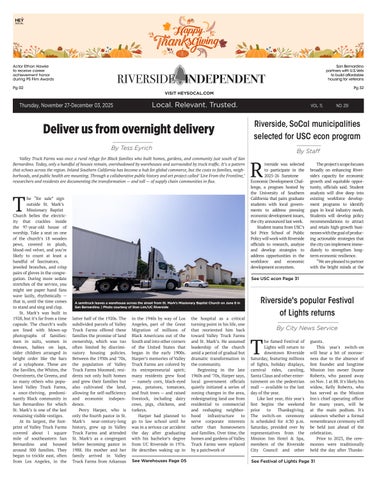
A semitruck leaves a warehouse across the street from St. Mark’s Missionary Baptist Church on June 8 in San Bernardino. | Photo courtesy of Stan Lim/UC Riverside
latter half of the 1920s. The subdivided parcels of Valley Truck Farms offered these families the promise of land ownership, which was too often limited by discriminatory housing policies. Between the 1930s and ’70s, the population of Valley Truck Farms bloomed; residents not only built homes and grew their families but also cultivated the land, allowing for self-sufficiency and economic independence. Percy Harper, who is only the fourth pastor in St. Mark’s near-century-long history, grew up in Valley Truck Farms and attended St. Mark’s as a congregant before becoming pastor in 1988. His mother and her family arrived in Valley Truck Farms from Arkansas
in the 1940s by way of Los Angeles, part of the Great Migration of millions of Black Americans out of the South and into other corners of the United States that began in the early 1900s. Harper’s memories of Valley Truck Farms are colored by its entrepreneurial spirit; many residents grew food — namely corn, black-eyed peas, potatoes, tomatoes, and fruit trees — and raised livestock, including dairy cows, pigs, chickens, and turkeys. Harper had planned to go to law school until he was in a serious car accident the day after graduating with his bachelor’s degree from UC Riverside in 1976. He describes waking up in See Warehouses Page 05
the hospital as a critical turning point in his life, one that reoriented him back toward Valley Truck Farms and St. Mark’s. He assumed leadership of the church amid a period of gradual but dramatic transformation in the community. Beginning in the late 1960s and ’70s, Harper says, local government officials quietly initiated a series of zoning changes in the area, redesignating land use from residential to commercial and reshaping neighborhood infrastructure to serve corporate interests rather than homeowners and families. Over time, the homes and gardens of Valley Truck Farms were replaced by a patchwork of
Riverside's popular Festival of Lights returns By City News Service
T
he famed Festival of Lights will return to downtown Riverside Saturday, featuring millions of lights, holiday displays, carnival rides, caroling, Santa Claus and other entertainment on the pedestrian mall — available to the last day of the year. Like last year, this year's fest begins the weekend prior to Thanksgiving. The switch-on ceremony is scheduled for 4:30 p.m. Saturday, presided over by representatives from the Mission Inn Hotel & Spa, members of the Riverside City Council and other
guests. This year's switch-on will bear a bit of moroseness due to the absence of fest founder and longtime Mission Inn owner Duane Roberts, who passed away on Nov. 1 at 88. It's likely his widow, Kelly Roberts, who has served as the Mission Inn's chief operating officer for many years, will be at the main podium. It's unknown whether a formal remembrance ceremony will be held just ahead of the celebration. Prior to 2023, the ceremonies were traditionally held the day after Thanks-
See Festival of Lights Page 31