FREE
Covina-Valley USD seeks court help in getting foreign deposition
Big City Mayors back ballot measure for more affordable housing across California
Pg 27
Pg 05
VISIT MONROVIAWEEKLY.COM
MONDAY, AUGUST 24-AUGUST 30, 2026
VOL.30,
NO. 290
Pasadena council designates 2 landmark districts, expands fire rebuilding fee waivers
Southern California homes could face new wildfiresafety requirements
By Joe Taglieri
By City News Service
joet@civicnewsgroup.com
W
P
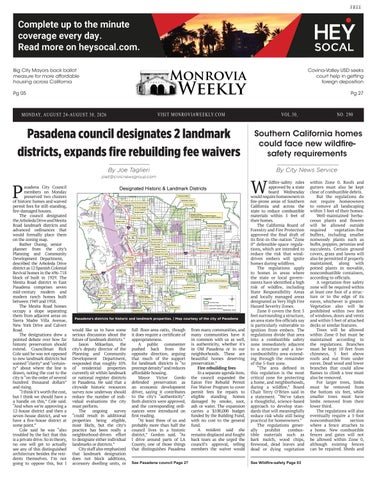
asadena City Council members on Monday preserved two clusters of historic homes and waived permit fees for still-standing, fire-damaged houses. The council designated the Arboleda Drive and Mesita Road landmark districts and advanced ordinances that would formally place them on the zoning map. Rather Duong, senior planner from the city’s Planning and Community Development Department, described the Arboleda Drive district as 12 Spanish Colonial Revival homes in the 696-718 block of built in 1929. The Mesita Road district in East Pasadena comprises seven mid-century modern and modern ranch homes built between 1949 and 1958. The Mesita Road homes occupy a slope separating them from adjacent areas on Sierra Madre Villa Avenue, New York Drive and Calvert Road. The designations drew a pointed debate over how far historic preservation should extend. Councilman Rick Cole said he was not opposed to new landmark districts but wanted “clarity” and “certainty” about where the line is drawn, noting the cost to the city is “on the order of several hundred thousand dollars” and rising. “I think it’s worth the cost, but I think we should have a a handle on this,” Cole said. “And when we’re approving a 12-house district and then a seven-house district, and we have a five-house district at some point.” Cole said he was “also troubled by the fact that this is a private drive. So in theory, no one will get to actually see any of this distinguished architecture besides the residents themselves. I’m not going to oppose this, but I
Pasadena’s districts for historic and landmark properties. | Map courtesy of the city of Pasadena
would like us to have some serious discussion about the future of landmark districts.” Jason Mikaelian, the city’s deputy director of the Planning and Community Development Department, responded that roughly 10% of residential properties currently sit within landmark or national register districts in Pasadena. He said that a citywide historic resources survey now underway should reduce the number of individual evaluations the city must perform. The ongoing survey “could result in additional properties being eligible, most likely, but the city’s practice has been really a neighborhood-driven effort to designate either individual landmarks or districts.” City staff also emphasized that landmark designation does not block additions, accessory dwelling units, or
full floor-area-ratio, though it does require a certificate of appropriateness. A public commenter pushed back from the opposite direction, arguing that much of the support for landmark districts is “to preempt density” and reduces affordable housing. Mayor Victor Gordo defended preservation as an economic development driver, saying it contributes to the city’s “authenticity”. Both districts were approved, and the corresponding ordinances were introduced on first reading. “At least three of us and probably more than half the council lives in a historic district,” Gordon said. “As I drive around parts of LA County, one of those things that distinguishes Pasadena See Pasadena council Page 27
from many communities, and many communities have it in common with us as well, is authenticity, whether it’s in Old Pasadena or in our neighborhoods. These are beautiful homes deserving preservation.” Fire rebuilding fees In a separate agenda item, the council expanded the Eaton Fire Rebuild Permit Fee Waiver Program to cover permit fees for repairs to eligible standing homes damaged by smoke, soot, ash or water. The expansion carries a $100,000 budget funded by the Building Fund, with no cost to the general fund. A resident said she remains displaced and fought back tears as she urged the council’s approval, telling members the waiver would
ildfire-safety rules approved by a state board Wednesday would require homeowners in fire-prone areas of Southern California and across the state to reduce combustible materials within 5 feet of their homes. The California Board of Forestry and Fire Protection approved the final draft of its first-in-the-nation “Zone 0” defensible-space regulations, which are intended to reduce the risk that winddriven embers will ignite homes during wildfires. The regulations apply to homes in areas where the state or local governments have identified a high risk of wildfire, including State Responsibility Areas and locally managed areas designated as Very High Fire Hazard Severity Zones. Zone 0 covers the first 5 feet surrounding a structure, an area state fire officials say is particularly vulnerable to ignition from embers. The regulations divide that area into a combustible safety zone immediately adjacent to a structure and a lowcombustibility area extending through the remainder of the 5-foot zone. “The area defined in this regulation is the most critical zone for protecting a home, and neighborhoods, during a wildfire,” Board Chair Terry O’Brien said in a statement. “We’ve taken a thoughtful, science-based approach to develop standards that will meaningfully reduce risk while still being practical for homeowners.” The regulations generally prohibit combustible materials such as bark mulch, wood chips, firewood, dead leaves and dead or dying vegetation See Wildfire-safety Page 03
within Zone 0. Roofs and gutters must also be kept clear of combustible debris. But the regulations do not require homeowners to remove all landscaping within 5 feet of their homes. Well-maintained herbaceous plants and flowers will be allowed outside required vegetation-free buffers, including smaller nonwoody plants such as bulbs, poppies, petunias and succulents. Certain ground covers, grass and lawns will also be permitted if properly maintained, along with potted plants in movable, noncombustible containers, according to officials. A vegetation-free safety zone will be required within at least one foot of a structure or to the edge of its eaves, whichever is greater. Vegetation also will be prohibited within two feet of windows, doors and vents and within 5 feet of attached decks or similar features. Trees will be allowed within Zone 0 but must be maintained according to the regulations. Branches must be kept 10 feet from chimneys, 5 feet above roofs and out from under eaves. Dead wood and lower branches that could allow flames to climb a tree must also be removed. For larger trees, limbs must be removed from the bottom six feet, while smaller trees must have limbs removed from their lower third. The regulations will also eventually require a 5-foot noncombustible section where a fence attaches to a home. New combustible fences and gates will not be allowed within Zone 0, although existing fences can be repaired. Sheds and