FREE
DOJ challenges California’s ban on sales of glock-style handguns
County advances efforts to improve safety at Whiteman Airport
PG 05
PG 24
MONDAY, JULY 06-JULY 12, 2026
VISIT HEYSOCAL.COM
These California trucking schools broke state laws — regulators couldn’t do anything about it By Adam Echelman and Erica Yee, CalMatters
Duarte council OKs deficit budget using reserve funds for park improvements By Joe Taglieri
This story was originally published by CalMatters.
joet@civicnewsgroup.com
D
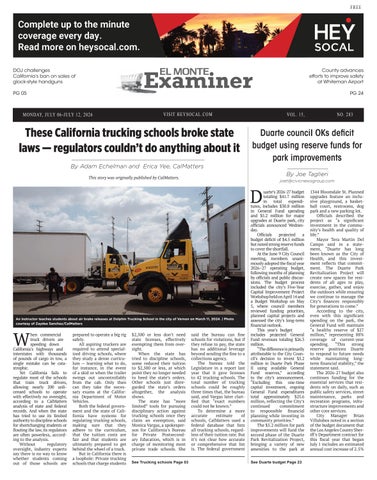
An instructor teaches students about air brake releases at Dolphin Trucking School in the city of Vernon on March 11, 2024. | Photo courtesy of Zaydee Sanchez/CalMatters
W
hen commercial truck drivers are speeding down California’s highways and interstates with thousands of pounds of cargo in tow, a single mistake can be catastrophic. Yet California fails to regulate most of the schools that train truck drivers, allowing nearly 200 unlicensed schools to operate with effectively no oversight, according to a CalMatters analysis of state and federal records. And when the state has tried to use its limited authority to discipline schools for shortchanging students or flouting the law, its regulators are often powerless, according to the analysis. Without regulatory oversight, industry experts say there is no way to know whether students coming out of those schools are
prepared to operate a big rig safely. All aspiring truckers are required to attend specialized driving schools, where they study a dense curriculum — learning what to do, for instance, in the event of a skid or when the trailer swings out uncontrollably from the cab. Only then can they take the necessary exams at the California Department of Motor Vehicles. Both the federal government and the state of California have systems for regulating trucking schools, making sure that they adhere to the curriculum, that the tuition costs are fair and that students are ultimately prepared to get behind the wheel of a truck. But in California there is a loophole: Private trucking schools that charge students
$2,500 or less don’t need state licenses, effectively exempting them from oversight. When the state has tried to discipline schools, some reduced their tuition to $2,500 or less, at which point they no longer needed to heed the state’s orders. Other schools just disregarded the state’s orders altogether, the analysis shows. The state has “more limited” tools for pursuing disciplinary action against trucking schools once they claim an exemption, said Monica Vargas, a spokesperson for California’s Bureau for Private Postsecondary Education, which is in charge of monitoring most private trade schools. She See Trucking schools Page 03
NO. 283
VOL. 15,
said the bureau can fine schools for violations, but if they refuse to pay, the state has no additional leverage beyond sending the fine to a collections agency. The bureau told the Legislature in a report last year that it gave licenses to 42 trucking schools. The total number of trucking schools could be roughly three times that, the bureau said, and Vargas later clarified that “exact numbers could not be known.” To determine a more accurate estimate of schools, CalMatters used a federal database that lists all trucking schools, regardless of their tuition rate. But it’s not clear how accurate or comprehensive that list is. The federal government
uarte’s 2026-27 budget totaling $41.7 million in total expenditures, includes $30.8 million in General Fund spending and $5.2 million for major upgrades at Duarte park, city officials announced Wednesday. Officials projected a budget deficit of $4.5 million but noted strong reserve funds to cover the shortfall. At the June 9 City Council meeting, members unanimously adopted the fiscal year 2026–27 operating budget, following months of planning by officials and public discussions. The budget process included the city’s Five-Year Capital Improvement Project Workshop held on April 14 and a Budget Workshop on May 5, where council members reviewed funding priorities, planned capital projects and assessed the city’s long-term financial outlook. This year’s budget includes projected General Fund revenues totaling $26.3 million. “The difference is primarily attributable to the City Council’s decision to invest $5.2 million in Duarte Park Phase II using available General Fund reserves,” according to the city’s announcement. “Excluding this one-time capital investment, ongoing General Fund expenditures total approximately $25.6 million, reflecting the City’s continued commitment to responsible financial planning while investing in community priorities.” The $5.2 million for park improvements will fund the second phase of the Duarte Park Revitalization Project, bringing a variety of new amenities to the park at See Duarte budget Page 23
1344 Bloomdale St. Planned upgrades feature an inclusive playground, a basketball court, restrooms, dog park and a new parking lot. Officials described the project as “a significant investment in the community’s health and quality of life.” Mayor Tera Martin Del Campo said in a statement, “Duarte has long been known as the City of Health, and this investment reflects that commitment. The Duarte Park Revitalization Project will create new spaces for residents of all ages to play, exercise, gather, and enjoy the outdoors while ensuring we continue to manage the City’s finances responsibly for generations to come.” According to the city, even with this significant spending on the park, the General Fund will maintain “a healthy reserve of $27 million,” representing 88% coverage of current-year spending. “This strong reserve positions Duarte to respond to future needs while maintaining longterm financial stability,” the statement said. The 2026-27 budget also continues funding for the essential services that residents rely on daily, such as public safety services, street maintenance, parks and recreation programs, infrastructure improvements and other core services. City Manager Brian Villalobos noted in a section of the budget document that the Los Angeles County Sheriff’s Department contract for this fiscal year that began July 1 includes an estimated annual cost increase of 2.5%