Bass, Garcia lead hearing on federal immigration actions



Thursday, November 27-December 03, 2025
Bass, Garcia lead hearing on federal immigration actions
Thursday, November 27-December 03, 2025
By Tess Eyrich
Valley Truck Farms was once a rural refuge for Black families who built homes, gardens, and community just south of San Bernardino. Today, only a handful of houses remain, overshadowed by warehouses and surrounded by truck traffic. It’s a pattern that echoes across the region. Inland Southern California has become a hub for global commerce, but the costs to families, neighborhoods, and public health are mounting. Through a collaborative public history and art project called "Live From the Frontline," researchers and residents are documenting the transformation — and toll — of supply chain communities in flux.
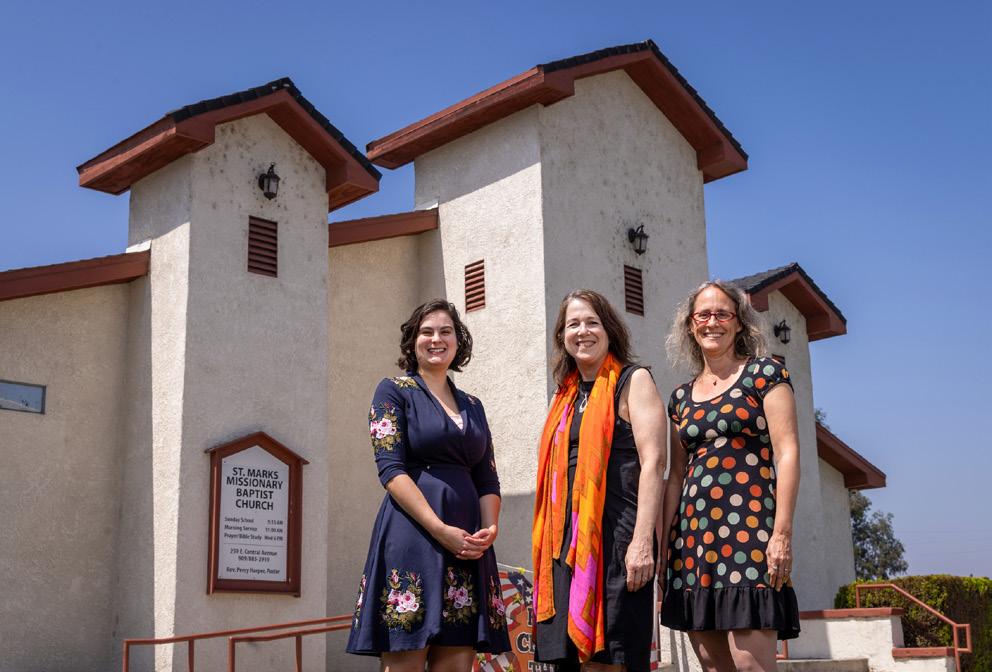
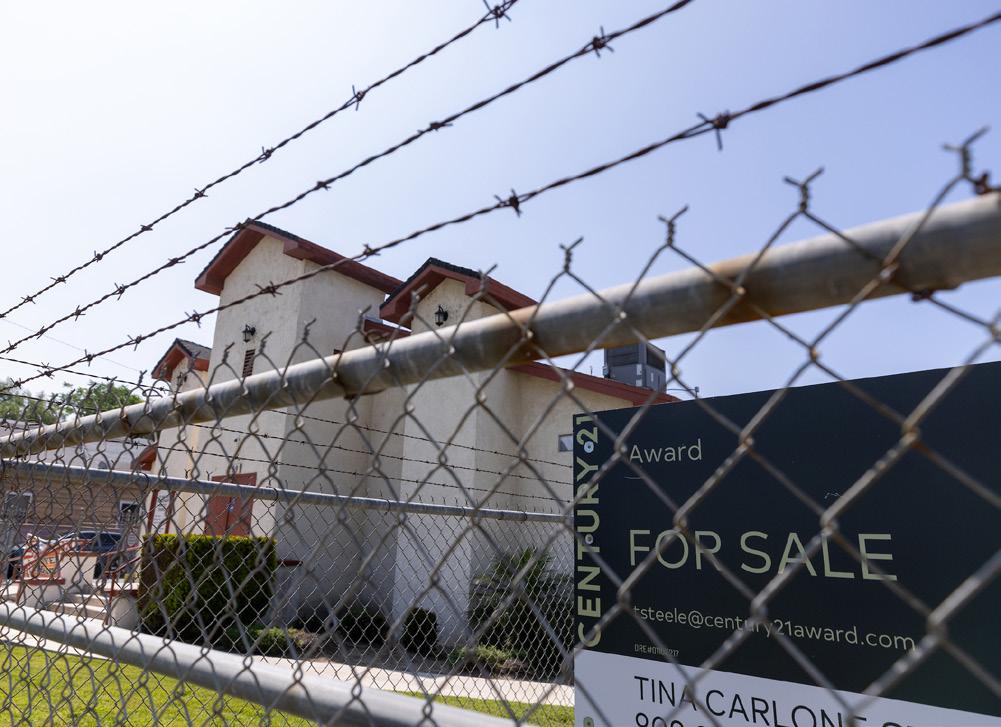
The“forsale”sign outsideSt.Mark’s MissionaryBaptist Church belies the electricity that crackles inside the 97-year-old house of worship. Take a seat on one of the church’s 18 wooden pews, covered in plush, blood-red velvet, and you’re likely to count at least a handfuloffascinators, jeweled brooches, and crisp pairs of gloves in the congregation. During more sedate stretches of the service, you might see paper hand fans wave lazily, rhythmically — that is, until the time comes to stand and sing and clap. St. Mark’s was built in 1928, but it’s far from a time capsule. The church’s walls are lined with blown-up photographs of families: men in suits, women in dresses, babies on laps, older children arranged in height order like the bars of a xylophone. These are the Savilles, the Whites, the Overstreets, the Greens, and so many others who populated Valley Truck Farms, a once-thriving, predominantly Black community in San Bernardino for which St. Mark’s is one of the last remaining visible vestiges.
At its largest, the footprint of Valley Truck Farms covered about 1 square mile of southeastern San Bernardino and housed around 500 families. They began to trickle east, often from Los Angeles, in the
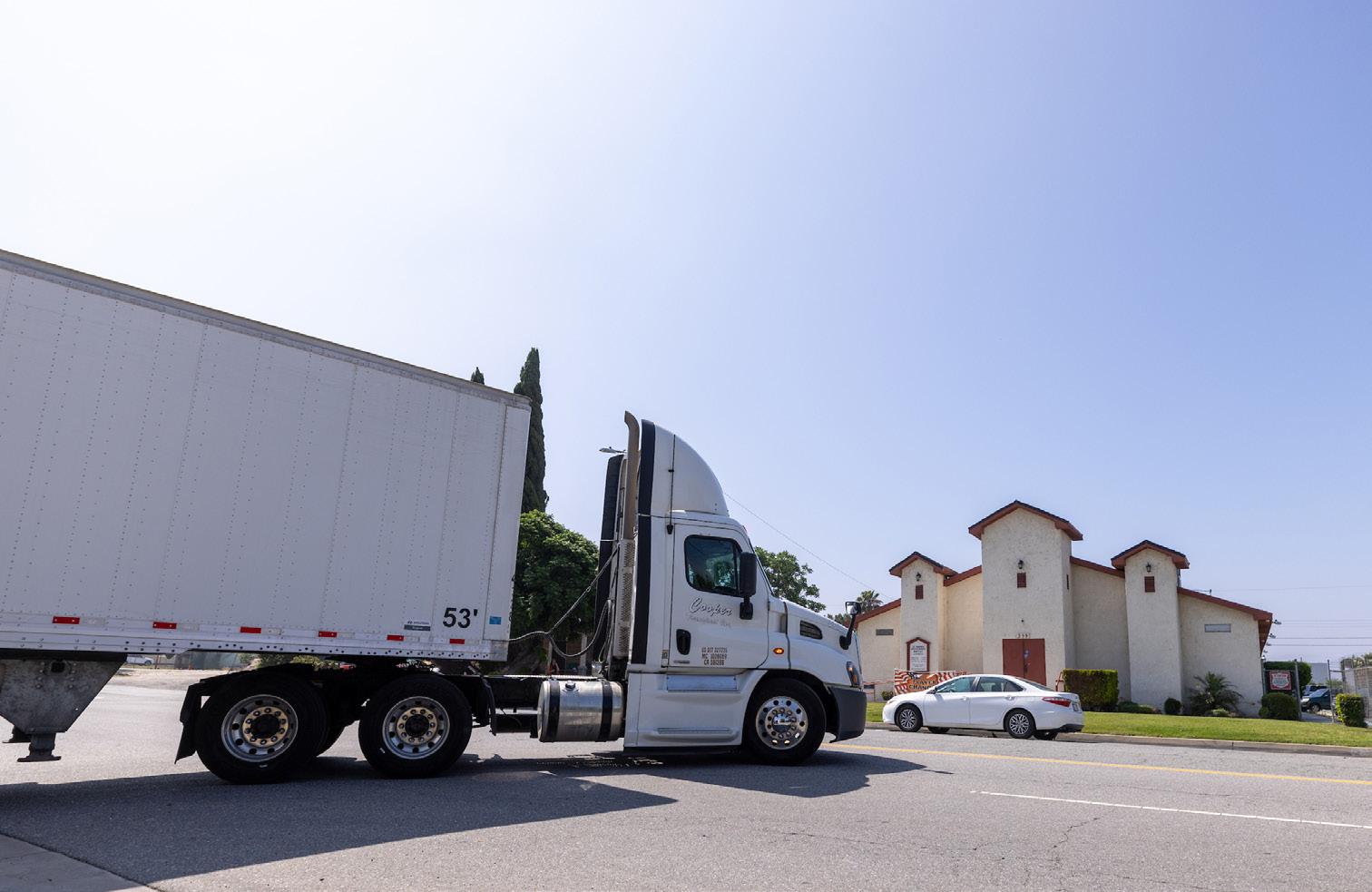
latter half of the 1920s. The subdivided parcels of Valley Truck Farms offered these families the promise of land ownership, which was too often limited by discriminatory housing policies. Between the 1930s and ’70s, the population of Valley Truck Farms bloomed; residents not only built homes and grew their families but also cultivated the land, allowing for self-sufficiency and economic independence.
Percy Harper, who is only the fourth pastor in St. Mark’s near-century-long history, grew up in Valley Truck Farms and attended St. Mark’s as a congregant before becoming pastor in 1988. His mother and her family arrived in Valley Truck Farms from Arkansas
in the 1940s by way of Los Angeles, part of the Great Migration of millions of Black Americans out of the South and into other corners of the United States that began in the early 1900s. Harper’s memories of Valley Truck Farms are colored by its entrepreneurial spirit; many residents grew food — namely corn, black-eyed peas, potatoes, tomatoes, and fruit trees — and raised livestock, including dairy cows, pigs, chickens, and turkeys.
Harper had planned to go to law school until he was in a serious car accident the day after graduating with his bachelor’s degree from UC Riverside in 1976. He describes waking up in
the hospital as a critical turning point in his life, one that reoriented him back toward Valley Truck Farms and St. Mark’s. He assumed leadership of the church amid a period of gradual but dramatic transformation in the community.
Beginning in the late 1960s and ’70s, Harper says, local government officials quietly initiated a series of zoning changes in the area, redesignating land use from residential to commercial and reshaping neighborhood infrastructure to serve corporate interests rather than homeowners and families. Over time, the homes and gardens of Valley Truck Farms were replaced by a patchwork of
By Joe Taglieri joet@beaconmedianews.com
LosAngelesCounty supervisorsunveiled a proposed ordinance Monday that would prohibit federal immigration agents and other law enforcement officers from concealing their identities, while two Southern California members of Congress are seeking answers on the 25 reported deaths of immigration detainees.
The proposed county law is up for a vote Dec. 2 and seeks to prohibit all officers with local, state and federal agencies from wearing masks or personal disguises while interacting with the public in unincorporated areas.
If approved, the ordinance also would require that all law enforcement officers wear visible IDs and agency affiliation.
"I never thought I would see the day when a masked, anonymous federal police force would be swarming our neighborhoods, targeting people based on the color of their skin or the language they speak, and forcing men and women into unmarked vans at gunpoint. This is how an authoritarian’s secret police operate – not legitimate law enforcement in a democracy,” Supervisor Janice Hahn said in a statement announcing the proposed ordinance that she co-authored with Supervisor Lindsey Horvath.
Hahn acknowledged the move will likely draw opposition from the federal
government, which has already sued California over similar laws requiring officer identification.
“If this means a fight with the federal government, I think it is a fight worth having," Hahn said. "We cannot give in now and make this okay in America."
Administration officials said increasing violence against immigration agents was a motivation for masks and lashed out at state and local officials.
“Sanctuarypoliticians attempting to ban our federal law enforcement from wearing masks is despicable and a flagrant attempt to endanger our officers," Homeland Security Assistant Secretary Tricia McLaughlin said in a statement. "To be crystal clear: we will not abide by a state’s unconstitutional ban."
McLaughlin and White House spokeswoman Abigail Jackson said violent attacks against federal agents has increased "1000%." McLaughlin cited increasing "terror attacks, cars being used as weapons (and) bounties to murder them placed on their heads. ... We’ve also seen thugs launch websites to reveal officers’ identities to dox and threated their families. We will prosecute those who dox our agents or lay a hand on law enforcement to the fullest extent of the law.”
Jackson said in a state-






MayorKarenBass andRep.Robert Garcia,D-Long Beach, convened a congressional hearing in downtown Los Angeles Monday to gather testimony about alleged violations by federal immigration agents, whom they accuse of improperly detaining immigrants and citizens alike, often without probable cause or warrants.
The hearing, dubbed "Due Process for All: Exposing Trump's Mass Deportation Machine," was preceded by a march held by immigrantrights advocates and local leaders -- including Bass.








"We want to establish a record because when the political winds change, we want to hold those accountable," Bass said during the rally. "We want transparency and accountability for all of the egregious unconstitutional acts that are taking place."
During the hearing, Bass said the session "addresses a crisis that we cannot ignore."
"Los Angeles will not stay silent while Angelenos' rights are violated," she said. "We are here to demand accountability. We are here to demand transparency and we
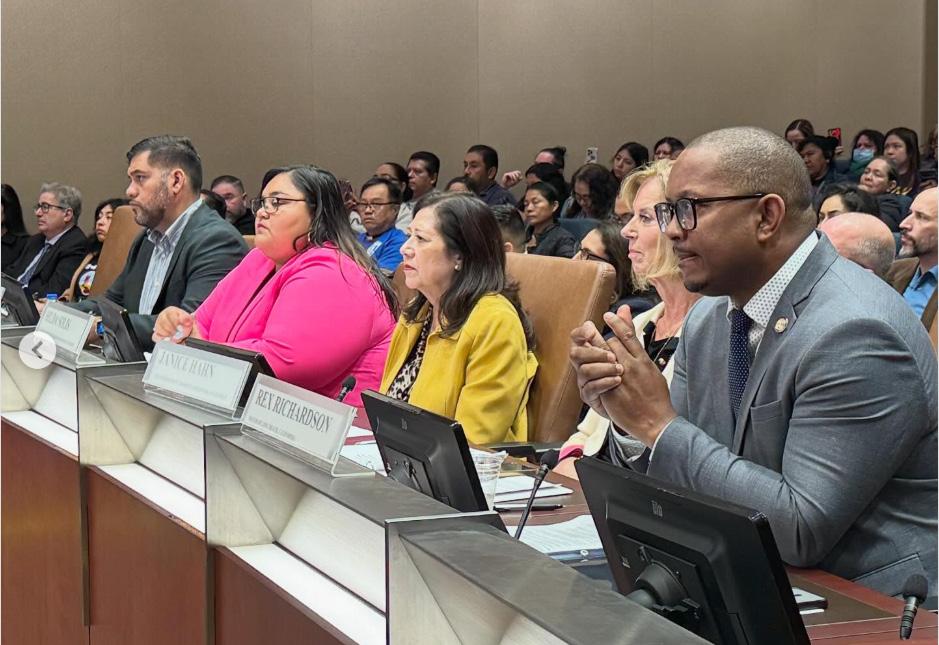
are calling on Congress to act before more families are torn apart."
Garcia, the ranking member of the House Oversight and Government Reform Committee, said the aim of the hearing was "to do real oversight of the Trump administration." He said the president and other top administration officials "are causing terror not just in Los Angeles and L.A. County, but across the country."
He said more than 170 U.S. citizens have been detained
during ICE operations.
The Trump administration has maintained that federal immigration enforcement focuses on the removal of "violent criminals" and the "worst of the worst." Federal officials have also denied allegations that detainees are mistreated or held in substandard facilities while in custody. They also deny claims that people are being arrested without probable cause.
During the hearing, Los Angeles City Councilman
Hugo Soto-Martinez said the impacts of the stepped-up immigration enforcement actions are far- reaching.
"Our communities are suffering, and it isn't just those being arrested and detained," he said. "Our businesses relying on the labor of immigrants are also suffering. Tourism has been hurt by federal policies that discourage both international and domestic travel. Commercial corridors that were once vibrant now feel like ghost towns."
Anonprofit group made up of mostly Harbor Gatewayresidents has filed a legal challenge to a proposed warehouse and distribution center for development in that community, saying it could bring more than 750 trucks into the area daily on a round-the-clock basis while contributing to traffic and pollution.
The Friends of Air, Earth and Water Inc. filed the petition Monday in Los Angeles Superior Court, asking a judge to order
the City Council to vacate its October approval of the Prologis Vermont and Redondo Project pending a more adequate assessment of its impact on the environment. A representative for the City Attorney's Office did not immediately reply to a request for comment.
In a unanimous vote, the council denied an appeal filed by concerned residents and advanced the project sought by Prologis, a company specializing in supply-chain and logistics real estate.
The one-story, 53-foot tall, 340,298-square-foot warehouse would be built on a combined 15-acre lot at 15116-15216 S. Vermont Ave. and 747-861 W. Redondo Beach Blvd.
"Despite comments from Friends of the Air and another environmental justice group urging the city to evaluate the project's inconsistency with the general plan, including policies in the Harbor Gateway Community Plan
update, it refused to do so," the petition alleges. "Instead, the city delayed approval of the updated Harbor Gateway Community Plan and plowed ahead with approving the project."
The development includes a 25,000-square-foot mezzanine and up to 40,000 square feet of office space, 194 parking spaces, 36 dockhigh truck loading positions and more parking spaces for up to 71 truck trailers.
See Harbor Gateway Page 31
As the holidays draw near, many of us start searching for meaningful ways to show the moms in our lives just how much they matter. The best gifts often strike a balance between practicality and delight—pieces that feel thoughtful, useful, and a little unexpected. Every mom has her own style, so choosing something that reflects her personality can make your gift feel all the more special. For those who love a seasonal treat, a festive chocolate collection can add a bit of sweetness to her December days. Cozy matching holiday pajamas are another fun way to bring extra cheer to the season, perfect for relaxed mornings or family photos. If she enjoys unwinding with a little self-care, luxurious body creams or spa-
inspired skincare sets deliver a moment of calm in the midst of holiday bustle. For moms who are always out and about, a well-designed weekender or carryall bag can make errands, quick trips, or gym days smoother and more stylish.
For something sentimental, digital photo displays have become a modern favorite—offering a clutter-free way to enjoy a rotation of family memories.
And for moms who appreciate a calming home ambiance, a high-quality candle can set the perfect tone with its soft glow and relaxing fragrance.
This season, a thoughtful gift—big or small—can serve as a simple reminder of gratitude, love, and all the ways she makes life brighter.


San Gabriel Holiday Tree Lighting (“Taste of San Gabriel”)
Date / Time: Thursday, December 3, 2025, from 6 p.m. to 8:30 annual holiday tree lighting with fun activities.
Activities Include train rides, ornament decorating, a light tunnel, hot cocoa, and Santa arriving via a vintage fire truck.
Monterey Park Holiday Snow Village
Date / Time: Thursday, December 4, 2025, from 4:00 PM to 8:00 PM.
Location: Barnes Park, 350 S. McPherrin Ave., Monterey Park.
Free snow play, sled runs, a snow play area, photos with Santa, holiday crafts, and a trackless train.
Registration: Required for snow activities (limited slots). montereypark.ca.gov
Wristbands: Available for pick-up starting December 1 at Langley Center (400 W. Emerson Ave) or at the event.
Monrovia Holiday Parade
Date / Time: Thursday, December 4, 2025, 7:00 PM.
Route: Along Myrtle Avenue, from Walnut Ave to Palm Ave in Old Town Monrovia.
Annual community parade featuring floats, local groups, and holiday cheer.
Pasadena Mayor’s Annual Holiday Tree Lighting Ceremony
Date / Time: December 5, 2025, 5:00 PM –7:00 PM.
Location: Pasadena City Hall, 100 N. Garfield Ave.
Live performances by local youth groups, crafts (run by the Armory Center for the Arts), refreshments, Santa, and a special photo booth. The Pasadena Fire Department will be collecting new, unwrapped toys for the Spark of Love Toy Drive.
Pasadena Holiday Lighted Parade
Date / Time: December 6, 2025, at 7:00 PM.
Location: Pasadena (parade route runs along Fairmont Parkway).
Over 95 brightly decorated vehicles, festive music, and community holiday spirit.
Santa in the Village & Carriage Rides
Dates: December 6, 13 & 20, 2025, from 5:00 PM – 7:00 PM
Location: Glendora Village
Meet Santa, take photos, and enjoy horsedrawn carriage rides on December 13 and 20, lively entertainment, unique shops, and plenty of festive fun.

If you’re shopping for someone who’s always catching flights or planning their next getaway, the travel market is full of smart, stylish upgrades that make time on the road (or in the air) easier and more enjoyable. One of the most popular trends this season is high-quality luggage sets that blend durability, thoughtful design, and modern aesthetics.
A well-designed set typically includes multiple suitcase sizes, along with smaller accessory pieces for toiletries or personal items—ideal for everything from weekend trips to longhaul adventures. Today’s
hardshell collections are built to withstand the inevitable bumps of travel, while features like 360-degree spinner wheels, TSA-friendly locks, and lightweight frames ensure smooth movement through airports and train stations.
Frequent travelers often praise these sets for their space efficiency and reliability, noting that good luggage can make a major difference when navigating unfamiliar cities or tight itineraries. Matching pieces also offer a sleek, coordinated look that tends to turn heads at the terminal.
Plenty of well-known
brands—fromsleek, minimalist designs to high-end luxury options— continue to be favorites among influencers, business travelers, and globetrotters alike.Theirenduring popularity comes from a mix of craftsmanship, smart organization, and stylish details.
Whether your recipient is prepping for a work trip or dreaming of their next international escape, gifting dependable luggage or travel accessories is a thoughtful way to make every journey smoother. In the end, great travel gear lets them focus on the adventure—not the haul.

Saturdays & Sundays: November 29 – December 21, 11:00 AM – 3:00 PM
Tree Lighting & Carolers: Friday, November 28, carolers begin at 5:30 PM, tree lighting at 6:15 PM
Step into a classic holiday scene in Old Town Montrose! This season, our charming, locally owned shops are decked out for the holidays, offering a variety of unique gifts for everyone on your list—from pets and kids to friends and family. When you’re ready for a break, enjoy delicious meals, coffee, or sweet
treats at the many nearby restaurants, cafés, and bakeries.
Kick off the festive fun on Friday, November 28, with a magical evening featuring strolling carolers, a visit from Santa, and the annual Holiday Tree Lighting. Carolers begin at 5:30 PM, followed by the tree lighting at 6:15 PM.
The weekend festivities continue with beloved traditions:
• Horse-drawn trolley rides along Honolulu Avenue (complimentary, Saturdays & Sundays)
• Pony rides for kids on Saturdays
• Photos with Santa on Saturdays and Sundays
• Live Christmas music filling the streets
• Strolling carolers to keep spirits bright Skip the crowded malls and long checkout lines— Old Town Montrose offers a warm, festive atmosphere perfect for holiday shopping and family fun. With plenty of free parking, delightful shops, and fantastic food, there’s something for everyone to enjoy this holiday season.
By City News Service
Attorneys for Cal State University administrators have responded to a bid by the California Faculty Association and other unions for a preliminary injunction requiring notice to them before their personal information is turned over to the federal government, calling the workers' effort unconstitutional.
The dispute began when CFA attorneys filed court papers on Nov. 3 with Los Angeles Superior Court Judge Stephen I. Goorvitch alleging that since January the U.S. Equal Employment Opportunity Commission and the U.S. Department of Education Office of Civil Rights have been actively engaged in a campaign by the Trump administration to control the content of research, scholarship, teaching and activism at American colleges and universities.
"Given the current federal administration's defiance of the norms and laws that normally constrain its authority, petitioners cannot rely on federal agencies to appropriately limit the scope of their investigations or maintain sensitive personal information in confidence," the CFA court papers state.
But in their own court papers filed Nov. 20, lawyers for CSU administrators say the notice sought by the unions is not required under either the state or federal constitutions.
"(The unions) have no likelihood of success in obtaining such unprecedented relief and the balance of hardships overwhelmingly favors CSU due to the extraordinary risk to the institution if it cannot respond lawfully and appropriately to federal government investigations," CSU administrators' attorneys' contend in their pleadings.
Nothing in the unions' proposed order would give administrators the right or discretion to comply with a subpoena that it believes is lawful and appropriate and an employee who wants to hinder an investigation could use the order in bad faith, the CSU administrators' attorney further contend in their pleadings.
The requested injunction would violate the supremacy clause of the federal constitution and the state constitution also does not provide such notice protections, according to the CSU administrators' court papers.
The CFA represents about 1,500 CSU faculty at Cal State Los Angeles and some 25,000 members systemwide. One of the other union plaintiffs, the United Automobile, Aerospace and Agricultural Implement Workers of America Local 4123, is the exclusive bargaining representative for some 10,000 CSU academic student employees.
The Equal Employment Opportunity Commission filed
a complaint against Cal State Los Angeles in January involving antisemitism allegations. On Aug. 11, the administration notified employees that it had provided the EEOC with "publicly available university contact information" for all employees, according to the CFA attorneys' court papers.
The school later disclosed student employees' personal contact information, demographic data and employment information to the EEOC by late September, the CFA lawyers further state.
The CFA and UAW have expended significant resources responding to union members' concerns that their personal information will be used to surveil them, that they will be targeted for employment consequences based on their activism, online speech and scholarship and that union members who are not U.S. citizens may face unjust immigration enforcement, the CFA attorneys contend in their pleadings.
"The federal government's threats are serious," according to the CFA attorneys' court papers, which note that on Sept. 30, a federal judge held that the Trump administration illegally targeted proPalestinian student activists with deportation threats to silence their speech critical of Israel.
A hearing on the unions' request for a preliminary injunction is scheduled for Dec. 5.



Monrovia Holiday Parade set for Dec. 4
Kick off the holiday season at Monrovia’s Annual Holiday Parade as it marches through Old Town on Thursday, Dec. 4, at 7 p.m. Local organizations, schools, and businesses are invited to participate and spread holiday cheer along Myrtle Avenue. The parade travels north on Myrtle Avenue from Walnut Avenue to Palm Avenue.
City of Long Beach Offers Tips for a Safe Thanksgiving
The City of Long Beach is offering the following tips to ensure a safe, healthy and hazard-free Thanksgiving holiday for all. The rate of accidental residential fires increases every year during the holiday season, with home cooking fires being a common culprit on Thanksgiving. The National Fire Protection Association (NFPA) recommends against deep-frying turkeys; if you decide to do so, follow safety recommendations, and never deep-fry a frozen turkey. Always stay in the kitchen while cooking; unattended cooking is the leading cause of cooking fires and casualties.Always keep children away from hot stoves as well as hot food and liquids as steam or splash could cause serious burns. Instead of using open-flame candles for a table centerpiece or in other home decor, use battery-operated candles. When cooking a turkey, the Centers for Disease
Control and Prevention (CDC)warns that improper handling or undercooking the bird can spoil the holiday by leading to food poisoning and illness. As the holiday season approaches, it is especially important to note the importance of not driving while impaired or distracted. The Long Beach Police Department will increase its police presence throughout the city to help deter drivers from distracted driving and driving under the influence.
Azusa
Azusa to host household hazardous, e-waste collection Saturday
Azusa residents can take their household hazardous and e-waste to the collection event at Veolia Environmental Services (107 S. Motor Ave., Azusa, CA 91702) from 9 a.m. to noon. This event is open to Azusa residents only, proof of Azusa residency is required.
Glendale
Residents warned of scam emails requesting payment for City of Glendale permits
The City of Glendale is alerting residents, businesses, and contractors about phishing emails containing fraudulent invoices targeting individuals who have submitted development-related permit applications to the City of Glendale. These emails are not from the city. Some of the fraudulent messages include wire transfer instructions, while others prompt individuals to click a link to “electronically sign documents,” mimicking
legitimate city communications. Recipients should not send payments or click on links in any unsolicited or unexpected email requesting money, banking information, or urgent action. For general questions about permits and payments, visit GlendalePermits.org or call (818)548-3200. If you believe you have responded to a fraudulent email or would like to report suspicious activities, call the Glendale Police Department at (818) 548-4840.
Celebrate the holiday season at OC Parks' Heritage Hill Historical Park
Get in the holiday spirit at OC Parks’ Heritage Hill Historical Park this December with two weekends of family-friendly fun at Candlelight Walk and Holiday Lights. Celebrate at the 39th annual Candlelight Walk Dec. 5-7, from 5 to 9 p.m. and stroll through the decorated historical grounds during special park hours. Enjoy live musical performances from carolers and brass band musicians, holiday-themed crafts for kids, enchanting puppet show productions of “The Wizard of Oz,” and a visit with Santa Claus. Light refreshments will be available for cash purchase. The celebration continues with Holiday Lights Dec. 12-14, from 5 to 9 p.m. Explore the historical buildings decked out with light displays and seasonal décor. Snap festive pictures at holiday-themed photo opportunities throughout the park. Light refreshments will be available for purchase. Pets are welcome to join the

festivities outdoors on leashes no longer than 6 feet. Additional entertainment will not be available during Holiday Lights. Candlelight Walk and Holiday Lights at Heritage Hill Historical Park are free to attend with free parking.
Anaheim
Anaheim approves hotelier plan to fund affordable housing for workers, second vote set for December
Hotels around Anaheim’s theme parks and convention center are set to fund affordable housing for hospitality workers. Last week, the city council unanimously approved a resolution and ordinance enacting changes to the Anaheim Tourism and Improvement District, known as ATID. The changes still require a second council vote on Dec. 9, and, if approved a second time, would take effect 30 days later in January. Funding would start going toward affordable housing on Feb. 1. ATID is a district of 93 hotels that funds tourism and improvements in The Anaheim Resort through an assessment, or 2% additional charge, on hotel stays.
‘Home for the Holidays’ fee-waived adoptions continue through Sunday
As Riverside County Department of Animal Services continues to operate in critical overcapacity for dogs, adoption fees are waived at all shelter locations for the month of November to encourage community members to help save lives. All fee-waived adoptions include spay/neuter surgery, microchips, vaccinations, and an engraved ID tag. With almost 1,000 dogs in the shelter there are hundreds of breeds, ages, sizes and personalities to choose from. “Giving a dog a home for the holidays is the ultimate gift,” said Fifth District Supervisor Yxstian Gutierrez. “RivCo pets deserve our best efforts, and this is the season to give a shelter pet a chance.”
City of Riverside launches “Rivy” AI chat
Riverside has launched “Rivy,”
an AI-powered chat and voice assistant designed to provide residents with faster access to city services and information. Rivy is available on city’s website --- riversideca.gov -- as a chat assistant and also integrated into the City’s 311 customer service phone line, offering an AI-powered voice assistant option for callers who prefer voice interaction, while still maintaining the option to speak with a live agent. Rivy uses content from the city’s website to answer residents’ questions in real time, providing a 24/7 virtual assistant for everything from finding city council agendas to learning how to apply for permits or explore parks and recreation programs.
Corona Holiday Lighting Celebration set for Dec. 7
Celebrate the season at the City of Corona’s Holiday Lighting CelebrationonSunday, Dec. 7, at the Historic Civic Center. Enjoy festive lights, live entertainment,familyfriendly activities, and a special visit from Santa Claus. This is a free community event. Highlights include sledding in real snow, live performances by community-based organizations, local artisan vendors, Crafters Village, the Holiday Express Train, roaming holiday themed entertainment and more. Handicap Parking available at the Vicentia Activity Center (550 S. Vicentia Ave.) and the corner of 6th Street and Buena Vista until the lot is full.
San Bernardino County Library partners with Children’s Fund for countywide toy drive
The San Bernardino County Library is spreading holiday cheer this season through a special partnership with Children’s Fund by hosting a Celebration of Giving Toy Drive at 28 library branches countywide through Dec. 9. Community members are encouraged to donate new, unwrapped toys at participating library locations during this period. All donations will directly support Children’s Fund’s annual Celebration of Giving, which provides
holiday gifts to children and youth in need throughout San Bernardino County. In lieu of donating physical toys, community members may also support the toy drive by making a monetary contribution directly through their website at https://www.childrensfund.org/cog. They also have links to their Amazon Wish Lists for kids and teens. For more information about the San Bernardino County Library system, visit library. sbcounty.gov.
Regional Parks, Calico Ghost Town will be open on Thanksgiving Day
All Regional Parks, including Calico Ghost Town will be open on Thanksgiving Day. Whether you want to fish, bike ride, camp, hike or just want to explore a ghost town, Regional Parks is the pre-Thanksgiving dinner destination to be. Cucamonga-Guasti, Glen Helen, Mojave Narrows, Prado and Yucaipa Regional Parks are pet-friendly and have plenty of open green space to relax and unwind with family and friends. Pack a picnic or head out to fish. Trout season kicked off on Wednesday with 830 pounds of stocking at each park mentioned above. For more on Regional Parks and Calico Ghost Town, visit parks.sbcounty.gov.
Ontario
Ontario’s 2025 Holiday Light Parade & Tree Lighting set for Dec. 6
Celebrate the start of the holiday season at Ontario’s annual Holiday Light Parade & Tree Lighting. Travel down to Euclid Avenue on Saturday, Dec. 6, at 6:30 p.m. The parade starts off at Fourth Street and travels down to B Street along Euclid Avenue. Enjoy the show as the city lights up the night with festive colors and lights. Following the parade, walk over to Ontario Town Square (224 N. Euclid Ave.) for a Holiday Drone Show that will count down to the annual Tree Lighting Ceremony. Don’t forget to write your letters to Santa and participate in cookie decorating at Ontario Town Square. Guests can also enjoy a free meet-and-greet photo opportunity with Santa. For more information, visit OntarioCA.gov/HolidayLightParade.
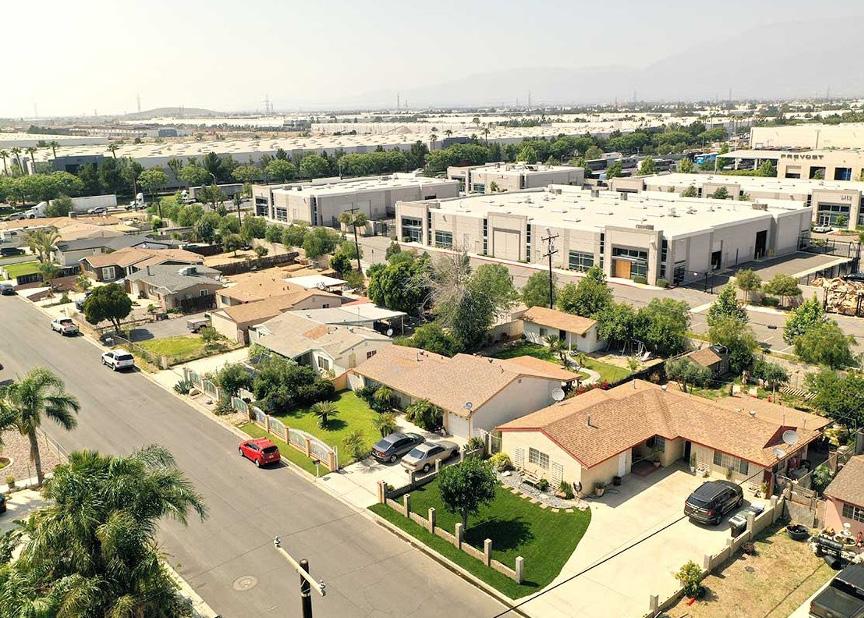
warehouses; linger on the St. Mark’s stoop today and you’ll see warehouses across the street and shipping trucks on the roads. Harper doesn’t mince words; he describes the transformation of Valley Truck Farms into “an asphalt jungle of warehouses” as nothing less than “the undermining of a community.”
What happened to Valley Truck Farms isn’t a rarity in Inland Southern California. In fact, the logistics industry has a long history in the two-county region, says Catherine Gudis, a public historian and professor of history at UCR, and a long history of transforming — or engulfing — communities that exist along the supply chain.
“Still, there’s a magic to this region,” Gudis says of the Inland Empire. “And it’s in part the people, and in part the landscape, and in part the way that industry and infrastructure frame so many of the views.”
Gudis is co-director of "Live From the Frontline," a far-reaching “participatory memory” project of which St. Mark’s is one of a selection of Riverside and San Bernardino county sites spotlighted. The project marries archival research, oral histories and interviews with community members, original photography by artists from the region, documentary work, digital mapping, the creation of public and communitydriven art installations, and partnerships with environmental justice organizations, all with a focus on exploring what Gudis describes as “the exploitation of land and labor” in the region.
Joining Gudis in the endeavor are co-directors Jennifer Tilton, chair and professor of race and ethnic studies at the University of Redlands, and Audrey Maier, public history director of the Civil Rights Institute of Inland Southern California and a 2021 graduate of UCR’s doctoral program in public history. Maier’s own family roots in the Inland Empire community of South
Colton, known for its leading role in cement production throughout much of the 20th century, extend across five generations.
“With Live From the Frontline, we wanted to show these different areas that are all connected through logistics, and these long histories of what we call the ‘slow violence of the supply chain,’ and work with the individual communities to flesh out their unique stories but also to connect them all together,” Maier says of the project, which developed out of a larger archival and mapping initiative the historians continue to collaborate on called "A People’s History of the I.E."
“We want these different communities to find shared similarities and histories through the project and connect through those.”
Their project also seeks to track places as they change in real time; one example is unincorporated Bloomington, a rural, ranch-friendly community just west of Colton whose population has skewed heavily Latino and working class for the past 50 years.
Since 2022, the ongoing development of an industrial park in Bloomington has resulted in a community interrupted, with some
and produced multimedia pieces about many of the Live From the Frontline sites and community members. The opportunity to collaborate with artists was a welcome one, Gudis says, made possible through grant funding awarded by Creative Corps Inland SoCal, an initiative financed by a constellation of organizations including the California Arts Council.
Among the site-specific installations produced by the Live From the Frontline team is “Bloomington Speaks: A Community Sculpture & Art Exhibition
The new company towns?
Southwest of Bloomington and within the munici-
at Zimmerman Elementary School”; at the June 2024 event, community members were invited to express their feelings about warehousing and Bloomington’s
homeowners accepting deals to vacate their land and others seeking to stay in place even as the neighborhood becomes increasingly unlivable.
As part of the project, Gudis, Tilton, and Maier partnered with local artists, led by visual artist Tamara Cedré, who photographed
transformation by decorating cardboard shipping boxes. The boxes were then displayed outside a shipping container in the parking lot of Zimmerman Elementary School, which is in the process of being relocated from its current site within the borders of the planned industrial park.
pal borders of Jurupa Valley, Mira Loma can be considered “ground zero” for the supply chain in Inland Southern California, Gudis says. The area’s vineyards, now mostly extinct, once produced the largest output of any grape-growing region in California. By World War II, however, Mira Loma’s proximity to railways and highways made it a desirable host for military supply operations, including those established to furnish the Manzanar War Relocation Center, where more than 10,000 Japanese Americans were forcibly relocated and incarcerated several hours north at the base of the Sierra Nevada mountains.
“The clear precedents for warehouses in the region have to do with the wartime efforts to create military bases and to generate jobs that related to those bases,” Gudis says, again emphasizing the region’s prime proximity to rail and freeway corridors. “Industry was connected not just to
it’s much easier for developers to get commercial industrial zoning in unincorporated areas because county supervisors — who approve rezoning — answer to many localities across a really big geographical area, and there’s a broader base for seeking out anything that could possibly add to county income.”
Out of the box
those military elements, but the discussion was always around the transportation infrastructure and large expanses of available land. World War II was like a linchpin because there was major growth using infrastructure. That’s when the biggest warehouses began.”
After World War II, Gudis says, the region hungrily courted industry, over time transitioning from production — of citrus in Riverside’s Eastside neighborhood, cement in South Colton, and steel in Fontana, among other outputs — to the movement and storage of goods. In 1956, Riverside County began to allow industrial waste dumping at Jurupa Valley’s Stringfellow Acid Pits; by the early 1980s, the site was considered one of the most toxic places in California. And along the way, the military invested heavily in the Inland Empire, growing the March and Norton Air Force bases throughout the mid-20th century until they were realigned in the early 1990s, with March significantly downsizing and Norton closing entirely.
“After the bases realigned, there was even more land available,” Gudis says. “In the early 2000s, when the region was so financially strapped, there were economic pundits who really led the region in claiming that warehousing was the only way to go because the land was cheap, and the labor was cheap — selling out the working people of the region. And, at least from what we’ve found,
The destruction of Colton’s natural landscape laid the groundwork for more than a billion square feet of distribution warehouses in the Inland Empire and the tens of thousands of trucks and trains that serve them daily.
Today, warehousing continues to expand throughout Inland Southern California into communities like Mead Valley, Barstow, and Hesperia. Gudis, Tilton, and Maier don’t yet see an end in sight to their Live From the Frontline project, and hope to coordinate more installations, events, and collaborations in support of regional environmental justice organizations such as the People’s Collective for Environmental Justice and the Center for Community Action and Environmental Justice.
Though the researchers admit it can be difficult for communities to push back against industry’s encroachment, they say they have observed some success among residents who have banded together to collectively resist lowball offers for their properties, for example, and demand higher compensation per square foot from developers. Another cause for hope, according to Gudis: the creation of San Bernardino Airport Communities, a coalition of community members, labor unions, environmental justice groups, and faith-based organizations that, in 2023, managed to halt the Airport Gateway Specific Plan, which would have rezoned nearly 700 acres of land in San Bernardino and Highland for industrial use.

Meet Roxy - a 10-year-old Siberian Husky at Pasadena Humane who is ready to spend the holidays in a loving, forever home! This sweet senior girl has been through a lot, as she first came to Pasadena Humane during the Eaton Fire for emergency boarding. When her owner sadly could no longer care for her, Roxy was surrendered into the shelter’s care. Despite everything, she remains the gentlest soul. During a recent adoption event, she was the star of the show, happily accepting treats and pets from everyone who stopped by. She is often described by staff as a “perfect girl”. Roxy recently underwent a surgery to repair a severe knee tear that had made everyday movement painful. Thanks to an incredible outpouring of support, her surgery was a success, and she’s now healing beautifully in her foster home. She’s expected to make a full recovery and enjoy a future of pain-free walks, cuddles, and playtime. Now all she needs is her forever family. Roxy’s adoption fee is waived through the month of November in honor of Adopt a Senior Pet Month, so if you’re looking for a gentle, grateful, holiday-ready companion, please consider adopting sweet Roxy, for free!
Dylan is a four-year-old tan pitbull mix at Pasadena Humane with a big smile, a bigger heart, and plenty of playful energy. He loves meeting new people, soaking up pets, and exploring the world with enthusiasm. On walks he can start off excited and pull with some strength, but he settles in once he’s had time to get his wiggles out. He’s a friendly, happy guy who just needs a bit of guidance and boundaries to match his big personality. In the car, Dylan is an absolute goof — he hops right in and wants to be as close as possible, sometimes a little too close! A crate, car harness, or an extra set of hands will help keep him safe while he learns his travel manners. He loves discovering new places, investigating snacks (especially the human kind), and chewing on a good dog toy. If you’re looking to make this Thanksgiving extra heartwarming, Dylan is available for a 10-day adoption trial. Come meet this sweet, silly turkey and help him find the forever home he deserves! The adoption fee for dogs is $150. All dog adoptions include spay or neuter, microchip, and age-appropriate vaccines. Walk-in adoptions are available every day from 10:00 –5:00. View photos of adoptable pets at pasadenahumane.org. New adopters will receive a complimentary health-and-wellness exam from VCA Animal Hospitals, as well as a goody bag filled with information about how to care for your pet. Pets may not be available for adoption and cannot be held for potential adopters by phone calls or email.
Eliminate gutter cleaning forever! LeafFilter, the most advanced debris-blocking gutter protection. Schedule a FREE LeafFilter estimate today. 20% off Entire Purchase. 10% Senior & Military Discounts. Call 1-855424-7581 (Cal-SCAN)
GOT AN UNWANTED CAR??? DONATE IT TO PATRIOTIC HEARTS. Fast free pick up. All 50 States. Patriotic Hearts’ programs help veterans find work or start their own business. Call 24/7: 1-833-426-0105 (CalSCAN)
Tiene un vehiculo no deseado? Donelo a Patriotic Hearts! Recogida rápida y gratuita en los 50 estados. Patriotic Hearts ofrece programas para ayudar a los veteranos a encontrar trabajo o iniciar su propio negocio. Llama ahora: 1-833-695-1947 (24/7) (Cal-SCAN)
Struggling with debt? If you have over $10,000 in debt we help you be debt free in as little as 24-48 months. Pay nothing to enroll. Call Now: 1-833-641-3437 (Cal-SCAN)
Attention: VIAGRA and CIALIS
USERS! A cheaper alternative to high drugstore prices! 50 Pill Special - Only $99! 100% guaranteed. CALL NOW:1-833-6413889 (Cal-SCAN)
Safe Step. North America's #1 Walk-In Tub. Comprehensive lifetime warranty. Top-of-the-line installation and service. Now featuring our FREE shower package and $1600 Off for a limited time! Call today! Financing available. Call Safe Step 1-888-989-5749 (Cal-SCAN)
DENTAL INSURANCE from Physicians Mutual Insurance Company. Coverage for 400 plus procedures. Real dental insurance - NOT just a discount plan. Do not wait! Call now! Get your FREE Dental Information Kit with all the details! 1-844-2032677 www.dental50plus.com/ calnews #6258 (Cal-SCAN)
The difference in winning and losing market share is how businesses use their advertising dollars. CNPA’s Advertising Services’ power to connect to nearly 13 million of the state’s readers who are an engaged audience, makes our services an indispensable marketing solution. For more info call Cecelia @ (916) 288-6011 or cecelia@cnpa.com
“You can see communities trying to learn lessons from each other as they have faced these struggles, and to me, that’s really powerful,” Tilton says.
Moving forward, communities will need to advocate for labor regulations that ensure more sustainable jobs, the researchers agree.
“Communities are sold on the promise of all these new jobs that warehousing and the logistics industry will bring, but these are exactly the robot-replaceable jobs, right?” Tilton says. “The promise of jobs in 5 or 10 years may evaporate, and then we’ll have huge blocks of land providing almost no
DID YOU KNOW Newspaper-generated content is so valuable it’s taken and repeated, condensed, broadcast, tweeted, discussed, posted, copied, edited, and emailed countless times throughout the day by others? Discover the Power of Newspaper Advertising. For a free brochure call 916288-6011 or email cecelia@ cnpa.com (Cal-SCAN)
RETIRED COUPLE $$$$ for business purpose Real Estate loans. Credit unimportant. V.I.P. Trust Deed Company www.viploan.com Call 1-818-248-0000. Broker-principal DRE 01041073. No consumer loans. (Cal-SCAN)
BATH & SHOWER UPDATES in as little as ONE DAY! Affordable prices - No payments for 18 months! Lifetime warranty & professional installs. Senior & Military Discounts available. Call: 1-833-795-0042 (CalSCAN)
WATER DAMAGE CLEANUP & RESTORATION: A small amount of water can lead to major damage in your home. Our trusted professionals do complete repairs to protect your family and your home's value! Call 24/7: 1-833-7123809. Have zip code of service location ready when you call! (Cal-SCAN)
jobs but all the environmental burdens.”
Amazon delivery drivers demonstrating in response to the company retaliating against workers’ efforts to unionize.
In this case, advocacy begins with education.
Gudis, Tilton and Maier emphasize that one of their biggest aspirations for the project is for its various materials to be incorporated into local K-12 ethnic studies curricula — something they’ve been told by area teachers has already begun to happen. The goal is to show the region’s young people that history is relevant, that
change doesn’t happen in a vacuum, and that they can impact decisions about things like the growth of the logistics sector in their communities.
“We really want to question: how it got here, why it’s here, and do we want it here?” Maier says.
“And if we don’t, what’s something else that we can put in its place?”
Learn more about the "Live From the Frontline" project and the impact of the logistics industry on other Inland Empire communities at livefromthe".org. UCR Magazine originally published this article, republished with permission.
Nov. 12
At 4:43 a.m., a caller in the 100 block of West Pomona reported a trespasser was being followed by security. Officers arrived and located the subject. He was arrested and taken into custody.
Nov. 13
At 5:20 a.m., a passerby reported a fire in the 1600 block of South Magnolia. Officers arrived and located a group of individuals, but were unable to locate a fire. The subjects were found to be in possession of stolen property.
At 7:35 a.m., a semi-truck in the 100 block of West Pomona sheared a fire hydrant. The fire department and public works responded.
At 9 a.m., multiple callers in the 100 block North Encinitas reported a suspicious person. Officers arrived and made contact with the subject. An investigation revealed he was in possession of a controlled substance. He was arrested and taken into custody.
At 4:25 p.m., a traffic collision between a pedestrian and a vehicle was reported. Officers arrived and made contact with the parties involved. An investigation revealed the pedestrian ran across lanes without checking traffic and was struck by a vehicle. This investigation is continuing.
Nov. 14
At 12:16 a.m., officers patrolling a park in the 1600 block of South Myrtle saw a subject in the park after hours. Officers made contact with the subject. A computer search revealed he had warrants for his arrest. He was arrested and taken into custody.
At 3:03 a.m., while patrol-
ling the 2800 block of South Peck officers saw a vehicle in violation of a parking code. Officers made contact with the single occupant. A computer search revealed he had a warrant for his arrest and further investigation revealed he was in possession of a controlled substance. He was arrested and taken into custody.
At 8:12 a.m., a security guard for a building in the 1300 block of South Mountain reported seeing a subject throw an object at a window and shattering it. Officers arrived, but the subject was gone prior to their arrival. This investigation is continuing.
At 3:58 p.m., a traffic collision was reported in the 500 block of South Ivy. Officers arrived and made contact with the parties involved. One of the parties complained of pain and received treatment.
At 5:28 p.m., an employee from a business in the 500 block of West Huntington reported a female subject causing a disturbance inside. Officers arrived and made contact with her. A computer search revealed she had a warrant for her arrest. She was arrested and taken into custody.
Nov. 15
At 11:38 p.m., several callers in the 500 block of West Duarte reported a residential fire. Officers arrived and evacuated residents in the home and nearby. MFD and Arcadia FD responded and extinguished the fire. No injuries were reported. This investigation is continuing.
Nov. 16
At 6:14 p.m., an officer responded to a facility in the 100 block of North Ivy regarding a runaway juvenile. Officers arrived and checked
nearby locations. She was located later that night and removed from the missing person’s computer system.
At 6:15 p.m., an employee from a business in the 100 block of East Pomona reported a burglary. Officers arrived and determined merchandise was taken. This investigation is continuing.
At 9:15 p.m., officers conducted a welfare check on a female subject in the 400 block of West Foothill. Upon contact officers learned she had been assaulted and her wallet had been stolen. This investigation is continuing.
At 9:39 p.m., multiple callers in the 200 block of West Central reported a structure fire. Officers arrived and located the fire. The structure was evacuated while officers were extinguishing the fire. This investigation is continuing.
Nov. 9
At approximately 3:13 a.m., an officer responded to a residence in the 1100 block of Fairview Avenue regarding a battery investigation. The victim stated her boyfriend violated a restraining order and hit her multiple times. The 36-year-old male from Upland was arrested and transported to the Arcadia City Jail for booking.
Nov. 10
At approximately 2:01 a.m., an officer responded to a parking structure in the 00 block of East Duarte Road regarding a commercial burglary report. A witness reported seeing a Hispanic male, approximately 30-years-old, breaking into a locked storage unit. The officer located property that had been recently reported stolen. The investigation is ongoing, and the recovered property was returned to the rightful owner.
Nov. 11
At approximately 8:11 a.m., an officer responded to 7-Eleven, located at 102 E. Huntington Drive, regarding a trespassing incident. The suspect had been asked to leave but failed to do so. The 35-year-old male transient was arrested and transported to the Arcadia City Jail for booking.
Nov. 12
At approximately 1:51 p.m., an officer responded to a vacant building in the 100 block of Las Tunas Drive regarding a burglary investigation. The officer determined three suspects forced open the building and appeared to be sleeping inside. A 37-year-old male from Alhambra was arrested and transported to the Arcadia City Jail for booking. A 27-year-old female suspect from San Dimas is outstanding at the time of this report. The investigation is ongoing.
Nov. 13
At approximately 3:26 p.m., an officer responded to Grocery Outlet, located at 140 E.Live Oak Ave., regarding a commercial burglary report. An investigation revealed a suspect smashed a glass door and fled with drinks and electronics. The suspect is described as a male wearing a black jacket, grey shirt, dark pants and white shoes.
Nov. 14
At approximately 12:24 a.m., an officer responded to the Arcadia Police Department to take a sexual battery report. The incident occurred at Le Meridian, located at 130 W. Huntington Drive. The officer determined a massage client sexually battered a certified massage therapist. The investigation is ongoing and the suspect, a 38-year-old male from Pasadena, is outstanding.
By Staff

Woman-owned and a cherished family business, Lucky Boy has been in business for more than 50 years. During the Eaton Canyon Fire Christina "Tina" Karagias fed the fire departments and local police departments to support our first responders. Around the clock, Karagias made sure that hundreds of folks including the fire victims had warm and delicious food to eat.
Karagias grew up in a loving Greek family in Pasadena. She has cherished her lifelong commitment of giving back to the community. She is the most compassionate and charming woman you will ever meet.
Lucky Boy is a Readers’ Choice Favorite and the legendary home of the best cheeseburgers and breakfast burritos. Location: 640 S. Arroyo Parkway, Pasadena
By City News Service
Thecountymedical examiner said Monday Los Angeles police have obtained a court order preventing the release of any information regarding the investigation into the death of a teenage girl whose body was found in the trunk of a Tesla registered to singer D4vd.
According to a statement released by the Medical Examiner's Office, the agency received a court order Friday placing a "security hold" on the office's investigation into the death of Celeste Rivas Hernandez, whose body was found shortly after what would have been her 15th birthday. She is believed to have been dead possibly for weeks before her body was found Sept. 8 in the front trunk of the car at a Hollywood tow yard.
The security hold means the medical examiner will not be able to publicly release any details, including the cause and manner of death.
"The department's mission is to have full transparency with the community by providing information about our cases to empower people to make changes that save lives," Chief Medical
We’ve come a long way from the first Thanksgiving feast in 1621. The English were so happy to have survived a very difficult first year in the new world. They were thankful for their new friends, the Wampanoag people. Their first “Thanksgiving” together lasted for three days as they feasted and played games. Their camaraderie did not last long and now represents a day of mourning for many Native Americans. That original feast was not referred to as “Thanksgiving” until Alexander Young did so in 1841.
Examiner Dr. Odey Ukpo said in a statement. "Since becoming the department head, I've worked on eradicating the practice of placing security holds on Medical Examiner cases simply by law enforcement request. The practice of security holds is virtually unheard of in other counties and has not been proven to improve outcomes in the legal system.
"We are dedicated to serving our community with full transparency; however, the law precludes us from doing so while the court order remains in this case."
The medical examiner denied an earlier request from police to place a security hold on the case, saying there was "insufficient justification" for doing so.
News of the security hold followed a weekend report by TMZ that the teen's dismembered and decomposing body had apparently been at least partially frozen before it was placed in the car's trunk. The condition of the body was so poor that the medical examiner may not be able to determine an exact cause of death, instead leaving it "undetermined," TMZ reported.

Last week, multiple media outlets reported that D4vd — whose real name is David Anthony Burke — had been officially named a suspect in the teen's death, and that he was being uncooperative with investigators. Police have not confirmed the reports.
Other reports have suggested that D4vd apparently took a trip in spring of this year in the middle of the night to a remote area of Santa Barbara County, where he stayed for several hours,
and that the police believe another person likely helped the singer dismantle the teen's body.
Celeste, of Lake Elsinore, had been reported missing by her mother last year, when the girl was just 13. The mother has told reporters that her daughter had a boyfriend named David. D4vd has a tattoo on one of his fingers matching the one reading "Shhh" that the Los Angeles County medical examiner revealed previously was on Rivas' index finger.
The teen's brother told NBC4 earlier this year that Celeste was last seen going to a movie with D4vd, but she never returned.
The Tesla in which her body was found had been abandoned near a home in the 1300 block of Doheny Place, not far from a home D4vd — pronounced "David" — had rented. Police served a search warrant at the house and took several items as possible evidence.
"The vehicle had been parked at the location from which it was towed for several weeks, so Ms. Rivas Hernandez may have been deceased for several weeks before the discovery of her body," police said in a statement in September.
No arrests have been made in connection with the teen's death. A representative for D4vd said previously the singer was cooperating with investigators.
"The Los Angeles County Medical Examiner has not yet determined the cause or manner of Ms. Rivas Hernandez's death," police said in September. "As such, it remains unclear whether there is any criminal culpability beyond the concealment of
The day was later declared a national holiday by Abraham Lincoln in 1863. Now, Thanksgiving is ultimately a day of gratitude. A day to remember to slow down so you can focus on and appreciate the things in your life that truly matter. The goal is to hold on to that spirit for as long as you can throughout the year, until the next Thanksgiving. Take time to count your blessings. Reflect on the simple, small moments that brought you happiness. Be grateful for the growth you have achieved, the obstacles you have overcome
By Shawn Spencer shawn@girlfridaysolutions.net
and the lessons you have learned. Express random acts of kindness. Give thanks to those around you who have supported you. Reflect on the family, friends and others who have had a positive impact on your life.
I was born and raised in Sierra Madre. As a teenager, I was not allowed to come to Monrovia. My parents forbade it. They said it wasn’t safe, nor was it a good environment. I moved here, kicking and screaming, 15 years ago. Low and behold, I love this town far more than Sierra Madre (which still holds a
special place in my heart). I am so thankful to be able to call this wonderful city home. I am so grateful to be able to work here and to have raised my four children here. This wonderful Old Town village is truly a magical place to be, and I feel so lucky when I look out my office window and see this picture-perfect community.
I am thankful and grateful for all the businesses we have in Old Town. You guys show up every day and make this a better place. In the face of inflation, the cost of labor and Amazon, you open your doors with a smile, and you make
her body. (Robbery-Homicide Division) is thoroughly examining every aspect of this case to uncover the truth and seek justice for Celeste Rivas Hernandez and her family.
"We appreciate the public's patience and understanding as we continue this investigation. Further updates will be provided as appropriate, but at this time, we are unable to answer additional questions."
The Los Angeles Times reported earlier that the 2023 Tesla had been parked on Bluebird Avenue in Hollywood Hills for so long that some residents complained about it in late August, leading the car to be ticketed. A parking enforcement officer marked the Tesla on Aug. 27, noting the position of its tires, according to The Times. The officer issued a citation on Sept. 3 to the Tesla for violating the 72-hour parking ordinance.
D4vd was on the last leg of a U.S. tour when Rivas' body was discovered. Several shows were canceled, including one that had been scheduled at Los Angeles' Greek Theatre. According to various reports, his label, Interscope Records, has halted all promotion of D4vd's latest record, "Withered."
Old Town shine! Old Town has evolved into a destination spot, and we have incredible brick and mortar businesses to thank for that. Our city staff also deserve a huge thank you. They go above and beyond to host events that bring people together. People come in droves from other communities just to party in ours, because ours is so much better.
I am thankful for our beautiful mountainside. Our Hillside Preserve is a gift we get to enjoy as often as we want to. I am grateful for the people who worked so hard
to protect it. I am thankful for the new and so beautifully improved Canyon Park. You can hike, you can splash, you can meditate, you can read a book, you can picnic ... the potential for peace and joy is limitless!
I am so thankful and grateful for the many people who make Monrovia so special. We have a strong force of good here and we always show up for each other. Thank you, all, for making our community so special. I wish you all a very happy Thanksgiving. May you all find things in your life that you can be thankful for.
By Cristin Milliner for DoorDash, via Stacker
Thanksgivingmay be rooted in tradition, but DoorDash ordering data reveals just how modern, and surprising, people's holiday habits have become. From panic buys and forgotten essentials, ordering data from Thanksgiving 2024 shows how families really prep and celebrate the biggest food holiday of the year. Covering restaurants, grocery, alcohol and retail, this year’s DoorDash report serves up the full spread.
Panic before the feast
The day before Thanksgiving might just be the most stressful 24 hours of the holiday. Kitchens are chaotic, fridges are overflowing, and every cook and host alike suddenly realizes they’ve forgotten something essential. DoorDash grocery and retail data confirms the frenzy — Thanksgiving Eve is officially the biggest grocery delivery day of the year. Orders soar nearly 90% higher than an average day, as households rush to stock up before the feast.
Here’s what filled carts across the country on Thanksgiving Eve 2024, including the percent increase when compared to a typical day:
- Prep panic: Heat bags (2,400%), trays and platters (2,100%), graters (1,400%), peelers (1,400%), mixers/ blenders (1,100%), rolling pins (820%) and measuring cups (720%) all took off, showing even the basic tools got overlooked.
- Seasoning aisle saves: Sage (1,900%), nutmeg (1,400%) and vanilla extract (790%) all surged, proving even the smallest spices can make or break the pie and the feast.
- More Guests, more stress: Dining furniture (1,700%) and outdoor chairs (510%) flew off shelves as hosts raced to seat their guests (and unexpected plusones).
- Last-minute bird: Whole turkeys (820%) and turkey legs (930%) saw huge lifts suggesting some families
truly left the main course to the very last minute.
- Backyard burners: Peanut oil (1,300%) and charcoal (630%) significantly spiked, indicating that backyard turkey frying and smoking are hot alternatives to oven-roasting.
- Turkey trot prep: Sneakers (100%), hoodies (150%), hand warmers (70%) and winter hats (60%) all spiked as people laced up to make room for a morning
unofficial reunion night, is known for gatherings and get-togethers, and 2024 was no different. Alcohol orders on DoorDash were up 88% compared to an average Wednesday, showing that many Americans raised a glass while catching up with friends and family. And we uncovered exactly what’s fueling those pre-feast celebrations:
- Most-ordered drinks: Of all alcohol ordered on

run.
The big night out: Bites, booze and beyond
Between stuffing turkeys and juggling sides, no one wants to cook dinner the night before Thanksgiving. In 2024, Thanksgiving Eve saw nearly five million restaurant orders across the U.S. on DoorDash, making it the busiest Wednesday of the year for food delivery, as families opted for fast food favorites to fuel the prep.
The top items:
1. Cheeseburger
2. Tacos
3. Chicken sandwich
4. Chicken wings
5. Chicken nuggets
6. French fries
7. Burgers
8. Chicken tenders
9. Burritos
10. Pizza
From happy hour to after hours
The night before Thanksgiving, often dubbed the

realized at the eleventh hour they had no clue how to check if the bird was done. Other last-minute essentials included can openers (470%) and kitchen knives (440%).
- Batter up: Cake pans (1,200%) and measuring cups (560%) soared as forgotten bakeware sent bakers into a frenzy. And when homemade
(630%) and gravy mixes (250%) spiked as cooks tried to rescue their dry birds.
Extra guests and extra left? Disposable plates (210%), cups (290%) and cutlery (280%) flew off shelves as hosts realized they were short on supplies. Disposable containers (400%) and aluminum foil (720%)
DoorDash on Thanksgiving Eve, wine led the pack (20% increase), followed by beer (20%), vodka (10%), whiskey (10%) and canned cocktails (8%).
- Cuffing season, confirmed: Condom orders jumped over 30% higher than a typical Wednesday, proving hometown reunions weren’t just happening at the bar.
And then came the feast: Thanksgiving Day by the plateful
Sometimes, no amount of prep can stop the inevitable day-of scramble on Thanksgiving. From burned pies to dry turkeys, the data shows Americans racing for forgotten essentials and lastminute saves when compared to a typical day to pull off a holiday miracle.
- Biggest order on Thanksgiving: Meat thermometers had the biggest spike (2,960% increase) on Thanksgiving, proof that countless cooks

wasn’t an option, bakery pies (510%) saved the day.
- The finishing touch: Whipped cream (310%) and pie crusts (300%) shot up as families rushed to finish off their desserts before serving.
- Sweet side dish: Marshmallows (370%), brown sugar (400%) and pecans (360%) also jumped as Americans leaned into the “sweet” in their sweet potato casseroles.
- Centerpiece crisis: Gravy
also jumped for the beloved leftovers.
- Meat the alternative: Ham (180%) made a surprise appearance as families turned to a backup main course when turkey didn’t make the cut.
The great dessert debate
There’s always room for dessert, especially on Thanksgiving. And the data
helps to finally settle the age-old debate: Pumpkin pie is, and may always be, America’s No. 1 most ordered Thanksgiving dessert. But what’s more interesting is what followed close behind. Cheesecake nearly stole the spotlight, with apple, chocolate and pecan pies rounding out the classics, but it wasn’t just about pies. Cakes made their way into the mix, topping off the top 10 most ordered desserts.
1. Pumpkin pie 2. Cheesecake
Apple pie
Chocolate pie
Pecan pie
Pound cake 8. Cherry pie
9. Sweet potato pie
10. Key lime Pie
Top dessert regionally
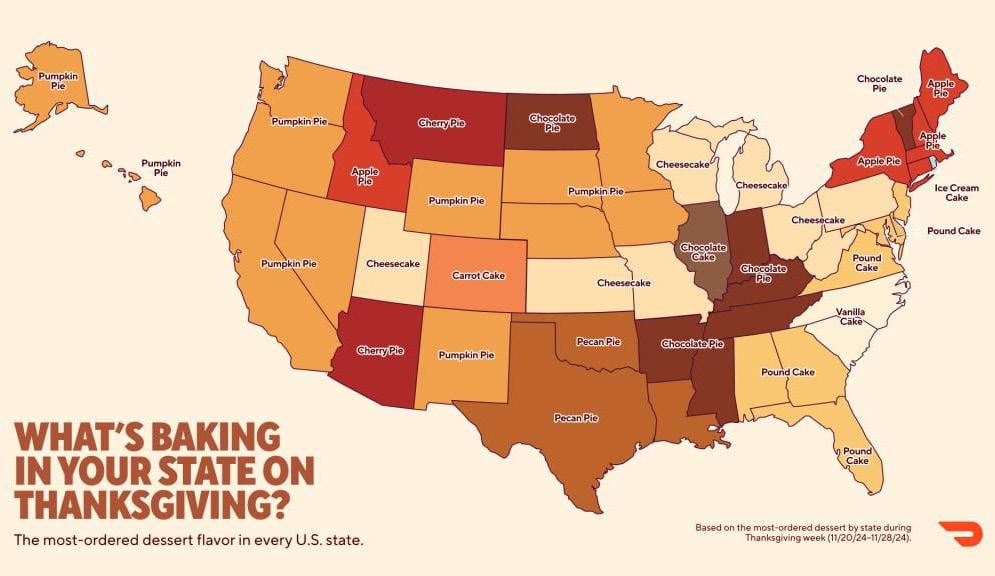
When it comes to Thanksgiving dessert, there’s no one-slice-fits-all. From classic pies to sweet cakes, here’s the breakdown of what each state is really reaching for at the table.
- Pumpkin pride: Pumpkin pie was the top ordered dessert in 12 states, from Alaska and California to Minnesota, Oregon, Vermont, Washington, West Virginia and Wyoming.
- Cheesecake states: Cheesecake stole the show as the creamy dessert favorite in eight states, including
Kansas, Michigan, Pennsylvania and Texas.
- Pound cake power: Pound cake’s buttery slices were the dessert of choice in Delaware, Florida, Georgia, Maryland, New Jersey and Virginia.
- Apple aficionados: Apple pie stayed true to its roots, winning hearts across New England including Massachusetts, Maine and New Hampshire, and fittingly, the home of the Big Apple,New York state.
- Chocolate lovers: Chocolate desserts were big winners, with chocolate pie dominating in states including Arkansas, Indiana, Kentucky, Mississippi, North Dakota and Tennessee, while Illinois preferred chocolate cake.
- Nutty for pecan: Pecan pie was the go-to pick in Louisiana and Oklahoma, proof that the South’s signature dessert isn’t going anywhere.
- Berry fans: Cherry pie was a favorite in Arizona and Montana, adding a tart twist to the Thanksgiving lineup.
- Vanilla victory: Vanilla cake had fans in North and South Carolina, proving that sometimes the simplest desserts can still be sweet.
-Sweet surprises: From ice cream cake in Rhode Island to carrot cake in Colorado to key lime pie in Alabama, some states clearly like to mix it up.
Sides worth seconds
While turkey is the star of the show, sides are the real reason we go back for seconds, and thirds. Based on the most-ordered side dishes nationwide during Thanksgiving, these are the top 10 crowd-pleasers that bring families together and spark friendly debates over which side truly deserves the top spot.
1. Mashed potatoes
Gravy
10. Cornbread
The holiday may be national, but the side-dish loyalties are local. We uncovered which sides stood out across the country.
-Spud nation: Mashed potatoes ruled in 10 states, including Idaho, naturally, Washington, Oregon, Colorado and Pennsylvania, proving no Thanksgiving plate is complete without them.
- The other potato: Sweet potatoes led in Maryland, Virginia and North Carolina, serving up a little Southern sweetness across the table.
- Bean scene: Green beans, usually casserolestyle, took the top spot in seven states including Iowa, Missouri, Indiana and
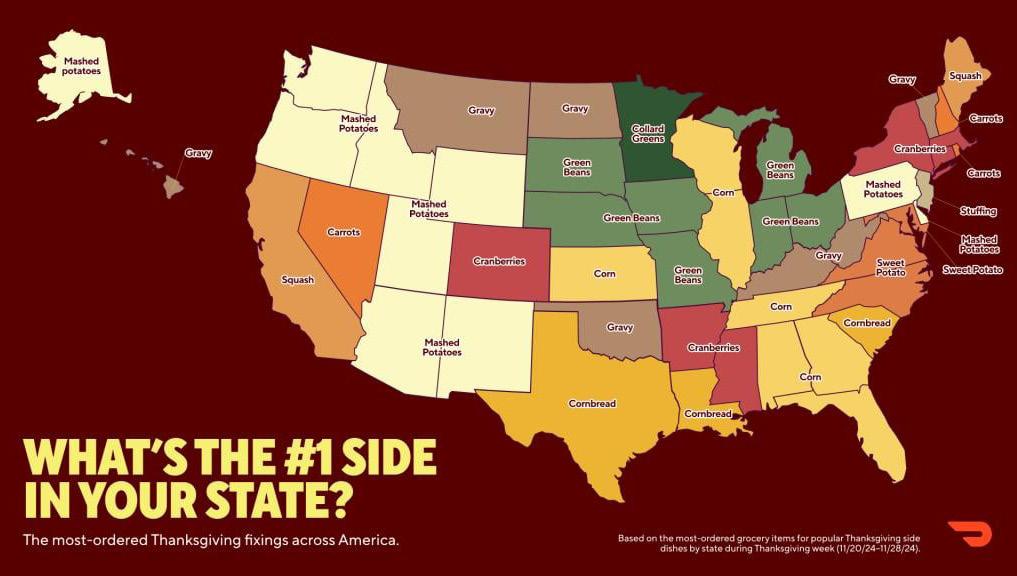

Nebraska.
- Sauce boss: Gravy poured its way to No. 1 in seven states, from Hawaii to Kentucky to Vermont, keeping Thanksgiving dishes anything but dry.
- Corn craze: Corn claimed the top spot in seven states including Florida, Alabama and Georgia, proving simple sides still steal hearts.
- Southern comfort: Cornbread was a favorite in Texas, South Carolina and Louisiana, adding a little Southern comfort to every bite.
- Berry lovers: Cranber-
ries topped orders in six states, including New York, Arizona and Utah, adding a pop of color to every spread.
- Carrot crowd: Carrots were the go-to side in New Hampshire, Nevada and Rhode Island, bringing a sweet crunch to smaller state tables.
- Unique eats: Minnesota went for collard greens, New Jersey chose stuffing and California and Maine gave squash the spotlight.
2025’s side dish to watch
You heard it here first: Squash is having a moment. It’s the trend to watch as
orders surged over 70% year over year during Thanksgiving week in 2024. Orders are trending up nearly 90% year to date in 2025, according to data from Sept. 21, 2025, and is already stealing the spotlight in places like California and Maine where it’s the top most ordered Thanksgiving side dish. Whether roasted, mashed or maple-drizzled,
dressing to yams versus sweet potatoes, DoorDash search data revealed where America really stands.
Stuffing versus dressing: 81% of consumers searched “stuffing” during Thanksgiving week compared to just 19% for “dressing.”
Yams versus sweet potato: Searches leaned 64% toward “sweet potato”
spikes compared to a typical November day — proof that America’s holiday appetite is just as diverse as the people celebrating it.
this veggie favorite is sure to claim a spot on Thanksgiving tables everywhere this year. Serving up semantics
After crowning the top sides and desserts, we figured it was only right to settle the names of the dishes that spark the biggest debates. From stuffing versus
and 36% toward “yams.”
Global holiday spread
In a country as diverse as the U.S., every Thanksgiving table is quite unique. The findings show families mixing global favorites with seasonal staples, with these restaurant dishes seeing the biggest Thanksgiving Day
This story was produced by
and reviewed and distributed by
The article was copy edited and retitled from its original version. Republished with CC BY-NC 4.0 license.
SUMMARY OF ORDINANCE NO. 2025-11
AN ORDINANCE OF THE CITY COUNCIL OF THE CITY OF MONROVIA, CALIFORNIA, ADDING SECTION 17.12.070 TO THE MONROVIA MUNICIPAL CODE AND AMENDING MONROVIA MUNICIPAL CODE SECTIONS 17.04.080 AND 17.52.110 TO CREATE INCENTIVES FOR THE DEVELOPMENT OF BUNGALOW COURTS, AND FINDING ADOPTION OF THE ORDINANCE TO BE CATEGORICALLY EXEMPT FROM REVIEW UNDER THE CALIFORNIA ENVIRONMENTAL QUALITY ACT
This is a summary of the above entitled Ordinance of the City of Monrovia, which was read by title only and introduced by the Monrovia City Council at its regular meeting on November 18, 2025 by a vote of 5 in favor (Belden, Jimenez, Kelly, Shevlin, and Spicer) and 0 opposed. The final vote on the Ordinance will take place at the regular City Council meeting on December 2, 2025 at 7:30 p.m. or as soon thereafter as the matter may be heard, in the City Council Chambers, 415 South Ivy Avenue, Monrovia, California. This summary has been prepared and published in accordance with the requirements of Government Code Section 36933.
Ordinance No. 2025-11 adds a new Section 17.12.070 (Incentives for Bungalow Court Development) to the Monrovia Municipal Code (“MMC”) that allows for minor modifications to setback requirements for the placement of non-habitable, architecturally compatible, openair accessory structures, such as arbors, trellises, and pergolas, in bungalow court developments. The Ordinance also establishes objective standards for those accessory structures. The stated purpose of this new proposed MMC Section is to encourage the development of bungalow courts as a form of low-density, multi-family housing that preserves neighborhood character and combines individual privacy with shared open space.
The Ordinance also amends Monrovia Municipal Code Section 17.52.110 (Minor Exceptions) to provide the Development Review Committee with the authority to grant minor exceptions to setback requirements for non-habitable, architecturally compatible, open-air accessory structures in bungalow courts.
The Ordinance is categorically exempt from the California Environmental Quality Act (“CEQA”) pursuant to CEQA Guidelines Section 15305 (Minor Alterations in Land Use Limitations) because this Ordinance permits minor modifications to existing development standards for non-habitable, architecturally compatible, open-air decorative accessory structures in the courtyards of bungalow courts, and does not result in any changes in land use or density.
A certified copy of the entirety of the text of Ordinance No. 2025-11 is available in the office of the City Clerk in City Hall, and is available for public inspection during regular business hours at that location.
/s/ Alice D. Atkins, MMC, City Clerk
Publish November 27, 2025 MONROVIA WEEKLY
CITY OF EL MONTE ZONING REVIEW COMMITTEE NOTICE OF PUBLIC HEARING
Hablamos Español favor de hablar con Jeni Colon (626) 258-8626
TO: All Interested Parties
FROM: City of El Monte Planning Division
PROJECT LOCATION: 3402 Cogswell Road, Unit B / APNs: 8549030-009
APPLICATION: Minor Use Permit (MUP) No. 13-2024 & Director Level Zoning Clearance (DLZC) No. 09-2025
REQUEST: The applicant is requesting approval to establish a transitional use of a retail water supply store within an existing 1,600 square foot tenant space within a residential zone through MUP No. 13-2024. The applicant is also requesting a parking reduction of one (1) parking space to accommodate voluntary landscaping through DLZC No. 09-2025. The subject property is located within the R-3 (Medium-Density Multiple-Family Dwelling) zone. The MUP request is made pursuant to Chapter 17.123 (Conditional and Minor Use Permits) and 17.120 (Zoning Clearances & Business Permits) of the El Monte Municipal Code (EMMC).
APPLICANT: Carolina & Silverio Pinedo
PROPERTY OWNER: Ling Xiu Yu
ENVIRONMENTAL DOCUMENTATION: Article 19. Categorical Exemptions – Section 15301 (Class 1 – Existing Facilities) in accordance with the requirements of the California Environmental Quality Act of 1970 and the CEQA Guidelines, as amended.
PLACE OF HEARING: Pursuant to State Law, the Zoning Review Committee will hold a public hearing to receive testimony, orally and in writing, on the proposed project. The public hearing is scheduled for:
Date: Tuesday, December 9, 2025
Time: 6:00 p.m.
Place: El Monte City Hall City Hall East – Council Chambers 11333 Valley Boulevard El Monte, CA 91731
Members of the public wishing to observe the meeting may do so by attending the meeting in person at the City’s Council Chambers.
Members of the public wishing to make public comment may do so in one of the following ways:
(1) In person by attending the public hearing at the date, time, and place specified above; or
(2) E-mail – All interested parties can submit questions/comments in advance to the Planning Division’s general e-mail address: planning@elmonteca.gov. All questions/comments must be received by the Planning Division no later than 3:00 pm on December 9, 2025.
The staff report on this matter will be available on or about December 4, 2025, on the City of El Monte website, which may be accessed at https://www.ci.el-monte.ca.us/276/Zoning-Review-Committee or by e-mailing wweisberg@elmonteca.gov.
Americans With Disabilities Act : In compliance with Section 202 of the Americans with Disabilities Act of 1990 (42 U.S.C. Sec. 12132) and the federal rules and regulations adopted in implementation thereof, the Agenda will be made available in appropriate alternative formats to persons with a disability. Should you need special assistance to participate in this meeting, please contact the City Clerk’s Office by calling (626) 580-2016. Notification 48 hours prior to the meeting will enable the City to make reasonable arrangements to ensure accessibility to this meeting.
Persons wishing to comment on the environmental documentation or proposed application may do so in in writing prior to the meeting date and must be received by 3:00 p.m., the day of the meeting. Public Comments of no more than 3-minutes shall be read into the record. Written comments shall be sent to Whitney Weisberg; El Monte City Hall West; 11333 Valley Boulevard; El Monte, CA 91731 or at wweisberg@elmonteca.gov. If you challenge the decision of the Zoning Review Committee, in court, you may be limited to raising only those issues you or someone else raised at the public hearing described in this notice, or in written correspondence delivered to the City Zoning Review Committee at, or prior to, the public hearing.
For further information regarding this application please contact Whitney Weisberg at (626) 258-8808. Monday through Thursday, except legal holidays, between the hours of 7:00 a.m. and 5:30 p.m.
PUBLISHED DATE: Thursday, November 27, 2025, Sandra Elias, City Planner
EL MONTE EXAMINER
CITY OF EL MONTE CITY COUNCIL NOTICE OF PUBLIC HEARING
Hablamos Español favor de hablar con Jeni Colon (626) 258-8626
TO: All Interested Parties
FROM: City of El Monte Planning Division
PROJECT LOCATION: 4378 Santa Anita Avenue (APNs: 8569-013019)
APPLICATIONS: Appeal of Planning Commission Decision
REQUEST: A public hearing to consider an appeal of the Planning Commission’s decision to deny Conditional Use Permit (CUP) No. 3-2023 for the proposed approval to modify an existing off-sale beer and wine license (Type 20 ABC License) to allow an off-sale general (Type 21 ABC License) that authorizes the sale of beer, wine, and distilled spirits for consumption off the premises in conjunction with an existing 1,246± square foot convenience store that is ancillary to the existing Arco service station. The subject site is located within the C-2 (Neighborhood Commercial) zone. This request is made pursuant to Section 17.10.100 (Ability to Appeal) of the El Monte Municipal Code (EMMC).
APPLICANT: Veer Station Partners LLC / Woods, Diaz Group LLC
PROPERTY OWNER: Airport Circle Center LLC
DOCUMENTATION: 1, Section 15301 (Existing Facilities) in accordance with the requirements of the California Environmental Quality Act (CEQA) of 1970 and the CEQA Guidelines, as amended.
PLACE OF HEARING: The City Council will hold a public hearing to receive testimony, orally and in writing, on the proposed project. The public hearing is scheduled for the following date, time, and location:
Dates: Wednesday, December 10, 2025
Time: 7:00 p.m.
Place: El Monte City Hall East – Council Chambers 11333 Valley Boulevard, El Monte, California
Members of the public wishing to observe the meeting may do so in one of the following ways:
(1) Turn your TV to Channel 3;
(2) City’s website at http://www.elmonteca.gov/378/Council-Meeting-Videos; or
(3) In Person
Persons wishing to offer public comment for this meeting may do so in one of the following ways:
(1) By directly addressing the City Council in person at the time(s) allotted on the agenda for such comment. Persons wishing to address the City Council in person are asked to fill-out a blue speaker card providing their name and indicating the specific agenda item(s) they wish to comment on or if they wish to speak during the portion of the agenda designated for comment on non-agendized matters. Speaker cards should be handed to City staff) before the City Council’s approval of the agenda, if possible. The City Council shall be under no obligation to recognize a speaker who submits a speaker card on a particular agenda item after the City Council has completed its handling of the agenda item and has moved on to the next item of business on the agenda. As members of the public are now free to attend City Council meetings in person, the City Council will no longer receive public comment by telephone.
(2) E-mail – All interested parties can submit questions/comments in advance to the Planning Division’s general e-mail address: planning@elmonteca.gov. All questions/comments must be received by the Planning Division no later than 12:00 pm on December 10, 2025.
The staff report on this matter will be available before the City Council meeting on the City of El Monte website, which may be accessed at https://www.ci.el-monte.ca.us/AgendaCenter/ or by e-mailing selias@elmonteca.gov.
Americans With Disabilities Act: In compliance with Section 202 of the Americans with Disabilities Act of 1990 (42 U.S.C. Sec. 12132) and the federal rules and regulations adopted in implementation thereof, the Agenda will be made available in appropriate alternative formats to persons with a disability. Should you need special assistance to participate in this meeting, please contact the City Clerk’s Office by calling (626) 580-2016. Notification 48 hours prior to the meeting will enable the City to make reasonable arrangements to ensure accessibility to this meeting.
Persons wishing to comment on the proposed application may do so orally at the public hearing or in writing prior to the meeting date and must be received by 12:00 pm the day of the meeting. Written comments shall be sent to Sandra Elias; El Monte City Hall West; 11333 Valley Boulevard; El Monte, CA 91731 or at selias@elmonteca.gov. If you challenge the decision of the City Council, in court, you may be limited to raising only those issues you or someone else raised at the public hearing described in this notice, or in written correspondence delivered to the City Council at, or prior to, the public hearing. For further information regarding this application please contact Sandra Elias, City Planner at selias@elmonteca.gov Monday through Thursday, except legal holidays, between the hours of 7:00 a.m. and 5:30 p.m.
Published: Thursday, November 27, 2025
Gabriel Ramirez, City Clerk
EL MONTE EXAMINER
NOTICE OF PUBLIC HEARING FOR THE CITY COUNCIL
The City
Project: An Ordinance of the City of Temple City amending Title 7 (Building Regulations) of the Temple City Municipal Code (TCMC) to adopt by reference the 2025 California Building, Residential, Electrical, Mechanical, Plumbing, Energy, Historical Building, Existing Building, and Green Building Standards Codes, with certain amendments, additions, and deletions. A first reading of the Ordinance was presented to City Council on November 18, 2025.
Residential, Electrical, Mechanical, Plumbing, Energy, Historical Building, Existing Building, and Green Building Standards Codes, with certain amendments, additions, and deletions. A first reading of the Ordinance was presented to City Council on November 18, 2025.
Applicant: City of Temple City, 9701 Las Tunas Drive, Temple City, CA 91780
Applicant: City of Temple City, 9701 Las Tunas Drive, Temple City, CA 91780
Environmental Review:
This Ordinance is not subject to environmental review under the California Environmental Quality Act (“CEQA”) pursuant to Section 15061(B)(3) of the California Public Resources Code, also known as the “Common Sense Exemption.” This is because it can be seen with certainty that there is no possibility that the project will have a significant effect on the environment.
Environmental Review: This Ordinance is not subject to environmental review under the California Environmental Quality Act (“CEQA”) pursuant to Section 15061(B)(3) of the California Public Resources Code, also known as the “Common Sense Exemption.” This is because it can be seen with certainty that there is no possibility that the project will have a significant effect on the environment.
The City Council Public Hearing will be held:
Meeting Date & Time: Tuesday, December 2, 2025, at 7:00 PM
Meeting Location: Temple City – City Council Chambers
5940 Kauffman Avenue, Temple City, California 91780
If you have a request for reasonable modification or accommodation due to a disability covered by the Americans with Disabilities Act, please contact staff (cityclerk@templecity.us or (626) 656-7316) 72 hours in advance of the meeting.
For questions or concerns regarding this project, or if you wish to review the project file, please contact:
For questions or concerns regarding this project, or if you wish to review the project file, please contact:
Project Planner: Tony Bu, Community Development Supervisor (626) 656-7316 tbu@templecity.us
Project Planner: Tony Bu, Community Development Supervisor (626) 656-7316 tbu@templecity.us
vice area. The proposed programs/projects for the 20262027 fiscal year are listed in the table below. Please note that the proposed budgets for specific projects are subject to change.
year is not to exceed $271,086. This includes an anticipated 2% decrease from the current year’s allocation amount. These funds may be used for a broad range of activities that advance community development goals of providing decent housing, a suitable living environment, and expanded economic opportunities for low- and moderate-income persons. For the upcoming fiscal year, Code Enforcement and Graffiti Control Program from the previous year are recommended for continuation, in addition to a street improvement project consisting of several streets within the CDBG eligible service area. The proposed programs/projects for the 2026-2027 fiscal year are listed in the table below. Please note that the proposed budgets for specific projects are subject to change.
Activity Proposed Use of CDBG Funds
Code Enforcement Identification of code deficiencies as they relate to planning, zoning, health & safety and substandard housing issues.
S Gladys Ave & E Marshall St (NW, NE)
Dewey Ave & California St (SE)
California St & E Norwood Pl (All Corners)
Walnut St & E Norwood Pl (All Corners)
Street Improvement
Project Construction of street repairs to include the following streets:
E Norwood Pl & Strathmore Ave (All Corners)
Dewey Ave & Strathmore Ave (All Corners)
S Palm Ave & E Ralph St (NW, SW)
S Palm Ave & E Bencamp St (NW, SW)
Euclid Ave & Dewey Ave (NE, NW)
Walnut St & E Newby Ave (All Corners)
Euclid Ave & E Newby Ave (All Corners)
Graffiti Removal Program Removal of graffiti on public and private property in residential and neighborhood commercial properties within the low- and moderate- income service areas.
Total
Proposed FY 202627 Allocation
$85,000
$145,424
The independent administration authority will be granted unless an interested person files an objection to the petition and shows good cause why the court should not grant the authority.
A HEARING on the petition will be held in this court as follows: 12/19/25 at 8:30AM in Dept. 5 located at 111 N. HILL ST., LOS ANGELES, CA 90012
IF YOU OBJECT to the granting of the petition, you should appear at the hearing and state your objections or file written objections with the court before the hearing. Your appearance may be in person or by your attorney.
IF YOU ARE A CREDITOR or a contingent creditor of the decedent, you must file your claim with the court and mail a copy to the personal representative appointed by the court within the later of either (1) four months from the date of first issuance of letters to a general personal representative, as defined in section 58(b) of the California Probate Code, or (2) 60 days from the date of mailing or personal delivery to you of a notice under section 9052 of the California Probate Code.
$40,662
$271,086
Questions: For further information on the CDBG Program administered by the City of San Gabriel, please contact the Community Development Department at (626) 308-2826.
Questions: For further information on the CDBG Program administered by the City of San Gabriel, please contact the Community Development Department at (626) 308 -2826.
Per Government Code Section 65009, if you challenge the nature of this proposed action in court, you may be limited to only raising those issues you or someone else raised at the public hearing described in this notice, or in written correspondence delivered to the City Clerk’s Department at or prior to the public hearing.
SAN GABRIEL CITY COUNCIL
By Julie Nguyen, City Clerk
Published on November 27,2025
SAN GABRIEL SUN
Other California statutes and legal authority may affect your rights as a creditor. You may want to consult with an attorney knowledgeable in California law.
YOU MAY EXAMINE the file kept by the court. If you are a person interested in the estate, you may file with the court a Request for Special Notice (form DE-154) of the filing of an inventory and appraisal of estate assets or of any petition or account as provided in Probate Code section 1250. A Request for Special Notice form is available from the court clerk.
Attorney for Petitioner
SPENCER D. WALCH, ESQ. - SBN 186602
WALCH & WALCH A LAW CORPORATION
301 N. LAKE AVE., 7TH FLR. PASADENA CA 91101-5118
Telephone (626) 844-6697
11/24, 11/27, 12/1/25
or personal delivery to you of a notice under section 9052 of the California Probate Code. Other California statutes and legal authority may affect your rights as a creditor. You may want to consult with an attorney knowledgeable in California law.
YOU MAY EXAMINE the file kept by the court. If you are a person interested in the estate, you may file with the court a Request for Special Notice (form DE-154) of the filing of an inventory and appraisal of estate assets or of any petition or account as provided in Probate Code section 1250. A Request for Special Notice form is available from the court clerk. Attorney for Petitioner SYBIL YVONNE BURRELL - CSB 183383 101 N. CITRUS AVE., SUITE 2B COVINA CA 91723
Telephone (213) 572-3700 11/27, 12/1, 12/4/25 CNS-3989256# DUARTE DISPATCH
NOTICE OF PETITION TO ADMINISTER ESTATE OF:
GWEN J. ROCHE AKA GWEN ALICE ROCHE AKA GWEN ROCHE CASE NO. 25STPB13147
To all heirs, beneficiaries, creditors, contingent creditors, and persons who may otherwise be interested in the WILL or estate, or both of GWEN J. ROCHE AKA GWEN ALICE ROCHE AKA GWEN ROCHE.
CNS-3989016# DUARTE DISPATCH
The decision of City Council is final. If you challenge any of the foregoing actions in court, you may be limited to raising only those issues you or someone else raised at the public hearing or in written correspondence delivered to the hearing body at, or prior to, the public hearing.
at the public hearing or in written correspondence delivered to the hearing body at, or prior to, the public hearing.
The decision of City Council is final. If you challenge any of the foregoing actions in court, you may be limited to raising only those issues you or someone else raised at the public hearing or in written correspondence delivered to the hearing body at, or prior to, the public hearing.
Date: November 19, 2025 Signature:

Public Notice: City of San Gabriel Notice of Public Hearing Before the City Council
You are invited to participate in a public hearing before the San Gabriel City Council. You will have an opportunity to present your opinion regarding this item at the meeting or in writing prior to the meeting. Please submit all written comments to the City Clerk Department, in person or electronically using the online public comment form at https://www.sangabrielcity.com/PublicComment by the hearing date to be considered by the City Council. The meeting will be broadcast on the City of San Gabriel’s YouTube channel: https:// www.youtube.com/CityofSanGabriel
Hearing Date: Tuesday, December 16, 2025 TIME: 6:30 p.m. Location Of Hearing: Council Chambers located on the second floor of San Gabriel City Hall (425 South Mission Drive, San Gabriel, CA 91776) The meeting can be viewed live at: https://www.youtube. com/CityofSanGabriel
Project Address: Citywide
Project Description: The City of San Gabriel City Council will hold a public hearing on Tuesday, December 16, 2025. The purpose of the hearing is to consider the proposed FY 2026-2027 Community Development Block Grant (CDBG) Program Allocations and Budget Plan.:
I. The Los Angeles County Development Authority has informed the City of San Gabriel that the preliminary federal CDBG funding allocation estimate for the 2026-2027 fiscal year is not to exceed $271,086. This includes an anticipated 2% decrease from the current year’s allocation amount. These funds may be used for a broad range of activities that advance community development goals of providing decent housing, a suitable living environment, and expanded economic opportunities for low- and moderate-income persons. For the upcoming fiscal year, Code Enforcement and Graffiti Control Program from the previous year are recommended for continuation, in addition to a street improvement project consisting of several streets within the CDBG eligible ser-
NOTICE OF PETITION TO ADMINISTER ESTATE OF LILLIAN J. PRINCE
Case No. 25STPB05081
To all heirs, beneficiaries, cred-itors, contingent creditors, and persons who may otherwise be interested in the will or estate, or both, of LILLIAN J. PRINCE
A PETITION FOR PROBATE has been filed by Jodi Critz, also known as Jo A. Critz in the Superior Court of California, County of LOS ANGELES.
THE PETITION FOR PROBATE requests that Jodi Critz be appointed as personal representative to administer the estate of the decedent.
THE PETITION requests the decedent's will and codicils, if any, be admitted to probate. The will and any codicils are available for examination in the file kept by the court.
THE PETITION requests authority to administer the estate under the Independent Administration of Estates Act. (This authority will allow the personal representative to take many actions without obtaining court approval. Before taking certain very important actions, however, the personal representative will be required to give notice to interested persons unless they have waived notice or consented to the proposed action.) The independent administration authority will be granted unless an interested person files an objec-tion to the petition and shows good cause why the court should not grant the authority.
A HEARING on the petition will be held on Dec. 23, 2025 at 8:30 AM in Dept. No. 5 located at 111 N. Hill St., Los Angeles, CA 90012.
IF YOU OBJECT to the granting of the petition, you should appear at the hearing and state your objections or file written objections with the court before the hearing. Your ap-pearance may be in person or by your attorney.
IF YOU ARE A CREDITOR or a contingent creditor of the decedent, you must file your claim with the court and mail a copy to the personal representative appointed by the court within the later of either (1) four months from the date of first issuance of letters to a general personal representative, as defined in section 58(b) of the California Probate Code, or (2) 60 days from the date of mailing or personal delivery to you of a notice under section 9052 of the California
Probate Code. Other California statutes and legal authority may affect your rights as a creditor. You may want to consult with an attorney knowl-edgeable in California law. YOU MAY EXAMINE the file kept by the court. If you are a person interested in the estate, you may file with the court a Request for Special Notice (form DE-154) of the filing of an inventory and appraisal of estate assets or of any petition or account as provided in Probate Code section 1250. A Request for Special Notice form is available from the court clerk. Attorney for petitioner: DARRELL G BROOKE ESQ SBN 118071
THE BROOKE LAW GROUP PC 525 S MYRTLE AVE STE 204 MONROVIA CA 91016 CN121998 PRINCE Nov 24,27, Dec 1, 2025 MONROVIA WEEKLY
NOTICE OF PETITION TO ADMINISTER ESTATE OF:
ELEANOR F. MEAGLIA AKA
ELEANOR MEAGLIA CASE NO. 25STPB13106
To all heirs, beneficiaries, creditors, contingent creditors, and persons who may otherwise be interested in the lost WILL or estate, or both of ELEANOR F. MEAGLIA AKA ELEANOR MEAGLIA.
A PETITION FOR PROBATE has been filed by LORI IRELAND in the Superior Court of California, County of LOS ANGELES.
THE PETITION FOR PROBATE requests that LORI IRELAND be appointed as personal representative to administer the estate of the decedent.
THE PETITION requests the decedent's lost WILL and codicils, if any, be admitted to probate. The lost WILL and any codicils are available for examination in the file kept by the court.
THE PETITION requests authority to administer the estate under the Independent Administration of Estates Act with limited authority. (This authority will allow the personal representative to take many actions without obtaining court approval. Before taking certain very important actions, however, the personal representative will be required to give notice to interested persons unless they have waived notice or consented to the proposed action.)
NOTICE OF PETITION TO ADMINISTER ESTATE OF: SANDRA COLLIER AKA SANDRA COLLIER-CARTER CASE NO. 24STPB13417
To all heirs, beneficiaries, creditors, contingent creditors, and persons who may otherwise be interested in the lost WILL or estate, or both of SANDRA COLLIER AKA SANDRA COLLIER-CARTER.
A PETITION FOR PROBATE has been filed by KENNETH COLLIER, SR. in the Superior Court of California, County of LOS ANGELES.
THE PETITION FOR PROBATE requests that KENNETH COLLIER, SR. be appointed as personal representative to administer the estate of the decedent.
THE PETITION requests the decedent's lost WILL and codicils, if any, be admitted to probate. The lost WILL and any codicils are available for examination in the file kept by the court.
THE PETITION requests authority to administer the estate under the Independent Administration of Estates Act. (This authority will allow the personal representative to take many actions without obtaining court approval. Before taking certain very important actions, however, the personal representative will be required to give notice to interested persons unless they have waived notice or consented to the proposed action.) The independent administration authority will be granted unless an interested person files an objection to the petition and shows good cause why the court should not grant the authority.
A HEARING on the petition will be held in this court as follows: 12/19/25 at 8:30AM in Dept. 29 located at 111 N. HILL ST., LOS ANGELES, CA 90012
IF YOU OBJECT to the granting of the petition, you should appear at the hearing and state your objections or file written objections with the court before the hearing. Your appearance may be in person or by your attorney.
IF YOU ARE A CREDITOR or a contingent creditor of the decedent, you must file your claim with the court and mail a copy to the personal representative appointed by the court within the later of either (1) four months from the date of first issuance of letters to a general personal representative, as defined in section 58(b) of the California Probate Code, or (2) 60 days from the date of mailing
A PETITION FOR PROBATE has been filed by KAREN L. RIPS in the Superior Court of California, County of LOS ANGELES. THE PETITION FOR PROBATE requests that KAREN L. RIPS be appointed as personal representative to administer the estate of the decedent. THE PETITION requests the decedent's WILL and codicils, if any, be admitted to probate. The WILL and any codicils are available for examination in the file kept by the court. THE PETITION requests authority to administer the estate under the Independent Administration of Estates Act with limited authority. (This authority will allow the personal representative to take many actions without obtaining court approval. Before taking certain very important actions, however, the personal representative will be required to give notice to interested persons unless they have waived notice or consented to the proposed action.) The independent administration authority will be granted unless an interested person files an objection to the petition and shows good cause why the court should not grant the authority.
A HEARING on the petition will be held in this court as follows: 12/24/25 at 8:30AM in Dept. 5 located at 111 N. HILL ST., LOS ANGELES, CA 90012 IF YOU OBJECT to the granting of the petition, you should appear at the hearing and state your objections or file written objections with the court before the hearing. Your appearance may be in person or by your attorney.
IF YOU ARE A CREDITOR or a contingent creditor of the decedent, you must file your claim with the court and mail a copy to the personal representative appointed by the court within the later of either (1) four months from the date of first issuance of letters to a general personal representative, as defined in section 58(b) of the California Probate Code, or (2) 60 days from the date of mailing or personal delivery to you of a notice under section 9052 of the California Probate Code. Other California statutes and legal authority may affect your rights as a creditor. You may want to consult with an attorney knowledgeable in California law.
YOU MAY EXAMINE the file kept by the court. If you are a person interested in the estate, you may file with the court a Request for Special Notice (form DE-154) of the filing of an inventory and appraisal of estate assets or of any petition or account as provided in Probate Code section 1250. A Request for Special Notice form is available from the court clerk.
By Staff



By City News Service
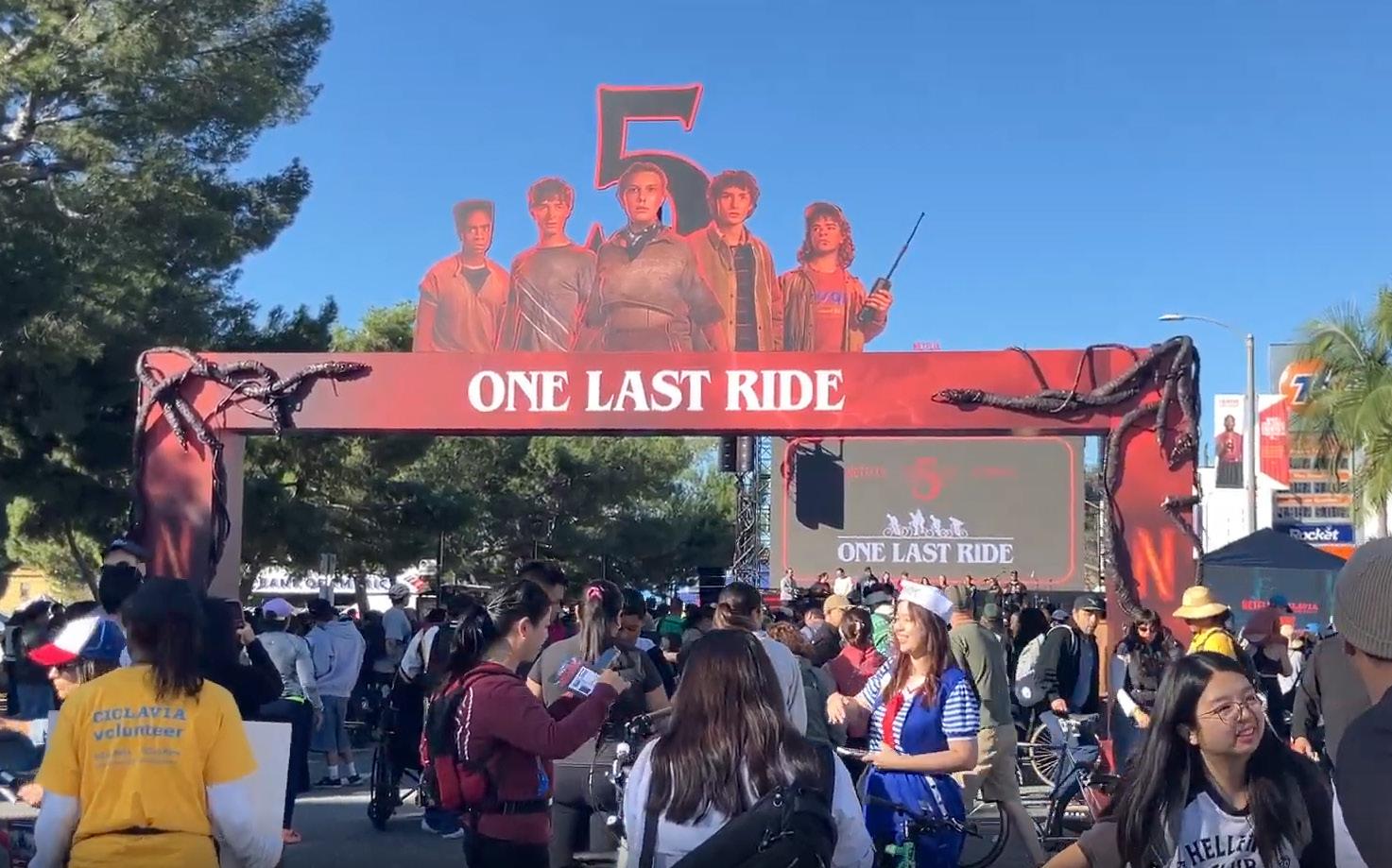
Lout their 2025 calendar with something different Sunday -- joining forces with Netflix's smash hit "Stranger Things" to celebrate the show's final season.
"Netflix x CicLAvia -Melrose Ave: Stranger Things 5 One Last Ride" took place from 9 a.m. to 3 p.m. Sunday.
Melrose Avenue was closed to electric vehicle traffic between Vermont and Fairfax avenues. Attendees were invited to explore the neighborhood by walking, jogging, biking, roller skating, and of course patronizing local businesses.
"This epic event is bringing fans together to bike, skate, or stroll along a car-free stretch of Melrose Ave in celebration of the cultural phenomenon's
finale season. For one day only, the street will be re-imagined as Hawkins itself, where the familiar collides with the mysteries of the Upside Down and fans come together for one last adventure," CicLAvia officials said.
"We're going full 1980s! You can show up as your favorite Hawkins character or monster of the Upside Down or channel peak '80s vibes with neon, leg warmers, windbreakers, or any totally awesome retro fit."
Although electric vehicles were prohibited, motorized wheelchairs and related vehicles for people with disabilities were allowed, as were Class 1 pedal-assisted e-bikes, Class 2 e-bikes when the throttle was powered off, and Class 3 e-bikes when pedal-assist was powered off.
CicLAvia is a non-profit organization that has been operating the regular street festivals throughout the Los Angeles area since 2010. Sunday's event was the 64th CicLAvia.
More information is available at ciclavia.org.
"Stranger Things" began airing on Netflix in 2016 and became an instant hit, quickly growing into a cultural phenomenon. Set in the 1980s, it stars Winona Ryder, David Harbour, Finn Wolfhard, Millie Bobby Brown and others, and concerns a group of young friends in an Indiana suburb who witness supernatural occurrences and get involved in trying to solve the mystery while occasionally battling with government officials.
Its fifth and final season will begin streaming on Nov. 26.

CITY OF GLENDALE – NOTICE OF PUBLIC COMMENT PERIOD
Substantial Amendment to the HOME-ARP Allocation Plan
The City of Glendale is proposing a substantial amendment to its HOME-ARP Allocation Plan. The original plan, approved by HUD in 2023, allocated nearly all HOME-ARP funding to the development of affordable housing at 426 Piedmont Avenue, with a preference for seniors facing or at risk of homelessness.
Because that project required less funding than anticipated, the City proposes to reallocate $2,100,000 of HOME-ARP funds to support the rehabilitation and expansion of a transi-tional housing facility in Glendale. The project will create 19 permanent supportive units for women and families affected by domestic violence.
Additionally, HUD identified an administrative error in the City’s original HOME-ARP award.
As a result, Glendale’s total allocation has been increased from $5,109,346 to $5,116,976. Consistent with HUD rules, up to 15% of this correction is allocated to Administration & Planning, with the balance added to the domestic violence housing activity. This amend¬ment reflects both the new project activity and the corrected total award.
This amendment qualifies as a substantial amendment under HUD regulations because it adds a new activity and updates the total award amount. The senior preference established for the Piedmont project does not apply to this new activity.
The draft amendment is available for public review at:
- Online: www.glendaleca.gov/affordablehousing
- In person: Community Development Department – Housing Division, 141 N. Glendale Avenue, Suite 202, Glendale, CA 91206
Public Comment Period: November 17, 2025 – December 1, 2025
Written comments may be submitted by email to abrownell@glendaleca.gov or by mail
to the address above. All comments received by December 1, 2025 at 5:00 p.m. will be consid¬ered before the amendment is submitted to HUD.
Public Hearing: The Glendale City Council and Housing Authority will hold a joint public hearing on December 2, 2025 at 3:00 PM at 613 E. Broadway, 2nd floor, Glendale, CA 91206 to consider adoption of the substantial amendment.
Contact: Aaron Brownell, Senior Housing Project Manager | abrownell@glendaleca.gov | 818-550-4530
Publish November 17, 20, 24, December 1, 2025 GLENDALE INDEPENDENT
NOTICE OF PLANNING COMMISSION PUBLIC HEARING CITY OF GLENDALE ZONING MAP AMENDMENT, ZONE CHANGE AND STATUTORY DEVELOPMENT AGREEMENT RELATING TO SIGNAGE IN THE ADVERTISING SIGNAGE OVERLAY ZONE
NOTICE IS HEREBY GIVEN:
Project Location of Zoning Map
228 - 252 SOUTH BRAND BLVD. -Downtown Specific Plan (DSP), Downtown “Arts and Entertainment” District
Assessor Parcel Nos: 5642-013-007, 5642-013-008 and 5642-013-014
Legal Description: Lots 8 – 16 and a Portion of Lot 17 and the vacated alley east of these lots, Tract No. 2461
Project Description
The Planning Commission will make a recommendation to the City Council regarding proposed amendments to Chapter 30.26 – Advertising Signage Overlay Zone (ASOZ) to provide a definition for ASOZ wall sign, and amend the criteria to approve an ASOZ and regulations for signs allowed by the ASOZ. The applicant is also proposing to change the zone map to expand the boundary of the ASOZ overlay zone and identify the locations, sizes and elevations of new signs incorporated into the expanded ASOZ boundary (Code Amendment Case No. PZC 0014-2025). The applicant is Chris Robertson of Caruso.
The ASOZ is located in areas of the City-designated Downtown Specific Plan (DSP) and within the boundaries of the Central Glendale Redevelopment Project Area. The existing ASOZ area is bounded by West Broadway to the north, South Brand Boulevard to the east, Colorado Street to the south and South Columbus Street to the west.
The applicant has also requested a statutory Development Agreement to comply with GMC Section 30.26.100, including the provision of certain public benefits to the City and the Development Agreement term.
Environmental Determination
The proposed Zoning Ordinance Amendment is exempt from environmental review under the California Environmental Quality Act (CEQA) pursuant to CEQA Guidelines Section 15305 - Minor Alterations in Land Use Limitations, because the proposed expansion of the ASOZ is a minor change to existing zoning regulations that does not result in any changes in either permitted land use (commercial) or density. The amendment is also exempt pursuant to CEQA Guidelines Section 15303 - New Construction or Conversion of Small Structures, because the expansion of the ASOZ would allow for a limited number of new, small structures in the form of signage. In addition, the amendment is categorically exempt under Section 15331 - Historical Resource Restoration/Rehabilitation, to the extent it applies to work on historic resources in a manner consistent with the Secretary of the Interior’s Standards for the Treatment of Historic Properties.
The ordinance establishes standards for digital signage on buildings, including limitations on size, brightness, location, and design to ensure compatibility with the historic character of affected structures and surrounding areas. Any future sign proposals will remain subject to review against these standards.
Public Hearing
Said matter concerning the proposed amendments will be the subject of a public hearing by the Planning Commission at 633 East Broadway (Municipal Services Building), Room 105, Glendale, CA 91206, on the 17TH DAY OF DECEMBER, 2025, at or after the hour of 5:00 p.m. The Planning Commission will make a recommendation to the City Council concerning this matter.
The meeting can be viewed on Charter Cable Channel 6 or streamed online at: https://www.glendaleca.gov/government/departments/management-services/gtv6/livevideo-stream.
For public comments and questions during the meeting call 818-937-8100. City staff will be submitting these questions and comments in real time to the appropriate person during the Planning Commission meeting.
If you desire more information on the proposal, please contact Roger Kiesel, Senior Planner, in the Community Development Department at (818) 937-8152 or email: RKiesel@ glendaleca.gov.
Any person having an interest in the subject project may participate in the hearing, in person or by phone as outlined above, and may be heard in support of his/her opinion. Any person protesting may file a duly signed and acknowledged written protest with the Director of Community Development not later than the hour set for public hearing before the Planning Commission. “Acknowledged”
at the public hearing described in this notice, or in written correspondence delivered to the City of Glendale, at or prior to the public hearing. In compliance with the Americans with Disabilities Act (ADA) of 1990, please notify the Community Development Department at least 48 hours (or two business days) for requests regarding sign language translation and Braille transcription services.
Staff reports are accessible prior to the meeting through hyperlinks in the ‘Agendas and Minutes’ section. Website Internet Address: www.glendaleca.gov/agendas
Dr. Suzie Abajian, The City Clerk of the City of Glendale Publish November 27, 2025 GLENDALE INDEPENDENT
BUENA PARK CA 90621
NOTICE OF PETITION TO ADMINISTER ESTATE OF: TERESITA CRUZ BENAVENTE AKA TERESITA BENAVENTE CASE NO. 30-2025-01525466-PR-LACMC o all heirs, beneficiaries, creditors, contingent creditors, and persons who may otherwise be interested in the WILL or estate, or both of TERESITA CRUZ BENAVENTE AKA TERESITA BENAVENTE.
A PETITION FOR PROBATE has been filed by ANNIE B. ECKELS in the Superior Court of California, County of ORANGE.
THE PETITION FOR PROBATE requests that ANNIE B. ECKELS be appointed as personal representative to administer the estate of the decedent.
THE PETITION requests authority to administer the estate under the Independent Administration of Estates Act. (This authority will allow the personal representative to take many actions without obtaining court approval. Before taking certain very important actions, however, the personal representative will be required to give notice to interested persons unless they have waived notice or consented to the proposed action.) The independent administration authority will be granted unless an interested person files an objection to the petition and shows good cause why the court should not grant the authority.
A HEARING on the petition will be held in this court as follows: 01/07/26 at 1:30PM in Dept. CM08 located at 3390 HARBOR BLVD., COSTA MESA, CA 92626
NOTICE IN PROBATE CASES
The court is providing the convenience to appear for hearing by video using the court's designated video platform. This is a no cost service to the public. Go to the Court's website at The Superior Court of California - County of Orange (occourts.org) to appear remotely for Probate hearings and for remote hearing instructions. If you have difficulty connecting or are unable to connect to your remote hearing, call 657-622-8452 for assistance. If you prefer to appear in-person, you can appear in the department on the day/time set for your hearing.
IF YOU OBJECT to the granting of the petition, you should appear at the hearing and state your objections or file written objections with the court before the hearing. Your appearance may be in person or by your attorney.
IF YOU ARE A CREDITOR or a contingent creditor of the decedent, you must file your claim with the court and mail a copy to the personal representative appointed by the court within the later of either (1) four months from the date of first issuance of letters to a general personal representative, as defined in section 58(b) of the California Probate Code, or (2) 60 days from the date of mailing or personal delivery to you of a notice under section 9052 of the California Probate Code.
Other California statutes and legal authority may affect your rights as a creditor. You may want to consult with an attorney knowledgeable in California law.
YOU MAY EXAMINE the file kept by the court. If you are a person interested in the estate, you may file with the court a Request for Special Notice (form DE-154) of the filing of an inventory and appraisal of estate assets or of any petition or account as provided in Probate Code section 1250. A Request for Special Notice form is available from the court clerk.
Attorney for Petitioner ROBERT L. COHEN, ESQ. - SBN 150913
LAW OFFICES OF ROBERT L. COHEN, INC.
8081 ORANGETHORPE AVE.
Telephone (714) 522-8880 11/20, 11/24, 11/27/25 CNS-3986999# ANAHEIM PRESS
NOTICE OF PETITION TO ADMINISTER ESTATE OF LINDA HAIRONG WU
Case No. 25STPB12960
To all heirs, beneficiaries, creditors, contingent creditors, and persons who may otherwise be interested in the will or estate, or both, of LINDA HAIRONG WU
A PETITION FOR PROBATE has been filed by Joey Wu in the Superior Court of California, County of LOS ANGELES.
THE PETITION FOR PROBATE requests that Joey Wu be appointed as personal representative to administer the estate of the decedent.
THE PETITION requests authority to administer the estate under the Independent Administration of Estates Act. (This authority will allow the personal representative to take many actions without obtaining court ap-proval. Before taking certain very important actions, however, the per-sonal representative will be required to give notice to interested persons unless they have waived notice or consented to the proposed action.) The independent administration authority will be granted unless an interested person files an objection to the petition and shows good cause why the court should not grant the authority.
A HEARING on the petition will be held on Dec. 18, 2025 at 8:30 AM in Dept. No. 4 located at 111 N. Hill St., Los Angeles, CA 90012.
IF YOU OBJECT to the granting of the petition, you should appear at the hearing and state your objections or file written objections with the court before the hearing. Your appearance may be in person or by your attorney.
IF YOU ARE A CREDITOR or a contingent creditor of the decedent, you must file your claim with the court and mail a copy to the personal rep-resentative appointed by the court within the later of either (1) four months from the date of first issuance of letters to a general personal representative, as defined in section 58(b) of the California Probate Code, or (2) 60 days from the date of mailing or personal delivery to you of a notice under section 9052 of the California Probate Code.
Other California statutes and legal authority may affect your rights as a creditor. You may want to consult with an attorney knowledgeable in California law.
YOU MAY EXAMINE the file kept by the court. If you are a person interested in the estate, you may file with the court a Request for Special Notice (form DE-154) of the filing of an inventory and appraisal of estate assets or of any petition or account as provided in Probate Code section 1250. A Request for Special Notice form is available from the court clerk.
Attorney for petitioner: JUSTIN M GORDON ESQ SBN 287328
GORDONLAW APC 12100 WILSHIRE BLVD STE 800 LOS ANGELES CA 90025 CN121993 WU Nov 24,27, Dec 1, 2025 ALHAMBRA PRESS
NOTICE OF PETITION TO ADMINISTER ESTATE OF: GENEVIEVE DENZON PACANA CASE NO. 25STPB13054
To all heirs, beneficiaries, creditors, contingent creditors, and persons who may otherwise be interested in the lost WILL or estate, or both of GENEVIEVE DENZON PACANA.
A PETITION FOR PROBATE has been filed by GORDON PACANA
in the Superior Court of California, County of LOS ANGELES.
THE PETITION FOR PROBATE requests that GORDON PACANA be appointed as personal representative to administer the estate of the decedent.
THE PETITION requests the decedent's lost WILL and codicils, if any, be admitted to probate. The lost WILL and any codicils are available for examination in the file kept by the court.
THE PETITION requests authority to administer the estate under the Independent Administration of Estates Act. (This authority will allow the personal representative to take many actions without obtaining court approval. Before taking certain very important actions, however, the personal representative will be required to give notice to interested persons unless they have waived notice or consented to the proposed action.) The independent administration authority will be granted unless an interested person files an objection to the petition and shows good cause why the court should not grant the authority.
A HEARING on the petition will be held in this court as follows: 12/18/25 at 8:30AM in Dept. 62 located at 111 N. HILL ST., LOS ANGELES, CA 90012
IF YOU OBJECT to the granting of the petition, you should appear at the hearing and state your objections or file written objections with the court before the hearing. Your appearance may be in person or by your attorney.
IF YOU ARE A CREDITOR or a contingent creditor of the decedent, you must file your claim with the court and mail a copy to the personal representative appointed by the court within the later of either (1) four months from the date of first issuance of letters to a general personal representative, as defined in section 58(b) of the California Probate Code, or (2) 60 days from the date of mailing or personal delivery to you of a notice under section 9052 of the California Probate Code. Other California statutes and legal authority may affect your rights as a creditor. You may want to consult with an attorney knowledgeable in California law.
YOU MAY EXAMINE the file kept by the court. If you are a person interested in the estate, you may file with the court a Request for Special Notice (form DE-154) of the filing of an inventory and appraisal of estate assets or of any petition or account as provided in Probate Code section 1250. A Request for Special Notice form is available from the court clerk. Attorney for Petitioner
GAREE T. GASPERIAN - SBN 136631 GASPERIAN LAW CORPORATION 966 ARTESIA BLVD. HERMOSA BEACH CA 90254 Telephone (310) 606-2576 11/24, 11/27, 12/1/25 CNS-3988483# GLENDALE INDEPENDENT
NOTICE OF PETITION TO ADMINISTER ESTATE OF: RONDA C. CHAMPAGNE CASE NO. 25STPB13111
To all heirs, beneficiaries, creditors, contingent creditors, and persons who may otherwise be interested in the WILL or estate, or both of RONDA C. CHAMPAGNE. A PETITION FOR PROBATE has been filed by BRIAN J. COLSELL in the Superior Court of California, County of LOS ANGELES.
THE PETITION FOR PROBATE requests that BRIAN J. COLSELL be appointed as personal representative to administer the estate of the decedent.
THE PETITION requests authority to administer the estate under the Independent Administration of Estates Act. (This authority will allow the personal representative to take many actions without obtaining court approval. Before taking certain very important actions, however, the personal representative will be required to give notice to interested persons unless they have waived notice or consented to the proposed action.) The independent administration authority will be granted unless an interested person files an objection to the petition and shows good cause why the court should not grant the authority.
A HEARING on the petition will be held in this court as follows: 12/19/25
at 8:30AM in Dept. 5 located at 111 N. HILL ST., LOS ANGELES, CA 90012
IF YOU OBJECT to the granting of the petition, you should appear at the hearing and state your objections or file written objections with the court before the hearing. Your appearance may be in person or by your attorney. IF YOU ARE A CREDITOR or a contingent creditor of the decedent, you must file your claim with the court and mail a copy to the personal representative appointed by the court within the later of either (1) four months from the date of first issuance of letters to a general personal representative, as defined in section 58(b) of the California Probate Code, or (2) 60 days from the date of mailing or personal delivery to you of a notice under section 9052 of the California Probate Code. Other California statutes and legal authority may affect your rights as a creditor. You may want to consult with an attorney knowledgeable in California law.
YOU MAY EXAMINE the file kept by the court. If you are a person interested in the estate, you may file with the court a Request for Special Notice (form DE-154) of the filing of an inventory and appraisal of estate assets or of any petition or account as provided in Probate Code section 1250. A Request for Special Notice form is available from the court clerk. Attorney for Petitioner
JENNIFER N. SAWDAY, ESQ.SBN 228320 TREDWAY, LUMSDAINE, AND DOYLE, LLP 3900 KILROY AIRPORT WAY, SUITE 240 LONG BEACH CA 90806 Telephone (562) 923-0871 BSC 227720 11/27, 12/4, 12/11/25 CNS-3990034# BELMONT BEACON
FICTITIOUS BUSINESS
NAME STATEMENT
FBN20250009545
File No.
The following persons are doing business as: (1). EverTrust Dental Works (2). Drealman Farm (3). Drealman Zered , 10233 Riggins Rd, Phelan, CA 92371. Mailing Address, , 10233 Riggins Rd, Phelan, CA 92371. # of Employees 1. Drealman Alliance LLC (CA, 10233 Riggins Rd, Phelan, CA 92371; Danny Y.K Yang, Manager. County of Principal Place of Business: San Bernardino
This business is conducted by: a limited liability company (llc). Registrant has not yet begun to transact business under the fictitious business name or names listed herein.
By signing below, I declare that I have read and understand the reverse side of this form and that all information in this statement is true and correct. A registrant who declares as true any material matter pursuant to Section 17913 of the Business and Professions Code that the registrant knows to be false is guilty of a misdemeanor punishable by a fine not to exceed one thousand dollars ($1,000). I am also aware that all information on this statement becomes Public Record upon filing pursuant to the California Public Records Act (Government Code Sections 6250- 6277). /s/ Danny Y.K Yang, Manager. This statement was filed with the County Clerk of San Bernardino on October 8, 2025 Notice- In accordance with subdivision (a) of Section 17920. A Fictitious Name Statement generally expires at the end of five years from the date on which it was filed in the office of the County Clerk, except, as provided in subdivision (b) of Section 17920, where it expires 40 days after any change in the facts set forth in the statement pursuant to Section 17913 other than a change in the residence address of a registered owner. A new Fictitious Business Name Statement must be filed before the expiration. The filing of this statement does not of itself authorize the use in this state of a fictitious business name in violation of the rights of another under federal, state, or common law (see Section 14411 et seq., Business and Professions Code) File#: FBN20250009545 Pub: 10/23/2025, 10/30/2025, 11/06/2025, 11/13/2025 San Bernardino Press
FICTITIOUS BUSINESS NAME STATEMENT File No. FBN20250009287
The following persons are doing business as: Hillcrest Nursing Home, 4280 Cypress Drive, San Bernardino, CA 92407. Mailing Address, 4280 Cypress Drive, San Bernardino, CA 92407. Marna Health Services, Inc (CA, 4280 Cypress Dr, San Bernardino, CA 92407; Maria Barrios, CEO. County of Principal Place of Business: San Bernardino This business is conducted by: a corporation. Registrant commenced to transact business under the fictitious business name or names listed herein on May 20, 2020. By signing below, I declare that I have read and understand the reverse side of this form and that all information in this statement is true and correct. A registrant who declares as true any material matter pursuant to Section 17913 of the Business and Professions Code that the registrant knows to be false is guilty of a misdemeanor punishable by a fine not to exceed one thousand dollars ($1,000). I am also aware that all information on this statement becomes Public Record upon filing pursuant to the California Public Records Act (Government Code Sections 62506277). /s/ Maria Barrios, CEO. This statement was filed with the County Clerk of San Bernardino on October 1, 2025 Notice- In accordance with subdivision (a) of Section 17920. A Fictitious Name Statement generally expires at the end of five years from the date on which it was filed in the office of the County Clerk, except, as provided in subdivision (b) of Section 17920, where it expires 40 days after any change in the facts set forth in the statement pursuant to Section 17913 other than a change in the residence address of a registered owner. A new Fictitious Business Name Statement must be filed before the expiration. The filing of this statement does not of itself authorize the use in this state of a fictitious business name in violation of the rights of another under federal, state, or common law (see Section 14411 et seq., Business and Professions Code) File#: FBN20250009287 Pub: 10/23/2025, 10/30/2025, 11/06/2025, 11/13/2025 San Bernardino Press
FICTITIOUS BUSINESS NAME STATEMENT 20256726347. The following person(s) is (are) doing business as: STAR LEAF TEA · ASIAN KITCHEN, 149 N Glassell St, Orange, CA 92866. Full Name
of Registrant(s) TEA MODERN CHINESE LLC (CA, 149 N Glassell St, Orange, CA 92866. This business is conducted by a limited liability company (llc). Registrant has not yet begun to transact business under the fictitious business name or names listed herein. STAR LEAF TEA · ASIAN KITCHEN. /S/ MEIHUA LIN, CEO (Chief Executive Officer). This statement was filed with the County Clerk of Orange County on October 2, 2025. Publish: Anaheim Press 10/30/2025, 11/06/2025, 11/13/2025, 11/20/2025
The following person(s) is (are) doing business as Aurea Lux Media 2920 Canyon Crest Dr APT 13 Riverside, CA 92507 Riverside County Samantha Shiver, 2920 Canyon Crest Dr APT 13, Riverside, CA 92507 Riverside County
This business is conducted by: a individual. Registrant commenced to transact business under the fictitious business name or names listed herein on October 31, 2024. I declare that all the information in this statement is true and correct. (A registrant who declares as true any material matter pursuant to Section 17913 of the Business and Professions Code, that the registrant knows to be false, is guilty of a misdemeanor punishable by a fine not to exceed one thousands dollars ($1000).)
s. Samantha Shiver, Aurea Lux Media Statement filed with the County of Riverside on October 14, 2025 NOTICE: In accordance with subdivision (a) of section 17920, a fictitious name statement generally expires at the end of the five years from the date on which it was filed in the office of the county clerk, except, as provided in subdivision (b) of section 17920, where it expires 40 days after any changes in the facts set forth in the statement pursuant to section 17913 other than a change in the residence address of a registered owner. A new Fictitious Business Name Statement must be filed before the expiration. The filing of this statement does not of itself authorize the use this state of a fictitious business name in violation of the rights of another under federal, state, or common law (see Section 14411 Et Seq., business and professions code). I hereby certify that this copy is a correct copy of the original statement on file in my office.
Peter Aldana, County, Clerk File# R-202512568 Pub. 10/30/2025, 11/06/2025, 11/13/2025, 11/20/2025 Riverside Independent
The following person(s) is (are) doing business as Privia Essentials 2665 Covington Cir Corona, CA 92881 Riverside County Privia Dental Solution LLC (CA, 2665 Covington Cir, Corona, CA 92881 Riverside County This business is conducted by: a limited liability company (llc). Registrant has not yet begun to transact business under the fictitious business name or names listed herein. I declare that all the information in this statement is true and correct.
(A registrant who declares as true any material matter pursuant to Section 17913 of the Business and Professions Code, that the registrant knows to be false, is guilty of a misdemeanor punishable by a fine not to exceed one thousands dollars ($1000).)
s. Robert Chun, Managing Member Statement filed with the County of Riverside on October 9, 2025 NOTICE: In accordance with subdivision (a) of section 17920, a fictitious name statement generally expires at the end of the five years from the date on which it was filed in the office of the county clerk, except, as provided in subdivision (b) of section 17920, where it expires 40 days after any changes in the facts set forth in the statement pursuant to section 17913 other than a change in the residence address of a registered owner. A new Fictitious Business Name Statement must be filed before the expiration. The filing of this statement does not of itself authorize the use this state of a fictitious business name in violation of the rights of another under federal, state, or common law (see Section 14411 Et Seq., business and professions code). I hereby certify that this copy is a correct copy of the original statement on file in my office. Peter Aldana, County, Clerk File# R-202512458 Pub. 10/30/2025, 11/06/2025, 11/13/2025, 11/20/2025 Riverside Independent
The following person(s) is (are) doing business as marathon nursery and landscape inc
30669 Madrona Ct Nuevo, CA 92567
Riverside County Marathon nursery and landscape inc (CA, 30669 Madrona Ct, Nuevo, CA 92567
Riverside County
This business is conducted by: a corporation. Registrant has not yet begun to transact business under the fictitious business name or names listed herein. I declare that all the information in this statement is true and correct. (A registrant who declares as true any material matter pursuant to Section 17913 of the Business and Professions Code, that the registrant knows to be false, is guilty of a misdemeanor punishable by a fine not to exceed one thousands dollars ($1000).)
s. Daniel Rodriguez, CEO Statement filed with the County of Riverside on October 24, 2025 NOTICE: In accordance with subdivision (a) of section 17920, a fictitious name statement generally expires at the end of the five years from the date on which it was filed in the office of the county clerk, except, as provided in subdivision (b) of section 17920, where it expires 40 days after any changes in the facts set forth in the statement pursuant to section 17913 other than a change in the residence address of a registered owner. A new Fictitious Business Name Statement must be filed before the expiration. The filing of this statement does not of itself authorize the use this state of a fictitious business name in violation of the rights of another under federal, state, or common law (see Section 14411 Et Seq., business and professions code). I hereby certify that this copy is a correct copy of the original statement on file in my office.
Peter Aldana, County, Clerk File# R-202513061 Pub. 10/30/2025, 11/06/2025, 11/13/2025, 11/20/2025 Riverside Independent
FICTITIOUS BUSINESS NAME STATEMENT File No. 20250010161
The following persons are doing business as: Fresh Dental Care, 99 N San Antonio Ave Ste 220, Upland, CA 91786. Mailing Address, 99 N San Antonio Ave Ste 220, Upland, CA 91786. Langroodi Upland Dental P.C. (CA-4812719, 99 N San Antonio Ave Ste 220, Upland, CA 91786; Houman H Langroodi, CEO. County of Principal Place of Business: San Bernardino This business is conducted by: a corporation. Registrant has not yet begun to transact business under the fictitious business name or names listed herein. By signing below, I declare that I have read and understand the reverse side of this form and that all information in this statement is true and correct. A registrant who declares as true any material matter pursuant to Section 17913 of the Business and Professions Code that the registrant knows to be false is guilty of a misdemeanor punishable by a fine not to exceed one thousand dollars ($1,000). I am also aware that all information on this statement becomes Public Record upon filing pursuant to the California Public Records Act (Government Code Sections 6250- 6277). /s/ Houman H Langroodi, CEO. This statement was filed with the County Clerk of San Bernardino on October 23, 2025 Notice- In accordance with subdivision (a) of Section 17920. A Fictitious Name Statement generally expires at the end of five years from the date on which it was filed in the office of the County Clerk, except, as provided in subdivision (b) of Section 17920, where it expires 40 days after any change in the facts set forth in the statement pursuant to Section 17913 other than a change in the residence address of a registered owner. A new Fictitious Business Name Statement must be filed before the expiration. The filing of this statement does not of itself authorize the use in this state of a fictitious business name in violation of the rights of another under federal, state, or common law (see Section 14411 et seq., Business and Professions Code)
File#: 20250010161 Pub: 10/30/2025, 11/06/2025, 11/13/2025, 11/20/2025 San Bernardino Press
FICTITIOUS BUSINESS NAME STATEMENT File No. FBN20250010132
The following persons are doing business as: JMF CSR, 2321 S. Magnolia Avenue Unit 1C, Ontario, CA 91762. Mailing Address, P.O. Box 253, chino, CA 91708. # of Employees 1. Jacqueline Fernandez. County of Principal Place of Business: San Bernardino This business is conducted by: a individual. Registrant has not yet begun to transact business under the fictitious business name or names listed herein. By signing below, I declare that I have read and understand the reverse side of this form and that all information in this statement is true and correct. A registrant who
declares as true any material matter pursuant to Section 17913 of the Business and Professions Code that the registrant knows to be false is guilty of a misdemeanor punishable by a fine not to exceed one thousand dollars ($1,000). I am also aware that all information on this statement becomes Public Record upon filing pursuant to the California Public Records Act (Government Code Sections 6250- 6277). /s/ Jacqueline Fernandez, Owner. This statement was filed with the County Clerk of San Bernardino on October 22, 2025 Notice- In accordance with subdivision (a) of Section 17920. A Fictitious Name Statement generally expires at the end of five years from the date on which it was filed in the office of the County Clerk, except, as provided in subdivision (b) of Section 17920, where it expires 40 days after any change in the facts set forth in the statement pursuant to Section 17913 other than a change in the residence address of a registered owner. A new Fictitious Business Name Statement must be filed before the expiration. The filing of this statement does not of itself authorize the use in this state of a fictitious business name in violation of the rights of another under federal, state, or common law (see Section 14411 et seq., Business and Professions Code) File#: FBN20250010132 Pub: 10/30/2025, 11/06/2025, 11/13/2025, 11/20/2025 San Bernardino Press
FICTITIOUS BUSINESS NAME STATEMENT File No. FBN20250009904
The following persons are doing business as: 3 LITTLE NAILS, 9507 Central Ave #B, Montclair, CA 91763. Mailing Address, 9507 Central Ave STE B, Montclair, CA 91763. # of Emplyees 3. KAI NGUYEN. County of Principal Place of Business: San Bernardino This business is conducted by: a individual. Registrant commenced to transact business under the fictitious business name or names listed herein on October 15, 2025. By signing below, I declare that I have read and understand the reverse side of this form and that all information in this statement is true and correct. A registrant who declares as true any material matter pursuant to Section 17913 of the Business and Professions Code that the registrant knows to be false is guilty of a misdemeanor punishable by a fine not to exceed one thousand dollars ($1,000). I am also aware that all information on this statement becomes Public Record upon filing pursuant to the California Public Records Act (Government Code Sections 62506277). /s/ KAI NGUYEN, Owner. This statement was filed with the County Clerk of San Bernardino on October 17, 2025 Notice- In accordance with subdivision (a) of Section 17920. A Fictitious Name Statement generally expires at the end of five years from the date on which it was filed in the office of the County Clerk, except, as provided in subdivision (b) of Section 17920, where it expires 40 days after any change in the facts set forth in the statement pursuant to Section 17913 other than a change in the residence address of a registered owner. A new Fictitious Business Name Statement must be filed before the expiration. The filing of this statement does not of itself authorize the use in this state of a fictitious business name in violation of the rights of another under federal, state, or common law (see Section 14411 et seq., Business and Professions Code) File#: FBN20250009904 Pub: 10/30/2025, 11/06/2025, 11/13/2025, 11/20/2025 San Bernardino Press
FICTITIOUS BUSINESS
NAME STATEMENT
File No. FBN20250009478
The following persons are doing business as: PHO M&N VIETNAMESE & CHINESE FOOD, 17171 Foothill Blvd UNIT D, Fontana, CA 92335. Mailing Address, 723 Indian Hill Blvd UNIT D, Pomona, CA 91767. M&N RESTAURANT INC (CAB20250295973, 17171 Foothill Blvd UNIT D, Fontana, CA 92335; ROSE NGUYEN, CEO. County of Principal
Place of Business: San Bernardino
This business is conducted by: a corporation. Registrant commenced to transact business under the fictitious business name or names listed herein on September 29, 2025. By signing below, I declare that I have read and understand the reverse side of this form and that all information in this statement is true and correct. A registrant who declares as true any material matter pursuant to Section 17913 of the Business and Professions Code that the registrant knows to be false is guilty of a misdemeanor punishable by a fine not to exceed one thousand dollars ($1,000). I am also aware that all information on this statement becomes Public Record upon filing pursuant to the California Public Records Act (Government Code Sections 6250- 6277).
/s/ ROSE M NGUYEN, CEO. This statement was filed with the County Clerk of San Bernardino on October 7, 2025 Notice- In accordance with subdivision (a) of Section 17920. A Fictitious Name Statement generally expires at the end of five years from the date on which it was filed in the office of the County Clerk, except, as provided in subdivision (b) of Section 17920, where it expires 40 days after any change in the facts set forth in the statement pursuant to Section 17913 other than a change in the residence address of a registered owner. A new Fictitious Business Name Statement must be filed before the expiration. The filing of this statement does not of itself authorize the use in this state of a fictitious business name in violation of the rights of another under federal, state, or common law (see Section 14411 et seq., Business and Professions Code) File#: FBN20250009478 Pub: 10/30/2025, 11/06/2025, 11/13/2025, 11/20/2025 San Bernardino Press
The following person(s) is (are) doing business as Keller Notary Co. 17113 Wood Road Riverside, CA 92508 Riverside County Christopher Ryan Keller, 17113 Wood Road, Riverside, CA 92508 Riverside County
This business is conducted by: a individual. Registrant has not yet begun to transact business under the fictitious business name or names listed herein. I declare that all the information in this statement is true and correct. (A registrant who declares as true any material matter pursuant to Section 17913 of the Business and Professions Code, that the registrant knows to be false, is guilty of a misdemeanor punishable by a fine not to exceed one thousands dollars ($1000).) s. Christopher Ryan Keller, Owner Statement filed with the County of Riverside on October 14, 2025 NOTICE: In accordance with subdivision (a) of section 17920, a fictitious name statement generally expires at the end of the five years from the date on which it was filed in the office of the county clerk, except, as provided in subdivision (b) of section 17920, where it expires 40 days after any changes in the facts set forth in the statement pursuant to section 17913 other than a change in the residence address of a registered owner. A new Fictitious Business Name Statement must be filed before the expiration. The filing of this statement does not of itself authorize the use this state of a fictitious business name in violation of the rights of another under federal, state, or common law (see Section 14411 Et Seq., business and professions code). I hereby certify that this copy is a correct copy of the original statement on file in my office.
Peter Aldana, County, Clerk File# R-202512537 Pub. 11/06/2025, 11/13/2025, 11/20/2025, 11/27/2025 Riverside Independent
FICTITIOUS BUSINESS NAME STATEMENT 20256728408. The following person(s) is (are) doing business as: Amalfi Terrace, 2433 W Lincoln Ave, Anaheim, CA 92801. Mailing Address, 11 Faenza, Newport Coast, CA 92657. Full Name of Registrant(s) (1). Shirley Field, Trustee, Field Family Trust, Trust, 11 Faenza, Newport Coast, CA 92657 (2). Sidney A Field, Trustee, Field Family Trust, trust, 11 Faenza, Newport Coast, CA 92657 . This business is conducted by a trust. Registrant has not yet begun to transact business under the fictitious business name or names listed herein. /S/ Shirley Field, Trustee, Field Family Trust, Trust. This statement was filed with the County Clerk of Orange County on November 3, 2025. Publish: Anaheim Press 11/20/2025, 11/27/2025, 12/04/2025, 12/11/2025 sc
FICTITIOUS BUSINESS NAME STATEMENT File No. FBN20250010070
The following persons are doing business as: Great Clips, 3626 Grand Ave., # G, Chino Hills, CA 91709. Mailing Address, PO BOX 1123, Chino Hills, CA 91709. # of Employees 6. CA Business Systems Enterprise, Inc. (CA, 15221 Calle Lomita, Chino Hills, CA 91709; Rommel Aquino, President. County of Principal Place of Business: San Bernardino This business is conducted by: a corporation. Registrant commenced to transact business under the fictitious business name or names listed herein on March 7, 2019. By signing below, I declare that I have read and understand the reverse side of this form and that all information in this statement is true and correct. A registrant
who declares as true any material matter pursuant to Section 17913 of the Business and Professions Code that the registrant knows to be false is guilty of a misdemeanor punishable by a fine not to exceed one thousand dollars ($1,000). I am also aware that all information on this statement becomes Public Record upon filing pursuant to the California Public Records Act (Government Code Sections 6250- 6277). /s/ Rommel Aquino, Secretary. This statement was filed with the County Clerk of San Bernardino on October 21, 2025 Notice- In accordance with subdivision (a) of Section 17920. A Fictitious Name Statement generally expires at the end of five years from the date on which it was filed in the office of the County Clerk, except, as provided in subdivision (b) of Section 17920, where
in this state of a fictitious business name in violation of the rights of another under federal, state, or common law (see Section 14411 et seq., Business and Professions Code) File#: FBN20250010070 Pub: 11/20/2025, 11/27/2025,
CA 91701. Mailing Address, Po Box 1123, Chino Hills, CA 91709. # of Employees 6. CA Business Systems Enterprise, Inc. (CA, 15221 Calle Lomita, Chino Hills, CA 91709; Rommel Aquino, President. County of Principal Place of Business: San Bernardino This business is conducted by: a corporation. Registrant commenced to transact business under the fictitious business name or names listed herein on September 10, 2015. By signing below, I declare that I have read and understand the reverse side of this form and that all information in this statement is true and correct. A registrant who declares as true any material matter pursuant to Section 17913 of the Business and Professions Code that the registrant knows to be false is guilty of a misdemeanor punishable by a fine not to exceed one thousand dollars ($1,000). I am also aware that all information on this statement becomes Public Record upon filing pursuant to the California Public Records Act (Government Code Sections 6250- 6277). /s/ Rommel Aquino, Secretary. This statement was filed with the County Clerk of San Bernardino on October 21, 2025 Notice- In accordance with subdivision (a) of Section 17920. A Fictitious Name Statement generally expires at the end of five years from the date on which it was filed in the office of the County Clerk, except, as provided in subdivision (b) of Section 17920, where it expires 40 days after any change in the facts set forth in the statement pursuant to Section 17913 other than a change in the residence address of a registered owner. A new Fictitious Business Name Statement must be filed before the expiration. The filing of this statement does not of itself authorize the use in this state of a fictitious business name in violation of the rights of another under federal, state, or common law (see Section 14411 et seq., Business and Professions Code) File#: FBN20250010072 Pub: 11/20/2025, 11/27/2025, 12/04/2025, 12/11/2025 San Bernardino Press
1812 W
Mailing
#909, Burbank,
91506. Full Name of Registrant(s) SVN Group, Inc (CA, 1812 W Burbank Blvd #909, Burbank, CA 91506. This business is conducted by a corporation. Registrant commenced to transact business under the fictitious business name or names listed herein on October 31, 2025.SVN Group, Inc. /S/ Vardges Yeghiazaryan, CEO. This statement was filed with the County Clerk of Orange County on October 31, 2025. Publish: Anaheim Press 11/27/2025, 12/04/2025, 12/11/2025, 12/18/2025
ment, “ICE officers are facing a 1000% increase in assaults against them because of dangerous, untrue smears from elected Democrats. ICE officers wear masks to protect themselves and their families from being doxed. ICE officers act heroically to enforce the law and protect American communities with the utmost professionalism. Anyone pointing the finger at law enforcement officers instead of the criminals are simply doing the bidding of criminal illegal aliens.”
In July, the Board of Supervisors approved a motion co-authored by Hahn and Supervisor Hilda Solis that directed the Office of the County Counsel to draft the ordinance. The board's move follows weeks of county residents reporting "disturbing encounters with plainclothes or masked agents — many refusing to identify themselves or display any form of official credentials," sparking fear and confusion about possible impersonation and other abuses, according to a county statement.
The county's proposed ordinance differs slightly from the state's agent ID law with its application to the California Highway Patrol and including exceptions crafted in consultation with law enforcement groups that include medical masks, breathing apparatuses, motorcycle helmets when riding a motorcycle, SWAT teams and active undercover
operations.
“Adopting this ordinance is a direct response to the federal government’s shameful targeting of immigrant communities in Los Angeles County," Horvath said in a statement. "No law enforcement officer should ever be allowed to hide behind a mask or conceal their identity while operating in our neighborhoods — not ICE, not anyone. If their actions are truly in the public’s interest, they should be willing to stand openly behind them. As part of our declared local emergency, we are shutting down this dangerous loophole and sending a clear message: in Los Angeles County, transparency is not optional, and no agency gets to operate in the shadows to terrorize our residents."
If a majority of supervisors vote for the ordinance, a required second will take place Dec. 9. The law would take effect 30 days after adoption.
The board meets at the Kenneth Hahn Hall of Administration, 500 W. Temple St. in downtown LA.
Information on providing public comment is on the county's website via tinyurl. com/ajxtwntt, and the proposed ordinance is also available online, tinyurl. com/3st9ave3.
Reps demand accountability in ICE deaths
U.S. Reps. Dave Min, D-Irvine, and Judy Chu, D-Pasadena, were the top
signers pf a congressional letter Friday to federal officials demanding information about the treatment of detainees arrested in immigration enforcement operations.
The letter to Department of Homeland Security Secretary Kristi Noel and Todd Lynons, acting director of Immigration and Customs Enforcement, was signed by 43 other members of Congress, including Southland Democrats Robert Garcia, Maxine Waters, Lou Correa and Mike Levin.
The representatives note the 25 reported detainee deaths since Jan. 23 is 64% as many in-custody deaths in the first nine months of President Donald Trump’s second term as occurred during his entire first term, when 36 detainees died in custody. The number of deaths this year exceeds every year on record since reporting started in 2018, including when deaths spiked during the COVID-19 pandemic.
The letter detailed the death of 56-year-old Gabriel Garcia-Aviles, of Costa Mesa, who died Oct. 23 at the agency's processing center in Adelanto.
"His death comes one month after the death of Mr. Ismael Ayala-Uribe on Sept. 22 ... also at Adelanto, who was reportedly denied medical treatment," the reps wrote. "These deaths raise serious questions about ICE's ability to compy with basic detention standards,

medical care protocols, and notification requirements, and underscore a pattern of grgoss negligence that demands immediate accountability."
A Nov. 3 ICE statement alleged that GarciaAviles, who illegally immigrated from Mexico, died at Victory Valley Global Medical Center in Victorville. According to the agency, Garcia-Aviles was arrested Oct. 15 and "did not spend the night at Adelanto because that same day Garcia exhibited suspected alcohol withdrawal symptoms and was therefore immediately admitted" to the hospital.
His family requested that "medical staff discontinue resuscitation efforts" about 7:45 p.m. Oct. 23, immigration officials
"The challenged project proposes to build a 340,298 square-foot industrial warehouse center that would operate 24 hours a day, 7 days a week, attracting an estimated 768 additional polluting truck trips per day to a site that is wedged between residential homes, an elementary school, two nursing homes and a public park, all within a neighborhood that is already one of the most heavily polluted in the state," the petition states.
"The Harbor Gateway community is an urban area that is already heavily burdened by multiple sources of pollution, including numerous oil drilling sites, two superfund sites, industrial and port-related activities and a high volume of heavy truck traffic,” the petition further states.
Harbor Gateway North residents are 94% minority members, including 63% Latinos, according to the petition, which alleges violations of the California
Environmental Quality Act as well as the state planning and zoning law.
Lauren Achtemeier, VP, Investment Officer, Prologis, said in a previous statement that her team had worked with the Harbor Gateway residents and local leaders to shape a project that would benefit the community.
"We're proud to move forward with a project that will create jobs and generate economic opportunity for the Harbor Gateway community for years to come,"
Achtemeier said.
The development was approved by the ninemember city Planning Commission earlier this year with concessions.
The company agreed to reduce the project's size and decrease the number of parking spaces, among other minor design changes. The company also agreed to increase the height of a sound and screen wall from 14 feet to 18 feet, and allow murals as a way to beautify the facility.
reported. Hospital officials "attributed the death to cardiac arrest due to alcohol withdrawals."
According to ICE, Garcia-Aviles said he told "medical staff that he consumed approximately two pints of liquor daily."
The agency also claimed that Garcia-Aviles had made multiple illegal entries into the country in 2007 and 2008 and that Costa Mesa police had arrested him multiple times from 2021-25 on suspicion of disorderly conduct and false identification to police.
The congressional representatives argue in the letter that ICE "appears to have repeatedly failed to comply with internal standards, and these failures have contributed to deaths in custody."
During the past decade,
ICE has "delayed or provided substandard medical care, neglected to provide proper medication, and falsified medical records... ICE's failure to adhere to basic standards of care for individuals in its custody is inexcusable," according to the letter.
The representatives said Garcia-Aviles had lived in the U.S. for more than 30 years, and his family was informed of his condition "when he was on his deathbed," indicating failure to comply with directives for timely notification to next of kin.
The letter also discusses detainee deaths in Florida and Texas and includes a demand for information on medical care provided to detainees and the steps taken to improve it.
However, the City Council's Planning and Land Use Committee later reduced the sound and screen wall to 14 feet, and decided that no murals would be permitted.
The council committee unanimously approved the project and denied the residents' appeal opposing it on health and congestion grounds, but agreed that Prologis would enter into the city's mitigation monitoring program. The company offered to make a one-time payment of $1.2 million into
a community benefits fund for the immediate vicinity of the project -- a measure spearheaded by Councilman Tim McOsker, whose district includes Harbor Gateway. Additionally, Prologis agreed to provide electric vehicle charging stations, use solar power and reduce the number of truck trips to the facility between 10 p.m. and 5 a.m., as well as limiting the use of its 36 loading docks by 25% -- prohibiting use for loading and unloading -- for that same time frame.
By City News Service
The driver of an allegedly stolen SUV that collided with a police cruiser, killing one of his passengers and a 28-yearold Alhambra police officer, was charged Monday with murder and other counts.
Steven Ara Zapata, 27, of El Monte, was charged with two counts of murder, one count of reckless driving on a highway causing a specified injury and two counts of fleeing a peace officer's motor vehicle causing death. The charges stem from a Thursday pursuit and crash that killed Alhambra police Officer Alec Sanders, 28.
One of Zapata's passengers, 42-year-old Gabriela Moreno, was ejected from the silver Hyundai SUV in the crash and died at the scene, officials said.
It was unclear when Zapata — who was also
injured along with another passenger in the Thursday crash — would appear in court for arraignment.
The crash occurred around 3 a.m. Thursday at the intersection of Edgewood Street and Valley Boulevard. Police said officers initially responded to the area of Valley Boulevard and Fremont Avenue regarding a pursuit.
It was unclear if Sanders was involved in the pursuit or was responding to it when the crash occurred.
It was also unclear if the cruiser had lights and sirens on at the time.
The crash left both the Alhambra police SUV and the Hyundai SUV severely damaged, with airbags deployed.
The cruiser came to rest in westbound lanes of Valley Boulevard, west of Edgewood, while the
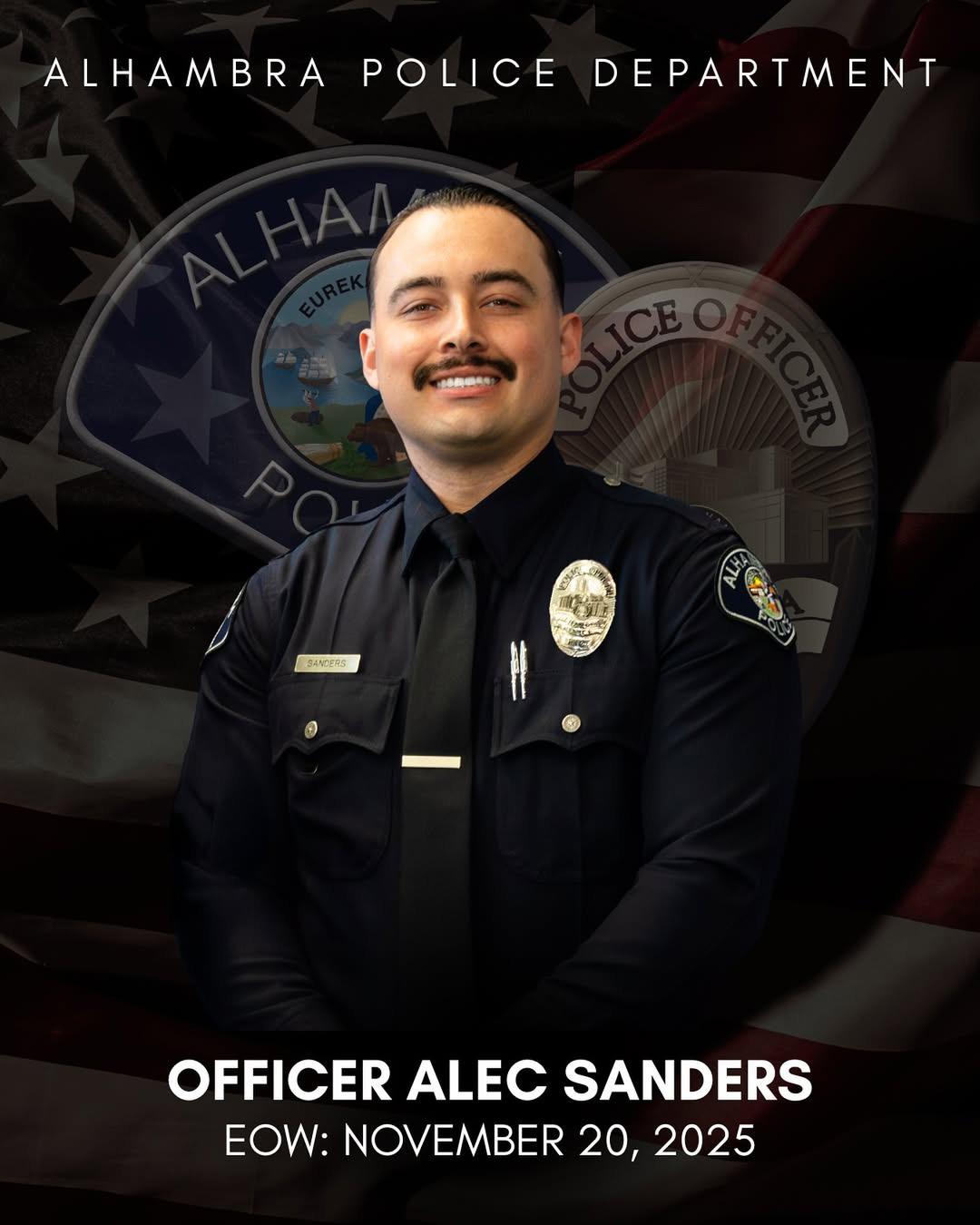
ing to be unconscious as he was taken in critical condition to Los Angeles General Medical Center, where he died.
Zapatasustained moderate injuries and was taken to a hospital, where he was later arrested.
A second passenger in the SUV, a 52-year-old man whose name was not released, sustained more serious, but non-life-threatening injuries and was also taken to a hospital, the CHP reported.
Sanders, who had been with the Alhambra Police Department for just eight months, was covering the shift of a colleague when he was fatally injured. He previously worked for about a year with the Long Beach Police Department.
He is survived by a fiancée, two younger sisters and a brother.
By City News Service
Amemorialof flowers, treats and tributes continued growing Monday outside the Burbank Police Department as community members pay respects to Spike, a police dog who died when he was shot by a fleeing suspect who was later killed by pursuing officers.
The shooting occurred after the suspect failed to yield while Burbank police were conducting a traffic stop at 6:40 p.m. Saturday in the 2400 block of Buena Vista Street near the northbound Golden State (5) Freeway on-ramp, according to Lt. Derek Green of the Burbank Police Department.
"With profound sadness, we share the news of the passing of our beloved K9 Spike, who courageously gave his life in the line
of duty after being struck by gunfire from an armed suspect," according to a BPD social media post. "K9 Spike was an intelligent and devoted partner, known for his gentle nature off duty and his tenacity and dedication while serving."
During the attempted traffic stop, a passenger fled the vehicle, ran up the freeway on-ramp and jumped over an embankment wall into a nearby residential neighborhood, Green said.
The officers remained with the driver and vehicle while requesting assistance. Additional police resources responded and a coordinated search was initiated using a police canine and a police helicopter.
The canine located the suspect hiding in nearby bushes and vegetation, and
the suspect fired multiple rounds from a handgun, striking the animal, then fled on foot, police said.
Officers recovered the wounded canine, Green said, while a search for the suspect continued.
The dog was taken to an emergency veterinarian but was pronounced dead.
Officers later saw the suspect hiding amid thick, overgrown terrain adjacent to the freeway, near the Buena Vista on-ramp. He was still armed within proximity of a residential neighborhood, Green said.
The effort transitioned to a joint operation between the Burbank and Glendale police departments and included additional K9 officers, crisis negotiators and the Burbank Police SWAT Team.
Multiple efforts were
made to communicate with the suspect, encouraging him to surrender peacefully, police said. Officers established a containment and deployed less lethal systems as part of the effort. During those attempts, the suspect began shooting at police officers, striking police vehicles parked near the scene, Green said.
Officers from both the Burbank and Glendale police departments returned fire, hitting the suspect, who was pronounced dead at the scene. The handgun was recovered nearby, authorities said.
The suspect's name was not immediately released.
Anyone with information about the case was urged to contact the Burbank Police Department Investigations Division at 818-238-3210.
Alhambra Police Chief Garrett Kennedy — speaking at a news conference outside the medical center on Thursday — said Sanders would be "remembered for his dedication, his kindness and positive impact he had on everyone."
"He was the type of officer who responded to every call, whether he was dispatched to it or not. He was just one of those officers," Kennedy said. "He was passionate about fitness, and he could often be found working out — a habit that was reflected in his discipline, both on and off the job. His intelligence, work ethic and steady presence made him a respected partner and a friend."
Kennedy said Sanders enjoyed traveling and was a passionate Dallas Cowboys fan.