
La Brea Tar Pits receives landmark donation toward ice age research center

La Brea Tar Pits receives landmark donation toward ice age research center
MONDAY, JANUARY 26-FEBRUARY 01, 2026
By Joe Taglieri joet@beaconmedianews.com
A$280millionproject tobringadditional sources of water to parts of Southern California hit hard by the state’s last drought got underway Wednesday, the Metropolitan Water District announced.
Officials from Los Angeles and Ventura counties broke ground in Culver City for the the Sepulveda Feeder Pump Stations Project, which will enable the MWD to reverse flows in its system if needed during severe droughts. The project’s aim is to move water from the Colorado River and Diamond Valley Lake into communities that currently have limited access to those key water resources, usually relying almost entirely on water from the northern Sierra Nevada that is delivered through the State Water Project.
Diamond Valley Lake is the region’s largest reservoir.
During the 2020-22 drought, which were the state’s three driest years on record that severely curtailed

Water Project deliveries, communities in Ventura and Los Angeles counties did not have enough water to meet normal demands.
Residents and businesses were required to dramatically curtail water use.
“Metropolitan had never
before imposed such strong reductions in water use on a portion of our service area. It was an unprecedented situation sparked by the hotter temperatures and more extreme droughts we are facing as the climate changes,” Metropolitan
TGeneral Manager Shivaji Deshmukh said in a statement. “When we saw the impacts of this historic drought on some portions of our service area, we committed to taking action to avoid this ever happening again.”
The Sepulveda Feeder
Pump Stations Project calls for two new pump stations that, when needed, can push Colorado River water and water stored in Diamond Valley Lake into northern
LA and southern Ventura counties, reversing normal water flows in the existing Sepulveda Feeder pipeline.
By early 2029 when officials expect the project to complete, the MWD will be able to deliver up to 22,000 acre-feet of additional water annually to the State Water Project-dependentarea during severe droughts. An acre-foot is approximately 326,000gallons,which is enough to serve three Southern California families for a year, officials said.
The pump stations’ design allows for future expansion based on water supply conditions and approvals by the MWD board.
“Under normal circumstances, our system largely relies on gravity to deliver water. But we learned during the last drought that left some communities without access to available water. Now, we will have the ability to pump more water uphill
he Los Angeles Metro BoardofDirectors
Thursdayapproved an underground heavy rail option for the Sepulveda Transit Corridor project that aims to connect the San Fernando Valley to the Westside.
In a unanimous vote, the board selected a Locally Preferred Alternative, referred to as Modified Alternative 5, a route that would go from Van Nuys to Sherman Oaks, under Bel-Air and Beverly Crest, UCLA and end at Metro’s E
Line/Expo Sepulveda Station.
The alignment would provide nearly 13 miles of rail with seven stations at an estimated cost between $20 billion and $25 billion. Metro officials say the price tag will change as they finalize the design and other factors.
Metro identified some funding from Measure M, a 2016-voter approved halfcent sales tax to support transit projects, to support the Sepulveda Transit Corridor project. “The Sepulveda Transit
By City News Service
Corridor project would add a critical regional connection to the transportation network linking the San Fernando Valley and the Westside, providing a fast, safe and reliable alternative to the congested 405 freeway,” Cecily Way, senior executive officer of countywide planning for Metro said.
The board’s approval of a Locally Preferred Alternative allows for further design refinement and authorizes advancement of a final environmental impact report, and
additional environmental documentation, Way added.
There were five options to choose from. Metro officials landed on Modified Alternative 5, which they say leverages the strengths of other proposals. The route is expected to have high ridership, high frequencies, shorter station construction sites, and reducing other cost elements.
“This is an important and exciting moment for Los Angeles,” Los Angeles City Councilwoman and Metro
Director Katy Yaroslavsky said. “There’s still a lot to do until we get shovels in the ground, let alone open this thing.”
Yaroslavsky described the Sepulveda Transit Corridor project as transformative as the L.A. Aqueduct.
“We have tried widening freeways and building over mountains, and we’ve spent billions doing it. The approach has failed,” Yaro-
slavsky said. “This project represents a fundamentally different strategy.”
She called for the agency to focus on the path to delivery and funding, encouraging her colleagues to push for cost reductions, explore new technologies, and construction approaches. Yaroslavsky, who represents Westside neighborhoods and communities in the Santa Monica Mountains,
By City News Service
TheNaturalHistory Museums of Los Angeles CountyThursday announceditslargest-ever donation, which will be used to establish the Samuel Oschin Global Center for Ice Age Research.
The philanthropic gift from the Mr. and Mrs. Samuel Oschin Family Foundation towards the new research center will help advance the La Brea Tar Pits’ longplanned makeover of the 13-acre fossil-rich site.
NHM President and Director Lori Bettison-Varga said in a statement that the foundation’s “transformational gift allows us to amplify the research that has always been at the heart of the Tar Pits, and to
more fully integrate it into a revitalized and modernized campus that connects science, landscape, education and community in powerful new ways.”
With progressive research as its mission, “the re-imagined Tar Pits will be one of the most consequential scientific and cultural sites in the world,” she said.
The museum declined to say the amount of the donation, but a news release says NHM has now raised $131 million toward its goal of $240 million for the Tar Pits’ renovation.
NHM officials said the project will tell the story of Los Angeles’ Ice Age past, when mammoths and dire wolves roamed the land-
scape, connecting research and science for visitors.
New renderings of the makeover reveal a pedestrian loop connecting excavation sites, research and exhibition spaces, and updated and expanded Pleistocene gardens, which will include the Tar Pits’ iconic mammoths.
Donor Lynda Oschin, chairman of the board and secretary of the Mr. and Mrs. Samuel Oschin Family Foundation, said in the NHM release that she and her late husband started their foundation, “to inspire future generations by supporting organizations that deepen our understanding of the world around us.”

“There is no place on Earth like La Brea Tar Pits,” she said. “It is fitting to
By City News Service
Flintridge Sacred Heart Academy has received a $5 million donation from the estate of a 1948 graduate of the Catholic allgirls school, the institution announced Wednesday. The gift from the estate of alumna Janet Hart Mitchell establishes the Stella and Louis Hart Scholarship Endowment Fund, dedicated to providing financial aid for students and ensuring that generations of young women benefit from the transformative education
that Mitchell cherished, officials said.
“From her very first gift of five dollars to the alumnae scholarship fund, given at a time when she herself had little to spare, to this extraordinary bequest, Janet lived with a deep understanding of legacy,” Academy President Marlena Conroy said. “By honoring her parents through scholarships, she has forever eased the burden for families and opened the doors of the Hill to young women she would
never meet, yet in whom she deeply believed.”
Mitchell began attending FSHA in her junior year. The gift honors her parents, Stella and Louis Hart, as well as Sister Mary Benigna Krug, O.P., who served as principal during her years at FSHA.
“We are immensely grateful for Janet, a dear alumna who loved our school profoundly,” said Sister Carolyn McCormack, O.P., the president of Flintridge Sacred Heart Academy from 2003 to 2021. “For almost a year, I
had the honor of spending meaningful time with her. Through our conversations, what was most touching was her clear affection for the school, even after so many years. Her generous gift will have a lasting impact on future generations of students.”
Flintridge Sacred Heart Academy is an all-girls, Catholic, Dominican, independent, college-preparatory, day and boarding school, located at 440 St Katherine Drive.

By Staff
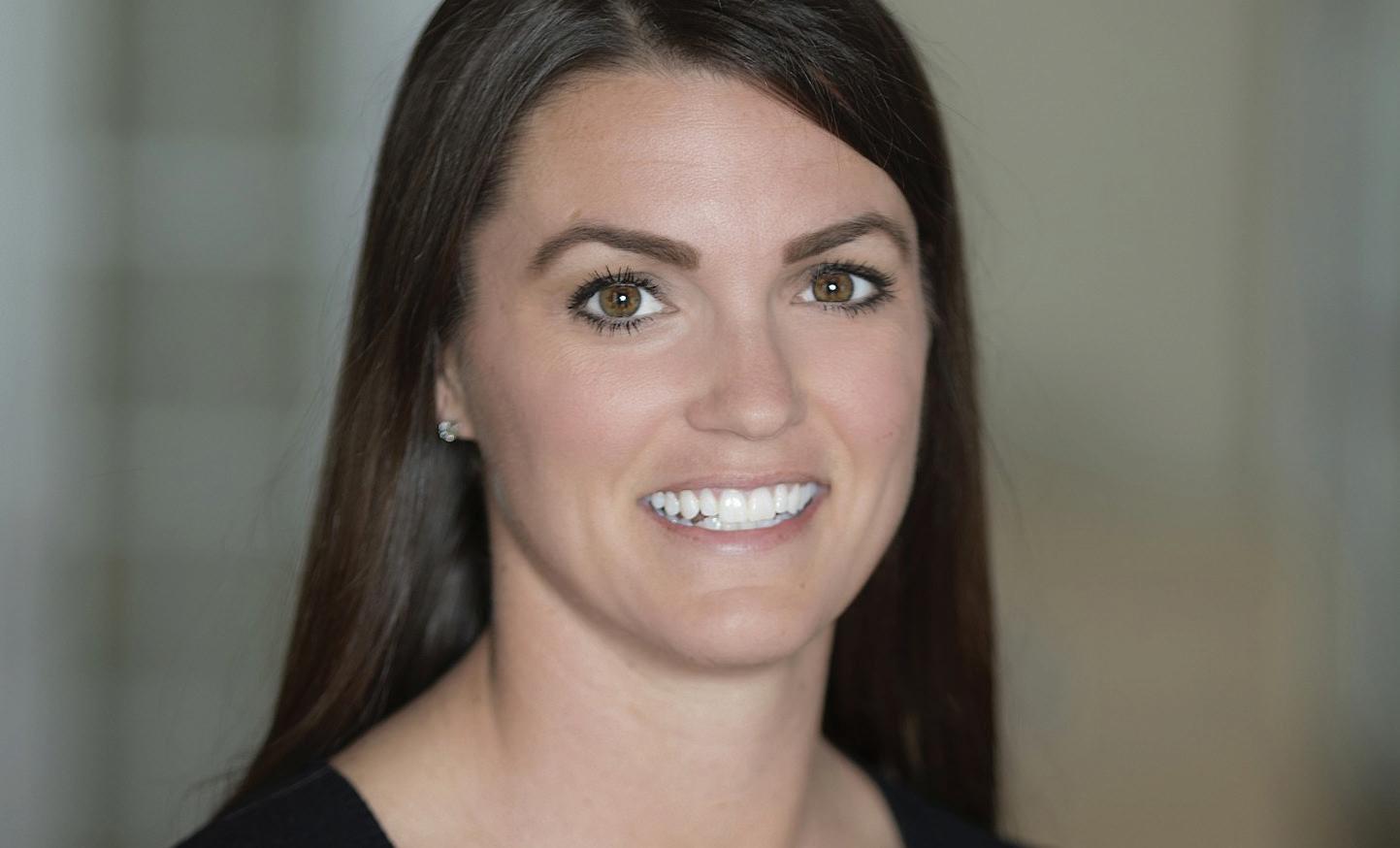
The Pasadena Chamber ofCommerceand Civic Association, has promoted Leanne Waggoner to vice president of events and operations. Previously Waggoner was director of events and external affairs where she grew attendance, interest and profitability for major fundraising events and staffed some board committees.
In her new role, Waggoner will take on added responsibility for day-to-day operations at the Chamber while she continues to organize and execute Chamber events and activities. Her enhanced port-
folio now includes budgeting and banking, payroll and human resources, building maintenance and operations and more.
“I am honored and excited to be taking on this expanded role with the Chamber,” Waggoner said. “I look forward to immersing myself in the day-to-day operations of the Chamber, doing more to serve our members and the greater Pasadena community, and I look forward to contributing to a stronger, more impactful Chamber.”
Waggoner began her career with the Pasadena Chamber in July, 2008, as
events and external affairs manager. Since then, she has built attendance at the Chamber signature events and financial success. In addition, she oversees monthly networking events and shares responsibility for member services.
Prior to joining the PasadenaChamber, Waggoner served as executive assistant to the director of the California-Nevada Conference of Operating Engineers. Concurrently, she was convention planner for the Western Conference of Operating Engineers. Waggoner holds Bachelor of Science
and Master of Arts degrees in Political Science from California State University, Los Angeles.
“Over the past 17 years, Leanne Waggoner has proved her worth to the Chamber, our membership and the community we serve,” said Chamber President and Chief Executive Officer Paul Little. “She has helped expand our offerings for members and steadily built on the enthusiasm and financial success of our major events. This promotion is well deserved.”
The Chamber of Commerce and Civic Association of Pasadena supports
Editorial editorial@beaconmedianews.com
editor@hlrmedia.com
Graphics/Production production@beaconmedianews.com production@hlrmedia.com
Advertising advertising@beaconmedianews.com advertising@hlrmedia.com
Legal Advertising legals@beaconmedianews.com legals@hlrmedia.com
Business accounting@beaconmedianews.com accounting@hlrmedia.com
BEACON MEDIA ADDRESS: 820 S. Myrtle Ave. Monrovia, CA 91016
PHONE: (626) 301-1010
WEBSITE www.beaconmedianews.com
HLR MEDIA ADDRESS: 820 S. Myrtle Ave. Monrovia, CA 91016
PHONE: (626) 301-1010 www.HLRmedia.com
PRESS
editor@beaconmedianews.com editor@hlrmedia.com


























‘Sinners’
By City News Service

“ Sinners,” Ryan Coogler’s vampire tale set in the Jim Crow South with Michael B. Jordan playing twin criminal brothers, made Oscar history Thursday, scoring a record 16 Academy Award nominations — followed by “One Battle After Another” with 13 nods, “Frankenstein, “Marty Supreme” and “Sentimental Value” with nine each and “Hamnet” with eight.
Each of those films was nominated for best picture for the 98th Academy Awards, which honor films released in 2025. The Oscars will be handed out March 15 at the Dolby Theatre in Hollywood.
The previous record for most Oscar nominations was 14 — by “La La Land” in 2016, “Titanic” in 1997 and “All About Eve” in 1950. Of those older films, only “La La Land” failed to capture the best picture award.
Also nominated Thursday for best picture — the lone Oscar category with 10 nominees — were “Bugonia”; “F1”; “The Secret Agent”; and “Train Dreams.”
For best actor,nominations went to Jordan in “Sinners”; Timothée Chalamet in “Marty Supreme”; Leonardo DiCaprio in “One Battle After Another”; Ethan Hawke for “Blue Moon”; and Wagner Moura for “The Secret Agent.”
Come Oscar night, the best actor prize will be one of the more intriguing categories, a battle of Hollywood heavyweights. Chalamet would seem the early front-runner, coming off wins earlier in this awards season at the Critics
Choice Awards and Golden Globes — and with some forecasters thinking he’s owed after his upset loss as best actor last year playing a young Bob Dylan in “A Complete Unknown.”
“Marty Supreme” is a sports comedy that tells the tale, loosely based on a true story, of one man’s travails chasing greatness in table tennis.
Best actress nods Thursday went to Jessie Buckley in “Hamnet”; Rose Byrne in “If I Had Legs I’d Kick You”; Kate Hudson for “Song Sung Blue”; Renate Reinsve in “Sentimental Value” and Emma Stone for “Bugonia.”
For best director, Coogler captured a nomination for “Sinners,” joining Chloé Zhao for “Hamnet”; Josh Safdie for “Marty Supreme”; Paul Thomas Anderson for “One Battle after Another”; and Joachim Trier for “Sentimental Value.”
Anderson has already won the Critics Choice and Golden Globe best director awards, and is among those nominated for the coveted Directors Guild Award — a good barometer for success on Oscar night in that category.
Coogler also grabbed a nomination for original screenplay, while Anderson and Zhao were nominated for adapted screenplay.
Oscar nods for best supporting actor went to Benicio Del Toro and Sean Penn in “One Battle After Another”; Jacob Elordi in “Frankenstein”; Delroy Lindo in “Sinners”; and Stellan
Skarsgard in “Sentimental Value.”
For best supporting actress, nominees were Elle Fanning and Inga Ibsdotter Lilleaas in “Sentimental Value”; Amy Madigan in “Weapons”; Wunmi Mosaku in “Sinners”; and Teyana Taylor in “One Battle After Another.”
The nominations were announced early Thursday morning via livestream by actress Danielle Brooks and actor Lewis Pullman from the Academy of Motion Picture Arts and Sciences’ Samuel Goldwyn Theater in Beverly Hills.
Besides the best picture, director, actor and supporting actor/actress nominations for “Sinners,” the film’s haul Thursday included nods for casting (a new category this year), cinematography, costume design, film editing, makeup and hairstyling, original score, original song, production design, sound, visual effects and original screenplay.
“One Battle After Another” — Anderson’s dark-comic tale about a group of one-time revolutionaries — also captured nominations for casting, cinematography, film editing, original score, production design, sound and adapted screenplay.
Both those films were produced by Warner Bros., which recorded a leading 30 nominations Thursday amid the multibillion-dollar battle over its ownership between Netflix and Paramount. Neon was next with 18 noms, followed by Netflix at 16,
Focus Features at 13 and A24 with 11.
Notable snubs Thursday included Cynthia Erivo and Ariana Grande for reprising their “Wicked” roles in 2025’s “Wicked: For Good.” Both had been nominated in the first iteration of that franchise.
Paul Mescal was another notable absentee from Thursday’s nominations for his turn as William Shakespeare in “Hamnet.” The film tells the story of Shakespeare and his wife (played by Buckley) as they mourn the death of their 11-yearold son Hamnet — a real-life tragedy that inspired Shakespeare to pen “Hamlet.”
Guillermo Del Toro was one more snub in the director category for “Frankenstein,” his take on the horror classic — though he did get a nod for adapted screenplay for the film.
A total of 317 feature films are eligible for consideration for the 98th Academy Awards, including 201 that met the criteria for consideration for best picture, the Academy of Motion Picture Arts and Sciences announced.
To be eligible for consideration in the general entry categories, feature films must open in a commercial motion picture theater in at least one of six U.S. metropolitan areas — Los Angeles County; the city of New York; the San Francisco Bay Area; Chicago, Illinois; Dallas-Fort Worth, Texas; and Atlanta, Georgia,




between Jan. 1 and Dec. 31 of 2025, and run for at least seven consecutive days in the same venue. The films must be more than 40 minutes long.
Qualifying for the best picture category, films must be eligible for the general categories and producers must submit an Academy Representation and Inclusion Standards form. They also must complete an expanded theatrical release standard, including a run of at least seven days in 10 of the top 50 U.S. markets, no later than 45 days after their initial release in 2025.
Voting for the Oscars was conducted by the Academy’s 10,136 voting members.
Here is a complete list of the nominations:
Best Picture — “Bugonia”’; “F1”; “Frankenstein”; “Hamnet”; “Marty Supreme”; “One Battle After Another”; “The Secret Agent”; “Sentimental Value”; “Sinners”; “Train Dreams”
Best actor — Timothée Chalamet, “Marty Supreme”; Leonardo DiCaprio, “One Battle after Another”; Ethan Hawke, “Blue Moon”; Michael B. Jordan, “Sinners”; Wagner Moura, “The Secret Agent”
Best supporting actor — Benicio Del Toro, “One Battle after Another”; Jacob Elordi, “Frankenstein”; Delroy Lindo, “Sinners”; Sean Penn, “One Battle After Another”; Stellan Skarsgard, “Sentimental Value”
Best actress — Jessie Buckley, “Hamnet”; Rose Byrne, “If I Had Legs I’d Kick You”; Kate Hudson, “Song Sung Blue”; Renate Reinsve, “Sentimental Value”; Emma Stone, “Bugonia”
Best supporting actress — Elle Fanning, “Sentimental Value”; Inga Ibsdotter Lilleaas, “Sentimental Value”; Amy Madigan, “Weapons”; Wunmi Mosaku, “Sinners”; Teyana Taylor, “One Battle After Another”
Best director — Chloé
Zhao, “Hamnet”; Josh Safdie, “Marty Supreme”; Paul Thomas Anderson, “One Battle After Another”; Joachim Trier, “Sentimental Value”; Ryan Coogler, “Sinners”
Best animated feature film — “Arco”; “Elio”; “KPop Demon Hunters”; “Little Amélie or the Character of Rain”; “Zootopia 2”
Best animated short film — “Butterfly”; “Forevergreen”; “The Girl Who Cried Pearls”; “Retirement Plan”; “The Three Sisters”
Casting — “Hamnet,” Nina Gold; “Marty Supreme,” Jennifer Venditti; “One Battle After Another,” Cassandra Kulukundis; “The Secret Agent,” Gabriel Domingues; “Sinners,” Francine Maisler
Cinematography — “Frankenstein,” Dan Laustsen; “Marty Supreme,” Darius Khondji; “One Battle after Another,” Michael Bauman; “Sinners,” Autumn Durald Arkapaw; “Train Dreams,” Adolpho Veloso
costume design —“Avatar: Fire and Ash,” Deborah L. Scott; “Frankenstein,” Kate Hawley; “Hamnet,” Malgosia Turzanska; “Marty Supreme,” Miyako Bellizzi; “Sinners,” Ruth E. Carter
Bestdocumentary feature film — “The Alabama Solution”; “Come See Me in the Good Light”; “Cutting Through Rocks”; “Mr. Nobody Against Putin”; “The Perfect Neighbor”
Bestdocumentary short film — “All the Empty Rooms”; “Armed Only with a Camera: The Life and Death of Brent Renaud”; “Children No More: Were and Are Gone”; “The Devil Is Busy”; “Perfectly a Strangeness”
Film editing — “F1,” Stephen Mirrione; “Marty Supreme,” Ronald Bronstein and Josh Safdie; “One Battle After Another,” Andy Jurgensen; “Sentimental Value,” Olivier Bugge Coutté; “Sinners,” Michael P. Shawver Best international
feature film — “The Secret Agent,” Brazil; “It Was Just an Accident,” France; “Sentimental Value,” Norway; “Sirat,” Spain; “The Voice of Hind Rajab,” Tunisia Best live action short film — “Butcher’s Stain”; “A Friend of Dorothy”; “Jane Austen’s Period Drama”; “The Singers”; “Two People Exchanging Saliva” Makeup and hairstyling — “Frankenstein”; “Kokuho”; “Sinners”; “The Smashing Machine”; “The Ugly Stepsister” Original score — “Bugonia,” Jerskin Fendrix; “Frankenstein,” Alexandre Desplat; “Hamnet,” Max Richter; “One Battle after Another,” Jonny Greenwood; “Sinners,” Ludwig Goransson Original song — “Dear Me” from “Diane Warren: Relentless”; “Golden” from “KPop Demon Hunters”; “I Lied To You” from “Sinners”; “Sweet Dreams Of Joy” from “Viva Verdi!”; “Train Dreams” from “Train Dreams” Production design — “Frankenstein”; “Hamnet”; “Marty Supreme”; “One Battle after Another”; “Sinners” Sound — “F1”; “Frankenstein”; “One Battle after Another”; “Sinners”; “Sirat” Visual effects — “Avatar: Fire and Ash”; “F1” “Jurassic World Rebirth”; “The Lost Bus”; “Sinners” Adapted screenplay — “Bugonia,” Will Tracy; “Frankenstein,” Guillermo Del Toro; “Hamnet,” Chloé Zhao and Maggie O’Farrell; “One Battle after Another,” Paul Thomas Anderson; “Train Dreams,” Clint Bentley and Greg Kwedar Original screenplay — “Blue Moon,” Robert Kaplow; “It Was Just an Accident,” Jafar Panahi; “Marty Supreme,” Ronald Bronstein and Josh Safdie; “Sentimental Value,” Eskil Vogt and Joachim Trier; “Sinners,” Ryan Coogler
By Suzanne Potter, Public News Service

ExpertsinCalifornia consumer law are warning car buyers about “yo-yo” scams, where people take the car home but then get called right back to the lot a few days later to sign new financing paperwork, often at a higher rate.
Many buyers don’t realize that the dealer can cancel the contract within 10 days. They’re supposed to give people their money back, but attorney Gregory Babbitt, a partner at the Auto Fraud Legal Center in San Diego, said some may be untruthful, telling clients that the financing fell through, or pressuring people if they resist a new offer.
“They tell them that they’re not going to get their down payment back if they cancel the deal because they want them to sign a new
contract,” he said. “So those are the types of abuses that are going on every day, all the time.”
New-car dealers who are on the up-and-up try to make the original finance contract work, because if they take it back, they have to resell it as a used vehicle.
Buyers can protect themselves by knowing their rights. They can also get preapproved financing through a credit union, or use that pre-approval to negotiate a better rate at the dealership.”
Oxnard attorney Sparky Abraham with Jubilee Legal said he has seen cases where the dealer missed the 10-day deadline, tried to take back the car anyway, and got nasty when the buyer tried to enforce the original deal.
“If the client tries to
assert their rights under the contract, the dealer sometimes will just go nuclear and go straight to the police and report the car stolen, even though clearly it wasn’t,” he said. “And the client can get arrested; I’ve seen clients lose their jobs, I’ve seen clients get prosecuted for stealing the car for many, many, many months before the charges are finally dropped.”
Another variation on the scam involves a trade-in vehicle where the buyer owes more than it is worth.
There have been cases where the dealer says they can’t return the person’s trade-in because it has already been sold, then says they won’t pay off the negative equity on the trade-in unless the buyer signs a new financial agreement.

By City News Service

Hundredsofpeople took part in protests at various locations across the Southland -- and the nation -- Tuesday as part of coordinated actions opposing select Trump administration policies, as the president began the second year of his term.
The protests were part of the nationwide Free America Walkout campaign organized nationally by Women’s March.
Organizers said the marches were in response to “ICE raids on our communities, troops occupying our cities, families torn apart, attacks on our trans siblings, mass surveillance and terror
used to keep us silent.”
Nearly 100 people gathered for a protest that began outside Los Angeles City Hall then evolved into a slow march through the downtown area, with police keeping a close watch on the procession.
Several hundred people also gathered at Burbank’s Lincoln Park near the Buena Vista Branch Library at Buena Vista Street and Verdugo Avenue in protest. More gathered near The Paseo in Pasadena, while other gatherings occurred in Venice, Santa Monica and Long Beach. There were also reports of students walking out of high school
classes in East Los Angeles and Montebello.
There were no immediate reports of any arrests in connection with the various actions.
Despite the protests, President Donald Trump celebrated the end of his first year in office by holding a two-hour news conference at the White House touting his administration’s accomplishments, including his crackdown on people living in the country illegally and his claims of a strong American economy rebounding from “a mess” he says he inherited from previous President Joe Biden.

How ‘Bitcoin Jesus’ avoided prison, thanks to one of the ‘Friends of Trump’
By Avi Asher-Schapiro and Molly Redden
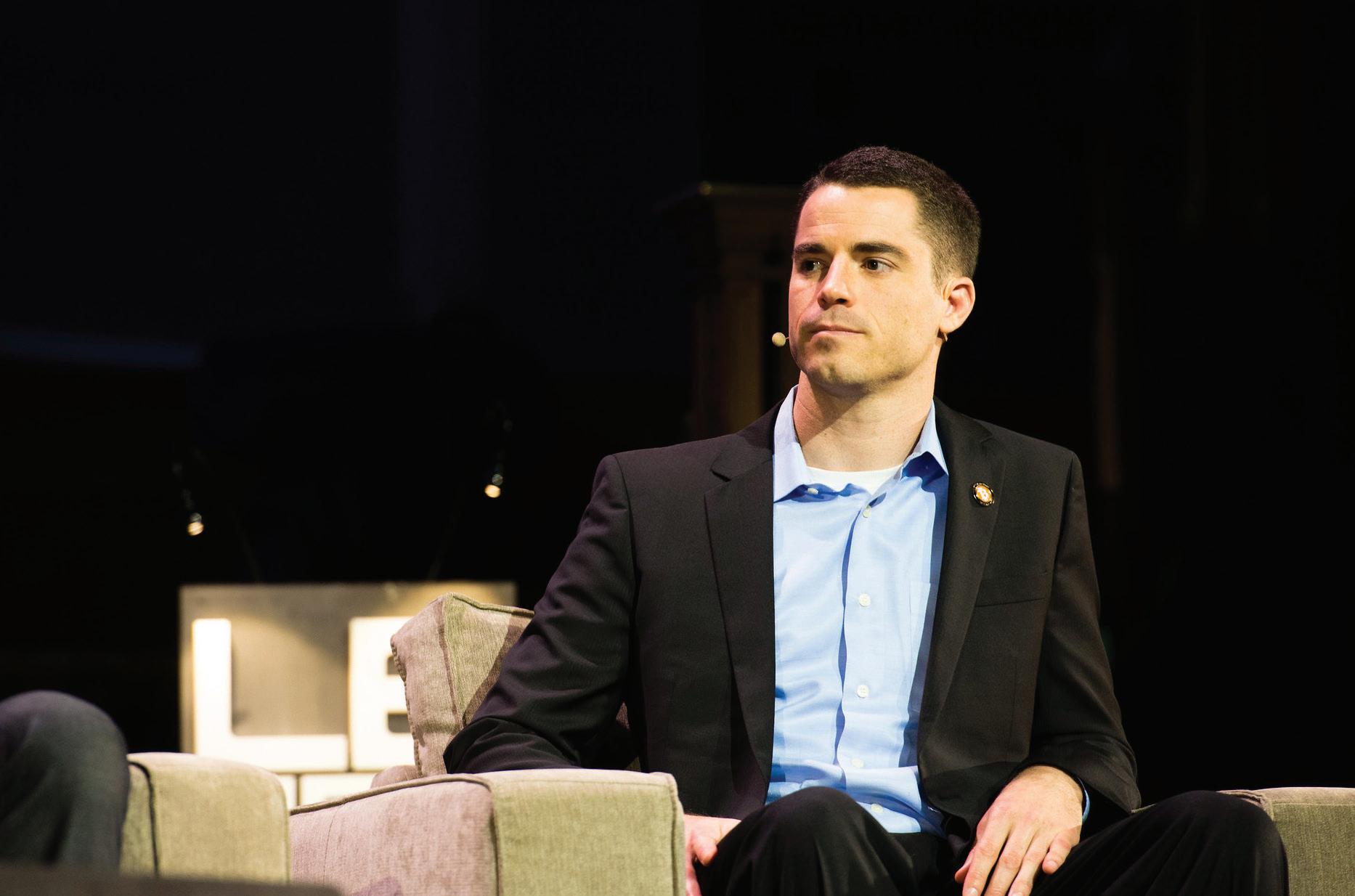
Donald Trump’s second term in the White House,acryptocurrency billionaire posted a video on X to his hundreds of thousands of followers. “Please Donald Trump, I need your help,” he said, wearing a flag pin askew and seated awkwardly in an armchair. “I am an American. … Help me come home.”
The speaker, 46-year-old Roger Ver, was in fact no longer a U.S. citizen. Nicknamed “Bitcoin Jesus” for his early evangelism for digital currency, Ver had renounced his citizenship more than a decade earlier. At the time of his video, Ver was under criminal indictment for millions in tax evasion and living on the Spanish island of Mallorca. His top-flight legal defense team had failed around half a dozen times to persuade the Justice Department to back down. The U.S., considering him a fugitive, was seeking his extradition from Spain, and he was likely looking at prison.
Once, prosecutors hoped to make Ver a marquee example amid concerns about widespread cryptocurrency tax evasion. They had spent eight painstaking years working the case. Just nine months after his directto-camera appeal, however, Ver and Trump’s new Justice Department leadership cut a remarkable deal to end his prosecution. Ver wouldn’t have to plead guilty or spend a day in prison. Instead, the government accepted a payout of $49.9 million — roughly the size of the tax bill prosecutors said he dodged in the first place — and allowed him to walk away.
Ver was able to pull off this coup by taking advantage of a new dynamic inside of Trump’s Department of Justice. A cottage industry of lawyers, lobbyists and consultants with close ties to Trump has sprung up to help people and companies seek leniency, often by arguing they had been victims of political persecution by the Biden administration. In his first year, Trump issued pardons or clemency to dozens of people who were convicted of various forms of white-collar crime, including major donors and political allies. Investigations have been halted. Cases have been dropped.
Within the Justice Department, a select club of Trump’s former personal attorneys have easy access to the top appointees, some of whom
also previously represented Trump. It has become a dark joke among career prosecutors to refer to these lawyers as the “Friends of Trump.”
The Ver episode, reported in detail here for the first time, reveals the extent to which white-collar criminal enforcement has eroded under the Trump administration. The account is based on interviews with current and former Justice Department officials, case records and conversations with people familiar with his case.
The Trump administration has particularly upended the way tax law violators are handled. Late last year, the administration essentially dissolved the team dedicated to criminal tax enforcement, dividing responsibility among a number of other offices and divisions. Tax prosecutions fell by more than a quarter, and more than a third of the 80 experienced prosecutors working on criminal tax cases have quit.
But even amid this turmoil, Ver’s case stands out. After Ver added several of these new power brokers to his team — most importantly, former Trump attorney Chris Kise — Trump appointees commandeered the case from career prosecutors. One newly installed Justice Department leader who had previously represented Trump’s family questioned his new subordinates on whether tax evasion should be a criminal offense. Ver’s team wielded unusual control over the final deal, down to dictating that the agreement would not include the word “fraud.”
It remains the only tax prosecution the administration has killed outright.
Ver did not reply to an extensive list of questions from ProPublica. In court filings and dealings with the Justice Department, Ver had always denied dodging his tax bill intentionally — a key distinction between a criminal and civil tax violation — and claimed to have relied on the advice of accountants and tax attorneys.
“Roger Ver took full responsibility for his gross financial misconduct to the tune of $50 million because this Department of Justice did not shy away from exposing those who cheat the system. The notion that any defendant can buy their way out of accountability under this administration is not founded in reality,” said Natalie Baldassarre, a Justice Department spokesperson.
In response to a list of detailed questions, the White House referred ProPublica to the Justice Department.“I know of no cases like this,” said Scott Schumacher, a former tax prosecutor and the director of the graduate program in taxation at the University of Washington. It is nearly unheard of for the department to abandon an indicted criminal case years in the making. “They’re basically saying you can buy your way out of a tax evasion prosecution.”
Roger Ver is not a longtime ally of Trump’s or a MAGA loyalist. He renounced his U.S. citizenship in 2014, a day he once called “the happiest day of my entire life.” In the early days of bitcoin, he controlled about 1% of the world’s supply.
Ver is clean-cut and fit — he has a black belt in Brazilian jujitsu. In his early 20s, while he was a libertarian activist in California, Ver was sentenced to 10 months in prison for illegally selling explosives on eBay. He’s often characterized that first brush with the law as political persecution by the state. After his release, he left the U.S. for Japan.
Ver became a fixture in the 2010s on the budding cryptocurrency conference circuit, where he got a kick out of needling government authority and arguing that crypto was the building block of a libertarian utopia. At a 2017 blockchain conference in Aspen, Colorado, Ver announced he had raised $100 million and was seeking a location to create a new “noncountry” without any central government. For years, Ver has recommended other wealthy people consider citizenship in the small Caribbean nation of Saint Kitts and Nevis, which has no individual income tax.
“Bitcoin completely undermines the power of every single government on the entire planet to control the money supply, to tax people’s income to control them in any way,” he told a gathering of anarcho-capitalists in Acapulco, Mexico, in 2016. “It makes it so incredibly easy for people to hide their income or evade taxes.” More than one friend, he said with a smirk, had asked him how to do so: They “say, ‘Roger, I need your help. How do I use bitcoins to avoid paying taxes on it?’”
Renouncing U.S. citizenship isn’t a magic get-outof-tax-free technique. Since 2008, the U.S. has required
expatriates with assets above $2 million pay a steep “exit tax” on the appreciation of all their property.
In 2024, the Justice Department indicted Ver in one of the largest-ever cryptocurrency tax fraud cases. The government accused Ver of lying to the IRS twice. After Ver renounced his citizenship in 2014, he claimed to the IRS that he personally did not own any bitcoin. He would later admit in his deal with the government to owning at least 130,664 bitcoin worth approximately $73.7 million at the time. Then in 2017, the government alleged, Ver tried to conceal the transfer of roughly $240 million in bitcoin from U.S. companies to his personal accounts. In all, the government said he had evaded nearly $50 million in taxes.
Ver’s defense was that his failure to pay taxes arose from a lack of clarity as to how tax law treated emerging cryptocurrency, good-faith accounting errors and reliance on his advisors’ advice. He claimed it was difficult to distinguish between his personal assets and his companies’ holdings and pinpoint what the bitcoin was actually worth.
The Biden administration’s Justice Department dismissed this legal argument. Prosecutors had troves of emails that they said showed Ver misleading his own attorneys and tax preparers about the extent of his bitcoin holdings. (Ver’s team accused the government of taking his statements out of context.)
The asset tracing in the case was “rock solid,” according
to a person familiar with the investigation who spoke on the condition of anonymity for fear of retaliation. A jury, prosecutors maintained, was unlikely to buy Ver’s defense that he made a good-faith error.
By the time of Trump’s election, Ver had been arrested in Spain and was fighting extradition. He was also the new owner of a sleek $70 million yacht that some law enforcement officials worried he might use to escape on the high seas.
In Trump, Ver saw a possible way out. After the 2024 election, he was “barking up every tree,” said his friend Brock Pierce, a fellow ultrawealthy crypto investor who tried to gin up sympathy for Ver in Trump’s orbit.
Ver had initially gone the orthodox route of hiring tax attorneys from a prestigious law firm, Steptoe. Like many wealthy people in legal jeopardy, Ver now also launched a media blitz seeking a pardon from the incoming president.“If anybody knows what it’s like to be the victim of lawfare it’s Trump, so I think he’ll be able to see it in this case as well,” Ver said in a December 2024 appearance on Tucker Carlson’s show. On Charlie Kirk’s show, Ver appeared with tape over his mouth with the word “censored” written in red ink.
Laura Loomer, the Trumpfriendly influencer, began posting that Ver’s prosecution was unfair. Ver paid Trump insider Roger Stone $600,000 to lobby Congress for an end
to the tax provision he was accused of violating. Ver’s pardon campaign fizzled. His public pressure campaign — in which he kept comparing himself to Trump — was not landing, according to Pierce. “You aren’t doing yourself any favors — shut up,” his friend recalled saying. One objection in the White House, according to a person who works on pardons, may have been Ver’s flamboyant rejection of his American citizenship. Less than a week after Trump was inaugurated, Elon Musk weighed in, posting on X, “Roger Ver gave up his US citizenship. No pardon for Ver. Membership has its privileges.”
But inside the Justice Department, Ver found an opening. The skeleton key proved to be one of the “Friends of Trump,” a seasoned defense lawyer named Christopher Kise. Kise is a longtime Florida Republican power player who served as the state’s solicitor general and has argued before the U.S. Supreme Court. He earned a place in Trump’s inner circle as one of the first experienced criminal defenders willing to represent the president after his 2020 election loss. Kise defended Trump in the Justice Department investigation stemming from the Jan. 6, 2021, attack on the U.S. Capitol and against charges that Trump mishandled classified documents when leaving the White House. Kise had worked shoulderto-shoulder on Trump’s cases with two lawyers who were
By Suzanne Potter, Public News Service
Thirty-four groups that focus on the environment and small farms are asking the U.S. Department of Agriculture to stop funding systems that produce natural gas from manure at industrial livestock operations.
The coalition just filed a rulemaking petition asking that factory farms be ineligible for grants and loans for anaerobic digesters under the Rural Energy for America program, known as REAP.
Tyler Lobdell, senior staff attorney with Food and Water Watch, said factory farm bio-gas digesters do produce energy, but carry high environmental costs. “They increase water and air pollution, and they encourage factory farms to get bigger, which increases the overall pollution load that a rural community has to deal with,” he said. “We are adding industrial gas production on top of these already very large and pretty industrialized facilities.”
In a statement, the Renewable Natural Gas Coalition said the petition is without merit and is unlikely to succeed, arguing that digesters create a new revenue stream for farmers and produce fertilizer as well. Farmers can also generate credits under California’s low-carbon fuel standard.
Lobdell said the limited REAP program funds would be better spent on projects such as solar arrays on small farms, which don’t
produce enough manure to merit a multi-million dollar digester.
“This type of gas production adds yet another market lever against small-scale local farming,” he said, “and in favor of multinational, Big Ag corporations having further consolidation in our ag system.”
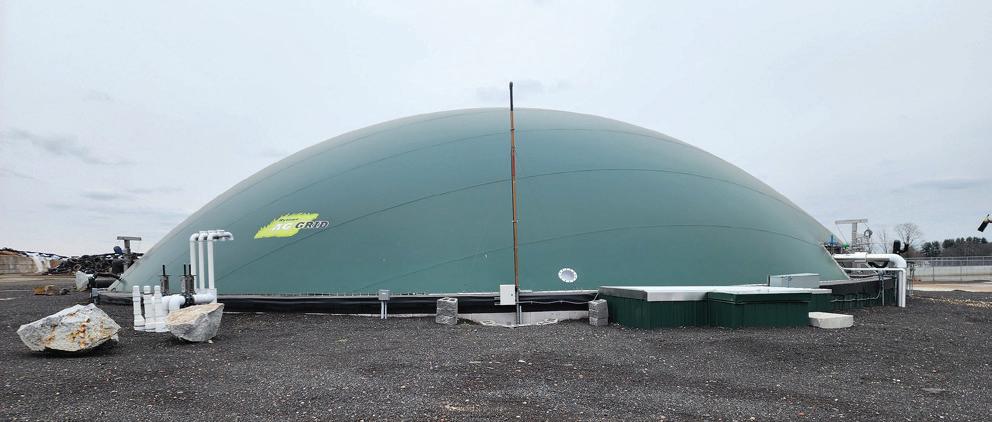
The RNG Coalition estimated that California has 230 RNG facilities, by far the most of any state in the nation. The EPA’s Livestock Anaerobic Digester Database lists 400 digesters in California, with seven that received funding from the USDA.
now leaders in the Trump 2.0 Justice Department: Todd Blanche, who runs day-to-day operations at the department as deputy attorney general, and his associate deputy attorney general, Ketan Bhirud, who oversaw the criminal tax division prosecuting Ver. Kise reportedly helped select Blanche to join Trump’s legal team in the documents case, and he and Bhirud had both worked for Trump’s family as they fought civil fraud charges brought by New York Attorney General Letitia James in 2022.
On Ver’s legal team, Kise worked the phones, pressing his old colleagues to rethink their prosecution against Ver.
Kise scored the legal team’s first big victory in years: a meeting with Bhirud that cut out the career attorneys most familiar with the merits of the case.
In that meeting, however, it wasn’t clear that the new Justice Department leadership would be willing to interfere with the trajectory of Ver’s case. While the Trump administration had backed off aggressive enforcement of whitecollar crimes writ large, the administration said it was still pursuing most criminal cases that had already been charged.
Bhirudinitiallyexpressed
skepticism that Ver accidentally underpaid his taxes. It was “hard to believe” that a man going by “Bitcoin Jesus” would have no idea how much bitcoin he owned, Bhirud said, according to a person familiar with the case.
Bhirud and Blanche did not respond to detailed questions from ProPublica.
The Justice Department stuck to its position that either Ver would plead guilty to a crime, or the case would go to trial.
But Kise would not stop lobbying his former colleagues to reconsider. Blanche and Bhirud had already demanded that career officials justify the case again and again. Over the course of the summer, Kise wore down the Trump appointees’ zeal for pursuing Ver on criminal charges.
Kise and the law firm of Steptoe did not respond to questions.
“While there were meetings and conversations with DOJ, that is not uncommon. The line attorneys remained engaged throughout the process, and the case was ultimately resolved based on the strength of the evidence,” said Bryan Skarlatos, one of Ver’s tax attorneys and a partner at Kostelanetz.
It was a chaotic moment at the Justice Department, an institution that Trump had incessantly accused of
being “weaponized” against him and his supporters. After Trump took office, the department was flooded with requests to reconsider prosecutions, with defendants claiming the Biden administration had singled them out for political persecution, too.
While many cases failed to grab the administration’s attention, Kise got results. On Jan. 15, Kise’s client Julio Herrera Velutini, a Venezuelan-Italian billionaire accused of trying to bribe the former governor of Puerto Rico, received a pardon from Trump.
“Every defense attorney is running the ‘weaponization’ play. This guy gets an audience because of who he is, because his name is Chris Kise,” said a person who recently attended a highlevel meeting Kise secured to talk the Justice Department down from prosecuting a client.
As Kise stepped up the pressure, Ver’s case ate up a significant share of Bhirud’s time, despite his job overseeing more than 1,000 Justice Department attorneys, according to people familiar with the matter. Ordinarily, it would be rare for a political appointee to be so involved, especially to the exclusion of career prosecutors who could weigh in on the merits.
Bhirud began to muse to coworkers about whether
failure to pay one’s taxes should really be considered a crime. Wasn’t it more of a civil matter? It seemed to a colleague that Bhirud was aware Ver’s advocates could try to elevate the case to the White House.
The government ceded ground and offered to take prison time off the table. Eventually, Ver’s team and Bhirud hit on the deal that would baffle criminal tax experts. They agreed on a deferred prosecution agreement that would allow Ver to avoid criminal charges and prison in exchange for a payout and an agreement not to violate any more laws. The government usually reserves such an agreement for lawbreaking corporations to avoid putting large employers out of business — not for fugitive billionaires.
By the time fall approached, Kise and Bhirud, with Blanche’s blessing, were negotiating Ver’s extraordinary deal line by line. Once more, career prosecutors were cut out from the negotiations.
Ver’s team enjoyed a remarkable ability to dictate terms. They rejected the text of the government’s supposed final offer because it required him to admit to “fraud,” according to a person familiar with the negotiations. In the end, Ver agreed to admit only to a “willful”
failure to report and pay taxes on all his bitcoin and turned over the $50 million.
The government arrived at that figure in a roundabout manner. It dropped its claim that Ver had lied on his 2017 tax return. The $50 million figure was based on how much he had evaded in taxes in 2014 alone, plus what the government asserted were interest and penalties. In the end, the deal amounted to the sum he allegedly owed in the first place. He never even had to leave Mallorca to appear in a U.S. court.
Under any previous administration, convincing the leadership of the tax division to drop an indicted criminal case and accept a monetary penalty instead would be a nonstarter. While the Justice Department settles most tax matters civilly through fines, when prosecutors do charge criminal fraud, their conviction rate is over 90%.
People “always ask you, ‘Can’t I just pay the taxes and it’ll go away?’” said Jack Townsend, a former federal tax prosecutor. “The common answer that everybody gave — until the Trump administration — was that, no, you can’t do that.”
When the Justice Department announced the resolution in October, it touted it as a victory.
“We are pleased that Mr. Ver has taken responsibility
for his past misconduct and satisfied his obligations to the American public,” Bhirud said in the Justice Department’s press release announcing the deferred prosecution agreement. “This resolution sends a clear message: whether you deal in dollars or digital assets, you must file accurate tax returns and pay what you owe.”
Inside the Justice Department, the resolution was demoralizing: “He’s admitted he owes money, and we get money, but everything else about it stinks to high heaven,” said a current DOJ official familiar with the case. “We shouldn’t negotiate with people who are fugitives, as if they have power over us.”
Among the wealthy targets of white-collar criminal investigations, the Ver affair sent a different message. Lawyers who specialize in that kind of work told ProPublica that more and more clients are asking which of the “Friends of Trump” they should hire. One prominent criminal tax defense lawyer said he would give his clients a copy of Ver’s agreement and tell them, “These are the guys who got this done.”
The only one of Ver’s many lawyers to sign it was Christopher Kise. Republished with Creative Commons License (CC BY-NC-ND 3.0).
PUBLIC NOTICE CITY OF EL MONTE
Notice of Public Hearing and Comment Period for the
CITY OF EL MONTE REVISED 5-YEAR ALLOCATION PLAN FOR PERMANENT LOCAL HOUSING ALLOCATION (PLHA) PROGRAM FUNDS
TO ALL INTERESTED PARTIES:
NOTICE IS HEREBY GIVEN that the El Monte City Council will hold a public hearing for the Revised 5-Year Allocation Plan for Permanent Local Housing Allocation (PHLA) Program Funds:
Hearing Date: Wednesday, February 11, 2026
Time: 7:00 p.m. or as soon thereafter as the matter may be heard
Place: City Hall East, City Council Chambers, 11333 Valley Boulevard, El Monte, CA 91731
Description: The City of El Monte is eligible to apply for a total estimated 5-year allocation amount of $5,083,752 through the Permanent Local Housing Allocation (PLHA) Program. The City is interested in revising the use of its allocation to: 1) rehabilitate and operate emergency shelter and/or transitional housing for the homeless; and 2) administrative costs up to five percent of the allocation.
NOTICE OF PETITION TO ADMINISTER ESTATE OF: IVY FUNG
CASE NO. 26STPB00085
To all heirs, beneficiaries, creditors, contingent creditors, and persons who may otherwise be interested in the WILL or estate, or both of IVY FUNG.
A PETITION FOR PROBATE has been filed by FLAVIA FANG KAN in the Superior Court of California, County of LOS ANGELES.
THE PETITION FOR PROBATE requests that FLAVIA FANG KAN be appointed as personal representative to administer the estate of the decedent.
THE PETITION requests authority to administer the estate under the Independent Administration of Estates Act with limited authority. (This authority will allow the personal representative to take many actions without obtaining court approval. Before taking certain very important actions, however, the personal representative will be required to give notice to interested persons unless they have waived notice or consented to the proposed action.) The independent administration authority will be granted unless an interested person files an objection to the petition and shows good cause why the court should not grant the authority.
A HEARING on the petition will be held in this court as follows: 02/05/26 at 8:30AM in Dept. 11 located at 111 N. HILL ST., LOS ANGELES, CA 90012
IF YOU OBJECT to the granting of the petition, you should appear at the hearing and state your objections or file written objections with the court before the hearing. Your appearance may be in person or by your attorney.
IF YOU ARE A CREDITOR or a contingent creditor of the decedent, you must file your claim with the court and mail a copy to the personal representative appointed by the court within the later of either (1) four months from the date of first issuance of letters to a general personal representative, as defined in section 58(b) of the California Probate Code, or (2) 60 days from the date of mailing or personal delivery to you of a notice under section 9052 of the California Probate Code.
Other California statutes and legal authority may affect your rights as a creditor. You may want to consult with an attorney knowledgeable in California law.
ing court approval. Before taking certain very important actions, however, the personal representative will be required to give notice to interested persons unless they have waived notice or consented to the proposed action.) The independent administration authority will be granted unless an interested person files an objection to the petition and shows good cause why the court should not grant the authority.
A HEARING on the petition will be held on February 11, 2026 at 8:30 AM in Dept. 5. located at 111 N. Hill St., Los Angeles, CA 90012.
IF YOU OBJECT to the granting of the petition, you should appear at the hearing and state your objections or file written objections with the court before the hearing. Your appearance may be in person or by your attorney.
IF YOU ARE A CREDITOR or a contingent creditor of the decedent, you must file your claim with the court and mail a copy to the personal representative appointed by the court within the later of either (1) four months from the date of first issuance of letters to a general personal representative, as defined in section 58(b) of the California Probate Code, or (2) 60 days from the date of mailing or personal delivery to you of a notice under section 9052 of the California Probate Code.
Other California statutes and legal authority may affect your rights as a creditor. You may want to consult with an attorney knowledgeable in California law.
YOU MAY EXAMINE the file kept by the court. If you are a person interested in the estate, you may file with the court a Request for Special Notice (form DE-154) of the filing of an inventory and appraisal of estate assets or of any petition or account as provided in Probate Code section 1250. A Request for Special Notice form is available from the court clerk.
Petitioner: Dean Balangue 12038 Roseglen St El Monte, Ca 91732 January 19, 22, 26, 2026 EL MONTE EXAMINER
Availability of Plan for Public Comment: The City of El Monte encourages citizen participation in the planning process. A Public Hearing regarding the proposed 5-Year PLHA Allocation Activity Plan will be held on Wednesday, February 11, 2026, at 7:00p.m. at the El Monte City Council Chambers, located at City Hall East, 11333 Valley Boulevard, El Monte, CA.
A copy of the Plan is attached to this notice and is available for public review and comment online at the City of El Monte Community and Economic Development webpage: https://www.ci.el-monte. ca.us/547/News-Notices, and at City Hall during normal business hours, Monday through Thursday, 7:00a.m.-5:30p.m.:
El Monte City Clerk’s Office, City Hall East, 11333 E. Valley Boulevard, El Monte, CA
El Monte Housing Division, City Hall West, 11333 E. Valley Boulevard, El Monte, CA
Members of the public wishing to make a public comment may do so via the following ways:
1) Call-in Conference Line – comments/questions can be submitted per the instructions at the beginning of the meeting; and
2) Email – all interested parties can submit questions/comments in advance to the City Clerk’s general email address: CityClerk@elmonteca.gov
Accessibility: It is the intention of the City of El Monte to complete with the Americans with Disabilities Act (ADA) in all respects. The City of El Monte will attempt to accommodate attendees in every reasonable manner. Please contact the City Clerk at least 72 hours prior to the above scheduled public hearing to establish need and to determine if additional accommodation is feasible.
For more information, contact Vanessa Sedano, Housing Manager for the City of El Monte Community and Economic Development Department at (626) 258-8831 or via email at vsedano@elmonteca.gov
YOU MAY EXAMINE the file kept by the court. If you are a person interested in the estate, you may file with the court a Request for Special Notice (form DE-154) of the filing of an inventory and appraisal of estate assets or of any petition or account as provided in Probate Code section 1250. A Request for Special Notice form is available from the court clerk.
Attorney for Petitioner
DANIEL FONG, ESQ. - SBN 248397 FONG LAW GROUP 407 W. VALLEY BLVD., UNIT 3 ALHAMBRA CA 91803
Telephone (626) 289-8299 1/19, 1/22, 1/26/26 CNS-4004222# TEMPLE CITY TRIBUNE
NOTICE OF PETITION TO ADMINISTER ESTATE OF Reynaldo J. Balangue
Case No. 25STPB13753
To all heirs, beneficiaries, creditors, contingent creditors, and persons who may otherwise be interested in the will or estate, or both, of Reynaldo J. Balangue
A PETITION FOR PROBATE has been filed by Dean Balangue in the Superior Court of California, County of LOS ANGELES.
THE PETITION FOR PROBATE requests that Dean Balangue be appointed as personal representative to administer the estate of the decedent.
THE PETITION requests the decedent’s will and codicils, if any, be admitted to probate. The will and any codicils are available for examination in the file kept by the court.
THE PETITION requests authority to administer the estate under the Independent Administration of Estates Act. (This authority will allow the personal representative to take many actions without obtain-
ORDER TO SHOW CAUSE FOR CHANGE OF NAME PETITION OF Anndrea Kensi Ortega by and through Ethelbine Cisneros Ortega FOR CHANGE OF NAME CASE NUMBER: 26NNCP00019 Superior Court of California, County of Los Angeles 150 West Commonwealth Avenue, Alhambra, Ca 91801-3787, Northeast Judicial District TO ALL INTERESTED PERSONS: 1. Petitioner Ethelbine Cisneros Ortega filed a petition with this court for a decree changing names as follows: Present name a. Anndrea Kensi Ortega to Proposed name Anndrea Kensi Cisneros Ortega 2. THE COURT ORDERS that all persons interested in this matter shall appear before this court at the hearing indicated below to show cause, if any, why the petition for change of name should not be granted. Any person objecting to the name changes described above must file a written objection that includes the reason for the objection at least two court days before the matter is scheduled to be heard and must appear at the hearing to show cause why the petition should not be granted. If no written objection is timely filed, the court may grant the petition without a hearing NOTICE OF HEARING a. Date: 03/25/2026 Time: 8:30AM Dept: 3. The address of the court is same as noted above. 3. a. A copy of this Order to Show Cause shall be published at least once each week for four successive weeks prior to the day set for hearing on the petition in the following newspaper of general circulation, printed in this county: San Gabriel Sun DATED: January 9, 2026 Roberto Longoria JUDGE OF THE SUPERIOR COURT Pub. January 19, 26, February 2, 9, 2026 SAN GABRIEL SUN
ORDER TO SHOW CAUSE FOR CHANGE OF NAME PETITION OF Han Ze Lee FOR CHANGE OF NAME CASE NUMBER: 25PSCP00654 Superior Court of California, County of Los Angeles 400 Civic Center Plaza , Pomona, Ca 91766, East Judicial District TO ALL INTERESTED PERSONS: 1. Petitioner Han Ze Lee a petition with this court for a decree changing names as follows: Present name a. OF Han Ze Lee to Proposed name Leon Lee 2. THE COURT ORDERS that all persons interested in this matter shall appear before this court at the hearing indicated below to show cause, if any, why the petition for change of name should not be granted. Any person objecting to the name changes described above must file a written objection that includes the reason for the objection at least two court days before the matter is scheduled to be heard and must appear at the hearing to show cause why the petition should not be granted. If no written objection is timely filed, the court may grant the petition without a hearing NOTICE OF HEARING a. Date: 03/06/2026
on: September 28, 2021 in the County of Los Angeles. Original File No. 2021213825. Signed: SANG MIN Lee, 2300 S HACIENDA BLVD Apt # A 8, Hacienda Heights, CA 91745 (Owner). This business is conducted by: a individual. This statement was filed with the Los Angeles County Registrar-Recorder on January 20, 2026. Pub. Monrovia Weekly 01/26/2026, 02/02/2026, 02/09/2026, 02/16/2026
FICTITIOUS BUSINESS NAME STATEMENT FILE NO. 2026002530 NEW FILING. The following person(s) is (are) doing business as Enter Tai Ment, 5733 Klump Ave, North Hollywood, CA 91601. This business is conducted by a individual. Registrant has not yet begun to transact business under the fictitious business name or names listed herein. Signed: tai white, 5733 Klump Ave, North Hollywood, CA 91601 (Owner). The statement was filed with the County Clerk of Los Angeles on January 6, 2026. NOTICE: This fictitious business name statement expires five years from the date it was filed in the office of the County Clerk. A new fictitious business name statement must be filed prior to that date. The filing of this statement does not of itself authorize the use in this state of a fictitious business name in violation of the rights of another under federal, state or common law (See Section 14400 et seq., Business and Professional Code). Pub. Monrovia Weekly 01/26/2026, 02/02/2026, 02/09/2026, 02/16/2026
FICTITIOUS BUSINESS NAME STATEMENT FILE NO. 2026014967 NEW FILING.
The following person(s) is (are) doing business as Ownly, 1427 S 4th St, Alhambra, CA 91803. This business is conducted by a corporation. Registrant commenced to transact business under the fictitious business name or names listed herein on January 2026. Signed: Michael Hua Holdings Inc (CA-4670372, 1427 S 4th St, Alhambra, CA 91803; Michael Hua, President. The statement was filed with the County Clerk of Los Angeles on January 21, 2026. NOTICE: This fictitious business name statement expires five years from the date it was filed in the office of the County Clerk. A new fictitious business name statement must be filed prior to that date. The filing of this statement does not of itself authorize the use in this state of a fictitious business name in violation of the rights of another under federal, state or common law (See Section 14400 et seq., Business and Professional Code). Pub. Monrovia Weekly 01/26/2026, 02/02/2026, 02/09/2026, 02/16/2026
FICTITIOUS BUSINESS NAME STATEMENT FILE NO. 2026014786 NEW FILING.
The following person(s) is (are) doing business as BIG HEATING & AIR, 6551 Cleon Ave, North Hollywood, CA 91606. This business is conducted by a corporation. Registrant has not yet begun to transact business under the fictitious business name or names listed herein. Signed: BIG H & A (CA-4797024, 6551 Cleon Ave, North Hollywood, CA 91606; Artem Oshev, President. The statement was filed with the County Clerk of Los Angeles on January 21, 2026. NOTICE: This fictitious business name statement expires five years from the date it was filed in the office of the County Clerk. A new fictitious business name statement must be filed prior to that date. The filing of this statement does not of itself authorize the use in this state of a fictitious business name in violation of the rights of another under federal, state or common law (See Section 14400 et seq., Business and Professional Code). Pub. Monrovia Weekly 01/26/2026, 02/02/2026, 02/09/2026, 02/16/2026
FICTITIOUS BUSINESS NAME STATEMENT FILE NO. 2026009951 NEW FILING.
The following person(s) is (are) doing business as SEPULVEDA REALTY, 2309 TORRANCE BLVD #207, TORRANCE, CA 90501. This business is conducted by a corporation. Registrant commenced to transact business under the fictitious business name or names listed herein on February 2019. Signed: SEPULVEDA REALTY, INC (CA-4571432, 2309 TORRANCE BLVD #207, TORRANCE, CA 90501; MIGUEL A SEPULVEDA, CEO. The statement was filed with the County Clerk of Los Angeles on January 14, 2026. NOTICE: This fictitious business name statement expires five years from the date it was filed in the office of the County Clerk. A new fictitious business name statement must be filed prior to that date. The filing of this statement does not of itself authorize the use in this state of a fictitious business name in violation of the rights of another under federal, state or common law (See Section 14400 et seq., Business and Professional Code). Pub. Monrovia Weekly 01/26/2026, 02/02/2026, 02/09/2026, 02/16/2026
FICTITIOUS BUSINESS NAME STATEMENT FILE NO. 2026014816 NEW FILING. The following person(s) is (are) doing business as Sweet Bunnies Academy, 3857 Foothill Blvd ste 16c, La Crescenta, CA 91214. This business is conducted by a limited liability company (llc). Registrant has not yet begun to transact business under the fictitious business name or names listed herein. Signed: Sweet Bunnies LLC (CA-202205710342, 3857 Foothill Blvd ste 16c, La Crescenta, CA 91214; Lusine Khachatryan, CEO. The statement was filed with the County Clerk of Los Angeles on January 21, 2026. NOTICE: This fictitious business name statement expires five years from the date it was filed in the office of the County Clerk. A new fictitious business name statement must be filed prior to that date. The filing of this statement does not of itself authorize the use in this state of a fictitious business name in violation of the rights of another under federal, state or common law (See Section 14400 et seq., Business and Professional Code).
Pub. Monrovia Weekly 01/26/2026, 02/02/2026, 02/09/2026, 02/16/2026
FICTITIOUS BUSINESS NAME STATEMENT FILE NO. 2026014751 NEW FILING.
The following person(s) is (are) doing business as Coach Andrew FC, 903 W Oak Park Pl, West Covina, CA 91790. This business is conducted by a individual. Registrant commenced to transact business under the fictitious business name or names listed herein on January 2026. Signed: Andrew Baduria, 903 W Oak Park Pl, West Covina, CA 91790 (Owner). The statement was filed with the County Clerk of Los Angeles on January 21, 2026. NOTICE: This fictitious business name statement expires five years from the date it was filed in the office of the County Clerk. A new fictitious business name statement must be filed prior to that date. The filing of this statement does not of itself authorize the use in this state of a fictitious business name in violation of the rights of another under federal, state or common law (See Section 14400 et seq., Business and Professional Code). Pub. Monrovia Weekly 01/26/2026, 02/02/2026, 02/09/2026, 02/16/2026
FICTITIOUS BUSINESS NAME STATEMENT FILE NO. 2026009597 NEW FILING. The following person(s) is (are) doing business as Brizuela Therapy, 11684 Ventura Blvd #1050, Studio City, CA 91604. This business is conducted by a corporation. Registrant has not yet begun to transact business under the fictitious business name or names listed herein. Signed: JIB Licensed Clinical Worker Inc (CAB20250433354, 11684 Ventura Blvd #1050, Studio City, CA 91604; Jennifer Brizuela, CEO. The statement was filed with the County Clerk of Los Angeles on January 14, 2026. NOTICE: This fictitious business name statement expires five years from the date it was filed in the office of the County Clerk. A new fictitious business name statement must be filed prior to that date. The filing of this statement does not of itself authorize the use in this state of a fictitious business name in violation of the rights of another under federal, state or common law (See Section 14400 et seq., Business and Professional Code). Pub. Monrovia Weekly 01/26/2026, 02/02/2026, 02/09/2026, 02/16/2026
FICTITIOUS BUSINESS NAME STATEMENT FILE NO. 2026013961 NEW FILING.
The following person(s) is (are) doing business as The Fascia Heeler, 25711 Chestnut Way, Stevenson Ranch, CA 91381. This business is conducted by a individual. Registrant commenced to transact business under the fictitious business name or names listed herein on January 2026. Signed: Payton Breann Gabaldon, 25711 Chestnut Way, Stevenson Ranch, CA 91381 (Owner). The statement was filed with the County Clerk of Los Angeles on January 20, 2026. NOTICE: This fictitious business name statement expires five years from the date it was filed in the office of the County Clerk. A new fictitious business name statement must be filed prior to that date. The filing of this statement does not of itself authorize the use in this state of a fictitious business name in violation of the rights of another under federal, state or common law (See Section 14400 et seq., Business and Professional Code).
Pub. Monrovia Weekly 01/26/2026, 02/02/2026, 02/09/2026, 02/16/2026
FICTITIOUS BUSINESS NAME STATEMENT FILE NO. 2026007371 NEW FILING. The following person(s) is (are) doing business as Cuate Publishing, 3345 Florecita Dr, Altadena, CA 91001. This business is conducted by a individual. Registrant has not yet begun to transact business under the fictitious business name or names listed herein. Signed: Michael Haggins, 3345 Florecita Dr, Altadena, CA 91001 (Owner). The statement was filed with the County Clerk of Los Angeles on January 12, 2026. NOTICE: This fictitious business name statement expires five years from the date it was filed in the office of the County Clerk. A new fictitious business name statement must be filed prior to that date. The filing of this statement does not of itself authorize the use in this state of a fictitious business name in violation of the rights of another under federal, state or common law (See Section 14400 et seq., Business and Professional Code).
Pub. Monrovia Weekly 01/26/2026, 02/02/2026, 02/09/2026, 02/16/2026
FICTITIOUS BUSINESS NAME STATEMENT FILE NO. 2026014949 NEW FILING. The following person(s) is (are) doing business as Cognet Academy, 124 S. Alta Vista Ave., Monrovia, CA 91016. This business is conducted by a individual. Registrant commenced to transact business under the fictitious business name or names listed herein on January 2026. Signed: Josue Max Garibay, 124 S. Alta Vista Ave., Monrovia, CA 91016 (Owner). The statement was filed with the County Clerk of Los Angeles on January 21, 2026. NOTICE: This fictitious business name statement expires five years from the date it was filed in the office of the County Clerk. A new fictitious business name statement must be filed prior to that date. The filing of this statement does not of itself authorize the use in this state of a fictitious business name in violation of the rights of another under federal, state or common law (See Section 14400 et seq., Business and Professional Code). Pub. Monrovia Weekly 01/26/2026, 02/02/2026, 02/09/2026, 02/16/2026
FICTITIOUS BUSINESS NAME STATEMENT FILE NO. 2026013806 NEW FILING. The following person(s) is (are) doing business as Downey Property Management, 10803 Lakewood Blvd, Downey, CA 90241. This business is conducted by a corporation. Registrant has not yet begun to transact business under the fictitious business name or names listed herein. Signed: JRA PROPERTY MANAGEMENT FIRM (CA-C4800172, 9838 Paramount Blvd, Downey, Ca 90240; JEFF ALLENSWORTH, PRESIDENT. The statement was filed with the County Clerk of Los Angeles on January 20, 2026. NOTICE: This fictitious business name statement expires five years from the date it was filed in the office of the County Clerk. A new fictitious business name statement must be filed prior to that date. The filing of this statement does not of itself authorize the use in this state of a fictitious business name in violation of the rights of another under federal, state or common law (See Section 14400 et seq., Business and Professional Code). Pub. Monrovia Weekly 01/26/2026, 02/02/2026, 02/09/2026, 02/16/2026
FICTITIOUS BUSINESS NAME STATEMENT FILE NO. 2026012636 NEW FILING.
The following person(s) is (are) doing business as (1). Bald Kitty Waxing (2). Bald Kitty Waxing Midtown , 5161 Pickford St, Los Angeles, CA 90019. This business is conducted by a limited liability company (llc). Registrant commenced to transact business under the fictitious business name or names listed herein on February 2022. Signed: Sorac Media & Services LlC (CA-202135510465, 5161 Pickford St, Los Angeles, CA 90019; Sara M Nelson, CEO. The statement was filed with the County Clerk of Los Angeles on January 20, 2026. NOTICE: This fictitious business name statement expires five years from the date it was filed in the office of the County Clerk. A new fictitious business name statement must be filed prior to that date. The filing of this statement does not of itself authorize the use in this state of a fictitious business name in violation of the rights of another under federal, state or common law (See Section 14400 et seq., Business and Professional Code). Pub. Monrovia Weekly 01/26/2026, 02/02/2026, 02/09/2026, 02/16/2026
FICTITIOUS BUSINESS NAME STATEMENT FILE NO. 2026 012220 NEW FILING.
The following person(s) is (are) doing business as Edith Keeler, 11383 Playa Street, Culver City, CA 90230. This business is conducted by a limited liability company (llc). Registrant commenced to transact business under the fictitious business name or names listed herein on January 2021. Signed: City on the edge of Forever, LLC (CA-201235010148, 11383 Playa Street, Culver City, CA 90230; Perry G. De Luna, Managing Member. The statement was filed with the County Clerk of Los Angeles on January 16, 2026. NOTICE: This fictitious business name statement expires five years from the date it was filed in the office of the County Clerk. A new fictitious business name statement must be filed prior to that date. The filing of this statement does not of itself authorize the use in this state of a fictitious business name in violation of the rights of another under federal, state or common law (See Section 14400 et seq., Business and Professional Code).
Pub. Monrovia Weekly 01/26/2026, 02/02/2026, 02/09/2026, 02/16/2026 FICTITIOUS BUSINESS NAME STATEMENT FILE NO. 2026 012249 NEW FILING. The following person(s) is (are) doing business as (1). Mr. Bela Okmyx (2). Mr. Jo Jo Kracko , 11383 Playa Street, Culver City, CA 90230. This business is conducted by a limited liability company (llc). Registrant commenced to transact business under the fictitious business name or names listed herein on January 2021. Signed: A Piece of the Action, LLC (CA201321710123, 11383 Playa Street, Culver City, CA 90230; Perry G. De Luna, Managing Member. The statement was filed with the County Clerk of Los Angeles on January 16, 2026. NOTICE: This fictitious business name statement expires five years from the date it was filed in the office of the County Clerk. A new fictitious business name statement must be filed prior to that date. The filing of this statement does not of itself authorize the use in this state of a fictitious business name in violation of the rights of another under federal, state or common law (See Section 14400 et seq., Business and Professional Code). Pub. Monrovia Weekly 01/26/2026, 02/02/2026, 02/09/2026, 02/16/2026
FICTITIOUS BUSINESS NAME STATEMENT FILE NO. 2026 011748 NEW FILING.
The following person(s) is (are) doing business as Samuel T. Cogley, 11383 Playa Street, Culver City, CA 90230. This business is conducted by a limited liability company (llc). Registrant commenced to transact business under the fictitious business name or names listed herein on January 2021. Signed: 11383 Playa Street, LLC (CA-201235610264, 11383 Playa Street, Culver City, CA 90230; Perry G. De Luna, Managing member. The statement was filed with the County Clerk of Los Angeles on January 16, 2026. NOTICE: This fictitious business name statement expires five years from the date it was filed in the office of the County Clerk. A new fictitious business name statement must be filed prior to that date. The filing of this statement does not of itself authorize the use in this state of a fictitious business name in violation of the rights of another under federal, state or common law (See Section 14400 et seq., Business and Professional Code).
Pub. Monrovia Weekly 01/26/2026, 02/02/2026, 02/09/2026, 02/16/2026
CITY OF MONTEREY PARK
320 West Newmark Avenue Monterey Park, CA 91754
CITY OF MONTEREY PARK
320 West Newmark Avenue
Monterey Park, CA 91754
Take Notice that the City of Monterey Park is holding funds as set fort below. If funds are not claimed 18th, 2026, these funds will become the property of the City of Monterey Park in accordance with Government Code § 50052. Funds may be released to the depositor, their heir, beneficiary, or due appointed representative provided a claim form is completed with the necessary information. The information required is as follows:
Take Notice that the City of Monterey Park is holding funds as set fort below. If funds are not claimed by March 18th, 2026, these funds will become the property of the City of Monterey Park in accordance with Government Code § 50052. Funds may be released to the depositor, their heir, beneficiary, or due appointed representative provided a claim form is completed with the necessary information. The information required is as follows:
•
address, telephone number and social security number (or FEIN).
• Amount of claim
• Name, address, telephone number and social security number (or FEIN).
• Proof of identity, such as a copy of driver’s license, social security card or birth certificate.
• Amount of claim
• Grounds on which the claim is founded The
• Proof of identity, such as a copy of driver’s license, social security card or birth certificate.
• Grounds on which the claim is founded
The Unclaimed Money Claim Form is available at the City of Monterey Park Finance Department located at 320 West Newmark Avenue, on the 1st floor.
Funds on deposit for over three years are:
Funds on deposit for over three years are:
Publish January 19, 2026 & January 26, 2026 MONTEREY PARK PRESS
NOTICE OF AMENDED PETITION TO ADMINISTER ESTATE OF: BERNARD GEORGE HOLMBRAKER CASE NO. 25STPB12155
To all heirs, beneficiaries, creditors, contingent creditors, and persons who may otherwise be interested in the WILL or estate, or both of BERNARD GEORGE HOLMBRAKER.
AN AMENDED PETITION FOR PROBATE has been filed by MARIA TERESA QUIOGUE ESTEBAN in the Superior Court of California, County of LOS ANGELES.
THE AMENDED PETITION FOR PROBATE requests that MARIA TERESA QUIOGUE ESTEBAN be appointed as personal representative to administer the estate of the decedent.
THE AMENDED PETITION requests the decedent's WILL and codicils, if any, be admitted to probate. The WILL and any codicils are available for examination in the file kept by the court.
THE AMENDED PETITION requests authority to administer the estate under the Independent Administration of Estates Act. (This authority will allow the personal representative to take many actions without obtaining court approval. Before taking certain very important actions, however, the personal representative will be required to give notice to interested persons unless they have waived notice or consented to the proposed action.)
The independent administration authority will be granted unless an interested person files an objection to the petition and shows good cause why the court should not grant the authority.
A HEARING on the petition will be held in this court as follows: 03/03/26 at 8:30AM in Dept. 4 located at 111 N. HILL ST., LOS ANGELES, CA 90012
IF YOU OBJECT to the granting of the petition, you should appear at the hearing and state your objections or file written objections with the court before the hearing. Your appearance may be in person or by your attorney.
IF YOU ARE A CREDITOR or a
contingent creditor of the decedent, you must file your claim with the court and mail a copy to the personal representative appointed by the court within the later of either (1) four months from the date of first issuance of letters to a general personal representative, as defined in section 58(b) of the California Probate Code, or (2) 60 days from the date of mailing or personal delivery to you of a notice under section 9052 of the California Probate Code.
Other California statutes and legal authority may affect your rights as a creditor. You may want to consult with an attorney knowledgeable in California law.
YOU MAY EXAMINE the file kept by the court. If you are a person interested in the estate, you may file with the court a Request for Special Notice (form DE-154) of the filing of an inventory and appraisal of estate assets or of any petition or account as provided in Probate Code section 1250. A Request for Special Notice form is available from the court clerk.
Attorney for Petitioner
CLAIRE N. ESPINA - SBN 176648 ESPINA LAWYERS, APLC 5161 LANKERSHIM BLVD., SUITE 250 NORTH HOLLYWOOD CA 91601
Telephone (818) 708-7791 1/22, 1/26, 1/29/26 CNS-4003592# BURBANK INDEPENDENT
NOTICE OF PETITION TO ADMINISTER ESTATE OF:
YUEH-ER PAN TSENG
CASE NO. 26STPB00365
To all heirs, beneficiaries, creditors, contingent creditors, and persons who may otherwise be interested in the WILL or estate, or both of YUEH-ER PAN TSENG.
A PETITION FOR PROBATE has been filed by JEFFREY PAN in the Superior Court of California, County of LOS ANGELES.
THE PETITION FOR PROBATE requests that JEFFREY PAN be appointed as personal representative to administer the estate of the decedent.
THE PETITION requests authority to administer the estate under the Independent Administration of Estates Act. (This authority will al-
low the personal representative to take many actions without obtaining court approval. Before taking certain very important actions, however, the personal representative will be required to give notice to interested persons unless they have waived notice or consented to the proposed action.) The independent administration authority will be granted unless an interested person files an objection to the petition and shows good cause why the court should not grant the authority.
A HEARING on the petition will be held in this court as follows: 02/17/26 at 8:30AM in Dept. 44 located at 111 N. HILL ST., LOS ANGELES, CA 90012
IF YOU OBJECT to the granting of the petition, you should appear at the hearing and state your objections or file written objections with the court before the hearing. Your appearance may be in person or by your attorney.
IF YOU ARE A CREDITOR or a contingent creditor of the decedent, you must file your claim with the court and mail a copy to the personal representative appointed by the court within the later of either (1) four months from the date of first issuance of letters to a general personal representative, as defined in section 58(b) of the California Probate Code, or (2) 60 days from the date of mailing or personal delivery to you of a notice under section 9052 of the California Probate Code. Other California statutes and legal authority may affect your rights as a creditor. You may want to consult with an attorney knowledgeable in California law.
YOU MAY EXAMINE the file kept by the court. If you are a person interested in the estate, you may file with the court a Request for Special Notice (form DE-154) of the filing of an inventory and appraisal of estate assets or of any petition or account as provided in Probate Code section 1250. A Request for Special Notice form is available from the court clerk.
Attorney for Petitioner JENNIFER
Rents, Security Agreement and Fixture Filing recorded on December 19, 2018, as Instrument No. 2018-0468061 of official records in the office of the Recorder of San Bernardino County, CA, executed by: EAST LA HOME IMPROVEMENT, LLC., a California limited liability company, as Trustor (the “Trustor”), in favor of Zions Bancorporation, N.A. dba California Bank and Trust, as Beneficiary, and any modifications thereto are collectively referred to herein from time to time as the “Deed of Trust”, WILL SELL AT PUBLIC AUCTION TO THE HIGHEST BIDDER, in lawful money of the United States, all payable at the time of sale, that certain property situated in said County, California describing the land therein as: THAT PORTION OF THE EAST 3/4THS OF LOT 5, BLOCK 45 OF RANCHO SAN BERNARDINO, IN THE CITY OF SAN BERNARDINO, COUNTY OF SAN BERNARDINO, STATE OF CALIFORNIA, AS PER MAP RECORDED IN BOOK 7, PAGE 2 OF MAPS, IN THE OFFICE OF THE COUNTY RECORDER OF SAID COUNTY, MORE PARTICULARLY DESCRIBED AS FOLLOWS: BEGINNING AT THE SOUTHWEST CORNER OF THE EAST 3/4THS OF SAID LOT 5, AND RUNNING THENCE NORTHERLY ALONG THE WESTERLY BOUNDARY OF SAID PARCEL, 393.37 FEET TO A POINT THEREIN; THENCE EASTERLY AND PARALLEL TO THE SOUTHERLY BOUNDARY OF SAID LOT 5,350 FEET TO A POINT THENCE SOUTHERLY AND PARALLEL WITH THE FIRST COURSE TO THE SOUTHERLY BOUNDARY OF SAID LOT 5; THENCE WESTERLY ALONG THE SOUTHERLY BOUNDARY OF SAID LOT 5 TO THE SOUTHWEST CORNER OF SAID LOT, AND THE POINT OF PLACE OF BEGINNING. NOTICE TO POTENTIAL BIDDERS: If you are considering bidding on this property lien, you should understand that there are risks involved in bidding at a trustee auction. You will be bidding on a lien, not on the Property itself. Placing the highest bid at a trustee auction does not automatically entitle you to free and clear ownership of the Property. You should also be aware that the lien being auctioned off may be a junior lien, if you are the highest bidder at the auction, you are or may be responsible for paying off all liens senior to the lien being auctioned off, before you can receive clear title to the Property. You are encouraged to investigate the existence, priority, and size of outstanding liens that may exist on this Property by contacting the county recorder’s office or a title insurance company, either of which may charge you a fee for this information. If you consult either of these resources, you should be aware that the same lender may hold more than one mortgage or deed of trust on the Property. NOTICE TO PROPERTY OWNER: The sale date shown on this notice of sale may be postponed one or more times by the mortgagee, beneficiary, trustee, or a court, pursuant to Section 2924g of the California Civil Code. The law requires that information about trustee sale postponements be made available to you and to the public, as a courtesy to those not present at the sale. If you wish to learn whether your sale date has been postponed, and, if applicable, the rescheduled time and date for the sale of this Property, you may call 1.866.684.2727 or visit this Internet Website www.servicelinkasap. com, using the file number assigned to this case 25-00197-2FNT. Information about postponements that are very short in duration or that occur close in time to the scheduled sale may not immediately be reflected in the telephone information or on the Internet Website. The best way to verify postponement information is to attend the scheduled sale. The real Property heretofore described is being sold “as is”. The street address and other common designation, if any, of the real Property described above is purported to be: 606 East Mill Street, San Bernardino, CA. The undersigned Trustee disclaims any liability for any incorrectness of the street address and other common designation, if any, shown herein. Said sale will be made without covenant or warranty, express or implied, regarding title, possession, or encumbrances, to pay the remaining unpaid balance of the obligations secured by and pursuant to the power of sale contained in that certain Deed of Trust (together with any modifications thereto). The total amount of the unpaid balance of the obligations secured by the Property to be sold and reasonable estimated costs, expenses and advances at the time of the initial publication of this Notice of Trustee’s Sale is estimated to be $2,609,102.27 (Estimated), provided, however, prepayment premiums, accrued interest and advances will increase this figure prior to sale. Beneficiary’s bid at said sale may include all or part of said amount. In addition to cash, the Trustee will accept a cashier’s check drawn on a state or national bank, a check drawn by a state or federal credit union or a check drawn by a state or federal savings and loan association, savings association or savings bank specified in Section 5102 of the California Financial Code and authorized to do business in California, or other such funds as may be acceptable to the trustee. In the event tender other than cash is accepted, the Trustee may withhold the issuance of the Trustee’s Deed Upon Sale until funds become available to the payee or endorsee as a matter of right The Property offered for sale excludes all funds held on account by the Property receiver, if applicable. DATE:
SAN BERNARDINO PRESS
T.S. No.: 25-16338 Loan No.: ******6518 APN: 930-06-574 (082-214-05) NOTICE OF TRUSTEE’S SALE YOU ARE IN DEFAULT UNDER A DEED OF TRUST DATED 11/28/2022. UNLESS YOU TAKE ACTION TO PROTECT YOUR PROPERTY, IT MAY BE SOLD AT A PUBLIC SALE. IF YOU NEED AN EXPLANATION OF THE NATURE OF THE PROCEEDING AGAINST YOU, YOU SHOULD CONTACT A LAWYER. A public auction sale to the highest bidder for cash, cashier’s check drawn on a state or national bank, check drawn by a state or federal credit union, or a check drawn by a state or federal savings and loan association, or savings association, or savings bank specified in Section 5102 of the Financial Code and authorized to do business in this state will be held by the duly appointed trustee as shown below, of all right, title, and interest conveyed to and now held by the trustee in the hereinafter described property under and pursuant to a Deed of Trust described below. The sale will be made, but without covenant or warranty, expressed or implied, regarding title, possession, or encumbrances, to pay the remaining principal sum of the note(s) secured by the Deed of Trust, with interest and late charges thereon, as provided in the note(s), advances, under the terms of the Deed of Trust, interest thereon, fees, charges and expenses of the Trustee for the total amount (at the time of the initial publication of the Notice of Sale) reasonably estimated to be set forth below. The amount may be greater on the day of sale.
Trustor: ELOY VELAZQUEZ , A MARRIED MAN AS HIS SOLE AND SEPARATE PROPERTY Duly Appointed Trustee: Prestige Default Services, LLC Recorded 11/30/2022 as Instrument No. 2022000394005 of Official Records in the office of the Recorder of Orange County, California Date of Sale: 2/11/2026 at 3:00 PM Place of Sale: On the steps to the entrance of the Orange Civic Center 300 E. Chapman Avenue, Orange, CA 92866 Amount of unpaid balance and other charges: $722,771.28 Street Address or other common designation of real property: 1206 W CARA DRIVE ANAHEIM, CALIFORNIA 92805
A.P.N.: 930-06-574 (082-214-05) The undersigned Trustee disclaims any liability for any incorrectness of the street address or other common designation, if any, shown above. If no street address or other common designation is shown, directions to the location of the property may be obtained by sending a written request to the beneficiary within 10 days of the date of first publication of this Notice of Sale.
NOTICE TO POTENTIAL BIDDERS: If you are considering bidding on this property lien, you should understand that there are risks involved in bidding at a trustee auction. You will be bidding on a lien, not on the property itself. Placing the highest bid at a trustee auction does not automatically entitle you to free and clear ownership of the property. You should also be aware that the lien being auctioned off may be a junior lien. If you are the highest bidder at the auction, you are or may be responsible for paying off all liens senior to the lien being auctioned off, before you can receive clear title to the property. You are encouraged to investigate the existence, priority, and size of outstanding liens that may exist on this property by contacting the county recorder’s office or a title insurance company, either of which may charge you a fee for this information. If you consult either of these resources, you should be aware that the same lender may hold more than one mortgage or deed of trust on the property. All checks payable to Prestige Default Services, LLC.
NOTICE TO PROPERTY OWNER: The sale date shown on this notice of sale may be postponed one or more times by the mortgagee, beneficiary, trustee, or a court, pursuant to Section 2924g of the California Civil Code. The law requires that information about trustee sale postponements be made available to you and to the public, as a courtesy to those not present at the sale. If you wish to learn whether your sale date has been postponed, and, if applicable, the rescheduled time and date for the sale of this property, you may call (949) 776-4697 or visit this Internet Website https://prestigepostandpub.com, using the file number assigned to this case 25-16338. Information about postponements that are very short in duration or that occur close in time to the scheduled sale may not immediately be reflected in the telephone information or on the Internet Web site. The best way to verify postponement information is to attend the scheduled sale.
NOTICE TO TENANT: You may have a right to purchase this property after the trustee auction pursuant to Section 2924m of the California Civil Code. If you are an “eligible tenant buyer,” you can purchase the property if you match the last and highest bid placed at the trustee auction. If you are an “eligible bidder,” you may be able to purchase the property if you exceed the last and highest bid placed at the trustee auction. There are three steps to exercising this right of purchase. First, 48 hours after the date of the trustee sale, you can call (949) 7764697, or visit this internet website https:// prestigepostandpub.com, using the file number assigned to this case 25-16338 to find the date on which the trustee’s sale was held, the amount of the last and high-
est bid, and the address of the trustee. Second, you must send a written notice of intent to place a bid so that the trustee receives it no more than 15 days after the trustee’s sale. Third, you must submit a bid so that the trustee receives it no more than 45 days after the trustee’s sale. If you think you may qualify as an “eligible tenant buyer” or “eligible bidder,” you should consider contacting an attorney or appropriate real estate professional immediately for advice regarding this potential right to purchase.
Date: 1/8/2026
Prestige Default Services, LLC
1920 Old Tustin Ave. Santa Ana, California 92705
Questions: 949-427-2010
Sale Line: (949) 776-4697
Nida Taylor, Foreclosure Coordinator PPP #26-000230
1/19/26, 1/26/26, 2/2/26
ANAHEIM PRESS
NOTICE OF TRUSTEE’S SALE T.S. No.: 25-0059 Loan No.: ********026 YOU ARE IN DEFAULT UNDER A DEED OF TRUST DATED 04/01/2024 AND MORE FULLY DESCRIBED BELOW. UNLESS YOU TAKE ACTION TO PROTECT YOUR PROPERTY, IT MAY BE SOLD AT A PUBLIC SALE. IF YOU NEED AN EXPLANATION OF THE NATURE OF THE PROCEEDING AGAINST YOU, YOU SHOULD CONTACT A LAWYER. A public auction sale to the highest bidder for cash, cashier’s check payable at the time of sale in lawful money of the United States (payable to Attorney Lender Services, Inc.) will be held by the duly appointed Trustee as shown below, of all right, title, and interest conveyed to and now held by the trustee in the hereinafter described property under and pursuant to a Deed of Trust described below. The sale will be made, but without covenant or warranty, expressed or implied, regarding title, possession, or encumbrances, to pay the remaining principal sum of the note(s) secured by the Deed of Trust, with interest and late charges thereon, as provided in the note(s), advances, under the terms of the Deed of Trust, interest thereon, fees, charges and expenses of the Trustee for the total amount (at the time of the initial publication of the Notice of Sale) reasonably estimated to be set forth below. The amount may be greater on the day of sale. Trustor: SUNGMIN JEON AND YOULEE SIN, HUSBAND AND WIFE AS JOINT TENANTS Trustee: ATTORNEY LENDER SERVICES, INC. Recorded 04/09/2024 as Instrument No. 20240231710 in book --, at Page -- of Official Records in the office of the Recorder of Los Angeles County, California, Date of Sale: 02/10/2026 at 10:00 AM Place of Sale: In the Courtyard located in Civic Center Plaza, 400 Civic Center Plaza, Pomona, CA 91766 Estimated amount of unpaid balance and other charges: $438,260.46 estimated - as of date of first publication of this Notice of Sale The purported property address is: 2256 BATSON AVE. ROWLAND HEIGHTS, CA 91748 A.P.N.: 8253-013103 The undersigned Trustee disclaims any liability for any incorrectness of the property address or other common designation, if any, shown above. If no street address or other common designation is shown, directions to the location of the property may be obtained by sending a written request to the beneficiary within 10 days of the date of first publication of this Notice of Trustee’s Sale. If the Trustee is unable to convey title for any reason, the successful bidder’s sole and exclusive remedy shall be the return of monies paid to the Trustee and the successful bidder shall have no further recourse. NOTICE TO POTENTIAL BIDDERS: If you are considering bidding on this property lien, you should understand that there are risks involved in bidding at a trustee auction. You will be bidding on a lien, not the property itself. Placing the highest bid at a trustee auction does not automatically entitle you to free and clear ownership of the property. You should also be aware that the lien being auctioned off may be a junior lien. If you are the highest bidder at the auction, you are or may be responsible for paying off all liens senior to the lien being auctioned off, before you can receive clear title to the property. You are encouraged to investigate the existence, priority, and size of outstanding liens that may exist on this property by contacting the county recorder’s office or a title insurance company, either of which may charge you a fee for this information. If you consult either of these resources, you should be aware that the same lender may hold more than one mortgage or deed of trust on the property. If the sale occurs after 1/1/2021, the sale may not be final until either 15 or 45 days after the sale date - see Notice to Tenant. Further, no TDUS can be issued until the sale is final. Your bid is subject to being over bid by the Tenant or “eligible bidder” after the sale and if your bid is over bid, your only remedy is to the refund of your actual bid amount without interest or payment of any other costs, expenses or funds of any kind or nature incurred by the initial successor bidder. NOTICE TO PROPERTY OWNER: The sale date shown on this notice of sale may be postponed one or more times by the mortgagee, beneficiary, trustee, or a court, pursuant to Section 2924g of the California Civil Code. The law requires that information about trustee sale postponements be made available to you and to the public, as a courtesy to those not present at the sale. If you wish to learn whether your sale date has been postponed, and, if applicable, the rescheduled time and date for the sale of this property, you may call (916) 939-0772 for information regarding the trustee’s sale or visit this internet website www.nationwideposting.com for information regarding the sale of this property, using the file number assigned to this case, 25-0059. Information
about postponements that are very short in duration or that occur close in time to the scheduled sale may not immediately be reflected in the telephone information or on the internet website. The best way to verify postponement information is to attend the scheduled sale. NOTICE TO TENANT: You may have a right to purchase this property after the trustee auction pursuant to Section 2924m of the California Civil Code. If you are an “eligible tenant buyer,” you can purchase the property if you match the last and highest bid placed at the trustee auction. If you are an “eligible bidder,” you may be able to purchase the property if you exceed the last and highest bid placed at the trustee auction. There are three steps to exercising this right of purchase. First, 48 hours after the date of the trustee sale, you can call (916) 939-0772, or visit this internet website www.nationwideposting.com, using the file number assigned to this case 25-0059 to find the date on which the trustee’s sale was held, the amount of the last and highest bid, and the address of the trustee. Second, you must send a written notice of intent to place a bid so that the trustee receives it no more than 15 days after the trustee’s sale. Third, you must submit a bid so that the trustee receives it no more than 45 days after the trustee’s sale. If you think you may qualify as an “eligible tenant buyer” or “eligible bidder,” you should consider contacting an attorney or appropriate real estate professional immediately for advice regarding this potential right to purchase. Date: 12/31/2025 ATTORNEY LENDER SERVICES, INC. Karen Talafus, Assistant Secretary 5120 E. La Palma Avenue, #209 Anaheim, CA 92807 Phone: 714-695-6637 This office is attempting to collect a debt and any information obtained will be used for that purpose. NPP0483237 To: WEST COVINA PRESS 01/19/2026, 01/26/2026, 02/02/2026 WEST COVINA PRESS
Classic
11576 Millbury Court Corona, CA 92878
Riverside County Mailing Address, 387 Magnolia Ave, Ste #103, PMB 739, Corona, CA 92879. Riverside County MPMC, In (CA, 34822 Midland Avenue, Murrieta, CA 92563
Riverside County
This business is conducted by: a limited liability company (llc). Registrant commenced to transact business under the fictitious business name or names listed herein on April 1, 2019. I declare that all the information in this statement is true and correct. (A registrant who declares as true any material matter pursuant to Section 17913 of the Business and Professions Code, that the registrant knows to be false, is guilty of a misdemeanor punishable by a fine not to exceed one thousands dollars ($1000).)
s. Jim Matthew Hildebrant, Vice President
Statement filed with the County of Riverside on January 5, 2026 NOTICE: In accordance with subdivision (a) of section 17920, a fictitious name statement generally expires at the end of the five years from the date on which it was filed in the office of the county clerk, except, as provided in subdivision (b) of section 17920, where it expires 40 days after any changes in the facts set forth in the statement pursuant to section 17913 other than a change in the residence address of a registered owner. A new Fictitious Business Name Statement must be filed before the expiration. The filing of this statement does not of itself authorize the use this state of a fictitious business name in violation of the rights of another under federal, state, or common law (see Section 14411 Et Seq., business and professions code). I hereby certify that this copy is a correct copy of the original statement on file in my office. Peter Aldana, County, Clerk File# R-202600033 Pub. 01/12/2026, 01/19/2026, 01/26/2026, 02/02/2026 Riverside Independent
The following person(s) is (are) doing business as TCY TRANSPORT 23532 Cantara Rd Corona, CA 92883 Riverside County CHUN YU TANG, 23532 Cantara Rd, Corona, CA 92883 Riverside County
This business is conducted by: a individual. Registrant commenced to transact business under the fictitious business name or names listed herein on December 22, 2025. I declare that all the information in this statement is true and correct. (A registrant who declares as true any material matter pursuant to Section 17913 of the Business and Professions Code, that the registrant knows to be false, is guilty of a misdemeanor punishable by a fine not to exceed one thousands dollars ($1000).) s. CHUN YU TANG Statement filed with the County of Riverside on January 7, 2026 NOTICE: In accordance with subdivision (a) of section 17920, a fictitious name statement generally expires at the end of the five years from the date on which it was filed in the office of the county clerk, except, as provided in subdivision (b) of section 17920, where it expires 40 days after any changes in the facts set forth in the statement pursuant to section 17913 other than a change in the residence address of a registered owner. A new Fictitious Business Name Statement must be filed before the expiration. The filing of this statement does not of itself authorize the use this state of a fictitious business name in violation of the rights of another under federal, state, or common law (see Section 14411
Et Seq., business and professions code). I hereby certify that this copy is a correct copy of the original statement on file in my office. Peter Aldana, County, Clerk File# R-202600198 Pub. 01/12/2026, 01/19/2026, 01/26/2026, 02/02/2026 Riverside Independent FICTITIOUS BUSINESS NAME STATEMENT File No. FBN20260000228 The following persons are doing business as: Mavrik Creative, 6973 WALKER COURT, RANCHO CUCAMONGA, CA 91701. Mailing Address, 6973 WALKER COURT, RANCHO CUCAMONGA, CA 91701 . # of Employees 2. Mavrik Works LLC (CA B20260005833, 6973 WALKER COURT, RANCHO CUCAMONGA, CA 91701; Cameron R Muir, Managing Member. County of Principal Place of Business: San Bernardino This business is conducted by: a limited liability company (llc). Registrant commenced to transact business under the fictitious business name or names listed herein on January 12, 2026. By signing below, I declare that I

other than a change in the residence address of a registered owner. A new Fictitious Business Name Statement must be filed before the expiration. The filing of this statement does not of itself authorize the use in this state of a fictitious business name in violation of the rights of another under federal, state, or common law (see Section 14411 et seq., Business and Professions
when needed,” Deshmukh said. “Simply put, this project strengthens our ability to move water where it’s needed during droughts, during emergencies, and when major infrastructure must be taken out of service for maintenance or rehabilitation.”
The Sepulveda Feeder project is being expedited through the use of the progressivedesign-build method for construction, which allows Metropolitan to use a single firm for both design and construction. It allows designers, builders and owners to work collaboratively from the very beginning and creates opportunities to deliver projects more effectively and efficiently. This is Metropolitan’s first
project using the progressive design-build method since the state legislature granted the agency the authority to use such alternative methods to expedite completion of construction projects.
Four other MWD projects combined will allow additional water from Diamond Valley Lake and the Colorado River to be delivered to communities in the Inland Empire and San Gabriel Valley that are also currently dependent on the State Water Project and were under mandatory restrictions during the last drought. That series of projects is expected to be completed in 2027.
“When all of these projects are completed, they will deliver water,
and, importantly, they will deliver reliability and equity,” Metropolitan board Vice Chair Nancy Sutley said. “They are a key part of Metropolitan’s climate adaptation strategy and are investments in flexibility and preparedness so that our communities are better positioned when the next drought inevitably hits.”
Southern California imports about half of the water used in the region from the State Water Project and the Colorado River, MWD officials said. Infrastructure limitations in some communities totaling more than 6 million people are heavily dependent on state water, and when the drought slashed state water supplies, those areas had to dramatically reduce consumption.

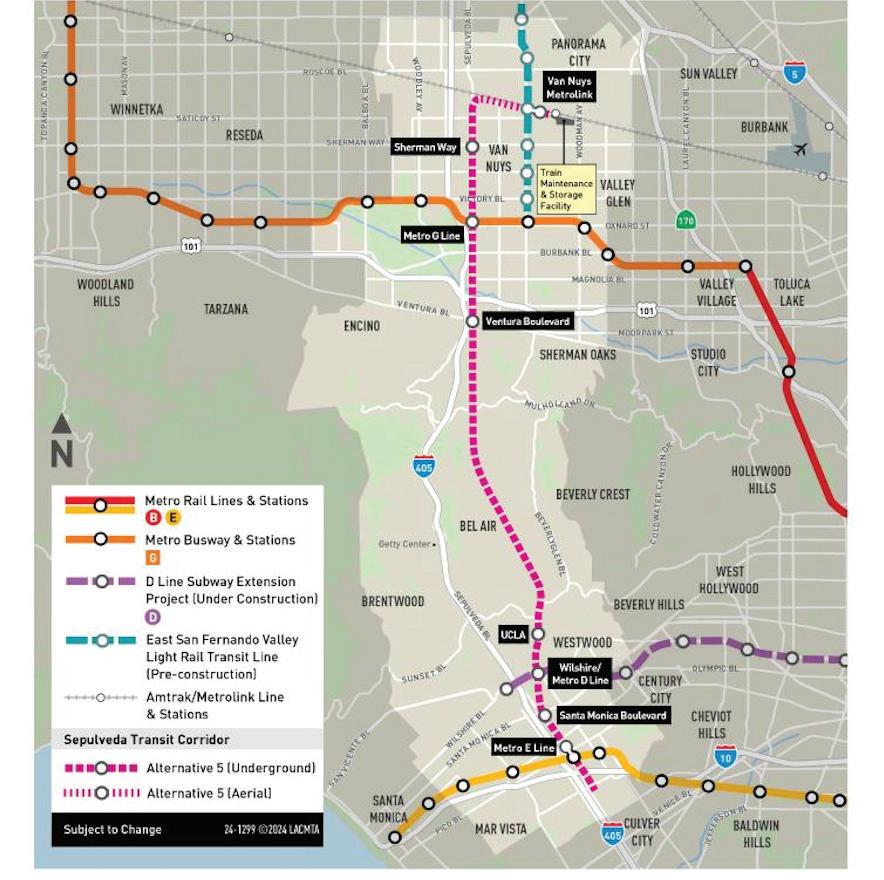
including Bel-Air, recognized that tunneling for the alignment will occur beneath homes, streets and critical infrastructure.
She introduced an amendment, which was approved by the board, to bolster community outreach and inform constituents as Metro advances work on the project.
Metro staff emphasized that Modified Alternative 5 would maintain construction underground, eliminating surface construction and reducing vibration impacts. Tunnels would be below at
least 500 feet underground.
The board approved a second amendment introduced by Los Angeles Mayor and Metro Director Karen Bass, who supported the project. She called for the agency to explore transit connections to the Getty Center.
A previous alignment option proposed a route through the Sepulveda Pass with a stop at the Getty Center.
Other alignment options that Metro explored involved combinations of monorail,
heavy rail, underground and aerial systems. These options varied in cost, length and service frequency, among other factors.
The project received support from some UCLA students, labor groups, transit advocates and community groups. The Sherman Oaks Homeowners Association previously opposed the project, but that has changed.
Some homeowners in Bel-Air, for example, have criticized and opposed any proposal for an underground rail system.
By City News Service
Statewildlifofficials
Thursday said a mountain lion cub with an injured paw that was captured after being spotted crouching in the middle of a Castaic roadway is on the mend.
On Wednesday, California Fish and Wildlife officials received a report of an injured mountain lion in the area of Hillcrest Parkway and Olympic Street, according to an agency spokesman.
“Shortly after, our biologists were able to locate and capture the juvenile mountain lion,” said CDFW spokesman Cort Klopping. “They confirmed it was a juvenile female mountain lion and transferred her to a vet for further assessment.”
The cub was initially captured on video about 1 a.m. Wednesday. The animal remained motionless on the asphalt for a time before eventually running off.
California Highway Patrol officers had blocked traffic while the cub was in the roadway.
Residents reported seeing two other mountain lions, one believed to be the cub’s mother, in the area.
The cub’s disappearance raised concerns about its welfare, but by Wednesday afternoon, CDFW shared video showing the approximately young wildcat being captured after a search that lasted several hours.
“Radiographs from the vet showed no broken bones, swelling or obvious issues,” Klopping said. “There is a small laceration on one of its paws and it’s slightly under-

weight, but overall, seems to be in good condition.”
The kitten weighs about 16 and a half pounds and is estimated to be 4 to 5 months old, according to Klopping.
Experts generally examine a panther’s teeth to determine its approximate age.
“Our biologists are now working on reunification efforts to get the cub back where she belongs,” Klopping said. “We’re asking the public to please drive
slowly in the area and to keep a distance from the area as human presence can negatively impact reunification of the cub with its mother.
We’re also asking residents from the Castaic area to utilize our Wildlife Incident Report system on the CDFW website to report any sightings of adult mountain lions in the area, as that could help us reunite her with her mother.”
By City News Service
The Los Angeles Unified School District discriminates against white students under its decadesold desegregation policy, a lawsuit filed Tuesday alleges.
Brought by the 1776 Project Foundation, a Billings, Montana-based conservative group, the federal civil rights suit contends the district’s allegedly racially discriminatory policies systematically disadvantage certain students based on the racial makeup of their schools.
Filed in Los Angeles federal court, the complaint targets LAUSD’s use of race-based classifications to label schools as “PHBAO” -- Predominantly Hispanic, Black, Asian, and Other non-Anglo -- and to allocate benefits accordingly.
Fewer than 100 schools in the district lack the PHBAO designation, and the suit
alleges that students at these schools, including white and Middle Eastern students, are being denied equal access to educational resources and opportunities.
An LAUSD spokesperson said the district could not comment on ongoing litigation.
“Because this matter involves pending litigation, we are unable to comment on the specifics,” according to the statement. “However, Los Angeles Unified remains firmly committed to ensuring all students have meaningful access to services and enriching educational opportunities.”
The plaintiffs maintain that LAUSD continues to use a race-based formula stemming from a 1981 court order related to desegregation, which categorized schools by student demographics.
While that order aimed to remedy past discrimination, the lawsuit argues that the district has transformed the policy into a permanent and unconstitutional system of racial preferences.
According to the 1776 Project Foundation, PHBAO schools receive more funding, staff and smaller class sizes than non-PHBAO schools. Additionally, the plaintiffs assert, only PHBAO school parents are guaranteed two annual parent-teacher conferences.
“These policies are not just unfair -- they’re unconstitutional,” Michael DiNardo, lead attorney for the 1776 Project Foundation, said in a statement. “What began as a temporary measure to address segregation has become a rigid system of racial favoritism that excludes thousands of

students from equal opportunity.”
The lawsuit alleges violations of the Equal Protection Clause of the Fourteenth Amendment, Title VI of the
Followingatriple
Civil Rights Act of 1964, and California’s Proposition 209, which prohibits racial preferences in public education.
The plaintiffs seek a permanent injunction to halt
alleged race-based programming to “ensure that all students receive equal treatment, regardless of racial classification,” according to the foundation.
By Staff
extended engagement in New York, a box office record-breakingtwo-week run in Chicago, San Francisco, Seattle, and a six-week London run—which Dame Judi Dench called “spectacular”—Tony Award-nominated Eddie Izzard brings Shakespeare’s “Hamlet” to life in a dynamic new staging of the play, adapted by Mark Izzard and directed by Selina Cadell. This solo performance of “Hamlet” will be in Los Angeles through Jan. 31 at The Montalbán Theatre. Tickets are on sale at ticketmaster.com. “Hamlet” in Los Angeles is a Westbeth Entertainment Production.
“Hamlet” received a
New York Outer Critics Circle Award nomination for Outstanding Solo Performance, as well as a nomination for the New York Drama League’s Distinguished Performance Award.
The King of Denmark is dead, and Prince Hamlet must take revenge—initiating a cascade of events that will destroy both family and state. In Hamlet, Izzard portrays men, women, ghosts, scholars, tyrants, courtiers, lovers, fools, and poets.
Izzard says, “I have always gravitated towards playing complex and challenging characters and Hamlet is the ultimate. This is a production for everyone, a timeless drama with an
accidental hero. Selina, Mark, and I want audiences to see and hear an accessible, touching, tragic, and dramatic Hamlet.”
Chris Jones in the Chicago Tribune said, “I’ve always been fascinated watching Izzard’s mind and memory work -- and she clearly has thought through everything in what was a near-flawless textual performance. For those of us who know ‘Hamlet’ like the back of our hands, there are revelations on tap … [and] when it gets to the famous soliloquies, Izzard smashes all three of the great ones with genuinely startling alacrity. A reward is to see an artist who deeply believes in taking risks and who loves

to share the rewards.”
Hamlet marks Izzard’s second solo show following
Ther sold-out run of
Dickens’ “Great Expectations,” which played to rave
he average price of a gallonofself-serve regulargasolinein
Los Angeles County dropped Thursday to its lowest amount since July 15, 2021, decreasing two-tenths of a cent to $4.346.
The average price has decreased three consecu-
tive days, dropping 1.3 cents, including three-tenths of a cent Wednesday, after backto-back increases totaling nine-tenths of a cent, according to figures from the AAA and Oil Price Information Service.
The average price is eight-
tenths of a cent less than one week ago, 12.2 cents lower than one month ago and 14.9 cents below what it was one year ago. It has dropped $2.148 since rising to a record
$6.494 on Oct. 5, 2022.
The Orange County average price rose seven-
tenths of a cent to $4.23, one day after dropping a half-cent to its lowest amount since June 22, 2021. It is ninetenths of a cents less than one week ago, 12.4 cents lower than one month ago and 20.8 cents below what it was one year ago.
The Orange County average price has dropped $2.229 since rising to a record $6.459 on Oct. 5, 2022.
The national average price rose 1.7 cents to $2.85, one day after a run of four decreases in five days totaling 2.2 cents ended with an increase of 1.1
cents. It is six-tenths of a cent more than one week ago but a half-cent less than one month ago and 27.9 cents lower than one year ago.
The national average price has dropped $2.166 since rising to a record $5.016 on June 14, 2022.