FREE
Baldwin Park
LA County board backs lawsuit seeking to stop media megamerger
County approves Altadena program to remove leadcontaminated soil
PG 27
PG 28
VISIT HEYSOCAL.COM
MONDAY, JULY 27-AUGUST 02, 2026
Court quashes lawsuit challenging Arcadia council censure
VOL. 14,
Therapy in a tent: The healthcare many homeless Californians need but aren’t getting
By Joe Taglieri
By Marisa Kendall, CalMatters
joet@civicnewsgroup.com
A
Los Angeles Superior Court judge Thursday dismissed a lawsuit challenging the Arcadia City Council’s censure of thenMayor and current Councilwoman Sharon Kwan. The council voted 4-1 in September to censure Kwan for alleged offenses that included violating rules of decorum during meetings and “engaging in un-collegial behavior, unprofessional temperament, and unfounded accusations against Councilmembers simply because other Councilmembers expressed a differing viewpoint,” according to the censure resolution.Kwan has said the censure was an attempt by the council majority — current Mayor Paul Cheng, Mayor Pro Tem David Fu and Councilman Michael Cao — to quell her opposition to large pay increases for city employees and discredit her allegations of sexual harassment and gender discrimination against Fu. In March an investigation into the harassment allegations determined Kwan’s charges were unsubstantiated. According to Kwan that conclusion “is not accurate, and I do not believe it was fair” because the only people interviewed were the four other council members, Fu’s wife and City Manager Dominic Lazzaretto. Ex-Mayor and Councilwoman Eileen Wang, who resigned earlier this year after federal prosecutors outed her as an intelligence operative for the People’s Republic of China, cast a vote to censure Kwan. In his ruling Thursday, Judge Dean J. Kitchens found that the censure was a constitutionally protected exercise of free speech and did not violate the Ralph M. Brown Act, which governs how local governments
NO. 286
This story was originally published by CalMatters.
L
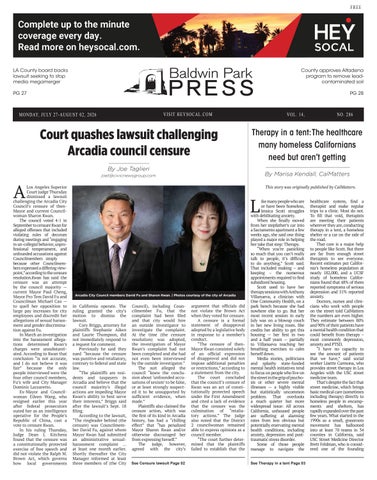
Arcadia City Council members David Fu and Sharon Kwan. | Photos courtesy of the city of Arcadia
in California operate. The ruling granted the city’s motion to dismiss the lawsuit. Cory Briggs, attorney for plaintiffs Stephanie Aiken and Laurie Thompson, did not immediately respond to a request for comment. Previously he said they sued “because the censure was punitive and retaliatory, contrary to federal and state law. “The plaintiffs are residents and taxpayers in Arcadia and believe that the council majority’s illegal actions are impeding Mayor Kwan’s ability to best serve their interests,” Briggs said after the lawsuit’s Sept. 18 filing. According to the lawsuit, “The ringleader behind (the censure) was Councilmember David Fu, against whom Mayor Kwan had submitted an administrative sexualharassment complaint … at least one month earlier. Shortly thereafter the City Manager informed at least three members of (the City
Council), including Councilmember Fu, that the complaint had been filed and that city would hire an outside investigator to investigate the complaint. At the time (the censure resolution) was adopted, the investigation of Mayor Kwan’s complaint had not been completed and she had not even been interviewed by the outside investigator.” The suit alleged the council “knew the conclusion about ‘unfounded accusations of sexism’ to be false, or at least strongly suspected it to be unsupported by sufficient evidence, when made.” Plaintiffs also claimed the censure action, which was the first of its kind in Arcadia history, has had a “chilling effect” that “has penalized Mayor Sharon Kwan and/or otherwise discouraged her from expressing herself.” The judge, however, agreed with the city’s See Censure lawsuit Page 02
argument that officials did not violate the Brown Act when they voted for censure. A censure is a formal statement of disapproval adopted by a legislative body in response to a member’s conduct. “The censure of thenMayor Kwan consisted solely of an official expression of disapproval and did not impose additional penalties or restrictions,” according to a statement from the city. The court concluded that the council’s censure of Kwan was an act of constitutionally protected speech under the First Amendment and cited a lack of evidence that the censure was the culmination of “retaliatory actions.” The judge also noted that the District 2 councilwoman remained able to express opinions as a council member. “The court further determined that the plaintiffs failed to establish that the
ike many people who are or have been homeless, Jessica Scott struggles with debilitating anxiety. When she finally moved from her stepfather’s car into a Sacramento apartment a few weeks ago, she said one thing played a major role in helping her take that step: Therapy. “When you’re panicking so much that you can’t really talk to people, it’s difficult to do anything,” Scott said. That included making – and keeping – the numerous appointments required to find subsidized housing. Scott used to have her therapy sessions with Anthony Villanueva, a clinician with One Community Health, on a park bench because she had nowhere else to go. But her most recent session in early July was on a blowup couch in her new living room. She credits her ability to get this housing — her first in two and a half years — partially to Villanueva teaching her breathing exercises to calm herself down. Media stories, politicians and splashy state-funded mental health initiatives tend to focus on people who live on the street in the grip of psychosis or other severe mental illnesses — a highly visible but statistically uncommon problem. That overlooks a much quieter but more widespread issue: All across California, unhoused people are suffering at alarming rates from less obvious but potentially enervating mental health conditions, including anxiety, depression and posttraumatic stress disorder. Some of those people manage to navigate the
See Therapy in a tent Page 03
healthcare system, find a therapist and make regular trips to a clinic. Most do not. To fill that void, therapists are meeting their patients wherever they are, conducting therapy in a tent, a homeless shelter or a car on the side of the road. That care is a major help to people like Scott. But there are far from enough street therapists to see everyone. Recent estimates put California’s homeless population at nearly 182,000, and a UCSF study of homeless Californians found that 48% of them reported symptoms of serious depression and 51% reported anxiety. Doctors, nurses and clinicians who work with people on the street told CalMatters the numbers are even higher. They estimate between 80% and 90% of their patients have a mental health condition that could benefit from therapy – most commonly depression, anxiety and PTSD. “I have no capacity to see the amount of patients that we have,” said social worker Lisette Carmona, who provides street therapy in Los Angeles with the USC street medicine team. That’s despite the fact that street medicine, which brings basic medical care (sometimes including therapy) directly to homeless people in encampments and shelters, has rapidly expanded over the past few years. What started in the 1990s as a small, grassroots movement has ballooned into at least 70 teams in 34 counties in California, said USC Street Medicine Director Brett Feldman, who is considered one of the founding