FREE
West Nile virus: Positive mosquito samples surge in SGV
El Monte reclaims troubled MacLaren site with park, affordable housing
Pg 02
Pg 24
MONDAY, SEPTEMBER 07-SEPTEMBER 13, 2026
VISIT HEYSOCAL.COM
NO. 292
VOL. 15,
Band-Aid, not a cure — federal Colorado River plan leaves states guessing every two years
Kwan denies ties to Chinese Communist Party ahead of Arcadia council hearing
By Rachel Becker, CalMatters
By Joe Taglieri joet@civicnewsgroup.com
This story was originally published by CalMatters.
A
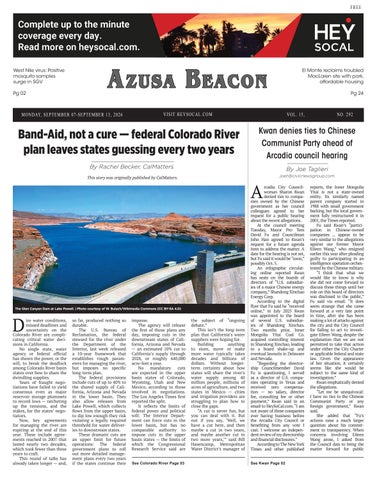
The Glen Canyon Dam at Lake Powell. | Photo courtesy of W. Bulach/Wikimedia Commons (CC BY-SA 4.0)
D
ire water conditions, missed deadlines and uncertainty on the Colorado River are complicating critical water decisions in California. No single state, water agency or federal official has shown the power, or the will, to break the deadlock among Colorado River basin states over how to share the dwindling supplies. Years of fraught negotiations have failed to yield consensus even as major reservoir storage plummets to record lows — ratcheting up the tensions, and the stakes, for the states’ negotiators. Now, key agreements for managing the river are expiring at the end of this year. These include agreements reached in 2007 that lasted nearly two decades, which took fewer than three years to craft. This round of talks has already taken longer — and,
so far, produced nothing so durable. The U.S. Bureau of Reclamation, the federal steward for the river under the Department of the Interior, last week released a 10-year framework that establishes rough parameters for managing the river, but imposes no specific long-term plan. The federal provisions include cuts of up to 40% to the shared supply of California, Arizona and Nevada in the lower basin. They also allow releases from Lake Powell, which collects flows from the upper basin, to dip low enough they risk violating a legally required threshold for water deliveries to downstream states. These dramatic cuts are an upper limit for future operations: The federal government plans to roll out more detailed management plans every two years if the states continue their
impasse. The agency will release the first of those plans any day, imposing cuts in the downstream states of California, Arizona and Nevada — an estimated 10% cut to California’s supply through 2028, or roughly 440,000 acre-feet a year. No mandatory cuts are expected in the upper basin states of Colorado, Wyoming, Utah and New Mexico, according to those involved in negotiations. The Los Angeles Times first reported the split. It reflects the limits of federal power and political will: The Interior Department can force cuts in the lower basin, but has no comparable authority to impose cuts in the upper basin states — the limits of which the Congressional Research Service said are See Colorado River Page 03
the subject of “ongoing debate.” This isn’t the long-term plan that California’s water suppliers were hoping for. Building anything to store, move or make more water typically takes decades and billions of dollars. Without longerterm certainty about how states will share the river’s water supply among 40 million people, millions of acres of agriculture, and two states in Mexico — cities and irrigation providers are struggling to plan how to close the gaps. “A cut is never fun, but you can deal with it. But not if you say, ‘Well, we have a cut here, and then maybe a cut in two years, and maybe another cut in two more years,’” said Bill Hasencamp, Metropolitan Water District’s manager of
rcadia City Councilwoman Sharon Kwan denied ties to companies owned by the Chinese government as her council colleagues agreed to her request for a public hearing about the recent allegations. At the council meeting Tuesday, Mayor Pro Tem David Fu and Councilman John Han agreed to Kwan’s request for a future agenda item to address the matter. A date for the hearing is not set, but Fu said it would be “soon,” possibly Oct. 5. An infographic circulating online reported Kwan has seats on the boards of directors of “U.S. subsidiaries of a major Chinese energy company,” Shandong Xinchao Energy Corp. According to the digital flyer that Fu said he “received online,” in July 2025 Kwan was appointed to the board of several U.S. subsidiaries of Shandong Xinchao. Two months prior, Inner Mongolia Yitai Coal Co. acquired controlling interest in Shandong Xinchao, leading to a board shake-up and eventual lawsuits in Delaware and Nevada. “Regarding the directorship Councilmember David Fu is questioning, I served as a director of U.S. companies operating in Texas and received zero compensation — no salary, director fee, consulting fee or other payment,” Kwan said in an email to HeySoCal.com. “I am not aware of these companies ever having business before the Arcadia City Council or benefiting from any vote I cast. I welcome an independent review of my directorship and financial disclosures.” According to The New York Times and other published See Kwan Page 02
reports, the Inner Mongolia Yitai is not a state-owned entity. Its similarly named parent company started in 1988 with small government backing, but the local government fully restructured it in 2001, the Times reported. Fu said Kwan’s “participation in Chinese-owned companies ... appear to be very similar to the allegations against our former Mayor Eileen Wang,” who resigned earlier this year after pleading guilty to participating in an intelligence operation orchestrated by the Chinese military. “I think that what we would like to know is why she did not come forward to discuss these things until her role on this board of directors was disclosed to the public,” Fu said via email. “It does seem strange that she came forward at a very late point in time, after she has been making a lot of attacks against the city and the City Council for failing to act to investigate Eileen Wang, despite the explanation that we are not permitted to take that action under either the City Charter or applicable federal and state law. Given the appearance of her situation, it certainly seems like she would be subject to the same kind of investigation.” Kwan emphatically denied the allegations. “Let me be unequivocal: I have no ties to the Chinese Communist Party or any foreign government,” Kwan said. She added that “Fu’s actions raise a much larger question about his commitment to transparency. When concerns involving Eileen Wang arose, I asked from the Council dais to bring the matter forward for public