FREE
Newsom makes last-minute push to help California utilities facing wildfire bills
Lineage reports 92% removal of rotting food waste after East LA warehouse fire
Pg 02
Pg 23
MONDAY, AUGUST 17-AUGUST 23, 2026
VISIT HEYSOCAL.COM
Almost nowhere in California is building enough, according to the state — here’s why By Ben Christopher, CalMatters
Fire survivors, local official blast Newsom’s pending ‘utility bailout’ By Joe Taglieri
This story was originally published by CalMatters. Sign up for their newsletters.
E
very eight years, state housing regulators give cities and counties across California an especially dreaded homework assignment: Make a plan for a bunch of new homes. Gov. Gavin Newsom’s administration assigns localities goals to hit at four different affordability levels. Collectively, the numbers represent the housing department’s best estimate of the number of new homes needed to match any expected population growth and to chip away at the state’s decades-in-themaking shortage of affordable places to live. With these targets meted out to each region on a rolling basis, this summer, a massive chunk of the state, including all of Southern California, passed its halfway mark. So in the spirit of a mid-term exam, how are cities and counties doing? Bad news, California. If this were graded, the state would abound in D’s and F’s. Less than a third of cities and counties are on track to permit enough “above moderate” units, the category that typically refers to market-rate housing, according to data submitted by locals to the state housing department. The progress report for more affordable types of housing is even bleaker. Only 32 jurisdictions — less than 6% — are on track to hit their “very low” targets. That refers to housing within financial reach of anyone earning less than half the typical local income. After years of nudging, political trolling and litigating, most cities and counties now have state-approved plans in place. But as the production numbers show,
joet@civicnewsgroup.com
L
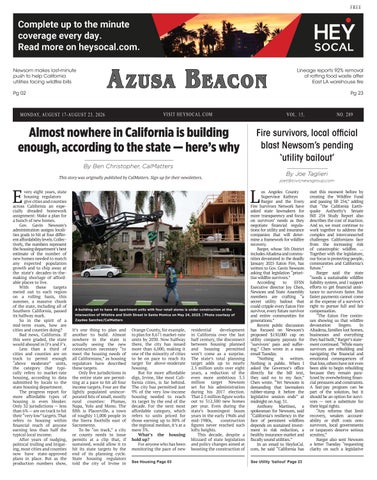
A building set to have 40 apartment units with four retail stores is under construction at the intersection of Wilshire and Sixth Street in Santa Monica on May 24, 2023. | Photo courtesy of Zaydee Sanchez/CalMatters
it’s one thing to plan and another to build. Almost nowhere in the state is actually seeing the new construction necessary “to meet the housing needs of all Californians,” as housing regulators have described these targets. Only five jurisdictions in the entire state are permitting at a pace to hit all four income targets. Four are the lightly populated unincorporated bits of small, mostly rural counties: Plumas, Napa, Yolo and Mono. The fifth is Placerville, a town of roughly 11,000 people in the Sierra foothills east of Sacramento. To be “on track,” a city or county needs to issue permits at a clip that, if sustained, would allow it to hit its state targets by the end of its planning cycle. State housing regulators told the city of Irvine in
Orange County, for example, to plan for 8,671 market-rate units by 2030. Now halfway there, the city has issued more than 6,000, making it one of the minority of cities to be on pace to reach its target for above-moderate housing. But for more affordable digs, Irvine, like most California cities, is far behind. The city has permitted just 9% of the very low-income housing needed to reach its target by the end of the decade. For the next most affordable category, which refers to units priced for those earning up to 80% of the regional median, it’s at a mere 3%. What’s the housing hold up? For anyone who has been monitoring the pace of new See Housing Page 03
residential development in California over the last half century, the disconnect between housing planned and housing permitted won’t come as a surprise. The state’s total planning target adds up to nearly 2.5 million units over eight years, a reduction of the even more ambitious 3.5 million target Newsom set for his administration during his 2017 election. That 2.5 million figure works out to 312,500 new homes per year. Even during the state’s boomingest boom years in the early 1960s and mid-1980s, construction figures never reached such lofty heights. This decade, despite a blizzard of state legislation and policy changes aimed at boosting the construction of
NO. 289
VOL. 15,
os Angeles County Supervisor Kathryn Barger and the Every Fire Survivors Network have asked state lawmakers for more transparency and focus on survivors’ needs as they negotiate financial regulations for utility and insurance companies that will determine a framework for wildfire recovery. Barger, whose 5th District includes Altadena and communities devastated in the deadly January 2025 Eaton Fire, has written to Gov. Gavin Newsom asking that legislation “prioritize wildfire survivors.” According to EFSN Executive director Joy Chen, Newsom and State Assembly members are crafting “a secret utility bailout that could cripple every Eaton Fire survivor, every future survivor and entire communities for generations.” Recent public discussion has focused on Newsom’s proposed $150,000 cap on utility company payouts for “survivors’ pain and suffering,” Chen wrote in a mass email Tuesday. “Nothing is written. Nothing is public. When I asked the Governor’s office directly for the bill text, they said no to my face,” Chen wrote. “Yet Newsom is demanding that lawmakers rubber-stamp it before the legislative session ends” at midnight on Aug. 31. Anthony Martinez, a spokesman for Newsom, said “California’s resiliency in the face of persistent wildfires depends on sustained investment in risk reduction, a healthy insurance market and fiscally sound utilities.” In an email to HeySoCal. com, he said “California has See Utility ‘bailout’ Page 23
met this moment before by creating the Wildfire Fund and passing SB 254,” adding that “the California Earthquake Authority’s Senate Bill 254 Study Report also describes the cost of inaction. And so, we must continue to work together to address the complex and interconnected challenges Californians face from the increasing risk of catastrophic wildfire. ... Together with the legislature, our focus is protecting people, communities and California’s future.” Barger said the state “needs a sustainable wildfire liability system, and I support efforts to get financial assistance to survivors faster. But faster payments cannot come at the expense of a survivor’s right to pursue full and fair compensation. “The Eaton Fire continues showing us that wildfire devastation lingers. In Altadena, families lost homes, businesses and everything they had built,” Barger’s statement continued. “While many survivors are rebuilding and navigating the financial and emotional consequences of that loss, others have not even been able to begin rebuilding because they remain paralyzed by overwhelming financial pressures and constraints. A fast-pay program can be part of the solution, but it should be an option for survivors — not a substitute for their legal rights. “Any reforms that limit recovery, weaken accountability or shift costs onto survivors, local governments or taxpayers deserve serious scrutiny,” Barger also sent Newsom a letter Tuesday “requesting clarity on such a legislative