FREE
Why insurance matters to renters, landlords and California
Measles exposure reported at Universal Studios Hollywood
Pg 05
Pg 23
MONDAY, AUGUST 10-AUGUST 16, 2026
VISIT ARCADIAWEEKLY.COM
VOL.30,
NO. 288
‘Don’t Flock me’: California, US lawmakers debate license plate reader technology
LA County to review allocation of Measure B tax funds for hospitals
By Ryan Sabalow, CalMatters
By City News Service
This story was originally published by CalMatters. Sign up for their newsletters.
I
n the past year alone, they’ve helped catch suspected murderers, bank robbers and hit-and-run drivers. They’ve located dozens of stolen cars and helped send a wildland arsonist to prison. They’re also distrusted and despised by privacy rights activists on the left and on the right. Just last month, police accused a suspect in Monterey County of yanking down three of them with his pickup. They’re called automated license plate readers. Every day, untold numbers of Californians drive past the thousands of cameras that at least 230 police and sheriffs’ departments have posted along roadways or installed on their patrol cars. The cameras in real time capture and read plate numbers, then cross-reference them with law enforcement databases of vehicles police want to locate, such as stolen cars, getaway vehicles or those that may be carrying a missing or wanted person. Since 2019, California Democratic lawmakers have unsuccessfully sought to further restrict how police use the technology. They’re trying again this year with a bill that would add limits on how long police may retain license plate data, how they access it and with whom they share it. Police agencies and officers’ unions across the state oppose the latest measure, which is similar to a bill Gov. Gavin Newsom vetoed last year. “This bill is about one simple principle: Protecting the privacy and safety of Californians while ensuring law enforcement tools are used responsibly before it’s too late,” the author of this year’s legislation, Riverside Democratic Sen. Sabrina Cervantes, told the Assembly privacy
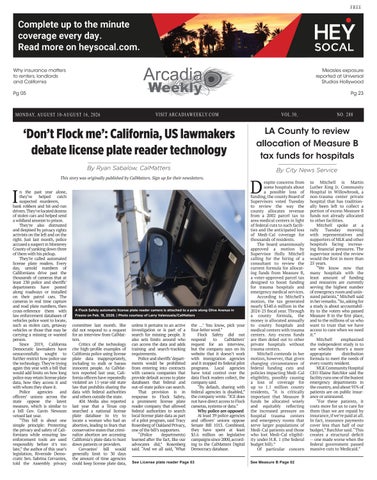
A Flock Safety automatic license plate reader camera is attached to a pole along Olive Avenue in Fresno on Feb. 19, 2026. | Photo courtesy of Larry Valenzuela/CalMatters
committee last month. She did not respond to a request for an interview from CalMatters. Critics of the technology cite high-profile examples of California police using license plate data inappropriately, including to stalk or harass innocent people. As CalMatters reported last year, California officers have repeatedly violated an 11-year-old state law that prohibits sharing the data with federal authorities and others outside the state. 404 Media also reported last year that a Texas cop searched a national license plate database to try to locate a woman who had an abortion, leading to fears that conservative states that criminalize abortion are accessing California’s plate data to hunt down patients or providers. Cervantes’ bill would generally limit to 30 days the amount of time agencies could keep license plate data,
unless it pertains to an active investigation or is part of a search for missing people. It also sets limits around who can access the data and adds training and search-tracking requirements. Police and sheriffs’ departments would be prohibited from entering into contracts with camera companies that provide default access to plate databases that federal and out-of-state police can search. That provision is in response to Flock Safety, a prominent license plate reader company that allowed federal authorities to search local license plate data as part of a pilot program, said Tracy Rosenberg of Oakland Privacy, one of the bill’s supporters. “(Police departments) learned after the fact, like our advocates did,” Rosenberg said. “And we all said, ‘What
the …’ You know, pick your four-letter word.” Flock Safety did not respond to CalMatters’ request for an interview, but the company says on its website that it doesn’t work with immigration agencies and it stopped its federal pilot programs. Local agencies have total control over the data Flock readers collect, the company said. “By default, sharing with federal agencies is disabled,” the company wrote. “ICE does not have direct access to Flock cameras, systems or data.” Why police are opposed At least 39 police agencies and officers’ unions oppose Senate Bill 1013. Combined, they have spent at least $5.6 million on legislative campaigns since 2000, according to the CalMatters Digital Democracy database.
See License plate reader Page 03
D
espite concerns from some hospitals about a possible loss of funding, the county Board of Supervisors voted Tuesday to review the way the county allocates revenue from a 2002 parcel tax to area medical centers in light of federal cuts to such facilities and the anticipated loss of Medi-Cal coverage for thousands of residents. The board unanimously approved a motion by Supervisor Holly Mitchell calling for the hiring of a consultant to review the current formula for allocating funds from Measure B, a voter-approved parcel tax designed to boost funding for trauma hospitals and emergency medical services. According to Mitchell’s motion, the tax generated nearly $340.6 million in the 2024-25 fiscal year. Through a county formula, the money is allocated annually to county hospitals and medical centers with trauma centers. Any excess funds are then doled out to other private hospitals without trauma centers. Mitchell contends in her motion, however, that given changing circumstances of federal funding cuts and policies impacting Medi-Cal eligibility, possibly causing a loss of coverage for up to 1.1 million county residents, “it is critically important that Measure B funds be allocated wisely and equitably reflecting the increased pressure on hospital trauma centers and emergency rooms that serve larger populations of Medi-Cal patients and those who lost Medi-Cal eligibility under H.R. 1 (the federal budget bill).” Of particular concern
See Measure B Page 02
to Mitchell is Martin Luther King Jr. Community Hospital in Willowbrook, a non-trauma center private hospital that has traditionally been left to collect a portion of excess Measure B funds not already allocated to other facilities. Mitchell spoke at a rally Tuesday morning with representatives and supporters of MLK and other hospitals facing increasing financial pressures. The supervisor noted the review would the first in more than 25 years. “We know now that many hospitals with the least amount of funding and resources are currently serving the highest number of emergency room and uninsured patients,” Mitchell said in her remarks. “So, asking for a study is about accountability to the voters who passed Measure B in the first place, and to the millions of us who want to trust that we have access to care when we need it.” Mitchell emphasized the independent study is to see whether there’s a more appropriate distribution formula to meet the needs of every county resident. MLK Community Hospital CEO Elaine Batchlor said the facility runs one of the busiest emergency departments in the country, and about 95% of patients are on public insurance or uninsured. “For these patients, it costs more for us to care for them than we are repaid by insurance, if we’re paid at all. In fact, insurance payments cover less than half of our budget,” Batchlor said. “This creates a structural deficit -- one made worse when the federal government passed massive cuts to Medicaid.”