FREE
Police: Nearly 100 citations issued for illegal fireworks in Riverside
Former Indian Wells Mayor Richard Oliphant dies at 92
PG 02
PG 27
VISIT HEYSOCAL.COM
MONDAY, JULY 20-JULY 26, 2026
VOL. 12,
A new review of the SAT at University of California is coming by June 2027
Analysis shows proposed stormwater mandates will cost San Bernardino County, cities $11 billion By Staff
By Mikhail Zinshteyn, CalMatters
A
n updated analysis by an economic research firm has revealed that proposed stormwater requirements will impose roughly $11 billion in costs on San Bernardino County and 16 of its cities over the next 20 years, which officials said will unleash a financial crisis that could bankrupt cities, increase housing prices, gut public safety budgets and disproportionately harm the region’s most vulnerable residents. The county hired Beacon Economics, a nationally recognized economic research and consulting firm for an “independent, data-driven analysis” of the proposed Regional Municipal Separate Storm Sewer System Permit, or MS4, county officials said. The Santa Ana Regional Water Quality Control Board oversees the permit, which regulates stormwater runoff from urban areas. According to the county, the proposed permit revisions would require sweeping new compliance measures that local officials claim “are both financially unworkable and environmentally unproven.” These concerns led to an outcry from Southern California counties and cities in 2024 when the permit was first discussed. “After 15 months of silence and no effort at collaboration,” the San Bernardino County Board of Supervisors 2026 update to the proposed MS4 permit was released about two months ago. Beacon Economics’ analysis found the newest version of the proposed permit failed to reduce its huge costs in any substantial way, according to the county. A revised “Tentative Order” does include some minor improvements in implementation flexibility,
NO. 285
This story was originally published by CalMatters.
T
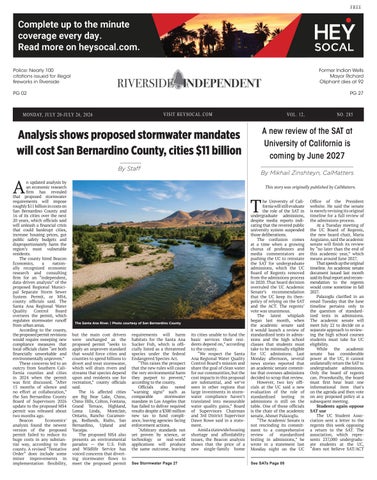
The Santa Ana River. | Photo courtesy of San Bernardino County
but the main cost drivers were unchanged as the proposed permit “seeks to apply an unproven standard that would force cities and counties to spend billions to divert and treat stormwater, which will drain rivers and streams that species depend upon and residents use for recreation,” county officials said. The 16 affected cities are Big Bear Lake, Chino, Chino Hills, Colton, Fontana, Grand Terrace, Highland, Loma Linda, Montclair, Ontario, Rancho Cucamonga, Redlands, Rialto, San Bernardino, Upland and Yucaipa. The proposed MS4 also presents an environmental paradox — the U.S. Fish and Wildlife Service has voiced concerns that diverting stormwater flows to meet the proposed permit
requirements will harm habitats for the Santa Ana Sucker Fish, which is officially listed as a threatened species under the federal Endangered Species Act. “This raises the prospect that the new rules will cause the very environmental harm they purport to prevent,” according to the county. Officials also noted “warning signs” such as comparable stormwater mandate in Los Angeles that has failed to deliver required results despite a $300 million new tax to fund compliance, leaving agencies facing enforcement actions. “Arbitrary standards not yet proven by science, or technology or real-world applications will produce the same outcome, leaving See Stormwater Page 27
its cities unable to fund the basic services their residents depend on,” according to the county. “We respect the Santa Ana Regional Water Quality Control Board’s mission and share the goal of clean water for our communities, but the cost impacts in this proposal are substantial, and we’ve seen in other regions that large investments in stormwater compliance haven’t translated into measurable water quality gains,” Board of Supervisors Chairman and 3rd District Supervisor Dawn Rowe said in a statement. Amid a statewide housing shortage and affordability issues, the Beacon analysis shows that the price of a new single-family home
he University of California will still evaluate the role of the SAT in undergraduate admissions, despite media reports indicating that the revered public university system suspended those deliberations. The confusion comes at a time when a growing chorus of professors and media commentators are pushing the UC to reinstate the SAT for undergraduate admissions, which the UC Board of Regents removed from the admissions process in 2020. That board decision overruled the UC Academic Senate’s recommendation that the UC keep its thenpolicy of relying on the SAT and the ACT. The regents’ vote was unanimous. The latest whiplash began last month, when the academic senate said it would launch a review of standardized tests in admissions and the high school classes that students must take to be minimally eligible for UC admissions. Last Monday afternoon, several news stories reported that an academic senate committee that oversees admissions decided to scrap that review. However, two key officials at the UC said a new evaluation of the role of standardized testing in admissions is still on the table. One of those officials is the chair of the academic senate, Ahmet Palazoglu. “The Academic Senate is not rescinding its commitment to a comprehensive review of standardized testing in admissions,” he wrote in a statement last Monday night on the UC See SATs Page 05
Office of the President website. He said the senate is merely revising its original timeline for a full review of the admissions process. At a Tuesday meeting of the UC Board of Regents, the new board chair, Maria Anguiano, said the academic senate will finish its review by “no later than the end of this academic year,” which means around June 2027. That speeds up the original timeline. An academic senate document issued last month said its final report and recommendation to the regents would come sometime in fall 2027. Palazoglu clarified in an email Tuesday that the June timeline pertains only to the question of standardized tests in admissions. The academic senate will meet July 22 to decide on a separate approach to reviewing the high school courses students must take for UC eligibility. While the academic senate has considerable power at the UC, it cannot unilaterally return the SAT to undergraduate admissions. Only the board of regents can. Procedurally, the board must first hear least one informational item that’s on the agenda and then vote on any proposed policy at a subsequent meeting. Students again oppose SAT use The UC Student Association sent a letter to the regents this week opposing a return to the SAT. The association, which represents 237,000 undergraduate students at the UC, “does not believe SAT/ACT
HEYSOCAL.COM
2 JULY 20-JULY 26, 2026
Police: Nearly 100 citations issued for illegal fireworks in Riverside By City News Service
P
ublic safety officials throughout the city of Riverside stayed busy in the days leading up to the Fourth of July, writing almost 100 citations for illegal fireworks and seizing over 50 pounds of pyrotechnics, according to figures published by the police department. The agency said Thursday extra patrols, coordination between the police and fire departments, as well as the Department of Code Enforcement, plus the deployment of remote-controlled drones, enabled authorities to take swift action from June 27 to July 4, whenever potential illegal fireworks activity was reported or uncovered. “Drone technology has become an important public safety tool in addressing illegal fireworks,” Riverside Police Department Chief
Larry Gonzalez said. “It allows our officers to safely identify violations, gather evidence and hold individuals accountable, while reducing unnecessary risks to police officers, firefighters and the community.” Authorities confirmed that during the June 27-July 4 period, 79 citations were issued for alleged fireworks violations, including igniting, possessing and transporting the devices. That compared to 65 citations over the same period last year. Convictions stemming from the citations can result in fines up to $1,500. The police department said 51 pounds of illicit fireworks were also seized. On the plus side, there were fewer complaints to the city’s call center regarding fireworks activity citywide — 452 this year, compared to 547
at the same time in 2025. On July 4, five designated “enforcement teams” were positioned in areas of the city where illicit pyrotechnics have been a problem in the past. Relying largely on drones, “teams collected video evidence to pinpoint the property of origin,” according to a police statement. “ Before issuing a citation, each case was carefully verified by the unmanned aerial systems operator, visual observer, code enforcement officer and often additional police and fire personnel,” the agency stated. There were at least two licensed fireworks spectaculars in the city on July 4. In Riverside County, private parties are prohibited from using fireworks except in Blythe, Coachella, Desert Hot Springs and Indio, where so- called “safe and sane” fire-
A person jumps through exploding fireworks on a Riverside street. | Photo courtesy of Riverside Police Department/YouTube
works, certified by the state fire marshal, can be sold to the public. “Every firework, especially illegal fireworks, has the potential to cause life
changing injuries, ignite destructive fires and put families, homes, businesses and first responders at risk,” Riverside Fire Department Chief Steve McKinster
said. “By making responsible choices, we can protect lives, safeguard property and ensure everyone enjoys a safe and memorable summer.”
Former classroom tech sues Corona-Norco school district over alleged workplace violations By City News Service
A
classroom technician who worked with an aggressive student notorious for disruptions alleges that she ultimately lost her job for properly documenting incidents involving the boy and others, prompting her to sue the Corona-Norco Unified School District, it was announced Thursday. Alejandrina King of San Diego filed the whistleblower retaliation suit in Riverside County Superior Court based on her experiences at John Adams Elementary School. The suit was formally announced Thursday during a news briefing outside the CNUSD administration building on Clark Avenue in Norco. The plaintiff worked directly for Oldsmar, Florida-based Sunbelt Staffing -- also a defendant in her civil action -- as a “registered behavior technician.” According to her civil complaint, Sunbelt assigned King to Adams from Sept. 12, 2025, to March 5, 2026, with responsibility for handling the “Behavior Intervention Plan” of a boy with maladaptive issues, designated as “special needs.” The boy was a student in the classroom of teacher Teresa Azzarello, court papers said. The suit noted the youth’s case was deemed “high profile” and that he had a history of emotional imbalances, pointing to an
instance in which he “bit and scratched Azzarello” and another in which he “attempted to kick a classmate.” The episodes led to his being physically restrained. “The plaintiff documented eight to 12 or more behavioral incidents per day, multiple early classroom dismissals, class evacuations, staff injuries, verbal threats and two student send-homes within three days,” according to the complaint. Previous actions by the school district to limit the student’s impacts led to legal action by his parents, who succeeded in keeping him at Adams Elementary, but with a personal behavior technician on hand to contain him and document his activity, as well as those around him, which became King’s responsibility, according to the plaintiff. She said that despite the disruptions, the youth made “measurable progress” while she was assigned to his case. When King began documenting what she perceived as unwarranted interventions against the youth, the plaintiff said she encountered push-back from Azzarello, Principal Andrea Kea and others. In January, a report was submitted that detailed how “’staff responses may unintentionally reinforce
problem behavior’ and that ‘inconsistent or limited opportunities for the student to communicate needs’ contributed to his behavioral challenges,” according to the suit. Following an incident in early February that left Azzarello with an injury, the child was sent home, and when King met with her to discuss what had occurred, the teacher allegedly compared trying to talk to the child as akin to “negotiating with terrorists,” the complaint said. The plaintiff alleged she was deprived of use of space set aside for behavioral health counseling, worked “off the clock” to resolve issues with the boy and was subject to “hostility and exclusion” when she tried to present data concerning the Behavior Intervention Plan and how it might be better applied.On Feb. 23, the plaintiff was trying to de-escalate an episode involving the student and other staff and children when she became “physically pinned against a wall,” causing needless physical danger to everyone, according to the suit. King presented her concerns to Kea and supervisors at Sunbelt Staffing, filing a formal grievance and alleging “noncompliance” with the Behavior Intervention Plan. She “expressly
Riverside County Superior Court. | Photo courtesy of michael h j c/Wikimedia Commons (CC BY-SA 2.0)
invoked her rights under the ... California Whistleblower Protection Act,” which is part of the Labor Code, in submitting her concerns, court papers said. Less than two weeks later, she was removed from her position at Adams Elementary. She was informed by her supervisors that her services within CNUSD were no longer required, after which she was sent to a school in Orange County. That assignment ended in early June. Since then,
she has been unemployed, according to the suit. “The Corona-Norco Unified School District is committed to providing all students with high-quality, free, appropriate public education and to comply with all applicable federal and state laws,” according to a CNUSD statement released to City News Service. “The district remains focused on supporting students and ensuring that appropriate educational services are provided.”
Administrators declined to comment specifically on King’s case because it involves pending litigation. Sunbelt Staffing did not reply to requests for comment Thursday. The plaintiff is seeking compensatory and punitive damages based on alleged whistleblower retaliation, wrongful termination, breaches of state law in providing rest periods and back wages owed. No hearings have been set yet in the civil action.
HEYSOCAL.COM
JULY 20-JULY 26, 2026 3
Publisher Civic News Group COO Andrea Olivas Tange Vice President Sam Kubert Editorial editorial@civicnewsgroup.com Fabiola Diaz Joe Taglieri Designer/ Production production@civicnewsgroup.com Renia Barouni Contributor May S. Ruiz Sales advertising@civicnewsgroup.com Raquel Mc Laughlin Legal Advertising legals@civicnewsgroup.com Annette Reyes Crystal Cortez Accounting accounting@civicnewsgroup.com
Newsom announces $2.5B for transportation improvements By City News Service
All Inquiries info@civicnewsgroup.com
CIVIC NEWS GROUP
118 W Lime, Ste 126 Monrovia, CA 91016 (626) 566-2149 www.heysocal.com
PRESS RELEASE SUBMISSIONS AND LETTERS editorial@civicnewsgroup.com Submissions Policy
Civic News Group, Inc. All contents herein are copyrighted and may not be reproduced in any manner, either in whole or in part, without the express written consent of the publisher. The Views and opinions expressed in this paper are not necessarily that of the management and staff at Civic News Group, Inc.
AI in the Newsroom
HeySoCal editors periodically utilize AI tools for research and writing assistance for some articles. No article is ever published without human editorial supervision and approval. The Arcadia Weekly has been adjudicated as a newspaper of general circulation in court case number GS 004333 for the City of Arcadia, County of Los Angeles, State of California.
| Photo courtesy of Amy Chen/Unsplash
L Rosemead Reader A Beacon Media, Inc. Publication
SanGabriel Sun Temple Tribune City
The Monrovia Weekly has been adjudicated as a newspaper of General Circulation in Court Case GS 004759 City of Monrovia, County of Los Angeles, State of California. The Temple City Tribune has been adjudicated as a newspaper of general circulation in court case number GS 012440 City of Temple City, County of Los Angeles, State of California. The El Monte Examiner has been adjudicated as a newspaper of general circulation in court case number KS 015872 City of El Monte, County of Los Angeles, State of California.
os Angeles County is expected to receive $257 million in state funding to support its southwest mobility hubs, consisting of street improvements for pedestrians, bicyclists and vehicles, it was announced Thursday. On Thursday, Gov. Gavin Newsom said nearly $2.5 billion would be disbursed for various projects across the state, which includes funding for L.A. and Riverside counties. Riverside County will receive $64 million for the rehabilitation of Interstate 215 with new pavement and safety improvement on about nine miles.
The Azusa Beacon has been adjudicated as a newspaper of general circulation in court case number KS 015970 City of Azusa, County of Los Angeles, State of California.
The Rosemead Reader has been adjudicated as a newspaper of general circulation in court case number GS 048894 City of Rosemead, County of Los Angeles, State of California.
Belmont Beacon
The Alhambra Press has been adjudicated as a newspaper of general circulation in court case number ES016581 City of Alhambra, County of Los Angeles, State of California.
The Burbank Independent has been adjudicated as a newspaper of general circulation in court case number ES016728 City of Burbank, County of Los Angeles, State of California. The Glendale Independent has been adjudicated as a newspaper of general circulation in court case number ES016579 City of Glendale, County of Los Angeles, State of California. The Monterey Park Press has been adjudicated as a newspaper of general circulation in court case number ES016580 City of Monterey Park, County of Los Angeles, State of California. The West Covina Press has been adjudicated as a newspaper of general circulation in court case number KS017304 City of West Covina, County of Los Angeles, State of California. The San Bernardino Press has been adjudicated as a newspaper of general circulation in court case number CIVDS 1506881 City of San Bernardino, County of San Bernardino, State of California. The Riverside Independent has been adjudicated as a newspaper of general circulation in court case number RIC1505351 City of Riverside, County of Riverside, State of California. The Pasadena Press has been adjudicated as a newspaper of general circulation in court case number ES018815 City of Pasadena, County of Los Angeles, State of California.
The Anaheim Press has been adjudicated as a newspaper of general circulation in court case number 30-2017-00942735-CU-PT-CJC City of Anaheim, County of Orange, State of California. The Ontario News Press has been adjudicated as a newspaper of general circulation in court case number CIVDS 1506881 City of Ontario, County of San Bernardino, State of California.
administration has allocated more than $78.4 billion to transportation projects across California, supporting the creation of more than 800,000 jobs, according to his office. “Transportation investments are about more than infrastructure; they are investments in people, communities, and opportunity,” said California Transportation Commission Chair Clarissa Falcon in a statement. “These latest investments will help ensure our transportation system continues to serve the needs of communities throughout California today while preparing for the challenges of tomorrow.”
By City News Service
G
The Baldwin Park Press has been adjudicated as a newspaper of general circulation in court case number KS017174 City of Baldwin Park, County of Los Angeles, State of California.
The Belmont Beacon has been adjudicated as a newspaper of general circulation in court case number NSO30275 City of Long Beach, County of Los Angeles, State of California.
transportation,” Newsom said in a statement. “Investments like these drive our economy while creating good-paying jobs across the state.” Through the California Transportation Commission, this nearly $2.5 billion investment brings the Newsom administration*s total transportation allocations for fiscal year 2025-26 to approximately $13.8 billion. These investments support local streets and roads, state highways, active transportation, public transit and intercity rail projects and will create more than 150,000 jobs. Since 2019, the Newsom
Newsom signs new law to streamline prosecution of sexual offense cases
The San Gabriel Sun has been adjudicated as a newspaper of general circulation in court case number GS 013808 City of San Gabriel, County of Los Angeles, State of California. The Duarte Dispatch has been adjudicated as a newspaper of general circulation in court case number GS 013893 City of Duarte, County of Los Angeles, State of California.
About $547 million from the federal infrastructure Investment and Jobs Act of 2021, and another $736 million from California’s Senate Bill 1, also referred to as the Road Repair and Accountability Act of 2017, made the contribution possible. Additionally, the remaining $1.1 billion is funded through the State Highway Account, the general fund and other state and federal programs. “Through repairing aging roads and bridges, creating world-class transit and freight systems, expanding public transit, and leading technological innovation -- we are ushering in the golden age of
San Bernardino Press
ov. Gavin Newsom signed a measure into law that strengthens prosecutors’ ability to prosecute certain multi-county sexual offense cases, the Riverside County District Attorney’s Office announced Tuesday. “As prosecutors, our goal is to seek justice while minimizing the impact the legal process has on victims whenever possible,” Chief Deputy District Attorney Ivy Fitzpatrick said in a statement. “AB 2147 helps accomplish both by allowing related cases to move forward together. We appreciate Assembly member Pilar Schiavo’s leadership in advancing this legislation and Governor Newsom for signing it into law.” Newsom signed Assembly Bill 2147, known as the Sexual Predator Accountability Act, on July
| Photo courtesy of Josh Hild/Unsplash
13.
Prior to the legislation, some cases involving sexual battery, indecent exposure and annoying or molesting a child had to be prosecuted
in the county where the crime occurred, prompting case delays and sometimes forcing victims to testify multiple times in cases involving multiple jurisdic-
tions, according to the D.A.’s office. The new law allows eligible cases to be prosecuted in a single jurisdiction, officials said.
HEYSOCAL.COM
4 JULY 20-JULY 26, 2026
Conservation groups slam attack on the Endangered Species Act
Suspected cheating prompts Cal DMV to require drivers retake written tests
By Suzanne Potter, Public News Service
By City News Service
I
t could soon become a lot harder for conservation groups to sue to stop development in sensitive wildlife habitat in California and across the country. Conservation groups pointed to a rule change finalized July 10 by a federal agency under President Donald Trump. The move guts part of the Endangered Species Act by redefining the term “harm” to exclude habitat destruction. Jewel Tomasula, national policy director for the Endangered Species Coalition, said it opens the door to projects that disturb wildlife habitat as long as the projects do not directly kill the species. “We know that the Trump administration and industry is going to look to abuse this by taking all the chances they can get to destroy habitat and to have unchecked activities like logging, mining, oil and gas development,” Tomasula contended. In a statement, the U.S. Fish and Wildlife Service defended the change, calling the old definition of harm
| Photo courtesy of Dmitry Grigoriev/Unsplash
a misguided example of federal overreach and a burden to landowners. California is home to more than 142 animal species federally listed as endangered or threatened, including the monarch butterfly and the California condor. Conservation groups have vowed to sue to stop this rule change. Tomasula encouraged people to make voices heard on the Trump administration’s interpretation of the Endangered Species Act.
“With enough public outcry and pressure, the Trump administration can roll back their decisions. Congress can also step in and void this rule,” Tomasula pointed out. Habitat protection under the California Endangered Species Act remains in force. Meanwhile, other endangered or threatened species in the state include the San Joaquin kit fox, bighorn sheep, the desert tortoise and the southern sea otter.
| Photo courtesy of Micah Sittig/Flickr (CC BY 2.0)
T
housands of licensed drivers in California are being required to retake their knowledge tests because the California Department of Motor Vehicles says it found “irregularities” in their test results and suspects them of cheating, officials said Wednesday. Last month, the DMV sent letters to some 11,000 drivers saying that their written test results showed “irregularities.” The department did not provide specifics about what problems were found with the tests. Those receiving the letters were instructed to return to a DMV office and retake their knowledge test within 30 days. Individuals who do not complete and pass the retest will have their driver’s license cancelled, the DMV said.
The DMV indicated that some individuals may have attempted to cheat during the testing process. “The California DMV has identified irregularities in certain driver knowledge test results that may indicate instances of cheating,” a department spokesperson said in an email sent to City News Service. The spokesperson said that through “routine internal monitoring,” the department identified patterns in driver knowledge test results indicating that “some individuals may have attempted to circumvent the testing process using various cheating methods.” The DMV emphasized that although certain test results have been identified as “potentially problematic,” receipt of a notice alone
does not indicate a final determination that cheating occurred in that instance. “Nonetheless, these irregularities are test taker related and not the result of an internal DMV technical issue, or involvement of artificial intelligence,” the spokesperson said. “Ensuring the integrity of the knowledge testing process is essential to public safety and to confirm that drivers understand California’s rules of the road.” Several cases have been referred to county district attorneys for prosecution, according to the DMV. “DMV is not sharing additional information at this time, so as not to reveal investigative methods and protect the integrity of the investigative process,” the department said Tuesday.
HEYSOCAL.COM
JULY 20-JULY 26, 2026 5
MWD agreement aims to address water levels in historically low Lake Mead By Joe Taglieri joet@civicnewsgroup.com
A
s Lake Mead’s historically low water level continues to decrease, the Metropolitan Water District of Southern California on Tuesday approved an agreement with the federal government in an effort to bring more water into the reservoir. The agreement with the U.S. Bureau of Reclamation will provide the MWD up to $65 million to keep up to 200,000 acre-feet of Colorado River water in the lake this year. An acre-foot is roughly 326,000 gallons, enough water to serve approximately three households, according to MWD officials. Under the agreement approved by the MWD Board of Directors, the Reclamation Bureau will pay the district $325 per acre-foot to keep these water supplies in Lake Mead this year. The funding is from the 2022 Inflation Reduction Act’s Lower Colorado River Basin System Conservation and Efficiency Program. Officials said the agreement came to fruition because of investments in water sources, storage and conservation efforts. “Over the last 30 years, we’ve transformed how Southern California secures its water future. By investing in diverse water supplies,
incentivizing conservation, and capturing and storing water whenever it’s available, we’ve added resilience to our system,” MWD Board Chair Adán Ortega Jr. said in a statement. He added that Metropolitan and its ratepayers have invested $1.7 billion in conservation, water recycling and groundwater recovery since 1990. The result has been the production of over 8.8 million acre-feet of water. “Those decades of forward-thinking investments allow us to step forward and help stabilize the Colorado River when it needs us most,” Ortega said. “That’s why flexibility in how we operate is so important — so we can take advantage of opportunities like this one to help when the water is available.” The board also approved two other agreements with the Quechan Tribe located in the Arizona-California border area and Bard Water District, allowing the federal government to pay for up to 19,000 acre-feet of additional conserved agricultural water to Lake Mead annually over the next two years. The agreements followed a record-low snowpack in the Colorado River Basin this year that has caused Lake Mead’s water level to significantly
recede. If Lake Mead loses too much water, hydropower generation at Hoover Dam could decrease by 70% and limit the electricity supply for the Southwest U.S. Metropolitan General Manager Shivaji Deshmukh said the agreements are temporary solutions and longer-term commitments are needed. That would require consensus among the seven states in the Colorado River Basin on how to proceed after current guidelines expire at the end of this year. “We’re grateful to be in the position this year to help reduce the impacts of drought on the Colorado River system as it faces unprecedented challenges,” Deshmukh said in a statement. “But while these agreements provide important near-term support, lasting progress will require long-term solutions. If we all commit to reducing our use, we can avoid deeper cuts and create lasting change that will benefit future generations who rely on the Colorado River Basin.” The MWD worked with agricultural entities and the federal Reclamation Bureau on similar agreements in 2023 to preserve water in Lake Mead, officials said. Hoover Dam and Lake
An aerial view of Lake Mead and Hoover Dam. | Photo courtesy of the U.S. Bureau of Reclamation
Mead are on the border of Arizona and Nevada in the Colorado River’s Black Canyon, about 35 miles southeast of Las Vegas. The reservoir has dropped 160-170 feet since its record high water level set in 1983,
according to Reclamation data. Since 2000, shrinking snowpacks, rising temperatures, agricultural irrigation demand and increasing populations have strained the Colorado River and its
reservoirs Lake Powell and Lake Mead, according to the Grand Canyon Trust. MWD service areas are in Los Angeles, Orange, San Diego, Riverside, San Bernardino and Ventura counties.
SATs will result in better prepared students.” The letter notes that racial and ethnic diversity at the UC increased after 2020 while the system posted no decline in graduation rates. “The role of public education is to ensure all students can access their right to a robust, quality learning experience, and the UC must not limit the number of students able to enter its halls,” the students wrote. Students in 2020 urged the regents to remove standardized tests from admissions. The regents reaffirmed their ban on exams for admissions in 2021. At the meeting, Anguiano hinted at her discomfort with the current discourse over the role of tests in admissions. “Recent public conversations have focused on admissions and standardized testing, too narrowly, in my opinion,” she said Tuesday. Why faculty want the SAT back More than 2,000 UC professors in science, technology, engineering and
math have signed a petition urging the UC to reinstate the SAT or ACT as requirements for undergraduate admissions for STEM majors by fall 2027. Nearly 1,000 additional professors in other disciplines signed a similar letter to fully reinstate the SAT or ACT in the admissions process. The petition from STEM professors said high school grades alone are not a sufficient measure of college readiness, pointing to increasing grade inflation and the growing number of students relying on artificial intelligence to complete assignments. That means some students aren’t prepared for the rigors of a UC education, they say. Mina Aganagic, a physics and math professor at UC Berkeley, spoke Tuesday in favor of returning the SAT. “Without the SAT, our introductory courses are forced to reteach elementary and middle school material. This wastes opportunities, misallocating resources rather than increasing access,” she
said. But the leader of an influential nonprofit that advocates for increased access to the UC said focusing on the SAT is the wrong move. “This is absolutely the wrong solution to an undefined problem,” said Jessie Ryan, president of the Campaign for College Opportunity. “What we know, based on the UC Office of the President’s own research, is that since going to test-free (admissions), our retention rates have remained stable and graduation rates have also increased.” She continued: “If, in fact, we want to address college preparation, we should be looking not at becoming more selective, but being more supportive to students across the state. Working with our K-12 partners to improve preparation, not slamming the door on thousands of students.” Critics of the SAT maintain that the test is unfair to lowincome students, who are less
Students walk through the UCLA campus in Los Angeles on Feb. 18, 2022. | Photo courtesy of Raquel Natalicchio/CalMatters
likely to be able to afford test preparation services to boost their scores. Standardized tests were just one factor in how campuses decided whom to admit. Other considerations
included the quality of courses students take, how that courseload compares to students from the same high school, an applicant’s special talents or achievements and the location of
their high school. This article was originally published on CalMatters and was republished under the Creative Commons Attribution-NonCommercialNoDerivatives license.
LEGALS
6 JULY 20-JULY 26, 2026
File your DBA with us at filedba.com El Monte City Notices NOTICE OF ELECTION CITY OF EL MONTE NOTICE IS HEREBY GIVEN that a Consolidated General Municipal Election will be held on Tuesday, November 3, 2026 for the following City of El Monte elected officers: For One (1) Mayor Elected At-Large from the Entire City Full term of two (2) years For One (1) Council Member of the City Council for District 2 Full term of four (4) years For One (1) Council Member of the City Council for District 3 Full term of four (4) years For One (1) Council Member of the City Council for District 6 Full term of four (4) years For One (1) City Clerk Elected At-Large from the Entire City Full term of four (4) years For One (1) City Treasurer Elected At-Large from the Entire City Full term of four (4) years The nomination period for these offices begins on Monday, July 13, 2026 and closes on Friday, August 7, 2026 at 5:00 p.m. If nomination papers for an incumbent officer of the City are not filed by Friday, August 7, 2026 (the 88th day before the election) the voters shall have until the 83rd day before the election, August 12, 2026 at 5:00 pm., to nominate candidates other than the person(s) who are the incumbents on the 88th day before the election, for that incumbent’s elective office. This extension is not applicable where there is no incumbent eligible to be elected. If no one (1) or only one (1) person is nominated for an elective office, appointment to the elective office may be made as prescribed by Elections Code Section 10229 of the State of California. In-person voting will be available at any Voting Center located in the County of Los Angeles at designated locations weekdays and weekends from October 24, 2026 to November 3, 2026. Voting Centers shall be open at 7:00 a.m. on the day of the election and shall remain open continuously from that time until 8:00 p.m. of the same day when the polls shall be closed (pursuant to Election Code Section 10242, except as provided in Section 14401 of the Elections Code of the State of California.) Gabriel Ramirez, City Clerk City of El Monte Date Published: July 9, 2026; July 13, 2026; July 20, 2026; and July 27, 2026
NOTICE OF ELECTION CITY OF EL MONTE NOTICE IS HEREBY GIVEN TO ALL QUALIFIED VOTERS of the City of El Monte that a Consolidated General Municipal Election will be held on TUESDAY, NOVEMBER 3, 2026 for the purpose of electing: For One (1) Mayor Elected At-Large from the Entire City Full term of two (2) years For One (1) Council Member of the City Council for District 2 Full term of four (4) years For One (1) Council Member of the City Council for District 3 Full term of four (4) years For One (1) Council Member of the City Council for District 6 Full term of four (4) years For One (1) City Clerk Elected At-Large from the Entire City Full term of four (4) years For One (1) City Treasurer Elected At-Large from the Entire City Full term of four (4) years Inclusive of any other qualifying criteria mandated by the California Government Code, the California Elections Code or the El Monte Municipal Code, candidates for the above election must be registered voters residing in the City of El Monte. Nomination documents for the election shall be available no earlier than Monday, July 13, 2026, and no later than Friday, August 7, 2026, pursuant to Elections Code Sections 10220, 10224 & 10407, at the City of El Monte, City Clerk’s Office, located at 11333 Valley Boulevard, El Monte, California 91731, between the hours of 7:00 a.m. and 5:00 p.m. Nomination documents must be filed at the office of the El Monte City Clerk’s Office, located at the above referenced address no later than 5:00 p.m. on Friday, August 7, 2026.
Although the City Clerk’s Office is closed for business on Fridays along with all other City Hall Offices, the City Clerk’s Office will be open on Friday, August 7, 2026, between the hours of 7:00 a.m. and 5:00 p.m. for the sole purpose of issuing and accepting candidates’ nomination papers for the aforementioned Consolidated General Municipal Election. Prospective candidates and members of the public are further advised that the City Clerk’s Office is not open on Saturdays, Sundays or any holiday observed by the City pursuant to Section 2.68.010 of the El Monte Municipal Code. Pursuant to Elections Code Section 10225, if nomination documents for an incumbent are not filed by 5:00 p.m. on Friday, August 7, 2026, the nomination period shall be extended until 5:00 p.m. on Wednesday, August 12, 2026. If no one (1) or only one (1) person is nominated for an elective office, appointment to the elective office may be made as prescribed by Elections Code Section 10229 of the State of California. On the date of the Consolidated General Municipal Election, polling places shall be open between the hours of 7:00 a.m. and 8:00 p.m. Persons requiring multilingual assistance in Spanish, Chinese, Vietnamese, Tagalog, Japanese, Korean, Thai, Khmer, and Hindi, regarding information in the notice may call (626) 580-2016. Gabriel Ramirez, City Clerk City of El Monte EL MONTE EXAMINER
AVISO DE ELECCIONES CIUDAD DE EL MONTE SIRVA EL PRESENTE PARA COMUNICAR que se llevará a cabo una Elección Municipal General Consolidada en la ciudad de El Monte el martes, 3 de noviembre de 2026, para ocupar los siguientes cargos: Para 1 (un) alcalde electo independiente para toda la ciudad Mandato completo de 2 (dos) años Para 1 (un) miembro del Concejo Municipal para el Distrito 2 Mandato completo de 4 (cuatro) años Para 1 (un) miembro del Concejo Municipal para el Distrito 3 Mandato completo de 4 (cuatro) años Para 1 (un) miembro del Concejo Municipal para el Distrito 6 Mandato completo de 4 (cuatro) años Para 1 (un) Secretario Municipal elegido en votación general para toda la ciudad Mandato completo de 4 (cuatro) años Para 1 (un) Tesorero Municipal elegido en votación general para toda la ciudad Mandato completo de 4 (cuatro) años El período de nominación para estos cargos comenzará el lunes, 13 de julio de 2026 y finalizará el viernes, 7 de agosto de 2026 a las 5:00 p.m. Si no se presenta la documentación de nominación para un funcionario titular de la ciudad antes del viernes, 7 de agosto de 2026 (el 88o día previo a las elecciones), los votantes tendrán hasta el 83o día antes de la elección, el 12 de agosto de 2026 a las 5:00 p.m., para nominar candidatos que no sean los titulares en el 88o día previo a la elección, para el cargo electivo de dicho titular. Esta extensión no se aplicará cuando no haya un titular que reúna los requisitos para ser electo. En caso de no presentarse nominación alguna o de haber solo 1 (un) nominado para el cargo electivo, se podrá recurrir al nombramiento del funcionario en cuestión conforme lo dispuesto en el art. 10229 del Código Electoral del Estado de California. Se podrá votar en persona en cualquier Centro de votación del condado de Los Ángeles, en ubicaciones designadas, los días entre semana y fines de semana a partir del 24 de octubre de 2026 y hasta el 3 de noviembre de 2026. Los Centros de votación abrirán a las 7:00 a. m. el día de las elecciones y permanecerán abiertos sin interrupciones desde esa hora hasta las 8:00 p. m. del mismo día, momento en que se cerrarán las urnas (de acuerdo con la sección 10242 del Código de electoral, salvo lo estipulado en la sección 14401 del Código electoral del estado de California). Gabriel Ramirez, Secretario Municipal Ciudad de El Monte Fecha de publicación: 9 de julio de 2026; 13 de julio de 2026; 20 de julio de 2026 y 27 de julio de 2026
AVISO DE ELECCIONES CIUDAD DE EL MONTE SIRVA EL PRESENTE PARA COMUNICAR A TODOS LOS VOTANTES CALIFICADOS de la ciudad de El Monte que se realizará una Elección General Municipal Consolidada el MARTES, 3 DE NOVIEMBRE DE 2026 para ocupar los siguientes cargos:
HEYSOCAL.COM Para 1 (un) alcalde electo independiente para toda la ciudad Mandato completo de 2 (dos) años Para 1 (un) miembro del Concejo Municipal para el Distrito 2 Mandato completo de 4 (cuatro) años Para 1 (un) miembro del Concejo Municipal para el Distrito 3 Mandato completo de 4 (cuatro) años Para 1 (un) miembro del Concejo Municipal para el Distrito 6 Mandato completo de 4 (cuatro) años Para 1 (un) Secretario Municipal elegido en votación general para toda la ciudad Mandato completo de 4 (cuatro) años Para 1 (un) Tesorero Municipal elegido en votación general para toda la ciudad Mandato completo de 4 (cuatro) años Además de cumplir con cualesquiera otros criterios para calificar que establezcan el Código de gobierno de California, el Código electoral de California o el Código municipal de El Monte, los candidatos para la elección mencionada previamente deben ser votantes registrados que residan en la ciudad de El Monte. La documentación de nominación para la elección estará disponible no antes del lunes, 13 de julio de 2026, ni más tarde del viernes, 7 de agosto de 2026, en virtud de las secciones 10220, 10224 y 10407 del Código electoral, en la Oficina de la secretaria municipal de la ciudad de El Monte, ubicada en 11333 Valley Boulevard, El Monte, California 91731, entre las 7:00 a. m. y las 5:00 p. m. La documentación de nominación debe presentarse en la oficina del secretario municipal de El Monte, ubicada en la dirección mencionada anteriormente, a más tardar a las 5:00 p. m. del viernes 7 de agosto de 2026. Aunque la oficina de la secretaria municipal esté cerrada al público los viernes junto con las demás oficinas del Ayuntamiento, la Oficina de la secretaria municipal estará abierta el viernes, 7 de agosto de 2026, de 7:00 a. m. a 5:00 p. m. con el único fin de emitir y aceptar documentación de nominación de candidatos para las Elecciones Municipales Generales Consolidadas que se mencionan más arriba. Además, se informa a los candidatos potenciales y a los miembros del público que la Oficina de la secretaria municipal no abre los sábados, domingos ni días feriados obligatorios para la ciudad, de conformidad con la sección 2.68.010 del Código municipal de El Monte. De conformidad con la sección 10225 del Código electoral, si no se presenta la documentación de nominación para un funcionario titular antes de las 5:00 p. m. del viernes, 7 de agosto de 2026, el periodo de nominación podrá extenderse hasta las 5:00 p. m. del miércoles, 12 de agosto de 2026. En caso de no presentarse nominación alguna o de haber solo 1 (una) persona nominada para un cargo electivo, se podrá realizar el nombramiento para el cargo electivo conforme a lo dispuesto en el artículo 10229 del Código Electoral del Estado de California. El día de las Elecciones Municipales Generales Consolidadas, los centros de votación estarán abiertos en un horario de 7:00 a. m. a 8:00 p. m. Quienes necesiten asistencia sobre la información del aviso en otros idiomas, como español, chino, vietnamita, tagalo, japonés, coreano, tailandés, camboyano e hindi, pueden comunicarse al (626) 580-2016. Gabriel Ramirez, Secretario Municipal Ciudad de El Monte EL MONTE EXAMINER
चुनाव का नोटिस सिटी ऑफ़ EL MONTE इसके द्वारा सूचित किया जाता है कि सिटी ऑफ़ El Monte के निम्नलिखित चुने गए अधिकारियों के लिए मंगलवार, 3 नवंबर, 2026 को समेकित आम नगरपालिका चुनाव आयोजित किया जाएगा: पूरे शहर से बड़े पैमाने पर चुने गए एक (1) मेयर के लिए दो (2) वर्षों का पूर्ण कार्यकाल डिस्ट्रिक्ट 2 के लिए नगर परिषद के एक (1) परिषद सदस्य के लिए चार (4) वर्षों का पूर्ण कार्यकाल डिस्ट्रिक्ट 3 के लिए नगर परिषद के एक (1) परिषद सदस्य के लिए चार (4) वर्षों का पूर्ण कार्यकाल डिस्ट्रिक्ट 6 के लिए नगर परिषद के एक (1) परिषद सदस्य के लिए चार (4) वर्षों का पूर्ण कार्यकाल पूरे शहर से बड़े पैमाने पर चुने गए एक (1) सिटी क्लर्क के लिए चार (4) वर्षों का पूर्ण कार्यकाल पूरे शहर से बड़े पैमाने पर चुने गए शहर के एक (1) कोषाध्यक्ष के लिए चार (4) वर्षों का पूर्ण कार्यकाल इन पदों के लिए नामांकन की अवधि सोमवार, 13 जुलाई 2026 को शुरू होगी और शुक्रवार, 7 अगस्त 2026 को शाम 5:00 बजे बंद होगी।
LEGALS
HEYSOCAL.COM अगर सिटी के किसी पदधारी के लिए नामांकन पत्र शुक्रवार 7 अगस्त, 2026 (चुनाव के पहले के 88वें दिन) तक दाखिल नहीं किया जाता है, तो मतदाताओं के पास चुनाव से 83वें दिन, 12 अगस्त, 2026 शाम 5:00 बजे तक उस पदधारी के निर्वाचित पद के लिए चुनाव से 88वें दिन पदधारी व्यक्ति(यों) के अलावा अन्य उम्मीदवारों को नामांकित करने का समय होगा। समय-सीमा का यह विस्तार उस स्थिति में लागू नहीं होता है जहाँ कोई पदधारी निर्वाचित किए जाने के लिए योग्य नहीं है। अगर किसी निर्वाचित पद के लिए कोई (1) भी नहीं या सिर्फ़ एक (1) व्यक्ति को नामित नहीं किया जाता है, तो निर्वाचित पद के लिए नियुक्ति स्टेट ऑफ़ कैलिफ़ोर्निया की चुनाव संहिता की धारा 10229 के अनुसार की जा सकती है। 24 अक्टूबर, 2026 से 3 नवंबर, 2026 तक कार्यदिवसों और सप्ताहांतों में निर्दिष्ट स्थानों पर काउंटी ऑफ़ लॉस एंजिलिस स्थित किसी भी मतदान केंद्र पर जाकर मतदान करने की सुविधा उपलब्ध रहेगी। चुनाव के दिन मतदान केंद्र सुबह 7:00 बजे से लेकर उसी दिन शाम 8:00 बजे तक लगातार खुले रहेंगे, जब मतदान बंद किया जाएगा (चुनाव संहिता की धारा 10242 के अनुसार, कैलिफ़ोर्निया राज्य की चुनाव संहिता की धारा 14401 में दिए गए प्रावधानों को छोड़कर।) Gabriel Ramirez, सिटी क्लर्क सिटी ऑफ़ EL Monte प्रकाशित होने की तारीख: 9 जुलाई, 2026; 13 जुलाई, 2026; 20 जुलाई, 2026; और 27 जुलाई, 2026 चुनाव का नोटिस सिटी ऑफ़ EL MONTE इसके द्वारा सिटी ऑफ़ El Monte के सभी योग्य मतदाताओं को सूचित किया जाता है कि समेकित आम नगरपालिका चुनाव मंगलवार, 3 नवंबर, 2026 को आयोजित किया जाएगा, जिसका उद्देश्य निम्नलिखित को चुनना है:
地区2選出市議会議員1名 任期4年
EL MONTE EXAMINER
地区3選出市議会議員1名 任期4年
សេចក្ដ ីជូនដំ ណឹងអំ ពីការស ោះសនោត ទីក្ក្ុង EL MONTE
地区6選出市議会議員1名 任期4年
សេចក្តីជន ូ ដំ ណឹងេូមជូនដំ ណឹងថា ការស ោះសនោតរួមរបេ់សាលាក្ក្ុងទូសៅនឹងក្តូវស្វ ីស ីងសៅថ្ងៃ អង្គារ ទី 3 ខែវ ិចឆ ិកា នោាំ 2026 េក្ាប់ មក្នតីជាប់ សនោតននទីក្ក្ុង El Monte ដូចខាងសក្កាម៖
市書記官1名(全市区から選出) 任期4年
េក្ាប់ សៅហ្វវយក្ក្ុងមួយ រូបក្តូវ នសក្ជីេសរ ីេទាំងក្េុងពីទីក្ក្ុងទាំងមូល
(1)
រយៈសពលសពញអាណតតិពីរ (2) នោាំ
市出納官1名(全市区から選出) 任期4年
េក្ាប់ េាជិក្ក្ក្ុមក្បឹក្ាមួយ រូបននក្ក្ុមក្បឹក្ាក្ក្ុងេក្ាប់ មណឌ លទី 2
(1)
រយៈសពលសពញអាណតតិបួននោាំ (4) នោាំ
上記公職の立候補受付は、2026年7月13日(月曜日)に開始 し、2026年8月7日(金曜日)午後5時に締め切ります。 市の現職者の立候補書類が2026年8月7日(金)(選挙日の88日 前)までに提出されない場合、有権者は選挙日の83日前である 2026年8月12日午後5時まで、その公職について、選挙日の88日 前時点の現職者以外の候補者を指名することができます。再選資 格のある現職者がいない場合、この受付期間延長は適用されませ ん。
េក្ាប់ េាជិក្ក្ក្ុមក្បឹក្ាមួយ រូបននក្ក្ុមក្បឹក្ាក្ក្ុងេក្ាប់ មណឌ លទី 3
(1)
រយៈសពលសពញអាណតតិបួននោាំ (4) នោាំ
េក្ាប់ េាជិក្ក្ក្ុមក្បឹក្ា រូបននក្ក្ុមក្បឹក្ាក្ក្ុងេក្ាប់ មណឌ លទី 6
(1)
រយៈសពលសពញអាណតតិបួននោាំ (4) នោាំ
េក្ាប់ សេម ៀនក្ក្ុងមួយ (1) រូប ដដលក្តូវ នសក្ជីេសរ ីេទាំងក្េុងពីទីក្ក្ុងទាំងមូល
រយៈសពលសពញអាណតតិបួននោាំ (4) នោាំ
េក្ាប់ ហិរញ្ញិក្ក្ក្ុងមួយ (1) រូបដដលក្តូវ នសក្ជីេសរ ីេទាំងក្េុងពីទីក្ក្ុងទាំងមូល
រយៈសពលសពញអាណតតិបួននោាំ (4) នោាំ
公選職について候補者がいない場合、または候補者が1名のみの場 合、当該公選職について、カリフォルニア州選挙法第10229条に 定めるところにより任命が行われることがあります。
पूरे शहर से बड़े पैमाने पर चुने गए एक (1) मेयर के लिए दो (2) वर्षों का पूर्ण कार्यकाल
直接投票は、2026年10月24日から2026年11月3日までの平日お よび週末に、ロサンゼルス郡内の指定された投票センターで行う ことができます。投票センターは選挙当日の午前7時に開所し、そ の時点から同日午後8時まで継続して開所し、その時点で投票を締 め切ります(カリフォルニア州選挙法第10242条に基づく。ただ し同法第14401条に別段の定めがある場合を除く)。
डिस्ट्रिक्ट 2 के लिए नगर परिषद के एक (1) परिषद सदस्य के लिए चार (4) वर्षों का पूर्ण कार्यकाल
Gabriel Ramirez(市書記官) エルモンテ市
डिस्ट्रिक्ट 3 के लिए नगर परिषद के एक (1) परिषद सदस्य के लिए चार (4) वर्षों का पूर्ण कार्यकाल
公告日:2026年7月9日、2026年7月13日、2026年7月20日、お よび2026年7月27日
डिस्ट्रिक्ट 6 के लिए नगर परिषद के एक (1) परिषद सदस्य के लिए चार (4) वर्षों का पूर्ण कार्यकाल
選挙通知 エルモンテ市
पूरे शहर से बड़े पैमाने पर चुने गए एक (1) सिटी क्लर्क के लिए चार (4) वर्षों का पूर्ण कार्यकाल
エルモンテ市のすべての有資格有権者に通知します。以下の公職 を選出するための統一地方選挙が2026年11月3日(火曜日)に実 施されます。
पूरे शहर से बड़े पैमाने पर चुने गए शहर के एक (1) कोषाध्यक्ष के लिए चार (4) वर्षों का पूर्ण कार्यकाल कैलिफ़ोर्निया सरकार की संहिता, कैलिफ़ोर्निया चुनाव संहिता या El Monte नगरपालिका संहिता द्वारा अनिवार्य किसी भी अन्य योग्य मानदंडों को शामिल करते हुए, उपरोक्त चुनाव का उम्मीदवार सिटी ऑफ़ El Monte में रहने वाला पंजीकृत मतदाता होना चाहिए। चुनाव के लिए नामांकन दस्तावेज़ सोमवार, 13 जुलाई, 2026 के बाद, और शुक्रवार, 7 अगस्त, 2026 से पहले, चुनाव संहिता धारा 10220, 10224 और 10407 के अनुसार, सिटी ऑफ़ El Monte, सिटी क्लर्क कार्यालय, 11333 Valley Boulevard, El Monte, कैलिफ़ोर्निया 91731 में, सुबह 7:00 बजे से शाम 5:00 बजे के बीच उपलब्ध रहेंगे। नामांकन के दस्तावेज़ शुक्रवार, 7 अगस्त 2026 को शाम 5:00 बजे तक ऊपर बताए गए पते पर स्थित El Monte सिटी क्लर्क के कार्यालय में जमा किए जाने चाहिए। हालाँकि, सिटी क्लर्क का कार्यालय अन्य सभी सिटी हॉल कार्यालयों की तरह शुक्रवार को व्यापार के लिए बंद रहता है, लेकिन सिटी क्लर्क का कार्यालय शुक्रवार, 7 अगस्त, 2026 को सुबह 7:00 बजे से शाम 5:00 बजे के बीच उपर्युक्त कथित समेकित आम नगरपालिका चुनाव के लिए उम्मीदवारों के नामांकन पत्र जारी करने और स्वीकार करने के एकमात्र उद्देश्य के लिए खुला रहेगा। संभावित उम्मीदवारों और जनता के सदस्यों को आगे सलाह दी जाती है कि El Monte नगरपालिका संहिता की धारा 2.68.010 के अनुसार सिटी क्लर्क का कार्यालय शनिवार, रविवार या किसी अवकाश के दिन नहीं खुलता है। चुनाव संहिता की धारा 10225 के अनुसार, अगर किसी उम्मीदवार के लिए नामांकन दस्तावेज़ शुक्रवार, 7 अगस्त, 2026 को शाम 5:00 बजे तक दाखिल नहीं किए जाते हैं, तो नामांकन की अवधि बुधवार, 12 अगस्त, 2026 शाम 5:00 बजे तक बढ़ाई जाएगी। अगर किसी निर्वाचित पद के लिए कोई (1) भी नहीं या सिर्फ़ एक (1) व्यक्ति को नामित नहीं किया जाता है, तो निर्वाचित पद के लिए नियुक्ति स्टेट ऑफ़ कैलिफ़ोर्निया की चुनाव संहिता की धारा 10229 के अनुसार की जा सकती है। समेकित आम नगरपालिका चुनाव की तिथि पर, मतदान स्थल सुबह 7:00 बजे से रात 8:00 बजे के बीच खुले रहेंगे। जो लोग इस नोटिस में दी गई जानकारी के संबंध में स्पैनिश, चीनी, वियतनामी, तागालोग, जापानी, कोरियाई, थाई, खमेर और हिंदी भाषाओं में सहायता चाहते हैं, वे (626) 580-2016 पर कॉल कर सकते हैं। Gabriel Ramirez, सिटी क्लर्क सिटी ऑफ़ EL Monte EL MONTE EXAMINER 選挙通知 エルモンテ市 2026年11月3日(火)にエルモンテ市の下記役職の統一地方選挙 を実施することとなりましたのでお知らせいたします。 市長1名(全市区から選出) 任期2年
JULY 20-JULY 26, 2026 7
រយៈសពលននការដតងតាំងេក្ាប់ កា រ ិយាល័យទាំងសនោះចាប់ ស្ដីមសៅថ្ងៃ ចនទ ទី 13 ខែក្ក្ក ដា នោាំ 2026 សហីយបិទសៅថ្ងៃ េុក្ក្ ទី 7 ខែេីហា នោាំ 2026 សវលាស ៉ោ ង 5:00 លាៃច។ ក្បេិនសបីឯក្សារដតងតាំងេក្ាប់ មក្នតីដដលក្ំ ពុងកាន់ អំណាចរបេ់សាលាក្ក្ុងមិនក្តូវ នដាក្់ ជន ូ ក្តឹ មថ្ងៃ េុក្ក្ ទី 7 ខែេីហា នោាំ 2026 សទ (នងៃទី 88 មុនការស ោះសនោត) ស ោះអោ ក្ស ោះសនោតក្តូវានសពលរហូតដល់ នងៃទី 83មុនការស ោះសនោតសៅថ្ងៃ ទី 12 ខែេីហា នោាំ 2026 សវលាស ៉ោ ង 5:00 លាៃច សដី មបីដតងតាំងសបក្ខ ជនសក្ៅពីមក្នតីដដលក្ំ ពុងកាន់ អំណាចសៅនងៃទី 88 មុនការស ោះសនោត សដី មបីចល ូ បសក្មីការសៅការ ិយាល័យសក្ជីេតាំងរបេ់មក្នតីដដលក្ំ ពុងកាន់ អំណាចស ោះ។ ការពនារសពលសនោះ មិនអាចអនុវតត សៅក្ដនែ ងណាដដលគ្មមនមក្នតីក្ំពុងកាន់ អំណាចានេិទធិឈរស្មោះស ោះសនោតសទ។ ក្បេិនសបីគ្មមនមនុេស (1) ក្់ ឬានមនុេសដត (1) ក្់ ក្តូវ នដតងតាំងេក្ាប់ កា រ ិយាល័យសក្ជីេតាំង ការដតងតាំងសៅការ ិយាល័យសក្ជីេតាំងអាចក្តូវ នស្វ ីស ីងដូចានដចងសដាយក្ក្មស ោះសនោត ាក្ត 10229 ននរដឋ California។ ការមក្ស ោះសនោតសដាយផ្ទាល់ គឺានស្វ ីស ីងសៅមជឈមណឌ លស ោះសនោតណាមួយដដលានទីតាំងសៅសខាន្ីននទីក្ក្ុង Los Angeles សៅទីតាំងដដល នក្ំ ណត់ សៅនងៃស្វ ីការ និងចុងេ ត ហ៍ចាប់ ពីថ្ងៃ ទី 24 ខែតុលា នោាំ 2026 ដល់ នងៃទី 3 ខែវ ិចឆ ិកា នោាំ 2026។ មណឌ លស ោះសនោតក្តូវសបីក្សៅសា៉ោង 7:00 ក្ពឹក្ សៅនងៃស ោះសនោត សហីយនឹងសៅដតសបីក្បនត ពីសា៉ោងស ោះរហូតដល់ សា៉ោង 8:00 យប់ នននងៃដដដល
សៅសពលដដលមណឌ លស ោះសនោតក្តូវបិទ (អនុសលាមតមក្ក្មស ោះសនោត សលីក្ដលងដតានដចងក្ន ុងាក្ត 14401 ននក្ក្មស ោះសនោតននរដឋ California។)
ាក្តទី
10242
Gabriel Ramirez, សេមៀនក្ក្ុង ទីក្ក្ុង El Monte
市長1名(全市区から選出) 任期2年 地区2選出市議会議員1名 任期4年
កាលបរិសចេ ទស ោះពុមព្ាយ៖ នងៃទី 9 ដែក្ក្ក ដា នោាំ 2026 នងៃទី 13 ដែក្ក្ក ដា នោាំ 2026 នងៃទី 20 ដែក្ក្ក ដា នោាំ 2026 និងនងៃទី 27 ដែក្ក្ក ដា នោាំ 2026
地区3選出市議会議員1名 任期4年
សេចក្ដ ីជូនដំ ណឹងអំ ពីការស ោះសនោត ទីក្ក្ុង EL MONTE
地区6選出市議会議員1名 任期4年
សេចក្ដ ីជន ូ ដំ ណឹងេូមជូនដំ ណឹងដល់ អោ ក្ានេិទធិស ោះសនោតក្គប់ រ ូបសៅទីក្ក្ុង El Monte ឲ្យ នក្ជាបថា ការស ោះសនោតរួមរបេ់សាលាក្ក្ុងទូសៅនឹងក្តូវស្វ ី ស ីងសៅថ្ងៃ អង្គារ ទី 3 ខែវ ិចឆ ិកា នោាំ 2026 ក្នុងសគ្មលបំ ណងេក្ាប់ ការស ោះសនោត៖
市書記官1名(全市区から選出) 任期4年 市出納官1名(全市区から選出) 任期4年 カリフォルニア州行政法、カリフォルニア州選挙法またはエルモ ンテ市条例で義務付けられているその他資格基準を含め、上記の 選挙の候補者はエルモンテ市在住の登録有権者でなければなりま せん。本選挙の立候補書類は、選挙法第10220条、第10224条お よび第10407条に基づき、2026年7月13日(月)から2026年8月7 日(金)まで、午前7時から午後5時の間、エルモンテ市書記官事 務所(11333 Valley Boulevard, El Monte, California 91731)に て入手できます。立候補書類は、2026年8月7日(金)午後5時ま でに、上記住所のエルモンテ市書記官事務所へ提出しなければな りません。 市書記官事務所は、他の市庁舎各部署と同様に金曜日は通常閉 庁していますが、上記統一地方総選挙の立候補書類の発行およ び受理のみを目的として、2026年8月7日(金)午前7時から午 後5時まで開所します。市書記官事務所は、エルモンテ市条例第 2.68.010条に基づき、土曜日、日曜日、または市の休日は開所し ておりません。候補者および一般市民の皆様は何卒ご了承くださ い。 選挙法第10225条に従い、2026年8月7日(金)午後5時までに 現職者の立候補書類が提出されなかった場合、立候補受付期間は 2026年8月12日(水)午後5時まで延長されます。公選職につい て候補者がいない場合、または候補者が1名のみの場合、当該公選 職について、カリフォルニア州選挙法第10229条に定めるところ により任命が行われることがあります。 連立地方総選挙の当日、投票所は、午前7時から午後8時まで開 設されるものとします。 本通知の内容について、スペイン語、中国語、ベトナム語、タガ ログ語、日本語、韓国語、タイ語、クメール語、ヒンディー語に よる多言語支援が必要な方は、(626) 580-2016までお電話くださ い。 Gabriel Ramirez(市書記官) エルモンテ市
េក្ាប់ សៅហ្វវយក្ក្ុងមួយ រូបក្តូវ នសក្ជីេសរ ីេទាំងក្េុងពី ទីក្ក្ុងទាំងមូល
(1)
រយៈសពលសពញអាណតតិពីរ (2) នោាំ
េក្ាប់ េាជិក្ក្ក្ុមក្បឹក្ាមួយ រូបននក្ក្ុមក្បឹក្ាក្ក្ុងេក្ាប់ មណឌ លទី 2
(1)
រយៈសពលសពញអាណតតិបួននោាំ (4) នោាំ
េក្ាប់ េាជិក្ក្ក្ុមក្បឹក្ាមួយ រូបននក្ក្ុមក្បឹក្ាក្ក្ុងេក្ាប់ មណឌ លទី 3
(1)
រយៈសពលសពញអាណតតិបួននោាំ (4) នោាំ
េក្ាប់ េាជិក្ក្ក្ុមក្បឹក្ា រូបននក្ក្ុមក្បឹក្ាក្ក្ុងេក្ាប់ មណឌ លទី 6
(1)
រយៈសពលសពញអាណតតិបួននោាំ (4) នោាំ
េក្ាប់ សេម ៀនក្ក្ុងមួយ (1) រូប ដដលក្តូវ នសក្ជីេសរ ីេទាំងក្េុងពី ទីក្ក្ុងទាំងមូល
រយៈសពលសពញអាណតតិបួននោាំ (4) នោាំ
េក្ាប់ ហិរញ្ញិក្ក្ក្ុងមួយ (1) រូបដដលក្តូវ នសក្ជីេសរ ីេទាំងក្េុងពី ទីក្ក្ុងទាំងមូល
រយៈសពលសពញអាណតតិបួននោាំ (4) នោាំ
សដាយរាប់ បញ្ចល ូ នូវលក្ខ ណៈវ ិនិចេយ ័ ដដលានេិទធិក្គប់ ក្គ្មន់ ណាមួយស្សងសទៀតដដល នក្ំ ណត់ អាណតត ិសដាយក្ក្មរដាឋភិ ល California, ក្ក្មស ោះសនោតរដឋ California ឬក្ក្មរបេ់ក្ក្ុង El Monte សបក្ខ ជនេក្ាប់ ការស ោះសនោតខាងសលីក្តូវដតជាអោ ក្ស ោះសនោតខដល នចុោះស្មោះរេ់សៅក្នុងទី ក្ក្ុង El Monte។ ឯក្សារដតងតាំងសបក្ខ ជនឈរស្មោះស ោះសនោតនឹងាន្ដល់ជូនមុនថ្ងៃ ចនទ ទី 13 ខែក្ក្ក ដា នោាំ 2026 និងមិនក្តូវសក្កាយថ្ងៃ េុក្ក្ ទី 7 ខែេីហា នោាំ 2026 ស ីយ សដាយអនុសលាមតមក្ក្មស ោះសនោត ាក្ត 10220, 10224 & 10407 សៅទីក្ក្ុង El Monte, ការ ិយាល័យសេម ៀនក្ក្ុង ដដលេថិតសៅអាេយដាឋន 11333 Valley Boulevard, El Monte, California 91731 ចស ែ ោះពីសា៉ោង 7:00 ក្ពឹក្ដល់ សា៉ោង 5:00 លាៃច។ ឯក្សារដតងតាំងក្តូវដតដាក្់ El Monte សៅការ ិយាល័យសេម ៀនក្ក្ុងននទីក្ក្ុង ដដលានទីតាំងសៅអាេយដាឋនសយាងខាងសលីមុនសា៉ោង 5:00 លាៃច សៅថ្ងៃ េុក្ក្ ទី 7 ខែេីហា នោាំ 2026។ សបីសទោះបីជាការ ិយាល័យសេម ៀនក្ក្ុងក្តូវបិទទវរមិនស្វ ី ការសៅនងៃេក្ុ ក្ រួមជាមួយការ ិយាល័យសាលាក្ក្ុងស្សងសទៀតក្៏ សដាយ ក្៏ ការ ិយាល័យសេម ៀនក្ក្ុងនឹងសបីក្ទវរស្វ ី ការវ ិញសៅនងៃេក្ុ ក្ទី 7 ដែេីហ្វ នោាំ 2026 ចស ែ ោះពីសា៉ោង 7:00 ក្ពឹក្ដល់ សា៉ោង 5:00 លាៃច ក្នុងសគ្មលបំ ណងដតមួយគត់ គឺការសចញ
និងទទួលយក្ឯក្សារដតងតាំងសបក្ខ ជនឈរស្មោះស ោះសនោតរួមទូសៅរបេ់ក្ក្ុងដូច នសរៀបរា ប់ ខាងសលី។ សបក្ខ ជនឈរស្មោះ សពលអ គត និងេាជិក្សាធារណៈក្តូវ នដណ ាំបដនថ មសទៀតថា ការ ិយាល័យសេម ៀនក្ក្ុងគឺមិនសបីក្សៅនងៃសៅរ៍ នងៃអាទិតយ ឬនងៃឈប់ េក្ាក្ ដដលក្បតិបតតិសដាយអនុសលាមតមដ្ោក្ 2.68.010 ននក្ក្មក្ក្ុង El Monte សទ។ អនុសលាមតមក្ក្មស ោះសនោត ាក្ត 10225 ក្បេិនសបីឯក្សារដតងតាំងសបក្ខ ជនឈរស្មោះស ោះសនោតដដលក្ំ ពុងកាន់ ដំដណងមិនក្តូវ ន ដាក្់ ក្តឹមសា៉ោង 5:00 លាៃច សៅនងៃេក្ុ ក្ទី 7 ដែេីហ្វ នោាំ 2026 សទ
ប់ ខាងសលី។ សបក្ខ ជនឈរស្មោះ សពលអ គត និងេាជិក្សាធារណៈក្តូវ នដណ ាំបដនថ មសទៀតថា ការ ិយាល័យសេម ៀនក្ក្ុងគឺមិនសបីក្សៅនងៃសៅរ៍ នងៃអាទិតយ ឬនងៃឈប់ េក្ាក្ 8ដដលក្JULY 2026 ក្ 2.68.010 ននក្ក្មក្ក្ុង El Monte សទ។ បតិបតត20-JULY ិសដាយអនុ26, សលាមតមដ្ោ អនុសលាមតមក្ក្មស ោះសនោត ាក្ត 10225 ក្បេិនសបីឯក្សារដតងតាំងសបក្ខ ជនឈរស្មោះស ោះសនោតដដលក្ំ ពុងកាន់ ដំដណងមិនក្តូវ ន ដាក្់ ក្តឹមសា៉ោង 5:00 លាៃច សៅនងៃេក្ុ ក្ទី 7 ដែេីហ្វ នោាំ 2026 សទ ស ោះរយៈសពលននការដតងតាំងក្តូវពនាររហូតដល់ សា៉ោង 5:00 លាៃច សៅនងៃពុ្ ទី 12 ដែេីហ្វ នោាំ 2026។ ក្បេិនសបីគ្មមនមនុេស (1) ក្់ ឬានមនុេសដត (1) ក្់ ក្តវូ នដតងតាំងេក្ាប់ ី តាំង ការ ិយាល័យសក្ជេ ី តាំងអាចក្តូវ នស្វីស ីងដូចានដចងសដាយដ្ោក្ក្ក្មស ោះ ការដតងតាំងសៅការ ិយាល័យសក្ជេ សនោតសលែ 10229 ននរដឋ California។ សៅនងៃស ោះសនោតរួមរបេ់សាលាក្ក្ុងទូសៅ មណឌ លស ោះសនោតក្តូវសបីក្សៅចស ែ ោះពីសា៉ោង 7:00 ក្ពឹក្ដល់ 8:00 យប់ ។ អោ ក្ដដលក្តូវការជំ នួយពហុភាសាជាភាសាសអេប៉ោ ញ ចិន សវៀតណាម តហ្វា ុ ក្ ជប៉ោ ុន ក្ូសរ ៉ោ នង ដែម រ និងហិណឌី ទក្់ ទងនឹងព័ត៌ានសៅក្ន ុងសេចក្តីជន ូ ដំ ណឹងសនោះអាចសៅទូរេពា សៅសលែ (626) 580-2016។ Gabriel Ramirez, សេម ៀនក្ក្ុង ទីក្ក្ុង El Monte EL MONTE EXAMINER 선거 공지 엘 몬테시
LEGALS 캘리포니아 정부법, 캘리포니아 선거법 또는 엘 몬테시 자치법규에 규정된 자격 기준을 포함하여, 위 선거의 후보자는 엘 몬테시에서 거주하는 유권자이어야 합니다. 선거공천 서류는 선거법 제10220 조, 10224조 및 10407조에 따라 2026년 7월 13일(월)부터 2026 년 8월 7일(금)까지 11333 Valley Boulevard, El Monte, California 91731에 위치한 엘 몬테시 시 서기 사무실에서 오전 7시부터 오후 5시까지 배포됩니다. 선거공천 서류는 2026년 8월 7일 금요일 오 후 5시까지 상기 주소에 위치한 엘 몬테시 시 서기 사무실에 제출 해야 합니다. 시청의 다른 모든 부서와 마찬가지로 시 서기관 사무실도 금요일 에는 휴무지만, 위에서 언급한 통합 시 총선거 후보 지명서 발급 및 접수만을 목적으로 2026년 8월 7일 금요일 오전 7시에서 오후 5 시까지 사무실 문을 개방합니다. 이에 더해, 예비 후보자 및 일반 인에게는 엘 몬테시법 제 2.68.010조에 따라 시가 준수하는 토요 일, 일요일, 공휴일에는 시 서기 사무실을 열지 않는다는 점을 안 내드립니다. 선거법 제10225조에 따라 현직 후보자에 대한 선거공천 서류가 2026년 8월 7일 금요일 오후 5시까지 제출되지 않은 경우, 2026년 8월 12일 수요일 오후 5시까지 공천 기간을 연장할 수 있습니다. 만 약 선출직에 아무도 출마하지 않거나 한(1) 명만 출마하는 경우, 캘 리포니아 주의 선거법 제10229조의 규정에 따라 그 선출직에 대하 여 임명을 할 수 있습니다. 통합 시 총선거일에는 오전 7시부터 오후 8시 사이에 투표소를 개 방합니다.
제2선거구에 대해 한(1) 명의 시의원 사(4) 년의 전체 임기 제3선거구에 대해 한(1) 명의 시의원 사(4) 년의 전체 임기 제6선거구에 대해 한(1) 명의 시의원 사(4) 년의 전체 임기 시 전체에서 한(1)명의 시 서기관 선출 사(4) 년의 전체 임기 시 전체에서 한(1)명의 시 재무관리자 선출 사(4) 년의 전체 임기 이번 공직의 지명 기간은 2026년 7월 13일 월요일에 시작해 2026 년 8월 7일 금요일 오후 5시에 종료됩니다. 만약 시의 재임자에 대한 지명 서류가 2026년 8월 7일 금요일(선거 일 전 88일째 되는 날)까지 접수되지 않으면 선거일 전 88일째에 재 임중이였던 자 이외의 다른 후보를 그 재임자 공직에 지명할 수 있 는 시간이 선거일 전 83일째 되는 날인 2026년 8월 12일 오후 5시 까지 유권자에게 주어집니다. 선출 자격을 갖춘 현직자가 없는 경 우에는 이 지명 기간 연장이 적용되지 않습니다. 만약 선출직에 아무도 출마하지 않거나 한(1) 명만 출마하는 경우, 캘리포니아 주의 선거법 제10229조의 규정에 따라 그 선출직에 대 하여 임명을 할 수 있습니다. 대면 투표는 2026년 10월 24일부터 2026년 11월 3일까지 주중 및 주말에 지정된 장소에서 로스앤젤레스 카운티에 위치한 모든 투표 소에서 가능합니다. 투표소는 선거 당일 오전 7시에 개장되며, 투 표소가 마감되는 당일 오후 8시까지 계속하여 개장될 예정입니다 (선거법 10242에 의거, 단, 캘리포니아 주 선거법 14401에 규정된 경우는 제외). Gabriel Ramirez, 시 서기관 엘 몬테시 발행일: 2026년 7월 9일 2026년 7월 13일, 2026년 7월 20일, 2026 년 7월 27일 선거 공지 엘 몬테시 다음 공직자 선출을 위해 엘 몬테시에서 자격을 갖춘 모든 선거 유 권자에게 2026년 11월 3일 화요일에 통합 시 총선거를 시행할 것 임을 공지합니다. 시 전체에서 한(1) 명의 시장 선출 이(2) 년의 전체 임기 제2선거구에 대해 한(1) 명의 시의원 사(4) 년의 전체 임기
IPINAAALAM SA LAHAT NG KUWALIPIKADONG BOTANTE ng Lungsod ng El Monte na magkakaroon ng Consolidated General Municipal Election sa MARTES, NOBYEMBRE 3, 2026 para sa paghalal ng mga sumusunod: Para sa Isang (1) Mayor na Inihalal ng Lahat ng Botante sa Buong Lungsod Buong terminong dalawang (2) taon Para sa Isang (1) Miyembro ng Konseho ng Lungsod para sa Distrito 2 Buong terminong apat (4) na taon Para sa Isang (1) Miyembro ng Konseho ng Lungsod para sa Distrito 3 Buong terminong apat (4) na taon Para sa Isang (1) Miyembro ng Konseho ng Lungsod para sa Distrito 6 Buong terminong apat (4) na taon
Gabriel Ramirez, 시 서기관 엘 몬테시
Para sa Isang (1) Ingat-yaman ng Lungsod na Inihalal ng Lahat ng Botante sa Buong Lungsod Buong terminong apat (4) na taon
EL MONTE EXAMINER PAUNAWA NG HALALAN LUNGSOD NG EL MONTE IPINAPAALAM SA PAMAMAGITAN NITO na magkakaroon ng Consolidated General Municipal Election sa Martes, Nobyembre 3, 2026 para sa pagpili ng mga sumusunod na halal na opisyal ng Lungsod ng El Monte: Para sa Isang (1) Mayor na Inihalal ng Lahat ng Botante sa Buong Lungsod Buong terminong dalawang (2) taon Para sa Isang (1) Miyembro ng Konseho ng Lungsod para sa Distrito 2 Buong terminong apat (4) na taon Para sa Isang (1) Miyembro ng Konseho ng Lungsod para sa Distrito 3 Buong terminong apat (4) na taon Para sa Isang (1) Miyembro ng Konseho ng Lungsod para sa Distrito 6 Buong terminong apat (4) na taon Para sa Isang (1) Klerk ng Lungsod na Inihalal ng Lahat ng Botante sa Buong Lungsod Buong terminong apat (4) na taon Para sa Isang (1) Ingat-yaman ng Lungsod na Inihalal ng Lahat ng Botante sa Buong Lungsod Buong terminong apat (4) na taon Ang panahon ng paghahain ng kandidatura para sa mga posisyong ito ay magsisimula sa Lunes, Hunyo 13, 2026, at magtatapos sa Biyernes, Agosto 7, 2026, nang 5:00 ng hapon. Kung ang mga papeles ng paghahain ng kandidatura ng kasalukuyang nanunungkulang opisyal ng Lungsod ay hindi maisumite pagsapit ng Biyernes, Agosto 7, 2026 (ika-88 araw bago ng halalan) maaaring maghain ng nominasyon ang mga botante hanggang sa ika-83 araw bago ang halalan, o hanggang Agosto 12, 2026, nang 5:00 pm., para sa mga kandidatong iba sa kasalukuyang nanunungkulan sa ika-88 araw bago ang halalan, para sa posisyong iyon. Hindi naaangkop ang pagpapalawig na ito kung walang kasalukuyang nanunungkulang opisyal na kwalipikadong mahalal. Kung walang sinuman o iisang (1) tao lang ang maitalaga bilang kandidato para sa isang inihahalal na posisyon, maaaring punan ang posisyong iyon sa pamamagitan ng pagtatalaga, alinsunod sa Seksyon 10229 ng Elections Code ng Estado ng California.
시 전체에서 한(1)명의 시 서기관 선출 사(4) 년의 전체 임기 시 전체에서 한(1)명의 시 재무관리자 선출 사(4) 년의 전체 임기
Gabriel Ramirez, Klerk ng Lungsod Lungsod ng El Monte
제6선거구에 대해 한(1) 명의 시의원 사(4) 년의 전체 임기
PAUNAWA NG HALALAN LUNGSOD NG EL MONTE
Para sa Isang (1) Klerk ng Lungsod na Inihalal ng Lahat ng Botante sa Buong Lungsod Buong terminong apat (4) na taon
Magiging available ang personal na pagboto sa alinmang Voting Center na matatagpuan sa County ng Los Angeles sa mga itinakdang lokasyon tuwing weekdays at weekends mula Oktubre 24, 2026 hanggang Nobyembre 3, 2026. Bukas ang mga Voting Center sa 7:00 a.m. sa araw ng halalan at mananatiling bukas hanggang 8:00 p.m. sa araw na iyon, kung kailan isasara ang mga botohan (alinsunod sa Seksyon 10242 ng Election Code, maliban sa itinakda sa Seksyon 14401 ng Elections Code ng Estado ng California).
제3선거구에 대해 한(1) 명의 시의원 사(4) 년의 전체 임기
Petsa ng Paglathala: Hulyo 9, 2026; Hulyo 13, 2026; Hulyo 20, 2026; at Hulyo 27, 2026
공지 사항과 관련하여 스페인어, 중국어, 베트남어, 타갈로그어, 일 본어, 한국어, 태국어, 크메르어, 힌디어로 다국어 지원이 필요한 사 람은 (626) 580-2016으로 전화하십시오.
다음 엘 몬테시의 공직자 선출을 위해 2026년 11월 3일 화요일에 통합 시 총선거를 실시함을 공지합니다. 시 전체에서 한(1) 명의 시장 선출 이(2) 년의 전체 임기
HEYSOCAL.COM
Kasama ang anumang iba pang kwalipikadong pamantayan na itinatakda ng California Government Code, California Elections Code, o ng El Monte Municipal Code, ang mga kandidato para sa nabanggit na halalan ay dapat na mga rehistradong botante na naninirahan sa Lungsod ng El Monte. Ang mga dokumento para sa nominasyon sa halalan ay magiging available mula Lunes, Hulyo 13, 2026 hanggang Biyernes, Agosto 7, 2026, Elections Code Sections 10220, 10224 at 10407, sa City of El Monte, City Clerk’s Office na matatagpuan sa 11333 Valley Boulevard, El Monte, California 91731, mula 7:00 a.m. hanggang 5:00 p.m. Ang mga dokumento ng nominasyon ay dapat maisumite sa opisina ng El Monte City Clerk sa nabanggit na address nang hindi lalampas sa 5:00 p.m. ng Biyernes, Agosto 7, 2026. Bagama’t sarado ang City Clerk’s Office tuwing Biyernes, kasama ang lahat ng iba pang opisina sa City Hall, ang City Clerk’s Office ay bubuksan sa Biyernes, Agosto 7, 2026, mula 7:00 a.m. hanggang 5:00 p.m. para lamang sa pagbibigay at pagtanggap ng mga papeles ng nominasyon ng mga kandidato para sa nabanggit na Consolidated General Municipal Election. Ipinapaalam din sa mga posibleng kandidato at sa publiko na sarado ang City Clerk’s Office tuwing Sabado, Linggo, o anumang holiday na sinusunod ng Lungsod alinsunod sa Seksyon 2.68.010 ng El Monte Municipal Code. Alinsunod sa Elections Code Section 10225, kung ang mga dokumento ng nominasyon para sa isang kasalukuyang nanunungkulan ay hindi naihain bago ang 5:00 p.m. ng Biyernes, Agosto 7, 2026, ang panahon ng nominasyon ay palalawigin 5:00 p.m. ng Miyerkules, Agosto 12, 2026. Kung walang sinuman o iisang (1) tao lang ang maitalaga bilang kandidato para sa isang inihahalal na posisyon, maaaring punan ang posisyong iyon sa pamamagitan ng pagtatalaga, alinsunod sa Seksyon 10229 ng Elections Code ng Estado ng California. Sa araw ng Consolidated General Municipal Election, ang mga lugar ng botohan ay bubuksan mula 7:00 a.m. hanggang 8:00 p.m. Kung kailangan mo ng tulong sa Spanish, Chinese, Vietnamese, Tagalog, Japanese, Korean, Thai, Khmer, at Hindi, kaugnay ng impormasyong nakasaad sa paunawang ito, maaari kang tumawag sa (626) 580-2016. Gabriel Ramirez, Klerk ng Lungsod Lungsod ng El Monte EL MONTE EXAMINER ่ หนั งสือแจ้งเรืองการเลื อกตัง้ เมืองเอล มอนเต ้ ่ อแจ้งให้ทุกท่านทราบว่ าจะมีการเลือกตังเทศบาลสามั ้ หนั งสือฉบับนี ้จัดทำาขึนเพื ญ ้ แบบรวมขึนในวั นอังคารที่ 3 พฤศจิกายน 2026 สำาหรับตำาแหน่ งที่ต้องผ่านการ ้ เลือกตังของเมื องเอล มอนเต ดังต่อไปนี ้ ้ งเมื ้ อง ตำาแหน่ งนายกเทศมนตรีหนึ่ ง (1) คนจากการเลือกตังทั เต็ มวาระสอง (2) ปี ตำาแหน่ งสมาชิกสภาเทศบาลเขต 2 หนึ่ ง (1) คน เต็ มวาระสี่ (4) ปี ตำาแหน่ งสมาชิกสภาเทศบาลเขต 3 หนึ่ ง (1) คน เต็ มวาระสี่ (4) ปี
HEYSOCAL.COM ตำ�แหน่ งสม�ชิกสภ�เทศบ�ลเขต 6 หนึ่ ง (1) คน เต็ มว�ระสี่ (4) ปี ้ งเมื ้ อง ตำ�แหน่ งเสมียนเทศบ�ลหนึ่ ง (1) คนจ�กก�รเลือกตังทั เต็ มว�ระสี่ (4) ปี ้ งเมื ้ อง ตำ�แหน่ งเหรัญญิกเทศบ�ลหนึ่ ง (1) คนจ�กก�รเลือกตังทั เต็ มว�ระสี่ (4) ปี ่ ต้นในวันจันทร์ท่ี 13 กรกฎ�คม ระยะเวล�เสนอชื่อสำ�หรับตำ�แหน่ งเหล่�นี ้จะเริม 2026 และปิ ดก�รเสนอชื่อในวันศุกร์ท่ี 7 สิงห�คม 2026 เวล� 17:00 น. ห�กไม่ ได้ย่ ืนเอกส�รเสนอชื่อสำ �หรับเจ้�หน้ �ที่ที่ดำ �รงตำ �แหน่ งปั จจุบ ันของเมือง ้ ผูม ภ�ยในวันศุกร์ท่ี 7 สิงห�คม 2026 (วันที่ 88 ก่อนก�รเลือกตัง) ้ ส ี ิทธิอ์ อก เสียงจะมีเวล�จนถึงวันที่ 83 ก่อนก�รเลือกตัง้ ซึ่งก็ คือวันที่ 12 สิงห�คม 2026 ที่ จะเสนอชื่อผูอ้ ่ ืนนอกเหนื อจ�กผูท ้ ่ีดำ�รงตำ�แหน่ งอยู่ในวันที่ 88 ก่อนก�รเลือกตัง้้ ้ สำ�หรับตำ�แหน่ งที่รับสมัครเลือกตังของผู ด ้ ำ�รงตำ�แหน่ ง ก�รขย�ยเวล�นี ้จะไม่มผ ี ล ห�กไม่มผ ี ูด ้ ำ�รงตำ�แหน่ งที่มีคุณสมบัติเหม�ะสมลงสมัครรับเลือกตัง้ ห�กไม่มค ี นใดคนหนึ่ ง (1) หรือมีเพียงคนหนึ่ ง (1) ที่ได้รบั ก�รเสนอชื่อเข้�รับ ้ ดำ�รงตำ�แหน่ งในก�รเลือกตังอ�จกระทำ ้ ตำ�แหน่ งในก�รเลือกตัง้ ก�รแต่งตังให้ � ้ ได้ต�มที่กำ�หนดไว้ในประมวลกฎหม�ยก�รเลือกตังม�ตร� 10229 แห่งรัฐ แคลิฟอร์เนี ย ้ วยตัวเองจะจัดขึนที ้ ่ ศูนย์เลือกตังต�มที ้ ่ ตังที ้ ่ กำ �หนดอยู่ ใน ก�รออกเสียงเลือกตังด้ เทศมณฑลลอส แองเจลิสในวันธรรมด�และวันสุดสัปด�ห์ตงแต่ ั ้ วน ั ที่ 24 ตุล�คม ้ ้ เวล� 7:00 น. 2026 ถึงวันที่ 3 พฤศจิก�ยน 2026 ศูนย์เลือกตังจะเปิ ดทำ�ก�รตังแต่ ้ ้ เวล�ดังกล่�วจนถึง 20:00 น. ของวันเดียวกัน ในวันที่เลือกตังและเปิ ดต่อเนื่ องตังแต่ ้ ่ 10242 ซึ่งจะปิ ดก�รรับก�รลงคะแนน (ต�มประมวลกฎหม�ยเลือกตังม�ตร�ที ยกเว้นต�มเงื่อนไขในม�ตร�ที่ 14401 ของประมวลกฎหม�ยว่�ด้วยก�รเลือกตัง้ ของรัฐแคลิฟอร์เนี ย)
LEGALS 选举通知 艾尔蒙地市 特此通知,将于 2026 年 11 月 3 日(星期二)就以下艾尔蒙地市选 举职位举行统一市级普选: 以全体选民直选的方式从全市选出一 (1) 位市长 两 (2) 年正式任期 一 (1) 位第 2 选区市议会议员 四 (4) 年正式任期 一 (1) 位第 3 选区市议会议员 四 (4) 年正式任期 一 (1) 位第 6 选区市议会议员 四 (4) 年正式任期 以全体选民直选的方式从全市选出一 (1) 位市书记官 四 (4) 年正式任期 以全体选民直选的方式从全市选出一 (1) 位市财政官 四 (4) 年正式任期 上述职位的提名期于 2026 年 7 月 13 日(星期一)开始,至 2026 年 8 月 7 日(星期五)下午 5:00 截止。
วันที่ประก�ศ: 9 กรกฎ�คม 2026, 13 กรกฎ�คม 2026, 20 กรกฎ�คม 2026 และ 27 กรกฎ�คม 2026
如果没有人或仅有一 (1) 人被提名竞选选举职位,可依照《加利福 尼亚州选举法》第 10229 节的规定任命担任该选举职位的人选。
่ หนั งสือแจ้งเรืองก�รเลื อกตัง้ เมืองเอล มอนเต
2026 年 10 月 24 日至 2026 年 11 月 3 日期间,可在工作日和 周末前往洛杉矶县指定地点的任何投票中心进行现场投票。投票中 心应于选举当天早上 7:00 开放,并从该时间起持续开放至同一天晚 上 8:00 投票结束时关闭(根据《加利福尼亚州选举法》第 10242 节规定,但《加利福尼亚州选举法》第 14401 节另有规定除外)。
ตำ�แหน่ งสม�ชิกสภ�เทศบ�ลเขต 2 หนึ่ ง (1) คน เต็ มว�ระสี่ (4) ปี ตำ�แหน่ งสม�ชิกสภ�เทศบ�ลเขต 3 หนึ่ ง (1) คน เต็ มว�ระสี่ (4) ปี ตำ�แหน่ งสม�ชิกสภ�เทศบ�ลเขต 6 หนึ่ ง (1) คน เต็ มว�ระสี่ (4) ปี ้ งเมื ้ อง ตำ�แหน่ งเสมียนเทศบ�ลหนึ่ ง (1) คนจ�กก�รเลือกตังทั เต็ มว�ระสี่ (4) ปี ้ งเมื ้ อง ตำ�แหน่ งเหรัญญิกเทศบ�ลหนึ่ ง (1) คนจ�กก�รเลือกตังทั เต็ มว�ระสี่ (4) ปี นอกจ�กหลักเกณฑ์คุณสมบัติอ่ ืน ๆ ที่กำ�หนดโดยประมวลกฎหม�ยของรัฐ ้ แคลิฟอร์เนี ย ประมวลกฎหม�ยว่�ด้วยก�รเลือกตังของรั ฐแคลิฟอร์เนี ย หรือ ้ �งต้นต้องเป็ นผูม ประมวลกฎหม�ยเทศบ�ลเอล มอนเตแล้ว ผูส ้ มัครรับเลือกตังข้ ้ ี ้ ่ขึนทะเบี ้ สิทธิเ์ ลือกตังที ยนที่พำ�นั กอยู่ในเมืองเอล มอนเต ส�ม�รถขอเอกส�รก�ร ้ หลังจ�กวันจันทร์ท่ี 13 กรกฎ�คม 2026 และไม่เกิน เสนอชื่อสำ�หรับก�รเลือกตังได้ ้ ่ 10220, วันศุกร์ท่ี 7 สิงห�คม 2026 ต�มประมวลกฎหม�ยก�รเลือกตังม�ตร�ที 10224 และ 10407 ที่เมืองเอล มอนเต สำ�นั กง�นปลัดเทศบ�ล ที่อยู่ 11333 Valley Boulevard, El Monte, California 91731 ระหว่�งเวล� 7:00 น. จนถึง ้ ่สำ�นั กง�นปลัด เวล� 17:00 น. โดยต้องส่งเอกส�รก�รเสนอชื่อผูส ้ มัครรับเลือกตังที เทศบ�ลเอล มอนเต ณ ที่อยู่ท่ีระบุข�้ งต้นไม่เกินเวล� 17:00 น. ของวันศุกร์ท่ี 7 สิงห�คม 2026 แม้ว่ � สำ � นั ก ง�นปลัด เทศบ�ลจะปิ ดทำ � ก�รในวัน ศุ ก ร์เหมือ นกับ สำ � นั ก ง�นศ�ล� กล�งอื่น ๆ แต่สำ�นั กง�นปลัดเทศบ�ลจะเปิ ดทำ�ก�รในวันศุกร์ท่ี 7 สิงห�คม 2026 ระหว่�งเวล� 7:00 น. จนถึงเวล� 17:00 น. เพื่อวัตถุประสงค์ในก�รออกและรับ ้ �หรับก�รเลือกตังเทศบ�ลส�มั ้ เอกส�รก�รเสนอชื่อของผูส ้ มัครรับเลือกตังสำ ญแบบ รวมต�มที่กล่�วไว้ข�้ งต้นแต่เพียงอย่�งเดียว ขออนุ ญ�ตแจ้งผูท ้ ่ีประสงค์จะสมัคร และประช�ชนเพิ่มเติมว่�สำ�นั กง�นปลัดเทศบ�ลจะไม่เปิ ดทำ�ก�รในวันเส�ร์ วัน อ�ทิตย์ หรือวันหยุดอื่น ๆ ต�มคว�มเห็ นของเมืองต�มม�ตร�ที่ 2.68.010 ของ ประมวลกฎหม�ยเทศบ�ลเอล มอนเต ้ ่ 10225 ห�กยังไม่มก ต�มประมวลกฎหม�ยว่�ด้วยก�รเลือกตังม�ตร�ที ี �รกรอก เอกส�รก�รเสนอชื่อของผูด ้ ำ�รงตำ�แหน่ งภ�ยในเวล� 17:00 น. ของวันศุกร์ท่ี 7 ่ สิงห�คม 2026 ให้ขย�ยช่วงเวล�ก�รเสนอชือออกไปจนถึงเวล� 17:00 น. ของ วันพุธที่ 12 สิงห�คม 2026 ห�กไม่มค ี นใดคนหนึ่ ง (1) หรือมีเพียงคนหนึ่ ง (1) ้ ดำ�รงตำ�แหน่ งใน ที่ได้รบั ก�รเสนอชื่อเข้�รับตำ�แหน่ งในก�รเลือกตัง้ ก�รแต่งตังให้ ้ ้ ก�รเลือกตังอ�จกระทำ �ได้ต�มที่กำ �หนดไว้ในประมวลกฎหม�ยก�รเลือกตังม�ตร� 10229 แห่งรัฐแคลิฟอร์เนี ย ้ ในวันเลือกตังเทศบ�ลส�มั ญแบบรวม สถ�นที่ลงคะแนนเสียงจะเปิ ดระหว่�งเวล� 7:00 น. ถึง 20:00 น.
Gabriel Ramirez,市书记官 艾尔蒙地市 发布日期:2026 年 7 月 9 日;2026 年 7 月 13 日;2026 年 7 月 20 日;以及 2026 年 7 月 27 日 选举通知 艾尔蒙地市
THÔNG BÁO BẦU CỬ THÀNH PHỐ EL MONTE XIN THÔNG BÁO rằng cuộc Tổng Tuyển Cử Thành Phố Hợp Nhất sẽ được tổ chức vào Thứ Ba, Ngày 3 Tháng Mười Một Năm 2026, cho các chức vụ dân cử sau đây của Thành Phố El Monte:
Một (1) Ủy Viên Hội Đồng Thành Phố cho Địa Hạt 3 Trọn nhiệm kỳ bốn (4) năm Một (1) Ủy Viên Hội Đồng Thành Phố cho Địa Hạt 6 Trọn nhiệm kỳ bốn (4) năm Một (1) Thư Ký Thành Phố do Toàn Thể Cử Tri của Cả Thành Phố Bầu Ra Trọn nhiệm kỳ bốn (4) năm Một (1) Thủ Quỹ Thành Phố do Toàn Thể Cử Tri của Cả Thành Phố Bầu Ra Trọn nhiệm kỳ bốn (4) năm Thời gian đề cử cho các chức vụ này bắt đầu vào Thứ Hai, Ngày 13 Tháng Bảy Năm 2026, và kết thúc vào Thứ Sáu, Ngày 7 Tháng Tám Năm 2026, lúc 5:00 giờ chiều. Nếu tới Thứ Sáu, Ngày 7 Tháng Tám Năm 2026 (ngày thứ 88 trước cuộc bầu cử), các tài liệu đề cử cho một vị trí viên chức đương nhiệm của Thành Phố vẫn chưa được đệ trình, cử tri sẽ có thời hạn tới ngày thứ 83 trước cuộc bầu cử, tức Ngày 12 Tháng Tám Năm 2026, lúc 5:00 chiều, để đề cử ứng cử viên không phải là (những) người đương nhiệm vào ngày thứ 88 trước cuộc bầu cử, cho chức vụ dân cử của người đương nhiệm đó. Thời gian gia hạn này không áp dụng nếu không có người đương nhiệm nào hội đủ điều kiện được bầu. Nếu không có ai (1) hoặc chỉ có một (1) người được đề cử cho chức vụ dân cử, việc bổ nhiệm cho chức vụ dân cử đó có thể được thực hiện theo quy định trong Đoạn 10229, Bộ Luật Bầu Cử của Tiểu Bang California.
以全体选民直选的方式从全市选出一 (1) 位市长 两 (2) 年正式任期
Việc bỏ phiếu trực tiếp sẽ diễn ra tại bất kỳ Trung Tâm Bỏ Phiếu nào tại Quận Los Angeles, tại các địa điểm được chỉ định vào ngày thường và cuối tuần từ Ngày 24 tháng Mười Năm 2026 đến Ngày 3 Tháng Mười Một Năm 2026. Các Trung Tâm Bỏ Phiếu sẽ mở cửa lúc 7:00 sáng vào ngày bầu cử, và mở cửa liên tục từ giờ này cho đến khi cuộc bỏ phiếu kết thúc vào lúc 8:00 tối cùng ngày (chiếu theo Đoạn 10242 của Bộ Luật Bầu Cử, trừ khi được quy định trong Đoạn 14401 của Bộ Luật Bầu Cử Tiểu Bang California.)
一 (1) 位第 2 选区市议会议员 四 (4) 年正式任期
Gabriel Ramirez, Thư Ký Thành Phố Thành Phố El Monte
一 (1) 位第 3 选区市议会议员 四 (4) 年正式任期
Ngày Công Bố: Ngày 9 Tháng Bảy Năm 2026; Ngày 13 Tháng Bảy Năm 2026; Naày 20 Tháng Bảy Năm 2026; và Ngày 27 Tháng Bảy Năm 2026
特此通知艾尔蒙地市所有合资格选民,将于 2026 年 11 月 3 日(星 期二)就以下职位举行统一市级普选:
一 (1) 位第 6 选区市议会议员 四 (4) 年正式任期 以全体选民直选的方式从全市选出一 (1) 位市书记官 四 (4) 年正式任期 以全体选民直选的方式从全市选出一 (1) 位市财政官 四 (4) 年正式任期 根据《加利福尼亚州政府法》、《加利福尼亚州选举法》或《艾尔 蒙地市政法》规定的任何其他资格标准,上述选举职位的候选人 必须是居住在艾尔蒙地市的登记选民。根据《选举法》第 10220 、10224 和 10407 节规定,选举提名文件必须于不早于 2026 年 7 月 13 日(星期一)和不晚于 2026 年 8 月 7 日(星期五)上 午 7:00 和下午 5:00 时之间的时间提交给位于下述地址的艾尔蒙地 市书记官办公室:11333 Valley Boulevard, El Monte, California 91731。提名文件必须于 2026 年 8 月 7 日(星期五)下午 5:00 之 前提交至位于上述地址的艾尔蒙地市书书记官办公室。 市书记官办公室和所有其他市政厅办公室通常在星期五关闭,但市 书记官办公室将于 2026 年 8 月 7 日(星期五)上午 7:00 至下午 5:00 之间开放,但仅为了发布和接受上述统一市级普选候选人的 提名文件。进一步提请准候选人和公众注意,根据《艾尔蒙地市政 法》第 2.68.010 节规定,市书记官办公室在星期六、星期天或本市 的任何公共假期均不开放。
บุคคลที่ต้องก�รคว�มช่วยเหลือเกี่ยวกับข้อมูลในหนั งสือแจ้งเป็ นภ�ษ�อื่น ๆ เช่น สเปน จีน เวียดน�ม ต�ก�ล็ อก ญี่ปุ่ น เก�หลี ไทย เขมร และฮินดี ส�ม�รถติดต่อ ที่ (626) 580-2016
根据《选举法》第 10225 节规定,如果未于 2026 年 8 月 7 日(星 期五)下午 5:00 之前提交现任官员的提名文件,提名期则应延长至 2026 年 8 月 12 日(星期三)下午 5:00。如果没有人或仅有一 (1) 人被提名竞选选举职位,可依照《加利福尼亚州选举法》第 10229 节的规定任命担任该选举职位的人选。 投票站将于统一市级普选当天早上 7:00 至晚上 8:00 开放。
Gabriel Ramirez ดำ�รงตำ�แหน่ งปลัดเทศบ�ล เมืองเอล มอนเต
就本通知信息需要西班牙语、中文、越南语、他加禄语、日语、韩 语、泰语、高棉语和印地语协助的人士,请致电 (626) 580-2016。
EL MONTE EXAMINER
EL MONTE EXAMINER
Một (1) Ủy Viên Hội Đồng Thành Phố cho Địa Hạt 2 Trọn nhiệm kỳ bốn (4) năm
Gabriel Ramirez ดำ�รงตำ�แหน่ งปลัดเทศบ�ล เมืองเอล มอนเต
้ งเมื ้ อง ตำ�แหน่ งน�ยกเทศมนตรีหนึ่ ง (1) คนจ�กก�รเลือกตังทั เต็ มว�ระสอง (2) ปี
艾尔蒙地市
Một (1) Thị Trưởng do Toàn Thể Cử Tri của Cả Thành Phố Bầu Ra Trọn nhiệm kỳ hai (2) năm
如果本市现任官员未于 2026 年 8 月 7 日(星期五)(即选举前第 88 天)之前提交提名文件,选民则可于选举前第 83 天(即 2026 年 8 月 12 日下午 5:00)之前,提名除选举前第 88 天现任官员之 外的候选人,以竞选该现任官员的选举职位。如果没有符合当选资 格的现任官员,则该延期规定不适用。
้ ่ อแจ้งแก่ผูม ้ กคนของเมืองเอล มอนเต ว่�จะ หนั งสือฉบับนี ้ทำ�ขึนเพื ้ ส ี ิทธิเ์ ลือกตังทุ ้ มีก�รจัดก�รเลือกตังส�มั ญของเทศบ�ลในวันอังค�รที่ 3 พฤศจิก�ยน 2026 เพื่อ วัตถุประสงค์ในก�รเลือกตัง้
JULY 20-JULY 26, 2026 9
Gabriel Ramirez,市书记官
THÔNG BÁO BẦU CỬ THÀNH PHỐ EL MONTE XIN THÔNG BÁO ĐẾN TẤT CẢ CỬ TRI ĐỦ ĐIỀU KIỆN của Thành Phố El Monte rằng cuộc Tổng Tuyển Cử Thành Phố Hợp Nhất sẽ được tổ chức vào THỨ BA, NGÀY 3 THÁNG MƯỜI MỘT NĂM 2026, với mục đích bầu ra: Một (1) Thị Trưởng do Toàn Thể Cử Tri của Cả Thành Phố Bầu Ra Trọn nhiệm kỳ hai (2) năm Một (1) Ủy Viên Hội Đồng Thành Phố cho Địa Hạt 2 Trọn nhiệm kỳ bốn (4) năm Một (1) Ủy Viên Hội Đồng Thành Phố cho Địa Hạt 3 Trọn nhiệm kỳ bốn (4) năm Một (1) Ủy Viên Hội Đồng Thành Phố cho Địa Hạt 6 Trọn nhiệm kỳ bốn (4) năm Một (1) Thư Ký Thành Phố do Toàn Thể Cử Tri của Cả Thành Phố Bầu Ra Trọn nhiệm kỳ bốn (4) năm Một (1) Thủ Quỹ Thành Phố do Toàn Thể Cử Tri của Cả Thành Phố Bầu Ra Trọn nhiệm kỳ bốn (4) năm Bao gồm mọi tiêu chí đủ điều kiện khác theo quy định của Bộ Luật Chính Quyền California, Bộ Luật Bầu Cử California hoặc Bộ Luật Đô Thị El Monte, các ứng cử viên cho cuộc bầu cử nêu trên phải là cử tri đã ghi danh và cư trú tại Thành Phố El Monte. Tài liệu đề cử cho cuộc bầu cử này sẽ phải có sớm nhất vào Thứ Hai, Ngày 13 Tháng Bảy Năm 2026, và trễ nhất vào Thứ Sáu, Ngày 7 Tháng Tám Năm 2026, chiếu theo Đoạn 10220, 10224 và 10407 của Bộ Luật Bầu Cử, tại Thành Phố EL Monte, Văn Phòng Thư Ký Thành Phố, tại địa chỉ
LEGALS
10 JULY 20-JULY 26, 2026 11333 Valley Boulevard, El Monte, California 91731, trong khung giờ từ 7:00 sáng đến 5:00 chiều. Tài liệu đề cử phải được nộp tại văn phòng của Văn Phòng Thư Ký Thành Phố El Monte, tọa lạc tại địa chỉ được tham chiếu ở trên trễ nhất là 5:00 chiều Thứ Sáu, Ngày 7 Tháng Tám Năm 2026. Tuy Văn Phòng Thư Ký Thành Phố đóng cửa vào các ngày Thứ Sáu như tất cả Văn Phòng khác của Tòa Thị Chính, song Văn Phòng Thư Ký Thành Phố vẫn sẽ mở cửa vào Thứ Sáu, Ngày 7 Tháng Tám Năm 2026, trong khung giờ từ 7:00 sáng đến 5:00 chiều, với mục đích duy nhất là cấp và nhận giấy đề cử của các ứng cử viên cho cuộc Tổng Tuyển Cử Thành Phố Hợp Nhất nói trên. Cũng xin thông báo thêm cho các ứng cử viên tiềm năng và người dân rằng Văn Phòng Thư Ký Thành Phố không mở cửa vào các ngày Thứ Bảy, Chủ Nhật hoặc bất kỳ ngày lễ nào do Thành Phố tổ chức chiếu theo Đoạn 2.68.010 của Bộ Luật Đô Thị El Monte. Chiếu theo Đoạn 10225 của Bộ Luật Bầu Cử, nếu tài liệu đề cử cho một người đương nhiệm không được nộp chậm nhất vào 5:00 chiều Thứ Sáu, Ngày 7 Tháng Tám Năm 2026, thì giai đoạn đề cử sẽ được kéo dài đến 5:00 chiều Thứ Tư Ngày 12 Tháng Tám Năm 2026. Nếu không có ai (1) hoặc chỉ có một (1) người được đề cử cho chức vụ dân cử, việc bổ nhiệm cho chức vụ dân cử đó có thể được thực hiện theo quy định trong Đoạn 10229, Bộ Luật Bầu Cử của Tiểu Bang California. Vào ngày diễn ra cuộc Tổng Tuyển Cử Thành Phố Hợp Nhất, các địa điểm bỏ phiếu sẽ mở cửa trong khung giờ từ 7:00 sáng đến 8:00 tối. Những người cần hỗ trợ đa ngôn ngữ bằng Tiếng Tây Ban Nha, Tiếng Trung, Tiếng Việt, Tiếng Tagalog, Tiếng Nhật, Tiếng Hàn, Tiếng Thái, Tiếng Khmer và Tiếng Hindi về thông tin trong thông báo này có thể gọi đến số (626) 580-2016. Gabriel Ramirez, Thư Ký Thành Phố Thành Phố El Monte Publish July 9, 13, 20, 27, 2026 EL MONTE EXAMINER
San Gabriel City Notices CITY OF SAN GABRIEL DEPARTMENT OF PUBLIC WORKS “LAS TUNAS DRIVE STREETSCAPE ENHANCEMENT PROJECT” CONTRACT NO. 25-58 NOTICE TO CONTRACTORS INVITATION FOR BIDS Date of Bid Opening: Notice is hereby given that sealed bids for the “LAS TUNAS DRIVE STREETSCAPE ENHANCEMENT PROJECT” will be received at the office of the City Clerk of the City of San Gabriel, 425 South Mission Drive, San Gabriel, CA 91776, California, until 3:00 p.m. on Wednesday, August 5, 2026. At 3:05 p.m., bids will be opened and read aloud at San Gabriel City Hall. A mandatory job walk meeting for interested bidders will be conducted on Wednesday, July 22, 2026, at 10:00 a.m. at 901 W. Las Tunas Drive, CA, 91776. Interested bidders who arrive for the meeting after 10:30 a.m. will not be eligible to submit bid proposals. Call the Project Manager, Charles Lee at (626) 308-2825, or email at clee@sangabriel.gov, should you require further information. Description of Work: The work to be done consists of furnishing all necessary labor, materials, equipment, tools, transportation, and other incidental and appurtenant work necessary for the construction of landscaped median and amenities along selected section of Las Tunas Drive from the westerly city limit (Alhambra) to the easterly city limit (Temple City). The proposed scope of work includes improvements to the parkways, benches, street lighting and trash receptacles. Median and entry sign will be installed at the western gateways. The project also includes installation of pedestrian lights and street trees. The goal of this project is to restore community identity along the Las Tunas corridor and revitalize this multi-modal corridor. All required installation and construction shall be performed by the Contractor as specified in the project plans, specifications, special provisions and contract documents, and as directed by the Engineer. The contract is to be executed within 7 calendar days after award of contract by City Council. Time for completion of the work is sixty (60) working days for all work from the date of the Notice to Proceed with construction. Contract Documents: To obtain the project documents please contact San Gabriel Public Works Project Manager, Charles Lee, at (626) 308-2825 or email: clee@sangabriel.gov Bid Security: Each bid shall be accompanied by a certified or cashier’s check, cash, or bid bond in the amount of ten percent (10%) of the total bid price payable to City of San Gabriel as a guarantee that the awarded bidder will execute the Contract and provide the required bonds, certificates of insurance, and endorsements within 7 calendars days of the award of contract by City Council.
Award of Contract: The City reserves the right after opening bids to reject any or all bids, to waive any informality (non-responsiveness) in a bid, or to make award to the lowest responsive, responsible bidder, and reject all other bids, as it may best serve the interest of the City. The bidder shall guarantee the Total Bid Price for a period of 90 calendar days from the date of bid opening. Prevailing Rate of Wage: Pursuant to Section 1770, et seq., of the California Labor Code, the Contractor shall pay the general prevailing rate of per diem wages as determined by the Director of the Department of Industrial Relations of the State of California for the locality where the work is to be performed. A copy of said wage rates is available on-line at: www.dir.ca.gov/dlsr/DPreWageDetermination.htm. The Contractor and any subcontractors shall pay not less than said specified rates and shall post a copy of said wage rates at the project site. Labor Code Compliance: Attention is directed to the provisions of Labor Code § 1725.5: Per SB 854, no contractor or subcontractor may be listed on a bid proposal for a public works project (submitted on or after March 1, 2015) unless registered with the Department of Industrial Relations (with limited exceptions for this requirement for bid purposes only under Labor Code Section 1771.1a). No contractor or subcontractor may be awarded a contract for public work on a public works project (awarded on or after April 1, 2015) unless registered with the Department of Industrial Relations (DIR). All contractors and subcontractors must furnish electronic certified payroll records to the Labor Commissioner for all new projects awarded on or after April 1, 2015. The Labor Commissioner may excuse contractors and subcontractors on a project that is under the jurisdiction of one of the four legacy DIR-approved labor compliance programs (Caltrans, City of Los Angeles, Los Angeles Unified School District and County of Sacramento) or that is covered by a qualified project labor agreement. This project is subject to compliance monitoring and enforcement by the Department of Industrial Relations. Any contract entered into pursuant to this Notice will incorporate the provisions of the State Labor. Pursuant to the provisions of Section 1773.2 of the Labor Code of the State of California, the minimum prevailing rate of per diem wages for each craft, classification, or type of workman needed to execute the contract shall be those determined by the Director of Industrial Relations of the State of California, which are on file in the Office of the City Clerk, City of San Gabriel and are available to any interested party on request. Attention is directed to the provisions of Sections 1777.5 and 1777.6 of the Labor Code concerning the employment of apprentices by the Contractor or any subcontractor under them. The Contractor or any subcontractor shall comply with the requirements of said sections in the employment of apprentices. Information relative to apprenticeship standards and administration of the apprenticeship program may be obtained from the Director of Industrial Relations, San Francisco, CA, or the Division of Apprenticeship Standards and its branch offices. All bidders shall be licensed in accordance with provisions of the Business and Professions Code and shall possess a Class A State Contractor’s License at the time this contract is awarded. The Successful Contractor and his/her subcontractors will be required to possess business licenses from the City of San Gabriel and maintain current until completion of the project. Business licenses can be purchased or renewed at the Finance Department at 425 S Mission Drive, San Gabriel, CA. Disadvantage Business Enterprise Goal: In accordance with Federal Highway Administration requirements, the City of San Gabriel has established a Race Conscious Disadvantaged Business Enterprise Goal of 22.0% for this project. Bidders are directed to Exhibit D and E for information regarding bid submittal requirements. All federal requirements listed in Exhibit D and E shall be made as part of any contract awarded as a result of this Invitation for Bids. Bidder shall also submit the appropriate federal forms found in Exhibit D with their bid proposal at time of bid. Failure of the bidder to provide all required information in a complete and accurate manner may cause the bid to be considered non-responsive. Consistent with Caltrans Division of Local Assistance Policy Update #25-07 R1 regarding the suspension of the Disadvantaged Business Enterprise (DBE) Program, the City of San Gabriel has not established a DBE participation goal for this project. Questions: All questions relative to this project prior to the opening of bids shall be in writing or email and received no later than 4:00 p.m. on Wednesday, July 29, 2026 and shall be directed to: Public Works Project Manager, Charles Lee, at email: clee@sangabriel. gov. Publish July 13, 2026 & July 20, 2026 SAN GABRIEL SUN
HEYSOCAL.COM
Probate Notices NOTICE OF PETITION TO ADMINISTER ESTATE OF: LARRY M. DAINES CASE NO. 26STPB07243
To all heirs, beneficiaries, creditors, contingent creditors, and persons who may otherwise be interested in the WILL or estate, or both of LARRY M. DAINES. A PETITION FOR PROBATE has been filed by VIRGINIA A. DAINES in the Superior Court of California, County of LOS ANGELES. THE PETITION FOR PROBATE requests that VIRGINIA A. DAINES be appointed as personal representative to administer the estate of the decedent. THE PETITION requests the decedent's WILL and codicils, if any, be admitted to probate. The WILL and any codicils are available for examination in the file kept by the court. THE PETITION requests authority to administer the estate under the Independent Administration of Estates Act. (This authority will allow the personal representative to take many actions without obtaining court approval. Before taking certain very important actions, however, the personal representative will be required to give notice to interested persons unless they have waived notice or consented to the proposed action.) The independent administration authority will be granted unless an interested person files an objection to the petition and shows good cause why the court should not grant the authority. A HEARING on the petition will be held in this court as follows: 08/04/26 at 8:30AM in Dept. 629 located at 111 N. HILL ST., LOS ANGELES, CA 90012 IF YOU OBJECT to the granting of the petition, you should appear at the hearing and state your objections or file written objections with the court before the hearing. Your appearance may be in person or by your attorney. IF YOU ARE A CREDITOR or a contingent creditor of the decedent, you must file your claim with the court and mail a copy to the personal representative appointed by the court within the later of either (1) four months from the date of first issuance of letters to a general personal representative, as defined in section 58(b) of the California Probate Code, or (2) 60 days from the date of mailing or personal delivery to you of a notice under section 9052 of the California Probate Code. Other California statutes and legal authority may affect your rights as a creditor. You may want to consult with an attorney knowledgeable in California law. YOU MAY EXAMINE the file kept by the court. If you are a person interested in the estate, you may file with the court a Request for Special Notice (form DE-154) of the filing of an inventory and appraisal of estate assets or of any petition or account as provided in Probate Code section 1250. A Request for Special Notice form is available from the court clerk. Attorney for Petitioner KIRK O. BROBERG - SBN 169124 CALLISTER, BROBERG & BECKER, A LAW CORPORATION 700 N. BRAND BLVD., #560 GLENDALE CA 91203 Telephone (818) 500-1890 7/16, 7/20, 7/23/26 CNS-4060805# ARCADIA WEEKLY
NOTICE OF PETITION TO ADMINISTER ESTATE OF: WANG WAI JUNG CASE NO. 26STPB07618
To all heirs, beneficiaries, creditors, contingent creditors, and persons who may otherwise be interested in the WILL or estate, or both of WANG WAI JUNG. A PETITION FOR PROBATE has been filed by EDMOND JUNG in the Superior Court of California, County of LOS ANGELES. THE PETITION FOR PROBATE requests that EDMOND JUNG be appointed as personal representative to administer the estate of the decedent. THE PETITION requests authority to administer the estate under the Independent Administration of Estates Act. (This authority will allow the personal representative to take many actions without obtaining court approval. Before taking certain very important actions, however, the personal representative will be required to give notice to interested persons unless they have waived notice or
consented to the proposed action.) The independent administration authority will be granted unless an interested person files an objection to the petition and shows good cause why the court should not grant the authority. A HEARING on the petition will be held in this court as follows: 08/11/26 at 8:30AM in Dept. 246 located at 111 N. HILL ST., LOS ANGELES, CA 90012 IF YOU OBJECT to the granting of the petition, you should appear at the hearing and state your objections or file written objections with the court before the hearing. Your appearance may be in person or by your attorney. IF YOU ARE A CREDITOR or a contingent creditor of the decedent, you must file your claim with the court and mail a copy to the personal representative appointed by the court within the later of either (1) four months from the date of first issuance of letters to a general personal representative, as defined in section 58(b) of the California Probate Code, or (2) 60 days from the date of mailing or personal delivery to you of a notice under section 9052 of the California Probate Code. Other California statutes and legal authority may affect your rights as a creditor. You may want to consult with an attorney knowledgeable in California law. YOU MAY EXAMINE the file kept by the court. If you are a person interested in the estate, you may file with the court a Request for Special Notice (form DE-154) of the filing of an inventory and appraisal of estate assets or of any petition or account as provided in Probate Code section 1250. A Request for Special Notice form is available from the court clerk. Attorney for Petitioner PAUL HORN, ESQ. - SBN 243227 PAUL HORN LAW GROUP, PC 11404 SOUTH STREET CERRITOS CA 90703 Telephone (800) 380-7076 BSC 228759 7/16, 7/20, 7/23/26 CNS-4061150# TEMPLE CITY TRIBUNE
Public Notices Amended ORDER TO SHOW CAUSE FOR CHANGE OF NAME PETITION OF Sreedhar Reddy Yeturu aka Sreedhar Reddy Yetur FOR CHANGE OF NAME CASE NUMBER: 26NNCP00299 Superior Court of California, County of Los Angeles 300 E Olive Avenue, Burbank CA 91502-1265 , North Central District Burbank Courthouse TO ALL INTERESTED PERSONS: 1. Petitioner Sreedhar Reddy Yeturu aka Sreedhar Reddy Yetur filed a petition with this court for a decree changing names as follows: Present name a. OF Sreedhar Reddy Yeturu to Proposed name Sreedhar Reddy Yetur 2. THE COURT ORDERS that all persons interested in this matter shall appear before this court at the hearing indicated below to show cause, if any, why the petition for change of name should not be granted. Any person objecting to the name changes described above must file a written objection that includes the reason for the objection at least two court days before the matter is scheduled to be heard and must appear at the hearing to show cause why the petition should not be granted. If no written objection is timely filed, the court may grant the petition without a hearing NOTICE OF HEARING a. Date: 08/07/2026 Time: 9:00AM Dept: A. The address of the court is same as noted above. 3. a. A copy of this Order to Show Cause shall be published at least once each week for four successive weeks prior to the day set for hearing on the petition in the following newspaper of general circulation, printed in this county: Arcadia Weekly DATED: June 23, 2026 Roberto Longoria JUDGE OF THE SUPERIOR COURT Pub. June 29, July 6, 13, 20, 2026 ARCADIA WEEKLY Superior Court of California, County of Riverside 4175 Main St Riverside, Ca 92501 Case Number: DVRI2506414 Order on Request to Continue Court Hearing (Temporary Restraining Order) 1. Protected Party: Suzanne Bovee Ream 2. Restrained Party: William Robert Wolf 3. Next Court Date: b. The request to reschedule the court date is granted. The new court date is listed below. New Court Date Date: 8-4-2026 Time: 8:30am Dept: F502 4. Option to Attend Court Hearing By Phone or Videoconference You may attend your court date remotely, such as by phone or video conference. For more information, go to the court’s website for the county listed above. To find the court’s website go to: www.courts.ca.gov/ find-my-court.htm. 5. Temporary Restraining Order b. 1: The court extends the TRO previously ranted on (date): 8-29-25 It now expires on (date): 8-4-26 (If no ex-
LEGALS
HEYSOCAL.COM piration date is listed. The TRO expires at the end of the court date listed in (3) b). 6. Reason Court Date IS Rescheduled a. There is good cause to reschedule the court date (check one): 1. The protected part has not served the restrained party 7. Serving (Giving) Order to Other Party The request to reschedule was made by the: a. Protected party 2. You must have the restrained party personally served with a copy of this order and a copy of all documents listed on form DV-109, item (6), by (date): 5 days before hearing. 9. The sheriff or marshal will serve this order for free 10. Attached pages (All of the attached pages are part of this order) a. Number of pages attached to this threepage form: 9 b. Attachments include forms (check all that apply): DV-100 Date: June 24, 2026 Judges Signature: Mona Nemat BURGOS SANTOYOS SMITH, INC 2667 Camino Del Rio South Ste 108 San Diego, Ca 92108 Publish July 13, 20, 27, August 3, 2026 ARCADIA WEEKLY
Trustee Notices T.S. No.: 25-17395 Loan No.: **4944 APN: 4145-039-023 NOTICE OF TRUSTEE’S SALE YOU ARE IN DEFAULT UNDER A DEED OF TRUST DATED 4/24/2023. UNLESS YOU TAKE ACTION TO PROTECT YOUR PROPERTY, IT MAY BE SOLD AT A PUBLIC SALE. IF YOU NEED AN EXPLANATION OF THE NATURE OF THE PROCEEDING AGAINST YOU, YOU SHOULD CONTACT A LAWYER. A public auction sale to the highest bidder for cash, cashier’s check drawn on a state or national bank, check drawn by a state or federal credit union, or a check drawn by a state or federal savings and loan association, or savings association, or savings bank specified in Section 5102 of the Financial Code and authorized to do business in this state will be held by the duly appointed trustee as shown below, of all right, title, and interest conveyed to and now held by the trustee in the hereinafter described property under and pursuant to a Deed of Trust described below. The sale will be made, but without covenant or warranty, expressed or implied, regarding title, possession, or encumbrances, to pay the remaining principal sum of the note(s) secured by the Deed of Trust, with interest and late charges thereon, as provided in the note(s), advances, under the terms of the Deed of Trust, interest thereon, fees, charges and expenses of the Trustee for the total amount (at the time of the initial publication of the Notice of Sale) reasonably estimated to be set forth below. The amount may be greater on the day of sale. Trustor: CHRISTINA M. ROSS AND CLIFFORD M. SHIKLER, CO-TRUSTEES OF THE SHIKLER/ROSS FAMILY TRUST DATED APRIL 10, 2018, Duly Appointed Trustee: Prestige Default Services, LLC Recorded 5/1/2023 as Instrument No. 20230280207 of Official Records in the office of the Recorder of Los Angeles County, California, Date of Sale: 7/27/2026 at 11:00 AM Place of Sale: Behind the fountain located in Civic Center Plaza 400 Civic Center Plaza, Pomona, CA 91766 Amount of unpaid balance and other charges: $678,838.24 Street Address or other common designation of real property: 5534 WEST STREET HAWTHORNE CA 90250 A.P.N.: 4145-039-023 The undersigned Trustee disclaims any liability for any incorrectness of the street address or other common designation, if any, shown above. If no street address or other common designation is shown, directions to the location of the property may be obtained by sending a written request to the beneficiary within 10 days of the date of first publication of this Notice of Sale. NOTICE TO POTENTIAL BIDDERS: If you are considering bidding on this property lien, you should understand that there are risks involved in bidding at a trustee auction. You will be bidding on a lien, not on the property itself. Placing the highest bid at a trustee auction does not automatically entitle you to free and clear ownership of the property. You should also be aware that the lien being auctioned off may be a junior lien. If you are the highest bidder at the auction, you are or may be responsible for paying off all liens senior to the lien being auctioned off, before you can receive clear title to the property. You are encouraged to investigate the existence, priority, and size of outstanding liens that may exist on this property by contacting the county recorder’s office or a title insurance company, either of which may charge you a fee for this information. If you consult either of these resources, you should be aware that the same lender may hold more than one mortgage or deed of trust on the property. All checks payable to Prestige Default Services, LLC. NOTICE TO PROPERTY OWNER: The sale date shown on this notice of sale may be postponed one or more times by the mortgagee, beneficiary, trustee, or a court, pursuant to Section 2924g of the California Civil Code. The law requires that information about trustee sale postponements be made available to you and to the public, as a courtesy to those not present at the sale. If you wish to learn whether your sale date has been postponed, and, if applicable, the
rescheduled time and date for the sale of this property, you may call (949) 776-4697 or visit this Internet Website https://prestigepostandpub.com, using the file number assigned to this case 25-17395. Information about postponements that are very short in duration or that occur close in time to the scheduled sale may not immediately be reflected in the telephone information or on the Internet Web site. The best way to verify postponement information is to attend the scheduled sale NOTICE TO TENANT: You may have a right to purchase this property after the trustee auction pursuant to Section 2924m of the California Civil Code. If you are an “eligible tenant buyer,” you can purchase the property if you match the last and highest bid placed at the trustee auction. If you are an “eligible bidder,” you may be able to purchase the property if you exceed the last and highest bid placed at the trustee auction. There are three steps to exercising this right of purchase. First, 48 hours after the date of the trustee sale, you can call (949) 776-4697, or visit this internet website https://prestigepostandpub.com, using the file number assigned to this case 25-17395 to find the date on which the trustee’s sale was held, the amount of the last and highest bid, and the address of the trustee. Second, you must send a written notice of intent to place a bid so that the trustee receives it no more than 15 days after the trustee’s sale. Third, you must submit a bid so that the trustee receives it no more than 45 days after the trustee’s sale. If you think you may qualify as an “eligible tenant buyer” or “eligible bidder,” you should consider contacting an attorney or appropriate real estate professional immediately for advice regarding this potential right to purchase. Date: 6/22/2026 Prestige Default Services, LLC 1920 Old Tustin Ave. Santa Ana, California 92705 Questions: 949-427-2010 Sale Line: (949) 776-4697 Nida Taylor, Foreclosure Coordinator PPP #26-006791 7/6/26, 7/13/26, 7/20/26 ROSEMEAD READER T.S. No.: 2026-00209-CA A.P.N.:8336-001-011 Property Address: 397 EAST KINGSLEY AVENUE, POMONA, CA 91767 NOTICE OF TRUSTEE’S SALE PURSUANT TO CIVIL CODE § 2923.3(a) and (d), THE SUMMARY OF INFORMATION REFERRED TO BELOW IS NOT ATTACHED TO THE RECORDED COPY OF THIS DOCUMENT BUT ONLY TO THE COPIES PROVIDED TO THE TRUSTOR. NOTE: THERE IS A SUMMARY OF THE INFORMATION IN THIS DOCUMENT ATTACHED 注:本文件包含一个信息摘要 참고사항: 본 첨부 문서에 정보 요약서가 있습니다 NOTA: SE ADJUNTA UN RESUMEN DE LA INFORMACIÓN DE ESTE DOCUMENTO TALA: MAYROONG BUOD NG IMPORMASYON SA DOKUMENTONG ITO NA NAKALAKIP LƯU Ý: KÈM THEO ĐÂY LÀ BẢN TRÌNH BÀY TÓM LƯỢC VỀ THÔNG TIN TRONG TÀI LIỆU NÀY IMPORTANT NOTICE TO PROPERTY OWNER: YOU ARE IN DEFAULT UNDER A DEED OF TRUST DATED 05/22/2006. UNLESS YOU TAKE ACTION TO PROTECT YOUR PROPERTY, IT MAY BE SOLD AT A PUBLIC SALE. IF YOU NEED AN EXPLANATION OF THE NATURE OF THE PROCEEDING AGAINST YOU, YOU SHOULD CONTACT A LAWYER. Trustor: CHRISTOPHER M ZURBUCH, A Married Man as his sole and separate property Duly Appointed Trustee: Western Progressive, LLC Deed of Trust Recorded 05/26/2006 as Instrument No. 06 1164029 in book ---, page--- and of Official Records in the office of the Recorder of Los Angeles County, California, Date of Sale: 08/20/2026 at 11:00 AM Place of Sale: IN THE COURTYARD OF THE CIVIC CENTER PLAZA, 400 CIVIC CENTER PLAZA, POMONA, CA 91766 Estimated amount of unpaid balance, reasonably estimated costs and other charges: $ 362,057.66 NOTICE OF TRUSTEE’S SALE THE TRUSTEE WILL SELL AT PUBLIC AUCTION TO HIGHEST BIDDER FOR CASH, CASHIER’S CHECK DRAWN ON A STATE OR NATIONAL BANK, A CHECK DRAWN BY A STATE OR FEDERAL CREDIT UNION, OR A CHECK DRAWN BY A STATE OR FEDERAL SAVINGS AND LOAN ASSOCIATION, A SAVINGS ASSOCIATION OR SAVINGS BANK SPECIFIED IN SECTION 5102 OF THE FINANCIAL CODE AND AUTHORIZED TO DO BUSINESS IN THIS STATE: All right, title, and interest conveyed to and now held by the trustee in the hereinafter described property under and pursuant to a Deed of Trust described as: More fully described in said Deed of Trust. Street Address or other common designation of real property: 397 EAST KINGSLEY AVENUE, POMONA, CA 91767 A.P.N.: 8336-001-011 The undersigned Trustee disclaims any liability for any incorrectness of the street address or other common designation, if any, shown above. The sale will be made, but without covenant or warranty, expressed or implied, regarding title, possession, or encumbrances, to pay the remaining principal sum of the note(s) secured by the Deed of Trust with interest thereon, as provided in said note(s), advances, under the terms of said Deed of Trust, fees, charges and expenses of the Trustee and of the trusts created by said Deed of Trust. The total amount of the unpaid balance of the obligation secured by the property to be sold and reasonable estimated costs, expenses and advances
at the time of the initial publication of the Notice of Sale is: $ 362,057.66. Note: Because the Beneficiary reserves the right to bid less than the total debt owed, it is possible that at the time of the sale the opening bid may be less than the total debt. If the Trustee is unable to convey title for any reason, the successful bidder’s sole and exclusive remedy shall be the return of monies paid to the Trustee, and the successful bidder shall have no further recourse. The beneficiary of the Deed of Trust has executed and delivered to the undersigned a written request to commence foreclosure, and the undersigned caused a Notice of Default and Election to Sell to be recorded in the county where the real property is located. NOTICE OF TRUSTEE’S SALE NOTICE TO POTENTIAL BIDDERS: If you are considering bidding on this property lien, you should understand that there are risks involved in bidding at a trustee auction. You will be bidding on a lien, not on the property itself. Placing the highest bid at a trustee auction does not automatically entitle you to free and clear ownership of the property. You should also be aware that the lien being auctioned off may be a junior lien. If you are the highest bidder at the auction, you are or may be responsible for paying off all liens senior to the lien being auctioned off, before you can receive clear title to the property. You are encouraged to investigate the existence, priority, and size of outstanding liens that may exist on this property by contacting the county recorder’s office or a title insurance company, either of which may charge you a fee for this information. If you consult either of these resources, you should be aware that the same lender may hold more than one mortgage or deed of trust on this property. Please be advised that the trustee may require entity or trust bidders at this trustee’s sale to provide information, documentation and/or certification of the vesting instructions and the data required to be reported pursuant to FinCEN regulations effective for transfers of residential real property to covered transferees on or after March 1, 2026. The required information must be provided to the trustee before a trustee’s deed upon sale will be issued for covered transfers. Additional information regarding these regulations and the required transferee information and certifications can be found at https://www.federalregister.gov/ documents/2024/08/29/2024-19198/antimoney-laundering-regulations-for-residential-real-estate-transfers and https://www. fincen.gov/rre-faqs#d_5 NOTICE TO PROPERTY OWNER: The sale date shown on this notice of sale may be postponed one or more times by the mortgagee, beneficiary, trustee, or a court, pursuant to Section 2924g of the California Civil Code. The law requires that information about trustee sale postponements be made available to you and to the public, as a courtesy to those not present at the sale. If you wish to learn whether your sale date has been postponed, and, if applicable, the rescheduled time and date for the sale of this property, you may call (866)-960-8299 or visit this Internet Web site https://www. altisource.com/loginpage.aspx using the file number assigned to this case 202600209-CA. Information about postponements that are very short in duration or that occur close in time to the scheduled sale may not immediately be reflected in the telephone information or on the Internet Web site. The best way to verify postponement information is to attend the scheduled sale. NOTICE OF TRUSTEE’S SALE NOTICE TO TENANT: You may have a right to purchase this property after the trustee auction, if conducted after January 1, 2021, pursuant to Section 2924m of the California Civil Code. If you are an “eligible tenant buyer,” you can purchase the property if you match the last and highest bid placed at the trustee auction. If you are an “eligible bidder,” you may be able to purchase the property if you exceed the last and highest bid placed at the trustee auction. There are three steps to exercising this right of purchase. First, 48 hours after the date of the trustee sale, you can call (866)-960-8299, or visit this internet website https://www.altisource.com/loginpage. aspx, using the file number assigned to this case 2026-00209-CA to find the date on which the trustee’s sale was held, the amount of the last and highest bid, and the address of the trustee. Second, you must send a written notice of intent to place a bid so that the trustee receives it no more than 15 days after the trustee’s sale. Third, you must submit a bid, by remitting the funds and affidavit described in Section 2924m(c) of the Civil Code, so that the trustee receives it no more than 45 days after the trustee’s sale. If you think you may qualify as an “eligible tenant buyer” or “eligible bidder,” you should consider contacting an attorney or appropriate real estate professional immediately for advice regarding this potential right to purchase. Date: July 8, 2026 Western Progressive, LLC, as Trustee for beneficiary C/o 1500 Palma Drive, Suite 238 Ventura, CA 93003 Sale Information Line: (866) 960-8299 https://www.altisource.com/loginpage.aspx _______________ Trustee Sale Assistant. 07/13/2026, 07/20/2026, 07/27/2026 AZUSA BEACON T.S. No.: 26-00136 Loan No.: 481010 Order: 2833572CAD APN: 8608-015-024 Property Address: 1010 N. Alameda Ave., Azusa, CA 91702 NOTICE OF TRUSTEE’S SALE YOU ARE IN DEFAULT UNDER A DEED OF TRUST DATED 5/24/2018. UNLESS YOU TAKE ACTION TO PROTECT YOUR PROPERTY, IT MAY BE SOLD AT A PUBLIC SALE. IF YOU NEED AN EXPLANATION OF THE NATURE OF THE PROCEEDING AGAINST YOU, YOU SHOULD CONTACT A LAWYER. A public auction sale to the highest bidder for ca-
shier’s check drawn on a state or national bank, cashier’s check drawn by a state or federal credit union, or a cashier’s check drawn by a state or federal savings and loan association, or savings association, or savings bank specified in Section 5102 of the Financial Code and authorized to do business in this state will be held by the duly appointed Trustee as shown below, of all right, title, and interest conveyed to and now held by the trustee in the hereinafter described property under and pursuant to a Deed of Trust described below. The sale will be made, but without covenant or warranty, expressed or implied, regarding title, possession, or encumbrances, to pay the remaining principal sum of the note(s) secured by the Deed of Trust, with interest and late charges thereon, as provided in the note(s), advances, under the terms of the Deed of Trust, interest thereon, fees, charges and expenses of the Trustee for the total amount (at the time of the initial publication of the Notice of Sale) reasonably estimated to be set forth below. The amount may be greater on the day of sale. Trustor: Mark Adams, solely in his capacity as Receiver Duly Appointed Trustee: TrustDeed Servicing, LLC Recorded: 5/31/2018 as Instrument No. 20180543062 of Official Records in the office of the Recorder of Los Angeles County, California. Date of Sale: 8/11/2026 at 10:00 AM Place of Sale: In the Courtyard located in Civic Center Plaza, 400 Civic Center Plaza, Pomona, CA 91766 Estimated amount of unpaid balance and other charges: $ 274,230.12 -estimated as of date of first publication of this Notice of Sale. Street Address or other common designation, if any, of the real property described above is purported to be: 1010 N. Alameda Ave., Azusa, CA 91702 Legal Description: LOT 22 IN BLOCK 3 OF AZUSA, IN THE CITY OF AZUSA, COUNTY OF LOS ANGELES, STATE OF CALIFORNIA, AS PER MAP RECORDED IN BOOK 15 PAGES 93 TO 96 OF MISCELLANEOUS RECORDS OF SAID COUNTY. The undersigned Trustee disclaims any liability for any incorrectness of the street address or other common designation, if any, shown herein. If no street address or other common designation is shown, directions to the location of the property may be obtained by sending a written request to the beneficiary within 10 days of the date of first publication of this Notice of Sale. If the Trustee is unable to convey title for any reason, the successful bidder’s sole and exclusive remedy shall be the return of monies paid to the Trustee and the successful bidder shall have no further recourse. NOTICE TO POTENTIAL BIDDERS: If you are considering bidding on this property lien, you should understand that there are risks involved in bidding at a trustee auction. You will be bidding on a lien, not on the property itself. Placing the highest bid at a trustee auction does not automatically entitle you to free and clear ownership of the property. You should also be aware that the lien being auctioned off may be a junior lien. If you are the highest bidder at the auction, you are or may be responsible for paying off all liens senior to the lien being auctioned off, before you can receive clear title to the property. You are encouraged to investigate the existence, priority, and size of outstanding liens that may exist on this property by contacting the county recorder’s office or a title insurance company, either of which may charge you a fee for this information. If you consult either of these resources, you should be aware that the same lender may hold more than one mortgage or deed of trust on the property. NOTICE TO PROPERTY OWNER: The sale date shown on this notice of sale may be postponed one or more times by the mortgagee, beneficiary, trustee, or a court, pursuant to Section 2924g of the California Civil Code. The law requires that information about trustee sale postponements be made available to you and to the public, as a courtesy to those not present at the sale. If you wish to learn whether your sale date has been postponed, and, if applicable, the rescheduled time and date for the sale of this property, you may call (916) 939-0772 or visit this internet website www.nationwideposting.com, using the file number assigned to this case 26-00136. Information about postponements that are very short in duration or that occur close in time to the scheduled sale may not immediately be reflected in the telephone information or on the internet website. The best way to verify postponement information is to attend the scheduled sale. NOTICE TO TENANT: You may have a right to purchase this property after the trustee auction pursuant to Section 2924m of the California Civil Code. If you are an “eligible tenant buyer,” you can purchase the property if you match the last and highest bid placed at the trustee auction. If you are an “eligible bidder,” you may be able to purchase the property if you exceed the last and highest bid placed at the trustee auction. There are three steps to exercising this right of purchase. First, 48 hours after the date of the trustee sale, you can call (916) 939-0772, or visit this internet website www.nationwideposting.com, using the file number assigned to this case 26-00136 to find the date on which the trustee’s sale was held, the amount of the last and highest bid, and the address of the trustee. Second, you must send a written notice of intent to place a bid so that the trustee receives it no more than 15 days after the trustee’s sale. Third, you must submit a bid so that the trustee receives it no more than 45 days after the trustee’s sale. If you think you may qualify as an “eligible tenant buyer” or “eligible bidder,” you should consider contacting an attorney or appropriate real estate professional immediately for advice regarding this potential right to purchase. Date: 7/13/2026 TrustDeed Servicing, LLC 1968 S. Coast Hwy, Num 1250 Laguna Beach, California 92651 Phone: (949) 207-9846 Shannon Winford, Trustee Sale Officer NPP0491608 To: AZUSA BEACON 07/20/2026, 07/27/2026, 08/03/2026 AZUSA BEACON
JULY 20-JULY 26, 2026 11
Fictitious Business Name Filings FICTITIOUS BUSINESS NAME STATEMENT FILE NO. 2026126406 NEW FILING. The following person(s) is (are) doing business as (1). Kearsarge Immigration Service Center (2). Law Office of Nicholas Tsai , 245 E Main Street Unit 117, Alhambra, CA 91801. This business is conducted by a individual. Registrant commenced to transact business under the fictitious business name or names listed herein on June 2026. Signed: Nicholas Tsai, 245 E Main Street Unit 117, Alhambra, CA 91801 (Owner). The statement was filed with the County Clerk of Los Angeles on June 9, 2026. NOTICE: This fictitious business name statement expires five years from the date it was filed in the office of the County Clerk. A new fictitious business name statement must be filed prior to that date. The filing of this statement does not of itself authorize the use in this state of a fictitious business name in violation of the rights of another under federal, state or common law (See Section 14400 et seq., Business and Professional Code). Pub. Monrovia Weekly 06/15/2026, 06/22/2026, 06/29/2026, 07/06/2026 FICTITIOUS BUSINESS NAME STATEMENT FILE NO. 2026127283 NEW FILING. The following person(s) is (are) doing business as Y B LOCKSMITH INC., 4917 Glickman Ave, Temple City, CA 91780. This business is conducted by a corporation. Registrant has not yet begun to transact business under the fictitious business name or names listed herein. Signed: Y B Locksmith Inc (CA-B20260139692, 4917 Glickman Ave, Temple City, CA 91780; Bo Yuan, PRESIDENT. The statement was filed with the County Clerk of Los Angeles on June 10, 2026. NOTICE: This fictitious business name statement expires five years from the date it was filed in the office of the County Clerk. A new fictitious business name statement must be filed prior to that date. The filing of this statement does not of itself authorize the use in this state of a fictitious business name in violation of the rights of another under federal, state or common law (See Section 14400 et seq., Business and Professional Code). Pub. Monrovia Weekly 06/15/2026, 06/22/2026, 06/29/2026, 07/06/2026 FICTITIOUS BUSINESS NAME STATEMENT FILE NO. 2026124308 NEW FILING. The following person(s) is (are) doing business as Bros-N-Rolls, 556 N Shadydale Avenue, West Covina, CA 91790. This business is conducted by a co-partners. Registrant commenced to transact business under the fictitious business name or names listed herein on January 2026. Signed: (1). Anthony Lewis, 556 N Shadydale Avenue, West Covina, CA 91790 (2). Jose Arroyo, 556 N Shadydale Avenue, West Covina, CA 91790 (General Partner). The statement was filed with the County Clerk of Los Angeles on June 5, 2026. NOTICE: This fictitious business name statement expires five years from the date it was filed in the office of the County Clerk. A new fictitious business name statement must be filed prior to that date. The filing of this statement does not of itself authorize the use in this state of a fictitious business name in violation of the rights of another under federal, state or common law (See Section 14400 et seq., Business and Professional Code). Pub. Monrovia Weekly 06/11/2026, 06/18/2026, 06/25/2026, 07/02/2026 FICTITIOUS BUSINESS NAME STATEMENT FILE NO. 2026120603 NEW FILING. The following person(s) is (are) doing business as Yihongus, 1635 S San Gabriel Blvd unit 31, San Gabriel, CA 91776. This business is conducted by a individual. Registrant commenced to transact business under the fictitious business name or names listed herein on August 2018. Signed: Limei Zhou, 1635 S San Gabriel Blvd unit 31, San Gabriel, CA 91776 (Owner). The statement was filed with the County Clerk of Los Angeles on June 2, 2026. NOTICE: This fictitious business name statement expires five years from the date it was filed in the office of the County Clerk. A new fictitious business name statement must be filed prior to that date. The filing of this statement does not of itself authorize the use in this state of a fictitious business name in violation of the rights of another under federal, state or common law (See Section 14400 et seq., Business and Professional Code). Pub. Monrovia Weekly 06/11/2026, 06/18/2026, 06/25/2026, 07/02/2026 _______________ FICTITIOUS BUSINESS NAME STATEMENT 2026137089 The following person(s) is/are doing business as: I GOT CHA TRAVEL AGENCY, 35 N LAKE
AVE STE 710, PASADENA, CA 91101 LOS ANGELES. Mailing address if different: N/A. Articles of Incorporation or Organization Number: 202463312475. The full name(s) of registrant(s) is/are: TELESIS BUSINESS CONSULTING LLC, 35 N LAKE AVE STE 710, PASADENA, CA 91101 (State of Incorporation/Organization: CALIFORNIA). This business is conducted by: LIMITED LIABILITY COMPANY. I declare that all information in this statement is true and correct. (A registrant who declares as true information which he or she knows to be false is guilty of a crime.) Signed: MYRA SOMMERS, CEO. The registrant commenced to transact business under the fictitious business name listed above on (date): 01/2026. This statement was filed with the County Clerk of Los Angeles County on (Date) 06/23/2026. NOTICE: This fictitious name statement expires five years from the date it was filed in the office of the county clerk. A new fictitious business name statement must be filed before that time. The filing of this statement does not of itself authorize the use in this state of a fictitious business name in violation of the rights of another under federal, state, or common law (see Section 14411 et seq. Business and Professions Code). Publish: 06/29/2026, 07/06/2026, 07/13/2026, 07/20/2026. ARCADIA WEEKLY. AAA1456965. FICTITIOUS BUSINESS NAME STATEMENT 2026112622 The following person(s) is/are doing business as: DELUXE KITCHEN AND BATH, 13545 SHERMAN WAY, VAN NUYS, CA 91405 LOS ANGELES. Mailing address if different: N/A. The full name(s) of registrant(s) is/are: R & B DELUXE, INC., 13545 SHERMAN WAY, VAN NUYS, CA 91405 (State of Incorporation/Organization: CA). This business is conducted by: CORPORATION. I declare that all information in this statement is true and correct. (A registrant who declares as true information which he or she knows to be false is guilty of a crime.) Signed: ROEE YEHEZKILOF, CFO. The registrant commenced to transact business under the fictitious business name listed above on (date): N/A. This statement was filed with the County Clerk of Los Angeles County on (Date) 05/21/2026. NOTICE: This fictitious name statement expires five years from the date it was filed in the office of the county clerk. A new fictitious business name statement must be filed before that time. The filing of this statement does not of itself authorize the use in this state of a fictitious business name in violation of the rights of another under federal, state, or common law (see Section 14411 et seq. Business and Professions Code). Publish: 06/29/2026, 07/06/2026, 07/13/2026, 07/20/2026. ARCADIA WEEKLY. AAA1480437. FICTITIOUS BUSINESS NAME STATEMENT 2026118408 The following person(s) is/are doing business as: GENDER INTEGRATION AND WELLNESS LLC, 1101 FREMONT AVE., SUITE 101, SOUTH PASADENA, CA 91030 LOS ANGELES. Mailing address if different: N/A. The full name(s) of registrant(s) is/are: GENDER INTEGRATION AND WELLNESS LLC, 1101 FREMONT AVE., SUITE 101, SOUTH PASADENA, CA 91030 (State of Incorporation/Organization: CA). This business is conducted by: LIMITED LIABILITY COMPANY. I declare that all information in this statement is true and correct. (A registrant who declares as true information which he or she knows to be false is guilty of a crime.) Signed: CAROLINE CARTER, PRESIDENT. The registrant commenced to transact business under the fictitious business name listed above on (date): 02/2022. This statement was filed with the County Clerk of Los Angeles County on (Date) 05/29/2026. NOTICE: This fictitious name statement expires five years from the date it was filed in the office of the county clerk. A new fictitious business name statement must be filed before that time. The filing of this statement does not of itself authorize the use in this state of a fictitious business name in violation of the rights of another under federal, state, or common law (see Section 14411 et seq. Business and Professions Code). Publish: 06/29/2026, 07/06/2026, 07/13/2026, 07/20/2026. ARCADIA WEEKLY. AAA1483602. FICTITIOUS BUSINESS NAME STATEMENT 2026137092 The following person(s) is/are doing business as: FAMILY DC CLEANING, 1330 W 95TH ST, LOS ANGELES, CA 90044 LOS ANGELES. Mailing address if different: N/A. The full name(s) of registrant(s) is/are: DIANA CERNA, 1330 W 95TH ST, LOS ANGELES, CA 90044. This business is conducted by: INDIVIDUAL. I declare that all information in this statement is true and correct. (A registrant who declares as true information which he or she knows to be false is guilty of a crime.) Signed: DIANA
12 JULY 20-JULY 26, 2026 CERNA, OWNER. The registrant commenced to transact business under the fictitious business name listed above on (date): N/A. This statement was filed with the County Clerk of Los Angeles County on (Date) 06/23/2026. NOTICE: This fictitious name statement expires five years from the date it was filed in the office of the county clerk. A new fictitious business name statement must be filed before that time. The filing of this statement does not of itself authorize the use in this state of a fictitious business name in violation of the rights of another under federal, state, or common law (see Section 14411 et seq. Business and Professions Code). Publish: 06/29/2026, 07/06/2026, 07/13/2026, 07/20/2026. ARCADIA WEEKLY. AAA1483674. FICTITIOUS BUSINESS NAME STATEMENT 2026118749 The following person(s) is/are doing business as: GENDER CAMPS, 1101 FREMONT AVE., SUITE 101, SOUTH PASADENA, CA 91030 LOS ANGELES. Mailing address if different: N/A. The full name(s) of registrant(s) is/are: GENDER INTEGRATION AND WELLNESS LLC, 1101 FREMONT AVE., SUITE 101, SOUTH PASADENA, CA 91030 (State of Incorporation/Organization: CA). This business is conducted by: LIMITED LIABILITY COMPANY. I declare that all information in this statement is true and correct. (A registrant who declares as true information which he or she knows to be false is guilty of a crime.) Signed: CAROLINE CARTER, PRESIDENT. The registrant commenced to transact business under the fictitious business name listed above on (date): 01/2026. This statement was filed with the County Clerk of Los Angeles County on (Date) 06/01/2026. NOTICE: This fictitious name statement expires five years from the date it was filed in the office of the county clerk. A new fictitious business name statement must be filed before that time. The filing of this statement does not of itself authorize the use in this state of a fictitious business name in violation of the rights of another under federal, state, or common law (see Section 14411 et seq. Business and Professions Code). Publish: 06/29/2026, 07/06/2026, 07/13/2026, 07/20/2026. ARCADIA WEEKLY. AAA1483778. FICTITIOUS BUSINESS NAME STATEMENT 2026119511 The following person(s) is/are doing business as: 1. SHADES OF BELONGING, 2. SIGMA SHOP, 3. CAMP BELONGING, 4. FAITH BELONGING, 5. HOW TO MINECRAFT, 6. CHANNEL MARKETING PROS, 26565 WEST AGOURA RD. 200, CALABASAS, CA 91302 LOS ANGELES. Mailing address if different: N/A. Articles of Incorporation or Organization Number: C4679899. The full name(s) of registrant(s) is/are: MCCAPLAN CONSULTING GROUP, INC., 26565 WEST AGOURA RD. 200, CALABASAS, CA 91302 (State of Incorporation/Organization: CA). This business is conducted by: CORPORATION. I declare that all information in this statement is true and correct. (A registrant who declares as true information which he or she knows to be false is guilty of a crime.) Signed: SHANNON MCCARTY-CAPLAN, CEO. The registrant commenced to transact business under the fictitious business names listed above on (date): 02/2026. This statement was filed with the County Clerk of Los Angeles County on (Date) 06/01/2026. NOTICE: This fictitious name statement expires five years from the date it was filed in the office of the county clerk. A new fictitious business name statement must be filed before that time. The filing of this statement does not of itself authorize the use in this state of a fictitious business name in violation of the rights of another under federal, state, or common law (see Section 14411 et seq. Business and Professions Code). Publish: 06/29/2026, 07/06/2026, 07/13/2026, 07/20/2026. ARCADIA WEEKLY. AAA1483860. FICTITIOUS BUSINESS NAME STATEMENT 2026137096 The following person(s) is/are doing business as: MUSASHI JAPANESE CUISINE, 19713 RINALDI ST, PORTER RANCH, CA 91326 LOS ANGELES. Mailing address if different: N/A. Articles of Incorporation or Organization Number: 200524910150. The full name(s) of registrant(s) is/ are: SHOGUN MURRIETA LLC, 2123 FOOTHILL BLVD STE A, LA VERNE, CA 91750 (State of Incorporation/ Organization: CALIFORNIA). This business is conducted by: LIMITED LIABILITY COMPANY. I declare that all information in this statement is true and correct. (A registrant who declares as true information which he or she knows to be false is guilty of a crime.) Signed: MASAMICHI OKADA, CEO. The registrant commenced to transact business under the fictitious business name listed above on (date): N/A. This statement was filed with the County Clerk of Los Angeles County
on (Date) 06/23/2026. NOTICE: This fictitious name statement expires five years from the date it was filed in the office of the county clerk. A new fictitious business name statement must be filed before that time. The filing of this statement does not of itself authorize the use in this state of a fictitious business name in violation of the rights of another under federal, state, or common law (see Section 14411 et seq. Business and Professions Code). Publish: 06/29/2026, 07/06/2026, 07/13/2026, 07/20/2026. ARCADIA WEEKLY. AAA1485693. FICTITIOUS BUSINESS NAME STATEMENT 2026123216 The following person(s) is/are doing business as: LATTES ON LOCATION, 1891 N GAFFEY STREET UNIT N, SAN PEDRO, CA 90731 LOS ANGELES. Mailing address if different: N/A. Articles of Incorporation or Organization Number: 3494328. The full name(s) of registrant(s) is/ are: LATTES INC., 1891 N GAFFEY STREET UNIT N, SAN PEDRO, CA 90731 (State of Incorporation/ Organization: CA). This business is conducted by: CORPORATION. I declare that all information in this statement is true and correct. (A registrant who declares as true information which he or she knows to be false is guilty of a crime.) Signed: MARIA DUMAS, CFO. The registrant commenced to transact business under the fictitious business name listed above on (date): 05/2024. This statement was filed with the County Clerk of Los Angeles County on (Date) 06/05/2026. NOTICE: This fictitious name statement expires five years from the date it was filed in the office of the county clerk. A new fictitious business name statement must be filed before that time. The filing of this statement does not of itself authorize the use in this state of a fictitious business name in violation of the rights of another under federal, state, or common law (see Section 14411 et seq. Business and Professions Code). Publish: 06/29/2026, 07/06/2026, 07/13/2026, 07/20/2026. ARCADIA WEEKLY. AAA1485776. FICTITIOUS BUSINESS NAME STATEMENT 2026139488 The following person(s) is/are doing business as: SIRKUSWORKS, 130 N HAMILTON DR #4, BEVERLY HILLS, CA 90211 LOS ANGELES. Mailing address if different: N/A. The full name(s) of registrant(s) is/ are: MARCELLE SIRKUS BRAND, 130 N HAMILTON DR #4, BEVERLY HILLS, CA 90211. This business is conducted by: INDIVIDUAL. I declare that all information in this statement is true and correct. (A registrant who declares as true information which he or she knows to be false is guilty of a crime.) Signed: MARCELLE SIRKUS BRAND, OWNER. The registrant commenced to transact business under the fictitious business name listed above on (date): 01/2004. This statement was filed with the County Clerk of Los Angeles County on (Date) 06/25/2026. NOTICE: This fictitious name statement expires five years from the date it was filed in the office of the county clerk. A new fictitious business name statement must be filed before that time. The filing of this statement does not of itself authorize the use in this state of a fictitious business name in violation of the rights of another under federal, state, or common law (see Section 14411 et seq. Business and Professions Code). Publish: 06/29/2026, 07/06/2026, 07/13/2026, 07/20/2026. ARCADIA WEEKLY. AAA1485964. FICTITIOUS BUSINESS NAME STATEMENT 2026125253 The following person(s) is/are doing business as: THEIA’S GROVE, 5905 VARNA AVE, VALLEY GLEN, CA 91401 LOS ANGELES. Mailing address if different: N/A. The full name(s) of registrant(s) is/are: JANE HENRIIKSEN, 5905 VARNA AVE, VAN NUYS, CA 91401. This business is conducted by: INDIVIDUAL. I declare that all information in this statement is true and correct. (A registrant who declares as true information which he or she knows to be false is guilty of a crime.) Signed: JANE HENRIIKSEN, OWNER. The registrant commenced to transact business under the fictitious business name listed above on (date): N/A. This statement was filed with the County Clerk of Los Angeles County on (Date) 06/08/2026. NOTICE: This fictitious name statement expires five years from the date it was filed in the office of the county clerk. A new fictitious business name statement must be filed before that time. The filing of this statement does not of itself authorize the use in this state of a fictitious business name in violation of the rights of another under federal, state, or common law (see Section 14411 et seq. Business and Professions Code). Publish: 06/29/2026, 07/06/2026, 07/13/2026, 07/20/2026. ARCADIA WEEKLY. AAA1487424. FICTITIOUS BUSINESS NAME STATEMENT 2026125814 The following person(s) is/are doing business as: THE PARTY GALS CO.,
LEGALS
1360 CHESTNUT RD, LA VERNE, CA 91750-1507 LOS ANGELES. Mailing address if different: N/A. The full name(s) of registrant(s) is/are: MARK ANTHONY CRUZ, 1360 CHESTNUT RD, LA VERNE, CA 91750-1507. This business is conducted by: INDIVIDUAL. I declare that all information in this statement is true and correct. (A registrant who declares as true information which he or she knows to be false is guilty of a crime.) Signed: MARK ANTHONY CRUZ, OWNER. The registrant commenced to transact business under the fictitious business name listed above on (date): 06/2026. This statement was filed with the County Clerk of Los Angeles County on (Date) 06/09/2026. NOTICE: This fictitious name statement expires five years from the date it was filed in the office of the county clerk. A new fictitious business name statement must be filed before that time. The filing of this statement does not of itself authorize the use in this state of a fictitious business name in violation of the rights of another under federal, state, or common law (see Section 14411 et seq. Business and Professions Code). Publish: 06/29/2026, 07/06/2026, 07/13/2026, 07/20/2026. ARCADIA WEEKLY. AAA1487662. FICTITIOUS BUSINESS NAME STATEMENT 2026137141 The following person(s) is/are doing business as: ELEMENTAL WELLNESS ACUPUNCTURE, 13323 W WASHINGTON BLVD STE 202, LOS ANGELES, CA 90066 LOS ANGELES. Mailing address if different: N/A. The full name(s) of registrant(s) is/ are: ASHLEY NICOLE SMITH, 10770 NORTHGATE ST, CULVER CITY, CA 90230. This business is conducted by: INDIVIDUAL. I declare that all information in this statement is true and correct. (A registrant who declares as true information which he or she knows to be false is guilty of a crime.) Signed: ASHLEY NICOLE SMITH, OWNER. The registrant commenced to transact business under the fictitious business name listed above on (date): 10/2021. This statement was filed with the County Clerk of Los Angeles County on (Date) 06/23/2026. NOTICE: This fictitious name statement expires five years from the date it was filed in the office of the county clerk. A new fictitious business name statement must be filed before that time. The filing of this statement does not of itself authorize the use in this state of a fictitious business name in violation of the rights of another under federal, state, or common law (see Section 14411 et seq. Business and Professions Code). Publish: 06/29/2026, 07/06/2026, 07/13/2026, 07/20/2026. ARCADIA WEEKLY. AAA1487717.
FICTITIOUS BUSINESS NAME STATEMENT 2026127924 The following person(s) is/are doing business as: AQUAFINE WATER, 16820 S VERMONT AVE, GARDENA, CA 90247 LOS ANGELES. Mailing address if different: N/A. The full name(s) of registrant(s) is/are: JOSE G CASTILLO LINARES, 16820 S VERMONT AVE, GARDENA, CA 90247. This business is conducted by: INDIVIDUAL. I declare that all information in this statement is true and correct. (A registrant who declares as true information which he or she knows to be false is guilty of a crime.) Signed: JOSE G CASTILLO LINARES, OWNER. The registrant commenced to transact business under the fictitious business name listed above on (date): 01/2026. This statement was filed with the County Clerk of Los Angeles County on (Date) 06/11/2026. NOTICE: This fictitious name statement expires five years from the date it was filed in the office of the county clerk. A new fictitious business name statement must be filed before that time. The filing of this statement does not of itself authorize the use in this state of a fictitious business name in violation of the rights of another under federal, state, or common law (see Section 14411 et seq. Business and Professions Code). Publish: 06/29/2026, 07/06/2026, 07/13/2026, 07/20/2026. ARCADIA WEEKLY. AAA1487946. FICTITIOUS BUSINESS NAME STATEMENT 2026127942 The following person(s) is/are doing business as: SUNSHINE 6, 8144 DEARBORN AVE, SOUTH GATE, CA 90280 LOS ANGELES. Mailing address if different: N/A. The full name(s) of registrant(s) is/are: MIG MEDIA LLC, 8144 DEARBORN AVE, SOUTH GATE, CA 90280 (State of Incorporation/Organization: CA). This business is conducted by: LIMITED LIABILITY COMPANY. I declare that all information in this statement is true and correct. (A registrant who declares as true information which he or she knows to be false is guilty of a crime.) Signed: CHRISTOPHER GALINDO, MANAGING MEMBER. The registrant commenced to transact business under the fictitious business name listed above on (date): N/A. This statement was filed with the County Clerk of Los Angeles County on (Date) 06/11/2026. NOTICE: This
fictitious name statement expires five years from the date it was filed in the office of the county clerk. A new fictitious business name statement must be filed before that time. The filing of this statement does not of itself authorize the use in this state of a fictitious business name in violation of the rights of another under federal, state, or common law (see Section 14411 et seq. Business and Professions Code). Publish: 06/29/2026, 07/06/2026, 07/13/2026, 07/20/2026. ARCADIA WEEKLY. AAA1487958. FICTITIOUS BUSINESS NAME STATEMENT 2026128085 The following person(s) is/are doing business as: 1. ROUND1 ARCADE, 2. YUU JAPANESE FOOD HALL, 1800 MONTEBELLO TOWN CENTER SPACE A2, MONTEBELLO, CA 90640 LOS ANGELES. Mailing address if different: N/A. The full name(s) of registrant(s) is/are: ROUND ONE ENTERTAINMENT INC., 12900 PARK PLAZA SUITE 200, CERRITOS, CA 90703 (State of Incorporation/ Organization: CA). This business is conducted by: CORPORATION. I declare that all information in this statement is true and correct. (A registrant who declares as true information which he or she knows to be false is guilty of a crime.) Signed: SHINJI OGASAWARA, VICE PRESIDENT. The registrant commenced to transact business under the fictitious business names listed above on (date): N/A. This statement was filed with the County Clerk of Los Angeles County on (Date) 06/11/2026. NOTICE: This fictitious name statement expires five years from the date it was filed in the office of the county clerk. A new fictitious business name statement must be filed before that time. The filing of this statement does not of itself authorize the use in this state of a fictitious business name in violation of the rights of another under federal, state, or common law (see Section 14411 et seq. Business and Professions Code). Publish: 06/29/2026, 07/06/2026, 07/13/2026, 07/20/2026. ARCADIA WEEKLY. AAA1488060. FICTITIOUS BUSINESS NAME STATEMENT 2026129123 The following person(s) is/are doing business as: YOLU DEN, 4149 1/8 MAINE AVE, BALDWIN PARK, CA 91706 LOS ANGELES. Mailing address if different: N/A. The full name(s) of registrant(s) is/are: PATRICIA L FIGUEROA AGUILAR, 4149 1/8 MAINE AVE, BALDWIN PARK, CA 91706. This business is conducted by: INDIVIDUAL. I declare that all information in this statement is true and correct. (A registrant who declares as true information which he or she knows to be false is guilty of a crime.) Signed: PATRICIA L FIGUEROA AGUILAR, OWNER. The registrant commenced to transact business under the fictitious business name listed above on (date): 05/2026. This statement was filed with the County Clerk of Los Angeles County on (Date) 06/12/2026. NOTICE: This fictitious name statement expires five years from the date it was filed in the office of the county clerk. A new fictitious business name statement must be filed before that time. The filing of this statement does not of itself authorize the use in this state of a fictitious business name in violation of the rights of another under federal, state, or common law (see Section 14411 et seq. Business and Professions Code). Publish: 06/29/2026, 07/06/2026, 07/13/2026, 07/20/2026. ARCADIA WEEKLY. AAA1488217. FICTITIOUS BUSINESS NAME STATEMENT 2026129588 The following person(s) is/are doing business as: SHAEED, 738 E 31ST ST, LOS ANGELES, CA 90011 LOS ANGELES. Mailing address if different: N/A. The full name(s) of registrant(s) is/are: EDWARD SMITH SUTTON, 738 E 31ST ST, LOS ANGELES, CA 90011. This business is conducted by: INDIVIDUAL. I declare that all information in this statement is true and correct. (A registrant who declares as true information which he or she knows to be false is guilty of a crime.) Signed: EDWARD SMITH SUTTON, OWNER. The registrant commenced to transact business under the fictitious business name listed above on (date): N/A. This statement was filed with the County Clerk of Los Angeles County on (Date) 06/12/2026. NOTICE: This fictitious name statement expires five years from the date it was filed in the office of the county clerk. A new fictitious business name statement must be filed before that time. The filing of this statement does not of itself authorize the use in this state of a fictitious business name in violation of the rights of another under federal, state, or common law (see Section 14411 et seq. Business and Professions Code). Publish: 06/29/2026, 07/06/2026, 07/13/2026, 07/20/2026. ARCADIA WEEKLY. AAA1488296. FICTITIOUS BUSINESS NAME STATEMENT 2026137094 The following person(s) is/
HEYSOCAL.COM are doing business as: 1. MR. MERINO FLOWERS, 2. ANYELINA’S FLOWERS, 13604 VICTORY BLVD, VAN NUYS, CA 91401 LOS ANGELES. Mailing address if different: N/A. The full name(s) of registrant(s) is/ are: ANTONIO O. MERINO MONGE, 12690 ENCINITAS AVE, SYLMAR, CA 91342. This business is conducted by: INDIVIDUAL. I declare that all information in this statement is true and correct. (A registrant who declares as true information which he or she knows to be false is guilty of a crime.) Signed: ANTONIO O. MERINO MONGE, OWNER. The registrant commenced to transact business under the fictitious business names listed above on (date): 04/2026. This statement was filed with the County Clerk of Los Angeles County on (Date) 06/23/2026. NOTICE: This fictitious name statement expires five years from the date it was filed in the office of the county clerk. A new fictitious business name statement must be filed before that time. The filing of this statement does not of itself authorize the use in this state of a fictitious business name in violation of the rights of another under federal, state, or common law (see Section 14411 et seq. Business and Professions Code). Publish: 06/29/2026, 07/06/2026, 07/13/2026, 07/20/2026. ARCADIA WEEKLY. AAA1488359. FICTITIOUS BUSINESS NAME STATEMENT 2026129765 The following person(s) is/ are doing business as: VDH BARRERA ENGINEERING AND HEALTH CONSULTANTS USA, 412 E. ELLIS ST, LONG BEACH, CA 90805 LOS ANGELES. Mailing address if different: N/A. The full name(s) of registrant(s) is/are: HELEN BARRERA, 412 E. ELLIS ST, LONG BEACH, CA 90805, VIRGILIO BARRERA, 412 E. ELLIS ST, LONG BEACH, CA 90805. This business is conducted by: GENERAL PARTNERSHIP. I declare that all information in this statement is true and correct. (A registrant who declares as true information which he or she knows to be false is guilty of a crime.) Signed: HELEN BARRERA, GENERAL PARTNER. The registrant commenced to transact business under the fictitious business name listed above on (date): 06/2018. This statement was filed with the County Clerk of Los Angeles County on (Date) 06/12/2026. NOTICE: This fictitious name statement expires five years from the date it was filed in the office of the county clerk. A new fictitious business name statement must be filed before that time. The filing of this statement does not of itself authorize the use in this state of a fictitious business name in violation of the rights of another under federal, state, or common law (see Section 14411 et seq. Business and Professions Code). Publish: 06/29/2026, 07/06/2026, 07/13/2026, 07/20/2026. ARCADIA WEEKLY. AAA1488393. FICTITIOUS BUSINESS NAME STATEMENT 2026129795 The following person(s) is/are doing business as: BOYSAN CREATIVE PARTNERS, 22241 NEEDLES ST, CHATSWORTH, CA 91311-4750 LA. Mailing address if different: N/A. The full name(s) of registrant(s) is/are: DENIZ BOYSAN, 22241 NEEDLES STREET, CHATSWORTH, CA 91311. This business is conducted by: INDIVIDUAL. I declare that all information in this statement is true and correct. (A registrant who declares as true information which he or she knows to be false is guilty of a crime.) Signed: DENIZ BOYSAN, OWNER. The registrant commenced to transact business under the fictitious business name listed above on (date): 06/2026. This statement was filed with the County Clerk of Los Angeles County on (Date) 06/12/2026. NOTICE: This fictitious name statement expires five years from the date it was filed in the office of the county clerk. A new fictitious business name statement must be filed before that time. The filing of this statement does not of itself authorize the use in this state of a fictitious business name in violation of the rights of another under federal, state, or common law (see Section 14411 et seq. Business and Professions Code). Publish: 06/29/2026, 07/06/2026, 07/13/2026, 07/20/2026. ARCADIA WEEKLY. AAA1488407. FICTITIOUS BUSINESS NAME STATEMENT 2026130818 The following person(s) is/are doing business as: 1. NEWMAN FAMILY THERAPY SERVICES, 2. NFT SERVICES, 45 S. ARROYO PARKWAY 1146, PASADENA, CA 91105 LOS ANGELES. Mailing address if different: N/A. The full name(s) of registrant(s) is/are: KAREN NEWMAN, 45 S. ARROYO PARKWAY 1146, PASADENA, CA 91105. This business is conducted by: INDIVIDUAL. I declare that all information in this statement is true and correct. (A registrant who declares as true information which he or she knows to be false is guilty of a crime.) Signed: KAREN NEWMAN, OWNER. The registrant commenced to transact business
under the fictitious business names listed above on (date): 06/2026. This statement was filed with the County Clerk of Los Angeles County on (Date) 06/15/2026. NOTICE: This fictitious name statement expires five years from the date it was filed in the office of the county clerk. A new fictitious business name statement must be filed before that time. The filing of this statement does not of itself authorize the use in this state of a fictitious business name in violation of the rights of another under federal, state, or common law (see Section 14411 et seq. Business and Professions Code). Publish: 06/29/2026, 07/06/2026, 07/13/2026, 07/20/2026. ARCADIA WEEKLY. AAA1488499. FICTITIOUS BUSINESS NAME STATEMENT 2026137139 The following person(s) is/are doing business as: 1. STARLIGHT MUSIC, 2. STARLIGHT MUSIC CLUB, 10711 DORLAND ST, WHITTIER, CA 90606 LOS ANGELES. Mailing address if different: N/A. The full name(s) of registrant(s) is/are: SANTOS ARMANDO SEGURA, 10711 DORLAND ST, WHITTIER, CA 90606. This business is conducted by: INDIVIDUAL. I declare that all information in this statement is true and correct. (A registrant who declares as true information which he or she knows to be false is guilty of a crime.) Signed: SANTOS ARMANDO SEGURA, OWNER. The registrant commenced to transact business under the fictitious business names listed above on (date): N/A. This statement was filed with the County Clerk of Los Angeles County on (Date) 06/23/2026. NOTICE: This fictitious name statement expires five years from the date it was filed in the office of the county clerk. A new fictitious business name statement must be filed before that time. The filing of this statement does not of itself authorize the use in this state of a fictitious business name in violation of the rights of another under federal, state, or common law (see Section 14411 et seq. Business and Professions Code). Publish: 06/29/2026, 07/06/2026, 07/13/2026, 07/20/2026. ARCADIA WEEKLY. AAA1489916. FICTITIOUS BUSINESS NAME STATEMENT 2026131063 The following person(s) is/ are doing business as: READY REPRODUCTIONS, 9822 INDEPENDENCE AVE., CHATSWORTH, CA 91311 LOS ANGELES. Mailing address if different: N/A. The full name(s) of registrant(s) is/are: BIZINK.COM LLC, 9822 INDEPENDENCE AVE., CHATSWORTH, CA 91311 (State of Incorporation/Organization: CA). This business is conducted by: LIMITED LIABILITY COMPANY. I declare that all information in this statement is true and correct. (A registrant who declares as true information which he or she knows to be false is guilty of a crime.) Signed: THOMAS PELINO, MANAGING MEMBER. The registrant commenced to transact business under the fictitious business name listed above on (date): 06/2026. This statement was filed with the County Clerk of Los Angeles County on (Date) 06/15/2026. NOTICE: This fictitious name statement expires five years from the date it was filed in the office of the county clerk. A new fictitious business name statement must be filed before that time. The filing of this statement does not of itself authorize the use in this state of a fictitious business name in violation of the rights of another under federal, state, or common law (see Section 14411 et seq. Business and Professions Code). Publish: 06/29/2026, 07/06/2026, 07/13/2026, 07/20/2026. ARCADIA WEEKLY. AAA1489964. FICTITIOUS BUSINESS NAME STATEMENT 2026131385 The following person(s) is/are doing business as: BRADS POOL SERVICE, 19043 E HALTERN ST, GLENDORA, CA 91740 LA COUNTY. Mailing address if different: N/A. The full name(s) of registrant(s) is/are: BRADLY STREMEL, 19043 E HALTERN ST, GLENDORA, CA 91740. This business is conducted by: INDIVIDUAL. I declare that all information in this statement is true and correct. (A registrant who declares as true information which he or she knows to be false is guilty of a crime.) Signed: BRADLY STREMEL, OWNER. The registrant commenced to transact business under the fictitious business name listed above on (date): N/A. This statement was filed with the County Clerk of Los Angeles County on (Date) 06/16/2026. NOTICE: This fictitious name statement expires five years from the date it was filed in the office of the county clerk. A new fictitious business name statement must be filed before that time. The filing of this statement does not of itself authorize the use in this state of a fictitious business name in violation of the rights of another under federal, state, or common law (see Section 14411 et seq. Business and Professions Code). Publish: 06/29/2026, 07/06/2026, 07/13/2026, 07/20/2026. ARCADIA WEEKLY.
LEGALS
HEYSOCAL.COM AAA1489976. FICTITIOUS BUSINESS NAME STATEMENT 2026132127 The following person(s) is/are doing business as: TOSTADAS Y DUROS “EL PULGA”, 9212 WALNUT ST, BELLFLOWER, CA 90706 LOS ANGELES. Mailing address if different: N/A. The full name(s) of registrant(s) is/are: ISABEL GARAY, 9212 WALNUT ST, BELLFLOWER, CA 90706. This business is conducted by: INDIVIDUAL. I declare that all information in this statement is true and correct. (A registrant who declares as true information which he or she knows to be false is guilty of a crime.) Signed: ISABEL GARAY, OWNER. The registrant commenced to transact business under the fictitious business name listed above on (date): 06/2026. This statement was filed with the County Clerk of Los Angeles County on (Date) 06/16/2026. NOTICE: This fictitious name statement expires five years from the date it was filed in the office of the county clerk. A new fictitious business name statement must be filed before that time. The filing of this statement does not of itself authorize the use in this state of a fictitious business name in violation of the rights of another under federal, state, or common law (see Section 14411 et seq. Business and Professions Code). Publish: 06/29/2026, 07/06/2026, 07/13/2026, 07/20/2026. ARCADIA WEEKLY. AAA1490120. FICTITIOUS BUSINESS NAME STATEMENT 2026132319 The following person(s) is/are doing business as: LOMAS TAX SERVICES, 2552 ZOE AVE, HUNTINGTON PARK, CA 90255 LOS ANGELES CO. Mailing address if different: N/A. The full name(s) of registrant(s) is/are: LUIS FERNANDO LOMAS PEREZ, 2552 ZOE AVE, HUNTINGTON PARK, CA 90255, ANGELA LUCRECIA LOMAS, 2552 ZOE AVE, HUNTINGTON PARK, CA 90255, LUIS ALBERTO LOMAS, 2552 ZOE AVE, HUNTINGTON PARK, CA 90255. This business is conducted by: GENERAL PARTNERSHIP. I declare that all information in this statement is true and correct. (A registrant who declares as true information which he or she knows to be false is guilty of a crime.) Signed: LUIS FERNANDO LOMAS PEREZ, GENERAL PARTNER. The registrant commenced to transact business under the fictitious business name listed above on (date): 01/2012. This statement was filed with the County Clerk of Los Angeles County on (Date) 06/16/2026. NOTICE: This fictitious name statement expires five years from the date it was filed in the office of the county clerk. A new fictitious business name statement must be filed before that time. The filing of this statement does not of itself authorize the use in this state of a fictitious business name in violation of the rights of another under federal, state, or common law (see Section 14411 et seq. Business and Professions Code). Publish: 06/29/2026, 07/06/2026, 07/13/2026, 07/20/2026. ARCADIA WEEKLY. AAA1490165. FICTITIOUS BUSINESS NAME STATEMENT 2026132540 The following person(s) is/are doing business as: VARA, 1411 MENLO AVE, LOS ANGELES, CA 90006 LOS ANGELES. Mailing address if different: N/A. Articles of Incorporation or Organization Number: 807211. The full name(s) of registrant(s) is/are: VINTAGE AUTO RACING ASSOCIATION, INC., 1411 MENLO AVE, LOS ANGELES, CA 90006 (State of Incorporation/ Organization: CA). This business is conducted by: CORPORATION. I declare that all information in this statement is true and correct. (A registrant who declares as true information which he or she knows to be false is guilty of a crime.) Signed: KENNETH M RODENBUSH, CFO. The registrant commenced to transact business under the fictitious business name listed above on (date): 06/2026. This statement was filed with the County Clerk of Los Angeles County on (Date) 06/17/2026. NOTICE: This fictitious name statement expires five years from the date it was filed in the office of the county clerk. A new fictitious business name statement must be filed before that time. The filing of this statement does not of itself authorize the use in this state of a fictitious business name in violation of the rights of another under federal, state, or common law (see Section 14411 et seq. Business and Professions Code). Publish: 06/29/2026, 07/06/2026, 07/13/2026, 07/20/2026. ARCADIA WEEKLY. AAA1490175. FICTITIOUS BUSINESS NAME STATEMENT 2026133041 The following person(s) is/are doing business as: BJB & THINGS, 4823 N BURNABY DR., COVINA, CA 91724 LOS ANGELES. Mailing address if different: N/A. The full name(s) of registrant(s) is/are: BETTY JEAN OWENS, 4823 N BURNABY DR., COVINA, CA 91724, WILLIE MATTHEW OWENS, 4823 N BURNABY DR., COVINA, CA 91724.
This business is conducted by: MARRIED COUPLE. I declare that all information in this statement is true and correct. (A registrant who declares as true information which he or she knows to be false is guilty of a crime.) Signed: BETTY JEAN OWENS, WIFE. The registrant commenced to transact business under the fictitious business name listed above on (date): N/A. This statement was filed with the County Clerk of Los Angeles County on (Date) 06/17/2026. NOTICE: This fictitious name statement expires five years from the date it was filed in the office of the county clerk. A new fictitious business name statement must be filed before that time. The filing of this statement does not of itself authorize the use in this state of a fictitious business name in violation of the rights of another under federal, state, or common law (see Section 14411 et seq. Business and Professions Code). Publish: 06/29/2026, 07/06/2026, 07/13/2026, 07/20/2026. ARCADIA WEEKLY. AAA1490226. FICTITIOUS BUSINESS NAME STATEMENT 2026133342 The following person(s) is/ are doing business as: DAVILA HARDWOOD FLOOR, 7143 WATCHER ST, COMMERCE, CA 90040 LOS ANGELES. Mailing address if different: N/A. The full name(s) of registrant(s) is/are: JOSE LUIS DAVILA RODRIGUEZ, 7143 WATCHER ST, COMMERCE, CA 90040. This business is conducted by: INDIVIDUAL. I declare that all information in this statement is true and correct. (A registrant who declares as true information which he or she knows to be false is guilty of a crime.) Signed: JOSE LUIS DAVILA RODRIGUEZ, OWNER. The registrant commenced to transact business under the fictitious business name listed above on (date): 06/2026. This statement was filed with the County Clerk of Los Angeles County on (Date) 06/17/2026. NOTICE: This fictitious name statement expires five years from the date it was filed in the office of the county clerk. A new fictitious business name statement must be filed before that time. The filing of this statement does not of itself authorize the use in this state of a fictitious business name in violation of the rights of another under federal, state, or common law (see Section 14411 et seq. Business and Professions Code). Publish: 06/29/2026, 07/06/2026, 07/13/2026, 07/20/2026. ARCADIA WEEKLY. AAA1490349. FICTITIOUS BUSINESS NAME STATEMENT 2026133691 The following person(s) is/are doing business as: ALEX JONESMORENO COACHING, 24307 MAGIC MOUNTAIN PARKWAY SUITE 1056, VALENCIA, CA 91355 LOS ANGELES. Mailing address if different: N/A. The full name(s) of registrant(s) is/ are: ALEX JONES-MORENO, 24307 MAGIC MOUNTAIN PARKWAY SUITE 1056, VALENCIA, CA 91355. This business is conducted by: INDIVIDUAL. I declare that all information in this statement is true and correct. (A registrant who declares as true information which he or she knows to be false is guilty of a crime.) Signed: ALEX JONESMORENO, OWNER. The registrant commenced to transact business under the fictitious business name listed above on (date): 06/2026. This statement was filed with the County Clerk of Los Angeles County on (Date) 06/18/2026. NOTICE: This fictitious name statement expires five years from the date it was filed in the office of the county clerk. A new fictitious business name statement must be filed before that time. The filing of this statement does not of itself authorize the use in this state of a fictitious business name in violation of the rights of another under federal, state, or common law (see Section 14411 et seq. Business and Professions Code). Publish: 06/29/2026, 07/06/2026, 07/13/2026, 07/20/2026. ARCADIA WEEKLY. AAA1490492. STATEMENT OF ABANDONMENT OF USE OF FICTITIOUS BUSINESS NAME 2026134377 The following person(s) has abandoned the use of the fictitious business name(s): FIVE STAR CHINESE FOOD, 2706 N BROADWAY, LOS ANGELES, CA 90031 . The fictitious business name(s) referred to above was filed on: SEPTEMBER 06, 2022 in the County of Los Angeles. Original File No. 2022197042. Full name of Registrant(s): MGL FOODS LLC, 2706 N BROADWAY, LOS ANGELES, CA 90031 (State of Incorporation/Organization: CA). This business is conducted by: LIMITED LIABILITY COMPANY. I declare that all information in this statement is true and correct. (A registrant who declares as true, information which he or she knows to be false, is guilty of a crime.) Signed: OTGONTSETSEG KHISHIGT, CEO. This statement was filed with the Los Angeles County Clerk on 06/18/2026. Publish: 06/29/2026, 07/06/2026, 07/13/2026, 07/20/2026. ARCADIA WEEKLY. AAA1490548.
FICTITIOUS BUSINESS NAME STATEMENT 2026135223 The following person(s) is/are doing business as: 5 STARS NAIL SPA, 10918 MAIN ST. STE A, EL MONTE, CA 91731 LOS ANGELES. Mailing address if different: N/A. The full name(s) of registrant(s) is/are: COTIENVO LLC, 10918 MAIN ST. STE A, EL MONTE, CA 91731 (State of Incorporation/Organization: CA). This business is conducted by: LIMITED LIABILITY COMPANY. I declare that all information in this statement is true and correct. (A registrant who declares as true information which he or she knows to be false is guilty of a crime.) Signed: TIEN THI VO, PRESIDENT. The registrant commenced to transact business under the fictitious business name listed above on (date): 06/2026. This statement was filed with the County Clerk of Los Angeles County on (Date) 06/22/2026. NOTICE: This fictitious name statement expires five years from the date it was filed in the office of the county clerk. A new fictitious business name statement must be filed before that time. The filing of this statement does not of itself authorize the use in this state of a fictitious business name in violation of the rights of another under federal, state, or common law (see Section 14411 et seq. Business and Professions Code). Publish: 06/29/2026, 07/06/2026, 07/13/2026, 07/20/2026. ARCADIA WEEKLY. AAA1490758. FICTITIOUS BUSINESS NAME STATEMENT 2026135610 The following person(s) is/are doing business as: BH AUTO SALES, 405 ISIS AVENUE, INGLEWOOD, CA 90301 LOS ANGELES. Mailing address if different: N/A. The full name(s) of registrant(s) is/are: JADA HOLDINGS AND INVESTMENTS, LLC, 405 ISIS AVENUE, INGLEWOOD, CA 90301 (State of Incorporation/ Organization: CA). This business is conducted by: LIMITED LIABILITY COMPANY. I declare that all information in this statement is true and correct. (A registrant who declares as true information which he or she knows to be false is guilty of a crime.) Signed: JAKE MEGRIKIAN, MANAGING MEMBER. The registrant commenced to transact business under the fictitious business name listed above on (date): N/A. This statement was filed with the County Clerk of Los Angeles County on (Date) 06/22/2026. NOTICE: This fictitious name statement expires five years from the date it was filed in the office of the county clerk. A new fictitious business name statement must be filed before that time. The filing of this statement does not of itself authorize the use in this state of a fictitious business name in violation of the rights of another under federal, state, or common law (see Section 14411 et seq. Business and Professions Code). Publish: 06/29/2026, 07/06/2026, 07/13/2026, 07/20/2026. ARCADIA WEEKLY. AAA1490796. FICTITIOUS BUSINESS NAME STATEMENT 2026136283 The following person(s) is/are doing business as: BURBANK LOT RENTALS, 1101 W ISABEL ST., BURBANK, CA 91506 LOS ANGELES. Mailing address if different: N/A. The full name(s) of registrant(s) is/are: AKS STAGE AND RENTAL LLC, 1101 W ISABEL ST., BURBANK, CA 91506 (State of Incorporation/Organization: CA). This business is conducted by: LIMITED LIABILITY COMPANY. I declare that all information in this statement is true and correct. (A registrant who declares as true information which he or she knows to be false is guilty of a crime.) Signed: RICHARD SWINDELL, MEMBER. The registrant commenced to transact business under the fictitious business name listed above on (date): N/A. This statement was filed with the County Clerk of Los Angeles County on (Date) 06/23/2026. NOTICE: This fictitious name statement expires five years from the date it was filed in the office of the county clerk. A new fictitious business name statement must be filed before that time. The filing of this statement does not of itself authorize the use in this state of a fictitious business name in violation of the rights of another under federal, state, or common law (see Section 14411 et seq. Business and Professions Code). Publish: 06/29/2026, 07/06/2026, 07/13/2026, 07/20/2026. ARCADIA WEEKLY. AAA1490851. FICTITIOUS BUSINESS NAME STATEMENT 2026136826 The following person(s) is/are doing business as: GUADALUPE’S TRAVEL GROUP, 10534 LONG BEACH BLVD, LYNWOOD, CA 90262 LA COUNTY. Mailing address if different: N/A. The full name(s) of registrant(s) is/ are: LOURDES SERRANO, 10534 LONG BEACH BLVD, LYNWOOD, CA 90262. This business is conducted by: INDIVIDUAL. I declare that all information in this statement is true and correct. (A registrant who declares as true information which he or she knows to be false is guilty of a crime.) Signed: LOURDES SERRANO, OWNER. The registrant commenced to transact business
under the fictitious business name listed above on (date): 05/1989. This statement was filed with the County Clerk of Los Angeles County on (Date) 06/23/2026. NOTICE: This fictitious name statement expires five years from the date it was filed in the office of the county clerk. A new fictitious business name statement must be filed before that time. The filing of this statement does not of itself authorize the use in this state of a fictitious business name in violation of the rights of another under federal, state, or common law (see Section 14411 et seq. Business and Professions Code). Publish: 06/29/2026, 07/06/2026, 07/13/2026, 07/20/2026. ARCADIA WEEKLY. AAA1490853. FICTITIOUS BUSINESS NAME STATEMENT 2026136774 The following person(s) is/are doing business as: 1. STORYARC, 2. STORYARC INITIATIVES, 3. STORYARC MISSIONS, 1102 S HARDVARD BOULEVARD, LOS ANGELES, CA 90006 LOS ANGELES. Mailing address if different: N/A. Articles of Incorporation or Organization Number: 190328010295. The full name(s) of registrant(s) is/ are: FILM IN NY PRODUCTIONS LLC, 1102 S HARDVARD BOULEVARD, LOS ANGELES, CA 90006 (State of Incorporation/Organization: NY). This business is conducted by: LIMITED LIABILITY COMPANY. I declare that all information in this statement is true and correct. (A registrant who declares as true information which he or she knows to be false is guilty of a crime.) Signed: DANIEL ALONSO GRAS PUJALT, CEO. The registrant commenced to transact business under the fictitious business names listed above on (date): 01/2026. This statement was filed with the County Clerk of Los Angeles County on (Date) 06/23/2026. NOTICE: This fictitious name statement expires five years from the date it was filed in the office of the county clerk. A new fictitious business name statement must be filed before that time. The filing of this statement does not of itself authorize the use in this state of a fictitious business name in violation of the rights of another under federal, state, or common law (see Section 14411 et seq. Business and Professions Code). Publish: 06/29/2026, 07/06/2026, 07/13/2026, 07/20/2026. ARCADIA WEEKLY. AAA1490854. FICTITIOUS BUSINESS NAME STATEMENT 2026135901 The following person(s) is/are doing business as: HAPPY LIFE HANDYMAN LA, 3709 FOLSOM ST, EAST LOS ANGELES, CA 90063 LOS ANGELES. Mailing address if different: N/A. The full name(s) of registrant(s) is/are: JOSE LUIS CRUZ, 3709 FOLSOM ST., EAST LOS ANGELES, CA 90063. This business is conducted by: INDIVIDUAL. I declare that all information in this statement is true and correct. (A registrant who declares as true information which he or she knows to be false is guilty of a crime.) Signed: JOSE LUIS CRUZ, OWNER. The registrant commenced to transact business under the fictitious business name listed above on (date): 06/2026. This statement was filed with the County Clerk of Los Angeles County on (Date) 06/22/2026. NOTICE: This fictitious name statement expires five years from the date it was filed in the office of the county clerk. A new fictitious business name statement must be filed before that time. The filing of this statement does not of itself authorize the use in this state of a fictitious business name in violation of the rights of another under federal, state, or common law (see Section 14411 et seq. Business and Professions Code). Publish: 06/29/2026, 07/06/2026, 07/13/2026, 07/20/2026. ARCADIA WEEKLY. AAA1491950. FICTITIOUS BUSINESS NAME STATEMENT 2026136944 The following person(s) is/are doing business as: JOVITA CREACIONES, 125 E AVENUE 39 3, LOS ANGELES, CA 90031 LOS ANGELES. Mailing address if different: N/A. The full name(s) of registrant(s) is/are: SABAS MENDEZ NUNEZ, 125 E AVENUE 39 3, LOS ANGELES, CA 90031. This business is conducted by: INDIVIDUAL. I declare that all information in this statement is true and correct. (A registrant who declares as true information which he or she knows to be false is guilty of a crime.) Signed: SABAS MENDEZ NUNEZ, OWNER. The registrant commenced to transact business under the fictitious business name listed above on (date): 06/2026. This statement was filed with the County Clerk of Los Angeles County on (Date) 06/23/2026. NOTICE: This fictitious name statement expires five years from the date it was filed in the office of the county clerk. A new fictitious business name statement must be filed before that time. The filing of this statement does not of itself authorize the use in this state of a fictitious business name in violation of the rights of another under federal, state, or common law (see Section 14411 et seq. Business and Professions Code). Publish:
JULY 20-JULY 26, 2026 13 06/29/2026, 07/06/2026, 07/13/2026, 07/20/2026. ARCADIA WEEKLY. AAA1492063. FICTITIOUS BUSINESS NAME STATEMENT 2026138492 The following person(s) is/are doing business as: 1. THE CRAFTY BUILDERS GROUP, 2. THE CRAFTY BUILDERS, 600 WEST GLADSTONE STREET SPACE #77, AZUSA, CA 91702 LOS ANGELES. Mailing address if different: N/A. The full name(s) of registrant(s) is/are: OSCAR ARMANDO ESCOBAR GAMEZ, 600 W. GLADSTONE STREET SPACE #77, AZUSA, CA 91702. This business is conducted by: INDIVIDUAL. I declare that all information in this statement is true and correct. (A registrant who declares as true information which he or she knows to be false is guilty of a crime.) Signed: OSCAR ARMANDO ESCOBAR GAMEZ, OWNER. The registrant commenced to transact business under the fictitious business names listed above on (date): 06/2026. This statement was filed with the County Clerk of Los Angeles County on (Date) 06/24/2026. NOTICE: This fictitious name statement expires five years from the date it was filed in the office of the county clerk. A new fictitious business name statement must be filed before that time. The filing of this statement does not of itself authorize the use in this state of a fictitious business name in violation of the rights of another under federal, state, or common law (see Section 14411 et seq. Business and Professions Code). Publish: 06/29/2026, 07/06/2026, 07/13/2026, 07/20/2026. ARCADIA WEEKLY. AAA1492239. FICTITIOUS BUSINESS NAME STATEMENT 2026137276 The following person(s) is/are doing business as: NAHUI THERAPY, 3605 LONG BEACH BLVD 200, LONG BEACH, CA 90807 LOS ANGELES. Mailing address if different: N/A. The full name(s) of registrant(s) is/ are: NAHUI THERAPY, LICENSED CLINICAL SOCIAL WORKER INC, 3553 ATLANTIC AVE. STE B #1602, LONG BEACH, CA 90807 (State of Incorporation/Organization: CA). This business is conducted by: CORPORATION. I declare that all information in this statement is true and correct. (A registrant who declares as true information which he or she knows to be false is guilty of a crime.) Signed: ALAYN ORTIZ, PRESIDENT. The registrant commenced to transact business under the fictitious business name listed above on (date): N/A. This statement was filed with the County Clerk of Los Angeles County on (Date) 06/23/2026. NOTICE: This fictitious name statement expires five years from the date it was filed in the office of the county clerk. A new fictitious business name statement must be filed before that time. The filing of this statement does not of itself authorize the use in this state of a fictitious business name in violation of the rights of another under federal, state, or common law (see Section 14411 et seq. Business and Professions Code). Publish: 06/29/2026, 07/06/2026, 07/13/2026, 07/20/2026. ARCADIA WEEKLY. AAA1492246. FICTITIOUS BUSINESS NAME STATEMENT 2026137571 The following person(s) is/are doing business as: MYTHRIEL JEWELRY, 20687 AMAR RD #2190, WALNUT, CA 91789 LOS ANGELES. Mailing address if different: N/A. The full name(s) of registrant(s) is/are: CHRISTINE SHEN, 20687 AMAR RD #2190, WALNUT, CA 91789. This business is conducted by: INDIVIDUAL. I declare that all information in this statement is true and correct. (A registrant who declares as true information which he or she knows to be false is guilty of a crime.) Signed: CHRISTINE SHEN, OWNER. The registrant commenced to transact business under the fictitious business name listed above on (date): N/A. This statement was filed with the County Clerk of Los Angeles County on (Date) 06/24/2026. NOTICE: This fictitious name statement expires five years from the date it was filed in the office of the county clerk. A new fictitious business name statement must be filed before that time. The filing of this statement does not of itself authorize the use in this state of a fictitious business name in violation of the rights of another under federal, state, or common law (see Section 14411 et seq. Business and Professions Code). Publish: 06/29/2026, 07/06/2026, 07/13/2026, 07/20/2026. ARCADIA WEEKLY. AAA1492398. FICTITIOUS BUSINESS NAME STATEMENT 2026138353 The following person(s) is/are doing business as: ELIZABETH’S TECH ADVISORY, LLC, 6201 E AVE G-8, LANCASTER, CA 93535 LOS ANGELES. Mailing address if different: N/A. Articles of Incorporation or Organization Number: 20260285609. The full name(s) of registrant(s) is/are: ELIZABETH’S TECH ADVISORY,
LLC, 6201 E AVE G-8, LANCASTER, CA 93535 (State of Incorporation/ Organization: CA). This business is conducted by: LIMITED LIABILITY COMPANY. I declare that all information in this statement is true and correct. (A registrant who declares as true information which he or she knows to be false is guilty of a crime.) Signed: SARAH ELIZABETH SINGER, CEO. The registrant commenced to transact business under the fictitious business name listed above on (date): 06/2026. This statement was filed with the County Clerk of Los Angeles County on (Date) 06/24/2026. NOTICE: This fictitious name statement expires five years from the date it was filed in the office of the county clerk. A new fictitious business name statement must be filed before that time. The filing of this statement does not of itself authorize the use in this state of a fictitious business name in violation of the rights of another under federal, state, or common law (see Section 14411 et seq. Business and Professions Code). Publish: 06/29/2026, 07/06/2026, 07/13/2026, 07/20/2026. ARCADIA WEEKLY. AAA1492424. FICTITIOUS BUSINESS NAME STATEMENT 2026139279 The following person(s) is/are doing business as: HEAD FIRST PRESS, 4211 E 4TH ST APT 6, LONG BEACH, CA 90814 LOS ANGELES. Mailing address if different: N/A. The full name(s) of registrant(s) is/ are: ENRIQUE ALEJANDRO ISLAEISENACHER, 4211 E 4TH ST APT 6, LONG BEACH, CA 90814. This business is conducted by: INDIVIDUAL. I declare that all information in this statement is true and correct. (A registrant who declares as true information which he or she knows to be false is guilty of a crime.) Signed: ENRIQUE ALEJANDRO ISLA-EISENACHER, OWNER. The registrant commenced to transact business under the fictitious business name listed above on (date): 06/2025. This statement was filed with the County Clerk of Los Angeles County on (Date) 06/25/2026. NOTICE: This fictitious name statement expires five years from the date it was filed in the office of the county clerk. A new fictitious business name statement must be filed before that time. The filing of this statement does not of itself authorize the use in this state of a fictitious business name in violation of the rights of another under federal, state, or common law (see Section 14411 et seq. Business and Professions Code). Publish: 06/29/2026, 07/06/2026, 07/13/2026, 07/20/2026. ARCADIA WEEKLY. AAA1492477. FICTITIOUS BUSINESS NAME STATEMENT 2026139476 The following person(s) is/are doing business as: THE SYNDICATE WOODLAND HILLS, 6322 FALLBROOK AVENUE, WOODLAND HILLS, CA 91367 LOS ANGELES. Mailing address if different: N/A. The full name(s) of registrant(s) is/are: SOCAL THE SYNDICATE, INC., 6322 FALLBROOK AVENUE, WOODLAND HILLS, CA 91367 (State of Incorporation/Organization: CA). This business is conducted by: CORPORATION. I declare that all information in this statement is true and correct. (A registrant who declares as true information which he or she knows to be false is guilty of a crime.) Signed: GABRIEL GUZMAN, CEO. The registrant commenced to transact business under the fictitious business name listed above on (date): 06/2019. This statement was filed with the County Clerk of Los Angeles County on (Date) 06/25/2026. NOTICE: This fictitious name statement expires five years from the date it was filed in the office of the county clerk. A new fictitious business name statement must be filed before that time. The filing of this statement does not of itself authorize the use in this state of a fictitious business name in violation of the rights of another under federal, state, or common law (see Section 14411 et seq. Business and Professions Code). Publish: 06/29/2026, 07/06/2026, 07/13/2026, 07/20/2026. ARCADIA WEEKLY. AAA1492478. FICTITIOUS BUSINESS NAME STATEMENT 2026139492 The following person(s) is/are doing business as: CASSIDY’S CORNER CAFE DTLB, 635 PINE AVE STE 101, LONG BEACH, CA 90802 LOS ANGELES. Mailing address if different: N/A. The full name(s) of registrant(s) is/are: PRIMO BAGELS LB, 635 PINE AVE STE 101, LONG BEACH, CA 90802 (State of Incorporation/Organization: CA). This business is conducted by: CORPORATION. I declare that all information in this statement is true and correct. (A registrant who declares as true information which he or she knows to be false is guilty of a crime.) Signed: SINY NEANG, CFO. The registrant commenced to transact business under the fictitious business name listed above on (date): 06/2026. This statement was filed with the County Clerk of Los Angeles County on (Date)
LEGALS
14 JULY 20-JULY 26, 2026 06/25/2026. NOTICE: This fictitious name statement expires five years from the date it was filed in the office of the county clerk. A new fictitious business name statement must be filed before that time. The filing of this statement does not of itself authorize the use in this state of a fictitious business name in violation of the rights of another under federal, state, or common law (see Section 14411 et seq. Business and Professions Code). Publish: 06/29/2026, 07/06/2026, 07/13/2026, 07/20/2026. ARCADIA WEEKLY. AAA1492480. FICTITIOUS BUSINESS NAME STATEMENT 2026139774 The following person(s) is/are doing business as: KARMA ROSE LLC, 400 CORPORATE POINTE SUITE 300, CULVER CITY, CA 90230 LOS ANGELES. Mailing address if different: N/A. The full name(s) of registrant(s) is/are: KARMA ROSE LLC, PO BOX 4711, CULVER CITY, CA 90231 (State of Incorporation/ Organization: CA). This business is conducted by: LIMITED LIABILITY COMPANY. I declare that all information in this statement is true and correct. (A registrant who declares as true information which he or she knows to be false is guilty of a crime.) Signed: LILITH EVE JONES, PRESIDENT. The registrant commenced to transact business under the fictitious business name listed above on (date): 02/2020. This statement was filed with the County Clerk of Los Angeles County on (Date) 06/25/2026. NOTICE: This fictitious name statement expires five years from the date it was filed in the office of the county clerk. A new fictitious business name statement must be filed before that time. The filing of this statement does not of itself authorize the use in this state of a fictitious business name in violation of the rights of another under federal, state, or common law (see Section 14411 et seq. Business and Professions Code). Publish: 06/29/2026, 07/06/2026, 07/13/2026, 07/20/2026. ARCADIA WEEKLY. AAA1492694. FICTITIOUS BUSINESS NAME STATEMENT FILE NO. 2026135445 NEW FILING. The following person(s) is (are) doing business as Bread Knife Co., 22704 Ventura Blvd #384, Woodland Hills, CA 91364. This business is conducted by a limited liability company (llc). Registrant commenced to transact business under the fictitious business name or names listed herein on June 2026. Signed: Athletes Endorse LLC (CAB20250056698, 22325 Welby Way, Woodland Hills, Ca 91303; Eric Wein, CEO. The statement was filed with the County Clerk of Los Angeles on June 22, 2026. NOTICE: This fictitious business name statement expires five years from the date it was filed in the office of the County Clerk. A new fictitious business name statement must be filed prior to that date. The filing of this statement does not of itself authorize the use in this state of a fictitious business name in violation of the rights of another under federal, state or common law (See Section 14400 et seq., Business and Professional Code). Pub. Monrovia Weekly 06/29/2026, 07/06/2026, 07/13/2026, 07/20/2026 FICTITIOUS BUSINESS NAME STATEMENT FILE NO. 2026131557 NEW FILING. The following person(s) is (are) doing business as Healthy Earth Communications, 2034 Glenview Terrace Rear, Altadena, CA 91001. This business is conducted by a individual. Registrant commenced to transact business under the fictitious business name or names listed herein on June 2021. Signed: Susette Horspool, 2034 Glenview Terrace Rear, Altadena, CA 91001 (Owner). The statement was filed with the County Clerk of Los Angeles on June 16, 2026. NOTICE: This fictitious business name statement expires five years from the date it was filed in the office of the County Clerk. A new fictitious business name statement must be filed prior to that date. The filing of this statement does not of itself authorize the use in this state of a fictitious business name in violation of the rights of another under federal, state or common law (See Section 14400 et seq., Business and Professional Code). Pub. Monrovia Weekly 06/29/2026, 07/06/2026, 07/13/2026, 07/20/2026 FICTITIOUS BUSINESS NAME STATEMENT FILE NO. 2026134805 NEW FILING. The following person(s) is (are) doing business as AT TAX SERVICE, 10945 BLUFFSIDE DRIVE APT. 123, STUDIO CITY, CA 91604. This business is conducted by a individual. Registrant commenced to transact business under the fictitious business name or names listed herein on October 2019. Signed: ANASTASIA A TYULINA, 10945 BLUFFSIDE DRIVE APT. 123, STUDIO CITY, CA 91604 (Owner). The statement was filed with the County Clerk of Los Angeles on June 22, 2026. NOTICE: This fictitious business name statement expires
five years from the date it was filed in the office of the County Clerk. A new fictitious business name statement must be filed prior to that date. The filing of this statement does not of itself authorize the use in this state of a fictitious business name in violation of the rights of another under federal, state or common law (See Section 14400 et seq., Business and Professional Code). Pub. Monrovia Weekly 06/29/2026, 07/06/2026, 07/13/2026, 07/20/2026 STATEMENT OF ABANDONMENT OF USE OF FICTITIOUS BUSINESS NAME 2026135595. The following person(s) have abandoned the use of the fictitious business name: City Wide Facility Solutions, Sherman Oaks, 3629 Sheridge Drive, Sherman Oaks, CA 91403. The fictitious business name referred to above was filed on: April 25, 2022 in the County of Los Angeles. Original File No. 2022091163. Signed: Sherman Oaks Maintenance Management LLC (CA, 3629 Sheridge Drive, Sherman Oaks, CA 91403; Joseph Michael McNamara, Member. This business is conducted by: a limited liability company (llc). This statement was filed with the Los Angeles County Registrar-Recorder on June 22, 2026. Pub. Monrovia Weekly 06/29/2026, 07/06/2026, 07/13/2026, 07/20/2026 FICTITIOUS BUSINESS NAME STATEMENT FILE NO. 2026127914 NEW FILING. The following person(s) is (are) doing business as Odd (Creation), 730 South Garfield Ave Apt. E, Alhambra, CA 91801. This business is conducted by a limited liability company (llc). Registrant commenced to transact business under the fictitious business name or names listed herein on June 2026. Signed: (Odd)ysee Creation LLC (CA-202026010730, 730 South Garfield Ave Apt. E, Alhambra, CA 91801; Milo B. Mitchell, CEO. The statement was filed with the County Clerk of Los Angeles on June 10, 2026. NOTICE: This fictitious business name statement expires five years from the date it was filed in the office of the County Clerk. A new fictitious business name statement must be filed prior to that date. The filing of this statement does not of itself authorize the use in this state of a fictitious business name in violation of the rights of another under federal, state or common law (See Section 14400 et seq., Business and Professional Code). Pub. Monrovia Weekly 06/29/2026, 07/06/2026, 07/13/2026, 07/20/2026 FICTITIOUS BUSINESS NAME STATEMENT FILE NO. 2026138565 NEW FILING. The following person(s) is (are) doing business as EMARO Logistics, 1021 S Atlantic Blvd, Los Angeles, CA 90022. This business is conducted by a limited liability company (llc). Registrant commenced to transact business under the fictitious business name or names listed herein on June 2026. Signed: EMARO Logistics LLC (CA-B20260291463, 1021 S Atlantic Blvd, Los Angeles, CA 90022; Rosalba Medrano Diaz, Member. The statement was filed with the County Clerk of Los Angeles on June 24, 2026. NOTICE: This fictitious business name statement expires five years from the date it was filed in the office of the County Clerk. A new fictitious business name statement must be filed prior to that date. The filing of this statement does not of itself authorize the use in this state of a fictitious business name in violation of the rights of another under federal, state or common law (See Section 14400 et seq., Business and Professional Code). Pub. Monrovia Weekly 06/29/2026, 07/06/2026, 07/13/2026, 07/20/2026 FICTITIOUS BUSINESS NAME STATEMENT FILE NO. 2026129627 NEW FILING. The following person(s) is (are) doing business as Café Ciabatta, 290 N. Hill Ave, Unit 5, Pasadena, CA 91106. This business is conducted by a limited liability company (llc). Registrant has not yet begun to transact business under the fictitious business name or names listed herein. Signed: Ingallina Mendez LLC (NV-BA20261130454, 2764 N. Green Valley Pkwy #254, Henderson, NV 89014; Chris Ingallina, Managing Member. The statement was filed with the County Clerk of Los Angeles on June 12, 2026. NOTICE: This fictitious business name statement expires five years from the date it was filed in the office of the County Clerk. A new fictitious business name statement must be filed prior to that date. The filing of this statement does not of itself authorize the use in this state of a fictitious business name in violation of the rights of another under federal, state or common law (See Section 14400 et seq., Business and Professional Code). Pub. Monrovia Weekly 06/29/2026, 07/06/2026, 07/13/2026, 07/20/2026 FICTITIOUS BUSINESS NAME STATEMENT FILE NO. 2026138533 NEW FILING. The following person(s) is (are) doing business as Azusa Painting, 900
W Sierra Madre Ave 12, Azusa, CA 91702. This business is conducted by a individual. Registrant has not yet begun to transact business under the fictitious business name or names listed herein. Signed: Ramiro Munoz, 900 W Sierra Madre Ave 12, Azusa, CA 91702 (Owner). The statement was filed with the County Clerk of Los Angeles on June 24, 2026. NOTICE: This fictitious business name statement expires five years from the date it was filed in the office of the County Clerk. A new fictitious business name statement must be filed prior to that date. The filing of this statement does not of itself authorize the use in this state of a fictitious business name in violation of the rights of another under federal, state or common law (See Section 14400 et seq., Business and Professional Code). Pub. Monrovia Weekly 06/29/2026, 07/06/2026, 07/13/2026, 07/20/2026 FICTITIOUS BUSINESS NAME STATEMENT FILE NO. 2026138324 NEW FILING. The following person(s) is (are) doing business as PopBloom Co., 235 Saint Francis St Apt. Q, San Gabriel, CA 91776. This business is conducted by a individual. Registrant has not yet begun to transact business under the fictitious business name or names listed herein. Signed: Idalia De Los Angeles Taylor, 235 Saint Francis St Apt. Q, San Gabriel, CA 91776 (Owner). The statement was filed with the County Clerk of Los Angeles on June 24, 2026. NOTICE: This fictitious business name statement expires five years from the date it was filed in the office of the County Clerk. A new fictitious business name statement must be filed prior to that date. The filing of this statement does not of itself authorize the use in this state of a fictitious business name in violation of the rights of another under federal, state or common law (See Section 14400 et seq., Business and Professional Code). Pub. Monrovia Weekly 06/29/2026, 07/06/2026, 07/13/2026, 07/20/2026 FICTITIOUS BUSINESS NAME STATEMENT FILE NO. 2026137969 NEW FILING. The following person(s) is (are) doing business as The Exceptional Learner, 200 E Del Mar Blvd Suite 160, Pasadena, CA 91105. This business is conducted by a corporation. Registrant has not yet begun to transact business under the fictitious business name or names listed herein. Signed: Salzman Educational Psychology, PC (CA-B20260263170, 200 E Del Mar Blvd Suite 160, Pasadena, CA 91105; Erica Salzman, President. The statement was filed with the County Clerk of Los Angeles on June 24, 2026. NOTICE: This fictitious business name statement expires five years from the date it was filed in the office of the County Clerk. A new fictitious business name statement must be filed prior to that date. The filing of this statement does not of itself authorize the use in this state of a fictitious business name in violation of the rights of another under federal, state or common law (See Section 14400 et seq., Business and Professional Code). Pub. Monrovia Weekly 06/29/2026, 07/06/2026, 07/13/2026, 07/20/2026 STATEMENT OF ABANDONMENT OF USE OF FICTITIOUS BUSINESS NAME 2026136152. The following person(s) have abandoned the use of the fictitious business name: The Exceptional Learner, 1371 machado st., los angeles, CA 90063. The fictitious business name referred to above was filed on: July 19, 2024 in the County of Los Angeles. Original File No. 2024152879. Signed: Erica Salzman, 1371 Machado St, Los Angeles, CA 90063 (Owner). This business is conducted by: a individual. This statement was filed with the Los Angeles County Registrar-Recorder on June 22, 2026. Pub. Monrovia Weekly 06/29/2026, 07/06/2026, 07/13/2026, 07/20/2026 STATEMENT OF ABANDONMENT OF USE OF FICTITIOUS BUSINESS NAME 2026131172. The following person(s) have abandoned the use of the fictitious business name: Naomi Pena Music, 2110 Jellick Avenue, Rowland Heights, CA 91748. The fictitious business name referred to above was filed on: November 6, 2024 in the County of Los Angeles. Original File No. 2024228993. Signed: Naomi E Pena, 2110 Jellick Avenue, Rowland Heights, CA 91748 (Owner). This business is conducted by: a individual. This statement was filed with the Los Angeles County Registrar-Recorder on June 16, 2026. Pub. Monrovia Weekly 06/29/2026, 07/06/2026, 07/13/2026, 07/20/2026 FICTITIOUS BUSINESS NAME STATEMENT FILE NO. 2026137225 NEW FILING. The following person(s) is (are) doing business as Montes Signature Sourcing, 877 W El Repetto Dr 74B, Monterey Park, CA 91754. This business is conducted by a individual. Registrant commenced to transact business under the fictitious
business name or names listed herein on June 2026. Signed: Francisco Montes Jr, 877 W El Repetto Dr B74, Monterey Park, CA 91754 (Owner). The statement was filed with the County Clerk of Los Angeles on June 23, 2026. NOTICE: This fictitious business name statement expires five years from the date it was filed in the office of the County Clerk. A new fictitious business name statement must be filed prior to that date. The filing of this statement does not of itself authorize the use in this state of a fictitious business name in violation of the rights of another under federal, state or common law (See Section 14400 et seq., Business and Professional Code). Pub. Monrovia Weekly 06/29/2026, 07/06/2026, 07/13/2026, 07/20/2026 FICTITIOUS BUSINESS NAME STATEMENT FILE NO. 2026136146 NEW FILING. The following person(s) is (are) doing business as (1). ZedLab.ai (2). Testyr.ai , 950 Looking Glass Drive, Diamond Bar, CA 91765. This business is conducted by a individual. Registrant has not yet begun to transact business under the fictitious business name or names listed herein. Signed: Paresh Kankariya, 950 Looking Glass Drive, Diamond Bar, CA 91765 (Owner). The statement was filed with the County Clerk of Los Angeles on June 22, 2026. NOTICE: This fictitious business name statement expires five years from the date it was filed in the office of the County Clerk. A new fictitious business name statement must be filed prior to that date. The filing of this statement does not of itself authorize the use in this state of a fictitious business name in violation of the rights of another under federal, state or common law (See Section 14400 et seq., Business and Professional Code). Pub. Monrovia Weekly 06/29/2026, 07/06/2026, 07/13/2026, 07/20/2026 ________________ FICTITIOUS BUSINESS NAME STATEMENT 2026142892 The following person(s) is/are doing business as: ASLAN CATERING, 8161 LAUREL CANYON BLVD, NORTH HOLLYWOOD, CA 91605 LOS ANGELES. Mailing address if different: N/A. The full name(s) of registrant(s) is/are: KARINE ASLANYAN, 8161 LAUREL CANYON BLVD, NORTH HOLLYWOOD, CA 91605. This business is conducted by: INDIVIDUAL. I declare that all information in this statement is true and correct. (A registrant who declares as true information which he or she knows to be false is guilty of a crime.) Signed: KARINE ASLANYAN, OWNER. The registrant commenced to transact business under the fictitious business name listed above on (date): 02/2020. This statement was filed with the County Clerk of Los Angeles County on (Date) 06/30/2026. NOTICE: This fictitious name statement expires five years from the date it was filed in the office of the county clerk. A new fictitious business name statement must be filed before that time. The filing of this statement does not of itself authorize the use in this state of a fictitious business name in violation of the rights of another under federal, state, or common law (see Section 14411 et seq. Business and Professions Code). Publish: 07/06/2026, 07/13/2026, 07/20/2026, 07/27/2026. ARCADIA WEEKLY. AAA1479543. FICTITIOUS BUSINESS NAME STATEMENT 2026142900 The following person(s) is/are doing business as: HOUSEPARTY, 1805 W MAGNOLIA BLVD 1ST FL, BURBANK, CA 91506 LOS ANGELES. Mailing address if different: N/A. Articles of Incorporation or Organization Number: 201435010094. The full name(s) of registrant(s) is/are: REDEMPTION SPIRITS LLC, 408 E 4TH ST STE 209, BRIDGEPORT, PA 19405 (State of Incorporation/ Organization: DELWARE). This business is conducted by: LIMITED LIABILITY COMPANY. I declare that all information in this statement is true and correct. (A registrant who declares as true information which he or she knows to be false is guilty of a crime.) Signed: RAYMOND SCOTT WINTERS, CEO. The registrant commenced to transact business under the fictitious business name listed above on (date): N/A. This statement was filed with the County Clerk of Los Angeles County on (Date) 06/30/2026. NOTICE: This fictitious name statement expires five years from the date it was filed in the office of the county clerk. A new fictitious business name statement must be filed before that time. The filing of this statement does not of itself authorize the use in this state of a fictitious business name in violation of the rights of another under federal, state, or common law (see Section 14411 et seq. Business and Professions Code). Publish: 07/06/2026, 07/13/2026, 07/20/2026, 07/27/2026. ARCADIA WEEKLY. AAA1480287. FICTITIOUS BUSINESS NAME STATEMENT 2026114084 The following person(s) is/are doing
HEYSOCAL.COM business as: GAMEZ ELECTRICAL SOLUTIONS, 24411 ALBATROSS AVE, WILMINGTON, CA 90744 LOS ANGELES. Mailing address if different: N/A. The full name(s) of registrant(s) is/are: MIGUEL GAMEZ, 24411 ALBATROSS AVE, WILMINGTON, CA 90744. This business is conducted by: INDIVIDUAL. I declare that all information in this statement is true and correct. (A registrant who declares as true information which he or she knows to be false is guilty of a crime.) Signed: MIGUEL GAMEZ, OWNER. The registrant commenced to transact business under the fictitious business name listed above on (date): N/A. This statement was filed with the County Clerk of Los Angeles County on (Date) 05/26/2026. NOTICE: This fictitious name statement expires five years from the date it was filed in the office of the county clerk. A new fictitious business name statement must be filed before that time. The filing of this statement does not of itself authorize the use in this state of a fictitious business name in violation of the rights of another under federal, state, or common law (see Section 14411 et seq. Business and Professions Code). Publish: 07/06/2026, 07/13/2026, 07/20/2026, 07/27/2026. ARCADIA WEEKLY. AAA1482779. FICTITIOUS BUSINESS NAME STATEMENT 2026117365 The following person(s) is/are doing business as: WST CMPLX, 2806 HALLDALE AVE, LOS ANGELES, CA 90018 LOS ANGELES. Mailing address if different: N/A. The full name(s) of registrant(s) is/ are: KARAH INNIS, 711 WILCOX AVE. APT 105, LOS ANGELES, CA 90038. This business is conducted by: INDIVIDUAL. I declare that all information in this statement is true and correct. (A registrant who declares as true information which he or she knows to be false is guilty of a crime.) Signed: KARAH INNIS, OWNER. The registrant commenced to transact business under the fictitious business name listed above on (date): 05/2026. This statement was filed with the County Clerk of Los Angeles County on (Date) 05/28/2026. NOTICE: This fictitious name statement expires five years from the date it was filed in the office of the county clerk. A new fictitious business name statement must be filed before that time. The filing of this statement does not of itself authorize the use in this state of a fictitious business name in violation of the rights of another under federal, state, or common law (see Section 14411 et seq. Business and Professions Code). Publish: 07/06/2026, 07/13/2026, 07/20/2026, 07/27/2026. ARCADIA WEEKLY. AAA1483339. FICTITIOUS BUSINESS NAME STATEMENT 2026120892 The following person(s) is/are doing business as: ABIGALES AESTHETICS, 4413 PAXTON PLACE, CALABASAS, CA 91302 LOS ANGELES. Mailing address if different: N/A. The full name(s) of registrant(s) is/are: ABIGALE ZIMMERMAN, 4413 PAXTON PLACE, CALABASAS, CA 91302. This business is conducted by: INDIVIDUAL. I declare that all information in this statement is true and correct. (A registrant who declares as true information which he or she knows to be false is guilty of a crime.) Signed: ABIGALE ZIMMERMAN, OWNER. The registrant commenced to transact business under the fictitious business name listed above on (date): 05/2026. This statement was filed with the County Clerk of Los Angeles County on (Date) 06/03/2026. NOTICE: This fictitious name statement expires five years from the date it was filed in the office of the county clerk. A new fictitious business name statement must be filed before that time. The filing of this statement does not of itself authorize the use in this state of a fictitious business name in violation of the rights of another under federal, state, or common law (see Section 14411 et seq. Business and Professions Code). Publish: 07/06/2026, 07/13/2026, 07/20/2026, 07/27/2026. ARCADIA WEEKLY. AAA1484118. FICTITIOUS BUSINESS NAME STATEMENT 2026122681 The following person(s) is/are doing business as: ZOIE MEDICAL DAY PROGRAM, 1233 W GARDENA BLVD SUITE 102, GARDENA, CA 90247 LOS ANY. Mailing address if different: N/A. The full name(s) of registrant(s) is/are: ZOIE HOME HEALTH CARE LLC, 2717 W 85TH ST, INGLEWOOD, CA 90305 (State of Incorporation/ Organization: CA). This business is conducted by: LIMITED LIABILITY COMPANY. I declare that all information in this statement is true and correct. (A registrant who declares as true information which he or she knows to be false is guilty of a crime.) Signed: ZOIE CLARKE, CEO. The registrant commenced to transact business under the fictitious business name listed above on (date): N/A. This statement was filed with the County Clerk of Los Angeles County
on (Date) 06/04/2026. NOTICE: This fictitious name statement expires five years from the date it was filed in the office of the county clerk. A new fictitious business name statement must be filed before that time. The filing of this statement does not of itself authorize the use in this state of a fictitious business name in violation of the rights of another under federal, state, or common law (see Section 14411 et seq. Business and Professions Code). Publish: 07/06/2026, 07/13/2026, 07/20/2026, 07/27/2026. ARCADIA WEEKLY. AAA1484417. FICTITIOUS BUSINESS NAME STATEMENT 2026124169 The following person(s) is/are doing business as: 1. PROPERTY PROFILE RECORDS, 2. PROPERTY PROFILE SERVICES, 3. HOME PROFILE REPORTS, 4. PROPERTY PROFILE SOLUTIONS, 4067 HARDWICK ST. #549, LAKEWOOD, CA 90712 LOS ANGELES. Mailing address if different: N/A. The full name(s) of registrant(s) is/are: PROPERTY RECORDS OF NEVADA, LLC, 4067 HARDWICK ST. #549, LAKEWOOD, CA 90712 (State of Incorporation/ Organization: CA). This business is conducted by: LIMITED LIABILITY COMPANY. I declare that all information in this statement is true and correct. (A registrant who declares as true information which he or she knows to be false is guilty of a crime.) Signed: VERONICA COVARRUBIAS, CEO. The registrant commenced to transact business under the fictitious business names listed above on (date): N/A. This statement was filed with the County Clerk of Los Angeles County on (Date) 06/05/2026. NOTICE: This fictitious name statement expires five years from the date it was filed in the office of the county clerk. A new fictitious business name statement must be filed before that time. The filing of this statement does not of itself authorize the use in this state of a fictitious business name in violation of the rights of another under federal, state, or common law (see Section 14411 et seq. Business and Professions Code). Publish: 07/06/2026, 07/13/2026, 07/20/2026, 07/27/2026. ARCADIA WEEKLY. AAA1487155. FICTITIOUS BUSINESS NAME STATEMENT 2026124161 The following person(s) is/are doing business as: 1. PROPERTY TITLE ALERT, 2. SECURE DEED MONITOR, 3. HOME RECORD MONITOR, 4067 HARDWICK ST. #549, LAKEWOOD, CA 90712 LOS ANGELES. Mailing address if different: N/A. The full name(s) of registrant(s) is/are: PROPERTY RECORDS OF FLORIDA, LLC, 4067 HARDWICK ST. #549, LAKEWOOD, CA 90712 (State of Incorporation/Organization: CA). This business is conducted by: LIMITED LIABILITY COMPANY. I declare that all information in this statement is true and correct. (A registrant who declares as true information which he or she knows to be false is guilty of a crime.) Signed: VERONICA COVARRUBIAS, CEO. The registrant commenced to transact business under the fictitious business names listed above on (date): N/A. This statement was filed with the County Clerk of Los Angeles County on (Date) 06/05/2026. NOTICE: This fictitious name statement expires five years from the date it was filed in the office of the county clerk. A new fictitious business name statement must be filed before that time. The filing of this statement does not of itself authorize the use in this state of a fictitious business name in violation of the rights of another under federal, state, or common law (see Section 14411 et seq. Business and Professions Code). Publish: 07/06/2026, 07/13/2026, 07/20/2026, 07/27/2026. ARCADIA WEEKLY. AAA1487156. FICTITIOUS BUSINESS NAME STATEMENT 2026125669 The following person(s) is/are doing business as: PROMOS MADE EASY, 11645 CHENAULT STREET 501, LOS ANGELES, CA 90049 LA. Mailing address if different: N/A. The full name(s) of registrant(s) is/are: EMILY BIRKEN, 11645 CHENAULT STREET 501, LOS ANGELES, CA 90049. This business is conducted by: INDIVIDUAL. I declare that all information in this statement is true and correct. (A registrant who declares as true information which he or she knows to be false is guilty of a crime.) Signed: EMILY BIRKEN, OWNER. The registrant commenced to transact business under the fictitious business name listed above on (date): 06/2026. This statement was filed with the County Clerk of Los Angeles County on (Date) 06/09/2026. NOTICE: This fictitious name statement expires five years from the date it was filed in the office of the county clerk. A new fictitious business name statement must be filed before that time. The filing of this statement does not of itself authorize the use in this state of a fictitious business name in violation of the rights of another under federal, state, or common law (see Section 14411 et seq. Business and Professions Code). Publish:
LEGALS
HEYSOCAL.COM 07/06/2026, 07/13/2026, 07/20/2026, 07/27/2026. ARCADIA WEEKLY. AAA1487537. FICTITIOUS BUSINESS NAME STATEMENT 2026127033 The following person(s) is/are doing business as: GRAND FUSION COMPUTERS, 3250 FAIRESTA ST G3, LA CRESCENTA, CA 91214 LOS ANGELES. Mailing address if different: N/A. The full name(s) of registrant(s) is/are: IVAN SIGAEV, 3250 FAIRESTA ST G3, LA CRESCENTA, CA 91214. This business is conducted by: INDIVIDUAL. I declare that all information in this statement is true and correct. (A registrant who declares as true information which he or she knows to be false is guilty of a crime.) Signed: IVAN SIGAEV, OWNER. The registrant commenced to transact business under the fictitious business name listed above on (date): N/A. This statement was filed with the County Clerk of Los Angeles County on (Date) 06/10/2026. NOTICE: This fictitious name statement expires five years from the date it was filed in the office of the county clerk. A new fictitious business name statement must be filed before that time. The filing of this statement does not of itself authorize the use in this state of a fictitious business name in violation of the rights of another under federal, state, or common law (see Section 14411 et seq. Business and Professions Code). Publish: 07/06/2026, 07/13/2026, 07/20/2026, 07/27/2026. ARCADIA WEEKLY. AAA1487812. STATEMENT OF ABANDONMENT OF USE OF FICTITIOUS BUSINESS NAME 2026126773 The following person(s) has abandoned the use of the fictitious business name(s): AUGGIE RUE, 6151 RADFORD AVENUE #404, NORTH HOLLYWOOD, CA 91606 . The fictitious business name(s) referred to above was filed on: APRIL 11, 2025 in the County of Los Angeles. Original File No. 2025073546. Full name of Registrant(s): GARETTE LAMPERT, 3820 OCEAN DRIVE, OXNARD, CA 93035. This business is conducted by: INDIVIDUAL. I declare that all information in this statement is true and correct. (A registrant who declares as true, information which he or she knows to be false, is guilty of a crime.) Signed: GARETTE LAMPERT, OWNER. This statement was filed with the Los Angeles County Clerk on 06/10/2026. Publish: 07/06/2026, 07/13/2026, 07/20/2026, 07/27/2026. ARCADIA WEEKLY. AAA1487817. FICTITIOUS BUSINESS NAME STATEMENT 2026127802 The following person(s) is/are doing business as: 1. CHELIS KITCHEN, 2. CHELIS KITCH3N, 3. CH3LIS KITCH3N, 4. CH3LIS KITCHEN, 9203 WASHBURN RD, DOWNEY, CA 90242 LOS ANGELES. Mailing address if different: N/A. The full name(s) of registrant(s) is/are: CARLA ARCELIA RODRIGUEZ AGUILERA, 9203 WASHBURN RD, DOWNEY, CA 90242. This business is conducted by: INDIVIDUAL. I declare that all information in this statement is true and correct. (A registrant who declares as true information which he or she knows to be false is guilty of a crime.) Signed: CARLA ARCELIA RODRIGUEZ AGUILERA, OWNER. The registrant commenced to transact business under the fictitious business names listed above on (date): 06/2026. This statement was filed with the County Clerk of Los Angeles County on (Date) 06/10/2026. NOTICE: This fictitious name statement expires five years from the date it was filed in the office of the county clerk. A new fictitious business name statement must be filed before that time. The filing of this statement does not of itself authorize the use in this state of a fictitious business name in violation of the rights of another under federal, state, or common law (see Section 14411 et seq. Business and Professions Code). Publish: 07/06/2026, 07/13/2026, 07/20/2026, 07/27/2026. ARCADIA WEEKLY. AAA1488001. FICTITIOUS BUSINESS NAME STATEMENT 2026127833 The following person(s) is/are doing business as: CALIFAS BEAUTY, 10181 STONEHURST AVE, SUN VALLEY, CA 91352 LOS ANGELES. Mailing address if different: N/A. The full name(s) of registrant(s) is/ are: CALIFAS BEAUTY LLC, 10181 STONEHURST AVE, SUN VALLEY, CA 91352 (State of Incorporation/ Organization: CA). This business is conducted by: LIMITED LIABILITY COMPANY. I declare that all information in this statement is true and correct. (A registrant who declares as true information which he or she knows to be false is guilty of a crime.) Signed: BRITTNEY GONZALEZ, CEO. The registrant commenced to transact business under the fictitious business name listed above on (date): 12/2020. This statement was filed with the County Clerk of Los Angeles County on (Date) 06/10/2026. NOTICE: This fictitious name statement expires
five years from the date it was filed in the office of the county clerk. A new fictitious business name statement must be filed before that time. The filing of this statement does not of itself authorize the use in this state of a fictitious business name in violation of the rights of another under federal, state, or common law (see Section 14411 et seq. Business and Professions Code). Publish: 07/06/2026, 07/13/2026, 07/20/2026, 07/27/2026. ARCADIA WEEKLY. AAA1488019. FICTITIOUS BUSINESS NAME STATEMENT 2026131333 The following person(s) is/are doing business as: QUEEN CONSULTING FIRM, 3327 W 60TH ST UNIT 2, LOS ANGELES, CA 90043 LOS ANGELES COUNTY. Mailing address if different: N/A. The full name(s) of registrant(s) is/are: SHAQUINTA BEVANS, 3227 W 60TH ST UNIT 2, LOS ANGELES, CA 90043. This business is conducted by: INDIVIDUAL. I declare that all information in this statement is true and correct. (A registrant who declares as true information which he or she knows to be false is guilty of a crime.) Signed: SHAQUINTA BEVANS, OWNER. The registrant commenced to transact business under the fictitious business name listed above on (date): 05/2026. This statement was filed with the County Clerk of Los Angeles County on (Date) 06/16/2026. NOTICE: This fictitious name statement expires five years from the date it was filed in the office of the county clerk. A new fictitious business name statement must be filed before that time. The filing of this statement does not of itself authorize the use in this state of a fictitious business name in violation of the rights of another under federal, state, or common law (see Section 14411 et seq. Business and Professions Code). Publish: 07/06/2026, 07/13/2026, 07/20/2026, 07/27/2026. ARCADIA WEEKLY. AAA1489955. FICTITIOUS BUSINESS NAME STATEMENT 2026132490 The following person(s) is/are doing business as: MENDRIX AGENCY GROUP, 3255 SAWTELLE BLVD APT 201, LOS ANGELES, CA 90066 LA COUNTY. Mailing address if different: N/A. The full name(s) of registrant(s) is/are: TALENT STAFFING SOLUTIONS INC., 1085 N MAIN STREET SUITE K, ORANGE, CA 92867 (State of Incorporation/ Organization: CA). This business is conducted by: CORPORATION. I declare that all information in this statement is true and correct. (A registrant who declares as true information which he or she knows to be false is guilty of a crime.) Signed: DANIEL ANDREWS, PRESIDENT. The registrant commenced to transact business under the fictitious business name listed above on (date): 06/2026. This statement was filed with the County Clerk of Los Angeles County on (Date) 06/17/2026. NOTICE: This fictitious name statement expires five years from the date it was filed in the office of the county clerk. A new fictitious business name statement must be filed before that time. The filing of this statement does not of itself authorize the use in this state of a fictitious business name in violation of the rights of another under federal, state, or common law (see Section 14411 et seq. Business and Professions Code). Publish: 07/06/2026, 07/13/2026, 07/20/2026, 07/27/2026. ARCADIA WEEKLY. AAA1490143. FICTITIOUS BUSINESS NAME STATEMENT 2026133283 The following person(s) is/are doing business as: HYPERSCORE, 1920 SAWTELLE BLVD APT 301, LOS ANGELES, CA 90025 LOS ANGELES. Mailing address if different: N/A. The full name(s) of registrant(s) is/are: DANIEL NGUYEN, 1920 SAWTELLE BLVD APT 301, LOS ANGELES, CA 90025. This business is conducted by: INDIVIDUAL. I declare that all information in this statement is true and correct. (A registrant who declares as true information which he or she knows to be false is guilty of a crime.) Signed: DANIEL NGUYEN, OWNER. The registrant commenced to transact business under the fictitious business name listed above on (date): N/A. This statement was filed with the County Clerk of Los Angeles County on (Date) 06/17/2026. NOTICE: This fictitious name statement expires five years from the date it was filed in the office of the county clerk. A new fictitious business name statement must be filed before that time. The filing of this statement does not of itself authorize the use in this state of a fictitious business name in violation of the rights of another under federal, state, or common law (see Section 14411 et seq. Business and Professions Code). Publish: 07/06/2026, 07/13/2026, 07/20/2026, 07/27/2026. ARCADIA WEEKLY. AAA1490223. FICTITIOUS BUSINESS NAME STATEMENT 2026133611 The following person(s) is/are doing business as: ELLIE ROSE BOUTIQUE, 555 W CESAR E CHAVEZ 108, LOS
ANGELES, CA 90012 LOS ANGELES. Mailing address if different: N/A. The full name(s) of registrant(s) is/are: JULIO HECTOR NIETO, 555 W CESAR E CHAVEZ 108, LOS ANGELES, CA 90012. This business is conducted by: INDIVIDUAL. I declare that all information in this statement is true and correct. (A registrant who declares as true information which he or she knows to be false is guilty of a crime.) Signed: JULIO HECTOR NIETO, OWNER. The registrant commenced to transact business under the fictitious business name listed above on (date): 06/2026. This statement was filed with the County Clerk of Los Angeles County on (Date) 06/17/2026. NOTICE: This fictitious name statement expires five years from the date it was filed in the office of the county clerk. A new fictitious business name statement must be filed before that time. The filing of this statement does not of itself authorize the use in this state of a fictitious business name in violation of the rights of another under federal, state, or common law (see Section 14411 et seq. Business and Professions Code). Publish: 07/06/2026, 07/13/2026, 07/20/2026, 07/27/2026. ARCADIA WEEKLY. AAA1490420. FICTITIOUS BUSINESS NAME STATEMENT 2026133952 The following person(s) is/are doing business as: LEOLA’S, 7912 ALLENGROVE ST, DOWNEY, CA 90240-2701 LA. Mailing address if different: N/A. The full name(s) of registrant(s) is/are: COLBY HARRISON MENDEL, 7912 ALLENGROVE ST, DOWNEY, CA 90240. This business is conducted by: INDIVIDUAL. I declare that all information in this statement is true and correct. (A registrant who declares as true information which he or she knows to be false is guilty of a crime.) Signed: COLBY HARRISON MENDEL, OWNER. The registrant commenced to transact business under the fictitious business name listed above on (date): 05/2026. This statement was filed with the County Clerk of Los Angeles County on (Date) 06/18/2026. NOTICE: This fictitious name statement expires five years from the date it was filed in the office of the county clerk. A new fictitious business name statement must be filed before that time. The filing of this statement does not of itself authorize the use in this state of a fictitious business name in violation of the rights of another under federal, state, or common law (see Section 14411 et seq. Business and Professions Code). Publish: 07/06/2026, 07/13/2026, 07/20/2026, 07/27/2026. ARCADIA WEEKLY. AAA1490496. FICTITIOUS BUSINESS NAME STATEMENT 2026134354 The following person(s) is/are doing business as: CLUTCH POCKETS WAMBLI, 6600 YUCCA STREET 204, LOS ANGELES, CA 90028-4771 LOS ANGELES. Mailing address if different: N/A. The full name(s) of registrant(s) is/are: ANDREW P. BLY, 6600 YUCCA STREET APT 204, LOS ANGELES, CA 900284771. This business is conducted by: INDIVIDUAL. I declare that all information in this statement is true and correct. (A registrant who declares as true information which he or she knows to be false is guilty of a crime.) Signed: ANDREW P. BLY, OWNER. The registrant commenced to transact business under the fictitious business name listed above on (date): 06/2026. This statement was filed with the County Clerk of Los Angeles County on (Date) 06/18/2026. NOTICE: This fictitious name statement expires five years from the date it was filed in the office of the county clerk. A new fictitious business name statement must be filed before that time. The filing of this statement does not of itself authorize the use in this state of a fictitious business name in violation of the rights of another under federal, state, or common law (see Section 14411 et seq. Business and Professions Code). Publish: 07/06/2026, 07/13/2026, 07/20/2026, 07/27/2026. ARCADIA WEEKLY. AAA1490504. FICTITIOUS BUSINESS NAME STATEMENT 2026142903 The following person(s) is/are doing business as: 1. GLOBAL SCALE, 2. GLOBAL SCALE SOCIAL, 3. SCALE SOCIAL, 4. GLOBAL SCALE COMMERCE, 3579 E. FOOTHILL BLVD. #721, PASADENA, CA 91107 LOS ANGELES. Mailing address if different: N/A. Articles of Incorporation or Organization Number: B20260193484. The full name(s) of registrant(s) is/ are: GLOBAL SCALE SOCIAL COMMERCE LLC, 3579 E. FOOTHILL BLVD. #721, PASADENA, CA 91107 (State of Incorporation/ Organization: CALIFORNIA). This business is conducted by: LIMITED LIABILITY COMPANY. I declare that all information in this statement is true and correct. (A registrant who declares as true information which he or she knows to be false is guilty of a crime.) Signed: ALAN QUAN, MANAGING MEMBER. The registrant commenced to transact business
JULY 20-JULY 26, 2026 15
under the fictitious business names listed above on (date): N/A. This statement was filed with the County Clerk of Los Angeles County on (Date) 06/30/2026. NOTICE: This fictitious name statement expires five years from the date it was filed in the office of the county clerk. A new fictitious business name statement must be filed before that time. The filing of this statement does not of itself authorize the use in this state of a fictitious business name in violation of the rights of another under federal, state, or common law (see Section 14411 et seq. Business and Professions Code). Publish: 07/06/2026, 07/13/2026, 07/20/2026, 07/27/2026. ARCADIA WEEKLY. AAA1490533. FICTITIOUS BUSINESS NAME STATEMENT 2026135032 The following person(s) is/are doing business as: CALIFORNIA BODY REPAIR, 1930 E WALNUT STREET, PASADENA, CA 91107 LOS ANGELES. Mailing address if different: N/A. The full name(s) of registrant(s) is/are: ROSARIO FIGUEROA, 1930 E WALNUT STREET, PASADENA, CA 91107. This business is conducted by: INDIVIDUAL. I declare that all information in this statement is true and correct. (A registrant who declares as true information which he or she knows to be false is guilty of a crime.) Signed: ROSARIO FIGUEROA, OWNER. The registrant commenced to transact business under the fictitious business name listed above on (date): 01/1990. This statement was filed with the County Clerk of Los Angeles County on (Date) 06/22/2026. NOTICE: This fictitious name statement expires five years from the date it was filed in the office of the county clerk. A new fictitious business name statement must be filed before that time. The filing of this statement does not of itself authorize the use in this state of a fictitious business name in violation of the rights of another under federal, state, or common law (see Section 14411 et seq. Business and Professions Code). Publish: 07/06/2026, 07/13/2026, 07/20/2026, 07/27/2026. ARCADIA WEEKLY. AAA1490633. FICTITIOUS BUSINESS NAME STATEMENT 2026134613 The following person(s) is/are doing business as: LAYZE & CO., 695 DEVIRIAN PL, ALTADENA, CA 91001 LOS ANGELES. Mailing address if different: N/A. The full name(s) of registrant(s) is/are: CHALAY CHANDLER, 695 DEVIRIAN PL, ALTADENA, CA 91001. This business is conducted by: INDIVIDUAL. I declare that all information in this statement is true and correct. (A registrant who declares as true information which he or she knows to be false is guilty of a crime.) Signed: CHALAY CHANDLER, OWNER. The registrant commenced to transact business under the fictitious business name listed above on (date): 01/2026. This statement was filed with the County Clerk of Los Angeles County on (Date) 06/22/2026. NOTICE: This fictitious name statement expires five years from the date it was filed in the office of the county clerk. A new fictitious business name statement must be filed before that time. The filing of this statement does not of itself authorize the use in this state of a fictitious business name in violation of the rights of another under federal, state, or common law (see Section 14411 et seq. Business and Professions Code). Publish: 07/06/2026, 07/13/2026, 07/20/2026, 07/27/2026. ARCADIA WEEKLY. AAA1490701. FICTITIOUS BUSINESS NAME STATEMENT 2026135788 The following person(s) is/are doing business as: TACOS BAEZA, 646 SOUTH EASTMONT AVENUE, LOS ANGELES, CA 90022 LOS ANGELES. Mailing address if different: N/A. The full name(s) of registrant(s) is/ are: ELOY SANCHEZ, 646 SOUTH EASTMONT AVENUE, LOS ANGELES, CA 90022. This business is conducted by: INDIVIDUAL. I declare that all information in this statement is true and correct. (A registrant who declares as true information which he or she knows to be false is guilty of a crime.) Signed: ELOY SANCHEZ, OWNER. The registrant commenced to transact business under the fictitious business name listed above on (date): N/A. This statement was filed with the County Clerk of Los Angeles County on (Date) 06/22/2026. NOTICE: This fictitious name statement expires five years from the date it was filed in the office of the county clerk. A new fictitious business name statement must be filed before that time. The filing of this statement does not of itself authorize the use in this state of a fictitious business name in violation of the rights of another under federal, state, or common law (see Section 14411 et seq. Business and Professions Code). Publish: 07/06/2026, 07/13/2026, 07/20/2026, 07/27/2026. ARCADIA WEEKLY. AAA1490721. FICTITIOUS
BUSINESS
NAME
STATEMENT 2026136304 The following person(s) is/are doing business as: SPK MANAGEMENT, 477 W CLAREMONT ST., PASADENA, CA 91103 LOS ANGELES. Mailing address if different: N/A. The full name(s) of registrant(s) is/ are: SUNGHYO KIM, 477 W. CLAREMONT ST, PASADENA, CA 91103. This business is conducted by: INDIVIDUAL. I declare that all information in this statement is true and correct. (A registrant who declares as true information which he or she knows to be false is guilty of a crime.) Signed: SUNGHYO KIM, OWNER. The registrant commenced to transact business under the fictitious business name listed above on (date): 06/2026. This statement was filed with the County Clerk of Los Angeles County on (Date) 06/23/2026. NOTICE: This fictitious name statement expires five years from the date it was filed in the office of the county clerk. A new fictitious business name statement must be filed before that time. The filing of this statement does not of itself authorize the use in this state of a fictitious business name in violation of the rights of another under federal, state, or common law (see Section 14411 et seq. Business and Professions Code). Publish: 07/06/2026, 07/13/2026, 07/20/2026, 07/27/2026. ARCADIA WEEKLY. AAA1491996. FICTITIOUS BUSINESS NAME STATEMENT 2026137190 The following person(s) is/are doing business as: TAX LADIES NL, 6515 SOMERSET BLVD, PARAMOUNT, CA 90723 LOS ANGELES. Mailing address if different: N/A. The full name(s) of registrant(s) is/are: NANCY LEAL, 6515 SOMERSET BLVD, PARAMOUNT, CA 90723. This business is conducted by: INDIVIDUAL. I declare that all information in this statement is true and correct. (A registrant who declares as true information which he or she knows to be false is guilty of a crime.) Signed: NANCY LEAL, OWNER. The registrant commenced to transact business under the fictitious business name listed above on (date): 06/2026. This statement was filed with the County Clerk of Los Angeles County on (Date) 06/23/2026. NOTICE: This fictitious name statement expires five years from the date it was filed in the office of the county clerk. A new fictitious business name statement must be filed before that time. The filing of this statement does not of itself authorize the use in this state of a fictitious business name in violation of the rights of another under federal, state, or common law (see Section 14411 et seq. Business and Professions Code). Publish: 07/06/2026, 07/13/2026, 07/20/2026, 07/27/2026. ARCADIA WEEKLY. AAA1492222. FICTITIOUS BUSINESS NAME STATEMENT 2026137589 The following person(s) is/are doing business as: 1. HINOKI CONSULTING, 2. HARVEY IRL, 3. HARVEY IRL CONSULTING, 11535 ROCHESTER AVE UNIT 303, LOS ANGELES, CA 90025 LOS ANGELES. Mailing address if different: N/A. The full name(s) of registrant(s) is/are: HARVEY JANG, 540 GUADALUPE DRIVE, LOS ALTOS, CA 94022. This business is conducted by: INDIVIDUAL. I declare that all information in this statement is true and correct. (A registrant who declares as true information which he or she knows to be false is guilty of a crime.) Signed: HARVEY JANG, OWNER. The registrant commenced to transact business under the fictitious business names listed above on (date): 06/2026. This statement was filed with the County Clerk of Los Angeles County on (Date) 06/24/2026. NOTICE: This fictitious name statement expires five years from the date it was filed in the office of the county clerk. A new fictitious business name statement must be filed before that time. The filing of this statement does not of itself authorize the use in this state of a fictitious business name in violation of the rights of another under federal, state, or common law (see Section 14411 et seq. Business and Professions Code). Publish: 07/06/2026, 07/13/2026, 07/20/2026, 07/27/2026. ARCADIA WEEKLY. AAA1492259. FICTITIOUS BUSINESS NAME STATEMENT 2026137629 The following person(s) is/are doing business as: HOMEBUILDERS CENTRAL LLC, 1725 OCEAN AVENUE 317, SANTA MONICA, CA 90401 LA. Mailing address if different: N/A. The full name(s) of registrant(s) is/are: MCRW LLC, 1725 OCEAN AVENUE 317, SANTA MONICA, CA 90401 (State of Incorporation/Organization: CA). This business is conducted by: LIMITED LIABILITY COMPANY. I declare that all information in this statement is true and correct. (A registrant who declares as true information which he or she knows to be false is guilty of a crime.) Signed: CHARLETTE WILLIAMS, MANAGER. The registrant commenced to transact business under the fictitious business name listed above on (date):
N/A. This statement was filed with the County Clerk of Los Angeles County on (Date) 06/24/2026. NOTICE: This fictitious name statement expires five years from the date it was filed in the office of the county clerk. A new fictitious business name statement must be filed before that time. The filing of this statement does not of itself authorize the use in this state of a fictitious business name in violation of the rights of another under federal, state, or common law (see Section 14411 et seq. Business and Professions Code). Publish: 07/06/2026, 07/13/2026, 07/20/2026, 07/27/2026. ARCADIA WEEKLY. AAA1492281. FICTITIOUS BUSINESS NAME STATEMENT 2026137488 The following person(s) is/are doing business as: SAFETY ASSURANCE AND FLEET EVALUATION CO, 9531 SANTA MONICA BLVD 1065, LOS ANGELES, CA 90210 LOS ANGELES. Mailing address if different: N/A. The full name(s) of registrant(s) is/are: ROBERT LOUIS PINA, 9531 S SANTA MONICA BLVD 1065, BEVERLY HILLS, CA 90210, WILLIAM THOMAS JONES, 9531 S SANTA MONICA BLVD 1065, LOS ANGELES, CA 90210. This business is conducted by: COPARTNERS. I declare that all information in this statement is true and correct. (A registrant who declares as true information which he or she knows to be false is guilty of a crime.) Signed: ROBERT LOUIS PINA, GENERAL PARTNER. The registrant commenced to transact business under the fictitious business name listed above on (date): 06/2026. This statement was filed with the County Clerk of Los Angeles County on (Date) 06/23/2026. NOTICE: This fictitious name statement expires five years from the date it was filed in the office of the county clerk. A new fictitious business name statement must be filed before that time. The filing of this statement does not of itself authorize the use in this state of a fictitious business name in violation of the rights of another under federal, state, or common law (see Section 14411 et seq. Business and Professions Code). Publish: 07/06/2026, 07/13/2026, 07/20/2026, 07/27/2026. ARCADIA WEEKLY. AAA1492340. FICTITIOUS BUSINESS NAME STATEMENT 2026143955 The following person(s) is/are doing business as: 1. NJ FASHION ZONE, 2. YH FASHION ZONE, 7186A LUXOR ST, DOWNEY, CA 90241 LOS ANGELES. Mailing address if different: N/A. The full name(s) of registrant(s) is/are: CHARIF HACHEM, 7186A LUXOR ST, DOWNEY, CA 90241. This business is conducted by: INDIVIDUAL. I declare that all information in this statement is true and correct. (A registrant who declares as true information which he or she knows to be false is guilty of a crime.) Signed: CHARIF HACHEM, OWNER. The registrant commenced to transact business under the fictitious business names listed above on (date): N/A. This statement was filed with the County Clerk of Los Angeles County on (Date) 07/01/2026. NOTICE: This fictitious name statement expires five years from the date it was filed in the office of the county clerk. A new fictitious business name statement must be filed before that time. The filing of this statement does not of itself authorize the use in this state of a fictitious business name in violation of the rights of another under federal, state, or common law (see Section 14411 et seq. Business and Professions Code). Publish: 07/06/2026, 07/13/2026, 07/20/2026, 07/27/2026. ARCADIA WEEKLY. AAA1492471. FICTITIOUS BUSINESS NAME STATEMENT 2026142922 The following person(s) is/are doing business as: AROYA THAI THERAPEUTIC MASSAGE, 131 W WILLOW ST, POMONA, CA 91768 LOS ANGELES. Mailing address if different: N/A. The full name(s) of registrant(s) is/are: PATCHARIN KIMENER, 8480 CARSON PL UNIT 28, RANCHO CUCAMONGA, CA 91730. This business is conducted by: INDIVIDUAL. I declare that all information in this statement is true and correct. (A registrant who declares as true information which he or she knows to be false is guilty of a crime.) Signed: PATCHARIN KIMENER, OWNER. The registrant commenced to transact business under the fictitious business name listed above on (date): N/A. This statement was filed with the County Clerk of Los Angeles County on (Date) 06/30/2026. NOTICE: This fictitious name statement expires five years from the date it was filed in the office of the county clerk. A new fictitious business name statement must be filed before that time. The filing of this statement does not of itself authorize the use in this state of a fictitious business name in violation of the rights of another under federal, state, or common law (see Section 14411 et seq. Business and Professions Code). Publish: 07/06/2026, 07/13/2026, 07/20/2026, 07/27/2026. ARCADIA WEEKLY. AAA1492473.
LEGALS
16 JULY 20-JULY 26, 2026 FICTITIOUS BUSINESS NAME STATEMENT 2026138685 The following person(s) is/are doing business as: 224 COMPANY, 2520 MONTEZUMA AVE, ALHAMBRA, CA 91803 LOS ANGELES. Mailing address if different: N/A. The full name(s) of registrant(s) is/are: THE CONTINGENCY COMPANY, LLC, 2520 MONTEZUMA AVE, ALHAMBRA, CA 91803 (State of Incorporation/ Organization: CA). This business is conducted by: LIMITED LIABILITY COMPANY. I declare that all information in this statement is true and correct. (A registrant who declares as true information which he or she knows to be false is guilty of a crime.) Signed: MATTHEW LAVIANO, MEMBER. The registrant commenced to transact business under the fictitious business name listed above on (date): 06/2026. This statement was filed with the County Clerk of Los Angeles County on (Date) 06/24/2026. NOTICE: This fictitious name statement expires five years from the date it was filed in the office of the county clerk. A new fictitious business name statement must be filed before that time. The filing of this statement does not of itself authorize the use in this state of a fictitious business name in violation of the rights of another under federal, state, or common law (see Section 14411 et seq. Business and Professions Code). Publish: 07/06/2026, 07/13/2026, 07/20/2026, 07/27/2026. ARCADIA WEEKLY. AAA1492542. FICTITIOUS BUSINESS NAME STATEMENT 2026139104 The following person(s) is/are doing business as: JCS SERVICES, 13400 WASHINGTON BLVD SUITE 206, MARINA DEL REY, CA 90292 LOS ANGELES. Mailing address if different: N/A. The full name(s) of registrant(s) is/are: JANA SMITH, 13400 WASHINGTON BLVD SUITE 206, MARINA DEL REY, CA 90292. This business is conducted by: INDIVIDUAL. I declare that all information in this statement is true and correct. (A registrant who declares as true information which he or she knows to be false is guilty of a crime.) Signed: JANA SMITH, OWNER. The registrant commenced to transact business under the fictitious business name listed above on (date): 06/2026. This statement was filed with the County Clerk of Los Angeles County on (Date) 06/25/2026. NOTICE: This fictitious name statement expires five years from the date it was filed in the office of the county clerk. A new fictitious business name statement must be filed before that time. The filing of this statement does not of itself authorize the use in this state of a fictitious business name in violation of the rights of another under federal, state, or common law (see Section 14411 et seq. Business and Professions Code). Publish: 07/06/2026, 07/13/2026, 07/20/2026, 07/27/2026. ARCADIA WEEKLY. AAA1492624. FICTITIOUS BUSINESS NAME STATEMENT 2026139529 The following person(s) is/ are doing business as: ACTIVE BODY CHIROPRACTIC WEST LOS ANGELES, 1856 S. SEPULVEDA BLVD., LOS ANGELES, CA 90025 LOS ANGELES. Mailing address if different: N/A. The full name(s) of registrant(s) is/are: JAMES K. HOGAN, CHIROPRACTIC INC., 1856 S. SEPULVEDA BLVD., LOS ANGELES, CA 90025 (State of Incorporation/Organization: CA). This business is conducted by: CORPORATION. I declare that all information in this statement is true and correct. (A registrant who declares as true information which he or she knows to be false is guilty of a crime.) Signed: JAMES HOGAN, PRESIDENT. The registrant commenced to transact business under the fictitious business name listed above on (date): 06/2026. This statement was filed with the County Clerk of Los Angeles County on (Date) 06/25/2026. NOTICE: This fictitious name statement expires five years from the date it was filed in the office of the county clerk. A new fictitious business name statement must be filed before that time. The filing of this statement does not of itself authorize the use in this state of a fictitious business name in violation of the rights of another under federal, state, or common law (see Section 14411 et seq. Business and Professions Code). Publish: 07/06/2026, 07/13/2026, 07/20/2026, 07/27/2026. ARCADIA WEEKLY. AAA1492683. FICTITIOUS BUSINESS NAME STATEMENT 2026139705 The following person(s) is/are doing business as: 1. ROZA PUBLISHING, 2. HOODSTOCK LIVE, 3. HOODSTOCK MANAGEMENT, 4. HOODSTOCK MEDIA, 5. ROZA RECORDS, 8510 S WESTERN AVE, LOS ANGELES, CA 90047 LOS ANGELES. Mailing address if different: N/A. The full name(s) of registrant(s) is/are: HOODSTOCK PRODUCTION LLC, 8510 S WESTERN AVENUE, LOS ANGELES, CA 90047 (State of Incorporation/Organization: CA). This business is conducted by: LIMITED
LIABILITY COMPANY. I declare that all information in this statement is true and correct. (A registrant who declares as true information which he or she knows to be false is guilty of a crime.) Signed: LATRESE KING, MEMBER. The registrant commenced to transact business under the fictitious business names listed above on (date): 01/2021. This statement was filed with the County Clerk of Los Angeles County on (Date) 06/25/2026. NOTICE: This fictitious name statement expires five years from the date it was filed in the office of the county clerk. A new fictitious business name statement must be filed before that time. The filing of this statement does not of itself authorize the use in this state of a fictitious business name in violation of the rights of another under federal, state, or common law (see Section 14411 et seq. Business and Professions Code). Publish: 07/06/2026, 07/13/2026, 07/20/2026, 07/27/2026. ARCADIA WEEKLY. AAA1492735. FICTITIOUS BUSINESS NAME STATEMENT 2026140010 The following person(s) is/are doing business as: MEL’S EDITING SERVICES, 10917 BLIX ST APT 7, NORTH HOLLYWOOD, CA 91602 LOS ANGELES. Mailing address if different: N/A. The full name(s) of registrant(s) is/are: MELISSA KATE MCALPINE, 10917 BLIX ST APT 7, NORTH HOLLYWOOD, CA 91602. This business is conducted by: INDIVIDUAL. I declare that all information in this statement is true and correct. (A registrant who declares as true information which he or she knows to be false is guilty of a crime.) Signed: MELISSA KATE MCALPINE, OWNER. The registrant commenced to transact business under the fictitious business name listed above on (date): N/A. This statement was filed with the County Clerk of Los Angeles County on (Date) 06/26/2026. NOTICE: This fictitious name statement expires five years from the date it was filed in the office of the county clerk. A new fictitious business name statement must be filed before that time. The filing of this statement does not of itself authorize the use in this state of a fictitious business name in violation of the rights of another under federal, state, or common law (see Section 14411 et seq. Business and Professions Code). Publish: 07/06/2026, 07/13/2026, 07/20/2026, 07/27/2026. ARCADIA WEEKLY. AAA1492758. FICTITIOUS BUSINESS NAME STATEMENT 2026140220 The following person(s) is/are doing business as: DEL REY MANAGEMENT, 3710 PACIFIC AVE #3, MARINA DEL REY, CA 90292 LOS ANGELES. Mailing address if different: N/A. The full name(s) of registrant(s) is/are: MARLA PFETZING, 3710 PACIFIC AVE #3, MARINA DEL REY, CA 90292. This business is conducted by: INDIVIDUAL. I declare that all information in this statement is true and correct. (A registrant who declares as true information which he or she knows to be false is guilty of a crime.) Signed: MARLA PFETZING, OWNER. The registrant commenced to transact business under the fictitious business name listed above on (date): N/A. This statement was filed with the County Clerk of Los Angeles County on (Date) 06/26/2026. NOTICE: This fictitious name statement expires five years from the date it was filed in the office of the county clerk. A new fictitious business name statement must be filed before that time. The filing of this statement does not of itself authorize the use in this state of a fictitious business name in violation of the rights of another under federal, state, or common law (see Section 14411 et seq. Business and Professions Code). Publish: 07/06/2026, 07/13/2026, 07/20/2026, 07/27/2026. ARCADIA WEEKLY. AAA1492763. FICTITIOUS BUSINESS NAME STATEMENT 2026140321 The following person(s) is/are doing business as: ROSY BARBER, 9573 GARVEY AVE UNIT 14, SOUTH EL MONTE, CA 91733 LOS ANGELES. Mailing address if different: N/A. The full name(s) of registrant(s) is/ are: ROSALVA FRANCO MARTINEZ, 2145 COGSWELL RD, SOUTH EL MONTE, CA 91733. This business is conducted by: INDIVIDUAL. I declare that all information in this statement is true and correct. (A registrant who declares as true information which he or she knows to be false is guilty of a crime.) Signed: ROSALVA FRANCO MARTINEZ, OWNER. The registrant commenced to transact business under the fictitious business name listed above on (date): N/A. This statement was filed with the County Clerk of Los Angeles County on (Date) 06/26/2026. NOTICE: This fictitious name statement expires five years from the date it was filed in the office of the county clerk. A new fictitious business name statement must be filed before that time. The filing of this statement does not of itself authorize the use in this state of a fictitious business name
in violation of the rights of another under federal, state, or common law (see Section 14411 et seq. Business and Professions Code). Publish: 07/06/2026, 07/13/2026, 07/20/2026, 07/27/2026. ARCADIA WEEKLY. AAA1492816. FICTITIOUS BUSINESS NAME STATEMENT 2026139848 The following person(s) is/are doing business as: S&S DENTAL STORE, 14140 ALONDRA BLVD. SUITE E, SANTA FE SPRINGS, CA 90670 LOS ANGELES. Mailing address if different: N/A. The full name(s) of registrant(s) is/are: SO YUN KIM, 14140 ALONDRA BLVD. SUITE E, SANTA FE SPRINGS, CA 90670. This business is conducted by: INDIVIDUAL. I declare that all information in this statement is true and correct. (A registrant who declares as true information which he or she knows to be false is guilty of a crime.) Signed: SO YUN KIM, OWNER. The registrant commenced to transact business under the fictitious business name listed above on (date): 06/2026. This statement was filed with the County Clerk of Los Angeles County on (Date) 06/26/2026. NOTICE: This fictitious name statement expires five years from the date it was filed in the office of the county clerk. A new fictitious business name statement must be filed before that time. The filing of this statement does not of itself authorize the use in this state of a fictitious business name in violation of the rights of another under federal, state, or common law (see Section 14411 et seq. Business and Professions Code). Publish: 07/06/2026, 07/13/2026, 07/20/2026, 07/27/2026. ARCADIA WEEKLY. AAA1492817. FICTITIOUS BUSINESS NAME STATEMENT 2026142895 The following person(s) is/are doing business as: STAR & MOON WELLNESS, 2407 VALLEY BLVD. SUITE A-3B, POMONA, CA 91768 LOS ANGELES. Mailing address if different: N/A. The full name(s) of registrant(s) is/are: JINGHUA WEN, 4674 OBERLE CT, LA VERNE, CA 91750, JUNLING JIAO, 4674 OBERLE CT, LA VERNE, CA CA. This business is conducted by: GENERAL PARTNERSHIP. I declare that all information in this statement is true and correct. (A registrant who declares as true information which he or she knows to be false is guilty of a crime.) Signed: JUNLING JIAO, GENERAL PARTNER. The registrant commenced to transact business under the fictitious business name listed above on (date): N/A. This statement was filed with the County Clerk of Los Angeles County on (Date) 06/30/2026. NOTICE: This fictitious name statement expires five years from the date it was filed in the office of the county clerk. A new fictitious business name statement must be filed before that time. The filing of this statement does not of itself authorize the use in this state of a fictitious business name in violation of the rights of another under federal, state, or common law (see Section 14411 et seq. Business and Professions Code). Publish: 07/06/2026, 07/13/2026, 07/20/2026, 07/27/2026. ARCADIA WEEKLY. AAA1492923. FICTITIOUS BUSINESS NAME STATEMENT 2026141238 The following person(s) is/are doing business as: VAL ROSEN SALON, 8000 SUNSET BLVD STE B-200, WEST HOLLYWOOD, CA 90046 LOS ANGELES. Mailing address if different: N/A. The full name(s) of registrant(s) is/are: VALCUTCOLOR LLC, 8000 SUNSET BLVD STE B-200, WEST HOLLYWOOD, CA 90046 (State of Incorporation/Organization: CA). This business is conducted by: LIMITED LIABILITY COMPANY. I declare that all information in this statement is true and correct. (A registrant who declares as true information which he or she knows to be false is guilty of a crime.) Signed: VALERIE NICOLE ROSEN, PRESIDENT. The registrant commenced to transact business under the fictitious business name listed above on (date): 06/2026. This statement was filed with the County Clerk of Los Angeles County on (Date) 06/29/2026. NOTICE: This fictitious name statement expires five years from the date it was filed in the office of the county clerk. A new fictitious business name statement must be filed before that time. The filing of this statement does not of itself authorize the use in this state of a fictitious business name in violation of the rights of another under federal, state, or common law (see Section 14411 et seq. Business and Professions Code). Publish: 07/06/2026, 07/13/2026, 07/20/2026, 07/27/2026. ARCADIA WEEKLY. AAA1494065. FICTITIOUS BUSINESS NAME STATEMENT 2026142926 The following person(s) is/are doing business as: ANA’S TACOS, 73187 EMERY AVE, BALDWIN PARK, CA 91706 LOS ANGELES. Mailing address if different: N/A. The full name(s) of registrant(s) is/are: ANA EDELMIRA MARQUEZ, 13187 EMERY
AVE, BALDWIN PARK, CA 91706, LUIS MARTINEZ, 13187 EMERY AVE, BALDWIN PARK, CA 91706. This business is conducted by: MARRIED COUPLE. I declare that all information in this statement is true and correct. (A registrant who declares as true information which he or she knows to be false is guilty of a crime.) Signed: ANA EDELMIRA MARQUEZ, WIFE. The registrant commenced to transact business under the fictitious business name listed above on (date): N/A. This statement was filed with the County Clerk of Los Angeles County on (Date) 06/30/2026. NOTICE: This fictitious name statement expires five years from the date it was filed in the office of the county clerk. A new fictitious business name statement must be filed before that time. The filing of this statement does not of itself authorize the use in this state of a fictitious business name in violation of the rights of another under federal, state, or common law (see Section 14411 et seq. Business and Professions Code). Publish: 07/06/2026, 07/13/2026, 07/20/2026, 07/27/2026. ARCADIA WEEKLY. AAA1494106. FICTITIOUS BUSINESS NAME STATEMENT 2026142924 The following person(s) is/are doing business as: MANUEL’S HOT DOGS, 1238 IROLO ST., LOS ANGELES, CA 90006 LOS ANGELES. Mailing address if different: N/A. The full name(s) of registrant(s) is/ are: KERIN OSWALDO REYNOZA GRANADOS, 1238 IROLO ST., LOS ANGELES, CA 90006. This business is conducted by: INDIVIDUAL. I declare that all information in this statement is true and correct. (A registrant who declares as true information which he or she knows to be false is guilty of a crime.) Signed: KERIN OSWALDO REYNOZA GRANADOS, OWNER. The registrant commenced to transact business under the fictitious business name listed above on (date): N/A. This statement was filed with the County Clerk of Los Angeles County on (Date) 06/30/2026. NOTICE: This fictitious name statement expires five years from the date it was filed in the office of the county clerk. A new fictitious business name statement must be filed before that time. The filing of this statement does not of itself authorize the use in this state of a fictitious business name in violation of the rights of another under federal, state, or common law (see Section 14411 et seq. Business and Professions Code). Publish: 07/06/2026, 07/13/2026, 07/20/2026, 07/27/2026. ARCADIA WEEKLY. AAA1494107. FICTITIOUS BUSINESS NAME STATEMENT 2026142050 The following person(s) is/are doing business as: WELLCRAFT AI, 10820 BEVERLY BOULEVARD STE A5, APT 199, WHITTIER, CA 90601 LA. Mailing address if different: N/A. The full name(s) of registrant(s) is/ are: WELLCRAFT SOLUTIONS INC., 10820 BEVERLY BOULEVARD STE A5, APT 199, WHITTIER, CA 90601 (State of Incorporation/Organization: CA). This business is conducted by: CORPORATION. I declare that all information in this statement is true and correct. (A registrant who declares as true information which he or she knows to be false is guilty of a crime.) Signed: ARMAND EDUARD COLTUNEAC, PRESIDENT. The registrant commenced to transact business under the fictitious business name listed above on (date): 06/2026. This statement was filed with the County Clerk of Los Angeles County on (Date) 06/30/2026. NOTICE: This fictitious name statement expires five years from the date it was filed in the office of the county clerk. A new fictitious business name statement must be filed before that time. The filing of this statement does not of itself authorize the use in this state of a fictitious business name in violation of the rights of another under federal, state, or common law (see Section 14411 et seq. Business and Professions Code). Publish: 07/06/2026, 07/13/2026, 07/20/2026, 07/27/2026. ARCADIA WEEKLY. AAA1494109. FICTITIOUS BUSINESS NAME STATEMENT 2026142255 The following person(s) is/are doing business as: DRIP BY DESIGN, 626 WILSHIRE BLVD. SUITE 410, LOS ANGELES, CA 90017 LOS ANGELES. Mailing address if different: N/A. Articles of Incorporation or Organization Number: 202112510662. The full name(s) of registrant(s) is/ are: AALIYAH’S HALO RESELL LLC, 626 WILSHIRE BLVD. SUITE 410, LOS ANGELES, CA 90017 (State of Incorporation/Organization: CA). This business is conducted by: LIMITED LIABILITY COMPANY. I declare that all information in this statement is true and correct. (A registrant who declares as true information which he or she knows to be false is guilty of a crime.) Signed: GREGORY ALLEN, PRESIDENT. The registrant commenced to transact business under the fictitious business name listed above on (date): 06/2026. This statement was filed with the County
HEYSOCAL.COM Clerk of Los Angeles County on (Date) 06/30/2026. NOTICE: This fictitious name statement expires five years from the date it was filed in the office of the county clerk. A new fictitious business name statement must be filed before that time. The filing of this statement does not of itself authorize the use in this state of a fictitious business name in violation of the rights of another under federal, state, or common law (see Section 14411 et seq. Business and Professions Code). Publish: 07/06/2026, 07/13/2026, 07/20/2026, 07/27/2026. ARCADIA WEEKLY. AAA1494112. FICTITIOUS BUSINESS NAME STATEMENT 2026143153 The following person(s) is/are doing business as: 1. DREAM PREMIER VOLLEYBALL CUB, 2. EMPOWER ED ADVOCACY, 3. KINDRED CARE ACADEMY, 4. DREAM PREMIER VOLLEYBALL CLUB, 3008 W 78TH ST, INGLEWOOD, CA 90305 LOS ANGELES. Mailing address if different: N/A. The full name(s) of registrant(s) is/are: DREAM ENTERPRISE NETWORK LLC, 3008 W 78TH ST, INGLEWOOD, CA 90305 (State of Incorporation/Organization: CA). This business is conducted by: LIMITED LIABILITY COMPANY. I declare that all information in this statement is true and correct. (A registrant who declares as true information which he or she knows to be false is guilty of a crime.) Signed: KENYA TURNER, MANAGING MEMBER. The registrant commenced to transact business under the fictitious business names listed above on (date): 06/2026. This statement was filed with the County Clerk of Los Angeles County on (Date) 06/30/2026. NOTICE: This fictitious name statement expires five years from the date it was filed in the office of the county clerk. A new fictitious business name statement must be filed before that time. The filing of this statement does not of itself authorize the use in this state of a fictitious business name in violation of the rights of another under federal, state, or common law (see Section 14411 et seq. Business and Professions Code). Publish: 07/06/2026, 07/13/2026, 07/20/2026, 07/27/2026. ARCADIA WEEKLY. AAA1494313. FICTITIOUS BUSINESS NAME STATEMENT 2026143265 The following person(s) is/are doing business as: 1. PRESCRIBED WELLNESS, 2. PRESCRIBED WELLNESS PSYCHIATRY, 11846 VENTURA BLVD SUITE 204, STUDIO CITY, CA 91604 LOS ANGELES. Mailing address if different: N/A. The full name(s) of registrant(s) is/are: PRESCRIBED WELLNESS PSYCHIATRY, PC, 12020 GUERIN ST 103, STUDIO CITY, CA 91604 (State of Incorporation/Organization: CA). This business is conducted by: CORPORATION. I declare that all information in this statement is true and correct. (A registrant who declares as true information which he or she knows to be false is guilty of a crime.) Signed: VERONICA SANCHEZ, CEO. The registrant commenced to transact business under the fictitious business names listed above on (date): 06/2026. This statement was filed with the County Clerk of Los Angeles County on (Date) 06/30/2026. NOTICE: This fictitious name statement expires five years from the date it was filed in the office of the county clerk. A new fictitious business name statement must be filed before that time. The filing of this statement does not of itself authorize the use in this state of a fictitious business name in violation of the rights of another under federal, state, or common law (see Section 14411 et seq. Business and Professions Code). Publish: 07/06/2026, 07/13/2026, 07/20/2026, 07/27/2026. ARCADIA WEEKLY. AAA1494316. FICTITIOUS BUSINESS NAME STATEMENT 2026143289 The following person(s) is/are doing business as: 7 SPRINGS 3PL LOGISTICS, 3933 W 178TH ST APT 1, TORRANCE, CA 90504 LOS ANGELES. Mailing address if different: N/A. The full name(s) of registrant(s) is/are: JUAN ANTONIO CASILLAS, 3933 W 178 ST APT 1, TORRANCE, CA 90505. This business is conducted by: INDIVIDUAL. I declare that all information in this statement is true and correct. (A registrant who declares as true information which he or she knows to be false is guilty of a crime.) Signed: JUAN ANTONIO CASILLAS, OWNER. The registrant commenced to transact business under the fictitious business name listed above on (date): 06/2026. This statement was filed with the County Clerk of Los Angeles County on (Date) 07/01/2026. NOTICE: This fictitious name statement expires five years from the date it was filed in the office of the county clerk. A new fictitious business name statement must be filed before that time. The filing of this statement does not of itself authorize the use in this state of a fictitious business name in violation of the rights of another under federal, state, or common law
(see Section 14411 et seq. Business and Professions Code). Publish: 07/06/2026, 07/13/2026, 07/20/2026, 07/27/2026. ARCADIA WEEKLY. AAA1494318. FICTITIOUS BUSINESS NAME STATEMENT 2026143440 The following person(s) is/are doing business as: GREETINGS FROM MALIBU, 10948 ALTA VIEW DRIVE, STUDIO CITY, CA 91604 LA COUNTY. Mailing address if different: N/A. The full name(s) of registrant(s) is/are: VIOLET TIGER, LLC, 10948 ALTA VIEW DRIVE, STUDIO CITY, CA 91604 (State of Incorporation/Organization: CA). This business is conducted by: LIMITED LIABILITY COMPANY. I declare that all information in this statement is true and correct. (A registrant who declares as true information which he or she knows to be false is guilty of a crime.) Signed: KELLY TOURGEMAN, MANAGER. The registrant commenced to transact business under the fictitious business name listed above on (date): N/A. This statement was filed with the County Clerk of Los Angeles County on (Date) 07/01/2026. NOTICE: This fictitious name statement expires five years from the date it was filed in the office of the county clerk. A new fictitious business name statement must be filed before that time. The filing of this statement does not of itself authorize the use in this state of a fictitious business name in violation of the rights of another under federal, state, or common law (see Section 14411 et seq. Business and Professions Code). Publish: 07/06/2026, 07/13/2026, 07/20/2026, 07/27/2026. ARCADIA WEEKLY. AAA1494320. FICTITIOUS BUSINESS NAME STATEMENT 2026143707 The following person(s) is/are doing business as: SOCAL IRRIGATION SPECIALISTS, 2233 N. CASITAS AVENUE, ALTADENA, CA 91001 LOS ANGELES. Mailing address if different: N/A. The full name(s) of registrant(s) is/are: SOCAL LANDSCAPE AND TREES, 2233 N. CASITAS AVENUE, ALTADENA, CA 91001 (State of Incorporation/ Organization: CA). This business is conducted by: CORPORATION. I declare that all information in this statement is true and correct. (A registrant who declares as true information which he or she knows to be false is guilty of a crime.) Signed: SANTIAGO GIOVANNI BANUELOS NUNEZ, CEO. The registrant commenced to transact business under the fictitious business name listed above on (date): N/A. This statement was filed with the County Clerk of Los Angeles County on (Date) 07/01/2026. NOTICE: This fictitious name statement expires five years from the date it was filed in the office of the county clerk. A new fictitious business name statement must be filed before that time. The filing of this statement does not of itself authorize the use in this state of a fictitious business name in violation of the rights of another under federal, state, or common law (see Section 14411 et seq. Business and Professions Code). Publish: 07/06/2026, 07/13/2026, 07/20/2026, 07/27/2026. ARCADIA WEEKLY. AAA1494321. FICTITIOUS BUSINESS NAME STATEMENT 2026143300 The following person(s) is/are doing business as: ‘MENT BAKERY, 107 S FRANCISCA AVE APT 204, REDONDO BEACH, CA 90277 LOS ANGELES. Mailing address if different: N/A. The full name(s) of registrant(s) is/ are: ZACHARY AARON CRAIGMILES, 107 S FRANCISCA AVE APT 204, REDONDO BEACH, CA 90277. This business is conducted by: INDIVIDUAL. I declare that all information in this statement is true and correct. (A registrant who declares as true information which he or she knows to be false is guilty of a crime.) Signed: ZACHARY AARON CRAIGMILES, OWNER. The registrant commenced to transact business under the fictitious business name listed above on (date): N/A. This statement was filed with the County Clerk of Los Angeles County on (Date) 07/01/2026. NOTICE: This fictitious name statement expires five years from the date it was filed in the office of the county clerk. A new fictitious business name statement must be filed before that time. The filing of this statement does not of itself authorize the use in this state of a fictitious business name in violation of the rights of another under federal, state, or common law (see Section 14411 et seq. Business and Professions Code). Publish: 07/06/2026, 07/13/2026, 07/20/2026, 07/27/2026. ARCADIA WEEKLY. AAA1494324. FICTITIOUS BUSINESS NAME STATEMENT FILE NO. 2026 139343 NEW FILING. The following person(s) is (are) doing business as A Touch of Class Builder, 23831 Rio Ranch Way, Valencia, CA 91354. This business is conducted by a corporation. Registrant commenced to transact business under the fictitious business name or names listed herein on March 2021. Signed: A Touch of Class
LEGALS
HEYSOCAL.COM Builder Incorporated (CA-6139332, 23831 Rio Ranch Way, Valencia, CA 91354; Jace Edwards, President. The statement was filed with the County Clerk of Los Angeles on June 25, 2026. NOTICE: This fictitious business name statement expires five years from the date it was filed in the office of the County Clerk. A new fictitious business name statement must be filed prior to that date. The filing of this statement does not of itself authorize the use in this state of a fictitious business name in violation of the rights of another under federal, state or common law (See Section 14400 et seq., Business and Professional Code). Pub. Monrovia Weekly 07/06/2026, 07/13/2026, 07/20/2026, 07/27/2026 sc FICTITIOUS BUSINESS NAME STATEMENT FILE NO. 2026 139341 NEW FILING. The following person(s) is (are) doing business as Certified Contractors, 1925 22nd St Unit 5, Santa Monica, CA 90404. This business is conducted by a individual. Registrant commenced to transact business under the fictitious business name or names listed herein on June 2021. Signed: Kaykossrow Sarvian, 1925 22nd St Unit 5, Santa Monica, CA 90404 (Owner). The statement was filed with the County Clerk of Los Angeles on June 25, 2026. NOTICE: This fictitious business name statement expires five years from the date it was filed in the office of the County Clerk. A new fictitious business name statement must be filed prior to that date. The filing of this statement does not of itself authorize the use in this state of a fictitious business name in violation of the rights of another under federal, state or common law (See Section 14400 et seq., Business and Professional Code). Pub. Monrovia Weekly 07/06/2026, 07/13/2026, 07/20/2026, 07/27/2026 sc FICTITIOUS BUSINESS NAME STATEMENT FILE NO. 2026 139316 NEW FILING. The following person(s) is (are) doing business as (1). Don roser Plumbing (2). Roser Ground Works , 31356 Via Colinas Unit 11, Westlake Village, CA 91362. This business is conducted by a corporation. Registrant commenced to transact business under the fictitious business name or names listed herein on May 2011. Signed: D. John Roser, Inc (CA1381676, 31356 Via Colinas Unit 11, Westlake Village, CA 91362; Natalie Roser, Secretary. The statement was filed with the County Clerk of Los Angeles on June 25, 2026. NOTICE: This fictitious business name statement expires five years from the date it was filed in the office of the County Clerk. A new fictitious business name statement must be filed prior to that date. The filing of this statement does not of itself authorize the use in this state of a fictitious business name in violation of the rights of another under federal, state or common law (See Section 14400 et seq., Business and Professional Code). Pub. Monrovia Weekly 07/06/2026, 07/13/2026, 07/20/2026, 07/27/2026 sc FICTITIOUS BUSINESS NAME STATEMENT FILE NO. 2026 139346 NEW FILING. The following person(s) is (are) doing business as (1). Marina Del Cruises (2). Marina Del Rey Yacht Management (3). Captain Max (4). Marina Del Rey ECO Tours (5). Marina Del Rey Yacht Charters (6). MDR Charters (7). MDR Yacht Charters , 333 Washington Blvd #350, Marina Del Rey, CA 90292. This business is conducted by a limited liability company (llc). Registrant commenced to transact business under the fictitious business name or names listed herein on December 2020. Signed: Marina Del Rey Charters LLC (CA-202020510096, 333 Washington Blvd #350, Marina Del Rey, CA 90292; Maz Edward Rappoport, Managing Member. The statement was filed with the County Clerk of Los Angeles on June 25, 2026. NOTICE: This fictitious business name statement expires five years from the date it was filed in the office of the County Clerk. A new fictitious business name statement must be filed prior to that date. The filing of this statement does not of itself authorize the use in this state of a fictitious business name in violation of the rights of another under federal, state or common law (See Section 14400 et seq., Business and Professional Code). Pub. Monrovia Weekly 07/02/2026, 07/09/2026, 07/16/2026, 07/23/2026 sc FICTITIOUS BUSINESS NAME STATEMENT FILE NO. 2026 139339 NEW FILING. The following person(s) is (are) doing business as Marylou Molina, LCSW, 11338 Santa monica Blvd, Los Angeles, CA 90025. This business is conducted by a individual. Registrant commenced to transact business under the fictitious business name or names listed herein on June 2021. Signed: MaryLu Molina, 11338 Santa monica Blvd, Los Angeles, CA 90025
(Owner). The statement was filed with the County Clerk of Los Angeles on June 25, 2026. NOTICE: This fictitious business name statement expires five years from the date it was filed in the office of the County Clerk. A new fictitious business name statement must be filed prior to that date. The filing of this statement does not of itself authorize the use in this state of a fictitious business name in violation of the rights of another under federal, state or common law (See Section 14400 et seq., Business and Professional Code). Pub. Monrovia Weekly 07/02/2026, 07/09/2026, 07/16/2026, 07/23/2026 sc FICTITIOUS BUSINESS NAME STATEMENT FILE NO. 2026143224 NEW FILING. The following person(s) is (are) doing business as Sino Polymer USA CO., 12921 Ramona Blvd #B, Irwindale, CA 91706. This business is conducted by a corporation. Registrant has not yet begun to transact business under the fictitious business name or names listed herein. Signed: Grandstone Solid Surfacing, Inc (CA-1791913, 12921 Ramona Blvd #B, Irwindale, CA 91706; Ving Dee Pu, President. The statement was filed with the County Clerk of Los Angeles on June 30, 2026. NOTICE: This fictitious business name statement expires five years from the date it was filed in the office of the County Clerk. A new fictitious business name statement must be filed prior to that date. The filing of this statement does not of itself authorize the use in this state of a fictitious business name in violation of the rights of another under federal, state or common law (See Section 14400 et seq., Business and Professional Code). Pub. Monrovia Weekly 07/06/2026, 07/13/2026, 07/20/2026, 07/27/2026 FICTITIOUS BUSINESS NAME STATEMENT FILE NO. 2026123122 NEW FILING. The following person(s) is (are) doing business as Prep Academy Tutors of Northern LA, 1336 N Orchard Drive, Burbank, CA 91506. This business is conducted by a corporation. Registrant has not yet begun to transact business under the fictitious business name or names listed herein. Signed: TwoLs Inc (CA-B20260172352, 1336 N Orchard Drive, Burbank, CA 91506; Allison Ricciardella, President. The statement was filed with the County Clerk of Los Angeles on June 4, 2026. NOTICE: This fictitious business name statement expires five years from the date it was filed in the office of the County Clerk. A new fictitious business name statement must be filed prior to that date. The filing of this statement does not of itself authorize the use in this state of a fictitious business name in violation of the rights of another under federal, state or common law (See Section 14400 et seq., Business and Professional Code). Pub. Monrovia Weekly 07/06/2026, 07/13/2026, 07/20/2026, 07/27/2026 FICTITIOUS BUSINESS NAME STATEMENT FILE NO. 2026124482 NEW FILING. The following person(s) is (are) doing business as Craig Holdings, 15021 Ventura Boulevard, Ste 1109, Sherman Oaks, CA 91403. This business is conducted by a limited liability company (llc). Registrant has not yet begun to transact business under the fictitious business name or names listed herein. Signed: Craig Holdings, LLC (CA-B20260227066, 15021 Ventura Boulevard, Ste 1109, Sherman Oaks, CA 91403; Althea Bowman, Manager. The statement was filed with the County Clerk of Los Angeles on June 8, 2026. NOTICE: This fictitious business name statement expires five years from the date it was filed in the office of the County Clerk. A new fictitious business name statement must be filed prior to that date. The filing of this statement does not of itself authorize the use in this state of a fictitious business name in violation of the rights of another under federal, state or common law (See Section 14400 et seq., Business and Professional Code). Pub. Monrovia Weekly 07/06/2026, 07/13/2026, 07/20/2026, 07/27/2026 FICTITIOUS BUSINESS NAME STATEMENT FILE NO. 2026141363 NEW FILING. The following person(s) is (are) doing business as (1). Strange Friend (2). Strange Friend Dog Cafe , 1330 Willow St, Los Angeles, CA 90013. This business is conducted by a limited liability company (llc). Registrant has not yet begun to transact business under the fictitious business name or names listed herein. Signed: Strange Friend Enterprises LLC (CA-B20250374923, 612 Sycamore Dr, San Gabriel, Ca 91775; Julia Vickerman, Member. The statement was filed with the County Clerk of Los Angeles on June 29, 2026. NOTICE: This fictitious business name statement expires five years from the date it was filed in the office of the County Clerk. A new fictitious business name statement must be filed prior to that date. The filing of this statement does not
of itself authorize the use in this state of a fictitious business name in violation of the rights of another under federal, state or common law (See Section 14400 et seq., Business and Professional Code). Pub. Monrovia Weekly 07/06/2026, 07/13/2026, 07/20/2026, 07/27/2026 FICTITIOUS BUSINESS NAME STATEMENT FILE NO. 2026142270 NEW FILING. The following person(s) is (are) doing business as Oamelda Cloud Services, 22718 Maple Avenue, Apt 1, Torrance, CA 90505. This business is conducted by a individual. Registrant has not yet begun to transact business under the fictitious business name or names listed herein. Signed: Jordan Oamelda, 22718 Maple Avenue, Apt 1, Torrance, CA 90505 (Owner). The statement was filed with the County Clerk of Los Angeles on June 30, 2026. NOTICE: This fictitious business name statement expires five years from the date it was filed in the office of the County Clerk. A new fictitious business name statement must be filed prior to that date. The filing of this statement does not of itself authorize the use in this state of a fictitious business name in violation of the rights of another under federal, state or common law (See Section 14400 et seq., Business and Professional Code). Pub. Monrovia Weekly 07/06/2026, 07/13/2026, 07/20/2026, 07/27/2026 FICTITIOUS BUSINESS NAME STATEMENT FILE NO. 2026142270 NEW FILING. The following person(s) is (are) doing business as Oamelda Cloud Services, 22718 Maple Avenue, Apt 1, Torrance, CA 90505. This business is conducted by a individual. Registrant has not yet begun to transact business under the fictitious business name or names listed herein. Signed: Jordan Oamelda, 22718 Maple Avenue, Apt 1, Torrance, CA 90505 (Owner). The statement was filed with the County Clerk of Los Angeles on June 30, 2026. NOTICE: This fictitious business name statement expires five years from the date it was filed in the office of the County Clerk. A new fictitious business name statement must be filed prior to that date. The filing of this statement does not of itself authorize the use in this state of a fictitious business name in violation of the rights of another under federal, state or common law (See Section 14400 et seq., Business and Professional Code). Pub. Monrovia Weekly 07/06/2026, 07/13/2026, 07/20/2026, 07/27/2026 FICTITIOUS BUSINESS NAME STATEMENT FILE NO. 2026141708 NEW FILING. The following person(s) is (are) doing business as Sandy Compass Adventures, 1215 Raymond Ave., Glendale, CA 91201. This business is conducted by a corporation. Registrant commenced to transact business under the fictitious business name or names listed herein on June 2026. Signed: Petrosian Enterprise Inc. (CA-4121603, 1215 Raymond Ave., Glendale, CA 91201; Arbi Petrosian, CEO. The statement was filed with the County Clerk of Los Angeles on June 29, 2026. NOTICE: This fictitious business name statement expires five years from the date it was filed in the office of the County Clerk. A new fictitious business name statement must be filed prior to that date. The filing of this statement does not of itself authorize the use in this state of a fictitious business name in violation of the rights of another under federal, state or common law (See Section 14400 et seq., Business and Professional Code). Pub. Monrovia Weekly 07/06/2026, 07/13/2026, 07/20/2026, 07/27/2026 FICTITIOUS BUSINESS NAME STATEMENT FILE NO. 2026134465 NEW FILING. The following person(s) is (are) doing business as Signal and Brew, 526 Embrook Way, West Covina, CA 91791. This business is conducted by a individual. Registrant commenced to transact business under the fictitious business name or names listed herein on June 2026. Signed: Martin Phan, 526 Embrook Way, West Covina, CA 91791 (Owner). The statement was filed with the County Clerk of Los Angeles on June 18, 2026. NOTICE: This fictitious business name statement expires five years from the date it was filed in the office of the County Clerk. A new fictitious business name statement must be filed prior to that date. The filing of this statement does not of itself authorize the use in this state of a fictitious business name in violation of the rights of another under federal, state or common law (See Section 14400 et seq., Business and Professional Code). Pub. Monrovia Weekly 07/06/2026, 07/13/2026, 07/20/2026, 07/27/2026 STATEMENT OF ABANDONMENT OF USE OF FICTITIOUS BUSINESS NAME 2026140644. The following person(s) have abandoned the use of the fictitious business name: SOLA SALON
STUDIOS, 2239 East Garvey Ave North, West Covina, CA 91791. The fictitious business name referred to above was filed on: May 13, 2024 in the County of Los Angeles. Original File No. 2014103333. Signed: ALISOLA INVESTORS, LLC (CA, 20152 MILANO COURT, Yorba Linda, CA 92886; ALICE PERIQUET, PRESIDENT. This business is conducted by: a limited liability company (llc). This statement was filed with the Los Angeles County Registrar-Recorder on June 22, 2026. Pub. Monrovia Weekly 07/06/2026, 07/13/2026, 07/20/2026, 07/27/2026 _______________ FICTITIOUS BUSINESS NAME STATEMENT 2026147159 The following person(s) is/are doing business as: 1. MINDFULNESS MEDITATION CENTER-COVINA, 2. LOS ANGELES BUDDHIST VIHARA, 1023 N GLENDORA AVE, COVINA, CA 91724 LOS ANGELES. Mailing address if different: N/A. Articles of Incorporation or Organization Number: 737520. The full name(s) of registrant(s) is/are: SRI LANKA - AMERICA BUDDHA DHAMMA SOCIETY, 1023 N GLENDORA AVE, COVINA, CA 91724 (State of Incorporation/Organization: CALIFORNIA). This business is conducted by: CORPORATION. I declare that all information in this statement is true and correct. (A registrant who declares as true information which he or she knows to be false is guilty of a crime.) Signed: MOONESINGHE ANURUDHA VISVAJITH, SECRETARY. The registrant commenced to transact business under the fictitious business names listed above on (date): 01/1980. This statement was filed with the County Clerk of Los Angeles County on (Date) 07/07/2026. NOTICE: This fictitious name statement expires five years from the date it was filed in the office of the county clerk. A new fictitious business name statement must be filed before that time. The filing of this statement does not of itself authorize the use in this state of a fictitious business name in violation of the rights of another under federal, state, or common law (see Section 14411 et seq. Business and Professions Code). Publish: 07/13/2026, 07/20/2026, 07/27/2026, 08/03/2026. ARCADIA WEEKLY. AAA1483670. FICTITIOUS BUSINESS NAME STATEMENT 2026120116 The following person(s) is/are doing business as: BEST CITY NAILS SPA, 26871 SIERRA HIGHWAY, SANTA CLARITA, CA 91321 LOS ANGELES. Mailing address if different: N/A. Articles of Incorporation or Organization Number: B20260223790. The full name(s) of registrant(s) is/are: LE CLOU CORPORATION, 3567 COGSWELL RD, EL MONTE, CA 91732 (State of Incorporation/ Organization: CALIFORNIA). This business is conducted by: CORPORATION. I declare that all information in this statement is true and correct. (A registrant who declares as true information which he or she knows to be false is guilty of a crime.) Signed: ANH AI LAM, PRESIDENT. The registrant commenced to transact business under the fictitious business name listed above on (date): N/A. This statement was filed with the County Clerk of Los Angeles County on (Date) 06/02/2026. NOTICE: This fictitious name statement expires five years from the date it was filed in the office of the county clerk. A new fictitious business name statement must be filed before that time. The filing of this statement does not of itself authorize the use in this state of a fictitious business name in violation of the rights of another under federal, state, or common law (see Section 14411 et seq. Business and Professions Code). Publish: 07/13/2026, 07/20/2026, 07/27/2026, 08/03/2026. ARCADIA WEEKLY. AAA1484004. FICTITIOUS BUSINESS NAME STATEMENT 2026124789 The following person(s) is/are doing business as: DELLIBOVI CONSTRUCTION, 3056 QUARRY RD, PALMDALE, CA 93550 LOS ANGELES. Mailing address if different: N/A. The full name(s) of registrant(s) is/are: GUISEPPE ROBERTO DELLIBOVI, 3056 QUARRY RD, PALMDALE, CA 93550. This business is conducted by: INDIVIDUAL. I declare that all information in this statement is true and correct. (A registrant who declares as true information which he or she knows to be false is guilty of a crime.) Signed: GUISEPPE ROBERTO DELLIBOVI, OWNER. The registrant commenced to transact business under the fictitious business name listed above on (date): 06/2026. This statement was filed with the County Clerk of Los Angeles County on (Date) 06/08/2026. NOTICE: This fictitious name statement expires five years from the date it was filed in the office of the county clerk. A new fictitious business name statement must be filed before that time. The filing of this statement does not of itself authorize the use in this state of a fictitious business name in violation of the rights of another
JULY 20-JULY 26, 2026 17 under federal, state, or common law (see Section 14411 et seq. Business and Professions Code). Publish: 07/13/2026, 07/20/2026, 07/27/2026, 08/03/2026. ARCADIA WEEKLY. AAA1487282. FICTITIOUS BUSINESS NAME STATEMENT 2026124570 The following person(s) is/are doing business as: 1. NEUROWELL METHOD, 2. NEUROWELL OT METHOD, 3. NEUROWELL METHOD OT, 4. NEUROWELL METHOD OCCUPATIONAL THERAPY, 5. NEUROWELL OCCUPATIONAL THERAPY METHOD, 1615 E ROWLAND AVE, WEST COVINA, CA 91791 LOS ANGELES. Mailing address if different: N/A. The full name(s) of registrant(s) is/are: LYDIA KRISTINE FREY, 1615 E ROWLAND AVE, WEST COVINA, CA 91791. This business is conducted by: INDIVIDUAL. I declare that all information in this statement is true and correct. (A registrant who declares as true information which he or she knows to be false is guilty of a crime.) Signed: LYDIA KRISTINE FREY, OWNER. The registrant commenced to transact business under the fictitious business names listed above on (date): 05/2026. This statement was filed with the County Clerk of Los Angeles County on (Date) 06/08/2026. NOTICE: This fictitious name statement expires five years from the date it was filed in the office of the county clerk. A new fictitious business name statement must be filed before that time. The filing of this statement does not of itself authorize the use in this state of a fictitious business name in violation of the rights of another under federal, state, or common law (see Section 14411 et seq. Business and Professions Code). Publish: 07/13/2026, 07/20/2026, 07/27/2026, 08/03/2026. ARCADIA WEEKLY. AAA1487302. FICTITIOUS BUSINESS NAME STATEMENT 2026147164 The following person(s) is/are doing business as: F.I.T.PROS PERFORMANCE, 25520 AVE STANFORD STE 310, SANTA CLARITA, CA 91355 LOS ANGELES. Mailing address if different: N/A. The full name(s) of registrant(s) is/ are: FELIPE A. SAMANO III, 25520 AVE STANFORD STE 310, SANTA CLARITA, CA 91355. This business is conducted by: INDIVIDUAL. I declare that all information in this statement is true and correct. (A registrant who declares as true information which he or she knows to be false is guilty of a crime.) Signed: FELIPE A. SAMANO III, OWNER. The registrant commenced to transact business under the fictitious business name listed above on (date): 01/2026. This statement was filed with the County Clerk of Los Angeles County on (Date) 07/07/2026. NOTICE: This fictitious name statement expires five years from the date it was filed in the office of the county clerk. A new fictitious business name statement must be filed before that time. The filing of this statement does not of itself authorize the use in this state of a fictitious business name in violation of the rights of another under federal, state, or common law (see Section 14411 et seq. Business and Professions Code). Publish: 07/13/2026, 07/20/2026, 07/27/2026, 08/03/2026. ARCADIA WEEKLY. AAA1487463. FICTITIOUS BUSINESS NAME STATEMENT 2026125799 The following person(s) is/are doing business as: KIDS UNITED, 835 LOCUST AVE UNIT 213, LONG BEACH, CA 90813-5851 LA. Mailing address if different: N/A. Articles of Incorporation or Organization Number: B20260257340. The full name(s) of registrant(s) is/are: AAM HOLDINGS - LONG BEACH INC., 835 LOCUST AVE UNIT 213, LONG BEACH, CA 90813-5851 (State of Incorporation/Organization: CA). This business is conducted by: CORPORATION. I declare that all information in this statement is true and correct. (A registrant who declares as true information which he or she knows to be false is guilty of a crime.) Signed: ADAM MANLOVE, PRESIDENT. The registrant commenced to transact business under the fictitious business name listed above on (date): 06/2026. This statement was filed with the County Clerk of Los Angeles County on (Date) 06/09/2026. NOTICE: This fictitious name statement expires five years from the date it was filed in the office of the county clerk. A new fictitious business name statement must be filed before that time. The filing of this statement does not of itself authorize the use in this state of a fictitious business name in violation of the rights of another under federal, state, or common law (see Section 14411 et seq. Business and Professions Code). Publish: 07/13/2026, 07/20/2026, 07/27/2026, 08/03/2026. ARCADIA WEEKLY. AAA1487650. FICTITIOUS BUSINESS NAME STATEMENT 2026126801 The following person(s) is/are doing business as: FSH MEDICAL COURIER SERVICES, 3911 W 104TH STREET
APT 29, INGLEWOOD, CA 90303 LOS ANGELES. Mailing address if different: N/A. The full name(s) of registrant(s) is/are: FSH HOLDINGS LLC, 3911 W 104TH STREET APT 29, INGLEWOOD, CA 90303 (State of Incorporation/Organization: CA). This business is conducted by: LIMITED LIABILITY COMPANY. I declare that all information in this statement is true and correct. (A registrant who declares as true information which he or she knows to be false is guilty of a crime.) Signed: FINESSE S HARRIS, MANAGER. The registrant commenced to transact business under the fictitious business name listed above on (date): N/A. This statement was filed with the County Clerk of Los Angeles County on (Date) 06/10/2026. NOTICE: This fictitious name statement expires five years from the date it was filed in the office of the county clerk. A new fictitious business name statement must be filed before that time. The filing of this statement does not of itself authorize the use in this state of a fictitious business name in violation of the rights of another under federal, state, or common law (see Section 14411 et seq. Business and Professions Code). Publish: 07/13/2026, 07/20/2026, 07/27/2026, 08/03/2026. ARCADIA WEEKLY. AAA1487844. FICTITIOUS BUSINESS NAME STATEMENT 2026128013 The following person(s) is/are doing business as: SYNTHEX COMPLIANCE, 14431 BRIDGEWOOD DR., LA MIRADA, CA 90638 LOS ANGELES. Mailing address if different: N/A. The full name(s) of registrant(s) is/are: SYNTHEX INNOVATIONS, LLC, 14431 BRIDGEWOOD DR., LA MIRADA, CA 90638 (State of Incorporation/ Organization: CA). This business is conducted by: LIMITED LIABILITY COMPANY. I declare that all information in this statement is true and correct. (A registrant who declares as true information which he or she knows to be false is guilty of a crime.) Signed: OMAR A MAGANA PINEDO, CEO. The registrant commenced to transact business under the fictitious business name listed above on (date): 10/2025. This statement was filed with the County Clerk of Los Angeles County on (Date) 06/11/2026. NOTICE: This fictitious name statement expires five years from the date it was filed in the office of the county clerk. A new fictitious business name statement must be filed before that time. The filing of this statement does not of itself authorize the use in this state of a fictitious business name in violation of the rights of another under federal, state, or common law (see Section 14411 et seq. Business and Professions Code). Publish: 07/13/2026, 07/20/2026, 07/27/2026, 08/03/2026. ARCADIA WEEKLY. AAA1488008. FICTITIOUS BUSINESS NAME STATEMENT 2026128686 The following person(s) is/are doing business as: SPEAK IT LIKE A NATIVE, 947 12TH STREET SUITE C, SANTA MONICA, CA 90403 LOS ANGELES. Mailing address if different: N/A. The full name(s) of registrant(s) is/are: ANGELIQUE H GLENNON, 947 12TH STREET C, SANTA MONICA, CA 90403. This business is conducted by: INDIVIDUAL. I declare that all information in this statement is true and correct. (A registrant who declares as true information which he or she knows to be false is guilty of a crime.) Signed: ANGELIQUE GLENNON, OWNER. The registrant commenced to transact business under the fictitious business name listed above on (date): 10/2001. This statement was filed with the County Clerk of Los Angeles County on (Date) 06/11/2026. NOTICE: This fictitious name statement expires five years from the date it was filed in the office of the county clerk. A new fictitious business name statement must be filed before that time. The filing of this statement does not of itself authorize the use in this state of a fictitious business name in violation of the rights of another under federal, state, or common law (see Section 14411 et seq. Business and Professions Code). Publish: 07/13/2026, 07/20/2026, 07/27/2026, 08/03/2026. ARCADIA WEEKLY. AAA1488054. FICTITIOUS BUSINESS NAME STATEMENT 2026128716 The following person(s) is/are doing business as: JEN’S VINTAGE STYLES, 425 E 6TH ST, AZUSA, CA 91702 LOS ANGELES. Mailing address if different: N/A. The full name(s) of registrant(s) is/are: FOUNDRY AND THREAD LLC, 425 E 6TH ST, AZUSA, CA 91702 (State of Incorporation/Organization: CA). This business is conducted by: LIMITED LIABILITY COMPANY. I declare that all information in this statement is true and correct. (A registrant who declares as true information which he or she knows to be false is guilty of a crime.) Signed: JENIFFER ALONZO, MEMBER. The registrant commenced to transact business under the fictitious business name listed above on (date): 06/2026. This
LEGALS
18 JULY 20-JULY 26, 2026 statement was filed with the County Clerk of Los Angeles County on (Date) 06/11/2026. NOTICE: This fictitious name statement expires five years from the date it was filed in the office of the county clerk. A new fictitious business name statement must be filed before that time. The filing of this statement does not of itself authorize the use in this state of a fictitious business name in violation of the rights of another under federal, state, or common law (see Section 14411 et seq. Business and Professions Code). Publish: 07/13/2026, 07/20/2026, 07/27/2026, 08/03/2026. ARCADIA WEEKLY. AAA1488078. FICTITIOUS BUSINESS NAME STATEMENT 2026128153 The following person(s) is/are doing business as: LAIOP, 7711 RESEDA BLVD. 23, RESEDA, CA 91335 LOS ANGELES. Mailing address if different: N/A. The full name(s) of registrant(s) is/are: JAMES AIELLO, 7711 RESEDA BLVD 23, RESEDA, CA 91335. This business is conducted by: INDIVIDUAL. I declare that all information in this statement is true and correct. (A registrant who declares as true information which he or she knows to be false is guilty of a crime.) Signed: JAMES AIELLO, OWNER. The registrant commenced to transact business under the fictitious business name listed above on (date): N/A. This statement was filed with the County Clerk of Los Angeles County on (Date) 06/11/2026. NOTICE: This fictitious name statement expires five years from the date it was filed in the office of the county clerk. A new fictitious business name statement must be filed before that time. The filing of this statement does not of itself authorize the use in this state of a fictitious business name in violation of the rights of another under federal, state, or common law (see Section 14411 et seq. Business and Professions Code). Publish: 07/13/2026, 07/20/2026, 07/27/2026, 08/03/2026. ARCADIA WEEKLY. AAA1488100. FICTITIOUS BUSINESS NAME STATEMENT 2026129027 The following person(s) is/are doing business as: SAENZ ATELIER, 1250 S. PENNSYLVANIA AVE., GLENDORA, CA 91740 LOS ANGELES. Mailing address if different: N/A. The full name(s) of registrant(s) is/are: AARON SAENZ VILLANUEVA, 1250 S. PENNSYLVANIA AVE., GLENDORA, CA 91740. This business is conducted by: INDIVIDUAL. I declare that all information in this statement is true and correct. (A registrant who declares as true information which he or she knows to be false is guilty of a crime.) Signed: AARON SAENZ VILLANUEVA, OWNER. The registrant commenced to transact business under the fictitious business name listed above on (date): N/A. This statement was filed with the County Clerk of Los Angeles County on (Date) 06/12/2026. NOTICE: This fictitious name statement expires five years from the date it was filed in the office of the county clerk. A new fictitious business name statement must be filed before that time. The filing of this statement does not of itself authorize the use in this state of a fictitious business name in violation of the rights of another under federal, state, or common law (see Section 14411 et seq. Business and Professions Code). Publish: 07/13/2026, 07/20/2026, 07/27/2026, 08/03/2026. ARCADIA WEEKLY. AAA1488279. FICTITIOUS BUSINESS NAME STATEMENT 2026129657 The following person(s) is/are doing business as: OLD FASHION BUILDING MAINTENANCE COMPANY, 11518 OBERT AVE APT 15, WHITTIER, CA 90604 LOS ANGELES. Mailing address if different: N/A. The full name(s) of registrant(s) is/are: JOSEPH RICHARD DIMAS, 11518 OBERT AVE APT 15, WHITTIER, CA 90604. This business is conducted by: INDIVIDUAL. I declare that all information in this statement is true and correct. (A registrant who declares as true information which he or she knows to be false is guilty of a crime.) Signed: JOSEPH RICHARD DIMAS, OWNER. The registrant commenced to transact business under the fictitious business name listed above on (date): 01/1985. This statement was filed with the County Clerk of Los Angeles County on (Date) 06/12/2026. NOTICE: This fictitious name statement expires five years from the date it was filed in the office of the county clerk. A new fictitious business name statement must be filed before that time. The filing of this statement does not of itself authorize the use in this state of a fictitious business name in violation of the rights of another under federal, state, or common law (see Section 14411 et seq. Business and Professions Code). Publish: 07/13/2026, 07/20/2026, 07/27/2026, 08/03/2026. ARCADIA WEEKLY. AAA1488342. FICTITIOUS BUSINESS NAME STATEMENT 2026131102 The following person(s) is/are doing business as: TIDAL WAVE
EXTERIORS, 4222 ETHEL AVENUE APT 8, STUDIO CITY, CA 91604 LOS ANGELES. Mailing address if different: N/A. The full name(s) of registrant(s) is/are: MALIA ALLEN, 4222 ETHEL AVENUE APT 8, STUDIO CITY, CA 91604. This business is conducted by: INDIVIDUAL. I declare that all information in this statement is true and correct. (A registrant who declares as true information which he or she knows to be false is guilty of a crime.) Signed: MALIA ALLEN, OWNER. The registrant commenced to transact business under the fictitious business name listed above on (date): 06/2026. This statement was filed with the County Clerk of Los Angeles County on (Date) 06/15/2026. NOTICE: This fictitious name statement expires five years from the date it was filed in the office of the county clerk. A new fictitious business name statement must be filed before that time. The filing of this statement does not of itself authorize the use in this state of a fictitious business name in violation of the rights of another under federal, state, or common law (see Section 14411 et seq. Business and Professions Code). Publish: 07/13/2026, 07/20/2026, 07/27/2026, 08/03/2026. ARCADIA WEEKLY. AAA1489977. FICTITIOUS BUSINESS NAME STATEMENT 2026131555 The following person(s) is/are doing business as: RAPID TIRES & AUTOSERVICE, 2003 MARINE AVE, GARDENA, CA 90249 LOS ANGELES. Mailing address if different: N/A. The full name(s) of registrant(s) is/ are: FRANCISCO JAVIER PEREZ, 2003 MARINE AVE, GARDENA, CA 90249. This business is conducted by: INDIVIDUAL. I declare that all information in this statement is true and correct. (A registrant who declares as true information which he or she knows to be false is guilty of a crime.) Signed: FRANCISCO JAVIER PEREZ, OWNER. The registrant commenced to transact business under the fictitious business name listed above on (date): N/A. This statement was filed with the County Clerk of Los Angeles County on (Date) 06/16/2026. NOTICE: This fictitious name statement expires five years from the date it was filed in the office of the county clerk. A new fictitious business name statement must be filed before that time. The filing of this statement does not of itself authorize the use in this state of a fictitious business name in violation of the rights of another under federal, state, or common law (see Section 14411 et seq. Business and Professions Code). Publish: 07/13/2026, 07/20/2026, 07/27/2026, 08/03/2026. ARCADIA WEEKLY. AAA1490079. FICTITIOUS BUSINESS NAME STATEMENT 2026147162 The following person(s) is/are doing business as: HER LEGAL LDA, 4551 KESTER AVE APT 4, SHERMAN OAKS, CA 91403 LOS ANGELES. Mailing address if different: N/A. The full name(s) of registrant(s) is/ are: YEKTA AARABI, 4551 KESTER AVE APT 4, SHERMAN OAKS, CA 91403. This business is conducted by: INDIVIDUAL. I declare that all information in this statement is true and correct. (A registrant who declares as true information which he or she knows to be false is guilty of a crime.) Signed: YEKTA AARABI, OWNER. The registrant commenced to transact business under the fictitious business name listed above on (date): N/A. This statement was filed with the County Clerk of Los Angeles County on (Date) 07/07/2026. NOTICE: This fictitious name statement expires five years from the date it was filed in the office of the county clerk. A new fictitious business name statement must be filed before that time. The filing of this statement does not of itself authorize the use in this state of a fictitious business name in violation of the rights of another under federal, state, or common law (see Section 14411 et seq. Business and Professions Code). Publish: 07/13/2026, 07/20/2026, 07/27/2026, 08/03/2026. ARCADIA WEEKLY. AAA1490108. FICTITIOUS BUSINESS NAME STATEMENT 2026134621 The following person(s) is/are doing business as: BAKERY EL PAN DE HOY CAFECITO, 326 N. AZUSA AVE, COVINA, CA 91722 LOS ANGELES. Mailing address if different: N/A. The full name(s) of registrant(s) is/are: BAKERY EL PAN DE HOY CAFECITO LLC, 326 N AZUSA AVE, COVINA, CA 91722 (State of Incorporation/ Organization: CA). This business is conducted by: LIMITED LIABILITY COMPANY. I declare that all information in this statement is true and correct. (A registrant who declares as true information which he or she knows to be false is guilty of a crime.) Signed: DORIAN MIRTA HARTLEY, MEMBER. The registrant commenced to transact business under the fictitious business name listed above on (date): 06/2026. This statement was filed with the County Clerk of Los Angeles County on (Date) 06/22/2026. NOTICE: This fictitious name statement expires
five years from the date it was filed in the office of the county clerk. A new fictitious business name statement must be filed before that time. The filing of this statement does not of itself authorize the use in this state of a fictitious business name in violation of the rights of another under federal, state, or common law (see Section 14411 et seq. Business and Professions Code). Publish: 07/13/2026, 07/20/2026, 07/27/2026, 08/03/2026. ARCADIA WEEKLY. AAA1490713. FICTITIOUS BUSINESS NAME STATEMENT 2026135584 The following person(s) is/are doing business as: MELMEL CASCAS ILLUSTRATION, 3131 LANTANA COURT, PALMDALE, CA 93551 LOS ANGELES. Mailing address if different: N/A. The full name(s) of registrant(s) is/are: MELANIE ADRIANNA KLOTZ, 3131 LANTANA COURT, PALMDALE, CA 93551. This business is conducted by: INDIVIDUAL. I declare that all information in this statement is true and correct. (A registrant who declares as true information which he or she knows to be false is guilty of a crime.) Signed: MELANIE ADRIANNA KLOTZ, OWNER. The registrant commenced to transact business under the fictitious business name listed above on (date): N/A. This statement was filed with the County Clerk of Los Angeles County on (Date) 06/22/2026. NOTICE: This fictitious name statement expires five years from the date it was filed in the office of the county clerk. A new fictitious business name statement must be filed before that time. The filing of this statement does not of itself authorize the use in this state of a fictitious business name in violation of the rights of another under federal, state, or common law (see Section 14411 et seq. Business and Professions Code). Publish: 07/13/2026, 07/20/2026, 07/27/2026, 08/03/2026. ARCADIA WEEKLY. AAA1490771. FICTITIOUS BUSINESS NAME STATEMENT 2026136292 The following person(s) is/are doing business as: 1. COOPERATIVE COLLECTOR’S COMMISSARY, 2. THE CCCOMMISSARY, 3223 WEST 6TH STREET STE 101 #1228, LOS ANGELES, CA 90020 LOS ANGELES. Mailing address if different: N/A. The full name(s) of registrant(s) is/ are: BABATUNDE JOHN OYELOWO, 3223 WEST 6TH STREET STE 101 #1228, LOS ANGELES, CA 90020. This business is conducted by: INDIVIDUAL. I declare that all information in this statement is true and correct. (A registrant who declares as true information which he or she knows to be false is guilty of a crime.) Signed: BABATUNDE JOHN OYELOWO, OWNER. The registrant commenced to transact business under the fictitious business names listed above on (date): 06/2026. This statement was filed with the County Clerk of Los Angeles County on (Date) 06/23/2026. NOTICE: This fictitious name statement expires five years from the date it was filed in the office of the county clerk. A new fictitious business name statement must be filed before that time. The filing of this statement does not of itself authorize the use in this state of a fictitious business name in violation of the rights of another under federal, state, or common law (see Section 14411 et seq. Business and Professions Code). Publish: 07/13/2026, 07/20/2026, 07/27/2026, 08/03/2026. ARCADIA WEEKLY. AAA1491985. FICTITIOUS BUSINESS NAME STATEMENT 2026136323 The following person(s) is/are doing business as: 1. CLEO & MARMALADE, 2. CLEO AND MARMALADE, 11933 MAGNOLIA BLVD APT 8, VALLEY VILLAGE, CA 91607 LOS ANGELES. Mailing address if different: N/A. The full name(s) of registrant(s) is/are: YOLY GARDEN LLC, 11933 MAGNOLIA BLVD APT 8, VALLEY VILLAGE, CA 91607 (State of Incorporation/ Organization: CA). This business is conducted by: LIMITED LIABILITY COMPANY. I declare that all information in this statement is true and correct. (A registrant who declares as true information which he or she knows to be false is guilty of a crime.) Signed: WADE GOSACK, MEMBER. The registrant commenced to transact business under the fictitious business names listed above on (date): 06/2026. This statement was filed with the County Clerk of Los Angeles County on (Date) 06/23/2026. NOTICE: This fictitious name statement expires five years from the date it was filed in the office of the county clerk. A new fictitious business name statement must be filed before that time. The filing of this statement does not of itself authorize the use in this state of a fictitious business name in violation of the rights of another under federal, state, or common law (see Section 14411 et seq. Business and Professions Code). Publish: 07/13/2026, 07/20/2026, 07/27/2026, 08/03/2026. ARCADIA WEEKLY. AAA1492017.
FICTITIOUS BUSINESS NAME STATEMENT 2026136474 The following person(s) is/are doing business as: GREYHOUND CUSTOM PACKAGING, 17813 S. MAIN STREET SUITE 101, GARDENA, CA 90248 LOS ANGELES. Mailing address if different: N/A. The full name(s) of registrant(s) is/are: ERIK LAIBE, 1008 SIERRA PLACE, TORRANCE, CA 90501. This business is conducted by: INDIVIDUAL. I declare that all information in this statement is true and correct. (A registrant who declares as true information which he or she knows to be false is guilty of a crime.) Signed: ERIK LAIBE, OWNER. The registrant commenced to transact business under the fictitious business name listed above on (date): 05/2026. This statement was filed with the County Clerk of Los Angeles County on (Date) 06/23/2026. NOTICE: This fictitious name statement expires five years from the date it was filed in the office of the county clerk. A new fictitious business name statement must be filed before that time. The filing of this statement does not of itself authorize the use in this state of a fictitious business name in violation of the rights of another under federal, state, or common law (see Section 14411 et seq. Business and Professions Code). Publish: 07/13/2026, 07/20/2026, 07/27/2026, 08/03/2026. ARCADIA WEEKLY. AAA1492111. FICTITIOUS BUSINESS NAME STATEMENT 2026138988 The following person(s) is/are doing business as: 1. FUDGIN’ SCRUMPTIOUS, 2. NOSTAFLO GAMES, 8155 CALIFORNIA AVE, WHITTIER, CA 90602 LOS ANGELES. Mailing address if different: N/A. The full name(s) of registrant(s) is/are: KARMATTY LLC, 8155 CALIFORNIA AVE, WHITTIER, CA 90602 (State of Incorporation/Organization: CA). This business is conducted by: LIMITED LIABILITY COMPANY. I declare that all information in this statement is true and correct. (A registrant who declares as true information which he or she knows to be false is guilty of a crime.) Signed: KARYSSA BOWKER, MANAGING MEMBER. The registrant commenced to transact business under the fictitious business names listed above on (date): 06/2026. This statement was filed with the County Clerk of Los Angeles County on (Date) 06/25/2026. NOTICE: This fictitious name statement expires five years from the date it was filed in the office of the county clerk. A new fictitious business name statement must be filed before that time. The filing of this statement does not of itself authorize the use in this state of a fictitious business name in violation of the rights of another under federal, state, or common law (see Section 14411 et seq. Business and Professions Code). Publish: 07/13/2026, 07/20/2026, 07/27/2026, 08/03/2026. ARCADIA WEEKLY. AAA1492532. FICTITIOUS BUSINESS NAME STATEMENT 2026138718 The following person(s) is/are doing business as: LITTLE DIPS, 423 W COLORADO BLVD, MONROVIA, CA 91016 LOS ANGELES. Mailing address if different: N/A. The full name(s) of registrant(s) is/are: JESSICA VAN FOSSAN, 423 W COLORADO BLVD., MONROVIA, CA 91016. This business is conducted by: INDIVIDUAL. I declare that all information in this statement is true and correct. (A registrant who declares as true information which he or she knows to be false is guilty of a crime.) Signed: JESSICA VAN FOSSAN, OWNER. The registrant commenced to transact business under the fictitious business name listed above on (date): 06/2026. This statement was filed with the County Clerk of Los Angeles County on (Date) 06/25/2026. NOTICE: This fictitious name statement expires five years from the date it was filed in the office of the county clerk. A new fictitious business name statement must be filed before that time. The filing of this statement does not of itself authorize the use in this state of a fictitious business name in violation of the rights of another under federal, state, or common law (see Section 14411 et seq. Business and Professions Code). Publish: 07/13/2026, 07/20/2026, 07/27/2026, 08/03/2026. ARCADIA WEEKLY. AAA1492581. FICTITIOUS BUSINESS NAME STATEMENT 2026139752 The following person(s) is/are doing business as: LETICIA’S HOUSE CLEANING SERVICES, 13053 PINNEY ST, PACOIMA, CA 91331-2441 LOS ANGELES. Mailing address if different: N/A. The full name(s) of registrant(s) is/ are: LETICIA ALVARADO, 13053 PINNEY ST, PACOIMA CA, CA 913312441. This business is conducted by: INDIVIDUAL. I declare that all information in this statement is true and correct. (A registrant who declares as true information which he or she knows to be false is guilty of a crime.) Signed: LETICIA ALVARADO, OWNER. The registrant commenced to transact business
HEYSOCAL.COM under the fictitious business name listed above on (date): N/A. This statement was filed with the County Clerk of Los Angeles County on (Date) 06/25/2026. NOTICE: This fictitious name statement expires five years from the date it was filed in the office of the county clerk. A new fictitious business name statement must be filed before that time. The filing of this statement does not of itself authorize the use in this state of a fictitious business name in violation of the rights of another under federal, state, or common law (see Section 14411 et seq. Business and Professions Code). Publish: 07/13/2026, 07/20/2026, 07/27/2026, 08/03/2026. ARCADIA WEEKLY. AAA1492747. FICTITIOUS BUSINESS NAME STATEMENT 2026139910 The following person(s) is/are doing business as: 1. SAN GABRIEL FOURSQUARE CHURCH, 2. CASA DE SU PRESENCIA SAN GABRIEL, 219 E. MISSION RD., SAN GABRIEL, CA 91776 LOS ANGELES. Mailing address if different: N/A. Articles of Incorporation or Organization Number: 0126840. The full name(s) of registrant(s) is/are: INTERNATIONAL CHURCH OF THE FOURSQUARE GOSPEL, 1132 GLENDALE BLVD., LOS ANGELES, CA 90026 (State of Incorporation/Organization: CALIFORNIA). This business is conducted by: CORPORATION. I declare that all information in this statement is true and correct. (A registrant who declares as true information which he or she knows to be false is guilty of a crime.) Signed: JARROD D. KULA, CFO. The registrant commenced to transact business under the fictitious business names listed above on (date): 05/1928. This statement was filed with the County Clerk of Los Angeles County on (Date) 06/26/2026. NOTICE: This fictitious name statement expires five years from the date it was filed in the office of the county clerk. A new fictitious business name statement must be filed before that time. The filing of this statement does not of itself authorize the use in this state of a fictitious business name in violation of the rights of another under federal, state, or common law (see Section 14411 et seq. Business and Professions Code). Publish: 07/13/2026, 07/20/2026, 07/27/2026, 08/03/2026. ARCADIA WEEKLY. AAA1492866. FICTITIOUS BUSINESS NAME STATEMENT 2026142511 The following person(s) is/are doing business as: W & A PROPERTIES, 5353 OSTROM AVENUE, ENCINO, CA 91316 LOS ANGELES. Mailing address if different: N/A. The full name(s) of registrant(s) is/are: LISA E. STONE, 4810 ENCINO TERRACE, ENCINO, CA 91316. This business is conducted by: LIMITED PARTNERSHIP. I declare that all information in this statement is true and correct. (A registrant who declares as true information which he or she knows to be false is guilty of a crime.) Signed: LISA E. STONE, GENERAL PARTNER. The registrant commenced to transact business under the fictitious business name listed above on (date): 04/2021. This statement was filed with the County Clerk of Los Angeles County on (Date) 06/30/2026. NOTICE: This fictitious name statement expires five years from the date it was filed in the office of the county clerk. A new fictitious business name statement must be filed before that time. The filing of this statement does not of itself authorize the use in this state of a fictitious business name in violation of the rights of another under federal, state, or common law (see Section 14411 et seq. Business and Professions Code). Publish: 07/13/2026, 07/20/2026, 07/27/2026, 08/03/2026. ARCADIA WEEKLY. AAA1494117. FICTITIOUS BUSINESS NAME STATEMENT 2026143027 The following person(s) is/are doing business as: LULU’S LIQUIDATION, 600 S SPRING ST UNIT 1412, LOS ANGELES, CA 90014 LOS ANGELES. Mailing address if different: N/A. The full name(s) of registrant(s) is/are: ANTONIO VILLAPUDUA, 600 S SPRING ST UNIT 1412, LOS ANGELES, CA 90014. This business is conducted by: INDIVIDUAL. I declare that all information in this statement is true and correct. (A registrant who declares as true information which he or she knows to be false is guilty of a crime.) Signed: ANTONIO VILLAPUDUA, OWNER. The registrant commenced to transact business under the fictitious business name listed above on (date): 06/2026. This statement was filed with the County Clerk of Los Angeles County on (Date) 06/30/2026. NOTICE: This fictitious name statement expires five years from the date it was filed in the office of the county clerk. A new fictitious business name statement must be filed before that time. The filing of this statement does not of itself authorize the use in this state of a fictitious business name in violation of the rights of another under federal, state, or common law
(see Section 14411 et seq. Business and Professions Code). Publish: 07/13/2026, 07/20/2026, 07/27/2026, 08/03/2026. ARCADIA WEEKLY. AAA1494333. FICTITIOUS BUSINESS NAME STATEMENT 2026143213 The following person(s) is/are doing business as: 1. ELYSIAN THEATER, 2. THE ELYSIAN THEATER, 1944 RIVERSIDE DRIVE, LOS ANGELES, CA 90039 LOS ANGELES. Mailing address if different: N/A. Articles of Incorporation or Organization Number: 4181671. The full name(s) of registrant(s) is/are: HAHA HEHE GLOBAL, 1944 RIVERSIDE DRIVE, LOS ANGELES, CA 90039 (State of Incorporation/Organization: CA). This business is conducted by: CORPORATION. I declare that all information in this statement is true and correct. (A registrant who declares as true information which he or she knows to be false is guilty of a crime.) Signed: KIMBERLY STUCKWISCH, PRESIDENT. The registrant commenced to transact business under the fictitious business names listed above on (date): N/A. This statement was filed with the County Clerk of Los Angeles County on (Date) 06/30/2026. NOTICE: This fictitious name statement expires five years from the date it was filed in the office of the county clerk. A new fictitious business name statement must be filed before that time. The filing of this statement does not of itself authorize the use in this state of a fictitious business name in violation of the rights of another under federal, state, or common law (see Section 14411 et seq. Business and Professions Code). Publish: 07/13/2026, 07/20/2026, 07/27/2026, 08/03/2026. ARCADIA WEEKLY. AAA1494392. FICTITIOUS BUSINESS NAME STATEMENT 2026143516 The following person(s) is/are doing business as: YTON, 21700 E COPLEY DRIVE STE 183, DIAMOND BAR, CA 91765 LOS ANGELES. Mailing address if different: N/A. Articles of Incorporation or Organization Number: 5869937. The full name(s) of registrant(s) is/are: WORLDYAO, 21700 E COPLEY DRIVE STE 183, DIAMOND BAR, CA 91765 (State of Incorporation/Organization: CA). This business is conducted by: CORPORATION. I declare that all information in this statement is true and correct. (A registrant who declares as true information which he or she knows to be false is guilty of a crime.) Signed: MORGAN YAO, CEO. The registrant commenced to transact business under the fictitious business name listed above on (date): 03/2026. This statement was filed with the County Clerk of Los Angeles County on (Date) 07/01/2026. NOTICE: This fictitious name statement expires five years from the date it was filed in the office of the county clerk. A new fictitious business name statement must be filed before that time. The filing of this statement does not of itself authorize the use in this state of a fictitious business name in violation of the rights of another under federal, state, or common law (see Section 14411 et seq. Business and Professions Code). Publish: 07/13/2026, 07/20/2026, 07/27/2026, 08/03/2026. ARCADIA WEEKLY. AAA1494483. FICTITIOUS BUSINESS NAME STATEMENT 2026144527 The following person(s) is/are doing business as: A & E FLORALS, 15507 SEAFORTH AVE, NORWALK, CA 90650 LOS ANGELES. Mailing address if different: N/A. The full name(s) of registrant(s) is/are: ARLISSA ALEXANDER, 15507 SEAFORTH AVE, NORWALK, CA 90650. This business is conducted by: INDIVIDUAL. I declare that all information in this statement is true and correct. (A registrant who declares as true information which he or she knows to be false is guilty of a crime.) Signed: ARLISSA ALEXANDER, OWNER. The registrant commenced to transact business under the fictitious business name listed above on (date): 06/2026. This statement was filed with the County Clerk of Los Angeles County on (Date) 07/02/2026. NOTICE: This fictitious name statement expires five years from the date it was filed in the office of the county clerk. A new fictitious business name statement must be filed before that time. The filing of this statement does not of itself authorize the use in this state of a fictitious business name in violation of the rights of another under federal, state, or common law (see Section 14411 et seq. Business and Professions Code). Publish: 07/13/2026, 07/20/2026, 07/27/2026, 08/03/2026. ARCADIA WEEKLY. AAA1494611. FICTITIOUS BUSINESS NAME STATEMENT 2026144648 The following person(s) is/are doing business as: PIXEL BYTE SOLUTIONS, 13728 PROCTOR AVE APT F, LA PUENTE, CA 91746 LOS ANGELES. Mailing address if different: N/A. The full name(s) of registrant(s) is/are: JOHN ANAND, 13728 PROCTOR AVE APT F, LA
LEGALS
HEYSOCAL.COM PUENTE, CA 91746, ASHLIN ANAND, 13728 PROCTOR AVE APT F, LA PUENTE, CA 91746. This business is conducted by: MARRIED COUPLE. I declare that all information in this statement is true and correct. (A registrant who declares as true information which he or she knows to be false is guilty of a crime.) Signed: JOHN ANAND, HUSBAND. The registrant commenced to transact business under the fictitious business name listed above on (date): N/A. This statement was filed with the County Clerk of Los Angeles County on (Date) 07/02/2026. NOTICE: This fictitious name statement expires five years from the date it was filed in the office of the county clerk. A new fictitious business name statement must be filed before that time. The filing of this statement does not of itself authorize the use in this state of a fictitious business name in violation of the rights of another under federal, state, or common law (see Section 14411 et seq. Business and Professions Code). Publish: 07/13/2026, 07/20/2026, 07/27/2026, 08/03/2026. ARCADIA WEEKLY. AAA1494710. FICTITIOUS BUSINESS NAME STATEMENT 2026144971 The following person(s) is/ are doing business as: 1. THE HOLLYWOODLAND, 2. LOS ANGELES PINCHE DODGERS, 3. L.A., 4. L.A. PINCHE DODGERS, 5. L.A.P.D, 6. L.A.’S, 7. L.A.’S PINCHE DODGERS, 8. LAPD DIGITAL MEDIA, 9. PINCHE DODGERS, 10. THE HOLLYWOODLAND STAFF, 604 N. KENWOOD ST., BURBANK, CA 91505 BURBANK. Mailing address if different: N/A. The full name(s) of registrant(s) is/are: DANIEL PEREZ, 604 N. KENWOOD ST., BURBANK, CA 91505. This business is conducted by: INDIVIDUAL. I declare that all information in this statement is true and correct. (A registrant who declares as true information which he or she knows to be false is guilty of a crime.) Signed: DANIEL PEREZ, OWNER. The registrant commenced to transact business under the fictitious business names listed above on (date): N/A. This statement was filed with the County Clerk of Los Angeles County on (Date) 07/02/2026. NOTICE: This fictitious name statement expires five years from the date it was filed in the office of the county clerk. A new fictitious business name statement must be filed before that time. The filing of this statement does not of itself authorize the use in this state of a fictitious business name in violation of the rights of another under federal, state, or common law (see Section 14411 et seq. Business and Professions Code). Publish: 07/13/2026, 07/20/2026, 07/27/2026, 08/03/2026. ARCADIA WEEKLY. AAA1494715. FICTITIOUS BUSINESS NAME STATEMENT 2026144743 The following person(s) is/are doing business as: 1. AVENUE ACAI, 2. REDONDO RESTORATIONS, 516 FAYE LANE, REDONDO BEACH, CA 90277 LOS ANGELES. Mailing address if different: N/A. The full name(s) of registrant(s) is/are: NICHOLAS VENTURES, LLC, 516 FAYE LANE, REDONDO BEACH, CA 90277 (State of Incorporation/ Organization: CA). This business is conducted by: LIMITED LIABILITY COMPANY. I declare that all information in this statement is true and correct. (A registrant who declares as true information which he or she knows to be false is guilty of a crime.) Signed: NICHOLAS HOLT, CEO. The registrant commenced to transact business under the fictitious business names listed above on (date): N/A. This statement was filed with the County Clerk of Los Angeles County on (Date) 07/02/2026. NOTICE: This fictitious name statement expires five years from the date it was filed in the office of the county clerk. A new fictitious business name statement must be filed before that time. The filing of this statement does not of itself authorize the use in this state of a fictitious business name in violation of the rights of another under federal, state, or common law (see Section 14411 et seq. Business and Professions Code). Publish: 07/13/2026, 07/20/2026, 07/27/2026, 08/03/2026. ARCADIA WEEKLY. AAA1494728. FICTITIOUS BUSINESS NAME STATEMENT 2026145568 The following person(s) is/are doing business as: OLIVAKI, 4227 TOSCA RD, WOODLAND HILLS, CA 91364 LOS ANGELES. Mailing address if different: N/A. Articles of Incorporation or Organization Number: B20260290024. The full name(s) of registrant(s) is/are: SMALL OLIVE COMPANY INC., 4227 TOSCA RD, WOODLAND HILLS, CA 91364 (State of Incorporation/Organization: DE). This business is conducted by: CORPORATION. I declare that all information in this statement is true and correct. (A registrant who declares as true information which he or she knows to be false is guilty of a crime.) Signed: ALEXANDER MICHAEL BELL, CEO. The registrant commenced to transact business
under the fictitious business name listed above on (date): 06/2026. This statement was filed with the County Clerk of Los Angeles County on (Date) 07/06/2026. NOTICE: This fictitious name statement expires five years from the date it was filed in the office of the county clerk. A new fictitious business name statement must be filed before that time. The filing of this statement does not of itself authorize the use in this state of a fictitious business name in violation of the rights of another under federal, state, or common law (see Section 14411 et seq. Business and Professions Code). Publish: 07/13/2026, 07/20/2026, 07/27/2026, 08/03/2026. ARCADIA WEEKLY. AAA1494736. FICTITIOUS BUSINESS NAME STATEMENT 2026145332 The following person(s) is/are doing business as: 1. IMPERIO REALTY, 2. SUBURBIA PROPERTY MANAGEMENT, 3. IMPERIO REAL ESTATE SERVICES, 1102 SAN FERNANDO RD UNIT 209, SAN FERNANDO, CA 91340 LOS ANGELES. Mailing address if different: N/A. The full name(s) of registrant(s) is/are: NEXT DORE, LLC, 1102 SAN FERNANDO RD UNIT 209, SAN FERNANDO, CA 91340 (State of Incorporation/Organization: CA). This business is conducted by: LIMITED LIABILITY COMPANY. I declare that all information in this statement is true and correct. (A registrant who declares as true information which he or she knows to be false is guilty of a crime.) Signed: SERGIO HERNANDEZ, PRESIDENT. The registrant commenced to transact business under the fictitious business names listed above on (date): N/A. This statement was filed with the County Clerk of Los Angeles County on (Date) 07/06/2026. NOTICE: This fictitious name statement expires five years from the date it was filed in the office of the county clerk. A new fictitious business name statement must be filed before that time. The filing of this statement does not of itself authorize the use in this state of a fictitious business name in violation of the rights of another under federal, state, or common law (see Section 14411 et seq. Business and Professions Code). Publish: 07/13/2026, 07/20/2026, 07/27/2026, 08/03/2026. ARCADIA WEEKLY. AAA1494766. FICTITIOUS BUSINESS NAME STATEMENT 2026145340 The following person(s) is/are doing business as: HAYRON BUILDING GROUP, 19704 HIAWATHA ST, CHATSWORTH, CA 91311 LOS ANGELES. Mailing address if different: N/A. The full name(s) of registrant(s) is/are: HAYRON GARCIA, 19704 HIAWATHA ST., CHATSWORTH, CA 91311. This business is conducted by: INDIVIDUAL. I declare that all information in this statement is true and correct. (A registrant who declares as true information which he or she knows to be false is guilty of a crime.) Signed: HAYRON GARCIA, OWNER. The registrant commenced to transact business under the fictitious business name listed above on (date): 07/2026. This statement was filed with the County Clerk of Los Angeles County on (Date) 07/06/2026. NOTICE: This fictitious name statement expires five years from the date it was filed in the office of the county clerk. A new fictitious business name statement must be filed before that time. The filing of this statement does not of itself authorize the use in this state of a fictitious business name in violation of the rights of another under federal, state, or common law (see Section 14411 et seq. Business and Professions Code). Publish: 07/13/2026, 07/20/2026, 07/27/2026, 08/03/2026. ARCADIA WEEKLY. AAA1494772. FICTITIOUS BUSINESS NAME STATEMENT 2026145418 The following person(s) is/are doing business as: PAUL3.DESIGN CO., 828 REDONDO AVE APT 4, LONG BEACH, CA 90804 LOS ANGELES. Mailing address if different: N/A. The full name(s) of registrant(s) is/ are: PAUL ALVAREZ, 828 REDONDO AVE APT 4, LONG BEACH, CA 90804. This business is conducted by: INDIVIDUAL. I declare that all information in this statement is true and correct. (A registrant who declares as true information which he or she knows to be false is guilty of a crime.) Signed: PAUL ALVAREZ, OWNER. The registrant commenced to transact business under the fictitious business name listed above on (date): 07/2026. This statement was filed with the County Clerk of Los Angeles County on (Date) 07/06/2026. NOTICE: This fictitious name statement expires five years from the date it was filed in the office of the county clerk. A new fictitious business name statement must be filed before that time. The filing of this statement does not of itself authorize the use in this state of a fictitious business name in violation of the rights of another under federal, state, or common law (see Section 14411 et seq. Business and Professions Code). Publish:
07/13/2026, 07/20/2026, 07/27/2026, 08/03/2026. ARCADIA WEEKLY. AAA1494824. FICTITIOUS BUSINESS NAME STATEMENT 2026145834 The following person(s) is/are doing business as: PADILLA’S GRAFFITI SOLUTIONS & PROPERTY MAINTENANCE, 120 N MACLAY AVE UNIT D 423, SAN FERNANDO, CA 91340 LOS ANGELES. Mailing address if different: N/A. The full name(s) of registrant(s) is/are: ANTONIO PADILLA, 120 N MACLAY AVE UNIT D 423, SAN FERNANDO, CA 91340. This business is conducted by: INDIVIDUAL. I declare that all information in this statement is true and correct. (A registrant who declares as true information which he or she knows to be false is guilty of a crime.) Signed: ANTONIO PADILLA, OWNER. The registrant commenced to transact business under the fictitious business name listed above on (date): N/A. This statement was filed with the County Clerk of Los Angeles County on (Date) 07/06/2026. NOTICE: This fictitious name statement expires five years from the date it was filed in the office of the county clerk. A new fictitious business name statement must be filed before that time. The filing of this statement does not of itself authorize the use in this state of a fictitious business name in violation of the rights of another under federal, state, or common law (see Section 14411 et seq. Business and Professions Code). Publish: 07/13/2026, 07/20/2026, 07/27/2026, 08/03/2026. ARCADIA WEEKLY. AAA1494869. FICTITIOUS BUSINESS NAME STATEMENT 2026145492 The following person(s) is/are doing business as: SUNBARE SKIN CO., 1034 ROSWELL AVE, LONG BEACH, CA 90804 LOS ANGELES. Mailing address if different: N/A. The full name(s) of registrant(s) is/ are: SABRINA BIANCA EWELL, 1034 ROSWELL AVE, LONG BEACH, CA 90804. This business is conducted by: INDIVIDUAL. I declare that all information in this statement is true and correct. (A registrant who declares as true information which he or she knows to be false is guilty of a crime.) Signed: SABRINA BIANCA EWELL, OWNER. The registrant commenced to transact business under the fictitious business name listed above on (date): 06/2026. This statement was filed with the County Clerk of Los Angeles County on (Date) 07/06/2026. NOTICE: This fictitious name statement expires five years from the date it was filed in the office of the county clerk. A new fictitious business name statement must be filed before that time. The filing of this statement does not of itself authorize the use in this state of a fictitious business name in violation of the rights of another under federal, state, or common law (see Section 14411 et seq. Business and Professions Code). Publish: 07/13/2026, 07/20/2026, 07/27/2026, 08/03/2026. ARCADIA WEEKLY. AAA1494874. FICTITIOUS BUSINESS NAME STATEMENT 2026146049 The following person(s) is/are doing business as: COCO NAILS, 1310 FAIR OAKS AVE UNIT B, SOUTH PASADENA, CA 91030 LOS ANGELES. Mailing address if different: N/A. The full name(s) of registrant(s) is/are: VINCENCE HO, 1310 FAIR OAKS AVE UNIT B, SOUTH PASADENA, CA 91030. This business is conducted by: INDIVIDUAL. I declare that all information in this statement is true and correct. (A registrant who declares as true information which he or she knows to be false is guilty of a crime.) Signed: VINCENCE HO, OWNER. The registrant commenced to transact business under the fictitious business name listed above on (date): 07/2026. This statement was filed with the County Clerk of Los Angeles County on (Date) 07/06/2026. NOTICE: This fictitious name statement expires five years from the date it was filed in the office of the county clerk. A new fictitious business name statement must be filed before that time. The filing of this statement does not of itself authorize the use in this state of a fictitious business name in violation of the rights of another under federal, state, or common law (see Section 14411 et seq. Business and Professions Code). Publish: 07/13/2026, 07/20/2026, 07/27/2026, 08/03/2026. ARCADIA WEEKLY. AAA1494947. FICTITIOUS BUSINESS NAME STATEMENT 2026146080 The following person(s) is/are doing business as: PALM82, 12335 DENHOLM DRIVE UNIT E, EL MONTE, CA 91732 LOS ANGELES. Mailing address if different: N/A. The full name(s) of registrant(s) is/ are: CHRISTOPHER BRYAN CHI, 12335 DENHOLM DRIVE UNIT E, EL MONTE, CA 91732. This business is conducted by: INDIVIDUAL. I declare that all information in this statement is true and correct. (A registrant who declares as true information which he or she knows to be false is guilty
of a crime.) Signed: CHRISTOPHER BRYAN CHI, OWNER. The registrant commenced to transact business under the fictitious business name listed above on (date): 06/2021. This statement was filed with the County Clerk of Los Angeles County on (Date) 07/06/2026. NOTICE: This fictitious name statement expires five years from the date it was filed in the office of the county clerk. A new fictitious business name statement must be filed before that time. The filing of this statement does not of itself authorize the use in this state of a fictitious business name in violation of the rights of another under federal, state, or common law (see Section 14411 et seq. Business and Professions Code). Publish: 07/13/2026, 07/20/2026, 07/27/2026, 08/03/2026. ARCADIA WEEKLY. AAA1494957. FICTITIOUS BUSINESS NAME STATEMENT 2026146390 The following person(s) is/are doing business as: SU BEOREG & MONTA FACTORY, 1531 E WASHINGTON BLVD, PASADENA, CA 91104 LOS ANGELES. Mailing address if different: N/A. The full name(s) of registrant(s) is/are: SARKES JACK EGIAZARYAN, 1531 E WASHINGTON BLVD, PASADENA, CA 91104. This business is conducted by: INDIVIDUAL. I declare that all information in this statement is true and correct. (A registrant who declares as true information which he or she knows to be false is guilty of a crime.) Signed: SARKES JACK EGIAZARYAN, OWNER. The registrant commenced to transact business under the fictitious business name listed above on (date): 11/2014. This statement was filed with the County Clerk of Los Angeles County on (Date) 07/07/2026. NOTICE: This fictitious name statement expires five years from the date it was filed in the office of the county clerk. A new fictitious business name statement must be filed before that time. The filing of this statement does not of itself authorize the use in this state of a fictitious business name in violation of the rights of another under federal, state, or common law (see Section 14411 et seq. Business and Professions Code). Publish: 07/13/2026, 07/20/2026, 07/27/2026, 08/03/2026. ARCADIA WEEKLY. AAA1496177. FICTITIOUS BUSINESS NAME STATEMENT 2026146775 The following person(s) is/are doing business as: UNIQUITIES THE CONSIGNMENT HOUSE, 266 N. BEVERLY DR., BEVERLY HILLS, CA 90210 LOS ANGELES. Mailing address if different: N/A. Articles of Incorporation or Organization Number: 2522727. The full name(s) of registrant(s) is/are: BARRINGTON GROUP INC, 266 N. BEVERLY DR., BEVERLY HILLS, CA 90210 (State of Incorporation/Organization: CA). This business is conducted by: CORPORATION. I declare that all information in this statement is true and correct. (A registrant who declares as true information which he or she knows to be false is guilty of a crime.) Signed: BIJAN SOTUDEH, PRESIDENT. The registrant commenced to transact business under the fictitious business name listed above on (date): 05/2021. This statement was filed with the County Clerk of Los Angeles County on (Date) 07/07/2026. NOTICE: This fictitious name statement expires five years from the date it was filed in the office of the county clerk. A new fictitious business name statement must be filed before that time. The filing of this statement does not of itself authorize the use in this state of a fictitious business name in violation of the rights of another under federal, state, or common law (see Section 14411 et seq. Business and Professions Code). Publish: 07/13/2026, 07/20/2026, 07/27/2026, 08/03/2026. ARCADIA WEEKLY. AAA1496187. FICTITIOUS BUSINESS NAME STATEMENT 2026147146 The following person(s) is/ are doing business as: PAPER TOWNS HOME INSPECTIONS, 1102 SAN FERNANDO ROAD 209, SAN FERNANDO, CA 91340 SAN FERNANDO. Mailing address if different: N/A. The full name(s) of registrant(s) is/are: LAS PIEDRITAS, LLC, 1102 SAN FERNANDO ROAD 209, SAN FERNANDO, CA 91340 (State of Incorporation/Organization: CA). This business is conducted by: LIMITED LIABILITY COMPANY. I declare that all information in this statement is true and correct. (A registrant who declares as true information which he or she knows to be false is guilty of a crime.) Signed: SERGIO HERNANDEZ, PRESIDENT. The registrant commenced to transact business under the fictitious business name listed above on (date): N/A. This statement was filed with the County Clerk of Los Angeles County on (Date) 07/07/2026. NOTICE: This fictitious name statement expires five years from the date it was filed in the office of the county clerk. A new fictitious business name statement must be filed before that time. The filing of this statement does not
JULY 20-JULY 26, 2026 19 of itself authorize the use in this state of a fictitious business name in violation of the rights of another under federal, state, or common law (see Section 14411 et seq. Business and Professions Code). Publish: 07/13/2026, 07/20/2026, 07/27/2026, 08/03/2026. ARCADIA WEEKLY. AAA1496209. FICTITIOUS BUSINESS NAME STATEMENT 2026146488 The following person(s) is/are doing business as: AMERICAN ROYAL VAN LINE, ADDRESS 25647 RYE CANYON ROAD, VALENCIA, CA 91355 LOS ANGELES. Mailing address if different: N/A. Articles of Incorporation or Organization Number: 5072955. The full name(s) of registrant(s) is/are: Y & O MOVING AND STORAGE INC, 17722 VANOWEN ST UNIT 239, RESEDA, CA 91335. This business is conducted by: CORPORATION. I declare that all information in this statement is true and correct. (A registrant who declares as true information which he or she knows to be false is guilty of a crime.) Signed: MALKAMO BIMARO, CEO. The registrant commenced to transact business under the fictitious business name listed above on (date): N/A. This statement was filed with the County Clerk of Los Angeles County on (Date) 07/07/2026. NOTICE: This fictitious name statement expires five years from the date it was filed in the office of the county clerk. A new fictitious business name statement must be filed before that time. The filing of this statement does not of itself authorize the use in this state of a fictitious business name in violation of the rights of another under federal, state, or common law (see Section 14411 et seq. Business and Professions Code). Publish: 07/13/2026, 07/20/2026, 07/27/2026, 08/03/2026. ARCADIA WEEKLY. AAA1496282. FICTITIOUS BUSINESS NAME STATEMENT 2026147744 The following person(s) is/are doing business as: 1. DARIAN LIGHT, 2. DARIAN HEALTH, 26827 HYTE ROAD, RANCHO PALOS VERDES, CA 90275 LOS ANGELES. Mailing address if different: N/A. The full name(s) of registrant(s) is/are: DARIAN HEALTH MEDICAL P.C., 26827 HYTE ROAD, RANCHO PALOS VERDES, CA 90275 (State of Incorporation/Organization: DE). This business is conducted by: CORPORATION. I declare that all information in this statement is true and correct. (A registrant who declares as true information which he or she knows to be false is guilty of a crime.) Signed: RAY NADERI, VICE PRESIDENT. The registrant commenced to transact business under the fictitious business names listed above on (date): 06/2026. This statement was filed with the County Clerk of Los Angeles County on (Date) 07/08/2026. NOTICE: This fictitious name statement expires five years from the date it was filed in the office of the county clerk. A new fictitious business name statement must be filed before that time. The filing of this statement does not of itself authorize the use in this state of a fictitious business name in violation of the rights of another under federal, state, or common law (see Section 14411 et seq. Business and Professions Code). Publish: 07/13/2026, 07/20/2026, 07/27/2026, 08/03/2026. ARCADIA WEEKLY. AAA1496283. FICTITIOUS BUSINESS NAME STATEMENT 2026148232 The following person(s) is/ are doing business as: MULHOLLAND STORYWORKS, 4909 LAURELGROVE AVE, VALLEY VILLAGE, CA 91607 LOS ANGELES. Mailing address if different: N/A. The full name(s) of registrant(s) is/are: ANDREA L BALLAS, 4909 LAURELGROVE AVE., VALLEY VILLAGE, CA 91607. This business is conducted by: INDIVIDUAL. I declare that all information in this statement is true and correct. (A registrant who declares as true information which he or she knows to be false is guilty of a crime.) Signed: ANDREA L BALLAS, OWNER. The registrant commenced to transact business under the fictitious business name listed above on (date): N/A. This statement was filed with the County Clerk of Los Angeles County on (Date) 07/08/2026. NOTICE: This fictitious name statement expires five years from the date it was filed in the office of the county clerk. A new fictitious business name statement must be filed before that time. The filing of this statement does not of itself authorize the use in this state of a fictitious business name in violation of the rights of another under federal, state, or common law (see Section 14411 et seq. Business and Professions Code). Publish: 07/13/2026, 07/20/2026, 07/27/2026, 08/03/2026. ARCADIA WEEKLY. AAA1496284. FICTITIOUS BUSINESS NAME STATEMENT 2026148890 The following person(s) is/are doing business as: 1. THE COOL TIA, 2. TO FLOURISH, 1000 S ALFRED STREET, LOS ANGELES, CA 90035 LOS ANGELES. Mailing address if different: N/A. Articles
of Incorporation or Organization Number: 3865735. The full name(s) of registrant(s) is/are: YELLOW STUDIO INC., 1000 S ALFRED STREET, LOS ANGELES, CA 90035 (State of Incorporation/Organization: CA). This business is conducted by: CORPORATION. I declare that all information in this statement is true and correct. (A registrant who declares as true information which he or she knows to be false is guilty of a crime.) Signed: ANANELA CHIRINOS, PRESIDENT. The registrant commenced to transact business under the fictitious business names listed above on (date): N/A. This statement was filed with the County Clerk of Los Angeles County on (Date) 07/09/2026. NOTICE: This fictitious name statement expires five years from the date it was filed in the office of the county clerk. A new fictitious business name statement must be filed before that time. The filing of this statement does not of itself authorize the use in this state of a fictitious business name in violation of the rights of another under federal, state, or common law (see Section 14411 et seq. Business and Professions Code). Publish: 07/13/2026, 07/20/2026, 07/27/2026, 08/03/2026. ARCADIA WEEKLY. AAA1496509. FICTITIOUS BUSINESS NAME STATEMENT 2026149347 The following person(s) is/are doing business as: 1. PAPA OHTLI, 2. CASA OHTLI, 1791 W. 9TH ST, POMONA, CA 91766 LOS ANGELES. Mailing address if different: N/A. The full name(s) of registrant(s) is/are: IRLANDA MORA, 1791 W. 9TH ST., POMONA, CA 91766. This business is conducted by: INDIVIDUAL. I declare that all information in this statement is true and correct. (A registrant who declares as true information which he or she knows to be false is guilty of a crime.) Signed: IRLANDA MORA, OWNER. The registrant commenced to transact business under the fictitious business names listed above on (date): N/A. This statement was filed with the County Clerk of Los Angeles County on (Date) 07/09/2026. NOTICE: This fictitious name statement expires five years from the date it was filed in the office of the county clerk. A new fictitious business name statement must be filed before that time. The filing of this statement does not of itself authorize the use in this state of a fictitious business name in violation of the rights of another under federal, state, or common law (see Section 14411 et seq. Business and Professions Code). Publish: 07/13/2026, 07/20/2026, 07/27/2026, 08/03/2026. ARCADIA WEEKLY. AAA1496516. FICTITIOUS BUSINESS NAME STATEMENT 2026149433 The following person(s) is/are doing business as: KATHARINA MARIE, 422 TURNBULL CANYON RD, CITY OF INDUSTRY, CA 91745 LOS ANGELES. Mailing address if different: N/A. Articles of Incorporation or Organization Number: 2097988. The full name(s) of registrant(s) is/ are: HAND KREATION, INC, 422 TURNBULL CANYON RD, CITY OF INDUSTRY, CA 91745 (State of Incorporation/Organization: CA). This business is conducted by: CORPORATION. I declare that all information in this statement is true and correct. (A registrant who declares as true information which he or she knows to be false is guilty of a crime.) Signed: KATHARINA LAM, SECRETARY. The registrant commenced to transact business under the fictitious business name listed above on (date): N/A. This statement was filed with the County Clerk of Los Angeles County on (Date) 07/09/2026. NOTICE: This fictitious name statement expires five years from the date it was filed in the office of the county clerk. A new fictitious business name statement must be filed before that time. The filing of this statement does not of itself authorize the use in this state of a fictitious business name in violation of the rights of another under federal, state, or common law (see Section 14411 et seq. Business and Professions Code). Publish: 07/13/2026, 07/20/2026, 07/27/2026, 08/03/2026. ARCADIA WEEKLY. AAA1496517. FICTITIOUS BUSINESS NAME STATEMENT FILE NO. 2026137473 NEW FILING. The following person(s) is (are) doing business as Mujeres Sin Limites, 12100 Park St, Cerritos, CA 90703. This business is conducted by a individual. Registrant commenced to transact business under the fictitious business name or names listed herein on February 2026. Signed: Celina MORALES, 12100 Park St, Cerritos, CA 90703 (Owner). The statement was filed with the County Clerk of Los Angeles on June 23, 2026. NOTICE: This fictitious business name statement expires five years from the date it was filed in the office of the County Clerk. A new fictitious business name statement must be filed prior to that date. The filing of this statement does not of itself authorize the use in this
LEGALS
20 JULY 20-JULY 26, 2026 state of a fictitious business name in violation of the rights of another under federal, state or common law (See Section 14400 et seq., Business and Professional Code). Pub. Monrovia Weekly 07/13/2026, 07/20/2026, 07/27/2026, 08/03/2026 FICTITIOUS BUSINESS NAME STATEMENT FILE NO. 2026145164 NEW FILING. The following person(s) is (are) doing business as Lameer Consulting, 392 S Marengo Ave Unit 102, Pasadena, CA 91101. This business is conducted by a individual. Registrant commenced to transact business under the fictitious business name or names listed herein on January 2025. Signed: Tahia Lameer, 392 S Marengo Ave Unit 102, Pasadena, CA 91101 (Owner). The statement was filed with the County Clerk of Los Angeles on July 2, 2026. NOTICE: This fictitious business name statement expires five years from the date it was filed in the office of the County Clerk. A new fictitious business name statement must be filed prior to that date. The filing of this statement does not of itself authorize the use in this state of a fictitious business name in violation of the rights of another under federal, state or common law (See Section 14400 et seq., Business and Professional Code). Pub. Monrovia Weekly 07/13/2026, 07/20/2026, 07/27/2026, 08/03/2026 FICTITIOUS BUSINESS NAME STATEMENT FILE NO. 2026133741 NEW FILING. The following person(s) is (are) doing business as Eatkinda, 3680 Wilshire Blvd, Los Angeles, CA 90010. This business is conducted by a corporation. Registrant has not yet begun to transact business under the fictitious business name or names listed herein. Signed: Kinda Global, Inc. (CA-B20260296344, 3680 Wilshire Blvd STE PO4, Los Angeles, CA 90010; Jennifer Mary Matheson, President. The statement was filed with the County Clerk of Los Angeles on June 18, 2026. NOTICE: This fictitious business name statement expires five years from the date it was filed in the office of the County Clerk. A new fictitious business name statement must be filed prior to that date. The filing of this statement does not of itself authorize the use in this state of a fictitious business name in violation of the rights of another under federal, state or common law (See Section 14400 et seq., Business and Professional Code). Pub. Monrovia Weekly 07/13/2026, 07/20/2026, 07/27/2026, 08/03/2026 FICTITIOUS BUSINESS NAME STATEMENT FILE NO. 2026134843 NEW FILING. The following person(s) is (are) doing business as VICTORY INCOME TAX SERVICES, 8001 LAUREL CYN. BLVD., SUITE 106, NORTH HOLLYWOO, CA 91605. This business is conducted by a individual. Registrant commenced to transact business under the fictitious business name or names listed herein on January 2016. Signed: Ofelia Aristizabal, 8001 LAUREL CYN. BLVD., SUITE 106, NORTH HOLLYWOO, CA 91605 (Owner). The statement was filed with the County Clerk of Los Angeles on June 22, 2026. NOTICE: This fictitious business name statement expires five years from the date it was filed in the office of the County Clerk. A new fictitious business name statement must be filed prior to that date. The filing of this statement does not of itself authorize the use in this state of a fictitious business name in violation of the rights of another under federal, state or common law (See Section 14400 et seq., Business and Professional Code). Pub. Monrovia Weekly 07/13/2026, 07/20/2026, 07/27/2026, 08/03/2026 FICTITIOUS BUSINESS NAME STATEMENT FILE NO. 2026146449 NEW FILING. The following person(s) is (are) doing business as western pacific insulation services, 1726 W Compton Blvd, Compton, CA 90220. This business is conducted by a corporation. Registrant commenced to transact business under the fictitious business name or names listed herein on January 2026. Signed: WESTERN PACIFIC INSULATION SERVICES. INC (CA462936649, 1726 W Compton Blvd, Compton, CA 90220; victor garcia, PRESIDENT. The statement was filed with the County Clerk of Los Angeles on July 7, 2026. NOTICE: This fictitious business name statement expires five years from the date it was filed in the office of the County Clerk. A new fictitious business name statement must be filed prior to that date. The filing of this statement does not of itself authorize the use in this state of a fictitious business name in violation of the rights of another under federal, state or common law (See Section 14400 et seq., Business and Professional Code). Pub. Monrovia Weekly 07/13/2026, 07/20/2026, 07/27/2026, 08/03/2026 FICTITIOUS BUSINESS NAME STATEMENT FILE NO. 2026148273 NEW FILING. The following person(s) is (are)
doing business as Birdwalk Therapy Collective, 20 E Foothill Blvd Suite 200/208, Arcadia, CA 91006. This business is conducted by a general partnership. Registrant has not yet begun to transact business under the fictitious business name or names listed herein. Signed: (1). Amanda Staples, 343 Stedman Place, Monrovia, Ca 91016 (2). Olivia Hauge, 207 North Alta Vista Avenue, Monrovia, Ca 91016 (General Partner). The statement was filed with the County Clerk of Los Angeles on July 8, 2026. NOTICE: This fictitious business name statement expires five years from the date it was filed in the office of the County Clerk. A new fictitious business name statement must be filed prior to that date. The filing of this statement does not of itself authorize the use in this state of a fictitious business name in violation of the rights of another under federal, state or common law (See Section 14400 et seq., Business and Professional Code). Pub. Monrovia Weekly 07/13/2026, 07/20/2026, 07/27/2026, 08/03/2026 FICTITIOUS BUSINESS NAME STATEMENT FILE NO. 2026145390 NEW FILING. The following person(s) is (are) doing business as KAMPIKO, 5861 Hardwick St, Lakewood, CA 90713. This business is conducted by a individual. Registrant commenced to transact business under the fictitious business name or names listed herein on May 2026. Signed: Allan Murphin, 5861 Hardwick St, Lakewood, CA 90713 (Owner). The statement was filed with the County Clerk of Los Angeles on July 6, 2026. NOTICE: This fictitious business name statement expires five years from the date it was filed in the office of the County Clerk. A new fictitious business name statement must be filed prior to that date. The filing of this statement does not of itself authorize the use in this state of a fictitious business name in violation of the rights of another under federal, state or common law (See Section 14400 et seq., Business and Professional Code). Pub. Monrovia Weekly 07/13/2026, 07/20/2026, 07/27/2026, 08/03/2026 FICTITIOUS BUSINESS NAME STATEMENT FILE NO. 2026147593 NEW FILING. The following person(s) is (are) doing business as Velasco Auto Care Center, 9401 Rush Street, South El Monte, CA 91733. This business is conducted by a corporation. Registrant commenced to transact business under the fictitious business name or names listed herein on November 2025. Signed: Velasco Smog Test Center, Inc. (CA-6496487, 12148 Paramount Blvd, Downey, Ca 90242; Erick Corte Hernandez, President. The statement was filed with the County Clerk of Los Angeles on July 7, 2026. NOTICE: This fictitious business name statement expires five years from the date it was filed in the office of the County Clerk. A new fictitious business name statement must be filed prior to that date. The filing of this statement does not of itself authorize the use in this state of a fictitious business name in violation of the rights of another under federal, state or common law (See Section 14400 et seq., Business and Professional Code). Pub. Monrovia Weekly 07/13/2026, 07/20/2026, 07/27/2026, 08/03/2026 FICTITIOUS BUSINESS NAME STATEMENT FILE NO. 2026139495 NEW FILING. The following person(s) is (are) doing business as (1). Alicia Lucinda Beauty (2). AL beauty House , 822 E Palmdale Blvd, Palmdale, CA 93550. This business is conducted by a individual. Registrant commenced to transact business under the fictitious business name or names listed herein on June 2026. Signed: Alicia Lucinda Urtiz, 822 E Palmdale Blvd, Palmdale, CA 93550 (Owner). The statement was filed with the County Clerk of Los Angeles on June 25, 2026. NOTICE: This fictitious business name statement expires five years from the date it was filed in the office of the County Clerk. A new fictitious business name statement must be filed prior to that date. The filing of this statement does not of itself authorize the use in this state of a fictitious business name in violation of the rights of another under federal, state or common law (See Section 14400 et seq., Business and Professional Code). Pub. Monrovia Weekly 07/13/2026, 07/20/2026, 07/27/2026, 08/03/2026 FICTITIOUS BUSINESS NAME STATEMENT FILE NO. 2026147254 NEW FILING. The following person(s) is (are) doing business as BEAUTY EQUATION, 308 W Almora Street, Monterey Park, CA 91754. This business is conducted by a individual. Registrant commenced to transact business under the fictitious business name or names listed herein on July 2026. Signed: JACK NG, 308 W Almora Street, Monterey Park, CA 91754 (Owner). The statement was filed with the County Clerk of Los Angeles on July 7, 2026. NOTICE: This fictitious
business name statement expires five years from the date it was filed in the office of the County Clerk. A new fictitious business name statement must be filed prior to that date. The filing of this statement does not of itself authorize the use in this state of a fictitious business name in violation of the rights of another under federal, state or common law (See Section 14400 et seq., Business and Professional Code). Pub. Monrovia Weekly 07/13/2026, 07/20/2026, 07/27/2026, 08/03/2026 _______________ FICTITIOUS BUSINESS NAME STATEMENT 2026125454 The following person(s) is/are doing business as: 1. INNOVATIVE FUSION HIVES, 2. INNOVATIVEFUSIONHIVES. COM, 3. WHERE INNOVATION THRIVES, 4401 ATLANTIC AVE., SUITE 200, LONG BEACH, CA 90807 LOS ANGELES. Mailing address if different: N/A. The full name(s) of registrant(s) is/are: PETER I. CASTILLO, 4401 ATLANTIC AVE. SUITE 200, LONG BEACH, CA 90807. This business is conducted by: INDIVIDUAL. I declare that all information in this statement is true and correct. (A registrant who declares as true information which he or she knows to be false is guilty of a crime.) Signed: PETER I. CASTILLO, OWNER. The registrant commenced to transact business under the fictitious business names listed above on (date): 06/2026. This statement was filed with the County Clerk of Los Angeles County on (Date) 06/08/2026. NOTICE: This fictitious name statement expires five years from the date it was filed in the office of the county clerk. A new fictitious business name statement must be filed before that time. The filing of this statement does not of itself authorize the use in this state of a fictitious business name in violation of the rights of another under federal, state, or common law (see Section 14411 et seq. Business and Professions Code). Publish: 07/20/2026, 07/27/2026, 08/03/2026, 08/10/2026. ARCADIA WEEKLY. AAA1487536. FICTITIOUS BUSINESS NAME STATEMENT 2026125540 The following person(s) is/are doing business as: 1. 139:14 IMAGES, 2. DAVID R THOMPSON CONSULTING, 21200 OXNARD ST, 109, WOODLAND HILLS, CA 91365 LOS ANGELES. Mailing address if different: N/A. The full name(s) of registrant(s) is/ are: SEVEN MOUNTAIN VENTURES LLC, 21200 OXNARD ST, 109, WOODLAND HILLS, CA 91365 (State of Incorporation/Organization: CA). This business is conducted by: LIMITED LIABILITY COMPANY. I declare that all information in this statement is true and correct. (A registrant who declares as true information which he or she knows to be false is guilty of a crime.) Signed: DAVID THOMPSON, MANAGING MEMBER. The registrant commenced to transact business under the fictitious business names listed above on (date): 05/2026. This statement was filed with the County Clerk of Los Angeles County on (Date) 06/08/2026. NOTICE: This fictitious name statement expires five years from the date it was filed in the office of the county clerk. A new fictitious business name statement must be filed before that time. The filing of this statement does not of itself authorize the use in this state of a fictitious business name in violation of the rights of another under federal, state, or common law (see Section 14411 et seq. Business and Professions Code). Publish: 07/20/2026, 07/27/2026, 08/03/2026, 08/10/2026. ARCADIA WEEKLY. AAA1487594. FICTITIOUS BUSINESS NAME STATEMENT 2026126774 The following person(s) is/are doing business as: CANYON CAFE, 23400 PARK SORRENTO, CALABASAS, CA 91302 LOS ANGELES. Mailing address if different: N/A. The full name(s) of registrant(s) is/are: PERU’S TASTE INC, 8246 LOUISE AVE, NORTHRIDGE, CA 91325 (State of Incorporation/Organization: CA). This business is conducted by: CORPORATION. I declare that all information in this statement is true and correct. (A registrant who declares as true information which he or she knows to be false is guilty of a crime.) Signed: GIOVANNI ORTEGA, CEO. The registrant commenced to transact business under the fictitious business name listed above on (date): 06/2026. This statement was filed with the County Clerk of Los Angeles County on (Date) 06/10/2026. NOTICE: This fictitious name statement expires five years from the date it was filed in the office of the county clerk. A new fictitious business name statement must be filed before that time. The filing of this statement does not of itself authorize the use in this state of a fictitious business name in violation of the rights of another under federal, state, or common law (see Section 14411 et seq. Business and Professions Code). Publish: 07/20/2026, 07/27/2026, 08/03/2026,
08/10/2026. ARCADIA AAA1487820.
HEYSOCAL.COM WEEKLY.
FICTITIOUS BUSINESS NAME STATEMENT 2026129040 The following person(s) is/are doing business as: SUN SPLASH POOLS MAINTENANCE OF SCV, 24979 CONSTITUTION AVE APT 431, STEVENSON RANCH, CA 91381-1733 LOS ANGELES. Mailing address if different: N/A. The full name(s) of registrant(s) is/are: JAEPHIL JANG, 24979 CONSTITUTION AVENUE APT 431, STEVENSON RANCH, CA 91381. This business is conducted by: INDIVIDUAL. I declare that all information in this statement is true and correct. (A registrant who declares as true information which he or she knows to be false is guilty of a crime.) Signed: JAEPHIL JANG, OWNER. The registrant commenced to transact business under the fictitious business name listed above on (date): N/A. This statement was filed with the County Clerk of Los Angeles County on (Date) 06/12/2026. NOTICE: This fictitious name statement expires five years from the date it was filed in the office of the county clerk. A new fictitious business name statement must be filed before that time. The filing of this statement does not of itself authorize the use in this state of a fictitious business name in violation of the rights of another under federal, state, or common law (see Section 14411 et seq. Business and Professions Code). Publish: 07/20/2026, 07/27/2026, 08/03/2026, 08/10/2026. ARCADIA WEEKLY. AAA1488294. FICTITIOUS BUSINESS NAME STATEMENT 2026133553 The following person(s) is/are doing business as: 1. ISLAND DIVE N’ SNORKEL, 2. ISLAND DIVE, 3. ISLAND SNORKEL, 107 PEBBLY BEACH RD., AVALON, CA 90704 LOS ANGELES. Mailing address if different: N/A. The full name(s) of registrant(s) is/are: CATALINA DIVE AND SNORKEL LLC, 107 PEBBLY BEACH RD. PO BOX 2113, AVALON, CA 90704 (State of Incorporation/ Organization: CA). This business is conducted by: LIMITED LIABILITY COMPANY. I declare that all information in this statement is true and correct. (A registrant who declares as true information which he or she knows to be false is guilty of a crime.) Signed: MICHAEL UPTON, MANAGING MEMBER. The registrant commenced to transact business under the fictitious business names listed above on (date): 04/2026. This statement was filed with the County Clerk of Los Angeles County on (Date) 06/17/2026. NOTICE: This fictitious name statement expires five years from the date it was filed in the office of the county clerk. A new fictitious business name statement must be filed before that time. The filing of this statement does not of itself authorize the use in this state of a fictitious business name in violation of the rights of another under federal, state, or common law (see Section 14411 et seq. Business and Professions Code). Publish: 07/20/2026, 07/27/2026, 08/03/2026, 08/10/2026. ARCADIA WEEKLY. AAA1490390. FICTITIOUS BUSINESS NAME STATEMENT 2026134027 The following person(s) is/are doing business as: MISS L CREATIVE CO., 10416 SATINWOOD CT., SANTA FE SPRINGS, CA 90670 LA. Mailing address if different: N/A. The full name(s) of registrant(s) is/are: LOREAN A. BAUTISTA, 10416 SATINWOOD CT., SANTA FE SPRINGS, CA 90670. This business is conducted by: INDIVIDUAL. I declare that all information in this statement is true and correct. (A registrant who declares as true information which he or she knows to be false is guilty of a crime.) Signed: LOREAN A. BAUTISTA, OWNER. The registrant commenced to transact business under the fictitious business name listed above on (date): N/A. This statement was filed with the County Clerk of Los Angeles County on (Date) 06/18/2026. NOTICE: This fictitious name statement expires five years from the date it was filed in the office of the county clerk. A new fictitious business name statement must be filed before that time. The filing of this statement does not of itself authorize the use in this state of a fictitious business name in violation of the rights of another under federal, state, or common law (see Section 14411 et seq. Business and Professions Code). Publish: 07/20/2026, 07/27/2026, 08/03/2026, 08/10/2026. ARCADIA WEEKLY. AAA1490519. FICTITIOUS BUSINESS NAME STATEMENT 2026136294 The following person(s) is/are doing business as: WASTE TRANS ROLL OFF SERVICE AND RECYCLING, 416 W. 130TH ST., LOS ANGELES, CA 90061 LOS ANGELES. Mailing address if different: N/A. The full name(s) of registrant(s) is/are: JUAN PEREZ, 416 W. 130TH ST., LOS ANGELES, CA 90061. This business is conducted by: INDIVIDUAL. I declare that all information in this statement is true and correct. (A
registrant who declares as true information which he or she knows to be false is guilty of a crime.) Signed: JUAN PEREZ, OWNER. The registrant commenced to transact business under the fictitious business name listed above on (date): 06/2026. This statement was filed with the County Clerk of Los Angeles County on (Date) 06/23/2026. NOTICE: This fictitious name statement expires five years from the date it was filed in the office of the county clerk. A new fictitious business name statement must be filed before that time. The filing of this statement does not of itself authorize the use in this state of a fictitious business name in violation of the rights of another under federal, state, or common law (see Section 14411 et seq. Business and Professions Code). Publish: 07/20/2026, 07/27/2026, 08/03/2026, 08/10/2026. ARCADIA WEEKLY. AAA1491987. FICTITIOUS BUSINESS NAME STATEMENT 2026137288 The following person(s) is/are doing business as: TAMALES DONA GUERA, 3551 MAINE AVE UNIT A, BALDWIN PARK, CA 91706 LOS ANGELES. Mailing address if different: N/A. The full name(s) of registrant(s) is/are: ANA BELEN DOMINGUEZ ACOSTA, 3551 MAINE AVE UNIT A, BALDWIN PARK, CA 91706. This business is conducted by: INDIVIDUAL. I declare that all information in this statement is true and correct. (A registrant who declares as true information which he or she knows to be false is guilty of a crime.) Signed: ANA BELEN DOMINGUEZ ACOSTA, OWNER. The registrant commenced to transact business under the fictitious business name listed above on (date): 08/2025. This statement was filed with the County Clerk of Los Angeles County on (Date) 06/23/2026. NOTICE: This fictitious name statement expires five years from the date it was filed in the office of the county clerk. A new fictitious business name statement must be filed before that time. The filing of this statement does not of itself authorize the use in this state of a fictitious business name in violation of the rights of another under federal, state, or common law (see Section 14411 et seq. Business and Professions Code). Publish: 07/20/2026, 07/27/2026, 08/03/2026, 08/10/2026. ARCADIA WEEKLY. AAA1492249. FICTITIOUS BUSINESS NAME STATEMENT 2026137471 The following person(s) is/are doing business as: DON ENTERPRISES, 12631 IMPERIAL HWY STE F220, SANTA FE SPRINGS, CA 90670 LOS ANGELES. Mailing address if different: N/A. The full name(s) of registrant(s) is/are: CLAUDIA L. ORELLANA, 12631 IMPERIAL HWY STE. F220, SANTA FE SPRINGS, CA 90670. This business is conducted by: INDIVIDUAL. I declare that all information in this statement is true and correct. (A registrant who declares as true information which he or she knows to be false is guilty of a crime.) Signed: CLAUDIA L. ORELLANA, OWNER. The registrant commenced to transact business under the fictitious business name listed above on (date): N/A. This statement was filed with the County Clerk of Los Angeles County on (Date) 06/23/2026. NOTICE: This fictitious name statement expires five years from the date it was filed in the office of the county clerk. A new fictitious business name statement must be filed before that time. The filing of this statement does not of itself authorize the use in this state of a fictitious business name in violation of the rights of another under federal, state, or common law (see Section 14411 et seq. Business and Professions Code). Publish: 07/20/2026, 07/27/2026, 08/03/2026, 08/10/2026. ARCADIA WEEKLY. AAA1492322. FICTITIOUS BUSINESS NAME STATEMENT 2026152904 The following person(s) is/are doing business as: NEW HAMPSHIRE APARTMENTS, 1509 S NEW HAMPSHIRE AVE, LOS ANGELES, CA 90006 LOS ANGELES. Mailing address if different: N/A. The full name(s) of registrant(s) is/are: LAWRENCE T. WAHL, 3255 WILSHIRE BLVD STE 1802, LOS ANGELES, CA 90010. This business is conducted by: INDIVIDUAL. I declare that all information in this statement is true and correct. (A registrant who declares as true information which he or she knows to be false is guilty of a crime.) Signed: LAWRENCE T. WAHL, OWNER. The registrant commenced to transact business under the fictitious business name listed above on (date): 12/2011. This statement was filed with the County Clerk of Los Angeles County on (Date) 07/14/2026. NOTICE: This fictitious name statement expires five years from the date it was filed in the office of the county clerk. A new fictitious business name statement must be filed before that time. The filing of this statement does not of itself authorize the use in this state of a fictitious business name in violation of the rights of another
under federal, state, or common law (see Section 14411 et seq. Business and Professions Code). Publish: 07/20/2026, 07/27/2026, 08/03/2026, 08/10/2026. ARCADIA WEEKLY. AAA1492519. STATEMENT OF ABANDONMENT OF USE OF FICTITIOUS BUSINESS NAME 2026139511 The following person(s) has abandoned the use of the fictitious business name(s): BELLFLOWER WINE AND SPIRITS, 14225 BELLFLOWER BLVD, BELLFLOWER, CA 90706 . The fictitious business name(s) referred to above was filed on: MARCH 26, 2024 in the County of Los Angeles. Original File No. 2024065117. Full name of Registrant(s): BELLFLOWER LIQUOR ALHOSRY, INC., 14225 BELLFLOWER BLVD, BELLFLOWER, CA 90706 (State of Incorporation/ Organization: CA). This business is conducted by: CORPORATION. I declare that all information in this statement is true and correct. (A registrant who declares as true, information which he or she knows to be false, is guilty of a crime.) Signed: IBRAHIM MAKSOUD, TREASURER. This statement was filed with the Los Angeles County Clerk on 06/25/2026. Publish: 07/20/2026, 07/27/2026, 08/03/2026, 08/10/2026. ARCADIA WEEKLY. AAA1492673. FICTITIOUS BUSINESS NAME STATEMENT 2026140155 The following person(s) is/are doing business as: SOFT LIFE SANCTUARY, 5148 CLINTON ST., LOS ANGELES, CA 90004 LOS ANGELES. Mailing address if different: N/A. The full name(s) of registrant(s) is/are: SOFT LIFE SANCTUARY LLC, 5148 CLINTON ST., LOS ANGELES, CA 90004 (State of Incorporation/Organization: CA). This business is conducted by: LIMITED LIABILITY COMPANY. I declare that all information in this statement is true and correct. (A registrant who declares as true information which he or she knows to be false is guilty of a crime.) Signed: LADEIJAH BRINEA SMITH, MANAGING MEMBER. The registrant commenced to transact business under the fictitious business name listed above on (date): 06/2026. This statement was filed with the County Clerk of Los Angeles County on (Date) 06/26/2026. NOTICE: This fictitious name statement expires five years from the date it was filed in the office of the county clerk. A new fictitious business name statement must be filed before that time. The filing of this statement does not of itself authorize the use in this state of a fictitious business name in violation of the rights of another under federal, state, or common law (see Section 14411 et seq. Business and Professions Code). Publish: 07/20/2026, 07/27/2026, 08/03/2026, 08/10/2026. ARCADIA WEEKLY. AAA1492860. FICTITIOUS BUSINESS NAME STATEMENT 2026140402 The following person(s) is/are doing business as: OPTX IN MOTION, 12128 HAVANA AVE, SYLMAR, CA 91342 LOS ANGELES. Mailing address if different: N/A. The full name(s) of registrant(s) is/are: OPTIX IN MOTION INC, 12128 HAVANA AVE, SYLMAR, CA 91342 (State of Incorporation/ Organization: CA). This business is conducted by: CORPORATION. I declare that all information in this statement is true and correct. (A registrant who declares as true information which he or she knows to be false is guilty of a crime.) Signed: VERONICA GARCIA GUARDADO, PRESIDENT. The registrant commenced to transact business under the fictitious business name listed above on (date): N/A. This statement was filed with the County Clerk of Los Angeles County on (Date) 06/26/2026. NOTICE: This fictitious name statement expires five years from the date it was filed in the office of the county clerk. A new fictitious business name statement must be filed before that time. The filing of this statement does not of itself authorize the use in this state of a fictitious business name in violation of the rights of another under federal, state, or common law (see Section 14411 et seq. Business and Professions Code). Publish: 07/20/2026, 07/27/2026, 08/03/2026, 08/10/2026. ARCADIA WEEKLY. AAA1492874. FICTITIOUS BUSINESS NAME STATEMENT 2026155067 The following person(s) is/are doing business as: RESTAURANTE LA BENDICION, 1668 W ADAMS BLVD, LOS ANGELES, CA 90007 LOS ANGELES. Mailing address if different: N/A. The full name(s) of registrant(s) is/are: STEPHANIE ANAHI MENDEZ, 1668 W ADAMS BLVD, LOS ANGELES, CA 90007. This business is conducted by: INDIVIDUAL. I declare that all information in this statement is true and correct. (A registrant who declares as true information which he or she knows to be false is guilty of a crime.) Signed: STEPHANIE ANAHI MENDEZ, OWNER. The registrant commenced to transact business under the fictitious business name
LEGALS
HEYSOCAL.COM listed above on (date): 05/2026. This statement was filed with the County Clerk of Los Angeles County on (Date) 07/16/2026. NOTICE: This fictitious name statement expires five years from the date it was filed in the office of the county clerk. A new fictitious business name statement must be filed before that time. The filing of this statement does not of itself authorize the use in this state of a fictitious business name in violation of the rights of another under federal, state, or common law (see Section 14411 et seq. Business and Professions Code). Publish: 07/20/2026, 07/27/2026, 08/03/2026, 08/10/2026. ARCADIA WEEKLY. AAA1494105. FICTITIOUS BUSINESS NAME STATEMENT 2026143174 The following person(s) is/are doing business as: LITTLE LUNGS, 1105 6TH ST, HERMOSA BEACH, CA 90254 LOS ANGELES. Mailing address if different: N/A. The full name(s) of registrant(s) is/are: TWIN VENTURES LLC, 1105 6TH ST, HERMOSA BEACH, CA 90254 (State of Incorporation/Organization: CA). This business is conducted by: LIMITED LIABILITY COMPANY. I declare that all information in this statement is true and correct. (A registrant who declares as true information which he or she knows to be false is guilty of a crime.) Signed: MATTHEW ALBA, PRESIDENT. The registrant commenced to transact business under the fictitious business name listed above on (date): N/A. This statement was filed with the County Clerk of Los Angeles County on (Date) 06/30/2026. NOTICE: This fictitious name statement expires five years from the date it was filed in the office of the county clerk. A new fictitious business name statement must be filed before that time. The filing of this statement does not of itself authorize the use in this state of a fictitious business name in violation of the rights of another under federal, state, or common law (see Section 14411 et seq. Business and Professions Code). Publish: 07/20/2026, 07/27/2026, 08/03/2026, 08/10/2026. ARCADIA WEEKLY. AAA1494361. FICTITIOUS BUSINESS NAME STATEMENT 2026143496 The following person(s) is/are doing business as: DELIPAN, 7211 A DINWIDDIE ST, DOWNEY, CA 90241 LOS ANGELES. Mailing address if different: N/A. The full name(s) of registrant(s) is/are: ANGIE SHIRLEY BUITRAGO DELGADILLO, 7211 A DINWIDDIE ST, DOWNEY, CA 90241. This business is conducted by: INDIVIDUAL. I declare that all information in this statement is true and correct. (A registrant who declares as true information which he or she knows to be false is guilty of a crime.) Signed: ANGIE SHIRLEY BUITRAGO DELGADILLO, OWNER. The registrant commenced to transact business under the fictitious business name listed above on (date): 06/2026. This statement was filed with the County Clerk of Los Angeles County on (Date) 07/01/2026. NOTICE: This fictitious name statement expires five years from the date it was filed in the office of the county clerk. A new fictitious business name statement must be filed before that time. The filing of this statement does not of itself authorize the use in this state of a fictitious business name in violation of the rights of another under federal, state, or common law (see Section 14411 et seq. Business and Professions Code). Publish: 07/20/2026, 07/27/2026, 08/03/2026, 08/10/2026. ARCADIA WEEKLY. AAA1494465. FICTITIOUS BUSINESS NAME STATEMENT 2026144294 The following person(s) is/are doing business as: DYNASTY HAIR AND NAILS, 15104 INGLEWOOD AVE, LAWNDALE, CA 90260 LOS ANGELES. Mailing address if different: N/A. The full name(s) of registrant(s) is/are: LE NUONG DYNASTY LLC, 14417 GREVILLEA AVE, LAWNDALE, CA 90260 (State of Incorporation/Organization: CA). This business is conducted by: LIMITED LIABILITY COMPANY. I declare that all information in this statement is true and correct. (A registrant who declares as true information which he or she knows to be false is guilty of a crime.) Signed: LENUONG THI TRUONG, MEMBER. The registrant commenced to transact business under the fictitious business name listed above on (date): 06/2026. This statement was filed with the County Clerk of Los Angeles County on (Date) 07/01/2026. NOTICE: This fictitious name statement expires five years from the date it was filed in the office of the county clerk. A new fictitious business name statement must be filed before that time. The filing of this statement does not of itself authorize the use in this state of a fictitious business name in violation of the rights of another under federal, state, or common law (see Section 14411 et seq. Business and Professions Code). Publish: 07/20/2026, 07/27/2026, 08/03/2026, 08/10/2026. ARCADIA WEEKLY. AAA1494612.
FICTITIOUS BUSINESS NAME STATEMENT 2026144609 The following person(s) is/are doing business as: PRIME BIO-CLEAN, 4220 8TH AVE, LOS ANGELES, CA 90008 LOS ANGELES. Mailing address if different: N/A. The full name(s) of registrant(s) is/are: BENJAMIN ATBERTIS JONES, JR, 4220 8TH AVE, LOS ANGELES, CA 90008. This business is conducted by: INDIVIDUAL. I declare that all information in this statement is true and correct. (A registrant who declares as true information which he or she knows to be false is guilty of a crime.) Signed: BENJAMIN ATBERTIS JONES, JR, OWNER. The registrant commenced to transact business under the fictitious business name listed above on (date): N/A. This statement was filed with the County Clerk of Los Angeles County on (Date) 07/02/2026. NOTICE: This fictitious name statement expires five years from the date it was filed in the office of the county clerk. A new fictitious business name statement must be filed before that time. The filing of this statement does not of itself authorize the use in this state of a fictitious business name in violation of the rights of another under federal, state, or common law (see Section 14411 et seq. Business and Professions Code). Publish: 07/20/2026, 07/27/2026, 08/03/2026, 08/10/2026. ARCADIA WEEKLY. AAA1494672. STATEMENT OF ABANDONMENT OF USE OF FICTITIOUS BUSINESS NAME 2026144421 The following person(s) has abandoned the use of the fictitious business name(s): ON THAI MASSAGE, 4219 SEPULVEDA BLVD, CULVER CITY, CA 90230 . The fictitious business name(s) referred to above was filed on: NOVEMBER 06, 2024 in the County of Los Angeles. Original File No. 2024229158. Full name of Registrant(s): ONGAMOL MANOWANNA, 3869 MCLAUGHLIN AVE., LOS ANGELES, CA 90066. This business is conducted by: INDIVIDUAL. I declare that all information in this statement is true and correct. (A registrant who declares as true, information which he or she knows to be false, is guilty of a crime.) Signed: ONGAMOL MANOWANNA, OWNER. This statement was filed with the Los Angeles County Clerk on 07/02/2026. Publish: 07/20/2026, 07/27/2026, 08/03/2026, 08/10/2026. ARCADIA WEEKLY. AAA1494689. FICTITIOUS BUSINESS NAME STATEMENT 2026144711 The following person(s) is/are doing business as: ANA’S CLEANING SERVICES, 1700 SOUTH CRESCENT HEIGHTS BLVD APT 2, LOS ANGELES, CA 90035 LOS ANGELES. Mailing address if different: N/A. The full name(s) of registrant(s) is/are: ANA MARINA GUTIERREZ CANALES, 1700 SOUTH CRESCENT HEIGHTS BLVD APT 2, LOS ANGELES, CA 90035. This business is conducted by: INDIVIDUAL. I declare that all information in this statement is true and correct. (A registrant who declares as true information which he or she knows to be false is guilty of a crime.) Signed: ANA MARINA GUTIERREZ CANALES, OWNER. The registrant commenced to transact business under the fictitious business name listed above on (date): N/A. This statement was filed with the County Clerk of Los Angeles County on (Date) 07/02/2026. NOTICE: This fictitious name statement expires five years from the date it was filed in the office of the county clerk. A new fictitious business name statement must be filed before that time. The filing of this statement does not of itself authorize the use in this state of a fictitious business name in violation of the rights of another under federal, state, or common law (see Section 14411 et seq. Business and Professions Code). Publish: 07/20/2026, 07/27/2026, 08/03/2026, 08/10/2026. ARCADIA WEEKLY. AAA1494720. FICTITIOUS BUSINESS NAME STATEMENT 2026145089 The following person(s) is/are doing business as: CHENCHEN CONSULTING, 11500 TENNESSEE AVENUE UNIT 114, LOS ANGELES, CA 90064 LOS ANGELES. Mailing address if different: N/A. The full name(s) of registrant(s) is/are: JIA WANG, 11500 TENNESSEE AVENUE UNIT 114, LOS ANGELES, CA 90064. This business is conducted by: INDIVIDUAL. I declare that all information in this statement is true and correct. (A registrant who declares as true information which he or she knows to be false is guilty of a crime.) Signed: JIA WANG, OWNER. The registrant commenced to transact business under the fictitious business name listed above on (date): 07/2026. This statement was filed with the County Clerk of Los Angeles County on (Date) 07/02/2026. NOTICE: This fictitious name statement expires five years from the date it was filed in the office of the county clerk. A new fictitious business name statement must be filed before that time. The filing of this statement does not
of itself authorize the use in this state of a fictitious business name in violation of the rights of another under federal, state, or common law (see Section 14411 et seq. Business and Professions Code). Publish: 07/20/2026, 07/27/2026, 08/03/2026, 08/10/2026. ARCADIA WEEKLY. AAA1494759. FICTITIOUS BUSINESS NAME STATEMENT 2026145213 The following person(s) is/are doing business as: OAK AND SUMMIT PARTNERS, 740 S COCHRAN AVE APT 211, LOS ANGELES, CA 90036 LOS ANGELES. Mailing address if different: N/A. The full name(s) of registrant(s) is/are: VICTORIA AVALLONE, 740 S COCHRAN AVE APT 211, LOS ANGELES, CA 90036. This business is conducted by: INDIVIDUAL. I declare that all information in this statement is true and correct. (A registrant who declares as true information which he or she knows to be false is guilty of a crime.) Signed: VICTORIA AVALLONE, OWNER. The registrant commenced to transact business under the fictitious business name listed above on (date): 07/2026. This statement was filed with the County Clerk of Los Angeles County on (Date) 07/02/2026. NOTICE: This fictitious name statement expires five years from the date it was filed in the office of the county clerk. A new fictitious business name statement must be filed before that time. The filing of this statement does not of itself authorize the use in this state of a fictitious business name in violation of the rights of another under federal, state, or common law (see Section 14411 et seq. Business and Professions Code). Publish: 07/20/2026, 07/27/2026, 08/03/2026, 08/10/2026. ARCADIA WEEKLY. AAA1494817. FICTITIOUS BUSINESS NAME STATEMENT 2026146075 The following person(s) is/are doing business as: TINTVALLEY, 7828 RHODES AVE, NORTH HOLLYWOOD, CA 91605 LOS ANGELES. Mailing address if different: N/A. The full name(s) of registrant(s) is/are: NESTOR HERNANDEZ ALFARO, 7828 RHODES AVE, NORTH HOLLYWOOD, CA 91605. This business is conducted by: INDIVIDUAL. I declare that all information in this statement is true and correct. (A registrant who declares as true information which he or she knows to be false is guilty of a crime.) Signed: NESTOR HERNANDEZ ALFARO, OWNER. The registrant commenced to transact business under the fictitious business name listed above on (date): N/A. This statement was filed with the County Clerk of Los Angeles County on (Date) 07/06/2026. NOTICE: This fictitious name statement expires five years from the date it was filed in the office of the county clerk. A new fictitious business name statement must be filed before that time. The filing of this statement does not of itself authorize the use in this state of a fictitious business name in violation of the rights of another under federal, state, or common law (see Section 14411 et seq. Business and Professions Code). Publish: 07/20/2026, 07/27/2026, 08/03/2026, 08/10/2026. ARCADIA WEEKLY. AAA1494955. FICTITIOUS BUSINESS NAME STATEMENT 2026146112 The following person(s) is/are doing business as: ERICS BARBERSHOP SALON AND SUPPLY #1, 7213 S BROADWAY, LOS ANGELES, CA 90003 LOS ANGELES. Mailing address if different: N/A. The full name(s) of registrant(s) is/are: MARIA ELENA MACIEL, 7213 S BROADWAY, LOS ANGELES, CA 90003. This business is conducted by: INDIVIDUAL. I declare that all information in this statement is true and correct. (A registrant who declares as true information which he or she knows to be false is guilty of a crime.) Signed: MARIA ELENA MACIEL, OWNER. The registrant commenced to transact business under the fictitious business name listed above on (date): 07/2026. This statement was filed with the County Clerk of Los Angeles County on (Date) 07/06/2026. NOTICE: This fictitious name statement expires five years from the date it was filed in the office of the county clerk. A new fictitious business name statement must be filed before that time. The filing of this statement does not of itself authorize the use in this state of a fictitious business name in violation of the rights of another under federal, state, or common law (see Section 14411 et seq. Business and Professions Code). Publish: 07/20/2026, 07/27/2026, 08/03/2026, 08/10/2026. ARCADIA WEEKLY. AAA1496078. FICTITIOUS BUSINESS NAME STATEMENT 2026146147 The following person(s) is/are doing business as: ERIC’S BARBER SHOP & BEAUTY SALON #2, 7220 S BROADWAY, LOS ANGELES, CA 90003 LOS ANGELES. Mailing address if different: N/A. The full name(s) of registrant(s) is/are: MARIA ELENA MACIEL, 7220 S BROADWAY, LOS ANGELES, CA
90003. This business is conducted by: INDIVIDUAL. I declare that all information in this statement is true and correct. (A registrant who declares as true information which he or she knows to be false is guilty of a crime.) Signed: MARIA ELENA MACIEL, OWNER. The registrant commenced to transact business under the fictitious business name listed above on (date): 08/2014. This statement was filed with the County Clerk of Los Angeles County on (Date) 07/06/2026. NOTICE: This fictitious name statement expires five years from the date it was filed in the office of the county clerk. A new fictitious business name statement must be filed before that time. The filing of this statement does not of itself authorize the use in this state of a fictitious business name in violation of the rights of another under federal, state, or common law (see Section 14411 et seq. Business and Professions Code). Publish: 07/20/2026, 07/27/2026, 08/03/2026, 08/10/2026. ARCADIA WEEKLY. AAA1496082. FICTITIOUS BUSINESS NAME STATEMENT 2026146668 The following person(s) is/are doing business as: BERNAL VINYL, 11168 LOUISE AVE B, LYNWOOD, CA 90262 LOS ANGELES. Mailing address if different: N/A. The full name(s) of registrant(s) is/are: GILBERTO BERNAL GALVEZ, 11168 LOUISE AVE B, LYNWOOD, CA 90262. This business is conducted by: INDIVIDUAL. I declare that all information in this statement is true and correct. (A registrant who declares as true information which he or she knows to be false is guilty of a crime.) Signed: GILBERTO BERNAL GALVEZ, OWNER. The registrant commenced to transact business under the fictitious business name listed above on (date): 07/2026. This statement was filed with the County Clerk of Los Angeles County on (Date) 07/07/2026. NOTICE: This fictitious name statement expires five years from the date it was filed in the office of the county clerk. A new fictitious business name statement must be filed before that time. The filing of this statement does not of itself authorize the use in this state of a fictitious business name in violation of the rights of another under federal, state, or common law (see Section 14411 et seq. Business and Professions Code). Publish: 07/20/2026, 07/27/2026, 08/03/2026, 08/10/2026. ARCADIA WEEKLY. AAA1496154. FICTITIOUS BUSINESS NAME STATEMENT 2026146866 The following person(s) is/are doing business as: CLJCUSTOMS, 645 E 219 ST. UNIT 1, CARSON, CA 90745 LOS ANGELES. Mailing address if different: N/A. The full name(s) of registrant(s) is/are: CARLOS Y LOPEZ, 16949 SOUTH WESTERN AVE SP96B, GARDENA, CA 90247. This business is conducted by: INDIVIDUAL. I declare that all information in this statement is true and correct. (A registrant who declares as true information which he or she knows to be false is guilty of a crime.) Signed: CARLOS Y LOPEZ, OWNER. The registrant commenced to transact business under the fictitious business name listed above on (date): 05/2025. This statement was filed with the County Clerk of Los Angeles County on (Date) 07/07/2026. NOTICE: This fictitious name statement expires five years from the date it was filed in the office of the county clerk. A new fictitious business name statement must be filed before that time. The filing of this statement does not of itself authorize the use in this state of a fictitious business name in violation of the rights of another under federal, state, or common law (see Section 14411 et seq. Business and Professions Code). Publish: 07/20/2026, 07/27/2026, 08/03/2026, 08/10/2026. ARCADIA WEEKLY. AAA1496208. FICTITIOUS BUSINESS NAME STATEMENT 2026155064 The following person(s) is/are doing business as: 310 STICKERS, 24520 S AVALON BLVD, WILMINGTON, CA 90744 LOS ANGELES. Mailing address if different: N/A. Articles of Incorporation or Organization Number: B20260314776. The full name(s) of registrant(s) is/are: 310 STICKERS, 24520 S AVALON BLVD, WILMINGTON, CA 90744 (State of Incorporation/Organization: CALIFORNIA). This business is conducted by: CORPORATION. I declare that all information in this statement is true and correct. (A registrant who declares as true information which he or she knows to be false is guilty of a crime.) Signed: REGINA R. TAYLOR, CEO. The registrant commenced to transact business under the fictitious business name listed above on (date): 07/2026. This statement was filed with the County Clerk of Los Angeles County on (Date) 07/16/2026. NOTICE: This fictitious name statement expires five years from the date it was filed in the office of the county clerk. A new fictitious business name statement must be filed before that time. The
JULY 20-JULY 26, 2026 21 filing of this statement does not of itself authorize the use in this state of a fictitious business name in violation of the rights of another under federal, state, or common law (see Section 14411 et seq. Business and Professions Code). Publish: 07/20/2026, 07/27/2026, 08/03/2026, 08/10/2026. ARCADIA WEEKLY. AAA1496287. FICTITIOUS BUSINESS NAME STATEMENT 2026147569 The following person(s) is/are doing business as: 1. PLAZA LOCK & KEY, 2. PLAZA LOCK AND KEY, 3. PLAZA LOCK AND SECURITY, 6910 HAYVENHURST AVE SUITE 100, VAN NUYS, CA 91406 LOS ANGELES. Mailing address if different: N/A. The full name(s) of registrant(s) is/are: PLAZA LOCK & KEY INC., 6910 HAYVENHURST AVE SUITE 100, VAN NUYS, CA 91406 (State of Incorporation/Organization: CA). This business is conducted by: CORPORATION. I declare that all information in this statement is true and correct. (A registrant who declares as true information which he or she knows to be false is guilty of a crime.) Signed: TESS ARROYO, CFO. The registrant commenced to transact business under the fictitious business names listed above on (date): N/A. This statement was filed with the County Clerk of Los Angeles County on (Date) 07/07/2026. NOTICE: This fictitious name statement expires five years from the date it was filed in the office of the county clerk. A new fictitious business name statement must be filed before that time. The filing of this statement does not of itself authorize the use in this state of a fictitious business name in violation of the rights of another under federal, state, or common law (see Section 14411 et seq. Business and Professions Code). Publish: 07/20/2026, 07/27/2026, 08/03/2026, 08/10/2026. ARCADIA WEEKLY. AAA1496389. FICTITIOUS BUSINESS NAME STATEMENT 2026148409 The following person(s) is/are doing business as: L.A. DREAMS TO EVENT, 212 W. JEFFERSON BLVD #29, LOS ANGELES, CA 90007 LOS ANGELES. Mailing address if different: N/A. The full name(s) of registrant(s) is/are: CHRISTY D. LITTLE, 1212 W. JEFFERSON BLVD. #29, LOS ANGELES, CA 90007. This business is conducted by: INDIVIDUAL. I declare that all information in this statement is true and correct. (A registrant who declares as true information which he or she knows to be false is guilty of a crime.) Signed: CHRISTY D. LITTLE, OWNER. The registrant commenced to transact business under the fictitious business name listed above on (date): N/A. This statement was filed with the County Clerk of Los Angeles County on (Date) 07/08/2026. NOTICE: This fictitious name statement expires five years from the date it was filed in the office of the county clerk. A new fictitious business name statement must be filed before that time. The filing of this statement does not of itself authorize the use in this state of a fictitious business name in violation of the rights of another under federal, state, or common law (see Section 14411 et seq. Business and Professions Code). Publish: 07/20/2026, 07/27/2026, 08/03/2026, 08/10/2026. ARCADIA WEEKLY. AAA1496477. FICTITIOUS BUSINESS NAME STATEMENT 2026149323 The following person(s) is/are doing business as: C.E. BARLOW PUBLISHING, 201 N BRAND BLVD SUITE 200, GLENDALE, CA 91203 LOS ANGELES. Mailing address if different: N/A. The full name(s) of registrant(s) is/are: CE BARLOW INC., 201 N BRAND BLVD SUITE 200, GLENDALE, CA 91203 (State of Incorporation/Organization: CA). This business is conducted by: CORPORATION. I declare that all information in this statement is true and correct. (A registrant who declares as true information which he or she knows to be false is guilty of a crime.) Signed: CHARLES BARLOW, PRESIDENT. The registrant commenced to transact business under the fictitious business name listed above on (date): 07/2026. This statement was filed with the County Clerk of Los Angeles County on (Date) 07/09/2026. NOTICE: This fictitious name statement expires five years from the date it was filed in the office of the county clerk. A new fictitious business name statement must be filed before that time. The filing of this statement does not of itself authorize the use in this state of a fictitious business name in violation of the rights of another under federal, state, or common law (see Section 14411 et seq. Business and Professions Code). Publish: 07/20/2026, 07/27/2026, 08/03/2026, 08/10/2026. ARCADIA WEEKLY. AAA1496576. FICTITIOUS BUSINESS NAME STATEMENT 2026149403 The following person(s) is/are doing business as: FRUIT FUSION, 945 E 120TH ST, LOS ANGELES, CA 90059 LOS ANGELES. Mailing address if
different: N/A. The full name(s) of registrant(s) is/are: TRACEY LASHA SPEARS, 945 E 120TH ST, LOS ANGELES, CA 90059. This business is conducted by: INDIVIDUAL. I declare that all information in this statement is true and correct. (A registrant who declares as true information which he or she knows to be false is guilty of a crime.) Signed: TRACEY LASHA SPEARS, OWNER. The registrant commenced to transact business under the fictitious business name listed above on (date): N/A. This statement was filed with the County Clerk of Los Angeles County on (Date) 07/09/2026. NOTICE: This fictitious name statement expires five years from the date it was filed in the office of the county clerk. A new fictitious business name statement must be filed before that time. The filing of this statement does not of itself authorize the use in this state of a fictitious business name in violation of the rights of another under federal, state, or common law (see Section 14411 et seq. Business and Professions Code). Publish: 07/20/2026, 07/27/2026, 08/03/2026, 08/10/2026. ARCADIA WEEKLY. AAA1496615. FICTITIOUS BUSINESS NAME STATEMENT 2026149118 The following person(s) is/are doing business as: 1. CITYBOOST, 2. CITYBOOST SEO, 3. CITYBOOST SEO LLC, 2105 FERGUSON DR, MONTEBELLO, CA 90640 LOS ANGELES. Mailing address if different: N/A. The full name(s) of registrant(s) is/are: CITYBOOST SEO LLC, 2105 FERGUSON DR, MONTEBELLO, CA 90640 (State of Incorporation/Organization: CA). This business is conducted by: LIMITED LIABILITY COMPANY. I declare that all information in this statement is true and correct. (A registrant who declares as true information which he or she knows to be false is guilty of a crime.) Signed: ANDREW MARTIN, PRESIDENT. The registrant commenced to transact business under the fictitious business names listed above on (date): 07/2026. This statement was filed with the County Clerk of Los Angeles County on (Date) 07/09/2026. NOTICE: This fictitious name statement expires five years from the date it was filed in the office of the county clerk. A new fictitious business name statement must be filed before that time. The filing of this statement does not of itself authorize the use in this state of a fictitious business name in violation of the rights of another under federal, state, or common law (see Section 14411 et seq. Business and Professions Code). Publish: 07/20/2026, 07/27/2026, 08/03/2026, 08/10/2026. ARCADIA WEEKLY. AAA1496620. FICTITIOUS BUSINESS NAME STATEMENT 2026148907 The following person(s) is/are doing business as: MELVIN HEART HAVEN, 8600 MELVIN AVE, NORTHRIDGE, CA 91324 LOS ANGELES. Mailing address if different: N/A. The full name(s) of registrant(s) is/are: LIFE CARE PARTNERS INC, 8600 MELVIN AVE, NORTHRIDGE, CA 91323 (State of Incorporation/Organization: CA). This business is conducted by: CORPORATION. I declare that all information in this statement is true and correct. (A registrant who declares as true information which he or she knows to be false is guilty of a crime.) Signed: MARY ARNALIE MECATE, CEO. The registrant commenced to transact business under the fictitious business name listed above on (date): 01/2026. This statement was filed with the County Clerk of Los Angeles County on (Date) 07/09/2026. NOTICE: This fictitious name statement expires five years from the date it was filed in the office of the county clerk. A new fictitious business name statement must be filed before that time. The filing of this statement does not of itself authorize the use in this state of a fictitious business name in violation of the rights of another under federal, state, or common law (see Section 14411 et seq. Business and Professions Code). Publish: 07/20/2026, 07/27/2026, 08/03/2026, 08/10/2026. ARCADIA WEEKLY. AAA1496661. FICTITIOUS BUSINESS NAME STATEMENT 2026149290 The following person(s) is/are doing business as: BC MARKET, 663 N HELIOTROPE DR, LOS ANGELES, CA 90004 LOS ANGELES. Mailing address if different: N/A. The full name(s) of registrant(s) is/are: BIPUL KUMAR SAHA, 663 N HELIOTROPE DR, LOS ANGELES, CA 90004. This business is conducted by: INDIVIDUAL. I declare that all information in this statement is true and correct. (A registrant who declares as true information which he or she knows to be false is guilty of a crime.) Signed: BIPUL KUMAR SAHA, OWNER. The registrant commenced to transact business under the fictitious business name listed above on (date): N/A. This statement was filed with the County Clerk of Los Angeles County on (Date) 07/09/2026. NOTICE: This fictitious name statement expires five years from the date it was filed in
LEGALS
22 JULY 20-JULY 26, 2026 the office of the county clerk. A new fictitious business name statement must be filed before that time. The filing of this statement does not of itself authorize the use in this state of a fictitious business name in violation of the rights of another under federal, state, or common law (see Section 14411 et seq. Business and Professions Code). Publish: 07/20/2026, 07/27/2026, 08/03/2026, 08/10/2026. ARCADIA WEEKLY. AAA1496711. FICTITIOUS BUSINESS NAME STATEMENT 2026149897 The following person(s) is/are doing business as: ONDO BARBERSHOP, 807 TORRANCE BLVD., REDONDO BEACH, CA 90277 LOS ANGELES. Mailing address if different: N/A. The full name(s) of registrant(s) is/ are: KUT KULT LLC, 807 TORRANCE BLVD., REDONDO BEACH, CA 90277 (State of Incorporation/Organization: CA). This business is conducted by: LIMITED LIABILITY COMPANY. I declare that all information in this statement is true and correct. (A registrant who declares as true information which he or she knows to be false is guilty of a crime.) Signed: JONATHAN RAMIREZ, MEMBER. The registrant commenced to transact business under the fictitious business name listed above on (date): 07/2026. This statement was filed with the County Clerk of Los Angeles County on (Date) 07/10/2026. NOTICE: This fictitious name statement expires five years from the date it was filed in the office of the county clerk. A new fictitious business name statement must be filed before that time. The filing of this statement does not of itself authorize the use in this state of a fictitious business name in violation of the rights of another under federal, state, or common law (see Section 14411 et seq. Business and Professions Code). Publish: 07/20/2026, 07/27/2026, 08/03/2026, 08/10/2026. ARCADIA WEEKLY. AAA1496773. FICTITIOUS BUSINESS NAME STATEMENT 2026150487 The following person(s) is/are doing business as: 1. FAITH REAL ESTATE, 2. FAITH CARS, 909 S MAYO AVE, COMPTON, CA 90221 LOS ANGELES. Mailing address if different: N/A. The full name(s) of registrant(s) is/are: CHRISTOPHER BANKS, 909 S MAYO AVE, COMPTON, CA 90221. This business is conducted by: INDIVIDUAL. I declare that all information in this statement is true and correct. (A registrant who declares as true information which he or she knows to be false is guilty of a crime.) Signed: CHRISTOPHER BANKS, OWNER. The registrant commenced to transact business under the fictitious business names listed above on (date): 07/2026. This statement was filed with the County Clerk of Los Angeles County on (Date) 07/10/2026. NOTICE: This fictitious name statement expires five years from the date it was filed in the office of the county clerk. A new fictitious business name statement must be filed before that time. The filing of this statement does not of itself authorize the use in this state of a fictitious business name in violation of the rights of another under federal, state, or common law (see Section 14411 et seq. Business and Professions Code). Publish: 07/20/2026, 07/27/2026, 08/03/2026, 08/10/2026. ARCADIA WEEKLY. AAA1496845. FICTITIOUS BUSINESS NAME STATEMENT 2026150981 The following person(s) is/are doing business as: ROH TUTORING, 905 N PLANTATION LN, WALNUT, CA 91789 LOS ANGELES. Mailing address if different: N/A. The full name(s) of registrant(s) is/are: ROH TUTORING, LLC., 905 N PLANTATION LN, WALNUT, CA 91789 (State of Incorporation/Organization: CA). This business is conducted by: LIMITED LIABILITY COMPANY. I declare that all information in this statement is true and correct. (A registrant who declares as true information which he or she knows to be false is guilty of a crime.) Signed: RAN BIAN, MANAGING MEMBER. The registrant commenced to transact business under the fictitious business name listed above on (date): N/A. This statement was filed with the County Clerk of Los Angeles County on (Date) 07/10/2026. NOTICE: This fictitious name statement expires five years from the date it was filed in the office of the county clerk. A new fictitious business name statement must be filed before that time. The filing of this statement does not of itself authorize the use in this state of a fictitious business name in violation of the rights of another under federal, state, or common law (see Section 14411 et seq. Business and Professions Code). Publish: 07/20/2026, 07/27/2026, 08/03/2026, 08/10/2026. ARCADIA WEEKLY. AAA1497031. FICTITIOUS BUSINESS NAME STATEMENT 2026153363 The following person(s) is/are doing business as: 1. INHOST, 2. WYENET SERVICES, 214 MAIN ST STE 231, EL SEGUNDO, CA 90245 LOS ANGELES.
Mailing address if different: N/A. The full name(s) of registrant(s) is/are: INTERVISION, LLC, 214 MAIN ST STE 231, EL SEGUNDO, CA 90245 (State of Incorporation/Organization: CA). This business is conducted by: LIMITED LIABILITY COMPANY. I declare that all information in this statement is true and correct. (A registrant who declares as true information which he or she knows to be false is guilty of a crime.) Signed: DANIEL BANALES, PRESIDENT. The registrant commenced to transact business under the fictitious business names listed above on (date): N/A. This statement was filed with the County Clerk of Los Angeles County on (Date) 07/15/2026. NOTICE: This fictitious name statement expires five years from the date it was filed in the office of the county clerk. A new fictitious business name statement must be filed before that time. The filing of this statement does not of itself authorize the use in this state of a fictitious business name in violation of the rights of another under federal, state, or common law (see Section 14411 et seq. Business and Professions Code). Publish: 07/20/2026, 07/27/2026, 08/03/2026, 08/10/2026. ARCADIA WEEKLY. AAA1497395. FICTITIOUS BUSINESS NAME STATEMENT 2026154070 The following person(s) is/are doing business as: HUSTLE NAILS, 289 S ROBERTSON BLVD, BEVERLY HILLS, CA 90211 LOS ANGELES. Mailing address if different: N/A. Articles of Incorporation or Organization Number: 202205611231. The full name(s) of registrant(s) is/ are: HUSTLE NAILS LLC, 289 S ROBERTSON BLVD, BEVERLY HILLS, CA 90211 (State of Incorporation/ Organization: CA). This business is conducted by: LIMITED LIABILITY COMPANY. I declare that all information in this statement is true and correct. (A registrant who declares as true information which he or she knows to be false is guilty of a crime.) Signed: ANTHONY PHAN, MANAGING MEMBER. The registrant commenced to transact business under the fictitious business name listed above on (date): N/A. This statement was filed with the County Clerk of Los Angeles County on (Date) 07/15/2026. NOTICE: This fictitious name statement expires five years from the date it was filed in the office of the county clerk. A new fictitious business name statement must be filed before that time. The filing of this statement does not of itself authorize the use in this state of a fictitious business name in violation of the rights of another under federal, state, or common law (see Section 14411 et seq. Business and Professions Code). Publish: 07/20/2026, 07/27/2026, 08/03/2026, 08/10/2026. ARCADIA WEEKLY. AAA1497397. FICTITIOUS BUSINESS NAME STATEMENT 2026154508 The following person(s) is/are doing business as: PALISADE CREST ACADEMY, 820 MORAGA DRIVE, LOS ANGELES, CA 90049 LOS ANGELES. Mailing address if different: N/A. The full name(s) of registrant(s) is/are: STAREDUS LLC, 22647 VENTURA BLVD SUITE 351, WOODLAND HILLS, CA 91364 (State of Incorporation/ Organization: CA). This business is conducted by: LIMITED LIABILITY COMPANY. I declare that all information in this statement is true and correct. (A registrant who declares as true information which he or she knows to be false is guilty of a crime.) Signed: GENE SELIVAN, MANAGING MEMBER. The registrant commenced to transact business under the fictitious business name listed above on (date): 07/2026. This statement was filed with the County Clerk of Los Angeles County on (Date) 07/16/2026. NOTICE: This fictitious name statement expires five years from the date it was filed in the office of the county clerk. A new fictitious business name statement must be filed before that time. The filing of this statement does not of itself authorize the use in this state of a fictitious business name in violation of the rights of another under federal, state, or common law (see Section 14411 et seq. Business and Professions Code). Publish: 07/20/2026, 07/27/2026, 08/03/2026, 08/10/2026. ARCADIA WEEKLY. AAA1497613. FICTITIOUS BUSINESS NAME STATEMENT 2026154533 The following person(s) is/are doing business as: A & J FAMILY TRANSPORT, 11886 FOOTHILL BLVD APT H104, SYLMAR, CA 91342 LOS ANGELES. Mailing address if different: N/A. The full name(s) of registrant(s) is/are: ANYELI Y AMADOR TORREZ, 11886 FOOTHILL BLVD APT H104, SYLMAR, CA 91342. This business is conducted by: INDIVIDUAL. I declare that all information in this statement is true and correct. (A registrant who declares as true information which he or she knows to be false is guilty of a crime.) Signed: ANYELI Y AMADOR TORREZ, OWNER. The registrant commenced to transact business under the fictitious business name listed above on (date): 06/2026. This
statement was filed with the County Clerk of Los Angeles County on (Date) 07/16/2026. NOTICE: This fictitious name statement expires five years from the date it was filed in the office of the county clerk. A new fictitious business name statement must be filed before that time. The filing of this statement does not of itself authorize the use in this state of a fictitious business name in violation of the rights of another under federal, state, or common law (see Section 14411 et seq. Business and Professions Code). Publish: 07/20/2026, 07/27/2026, 08/03/2026, 08/10/2026. ARCADIA WEEKLY. AAA1498538. FICTITIOUS BUSINESS NAME STATEMENT 2026155061 The following person(s) is/are doing business as: I CRAVE DONUTS, 5105 PACIFIC COAST HWY, LONG BEACH, CA 90804 LOS ANGELES. Mailing address if different: N/A. The full name(s) of registrant(s) is/are: AKMITHSE CORP., 5105 PACIFIC COAST HWY, LONG BEACH, CA 90804 (State of Incorporation/ Organization: CA). This business is conducted by: CORPORATION. I declare that all information in this statement is true and correct. (A registrant who declares as true information which he or she knows to be false is guilty of a crime.) Signed: PHANIT SE, CEO. The registrant commenced to transact business under the fictitious business name listed above on (date): 07/2026. This statement was filed with the County Clerk of Los Angeles County on (Date) 07/16/2026. NOTICE: This fictitious name statement expires five years from the date it was filed in the office of the county clerk. A new fictitious business name statement must be filed before that time. The filing of this statement does not of itself authorize the use in this state of a fictitious business name in violation of the rights of another under federal, state, or common law (see Section 14411 et seq. Business and Professions Code). Publish: 07/20/2026, 07/27/2026, 08/03/2026, 08/10/2026. ARCADIA WEEKLY. AAA1498540.
FICTITIOUS BUSINESS NAME STATEMENT FILE NO. 2026154023 NEW FILING. The following person(s) is (are) doing business as Form & Flow Lab, 10209 Tujunga Canyon Blvd 391, Tujunga, CA 91042. This business is conducted by a individual. Registrant has not yet begun to transact business under the fictitious business name or names listed herein. Signed: Cecilia Bouza, 1150 E Street Suite 2905, San Diego, Ca 92101 (Owner). The statement was filed with the County Clerk of Los Angeles on July 15, 2026. NOTICE: This fictitious business name statement expires five years from the date it was filed in the office of the County Clerk. A new fictitious business name statement must be filed prior to that date. The filing of this statement does not of itself authorize the use in this state of a fictitious business name in violation of the rights of another under federal, state or common law (See Section 14400 et seq., Business and Professional Code). Pub. Monrovia Weekly 07/20/2026, 07/27/2026, 08/03/2026, 08/10/2026 FICTITIOUS BUSINESS NAME STATEMENT FILE NO. 2026153065 NEW FILING. The following person(s) is (are) doing business as FreeNSale, 3821 Los Olivos Ln, La Crescenta, CA 91214. This business is conducted by a individual. Registrant has not yet begun to transact business under the fictitious business name or names listed herein. Signed: Andrey Leonaldovich Khavkin, 3821 Los Olivos Ln, La Crescenta, CA 91214 (Owner). The statement was filed with the County Clerk of Los Angeles on July 14, 2026. NOTICE: This fictitious business name statement expires five years from the date it was filed in the office of the County Clerk. A new fictitious business name statement must be filed prior to that date. The filing of this statement does not of itself authorize the use in this state of a fictitious business name in violation of the rights of another under federal, state or common law (See Section 14400 et seq., Business and Professional Code). Pub. Monrovia Weekly 07/20/2026, 07/27/2026, 08/03/2026, 08/10/2026 FICTITIOUS BUSINESS NAME STATEMENT FILE NO. 2026154439 NEW FILING. The following person(s) is (are) doing business as MIT, 19530 Normandie Avenue, Torrance, CA 90502. This business is conducted by a individual. Registrant commenced to transact business under the fictitious business name or names listed herein on July 2026. Signed: Clifton Kane Jr, 19530 Normandie Ave, Torrance, CA 90502 (Owner). The statement was filed with the County Clerk of Los Angeles on July 16, 2026. NOTICE: This fictitious business name statement expires five years from the date it was filed in the office of the County Clerk. A new
fictitious business name statement must be filed prior to that date. The filing of this statement does not of itself authorize the use in this state of a fictitious business name in violation of the rights of another under federal, state or common law (See Section 14400 et seq., Business and Professional Code). Pub. Monrovia Weekly 07/20/2026, 07/27/2026, 08/03/2026, 08/10/2026 FICTITIOUS BUSINESS NAME STATEMENT FILE NO. 2026154530 NEW FILING. The following person(s) is (are) doing business as Baja Mar Taco, 4526 Rosemead Blvd, Pico Rivera, CA 90660. This business is conducted by a individual. Registrant commenced to transact business under the fictitious business name or names listed herein on July 2026. Signed: Nancy M Torres, 1015 S Olive Apt A, Alhambra, Ca 91803 (Owner). The statement was filed with the County Clerk of Los Angeles on July 16, 2026. NOTICE: This fictitious business name statement expires five years from the date it was filed in the office of the County Clerk. A new fictitious business name statement must be filed prior to that date. The filing of this statement does not of itself authorize the use in this state of a fictitious business name in violation of the rights of another under federal, state or common law (See Section 14400 et seq., Business and Professional Code). Pub. Monrovia Weekly 07/20/2026, 07/27/2026, 08/03/2026, 08/10/2026 STATEMENT OF ABANDONMENT OF USE OF FICTITIOUS BUSINESS NAME 2026154394. The following person(s) have abandoned the use of the fictitious business name: Pro Appliance Team, Pro Appliance Team, 7318 1/2 Remmet Ave, Canoga Park, CA 91303. The fictitious business name referred to above was filed on: July 17, 2025 in the County of Los Angeles. Original File No. 2025146157. Signed: Honest Price Services INC (CA, 7318 1/2 Remmet Ave, canoga park, CA 91303; Danil Iusupov, President. This business is conducted by: a corporation. This statement was filed with the Los Angeles County Registrar-Recorder on July 15, 2026. Pub. Monrovia Weekly 07/20/2026, 07/27/2026, 08/03/2026, 08/10/2026 FICTITIOUS BUSINESS NAME STATEMENT FILE NO. 2026127970 NEW FILING. The following person(s) is (are) doing business as (1). PROSIRV RADON (2). PROSIRV RADON GAS SOLUTIONS (3). PROSIRV RADON TESTING & MITIGATION (4). PROSIRV ENVIRONMENTAL SERVICES (5). PROSIRV (6). PROSIRV.COM (7). PROSIRV CONSTRUCTION (8). PROSIRV HOME SERVICES , 22617 MARIANO ST., WOODLAND HILLS, CA 91367. This business is conducted by a corporation. Registrant commenced to transact business under the fictitious business name or names listed herein on January 2024. Signed: PROSIRV, INC. (CA-4553391, 22617 MARIANO ST., WOODLAND HILLS, CA 91367; DANIEL FRAYMAN, PRESIDENT. The statement was filed with the County Clerk of Los Angeles on June 11, 2026. NOTICE: This fictitious business name statement expires five years from the date it was filed in the office of the County Clerk. A new fictitious business name statement must be filed prior to that date. The filing of this statement does not of itself authorize the use in this state of a fictitious business name in violation of the rights of another under federal, state or common law (See Section 14400 et seq., Business and Professional Code). Pub. Monrovia Weekly 07/20/2026, 07/27/2026, 08/03/2026, 08/10/2026 FICTITIOUS BUSINESS NAME STATEMENT FILE NO. 2026121586 NEW FILING. The following person(s) is (are) doing business as Ori Collection, 25350 Magic Mountain Parkway, Suite300, Valencia, CA 91355. This business is conducted by a corporation. Registrant has not yet begun to transact business under the fictitious business name or names listed herein. Signed: The Agency411 Inc (CA-C4750146, 25350 Magic Mountain Parkway, Suite300, Valencia, CA 91355; Theresa Distor, President. The statement was filed with the County Clerk of Los Angeles on June 3, 2026. NOTICE: This fictitious business name statement expires five years from the date it was filed in the office of the County Clerk. A new fictitious business name statement must be filed prior to that date. The filing of this statement does not of itself authorize the use in this state of a fictitious business name in violation of the rights of another under federal, state or common law (See Section 14400 et seq., Business and Professional Code). Pub. Monrovia Weekly 07/20/2026, 07/27/2026, 08/03/2026, 08/10/2026 FICTITIOUS BUSINESS NAME STATEMENT FILE NO. 2026154104 NEW FILING. The following person(s) is (are) doing business as (1). H Cafe (2). The Guest House , 1750 Hillhurst
HEYSOCAL.COM Ave, Los Angeles, CA 90027. This business is conducted by a corporation. Registrant has not yet begun to transact business under the fictitious business name or names listed herein. Signed: AANR Inc. (CA-453515929, 2700 N Parish Pl, Burbank, CA 91504; Aram Serobian, President. The statement was filed with the County Clerk of Los Angeles on July 15, 2026. NOTICE: This fictitious business name statement expires five years from the date it was filed in the office of the County Clerk. A new fictitious business name statement must be filed prior to that date. The filing of this statement does not of itself authorize the use in this state of a fictitious business name in violation of the rights of another under federal, state or common law (See Section 14400 et seq., Business and Professional Code). Pub. Monrovia Weekly 07/20/2026, 07/27/2026, 08/03/2026, 08/10/2026 FICTITIOUS BUSINESS NAME STATEMENT FILE NO. 2026148861 NEW FILING. The following person(s) is (are) doing business as HABIBI GROCERIES AND RESTAURANT, 16147 Nordhoff St, north hills, CA 91343. This business is conducted by a corporation. Registrant has not yet begun to transact business under the fictitious business name or names listed herein. Signed: SAFFRON GLOBAL INC (CAB20260165623, 16147 Nordhoff St, north hills, CA 91343; MOHAMMED HABIBUR RAHMAN, president. The statement was filed with the County Clerk of Los Angeles on July 8, 2026. NOTICE: This fictitious business name statement expires five years from the date it was filed in the office of the County Clerk. A new fictitious business name statement must be filed prior to that date. The filing of this statement does not of itself authorize the use in this state of a fictitious business name in violation of the rights of another under federal, state or common law (See Section 14400 et seq., Business and Professional Code). Pub. Monrovia Weekly 07/20/2026, 07/27/2026, 08/03/2026, 08/10/2026 FICTITIOUS BUSINESS NAME STATEMENT FILE NO. 2026153200 NEW FILING. The following person(s) is (are) doing business as CORNERSTONE SERVICE CORPORATION, 523 N Mcpherrin Ave, MONTEREY PARK, CA 91754. This business is conducted by a corporation. Registrant commenced to transact business under the fictitious business name or names listed herein on July 2026. Signed: KY CAPITAL REALTY (CA-4121211, 523 N Mcpherrin Ave, MONTEREY PARK, CA 91754; keith yang, CEO. The statement was filed with the County Clerk of Los Angeles on July 14, 2026. NOTICE: This fictitious business name statement expires five years from the date it was filed in the office of the County Clerk. A new fictitious business name statement must be filed prior to that date. The filing of this statement does not of itself authorize the use in this state of a fictitious business name in violation of the rights of another under federal, state or common law (See Section 14400 et seq., Business and Professional Code). Pub. Monrovia Weekly 07/20/2026, 07/27/2026, 08/03/2026, 08/10/2026 FICTITIOUS BUSINESS NAME STATEMENT FILE NO. 2026 149682 FIRST FILING. The following person(s) is (are) doing business as Goodyear Realty, 2425 Mission St #5, San Marino, CA 91108. This business is conducted by a corporation. Registrant has not yet begun to transact business under the fictitious business name or names listed herein. Signed: Goodyear Management Inc (CA3785547, 2425 Mission Street #5, San Marino, CA 91108; Clyde J Goodyear, III, President. The statement was filed with the County Clerk of Los Angeles on July 9, 2026. NOTICE: This fictitious business name statement expires five years from the date it was filed in the office of the County Clerk. A new fictitious business name statement must be filed prior to that date. The filing of this statement does not of itself authorize the use in this state of a fictitious business name in violation of the rights of another under federal, state or common law (See Section 14400 et seq., Business and Professional Code). Pub. Monrovia Weekly 07/20/2026, 07/27/2026, 08/03/2026, 08/10/2026 FICTITIOUS BUSINESS NAME STATEMENT FILE NO. 2026149725 NEW FILING. The following person(s) is (are) doing business as PAPA JOHNS CARWASH, 11024 Paramount Blvd, Downey, CA 90241. This business is conducted by a limited liability company (llc). Registrant commenced to transact business under the fictitious business name or names listed herein on April 2018. Signed: DUCU & ASSOCIATES LLC (CA-201802610469, 8305 Enramada Ave, Whittier, Ca 90706; Alexandru Petrusan, OWNER. The statement was filed with the County Clerk
of Los Angeles on July 9, 2026. NOTICE: This fictitious business name statement expires five years from the date it was filed in the office of the County Clerk. A new fictitious business name statement must be filed prior to that date. The filing of this statement does not of itself authorize the use in this state of a fictitious business name in violation of the rights of another under federal, state or common law (See Section 14400 et seq., Business and Professional Code). Pub. Monrovia Weekly 07/20/2026, 07/27/2026, 08/03/2026, 08/10/2026 FICTITIOUS BUSINESS NAME STATEMENT FILE NO. 2026153904 NEW FILING. The following person(s) is (are) doing business as Golden Tiger Life Corp, 21131 Costanso Street, Woodland Hills, CA 91364. This business is conducted by a corporation. Registrant commenced to transact business under the fictitious business name or names listed herein on July 2026. Signed: Golden Tiger Bio C (CA-B20260281848, 21131 Costanso Street, Woodland Hills, CA 91364; Ravindra Ahuja, CFO. The statement was filed with the County Clerk of Los Angeles on July 15, 2026. NOTICE: This fictitious business name statement expires five years from the date it was filed in the office of the County Clerk. A new fictitious business name statement must be filed prior to that date. The filing of this statement does not of itself authorize the use in this state of a fictitious business name in violation of the rights of another under federal, state or common law (See Section 14400 et seq., Business and Professional Code). Pub. Monrovia Weekly 07/20/2026, 07/27/2026, 08/03/2026, 08/10/2026 FICTITIOUS BUSINESS NAME STATEMENT FILE NO. 2026153964 NEW FILING. The following person(s) is (are) doing business as Lucy + Lauren, 9454 Wilshire Blvd #100, Beverly Hills, CA 90212. This business is conducted by a individual. Registrant has not yet begun to transact business under the fictitious business name or names listed herein. Signed: Lauren Kinkade-Wong, 9454 Wilshire Blvd #100, Beverly Hills, CA 90212 (Owner). The statement was filed with the County Clerk of Los Angeles on July 15, 2026. NOTICE: This fictitious business name statement expires five years from the date it was filed in the office of the County Clerk. A new fictitious business name statement must be filed prior to that date. The filing of this statement does not of itself authorize the use in this state of a fictitious business name in violation of the rights of another under federal, state or common law (See Section 14400 et seq., Business and Professional Code). Pub. Monrovia Weekly 07/20/2026, 07/27/2026, 08/03/2026, 08/10/2026 FICTITIOUS BUSINESS NAME STATEMENT FILE NO. 2026145087 NEW FILING. The following person(s) is (are) doing business as RMS CONSULTS, 1154 W Puente Ave, West Covina, CA 91790. This business is conducted by a individual. Registrant commenced to transact business under the fictitious business name or names listed herein on March 2000. Signed: Robert Soto, 1154 W Puente Ave, West Covina, CA 91790 (Owner). The statement was filed with the County Clerk of Los Angeles on July 2, 2026. NOTICE: This fictitious business name statement expires five years from the date it was filed in the office of the County Clerk. A new fictitious business name statement must be filed prior to that date. The filing of this statement does not of itself authorize the use in this state of a fictitious business name in violation of the rights of another under federal, state or common law (See Section 14400 et seq., Business and Professional Code). Pub. Monrovia Weekly 07/20/2026, 07/27/2026, 08/03/2026, 08/10/2026 FICTITIOUS BUSINESS NAME STATEMENT FILE NO. 2026142184 NEW FILING. The following person(s) is (are) doing business as Cookie Clinic, 11728 Ranchito St, El Monte, CA 91732. This business is conducted by a individual. Registrant commenced to transact business under the fictitious business name or names listed herein on June 2026. Signed: Nancy Liu, 11728 Ranchito St, El Monte, CA 91732 (Owner). The statement was filed with the County Clerk of Los Angeles on June 30, 2026. NOTICE: This fictitious business name statement expires five years from the date it was filed in the office of the County Clerk. A new fictitious business name statement must be filed prior to that date. The filing of this statement does not of itself authorize the use in this state of a fictitious business name in violation of the rights of another under federal, state or common law (See Section 14400 et seq., Business and Professional Code). Pub. Monrovia Weekly 07/20/2026, 07/27/2026, 08/03/2026, 08/10/2026
LEGALS
HEYSOCAL.COM
Starting a new business?
ba.com
Go to filed
Pasadena City Notices Notice of Public Hearing Planning Commission Notice of Public Hearing for Amendments to Title 17 (Zoning Code) of the Pasadena Municipal Code (PMC) related to Special Purpose Zoning Districts, Inclusionary Housing, Density Bonus and Concessions/Waivers, Signs, Standards for Specific Land Uses, Land Use/Development Permit Procedures and Definitions and an Amendment to the Central District Specific Plan PROJECT DESCRIPTION: The Planning and Community Development Department is bringing forward Amendments to Title 17 (the Zoning Code) of the Pasadena Municipal Code (PMC) and the City’s Central District Specific Plan. This includes changes to the following: 1) Chapter 17.26 (Special Purpose Zoning Districts) – Update the list of permitted uses and development standards for the Open Space (OS) and Public/Semi-Public (PS) zoning districts; 2) Chapter 17.30 (Central District) and the Central District Specific Plan – Add development standards for Granite Drive (e.g., sidewalk width, parkway, street setback, ground floor frontage type); 3) Chapter 17.42 (Inclusionary Housing Requirements) – Reduce the eligibility thresholds for inclusionary housing from 10 units to five units; 4) Chapter 17.43 (Density Bonus, Waivers and Incentives) – Adopt a Model Density Bonus Ordinance; include procedures and findings to approve Concessions and Waivers; 5) Chapter 17.48 (Signs) – Miscellaneous updates; 6) Chapter 17.50 (Standards for Specific Land Uses) – Update the following Sections: a) 17.50.030 Adaptive Reuse Projects – Updates related to hotels and motels; b) 17.50.040 Alcohol Sales – Remove ‘Food Sales’ uses from the requirements of the Ordinance; c) 17.50.075 Conversion of a Hotel or Motel to Affordable Housing – Remove this Section; d) 17.50.280 Senior Affordable Housing Regulations – Replace with a new Section outlining operational standards for ‘Secondhand Sales with Donation Drop-off’ uses; and e) 17.50.310 Telecommunications Facilities – Update language related to permitted zoning districts. 7) Chapter 17.60 (Land Use and Development Permit Procedures) – Update to Table 6-1 regarding the review authority for different types of decisions; and 8) Chapter 17.80 (Glossary) – Update the definitions for affordable housing. PROJECT LOCATION: Citywide and within the Central District Specific Plan (roughly bounded by the 210 Freeway to the north, Pasadena Avenue and A-Line to the west, Del Mar and California Boulevards to the south, and Mentor and Wilson Avenues to the east). ENVIRONMENTAL DETERMINATION: The Planning Commission will consider whether adoption of the proposed Amendments are exempt from the California Environmental Quality Act (CEQA) pursuant to State CEQA Guidelines Section 15061(b)(3), under the “Common Sense” exemption that CEQA applies only to projects which have the potential for causing a significant effect on the environment. Where it can be seen with certainty that there is no possibility that the activity in question may have a significant effect on the environment, the activity is not subject to CEQA. The proposed Amendments will not increase development capacity on properties or add uses that will generate impacts on surrounding properties. The Amendments will implement programs of the General Plan Housing Element related to inclusionary housing, density bonus and concessions/waivers, adaptive reuse, and streamlining the review process for housing projects. Other Amendments focus on clarifying and cleaning up text related to special purpose zoning districts and signs. APPROVALS NEEDED: The Planning Commission will conduct a public hearing and consider the proposed Zoning Code Amendments and environmental determination. The Planning Commission recommendation will be forwarded to the City Council, who will make a final decision at a separately noticed public hearing. NOTICE IS HEREBY GIVEN that the Planning Commission will conduct a public hearing and consider the proposed Zoning Code Amendments and proposed environmental determination. The hearing is scheduled for: Date: Time: Place:
Wednesday, July 22, 2026 6:30 p.m. Council Chambers, Pasadena City Hall 100 North Garfield Avenue, Room S249.
JULY 20-JULY 26, 2026 23
The meeting agenda will be posted by July 17, 2026 at www.cityofpasadena.net/commissions/planning-commission/ PUBLIC INFORMATION: Any interested party or their representative may provide live public comment by following the instructions in the meeting agenda. Prior to the start of the meeting, written correspondence may be emailed to commentsPC@cityofpasadena.net or mailed to the address below (note that this email address will not be checked once the meeting starts). Contact Person: Jason Mikaelian, Acting Director Phone: (626) 744-7231 E-mail: jmikaelian@cityofpasadena.net Website: www.cityofpasadena.net/planning
NOTICE is hereby given that the City of Glendale (“City”) will receive sealed Bids, before the Bid Deadline established below for the following work of improvement: SOUTH GLENDALE PAVEMENT MANAGEMENT PROGRAM IMPLEMENTATION PROJECT SPECIFICATION NO. 3964 Bid Deadline:
Submit before 2:00 p.m. on Wednesday, August 12, 2026 (“the Bid Deadline”) Original Bid to be submitted to: Office of City Clerk 613 E. Broadway, Room 110 Glendale, CA 91206
Bid Opening:
Mailing Address: Planning & Community Development Department Planning Division, Community Planning Section 175 North Garfield Avenue, Pasadena, CA 91101
2:00 p.m. on Wednesday, August 12, 2026 City Council Chambers 613 E. Broadway, 2nd Floor Glendale, CA 91206
NO LATE BIDS WILL BE ACCEPTED.
ADA: To request a disability-related modification or accommodation necessary to facilitate meeting participation, please contact the Planning & Community Development Department as soon as possible at (626) 744-4009 or (626) 744-4371 (TDD) or commentsPC@ cityofpasadena.net. Providing at least 72 hours advance notice will help ensure availability. Language translation services may also be requested with 72-hour advance notice by calling (626) 744-4009. Publish July 2, 9, 20, 2026 PASADENA PRESS
Glendale City Notices NOTICE OF PLANNING COMMISSION PUBLIC HEARING CITY OF GLENDALE ZONING CODE TEXT AND MAP AMENDMENT CASE NO. PZC-0015-2025 FOR THE ANIMATED SIGNAGE OVERLAY ZONE (ANSOZ). NOTICE IS HEREBY GIVEN: LOCATION: All properties located in the C3 “Commercial Service” Zone, Height District I along South Central Avenue between West Elk Avenue and West Cypress Street, and in the CA “Commercial Auto” Zone along South Brand Boulevard between East and West Elk Avenue and East and West Cerritos Avenue PROJECT DESCRIPTION The Planning Commission will make a recommendation to the City Council regarding proposed amendments to Title 30 of the Glendale Municipal Code (Zoning Code Text Amendment) related to establishing an Animated Signage Overlay Zone (ANSOZ) and associated standards. The proposed amendments include adding Chapter 30.28 to the zoning code entitled “Animated Signage Overlay Zone (ANSOZ) and amendments to corresponding standards to the zoning standards for signs in Chapter 30.33. The project also includes a Zoning Map Amendment to add the ANSOZ to all properties in the C3, Height District I, and CA zones along South Central Avenue between West Elk Avenue and West Cypress Street and South Brand Boulevard between East and West Elk Avenue and West Cerritos Avenue. The proposed text and map amendments are part of a temporary pilot program that will expire after a period of a minimum of ten (10) years. ENVIRONMENTAL DETERMINATION The proposed Zoning Text and Map Amendment is exempt from further environmental review under the California Environmental Quality Act (CEQA) pursuant to CEQA Guidelines Section 15301(g) because the project involves new copy on existing on-premise signs, Section 15305 because the project involves minor changes to land use regulations which do not result in any changes in land use or density, and Section 15311 because the project would involve construction or replacement of on-premise signs which are minor structures that are accessory to existing commercial facilities. This Ordinance establishes standards to permit animated signs as accessory ground signs in an overlay zone, with development standards for the animated signs, including limitations on size, brightness, locations, and design to regulate impacts to traffic, light, and noise. Any future sign proposals will remain subject to review against these standards. PUBLIC HEARING Said matter concerning the proposed amendments will be the subject of a public hearing by the Planning Commission at 633 East Broadway (Municipal Services Building), Room 105, Glendale, CA 91206, on the 5th day of August, 2026, at or after the hour of 5:00 p.m. The Planning Commission will make a recommendation to the City Council concerning this matter. The meeting can be viewed on Charter Cable Channel 6 or streamed online at: https://www.glendaleca.gov/government/departments/management-services/gtv6/livevideo-stream. For public comments and questions during the meeting call 818-937-8100. City staff will be submitting these questions and comments in real time to the appropriate person during the Planning Commission meeting. If you desire more information on the proposal, please contact Vista Ezzati, Principal Planner, in the Community Development Department at (818) 937-8180 or email: VEzzati@ glendaleca.gov. Any person having an interest in the subject project may participate in the hearing, in person or by phone as outlined above, and may be heard in support of his/her opinion. Any person protesting may file a duly signed and acknowledged written protest with the Director of Community Development not later than the hour set for public hearing before the Planning Commission. “Acknowledged” shall mean a declaration of property ownership (or occupant if not owner) under penalty of perjury. If you challenge the decision of this project in court, you may be limited to raising only those issues you or someone else raised at the public hearing described in this notice, or in written correspondence delivered to the City of Glendale, at or prior to the public hearing. In compliance with the Americans with Disabilities Act (ADA) of 1990, please notify the Community Development Department at least 48 hours (or two business days) for requests regarding sign language translation and Braille transcription services. Staff reports are accessible prior to the meeting through hyperlinks in the ‘Agendas and Minutes’ section. Website Internet Address: www.glendaleca.gov/agendas Dated: JULY 16, 2026 Dr. Suzie Abajian The City Clerk of the City of Glendale Publish July 20, 2026 GLENDALE INDEPENDENT
NOTICE INVITING BIDS
Bidding Documents Available: Bidding documents are also available to view and download online at: https://www.glendaleca.gov/government/departments/finance/ purchasing/rfp-rfq-bid-page Mandatory Pre-Bid Conference:N/A Additional Bid Document 1. Bid America Procurement Locations: 2 Construct Connect 3. Dodge Construction Network 4. CMD Group 5. BidNet Direct City of Glendale Contact Person:
(951) 677-4819 (877) 422-8665 (844) 326-3826 x 9110 (877) 794-0651 (800) 835-4603 Option 2
Viktoriya Pakhanyan, P.E., Project Manager Phone: 818-548-3945 Fax: 818-242-7087 E-mail: vpakhanyan@glendaleca.gov
Mandatory Qualifications for Bidder and Designated Subcontractors: A Bid may be rejected as non-responsive if the Bid fails to document that Bidder meets the essential requirements for qualification. As part of the Bidder’s Statement of Qualifications, each Bid must provide satisfactory evidence that: Bidder satisfactorily completed at least four (4) prevailing wage public contracts in California; each comparable in scope and scale to this Project, within three (3) years prior to the Bid Deadline. General Scope of Work: Contractor shall furnish labor, materials, equipment, services, and specialized skills to perform work involved in the Project. The Work included in the Bid is defined in accordance with Specification No. 3964 and Plan Nos. 1-3120, 1-3125, 3-1591, 3-1595, 49-264, 49266, and 7026. The work generally includes: Surface grinding and placement of Asphalt Rubber Hot Mix (ARHM), ARHM over Asphalt Rubber Aggregate Membrane (ARAM), or ARHM over leveling course over ARAM; selective removal, repair, and reconstruction of damaged curbs and gutters, sidewalks, driveways, cross gutters, alley aprons, and local depressions; modification and reconstruction of curb ramps to meet current ADA standards; removal and replacement of existing speed humps; adjustment of existing utilities to finished grade; relocation of existing water meters; removal and planting of street trees; removal and replacement of existing traffic striping, pavement markings, and signage; installation of new loop detectors; selective street lighting improvements; sanitary sewer point repairs, cure-in-place pipe (CIPP) lining, and manhole shelf repairs; replacement of manhole frames and covers; and all appurtenant work as shown on the project plans and specifications, Standard Plans for Public Works Construction (SPPWC 2021 Edition), and the Standard Specifications for Public Works Construction (2024 Edition), including all supplements thereto issued prior to bid opening date. Other Bidding Information: Number of Contract Working Days: 130 Working Days Amount of Liquidated Damages: $6,700 per Calendar Day Required Construction Staging: Two Phases, See Construction Staging Plan Other Bidding Information: 1. Bidding Documents: Bids must be made on the Bidder’s Proposal form contained herein. Bidding Documents may be obtained in the Public Works Engineering Department, 633 E. Broadway, Room 205, Glendale, CA 91206 where they may be examined. Electronic copies of bidding documents can be obtained at no cost from: https://www. glendaleca.gov/government/departments/finance/purchasing/rfp-rfq-bid-page. Future addenda, if any, will be available for download on the same page as the bidding documents. The city will not mail/deliver the addenda to the prospective bidders. It is the bidders’ sole responsibility to check the website to obtain future addenda to this bid document. Prospective bidders shall acknowledge the receipt of the addenda in the bid forms. 2. Engineer’s Estimate. The preliminary cost of construction of this Work has been prepared. The estimate is in the range of $10,000,000 to $11,000,000. 3. Completion: This Work must be completed within One Hundred Thirty (130) Working days from the Date of Commencement as established by the City’s written Notice to Proceed. 4. Acceptance or Rejection of Bids. The City reserves the right to reject any and all Bids, to award all or any individual part/item of the Bid, and to waive any informalities, irregularities or technical defects in such Bids and determine the lowest responsible Bidder, whichever may be in the best interests of the City. No late Bids will be accepted, nor will any oral, facsimile or electronic Bids be accepted by the City. 5. Contractor License. At the time of the Bid Deadline and at all times during performance of the Work, including full completion of all corrective work during the Correction Period, the Contractor must possess a California contractor license or licenses, current and active, of the classification required for the Work, in accordance with the provisions of Chapter 9, Division 3, Section 7000 et seq. of the Business and Professions Code. In compliance with Public Contract Code Section 3300, the City has determined that the Bidder must possess the following license(s): • a. Pursuant to Section 3300, of the Public Contract Code, the classification of the bidder’s Contractor’s License shall be “Class A”. For sewer cleaning and video, Class A, C-36, C-42, or D-38. Failure of a bidder to obtain adequate licensing at the time the contract is awarded shall constitute a failure to execute the Contract and shall result in the forfeiture of the Bidder’s Bond. • b. For federally funded projects, the Contractor shall be properly licensed at the time of award. The successful Bidder will not receive a Contract award if the successful Bidder is unlicensed, does not have all of the required licenses, or one or more of the licenses are not current and active. If the City discovers after the Contract’s award that the Contractor is unlicensed, does not have all of the required licenses, or one or more of the licenses are not current and active, the City may cancel the award, reject the Bid, declare the Bid Bond as forfeited, keep the Bid Bond’s proceeds, and exercise any one or more of the remedies in the Contract Documents. 6. Subcontractors’ Licenses and Listing. At the time of the Bid Deadline and at all times during performance of the Work, each listed Subcontractor must possess a current and active California contractor license or licenses appropriate for the portion of the Work listed for such Subcontractor and shall hold all specialty certifications required for such Work. When the Bidder submits its Bid to the City, the Bidder must list each Subcontractor whom the Bidder must disclose under Public Contract Code Section 4104 (Subcontractor Listing Law), and the Bidder must provide all of the Subcontractor information that Section 4104 requires (name, the location (address) of the Subcontractor’s place of business, California Contractor license number, California Department of Industrial Relations contractor registration number, and portion of the Work). In addition, the City requires that the Bidder list the dollar value of each Subcontractor’s labor or services. The City’s disqualification of a Subcontractor does not disqualify a Bidder. However, prior to and as a condition to award of the Contract, the successful Bidder shall substitute a properly licensed and qualified Subcontractor— without an adjustment of the Bid Amount. 7. Permits, Inspections, Plan Checks, Governmental Approvals, Utility Fees and Similar Authorizations: The City has applied and paid for the following Governmental Approvals and Utility Fees: NONE All other Governmental Approvals and Utility Fees shall be obtained and paid for by Con-
LEGALS
24 JULY 20-JULY 26, 2026 tractor and will be reimbursed based on Contractor’s actual direct cost without markup. See Instructions to Bidders Paragraph 14, and General Conditions Paragraph 1.01 for definitions and Paragraph 1.03 for Contractor responsibilities. 8. Bid Forms and Bid Security: Each Bid must be made on the Bid Forms obtainable from the City’s Bidding website listed in the paragraph 1 above. Each Bid shall be accompanied by a cashier’s check or certified check drawn on a solvent bank, payable to “City of Glendale,” for an amount equal to ten percent (10%) of the total maximum amount of the Bid. Alternatively, a satisfactory corporate surety Bid Bond for an amount equal to ten percent (10%) of the total maximum amount of the Bid may accompany the Bid. Said security shall serve as a guarantee that the successful Bidder, within fourteen (14) calendar days after the City’s Notice of Award of the Contract, will enter into a valid contract with the City for said Work in accordance with the Contract Documents. 9. Bid Irrevocability. Bids shall remain open and valid for ninety (90) calendar days after the Bid Deadline. 10. Substitution of Securities. Pursuant to California Public Contract Code Section 22300, substitution of securities for withheld funds is permitted in accordance therewith. 11. Prevailing Wage Resolution. Bidders are hereby notified that in accordance with the provisions of the Labor Code of the State of California, the City Council of the City has ascertained and determined by Resolution No. 18,626 (as amended), the general prevailing rate of per diem wages of a similar character in the locality in which the Work is performed and the general prevailing rate for legal holiday and overtime Work for each craft or type of worker needed in the execution of agreements with the City. Said resolution is on file in the Office of the City Clerk and is hereby incorporated and made a part hereof by the same as though fully set forth herein. Copies of said resolution may be obtained at the Office of the City Clerk. 12. Prevailing Wages. This Project is subject to the provisions of California Labor Code Section 1720. Contractor awarded this Contract and all Subcontractors of any tier shall not pay less than the minimum prevailing rate of per diem wages for each craft, classification, or type of worker needed to perform the Work. The Director of Industrial Relations of the State of California, pursuant to the California Labor Code, and the United States Secretary of Labor, pursuant to the Davis-Bacon Act, have determined the general prevailing rates of wages in the locality in which the Work is to be performed. The rates determined by the California Director of Industrial Relations are available online at www. dir.ca.gov/DLSR/PWD/. Davis-Bacon wage rates are available online at www.wdol.gov/. To the extent that there are any differences in the federal and state prevailing wage rates for similar classifications of labor, Contractor and its Subcontractors shall pay the highest wage rate. 13. California Department of Industrial Relations ― Public Works Contractor Registration. Beginning July 1, 2014, under the Public Works Contractor Registration Law (California Senate Bill No. 854 - See Labor Code Section 1725.5), contractors must register and meet requirements using the online application https://www.dir.ca.gov/public-works/contractorregistration.html before bidding on public works contracts in California. The application also provides agencies that administer public works programs with a searchable database of qualified contractors. Application and renewal are completed online with a non-refundable fee of $300. More information is available at the following links: https://www.dir.ca.gov/public-works/PublicWorksSB854.html http://www.dir.ca.gov/Public-Works/PublicWorks.html Beginning April 1, 2015, the City must award public works projects only to contractors and subcontractors who comply with the Public Works Contractor Registration Law. Notice to Bidders and Subcontractors: • No contractor or subcontractor may be listed on a Bid proposal for a public works project (submitted on or after March 1, 2015) unless registered with the Department of Industrial Relations pursuant to Labor Code Section 1725.5 [with limited exceptions from this requirement for bid purposes only under Labor Code Section 1771.1(a)]. • No contractor or subcontractor may be awarded a contract for public work on a public works project (awarded on or after April 1, 2015) unless registered with the Department of Industrial Relations pursuant to Labor Code Section 1725.5. • This Project is subject to compliance monitoring and enforcement by the Department of Industrial Relations. • The prime contractor must post job site notices prescribed by regulation. (See 8 Calif. Code Reg. Section 16451(d) for the notice that previously was required for projects monitored by the DIR Compliance Monitoring Unit.) Furnishing of Electronic Certified Payroll Records to Labor Commissioner. For all new projects awarded on or after April 1, 2015, contractors and subcontractors must furnish electronic certified payroll records directly to the Labor Commissioner (aka Division of Labor Standards Enforcement). Dated this ____ day of _______, 20___, City of Glendale, California. Suzie Abajian, Ph.D., City Clerk of the City of Glendale Publish July 20, 2026 GLENDALE INDEPENDENT
Probate Notices NOTICE OF PETITION TO ADMINISTER ESTATE OF: ADRIAN SILVA BALANZAR AKA ADRIAN SILVA CASE NO. 26STPB07230
To all heirs, beneficiaries, creditors, contingent creditors, and persons who may otherwise be interested in the WILL or estate, or both of ADRIAN SILVA BALANZAR AKA ADRIAN SILVA. A PETITION FOR PROBATE has been filed by YADIRA SILVA in the Superior Court of California, County of LOS ANGELES. THE PETITION FOR PROBATE requests that YADIRA SILVA be appointed as personal representative to administer the estate of the decedent. THE PETITION requests authority to administer the estate under the Independent Administration of Estates Act with limited authority. (This authority will allow the personal representative to take many actions without obtaining court approval. Before taking certain very important actions, however, the personal representative will be required to give notice to interested persons unless they have waived notice or consented to the proposed action.) The independent administration authority will be granted unless an interested person files an objection to the petition and shows good cause why the court should not grant the authority. A HEARING on the petition will be held in this court as follows: 07/31/26 at 8:30AM in Dept. 614 located at 111 N. HILL ST., LOS ANGELES, CA 90012 IF YOU OBJECT to the granting of the petition, you should appear at the hearing and state your objections or file written objections with the court before the hearing. Your appearance may be in person or by your attorney.
IF YOU ARE A CREDITOR or a contingent creditor of the decedent, you must file your claim with the court and mail a copy to the personal representative appointed by the court within the later of either (1) four months from the date of first issuance of letters to a general personal representative, as defined in section 58(b) of the California Probate Code, or (2) 60 days from the date of mailing or personal delivery to you of a notice under section 9052 of the California Probate Code. Other California statutes and legal authority may affect your rights as a creditor. You may want to consult with an attorney knowledgeable in California law. YOU MAY EXAMINE the file kept by the court. If you are a person interested in the estate, you may file with the court a Request for Special Notice (form DE-154) of the filing of an inventory and appraisal of estate assets or of any petition or account as provided in Probate Code section 1250. A Request for Special Notice form is available from the court clerk. Attorney for Petitioner JUVENTINO B. CASAS, JR. - SBN 44445 LAW OFFICE OF J.B. CASAS, JR. 2520 W. BEVERLY BLVD. MONTEBELLO CA 90640 Telephone (323) 726-3200 7/16, 7/20, 7/23/26 CNS-4060355# BELMONT BEACON
NOTICE OF PETITION TO ADMINISTER FOREIGN ESTATE OF: EDWARD ARTHUR KILLALY WICKSON AKA TED WICKSON CASE NO. 26STPB07490
To all heirs, beneficiaries, creditors, contingent creditors, and persons who may otherwise be interested in the WILL or foreign estate, or both of
EDWARD ARTHUR KILLALY WICKSON AKA TED WICKSON. A PETITION FOR PROBATE has been filed by KATHRYN WICKSON CARPENTER in the Superior Court of California, County of LOS ANGELES. THE PETITION FOR PROBATE requests that RONALD A. STOFFERS be appointed as Special Administrator with general powers to administer the estate of the decedent. THE PETITION requests authority to administer the estate under the Independent Administration of Estates Act. (This authority will allow the personal representative to take many actions without obtaining court approval. Before taking certain very important actions, however, the personal representative will be required to give notice to interested persons unless they have waived notice or consented to the proposed action.) The independent administration authority will be granted unless an interested person files an objection to the petition and shows good cause why the court should not grant the authority. A HEARING on the petition will be held in this court as follows: 08/10/26 at 8:30AM in Dept. 308 located at 111 N. HILL ST., LOS ANGELES, CA 90012 IF YOU OBJECT to the granting of the petition, you should appear at the hearing and state your objections or file written objections with the court before the hearing. Your appearance may be in person or by your attorney. IF YOU ARE A CREDITOR or a contingent creditor of the decedent, you must file your claim with the court and mail a copy to the personal representative appointed by the court within the later of either (1) four months from the date of first issuance of letters to a general personal representative, as defined in section 58(b) of the California Probate Code, or (2) 60 days from the date of mailing or personal delivery to you of a notice under section 9052 of the California Probate Code. Other California statutes and legal authority may affect your rights as a creditor. You may want to consult with an attorney knowledgeable in California law. YOU MAY EXAMINE the file kept by the court. If you are a person interested in the estate, you may file with the court a Request for Special Notice (form DE-154) of the filing of an inventory and appraisal of estate assets or of any petition or account as provided in Probate Code section 1250. A Request for Special Notice form is available from the court clerk. Attorney for Petitioner JONATHAN D. PRIMUTH - SBN 143736 KAILA BRADLEY - SBN 307863 LAGERLOF, LLP 155 N. LAKE AVENUE, 11TH FLOOR PASADENA CA 91101 Telephone (626) 793-9400 BSC 228749 7/16, 7/20, 7/23/26 CNS-4060381# PASADENA PRESS
NOTICE OF PETITION TO ADMINISTER ESTATE OF MARIE BETTAREL Case No. 26STPB06189
To all heirs, beneficiaries, creditors, contingent creditors, and persons who may otherwise be interested in the will or estate, or both, of MARIE BETTAREL A PETITION FOR PROBATE has been filed by Patrick Thomas Bettarel in the Superior Court of California, County of LOS ANGELES. THE PETITION FOR PROBATE requests that Patrick Thomas Bettarel be appointed as personal representative to administer the estate of the decedent. THE PETITION requests the decedent’s will and codicils, if any, be admitted to probate. The will and any codicils are available for examination in the file kept by the court. THE PETITION requests authority to administer the estate under the Independent Administration of Estates Act. (This authority will allow the personal representative to take many actions without obtaining court approval. Before taking certain very important actions, however, the personal representative will be required to give notice to interested persons unless they have waived notice or consented to the proposed action.) The independent administration authority will be granted unless an interested person files an objection to
the petition and shows good cause why the court should not grant the authority. A HEARING on the petition will be held on Sept. 29, 2026 at 8:30 AM in Dept. No. 600 located at 111 N. Hill St., Los Angeles, CA 90012. IF YOU OBJECT to the granting of the petition, you should appear at the hearing and state your objections or file written objections with the court before the hearing. Your appearance may be in person or by your attorney. IF YOU ARE A CREDITOR or a contingent creditor of the decedent, you must file your claim with the court and mail a copy to the personal representative appointed by the court within the later of either (1) four months from the date of first issuance of letters to a general personal representative, as defined in section 58(b) of the California Probate Code, or (2) 60 days from the date of mailing or personal delivery to you of a notice under section 9052 of the California Probate Code. Other California statutes and legal authority may affect your rights as a creditor. You may want to consult with an attorney knowledgeable in California law. YOU MAY EXAMINE the file kept by the court. If you are a person interested in the estate, you may file with the court a Request for Special Notice (form DE-154) of the filing of an inventory and appraisal of estate assets or of any petition or account as provided in Probate Code section 1250. A Request for Special Notice form is available from the court clerk. Petitioner: Patrick Thomas Bettarel PATRICK THOMAS BETTAREL 317 S SPARKS ST BURBANK CA 91506 CN128358 BETTAREL Jul 16,20,23, 2026 BURBANK INDEPENDENT
NOTICE OF PETITION TO ADMINISTER ESTATE OF SEVANA NAZARIAN Case No. 26STPB07465
To all heirs, beneficiaries, creditors, contingent creditors, and persons who may otherwise be interested in the will or estate, or both, of SEVANA NAZARIAN A PETITION FOR PROBATE has been filed by Razmik Nazarian in the Superior Court of California, County of LOS ANGELES. THE PETITION FOR PROBATE requests that Razmik Nazarian be appointed as personal representative to administer the estate of the decedent. THE PETITION requests authority to administer the estate under the Independent Administration of Estates Act. (This authority will allow the personal representative to take many actions without obtaining court approval. Before taking certain very important actions, however, the personal representative will be required to give notice to interested persons unless they have waived notice or consented to the proposed action.) The independent administration authority will be granted unless an interested person files an objection to the petition and shows good cause why the court should not grant the authority. A HEARING on the petition will be held on August 6, 2026 at 8:30 AM in Dept. No. 217 located at 111 N. Hill St., Los Angeles, CA 90012. IF YOU OBJECT to the granting of the petition, you should appear at the hearing and state your objections or file written objections with the court before the hearing. Your appearance may be in person or by your attorney. IF YOU ARE A CREDITOR or a contingent creditor of the decedent, you must file your claim with the court and mail a copy to the personal representative appointed by the court within the later of either (1) four months from the date of first issuance of letters to a general personal representative, as defined in section 58(b) of the California Probate Code, or (2) 60 days from the date of mailing or personal delivery to you of a notice under section 9052 of the California Probate Code. Other California statutes and legal authority may affect your rights as a creditor. You may want to consult with an attorney knowledgeable in California law. YOU MAY EXAMINE the file kept by the court. If you are a person interested in the estate, you may file with the court a Request for Special Notice (form DE-154) of the filing of an inventory and appraisal of estate assets or of any petition or account
HEYSOCAL.COM as provided in Probate Code section 1250. A Request for Special Notice form is available from the court clerk. Attorney for petitioner: ARPI VARDANYAN ESQ SBN 315057 LAW OFFICES OF ARPI VARDANYAN 1122 EAST GREEN ST PASADENA CA 91106 CN128984 NAZARIAN Jul 16,20,23, 2026 GLENDALE INDEPENDENT
NOTICE OF PETITION TO ADMINISTER ESTATE OF Tracie P. Chin Case No. 26STPB05748
To all heirs, beneficiaries, creditors, contingent creditors, and persons who may otherwise be interested in the will or estate, or both, of Tracie P. Chin A PETITION FOR PROBATE has been filed by Martin Chin in the Superior Court of California, County of LOS ANGELES. THE PETITION FOR PROBATE requests that Martin Chin be appointed as personal representative to administer the estate of the decedent. THE PETITION requests the decedent’s will and codicils, if any, be admitted to probate. The will and any codicils are available for examination in the file kept by the court. THE PETITION requests authority to administer the estate under the Independent Administration of Estates Act. (This authority will allow the personal representative to take many actions without obtaining court approval. Before taking certain very important actions, however, the personal representative will be required to give notice to interested persons unless they have waived notice or consented to the proposed action.) The independent administration authority will be granted unless an interested person files an objection to the petition and shows good cause why the court should not grant the authority. A HEARING on the petition will be held on September 8, 2026 at 8:32 AM in Dept. 308. located at 111 N. Hill St., Los Angeles, CA 90012. IF YOU OBJECT to the granting of the petition, you should appear at the hearing and state your objections or file written objections with the court before the hearing. Your appearance may be in person or by your attorney. IF YOU ARE A CREDITOR or a contingent creditor of the decedent, you must file your claim with the court and mail a copy to the personal representative appointed by the court within the later of either (1) four months from the date of first issuance of letters to a general personal representative, as defined in section 58(b) of the California Probate Code, or (2) 60 days from the date of mailing or personal delivery to you of a notice under section 9052 of the California Probate Code. Other California statutes and legal authority may affect your rights as a creditor. You may want to consult with an attorney knowledgeable in California law. YOU MAY EXAMINE the file kept by the court. If you are a person interested in the estate, you may file with the court a Request for Special Notice (form DE-154) of the filing of an inventory and appraisal of estate assets or of any petition or account as provided in Probate Code section 1250. A Request for Special Notice form is available from the court clerk. Petitioner: MARTIN CHIN 1512 SE 121ST AVE VANCOVER, WA 98683 917-617-1451 JULY 16, 20, 23, 2026 MONTEREY PARK PRESS
Public Notices ORDER TO SHOW CAUSE FOR CHANGE OF NAME PETITION OF Eliza Avelar FOR CHANGE OF NAME CASE NUMBER: 26NWCP00245 Superior Court of California, County of Los Angeles 12720 Norwalk Blvd, Norwalk, Ca 90650, Southeast Judicial District TO ALL INTERESTED PERSONS: 1. Petitioner Eliza Avelar filed a petition with this court for a decree changing names as follows: Present name a. OF Eliza Avelar to Proposed name Alice Clemente 2. THE COURT ORDERS that all persons interested in this matter shall appear before this court at the hearing indicated below to show cause, if any, why the petition for change of name should not be granted. Any person objecting to the name changes described above must file a written objection that includes the reason for the objection at least two
court days before the matter is scheduled to be heard and must appear at the hearing to show cause why the petition should not be granted. If no written objection is timely filed, the court may grant the petition without a hearing NOTICE OF HEARING a. Date: 08/21/2026 Time: 8:30AM Dept: D. Room: 310 The address of the court is same as noted above. 3. a. A copy of this Order to Show Cause shall be published at least once each week for four successive weeks prior to the day set for hearing on the petition in the following newspaper of general circulation, printed in this county: Monterey Park Press DATED: June 22, 2026 Lee W. Tsao JUDGE OF THE SUPERIOR COURT Pub. June 29, July 6, 13, 20, 2026 MONTEREY PARK PRESS Order To Show Cause For Change of Name Case No. 30-2026-01578290 To All Interested Persons: Sasha Teresa Gonzales a.k.a Sasha T. Gonzales a.k.a Sasha Gonzales filed a petition with this court for a decree changing names as follows: PRESENT NAME Sasha Teresa Gonzales a.k.a Sasha T. Gonzales a.k.a Sasha Gonzales PROPOSED NAME Carmen Teresa Gonzales Aguilar. The Court Orders that all persons interested in this matter shall appear before this court at the hearing indicated below to show cause, if any, why the petition for change of name should not be granted. Any person objecting to the name changes described above must file a written objection that includes the reasons for the objection at least two court days before the matter is scheduled to be heard and must appear at the hearing to show cause why the petition should not be granted. If no written objection is timely filed, the court may grant the petition without a hearing. Notice Of Hearing Date: 07/30/2026 Time: 1:30pm Dept. D100 REMOTE HEARING The address of the court is Central Justice Center, 700 Civic Center Drive West, Santa Ana, Ca 92701. A copy of this Order to Show Cause shall be published at least once each week for four successive weeks prior to the date set for hearing on the petition in the following newspaper of general circulation, printed in this county: Anaheim Press Date: June 18, 2026 David J. Hesseltine Judge of the Superior Court Pub Dates: June 29, July6, 13, 20, 2026 ANAHEIM PRESS Notice of Self Storage Sale Please take notice Purely Storage - Victorville located at 15262 Mojave Dr Victorville CA 92394 intends to hold a public sale to the highest bidder of the property stored by the following tenants at the storage facility. The sale will occur as an online auction via www.lockerfox.com on 8/3/26 at 10:00 AM. Mariana Ramosrivas; Dashanae Brown; Joel A Saez; Michael R Estrella; Katiana Prater; Steven P Hellmann Jr; Jordan K Kimber; Gabriel A Valadez; Angelica Gaona; Tammy D Morris; Blake Fofrich; Shianne L L Riley; Naikeia T Moreno; Ashley Partlow; Arleen Nolan; Kim S Espinoza; Loretta L Hunter; Kalani L Hoggatt; Jodi M Kester; Teresa M Gonzales; Juan M Gonzalez-Conn; Monique J Bustillos; Veronica Deleon; Keyara T Dyer; Derrel M Perkins; Rose M Busito; Rhonda R Jimenez; Della E Russell; Sarah E Moore; Leshawn Johnson; Isabel Castro; Ronnie R Pena; Lizeth Martinez; Emma L Scott; Lisa Allen; Veronica R Harris; Marshall A Sims; Angelia F Evans; Alejandro D Rojas; John Swain III; Andre J Wall; Harper Butts; Carla A Alvarado; Nettie Gorden. This sale may be withdrawn at any time without notice. Certain terms and conditions apply. Publish July 13, 2026 & July 20, 2026 in THE SAN BERNARDINO PRESS NOTICE OF PUBLIC SALE: NOTICE IS HEREBY GIVEN that pursuant to California Civil Code Section 798.56a and California Commercial Code Sections 7209 and 7210, noticing having been given to all parties believed to claim an interest and the time specified for payment in the notice having expired, Villa Magnolia (Park) is entitled to a warehouse lien against that certain mobilehome described as 1983 Kirkwood mobile home with a Decal Number of LAF2860, Serial Number(s) of 12610738A/B (HUD Label/Insignia(s) of CAL256142/3 consisting of 64’ in length and 24’ (total) in width, and now stored at 3500 Buchanan Street Space 159, Riverside, CA 92503. The parties believed to claim an interest in the mobilehome and personal property are Dorothy Ungaro, Thomas Ungaro, Catherine Ungaro and . The mobilehome and personal property will be sold by the Park (Warehouseman) at public auction to the highest bidder (with a minimum bid of $2,949.72 (subject to further adjustments). In order to prevent the mobilehome from being sold at the noticed sale the minimum bid amount must be paid by a person claiming a right in the mobilehome, prior to the sale date, AND the mobilehome must then be promptly removed from the park. This amount incl. estimated storage charges, publication charges, attorneys fees, incidental and/or transportation charges, charges incurred by the park in connection with the unit remaining on site, as provided in the Commercial Code, and is subject to further adjustment. The sale is conducted on a cash or certified fund basis only (Cash, cashier’s check, or travelers checks only). Payment is due and payable immediately following the sale. No exceptions. The mobilehome and its contents are sold as is, where is and with no guarantees and without covenant or warranty as to possession, financing, title, or encumbrances. The purchaser of the mobilehome will take it subject to any current or past due real or personal property taxes, registration fees and/or liens incl. H&S § 18116.1. The sale will be held as follows: Date: 8/10/2026 Time: 10:00 a.m. at 3500 Buchanan Street Space 159, Riverside, CA 92503. PLEASE TAKE
LEGALS
HEYSOCAL.COM FURTHER NOTICE that the mobilehome and contents must be removed from the premises within five (5) days of the date of sale (or be subject to storage fees of $150/day); no occupancy within the home will be allowed; no storage agreement will be offered; purchaser is not purchasing a right to the space. The purchaser shall be responsible for cleanup of the space of all trash, personal property or other belongings on the space or utilized in the removal of the Property. The purchaser shall also be liable for any damages caused during the removal of the Property. The auction will be made for the purpose of satisfying the lien on the Property, together with the cost of the sale. Proper Notice has been sent to the others who have an interest in the Property or who owe money. This notice is published by an attorney to collect debts owed to the warehouse and any information obtained from the debtors will be used for that purpose. The debtor has 30 days after receipt of the debt collection notice to dispute the amount due, or the amount will be presumed to be valid. If the debtors dispute the amount, they may do so in writing. The law does not require waiting the 30 day period to proceed to collect on the debt, but if the debtors despite the amount in writing, all collection activities will be suspended until the debtors are mailed verification of the debt. Dated: 7/15/2026, Bedell Law PC., (2121 Palomar Airport Rd, Ste 200 Carlsbad, CA 92011) attorneys and authorized agents for Park. (VM 159) July 20, 27, 2026 SAN BERNARDINO PRESS
The name and address of the court is: (El nombre y direccion de la corte es): Burbank Courthouse, 300 East Olive Avenue, RM 225, Burbank, Ca 91502 The name, address and telephone number of plaintiff’s attorney, or plaintiff without an attorney is: (El nombre, la direccion y el numero de telefono del abogado del demandante, o del demandante que no tiene abogado, es): Alfonso Ortega, Esq., California Accident Firm, APC - 18653 Ventura Blvd., Suite 579, Tarzana, CA 91356; (818) 338-0020 Date: (Fecha) January 31, 2025 David W. Slayton, Clerk (Secretario) By: D. Gallegos, Deputy (Adjunto)
CASE NUMBER: (Numero del Caso): 25NNCV00650 SUMMONS (CITACION JUDICIAL) NOTICE TO DEFENDANT: (AVISO AL DEMANDADO): GOR MATEVOSYAN; LILIT HARUTUNIAN; and DOES 1 to 50, Inclusive
TO ALL INTERESTED PARTIES AND THEIR ATTORNEYS OF RECORD: PLEASE TAKE NOTICE that Plaintiff, KENNETH ALAN MILLER, hereby submits the following Statement of Damages: 1. Medical Expenses to Date........................ $171,975.00 2. Future Medical Expenses……………….. $1,000,000.00 3. General Damages................................. $2,000,000.00
YOU ARE BEING SUED BY PLAINTIFF: (LO ESTA DEMANDANDO EL DEMANDANTE): KENNETH ALAN MILLER NOTICE! You have been sued. The court may decide against you without your being heard unless you respond within 30 days. Read the information below. You have 30 CALENDAR DAYS after this summons and legal papers are served on you to file a written response at this court and have a copy served on the plaintiff. A letter or phone call will not protect you. Your written response must be in proper legal form if you want the court to hear your case. There may be a court form that you can use for your response. You can find these court forms and more information at the California Courts Online Self-Help Center (www.courtinfo.ca.gov/ selfhelp), your county law library, or the courthouse nearest you. If you cannot pay the filing fee, ask the court clerk for a fee waiver form. If you do not file your response on time, you may lose the case by default, and your wages, money, and property may be taken without further warning from the court. There are other legal requirements. You may want to call an attorney right away. If you do not know an attorney, you may want to call an attorney referral service. If you cannot afford an attorney, you may be eligible for free legal services from a nonprofit legal services program. You can locate these nonprofit groups at the California Legal Services Web site (www.lawhelpcalifornia.org), the California Courts Online Self-Help Center (www. courtinfo.ca.gov/selfhelp), or by contacting your local court or county bar association. NOTE: The court has a statutory lien for waived fees and costs on any settlement or arbitration award of $10,000 or more in a civil case. The court’s lien must be paid before the court will dismiss the case. ¡AVISO! Lo han demandado. Si no responde dentro de 30 días, la corte puede decidir en su contra sin escuchar su versión. Lea la información a continuación. Tiene 30 DÍAS DE CALENDARIO después de que le entreguen esta citación y papeles legales para presentar una respuesta por escrito en esta corte y hacer que se entregue una copia al demandante. Una carta o una llamada telefónica no lo protegen. Su respuesta por escrito tiene que estar en formato legal correcto si desea que procesen su caso en la corte. Es posible que haya un formulario que usted pueda usar para su respuesta. Puede encontrar estos formularios de la corte y más información en el Centro de Ayuda de las Cortes de California (www.sucorte.ca.gov), en la biblioteca de leyes de su condado o en la corte que le quede más cerca. Si no puede pagar la cuota de presentación, pida al secretario de la corte que le dé un formulario de exención de pago de cuotas. Si no presenta su respuesta a tiempo, puede perder el caso por incumplimiento y la corte le podrá quitar su sueldo, dinero y bienes sin más advertencia. Hay otros requisitos legales. Es recomendable que llame a un abogado inmediatamente. Si no conoce a un abogado, puede llamar a un servicio de remisión a abogados. Si no puede pagar a un abogado, es posible que cumpla con los requisitos para obtener servicios legales gratuitos de un programa de servicios legales sin fines de lucro. Puede encontrar estos grupos sin fines de lucro en el sitio web de California Legal Services, (www.lawhelpcalifornia. org), en el Centro de Ayuda de las Cortes de California, (www.sucorte.ca.gov) o poniéndose en contacto con la corte o el colegio de abogados locales. AVISO: Por ley, la corte tiene derecho a reclamar las cuotas y los costos exentos por imponer un gravamen sobre cualquier recuperación de $10,000 ó más de valor recibida mediante un acuerdo o una concesión de arbitraje en un caso de derecho civil. Tiene que pagar el gravamen de la corte antes de que la corte pueda desechar el caso.
SUPERIOR COURT OF THE STATE OF CALIFORNIA COUNTY OF LOS ANGELES Case No.: 25NNCV00650 PLAINTIFF’S STATEMENT OF DAMAGES KENNETH ALAN MILLER; Plaintiff, vs. GOR MATEVOSYAN; LILIT HARUTUNIAN; AGASSI HALAJYAN; MHER SIMONYAN; AND DOES 3 TO 50, INCLUSIVE. Defendants.
DATED: March 21, 2025, CALIFORNIA ACCIDENT FIRM, APC By: __________________________ Alfonso Ortega, Esq. Etan Nozar, Esq. Attorneys for Plaintiff, KENNETH ALAN MILLER AMENDMENT TO COMPLAINT (fictitious/Incorrect Name) FICTITIOUS NAME (No order required) Upon the filing of the complaint, the plaintiff, being ignorant of the true name of the defendant and having designated the defendant in the complaint vyt the fictitious name of: FICTITIOUS NAME DOE 1 And having discovered the tru name of the defebdant to be: TRUE NAME MHER SIMONYAN Amends the complaint by substituting the trus name for the fictitious name wherever it appears in the complaint. DATE 02/04/2025 TYPE OR PRINT NAME Eman Zokaeim, ESQ SIGNATURE OF ATTORNEY /s/ Eman Zokaeim Eman Zokaeim, Esq. California Accident Firm, APC 18653 Ventura Blvd., Suite 579, Tarzana, CA 91356 Ph: (818) 338-0020 July 20, 27, August 3, 10, 2026 GLENDALE INDEPENDENT
Trustee Notices NOTICE OF TRUSTEE’S SALE TSG No.: 92717488 TS No.: 26-001737 APN: 8605-005-007 Property Address: 1044 N SUNSET AVE, AZUSA, CA 91702 YOU ARE IN DEFAULT UNDER A DEED OF TRUST, DATED 11/06/2021. UNLESS YOU TAKE ACTION TO PROTECT YOUR PROPERTY, IT MAY BE SOLD AT A PUBLIC SALE. IF YOU NEED AN EXPLANATION OF THE NATURE OF THE PROCEEDING AGAINST YOU, YOU SHOULD CONTACT A LAWYER. On 08/06/2026 at 09:00 A.M., America West Lender Services, LLC, as duly appointed Trustee under and pursuant to Deed of Trust recorded 11/15/2021, as Instrument No. 20211691036, in book , page , , of Official Records in the office of the County Recorder of LOS ANGELES County, State of California. Executed by: EDMOND RAMIREZ, A SINGLE MAN, WILL SELL AT PUBLIC AUCTION TO HIGHEST BIDDER FOR CASH, CASHIER’S CHECK/ CASH EQUIVALENT or other form of payment authorized by 2924h(b), (Payable at time of sale in lawful money of the United States) Vineyard Ballroom Doubletree Hotel Los Angeles-Norwalk, 13111 Sycamore Drive, Norwalk, CA 90650 All right, title and interest conveyed to and now held by it under said Deed of Trust in the property situated in said County and State described as: AS MORE FULLY DESCRIBED IN THE ABOVE MENTIONED DEED OF TRUST APN# 8605-005-007 The street address and other common designation, if any, of the real property described above is purported to be: 1044 N SUNSET AVE, AZUSA, CA 91702 The undersigned Trustee disclaims any liability for any incorrectness of the street address and other common designation, if any,
shown herein. Said sale will be made, but without covenant or warranty, expressed or implied, regarding title, possession, or encumbrances, to pay the remaining principal sum of the note(s) secured by said Deed of Trust, with interest thereon, as provided in said note(s), advances, under the terms of said Deed of Trust, fees, charges and expenses of the Trustee and of the trusts created by said Deed of Trust. The total amount of the unpaid balance of the obligation secured by the property to be sold and reasonable estimated costs, expenses and advances at the time of the initial publication of the Notice of Sale is $ 418,251.28. The beneficiary under said Deed of Trust has deposited all documents evidencing the obligations secured by the Deed of Trust and has declared all sums secured thereby immediately due and payable, and has caused a written Notice of Default and Election to Sell to be executed. The undersigned caused said Notice of Default and Election to Sell to be recorded in the County where the real property is located. NOTICE TO POTENTIAL BIDDERS: If you are considering bidding on this property lien, you should understand that there are risks involved in bidding at a trustee auction. You will be bidding on a lien, not on the property itself. Placing the highest bid at a trustee auction does not automatically entitle you to free and clear ownership of the property. You should also be aware that the lien being auctioned off may be a junior lien. If you are the highest bidder at the auction, you are or may be responsible for paying off all liens senior to the lien being auctioned off, before you can receive clear title to the property. You are encouraged to investigate the existence, priority, and size of outstanding liens that may exist on this property by contacting the county recorder’s office or a title insurance company, either of which may charge you a fee for this information. If you consult either of these resources, you should be aware that the same lender may hold more than one mortgage or deed of trust on the property. All bids are subject to California Civil Code 2924h and are sold “AS-IS”. NOTICE TO PROPERTY OWNER: The sale date shown on this notice of sale may be postponed one or more times by the mortgagee, beneficiary, trustee, or a court, pursuant to Section 2924g of the California Civil Code. The law requires that information about trustee sale postponements be made available to you and to the public, as a courtesy to those not present at the sale. If you wish to learn whether your sale date has been postponed, and if applicable, the rescheduled time and date for the sale of this property, you may call 844-693-4761 or visit this internet website www.awest. us, using the file number assigned to this case 26-001737 Information about postponements that are very short in duration or that occur close in time to the scheduled sale may not immediately be reflected in the telephone information or on the Internet Website. The best way to verify postponement information is to attend the scheduled sale. Please be advised that the trustee will require any entity or trust bidder at this trustee’s sale to provide beneficial ownership information, documentation, and written certification as required under FinCEN’s Anti-Money Laundering Regulations for Residential Real Estate Transfers, effective for transfers to covered transferees closing on or after March 1, 2026. This requirement applies where the purchaser is a legal entity (including an LLC, corporation, or partnership) or a trust, and the transfer is not financed by an institutional lender subject to existing anti-money laundering requirements. The required information and certification must be provided to the trustee prior to issuance of the trustee’s deed upon sale. No trustee’s deed will be issued for a covered transfer until all required FinCEN information has been received and certified. Additional information regarding these regulations and required transferee disclosures can be found at: https://www.fincen.gov/rre and https://www.fincen.gov/rre-faqs NOTICE TO TENANT: You may have a right to purchase this property after the trustee auction if conducted after January 1, 2021, pursuant to Section 2924m of the California Civil Code. If you are an “eligible tenant buyer,” you can purchase the property if you match the last and highest bid placed at the trustee auction. If you are an “eligible bidder,” you may be able to purchase the property if you exceed the last and highest bid placed at the trustee auction. There are three steps to exercising this right of purchase. First, 48 hours after the date of the trustee sale, you can call 844-693-4761, or visit this internet website www.awest. us, using the file number assigned to this case 26-001737 to find the date on which the trustee’s sale was held, the amount of the last and highest bid, and the address of the trustee. Second, you must send a written notice of intent to place a bid so that the trustee receives it no more than 15 days after the trustee’s sale. Third, you must submit a bid, by remitting the funds and affidavit described in Section 2924m(c) of the Civil Code, so that the trustee receives it no more than 45 days after the trustee’s sale. If you think you may qualify as an “eligible tenant buyer” or “eligible bidder,” you should consider contacting an attorney or appropriate real estate professional immediately for advice regarding this potential right to purchase. If the sale is set aside for any reason, the Purchaser at the sale shall be entitled only to a return of the deposit paid. The Purchaser shall have no further recourse against the Mortgagor, the Mortgagee or the Mortgagee’s attorney. Date: America West Lender Services, LLC 5404 Cypress Center Drive, Ste 300 Tampa, FL 33609 America West Lender Services, LLC MAY BE ACTING AS A DEBT COLLECTOR ATTEMPTING TO COLLECT A DEBT. ANY INFORMATION OBTAINED MAY BE USED FOR THAT PURPOSE FOR TRUSTEES SALE INFORMATION PLEASE CALL 844-693-4761 NPP0490626 To: WEST COVINA PRESS
07/06/2026, 07/13/2026, 07/20/2026 NOTICE OF TRUSTEE’S SALE Trustee Sale No. 5952 Loan No. 6403 Title Order No. LTTSG2600727 APN 7269-021-019 and 7269-021-020 TRA No. NOTE: THERE IS A SUMMARY OF THE INFORMATION IN THIS DOCUMENT ATTACHED (The above statement is made pursuant to CA Civil Code Section 2923.3(d)(1). The Summary will be provided to Trustor(s) and/or vested owner(s) only, pursuant to CA Civil Code Section 2923.3 (d)(2).) YOU ARE IN DEFAULT UNDER A DEED OF TRUST DATED 11/13/2024. UNLESS YOU TAKE ACTION TO PROTECT YOUR PROPERTY, IT MAY BE SOLD AT A PUBLIC SALE. IF YOU NEED AN EXPLANATION OF THE NATURE OF THE PROCEEDINGS AGAINST YOU, YOU SHOULD CONTACT A LAWYER. On 08/05/2026 at 11:00AM, Shoshone Service Corporation, a California Corporation as the duly appointed Trustee under and pursuant to Deed of Trust Recorded on 11/22/2024 as Instrument Number 20240819780 of official records in the Office of the Recorder of Los Angeles County, California, executed by: Long Beach Esther LLC, a Wyoming Limited Liability Company, as Trustor, David D. Young and Nichole Young, husband and wife as joint tenants, as Beneficiary, WILL SELL AT PUBLIC AUCTION TO THE HIGHEST BIDDER FOR CASH (payable at time of sale in lawful money of the United States, by cash, a cashier’s check drawn by a state or national bank, a check drawn by a state or federal credit union, or a check drawn by a state or federal savings and loan association, savings association, or savings bank specified in section 5102 of the Financial Code and authorized to do business in this state). At: The Courtyard located at 400 Civic Center Plaza, Pomona CA 91766, all right, title and interest conveyed to and now held by it under said Deed of Trust in the property situated in said County, California describing the land therein: PARCEL 1: LOT 19 OF THE WOODWARD TRACT IN THE CITY OF LONG BEACH, COUNTY OF LOS ANGELES, STATE OF CALIFORNIA, AS PER MAP RECORDED IN BOOK 6, PAGE 68 OF MAPS, IN THE OFFICE OF THE COUNTY RECORDER OF SAID COUNTY. EXCEPTING THEREFROM ALL OIL, GAS, MINERALS AND OTHER HYDROCARBON SUBSTANCES IN AND UNDER SAID LAND BELOW A DEPTH OF 500 FEET WITHOUT A RIGHT OF SURFACE ENTRY THEREOF. AS RESERVED IN THE DEED RECORDED MAY 19, 1989, AS INSTRUMENT/FILE NO. 89-817100 OF OFFICIAL RECORDS. PARCEL 2: LOT 20 OF THE WOODWARD TRACT IN THE CITY OF LONG BEACH, COUNTY OF LOS ANGELES, STATE OF CALIFORNIA, AS PER MAP RECORDED IN BOOK 6, PAGE 68 OF MAPS, IN THE OFFICE OF THE COUNTY RECORDER OF SAID COUNTY. EXCEPTING THEREFROM ALL OIL, GAS, MINERALS AND OTHER HYDROCARBON SUBSTANCES IN AND UNDER SAID LAND BELOW A DEPTH OF 500 FEET WITHOUT A RIGHT OF SURFACE ENTRY THEREOF. AS RESERVED IN THE DEED RECORDED MAY 19, 1989, AS INSTRUMENT/FILE NO. 89-817100 OF OFFICIAL RECORDS. NOTICE TO POTENTIAL BIDDERS: If you are considering bidding on this property lien, you should understand that there are risks involved in bidding at a trustee auction. You will be bidding on a lien, not on the property itself. Placeing the highest bid at a trustee auction does not automatically entitle you to free and clear ownership of the property or necessarily a 100% ownership interest in the property. You should also be aware that the lien being auctioned off may be a junior lien. If you are the highest bidder at the auction, you are or may be responsible for paying off all liens senior to the lien being auctioned off or resolving ownership interest issues, before you can receive clear title to the property. You are encoraged to investigate the existence, priority, and size of outstanding liens as well as the ownership interest(s) and salability of the property that may exist on this property by contacting the county recorder’s office or a title insurance company, either of which may charge you a fee for this information.- If you consult either of these sources, you should be aware that the same lender may hold more than one mortgage or deed of trust or lien on the property. If the sale occurs after 1/1/2021, the sale may not be final until either 15 or 45 days after the sale date- see Notice to Tenant. Further, no TDUS can be issued until the sale is final. Your bid is subject to being over bid by the Tenant or “eligible bidder” after the sale and if your bid is over bid, your only remedy is to the refund of your actual bid amount without interest or payment of any other cost, expenses or funds of any kind or nature incurred by the initial successful bidder. NOTICE TO PROPERTY OWNERS: The sale date shown on this notice of sale may be postponed one or more times by the morgagee, beneficiary, lien holder, trustee, or a court, pursuant to Section 2924g of the California Civil Code. The law requires that information about trustee sale postponements be made available to you and to the public, as a courtesy to those not present at the sale. If you wish to learn whether your sale date has been postponed, and, if applicable, the rescheduled time and date for the sale of this property, you may call (800)683-2468 or visit this internet web site www.lpsasap. com/default.aspx using the file number assigned to this case 5952 . Information about postponments that are very short in duration or that occur closest in time to the scheduled sale may not immediately be reflected in the telephone information or on the internet web site. The best way to verify sale or postponement information is to attend the scheduled sale. NOTICE TO TENANT: (This section only applies after 1/1/2021) You may have a right to pur-
JULY 20-JULY 26, 2026 25 chase this property after the trustee auction pursuant to Section 2924m of the California Civil Code. If you are an “eligible tenant buyer” you can purchase the property if you match the last and highest bid placed at the trustee auction. If you are an “eligible bidder”, you may be able to purchase the property if you exceed the last and highest bid placed at the trustee auction. There are three steps to exercising this right of purchase. First, 48 hours after the date of the trustee sale, you can call (800)683¬2468, or visit this internet web site www.lpsasap.com/default.aspx using the file number assigned to this case 5952 to find the date on which the trustee’s sale was held, the amount o f the last highest bid, and the address of the trustee. Second you must send a written notice of intent to place a bid so that the trustee receives it no more than 15 days after the trustee sale. Third, you must submit a written bid along with the funds constituting the bid payable in lawful money of the United States, by cash, a cashier’s check drawn on a state or national bank, check drawn by a state or federal credit union, or a check drawn by a state or federal savings and loan association, or savings association, or savings bank specified in Section 5102 of the Financial Code and authorized to do business in this state so that the trustee receives the bid and funds no more than 45 days after the trustee’s sale. If you think you may qualify as an “eligible tenant buyer” or “eligible bidder”, you should consider contacting an attorney or appropriate real estate proffesional immediately for advice regarding this potential right to purchase.The property heretofore described is being sold “as is”. The street address and other common designation, if any, of the real property described above is purported to be: 1730 Long Beach Blvd. and 318 E. Esther Street; Long Beach CA 90813. The undersigned Trustee disclaims any liability for any incorrectness of the street address and other common designation, if any, shown herein. Said sale will be made, but without covenant or warranty, expressed or implied, regarding title, possession, or encumbrances, to pay the remaining principal sum of the note(s) secured by said Deed of Trust, with interest thereon, as provided in said note(s), advances, if any, under the terms of the Deed of Trust, estimated fees, charges and expenses of the Trustee and of the trusts created by said Deed of Trust, to-wit: $659,973.59 (Estimated) Accrued interest and additional advances, if any, will increase this figure prior to sale. Beneficiary’s bid at said sale may include all or part of said amount. The beneficiary under said Deed of Trust heretofore executed and delivered to the undersigned a written Declaration of Default and Demand for Sale, and a written Notice of Default and Election to Sell. The undersigned caused said Notice of Default and Election to Sell to be recorded in the county where the real property is located and more than three months have elapsed since such recordation. DATE: 7/7/26 Shoshone Service Corporation 1447 Ford Street Suite 101 Redlands, CA 92374 (909) 891-8203 Leonel Tapia, Executive Vice President A-4880060 07/13/2026, 07/20/2026, 07/27/2026 BELMONT BEACON NOTICE OF TRUSTEE’S SALE T.S. No.: 2025-2212 Loan No.: GRIGORIAN/BALBOA YOU ARE IN DEFAULT UNDER A DEED OF TRUST DATED 05/21/2025. UNLESS YOU TAKE ACTION TO PROTECT YOUR PROPERTY, IT MAY BE SOLD AT A PUBLIC SALE. IF YOU NEED AN EXPLANATION OF THE NATURE OF THE PROCEEDING AGAINST YOU, YOU SHOULD CONTACT A LAWYER. A public auction sale to the highest bidder for cash, cashier’s check drawn on a state or national bank, check drawn by a state or federal credit union, or a check drawn by a state or federal savings and loan association, or savings association, or savings bank specified in Section 5102 of the Financial Code and authorized to do business in this state will be held by the duly appointed trustee as shown below, of all right, title, and interest conveyed to and now held by the trustee in the hereinafter described property under and pursuant to a Deed of Trust described below. The sale will be made, but without covenant or warranty, expressed or implied, regarding title, possession, or encumbrances, to pay the remaining principal sum of the note(s) secured by the Deed of Trust, with interest and late charges thereon, as provided in the note(s), advances, under the terms of the Deed of Trust, interest thereon, fees, charges and expenses of the Trustee for the total amount (at the time of the initial publication of the Notice of Sale) reasonably estimated to be set forth below. The amount may be greater on the day of sale. Trustor: ARTEM GRIGORIAN Duly Appointed Trustee: ZTS Foreclosure Services, LLC Recorded 06/06/2025 as Instrument No. 2025-0131006 in book , page of Official Records in the office of the Recorder of SAN BERNARDINO County, California, Date of Sale: 08/03/2026 at 1:00 PM Place of Sale: At the main (south) entrance to the City of Chino Civic Center, 13220 Central Ave., Chino, CA. Amount of unpaid balance and other charges: $446,700.66 Street Address or other common designation of real property: 2282 NORTH SIERRA WAY SAN BERNARDINO, CA 92405 A.P.N.: 0150-422-09-0-000 The undersigned Trustee disclaims any liability for any incorrectness of the street address or other common designation, if any, shown above. If no street address or other common designation is shown, directions to the location of the property may be obtained by sending a written request to the beneficiary within 10 days of the date of first publication of this Notice of Sale. If the Trustee is unable to convey title for any reason, the successful bidder’s sole and exclusive remedy shall be the return of monies paid to the Trustee and
the successful bidder shall have no further recourse. NOTICE TO POTENTIAL BIDDERS: If you are considering bidding on this property lien, you should understand that there are risks involved in bidding at a trustee auction. You will be bidding on a lien, not on the property itself. Placing the highest bid at a trustee auction does not automatically entitle you to free and clear ownership of the property. You should also be aware that the lien being auctioned off may be a junior lien. If you are the highest bidder at the auction, you are or may be responsible for paying off all liens senior to the lien being auctioned off, before you can receive clear title to the property. You are encouraged to investigate the existence, priority, and size of outstanding liens that may exist on this property by contacting the county recorder’s office or a title insurance company, either of which may charge you a fee for this information. If you consult either of these resources, you should be aware that the same lender may hold more than one mortgage or deed of trust on the property. NOTICE TO PROPERTY OWNER: The sale date shown on this notice of sale may be postponed one or more times by the mortgagee, beneficiary, trustee, or a court, pursuant to Section 2924g of the California Civil Code. The law requires that information about trustee sale postponements be made available to you and to the public, as a courtesy to those not present at the sale. If you wish to learn whether your sale date has been postponed, and, if applicable, the rescheduled time and date for the sale of this property, you may call 760-758-7622 or visit this Internet Website WWW.ZENITHTRUSTEE.COM, using the file number assigned to this case 20252212. Information about postponements that are very short in duration or that occur close in time to the scheduled sale may not immediately be reflected in the telephone information or on the Internet Website. The best way to verify postponement information is to attend the scheduled sale. NOTICE TO TENANT: You may have a right to purchase this property after the trustee auction pursuant to Section 2924m of the California Civil Code. If you are an “eligible tenant buyer,” you can purchase the property if you match the last and highest bid placed at the trustee auction. If you are an “eligible bidder,” you may be able to purchase the property if you exceed the last and highest bid placed at the trustee auction. There are three steps to exercising this right of purchase. First, 48 hours after the date of the trustee sale, you can call, 760-758-7622 or visit this internet website WWW.ZENITHTRUSTEE.COM, using the file number assigned to this case 2025-2212 to find the date on which the trustee’s sale was held, the amount of the last and highest bid, and the address of the trustee. Second, you must send a written notice of intent to place a bid so that the trustee receives it no more than 15 days after the trustee’s sale. Third, you must submit a bid so that the trustee receives it no more than 45 days after the trustee’s sale. If you think you may qualify as an “eligible tenant buyer” or “eligible bidder,” you should consider contacting an attorney or appropriate real estate professional immediately for advice regarding this potential right to purchase. ALL BIDDERS MUST HAVE CERTIFIED FUNDS PAYABLE TO ZTS FORECLOSURE SERVICES, LLC, IN ORDER TO BID AT THE SALE. Date: 06/24/2026 ZTS Foreclosure Services, LLC A CA Limited Liability Company 217 Civic Center Drive # 2 Vista, California 92084 Sale Line: 760-758-7622 Jon Fazio, Trustee Officer NPP0491296 To: SAN BERNARDINO PRESS 07/13/2026, 07/20/2026, 07/27/2026 T.S. No.: 2026-00238-CA A.P.N.:1210191230000 Property Address: 7845 OAK CT, HIGHLAND, CA 92346 NOTICE OF TRUSTEE’S SALE PURSUANT TO CIVIL CODE § 2923.3(a) and (d), THE SUMMARY OF INFORMATION REFERRED TO BELOW IS NOT ATTACHED TO THE RECORDED COPY OF THIS DOCUMENT BUT ONLY TO THE COPIES PROVIDED TO THE TRUSTOR. NOTE: THERE IS A SUMMARY OF THE INFORMATION IN THIS DOCUMENT ATTACHED 注:本文件包含一个信息摘要 참고사항: 본 첨부 문서에 정보 요약서가 있습니다 NOTA: SE ADJUNTA UN RESUMEN DE LA INFORMACIÓN DE ESTE DOCUMENTO TALA: MAYROONG BUOD NG IMPORMASYON SA DOKUMENTONG ITO NA NAKALAKIP LƯU Ý: KÈM THEO ĐÂY LÀ BẢN TRÌNH BÀY TÓM LƯỢC VỀ THÔNG TIN TRONG TÀI LIỆU NÀY IMPORTANT NOTICE TO PROPERTY OWNER: YOU ARE IN DEFAULT UNDER A DEED OF TRUST DATED 01/04/2007. UNLESS YOU TAKE ACTION TO PROTECT YOUR PROPERTY, IT MAY BE SOLD AT A PUBLIC SALE. IF YOU NEED AN EXPLANATION OF THE NATURE OF THE PROCEEDING AGAINST YOU, YOU SHOULD CONTACT A LAWYER. Trustor: GLORIA DIANE GAONA AND RICHARD GAONA, SR., WIFE AND HUSBAND AS JOINT TENANTS Duly Appointed Trustee: Western Progressive, LLC Deed of Trust Recorded 01/11/2007 as Instrument No. 2007-0022562 in book ---, page--- and of Official Records in the office of the Recorder of San Bernardino County, California, Date of Sale: 08/19/2026 at 01:00 PM Place of Sale: NEAR THE FRONT STEPS LEADING UP TO THE CITY OF CHINO CIVIC CENTER, 13220 CENTRAL AVENUE, CHINO, CA 91710 Estimated amount of unpaid balance, reasonably estimated costs and other charges: $ 242,997.84
26 JULY 20-JULY 26, 2026 this case 2026-00238-CA to find the date on which the trustee’s sale was held, the amount of the last and highest bid, and the address of the trustee. Second, you must send a written notice of intent to place a bid so that the trustee receives it no more than 15 days after the trustee’s sale. Third, you must submit a bid, by remitting the funds and affidavit described in Section 2924m(c) of the Civil Code, so that the trustee receives it no more than 45 days after the trustee’s sale. If you think you may qualify as an “eligible tenant buyer” or “eligible bidder,” you should consider contacting an attorney or appropriate real estate professional immediately for advice regarding this potential right to purchase. Date: July 7, 2026 Western Progressive, LLC, as Trustee for beneficiary C/o 1500 Palma Drive, Suite 238 Ventura, CA 93003 Sale Information Line: (866) 960-8299 https://www.altisource.com/loginpage. aspx ____________ Trustee Sale Assistant. 07/13/2026, 07/20/2026, 07/27/2026 SAN BERNARDINO PRESS T.S. No.: 26-39755 A.P.N.: 8467-004-020 NOTICE OF TRUSTEE’S SALE YOU ARE IN DEFAULT UNDER A DEED OF TRUST DATED 8/19/2022. UNLESS YOU TAKE ACTION TO PROTECT YOUR PROPERTY, IT MAY BE SOLD AT A PUBLIC SALE. IF YOU NEED AN EXPLANATION OF THE NATURE OF THE PROCEEDING AGAINST YOU, YOU SHOULD CONTACT A LAWYER. A public auction sale to the highest bidder for cash, cashier’s check drawn on a state or national bank, check drawn by a state or federal credit union, or a check drawn by a state or federal savings and loan association, or savings association, or savings bank specified in Section 5102 of the Financial Code and authorized to do business in this state will be held by the duly appointed trustee as shown below, of all right, title, and interest conveyed to and now held by the trustee in the hereinafter described property under and pursuant to a Deed of Trust described below. The sale will be made, but without covenant or warranty, expressed or implied, regarding title, possession, or encumbrances, to pay the remaining principal sum of the note(s) secured by the Deed of Trust, with interest and late charges thereon, as provided in the note(s), advances, under the terms of the Deed of Trust, interest thereon, fees, charges and expenses of the Trustee for the total amount (at the time of the initial publication of the Notice of Sale) reasonably estimated to be set forth below. The amount may be greater on the day of sale. BENEFICIARY MAY ELECT TO BID LESS THAN THE TOTAL AMOUNT DUE. Trustor: Louis J. Pelayo, a single man Duly Appointed Trustee: Vylla Solutions, LLC Recorded 8/26/2022 as Instrument No. 20220851160 in book , page of Official Records in the office of the Recorder of Los Angeles County, California , Described as follows: As more fully described in the Deed of Trust Date of Sale: 8/20/2026 at 10:00 AM Place of Sale: By the fountain, located at 400 Civic Center Plaza, Pomona, CA 91766 Amount of unpaid balance and other charges: $628,309.26 (Estimated) Street Address or other common designation of real property: 1647 S RAMA DR WEST COVINA, CA 91790 A.P.N.: 8467-004-020 The undersigned Trustee disclaims any liability for any incorrectness of the street address or other common designation, if any, shown above. If no street address or other common designation is shown, directions to the location of the property may be obtained by sending a written request to the beneficiary within 10 days of the date of first publication of this Notice of Sale. If the Trustee is unable to convey title for any reason, the successful bidder’s sole and exclusive remedy shall be the return of monies paid to the Trustee, and the successful bidder shall have no further recourse. If the sale is set aside for any reason, the Purchaser at the sale shall be entitled only to a return of the deposit paid. The Purchaser shall have no further recourse against the Mortgagor, the Mortgagee, or the Mortgagee’s Attorney. If you have previously been discharged through bankruptcy, you may have been released of personal liability for this loan in which case this letter is intended to exercise the note holder’s rights against the real property only. THIS NOTICE IS SENT FOR THE PURPOSE OF COLLECTING A DEBT. THIS FIRM IS ATTEMPTING TO COLLECT A DEBT ON BEHALF OF THE HOLDER AND OWNER OF THE NOTE. ANY INFORMATION OBTAINED BY OR PROVIDED TO THIS FIRM OR THE CREDITOR WILL BE USED FOR THAT PURPOSE. As required by law, you are hereby notified that a negative credit report reflecting on your credit record may be submitted to a credit report agency if you fail to fulfill the terms of your credit obligations. NOTICE TO POTENTIAL BIDDERS: If you are considering bidding on this property lien, you should understand that there are risks involved in bidding at a trustee auction. You will be bidding on a lien, not on the property itself. Placing the highest bid at a trustee auction does not automatically entitle you to free and clear ownership of the property. You should also be aware that the lien being auctioned off may be a junior lien. If you are the highest bidder at the auction, you are or may be responsible for paying off all liens senior to the lien being auctioned off, before you can receive clear title to the property. You are encouraged to investigate the existence, priority, and size of outstanding liens that may exist on this property by contacting the county recorder’s office or a title insurance company, either of which may charge you a fee for this information. If you consult either of these resources, you should
be aware that the same lender may hold more than one mortgage or deed of trust on the property. NOTICE TO PROPERTY OWNER: The sale date shown on this notice of sale may be postponed one or more times by the mortgagee, beneficiary, trustee, or a court, pursuant to Section 2924g of the California Civil Code. The law requires that information about trustee sale postponements be made available to you and to the public, as a courtesy to those not present at the sale. If you wish to learn whether your sale date has been postponed, and, if applicable, the rescheduled time and date for the sale of this property, you may call (800) 758-8052 or visit this Internet Web site www.xome. com, using the file number assigned to this case 26-39755. Information about postponements that are very short in duration or that occur close in time to the scheduled sale may not immediately be reflected in the telephone information or on the Internet Web site. The best way to verify postponement information is to attend the scheduled sale. NOTICE TO TENANT: You may have a right to purchase this property after the trustee auction pursuant to Section 2924m of the California Civil Code. If you are an “eligible tenant buyer,” you can purchase the property if you match the last and highest bid placed at the trustee auction. If you are an “eligible bidder,” you may be able to purchase the property if you exceed the last and highest bid placed at the trustee auction. There are three steps to exercising this right of purchase. First, 48 hours after the date of the trustee sale, you can call (800) 758-8052, or visit this internet website www.xome.com, using the file number assigned to this case 26-39755 to find the date on which the trustee’s sale was held, the amount of the last and highest bid, and the address of the trustee. Second, you must send a written notice of intent to place a bid so that the trustee receives it no more than 15 days after the trustee’s sale. Third, you must submit a bid so that the trustee receives it no more than 45 days after the trustee’s sale. If you think you may qualify as an “eligible tenant buyer” or “eligible bidder,” you should consider contacting an attorney or appropriate real estate professional immediately for advice regarding this potential right to purchase. Please be advised that the trustee may require entity or trust bidders at this trustee’s sale to provide information, documentation and/or certification of the vesting instructions and the data required to be reported pursuant to FinCEN regulations effective for transfers of residential real property to covered transferees on or after March 1, 2026. The required information must be provided to the trustee before a trustee’s deed upon sale will be issued for covered transfers. The Buyer may be required to pay charges associated with the gathering and reporting of information to FinCEN. Additional information regarding these regulations and the required transferee information and certifications can be found at https://www.federalregister.gov/documents/2024/08/29/2024-19198/anti-money-laundering-regulations-for-residentialreal-estate-transfers and https://www. fincen.gov/rre-faqs#D_5 Date: 07/11/2026 Vylla Solutions, LLC 500 N. State College Blvd., Suite 1030 Orange, CA 92868 Automated Sale Information: (800) 7588052 or www.Xome.com for NON-SALE information: 888-313-1969 LaTedran Franklin, Trustee Sale Specialist PPP #26-007601 7/20/26, 7/27/26, 8/3/26 WEST COVINA PRESS
Fictitious Business Name Filings FICTITIOUS BUSINESS NAME STATEMENT File No. FBN20260005696 The following persons are doing business as: Frostiv Performance Mist, 9650 Milliken Ave 5310, Rancho Cucamonga, CA 91730. Mailing Address, 9650 Milliken Ave 5310, Rancho Cucamonga, CA 91730. Mary S Parsons. County of Principal Place of Business: San Bernardino This business is conducted by: a individual. Registrant commenced to transact business under the fictitious business name or names listed herein on June 12, 2026. By signing below, I declare that I have read and understand the reverse side of this form and that all information in this statement is true and correct. A registrant who declares as true any material matter pursuant to Section 17913 of the Business and Professions Code that the registrant knows to be false is guilty of a misdemeanor punishable by a fine not to exceed one thousand dollars ($1,000). I am also aware that all information on this statement becomes Public Record upon filing pursuant to the California Public Records Act (Government Code Sections 62506277). /s/ Mary S Parsons. This statement was filed with the County Clerk of San Bernardino on June 17, 2026 Notice- In accordance with subdivision (a) of Section 17920. A Fictitious Name Statement generally expires at the end of five years from the date on which it was filed in the office of the County Clerk, except, as provided in subdivision (b) of Section 17920, where it expires 40 days after any change in the facts set forth in the statement pursuant
to Section 17913 other than a change in the residence address of a registered owner. A new Fictitious Business Name Statement must be filed before the expiration. The filing of this statement does not of itself authorize the use in this state of a fictitious business name in violation of the rights of another under federal, state, or common law (see Section 14411 et seq., Business and Professions Code) File#: FBN20260005696 Pub: 06/29/2026, 07/06/2026, 07/13/2026, 07/20/2026 San Bernardino Press The following person(s) is (are) doing business as Pandora 48400 Seminole Drive #410 Cabazon, CA 92230 Riverside County Mailing Address, 250 West Pratt Street Fl 17, BALTIMORE, MD 21201. Maryland County Pandora Ventures California, LLC (MD, 250 WEST PRATT ST FL 17, Maryland, MD 21201 Riverside County This business is conducted by: a limited liability company (llc). Registrant commenced to transact business under the fictitious business name or names listed herein on March 3, 2022. I declare that all the information in this statement is true and correct. (A registrant who declares as true any material matter pursuant to Section 17913 of the Business and Professions Code, that the registrant knows to be false, is guilty of a misdemeanor punishable by a fine not to exceed one thousands dollars ($1000).) s. Matthew Scott, Secretary Statement filed with the County of Riverside on June 24, 2026 NOTICE: In accordance with subdivision (a) of section 17920, a fictitious name statement generally expires at the end of the five years from the date on which it was filed in the office of the county clerk, except, as provided in subdivision (b) of section 17920, where it expires 40 days after any changes in the facts set forth in the statement pursuant to section 17913 other than a change in the residence address of a registered owner. A new Fictitious Business Name Statement must be filed before the expiration. The filing of this statement does not of itself authorize the use this state of a fictitious business name in violation of the rights of another under federal, state, or common law (see Section 14411 Et Seq., business and professions code). I hereby certify that this copy is a correct copy of the original statement on file in my office. Peter Aldana, County, Clerk File# R-202609289 Pub. 06/29/2026, 07/06/2026, 07/13/2026, 07/20/2026 Riverside Independent ____________ FICTITIOUS BUSINESS NAME STATEMENT 20266746290. The following person(s) is (are) doing business as: Hemababa Books, 116 Strawberry Grove, Irvine, CA 92620. Full Name of Registrant(s) Friday Afternoon LLC (CA, 116 Strawberry Grove, Irvine, CA 92620. This business is conducted by a limited liability company (llc). Registrant commenced to transact business under the fictitious business name or names listed herein on October 1, 2023. Hemababa Books. /S/ Yanlin Wang, CEO (Cheif Financial Officer). This statement was filed with the County Clerk of Orange County on June 29, 2026. Publish: Anaheim Press 07/06/2026, 07/13/2026, 07/20/2026, 07/27/2026 __________________ STATEMENT OF ABANDONMENT OF USE OF FICTITIOUS BUSINESS NAME 20266746471. The following person(s) has(have) abandoned the use of the Fictitious Business Name: SOLA SALON STUDIOS, 20152 Milano Court, Yorba Linda, CA 92886. The Fictitious Business Name referred to above was filed in Orange County on: March 2, 2023. FILE NO. 20236657319 Full Name of Registrant(s): ALISOLA VENTURES LLC (CA, 20152 MILANO COURT, Yorba Linda, CA 92886. This business is conducted by an limited liability company (llc). SOLA SALON STUDIOS. /s/ ALICE B PERIQUET, PRESIDENT. This statement was filed with the County Clerk on July 1, 2026. Published in: Anaheim Press 07/13/2026, 07/20/2026, 07/27/2026, 08/03/2026
HEYSOCAL.COM FICTITIOUS BUSINESS NAME STATEMENT File No. 20260006293 The following persons are doing business as: (1). MAURICE HANNA, CPA (2). MAGDY HANNA, CPA , 15338 Central Ave STE 116, Chino, CA 91710. Mailing Address, 15338 Central Ave STE 116, Chino, CA 91710. HANNA, CPA (CA, 15338 Central Ave STE #116, Chino, CA 91710; MAGDY HANNA, PRESIDENT. County of Principal Place of Business: San Bernardino This business is conducted by: a corporation. Registrant commenced to transact business under the fictitious business name or names listed herein on June 1, 2026. By signing below, I declare that I have read and understand the reverse side of this form and that all information in this statement is true and correct. A registrant who declares as true any material matter pursuant to Section 17913 of the Business and Professions Code that the registrant knows to be false is guilty of a misdemeanor punishable by a fine not to exceed one thousand dollars ($1,000). I am also aware that all information on this statement becomes Public Record upon filing pursuant to the California Public Records Act (Government Code Sections 6250- 6277). /s/ MAGDY HANNA, PRESIDENT. This statement was filed with the County Clerk of San Bernardino on July 6, 2026 Notice- In accordance with subdivision (a) of Section 17920. A Fictitious Name Statement generally expires at the end of five years from the date on which it was filed in the office of the County Clerk, except, as provided in subdivision (b) of Section 17920, where it expires 40 days after any change in the facts set forth in the statement pursuant to Section 17913 other than a change in the residence address of a registered owner. A new Fictitious Business Name Statement must be filed before the expiration. The filing of this statement does not of itself authorize the use in this state of a fictitious business name in violation of the rights of another under federal, state, or common law (see Section 14411 et seq., Business and Professions Code) File#: 20260006293 Pub: 07/13/2026, 07/20/2026, 07/27/2026, 08/03/2026 San Bernardino Press ________________ FICTITIOUS BUSINESS NAME STATEMENT File No. FBN20260006499 The following persons are doing business as: Bossy & Boujee Creations, 2340 S Fern Ave, Ontario, CA 91762. Mailing Address, 1945 E Riverside Dr # 20, Ontario, CA 91761. (1). Crystal M Diaz (2). Ruby Barroso. County of Principal Place of Business: San Bernardino This business is conducted by: a general partnership. Registrant commenced to transact business under the fictitious business name or names listed herein on July 1, 2026. By signing below, I declare that I have read and understand the reverse side of this form and that all information in this statement is true and correct. A registrant who declares as true any material matter pursuant to Section 17913 of the Business and Professions Code that the registrant knows to be false is guilty of a misdemeanor punishable by a fine not to exceed one thousand dollars ($1,000). I am also aware that all information on this statement becomes Public Record upon filing pursuant to the California Public Records Act (Government Code Sections 6250- 6277). /s/ Crystal M Diaz, Partner. This statement was filed with the County Clerk of San Bernardino on July 13, 2026 NoticeIn accordance with subdivision (a) of Section 17920. A Fictitious Name Statement generally expires at the end of five years from the date on which it was filed in the office of the County Clerk, except, as provided in subdivision (b) of Section 17920, where it expires 40 days after any change in the facts set forth in the statement pursuant to Section 17913 other than a change in the residence address of a registered owner. A new Fictitious Business Name Statement must be filed before the expiration. The filing of this statement does not of itself authorize the use in this state of a fictitious business name in violation of the rights of another under federal, state, or common law (see Section 14411 et seq., Business and Professions Code) File#: FBN20260006499 Pub: 07/20/2026, 07/27/2026, 08/03/2026, 08/10/2026 San Bernardino Press
www.Notiecfiling.com
NOTICE OF TRUSTEE’S SALE THE TRUSTEE WILL SELL AT PUBLIC AUCTION TO HIGHEST BIDDER FOR CASH, CASHIER’S CHECK DRAWN ON A STATE OR NATIONAL BANK, A CHECK DRAWN BY A STATE OR FEDERAL CREDIT UNION, OR A CHECK DRAWN BY A STATE OR FEDERAL SAVINGS AND LOAN ASSOCIATION, A SAVINGS ASSOCIATION OR SAVINGS BANK SPECIFIED IN SECTION 5102 OF THE FINANCIAL CODE AND AUTHORIZED TO DO BUSINESS IN THIS STATE: All right, title, and interest conveyed to and now held by the trustee in the hereinafter described property under and pursuant to a Deed of Trust described as: More fully described in said Deed of Trust. Street Address or other common designation of real property: 7845 OAK CT, HIGHLAND, CA 92346 A.P.N.: 1210191230000 The undersigned Trustee disclaims any liability for any incorrectness of the street address or other common designation, if any, shown above. The sale will be made, but without covenant or warranty, expressed or implied, regarding title, possession, or encumbrances, to pay the remaining principal sum of the note(s) secured by the Deed of Trust with interest thereon, as provided in said note(s), advances, under the terms of said Deed of Trust, fees, charges and expenses of the Trustee and of the trusts created by said Deed of Trust. The total amount of the unpaid balance of the obligation secured by the property to be sold and reasonable estimated costs, expenses and advances at the time of the initial publication of the Notice of Sale is: $ 242,997.84. Note: Because the Beneficiary reserves the right to bid less than the total debt owed, it is possible that at the time of the sale the opening bid may be less than the total debt. If the Trustee is unable to convey title for any reason, the successful bidder’s sole and exclusive remedy shall be the return of monies paid to the Trustee, and the successful bidder shall have no further recourse. The beneficiary of the Deed of Trust has executed and delivered to the undersigned a written request to commence foreclosure, and the undersigned caused a Notice of Default and Election to Sell to be recorded in the county where the real property is located. NOTICE OF TRUSTEE’S SALE NOTICE TO POTENTIAL BIDDERS: If you are considering bidding on this property lien, you should understand that there are risks involved in bidding at a trustee auction. You will be bidding on a lien, not on the property itself. Placing the highest bid at a trustee auction does not automatically entitle you to free and clear ownership of the property. You should also be aware that the lien being auctioned off may be a junior lien. If you are the highest bidder at the auction, you are or may be responsible for paying off all liens senior to the lien being auctioned off, before you can receive clear title to the property. You are encouraged to investigate the existence, priority, and size of outstanding liens that may exist on this property by contacting the county recorder’s office or a title insurance company, either of which may charge you a fee for this information. If you consult either of these resources, you should be aware that the same lender may hold more than one mortgage or deed of trust on this property. Please be advised that the trustee may require entity or trust bidders at this trustee’s sale to provide information, documentation and/or certification of the vesting instructions and the data required to be reported pursuant to FinCEN regulations effective for transfers of residential real property to covered transferees on or after March 1, 2026. The required information must be provided to the trustee before a trustee’s deed upon sale will be issued for covered transfers. Additional information regarding these regulations and the required transferee information and certifications can be found at https://www.federalregister.gov/ documents/2024/08/29/2024-19198/antimoney-laundering-regulations-for-residential-real-estate-transfers and https://www. fincen.gov/rre-faqs#d_5 NOTICE TO PROPERTY OWNER: The sale date shown on this notice of sale may be postponed one or more times by the mortgagee, beneficiary, trustee, or a court, pursuant to Section 2924g of the California Civil Code. The law requires that information about trustee sale postponements be made available to you and to the public, as a courtesy to those not present at the sale. If you wish to learn whether your sale date has been postponed, and, if applicable, the rescheduled time and date for the sale of this property, you may call (866)-960-8299 or visit this Internet Web site https://www. altisource.com/loginpage.aspx using the file number assigned to this case 202600238-CA. Information about postponements that are very short in duration or that occur close in time to the scheduled sale may not immediately be reflected in the telephone information or on the Internet Web site. The best way to verify postponement information is to attend the scheduled sale. NOTICE OF TRUSTEE’S SALE NOTICE TO TENANT: You may have a right to purchase this property after the trustee auction, if conducted after January 1, 2021, pursuant to Section 2924m of the California Civil Code. If you are an “eligible tenant buyer,” you can purchase the property if you match the last and highest bid placed at the trustee auction. If you are an “eligible bidder,” you may be able to purchase the property if you exceed the last and highest bid placed at the trustee auction. There are three steps to exercising this right of purchase. First, 48 hours after the date of the trustee sale, you can call (866)-960-8299, or visit this internet website https://www.altisource.com/loginpage. aspx, using the file number assigned to
LEGALS
HEYSOCAL.COM
JULY 20-JULY 26, 2026 27
Former Indian Wells Mayor Richard Oliphant dies at 92 By City News Service
F
ormer Mayor Richard “Dick” Oliphant, who is credited with helping Indian Wells avoid being dissolved or absorbed by a neighboring city, has died at the age of 92, officials announced Wednesday. When Oliphant became mayor in 1984, reduced tax revenue stemming from the 1978 passage of Proposition 13, which limited property taxes, and the 1979 passage Gann Initiative, which set spending limits, left he city with shrinking reserves and an uncertain future. Working through the city’s newly formed redevelopment agency, Oliphant helped made possible the Indian Wells Golf Resort, the catalyst for the development of the Renaissance Esmeralda Resort & Spa, now the
Grand Hyatt Indian Wells Resort & Spa, and the BNP Paribas Open’s future home of the Indian Wells Tennis Gardens. Oliphant approached leaders of the California State University system in the late 1980s about creating a permanent campus of the university in Palm Desert. He helped create an agreement with the CSU to support Cal State San Bernardino’s Palm Desert Campus with programs if it could be built without state funds. Oliphant and co-chair Betty Barker raised more than $30 million, resulting in four buildings being built. “Without Dick’s initial vision and later energy and support, we could never have built the Palm Desert
Campus,” then-Cal State San Bernardino President Albert Karnig said in 2006 in connection with Oliphant receiving an honorary doctorate from Cal State San Bernardino. “Dick has been the campus patron.” Through his leadership with the Desert Sands Unified School District Building Corp., Oliphant helped oversee construction of numerous. Richard Oliphant Elementary School in Indio was named in his honor. Before becoming mayor, Oliphant was the city’s first fire chief and one of the Coachella Valley’s earliest paramedics. Fire Station 55 will be renamed in his honor for his long-lasting contributions to the city, city officials said. Oliphant came to the
Coachella Valley in 1962 from Iowa to manage a retirement community in Palm Desert. He is survived by his wife Jan, their five children, grandchildren and greatgrandchildren. “Dick Oliphant was the visionary mayor of Indian Wells who used his financial acumen, real estate development expertise and powerful political relationships to establish Indian Wells as a globally recognized destination for tennis, golf, luxury accommodations and a fiscally sound, safe, tranquil desert community,” Mayor Toper Taylor said in a statement. “Today, we mourn a man whose contributions to Indian Wells we will honor for generations to come.”
Richard Oliphant. | Photo courtesy of Richard Oliphant/LinkedIn
Stormwater in San Bernardino County could potentially increase by $26,000 to comply with the proposed MS4 permit that calls for a costly stormwater treatment system to be installed on every lot in a new home development. That requirement does not exist currently. “Everyone agrees that clean stormwater is an important goal, but not at the risk of imposing financial hardship on cities, eliminating police and fire services, and pricing working families out of housing,” board Vice Chair and 5th District Supervisor Joe Baca Jr. said in a statement. “The board has refused to seriously grapple with those trade-offs, and that is simply not acceptable.” Beacon’s report also highlights the U.S. Supreme Court’s 2025 decision in City and County of San Francisco v. EPA that found permit requirements must align with the statutory framework established by Congress. Justices decided that permittees are not responsible for water quality outcomes they can’t control. The proposed permit, however, does exactly that by imposing strict numeric standards for bacteria from nature as opposed to human sources, county officials said.
Federal law requires permit holders to reduce pollutant discharge to the maximum extent practicable, not to achieve specific numeric pollutant concentrations. The proposed permit’s strict standards raise questions about whether the board is operating within its authority, which officials said is heightened by the fact that no human illness has ever been connected to the San Bernardino County stormwater. Environmental justice organizations, labor unions and dozens of elected and public works officials from San Bernardino, Orange and Riverside counties have expressed concerns about the proposed MS4, officials said. The Santa Ana Regional Water Quality Control Board has scheduled a public hearing where members will possibly vote to approve the permit. The meeting is set for 9 a.m. Friday, July 24 at Orange City Hall, 300 E. Chapman Ave. County and city officials called on lawmakers, labor leaders and community advocates to attend and urge the board to provide alternative ways to comply with water quality standards instead of an unattainable requirements that drive up costs.
“Our county achieves 99% compliance with nonbacteria numeric limits, and no agency in the nation has been as successful as we are in detecting and eliminating controllable sources of bacteria,” Baca said. “We should aim for a better path forward than investing billions in compliance measures that have not yet demonstrated consistent success in other regions.” Local governments also oppose the Regional Water Quality Control Board’s process for developing the permit, county officials said. Cities submitted 100 pages of comments to the Regional Board’s original Tentative Order in 2024. According to the county, the Regional Board’s 440-page response to those comments was not released until June 2026, “just 15 days before the comment deadline, despite prior commitments to provide 90 days for review,” county officials noted. “This is not how sensible environmental policy is made,” Rowe said. “Fifteen months of silence followed by a 440-page data dump, broken promises on review timelines, and surprise requirements that were never discussed. Given the astronomical costs, the board owes the communities it
regulates a far more transparent and collaborative process.” County officials highlighted these findings from the Beacon Economics analysis: $11 billion unfunded mandate with no plan to pay for it The county and its 16 permittee cities face approximately $10.8 billion in capital and operational expenses for Watershed Management Plan compliance alone, hundreds of millions of dollars in added residential development costs, and millions more to comply with trash provisions, development and redevelopment requirements, and industrial, commercial, construction, and food and drinking establishment inspection requirements — bringing the total estimated compliance burden to over $11 billion over 20 years. Risk of municipal insolvency The 16 cities have no means of absorbing these costs without imposing new taxes on residents or reducing services. Cities such as Grand Terrace, Highland and Yucaipa could face annual costs exceeding 150% to 200% of their entire general fund budgets for five years. Without new
HEYSOCAL.COM
taxes, permit compliance may bankrupt cities while redirecting funds for police, fire, public works and parks. Disadvantaged communities hit hardest According to a 2024 report, low-income residents comprise 60–78% of the populations in San Bernardino, Ontario and Fontana — among the cities facing the highest compliance costs, officials reported. Across San Bernardino County, the 33% of residents who live in disadvantaged communities will face higher housing costs and reduced public services because of the permit’s cost. Cities like Ontario, Chino, Colton and Fontana face the most severe financial impacts. Housing affordability made worse The permit could raise the cost of building a singlefamily home by $26,300 by requiring added stormwater infrastructure for each unit. Newly required “Water Quality Management Plans” for public- and privatesector projects will add to total costs. Public safety and services at risk “The huge financial demands of the proposed permit will force cities to make an impossible
choice: pay to comply with permit or fund police, fire, roads, parks and other vital services on which residents rely, especially those in DACs,” according to the county. Unproven and unattainable standards The permit’s proposed numeric limits on bacteria are widely regarded as unachievable, officials said. Studies show that 77% of Santa Ana River bacteria comes from uncontrollable natural sources like wildlife and sediment that no amount of infrastructure spending can eliminate. Los Angeles has shown the standards are unreachable, proving that the Regional Board is demanding San Bernardino County and 16 cities spend billions chasing an unattainable standard. Infrastructure and transportation obstacles New development thresholds will impose water quality requirements on public infrastructure projects, delaying transportation upgrades and adding millions of dollars in cost obligations to projects already funded with limited budgets, according to the county. The Beacon report is on the internet via bit. ly/4vzgHnQ.
HEYSOCAL.COM
28 JULY 20-JULY 26, 2026
Coachella Planning Commission votes to ban data centers
Riverside County to receive $64M to improve 215 Freeway
By City News Service
By City News Service
R
A Google data center in Iowa. | Photo courtesy of Chad Davis/Flickr (CC BY 2.0)
C
oachella’s planning commission voted last week to recommend the City Council prohibit data centers in the city, with councilmembers scheduled to decide the matter next month. In a special meeting Wednesday evening, the
planning commission unanimously approved the motion to recommend City Council adopt an ordinance, adding a chapter to the city’s municipal code, essentially banning data center uses in the city. However, commission members added that city staff further define and expand
the definitions of data center applications under the ordinance, and have staff research how to include the subject to the November ballot in order to allow the public to vote on the ban. The items will be going before the City Council on Aug. 12.
Retail theft operation nets 7 arrests in Eastvale By City News Service
iverside County is expected to receive $64 million in state funding for the rehabilitation of Interstate 215 with new pavement and safety improvement on about nine miles, it was announced Thursday. On Thursday, Gov. Gavin Newsom said nearly $2.5 billion would be disbursed for various projects across the state, which includes funding for Riverside and Los Angeles counties. L.A. County will receive about $257 million to support its southwest mobility hubs, consisting of street improvements for pedestrians, bicyclists and vehicles. About $547 million from the federal infrastructure Investment and Jobs Act of 2021, and another $736 million from California’s Senate Bill 1, also referred to as the Road Repair and Accountability Act of 2017, made the contribution possible. Additionally, the remaining $1.1 billion is funded through the State Highway Account, the general fund and other state and federal programs. “Through repairing aging roads and bridges, creating world-class transit and freight systems, expanding public transit, and leading technological innovation
| Photo courtesy of Max Twin 7/Wikimedia Commons (CC BY-SA 4.0)
-- we are ushering in the golden age of transportation,” Newsom said in a statement. “Investments like these drive our economy while creating good-paying jobs across the state.” Through the California Transportation Commission, this nearly $2.5 billion investment brings the Newsom administration*s total transportation allocations for fiscal year 2025-26 to approximately $13.8 billion. These investments support local streets and roads, state highways, active transportation, public transit and intercity rail projects and will create more than 150,000 jobs. Since 2019, the Newsom
administration has allocated more than $78.4 billion to transportation projects across California, supporting the creation of more than 800,000 jobs, according to his office. “Transportation investments are about more than infrastructure; they are investments in people, communities, and opportunity,” said California Transportation Commission Chair Clarissa Falcon in a statement. “These latest investments will help ensure our transportation system continues to serve the needs of communities throughout California today while preparing for the challenges of tomorrow.”
San Bernardino County Library to host inaugural Read, Write & Cruise Car Show
D | Photo courtesy of Jurupa Valley Sheriff’s Station/Facebook
S
even people were arrested on suspicion of petty theft and various other charges following a retail theft operation in Eastvale, authorities announced Friday. Deputies with the Riverside County Sheriff’s Department Jurupa Valley station, in coordination with the department’s Eastvale Special Enforcement Team and loss prevention personnel, conducted the operation Thursday in the 12400 block of Limonite Avenue to “proactively address retail theft and ensure the safety and wellbeing of both businesses and shoppers in the area,” according to sheriff’s Sgt. Rafael
Lopez. Numerous individuals were allegedly seen stealing merchandise during the sting. The following people were arrested without incident and booked at the Robert Presley Detention Center in Riverside: -Anderson TorresChavarria, 24, of Canoga Park arrested on suspicion of petty theft; -- Dennis Joao Sangoquisa-Calapucha, 27, of Los Angeles was arrested on suspicion of petty theft ; -- Kent Ma, 60, of Pasadena was arrested on suspicion of petty theft; -- Adriana Santa Maria, 58, of Norco was arrested on
suspicion of petty theft; -- Dulce Maria MelendezGarcia, 34, of Riverside was arrested on suspicion of petty theft and possession of a controlled substance; -- Freddy Perez-Valdez, 37, of Norco was arrested on suspicion of petty, theft, possession of a controlled substance and conspiracy, and -- Briana Kyshaun Lloyd, 41, of North Las Vegas was arrested on suspicion of vandalism, trespassing and attempted fraud. Anyone with additional information regarding the case was asked to call 951-955-2600.
rivers, start your engines! The San Bernardino County Library is inviting classic car enthusiasts, families and Route 66 fans to its inaugural Read, Write & Cruise Car Show, a free community celebration honoring the 100th anniversary of historic Route 66. Taking place on Saturday, Aug. 8, from 10 a.m. to 3 p.m. at the Hesperia Branch Library, the event will bring together automotive enthusiasts and the community for a day celebrating the legacy of America’s Mother Road through classic vehicles, live entertainment and familyfriendly activities. Guests will be able to admire classic automobiles, custom builds and unique vehicles while meeting the owners behind them. Vehicle owners are encouraged to register now and showcase their prized rides as part of this milestone celebration. The event will also feature live music by Arena Red, food vendors, interactive exhibits
By Staff
| Photo courtesy of San Bernardino County
from San Bernardino County departments and community organizations, children’s activities and more. Food vendors include Dawgs 4 Dogs, Kona Ice of Victor Valley, E’Kernely Yours Kettle Corn, Tacos Los 3 Robertos and West Roast Coffee. “As we commemorate the 100th anniversary of Route 66, we’re excited to bring our first-ever car show to the community and create an event where people can connect, share stories and celebrate the road that has inspired generations,” said SBCL Events Coordinator
Jenni McCormick. “Whether you’re a lifelong car enthusiast, a Route 66 history buff or simply looking for a fun family outing, we invite everyone to join us for this special celebration.” Vehicle registration remains open at library. sbcounty.gov/read-writecruise-car-show-registration/. Admission is free and open to the public. For more information about the San Bernardino County Library system, visit library.sbcounty.gov or call 909-387-2220.