

By Joe Taglieri joet@beaconmedianews.com
The Los Angeles County Board of Supervisors voted 3-1 Tuesday to support Proposition 33, an initiative California voters will consider in November that aims to expand rent control.
Prop 33 would repeal rentcontrol exemptions established by a 1995 state law and enable local governments to enact rent stabilization laws.
Supervisor Kathryn Barger voted no, and Supervisor Holly Mitchell abstained.
“My ‘no’ vote is a reflection of my unwavering belief that adding more rent control policies ultimately harms housing markets and communities in the longterm,” Barger said in a statement. “Rent control can discourage landlords from maintaining or investing in their properties, leading to a decline in the overall quality of housing. It can even drive some property owners to withdraw their units from the rental market, which will make our housing shortage worse.”
As an alternative to rent control, Barger called for “strategies that address the root causes of the housing crisis” with an emphasis county housing policies “that promote affordability, increase supply, and ensure a fair market for everyone. One-sided policies like this one miss the mark,” she said.
Supervisors Hilda Solis and Lindsey Horvath introduced the pro-Prop 33 motion, which noted that more than half of LA County residents are renters, 59% of whom are cost-burdened.
“Californians are overly rent burdened,” according to the motion, which cited data showing rental housing in the Golden State typically costs 50% more than in other states. According to the Public Policy Institute of

California, in 2022, 30% of the state’s renters paid more than half of their income to landlords.
“With Angelenos paying the bulk of their income on housing, they are cutting back on other essentials including food, clothing, medical, and transportation costs,” the motion states. “To protect tenants from unaffordable rent increases, many local jurisdictions enact rent stabilization policies, which limit the amount that a landlord can raise the rent each year.”
The motion also said the state’s 1995 Costa-Hawkins Act limits rent control ordinances at the local level by exempting single-family homes, condominiums and housing built after February 1995. If passed, Prop 33 would allow local jurisdictions to “protect tenants by making rent more affordable and predictable,” according to
the motion.
Initiative supporters from the YesOn33. org coalition attended the board meeting in support of the motion, according to published reports. Some public hearing attendees included West Covina Mayor Brian Tabatabai, former Santa Monica Mayor Sue Himmelrich, members of the Santa Monica Rent Board, UNITE Here Local 11 union members and other individual county residents.
In a letter to the board, county resident William Kelleher wrote, “The people who live in the jurisdiction of their local gov ought to be able to decide for themselves what sort of rent and eviction regulations they want for their community. Prop 33 will ... repeal CostaHawkins, which denies folks that Right of self-determination.”
The Southern California
Rental Housing Association has publicly opposed the proposition.
“For those who have owned their properties for many years, rents are often 30% to 40% below market for long-term renters,” according to the association. “Under vacancy control, owners who are renting below market may never catch up.”
Association members said landlords’ “income and property value will decline” if voters enact Prop 33, adding that landlords who rent units at rates below market averages “may never catch up because the initiative allows local jurisdictions to ‘cap’ how much (property owners) may increase rent following a vacancy.”
Prop 33 will be on the Nov. 5 ballot along with the presidential election and a number of elected offices at all levels of government.
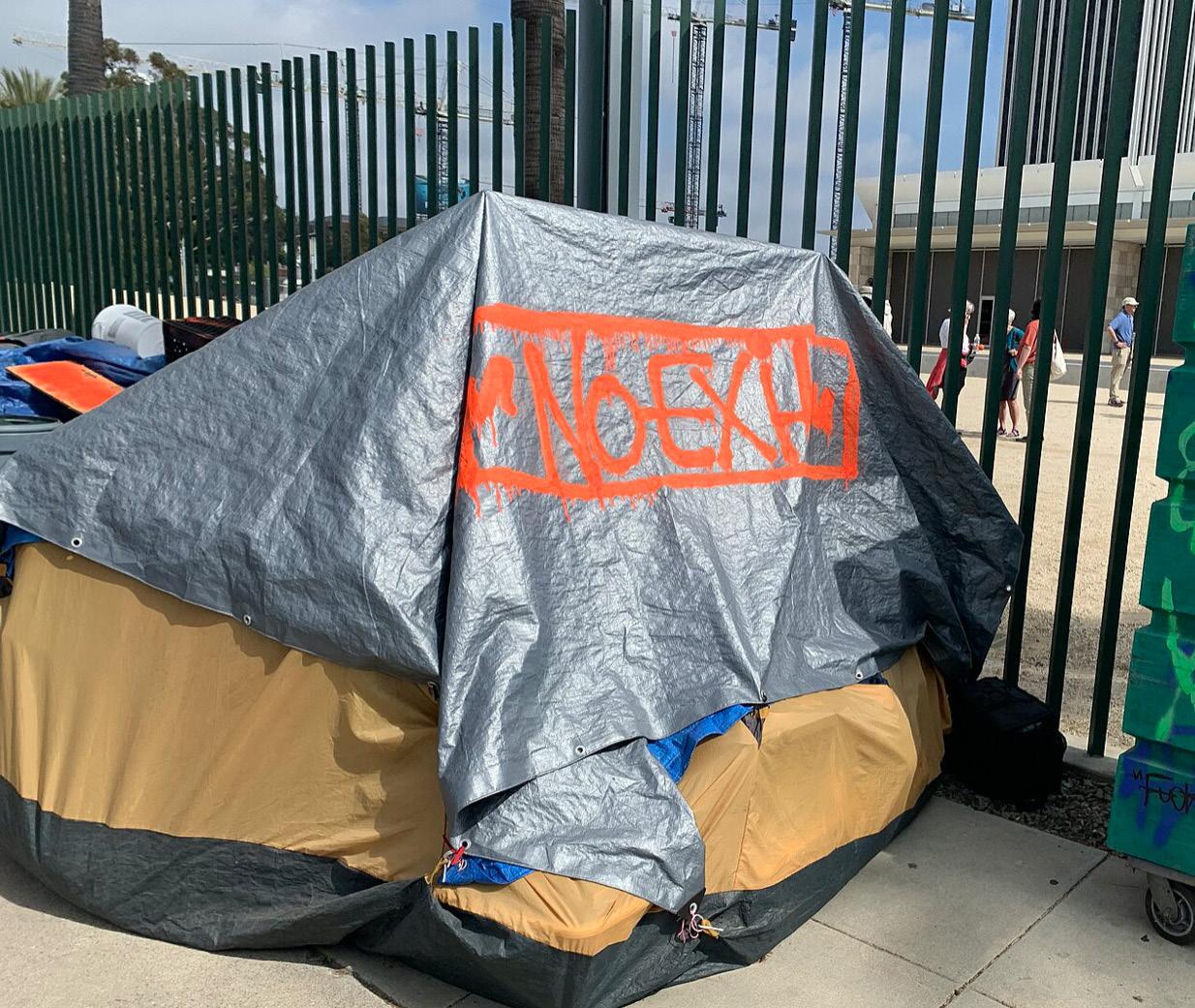
The Board of Supervisors on Tuesday unanimously approved the development of year-round emergencyhomelessness shelters operating 24 hours a day, seven days a week in Los Angeles County.
Under a motion by Supervisors Kathryn Barger and Lindsey Horvath, the board directed the county CEO to report back with a strategy to establish eight roundthe-clock shelters, one in each of the county’s Service Planning Areas.
Barger and Horvath stressed in the motion the importance of providing shelter and emergency care to unhoused individuals during an ongoing climate crisis.
“The vision is straightforward: keep those who are most vulnerable safe from the extreme weather that is battering Los Angeles County year-round,” Barger in a statement following the vote. “This is another step to enhance our emergency sheltering capabilities to help those in need find a safe place that offers relief.”
The motion cited the Los Angeles Homeless Services Authority’s 2024 Point in
Time Count, noting there are more than 75,000 people experiencing homelessness in the county, with 52,365 unsheltered, and 22,947 sheltered individuals.
“Los Angeles County is expanding its emergency resources to ensure our most vulnerable community members can access safe shelter and services during inclement weather events,” Horvath said. “With lives on the line, the new normal of extreme weather calls on us to more readily open shelters and share resources widely.”
The emergency shelters are expected to provide “core support” for the homeless, including three meals a day, showers, bathrooms, clothes and other basic needs, according to Barger’s office.
The CEO’s report, which is expected to be presented in a month, will examine the provision of services such as medical care, mental health and substance abuse treatment, housing navigation, legal document retrieval and record clearing.
The report is also expected to identify potential funding and locations for the emergency shelters.
By City News Service
APanorama City resident has been confirmed with a rare locally acquired case of the mosquitoborne illness dengue, making him the fourth person in the county with the virus this year, public health officials said Wednesday.
According to the Los Angeles County Department of Public Health, the latest case is unrelated to the three previous infections, which all occurred in a cluster in the Baldwin Park area.
None of the local patients had any history of travel to areas where dengue is endemic. Last week, public health officials called the cluster of three cases in Baldwin Park “unprecedented.”
In October and November of last year, single locally
acquired cases of dengue were confirmed by health officials in Pasadena and Long Beach.
“These cases of local transmission are extremely rare in L.A. County and residents are urged to take proactive steps to prevent mosquito breeding and mosquito bites,” county Public Health officials said in a statement Wednesday.
Dengue is generally spread by a bite from an infected Aedes mosquito. Most patients never exhibit any symptoms, but one in four will develop signs including fever, nausea, vomiting, rash and aches and pains to the eyes, joints or bones.
The symptoms generally last no more than a week, and people usually fully recover within two weeks. Deaths from the virus are extremely rare, health officials said.
Health officials noted that the symptoms of dengue often mirror those of other viruses, and they urged health-care providers to be “vigilant for dengue fever in patients with acute febrile illness and test for and report such cases of mosquito-borne diseases.”
“We are seeing the local transmission of dengue, which is unprecedented in Los Angeles County. Preventing mosquito bites and mosquito breeding is the best way stop the ongoing local transmission of dengue,” Dr. Muntu Davis, Los Angeles County health officer, said in a statement. “Using insect repellent to prevent mosquito bites, eliminating items that hold standing water around your home where mosquitoes can

breed, and using or fixing screens on your doors and windows to keep mosquitoes
out of the home are simple steps everyone can take to significantly reduce the risk of mosquito-borne disease for both you and your neighbors.”
By Fred Shuster, City News Service
UCLA’s Jackie Robinson Stadium on the VA’s West Los Angeles campus was locked down Thursday after a federal judge ordered the facility closed until the university submits a proposal for the stadium grounds to be used primarily for the benefit of the military veterans for whom the land was originally deeded.
The shut-down order came at the conclusion of a daylong hearing Wednesday in which U.S. District Judge David O. Carter voiced frustration at UCLA and other ex-leaseholders at the VA’s West Los Angeles campus for not offering satisfactory uses for land that he ruled has been illegally contracted from the U.S. Department of Veterans Affairs.
VA security placed locks on all entrances and exit gates to the stadium and an adjacent practice field and posted no trespassing signs in the area at about noon Thursday. UCLA employees could be seen earlier carrying various supplies out of the complex.
UCLA Athletics and the university put out a statement early Thursday afternoon, insisting that “UCLA unequivocally supports veterans, including making sure our country’s heroes get the housing and healthcare they need and deserve.”
“The VA has leased a small part of its land to UCLA since 1963. In exchange, the
VA receives annual compensation that supports several veteran programs. Last night, a judge prohibited UCLA’s use of this lease by noon today — we are disappointed with the ruling but are complying.
UCLA Athletics is actively working to adjust operations and training, as this means our students are no longer able to access Jackie Robinson Stadium.
“We hope for a swift legal resolution that lets our student-athletes return to the facility. It*s deeply important to be clear on this point: UCLA supports veterans.”
Carter imposed the order Wednesday evening after interim UCLA Chancellor Darnell Hunt rushed to the downtown Los Angeles courtroom when he heard the judge was ready to lock down the baseball stadium. A UCLA attorney could not persuade the judge to do otherwise.
“The VA is ordered by noon tomorrow to cordon off and prevent any use of the UCLA baseball stadium and practice field until further notice from the court,” Carter ordered at the conclusion of the hearing.
The judge said he would visit the VA’s West Los Angeles campus Thursday to ensure the order had been followed.
Carter warned at the hearing that he was also on the verge of ordering the private Brentwood School’s athletic center on VA grounds

“bulldozed” and its swimming pool “filled with sand” unless the school handed over VA land and devised a way for military veterans to enjoy the center, along with the student body.
The lengthy hearing followed a strongly worded ruling issued earlier this month in which Carter blasted the VA for “turning its back” on the veterans it was designed to help by illegally leasing portions of the campus to UCLA’s baseball team, the affluent Brentwood School, an oil company, and other private interests on the agency’s West Los Angeles campus.
The judge ordered the leases terminated.
During the Los Angeles federal court hearing Wednesday, Carter used threats and old-fashioned horse trading to cajole the affluent Brentwood School into attempting to make a deal whereby up to
5 acres of the 22 acres it had leased from the VA would be given to veterans. The school also offered to greatly expand hours for veterans to use the complex.
But after a group of veterans met in the back of the courtroom and nixed the deal, Carter gave the proposal a thumbs down.
The developments stem from a monthlong non-jury trial of a lawsuit lodged in federal court against the VA by a group of unhoused veterans with disabilities, challenging land lease agreements and seeking housing on the campus for veterans in need, many of whom are homeless or must travel for hours to see their doctors.
Over the past five decades, Carter wrote, the VA in West LA “has been infected by bribery, corruption, and the influence of the powerful and their lobbyists, and enabled by a major educational insti-
tution in excluding veterans’ input about their own lands.”
During the trial, the VA argued that it is out of space on its 388- acre campus, and that the lack of available acreage precludes any increase to the 1,200 housing units the agency promised to open by 2030. VA attorneys alleged that any relief ordered by the court would burden the department financially and deprive it of the flexibility needed to solve veteran homelessness.
Ultimately, the court found that veterans are entitled to more than 2,500 units of housing at the campus “and termination of the illegal land-use agreements.”
Carter previously said the court would begin to determine an “exit strategy” for the lease holders in order to ensure the land — including the 10 acres rented to UCLA — is put to a use that principally benefits veterans.
The judge’s ruling orders the VA to build 750 units of temporary housing within 18 months and to form a plan within six months to add another 1,800 units of permanent housing to the roughly 1,200 units already in planning and construction under the settlement terms of an earlier lawsuit.
Carter, himself a Vietnam War veteran, found that the VA “has allowed the drastic reduction of the size of the original plot of land deeded
in 1888 to be an old soldiers’ home. In a series of lengthy, renewable leases, the VA authorized leaseholders to build permanent athletic facilities -- after permitting these concrete structures to be built on veterans’ land.”
The judge held that for years the VA — budgeted at $407 billion annually — has “quietly sold off” land badly needed for injured and homeless military veterans. VA press secretary Terrence Hayes said in a recent statement to City News Service the agency “will continue to do everything in our power to end veteran homelessness — both in Los Angeles and across America. No veteran should be homeless in this country they swore to defend, and we will not rest until veteran homelessness is a thing of the past.”
Hayes did not comment on the judge’s findings regarding the leaseholders.
A UCLA representative said earlier this month that the university and VA have had a “longstanding public service partnership” over more than 70 years.
“Working with the VA to serve veterans continues to be one of our key objectives as part of UCLA’s mission of teaching, research and public service,” according to UCLA. “We are reviewing the judge’s (leaseholder) decision to determine how it will affect our partnership with the VA.”
Editorial editorial@beaconmedianews.com
editor@hlrmedia.com
Graphics/Production production@beaconmedianews.com production@hlrmedia.com
Advertising advertising@beaconmedianews.com advertising@hlrmedia.com
Legal Advertising legals@beaconmedianews.com legals@hlrmedia.com
Business accounting@beaconmedianews.com accounting@hlrmedia.com
BEACON MEDIA ADDRESS: 820 S. Myrtle Ave. Monrovia, CA 91016
PHONE: (626) 301-1010
WEBSITE www.beaconmedianews.com
HLR MEDIA ADDRESS: 820 S. Myrtle Ave. Monrovia, CA 91016
PHONE: (626) 301-1010 www.HLRmedia.com PRESS
editor@beaconmedianews.com editor@hlrmedia.com







California.
The Duarte Dispatchhas been adjudicated as a newspaper of general circulation in court case number GS 013893 City of Duarte, County of Los Angeles, State of California. The Rosemead Readerhas been adjudicated as a newspaper of general circulation in court case number GS 048894 City of Rosemead, County of Los Angeles, State of California.
Alhambra Press has been adjudicated as a newspaper of
circulation in court case number ES016581 City of Alhambra, County of Los Angeles, State of California.
Baldwin Park Press has been adjudicated as a newspaper of general circulation in court case number KS017174 City of Baldwin Park, County of Los Angeles, State of California. The Burbank Independent has been adjudicated as a newspaper of general circulation in court case number ES016728 City of Burbank, County of Los Angeles, State of California.
The Glendale Independent has been adjudicated as a newspaper of general circulation in court case number ES016579 City of Glendale, County of Los Angeles, State of California.
The Monterey Park Press has been adjudicated as a newspaper of general circulation in court case number ES016580 City of Monterey







A Supreme Court justice warned that a ruling would cause ‘large-scale disruption.’ The effects are already being felt.
By Eli Sanders for ProPublica, illustrations by Michael Haddid, special to ProPublica
This story was originally published by ProPublica. ProPublica is a Pulitzer Prize-winning investigative newsroom. Sign up for The Big Story newsletter to receive stories like this one in your inbox.
Reporting Highlights
Long-timePrecedent
Abandoned: The high court rejected a doctrine granting deferencetoregulatory agencies in interpreting laws when Congress hasn’t clearly defined the scope of the agencies’ power.
Effects Were Immediate: After less than three months, parties or judges have invoked the new ruling in 110 cases, with more likely to come.
Broad Reach: The ruling has already been cited in cases on abortion, overtime pay, airline fees, protections against health care discrimination, background checks for guns and more.
These highlights were written by the reporters and editors who worked on this story.
Forheadline-grabbing drama, few Supreme Court decisions could equal the justices’ July ruling that former presidents are immune from criminal prosecution for virtually all of their official acts. But a decision in the seemingly humdrum realm of administrative law could end up having far broader consequences, affecting vast areas of American life by slashing the power of federal regulatory agencies that police pollution, food safety, health care and countless other aspects of modern society.
Lower court judges have already cited the Supreme Court’s 6-3 decision, in a case known as Loper Bright, to halt implementation of Biden administration rules on overtime pay and health care discrimination. In the past three months, Loper Bright also has been invoked to challenge regulations on everything from hidden airline fees to gun sales to abortion referrals.
Justice Neil Gorsuch, who was part of the conservative majority in Loper Bright, described it as placing “a tombstone” on a doctrine that had existed for 40 years. That doctrine, known as Chevron deference, was named after the 1984 Supreme Court case in which it emerged, and it offered an answer to a recurring question: What happens when Congress passes a law granting power to a federal agency but
fails to precisely define the boundaries of that power?
In such situations, the doctrine of Chevron deference instructed federal judges to rely on the interpretations made by federal agencies, as long as those interpretations were reasonable, since agencies typically have greater expertise in their subject areas than judges. The Loper Bright decision erased that, commanding federal judges to “exercise their independent judgment in deciding whether an agency has acted within its statutory authority.”
Dissenting, Justice Elena Kagan noted that federal courts had cited Chevron deference 18,000 times, making it “part of the warp and woof of modern government, supporting regulatory efforts of all kinds — to name a few, keeping air and water clean, food and drugs safe, and financial markets honest.” She warned of “large-scale disruption.”
Legal experts view Loper Bright as a major transfer of power from agencies to judges. “You have incredibly technical areas of law for which the U.S. Supreme Court in Loper Bright has now paved a path for individual judges, or panels of three judges, to make decisions without having the technical expertise,” said Sanne Knudsen, a professor at the University of Washington School of Law, whose scholarship on deference doctrines has been cited by the Supreme Court.
Critics of the Chevron doctrine argued that letting agencies make legal interpretations led to constant uncertainty, with each presidential administration appointing new agency leaders who theoretically could change their interpretation of the law. But critics of the Loper Bright ruling counter that the same risk exists today — at the hands of judges rather than regulators.
Dan Weiner, director for elections and government at the Brennan Center for Justice, sees Loper Bright as the capstone of a series of recent Supreme Court rulings that limit agency power. Weiner called it the “culmination of a broader

project to just cut the legs out from under government as we’ve known it since the New Deal.”
In theory, Congress could respond by writing more detailed legislation when it comes to federal agency power. But in the current political landscape, Knudsen said, that’s unlikely. As she put it, “cases like Loper Bright put more power in the hands of individual judges to decide policy questions, taking them further from the hands of the experts that Congress has otherwise delegated power to.”
Loper Bright has been celebrated by foes of regulation. The decision “gives us the thunder and lightning we need to beat back the aggressive anti-gun agenda of the rogue Biden Administration,” Gun Owners of America exulted in a press release after the ruling.
The advocacy group Democracy Forward counted 110 federal cases in which parties or judges have cited Loper Bright as of Sept. 6 — and that figure will only rise in the coming months and years. Here are some of the most consequential pending cases.Labor
Who is eligible for overtime pay?
It took only hours for the decision to ripple into a lower court. On June 28, the day Loper Bright was announced, a federal judge in Texas issued a preliminary injunction against a new Department of Labor rule expanding eligibility for overtime pay. The judge blocked the rule from being enforced against the state of Texas as an employer, explaining that his decision
“carefully follows Loper Bright’s controlling guidance.”
Among other things, the regulation seeks to prevent employers from deeming someone an “executive,” and thus exempt from overtime pay, if that person’s salary is below $43,888 (or below $58,656 next year). “Too often, lower-paid salaried workers are doing the same job as their hourly counterparts but are spending more time away from their families for no additional pay,” acting Secretary of Labor Julie Su said when the regulation was announced in April. “That is unacceptable.”
Texas challenged the rule, arguing the DOL had exceeded the authority granted by Congress in the Fair Labor Standards Act; the judge wrote that he expects to reach a final decision “in a matter of months.”Health Care Does Obamacare protect transgender people from discrimination?
On July 3, three federal judges in different states, all citing Loper Bright, issued orders blocking implementation of a new rule from the Department of Health and Human Services that would prohibit discrimination in health care based on gender identity. Mary Rouvelas, legal advocacy director for the American Cancer Society Cancer Action Network, said her group had supported the regulation because “nondiscrimination is critical for LGBTQ individuals, who
suffer a disproportionate cancer burden.” However, the rule had become “a political football” amid debates over gender affirming care, Rouvelas said, and under Loper Bright federal judges no longer had to defer to HHS’ determination that gender identity is protected under the Affordable Care Act, which prohibits discrimination “on the basis of sex” but does not use the phrase “gender identity.”
Fifteen states sued in Mississippi federal court, arguing that HHS overstepped its authority. The states claimed the rule would force them to “use taxpayer funds to pay for unproven and costly gender-transition interventions through Medicaid and state health plans — even for children who may suffer irreversible harms.” District Judge Louis Guirola Jr. issued a nationwide injunction against the rule. The case will continue while the regulation is on hold, as will similar cases in Texas and Florida.Transportation
Can a federal agency force airlines to reveal fees?
The Department of Transportation issued a rule in April that requires airlines to, in the words of Secretary Pete Buttigieg, “inform you, before you buy a ticket, of fees they will charge you.” The rule specifies that baggage, change and cancellation fees must be disclosed the first time an airline quotes a price to a customer. At present, according to DOT court filings, “surprise costs” cause consumers to “overpay by half a billion dollars annually.”
In May, a group of airlines sued to stop the rule, claiming that the DOT exceeded its authority. According to the airlines, the agency can order them to halt unfair or deceptive practices after they’ve occurred, but it cannot tell them what their practices should be going forward. The airlines sought a stay. The DOT counters that its new regulation is based on
“well-established” legal authority.
On July 1 — the Monday following the Friday issuance of the Loper Bright ruling — lawyers for the airlines cited the case, telling the 5th U.S. Circuit Court of Appeals that “resolving this statutoryinterpretation issue is a task for this Court, especially because, with Chevron overruled, only courts have ‘the power to authoritatively interpret the statute.’”
At the end of July, a panel of three 5th Circuit judges stayed the rule, concluding that the airlines had “made a strong showing that the Rule exceeds the agency’s authority.” They placed the case on an expedited path toward a final determination of whether the rule should be struck down.Employment
Can the FTC ban agreements that prohibit employees from joining a rival company?
In April, after six years of study, the Federal Trade Commission issued a rule banning noncompete agreements, which restrict workers from accepting employment with competitors for a period of time after leaving their current jobs.
The FTC determined the rule was needed because such contracts impair “the fundamental freedom of workers to change jobs,” harm innovation and are “often exploitative.” Of the more than 26,000 comments the agency had received about the proposed ban, over 25,000 were supportive, the FTC said. A group of plaintiffs that includes the U.S. Chamber of Commerce filed suit in federal court in Texas, arguing the FTC had exceeded its authority.
On Aug. 20, citing Loper Bright, the judge in this case agreed with the plaintiffs and issued a final order that set aside the ban on noncompetes, declaring that the FTC had “promulgated the NonCompete Rule in excess of its statutory authority.”
The Chamber of Commerce called it a “significant win” in the group’s “fight against
government micromanagement of business decisions.”
An FTC spokesperson told ProPublica that the agency is “seriously considering a potential appeal” and added that the “decision does not prevent the FTC from addressing noncompetes through case-by-base enforcement actions.”Guns Can the government require background checks for firearms sold at gun shows?
In April, the Bureau of Alcohol, Tobacco, Firearms and Explosives issued a rule that would close a loophole through which guns are sold without background checks online and at gun shows.
Attorney General Merrick Garland called it “one of the most significant gun regulations in decades.” Under the rule, he said: “It does not matter if guns are sold on the internet, at a gun show or at a brick-and-mortar store. If someone sells a gun predominantly to earn a profit, they must be licensed, and they must conduct a background check to ensure that the buyer is not barred by law from having a gun.”
In May, 21 states sued to block the regulation in federal court in Arkansas. The complaint noted that the Supreme Court would soon be hearing arguments in Loper Bright and contended the ATF had exceeded its authority in adopting the rule.
Another group of plaintiffs filed suit in the Northern District of Texas, also seeking to block the ATF rule. Those plaintiffs include the states of Texas, Louisiana, Mississippi and Utah, as well as Gun Owners of America, which has called the rule “tyrannical.”
On June 11, weeks before Loper Bright was decided, the judge in the Texas case, Matthew Kacsmaryk, issued a preliminary injunction banning enforcement of the rule against any of the plaintiffs in the Texas case. Kacsmaryk based his decision in part on his belief that the plaintiffs would likely succeed in proving, in further proceedings,

the ATF
exceeded its authority. The Justice Department appealed the preliminary injunction to the 5th Circuit.
On July 10, less than two weeks after the Loper Bright decision, the judge in Arkansas went the opposite direction from the judge in Texas, denying the request from the 21 other states that he block the ATF rule closing the gun-show loophole. In doing this, the Arkansas judge cited a passage in Loper Bright that he views as supporting the ATF’s authority to close the loophole.
Much remains to be argued in the Texas and Arkansas lawsuits; both injunction rulings are being appealed on multiple grounds. But the Arkansas judge’s use of Loper Bright to support an agency’s authority to regulate highlights the still-unsettled nature of the high court’s pronouncements in Loper Bright. As the U.S. Chamber of Commerce noted, there is a need for lower courts to “interpret” certain aspects of the decision going forward.Abortion Can federal aid for family planning be withheld from states that
prohibit abortion?
In 2021, HHS issued a rule related to Title X grants, which have existed since 1970 and are intended to fund family planning programs. This rule, as described by the 6th U.S. Circuit Court of Appeals, requires states receiving Title X grants to “provide neutral, nondirective counseling and referrals for abortions to patients who request it.” Tennessee had received Title X grants for more than 50 years. But after the Supreme Court overturned Roe v. Wade in 2022, Tennessee banned abortions with exceptions only to “prevent the death of the pregnant woman or prevent serious risk of substantial and irreversible impairment of a major bodily function.” Tennessee said it would provide counseling and referrals only for abortions that are legal in the state. In response, HHS ended Tennessee’s Title X funding. The state sued, seeking an injunction to prevent the grant from ending and claiming that HHS exceeded its authority by requiring unbiased abortion counseling and referrals as a condition for Title X aid.
Just a year earlier, the 6th Circuit, in a similar case, had ruled that HHS did have the statutory authority to condition Title X funding in this manner. In doing so, the 6th Circuit relied on Chevron deference, finding that the new HHS regulation was based on a reasonable interpretation of this ambiguous statute. (The appeals court also cited a second precedent, a Supreme Court decision from 1991 that applied Chevron deference to the same Title X issue.)
Given the end of Chevron deference, should the 6th Circuit’s 2023 decision upholding HHS’ abortion counseling and referral rule be stripped of any precedential effect? Tennessee certainly thought so. But two judges from the 6th Circuit disagreed, pointing to a line in Loper Bright that says “we do not call into question prior cases that relied on the Chevron framework.” Therefore, the 6th Circuit reasoned, its 2023 precedent upholding HHS’ rule had withstood the death of Chevron deference and, as a result, the injunction requested by Tennessee
was unwarranted. One judge on the 6th Circuit’s threejudge panel disagreed, however, citing different passages from Loper Bright to reach the opposite conclusion. The case is now continuing in the Tennessee district court where it was originally filed.Taxes
Can the FTC stop a tax-preparation company from making misleading claims?
In January, after an investigation prompted by ProPublica’s reporting, the FTC concluded that Intuit, the maker of TurboTax, used deceptive advertising to lure customers into paying for tax preparation services when they were eligible to file for free under a program sponsored by the government. Purchases by such customers generated roughly $1 billion in revenue for Intuit and other tax prep companies in 2019 alone, according to a government audit.
The FTC ordered Intuit to cease and desist from making any misleading “free” claims in its advertising. In response, Intuit appealed the FTC’s ruling to the 5th Circuit and asserted that Loper Bright had strengthened its argument for jettisoning the decision. “Whatever ‘deference’ the FTC claimed its interpretation of the FTC Act was due did not survive the Supreme Court’s intervening holding,” lawyers for the company wrote.
Intuit is also citing a recent Supreme Court decision that found the Securities and Exchange Commission can’t bring certain kinds of suits before its own administrative law judges; Intuit argues the decision, which focused on a securities fraud case in which civil penalties were sought, should apply
to the FTC, too. The FTC disagrees, arguing that its action, originally brought before an FTC administrative law judge, is different from the relevant SEC action. For example, no civil penalties were involved in the action against Intuit. In a sign of how much rides on the outcome in this appeal, amicus briefs have been filed on both sides by a group of more than 20 states; numerous consumer advocate groups, including Public Citizen and the Consumer Federation of America; business groups like the U.S. Chamber of Commerce and the National Federation of Independent Business; and the libertarian Cato Institute.Immigration
Can a judge review the revocation of an immigrant’s opportunity for citizenship by marriage?
During the Supreme Court’s next term, it will hear a case involving the intricate rules for becoming a U.S. citizen through marriage. The case, Bouarfa v. Mayorkas, asks the justices to consider a very specific scenario, in which a Palestinian national married a U.S. citizen named Amina Bouarfa, who then petitioned to make her new husband eligible for citizenship through marriage. The United States Citizenship and Immigration Services approved Bouarfa’s petition but then, two years later, revoked that approval, saying the couple’s union had been “a sham marriage” for “the purpose of evading immigration laws.” The question in this case is whether that revocation is subject to judicial review.
The case also reveals an unexpected potential consequence of the Loper Bright ruling. It’s typically
perceived as a victory for conservative foes of regulation, but liberals may be able to use the ruling to their advantage in certain areas. For example, in the realm of immigration, conservatives typically want more vigorous federal regulation. But in this case, liberal advocates of immigration reform are attempting to use Loper Bright to check the power of an immigration agency. “We’ll see whether the people who advanced Loper Bright might end up having a little bit of buyer’s remorse,” Weiner, of the Brennan Center for Justice, said.
Advocates for immigration reform have filed an amicus brief that supports Bouarfa’s right to judicial review by citing passages from Loper Bright. In addition, lawyers for Bouarfa have cited another major administrative law ruling last term from the Supreme Court’s conservative majority, Corner Post v. Board of Governors of the Federal Reserve, which greatly expanded the possibilities for suing federal agencies. That ruling led dissenting Justice Ketanji Brown Jackson to warn that the “tsunami of lawsuits against agencies that the Court’s holding in this case and Loper Bright have authorized has the potential to devastate the functioning of the Federal Government.”
It’s too early to say whether a legal tsunami is coming, but with the Supreme Court set to open its new term in two weeks, it’s clear that a wave is already growing.
Eli Sanders won the 2012 Pulitzer Prize for feature writing and is a recent law school graduate.
Republished with Creative Commons License (CC BY-NC-ND 3.0).



By Suzanne Potter, Producer, Public News Service
Starting in January, medical debt will no longer count against millions of Californians’ credit scores thanks to a bill signed Tuesday by Gov. Gavin Newsom.
Senate Bill 1061 will ban almost all medical debt from showing up on people’s credit reports.
Jenn Engstrom, state director for the nonprofit California Public Interest Research Group, which backed the bill, explained the importance of the legislation.
“Medical debt really does not belong on credit reports,” Engstrom contended. “Unlike other types of debt, medical
expenses are not something that consumers can control, you know, you might get into a car accident, or all of a sudden you have cancer, and have these expenses.”
The bill faced initial opposition from lenders, who secured an amendment to exclude debt from specialty medical credit cards and debt for cosmetic procedures not medically necessary. The new law goes into effect in January.
Engstrom estimated one in five Californians has unpaid medical debt, which she argued saddles them in ways that go far beyond just having to pay it.
“When medical debt ends up on your credit report, that makes it more challenging to apply for a credit card or a loan, or get a house and even some employment,” Engstrom outlined. “That’s why it’s really important that California is now moving towards a fairer credit system.”
In June, the Consumer Financial Protection Bureau proposed a similar rule to keep most medical debt off credit reports nationwide. It would stop credit reporting companies from sharing medical debts with lenders and forbid lenders from making decisions based on medical information.

Survey: Only 53% of high school students think voting is important Environmental advocates call on Newsom
By Suzanne Potter, Producer, Public News Service

About 53% of high school students think voting is important, according to a survey out Sept. 16 from the nonprofit Youth Truth.
Researchers polled 115,000 American high school students, including Californians, on civic engagement and found 60% believe “helping others is important,” but only 44% feel confident in their ability to make a difference.
Jennifer de Forest, interim vice president of Youth Truth, said 30% of students translate their intentions into meaningful action.
“They say, ‘We don’t know where to start,’” de Forest explained. “And that’s the best-case scenario, because
for many students, they’ve actually internalized the message that the system is broken, and that what they have to say doesn’t matter.”
Latino students report feeling the most disempowered. Only 26% have taken civic action and just 46% believe voting is important. Many students said they are more focused on academic success and college acceptance. But they say extracurriculars like scouting, band and sports do make them feel more civic-minded.
Kate Snow, coordinator of school climate for the Davis Joint Unified School District, which brought diverse student groups together for a youth empowerment workshop, said
districts need to build young people’s confidence in the importance of their voices.
“There’s a link between how schools are engaging students and helping students see their own power and use their power, with how they see and use it in the public arena,” Snow pointed out.
The report encouraged schools to promote the importance of voting and students getting involved in their community.
Disclosure: YouthTruth contributes to Public News Service’s fund for reporting on Education, Philanthropy, and Youth Issues. If you would like to help support news in the public interest, visit publicnewsservice.org/dn1.php.
By Suzanne Potter, Producer, Public News Service

Groups concerned about pollution and climate change are asking Gov. Gavin Newsom to sign a trio of bills dubbed the “make polluters pay” package.
Assembly Bill 1866 would increase fees on 40,000 idle oil wells and accelerate cleanup.
Nayamin Martinez, executive director of the Central California Environmental Justice Network, said right now, companies often pay fees without actually cleaning up “orphan wells.”
“The authorities are not proactively going and inspecting these sites,” Martinez pointed out. “We have a program that goes to do inspections on active and abandoned uncapped wells,
and we have found that many of them are leaking.”
The Western States Petroleum Association argued current regulations are sufficient and companies are making progress plugging their idle wells.
A second measure, Assembly Bill 3233, would protect local communities’ rights to limit oil drilling. It comes in response to a lawsuit from Chevron, eliminating a part of ‘Measure Z’ in Monterey County, which would have required companies to phase out oil drilling in that area.
Raquel Mason, senior legislative manager for the California Environmental Justice Alliance, said oil wells leak methane, a
potent greenhouse gas, and release other toxic substances into the air and water.
“Those pollutants that are coming off these wells can have different healthharming impacts like respiratory issues, different types of cancer, headaches, nosebleeds,” Mason outlined. “We hear about it too often from community members who are living near these types of facilities.”
A third bill would fine oil companies in the Inglewood Oil Field in Los Angeles $10,000 a month for operating low-producing wells near local neighborhoods.
References:Virtual meeting Calif. Dept. of Conservation 2024
By Jeannie Assimos, Way.com via Stacker
The past few years have been tumultuous in a post-pandemic insurance world. For the first time in recent memory, the auto insurance industry faces substantial loss pressures on multiple fronts. To maintain viability, rates have increased concurrently with this uptick in claims costs. Way.com provides context.
These are being driven by several factors:
Loss severity: While supply chain issues have mostly receded, the increased cost of parts and labor translates directly into higher repair costs.
Further complicating this are today’s vehicles and their integrated safety devices, parking sensors, integrated body panels and vehicle construction designed to crumple around passengers to absorb impact. What was once a “fender bender” in a parking lot that involved dent removal and paint now contains thousands of dollars in electronics and takes specialized labor to install. This is measured as loss severity, or the average amount paid out in an
average claim — and this number has seen an 82% rise over the past decade.
Loss frequency: Drivers emerged from a pandemic to newly crowded roads and a more constantly connected environment. Distracted driving is a major culprit and has driven accident rates to new highs, with more vehicle accidents per mile driven. For the first time in decades, auto accident-related fatalities have begun to increase as well. More accidents, plus more expensive accidents, is a combination of higher premiums.
Medical expenses:
Medical expenses are rapidly escalating, leading to an increased “large loss” rate, wherein policy limits are reached, frequently through lengthy court processes. These additional legal fees, medical expenses, and administration costs have far outpaced the CPI.
Carrying costs: The time from opening to closing the claim has stretched. Due to staffing limitations on the claims side and labor shortages on the repair side, claim files are taking longer, which has its own ancillary costs in
rental and substitute auto coverages and storage fees.
Car insurance costs are currently the #1 driver of inflation, and they are a substantial part of every household’s budget — and rates will vary wildly from state to state. For example, the average in Georgia would be considered extremely high in California regarding relative average premiums. Various reasons play into this variance, and rates vary significantly from driver to driver.
The core factors that drive rates are location, years of driving experience, prior insurance and loss history and driving record. A driver with a solid history of maintaining insurance, with zero to few claims, and 20 years of clean driving experience will see a much lower premium than a newly licensed driver or one with a poor driving history — however, that same driver with the lower rate could see their rate jump by simply moving to an area with a higher accident frequency or a state with increased weather risks.
The choice of vehicle

will also be tied directly to premium rates.
Every state requires some level of insurance. However, no state requires coverage for your vehicle — they all require some protection for damages a driver may be liable for due to a driver’s negligence.
Every driver who is looking to save on their insurance costs or find better coverage than what they have currently should look at what they
need to be protected against when considering which coverage options to choose from, along with their own driving habits — which may have changed dramatically in the past few years. If the vehicle is owned outright and wouldn’t pose a significant loss in the event of a theft or collision, reducing coverage to statemandated liability may make sense. If it’s the only
By City News Service
The Los Angeles Dodgers won their third consecutive National League West title and 11th in the past 12 seasons with a 7-2 victory Thursday evening over the San Diego Padres at Dodger Stadium in their final home game of the 2024 regular season.
The Dodgers combined Will Smith’s two-run homer, Shohei Ohtani’s tiebreaking single and Mookie Betts’ two-run single for a five-run seventh inning that gave them a 5-2 lead. Andy Pages hit a two-run homer in the eighth for the Dodgers.
The victory in front of a sellout crowd announced at 52,433.gave the Dodgers (95-64) a four-game lead over the Padres (91-68) with three games to play for both teams.
It was the first time the Dodgers clinched a division title in front of their fans
since 2018.
Anthony Banda (3-2), the third of five Dodger pitchers, retired all five batters he faced for the victory in his first appearance after spending 16 days on the injured list because of a fractured left hand.
Tanner Scott (9-6), the second of four San Diego pitchers, was charged with the loss, allowing three runs (two earned) and three hits in two-thirds of an inning.
Padre starter Joe Musgrove remained winless against the Dodgers with seven losses. He was relieved by Scott with one out in the seventh inning and the bases empty and the score tied 2-2. Musgrove allowed two runs and five hits in 6 1/3 innings, struck out six and walked one.
Dodger first baseman Freddie Freeman twisted his right ankle while trying to avoid a tag at first base in
the seventh inning and had to leave the game.
Andrew Friedman, the Dodgers’ president of baseball operations, said X-rays on Freeman’s ankle were negative but he would not play in the three-game series against the Colorado Rockies in Denver beginning Friday to conclude the regular season.
Freeman was on crutches and wearing a walking boot during the Dodgers’ postgame celebration.
The Dodgers still have one more thing to play for in the regular season — homefield advantage throughout the postseason. The Dodgers have a one-game lead over the Philadelphia Phillies (94-65) in the race for the best record in Major League Baseball with three games remaining for both teams.
If the Dodgers and Philadelphia end the regular
vehicle in a busy household and would represent a significant disruption if it were no longer available, you may want to stretch that budget to ensure every situation is accounted for.
This story was produced by Way.com and reviewed and distributed by Stacker Media. The article was copy edited from its original version. Republished pursuant to a CC BY-NC 4.0 license.

By A.C. Thompson, James Bandler and Brandon Roberts, ProPublica
The recent crackdown on the social media platform Telegram has triggered waves of panic among the neo-Nazis who have made the app their headquarters for posting hate and planning violence.
“Shut It Down,” one person posted in a white supremacist chat on Tuesday, hours after Telegram founder Pavel Durov announced he would begin sharing some users’ identifying information with law enforcement.
With over 900 million users around the globe, Telegram has been both revered and reviled for its hands-off approach to moderating posted content. The platform made headlines this summer when French authorities arrested Durov, seeking to hold him responsible for illegal activity that has been conducted or facilitated on the platform — including organized drug trafficking, child pornography and fraud.
Durov has called the charges “misguided.” But he acknowledged that criminals have abused the platform and promised in a Telegram post to “significantly improve things in this regard.” Durov’s announcement marked a considerable policy shift: He said Telegram will now share the IP addresses and phone numbers of users who violate the platform’s rules with authorities “in response to valid legal requests.”
This was the second time in weeks that extremists had called on their brethren to abandon Telegram. The first flurry of panic followed indictments by the Justice Department of two alleged leaders of the Terrorgram Collective, a group of white supremacists accused of inciting others on the platform to commit racist killings.
“EVERYONE LEAVE CHAT,” posted the administrator of a group chat allied with the Terrorgram Collective the day the indictments were announced.
An analysis by ProPublica and FRONTLINE, however, shows that despite the wave of early panic, users didn’t initially leave the platform. Instead there was a surge

in activity on Terrorgramaligned channels and chats, as allies of the group tried to rally support for their comrades in custody, railed against the government’s actions and sought to oust users they believed to be federal agents.
Federal prosecutors in the U.S. have charged Dallas Humber and Matthew Allison, two alleged leaders of the Terrorgram Collective, with a slew of felonies including soliciting the murder of government officials on Telegram.
Humber has pleaded not guilty. She made a brief appearance in federal court in Sacramento, California, on Sept. 13, during which she was denied bail. Humber, shackled and clad in orange-and-white jail garb, said nothing. Allison, who has not yet entered a plea, was arrested in Idaho but will face trial in California.
Attorneys for Humber and Allison did not respond to separate requests for comment.
The two are alleged Accelerationists, a subset of white supremacists intent on accelerating the collapse of today’s liberal democracies and replacing them with all-white ethno-states, according to the
indictment.
Through a constellation of linked Telegram channels, the collective distributes books, audio recordings, videos, posters and calendars celebrating white supremacist mass murderers, such as Brenton Tarrant, who in early 2019 stormed two mosques in New Zealand and shot to death 51 Muslim worshippers.
The group explicitly aims to inspire similar attacks, offering would-be terrorists tips and tools for carrying out spectacular acts of violence and sabotage. A now-defunct channel allegedly run by Humber, for example, featured instructions on how to make a vast array of potent explosives. After their arrests, channels allegedly run by Humber and Allison went silent.
But within days of the indictments, an anonymous Telegram user had set up a new channel “dedicated to updates about their situation.”
“I understand that some people may not like these two, however, their arrests and possible prosecution affects all of us,” the user wrote. The criminal case, they argued, “shows us that Telegram is under attack globally.”
The channel referred to Humber and Allison by their alleged Telegram usernames, Ryder_Returns and Btc.
A long-running neo-Nazi channel with more than 13,000 subscribers posted a lengthy screed. “We are very sad to hear of the egregious overreach of government powers with these arrests,” stated the poster, who used coded language to suggest that white supremacists should forcefully overthrow the U.S. government.
One group closely aligned with the Terrorgram Collective warned like-minded followers that federal agents could be lurking. In a post, it said that it had been in contact with Humber since her arrest, and that she gave them information about an undercover FBI agent who had infiltrated the Accelerationist scene.
“If this person is in your chats, remove them,” said one post, referring to the supposed agent. “Don’t threaten them. Don’t say anything to them. Just remove them from contacts and chats.”
Matthew Kriner, managing director of the Accelerationism Research
Consortium, said the Terrorgram Collective had already been badly weakened by a string of arrests in the U.S., Europe and Canada over the past two years. “Overall, the arrests of Humber and Allison are likely the final blow to the Terrorgram Collective,” Kriner said.
In the U.S., federal agents this year have arrested at least two individuals who were allegedly inspired by the group. The first was Alexander Lightner, a 26-year-old construction worker who was apprehended in January during a raid on his Florida home. In a series of Telegram posts, Lightner said he planned to commit a racially or ethnically motivated mass killing, according to prosecutors. Court records show that agents found a manual produced by the Terrorgram Collective and a copy of “Mein Kampf” in Lightner’s home.
Lightner has pleaded not guilty to charges of making online threats and possessing an illegal handgun silencer. His attorney declined to comment.
This summer, prosecutors charged Andrew Takhistov of New Jersey with soliciting an individual to destroy a
power plant. Takhistov allegedly shared a PDF copy of a different Terrorgram publication with an undercover agent. The 261-page manual includes detailed instructions for building explosives and encourages readers to destabilize society through murder and industrial sabotage. Takhistov has not yet entered a plea. His attorney did not respond to a request for comment.
Durov’s August arrest also sent a spasm of fear through the extremist scene. “It’s over,” one user of a white supremacist chat group declared.
“Does this mean I have to Nuke my Telegram account?” asked another member of the group. “I just got on.” Their concerns grew when Telegram removed language from its FAQ page stating that the company would not comply with law enforcement requests regarding users in private Telegram chats.
Alarmed, Accelerationists on Telegram discussed the feasibility of finding another online sanctuary. Some considered the messaging service Signal, but others warned it was likely controlled by U.S. intelligence agencies. One post suggested users migrate to more obscure encrypted messaging apps like Briar and Session. In extremist circles, there was more discussion about fleeing Telegram after Durov’s announcement last week. “Time is running out on this sinking ship,” wrote one user. “So we’re ditching Telegram?” asked another.
“Every time we have a success against one of them, they learn, they adapt, they modify,” said Don Robinson, who as an FBI agent conducted infiltration operations against white supremacists. “Extremists can simply pick up and move to a new platform once they are de-platformed for content abuses. This leaves law enforcement and intelligence agencies playing an endless game of Whac-aMole to identify where the next threat may be coming from.”
Republished with Creative Commons License (CC BY-NC-ND 3.0).
“CDBG LOCAL STREETS SLURRY SEAL PROJECT, FY 24/25”
CONTRACT NO. 24-03 / CDBG PROJECT NO. 602633-23
Date of Bid Opening: Notice is hereby given that sealed bids for the “CDBG LOCAL STREETS SLURRY SEAL PROJECT, FY 24/25” will be received at the office of the City Clerk of the City of San Gabriel, 425 South Mission Drive, San Gabriel, CA 91776, California, until 3:00 p.m. on Wednesday, October 16, 2024. At 3:05 p.m., bids will be opened and read aloud at the San Gabriel City Hall.
Section 3 Mandatory Pre-Bid Meeting: This is a HUD Section 3-covered construction project subject to creating economic opportunities directed toward the low-income persons and business concerns which provide economic opportunities to the low-income persons. A mandatory job walk meeting for interested bidders will be conducted on Wednesday, October 2, 2024, at 10:00 a.m. at the San Gabriel Public Works Department, at 917 E. Grand Avenue, CA, 91776. Interested bidders who arrive for the meeting after 10:30 a.m. will not be eligible to submit bid proposals. Call the Project Manager, Alan Mai at (626) 308-2825, or email at amai@ sgch.org, should you require further information.
Description of Work: The work generally consists of furnishing all necessary labor, materials, tools, equipment, and other incidental and appurtenant work necessary for the application of Type II slurry seal at various designated streets within the City of San Gabriel and the re-pavement of the Vincent Lugo Park’s parking lot. The work shall also include but not necessarily limited to following: sweeping before and after slurry seal applications; removing of grease spots (by grinding); restoration of all existing striping, pavement marking and raised markers; all necessary traffic control and public notifications to all adjacent properties to work areas; posting signs for “NO PARKING” and arranging for towing of cars, if necessary; and all other miscellaneous appurtenant work. The bid items, corresponding estimated quantities, and time allowed to complete the work are listed in the Bidder’s Proposal and Statement. All required installation and construction shall be performed by the Contractor as specified in the Project Plans, Specifications, Special Provisions and Contract Documents, and as directed by the Engineer. Engineer’s Estimate - $480,000.
The contract is to be executed within 7 calendar days after award of contract by City Council. Time for completion of the work is thirty (30) working days for all work from the date of the Notice to Proceed.
Contract Documents: To obtain the project documents, please contact San Gabriel Public Works Project Manager, Alan Mai, at (626) 308-2825 or email: amai@sgch.org
Bid Security: Each bid shall be accompanied by a certified or cashier’s check, cash, or bid bond in the amount of ten percent (10%) of the total bid price payable to City of San Gabriel as a guarantee that the awarded bidder will execute the Contract and provide the required bonds, certificates of insurance, and endorsements within seven calendars days of the of the award of contract by City Council.
Award of Contract: The City reserves the right after opening bids to reject any or all bids, to waive any informality (non-responsiveness) in a bid, or to make award to the lowest responsive, responsible bidder, and reject all other bids, as it may best serve the interest of the City. The bidder shall guarantee the Total Bid Price for a period of 90 calendar days from the date of bid opening.
Prevailing Rate of Wage: Pursuant to Section 1770, et seq., of the California Labor Code, the Contractor shall pay the general prevailing rate of per diem wages as determined by the Director of the Department of Industrial Relations of the State of California for the locality where the work is to be performed. A copy of said wage rates is available on-line at: www.dir.ca.gov/dlsr/DPreWageDetermination.htm. The Contractor and any subcontractors shall pay not less than said specified rates and shall post a copy of said wage rates at the project site.
This project is funded with the Community Development Block Grant (CDBG) funds provided by the U.S. Department of Housing and Urban Development (HUD). Federal Labor Standards Provisions, including prevailing wage requirements of the Davis-Bacon and Related Acts will be enforced. In the event of a conflict between Federal and State wages rates, the higher of the two will prevail.
Labor Code Compliance: Attention is directed to the provisions of Labor Code § 1725.5: Per SB 854, no contractor or subcontractor may be listed on a bid proposal for a Public Works Project (submitted on or after March 1, 2015) unless registered with the Department of Industrial Relations (with limited exceptions for this requirement for bid purposes only under Labor Code Section 1771.1a). No contractor or subcontractor may be awarded a contract for public work on a public works project (awarded on or after April 1, 2015) unless registered with the Department of Industrial Relations (DIR). All contractors and subcontractors must furnish electronic certified payroll records to the Labor Commissioner for all new projects awarded on or after April 1, 2015. The Labor Commissioner may excuse contractors and subcontractors on a project that is under the jurisdiction of one of the four legacy DIR-approved labor compliance programs (Caltrans, City of Los Angeles, Los Angeles Unified School District and County of Sacramento) or that is covered by a qualified project labor agreement. This project is subject to compliance monitoring and enforcement by the Department of Industrial Relations.
Any contract entered into pursuant to this Notice will incorporate the provisions of the State Labor. Pursuant to the provisions of Section 1773.2 of the Labor Code of the State of California, the minimum prevailing rate of per diem wages for each craft, classification, or type of workman needed to execute the contract shall be those determined by the Director of Industrial Relations of the State of California, which are on file in the Office of the City Clerk, City of San Gabriel and are available to any interested party on request.
Attention is directed to the provisions of Sections 1777.5 and 1777.6 of the Labor Code concerning the employment of apprentices by the Contractor or any subcontractor under them. The Contractor or any subcontractor shall comply with the requirements of said sections in the employment of apprentices. Information relative to apprenticeship standards and administration of the apprenticeship program may be obtained from the Director of Industrial Relations, San Francisco, CA, or the Division of Apprenticeship Standards and its branch offices.
All bidders shall be licensed in accordance with provisions of the Business and Professions Code and shall possess a Class “A” State Contractor’s License at the time this contract is awarded. The Successful Contractor and his subcontractors will be required to possess business licenses from the City of San Gabriel and maintain current until completion of the project. Business licenses can be purchased or renewed at the Finance Department at 425 S Mission Drive, San Gabriel, CA.
Questions: All questions relative to this project prior to the opening of bids shall be in writing or esmail and received no later than 4:00 p.m. on Wednesday, October 9, 2024, and shall be directed to: Public Works Project Manager, Alan Mai, at email: amai@sgch.org.
Publish September 23 & 30, 2024
SAN GABRIEL SUN
SUMMARY ORDINANCE BY THE CITY COUNCIL OF THE CITY OF ROSEMEAD, CALIFORNIA, AMENDING MUNICIPAL CODE SECTION 13.17.040, RELATING TO SUBSTANTIAL IMPROVEMENT AND SUBSTANTIAL DAMAGE WITHIN THE FLOODPLAIN MANAGEMENT CODE
On September 10th, 2024, the City Council of the City of Rosemead introduced by title only, at first reading, Ordinance No. 1022. On September 24, 2024, the City Council adopted the second reading of said ordinance. The Ordinance amends Municipal Code Section 13.17.040 (C), to incorporate substantial improvement and substantial damage determinations for applications for building permits to improve buildings and structures, including alterations, movement, enlargement, replacement, repair, additions, rehabilitations, renovations, substantial improvements, repairs of substantial damage, and any other improvement of or work on such buildings and structures, the Floodplain Administrator, in coordination with the Building Official.
In addition to the requirements of the building code and these regulations, and regardless of any limitation on the period required for retention of public records, the Floodplain Administrator shall maintain and permanently keep and make available for public inspection all records that are necessary for the administration of these regulations and the flood provisions of the building codes, including Flood Insurance Studies and Flood Insurance Rate Maps; documents from FEMA that amend or revise FIRMs; records of issuance of permits and denial of permits; determinations of whether proposed work constitutes substantial improvement or repair of substantial damage; required certifications and documentation specified by the building codes and these regulations; notifications to adjacent communities, FEMA, and the State related to alterations of watercourses; assurance that the flood carrying capacity of altered waterways will be maintained; documentation related to variances, including justification for issuance or denial; and records of enforcement actions taken pursuant to these regulations and the flood resistant provisions of the building codes.
Passed, Approved and Adopted on the 24th day of September, 2024 by the following vote:
Ayes: Armenta, Clark, Low, and Ly Noes: None
Absent: Dang
Abstain: None
The full text of Ordinance No. 1022 is available for inspection during regular business hours at the City Clerk’s Office, 8838 E. Valley Blvd. Monday –Thursday 7:00 a.m. till 6:00 p.m. or at www.cityofrosemead.org.
DATED THIS 30th DAY OF SEPTEMBER 2024
Ericka Hernandez, City Clerk City of Rosemead 8838 E. Valley Boulevard
Publish September 30, 2024
ROSEMEAD READER
NOTICE OF PETITION TO ADMINISTER ESTATE OF: NEIL THOMAS MARTAU CASE NO. 24STPB10430
To all heirs, beneficiaries, creditors, contingent creditors, and persons who may otherwise be interested in the WILL or estate, or both of NEIL THOMAS MARTAU.
A PETITION FOR PROBATE has been filed by EMILY WEST MARTAU in the Superior Court of California, County of LOS ANGELES. THE PETITION FOR PROBATE requests that EMILY WEST MARTAU be appointed as personal representative to administer the estate of the decedent.
THE PETITION requests authority to administer the estate under the Independent Administration of Estates Act. (This authority will allow the personal representative to take many actions without obtaining court approval. Before taking certain very important actions, however, the personal representative will be required to give notice to interested persons unless they have waived notice or consented to the proposed action.) The independent administration authority will be granted unless an interested person files an objection to the petition and shows good cause why the court should not grant the authority.
A HEARING on the petition will be held in this court as follows: 10/24/24 at 8:30AM in Dept. 11 located at 111 N. HILL ST., LOS ANGELES, CA 90012
IF YOU OBJECT to the granting of the petition, you should appear at the hearing and state your objections or file written objections with the court before the hearing. Your appearance may be in person or by your attorney.
IF YOU ARE A CREDITOR or a contingent creditor of the decedent, you must file your claim with the court and mail a copy to the personal representative appointed by the court within the later of either (1) four months from the date of first issuance of letters to a general personal representative, as defined in section 58(b) of the California Probate Code, or (2) 60 days from the date of mailing or personal delivery to you of a notice under section 9052 of the California Probate Code.
Other California statutes and legal authority may affect your rights as a creditor. You may want to consult with an attorney knowledgeable in California law.
YOU MAY EXAMINE the file kept by the court. If you are a person interested in the estate, you may file with the court a Request for Special Notice (form DE-154) of the filing of an inventory and appraisal of estate assets or of any petition or account as provided in Probate Code section 1250. A Request for Special Notice form is available from the court clerk.
Attorney for Petitioner
DEBBY S. DOITCH, ESQ. - SBN 266731
ANDREW D. NUTBROWN, ESQ.SBN 343702
KJMLAW PARTNERS, PLC
301 E COLORADO BLVD STE 600 PASADENA CA 91101
Telephone (626) 568-9300
9/23, 9/26, 9/30/24
CNS-3853886# AZUSA BEACON
NOTICE OF PETITION TO ADMINISTER ESTATE OF SANDRA ADRIENNE WATERS
Case No. 24STPB07790
To all heirs, beneficiaries, cred-itors, contingent creditors, and persons who may otherwise be interested in the will or estate, or both, of SANDRA ADRIENNE WATERS A PETITION FOR PROBATE has been filed by Michael Waters in the Superior Court of California, County of LOS ANGELES.
THE PETITION FOR PROBATE requests that Michael Waters be appointed as personal representative to administer the estate of the decedent.
THE PETITION requests authority to administer the estate under the Independent Administration of Estates Act. (This authority will allow the personal representative to take many actions without obtaining court approval. Before taking certain very important actions, however, the personal representative will be required to give notice to interested persons unless they have waived notice or consented to the proposed action.) The independent administra-tion authority will be granted unless an interested person files an objec-tion to the petition and shows good cause why the court should not grant the authority.
A HEARING on the petition will be held on Oct. 18, 2024 at 8:30 AM in Dept. No. 9 located at 111 N. Hill St., Los Angeles, CA 90012.
IF YOU OBJECT to the granting of the petition, you should appear at the hearing and state your objections or file written objections with the court before the hearing. Your ap-pearance may be in person or by your attorney.
IF YOU ARE A CREDITOR or a contingent creditor of the decedent, you must file your claim with the court and mail a copy to the personal representative appointed by the court within the later of either (1) four months from the date of first issu-ance of letters to a general personal representative, as defined in section 58(b) of the California Probate Code, or (2) 60 days from the date of mailing or personal delivery to you of a notice under section 9052 of the California Probate Code.
Other California statutes and legal authority may affect your rights as a creditor. You may want to consult with an attorney knowledgeable in California law. YOU MAY EXAMINE the file kept by the court. If you are a person interested in the estate, you may file with the court a Request for Special Notice (form DE-154) of the filing of an inventory and appraisal of estate assets or of any petition or account as provided in Probate Code section 1250. A Request for Special Notice form is available from the court clerk. Attorney for petitioner:
City of Monterey Park
Engineering Division
320 West Newmark Avenue
Monterey Park, CA 91754
Tel. No: (626) 307-1320
Fax: (626) 307-2500
NOTICE INVITING BIDS
2024-25 CONCRETE IMPROVEMENT PROJECT
SPEC. NO. 2024-005
Contract Time: 50 Working Days; Liquidated Damages: $1,000 per working day.
DESCRIPTION OF WORK
The project consists of the removal and replacement of concrete sidewalk, curb and gutter, and curb ramps at various locations citywide and all related work on file with the City’s Public Works Department. Prevailing wages required. A 10% Bidder’s Bond is required with bid. Successful contractor will be required to provide: (1) Liability insurance with City of Monterey Park as addition insured endorsement; (2) Proof of workers' compensation insurance coverage; (3) 100% Faithful Performance Bond, (4) 100% Labor and Material Bond, and (5) DIR Registration.
Plans are available to download for a fee from QuestCDN; link on the City’s website www.montereypark.ca.gov/444/Bids-Proposals. Bid Package Cost: $22.00.
Bid Due Date and Time: Bids will be received via the online electronic bid service, Quest Construction Data Network (QuestCDN), www.questcdn.com, until 10:00 AM, Tuesday, October 22, 2024. Questions? Please call: Anthony Bendezu, Civil Engineering Associate at (626) 307-1320.
Published September 30, October 7, 2024 MONTEREY PARK PRESS
NOTICE IS HEREBY GIVEN THAT a public hearing to consider the following case will be held at 7:00 p.m. by the Planning Commission of the City of Baldwin Park on Wednesday, October 9, 2024. The Council Chamber will be open to the public in accordance with health official’s recommendations. Live audio of the hearing will be available via YouTube by clicking on the YouTube icon located on the upper right-hand corner of the City of Baldwin Park Webpage www.BaldwinPark.com.
If you wish to comment on this agenda item, please provide a comment no later than 6:30 PM on October 9, 2024. Comments sent via email can be directed to pc-comments@baldwinpark.com. Comments made by phone can be given to the case planner whose contact information is provided at the end of the notice.
CASE NUMBER: AZC 24-03
LOCATION: Citywide
REQUEST: A request to the Planning Commission to recommend City Council approval of an amendment to the City of Baldwin Park Municipal Code, Title XV, Land Usage, Chapter, 153, Zoning Code, Sections 153.220.240 related to Definitions for Warehouses and Wholesale Sales, and Title XV, Land Usage, Chapter, 153, Zoning Code, Sections 153.050.020 related to permitted and conditionally permitted uses in the Industrial “I” and Industrial Commercial “I-C” zones.
It has been determined that the code amendment will not have a significant impact upon the environment and is Exempt from further review under the California Environmental Quality Act (CEQA) pursuant to Section 15061 (b)(3) of the California State CEQA Guidelines.
If in the future anyone wishes to challenge a decision of the Planning Commission in court, you may be limited to raising only those issues you or someone else raise at the public hearing described above or in written correspondence delivered to the Planning Commission at, or prior to, the Public Hearing.
If further information is desired on the above case, please contact Assistant Planner Jesus Astorga-Rios of the Planning Division at (626) 960-4011 Ext.489 or jarios@baldwinpark.com and refer to the case number. If you are aware of someone who would be interested in becoming informed of the contemplated action, please pass this notice along as a community service. Para información en Español referente a este caso, favor de llamar al (626) 960-4011 Ext. 489.
Publish September 30, 2024
BALDWIN PARK PRESS
NOTICE OF PETITION TO ADMINISTER ESTATE OF:
SAMIR A. ELMASHHARAWI
CASE NO. 24STPB10486
To all heirs, beneficiaries, creditors, contingent creditors, and persons who may otherwise be interested in the WILL or estate, or both of SAMIR A. ELMASHHARAWI.
A PETITION FOR PROBATE has been filed by MARTHA C. ELMASHHARAWI in the Superior Court of California, County of LOS ANGELES. THE PETITION FOR PROBATE requests that MARTHA C. ELMASHHARAWI be appointed as personal representative to administer the estate of the decedent.
THE PETITION requests authority to administer the estate under the Independent Administration of Estates Act. (This authority will allow the personal representative to take many actions without obtaining court approval. Before taking certain very important actions, however, the personal representative will be required to give notice to interested persons unless they have waived notice or consented to the proposed action.)
The independent administration authority will be granted unless an interested person files an objection to the petition and shows good cause why the court should not grant the authority.
A HEARING on the petition will be held in this court as follows: 10/16/24 at 8:30AM in Dept. 29 located at 111 N. HILL ST., LOS ANGELES, CA 90012
IF YOU OBJECT to the granting of the petition, you should appear at the hearing and state your objections or file written objections with the court before the hearing. Your appearance may be in person or by your attorney.
IF YOU ARE A CREDITOR or a contingent creditor of the decedent, you must file your claim with the court and mail a copy to the personal representative appointed by the court within the later of either (1) four months from the date of first issuance of letters to a general personal representative, as defined in section 58(b) of the California Probate Code, or (2) 60 days from the date of mailing or personal delivery to you of a notice under section 9052 of the California Probate Code. Other California statutes and legal authority may affect your rights as a creditor. You may want to consult with an attorney knowledgeable in California law.
YOU MAY EXAMINE the file kept by the court. If you are a person interested in the estate, you may file with the court a Request for Special Notice (form DE-154) of the filing of an inventory and appraisal of estate assets or of any petition or account as provided in Probate Code section 1250. A Request for Special Notice form is available from the court clerk. Attorney for Petitioner
JOHN L. SHAW - SBN 58283
LAW OFFICE OF JOHN L. SHAW 5816 TEMPLE CITY BLVD. TEMPLE CITY CA 91780
Telephone (626) 286-3710 9/23, 9/26, 9/30/24 CNS-3854144# GLENDALE INDEPENDENT
NOTICE OF PETITION TO ADMINISTER ESTATE OF CHINHDA KHOMMARATH
Case No. 24STPB10513
To all heirs, beneficiaries, cred-itors, contingent creditors, and persons who may otherwise be interested in the will or estate, or both, of CHINHDA KHOMMARATH
A PETITION FOR PROBATE has been filed by Kathy Khommarath in the Superior Court of California, County of LOS ANGELES. THE PETITION FOR PROBATE requests that Kathy Khommarath be appointed as personal representative to administer the estate of the decedent.
THE PETITION requests authority to administer the estate under the Independent Administration of Estates Act. (This authority will allow the personal representative to take many actions without obtaining court approval. Before taking certain very important actions, however, the personal representative will be required to give notice to interested persons unless they have waived notice or consented to the proposed action.) The independent administra-tion au-
thority will be granted unless an interested person files an objec-tion to the petition and shows good cause why the court should not grant the authority.
A HEARING on the petition will be held on Oct. 18, 2024 at 8:30 AM in Dept. No. 9 located at 111 N. Hill St., Los Angeles, CA 90012.
IF YOU OBJECT to the granting of the petition, you should appear at the hearing and state your objections or file written objections with the court before the hearing. Your ap-pearance may be in person or by your attorney.
IF YOU ARE A CREDITOR or a contingent creditor of the decedent, you must file your claim with the court and mail a copy to the personal representative appointed by the court within the later of either (1) four months from the date of first issuance of letters to a general personal representative, as defined in section 58(b) of the California Probate Code, or (2) 60 days from the date of mailing or personal delivery to you of a notice under section 9052 of the California Probate Code.
Other California statutes and legal authority may affect your rights as a creditor. You may want to consult with an attorney knowl-edgeable in California law.
YOU MAY EXAMINE the file kept by the court. If you are a person interested in the estate, you may file with the court a Request for Special Notice (form DE-154) of the filing of an inventory and appraisal of estate assets or of any petition or account as provided in Probate Code section 1250. A Request for Special Notice form is available from the court clerk. Attorney for petitioner:
PHUNPHILAS VIRAVAN ESQ SBN 188072
LAW OFFICE OF PHUNPHILAS VIRAVAN 4879 E LA PALMA AVE STE 203 ANAHEIM CA 92807
CN110373 KHOMMARATH Sep 23,26,30, 2024 MONTEREY PARK PRESS
NOTICE OF PETITION TO ADMINISTER ESTATE OF Rafael Valencia CASE NO. PROVA2400798
To all heirs, beneficiaries, creditors, contingent creditors, and persons who may otherwise be interested in the will or estate, or both, of: Rafael Valencia
A PETITION FOR PROBATE has been filed by Itzel Maory Valencia in the Superior Court of California, County of San Bernardino.
THE PETITION FOR PROBATE requests that Itzel Maory Valencia be appointed as personal representative to administer the estate of the decedent.
THE PETITION requests authority to administer the estate under the Independent Administration of Estates Act with full authority . (This authority will allow the personal representative to take many actions without obtaining court approval. Before taking certain very important actions, however, the personal representative will be required to give notice to interested persons unless they have waived notice or consented to the proposed action.) The independent administration authority will be granted unless an interested person files an objection to the petition and shows good cause why the court should not grant the authority.
A HEARING on the petition will be held on 10/31/2024 at 9:00AM in Dept. F1 located at 17780 ARROW BLVD FONTANA CA 92335 FONTANA SUPERIOR COURT OF CALIFORNIA.
IF YOU OBJECT to the granting of the petition, you should appear at the hearing and state your objections or file written objections with the court before the hearing. Your appearance may be in person or by your attorney.
IF YOU ARE A CREDITOR or a contingent creditor of the decedent, you must file your claim with the court and mail a copy to the personal representative appointed by the court within the later of either (1) four months from the date of first issuance of letters to a general personal representative, as defined in section 58(b) of the California Probate Code, or (2) 60 days from the date of mailing or personal delivery to you of a notice under section 9052 of the California Probate Code. Other California statutes and legal authority may affect your rights as a creditor. You may want to consult with an attorney knowledgeable in California law.
YOU MAY EXAMINE the file kept by the court. If you are a person interested in the estate, you may file with the court a Request for Special Notice (DE-154) of the filing of an inventory and appraisal of estate assets or of any petition or account as provided in Probate Code section 1250. A Request for Special Notice form is available from the court clerk.
Attorney for Petitioner: Cindy K. Myers (SBN: 297532) 3548 Seagate Way Suite 240 Oceanside, CA 92056
Telephone: (858) 549-8600
9/23, 9/26, 9/30/24
CNS-3854530#
ONTARIO NEWS PRESS
NOTICE OF PETITION TO ADMINISTER ESTATE OF: DANIELLE MARIE GIOVANELLO
CASE NO. 24STPB10618
To all heirs, beneficiaries, creditors, contingent creditors, and persons who may otherwise be interested in the WILL or estate, or both of DANIELLE MARIE GIOVANELLO.
A PETITION FOR PROBATE has been filed by NICHOLAS JOSEPH GIOVANELLO AND GUY PATRICK GIOVANELLO in the Superior Court of California, County of LOS ANGELES.
THE PETITION FOR PROBATE requests that NICHOLAS GIOVANELLO AND GUY PATRICK GIOVANELLO be appointed as personal representative to administer the estate of the decedent.
THE PETITION requests authority to administer the estate under the Independent Administration of Estates Act with limited authority. (This authority will allow the personal representative to take many actions without obtaining court approval. Before taking certain very important actions, however, the personal representative will be required to give notice to interested persons unless they have waived notice or consented to the proposed action.) The independent administration authority will be granted unless an interested person files an objection to the petition and shows good cause why the court should not grant the authority.
A HEARING on the petition will be held in this court as follows: 10/22/24 at 8:30AM in Dept. 29 located at 111 N. HILL ST., LOS ANGELES, CA 90012
IF YOU OBJECT to the granting of the petition, you should appear at the hearing and state your objections or file written objections with the court before the hearing. Your appearance may be in person or by your attorney.
IF YOU ARE A CREDITOR or a contingent creditor of the decedent, you must file your claim with the court and mail a copy to the personal representative appointed by the court within the later of either (1) four months from the date of first issuance of letters to a general personal representative, as defined in section 58(b) of the California Probate Code, or (2) 60 days from the date of mailing or personal delivery to you of a notice under section 9052 of the California Probate Code.
Other California statutes and legal authority may affect your rights as a creditor. You may want to consult with an attorney knowledgeable in California law.
YOU MAY EXAMINE the file kept by the court. If you are a person interested in the estate, you may file with the court a Request for Special Notice (form DE-154) of the filing of an inventory and appraisal of estate assets or of any petition or account as provided in Probate Code section 1250. A Request for Special Notice form is available from the court clerk.
Attorney for Petitioner
TALINE PANOSSIAN, ESQ. - SBN 332654
LAW OFFICES OF TALINE PANOSSIAN, APC
301 E. COLORADO BLVD., SUITE 510 PASADENA CA 91101
Telephone (626) 628-8117 9/23, 9/26, 9/30/24
CNS-3854580# GLENDALE INDEPENDENT
NOTICE OF PETITION TO ADMINISTER ESTATE OF: ARACELI REYES CASE NO. 24STPB10626
To all heirs, beneficiaries, creditors, contingent creditors, and persons who may otherwise be interested in the WILL or estate, or both of ARACELI REYES.
A PETITION FOR PROBATE has been filed by FLERIDA REYES AREVALO in the Superior Court of California, County of LOS ANGELES. THE PETITION FOR PROBATE requests that FLERIDA REYES AREVALO be appointed as personal representative to administer the estate of the decedent. THE PETITION requests authority to administer the estate under the Independent Administration of Estates Act. (This authority will allow the personal representative to take many actions without obtaining court approval. Before taking certain very important actions, however, the personal representative will be required to give notice to interested persons unless they have waived notice or consented to the proposed action.) The independent administration authority will be granted unless an interested person files an objection to the petition and shows good cause why the court should not grant the authority.
A HEARING on the petition will be held in this court as follows: 10/31/24 at 8:30AM in Dept. 79 located at 111 N. HILL ST., LOS ANGELES, CA 90012
IF YOU OBJECT to the granting of the petition, you should appear at the hearing and state your objections or file written objections with the court before the hearing. Your appearance may be in person or by your attorney.
IF YOU ARE A CREDITOR or a contingent creditor of the decedent, you must file your claim with the court and mail a copy to the personal representative appointed by the court within the later of either (1) four months from the date of first issuance of letters to a general personal representative, as defined in section 58(b) of the California Probate Code, or (2) 60 days from the date of mailing or personal delivery to you of a notice under section 9052 of the California Probate Code. Other California statutes and legal authority may affect your rights as a creditor. You may want to consult with an attorney knowledgeable in California law.
YOU MAY EXAMINE the file kept by the court. If you are a person interested in the estate, you may file with the court a Request for Special Notice (form DE-154) of the filing of an inventory and appraisal of estate assets or of any petition or account as provided in Probate Code section 1250. A Request for Special Notice form is available from the court clerk. Attorney for Petitioner JEFFREY MARVAN - SBN 203686, ANDRE ZAKARI - SBN 284129, MARVANLAW, A.P.C. 500 S. GRAND AVENUE, STE. 1490 LOS ANGELES CA 90071
Telephone (213) 386-5988 9/26, 9/30, 10/3/24 CNS-3854836# PASADENA PRESS
NOTICE OF PETITION TO ADMINISTER ESTATE OF YOLANDA SANTIAGO MARQUEZ Case No. 24STPB10515 To all heirs, beneficiaries, cred-itors, contingent creditors, and persons who may otherwise be interested in the will or estate, or both, of YOLANDA SANTIAGO MARQUEZ A PETITION FOR PROBATE has been filed by Joseph Charles Marquez in the Superior Court of California, County of LOS ANGELES.
THE PETITION FOR PROBATE requests that Joseph Charles Marquez be appointed as personal representative to administer the estate of the decedent.
THE PETITION requests the decedent’s will and codicils, if any, be admitted to probate. The will and any codicils are available for examination in the file kept by the court.
THE PETITION requests authority to administer the estate under the Independent Administration of Estates Act. (This authority will allow the personal representative to take many actions without obtaining court approval. Before taking certain very important actions, however, the personal representative will be required to give notice to interested persons unless they have waived notice or consented to the proposed action.) The independent administra-tion authority will be granted unless an interested person files an objec-tion to the petition and shows good cause why the court should not grant the authority.
of the Business and Professions Code, that the registrant knows to be false, is guilty of a misdemeanor punishable by a fine not to exceed one thousands dollars ($1000).)
s. Angelina Barlow Statement filed with the County of Riverside on September 3, 2024
NOTICE: In accordance with subdivision (a) of section 17920, a fictitious name statement generally expires at the end of the five years from the date on which it was filed in the office of the county clerk, except, as provided in subdivision (b) of section 17920, where it expires 40 days after any changes in the facts set forth in the statement pursuant to section 17913 other than a change in the residence address of a registered owner.
A new Fictitious Business Name Statement must be filed before the expiration. The filing of this statement does not of itself authorize the use this state of a fictitious business name in violation of the rights of another under federal, state, or common law (see Section 14411 Et Seq., business and professions code).
I hereby certify that this copy is a correct copy of the original statement on file in my office. Peter Aldana, County, Clerk File# R-202411245 Pub. 09/09/2024, 09/16/2024, 09/23/2024, 09/30/2024 Riverside Independent
FICTITIOUS BUSINESS NAME STATEMENT File No. FBN20240007613
The following persons are doing business as: Sevenfold, 1900 S Proforma Ave Suite G-2, Ontario, CA 91761. Mailing Address, 1900 S Proforma Ave Suite G-2, Ontario, CA 91761. Parallel Ventures LLC (CA, 1900 S Proforma Ave Unit G-2, Ontario, CA 91761; Nancy Li, Managing Member. County of Principal Place of Business: San Bernardino This business is conducted by: a limited liability company (llc). Registrant commenced to transact business under the fictitious business name or names listed herein on July 31, 2024. By signing below, I declare that I have read and understand the reverse side of this form and that all information in this statement is true and correct. A registrant who declares as true any material matter pursuant to Section 17913 of the Business and Professions Code that the registrant knows to be false is guilty of a misdemeanor punishable by a fine not to exceed one thousand dollars ($1,000). I am also aware that all information on this statement becomes Public Record upon filing pursuant to the California Public Records Act (Government Code Sections 6250- 6277). /s/ Nancy Li, Managing Member. This statement was filed with the County Clerk of San Bernardino on August 22, 2024 Notice- In accordance with subdivision (a) of Section 17920. A Fictitious Name Statement generally expires at the end of five years from the date on which it was filed in the office of the County Clerk, except, as provided in subdivision (b) of Section 17920, where it expires 40 days after any change in the
facts set forth in the statement pursuant to Section 17913 other than a change in the residence address of a registered owner. A new Fictitious Business Name Statement must be filed before the expiration. The filing of this statement does not of itself authorize the use in this state of a fictitious business name in violation of the rights of another under federal, state, or common law (see Section 14411 et seq., Business and Professions Code) File#: FBN20240007613
Pub: 09/09/2024, 09/16/2024, 09/23/2024, 09/30/2024 San Bernardino Press
FICTITIOUS BUSINESS NAME STATEMENT File No. FBN20240008022
The following persons are doing business as: CIYA PET, 3238 E Orchard St, Ontario, CA 91762. Mailing Address, 3238 E Orchard St, Ontario, CA 91762. CIYA PETSUPP TRADE LLC (CA, 3238 E Orchard St, Ontario, CA 91762; RUNTAO DENG, MANAGER. County of Principal Place of Business: San Bernardino
This business is conducted by: a limited liability company (llc). Registrant commenced to transact business under the fictitious business name or names listed herein on March 21, 2023. By signing below, I declare that I have read and understand the reverse side of this form and that all information in this statement is true and correct. A registrant who declares as true any material matter pursuant to Section 17913 of the Business and Professions Code that the registrant knows to be false is guilty of a misdemeanor punishable by a fine not to exceed one thousand dollars ($1,000). I am also aware that all information on this statement becomes Public Record upon filing pursuant to the California Public Records Act (Government Code Sections 6250- 6277). /s/ RUNTAO DENG, MANAGER. This statement was filed with the County Clerk of San Bernardino on September 4, 2024 Notice- In accordance with subdivision (a) of Section 17920. A Fictitious Name Statement generally expires at the end of five years from the date on which it was filed in the office of the County Clerk, except, as provided in subdivision (b) of Section 17920, where it expires 40 days after any change in the facts set forth in the statement pursuant to Section 17913 other than a change in the residence address of a registered owner. A new Fictitious Business Name Statement must be filed before the expiration. The filing of this statement does not of itself authorize the use in this state of a fictitious business name in violation of the rights of another under federal, state, or common law (see Section 14411 et seq., Business and Professions Code) File#: FBN20240008022 Pub: 09/09/2024, 09/16/2024, 09/23/2024, 09/30/2024 San Bernardino Press
FICTITIOUS BUSINESS NAME STATEMENT 20246698949. The following person(s) is (are) doing business as: MUST LOVE,
2543 Farview Rd, Fullerton, CA 92833. Full Name of Registrant(s) Hakuna Brands Inc. (CA, 2543 Farview Rd, Fullerton, CA 92833. This business is conducted by a corporation. Registrant commenced to transact business under the fictitious business name or names listed herein on October 3, 2018. MUST LOVE. /S/ Hannah Hong, Chief operating officer. This statement was filed with the County Clerk of Orange County on September 16, 2024. Publish: Anaheim Press 09/23/2024, 09/30/2024, 10/07/2024, 10/14/2024
FICTITIOUS BUSINESS NAME STATEMENT 20246699486. The following person(s) is (are) doing business as: California Holistic Psychology, 25108 Marguerite Pkwy, A89, Mission Viejo, CA 92692. Full Name of Registrant(s) Kelly Karjoo, PsyD, Psychologist Inc. (CA, 25108 Marguerite Pkwy, A89, Mission Viejo, CA 92692. This business is conducted by a corporation. Registrant commenced to transact business under the fictitious business name or names listed herein on July 30, 2021. California Holistic Psychology. /S/ Kelly Karjoo, CEO. This statement was filed with the County Clerk of Orange County on September 24, 2024. Publish: Anaheim Press 09/30/2024, 10/07/2024, 10/14/2024, 10/21/2024
FICTITIOUS BUSINESS NAME STATEMENT File No. FBN20240007914
The following persons are doing business as: Orange Sun Property Services, 60828 Mason Dr, Joshua Tree, CA 92252. Mailing Address, 60828 Mason Dr, Joshua Tree, CA 92252 . WebSeed LLC (CA, 60828 Mason Dr, Joshua Tree, CA 92252; Ross McMinnBorough, CEO. County of Principal Place of Business: San Bernardino This business is conducted by: a limited liability company (llc). Registrant commenced to transact business under the fictitious business name or names listed herein on July 15, 2024. By signing below, I declare that I have read and understand the reverse side of this form and that all information in this statement is true and correct. A registrant who declares as true any material matter pursuant to Section 17913 of the Business and Professions Code that the registrant knows to be false is guilty of a misdemeanor punishable by a fine not to exceed one thousand dollars ($1,000). I am also aware that all information on this statement becomes Public Record upon filing pursuant to the California Public Records Act (Government Code Sections 6250- 6277). /s/ Ross McMinnBorough, CEO. This statement was filed with the County Clerk of San Bernardino on August 29, 2024 Notice- In accordance with subdivision (a) of Section 17920.
A Fictitious Name Statement generally expires at the end of five years from the date on which it was filed in the office of the County Clerk, except, as provided in subdivision (b) of Section 17920, where it expires 40 days after any change in the
facts set forth in the statement pursuant to Section 17913 other than a change in the residence address of a registered owner.
A new Fictitious Business Name Statement must be filed before the expiration. The filing of this statement does not of itself authorize the use in this state of a fictitious business name in violation of the rights of another under federal, state, or common law (see Section 14411 et seq., Business and Professions Code) File#: FBN20240007914
Pub: 09/30/2024, 10/07/2024, 10/14/2024, 10/21/2024 San Bernardino Press
The following person(s) is (are) doing business as (1). ProServ Mortgage (2). ProServ Realty 20833 Hartsdale Drive Riverside, CA 92508 Riverside County Presage Financial Corporation (CA, 20833 Hartsdale Drive, Riverside, CA 92508 Riverside County This business is conducted by: a corporation. Registrant commenced to transact business under the fictitious business name or names listed herein on September 16, 2024. I declare that all the information in this statement is true and correct. (A registrant who declares as true any material matter pursuant to Section 17913 of the Business and Professions Code, that the registrant knows to be false, is guilty of a misdemeanor punishable by a fine not to exceed one thousands dollars ($1000).)
s. Eric Carl Carlson, President Statement filed with the County of Riverside on September 16, 2024
NOTICE: In accordance with subdivision (a) of section 17920, a fictitious name statement generally expires at the end of the five years from the date on which it was filed in the office of the county clerk, except, as provided in subdivision (b) of section 17920, where it expires 40 days after any changes in the facts set forth in the statement pursuant to section 17913 other than a change in the residence address of a registered owner.
A new Fictitious Business Name Statement must be filed before the expiration. The filing of this statement does not of itself authorize the use this state of a fictitious business name in violation of the rights of another under federal, state, or common law (see Section 14411 Et Seq., business and professions code).
I hereby certify that this copy is a correct copy of the original statement on file in my office.
Peter Aldana, County, Clerk File# R-202411765 Pub. 09/30/2024, 10/07/2024, 10/14/2024, 10/21/2024 Riverside Independent
The following person(s) is (are) doing business as (1). Catalyst – Riverside (2). Catalyst Riverside (3). Catalyst Cannabis Riverside (4). Catalyst Cannabis Co. – Riverside (5). Catalyst Cannabis – Riverside 1778 Columbia Avenue Riverside, CA 92507 Riverside County Catalyst – Riverside LLC (CA,
401 Pine Ave, Long Beach, CA 90802
Riverside County This business is conducted by: a limited liability company (llc). Registrant has not yet begun to transact business under the fictitious business name or names listed herein. I declare that all the information in this statement is true and correct. (A registrant who declares as true any material matter pursuant to Section 17913 of the Business and Professions Code, that the registrant knows to be false, is guilty of a misdemeanor punishable by a fine not to exceed one thousands dollars ($1000).)
s. Elliot Lewis, Manager Statement filed with the County of Riverside on September 25, 2024
NOTICE: In accordance with subdivision (a) of section 17920, a fictitious name statement generally expires at the end of the five years from the date on which it was filed in the office of the county clerk, except, as provided in subdivision (b) of section 17920, where it expires 40 days after any changes in the facts set forth in the statement pursuant to section 17913 other than a change in the residence address of a registered owner.
A new Fictitious Business Name Statement must be filed before the expiration. The filing of this statement does not of itself authorize the use this state of a fictitious business name in violation of the rights of another under federal, state, or common law (see Section 14411 Et Seq., business and professions code).
I hereby certify that this copy is a correct copy of the original statement on file in my office.
Peter Aldana, County, Clerk File# R-202412138 Pub. 09/30/2024, 10/07/2024, 10/14/2024, 10/21/2024 Riverside Independent
The following person(s) is (are) doing business as Atria Rancho Mirage 34560 Bob Hope Drive Rancho Mirage, CA 92270 Riverside County Mailing Address, 300 E. Market St, Ste 100, Lousiville, KY 40222.
Jefferson County AOC CA Opco GP Partner, LLC (KY, 500 N. Hurstbourne Parkway Suite 200, Louisville, KY 40222
Jefferson County
This business is conducted by: a limited liability company (llc). Registrant commenced to transact business under the fictitious business name or names listed herein on February 1, 2019. I declare that all the information in this statement is true and correct. (A registrant who declares as true any material matter pursuant to Section 17913 of the Business and Professions Code, that the registrant knows to be false, is guilty of a misdemeanor punishable by a fine not to exceed one thousands dollars ($1000).)
s. Dana J Laker, Secretary Statement filed with the County of Riverside on September 19, 2024
NOTICE: In accordance with subdivision (a) of section 17920, a fictitious name statement generally expires at the end of the five years from the date on
which it was filed in the office of the county clerk, except, as provided in subdivision (b) of section 17920, where it expires 40 days after any changes in the facts set forth in the statement pursuant to section 17913 other than a change in the residence address of a registered owner. A new Fictitious Business Name Statement must be filed before the expiration. The filing of this statement does not of itself authorize the use this state of a fictitious business name in violation of the rights of another under federal, state, or common law (see Section 14411 Et Seq., business and professions code). I hereby certify that this copy is a correct copy of the original statement on file in my office. Peter Aldana, County, Clerk File# R-202411905 Pub. 09/30/2024, 10/07/2024, 10/14/2024, 10/21/2024 Riverside Independent
The following
By City News Service

It never went into space, but a full-size original space shuttle design prototype built in 1972 as part of Rockwell International’s ultimately successful bid to build NASA’s shuttles will move through the streets of Downey next month ahead of being displayed in a new exhibit hall at the Columbia Memorial Space Center.
The mock-up, measuring 122 feet long and 35 feet tall, was constructed as a prototype for the future shuttles, thus it stands as the first shuttle ever built, although it never left the Earth. As a full-scale model, the mock-up was later used as a fitting tool for instruments and payloads that were being planned for the actual NASA shuttles.
In 2012, it was affec-
tionately given the name “Inspiration,” as the original design model for the space shuttle program.
More than 10 years ago, however, Inspiration was disassembled and placed in storage while plans were considered for a possible permanent future display.
Earlier this year, the city of Downey approved plans for a roughly 20,000-squarefoot facility expanding the Columbia Memorial Space Center and housing Inspiration and other scienceeducation exhibits. In advance of that project, which is expected to begin next year, the Inspiration will make a meticulous two-day move spanning three city blocks on Oct. 17 and 18, according to the city and Space Center. The disas-
B‘Old Glory’ oak tree in Santa Clarita Valley gets landmark designation
By City News Service
The “Old Glory” oak tree in Santa Clarita is a historical landmark Wednesday following months of community activism and environmentalist pleas.
The Los Angeles County Board of Supervisors voted to give the valley oak tree that stands 70-feet tall within the Pico Canyon Park at 25600 Pico Canyon Road the designation Tuesday. Estimated to be more than four centuries old, the tree gained fame 20 years ago when area activists saved it from being destroyed for a development project in Stevenson Ranch.
sembled mock- up will be moved in seven large pieces aboard specialized moving equipment for the journey.
The trip will carry the pieces out of city storage and into a building where specialists will restore Inspiration and prepare it for its ultimate move into the new exhibit space.
Space Center officials said the public will be invited to line the streets as the historic shuttle mock-up makes its move. The exact timing and route are expected to be announced soon.
The space center will also be embarking on a $50 million fundraising campaign to help cover the costs of construction of the new facility, along with the specialized exhibits and science-education programs.
By City News Service
iosecurity measures are in place at Los Alamitos Race Course after a horse was found to have Equine Infectious Anemia, a potentially fatal infectious disease, state officials said Wednesday.
Bullet Train V, a 2-yearold colt with two career races, was euthanized on Tuesday, according to the California Horse Racing Board.
“EIA occurs in the general horse population and is a potentially fatal infectious disease. As such, the horse Bullet Train V was euthanized on September 24,” CHRB spokesman Mike Marten told City News Service. “No other positives have been confirmed at this time. The California Department of Food and Agriculture (CDFA) is currently

overseeing the situation.”
According to the Equine Disease Communication Center, EIA is a potentially fatal blood-borne infectious viral disease that produces a persistent infection among equids nearly worldwide. It is commonly transmitted from horse to horse by
large biting insects such as horseflies and deerflies. There is no known treatment or cure for EIA. Horses with the disease can be quarantined for the rest of their lives but are usually euthanized.
Los Alamitos officials did not reply to a request for more details.
When plans for the development surfaced, John Quigley and a group of environmentalists began a campaign to save the tree. Quigley lived in the tree for 71 days in 2002 and 2003 before an agreement was made to relocate Old Glory instead of destroying it.
In 2007, Old Glory was officially recognized by the Guinness Book of World Records as the largest transplanted tree in the world.
Supervisor Kathryn Barger initially called on the board last summer to give the renowned oak tree

landmark status. That move was unanimously approved during Tuesday’s board meeting.
The board also approved a motion by Supervisor
By Briana Chu
The Huntington used the recently expanded Chinese Garden to its fullest extent to create an enchanted setting for the Mid-Autumn Moon Celebration in mid-September. There was a packed line before entry at 6:30 p.m., funneling entrants through the newest section of the garden, the Medicinal Garden, with glowing moon seats.
From there, we walked to the main courtyard, which featured the Alan Chan Jazz Orchestra and a mini market with local artisans and vendors, as well as a lava mooncake stall.
At the back of the pavilion with the mooncakes, a lit and inflated moon was moored — ensuring that festivalgoers would be guaranteed a full moon. On both sides of the lake, tables with tea lights and paper lanterns offered visitors the chance to adorn them with drawings, wishes or anything they fancied

before passing them off to be released into the lake.
The Saltando Strings quartet were located next to the Freshwater Pavilion, serenading the small courtyard next to refreshments.
Chinese folk music played in the Penjing Garden, abutting the main food area
for the festival, which hosted three food trucks and table vendor.
The family-friendly event provided a beautiful and tranquil evening event for all, with live performances, food and local vendors to celebrate the autumn festival.
By Staff
An Alhambra resident and Pasadena City College alum received the California State University system’s top academic achievement award on Tuesday, officials announced.
Rebekah Reyes was among 23 students statewide to be honored with the distinction. Reyes, a Cal State Los Angeles graduate student, will receive an $18,000 scholarship and be named a CSU trustee emeritus and CSU Foundation Board Member Ali C. Razi scholar, according to a Cal State LA statement.
“Despite an abusive childhood experience and earlier struggles with addiction, Reyes, 32, has prevailed to become an outstanding college student,” officials said.
“I am grateful that I have been chosen as the Razi Scholar,” Reyes said in a statement. “This award reflects and symbolizes the resiliency of my spirit and dedication I have placed on my success and on my goals.”
Reyes is one of 23 students statewide to receive the 2024 California State University Trustees’ Award for Outstanding Achievement. She will receive the largest scholarship that is funded by a donation from Razi, who endows a scholarship fund to recognize the top-scoring CSU Trustees’ Award recipient each year.
“Ms. Reyes personifies the vision we hold for first-
generation student success by demonstrating personal resourcefulness, overcoming adversity, and a strong commitment to serve her community,” Cal State LA President Berenecea Johnson Eanes said in a nomination letter.
Reyes is a sociology major and believes that education has the power to transform lives, university officials said.
“By committing myself to educational goals, I have avoided becoming a statistic associated with weak family ties, an abusive home life, and the health and life implications produced by childhood experiences,” Reyes said. She added that with the correct guidance and access to resources, people can not just survive but also thrive, despite whatever challenges they may have to face and endure.
Reflecting on her college experience, Reyes said, “Figuring out how to navigate the college system, my own finances, and experiencing homelessness due to my LGBTQ status, and the healing of childhood trauma required to even adequately function in a society were some of the challenges I faced to gain an academic degree.”
Despite being determined to change her life’s path through higher education, “Reyes admitted that she went through a period of self-doubt, grappling with
imposter syndrome while attending Pasadena City College,” university officials said.
“Reyes was utterly incapable of concentrating on the course topics and was experiencing suicidal thoughts following a summer of rehabilitation and less than 90 days sober. She eventually confided in her professor about her circumstances and decided to take a semester off to attend to her mental health.” the Cal State LA statement said.
“This lesson taught me how to communicate honestly, to listen to my body,” she said, “and most importantly, that it is okay when plans get thrown off course for a bit of time, as long as we return to them.”
Reyes eventually completed associate degrees in psychology, humanities and sociology in 2017. She transferred to UC Davis and earned a bachelor’s in sociology in 2019.
“Sociology was able to negate some of the statements that I grew up hearing,” she said. “Learning the impact that social institutions have on individuals expanded the scope of my own thinking, leaving me more eager to learn more.”
She’s now motivated and feels ready to serve lowincome, first-generation students seeking college educations, officials said.
“The drive to not want to struggle, to seek the truth of

social systems and human behavior, and to understand my own ascribed situation through academic learning results in my ability to be a strong, compassionate leader for future generations,” Reyes said.
Currently, Reyes is an intern at the Los Angeles Housing Authority, where she supports students through the city’s Build Hope scholarship program.
“Getting to know many of the students through their essay stories and via email reminds me of the hope that
I was holding onto when I was going through community college and undergrad myself,” Reyes said.
She’s on track to graduate with a master’s degree this spring, and since attending Cal State LA classes starting in fall 2022, Reyes has been named to the Dean’s List and has maintained a 4.0 gradepoint average in the sociology program.
Reyes was also invited to give a presentation in March about her research on the opiate-addiction epidemic at the 2024 Pacific Sociological
Association Conference.
After graduation, Reyes is considering a career start in education as a community college teacher, with hopes of becoming a mentor for underserved communities, officials said.
“With a master’s degree, I plan to teach at a community college part-time while working for a nonprofit organization,” Reyes said. “I want to place myself in a setting where I can lend a hand to others and offer my experience, strength, and hope to individuals that may need it.”
By Staff
Aspecialeducation teacher in Arcadia has been selected as one of Los Angeles County’s 2024 Teachers of the Year, the local school district announced Wednesday.
Courtney Franz from Holly Avenue Elementary will go on to represent the Arcadia Unified School District in this year’s California Teacher of the Year competition.
Franz has taught in Arcadia classrooms for 17 years and also has developed comprehensive training programs for instructional assistants that have been implemented throughout the school district. Franz also coaches and co-teaches with other educators to support students.
AUSD Board of Education President Raymond Cheung said in a statement. “Her deep love of teaching and commitment to her students knows no bounds.”
AUSD Superintendent David Vannasdall said in a statement, “Courtney’s enthusiastic and genuine care for empowering students with practical knowledge and perspective to help them tackle both whatever lies ahead for them in life and their personal goals for the future are second to none. She embodies our ‘Imagine, Inquire, Inspire’ tagline in all aspects of her role as an educator and as an invaluable contributor to our team.” Franz was among the 16
“Mrs. Franz is a passionate educator known for her unwavering dedication to her students and our entire Holly Avenue community,”
LA County Teachers of the Year honorees, who were selected from a pool of 69 teachers from 65 school districts.
“Courtney takes every measure to ensure that every student receives the support they need to thrive academically and emotionally,” Holly Avenue Elementary Principal Teresa Oakland said in a statement. “She is truly an exceptional educator who embodies the values of excellence, compassion, and dedication that define the Arcadia Unified School District.”
Franz will represent the county in this fall’s statewide teachers competition — state officials will announce five California Teachers of the Year in October.
One of the state’s five honorees will represent