prompts

MONDAY, JULY 01- JULY 07, 2024
prompts
MONDAY, JULY 01- JULY 07, 2024
By Mark Olalde, ProPublica

Series: Unplugged: Will Taxpayers Foot the Oil Industry’s Cleanup Bill?
Unpluggedoiland gaswellsaccelerate climate change, threaten public health and risk hitting taxpayers’ wallets. Money set aside to fix the problem covers less than 2% of the impending cost.
Last year, representatives of New Mexico’s oil industry met behind closed doors with the very groups with which they typically clash — state regulators and environmentalists — in search of an answer to the more than 70,000 wells sitting unplugged across the state. Many leak oil, brine and toxic or explosive gasses, and more than 1,700 have already been left to the public to clean up.
The situation is so dire
that oil companies agreed to help try to find a solution.
After months of negotiations, the state regulators who ran the meetings emerged with a proposal that they hoped would appease everyone in the room. The bill would instruct drillers to set aside more money to plug their wells, authorize regulators to block risky sales to companies that would be unlikely to afford to clean up their wells and implement a buffer zone between wells and hospitals, schools, homes and other buildings.
The industry, unhappy with the state’s final language, turned against the bill it helped shape.
The influential New Mexico Oil and Gas Association told its supporters that HB 133 was “a radical
and dangerous approach designed to strangle the oil and gas industry” and asked them to send their elected representatives a form letter opposing it. If passed, the trade group proclaimed, the bill would “Destroy New Mexico.” The Independent Petroleum Association of New Mexico, which represents small oil companies, called the bill “overzealous.”
In the face of such opposition, Democrats removed key provisions. The New Mexico Oil and Gas Association eventually changed its position to neutral, but largely stripped of substance, the bill died on the floor of the House of Representatives.
“Industry killing the bills was the dynamic I saw,” said Adam Peltz, a senior attorney with the Envi-
ronmental Defense Fund who helped write the New Mexico proposal, as well as similar bills in other oilproducing states.
New Mexico faces a multibillion-dollar shortfall between the money companies have set aside to plug wells and the actual cost of doing so, according to state research, a reality mirrored in many states.
Across the country, more than 2 million oil and gas wells sit unplugged, but the money held in cleanup funds, called bonds, is many tens of billions of dollars short of the projected costs, ProPublica and Capital & Main found. Now, a once-ina-lifetime effort to shrink that shortfall is underway,
By
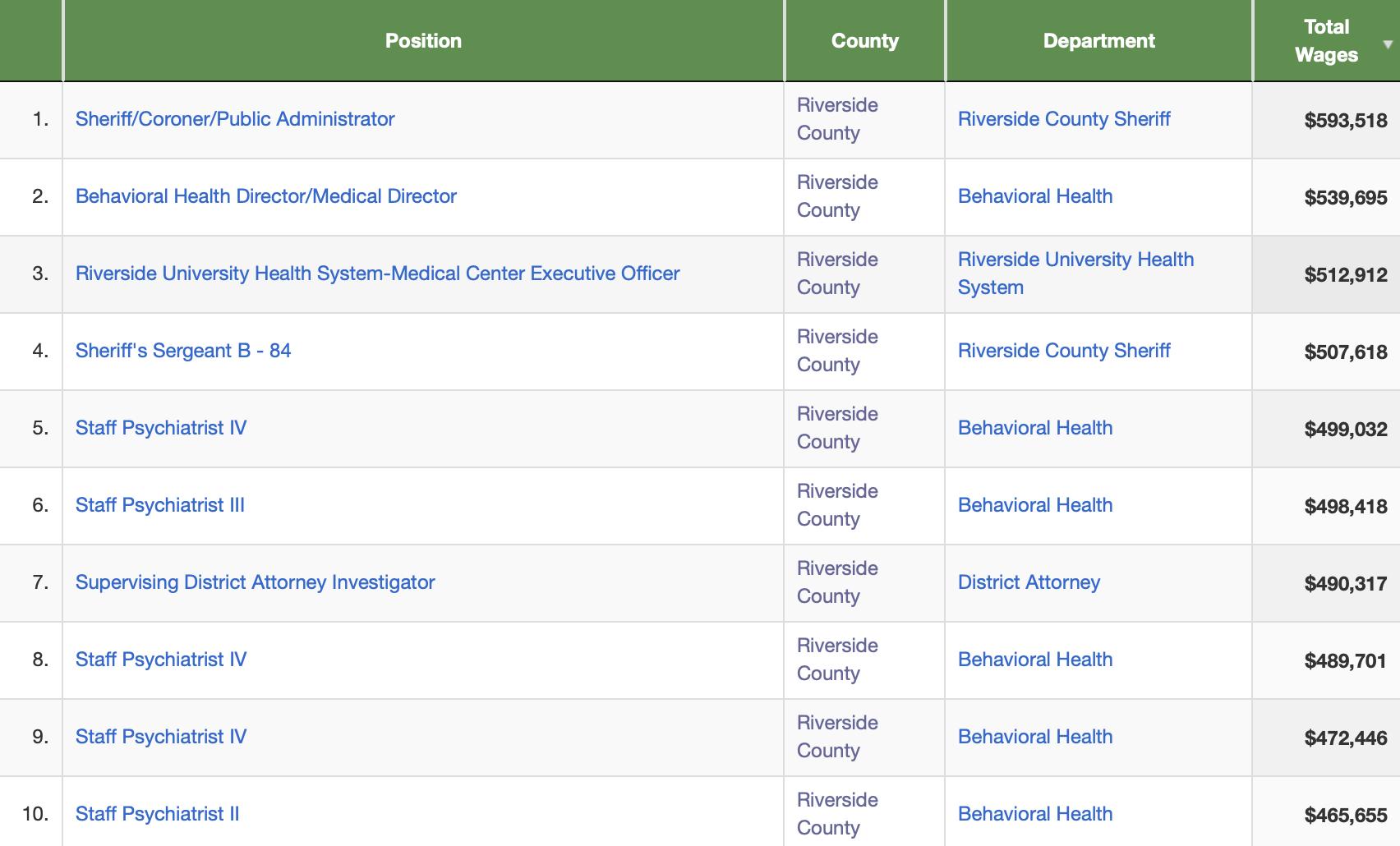
The 10 highest paid officials in Riverside County government last year were working in public safety and public health, according to a report released by the California State Controller’s Office and is available Wednesday online at www.publicpay.ca.gov.
The agency published its 2023 “Government Compensation in California” analysis, showing how taxpayer funds were spent in the previous year, and who was receiving what for being on the public payroll.
The individual who received the largest income in county government was Sheriff Chad Bianco, whose composite compensation last year totaled $593,518, the report said. That amount included base pay and a lump sum disbursal, totaling $286,529, which wasn’t specifically defined on the web portal but could have been banked vacation and sick leave time that wasn’t used, but cashed out, as well as funds from a legal settlement, according to the controller’s office.
In a 3-1 vote, with Supervisor Kevin Jeffries opposed and Supervisor Karen Spiegel abstaining, the Board of Supervisors earlier this month approved a raise for the sheriff, boosting his annual salary from $273,463 to 347,771, beginning in the
See Payroll Page 28
By City News Service
omen living in states with the most restrictive abortion policies after the Supreme Court’s reversal of Roe v. Wade experienced steep declines in the use of birth control pills and emergency contraceptives, according to a USC study released Wednesday.
The findings, which appear in the medical journal JAMA Network Open, suggest that the Dobbs v. Jackson Women’s Health Organization case had an even wider impact for women’s reproductive health than previously thought, the authors said.
According to the study, states that implemented a full ban on abortion after the ruling saw significant declines in the number of prescriptions filled for birth control pills and emergency contraceptives at pharmacies.
These reductions weren’t found in states whose policies were unchanged after the Dobbs decision, according to the findings.
The study said many family planning clinics with abortion services closed immediately after the Roe reversal, particularly in the most restrictive states.
By Staff
TheRiversideCity
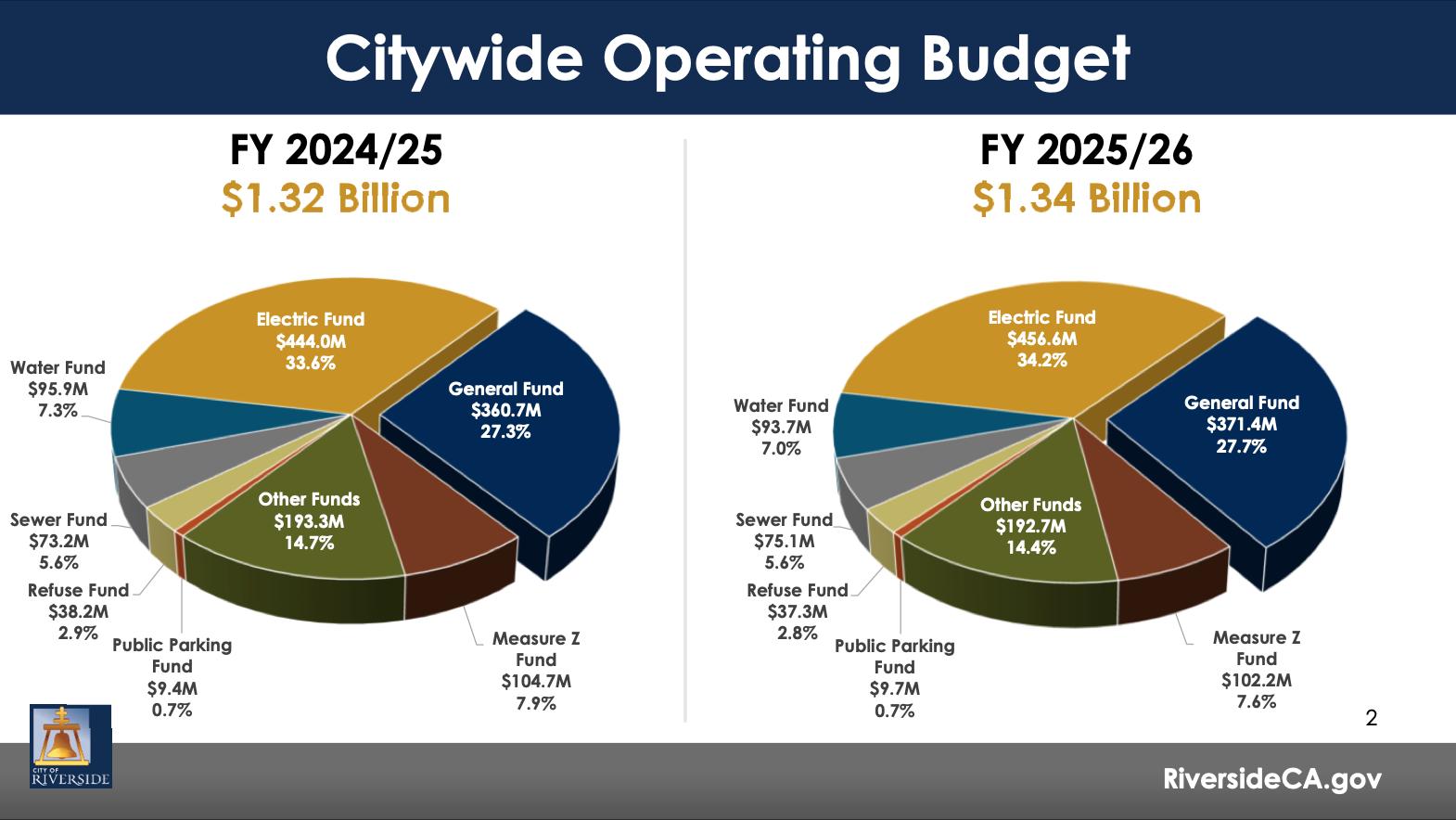
Council on Tuesday approved a balanced biennial budget of $1.45 billion each year.
Officialshighlighted these areas of financial focus — public safety; housing and homelessness, specifically investments in affordable housing, supportive services and homelessness prevention efforts; infrastructure maintenance, improvement and expansion; significant budget increases for road maintenance; and investments in the city’s economy, job creation and business development.
“This budget reflects a balanced approach to providing services our residents have made clear they want, while also addressing challenges we face as a city,” Mayor Patricia Lock Dawson said in a statement.
“We welcome the accountability that comes with these increases and appreciate our residents’ expectations for responsible fiscal stewardship.”
City officials described these key expenditures:
- Replacing Riverside Police Department radios for $5.3 million because the existing radios are nearing the end of their lifespan. “The cost will be partially offset by $2 million projected from the sale of two surplus police helicopters,” according to a city statement.
- Adding staff members to the Riverside Fire Department’s arson
program “to improve the department’s ability to investigate and prosecute arson cases,” officials said. The fire department also received an extra $9 million to replace vehicles and equipment, increasing that spending to $30.4 million through 2029.
- Enhancing the Community and Economic Development Department’s One-Stop Shop with $1.2 million in software upgrades to improve customer service and streamline the permit application process. The council also approved funding for an Economic Impact Study and Strategic Plan, a Sports Attraction Study and Convention Center Expansion Study.
- “Expanding staff at Library branches across the city to facilitate program expansions, enhance patron support and meet technology needs; and adding $500,000 for materials, increasing the per capita budget from $1.23 to $2.80, which remains below the $5.31 statewide average,” officials said.
- “Moving the Arts & Cultural Affairs Division from the CEDD to the Parks, Recreation and Community Services Department to further promote arts and culture, and enhance the quality of life; expand recreation and aquatics programs throughout the City; and improve the landscaping and maintenance of the City’s 68 parks and 16
facilities.”
Devoting $2.3 million to landscaping improvements on 450 acres of “rights-of-way” spread over 81 square miles. Sites targeted for enhanced landscaping include freeway on- off-ramps, historical roadways, the downtown pedestrian mall, “landscape maintenance districts,” citrus groves, fountains and “150,000 street trees.”
- Establishing a Marketing and Communications Department and a $300,000 Visit Riverside campaign to promote tourism and “create a distinctive City brand.”
- Putting an additional $5 million each year into infrastructure upgrades for a total street maintenance budget of $25.6 million annually, increasing spending for facilities capital maintenance, investing in technology upgrades and funding a replacement plan for city vehicles that aren’t used for public safety work.
The council’s approval ends a nine-month budget process that started in October, when officials first sought public input by mailing a postcard to residents, posting notices on the city’s social media accounts and inviting residents to budget workshops. The public meetings were dubbed “Your Money, Your Voice” and garnered feedback on services, programs and facilities
city residents thought were most important. The city also conducted online surveys and a more extensive Quality of Life survey.
“The budget is based on prudent financial planning and innovative strategies to address critical needs, strengthen the local government and position the City to catalyze transformation in the Riverside community and economy,” according to the city statement. The budget covers the cost of city staff time for studying ways to maximize revenue and recover overhead expenses through measures such as the recent fees and charges study.
Officials said the budget is bolstered by robust property tax revenue that resulted following recent increases in assessed values, in addition to new revenue sources including those from the March JPA revenue-sharing agreement and cannabis tax.
“This budget reflects hundreds of hours of work by the City Council and City staff to capture our community’s desires, aspirations and values,”
City Manager Mike Futrell said in a statement. “It is a systemically balanced budget year over year while allowing robust investments in public safety, housing, homelessness
response, park and library improvements, funding for the arts and community events — everything that makes Riverside a great place to live, work, and raise a family. This budget reflects Riverside’s strong economy and positions us well for the future.”
Officials said the budget will enable the city to keep providing essential services and buffer against potential economic concerns in the future as rising retirement costs, ongoing maintenance and infrastructure needs and increasing personnel costs remain significant fiscal challenges for Riverside and cities nationwide.
By City News Service
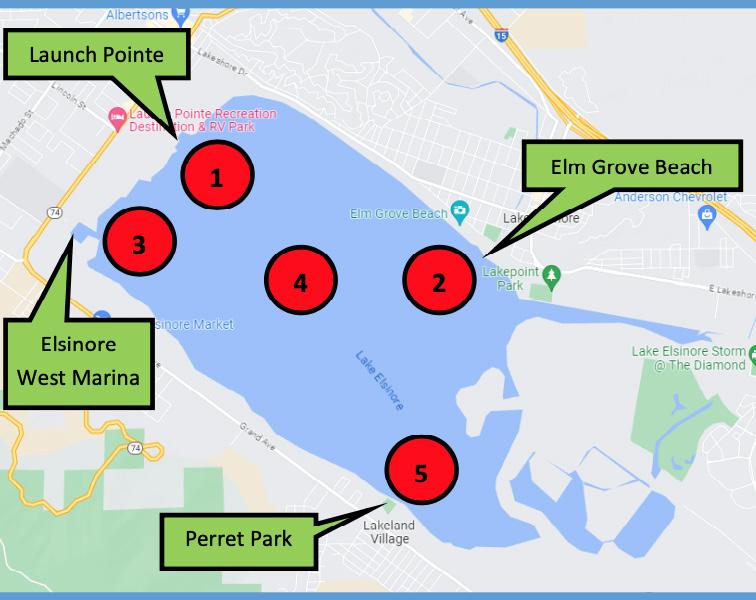
An algal bloom in Lake Elsinore prompted the city and state Wednesday to warn swimmers to stay out of the water and others engaged in recreational activity to take precautions to minimize exposure to the green slime.
According to the California Water Resources Control Board, the bloom appeared earlier this month and now poses a potential health threat to people and pets.
“No swimming” signs have been posted around the water, with additional warnings not to let dogs drink from the lake or eat scum washing up on shore. No fish caught in the lake should be
consumed, officials said.
“Cyanobacteria, a group of organisms that form harmful algal blooms, can produce potent toxins,” according to a Water Resources Control Board statement. “Health risks include ... dermatoxins that can cause itchy skin and rashes, gastrointestinal distress, headaches, agitation and weakness, or abnormal breathing if ... material is swallowed while swimming.”
Blooms have appeared in the lake in previous years, and according to officials, the current one is suspended at the surface, resulting in the “Danger Advisory” issued by the city and state.
“Due to the size and
toxicity of this bloom, along with the summer heat and absence of rainfall this time of year, the bloom may proliferate and alter its potential to produce toxins,” the water board stated. “Bloom conditions can change rapidly, as wind and waves move or concentrate the bloom into different regions of the lake.”
Algal growth is attributed to higher volumes of nutrients in the water, combined with elevated temperatures, lots of sunshine and little to no wind.
“In some areas, the bloom may concentrate and form a film or scum on the
water surface,” the water board said. “The color of the water may also appear discolored as bright or dark green and brown.”
Officials could not say when conditions might improve.
In December, the city announced a $2 million project to eradicate algae growth in the 3,300-acre lake, relying on two industrial-strength Titan NB6 nanobubble circulation units on a floating barge. It was unclear whether that technology had been successfully deployed and had the desired impact. Additional information is available at lake-elsinore. org/615/Lake-Watch.
Editorial editorial@beaconmedianews.com
editor@hlrmedia.com
Graphics/Production production@beaconmedianews.com production@hlrmedia.com
Advertising advertising@beaconmedianews.com advertising@hlrmedia.com
Legal Advertising legals@beaconmedianews.com legals@hlrmedia.com
Business accounting@beaconmedianews.com accounting@hlrmedia.com
BEACON MEDIA ADDRESS: 820 S. Myrtle Ave. Monrovia, CA 91016
PHONE: (626) 301-1010
WEBSITE www.beaconmedianews.com
HLR MEDIA ADDRESS: 820 S. Myrtle Ave. Monrovia, CA 91016
PHONE: (626) 301-1010
www.HLRmedia.com
PRESS
editor@beaconmedianews.com editor@hlrmedia.com






By Jennifer Huizen, Pettable via Stacker
If you're a pet parent, you probably know that having a meaningful bond with an animal companion can have several health benefits. According to the National Institutes of Health and the independent nonprofit organization HelpGuide.org, pet ownership can reduce stress, anxiety, and depression, improve heart health by lowering blood pressure, cholesterol levels, and triglyceride levels, and help children develop social and emotional skills. But did you know pets may also help combat loneliness?
Several studies have investigated the potential impact of pet companionship on loneliness and social isolation, and while the relationship still requires further research, there is some evidence that your furred, scaled or feathered pet pal may help ward off feelings of isolation.

To see how pet parents fare and what science says about it, Pettable sorted through the existing research out there exploring the relationship between pet ownership and loneliness, including various scientific studies, reviews and credible surveys.
The spread of loneliness

The Duarte Dispatchhas been adjudicated as a newspaper of general circulation in court case number GS 013893 City of Duarte, County of Los Angeles, State of California. The Rosemead Readerhas been adjudicated as a newspaper of general circulation in court case number GS 048894 City of Rosemead, County of Los Angeles, State of California.
The Alhambra Press has been adjudicated as a newspaper of general circulation in court case number ES016581 City of Alhambra, County of Los Angeles, State of California.
The Baldwin Park Press has been adjudicated as a newspaper of general circulation in court case number KS017174 City of Baldwin Park, County of Los Angeles, State of California.
The Burbank Independent has been adjudicated as a newspaper of general circulation in court case number ES016728 City of Burbank, County of Los Angeles, State of California.
The Glendale Independent has been adjudicated as a newspaper of general circulation in court case number ES016579 City of Glendale, County of Los Angeles, State of California.
The Monterey Park Press has been adjudicated as a newspaper of general circulation in court case number ES016580 City of Monterey Park, County of Los Angeles, State of California.







According to experts like the American Surgeon General Dr. Vivek H. Murthy, loneliness in the United States is more than just a problem for older, single people or people living in remote areas. It's an epidemic.
In a 2023 general advisory, Murthy wrote that about half of adults living in the U.S. reported feeling lonely, even before the onset of the COVID-19 pandemic.
"Loneliness is far more than just a bad feeling — it harms both individual and societal health. It is associated with a greater risk of cardiovascular disease, dementia, stroke, depression, anxiety, and premature death," Murthy added. "The mortality impact of being socially disconnected is similar to that caused by smoking up to 15 cigarettes a day, and even greater than that associated with obesity and physical inactivity."
While forming more supportive, stronger social human relationships is one more way to help reduce loneliness, this isn't always easy for everyone, neither physically nor emotionally. Luckily, there's growing evidence that 2 in 3 American households already have a potential loneliness-combating tool right in front of them, a pet.
Feeling is believing
In a nationally repre-
sentative survey of nonpet owners and pet owners conducted by the Human Animal Bond Research Institute and Mars Petcare, more than 4 in 5 (85%) respondents agreed that pet interaction might help reduce loneliness, while 3 in 4 (76%) agreed that human-pet interactions may positively impact social isolation. Of the pet owners surveyed, 4 in 5 said their pet helps them feel less lonely, and over half (54%) responded that their animal companion helps them connect with other humans.
Other studies confirm that generally speaking, pet owners tend to believe that pet companionship benefits their overall mental health and helps quell loneliness.
A study published in the journal Animals in 2021 conducted an online survey with 1,199 participants, 84% of whom reported having at least one companion animal. In the study, most respondents felt their pets positively impacted their mental wellbeing during the COVID-19 pandemic. Around 85% of respondents who owned dogs and roughly 3 in 4 respondents who owned cats felt their pets had an "extremely or moderately positive effect" on their mental health.
Sometimes, simply believing that you're doing something to help combat a mental or physical health problem can actually help treat it. Recent scientific research even supports the idea that in certain instances, the placebo effect can be as effective as traditional medical treatments.
But when it comes to solid scientific evidence, the jury is still out as to whether pet ownership has a strong or meaningful impact on loneliness and social isolation in humans. In the article
published in Animals cited above, the authors summarized: "Consistent with past research, these findings indicate that people believe their companion animals positively influenced their lives during the pandemic, but there is a lack of quantitative evidence to support these beliefs."
Science says
A 2022 scientific review published in Social Psychiatry and Psychiatric Epidemiology analyzing the findings of 24 studies focused on pet ownership and lower levels of social isolation or loneliness also found that only a part of the studies included had established a significant association between pet ownership, social isolation and loneliness.
More specifically, regarding loneliness the authors wrote that "studies that were conducted after the outbreak of COVID-19 mostly showed that pet ownership can contribute to lower levels of loneliness, but did not reveal an overall significant association until then."
An earlier review published in 2015 by the journal Anthrozoös evaluated quantitative studies of companion animals and human loneliness from five large electronic databases. It concluded that of the 21 studies that met their criteria, all but one study were "underpowered." In scientific lingo, a study is considered underpowered if it doesn't include a large enough sample size to provide a meaningful answer to the research question.
While more research is needed before we can scientifically say that your fur baby, or any other beloved companion of the animal variety, can help prevent or combat feelings of loneliness or social isolation, but that
doesn't mean they won't. Research questions that rely heavily on perceived connections — i.e., what people think versus proven reality — can be extremely difficult to answer. The extent to which a pet can reduce loneliness is also very likely to be dependent, at least in part, on the closeness of the owner-pet bond. Yet despite the remaining uncertainties, currently reputable, large health agencies like the NIH continue to support the idea that pet ownership can reduce loneliness, provide comfort, and enhance feelings of social support. According to the American Psychiatric Association, a leading authority on human mental health in the U.S., companion animals are also increasingly being used to augment mental health treatments and support mental well-being.
Even though the science isn't quite there yet, if you're one of the growing numbers of people struggling with loneliness or social isolation, it may be a good idea to consider adding an animal friend to your life. In case you find yourself ready to be a pet guardian, groups like The Humane Society of the United States and the American Society for the Prevention of Cruelty to Animals ask you to look into adopting a fur-ever friend, perhaps helping these companions stave off a little loneliness of their own.
Story editing by Carren Jao. Copy editing by Paris Close.
This story originally appeared on Pettable and was produced and distributed in partnership with Stacker Studio. The article was copy edited from its original version. Republished pursuant to a CC BY-NC 4.0 license.
On a bright morning in early January near the confluence of the San Joaquin and Tuolumne rivers in Central California, John Cain looks out over a small, curved lake. The trees are mostly bare for winter, but Cain, senior director of conservation of the nonprofit organization River Partners, points out that the wild landscape in front of him is buzzing. Bright white egrets swoop lazily down into the water while terns whiz by in the air. A California rose bush clings onto bright red rose hips. The low-lying plain across the water is dense with gray branches of adolescent trees.
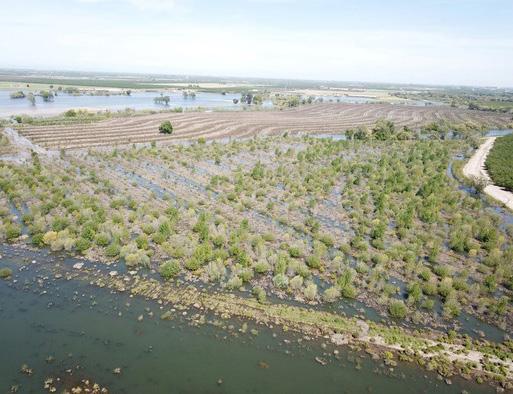
For more than four months last year, as California was inundated with a series of major storms, this part of Dos Rios Ranch Preserve, about 20 miles west of Modesto, was submerged under water. That’s exactly what it was designed for. And when the floodwaters recede, Cain says, “It’s just an explosion of life out here.”
Until a little more than a decade ago, this area was productive farmland, used for growing crops like tomatoes, alfalfa, melons and almonds. Now it’s set to be California’s next state park after a restoration project spearheaded by River Partners converted the ranch into rewilded riverside habitat. As climate change has doubled the likelihood of flooding in California, and is projected to increase runoff from storms by as much as 200 to 400 percent, this restored floodplain is proving to be a promising approach.
Not only does the area help buffer downstream communi-
By Elizabeth Hewitt for Reasons to be Cheerful
Broadcast version by
Suzanne Potter for California News Service reporting
for the Solutions Journalism Network-Public News Service Collaboration
ties from flood damage, it also maximizes environmental benefits from high waters.
“When we step back from the river, when we give the river more room, flooding actually is a very productive process for the ecosystem,” says Cain. “It recharges groundwater. It filters polluted water. It nourishes riparian forests that support all kinds of wildlife. It’s alive.”
California’s Central Valley doesn’t get much rain, but the 400-mile-long region is naturally shaped by water. Before human intervention, rivers fluctuated with flow from the towering Sierra Nevada range to the east. But over the last century and a half, rivers have been tamed by dams and constricted by levees as land was converted for agriculture and urban development. Some 95 percent of the region’s native riparian and wetland habitat has been lost. Even as rivers have been engineered with the aim of reducing flooding, communities and farmland have remained vulnerable. Bill Lyons, whose family owned Dos Rios Ranch for about 25 years, says that it was good farmland. But he recalls three times when the ranch was impacted by major flooding, resulting in loss of crops, erosion damage, and debris scattered across farmland.
Lyons’ family — which has been farming for four generations and has a century of history in this region — has long been committed to stewardship of the land. They are concerned with supporting the health of the environment, he says. So the family was interested when River Partners approached them
about buying Dos Rios Ranch.
“We looked at it from a point of view that probably its highest and best use would be to be returned to a natural state,” Lyons says.
In 2012, River Partners purchased the property and began restoration work along eight miles of river. Berms that had been built to protect farmland from high water were removed. To date, more than 350,000 trees and shrubs have been planted. River Partners uses existing irrigation infrastructure on former farmland to help young vegetation endure hot dry summers as it gets established. About 1,600 acres have been rewilded so far, and restoration work is ongoing on another 500 acres on an adjacent former farm.
Pausing on a rough singletrack road that runs atop higher ground through the preserve, Cain points out a long, shrubbery-covered berm that gently slopes down to the floodplain about three yards below the road. It’s a ramp

designed for riparian brush rabbits, an endangered species that has has moved in to Dos Rios. The slope allows them to escape to higher ground when the area floods. To the right of the ramp, birds flit between bare branches of densely planted trees. To the left, a low-lying grassy meadow is primed to take on high water. When the San Joaquin River overflows onto the field, it offers an abundant feast of zooplankton and tiny bugs for juvenile salmon, which studies show grow faster on floodplains than in the river. Instead of aiming to benefit any single species, the restoration was geared towards creating a varied ecosystem.
“It’s a more resilient landscape that supports a greater diversity of life,” Cain says. The preserve hosts migratory Aleutian cackling geese, a formerly endangered species that’s on the rebound. Beavers have been spotted, as well as deer, which hadn’t been seen in this area for about 60 years, according to River Partners.
Over the last decade, the restored floodplain quickly showed signs of success in supporting wildlife. And in 2023, the area got a chance to show how it performed in heavy flooding.
Lilia Lomeli-Gil walks by piles of branches and brush a few feet away from the backyard fences of houses on the edge of the small town of Grayson, across the river from Dos Rios Ranch Preserve. The debris was left by high water last winter, she explains, as the river overflowed near this small community, home to many farmworkers.
The record-breaking precipitation that hit California last year was devastating for some communities. Thou-
sands of people were evacuated when a levee broke along the Pajaro River, 50 miles southwest of Grayson.
In Grayson, residents watched the rising river warily. A few families evacuated out of precaution, according to Lomeli-Gil, co-founder of the Grayson United Community Center. The water came up within a couple feet of several houses, she says, but the town didn’t sustain major damage. She attributes that to the floodplain restoration work.
“I can only imagine if … River Partners had not opened up the levees,” she says. She believes giving the water room to spread out helped the town avoid flood damage. “I think that made a difference.”
Awareness has been growing that California’s old flood management approach of confining rivers has not been working, according to Brian Johnson, a board member of the Central Valley Flood Protection Board. But during the winter and spring of 2023, the Dos Rios project proved that floodplain restoration is an effective flood control approach. “You need to give the water a safe place to go,” he says, “or it’ll go to a place that’s not safe.”
Across the Central Valley, similar projects are in development, he says. Cost is a limitation — the board’s recommended flood protection measures, including projects like Dos Rios, have an estimated price tag of $25 to $30 billion. But those measures could avoid around $1 trillion damage from major flooding. The permitting process can also be slow and a hurdle. But Johnson says there’s a lot of opportunity to develop similar floodplain habitat restoration projects across the valley.
“In order for it to work at a system-wide scale, we want to be doing it in a bunch of different places,” Johnson says.
Floodplain restoration can also help California weather drought, which is predicted to become more intense with climate change, according to Cain. Not only does growing native vegetation require less water than agriculture, when floodwaters spread across the land, the water seeps down into the groundwater, recharging overdrawn aquifers.
For all its benefits, this type of floodplain restoration isn’t appropriate everywhere, according to Joshua Viers, a watershed expert at Univer-
sity of California, Merced. Dos Rios is well-suited because the confluence of the two rivers makes for dynamic conditions that are particularly good for habitat restoration. In other parts of this heavily agricultural region, other approaches may be more appropriate, he says. Certain crops, like grape vines, can handle some flooding, which also benefits groundwater stores. Some types of farming can be incorporated into habitat restoration; rice fields can support salmon. According to Viers, using a range of different approaches can help manage flooding and support ecosystems along California rivers.
“You can’t do all things in all places,” Viers says. “If you can string these together, you can have mutually reinforcing benefits.”
There are also social benefits to habitat restoration: Through the Grayson United Community Center, Lomeli-Gil has been working to engage Grayson residents with Dos Rios and surrounding restored natural areas. Several locals have gotten jobs with River Partners planting vegetation. And now, California State Parks is aiming to open the new state park to the public later this year.
“It’s in our backyard, so how blessed will we be,” Lomeli-Gil says.
As other floodplain projects are in development across California, Dos Rios is still expanding.
Cain walks along furrows on a plowed field on former farmland adjacent to Dos Rios. Instead of crops, this plot will soon be planted with young native trees and shrubs. Cain checks little white labels on sticks that mark where each new plant will go: a Modesto ash, box elder, and, his favorite, elderberry.
Cain and his colleagues at River Partners have set a long-term goal of restoring 100,000 acres in the San Joaquin Valley. That would restore about 10 percent of the wetlands that used to be in this area.
On the other side of the bare field, two large wonky Vs of Aleutian cackling geese fly by. Even though they are hard to see from such a distance, their characteristic honks echo across the field.
Elizabeth Hewitt wrote this article for Reasons to be Cheerful.
Tipflation is upon us.
TheCOVID-19-era explosion of cashless points of sale and touchscreens in shops, cafes, auto repair shops, and anywhere else money is exchanged has sent tipping culture into a tizzy: People are even prompted to tip upon checkout at retail shops and merch booths at farmers' markets.
Approximately 72% of American adults noted that tips are being expected in more places presently than they were five years prior, according to a Pew Research Center survey conducted in August 2023. This tipflation, or "tip creep," allows businesses to nudge customers for tips while keeping employee compensation low and exacerbating customers. Uniqode used data from Pew Research Center and news reports to explore how technology is changing the tipping culture in the U.S.
The expansion of tipping expectations has contributed to confusion and "tip fatigue," where customers feel pressured and frustrated when asked for tips in
nontraditional places. The Pew survey, for example, found that only about onethird of Americans found it very easy to know when was an appropriate time to tip.
At the height of the COVID-19 pandemic, when lockdown restrictions prohibited dining in, customers tipped delivery workers and cashiers at take-out restaurants to support their work as essential workers. But as Americans returned to business as usual, the new standard for tipping remained.
Rising inflation has made tips more essential to overall compensation for workers with low hourly wages. Pressuring customers to tip also helps employers retain workers in a competitive market — even if it's adding to the anxiety of patrons. While we're encouraged to tip in more venues, our habits haven't changed much Technology — particularly cashless payment systems — may have upended tipping norms through a phenomenon known as the framing effect, a cognitive bias in which people make choices
By Andrew Jose, Uniqode via Stacker
based on how a set of options is presented or "framed" instead of based on facts.
If a kiosk or other techbased payment system prompts people to select 20%, 25%, and 28% tips instead of the traditional 10%, 15% and 20%, it can create a culture of overtipping. It can also play into people's desire not to appear ungenerous by nudging them to tip more. This tactic can also be done without technology, as restaurants can place higher percentages on receipts in their suggested tips sections.
Payment processing companies, which take a cut from every transaction, benefit from bigger tips. Cashless payment systems like Venmo, Cashapp and Zelle allow people to pay buskers and street artists quickly, making paying tips more convenient. Some hotels use technologies that allow customers to pay tips by scanning a QR code.
While our overall tipping behaviors might not have changed entirely, the visualization above does underscore some movement. While

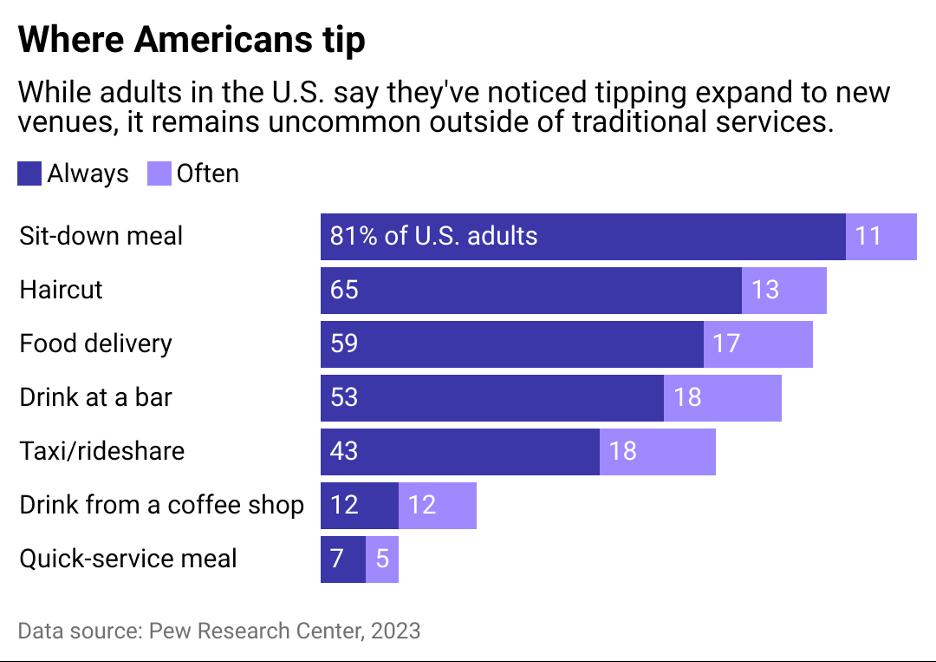
many coffee shops historically had tip jars out for baristas, tipping at fast food restaurants or other quickservice locations wasn't a regular part of American tipping culture.
The fact that 12% of people now report tipping
often or always in those settings shows how much has evolved in a short time — and how tipping may continue to adapt as the technology around us advances.
Data work by Emma Rubin. Story editing by Nicole Caldwell. Copy editing by
and
from its original version. Republished pursuant to a CC BY-NC 4.0 license.


NOTICE OF DISCONTINUATION OF CURRENT PROPOSITION 218 MAJORITY PROTEST PUBLIC HEARING PROCESS REGARDING INCREASES TO SEWER SERVICE RATES AND CHARGES AND CANCELLATION OF CONTINUED MAJORITY PROTEST PUBLIC HEARING FOR JULY 2, 2024 IN CONNECTION WITH THE SAME
NOTICE IS HEREBY GIVEN that the Proposition 218 Majority Protest Public Hearing to consider and approve increases to the City’s schedule of sewer service rates and charges that was started at the City Council’s Regular Meeting of June 4, 2024 under Agenda Item 13.2 and which was continued to July 2, 2024 has been discontinued in its entirety and as such, the continued public hearing scheduled for July 2, 2024 has been cancelled.
City staff will initiate an entirely new (rebooted) Proposition 218 Majority Protest Public Hearing process with an entirely new round of noticing and outreach as required under Proposition 218 with the aim of holding a new Majority Protest Public Hearing on or about September 3, 2024. As required by law, the City will issue a new round of 45-day notices to affected real property owners ahead of the new hearing date and all affected property owners will be given the opportunity to submit written protests in opposition to the proposed increases to sewer service rates and charges. This means property owners who submitted written protests for the discontinued Majority Protest hearing process referenced above will be required to submit a new written protests in connection with the new anticipated Majority Protest Public Hearing.
If you have any questions or would like additional information, please contact Don Nguyen, Utilities Manager, at (626) 580-2250 or via email at dnguyen@elmonteca.gov
Dated: June 25, 2024 Gabriel Ramirez, City Clerk
AVISO DE DISCONTINUACÍON DEL PROCESO DE AUDIENCIA PÚBLICA DE LA PROPOSICIÓN 218 PROTESTA MAYORITARIA ACTUAL CON RESPECTO A LOS AUMENTOS A LAS TARIFAS Y CARGOS DEL SERVICIO DE ALCANTARILLADO Y CANCELACIÓN DE LA CONTINUACIÓN DE LA AUDIENCIA PÚBLICA DE PROTESTA MAYORITARIA PREVIAMENTE PROGRAMADA PARA EL 2 DE JULIO DE 2024 EN RELACIÓN CON LA MISMA
POR EL PRESENTE SE NOTIFICA que la audiencia pública de protesta mayoritaria de la Propuesta 218 para considererar y aprobar aumentos al plan de tarifas y cargos del servicio de alcantarillado de la Ciudad que inició en la junta del Concejo Municipal el 4 de junio de 2024 bajo el articulo 13.2 de la agenda y que fue continuado hasta el 2 de julio de 2024 a sido descontinuada en su totalidad y como tal, la audiencia pública prevista para el 2 de julio de 2024 ha sido cancelado.
El personal de la Ciudad iniciará un proceso de audiencia pública de protesta mayoritaria de la Propuesta 218 completamente nuevo (reiniciado) con una ronda completamente nueva de notificación y divulgación según lo exige la Proposición 218 con el objetivo de tener una nueva audiencia pública de protesta mayoritaria el 3 de septiembre de 2024. Como lo exige la ley, la Ciudad emitirá una nueva ronda de avisos de 45 días a los propietarios afectados antes de la nueva fecha de audiencia y todos los propietarios afectados tendrán la oportunidad de presenter protestas por escrito en oposición a los aumentos propuestos al alcantarillado, tarifas y cargos de servicio. Esto significa que los propietarios que presentaron anteriormente protestas por escrito para el proceso de audiencia de protesta mayoritaria descontinuado deberán presenter una nueva protesta por escrito en relación con la nueva audiencia pública de protesta mayoritaria de la Propuesta 218.
Si tiene alguna pregunta o desea información adicional, comuníquese con Don Nguyen, Gerente de Servicios Públicos al (626) 580-2250 or por correo electrónico a dnguyen@elmonteca.gov
Fecha: 25 de junio de 2024 Gabriel Ramirez, City Clerk
終止通知: 終止目前關於提高下水道服務費率和收費的 218 號提案多數抗議公開聽證會程序,並取消原定於 2024 年 7 月 2 日舉行的與此相關的多數抗議公開聽證會
特此通知,第 218 號提案 (多數抗議公開聽證會審議並批准增加本 市下水道服務費率和收費表,該聽證會於 2024 年 6 月 4 日市議會 例行會議上根據議程第13.2 項啟動,並持續到 2024 年 7 月 2 日繼 續討論的計劃) 已完全終止,因此原定於 2024 年 7 月 2 日將舉行的 公開聽證會已被取消。
市府工作人員將啟動新的(重新計畫並提出的)218 號提案多數抗 議公開聽證會流程,並按照218 號提案的規定進行新一輪的通知和 宣傳活動,目標是在 2024 年 9 月 3 日當天或是那天左右舉行新的 多數抗議公開聽證會。法律規定,在聽證會日期之前向受影響的房
地產業主發出新一輪的 45
天通知,並且讓所有受影響的業主都有機 會提交書面抗議,反對提高下水道服務費率和收費的提議。這意味 著為已經在之前提交過書面抗議的業主將需要針對新的多數抗議公 開聽證會再次提交新的書面抗議。
如果您有任何問題或想要了解更多細節,請聯繫公用事業經理人 Don Nguyen,電話 (626) 580-2250 或發送電子郵件至 dnguyen@elmonteca.gov
日期:2024 年 6 月 25 日 Gabriel Ramirez, 市書記官 艾爾蒙特市
THÔNG BÁO NGỪNG QUÁ TRÌNH TỔ CHỨC CÔNG KHAI ĐA SỐ PHẢN ĐỐI THEO QUY ĐỊNH 218 LIÊN QUAN ĐẾN VIỆC TĂNG CÁC MỨC GIÁ VÀ PHÍ DỊCH VỤ CỐNG RÃNH VÀ HỦY BỎ CÔNG KHAI ĐA SỐ PHẢN ĐỐI DỰ KIẾN VÀO NGÀY 2 THÁNG 7, 2024 LIÊN QUAN ĐẾN VẤN ĐỀ TRÊN
THÔNG BÁO BẰNG VĂN BẢN rằng Cuộc Họp Công Khai Đa Số Phản Đối Theo Quy Định 218 để xem xét và phê duyệt việc tăng bảng giá và phí dịch vụ cống rãnh của Thành phố đã được bắt đầu tại Cuộc Họp Thường Lệ của Hội Đồng Thành Phố vào ngày 4 tháng 6, 2024 dưới Mục 13.2 của Chương Trình Nghị Sự và đã được tiếp tục đến ngày 2 tháng 7, 2024, đã bị ngừng hoàn toàn và do đó, cuộc họp công khai tiếp tục dự kiến vào ngày 2 tháng 7, 2024 đã bị hủy bỏ.
Nhân viên Thành phố sẽ khởi xướng một quy trình tổ chức công khai Đa Số Phản Đối Theo Quy Định 218 hoàn toàn mới với một vòng thông báo và tiếp cận hoàn toàn mới như yêu cầu theo Quy Định 218 nhằm tổ chức một Cuộc Họp Công Khai Đa Số Phản Đối mới vào khoảng ngày 3 tháng 9, 2024. Theo yêu cầu của luật pháp, Thành phố sẽ gửi một vòng thông báo 45 ngày mới đến các chủ sở hữu tài sản bị ảnh hưởng trước ngày họp mới và tất cả các chủ sở hữu tài sản bị ảnh hưởng sẽ được cung cấp cơ hội để nộp phản đối bằng văn bản
đối với việc tăng bảng giá và phí dịch vụ cống rãnh.
Điều này có nghĩa là các chủ sở hữu tài sản đã nộp phản đối bằng văn bản cho quy trình công khai Đa Số Phản Đối bị ngừng nêu trên sẽ phải nộp lại phản đối bằng văn bản mới liên quan đến Cuộc Họp Công Khai Đa Số Phản Đối mới dự kiến.
Nếu bạn có bất kỳ câu hỏi nào hoặc muốn biết thêm thông tin, vui lòng liên hệ với Don Nguyen, Quản lý Tiện ích, theo số điện thoại (626) 580-2250 hoặc qua email tại dnguyen@elmonteca.gov
Ngày: 25 tháng 6, 2024 Gabriel Ramirez, Thư ký Thành phố
Publish June 27 & July 1, 2024 EL MONTE EXAMINER
NOTICE OF FINDING OF NO SIGNFICANT IMPACT AND NOTICE OF INTENT TO REQUEST RELEASE OF FUNDS
July 1, 2024
City of El Monte 11333 Valley Boulevard El Monte, CA 91731 (626) 580-2070
These notices shall satisfy two separate but related procedural requirements for activities to be undertaken by the City of El Monte. REQUEST FOR RELEASE OF FUNDS
On or about July 17, 2024, the City of El Monte will submit a request to the U.S. Department of Housing and Urban Development (HUD) for the release of HOME Investment Partnerships Program (HOME) funds under Title 24 Part 92 and HOME ARP funds under Section 3205 of the American Rescue Plan Act of 2021, as amended, to undertake a project known as Esperanza Village for the purpose of developing 202 residential units affordable to low- and extremely low-income individuals, families and seniors and approximately 46,000 square feet of non-residential community-serving uses (medical clinic, senior health center, job training) at 4024 Durfee Avenue in the City of El Monte (APNs 8549-004-900 [Lot 2] and 8549-005-900 [Lots 5, 6, 7, 8, and 9]).
Estimated Total Project Cost (HUD and non-HUD funds):
$169,000,000
Estimated Total HUD Funding Amount (HOME and HOME ARP): $3,000,000
FINDING OF NO SIGNIFICANT IMPACT
The City of El Monte has determined that the project will have no significant impact on the human environment. Therefore, an Environmental Impact Statement under the National Environmental Policy Act of 1969 (NEPA) is not required. Additional project information is contained in the Environmental Review Record (ERR)
on file at:
City of El Monte Housing Division
El Monte City Hall West 11333 Valley Boulevard El Monte, CA 91731
The ERR may be examined or copied Mondays through Thursdays, except legal holidays, between the hours of 7:00 a.m. and 5:30 p.m.
Any individual, group, or agency may submit written comments on the ERR to the City of El Monte’s Housing Manager, Vanesa Sedano at 11333 Valley Boulevard, El Monte, CA 91731, by phone at (626)258-8831, or via email at vsedano@elmonteca.gov. All comments received by July 16, 2024, or fifteen (15) days from the actual date of publication, whichever is later, will be considered by the City of El Monte prior to authorizing submission of a request for release of funds. Comments should specify which Notice they are addressing.
The City of El Monte certifies to HUD that Betty Donavanik in her capacity as the City’s Community & Economic Development Director consents to accept the jurisdiction of the Federal Courts if an action is brought to enforce responsibilities in relation to the environmental review process and that these responsibilities have been satisfied. HUD’s approval of the certification satisfies its responsibilities under NEPA and related laws and authorities and allows the City of El Monte to use Program funds.
HUD will accept objections to its release of fund and the City of El Monte’s certification for a period of fifteen (15) days following the anticipated submission date or its actual receipt of the request (whichever is later) only if they are on one of the following bases: (a) the certification was not executed by the Certifying Officer of the City of El Monte; (b) the City of El Monte has omitted a step or failed to make a decision or finding required by HUD regulations at 24 CFR part 58; (c) the grant recipient or other participants in the development process have committed funds, incurred costs or undertaken activities not authorized by 24 CFR Part 58 before approval of a release of funds by HUD/State; or (d) another Federal agency acting pursuant to 40 CFR Part 1504 has submitted a written finding that the project is unsatisfactory from the standpoint of environmental quality. Objections must be prepared and submitted in accordance with the required procedures (24 CFR Part 58, Sec. 58.76) and shall be addressed to:
Candice Hughes, Field Environmental Officer
Los Angeles Federal Building
U.S. Department of Housing and Urban Development
Los Angeles Field Office
300 North Los Angeles, Suite #4054 Los Angeles, CA 90012
Potential objectors should contact HUD to verify the actual last day of the objection period.
Betty Donavanik, Director of Community & Economic Development City of El Monte
AVISO DE CONSTATACIÓN DE QUE NO HAY IMPACTO SIGNIFICATIVO Y AVISO DE INTENCIÓN DE SOLICITAR LA LIBERACIÓN DE FONDOS
1 de julio del 2024
City of El Monte 11333 Valley Blvd. El Monte, CA 91731 (626) 580-2070
Estos avisos cubren dos requisitos procesales distintos pero relacionados para actividades que llevará a cabo la Ciudad de El Monte.
SOLICITUD DE LIBERACIÓN DE FONDOS
En o cerca del 17 de Julio del 2024, la Ciudad de El Monte procederá a someter una solicitud al Departamento de Vivienda y Desarrollo Urbano de EE. UU (HUD, por sus siglas en inglés) para la liberación de fondos del programa HOME Investment Partnerships Program (HOME, por sus siglas en inglés) bajo el Título 24 Parte 92, y del programa HOME ARP bajo la Sección 3205 de la Ley del Plan de Rescate Americano de 2021, según enmendada, para llevar a cabo el proyecto conocido como Esperanza Village con el propósito de desarrollar 202 unidades residenciales asequibles para personas de bajos y extremadamente bajos ingresos, familias y personas mayores y aproximadamente 46,000 pies cuadrados de usos comunitarios no residenciales (clínica médica, centro de salud para personas mayores y una escuela de capacitación vocacional) en 4024 Durfee Avenue en la ciudad de El Monte (APNs 8549-004-900 [Lot 2] y 8549-005-900 [Lotes 5, 6, 7, 8 y 9]).
Costo total estimado del proyecto (fondos HUD y no HUD):
$169,000,000
Monto total estimado de financiamiento de HUD (HOME y HOME ARP): $ 3,000,000
DETERMINACIÓN DE NO IMPACTO SIGNIFICATIVO
La Ciudad de El Monte ha determinado que el proyecto no tendrá un impacto significativo en el medio ambiente humano. Por lo tanto, no se requiere una Declaración de Impacto Ambiental (EIS, por su siglas en ingles) bajo la Ley de Política Ambiental Nacional de 1969 (NEPA, por su siglas en ingles). La información e Expediente de Revisión Ambiental (ERR, por sus siglas en inglés) está disponible en la oficina de la División de Casas y Viviendas de la Ciudad de El Monte en:
City of El Monte Oeste (West) 11333 Valley Blvd. El Monte, CA 91731
El documento podrá ser examinado o copiado de lunes a jueves, excepto festivos legales, entre las 7:00 a.m. y las 5:30 p.m. COMENTARIOS PÚBLICOS
Cualquier individuo, grupo o agencia puede enviar comentarios por escrito sobre el ERR a la Manager de Casas y Viviendas de la Ciudad de El Monte, Vanesa Sedano a 11333 Valley Boulevard, El Monte, CA 91731, por teléfono al (626)258-8831, o por correo electrónico a vsedano@elmonteca.gov. Todos los comentarios recibidos hasta el 16 de Julio de 2024, o quince (15) días de la fecha actual de esta publicación, lo que ocurra mas tarde, serán considerados por la Ciudad de El Monte antes de autorizar la presentación de la solicitud de liberación de fondos. Los comentarios deben especificar a qué Aviso se dirigen.
CERTIFICACIÓN AMBIENTAL
La Ciudad de El Monte certifica a HUD que Betty Donavanik en su calidad de Director de Desarrollo Económico consiente en aceptar la jurisdicción de los Tribunales Federales si se presenta una acción para hacer cumplir las responsabilidades en relación con el proceso de revisión ambiental y que estas responsabilidades han sido satisfechas. La aprobación de la certificación por parte de HUD satisface sus responsabilidades bajo NEPA, y las leyes y autoridades relacionadas, y permite que la Cuidad de El Monte utilice fondos del programa.
OBJECIONES A LA LIBERACIÓN DE FONDOS
HUD aceptará objeciones a su liberación de fondos y la certificación de la Ciudad de El Monte por un período de quince (15) días a partir de la fecha de presentación anticipada o su recepción real de la solicitud (lo que sea posterior) solo si se basan en una de las siguientes bases: (a) la certificación no fue ejecutada por el Oficial Certificador de la Ciudad de El Monte; (b) la Ciudad de El Monte ha omitido un paso o no ha tomado una decisión o hallazgo requerido por las regulaciones de HUD en 24 CFR parte 58; (c) el beneficiario de la subvención u otros participantes en el proceso de desarrollo han comprometido fondos, incurrido en costos o emprendido actividades no autorizadas por 24 CFR Parte 58 antes de la aprobación de una liberación de fondos por HUD; o (d) otra agencia federal que actúe de conformidad con 40 CFR Parte 1504 ha presentado una conclusión por escrito de que el proyecto no es satisfactorio desde el punto de vista de la calidad ambiental. Las objeciones deben prepararse y presentarse de acuerdo con los procedimientos requeridos (24 CFR Parte 58, Sec. 58.76) y se dirigirán a:
Candice Hughes, Oficial Ambiental de Campo Edificio Federal de Los Ángeles
Departamento de Vivienda y Desarrollo Urbano de los Estados Unidos
Oficina de campo de Los Angeles 300 North Los Angeles, Suite #4054 Los Angeles, CA 90012
Los posibles objetores deben comunicarse con HUD para verificar el último día real del período de objeción.
Betty Donavanik, Director de Desarrollo Económico Cuidad de El Monte
Publish July 1, 2024 EL MONTE EXAMINER
NOTICE OF PETITION TO
OF: VICTOR S. TRUJILLO AKA VICTOR T. SIERRA CASE NO. 24STPB06775 To all heirs, beneficiaries, creditors, contingent creditors, and persons who may otherwise be interested in the WILL or estate, or both of VICTOR S. TRUJILLO AKA VICTOR T. SIERRA.
A PETITION FOR PROBATE has been filed by GRACIELA CASTANEDA in the Superior Court of California, County of LOS ANGELES.
THE PETITION FOR PROBATE requests that GRACIELA CASTANE-
dent administration authority will be granted unless an interested person files an objection to the petition and shows good cause why the court should not grant the authority.
A HEARING on the petition will be held in this court as follows: 08/09/24 at 8:30AM in Dept. 5 located at 111 N. HILL ST., LOS ANGELES, CA 90012
IF YOU OBJECT to the granting of the petition, you should appear at the hearing and state your objections or file written objections with the court before the hearing. Your appearance may be in person or by your attorney.
IF YOU ARE A CREDITOR or a contingent creditor of the decedent, you must file your claim with the court and mail a copy to the personal representative appointed by the court within the later of either (1) four months from the date of first issuance of letters to a general personal representative, as defined in section 58(b) of the California Probate Code, or (2) 60 days from the date of mailing or personal delivery to you of a notice under section 9052 of the California Probate Code. Other California statutes and legal authority may affect your rights as a creditor. You may want to consult with an attorney knowledgeable in California law.
YOU MAY EXAMINE the file kept by the court. If you are a person interested in the estate, you may file with the court a Request for Special Notice (form DE-154) of the filing of an inventory and appraisal of estate assets or of any petition or account as provided in Probate Code section 1250. A Request for Special Notice form is available from the court clerk.
Attorney for Petitioner
JUVENTINO B. CASAS JR. - SBN 44445
LAW OFFICE OF J.B. CASAS JR. 2520 WEST BEVERLY BLVD. MONTEBELLO CA 90640
Telephone (323) 726-3200 6/24, 6/27, 7/1/24
CNS-3825997# EL MONTE EXAMINER
NOTICE OF PETITION TO ADMINISTER ESTATE OF Josephine Cabral CASE NO. 24STPB06931
To all heirs, beneficiaries, creditors, contingent creditors, and persons who may otherwise be interested in the will or estate, or both, of: Josephine Cabral
A PETITION FOR PROBATE has been filed by Daniel Cabral in the Superior Court of California, County of Los Angeles.
THE PETITION FOR PROBATE requests that Daniel Cabral be appointed as personal representative to administer the estate of the decedent.
THE PETITION requests authority to administer the estate under the Independent Administration of Estates Act with full authority . (This authority will allow the personal representative to take many actions without obtaining court approval. Before taking certain very important actions, however, the personal representative will be required to give notice to interested persons unless they have waived notice or consented to the proposed action.) The independent administration authority will be granted unless an interested person files an objection to the petition and shows good cause why the court should not grant the authority.
A HEARING on the petition will be held on 08/02/2024 at 8:30AM in Dept. 44 located at 111 N. HILL ST. LOS ANGELES CA 90012 STANLEY MOSK COURTHOUSE.
IF YOU OBJECT to the granting of the petition, you should appear at the hearing and state your objections or file written objections with the court before the hearing. Your appearance may be in person or by your attorney.
by the court. If you are a person interested in the estate, you may file with the court a Request for Special Notice (DE-154) of the filing of an inventory and appraisal of estate assets or of any petition or account as provided in Probate Code section 1250. A Request for Special Notice form is available from the court clerk. Attorney for Petitioner: Sherlock K. Lau, SBN 352182 41 Corporate Park, Suite 320 Telephone: (714) 543 6829 6/27, 7/1, 7/4/24 CNS-3826967# EL MONTE EXAMINER
NOTICE OF PETITION TO ADMINISTER ESTATE OF CHRISTINE OOI
Case No. 24STPB03191
To all heirs, beneficiaries, cred-itors, contingent creditors, and persons who may otherwise be interested in the will or estate, or both, of CHRISTINE OOI
A PETITION FOR PROBATE has been filed by James Ooi in the Superior Court of California, County of LOS ANGELES.
THE PETITION FOR PROBATE requests that James Ooi be ap-pointed as personal representative to administer the estate of the dece-dent.
THE PETITION requests the decedent’s will and codicils, if any, be admitted to probate. The will and any codicils are available for examination in the file kept by the court.
THE PETITION requests authority to administer the estate under the Independent Administration of Estates Act. (This authority will allow the personal representative to take many actions without obtaining court approval. Before taking certain very important actions, however, the personal representative will be required to give notice to interested persons unless they have waived notice or consented to the proposed action.) The independent administra-tion authority will be granted unless an interested person files an objec-tion to the petition and shows good cause why the court should not grant the authority.
A HEARING on the petition will be held on July 26, 2024 at 8:30 AM in Dept. No. 62 located at 111 N. Hill St., Los Angeles, CA 90012.
IF YOU OBJECT to the granting of the petition, you should appear at the hearing and state your objections or file written objections with the court before the hearing. Your ap-pearance may be in person or by your attorney.
IF YOU ARE A CREDITOR or a contingent creditor of the decedent, you must file your claim with the court and mail a copy to the personal representative appointed by the court within the later of either (1) four months from the date of first issuance of letters to a general personal representative, as defined in section 58(b) of the California Probate Code, or (2) 60 days from the date of mailing or personal delivery to you of a notice under section 9052 of the California Probate Code.
Other California statutes and legal authority may affect your rights as a creditor. You may want to consult with an attorney knowl-edgeable in California law.
YOU MAY EXAMINE the file kept by the court. If you are a person interested in the estate, you may file with the court a Request for Special Notice (form DE-154) of the filing of an inventory and appraisal of estate assets or of any petition or account as provided in Probate Code section 1250. A Request for Special Notice form is available from the court clerk. Attorney for petitioner: JAMES OOI 2347 BEARDSLEE ST DUARTE CA 91010 CN106077 OOI
Jul 1,4,8, 2024 DUARTE DISPATCH
decedent.
THE PETITION requests authority to administer the estate under the Independent Administration of Estates Act. (This authority will allow the personal representative to take many actions without obtaining court approval. Before taking certain very important actions, however, the personal representative will be required to give notice to interested persons unless they have waived notice or consented to the proposed action.)
The independent administration authority will be granted unless an interested person files an objection to the petition and shows good cause why the court should not grant the authority.
A HEARING on the petition will be held in this court as follows: 08/08/24 at 8:30AM in Dept. 79 located at 111 N. HILL ST., LOS ANGELES, CA
90012
IF YOU OBJECT to the granting of the petition, you should appear at the hearing and state your objections or file written objections with the court before the hearing. Your appearance may be in person or by your attorney.
IF YOU ARE A CREDITOR or a contingent creditor of the decedent, you must file your claim with the court and mail a copy to the personal representative appointed by the court within the later of either (1) four months from the date of first issuance of letters to a general personal representative, as defined in section 58(b) of the California Probate Code, or (2) 60 days from the date of mailing or personal delivery to you of a notice under section 9052 of the California Probate Code.
Other California statutes and legal authority may affect your rights as a creditor. You may want to consult with an attorney knowledgeable in California law.
YOU MAY EXAMINE the file kept by the court. If you are a person interested in the estate, you may file with the court a Request for Special Notice (form DE-154) of the filing of an inventory and appraisal of estate assets or of any petition or account as provided in Probate Code section 1250. A Request for Special Notice form is available from the court clerk.
Attorney for Petitioner PENG GAO - SBN 243339
LAW OFFICE OF GAO PENG 159 E. LIVE OAK AVE. #209
ARCADIA CA 91006
Telephone (626) 446-6588
7/1, 7/4, 7/8/24
CNS-3827827#
ARCADIA WEEKLY
NOTICE OF PETITION TO ADMINISTER ESTATE OF NORMAN CARTER
Case No. 24STPB07100
To all heirs, beneficiaries, cred-itors, contingent creditors, and persons who may otherwise be interested in the will or estate, or both, of NORMAN CARTER
A PETITION FOR PROBATE has been filed by Doris Wang in the Superior Court of California, County of LOS ANGELES.
THE PETITION FOR PROBATE requests that Doris Wang be ap-pointed as personal representative to administer the estate of the dece-dent.
THE PETITION requests the decedent’s will and codicils, if any, be admitted to probate. The will and any codicils are available for examination in the file kept by the court.
THE PETITION requests authority to administer the estate under the Independent Administration of Estates Act. (This authority will allow the personal representative to take many actions without obtaining court approval. Before taking certain very important actions, however, the personal representative will be required to give notice to interested persons unless they have waived notice or consented to the proposed action.)
court and mail a copy to the personal representative appointed by the court within the later of either (1) four months from the date of first issuance of letters to a general personal representative, as defined in section 58(b) of the California Probate Code, or (2) 60 days from the date of mailing or personal delivery to you of a notice under section 9052 of the California Probate Code. Other California statutes and legal authority may affect your rights as a creditor. You may want to consult with an attorney knowl-edgeable in California law.
YOU MAY EXAMINE the file kept by the court. If you are a person interested in the estate, you may file with the court a Request for Special Notice (form DE-154) of the filing of an inventory and appraisal of estate assets or of any petition or account as provided in Probate Code section 1250. A Request for Special Notice form is available from the court clerk. Attorney for petitioner:
G YEE
Jul 1,4,8, 2024 ROSEMEAD READER
DA be appointed as personal representative to administer the estate of the decedent.
THE PETITION requests the decedent’s WILL and codicils, if any, be admitted to probate. The WILL and any codicils are available for examination in the file kept by the court.
THE PETITION requests authority to administer the estate under the Independent Administration of Estates Act with limited authority. (This authority will allow the personal representative to take many actions without obtaining court approval. Before taking certain very important actions, however, the personal representative will be required to give notice to interested persons unless they have waived notice or consented to the proposed action.) The indepen-
IF YOU ARE A CREDITOR or a contingent creditor of the decedent, you must file your claim with the court and mail a copy to the personal representative appointed by the court within the later of either (1) four months from the date of first issuance of letters to a general personal representative, as defined in section 58(b) of the California Probate Code, or (2) 60 days from the date of mailing or personal delivery to you of a notice under section 9052 of the California Probate Code. Other California statutes and legal authority may affect your rights as a creditor. You may want to consult with an attorney knowledgeable in California law.
YOU MAY EXAMINE the file kept
NOTICE OF PETITION TO ADMINISTER ESTATE OF:
SERGIO M. CERDA
CASE NO. 24STPB06616
To all heirs, beneficiaries, creditors, contingent creditors, and persons who may otherwise be interested in the WILL or estate, or both of SERGIO M. CERDA. A PETITION FOR PROBATE has been filed by WENDY C. MONTOYA in the Superior Court of California, County of LOS ANGELES. THE PETITION FOR PROBATE requests that WENDY C. MONTOYA be appointed as personal representative to administer the estate of the
The independent administra-tion authority will be granted unless an interested person files an objec-tion to the petition and shows good cause why the court should not grant the authority.
A HEARING on the petition will be held on August 6, 2024 at 8:30 AM in Dept. No. 44 located at 111 N. Hill St., Los Angeles, CA 90012.
IF YOU OBJECT to the granting of the petition, you should appear at the hearing and state your objections or file written objections with the court before the hearing. Your ap-pearance may be in person or by your attorney.
IF YOU ARE A CREDITOR or a contingent creditor of the decedent, you must file your claim with the
NOTICE OF $10,000 REWARD OFFERED BY THE LOS ANGELES COUNTY BOARD OF SUPERVISORS Notice is hereby given that the Board of Supervisors of the County of Los Angeles has extended the $10,000 reward offered in exchange for information leading to the apprehen-sion and conviction of the person or persons responsible for the fatal shooting of 46-year-old Terry Alford, who was found in front of a residence located on the 100 block of Los Angeles Avenue in the City of Monrovia suffering from multiple gunshot wounds on January 29, 2021, at approximately 5:00 p.m. Si no entiende esta noticia o necesita mas informacion, favor de llamar al (213) 974-1579. Any person having any information related to this crime is requested to call Detective Cynthia Sanchez at the Los Angeles County Sheriff’s Department, Homicide Bureau at (323) 890-5617 or Crime Stoppers at (800) 222-8477 and refer to Report No. 02100014-3199-011. The terms of the reward provide that: The information given that leads to the determination of the identity, the apprehension and conviction of any person or persons must be given no later than October 10, 2024. All reward claims must be in writing and shall be received no later than December 9, 2024. The total County payment of any and all rewards shall in no event exceed $10,000 and no claim shall be paid prior to conviction unless the Board of Supervisors makes a finding of impossibility of conviction due to the death or inca-pacity of the person or persons responsible for the crime or crimes. The County reward may be apportioned between various persons and/or paid for the conviction of various persons as the circumstances fairly dictate. Any claims for the reward funds should be filed no later than December 9, 2024, with the Executive Office of the Board of Supervisors, 500 West Temple Street, Room 383 Kenneth Hahn Hall of Administration, Los Angeles, California 90012, Attention: Terry Alford Reward Fund. For further information, please call (213) 974-1579. JEFF LEVINSON INTERIM EXECUTIVE OFFICER BOARD OF SUPERVI-SORS OF THE COUNTY OF LOS ANGELES CN107572 04142 Jun 13,17,20,24,27, Jul 1,4,8,11,15, 2024 MONROVIA WEEKLY ORDER TO SHOW CAUSE FOR CHANGE OF NAME PETITION OF Andrea Nittoli Kelly FOR CHANGE OF NAME CASE NUMBER: 24STCP01971 Superior Court of California, County of Los Angeles 111 North Hill Street, Los Angeles, Ca 90012, Central Judicial District TO
spurred in large part by federal funding for wellplugging efforts.
As regulators and legislators seek to require that drillers set aside more money for the work, they have invited oil companies and trade groups to help write the regulations. This dynamic — politically expedient in states where the industry wields tremendous influence — has combined with secretive drafting processes and millions of dollars of industry lobbying to weaken or kill proposals in state after state.
In some, including Oklahoma and Utah, lawmakers propose bills only after oil trade groups approve the language. In many others, regulators and drillers work together through organizations such as the quasi-governmental Interstate Oil and Gas Compact Commission to design policy. But even when given a seat at the table, like in New Mexico, the industry has turned against reform efforts.
Holly Hopkins, a vice president of the American Petroleum Institute, the industry’s largest trade group, said in a statement, “We are continuing to work with policymakers to advance balanced regulations that enhance safety, sustainability and environmental stewardship and help ensure that American energy is produced responsibly from start to finish.”
Those working to reform a status quo that has left potentially millions of wells as orphans disagree. Sen. Jeff Merkley, an Oregon Democrat, is preparing to file a bill in Congress targeting oil companies’ use of bankruptcy to offload cleanup obligations on the public.
“The challenge in anything that involves fossil fuels, and particularly that addresses a profit strategy of fossil fuel companies, is you’re taking on the most powerful lobby in the United States of America,” he said.
“All Hell Broke Loose”
After a previous effort to update oil regulations failed in the New Mexico Legislature last year, the state convened a working group. Regulators, the industry and environmentalists spent months negotiating the details. Written with input from this broad coalition, and with the governor’s office and the Legislature in the hands of Democrats, it appeared the political stars had aligned.
But roadblocks quickly appeared. Lawmakers hadn’t been included in the negotiations, even though a
sponsor would have to carry the bill through the session, which lasts only a few weeks. The talks were also closed to the public, and some environmental groups had been excluded because of ongoing litigation against the state.
As soon as Rep. Kristina Ortez, a Democrat, filed HB 133, “all hell broke loose,” she said, with infighting from the closed-door negotiations spilling into the Legislature.
“The oil and gas companies didn’t appreciate the language,” Ortez said. “They felt like they weren’t being listened to.”
Some environmentalists, meanwhile, felt that industry representatives had already watered down the bill too much during the negotiations and came out against it, she said.
HB 133 was picked apart further as it worked its way through the legislative process.
With the New Mexico Oil and Gas Association now opposed, House committees submitted substitute measures to shift the industry’s position, gain votes and pass the bill. The amended versions eliminated a requirement that wells be a certain distance from schools and other buildings. Also gone was language to remove a cap on the monetary penalties regulators could assess against oil companies. And bonding requirements were watered down to the point that new, stricter rules would only apply to a handful of drillers.
By the time the rewritten legislation made it to the House floor, “I was so wildly unenthusiastic of the bill,” said Andrew ForkesGudmundson, who worked on it for environmental group Earthworks.
Missi Currier, the New Mexico Oil and Gas Association’s president and CEO, said that the group dropped its opposition after the bill was amended. But as the bill’s supporters whipped votes, they still encountered resistance from legislators who had been persuaded by small oil companies’ arguments that the new rules would push drillers out of business, Forkes-Gudmundson recalled.
Having hemorrhaged environmentalists’ support without gaining significant votes from moderates and conservatives, Democratic leadership never brought the bill up for a vote by the full House.
State-Sponsored Influence
Because the oil and gas industry is largely governed at the state level, states
banded together in the 1930s with the approval of Congress, and more recently with federal funding, to share best practices for regulating oil. The resulting organization, the Interstate Oil and Gas Compact Commission, has evolved into a forum where, much as happened in New Mexico, the industry influences the ideas that regulators take back to their states and write into the rules governing oil companies.
This was on full display in October at the commission’s annual conference, hosted among Utah’s Wasatch Mountains, which were blanketed by autumnal reds and yellows. With Chevron, ExxonMobil and Oxy Petroleum among the conference’s largest sponsors, oil and gas regulators from across the country had gathered at the Chateaux Deer Valley, an upscale ski resort overlooking Park City’s renowned pistes.
As the conference began, regulators were clear-eyed that taxpayers could be saddled with the cost of plugging orphan wells.
“This year, I spent $29 million, and somehow that’s still not enough,” Jason Harmon, one of West Virginia’s head oil regulators, said about his state’s well-plugging efforts.
Catherine Dickert, New York’s top oil regulator, noted that wells in her state get passed to eversmaller companies “until finally they get transferred to somebody who owns two wells that never, ever will be able to plug them.”
And cleanup funds are “woefully inadequate in Pennsylvania right now,” Kurt Klapkowski, the commonwealth’s lead oil regulator, told the attendees. “And we’ve gotten a lot of opposition about increasing that.”
But as the conference progressed, talk of bonding regulations gave way to discussions of repurposing old wells. Perhaps natural gas would still be needed to develop hydrogen fuel, an ExxonMobil representative discussed on a panel at the conference. Or wells could be used for storing captured carbon dioxide, an Oxy Petroleum representative said on another. State regulators returned home with these and other pitches from the oil industry on how to manage aging oil fields.
In addition to conferences, the organization pens pro-oil and gas resolutions that it has placed in state legislatures. In these resolutions, its members have called on the federal govern-
ment to minimize regulations on climate-warming gasses, increase oil-related tax credits and shield certain royalty owners from cleanup costs. States including Wyoming, Utah and Oklahoma, among others, have passed resolutions pushed by the commission.
By the 1970s, the Department of Justice was arguing that the Interstate Oil and Gas Compact Commission had largely become a lobbying organization. Critics today say the commission is hampering reform.
“They’re this unique mechanism for corporate capture,” said Jesse Coleman, a senior researcher with public interest watchdog organization Documented who has tracked the commission for years. “They get to act as this impartial source of information, when in reality, they’re on the industry side.”
While about 60% of the people involved with the group were government officials, a quarter worked in the oil and gas industry, according to a 2021 membership survey Documented obtained via a public records request. The Environmental Defense Fund is typically the only green group in the room.
The survey also found that people involved with the group saw its role as promoting “diverse viewpoints on climate related issues” and “fighting back against measures that seek to ‘keep it in the ground’” — the “it” referring to climatewarming fossil fuels.
As the U.S. Department of the Interior doles out $4.7 billion to plug orphan wells from the Infrastructure Investment and Jobs Act, the commission and its members have helped write guidelines governing the spending, most of which is going to states, documents obtained via public records requests
revealed. In many cases, the commission’s suggestions were highly technical and provided assistance to a federal department trying to navigate various states’ unique laws.
But at other times, the commission and its members asked the Interior Department to tear up requirements that states prioritize plugging wells that are emitting methane, a potent greenhouse gas, and pay the regional prevailing wage to workers hired to do the plugging.
In an email responding to questions, Lori Wrotenbery, the commission’s executive director, said the group’s pushback was justified because the Interior Department had exceeded its authority in telling states how to spend the money.
For Coleman, resistance from the commission comes as no surprise.
“The regulations and the resolutions that they promote have allowed a greater degree of pollution,” he said, “and have allowed greater leniency on the oil and gas industry.”
Despite industry pressure, some states have begun addressing the orphan well epidemic. California passed a law in October that could significantly increase oil companies’ bonds. A few weeks later, Louisiana strengthened rules pushing companies to more quickly plug wells that aren’t pumping.
But New Mexico’s story is more typical. There and around the country, reform efforts have foundered.
Oklahoma, for example, faces an estimated shortfall of more than $7 billion between cleanup costs and bonds, according to state data analyzed by ProPublica and Capital & Main. Still, a group of Republican legislators has tried and failed for several years to increase the
state’s bonding levels.
This legislative session, Rep. Brad Boles, a Republican, ran a bill to increase the highest level of required bonds from $25,000 to $150,000. Boles told a House committee that he had worked with two oil trade groups on the bill, describing it as “language that helps move the needle but also is not seen as anti-industry.” His proposal unanimously passed the House of Representatives and a Senate committee. Even so, it died without a vote in the Senate. (Boles declined to “point fingers at any particular person or group” for its failure but said he would try again next session.)
Meanwhile in West Virginia, which has a projected bonding shortfall of more than $15 billion and some of the nation’s weakest bonding laws, a bill to strengthen regulations never made it onto a committee agenda. This is the sixth straight year that such legislation has failed, Mountain State Spotlight reported.
The bill’s lead sponsors did not respond to requests for comment.
“The industry has a pretty solid lock on the Legislature,” said David McMahon, a West Virginia attorney who drafted this year’s bill.
In New Mexico, Ortez, the legislator who ran HB 133, said she was “dismayed” by how the bill fell apart, even though it was “maybe too fair” to oil and gas companies. But she hasn’t given up, pledging to continue pitching the industry on reform and finding language that can secure the necessary votes in advance of next year’s legislative session.
“I feel so strongly about this moving forward,” she said. “We need to make it happen.”
Republished with Creative Commons License (CC BY-NC-ND 3.0).
Notice of Public Hearing City Council
Zoning Code Amendments related to Restaurant Regulations
PROJECT DESCRIPTION: Proposed are Amendments to various sections of Title 17 (the Zoning Code) of the Pasadena Municipal Code (PMC) that would codify three pandemic-era measures for restaurants, including: a) allowing walk-up windows at restaurants by-right; b) creating an Administrative Conditional Use Permit (CUP) process for the on-site sale of alcohol at restaurants; and c) allowing outdoor dining on private property (e.g., parking lots and plazas) for restaurants.
PROJECT LOCATION: Citywide.
ENVIRONMENTAL DETERMINATION: The City Council will consider whether adoption of the proposed Zoning Code Amendments are exempt from environmental review pursuant to the guidelines of the California Environmental Quality Act (CEQA) under Section 15305 (Class 5 – Minor Alterations in Land Use Limitations) and whether there are no features that distinguish this project from others in the exempt class, therefore resulting in no unusual circumstances.
PLANNING COMMISSION RECOMMENDATION: On April 24, 2024, the Planning Commission considered the proposed Zoning Code Amendments at a publicly noticed hearing and recommended that the City Council approve the environmental determination and Zoning Code Amendments as presented by staff, with the following amendments:
1) Walk-up Windows - Amend Zoning Code definition of“Restaurants with Walk-up Window” to include the service of beverages, in addition to food; and 2) Outdoor Dining - Parking lot dining within 50 feet of any abutting residential use shall require the approval of a Minor CUP. This shall not apply to properties within the Central District Specific Plan.
ECONOMIC DEVELOPMENT & TECHNOLOGY COMMITTEE
RECOMMENDATION: On May 21, 2024, the Economic Development & Technology Committee voted to recommend the City Council approve the proposed Zoning Code Amendments as recommended by staff.
NOTICE IS HEREBY GIVEN that the City Council will conduct a public hearing and consider the proposed Zoning Code Amendments and proposed environmental determination. The hearing is scheduled for:
Date: Monday, July 15, 2024
Time: 5:30 p.m.
Place: Council Chambers, Pasadena City Hall 100 North Garfield Avenue, Room S249. The meeting agenda will be posted by July 12 at http://ww2.cityofpasadena.net/councilagendas/ council_agenda.asp
PUBLIC INFORMATION: All interested persons may submit correspondence to correspondence@cityofpasadena.net prior to the start of the meeting. During the meeting and prior to the close of the public hearing, members of the public may provide live public comment. Please refer to the agenda when posted for instructions on to how to provide live public comment. If you challenge the matter in Court, you may be limited to raising those issues you or someone else raised at the public hearing, or in written correspondence sent to the Council or the case planner at, or prior to, the public hearing.
Contact Person: David Sinclair, Senior Planner Phone: (626) 744-6766
E-mail: dsinclair@cityofpasadena.net Website: www.cityofpasadena.net/planning
Mailing Address:
Planning & Community Development Department
Planning Division, Community Planning Section 175 North Garfield Avenue, Pasadena, CA 91101
ADA: To request a disability-related modification or accommodation necessary to facilitate meeting participation, please contact the City Clerk’s Office as soon as possible at (626) 744-4124 or cityclerk@ cityofpasadena.net. Providing at least 72 hours advance notice will help ensure availability. Published on July 1, 8, 11, 2024
PROJECT DESCRIPTION: Proposed are two sets of Amendments to various sections of Title 17 (the Zoning Code) of the Pasadena Municipal Code (PMC). The first set of Amendments would revise the Zoning Code to simplify and streamline the entitlement and time extension processes. For most land use entitlements, such as Conditional Use Permits (CUPs) and Variances, the time limit would be the same (three years) regardless of zoning district. This amendment would also change the review authority for time extension applications from the original hearing body (e.g., Planning Commission, Design Commission, Hearing Officer) to the Director of Planning & Community Development.
The second set of Amendments are miscellaneous updates to clarify the application of development standards and other administrative clean-ups such as clarifying application of certain regulations and removing outdated references for internal consistency within the Zoning Code.
PROJECT LOCATION: Citywide.
ENVIRONMENTAL DETERMINATION: The City Council will consider whether adoption of the proposed Zoning Code Amendments are exempt from environmental review pursuant to the guidelines of the California Environmental Quality Act (CEQA) under Section 15305 (Class 5 – Minor Alterations in Land Use Limitations) and whether there are no features that distinguish this project from others in the exempt class, therefore resulting in no unusual circumstances.
PLANNING COMMISSION RECOMMENDATION: On April 24, 2024, the Planning Commission considered the proposed Zoning Code Amendments at a publicly noticed hearing and recommended that the City Council approve the environmental determination and Zoning Code Amendments as presented by staff, with the following amendments:
• Reflective Materials - Require an Administrative Minor CUP for materials that are reflective. Use industry standards for staff to identify when a material is considered reflective; and • Effect of Zoning Code Amendments on Projects in ProgressProjects with legislative or quasi-judicial approval shall be processed under the rules in effect when the project is deemed complete.
NOTICE IS HEREBY GIVEN that the City Council will conduct a public hearing and consider the proposed Zoning Code Amendments and proposed environmental determination. The hearing is scheduled for:
Date: Monday, July 15, 2024
Time: 5:30 p.m.
Place: Council Chambers, Pasadena City Hall 100 North Garfield Avenue, Room S249. The meeting agenda will be posted by July 12at http://ww2.cityofpasadena.net/ councilagendas/council_agenda.asp
PUBLIC INFORMATION: All interested persons may submit correspondence to correspondence@cityofpasadena.net prior to the start of the meeting. During the meeting and prior to the close of the public hearing, members of the public may provide live public comment. Please refer to the agenda when posted for instructions on to how to provide live public comment. If you challenge the matter in Court, you may be limited to raising those issues you or someone else raised at the public hearing, or in written correspondence sent to the Council or the case planner at, or prior to, the public hearing.
Contact Person: David Sinclair, Senior Planner Phone: (626) 744-6766
E-mail: dsinclair@cityofpasadena.net Website: www.cityofpasadena.net/planning
Mailing Address:
Planning & Community Development Department Planning Division, Community Planning Section 175 North Garfield Avenue, Pasadena, CA 91101
ADA: To request a disability-related modification or accommodation necessary to facilitate meeting participation, please contact the City Clerk’s Office as soon as possible at (626) 744-4124 or cityclerk@ cityofpasadena.net. Providing at least 72 hours advance notice will help ensure availability.
Published July 1, 8, 11, 2024 PASADENA
Project Manager Phone: 818-548-3945 Fax: 818-242-7087 E-mail: RTavitian@GlendaleCA.gov
Mandatory Qualifications for Bidder and Designated Subcontractors: A Bid may be rejected as non-responsive if the Bid
Bidder satisfactorily completed at least four (4) prevailing
public contracts in California; each comparable in scope and scale to this Project, within three (3) years prior to the Bid Deadline.
General Scope of Work: Contractor shall furnish labor, materials, equipment, services, and specialized skills to perform work involved in the Project. The Work included in the Bid is defined in accordance with Specification No. 3829R and Plan Nos. 1-3071, 3-1572, 4-649, 4-650, 18-114, 49-247, 50-638, 50-639, 50-648, 50-672, 50-673, 50-698, 50-699, and 70-113. The work generally includes: Surface grinding and placement of ARHM; surface grinding and placement of ARHM over Asphalt Rubber Aggregate Membrane (ARAM); selective removal, repair, and reconstruction of damaged curbs and gutters, sidewalks, driveways, cross gutters, alley aprons, and local depressions; modification and reconstruction of curb ramps to meet current ADA standards; adjustment of existing manholes and water meters to finished grade; removal and replacement of existing traffic striping and pavement markings; installation of new protected bicycle class (class IV) and dedicated bicycle lanes (class II); upsizing of sanitary sewer main line; removal and replacement of sanitary sewer main line; installation of bicycle friendly catch basin surface grates; construction of manhole structures; realignment of intersections; planting of new street trees; modification of existing traffic signal installation of new traffic signals, pedestrian hybrid beacons, and signalized bicycle crossing; installation of ten drywells and three bio-retention facilities; installation of reflective pavement; installation of creative crosswalks; and fiber optic improvements as shown on the project plans and specifications, Standard Plans for Public Works Construction (SPPWC 2021 Edition), and the Standard Specifications for Public Works Construction (2021 Edition), including all supplements thereto issued prior to bid opening date.
Other Bidding Information: Number of Contract Working Days: 140 Working Days
Amount of Liquidated Damages: $9,500 per Calendar Day
Required Construction Staging: Three Phases, See Construction Staging Plan
Other Bidding Information:
1. Bidding Documents: Bids must be made on the Bidder’s Proposal form contained herein. Bidding Documents may be obtained in the Public Works Engineering Department, 633 E. Broadway, Room 205, Glendale, CA 91206 where they may be examined. Electronic copies of bidding documents can be obtained at no cost from: https://www. glendaleca.gov/government/departments/finance/purchasing/rfp-rfq-bid-page. Future addenda, if any, will be available for download on the same page as the bidding documents. The city will not mail/deliver the addenda to the prospective bidders. It is the bidders’ sole responsibility to check the website to obtain future addenda to this bid document. Prospective bidders shall acknowledge the receipt of the addenda in the bid forms.
2. Engineer’s Estimate. The preliminary cost of construction of this Work has been prepared. The estimate is in the range of $15,500,000 to $16,500,000.
3. Completion: This Work must be completed within One Hundred Forty (140) Working days from the Date of Commencement as established by the City’s written Notice to Proceed.
4. Acceptance or Rejection of Bids. The City reserves the right to reject any and all Bids, to award all or any individual part/item of the Bid, and to waive any informalities, irregularities or technical defects in such Bids and determine the lowest responsible Bidder, whichever may be in the best interests of the City. No late Bids will be accepted, nor will any oral, facsimile or electronic Bids be accepted by the City.
5. Contractor License. At the time of the Bid Deadline and at all times during performance of the Work, including full completion of all corrective work during the Correction Period, the Contractor must possess a California contractor license or licenses, current and active, of the classification required for the Work, in accordance with the provisions of Chapter 9, Division 3, Section 7000 et seq. of the Business and Professions Code. In compliance with Public Contract Code Section 3300, the City has determined that the Bidder must possess the following license(s): a. Pursuant to Section 3300, of the Public Contract Code, the classification of the bidder’s Contractor’s License shall be “Class A” (for sewer cleaning and video, Class A, C-36, C-42, or D-38). Failure of a bidder to obtain adequate licensing at the time the contract is awarded shall constitute a failure to execute the Contract and shall result in the forfeiture of the Bidder’s Bond. b. For federally funded projects, the Contractor shall be properly licensed at the time of award.
The successful Bidder will not receive a Contract award if the successful Bidder is unlicensed, does not have all of the required licenses, or one or more of the licenses are not current and active. If the City discovers after the Contract’s award that the Contractor is unlicensed, does not have all of the required licenses, or one or more of the licenses are not current and active, the City may cancel the award, reject the Bid, declare the Bid Bond as forfeited, keep the Bid Bond’s proceeds, and exercise any one or more of the remedies in the Contract Documents.
6. Subcontractors’ Licenses and Listing. At the time of the Bid Deadline and at all times during performance of the Work, each listed Subcontractor must possess a current and active California contractor license or licenses appropriate for the portion of the Work listed for such Subcontractor and shall hold all specialty certifications required for such Work. When the Bidder submits its Bid to the City, the Bidder must list each Subcontractor whom the Bidder must disclose under Public Contract Code Section 4104 (Subcontractor Listing Law), and the Bidder must provide all of the Subcontractor information that Section 4104 requires (name, the location (address) of the Subcontractor’s place of business, California Contractor license number, California Department of Industrial Relations contractor registration number, and portion of the Work). In addition, the City requires that the Bidder list the dollar value of each Subcontractor’s labor or services. The City’s disqualification of a Subcontractor does not disqualify a Bidder. However, prior to and as a condition to award of the Contract, the successful Bidder shall substitute a properly licensed and qualified Subcontractor— without an adjustment of the Bid Amount. 7. Permits, Inspections, Plan Checks, Governmental Approvals, Utility Fees and Similar Authorizations: The City has applied and paid for the following Governmental Approvals and Utility Fees:
with the provisions of the Labor Code of the State of California, the City Council of the City has ascertained and determined by Resolution No. 18,626 (as amended), the general prevailing rate of per diem wages of a similar character in the locality in which the Work is performed and the general prevailing rate for legal holiday and overtime Work for each craft or type of worker needed in the execution of agreements with the City. Said resolution is on file in the Office of the City Clerk and is hereby incorporated and made a part hereof by the same as though fully set forth herein. Copies of said resolution may be obtained at the Office of the City Clerk.
12. Prevailing Wages. This Project is subject to the provisions of California Labor Code Section 1720. Contractor awarded this Contract and all Subcontractors of any tier shall not pay less than the minimum prevailing rate of per diem wages for each craft, classification, or type of worker needed to perform the Work. The Director of Industrial Relations of the State of California, pursuant to the California Labor Code, and the United States Secretary of Labor, pursuant to the Davis-Bacon Act, have determined the general prevailing rates of wages in the locality in which the Work is to be performed. The rates determined by the California Director of Industrial Relations are available online at www. dir.ca.gov/DLSR/PWD/. Davis-Bacon wage rates are available online at www.wdol.gov/.
To the extent that there are any differences in the federal and state prevailing wage rates for similar classifications of labor, Contractor and its Subcontractors shall pay the highest wage rate.
13. California Department of Industrial Relations ― Public Works Contractor Registration.
Beginning July 1, 2014, under the Public Works Contractor Registration Law (California Senate Bill No. 854 - See Labor Code Section 1725.5), contractors must register and meet requirements using the online application https://www.dir.ca.gov/public-works/contractorregistration.html before bidding on public works contracts in California. The application also provides agencies that administer public works programs with a searchable database of qualified contractors. Application and renewal are completed online with a non-refundable fee of $300. More information is available at the following links: https://www.dir.ca.gov/public-works/PublicWorksSB854.html http://www.dir.ca.gov/Public-Works/PublicWorks.html
Beginning April 1, 2015, the City must award public works projects only to contractors and subcontractors who comply with the Public Works Contractor Registration Law. Notice to Bidders and Subcontractors:
• No contractor or subcontractor may be listed on a Bid proposal for a public works project (submitted on or after March 1, 2015) unless registered with the Department of Industrial Relations pursuant to Labor Code Section 1725.5 [with limited exceptions from this requirement for bid purposes only under Labor Code Section 1771.1(a)].
No contractor or subcontractor may be awarded a contract for public work on a public works project (awarded on or after April 1, 2015) unless registered with the Department of Industrial Relations pursuant to Labor Code Section 1725.5.
This Project is subject to compliance monitoring and enforcement by the Department of Industrial Relations.
The prime contractor must post job site notices prescribed by regulation. (See 8 Calif. Code Reg. Section 16451(d) for the notice that previously was required for projects monitored by the DIR Compliance Monitoring Unit.)
Furnishing of Electronic Certified Payroll Records to Labor Commissioner. For all new projects awarded on or after April 1, 2015, contractors and subcontractors must furnish electronic certified payroll records directly to the Labor Commissioner (aka Division of Labor Standards Enforcement).
Dated this ____ day of _______, 20___, City of Glendale, California.
Suzie Abajian, Ph.D., City Clerk of the City of Glendale
Publish July 1 & 8, 2024
GLENDALE INDEPENDENT
NOTICE OF PETITION TO ADMINISTER ESTATE OF:
DULCE L. ESPINO AKA DULCE LEGASPI ESPINO CASE NO.
30-2024-01405605-PR-LACMC
To all heirs, beneficiaries, creditors, contingent creditors, and persons who may otherwise be interested in the WILL or estate, or both of DULCE L. ESPINO AKA DULCE LEGASPI ESPINO.
A PETITION FOR PROBATE has been filed by ANNETTE E. REBURIANO-FRENCH in the Superior Court of California, County of ORANGE.
THE PETITION FOR PROBATE requests that ANNETTE E. REBURIANO-FRENCH be appointed as personal representative to administer the estate of the decedent.
THE PETITION requests authority to administer the estate under the Independent Administration of Estates Act. (This authority will allow the personal representative to take many actions without obtaining court approval. Before taking certain very important actions, however, the personal representative will be required to give notice to interested persons unless they have waived notice or consented to the proposed action.)
The independent administration authority will be granted unless an interested person files an objection to the petition and shows good cause why the court should not grant the authority.
A HEARING on the petition will be held in this court as follows: 08/28/24 at 1:30PM in Dept. CM08 located at 3390 HARBOR BLVD., COSTA MESA, CA 92626 NOTICE IN PROBATE CASES
The court is providing the convenience to appear for hearing by video using the court’s designated video platform. This is a no cost service to the public. Go to the Court’s website at The Superior Court of CaliforniaCounty of Orange (occourts.org) to appear remotely for Probate hearings and for remote hearing instructions. If you have difficulty connecting or are unable to connect to your remote hearing, call 657-622-8278 for assistance. If you prefer to appear in-person, you can appear in the department on the day/time set for your hearing.
IF YOU OBJECT to the granting of the petition, you should appear at the hearing and state your objections or file written objections with the court
ing court approval. Before taking certain very important actions, however, the personal representative will be required to give notice to interested persons unless they have waived notice or consented to the proposed action.) The independent administration authority will be granted unless an interested person files an objection to the petition and shows good cause why the court should not grant the authority.
A HEARING on the petition will be held on 08/08/2024 at 1:30 PM in Dept. CM07 located at 3390 HAR-
BOR BLVD COSTA MESA CA 92626
COSTA MESA JUSTICE CENTER.
NOTICE IN PROBATE CASES
The court is providing the convenience to appear for hearing by video using the court’s designated video platform. This is a no cost service to the public. Go to the Court’s website at The Superior Court of CaliforniaCounty of Orange (occourts.org) to appear remotely for Probate hearings and for remote hearing instructions. If you have difficulty connecting or are unable to connect to your remote hearing, call 657-622-8278 for assistance. If you prefer to appear in-person, you can appear in the department on the day/time set for your hearing.
IF YOU OBJECT to the granting of the petition, you should appear at the hearing and state your objections or file written objections with the court before the hearing. Your appearance may be in person or by your attorney. IF YOU ARE A CREDITOR or a contingent creditor of the decedent, you must file your claim with the court and mail a copy to the personal representative appointed by the court within the later of either (1) four months from the date of first issuance of letters to a general personal representative, as defined in section 58(b) of the California Probate Code, or (2) 60 days from the date of mailing or personal delivery to you of a notice under section 9052 of the California Probate Code.
before the hearing. Your appearance may be in person or by your attorney.
IF YOU ARE A CREDITOR or a contingent creditor of the decedent, you must file your claim with the court and mail a copy to the personal representative appointed by the court within the later of either (1) four months from the date of first issuance of letters to a general personal representative, as defined in section 58(b) of the California Probate Code, or (2) 60 days from the date of mailing or personal delivery to you of a notice under section 9052 of the California Probate Code.
Other California statutes and legal authority may affect your rights as a creditor. You may want to consult with an attorney knowledgeable in California law.
YOU MAY EXAMINE the file kept by the court. If you are a person interested in the estate, you may file with the court a Request for Special Notice (form DE-154) of the filing of an inventory and appraisal of estate assets or of any petition or account as provided in Probate Code section 1250. A Request for Special Notice form is available from the court clerk. Attorney for Petitioner
DARLYNN MORGAN - SBN 185963 MORGAN LAW GROUP 1500 QUAIL ST., STE. 540 NEWPORT BEACH CA 92660
Telephone (949) 260-1400 6/24, 6/27, 7/1/24 CNS-3826039# ANAHEIM PRESS
NOTICE OF PETITION TO ADMINISTER ESTATE OF Donald Malcolm MacDonald CASE NO. 30-2024-01397032-PR-LACMC
To all heirs, beneficiaries, creditors, contingent creditors, and persons who may otherwise be interested in the will or estate, or both, of: Donald Malcolm MacDonald
A PETITION FOR PROBATE has been filed by Donna Mercedes Larson in the Superior Court of California, County of Orange. THE PETITION FOR PROBATE requests that Donna Mercedes Larson be appointed as personal representative to administer the estate of the decedent.
THE PETITION requests authority to administer the estate under the Independent Administration of Estates Act with full authority . (This authority will allow the personal representative to take many actions without obtain-
LEY MOSK COURTHOUSE.
IF YOU OBJECT to the granting of the petition, you should appear at the hearing and state your objections or file written objections with the court before the hearing. Your appearance may be in person or by your attorney.
IF YOU ARE A CREDITOR or a contingent creditor of the decedent, you must file your claim with the court and mail a copy to the personal representative appointed by the court within the later of either (1) four months from the date of first issuance of letters to a general personal representative, as defined in section 58(b) of the California Probate Code, or (2) 60 days from the date of mailing or personal delivery to you of a notice under section 9052 of the California Probate Code. Other California statutes and legal authority may affect your rights as a creditor. You may want to consult with an attorney knowledgeable in California law.
YOU MAY EXAMINE the file kept by the court. If you are a person interested in the estate, you may file with the court a Request for Special Notice (DE-154) of the filing of an inventory and appraisal of estate assets or of any petition or account as provided in Probate Code section 1250. A Request for Special Notice form is available from the court clerk.
Attorney for Petitioner: BRITTANY BRITTON (SBN:303084) 2312 W. OLIVE AVENUE SUITE D BURBANK, CA 91506
Telephone:(626) 390-5953 6/24, 6/27, 7/1/24 CNS-3826221# BURBANK INDEPENDENT
NOTICE OF PETITION TO ADMINISTER ESTATE OF LAWRENCE EDWARD HODGE aka LAWRENCE E. HODGE aka LAWRENCE HODGE aka LARRY HODGE Case No. PROVA2400512
Other California statutes and legal authority may affect your rights as a creditor. You may want to consult with an attorney knowledgeable in California law.
YOU MAY EXAMINE the file kept by the court. If you are a person interested in the estate, you may file with the court a Request for Special Notice (DE-154) of the filing of an inventory and appraisal of estate assets or of any petition or account as provided in Probate Code section 1250. A Request for Special Notice form is available from the court clerk.
Attorney for Petitioner: Cindy T. Nguyen, Esq. (SBN 273886) Amity Law Group LLP
800 S. Barranca Ave. #260 Covina, CA 91723
Telephone: (626) 307-2800 6/24, 6/27, 7/1/24 CNS-3826183# ANAHEIM PRESS
NOTICE OF PETITION TO ADMINISTER ESTATE OF CECIL RAY SELMAN CASE NO. 24STPB06614
To all heirs, beneficiaries, creditors, contingent creditors, and persons who may otherwise be interested in the will or estate, or both, of: CECIL RAY SELMAN
A PETITION FOR PROBATE has been filed by CHRISTOPHER L. SELMAN in the Superior Court of California, County of Los Angeles. THE PETITION FOR PROBATE requests that CHRISTOPHER L. SELMAN be appointed as personal representative to administer the estate of the decedent.
THE PETITION requests the decedent’s WILL and codicils, if any, be admitted to probate. The will and any codicils are available for examination in the file kept by the court.
THE PETITION requests authority to administer the estate under the Independent Administration of Estates Act with full authority . (This authority will allow the personal representative to take many actions without obtaining court approval. Before taking certain very important actions, however, the personal representative will be required to give notice to interested persons unless they have waived notice or consented to the proposed action.) The independent administration authority will be granted unless an interested person files an objection to the petition and shows good cause why the court should not grant the authority.
A HEARING on the petition will be held on 08/08/2024 at 8:30AM in Dept. 79 located at 111 N. HILL ST. LOS ANGELES CA 90012 STAN-
as provided in Probate Code section 1250. A Request for Special Notice form is available from the court clerk.
Attorney for petitioner: JAMES L LEESTMA ESQ SBN 207311
LAW OFFICE OF JAMES LAMBERT LEESTMA 7301 TOPANGA CYN BL STE 202 CANOGA PARK CA 91303
CN107737 HODGE Jun 24,27, Jul 1, 2024
ONTARIO NEWS PRESS
NOTICE OF PETITION TO ADMINISTER ESTATE OF: WALTER D. GERMOND
CASE NO. 24STPB06946
To all heirs, beneficiaries, creditors, contingent creditors, and persons who may otherwise be interested in the WILL or estate, or both of WALTER D. GERMOND.
A PETITION FOR PROBATE has been filed by TRACEY GERMOND in the Superior Court of California, County of LOS ANGELES.
THE PETITION FOR PROBATE requests that TRACEY GERMOND be appointed as personal representative to administer the estate of the decedent.
THE PETITION requests authority to administer the estate under the Independent Administration of Estates Act. (This authority will allow the personal representative to take many actions without obtaining court approval. Before taking certain very important actions, however, the personal representative will be required to give notice to interested persons unless they have waived notice or consented to the proposed action.)
The independent administration authority will be granted unless an interested person files an objection to the petition and shows good cause why the court should not grant the authority.
To all heirs, beneficiaries, cred-itors, contingent creditors, and persons who may otherwise be interested in the will or estate, or both, of LAWRENCE EDWARD HODGE aka LAWRENCE E. HODGE aka LAWRENCE HODGE aka LARRY HODGE
A PETITION FOR PROBATE has been filed by Sherry L. Friend in the Superior Court of California, County of SAN BERNARDINO.
THE PETITION FOR PROBATE requests that Sherry L. Friend be appointed as personal representative to administer the estate of the decedent.
THE PETITION requests authority to administer the estate under the Independent Administration of Estates Act. (This authority will allow the personal representative to take many actions without obtaining court approval. Before taking certain very important actions, however, the personal representative will be required to give notice to interested persons unless they have waived notice or consented to the proposed action.) The independent administra-tion authority will be granted unless an interested person files an objec-tion to the petition and shows good cause why the court should not grant the authority.
A HEARING on the petition will be held on July 22, 2024 at 9:00 AM in Dept. No. F2 located at 17780 ARROW BLVD, FONTANA CA 92335.
IF YOU OBJECT to the granting of the petition, you should appear at the hearing and state your objections or file written objections with the court before the hearing. Your ap-pearance may be in person or by your attorney.
IF YOU ARE A CREDITOR or a contingent creditor of the decedent, you must file your claim with the court and mail a copy to the personal representative appointed by the court within the later of either (1) four months from the date of first issuance of letters to a general personal representative, as defined in section 58(b) of the California Probate Code, or (2) 60 days from the date of mailing or personal delivery to you of a notice under section 9052 of the California Probate Code.
Other California statutes and legal authority may affect your rights as a creditor. You may want to consult with an attorney knowl-edgeable in California law.
YOU MAY EXAMINE the file kept by the court. If you are a person interested in the estate, you may file with the court a Request for Special Notice (form DE-154) of the filing of an inventory and appraisal of estate assets or of any petition or account
ity to administer the estate under the Independent Administration of Estates Act with limited authority. (This authority will allow the personal representative to take many actions without obtaining court approval. Before taking certain very important actions, however, the personal representative will be required to give notice to interested persons unless they have waived notice or consented to the proposed action.) The independent administration authority will be granted unless an interested person files an objection to the petition and shows good cause why the court should not grant the authority.
A HEARING on the petition will be held in this court as follows: 07/23/24 at 9:00AM in Dept. F3 located at 17780 ARROW BLVD., FONTANA, CA 92335
IF YOU OBJECT to the granting of the petition, you should appear at the hearing and state your objections or file written objections with the court before the hearing. Your appearance may be in person or by your attorney.
IF YOU ARE A CREDITOR or a contingent creditor of the decedent, you must file your claim with the court and mail a copy to the personal representative appointed by the court within the later of either (1) four months from the date of first issuance of letters to a general personal representative, as defined in section 58(b) of the California Probate Code, or (2) 60 days from the date of mailing or personal delivery to you of a notice under section 9052 of the California Probate Code. Other California statutes and legal authority may affect your rights as a creditor. You may want to consult with an attorney knowledgeable in California law.
A HEARING on the petition will be held in this court as follows: 07/22/24 at 8:30AM in Dept. 9 located at 111 N. HILL ST., LOS ANGELES, CA
90012
IF YOU OBJECT to the granting of the petition, you should appear at the hearing and state your objections or file written objections with the court before the hearing. Your appearance may be in person or by your attorney.
IF YOU ARE A CREDITOR or a contingent creditor of the decedent, you must file your claim with the court and mail a copy to the personal representative appointed by the court within the later of either (1) four months from the date of first issuance of letters to a general personal representative, as defined in section 58(b) of the California Probate Code, or (2) 60 days from the date of mailing or personal delivery to you of a notice under section 9052 of the California Probate Code.
Other California statutes and legal authority may affect your rights as a creditor. You may want to consult with an attorney knowledgeable in California law.
YOU MAY EXAMINE the file kept by the court. If you are a person interested in the estate, you may file with the court a Request for Special Notice (form DE-154) of the filing of an inventory and appraisal of estate assets or of any petition or account as provided in Probate Code section 1250. A Request for Special Notice form is available from the court clerk. Attorney for Petitioner
ALEXANDRA SMYSER, ESQ.SBN 258181 SCHWEITZER LAW PARTNERS, APC 201 SOUTH LAKE AVE., #800 PASADENA CA 91101
Telephone (626) 683-8113
6/27, 7/1, 7/4/24
CNS-3826935# BURBANK INDEPENDENT
NOTICE OF PETITION TO ADMINISTER ESTATE OF: ISABEL PADILLA CASE NO. PROVA2400525
To all heirs, beneficiaries, creditors, contingent creditors, and persons who may otherwise be interested in the WILL or estate, or both of ISABEL PADILLA. A PETITION FOR PROBATE has been filed by OLIVIA PADILLA in the Superior Court of California, County of SAN BERNARDINO.
THE PETITION FOR PROBATE requests that OLIVIA PADILLA be appointed as personal representative to administer the estate of the decedent.
THE PETITION requests author-
YOU MAY EXAMINE the file kept by the court. If you are a person interested in the estate, you may file with the court a Request for Special Notice (form DE-154) of the filing of an inventory and appraisal of estate assets or of any petition or account as provided in Probate Code section 1250. A Request for Special Notice form is available from the court clerk. Attorney for Petitioner
MATTHEW SHEASBY - SBN 197617 SHEASBY AND ASSOCIATES
3110 GUASTI RD., STE. 550 ONTARIO CA 91761 Telephone (909) 922-2543 BSC 225349 6/27, 7/1, 7/4/24 CNS-3827074# ONTARIO NEWS PRESS
NOTICE OF PETITION TO ADMINISTER ESTATE OF: BRYCE MILTON BROWNE CASE NO. PROVA2400534
To all heirs, beneficiaries, creditors, contingent creditors, and persons who may otherwise be interested in the WILL or estate, or both of BRYCE MILTON BROWNE. A PETITION FOR PROBATE has been filed by BRYAN LEE SHARTZER in the Superior Court of California, County of SAN BERNARDINO. THE PETITION FOR PROBATE requests that BRYAN LEE SHARTZER be appointed as personal representative to administer the estate of the decedent.
THE PETITION requests authority to administer the estate under the Independent Administration of Estates Act. (This authority will allow the personal representative to take many actions without obtaining court approval. Before taking certain very important actions, however, the personal representative will be required to give notice to interested persons unless they have waived notice or consented to the proposed action.) The independent administration authority will be granted unless an interested person files an objection to the petition and shows good cause why the court should not grant the authority.
A HEARING on the petition will be held in this court as follows: 07/23/24 at 9:00AM in Dept. F3 located at 17780 ARROW BLVD., FONTANA, CA 92335
IF YOU OBJECT to the granting of the petition, you should appear at the hearing and state your objections or file written objections with the court before the hearing. Your appearance may be in person or by your attorney. IF YOU ARE A CREDITOR or a contingent creditor of the decedent, you must file your claim with the court and mail a copy to the personal representative appointed by the court within the later of either (1) four months from the date of first issuance of letters to a general personal representative, as defined in section 58(b) of
the California Probate Code, or (2) 60 days from the date of mailing or personal delivery to you of a notice under section 9052 of the California Probate Code. Other California statutes and legal authority may affect your rights as a creditor. You may want to consult with an attorney knowledgeable in California law.
YOU MAY EXAMINE the file kept by the court. If you are a person interested in the estate, you may file with the court a Request for Special Notice (form DE-154) of the filing of an inventory and appraisal of estate assets or of any petition or account as provided in Probate Code section 1250. A Request for Special Notice form is available from the court clerk. Attorney for Petitioner
DANIEL B. BURBOTT - SBN 279759
GAUDY LAW INC.
267 D STREET UPLAND CA 91786
Telephone (909) 982-3199 6/27, 7/1, 7/4/24 CNS-3827286# ONTARIO NEWS PRESS
NOTICE OF PETITION TO ADMINISTER ESTATE OF Kenji F. Uyetake Case No.
30-2024-01407194-PR-PWCMC
To all heirs, beneficiaries, creditors, contingent creditors, and persons who may otherwise be interested in the will or estate, or both, of Kenji F. Uyetake AKA Kenji Frank Uyetake
A PETITION FOR PROBATE has been filed by Javier E. Morgan in the Superior Court of California, County of Orange.
THE PETITION FOR PROBATE requests that Javier E. Morgan be appointed as personal representative to administer the estate of the decedent.
THE PETITION requests the decedent’s will and codicils, if any, be admitted to probate. The will and any codicils are available for examination in the file kept by the court.
THE PETITION requests authority to administer the estate under the Independent Administration of Estates Act. (This authority will allow the personal representative to take many actions without obtaining court approval. Before taking certain very important actions, however, the personal representative will be required to give notice to interested persons unless they have waived notice or consented to the proposed action.)
The independent administration authority will be granted unless an interested person files an objection to the petition and shows good cause why the court should not grant the authority.
A HEARING on the petition will be held on September 4, 2024 at 1:30 PM in Dept. CM08. located at 3390 Harbor Blvd, Costa Mesa, Ca 92626.
IF YOU OBJECT to the granting of the petition, you should appear at the hearing and state your objections or file written objections with the court before the hearing. Your appearance may be in person or by your attorney.
IF YOU ARE A CREDITOR or a contingent creditor of the decedent, you must file your claim with the court and mail a copy to the personal representative appointed by the court within the later of either (1) four months from the date of first issuance of letters to a general personal representative, as defined in section 58(b) of the California Probate Code, or (2) 60 days from the date of mailing or personal delivery to you of a notice under section 9052 of the California Probate Code. Other California statutes and legal authority may affect your rights as a creditor. You may want to consult with an attorney knowledgeable in California law.
YOU MAY EXAMINE the file kept by the court. If you are a person interested in the estate, you may file with the court a Request for Special Notice (form DE-154) of the filing of an inventory and appraisal of estate assets or of any petition or account as provided in Probate Code section 1250. A Request for Special Notice form is available from the court clerk. Attorney for petitioner: Tiffany Morgan
519 S. 1st Ave Arcadia, Ca 91007
626-414-6508
June 27, July 1, 4, 2024
ANAHEIM PRESS
NOTICE OF PETITION TO ADMINISTER ESTATE OF: FRANCIS JOHN DUFFY CASE NO. 30-2024-01407917-PR-LACMC
To all heirs, beneficiaries, creditors, contingent creditors, and persons who may otherwise be interested in the WILL or estate, or both of FRANCIS JOHN DUFFY.
A PETITION FOR PROBATE has been filed by JOHN FRANCIS DUFFY in the Superior Court of California, County of ORANGE.
THE PETITION FOR PROBATE requests that JOHN FRANCIS DUFFY be appointed as personal representative to administer the estate of the decedent.
THE PETITION requests authority to administer the estate under the Independent Administration of Estates Act with limited authority. (This authority will allow the personal representative to take many actions without obtaining court approval. Before taking certain very important actions, however, the personal representative will be required to give notice to interested persons unless they have waived notice or consented to the proposed action.) The independent administration authority will be granted unless an interested person files an objection to the petition and shows good cause why the court should not grant the authority.
A HEARING on the petition will be held in this court as follows: 09/05/24 at 1:30PM in Dept. CM07 located at 3390 HARBOR BLVD., COSTA MESA, CA 92626-1554
NOTICE IN PROBATE CASES
The court is providing the convenience to appear for hearing by video using the court’s designated video platform. This is a no cost service to the public. Go to the Court’s website at The Superior Court of CaliforniaCounty of Orange (occourts.org) to appear remotely for Probate hearings and for remote hearing instructions. If you have difficulty connecting or are unable to connect to your remote hearing, call 657-622-8278 for assistance. If you prefer to appear in-person, you can appear in the department on the day/time set for your hearing.
IF YOU OBJECT to the granting of the petition, you should appear at the hearing and state your objections or file written objections with the court before the hearing. Your appearance may be in person or by your attorney.
IF YOU ARE A CREDITOR or a contingent creditor of the decedent, you must file your claim with the court and mail a copy to the personal representative appointed by the court within the later of either (1) four months from the date of first issuance of letters to a general personal representative, as defined in section 58(b) of the California Probate Code, or (2) 60 days from the date of mailing or personal delivery to you of a notice under section 9052 of the California Probate Code.
Other California statutes and legal authority may affect your rights as a creditor. You may want to consult with an attorney knowledgeable in California law.
YOU MAY EXAMINE the file kept by the court. If you are a person interested in the estate, you may file with the court a Request for Special Notice (form DE-154) of the filing of an inventory and appraisal of estate assets or of any petition or account as provided in Probate Code section 1250. A Request for Special Notice form is available from the court clerk. Attorney for Petitioner
MATTHEW C. YU, ESQ. - SBN 256235 THE LAW OFFICE OF MATTHEW C. YU 3620 PACIFIC COAST HIGHWAY #200 TORRANCE CA 90505
Telephone (310) 891-0016 6/27, 7/1, 7/4/24 CNS-3827634# ANAHEIM PRESS
NOTICE OF PETITION TO ADMINISTER ESTATE OF: JAKE PETROSINO CASE NO. 30-2024-01406994-PR-PWCMC To all heirs, beneficiaries, creditors, contingent creditors, and persons who may otherwise be interested in the WILL or estate, or both of JAKE PETROSINO.
A PETITION FOR PROBATE has been filed by STEVE PETROSINO in the Superior Court of California,
County of ORANGE. THE PETITION FOR PROBATE requests that STEVE PETROSINO be appointed as personal representative to administer the estate of the decedent.
THE PETITION requests the decedent’s WILL and codicils, if any, be admitted to probate. The WILL and any codicils are available for examination in the file kept by the court.
THE PETITION requests authority to administer the estate under the Independent Administration of Estates Act. (This authority will allow the personal representative to take many actions without obtaining court approval. Before taking certain very important actions, however, the personal representative will be required to give notice to interested persons unless they have waived notice or consented to the proposed action.) The independent administration authority will be granted unless an interested person files an objection to the petition and shows good cause why the court should not grant the authority.
A HEARING on the petition will be held in this court as follows: 09/04/24 at 1:30PM in Dept. CM08 located at 3390 HARBOR BLVD., COSTA MESA, CA 92626-1554
NOTICE IN PROBATE CASES
The court is providing the convenience to appear for hearing by video using the court’s designated video platform. This is a no cost service to the public. Go to the Court’s website at The Superior Court of CaliforniaCounty of Orange (occourts.org) to appear remotely for Probate hearings and for remote hearing instructions. If you have difficulty connecting or are unable to connect to your remote hearing, call 657-622-8278 for assistance. If you prefer to appear in-person, you can appear in the department on the day/time set for your hearing.
IF YOU OBJECT to the granting of the petition, you should appear at the hearing and state your objections or file written objections with the court before the hearing. Your appearance may be in person or by your attorney. IF YOU ARE A CREDITOR or a contingent creditor of the decedent, you must file your claim with the court and mail a copy to the personal representative appointed by the court within the later of either (1) four months from the date of first issuance of letters to a general personal representative, as defined in section 58(b) of the California Probate Code, or (2) 60 days from the date of mailing or personal delivery to you of a notice under section 9052 of the California Probate Code.
Other California statutes and legal authority may affect your rights as a creditor. You may want to consult with an attorney knowledgeable in California law.
YOU MAY EXAMINE the file kept by the court. If you are a person interested in the estate, you may file with the court a Request for Special Notice (form DE-154) of the filing of an inventory and appraisal of estate assets or of any petition or account as provided in Probate Code section 1250. A Request for Special Notice form is available from the court clerk. Attorney for Petitioner
SCOTT E. RAHN - SBN 222528
STEPHANIE K. DELANEY - SBN 317557 RMO LLP 901 BRINGHAM AVENUE
LOS ANGELES CA 90049-4771
Telephone (424) 320-9444 6/27, 7/1, 7/4/24
CNS-3827685# ANAHEIM PRESS
NOTICE OF PETITION TO ADMINISTER ESTATE OF:
GAYE J. GRANET
CASE NO. 24STPB07127
To all heirs, beneficiaries, creditors, contingent creditors, and persons who may otherwise be interested in the WILL or estate, or both of GAYE J. GRANET. A PETITION FOR PROBATE has been filed by DAVIDA HARLEM in the Superior Court of California, County of LOS ANGELES. THE PETITION FOR PROBATE requests that DAVIDA HARLEM be appointed as personal representative to administer the estate of the decedent.
THE PETITION requests the decedent’s WILL and codicils, if any, be admitted to probate. The WILL and any codicils are available for examination in the file kept by the court.
THE PETITION requests authority to administer the estate under the Independent Administration of Estates Act. (This authority will allow the personal representative to take
many actions without obtaining court approval. Before taking certain very important actions, however, the personal representative will be required to give notice to interested persons unless they have waived notice or consented to the proposed action.) The independent administration authority will be granted unless an interested person files an objection to the petition and shows good cause why the court should not grant the authority.
A HEARING on the petition will be held in this court as follows: 08/01/24 at 8:30AM in Dept. 11 located at 111 N.HILL ST., LOS ANGELES, CA 90012
IF YOU OBJECT to the granting of the petition, you should appear at the hearing and state your objections or file written objections with the court before the hearing. Your appearance may be in person or by your attorney. IF YOU ARE A CREDITOR or a contingent creditor of the decedent, you must file your claim with the court and mail a copy to the personal representative appointed by the court within the later of either (1) four months from the date of first issuance of letters to a general personal representative, as defined in section 58(b) of the California Probate Code, or (2) 60 days from the date of mailing or personal delivery to you of a notice under section 9052 of the California Probate Code.
Other California statutes and legal authority may affect your rights as a creditor. You may want to consult with an attorney knowledgeable in California law.
YOU MAY EXAMINE the file kept by the court. If you are a person interested in the estate, you may file with the court a Request for Special Notice (form DE-154) of the filing of an inventory and appraisal of estate assets or of any petition or account as provided in Probate Code section 1250. A Request for Special Notice form is available from the court clerk. Attorney for Petitioner LESLIE BARNETT, ESQ. - SBN 161040
LAW OFFICE OF LESLIE BARNETT 1631 BEVERLY BLVD. LOS ANGELES CA 90026
Telephone (213) 250-7800 7/1, 7/4, 7/8/24
CNS-3827830# GLENDALE INDEPENDENT
NOTICE OF PETITION TO ADMINISTER ESTATE OF: ENEDINA PINA CASE NO. 24STPB07121
To all heirs, beneficiaries, creditors, contingent creditors, and persons who may otherwise be interested in the WILL or estate, or both of ENEDINA PINA.
A PETITION FOR PROBATE has been filed by ENEDINA HOLGUIN in the Superior Court of California, County of LOS ANGELES.
THE PETITION FOR PROBATE requests that ENEDINA HOLGUIN be appointed as personal representative to administer the estate of the decedent.
THE PETITION requests the decedent’s WILL and codicils, if any, be admitted to probate. The WILL and any codicils are available for examination in the file kept by the court.
THE PETITION requests authority to administer the estate under the Independent Administration of Estates Act. (This authority will allow the personal representative to take many actions without obtaining court approval. Before taking certain very important actions, however, the personal representative will be required to give notice to interested persons unless they have waived notice or consented to the proposed action.)
The independent administration authority will be granted unless an interested person files an objection to the petition and shows good cause why the court should not grant the authority.
A HEARING on the petition will be held in this court as follows: 08/08/24 at 8:30AM in Dept. 44 located at 111 N.HILL ST., LOS ANGELES, CA 90012
IF YOU OBJECT to the granting of the petition, you should appear at the hearing and state your objections or file written objections with the court before the hearing. Your appearance may be in person or by your attorney.
IF YOU ARE A CREDITOR or a contingent creditor of the decedent, you must file your claim with the court and mail a copy to the personal representative appointed by the court within the later of either (1) four months from the date of first issuance of let-
ters to a general personal representative, as defined in section 58(b) of the California Probate Code, or (2) 60 days from the date of mailing or personal delivery to you of a notice under section 9052 of the California Probate Code.
Other California statutes and legal authority may affect your rights as a creditor. You may want to consult with an attorney knowledgeable in California law.
YOU MAY EXAMINE the file kept by the court. If you are a person interested in the estate, you may file with the court a Request for Special Notice (form DE-154) of the filing of an inventory and appraisal of estate assets or of any petition or account as provided in Probate Code section 1250. A Request for Special Notice form is available from the court clerk.
Attorney for Petitioner
KATHERINE LINDSEY, ESQ. - SBN 252438, BARTH CALDERON LLP 333 CITY BOULEVARD WEST, SUITE 2050 ORANGE CA 92868
Telephone (714) 704-4828
BSC 225365 7/1, 7/4, 7/8/24
CNS-3827850# BURBANK INDEPENDENT
NOTICE OF PETITION TO ADMINISTER ESTATE OF: EDWARD SILVER CASE NO. 24STPB05477
To all heirs, beneficiaries, creditors, contingent creditors, and persons who may otherwise be interested in the WILL or estate, or both of EDWARD SILVER.
A PETITION FOR PROBATE has been filed by GLENN KRAKOFF in the Superior Court of California, County of LOS ANGELES.
THE PETITION FOR PROBATE requests that GLENN KRAKOFF be appointed as personal representative to administer the estate of the decedent.
THE PETITION requests the decedent’s WILL and codicils, if any, be admitted to probate. The WILL and any codicils are available for examination in the file kept by the court.
THE PETITION requests authority to administer the estate under the Independent Administration of Estates Act. (This authority will allow the personal representative to take many actions without obtaining court approval. Before taking certain very important actions, however, the personal representative will be required to give notice to interested persons unless they have waived notice or consented to the proposed action.)
The independent administration authority will be granted unless an interested person files an objection to the petition and shows good cause why the court should not grant the authority.
A HEARING on the petition will be held in this court as follows: 09/13/24 at 8:30AM in Dept. 67 located at 111 N.HILL ST., LOS ANGELES, CA 90012
IF YOU OBJECT to the granting of the petition, you should appear at the hearing and state your objections or file written objections with the court before the hearing. Your appearance may be in person or by your attorney.
IF YOU ARE A CREDITOR or a contingent creditor of the decedent, you must file your claim with the court and mail a copy to the personal representative appointed by the court within the later of either (1) four months from the date of first issuance of letters to a general personal representative, as defined in section 58(b) of the California Probate Code, or (2) 60 days from the date of mailing or personal delivery to you of a notice under section 9052 of the California Probate Code.
Other California statutes and legal authority may affect your rights as a creditor. You may want to consult with an attorney knowledgeable in California law.
YOU MAY EXAMINE the file kept by the court. If you are a person interested in the estate, you may file with the court a Request for Special Notice (form DE-154) of the filing of an inventory and appraisal of estate assets or of any petition or account as provided in Probate Code section 1250. A Request for Special Notice form is available from the court clerk.
Attorney for Petitioner
FRANK O. FOX - SBN 117780 THE LAW FIRM OF FOX AND FOX 4262 WILSHIRE BOULEVARD, THIRD FLOOR LOS ANGELES CA 90010-3505
Telephone (323) 937-4422
7/1, 7/4, 7/8/24
CNS-3828199# BURBANK INDEPENDENT
NOTICE OF PETITION TO ADMINISTER ESTATE OF:
MARTIN LEE WEISS CASE NO. 24STPB06769
To all heirs, beneficiaries, creditors, contingent creditors, and persons who may otherwise be interested in the WILL or estate, or both of MARTIN LEE WEISS. A PETITION FOR PROBATE has been filed by BEVERLY ANN WEISS in the Superior Court of California, County of LOS ANGELES. THE PETITION FOR PROBATE requests that BEVERLY ANN WEISS be appointed as personal representative to administer the estate of the decedent.
THE PETITION requests the decedent’s WILL and codicils, if any, be admitted to probate. The WILL and any codicils are available for examination in the file kept by the court. THE PETITION requests authority to administer the estate under the Independent Administration of Estates Act. (This authority will allow the personal representative to take many actions without obtaining court approval. Before taking certain very important actions, however, the personal representative will be required to give notice to interested persons unless they have waived notice or consented to the proposed action.) The independent administration authority will be granted unless an interested person files an objection to the petition and shows good cause why the court should not grant the authority.
A HEARING on the petition will be held in this court as follows: 07/19/24 at 8:30AM in Dept. 99 located at 111 N.HILL ST., LOS ANGELES, CA 90012
IF YOU OBJECT to the granting of the petition, you should appear at the hearing and state your objections or file written objections with the court before the hearing. Your appearance may be in person or by your attorney. IF YOU ARE A CREDITOR or a contingent creditor of the decedent, you must file your claim with the court and mail a copy to the personal representative appointed by the court within the later of either (1) four months from the date of first issuance of letters to a general personal representative, as defined in section 58(b) of the California Probate Code, or (2) 60 days from the date of mailing or personal delivery to you of a notice under section 9052 of the California Probate Code. Other California statutes and legal authority may affect your rights as a creditor. You may want to consult with an attorney knowledgeable in California law. YOU MAY EXAMINE the file kept by the court. If you are a person interested in the estate, you may file with the court a Request for Special Notice (form DE-154) of the filing of an inventory and appraisal of estate assets or of any petition or account as provided in Probate Code section 1250. A Request for Special Notice form is available from the court clerk. Attorney for Petitioner ROSEANN FRAZEE - SBN 262516 FRAZEE LAW GROUP 5133 EAGLE ROCK BLVD. LOS ANGELES CA 90041 Telephone (323) 274-4287 7/1, 7/4, 7/8/24
By City News Service
AHome Gardens gang member who killed an outcast lured to his death by the defendant was convicted Tuesday of first-degree murder and other charges.
A Murrieta jury deliberated one day before finding 24-year-old Eric “Silent” Chaparro guilty in the 2020 death of Antonio “Omen” Anaya, 25.
Along with murder, jurors found true special circumstance allegations of killing for the benefit of a criminal street gang and lying in wait.
Riverside County Superior Court Judge Stephen Gallon scheduled a sentencing hearing for Aug. 9 at the Southwest Justice Center.
Chaparro is being held without bail at the Byrd Detention Center.
According to the District Attorney’s Office, Anaya was alienated from fellow members of the gang in January 2020 after an unexplained falling out.
Chaparro was among Anaya’s prior associates, and the two had been on good terms, prosecutors said in a trial brief.
On Jan. 26, 2020, the gang hierarchy decided Anaya was a liability, and one of the members angling to become a leader, then-15-year-old Horacio Monroy, volunteered to be a hit man, with Chaparro’s help, the brief said. Monroy’s case was handled in juvenile court, and its disposition was unavailable.
Court papers said that he and Chaparro drove around most of the afternoon of
Jan. 26 in the latter’s Toyota Scion, waiting for an opportunity to confront Anaya, who ultimately went to a gang
hangout at 3710 Windsong St., near Harlow Avenue, in Home Gardens. Prosecutors said that
Chaparro talked Anaya out of the house and into the driveway to speak with him there.
Monroy allegedly hid in shrubs nearby and waited for an opportunity to open fire with a .40-caliber semiautomatic handgun. However, according to prosecutors, Anaya immediately became suspicious about Chaparro’s motives and pulled a 9mm pistol, prompting Monroy to begin firing his gun.
Chaparro ran toward his Toyota as Monroy allegedly fired multiple rounds, gravely wounding Anaya, who returned fire, striking Chaparro’s vehicle before collapsing at the end of the driveway, according to the prosecution.
The defendants fled as residents of surrounding homes called 911.
Anaya was taken to Riverside Community Hospital, where he was pronounced dead on arrival.
Sheriff’s Central Homicide Unit detectives spent nearly seven months piecing together what occurred, relying on area residents’ statements, security surveillance videos obtained from businesses in the immediate vicinity of Windsong Street and Chaparro’s mobile phone records to amass sufficient evidence to obtain arrest warrants in August 2020. Chaparro had a misdemeanor conviction for driving under the influence, but he had no documented prior felony convictions in Riverside County. No information was available regarding his co-defendant.
By City News Service
A32-year-old felon was sentenced to 12 years and eight months in prison Tuesday for firing a gunshot inside a Desert Hot Springs home and possessing an explosive device.
Sean Daniel Bejarano of Desert Hot Springs pleaded guilty to one felony count each of attempted murder, assault with an assault weapon, being a convicted felon and narcotic addict in possession of a firearm, possessing ammunition, criminal threats to cause death or great bodily injury, possessing a destructive device other than fixed ammunition, possessing a
destructive device without permit, possessing a destructive device near private habitation, shooting at a dwelling and discharging a firearm in a negligent manner, according to court records.
He also pleaded to a misdemeanor count of assault of a person by means of force likely to produce great bodily injury.
Bejarano made an open plea to the court, meaning there was no plea agreement with prosecutors, and was immediately sentenced to 12 years and eight months in prison, according to John Hall of the Riverside County District Attorney’s Office.
Prosecutors objected on the record to the plea to the court.
Officers responded at 12:07 a.m. May 2, 2023, to the 12200 block of Ocotillo Road to a report of a disturbance involving a firearm, according to the Desert Hot Springs Police Department.
“While en route to the call, officers were advised that a gunshot had been fired inside the residence,” police said in a statement. “Officers arrived and encountered an adult male armed with a rifle standing in the front walkway of the residence.”
The suspect allegedly fled into the home and barricaded himself. The other occupants
in the home were escorted to safety.
Bejarano was subsequently taken into custody with assistance from the Riverside County Sheriff’s Department SWAT team, according to police.
After his arrest, detectives from the police department searched the home, where they found a suspected explosive device, police said. It was secured and removed from the home by bomb technicians from the sheriff department’s Bomb Squad.
Bejarano was booked into the John J. Benoit Detention Center in Indio, where he was held on $1 million bail.

“Because 11% of women rely on such clinics for the provision of prescriptions for contraceptives -- many of which are filled at outside pharmacies -- these closures may have reduced access to oral and emergency contraceptives,” Dima Qato, associate professor at the USC Alfred E. Mann School of Pharmacy and Pharmaceutical Sciences of USC, said in a statement.
The Supreme Court decision may also have contributed to declines in the use of emergency contraceptives due to misunderstandings about their legality, according to the study. A
January 2023 survey by the Kaiser Family Foundation found that half of women in full-ban states believed Plan B was illegal in their state.
During the time period analyzed, March 2021 and October 2023, 142.8 million prescriptions for oral contraceptive pills and 904,269 prescriptions for emergency contraceptives were dispensed at retail pharmacies, researchers said.
Before Roe’s reversal, trends in monthly prescription rates for oral and emergency contraception were similar between the most restrictive and least restric-

tive states. However, while the case was being reviewed, more highly restrictive states saw a spike in emergency contra-
ceptive prescriptions.
After the decision, the researchers found that states becoming the most restric-
tive experienced a 24% total decline in oral contraceptive prescriptions filled. Prescriptions for emergency contraceptives declined by 65% in the most restrictive states compared to less restrictive ones, according to the study.
“In states such as Texas and Mississippi where women now don’t even have the option to have an abortion, their access to contraception is also becoming more difficult,” Qato said. “More efforts to improve and protect access to oral contraceptives are needed, especially for emergency contraceptives in states where abortion is no longer an
option.” Researchers noted that emergency contraceptive fills post-Dobbs increased the most in Idaho, which, among states with the most restrictive abortion policies, is the only one that allows pharmacists to prescribe emergency contraceptives to women without any age restrictions.
“We saw the greatest declines in birth control pills and emergency contraceptives in states that had closed a larger share of their family planning clinics,” said Rebecca Myerson, an assistant professor at UW Madison who worked on the study.
By City News Service
The Riverside County Board of Supervisors Tuesdayapproved licenses for a cannabis retail outlet in a building slated for construction near the north end of French Valley Airport, with no public opposition to the operation.
Following a brief public hearing, the board voted 5-0 in favor of Fausto Atilano’s future shop in a 2,658-squarefoot space within the Boreal Airpark Center, near the intersection of Auld Road and Sky Canyon Drive.
“The project ... complies with minimum standard requirements, and there is no anticipation that the use will be detrimental to the public health, safety or general welfare,” according to a Transportation & Land Management Agency statement posted to the board’s agenda.
There was no listed opposition to the dispensary.
The outlet’s hours of
operation will be from 6 a.m. to 10 p.m., seven days a week, with a mobile delivery service available between 6 a.m. and 9 p.m. daily.
TLMA officials said that the business will employ 25 people, including full-time security personnel. Staff will fill two shifts, with generally five employees on hand during each shift.
The Planning Commission recommended that the board approve the operation following hearings in December 2020. There were postponements in the proposal reaching the board due to unspecified negotiations between the cannabis operator and the owner of the lot, officials said.
Under the 10-year conditional use permit and development agreement approved by the board, Atilano will be required to make a first-year public benefits payment to the county totaling $52,844.
An ongoing annual payment of $77,600 will also be owed, increased 5% every year.
The public benefit payments are intended to offset the costs to the county of providing additional law enforcement, street maintenance and other services in and around a site.
Since 2020, including the latest approval, the board has granted over two dozen conditional use permits for cannabis businesses in unincorporated communities, seven of which have opened their doors. Operations have been authorized in Bermuda Dunes, Coronita, East Hemet, Green Acres, Highgrove, Lakeland Village, Mead Valley, Temescal Valley, Thousand Palms and Winchester.
Three proposed outlets have been rejected by the board in the last two years. All of the denials related to compatibility with surroundings.

Under Ordinance No. 348, which contains provisions of the county’s Marijuana Comprehensive Regulatory Framework of 2018, a series of steps are laid out that prospective businesses must take to be eligible for permits. Safety and health safeguards are part of the regulatory stipulations.
Under an ordinance approved by the board in March 2023, operators must submit applications to the California Department of Cannabis Control within 60 days of obtaining a conditional use permit from the county. Otherwise, their permits could be revoked. However, there is no deadline for when the state processes and approves or denies an application, which TLMA officials have acknowledged can take a year.
By City News Service
An economic impact report has revealed that Acrisure Arena near Palm Desert boosted the local economy by almost $170 million in 2023, city officials announced Wednesday.
The venue injected $168.5 million in total and supported almost 2,000 jobs, surpassing 2023 projections in areas such as annual direct spending and labor income, according to the report by Tourism Economics.
“We are thrilled to see the remarkable economic contributions that Acrisure Arena has brought to Greater Palm Springs in such a short time,” said Scott White, President & CEO of Visit Greater Palm Springs. “The arena has not only become a beacon for world-class entertainment but also a catalyst for economic growth and job creation in our region.”
Acrisure Arena hosted
117 events in the previous calendar year, attracting about 850,000 attendees, more than 20% higher than projected per event. The 11,000-capacity arena was primarily a site for concerts and home games for the American Hockey League’s Coachella Valley Firebirds, who recently finished the 2023-24 season as runnersup for the second time in a row.
The AHL Board of Governors also unanimously designated Acrisure Arena to host the 2025 AHL All-Star Classic.
“Acrisure Arena stands as more than just a venue,” said John Page, Senior Vice President of Acrisure Arena and the Firebirds. “It’s a vibrant hub of community spirit and economic vitality.”
The full report can be viewed at tinyurl. com/5de2pvte.
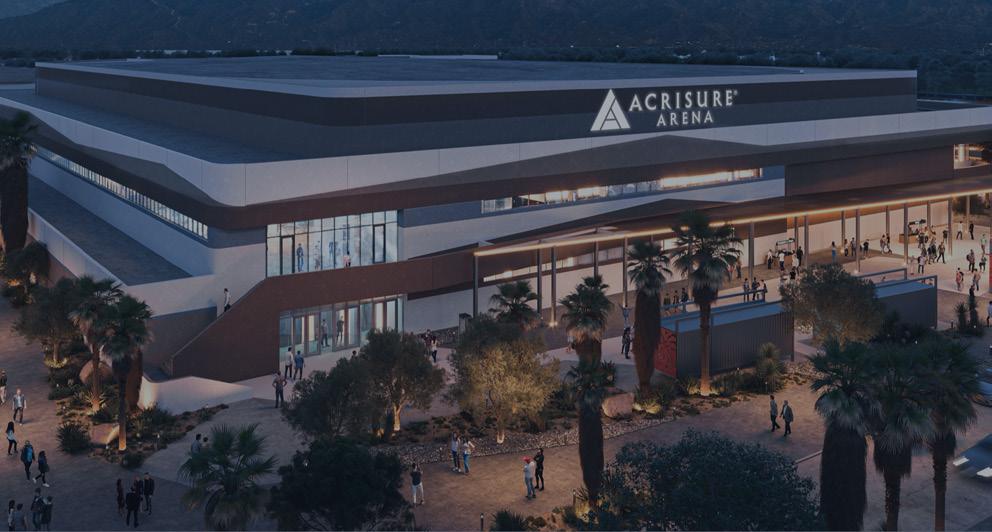
next fiscal year, which starts Monday.
The second-highest paid in 2023 was Director of Behavioral Health Dr. Matthew Chang — who was the highest paid in 2022. His composite salary last year was $539,695.
Next in line was Riverside University Health SystemMedical Center CEO Jennifer Cruikshank, whose total comp last year was $512,912, according to the report.
An unnamed sheriff’s sergeant was No. 4 on the list, with a base salary of $175,953, bulked up with $129,361 in overtime and a lump sum payout of $187,774.
A senior psychiatrist in the county Department of Mental Health followed at No. 5 with $499,032 in total compensation, while another
staff psychiatrist landed at No. 6 with $498,418 in take-home pay.
At No. 7 was a supervising District Attorney’s Office investigator, receiving $490,317. Just behind that person was another psychiatrist, whose annual comp was $489,701.
The balance of the top 10 was comprised of two additional Department of Mental Health staff psychiatrists, whose total compensation ranged from $465,655 to $472,446 in 2023.
County CEO Jeff Van Wagenen was at No. 32, with total compensation of $383,080, according to the report.
Board members were way down the list for annual comp packages, making less
than many deputy district attorneys, sheriff’s investigators, even an “administrative services manager” for the Department of Public Social Services, according to figures.
The supervisors’ composite pay ranged from $162,295 to $210,496 in 2023, with Jeffries at the bottom because he has consistently declined pay raises since first taking office in 2013. He’s the most senior member of the board and will be retiring from politics at the end of the year.
The controller’s website indicated the average pay for a county employee last year was $64,209. County government is the single largest employer in Riverside County, with nearly 28,000 positions. Roughly $2.07 billion in total wages were paid in 2023.