


Fluorideexposure duringpregnancy
has been linked to an increased risk of childhood behavioral problems, according to research published Monday by the Keck School of Medicine of USC.
Researchers at the university conducted the first U.S.-based study examining the link between prenatal fluoride and childhood social, emotional and behavioral functioning.
Nearly three-quarters of Americans consume drinking water that contains fluoride, a practice that began in 1945 to help prevent tooth decay, according to researchers.
The findings appear in JAMA Network Open, a medical journal published by the American Medical Association.
The study analyzed more than 220 mother-child pairs, collecting data on fluoride levels during pregnancy and child behavior at age 3. The researchers found that a 0.68 milligram per liter increase in fluoride exposure was associated with nearly double the chance of a child showing neurobehavioral problems in a range considered close to or at a level to meet the criteria for clinical diagnosis.
"Women with higher fluoride exposure levels in their bodies during pregnancy tended to rate their 3-year-old children higher on overall neurobehavioral problems and internalizing symptoms, including emotional reactivity, anxiety and somatic complaints,"

Tracy Bastain, an associate professor of clinical population and public health sciences at the Keck School of Medicine, said in a statement.
The findings add to existing evidence from animal studies showing that fluoride can harm neurodevelopment, as well as data from studies conducted in Canada, Mexico and other countries showing that prenatal exposure to fluoride is linked with a lower IQ in early childhood, according to the study.
The researchers said they hope the new findings help convey the risks of fluoride consumption during pregnancy to policymakers, health care providers and the public.
"Our findings are noteworthy, given that the
women in this study were exposed to pretty low levels of fluoride — levels that are typical of those living in fluoridated regions within North America," Ashley Malin, an assistant professor of epidemiology at the University of Florida's College of Public Health and Health Professions and College of Medicine, said in a statement.
Malin conducted the research in part as a postdoctoral scholar at the Keck School of Medicine.
Tracking emotions and behavior data for the study came from the Maternal and Developmental Risks from Environmental and Social Stressors Center for Environmental Health Disparities at the Keck School of Medicine. MADRES follows predominantly Hispanic families in
Los Angeles from pregnancy throughout childhood.
"The overall goal of MADRES is reducing the effects of environmental contaminants on the health and well-being of marginalized communities," said Bastain, who co-directs MADRES.
Currently, no official recommendations exist for limiting fluoride consumption during pregnancy. However, the researchers hope the findings can help stimulate change.
"There are no known benefits to the fetus from ingesting fluoride," Malin said. "And yet now we have several studies conducted in North America suggesting that there may be a pretty significant risk to the developing brain during that time."
‘An Evening with Ezra’ sets benchmark for inclusivity in Hollywood
According to the American Psychiatric Association, autism is a complex developmental condition involving persistent challenges with social communication, restricted interests, and repetitive behavior. The Center for Disease Control and Prevention estimates that one in 36 children has been identified as having autism spectrum disorder (ASD). Academic books have been written to help us understand it while fiction novels and movies with autistic protagonists have been published and produced.
A Hollywood film makes cinema history with the release of "Ezra" at the end of the month in about 1,000 movie theaters across the country — marking the first time a neurodivergent actor is playing the title role.
With an ensemble cast starring Robert de Niro, Bobby Cannavale, Rose Byrne, Vera Farmiga, Whoopi Goldberg, and Rainn Wilson, the movie follows a father’s journey co-parenting his autistic son. Written by Tony Spiridakis, directed by Tony Goldwyn, and introducing autistic actor William Fitzgerald, 'Ezra' is more than a film about autism; it's a groundbreaking step towards inclusive filmmaking, inspired by Spiridakis’ own journey of acceptance with his son, Dimitri.
Taking that history-making event one step further, Love & Autism hosted Hollywood’s 'An Evening with Ezra,' on Tuesday. Held at The Writer’s Guild Theater in Beverly Hills, it was a first-of-its-kind neurodivergentaffirming film screening. This event aimed to become the blueprint for inclusive screening practices in Hollywood, advocating for authentic representation of neurodiversity both on and off the screen.
The entire movie production centered around a neurodivergent-affirming ethos, tapping filmmaker and autistic advocate Alex Plank as the film’s associate producer, creative consultant, and DEI advisor to ensure meaningful representation behind the camera as well as thoughtful accessibility for its titular actor on set.
Dr. Jenny Palmiotto, an expert in neurodivergentaffirming care and founder of Love & Autism, is the driving force behind this screening, inviting Hollywood to celebrate the autistic and neurodivergent community and confront internalized ableism in traditional screening practices. The neurodivergent community features prominently in every aspect of the event – from the chefs and musicians to artists and guests.
“Ezra captures the universal themes of love and connection that are often missed within the larger conversation and beliefs about what it means to be





After discussions held over the course of a week, the UCLA Academic Senate ultimately rejected a pair of resolutions to formally censure and declare no confidence in university Chancellor Gene Block over the handling of a pro-Palestinian encampment and its ultimate dismantling by police.
According to the Los Angeles Times, the no-confidence resolution failed on a tally of 79 yes votes, 103 no votes and five abstentions. The censure resolution failed on an 88-88 vote, with three abstentions, the paper reported.


A source familiar with the situation told the paper, "This shows that many faculty support Chancellor Block and they understand that he was adhering to UC policy. People are realizing that Chancellor Block was put in an impossible situation."
The resolutions were initially considered by the Academic Senate last week, but no decisions were made, with the issue carrying over to this week. The Senate met again Thursday.
The resolutions had contended that Block "failed to ensure the safety of our students and grievously mishandled the events" surrounding an attack on the encampment by counter-protesters and



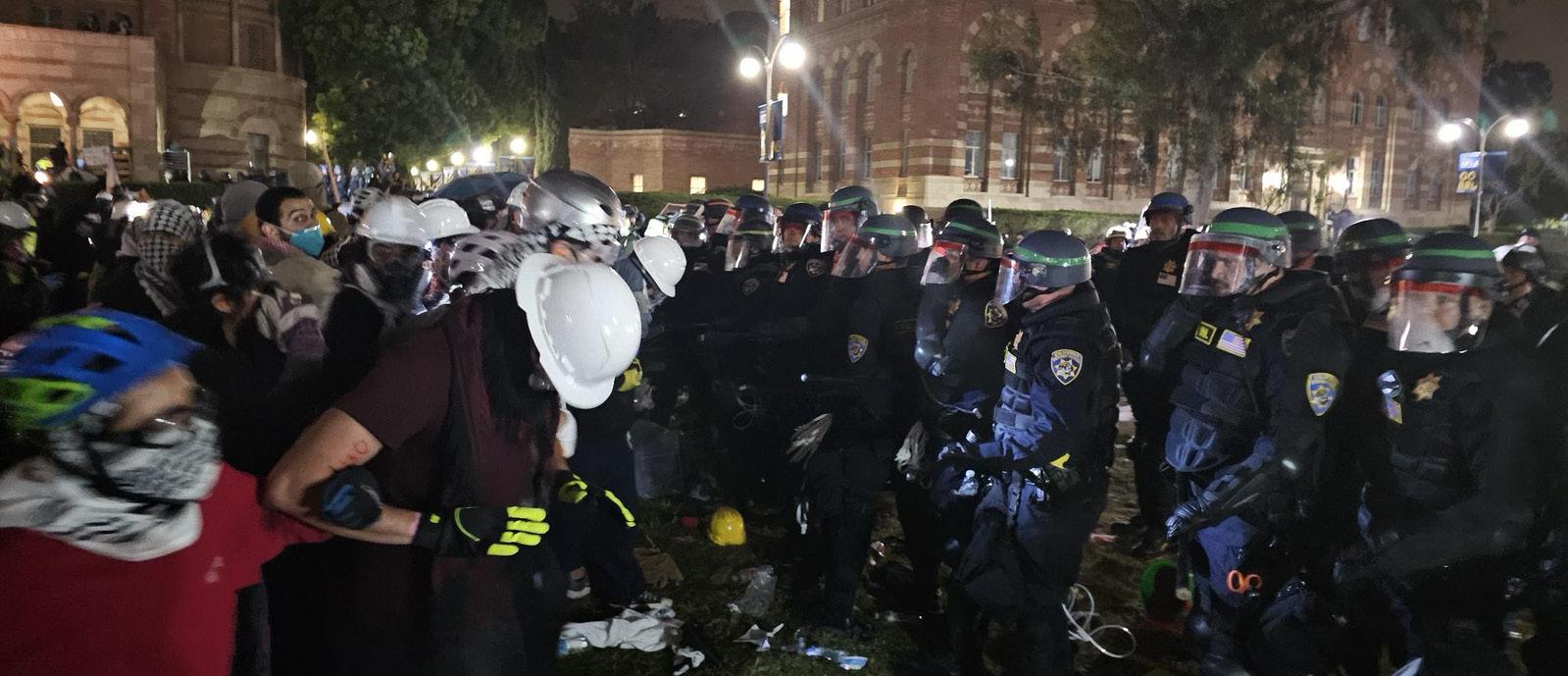
its dismantling by police the following night.
The police dismantling of the encampment resulted in 209 arrests. The attack on the camp by counter-protesters the previous evening led to calls for investigations into the university and police response to the violence. Witnesses said the attack was allowed to continue for hours before police finally intervened.
Gov. Gavin Newsom was among those criticizing the response. University of California President Michael Drake also announced an independent investigation of the UCLA response to the violence.
The UC announced last week it was hiring 21st Century Policing Solutions — a police-tactics consulting firm — to lead the university system's independent investigation of actions taken at UCLA.
Block, meanwhile, issued a statement last week he remained committed to identifying those who carried out the attack.
"To that end, inaugural Associate Vice Chancellor and Chief Safety Officer Rick Braziel is leading a law enforcement investigation to identify the perpetrators of the violence and hold them to account," Block said.
"The LAPD has committed a detective to assist in our investigative efforts, and we have also connected with the FBI about possible assistance. We have spoken to Los Angeles County District Attorney George Gascón to solicit his help in ensuring that the instigators will be prosecuted to the fullest extent of the law."
Citing unnamed law enforcement sources, the Los Angeles Times reported that the investigation will include the use of
facial-recognition technology, while also employing license plate readers to determine who entered the campus or was driving in the vicinity that night.
The investigative tools being employed are comparable to those used by federal authorities investigating the Jan. 6, 2021, insurrection at the U.S. Capitol.
Block, who is set to retire at the end of July, is scheduled to testify before a congressional committee next week about the university's response to antisemitism on campus. Meanwhile, the chair of the House Committee on Education and the Workforce sent a letter this week demanding that the UC system turn over all communications and documents relating to alleged campus antisemitism since Oct. 7, the date of the Hamas attack on Israel.
Authorities Monday identified a man who was fatally shot by a Monrovia woman when he allegedly violated a restraining order and went to her home armed with a knife.
The shooting occurred shortly after 9 p.m. Friday in the 400 block of South Shamrock Avenue, according to the Los Angeles
By City News ServiceCounty Sheriff's Department.
The man was identified as Thanh Cong Le, 42, according to the Los Angeles County Department of Medical Examiner. His city of residence was not known.
Officers from the Monrovia Police Department responded to the
scene after a woman phoned dispatchers saying a man with a restraining order was at her home and armed with a knife. Arriving officers found the man dead.
Sheriff's officials said an investigation revealed that he went to the home to stab the woman and another man, "and to stop the threat, the white female
adult discharged a firearm."
"The female adult and male adult provided voluntary statements and were not arrested," the department added. A firearm and several knives allegedly used were recovered at the scene.
The case was turned over to the Sheriff's Homicide Bureau for investigation.
In 2023, more than 650,000 people in the United States experiencedhomelessness. The number is a record since data collection began in 2007, and means more people than ever are confronted with the unique health risks that come from living without stable housing.
Homelessness can take many forms, from couch surfing to living in a shelter to sleeping on public streets. In a country like the U.S., where access to health care is determined by someone's ability to pay, the economic instability that puts someone at risk of homelessness is also bound to have a direct impact on their health.
The life expectancy of people experiencing homelessness is between 42 and 52 years old, according to a study from the University of Pennsylvania published in 2022. Meanwhile, the overall life expectancy in the U.S. is 76 years old.
Foothold Technology used data from the Department of Housing and Urban Development to explore how access to housing impacts health, and vice versa.
Some of the health risks from cold winters, air pollution in dense cities, and extreme heat may seem obvious, but internal and chronic health conditions also fuel shorter life expectancies for unhoused people.
A study in the Journal of the American Medical Association published in 2023 examined deaths
among unhoused people in San Francisco over eight years and found the sudden mortality rate was 16 times higher than the housed population.
Sudden mortality events include heart attacks, drug overdoses, strokes, and more. Even when the researchers adjusted to remove drug overdoses and focus exclusively on cardiac events where a defibrillator could intervene, the sudden mortality rate remained seven times higher.
Another study by the National Bureau of Economic Research found that people experiencing homelessness were 3.2 times more likely to die within a six-month period than housed people. They remained 1.6 times more likely to die within a sixmonth period than lowincome, housed individuals.
The connection between access to housing and health is also cyclic. Just as homelessness can worsen health outcomes, health problems can also lead to homelessness.
Certain disabilities and health problems can limit available job opportunities, and the high cost of medical treatment can be burdensome — even for those with consistent income. About 8% of people hold medical debt in the U.S., but the share jumps to 14% for people in fair health, and 20% for people in poor health.
Health issues are harder to manage without stable

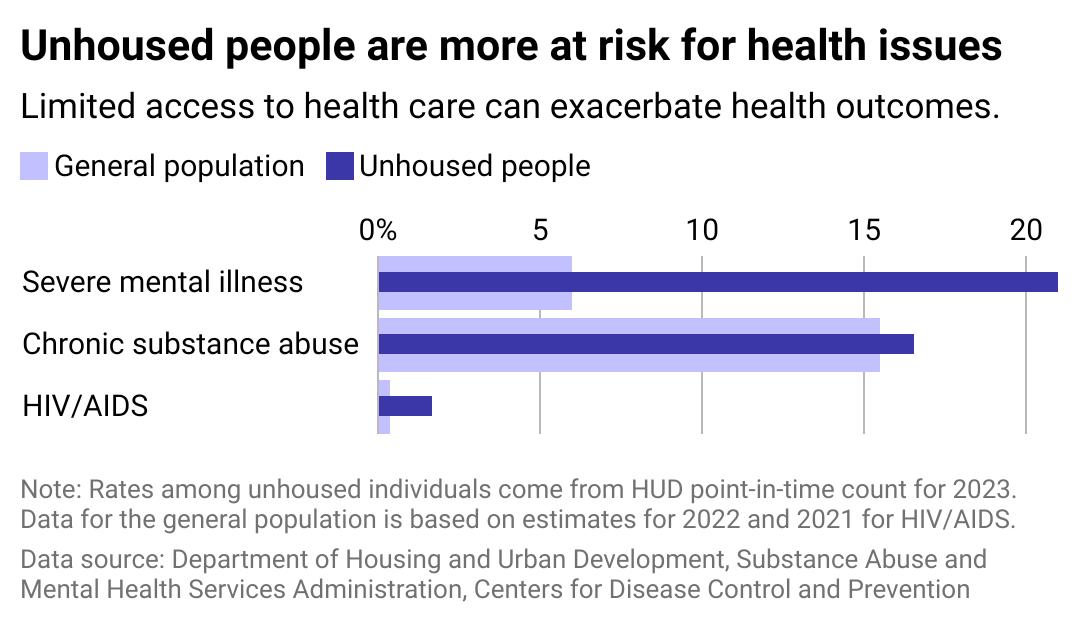
Seeking treatment for chronic health issues can be a challenge when 60% of unhoused people are without health insurance. Although HIV/AIDS can be managed and prevented with medications today, limited access to such care has resulted in higher diagnosis rates among the unhoused population.
Economic and housing instability can exacerbate mental health conditions, and severe conditions can make it more challenging to hold a job and interact with people.
When it comes to mental health and substance use disorders, the national program Projects for Assistance in Transition from Homelessness connected with more than 100,000 unhoused people also experiencing serious mental health conditions in 2021. Nearly 60,000 enrolled in a variety of their services including screening and treatment, rehabilitation and housing services.
The wider availability of overdose-reversing drugs like naloxone has also been effective for intervening in emergency situations. The National Institutes of Health estimates that the distribution of naloxone kits has reduced overdose deaths by 6%.
Other health care issues can be especially difficult to manage without having a consistent roof over one's head. The FDA recommends diabetes patients keep insulin in the refrigerator. Diet-related condi-
tions like hypertension are harder to manage without access to a kitchen to prepare unprocessed foods.
Estimates suggest that people experiencing homelessness also more often live with disabilities. Among the sheltered homeless population in 2021, 57.3% had disabilities compared to 13% of the American population overall.
A whole-person health approach
In 2016, California began rolling out programs to coordinate the health care needs of its population with the social service needs of its population. This includes helping connect patients with housing and food resources and allowing federal health funding to be used for certain housing services. This "whole person care" approach has shown success in the state,
where 13 million people are enrolled in Medicaid.
The program showed success in its first five years. A 2021 report from the UCLA Center for Health Policy Research showed enrollees reported 45 fewer hospital stays and 130 fewer emergency room visits for every 1,000 beneficiaries compared to similar-profile Medicaid beneficiaries who did not participate in the program. This also reduced Medicaid payments by $383 per beneficiary per year.
Also in California, newly legalized mobile pharmacies will now be able to immediately dispense uncontrolled substances to patients without permanent addresses.
California isn't the only state beginning to use Medicaid funds for food and housing needs. Several other states — including Arizona, Arkansas, Massa-
chusetts, Nevada, New Jersey, New York, Oregon and Washington — have launched pilot projects. Nevada's program will cover rent and food costs for eligible participants as well as housing transition services, case management and deposits for housing. State Medicaid Administrator Stacie Weeks told the Nevada Current that the state's program was a "small piece of the puzzle to improve health outcomes and lower the risk of high health care costs that can come from being unhoused."
Story editing by Nicole Caldwell. Copy editing by Tim Bruns.
This story originally appeared on Foothold Technology and was produced and distributed in partnership with Stacker Studio. The article was copy edited from its original version. Republished pursuant to a CC BY-NC 4.0 license.
Long Beach
Long Beach commemorates Memorial Day with sunset ceremony
The City of Long Beach Department of Health and Human Services Office of Veterans Support will host the 2024 Honoring Our Heroes – A Sunset Ceremony, on Sunday to commemorate Memorial Day. This year’s free event will take place from 5:30 to 8 p.m. at the Long Beach Navy Memorial in Shoreline Aquatic Park (200 Aquarium Way). The event will include live patriotic music provided by the Navy Band Southwest Harborside Brass Quintet, flyovers with historic aircraft, exhibition drills by Lakewood High School’s Navy Junior Reserve Officer Training Corps, and an information fair and familyfriendly activities featuring the Historical Society of Long Beach, People of the Earth Krew and other local community-based, veteran-led and veteran-serving organizations. A program with special guest speakers will also take
place at 6:45 p.m. followed by the sunset flag ceremony and the playing of Taps to honor our fallen service members.
Burbank
Downtown Burbank Arts Festival returns
The Downtown Burbank Partnership, in collaboration with Jackalope Arts, is bringing back the Downtown Burbank Arts Festival on Saturday, June 8, and Sunday, June 9, from 11 a.m. to 6 p.m. The event is free and open to the public. The festival brings together 200 inventive artisans selling handmade housewares such as candles and ceramics, fashion and accessory designers, beauty products, and visual art.
Acoustic musicians will be roaming the festival performing tunes for guests as they make their way through the event. Additionally, the Chalk Block will showcase more than 15 chalk artists recreating scenes and characters from film and television. For more information about the Downtown Burbank Arts Festival, visit www.jackalopeartfair.com/burbank.
Monrovia
Summer Concerts in the Park series kicks off Sunday
Monrovia’s Summer Concerts in the Park series kicks off Sunday at Station Square with free BBQ, activities for kids, and Stone Soul performing Motown hits. Concerts will be held every Sunday at Station Square through June 30. In July, the concerts will migrate north to Library Park from July 7 to Aug. 11.
Annual Family Fun Day returns Saturday
Saturday is the 28th annual Family Fun Day from 11 a.m. to 3 p.m. at La Pintoresca Park, 45 E. Washington Blvd. The event will feature family-friendly activities, free food, arts and crafts, a tiny tot area, a bubble zone, bingo, a skateboarding expo, and more. For accessibility information and requests, contact (626) 744-7311 or CSC@CityOfPasadena.net. Provide at least 72 hours advance notice to help ensure availability.

Orange County
OC Parks completes restoration of Pleasants Stone House in Modjeska Canyon
Following an extensive restoration project, the oldest building on the grounds of OC Parks’ Arden: Helena Modjeska Historic House and Gardens is complete. Originally built in the 1870s, the restored Pleasants Stone House is now fully open to the public for the first time in park history. The Pleasants Stone House can be seen during guided tours offered Wednesdays and Saturdays at 10 a.m. with advance registration. Visitors can enjoy self-guided tours of the grounds Wednesday through Saturday from 10 a.m. to 2 p.m. For information about Arden: Helena Modjeska Historic House and Gardens, visit http://www.ocparks.com/ historic/modjeska.
Anaheim
Downtown Anaheim park gets new playground
One of Anaheim’s most iconic parks got a new playground designed by neighborhood kids and built in a day by more than 100 volunteers from The CarMax Foundation, KABOOM!, Anaheim Family YMCA and the city of Anaheim. The playground was built last Thursday, replacing the park’s existing playspace, which dates back to 2003. The new playground will feature a zip line, two slides, swings, a climbing wall, see-saw, drums and chimes and an educational panel where kids can learn the alphabet in sign language. To ensure fun for all abilities, the playground design includes bucket swings and see-saw seats with backs for kids who may transfer from a wheelchair. There are also groundlevel learning panels and music play.
Riverside County
RUHS program inspires future medical leaders
Thanks to a collaborative program between Riverside University Health SystemMedical Center (RUHS-MC) and Landmark Middle School
in Moreno Valley, every month, doctors bring medical science to life for more than 50 seventh and eighth graders in teacher Carly Blask’s anatomy and physiology class through hands-on learning and experiments in epidemiology, the musculoskeletal system and more. The program – Fostering Healthcare Education and Research Network – Middle School, or F(h)ERN-M, was created by pediatric residents Dr. Marcus Lowe and Dr. Jazmin Fernandez in September 2023. On a recent field trip to RUHS-MC, the students listened to stories from doctors in various fields, as well as a respiratory therapist and nursing coordinator before touring the morgue, a lab, pediatrics and the emergency department. In the classroom, students have learned how to cast and splint broken bones, watched a doctor demonstrate a cardiac ultrasound and became certified in stopping a life-threatening bleeding injury.
City of Riverside
Memorial Day flag placement event to be held at Riverside National Cemetery
Volunteers are sought to place flags at Riverside National Cemetery on Saturday. The ceremony will begin at 8 a.m. and flags will be passed out at the completion of the ceremony at 8:30 a.m. Volunteers are also needed to retrieve the flags on Tuesday. No registration or sign up ahead is necessary.
Corona
Lineup announced for Corona’s first Movies in the Park series
The City of Corona's new event, Movies in the Park, offers free outdoor film screenings for the community to enjoy under the stars from July 8 to Aug. 9, 2024. Pack snacks, blankets, and chairs for five free feature films starting at 8:15 p.m. Movie screenings will be held on Mondays at Promenade Park (615 Richey St.), Tuesdays at Ridgeline Park (2850 Ridgeline Dr.), Wednesdays at Stagecoach Park (2125 Stagecoach Rd.), and Fridays at Spyglass Park (1790 Spyglass Dr.). The lineup will include "Teenage
Mutant Ninja Turtles: Mutant Mayhem,” “Elemental,” "Wish," "Trolls: Band Together" and “Wonka.”
San Bernardino County School district approves lease for new fire station in San Bernardino
The San Bernardino City Unified School District has announced the approval of a ground lease agreement with the San Bernardino County Fire Protection District to facilitate the construction of a new fire station intended to serve the Wildwood Park neighborhood and surrounding areas of the city of San Bernardino. This strategic collaboration will see County Fire leasing approximately one acre on the southern portion of the Arrowhead Elementary School property to facilitate the building of a new fire station 227. The lease includes provisions for a longterm commitment that could extend up to 99 years.
City of San Bernardino
3 new Dodger Dreamfields unveiled at Blair Park
The City of San Bernardino along with the Los Angeles Dodgers Foundation and its lead partner, the San Manuel Band of Mission Indians, unveiled three new Dodger Dreamfields at a ceremony on Saturday at Blair Park. Blair Park received $1.7 million, including $1.4 from San Manuel, to complete the refurbishment of the three baseball and softball fields. The refurbishments include new playing surfaces and grass, enclosed fields, upgraded dugouts, upgraded irrigation systems, new pitching mounds, bullpens and LED scoreboards resembling Dodger Stadium.
Ontario
Lewis Family Branch Library celebrates AAPI Heritage Month
Celebrate Asian American & Pacific Islander Heritage Month at the Lewis Family Branch Library on May 25 from 1 to 3 p.m. Attendees will enjoy snacks, crafts, and more.
May 9
At 2:01 a.m., an officer was patrolling the 400 block of Linwood and located a suspicious parked vehicle occupied by two subjects and made contact with the subjects. A search revealed the driver was in possession of drug paraphernalia. He was arrested and taken into custody.
At 9:49 a.m., a caller in the 3200 block of South Peck reported a commercial burglary. The suspect posed as a contractor and picked up a purchase order intended for another company. This investigation is continuing.
At 11:20 a.m., an employee from a business in the 600 block of West Huntington called to report thefts that took place a month prior. This investigation is continuing.
At 1:18 p.m., a caller in the 200 block of West Evergreen reported she was in a verbal altercation with her boyfriend. Officers arrived and made contact with both subjects. The boyfriend was found to be in possession of a controlled substance. He was arrested, cited, and released at the scene.
At 3:15 p.m., a vandalism was reported in the 300 block of Oakcliff. The caller reported the rear window to his vehicle was smashed. This investigation is continuing.
At 3:18 p.m., an employee from a business in the 300 block of West Huntington called to report a robbery. The caller stated that a subject took merchandise and when an employee approached the subject, the subject pushed the employee to the ground and fled. Officers located a subject matching the description, a field show up confirmed the subject was the suspect. He was arrested and taken into custody.
At 7:24 p.m., officers were dispatched to the 100 block of West Palm on a report of an argument between a male and female subject.
Officers arrived, located and made contact with the subjects. An investigation revealed that the male subject was too intoxicated to care for himself. He was arrested and taken into custody.
At 9:36 p.m., an employee of a restaurant in the 500 block of West Huntington called to report that a suspicious person was acting erratically and refusing the leave. Officers arrived and made contact with the subject. A computer search revealed he had a no bail warrant. He was arrested and taken into custody.
May 10
At 1:50 p.m., a victim in the 600 block of West Huntington reported that someone stole her wallet at a business. This investigation is continuing.
At 4:05 p.m., an employee at a business in the 500 block of West Huntington called to report a theft that occurred on May 6 where merchandise was stolen. This investigation is continuing.
At 4:47 p.m., an officer conducted a traffic stop in the area of Longden and Myrtle for a traffic violation. Upon contacting the driver, the officer observed a controlled substance inside the vehicle. The driver was arrested and taken into custody.
At 6:07 p.m., officers responded to the area of Chestnut and Primrose regarding an injury traffic collision between a vehicle and a pedestrian. The pedestrian was transported to a hospital for treatment.
At 7:21 p.m., fraud was reported in a hotel in the 900 block of South Fifth. Officers arrived and determined that a female subject fraudulently used a credit card not belonging to her to pay for a room. The female subject was located a short distance away in a vehicle. Officers conducted a traffic stop and determined that she was in violation of credit card fraud. The suspect was arrested and taken into custody.
At 8:22 p.m., a residen-
tial fire was reported in the 600 block of West Foothill. Officers arrived to assist MFD with evacuating the residence and crowd control. This investigation is continuing.
At 11:30 p.m., a fight was reported in the 100 block of Mauna Loa. Officers arrived and determined two roommates were upset about a fire that occurred earlier in the day and were involved in a physical altercation. This investigation is continuing.
May 11
At 10:14 a.m., a resident walked into the MPD lobby to report that his vehicle was burglarized on April 14. His credit cards were stolen and used outside the city. This investigation is continuing.
At 11:02 a.m., officers responded to the area of Magnolia and Cherry regarding a hit and run traffic collision. This investigation is continuing.
At 2:43 p.m. officers responded to the 800 block of South Myrtle regarding a female subject loitering to the rear of an apartment complex. The officer arrived and made contact with the subject. A computer search revealed she had an outstanding warrant for her arrest. She was arrested and taken into custody.
At 3:08 p.m., a caller reported that her wallet was stolen while shopping inside a business in the 600 block of West Huntington. While the officer was conducting his investigation, the victim was alerted that her credit card was just used in Duarte. This investigation is continuing.
At 9:20 p.m., officers conducted a traffic stop in the area of Foothill and Alta Vista. A records check on the driver showed he had warrants. The driver was arrested and taken into custody.
At 11:07 p.m., a battery was reported in the 100 block of West Palm. Officers arrived and determined that a family event led to an argument where several fam-
ily members battered each other. This investigation is continuing.
May 12
At 9:33 a.m., a caller in the 800 block of West Walnut reported that a subject broke a window to his vehicle. The subject fled the scene but was located nearby. He was arrested and taken into custody.
At 2:25 p.m., a victim in the 600 block of West Huntington reported her necklace was stolen while at a business. This investigation is continuing.
At 2:47 p.m., a resident in the 700 block of Bonita reported a female subject restrained from the location had arrived. Officers arrived and located the female subject. She was arrested and taken into custody.
At 10:09 p.m., an officer patrolling a parking lot in the 900 block of South Fifth located an unoccupied stolen vehicle. This investigation is continuing.
At 10:52 p.m., while patrolling the area of Encino and Alta an officer saw a bicyclist commit a vehicle code violation. The officer conducted a traffic stop on the bicyclist. An investigation revealed he was under the influence. He was arrested and taken into custody.
May 13
At 1:44 p.m., a solo traffic collision was reported in the area of Royal Oaks and Mountain. The driver suffered a medical emergency and went up and over the sidewalk, into a brick wall and came to a stop in the front yard of a residence. Nobody was injured as a result and the driver was taken to the hospital for treatment.
At 2:47 p.m., officers were dispatched to the 200 block of West Evergreen regarding multiple subjects trespassing. Officers arrived and were aggressively approached by a male subject who was refusing to comply with the officers’ requests. Officers attempted different methods of de-escalation and the subject refused to comply. He was eventually
arrested and taken into custody.
At 10:32 p.m., an alarm activation was reported in the 100 block of West Lime. Officers arrived and found an unlocked door. A search revealed several people were inside the building trespassing. The property management refused to prosecute and only wanted the subjects to leave.
May 14
At 10:13 a.m., a caller in the 500 block of West Huntington reported a male urinating in public. Officers arrived and contacted a subject matching the description. The caller positively identified the subject and desired prosecution. The subject refused to give officers his name. He was arrested and taken into custody.
At 12:11 p.m., while patrolling the area of Myrtle and California an officer saw a vehicle in violation of a vehicle code. When contacting the driver the officer saw a baton next to the driver. He was arrested and taken into custody.
At 9:36 p.m., an employee of a store in the 1600 block of South Mountain reported a female suspect ran out of the store with power tools without paying. Officers responded and located the suspect vehicle and conducted a traffic stop. A field show-up confirmed she was the suspect. The stolen property was returned to the store. She was arrested and taken into custody.
May 15
At 7:54 a.m., a victim in the 400 block of Norumbega called to report his vehicle was broken into sometime during the evening. This investigation is continuing.
At 11:16 a.m., a resident walked into the MPD lobby to report that his bank account showed fraudulent activity. This investigation is continuing.
At 4:11 p.m., a victim in the 1600 block of South Mountain walked out of a store and realized that her vehicle had been stolen. This
investigation is continuing.
At 4:47 p.m., a resident in the 500 block of South Mayflower reported that his vehicle was hit while parked on the street and the driver did not stop. This investigation is continuing.
At 5:03 p.m., a caller in the 600 block of West Foothill reported that a female subject restrained from the location was there. Officers arrived and could not find any evidence of a restraining order. A computer search revealed she had a warrant for her arrest. She was arrested and taken into custody.
At 9:09 p.m., officers were dispatched to the 200 block of West Cherry regarding people yelling outside. The caller reported two vehicles in the middle of the street with several occupants in the vehicles yelling at each other. One of the vehicles shot at the occupants of the other vehicle. Officers located the suspect vehicle and attempted to conduct a traffic stop. Two suspects fled and one of the occupants stayed in the vehicle. She was found to be in possession of drug paraphernalia. She was arrested and taken into custody. This investigation is continuing.
At 9:33 p.m., a guest of a hotel in the 700 block of West Huntington reported someone had entered her unlocked vehicle sometime during the day and took items. This investigation is continuing.


Eliminate gutter cleaning forever! LeafFilter, the most advanced debris-blocking gutter protection. Schedule a FREE LeafFilter estimate today. 20% off Entire Purchase. 10% Senior & Military Discounts. Call 1-855-424-7581 (Cal-SCAN)
DONATE YOUR VEHICLE to fund the SEARCH FOR MISSING CHILDREN. FAST FREE PICKUP. 24 hour response. Running or not. Maximum Tax Deduction and No Emission Test Required! Call 24/7: 1-877-434-6852 (Cal-SCAN)
GOT AN UNWANTED CAR??? DONATE IT TO PATRIOTIC HEARTS. Fast free pick up. All 50 States. Patriotic Hearts’ programs help veterans find work or start their own business. Call 24/7: 1-855-4086546 (Cal-SCAN)
Tiene un vehiculo no deseado? Donelo a Patriotic Hearts! Recogida rápida y gratuita en los 50 estados. Patriotic Hearts ofrece programas para ayudar a los veteranos a encontrar trabajo o iniciar su propio negocio. Llama ahora: 1-855408-7368 (24/7) (Cal-SCAN)
Get your deduction ahead of the year-end! Donate your car, truck, or SUV to assist the blind and visually impaired. Arrange a swift, no-cost vehicle pickup and secure a generous yearend tax credit. Call Heritage for the Blind Today at 1-844491-2884 today! (Cal-SCAN)
DIRECTV- All your entertainment. Nothing on your roof! Sign up for Direct and get your first free months of
Max, Paramount+, Showtime, Starz, MGM+ and Cinemax included. Choice package $84.99/mo. Some restrictions apply. Call DIRECTV 1-888641-5762 (Cal-SCAN)
Struggling with debt? If you have over $10,000 in debt we help you be debt free in as little as 24-48 months. Pay nothing to enroll. Call Now: 1-877-435-4860 (Cal-SCAN)
Jacuzzi Bath Remodel can install a new, custom bath or shower in as little as one day. For a limited time, we're waiving ALL installation costs. (Additional terms apply. Subject to change and vary by dealer. Offer ends 6/30/24 Call 1-833985-4766 (Cal-SCAN)
Safe Step. North America's #1 Walk-In Tub. Comprehensive lifetime warranty. Top-ofthe-line installation and service. Now featuring our FREE shower package and $1600 Off for a limited time! Call today! Financing available. Call Safe Step 1-888-989-5749 (CalSCAN)
DENTAL INSURANCE from Physicians Mutual Insurance Company. Coverage for 400 plus procedures. Real dental insurance - NOT just a discount plan. Do not wait! Call now! Get your FREE Dental Information Kit with all the details! 1-844-203-2677 www.dental50plus.com/calnews #6258 (Cal-SCAN)
Switch and save up to $250/ year on your talk, text and data. No contract and no hid -
den fees. Unlimited talk and text with flexible data plans. Premium nationwide coverage. 100% U.S. based customer service. For more information, call 1-844-908-0605 (Cal-SCAN)
The difference in winning and losing market share is how businesses use their advertising dollars. CNPA’s Advertising Services’ power to connect to nearly 13 million of the state’s readers who are an engaged audience, makes our services an indispensable marketing solution. For more info call Cecelia @ (916) 2886011 or cecelia@cnpa.com
DID YOU KNOW Newspapergenerated content is so valuable it’s taken and repeated, condensed, broadcast, tweeted, discussed, posted, copied, edited, and emailed countless times throughout the day by others? Discover the Power of Newspaper Advertising. For a free brochure call 916-2886011 or email cecelia@cnpa. com (Cal-SCAN)
RETIRED COUPLE $$$$ for business purpose Real Estate loans. Credit unimportant. V.I.P. Trust Deed Company www.viploan.com Call 1-818248-0000. Broker-principal DRE 01041073. No consumer loans. (Cal-SCAN)
Wesley Financial Group, LLC Timeshare Cancellation Experts. Over $50,000,000 in timeshare debt and fees cancelled in 2019. Get free informational package and learn how to get rid of your timeshare! Free consultations. Over 450 positive reviews. Call 866-675-2404 (CalSCAN)
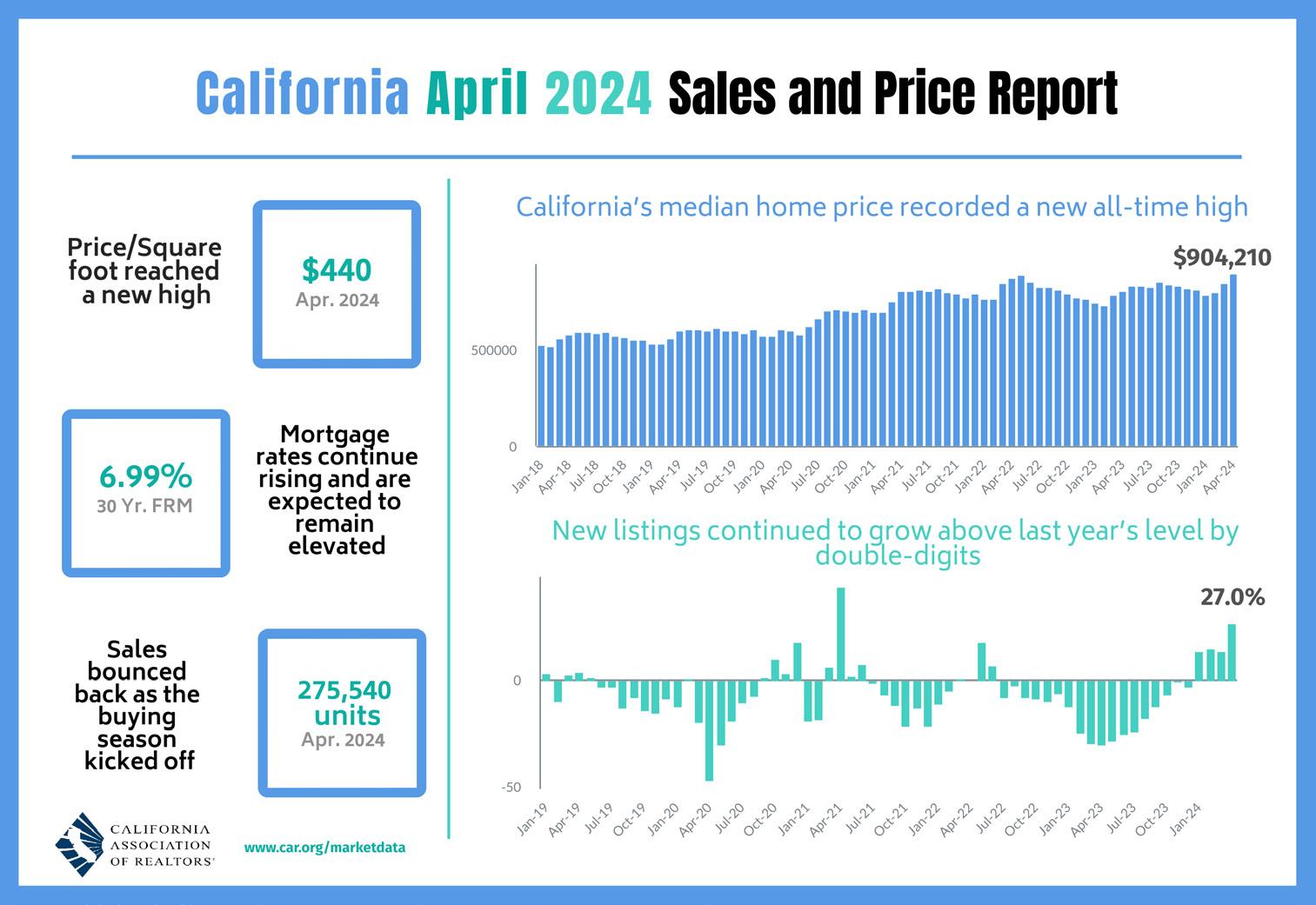
Home sales in Southern Californiaand throughout the state rebounded in April, while the statewide median home price surpassed $900,000 for the first time, the California Association of Realtors reported Friday.
The statewide median jumped 11.4% from $811,510 in April 2023 to $904,210 in April 2024, to put it past the $900,000 plateau for the first time in history, according to CAR. California's median was 5.8% more than the $854,490 recorded in March, and recently sagging home sales in the state, the yearover-year gain was the 10th consecutive month of annual price increases.
Seasonal factors and a limited supply of housing will maintain upward pressure on home prices in the coming months, according to CAR.
The volume of home sales in the Central Coast region increased the most from a year ago, surging 26.7%. Southern California sales increased 8.7% compared with April 2023.
"April's rebound in both home sales and price shows the resilience of California's housing market and is a signal that buyers and sellers
are beginning to adjust to the higher interest rate environment," CAR President Melanie Barker said in a statement.
"Market fundamentals are showing signs of improvement, and competition is on the rise again; homes are selling faster and nearly half the share of homes is selling above asking price — the highest in nine months."
All major regions in the state showed increases in median prices from a year ago, CAR data indicated. An existing single-family home in Southern California rose 12.1% year-over-year to $880,000, which was a 3.5% increase from March.
In the Los Angeles metro area, the median price increased 4.9% from last month to $840,000, which was a 13.5% increase from April 2023.
The Inland Empire totals were a 607,000 median price in April, $594,250 in March and $565,000 a year ago, for respective 2.1% and 7.4% increases. Sales totals increased 1.2% from March and 1.5% compared with April 2023.
The LA County median price increased by 2.6%, from $805,100 in March to $825,970 in April.
If you have ever been to an event in Old Town, like the Fall Festival or the Wine Walk, you might have noticed that activity tends to taper off once you enter the 600 block of Myrtle. Well, we have a new business that may be opening there soon. Specifically, at 625 S. Myrtle; formally known as Deasy, Penner, Podley. I think this will be just the pick-me-up that end of Myrtle needs!
Steve Kwan, the owner of Copper Still Grill located at 610 S. Myrtle Ave, has leased the property and applied for a
Orange County's median rose 2.9% from March to $1.44 million, a 17.6% jump compared with April 2023.
In Riverside County, the median price for a singlefamily home was $650,000 last month, a 1.6% increase from $640,000 in March and a 5.7% rise from $615,000 one year ago. Home sales totaled slightly lower than April 2023 with a 0.4% decline but rose 2.1% from March.
San Bernardino County's median home-sale price was $516,080 in April and $499,900 in March, a 3.2% increase from March and a 14.7% jump compared with April 2023. The number of sales in April dropped 0.5% from March but increased 5.3% compared with last year.
In San Diego County, the median price for a singlefamily home was $1.04 million last month, a 2.7 % increase from $1.02 million in March and a 12.6% rise from $930,000 one year ago.
The San Francisco Bay Area posted the largest price increase year-over-year, rising 15.5% from last April. The Bay Area and Southern California with 12.1% were the only two regions to show a double-digit price increase from last year.
Imperial County had the the lowest median price in Southern California, $377,500, an 8.2% increase from April.
"While the market performed solidly in April, we don't expect to see a rapid recovery as long as inflation remains sticky and mortgage rates continue to fluctuate despite recent dips," Jordan Levine, CAR Senior Vice President and Chief Economist, said in a statement. "However, housing inventory has also started to increase, which will
provide much-needed supply to the market and facilitate a higher level of home sales in the second half of the year."
Homes priced at or above $1 million in California continued to hold up better than their more affordable real estate in the last few months, CAR observed. The high-end market segment spiked 39.8% year-over-year in April, while homes priced under $500,000 declined again moderately at 8%. The change in the mix of sales of homes priced over $1 million
Monrovia Old Town report: Is that music we hear?
CUP (Conditional Use Permit), for live music and the sale of alcoholic beverages. With so many world-class musicians in Los Angeles County, Steve is hoping to bring some of that amazing talent to Monrovia. His goal is to open a full service restaurant and bar, featuring live music seven nights a week. Though the line-up is still in its early planning stages, the genre will differ by night — e.g. Thursday Night Jazz, Monday Night Blues, etc. From what I hear, Steve is an avid jazz enthusiast, so I am expecting some serious talent
to be showcased.
By Shawn Spencer shawn@girlfridaysolutions.netThe Crimson, as it is being called thus far, will be open seven days a week and food will be served during all business hours. Live music will end at 11 p.m. Sunday through Thursday, and midnight Friday and Saturday. Great care will be taken with the professionally engineered stage lighting and acoustics. That is a huge plus for me because nothing makes me want to stab myself in the eardrum with a swizzle stick more than loud music with terrible acoustics. (One more
thing I blame on aging.) To those of you who love to get their boogie on, you’ll have to head on over to Gem City Grill for that. The Crimson is for music enthusiasts only. There will be no accommodation for dancing.
The menu is nothing new or terribly exciting. It will be your usual bar-fare of burgers, salads, pizza, and a few entrees like pepper steak, teriyaki chicken, jumbo shrimp kabobs and cubed steak with mushroom sauce. The menu is moderately priced at $13 to $18, with the entrees topping
out at $21. As of now, there will not be a cover charge to enter, but do not be surprised if you see a service fee of $5 added to your check to help offset the costs of entertainment. The Crimson will have five parking spots to offer their clientele, but the rest of us will have to find street parking or take advantage of the ample free parking lots that Old Town has to offer. If Steve meets his goals and really brings in the talented musicians he hopes to, I expect The Crimson to
accounted for 36.4% of all sales, the largest share in at least the last five years.
"The growth in sales of higher-priced homes continued to provide upward support to the statewide median price and was partly responsible for the solid increase in yearover-year growth rate at the start of the second quarter," according to CAR. The average number of days it took to sell a singlefamily home in California was 16 days in April and 20 days in April 2023.
grow into a true destination spot for people all over the southland. Once they get here, those people will fall in love with Old Town (as people always do), and hopefully spread some of their dollars all over town. I love this concept and wish Steve so much luck in getting this off the ground. He has a long build-out ahead of him, but I cannot wait to see the finished product. I hope this place lives up to the hype. A music venue such as this will be a fantastic addition to Old Town Monrovia. Stay tuned for more info and updates!
PUBLIC NOTICE: CITY OF SAN GABRIEL
NOTICE OF PUBLIC HEARING BEFORE THE CITY COUNCIL
You are invited to participate in a public hearing before the San Gabriel City Council. You will have an opportunity to present your opinion regarding this item at the meeting or in writing prior to the meeting. Please submit all written comments to the City Clerk Department, in person or by mail to San Gabriel City Hall, 425 South Mission Drive, San Gabriel, California 91776. The meeting will be broadcast on the City of San Gabriel’s YouTube channel at the link shown: https://www.youtube.com/ CityofSanGabriel
HEARING DATE: Tuesday, June 4, 2024 TIME: 6:30 p.m.
LOCATION OF HEARING: Council Chambers located on the second floor of San Gabriel City Hall.
PROJECT: Adoption of the Annual Budget, Capital Improvement Program, and Appropriations Limit for Fiscal Year 2024-25.
DESCRIPTION: The purpose of the hearing is to consider the City’s Proposed Operating Budget, Capital Improvement Program (CIP), Position Classification and Salary Schedule, and Appropriations Limit for Fiscal Year 2024-25.
QUESTIONS: For additional information or to review the documents, please contact Will Kaholokula, Finance Director at 626-3082812 ext. 4610 or WKaholokula@sgch.org
Per Government Code Section 65009, if you challenge the nature of this proposed action in court, you may be limited to only raising those issues you or someone else raised at the public hearing described in this notice, or in written correspondence delivered to the City Clerk Department at or prior to the public hearing.
San Gabriel City Council
Julie Nguyen, City Clerk
Published on May 23, 2024
NOTICE IS HEREBY GIVEN that the Rosemead Planning Commission will conduct a public hearing on Monday, June 3, 2024, at 7:00 PM, at Rosemead City Hall, located at 8838 East Valley Boulevard, Rosemead. Remote public comments will be received by calling (626) 569-2100 or via email at publiccomment@cityofrosemead.org by 5:00 p.m. on June 3, 2024. A live phone call option may also be requested by calling the number provided above. All comments are public record and will be recorded in the official record of the City. If you have a request for an accommodation under the ADA, please contact Ericka Hernandez, City Clerk, at (626) 569-2100.
CASE NO.: DESIGN REVIEW (DR) 24-03 – Maggie Thai has submitted a Design Review application requesting to modernize the exterior façade of an existing shopping center. The project site is located at 8966-8968 Garvey Avenue (APN: 5282-010-030), in the Medium Commercial with Residential/Commercial Mixed-Use Development and Design Overlays (C-3/RC-MUDO/D-O) zone. Approval of a Design Review is required for all improvements requiring a building permit or visible changes in form, texture, color, exterior façade, or landscaping within a Design Overlay zone.
ENVIRONMENTAL DETERMINATION: Section 15303 of the California Environmental Quality Act Guidelines exempts projects consisting of construction and location of limited numbers of new, small facilities or structures; installation of small new equipment and facilities in small structures; and the conversion of existing small structures from one use to another where only minor modifications are made in the exterior of the structure. Accordingly, Design Review 24-03 is classified as a Class 3 Categorical Exemption, pursuant to Section 15303 of California Environmental Quality Act guidelines.
Pursuant to Government Code Section 65009(b), if this matter is subsequently challenged in court, the challenge may be limited to only those issues raised at the public hearing described in this notice or in written correspondence delivered to the City of Rosemead at, or prior to, the public hearing.
For further details on this project, please contact Annie Lao, Associate Planner, at (626) 569-2144 or alao@cityofrosemead.org. In addition, the Planning Commission Agenda and Staff Report will be available on the City’s website under “City Calendar” (www.cityofrosemead.org) at least 72 hours in advance of the public hearing. Any person interested in the above proceedings may appear at the time and place indicated above to testify in support of, or in opposition to, the item(s) indicated in this notice.
Notice and Publication Date: May 23, 2024
ROSEMEAD READER
NOTICE OF PUBLIC HEARING INTENTION TO LEVY AND COLLECT ASSESSMENTS FOR FY 2024-2025 CITYWIDE LIGHTING AND MAINTENANCE DISTRICT
Notice is hereby given that the City Council of the City of Temple City will hold a public hearing on Tuesday, June 4, 2024, 7:30 p.m. in the City Council Chambers located in the Civic Center facility at 5938 N. Kauffman Avenue to consider the following:
CITY COUNCIL OF THE CITY OF TEMPLE CITY, DECLARING ITS INTENTION TO LEVY AND COLLECT ASSESSMENTS FOR FISCAL YEAR 2024-2025 WITHIN THE CITYWIDE LIGHTING AND MAINTENANCE DISTRICT, PURSUANT TO THE LANDSCAPING AND LIGHTING ACT OF 1972 AND ESTABLISHING A TIME AND PLACE FOR HEARING PUBLIC OBJECTIONS
Any persons having any objections regarding the proposed work, improvements, or intent of the assessment district, may call in (phone number to be provided on the May 21, 2024 City Council meeting agenda) or send email to cityclerk@templecity.us and demonstrate cause why said work or improvements should not be performed or carried out in accordance with this resolution of intention. The City Council will consider all verbal and written protests.
Peggy Kuo City Clerk
Dates: May 22, 2024
Publish May 23, 2024 TEMPLE CITY TRIBUNE
ORDINANCE NO. 2024-05
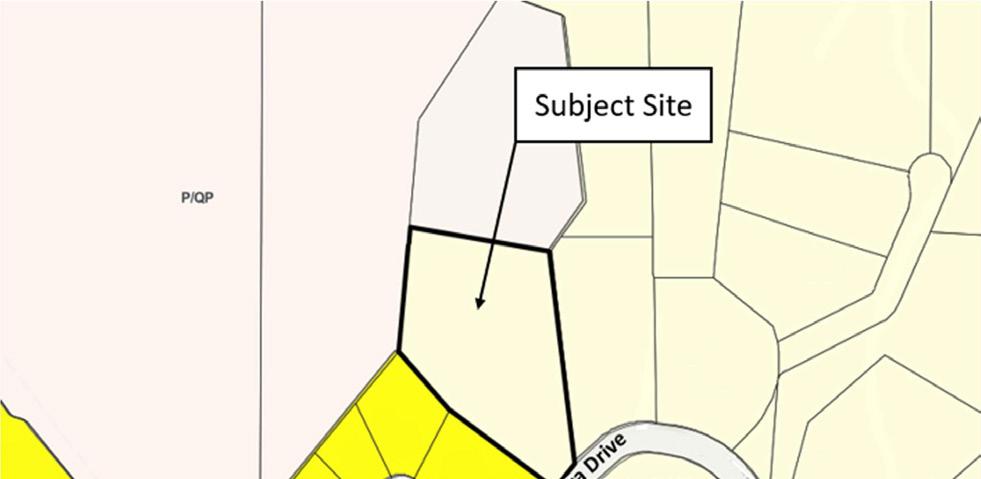
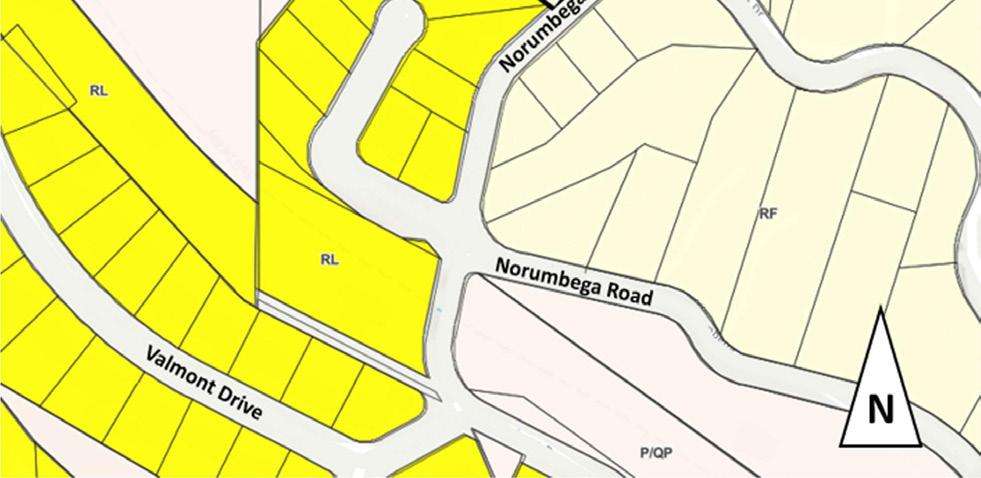
AN ORDINANCE OF THE CITY OF MONROVIA, CALIFORNIA, ADOPTING ZA2022-0002, A MAP AMENDMENT AMENDING THE OFFICIAL ZONING MAP SET FORTH IN SECTION 17.04.040 OF THE MONROVIA MUNICIPAL CODE TO CHANGE THE P/QP (PUBLIC/ QUASI-PUBLIC) ZONE DESIGNATION OF THE PROPERTY LOCATED AT 545 NORUMBEGA DRIVE (APN 8523-002-045) TO THE RF (RESIDENTIAL FOOTHILL) ZONE DESIGNATION
THE CITY COUNCIL OF THE CITY OF MONROVIA, CALIFORNIA does ordain as follows:
SECTION 1. The Applicant, Miguel Uribe of Group Atom Development, has initiated an application to develop a 1.295-acre lot with a two-story, single-family residence approximately 3,758 square feet in size with an attached 1,348 square foot four-car garage located at 545 Norumbega Drive (APN: 8523-002-045). The development application includes an amendment to the City's Official Zoning Map changing the P/QP (Public/Quasi Public) zone designation to the RF (Residential Foothill) zone designation for the subject property. The development application also includes a request for a General Plan Amendment to change the existing P/QP (Public/Quasi-Public) land use designation to RF (Residential Foothill), a request to approve Hillside Development Permit (HDP2022-0002) and Neighborhood Compatibility Design Review (DR2022-0009) for the construction of the new two-story home on a vacant hillside lot, and a Minor Exception (ME2022-0008) for the approval of perimeter fencing that exceeds the maximum zoning height limit (ten feet in-lieu of six feet) on the southwest side yard of the property (“Project”).
SECTION 2. On April 10, 2024, the Planning Commission of the City of Monrovia conducted a duly noticed public hearing on the Project. At the hearing, all interested persons were given an opportunity to be heard. The Planning Commission received and considered the staff report and all the information, evidence, and testimony presented in connection with this Project. Following the close of the public hearing, the Planning Commission adopted Resolution No. PCR2024-0003 recommending adoption of this Ordinance No. 2024-05 to the City Council.
SECTION 3. On May 7, 2024 the City Council of the City of Monrovia conducted a duly noticed public hearing on the Project, including this Ordinance No. 2024-05. At the hearing, all interested persons were given an opportunity to be heard. The City Council received and considered the staff report and all the information, evidence, and testimony presented in connection with this Project.
SECTION 4. Environmental Review
(a) Based on the information in the application and accompanying technical reports, an Initial Study was completed. The Initial Study identified potentially significant environmental effects however, those environmental impacts could be mitigated to a level of less than significant with mitigation measures. Therefore, a Mitigated
Negative Declaration was prepared, pursuant to the California Environmental Quality Act (“CEQA”) and the City’s local CEQA Guidelines.
(b) The City Council has adopted Resolution No. 2022-22 adopting the Mitigated Negative Declaration and Mitigation Monitoring and Reporting Program for the Project.
(c) The City Council has independently considered and reviewed the information in the Mitigated Negative Declaration and Mitigation Monitoring and Reporting Program in its decision to adopt this Ordinance No. 2024-05.
SECTION 5. The custodian of records for all materials that constitute the record of the proceedings upon which this decision is based is the City Clerk. Those documents are available for public review in the Office of the City Clerk located at 415 South Ivy Avenue, Monrovia, California 91016.
SECTION 6. All legal prerequisites to the adoption of the Ordinance have occurred.
SECTION 7. The P/QP (Public / Quasi Public) zone designation is appropriate for publicly owned land and refers to public or community facility uses. The P/QP designation was appropriate for the subject property when it was owned for public purposes by the Los Angeles County Flood Control District, but not for vacant, privately-owned property in a residential zone. The amendments proposed in this ordinance are consistent with the General Plan, as amended as part of the Project.
SECTION 8. The Official Zoning Map for the City of Monrovia set forth in Title 17 (Zoning), Chapter 17.04 (General Provisions), Section 17.04.040 (Official Zoning Map) of the Monrovia Municipal Code, is hereby amended by changing the zoning designation of the property that is identified in Exhibit "A", attached hereto and incorporated herein by this reference, from the P/QP zone designation to the RF (Residential Foothill) zone designation.
SECTION 9. If any section, subsection, subdivision, sentence, clause, phrase, or portion of this ordinance or the application thereof to any person or place, is for any reason held to be invalid or unconstitutional by the decision of any court of competent jurisdiction, such decision shall not affect the validity of the remainder of this ordinance. The City Council hereby declares that it would have adopted this ordinance, and each and every section, subsection, subdivision, sentence, clause, phrase, or portion thereof, irrespective of the fact that any one or more sections, subsections, subdivisions, sentences, clauses, phrases, or portions thereof be declared invalid or unconstitutional.
SECTION 10. The City Clerk shall certify to the passage of this ordinance and shall cause same to be published pursuant to state law within fifteen (15) days after its passage, and this ordinance shall become effective thirty (30) days after its passage.
INTRODUCED this 7th day of May, 2024.
PASSED, APPROVED, AND ADOPTED this 21st day of May, 2024 by the following vote: AYES: Councilmembers Belden, Jimenez, Spicer, Mayor Pro Tem Dr. Kelly, Mayor Shevlin.
EXHIBIT A
EXHIBIT A
Ordinance No. 2024-05
Ordinance No. 2024-05
Zoning Map Amendment 2022-0002 545 Norumbega Drive (APN: 8523-002-045)
Zoning Map Amendment 2022-0002 545 Norumbega Drive (APN: 8523-002-045)
NOTICE OF PETITION TO ADMINISTER ESTATE OF MARGARITA MORALES
FUENTES
Case No. 24STPB05238
To all heirs, beneficiaries, cred-itors, contingent creditors, and persons who may otherwise be interested in the will or estate, or both, of MARGARITA MORALES FUENTES
A PETITION FOR PROBATE has been filed by Jessica Morales in the Superior Court of California, County of LOS ANGELES.
THE PETITION FOR PROBATE requests that Jessica Morales be appointed as personal representative to administer the estate of the decedent.
THE PETITION requests authority to administer the estate under the Independent Administration of Estates Act. (This authority will allow the personal representative to take many actions without obtaining court approval. Before taking certain very important actions, however, the personal representative will be required to give notice to interested persons unless they have waived notice or consented to the proposed action.)
The independent administra-tion authority will be granted unless an interested person files an objec-tion to the petition and shows good cause why the court should not grant the authority.
A HEARING on the petition will be held on June 7, 2024 at 8:30 AM in Dept. No. 2D located at 111 N. Hill St., Los Angeles, CA 90012.
IF YOU OBJECT to the granting of the petition, you should appear at the hearing and state your objections or file written objections with the court before the hearing. Your ap-pearance may be in person or by your attorney.
IF YOU ARE A CREDITOR or a contingent creditor of the decedent, you must file your claim with the court and mail a copy to the personal representative appointed by the court within the later of either (1) four months from the date of first issuance of letters to a general personal representative, as defined in section 58(b) of the California Probate Code, or (2) 60 days from the date of mailing or personal delivery to you of a notice under section 9052 of the California Probate Code.
Other California statutes and legal authority may affect your rights as a creditor. You may want to consult with an attorney knowl-edgeable in California law.
YOU MAY EXAMINE the file kept by the court. If you are a person interested in the estate, you may file with the court a Request for Special Notice (form DE-154) of the filing of an inventory and appraisal of estate assets or of any petition or account as provided in Probate Code section 1250. A Request for Special Notice form is available from the court clerk.
Petitioner: Jessica Morales
JESSICA MORALES 3812 CYPRESS AVE EL MONTE CA 91731 CN106635 FUENTES May 16,20,23, 2024 EL MONTE EXAMINER
NOTICE OF PETITION TO ADMINISTER ESTATE OF:
DENNIS DEAN MIELKE CASE NO. 24STPB05064
To all heirs, beneficiaries, creditors, contingent creditors, and persons who may otherwise be interested in the WILL or estate, or both of DENNIS DEAN MIELKE.
A PETITION FOR PROBATE has been filed by SALLY D. MIELKE in the Superior Court of California, County of LOS ANGELES.
THE PETITION FOR PROBATE requests that SALLY D. MIELKE be appointed as personal representative to administer the estate of the decedent.
THE PETITION requests the decedent's WILL and codicils, if any, be admitted to probate. The WILL and any codicils are available for examination in the file kept by the court. THE PETITION requests authority to administer the estate under the Independent Administration of Estates Act. (This authority will allow the personal representative to take many actions without obtaining court approval. Before taking certain very important actions, however, the personal representative will be required to give notice to interested persons unless they have waived notice or consented to the proposed action.)
The independent administration authority will be granted unless an interested person files an objection to the petition and shows good cause why the court should not grant the authority.
A HEARING on the petition will be held in this court as follows: 06/11/24 at 8:30AM in Dept. 29 located at 111 N. HILL ST., LOS ANGELES, CA 90012
IF YOU OBJECT to the granting of the petition, you should appear at the hearing and state your objections or file written objections with the court before the hearing. Your appearance may be in person or by your attorney.
IF YOU ARE A CREDITOR or a contingent creditor of the decedent, you must file your claim with the court and mail a copy to the personal representative appointed by the court within the later of either (1) four months from the date of first issuance of letters to a general personal representative, as defined in section 58(b) of the California Probate Code, or (2) 60 days from the date of mailing or personal delivery to you of a notice under section 9052 of the California Probate Code. Other California statutes and legal authority may affect your rights as a creditor. You may want to consult with an attorney knowledgeable in California law.
YOU MAY EXAMINE the file kept by the court. If you are a person interested in the estate, you may file with the court a Request for Special Notice (form DE-154) of the filing of an inventory and appraisal of estate assets or of any petition or account as provided in Probate Code section 1250. A Request for Special Notice form is available from the court clerk.
Attorney for Petitioner KEVIN CHIU - SBN 249479 LAW OFFICE OF KEVIN CHIU 1055 E. COLORADO BLVD., #500 PASADENA CA 91106
Telephone (626) 607-1411 5/16, 5/20, 5/23/24 CNS-3812801# DUARTE DISPATCH
NOTICE OF PETITION TO ADMINISTER ESTATE OF KHANH HOANG NGUYEN aka KENEY NGUYEN
CASE NO. 24STPB05117
To all heirs, beneficiaries, creditors, contingent creditors, and persons who may otherwise be interested in the will or estate, or both, of: KHANH HOANG NGUYEN aka KENEY NGUYEN
A PETITION FOR PROBATE has been filed by KEVIN NGUYEN and EDWIN NGUYEN in the Superior Court of California, County of Los Angeles.
THE PETITION FOR PROBATE requests that KEVIN NGUYEN and EDWIN NGUYEN be appointed as personal representative to administer the estate of the decedent. THE PETITION requests authority to administer the estate under the Independent Administration of Estates Act with full authority (This authority will allow the personal representative to take many actions without obtaining court approval. Before taking certain very important actions, however, the personal representative will be required to give notice to interested persons unless they have waived notice or consented to the proposed action.) The independent administration authority will be granted unless an interested person files an objection to the petition and shows good cause why the court should not grant the authority.
A HEARING on the petition will be held on 07/15/2024 at 8:30 AM in Dept. 67 located at 111 N. HILL ST. LOS ANGELES CA 90012 STANLEY MOSK COURTHOUSE.
IF YOU OBJECT to the granting of the petition, you should appear at the hearing and state your objections or file written objections with the court before the hearing. Your appearance may be in person or by your attorney.
IF YOU ARE A CREDITOR or a contingent creditor of the decedent, you must file your claim with the court and mail a copy to the personal representative appointed by the court within the later of either (1) four months from the date of first issuance of letters to a general personal representative, as defined in section 58(b) of the California Probate Code, or (2) 60 days from the date of mailing or personal delivery to you of a notice under section 9052 of the California Probate Code. Other California statutes and legal authority may affect your rights as a creditor. You may want to consult
with an attorney knowledgeable in California law. YOU MAY EXAMINE the file kept by the court. If you are a person interested in the estate, you may file with the court a Request for Special Notice (DE-154) of the filing of an inventory and appraisal of estate assets or of any petition or account as provided in Probate Code section 1250. A Request for Special Notice form is available from the court clerk. Attorney for Petitioner: VICKIE D. LE, ESQ., Bar No. 143310
Law Offices of Vickie D. Le 9039 Bolsa Avenue, Suite 218 Westminster, CA 92683
Telephone No. (714) 379-6449
Fax No. (714) 379-4779
Email Address: lawofficesofandrelam@gmail.com
Attorney for: Kevin Nguyen and Edwin Nguyen, Telephone: (714) 379-6449 5/20, 5/23, 5/27/24 CNS-3814870# EL MONTE EXAMINER
NOTICE OF PETITION TO ADMINISTER ESTATE OF: PATRICIA LOU WILLIAMS AKA PATTY WILLIAMS CASE NO. 24STPB05623
To all heirs, beneficiaries, creditors, contingent creditors, and persons who may otherwise be interested in the WILL or estate, or both of PATRICIA LOU WILLIAMS AKA PATTY WILLIAMS.
A PETITION FOR PROBATE has been filed by KIMBERLY SEGO in the Superior Court of California, County of LOS ANGELES.
THE PETITION FOR PROBATE requests that KIMBERLY SEGO be appointed as personal representative to administer the estate of the decedent.
THE PETITION requests authority to administer the estate under the Independent Administration of Estates Act with limited authority. (This authority will allow the personal representative to take many actions without obtaining court approval. Before taking certain very important actions, however, the personal representative will be required to give notice to interested persons unless they have waived notice or consented to the proposed action.) The independent administration authority will be granted unless an interested person files an objection to the petition and shows good cause why the court should not grant the authority.
A HEARING on the petition will be held in this court as follows: 06/17/24 at 8:30AM in Dept. 99 located at 111 N. HILL ST., LOS ANGELES, CA 90012
IF YOU OBJECT to the granting of the petition, you should appear at the hearing and state your objections or file written objections with the court before the hearing. Your appearance may be in person or by your attorney.
IF YOU ARE A CREDITOR or a contingent creditor of the decedent, you must file your claim with the court and mail a copy to the personal representative appointed by the court within the later of either (1) four months from the date of first issuance of letters to a general personal representative, as defined in section 58(b) of the California Probate Code, or (2) 60 days from the date of mailing or personal delivery to you of a notice under section 9052 of the California Probate Code. Other California statutes and legal authority may affect your rights as a creditor. You may want to consult with an attorney knowledgeable in California law.
YOU MAY EXAMINE the file kept by the court. If you are a person interested in the estate, you may file with the court a Request for Special Notice (form DE-154) of the filing of an inventory and appraisal of estate assets or of any petition or account as provided in Probate Code section 1250. A Request for Special Notice form is available from the court clerk. Attorney for Petitioner LARRY D. STRATTON, ESQ.SBN 116955
LAW OFFICES OF LARRY D. STRATTON
35 NORTH LAKE AVENUE, SUITE 710 PASADENA CA 91101
Telephone (626) 447-1446 5/23, 5/27, 5/30/24
CNS-3816230# ARCADIA WEEKLY
ORDER TO SHOW CAUSE FOR
CHANGE OF NAME PETITION OF Kevin Lars Vela Akin, Rebeca Sanchez Santiago, Pedro Miguel Vela Sanchez FOR CHANGE OF NAME CASE NUMBER: 24NNCP00180 Superior Court of California, County of Los Angeles 600 East Broadway, Glendale, Ca 91206, North Central Judicial District TO ALL INTERESTED
PERSONS: 1. Petitioner Kevin Lars Vela Akin, Rebeca Sanchez Santiago, Pedro Miguel Vela Sanchez filed a petition with this court for a decree changing names as follows: Present name a. OF Pedro Miguel Vela Sanchez to Proposed name Elias Peter Vela Sanchez 2. THE COURT
ORDERS that all persons interested in this matter shall appear before this court at the hearing indicated below to show cause, if any, why the petition for change of name should not be granted. Any person objecting to the name changes described above must file a written objection that includes the reason for the objection at least two court days before the matter is scheduled to be heard and must appear at the hearing to show cause why the petition should not be granted. If no written objection is timely filed, the court may grant the petition without a hearing NOTICE OF HEARING a. Date: 07/11/2024 Time: 8:30AM Dept: E. The address of the court is same as noted above. 3. a. A copy of this Order to Show Cause shall be published at least once each week for four successive weeks prior to the day set for hearing on the petition in the following newspaper of general circulation, printed in this county: Monrovia Weekly DATED: April 29, 2024 Robin Miller Sloan JUDGE OF THE SUPERIOR COURT Pub. May 2, 9, 16, 23, 2024 MONROVIA WEEKLY
ORDER TO SHOW CAUSE FOR CHANGE OF NAME PETITION OF Mia Liu a minor by and through Guardian Ad Litem Mei Jiang FOR CHANGE OF NAME CASE NUMBER: 24PSCP00209 Superior Court of California, County of Los Angeles 1427 West Covina Parkway, West Covina, CA 91790, East Judicial District TO ALL INTERESTED PERSONS: 1. Petitioner Mia Liu a minor by and through Guardian Ad Litem Mei Jiang filed a petition with this court for a decree changing names as follows: Present name a. OF Mia Liu to Proposed name Mia Jiang 2. THE COURT ORDERS that all persons interested in this matter shall appear before this court at the hearing indicated below to show cause, if any, why the petition for change of name should not be granted. Any person objecting to the name changes described above must file a written objection that includes the reason for the objection at least two court days before the matter is scheduled to be heard and must appear at the hearing to show cause why the petition should not be granted. If no written objection is timely filed, the court may grant the petition without a hearing NOTICE OF HEARING a. Date: 07/12/2024 Time: 8:30AM Dept: 6. The address of the court is same as noted above. 3. a. A copy of this Order to Show Cause shall be published at least once each week for four successive weeks prior to the day set for hearing on the petition in the following newspaper of general circulation, printed in this county: San Gabriel Sun DATED: April 24, 2024 Robin Miller Sloan JUDGE OF THE SUPERIOR COURT Pub. May 9, 16, 23, 30, 2024 SAN GABRIEL SUN
ORDER TO SHOW CAUSE FOR CHANGE OF NAME PETITION OF Daughter Esther Rose Banayan by & through her parents Nicole Banayan and Shahab Banayan FOR CHANGE OF NAME CASE NUMBER: 24VECP00195
Superior Court of California, County of Los Angeles 6230 Sylmar Ave, Van Nuys, Ca 91401, Northwest Judicial District TO ALL INTERESTED PERSONS: 1. Petitioner Daughter Esther Rose Banayan by & through her parents Nicole Banayan and Shahab Robert Banayan filed a petition with this court for a decree changing names as follows: Present name a. OF Esther Rose Banayan to Proposed name Eden Rose Banayan 2. THE COURT ORDERS that all persons interested in this matter shall appear before this court at the hearing indicated below to show cause, if any, why the petition for change of name should not be granted. Any person objecting to the name changes described above must file a written objection that includes the reason for the objection at least two court days before the matter is scheduled to be heard and must appear at the hearing to show cause why the petition should not be granted. If no written objection is timely filed, the court may grant the petition without a hearing NOTICE OF HEARING a. Date: 06/24/2024 Time: 8:30AM Dept: U. Room: 620 The address of the court is same as noted above. 3. a. A copy of this Order to Show Cause shall be published at least once each week for four successive weeks prior to the day set for hearing on the petition in the following newspaper of general circulation, printed in this county: Arcadia Weekly DATED: May 9, 2024 Virginia Keeny JUDGE OF THE SUPERIOR COURT Pub. May 16, 23, 30, June 6, 2024 ARCADIA WEEKLY
NOTICE OF LIEN SALE
Notice is given that pursuant to sections 21700-21713 of the Business and Professions Code, Section 2328 of the Commercial Code, Section 535 of the Penal Code, that El Monte Mini Warehouse Associates, LP, at 10212 East Valley Blvd, El Monte CA 91731 will sell by competitive bidding, on or after June 11, 2024 at
1:30pm, property belonging to those listed below. Auction is to be held at the above address. Property to be sold as follows: Household, office & business goods, furniture, appliances, personal items, clothing, electronics, tools, duffle bags/suit cases, electronics, sporting and exercise equipment, miscellaneous boxes, containers & bags with unknown contents belonging to the following: Funk, Kimberley Manuel-Hernandez, Micaela Velasco, Vidal lovio, fred BAUTISTA, JORGE Sanchez, Brian ALDRETE, ELIZABETH CARVALHO, NEUSA Marin, Joshua Mueller, Curt V. Jimenez, Maria CALLETANO, OMAR Padilla, Hector Ortega, Brenda DORANTES, CHRISTIAN GARNICA, TOMASA RODRIGUEZ, BOBBIE
Publish May 23, 2024 & May 30, 2024 & in THE EL MONTE EXAMINER
Extra Space Storage, on behalf of itself or its affiliates, Life Storage or Storage Express, will hold a public auction to sell personal property described below belonging to those individuals listed below at the location indicated: 115 E Lime Ave Monrovia, Ca, 91016
June 12, 2024 at 12:00 PM
Farihah Salman - house stuff furniture, clothes boxes
The auction will be listed and advertised on www.storagetreasures.com. Purchases must be made with cash only and paid at the above referenced facility in order to complete the transaction. Extra Space Storage may refuse any bid and may rescind any purchase up until the winning bidder takes possession of the personal property.
Publish May 23, 2024 in the MONROVIA WEEKLY

COUNTY OF LOS ANGELES DEPARTMENT OF TREASURER AND TAX COLLECTOR
NOTICE OF DIVIDED PUBLICATION Made pursuant to Revenue and Taxation Code Section 3381
Pursuant to Revenue and Taxation Code (R&TC) Sections 3381 through 3385, the Notice of Power to Sell Tax-Defaulted Property Subject to the Tax Collector’s Power to Sell in and for the County of Los Angeles, State of California, has been divided and distributed to various newspapers of general circulation published in the County. A portion of the list appears in each of such newspapers.
NOTICE OF IMPENDING POWER TO SELL TAX-DEFAULTED PROPERTY Made pursuant to Revenue and Taxation Code Section 3361
Notice is hereby given that the following parcels listed will become subject to the tax collector’s power to sell on Monday, July 1, 2024, at 12:01 a.m. Pacific Time, by operation of law. The real property taxes and assessments on the parcels listed will have been defaulted five or more years, except for:
1. Nonresidential commercial parcels, as defined in R&TC Section 3691, which will have been defaulted for three or more years,
2. Parcels on which a nuisance abatement lien has been recorded, which will have been defaulted for three or more years.
The Tax Collector will record a Notice of Power to Sell unless the property taxes are paid in full or the property owner initiates an installment plan of redemption, as provided by law, prior to 5:00 p.m. Pacific Time, on Friday, June 28, 2024, when the right to initiate an installment plan terminates. Thereafter, the only option to prevent the sale of the property at public auction is to pay the taxes in full.
The right of redemption survives the property becoming subject to the tax collector’s power to sell, but it terminates at 5:00 p.m. Pacific Time, on the last business day before the scheduled auction of the property by the Tax Collector.
The Treasurer and Tax Collector’s Office will furnish, upon request, information concerning making a payment in full or initiating an installment plan of redemption. Requests must be made at 225 North Hill Street, First Floor Lobby, Los Angeles, California 90012. For more information, please visit our website at ttc.lacounty.gov or contact us at (213) 974-2111.
The amount to redeem the property, in United States dollars and cents, is set forth in the listing opposite each parcel number. This amount includes all defaulted taxes, penalties, and fees that have accrued from the date of tax-default to the date of Friday, June 28, 2024.
I certify, under penalty of perjury, that the foregoing is true and correct. Dated this 16 day of April 2024.

TRUST SITUS:1603 PENN MAR AVE SOUTH EL MONTE CA 91733-4025 AIN: 8114-028-012 2974 $5,885.56
MARIA E AND CHAVARRIA, CIRO J SITUS:4145 CENTER ST BALDWIN PARK CA 917062923 AIN: 8546-011-030 2975 $17,538.78 MONDRAGON, EDUARDO H JR TR EDUARDO H MONDRAGON JR TRUST SITUS:11639 ROSEGLEN ST EL MONTE CA 91732-1443 AIN: 8547-002-017 2976 $20,055.61 ALMARAZ, ROBERTO SITUS:11635 FOREST GROVE ST EL MONTE CA 91732-2221 AIN: 8548-017-019 2977 $10,281.56 GE, FENG AND ZHENG, YUMEI SITUS:3627 MEADOWLARK ST EL MONTE CA 91732-4313 AIN: 8549-043003 2985 $46,853.87 HARRISON, GARY S SITUS:11268 VISTA LN EL MONTE CA 91731-1487 AIN: 8571-016-010 2988 $17,803.42 ARREOLA, ANTONIO AND
"Ezra"

autistic,” says Palmiotto.
“Everyone deserves to be seen and heard, to have a sense of belonging, and be their authentic self. Ezra gets it right, and we want to reflect that in this event.”
By email, Palmiotto and Plank talk about how the movie came about and their involvement with it.
“The film was written by Tony Spiridakis who has an autistic son. I was brought on by Bill Horberg and Tony Goldwyn who wanted to make sure we cast an autistic actor and was a proponent of ‘nothing about us without us.’”
Getting films produced is very challenging and filled with obstacles, but Ezra was blessed with good fortune. Plank explains, “Films have gotten harder and harder to finance recently but Ezra is a story that struck a chord with a lot of people. Bill Horberg has a son on the autism spectrum so Closer Media and its founder Zhang Xin were instrumental. Jon Kilik, who produced De Niro’s directorial debut ‘A Bronx Tale,’ also produced our film and was on set every day. Tony Goldwyn was a powerhouse in terms of getting things in place.
And Wayfarer Studios also made this film.”
False impressions about autism abound as Palmiotto and Plank reveal. “There are way
too many misconceptions about autism to be able to list them all but some of the most common are related to the way we think about disability in general,” states Plank.
“Autistic people don’t overcome our own limitations. We overcome society being set up in a way that doesn’t align with the way neurodivergent individuals function. I’m autistic myself so everything I do involves neurodivergence (at least my own). I founded a website called WrongPlanet.net when I was a teenager. Since that time I’ve been doing public speaking and activism”
Palmiotto adds, “Misconceptions about being autistic are discriminatory as they create access barriers in all systems. Each of us is responsible for examining our own ableism and how these internal thoughts stigmatize and pathologize those that are autistic. When we make assumptions that autistic people are broken versions of ‘normal, we have a human rights issue. It isn’t hard to change our internal thoughts and actions, it just requires us to accept the invitation to do so. Alex, myself and so many others work towards dismantling ableism, when we do this we create a better world. As a neurodivergent-affirming therapist, I see this work as not
just the work of autistic self-advocates and their family members, but all of our journey. My work within neurodivergence is to help all of us accept the invitation to challenge ableism for autistic people.”
“Film has a way of moving people towards change even when we have no lived experience with the story. Ezra invites viewers to shift their perspective on what it means to be autistic. Ezra’s story is one of universal themes of becoming, authenticity and love. Each character becomes a better version of themselves when their loved ones are their truest self. Even more than that, it’s a story of love and the risks that we take for those we love. Within this, ‘Ezra’ shows us all that autistic people want and need the very things that we all need. This is what I hope the audience takes from this movie; that each person deserves the human right of being their authentic self and when we allow for that in others, autistic or non-autistic, we all are better for it,” concludes Palmiotto.
Wiser words have never been spoken. Would that “Ezra” and its film screening event “An Evening with Ezra” serve as the standard for inclusivity in Hollywood.

Arcadian is a big guy with an equally big heart. He’s an 80 pound lap-dog in the shape of a Shepherd mix. Arcadian has been out with the Pasadena Humane Mobile Outreach team and they have nothing but wonderful things to say about him. He’s super friendly, easy to train and walks right next to you on a walk. He’s very quick to make friends with everyone who he meets. He will often place a gentle paw on your lap to prod you to give him some pets, then replace that with his head, then the rest of his body if you allow it. He just wants to be close to you! Arcadian also appears to be friendly with dogs- he has met a few at the shelter and seems to want to play with them. He might be a great buddy for another large dog. If you’re ready for all the love you can handle, you might be ready for Arcadian!
Dolly is a beautiful German Shepherd mix who is just over a year old. She is very sensitive- it takes her some time to get used to new things, so a patient and understanding home is a must for her. Dolly spent some time in a foster home that allowed us to gather a lot of information about her. She is housetrained and will alert you when it’s time for her to go out to potty. She gets attached to her family quickly, so she’ll be your new BFF in no time. She is also extremely smart and easy to train. She loves to play fetch and is a whiz at catching treats in mid-air. In fact, she has a laser-like focus when treats are involved, so additional training will be easy. Dolly has gained such a big fan in one of the staff members at Pasadena Humane that her adoption fee has been sponsored. This sweet girl will need to be introduced to things slowly and receive reinforcement that everything will be OK. Once she’s comfortable, she’s going to be a lot of fun and will make someone a great companion. Maybe that someone is you?
The adoption fee for dogs is $150. All dog adoptions include spay or neuter, microchip, and age-appropriate vaccines. Walk-in adoptions are available every day from 2:00 – 5:00. For those who prefer, adoption appointments are available daily from 10:30 – 1:30, and can be scheduled online. View photos of adoptable pets at pasadenahumane.org. New adopters will receive a complimentary health-and-wellness exam from VCA Animal Hospitals, as well as a goody bag filled with information about how to care for your pet. Pets may not be available for adoption and cannot be held for potential adopters by phone calls or email.

On Mother's Day, a serene Sunday evening in Los Angeles, the Munson Recital Hall at Azusa Pacific University became a vibrant stage for the climactic finale of the 5th CUAAASC Singing Competition, "Just Sing It." The event resonated deeply within both local and international communities.
The night belonged to the "Voices Unstoppable" team, mentored by Zhentao Li, who clinched the championship with undeniable flair. The "Prosperity" team, mentored by Sophia Li, emerged as strong challengers. Liza Russell, President of the Chinese University Alumni Association Alliance of Southern California (CUAAASC), proudly noted the competition's expanded scope. "This year, our participants included second and third-generation CUAAASC members as well as Chinese international students," she
"We also invited six non-Chinese American industry representatives as judges to enhance cultural exchange and appreciation of Chinese music."
The event, co-hosted by Angelas Vocal Art and supported by organiza-
tions including HTTV, was a testament to community spirit. Key sponsors such as the HUST Alumni Association and Thunder International Group, along with Lorde+Belle, US Ginseng Wholesale Corporation, YK Law LLP, and the Jiaotong

University Alumni Association, played pivotal roles. Saral Sun, Minister of CUAAASC Arts & Performance, emphasized the event's intricate planning and community engagement. "This year, we enhanced audience inter-
action through QR code voting," Sun explained. "Our 38-member Alumni Volunteer Team was instrumental in delivering a seamless and memorable experience."
Twenty finalists showcased their talents. Zhenni Qiao from the Shandong
University Alumni Association won the individual gold medal with her rendition of “Quando men vo” from "La Bohème," scoring 966 points and receiving a $1,000 prize. Yi Long from the Shenzhen University Alumni Association and Anisa Shu from Nanjing University of the Arts both secured silver medals, each receiving $500. Bronze medals and $200 prizes were awarded to Vivian Wang from the Beijing University of Chemical Technology Alumni Association and other gifted vocalists.
As the evening concluded, the air was filled with accomplishment and anticipation. The competition not only fulfilled many singers' dreams but also enriched cultural understanding. Looking ahead, these talented performers are poised to seize new opportunities and captivate even larger audiences.


A39-year-old woman who acted as a lookout on a hit ordered by reputed Orange County Mexican Mafia chief Johnny Martinez was sentenced Monday to time served in custody based on her hard work rehabilitating herself while out of custody.
Megan Moreno pleaded guilty June 12 to conspiring to commit assault resulting in serious bodily injury.
Moreno was part of a second crew of people Martinez allegedly directed to assault Ricardo Moncada on Dec. 25, 2017, because the alleged gang boss suspected Moncada was using drugs with "and making advances toward" Martinez's girlfriend, Dolores Mendez, prosecutors have said in court papers.
U.S. District Judge Cormac Carney sentenced 33-year-old Alex Gonzalez to four years in prison, which was much less than what probation officials and prosecutors had recommended, due to his attempts to rehabilitate himself.
Carney was similarly
moved by Moreno's story to significantly reduce her punishment as well.
"Your story is very powerful," Carney told Moreno. "I was very moved by it. I'm inspired by it. ... You've shown it's never too late to turn your life around. Keep up the good work."
Authorities monitoring a wire ordered a traffic stop of Gonzalez, derailing the assault on Moncada, prosecutors said.
The wire helped investigators stymie a second planned attack on the victim, prosecutors said.
Moreno met with other co-defendants, who went to "scope out" the victim's home before returning to a restaurant to "regroup," prosecutors said. At some point, Moreno "watched the street where (the victim) was located while the rest of the crew, at least one of whom was armed with a firearm, went to (Moncada's) location to carry out the assault."
That prompted authorities to intercept the vehicle
those defendants were in, triggering a pursuit in which one of the defendants tossed a loaded gun, prosecutors said.
Moreno "fell off a cliff" from a dependency on methamphetamine in 2015, Assistant U.S. Attorney Gregory Scally. She has a "lengthy criminal history mostly involving drug possession, drug possession with intent to sell, and petty theft," Scally said in court papers.
Carney said he was concerned about the defendant's ties to the Mexican Mafia, which he said was a "dangerous and destructive gang," and wanted to know if she would renounce her connection. Her attorney Rob Harley said she has.
Carney noted she had a traumatic upbringing at the hands of a "verbally abusive" mother and has been diagnosed with depression, anxiety and post-traumatic stress disorder and experiences panic attacks. She struggles with a bad back that will require surgery, he added.

Scally said that after digging more into the defendant's background he backed off the 36 months he recommended in court papers in January. He said her case was "unique" because of her hard work while out of custody.
"I'm committed to making amends" to the victim, Moreno told Carney.
She recalled, tearfully, how her stepfather sexually assaulted her and when she told her mother she was told, "He was drunk, he didn't mean it."
She said she got addicted to methamphetamine at
27 when she started "selfmedicating."
On May 4, 2021, her daughters issued an ultimatum — get sober or lose a relationship with them, she said.
"I chose them," she said.
"I've been sober ever since."
After she was granted bail in February of last year she applied for a job with McDonald's and worked her way up from the bottom to shift leader to a general manager of a restaurant.
She said she was "grateful" for her job and being a mother and grand-
mother.
"I'm blessed no matter what happens today," she said.
Carney responded, "Well, that was quite powerful. You inspire us all that there is hope."
Carney noted he often sees defendants who get caught in a "vicious cycle" of incarceration and drug addiction with little success of rehabilitation.
Moreno has about 10 months in custody, so Carney sentenced her to 10 months and placed her on one year of supervised release.
TheShakespeare Center of Los Angeles’s downtown Los Angeles headquarters will be undergoing $15 million renovations to transform into a new 299-seat state of the art multi-media and live performing arts and community center.
The newly renovated studio will also support the expansion of a wide range of SCLA’s White House awarded youth employment programs and transitional arts employment on-the-job training experiences targeting Los Angeles community’s most severely unemployed populations.
SCLA has appointed Amanda Susskind as managing director to lead this effort. Susskind was the former President of Teach Democracy, a national civic education provider, and before that was the Los Angeles Regional Director of the Anti-Defamation League. A throughline in her
SCLA Founder and Artistic Director Ben Donenberg said, “Renovating our 22,000 square foot warehouse to support live multi-media performance, as well as building out the functionalities demanded by high tech media production, will enable us to create great art that meets the moment and support other nonprofit arts organizations and commercial for-profit entertainment industry enterprises to do the same.”
| Rendering credit of SPF:a
career as a lawyer and nonprofit leader is programming for students and teachers in underserved communities.
“It is thrilling to be part of the transformation of a community. The new space will bolster the Shakespeare Center’s long history
of providing world-class theater and life-transforming education and workforce programs,” said Susskind.
“We also see it as providing a western gateway to the downtown arts community, anchored in the Grand Street corridor which houses
the Civic Center, Cathedral of our Lady of the Angels, Music Center, Walt Disney Concert Hall, Colburn School, and the Broad and MOCA museums.”
To date, SCLA has secured $15 million for the renovation through the sale of US Department of the Treasury New Market Tax Credits, a contribution of California Arts Council funds arranged by California State Senator Maria Elena Durazo; a grant from the U.S. Department of Commerce Economic Development Administration, and a lead gift from The Ahmanson Foundation that put the entire project in motion.
“The large grant from the California Arts Council and the New Market Tax Credits award reflects the theater’s long-standing commitment to creating economic and educational opportunities in underserved communities,” stated Durazo. “Besides SCLA’s world-class mainstage productions of Shakespeare and other classics, the center’s arts education and workforce programs help break the cycle of disinvestment in historically lowincome communities.”
“While we have lovingly called this our ‘home improvement project’ we also recognize that it is in fact a major transformation and significant addition to the downtown arts scene,” said SCLA Board Chair Bill Ahmanson.
listed herein. Signed: Sandra De Los Angeles Grega, 13550-B Whittier Blvd, Whittier, CA 90605 (Owner). The statement was filed with the County Clerk of Los Angeles on May 10, 2024.
NOTICE: This fictitious business name statement expires five years from the date it was filed in the office of the County Clerk. A new fictitious business name statement must be filed prior to that date. The filing of this statement does not of itself authorize the use in this state of a fictitious business name in violation of the rights of another under federal, state or common law (See Section 14400 et seq., Business and Professional Code).
Pub. Monrovia Weekly 05/23/2024, 05/30/2024, 06/06/2024, 06/13/2024
FICTITIOUS BUSINESS NAME STATEMENT FILE NO. 2024103377
NEW FILING.
The following person(s) is (are) doing business as QUICKIES
HANDCRAFTED COOKIES, 16310 Main St, La Puente, CA 91744. This business is conducted by a individual. Registrant commenced to transact business under the fictitious business name or names listed herein on May 2024. Signed: Marquis Williams, 16310 Main St, La Puente, CA 91744 (Owner). The statement was filed with the County Clerk of Los Angeles on May 14, 2024. NOTICE: This fictitious business name statement expires five years from the date it was filed in the office of the County Clerk. A new fictitious business name statement must be filed prior to that date. The filing of this statement does not of itself authorize the use in this state of a fictitious business name in violation of the rights of another under federal, state or common law (See Section 14400 et seq., Business and Professional Code).
Pub. Monrovia Weekly 05/23/2024, 05/30/2024, 06/06/2024, 06/13/2024
FICTITIOUS BUSINESS NAME STATEMENT FILE NO. 2024102151
NEW FILING.
The following person(s) is (are) doing business as (1). VIRTUAL ACCOUNTING SOLUTIONS (2). TECHNICAL ACCOUNTING SOLUTIONS , 13550-B Whittier Blvd, Whittier, CA 90605. This business is conducted by a individual. Registrant commenced to transact business under the fictitious business name or names listed herein on May 2024.
Signed: Kevin Scott Grega, 13550B Whittier Blvd, Whittier, CA 90605 (Owner). The statement was filed with the County Clerk of Los Angeles on May 10, 2024. NOTICE: This fictitious business name statement expires five years from the date it was filed in the office of the County Clerk. A new fictitious business name statement must be filed prior to that date. The filing of this statement does not of itself authorize the use in this state of a fictitious business name in violation of the rights of another under federal, state or common law (See Section 14400 et seq., Business and Professional Code).
Pub. Monrovia Weekly 05/23/2024, 05/30/2024, 06/06/2024, 06/13/2024
FICTITIOUS BUSINESS NAME STATEMENT FILE NO. 2024108765
NEW FILING.
The following person(s) is (are) doing business as RS MONEYTUN, 1054 Allen Ave, Pasadena, CA 91104. This business is conducted by a individual. Registrant commenced to transact business under the fictitious business name or names listed herein on June 2017. Signed: Matevos Papyan, 1054 Allen Ave, Pasadena, CA 91104 (Owner). The statement was filed with the County Clerk of Los Angeles on May 20, 2024. NOTICE: This fictitious business name statement expires five years from the date it was filed in the office of the County Clerk. A new fictitious business name statement must be filed prior to that date. The filing of this statement does not of itself authorize the use in this state of a fictitious business name in violation of the rights of another under federal, state or common law (See Section 14400 et seq., Business and Professional Code).
Pub. Monrovia Weekly 05/23/2024, 05/30/2024, 06/06/2024, 06/13/2024
FICTITIOUS BUSINESS NAME STATEMENT FILE NO. 2024095146 NEW FILING. The following person(s) is (are) doing business as HEALING HEARTS THERAPY, 4492 W Adams Blvd, Los Angeles, CA 90016. This business is conducted by a individual. Registrant commenced to transact business under the fictitious business name or names listed herein on May 2024. Signed: Aracely Reyes, 4492 W Adams Blvd, Los Angeles, CA 90016 (Owner). The statement was filed with the County Clerk of Los Angeles on May 2, 2024. NOTICE: This fictitious business name statement expires five years from the date it was filed in the office of the County Clerk. A new fictitious business name statement must be filed prior to that date. The filing of this statement does not of
Pub. Monrovia Weekly 05/23/2024, 05/30/2024, 06/06/2024, 06/13/2024
FICTITIOUS BUSINESS NAME STATEMENT FILE NO. 2024089010 FIRST FILING. The following person(s) is (are) doing business as (1). FUSION WELLNESS & PHYSICAL THERAPY (2). FEMINA PHYSICAL THERAPY (3). FUSION WELLNESS PT (4). FEMINA PT (5). FUSION PT , 3702 Park Place, Montrose, CA 91020. This business is conducted by a corporation. Registrant commenced to transact business under the fictitious business name or names listed herein on January 2019. Signed: THE PILATES PT PHYSICAL THERAPY INC (CA-C3558165, 13425 Ventura Blvd SUITE 200, SHERMAN OAKS, CA 91423; HEATHER JEFFCOAT, President. The statement was filed with the County Clerk of Los Angeles on April 24, 2024. NOTICE: This fictitious business name statement expires five years from the date it was filed in the office of the County Clerk. A new fictitious business name statement must be filed prior to that date. The filing of this statement does not of itself authorize the use in this state of a fictitious business name in violation of the rights of another under federal, state or common law (See Section 14400 et seq., Business and Professional Code). Pub. Monrovia Weekly 05/23/2024, 05/30/2024, 06/06/2024, 06/13/2024
FICTITIOUS BUSINESS NAME STATEMENT FILE NO. 2024105761 NEW FILING. The following person(s) is (are) doing business as SOCAL OBGYN ASSOCIATES, 8100 Sunland Blvd, Los Angeles, CA 91352. This business is conducted by a corporation. Registrant commenced to transact business under the fictitious business name or names listed herein on August 2017. Signed: Joon Choi MD A Professional Corporation (CA-1765260, 8100 Sunland Blvd, Los Angeles, CA 91352; Joon Choi, President. The statement was filed with the County Clerk of Los Angeles on May 15, 2024. NOTICE: This fictitious business name statement expires five years from the date it was filed in the office of the County Clerk. A new fictitious business name statement must be filed prior to that date. The filing of this statement does not of itself authorize the use in this state of a fictitious business name in violation of the rights of another under federal, state or common law (See Section 14400 et seq., Business and Professional Code). Pub. Monrovia Weekly 05/23/2024, 05/30/2024, 06/06/2024, 06/13/2024
FICTITIOUS BUSINESS NAME STATEMENT FILE NO. 2024105938
NEW FILING. The following person(s) is (are) doing business as GOTHAM ELITE PROPERTIES, 9654 E Camino Real Ave, Arcadia, CA 91007. This business is conducted by a individual. Registrant has not yet begun to transact business under the fictitious business name or names listed herein. Signed: Richard Chow, 9654 E Camino Real Ave, Arcadia, CA 91007 (Owner). The statement was filed with the County Clerk of Los Angeles on May 16, 2024. NOTICE: This fictitious business name statement expires five years from the date it was filed in the office of the County Clerk. A new fictitious business name statement must be filed prior to that date. The filing of this statement does not of itself authorize the use in this state of a fictitious business name in violation of the rights of another under federal, state or common law (See Section 14400 et seq., Business and Professional Code). Pub. Monrovia Weekly 05/23/2024, 05/30/2024, 06/06/2024, 06/13/2024
FICTITIOUS BUSINESS NAME STATEMENT FILE NO. 2024107828 NEW FILING.
The following person(s) is (are) doing business as SET FREE BAIL BONDS, 965 N Vignes St #2, Los Angeles, CA 90012. This business is conducted by a individual. Registrant has not yet begun to transact business under the fictitious business name or names listed herein. Signed: ROGER JAMES SAYEGH, 965 N Vignes St #2, Los Angeles, CA 90012 (Owner). The statement was filed with the County Clerk of Los Angeles on May 17, 2024. NOTICE: This fictitious business name statement expires five years from the date it was filed in the office of the County Clerk. A new fictitious business name statement must be filed prior to that date. The filing of this statement does not of itself authorize the use in this state of a fictitious business name in violation of the rights of another under federal, state or common law (See Section 14400 et seq., Business and Professional Code).
Pub. Monrovia Weekly 05/23/2024, 05/30/2024, 06/06/2024, 06/13/2024
FICTITIOUS BUSINESS NAME STATEMENT FILE NO. 2024085008 NEW FILING. The following person(s) is (are) doing business as JUST BREATH HOME HELATHCARE, 20819 Norwalk Blvd 11, Lakewood, CA 90715. This business is conducted by a limited liability
company (llc). Registrant commenced to transact business under the fictitious business name or names listed herein on March 2024. Signed: Just Breath (CA-, 20819 Norwalk Blvd 11, Lakewood, CA 90715; paul ondo, Owner. The statement was filed with the County Clerk of Los Angeles on April 19, 2024. NOTICE: This fictitious business name statement expires five years from the date it was filed in the office of the County Clerk. A new fictitious business name statement must be filed prior to that date. The filing of this statement does not of itself authorize the use in this state of a fictitious business name in violation of the rights of another under federal, state or common law (See Section 14400 et seq., Business and Professional Code). Pub. Monrovia Weekly 05/23/2024, 05/30/2024, 06/06/2024, 06/13/2024
FICTITIOUS BUSINESS NAME STATEMENT FILE NO. 2024087237 NEW FILING.
The following person(s) is (are) doing business as ESSENTIAL FOODS GROUP, 4524 N Clybourn Ave 105, Burbank, CA 91505. This business is conducted by a general partnership. Registrant commenced to transact business under the fictitious business name or names listed herein on April 2024. Signed: (1). ARMOND ANDERSON, 4524 N Clybourn Ave 105, Burbank, CA 91505 (2). CARMELA ANDERSON, 4524 N Clybourn Ave 105, Burbank, CA 91505 (General Partner). The statement was filed with the County Clerk of Los Angeles on April 23, 2024. NOTICE: This fictitious business name statement expires five years from the date it was filed in the office of the County Clerk. A new fictitious business name statement must be filed prior to that date. The filing of this statement does not of itself authorize the use in this state of a fictitious business name in violation of the rights of another under federal, state or common law (See Section 14400 et seq., Business and Professional Code). Pub. Monrovia Weekly 05/23/2024, 05/30/2024, 06/06/2024, 06/13/2024
FICTITIOUS BUSINESS NAME STATEMENT FILE NO. 2024091676 NEW FILING. The following person(s) is (are) doing business as FAMILY FIRST NURSE PRACTITIONER, NURSING CORP., 3808 W Riverside Dr 406, Burbank, CA 91505. This business is conducted by a corporation. Registrant has not yet begun to transact business under the fictitious business name or names listed herein. Signed: Family First Nurse Practitioner, Nursing Corp. (CA-6031124, 8209 Foothill Blvd, Sunland, Ca 91040; Anna Walker, President. The statement was filed with the County Clerk of Los Angeles on April 29, 2024. NOTICE: This fictitious business name statement expires five years from the date it was filed in the office of the County Clerk. A new fictitious business name statement must be filed prior to that date. The filing of this statement does not of itself authorize the use in this state of a fictitious business name in violation of the rights of another under federal, state or common law (See Section 14400 et seq., Business and Professional Code). Pub. Monrovia Weekly 05/23/2024, 05/30/2024, 06/06/2024, 06/13/2024
FICTITIOUS BUSINESS NAME STATEMENT FILE NO. 2024 101679 NEW FILING. The following person(s) is (are) doing business as LIWEI COMPANY, 1240 S 2nd St Apt B, Alhambra, CA 91801. This business is conducted by a individual. Registrant commenced to transact business under the fictitious business name or names listed herein on May 2024. Signed: LIWEI XIE, 1240 S 2nd St Apt B, Alhambra, CA 91801 (Owner). The statement was filed with the County Clerk of Los Angeles on May 10, 2024. NOTICE: This fictitious business name statement expires five years from the date it was filed in the office of the County Clerk. A new fictitious business name statement must be filed prior to that date. The filing of this statement does not of itself authorize the use in this state of a fictitious business name in violation of the rights of another under federal, state or common law (See Section 14400 et seq., Business and Professional Code). Pub. Monrovia Weekly 05/23/2024, 05/30/2024, 06/06/2024, 06/13/2024
FICTITIOUS BUSINESS NAME STATEMENT FILE NO. 2024091940 NEW FILING.
The following person(s) is (are) doing business as ANCESTRAL EMANATION WELLNESS, 5965 Hayes Ave, Los Angeles, CA 90042. This business is conducted by a general partnership. Registrant has not yet begun to transact business under the fictitious business name or names listed herein. Signed: (1). Julie Lynn Sanchez, 5965 Hayes Ave, Los Angeles, CA 90042 (2). Genise Nichole Sanchez, 5965 Hayes Ave, Los Angeles, CA 90042 (General Partner). The statement was filed with the County Clerk of Los Angeles on April 29, 2024. NOTICE: This fictitious business name statement expires five years from the date it was filed in the office of the County
Clerk. A new fictitious business name statement must be filed prior to that date. The filing of this statement does not of itself authorize the use in this state of a fictitious business name in violation of the rights of another under federal, state or common law (See Section 14400 et seq., Business and Professional Code).
Pub. Monrovia Weekly 05/23/2024, 05/30/2024, 06/06/2024, 06/13/2024
FICTITIOUS BUSINESS NAME STATEMENT FILE NO. 2024107434
NEW FILING.
The following person(s) is (are) doing business as FUEGA & ASSOCIATES, 1745 East Oakridge Circle, West Covina, CA 91792. This business is conducted by a married couple. Registrant has not yet begun to transact business under the fictitious business name or names listed herein. Signed: (1). Poutoa Fuega, 1745 East Oakridge Circle, West Covina, CA 91792 (2). Lorrina Fuega, 1745 East Oakridge Circle, West Covina, CA 91792 (Co-Owner). The statement was filed with the County Clerk of Los Angeles on May 17, 2024.
NOTICE: This fictitious business name statement expires five years from the date it was filed in the office of the County Clerk. A new fictitious business name statement must be filed prior to that date. The filing of this statement does not of itself authorize the use in this state of a fictitious business name in violation of the rights of another under federal, state or common law (See Section 14400 et seq., Business and Professional Code).
Pub. Monrovia Weekly 05/23/2024, 05/30/2024, 06/06/2024, 06/13/2024
FICTITIOUS BUSINESS NAME STATEMENT FILE NO. 2024107633 NEW FILING.
The following person(s) is (are) doing business as BABAYAN FAMILY PARTNERSHIP, 1540 W Glenoaks Blvd 201, Glendale, CA 91201. This business is conducted by a limited liability company (llc). Registrant has not yet begun to transact business under the fictitious business name or names listed herein. Signed: Glenoaks Commercial Center LLC (CA-199736410057, 1540 W Glenoaks Blvd 201, Glendale, CA 91201; JANET HAROOTUN, Member. The statement was filed with the County Clerk of Los Angeles on May 17, 2024. NOTICE: This fictitious business name statement expires five years from the date it was filed in the office of the County Clerk. A new fictitious business name statement must be filed prior to that date. The filing of this statement does not of itself authorize the use in this state of a fictitious business name in violation of the rights of another under federal, state or common law (See Section 14400 et seq., Business and Professional Code).
Pub. Monrovia Weekly 05/23/2024, 05/30/2024, 06/06/2024, 06/13/2024
FICTITIOUS BUSINESS NAME STATEMENT FILE NO. 2024107629 NEW FILING. The following person(s) is (are) doing business as (1). WESTGARTH WINES (2). FINER THINGS IMPORTS , 475 Washington Blvd, Marina del Rey, CA 90292. This business is conducted by a corporation. Registrant commenced to transact business under the fictitious business name or names listed herein on April 2012. Signed: The Finer Things Company (CA455112382, 475 Washington Blvd, Marina del Rey, CA 90292; Alexander Westgarth, President. The statement was filed with the County Clerk of Los Angeles on May 17, 2024. NOTICE: This fictitious business name statement expires five years from the date it was filed in the office of the County Clerk. A new fictitious business name statement must be filed prior to that date. The filing of this statement does not of itself authorize the use in this state of a fictitious business name in violation of the rights of another under federal, state or common law (See Section 14400 et seq., Business and Professional Code).
Pub. Monrovia Weekly 05/23/2024, 05/30/2024, 06/06/2024, 06/13/2024
FICTITIOUS BUSINESS NAME STATEMENT FILE NO. 2024105408
NEW FILING.
The following person(s) is (are) doing business as H.A.N.D. ADVISORY, 4647 Kingswell Ave Unit 135, Los Angeles, CA 90027. This business is conducted by a limited liability company (llc). Registrant has not yet begun to transact business under the fictitious business name or names listed herein. Signed: SARIGO APPARAT LLC (CA-201835510361, 4647 Kingswell Ave Unit 135, Los Angeles, CA 90027; Sarita Govin Gonzales, President. The statement was filed with the County Clerk of Los Angeles on May 15, 2024. NOTICE: This fictitious business name statement expires five years from the date it was filed in the office of the County Clerk. A new fictitious business name statement must be filed prior to that date. The filing of this statement does not of itself authorize the use in this state of a fictitious business name in violation of the rights of another under federal, state or common law (See Section 14400 et seq., Business and Professional Code). Pub. Monrovia Weekly 05/23/2024,
05/30/2024, 06/06/2024, 06/13/2024
FICTITIOUS BUSINESS NAME STATEMENT FILE NO. 2024105831
NEW FILING.
The following person(s) is (are) doing business as DAZELOSANGELES, 1504 S Chapel Ave Unit B, Alhambra, CA 91801. This business is conducted by a individual. Registrant commenced to transact business under the fictitious business name or names listed herein on May 2024. Signed: Raymond Martinez, 1504 S Chapel Ave Unit B, Alhambra, CA 91801 (Owner). The statement was filed with the County Clerk of Los Angeles on May 15, 2024. NOTICE: This fictitious business name statement expires five years from the date it was filed in the office of the County Clerk. A new fictitious business name statement must be filed prior to that date. The filing of this statement does not of itself authorize the use in this state of a fictitious business name in violation of the rights of another under federal, state or common law (See Section 14400 et seq., Business and Professional Code).
Pub. Monrovia Weekly 05/23/2024, 05/30/2024, 06/06/2024, 06/13/2024
FICTITIOUS BUSINESS NAME STATEMENT FILE NO. 2024106947 NEW FILING.
The following person(s) is (are) doing business as (1). CENTINELA ASSISTED LIVING CENTRE (2). CENTINELA RETIREMENT CENTRE , 950 South Flower Street, Inglewood, CA 90301. This business is conducted by a limited liability company (llc). Registrant commenced to transact business under the fictitious business name or names listed herein on February 2009. Signed: Centinela Assisted Living Management, LLC (CA-200834010092, 950 South Flower Street, Inglewood, CA 90301; Shlomo Rechnitz, Manager. The statement was filed with the County Clerk of Los Angeles on May 17, 2024. NOTICE: This fictitious business name statement expires five years from the date it was filed in the office of the County Clerk. A new fictitious business name statement must be filed prior to that date. The filing of this statement does not of itself authorize the use in this state of a fictitious business name in violation of the rights of another under federal, state or common law (See Section 14400 et seq., Business and Professional Code).
Pub. Monrovia Weekly 05/23/2024, 05/30/2024, 06/06/2024, 06/13/2024
FICTITIOUS BUSINESS NAME STATEMENT FILE NO. 2024084672 NEW FILING. The following person(s) is (are) doing business as CAREMEDI PLUS URGENT CARE, 10048 Washington Blvd, Whittier, CA 90606. This business is conducted by a corporation. Registrant commenced to transact business under the fictitious business name or names listed herein on April 2024. Signed: CareMedi Plus Urgent Care (CA-6101831, 10048 Washington Blvd, Whittier, CA 90606; Jude Gineta, President. The statement was filed with the County Clerk of Los Angeles on April 18, 2024. NOTICE: This fictitious business name statement expires five years from the date it was filed in the office of the County Clerk. A new fictitious business name statement must be filed prior to that date. The filing of this statement does not of itself authorize the use in this state of a fictitious business name in violation of the rights of another under federal, state or common law (See Section 14400 et seq., Business and Professional Code). Pub. Monrovia Weekly 05/23/2024, 05/30/2024, 06/06/2024, 06/13/2024
FICTITIOUS BUSINESS NAME STATEMENT FILE NO. 2024107157 NEW FILING. The following person(s) is (are) doing business as (1). LUCENT PROPERTIES (2). HHST CONSULTING GROUP , 107 S Fair Oaks Ave #330, Pasadena, CA 91105. This business is conducted by a individual. Registrant commenced to transact business under the fictitious business name or names listed herein on January 2009. Signed: Harout Khayalian, 107 S Fair Oaks Ave #330, Pasadena, CA 91105 (Owner). The statement was filed with the County Clerk of Los Angeles on May 17, 2024. NOTICE: This fictitious business name statement expires five years from the date it was filed in the office of the County Clerk. A new fictitious business name statement must be filed prior to that date. The filing of this statement does not of itself authorize the use in this state of a fictitious business name in violation of the rights of another under federal, state or common law (See Section 14400 et seq., Business and Professional Code).
Pub. Monrovia Weekly 05/23/2024, 05/30/2024, 06/06/2024, 06/13/2024
Subject: The City of Pasadena proposes to change Dayton Street between Fair Oaks Avenue and Raymond Avenue to “Troop Way”.
Environmental: This project has been determined to be Categorically exempt from the California Environmental Quality Act (CEQA) under Section 15061(b)(3), common sense exemption that CEQA only applies to projects that have the potential for causing a significant effect on the environment; as well as under Section 15301 as a minor alteration of an existing facility with no change in capacity.
NOTICE IS HEREBY GIVEN that the City Council will hold a public hearing on the proposed street name change. The hearing is scheduled for:
Date: June 3, 2024
Time: 5:30 pm.
Place: City Hall Council Chamber 100 N. Garfield Avenue S249 Pasadena, CA 91101
Public Information: Any interested party or their representative may appear at the hearing and comment on the project. Written comments may also be mailed to the Department of Public Works by May 30, 2024.
Members of the public may provide public comment by submitting a speaker card at the following webpage: www.cityofpasadena.net/city-clerk/public-comment
Members of the public may also submit correspondence of any length at the following email address: correspondence@cityofpasadena.net
For more information about the street name change:
Contact Person: Yannie Wu-Bowman, P.E.
Phone: (626) 744-3762
E-mail: ywu-bowman@cityofpasadena.net
Mailing Address: Department of Public Works, Engineering Services Section, 175 North Garfield Avenue, 2nd Floor, Pasadena, CA 91101.
Pursuant to the requirements of Chapter 2 of Division 2, Section 970.5 of the California Streets and Highways Code, this notice is posted to provide a 10-day notification of the proposed street name change.
ADA: In compliance with the Americans with Disabilities Act (ADA) of 1990, assistive listening devices are available at all Pasadena City Council Meetings. Assistive listening headphones and neck loops can be checked out at the desk of the sergeant-at-arms, located inside the City Council Chambers. Language translation services are available for this meeting by calling (626) 744-4124 at least 24 hours in advance.
Date of Notice: May 21, 2024
Notice is hereby given that the City of Pasadena is calling for sealed bids for the Human Resources Department and will receive sealed bids prior to 2:00 pm, Wednesday, June 5, 2024 and will electronically unseal and make them available online (https://procurement. opengov.com/portal/pasadena) for this solicitation named "Office Supplies for Human Resources" Project ID: 2024-IFB-MS-0266. 1.1. Summary
The Human Resources Department seeks a vendor to provide general office supplies. Bidders must bid on all items. Shipping costs shall be free or included in the bid prices. All product quantities are approximate. Actual quantities may vary and are contingent upon City requirements at the time of the order. Payment will be made by the City based on the unit price times the actual numbers ordered by the City.
Bids will be received via the City's eProcurement Portal (https://procurement.opengov.com/portal/pasadena). A bid received after the time set for the bid opening shall not be considered. Bidders are required to submit (upload) all items listed in the Bidder's Submittals/Checklist. Bids will be received prior to the time and date in this Notice Inviting Bids and will be opened online at that time.
Copies of the Specifications and all required forms may be obtained for this solicitation online: https://procurement.opengov.com/portal/ pasadena/projects/94226
Addenda shall be acknowledged via the City's eProcurement Portal (https://procurement.opengov.com/portal/pasadena/projects/94226). Refer to the Specifications for complete details and bidding requirements. The Specification and this Notice shall be considered a part of any contract made pursuant thereunder.
1.3. Pre-bid Conference
See the Timeline in the section named "Instructions to Bidders." If there is a Mandatory pre-bid meeting, bidders are required to attend at the time, date, and location included in the Timeline Instructions to Bidders of this solicitation. If there is a Non-Mandatory pre-bid meeting, bidders not required to attend.
Each prospective bidder will have the opportunity to clarify and ask questions regarding these Specifications. The Pre-bid Meeting will be held at the time, date, and location in the Timeline of this solicitation.
1.4. Deadline for Questions
The deadline to submit questions related to this solicitation is Friday, May 31, 2024, prior to 2:00 pm.
Questions regarding this solicitation should be submitted directly through the City's eProcurement Portal (https://procurement.opengov.com/portal/pasadena) Q&A function. Do not contact any other City employee or official regarding this solicitation. Any questions submitted after the date and time specified may not be considered.
1.5. Release Date
Release Dated: Thursday, May 23, 2024
MIGUEL MÁRQUEZ City Manager
Published on May 23, 2024 PASADENA PRESS
Notice is hereby given that the City of Pasadena is calling for sealed bids for the Water & Power Department, Power Delivery and will receive sealed bids prior to 1:00 pm, Tuesday, June 18, 2024 and will electronically unseal and make them available online (https:// procurement.op engov.com/portal/pasadena) for this solicitation named "Electrical Utility Pad Mount Transformers" Project ID: 2024-IFB-MS-0253.
1.1. Summary
The City of Pasadena, Water and Power Department, is soliciting bids from qualified suppliers for the provision of Electrical Utility Pad Mount Transformers. The Utility aims to establish a multiyear fixedprice contract with provisions for annual price adjustments, limited to the then-current Consumer Price Index (C.P.I.).
1.2. Delivery Instructions
Bids will be received via the City's eProcurement Portal (https://procurement.opengov.com/portal/pasadena). A bid received after the time set for the bid opening shall not be considered. Bidders are required to submit (upload) all items listed in the Bidder's Submittals/Checklist. Bids will be received prior to the time and date in this Notice Inviting Bids and will be opened online at that time.
Copies of the Specifications and all required forms may be obtained for this solicitation online: https://procurement.opengov.com/portal/ pasadena/projects/92273
Addenda shall be acknowledged via the City's eProcurement Portal (https://procurement.opengov.com/portal/pasadena/projects/92273). Refer to the Specifications for complete details and bidding requirements. The Specification and this Notice shall be considered a part of any contract made pursuant thereunder.
1.3. Pre-bid Conference
See the Timeline in the section named "Instructions to Bidders." If there is a Mandatory pre-bid meeting, bidders are required to attend at the time, date, and location included in the Timeline Instructions to Bidders of this solicitation. If there is a Non-Mandatory pre-bid
meeting, bidders not required to attend.
Each prospective bidder will have the opportunity to clarify and ask questions regarding these Specifications. The Pre-bid Meeting will be held at the time, date, and location in the Timeline of this solicitation.
1.4. Deadline for Questions
The deadline to submit questions related to this solicitation is Tuesday, June 4, 2024, prior to 1:00 pm.
Questions regarding this solicitation should be submitted directly through the City's eProcurement Portal (https://procurement.opengov.com/portal/pasadena) Q&A function. Do not contact any other City employee or official regarding this solicitation. Any questions submitted after the date and time specified may not be considered.
1.5. Release Date
Release Dated: Thursday, May 23, 2024
MIGUEL MÁRQUEZ City Manager
Publish May 23, 2024
PASADENA PRESS
Notice is hereby given that the City of Pasadena is calling for sealed bids for the Police Department and will receive sealed bids prior to 11:00 am, Tuesday, June 11, 2024 and will electronically unseal and make them available online (https://procurement.opengov.com/ portal/pasadena) for this solicitation named "Mobile Observation Tower" Project ID: 2024-IFB-MS-0238.
1.1. Summary
The City of Pasadena, CA Police Department is seeking proposals from qualified vendors for the purchase and delivery of a mobile observation tower to be used at major events in the city. The tower will serve as a strategic vantage point to observe and manage crowd movement utilizing CCTV cameras, ensuring the safety and security of event attendees. The tower must offer ballistic protection and be durable, easily transportable, and provide a comfortable working environment for personnel stationed within.
1.2. Delivery Instructions
Bids will be received via the City's eProcurement Portal (https://procurement.opengov.com/portal/pasadena). A bid received after the time set for the bid opening shall not be considered. Bidders are required to submit (upload) all items listed in the Bidder's Submittals/Checklist. Bids will be received prior to the time and date in this Notice Inviting Bids and will be opened online at that time.
Copies of the Specifications and all required forms may be obtained for this solicitation online: https://procurement.opengov.com/portal/ pasadena/projects/90995
Addenda shall be acknowledged via the City's eProcurement Portal (https://procurement.opengov.com/portal/pasadena/projects/90995). Refer to the Specifications for complete details and bidding requirements. The Specification and this Notice shall be considered a part of any contract made pursuant thereunder.
1.3. Pre-bid Conference
See the Timeline in the section named "Instructions to Bidders." If there is a Mandatory pre-bid meeting, bidders are required to attend at the time, date, and location included in the Timeline Instructions to Bidders of this solicitation. If there is a Non-Mandatory pre-bid meeting, bidders not required to attend.
Each prospective bidder will have the opportunity to clarify and ask questions regarding these Specifications. The Pre-bid Meeting will be held at the time, date, and location in the Timeline of this solicitation.
1.4. Deadline for Questions
The deadline to submit questions related to this solicitation is Wednesday, May 29, 2024, prior to 11:00 am.
Questions regarding this solicitation should be submitted directly through the City's eProcurement Portal (https://procurement.opengov.com/portal/pasadena) Q&A function. Do not contact any other City employee or official regarding this solicitation. Any questions submitted after the date and time specified may not be considered.
1.5. Release Date
Release Dated: Thursday, May 23, 2024
MIGUEL MÁRQUEZ City ManagerPublished on May 23, 2024 PASADENA PRESS
Notice is hereby given that the City of Pasadena is calling for sealed bids for the Police Department and will receive sealed bids prior to 3:00 pm, Tuesday, June 4, 2024 and will electronically unseal and make them available online (https://procurement.opengov.com/ portal/pasadena) for this solicitation named "3D Laser Scanners" Project ID: 2024-IFB-MS-0215.
1.1. Summary
The City of Pasadena, CA Police Department is seeking proposals from qualified vendors for the purchase and delivery of (2) Faro Focus Premium 150m Laser Scanners (Model# LS9-HU) and related accessories. The scanners will be used by the Traffic and Forensic Services Section to accurately capture and document crime scenes for investigation and analysis purposes.
1.2. Delivery Instructions
Bids will be received via the City's eProcurement Portal (https://procurement.opengov.com/portal/pasadena). A bid received after the time set for the bid opening shall not be considered. Bidders are required to submit (upload) all items listed in the Bidder's Submittals/Checklist. Bids will be received prior to the time and date in this Notice Inviting Bids and will be opened online at that time.
Copies of the Specifications and all required forms may be obtained for this solicitation online: https://procurement.opengov.com/portal/ pasadena/projects/89831
Addenda shall be acknowledged via the City's eProcurement Portal (https://procurement.opengov.com/portal/pasadena/projects/89831). Refer to the Specifications for complete details and bidding requirements. The Specification and this Notice shall be considered a part of any contract made pursuant thereunder.
1.3. Pre-bid Conference
See the Timeline in the section named "Instructions to Bidders." If there is a Mandatory pre-bid meeting, bidders are required to attend at the time, date, and location included in the Timeline Instructions to Bidders of this solicitation. If there is a Non-Mandatory pre-bid meeting, bidders not required to attend.
Each prospective bidder will have the opportunity to clarify and ask questions regarding these Specifications. The Pre-bid Meeting will be held at the time, date, and location in the Timeline of this solicitation.
1.4. Deadline for Questions
The deadline to submit questions related to this solicitation is Tuesday, May 28, 2024, prior to 3:00 pm.
Questions regarding this solicitation should be submitted directly through the City's eProcurement Portal (https://procurement.opengov.com/portal/pasadena) Q&A function. Do not contact any other City employee or official regarding this solicitation. Any questions submitted after the date and time specified may not be considered.
1.5. Release Date
Release Dated: Thursday, May 23, 2024
MIGUEL MÁRQUEZ
City Manager
Published on May 23, 2024
PASADENA PRESS
Introduced by Councilmember Hampton
ORDINANCE NO. 7422
AN UNCODIFIED ORDINANCE OF THE CITY OF PASADENA GRANTING NON-EXCLUSIVE POLICE TOWING FRANCHISES
WHEREAS, on April 15, 2024, the City Council of the City of Pasadena adopted a resolution setting a public hearing for May 13, 2024, in order that all persons wishing to be heard in favor or in opposition to the granting of non-exclusive police towing franchises will have the opportunity to do so;
WHEREAS, a duly-noticed public hearing was held on May 13, 2024; and
WHEREAS, after reviewing the applications, and after a public hearing, it was determined that the applications comply with Chapter 10.46 of the Pasadena Municipal Code, and that the successful applicants have agreed to comply with all provisions of this Chapter.
NOW, THEREFORE, the People of the City of Pasadena ordain as follows:
SECTION 1. Pursuant to Chapter 10.46 of the Pasadena Municipal Code, a non-exclusive police towing franchise is granted to all applicants listed by name and business address in Section 2, below, according to the terms and conditions set forth in the text of this Ordinance and to the terms and conditions of a separate franchise agreement to be executed by each franchisee.
The grant of franchise is based on the certifications of that franchisee that it shall comply with all the provisions of Chapter 10.46. The franchise shall be for a period of one year, if a written franchise has been fully executed by the franchisee and all other requirements of Chapter 10.46 have been met by the franchisee. The franchise may be extended for up to four additional renewal terms, at the option of the City Manager and according to the provisions of Chapter 10.46, with each renewal term being a term of one year.
SECTION 2. Pursuant to Chapter 10.46 of the Pasadena Municipal Code, a non-exclusive police towing franchise is granted to the following applicants:
Walnut-Vista Automotive Industries, Inc. d/b/a A-Car Auto Repair Services 1160 E. Walnut Street Pasadena, CA 91106
Dickson Motor Service 220 Agostino Road San Gabriel, CA 91776
Henry’s Towing & Recovery 1100 Westminster Avenue Alhambra, CA 91803
M&M Action Towing and Road Side Service Emergency 1312 Fair Oaks Avenue South Pasadena, CA 91030
SECTION 3. The City Clerk shall certify the adoption of this ordinance and shall cause this ordinance to be published in full text.
SECTION 4. This ordinance shall take effect upon publication.
Signed and approved this 20th day of May, 2024.
Victor M. Gordo Mayor of the City of Pasadena
I HEREBY CERTIFY that the foregoing ordinance was adopted by the City Council of the City of Pasadena at its meeting held this 20th day of May 2024, by the following vote:
AYES: Councilmembers Hampton, Jones, Lyon, Masuda, Rivas, Mayor Gordo
NOES: None
ABSENT: Councilmember Williams, Vice Mayor Madison
ABSTAIN: None
Date Published: May 23, 2024
Approved as to form:
Javan N. Rad
Chief Assistant City Attorney
Publish May 23, 2024 PASADENA PRESS
Mark Jomsky City Clerk
Availability of Documentation Used in Determination of Appropriations Limit
Notice is hereby given that the City Council of the City of Pasadena is scheduled to consider adopting an Appropriations Limit, as defined in Article XIIIB of the Constitution of the State of California, for the fiscal year 2025 at the time and place listed below. Pursuant to Government Code Section 7910(a), at least fifteen (15) days prior to the meeting, documentation used in the determination of the Appropriations Limit is available to the public at the office of the Director of Finance, 100 N. Garfield Ave., Room S353, Pasadena, California.
DATE: June 10, 2024
TIME: 5:30 P.M.
PLACE: City Hall, Council Chambers 100 N. Garfield Avenue, Room S-249
Public Information:
Pasadena, CA 91101
Please refer to the City Council agenda for instructions on how to view a live stream of the meeting. The meeting agenda will be posted at: http://ww2.cityofpasadena.net/councilagendas/ council_agenda.asp
All interested persons may submit correspondence to correspondence@cityofpasadena.net prior to the start of the City Council meeting. Members of the public may provide live public comment by submitting an online speaker card form at the following webpage: www.cityofpasadena.net/city-clerk/public-comment; or by calling the City Clerk’s Office at (626) 744-4124. For information on how to provide live public comment, please refer to the posted agenda for additional details and instructions. If you challenge the matter in Court, you may be limited to raising those issues you or someone else raised at the public hearing, or in written correspondence sent to the Council or the case planner at, or prior to, the public hearing. ADA:
In compliance with the Americans with Disabilities Act (ADA) of 1990, listening assistive devices are available with a 24-hour advance notice. Please call (626) 744-4009 or (626) 744-4371 (TDD) to request use of a listening device. Language translation services are available for this meeting by calling (626) 744-4009 at least 48 hours in advance.
No person shall, on the grounds of race, religious creed, color, national origin, ancestry, sex, age or disability be excluded from participation in or be subjected to discrimination in any program or activity funded, in whole or in part, by public funds.
Mathew E. Hawkesworth Director of FinanceDate Published:_____________
Approved as to form:______________ Date:______________
Chief Assistant City Attorney
Publish May 23, 2024 PASADENDA PRESS
ORDINANCE NO. 7423
AN ORDINANCE OF THE CITY OF PASADENA AUTHORIZING THE ISSUANCE BY THE CITY OF NOT TO EXCEED $125,000,000 AGGREGATE PRINCIPAL AMOUNT OF CITY OF PASADENA ELECTRIC REVENUE/REFUNDING BONDS, 2024A SERIES, PAYABLE OUT OF THE LIGHT AND POWER FUND, AND APPROVING THE EXECUTION AND DELIVERY OF AN ELEVENTH SUPPLEMENT TO ELECTRIC REVENUE BOND FISCAL AGENT AGREEMENT AND A CONTINUING DISCLOSURE AGREEMENT IN CONNECTION THEREWITH
WHEREAS, pursuant to Article XIV of the Charter (the “Charter”) of the City of Pasadena (the “City”), the City Council of the City (the “City Council”) is authorized to provide for the issuance of revenue bonds for the purpose of providing moneys for the acquisition and construction of additions to, extensions, improvements, or repairs of the electric works of the City, or the purchase for intertie purposes of undivided joint interests or rights of use in other generation or transmission facilities, constructed either by governmental agencies or investor-owned companies, or for the purpose of refunding any revenue bonds issued for such purposes, by ordinance authorizing the issuance of such revenue bonds; and
WHEREAS, the City has heretofore authorized and issued $80,485,000 principal amount of its City of Pasadena, California Electric Revenue/Refunding Bonds, 2013A Series (the “2013A Bonds”), of which $65,445,000 principal amount are outstanding and unpaid; and
WHEREAS, pursuant to Article XIV of the Charter, the City now proposes to issue its Electric Revenue/Refunding Bonds, 2024A Series (the “2024A Bonds”) pursuant to the Electric Revenue Bond Fiscal Agent Agreement, dated as of August 1, 1998 (the “Master Fiscal Agent Agreement”), by and between the City and The Bank of New York Mellon Trust Company, N.A., as successor fiscal agent (the “Fiscal Agent”), as amended and supplemented, including as amended and supplemented by a Eleventh Supplement to Electric Revenue Bond Fiscal Agent Agreement, by and between the City and the Fiscal Agent (the Master Fiscal Agent Agreement as so amended and supplemented hereinafter, the “Fiscal Agent Agreement”), in order (i) to refund all of the outstanding 2013A Bonds, (ii) to finance the costs of acquisition and construction of certain capital improvements to the electric works of the City, (iii) to make an additional deposit to the Parity Reserve Fund, if necessary, and (iv) to pay costs of issuance of the 2024A Bonds, said 2024A Bonds not to constitute an indebtedness of the City but to constitute obligations which shall be payable as to both principal and interest, and any premiums upon the redemption of any thereof prior to maturity, only from the Light and Power Fund of the City and certain other funds as provided in the Fiscal Agent Agreement; and this Ordinance is for the purpose of authorizing the issuance of such 2024A Bonds.
NOW, THEREFORE, the People of the City of Pasadena ordain as follows:
Section 1. Summary. This ordinance, due to its length and corresponding cost of publication, will be published by title and summary as permitted by Section 508 of the Pasadena City Charter. The approved summary of this ordinance is as follows:
“Summary This uncodified ordinance authorizes the issuance of approximately $125 million in 2024A Bonds for the primary purpose of refunding the outstanding and unpaid principal amount of Electric Revenue/ Refunding Bonds, 2013A Series and finance the costs of acquisition and construction of certain capital improvements to the electric works of the City.
Ordinance no. 7423 shall take effect upon publication.”
Section 2. Authorization to Issue 2024A Bonds; Purpose; Principal Amount.
(a) Pursuant to Article XIV of the Charter, the City Council does hereby authorize to be issued, upon the terms and conditions as hereinafter set forth, the 2024A Bonds in the aggregate principal amount of not to exceed $125,000,000 for the primary purpose of refunding the 2013A Bonds maturing on or after June 1, 2025 and financing the acquisition and construction of certain capital improvements to the electric works of the City.
(b) This Ordinance shall constitute complete authority to issue the 2024A Bonds pursuant to the Fiscal Agent Agreement as provided herein.
Section 3. Issuance of 2024A Bonds. The 2024A Bonds shall be issued pursuant to and in accordance with the terms and conditions set forth in this Ordinance, and more specifically in the Fiscal Agent Agreement, including the Eleventh Supplement.
Section 4. Date of Issuance; Interest Rates for the 2024A Bonds. The 2024A Bonds shall be dated their date of delivery. The interest rates to be payable on the 2024A Bonds shall not exceed such rates as will result in a true interest cost to the City of greater than five and one-half percent (5.50%) for the 2024A Bonds.
Section 5. Maturity Dates. The maximum term for the 2024A Bonds shall not exceed August 1, 2054. Subject to the preceding sentence, the 2024A Bonds shall mature and be payable on such dates as specifically set forth in the Eleventh Supplement described in Section 7 hereof.
Section 6. Source of Payment. The 2024A Bonds shall not constitute an indebtedness of the City but shall constitute obligations which shall be payable as to both principal and interest, and any premiums upon the redemption of any thereof prior to maturity, only from the Light and Power Fund of the City, as provided in Article XIV of the Charter, and certain other funds as authorized by Article XIV and provided in the Fiscal Agent Agreement.
Section 7. Approval of Eleventh Supplement. In order to prescribe the terms and conditions upon which the 2024A Bonds are to be issued, secured, executed, authenticated and held, the Eleventh Supplement proposed to be executed and entered into by the City and the Fiscal Agent, in substantially the form attached hereto as Exhibit A, is hereby approved, and the Director of Finance (or, in the absence of the Director of Finance, his designee) is hereby authorized and directed, for and in the name and on behalf of the City, to execute, and the City Clerk is authorized to affix the official seal of the City to, and deliver the Eleventh Supplement in substantially such form, with such changes (including, without limitation, such changes as may be requested by rating agencies providing ratings on the 2024A Bonds) as may be approved by the Director of Finance (or, in the absence of the Director of Finance, his designee), acting on behalf of the City, subject to advice of counsel, such execution thereof to constitute conclusive evidence of the approval of the City of all changes from the form of the Eleventh Supplement presented to this meeting.
Section 8. Continuing Disclosure Agreement. The Continuing Disclosure Agreement, proposed to be executed and entered into by and between the City and the Digital Assurance Certification, L.L.C., in substantially the form attached hereto as Exhibit B is hereby approved, and the Director of Finance (or, in the absence of the Director of Finance, his designee) is hereby authorized and directed, for and in the name and on behalf of the City, to execute and deliver the Continuing Disclosure Agreement in substantially said form, with such changes as may be approved by the Director of Finance (or, in the absence of the Director of Finance, his designee), acting on behalf of the City, subject to advice of counsel, such execution thereof to constitute conclusive evidence of the approval of the City of all changes from the form of the Continuing Disclosure Agreement presented to this meeting.
Section 9. Official Action. All actions heretofore taken by the officers and agents of the City with respect to the issuance of the 2024A Bonds and the negotiation and execution of said agreements are hereby approved, confirmed and ratified. The City Manager, the Director of Finance, the City Treasurer, the City Clerk and any and all other officers of the City are hereby authorized and directed, for and in the name and on behalf of the City to do any and all things and take any and all actions, including, without limitation, the execution and delivery of any and all certificates, requisitions, agreements
and other documents, which they, or any of them, may deem necessary or advisable in order to consummate the issuance, sale and delivery of the 2024A Bonds pursuant to the agreements described herein.
Section 10. Provisions Necessary and Desirable. The provisions of this Ordinance are deemed necessary and desirable to facilitate the issuance and sale of the 2024A Bonds authorized by this Ordinance.
Section 11. Publication. The City Clerk shall certify to the adoption of this Ordinance and shall cause this Ordinance to be published by title and summary.
Section 12. Effective Date. This Ordinance shall take effect on the date of publication pursuant to Section 11, subject only to the right of referendum provided in Section 1413 of the City Charter Signed and approved this 20th day of May, 2024.
Mayor of the City of Pasadena, California
I HEREBY CERTIFY that the foregoing Ordinance was adopted by the City Council of the City of Pasadena at its regular meeting held May 20, 2024, by the following vote:
Ayes: Councilmembers Hampton, Jones, Lyon, Masuda, Rivas, Mayor Gordo
Noes: None
Absent: Councilmember Williams, Vice Mayor Madison Published: May 23, 2024
APPROVED AS TO FORM:
Michele Beal Bagneris City Attorney
APPROVED AS TO FORM:
mental Quality Act (CEQA) as a Class 1 “Existing Facilities”, per Section 15301 of the CEQA Guidelines, because the project involves no expansion of an existing use.
HEARING INFORMATION
The Planning Hearing Officer will conduct a public hearing regarding the above project in Room 105 of the Municipal Services Building, 633 E. Broadway, Glendale, CA 91206, on JUNE 5, 2024, AT 9:30 AM or as soon thereafter as possible. The purpose of the hearing is to hear comments from the public with respect to zoning concerns. The hearing will be held in accordance with Glendale Municipal Code, Title 30, Chapter 30.43. The meeting can be viewed on Charter Cable Channel 6 or streamed online at: https://www. glendaleca.gov/government/departments/management-services/gtv6/live-video-stream. For public comments and questions during the meeting call 818-937-8100. City staff will be submitting these questions and comments in real time to the appropriate person during the Planning Hearing Officer Hearing. You may also testify in person at the hearing if you wish to do so.
If the final decision is challenged in court, testimony may be limited to issues raised before or at the public hearing.
The staff report and case materials will be available a week before the hearing date at www. glendaleca.gov/agendas.
QUESTIONS OR COMMENTS: If you desire more information on the proposal, please contact the case planner, Shoghig Yepremian in the Planning Division at SYepremian@ glendaleca.gov or (818) 937-8135.
Any person having an interest in the subject project may participate in the hearing, by phone as outlined above, and may be heard in support of his/her opinion. Any person protesting may file a duly signed and acknowledged written protest with the Director of Community Development not later than the hour set for public hearing before the Hearing Officer. "Ac-
ENVIRONMENTAL DETERMINATION
knowledged" shall mean a declaration of property ownership (or occupant if not owner) under penalty of perjury. If you challenge the decision of this project in court, you may be limited to raising only those issues you or someone else raised at the public hearing described in this notice, or in written correspondence delivered to the City of Glendale, at or prior to the public hearing. In compliance with the Americans with Disabilities Act (ADA) of 1990, please notify the Community Development Department at least 48 hours (or two business days) for requests regarding sign language translation and Braille transcription services. When a final decision is rendered, a decision letter will be posted online at www.glendaleca. gov/planning/decisions. An appeal may be filed within 15 days of the final decision date appearing on the decision letter. Appeal forms are available at https://www.glendaleca.gov/ home/showdocument?id=11926
Dr. S. Abajian, The City Clerk of the City of Glendale
Published on May 23, 2024
GLENDALE iNDEPENDENT
NOTICE OF COMMUNITY DEVELOPMENT DIRECTOR DECISION
ADMINISTRATIVE USE PERMIT CASE NO. PAUP-003120-2024
LOCATION: 125 NORTH CENTRAL AVENUE (CVS Pharmacy Drugstore)
APPLICANT: Jenna Spivey, Solomon, Saltsman & Jamieson (Applicant Representative)
ZONE: “DSP/TD” - (Downtown Specific Plan/Transitional District)
LEGAL DESCRIPTION: Lots 39, 40, 41 VAC alley Block 8_MB 5-167 and EX of STS Lot
A PM 47-64
APN: 5637-009-077
PROJECT DESCRIPTION
Application for an Administrative Use Permit (AUP) to allow the continued off-site sales of alcoholic beverages (ABC License Type 21) at an existing 15,137 square foot pharmacy and drugstore (CVS) located in the “DSP/TD”- Downtown Specific Plan/Transitional District.
CODE REQUIRES
1) The sale of alcoholic beverages requires an Administrative Use Permit in the DSP/TD zone (Chapter 3, Table 3-A-3).
APPLICANT’S PROPOSAL
1) To allow the continued off-site sales of alcoholic beverages at an existing CVS pharmacy and drugstore. The applicant is also requesting to modify condition # 6 from previously approved Conditional Use Permit Case No.72845 to extend the offsite sales of alcoholic beverages from 10:00 a.m. - 11:00 p.m. to 7:00 a.m. - 12:00 a.m. (midnight) Monday through Sunday.
ENVIRONMENTAL DETERMINATION
The project is exempt from CEQA review as a Class 1 "Existing Facilities" exemption, pursuant to Section 15301(e) of the State CEQA Guidelines because the discretionary permit request is to allow for off-sale of alcoholic beverages at an existing pharmacy and drugstore and there is no added floor area proposed.
PENDING DECISION AND COMMENTS
Copies of plans, staff analysis, and the proposed decision letter are available at http://www. glendaleca.gov/planning/pending-decisions.
If you would like to review plans, submit comments, or be notified of the decision, please contact case planner Shoghig Yepremian at (818) 937-8135 or SYepremian@glendaleca.gov.
DECISION
On or after June 5, 2024, the Community Development Director will make a written decision regarding this request.
APPEAL
After the Director has made a decision, any person may file an appeal within 15 days of the written decision. Appeal forms are available at https://www.glendaleca.gov/home/ showdocument?id=11926.
Dr. Suzie Abajian, The City Clerk of the City of Glendale Publish May 23, 2024 GLENDALE INDEPENDENT
Under the provisions of the Glendale City Charter and California Government Code Sections 66016 et seq., public notice is hereby given that the City of Glendale will hold a public hearing on Tuesday, June 4, 2024, at 6:00 p.m., in the City Hall located at 613 E. Broadway, Council Chambers (2nd Floor) on the proposed City of Glendale Budget for the Fiscal Year 2024-25 and the proposed amendments to the Citywide fee schedule.
The proposed amendments to the Citywide Fee Schedule include recommended modifications to existing fees, increases, decreases, addition of new fees, and deletion of a number of existing fees, relating to Filming & Special Events, City Clerk, Public Works, Community Development, Community Services & Parks, Glendale Water & Power, Fire, Police, Library and other miscellaneous Citywide fees for various City services that do not exceed the cost of providing the services.
The proposed budget material and the amendments to the Citywide fee schedule material including the estimated costs required to provide the services for which the new and increased fees are being charged will be available for public inspection on the City’s website, at: www. glendaleca.gov. The purpose of this meeting is to provide citizens the opportunity to share comments and to ask questions concerning the proposed budget and the amendments to the Citywide Fee Schedule.
The meeting can also be viewed:
On local cable: Spectrum Cable, channel 6 and AT&T U-verse, channel 99. Streaming Live: city's webpage, glendaleca.gov/live, on YouTube.com/myglendale, and on Apple TV, Roku, and Amazon Fire devices using a free app called Screenweave and choosing “Glendale TV” from the menu.
For public comments and questions during the meeting, please call (818) 937-8100.
Declared by the City Council of the City of Glendale this 17th day of May 2024.
Publish May 23 & 30, 2024
APPLICANT: Jorge Lara/Jeanna Ruby ZONE: “R1R”
The project is exempt from CEQA review as a Class 3 “New Construction or Conversion of Small Structures” exemption pursuant to Section 15303 of the State CEQA Guidelines because the project is the construction of a new single-family house. The property does not appear eligible for historic designation at the federal, state or local levels and is, therefore, not considered a historic resource under the California Environmental Quality Act.
PUBLIC HEARING
The Planning Hearing officer will conduct a public hearing regarding the above project at 633 E. Broadway (Municipal Services Building) Room 105, Glendale, CA 91206, on June 5, 2024, at 9:30 AM or as soon thereafter as possible. The purpose of the hearing is to hear comments from the public with respect to zoning concerns. The hearing will be held in accordance with Glendale Municipal Code, Title 30, Chapter 30.43. and 30.44.
The meeting can be viewed on Charter Cable Channel 6 or streamed online at: https://www.glendaleca.gov/government/departments/management-services/gtv6/livevideo-stream . For public comments and questions during the meeting call 818-937-8100. City staff will be submitting these questions and comments in real time to the appropriate person during the Planning Hearing Officer Hearing. You may also testify in person at the hearing if you wish to do so.
If the final decision is challenged in court, testimony may be limited to issues raised before or at the public hearing.
The staff report and case materials will be available a week before the hearing date at www. glendaleca.gov/agendas.
QUESTIONS OR COMMENTS: If you desire more information on the proposal, please contact the case planner Roger Kiesel in the Planning Division at RKiesel@glendaleca.gov, or (818) 937-8152, or (818) 548-2140. The staff report and case materials will be available before the hearing date at www.glendaleca.gov/agendas.
Any person having an interest in the subject project may participate in the hearing, by phone as outlined above, and may be heard in support of his/her opinion. Any person protesting may file a duly signed and acknowledged written protest with the Director of Community Development not later than the hour set for public hearing before the Hearing Officer. "Acknowledged" shall mean a declaration of property ownership (or occupant if not owner) under penalty of perjury. If you challenge the decision of this project in court, you may be limited to raising only those issues you or someone else raised at the public hearing described in this notice, or in written correspondence delivered to the City of Glendale, at or prior to the public hearing. In compliance with the Americans with Disabilities Act (ADA) of 1990, please notify the Community Development Department at least 48 hours (or two business days) for requests regarding sign language translation and Braille transcription services.
When a final decision is rendered, a decision letter will be posted online at www.glendaleca. gov/planning/decisions. An appeal may be filed within 15 days of the final decision date appearing on the decision letter. Appeal forms are available at https://www.glendaleca.gov/ home/showdocument?id=11926
Dr. S. Abajian, The City Clerk of the City of Glendale
Published on May 23, 2024 GLENDALE INDEPENDENT
NO. 2024-R28
RESOLUTION INITIATING AND DECLARING THE CITY COUNCIL’S INTENT TO LEVY AND COLLECT ASSESSMENTS FOR FISCAL YEAR 2024-2025 IN CITYWIDE MAINTENANCE DISTRICT NO. 93-1 PURSUANT TO STREETS AND HIGHWAYS CODE § 22587 AND SETTING A TIME AND PLACE FOR A PUBLIC HEARING.
BE IT RESOLVED by the Council of the City of Monterey Park as follows:
SECTION 1: The City Council has, by previous Resolutions, formed the City of Monterey Park Citywide Maintenance District No. 93-1 (hereafter referred to as the “District”) pursuant to the provisions of the Landscape and Lighting Act of 1972, Part 2 of Division 15 of the Streets and Highways Code of California, beginning with Section 22500 (hereafter referred to as the “Act”), that provides for the levy and collection of assessments by the County of Los Angeles (“County”) for the City of Monterey Park to pay for the operation, maintenance, and servicing of landscaping, streetlighting, and all appurtenant facilities related thereto.
SECTION 2: The City Council finds as follows:
A. The City Council seeks to initiate proceedings to levy assessments for Fiscal Year 2024-25 by ordering the preparation of an Engineer’s Report and declares the intention to levy and collect assessments pursuant to Streets and Highways Code §§ 22500, et seq. for the District; and
B. The District is exempt from the procedures and approval process of California Constitution art. XIIID, § 4 pursuant to California Constitution, art. XIIID, § 5(a).
SECTION 3: An Engineer’s Report (“Report”), dated May 1, 2024, was prepared pursuant to Streets and Highways Code § 22566 for Fiscal Year 2024-25. A copy of the Report is attached as Exhibit “A” and incorporated by reference.
SECTION 4: After reviewing the Report, the City Council finds as follows:
A. The Report sufficiently meets the requirements set forth in Streets and Highways Code §§ 22565, et seq.
B. The Engineer’s estimate of the itemized costs and expenses of said work, as contained in the Report is preliminarily approved and confirmed.
C. The diagram, showing the boundaries of the land within the District referred to and described in the Report is preliminarily approved and confirmed.
D. The proposed assessment upon the land in the District is in proportion to the estimated special benefit to be received by said land, as contained in the Report, is hereby preliminarily approved and confirmed.
E. The Report may be used for the purposes of all subsequent proceedings pursuant to the proposed benefit assessment.
SECTION 5: The City Council directs the City Clerk to give notice that the City Council intends to undertake proceedings for levying and collecting special assessments for Fiscal Year 2024-25 on real property within the District for the continual maintenance of certain improvements as shown and delineated on a map previously approved by City Council and on file with the City Clerk which is available for public inspection as if fully set forth (“Map”) pursuant to Streets and Highways Code § 22508. Any proposed changes to the map, maintenance, and assessments are set forth in the Report.
SECTION 6: On June 5, 2024, the City Council will consider ordering the annual assessment recommended by the Report. The annual assessment proposed for each Equivalent Dwelling Unit (EDU) in the Report is $40.97 for Fiscal Year 2024-25, no increase from Fiscal Year 2023-24.
SECTION 7: If approved, the assessment levied and collected is for maintaining certain landscaping and streetlighting improvements, as set forth in the Report, referenced and so incorporated herein.
SECTION 8: If approved, the County Auditor/Controller must enter on the County Assessment Roll the amount of the assessments and collect such assessments at the same time and in the same manner as County taxes are collected. After collection by the County, the net amount of the assessments, after the deduction of any compensation due to the County for collection, must be paid to the City Treasurer for purposes of paying the costs and expenses of the District.
SECTION 9: All monies collected for such assessments must be deposited in a special fund known as “Special Fund City of Monterey Park Citywide Maintenance District No. 93-1.” Payment may be made out of said fund only for the purpose provided for in this Resolution and as set forth in an appropriate resolution on or about June 5, 2024.
SECTION 10: Any public property included within the boundaries of the District is exempt from assessment.
SECTION 11: The public hearing to consider levying the assessments identified in this Resolution will take place on June 5, 2024, or as soon thereafter as is practicable, at a regular meeting of the City Council at the Council Chamber, 320 West Newmark Avenue, Monterey Park.
SECTION 12: The City Clerk is hereby authorized and directed to publish this Resolution pursuant to Government Code § 6061 and Streets and Highways Code § 22554.
SECTION 13: A majority protest from the property owners may cause any proposed increase of assessment for Fiscal Year 202425 to be abandoned. Written protest must be submitted to the City Clerk’s office at City Hall, 320 West Newmark Avenue, Monterey Park, CA 91754, before the close of the public hearing on June 5, 2024. Each written protest must state the grounds of objection and contain a description of property owned.
SECTION 14: For any and all information relating to the proceedings, protest procedure, any documentation and/or information of a procedural or technical nature, your attention is directed to the below listed person so designated:
Martha Garcia Director of FinanceCity of Monterey Park 320 West Newmark Avenue Monterey Park, California 91754 (626) 307-1349
SECTION 15: Electronic Signatures. This Resolution may be executed with electronic signatures in accordance with Government Code §16.5. Such electronic signatures will be treated in all respects as having the same effect as an original signature.
SECTION 16: Recordation. The Mayor, or presiding officer, is authorized to sign this Resolution signifying its adoption by the City Council of the City of Monterey Park and the City Clerk, or her duly appointed deputy, may attest thereto.
SECTION 17: Effective Date. This Resolution will become effective immediately upon adoption and will remain effective unless repealed or superseded.
PASSED AND ADOPTED this 1st day of May, 2024
Thomas Wong, Mayor
ATTEST:
Maychelle Yee, City Clerk
Approved as to Form: KARL H. BERGER, CITY ATTORNEY
_________________________________
Ephraim S. Margolin, Deputy City Attorney
State of California ) County of Los Angeles ) § City of Monterey Park )
I, Maychelle Yee, City Clerk of the City of Monterey Park, California, do hereby certify that the foregoing Resolution No. 2024-R28 was duly and regularly adopted by the City Council of the City of Monterey Park at a regular meeting held on the 1st day of May, 2024, by the following vote:
Ayes: Council Members: Sanchez, Lo, Yiu, Ngo, Wong Noes: Council Members: None
Absent: Council Members: None
Abstain: Council Members: None
Recusal: Council Members: None
Dated this 1st day of May, 2024.
Publish May 23, 2024 MONTEREY PARK PRESS
Maychelle Yee, City Clerk Monterey Park, California
NOTICE OF INTENT TO ADOPT A MITIGATED NEGATEIVE DECLARATION
DATE: May 23, 2024
TO: Responsible Agencies, Trustee Agencies, Interested Parties
LEAD AGENCY: City of Monterey Park Planning Division 320 West Newmark Avenue Monterey Park, California 91754
SUBJECT: Notice of Intent to Adopt a Mitigated Negative Declaration for the 338-410 South Alhambra Avenue 64-Unit Condominium Project
NOTICE IS HEREBY GIVEN that the City of Monterey Park (City) has prepared an Initial Study and Mitigated Negative Declaration (IS/MND), which is being distributed for public review pursuant to the California Public Resources Code Section 21092 and California Environmental Quality Act (CEQA) Guidelines Section 15072 for the following project:
Project Title: 338-410 South Alhambra Avenue 64-Unit Condominium Project
Project Location: The approximately 1.73-acre project site is located on the east side of Alhambra Avenue, between Newmark Avenue and Graves Avenue, at the eastern terminus of Peach Street in the City of Monterey Park, California. The project site currently contains multi- and single-family residential dwelling units and is surrounded by residential properties on all sides.
Project Description: The City of Monterey Park received an application for demolition of the existing residential structures, a Tentative Map to combine the three parcels into two new parcels of equal size, and construction of a residential development consisting of 64 multi-family condominium units along with associated parking and landscaping improvements. The proposed condominiums would be divided between two buildings, with seven attached 3-bedroom townhomes located in a two-story building along the project frontage and the remaining 57 condominium units arranged in the shape of a square surrounding a central courtyard area in the central/rear portion of the site. In total, the project proposes fifteen (15) 1-bedroom units, thirty-three (33) 2-bedroom units, and seventeen (16) 3-bedroom units. Fifty-seven (57) of the proposed residential units would be market rate while the remaining seven (7) units would be designated as very low-income housing units. Each level of the square condominium building contains five 1-bedroom units, eleven 2-bedroom units, and three 3-bedroom units.
The project site is zoned High-Density Residential (R-3) and the surrounding area is zoned either Medium-Density Residential (R-2) or High-Density Residential (R-3). The Maximum density for the R-3 designations is 30 dwelling units per acre. As such, the zoning for the 1.73-acre site allows up to 43 dwelling units. Monterey Park Municipal Code (MPMC) Section 21.08.080 provides that no building within a residential designation can exceed two stories or 30 feet in height. However, because the project would designate fifteen percent (15%) of the proposed units as very-low income housing, the project would qualify for an Affordable Housing density bonus of fifty percent (50%) (MPMC Section 21.18.060(D)) and height incentives up to 3 stories or 41 feet in height (MPMC Section 21.18.050). With
the Affordable Housing density bonus concessions, the proposed project is allowed to develop up to 64 dwelling units. As previously described, the proposed project consists of 64 condominiums. Additionally, upon completion, the proposed development would be three stories and would have a maximum height of 38.7 feet at its highest point as measured from the Grade Plane.
Each of the 3-bedroom townhomes located along the project frontage includes a two-car subterranean garage. The parking garage includes 83 passenger vehicle parking stalls for residents and guests with six of these spaces designated for electric vehicles and two spaces designated for ADA parking. The parking garage would also house the lobby/leasing office, an electrical room, a fire control room, and trash enclosures. The first level of the square building includes a community room and gym, while the second level will include a community room and business center, with the third level containing a roof top deck with open trellis. Vehicular access to the site would be provided via a 26-foot wide driveway at the northwest corner of the site and a 20-foot wide driveway at the southwest corner of the site. The project would also include approximately 13,700 square feet of landscaped common open space around the edges of the site and an approximately 12,000-square foot central courtyard in the center of the square building.
Environmental Determination: Based on the findings of the Initial Study, the City has determined that this project would not result in significant environmental impacts. Mitigation measures for air quality, biological resources, cultural resources, paleontological resources, and noise will be required to reduce impacts to less than significant. Accordingly, the City intends to adopt a Mitigated Negative Declaration, pursuant to Public Resources Code section 21080(c)
Hazardous Waste Sites: The project site is not included on the list of hazardous materials facilities, hazardous waste properties, or hazardous waste disposal sites enumerated under Section 65962.5 of the California Government Code (Cortese List).
Public Review/Public Comment Period: The Initial Study and Mitigated Negative Declaration will be available for public review and comment for a period of 20 days beginning Thursday May 23, 2024 and ending Tuesday June 12, 2024. Any person may submit written comments to the Planning Division before the end of the review period. Copies of the Initial Study and Mitigated Negative Declaration, project plans, and supporting documents are available for public review at the City of Monterey Park, Planning Division, 320 West Newmark Avenue, Monterey Park, California 91754. These materials are also available for review on the City’s website at: ttp:// www.montereypark.ca.gov/1535/Public-Notices. Comments should be submitted in writing no later than 5:00 p.m. on June 12, 2024, to the City of Monterey Park Planning Division. If you would like to comment, please send written comments to:
Beth Chow, AICP, Planning Manager City of Monterey Park Planning Division 320 West Newmark Avenue Monterey Park, California 91754
Phone: (626) 307-1318
Email: BChow@MontereyPark.ca.gov
Public Hearing: The Monterey Park City Council is scheduled to consider the proposed project and Mitigated Negative Declaration at a special meeting on Tuesday June 18, 2024 at 6:30 P.M., at City Hall at 320 West Newmark Avenue, Monterey Park, California 91754.
Published on May 23, 2024 Monterey Park Press
NOTICE OF PETITION TO ADMINISTER ESTATE OF:
Probate Notices notice or consented to the proposed action.) The independent administration authority will be granted unless an interested person files an objection to the petition and shows good cause why the court should not grant the authority.
DORIS ANN DEL FANTE CASE NO. 24STPB05222
To all heirs, beneficiaries, creditors, contingent creditors, and persons who may otherwise be interested in the WILL or estate, or both of DORIS ANN DEL FANTE.
A PETITION FOR PROBATE has been filed by MARY ANN DEL FANTE in the Superior Court of California, County of LOS ANGELES.
THE PETITION FOR PROBATE requests that MARY ANN DEL FANTE be appointed as personal representative to administer the estate of the decedent.
THE PETITION requests the decedent's WILL and codicils, if any, be admitted to probate. The WILL and any codicils are available for examination in the file kept by the court.
THE PETITION requests authority to administer the estate under the Independent Administration of Estates Act with limited authority. (This authority will allow the personal representative to take many actions without obtaining court approval. Before taking certain very important actions, however, the personal representative will be required to give notice to interested persons unless they have waived
with the court a Request for Special Notice (form DE-154) of the filing of an inventory and appraisal of estate assets or of any petition or account as provided in Probate Code section 1250. A Request for Special Notice form is available from the court clerk.
Attorney for Petitioner
MICHAEL G. EBINER, ESQ. - SBN 183499, EBINER LAW OFFICE 100 N CITRUS ST., #520 WEST COVINA CA 91791, Telephone (626) 918-9000 5/16, 5/20, 5/23/24
CNS-3812857# WEST COVINA PRESS
NOTICE OF PETITION TO ADMINISTER ESTATE OF DARLENE MAE DAMERON, aka DARLENE M. DAMERON, aka DARLENE DAMERON CASE NO. 24STPB04852
To all heirs, beneficiaries, creditors, contingent creditors, and persons who may otherwise be interested in the will or estate, or both, of DARLENE MAE DAMERON, aka DARLENE M. DAMERON, aka DARLENE DAMERON
A PETITION FOR PROBATE has been filed by JENNIE MEYER in the Superior Court of California, County of LOS ANGELES.
THE PETITION FOR PROBATE requests that JENNIE MEYER be appointed as personal representative to administer the estate of the decedent.
THE PETITION requests the decedent’s will and codicils, if any, be admitted to probate. The will and any codicils are available for examination in the file kept by the court.
THE PETITION requests authority to administer the estate under the Independent Administration of Estates Act. (This authority will allow the personal representative to take many actions without obtaining court approval. Before taking certain very important actions, however, the personal representative will be required to give notice to interested persons unless they have waived notice or consented to the proposed action.)
The independent administration authority will be granted unless an interested person files an objection to the petition and shows good cause why the court should not grant the authority.
A HEARING on the petition will be held on MAY 31, 2024 at 8:30 A.M. in Dept.: “2D” located at: 111 N. Hill Street, Los Angeles, CA Stanley Mosk Courthouse
IF YOU OBJECT to the granting of the petition, you should appear at the hearing and state your objections or file written objections with the court before the hearing. Your appearance may be in person or by your attorney.
IF YOU ARE A CREDITOR or a contingent creditor of the decedent, you must file your claim with the court and mail a copy to the personal representative appointed by the court within the later of either (1) four months from the date of first issuance of letters to a general personal representative ,as defined in section 58(b) of the California Probate Code, or (2) 60 days from the date of mailing or personal delivery to you of a notice under section 9052 of the California Probate Code.
OTHER CALIFORNIA statutes and legal authority may affect your rights as a creditor. You may want to consult with an attorney knowledgeable in California law.
been filed by TAYLOR MOORE in the Superior Court of California, County of LOS ANGELES.
THE PETITION FOR PROBATE requests that TAYLOR MOORE be appointed as personal representative to administer the estate of the decedent.
THE PETITION requests authority to administer the estate under the Independent Administration of Estates Act. (This authority will allow the personal representative to take many actions without obtaining court approval. Before taking certain very important actions, however, the personal representative will be required to give notice to interested persons unless they have waived notice or consented to the proposed action.) The independent administration authority will be granted unless an interested person files an objection to the petition and shows good cause why the court should not grant the authority.
A HEARING on the petition will be held in this court as follows: 06/03/24 at 8:30AM in Dept. 9 located at 111 N. HILL ST., LOS ANGELES, CA 90012
IF YOU OBJECT to the granting of the petition, you should appear at the hearing and state your objections or file written objections with the court before the hearing. Your appearance may be in person or by your attorney. IF YOU ARE A CREDITOR or a contingent creditor of the decedent, you must file your claim with the court and mail a copy to the personal representative appointed by the court within the later of either (1) four months from the date of first issuance of letters to a general personal representative, as defined in section 58(b) of the California Probate Code, or (2) 60 days from the date of mailing or personal delivery to you of a notice under section 9052 of the California Probate Code. Other California statutes and legal authority may affect your rights as a creditor. You may want to consult with an attorney knowledgeable in California law.
YOU MAY EXAMINE the file kept by the court. If you are a person interested in the estate, you may file with the court a Request for Special Notice (form DE-154) of the filing of an inventory and appraisal of estate assets or of any petition or account as provided in Probate Code section 1250. A Request for Special Notice form is available from the court clerk. Attorney for Petitioner JORDAN LANE CEAUSU - SBN 333266
JLC LEGACY LAW, INC. 15333 CULVER DRIVE, SUITE 340-224 IRVINE CA 92604
Telephone (714) 844-6669 5/16, 5/20, 5/23/24 CNS-3813706# PASADENA PRESS
NOTICE OF PETITION TO ADMINISTER ESTATE OF NORMA PHILLIPS Case No. 24STPB05184
A HEARING on the petition will be held in this court as follows: 06/07/24 at 8:30AM in Dept. 9 located at 111 N. HILL ST., LOS ANGELES, CA 90012
IF YOU OBJECT to the granting of the petition, you should appear at the hearing and state your objections or file written objections with the court before the hearing. Your appearance may be in person or by your attorney.
IF YOU ARE A CREDITOR or a contingent creditor of the decedent, you must file your claim with the court and mail a copy to the personal representative appointed by the court within the later of either (1) four months from the date of first issuance of letters to a general personal representative, as defined in section 58(b) of the California Probate Code, or (2) 60 days from the date of mailing or personal delivery to you of a notice under section 9052 of the California Probate Code. Other California statutes and legal authority may affect your rights as a creditor. You may want to consult with an attorney knowledgeable in California law.
YOU MAY EXAMINE the file kept by the court. If you are a person interested in the estate, you may file
YOU MAY EXAMINE the file kept by the court. If you are a person interested in the estate, you may file with the court a formal Request for Special Notice (form DE-154) of the filing of an inventory and appraisal of estate assets or of any petition or account as provided in Probate Code section 1250. A Request for Special Notice form is available from the court clerk.
DENAE L. OATEY, ESQ., SB# 215276
Attorney for Petitioner MADDEN, JONES, COLE & JOHNSON
3010 Old Ranch Parkway, Suite 450 Seal Beach, CA 90740 PNSB# 107414
Published in: Belmont Beacon Pub Dates: May 16, 20, 23, 2024
NOTICE OF PETITION TO ADMINISTER ESTATE OF: PATRICIA SALCIDOALVONISTIS
CASE NO. 21STPB01670
To all heirs, beneficiaries, creditors, contingent creditors, and persons who may otherwise be interested in the WILL or estate, or both of PATRICIA SALCIDO-ALVONISTIS.
A PETITION FOR PROBATE has
To all heirs, beneficiaries, creditors, contingent creditors, and persons who may otherwise be interested in the will or estate, or both, of NORMA PHILLIPS A PETITION FOR PROBATE has been filed by Chris Phillips in the Superior Court of California, County of LOS ANGELES. THE PETITION FOR PROBATE requests that Chris Phillips be appointed as personal representative to administer the estate of the decedent.
THE PETITION requests the decedent's will and codicils, if any, be admitted to probate. The will and any codicils are available for examination in the file kept by the court.
THE PETITION requests authority to administer the estate under the Independent Administration of Estates Act. (This authority will allow the personal representative to take many actions without obtaining court approval. Before taking certain very important actions, however, the personal representative will be required to give notice to interested persons unless they have waived notice or consented to the proposed action.) The independent administra-tion authority will be granted unless an interested person files an objec-tion to the petition and shows good cause why the court should not grant the authority.
A HEARING on the petition will be held on June 7, 2024 at
The hourly minimum wage will rise from $16.93 per hour to $17.50 on July 1 for all Pasadena businesses, the city announced Monday.
Pasadena’s minimum wage provides a steeper increase than the state's wage hike, which rose from $15.50 hourly in 2023 to $16 on Jan. 1. The new pay rate will remain until it rises again on June 30, 2025.
The Pasadena City Council adopted its own minimum wage ordinance
in March 2016, which according to city officials was "prior to the State of California’s action, and the state’s minimum wage does not preempt Pasadena’s minimum wage ordinance."
Following several mandated annual increases, Pasadena’s minimum wage is currently adjusted based on "an amount equal to the change in the consumer price index," according to the city's announcement.
On April 1, the state's
By Staffminimum wage for all national fast-food chain restaurants became $20 an hour. This supersedes Pasadena's ordinance, so all fast-food establishments within the city limits must pay the higher rate.
More information on California’s minimum wage for fast-food workers is available from the Department of Industrial Relations at Dir.Ca.Gov/ Dlse/Minimum_Wage.htm.
"Recognizing the importance of the local minimum
wage and particularly its impact on low-wage earners and members of the immigrant community, Planning & Community Development Director Jennifer Paige noted that workers at all levels bring vibrance and vitality to the local economy," according to the city's announcement. "Employees can share in Pasadena’s prosperity made possible, in large part, by the City Council’s vision in requiring payment of a fair and

Los Angeles County's seasonally adjusted unemployment rate dipped slightly to 5.3% in April, down from 5.4% in March, according to figures released Friday by the state Employment Development Department.
The 5.3% rate was above the rate of 4.8% rate from April 2023.
The April 2024 unem-
ployment rate in Orange County, where seasonally adjusted rates were not immediately available, was 3.7%, down from 3.9% in March.
Statewide, California's seasonally adjusted unemployment rate was 5.3% in April, the same rate as March but above the 4.5% rate in April 2023, the EDD reported. The comparable
estimates for the nation were 3.9% in April, 3.8% in March and 3.4% a year ago.
The statewide nonseasonally adjusted unemployment rate in April was 4.8%. The state gained 5,200 nonfarm payroll jobs last month, and the unemployment rate was unchanged for a third consecutive month at 5.3%, according to the EDD citing federal
surveys of 5,100 households and 80,000 businesses in California.
Total nonfarm employment in Los Angeles County increased by 18,100 jobs between March and April to reach nearly 4.6 million.
The leisure and hospitality sector posted the largest gains, adding 7,300 jobs and marking its largest monthly increase in the past year.
Following five weeks of overnight lane closures, constructioncrews have completed the installation of 82 massive girders that will eventually support a wildlife crossing over the Ventura (101) Freeway near Agoura Hills, officials said Tuesday.
All southbound lanes of the 101 Freeway will be closed between Cheseboro and Liberty Canyon roads between 11 p.m. Tuesday and 4 a.m. Wednesday so crews can remove the large crane that was used to install the girders over each side of the freeway.
All northbound lanes
will remain open. No additional overnight closures in the area are immediately planned now that the girder work has been completed. Installation of the girders began on April 15, starting on the southbound side of the freeway and prompting daily overnight closures of those lanes. At the beginning of May, the work shifted to the northbound side, prompting nightly closures of those lanes.
Each of the girders used for the project weighs between 126 and 140 tons, stretching from the center median to the freeway shoulder.
Construction on the wildlife crossing began in 2022, and it is expected to be completed by late 2025 or early 2026.
The fully landscaped crossing is designed to provide a connection between the small population of mountain lions in the Santa Monica Mountains and the larger and genetically diverse populations to the north. The crossing will be the largest of its type in the nation, officials said.
Decades of road construction and development have been deadly
for animals trying to cross the area's freeways, while creating islands of habitat that have genetically isolated wildlife ranging from bobcats to birds and lizards.
Wildlife advocates hope the crossing can save the threatened local population of mountain lions from extinction, which could become inevitable if lions continue a historic pattern of inbreeding due to the limited numbers of cats in the area.
More information about the project is available online at www.101wildlifecrossing. org.
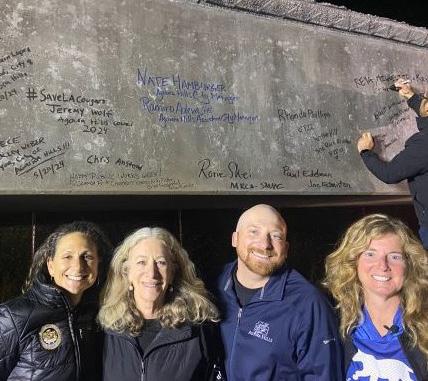
Los Angeles residents hadachanceto celebrate Taiwanese American Heritage Week at the Taiwan Boba Tea Festival, a celebration of Taiwan's cultural heritage through its globally beloved boba tea, on Saturday at Barnes Park in Monterey Park.
As part of Asian Pacific American Heritage Month, celebrated annually in May, the "Taiwanese American Heritage Week" showcases the rich heritage of Taiwan and Taiwanese American communities. Led by the Greater Los Angeles Taiwan Center and the Taiwanese American Heritage Week Committee, this year's festival marked a successful collaboration with the Taipei Economic & Cultural Office in Los Angeles.
The festival aimed to introduce attendees to the cultural significance of boba tea, a beverage originating from Taiwan, through a

diverse selection of boba tea flavors, activities, and interactive experiences.
Taiwanese beverage companies, including Xing Fu Tang, Hanlin, Taro Yuan, THE ALLEY, Sunrise Tea Studio, LA Tea, Just Boba, and 85C Bakery Cafe, participated in the festival to jointly share Taiwan's rich culinary heritage with attendees.
TECO-LA displayed a “Taiwan Boba Tea Festival”
Local wildlife enthusiasts are buzzing Tuesday in response to video that appears to have captured another mountain lion in Griffith Park, which was long home to the famed P-22 "Hollywood Cat" until his death in December 2022.
Thursday • May 23
photo wall, serving as a picturesque backdrop for attendees to capture memorable moments, and offered guests themed towels and other giveaways as they explored Taiwanese culinary delights. In addition, TECO-LA hosted a booth dedicated to supporting Taiwan's participation at the upcoming 77th World Health Assembly which will be held in Geneva, Switzerland, on May 27.
7:30PM • Breaking The Ice Open Mic
Friday • May 24
7:30PM • Ladies Love Comedy
8PM • Jiaoying Summers
Saturday • May 25
5PM • Deez Nuts
8PM
Sunday • May 26
A resident recently captured video of the lion while parking at his apartment building off Barham Boulevard. Vladimir Polumiskov told the Los Angeles Times he and his wife and son had just returned from dinner when they spotted the cat in his car's headlights.
The sighting is still in the process of being verified by the National Park Service, which tracks lions and their movements in the Santa Monica Mountains. But fans of P-22 were enthusiastic about the possibility of Griffith Park welcoming another big cat.
"Exciting news!" Beth Pratt of the National Wildlife Federation proclaimed on social media on Sunday after the news began spreading. "We have been getting some reports of a mountain lion sighted in Griffith Park. The (NPS) biologists have been alerted and are investigating.
"Please give the cat space if you see him — we are trying to avoid for now people trying to photograph him — lights and sounds from cameras could impact this cat's behavior as we don't know if he is as comfortable in front of the cameras as
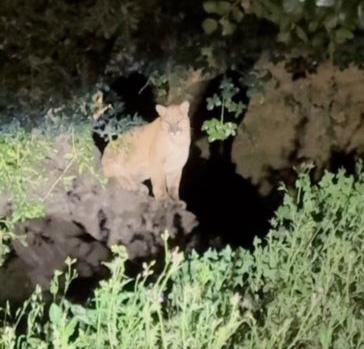
P-22," Pratt wrote. "And even P-22 would avoid cameras as well. If you do see him, please let us know as this will help the researchers. He is not collared."
If the sighting is confirmed and the cat is captured and fitted with an NPS tracking collar, it would be dubbed P-122, Pratt said.
J.P. Rose, urban wildlands policy director at the Center for Biological Diversity, called the sighting a "wonderful reminder that iconic pumas live among us, even in one of the most populated cities in the U.S."
"Like P-22, this young cat has to navigate dangerous roads, development and poisons on the landscape to survive," Rose said in a statement. "It's good timing that state lawmakers are voting on two bills this week that would improve wildlife connectivity and
restrict the use of deadly rat poisons. Let's hope they use this opportunity to pass the Room to Roam Act and the Poison-free Wildlife Act so our wild neighbors can thrive."
P-22 was long the face of the NPS' lion-tracking project. He gained fame for persisting in the urban environment, and managed to successfully cross both the San Diego (405) and Hollywood (101) freeways to reach Griffith Park. He was occasionally caught on camera as he roamed through Griffith Park. He was euthanized in December 2022 after a series of strange behavior that led to concerns about his health. Experts captured the cat and determined he was suffering from an array of health problems, leading to the decision to euthanize him.