
Housing: Court rejects HB suit vs. state; La Habra Heights to submit plan

MONDAY, NOVEMBER 11- NOVEMBER 17, 2024

Housing: Court rejects HB suit vs. state; La Habra Heights to submit plan
MONDAY, NOVEMBER 11- NOVEMBER 17, 2024
By Joe Taglieri joet@beaconmedianews.com
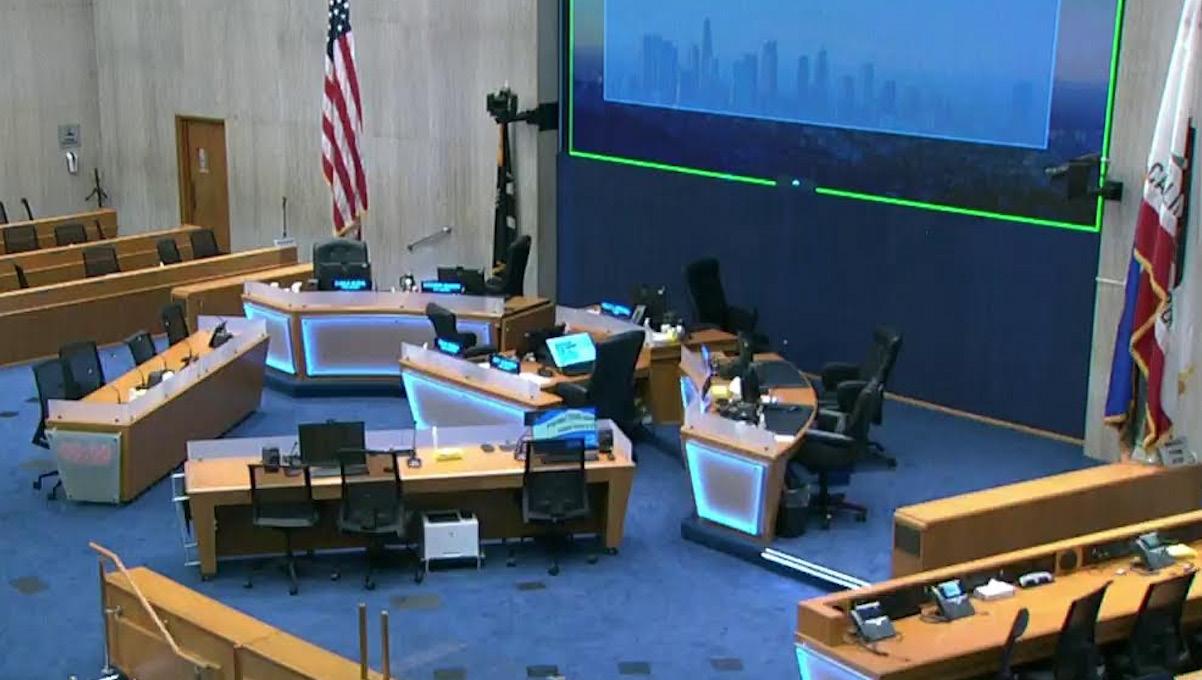
Los Angeles County voters turned out in favor of raising the sales tax a half-cent to fund homelessness programs but were divided on expanding the Board of Supervisors and other government restructuring, according to election results released Wednesday afternoon.
Supporters of Measure A, which extended and raised a sales tax for anti-homelessness programs, declared victory Wednesday as votecounting continued.
According to the Registrar-Recorder/County Clerk’s Office, Measure A passed with 55.8% and nearly 300,000 more yes than no votes. More than 1.1 million ballots from Tuesday’s election still need to be counted — roughly 1 million vote-by-mail ballots, 104,000 conditional voter registration ballots and 12,100 provisional ballots. The county will also accept vote-by-mail ballots for a
week if they have a postmark no later than Nov. 5.
Despite the still-to-becounted votes, the Yes on Measure A campaign declared victory Wednesday afternoon.
“The passage of Measure A demonstrates the power of what can be accomplished when working families join with over 150 community organizations, homeless services providers, housing advocates, local and elected officials to find solutions to the issues facing our communities,” Yvonne Wheeler, president of the LA Federation of Labor, AFL-CIO, said in a statement. “We look forward to continuing to work together to bring about the change voters want and our county needs.”
David Green, president of the Service Employees International Union Local 721, said the measure’s passage was a “historic vote” for LA county.
“Voters are clear that
they want bold solutions to addressing our county’s most pressing issue,” Green said in a statement.
“Measure A gives us the tools to do just that. Because of the investment voters are willing to make, we’ll be able to implement and expand proven solutions to reduce homelessness while making Los Angeles County more affordable.”
The coalition of supporters who led the initiative drive that got the measure on the ballot included more than 80 organizations, including the L.A. County Federation of Labor, California Community Foundation, United Way of Greater Los Angeles, Los Angeles/ Orange Counties Building and Construction Trades Council, SEIU 721, among others.
Proponents,which included more than 80 labor and charitable organizations, said they aim
to dedicate more funding generated from the halfcent sales tax to add more affordable housing, increase access to treatment for mental health disorders and drug addiction and enhance accountability measures via a legal requirement to deliver results.
According to Measure A, 60% of the sales tax revenue will fund homelessness services with 15% of that distributed to cities based on the annual count of county residents experiencing homelessness. Another 35.75% of the revenue will fund the county’s Affordable Housing Solutions Agency, established last year under state law to oversee efforts to reduce homelessness.
The ballot measure’s opponents argued it would create an endless tax burden on residents with no guar-
Newsom calls special legislative session to prepare for Trump administration
Report: Housing affordability improves slightly in LA city, declines in county

Los Angeles city homebuyers got some good news in the third quarter of 2024 with housing affordability improving slightly from the previous quarter, while fewer county house purchasers could afford a home in the same quarter, the California Association of Realtors announced Thursday.
Eleven percent of LA County households could afford to buy the $947,480 median-priced home in the third quarter of the year, down from 13% in the second quarter of 2024, and mirroring the 11% in third-quarter 2023, according to the association.
A minimum annual income of $237,600 was needed to make monthly payments of $5,940, including principal, interest and taxes on a 30-year fixed-rate mortgage at a 6.63% interest rate, the report said.
In the LA metro area, 15% of households could afford to buy the $827,000 median-priced home in the third quarter of 2024, up from 14% in the third quarter of 2023 and up from 13% in the second quarter of this year. A minimum qualifying income of $207,600 was needed to make monthly payments of $5,190.
In Orange County — considered by CAR one of the least-affordable counties in
California — 12% of households could afford to buy the $1.39 million median-priced home in the third quarter of the year, up from 11% in the last quarter of 2023, and the same percentage as secondquarter 2024, according to the association.
A minimum annual income of $350,800 was needed to make monthly payments of $8,770, including principal, interest and taxes on a 30-year fixed-rate mortgage at a 6.63% interest rate, the report said.
Sixteen percent of California households could afford to purchase the $880,250 statewidemedian-priced home in the third quarter of 2024, up from 14% in secondquarter 2024 and up from 15% in third-quarter 2023, CAR said.
A minimum annual income of $220,800 was needed to make monthly payments of $5,520, including principal, interest and taxes on a 30-year fixed-rate mortgage at a 6.63% interest rate, the report said.
Also statewide, 25% of home buyers were able to purchase the $670,000 median-priced condo or townhome.Aminimum annual income of $168,000 was required to make a monthly payment of $4,200, according to the association.
By Joe Taglieri joet@beaconmedianews.com
The clash between the state and some Southern California cities over affordable housing continued in recent weeks with a federal court dismissing Huntington Beach’s lawsuit and La Habra Heights agreeing to develop a housing element compliant with state law.
On Oct. 30 the federal 9th Circuit Court of Appeals’ decision was the latest in a legal battle that began in March 2023 when the state sued Huntington Beach for violating state housing laws. The city then sued the state in federal court, claiming that requiring cities to build more residential units was unconstitutional.
“Yet another court has slapped down Huntington Beach’s cynical attempt to prevent the state from enforcing our housing laws,” Newsom said in a statement.
“Huntington Beach officials’ continued efforts to advance plainly unlawful NIMBY policies are failing their own citizens — by wasting time and taxpayer dollars that could be used to create much-needed housing. No more excuses — every city must follow state law and do its part to build more housing.”
Attorney General Rob Bonta said in a statement he was “pleased that yet another court has emphatically rejected Huntington Beach’s attempt to exempt itself from state housing laws. While the city has been wasting the public’s time and money pursuing this meritless lawsuit, its neighboring communities — along with every Californian struggling to keep a roof over their heads or wondering where they’re going to sleep tonight — need Huntington Beach to step up and adopt a housing plan without further delay.”
Huntington Beach City Attorney Michael Gates said he will seek an “en banc rehearing” of the case by all of the appeals court’s 29 judges, which could overturn the three-judge panel’s ruling. If that fails, the city could petition the U.S. Supreme Court to hear the case.
“Based on the hearing, I’m not surprised by the decision,” Gates said in an email to the Pasadena Independent. “What I am surprised by is the brevity of

the decision, and, that the decision ignores an entire body of decades of law that holds Charter Cities are NOT political subdivisions of the State. Because of this, the 9th Circuit’s reliance on the South Lake Tahoe and Burbank cases is error — as those did concern political subdivisions.
“Because of this error, we’ll Petition for En Banc rehearing,” Gates said. “It’s such an important case, we’ll take it to the U.S. Supreme Court if need be.”
The court issued its opinion Oct. 21, rejecting the city’s claim that as a charter municipality it has greater authority than a general law municipality to act outside of legal boundaries set by state lawmakers.
The appellate panel affirmed a November 2023 ruling by U.S. District Judge Fred Slaughter.
“The city argues that our standing bar does not apply because Huntington Beach is a charter city, which it claims is not a ‘political subdivision’” of the state, according to the appeals court opinion. “No matter how California categorizes charter cities, they remain subordinate political bodies, not sovereign entities.”
The court also opined that the city did not have legal standing to challenge the state in federal court, and the judges also quashed a constitutional claim by Councilman Tony Strickland and Mayor Gracey Van Der Mark.
The council members “do not explain how they suffered a constitutional
injury absent their roles as local officials,” according to the court. “So while the city officials retain personal free speech rights, they cannot invoke those rights to avoid executing `laws within their charge.’”
According to the city’s lawsuit, the state’s requirement for affordable housing would result in approximately 40,000 new highdensity units in Huntington Beach over the next several years.
Mayor Pro Tem Pat Burns had harsh words for the governor.
“Newsom is a tyrant,” he said in an email to the PasadenaIndependent. “With the population of HB projected to decrease, as is California’s, and an increase in housing already projected to increase, why is more housing needed? I have never heard an explanation from Newsom or his Administration to this question. Is he trying to ruin capitalism within California?
“If there is a housing ‘shortage,’ why is (the Newsomadministration) letting an unbelievable and uncountable number of illegal entries into our state and country?” Burns said. “Like the homeless Newsom created ‘crisis,’ this is another Newson scam to grab more power and to enrich himself and/ or his cronies. He is shameless in the brazen push he is making California move toward Socialism/Communism.”
CouncilmanDan Kalmick said he didn’t think the Supreme Court would
take up the case “because it does not have national importance,” he told City News Service, adding that the opinion came “very fast, which should tell you something.”
Kalmick said additional appeals are a “fool’s errand when there are political solutions, not legal solutions to the issues being brought.”
Burns said “the courts should recognize and respect the City of Huntington Beach to self-govern and to let us have local control as outlined in the Constitution of California. Newsom should also respect our disrespect for him and leave Huntington Beach alone.”
The appeals court’s decision filing under case No. 23-3694 is available online.
La Habra Heights
On Nov. 1, Newsom and Bonta announced the state has entered into a stipulated judgment with La Habra Heights, putting the city on an hastened schedule to submit a compliant housing element
The new plan must create 244 units, with at least 164 affordable for lowor very-low-income households.
“No more excuses — every community has a responsibility to create housing and to help reduce homelessness,” Newsom said again in a statement. “I am pleased that La Habra Heights has come to the table and agreed to meet their housing goals for a community that desperately needs more affordable homes.”
Bonta said the city “has done the right thing. Instead of continuing to skirt California’s housing laws, it will finally be complying with its legal obligation to plan for 244 housing units. My office will not let up: no matter the size of the city or county, we will not rest until every local government in California plans for the future and does its part to tackle our housing crisis.”
La Habra Heights city officials did not immediately respond to requests for comment.
La Habra Heights is a “high opportunity jurisdiction,” according to the California Tax Credit Allocation Committee and California Department of Housing and Community Development. That designation indicates access to good schools, less pollution and jobs, which are all factors that impact longterm success for families with children.
Currently La Habra Heights has only singlefamily homes, no multifamily housing and no affordable units, state officials said. The deadline for the city to approve a compliant housing element was October 2021.
“After repeated attempts to assist the city to come into compliance,” the state Housing Accountability Unit issued a Notice of Violation on March 19. HCD and the Attorney General’s Office then worked to reach the compliance agreement with La Habra Heights.
State officials said that until La Habra Heights
fulfills obligations spelled out in the agreement, the city will be subject to the “Builder’s Remedy” and can’t refuse to allow certain affordable housing projects. The city also remains ineligible for state housing and homelessness funding.
The state has now entered into five agreements over housing element compliance. The other cities are San Bernardino, Coronado, Malibu and Fullerton.
“This latest agreement is a key example of why it is so important that every city, big and small, is held accountable for doing its fair share to address the statewide housing need,” HCD Director Gustavo Velasquez said in a statement. “When La Habra Heights adopts a compliant housing element, it will — for the first time ever — make land available for multifamily and affordable housing, creating a path to opportunity for more families in this highresource community.”
State officials said governments “must take deliberate action to Affirmatively Further Fair Housing — combating disparities resulting from past patterns of segregation. Increasing supply of multifamily housing expands access to fair housing for lower-income and historically disadvantaged groups, in turn fostering more inclusive communities.”
Since Newsom took office in 2019, the state has spent $40 billion to stimulate housing construction. The state has also invested more than $27 billion to assist communities in addressing homelessness.
According to Newsom’s office, he championed the creation of HCD’s Housing Accountability Unit to make sure local governments “fulfill their legal responsibilities to plan and permit their fair share of housing.” Officials said this focus on accountability has partially led to a 15-year high in housing starts statewide. Since its 2021 establishment, the Housing Accountability Unit has supported the development of 7,513 housing units, including 2,765 affordable units by doing enforcement actions and by working with cities and counties to ensure compliance with state law.
Editorial editorial@beaconmedianews.com
editor@hlrmedia.com
Graphics/Production production@beaconmedianews.com production@hlrmedia.com
Advertising advertising@beaconmedianews.com advertising@hlrmedia.com
Legal Advertising legals@beaconmedianews.com legals@hlrmedia.com
Business accounting@beaconmedianews.com accounting@hlrmedia.com
BEACON MEDIA ADDRESS: 820 S. Myrtle Ave. Monrovia, CA 91016
PHONE: (626) 301-1010
WEBSITE www.beaconmedianews.com
HLR MEDIA ADDRESS: 820 S. Myrtle Ave. Monrovia, CA 91016
PHONE: (626) 301-1010
www.HLRmedia.com
PRESS RELEASE
editor@beaconmedianews.com editor@hlrmedia.com






By City News Service
With Vice President Kamala Harris officially conceding defeat to Republican President-elect Donald Trump, heavily Democratic California elected officials and community leaders vowed to work with the nation’s new leader but continue fighting for the party’s ideals.
“No matter what, Angelenos will always protect each other,” Los Angeles Mayor Karen Bass said in a statement Wednesday after Harris gave her concession speech in Washington, D.C. “The fabric of our city is woven by the hearts of people from all over the world coming together in pursuit of opportunity and equity. That’s who we are — and that’s what our policies in the city of Los Angeles will uphold.
“Vice President Kamala Harris has inspired millions all over the country and all over the world — and she continues to do so. It’s our responsibility to ensure that the flame she has lit still burns bright. We will fill the sky with stars. No matter where you were born, how you came to this country, how you worship, or who you love, Los Angeles will stand with you. This is not a time for despair, this is a time for action. I’ve spoken with leaders across the city, the state and the country. We are ready.”

engaged and stay in the fight. Not because it’s easy, but because it’s important.”
Former LA-area Assemblyman Mike Gatto, a Democrat, wrote on X that the party needs to reassess its “messaging.”







Gov. Gavin Newsom issued a statement saying the state “will seek to work with the incoming president -- but let there be no mistake, we intend to stand with states across our nation to defend our Constitution and uphold the rule of law. Federalism is the cornerstone of democracy. It’s the United STATES of America.”
He noted that “though this is not the outcome we wanted, our fight for freedom and opportunity endures.”
Sen. Alex Padilla, D-California and a former Los Angeles City Council member and state senator, wrote on X, “Progress does not always come easily or quickly.”
“This election was a difficult reminder of that, but the work will continue,” he wrote. “To ensure hardworking Americans can provide for their families. To protect vulnerable communities. To defend our democracy. We must stay
“For years, many Democrats called Trump ‘Hitler,’” he wrote. “What does it say about our messaging if we lost to ‘Hitler?’ If your reply is that ‘HALF the country is crazy,’ then you’re part of the problem. Dems have a LOT of work to do to appeal again to everyday, workingclass voters.”
Joe Hollendoner, CEO of the Los Angeles LGBT Center, issued a statement saying he understands that many people “are feeling anxious and uncertain about the future.”
“The outcome of this election understandably raises serious fears about the direction our country will take, given the president-elect’s history of attacking our rights and dignity,” Hollendoner said. “We want to acknowledge those fears because they are real and valid.
“But let us be clear: Our fight for equality, justice, and dignity is not defined by the outcome of this election. In fact, these results only strengthen our
resolve. We are a community rooted in resilience, strength, and the unshakable belief that we deserve to live and love freely without fear of discrimination or violence.”
Republican Rep. Darrell Issa, whose 48th district includes parts of Orange, San Diego and Riverside counties, said Trump’s win was a clear mandate from voters for a change.
“Last night, with clear intent, bright hope, and in numbers too large and too widespread to dismiss, the American people voted for a fresh start, a new direction, and a nation as great as ever,” Issa said in a statement. “One of the signature reasons why President Trump was re-elected was a vote of confidence by more than 70 million fellow citizens that he will steer the nation away from four years of failure and chart a new and better course of opportunity for all Americans.
“In that mission, he will need partners as determined as he is, and I believe Republican majorities in the House and Senate will be ready to work, lead, and succeed. America has been through a lot over the last four years, and we have the chance to show our best and
deliver a rebuilt economy, a restored national defense, and a real border that protects the homeland.”
But Democrat Hilda Solis, a member of the Los Angeles County Board of Supervisors, insisted the past four years of Democratic leadership have been a success, “including historic investments in infrastructure, pulling us out of a once-in-a-generation pandemic, and passing the most consequential environmental legislation in decades.”
“Today is a difficult day for many of our communities in Los Angeles County,” Solis said in a statement. “We have seen what four years of a Trump Administration looks like and know that it is our most vulnerable residents that will face the greatest harm. I am grateful to live in a county and a state that have repudiated xenophobia, racism, homophobia, and the politics of fear that drove this election. I remain steadfast in my commitment to stand up for social justice, reproductive rights, keep families together, and ensure that Los Angeles County remains a welcoming place for all regardless of race, gender, or where they were born.”
By Ben Popken, Stacker
Chances are you're guilty of "media multitasking"—and you might not even realize it.
Media multitasking can take several forms, like using your phone during a real-life social interaction. Reviewing Instagram comments while talking to a friend is one prime example. It can also mean performing tasks simultaneously on multiple forms of media, such as watching television while also posting on Facebook, or doing multiple tasks on one medium, such as listening to music while watching a video and writing emails on your laptop.
Officially, media multitasking means "monitoring and interacting with multiple streams of information simultaneously while also engaging in other tasks," according to a 2022 Scientific Reports study. Though common, there are lots of costs to this behavior, including a lack of concentration, memory lapses, and forgetfulness.
ADHD Advisor investigated the impacts of media multitasking on attention and memory recall using scientific, peer-reviewed research studies.
In the Scientific Reports study, subjects were invited to use an electronic screen to estimate a line's length and count dots. The tasks were presented individually or simultaneously and allowed participants to choose which to do or to switch between the tasks. Those who were presented with more than one task at a time had a "significant" decrease in their accuracy, and response time also suffered for participants in the scenarios involving
counting.
In a different study, researchers at Stanford University found that media multitasking negatively impacts both working and long-term memory and is associated with memory lapses and forgetfulness.
Those who think they're effectively multitasking are actually doing more things poorly. Engaging in multiple simultaneous activities can make it seem like more tasks are achieved. However, research shows overall net productivity is lower than if you did each activity individually, known as "monotasking."
If you're struggling to stay focused in a mediasaturated environment, these tips will help you stay on task.
The Pomodoro method
The name of this technique comes from its Italian creator who used a kitchen timer shaped like a tomato ("pomodoro" in Italian) to help focus while studying. Alternate 25-minute work sessions (pomodoros) with five-minute breaks. After four pomodoros, take a 20-minute break to recharge.
At the beginning of your work day, you decide how much time you can allocate to pomodoros, then divide your batched tasks and projects into an estimated number of pomodoros needed for completion. Distractions and interruptions will crop up, but the method requires they be delayed, deferred, or written down to address later.
If you have to stop a pomodoro, you take a short break and restart it. If you finish a task early, review and refine your work until
the time is up. Studies show that working using a pomodoro-style system increases focus and decreases fatigue.
The GTD method
Often the hardest part of completing a task is getting started. Procrastination gets worse when our sticky notes are full of vague and sprawling projects like "taxes," "back to school," and "clean up for guests." Enter "Getting Things Done," or GTD, a method drawn from productivity expert David Allen's course and book. It's like a to-do list with superpowers.
GTD breaks every project in your life into the individual "next action" it takes to do it. Need to clean the garage, but oh wait, the garage is locked? Write down "look for key in junk drawer." Once you have that little task figured out, it's much easier to feel productive and keep the momentum to bang out the rest of the task.
The GTD approach can take a few hours to set up and requires daily and weekly maintenance to keep running smoothly. But once it gets going and you achieve "mind like water"—a state of clarity and focus where creativity and responsiveness come naturally—you'll flow with ease and focus from one task to the next.
Block distractions
The other way to increase focus is to block distractions that steal our attention. Depending on the most common interruptions you experience, there are various ways to achieve this.
Some people are especially distracted by auditory and visual stimuli. They might choose to work in a room with a door they can


shut, wear noise-canceling headphones or earplugs, or get up early in the morning before anyone else is awake. They reduce visual triggers by wearing a large-brimmed baseball cap, working with their desk facing the wall, or setting up a portable cardboard divider around their work area.
Other people find themselves especially distracted by social media. They can benefit from disabling notifications, using apps or devices that temporarily block social media and other noncritical apps, or deleting their social media apps and accounts entirely. There are also special single-purpose word processing apps and distraction-free devices that only allow for text entry, removing all attentiongrabbing apps and toolbars.
One can also just use paper and a pen, as long as you don't need to sync to the
cloud.
Make it a game
There are those who breeze through their to-do lists, motivated by the pure joy of productivity and the satisfaction of a job done to its completion, driven by "intrinsic motivation."
Others need a little more help. For instance, research shows that people with ADHD possess lower levels of intrinsic motivation and respond better to "extrinsic" or external motivation, such as praise, prizes, money, etc.
Video games have practically perfected the art of motivating users to keep them. Instead of being distracted from your work by video games, you can use video games to get more work done by turning your work into a game.
Some productivity game apps are designed to be roleplaying games, like Habitica, which features levels,
swords, wizards, and gold coins. Others tokenize your productivity into units that nurture a virtual ecosystem (Forest), clean up a bunny's house (Habit Rabbit), or have you ascend a ranking system and prod you to keep going with guilt-inducing humor (Productivity Challenge Timer) and the threat of losing hard-won rank. Some people don't respond to "gamification" while others love it. The bottom line is that productivity is about whatever works best for you.
Story editing by Alizah Salario. Additional editing by Kelly Glass. Copy editing by Tim Bruns. Photo selection by Lacy Kerrick. This story originally appeared on ADHD Advisor and was produced and distributed in partnership with Stacker Studio.
Re-published with CC BY-NC 4.0 License.
For months, Wendy Rodas felt disempowered and silenced whenever she tried to reach out to her daughter’s Missouri elementary school.
The El Salvadorian mother of three, who primarily speaks Spanish, struggled to communicate with teachers, administrators, and district leaders. She made repeated requests for the interpretation services that she—and all public school parents who don’t speak English fluently—are legally entitled to.
In most of her exchanges with the school, Rodas said she wasn’t even offered access to a phone translation service. If she ever needed to inform them of something like an absence or a kid running late, she had to rely on her older son to translate, The 74 reports.
This reached a fever pitch in the fall of 2022, when Rodas’s daughter, then a 5th grader in South Kansas City, told her mom that two kids at school “were touching her inappropriately in her private parts.” When Rodas contacted the school to report this, they initially provided her with a phone interpreter, she said, but as the situation escalated over the next few months, communication dwindled.
At a meeting with district leaders to discuss the assault allegation and the attacks on her daughter that Rodas said took place afterward, the mom said she was denied any school-provided interpretation services.
“I felt powerless, not being able to say what I wanted to say, how I wanted to say it, in the manner and moment that I wanted to say it,” Rodas said in a translated interview with The 74. “And it also made me feel bad. There were a lot of times that I felt … if I was not like them—because I can’t speak the language—that I didn’t belong there. I felt ignored.”
Rodas’s experiences are not unique, according to interviews with over a dozen parents, advocates, lawyers, and academic experts, along with a review of national data. Parents and families who speak a language other than English are frequently denied access to communication from their child’s school in their primary language, often turning to Google translate, their own kid, or a bilingual staff member who isn’t a trained
By Amanda Geduld - The 74, Stacker

interpreter for issues as simple as their child being absent for a day or as complex and intimidating as a special education meeting or a school disciplinary hearing.
All of this can lead to a breakdown in trust between families and schools and harmful consequences for students—and it’s happening all the time in districts across the country, advocates say.
“It’s such a prevalent issue that everybody knows about it,” said Nancy Leon, director of the D.C.-based immigrationadvocacy organization MLOV—Many Languages, One Voice. “It’s unspoken. It’s expected. So sometimes it’s something parents don’t even bring up to us because it just happens so frequently.”
It’s challenging to pin down just how widespread the problem is because a number of parents don’t know that they’re legally entitled to these services, advocates say, and those who do know their rights are often afraid to report violations or unaware of how to tackle that process. Others still may feel embarrassed to request the services, viewing their status as shameful or a burden.
Another Missouri mom told The 74 that she marked on enrollment papers that she needed an interpreter, but then when her son got hurt at school one day, was put on the phone with someone whose Spanish was so poor that she just told them to speak to her in English.
One measure of the
extent of the problem is the number of times children are called on to interpret for their parents at school.
Tricia McGhee, director of communications at Midwest-based Revolución Educativa, said they put that question to kids when the advocacy group is doing programming with Spanishspeaking families.
When they ask, “’Have you ever been [an] interpreter for your mom?’ They all raise their hand,” she said. “Every last one of them.’”
Countless Examples
This year marks the 60th anniversary of The Civil Rights Act, which granted families the legal right to interpretation and translation services from public K-12 schools under Title VI.
Unlike for legal and medical interpreters, there is no national certification for education interpreters, though one is in the works, according to Ana Soler, chairperson at the National Association of Educational Translators and Interpreters of Spoken Languages. This leaves those in education largely unregulated, which means that even when parents do get an interpreter, they might not have sufficient training or expertise. And, they’re frequently accessed through a phone service, described by some as “check-off-the-box” language access.
In 2023, the Department of Education’s Office for Civil Rights received about 3,500 complaint allegations raising Title VI issues. Of those, only 54 were related to communication with parents who don’t speak English
fluently. They ranged from a child in Colorado denied access to free and reducedprice lunch—and later fined—because of miscommunication to a Rhode Island district’s widespread use of untrained interpreters and translators. The previous year, there were even fewer communication-based complaints filed: just 34.
But experts, advocates, and parents assert that these numbers represent a sliver of the problem.
“We have seen countless examples of schools not providing interpretation at meetings, of parents going to schools and being told that there isn’t anybody there who speaks their language, and so they should come back at another time,” said Rita Rodriguez-Engberg, director of the Immigrant Students’ Rights Project at Advocates for Children of New York.
“Whenever we hear about an example in a school, we know that there are probably dozens of parents who have gone through the same thing at that school because we’re lucky enough to get the one parent to tell us about it,” she added.
The Legal Standard: ‘A Very Tricky Balance’
In 2021, just over 10% of K-12 students nationally were English learners. In some states the percentage of children whose parents are not fluent in English can be even higher, ranging from 33% in California to nearly none in Montana, according to Education Week research. And in 2021, about onefifth of school-age children spoke a language other than
misunderstood or flagrantly violated, experts and parents told The 74. And some argue the guidance doesn’t go far enough.
“Quite frankly, the verbiage is left up to interpretation,” said Revolución Educativa’s McGhee. “So if I were passing laws, I would be much more specific about the requirements.”
The standard is not completely clear when it comes to school staff who are multilingual serving as interpreters, said Paige Duggins-Clay, chief legal analyst at the Texas-based Intercultural Development Research Association, so “it’s a very tricky balance.”
English at home and about 4% also lived in “limitedEnglish-speaking households.”
The 2023 Family Needs Assessment, which surveyed 980 families, the vast majority of whom identified as Latino with kids who are English learners, reported almost 60% of parents being at least somewhat concerned about the lack of access to translation or interpretation services at school.
In January 2015, the departments of Justice and Education released joint guidance outlining what these services should look like: Schools must communicate with parents in a language they understand and are prohibited from asking “the child, other students, or untrained school staff to translate or interpret.”
Interpreters and translators must have knowledge of specialized terms in both languages and must be trained in the role, including the ethics of interpreting and translating. The document clearly establishes, “it is not sufficient for the staff merely to be bilingual.”
It’s important that families understand “this is not a favor they’re doing for you,” said Soler. “They need to provide you with language access that is quality language access—not just anybody that speaks a little bit of one language so that they can fulfill their requirements.”
Despite their legal heft, these provisions are often
And when these rights are not sufficiently met—and parents are hobbled in their efforts to advocate for their children—the consequences can be deeply harmful to both students and families.
“Having a really engaged caregiver is critically important to the success of any young person,” said DugginsClay, “but especially a young person who might be new to the school community or might be learning to speak English and integrating into the broader school community.”
Often schools and districts claim interpretation and translation services are expensive and budgets are tight or they don’t have access to certain languages locally, said Alejandra Vázquez Baur, a fellow at The Century Foundation, a progressive think tank based in New York City.
But, she said, these are all barriers that can be overcome.
Schools have also increasingly struggled to recruit and retain bilingual educators, though Vázquez Baur, who is bilingual and a former teacher, again emphasized that merely speaking another language is not enough.
When she taught in Florida’s Miami-Dade County between 2017-19, she said she was frequently relied on to translate and interpret for families.
At the time, Vázquez Baur said, “I did not realize that them calling me down for parent-teacher conferences for other teachers and calling parents for all the different things was against their right.”
Superintendents and school leaders across the country want to fulfill their legal obligation and communicate effectively with their parents, but are often thwarted by an “implementation gap,” according to John Malloy, the assistant executive director for the Learning Network at The School Superintendents Association and a former superintendent in California.
The challenge comes from both pipeline and funding issues, he said: “There’s a lack of professionals to fulfill that [legal] obligation, and then there’s a lack of dollars to pay those professionals.”
The problem is endemic, he added, noting, “I think you’d be hard pressed to find a district—even in the face of our legal obligations—who isn’t struggling [with this].”
In order to combat it, Malloy said, schools will require increased state and federal funding.
“Too often in my experience—whether we’re talking special education, whether we’re talking Title IX, whether we’re talking this important and legal requirement related to access— we’re stretching dollars in multiple ways,” the former superintendent of 15 years said. “And at the end of the day, we are expected to do something that we might not actually have the resources to provide no matter how hard we try.”
Until then, school leaders will continue to rely on other strategies, such as family members or untrained bilingual staff, according to Malloy.
The school principal of a rural, low-income district in Eastern North Carolina told The 74 that he was able to hire a front office secretary who is both bilingual and a trained interpreter.
“But most people aren’t that lucky,” said Patrick Greene, who is in his 12th year as principal in Greene County Schools, a district of 2,700 students.
Finding a trained, bilingual staff member was important to him because his
student population is now about a third Latino, with only one designated interpreter for the entire district.
Greene said he was forced to schedule “more official” meetings, such as disciplinary hearings, around that lone staffer’s schedule.
“He stays very busy,” he said.
All of the Great Details Are Just Gone
Alejandra, who moved from Mexico to Missouri two decades ago, gave birth to her son Danny three years later. Described by his mother as a bright, hyperactive kid, Danny was in third grade when he was badly injured on the monkey bars at school.
Alejandra requested only her first name and her son’s nickname be used because she feared retaliation from her son’s school district.
After Danny walked himself to the nurse’s office that day—and after the initial interpreter spoke such poor Spanish that Alejandra told her to switch to English—it was the little boy himself who had to explain the fraught situation to his mom.
“It was very frustrating,” she added, “because they ended up using my child as the interpreter.”
This experience was not new, nor has it changed in the years since. Alejandra said that in general, when her kids were in elementary school, the school would make an interpreter available, but only if she scheduled an appointment ahead of time.
“In middle school, there are no interpreters. You have to bring your own person that will help you. And for high school? Definitely not.”
In general, even when interpretation has been provided, she described it as subpar and largely unhelpful, marked by translators who cross boundaries, interjecting their views into conversations in ways that she said were inappropriate and ultimately hurt her son.
“Oftentimes, what I’ve experienced is that when they’re part of the district,

they insert themselves in the situation,” she said. “Their own bias comes in, they give their own opinions, and then they get in the way of the proper communication that should just be a bridge between one party and the other.”
It’s often in the face of these deficiencies that the student gets called on to translate. Not only is this a violation of the law, but also makes families feel disconnected from their schools and leads to an adultification of children, said Daysi Ximena Diaz-Strong, an assistant professor at the University of Chicago’s School of Social Work.
“It creates a kind of interesting family dynamic of parents wanting to support their kids, but having these sort of structural constraints, which then forces the kids to take on more responsibility within the home.”
She said as someone who grew up as an immigrant and took on these responsibilities herself, “It stays with you all the way through adulthood. You just know that you … are responsible for your family’s well-being and that you must take on that burden at any expense— including your own.”
Sometimes, students are even pulled to be translators for their peers, according to Hannah Liu, a policy analyst at the The Center for Law and Social Policy in D.C.
It’s not just an individual school issue, she said, “it’s a
very widespread issue. And I think that’s something that’s been normalized in the immigrant child experience … We need to denormalize and say, ‘OK, actually, we are not supporting our kids enough.’”
McGhee, of Revolución Educativa, said unless translation is requested in advance, it’s typically not available and even when established advocacy groups like hers make the ask, often it’s still not provided. What happens then, she said, is administrators will pull in someone like a bilingual secretary to fill the gap.
“If the student is a middle schooler or above, they are doing all their own interpretation,” she said.
McGhee said she once sat in on an emotionally charged disciplinary hearing for an English learner facing expulsion. His mom didn’t speak English, so the school ultimately brought in a young, bilingual staff member who worked in the front office but had no training in interpretation.
As the meeting intensified, the staff member grew increasingly emotional and began to cry. McGhee said she turned to her and offered to take over.
McGhee said she’s also witnessed meetings where bilingual staff members are burned out and frustrated after being repeatedly asked to do this work and therefore do the bare minimum.
Christy Moreno, commu-
nity advocacy and impact officer at Revolución Educativa and a trained language access provider, emphasized the harm that is done when this happens. Moreno interpreted the parent interviews for this article.
“Oftentimes what I see and what I experience and what I hear about is meetings where when the information is translated into their language of preference, it’s summarized,” she said. “So all of the great detail, all of the very important things that need to be taken into consideration when families are making decisions about the educational experience of their children, are just gone. And so they’re disenfranchised. Someone else is making decisions for them without their true input and ultimately that impacts their student, the child.”
She’s even seen cases in which legal documents, such as Individualized Education Programs, are translated using Google: “I’ve seen it many times, literally printed on the IEP where the top corner says ‘Translated by Google Translate.’”
“It’s not really a system that’s working,” said Rodriguez-Engberg, from Advocates for Children.
“The problem is that there are resources and there is guidance and there’s definitely a little bit of oversight, it’s just that I’m not sure the schools are actually being held accountable.”
Unlike federal laws that protect students with disabilities, she added, the enforcement mechanisms just aren’t very robust.
“I Want People to Know My Story”
Wendy Rodas said her daughter was hospitalized in December 2022 as a result of being victimized in her Missouri school, and that her son was forced to interpret a challenging conversation between his mother and the school principal about his younger sister’s traumatizing experiences.
Eventually, frustrated by the school’s lack of response, Rodas involved Child Protective Services and requested a
meeting with the principal, superintendent, and director of student services. She also requested an interpreter be present.
At this point, a skeptical Rodas also elicited outside help from Revolución Educativa. On the morning of the meeting, the interpreter she had requested from the school wasn’t there, she said. A staff member in the session tried unsuccessfully to access one on the phone. Finally, the Revolución Educativa advocate, a trained interpreter, stepped in.
For the first time, Rodas said, “I felt like I was finally able to say everything I wanted to say.”
Rodas said she never saw the outcome of the investigation into what happened to her daughter. But in the year and a half since, the young girl has been healing through therapy and has transferred to another public school in the district, one that consistently offers translation through a phone interpreter, her mother said. This is better than nothing, but still feeling disconnected, Rodas continues to rely on outside services and volunteers.
Rodas is hoping for change—ideally a bilingual staffer is assigned at each school to facilitate communication between educators and families. And while reliving her daughter’s story is painful, she said she shares it to encourage other nonEnglish-speaking parents to fight and advocate for their kids.
“I want people to know my story so that they can know that if they have the courage … they can make change. I want people to have that courage so that they can speak up, so that they can go and find answers and say what they want to say. And I want them to know that it is possible to get effective communication—we just need to push and ask for it.”
This story was produced by The 74 and reviewed and distributed by Stacker.
Re-published with CC BY-NC 4.0 License.
By City News Service

Following this week’s presidential election of Donald Trump, Gov. Gavin Newsom Thursday summoned state legislators to attend a special session in December and “safeguard California values and fundamental rights,” a move quickly lambasted by some Republican lawmakers as a political stunt.
The session will “focus on bolstering California legal resources to protect civil rights, reproductive freedom, climate action and immigrant families,” according to the governor’s office, which characterized the session as one in a series of steps planned in light of “an incoming federal administration that has threatened the state on multiple fronts.”
“The freedoms we hold dear in California are under attack — and we won’t sit idle,” Newsom said in a statement.
“California has faced this challenge before, and we know how to
respond. We are prepared to fight in the courts, and we will do everything necessary to ensure Californians have the support and resources they need to thrive.”
Trump has been outspoken about plans to crack down on illegal immigration, even suggesting a mass deportation effort, while also suggesting he would without federal wildfire funding from the state if it resists his policies.
Newsom’s office also suggested a Trump administration could “erode essential freedoms and individual rights, including women’s rights and LGBTQ+ rights.”
Senate Majority Leader Brian Jones, R-San Diego, called Newsom’s action a “political stunt” and a “desperate attempt to distract from Democrats’ significant losses in across California on Tuesday.”
“Californians have made it clear: affordability is their top concern,” Jones said in a statement. “Yet, even

with the massive deficit he created, Governor Newsom wants to hand his Attorney General a blank check to wage endless battles against the federal government — while our own state is on fire, both literally and metaphorically.”
AssemblyRepublican Leader James Gallagher, R-Chico, also called Newsom’s move a “shameless political stunt.”
“The only ‘problem’ it will solve is Gavin Newsom’s insecurity that not enough people are paying attention to him,” Gallagher said in a statement. “There will not be a single policy implemented in this special session that couldn’t be addressed when the Legislature reconvenes in January. If Newsom is so eager to set up a 2028 presidential run, he’d be much better served by fixing the crime, homelessness and high costs that will doom his campaign.”
The special session called by Newsom will begin Dec. 2.


By Michael Howerton , The RealReal via Stacker
The arrival of fall and its milder temperatures—especially welcome this year after the fourth hottest summer on record in the U.S.—have many looking forward to the return of “sweater weather” and all things cozy—wraps, hoodies, loungewear, scarves, and scrunchy socks. The brutal heat of the past few months is gone; now closets and drawers must be rearranged—and new items bought—for the colder months.
The rise of unpredictable weather patterns and seasonal temperatures, however, has transformed some long-standing clothing industry practices, according to Melissa Scott, founder of Modefywear, a Los Angelesbased activewear brand for women who want full coverage.
“Consumers today want more sun protection in their clothing,” Scott told Stacker. “That’s something that was not done in the past, sun protection, but increasingly that’s what consumers want in everyday clothing, in all seasons.”
Another change Scott has seen during her decade in the industry is that her factory is not making as many wool or heavy pieces as they did in the past. “When we use wool, it’s now merino wool, because it’s extremely breathable and lighter,” she said. In other words, sweater weather is still here, but it just might be a different kind of sweater.
Weather-related cues have long influenced shopping and lifestyle habits, but the acceleration of changing weather patterns can make that dynamic more complicated and confounding. The RealReal talked to experts and used data from Climate Central, Applied Climate Information System, and Google Trends to examine how climate change is impacting “sweater weather.”
When is sweater weather, anyway?
The Modefywear manufacturing plant, which produces its own line of clothing as well as lines for dozens of other designers and smaller companies, is seeing a move to lighter-weight fabrics overall, according to Scott. That doesn’t mean there is any less focus on fall attire this time of year, but it might look and feel a bit different than the fashion of a generation ago.
Another phenomenon of warming temperatures is that sweater weather stretches well beyond the fall and into the winter. Shopping trends are increasingly being driven by “micro seasons” and the rapid cycles of fast fashion.
“We’re getting to the point now where it’s hotter for longer,” Scott said. “People still want sweaters, but in lighter-weight options.”
Fall may be the start of sweater weather, but Google Trends data suggests people more often search for sweaters at the start of December (Christmas gift, anyone?) when temperatures more consistently demand sweaters. For most of the U.S., Google searches for sweaters peaked in the first and second week of December 2023. National Google shopping search data from 2018 to 2023 for sweaters echoes those trends.
Julia Rockwell, a San Francisco-based sustainability expert, author, and founder of The Mothering Earth Project, told Stacker that shifting attitudes and behavior around clothes shopping can have a profound impact on the earth. Many consumer and industry practices—especially the explosion of fast fashion, she noted—have produced needless waste and damage to the planet.
There might be no official definition of “sweater weather,” but most consider it to be when temperatures fall between 55 and 65 F, according to a survey from the Weather Channel. But it’s not only about temperature; the degree of cloudiness, sunlight, and rain also influences how people choose to dress on a given day.
In general, it’s fair to say that most places in the U.S. experience “sweater weather” days in the fall, but how often will vary greatly by region. For instance, in 2023, 55% of U.S. counties had an average temperature below 60 F for at least half of their fall days.
When it comes to some consumer habits, the more
“Sweater weather means fall has come, that the season has changed,” Scott said. “You think darker clothes, and we still have those, but now it’s more cotton, spandex, and polyester.”
things change, the more they stay the same, Haley Brennan told Stacker. She’s worked for a mix of small clothing boutiques and big corporate retailers. She describes herself as a microinfluencer with a fashion and lifestyle blog called Haley’s Life in Color.
“People do seem to still gravitate toward sweaters, coats, and layers. It seems like when something is cute, it’s cute—no matter the weather,” Brennan said in a text. “Sweater weather, to me, used to signify those crisp fall days where you finally get to break out your heavier knits, but you don’t yet need a full coat on top. Unfortunately, with climate change, those days seem few and far between.”
A shortening start to sweater weather
Scott said she expects her plant to use around 20,000 bolts (or about 570 miles) of fabric this fall, which, she estimated, will make about 150,000 fall pieces—mainly sweaters, flannels, thermals, and other cozy items. The demand for fall styles is as robust as ever.
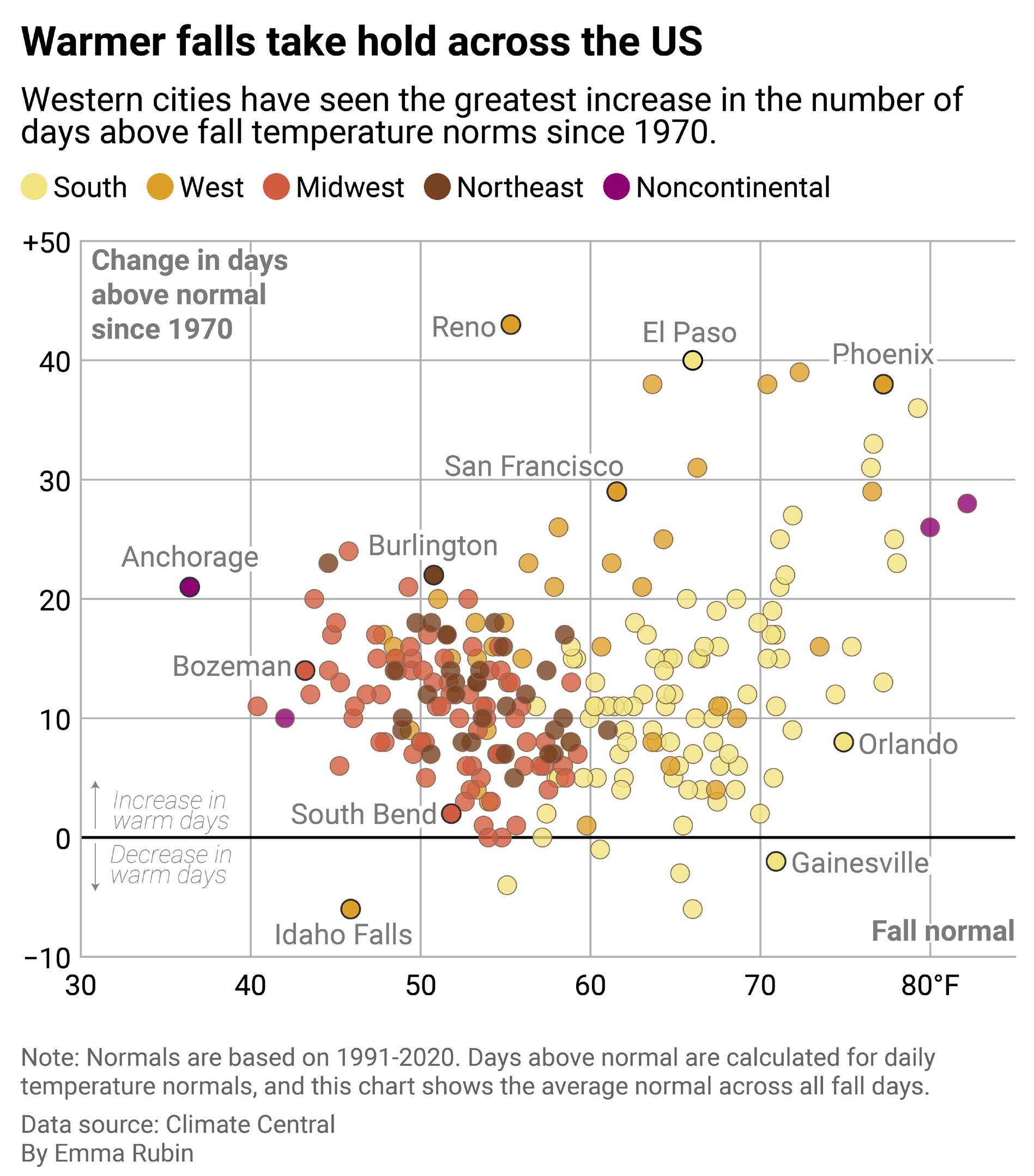
Warmer fall weather has been a noticeable trend over the past few decades, as seen in Climate Central’s fall temperature report. Measuring fall temperatures in 242 cities, the report found that 97 cities saw two more weeks above fall temperature norms in 2023 compared to 1970. This warming trend, along with changes in air quality, has had an impact on how people dress.
“The use of lighter fabrics year-round is easier for the company,” Scott said,
acknowledging one benefit of using the same lighter fabrics in all seasons. “It means fewer [fabric] sources, which is more cost-effective. We are not using so many different bolts of fabric, and the process is more streamlined.”
The warming trend has required designers to lean into the desires of consumers more rather than adhering to seasonality. “My friends and I would, in the past, have talked each other out of buying that skirt or short sleeve as fall and winter approached,” Brennan said in a text. “Now we say things like ‘Well, we might get another really warm day,’ or, ‘I don’t know, October and November have been really warm lately!’”
Sweater season carries into winter
One way her family has tried to respond in the past few years is to buy secondhand clothes, purchase only what they need, and (if possible) mend clothes when they start to fray instead of replacing them, Rockwell said. Secondhand shopping is easier than it used to be with online retailers, swap parties, proliferation of consignment and thrift shops, and a growing recognition of its ecological value, she added.
“One benefit of secondhand clothes is that you can always shop for the season it is rather than for what’s in the stores,” Rockwell said, referring to the clothing store practice of stocking items for the upcoming season. “When I shop, I look for staple pieces and look for quality—something that can last years. I’m not thinking about just one season.”
Story editing by Carren Jao. Additional editing by Kelly Glass and Elisa Huang. Copy editing by Tim Bruns. This story originally appeared on The RealReal and was produced and distributed in partnership with Stacker Studio.
SUMMARY OF ORDINANCE AS REQUIRED BY GOVERNMENT CODE SECTION 36933(c)
NOTICE IS HEREBY GIVEN THAT AT ITS REGULARLY SCHEDULED CITY COUNCIL MEETING ON WEDNESDAY, NOVEMBER 6, 2024, THE CITY COUNCIL ADOPTED:
ORDINANCE NO. 24-1077
AN ORDINANCE OF THE CITY COUNCIL OF THE CITY OF TEMPLE CITY, CALIFORNIA, AMENDING PROVISIONS OF THE TEMPLE CITY MUNICIPAL CODE TO COMPLY WITH FEDERAL AND STATE LAW REGARDING APPLICATION STANDARDS FOR AND OTHER ADMINISTRATIVE MATTERS RELATING TO WIRELESS COMMUNICATIONS FACILITIES
THE FOLLOWING SUMMARIZES ORDINANCE 24-1077
The proposed Ordinance would amend the Temple City Municipal Code (TCMC) to comply with Federal and State law regarding application standards for and other administrative matters relating to wireless communications facilities.
Ordinance No. 24-1077 was introduced for first reading at the City Council Regular Meeting of October 15, 2024, and adopted at the City Council Regular Meeting of November 6, 2024, by the following vote:
AYES: Councilmember- Chen, Sternquist, Yu, Chavez NOES: Councilmember- None
ABSENT: Councilmember- Man
RECUSED: Councilmember- None
A certified copy of the full text of the ordinance is available for review on the City’s website, www.templecity.us. Anyone having questions may contact the City Clerk at (626) 285-2171.
Dated: November 7, 2024
Peggy Kuo, City Clerk
Published: November 11, 2024
TEMPLE CITY TRIBUNE
NOTICE OF PETITION TO ADMINISTER ESTATE OF STACI LYNN McFARLAND Case No. 24STPB212173
To all heirs, beneficiaries, cred-itors, contingent creditors, and persons who may otherwise be interested in the will or estate, or both, of STACI LYNN McFARLAND
A PETITION FOR PROBATE has been filed by Kimberly McFarland Skonos in the Superior Court of California, County of LOS ANGELES.
THE PETITION FOR PROBATE requests that Kimberly McFarland Skonos be appointed as personal representative to administer the estate of the decedent.
THE PETITION requests authority to administer the estate under the Independent Administration of Estates Act. (This authority will allow the personal representative to take many actions without obtaining court approval. Before taking certain very important actions, however, the personal representative will be required to give notice to interested persons unless they have waived notice or consented to the proposed action.) The independent administra-tion authority will be granted unless an interested person files an objec-tion to the petition and shows good cause why the court should not grant the authority.
A HEARING on the petition will be held on Dec. 4, 2024 at 8:30 AM in Dept. No. 9 located at 111 N. Hill St., Los Angeles, CA 90012.
IF YOU OBJECT to the granting of the petition, you should appear at the hearing and state your objections or file written objections with the court before the hearing. Your ap-pearance may be in person or by your attorney.
IF YOU ARE A CREDITOR or a contingent creditor of the dece-
been filed by CONRAD JOSEPH ARGUIJO in the Superior Court of California, County of LOS ANGELES. THE PETITION FOR PROBATE requests that CONRAD JOSEPH ARGUIJO be appointed as personal representative to administer the estate of the decedent.
THE PETITION requests authority to administer the estate under the Independent Administration of Estates Act. (This authority will allow the personal representative to take many actions without obtaining court approval. Before taking certain very important actions, however, the personal representative will be required to give notice to interested persons unless they have waived notice or consented to the proposed action.) The independent administration authority will be granted unless an interested person files an objection to the petition and shows good cause why the court should not grant the authority.
A HEARING on the petition will be held in this court as follows: 12/05/24 at 8:30AM in Dept. 62 located at 111 N. HILL ST., LOS ANGELES, CA 90012
IF YOU OBJECT to the granting of the petition, you should appear at the hearing and state your objections or file written objections with the court before the hearing. Your appearance may be in person or by your attorney.
IF YOU ARE A CREDITOR or a contingent creditor of the decedent, you must file your claim with the court and mail a copy to the personal representative appointed by the court within the later of either (1) four months from the date of first issuance of letters to a general personal representative, as defined in section 58(b) of the California Probate Code, or (2) 60 days from the date of mailing or personal delivery to you of a notice under section 9052 of the California Probate Code. Other California statutes and legal authority may affect your rights as a creditor. You may want to consult with an attorney knowledgeable in California law.
YOU MAY EXAMINE the file kept by the court. If you are a person interested in the estate, you may file with the court a Request for Special Notice (form DE-154) of the filing of an inventory and appraisal of estate assets or of any petition or account as provided in Probate Code section 1250. A Request for Special Notice form is available from the court clerk.
Attorney for Petitioner
CORY A. OLIVER - SBN 325425
OLIVER LAW, A PROFESSIONAL CORPORATION
dent, you must file your claim with the court and mail a copy to the personal representative appointed by the court within the later of either (1) four months from the date of first issu-ance of letters to a general personal representative, as defined in section 58(b) of the California Probate Code, or (2) 60 days from the date of mailing or personal delivery to you of a notice under section 9052 of the California Probate Code.
Other California statutes and legal authority may affect your rights as a creditor. You may want to consult with an attorney knowledgeable in California law.
YOU MAY EXAMINE the file kept by the court. If you are a person interested in the estate, you may file with the court a Request for Special Notice (form DE-154) of the filing of an inventory and appraisal of estate assets or of any petition or account as provided in Probate Code section 1250. A Request for Special Notice form is available from the court clerk.
Attorney for petitioner:
LEONARD M TAVERA ESQ SBN 127070
SEMPER LAW GROUP LLP
330 N BRAND BLVD STE 670 GLENDALE CA 91203 CN111351 MCFARLAND Nov 4,7,11, 2024 EL MONTE EXAMINER
NOTICE OF PETITION TO ADMINISTER ESTATE OF:
CONRAD VALDEZ ARGUIJO AKA CONRAD V. ARGUIJO CASE NO. 24STPB12221
To all heirs, beneficiaries, creditors, contingent creditors, and persons who may otherwise be interested in the WILL or estate, or both of CONRAD VALDEZ ARGUIJO AKA CONRAD V. ARGUIJO.
A PETITION FOR PROBATE has
IF YOU OBJECT to the granting of the petition, you should appear at the hearing and state your objections or file written objections with the court before the hearing. Your appearance may be in person or by your attorney.
IF YOU ARE A CREDITOR or a contingent creditor of the decedent, you must file your claim with the court and mail a copy to the personal representative appointed by the court within the later of either (1) four months from the date of first issuance of letters to a general personal representative, as defined in section 58(b) of the California Probate Code, or (2) 60 days from the date of mailing or personal delivery to you of a notice under section 9052 of the California Probate Code.
Other California statutes and legal authority may affect your rights as a creditor. You may want to consult with an attorney knowledgeable in California law.
YOU MAY EXAMINE the file kept by the court. If you are a person interested in the estate, you may file with the court a Request for Special Notice (form DE-154) of the filing of an inventory and appraisal of estate assets or of any petition or account as provided in Probate Code section 1250. A Request for Special Notice form is available from the court clerk.
Attorney for Petitioner
MARSHAL A OLDMAN - SBN 72149
OLDMAN, SALLUS & GOLD, LLP 16133 VENTURA BLVD., PENTHOUSE ENCINO CA 91436
Telephone (818) 986-8080 11/4, 11/7, 11/11/24 CNS-3867304# EL MONTE EXAMINER
NOTICE OF PETITION TO ADMINISTER ESTATE OF JERRY DUANE DOONER
Case No. 24STPB11175
To all heirs, beneficiaries, cred-itors, contingent creditors, and persons who may otherwise be interested in the will or estate, or both, of JERRY DUANE DOONER
A PETITION FOR PROBATE has been filed by Rudolfo Zeledon in the Superior Court of California, County of LOS ANGELES.
THE PETITION FOR PROBATE requests that Rudolfo Zeledon be appointed as personal representative to administer the estate of the decedent.
730 N. NORMA, SUITE B RIDGECREST CA 93555
Telephone (760) 977-3025 11/4, 11/7, 11/11/24 CNS-3867077# ROSEMEAD READER
NOTICE OF PETITION TO ADMINISTER ESTATE OF: ELVIRA ANAYA GOMEZ
CASE NO. 24STPB12206
To all heirs, beneficiaries, creditors, contingent creditors, and persons who may otherwise be interested in the WILL or estate, or both of ELVIRA ANAYA GOMEZ.
A PETITION FOR PROBATE has been filed by ELOISE MEJIA REYES AND JEFF WILLIAM LEBLANC in the Superior Court of California, County of LOS ANGELES. THE PETITION FOR PROBATE requests that ELOISE MEJIA REYES AND JEFF WILLIAM LEBLANC be appointed as personal representative to administer the estate of the decedent.
THE PETITION requests authority to administer the estate under the Independent Administration of Estates Act with limited authority. (This authority will allow the personal representative to take many actions without obtaining court approval. Before taking certain very important actions, however, the personal representative will be required to give notice to interested persons unless they have waived notice or consented to the proposed action.) The independent administration authority will be granted unless an interested person files an objection to the petition and shows good cause why the court should not grant the authority.
A HEARING on the petition will be held in this court as follows: 12/09/24 at 8:30AM in Dept. 62 located at 111 N. HILL ST., LOS ANGELES, CA 90012
THE PETITION requests authority to administer the estate under the Independent Administration of Estates Act. (This authority will allow the personal representative to take many actions without obtaining court approval. Before taking certain very important actions, however, the personal representative will be required to give notice to interested persons unless they have waived notice or consented to the proposed action.) The independent administra-tion authority will be granted unless an interested person files an objec-tion to the petition and shows good cause why the court should not grant the authority.
A HEARING on the petition will be held on January 10, 2025 at 8:30 AM in Dept. No. 2D located at 111 N. Hill St., Los Angeles, CA 90012.
IF YOU OBJECT to the granting of the petition, you should appear at the hearing and state your objections or file written objections with the court before the hearing. Your ap-pearance may be in person or by your attorney.
IF YOU ARE A CREDITOR or a contingent creditor of the decedent, you must file your claim with the court and mail a copy to the personal representative appointed by the court within the later of either (1) four months from the date of first issu-ance of letters to a general personal representative, as defined in section 58(b) of the California Probate Code, or (2) 60 days from the date of mailing or personal delivery to you of a notice under section 9052 of the California Probate Code.
Other California statutes and legal authority may affect your rights as a creditor. You may want to consult with an attorney knowledgeable in California law.
YOU MAY EXAMINE the file kept by the court. If you are a person interested in the estate, you may file with the court a Request for Special Notice (form DE-154) of the filing of an inventory and appraisal of estate assets or of any petition
ORDER TO SHOW CAUSE FOR CHANGE OF NAME PETITION OF Noe Damian Aguilar Donis FOR CHANGE OF NAME CASE NUMBER: 24NNCP00473
Superior Court of California, County of Los Angeles 150 West Commonwealth, Alhambra, Ca 91801, Northeast Judicial District TO ALL INTERESTED PERSONS: 1. Petitioner Noe Damian Aguilar Donis filed a petition with this court for a decree changing names as follows: Present name a. OF Noe Damian Aguilar Donis to Proposed name Noe Damian Castillo Aguilar 2. THE COURT ORDERS that all persons interested in this matter shall appear before this court at the hearing indicated below to show cause, if any, why the petition for change of name should not be granted. Any person objecting to the name changes described above must file a written objection that includes the reason for the objection at least two court days before the matter is scheduled to be heard and must appear at the hearing to show cause why the petition should not be granted. If no written objection is timely filed, the court may grant the petition without a hearing NOTICE OF HEARING a. Date: 12/23/2024 Time: 8:30AM Dept: T. The address of the court is same as noted above. 3. a. A copy of this Order to Show Cause shall be published at least once each week for four successive weeks prior to the day set for hearing on the petition in the following newspaper of general circulation, printed in this county: Arcadia Weekly DATED: August 21, 2024 Peter A Hernandez JUDGE OF THE SUPERIOR COURT Pub. October 28, November 4, 11, 18, 2024 ARCADIA WEEKLY
NOTICE OF PUBLIC SALE OF GOODS TO SATISFY LIEN AUCTION LOCATION: 730 Cypress Ave., Monrovia, CA In accordance with the provisions of the California Commercial Code, Sections 7201-7210, notice is hereby given that on Thursday November 21st, 2024 at 10:00 am of said date, at 730 Cypress Ave., City of Monrovia, County of Los Angeles, State of CA, the undersigned will sell at public auction for cash, in lawful money of the United States, the articles hereinafter described, belonging to, or deposited with, the undersigned by the persons hereinafter named at: Pink Transfer Moving and Storage. Said goods are being held on the accounts of: Art Guzman, Jennifer Heber, and Laura Whipple. All other goods are described as household goods, furniture, antiques, appliances, tools, misc goods, office furniture, and articles of art, equipment, rugs, sealed cartons and the unknown. The auction will be made for the purpose of satisfying the lien of the undersigned on said personal property to the extent of the sum owed, together with the cost of the sale. For information contact Pink Transfer Moving and Storage. Terms: Cash only with a 15% buyer’s premium. Payment and removal of items purchased, day of sale. Auction conducted by American Auctioneers, Dan Dotson & Associates (800) 838-SOLD, (909) 790-0433 or www. americanauctioneers.com Bond #FS86320-14. Pink Transfer Moving and Storage 11/4, 11/11/24 CNS-3867161# ARCADIA WEEKLY
Notice of Lien Sale
Notice is given that Arcadia 210 Self Storage located at 324 N. Second Avenue, Arcadia, CA 91006 will conduct an auction to sell the goods stored by the following tenants at the storage facility. The sale will occur as an online auction via https:// www.storagetreasures.com on 11/18/2024 at 12:00pm. Unless stated otherwise the description of the contents are household goods and furnishings.
Amado, Shirley DIXON, BARRY TOLLIVER, BOBBY Delmo, Christine Ananiades, Spyridon C. GAMEZ, NANCY Puerto-Lopez, Julio A. Harris, Desiree
All property is being stored at the above self-storage facility. This sale may be withdrawn at any time without notice. Certain terms and conditions apply. See manager for details.
Publish November 4, 2024 & November 11, 2024 IN THE ARCADIA WEEKLY
NOTICE TO CREDITORS OF BULK SALE (Division 6 of the Commercial Code) Escrow No. 101088-EF (1) Notice is hereby given to creditors of the within named Seller(s) that a bulk sale is about
on (Date) 11/06/2024. NOTICE: This fictitious name statement expires five years from the date it was filed in the office of the county clerk. A new fictitious business name statement must be filed before that time. The filing of this statement does not of itself authorize the use in this state of a fictitious business name in violation of the rights of another under federal, state, or common law (see Section 14411 et seq. Business and Professions Code). Publish: 11/11/2024, 11/18/2024, 11/25/2024, 12/02/2024. ARCADIAWEEKLY. AAA1311808.
FICTITIOUS BUSINESS NAME STATEMENT 2024230043
The following person(s) is/are doing business as: OFFICIAL TOWING SERVICES, 13311 REMINGTON ST, PACOIMA, CA 91331 LOS ANGELES. Mailing address if different: N/A. The full name(s) of registrant(s) is/are: DIAZ TRUCKING ZAC LLC, 13311 REMINGTON ST, PACOIMA, CA91331 (State of Incorporation/ Organization: CA). This business is conducted by: LIMITED LIABILITY COMPANY. I declare that all information in this statement is true and correct. (A registrant who declares as true information which he or she knows to be false is guilty of a crime.) Signed: FRANCISCO DIAZ RODRIGUEZ, MANAGING MEMBER. The registrant commenced to transact business under the fictitious business name listed above on (date): 11/2024. This statement was filed with the County Clerk of Los Angeles County on (Date) 11/07/2024. NOTICE: This fictitious name statement expires five years from the date it was filed in the office of the county clerk. A new fictitious business name statement must be filed before that time. The filing of this statement does not of itself authorize the use in this state of a fictitious business name in violation of the rights of another under federal, state, or common law (see Section 14411 et seq. Business and Professions Code). Publish: 11/11/2024, 11/18/2024, 11/25/2024, 12/02/2024. ARCADIAWEEKLY. AAA1311809.
FICTITIOUS BUSINESS NAME STATEMENT 2024230203
The following person(s) is/are doing business as: FAITH JUICE COMPANY, 5047 BAKMAN AVE APT113, NORTH HOLLYWOOD, CA 91601 LOS ANGELES. Mailing address if different: N/A. The full name(s) of registrant(s) is/are: BRANDI KELLY, 5047 BAKMAN AVE APT113, NORTH HOLLYWOOD, CA 91601. This business is conducted by: INDIVIDUAL. I declare that all information in this statement is true and correct. (A registrant who declares as true information which he or she knows to be false is guilty of a crime.) Signed: BRANDI KELLY, OWNER. The registrant commenced to transact business under the fictitious business name listed above on (date): 09/2024. This statement was filed with the County Clerk of Los Angeles County on (Date) 11/07/2024. NOTICE: This fictitious name statement expires five years from the date it was filed in the office of the county clerk. A new fictitious business name statement must be filed before that time. The filing of this statement does not of itself authorize the use in this state of a fictitious business name in violation of the rights of another under federal, state, or common law (see Section 14411 et seq. Business and Professions Code). Publish: 11/11/2024, 11/18/2024, 11/25/2024, 12/02/2024. ARCADIAWEEKLY. AAA1311966.
FICTITIOUS BUSINESS NAME STATEMENT 2024230465 The following person(s) is/are doing business as: SAHUAYO BODY SHOP LLC, 2145 FIRESTONE BLVD, LOS ANGELES, CA90001 LOS ANGELES. Mailing address if different: N/A. The full name(s) of registrant(s) is/are: SAHUAYO BODY SHOP LLC, 2145 FIRESTONE BLVD, LOS ANGELES, CA90001 (State of Incorporation/ Organization: CA). This business is conducted by: LIMITED LIABILITY COMPANY. I declare that all information in this statement is true and correct. (A registrant who declares as true information which he or she knows to be false is guilty of a crime.) Signed: DANIEL NEGRETE CABEZAS, CEO. The registrant commenced to transact business under the fictitious business name listed above on (date): N/A. This statement was filed with the County Clerk of Los Angeles County on (Date) 11/07/2024. NOTICE: This fictitious name statement expires five years from the date it was filed in the office of the county clerk. A new fictitious business name statement must be filed before that time. The filing of this statement does not of itself authorize the use in this state of a fictitious business name in violation of the rights of another under federal, state, or common law (see Section 14411 et seq. Business and Professions Code). Publish: 11/11/2024, 11/18/2024, 11/25/2024, 12/02/2024. ARCADIAWEEKLY.
AAA1311969. FICTITIOUS BUSINESS NAME STATEMENT FILE NO. 2024228781 NEW FILING. The following person(s) is (are) doing business as Fancies Nails, 11659 Santa Monica Blvd,, Los Angeles, CA 90025. This business is conducted by a limited liability company (llc). Registrant commenced to transact business under the fictitious business name or names listed herein on November 2024. Signed: Forever Green LLC (CA-202464316353, 11659 Santa Monica Blvd,, Los Angeles, CA 90025; Quynh N Vu, Owner. The statement was filed with the County Clerk of Los Angeles on November 5, 2024. NOTICE: This fictitious business name statement expires five years from the date it was filed in the office of the County Clerk. A new fictitious business name statement must be filed prior to that date. The filing of this statement does not of itself authorize the use in this state of a fictitious business name in violation of the rights of another under federal, state or common law (See Section 14400 et seq., Business and Professional Code).
Pub. Monrovia Weekly 11/11/2024, 11/18/2024, 11/25/2024, 12/02/2024
FICTITIOUS BUSINESS NAME STATEMENT FILE NO. 2024230164 NEW FILING.
The following person(s) is (are) doing business as Kitty Leather, 11018 Aqua Vista St Apt 7, Studio City, CA 91602. This business is conducted by a individual. Registrant commenced to transact business under the fictitious business name or names listed herein on November 2024. Signed: Christopher Stanback, 11018 Aqua Vista St 7, Studio City, CA 91602 (Owner). The statement was filed with the County Clerk of Los Angeles on November 7, 2024.
NOTICE: This fictitious business name statement expires five years from the date it was filed in the office of the County Clerk. A new fictitious business name statement must be filed prior to that date. The filing of this statement does not of itself authorize the use in this state of a fictitious business name in violation of the rights of another under federal, state or common law (See Section 14400 et seq., Business and Professional Code).
Pub. Monrovia Weekly 11/11/2024, 11/18/2024, 11/25/2024, 12/02/2024
FICTITIOUS BUSINESS NAME STATEMENT FILE NO. 2024207543 NEW FILING.
The following person(s) is (are) doing business as Samani Services, 124 N Hartley St, West Covina, CA 91790. This business is conducted by a individual. Registrant commenced to transact business under the fictitious business name or names listed herein on September 2024. Signed: Zusanne Samani, 124 N Hartley St, West Covina, CA 91790 (Owner). The statement was filed with the County Clerk of Los Angeles on October 27, 2024. NOTICE: This fictitious business name statement expires five years from the date it was filed in the office of the County Clerk. A new fictitious business name statement must be filed prior to that date. The filing of this statement does not of itself authorize the use in this state of a fictitious business name in violation of the rights of another under federal, state or common law (See Section 14400 et seq., Business and Professional Code). Pub. Monrovia Weekly 11/11/2024, 11/18/2024, 11/25/2024, 12/02/2024
FICTITIOUS BUSINESS NAME STATEMENT FILE NO. 2024227094 NEW FILING.
The following person(s) is (are) doing business as SooHoo Ignite, 1424 Marcelina Ave, Torrance, CA 90501. This business is conducted by a limited liability company (llc). Registrant has not yet begun to transact business under the fictitious business name or names listed herein. Signed: SooHoo Designers, LLC (CA-202206010603, 1424 Marcelina Ave, Torrance, CA 90501; Thomas Ling, Managing Member. The statement was filed with the County Clerk of Los Angeles on November 4, 2024. NOTICE: This fictitious business name statement expires five years from the date it was filed in the office of the County Clerk. A new fictitious business name statement must be filed prior to that date. The filing of this statement does not of itself authorize the use in this state of a fictitious business name in violation of the rights of another under federal, state or common law (See Section 14400 et seq., Business and Professional Code). Pub. Monrovia Weekly 11/11/2024, 11/18/2024, 11/25/2024, 12/02/2024
FICTITIOUS BUSINESS NAME STATEMENT FILE NO. 2024218707 NEW FILING. The following person(s) is (are) doing business as JMC TAX ACCOUNTING AND CONSULTING,
3407 W 6th Street STE 612, Los Angeles, CA 90020. This business is conducted by a corporation. Registrant commenced to transact business under the fictitious business name or names listed herein on October 2024. Signed: CHEOL CHOI ACCOUNTANCY CORP (CA-3822458, 3407 W 6th Street STE 612, Los Angeles, CA 90020; CHEOL CHOI, PRESIDENT. The statement was filed with the County Clerk of Los Angeles on October 22, 2024. NOTICE: This fictitious business name statement expires five years from the date it was filed in the office of the County Clerk. A new fictitious business name statement must be filed prior to that date. The filing of this statement does not of itself authorize the use in this state of a fictitious business name in violation of the rights of another under federal, state or common law (See Section 14400 et seq., Business and Professional Code). Pub. Monrovia Weekly 11/11/2024, 11/18/2024, 11/25/2024, 12/02/2024
FICTITIOUS BUSINESS NAME STATEMENT FILE NO. 2024229738 NEW FILING.
The following person(s) is (are) doing business as Signature Post Group, 919 N Victory Blvd, Burbank, CA 91502. This business is conducted by a corporation. Registrant commenced to transact business under the fictitious business name or names listed herein on November 2024. Signed: SPG Studios, Inc. (CA-C2009343, 919 N Victory Blvd, Burbank, CA 91502; Gregory Stone, President. The statement was filed with the County Clerk of Los Angeles on November 6, 2024. NOTICE: This fictitious business name statement expires five years from the date it was filed in the office of the County Clerk. A new fictitious business name statement must be filed prior to that date. The filing of this statement does not of itself authorize the use in this state of a fictitious business name in violation of the rights of another under federal, state or common law (See Section 14400 et seq., Business and Professional Code). Pub. Monrovia Weekly 11/11/2024, 11/18/2024, 11/25/2024, 12/02/2024
FICTITIOUS BUSINESS NAME STATEMENT FILE NO. 2024229529 NEW FILING. The following person(s) is (are) doing business as INCOME TAX 4 LESS, 6002 york blvd, los angeles, CA 90042-3504. This business is conducted by a individual. Registrant commenced to transact business under the fictitious business name or names listed herein on November 2024. Signed: MAHFOUZ SAFAOUI, 6002 york blvd, los angeles, CA 90042-3504 (Owner). The statement was filed with the County Clerk of Los Angeles on November 6, 2024. NOTICE: This fictitious business name statement expires five years from the date it was filed in the office of the County Clerk. A new fictitious business name statement must be filed prior to that date. The filing of this statement does not of itself authorize the use in this state of a fictitious business name in violation of the rights of another under federal, state or common law (See Section 14400 et seq., Business and Professional Code). Pub. Monrovia Weekly 11/11/2024, 11/18/2024, 11/25/2024, 12/02/2024
FICTITIOUS BUSINESS NAME STATEMENT FILE NO. 2024226184 NEW FILING.
The following person(s) is (are) doing business as 11 COSMETICS CLINIC, 712 S Main St, Burbank, CA 91506. This business is conducted by a corporation. Registrant commenced to transact business under the fictitious business name or names listed herein on October 2024. Signed: 11 COSMETICS SURGERY CLINIC INC (CA6368544, 712 S Main St, Burbank, CA 91506; HAKOB HAKOBYAN, VICE PRESIDENT. The statement was filed with the County Clerk of Los Angeles on November 6, 2024. NOTICE: This fictitious business name statement expires five years from the date it was filed in the office of the County Clerk. A new fictitious business name statement must be filed prior to that date. The filing of this statement does not of itself authorize the use in this state of a fictitious business name in violation of the rights of another under federal, state or common law (See Section 14400 et seq., Business and Professional Code). Pub. Monrovia Weekly 11/11/2024, 11/18/2024, 11/25/2024, 12/02/2024
FICTITIOUS BUSINESS NAME STATEMENT FILE NO. 2024227746 NEW FILING. The following person(s) is (are) doing business as AI Code Pathways, 429 S Alhambra Ave, Monterey Park, CA 91755. This business is conducted by a limited liability company (llc). Registrant has not yet begun to transact business under the fictitious business name or names listed herein. Signed: No Code
Pathways LLC (CA-202462619941, 429 S Alhambra Ave Unit C, Monterey Park, CA 91755; Brendan Li, President. The statement was filed with the County Clerk of Los Angeles on November 4, 2024.
NOTICE: This fictitious business name statement expires five years from the date it was filed in the office of the County Clerk. A new fictitious business name statement must be filed prior to that date. The filing of this statement does not of itself authorize the use in this state of a fictitious business name in violation of the rights of another under federal, state or common law (See Section 14400 et seq., Business and Professional Code).
Pub. Monrovia Weekly 11/11/2024, 11/18/2024, 11/25/2024, 12/02/2024
FICTITIOUS BUSINESS NAME STATEMENT FILE NO. 2024229054 FIRST FILING.
The following person(s) is (are) doing business as Bri Spencer Therapy, 1614 Avalon St, Los Angeles, CA 90026. This business is conducted by a corporation. Registrant commenced to transact business under the fictitious business name or names listed herein on November 2024. Signed: Dellinger Productions (NH3389369, 149 Four Winds Farm Rd, Peterborough, NH 03458; Brianna Spencer, CEO. The statement was filed with the County Clerk of Los Angeles on November 6, 2024.
NOTICE: This fictitious business name statement expires five years from the date it was filed in the office of the County Clerk. A new fictitious business name statement must be filed prior to that date. The filing of this statement does not of itself authorize the use in this state of a fictitious business name in violation of the rights of another under federal, state or common law (See Section 14400 et seq., Business and Professional Code).
Pub. Monrovia Weekly 11/11/2024, 11/18/2024, 11/25/2024, 12/02/2024
FICTITIOUS BUSINESS NAME STATEMENT FILE NO. 2024227998 NEW FILING.
The following person(s) is (are) doing business as The Hive Salon, 655 W Arrow Hwy suite 36, San Dimas, CA 91773. This business is conducted by a limited liability company (llc). Registrant has not yet begun to transact business under the fictitious business name or names listed herein. Signed: The Hive Studio LLC (CA-202463411655, 1741 Inola St Glendora, Ca 91740; Joyce Inchausti, Owner. The statement was filed with the County Clerk of Los Angeles on November 5, 2024. NOTICE: This fictitious business name statement expires five years from the date it was filed in the office of the County Clerk. A new fictitious business name statement must be filed prior to that date. The filing of this statement does not of itself authorize the use in this state of a fictitious business name in violation of the rights of another under federal, state or common law (See Section 14400 et seq., Business and Professional Code). Pub. Monrovia Weekly 11/11/2024, 11/18/2024, 11/25/2024, 12/02/2024
STATEMENT OF ABANDONMENT OF USE OF FICTITIOUS BUSINESS
NAME 2024226980.
The following person(s) have abandoned the use of the fictitious business name: RMC Afterschool., Music and Art at Temple city, 5618 Rosemead Blvd, Temple City, CA 91780. The fictitious business name referred to above was filed on: January 23, 2023 in the County of Los Angeles. Original File No. 2023015853. Signed: (1). Karina Manukyan, 1402 N Alta Vista Blvd, Los Angeles, CA 90046 (2). Lusine Avagyan, 1727 Monte Vista Street, Pasadena, CA 91106 (General Partner). This business is conducted by: a general partnership. This statement was filed with the Los Angeles County Registrar-Recorder on November 4, 2024. Pub. Monrovia Weekly 11/11/2024, 11/18/2024, 11/25/2024, 12/02/2024
FICTITIOUS BUSINESS NAME STATEMENT FILE NO. 2024214091 NEW FILING.
The following person(s) is (are) doing business as California Cactus Center, 216 South Rosemead Blvd, Pasadena, CA 91107. This business is conducted by a corporation. Registrant has not yet begun to transact business under the fictitious business name or names listed herein. Signed: Maleenee Desert Gallery, Inc (CA-2325773, 216 South Rosemead Blvd, Pasadena, CA 91107; Martha Thongthiraj, CEO. The statement was filed with the County Clerk of Los Angeles on October 16, 2024. NOTICE: This fictitious business name statement expires five years from the date it was filed in the office of the County Clerk. A new fictitious business name statement must be filed prior to that date. The filing of this statement does not of itself authorize the use in this state of a
fictitious business name in violation of the rights of another under federal, state or common law (See Section 14400 et seq., Business and Professional Code).
Pub. Monrovia Weekly 11/11/2024, 11/18/2024, 11/25/2024, 12/02/2024
FICTITIOUS BUSINESS NAME STATEMENT FILE NO. 2024223298
NEW FILING. The following person(s) is (are) doing business as (1). Crude Works Company (2). Embark and Endure , 657 Aurora Drive, Claremont, CA 91711. This business is conducted by a individual. Registrant has not yet begun to transact business under the fictitious business name or names listed herein. Signed: Nolawi Wolde-Yohannes, 657 Aurora Drive, Claremont, CA 91711 (Owner). The statement was filed with the County Clerk of Los Angeles on October 29, 2024. NOTICE: This fictitious business name statement expires five years from the date it was filed in the office of the County Clerk. A new fictitious business name statement must be filed prior to that date. The filing of this statement does not of itself authorize the use in this state of a fictitious business name in violation of the rights of another under federal, state or common law (See Section 14400 et seq., Business and Professional Code). Pub. Monrovia Weekly 11/11/2024, 11/18/2024, 11/25/2024, 12/02/2024
FICTITIOUS BUSINESS NAME STATEMENT FILE NO. 2024227445 NEW FILING. The following person(s) is (are) doing business as Best Choice Valet Parking Inc, 527 W Harvard St Unit 2, Glendale, CA 91204. This business is conducted by a corporation. Registrant has not yet begun to transact business under the fictitious business name or names listed herein. Signed: Best Choice Valet Parking Inc (CA-4645903, 527 W Harvard St Unit 2, Glendale, CA 91204; Arsen Asatryan, President. The statement was filed with the County Clerk of Los Angeles on November 4, 2024. NOTICE: This fictitious business name statement expires five years from the date it was filed in the office of the County Clerk. A new fictitious business name statement must be filed prior to that date. The filing of this statement does not of itself authorize the use in this state of a fictitious business name in violation of the rights of another under federal, state or common law (See Section 14400 et seq., Business and Professional Code). Pub. Monrovia Weekly 11/11/2024, 11/18/2024, 11/25/2024, 12/02/2024
STATEMENT OF ABANDONMENT OF USE OF FICTITIOUS BUSINESS NAME 2024228936. The following person(s) have abandoned the use of the fictitious business name: (1). Queens English (2). Best of France and Italy , 4063 Canyon Dell Drive, Altadena, CA 91001. The fictitious business name referred to above was filed on: May 10, 2023 in the County of Los Angeles. Original File No. 2023103872. Signed: (1). Bettina Van Curen, 4063 Canyon Dell Drive, Altadena, CA 91001 (2). Charles Forward, 4063 Canyon Dell Drive, Altadena, CA 91001 (3). Samuel Williams, 17260 Prairie st, Northridge, CA 91325 (General Partner). This business is conducted by: a general partnership. This statement was filed with the Los Angeles County Registrar-Recorder on November 5, 2024. Pub. Monrovia Weekly 11/11/2024, 11/18/2024, 11/25/2024, 12/02/2024
FICTITIOUS BUSINESS NAME STATEMENT FILE NO. 2024230614 NEW FILING. The following person(s) is (are) doing business as FLORENCE THERAPEUTIC CLINIC LLC, 6443 FLORENCE AVENUE, BELL GARDENS, CA 90201. This business is conducted by a limited liability company (llc). Registrant commenced to transact business under the fictitious business name or names listed herein on July 2024. Signed: FLORENCE THERAPEUTIC CLINIC LLC (CA-202463010527, 6443 FLORENCE AVENUE, BELL GARDENS, CA 90201; RUHT ANSELMI PEREZ ANSELMI, Managing member. The statement was filed with the County Clerk of Los Angeles on November 7, 2024. NOTICE: This fictitious business name statement expires five years from the date it was filed in the office of the County Clerk. A new fictitious business name statement must be filed prior to that date. The filing of this statement does not of itself authorize the use in this state of a fictitious business name in violation of the rights of another under federal, state or common law (See Section 14400 et seq., Business and Professional Code). Pub. Monrovia Weekly 11/11/2024, 11/18/2024, 11/25/2024, 12/02/2024
NOTICE OF PETITION TO ADMINISTER ESTATE OF:
BOBBY GLENN HENRY AKA
BOBBY G. HENRY CASE NO.
30-2024-01434514-PR-CP-
CMC
To all heirs, beneficiaries, creditors, contingent creditors, and persons who may otherwise be interested in the WILL or estate, or both of BOBBY GLENN HENRY AKA BOBBY G.HENRY.
A PETITION FOR PROBATE has been filed by PATRICIA HENRY in the Superior Court of California, County of ORANGE.
THE PETITION FOR PROBATE requests that PATRICIA HENRY be appointed as personal representative to administer the estate of the decedent.
THE PETITION requests authority to administer the estate under the Independent Administration of Estates Act. (This authority will allow the personal representative to take many actions without obtaining court approval. Before taking certain very important actions, however, the personal representative will be required to give notice to interested persons unless they have waived notice or consented to the proposed action.) The independent administration authority will be granted unless an interested person files an objection to the petition and shows good cause why the court should not grant the authority.
A HEARING on the petition will be held in this court as follows: 12/05/24 at 1:30PM in Dept. CM07 located at 3390 HARBOR BLVD., COSTA MESA, CA 92626
NOTICE IN PROBATE CASES
The court is providing the convenience to appear for hearing by video using the court’s designated video platform. This is a no cost service to the public. Go to the Court’s website at The Superior Court of California - County of Orange (occourts.org) to appear remotely for Probate hearings and for remote hearing instructions. If you have difficulty connecting or are unable to connect to your remote hearing, call 657-622-8278 for assistance. If you prefer to appear in-person, you can appear in the department on the day/time set for your hearing.
IF YOU OBJECT to the granting of the petition, you should appear at the hearing and state your objections or file written objections with the court before the hearing. Your appearance may be in person or by your attorney.
IF YOU ARE A CREDITOR or a contingent creditor of the decedent, you must file your claim with the court and mail a copy to the personal representative appointed by the court within the later of either (1)four months from the date of first issuance of letters to a general personal representative, as defined in section 58(b) of the California Probate Code, or (2) 60 days from the date of mailing or personal delivery to you of a notice under section 9052 of the California Probate Code.
Other California statutes and legal authority may affect your rights as a creditor. You may want to consult with an attorney knowledgeable in California law.
YOU MAY EXAMINE the file kept by the court. If you are a person interested in the estate, you may file with the court a Request for Special Notice (form DE-154) of the filing of an inventory and appraisal of estate assets or of any petition or account as provided in Probate Code section 1250. A Request for Special Notice form is available from the court clerk.
Attorney for Petitioner
KRISTEN WONG - SBN 210627
SEASONS ESTATE PLANNING, APC
475 WASHINGTON BOULEVARD
MARINA DEL REY CA 90292
Telephone (310) 344-3015
11/4, 11/7, 11/11/24
CNS-3866492# ANAHEIM PRESS
NOTICE OF PETITION TO ADMINISTER ESTATE OF: RAFAEL J. AGUIRRE
CASE NO. 24STPB12346
To all heirs, beneficiaries, creditors, contingent creditors, and persons who may otherwise be interested in the WILL or estate, or both of RAFAEL J. AGUIRRE.
A PETITION FOR PROBATE has been filed by MARIA AGUIRRE AKA MARIA RAMIREZ in the Superior Court of California, County of LOS ANGELES. THE PETITION FOR PROBATE requests that MARIA AGUIRRE AKA MARIA RAMIREZ be appointed as personal representative to administer the estate of the decedent.
THE PETITION requests authority to administer the estate under the Independent Administration of Estates Act with limited authority.
(This authority will allow the personal representative to take many actions without obtaining court approval. Before taking certain very important actions, however, the personal representative will be required to give notice to interested persons unless they have waived notice or consented to the proposed action.) The independent administration authority will be granted unless an interested person files an objection to the petition and shows good cause why the court should not grant the authority.
A HEARING on the petition will be held in this court as follows: 12/06/24 at 8:30AM in Dept. 9 located at 111 N. HILL ST., LOS ANGELES, CA 90012
IF YOU OBJECT to the granting of the petition, you should appear at the hearing and state your objections or file written objections with the court before the hearing. Your appearance may be in person or by your attorney.
IF YOU ARE A CREDITOR or a contingent creditor of the decedent, you must file your claim with the court and mail a copy to the personal representative appointed by the court within the later of either (1)four months from the date of first issuance of letters to a general personal representative, as defined in section 58(b) of the California Probate Code, or (2) 60 days from the date of mailing or personal delivery to you of a notice under section 9052 of the California Probate Code. Other California statutes and legal authority may affect your rights as a creditor. You may want to consult with an attorney knowledgeable in California law.
YOU MAY EXAMINE the file kept by the court. If you are a person interested in the estate, you may file with the court a Request for Special Notice (form DE-154) of the filing of an inventory and appraisal of estate assets or of any petition or account as provided in Probate Code section 1250. A Request for Special Notice form is available from the court clerk.
Attorney for Petitioner
JUVENTINO B. CASAS JR. - SBN 44445
LAW OFFICE OF J.B. CASAS JR. 2520 WEST BEVERLY BLVD. MONTEBELLO CA 90640
Telephone (323) 726-3200 11/4, 11/7, 11/11/24 CNS-3867529# PASADENA PRESS
NOTICE OF PETITION TO ADMINISTER ESTATE OF MARIANNE FRIEDMAN
Case No. 24STPB12159
To all heirs, beneficiaries, creditors, contingent creditors, and persons who may otherwise be interested in the will or estate, or both, of MARIANNE FRIEDMAN A PETITION FOR PROBATE has been filed by Nathan Donald Weinstein in the Superior Court of California, County of LOS ANGELES.
THE PETITION FOR PROBATE requests that Nathan Donald Weinstein be appointed as personal representa-tive to administer the estate of the decedent.
THE PETITION requests authority to administer the estate under the Independent Administration of Estates Act. (This authority will allow the personal representative to take many actions without ob-
taining court ap-proval. Before taking certain very important actions, however, the per-sonal representative will be required to give notice to interested persons unless they have waived notice or consented to the proposed action.) The independent administration authority will be granted unless an interested person files an objection to the petition and shows good cause why the court should not grant the authority.
A HEARING on the petition will be held on Nov. 25, 2024 at 8:30 AM in Dept. No. 4 located at 111 N. Hill St., Los Angeles, CA 90012.
IF YOU OBJECT to the granting of the petition, you should appear at the hearing and state your objections or file written objections with the court before the hearing. Your appearance may be in person or by your attorney.
IF YOU ARE A CREDITOR or a contingent creditor of the decedent, you must file your claim with the court and mail a copy to the personal rep-resentative appointed by the court within the later of either (1)four months from the date of first issuance of letters to a general personal representative, as defined in section 58(b) of the California Probate Code, or (2) 60 days from the date of mailing or personal delivery to you of a notice under section 9052 of the California Probate Code. Other California statutes and legal authority may affect your rights as a creditor. You may want to consult with an attorney knowledgeable in California law.
YOU MAY EXAMINE the file kept by the court. If you are a person interested in the estate, you may file with the court a Request for Special Notice (form DE-154) of the filing of an inventory and appraisal of estate assets or of any petition or account as provided in Probate Code section 1250. A Request for Special Notice form is available from the court clerk.
Attorney for petitioner: JUSTIN M GORDON ESQ SBN287328
GORDONLAW APC 12100 WILSHIRE BLVD STE 800 LOS ANGELES CA 90025
CN111608 FRIEDMAN Nov 4,7,11, 2024 ALHAMBRA PRESS
NOTICE OF PETITION TO ADMINISTER ESTATE OF RICHARD A. COX
Case No. 24STPB12308
To all heirs, beneficiaries, cred-itors, contingent creditors, and persons who may otherwise be interested in the will or estate, or both, of RICHARD A. COX
A PETITION FOR PROBATE has been filed by Cynthia Todd and Adrianne Gallarza in the Superior Court of California, County of LOS ANGELES.
THE PETITION FOR PROBATE requests that Cynthia Todd and Adrianne Gallarza be appointed as personal representative to administer the estate of the decedent.
THE PETITION requests the decedent’s will and codicils, if any, be admitted to probate. The will and any codicils are available for examination in the file kept by the court.
THE PETITION requests authority to administer the estate under the Independent Administration of Estates Act. (This authority will allow the personal representative to take many actions without obtaining court approval. Before taking certain very important actions, however, the personal representative will be required to give notice to interested persons unless they have waived notice or consented to the proposed action.) The independent administra-tion authority will be granted unless an interested person files an objec-tion to the petition and shows good cause why the court should not grant the authority.
A HEARING on the petition will be held on Dec. 5, 2024 at 8:30 AM in Dept. No. 67 located at 111 N.Hill St., Los Angeles, CA 90012.
IF YOU OBJECT to the granting of the petition, you should appear at the hearing and state your objections or file written objections with the court before the hearing. Your ap-pearance may be in person or by your attorney.
IF YOU ARE A CREDITOR or a contingent creditor of the decedent, you must file your claim with the court and mail a copy to the personal representative appointed
by the court within the later of either (1)four months from the date of first issu-ance of letters to a general personal representative, as defined in section 58(b) of the California Probate Code, or (2) 60 days from the date of mailing or personal delivery to you of a notice under section 9052 of the California Probate Code. Other California statutes and legal authority may affect your rights as a creditor. You may want to consult with an attorney knowledgeable in California law. YOU MAY EXAMINE the file kept by the court. If you are a person interested in the estate, you may file with the court a Request for Special Notice (form DE-154) of the filing of an inventory and appraisal of estate assets or of any petition or account as provided in Probate Code section 1250. A Request for Special Notice form is available from the court clerk.
Attorney for petitioner: M JUSTIN MCDERMOTT ESQ SBN303235 LAW OFFICES OF STUART D ZIMRING 16133 VENTURA BLVD STE 1075 ENCINO CA 91436 CN111628 COX Nov 7,11,14, 2024 GLENDALE INDEPENDENT
NOTICE OF PETITION TO ADMINISTER ESTATE OF: JERRY GORNEY HESS
CASE NO. 24STPB12368
To all heirs, beneficiaries, creditors, contingent creditors, and persons who may otherwise be interested in the WILL or estate, or both of JERRY GORNEY HESS.
A PETITION FOR PROBATE has been filed by CATHLEEN F. KIBALA in the Superior Court of California, County of LOS ANGELES. THE PETITION FOR PROBATE requests that CATHLEEN F. KIBALA be appointed as personal representative to administer the estate of the decedent.
THE PETITION requests the decedent’s WILL and codicils, if any, be admitted to probate. The WILL and any codicils are available for examination in the file kept by the court.
THE PETITION requests authority to administer the estate under the Independent Administration of Estates Act with limited authority. (This authority will allow the personal representative to take many actions without obtaining court approval. Before taking certain very important actions, however, the personal representative will be required to give notice to interested persons unless they have waived notice or consented to the proposed action.) The independent administration authority will be granted unless an interested person files an objection to the petition and shows good cause why the court should not grant the authority.
A HEARING on the petition will be held in this court as follows: 12/06/24 at 8:30AM in Dept. 4 located at 111 N. HILL ST., LOS ANGELES, CA 90012
IF YOU OBJECT to the granting of the petition, you should appear at the hearing and state your objections or file written objections with the court before the hearing. Your appearance may be in person or by your attorney.
IF YOU ARE A CREDITOR or a contingent creditor of the decedent, you must file your claim with the court and mail a copy to the personal representative appointed by the court within the later of either (1)four months from the date of first issuance of letters to a general personal representative, as defined in section 58(b) of the California Probate Code, or (2) 60 days from the date of mailing or personal delivery to you of a notice under section 9052 of the California Probate Code.
Other California statutes and legal authority may affect your rights as a creditor. You may want to consult with an attorney knowledgeable in California law.
YOU MAY EXAMINE the file kept by the court. If you are a person interested in the estate, you may file with the court a Request for Special Notice (form DE-154) of the filing of an inventory and appraisal of estate assets or of any petition or account as provided in Probate Code section 1250. A Request for Special Notice form is available from the court clerk.
Attorney for Petitioner JUSTIN A. MILLER, ESQ. - SBN 302136
form that you can use for your re-sponse.
ORDER TO SHOW CAUSE FOR CHANGE OF NAME PETITION OF Kellye Marie Ng-Mc Cullough FOR CHANGE OF NAME CASE NUMBER: 24NNCP00614
Superior Court of California, County of Los Angeles 300 E Olive, Burbank, Ca 91502, North Central Judicial District TO ALL INTERESTED PERSONS: 1. Petitioner
Kellye Marie Ng-Mc Cullough filed a petition with this court for a decree changing names as follows: Present name a. OF Kellye Marie Ng-Mc Cullough to Proposed name Kellye Marie Ng 2. THE COURT ORDERS that all persons interested in this matter shall appear before this court at the hearing indicated below to show cause, if any, why the petition for change of name should not be granted. Any person objecting to the name changes described above must file a written objection that includes the reason for the objection at least two court days before the matter is scheduled to be heard and must appear at the hearing to show cause why the petition should not be granted. If no written objection is timely filed, the court may grant the petition without a hearing NOTICE OF HEARING a.Date: 12/06/2024 Time: 9:00AM Dept: A.The address of the court is same as noted above. 3. a. A copy of this Order to Show Cause shall be published at least once each week for four successive weeks prior to the day set for hearing on the petition in the following newspaper of general circulation, printed in this county: Alhambra Press DATED: October 10, 2024 Robin Miller Sloan JUDGE OF THE SUPERIOR COURT Pub. October 21, 28, November 4, 11, 2024 ALHAMBRA PRESS
NOTICE OF $20,000 REWARD OFFERED BY THE LOS ANGELES COUNTY BOARD OF SUPERVISORS Notice is hereby given that the Board of Supervisors of the County of Los Angeles has extended the $20,000 reward offered in exchange for information leading to the apprehension and conviction of the person or persons responsible for the heinous murder of Sheriff’s Deputy Juan Escalante, who was fatally shot in front of his mother’s house in the Cypress Park area, on Saturday, August 2, 2008, at approximately 5:40 a.m. Si no entiende esta noticia o necesita más información, favor de llamar al (213) 974-1579.Any person having any information related to this crime is requested to call Lieutenant Patricia Thomas at the Los Angeles County Sheriff’s Department, Homicide Bureau at(323) 890-5500, and refer to Report No. 008-00095-3199-011, or Detective Carlos Camacho at the Los Angeles Police Department, Homicide Division at (213) 486-6890, and refer to Report No. 08-1119483, or the Los Angeles Regional Crime Stoppers Hotline at (800) 222-8477 The terms of the reward provide that:The information given that leads to the determination of the identity, the apprehension and conviction of any person or persons must be given no later than March 21 2025. All reward claims must be in writing and shall be received no later than May 20, 2025. The total County payment of any and all rewards shall in no event exceed $20,000 and no claim shall be paid prior to conviction unless the Board of Supervisors makes a finding of impossibility of conviction due to the death or incapacity of the person or persons responsible for the crime or crimes.The County reward may be apportioned between various persons and/or paid for the conviction of various persons as the circumstances fairly dictate. Any claims for the reward funds should be filed no later than May 20, 2025, with the Executive Office of the Board of Supervisors, 500 West Temple Street, Room 383 Kenneth Hahn Hall of Administration, Los Angeles, California 90012, Attention: Sheriff’s Deputy Juan Escalante Reward Fund. For further information, please call (213) 974-1579.EDWARD YEN EXECUTIVE OFFICER BOARD OF SUPERVISORS OF THE COUNTY OF LOS ANGELES 10/21, 10/24, 10/28, 10/31, 11/4, 11/7, 11/11, 11/14, 11/18, 11/21/24 CNS-3856131# GLENDALE INDEPENDENT
CASE NUMBER: (Numero del Caso): 30-202401391305-CU-BC-CJC SUMMONS (CITACION JUDICIAL)
NOTICE TO DEFENDANT: (AVISO AL DEMANDADO): PAUL KHOR; GWYNETH KHOR; CALIFORNIA BEHAVORIAL HEALTHCARE, LLC; RSM MISSION RECOVERY aka RECOVERY SERVICES MANAGEMENT, LLC; HILLSIDE MISSION; HILLSIDE MISSION, LLC; MEDICAL CONCIERGE, LLC STEEL CANYON, LLC; AND DOES 1 THROUGH 50
Plaintiff’s Title Thereto. YOU ARE BEING SUED BY PLAINTIFF: (LO ESTA DEMANDANDO EL DEMANDANTE): URP CALIFORNIA, LLC
NOTICE! You have been sued. The court may decide against you without your being heard unless you respond within 30 days. Read the information below. You have 30 CALENDAR DAYS after this summons and legal papers are served on you to file a written response at this court and have a
of $10,000 or more in a civil case. The court’s lien must be paid before the court will dismiss the case. ¡AVISO! Lo han demandado. Si no responde dentro de 30 días, la corte puede decidir en su contra sin escuchar su versión. Lea la infor-mación a continuación. Tiene 30 DÍAS DE CALENDARIO después de que le entreguen esta citación y papeles legales para presentar una respuesta por escrito en esta corte y hacer que se entregue una copia al de-mandante. Una carta o una llamada telefónica no lo protegen. Su respuesta por escrito tiene que estar en formato legal correcto si desea que procesen su caso en la corte. Es posible que haya un formulario que usted pueda usar para su respuesta. Puede encontrar estos formularios de la corte y más información en el Centro de Ayuda de las Cortes de California (www.sucorte.ca.gov), en la biblioteca de leyes de su condado o en la corte que le quede más cerca. Si no puede pagar la cuota de presentación, pida al secretario de la corte que le dé un formulario de exención de pago de cuotas. Si no presenta su respuesta a tiempo, puede perder el caso por incumpli-miento y la corte le podrá quitar su sueldo, dinero y bienes sin más advertencia. Hay otros requisitos legales. Es recomenda-ble que llame a un abogado inmediatamente. Si no conoce a un abogado, puede llamar a un servicio de remisión a abogados. Si no puede pagar a un abogado, es posible que cumpla con los requisitos para obtener servicios le-gales gratuitos de un programa de servicios legales sin fines de lucro. Puede encontrar estos grupos sin fines de lucro en el sitio web de California Legal Services, (www.lawhelpcalifornia. org), en el Centro de Ayuda de las Cortes de California, (www.sucorte.ca.gov) o poniéndose en con-tacto con la corte o el colegio de abogados locales. AVISO: Por ley, la corte tiene derecho a reclamar las cuotas y los costos exentos por imponer un gravamen sobre cualquier recuperación de $10,000 ó más de valor recibida mediante un acuerdo o una concesión de arbitraje en un caso de derecho civil. Tiene que pagar el gravamen de la cor-te antes de que la corte pueda desechar el caso. The name and address of the court is: (El nombre y direccion de la corte es): Or-ange Superior Court, 700 W Civic Center Dr, Santa Ana, Ca 92701 The name, address and telephone num-ber of plaintiff’s attorney, or plaintiff without an attorney is: (El nombre, la direccion y el nu-mero de telefono del abogado del demandan-te, o del demandante que no tiene abogado, es): Alana Yakovlev, 1001 Wilshire Boulevard #2085, Los Angeles, Ca 90017 (323) 507, 6093 Date: (Fecha) 04/03/2024 David H. Yamasaki, Clerk (Secretario) By: K. Climer, Deputy (Adjunto) You are served October 28, November 4, 11, 18, 2024 ANAHEIM PRESS
Notice of Public Auction NOTICE IS HEREBY GIVEN that the undersigned intends to sell the personal property described below to enforce a lien imposed on said property pursuant to sections 21700 - 21716 of the CA Business and Professions Code, CA Commercial Code Section 2328, Section 1812.600 -1812.609 and Section 1988 of CA Civil Code, 353 of the Penal Code. The undersigned will sell at public sale by competitive bidding on the 19th day of November 2024 at 10:30 A.M., on StorageAuctions. net: household goods, tools, electronics, and personal effects that have been stored and which are located at Trojan Storage of Glendale LLC, 620 W Elk Avenue, Glendale, CA, 91204, County of Los Angeles,
was filed with the County Clerk of Orange County on October 14, 2024.
Publish: Anaheim Press 10/21/2024, 10/28/2024, 11/04/2024, 11/11/2024
FICTITIOUS BUSINESS NAME
STATEMENT 20246701552. The following person(s) is (are) doing business as: AICARE
ORTHODONTICS, 10990 Warner Ave
# I, Fountain Valley, CA 92708. Full Name of Registrant(s) Ai Huang, D.M.D., Inc. (CA, 10990 Warner Ave # I, Fountain Valley, CA 92708. This business is conducted by a corporation. Registrant commenced to transact business under the fictitious business name or names listed herein on October 8, 2024.
AICARE ORTHODONTICS. /S/ Ai Huang, President. This statement was filed with the County Clerk of Orange County on October 22, 2024.
Publish: Anaheim Press 10/28/2024, 11/04/2024, 11/11/2024, 11/18/2024
The following person(s) is (are) doing business as Estela Market 6104 Mission Blvd Riverside, CA 92509 Riverside County Mailing Address, 8628 6th st, downey, CA 90241. Riverside County yahir german caiceros galeno, 6104 Mission Blvd, Riverside, CA 92509 Riverside County
This business is conducted by: a individual. Registrant has not yet begun to transact business under the fictitious business name or names listed herein. I declare that all the information in this statement is true and correct. (A registrant who declares as true any material matter pursuant to Section 17913 of the Business and Professions Code, that the registrant knows to be false, is guilty of a misdemeanor punishable by a fine not to exceed one thousands dollars ($1000).)
s. yahir german caiceros galeno Statement filed with the County of Riverside on October 8, 2024 NOTICE: In accordance with subdivision (a) of section 17920, a fictitious name statement generally expires at the end of the five years from the date on which it was filed in the office of the county clerk, except, as provided in subdivision (b) of section 17920, where it expires 40 days after any changes in the facts set forth in the statement pursuant to section 17913 other than a change in the residence address of a registered owner. A new Fictitious Business Name Statement must be filed before the expiration. The filing of this statement does not of itself authorize the use this state of a fictitious business name in violation of the rights of another under federal, state, or common law (see Section 14411 Et Seq., business and
professions code). I hereby certify that this copy is a correct copy of the original statement on file in my office.
Peter Aldana, County, Clerk File# R-202412741 Pub. 10/28/2024, 11/04/2024, 11/11/2024, 11/18/2024
Riverside Independent
FICTITIOUS BUSINESS NAME STATEMENT File No. FBN20240009157
The following persons are doing business as: KMT AUTO, 4495 E Wall St Ste 102, Ontario, CA 91761. Mailing Address, 4495 E Wall St Ste 102, Ontario, CA 91761. KMT AUTOMOTIVE INC (CA, 4495 E Wall St Ste 102, Ontario, CA 91761; HONGBIN YU, President. County of Principal Place of Business: San Bernardino This business is conducted by: a corporation. Registrant commenced to transact business under the fictitious business name or names listed herein on September 26, 2024. By signing below, I declare that I have read and understand the reverse side of this form and that all information in this statement is true and correct. A registrant who declares as true any material matter pursuant to Section 17913 of the Business and Professions Code that the registrant knows to be false is guilty of a misdemeanor punishable by a fine not to exceed one thousand dollars ($1,000). I am also aware that all information on this statement becomes Public Record upon filing pursuant to the California Public Records Act (Government Code Sections 6250- 6277). /s/ HONGBIN YU, President. This statement was filed with the County Clerk of San Bernardino on October 10, 2024 Notice- In accordance with subdivision (a) of Section 17920. A Fictitious Name Statement generally expires at the end of five years from the date on which it was filed in the office of the County Clerk, except, as provided in subdivision (b) of Section 17920, where it expires 40 days after any change in the facts set forth in the statement pursuant to Section 17913 other than a change in the residence address of a registered owner. A new Fictitious Business Name Statement must be filed before the expiration. The filing of this statement does not of itself authorize the use in this state of a fictitious business name in violation of the rights of another under federal, state, or common law (see Section 14411 et seq., Business and Professions Code) File#: FBN20240009157 Pub: 10/28/2024, 11/04/2024, 11/11/2024, 11/18/2024 San Bernardino Press
The following person(s) is (are) doing business as Integrity Notary Service
20385 Barrel Road
Riverside, CA 92507
Riverside County Integrity Life Planning (CA, 20385 Barrel Road, RIVERSIDE, CA 92507
Riverside County
This business is conducted by: a corporation. Registrant has not yet begun to transact business under the fictitious business name or names listed herein. I declare that all the information in this statement is true and correct. (A registrant who declares as true any material matter pursuant to Section 17913 of the Business and Professions Code, that the registrant knows to be false, is guilty of a misdemeanor punishable by a fine not to exceed one thousands dollars ($1000).)
s. Ernest Romero, Secretary Statement filed with the County of Riverside on October 24, 2024 NOTICE: In accordance with subdivision (a) of section 17920, a fictitious name statement generally expires at the end of the five years from the date on which it was filed in the office of the county clerk, except, as provided in subdivision (b) of section 17920, where it expires 40 days after any changes in the facts set forth in the statement pursuant to section 17913 other than a change in the residence address of a registered owner. A new Fictitious Business Name Statement must be filed before the expiration. The filing of this statement does not of itself authorize the use this state of a fictitious business name in violation of the rights of another under federal, state, or common law (see Section 14411 Et Seq., business and professions code). I hereby certify that this copy is a correct copy of the original statement on file in my office.
Peter Aldana, County, Clerk File# R-202413391 Pub. 11/11/2024, 11/18/2024, 11/25/2024, 12/02/2024 Riverside Independent
FICTITIOUS BUSINESS NAME STATEMENT File No. FBN20240010223
The following persons are doing business as: SIIS Deals, 1101 S Milliken Ave Suite E#10025, Ontario, CA 91761. Mailing Address, 1101 S Milliken Ave Suite E#10025, Ontario, CA 91761. SIIS Enterprise LLC (CA, 1101 S Milliken Ave Suite E#10025, Ontario, CA 91761; Marie Rutledge, CEO. County of Principal Place of Business: San Bernardino This business is conducted by: a limited liability company (llc). Registrant has not yet begun to transact business under the fictitious business name or names listed herein. By signing below, I declare that I have read and understand the reverse side of this form and that all information in this statement is true and correct. A registrant who declares as true any material matter
pursuant to Section 17913 of the Business and Professions Code that the registrant knows to be false is guilty of a misdemeanor punishable by a fine not to exceed one thousand dollars ($1,000). I am also aware that all information on this statement becomes Public Record upon filing pursuant to the California Public Records Act (Government Code Sections 6250- 6277). /s/ Marie Rutledge, CEO. This statement was filed with the County Clerk of San Bernardino on November 5, 2024 Notice- In accordance with subdivision (a) of Section 17920. A Fictitious Name Statement generally expires at the end of five years from the date on which it was filed in the office of the County Clerk, except, as provided in subdivision (b) of Section 17920, where it expires 40 days after any change in the facts set forth in the statement pursuant to Section 17913 other than a change in the residence address of a registered owner. A new Fictitious Business Name Statement must be filed before the expiration. The filing of this statement does not of itself authorize the use in this state of a fictitious business name in violation of the rights of another under federal, state, or common law (see Section 14411 et seq., Business and Professions Code) File#: FBN20240010223 Pub: 11/11/2024, 11/18/2024, 11/25/2024, 12/02/2024 San Bernardino Press
FICTITIOUS BUSINESS NAME STATEMENT File No. FBN20240010299
The following persons are doing business as: (1). POINT S TIRE & WHEEL OUTLET US (2). TIRE OUTLET US (3). POINT S TIRE OUTLET US (4). TIRE & WHEEL OUTLET US , 5483 Moreno St, Montclair, CA 91763. Mailing Address, 2870 Surveyor St, Pomona, CA 91768. AVRA LLC (CA, 1301 E Burton Street, Fullerton, CA 92831; Arsen Tchaghlassian, Manager. County of Principal Place of Business: San Bernardino This business is conducted by: a limited liability company (llc). Registrant has not yet begun to transact business under the fictitious business name or names listed herein. By signing below, I declare that I have read and understand the reverse side of this form and that all information in this statement is true and correct. A registrant who declares as true any material matter pursuant to Section 17913 of the Business and Professions Code that the registrant knows to be false is guilty of a misdemeanor punishable by a fine not to exceed one thousand dollars ($1,000). I am also aware that all information on this statement becomes Public Record upon filing pursuant to the California Public Records Act (Government Code Sections 6250- 6277). /s/ Arsen Tchaghlassian, Manager.
This statement was filed with the County Clerk of San Bernardino on November 6, 2024 Notice- In accordance with subdivision (a) of Section 17920. A Fictitious Name Statement generally expires at the end of five years from the date on which it was filed in the office of the County Clerk, except, as provided in subdivision (b) of Section 17920, where it expires 40 days after any change in the facts set forth in the statement pursuant to Section 17913 other than a change in the residence address of a registered owner. A new Fictitious Business Name Statement must be filed before the expiration. The filing of this statement does not of itself authorize the use in this state of a fictitious business name in violation of the rights of another under federal, state, or common law (see Section 14411 et seq., Business and Professions Code) File#: FBN20240010299 Pub: 11/11/2024, 11/18/2024, 11/25/2024, 12/02/2024 San Bernardino Press
FICTITIOUS BUSINESS NAME STATEMENT File No. FBN20240010317
The following persons are doing business as: Boiling Point Restaurant Chino Hills, 13089 Peyton Dr 6018, Chino Hills, CA 91709. Mailing Address, 13668 Valley Blvd, Unit C2, City of Industry, CA 91746. BP PARTNERS I, Inc (CA, 13668 Valley Blvd, Unit C2, City of Industry, CA 91746; Chi How Chou, President. County of Principal Place of Business: San Bernardino
This business is conducted by: a corporation. Registrant commenced to transact business under the fictitious business name or names listed herein on April 1, 2011. By signing below, I declare that I have read and understand the reverse side of this form and that all information in this statement is true and correct. A registrant who declares as true any material matter pursuant to Section 17913 of the Business and Professions Code that the registrant knows to be false is guilty of a misdemeanor punishable by a fine not to exceed one thousand dollars ($1,000). I am also aware that all information on this statement becomes Public Record upon filing pursuant to the California Public Records Act (Government Code Sections 6250- 6277). /s/ Chi How Chou, President. This statement was filed with the County Clerk of San Bernardino on November 6, 2024 Notice- In accordance with subdivision (a) of Section 17920. A Fictitious Name Statement generally expires at the end of five years from the date on which it was filed in the office of the County Clerk, except, as provided in subdivision (b) of Section 17920, where it expires 40 days after any change in the facts set forth in the statement pursuant to Section 17913 other than a change in the residence address of a
By City News Service
Crews from Los Angeles and Orange counties and across the state were among the hundreds of firefighters working Thursday to battle a massive wildfire in Ventura County that has forced thousands of people from their homes, left an unknown number of people injured and destroyed “numerous” structures amid fierce Santa Ana winds.
The Mountain Fire was reported Wednesday morning on South Mountain near the 7900 block of Balcom Canyon and Bradley roads in the Somis area, according to the Ventura County Fire Department. The blaze quickly exploded in size, fueled by the terrain and driven by gusting Santa Ana winds. The flames eventually jumped the Ronald Reagan (118) Freeway in the Camarillo Heights area and chewed their way to the west, north and south.
As of Thursday morning, the Ventura County Fire Department estimated the fire had burned 14,500 acres and was 0% contained, with at least 800 firefighters were on the scene. By midday Thursday, Cal Fire put the size of the blaze at 19,643 acres.
About 31,200 electrical customers in Ventura County were without power as of Thursday morning, according to county officials, Southern California
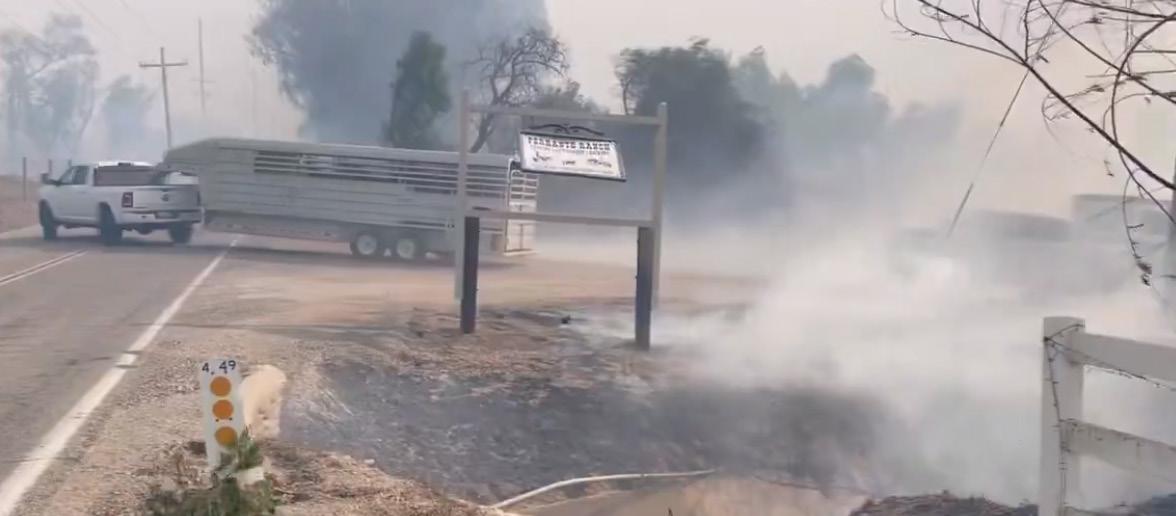
Edison has set up community resource centers at the Arroyo Vista Recreation Center in Moorpark, Simi Valley Senior Center at 3900 Avenida Simi, and the Ventura Beach Marriott at 2055 Harbor Blvd. The centers are open from 8 a.m. to 10 p.m. Thursday.
Ventura County Fire Department officials said crews on the air and ground would work through the night to continue efforts to quell the flames.
“Hundreds of mutual aid firefighters continue to arrive on scene from throughout California,” according to the department.
The Los Angeles Fire Department dispatched nearly 100 firefighters to
the blaze, including at least five strike teams, along with another team that included fire personnel from Beverly Hills, Culver City and Santa Monica.
The Glendale Fire Department also sent crews to the fire lines. The Angeles National Forest sent two engine strike teams, two hotshot crews, two helicopters, and several fixed-wing aircraft to help fight the fire.
Ventura County fire officials said “numerous” structures have been impacted by the fire, but no firm numbers of destroyed homes and buildings were released as of Wednesday night. According to VCFD, damage estimates were expected to be released
beginning Friday.
Hundreds of homes were under evacuation orders, with an evacuation center established at 5205 Upland Road in Camarillo. Multiple roads in the fire area were closed and numerous schools and school districts announced that they would be closed Thursday.
There were reports of at least two people being injured in the blaze. They were taken to a hospital and treated for smoke inhalation, according to media reports. Details about injured people and damage to property were expected to be updated at a news conference Thursday morning.
At least 14,000 people
were evacuated. Evacuation shelters have been set up at Padre Parish, 5205 Upland Road in Camarillo, for large animals at the Ventura County Fairgrounds at 10 E.Harbor Blvd. in Ventura, and for small animals at the Camarillo Airport at 600 Aviation Drive in Camarillo.
Northbound Lewis Road at Las Posas, eastbound Highway 118 at Wells Road and westbound Highway 118 at Tierra Road are closed.
Gov. Gavin Newsom announced Wednesday afternoon that the state had secured a Fire Management Assistance Grant from the Federal Emergency Management Agency to help with the firefight.
“This is a dangerous fire that’s spreading quickly and threatening lives,” Newsom said in a statement. “State resources have been mobilized to protect communities, and this federal support from the Biden-Harris Administration will give state and local firefighters the resources they need to save lives and property as they continue battling this aggressive fire.”
The fire erupted amid Santa Ana winds that forecasters said were capable of reaching 100 mph in particularly wind-prone areas. Much of Ventura and Los Angeles counties were under red flag warnings that will continue into Thursday.
“A very strong, widespread, and long-duration Santa Ana wind event will bring widespread extremely critical fire weather conditions to many areas of Los Angeles and Ventura counties Wednesday into Thursday,” according to the National Weather Service.
The National Weather Service noted that while the gusting winds will increase Thursday morning, they were not expected to be as powerful as Wednesday’s gusts, and conditions were expected to ease by Thursday afternoon, with “much lighter winds expected Thursday night into Friday with a shift back to a westerly direction.”
antee that the additional sales tax money would end or ease the homelessness crisis.
“Measure A is a sales tax increase to pay for the same failed homelessness programs,” according to a statement from the Howard Jarvis Taxpayers Association. “Auditors are still trying to figure out where all the money went and why homelessness is worse than before the tax increase.
Measure H doesn’t expire until 2027, so there is time for the L.A. County Board of Supervisors to develop a better plan to address homelessness, without raising taxes.”
The association took issue with tax dollars awarded to nongovernmental organizations that are not transparent.
“Homelessness increased from about 46,000 in L.A. County before the
Measure H tax increase in 2017 to about 75,000 now,” according to the association.
“This is a failure, and this broken model should not be made permanent.”
LA Mayor Karen Bass and LA County Sheriff Robert Luna were among the officials who supported Measure A.
Bass countered critics’ concerns about accountability, noting that the measure was written with mandates for clearly defined results and expectations.
“Money will be taken away from programs that do not deliver results,” Bass told reporters last month. “I want to make it clear that I mean business, and Measure A means business.”
Luna said, “We’re here to continue to make sure that our law enforcement officers, our first responders, continue to have options to help people dealing with
homelessness, mental health and addiction, so it doesn’t lead to possible incarceration.”
Measure A is a means of “helping our neighbors, and keeping our neighborhoods safe,” Luna added.
Measure G
A proposed massive restructuring of Los Angeles County’s government, including expanding the Board of Supervisors and making the county CEO an elected position, was still in limbo with the results of Tuesday’s election too close to call.
Election results published Wednesday afternoon showed voters almost evenly divided on Measure G.Yes votes held a slight lead of 50.3%-49.7%, with an approximately 15,000vote separation between the two sides out of 2.3 million ballots counted.
A voter-enacted Measure G would increase the Board
of Supervisors from five to nine members following the 2030 Census and the county CEO would convert from an appointed to elected office by 2028. The ballot initiative would also create the positions of county legislative analyst and director of budget and management.
Measure G also creates a charter-codified Ethics Commission and a compliance officer by 2026 and a commission that would review the county charter every 10 years. It seeks to require all county departments to present their annual budgets during public meetings and all Board of Supervisors agenda items be posted at least 120 hours before a regular meeting.
Further, the measure authorizes suspension of an elected official charged with a felony connected with a
violation of officials duties, and it creates a task force to oversee the implementations of the changes that must be made with no added expense to taxpayers.
Supervisors Lindsey Horvath and Janice Hahn initiated the proposed charter overhaul, which Supervisor Hilda Solis supported.
Horvath and Hahn have said the County Charter and its five-member board format were adopted in 1912, when the population was about 500,000, compared with its current 10 million residents and 88 incorporated cities.
Barger and Mitchell also opposed the notion of an elected CEO.
“The people of L.A. County deserve results from their elected leaders, not more elected positions without accountability and increased spending that takes from an already strained county budget working to address the homeless and mental health crisis,” according to a ballot argument signed by Mitchell, Barger and union officials representing county firefighters and sheriff’s deputies.
Opponents have also questioned whether the governmental adjustments could be implemented without any additional costs borne by taxpayers following the creation of new elected offices and county staff positions.
Supervisors Holly Mitchell and Kathryn Barger, however, voted against placing Measure G on the ballot. They suggested the proposed governance makeover was rushed and questioned if nine would be the proper number of supervisors on an expanded board.
By Terri Vermeulen Keith, City News Service
APasadena man — who had been part of a construction crew that had worked at an Arcadia home — was convicted Thursday of murdering a 76-year-old woman whose body was discovered in her backyard.
The downtown Los Angeles jury deliberated less than an hour before finding Heber Enoc Diaz, now 33, guilty of first-degree murder for the April 9, 2019, killing of Chyong Jen Tsai.
Jurors also found true the special circumstance allegations of murder during the commission of a robbery or attempted robbery and murder during the commission of a burglary or attempted burglary, along with allegations that he had personally used a box cutter, a drywall saw and a hammer during the commission of the crime.
Diaz was also convicted of
three counts of burglary and one count each of robbery and dependent adult abuse resulting in death.
He is facing life in prison without the possibility of parole, with sentencing set Dec. 16 before Superior Court Judge Terry A. Bork.
During closing arguments Thursday, Deputy District Attorney Miriam Avalos said there was an “overwhelming amount of evidence” to prove the defendant’s guilt.
The prosecutor told the jury that it was “ludicrous” for the defendant to claim to Los Angeles County sheriff’s detectives that the victim attacked him first, with the deputy district attorney saying that Tsai tried to run away from him and screamed for help.
The woman was stabbed multiple times, her throat was cut twice and she had injuries that were consistent with her

being hit by a hammer and choked, Avalos told jurors, noting that she was sorry she had to show them graphic photos of the woman.
During an undercover jail operation after his arrest, Diaz said the woman — who had brought him breakfast every day while he was
By City News Service

The county Board of Supervisors authorized the acquisition of the Gas Company Tower in downtown Los Angeles Wednesday, in hopes of moving many county workers and public services out of some existing offices in the Civic Center area.
The purchase comes on the heels of concerns about existing county buildings in need of seismic upgrades. In March, the board published a list of 33 county-owned buildings that were at the risk of earthquake damage, including the Kenneth Hahn Hall of Administration, Hall of Records and Historic General Hospital, among others.
The purchase of the 52-story skyscraper, which stands 749 feet tall at 555 W. Fifth St., was approved by the board Wednesday in a 4-1 vote.
A total of $200 million was allocated for the purchase, and the county CEO was asked to take the next steps in acquiring and upgrading the tower, which could be the next prominent office space for county workers.
Supervisor Janice Hahn, whose father is the namesake of the existing Hall of Administration, opposed the purchase, saying, “The money being used to pay for
this purchase is being stolen from the funds that were meant to keep (Kenneth Hahn Hall) alive.”
In September, Southern California Gas Co. announced plans to move out of its longtime headquarters and signed a least at the Two California Plaza building on Bunker Hill, with plans to relocate by spring 2026.
County CEO Fesia Davenport posted on X, formerly Twitter, that the acquisition of the Class A skyscraper would provide “a safe and modern environment for (county) employees, saving hundreds of millions of dollars or more in retrofit expenses.”
The prosecutor told the jury that Diaz had also been involved in another burglary at the property about three weeks earlier while he was still working there.
Diaz’s attorney, Simon Aval, countered that his client solely returned to the property where he had worked “with the intention of stealing tools.”
The defense lawyer said there was “no plan for Mr. Diaz to hurt anybody that night,” telling jurors that he believed it was “clear that he (Diaz) did not go there with an intention (of) hurting anybody.”
working on the construction crew — called him by his name and asked him what he was doing on the property, according to the prosecutor.
“As soon as he saw her, Ms. Tsai was going to die,” Avalos told jurors, saying that Diaz caused the victim “unimaginable pain.”
The defense lawyer suggested that the attack was a “crime of impulse” and was not premeditated.
Aval noted that the victim had been described as a “wonderful lady,” and that it would be human nature to feel emotional about the graphic photos of Tsai’s injuries.
But he said it doesn’t mean that the crime should be over-charged.
He argued that nothing was taken from the woman in her presence and said there was “insufficient evidence” to support a “special circumstances type of murder.”
In her rebuttal argument, the prosecutor questioned why Diaz would ride a bicycle to the home if he was going to steal “very, very heavy tools,” and said the only reason would be if he was going to take Tsai’s Lexus, for which the keys were inside her house. The vehicle was found about three miles from where the defendant lived, she said. Diaz — who was linked to the killing through cellphone records and DNA — was arrested 10 days later by Los Angeles County sheriff’s deputies.
He has remained behind bars since then.
State Sen. Janet Nguyen will be returning to the Orange County Board of Supervisors after defeating Cypress City Councilwoman Frances Marquez in the race to succeed Andrew Do, according to figures released Wednesday by the Orange County Registrar of Voters.
Nguyen led 62.81%37.19% as of early Wednesday evening, with additional ballots remaining to be counted.
Do was Nguyen’s chief of staff when she served on the Board of Supervisors, before he was elected to the Garden Grove City Council, then won a special election for Orange County supervisor when Nguyen became a state lawmaker.
The nonpartisan Board of Supervisors currently includes three Democrats: Katrina Foley, Vicente Sarmiento and Doug Chaffee. If Marquez had won the race for Do’s former seat, Chairman Don Wagner would have been the only Republicanremaining. Wagner was reelected in the March primary.
Do was already set to be termed out of office at the end of the year, but he agreed to resign last week as part of a plea deal with federal and local prosecu-
By City News Service
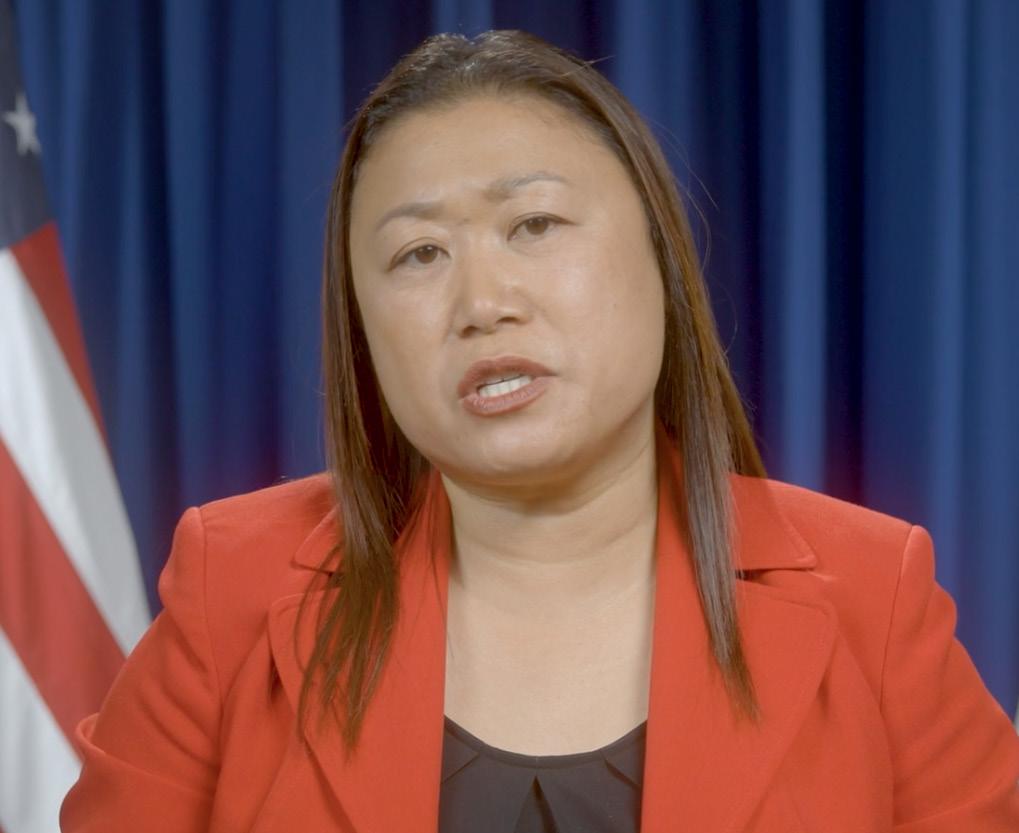
tors over an investigation into county COVID-19 relief funds awarded to a nonprofit organization that employed Do’s daughter.
In another closely watched Orange County race, 74th District Assemblywoman Laurie Davies, R-Laguna Niguel, was defeating Democrat Chris Duncan, a San Clemente city councilman and former federal prosecutor, in her bid for a third term. The district covers portions of southern Orange County and northern San Diego County.
As of late Wednesday afternoon, Davies had 52.5% of the vote, while Duncan
had 47.5%, according to the Secretary of State’s office. In the 37th Senate District race, Sen. Josh Newman, D-Fullerton, was trailing Republican former Irvine Mayor Steven Choi by 12,872 votes, with Choi receiving 51.88%.
“We’re going to win that,” Orange County Republican Party Chairman Fred Whitaker said. “I think (Choi) was better known and that overcame all the money (Newman) had.” Whitaker added, “We had a very good night last time nationwide and locally. Up and down the ballot we had a very good night.”