George McGraw joins LA Board of Water and Power Commissioners
Downey man suspected of killing Tijuana sex worker will remain in custody
Pg 28
Pg 14
VISIT ELMONTEEXAMINER.COM
Local. Relevant. Trusted.
Thursday, July 13-July 19, 2023
VOL. 12,
NO. 129
Checked out: How LA failed to stop landlords from turning low-cost housing into tourist hotels By Robin Urevich, Capital & Main, and Gabriel Sandoval, ProPublica Many of the American’s residents said they took Verge up on his offer, unaware that his plan to eventually turn the American into a tourist hotel was supposed to be illegal under the residential hotel law. The conversion disrupted a tight-knit community that had lived at the hotel for years — including at least one person who said he ended up sleeping in his car. Under the law, Verge was required to compensate the city for the loss of affordable housing by either building replacement units or paying into a fund for housing construction. In Verge’s case, that could have cost more than $10 million. But like many landlords, Verge did neither of those things, and the city Housing Department didn’t compel him to, even though the law provides for $250-per-day fines and jail time for violators. Scouring city records and online advertisements, Capital & Main and ProPublica identified 21 residential hotels, totaling more than 800 dwelling units, that were
This story was originally published by ProPublica. ProPublica is a Pulitzer Prizewinning investigative newsroom. Sign up for The Big Story newsletter to receive stories like this one in your inbox.
B
y law, the American Hotel in downtown Los Angeles is supposed to be reserved for residents who can’t afford to live anywhere else. For decades, the building was a haven in the city’s sky-high housing market, where artists, musicians and people down on their luck could rent rooms for about $500 a month. At the end of the day, longtime tenants would hang out at Al’s Bar, a legendary punk and alternative rock venue on the ground floor where bands like the Red Hot Chili Peppers played long before they sold out stadiums. But amid the largest homelessness crisis in the nation, the American’s owner has turned the building into a boutique hotel where tourists can book rooms for as much as $209 a night. And the city has done nothing to stop him. Long before Los Angeles
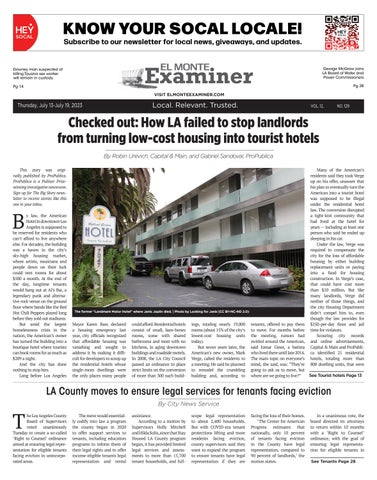
The former "Landmark Motor Hotel" where Janis Joplin died. | Photo by Looking for Janis (CC BY-NC-ND 2.0)
Mayor Karen Bass declared a housing emergency last year, city officials recognized that affordable housing was vanishing and sought to address it by making it difficult for developers to scoop up the residential hotels whose single-room dwellings were the only places many people
could afford. Residential hotels consist of small, bare-bones rooms, some with shared bathrooms and most with no kitchens, in aging downtown buildings and roadside motels. In 2008, the LA City Council passed an ordinance to place strict limits on the conversion of more than 300 such build-
ings, totaling nearly 19,000 rooms (about 15% of the city’s lowest-cost housing units today). But seven years later, the American’s new owner, Mark Verge, called the residents to a meeting. He said he planned to remodel the crumbling building and, according to
tenants, offered to pay them to move. For months before the meeting, rumors had swirled around the American, said Jomar Giner, a barista who lived there until late 2014. The main topic on everyone’s mind, she said, was: “They’re going to ask us to move, but See Tourist hotels Page 13 where are we going to live?”
LA County moves to ensure legal services for tenants facing eviction By City News Service
T
he Los Angeles County Board of Supervisors voted unanimously Tuesday to create a so-called "Right to Counsel" ordinance aimed at ensuring legal representation for eligible tenants facing eviction in unincorporated areas.
The move would essentially codify into law a program the county began in 2020 to offer support services to tenants, including education programs to inform them of their legal rights and to offer income-eligible tenants legal representation and rental
assistance. According to a motion by Supervisors Holly Mitchell and Hilda Solis, since that Stay Housed LA County program began, it has provided limited legal services and assessments to more than 15,700 tenant households, and full-
scope legal representation to about 2,400 households. But with COVID-era tenant protections lifting and more residents facing eviction, county supervisors said they want to expand the program to ensure tenants have legal representation if they are
facing the loss of their homes. "The Center for American Progress estimates that nationally, only 10 percent of tenants facing eviction in the County have legal representation, compared to 90 percent of landlords," the motion states.
In a unanimous vote, the board directed its attorneys to return within 10 months with a "Right to Counsel" ordinance, with the goal of ensuring legal representation for eligible tenants in See Tenants Page 28