FREE
Man convicted of shooting, wounding 2 sheriff’s deputies gets life sentence
Bass expands alternative unarmed response program to Sherman Oaks
PG 02
PG 28
M O N D AY, N O V E M B E R 06- N O V E M B E R 12, 2023
V I S I T M O N T E R E Y PA R K P R E S S . C O M
V O L. 11,
N O. 145
Thousands attend 2-day Breeders’ Cup Championships at Santa Anita Park
How a big pharma company stalled a potentially lifesaving vaccine in pursuit of bigger profits
By City News Service
By Anna Maria Barry-Jester, ProPublica
T
housands of horseracing aficionados, curious spectators and enthusiastic bettors descended Friday on Santa Anita Park in Arcadia for the beginning of the two-day Breeders’ Cup World Championships, one of the sport’s most prestigious gatherings of horses, trainers and owners from around the world. For Santa Anita, this year’s gathering marked the record 11th time the track has hosted the event. “Santa Anita’s outstanding reputation and scenic venue provide us with the ideal setting to continue to grow our audience by combining the best that racing, hospitality, and entertainment have to offer,” Breeders’ Cup President/ CEO Drew Fleming said last year when announcing the track would be hosting the 2023 event. Organizers said a report prepared in 2017 showed that the event can have a nearly $100 million impact on the local economy, given its worldwide industry attraction. Santa Anita last hosted the Breeders’ Cup in 2019. In 2021 it was at Del Mar Thoroughbred Club in San Diego County. Last year’s event was at Keeneland in Lexington, Kentucky. Organizers said 175 horses were entered for the 40th Breeders’ Cup World Championships, with races scheduled over two days, anchored by the $6 million Longines Breeders’ Cup Classic on Saturday. Friday’s first post was scheduled for 11:30 a.m., beginning with four undercard races. The first Breeders’ Cup race Friday was the $1 million Juvenile Turf Sprint, set for about 2 p.m., followed by the $2 million Juvenile Fillies, the $1 million
to have been a cardiac event. Practical Move was returning from a workout on the track when the event occurred. Another Breeders’ Cup Classic entry, Arcangelo, dropped out of the race Tuesday due to an issue with the colt’s left hind foot. In remarks posted on social media from Santa Anita, trainer Jena Antonucci confirmed the issue with the horse’s foot that “he’s not fully resolving, and we’re running out of time” to successfully treat the problem before the race. Kentucky Derby winner Mage had been expected to run in the Breeders’ Cup Classic but never made the trip to Santa Anita “after spiking a fever last weekend,” ESPN reported.
This story was originally published by ProPublica. ProPublica is a Pulitzer Prize-winning investigative newsroom. Sign up for The Big Story newsletter to receive stories like this one in your inbox. ver since he was a medical student, Dr. Neil Martinson has confronted the horrors of tuberculosis, the world’s oldest and deadliest pandemic. For more than 30 years, patients have streamed into the South African clinics where he has worked — migrant workers, malnourished children and pregnant women with HIV — coughing up blood. Some were so emaciated, he could see their ribs. They’d breathed in the contagious bacteria from a cough on a crowded bus or in the homes of loved ones who didn’t know they had TB. Once infected, their best option was to spend months swallowing pills that often carried terrible side effects. Many died. So, when Martinson joined a call in April 2018, he was anxious for the verdict about a tuberculosis vaccine he’d helped test on hundreds of people. The results blew him away: The shot prevented over half of those infected from getting sick; it was the biggest TB vaccine breakthrough in a century. He hung up, excited, and waited for the next step, a trial that would determine whether the shot was safe and effective enough to sell. Weeks passed. Then months. More than five years after the call, he’s still waiting, because the company that owns the vaccine decided to prioritize far more lucrative business. Pharmaceutical giant GSK pulled back on its global public health work and leaned into serving the world’s most-profitable market, the United States, which CEO Emma Walmsley recently called its “top priority.” As the London-based company turned away from its vaccine for TB, a disease that kills 1.6 million mostly poor people each year, it went all in on a vaccine against shingles, a viral infection that comes with a painful rash. It afflicts mostly older people who, in the U.S., are largely covered by government insurance. Importantly, the shingles vaccine shared a key ingredient with the TB shot, a component that enhanced the effectiveness of both but was in limited supply. From a business standpoint, GSK’s decision made sense. Shingrix would become what the company calls a “crown jewel,” raking in more than $14 billion since 2018. But the ability of a corporation to allow a potentially lifesaving vaccine to languish lays bare the distressing reality of public health vaccine creation. With limited resources, governments have long seen no other option but to team with Big Pharma to develop vaccines for global scourges. But after the governments pump taxpayer money and resources into the efforts, the companies get control of the products, locking up ownership and prioritizing their own gain. That’s what GSK did with the TB vaccine. Decades ago, the U.S. Army brought in GSK to work on a malaria vaccine and helped develop the ingredient that would prove game-changing for the company. It was an adjuvant, a
See Breeders’ Cup Page 27
See Pharma Page 14
E
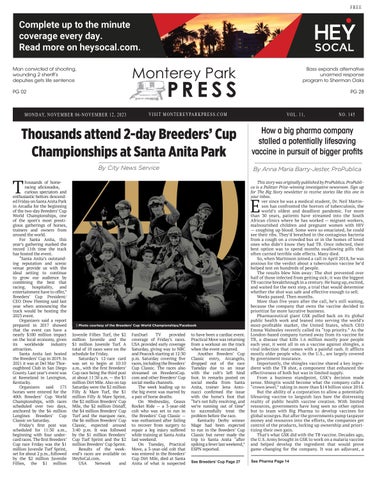
| Photo courtesy of the Breeders’ Cup World Championships/Facebook
Juvenile Fillies Turf, the $2 million Juvenile and the $1 million Juvenile Turf. A total of 10 races were on the schedule for Friday. Saturday’s 12-race card was set to begin at 10:10 a.m., with the first Breeders’ Cup race being the third post at about 11:30 a.m. — the $1 million Dirt Mile. Also on tap Saturday were the $2 million Filly & Mare Turf, the $1 million Filly & Mare Sprint, the $2 million Breeders’ Cup Mile, the $2 million Distaff, the $4 million Breeders’ Cup Turf and the marquee race, the $6 million Breeders’ Cup Classic, expected around 3:40 p.m. It was followed by the $1 million Breeders’ Cup Turf Sprint and the $2 million Breeders’ Cup Sprint. Results of the weekend’s races are available on HeySoCal.com. USA Network and
FanDuel TV provided coverage of Friday’s races. USA provided early coverage Saturday, giving way to NBC and Peacock starting at 12:30 p.m. Saturday covering five races, including the Breeders’ Cup Classic. The races also streamed on BreedersCup. com and other Breeders’ Cup social media channels. The week leading up to the big event was marred by a pair of horse deaths. On Wednesday, Geaux Rocket Ride — a 3-year-old colt who was set to run in the Breeders’ Cup Classic — was euthanized after failing to recover from surgery to repair a leg injury suffered while training at Santa Anita last weekend. On Tuesday, Practical Move, a 3-year-old colt that was entered in the Breeders’ Cup Dirt Mile, died at Santa Anita of what is suspected
2
BeaconMediaNews.com
NOVEMBER 06-NOVEMBER 12, 2023
Man convicted of shooting, wounding 2 sheriff’s deputies gets life sentence By Terri Vermeulen Keith, City News Service
A
n ex-con who carried out a 2020 crime spree that included the ambush-style shooting of two Los Angeles County sheriff’s deputies in their patrol vehicle outside a Compton transit center was sentenced Wednesday to 166 years and eight months to life in prison. Deonte Lee Murray, 39, was convicted Sept. 28 of two counts of attempted murder of a peace officer for the Sept. 12, 2020, attack on Deputies Claudia Apolinar and Emmanuel PerezPerez, which was caught on surveillance video outside a Compton transit center. Jurors also convicted Murray of one count each of attempted murder, assault with a semiautomatic firearm, carjacking and robbery, along with four counts of possession of a firearm by a felon. Apolinar and PerezPerez both attended and spoke during the Wednesday morning sentencing hearing, which was also attended by Los Angeles County Sheriff Robert Luna. During Murray’s trial, Deputy District Attorney Stephen Lonseth told jurors that Murray shot four people and tried to kill three of them, including the two sheriff’s deputies whom he allegedly tried to ambush in what the prosecutor said was “no impulse.” According to Lonseth, Murray allegedly said after the shooting that he could not believe the deputies had not died. The prosecutor told the panel that Murray “did everything he could to end the lives of Claudia Apolinar
and Emmanuel Perez-Perez,” saying “this wasn’t some impulsive thing.” “They’re alive because of frankly a miracle,” Lonseth said, citing the “heroic actions” of Apolinar in trying to aid her partner despite being wounded herself in the jaw and arms. The prosecutor had told jurors during his opening statement in August that Murray “lost it” and “sought to take out revenge” after sheriff’s deputies shot and killed his best friend Sam Herrera while serving a search warrant in Compton on Sept. 10, 2020, two days before Apolinar and PerezPerez were ambushed. Murray allegedly “unloaded over and over again” by firing upon a man he mistakenly believed was a detective in an unmarked car near the Compton courthouse on Sept. 10, 2020, then driving away in a black Mercedes-Benz that had been carjacked nine days earlier from a man who was shot in the leg with a rifle, Lonseth told the panel. The defendant — who allegedly abandoned the Mercedes-Benz near an elementary school — was arrested Sept. 15, 2020, after leading police on a chase in which he tossed a “ghost gun” from the Toyota Solara he was driving and then running into a neighborhood, where he was subsequently found hiding under a chicken coop in a resident’s backyard, the prosecutor said. Ballistics testing subsequently determined that the .40-caliber weapon had been used to shoot the sheriff’s
deputies, authorities said. Murray’s attorney Kate Hardie told jurors her client was under the influence of drugs and alcohol and griefstricken over his best friend’s shooting death by other sheriff’s deputies two days earlier. The defense lawyer told jurors the “closest person” to Murray had been killed, calling the days between Sept. 10 and Sept. 12 of that year “the worst time in Mr. Murray’s life.” Hardie told jurors her client’s actions were “impulsive” and fueled by alcohol, methamphetamine and grief over his best friend’s death. She told the panel they had heard about evidence of Murray’s intoxication from six separate sources, saying that and his mental state negate both premeditation and intent to kill involving the attempted murder charges. Hardie accused the prosecutor of trying to sway the jurors’ emotions by arguing that it would have been a murder case if it wasn’t for Apolinar’s actions. “You can, in your outside lives, think these deputies are heroes,” Murray’s attorney said, while urging jurors to consider only the evidence and jury instructions during the trial. The defense lawyer conceded an assault charge involving the first shooting on Sept. 1, 2020, along with a series of counts against Murray alleging that he was a felon in possession of a firearm. She described her client as having been convicted of “small stuff.” But she told jurors the
Deputy Claudia Apolinar was one of two deputies shot at point-blank range in their vehicle in 2020. | Photo courtesy of the Los Angeles County Sheriff’s Department/Facebook
defense was contesting other charges against him, including the attempted murder counts involving the deputies and the carjacking and robbery counts involving the first shooting victim named in the assault count. The defense lawyer told jurors the defense was “not asking you ... to let him go,” but was asking them to “follow the law.” During the trial, jurors heard from the two wounded deputies along with Murray, who testified in his own defense. Wearing a sheriff’s uniform while on the stand, Apolinar told jurors that she heard gunshots and that her vision went blank for a few seconds after she and her partner were shot. She testified that she didn’t immediately know where she had been shot but felt a “warm sensation in my mouth” and tried to speak over a police radio to report what had happened to her
and her partner. She told jurors that she felt her tongue flapping around in her mouth and that the dispatcher was having difficulty understanding her plea for assistance. “I knew I was hit in the mouth,” Apolinar, the mother of a then 6-year-old child, told jurors. She said she subsequently tried to help her partner, who was struggling to put a tourniquet on after she saw his face and right arm covered in blood. “I didn’t know where the suspect was at, if he was going to come back,” the deputy told jurors, saying later she did not see who he was and that neither she nor her partner fired any shots in response. Surveillance video shows the gunman walking up to the passenger side of the sheriff’s vehicle, firing and then quickly leaving, and Apolinar subsequently coming to her partner’s aid
followed by the two — both of their uniforms stained with blood — hurrying to a waiting patrol vehicle that rushed them to a hospital. She said she later learned that one round struck her in the jaw and “nearly cut my tongue off” and that she also suffered gunshot wounds to both of her arms, which were broken in the shooting. The deputy said she still has scars on both of her arms and her face from the attack, and that she returned to work at the sheriff’s department last September. Apolinar was praised for helping her wounded partner despite her own injuries, with then-District Attorney Jackie Lacey calling her actions “heroic.” The deputy was subsequently honored with the 2021 American Legion, Department of California’s Law Enforcement Officer of the Year for Valor award. Apolinar’s partner was shot in the forehead and an arm.
Duarte park renamed for late mayor By City News Service
T
here was a park renaming and dedication ceremony Wednesday in memory of former Duarte Mayor Tzeitel ParasCaracci. The City Council voted in September to rename Royal Oaks Park Extension Tzeitel Paras-Caracci Park due to her attachment to the park, where she married her husband, KC Caracci, in 2003, according to Manuel Enriquez, the city’s director of parks and recreation. The 11 a.m. ceremony at the park was on Wednesday because it was Hello Kitty Day, the “birthday” of the
Sanrio character ParasCaracci was a “huge enthusiast” of, Enriquez said. Paras-Caracci was a strong advocate of Duarte’s young people and parks and recreation services, Enriquez said. Paras-Caracci was elected to the first of her six terms on the council in 2001. She was the first FilipinoAmerican to be elected to the Duarte City Council and the first Duarte High School graduate. She served as mayor in 2006, 2011, 2015 and 2019. Paras-Caracci was also a member of the National
League of Cities Board of Directors, the League of California Cities Board of Directors, president of the Asian Pacific American Municipal Officials, director for the Los Angeles County Sanitation Districts, governing board member of Foothill Transit, board member of the Duarte Community Coordinating Council and president of the Duarte Women’s Club. Born Aug. 8, 1972, in Quezon City, Philippines, and named for the eldest daughter from the Broadway musical “Fiddler on the Roof,” Paras- Caracci and her family moved to Los Angeles
Royal Oaks Park sign. | Photo courtesy of City of Duarte / Facebook
in 1975 and to Duarte in 1985. She graduated from Duarte High School in 1989
and later from Woodbury University in Burbank. Paras-Caracci died June
25, 2022, at age 49 following a nearly three-year battle with lung cancer.
HLRMedia.com
NOVEMBER 06-NOVEMBER 12, 2023 3
Report: Metro has advanced transit goals through Measure M tax funds
Editorial editorial@beaconmedianews.com editor@hlrmedia.com Graphics/Production production@beaconmedianews.com production@hlrmedia.com
By City News Service
Advertising advertising@beaconmedianews.com advertising@hlrmedia.com
M
Legal Advertising legals@beaconmedianews.com legals@hlrmedia.com Business accounting@beaconmedianews.com accounting@hlrmedia.com
BEACON MEDIA ADDRESS:
125 E. Chestnut Ave., Monrovia, CA 91016 PHONE: (626) 301-1010 WEBSITE
Temple Tribune City
SanGabriel Sun
www.beaconmedianews.com
HLR MEDIA ADDRESS:
820 S. Myrtle Ave. Monrovia, CA 91016 PHONE: (626) 301-1010 www.HLRmedia.com
PRESS RELEASE SUBMISSIONS editor@beaconmedianews.com editor@hlrmedia.com
A zusa B eacon
Rosemead Reader A Beacon Media, Inc. Publication
Dispatch uarte
SUBMISSIONS POLICY
Beacon Media, Inc. and HLR Media, LLC All contents herein are copyrighted and may not be reproduced in any manner, either in whole or in part, without the express written consent of the publisher. The Views and opinions expressed in this paper are not necessarily that of the management and staff at Beacon Media, Inc. or HLR Media, LLC.
The Arcadia Weekly has been adjudicated as a newspaper of general circulation in court case number GS 004333 for the City of Arcadia, County of Los Angeles, State of California. The Monrovia Weekly has been adjudicated as a newspaper of General Circulation in Court Case GS 004759 City of Monrovia, County of Los Angeles, State of California. The Temple City Tribune has been adjudicated as a newspaper of general circulation in court case number GS 012440 City of Temple City, County of Los Angeles, State of California. The El Monte Examiner has been adjudicated as a newspaper of general circulation in court case number KS 015872 City of El Monte, County of Los Angeles, State of California.
Alhambra PRESS Baldwin Park
The Azusa Beacon has been adjudicated as a newspaper of general circulation in court case number KS 015970 City of Azusa, County of Los Angeles, State of California. The San Gabriel Sun has been adjudicated as a newspaper of general circulation in court case number GS 013808 City of San Gabriel, County of Los Angeles, State of California.
INDEPENDENT
The Duarte Dispatch has been adjudicated as a newspaper of general circulation in court case number GS 013893 City of Duarte, County of Los Angeles, State of California. The Rosemead Reader has been adjudicated as a newspaper of general circulation in court case number GS 048894 City of Rosemead, County of Los Angeles, State of California.
INDEPENDENT
The Alhambra Press has been adjudicated as a newspaper of general circulation in court case number ES016581 City of Alhambra, County of Los Angeles, State of California.
etro has successfully advanced goals such as transit expansion, infrastructure repair and congestion management that were included in the Measure M transportation sales tax measure approved by voters in 2016, according to a report released Thursday by the transit agency. The 189-page report provides an overview of Measure M, which was approved by over 70% of county voters in 2016, and analyzes the use of taxgenerated funds from July 2017 through June 2022. The report concluded that overall, Metro has advanced projects, programs and services that address many of Measure M goals, particularly around congestion management, transit expansion, local infrastructure repair and efforts to improve safety and affordability. “I applaud Metro for its progress on these goals and for leading initiatives that are making public transportation more accessible, convenient and affordable,” Los Angeles Mayor and Metro Board Chair Karen Bass said in a statement. She highlighted Metro’s GoPass and LowIncome Fare is Easy (LIFE) programs, which offer discounted rides for K-12 and community college students, riders who are income-eligible and riders with disabilities. “Metro is demonstrating its strong commitment to creating a world-class transportation system
The Burbank Independent has been adjudicated as a newspaper of general circulation in court case number ES016728 City of Burbank, County of Los Angeles, State of California.
T
The Monterey Park Press has been adjudicated as a newspaper of general circulation in court case number ES016580 City of Monterey Park, County of Los Angeles, State of California.
The Riverside Independent has been adjudicated as a newspaper of general circulation in court case number RIC1505351 City of Riverside, County of Riverside, State of California. The Pasadena Press has been adjudicated as a newspaper of general circulation in court case number ES018815 City of Pasadena, County of Los Angeles, State of California. The Belmont Beacon has been adjudicated as a newspaper of general circulation in court case number NSO30275 City of Long Beach, County of Los Angeles, State of California. The Anaheim Press has been adjudicated as a newspaper of general circulation in court case number 30-2017-00942735-CU-PT-CJC City of Anaheim, County of Orange, State of California. The Ontario News Press has been adjudicated as a newspaper of general circulation in court case number CIVDS 1506881 City of Ontario, County of San Bernardino, State of California. The Corona News Press has been adjudicated as a newspaper of general circulation in court case number RIC1723524 City of Corona, County of Riverside, State of California.
its goals such as addressing congestion; expanding rail and rapid systems; repaving and improving local streets; embracing technology; creating jobs; and making public transportation more accessible and affordable. Earlier this month, the Measure M Independent Taxpayer Oversight Committee met and unanimously voted to accept the findings and recommendations of the five-year assessment and equity report. The committee is a panel of residents charged with ensuring sales tax revenues are spent as intended. The assessment reviewed the projects and programs funded by Measure M, evaluated the program for
its effectiveness and made a series of recommendations as Metro continues to implement the measure. The assessment period of the report was marked by the pandemic, which changed the way people approach health, work and travel — and by extension the values and patterns of the transportation industry. According to Metro, the report reflects that the agency has made “difficult course adjustments,” while increasing its focus on equity and customer experience. Measure M imposed a permanent half-cent sales tax in Los Angeles County for transportation projects, and permanently extended an existing half-cent tax.
By City News Service
The Glendale Independent has been adjudicated as a newspaper of general circulation in court case number ES016579 City of Glendale, County of Los Angeles, State of California.
The San Bernardino Press has been adjudicated as a newspaper of general circulation in court case number CIVDS 1506881 City of San Bernardino, County of San Bernardino, State of California.
through these programs and its progress toward its goals,” Bass added. According to Metro CEO Stephanie Wiggins, when voters approved Measure M, they declared their intention to “remake our region into a more equitable, multimodal, accessible and economically prosperous place where the mobility benefits of transportation projects reached every corner of the county.” Wiggins recognized that the last five years have been tumultuous due to the coronavirus pandemic, but Metro continues to “deliver on our promises” to voters. Measure M outlined funding for programs and major projects, mapping a 40-year forecast to advance
Disney to buy remainder of Hulu for estimated $8.6 billion
The Baldwin Park Press has been adjudicated as a newspaper of general circulation in court case number KS017174 City of Baldwin Park, County of Los Angeles, State of California.
The West Covina Press has been adjudicated as a newspaper of general circulation in court case number KS017304 City of West Covina, County of Los Angeles, State of California.
Train on the E Line. | Photo by Daniel Melling/UCLA Emmett Institute (CC BY 2.0)
Pasadena Press
Belmont Beacon San Bernardino Press
he Burbank-based Walt Disney Co. announced Wednesday it has reached a deal to acquire Comcast Corp.’s remaining 33% stake in the Hulu streaming service for an anticipated $8.61 billion. The exact purchase price could vary pending the outcome of a value assessment of Hulu, and if the value is determined to be higher, Disney will pay the difference, according to the media giant. Once finalized, Disney will have full ownership of the streaming service. “The acquisition of Comcast’s stake in Hulu at fair market value will further Disney’s streaming
objectives,” according to a company statement. Disney officials said the process of appraising Hulu’s value should be completed sometime next year. The announcement came on a day that striking SAGAFTRA actors held a massive picket outside Disney studios in Burbank. It was unclear if the union chose to focus its picketing on Disney with knowledge of its anticipated Hulu acquisition. Contract talks were continuing Wednesday between SAG-AFTRA and the Alliance of Motion Picture and Television Producers, of which Disney is a member. Disney CEO Bob
| Photo courtesy of Tech Daily/Unsplash
Iger is believed to be an active participant in the ongoing talks, as he was in discussions
that led to a contract agreement with the Writers Guild of America.
4
BeaconMediaNews.com
NOVEMBER 06-NOVEMBER 12, 2023
Long Beach reports locally acquired dengue virus, following Pasadena case By City News Service
An Aedes mosquito and a transmission electron micrograph of dengue virus particles. | Photo courtesy of the NIAID/CDC/Flickr (CC BY 2.0)
L
ong Beach health officials Wednesday confirmed the city’s first locally acquired case of the mosquito-borne dengue virus, which is normally associated with people who have traveled outside the country. The local case is only the second of its type reported in California, with the first being reported roughly two weeks ago by health officials in Pasadena. Long Beach officials insisted the risk of local exposure remains low, and the patient is recovering at home. “The health and wellbeing of the community is our most important priority,” Mayor Rex Richardson said in a statement. “We are working closely with health officials to do everything we can to prevent more cases. We ask that everyone do their part by removing any standing water on their property to help us control the mosquitoes in our neighborhoods.” Health officials said a person can be infected with the dengue virus from an
infected Aedes mosquito. Dengue cases in the United States typically occur in people who have traveled to countries where the disease is more common, but neither the Long Beach nor Pasadena patients had any history of recent travel. Long Beach health officials said most patients never exhibit any symptoms, but one in four will develop signs including fever, nausea, vomiting, rash and aches and pains to the eyes, joints or bones. The symptoms generally last no more than a week, and people usually fully recover within two weeks. Deaths from the virus are extremely rare, health officials said. “We are taking many steps to prevent mosquito-borne infections in Long Beach,” city Health Officer Dr. Anissa Davis said. “Outreach teams are visiting the neighborhood where dengue was identified to provide information on mosquito bite prevention and ways to control mosquito breeding around the home. Health Depart-
ment staff continue to trap and test mosquitoes in nearby areas to look for infected mosquitoes and are intensifying efforts to reduce breeding and control mosquito populations.” Health officials urge residents to take steps to prevent and reduce mosquito populations, such as: -- Eliminate standing water in clogged rain gutters, rain barrels, discarded tires, buckets, watering troughs, or anything that holds water for more than a week. -- Ensure that swimming pools, spas, and ponds are properly maintained. -- Change water in pet dishes, birdbaths, and other small containers weekly. -- Report neglected swimming pools to vector control district. -- Wear insect repellent containing CDC and EPA approved active ingredients such as DEET, picaridin, IR3535, or oil of lemon eucalyptus. -- Wear loosely fitted, light-colored, longsleeved shirts and long pants.
HLRMedia.com
NOVEMBER 06-NOVEMBER 12, 2023 5
It’s official: Former NBA MVP James Harden is a Clipper By City News Service
T
he Los Angeles Clippers made it official Wednesday, announcing the team has acquired former NBA MVP James Harden from the Philadelphia 76ers. According to the team, the Clippers acquired Harden, P.J. Tucker and Filip Petrusev from Philadelphia in exchange for Marcus Morris, Robert Covington, Nico Batum and K.J. Martin, along with a first-round draft pick, two second-round picks, a swap of picks and cash considerations. As part of the deal, the Clippers will also send a pick swap and cash considerations to the Oklahoma City Thunder. “James is one of the most prolific and efficient playmakers in the NBA,” Lawrence Frank, Clippers
president of basketball operations, said in a statement Wednesday. “With his size and vision, he possesses an extraordinary ability to create for himself and others. The Los Angeles area has produced so many elite players in recent years. With Kawhi, Paul, Russ and James, we’re excited to bring four of them together, and eager to see what they can accomplish with the rest of our group.” The deal reunites Harden and Russell Westbrook as teammates for the third time. Harden has been vocal in the offseason about wanting to be traded from Philadelphia. It is the fourth time Harden has been traded by an NBA team. Harden and Westbrook
played together with the Oklahoma City Thunder and Houston Rockets previously. The Clippers and 76ers reportedly had been in trade talks since July. The 34-year-old Harden requested a trade in June when he opted out of his $35.6 million player option for the 2023-24 season. He has not played a game for the 76ers this season. Harden played basketball at Artesia High School in Lakewood and joins a team with strong Southern California roots. Westbrook played at UCLA and Leuzinger High School in Lawndale, Paul George played at Knight High School in Palmdale and Fresno State, and Kawhi Leonard played at San Diego State and Martin Luther
James Harden. | Photo by GAMEFACE-PHOTOS CC BY-SA 2.0 DEED
King High School in Riverside.
Harden has won three scoring titles and the 2018
NBA MVP award. He led the league in assists last year.
Riverside, San Diego counties report new mpox cases By City News Service
R
iverside County officials on Tuesday reported a new confirmed or probable mpox case, the second within the span of a week, raising the overall number to 319. The county has reported a total of 319 probable or confirmed cases of mpox, formerly known as monkeypox, with nearly half of them in Palm Springs and the last case, before this week, reported in July, according to the latest Riverside University Health System data. Additional data can be found at ruhealth.org/mpx-data. “It is a man 40-plus years from southwest Riverside County,” RUHS public information officer Jose Arballo said Tuesday. “Good reminder to get vaccinated against mpox.” Vaccines and testing for mpox are available in various areas including DAP Health, Palm Springs Community Health Center, Eisenhower Health and Indio Family Care Center, all located in eastern Riverside County. More information about
upcoming vaccine clinics in Riverside County for mpox can be found at ruhealth.org/ upcoming-vaccine-clinics. The California Department of Public Health asks individuals to self-evaluate their risk for mpox infection and to prioritize getting the vaccine for individuals who are high-risk, according to RUHS. “While there is currently adequate vaccine supply, there are no longer ‘eligibility’ criteria, and vaccine providers can offer and provide vaccine to any patients who may be at risk, and persons who request vaccination should receive it without having to attest to specific risk factors,” RUHS officials said in a statement. Mpox is generally spread through intimate skin-toskin contact, resulting from infectious rashes and scabs, though respiratory secretions and bodily fluids exchanged during extended physical episodes such as sexual intercourse can lead to transmission, according to the CDC. Symptoms include pimples, blisters, rashes,
fever and fatigue. There is no specific treatment. People who have been infected with smallpox, or have been vaccinated for it, may have immunity to mpox. People with symptoms are urged to visit a medical provider, cover the rash area with clothing, wear a mask and avoid close or skin-toskin contact with others. The CDC particularly recommends those steps for people who recently traveled to an area where mpox cases have been reported or who have had contact with a confirmed or suspected mpox case. As of Wednesday, a total of 5,905 mpox cases have been reported in California — the highest of any state — while nationwide, the aggregate count is 31,010, according to the latest CDC data. A state-by-state tally of cases is available at cdc.gov/poxvirus/ mpox/response/2022/ us-map.html. SD County encourages mpox vaccinations San Diego County public health officials on Oct. 26
encouraged residents to get vaccinated for mpox, as a rise in cases across the state was mirrored with 11 new cases in the county so far this month. As of Saturday, the total number of cases in San Diego County is 492 since cases first emerged in July 2022. During last summer’s global outbreak, mpox affected mostly the LBGTQ+ community, but anyone can get mpox. “The Mpox vaccine is widely available, safe and an effective way to lower your risk of getting Mpox or lower the severity of your symptoms if you do get sick,” said County Public Health Officer Dr. Wilma Wooten. “It’s important that people at risk are also practicing other safety measures and notifying their partner or partners of any recent illness or rashes.” The JYNNEOS vaccine is a two-dose injection that helps prevent mpox when given before or shortly after exposure to the virus. It is available to anyone 16 years and older without parental
A microscopic look at the mpox virus. | Photo courtesy of NIAID/ Wikimedia Commons (CC BY 2.0)
consent. It is also available for people 16 years of age and younger, with parental consent. In San Diego County nearly 16,000 people have received at least one dose of the JYNNEOS vaccine. No-cost vaccines including second doses are widely available from healthcare providers and public health clinics. People unsure of
STARTING A NEW BUSINESS? VISIT
NOTICEFILING.COM
where to get a vaccine can call 2-1-1 or make an appointment on MyTurn. ca.gov. To avoid the illness, county public health officials urge those at risk to limit contact with people with sores or symptoms, avoid touching items someone with the illness has recently handled, practice good hygiene and wash hands.
6
BeaconMediaNews.com
NOVEMBER 06-NOVEMBER 12, 2023
Consumer debt grows to nearly $17 trillion, but not everyone is affected equally By Chris Horymski, Stacker
C
onsumers accumulated an additional $73 billion in debt over the past year through the second quarter (Q2) of 2023, according to Experian data. Debt balances have risen for most types of consumer debt, resulting in a 4.5% total increase since Q2 2022. Collectively, consumers now owe $16.84 trillion to lenders. In this midyear review of consumer debt, Experian examined representative and anonymized credit data from Q2 2022 through Q2 2023, and highlighted some of the observations. The data revealed that each type of debt told a slightly different tale about the state of the economy in 2023. Some types of debt are growing spectacularly, while others are more subdued— although not every segment of the consumer population has seen an equal impact. Changes in average consumer credit balances vary by type of debt The total debt balance appearing in consumer credit files increased to $16.84 trillion as of Q2 2023, up from $16.11 trillion in Q2 2022. This was a smaller increase than the 7% jump in consumer debt from Q2 2021 to Q2 2022. Average consumer debt balances increased in 2023, though growth has slowed compared to prior years. Mortgage debt looms largest, but personal loan debt saw the biggest growth In percentage terms, credit card and personal loan debt grew the most in 2023, increasing by 16.3% and 21.3%, respectively. The "percentage terms" qualifier is important here: Despite the double-digit percentage growth, the $150 billion increase in credit card and personal loan debt is still dwarfed in dollar terms by the $500 billion sum added to the total consumer mortgage balance. The total auto loan balance increased 5.8% to $1.5 trillion for the 12 months ending in Q2 2023, according to Experian data. While not as sharp an increase as was seen with personal loans and credit cards, drivers are still reeling from years of inventory
shortages that increased prices for both new and used vehicles. In addition, expenses not directly tied to financing (auto insurance, for example) are also eating into driving costs. This effect is so pronounced that higher auto loan APRs, currently averaging 7.50% according to Federal Reserve data, may only be a secondary concern for some car buyers in 2023. Student loans declined by $120 billion in 2023, a stark contrast to the other types of debt. Factors contributing to the decrease in student debt levels included the moratorium on interest assessed on student loans, some borrowers making loan payments during the three-year payment pause that ended this year, and loan forgiveness initiatives through the Department of Education. Average debt increases more sharply among those with lower credit scores Those with lower FICO Scores tend to carry higher balances, on average, while those with very good or exceptional scores saw their average balance increase at more modest rates in 2023. Although larger balances in and of themselves don't automatically translate to lower credit scores, consumers with lower FICO Scores don't often receive as favorable interest rates on their loans and credit. Higher interest rates on debt means balances will swell faster (in the case of revolving credit like credit cards) as well as take longer to pay down (in the case of fixed debt like auto loans). Generation X leads in non-mortgage debt growth Average overall debt, excluding mortgage debt, increased among all except the oldest U.S. consumers in 2023. But one generation carrying much of the higher debt costs is Generation X. Now at least in their mid 40s, Generation X's nearly $2,000 increase in average non-mortgage debt was significantly more, in dollar amount terms, than the increases of the other generations. In addition, Generation X, along with millennials, carry the majority of student loans. Mortgage debt increas-
Experian
es at slower rate than other types of debt Except for the newbie Generation Z homeowners, mortgage balances increased less than other types of consumer debt over the past 12 months. This makes sense when you consider two factors: the preponderance of existing mortgages with interest rates of 4% or less, and the relative scarcity of new mortgage originations at now eye-watering rates of more than 7% (for 30-year fixed rate mortgages). Until home sales, and perhaps more important, the number of homes for sale, increase, expect the modest mortgage debt increases to continue. While good news for existing homeowners— especially those with low mortgage interest payments as well as appreciating home values—sluggish growth means many consumers wanting to buy will likely remain on the sidelines. Millennials hardest hit by credit card debt increases Credit card balances grew by 16.3% for all U.S. consumers over the past year, with the average balances among younger consumers—Generation Z and millennials—growing even faster than the overall increase. Average credit card balances for every generation outstripped the 3% increase of the consumer price index over that same period. Consumers, facing sharp increases in the prices of many of the basics—food costs were up 5.7% and rents up 8.5%, according to the Bureau of Labor Statistics— may be adding to credit card balances by borrowing for more discretionary purchases, such as travel and enter-
tainment. While the increases are perhaps eyebrow-raising, consider that more consumers are now considered creditworthy enough for lenders to extend credit to them in the first place. Unemployment levels remain below 4%, which means more consumers are making an income, which is something lenders prefer to see before they'll extend them credit. But of course, that credit card use comes with the cost of rising APR for revolving balances, which have increased by an average of 5 percentage points since 2020. So although an increase in purchases and purchasing power are driving some of the credit card increase, higher interest rates are also an accelerant. Where consumer debt levels may be headed in 2024 Overall, an observer probably shouldn't expect a sharp increase in the total consumer debt levels in the next year, if only for one reason: Mortgages make up nearly two-thirds of the $16 trillion debt level, and those debt balances are growing the least in percentage terms, as both new and potential homeowners shy away from 7% mortgage rates, creating very new additional mortgage debt. However, the growth rates of other types of debt for the coming months are difficult to anticipate. Changes in credit card debt balances will largely be a function of holiday spending, as always. Consumers may have the income to spend, yet may balk at adding even more interest-bearing purchases to their existing debt levels. Predicting auto loan
Experian
debt levels will depend on how much inventories are being roiled again, this time by strikes at some U.S. auto plants this fall. Even student loans, where payments have recently resumed after a three-year absence, are difficult to forecast, as borrowers and loan servicers navigate new student loan repayment plans available to federal student loan borrowers. The following indicators will directly inform how much consumer credit balances will increase as we approach 2024: - Wages: Price increases on consumer goods outpaced wage increases in 2021 and 2022, and median incomes, after adjusting for inflation, have fallen over the past two years. Moreover, the decline was most pronounced for those with incomes below the median, so those earning the least fell furthest behind. However, unemployment remains low. Additionally, so far this year, workers have demanded—and in many cases, received—pay increases from employers, who still have many more potential job openings to fill than workers to fill them. In short, higher wages and nearly full employment will likely encourage consumers to spend more, even in the face of higher rates. Unemployment claims: Typically, increases in unemployment and economic slowdowns only start occurring when more than 300,000 workers weekly start a new unemployment claim. So far in 2023, claims have been well under that level, according to Labor Department data. If the trend continues, then there's at least the chance that there will be more consumers with
more discretionary income to spend. - Holiday spending: We're already receiving mixed messages about the holiday season from employers. Some, like Amazon, expect to hire more seasonal workers this holiday season, while retailers like Macy's aren't hiring as many in 2023 versus the prior holiday season. While this information may be telling us more about how consumers might spend rather than if consumers might spend, conflicting economic signals are par for the course in 2023. With all that noted, there are still enough wild cards that could upend any reasonable short-term economic forecast, and we've already seen pandemics and international conflicts impact the cost of nearly everything so far this decade, including credit. One constant for consumers remains, though: Access to credit still depends in large part on a consumer's credit history. Methodology: The analysis results provided are based on an Experiancreated statistically relevant aggregate sampling of our consumer credit database that may include use of the FICO Score 8 version. Different sampling parameters may generate different findings compared with other similar analysis. Analyzed credit data did not contain personal identification information. Metro areas group counties and cities into specific geographic areas for population censuses and compilations of related statistical data. This story was produced by Experian and reviewed and distributed by Stacker Media. Re-published with CC BY-NC 4.0 License.
HLRMedia.com
NOVEMBER 06-NOVEMBER 12, 2023 7
Man sentenced to 31 years in prison for series of celebrity burglaries By City News Service
A
Los Angeles man was sentenced Wednesday to 31 years and eight months in state prison for a series of burglaries including ones that targeted the homes of singers Usher and Adam Lambert. Benjamin Eitan Ackerman, 37, pleaded no contest this summer to 11 counts of residential burglary, 28 counts of money laundering and one count of conspiracy to commit money laundering, and admitted a whitecollar crime enhancement. Those charges stemmed from burglaries at the home of Lambert on Dec. 1, 2017, and again at Lambert’s home a day later, a burglary at Usher’s home on March 20, 2018, and a June 28, 2018, burglary at the home of reality TV personalities Paul and Dorit Kemsley. Ackerman was ordered to be taken into custody after being convicted
Sept. 13 by a jury of three additional burglaries, including one at former NFL player Shaun Phillips’ home, according to Deputy District Attorney Phil Stirling. In his opening statement, Deputy District Attorney Jeff Stodel told jurors that the defendant was “heartless,” derived “joy from stealing from people” and sent text messages “bragging about his conquests.” The prosecutor said Ackerman was “not the typical burglar,” telling jurors that the defendant posed as a real estate agent, signed in under an alias at brokers’ open houses, would sometimes steal expensive items while he was in the homes and would sometimes return later. Stodel told jurors that Usher and Lambert were among the other victims,
saying that the jury would hear evidence about the burglaries to which Ackerman had already pleaded no contest because it “shows a common scheme or plan.” The items stolen from Lambert included a framed photo of former Queen lead singer Freddie Mercury given to him by members of the band which included a personal inscription to “Adam” that was “whited out” and read “Ben” when it was subsequently found at Ackerman’s apartment, according to the prosecutor. Ackerman’s attorney Gary Jay Kaufman told jurors in his opening statement that his client came into the courtroom before the trial and had “taken responsibility” for the crimes he had committed. “Mr. Ackerman pled guilty to what he did and he’s fighting what he
didn’t,” the defense lawyer said. “He’s here to dispute the ones he didn’t do.” He urged jurors not to be swayed by musicians or fancy houses, saying that he believed the prosecution would not be able to prove the case beyond a reasonable doubt. Jason Emil Yaselli, who was charged along with Ackerman in 2019, pleaded guilty at an earlier court date to one count of residential burglary and two counts of money laundering and admitted a whitecollar crime enhancement. Yaselli is awaiting sentencing Nov. 15. Stodel told jurors that Yaselli had “made some very bad decisions” by helping a “serial burglar” to launder his profits and putting Ackerman on his credit card as an authorized user, but “did not actually commit any of the burglaries.”
Adam Lambert’s was one of several celebrity homes that Ben Ackerman admitted to burglarizing. | Photo courtesy of Raph_ PH/Wikimedia Commons (CC BY 2.0)
How plant-based diets have been shown to affect gut health By Ben Popken, Stacker
Y
our body is home to a vast ecosystem of trillions of microorganisms, mainly in the large intestine. All those bacteria, viruses, fungi, and parasites make up what’s called your gut microbiome. They primarily exist in a symbiotic relationship with you, their host, helping break down cellulose fiber, supplying essential nutrients, and synthesizing critical vitamins. Thistle researched how plant-based diets affect the health of the gut microbiome. New studies and funding and a COVID-19 pandemicera increase in consumers looking for additional health protection from foods have spurred a renewed interest in the ancient arts of fermentation and the prebiotic and probiotic foods that, according to a review of scientific studies published in peer-reviewed journals, can support the microbiome and promote overall health. Research has shown that the microbiome is involved in optimizing a person’s daily function. The microorganisms break down food compounds into components and even reas-
semble pieces into amino acids and vitamins, such as B vitamins and vitamin K. Starches and fibers, which don’t easily break down in the small intestine, travel to the large intestine, where they’re fermented into beneficial compounds that play a role in how muscles operate — and perhaps help prevent some chronic diseases. The microbiome plays such an important role that medical professionals consider it almost on par with other vital organs like the liver and kidneys. A person’s microbiome can improve their health or place them at greater risk of disease. What’s in a person’s microbiome is first shaped by their DNA, then by their contact with microorganisms coming from the birth canal during delivery and through breast milk. Later in life, environmental factors and diet become the most significant determinants of a person’s microbiome composition. How plant-based diets affect gut health What you eat directly affects the composition of your gut biome. The two major types of gut bacteria
are known as bacteroidetes and firmicutes. Each flourishes when it gets its favorite food. Bacteroidetes thrive on plant-based, fiber-rich whole foods, while firmicutes love to munch on animal proteins. Eat more plants and whole foods, and you’ll promote the growth of bacteroidetes. Eat more animal proteins, and you’ll encourage the development of firmicutes. Research suggests that people with more animalprotein-loving bacteria than plant-loving bacteria tend to have a higher body mass index and, therefore, are at higher risk of heart disease, high blood pressure, and other chronic conditions. In addition, people with higher levels of firmicutes may also be able to absorb more energy from their food, which could lead to gaining weight. Plant-based diets, by contrast, promote the growth of bacteria species that consume plant-based fiber and turn them into short-chain fatty acids. Those compounds are energy sources and can reduce inflammation, improve the immune
system, regulate digestive functions, and help protect brain function. The polyphenols in plant foods also increase the amount of Bifidobacterium and Lactobacillus bacteria. Known as “probiotics,” they supplement the body’s natural microbial environment. These bacteria help fight against pathogens and inflammations and protect the cardiovascular system. Other foods that support the microbiome In addition to probiotics, there are compounds called “prebiotics,” which act like food for the beneficial microbes. They are most prevalent in certain raw vegetables, such as garlic, seaweed, bananas, onions, leeks, dandelion greens, Jerusalem artichokes, and asparagus. Whole grains, vegetables, and beans are also excellent sources of prebiotic fiber. Other foods can also support the gut biome, like fermented products, which host their own microorganisms. These interact positively with the gut biome and promote overall microbe diversity. Fermented foods such as
| Photo by alvanfotografia/Envato Elements
kombucha, kimchi, sauerkraut, kefir, miso, and aged and raw cheeses are excellent sources of these microorganisms. Story editing by Jeff Inglis. Copy editing by Kristen Wegrzyn.
This story originally appeared on Thistle and was produced and distributed in partnership with Stacker Studio. It was copy edited from its original version. Republished pursuant to a CC BY-NC 4.0 license
8
LEGALS
NOVEMBER 06-NOVEMBER 12, 2023
Rosemead City Notices NOTICE OF ELECTION NOTICE IS HEREBY GIVEN that a General Municipal Election will be held in the City of Rosemead on Tuesday, March 5, 2024 for the following Officers: For (2) Members of the City Council
(Full term of four years)
The nomination period for these offices begins on Monday, November 13, 2023 and closes on Friday, December 8, 2023 at 5:00 p.m. If no one or only one person is nominated for an elective office, appointment to the elective office may be made as prescribed by § 10229, Elections Code of the State of California. The polls will be open between the hours of 7:00 a.m. and 8:00 p.m. Ericka Hernandez, CMC City Clerk Dated: November 6, 2023 ROSEMEAD READER
El Monte City Notices The Trust for Public Land REQUEST FOR PROPOSAL FOR GENERAL CONTRACTORS The Trust for Public Land seeks bids from pre-qualified General Contractors for the construction of the Zamora Park Renovation Project (“Project”) in El Monte, CA, and now invites bid submittals from General Contractors (Class “A” and/or “B” License). Notice is hereby given that The Trust for Public Land has determined that general contractor bidders on this Project must be prequalified prior to submitting a bid on this Project. TPL conducted a contractor pre-qualification pursuant to the Department of Industrial Relations framework. Contractor pre-qualification packages were submitted on January 9, 2023 after a public advertisement. Only the listed pre-qualified General Contractors are eligible to submit a bid on the Zamora Park Renovation Project: AMG & Associates, Inc.; Los Angeles Engineering, Inc.; and Ohno Construction Company. MANDATORY PRE-BID MEETING: There will be a mandatory bidder’s meeting on Tuesday, November 21, 2023, at 8:00 am at the project site (3820 Penn Mar Ave, El Monte, CA 91732). Failure to attend this meeting shall give cause to have your bid declared nonresponsive. FILING OF SUBMITTALS: All submittals must be delivered on or before 1:00 pm, Friday, December 8, 2023 through the City of El Monte’s Planet Bids portal. The Request for Proposal packages may be obtained through the City of El Monte’s Planet Bids portal or by e-mailing Edna Robidas (edna.robidas@tpl.org). PUBLISHED ON: November 6 & 9, 2023 City of El Monte City Clerk Gabriel Ramirez, City Clerk EL MONTE EXAMINER
Probate Notices NOTICE OF PETITION TO ADMINISTER ESTATE OF: RUTH EDWARDS CASE NO. 23STPB11092
To all heirs, beneficiaries, creditors, contingent creditors, and persons who may otherwise be interested in the WILL or estate, or both of RUTH EDWARDS. A PETITION FOR PROBATE has been filed by JAIME NAVA in the Superior Court of California, County of LOS ANGELES. THE PETITION FOR PROBATE requests that JAIME NAVA be appointed as personal representative to administer the estate of the decedent. THE PETITION requests the decedent’s WILL and codicils, if any, be admitted to probate. The WILL and any codicils are available for examination in the file kept by the court. THE PETITION requests authority to administer the estate under the Independent Administration of Estates Act. (This authority will allow the personal representative to take many actions without obtaining court approval. Before taking certain very
important actions, however, the personal representative will be required to give notice to interested persons unless they have waived notice or consented to the proposed action.) The independent administration authority will be granted unless an interested person files an objection to the petition and shows good cause why the court should not grant the authority. A HEARING on the petition will be held in this court as follows: 11/15/23 at 8:30AM in Dept. 29 located at 111 N. HILL ST., LOS ANGELES, CA 90012 IF YOU OBJECT to the granting of the petition, you should appear at the hearing and state your objections or file written objections with the court before the hearing. Your appearance may be in person or by your attorney. IF YOU ARE A CREDITOR or a contingent creditor of the decedent, you must file your claim with the court and mail a copy to the personal representative appointed by the court within the later of either (1) four months from the date of first issuance of letters to a general personal representative, as defined in section 58(b) of the California Probate Code, or (2) 60 days from the date of mailing or personal delivery to you
of a notice under section 9052 of the California Probate Code. Other California statutes and legal authority may affect your rights as a creditor. You may want to consult with an attorney knowledgeable in California law. YOU MAY EXAMINE the file kept by the court. If you are a person interested in the estate, you may file with the court a Request for Special Notice (form DE-154) of the filing of an inventory and appraisal of estate assets or of any petition or account as provided in Probate Code section 1250. A Request for Special Notice form is available from the court clerk. Attorney for Petitioner FRANK O. FOX - SBN 117780, THE LAW FIRM OF FOX AND FOX 4262 WILSHIRE BLVD., THIRD FLOOR LOS ANGELES CA 90010-3505, Telephone (323) 937-4422 10/30, 11/2, 11/6/23 CNS-3753009# ROSEMEAD READER
NOTICE OF PETITION TO ADMINISTER ESTATE OF: JOANNE MARGARET O’MALLEY AKA JOANNE M. O’MALLEY AKA JOANNE O’MALLEY CASE NO. 23STPB11940
To all heirs, beneficiaries, creditors, contingent creditors, and persons who may otherwise be interested in the WILL or estate, or both of JOANNE MARGARET O’MALLEY AKA JOANNE M. O’MALLEY AKA JOANNE O’MALLEY. A PETITION FOR PROBATE has been filed by JANICE M. O’MALLEY in the Superior Court of California, County of LOS ANGELES. THE PETITION FOR PROBATE requests that JANICE M. O’MALLEY be appointed as personal representative to administer the estate of the decedent. THE PETITION requests the decedent’s WILL and codicils, if any, be admitted to probate. The WILL and any codicils are available for examination in the file kept by the court. THE PETITION requests authority to administer the estate under the Independent Administration of Estates Act. (This authority will allow the personal representative to take many actions without obtaining court approval. Before taking certain very important actions, however, the personal representative will be required to give notice to interested persons unless they have waived notice or consented to the proposed action.) The independent administration authority will be granted unless an interested person files an objection to the petition and shows good cause why the court should not grant the authority. A HEARING on the petition will be held in this court as follows: 12/28/23 at 8:30AM in Dept. 11 located at 111 N. HILL ST., LOS ANGELES, CA 90012 IF YOU OBJECT to the granting of the petition, you should appear at the hearing and state your objections or file written objections with the court before the hearing. Your appearance may be in person or by your attorney. IF YOU ARE A CREDITOR or a contingent creditor of the decedent, you must file your claim with the court and mail a copy to the personal representative appointed by the court within the later of either (1) four months from the date of first issuance of letters to a general personal representative, as defined in section 58(b) of the California Probate Code, or (2) 60 days from the date of mailing or personal delivery to you of a notice under section 9052 of the California Probate Code. Other California statutes and legal authority may affect your rights as a creditor. You may want to consult with an attorney knowledgeable in California law. YOU MAY EXAMINE the file kept by the court. If you are a person interested in the estate, you may file with the court a Request for Special Notice (form DE-154) of the filing of an inventory and appraisal of estate assets or of any petition or account as provided in Probate Code section 1250. A Request for Special Notice form is available from the court clerk. Attorney for Petitioner JONATHAN D. PRIMUTH - SBN 143736 LAGERLOF, LLP 155 N. LAKE AVE., 11TH FLOOR PASADENA CA 91101 Telephone: (626) 683-7234 BSC 224172 11/6, 11/9, 11/13/23 CNS-3753649# SAN GABRIEL SUN
NOTICE OF PETITION TO ADMINISTER ESTATE OF RICHARD ALLEN KRUTIL CASE NO. 23STPB11894
To all heirs, beneficiaries, creditors, contingent creditors, and persons who may otherwise be interested in the will or estate, or both, of: RICHARD ALLEN KRUTIL A PETITION FOR PROBATE has been filed by LEIELLEN KRUTIL in the Superior Court of California, County of Los Angeles. THE PETITION FOR PROBATE requests that LEIELLEN KRUTIL be appointed as personal representative to administer the estate of the decedent. THE PETITION requests authority to administer the estate under the Independent Administration of Estates Act with full authority . (This authority will allow the personal representative to take many actions without obtaining court approval. Before taking certain very important actions, however, the personal representative will be required to give notice to interested persons unless they have waived notice or consented to the proposed action.) The independent administration authority will be granted unless an interested person files an objection to the petition and shows good cause why the court should not grant the authority. A HEARING on the petition will be held on 12/08/2023 at 8:30 a.m. in Dept. 5 located at 111 N. HILL ST. LOS ANGELES CA 90012 STANLEY MOSK COURTHOUSE. IF YOU OBJECT to the granting of the petition, you should appear at the hearing and state your objections or file written objections with the court before the hearing. Your appearance may be in person or by your attorney. IF YOU ARE A CREDITOR or a contingent creditor of the decedent, you must file your claim with the court and mail a copy to the personal representative appointed by the court within the later of either (1) four months from the date of first issuance of letters to a general personal representative, as defined in section 58(b) of the California Probate Code, or (2) 60 days from the date of mailing or personal delivery to you of a notice under section 9052 of the California Probate Code. Other California statutes and legal authority may affect your rights as a creditor. You may want to consult with an attorney knowledgeable in California law. YOU MAY EXAMINE the file kept by the court. If you are a person interested in the estate, you may file with the court a Request for Special Notice (DE-154) of the filing of an inventory and appraisal of estate assets or of any petition or account as provided in Probate Code section 1250. A Request for Special Notice form is available from the court clerk. Attorney for Petitioner: Clayton D. Wilson, SB# 40339, Wilson & Wilson, 414 S. First Ave., Arcadia, CA, Telephone: (626) 574-1890 11/2, 11/6, 11/9/23 CNS-3753686# MONROVIA WEEKLY
NOTICE OF PETITION TO ADMINISTER ESTATE OF: ENRICO G. EUGENIO CASE NO. 23STPB12061
To all heirs, beneficiaries, creditors, contingent creditors, and persons who may otherwise be interested in the WILL or estate, or both of ENRICO G. EUGENIO. A PETITION FOR PROBATE has been filed by ALFREDO G. EUGENIO II in the Superior Court of California, County of LOS ANGELES. THE PETITION FOR PROBATE requests that ALFREDO G. EUGENIO II be appointed as personal representative to administer the estate of the decedent. THE PETITION requests the decedent’s WILL and codicils, if any, be admitted to probate. The WILL and any codicils are available for examination in the file kept by the court. THE PETITION requests authority to administer the estate under the Independent Administration of Estates Act. (This authority will allow the personal representative to take many actions without obtaining court approval. Before taking certain very important actions, however, the personal representative will be required to give notice to interested persons unless they have waived notice or consented to the proposed action.) The independent administration authority will be granted unless an interested person files an objection to
BeaconMediaNews.com the petition and shows good cause why the court should not grant the authority. A HEARING on the petition will be held in this court as follows: 12/05/23 at 8:30AM in Dept. 2D located at 111 N. HILL ST., LOS ANGELES, CA 90012 IF YOU OBJECT to the granting of the petition, you should appear at the hearing and state your objections or file written objections with the court before the hearing. Your appearance may be in person or by your attorney. IF YOU ARE A CREDITOR or a contingent creditor of the decedent, you must file your claim with the court and mail a copy to the personal representative appointed by the court within the later of either (1) four months from the date of first issuance of letters to a general personal representative, as defined in section 58(b) of the California Probate Code, or (2) 60 days from the date of mailing or personal delivery to you of a notice under section 9052 of the California Probate Code. Other California statutes and legal authority may affect your rights as a creditor. You may want to consult with an attorney knowledgeable in California law. YOU MAY EXAMINE the file kept by the court. If you are a person interested in the estate, you may file with the court a Request for Special Notice (form DE-154) of the filing of an inventory and appraisal of estate assets or of any petition or account as provided in Probate Code section 1250. A Request for Special Notice form is available from the court clerk. Attorney for Petitioner MARIA N. JONSSON, ESQ. - SBN 282624 OF COUNSEL TO: KAIDEN ELDER LAW GROUP, P.C. 27240 TURNBERRY LANE, SUITE 200 VALENCIA CA 91355, Telephone (310) 776-5158 11/6, 11/9, 11/13/23 CNS-3754161# MONROVIA WEEKLY
Public Notices NOTICE OF LIEN SALE NOTICE IS HEREBY given San Dimas Lock-Up Self Storage in City of San Dimas intends to sell Personal Property described below to enforce a lien imposed on said property pursuant to Sections 2170021716 of the Business & Professions Code, Section 2328 of the UCC, Section 535 of the Penal Code and provisions of Civil Code. San Dimas Lock-Up Self Storage will sell at public sale by competitive bidding on the 14th day of November 2023 at 10:00 a.m. where said property has been stored which is located at San Dimas Lock-Up Self Storage, 409 West Allen Avenue, San Dimas, California, County of Los Angeles, State of California the following: Tenant’s Name Kendra Mieux Units consist of miscellaneous household items and/or furniture, refrigerator, microwave, sofa, coffee table, end table tv stand, mattress spring, frame, bedding, printer file cab, boxes and bags (contents unknown). Purchases must be paid for at the time of purchase in cash only. All purchased items sold “as is” where is and must be removed at the time of sale. Sale is subject to cancellation in the event of settlement between Owner and obligated party. The obligated party reserves the right to bid at the Auction. The Owner reserves the right to cancel a bid at the time of auction as well. Auctioneer: Bill Robb Auctions, Inc. Bond #: 65067162 Telephone: 310-994-6908 Sale will be on: November 14, 2023 @ 10:00 am, or any day after. Publish October 30, 2023 & November 6, 2023 In the AZUSA BEACON NOTICE TO CREDITORS OF BULK SALE (Division 6 of the Commercial Code) Escrow No. 205716-JK (1) Notice is hereby given to creditors of the within named Seller(s) that a bulk sale is about to be made on personal property hereinafter described. (2) The name and business addresses of the seller are: G & H RAPHA, LLC, 18777 COLIMA RD, ROWLAND HEIGHTS, CA 91748 (3) The location in California of the chief executive office of the Seller is: SAME (4) The names and business address of the Buyer(s) are: JAXON PHARMACY, LLC, 18777 COLIMA RD. ROWLAND HEIGHTS. CA 91748. (5) The location and general description of the assets to be sold are Any/all Licenses, Goodwill, Leasehold Interest, Furniture, Fixture & Equipments, inventory, etc. of that certain business located at: 18777 COLIMA RD. ROWLAND HEIGHTS. CA 91748. (6) The business name used by the seller(s) at that location is: GRACE PHARMACY
(7) The anticipated date of the bulk sale is 11/27/23 at the office of Prima Escrow, Inc., 3600 Wilshire Blvd,, Suite 1028 Los Angeles. CA 90010, Escrow No. 205716JK, Escrow Officer: Jae Kwon. (8) Claims may be filed with Same as “7” above. (9) The last date for filing claims is 11/22/23. (10) This Bulk Sale is subject to Section 6106.2 of the Uniform Commercial Code. (11) As listed by the Seller, all other business names and addresses used by the Seller within three years before the date such list was sent or delivered to the Buyer are: NONE Dated: October 25, 2023 Transferees: JAXON PHARMACY, LLC, a California Limited Liability Company By:/S/ Jay Kim, Member/Manager 11/6/23 CNS-3754412# AZUSA BEACON Notice of Public Sale Pursuant to the California Self Service Storage Facility Act (B&P Code 21700 ET seq.) The undersigned will sell at public auction on Wednesday November 22, 2023 at 1:30 pm. Personal property including but not limited to furniture, clothing, tools and/or other household items located at: The sale will take place online at www. selfstorageauction.com. Joseph D Davis Joseph Daniel Davis, Attorney Joseph D Davis Joseph Daniel Davis, Attorney All sales are subject to prior cancellation. All terms, rules and regulations are available online at www.selfstorageauction. com. Dated this November 06, 2023 and November 13, 2023 by StorAmerica - Duarte, 2250 Central Ave, Duarte, CA, 91010 (626) 930-0036 11/6, 11/13/23 CNS-3754655# ARCADIA WEEKLY File No: 0095-3343 Notice Of Sale Of Collateral TO: Francisco Herrera and Yvette Herrera, Notice Is Hereby Given, pursuant to Section 9610 of the California Uniform Commercial Code, of the public sale of that certain mobile home generally described as follows: 2021 Creekside Manor Mobile Home which is located at 12700 Elliot Ave, Space 23, El Monte, CA 91732, and registered with the Department of Housing and Community Development under Decal No. LBO9356 and the following Serial and Label/Insignia Number(s): Serial Number(s) 009000HA005742A 009000HA005742B Label/Insignia Number(s) NTA2067492 NTA2067491 The Undersigned Will Sell Said Collateral On November 29, 2023, At 11:00 A.M., Behind The Fountain Located In Civic Center Plaza, 400 Civic Center Plaza, Pomona CA 91766. Such sale is being made by reason of your default on June 1, 2023 under that certain Security Agreement dated May 1, 2022, between you, as debtor, and, RHP Partners Capital LLC as secured party, and pursuant to the rights of the undersigned under said Security Agreement and Section 9610 of the California Uniform Commercial Code. At any time before the sale, you may redeem said collateral in accordance with your rights under Section 9623 of the California Uniform Commercial Code, by tendering the estimated amount of $113,703.31 in payment of the unpaid balance of the obligation, secured by the property to be sold, including expenses reasonably incurred by the undersigned in retaking, holding, and preparing the collateral for disposition, in arranging for the sale, and for reasonable attorney’s fees and for reasonable legal expenses incurred in the foreclosure. It will be necessary to contact the agent for updated figures after the date of this notice. Such tender must be in the form of cash, certified check, or cashier’s check drawn upon a California bank or savings institution, and may be made payable to RHP Partners Capital LLC, and delivered to the undersigned at Steele, LLP, 17272 Red Hill Avenue, Irvine, California 92614, or at the place and time of sale. There is no warranty relating to title, possession, quiet enjoyment, or the like in this disposition. This Firm May Be Collecting A Debt And Any Information We Obtain Will Be Used For That Purpose. The sale date shown on the attached notice of sale may be postponed one or more times by the mortgagee, beneficiary, trustee, or a court. The law requires that information about trustee sale postponements be made available to the public as a courtesy to those not present at the sale. If you wish to learn whether the sale date has been postponed, and, if applicable, the rescheduled time and date for the sale of this property, you may call (877) 440-4460 or visit this Internet Website address www.mkconsultantsinc.com, using the file number assigned to this case 00953343. Information about postponements that are very short in duration or that occur close in time to the scheduled sale may not immediately be reflected in the telephone information or on the Internet Website. The best way to verify postponement information is to attend the scheduled sale. Dated: November 2, 2023 RHP Partners Capital LLC By: /s/ Kayo Manson-Tompkins, Esq. Steele, LLP, as Agent Tel: (949) 222-1161. 11/6/2023 EL MONTE EXAMINER
Trustee Notices NOTICE OF TRUSTEE'S SALE UNDER DEED OF TRUST T.S. No.: 23-0159 Loan No.: FERNANDEZ Other: 05948971 APN: 8745-023-049 YOU ARE IN DEFAULT UNDER A DEED OF TRUST DATED 01/18/2023. UNLESS YOU TAKE ACTION TO PROTECT YOUR PROPERTY, IT
LEGALS
HLRMedia.com MAY BE SOLD AT A PUBLIC SALE. IF YOU NEED AN EXPLANATION OF THE NATURE OF THE PROCEEDING AGAINST YOU, YOU SHOULD CONTACT A LAWYER. NOTICE is hereby given that Law Offices of Richard G. Witkin APC, as trustee, or successor trustee, or substituted trustee, or as agent for the trustee, pursuant to the Deed of Trust executed by MANUEL FERNANDEZ, TRUSTEE OF THE PENA FAMILY REVOCABLE TRUST, DATED NOVEMBER 9. 2022, recorded 01/26/2023 as Instrument No. 20230052285 in Book N.A., Page N.A. of Official Records in the office of the County Recorder of LOS ANGELES County, State of California, and pursuant to the Notice of Default and Election to Sell thereunder recorded 7/18/2023 in Book n.a., Page n.a., as Instrument No. 20230470864 of said Official Records, WILL SELL on 11/14/2023 at 10:00 AM Behind the fountain located in Civic Center Plaza, 400 Civic Center Plaza, Pomona CA 91766 AT PUBLIC AUCTION TO THE HIGHEST BIDDER FOR CASH (payable at the time of sale in lawful money of the United States), all right, title and interest conveyed to and now held by it under said Deed of Trust in the property situated in said County and State hereinafter described: more fully described on said Deed of Trust. The property address and other common designation, if any, of the real property described above is purported to be: 505 LIDFORD AVENUE, LA PUENTE, CA 91744 The undersigned Trustee disclaims any liability for any incorrectness of the property address and other common designation, if any, shown herein. The total amount of the unpaid balance of the obligation secured by the property to be sold and reasonable estimated costs, expenses and advances at the time of the initial publication of the Notice of Sale is: $409,297.06* *The actual opening bid may be more or less than this estimate. In addition to cash, the Trustee will accept a cashier's check drawn on a state or national bank, a check drawn by a state or federal credit union or a check drawn by a state or federal savings and loan association, savings association or savings bank specified in Section 5102 of the Financial Code and authorized to do business in this state. In the event tender other than cash is accepted, the Trustee may withhold the issuance of the Trustee's Deed until funds become available to the payee or endorsee as a matter of right. Said sale will be made, but without covenant or warranty, express or implied regarding title, possession or encumbrances, to satisfy the indebtedness secured by said Deed of Trust including advances authorized thereunder and also including, without way of limitation, the unpaid principal balance of the Note secured by said Deed of Trust together with interest thereon as provided in said Note, plus the fees, charges and expenses of the trustee and the trusts created by said Deed of Trust. THIS PROPERTY IS BEING SOLD IN AN "ASIS" CONDITION. NOTICE TO POTENTIAL BIDDERS: If you are considering bidding on this property lien, you should understand that there are risks involved in bidding at a trustee auction. You will be bidding on a lien, not on the property itself. Placing the highest bid at a trustee auction does not automatically entitle you to free and clear ownership of the property. You should also be aware that the lien being auctioned off may be a junior lien. If you are the highest bidder at the auction, you are or may be responsible for paying off all liens senior to the lien being auctioned off, before you can receive clear title to the property. You are encouraged to investigate the existence, priority, and size of outstanding liens that may exist on this property by contacting the county recorder's office or a title insurance company, either of which may charge you a fee for this information. If you consult either of these resources, you should be aware that the same lender may hold more than one mortgage or deed of trust on the property. NOTICE TO PROPERTY OWNER: The sale date shown on this notice of sale may be postponed one or more times by the mortgagee, beneficiary, trustee, or a court, pursuant to Section 2924g of the California Civil Code. The law requires that information about trustee sale postponements be made available to you and to the public, as a courtesy to those not present at the sale. If you wish to learn whether your sale date has been postponed, and, if applicable, the rescheduled time and date for the sale of this property, you may call (916) 939-0772 or visit this internet website WWW.NATIONWIDEPOSTING.COM, using the file number assigned to this case 23-0159. Information about postponements that are very short in duration or that occur close in time to the scheduled sale may not immediately be reflected in the telephone information or on the internet website. The best way to verify postponement information is to attend the scheduled sale. NOTICE TO TENANT: You may have a right to purchase this property after the trustee auction pursuant to Section 2924m of the California Civil Code. If you are an "eligible tenant buyer," you can purchase the property if you match the last and highest bid placed at the trustee auction. If you are an "eligible bidder," you may be able to purchase the property if you exceed the last and highest bid placed at the trustee auction. There are three steps to exercising this right of purchase. First, 48 hours after the date of the trustee sale, you can call (916) 939-0772, or visit this internet website WWW.NATIONWIDEPOSTING.COM, using the file number assigned to this case, 23-0159, to find the date on which the trustee's sale was held, the amount of the last and highest bid, and the address of the trustee. Second, you must send a written notice of intent to place a bid so that the trustee receives it no more than 15 days after the trustee's sale. Third, you must submit a bid so that the trustee receives it no more than 45 days after the trustee's sale. If you think you may qualify as an "eligible tenant buyer" or "eligible bidder," you should consider contacting an attorney
or appropriate real estate professional immediately for advice regarding this potential right to purchase. FOR SALES INFORMATION AND STATUS 24 HOURS A DAY, SEVEN DAYS A WEEK, GO TO: WWW.NATIONWIDEPOSTING.COM OR CALL (916) 939-0772. ADDITIONAL INFORMATION, DISCLOSURES AND CONDITIONS OF SALE: (1) At the time of sale, the opening bid by the beneficiary may not represent a full credit bid. The beneficiary reserves the right, during the auction, to increase its credit bid incrementally up to a full credit bid. The beneficiary may also bid over and above its credit bid with cash, cashier's checks or cash equivalents. (2) The Trustee's Deed Upon Sale (TDUS) will not be issued to the successful bidder until the bidder's payment has been deposited in the trustee's bank and cleared (all holds released). The bidder may have to take additional actions as required by trustee's bank in order to facilitate the deposit and clearance of bidder's funds. (3) If, prior to the issuance of the TDUS, the trustee shall become aware of any deficiency in the foreclosure process, or if the trustee becomes aware of any bankruptcy or other legal issue affecting the validity of the foreclosure process, or if the trustee becomes aware of any bankruptcy or other legal issue affecting the validity of the foreclosure sale, then, after consultation with its attorneys, the trustee, in its sole discretion, may decline to issue the TDUS and return the bidder's funds, without interest. If, subsequent to the issuances of the TDUS, the trustee shall become aware of any deficiency in the foreclosure process, or if the trustee becomes aware of any bankruptcy or other legal issue affecting the validity of the foreclosure sale, then, after consultation with its attorneys, the trustee, in its sole discretion, may rescind the TDUS pursuant to Civil Code Section 1058.5(b) and return the bidder's funds, without interest. (4) When conducted, the foreclosure sale is not final until the auctioneer states "sold". Any time prior thereto, the sale may be canceled or postponed at the discretion of the trustee or the beneficiary. A bid by the beneficiary may not result in a sale of the property. All bids placed by the auctioneer are on behalf of the seller/beneficiary. (5) NEW – SEVERAL CITIES IN CALIFORNIA, INCLUDING THE CITY OF LOS ANGELES (GOOGLE “MEASURE ULA”), HAVE IMPOSED VERY LARGE, NEW TRANSFER TAXES ON SALES OF CERTAIN HIGH VALUE PROPERTIES. THESE TAXES CAN AMOUNT TO HUNDREDS OF THOUSANDS OF DOLLARS OR EVEN MORE. AS A CONDITION OF THIS SALE, THESE TAXES WILL NOT BE PAID BY THE FORECLOSING LENDER NOR BY THE FORECLOSURE TRUSTEE. THESE TAXES, IF AND WHEN CHARGED, ARE THE RESPONSIBILITY OF THE SUCCESSFUL PURCHASER AT THE FORECLOSURE SALE. This communication may be considered as being from a debt collector. To the extent your original obligation was discharged or is subject to an automatic stay of bankruptcy under Title 11 of the United States Code, this notice is for compliance and/or informational purposes only and does not constitute an attempt to collect a debt or to impose personal liability for such obligation. However, a secured party may retain rights under its security instrument, including the right to foreclose its lien. Date: 10/18/2023 Law Offices of Richard G. Witkin APC 5805 Sepulveda Boulevard, Suite 670 Sherman Oaks, California 91411 Phone: (818) 845-4000 By: APRIL WITKIN TRUSTEE OFFICER NPP0442172 To: EL MONTE EXAMINER 10/23/2023, 10/30/2023, 11/06/2023 EL MONTE EXAMINER APN: 8263-010-043 TS No: CA0800022522-1 TO No: 220183082-CA-VOI NOTICE OF TRUSTEE’S SALE (The above statement is made pursuant to CA Civil Code Section 2923.3(d)(1). The Summary will be provided to Trustor(s) and/ or vested owner(s) only, pursuant to CA Civil Code Section 2923.3(d)(2).) YOU ARE IN DEFAULT UNDER A DEED OF TRUST DATED January 20, 2005. UNLESS YOU TAKE ACTION TO PROTECT YOUR PROPERTY, IT MAY BE SOLD AT A PUBLIC SALE. IF YOU NEED AN EXPLANATION OF THE NATURE OF THE PROCEEDINGS AGAINST YOU, YOU SHOULD CONTACT A LAWYER. On November 30, 2023 at 10:00 AM, behind the fountain located in the Civic Center Plaza, 400 Civic Center Plaza, Pomona CA 91766, MTC Financial Inc. dba Trustee Corps, as the duly Appointed Trustee, under and pursuant to the power of sale contained in that certain Deed of Trust recorded on January 28, 2005 as Instrument No. 050211673, of official records in the Office of the Recorder of Los Angeles County, California, executed by MARTHA A. VAZQUEZ, A SINGLE WOMAN , as Trustor(s), in favor of MORTGAGE ELECTRONIC REGISTRATION SYSTEMS, INC., as Beneficiary, as nominee for PREFERRED MORTGAGE ALLIANCE CORP. as Beneficiary, WILL SELL AT PUBLIC AUCTION TO THE HIGHEST BIDDER, in lawful money of the United States, all payable at the time of sale, that certain property situated in said County, California describing the land therein as: AS MORE FULLY DESCRIBED IN SAID DEED OF TRUST The property heretofore described is being sold “as is”. The street address and other common designation, if any, of the real property described above is purported to be: 16829 PARK ROCK DRIVE, LA PUENTE, CA 91744 The undersigned Trustee disclaims any liability for any incorrectness of the street address and other common designation, if any, shown herein. Said sale will be made without covenant or warranty, express or implied, regarding title, possession, or encumbrances, to pay the remaining principal sum of the Note(s) secured by said Deed of Trust, with interest thereon, as provided in said Note(s), advances if any, under the terms of the Deed of Trust, estimated fees, charges and
expenses of the Trustee and of the trusts created by said Deed of Trust. The total amount of the unpaid balance of the obligations secured by the property to be sold and reasonable estimated costs, expenses and advances at the time of the initial publication of this Notice of Trustee’s Sale is estimated to be $272,827.05 (Estimated). However, prepayment premiums, accrued interest and advances will increase this figure prior to sale. Beneficiary’s bid at said sale may include all or part of said amount. In addition to cash, the Trustee will accept a cashier’s check drawn on a state or national bank, a check drawn by a state or federal credit union or a check drawn by a state or federal savings and loan association, savings association or savings bank specified in Section 5102 of the California Financial Code and authorized to do business in California, or other such funds as may be acceptable to the Trustee. In the event tender other than cash is accepted, the Trustee may withhold the issuance of the Trustee’s Deed Upon Sale until funds become available to the payee or endorsee as a matter of right. The property offered for sale excludes all funds held on account by the property receiver, if applicable. If the Trustee is unable to convey title for any reason, the successful bidder’s sole and exclusive remedy shall be the return of monies paid to the Trustee and the successful bidder shall have no further recourse. Notice to Potential Bidders If you are considering bidding on this property lien, you should understand that there are risks involved in bidding at a Trustee auction. You will be bidding on a lien, not on the property itself. Placing the highest bid at a Trustee auction does not automatically entitle you to free and clear ownership of the property. You should also be aware that the lien being auctioned off may be a junior lien. If you are the highest bidder at the auction, you are or may be responsible for paying off all liens senior to the lien being auctioned off, before you can receive clear title to the property. You are encouraged to investigate the existence, priority, and size of outstanding liens that may exist on this property by contacting the county recorder’s office or a title insurance company, either of which may charge you a fee for this information. If you consult either of these resources, you should be aware that the same Lender may hold more than one mortgage or Deed of Trust on the property. Notice to Property Owner The sale date shown on this Notice of Sale may be postponed one or more times by the Mortgagee, Beneficiary, Trustee, or a court, pursuant to Section 2924g of the California Civil Code. The law requires that information about Trustee Sale postponements be made available to you and to the public, as a courtesy to those not present at the sale. If you wish to learn whether your sale date has been postponed, and, if applicable, the rescheduled time and date for the sale of this property, you may call In Source Logic at 702-659-7766 for information regarding the Trustee’s Sale or visit the Internet Website address listed below for information regarding the sale of this property, using the file number assigned to this case, CA08000225-22-1. Information about postponements that are very short in duration or that occur close in time to the scheduled sale may not immediately be reflected in the telephone information or on the Internet Website. The best way to verify postponement information is to attend the scheduled sale. Notice to Tenant NOTICE TO TENANT FOR FORECLOSURES AFTER JANUARY 1, 2021 You may have a right to purchase this property after the trustee auction pursuant to Section 2924m of the California Civil Code. If you are an “eligible tenant buyer,” you can purchase the property if you match the last and highest bid placed at the trustee auction. If you are an “eligible bidder,” you may be able to purchase the property if you exceed the last and highest bid placed at the trustee auction. There are three steps to exercising this right of purchase. First, 48 hours after the date of the trustee sale, you can call 702-659-7766, or visit this internet website www.insourcelogic.com, using the file number assigned to this case CA08000225-22-1 to find the date on which the trustee’s sale was held, the amount of the last and highest bid, and the address of the trustee. Second, you must send a written notice of intent to place a bid so that the trustee receives it no more than 15 days after the trustee’s sale. Third, you must submit a bid so that the trustee receives it no more than 45 days after the trustee’s sale. If you think you may qualify as an “eligible tenant buyer” or “eligible bidder,” you should consider contacting an attorney or appropriate real estate professional immediately for advice regarding this potential right to purchase. Date: October 20, 2023 MTC Financial Inc. dba Trustee Corps TS No. CA08000225-22-1 17100 Gillette Ave Irvine, CA 92614 Phone: 949-252-8300 TDD: 711 949.252.8300 By: Bernardo Sotelo, Authorized Signatory SALE INFORMATION CAN BE OBTAINED ONLINE AT www.insourcelogic. com FOR AUTOMATED SALES INFORMATION PLEASE CALL: In Source Logic AT 702-659-7766 Order Number 96855, Pub Dates: 10/30/2023, 11/6/2023, 11/13/2023, EL MONTE EXAMINER
Fictitious Business Name Filings FICTITIOUS BUSINESS NAME STATEMENT 2023193702 The following person(s) is/are doing business as: ESMI NOTARY SERVICES, 2226 NELSON STREET, POMONA, CA 91766 LOS ANGELES. Mailing address if different: N/A. The full name(s) of registrant(s) is/are: ESMERALDA PANTOJA, 2226 NELSON STREET, POMONA, CA 91766. This business is conducted by: INDIVIDUAL. I declare that all information in this statement is true and correct. (A registrant who
declares as true information which he or she knows to be false is guilty of a crime.) Signed: ESMERALDA PANTOJA, OWNER. The registrant commenced to transact business under the fictitious business name listed above on (date): 08/2023. This statement was filed with the County Clerk of Los Angeles County on (Date) 09/01/2023. NOTICE: This fictitious name statement expires five years from the date it was filed in the office of the county clerk. A new fictitious business name statement must be filed before that time. The filing of this statement does not of itself authorize the use in this state of a fictitious business name in violation of the rights of another under federal, state, or common law (see Section 14411 et seq. Business and Professions Code). Publish: 10/16/2023, 10/23/2023, 10/30/2023, 11/06/2023. ARCADIA WEEKLY. AAA1169215. FICTITIOUS BUSINESS NAME STATEMENT 2023195181 The following person(s) is/are doing business as: AUTOVIBES, 7190 SUNSET 561, LOS ANGELES, CA 90069 LOS ANGELES. Mailing address if different: N/A. The full name(s) of registrant(s) is/are: VIBE MEDIA INC., 7190 SUNSET 561, LOS ANGELES, CA 90046 (State of Incorporation/ Organization: CA). This business is conducted by: CORPORATION. I declare that all information in this statement is true and correct. (A registrant who declares as true information which he or she knows to be false is guilty of a crime.) Signed: ALI ASKARI, PRESIDENT. The registrant commenced to transact business under the fictitious business name listed above on (date): 08/2023. This statement was filed with the County Clerk of Los Angeles County on (Date) 09/06/2023. NOTICE: This fictitious name statement expires five years from the date it was filed in the office of the county clerk. A new fictitious business name statement must be filed before that time. The filing of this statement does not of itself authorize the use in this state of a fictitious business name in violation of the rights of another under federal, state, or common law (see Section 14411 et seq. Business and Professions Code). Publish: 10/16/2023, 10/23/2023, 10/30/2023, 11/06/2023. ARCADIA WEEKLY. AAA1170704. FICTITIOUS BUSINESS NAME STATEMENT 2023195953 The following person(s) is/are doing business as: ANCHORED HAUS, 1723 W 79TH ST, LOS ANGELES, CA 90047 LOS ANGELES. Mailing address if different: N/A. The full name(s) of registrant(s) is/are: CHANEL MCMORRIS, 1723 W 79TH ST, LOS ANGELES, CA 90047 (State of Incorporation/Organization: CA), DAMEIN JACKSON, 1723 W 79TH ST, LOS ANGELES, CA 90047 (State of Incorporation/Organization: CA). This business is conducted by: JOINT VENTURE. I declare that all information in this statement is true and correct. (A registrant who declares as true information which he or she knows to be false is guilty of a crime.) Signed: DAMEIN JACKSON, GENERAL PARTNER. The registrant commenced to transact business under the fictitious business name listed above on (date): 09/2023. This statement was filed with the County Clerk of Los Angeles County on (Date) 09/06/2023. NOTICE: This fictitious name statement expires five years from the date it was filed in the office of the county clerk. A new fictitious business name statement must be filed before that time. The filing of this statement does not of itself authorize the use in this state of a fictitious business name in violation of the rights of another under federal, state, or common law (see Section 14411 et seq. Business and Professions Code). Publish: 10/16/2023, 10/23/2023, 10/30/2023, 11/06/2023. ARCADIA WEEKLY. AAA1170858. FICTITIOUS BUSINESS NAME STATEMENT 2023202682 The following person(s) is/are doing business as: NICOLAY, 4141 PALM AVE 552, SACRAMENTO, CA 95842 SACRAMENTO. Mailing address if different: N/A. The full name(s) of registrant(s) is/are: TAMIKA HUFF, 4141 PALM AVE 552, SACRAMENTO, CA 95842. This business is conducted by: INDIVIDUAL. I declare that all information in this statement is true and correct. (A registrant who declares as true information which he or she knows to be false is guilty of a crime.) Signed: TAMIKA HUFF, OWNER. The registrant commenced to transact business under the fictitious business name listed above on (date): 01/2019. This statement was filed with the County Clerk of Los Angeles County on (Date) 09/14/2023. NOTICE: This fictitious name statement expires five years from the date it was filed in the office of the county clerk. A new fictitious business name statement must be filed before that time. The filing of this statement does not of itself authorize the use in this state of a fictitious business name in violation of the rights of another under federal, state, or common law (see Section 14411 et seq. Business and Professions Code). Publish: 10/16/2023, 10/23/2023, 10/30/2023, 11/06/2023. ARCADIA WEEKLY. AAA1173496.
NOVEMBER 06-NOVEMBER 12, 2023 9 FICTITIOUS BUSINESS NAME STATEMENT 2023203126 The following person(s) is/are doing business as: PRACTICAL MART, 8860 CORBIN AVE #115, NORTHRIDGE, CA 91324 LOS ANGELES. Mailing address if different: N/A. The full name(s) of registrant(s) is/are: KALIL WASHINGTON, 8860 CORBIN AVE #115, NORTHRIDGE, CA 91324. This business is conducted by: INDIVIDUAL. I declare that all information in this statement is true and correct. (A registrant who declares as true information which he or she knows to be false is guilty of a crime.) Signed: KALIL WASHINGTON, OWNER. The registrant commenced to transact business under the fictitious business name listed above on (date): 09/2023. This statement was filed with the County Clerk of Los Angeles County on (Date) 09/14/2023. NOTICE: This fictitious name statement expires five years from the date it was filed in the office of the county clerk. A new fictitious business name statement must be filed before that time. The filing of this statement does not of itself authorize the use in this state of a fictitious business name in violation of the rights of another under federal, state, or common law (see Section 14411 et seq. Business and Professions Code). Publish: 10/16/2023, 10/23/2023, 10/30/2023, 11/06/2023. ARCADIA WEEKLY. AAA1173599. FICTITIOUS BUSINESS NAME STATEMENT 2023221341 The following person(s) is/are doing business as: BLACK PEARL, 21860 BURBANK BLVD. SUITE 110, WOODLAND HILLS, CA 91367 LOS ANGELES. Mailing address if different: N/A. The full name(s) of registrant(s) is/ are: SAMATA ELIZABETH CATHERINE PATTINSON, 21860 BURBANK BLVD. SUITE 110, WOODLAND HILLS, CA 91367. This business is conducted by: INDIVIDUAL. I declare that all information in this statement is true and correct. (A registrant who declares as true information which he or she knows to be false is guilty of a crime.) Signed: SAMATA ELIZABETH CATHERINE PATTINSON, OWNER. The registrant commenced to transact business under the fictitious business name listed above on (date): N/A. This statement was filed with the County Clerk of Los Angeles County on (Date) 10/11/2023. NOTICE: This fictitious name statement expires five years from the date it was filed in the office of the county clerk. A new fictitious business name statement must be filed before that time. The filing of this statement does not of itself authorize the use in this state of a fictitious business name in violation of the rights of another under federal, state, or common law (see Section 14411 et seq. Business and Professions Code). Publish: 10/16/2023, 10/23/2023, 10/30/2023, 11/06/2023. ARCADIA WEEKLY. AAA1173807. FICTITIOUS BUSINESS NAME STATEMENT 2023205793 The following person(s) is/are doing business as: 1. LIQUID URBAN, 2. JASPER MARKETING SOLUTIONS, 3. J. EVANS VISUALS, 1498 HADDINGTON DR, RIVERSIDE, CA 92507 RIVERSIDE. Mailing address if different: N/A. The full name(s) of registrant(s) is/are: LIQUID URBAN LLC, 1498 HADDINGTON DRIVE, RIVERSIDE, CA 92507 (State of Incorporation/Organization: CA). This business is conducted by: LIMITED LIABILITY COMPANY. I declare that all information in this statement is true and correct. (A registrant who declares as true information which he or she knows to be false is guilty of a crime.) Signed: DEANDRE EVANS, CEO. The registrant commenced to transact business under the fictitious business names listed above on (date): 08/2023. This statement was filed with the County Clerk of Los Angeles County on (Date) 09/19/2023. NOTICE: This fictitious name statement expires five years from the date it was filed in the office of the county clerk. A new fictitious business name statement must be filed before that time. The filing of this statement does not of itself authorize the use in this state of a fictitious business name in violation of the rights of another under federal, state, or common law (see Section 14411 et seq. Business and Professions Code). Publish: 10/16/2023, 10/23/2023, 10/30/2023, 11/06/2023. ARCADIA WEEKLY. AAA1174230. FICTITIOUS BUSINESS NAME STATEMENT 2023206076 The following person(s) is/are doing business as: PATAGONIA STYLE, 6467 HANNA AVE, CANOGA PARK, CA 91303-2514 LOS ANGELES. Mailing address if different: N/A. The full name(s) of registrant(s) is/are: VALERIA MARTINA VICENTE, 6467 HANNA AVE, CANOGA PARK, CA 91303. This business is conducted by: INDIVIDUAL. I declare that all information in this statement is true and correct. (A registrant who declares as true information which he or she knows to be false is guilty of a crime.) Signed: VALERIA MARTINA VICENTE, OWNER. The registrant commenced to transact business under the fictitious business name listed above on (date): N/A. This statement was filed with the County Clerk of Los Angeles County on (Date) 09/19/2023. NOTICE: This fictitious name statement expires five years from the date it was filed in the office of the county clerk. A new fictitious business name statement must be filed before
that time. The filing of this statement does not of itself authorize the use in this state of a fictitious business name in violation of the rights of another under federal, state, or common law (see Section 14411 et seq. Business and Professions Code). Publish: 10/16/2023, 10/23/2023, 10/30/2023, 11/06/2023. ARCADIA WEEKLY. AAA1174312. FICTITIOUS BUSINESS NAME STATEMENT 2023206398 The following person(s) is/are doing business as: RAT PACK PRODUCTIONS, 19616 VISTA HERMOSA DRIVE, WALNUT, CA 91789 LOS ANGELES. Mailing address if different: N/A. The full name(s) of registrant(s) is/are: ADAM AGUIRRE, 19616 VISTA HERMOSA DRIVE, WALNUT, CA 91789 (State of Incorporation/Organization: CA). This business is conducted by: INDIVIDUAL. I declare that all information in this statement is true and correct. (A registrant who declares as true information which he or she knows to be false is guilty of a crime.) Signed: ADAM AGUIRRE, OWNER. The registrant commenced to transact business under the fictitious business name listed above on (date): N/A. This statement was filed with the County Clerk of Los Angeles County on (Date) 09/20/2023. NOTICE: This fictitious name statement expires five years from the date it was filed in the office of the county clerk. A new fictitious business name statement must be filed before that time. The filing of this statement does not of itself authorize the use in this state of a fictitious business name in violation of the rights of another under federal, state, or common law (see Section 14411 et seq. Business and Professions Code). Publish: 10/16/2023, 10/23/2023, 10/30/2023, 11/06/2023. ARCADIA WEEKLY. AAA1174405. FICTITIOUS BUSINESS NAME STATEMENT 2023206448 The following person(s) is/are doing business as: ATLAS ROOFING COMPANY, 332 E AVENUE R4, PALMDALE, CA 93550-5223 LOS ANGELES. Mailing address if different: N/A. The full name(s) of registrant(s) is/are: MAYRA VERGARA, 332 E AVENUE R4, PALMDALE, CA 935505223. This business is conducted by: INDIVIDUAL. I declare that all information in this statement is true and correct. (A registrant who declares as true information which he or she knows to be false is guilty of a crime.) Signed: MAYRA VERGARA, OWNER. The registrant commenced to transact business under the fictitious business name listed above on (date): N/A. This statement was filed with the County Clerk of Los Angeles County on (Date) 09/20/2023. NOTICE: This fictitious name statement expires five years from the date it was filed in the office of the county clerk. A new fictitious business name statement must be filed before that time. The filing of this statement does not of itself authorize the use in this state of a fictitious business name in violation of the rights of another under federal, state, or common law (see Section 14411 et seq. Business and Professions Code). Publish: 10/16/2023, 10/23/2023, 10/30/2023, 11/06/2023. ARCADIA WEEKLY. AAA1174423. FICTITIOUS BUSINESS NAME STATEMENT 2023207273 The following person(s) is/are doing business as: 1. DOROTHY MARIE HUSSER, 2. DOROTHY M HUSSER, 3. DOROTHY HUSSER, 756 SOUTH BROADWAY #203, LOS ANGELES, CA 90014 LOS ANGELES. Mailing address if different: 1270 SOUTH ALFRED STREET #35584, LOS ANGELES, CA 90014. The full name(s) of registrant(s) is/are: LANCE BERNARD MITCHELL, 1270 SOUTH ALFRED STREET UNIT, 35584, LOS ANGELES, CA 90035. This business is conducted by: TRUST. I declare that all information in this statement is true and correct. (A registrant who declares as true information which he or she knows to be false is guilty of a crime.) Signed: LANCE BERNARD MITCHELL, TRUSTEE. The registrant commenced to transact business under the fictitious business names listed above on (date): 09/2023. This statement was filed with the County Clerk of Los Angeles County on (Date) 09/20/2023. NOTICE: This fictitious name statement expires five years from the date it was filed in the office of the county clerk. A new fictitious business name statement must be filed before that time. The filing of this statement does not of itself authorize the use in this state of a fictitious business name in violation of the rights of another under federal, state, or common law (see Section 14411 et seq. Business and Professions Code). Publish: 10/16/2023, 10/23/2023, 10/30/2023, 11/06/2023. ARCADIA WEEKLY. AAA1174581. FICTITIOUS BUSINESS NAME STATEMENT 2023208011 The following person(s) is/are doing business as: SHIM SHAM, 3123 BEVERLY BLVD, LOS ANGELES, CA 90057 LOS ANGELES. Mailing address if different: 4628 HOLLYWOOD BLVD, LOS ANGELES, CA 90027. The full name(s) of registrant(s) is/are: GRAFTON STREET BOTTLE SHOP, LLC, 4628 HOLLYWOOD BLVD,
10
NOVEMBER 06-NOVEMBER 12, 2023
LOS ANGELES, CA 90027 (State of Incorporation/Organization: CA). This business is conducted by: LIMITED LIABILITY COMPANY. I declare that all information in this statement is true and correct. (A registrant who declares as true information which he or she knows to be false is guilty of a crime.) Signed: DUSTIN LANCASTER, MANAGER. The registrant commenced to transact business under the fictitious business name listed above on (date): 09/2023. This statement was filed with the County Clerk of Los Angeles County on (Date) 09/21/2023. NOTICE: This fictitious name statement expires five years from the date it was filed in the office of the county clerk. A new fictitious business name statement must be filed before that time. The filing of this statement does not of itself authorize the use in this state of a fictitious business name in violation of the rights of another under federal, state, or common law (see Section 14411 et seq. Business and Professions Code). Publish: 10/16/2023, 10/23/2023, 10/30/2023, 11/06/2023. ARCADIA WEEKLY. AAA1174723. FICTITIOUS BUSINESS NAME STATEMENT 2023209123 The following person(s) is/are doing business as: SOUTHERN BOYS GENERAL CONTRACTING, 7845 CAPISTRANO AVE, WEST HILLS, CA 91304 LOS ANGELES. Mailing address if different: N/A. The full name(s) of registrant(s) is/are: CHRISTOPHER ROBERT STONE, 7845 CAPISTRANO AVE, WEST HILLS, CA 91304. This business is conducted by: INDIVIDUAL. I declare that all information in this statement is true and correct. (A registrant who declares as true information which he or she knows to be false is guilty of a crime.) Signed: CHRISTOPHER ROBERT STONE, OWNER. The registrant commenced to transact business under the fictitious business name listed above on (date): 09/2023. This statement was filed with the County Clerk of Los Angeles County on (Date) 09/25/2023. NOTICE: This fictitious name statement expires five years from the date it was filed in the office of the county clerk. A new fictitious business name statement must be filed before that time. The filing of this statement does not of itself authorize the use in this state of a fictitious business name in violation of the rights of another under federal, state, or common law (see Section 14411 et seq. Business and Professions Code). Publish: 10/16/2023, 10/23/2023, 10/30/2023, 11/06/2023. ARCADIA WEEKLY. AAA1175006. FICTITIOUS BUSINESS NAME STATEMENT 2023209214 The following person(s) is/are doing business as: KULEANA CO, 171 PIER AVENUE 252, SANTA MONICA, CA 90405 LOS ANGELES. Mailing address if different: N/A. The full name(s) of registrant(s) is/are: NEWARA BROSNAN-FALTAS, 171 PIER AVENUE 252, SANTA MONICA, CA 90405. This business is conducted by: INDIVIDUAL. I declare that all information in this statement is true and correct. (A registrant who declares as true information which he or she knows to be false is guilty of a crime.) Signed: NEWARA BROSNAN-FALTAS, OWNER. The registrant commenced to transact business under the fictitious business name listed above on (date): N/A. This statement was filed with the County Clerk of Los Angeles County on (Date) 09/25/2023. NOTICE: This fictitious name statement expires five years from the date it was filed in the office of the county clerk. A new fictitious business name statement must be filed before that time. The filing of this statement does not of itself authorize the use in this state of a fictitious business name in violation of the rights of another under federal, state, or common law (see Section 14411 et seq. Business and Professions Code). Publish: 10/16/2023, 10/23/2023, 10/30/2023, 11/06/2023. ARCADIA WEEKLY. AAA1175029. FICTITIOUS BUSINESS NAME STATEMENT 2023209530 The following person(s) is/are doing business as: MELBA’S BOUTIQUE, 1229 SANTEE STREET, LOS ANGELES, CA 90015 LOS ANGELES. Mailing address if different: N/A. The full name(s) of registrant(s) is/ are: AVA DEFONTENELLE, 1229 SANTEE STREET, LOS ANGELES, CA 90015. This business is conducted by: INDIVIDUAL. I declare that all information in this statement is true and correct. (A registrant who declares as true information which he or she knows to be false is guilty of a crime.) Signed: AVA DEFONTENELLE, OWNER. The registrant commenced to transact business under the fictitious business name listed above on (date): 09/2023. This statement was filed with the County Clerk of Los Angeles County on (Date) 09/25/2023. NOTICE: This fictitious name statement expires five years from the date it was filed in the office of the county clerk. A new fictitious business name statement must be filed before that time. The filing of this statement does not of itself authorize the use in this state of a fictitious business name in violation of the rights of another under federal, state, or common law (see Section 14411 et seq. Business and Professions Code). Publish: 10/16/2023, 10/23/2023, 10/30/2023, 11/06/2023. ARCADIA
WEEKLY. AAA1177214. FICTITIOUS BUSINESS NAME STATEMENT 2023210275 The following person(s) is/are doing business as: GB REALTY, 10208 AMESTOY AVE, NORTHRIDGE, CA 91325 LOS ANGELES. Mailing address if different: N/A. The full name(s) of registrant(s) is/are: GONZALO ANDRES BAUMGARTNER, 10208 AMESTOY AVE, NORTHRIDGE, CA 91325. This business is conducted by: INDIVIDUAL. I declare that all information in this statement is true and correct. (A registrant who declares as true information which he or she knows to be false is guilty of a crime.) Signed: GONZALO ANDRES BAUMGARTNER, OWNER. The registrant commenced to transact business under the fictitious business name listed above on (date): 06/2023. This statement was filed with the County Clerk of Los Angeles County on (Date) 09/26/2023. NOTICE: This fictitious name statement expires five years from the date it was filed in the office of the county clerk. A new fictitious business name statement must be filed before that time. The filing of this statement does not of itself authorize the use in this state of a fictitious business name in violation of the rights of another under federal, state, or common law (see Section 14411 et seq. Business and Professions Code). Publish: 10/16/2023, 10/23/2023, 10/30/2023, 11/06/2023. ARCADIA WEEKLY. AAA1177418. FICTITIOUS BUSINESS NAME STATEMENT 2023210277 The following person(s) is/are doing business as: KAMALI ENTERPRISES, 321 N OAKHURST DR APT 204, BEVERLY HILLS, CA 90210 LOS ANGELES. Mailing address if different: N/A. The full name(s) of registrant(s) is/are: MANUCCI MICHAEL KAMALI, 321 N OAKHURST DR APT 204, BEVERLY HILLS, CA 90210, MAHSHID KAMALI, 321 N OAKHURST DR APT 204, BEVERLY HILLS, CA 90210. This business is conducted by: MARRIED COUPLE. I declare that all information in this statement is true and correct. (A registrant who declares as true information which he or she knows to be false is guilty of a crime.) Signed: MANUCCI MICHAEL KAMALI, HUSBAND. The registrant commenced to transact business under the fictitious business name listed above on (date): 09/2023. This statement was filed with the County Clerk of Los Angeles County on (Date) 09/26/2023. NOTICE: This fictitious name statement expires five years from the date it was filed in the office of the county clerk. A new fictitious business name statement must be filed before that time. The filing of this statement does not of itself authorize the use in this state of a fictitious business name in violation of the rights of another under federal, state, or common law (see Section 14411 et seq. Business and Professions Code). Publish: 10/16/2023, 10/23/2023, 10/30/2023, 11/06/2023. ARCADIA WEEKLY. AAA1177419. FICTITIOUS BUSINESS NAME STATEMENT 2023210300 The following person(s) is/are doing business as: LA DEYSI FASHION, 2525 WILSHIRE BLVD 705, LOS ANGELES, CA 90057 LOS ANGELES. Mailing address if different: N/A. The full name(s) of registrant(s) is/ are: DEYSI REYES GARCIA, 2525 WILSHIRE BLVD 705, LOS ANGELES, CA 90057. This business is conducted by: INDIVIDUAL. I declare that all information in this statement is true and correct. (A registrant who declares as true information which he or she knows to be false is guilty of a crime.) Signed: DEYSI REYES GARCIA, OWNER. The registrant commenced to transact business under the fictitious business name listed above on (date): 09/2023. This statement was filed with the County Clerk of Los Angeles County on (Date) 09/26/2023. NOTICE: This fictitious name statement expires five years from the date it was filed in the office of the county clerk. A new fictitious business name statement must be filed before that time. The filing of this statement does not of itself authorize the use in this state of a fictitious business name in violation of the rights of another under federal, state, or common law (see Section 14411 et seq. Business and Professions Code). Publish: 10/16/2023, 10/23/2023, 10/30/2023, 11/06/2023. ARCADIA WEEKLY. AAA1177438. FICTITIOUS BUSINESS NAME STATEMENT 2023211065 The following person(s) is/are doing business as: OH SNAPS MISH, 1137 E CALIFORNIA AVE 36, GLENDALE, CA 91206 LOS ANGELES COUNTY. Mailing address if different: N/A. The full name(s) of registrant(s) is/are: MISHAWN SIMMS, 1137 E CALIFORNIA AVE 36, GLENDALE, CA 91206. This business is conducted by: INDIVIDUAL. I declare that all information in this statement is true and correct. (A registrant who declares as true information which he or she knows to be false is guilty of a crime.) Signed: MISHAWN SIMMS, OWNER. The registrant commenced to transact business under the fictitious business name listed above on (date): 01/2022. This statement was filed with the County Clerk of Los Angeles County on (Date) 09/26/2023. NOTICE: This fictitious name statement expires
LEGALS five years from the date it was filed in the office of the county clerk. A new fictitious business name statement must be filed before that time. The filing of this statement does not of itself authorize the use in this state of a fictitious business name in violation of the rights of another under federal, state, or common law (see Section 14411 et seq. Business and Professions Code). Publish: 10/16/2023, 10/23/2023, 10/30/2023, 11/06/2023. ARCADIA WEEKLY. AAA1177600. FICTITIOUS BUSINESS NAME STATEMENT 2023212154 The following person(s) is/are doing business as: THE TRADING CORPORATION, 12780 CALIFORNIA ST SUITE 101 I, YUCAIPA, CA 92399 SAN BERNARDINO. Mailing address if different: N/A. The full name(s) of registrant(s) is/are: NATASHA A SANDOVAL, 1949 JONES AVE, LOS ANGELES, CA 90032. This business is conducted by: INDIVIDUAL. I declare that all information in this statement is true and correct. (A registrant who declares as true information which he or she knows to be false is guilty of a crime.) Signed: NATASHA A SANDOVAL, OWNER. The registrant commenced to transact business under the fictitious business name listed above on (date): 09/2023. This statement was filed with the County Clerk of Los Angeles County on (Date) 09/27/2023. NOTICE: This fictitious name statement expires five years from the date it was filed in the office of the county clerk. A new fictitious business name statement must be filed before that time. The filing of this statement does not of itself authorize the use in this state of a fictitious business name in violation of the rights of another under federal, state, or common law (see Section 14411 et seq. Business and Professions Code). Publish: 10/16/2023, 10/23/2023, 10/30/2023, 11/06/2023. ARCADIA WEEKLY. AAA1177924. FICTITIOUS BUSINESS NAME STATEMENT 2023212715 The following person(s) is/are doing business as: BTG BASKETBALL, 3329 HALFWAY AVE., MCKINLEYVILLE, CA 95519 HUMBOLDT. Mailing address if different: PO BOX 2369, MCKINLEYVILLE, CA 95519. The full name(s) of registrant(s) is/ are: BRIDGING IMPACT LLC, 3329 HALFWAY AVE., MCKINLEYVILLE, CA 95519 (State of Incorporation/ Organization: CA). This business is conducted by: LIMITED LIABILITY COMPANY. I declare that all information in this statement is true and correct. (A registrant who declares as true information which he or she knows to be false is guilty of a crime.) Signed: JUSTIN FURTADO, PRESIDENT. The registrant commenced to transact business under the fictitious business name listed above on (date): 09/2023. This statement was filed with the County Clerk of Los Angeles County on (Date) 09/28/2023. NOTICE: This fictitious name statement expires five years from the date it was filed in the office of the county clerk. A new fictitious business name statement must be filed before that time. The filing of this statement does not of itself authorize the use in this state of a fictitious business name in violation of the rights of another under federal, state, or common law (see Section 14411 et seq. Business and Professions Code). Publish: 10/16/2023, 10/23/2023, 10/30/2023, 11/06/2023. ARCADIA WEEKLY. AAA1178094. FICTITIOUS BUSINESS NAME STATEMENT 2023213448 The following person(s) is/are doing business as: OJOS DE SOL, 6141 MARBRISA AVE E, HUNTINGTON PARK, CA 90255 LOS ANGELES. Mailing address if different: N/A. The full name(s) of registrant(s) is/ are: GRACIELA GUTIERREZ, 6141 MARBRISA AVE E, HUNTINGTON PARK, CA 90255. This business is conducted by: INDIVIDUAL. I declare that all information in this statement is true and correct. (A registrant who declares as true information which he or she knows to be false is guilty of a crime.) Signed: GRACIELA GUTIERREZ, OWNER. The registrant commenced to transact business under the fictitious business name listed above on (date): N/A. This statement was filed with the County Clerk of Los Angeles County on (Date) 09/29/2023. NOTICE: This fictitious name statement expires five years from the date it was filed in the office of the county clerk. A new fictitious business name statement must be filed before that time. The filing of this statement does not of itself authorize the use in this state of a fictitious business name in violation of the rights of another under federal, state, or common law (see Section 14411 et seq. Business and Professions Code). Publish: 10/16/2023, 10/23/2023, 10/30/2023, 11/06/2023. ARCADIA WEEKLY. AAA1178265. FICTITIOUS BUSINESS NAME STATEMENT 2023213420 The following person(s) is/ are doing business as: A.T.I. HOLDING COMPANY (ALL THINGS INCORPORATED HOLDING COMPANY), 22097 BARRINGTON WAY, SANTA CLARITA, CA 91350 LOS ANGELES. Mailing address if different: N/A. The full name(s) of
registrant(s) is/are: ALL TRAINING INSTITUTE - ATI, 22097 BARRINGTON WAY, SANTA CLARITA, CA 91350 (State of Incorporation/Organization: CA). This business is conducted by: CORPORATION. I declare that all information in this statement is true and correct. (A registrant who declares as true information which he or she knows to be false is guilty of a crime.) Signed: LANESHA MICKLES, PRESIDENT. The registrant commenced to transact business under the fictitious business name listed above on (date): N/A. This statement was filed with the County Clerk of Los Angeles County on (Date) 09/29/2023. NOTICE: This fictitious name statement expires five years from the date it was filed in the office of the county clerk. A new fictitious business name statement must be filed before that time. The filing of this statement does not of itself authorize the use in this state of a fictitious business name in violation of the rights of another under federal, state, or common law (see Section 14411 et seq. Business and Professions Code). Publish: 10/16/2023, 10/23/2023, 10/30/2023, 11/06/2023. ARCADIA WEEKLY. AAA1178270. FICTITIOUS BUSINESS NAME STATEMENT 2023213429 The following person(s) is/are doing business as: BEVERLY HILLS SMOG, 8567 WILSHIRE BLVD, BEVERLY HILLS, CA 90211 LOS ANGELES. Mailing address if different: N/A. The full name(s) of registrant(s) is/ are: MEHRDAD KHAZAEE, 100 S DOHENY DR 923, LOS ANGELES, CA 90048. This business is conducted by: INDIVIDUAL. I declare that all information in this statement is true and correct. (A registrant who declares as true information which he or she knows to be false is guilty of a crime.) Signed: MEHRDAD KHAZAEE, OWNER. The registrant commenced to transact business under the fictitious business name listed above on (date): 09/2023. This statement was filed with the County Clerk of Los Angeles County on (Date) 09/29/2023. NOTICE: This fictitious name statement expires five years from the date it was filed in the office of the county clerk. A new fictitious business name statement must be filed before that time. The filing of this statement does not of itself authorize the use in this state of a fictitious business name in violation of the rights of another under federal, state, or common law (see Section 14411 et seq. Business and Professions Code). Publish: 10/16/2023, 10/23/2023, 10/30/2023, 11/06/2023. ARCADIA WEEKLY. AAA1178276. FICTITIOUS BUSINESS NAME STATEMENT 2023214573 The following person(s) is/are doing business as: EMPATHY FOR LIFE HEALTH SERVICES AGENCY, 22097 BARRINGTON WAY, SANTA CLARITA, CA 91350 LOS ANGELES. Mailing address if different: N/A. Articles of Incorporation or Organization Number: 4291343. The full name(s) of registrant(s) is/are: ALL TRAINING INSTITUTE, INC. - ATI, 22097 BARRINGTON WAY, SANTA CLARITA, CA 91350 (State of Incorporation/Organization: CA). This business is conducted by: CORPORATION. I declare that all information in this statement is true and correct. (A registrant who declares as true information which he or she knows to be false is guilty of a crime.) Signed: LANESHA MICKLES, CEO. The registrant commenced to transact business under the fictitious business name listed above on (date): N/A. This statement was filed with the County Clerk of Los Angeles County on (Date) 10/02/2023. NOTICE: This fictitious name statement expires five years from the date it was filed in the office of the county clerk. A new fictitious business name statement must be filed before that time. The filing of this statement does not of itself authorize the use in this state of a fictitious business name in violation of the rights of another under federal, state, or common law (see Section 14411 et seq. Business and Professions Code). Publish: 10/16/2023, 10/23/2023, 10/30/2023, 11/06/2023. ARCADIA WEEKLY. AAA1178590. FICTITIOUS BUSINESS NAME STATEMENT 2023214579 The following person(s) is/are doing business as: 1. MAISON BÉNIE COALITION, 2. P.E.A.R.L., 22097 BARRINGTON WAY, SANTA CLARITA, CA 91350 LOS ANGELES. Mailing address if different: N/A. Articles of Incorporation or Organization Number: 4626501. The full name(s) of registrant(s) is/are: PUSHING EMPOWERMENT AND RAISING LEADERS, INC., 22097 BARRINGTON WAY, SANTA CLARITA, CA 91350 (State of Incorporation/Organization: CA). This business is conducted by: CORPORATION. I declare that all information in this statement is true and correct. (A registrant who declares as true information which he or she knows to be false is guilty of a crime.) Signed: LANESHA MICKLES, CEO. The registrant commenced to transact business under the fictitious business names listed above on (date): N/A. This statement was filed with the County Clerk of Los Angeles County on (Date) 10/02/2023. NOTICE: This fictitious name statement expires five years from the date it was filed in the office of the county clerk. A new fictitious business
BeaconMediaNews.com name statement must be filed before that time. The filing of this statement does not of itself authorize the use in this state of a fictitious business name in violation of the rights of another under federal, state, or common law (see Section 14411 et seq. Business and Professions Code). Publish: 10/16/2023, 10/23/2023, 10/30/2023, 11/06/2023. ARCADIA WEEKLY. AAA1178594. FICTITIOUS BUSINESS NAME STATEMENT 2023215646 The following person(s) is/are doing business as: LRL TRADING, 64 N ARROYO, PASADENA, CA 91105 LOS ANGELES. Mailing address if different: N/A. The full name(s) of registrant(s) is/are: RANDY CHRISTIAN, 64 N ARROYO BLVD, PASADENA, CA 91105. This business is conducted by: INDIVIDUAL. I declare that all information in this statement is true and correct. (A registrant who declares as true information which he or she knows to be false is guilty of a crime.) Signed: RANDY CHRISTIAN, OWNER. The registrant commenced to transact business under the fictitious business name listed above on (date): N/A. This statement was filed with the County Clerk of Los Angeles County on (Date) 10/03/2023. NOTICE: This fictitious name statement expires five years from the date it was filed in the office of the county clerk. A new fictitious business name statement must be filed before that time. The filing of this statement does not of itself authorize the use in this state of a fictitious business name in violation of the rights of another under federal, state, or common law (see Section 14411 et seq. Business and Professions Code). Publish: 10/16/2023, 10/23/2023, 10/30/2023, 11/06/2023. ARCADIA WEEKLY. AAA1179580. FICTITIOUS BUSINESS NAME STATEMENT 2023215655 The following person(s) is/are doing business as: 1. PARCE EATERY, 2. PARCE COCINA, 11728 IDALENE STREET, SANTA FE SPRINGS, CA 90670 LOS ANGELES. Mailing address if different: N/A. The full name(s) of registrant(s) is/are: CARLOS FRANCO, 11728 IDALENE STREET, SANTA FE SPRINGS, CA 90670. This business is conducted by: INDIVIDUAL. I declare that all information in this statement is true and correct. (A registrant who declares as true information which he or she knows to be false is guilty of a crime.) Signed: CARLOS FRANCO, OWNER. The registrant commenced to transact business under the fictitious business names listed above on (date): 09/2023. This statement was filed with the County Clerk of Los Angeles County on (Date) 10/03/2023. NOTICE: This fictitious name statement expires five years from the date it was filed in the office of the county clerk. A new fictitious business name statement must be filed before that time. The filing of this statement does not of itself authorize the use in this state of a fictitious business name in violation of the rights of another under federal, state, or common law (see Section 14411 et seq. Business and Professions Code). Publish: 10/16/2023, 10/23/2023, 10/30/2023, 11/06/2023. ARCADIA WEEKLY. AAA1179587. FICTITIOUS BUSINESS NAME STATEMENT 2023215872 The following person(s) is/are doing business as: DARK ARTS STUDIO, 13931 BESSEMER ST., APT. 7, VAN NUYS, CA 91401 LOS ANGELES. Mailing address if different: N/A. The full name(s) of registrant(s) is/ are: MARISCELA MENDEZ, 13931 BESSEMER ST. APT. 7, VAN NUYS, CA 91401. This business is conducted by: INDIVIDUAL. I declare that all information in this statement is true and correct. (A registrant who declares as true information which he or she knows to be false is guilty of a crime.) Signed: MARISCELA MENDEZ, OWNER. The registrant commenced to transact business under the fictitious business name listed above on (date): 07/2023. This statement was filed with the County Clerk of Los Angeles County on (Date) 10/03/2023. NOTICE: This fictitious name statement expires five years from the date it was filed in the office of the county clerk. A new fictitious business name statement must be filed before that time. The filing of this statement does not of itself authorize the use in this state of a fictitious business name in violation of the rights of another under federal, state, or common law (see Section 14411 et seq. Business and Professions Code). Publish: 10/16/2023, 10/23/2023, 10/30/2023, 11/06/2023. ARCADIA WEEKLY. AAA1179635. FICTITIOUS BUSINESS NAME STATEMENT 2023216360 The following person(s) is/are doing business as: BULLSEYE PROTECTION SERVICES, 6454 VAN NUYS BLVD SUITE 150-37, VAN NUYS, CA 91401 LOS ANGELES. Mailing address if different: N/A. Articles of Incorporation or Organization Number: 5724009. The full name(s) of registrant(s) is/ are: B & P PROTECTION SERVICES INC, 6454 VAN NUYS BLVD SUITE 150-37, VAN NUYS, CA 91401 (State of Incorporation/Organization: CA). This business is conducted by: CORPORATION. I declare that all information in this statement is true and correct. (A registrant who declares
as true information which he or she knows to be false is guilty of a crime.) Signed: EMMANUEL IBE, CEO. The registrant commenced to transact business under the fictitious business name listed above on (date): N/A. This statement was filed with the County Clerk of Los Angeles County on (Date) 10/03/2023. NOTICE: This fictitious name statement expires five years from the date it was filed in the office of the county clerk. A new fictitious business name statement must be filed before that time. The filing of this statement does not of itself authorize the use in this state of a fictitious business name in violation of the rights of another under federal, state, or common law (see Section 14411 et seq. Business and Professions Code). Publish: 10/16/2023, 10/23/2023, 10/30/2023, 11/06/2023. ARCADIA WEEKLY. AAA1179754. FICTITIOUS BUSINESS NAME STATEMENT 2023217449 The following person(s) is/are doing business as: DUDE DENS, 3400 COTTAGE WAY, STE G2 # 20637, SACRAMENTO, CA 95825 ARDEN ARCADE. Mailing address if different: 844 6TH STREET 5, SANTA MONICA, CA 90403. The full name(s) of registrant(s) is/are: PHARAOHENTERPRISES LLC, 844 6TH STREET 5, SANTA MONICA, CA 90403 (State of Incorporation/Organization: CA). This business is conducted by: LIMITED LIABILITY COMPANY. I declare that all information in this statement is true and correct. (A registrant who declares as true information which he or she knows to be false is guilty of a crime.) Signed: MICAYLA KOTZBACH, CEO. The registrant commenced to transact business under the fictitious business name listed above on (date): 10/2023. This statement was filed with the County Clerk of Los Angeles County on (Date) 10/04/2023. NOTICE: This fictitious name statement expires five years from the date it was filed in the office of the county clerk. A new fictitious business name statement must be filed before that time. The filing of this statement does not of itself authorize the use in this state of a fictitious business name in violation of the rights of another under federal, state, or common law (see Section 14411 et seq. Business and Professions Code). Publish: 10/16/2023, 10/23/2023, 10/30/2023, 11/06/2023. ARCADIA WEEKLY. AAA1180039. FICTITIOUS BUSINESS NAME STATEMENT 2023222333 The following person(s) is/are doing business as: HOUSE OF THE LORD, 112 HARVARD AVE #288, CLAREMONT, CA 91711 LOS ANGELES. Mailing address if different: N/A. Articles of Incorporation or Organization Number: 4034024. The full name(s) of registrant(s) is/are: HELPING HANDS OF HOPE, INC., 112 HARVARD AVE #288, CLAREMONT, CA 91711 (State of Incorporation/Organization: CALIFORNIA). This business is conducted by: CORPORATION. I declare that all information in this statement is true and correct. (A registrant who declares as true information which he or she knows to be false is guilty of a crime.) Signed: ANTONIO J. LOPEZ, PRESIDENT. The registrant commenced to transact business under the fictitious business name listed above on (date): 10/2023. This statement was filed with the County Clerk of Los Angeles County on (Date) 10/12/2023. NOTICE: This fictitious name statement expires five years from the date it was filed in the office of the county clerk. A new fictitious business name statement must be filed before that time. The filing of this statement does not of itself authorize the use in this state of a fictitious business name in violation of the rights of another under federal, state, or common law (see Section 14411 et seq. Business and Professions Code). Publish: 10/16/2023, 10/23/2023, 10/30/2023, 11/06/2023. ARCADIA WEEKLY. AAA1180100. FICTITIOUS BUSINESS NAME STATEMENT 2023217854 The following person(s) is/are doing business as: RESNICK MADE, 401 S WINDSOR BLVD, LOS ANGELES, CA 90020 LOS ANGELES. Mailing address if different: N/A. The full name(s) of registrant(s) is/are: GEOFFREY RESNICK, 401 S WINDSOR BLVD, LOS ANGELES, CA 90020. This business is conducted by: INDIVIDUAL. I declare that all information in this statement is true and correct. (A registrant who declares as true information which he or she knows to be false is guilty of a crime.) Signed: GEOFFREY RESNICK, OWNER. The registrant commenced to transact business under the fictitious business name listed above on (date): 10/2023. This statement was filed with the County Clerk of Los Angeles County on (Date) 10/04/2023. NOTICE: This fictitious name statement expires five years from the date it was filed in the office of the county clerk. A new fictitious business name statement must be filed before that time. The filing of this statement does not of itself authorize the use in this state of a fictitious business name in violation of the rights of another under federal, state, or common law (see Section 14411 et seq. Business and Professions Code). Publish: 10/16/2023, 10/23/2023, 10/30/2023, 11/06/2023. ARCADIA WEEKLY. AAA1180270.
LEGALS
HLRMedia.com
FICTITIOUS BUSINESS NAME STATEMENT 2023218359 The following person(s) is/are doing business as: PATIO UMBRELLA STORE, 323 S. ROSEMEAD BLVD., PASADENA, CA 91107 LOS ANGELES. Mailing address if different: N/A. Articles of Incorporation or Organization Number: C4813768. The full name(s) of registrant(s) is/are: PATIO STORE, INC, 323 S. ROSEMEAD BLVD., PASADENA, CA 91107 (State of Incorporation/Organization: CA). This business is conducted by: CORPORATION. I declare that all information in this statement is true and correct. (A registrant who declares as true information which he or she knows to be false is guilty of a crime.) Signed: CHRISTINE NEWELL, PRESIDENT. The registrant commenced to transact business under the fictitious business name listed above on (date): 11/2012. This statement was filed with the County Clerk of Los Angeles County on (Date) 10/05/2023. NOTICE: This fictitious name statement expires five years from the date it was filed in the office of the county clerk. A new fictitious business name statement must be filed before that time. The filing of this statement does not of itself authorize the use in this state of a fictitious business name in violation of the rights of another under federal, state, or common law (see Section 14411 et seq. Business and Professions Code). Publish: 10/16/2023, 10/23/2023, 10/30/2023, 11/06/2023. ARCADIA WEEKLY. AAA1180392. FICTITIOUS BUSINESS NAME STATEMENT 2023218933 The following person(s) is/are doing business as: ATLS CAR SERVICE, 222 N PACIFIC COAST HWY, EL SEGUNDO, CA 90245 LOS ANGELES. Mailing address if different: N/A. The full name(s) of registrant(s) is/are: E.J.J. ENTERPRISE LLC, 1104 ONEONTA DR, LOS ANGELES, CA 90065 (State of Incorporation/Organization: CA). This business is conducted by: LIMITED LIABILITY COMPANY. I declare that all information in this statement is true and correct. (A registrant who declares as true information which he or she knows to be false is guilty of a crime.) Signed: WILLIAM SMITH, MANAGER. The registrant commenced to transact business under the fictitious business name listed above on (date): N/A. This statement was filed with the County Clerk of Los Angeles County on (Date) 10/06/2023. NOTICE: This fictitious name statement expires five years from the date it was filed in the office of the county clerk. A new fictitious business name statement must be filed before that time. The filing of this statement does not of itself authorize the use in this state of a fictitious business name in violation of the rights of another under federal, state, or common law (see Section 14411 et seq. Business and Professions Code). Publish: 10/16/2023, 10/23/2023, 10/30/2023, 11/06/2023. ARCADIA WEEKLY. AAA1180542. FICTITIOUS BUSINESS NAME STATEMENT 2023219068 The following person(s) is/are doing business as: THE BRIGHT OUT, 816 N 21ST STREET, MONTEBELLO, CA 90640 LOS ANGELES. Mailing address if different: N/A. The full name(s) of registrant(s) is/ are: VIRGINIA MENDOZA, 816 N 21ST STREET, MONTEBELLO, CA 90640. This business is conducted by: INDIVIDUAL. I declare that all information in this statement is true and correct. (A registrant who declares as true information which he or she knows to be false is guilty of a crime.) Signed: VIRGINIA MENDOZA, OWNER. The registrant commenced to transact business under the fictitious business name listed above on (date): N/A. This statement was filed with the County Clerk of Los Angeles County on (Date) 10/06/2023. NOTICE: This fictitious name statement expires five years from the date it was filed in the office of the county clerk. A new fictitious business name statement must be filed before that time. The filing of this statement does not of itself authorize the use in this state of a fictitious business name in violation of the rights of another under federal, state, or common law (see Section 14411 et seq. Business and Professions Code). Publish: 10/16/2023, 10/23/2023, 10/30/2023, 11/06/2023. ARCADIA WEEKLY. AAA1180592. FICTITIOUS BUSINESS NAME STATEMENT 2023219425 The following person(s) is/are doing business as: LAX CAR SERVICE, 222 N PACIFIC COAST HWY SUITE 2000, EL SEGUNDO, CA 90245 LOS ANGELES. Mailing address if different: N/A. The full name(s) of registrant(s) is/are: E.J.J ENTERPRISE LLC, 1104 ONEONTA DR, LOS ANGELES, CA 90065 (State of Incorporation/Organization: CA). This business is conducted by: LIMITED LIABILITY COMPANY. I declare that all information in this statement is true and correct. (A registrant who declares as true information which he or she knows to be false is guilty of a crime.) Signed: WILLIAM SMITH, MANAGER. The registrant commenced to transact business under the fictitious business name listed above on (date): N/A. This statement was filed with the County Clerk of Los Angeles County on (Date) 10/06/2023. NOTICE: This fictitious
name statement expires five years from the date it was filed in the office of the county clerk. A new fictitious business name statement must be filed before that time. The filing of this statement does not of itself authorize the use in this state of a fictitious business name in violation of the rights of another under federal, state, or common law (see Section 14411 et seq. Business and Professions Code). Publish: 10/16/2023, 10/23/2023, 10/30/2023, 11/06/2023. ARCADIA WEEKLY. AAA1180693. FICTITIOUS BUSINESS NAME STATEMENT 2023220370 The following person(s) is/are doing business as: KAYO PIANO STUDIO, 3142 PACIFIC COAST HWY #208, TORRANCE, CA 90505 . Mailing address if different: N/A. The full name(s) of registrant(s) is/are: KAYO HARADA, 3120 DALEMEAD ST., TORRANCE, CA 90505. This business is conducted by: INDIVIDUAL. I declare that all information in this statement is true and correct. (A registrant who declares as true information which he or she knows to be false is guilty of a crime.) Signed: KAYO HARADA, OWNER. The registrant commenced to transact business under the fictitious business name listed above on (date): 02/2019. This statement was filed with the County Clerk of Los Angeles County on (Date) 10/10/2023. NOTICE: This fictitious name statement expires five years from the date it was filed in the office of the county clerk. A new fictitious business name statement must be filed before that time. The filing of this statement does not of itself authorize the use in this state of a fictitious business name in violation of the rights of another under federal, state, or common law (see Section 14411 et seq. Business and Professions Code). Publish: 10/16/2023, 10/23/2023, 10/30/2023, 11/06/2023. ARCADIA WEEKLY. AAA1181989. FICTITIOUS BUSINESS NAME STATEMENT 2023221430 The following person(s) is/are doing business as: A SABILLON CONSTRUCTION, 2875 W 15TH STREET, LOS ANGELES, CA 90006 LOS ANGELES. Mailing address if different: N/A. The full name(s) of registrant(s) is/ are: ADOLFO HERNÁNDEZ SABILLON, 2875 W 15TH STREET, LOS ANGELES, CA 90006. This business is conducted by: INDIVIDUAL. I declare that all information in this statement is true and correct. (A registrant who declares as true information which he or she knows to be false is guilty of a crime.) Signed: ADOLFO HERNÁNDEZ SABILLON, OWNER. The registrant commenced to transact business under the fictitious business name listed above on (date): 01/1981. This statement was filed with the County Clerk of Los Angeles County on (Date) 10/11/2023. NOTICE: This fictitious name statement expires five years from the date it was filed in the office of the county clerk. A new fictitious business name statement must be filed before that time. The filing of this statement does not of itself authorize the use in this state of a fictitious business name in violation of the rights of another under federal, state, or common law (see Section 14411 et seq. Business and Professions Code). Publish: 10/16/2023, 10/23/2023, 10/30/2023, 11/06/2023. ARCADIA WEEKLY. AAA1182206. FICTITIOUS BUSINESS NAME STATEMENT 2023221560 The following person(s) is/are doing business as: KARMA PHOTO STUDIO, 4432 GONDAR AVENUE, LAKEWOOD, CA 90713 LOS ANGELES. Mailing address if different: N/A. The full name(s) of registrant(s) is/are: ANTONELLA GUERRA FLORIAN, 4432 GONDAR AVENUE, LAKEWOOD, CA 90713. This business is conducted by: INDIVIDUAL. I declare that all information in this statement is true and correct. (A registrant who declares as true information which he or she knows to be false is guilty of a crime.) Signed: ANTONELLA GUERRA FLORIAN, OWNER. The registrant commenced to transact business under the fictitious business name listed above on (date): N/A. This statement was filed with the County Clerk of Los Angeles County on (Date) 10/11/2023. NOTICE: This fictitious name statement expires five years from the date it was filed in the office of the county clerk. A new fictitious business name statement must be filed before that time. The filing of this statement does not of itself authorize the use in this state of a fictitious business name in violation of the rights of another under federal, state, or common law (see Section 14411 et seq. Business and Professions Code). Publish: 10/16/2023, 10/23/2023, 10/30/2023, 11/06/2023. ARCADIA WEEKLY. AAA1182270. FICTITIOUS BUSINESS NAME STATEMENT 2023221823 The following person(s) is/are doing business as: L & BEE’S PROPERTY INVESTMENT, 726 E. 118TH ST., LOS ANGELES, CA 90059 LOS ANGELES. Mailing address if different: N/A. The full name(s) of registrant(s) is/are: LOUIS B. MCADOO, 726 E. 118TH ST., LOS ANGELES, CA 90059, BEATRIZ A. RODRIGUEZ, 726 E. 118TH ST., LOS ANGELES, CA 90059. This business is conducted by: GENERAL PARTNERSHIP. I declare that all information in this statement is true
and correct. (A registrant who declares as true information which he or she knows to be false is guilty of a crime.) Signed: BEATRIZ A. RODRIGUEZ, GENERAL PARTNER. The registrant commenced to transact business under the fictitious business name listed above on (date): 10/2023. This statement was filed with the County Clerk of Los Angeles County on (Date) 10/11/2023. NOTICE: This fictitious name statement expires five years from the date it was filed in the office of the county clerk. A new fictitious business name statement must be filed before that time. The filing of this statement does not of itself authorize the use in this state of a fictitious business name in violation of the rights of another under federal, state, or common law (see Section 14411 et seq. Business and Professions Code). Publish: 10/16/2023, 10/23/2023, 10/30/2023, 11/06/2023. ARCADIA WEEKLY. AAA1182273. FICTITIOUS BUSINESS NAME STATEMENT 2023221763 The following person(s) is/are doing business as: DONNA FURNITURE STORE, 14956 LASSEN ST, MISSION HILLS, CA 91345 LOS ANGELES. Mailing address if different: N/A. The full name(s) of registrant(s) is/ are: RUBEN ALEKSANYAN, 14956 LASSEN ST, MISSION HILLS, CA 91345. This business is conducted by: INDIVIDUAL. I declare that all information in this statement is true and correct. (A registrant who declares as true information which he or she knows to be false is guilty of a crime.) Signed: RUBEN ALEKSANYAN, OWNER. The registrant commenced to transact business under the fictitious business name listed above on (date): 10/2023. This statement was filed with the County Clerk of Los Angeles County on (Date) 10/11/2023. NOTICE: This fictitious name statement expires five years from the date it was filed in the office of the county clerk. A new fictitious business name statement must be filed before that time. The filing of this statement does not of itself authorize the use in this state of a fictitious business name in violation of the rights of another under federal, state, or common law (see Section 14411 et seq. Business and Professions Code). Publish: 10/16/2023, 10/23/2023, 10/30/2023, 11/06/2023. ARCADIA WEEKLY. AAA1182274. FICTITIOUS BUSINESS NAME STATEMENT 2023221918 The following person(s) is/are doing business as: CALIFORNIA BUILDERS GROUP, 443 WEST 7TH STREET, LONG BEACH, CA 90813 LOS ANGELES. Mailing address if different: N/A. The full name(s) of registrant(s) is/are: FREDDY CHIRIVI DUARTE, 443 WEST 7TH STREET, LONG BEACH, CA 90813, WILMER CHIRIVI DUARTE, 443 WEST 7TH STREET, LONG BEACH, CA 90813, OLGA CHIRIVI DUARTE, 920 HOLLY STREET, INGLEWOOD, CA 90301. This business is conducted by: GENERAL PARTNERSHIP. I declare that all information in this statement is true and correct. (A registrant who declares as true information which he or she knows to be false is guilty of a crime.) Signed: OLGA CHIRIVI DUARTE, GENERAL PARTNER. The registrant commenced to transact business under the fictitious business name listed above on (date): N/A. This statement was filed with the County Clerk of Los Angeles County on (Date) 10/11/2023. NOTICE: This fictitious name statement expires five years from the date it was filed in the office of the county clerk. A new fictitious business name statement must be filed before that time. The filing of this statement does not of itself authorize the use in this state of a fictitious business name in violation of the rights of another under federal, state, or common law (see Section 14411 et seq. Business and Professions Code). Publish: 10/16/2023, 10/23/2023, 10/30/2023, 11/06/2023. ARCADIA WEEKLY. AAA1182275. FICTITIOUS BUSINESS NAME STATEMENT 2023221653 The following person(s) is/are doing business as: 1. ARCTIC PLUNGE, 2. HYDRO PLUNGE, 2108 N ST STE N, SACRAMENTO, CA 95816 SACRAMENTO. Mailing address if different: N/A. The full name(s) of registrant(s) is/are: JTLB LLC, 2108 N ST STE N, SACRAMENTO, CA 95816 (State of Incorporation/Organization: CA). This business is conducted by: LIMITED LIABILITY COMPANY. I declare that all information in this statement is true and correct. (A registrant who declares as true information which he or she knows to be false is guilty of a crime.) Signed: JAVEY TRI, MEMBER. The registrant commenced to transact business under the fictitious business names listed above on (date): N/A. This statement was filed with the County Clerk of Los Angeles County on (Date) 10/11/2023. NOTICE: This fictitious name statement expires five years from the date it was filed in the office of the county clerk. A new fictitious business name statement must be filed before that time. The filing of this statement does not of itself authorize the use in this state of a fictitious business name in violation of the rights of another under federal, state, or common law (see Section 14411 et seq. Business and Professions Code). Publish: 10/16/2023, 10/23/2023, 10/30/2023,
11/06/2023. ARCADIA AAA1182308.
NOVEMBER 06-NOVEMBER 12, 2023 11 WEEKLY.
FICTITIOUS BUSINESS NAME STATEMENT 2023222109 The following person(s) is/are doing business as: IDEAWINGS, 5331 BINDEWALD ROAD,, TORRANCE, CA 90505 LOS ANGELES. Mailing address if different: N/A. The full name(s) of registrant(s) is/are: PARUL VIBHAKAR, 5331 BINDEWALD ROAD, TORRANCE, CA 90505, ASHISH VIBHAKAR, 5331 BINDEWALD ROAD,, TORRANCE, CA 90505. This business is conducted by: MARRIED COUPLE. I declare that all information in this statement is true and correct. (A registrant who declares as true information which he or she knows to be false is guilty of a crime.) Signed: ASHISH VIBHAKAR, PARTNER. The registrant commenced to transact business under the fictitious business name listed above on (date): 01/2001. This statement was filed with the County Clerk of Los Angeles County on (Date) 10/12/2023. NOTICE: This fictitious name statement expires five years from the date it was filed in the office of the county clerk. A new fictitious business name statement must be filed before that time. The filing of this statement does not of itself authorize the use in this state of a fictitious business name in violation of the rights of another under federal, state, or common law (see Section 14411 et seq. Business and Professions Code). Publish: 10/16/2023, 10/23/2023, 10/30/2023, 11/06/2023. ARCADIA WEEKLY. AAA1182466. FICTITIOUS BUSINESS NAME STATEMENT 2023222073 The following person(s) is/are doing business as: CID CARRIER, 906 HERBERT AVE., LOS ANGELES, CA 90063 LOS ANGELES. Mailing address if different: N/A. The full name(s) of registrant(s) is/are: ERASMO CID ORTEGA, 906 HERBERT AVE., LOS ANGELES, CA 90063. This business is conducted by: INDIVIDUAL. I declare that all information in this statement is true and correct. (A registrant who declares as true information which he or she knows to be false is guilty of a crime.) Signed: ERASMO CID ORTEGA, OWNER. The registrant commenced to transact business under the fictitious business name listed above on (date): N/A. This statement was filed with the County Clerk of Los Angeles County on (Date) 10/12/2023. NOTICE: This fictitious name statement expires five years from the date it was filed in the office of the county clerk. A new fictitious business name statement must be filed before that time. The filing of this statement does not of itself authorize the use in this state of a fictitious business name in violation of the rights of another under federal, state, or common law (see Section 14411 et seq. Business and Professions Code). Publish: 10/16/2023, 10/23/2023, 10/30/2023, 11/06/2023. ARCADIA WEEKLY. AAA1182473. FICTITIOUS BUSINESS NAME STATEMENT 2023222362 The following person(s) is/are doing business as: 1. DVGM HAULING AND DISPOSAL, 2. THEY POOPING WE SCOOPING, 839 E MOBECK ST UNIT A, WEST COVINA, CA 91790 LOS ANGELES. Mailing address if different: N/A. The full name(s) of registrant(s) is/ are: DEAN DAVID VARGAS JR, 839 E MOBECK ST UNIT A, WEST COVINA, CA 91790. This business is conducted by: INDIVIDUAL. I declare that all information in this statement is true and correct. (A registrant who declares as true information which he or she knows to be false is guilty of a crime.) Signed: 839 E MOBECK ST UNIT A, OWNER. The registrant commenced to transact business under the fictitious business names listed above on (date): 10/2023. This statement was filed with the County Clerk of Los Angeles County on (Date) 10/12/2023. NOTICE: This fictitious name statement expires five years from the date it was filed in the office of the county clerk. A new fictitious business name statement must be filed before that time. The filing of this statement does not of itself authorize the use in this state of a fictitious business name in violation of the rights of another under federal, state, or common law (see Section 14411 et seq. Business and Professions Code). Publish: 10/16/2023, 10/23/2023, 10/30/2023, 11/06/2023. ARCADIA WEEKLY. AAA1182510. FICTITIOUS BUSINESS NAME STATEMENT 2023222441 The following person(s) is/are doing business as: VANESA’S COSMETICS, 2571 CLARENDON AVE, HUNTINGTON PARK, CA 90255 LOS ANGELES. Mailing address if different: N/A. The full name(s) of registrant(s) is/are: ANA V. GUTIERREZ, 2571 CLARENDON AVE, HUNTINGTON PARK, CA 90255. This business is conducted by: INDIVIDUAL. I declare that all information in this statement is true and correct. (A registrant who declares as true information which he or she knows to be false is guilty of a crime.) Signed: ANA V. GUTIERREZ, OWNER. The registrant commenced to transact business under the fictitious business name listed above on (date): 05/2022. This statement was filed with the County Clerk of Los Angeles County on (Date) 10/12/2023. NOTICE: This fictitious name statement expires five years from the date it was filed in
the office of the county clerk. A new fictitious business name statement must be filed before that time. The filing of this statement does not of itself authorize the use in this state of a fictitious business name in violation of the rights of another under federal, state, or common law (see Section 14411 et seq. Business and Professions Code). Publish: 10/16/2023, 10/23/2023, 10/30/2023, 11/06/2023. ARCADIA WEEKLY. AAA1182511. FICTITIOUS BUSINESS NAME STATEMENT 2023222439 The following person(s) is/are doing business as: KITCHEN BATH CREATIONS, 3632 SMITH AVE UNIT 53, ACTON, CA 93510 LOS ANGELES. Mailing address if different: N/A. The full name(s) of registrant(s) is/are: FRANK DOMINGUEZ, 3632 SMITH AVE UNIT 53, ACTON, CA 93510, ELYSE SELVAGE, 3632 SMITH AVE UNIT 53, ACTON, CA 93510. This business is conducted by: MARRIED COUPLE. I declare that all information in this statement is true and correct. (A registrant who declares as true information which he or she knows to be false is guilty of a crime.) Signed: FRANK DOMINGUEZ, PARTNER. The registrant commenced to transact business under the fictitious business name listed above on (date): 08/2022. This statement was filed with the County Clerk of Los Angeles County on (Date) 10/12/2023. NOTICE: This fictitious name statement expires five years from the date it was filed in the office of the county clerk. A new fictitious business name statement must be filed before that time. The filing of this statement does not of itself authorize the use in this state of a fictitious business name in violation of the rights of another under federal, state, or common law (see Section 14411 et seq. Business and Professions Code). Publish: 10/16/2023, 10/23/2023, 10/30/2023, 11/06/2023. ARCADIA WEEKLY. AAA1182512. FICTITIOUS BUSINESS NAME STATEMENT 2023222437 The following person(s) is/are doing business as: PINK PANTHER ROOFING, 3632 SMITH AVE UNIT 53, ACTON, CA 93510 LOS ANGELES. Mailing address if different: N/A. The full name(s) of registrant(s) is/are: FRANK DOMINGUEZ, 3632 SMITH AVE UNIT 53, ACTON, CA 93510, ELYSE SELVAGE, 3632 SMITH AVE UNIT 53, ACTON, CA 93510. This business is conducted by: MARRIED COUPLE. I declare that all information in this statement is true and correct. (A registrant who declares as true information which he or she knows to be false is guilty of a crime.) Signed: FRANK DOMINGUEZ, PARTNER. The registrant commenced to transact business under the fictitious business name listed above on (date): N/A. This statement was filed with the County Clerk of Los Angeles County on (Date) 10/12/2023. NOTICE: This fictitious name statement expires five years from the date it was filed in the office of the county clerk. A new fictitious business name statement must be filed before that time. The filing of this statement does not of itself authorize the use in this state of a fictitious business name in violation of the rights of another under federal, state, or common law (see Section 14411 et seq. Business and Professions Code). Publish: 10/16/2023, 10/23/2023, 10/30/2023, 11/06/2023. ARCADIA WEEKLY. AAA1182513. FICTITIOUS BUSINESS NAME STATEMENT 2023222449 The following person(s) is/are doing business as: ESCOBAR INDUSTRIAL CLEANING SERVICES, 2525 WEST PICO BLVD, LOS ANGELES, CA 90006 LOS ANGELES. Mailing address if different: N/A. The full name(s) of registrant(s) is/are: DORIS CAROLINA PENA ESCOBAR, 2525 WEST PICO BLVD, LOS ANGELES, CA 90006. This business is conducted by: INDIVIDUAL. I declare that all information in this statement is true and correct. (A registrant who declares as true information which he or she knows to be false is guilty of a crime.) Signed: DORIS CAROLINA PENA ESCOBAR, OWNER. The registrant commenced to transact business under the fictitious business name listed above on (date): N/A. This statement was filed with the County Clerk of Los Angeles County on (Date) 10/12/2023. NOTICE: This fictitious name statement expires five years from the date it was filed in the office of the county clerk. A new fictitious business name statement must be filed before that time. The filing of this statement does not of itself authorize the use in this state of a fictitious business name in violation of the rights of another under federal, state, or common law (see Section 14411 et seq. Business and Professions Code). Publish: 10/16/2023, 10/23/2023, 10/30/2023, 11/06/2023. ARCADIA WEEKLY. AAA1182514. FICTITIOUS BUSINESS NAME STATEMENT 2023222516 The following person(s) is/are doing business as: CHER KOBZOFF JEWELRY COLLECTION, 749 S. BLUFF RD, MONTEBELLO, CA 90640 LOS ANGELES. Mailing address if different: N/A. The full name(s) of registrant(s) is/are: CHERYL LYNN KOBZOFF, 749 S. BLUFF RD, MONTEBELLO, CA 90640. This business is conducted
by: INDIVIDUAL. I declare that all information in this statement is true and correct. (A registrant who declares as true information which he or she knows to be false is guilty of a crime.) Signed: CHERYL LYNN KOBZOFF, OWNER. The registrant commenced to transact business under the fictitious business name listed above on (date): 10/2023. This statement was filed with the County Clerk of Los Angeles County on (Date) 10/12/2023. NOTICE: This fictitious name statement expires five years from the date it was filed in the office of the county clerk. A new fictitious business name statement must be filed before that time. The filing of this statement does not of itself authorize the use in this state of a fictitious business name in violation of the rights of another under federal, state, or common law (see Section 14411 et seq. Business and Professions Code). Publish: 10/16/2023, 10/23/2023, 10/30/2023, 11/06/2023. ARCADIA WEEKLY. AAA1182527. FICTITIOUS BUSINESS NAME STATEMENT 2023222754 The following person(s) is/are doing business as: RB PERFUMERIA Y ACCESORIOS, 16118 BELFLOWER BLVD SPC 9, BELLFLOWER, CA 90706 LOS ANGELES. Mailing address if different: N/A. The full name(s) of registrant(s) is/ are: ROCIO BALTIERREZ PEREZ, 16118 BELLFLOWER BLVD SPC 9, BELLFLOWER, CA 90706. This business is conducted by: INDIVIDUAL. I declare that all information in this statement is true and correct. (A registrant who declares as true information which he or she knows to be false is guilty of a crime.) Signed: ROCIO BALTIERREZ PEREZ, OWNER. The registrant commenced to transact business under the fictitious business name listed above on (date): 03/2022. This statement was filed with the County Clerk of Los Angeles County on (Date) 10/12/2023. NOTICE: This fictitious name statement expires five years from the date it was filed in the office of the county clerk. A new fictitious business name statement must be filed before that time. The filing of this statement does not of itself authorize the use in this state of a fictitious business name in violation of the rights of another under federal, state, or common law (see Section 14411 et seq. Business and Professions Code). Publish: 10/16/2023, 10/23/2023, 10/30/2023, 11/06/2023. ARCADIA WEEKLY. AAA1182563. FICTITIOUS BUSINESS NAME STATEMENT FILE NO. 2023209449 NEW FILING. The following person(s) is (are) doing business as REDRIPZ, 917 sandpiper st, West Covina, CA 91790. This business is conducted by a individual. Registrant commenced to transact business under the fictitious business name or names listed herein on September 2023. Signed: Rachel Reyes, 917 Sandpiper St, West Covina, CA 91790 (Owner). The statement was filed with the County Clerk of Los Angeles on September 25, 2023. NOTICE: This fictitious business name statement expires five years from the date it was filed in the office of the County Clerk. A new fictitious business name statement must be filed prior to that date. The filing of this statement does not of itself authorize the use in this state of a fictitious business name in violation of the rights of another under federal, state or common law (See Section 14400 et seq., Business and Professional Code). Pub. Monrovia Weekly 10/16/2023, 10/23/2023, 10/30/2023, 11/06/2023 FICTITIOUS BUSINESS NAME STATEMENT FILE NO. 2023214408 NEW FILING. The following person(s) is (are) doing business as SAVVY VINTAGE COLLECTIVE, 217 N Citrus Ave Suite C, Covina, CA 91723. This business is conducted by a limited liability company (llc). Registrant has not yet begun to transact business under the fictitious business name or names listed herein. Signed: Savvy Vintage Collective LLC (CA-202358613944), 217 N Citrus Ave Suite C, Covina, CA 91723; Raquel Rivera, President. The statement was filed with the County Clerk of Los Angeles on September 29, 2023. NOTICE: This fictitious business name statement expires five years from the date it was filed in the office of the County Clerk. A new fictitious business name statement must be filed prior to that date. The filing of this statement does not of itself authorize the use in this state of a fictitious business name in violation of the rights of another under federal, state or common law (See Section 14400 et seq., Business and Professional Code). Pub. Monrovia Weekly 10/16/2023, 10/23/2023, 10/30/2023, 11/06/2023 FICTITIOUS BUSINESS NAME STATEMENT FILE NO. 2023222834 NEW FILING. The following person(s) is (are) doing business as DISCRETIONARY INVESTIGATIONS SERVICE, 1050 W Alameda Avenue Suite 293, Burbank, CA 91506. This business is conducted by a co-partners. Registrant commenced to transact business under the fictitious business name or names listed herein on June 2015. Signed: (1). David M Elliott, 1050 W Alameda Avenue Suite 293, Burbank, CA 91506 (2). Gabrielle McKenna-
12
NOVEMBER 06-NOVEMBER 12, 2023
Elliott, 1050 W Alameda Avenue Suite 293, Burbank, CA 91506 (Partner). The statement was filed with the County Clerk of Los Angeles on October 12, 2023. NOTICE: This fictitious business name statement expires five years from the date it was filed in the office of the County Clerk. A new fictitious business name statement must be filed prior to that date. The filing of this statement does not of itself authorize the use in this state of a fictitious business name in violation of the rights of another under federal, state or common law (See Section 14400 et seq., Business and Professional Code). Pub. Monrovia Weekly 10/16/2023, 10/23/2023, 10/30/2023, 11/06/2023 FICTITIOUS BUSINESS NAME STATEMENT FILE NO. 2023222731 NEW FILING. The following person(s) is (are) doing business as LUXOF, 9901 Tunney Ave, Northridge, CA 91324. This business is conducted by a individual. Registrant commenced to transact business under the fictitious business name or names listed herein on April 2016. Signed: Yoon Hong, 9901 Tunney Ave, Northridge, CA 91324 (Owner). The statement was filed with the County Clerk of Los Angeles on October 12, 2023. NOTICE: This fictitious business name statement expires five years from the date it was filed in the office of the County Clerk. A new fictitious business name statement must be filed prior to that date. The filing of this statement does not of itself authorize the use in this state of a fictitious business name in violation of the rights of another under federal, state or common law (See Section 14400 et seq., Business and Professional Code). Pub. Monrovia Weekly 10/16/2023, 10/23/2023, 10/30/2023, 11/06/2023 FICTITIOUS BUSINESS NAME STATEMENT FILE NO. 2023211251 NEW FILING. The following person(s) is (are) doing business as PACIFIC ATLANTIC REALTY, 21515 Hawthorne Blvd Suite 200, Torrance, CA 90503. Mailing Address, 2019 Mathews Ave unit A, Redondo Beach, CA 90278. This business is conducted by a individual. Registrant has not yet begun to transact business under the fictitious business name or names listed herein. Signed: Jae H Kim, 21515 Hawthorne Blvd Suite 200, Torrance, CA 90503 (Owner). The statement was filed with the County Clerk of Los Angeles on September 26, 2023. NOTICE: This fictitious business name statement expires five years from the date it was filed in the office of the County Clerk. A new fictitious business name statement must be filed prior to that date. The filing of this statement does not of itself authorize the use in this state of a fictitious business name in violation of the rights of another under federal, state or common law (See Section 14400 et seq., Business and Professional Code). Pub. Monrovia Weekly 10/16/2023, 10/23/2023, 10/30/2023, 11/06/2023 ICTITIOUS BUSINESS NAME STATEMENT FILE NO. 2023221553 NEW FILING. The following person(s) is (are) doing business as NORAYR OHANESSIAN ATTORNEY AT LAW, 412 W. BROADWAY, SUITE 211, Glendale, CA 91204. This business is conducted by a individual. Registrant commenced to transact business under the fictitious business name or names listed herein on February 2005. Signed: NORAYR GRIGOR OHANESSIAN, 412 W. BROADWAY, SUITE 211, Glendale, CA 91204 (Owner). The statement was filed with the County Clerk of Los Angeles on October 11, 2023. NOTICE: This fictitious business name statement expires five years from the date it was filed in the office of the County Clerk. A new fictitious business name statement must be filed prior to that date. The filing of this statement does not of itself authorize the use in this state of a fictitious business name in violation of the rights of another under federal, state or common law (See Section 14400 et seq., Business and Professional Code). Pub. Monrovia Weekly 10/16/2023, 10/23/2023, 10/30/2023, 11/06/2023 FICTITIOUS BUSINESS NAME STATEMENT FILE NO. 2023222419 NEW FILING. The following person(s) is (are) doing business as PIVOTAL CARE, 2828 Manhattan Avenue, La Crescenta, CA 91214. This business is conducted by a individual. Registrant commenced to transact business under the fictitious business name or names listed herein on October 2023. Signed: Myla Go, 2828 Manhattan Avenue, La Crescenta, CA 91214 (Owner). The statement was filed with the County Clerk of Los Angeles on October 12, 2023. NOTICE: This fictitious business name statement expires five years from the date it was filed in the office of the County Clerk. A new fictitious business name statement must be filed prior to that date. The filing of this statement does not of itself authorize the use in this state of a fictitious business name in violation of the rights of another under federal, state or common law (See Section 14400 et seq., Business and Professional Code). Pub. Monrovia Weekly 10/16/2023, 10/23/2023, 10/30/2023, 11/06/2023 FICTITIOUS
BUSINESS
NAME
STATEMENT FILE NO. 2023221665 NEW FILING. The following person(s) is (are) doing business as LEGENDZ ONLY, 14118 Crossdale Avenue, Norwalk, CA 90650. This business is conducted by a individual. Registrant commenced to transact business under the fictitious business name or names listed herein on October 2023. Signed: Vanessa Granados Macias, 14118 Crossdale Avenue, Norwalk, CA 90650 (Owner). The statement was filed with the County Clerk of Los Angeles on October 11, 2023. NOTICE: This fictitious business name statement expires five years from the date it was filed in the office of the County Clerk. A new fictitious business name statement must be filed prior to that date. The filing of this statement does not of itself authorize the use in this state of a fictitious business name in violation of the rights of another under federal, state or common law (See Section 14400 et seq., Business and Professional Code). Pub. Monrovia Weekly 10/16/2023, 10/23/2023, 10/30/2023, 11/06/2023 FICTITIOUS BUSINESS NAME STATEMENT FILE NO. 2023212126 NEW FILING. The following person(s) is (are) doing business as LIONS TREE SERVICE, 240 s hicks Ave, Los Angeles, CA 90063. This business is conducted by a individual. Registrant commenced to transact business under the fictitious business name or names listed herein on September 2023. Signed: Lilian S Rodriguez Briones, 240 s hicks Ave, Los Angeles, CA 90063 (Owner). The statement was filed with the County Clerk of Los Angeles on September 27, 2023. NOTICE: This fictitious business name statement expires five years from the date it was filed in the office of the County Clerk. A new fictitious business name statement must be filed prior to that date. The filing of this statement does not of itself authorize the use in this state of a fictitious business name in violation of the rights of another under federal, state or common law (See Section 14400 et seq., Business and Professional Code). Pub. Monrovia Weekly 10/16/2023, 10/23/2023, 10/30/2023, 11/06/2023 FICTITIOUS BUSINESS NAME STATEMENT FILE NO. 2023218382 NEW FILING. The following person(s) is (are) doing business as RM REALTY, 20 E Colorado Blvd, Pasadena, CA 91105. Mailing Address, 829 Cypress Ave, Los Angeles, CA 90065. This business is conducted by a individual. Registrant commenced to transact business under the fictitious business name or names listed herein on April 1993. Signed: Sonia Medina, 829 Cypress Ave, Los Angeles, CA 90065 (Owner). The statement was filed with the County Clerk of Los Angeles on October 5, 2023. NOTICE: This fictitious business name statement expires five years from the date it was filed in the office of the County Clerk. A new fictitious business name statement must be filed prior to that date. The filing of this statement does not of itself authorize the use in this state of a fictitious business name in violation of the rights of another under federal, state or common law (See Section 14400 et seq., Business and Professional Code). Pub. Monrovia Weekly 10/16/2023, 10/23/2023, 10/30/2023, 11/06/2023 FICTITIOUS BUSINESS NAME STATEMENT FILE NO. 2023218476 NEW FILING. The following person(s) is (are) doing business as MOTUS THE COMPANY, 6263 Topanga Canyon Blvd APt 715, Woodland Hills, CA 91367. This business is conducted by a corporation. Registrant commenced to transact business under the fictitious business name or names listed herein on October 2023. Signed: SUITED N BOOTED Productions, Inc (CA3429529), 6263 Topanga Canyon Blvd APT 715, WOODLAND HILLS, CA 91367; IVAN KOUMAEV, PRESIDENT. The statement was filed with the County Clerk of Los Angeles on October 5, 2023. NOTICE: This fictitious business name statement expires five years from the date it was filed in the office of the County Clerk. A new fictitious business name statement must be filed prior to that date. The filing of this statement does not of itself authorize the use in this state of a fictitious business name in violation of the rights of another under federal, state or common law (See Section 14400 et seq., Business and Professional Code). Pub. Monrovia Weekly 10/16/2023, 10/23/2023, 10/30/2023, 11/06/2023 FICTITIOUS BUSINESS NAME STATEMENT FILE NO. 2023221531 NEW FILING. The following person(s) is (are) doing business as USA VETERAN STEEL BUILDINGS, 5118 BAKMAN AVE #6, NORTH HOLLYWOOD, CA 91601. This business is conducted by a individual. Registrant commenced to transact business under the fictitious business name or names listed herein on October 2023. Signed: Dwayne Parson, 5118 BAKMAN AVE #6, NORTH HOLLYWOOD, CA 91601 (Owner). The statement was filed with the County Clerk of Los Angeles on October 11, 2023. NOTICE: This fictitious business name statement expires five years from the date it was filed in the office of the County Clerk. A new fictitious business
LEGALS name statement must be filed prior to that date. The filing of this statement does not of itself authorize the use in this state of a fictitious business name in violation of the rights of another under federal, state or common law (See Section 14400 et seq., Business and Professional Code). Pub. Monrovia Weekly 10/16/2023, 10/23/2023, 10/30/2023, 11/06/2023 FICTITIOUS BUSINESS NAME STATEMENT FILE NO. 2023216237 NEW FILING. The following person(s) is (are) doing business as DIVINE EFFUSION, 1360 Brooktree Circle, West Covina, CA 91792. This business is conducted by a individual. Registrant has not yet begun to transact business under the fictitious business name or names listed herein. Signed: Roschell Y Shaw, 1360 Brooktree Circle, West Covina, CA 91792 (Owner). The statement was filed with the County Clerk of Los Angeles on October 3, 2023. NOTICE: This fictitious business name statement expires five years from the date it was filed in the office of the County Clerk. A new fictitious business name statement must be filed prior to that date. The filing of this statement does not of itself authorize the use in this state of a fictitious business name in violation of the rights of another under federal, state or common law (See Section 14400 et seq., Business and Professional Code). Pub. Monrovia Weekly 10/16/2023, 10/23/2023, 10/30/2023, 11/06/2023 FICTITIOUS BUSINESS NAME STATEMENT FILE NO. 2023222003 NEW FILING. The following person(s) is (are) doing business as MOMS ENGINEERING, 23036 Vista Delgado Drive, Valencia, CA 91354. This business is conducted by a individual. Registrant commenced to transact business under the fictitious business name or names listed herein on January 2023. Signed: Thomas James Maydeck, 23036 Vista Delgado Drive, Valencia, CA 91354 (Owner). The statement was filed with the County Clerk of Los Angeles on October 12, 2023. NOTICE: This fictitious business name statement expires five years from the date it was filed in the office of the County Clerk. A new fictitious business name statement must be filed prior to that date. The filing of this statement does not of itself authorize the use in this state of a fictitious business name in violation of the rights of another under federal, state or common law (See Section 14400 et seq., Business and Professional Code). Pub. Monrovia Weekly 10/16/2023, 10/23/2023, 10/30/2023, 11/06/2023 FICTITIOUS BUSINESS NAME STATEMENT FILE NO. 2023221543 NEW FILING. The following person(s) is (are) doing business as DONUT KING 1, 6913 n. Rosemead Blvd suite A, San gabriel, CA 91775. This business is conducted by a individual. Registrant commenced to transact business under the fictitious business name or names listed herein on October 2023. Signed: Sofia Suon, 6913 n. Rosemead Blvd suite A, San gabriel, CA 91775 (Owner). The statement was filed with the County Clerk of Los Angeles on October 11, 2023. NOTICE: This fictitious business name statement expires five years from the date it was filed in the office of the County Clerk. A new fictitious business name statement must be filed prior to that date. The filing of this statement does not of itself authorize the use in this state of a fictitious business name in violation of the rights of another under federal, state or common law (See Section 14400 et seq., Business and Professional Code). Pub. Monrovia Weekly 10/16/2023, 10/23/2023, 10/30/2023, 11/06/2023 FICTITIOUS BUSINESS NAME STATEMENT FILE NO. 2023193855 NEW FILING. The following person(s) is (are) doing business as THE RIGHT CALL OFFICIATING SERVICES, 934 S Glendora Ave, Glendora, CA 91740. This business is conducted by a limited liability company (llc). Registrant has not yet begun to transact business under the fictitious business name or names listed herein. Signed: HBed LLC (CA-20112410013), 934 S Glendora Ave, Glendora, CA 91740; Harout Bederian, President. The statement was filed with the County Clerk of Los Angeles on September 5, 2023. NOTICE: This fictitious business name statement expires five years from the date it was filed in the office of the County Clerk. A new fictitious business name statement must be filed prior to that date. The filing of this statement does not of itself authorize the use in this state of a fictitious business name in violation of the rights of another under federal, state or common law (See Section 14400 et seq., Business and Professional Code). Pub. Monrovia Weekly 10/16/2023, 10/23/2023, 10/30/2023, 11/06/2023 FICTITIOUS BUSINESS NAME STATEMENT FILE NO. 2023219513 NEW FILING. The following person(s) is (are) doing business as NELLITA’S CRAFT, 232 E 2nd Street suite A-8163, Los Angeles, CA 90012. This business is conducted by a limited liability company (llc). Registrant has not yet begun to transact business under the fictitious business
name or names listed herein. Signed: Nellita’s Craft llc (CA-202359212351), 232 E 2nd Street A-8163, Los Angeles, CA 90012; Rosalyn Kawahira, Member. The statement was filed with the County Clerk of Los Angeles on October 10, 2023. NOTICE: This fictitious business name statement expires five years from the date it was filed in the office of the County Clerk. A new fictitious business name statement must be filed prior to that date. The filing of this statement does not of itself authorize the use in this state of a fictitious business name in violation of the rights of another under federal, state or common law (See Section 14400 et seq., Business and Professional Code). Pub. Monrovia Weekly 10/16/2023, 10/23/2023, 10/30/2023, 11/06/2023 FICTITIOUS BUSINESS NAME STATEMENT FILE NO. 2023199695 NEW FILING. The following person(s) is (are) doing business as TRANQUILITY RESORTS, 13511 High St Apt C, Whittier, CA 90602. This business is conducted by a individual. Registrant commenced to transact business under the fictitious business name or names listed herein on September 2023. Signed: Mark Helms, 13511 High St Apt C, Whittier, CA 90602 (Owner). The statement was filed with the County Clerk of Los Angeles on September 12, 2023. NOTICE: This fictitious business name statement expires five years from the date it was filed in the office of the County Clerk. A new fictitious business name statement must be filed prior to that date. The filing of this statement does not of itself authorize the use in this state of a fictitious business name in violation of the rights of another under federal, state or common law (See Section 14400 et seq., Business and Professional Code). Pub. Monrovia Weekly 10/16/2023, 10/23/2023, 10/30/2023, 11/06/2023 FICTITIOUS BUSINESS NAME STATEMENT FILE NO. 2023221020 NEW FILING. The following person(s) is (are) doing business as BUBBLE BALL LA, 7001 Park Manor Ave, Van nuys, CA 91605. This business is conducted by a individual. Registrant commenced to transact business under the fictitious business name or names listed herein on September 2023. Signed: Anna Kocharian, 7001 Park Manor Ave, van nuys, CA 91605 (Owner). The statement was filed with the County Clerk of Los Angeles on October 11, 2023. NOTICE: This fictitious business name statement expires five years from the date it was filed in the office of the County Clerk. A new fictitious business name statement must be filed prior to that date. The filing of this statement does not of itself authorize the use in this state of a fictitious business name in violation of the rights of another under federal, state or common law (See Section 14400 et seq., Business and Professional Code). Pub. Monrovia Weekly 10/16/2023, 10/23/2023, 10/30/2023, 11/06/2023 FICTITIOUS BUSINESS NAME STATEMENT FILE NO. 2023216736 NEW FILING. The following person(s) is (are) doing business as OTGS, 5514 Jon Dodson Dr, Agoura Hills, CA 91301. This business is conducted by a corporation. Registrant has not yet begun to transact business under the fictitious business name or names listed herein. Signed: OPEN TECHNOLOGY SOLUTIONS (CA-3262365), 5514 Jon Dodson Dr., Agoura Hills, CA 91301; Lubomir Lubomirov, President. The statement was filed with the County Clerk of Los Angeles on October 3, 2023. NOTICE: This fictitious business name statement expires five years from the date it was filed in the office of the County Clerk. A new fictitious business name statement must be filed prior to that date. The filing of this statement does not of itself authorize the use in this state of a fictitious business name in violation of the rights of another under federal, state or common law (See Section 14400 et seq., Business and Professional Code). Pub. Monrovia Weekly 10/16/2023, 10/23/2023, 10/30/2023, 11/06/2023 __________________ aFICTITIOUS BUSINESS NAME STATEMENT 2023199719 The following person(s) is/are doing business as: 1. CHANDLER THOMAS, 2. ELITE EVENTS, 3. CHANDLER THOMAS CONSULTING, 4. CHANDLER THOMAS VENTURES, 9041 CATTARAUGUS AVENUE, LOS ANGELES, CA 90034 LOS ANGELES. Mailing address if different: N/A. The full name(s) of registrant(s) is/ are: FAITH FIRST VISIONARIES, LLC, 9041 CATTARAUGUS AVENUE, LOS ANGELES, CA 90034 (State of Incorporation/Organization: CA). This business is conducted by: LIMITED LIABILITY COMPANY. I declare that all information in this statement is true and correct. (A registrant who declares as true information which he or she knows to be false is guilty of a crime.) Signed: CHANDLER THOMAS, MANAGING MEMBER. The registrant commenced to transact business under the fictitious business names listed above on (date): 09/2023. This statement was filed with the County Clerk of Los Angeles County on (Date) 09/12/2023. NOTICE: This fictitious
BeaconMediaNews.com name statement expires five years from the date it was filed in the office of the county clerk. A new fictitious business name statement must be filed before that time. The filing of this statement does not of itself authorize the use in this state of a fictitious business name in violation of the rights of another under federal, state, or common law (see Section 14411 et seq. Business and Professions Code). Publish: 10/23/2023, 10/30/2023, 11/06/2023, 11/13/2023. ARCADIA WEEKLY. AAA1172729. FICTITIOUS BUSINESS NAME STATEMENT 2023204137 The following person(s) is/are doing business as: MINUTEMAN PRESS, 28925 FOUNTAINWOOD ST, AGOURA HILLS, CA 91301 LOS ANGELES. Mailing address if different: N/A. The full name(s) of registrant(s) is/ are: ALTAI GRAPHICS GROUP, LLC, 28925 FOUNTAINWOOD ST, AGOURA HILLS, CA 91301 (State of Incorporation/Organization: CA). This business is conducted by: LIMITED LIABILITY COMPANY. I declare that all information in this statement is true and correct. (A registrant who declares as true information which he or she knows to be false is guilty of a crime.) Signed: JOSEPH JEREB, MANAGING MEMBER. The registrant commenced to transact business under the fictitious business name listed above on (date): N/A. This statement was filed with the County Clerk of Los Angeles County on (Date) 09/15/2023. NOTICE: This fictitious name statement expires five years from the date it was filed in the office of the county clerk. A new fictitious business name statement must be filed before that time. The filing of this statement does not of itself authorize the use in this state of a fictitious business name in violation of the rights of another under federal, state, or common law (see Section 14411 et seq. Business and Professions Code). Publish: 10/23/2023, 10/30/2023, 11/06/2023, 11/13/2023. ARCADIA WEEKLY. AAA1173871. FICTITIOUS BUSINESS NAME STATEMENT 2023206177 The following person(s) is/are doing business as: EAZYHOLD, 26565 W AGOURA RD SUITE 200, CALABASAS, CA 91302 LOS ANGELES. Mailing address if different: N/A. Articles of Incorporation or Organization Number: 201421610090. The full name(s) of registrant(s) is/are: KERRY MELLIN, 2040 CASUAL CT., SIMI VALLEY, CA 93065, HUNTER SANDELL, 4674 MORRO DR, WOODLAND HILLS, CA 91364, POLINA TOLKACHEVA, 4674 MORRO DR, WOODLAND HILLS, CA 91364. This business is conducted by: LIMITED LIABILITY PARTNERSHIP. I declare that all information in this statement is true and correct. (A registrant who declares as true information which he or she knows to be false is guilty of a crime.) Signed: POLINA TOLKACHEVA, GENERAL PARTNER. The registrant commenced to transact business under the fictitious business name listed above on (date): N/A. This statement was filed with the County Clerk of Los Angeles County on (Date) 09/19/2023. NOTICE: This fictitious name statement expires five years from the date it was filed in the office of the county clerk. A new fictitious business name statement must be filed before that time. The filing of this statement does not of itself authorize the use in this state of a fictitious business name in violation of the rights of another under federal, state, or common law (see Section 14411 et seq. Business and Professions Code). Publish: 10/23/2023, 10/30/2023, 11/06/2023, 11/13/2023. ARCADIA WEEKLY. AAA1174340. FICTITIOUS BUSINESS NAME STATEMENT 2023206290 The following person(s) is/are doing business as: LATINAS AFTER DARK, 2447 OLIVE ST, HUNTINGTON PARK, CA 90255 LOS ANGELES. Mailing address if different: N/A. The full name(s) of registrant(s) is/are: LORENA GASTELUM, 2447 OLIVE ST, HUNTINGTON PARK, CA 90255. This business is conducted by: INDIVIDUAL. I declare that all information in this statement is true and correct. (A registrant who declares as true information which he or she knows to be false is guilty of a crime.) Signed: LORENA GASTELUM, OWNER. The registrant commenced to transact business under the fictitious business name listed above on (date): N/A. This statement was filed with the County Clerk of Los Angeles County on (Date) 09/19/2023. NOTICE: This fictitious name statement expires five years from the date it was filed in the office of the county clerk. A new fictitious business name statement must be filed before that time. The filing of this statement does not of itself authorize the use in this state of a fictitious business name in violation of the rights of another under federal, state, or common law (see Section 14411 et seq. Business and Professions Code). Publish: 10/23/2023, 10/30/2023, 11/06/2023, 11/13/2023. ARCADIA WEEKLY. AAA1174375. FICTITIOUS BUSINESS NAME STATEMENT 2023208939 The following person(s) is/are doing business as: CANDLESTICK RAVINE, 2125 ADRIATIC AVE, LONG BEACH, CA 90810 LA. Mailing address if different:
N/A. The full name(s) of registrant(s) is/ are: JAMES RODDY, 2125 ADRIATIC AVE, LONG BEACH, CA 90810 (State of Incorporation/Organization: CA), CLAUDIA ALVAREZ, 2125 ADRIATIC AVD, LONG BEACH, CA 90810 (State of Incorporation/Organization: CA). This business is conducted by: MARRIED COUPLE. I declare that all information in this statement is true and correct. (A registrant who declares as true information which he or she knows to be false is guilty of a crime.) Signed: CLAUDIA ALVAREZ, WIFE. The registrant commenced to transact business under the fictitious business name listed above on (date): 08/2023. This statement was filed with the County Clerk of Los Angeles County on (Date) 09/22/2023. NOTICE: This fictitious name statement expires five years from the date it was filed in the office of the county clerk. A new fictitious business name statement must be filed before that time. The filing of this statement does not of itself authorize the use in this state of a fictitious business name in violation of the rights of another under federal, state, or common law (see Section 14411 et seq. Business and Professions Code). Publish: 10/23/2023, 10/30/2023, 11/06/2023, 11/13/2023. ARCADIA WEEKLY. AAA1174931. FICTITIOUS BUSINESS NAME STATEMENT 2023209997 The following person(s) is/are doing business as: CLEAN UNIVERSE J, 1321 WEST MARTIN LUTHER KING JR #16, LOS ANGELES, CA 90037 LOS ANGELES. Mailing address if different: N/A. The full name(s) of registrant(s) is/are: SERGIO JIMENEZ CAJAS, 1321 WEST MARTIN LUTHER KING JR #16, LOS ANGELES, CA 90037. This business is conducted by: INDIVIDUAL. I declare that all information in this statement is true and correct. (A registrant who declares as true information which he or she knows to be false is guilty of a crime.) Signed: SERGIO JIMENEZ CAJAS, OWNER. The registrant commenced to transact business under the fictitious business name listed above on (date): 09/2023. This statement was filed with the County Clerk of Los Angeles County on (Date) 09/25/2023. NOTICE: This fictitious name statement expires five years from the date it was filed in the office of the county clerk. A new fictitious business name statement must be filed before that time. The filing of this statement does not of itself authorize the use in this state of a fictitious business name in violation of the rights of another under federal, state, or common law (see Section 14411 et seq. Business and Professions Code). Publish: 10/23/2023, 10/30/2023, 11/06/2023, 11/13/2023. ARCADIA WEEKLY. AAA1177318. FICTITIOUS BUSINESS NAME STATEMENT 2023210872 The following person(s) is/are doing business as: LENA’S LITTLE ONES FAMILY CHILD CARE, 210 N BERENDO ST, LOS ANGELES, CA 90004 LOS ANGELES. Mailing address if different: N/A. The full name(s) of registrant(s) is/are: LENAS ENTERPRISES LLC, 210 N BERENDO ST, LOS ANGELES, CA 90004 (State of Incorporation/ Organization: CALIFORNIA). This business is conducted by: LIMITED LIABILITY COMPANY. I declare that all information in this statement is true and correct. (A registrant who declares as true information which he or she knows to be false is guilty of a crime.) Signed: MACARIO MARQUEZ SANTIAGO, MANAGING MEMBER. The registrant commenced to transact business under the fictitious business name listed above on (date): N/A. This statement was filed with the County Clerk of Los Angeles County on (Date) 09/26/2023. NOTICE: This fictitious name statement expires five years from the date it was filed in the office of the county clerk. A new fictitious business name statement must be filed before that time. The filing of this statement does not of itself authorize the use in this state of a fictitious business name in violation of the rights of another under federal, state, or common law (see Section 14411 et seq. Business and Professions Code). Publish: 10/23/2023, 10/30/2023, 11/06/2023, 11/13/2023. ARCADIA WEEKLY. AAA1177542. FICTITIOUS BUSINESS NAME STATEMENT 2023210875 The following person(s) is/are doing business as: LENNA’S GROOMING PAW R LOR, 210 N BERENDO ST, LOS ANGELES, CA 90004 LOS ANGELES. Mailing address if different: N/A. The full name(s) of registrant(s) is/ are: LENAS ENTERPRISES LLC, 210 N BERENDO ST, LOS ANGELES, CA 90004 (State of Incorporation/ Organization: CALIFORNIA). This business is conducted by: LIMITED LIABILITY COMPANY. I declare that all information in this statement is true and correct. (A registrant who declares as true information which he or she knows to be false is guilty of a crime.) Signed: MACARIO MARQUEZ SANTIAGO, MANAGING MEMBER. The registrant commenced to transact business under the fictitious business name listed above on (date): N/A. This statement was filed with the County Clerk of Los Angeles County on (Date) 09/26/2023. NOTICE: This fictitious name statement expires five years from the date it was filed in the office of the
LEGALS
HLRMedia.com county clerk. A new fictitious business name statement must be filed before that time. The filing of this statement does not of itself authorize the use in this state of a fictitious business name in violation of the rights of another under federal, state, or common law (see Section 14411 et seq. Business and Professions Code). Publish: 10/23/2023, 10/30/2023, 11/06/2023, 11/13/2023. ARCADIA WEEKLY. AAA1177543. FICTITIOUS BUSINESS NAME STATEMENT 2023211477 The following person(s) is/are doing business as: 1. EL PAJARITO LLC, 2. EL PAJARITO, 3. EL PAJARITO SABORES MEXICANOS, 440 N BARRANCA AVE. UNIT 4163, COVINA, CA 91723 LOS ANGELES. Mailing address if different: N/A. The full name(s) of registrant(s) is/are: EL PAJARITO LLC, 2235 PARKWOOD WAY, SAN JOSE, CA 95125 (State of Incorporation/Organization: CA). This business is conducted by: LIMITED LIABILITY COMPANY. I declare that all information in this statement is true and correct. (A registrant who declares as true information which he or she knows to be false is guilty of a crime.) Signed: LUIS DE LA CRUZ, MEMBER. The registrant commenced to transact business under the fictitious business names listed above on (date): N/A. This statement was filed with the County Clerk of Los Angeles County on (Date) 09/27/2023. NOTICE: This fictitious name statement expires five years from the date it was filed in the office of the county clerk. A new fictitious business name statement must be filed before that time. The filing of this statement does not of itself authorize the use in this state of a fictitious business name in violation of the rights of another under federal, state, or common law (see Section 14411 et seq. Business and Professions Code). Publish: 10/23/2023, 10/30/2023, 11/06/2023, 11/13/2023. ARCADIA WEEKLY. AAA1177740. FICTITIOUS BUSINESS NAME STATEMENT 2023213117 The following person(s) is/are doing business as: 1. TOUCH OF FAITH, 2. TOUCH OF FAITH AESTHETICS, 3. TOFA, 4. TOFAISM, 5520 WILSHIRE BLVD SUITE 110, LOS ANGELES, CA 90036 LOS ANGELES. Mailing address if different: 5482 WILSHIRE BLVD SUITE 300, LOS ANGELES, CA 90036. The full name(s) of registrant(s) is/ are: TOUCH OF FAITH AESTHETICS LLC, 5482 WILSHIRE BLVD SUITE 300, LOS ANGELES, CA 90036 (State of Incorporation/Organization: CA). This business is conducted by: LIMITED LIABILITY COMPANY. I declare that all information in this statement is true and correct. (A registrant who declares as true information which he or she knows to be false is guilty of a crime.) Signed: FAITH TATRO, PRESIDENT. The registrant commenced to transact business under the fictitious business names listed above on (date): 01/2005. This statement was filed with the County Clerk of Los Angeles County on (Date) 09/28/2023. NOTICE: This fictitious name statement expires five years from the date it was filed in the office of the county clerk. A new fictitious business name statement must be filed before that time. The filing of this statement does not of itself authorize the use in this state of a fictitious business name in violation of the rights of another under federal, state, or common law (see Section 14411 et seq. Business and Professions Code). Publish: 10/23/2023, 10/30/2023, 11/06/2023, 11/13/2023. ARCADIA WEEKLY. AAA1178179. FICTITIOUS BUSINESS NAME STATEMENT 2023213278 The following person(s) is/are doing business as: SISTA BERRY’S CATERING COMPANY, 707 3/4 S. OSAGE AVE., INGLEWOOD, CA 90301 LOS ANGELES. Mailing address if different: P.O. BOX 88052, LOS ANGELES, CA 90009. The full name(s) of registrant(s) is/ are: PAMELA R. BERRY, 707 3/4 S. OSAGE AVE., INGLEWOOD, CA 90301 (State of Incorporation/Organization: CA). This business is conducted by: INDIVIDUAL. I declare that all information in this statement is true and correct. (A registrant who declares as true information which he or she knows to be false is guilty of a crime.) Signed: PAMELA R. BERRY, OWNER. The registrant commenced to transact business under the fictitious business name listed above on (date): N/A. This statement was filed with the County Clerk of Los Angeles County on (Date) 09/28/2023. NOTICE: This fictitious name statement expires five years from the date it was filed in the office of the county clerk. A new fictitious business name statement must be filed before that time. The filing of this statement does not of itself authorize the use in this state of a fictitious business name in violation of the rights of another under federal, state, or common law (see Section 14411 et seq. Business and Professions Code). Publish: 10/23/2023, 10/30/2023, 11/06/2023, 11/13/2023. ARCADIA WEEKLY. AAA1178230. FICTITIOUS BUSINESS NAME STATEMENT 2023213368 The following person(s) is/are doing business as: FACE-2-FACE COSMETICS PLUS, 707 3/4 S. OSAGE
AVE., INGLEWOOD, CA 90301 LOS ANGELES. Mailing address if different: P. O. BOX 88052, LOS ANGELES, CA 90009. The full name(s) of registrant(s) is/are: PAMELA R. BERRY, 707 3/4 S. OSAGE AVE., INGLEWOOD, CA 90301. This business is conducted by: INDIVIDUAL. I declare that all information in this statement is true and correct. (A registrant who declares as true information which he or she knows to be false is guilty of a crime.) Signed: PAMELA R. BERRY, OWNER. The registrant commenced to transact business under the fictitious business name listed above on (date): 09/2023. This statement was filed with the County Clerk of Los Angeles County on (Date) 09/28/2023. NOTICE: This fictitious name statement expires five years from the date it was filed in the office of the county clerk. A new fictitious business name statement must be filed before that time. The filing of this statement does not of itself authorize the use in this state of a fictitious business name in violation of the rights of another under federal, state, or common law (see Section 14411 et seq. Business and Professions Code). Publish: 10/23/2023, 10/30/2023, 11/06/2023, 11/13/2023. ARCADIA WEEKLY. AAA1178240. FICTITIOUS BUSINESS NAME STATEMENT 2023214453 The following person(s) is/are doing business as: HP JEWELRY DESIGN, 606 S HILL STREET SUIT 811, LOS ANGELES, CA 90014 LOS ANGELES. Mailing address if different: N/A. The full name(s) of registrant(s) is/are: HARUTYUN PETROSYAN, 1717 N VERDUGO RD APT 206, GLENDALE, CA 91208. This business is conducted by: INDIVIDUAL. I declare that all information in this statement is true and correct. (A registrant who declares as true information which he or she knows to be false is guilty of a crime.) Signed: HARUTYUN PETROSYAN, OWNER. The registrant commenced to transact business under the fictitious business name listed above on (date): N/A. This statement was filed with the County Clerk of Los Angeles County on (Date) 09/29/2023. NOTICE: This fictitious name statement expires five years from the date it was filed in the office of the county clerk. A new fictitious business name statement must be filed before that time. The filing of this statement does not of itself authorize the use in this state of a fictitious business name in violation of the rights of another under federal, state, or common law (see Section 14411 et seq. Business and Professions Code). Publish: 10/23/2023, 10/30/2023, 11/06/2023, 11/13/2023. ARCADIA WEEKLY. AAA1178558. FICTITIOUS BUSINESS NAME STATEMENT 2023214595 The following person(s) is/are doing business as: 1. HANDS-ON QUALITY CARE, 2. CARE4QUALITY, 3. CARE TO QUALITY LIFE, 9080 BLOOMFIELD AVENUE SPACE 121, CYPRESS, CA 90630 LA. Mailing address if different: N/A. The full name(s) of registrant(s) is/are: MAYBELLE D BEALER, 9080 BLOOMFIELD AVENUE SPACE # 121, CYPRESS, CA 90630. This business is conducted by: INDIVIDUAL. I declare that all information in this statement is true and correct. (A registrant who declares as true information which he or she knows to be false is guilty of a crime.) Signed: MAYBELLE DE GUZMAN BEALER, OWNER. The registrant commenced to transact business under the fictitious business names listed above on (date): N/A. This statement was filed with the County Clerk of Los Angeles County on (Date) 10/02/2023. NOTICE: This fictitious name statement expires five years from the date it was filed in the office of the county clerk. A new fictitious business name statement must be filed before that time. The filing of this statement does not of itself authorize the use in this state of a fictitious business name in violation of the rights of another under federal, state, or common law (see Section 14411 et seq. Business and Professions Code). Publish: 10/23/2023, 10/30/2023, 11/06/2023, 11/13/2023. ARCADIA WEEKLY. AAA1178604. FICTITIOUS BUSINESS NAME STATEMENT 2023215661 The following person(s) is/are doing business as: C&S CARPENTRY INC, 4329 W 165TH ST, LAWNDALE, CA 90260 LOS ANGELES. Mailing address if different: N/A. The full name(s) of registrant(s) is/are: C&S CARPENTRY INC, 4329 W 165TH ST, LAWNDALE, CA 90260 (State of Incorporation/ Organization: CA). This business is conducted by: CORPORATION. I declare that all information in this statement is true and correct. (A registrant who declares as true information which he or she knows to be false is guilty of a crime.) Signed: RUBEN MEDINA, PRESIDENT. The registrant commenced to transact business under the fictitious business name listed above on (date): N/A. This statement was filed with the County Clerk of Los Angeles County on (Date) 10/03/2023. NOTICE: This fictitious name statement expires five years from the date it was filed in the office of the county clerk. A new fictitious business name statement must be filed before that time. The filing of this statement does not of itself authorize the use in this state of a fictitious business name
in violation of the rights of another under federal, state, or common law (see Section 14411 et seq. Business and Professions Code). Publish: 10/23/2023, 10/30/2023, 11/06/2023, 11/13/2023. ARCADIA WEEKLY. AAA1179593. FICTITIOUS BUSINESS NAME STATEMENT 2023216448 The following person(s) is/are doing business as: LOLA’S BEAUTY SHOP, 1122 PICO STREET, SAN FERNANDO, CA 91340 LA COUNTY. Mailing address if different: N/A. The full name(s) of registrant(s) is/are: AURORA DIAZ, 1122 PICO ST, SAN FERNANDO, CA 91340. This business is conducted by: INDIVIDUAL. I declare that all information in this statement is true and correct. (A registrant who declares as true information which he or she knows to be false is guilty of a crime.) Signed: AURORA DIAZ, OWNER. The registrant commenced to transact business under the fictitious business name listed above on (date): 01/2019. This statement was filed with the County Clerk of Los Angeles County on (Date) 10/03/2023. NOTICE: This fictitious name statement expires five years from the date it was filed in the office of the county clerk. A new fictitious business name statement must be filed before that time. The filing of this statement does not of itself authorize the use in this state of a fictitious business name in violation of the rights of another under federal, state, or common law (see Section 14411 et seq. Business and Professions Code). Publish: 10/23/2023, 10/30/2023, 11/06/2023, 11/13/2023. ARCADIA WEEKLY. AAA1179789. FICTITIOUS BUSINESS NAME STATEMENT 2023217487 The following person(s) is/are doing business as: 1. THE HIDEOUT SALON, 2. THE HIDEOUT SALON DTLA, 833 S SPRING ST 101, LOS ANGELES, CA 90014 LOS ANGELES. Mailing address if different: N/A. The full name(s) of registrant(s) is/are: SUITE 23 LLC, 10950 BLOOMFIELD ST, PH9, TOLUCA LAKE, CA 91602 (State of Incorporation/Organization: CA). This business is conducted by: LIMITED LIABILITY COMPANY. I declare that all information in this statement is true and correct. (A registrant who declares as true information which he or she knows to be false is guilty of a crime.) Signed: ANGELA KNOX, MANAGING MEMBER. The registrant commenced to transact business under the fictitious business names listed above on (date): 10/2023. This statement was filed with the County Clerk of Los Angeles County on (Date) 10/04/2023. NOTICE: This fictitious name statement expires five years from the date it was filed in the office of the county clerk. A new fictitious business name statement must be filed before that time. The filing of this statement does not of itself authorize the use in this state of a fictitious business name in violation of the rights of another under federal, state, or common law (see Section 14411 et seq. Business and Professions Code). Publish: 10/23/2023, 10/30/2023, 11/06/2023, 11/13/2023. ARCADIA WEEKLY. AAA1180058. FICTITIOUS BUSINESS NAME STATEMENT 2023217623 The following person(s) is/are doing business as: LOCAL NOTARY NEAR ME, 1439 S POINT VIEW ST APT 7, LOS ANGELES, CA 90035 LOS ANGELES. Mailing address if different: N/A. The full name(s) of registrant(s) is/are: NICHOLAS HERMANTO, 1439 S POINT VIEW ST APT 7, LOS ANGELES, CA 90035. This business is conducted by: INDIVIDUAL. I declare that all information in this statement is true and correct. (A registrant who declares as true information which he or she knows to be false is guilty of a crime.) Signed: NICHOLAS HERMANTO, OWNER. The registrant commenced to transact business under the fictitious business name listed above on (date): N/A. This statement was filed with the County Clerk of Los Angeles County on (Date) 10/04/2023. NOTICE: This fictitious name statement expires five years from the date it was filed in the office of the county clerk. A new fictitious business name statement must be filed before that time. The filing of this statement does not of itself authorize the use in this state of a fictitious business name in violation of the rights of another under federal, state, or common law (see Section 14411 et seq. Business and Professions Code). Publish: 10/23/2023, 10/30/2023, 11/06/2023, 11/13/2023. ARCADIA WEEKLY. AAA1180078. FICTITIOUS BUSINESS NAME STATEMENT 2023217891 The following person(s) is/are doing business as: NWANI DESIGN ENTERPRISES, 10405 S TRURO AVENUE, INGLEWOOD, CA 90304 LOS ANGELES. Mailing address if different: N/A. The full name(s) of registrant(s) is/are: UCHECHUKWU CHRISTOPHER NWANI, 10405 S TRURO AVENUE, INGLEWOOD, CA 90304. This business is conducted by: INDIVIDUAL. I declare that all information in this statement is true and correct. (A registrant who declares as true information which he or she knows to be false is guilty of a crime.) Signed: UCHECHUKWU CHRISTOPHER NWANI, OWNER. The registrant commenced to transact
business under the fictitious business name listed above on (date): 08/2008. This statement was filed with the County Clerk of Los Angeles County on (Date) 10/05/2023. NOTICE: This fictitious name statement expires five years from the date it was filed in the office of the county clerk. A new fictitious business name statement must be filed before that time. The filing of this statement does not of itself authorize the use in this state of a fictitious business name in violation of the rights of another under federal, state, or common law (see Section 14411 et seq. Business and Professions Code). Publish: 10/23/2023, 10/30/2023, 11/06/2023, 11/13/2023. ARCADIA WEEKLY. AAA1180296. FICTITIOUS BUSINESS NAME STATEMENT 2023218376 The following person(s) is/are doing business as: 1. ATLANTIC CABINET SALES CO INC, 2. ATLANTIC CABINETS, 3. SIMPLY KITCHENS, 11129 S. ATLANTIC AVE, LYNWOOD, CA 90260 LOS ANGELES. Mailing address if different: N/A. Articles of Incorporation or Organization Number: 0739422. The full name(s) of registrant(s) is/are: ATLANTIC CABINET SALES CO., INC., 11129 S. ATLANTIC AVE, LYNWOOD, CA 90260 (State of Incorporation/Organization: CA). This business is conducted by: CORPORATION. I declare that all information in this statement is true and correct. (A registrant who declares as true information which he or she knows to be false is guilty of a crime.) Signed: JOHN CORDERO, PRESIDENT. The registrant commenced to transact business under the fictitious business names listed above on (date): 10/2023. This statement was filed with the County Clerk of Los Angeles County on (Date) 10/05/2023. NOTICE: This fictitious name statement expires five years from the date it was filed in the office of the county clerk. A new fictitious business name statement must be filed before that time. The filing of this statement does not of itself authorize the use in this state of a fictitious business name in violation of the rights of another under federal, state, or common law (see Section 14411 et seq. Business and Professions Code). Publish: 10/23/2023, 10/30/2023, 11/06/2023, 11/13/2023. ARCADIA WEEKLY. AAA1180396. FICTITIOUS BUSINESS NAME STATEMENT 2023218827 The following person(s) is/are doing business as: LEGACY FUNERAL HOME INC, 1737 EAST WASHINGTON BLVD, PASADENA, CA 91104 LOS ANGELES. Mailing address if different: 4901 COMPTON AVE, LOS ANGELES, CA 90011. Articles of Incorporation or Organization Number: 5917109. The full name(s) of registrant(s) is/ are: LEGACY FUNERAL HOME INC, 1737 EAST WASHINGTON BLVD, PASADENA, CA 91104 (State of Incorporation/Organization: CA). This business is conducted by: CORPORATION. I declare that all information in this statement is true and correct. (A registrant who declares as true information which he or she knows to be false is guilty of a crime.) Signed: EMILY G NUNEZ, PRESIDENT. The registrant commenced to transact business under the fictitious business name listed above on (date): N/A. This statement was filed with the County Clerk of Los Angeles County on (Date) 10/06/2023. NOTICE: This fictitious name statement expires five years from the date it was filed in the office of the county clerk. A new fictitious business name statement must be filed before that time. The filing of this statement does not of itself authorize the use in this state of a fictitious business name in violation of the rights of another under federal, state, or common law (see Section 14411 et seq. Business and Professions Code). Publish: 10/23/2023, 10/30/2023, 11/06/2023, 11/13/2023. ARCADIA WEEKLY. AAA1180514. FICTITIOUS BUSINESS NAME STATEMENT 2023219268 The following person(s) is/are doing business as: 1. AMMO BROS, 2. AMMO BROTHERS, 3. SAV-ON FISHING, 4. SAVON FISHING, 5. SAVON FISHING AND TACKLE, 6. SAV-ON FISHING AND TACKLE, 7. SAVON TACKLE, 8. SAV-ON TACKLE, 9. SAVON TACKLE AND FISHING, 10. SAV-ON TACKLE AND FISHING, 15979 S PIUMA AVE, CERRITOS, CA 90703 LA. Mailing address if different: 820 S ROCKEFELLER AVE STE G, ONTARIO, CA 91761. The full name(s) of registrant(s) is/are: MAXIMUM WHOLESALE INC, 820 S ROCKEFELLER AVE STE G, ONTARIO, CA 91761 (State of Incorporation/ Organization: CA). This business is conducted by: CORPORATION. I declare that all information in this statement is true and correct. (A registrant who declares as true information which he or she knows to be false is guilty of a crime.) Signed: SHAUN REDMON, CFO. The registrant commenced to transact business under the fictitious business names listed above on (date): 07/2004. This statement was filed with the County Clerk of Los Angeles County on (Date) 10/06/2023. NOTICE: This fictitious name statement expires five years from the date it was filed in the office of the county clerk. A new fictitious business name statement must be filed before
NOVEMBER 06-NOVEMBER 12, 2023 13 that time. The filing of this statement does not of itself authorize the use in this state of a fictitious business name in violation of the rights of another under federal, state, or common law (see Section 14411 et seq. Business and Professions Code). Publish: 10/23/2023, 10/30/2023, 11/06/2023, 11/13/2023. ARCADIA WEEKLY. AAA1180637. FICTITIOUS BUSINESS NAME STATEMENT 2023221012 The following person(s) is/are doing business as: TONNY’S AUTO REPAIR, 22422 AVALON BLVD, CARSON, CA 90745 LOS ANGELES. Mailing address if different: N/A. The full name(s) of registrant(s) is/are: LAST MINUTE SOLUTION, INC., 22422 AVALON BLVD, CARSON, CA 90745 (State of Incorporation/Organization: CA). This business is conducted by: CORPORATION. I declare that all information in this statement is true and correct. (A registrant who declares as true information which he or she knows to be false is guilty of a crime.) Signed: LUIS A.SANDOVAL, PRESIDENT. The registrant commenced to transact business under the fictitious business name listed above on (date): 04/2016. This statement was filed with the County Clerk of Los Angeles County on (Date) 10/11/2023. NOTICE: This fictitious name statement expires five years from the date it was filed in the office of the county clerk. A new fictitious business name statement must be filed before that time. The filing of this statement does not of itself authorize the use in this state of a fictitious business name in violation of the rights of another under federal, state, or common law (see Section 14411 et seq. Business and Professions Code). Publish: 10/23/2023, 10/30/2023, 11/06/2023, 11/13/2023. ARCADIA WEEKLY. AAA1182171. FICTITIOUS BUSINESS NAME STATEMENT 2023222587 The following person(s) is/are doing business as: BRS PROJECTS, 11950 ERWIN ST STE 324, NORTH HOLLYWOOD, CA 91606 LOS ANGELES. Mailing address if different: N/A. The full name(s) of registrant(s) is/ are: AARON KESHISHIAN, 11950 ERWIN ST STE 324, NORTH HOLLYWOOD, CA 91606, ZOHRAB TER-KARAPETYAN, 11950 ERWIN ST STE 324, NORTH HOLLYWOOD, CA 91606, HECTOR DAVID BRIZUELA, 3154 BELVEDERE AVE., HIGHLAND, CA 92346, GARY BARGHOUTIAN, 11950 ERWIN ST STE 324, NORTH HOLLYWOOD, CA 91606. This business is conducted by: GENERAL PARTNERSHIP. I declare that all information in this statement is true and correct. (A registrant who declares as true information which he or she knows to be false is guilty of a crime.) Signed: GARY BARGHOUTIAN, GENERAL PARTNER. The registrant commenced to transact business under the fictitious business name listed above on (date): N/A. This statement was filed with the County Clerk of Los Angeles County on (Date) 10/12/2023. NOTICE: This fictitious name statement expires five years from the date it was filed in the office of the county clerk. A new fictitious business name statement must be filed before that time. The filing of this statement does not of itself authorize the use in this state of a fictitious business name in violation of the rights of another under federal, state, or common law (see Section 14411 et seq. Business and Professions Code). Publish: 10/23/2023, 10/30/2023, 11/06/2023, 11/13/2023. ARCADIA WEEKLY. AAA1182549. FICTITIOUS BUSINESS NAME STATEMENT 2023223115 The following person(s) is/are doing business as: 1. TOWN GARAGE DOOR REPAIR, 2. TOWN GARAGE DOOR REPAIR SERVICE, 550 W RANCHO VISTA BLVD STE D PMB 1238, PALMDALE, CA 93551 PALMDALE. Mailing address if different: N/A. The full name(s) of registrant(s) is/are: ARA HAKOB, 5563 ESSEX DR, PALMDALE, CA 93552. This business is conducted by: INDIVIDUAL. I declare that all information in this statement is true and correct. (A registrant who declares as true information which he or she knows to be false is guilty of a crime.) Signed: ARA HAKOB, OWNER. The registrant commenced to transact business under the fictitious business names listed above on (date): 10/2023. This statement was filed with the County Clerk of Los Angeles County on (Date) 10/13/2023. NOTICE: This fictitious name statement expires five years from the date it was filed in the office of the county clerk. A new fictitious business name statement must be filed before that time. The filing of this statement does not of itself authorize the use in this state of a fictitious business name in violation of the rights of another under federal, state, or common law (see Section 14411 et seq. Business and Professions Code). Publish: 10/23/2023, 10/30/2023, 11/06/2023, 11/13/2023. ARCADIA WEEKLY. AAA1182677. FICTITIOUS BUSINESS NAME STATEMENT 2023226699 The following person(s) is/are doing business as: CHEEPTEE, 832 N. MACLAY AVE. UNIT 5, SAN FERNANDO, CA 91340 LOS ANGELES. Mailing address if different: N/A. The full name(s) of registrant(s) is/are:
SHANT DERMENJIAN, 832 N. MACLAY AVE. UNIT 5, SAN FERNANDO, CA 91340. This business is conducted by: INDIVIDUAL. I declare that all information in this statement is true and correct. (A registrant who declares as true information which he or she knows to be false is guilty of a crime.) Signed: SHANT DERMENJIAN, OWNER. The registrant commenced to transact business under the fictitious business name listed above on (date): N/A. This statement was filed with the County Clerk of Los Angeles County on (Date) 10/19/2023. NOTICE: This fictitious name statement expires five years from the date it was filed in the office of the county clerk. A new fictitious business name statement must be filed before that time. The filing of this statement does not of itself authorize the use in this state of a fictitious business name in violation of the rights of another under federal, state, or common law (see Section 14411 et seq. Business and Professions Code). Publish: 10/23/2023, 10/30/2023, 11/06/2023, 11/13/2023. ARCADIA WEEKLY. AAA1182810. FICTITIOUS BUSINESS NAME STATEMENT 2023222280 The following person(s) is/are doing business as: CONTRACTOR CATAPULT, 11674 FACULTY DR., NORWALK, CA 90650 LOS ANGELES. Mailing address if different: N/A. The full name(s) of registrant(s) is/ are: ASHOT BAGDASARYAN, 11674 FACULTY DR., NORWALK, CA 90650. This business is conducted by: INDIVIDUAL. I declare that all information in this statement is true and correct. (A registrant who declares as true information which he or she knows to be false is guilty of a crime.) Signed: ASHOT BAGDASARYAN, OWNER. The registrant commenced to transact business under the fictitious business name listed above on (date): N/A. This statement was filed with the County Clerk of Los Angeles County on (Date) 10/12/2023. NOTICE: This fictitious name statement expires five years from the date it was filed in the office of the county clerk. A new fictitious business name statement must be filed before that time. The filing of this statement does not of itself authorize the use in this state of a fictitious business name in violation of the rights of another under federal, state, or common law (see Section 14411 et seq. Business and Professions Code). Publish: 10/23/2023, 10/30/2023, 11/06/2023, 11/13/2023. ARCADIA WEEKLY. AAA1183147. FICTITIOUS BUSINESS NAME STATEMENT 2023222390 The following person(s) is/are doing business as: CASHPLUS212, 6011 WEEPING BANYAN LANE, WOODLAND HILLS, CA 91367 LOS ANGELES. Mailing address if different: 9015 DESOTO AVE, CANOGA PARK, CA 91304. The full name(s) of registrant(s) is/are: TERRIA WRIGHT, 6011 WEEPING BANYAN LANE, WOODLAND HILLS, CA 91367, STEPHEN M WRIGHT, 6011 WEEPING BANYAN LANE, WOODLAND HILLS, CA 91367. This business is conducted by: MARRIED COUPLE. I declare that all information in this statement is true and correct. (A registrant who declares as true information which he or she knows to be false is guilty of a crime.) Signed: STEPHEN M WRIGHT, HUSBAND. The registrant commenced to transact business under the fictitious business name listed above on (date): 10/2023. This statement was filed with the County Clerk of Los Angeles County on (Date) 10/12/2023. NOTICE: This fictitious name statement expires five years from the date it was filed in the office of the county clerk. A new fictitious business name statement must be filed before that time. The filing of this statement does not of itself authorize the use in this state of a fictitious business name in violation of the rights of another under federal, state, or common law (see Section 14411 et seq. Business and Professions Code). Publish: 10/23/2023, 10/30/2023, 11/06/2023, 11/13/2023. ARCADIA WEEKLY. AAA1183678. FICTITIOUS BUSINESS NAME STATEMENT 2023224338 The following person(s) is/are doing business as: VINCENT APPLIANCES, 22709 RODAX ST, WEST HILLS, CA 91304 LOS ANGELES. Mailing address if different: N/A. The full name(s) of registrant(s) is/are: VIACHESLAV CHECHET, 22709 RODAX ST, WEST HILLS, CA 91304. This business is conducted by: INDIVIDUAL. I declare that all information in this statement is true and correct. (A registrant who declares as true information which he or she knows to be false is guilty of a crime.) Signed: VIACHESLAV CHECHET, OWNER. The registrant commenced to transact business under the fictitious business name listed above on (date): 01/2023. This statement was filed with the County Clerk of Los Angeles County on (Date) 10/16/2023. NOTICE: This fictitious name statement expires five years from the date it was filed in the office of the county clerk. A new fictitious business name statement must be filed before that time. The filing of this statement does not of itself authorize the use in this state of a fictitious business name in violation of the rights of another under federal, state, or common law (see Section 14411 et seq. Business
14
BeaconMediaNews.com
NOVEMBER 06-NOVEMBER 12, 2023
Pharma substance that primed the body’s immune system to successfully respond to a vaccine for malaria — and, the company would come to learn, a variety of other ailments. GSK patented the adjuvant and took control of the supply of the ingredients in it. It accepted government and nonprofit funding to develop a TB vaccine using the adjuvant. But even though it isn’t carrying the vaccine to the finish line, it isn’t letting go of it entirely either, keeping a tight grip on that valuable ingredient. As TB continued to rage around the globe, it took nearly two years for GSK to finalize an agreement with the nonprofit Bill & Melinda Gates Medical Research Institute, or Gates MRI, to continue to develop the vaccine. While the Gates organization agreed to pay to keep up the research, GSK reserved the right to sell the shot in wealthy countries. The trial that will determine whether the vaccine is approved won’t begin until 2024, and isn’t expected to end until at least 2028. “We just can’t operate like that for a disease that is this urgent,” said Thomas Scriba, a South African scientist and TB expert who also worked on the study. GSK pushes back against the premise that the company delayed the development of the TB vaccine and says it remains dedicated to researching diseases that plague underserved communities. “Any suggestion that our commitment to continued investment in global health has reduced, is fundamentally untrue,” Dr. Thomas Breuer, the company’s chief global health officer, wrote in a statement. The company told ProPublica that it cannot do everything, and it now sees its role in global health as doing early development of products and then handing off the final clinical trials and manufacturing to others. It also said that a vaccine for TB is radically different from the company’s other vaccines because it can’t be sold at scale in wealthy countries. Though a good TB vaccine would be used by tens of millions of people, it has, in the parlance of industry, “no market,” because those who buy it are mostly nonprofits and countries that can’t afford to spend much. It’s not that a TB vaccine couldn’t be
profitable. It’s that it would never be as profitable as a product like the shingles vaccine that can be sold in the U.S. or Western Europe. Experts say the story of GSK’s TB vaccine, and its roller coaster of hope and disappointment, highlights a broken system, which has for too long prioritized the needs of corporations over those of the sick and poor. “We don’t ask for a fair deal from our pharma partners,” said Mike Frick, a director of the tuberculosis program at Treatment Action Group and a global expert on the TB vaccine pipeline. “We let them set the terms, but we don’t ask them to pick up the check. And I just find it frankly a little humiliating.” Steven Reed, a co-inventor of the TB vaccine, brought his idea to GSK decades ago, believing that working with a pharmaceutical giant was essential to getting the shots to people who desperately needed them. He’s disillusioned that this hasn’t happened and now says that Big Pharma is not the path to saving lives with vaccines in much of the world. “You get a big company to take it forward? Bullshit,” he said. “That model is gone. It’s failed. It’s dead. We have to create a new one.” Gaining Control In the early 1980s, the U.S. Army was desperate for a way to keep troops safe from the parasite that causes malaria. Military scientists had some promising ideas but wanted to find a company that could help them develop and manufacture the antigen, the piece of a vaccine that triggers an immune response. They called on SmithKline Beckman, now part of GSK, which had a plant outside of Philadelphia committed to the exact type of antigen technology they were researching. For the company’s part, working with the Army gave it access to new science and, importantly, the ability to conduct specialized research. The Army had laboratories for animal testing and ran clinical trial sites around the world. It’s also generally easier to get experimental products through regulatory approval when working with the government, and Army scientists were willing to be infected with malaria and run the first tests of the vaccine on themselves. Col. Carl Alving, then an investigator at the
Walter Reed Army Institute of Research, said he was the first person known to be injected with an ingredient called MPL, an adjuvant added to the vaccine. Today, we know that adjuvants are key to many modern vaccines. But at the time, only one adjuvant, alum, had ever been approved for use. Alving published promising results, showing that MPL boosted the shot’s success in the body. Company scientists took note and began adding MPL to other ingredients. If one adjuvant was good, maybe two adjuvants together, stimulating different parts of the immune system, might be even better. It was an exciting development, bringing the multiple adjuvants together, Alving said in an interview. But then he learned that the company scientists had filed a patent for the combinations in Europe, which put limits on what he and his colleagues could do with MPL. “The Army felt perhaps a little frustrated by that because we had introduced Glaxo to the field.” Still, the Army wanted the malaria vaccine. Military personnel started comparing the adjuvant combinations on rhesus monkeys at an Army facility in Thailand and ran clinical trials that tested the most promising pairs in humans and devised dosing strategies. The Army found that one of the combinations came out on top: MPL and an extract from the bark of a tree that grows in Chile. The bark extract was already used in veterinary vaccines, but a scientist at one of the world’s first biotech companies had recently discovered you could purify it into a material that makes it safe enough for use in humans. Alving said that at the time, he didn’t patent the work he and his colleagues were doing or demand an exclusive license for MPL. “It’s a question of the Army being the Army, which is not a company,” Alving said. (This was actually the second time the government failed to secure its rights over MPL. Decades earlier, the ingredient was discovered and formulated by scientists working for the Department of Veterans Affairs and a National Institutes of Health lab in Montana. One of the scientists, frustrated that his bosses in Bethesda,
Pulmonary tuberculosis. | Photo by CDC on Unsplash
Maryland, wouldn’t let him test the product in humans, quit and formed a company, taking the research with him. Though his company initially said it thought MPL was in the public domain and couldn’t be patented, he did manage to patent it.) Experts say drug development in the U.S. is littered with such missed opportunities, which allow private companies to seize control of and profit off work done by publicly funded researchers. Governments, they say, need to be more aggressive about keeping such work in the public domain. Alving has since done just that, recently receiving his 30th patent owned by the military. It’s an open secret in the pharmaceutical world that companies participate in global health research because it’s where they get to try out new technologies that can be applied to other, more lucrative diseases. At an investor presentation in 2016, a GSK executive used the malaria vaccine example to explain the benefit of such work. “Of those of you who think this is just philanthropy, it is not,” Luc Debruyne, then president of vaccines at GSK, told the group. He explained that it was through the malaria work that the company invented the adjuvant that is now in its blockbuster shingles vaccine. And, he explained,
vaccines are high-volume products that make a steady stream of money over time. “So doing good business, innovating and doing well for the world absolutely can get married.” As the Army’s research on the combination of MPL and the bark extract evolved — and its market potential became clear — GSK moved to vacuum up the companies that owned the building blocks to the adjuvant. In 2005, it bought the company that owned the rights to MPL for $300 million. In 2012, it struck a deal for the rights to a lion’s share of the supply of the Chilean tree bark extract. The company was now in full control of the adjuvant. Picking a Winner GSK eagerly began to test its new adjuvant on a number of diseases — hepatitis, Lyme, HIV, influenza. Steven Reed, a microbiologist and immunologist, had come to the company in 1994 with an idea for a tuberculosis vaccine. An estimated 2 billion people are infected with TB globally, but it’s mainly those with weakened immune systems who fall ill. A century-old vaccine called BCG protects young children, but immunity wanes over time, and that vaccine does little to shield people from the most common type of infection in the lungs.
Reed had just the background and resources to attempt a breakthrough: An adjunct professor at Cornell University’s medical school, he also ran a nonprofit research organization that worked on infectious diseases and had co-founded a biotech company to create and market products. He and his colleagues were building a library of the proteins that make up the mycobacterium that causes TB. He also had access to a blood bank in Brazil, where TB was more prevalent, that he could screen the proteins against to determine which generated an immune response that prevented people from getting sick. At the time Reed pitched the vaccine, the company’s decision over whether to take him up was made by researchers, said Michel De Wilde, a former vice president of research and development at the company that partnered with Reed and later became part of GSK. Today, across the industry, finance units play a much stronger role in deciding what a company works on, he said. GSK signed on, asking Reed to add the company’s promising new adjuvant to his idea for a TB vaccine. Reed and his colleagues used more than $2 million in federal money to conduct trials from 1995 to 2005. See Pharma Page 15
HLRMedia.com
NOVEMBER 06-NOVEMBER 12, 2023 15
Pharma GSK also invested, but NIH money and resources were the key, Reed said. As the vaccine progressed into testing, the Bill & Melinda Gates Foundation pitched in, as did the governments of the United Kingdom, the Netherlands and Australia, among others. Amid all that, in 2003, GSK started testing the adjuvant in its shingles vaccine, according to annual reports, but at a much faster speed. With TB, it performed a small proof-of-concept study to justify moving to a larger one. There’s no evidence it did so with shingles. By 2010, GSK’s shingles vaccine was in final trials; in 2017, the FDA approved it for use. To employees and industry insiders, GSK was making its priorities clear. The company built a vaccine research facility in Rockville, Maryland, to be closer to the NIH and the Food and Drug Administration; at the same time, it was retreating from TB and other global public health projects, according to former employees of the vaccine division. All the while, the adjuvant was limited. GSK struggled to ramp up production of MPL, according to former employees there; it relies on a cumbersome manufacturing process. And it wasn’t clear whether there was sufficient supply of the Chilean tree that is essential to both vaccines. After researchers learned of the TB vaccine’s successful proof-ofconcept results in 2018, GSK said nothing about what was next. “You would have thought people would have said: ‘Oh shit, this is doable. Let’s double down, let’s quadruple down,’” said Dr. Tom Evans, former president and CEO of Aeras, a nonprofit that led and paid for half of the proof-of-concept study. “But that didn’t happen.” Scriba, who was involved in the study in South Africa, said he never imagined that GSK wouldn’t continue the research. “To be honest it never occurred to us that they wouldn’t. The people we worked with at GSK were the TB team. They were passionate about TB,” Scriba said. “It’s extremely frustrating.” But Reed said that when the shingles vaccine was approved, he had a gut feeling that GSK would abandon the tuberculosis
work. “The company that dropped it used similar technology to make billions of dollars on shingles, which doesn’t kill anyone,” Reed said. Those in the field grew so concerned about the fate of the TB vaccine that the World Health Organization convened a series of meetings in 2019. Breuer, then chief medical officer for GSK’s vaccine division, explained that the pharmaceutical giant was willing to hand off the vaccine to an organization or company that would cover the cost of future development, licensing, manufacturing and liability. If the next trial went well, they could sell the vaccine in the “developing world,” with GSK retaining the sales rights in wealthier countries. GSK would, however, retain control of the adjuvant, Breuer said. And the company only had enough for its other vaccines, so whoever took over the TB vaccine’s development would need to pay GSK to ramp up production, which Breuer estimated would cost around $200 million. Dr. Julio Croda was director of communicable diseases for Brazil at the time and attended the meeting. He said he was authorized to spend significant government funds on a tuberculosis vaccine trial but needed assurances that GSK would transfer technology and intellectual property if governments paid for its development. “But in the end of the meeting, we didn’t have an agreement,” he said. Dr. Glenda Gray, a leading HIV vaccine expert who attended the meeting on behalf of South Africa, said she wasn’t able to get a straight answer about the availability of the adjuvant. The year after the WHO meeting, after what a Gates representative described as “a lot of negotiation,” GSK licensed the vaccine to Gates MRI, a nonprofit created by the Gates Foundation to develop drugs and vaccines for global health issues that forprofit companies won’t tackle. GSK told ProPublica that it did not receive upfront fees or royalties as part of the arrangement, but that Gates MRI paid it a small incentive to invest in the company’s global
| Photo courtesy of Canva
health endeavors. GSK and Gates MRI declined to comment on the amount. Gates MRI tax documents show a payment designated as “royalties, license fees, and similar amounts that allow the organization to use intellectual property such as patents and copyrights” the year the agreement was finalized. Among available tax documents, that is the only year the organization has made a payment in that category. The amount: $10 million. An Uncertain Future In June of this year, the Gates Foundation and the Wellcome Trust announced they were pledging $550 million to fund the phase 3 trial that will finally show whether the vaccine works. They’ve selected trial locations and are currently testing it on a smaller subset of patients, those with HIV. Jeremy Farrar, chief scientist at the WHO, said he’s more optimistic than he’s ever been in his career that we’ll have a new TB vaccine this decade. Gates MRI and GSK declined to say who had the rights to sell the vaccine in which countries, but Gates MRI said it will “work with partners to ensure the vaccine is accessible for people living in high TB-burden lower- and middle-income countries,” and GSK acknowledged that its rights extend to South America and Eastern Europe, two regions with significant pockets of TB. As expected, Gates MRI will be reliant on GSK to supply the adjuvant, which concerns vaccine hopefuls
because of the lack of transparency surrounding its availability. One of the key ingredients, the bark extract, comes from a tree whose harvest and export has been controlled by the Chilean government since the 1970s because of overexploitation. A megadrought and forest fires continue to threaten native forests today. The main exporter of the bark says it has resolved previous bottlenecks, and GSK said it is working on a synthetic version as part of its long-term plan. In response to questions about why it retained control of the adjuvant, GSK said it was complicated to make, would not be economical to produce in more than one place, and was a very important component in many of the company’s vaccines, so it wasn’t willing to share the know-how. The adjuvant is only growing in value to the company, as it adds yet another lucrative vaccine to its portfolio that requires it. In May, the FDA approved a GSK vaccine for the respiratory virus known as RSV. Analysts project that the shot will bring in $4 billion annually at its peak. GSK continues to study the adjuvant in additional vaccines. GSK strongly insists that it has enough of the adjuvant to fulfill its forecasted needs for the RSV, shingles, malaria and TB vaccines through 2035. The company and Gates MRI said their agreement includes enough adjuvant for research and the initial supply of the TB vaccine, if it is approved. The
organizations declined, however, to specify how many people could be vaccinated. GSK also said it was willing to supply more adjuvant after that, but further negotiations would be necessary and Gates MRI would likely need to pay to increase adjuvant manufacturing capacity. For its part, Gates MRI said it is evaluating several strategies to ensure longer term supply. Several experts said that Gates MRI should test other adjuvants with the vaccine’s antigen. That includes Farrar, who said it would be “very wise” to start looking for a new adjuvant. He is one of the few people who has seen the agreement between Gates MRI and GSK as a result of his previous role as director of the Wellcome Trust. Farrar is now helping to lead a new TB Vaccine Accelerator Council at the WHO and said he believes one of the group’s roles would be to find solutions to any future problems with the adjuvant. Gates MRI declined to answer when asked if it was considering testing other adjuvants with the vaccine’s antigen. GSK, along with several other scientists and regulators that ProPublica spoke with, expressed that using a new adjuvant would require redoing all of the long and expensive clinical trials. U.S. government officials, meanwhile, are working to identify adjuvants that aren’t already tied up by major pharmaceutical companies. For a corporation, the primary concern is “what is this adjuvant doing for my bottom line,” said Wolfgang Leitner, who began his career working at Walter Reed Army Institute of Research on the malaria vaccine as a consultant for GSK. Now the chief of the innate immunity section at the National Institute of Allergy and Infectious Diseases, his job is to encourage the development of new adjuvants and to make sure that researchers have access to ones that aren’t tightly controlled by individual companies. The WHO has also been helping to build a global network of vaccine manufacturers who can develop and supply vaccines to less wealthy countries outside of the shadow of Big Pharma; it is using
a technology debuted during the COVID-19 pandemic called mRNA, which deploys snippets of genetic code to trigger an immune response. Reed, an inventor of GSK’s TB vaccine, co-founded the company at the center of that effort, Afrigen, after growing concerned about the fate of the vaccine he made for GSK. Reed helped create a second TB vaccine, which Afrigen has the rights to manufacture for sale in Africa. But that vaccine has yet to start a proof-ofconcept trial. Over the past five years, an average of just $120 million a year has been spent on all TB vaccine research globally, including money from governments, pharmaceutical companies and philanthropic organizations, according to annual surveys conducted by the Treatment Action Group. For perspective, the U.S. alone spent more than $2 billion developing COVID-19 vaccines from 2020 to 2022. At a special UN meeting on tuberculosis in 2018, the nations of the world pledged to ensure $3 billion was spent on TB vaccine research and development over the next five years. Just 20% of that was handed out. While that mRNA hub holds promise, it will be years before an mRNA TB vaccine enters a proof-ofconcept trial, according to people involved. The pharmaceutical companies that made successful COVID-19 vaccines have refused to share the technology and manufacturing techniques that make mRNA vaccines work. One company, Moderna, has said it won’t enforce its patents on mRNA vaccines Afrigen creates for COVID-19, but it’s not clear what it’ll do if Afrigen applies those techniques to a disease like TB. (Paul Sagan, board chairman of ProPublica, is a member of Moderna’s board.) To date, the GSK tuberculosis vaccine — which does not use mRNA technology — is the only one that meets a set of characteristics the WHO believes are necessary for a viable TB vaccine. The phase 3 trial is set to begin early next year. In the time between the two trials, approximately 9 million people will have died from TB. Republished with Creative Commons License (CC BY-NC-ND 3.0).
16
NOVEMBER 06-NOVEMBER 12, 2023
and Professions Code). Publish: 10/23/2023, 10/30/2023, 11/06/2023, 11/13/2023. ARCADIA WEEKLY. AAA1183768. FICTITIOUS BUSINESS NAME STATEMENT 2023224356 The following person(s) is/are doing business as: 1. MEMORY SAVE IT, 2. MKI, 3. MEMORYKEEPIT. COM, 4. MEMORYSHAREIT.COM, 5. MEMORYSTOREIT.COM, 4100 W. ALAMEDA AVE SUITE 208, BURBANK, CA 91505 LOS ANGELES. Mailing address if different: N/A. The full name(s) of registrant(s) is/are: SANTA MONICA VIDEO, INC, 4100 W. ALAMEDA AVE SUITE 208, BURBANK, CA 91505 (State of Incorporation/Organization: CA). This business is conducted by: CORPORATION. I declare that all information in this statement is true and correct. (A registrant who declares as true information which he or she knows to be false is guilty of a crime.) Signed: THORIN ALLEN, CEO. The registrant commenced to transact business under the fictitious business names listed above on (date): N/A. This statement was filed with the County Clerk of Los Angeles County on (Date) 10/16/2023. NOTICE: This fictitious name statement expires five years from the date it was filed in the office of the county clerk. A new fictitious business name statement must be filed before that time. The filing of this statement does not of itself authorize the use in this state of a fictitious business name in violation of the rights of another under federal, state, or common law (see Section 14411 et seq. Business and Professions Code). Publish: 10/23/2023, 10/30/2023, 11/06/2023, 11/13/2023. ARCADIA WEEKLY. AAA1183772. FICTITIOUS BUSINESS NAME STATEMENT 2023224576 The following person(s) is/are doing business as: ROXY HAIR, 11848 LANDSDALE AVE APT 2, EL MONTE, CA 91732 LOS ANGELES. Mailing address if different: N/A. The full name(s) of registrant(s) is/are: STEPHANIE ROXEANNE CASTANON, 11848 LANDSDALE AVE APT 2, EL MONTE, CA 91732. This business is conducted by: INDIVIDUAL. I declare that all information in this statement is true and correct. (A registrant who declares as true information which he or she knows to be false is guilty of a crime.) Signed: STEPHANIE ROXEANNE CASTANON, OWNER. The registrant commenced to transact business under the fictitious business name listed above on (date): N/A. This statement was filed with the County Clerk of Los Angeles County on (Date) 10/16/2023. NOTICE: This fictitious name statement expires five years from the date it was filed in the office of the county clerk. A new fictitious business name statement must be filed before that time. The filing of this statement does not of itself authorize the use in this state of a fictitious business name in violation of the rights of another under federal, state, or common law (see Section 14411 et seq. Business and Professions Code). Publish: 10/23/2023, 10/30/2023, 11/06/2023, 11/13/2023. ARCADIA WEEKLY. AAA1183849. FICTITIOUS BUSINESS NAME STATEMENT 2023225752 The following person(s) is/are doing business as: ZEN HANDY SERVICE, 460 E. ELLIS ST., LONG BEACH, CA 90805 LOS ANGELES. Mailing address if different: N/A. The full name(s) of registrant(s) is/are: DANIEL ZENDEJAS, 460 E. ELLIS ST., LONG BEACH, CA 90805. This business is conducted by: INDIVIDUAL. I declare that all information in this statement is true and correct. (A registrant who declares as true information which he or she knows to be false is guilty of a crime.) Signed: DANIEL ZENDEJAS, OWNER. The registrant commenced to transact business under the fictitious business name listed above on (date): N/A. This statement was filed with the County Clerk of Los Angeles County on (Date) 10/18/2023. NOTICE: This fictitious name statement expires five years from the date it was filed in the office of the county clerk. A new fictitious business name statement must be filed before that time. The filing of this statement does not of itself authorize the use in this state of a fictitious business name in violation of the rights of another under federal, state, or common law (see Section 14411 et seq. Business and Professions Code). Publish: 10/23/2023, 10/30/2023, 11/06/2023, 11/13/2023. ARCADIA WEEKLY. AAA1184170. FICTITIOUS BUSINESS NAME STATEMENT 2023226045 The following person(s) is/are doing business as: PRIME STOCK, 6914 OTIS AVE, BELL, CA 90201 LOS ANGELES. Mailing address if different: N/A. Articles of Incorporation or Organization Number: 4840839. The full name(s) of registrant(s) is/are: CUPOLA EXPORT INC, 8518 MANATEE ST, DOWNEY, CA 90241 (State of Incorporation/ Organization: CALIFORNIA). This business is conducted by: CORPORATION. I declare that all information in this statement is true and correct. (A registrant who declares as true information which he or she knows to be false is guilty of a crime.) Signed: ALI AWADA, PRESIDENT. The registrant commenced to transact
business under the fictitious business name listed above on (date): 10/2023. This statement was filed with the County Clerk of Los Angeles County on (Date) 10/18/2023. NOTICE: This fictitious name statement expires five years from the date it was filed in the office of the county clerk. A new fictitious business name statement must be filed before that time. The filing of this statement does not of itself authorize the use in this state of a fictitious business name in violation of the rights of another under federal, state, or common law (see Section 14411 et seq. Business and Professions Code). Publish: 10/23/2023, 10/30/2023, 11/06/2023, 11/13/2023. ARCADIA WEEKLY. AAA1184225. FICTITIOUS BUSINESS NAME STATEMENT 2023226081 The following person(s) is/are doing business as: 1. BURKE INTERIOR, 2. JAN SERVICES, 8774 SEPULVEDA BLVD SUITE 6, NORTH HILLS, CA 91343 LOS ANGELES. Mailing address if different: N/A. The full name(s) of registrant(s) is/are: IVAN ADAMONIS, 8774 SEPULVEDA BLVD SUITE 6, NORTH HOLLYWOOD, CA 91343, IRYNA ADAMONIS, 8774 SEPULVEDA BLVD SUITE 6, NORTH HILLS, CA 91343. This business is conducted by: GENERAL PARTNERSHIP. I declare that all information in this statement is true and correct. (A registrant who declares as true information which he or she knows to be false is guilty of a crime.) Signed: IVAN ADAMONIS, GENERAL PARTNER. The registrant commenced to transact business under the fictitious business names listed above on (date): 10/2023. This statement was filed with the County Clerk of Los Angeles County on (Date) 10/18/2023. NOTICE: This fictitious name statement expires five years from the date it was filed in the office of the county clerk. A new fictitious business name statement must be filed before that time. The filing of this statement does not of itself authorize the use in this state of a fictitious business name in violation of the rights of another under federal, state, or common law (see Section 14411 et seq. Business and Professions Code). Publish: 10/23/2023, 10/30/2023, 11/06/2023, 11/13/2023. ARCADIA WEEKLY. AAA1184264. FICTITIOUS BUSINESS NAME STATEMENT 2023226084 The following person(s) is/are doing business as: ATLANTIC CABINET, 4064 W 101ST ST, INGLEWOOD, CA 90304 LOS ANGELES. Mailing address if different: N/A. The full name(s) of registrant(s) is/are: JOHN CORDERO, 4064 W. 101ST ST., INGLEWOOD, CA 90304. This business is conducted by: INDIVIDUAL. I declare that all information in this statement is true and correct. (A registrant who declares as true information which he or she knows to be false is guilty of a crime.) Signed: JOHN CORDERO, OWNER. The registrant commenced to transact business under the fictitious business name listed above on (date): 10/2023. This statement was filed with the County Clerk of Los Angeles County on (Date) 10/18/2023. NOTICE: This fictitious name statement expires five years from the date it was filed in the office of the county clerk. A new fictitious business name statement must be filed before that time. The filing of this statement does not of itself authorize the use in this state of a fictitious business name in violation of the rights of another under federal, state, or common law (see Section 14411 et seq. Business and Professions Code). Publish: 10/23/2023, 10/30/2023, 11/06/2023, 11/13/2023. ARCADIA WEEKLY. AAA1184265. FICTITIOUS BUSINESS NAME STATEMENT 2023226697 The following person(s) is/are doing business as: RED DIAMOND ACCOUNTANCY, 45 S. ARROYO PARKWAY #B16, PASADENA, CA 91105 LOS ANGELES. Mailing address if different: N/A. The full name(s) of registrant(s) is/are: MIAO MIAO SUN, 45 S. ARROYO PARKWAY #B16, PASADENA, CA 91105. This business is conducted by: INDIVIDUAL. I declare that all information in this statement is true and correct. (A registrant who declares as true information which he or she knows to be false is guilty of a crime.) Signed: MIAO MIAO SUN, OWNER. The registrant commenced to transact business under the fictitious business name listed above on (date): 11/2018. This statement was filed with the County Clerk of Los Angeles County on (Date) 10/19/2023. NOTICE: This fictitious name statement expires five years from the date it was filed in the office of the county clerk. A new fictitious business name statement must be filed before that time. The filing of this statement does not of itself authorize the use in this state of a fictitious business name in violation of the rights of another under federal, state, or common law (see Section 14411 et seq. Business and Professions Code). Publish: 10/23/2023, 10/30/2023, 11/06/2023, 11/13/2023. ARCADIA WEEKLY. AAA1184266. FICTITIOUS BUSINESS NAME STATEMENT 2023226169 The following person(s) is/are doing business as: OLIVIA’S HOUSE KEEPING SVCS, 10905 EXCELSIOR DR, NORWALK, CA 90650 LOS
LEGALS ANGELES. Mailing address if different: PO BOX 2205, NORWALK, CA 90651. The full name(s) of registrant(s) is/are: OLIVIA COVARRUBIAS NAVARRETE, 10905 EXCELSIOR DR, NORWALK, CA 90650. This business is conducted by: INDIVIDUAL. I declare that all information in this statement is true and correct. (A registrant who declares as true information which he or she knows to be false is guilty of a crime.) Signed: OLIVIA COVARRUBIAS NAVARRETE, OWNER. The registrant commenced to transact business under the fictitious business name listed above on (date): 10/2023. This statement was filed with the County Clerk of Los Angeles County on (Date) 10/18/2023. NOTICE: This fictitious name statement expires five years from the date it was filed in the office of the county clerk. A new fictitious business name statement must be filed before that time. The filing of this statement does not of itself authorize the use in this state of a fictitious business name in violation of the rights of another under federal, state, or common law (see Section 14411 et seq. Business and Professions Code). Publish: 10/23/2023, 10/30/2023, 11/06/2023, 11/13/2023. ARCADIA WEEKLY. AAA1184267. FICTITIOUS BUSINESS NAME STATEMENT 2023226204 The following person(s) is/are doing business as: ONE STOP PAINT & REPAIR, 7254 HINDS AVENUE, NORTH HOLLYWOOD, CA 91605 LOS ANGELES. Mailing address if different: N/A. The full name(s) of registrant(s) is/are: ONE STOP CAR AND DETAIL, INC., 4062 WEST 5TH STREET 5, LOS ANGELES, CA 90020 (State of Incorporation/Organization: CA). This business is conducted by: CORPORATION. I declare that all information in this statement is true and correct. (A registrant who declares as true information which he or she knows to be false is guilty of a crime.) Signed: RICARDO A. COLINDRES SANCHEZ, PRESIDENTS. The registrant commenced to transact business under the fictitious business name listed above on (date): N/A. This statement was filed with the County Clerk of Los Angeles County on (Date) 10/18/2023. NOTICE: This fictitious name statement expires five years from the date it was filed in the office of the county clerk. A new fictitious business name statement must be filed before that time. The filing of this statement does not of itself authorize the use in this state of a fictitious business name in violation of the rights of another under federal, state, or common law (see Section 14411 et seq. Business and Professions Code). Publish: 10/23/2023, 10/30/2023, 11/06/2023, 11/13/2023. ARCADIA WEEKLY. AAA1184268. FICTITIOUS BUSINESS NAME STATEMENT 2023226252 The following person(s) is/are doing business as: 1. BEN CAO TANG ACUPUNCTURE HERBS CENTER, 2. FOOT SPECIAL, 2130 HUNTINGTON DRIVE #216, SOUTH PASADENA, CA 91030 LA. Mailing address if different: 4946 HALLOWELL AVENUE, TEMPLE CITY, CA 91780. The full name(s) of registrant(s) is/are: CHARLENE CADE, 4946 HALLOWELL AVENUE, TEMPLE CITY, CA 91780. This business is conducted by: INDIVIDUAL. I declare that all information in this statement is true and correct. (A registrant who declares as true information which he or she knows to be false is guilty of a crime.) Signed: CHARLENE CADE, OWNER. The registrant commenced to transact business under the fictitious business names listed above on (date): 09/2006. This statement was filed with the County Clerk of Los Angeles County on (Date) 10/18/2023. NOTICE: This fictitious name statement expires five years from the date it was filed in the office of the county clerk. A new fictitious business name statement must be filed before that time. The filing of this statement does not of itself authorize the use in this state of a fictitious business name in violation of the rights of another under federal, state, or common law (see Section 14411 et seq. Business and Professions Code). Publish: 10/23/2023, 10/30/2023, 11/06/2023, 11/13/2023. ARCADIA WEEKLY. AAA1184269. FICTITIOUS BUSINESS NAME STATEMENT 2023226701 The following person(s) is/are doing business as: 1. DURA-PEDIC BEDDING, INC, 2. DURA-PEDIC, 3. DURA-PEDIC MATTRESS LOS, 937 E. COLORADO BLVD., PASADENA, CA 91106 LOS ANGELES. Mailing address if different: PO BOX 60785, PASADENA, CA 91116. Articles of Incorporation or Organization Number: 3603649. The full name(s) of registrant(s) is/are: DURA-PEDIC BEDDING, INC., 937 E. COLORADO BLVD., PASADENA, CA 91106. This business is conducted by: CORPORATION. I declare that all information in this statement is true and correct. (A registrant who declares as true information which he or she knows to be false is guilty of a crime.) Signed: JAMES TYLER, PRESIDENT. The registrant commenced to transact business under the fictitious business names listed above on (date): 09/2013. This statement was filed with the County Clerk of Los Angeles County on (Date) 10/19/2023. NOTICE: This fictitious name statement expires five years from the date it was filed in
the office of the county clerk. A new fictitious business name statement must be filed before that time. The filing of this statement does not of itself authorize the use in this state of a fictitious business name in violation of the rights of another under federal, state, or common law (see Section 14411 et seq. Business and Professions Code). Publish: 10/23/2023, 10/30/2023, 11/06/2023, 11/13/2023. ARCADIA WEEKLY. AAA1184271. FICTITIOUS BUSINESS NAME STATEMENT 2023226779 The following person(s) is/are doing business as: KAREN’S BARBER SHOP AND BEAUTY SALON, 1408 1/2 EAST FLORENCE AVENUE, LOS ANGELES, CA 90001 LOS ANGELES. Mailing address if different: N/A. The full name(s) of registrant(s) is/are: GUADALUPE MELO RAMIREZ, 1408 1/2 EAST FLORENCE AVENUE, LOS ANGELES, CA 90001. This business is conducted by: INDIVIDUAL. I declare that all information in this statement is true and correct. (A registrant who declares as true information which he or she knows to be false is guilty of a crime.) Signed: GUADALUPE MELO RAMIREZ, OWNER. The registrant commenced to transact business under the fictitious business name listed above on (date): 01/2017. This statement was filed with the County Clerk of Los Angeles County on (Date) 10/19/2023. NOTICE: This fictitious name statement expires five years from the date it was filed in the office of the county clerk. A new fictitious business name statement must be filed before that time. The filing of this statement does not of itself authorize the use in this state of a fictitious business name in violation of the rights of another under federal, state, or common law (see Section 14411 et seq. Business and Professions Code). Publish: 10/23/2023, 10/30/2023, 11/06/2023, 11/13/2023. ARCADIA WEEKLY. AAA1184380. FICTITIOUS BUSINESS NAME STATEMENT 2023226828 The following person(s) is/are doing business as: SAM FOOD EDUCATION AND CONSULTING SERVICES, 500 S ELECTRIC AVE APT B, ALHAMBRA, CA 91803 LOS ANGELES. Mailing address if different: N/A. The full name(s) of registrant(s) is/are: JIAN QUAN LI, 500 S ELECTRIC AVE APT B, ALHAMBRA, CA 91803. This business is conducted by: INDIVIDUAL. I declare that all information in this statement is true and correct. (A registrant who declares as true information which he or she knows to be false is guilty of a crime.) Signed: JIAN QUAN LI, OWNER. The registrant commenced to transact business under the fictitious business name listed above on (date): N/A. This statement was filed with the County Clerk of Los Angeles County on (Date) 10/19/2023. NOTICE: This fictitious name statement expires five years from the date it was filed in the office of the county clerk. A new fictitious business name statement must be filed before that time. The filing of this statement does not of itself authorize the use in this state of a fictitious business name in violation of the rights of another under federal, state, or common law (see Section 14411 et seq. Business and Professions Code). Publish: 10/23/2023, 10/30/2023, 11/06/2023, 11/13/2023. ARCADIA WEEKLY. AAA1184381. FICTITIOUS BUSINESS NAME STATEMENT 2023224335 The following person(s) is/are doing business as: JOHN’S STORE, 20135 KESWICK ST APT 309, WINNETKA, CA 91306 LOS ANGELES. Mailing address if different: N/A. The full name(s) of registrant(s) is/are: JUAN MIGUEL BAQUIAX TAX, 20135 KESWICK ST APT 309, WINNETKA, CA 91306. This business is conducted by: INDIVIDUAL. I declare that all information in this statement is true and correct. (A registrant who declares as true information which he or she knows to be false is guilty of a crime.) Signed: JUAN MIGUEL BAQUIAX TAX, OWNER. The registrant commenced to transact business under the fictitious business name listed above on (date): N/A. This statement was filed with the County Clerk of Los Angeles County on (Date) 10/16/2023. NOTICE: This fictitious name statement expires five years from the date it was filed in the office of the county clerk. A new fictitious business name statement must be filed before that time. The filing of this statement does not of itself authorize the use in this state of a fictitious business name in violation of the rights of another under federal, state, or common law (see Section 14411 et seq. Business and Professions Code). Publish: 10/23/2023, 10/30/2023, 11/06/2023, 11/13/2023. ARCADIA WEEKLY. AAA1184461. FICTITIOUS BUSINESS NAME STATEMENT 2023227093 The following person(s) is/are doing business as: 1. ESTO ES MEXICO PARA EL MUNDO, 2. UNIVERSAL REAL ESTATE GROUP, 3. ORGANIC HEALTHY FOOD D USA, 4. CENTRO DE AYUDA LEGAL, 665 E GRAND AVE., POMONA, CA 91766 LOS ANGELES. Mailing address if different: N/A. The full name(s) of registrant(s) is/are: MATILDE ELENA FERNANDEZ GALAN ZARAGOZA, 665 E GRAND AVE., POMONA, CA 91766. This business is
BeaconMediaNews.com conducted by: INDIVIDUAL. I declare that all information in this statement is true and correct. (A registrant who declares as true information which he or she knows to be false is guilty of a crime.) Signed: MATILDE ELENA FERNANDEZ GALAN ZARAGOZA, OWNER. The registrant commenced to transact business under the fictitious business names listed above on (date): N/A. This statement was filed with the County Clerk of Los Angeles County on (Date) 10/19/2023. NOTICE: This fictitious name statement expires five years from the date it was filed in the office of the county clerk. A new fictitious business name statement must be filed before that time. The filing of this statement does not of itself authorize the use in this state of a fictitious business name in violation of the rights of another under federal, state, or common law (see Section 14411 et seq. Business and Professions Code). Publish: 10/23/2023, 10/30/2023, 11/06/2023, 11/13/2023. ARCADIA WEEKLY. AAA1184489. FICTITIOUS BUSINESS NAME STATEMENT FILE NO. 2023 213096 NEW FILING. The following person(s) is (are) doing business as AMERIVEST ASSOCIATES, 2353 E 230th Pl, Torrance, CA 90501. This business is conducted by a individual. Registrant commenced to transact business under the fictitious business name or names listed herein on April 2005. Signed: Philip Mark Colin, 2353 W 230th Pl, Torrance, CA 90501 (Owner). The statement was filed with the County Clerk of Los Angeles on September 28, 2023. NOTICE: This fictitious business name statement expires five years from the date it was filed in the office of the County Clerk. A new fictitious business name statement must be filed prior to that date. The filing of this statement does not of itself authorize the use in this state of a fictitious business name in violation of the rights of another under federal, state or common law (See Section 14400 et seq., Business and Professional Code). Pub. Monrovia Weekly 10/23/2023, 10/30/2023, 11/06/2023, 11/13/2023 SC FICTITIOUS BUSINESS NAME STATEMENT FILE NO. 2023 213075 NEW FILING. The following person(s) is (are) doing business as AMPARO GREGORIO CAREGIVING, 11856 Chesterton St, Norwalk, CA 90650. This business is conducted by a individual. Registrant commenced to transact business under the fictitious business name or names listed herein on March 2019. Signed: Amparo Ibarra Gregorio, 11856 Chesterton St, Norwalk, CA 90650 (Owner). The statement was filed with the County Clerk of Los Angeles on September 28, 2023. NOTICE: This fictitious business name statement expires five years from the date it was filed in the office of the County Clerk. A new fictitious business name statement must be filed prior to that date. The filing of this statement does not of itself authorize the use in this state of a fictitious business name in violation of the rights of another under federal, state or common law (See Section 14400 et seq., Business and Professional Code). Pub. Monrovia Weekly 10/23/2023, 10/30/2023, 11/06/2023, 11/13/2023 SC FICTITIOUS BUSINESS NAME STATEMENT FILE NO. 2023 213086 NEW FILING. The following person(s) is (are) doing business as FISHER OF MEN MINISTRIES, 2753 Sycamore Ave, Montrose, CA 91020. This business is conducted by a individual. Registrant commenced to transact business under the fictitious business name or names listed herein on June 2009. Signed: Edgar Leonel Kelson, 2753 Sycamore Ave, Montrose, CA 91020 (Owner). The statement was filed with the County Clerk of Los Angeles on September 28, 2023. NOTICE: This fictitious business name statement expires five years from the date it was filed in the office of the County Clerk. A new fictitious business name statement must be filed prior to that date. The filing of this statement does not of itself authorize the use in this state of a fictitious business name in violation of the rights of another under federal, state or common law (See Section 14400 et seq., Business and Professional Code). Pub. Monrovia Weekly 10/23/2023, 10/30/2023, 11/06/2023, 11/13/2023 SC FICTITIOUS BUSINESS NAME STATEMENT FILE NO. 2023 213090 NEW FILING. The following person(s) is (are) doing business as GLOBAL METAL WORK, 8217 Lankershim Blvd Unit 30, North Hollywood, CA 91605. Mailing Address, 125 E. Fairview Ave Apt 105, Glendale, CA 91207. This business is conducted by a individual. Registrant commenced to transact business under the fictitious business name or names listed herein on April 2009. Signed: Tomik Balians, 125 E Fairview ave Apt 105, Glendale, CA 91207 (Owner). The statement was filed with the County Clerk of Los Angeles on September 28, 2023. NOTICE: This fictitious business name statement expires five years from the date it was filed in the office of the County Clerk. A new fictitious business
name statement must be filed prior to that date. The filing of this statement does not of itself authorize the use in this state of a fictitious business name in violation of the rights of another under federal, state or common law (See Section 14400 et seq., Business and Professional Code). Pub. Monrovia Weekly 10/23/2023, 10/30/2023, 11/06/2023, 11/13/2023 SC FICTITIOUS BUSINESS NAME STATEMENT FILE NO. 2023 213094 NEW FILING. The following person(s) is (are) doing business as GREEN LEAF LOOKOUT, 1215 Browning Blvd Unit A, Los Angeles, CA 90037. This business is conducted by a individual. Registrant commenced to transact business under the fictitious business name or names listed herein on March 2019. Signed: Juan A Contreras Gonzalez, 1215 Browning Blvd Unit A, Los Angeles, CA 90037 (Owner). The statement was filed with the County Clerk of Los Angeles on September 28, 2023. NOTICE: This fictitious business name statement expires five years from the date it was filed in the office of the County Clerk. A new fictitious business name statement must be filed prior to that date. The filing of this statement does not of itself authorize the use in this state of a fictitious business name in violation of the rights of another under federal, state or common law (See Section 14400 et seq., Business and Professional Code). Pub. Monrovia Weekly 10/23/2023, 10/30/2023, 11/06/2023, 11/13/2023 SC FICTITIOUS BUSINESS NAME STATEMENT FILE NO. 2023 213083 NEW FILING. The following person(s) is (are) doing business as GRETA P TEXTILES, 1205 W 135th St, Gardena, CA 90247. Mailing Address, Po Box 3719, Redondo Beach, CA 90277. This business is conducted by a corporation. Registrant has not yet begun to transact business under the fictitious business name or names listed herein. Signed: Greta Properties Corp (CA-4241111), 1205 W 135th St, Gardena, CA 90247; Lauren Andrea Greenberg, CEO. The statement was filed with the County Clerk of Los Angeles on September 28, 2023. NOTICE: This fictitious business name statement expires five years from the date it was filed in the office of the County Clerk. A new fictitious business name statement must be filed prior to that date. The filing of this statement does not of itself authorize the use in this state of a fictitious business name in violation of the rights of another under federal, state or common law (See Section 14400 et seq., Business and Professional Code). Pub. Monrovia Weekly 10/23/2023, 10/30/2023, 11/06/2023, 11/13/2023 SC FICTITIOUS BUSINESS NAME STATEMENT FILE NO. 2023 213092 NEW FILING. The following person(s) is (are) doing business as RESPLENDENT RECORDS, 3852 Jean Pl, Culver City, CA 90232. This business is conducted by a individual. Registrant commenced to transact business under the fictitious business name or names listed herein on February 2014. Signed: Timmy N Mcmenamee, 3852 Jean Pl, Culver City, CA 90232 (Owner). The statement was filed with the County Clerk of Los Angeles on September 28, 2023. NOTICE: This fictitious business name statement expires five years from the date it was filed in the office of the County Clerk. A new fictitious business name statement must be filed prior to that date. The filing of this statement does not of itself authorize the use in this state of a fictitious business name in violation of the rights of another under federal, state or common law (See Section 14400 et seq., Business and Professional Code). Pub. Monrovia Weekly 10/23/2023, 10/30/2023, 11/06/2023, 11/13/2023 SC FICTITIOUS BUSINESS NAME STATEMENT FILE NO. 2023 213077 NEW FILING. The following person(s) is (are) doing business as SANDOVAL SECURITY SERVICES, 3107 1/2 Kenwood Ave, Los Angeles, CA 90007. This business is conducted by a individual. Registrant commenced to transact business under the fictitious business name or names listed herein on March 2019. Signed: Marco Tulio Martinez Sandoval, 3107 1/2 Kenwood Ave, Los Angeles, CA 90007 (Owner). The statement was filed with the County Clerk of Los Angeles on September 28, 2023. NOTICE: This fictitious business name statement expires five years from the date it was filed in the office of the County Clerk. A new fictitious business name statement must be filed prior to that date. The filing of this statement does not of itself authorize the use in this state of a fictitious business name in violation of the rights of another under federal, state or common law (See Section 14400 et seq., Business and Professional Code). Pub. Monrovia Weekly 10/23/2023, 10/30/2023, 11/06/2023, 11/13/2023 SC FICTITIOUS NAME STATEMENT
BUSINESS FILE NO.
LEGALS
HLRMedia.com 2023208700 NEW FILING. The following person(s) is (are) doing business as TRY ASTRAL, 4470 W SUNSET BLVD STE 107 PMB 90156, Los Angeles, CA 90027. This business is conducted by a corporation. Registrant commenced to transact business under the fictitious business name or names listed herein on May 2023. Signed: Strimmerz Media, Inc (CA20175107771), 4470 W SUNSET BLVD STE 107 PMB 90156, Los Angeles, CA 90027; Kim Nortman, CEO. The statement was filed with the County Clerk of Los Angeles on September 22, 2023. NOTICE: This fictitious business name statement expires five years from the date it was filed in the office of the County Clerk. A new fictitious business name statement must be filed prior to that date. The filing of this statement does not of itself authorize the use in this state of a fictitious business name in violation of the rights of another under federal, state or common law (See Section 14400 et seq., Business and Professional Code). Pub. Monrovia Weekly 10/23/2023, 10/30/2023, 11/06/2023, 11/13/2023 FICTITIOUS BUSINESS NAME STATEMENT FILE NO. 2023209219 NEW FILING. The following person(s) is (are) doing business as APGO FOUNDATION SERVICES, 148 W Villa St, Pasadena, CA 91103. This business is conducted by a individual. Registrant commenced to transact business under the fictitious business name or names listed herein on September 2023. Signed: Arturo P. Gonzalez, 148 W Villa St, Pasadena, CA 91103 (Owner). The statement was filed with the County Clerk of Los Angeles on September 25, 2023. NOTICE: This fictitious business name statement expires five years from the date it was filed in the office of the County Clerk. A new fictitious business name statement must be filed prior to that date. The filing of this statement does not of itself authorize the use in this state of a fictitious business name in violation of the rights of another under federal, state or common law (See Section 14400 et seq., Business and Professional Code). Pub. Monrovia Weekly 10/23/2023, 10/30/2023, 11/06/2023, 11/13/2023 FICTITIOUS BUSINESS NAME STATEMENT FILE NO. 2023221416 NEW FILING. The following person(s) is (are) doing business as ANDYS AUTO, 3200 W VALLEY BLVD, Alhambra, CA 91803. This business is conducted by a individual. Registrant commenced to transact business under the fictitious business name or names listed herein on December 2020. Signed: ROGER RONALD FARRAJ, 3200 W VALLEY BLVD, Alhambra, CA 91803 (Owner). The statement was filed with the County Clerk of Los Angeles on October 11, 2023. NOTICE: This fictitious business name statement expires five years from the date it was filed in the office of the County Clerk. A new fictitious business name statement must be filed prior to that date. The filing of this statement does not of itself authorize the use in this state of a fictitious business name in violation of the rights of another under federal, state or common law (See Section 14400 et seq., Business and Professional Code). Pub. Monrovia Weekly 10/23/2023, 10/30/2023, 11/06/2023, 11/13/2023 FICTITIOUS BUSINESS NAME STATEMENT FILE NO. 2023224148 NEW FILING. The following person(s) is (are) doing business as GREG AND JIM’S MEAT CO, 13211 Whittier Blvd Unit D, Whittier, CA 90602. This business is conducted by a individual. Registrant has not yet begun to transact business under the fictitious business name or names listed herein. Signed: William M. Treguboff, 14657 Broadway Unit D, Whittier, CA 90604 (Owner). The statement was filed with the County Clerk of Los Angeles on October 16, 2023. NOTICE: This fictitious business name statement expires five years from the date it was filed in the office of the County Clerk. A new fictitious business name statement must be filed prior to that date. The filing of this statement does not of itself authorize the use in this state of a fictitious business name in violation of the rights of another under federal, state or common law (See Section 14400 et seq., Business and Professional Code). Pub. Monrovia Weekly 10/23/2023, 10/30/2023, 11/06/2023, 11/13/2023 FICTITIOUS BUSINESS NAME STATEMENT FILE NO. 2023225768 NEW FILING. The following person(s) is (are) doing business as (1). SHIN NOTARY PUBLIC (2). SHIN MOBILE NOTARY (3). JANICE SHIN NOTARY (4). SHIN NOTARY (5). SHIN REAL ESTATE (6). JANICE SHIN REAL ESTATE (7). S&H CONSULTING (8). S&H ENTERPRISES (9). S&H PROPERTIES , 1039 East Valley Blvd. #203B PMB#873, San Gabriel, CA 91776. This business is conducted by a individual. Registrant commenced to transact business under the fictitious business name or names listed herein on October 2023. Signed: Janice Jooyoung Shin, 1039 E Valley Blvd #203B PMB#873, San Gabriel, CA 91776 (Owner). The statement was filed with the County Clerk of Los Angeles on October 18,
2023. NOTICE: This fictitious business name statement expires five years from the date it was filed in the office of the County Clerk. A new fictitious business name statement must be filed prior to that date. The filing of this statement does not of itself authorize the use in this state of a fictitious business name in violation of the rights of another under federal, state or common law (See Section 14400 et seq., Business and Professional Code). Pub. Monrovia Weekly 10/23/2023, 10/30/2023, 11/06/2023, 11/13/2023 FICTITIOUS BUSINESS NAME STATEMENT FILE NO. 2023223453 NEW FILING. The following person(s) is (are) doing business as ANODIZING INDUSTRIES, 5222 Alhambra Avenue, Alhambra, CA 90032. Mailing Address, 2125 Lemon Street, Alhambra, CA 91830. This business is conducted by a corporation. Registrant commenced to transact business under the fictitious business name or names listed herein on January 1981. Signed: Anodizing Industries, INc. (CA-983613), 2125 Lemon Street, Alhambra, CA 91830; Stephan Golling, President. The statement was filed with the County Clerk of Los Angeles on October 13, 2023. NOTICE: This fictitious business name statement expires five years from the date it was filed in the office of the County Clerk. A new fictitious business name statement must be filed prior to that date. The filing of this statement does not of itself authorize the use in this state of a fictitious business name in violation of the rights of another under federal, state or common law (See Section 14400 et seq., Business and Professional Code). Pub. Monrovia Weekly 10/23/2023, 10/30/2023, 11/06/2023, 11/13/2023 FICTITIOUS BUSINESS NAME STATEMENT FILE NO. 2023211011 NEW FILING. The following person(s) is (are) doing business as JESS PERIOD, 6350 Cardale St, Lakewood, CA 90713. This business is conducted by a limited liability company (llc). Registrant commenced to transact business under the fictitious business name or names listed herein on September 2023. Signed: JESS HER PERIOD LLC (CA-202356315359), 6350 Cardale St, Lakewood, CA 90713; YESSICA VILLATORO, President. The statement was filed with the County Clerk of Los Angeles on September 26, 2023. NOTICE: This fictitious business name statement expires five years from the date it was filed in the office of the County Clerk. A new fictitious business name statement must be filed prior to that date. The filing of this statement does not of itself authorize the use in this state of a fictitious business name in violation of the rights of another under federal, state or common law (See Section 14400 et seq., Business and Professional Code). Pub. Monrovia Weekly 10/23/2023, 10/30/2023, 11/06/2023, 11/13/2023 FICTITIOUS BUSINESS NAME STATEMENT FILE NO. 2023221023 NEW FILING. The following person(s) is (are) doing business as PKMN PRIMOS, 2307 Lomita Blvd, Lomita, CA 90717. This business is conducted by a individual. Registrant commenced to transact business under the fictitious business name or names listed herein on October 2023. Signed: Josernesto Sanchez Arceo, 2307 Lomita Blvd, Lomita, CA 90717 (Owner). The statement was filed with the County Clerk of Los Angeles on October 11, 2023. NOTICE: This fictitious business name statement expires five years from the date it was filed in the office of the County Clerk. A new fictitious business name statement must be filed prior to that date. The filing of this statement does not of itself authorize the use in this state of a fictitious business name in violation of the rights of another under federal, state or common law (See Section 14400 et seq., Business and Professional Code). Pub. Monrovia Weekly 10/23/2023, 10/30/2023, 11/06/2023, 11/13/2023 FICTITIOUS BUSINESS NAME STATEMENT FILE NO. 2023219433 NEW FILING. The following person(s) is (are) doing business as (1). LAB STUDIOS, INC. (2). LAB, INC. , 2027 E 7th Street, Los Angeles, CA 90021. Mailing Address, 1333 5th St, La Verne, CA 91750. This business is conducted by a corporation. Registrant commenced to transact business under the fictitious business name or names listed herein on August 2018. Signed: Lab Studios, Inc. (CA-4178333), 2027 E 7th Street, Los Angeles, CA 90005; Valerie Ramirez, CEO. The statement was filed with the County Clerk of Los Angeles on October 6, 2023. NOTICE: This fictitious business name statement expires five years from the date it was filed in the office of the County Clerk. A new fictitious business name statement must be filed prior to that date. The filing of this statement does not of itself authorize the use in this state of a fictitious business name in violation of the rights of another under federal, state or common law (See Section 14400 et seq., Business and Professional Code). Pub. Monrovia Weekly 10/23/2023,
10/30/2023, 11/06/2023, 11/13/2023 STATEMENT OF ABANDONMENT OF USE OF FICTITIOUS BUSINESS NAME 2023225039. The following person(s) have abandoned the use of the fictitious business name: (1). J&A SERRANO’S (2). SERRANO’S J&A , 5554 La Deney St, Montclair, CA 91763. The fictitious business name referred to above was filed on: February 3, 2020 in the County of Los Angeles. Original File No. 2020026799. Signed: (1). Jose A Serrano, 5554 La Deney St, Montclair, CA 91763 (2). Angelica Serrano, 5554 La Deney St, Montclair, CA 91763 (Partner). This business is conducted by: a co-partners. This statement was filed with the Los Angeles County Registrar-Recorder on October 17, 2023. Pub. Monrovia Weekly 10/23/2023, 10/30/2023, 11/06/2023, 11/13/2023 ___________________ FICTITIOUS BUSINESS NAME STATEMENT 2023207966 The following person(s) is/are doing business as: ELUSIVELY, 702 WEST 145TH ST., GARDENA, CA 90247 LOS ANGELES. Mailing address if different: N/A. The full name(s) of registrant(s) is/are: CONSCILIA NWABUEZE, 702 WEST 145TH ST., GARDENA, CA 90247. This business is conducted by: INDIVIDUAL. I declare that all information in this statement is true and correct. (A registrant who declares as true information which he or she knows to be false is guilty of a crime.) Signed: CONSCILIA NWABUEZE, OWNER. The registrant commenced to transact business under the fictitious business name listed above on (date): N/A. This statement was filed with the County Clerk of Los Angeles County on (Date) 09/21/2023. NOTICE: This fictitious name statement expires five years from the date it was filed in the office of the county clerk. A new fictitious business name statement must be filed before that time. The filing of this statement does not of itself authorize the use in this state of a fictitious business name in violation of the rights of another under federal, state, or common law (see Section 14411 et seq. Business and Professions Code). Publish: 10/30/2023, 11/06/2023, 11/13/2023, 11/20/2023. ARCADIA WEEKLY. AAA1174706. FICTITIOUS BUSINESS NAME STATEMENT 2023219648 The following person(s) is/are doing business as: MAMITAS FAMILY DAYCARE, 1734 BROWNING BLVD, LOS ANGELES, CA 90062 LOS ANGELES. Mailing address if different: N/A. The full name(s) of registrant(s) is/are: RUTH SILVESTRE DE ESCOLERO, 1734 BROWNING BLVD, LOS ANGELES, CA 90062 (State of Incorporation/Organization: CA). This business is conducted by: INDIVIDUAL. I declare that all information in this statement is true and correct. (A registrant who declares as true information which he or she knows to be false is guilty of a crime.) Signed: RUTH SILVESTRE DE ESCOLERO, OWNER. The registrant commenced to transact business under the fictitious business name listed above on (date): N/A. This statement was filed with the County Clerk of Los Angeles County on (Date) 10/10/2023. NOTICE: This fictitious name statement expires five years from the date it was filed in the office of the county clerk. A new fictitious business name statement must be filed before that time. The filing of this statement does not of itself authorize the use in this state of a fictitious business name in violation of the rights of another under federal, state, or common law (see Section 14411 et seq. Business and Professions Code). Publish: 10/30/2023, 11/06/2023, 11/13/2023, 11/20/2023. ARCADIA WEEKLY. AAA1180809. FICTITIOUS BUSINESS NAME STATEMENT 2023220217 The following person(s) is/are doing business as: 3 SISTER BODY SHOP, 11615 VANOWEN ST UNIT E, NORTH HOLLYWOOD, CA 91605 LOS ANGELES. Mailing address if different: N/A. The full name(s) of registrant(s) is/are: ISRRAEL DE LEON, 11615 VANOWEN ST UNIT E, NORTH HOLLYWOOD, CA 91605. This business is conducted by: INDIVIDUAL. I declare that all information in this statement is true and correct. (A registrant who declares as true information which he or she knows to be false is guilty of a crime.) Signed: ISRRAEL DE LEON, OWNER. The registrant commenced to transact business under the fictitious business name listed above on (date): 01/2004. This statement was filed with the County Clerk of Los Angeles County on (Date) 10/10/2023. NOTICE: This fictitious name statement expires five years from the date it was filed in the office of the county clerk. A new fictitious business name statement must be filed before that time. The filing of this statement does not of itself authorize the use in this state of a fictitious business name in violation of the rights of another under federal, state, or common law (see Section 14411 et seq. Business and Professions Code). Publish: 10/30/2023, 11/06/2023, 11/13/2023, 11/20/2023. ARCADIA WEEKLY. AAA1181952. FICTITIOUS BUSINESS STATEMENT 2023220226 The following person(s)
NAME is/are
doing business as: ACTIVE AUTO DETAILING, 10601 ALEXANDER AVE, SOUTH GATE, CA 90280 LOS ANGELES. Mailing address if different: N/A. The full name(s) of registrant(s) is/ are: MARTIN EMILIO CAMARGO, 10601 ALEXANDER AVE, SOUTH GATE, CA 90280. This business is conducted by: INDIVIDUAL. I declare that all information in this statement is true and correct. (A registrant who declares as true information which he or she knows to be false is guilty of a crime.) Signed: MARTIN EMILIO CAMARGO, OWNER. The registrant commenced to transact business under the fictitious business name listed above on (date): N/A. This statement was filed with the County Clerk of Los Angeles County on (Date) 10/10/2023. NOTICE: This fictitious name statement expires five years from the date it was filed in the office of the county clerk. A new fictitious business name statement must be filed before that time. The filing of this statement does not of itself authorize the use in this state of a fictitious business name in violation of the rights of another under federal, state, or common law (see Section 14411 et seq. Business and Professions Code). Publish: 10/30/2023, 11/06/2023, 11/13/2023, 11/20/2023. ARCADIA WEEKLY. AAA1181956. FICTITIOUS BUSINESS NAME STATEMENT 2023220366 The following person(s) is/are doing business as: A BENCHMARK FOR SUCCESS, 1851 S. MANSFIELD AVE, LOS ANGELES, CA 90019 LA. Mailing address if different: N/A. The full name(s) of registrant(s) is/ are: DERRICK W MORRIS, 1851 S. MANSFIELD AVE, LOS ANGELES, CA 90019. This business is conducted by: INDIVIDUAL. I declare that all information in this statement is true and correct. (A registrant who declares as true information which he or she knows to be false is guilty of a crime.) Signed: DERRICK W MORRIS, OWNER. The registrant commenced to transact business under the fictitious business name listed above on (date): 04/2014. This statement was filed with the County Clerk of Los Angeles County on (Date) 10/10/2023. NOTICE: This fictitious name statement expires five years from the date it was filed in the office of the county clerk. A new fictitious business name statement must be filed before that time. The filing of this statement does not of itself authorize the use in this state of a fictitious business name in violation of the rights of another under federal, state, or common law (see Section 14411 et seq. Business and Professions Code). Publish: 10/30/2023, 11/06/2023, 11/13/2023, 11/20/2023. ARCADIA WEEKLY. AAA1181985. FICTITIOUS BUSINESS NAME STATEMENT 2023232172 The following person(s) is/are doing business as: BEYOUTIFUL BY DALILA, 9190 WEST OLYMPIC BLVD #154, BEVERLY HILLS, CA 90212 LOS ANGELES. Mailing address if different: N/A. The full name(s) of registrant(s) is/ are: DALILA J MIRANDA VARGAS, 9190 W OLYMPIC B LVD #154, BEVERLY HILLS, CA 90212. This business is conducted by: INDIVIDUAL. I declare that all information in this statement is true and correct. (A registrant who declares as true information which he or she knows to be false is guilty of a crime.) Signed: DALILA J MIRANDA VARGAS, OWNER. The registrant commenced to transact business under the fictitious business name listed above on (date): 08/2023. This statement was filed with the County Clerk of Los Angeles County on (Date) 10/26/2023. NOTICE: This fictitious name statement expires five years from the date it was filed in the office of the county clerk. A new fictitious business name statement must be filed before that time. The filing of this statement does not of itself authorize the use in this state of a fictitious business name in violation of the rights of another under federal, state, or common law (see Section 14411 et seq. Business and Professions Code). Publish: 10/30/2023, 11/06/2023, 11/13/2023, 11/20/2023. ARCADIA WEEKLY. AAA1182272. FICTITIOUS BUSINESS NAME STATEMENT 2023221958 The following person(s) is/are doing business as: THE HAPPINEST COLLECTION, 13009 TONOPAH ST., PACOIMA, CA 91331 LOS ANGELES. Mailing address if different: N/A. The full name(s) of registrant(s) is/are: PHILIP FORTEZA, 13009 TONOPAH ST., ARLETA, CA 91331, DARLENE FORTEZA, 13009 TONOPAH ST., ARLETA, CA 91331, DARLENE FORTEZA, 13009 TONOPAH ST., PACOIMA, CA 91331. This business is conducted by: MARRIED COUPLE. I declare that all information in this statement is true and correct. (A registrant who declares as true information which he or she knows to be false is guilty of a crime.) Signed: PHILIP FORTEZA, OWNER. The registrant commenced to transact business under the fictitious business name listed above on (date): N/A. This statement was filed with the County Clerk of Los Angeles County on (Date) 10/11/2023. NOTICE: This fictitious name statement expires five years from the date it was filed in the office of the county clerk. A new fictitious business name statement must be filed before
NOVEMBER 06-NOVEMBER 12, 2023 17
that time. The filing of this statement does not of itself authorize the use in this state of a fictitious business name in violation of the rights of another under federal, state, or common law (see Section 14411 et seq. Business and Professions Code). Publish: 10/30/2023, 11/06/2023, 11/13/2023, 11/20/2023. ARCADIA WEEKLY. AAA1182407. FICTITIOUS BUSINESS NAME STATEMENT 2023222157 The following person(s) is/are doing business as: 1. J&R MOTORS, 2. J&R MOTORS INC, 25101 THE OLD RD UNIT 124, STEVENSTON RANCH, CA 91381 LOS ANGELES. Mailing address if different: 22040 CRESTLINE TRL, SANTA CLARITA, CA 91390. The full name(s) of registrant(s) is/are: J&R MOTORS INC, 22040 CRESTLINE TRAIL, SANTA CLARITA, CA 91390 (State of Incorporation/Organization: CA). This business is conducted by: CORPORATION. I declare that all information in this statement is true and correct. (A registrant who declares as true information which he or she knows to be false is guilty of a crime.) Signed: PAUL WARDA, PRESIDENT. The registrant commenced to transact business under the fictitious business names listed above on (date): 07/2020. This statement was filed with the County Clerk of Los Angeles County on (Date) 10/12/2023. NOTICE: This fictitious name statement expires five years from the date it was filed in the office of the county clerk. A new fictitious business name statement must be filed before that time. The filing of this statement does not of itself authorize the use in this state of a fictitious business name in violation of the rights of another under federal, state, or common law (see Section 14411 et seq. Business and Professions Code). Publish: 10/30/2023, 11/06/2023, 11/13/2023, 11/20/2023. ARCADIA WEEKLY. AAA1182488. FICTITIOUS BUSINESS NAME STATEMENT 2023223771 The following person(s) is/are doing business as: SIGNED & SEALED NOTARY, 6442 VINELAND AVE. APARTMENT 9, NORTH HOLLYWOOD, CA 91606 LOS ANGELES. Mailing address if different: N/A. The full name(s) of registrant(s) is/are: MARGARIT GABIKYAN, 6442 VINELAND AVE APARTMENT 9, NORTH HOLLYWOOD, CA 91606. This business is conducted by: INDIVIDUAL. I declare that all information in this statement is true and correct. (A registrant who declares as true information which he or she knows to be false is guilty of a crime.) Signed: MARGARIT GABIKYAN, OWNER. The registrant commenced to transact business under the fictitious business name listed above on (date): N/A. This statement was filed with the County Clerk of Los Angeles County on (Date) 10/13/2023. NOTICE: This fictitious name statement expires five years from the date it was filed in the office of the county clerk. A new fictitious business name statement must be filed before that time. The filing of this statement does not of itself authorize the use in this state of a fictitious business name in violation of the rights of another under federal, state, or common law (see Section 14411 et seq. Business and Professions Code). Publish: 10/30/2023, 11/06/2023, 11/13/2023, 11/20/2023. ARCADIA WEEKLY. AAA1182841. STATEMENT OF ABANDONMENT OF USE OF FICTITIOUS BUSINESS NAME 2023223780 The following person(s) has abandoned the use of the fictitious business name(s): GENESIS HANDYMAN SERVICES, 37629 VINTAGE DRIVE, PALMDALE, CA 93550 . The fictitious business name(s) referred to above was filed on: 09/19/2018 in the County of Los Angeles. Original File No. 2018238693. Full name of Registrant(s): INES MARCIAL ALARCON, 37629 VINTAGE DRIVE, PALMDALE, CA 93550 (State of Incorporation/Organization: CA). This business is conducted by: INDIVIDUAL. I declare that all information in this statement is true and correct. (A registrant who declares as true, information which he or she knows to be false, is guilty of a crime.) Signed: INES MARCIAL ALARCON, OWNER. This statement was filed with the Los Angeles County Clerk on 10/13/2023. Publish: 10/30/2023, 11/06/2023, 11/13/2023, 11/20/2023. ARCADIA WEEKLY. AAA1182847. FICTITIOUS BUSINESS NAME STATEMENT 2023224144 The following person(s) is/are doing business as: MEDICAVUE MEDICAL SPA, 18311 NIGHTINGALE CT, CANYON COUNTRY, CA 91387 LOS ANGELES. Mailing address if different: N/A. The full name(s) of registrant(s) is/are: TAMMY SALEM ISSA, 18311 NIGHTINGALE CT, CANYON COUNTRY, CA 91387. This business is conducted by: INDIVIDUAL. I declare that all information in this statement is true and correct. (A registrant who declares as true information which he or she knows to be false is guilty of a crime.) Signed: TAMMY SALEM ISSA, OWNER. The registrant commenced to transact business under the fictitious business name listed above on (date): 10/2023. This statement was filed with the County Clerk of Los Angeles County on (Date) 10/16/2023. NOTICE: This fictitious name statement expires
five years from the date it was filed in the office of the county clerk. A new fictitious business name statement must be filed before that time. The filing of this statement does not of itself authorize the use in this state of a fictitious business name in violation of the rights of another under federal, state, or common law (see Section 14411 et seq. Business and Professions Code). Publish: 10/30/2023, 11/06/2023, 11/13/2023, 11/20/2023. ARCADIA WEEKLY. AAA1183718. FICTITIOUS BUSINESS NAME STATEMENT 2023224448 The following person(s) is/are doing business as: TINY WIND, 1624 W 222ND ST, TORRANCE, CA 90501 LOS ANGELES. Mailing address if different: N/A. The full name(s) of registrant(s) is/are: YOSHIO MIYAMOTO, 1624 W 222ND ST, TORRANCE, CA 90501. This business is conducted by: INDIVIDUAL. I declare that all information in this statement is true and correct. (A registrant who declares as true information which he or she knows to be false is guilty of a crime.) Signed: YOSHIO MIYAMOTO, OWNER. The registrant commenced to transact business under the fictitious business name listed above on (date): 10/2023. This statement was filed with the County Clerk of Los Angeles County on (Date) 10/16/2023. NOTICE: This fictitious name statement expires five years from the date it was filed in the office of the county clerk. A new fictitious business name statement must be filed before that time. The filing of this statement does not of itself authorize the use in this state of a fictitious business name in violation of the rights of another under federal, state, or common law (see Section 14411 et seq. Business and Professions Code). Publish: 10/30/2023, 11/06/2023, 11/13/2023, 11/20/2023. ARCADIA WEEKLY. AAA1183801. FICTITIOUS BUSINESS NAME STATEMENT 2023224626 The following person(s) is/are doing business as: MAMANITA, 825 S HILL STREET 2810, LOS ANGELES, CA 90014 LOS ANGELES. Mailing address if different: N/A. The full name(s) of registrant(s) is/are: MAMA DISTRO LLC, 825 S HILL STREET 2810, LOS ANGELES, CA 90014 (State of Incorporation/Organization: CA). This business is conducted by: LIMITED LIABILITY COMPANY. I declare that all information in this statement is true and correct. (A registrant who declares as true information which he or she knows to be false is guilty of a crime.) Signed: FHARDEN KABIR, MANAGING MEMBER. The registrant commenced to transact business under the fictitious business name listed above on (date): 10/2023. This statement was filed with the County Clerk of Los Angeles County on (Date) 10/17/2023. NOTICE: This fictitious name statement expires five years from the date it was filed in the office of the county clerk. A new fictitious business name statement must be filed before that time. The filing of this statement does not of itself authorize the use in this state of a fictitious business name in violation of the rights of another under federal, state, or common law (see Section 14411 et seq. Business and Professions Code). Publish: 10/30/2023, 11/06/2023, 11/13/2023, 11/20/2023. ARCADIA WEEKLY. AAA1183873. FICTITIOUS BUSINESS NAME STATEMENT 2023225146 The following person(s) is/are doing business as: SUSTAINING SOLIDARITY, 4555 FRANKLIN AVE #8, LOS ANGELES, CA 90027 LOS ANGELES. Mailing address if different: N/A. The full name(s) of registrant(s) is/ are: SARAH BRIUER BOLAND, 4555 FRANKLIN AVE #8, LOS ANGELES, CA 90027. This business is conducted by: INDIVIDUAL. I declare that all information in this statement is true and correct. (A registrant who declares as true information which he or she knows to be false is guilty of a crime.) Signed: SARAH BRIUER BOLAND, OWNER. The registrant commenced to transact business under the fictitious business name listed above on (date): 10/2023. This statement was filed with the County Clerk of Los Angeles County on (Date) 10/17/2023. NOTICE: This fictitious name statement expires five years from the date it was filed in the office of the county clerk. A new fictitious business name statement must be filed before that time. The filing of this statement does not of itself authorize the use in this state of a fictitious business name in violation of the rights of another under federal, state, or common law (see Section 14411 et seq. Business and Professions Code). Publish: 10/30/2023, 11/06/2023, 11/13/2023, 11/20/2023. ARCADIA WEEKLY. AAA1183998. FICTITIOUS BUSINESS NAME STATEMENT 2023225320 The following person(s) is/are doing business as: SOLAR DEVICES, 3138 NEWTON STREET, SUITE 204F, TORRANCE, CA 90505 LOS ANGELES. Mailing address if different: N/A. The full name(s) of registrant(s) is/are: NASSER YAZDANPANAH, 3138 NEWTON STREET, SUITE 204F, TORRANCE, CA 90505. This business is conducted by: INDIVIDUAL. I declare that all information in this statement is true and correct. (A registrant who declares
18
NOVEMBER 06-NOVEMBER 12, 2023
as true information which he or she knows to be false is guilty of a crime.) Signed: NASSER YAZDANPANAH, OWNER. The registrant commenced to transact business under the fictitious business name listed above on (date): 10/2023. This statement was filed with the County Clerk of Los Angeles County on (Date) 10/17/2023. NOTICE: This fictitious name statement expires five years from the date it was filed in the office of the county clerk. A new fictitious business name statement must be filed before that time. The filing of this statement does not of itself authorize the use in this state of a fictitious business name in violation of the rights of another under federal, state, or common law (see Section 14411 et seq. Business and Professions Code). Publish: 10/30/2023, 11/06/2023, 11/13/2023, 11/20/2023. ARCADIA WEEKLY. AAA1184057. FICTITIOUS BUSINESS NAME STATEMENT 2023225795 The following person(s) is/are doing business as: KD INSTALLATIONS, 4163 LEIMERT BLVD., LOS ANGELES, CA 90008 LOS ANGELES. Mailing address if different: N/A. The full name(s) of registrant(s) is/are: KIRK MARSHALL, 4163 LEIMERT BLVD., LOS ANGELES, CA 90008. This business is conducted by: INDIVIDUAL. I declare that all information in this statement is true and correct. (A registrant who declares as true information which he or she knows to be false is guilty of a crime.) Signed: KIRK MARSHALL, OWNER. The registrant commenced to transact business under the fictitious business name listed above on (date): N/A. This statement was filed with the County Clerk of Los Angeles County on (Date) 10/18/2023. NOTICE: This fictitious name statement expires five years from the date it was filed in the office of the county clerk. A new fictitious business name statement must be filed before that time. The filing of this statement does not of itself authorize the use in this state of a fictitious business name in violation of the rights of another under federal, state, or common law (see Section 14411 et seq. Business and Professions Code). Publish: 10/30/2023, 11/06/2023, 11/13/2023, 11/20/2023. ARCADIA WEEKLY. AAA1184182. FICTITIOUS BUSINESS NAME STATEMENT 2023226069 The following person(s) is/are doing business as: NOVA BAKERY, 865 E 7TH STREET, LONG BEACH, CA 90813 LOS ANGELES. Mailing address if different: 25316 EBONY LN UNIT #5, LOMITA, CA 90717. The full name(s) of registrant(s) is/are: CRUNCHY TIGER CORP., 865 E 7TH ST., LONG BEACH, CA 90813 (State of Incorporation/Organization: CA). This business is conducted by: CORPORATION. I declare that all information in this statement is true and correct. (A registrant who declares as true information which he or she knows to be false is guilty of a crime.) Signed: RAUL ARTURO BARBOZA ARDILA SR., PRESIDENT. The registrant commenced to transact business under the fictitious business name listed above on (date): 08/2023. This statement was filed with the County Clerk of Los Angeles County on (Date) 10/18/2023. NOTICE: This fictitious name statement expires five years from the date it was filed in the office of the county clerk. A new fictitious business name statement must be filed before that time. The filing of this statement does not of itself authorize the use in this state of a fictitious business name in violation of the rights of another under federal, state, or common law (see Section 14411 et seq. Business and Professions Code). Publish: 10/30/2023, 11/06/2023, 11/13/2023, 11/20/2023. ARCADIA WEEKLY. AAA1184261. FICTITIOUS BUSINESS NAME STATEMENT 2023226739 The following person(s) is/are doing business as: APPLIANCE TECH DR, 810 E PALM AVE, MONROVIA, CA 91016 LOS ANGELES. Mailing address if different: N/A. The full name(s) of registrant(s) is/are: DAVID A ROBERTS, 810 E PALM AVE, MONROVIA, CA 91016. This business is conducted by: INDIVIDUAL. I declare that all information in this statement is true and correct. (A registrant who declares as true information which he or she knows to be false is guilty of a crime.) Signed: DAVID A ROBERTS, OWNER. The registrant commenced to transact business under the fictitious business name listed above on (date): N/A. This statement was filed with the County Clerk of Los Angeles County on (Date) 10/19/2023. NOTICE: This fictitious name statement expires five years from the date it was filed in the office of the county clerk. A new fictitious business name statement must be filed before that time. The filing of this statement does not of itself authorize the use in this state of a fictitious business name in violation of the rights of another under federal, state, or common law (see Section 14411 et seq. Business and Professions Code). Publish: 10/30/2023, 11/06/2023, 11/13/2023, 11/20/2023. ARCADIA WEEKLY. AAA1184429. FICTITIOUS BUSINESS NAME STATEMENT 2023226859 The following person(s) is/are doing business as: FRUTILAND SNACKS, 1123 S HACIENDA BLVD, HACIENDA
HEIGHTS, CA 91745 LOS ANGELES. Mailing address if different: N/A. The full name(s) of registrant(s) is/are: ADRIANA ZEPEDA, 1123 S HACIENDA BLVD, HACIENDA HEIGHTS, CA 91745. This business is conducted by: INDIVIDUAL. I declare that all information in this statement is true and correct. (A registrant who declares as true information which he or she knows to be false is guilty of a crime.) Signed: ADRIANA ZEPEDA, OWNER. The registrant commenced to transact business under the fictitious business name listed above on (date): N/A. This statement was filed with the County Clerk of Los Angeles County on (Date) 10/19/2023. NOTICE: This fictitious name statement expires five years from the date it was filed in the office of the county clerk. A new fictitious business name statement must be filed before that time. The filing of this statement does not of itself authorize the use in this state of a fictitious business name in violation of the rights of another under federal, state, or common law (see Section 14411 et seq. Business and Professions Code). Publish: 10/30/2023, 11/06/2023, 11/13/2023, 11/20/2023. ARCADIA WEEKLY. AAA1184448. FICTITIOUS BUSINESS NAME STATEMENT 2023227057 The following person(s) is/are doing business as: VALLEY HAND AND ORTHOPAEDIC, 4849 VAN NUYS BL. SUITE 217, SHERMAN OAKS, CA 91403 LOS ANGELES. Mailing address if different: N/A. The full name(s) of registrant(s) is/are: ELI ZIV, 4849 VAN NUYS BL. #217, SHERMAN OAKS, CA 91403, JENNIEFER KHO, 4849 VAN NUYS BL. #217, SHERMAN OAKS, CA 91403, LESIN, BALFOUR AND ZIV, 4849 VAN NUYS BLVD. 217, SHERMAN OAKS, CA 91403 (State of Incorporation/Organization: CA). This business is conducted by: GENERAL PARTNERSHIP. I declare that all information in this statement is true and correct. (A registrant who declares as true information which he or she knows to be false is guilty of a crime.) Signed: ELI ZIV, GENERAL PARTNER. The registrant commenced to transact business under the fictitious business name listed above on (date): 04/2023. This statement was filed with the County Clerk of Los Angeles County on (Date) 10/19/2023. NOTICE: This fictitious name statement expires five years from the date it was filed in the office of the county clerk. A new fictitious business name statement must be filed before that time. The filing of this statement does not of itself authorize the use in this state of a fictitious business name in violation of the rights of another under federal, state, or common law (see Section 14411 et seq. Business and Professions Code). Publish: 10/30/2023, 11/06/2023, 11/13/2023, 11/20/2023. ARCADIA WEEKLY. AAA1184483. FICTITIOUS BUSINESS NAME STATEMENT 2023227076 The following person(s) is/are doing business as: AMERICA PAINTERS, 848 ARCIERO DR, WHITTIER, CA 90601 LOS ANGELES. Mailing address if different: N/A. The full name(s) of registrant(s) is/are: JUAN CARLOS GUTIERREZ, 848 ARCIERO DR, WHITTIER, CA 90601. This business is conducted by: INDIVIDUAL. I declare that all information in this statement is true and correct. (A registrant who declares as true information which he or she knows to be false is guilty of a crime.) Signed: JUAN CARLOS GUTIERREZ, OWNER. The registrant commenced to transact business under the fictitious business name listed above on (date): 06/2006. This statement was filed with the County Clerk of Los Angeles County on (Date) 10/19/2023. NOTICE: This fictitious name statement expires five years from the date it was filed in the office of the county clerk. A new fictitious business name statement must be filed before that time. The filing of this statement does not of itself authorize the use in this state of a fictitious business name in violation of the rights of another under federal, state, or common law (see Section 14411 et seq. Business and Professions Code). Publish: 10/30/2023, 11/06/2023, 11/13/2023, 11/20/2023. ARCADIA WEEKLY. AAA1184492. FICTITIOUS BUSINESS NAME STATEMENT 2023227182 The following person(s) is/are doing business as: MATER FILIA FINANCIAL & INSURANCE SERVICES, 21800 OXNARD ST., STE. 800, WOODLAND HILLS, CA 91367 LOS ANGELES. Mailing address if different: N/A. The full name(s) of registrant(s) is/are: KAREN DRY, 21800 OXNARD ST., STE. 800, WOODLAND HILLS, CA 91367. This business is conducted by: INDIVIDUAL. I declare that all information in this statement is true and correct. (A registrant who declares as true information which he or she knows to be false is guilty of a crime.) Signed: KAREN DRY, OWNER. The registrant commenced to transact business under the fictitious business name listed above on (date): N/A. This statement was filed with the County Clerk of Los Angeles County on (Date) 10/19/2023. NOTICE: This fictitious name statement expires five years from the date it was filed in the office of the county clerk. A new fictitious business name statement must be filed before
LEGALS that time. The filing of this statement does not of itself authorize the use in this state of a fictitious business name in violation of the rights of another under federal, state, or common law (see Section 14411 et seq. Business and Professions Code). Publish: 10/30/2023, 11/06/2023, 11/13/2023, 11/20/2023. ARCADIA WEEKLY. AAA1184525. FICTITIOUS BUSINESS NAME STATEMENT 2023228641 The following person(s) is/are doing business as: ESTAR ENTERTAINMENT PRODUCTIONS, 3647 W. SCRIBNER LANE, INGLEWOOD, CA 90305 LOS ANGELES. Mailing address if different: N/A. The full name(s) of registrant(s) is/ are: ELISA G IRISH, 3647 W. SCRIBNER LANE, INGLEWOOD, CA 90305. This business is conducted by: INDIVIDUAL. I declare that all information in this statement is true and correct. (A registrant who declares as true information which he or she knows to be false is guilty of a crime.) Signed: ELISA G IRISH, OWNER. The registrant commenced to transact business under the fictitious business name listed above on (date): 10/2023. This statement was filed with the County Clerk of Los Angeles County on (Date) 10/23/2023. NOTICE: This fictitious name statement expires five years from the date it was filed in the office of the county clerk. A new fictitious business name statement must be filed before that time. The filing of this statement does not of itself authorize the use in this state of a fictitious business name in violation of the rights of another under federal, state, or common law (see Section 14411 et seq. Business and Professions Code). Publish: 10/30/2023, 11/06/2023, 11/13/2023, 11/20/2023. ARCADIA WEEKLY. AAA1184929. FICTITIOUS BUSINESS NAME STATEMENT 2023229117 The following person(s) is/are doing business as: ARTISTIC NAILS SPA, 42 E FOOTHILL BLVD, ARCADIA, CA 91006 LOS ANGELS. Mailing address if different: N/A. The full name(s) of registrant(s) is/are: NGAN THI KIM NGUYEN, 42 E FOOTHILL BLVD, ARCADIA, CA 91006. This business is conducted by: INDIVIDUAL. I declare that all information in this statement is true and correct. (A registrant who declares as true information which he or she knows to be false is guilty of a crime.) Signed: NGAN THI KIM NGUYEN, OWNER. The registrant commenced to transact business under the fictitious business name listed above on (date): N/A. This statement was filed with the County Clerk of Los Angeles County on (Date) 10/23/2023. NOTICE: This fictitious name statement expires five years from the date it was filed in the office of the county clerk. A new fictitious business name statement must be filed before that time. The filing of this statement does not of itself authorize the use in this state of a fictitious business name in violation of the rights of another under federal, state, or common law (see Section 14411 et seq. Business and Professions Code). Publish: 10/30/2023, 11/06/2023, 11/13/2023, 11/20/2023. ARCADIA WEEKLY. AAA1185877. FICTITIOUS BUSINESS NAME STATEMENT 2023229401 The following person(s) is/are doing business as: 1. COMMERCIAL RESOURCE REAL ESTATE SERVICES, 2. COMMERCIAL RESOURCES REAL ESTATE SERVICES, 3. COMMRESO, 4326 FORMAN AVENUE, TOLUCA LAKE, CA 91602 LOS ANGELES. Mailing address if different: N/A. The full name(s) of registrant(s) is/are: AMERICAN CARTER GROUP, INC., 4326 FORMAN AVENUE, TOLUCA LAKE, CA 91602 (State of Incorporation/ Organization: CA). This business is conducted by: CORPORATION. I declare that all information in this statement is true and correct. (A registrant who declares as true information which he or she knows to be false is guilty of a crime.) Signed: ROBERT E CARTER, PRESIDENT. The registrant commenced to transact business under the fictitious business names listed above on (date): 09/1997. This statement was filed with the County Clerk of Los Angeles County on (Date) 10/23/2023. NOTICE: This fictitious name statement expires five years from the date it was filed in the office of the county clerk. A new fictitious business name statement must be filed before that time. The filing of this statement does not of itself authorize the use in this state of a fictitious business name in violation of the rights of another under federal, state, or common law (see Section 14411 et seq. Business and Professions Code). Publish: 10/30/2023, 11/06/2023, 11/13/2023, 11/20/2023. ARCADIA WEEKLY. AAA1185937. FICTITIOUS BUSINESS NAME STATEMENT 2023229842 The following person(s) is/are doing business as: DENTAL LINE, 18024 VENTURA BLVD., ENCINO, CA 91316 LOS ANGELES. Mailing address if different: N/A. Articles of Incorporation or Organization Number: 4777514. The full name(s) of registrant(s) is/are: IRENA STARCHENKO DDS, INC., 18024 VENTURA BLVD., ENCINO, CA 91316 (State of Incorporation/Organization: CA). This business is conducted
by: INDIVIDUAL. I declare that all information in this statement is true and correct. (A registrant who declares as true information which he or she knows to be false is guilty of a crime.) Signed: IRENE STARCHENKO, CEO. The registrant commenced to transact business under the fictitious business name listed above on (date): N/A. This statement was filed with the County Clerk of Los Angeles County on (Date) 10/24/2023. NOTICE: This fictitious name statement expires five years from the date it was filed in the office of the county clerk. A new fictitious business name statement must be filed before that time. The filing of this statement does not of itself authorize the use in this state of a fictitious business name in violation of the rights of another under federal, state, or common law (see Section 14411 et seq. Business and Professions Code). Publish: 10/30/2023, 11/06/2023, 11/13/2023, 11/20/2023. ARCADIA WEEKLY. AAA1186067. FICTITIOUS BUSINESS NAME STATEMENT 2023230885 The following person(s) is/are doing business as: CBM ILS, 5613 ESQUIVEL AVE, LAKEWOOD, CA 90712 LOS ANGELES. Mailing address if different: N/A. The full name(s) of registrant(s) is/are: CORA MANALANG, 5613 ESQUIVEL AVENUE, LAKEWOOD, CA 90712. This business is conducted by: INDIVIDUAL. I declare that all information in this statement is true and correct. (A registrant who declares as true information which he or she knows to be false is guilty of a crime.) Signed: CORA MANALANG, OWNER. The registrant commenced to transact business under the fictitious business name listed above on (date): 08/2023. This statement was filed with the County Clerk of Los Angeles County on (Date) 10/24/2023. NOTICE: This fictitious name statement expires five years from the date it was filed in the office of the county clerk. A new fictitious business name statement must be filed before that time. The filing of this statement does not of itself authorize the use in this state of a fictitious business name in violation of the rights of another under federal, state, or common law (see Section 14411 et seq. Business and Professions Code). Publish: 10/30/2023, 11/06/2023, 11/13/2023, 11/20/2023. ARCADIA WEEKLY. AAA1186347. FICTITIOUS BUSINESS NAME STATEMENT 2023230942 The following person(s) is/are doing business as: ATP GROUP, 10715 NORWALK BLVD., SANTA FE SPRINGS, CA 90670 LOS ANGELES. Mailing address if different: N/A. Articles of Incorporation or Organization Number: 4794195. The full name(s) of registrant(s) is/are: AMERICAN THERMAL PROCESSING GROUP INC., 10715 NORWALK BLVD., SANTA FE SPRINGS, CA 90670 (State of Incorporation/Organization: CA). This business is conducted by: CORPORATION. I declare that all information in this statement is true and correct. (A registrant who declares as true information which he or she knows to be false is guilty of a crime.) Signed: JEONG SEON KIM, CEO. The registrant commenced to transact business under the fictitious business name listed above on (date): N/A. This statement was filed with the County Clerk of Los Angeles County on (Date) 10/25/2023. NOTICE: This fictitious name statement expires five years from the date it was filed in the office of the county clerk. A new fictitious business name statement must be filed before that time. The filing of this statement does not of itself authorize the use in this state of a fictitious business name in violation of the rights of another under federal, state, or common law (see Section 14411 et seq. Business and Professions Code). Publish: 10/30/2023, 11/06/2023, 11/13/2023, 11/20/2023. ARCADIA WEEKLY. AAA1186382. FICTITIOUS BUSINESS NAME STATEMENT 2023231710 The following person(s) is/are doing business as: MEISHE HEALING SPA, 2440 S HACIENDA BLVD UNIT 206, HACIENDA HEIGHTS, CA 91745 LA. Mailing address if different: 333 W GARVEY AVE STE 611, MONTEREY PARK, CA 91754. The full name(s) of registrant(s) is/are: AMOUR GOODS LLC, 333 W GARVEY AVE STE 611, MONTEREY PARK, CA 91754 (State of Incorporation/Organization: CA). This business is conducted by: LIMITED LIABILITY COMPANY. I declare that all information in this statement is true and correct. (A registrant who declares as true information which he or she knows to be false is guilty of a crime.) Signed: SERENA YAN XIAO, CEO. The registrant commenced to transact business under the fictitious business name listed above on (date): 10/2023. This statement was filed with the County Clerk of Los Angeles County on (Date) 10/25/2023. NOTICE: This fictitious name statement expires five years from the date it was filed in the office of the county clerk. A new fictitious business name statement must be filed before that time. The filing of this statement does not of itself authorize the use in this state of a fictitious business name in violation of the rights of another under federal, state, or common law (see Section 14411 et seq. Business and Professions
BeaconMediaNews.com Code). Publish: 10/30/2023, 11/06/2023, 11/13/2023, 11/20/2023. ARCADIA WEEKLY. AAA1186538. FICTITIOUS BUSINESS NAME STATEMENT 2023231854 The following person(s) is/are doing business as: AGUILAS PAINTING, 8953 SAN CARLOS AVENUE, SOUTH GATE, CA 90280 LOS ANGELES. Mailing address if different: N/A. The full name(s) of registrant(s) is/are: HERMENEGILDO AGUILAR CHUN, 8953 SAN CARLOS AVENUE, SOUTH GATE, CA 90280, PATRICIA RIVERA CANAS, 8953 SAN CARLOS AVE, SOUTH GATE, CA 90280 (State of Incorporation/Organization: CA). This business is conducted by: MARRIED COUPLE. I declare that all information in this statement is true and correct. (A registrant who declares as true information which he or she knows to be false is guilty of a crime.) Signed: PATRICIA RIVERA CANAS, WIFE. The registrant commenced to transact business under the fictitious business name listed above on (date): N/A. This statement was filed with the County Clerk of Los Angeles County on (Date) 10/25/2023. NOTICE: This fictitious name statement expires five years from the date it was filed in the office of the county clerk. A new fictitious business name statement must be filed before that time. The filing of this statement does not of itself authorize the use in this state of a fictitious business name in violation of the rights of another under federal, state, or common law (see Section 14411 et seq. Business and Professions Code). Publish: 10/30/2023, 11/06/2023, 11/13/2023, 11/20/2023. ARCADIA WEEKLY. AAA1186539. FICTITIOUS BUSINESS NAME STATEMENT 2023231896 The following person(s) is/are doing business as: CRYSTAL SPA 2018, 638 E COLORADO BLVD STE 201, PASADENA, CA 91101 LOS ANGELES. Mailing address if different: N/A. Articles of Incorporation or Organization Number: 4716216. The full name(s) of registrant(s) is/are: CHINA ANCIENT FOOT MASSAGE, 529 E VALLEY BLVD STE 188A, SAN GABRIEL, CA 91776 (State of Incorporation/Organization: CA). This business is conducted by: CORPORATION. I declare that all information in this statement is true and correct. (A registrant who declares as true information which he or she knows to be false is guilty of a crime.) Signed: JIAN CHEN, PRESIDENT. The registrant commenced to transact business under the fictitious business name listed above on (date): N/A. This statement was filed with the County Clerk of Los Angeles County on (Date) 10/26/2023. NOTICE: This fictitious name statement expires five years from the date it was filed in the office of the county clerk. A new fictitious business name statement must be filed before that time. The filing of this statement does not of itself authorize the use in this state of a fictitious business name in violation of the rights of another under federal, state, or common law (see Section 14411 et seq. Business and Professions Code). Publish: 10/30/2023, 11/06/2023, 11/13/2023, 11/20/2023. ARCADIA WEEKLY. AAA1186609. FICTITIOUS BUSINESS NAME STATEMENT 2023232127 The following person(s) is/are doing business as: ROCK RETAIL. INC, 1424 W.WILLOW ST, LONG BEACH, CA 90810 LOS ANGELES. Mailing address if different: N/A. The full name(s) of registrant(s) is/are: OCEAN CIGARS AND TOBACCO INC, 1424 WILLOW ST, LONG BEACH, CA 90810 (State of Incorporation/Organization: CA). This business is conducted by: CORPORATION. I declare that all information in this statement is true and correct. (A registrant who declares as true information which he or she knows to be false is guilty of a crime.) Signed: TAMER ATAALLA SR, PRESIDENT. The registrant commenced to transact business under the fictitious business name listed above on (date): 10/2023. This statement was filed with the County Clerk of Los Angeles County on (Date) 10/26/2023. NOTICE: This fictitious name statement expires five years from the date it was filed in the office of the county clerk. A new fictitious business name statement must be filed before that time. The filing of this statement does not of itself authorize the use in this state of a fictitious business name in violation of the rights of another under federal, state, or common law (see Section 14411 et seq. Business and Professions Code). Publish: 10/30/2023, 11/06/2023, 11/13/2023, 11/20/2023. ARCADIA WEEKLY. AAA1186669. FICTITIOUS BUSINESS NAME STATEMENT 2023232174 The following person(s) is/are doing business as: ETM JEWELRY, 640 S HILL ST STE 864C, LOS ANGELES, CA 90014 LOS ANGELES. Mailing address if different: N/A. The full name(s) of registrant(s) is/are: AVO KHATCHADOURIAN, 640 S HILL ST STE 864C, LOS ANGELES, CA 90014. This business is conducted by: INDIVIDUAL. I declare that all information in this statement is true and correct. (A registrant who declares as true information which he or she knows to be false is guilty of a crime.) Signed: AVO KHATCHADOURIAN,
OWNER. The registrant commenced to transact business under the fictitious business name listed above on (date): 11/2022. This statement was filed with the County Clerk of Los Angeles County on (Date) 10/26/2023. NOTICE: This fictitious name statement expires five years from the date it was filed in the office of the county clerk. A new fictitious business name statement must be filed before that time. The filing of this statement does not of itself authorize the use in this state of a fictitious business name in violation of the rights of another under federal, state, or common law (see Section 14411 et seq. Business and Professions Code). Publish: 10/30/2023, 11/06/2023, 11/13/2023, 11/20/2023. ARCADIA WEEKLY. AAA1186670. FICTITIOUS BUSINESS NAME STATEMENT 2023228613 The following person(s) is/are doing business as: PICA KANDY, 301 S GLENDORA AVE. APT 1202, WEST COVINA, CA 91790 LOS ANGELES. Mailing address if different: N/A. The full name(s) of registrant(s) is/ are: ANDRES HERRERA III, 301 S GLENDORA AVE. APT 1202, WEST COVINA, CA 91790. This business is conducted by: INDIVIDUAL. I declare that all information in this statement is true and correct. (A registrant who declares as true information which he or she knows to be false is guilty of a crime.) Signed: ANDRES HERRERA III, OWNER. The registrant commenced to transact business under the fictitious business name listed above on (date): 10/2023. This statement was filed with the County Clerk of Los Angeles County on (Date) 10/23/2023. NOTICE: This fictitious name statement expires five years from the date it was filed in the office of the county clerk. A new fictitious business name statement must be filed before that time. The filing of this statement does not of itself authorize the use in this state of a fictitious business name in violation of the rights of another under federal, state, or common law (see Section 14411 et seq. Business and Professions Code). Publish: 10/30/2023, 11/06/2023, 11/13/2023, 11/20/2023. ARCADIA WEEKLY. AAA1186671. FICTITIOUS BUSINESS NAME STATEMENT 2023232369 The following person(s) is/are doing business as: LAMI HAIR & NAILS, 15010 PIONEER BLVD, NORWALK, CA 90650 LOS ANGELES. Mailing address if different: N/A. The full name(s) of registrant(s) is/are: HELEN THANH, 15010 PIONEER BLVD, NORWALK, CA 90650. This business is conducted by: INDIVIDUAL. I declare that all information in this statement is true and correct. (A registrant who declares as true information which he or she knows to be false is guilty of a crime.) Signed: HELEN THANH, OWNER. The registrant commenced to transact business under the fictitious business name listed above on (date): 08/2022. This statement was filed with the County Clerk of Los Angeles County on (Date) 10/26/2023. NOTICE: This fictitious name statement expires five years from the date it was filed in the office of the county clerk. A new fictitious business name statement must be filed before that time. The filing of this statement does not of itself authorize the use in this state of a fictitious business name in violation of the rights of another under federal, state, or common law (see Section 14411 et seq. Business and Professions Code). Publish: 10/30/2023, 11/06/2023, 11/13/2023, 11/20/2023. ARCADIA WEEKLY. AAA1186672. FICTITIOUS BUSINESS NAME STATEMENT 2023232487 The following person(s) is/are doing business as: 1. HUSTLE ONEHUNDRED, 2. LOYALTY EARNS RESPECT (LER), 43841 RIMVALE AVE, LANCASTER, CA 93534 LOS ANGELES. Mailing address if different: N/A. The full name(s) of registrant(s) is/are: LAVELL PRINCE CLAYTON, 43841 RIMVALE AVE, LANCASTER, CA 93534. This business is conducted by: INDIVIDUAL. I declare that all information in this statement is true and correct. (A registrant who declares as true information which he or she knows to be false is guilty of a crime.) Signed: LAVELL PRINCE CLAYTON, OWNER. The registrant commenced to transact business under the fictitious business names listed above on (date): N/A. This statement was filed with the County Clerk of Los Angeles County on (Date) 10/26/2023. NOTICE: This fictitious name statement expires five years from the date it was filed in the office of the county clerk. A new fictitious business name statement must be filed before that time. The filing of this statement does not of itself authorize the use in this state of a fictitious business name in violation of the rights of another under federal, state, or common law (see Section 14411 et seq. Business and Professions Code). Publish: 10/30/2023, 11/06/2023, 11/13/2023, 11/20/2023. ARCADIA WEEKLY. AAA1186673. FICTITIOUS BUSINESS NAME STATEMENT 2023232565 The following person(s) is/are doing business as: OVERSEAS PROMOGIFTS, 313 E DUARTE RD #3, ARCADIA, CA 91006 LOS ANGELES. Mailing address if different: N/A. The full name(s) of registrant(s) is/are:
LEGALS
HLRMedia.com HOYANG CHENG, 313 E DUARTE RD #3, ARCADIA, CA 91006. This business is conducted by: INDIVIDUAL. I declare that all information in this statement is true and correct. (A registrant who declares as true information which he or she knows to be false is guilty of a crime.) Signed: HOYANG CHENG, OWNER. The registrant commenced to transact business under the fictitious business name listed above on (date): 04/2018. This statement was filed with the County Clerk of Los Angeles County on (Date) 10/26/2023. NOTICE: This fictitious name statement expires five years from the date it was filed in the office of the county clerk. A new fictitious business name statement must be filed before that time. The filing of this statement does not of itself authorize the use in this state of a fictitious business name in violation of the rights of another under federal, state, or common law (see Section 14411 et seq. Business and Professions Code). Publish: 10/30/2023, 11/06/2023, 11/13/2023, 11/20/2023. ARCADIA WEEKLY. AAA1186676.
FICTITIOUS BUSINESS NAME STATEMENT FILE NO. 2023232471 NEW FILING. The following person(s) is (are) doing business as SUNFLOWER CHB, 2441 W 205th St C200E, Torrance, CA 90501. This business is conducted by a individual. Registrant commenced to transact business under the fictitious business name or names listed herein on January 2011. Signed: CHRISTINE CHIU, 2305 Harriman Ln A, Redondo Beach, CA 90278 (Owner). The statement was filed with the County Clerk of Los Angeles on October 26, 2023. NOTICE: This fictitious business name statement expires five years from the date it was filed in the office of the County Clerk. A new fictitious business name statement must be filed prior to that date. The filing of this statement does not of itself authorize the use in this state of a fictitious business name in violation of the rights of another under federal, state or common law (See Section 14400 et seq., Business and Professional Code). Pub. Monrovia Weekly 10/30/2023, 11/06/2023, 11/13/2023, 11/20/2023 FICTITIOUS BUSINESS NAME STATEMENT FILE NO. 2023229191 NEW FILING. The following person(s) is (are) doing business as SOCAL LIL’ KICKERS, 18042 Cortney Court, Suite A, City of Industry, CA 91748. This business is conducted by a corporation. Registrant has not yet begun to transact business under the fictitious business name or names listed herein. Signed: SCLK, Inc (CA-5912763), 18042 Cortney Court, Suite A, City of Industry, CA 91748; Ka Chun Cheung, President. The statement was filed with the County Clerk of Los Angeles on October 23, 2023. NOTICE: This fictitious business name statement expires five years from the date it was filed in the office of the County Clerk. A new fictitious business name statement must be filed prior to that date. The filing of this statement does not of itself authorize the use in this state of a fictitious business name in violation of the rights of another under federal, state or common law (See Section 14400 et seq., Business and Professional Code). Pub. Monrovia Weekly 10/30/2023, 11/06/2023, 11/13/2023, 11/20/2023 FICTITIOUS BUSINESS NAME STATEMENT FILE NO. 2023232250 NEW FILING. The following person(s) is (are) doing business as ARTEMANHA FIT, 25046 Oak St, Lomita, CA 90717. This business is conducted by a individual. Registrant commenced to transact business under the fictitious business name or names listed herein on October 2023. Signed: Luiz O. Pereira, 25046 Oak St, Lomita, CA 90717 (Owner). The statement was filed with the County Clerk of Los Angeles on October 26, 2023. NOTICE: This fictitious business name statement expires five years from the date it was filed in the office of the County Clerk. A new fictitious business name statement must be filed prior to that date. The filing of this statement does not of itself authorize the use in this state of a fictitious business name in violation of the rights of another under federal, state or common law (See Section 14400 et seq., Business and Professional Code). Pub. Monrovia Weekly 10/30/2023, 11/06/2023, 11/13/2023, 11/20/2023 FICTITIOUS BUSINESS NAME STATEMENT FILE NO. 2023230240 NEW FILING. The following person(s) is (are) doing business as VITO RESTAURANT, 2807 Ocean Park Blvd, Santa Monica, CA 91007. This business is conducted by a corporation. Registrant commenced to transact business under the fictitious business name or names listed herein on October 2023. Signed: VITO HOSPITALITY, INC. (CA-C5674100), 2807 OCEAN PARK BLVD, SANTA MONICA, CA 90405; SEAN AHAUS, CEO. The statement was filed with the County Clerk of Los Angeles on October 24, 2023. NOTICE: This fictitious business name statement expires five years from the date it was filed in the office of the County Clerk. A new fictitious business name statement must be filed prior to that
date. The filing of this statement does not of itself authorize the use in this state of a fictitious business name in violation of the rights of another under federal, state or common law (See Section 14400 et seq., Business and Professional Code). Pub. Monrovia Weekly 10/30/2023, 11/06/2023, 11/13/2023, 11/20/2023 FICTITIOUS BUSINESS NAME STATEMENT FILE NO. 2023231653 NEW FILING. The following person(s) is (are) doing business as (1). INTEGRATED TENNIS (2). KIDONETICS , 2108 N St Ste N, Sacramento, CA 95816. Mailing Address, 6141 Ivar Ave, Temple City, CA 91780. This business is conducted by a limited liability company (llc). Registrant has not yet begun to transact business under the fictitious business name or names listed herein. Signed: Jugaad solutions, LLC (CA-202252811248), 6141 Ivar Ave, TEMPLE CITY, CA 91780-1524; Arunraj Ramalingam, Managing Member. The statement was filed with the County Clerk of Los Angeles on October 25, 2023. NOTICE: This fictitious business name statement expires five years from the date it was filed in the office of the County Clerk. A new fictitious business name statement must be filed prior to that date. The filing of this statement does not of itself authorize the use in this state of a fictitious business name in violation of the rights of another under federal, state or common law (See Section 14400 et seq., Business and Professional Code). Pub. Monrovia Weekly 10/30/2023, 11/06/2023, 11/13/2023, 11/20/2023 FICTITIOUS BUSINESS NAME STATEMENT FILE NO. 2023231215 NEW FILING. The following person(s) is (are) doing business as 5DOLLARNOTARYCOURSES.COM, 14549 Victory Blvd Suite 202, Van Nuys, CA 91411. This business is conducted by a corporation. Registrant has not yet begun to transact business under the fictitious business name or names listed herein. Signed: Traffic101.com, Inc. (CA-2349856), 14549 Victory Blvd Suite 202, Van Nuys, CA 91411; Armen J GeoSimonian, CEO. The statement was filed with the County Clerk of Los Angeles on October 25, 2023. NOTICE: This fictitious business name statement expires five years from the date it was filed in the office of the County Clerk. A new fictitious business name statement must be filed prior to that date. The filing of this statement does not of itself authorize the use in this state of a fictitious business name in violation of the rights of another under federal, state or common law (See Section 14400 et seq., Business and Professional Code). Pub. Monrovia Weekly 10/30/2023, 11/06/2023, 11/13/2023, 11/20/2023 FICTITIOUS BUSINESS NAME STATEMENT FILE NO. 2023231514 NEW FILING. The following person(s) is (are) doing business as (1). MOMTREPRENEUR PLANNER LLC (2). MOMTREPRENEUR PLANNER , 1108 E. Elgenia Ave., West Covina, CA 91790-1320. This business is conducted by a limited liability company (llc). Registrant commenced to transact business under the fictitious business name or names listed herein on September 2018. Signed: Momtrepreneur Planner LLC (CA-201822610200), 1108 E Elgenia Ave, West Covina, CA 91790; Laurie Castillo, CEO. The statement was filed with the County Clerk of Los Angeles on October 25, 2023. NOTICE: This fictitious business name statement expires five years from the date it was filed in the office of the County Clerk. A new fictitious business name statement must be filed prior to that date. The filing of this statement does not of itself authorize the use in this state of a fictitious business name in violation of the rights of another under federal, state or common law (See Section 14400 et seq., Business and Professional Code). Pub. Monrovia Weekly 10/30/2023, 11/06/2023, 11/13/2023, 11/20/2023 FICTITIOUS BUSINESS NAME STATEMENT FILE NO. 2023231481 NEW FILING. The following person(s) is (are) doing business as CRYSTAL RAIN MEDIA ENTERTAINMENT, 4424 Whitsett Ave #105, Studio City, CA 91604. This business is conducted by a individual. Registrant commenced to transact business under the fictitious business name or names listed herein on March 2012. Signed: Susan Zwerman, 4424 Whitsett Ave. #105 ., Studio City, CA 91604 (Owner). The statement was filed with the County Clerk of Los Angeles on October 25, 2023. NOTICE: This fictitious business name statement expires five years from the date it was filed in the office of the County Clerk. A new fictitious business name statement must be filed prior to that date. The filing of this statement does not of itself authorize the use in this state of a fictitious business name in violation of the rights of another under federal, state or common law (See Section 14400 et seq., Business and Professional Code). Pub. Monrovia Weekly 10/30/2023, 11/06/2023, 11/13/2023, 11/20/2023 FICTITIOUS BUSINESS NAME STATEMENT FILE NO. 2023225233
NEW FILING. The following person(s) is (are) doing business as THE PILLOW COMPANY, 838 N Eldon Ave, La Puente, CA 91744. This business is conducted by a individual. Registrant has not yet begun to transact business under the fictitious business name or names listed herein. Signed: melissa ramirez, 838 N ELDON AVE, La Puente, CA 91744 (Owner). The statement was filed with the County Clerk of Los Angeles on October 17, 2023. NOTICE: This fictitious business name statement expires five years from the date it was filed in the office of the County Clerk. A new fictitious business name statement must be filed prior to that date. The filing of this statement does not of itself authorize the use in this state of a fictitious business name in violation of the rights of another under federal, state or common law (See Section 14400 et seq., Business and Professional Code). Pub. Monrovia Weekly 10/30/2023, 11/06/2023, 11/13/2023, 11/20/2023 FICTITIOUS BUSINESS NAME STATEMENT FILE NO. 2023231036 NEW FILING. The following person(s) is (are) doing business as ABC LIQUOR LICENSE EXPERTS, 1331 Arlington Avenue, Los Angeles, CA 90019. This business is conducted by a individual. Registrant commenced to transact business under the fictitious business name or names listed herein on October 2023. Signed: Loida Eunice Salazar Canu, 1331 Arlington Avenue, Los Angeles, CA 90019 (Owner). The statement was filed with the County Clerk of Los Angeles on October 25, 2023. NOTICE: This fictitious business name statement expires five years from the date it was filed in the office of the County Clerk. A new fictitious business name statement must be filed prior to that date. The filing of this statement does not of itself authorize the use in this state of a fictitious business name in violation of the rights of another under federal, state or common law (See Section 14400 et seq., Business and Professional Code). Pub. Monrovia Weekly 10/30/2023, 11/06/2023, 11/13/2023, 11/20/2023 FICTITIOUS BUSINESS NAME STATEMENT FILE NO. 2023230762 NEW FILING. The following person(s) is (are) doing business as (1). PCW NUTRITION COMPANY (2). NUTRITION LIFE CO. , 5316 Irwindale Ave., Irwindale, CA 91706. This business is conducted by a corporation. Registrant has not yet begun to transact business under the fictitious business name or names listed herein. Signed: Esmond Natural, Inc. (CA-1874775), 5316 Irwindale Ave., Irwindale, CA 91706; Lindi Tseng, Vice President. The statement was filed with the County Clerk of Los Angeles on October 24, 2023. NOTICE: This fictitious business name statement expires five years from the date it was filed in the office of the County Clerk. A new fictitious business name statement must be filed prior to that date. The filing of this statement does not of itself authorize the use in this state of a fictitious business name in violation of the rights of another under federal, state or common law (See Section 14400 et seq., Business and Professional Code). Pub. Monrovia Weekly 10/30/2023, 11/06/2023, 11/13/2023, 11/20/2023 FICTITIOUS BUSINESS NAME STATEMENT FILE NO. 2023229064 NEW FILING. The following person(s) is (are) doing business as PIXIE DUSTED MEMORIES TRAVEL, 13023 Corcoran Street, San Fernando, CA 91340. This business is conducted by a married couple. Registrant commenced to transact business under the fictitious business name or names listed herein on May 2023. Signed: (1). Carolyn Hoagland, 13023 Corcoran Street, San Fernando, CA 91340 (2). Scott K Hoagland, 13023 Corcoran Street, San Fernando, CA 91340 (Co-Owner). The statement was filed with the County Clerk of Los Angeles on October 23, 2023. NOTICE: This fictitious business name statement expires five years from the date it was filed in the office of the County Clerk. A new fictitious business name statement must be filed prior to that date. The filing of this statement does not of itself authorize the use in this state of a fictitious business name in violation of the rights of another under federal, state or common law (See Section 14400 et seq., Business and Professional Code). Pub. Monrovia Weekly 10/30/2023, 11/06/2023, 11/13/2023, 11/20/2023 FICTITIOUS BUSINESS NAME STATEMENT FILE NO. 2023229889 NEW FILING. The following person(s) is (are) doing business as MEGA NUTRITION LIFE INC., U.S.A., 5316 Irwindale Ave., Irwindale, CA 91706. This business is conducted by a corporation. Registrant has not yet begun to transact business under the fictitious business name or names listed herein. Signed: Esmond Natural, Inc. (CA-1874775), 5316 Irwindale Ave., Irwindale, CA 91706; Lindi Tseng, Vice President. The statement was filed with the County Clerk of Los Angeles on October 24, 2023. NOTICE: This fictitious business name statement expires five years from the date it was filed in the office of the County Clerk. A new fictitious business
name statement must be filed prior to that date. The filing of this statement does not of itself authorize the use in this state of a fictitious business name in violation of the rights of another under federal, state or common law (See Section 14400 et seq., Business and Professional Code). Pub. Monrovia Weekly 10/30/2023, 11/06/2023, 11/13/2023, 11/20/2023 FICTITIOUS BUSINESS NAME STATEMENT FILE NO. 2023201326 NEW FILING. The following person(s) is (are) doing business as BREED STREET CUSTOMS LLC, 6600 Avalon Blvd, Los Angeles, CA 90003. Mailing Address, 3501 S Norton Ave, Los Angeles, CA 90018. This business is conducted by a limited liability company (llc). Registrant commenced to transact business under the fictitious business name or names listed herein on May 2023. Signed: Breed Street Customs LLC (CA-202357412339), 3501 S Norton Ave, Los Angeles, CA 90018; Trent Ryan Eisfeller, Managing Member. The statement was filed with the County Clerk of Los Angeles on September 13, 2023. NOTICE: This fictitious business name statement expires five years from the date it was filed in the office of the County Clerk. A new fictitious business name statement must be filed prior to that date. The filing of this statement does not of itself authorize the use in this state of a fictitious business name in violation of the rights of another under federal, state or common law (See Section 14400 et seq., Business and Professional Code). Pub. Monrovia Weekly 10/30/2023, 11/06/2023, 11/13/2023, 11/20/2023 FICTITIOUS BUSINESS NAME STATEMENT FILE NO. 2023228788 NEW FILING. The following person(s) is (are) doing business as FRIENDS OF FAIRFAX BOOSTER CLUB, 544 North Fairfax Avenue, Los Angeles, CA 90036. This business is conducted by a corporation. Registrant has not yet begun to transact business under the fictitious business name or names listed herein. Signed: Greenway Friends of Fairfax (CA-2095025), 544 North Fairfax Avenue, Los Angeles, CA 90036; Whitney Weston Stein, Secretary. The statement was filed with the County Clerk of Los Angeles on October 23, 2023. NOTICE: This fictitious business name statement expires five years from the date it was filed in the office of the County Clerk. A new fictitious business name statement must be filed prior to that date. The filing of this statement does not of itself authorize the use in this state of a fictitious business name in violation of the rights of another under federal, state or common law (See Section 14400 et seq., Business and Professional Code). Pub. Monrovia Weekly 10/30/2023, 11/06/2023, 11/13/2023, 11/20/2023 FICTITIOUS BUSINESS NAME STATEMENT FILE NO. 2023211698 FIRST FILING. The following person(s) is (are) doing business as AUTOTEK COLLISION, 7850 Sepulveda Blvd Unit 1, Van Nuys, CA 91405. This business is conducted by a individual. Registrant commenced to transact business under the fictitious business name or names listed herein on September 2023. Signed: Haroutun Harry Takvoryan, 7850 Sepulveda Blvd Unit 1, Van Nuys, CA 91405 (Owner). The statement was filed with the County Clerk of Los Angeles on September 27, 2023. NOTICE: This fictitious business name statement expires five years from the date it was filed in the office of the County Clerk. A new fictitious business name statement must be filed prior to that date. The filing of this statement does not of itself authorize the use in this state of a fictitious business name in violation of the rights of another under federal, state or common law (See Section 14400 et seq., Business and Professional Code). Pub. Monrovia Weekly 10/30/2023, 11/06/2023, 11/13/2023, 11/20/2023 FICTITIOUS BUSINESS NAME STATEMENT FILE NO. 2023211698 FIRST FILING. The following person(s) is (are) doing business as AUTOTEK COLLISION, 7850 Sepulveda Blvd Unit 1, Van Nuys, CA 91405. This business is conducted by a individual. Registrant commenced to transact business under the fictitious business name or names listed herein on September 2023. Signed: Haroutun Harry Takvoryan, 7850 Sepulveda Blvd Unit 1, Van Nuys, CA 91405 (Owner). The statement was filed with the County Clerk of Los Angeles on September 27, 2023. NOTICE: This fictitious business name statement expires five years from the date it was filed in the office of the County Clerk. A new fictitious business name statement must be filed prior to that date. The filing of this statement does not of itself authorize the use in this state of a fictitious business name in violation of the rights of another under federal, state or common law (See Section 14400 et seq., Business and Professional Code). Pub. Monrovia Weekly 10/30/2023, 11/06/2023, 11/13/2023, 11/20/2023 FICTITIOUS BUSINESS NAME STATEMENT FILE NO. 2023230882 NEW FILING. The following person(s) is (are) doing business as YEE YUEN LINEN SERVICE, 2575 S NORMANDIE
NOVEMBER 06-NOVEMBER 12, 2023 19
AVE, LOS ANGELES, CA 90007. This business is conducted by a corporation. Registrant commenced to transact business under the fictitious business name or names listed herein on August 2023. Signed: Yee Yuen Laundry & Cleaners Inc. (CA-466676), 2575 S NORMANDIE AVE, LOS ANGELES, CA 90007; Cynthia Louie, Vice President. The statement was filed with the County Clerk of Los Angeles on October 24, 2023. NOTICE: This fictitious business name statement expires five years from the date it was filed in the office of the County Clerk. A new fictitious business name statement must be filed prior to that date. The filing of this statement does not of itself authorize the use in this state of a fictitious business name in violation of the rights of another under federal, state or common law (See Section 14400 et seq., Business and Professional Code). Pub. Monrovia Weekly 10/30/2023, 11/06/2023, 11/13/2023, 11/20/2023 FICTITIOUS BUSINESS NAME STATEMENT FILE NO. 2023228675 NEW FILING. The following person(s) is (are) doing business as KAPITALY EXCHANGE, 11972 186th Street, Artesia, CA 90701. This business is conducted by a limited liability company (llc). Registrant has not yet begun to transact business under the fictitious business name or names listed herein. Signed: DIGITAL RAINE STUDIOS LLC (CA202357118475), 3400 Cottage Way Ste G2, Sacramento, CA 95825; Paolo Christopher Yatar, Managing member. The statement was filed with the County Clerk of Los Angeles on October 23, 2023. NOTICE: This fictitious business name statement expires five years from the date it was filed in the office of the County Clerk. A new fictitious business name statement must be filed prior to that date. The filing of this statement does not of itself authorize the use in this state of a fictitious business name in violation of the rights of another under federal, state or common law (See Section 14400 et seq., Business and Professional Code). Pub. Monrovia Weekly 10/30/2023, 11/06/2023, 11/13/2023, 11/20/2023 FICTITIOUS BUSINESS NAME STATEMENT FILE NO. 2023230781 NEW FILING. The following person(s) is (are) doing business as ROWLAND HEIGHTS PHARMACY, 18777 Colima Rd, Rowland Heights, CA 91748. Mailing Address, 5562 Philadelphia St STE 110, Chino, CA 91710. This business is conducted by a limited liability company (llc). Registrant has not yet begun to transact business under the fictitious business name or names listed herein. Signed: JAXON PHARMACY, LLC (CA-202252711323), 754 Pico Canyon Ln, Brea, CA 92821; JAY KIM, MANAGING MEMBER. The statement was filed with the County Clerk of Los Angeles on October 24, 2023. NOTICE: This fictitious business name statement expires five years from the date it was filed in the office of the County Clerk. A new fictitious business name statement must be filed prior to that date. The filing of this statement does not of itself authorize the use in this state of a fictitious business name in violation of the rights of another under federal, state or common law (See Section 14400 et seq., Business and Professional Code). Pub. Monrovia Weekly 10/30/2023, 11/06/2023, 11/13/2023, 11/20/2023 FICTITIOUS BUSINESS NAME STATEMENT FILE NO. 2023224753 NEW FILING. The following person(s) is (are) doing business as ACTUAL THRIFT, 1066 Tyleen Pl, Pomona, CA 91768. This business is conducted by a individual. Registrant commenced to transact business under the fictitious business name or names listed herein on October 2023. Signed: Kelly Adams, 1066 Tyleen Pl, Pomona, CA 91768 (Owner). The statement was filed with the County Clerk of Los Angeles on October 17, 2023. NOTICE: This fictitious business name statement expires five years from the date it was filed in the office of the County Clerk. A new fictitious business name statement must be filed prior to that date. The filing of this statement does not of itself authorize the use in this state of a fictitious business name in violation of the rights of another under federal, state or common law (See Section 14400 et seq., Business and Professional Code). Pub. Monrovia Weekly 10/30/2023, 11/06/2023, 11/13/2023, 11/20/2023 FICTITIOUS BUSINESS NAME STATEMENT FILE NO. 2023225504 NEW FILING. The following person(s) is (are) doing business as UNAPOLOGETIC T EATS, 1173 1/2 East 64th Street, Los Angeles, CA 90001. This business is conducted by a individual. Registrant commenced to transact business under the fictitious business name or names listed herein on October 2023. Signed: Tara Marie Brown, 1173 1/2 East 64th Street, Los Angeles, CA 90001 (Owner). The statement was filed with the County Clerk of Los Angeles on October 18, 2023. NOTICE: This fictitious business name statement expires five years from the date it was filed in the office of the County Clerk. A new fictitious business name statement must be filed prior to that date. The filing of this statement
does not of itself authorize the use in this state of a fictitious business name in violation of the rights of another under federal, state or common law (See Section 14400 et seq., Business and Professional Code). Pub. Monrovia Weekly 10/30/2023, 11/06/2023, 11/13/2023, 11/20/2023 FICTITIOUS BUSINESS NAME STATEMENT FILE NO. 2023224988 NEW FILING. The following person(s) is (are) doing business as CALI INSURANCE SERVICES, 20521 Orey Plae, Winnetka, CA 91308. Mailing Address, 7449 Reseda Blvd 165, Reseda, CA 91335. This business is conducted by a individual. Registrant commenced to transact business under the fictitious business name or names listed herein on October 2023. Signed: Diana Olarte, 7449 Reseda Blvd 165, Reseda, CA 91335 (Owner). The statement was filed with the County Clerk of Los Angeles on October 17, 2023. NOTICE: This fictitious business name statement expires five years from the date it was filed in the office of the County Clerk. A new fictitious business name statement must be filed prior to that date. The filing of this statement does not of itself authorize the use in this state of a fictitious business name in violation of the rights of another under federal, state or common law (See Section 14400 et seq., Business and Professional Code). Pub. Monrovia Weekly 10/30/2023, 11/06/2023, 11/13/2023, 11/20/2023 FICTITIOUS BUSINESS NAME STATEMENT FILE NO. 2023227495 NEW FILING. The following person(s) is (are) doing business as (1). CATALYST LANCASTER (2). CATALYST – LANCASTER (3). CATALYST CANNABIS LANCASTER (4). CATALYST CANNABIS – LANCASTER (5). CATALYST CANNABIS CO. – LANCASTER , 42020 4th St E, Lancaster, CA 93535. Mailing Address, 401 Pine Ave, Long Beach, CA 90802. This business is conducted by a limited liability company (llc). Registrant has not yet begun to transact business under the fictitious business name or names listed herein. Signed: CATALYST – LANCASTER LLC (CA-202359313534), 42020 4th St E, Lancaster, CA 93535; ELLIOT LEWIS, MANAGING MEMBER. The statement was filed with the County Clerk of Los Angeles on October 20, 2023. NOTICE: This fictitious business name statement expires five years from the date it was filed in the office of the County Clerk. A new fictitious business name statement must be filed prior to that date. The filing of this statement does not of itself authorize the use in this state of a fictitious business name in violation of the rights of another under federal, state or common law (See Section 14400 et seq., Business and Professional Code). Pub. Monrovia Weekly 10/30/2023, 11/06/2023, 11/13/2023, 11/20/2023 --------------------------------FICTITIOUS BUSINESS NAME STATEMENT 2023208142 The following person(s) is/are doing business as: JUST DEMOLITION & HAULING, 25713 TOURNAMENT ROAD, SANTA CLARITA, CA 91355 LOS ANGELES. Mailing address if different: N/A. The full name(s) of registrant(s) is/are: JONATHAN MOGEY, 25713 TOURNAMENT ROAD, SANTA CLARITA, CA 91355. This business is conducted by: INDIVIDUAL. I declare that all information in this statement is true and correct. (A registrant who declares as true information which he or she knows to be false is guilty of a crime.) Signed: JONATHAN MOGEY, OWNER. The registrant commenced to transact business under the fictitious business name listed above on (date): 09/2023. This statement was filed with the County Clerk of Los Angeles County on (Date) 09/22/2023. NOTICE: This fictitious name statement expires five years from the date it was filed in the office of the county clerk. A new fictitious business name statement must be filed before that time. The filing of this statement does not of itself authorize the use in this state of a fictitious business name in violation of the rights of another under federal, state, or common law (see Section 14411 et seq. Business and Professions Code). Publish: 11/06/2023, 11/13/2023, 11/20/2023, 11/27/2023. ARCADIA WEEKLY. AAA1174759. FICTITIOUS BUSINESS NAME STATEMENT 2023212421 The following person(s) is/are doing business as: GALILEO UAS, 1015 HERMOSA AVE, POMONA, CA 91767 LOS ANGELES. Mailing address if different: N/A. The full name(s) of registrant(s) is/are: MARIO ERNESTO MIRANDA JR, 1015 HERMOSA AVENUE, POMONA, CA 91767. This business is conducted by: INDIVIDUAL. I declare that all information in this statement is true and correct. (A registrant who declares as true information which he or she knows to be false is guilty of a crime.) Signed: MARIO ERNESTO MIRANDA JR, OWNER. The registrant commenced to transact business under the fictitious business name listed above on (date): 09/2023. This statement was filed with the County Clerk of Los Angeles County on (Date) 09/28/2023. NOTICE:
20
NOVEMBER 06-NOVEMBER 12, 2023
This fictitious name statement expires five years from the date it was filed in the office of the county clerk. A new fictitious business name statement must be filed before that time. The filing of this statement does not of itself authorize the use in this state of a fictitious business name in violation of the rights of another under federal, state, or common law (see Section 14411 et seq. Business and Professions Code). Publish: 11/06/2023, 11/13/2023, 11/20/2023, 11/27/2023. ARCADIA WEEKLY. AAA1178014. FICTITIOUS BUSINESS NAME STATEMENT 2023216929 The following person(s) is/are doing business as: FREDO’S FLAME, 7532 ETON AVE, CANOGA PARK, CA 91303 LOS ANGELES. Mailing address if different: N/A. The full name(s) of registrant(s) is/are: ALFREDO GONZALEZ, 7532 ETON AVE, CANOGA PARK, CA 91303. This business is conducted by: INDIVIDUAL. I declare that all information in this statement is true and correct. (A registrant who declares as true information which he or she knows to be false is guilty of a crime.) Signed: ALFREDO GONZALEZ, OWNER. The registrant commenced to transact business under the fictitious business name listed above on (date): N/A. This statement was filed with the County Clerk of Los Angeles County on (Date) 10/04/2023. NOTICE: This fictitious name statement expires five years from the date it was filed in the office of the county clerk. A new fictitious business name statement must be filed before that time. The filing of this statement does not of itself authorize the use in this state of a fictitious business name in violation of the rights of another under federal, state, or common law (see Section 14411 et seq. Business and Professions Code). Publish: 11/06/2023, 11/13/2023, 11/20/2023, 11/27/2023. ARCADIA WEEKLY. AAA1179933. FICTITIOUS BUSINESS NAME STATEMENT 2023217531 The following person(s) is/are doing business as: JANOTA FILMS, 770 S GRAND AVE APT 2080, LOS ANGELES, CA 90017 LOS ANGELES. Mailing address if different: N/A. The full name(s) of registrant(s) is/ are: LINDA JANOTA, 770 S GRAND AVE APT 2080, LOS ANGELES, CA 90017. This business is conducted by: INDIVIDUAL. I declare that all information in this statement is true and correct. (A registrant who declares as true information which he or she knows to be false is guilty of a crime.) Signed: LINDA JANOTA, OWNER. The registrant commenced to transact business under the fictitious business name listed above on (date): N/A. This statement was filed with the County Clerk of Los Angeles County on (Date) 10/04/2023. NOTICE: This fictitious name statement expires five years from the date it was filed in the office of the county clerk. A new fictitious business name statement must be filed before that time. The filing of this statement does not of itself authorize the use in this state of a fictitious business name in violation of the rights of another under federal, state, or common law (see Section 14411 et seq. Business and Professions Code). Publish: 11/06/2023, 11/13/2023, 11/20/2023, 11/27/2023. ARCADIA WEEKLY. AAA1180067. FICTITIOUS BUSINESS NAME STATEMENT 2023217888 The following person(s) is/are doing business as: 1. LOS ANGELES GREEK FILM FESTIVAL, 2. LAGFF, 10021 COLLETT AVENUE, LOS ANGELES, CA 91343 LOS ANGELES. Mailing address if different: N/A. The full name(s) of registrant(s) is/are: BALKAN CULTURAL CENTER, 10021 COLLETT AVENUE, LOS ANGELES, CA 91343 (State of Incorporation/Organization: CA). This business is conducted by: CORPORATION. I declare that all information in this statement is true and correct. (A registrant who declares as true information which he or she knows to be false is guilty of a crime.) Signed: ERSI DANOU, PRESIDENT. The registrant commenced to transact business under the fictitious business names listed above on (date): N/A. This statement was filed with the County Clerk of Los Angeles County on (Date) 10/05/2023. NOTICE: This fictitious name statement expires five years from the date it was filed in the office of the county clerk. A new fictitious business name statement must be filed before that time. The filing of this statement does not of itself authorize the use in this state of a fictitious business name in violation of the rights of another under federal, state, or common law (see Section 14411 et seq. Business and Professions Code). Publish: 11/06/2023, 11/13/2023, 11/20/2023, 11/27/2023. ARCADIA WEEKLY. AAA1180294. FICTITIOUS BUSINESS NAME STATEMENT 2023224746 The following person(s) is/are doing business as: BCS, 15603 LEMOLI AVE, GARDENA, CA 90249 LOS ANGELES. Mailing address if different: N/A. The full name(s) of registrant(s) is/are: JUSTIN BATES, 15603 LEMOLI AVE, GARDENA, CA 90249. This business is conducted by: INDIVIDUAL. I declare that all information in this statement is true and correct. (A registrant who declares as true information which
he or she knows to be false is guilty of a crime.) Signed: JUSTIN BATES, OWNER. The registrant commenced to transact business under the fictitious business name listed above on (date): 10/2023. This statement was filed with the County Clerk of Los Angeles County on (Date) 10/17/2023. NOTICE: This fictitious name statement expires five years from the date it was filed in the office of the county clerk. A new fictitious business name statement must be filed before that time. The filing of this statement does not of itself authorize the use in this state of a fictitious business name in violation of the rights of another under federal, state, or common law (see Section 14411 et seq. Business and Professions Code). Publish: 11/06/2023, 11/13/2023, 11/20/2023, 11/27/2023. ARCADIA WEEKLY. AAA1183899. FICTITIOUS BUSINESS NAME STATEMENT 2023225101 The following person(s) is/are doing business as: BS LAND, 243 S SAN GABRIEL BLVD, SAN GABRIEL, CA 91776 LOS ANGELES. Mailing address if different: N/A. The full name(s) of registrant(s) is/are: TUPEY CORP., 243 S SAN GABRIEL BLVD, SAN GABRIEL, CA 91776 (State of Incorporation/Organization: CA). This business is conducted by: CORPORATION. I declare that all information in this statement is true and correct. (A registrant who declares as true information which he or she knows to be false is guilty of a crime.) Signed: TONY LIANG, PRESIDENT. The registrant commenced to transact business under the fictitious business name listed above on (date): 05/2012. This statement was filed with the County Clerk of Los Angeles County on (Date) 10/17/2023. NOTICE: This fictitious name statement expires five years from the date it was filed in the office of the county clerk. A new fictitious business name statement must be filed before that time. The filing of this statement does not of itself authorize the use in this state of a fictitious business name in violation of the rights of another under federal, state, or common law (see Section 14411 et seq. Business and Professions Code). Publish: 11/06/2023, 11/13/2023, 11/20/2023, 11/27/2023. ARCADIA WEEKLY. AAA1183986. FICTITIOUS BUSINESS NAME STATEMENT 2023225561 The following person(s) is/are doing business as: EVERYTHING BUT THE DOG, 14013 CAPTAINS ROW UNIT 215, MARINA DEL REY, CA 90292 LOS ANGELES. Mailing address if different: N/A. The full name(s) of registrant(s) is/are: RACHEL MITCHELL, 14013 CAPTAINS ROW UNIT 215, MARINA DEL REY, CA 90292. This business is conducted by: INDIVIDUAL. I declare that all information in this statement is true and correct. (A registrant who declares as true information which he or she knows to be false is guilty of a crime.) Signed: RACHEL MITCHELL, OWNER. The registrant commenced to transact business under the fictitious business name listed above on (date): 10/2023. This statement was filed with the County Clerk of Los Angeles County on (Date) 10/18/2023. NOTICE: This fictitious name statement expires five years from the date it was filed in the office of the county clerk. A new fictitious business name statement must be filed before that time. The filing of this statement does not of itself authorize the use in this state of a fictitious business name in violation of the rights of another under federal, state, or common law (see Section 14411 et seq. Business and Professions Code). Publish: 11/06/2023, 11/13/2023, 11/20/2023, 11/27/2023. ARCADIA WEEKLY. AAA1184147. FICTITIOUS BUSINESS NAME STATEMENT 2023226592 The following person(s) is/are doing business as: LANDSCAPING MONSERATT AND SEBASTIAN, 18647 BRYANT ST., NORTHRIDGE, CA 91324 LOS ANGELES. Mailing address if different: N/A. The full name(s) of registrant(s) is/are: SEBASTIAN REYES MEZA, 18647 BRYANT ST., NORTHRIDGE, CA 91324. This business is conducted by: INDIVIDUAL. I declare that all information in this statement is true and correct. (A registrant who declares as true information which he or she knows to be false is guilty of a crime.) Signed: SEBASTIAN REYES MEZA, OWNER. The registrant commenced to transact business under the fictitious business name listed above on (date): 09/2023. This statement was filed with the County Clerk of Los Angeles County on (Date) 10/19/2023. NOTICE: This fictitious name statement expires five years from the date it was filed in the office of the county clerk. A new fictitious business name statement must be filed before that time. The filing of this statement does not of itself authorize the use in this state of a fictitious business name in violation of the rights of another under federal, state, or common law (see Section 14411 et seq. Business and Professions Code). Publish: 11/06/2023, 11/13/2023, 11/20/2023, 11/27/2023. ARCADIA WEEKLY. AAA1184396. FICTITIOUS BUSINESS NAME STATEMENT 2023227376 The following person(s) is/are doing business as: 1. NEXT ADVENTURE
LEGALS E-BIKES, 2. NEXT ADVENTURE BIKES & E-BIKES, 1332 HERMOSA AVE SUITE 5, HERMOSA BEACH, CA 90254 LOS ANGELES. Mailing address if different: 703 PIER AVENUE SUITE B #168, HERMOSA BEACH, CA 90254. The full name(s) of registrant(s) is/are: NAEB LA LLC, 2761 VISTA MESA DRIVE, RANCHO PALOS VERDES, CA 90275 (State of Incorporation/Organization: CA). This business is conducted by: LIMITED LIABILITY COMPANY. I declare that all information in this statement is true and correct. (A registrant who declares as true information which he or she knows to be false is guilty of a crime.) Signed: TRAVIS FORD, CEO. The registrant commenced to transact business under the fictitious business names listed above on (date): 10/2023. This statement was filed with the County Clerk of Los Angeles County on (Date) 10/20/2023. NOTICE: This fictitious name statement expires five years from the date it was filed in the office of the county clerk. A new fictitious business name statement must be filed before that time. The filing of this statement does not of itself authorize the use in this state of a fictitious business name in violation of the rights of another under federal, state, or common law (see Section 14411 et seq. Business and Professions Code). Publish: 11/06/2023, 11/13/2023, 11/20/2023, 11/27/2023. ARCADIA WEEKLY. AAA1184573. FICTITIOUS BUSINESS NAME STATEMENT 2023227359 The following person(s) is/are doing business as: 1. ONE MORE TIME, 2. ONE MORE TIME VIP, 269 SOUTH BEVERLY DRIVE SUITE 350, BEVERLY HILLS, CA 90212 LOS ANGELES. Mailing address if different: N/A. Articles of Incorporation or Organization Number: 202359216227. The full name(s) of registrant(s) is/ are: ONE MORE TIME VIP LLC, 269 SOUTH BEVERLY DRIVE SUITE 350, BEVERLY HILLS, CA 90212 (State of Incorporation/Organization: CA). This business is conducted by: LIMITED LIABILITY COMPANY. I declare that all information in this statement is true and correct. (A registrant who declares as true information which he or she knows to be false is guilty of a crime.) Signed: ANDREW D TENENBAUM, MANAGER. The registrant commenced to transact business under the fictitious business names listed above on (date): 10/2023. This statement was filed with the County Clerk of Los Angeles County on (Date) 10/20/2023. NOTICE: This fictitious name statement expires five years from the date it was filed in the office of the county clerk. A new fictitious business name statement must be filed before that time. The filing of this statement does not of itself authorize the use in this state of a fictitious business name in violation of the rights of another under federal, state, or common law (see Section 14411 et seq. Business and Professions Code). Publish: 11/06/2023, 11/13/2023, 11/20/2023, 11/27/2023. ARCADIA WEEKLY. AAA1184578. FICTITIOUS BUSINESS NAME STATEMENT 2023228492 The following person(s) is/are doing business as: LET’S GET CRAFTY, 6523 LOBER PL., SAN GABRIEL, CA 91775 LOS ANGELES. Mailing address if different: N/A. The full name(s) of registrant(s) is/are: JESSICA GUILLERMO, 6523 LOBER PL., SAN GABRIEL, CA 91775. This business is conducted by: INDIVIDUAL. I declare that all information in this statement is true and correct. (A registrant who declares as true information which he or she knows to be false is guilty of a crime.) Signed: JESSICA GUILLERMO, OWNER. The registrant commenced to transact business under the fictitious business name listed above on (date): N/A. This statement was filed with the County Clerk of Los Angeles County on (Date) 10/20/2023. NOTICE: This fictitious name statement expires five years from the date it was filed in the office of the county clerk. A new fictitious business name statement must be filed before that time. The filing of this statement does not of itself authorize the use in this state of a fictitious business name in violation of the rights of another under federal, state, or common law (see Section 14411 et seq. Business and Professions Code). Publish: 11/06/2023, 11/13/2023, 11/20/2023, 11/27/2023. ARCADIA WEEKLY. AAA1184872. FICTITIOUS BUSINESS NAME STATEMENT 2023228646 The following person(s) is/are doing business as: 1. MAATI’S TEA TIME, 2. BLACK VOICES UNITED ARTISTS COLLECTIVE, 1251 4TH AVS APT C, LOS ANGELES, CA 90019 LOS ANGELES. Mailing address if different: 4550 W SAHARA AVE APT 2157, LAS VEGAS, NV 89102. The full name(s) of registrant(s) is/are: TAMIEL MCKEE BEY, 4550 W SAHARA AVE APT 2157, LAS VEGAS, NV 89102. This business is conducted by: INDIVIDUAL. I declare that all information in this statement is true and correct. (A registrant who declares as true information which he or she knows to be false is guilty of a crime.) Signed: TAMIEL MCKEE BEY, OWNER. The registrant commenced to transact business under the fictitious business names listed above on (date): 10/2023. This statement was filed with the County Clerk of Los Angeles
County on (Date) 10/23/2023. NOTICE: This fictitious name statement expires five years from the date it was filed in the office of the county clerk. A new fictitious business name statement must be filed before that time. The filing of this statement does not of itself authorize the use in this state of a fictitious business name in violation of the rights of another under federal, state, or common law (see Section 14411 et seq. Business and Professions Code). Publish: 11/06/2023, 11/13/2023, 11/20/2023, 11/27/2023. ARCADIA WEEKLY. AAA1184933. FICTITIOUS BUSINESS NAME STATEMENT 2023228658 The following person(s) is/are doing business as: STAND AND GRIND, 13963 ALONDRA BLVD., SANTA FE SPRINGS, CA 90670 LOS ANGELES. Mailing address if different: 10761 HARCOURT AVE. APT A, ANAHEIM, CA 92804. The full name(s) of registrant(s) is/are: SHAN GENDLE, 10761 HARCOURT AVE. APT. A, ANAHEIM, CA 92804. This business is conducted by: INDIVIDUAL. I declare that all information in this statement is true and correct. (A registrant who declares as true information which he or she knows to be false is guilty of a crime.) Signed: SHAN GENDLE, OWNER. The registrant commenced to transact business under the fictitious business name listed above on (date): 10/2023. This statement was filed with the County Clerk of Los Angeles County on (Date) 10/23/2023. NOTICE: This fictitious name statement expires five years from the date it was filed in the office of the county clerk. A new fictitious business name statement must be filed before that time. The filing of this statement does not of itself authorize the use in this state of a fictitious business name in violation of the rights of another under federal, state, or common law (see Section 14411 et seq. Business and Professions Code). Publish: 11/06/2023, 11/13/2023, 11/20/2023, 11/27/2023. ARCADIA WEEKLY. AAA1184943. FICTITIOUS BUSINESS NAME STATEMENT 2023229223 The following person(s) is/are doing business as: 1. THE “C” UNIT, 2. THE CALBOYZ UNIT, 3. THE CALBOY UNIT, 4. THE COWBOY UNIT, 5. THE COWBOYS UNIT, 6. THE WORLD’S MXST DEDICATED GROUP, 7. WE*R*THE*WEST-COAST, 1270 WEST 80TH ST, LOS ANGELES, CA 90044 LOS ANGELES. Mailing address if different: N/A. The full name(s) of registrant(s) is/are: MICHAEL B JOHNSON, 1270 WEST 80TH ST., LOS ANGELES, CA 90044. This business is conducted by: INDIVIDUAL. I declare that all information in this statement is true and correct. (A registrant who declares as true information which he or she knows to be false is guilty of a crime.) Signed: MICHAEL B JOHNSON, OWNER. The registrant commenced to transact business under the fictitious business names listed above on (date): N/A. This statement was filed with the County Clerk of Los Angeles County on (Date) 10/23/2023. NOTICE: This fictitious name statement expires five years from the date it was filed in the office of the county clerk. A new fictitious business name statement must be filed before that time. The filing of this statement does not of itself authorize the use in this state of a fictitious business name in violation of the rights of another under federal, state, or common law (see Section 14411 et seq. Business and Professions Code). Publish: 11/06/2023, 11/13/2023, 11/20/2023, 11/27/2023. ARCADIA WEEKLY. AAA1185890. FICTITIOUS BUSINESS NAME STATEMENT 2023229293 The following person(s) is/are doing business as: 1. F A M, 2. FESTIVAL ART MUSIC, 4859 COLDWATER CANYON AVE APT 6, SHERMAN OAKS, CA 91423 LOS ANGELES. Mailing address if different: N/A. The full name(s) of registrant(s) is/are: TODD GARNER, 4859 COLDWATER CANYON AVE APT 6, SHERMAN OAKS, CA 91423. This business is conducted by: INDIVIDUAL. I declare that all information in this statement is true and correct. (A registrant who declares as true information which he or she knows to be false is guilty of a crime.) Signed: TODD GARNER, OWNER. The registrant commenced to transact business under the fictitious business names listed above on (date): 10/2023. This statement was filed with the County Clerk of Los Angeles County on (Date) 10/23/2023. NOTICE: This fictitious name statement expires five years from the date it was filed in the office of the county clerk. A new fictitious business name statement must be filed before that time. The filing of this statement does not of itself authorize the use in this state of a fictitious business name in violation of the rights of another under federal, state, or common law (see Section 14411 et seq. Business and Professions Code). Publish: 11/06/2023, 11/13/2023, 11/20/2023, 11/27/2023. ARCADIA WEEKLY. AAA1185906. FICTITIOUS BUSINESS NAME STATEMENT 2023229740 The following person(s) is/are doing business as: DISTRIBUIDORA ADEN, 9707 MALLISON AVE, SOUTH GATE, CA 90280 LOS ANGELES. Mailing address if different: N/A.
BeaconMediaNews.com The full name(s) of registrant(s) is/ are: ISMALIA ADEN JIMENEZ, 11831 WOODLEY AVE, GRANADA HILLS, CA 91344. This business is conducted by: INDIVIDUAL. I declare that all information in this statement is true and correct. (A registrant who declares as true information which he or she knows to be false is guilty of a crime.) Signed: ISMALIA ADEN JIMENEZ, OWNER. The registrant commenced to transact business under the fictitious business name listed above on (date): 10/2023. This statement was filed with the County Clerk of Los Angeles County on (Date) 10/23/2023. NOTICE: This fictitious name statement expires five years from the date it was filed in the office of the county clerk. A new fictitious business name statement must be filed before that time. The filing of this statement does not of itself authorize the use in this state of a fictitious business name in violation of the rights of another under federal, state, or common law (see Section 14411 et seq. Business and Professions Code). Publish: 11/06/2023, 11/13/2023, 11/20/2023, 11/27/2023. ARCADIA WEEKLY. AAA1186019. FICTITIOUS BUSINESS NAME STATEMENT 2023237543 The following person(s) is/are doing business as: JAE BEAUTY SALON, 9357 ALONDRA BLVD, BELLFLOWER, CA 90706 LOS ANGELES. Mailing address if different: N/A. The full name(s) of registrant(s) is/are: JAE BEAUTY SALON LLC, 9357 ALONDRA BLVD, BELLFLOWER, CA 90706 (State of Incorporation/ Organization: CALIFORNIA). This business is conducted by: LIMITED LIABILITY COMPANY. I declare that all information in this statement is true and correct. (A registrant who declares as true information which he or she knows to be false is guilty of a crime.) Signed: JESSICA PEREZ, PRESIDENT. The registrant commenced to transact business under the fictitious business name listed above on (date): N/A. This statement was filed with the County Clerk of Los Angeles County on (Date) 11/02/2023. NOTICE: This fictitious name statement expires five years from the date it was filed in the office of the county clerk. A new fictitious business name statement must be filed before that time. The filing of this statement does not of itself authorize the use in this state of a fictitious business name in violation of the rights of another under federal, state, or common law (see Section 14411 et seq. Business and Professions Code). Publish: 11/06/2023, 11/13/2023, 11/20/2023, 11/27/2023. ARCADIA WEEKLY. AAA1186106. FICTITIOUS BUSINESS NAME STATEMENT 2023230766 The following person(s) is/are doing business as: 1. ALTADENA ANIMAL HOSPITAL, 2. ALTADENA PET HOSPITAL, 3. ALTADENA VETERINARY CENTER, 4. ALTADENA PET CENTER, 5. ALTADENA ANIMAL CLINIC, 6. ALTADENA PET CLINIC, 7. ALTADENA VETERINARY CLINIC, 8. ALTADENA VETERINARY HOSPITAL, 2071 N. LAKE AVENUE, ALTADENA, CA 91001 LOS ANGELES. Mailing address if different: N/A. The full name(s) of registrant(s) is/are: ALTADENA ANIMAL HOSPITAL INC., 2071 N. LAKE AVENUE, ALTADENA, CA 91001 (State of Incorporation/Organization: CA). This business is conducted by: CORPORATION. I declare that all information in this statement is true and correct. (A registrant who declares as true information which he or she knows to be false is guilty of a crime.) Signed: ADARSH SAHI, VICE PRESIDENT. The registrant commenced to transact business under the fictitious business names listed above on (date): 07/1999. This statement was filed with the County Clerk of Los Angeles County on (Date) 10/24/2023. NOTICE: This fictitious name statement expires five years from the date it was filed in the office of the county clerk. A new fictitious business name statement must be filed before that time. The filing of this statement does not of itself authorize the use in this state of a fictitious business name in violation of the rights of another under federal, state, or common law (see Section 14411 et seq. Business and Professions Code). Publish: 11/06/2023, 11/13/2023, 11/20/2023, 11/27/2023. ARCADIA WEEKLY. AAA1186318. FICTITIOUS BUSINESS NAME STATEMENT 2023230778 The following person(s) is/are doing business as: RAINBOW CLEANERS, 14832 MAGNOLIA BLVD #1328, SHERMAN OAKS, CA 91403 LOS ANGELES. Mailing address if different: 1327 BARRINGTON WAY APT 4, GLENDALE, CA 91206. The full name(s) of registrant(s) is/are: T C ATLAS CAPTIAL LLC, 1327 BARRINGTON WAY, APT 4, GLENDALE, CA 91206 (State of Incorporation/Organization: CA). This business is conducted by: LIMITED LIABILITY COMPANY. I declare that all information in this statement is true and correct. (A registrant who declares as true information which he or she knows to be false is guilty of a crime.) Signed: CARSYN FRAUSTO, PRESIDENT. The registrant commenced to transact business under the fictitious business name listed above on (date): 09/2023. This statement was filed with the County Clerk of Los Angeles County
on (Date) 10/24/2023. NOTICE: This fictitious name statement expires five years from the date it was filed in the office of the county clerk. A new fictitious business name statement must be filed before that time. The filing of this statement does not of itself authorize the use in this state of a fictitious business name in violation of the rights of another under federal, state, or common law (see Section 14411 et seq. Business and Professions Code). Publish: 11/06/2023, 11/13/2023, 11/20/2023, 11/27/2023. ARCADIA WEEKLY. AAA1186322. FICTITIOUS BUSINESS NAME STATEMENT 2023231967 The following person(s) is/are doing business as: CALYX NAILS, 999 S SAN GABRIEL BLVD, SAN GABRIEL, CA 91776 LOS ANGELES. Mailing address if different: 122 S ST. LOUIS ST, LOS ANGELES, CA 90033. The full name(s) of registrant(s) is/are: TAMMY NERI, 122 S ST. LOUIS ST, LOS ANGELES, CA 90033. This business is conducted by: INDIVIDUAL. I declare that all information in this statement is true and correct. (A registrant who declares as true information which he or she knows to be false is guilty of a crime.) Signed: TAMMY NERI, OWNER. The registrant commenced to transact business under the fictitious business name listed above on (date): 10/2023. This statement was filed with the County Clerk of Los Angeles County on (Date) 10/26/2023. NOTICE: This fictitious name statement expires five years from the date it was filed in the office of the county clerk. A new fictitious business name statement must be filed before that time. The filing of this statement does not of itself authorize the use in this state of a fictitious business name in violation of the rights of another under federal, state, or common law (see Section 14411 et seq. Business and Professions Code). Publish: 11/06/2023, 11/13/2023, 11/20/2023, 11/27/2023. ARCADIA WEEKLY. AAA1186651. FICTITIOUS BUSINESS NAME STATEMENT 2023232630 The following person(s) is/are doing business as: ANGLICAN KNIGHTS ASSOCIATION OF LOS ANGELES, 462 WEST PALMER STREET, COMPTON, CA 90220 LOS ANGELES. Mailing address if different: N/A. The full name(s) of registrant(s) is/are: DANIEL MOGBO, 462 WEST PALMER STREET, COMPTON, CA 90220, CHRISTIAN E. OKPALA, 3919 W. SLAUSON AVE, LOS ANGELES, CA 90043. This business is conducted by: UNINCORPORATED ASSOCIATION OTHER THAN A PARTNERSHIP. I declare that all information in this statement is true and correct. (A registrant who declares as true information which he or she knows to be false is guilty of a crime.) Signed: CHRISTIAN E. OKPALA, GENERAL PARTNER. The registrant commenced to transact business under the fictitious business name listed above on (date): 01/2020. This statement was filed with the County Clerk of Los Angeles County on (Date) 10/26/2023. NOTICE: This fictitious name statement expires five years from the date it was filed in the office of the county clerk. A new fictitious business name statement must be filed before that time. The filing of this statement does not of itself authorize the use in this state of a fictitious business name in violation of the rights of another under federal, state, or common law (see Section 14411 et seq. Business and Professions Code). Publish: 11/06/2023, 11/13/2023, 11/20/2023, 11/27/2023. ARCADIA WEEKLY. AAA1186820. FICTITIOUS BUSINESS NAME STATEMENT 2023232771 The following person(s) is/are doing business as: SIGNOFF NOTARY, 10718 LESTERFORD AVE., DOWNEY, CA 90241 LOS ANGELES. Mailing address if different: N/A. The full name(s) of registrant(s) is/are: EDGARDO MANUEL PAREDES, 10718 LESTERFORD AVE, DOWNEY, CA 90241. This business is conducted by: INDIVIDUAL. I declare that all information in this statement is true and correct. (A registrant who declares as true information which he or she knows to be false is guilty of a crime.) Signed: EDGARDO MANUEL PAREDES, OWNER. The registrant commenced to transact business under the fictitious business name listed above on (date): 10/2023. This statement was filed with the County Clerk of Los Angeles County on (Date) 10/26/2023. NOTICE: This fictitious name statement expires five years from the date it was filed in the office of the county clerk. A new fictitious business name statement must be filed before that time. The filing of this statement does not of itself authorize the use in this state of a fictitious business name in violation of the rights of another under federal, state, or common law (see Section 14411 et seq. Business and Professions Code). Publish: 11/06/2023, 11/13/2023, 11/20/2023, 11/27/2023. ARCADIA WEEKLY. AAA1186847. FICTITIOUS BUSINESS NAME STATEMENT 2023233254 The following person(s) is/are doing business as: LEGACY PARTNERS, 1815 ARMACOST AVE., LOS ANGELES, CA 90025 LOS ANGELES. Mailing address if different: N/A. The full name(s) of registrant(s) is/are: VINCE PEAGLER
LEGALS
HLRMedia.com III, 1815 ARMACOST AVE., LOS ANGELES, CA 90025. This business is conducted by: INDIVIDUAL. I declare that all information in this statement is true and correct. (A registrant who declares as true information which he or she knows to be false is guilty of a crime.) Signed: VINCE PEAGLER III, OWNER. The registrant commenced to transact business under the fictitious business name listed above on (date): 10/2023. This statement was filed with the County Clerk of Los Angeles County on (Date) 10/27/2023. NOTICE: This fictitious name statement expires five years from the date it was filed in the office of the county clerk. A new fictitious business name statement must be filed before that time. The filing of this statement does not of itself authorize the use in this state of a fictitious business name in violation of the rights of another under federal, state, or common law (see Section 14411 et seq. Business and Professions Code). Publish: 11/06/2023, 11/13/2023, 11/20/2023, 11/27/2023. ARCADIA WEEKLY. AAA1186981. FICTITIOUS BUSINESS NAME STATEMENT 2023233328 The following person(s) is/are doing business as: PEREZ BROTHERS ENTERPRISE, 1003 W 132ND ST, GARDENA, CA 90247 LOS ANGELES. Mailing address if different: 732 RIVER DR, NORCO, CA 92860. Articles of Incorporation or Organization Number: C4547131. The full name(s) of registrant(s) is/are: PEREZ BROTHERS ENTERPRISE, 732 RIVER DR, NORCO, CA 92860 (State of Incorporation/ Organization: CA). This business is conducted by: CORPORATION. I declare that all information in this statement is true and correct. (A registrant who declares as true information which he or she knows to be false is guilty of a crime.) Signed: FELIPE PEREZ, PRESIDENT. The registrant commenced to transact business under the fictitious business name listed above on (date): 01/2020. This statement was filed with the County Clerk of Los Angeles County on (Date) 10/27/2023. NOTICE: This fictitious name statement expires five years from the date it was filed in the office of the county clerk. A new fictitious business name statement must be filed before that time. The filing of this statement does not of itself authorize the use in this state of a fictitious business name in violation of the rights of another under federal, state, or common law (see Section 14411 et seq. Business and Professions Code). Publish: 11/06/2023, 11/13/2023, 11/20/2023, 11/27/2023. ARCADIA WEEKLY. AAA1187000. FICTITIOUS BUSINESS NAME STATEMENT 2023233378 The following person(s) is/are doing business as: ALFA SMOKES, 6014 WHITTIER BLVD, LOS ANGELES, CA 90022 LOS ANGELES. Mailing address if different: N/A. The full name(s) of registrant(s) is/are: AMILCAR JONATHAN TORRES, 6014 WHITTIER BLVD, LOS ANGELES, CA 90022. This business is conducted by: INDIVIDUAL. I declare that all information in this statement is true and correct. (A registrant who declares as true information which he or she knows to be false is guilty of a crime.) Signed: AMILCAR JONATHAN TORRES, OWNER. The registrant commenced to transact business under the fictitious business name listed above on (date): N/A. This statement was filed with the County Clerk of Los Angeles County on (Date) 10/27/2023. NOTICE: This fictitious name statement expires five years from the date it was filed in the office of the county clerk. A new fictitious business name statement must be filed before that time. The filing of this statement does not of itself authorize the use in this state of a fictitious business name in violation of the rights of another under federal, state, or common law (see Section 14411 et seq. Business and Professions Code). Publish: 11/06/2023, 11/13/2023, 11/20/2023, 11/27/2023. ARCADIA WEEKLY. AAA1187024. FICTITIOUS BUSINESS NAME STATEMENT 2023233756 The following person(s) is/are doing business as: BIZZY POCKETZ, 19215 REINHART AVE., CARSON, CA 90746 LOS ANGELES. Mailing address if different: N/A. The full name(s) of registrant(s) is/are: VALERIE BUSCH, 19215 REINHART AVE., CARSON, CA 90746. This business is conducted by: INDIVIDUAL. I declare that all information in this statement is true and correct. (A registrant who declares as true information which he or she knows to be false is guilty of a crime.) Signed: VALERIE BUSCH, OWNER. The registrant commenced to transact business under the fictitious business name listed above on (date): N/A. This statement was filed with the County Clerk of Los Angeles County on (Date) 10/27/2023. NOTICE: This fictitious name statement expires five years from the date it was filed in the office of the county clerk. A new fictitious business name statement must be filed before that time. The filing of this statement does not of itself authorize the use in this state of a fictitious business name in violation of the rights of another under federal, state, or common law (see Section 14411 et seq. Business and Professions Code). Publish: 11/06/2023, 11/13/2023, 11/20/2023,
11/27/2023. ARCADIA AAA1187434.
WEEKLY.
FICTITIOUS BUSINESS NAME STATEMENT 2023233982 The following person(s) is/are doing business as: ATP GROUP INC., 10715 NORWALK BLVD, SANTA FE SPRINGS, CA 90670 LOS ANGELES. Mailing address if different: N/A. Articles of Incorporation or Organization Number: 3724954. The full name(s) of registrant(s) is/are: ILJIN GRATEC USA, INC., 10715 NORWALK BLVD, SANTA FE SPRINGS, CA 90670 (State of Incorporation/Organization: CA). This business is conducted by: CORPORATION. I declare that all information in this statement is true and correct. (A registrant who declares as true information which he or she knows to be false is guilty of a crime.) Signed: JEONG SEON KIM, CEO. The registrant commenced to transact business under the fictitious business name listed above on (date): N/A. This statement was filed with the County Clerk of Los Angeles County on (Date) 10/30/2023. NOTICE: This fictitious name statement expires five years from the date it was filed in the office of the county clerk. A new fictitious business name statement must be filed before that time. The filing of this statement does not of itself authorize the use in this state of a fictitious business name in violation of the rights of another under federal, state, or common law (see Section 14411 et seq. Business and Professions Code). Publish: 11/06/2023, 11/13/2023, 11/20/2023, 11/27/2023. ARCADIA WEEKLY. AAA1188081. FICTITIOUS BUSINESS NAME STATEMENT 2023234197 The following person(s) is/are doing business as: MEMORABLE MOMENTS, 608 E 219TH. ST, CARSON, CA 90745 LOS ANGELES. Mailing address if different: N/A. The full name(s) of registrant(s) is/are: MONICA MORA, 608 E 219TH ST., CARSON, CA 90745. This business is conducted by: INDIVIDUAL. I declare that all information in this statement is true and correct. (A registrant who declares as true information which he or she knows to be false is guilty of a crime.) Signed: MONICA MORA, OWNER. The registrant commenced to transact business under the fictitious business name listed above on (date): 10/2023. This statement was filed with the County Clerk of Los Angeles County on (Date) 10/30/2023. NOTICE: This fictitious name statement expires five years from the date it was filed in the office of the county clerk. A new fictitious business name statement must be filed before that time. The filing of this statement does not of itself authorize the use in this state of a fictitious business name in violation of the rights of another under federal, state, or common law (see Section 14411 et seq. Business and Professions Code). Publish: 11/06/2023, 11/13/2023, 11/20/2023, 11/27/2023. ARCADIA WEEKLY. AAA1188122. FICTITIOUS BUSINESS NAME STATEMENT 2023234376 The following person(s) is/are doing business as: SIMPLY FOR YOU, 9920 COMPTON AVENUE, LOS ANGELES, CA 90002 LOS ANGELES. Mailing address if different: N/A. The full name(s) of registrant(s) is/ are: ELEANOR S DERBIGNY, 9920 COMPTON AVENUE, LOS ANGELES, CA 90002. This business is conducted by: INDIVIDUAL. I declare that all information in this statement is true and correct. (A registrant who declares as true information which he or she knows to be false is guilty of a crime.) Signed: ELEANOR S DERBIGNY, OWNER. The registrant commenced to transact business under the fictitious business name listed above on (date): 10/2023. This statement was filed with the County Clerk of Los Angeles County on (Date) 10/30/2023. NOTICE: This fictitious name statement expires five years from the date it was filed in the office of the county clerk. A new fictitious business name statement must be filed before that time. The filing of this statement does not of itself authorize the use in this state of a fictitious business name in violation of the rights of another under federal, state, or common law (see Section 14411 et seq. Business and Professions Code). Publish: 11/06/2023, 11/13/2023, 11/20/2023, 11/27/2023. ARCADIA WEEKLY. AAA1188165. FICTITIOUS BUSINESS NAME STATEMENT 2023234595 The following person(s) is/are doing business as: JIMENEZ MEAT MARKET, 5037 COMPTON AVE, LOS ANGELES CA, CA 90011 LOS ANGELES. Mailing address if different: N/A. The full name(s) of registrant(s) is/ are: NANCY JIMENEZ SALAS, 5037 COMPTON AVE, LOS ANGELES, CA 90011. This business is conducted by: INDIVIDUAL. I declare that all information in this statement is true and correct. (A registrant who declares as true information which he or she knows to be false is guilty of a crime.) Signed: NANCY JIMENEZ SALAS, OWNER. The registrant commenced to transact business under the fictitious business name listed above on (date): 10/2023. This statement was filed with the County Clerk of Los Angeles County on (Date) 10/30/2023. NOTICE: This fictitious name statement expires
five years from the date it was filed in the office of the county clerk. A new fictitious business name statement must be filed before that time. The filing of this statement does not of itself authorize the use in this state of a fictitious business name in violation of the rights of another under federal, state, or common law (see Section 14411 et seq. Business and Professions Code). Publish: 11/06/2023, 11/13/2023, 11/20/2023, 11/27/2023. ARCADIA WEEKLY. AAA1188223. STATEMENT OF ABANDONMENT OF USE OF FICTITIOUS BUSINESS NAME 2023234961 The following person(s) has abandoned the use of the fictitious business name(s): TRAVILLA ENTERPRISES, 22100 BURBANK BLVD STE 131C, WOODLAND HILLS, CA 91367 . The fictitious business name(s) referred to above was filed on: DECEMBER 03, 2021 in the County of Los Angeles. Original File No. 2021262685. Full name of Registrant(s): FARIBA KHODADADI, 22100 BURBANK BLVD 131C, WOODLAND HILLS, CA 91367. This business is conducted by: INDIVIDUAL. I declare that all information in this statement is true and correct. (A registrant who declares as true, information which he or she knows to be false, is guilty of a crime.) Signed: FARIBA KHODADADI, OWNER. This statement was filed with the Los Angeles County Clerk on 10/31/2023. Publish: 11/06/2023, 11/13/2023, 11/20/2023, 11/27/2023. ARCADIA WEEKLY. AAA1188342. FICTITIOUS BUSINESS NAME STATEMENT 2023236080 The following person(s) is/ are doing business as: 1. M&A CONSULTING SERVICES, LLC, 2. DLPCONSULTINGSERVICES.COM, 3. M&A CONSULTING LLC, 9631 QUINN ST, DOWNEY, CA 90241-3061 LOS ANGELES COUNTY. Mailing address if different: N/A. The full name(s) of registrant(s) is/are: M&A CONSULTING LLC, 9631 QUINN ST, DOWNEY, CA 90241-3061 (State of Incorporation/ Organization: CA). This business is conducted by: LIMITED LIABILITY COMPANY. I declare that all information in this statement is true and correct. (A registrant who declares as true information which he or she knows to be false is guilty of a crime.) Signed: JUANA A. SANCHES, MEMBER. The registrant commenced to transact business under the fictitious business names listed above on (date): 05/2015. This statement was filed with the County Clerk of Los Angeles County on (Date) 11/01/2023. NOTICE: This fictitious name statement expires five years from the date it was filed in the office of the county clerk. A new fictitious business name statement must be filed before that time. The filing of this statement does not of itself authorize the use in this state of a fictitious business name in violation of the rights of another under federal, state, or common law (see Section 14411 et seq. Business and Professions Code). Publish: 11/06/2023, 11/13/2023, 11/20/2023, 11/27/2023. ARCADIA WEEKLY. AAA1188482. FICTITIOUS BUSINESS NAME STATEMENT 2023236088 The following person(s) is/are doing business as: BLANK T’S, 1626 S BONNIE BRAE ST., LOS ANGELES, CA 90006 LOS ANGELES. Mailing address if different: N/A. The full name(s) of registrant(s) is/are: ARMANDO J ALEMAN, 1626 S BONNIE BRAE ST., LOS ANGELES, CA 90006. This business is conducted by: INDIVIDUAL. I declare that all information in this statement is true and correct. (A registrant who declares as true information which he or she knows to be false is guilty of a crime.) Signed: ARMANDO J ALEMAN, OWNER. The registrant commenced to transact business under the fictitious business name listed above on (date): N/A. This statement was filed with the County Clerk of Los Angeles County on (Date) 11/01/2023. NOTICE: This fictitious name statement expires five years from the date it was filed in the office of the county clerk. A new fictitious business name statement must be filed before that time. The filing of this statement does not of itself authorize the use in this state of a fictitious business name in violation of the rights of another under federal, state, or common law (see Section 14411 et seq. Business and Professions Code). Publish: 11/06/2023, 11/13/2023, 11/20/2023, 11/27/2023. ARCADIA WEEKLY. AAA1188483. FICTITIOUS BUSINESS NAME STATEMENT 2023236178 The following person(s) is/are doing business as: IVY LEAGUE PUBLISHERS, 201 WEST WARDLOW ROAD, LONG BEACH, CA 90807 LOS ANGELES. Mailing address if different: N/A. The full name(s) of registrant(s) is/are: DAVID GOODWIN, 201 WEST WARDLOW ROAD, LONG BEACH, CA 90807. This business is conducted by: INDIVIDUAL. I declare that all information in this statement is true and correct. (A registrant who declares as true information which he or she knows to be false is guilty of a crime.) Signed: DAVID GOODWIN, OWNER. The registrant commenced to transact business under the fictitious business name listed above on (date): N/A. This statement was filed with the County
NOVEMBER 06-NOVEMBER 12, 2023 21
Clerk of Los Angeles County on (Date) 11/01/2023. NOTICE: This fictitious name statement expires five years from the date it was filed in the office of the county clerk. A new fictitious business name statement must be filed before that time. The filing of this statement does not of itself authorize the use in this state of a fictitious business name in violation of the rights of another under federal, state, or common law (see Section 14411 et seq. Business and Professions Code). Publish: 11/06/2023, 11/13/2023, 11/20/2023, 11/27/2023. ARCADIA WEEKLY. AAA1188486. FICTITIOUS BUSINESS NAME STATEMENT 2023236227 The following person(s) is/are doing business as: FELDMAR WOUND CARE, 8907 WILSHIRE BLVD. STE 100, BEVERLY HILLS, CA 90211 LOS ANGELES. Mailing address if different: N/A. Articles of Incorporation or Organization Number: 3309979. The full name(s) of registrant(s) is/are: FELDMAR MEDICAL CORPORATION, 8907 WILSHIRE BLVD. STE 100, BEVERLY HILLS, CA 90211 (State of Incorporation/Organization: CALIFORNIA). This business is conducted by: CORPORATION. I declare that all information in this statement is true and correct. (A registrant who declares as true information which he or she knows to be false is guilty of a crime.) Signed: DAVID A. FELDMAR, PRESIDENT. The registrant commenced to transact business under the fictitious business name listed above on (date): N/A. This statement was filed with the County Clerk of Los Angeles County on (Date) 11/01/2023. NOTICE: This fictitious name statement expires five years from the date it was filed in the office of the county clerk. A new fictitious business name statement must be filed before that time. The filing of this statement does not of itself authorize the use in this state of a fictitious business name in violation of the rights of another under federal, state, or common law (see Section 14411 et seq. Business and Professions Code). Publish: 11/06/2023, 11/13/2023, 11/20/2023, 11/27/2023. ARCADIA WEEKLY. AAA1188488. FICTITIOUS BUSINESS NAME STATEMENT 2023236413 The following person(s) is/are doing business as: OPENMICZ, 2711 N. SEPULVEDA #1047, MANHATTAN BEACH, CA 90266 LOS ANGELES. Mailing address if different: N/A. Articles of Incorporation or Organization Number: 202356717744. The full name(s) of registrant(s) is/are: INVINCIBLE CONCEPTS LLC, 2711 N. SEPULVEDA #1047, MANHATTAN BEACH, CA 90266 (State of Incorporation/Organization: CA). This business is conducted by: LIMITED LIABILITY COMPANY. I declare that all information in this statement is true and correct. (A registrant who declares as true information which he or she knows to be false is guilty of a crime.) Signed: PERRY CHANCE, CEO. The registrant commenced to transact business under the fictitious business name listed above on (date): 10/2023. This statement was filed with the County Clerk of Los Angeles County on (Date) 11/01/2023. NOTICE: This fictitious name statement expires five years from the date it was filed in the office of the county clerk. A new fictitious business name statement must be filed before that time. The filing of this statement does not of itself authorize the use in this state of a fictitious business name in violation of the rights of another under federal, state, or common law (see Section 14411 et seq. Business and Professions Code). Publish: 11/06/2023, 11/13/2023, 11/20/2023, 11/27/2023. ARCADIA WEEKLY. AAA1188489. FICTITIOUS BUSINESS NAME STATEMENT 2023236487 The following person(s) is/are doing business as: JR TRANSMISSION, 1255 N WILMINGTON BLVD, WILMINGTON, CA 90744 LOS ANGELES. Mailing address if different: 259 W 17TH ST, SAN PEDRO, CA 90731. The full name(s) of registrant(s) is/are: BEATRIZ ADRIANA DELGADO ZERMENO, 259 W 17TH ST, SAN PEDRO, CA 90731. This business is conducted by: INDIVIDUAL. I declare that all information in this statement is true and correct. (A registrant who declares as true information which he or she knows to be false is guilty of a crime.) Signed: BEATRIZ ADRIANA DELGADO ZERMENO, OWNER. The registrant commenced to transact business under the fictitious business name listed above on (date): N/A. This statement was filed with the County Clerk of Los Angeles County on (Date) 11/01/2023. NOTICE: This fictitious name statement expires five years from the date it was filed in the office of the county clerk. A new fictitious business name statement must be filed before that time. The filing of this statement does not of itself authorize the use in this state of a fictitious business name in violation of the rights of another under federal, state, or common law (see Section 14411 et seq. Business and Professions Code). Publish: 11/06/2023, 11/13/2023, 11/20/2023, 11/27/2023. ARCADIA WEEKLY. AAA1188490. FICTITIOUS BUSINESS STATEMENT 2023236461
NAME
The following person(s) is/are doing business as: PERNUDI’S BAKERY, 10523 FLORALITA AVE APT 205A, SUNLAND, CA 91040 LOS ANGELES. Mailing address if different: N/A. The full name(s) of registrant(s) is/are: KAREN AUXILIADORA PERNUDI CABRERA, 10523 FLORALITA AVE APT 205 A, SUNLAND, CA 91040. This business is conducted by: INDIVIDUAL. I declare that all information in this statement is true and correct. (A registrant who declares as true information which he or she knows to be false is guilty of a crime.) Signed: KAREN AUXILIADORA PERNUDI CABRERA, OWNER. The registrant commenced to transact business under the fictitious business name listed above on (date): 01/2023. This statement was filed with the County Clerk of Los Angeles County on (Date) 11/01/2023. NOTICE: This fictitious name statement expires five years from the date it was filed in the office of the county clerk. A new fictitious business name statement must be filed before that time. The filing of this statement does not of itself authorize the use in this state of a fictitious business name in violation of the rights of another under federal, state, or common law (see Section 14411 et seq. Business and Professions Code). Publish: 11/06/2023, 11/13/2023, 11/20/2023, 11/27/2023. ARCADIA WEEKLY. AAA1188749. FICTITIOUS BUSINESS NAME STATEMENT 2023236737 The following person(s) is/are doing business as: DIVINE LOTOS, 4326 1/2 ELIZABETH ST., CUDAHY, CA 90201 LOS ANGELES. Mailing address if different: N/A. The full name(s) of registrant(s) is/are: MARIA J. MANZO, 4326 1/2 ELIZABETH ST., CUDAHY, CA 90201. This business is conducted by: INDIVIDUAL. I declare that all information in this statement is true and correct. (A registrant who declares as true information which he or she knows to be false is guilty of a crime.) Signed: MARIA J. MANZO, OWNER. The registrant commenced to transact business under the fictitious business name listed above on (date): 11/2023. This statement was filed with the County Clerk of Los Angeles County on (Date) 11/01/2023. NOTICE: This fictitious name statement expires five years from the date it was filed in the office of the county clerk. A new fictitious business name statement must be filed before that time. The filing of this statement does not of itself authorize the use in this state of a fictitious business name in violation of the rights of another under federal, state, or common law (see Section 14411 et seq. Business and Professions Code). Publish: 11/06/2023, 11/13/2023, 11/20/2023, 11/27/2023. ARCADIA WEEKLY. AAA1188768. FICTITIOUS BUSINESS NAME STATEMENT 2023236836 The following person(s) is/are doing business as: DANNY HAIR STUDIO, 443 W GARVEY AVE STE B, MONTEREY PARK, CA 91754 LOS ANGELES. Mailing address if different: 436 EVERETT AVE, MONTEREY PARK, CA 91755. The full name(s) of registrant(s) is/are: DONG WANG, 443 W GARVEY AVE STE B, MONTEREY PARK, CA 91754. This business is conducted by: INDIVIDUAL. I declare that all information in this statement is true and correct. (A registrant who declares as true information which he or she knows to be false is guilty of a crime.) Signed: DONG WANG, OWNER. The registrant commenced to transact business under the fictitious business name listed above on (date): N/A. This statement was filed with the County Clerk of Los Angeles County on (Date) 11/01/2023. NOTICE: This fictitious name statement expires five years from the date it was filed in the office of the county clerk. A new fictitious business name statement must be filed before that time. The filing of this statement does not of itself authorize the use in this state of a fictitious business name in violation of the rights of another under federal, state, or common law (see Section 14411 et seq. Business and Professions Code). Publish: 11/06/2023, 11/13/2023, 11/20/2023, 11/27/2023. ARCADIA WEEKLY. AAA1188824. FICTITIOUS BUSINESS NAME STATEMENT 2023237221 The following person(s) is/are doing business as: BAYSIDE PROFESSIONAL MARINE SERVICES LLC, 2436 E 4TH ST UNIT 505, LONG BEACH, CA 90814 LOS ANGELES. Mailing address if different: N/A. The full name(s) of registrant(s) is/are: BAYSIDE PROFESSIONAL HANDYMAN AND HOME SERVICES LLC, 2436 E 4TH ST UNIT 505, LONG BEACH, CA 90814 (State of Incorporation/Organization: FL). This business is conducted by: LIMITED LIABILITY COMPANY. I declare that all information in this statement is true and correct. (A registrant who declares as true information which he or she knows to be false is guilty of a crime.) Signed: CAROLINE LOPEZ, MANAGING MEMBER. The registrant commenced to transact business under the fictitious business name listed above on (date): N/A. This statement was filed with the County Clerk of Los Angeles County on (Date) 11/02/2023. NOTICE: This fictitious name statement expires five years from the date it was filed in the office of the county clerk. A new fictitious business
name statement must be filed before that time. The filing of this statement does not of itself authorize the use in this state of a fictitious business name in violation of the rights of another under federal, state, or common law (see Section 14411 et seq. Business and Professions Code). Publish: 11/06/2023, 11/13/2023, 11/20/2023, 11/27/2023. ARCADIA WEEKLY. AAA1188856. FICTITIOUS BUSINESS NAME STATEMENT 2023237150 The following person(s) is/are doing business as: ORBITAL SEO, 1355 WESTWOOD BLVD STE 201, LOS ANGELES, CA 90024 LOS ANGELES. Mailing address if different: N/A. Articles of Incorporation or Organization Number: C4620848. The full name(s) of registrant(s) is/are: ORBITAL SERVICES INC, 1355 WESTWOOD BLVD STE 201, LOS ANGELES, CA 90024 (State of Incorporation/Organization: CA). This business is conducted by: CORPORATION. I declare that all information in this statement is true and correct. (A registrant who declares as true information which he or she knows to be false is guilty of a crime.) Signed: ALEXANDRE LIRETTE, PRESIDENT. The registrant commenced to transact business under the fictitious business name listed above on (date): 11/2023. This statement was filed with the County Clerk of Los Angeles County on (Date) 11/02/2023. NOTICE: This fictitious name statement expires five years from the date it was filed in the office of the county clerk. A new fictitious business name statement must be filed before that time. The filing of this statement does not of itself authorize the use in this state of a fictitious business name in violation of the rights of another under federal, state, or common law (see Section 14411 et seq. Business and Professions Code). Publish: 11/06/2023, 11/13/2023, 11/20/2023, 11/27/2023. ARCADIA WEEKLY. AAA1188857. FICTITIOUS BUSINESS NAME STATEMENT 2023237395 The following person(s) is/are doing business as: TAILORING ZALDANA ALTERATION EXPERT, 2408 W VERNON AVE, LOS ANGELES, CA 90008 LOS ANGELES. Mailing address if different: N/A. The full name(s) of registrant(s) is/are: GUADALUPE ZALDANA LINARES, 2408 W VERNON AVE, LOS ANGELES, CA 90008. This business is conducted by: INDIVIDUAL. I declare that all information in this statement is true and correct. (A registrant who declares as true information which he or she knows to be false is guilty of a crime.) Signed: GUADALUPE ZALDANA LINARES, OWNER. The registrant commenced to transact business under the fictitious business name listed above on (date): 03/2021. This statement was filed with the County Clerk of Los Angeles County on (Date) 11/02/2023. NOTICE: This fictitious name statement expires five years from the date it was filed in the office of the county clerk. A new fictitious business name statement must be filed before that time. The filing of this statement does not of itself authorize the use in this state of a fictitious business name in violation of the rights of another under federal, state, or common law (see Section 14411 et seq. Business and Professions Code). Publish: 11/06/2023, 11/13/2023, 11/20/2023, 11/27/2023. ARCADIA WEEKLY. AAA1188954. FICTITIOUS BUSINESS NAME STATEMENT 2023237537 The following person(s) is/are doing business as: CCSC, 1247 S AZUSA AVE, WEST COVINA, CA 91791 LOS ANGELES. Mailing address if different: N/A. The full name(s) of registrant(s) is/are: CABINETRY CONSULTING OF SOCAL LLC, 1247 S AZUSA AVE, WEST COVINA, CA 91791. This business is conducted by: LIMITED LIABILITY COMPANY. I declare that all information in this statement is true and correct. (A registrant who declares as true information which he or she knows to be false is guilty of a crime.) Signed: WILLIAM ORTEGA, CEO. The registrant commenced to transact business under the fictitious business name listed above on (date): 09/2023. This statement was filed with the County Clerk of Los Angeles County on (Date) 11/02/2023. NOTICE: This fictitious name statement expires five years from the date it was filed in the office of the county clerk. A new fictitious business name statement must be filed before that time. The filing of this statement does not of itself authorize the use in this state of a fictitious business name in violation of the rights of another under federal, state, or common law (see Section 14411 et seq. Business and Professions Code). Publish: 11/06/2023, 11/13/2023, 11/20/2023, 11/27/2023. ARCADIA WEEKLY. AAA1189039.
FICTITIOUS BUSINESS NAME STATEMENT FILE NO. 2023 231366 NEW FILING. The following person(s) is (are) doing business as RONALD MARTINETTEI, ESQ, 562 Woodland Drive, Sierra Madre, CA 91024. This business is conducted by a individual. Registrant commenced to transact business under the fictitious business name or
22
NOVEMBER 06-NOVEMBER 12, 2023
FICTITIOUS BUSINESS NAME STATEMENT FILE NO. 2023 220398 NEW FILING. The following person(s) is (are) doing business as ACTION PLUMBING, 21425 Avalon Blvd Spc 8, Carson, CA 90745. This business is conducted by a individual. Registrant commenced to transact business under the fictitious business name or names listed herein on July 2005. Signed: Robert P Stubbs, 21425 Avalon Blvd Spc 8, Carson, CA 90745 (Owner). The statement was filed with the County Clerk of Los Angeles on October 10, 2023. NOTICE: This fictitious business name statement expires five years from the date it was filed in the office of the County Clerk. A new fictitious business name statement must be filed prior to that date. The filing of this statement does not of itself authorize the use in this state of a fictitious business name in violation of the rights of another under federal, state or common law (See Section 14400 et seq., Business and Professional Code). Pub. Monrovia Weekly 11/06/2023, 11/13/2023, 11/20/2023, 11/27/2023 sc FICTITIOUS BUSINESS NAME STATEMENT FILE NO. 2023237205 NEW FILING. The following person(s) is (are) doing business as PHLEBOTOMY MOBILE 2U, 344 N Maryland Ave, Glendale, CA 91206. This business is conducted by a individual. Registrant has not yet begun to transact business under the fictitious business name or names listed herein. Signed: silvana paredes, 344 N Maryland Ave, Glendale, CA 91206 (Owner). The statement was filed with the County Clerk of Los Angeles on November 2, 2023. NOTICE: This fictitious business name statement expires five years from the date it was filed in the office of the County Clerk. A new fictitious business name statement must be filed prior to that date. The filing of this statement does not of itself authorize the use in this state of a fictitious business name in violation of the rights of another under federal, state or common law (See Section 14400 et seq., Business and Professional Code). Pub. Monrovia Weekly 11/06/2023, 11/13/2023, 11/20/2023, 11/27/2023 FICTITIOUS BUSINESS NAME STATEMENT FILE NO. 2023237237 NEW FILING. The following person(s) is (are) doing business as RED TRUNK TRAVEL, 107 S Fair Oaks Ave #330, Pasadena, CA 91105. This business is conducted by a individual. Registrant commenced to transact business under the fictitious business name or names listed herein on November 2023. Signed: Harout Khayalian, 107 S Fair Oaks Ave #330, Pasadena, CA 91105 (Owner). The statement was filed with the County Clerk of Los Angeles on November 2, 2023. NOTICE: This fictitious business name statement expires five years from the date it was filed in the office of the County Clerk. A new fictitious business name statement must be filed prior to that date. The filing of this statement does not of itself authorize the use in this state of a fictitious business name in violation of the rights of another under federal, state or common law (See Section 14400 et seq., Business and Professional Code). Pub. Monrovia Weekly 11/06/2023, 11/13/2023, 11/20/2023, 11/27/2023 FICTITIOUS BUSINESS NAME STATEMENT FILE NO. 2023237275 NEW FILING. The following person(s) is (are) doing business as FLORES FAMILY CHILD CARE, 3146 Chico Ave, El Monte, CA 91733. This business is conducted by a corporation. Registrant commenced to transact business under the fictitious business name or names listed herein on September 2023. Signed: EVERYDAY SUNSHINE INC (CA5910496), 3146 CHICO AVE, EL MONTE, CA 91733; MARIA FLORES, CEO. The statement was filed with the County Clerk of Los Angeles on November 2, 2023. NOTICE: This fictitious business name statement expires five years from the date it was filed in the office of the County Clerk. A new fictitious business name statement must be filed prior to that date. The filing of this statement does not of itself authorize the use in this state of a fictitious business name in violation of the rights of another under federal, state or common law (See Section 14400 et seq., Business and Professional Code). Pub. Monrovia Weekly 11/06/2023, 11/13/2023, 11/20/2023, 11/27/2023
FICTITIOUS BUSINESS NAME STATEMENT FILE NO. 2023 233712 FIRST FILING. The following person(s) is (are) doing business as ORANGE HILL REAL ESTATE TEAM, 21 Rancho Camino Dr 200, Pomona, CA 91766. This business is conducted by a individual. Registrant has not yet begun to transact business under the fictitious business name or names listed herein. Signed: Cynthia Ng, 16309 Willowmist Ct, CHINO HILLS, CA 91709 (Owner). The statement was filed with the County Clerk of Los Angeles on October 27, 2023. NOTICE: This fictitious business name statement expires five years from the date it was filed in the office of the County Clerk. A new fictitious business name statement must be filed prior to that date. The filing of this statement does not of itself authorize the use in this state of a fictitious business name in violation of the rights of another under federal, state or common law (See Section 14400 et seq., Business and Professional Code). Pub. Monrovia Weekly 11/06/2023, 11/13/2023, 11/20/2023, 11/27/2023 FICTITIOUS BUSINESS NAME STATEMENT FILE NO. 2023 233612 FIRST FILING. The following person(s) is (are) doing business as F AND R GROUP, 2239 Los Padres Dr, Rowland Heights, CA 91748. This business is conducted by a individual. Registrant has not yet begun to transact business under the fictitious business name or names listed herein. Signed: Hongwen Li, 2239 Los Padres Dr, Rowland Heights, CA 91748 (Owner). The statement was filed with the County Clerk of Los Angeles on October 27, 2023. NOTICE: This fictitious business name statement expires five years from the date it was filed in the office of the County Clerk. A new fictitious business name statement must be filed prior to that date. The filing of this statement does not of itself authorize the use in this state of a fictitious business name in violation of the rights of another under federal, state or common law (See Section 14400 et seq., Business and Professional Code). Pub. Monrovia Weekly 11/06/2023, 11/13/2023, 11/20/2023, 11/27/2023 FICTITIOUS BUSINESS NAME STATEMENT FILE NO. R201913353 NEW FILING. The following person(s) is (are) doing business as SSTARS, 325 N Maple Drive Unit 2076, Beverly Hills, CA 90213. This business is conducted by a corporation. Registrant commenced to transact business under the fictitious business name or names listed herein on January 2017. Signed: MS G AND ASSOCIATES (CA-C3290100), 325 N Maple Drive Unit 2076, Beverly Hills, CA 90213; Gwenique Williams, President. The statement was filed with the County Clerk of Los Angeles on September 30, 2019. NOTICE: This fictitious business name statement expires five years from the date it was filed in the office of the County Clerk. A new fictitious business name statement must be filed prior to that date. The filing of this statement does not of itself authorize the use in this state of a fictitious business name in violation of the rights of another under federal, state or common law (See Section 14400 et seq., Business and Professional Code). Pub. Monrovia Weekly 11/06/2023, 11/13/2023, 11/20/2023, 11/27/2023 FICTITIOUS BUSINESS NAME STATEMENT FILE NO. 2023 234319 FIRST FILING. The following person(s) is (are) doing business as MMM COMMERCIAL, 8932 Mission Dr #102, Rosemead, CA 91770. This business is conducted by a corporation. Registrant has not yet begun to transact business under the fictitious business name or names listed herein. Signed: Carsten Phillips, Inc. (CA-3413436), 8932 Mission Dr #102, Rosemead, CA 91770; Rudy Lira Kusuma, President. The statement was filed with the County Clerk of Los Angeles on October 30, 2023. NOTICE: This fictitious business name statement expires five years from the date it was filed in the office of the County Clerk. A new fictitious business name statement must be filed prior to that date. The filing of this statement does not of itself authorize the use in this state of a fictitious business name in violation of the rights of another under federal, state or common law (See Section 14400 et seq., Business and Professional Code). Pub. Monrovia Weekly 11/06/2023, 11/13/2023, 11/20/2023, 11/27/2023 FICTITIOUS BUSINESS NAME STATEMENT FILE NO. 2023221770 NEW FILING. The following person(s) is (are) doing business as THE LIFE OF A BIKER’S WIFE, 1440 Crestview , San Bernardino, CA 92404. This business is conducted by a individual. Registrant commenced to transact business under the fictitious business name or names listed herein on August 2023. Signed: Takisha Chase, 1440 Crestview , San Bernardino, CA 92404 (Owner). The statement was filed with the County Clerk of Los Angeles on October 11, 2023. NOTICE: This fictitious business name statement expires five years from the date it was filed in the office of the County Clerk. A new fictitious business name statement must be filed prior to that date. The filing of this statement
does not of itself authorize the use in this state of a fictitious business name in violation of the rights of another under federal, state or common law (See Section 14400 et seq., Business and Professional Code). Pub. Monrovia Weekly 11/06/2023, 11/13/2023, 11/20/2023, 11/27/2023 FICTITIOUS BUSINESS NAME STATEMENT FILE NO. 2023 234483 FIRST FILING. The following person(s) is (are) doing business as (1). SALONS BY JC (2). MASSAGE ME (3). SALONS ME (4). NAILS ME , 877 Francisco St, Los Angeles, CA 90017. Mailing Address, 9675 Wilshire Blvd, Beverly Hills, CA 90212. This business is conducted by a corporation. Registrant commenced to transact business under the fictitious business name or names listed herein on January 2023. Signed: salon jcla (CA-4789705), 877 Francisco St, Los Angeles, CA 90017; chun chan, President. The statement was filed with the County Clerk of Los Angeles on October 30, 2023. NOTICE: This fictitious business name statement expires five years from the date it was filed in the office of the County Clerk. A new fictitious business name statement must be filed prior to that date. The filing of this statement does not of itself authorize the use in this state of a fictitious business name in violation of the rights of another under federal, state or common law (See Section 14400 et seq., Business and Professional Code). Pub. Monrovia Weekly 11/06/2023, 11/13/2023, 11/20/2023, 11/27/2023 FICTITIOUS BUSINESS NAME STATEMENT FILE NO. 2023236775 NEW FILING. The following person(s) is (are) doing business as PERCH CONSULTING, 205 Palatine Drive, Alhambra, CA 91801. This business is conducted by a limited liability company (llc). Registrant has not yet begun to transact business under the fictitious business name or names listed herein. Signed: J and M Strings LLC (CA-201818010543), 205 Palatine Drive, Alhambra, CA 91801; Morgan Gerstmar, CEO. The statement was filed with the County Clerk of Los Angeles on November 1, 2023. NOTICE: This fictitious business name statement expires five years from the date it was filed in the office of the County Clerk. A new fictitious business name statement must be filed prior to that date. The filing of this statement does not of itself authorize the use in this state of a fictitious business name in violation of the rights of another under federal, state or common law (See Section 14400 et seq., Business and Professional Code). Pub. Monrovia Weekly 11/06/2023, 11/13/2023, 11/20/2023, 11/27/2023 FICTITIOUS BUSINESS NAME STATEMENT FILE NO. 2023236664 NEW FILING. The following person(s) is (are) doing business as (1). BIGGASSCATCH (2). BIGG ASS CATCH (3). BIG ASS CATCH (4). BIGASSCATCH , 660 w. center st., pomona, CA 91768. Mailing Address, 4195 Chino Hills Parkway, Chino Hills, CA 91709. This business is conducted by a individual. Registrant has not yet begun to transact business under the fictitious business name or names listed herein. Signed: veronica rodriguez-relles, 660 w. center st., pomona, CA 91768 (Owner). The statement was filed with the County Clerk of Los Angeles on November 1, 2023. NOTICE: This fictitious business name statement expires five years from the date it was filed in the office of the County Clerk. A new fictitious business name statement must be filed prior to that date. The filing of this statement does not of itself authorize the use in this state of a fictitious business name in violation of the rights of another under federal, state or common law (See Section 14400 et seq., Business and Professional Code). Pub. Monrovia Weekly 11/06/2023, 11/13/2023, 11/20/2023, 11/27/2023 FICTITIOUS BUSINESS NAME STATEMENT FILE NO. 2023236612 NEW FILING. The following person(s) is (are) doing business as BAAM., 660 W Center St, Pomona, CA 91768. This business is conducted by a individual. Registrant has not yet begun to transact business under the fictitious business name or names listed herein. Signed: Veronica Rodriguez-Relles, 660 W Center St, Pomona, CA 91768 (Owner). The statement was filed with the County Clerk of Los Angeles on November 1, 2023. NOTICE: This fictitious business name statement expires five years from the date it was filed in the office of the County Clerk. A new fictitious business name statement must be filed prior to that date. The filing of this statement does not of itself authorize the use in this state of a fictitious business name in violation of the rights of another under federal, state or common law (See Section 14400 et seq., Business and Professional Code). Pub. Monrovia Weekly 11/06/2023, 11/13/2023, 11/20/2023, 11/27/2023 FICTITIOUS BUSINESS NAME STATEMENT FILE NO. 2023236667 FIRST FILING. The following person(s) is (are) doing business as J.N. DAVIS ROOFING, 139 South Orange Avenue, Azusa, CA 91702. Mailing Address, 1404c N
Azusa Ave #479, Covina, CA 91722. This business is conducted by a corporation. Registrant commenced to transact business under the fictitious business name or names listed herein on November 2023. Signed: J.N. Davis Roofing Company (CA-1715114), 139 South Orange Avenue, Covina, CA 91722; Robin Thomas, President. The statement was filed with the County Clerk of Los Angeles on November 1, 2023. NOTICE: This fictitious business name statement expires five years from the date it was filed in the office of the County Clerk. A new fictitious business name statement must be filed prior to that date. The filing of this statement does not of itself authorize the use in this state of a fictitious business name in violation of the rights of another under federal, state or common law (See Section 14400 et seq., Business and Professional Code). Pub. Monrovia Weekly 11/06/2023, 11/13/2023, 11/20/2023, 11/27/2023 FICTITIOUS BUSINESS NAME STATEMENT FILE NO. 2023236580 FIRST FILING. The following person(s) is (are) doing business as (1). QUALITY ONE ENTERPRISES, INC (2). QUALITY ONE ENTERPRISES, INC DBA SMITTY’S GLASS WAX (3). QUALITY ONE ENTERPRISES, INC DBA RUSTIC ROOTS HANDMADE , 139 South Orange Avenue, Azusa, CA 91702. Mailing Address, 1404c N Azusa Ave #479, Covina, CA 91722. This business is conducted by a corporation. Registrant commenced to transact business under the fictitious business name or names listed herein on September 2009. Signed: Quality One Enterprises, Inc (CA-1790648), 139 S Orange Ave, Azusa, CA 91702; Robin Thomas, PRESIDENT. The statement was filed with the County Clerk of Los Angeles on November 1, 2023. NOTICE: This fictitious business name statement expires five years from the date it was filed in the office of the County Clerk. A new fictitious business name statement must be filed prior to that date. The filing of this statement does not of itself authorize the use in this state of a fictitious business name in violation of the rights of another under federal, state or common law (See Section 14400 et seq., Business and Professional Code). Pub. Monrovia Weekly 11/06/2023, 11/13/2023, 11/20/2023, 11/27/2023 FICTITIOUS BUSINESS NAME STATEMENT FILE NO. 2023232602 NEW FILING. The following person(s) is (are) doing business as POWER TRIAL LAWYERS, 811 Wilshire Blvd FLOOR 17, Los Angeles, CA 90017. This business is conducted by a corporation. Registrant has not yet begun to transact business under the fictitious business name or names listed herein. Signed: BARHOMA LAW P.C (CA-4568433), 811 Wilshire Blvd FLOOR 17, Los Angeles, CA 90017; MATTHEW BARHOMA, CEO. The statement was filed with the County Clerk of Los Angeles on October 26, 2023. NOTICE: This fictitious business name statement expires five years from the date it was filed in the office of the County Clerk. A new fictitious business name statement must be filed prior to that date. The filing of this statement does not of itself authorize the use in this state of a fictitious business name in violation of the rights of another under federal, state or common law (See Section 14400 et seq., Business and Professional Code). Pub. Monrovia Weekly 11/06/2023, 11/13/2023, 11/20/2023, 11/27/2023 FICTITIOUS BUSINESS NAME STATEMENT FILE NO. 2023218785 NEW FILING. The following person(s) is (are) doing business as TONY’S AUTO SERVICES, 19741 1/2 VALLEY BLVD, WALNUT, CA 91789. This business is conducted by a individual. Registrant commenced to transact business under the fictitious business name or names listed herein on September 2023. Signed: Mauricio Antonio Aparicio Sanchez, 19741 1/2 Valley Blvd, walnut, CA 91789 (Owner). The statement was filed with the County Clerk of Los Angeles on October 6, 2023. NOTICE: This fictitious business name statement expires five years from the date it was filed in the office of the County Clerk. A new fictitious business name statement must be filed prior to that date. The filing of this statement does not of itself authorize the use in this state of a fictitious business name in violation of the rights of another under federal, state or common law (See Section 14400 et seq., Business and Professional Code). Pub. Monrovia Weekly 11/06/2023, 11/13/2023, 11/20/2023, 11/27/2023 FICTITIOUS BUSINESS NAME STATEMENT FILE NO. 2023236074 NEW FILING. The following person(s) is (are) doing business as GREEN CALSTATE CONSTRUCTION, 16000 Ventura Blvd ste 200, Encino, CA 91436. This business is conducted by a corporation. Registrant has not yet begun to transact business under the fictitious business name or names listed herein. Signed: William Brothers Building & Construction (CA-4327276), 16000 Ventura Blvd ste 200, encino, CA 91436; Aviram Tzafrir, CFO. The statement was filed with the County Clerk of Los Angeles on November 1, 2023. NOTICE: This fictitious business
BeaconMediaNews.com name statement expires five years from the date it was filed in the office of the County Clerk. A new fictitious business name statement must be filed prior to that date. The filing of this statement does not of itself authorize the use in this state of a fictitious business name in violation of the rights of another under federal, state or common law (See Section 14400 et seq., Business and Professional Code). Pub. Monrovia Weekly 11/06/2023, 11/13/2023, 11/20/2023, 11/27/2023 FICTITIOUS BUSINESS NAME STATEMENT FILE NO. 2023236354 NEW FILING. The following person(s) is (are) doing business as COMMUNICATION LANE, 18251 E Benbow St, Covina, CA 91722. Mailing Address, P.O. Box 4694, Covina, CA 91723. This business is conducted by a individual. Registrant commenced to transact business under the fictitious business name or names listed herein on April 2022. Signed: Diana Phan, 18251 E Benbow St, Covina, CA 91722 (Owner). The statement was filed with the County Clerk of Los Angeles on November 1, 2023. NOTICE: This fictitious business name statement expires five years from the date it was filed in the office of the County Clerk. A new fictitious business name statement must be filed prior to that date. The filing of this statement does not of itself authorize the use in this state of a fictitious business name in violation of the rights of another under federal, state or common law (See Section 14400 et seq., Business and Professional Code). Pub. Monrovia Weekly 11/06/2023, 11/13/2023, 11/20/2023, 11/27/2023 FICTITIOUS BUSINESS NAME STATEMENT FILE NO. 2023236360 NEW FILING. The following person(s) is (are) doing business as THE SECRET CIRCUS, 421 South Fairview St, Burbank, CA 91505. Mailing Address, 16000 Ventura Blvd Suite 1102, Encino, CA 91436. This business is conducted by a individual. Registrant commenced to transact business under the fictitious business name or names listed herein on October 2023. Signed: Chanel Samson, 421 South Fairview St, Burbank, CA 91505 (Owner). The statement was filed with the County Clerk of Los Angeles on November 1, 2023. NOTICE: This fictitious business name statement expires five years from the date it was filed in the office of the County Clerk. A new fictitious business name statement must be filed prior to that date. The filing of this statement does not of itself authorize the use in this state of a fictitious business name in violation of the rights of another under federal, state or common law (See Section 14400 et seq., Business and Professional Code). Pub. Monrovia Weekly 11/06/2023, 11/13/2023, 11/20/2023, 11/27/2023 FICTITIOUS BUSINESS NAME STATEMENT FILE NO. 2023229709 NEW FILING. The following person(s) is (are) doing business as THE COVE COCKTAIL BAR, 146 S Glendora Ave, West Covina, CA 91790. This business is conducted by a corporation. Registrant commenced to transact business under the fictitious business name or names listed herein on October 2023. Signed: GMFC Industries inc (CA-c3677837), 18364 Sumac Ave, Hesperia, CA 92354; Gregory Carlos, president. The statement was filed with the County Clerk of Los Angeles on October 23, 2023. NOTICE: This fictitious business name statement expires five years from the date it was filed in the office of the County Clerk. A new fictitious business name statement must be filed prior to that date. The filing of this statement does not of itself authorize the use in this state of a fictitious business name in violation of the rights of another under federal, state or common law (See Section 14400 et seq., Business and Professional Code). Pub. Monrovia Weekly 11/06/2023, 11/13/2023, 11/20/2023, 11/27/2023 FICTITIOUS BUSINESS NAME STATEMENT FILE NO. 2023235031 NEW FILING. The following person(s) is (are) doing business as MAOMAO TRAVEL AGENCY, 4952 W 112th St UNIT 15, Inglewood, CA 90304. This business is conducted by a individual. Registrant commenced to transact business under the fictitious business name or names listed herein on October 2023. Signed: NING XI, 4952 W 112th St UNIT 15, Inglewood, CA 90304 (Owner). The statement was filed with the County Clerk of Los Angeles on October 31, 2023. NOTICE: This fictitious business name statement expires five years from the date it was filed in the office of the County Clerk. A new fictitious business name statement must be filed prior to that date. The filing of this statement does not of itself authorize the use in this state of a fictitious business name in violation of the rights of another under federal, state or common law (See Section 14400 et seq., Business and Professional Code). Pub. Monrovia Weekly 11/06/2023, 11/13/2023, 11/20/2023, 11/27/2023 ____________________________
Starting a New Business? File your D.B.A. Online www.filedba.com
names listed herein on January 2016. Signed: Ronald anthiny Martinetti, 562 Woodland Drive, Sierra Madre, CA 91024 (Owner). The statement was filed with the County Clerk of Los Angeles on October 25, 2023. NOTICE: This fictitious business name statement expires five years from the date it was filed in the office of the County Clerk. A new fictitious business name statement must be filed prior to that date. The filing of this statement does not of itself authorize the use in this state of a fictitious business name in violation of the rights of another under federal, state or common law (See Section 14400 et seq., Business and Professional Code). Pub. Monrovia Weekly 11/06/2023, 11/13/2023, 11/20/2023, 11/27/2023 SC
LEGALS LEGALS
LEGALS
HLRMedia.com
Glendale City Notices
PUBLIC NOTICE The City of Glendale has prepared the Substantial Amendment to the FY2018-2019 and FY2021-2022 Annual Action Plans for Community Development Block Grant (CDBG), Emergency Solutions Grant (ESG), and HOME Partnership, in accordance with 24 CFR 91 Consolidated Submissions for Community Planning and Development Programs, as required by U.S. Department of Housing and Urban Development. City of Glendale invites citizens and local jurisdictions to view the documents via the Internet and provide written comments on or before November 30, 2023 to the following: City of Glendale Community Services & Parks Attention: Maggie Kavarian, Senior Community Services Supervisor Community Services & Parks-CDBG Section 613 E. Broadway, Room 120 Glendale, CA 91206 mkavarian@glendaleca.gov Link to the Plan: https://www.glendaleca.gov/government/departments/community-services-parks/humanservices/community-development-block-grant Publish November 2 & 6, 2023 GLENDALE INDEPENDENT
Probate Notices NOTICE OF PETITION TO ADMINISTER ESTATE OF JACKIE F. WONG Case No. 23STPB11741
To all heirs, beneficiaries, cred-itors, contingent creditors, and persons who may otherwise be interested in the will or estate, or both, of JACKIE F. WONG A PETITION FOR PROBATE has been filed by Patty S. Wong in the Superior Court of California, County of LOS ANGELES. THE PETITION FOR PROBATE requests that Patty S. Wong be appointed as personal representative to administer the estate of the decedent. THE PETITION requests authority to administer the estate under the Independent Administration of Estates Act. (This authority will allow the personal representative to take many actions without obtaining court approval. Before taking certain very important actions, however, the personal representative will be required to give notice to interested persons unless they have waived notice or consented to the proposed action.) The independent administra-tion authority will be granted unless an interested person files an objec-tion to the petition and shows good cause why the court should not grant the authority. A HEARING on the petition will be held on Dec. 1, 2023 at 8:30 AM in Dept. No. 2D located at 111 N. Hill St., Los Angeles, CA 90012. IF YOU OBJECT to the granting of the petition, you should appear at the hearing and state your objections or file written objections with the court before the hearing. Your ap-pearance may be in person or by your attorney. IF YOU ARE A CREDITOR or a contingent creditor of the decedent, you must file your claim with the court and mail a copy to the personal representative appointed by the court within the later of either (1) four months from the date of first issuance of letters to a general personal representative, as defined in section 58(b) of the California Probate Code, or (2) 60 days from the date of mailing or personal delivery to you of a notice under section 9052 of the California Probate Code. Other California statutes and legal authority may affect your rights as a creditor. You may want to consult with an attorney knowl-edgeable in California law. YOU MAY EXAMINE the file kept by the court. If you are a person interested in the estate, you may file with the court a Request for Special Notice (form DE-154) of the filing of an inventory and appraisal of estate assets or of any petition or account as provided in Probate Code section 1250. A Request for Special Notice form is available from the court clerk. Attorney for petitioner: WILLIAM J ZEUTZIUS JR ESQ
SBN 152829 LAW OFFICES OF ZEUTZIUS & LABRAN 234 E COLORADO BLVD STE 520 PASADENA CA 91101 CN101163 WONG Oct 30, Nov 2,6, 2023 MONTEREY PARK PRESS
NOTICE OF PETITION TO ADMINISTER ESTATE OF: SHAU JANE YUT CASE NO. 23STPB11749
To all heirs, beneficiaries, creditors, contingent creditors, and persons who may otherwise be interested in the WILL or estate, or both of SHAU JANE YUT. A PETITION FOR PROBATE has been filed by EMILY YUT SCHMIDTLING in the Superior Court of California, County of LOS ANGELES. THE PETITION FOR PROBATE requests that EMILY YUT SCHMIDTLING be appointed as personal representative to administer the estate of the decedent. THE PETITION requests authority to administer the estate under the Independent Administration of Estates Act. (This authority will allow the personal representative to take many actions without obtaining court approval. Before taking certain very important actions, however, the personal representative will be required to give notice to interested persons unless they have waived notice or consented to the proposed action.) The independent administration authority will be granted unless an interested person files an objection to the petition and shows good cause why the court should not grant the authority. A HEARING on the petition will be held in this court as follows: 12/04/23 at 8:30AM in Dept. 67 located at 111 N. HILL ST., LOS ANGELES, CA 90012 IF YOU OBJECT to the granting of the petition, you should appear at the hearing and state your objections or file written objections with the court before the hearing. Your appearance may be in person or by your attorney. IF YOU ARE A CREDITOR or a contingent creditor of the decedent, you must file your claim with the court and mail a copy to the personal representative appointed by the court within the later of either (1) four months from the date of first issuance of letters to a general personal representative, as defined in section 58(b) of the California Probate Code, or (2) 60 days from the date of mailing or personal delivery to you of a notice under section 9052 of the California Probate Code. Other California statutes and legal authority may affect your rights as a creditor. You may want to consult with an attorney knowledgeable in California law. YOU MAY EXAMINE the file kept by the court. If you are a person in-
terested in the estate, you may file with the court a Request for Special Notice (form DE-154) of the filing of an inventory and appraisal of estate assets or of any petition or account as provided in Probate Code section 1250. A Request for Special Notice form is available from the court clerk. Attorney for Petitioner KIRK O. BROBERG - SBN 169124 CALLISTER, BROBERG & BECKER A LAW CORPORATION 700 N. BRAND BLVD. SUITE 560 GLENDALE CA 91203 Telephone (818) 500-1890 10/30, 11/2, 11/6/23 CNS-3752098# PASADENA PRESS
NOTICE OF PETITION TO ADMINISTER ESTATE OF: LOCKE YUT CASE NO. 23STPB11742
To all heirs, beneficiaries, creditors, contingent creditors, and persons who may otherwise be interested in the WILL or estate, or both of LOCKE YUT. A PETITION FOR PROBATE has been filed by EMILY YUT SCHMIDTLING in the Superior Court of California, County of LOS ANGELES. THE PETITION FOR PROBATE requests that EMILY YUT SCHMIDTLING be appointed as personal representative to administer the estate of the decedent. THE PETITION requests authority to administer the estate under the Independent Administration of Estates Act. (This authority will allow the personal representative to take many actions without obtaining court approval. Before taking certain very important actions, however, the personal representative will be required to give notice to interested persons unless they have waived notice or consented to the proposed action.) The independent administration authority will be granted unless an interested person files an objection to the petition and shows good cause why the court should not grant the authority. A HEARING on the petition will be held in this court as follows: 12/01/23 at 8:30AM in Dept. 4 located at 111 N. HILL ST., LOS ANGELES, CA 90012 IF YOU OBJECT to the granting of the petition, you should appear at the hearing and state your objections or file written objections with the court before the hearing. Your appearance may be in person or by your attorney. IF YOU ARE A CREDITOR or a contingent creditor of the decedent, you must file your claim with the court and mail a copy to the personal representative appointed by the court within the later of either (1) four months from the date of first issuance of letters to a general personal representative, as defined in section 58(b) of the California Probate Code, or (2) 60 days from the date
of mailing or personal delivery to you of a notice under section 9052 of the California Probate Code. Other California statutes and legal authority may affect your rights as a creditor. You may want to consult with an attorney knowledgeable in California law. YOU MAY EXAMINE the file kept by the court. If you are a person interested in the estate, you may file with the court a Request for Special Notice (form DE-154) of the filing of an inventory and appraisal of estate assets or of any petition or account as provided in Probate Code section 1250. A Request for Special Notice form is available from the court clerk. Attorney for Petitioner KIRK O. BROBERG - SBN 169124 CALLISTER, BROBERG & BECKER A LAW CORPORATION 700 N. BRAND BLVD. SUITE 560 GLENDALE CA 91203 Telephone (818) 500-1890 10/30, 11/2, 11/6/23 CNS-3752118# PASADENA PRESS
NOTICE OF PETITION TO ADMINISTER ESTATE OF: THOMAS EVERETT HARRISON III CASE NO. 30-2023-01356422-PR-LACMC
To all heirs, beneficiaries, creditors, contingent creditors, and persons who may otherwise be interested in the WILL or estate, or both of THOMAS EVERETT HARRISON III. A PETITION FOR PROBATE has been filed by THOMAS EVERETT HARRISON IV in the Superior Court of California, County of ORANGE. THE PETITION FOR PROBATE requests that THOMAS EVERETT HARRISON IV be appointed as personal representative to administer the estate of the decedent. THE PETITION requests authority to administer the estate under the Independent Administration of Estates Act with limited authority. (This authority will allow the personal representative to take many actions without obtaining court approval. Before taking certain very important actions, however, the personal representative will be required to give notice to interested persons unless they have waived notice or consented to the proposed action.) The independent administration authority will be granted unless an interested person files an objection to the petition and shows good cause why the court should not grant the authority. A HEARING on the petition will be held in this court as follows: 01/04/24 at 1:30PM in Dept. CM06 located at 3390 HARBOR BLVD., COSTA MESA, CA 92626 NOTICE IN PROBATE CASES The court is providing the convenience to appear for hearing by video using the court’s designated video platform. This is a no cost service to the public. Go to the Court’s website at The Superior Court of California - County of Orange (occourts.org) to appear remotely for Probate hearings and for remote hearing instructions. If you have difficulty connecting or are unable to connect to your remote hearing, call 657-622-8278 for assistance. If you prefer to appear in-person, you can appear in the department on the day/ time set for your hearing. IF YOU OBJECT to the granting of the petition, you should appear at the hearing and state your objections or file written objections with the court before the hearing. Your appearance may be in person or by your attorney. IF YOU ARE A CREDITOR or a contingent creditor of the decedent, you must file your claim with the court and mail a copy to the personal representative appointed by the court within the later of either (1) four months from the date of first issuance of letters to a general personal representative, as defined in section 58(b) of the California Probate Code, or (2) 60 days from the date of mailing or personal delivery to you of a notice under section 9052 of the California Probate Code. Other California statutes and legal authority may affect your rights as a creditor. You may want to consult with an attorney knowledgeable in California law. YOU MAY EXAMINE the file kept by the court. If you are a person interested in the estate, you may file with the court a Request for Special Notice (form DE-154) of the filing of an inventory and appraisal of estate assets or of any petition or account as provided in Probate Code section
NOVEMBER 06-NOVEMBER 12, 2023 1250. A Request for Special Notice form is available from the court clerk. Attorney for Petitioner THE PROBATE GUY ROBERT L. COHEN, ESQ. - SBN 150913 LAW OFFICES OF ROBERT L. COHEN, INC. 8081 ORANGETHORPE AVE BUENA PARK CA 90621 Telephone (714) 522-8880 10/30, 11/2, 11/6/23 CNS-3752231# ANAHEIM PRESS
NOTICE OF PETITION TO ADMINISTER ESTATE OF: THERESA HELENE HARRISON CASE NO. 30-2023-01356418-PR-LACMC
To all heirs, beneficiaries, creditors, contingent creditors, and persons who may otherwise be interested in the WILL or estate, or both of THERESA HELENE HARRISON. A PETITION FOR PROBATE has been filed by THOMAS EVERETT HARRISON IV in the Superior Court of California, County of ORANGE. THE PETITION FOR PROBATE requests that THOMAS EVERETT HARRISON IV be appointed as personal representative to administer the estate of the decedent. THE PETITION requests authority to administer the estate under the Independent Administration of Estates Act with limited authority. (This authority will allow the personal representative to take many actions without obtaining court approval. Before taking certain very important actions, however, the personal representative will be required to give notice to interested persons unless they have waived notice or consented to the proposed action.) The independent administration authority will be granted unless an interested person files an objection to the petition and shows good cause why the court should not grant the authority. A HEARING on the petition will be held in this court as follows: 01/03/24 at 1:30PM in Dept. CM05 located at 3390 HARBOR BLVD., COSTA MESA, CA 92626 NOTICE IN PROBATE CASES The court is providing the convenience to appear for hearing by video using the court’s designated video platform. This is a no cost service to the public. Go to the Court’s website at The Superior Court of California - County of Orange (occourts.org) to appear remotely for Probate hearings and for remote hearing instructions. If you have difficulty connecting or are unable to connect to your remote hearing, call 657-622-8278 for assistance. If you prefer to appear in-person, you can appear in the department on the day/ time set for your hearing. IF YOU OBJECT to the granting of the petition, you should appear at the hearing and state your objections or file written objections with the court before the hearing. Your appearance may be in person or by your attorney. IF YOU ARE A CREDITOR or a contingent creditor of the decedent, you must file your claim with the court and mail a copy to the personal representative appointed by the court within the later of either (1) four months from the date of first issuance of letters to a general personal representative, as defined in section 58(b) of the California Probate Code, or (2) 60 days from the date of mailing or personal delivery to you of a notice under section 9052 of the California Probate Code. Other California statutes and legal authority may affect your rights as a creditor. You may want to consult with an attorney knowledgeable in California law. YOU MAY EXAMINE the file kept by the court. If you are a person interested in the estate, you may file with the court a Request for Special Notice (form DE-154) of the filing of an inventory and appraisal of estate assets or of any petition or account as provided in Probate Code section 1250. A Request for Special Notice form is available from the court clerk. Attorney for Petitioner THE PROBATE GUY ROBERT L. COHEN ESQ. - SBN 150913 LAW OFFICES OF ROBERT L. COHEN, INC. 8081 ORANGETHORPE AVE BUENA PARK CA 90621 Telephone (714) 522-8880 10/30, 11/2, 11/6/23 CNS-3752240# ANAHEIM PRESS
23
NOTICE OF PETITION TO ADMINISTER ESTATE OF DAVID WEI YEH Case No. 23STPB10305
To all heirs, beneficiaries, creditors, contingent creditors, and persons who may otherwise be interested in the will or estate, or both, of DAVID WEI YEH A PETITION FOR PROBATE has been filed by Margaret Jung in the Superior Court of California, County of LOS ANGELES. THE PETITION FOR PROBATE requests that Margaret Jung be appointed as personal representative to administer the estate of the decedent. THE PETITION requests authority to administer the estate under the Independent Administration of Estates Act. (This authority will allow the personal representative to take many actions without obtaining court approval. Before taking certain very important actions, however, the personal representative will be required to give notice to interested persons unless they have waived notice or consented to the proposed action.) The independent administration authority will be granted unless an interested person files an objection to the petition and shows good cause why the court should not grant the authority. A HEARING on the petition will be held on Dec. 4, 2023 at 8:30 AM in Dept. No. 4 located at 111 N. Hill St., Los Angeles, CA 90012. IF YOU OBJECT to the granting of the petition, you should appear at the hearing and state your objections or file written objections with the court before the hearing. Your appearance may be in person or by your attorney. IF YOU ARE A CREDITOR or a contingent creditor of the decedent, you must file your claim with the court and mail a copy to the personal representative appointed by the court within the later of either (1) four months from the date of first issuance of letters to a general personal representative, as defined in section 58(b) of the California Probate Code, or (2) 60 days from the date of mailing or personal delivery to you of a notice under section 9052 of the California Probate Code. Other California statutes and legal authority may affect your rights as a creditor. You may want to consult with an attorney knowledgeable in California law. YOU MAY EXAMINE the file kept by the court. If you are a person interested in the estate, you may file with the court a Request for Special Notice (form DE-154) of the filing of an inventory and appraisal of estate assets or of any petition or account as provided in Probate Code section 1250. A Request for Special Notice form is available from the court clerk. Attorney for petitioner: TIMOTHY D WONG ESQ SBN 167393 LAW OFFICES OF TIMOTHY D WONG 1031 S GLENDORA AVE W COVINA CA 91790 CN101177 YEH Oct 30, Nov 2,6, 2023 ALHAMBRA PRESS
NOTICE OF PETITION TO ADMINISTER ESTATE OF ONA CHRYSTEN MCGARY CASE NO. 23STPB11810
To all heirs, beneficiaries, creditors, contingent creditors, and persons who may otherwise be interested in the will or estate, or both, of: ONA CHRYSTEN MCGARY A PETITION FOR PROBATE has been filed by M’LISA ANN MACLAREN in the Superior Court of California, County of Los Angeles. THE PETITION FOR PROBATE requests that M’LISA ANN MACLAREN be appointed as personal representative to administer the estate of the decedent. THE PETITION requests authority to administer the estate under the Independent Administration of Estates Act with full authority . (This authority will allow the personal representative to take many actions without obtaining court approval. Before taking certain very important actions, however, the personal representative will be required to give notice to interested persons unless they have waived notice or consented to the proposed action.) The independent administration authority will be granted unless an interested person files an objection to the petition and shows good cause why the court should not grant
24
NOVEMBER 06-NOVEMBER 12, 2023
the authority. A HEARING on the petition will be held on 11/30/2023 at 8:30AM in Dept. 11 located at 111 N. HILL ST. LOS ANGELES CA 90012 STANLEY MOSK COURTHOUSE. IF YOU OBJECT to the granting of the petition, you should appear at the hearing and state your objections or file written objections with the court before the hearing. Your appearance may be in person or by your attorney. IF YOU ARE A CREDITOR or a contingent creditor of the decedent, you must file your claim with the court and mail a copy to the personal representative appointed by the court within the later of either (1) four months from the date of first issuance of letters to a general personal representative, as defined in section 58(b) of the California Probate Code, or (2) 60 days from the date of mailing or personal delivery to you of a notice under section 9052 of the California Probate Code. Other California statutes and legal authority may affect your rights as a creditor. You may want to consult with an attorney knowledgeable in California law. YOU MAY EXAMINE the file kept by the court. If you are a person interested in the estate, you may file with the court a Request for Special Notice (DE-154) of the filing of an inventory and appraisal of estate assets or of any petition or account as provided in Probate Code section 1250. A Request for Special Notice form is available from the court clerk. Attorney for Petitioner: Brittany Britton (SBN 303084) 2312 W. Olive Ave. Suite D Burbank, CA 91506, Telephone: 6263905953 10/30, 11/2, 11/6/23 CNS-3752929# BURBANK INDEPENDENT
NOTICE OF PETITION TO ADMINISTER ESTATE OF: ANNA MARIA LEIMOMI KAUHI PINEDA CASE NO. PROVA2300142
To all heirs, beneficiaries, creditors, contingent creditors, and persons who may otherwise be interested in the WILL or estate, or both of ANNA MARIA LEIMOMI KAUHI PINEDA. A PETITION FOR PROBATE has been filed by MARICE SANCHEZ PINEDA in the Superior Court of California, County of SAN BERNARDINO. THE PETITION FOR PROBATE requests that MARICE SANCHEZ PINEDA be appointed as personal representative to administer the estate of the decedent. THE PETITION requests authority to administer the estate under the Independent Administration of Estates Act. (This authority will allow the personal representative to take many actions without obtaining court approval. Before taking certain very important actions, however, the personal representative will be required to give notice to interested persons unless they have waived notice or consented to the proposed action.) The independent administration authority will be granted unless an interested person files an objection to the petition and shows good cause why the court should not grant the authority. A HEARING on the petition will be held in this court as follows: 11/22/23 at 9:00AM in Dept. F2 located at 17780 ARROW BLVD., FONTANA, CA 92335 IF YOU OBJECT to the granting of the petition, you should appear at the hearing and state your objections or file written objections with the court before the hearing. Your appearance may be in person or by your attorney. IF YOU ARE A CREDITOR or a contingent creditor of the decedent, you must file your claim with the court and mail a copy to the personal representative appointed by the court within the later of either (1) four months from the date of first issuance of letters to a general personal representative, as defined in section 58(b) of the California Probate Code, or (2) 60 days from the date of mailing or personal delivery to you of a notice under section 9052 of the California Probate Code. Other California statutes and legal authority may affect your rights as a creditor. You may want to consult with an attorney knowledgeable in California law. YOU MAY EXAMINE the file kept by the court. If you are a person interested in the estate, you may file with the court a Request for Special Notice (form DE-154) of the filing of
an inventory and appraisal of estate assets or of any petition or account as provided in Probate Code section 1250. A Request for Special Notice form is available from the court clerk. Attorney for Petitioner ROBERT W. HOWELL - SBN 241568, LAW OFFICE OF ROBERT W. HOWELL 6355 TOPANGA CANYON BLVD., SUITE 505 WOODLAND HILLS CA 91367, Telephone (818) 888-0504 10/30, 11/2, 11/6/23 CNS-3752982# ONTARIO NEWS PRESS
NOTICE OF AMENDED PETITION TO ADMINISTER ESTATE OF: ROBERT GENE HAND CASE NO. 22STPB10100
To all heirs, beneficiaries, creditors, contingent creditors, and persons who may otherwise be interested in the lost WILL or estate, or both of ROBERT GENE HAND. AN AMENDED PETITION FOR PROBATE has been filed by ROBERT GENE HAND in the Superior Court of California, County of LOS ANGELES. THE AMENDED PETITION FOR PROBATE requests that ROBERT GENE HAND be appointed as personal representative to administer the estate of the decedent. THE AMENDED PETITION requests the decedent’s lost WILL and codicils, if any, be admitted to probate. The lost WILL and any codicils are available for examination in the file kept by the court. THE AMENDED PETITION requests authority to administer the estate under the Independent Administration of Estates Act. (This authority will allow the personal representative to take many actions without obtaining court approval. Before taking certain very important actions, however, the personal representative will be required to give notice to interested persons unless they have waived notice or consented to the proposed action.) The independent administration authority will be granted unless an interested person files an objection to the petition and shows good cause why the court should not grant the authority. A HEARING on the petition will be held in this court as follows: 12/28/23 at 8:30AM in Dept. 29 located at 111 N. HILL ST., LOS ANGELES, CA 90012 IF YOU OBJECT to the granting of the petition, you should appear at the hearing and state your objections or file written objections with the court before the hearing. Your appearance may be in person or by your attorney. IF YOU ARE A CREDITOR or a contingent creditor of the decedent, you must file your claim with the court and mail a copy to the personal representative appointed by the court within the later of either (1) four months from the date of first issuance of letters to a general personal representative, as defined in section 58(b) of the California Probate Code, or (2) 60 days from the date of mailing or personal delivery to you of a notice under section 9052 of the California Probate Code. Other California statutes and legal authority may affect your rights as a creditor. You may want to consult with an attorney knowledgeable in California law. YOU MAY EXAMINE the file kept by the court. If you are a person interested in the estate, you may file with the court a Request for Special Notice (form DE-154) of the filing of an inventory and appraisal of estate assets or of any petition or account as provided in Probate Code section 1250. A Request for Special Notice form is available from the court clerk. Attorney for Petitioner ADAM M. MILLER, ESQ. - SBN 277939, MILLER LAW OFFICE, PC 25000 AVE STANFORD, SUITE 94 VALENCIA CA 91355, Telephone (661) 544-3401 11/2, 11/6, 11/9/23 CNS-3753336# GLENDALE INDEPENDENT
NOTICE OF PETITION TO ADMINISTER ESTATE OF: LINDA J. CARTER CASE NO. 30-2023-01352943-PR-PWCMC
To all heirs, beneficiaries, creditors, contingent creditors, and persons who may otherwise be interested in
LEGALS the WILL or estate, or both of LINDA J. CARTER. A PETITION FOR PROBATE has been filed by DONNA HARDEMAN in the Superior Court of California, County of ORANGE. THE PETITION FOR PROBATE requests that DONNA HARDEMAN be appointed as personal representative to administer the estate of the decedent. THE PETITION requests the decedent’s WILL and codicils, if any, be admitted to probate. The WILL and any codicils are available for examination in the file kept by the court. THE PETITION requests authority to administer the estate under the Independent Administration of Estates Act. (This authority will allow the personal representative to take many actions without obtaining court approval. Before taking certain very important actions, however, the personal representative will be required to give notice to interested persons unless they have waived notice or consented to the proposed action.) The independent administration authority will be granted unless an interested person files an objection to the petition and shows good cause why the court should not grant the authority. A HEARING on the petition will be held in this court as follows: 12/07/23 at 1:30PM in Dept. CM06 located at 3390 HARBOR BLVD., COSTA MESA, CA 92626 NOTICE IN PROBATE CASES The court is providing the convenience to appear for hearing by video using the court’s designated video platform. This is a no cost service to the public. Go to the Court’s website at The Superior Court of California - County of Orange (occourts.org) to appear remotely for Probate hearings and for remote hearing instructions. If you have difficulty connecting or are unable to connect to your remote hearing, call 657-622-8278 for assistance. If you prefer to appear in-person, you can appear in the department on the day/ time set for your hearing. IF YOU OBJECT to the granting of the petition, you should appear at the hearing and state your objections or file written objections with the court before the hearing. Your appearance may be in person or by your attorney. IF YOU ARE A CREDITOR or a contingent creditor of the decedent, you must file your claim with the court and mail a copy to the personal representative appointed by the court within the later of either (1) four months from the date of first issuance of letters to a general personal representative, as defined in section 58(b) of the California Probate Code, or (2) 60 days from the date of mailing or personal delivery to you of a notice under section 9052 of the California Probate Code. Other California statutes and legal authority may affect your rights as a creditor. You may want to consult with an attorney knowledgeable in California law. YOU MAY EXAMINE the file kept by the court. If you are a person interested in the estate, you may file with the court a Request for Special Notice (form DE-154) of the filing of an inventory and appraisal of estate assets or of any petition or account as provided in Probate Code section 1250. A Request for Special Notice form is available from the court clerk. Attorney for Petitioner MICHAEL DITTER - SBN 185592 THE DITTER LAW GROUP, APC 9750 MIRAMAR ROAD, STE. 225 SAN DIEGO CA 92126, Telephone (619) 231-0456 11/2, 11/6, 11/9/23 CNS-3753383# ANAHEIM PRESS
NOTICE OF PETITION TO ADMINISTER ESTATE OF ROBERT BRUCE MACLAREN CASE NO. 23STPB11815
To all heirs, beneficiaries, creditors, contingent creditors, and persons who may otherwise be interested in the will or estate, or both, of: ROBERT BRUCE MACLAREN A PETITION FOR PROBATE has been filed by M’LISA ANN MACLAREN in the Superior Court of California, County of Los Angeles. THE PETITION FOR PROBATE requests that M’LISA ANN MACLAREN be appointed as personal representative to administer the estate of the decedent. THE PETITION requests the decedent’s WILL and codicils, if any, be admitted to probate. The will and any codicils are available for examination in the file kept by the court.
THE PETITION requests authority to administer the estate under the Independent Administration of Estates Act with full authority . (This authority will allow the personal representative to take many actions without obtaining court approval. Before taking certain very important actions, however, the personal representative will be required to give notice to interested persons unless they have waived notice or consented to the proposed action.) The independent administration authority will be granted unless an interested person files an objection to the petition and shows good cause why the court should not grant the authority. A HEARING on the petition will be held on 12/01/2023 at 8:30AM in Dept. 29 located at 111 N. HILL ST. LOS ANGELES CA 90012 STANLEY MOSK COURTHOUSE. IF YOU OBJECT to the granting of the petition, you should appear at the hearing and state your objections or file written objections with the court before the hearing. Your appearance may be in person or by your attorney. IF YOU ARE A CREDITOR or a contingent creditor of the decedent, you must file your claim with the court and mail a copy to the personal representative appointed by the court within the later of either (1) four months from the date of first issuance of letters to a general personal representative, as defined in section 58(b) of the California Probate Code, or (2) 60 days from the date of mailing or personal delivery to you of a notice under section 9052 of the California Probate Code. Other California statutes and legal authority may affect your rights as a creditor. You may want to consult with an attorney knowledgeable in California law. YOU MAY EXAMINE the file kept by the court. If you are a person interested in the estate, you may file with the court a Request for Special Notice (DE-154) of the filing of an inventory and appraisal of estate assets or of any petition or account as provided in Probate Code section 1250. A Request for Special Notice form is available from the court clerk. Attorney for Petitioner: Brittany Britton (SBN 303084) 2312 W. Olive Ave. Suite D Burbank, CA 91506, Telephone: (626) 390-5953 11/2, 11/6, 11/9/23 CNS-3753482# BURBANK INDEPENDENT
NOTICE OF PETITION TO ADMINISTER ESTATE OF: HEATHER BACAGAN VALMONTE AKA HEATHER B. VALMONTE AKA HEATHER VALMONTE CASE NO. PROVA2300186
To all heirs, beneficiaries, creditors, contingent creditors, and persons who may otherwise be interested in the WILL or estate, or both of HEATHER BACAGAN VALMONTE AKA HEATHER B. VALMONTE AKA HEATHER VALMONTE. A PETITION FOR PROBATE has been filed by MAREN MILLER, PRIVATE PROFESSIONAL FIDUCIARY in the Superior Court of California, County of SAN BERNARDINO. THE PETITION FOR PROBATE requests that MAREN MILLER, PRIVATE PROFESSIONAL FIDUCIARY be appointed as personal representative to administer the estate of the decedent. THE PETITION requests authority to administer the estate under the Independent Administration of Estates Act. (This authority will allow the personal representative to take many actions without obtaining court approval. Before taking certain very important actions, however, the personal representative will be required to give notice to interested persons unless they have waived notice or consented to the proposed action.) The independent administration authority will be granted unless an interested person files an objection to the petition and shows good cause why the court should not grant the authority. A HEARING on the petition will be held in this court as follows: 12/05/23 at 9:00AM in Dept. F3 located at 17780 ARROW BLVD., FONTANA, CA 92335 IF YOU OBJECT to the granting of the petition, you should appear at the hearing and state your objections or file written objections with the court before the hearing. Your appearance may be in person or by your attorney. IF YOU ARE A CREDITOR or a contingent creditor of the decedent, you
BeaconMediaNews.com must file your claim with the court and mail a copy to the personal representative appointed by the court within the later of either (1) four months from the date of first issuance of letters to a general personal representative, as defined in section 58(b) of the California Probate Code, or (2) 60 days from the date of mailing or personal delivery to you of a notice under section 9052 of the California Probate Code. Other California statutes and legal authority may affect your rights as a creditor. You may want to consult with an attorney knowledgeable in California law. YOU MAY EXAMINE the file kept by the court. If you are a person interested in the estate, you may file with the court a Request for Special Notice (form DE-154) of the filing of an inventory and appraisal of estate assets or of any petition or account as provided in Probate Code section 1250. A Request for Special Notice form is available from the court clerk. Attorney for Petitioner TREVOR D. MARTIN - SBN 279499, LAW OFFICE OF TREVOR D. MARTIN 300 E. STATE STREET, SUITE 200 REDLANDS CA 92373, Telephone (909) 792-9660, Ext 2 11/6, 11/9, 11/13/23 CNS-3753841# ONTARIO NEWS PRESS
NOTICE OF PETITION TO ADMINISTER ESTATE OF: GARY E. WENTE AKA GARY ELDON WENTE CASE NO. 23STPB12064
To all heirs, beneficiaries, creditors, contingent creditors, and persons who may otherwise be interested in the WILL or estate, or both of GARY E. WENTE AKA GARY ELDON WENTE. A PETITION FOR PROBATE has been filed by RANDALL WENTE in the Superior Court of California, County of LOS ANGELES. THE PETITION FOR PROBATE requests that RANDALL WENTE be appointed as personal representative to administer the estate of the decedent. THE PETITION requests the decedent’s WILL and codicils, if any, be admitted to probate. The WILL and any codicils are available for examination in the file kept by the court. THE PETITION requests authority to administer the estate under the Independent Administration of Estates Act. (This authority will allow the personal representative to take many actions without obtaining court approval. Before taking certain very important actions, however, the personal representative will be required to give notice to interested persons unless they have waived notice or consented to the proposed action.) The independent administration authority will be granted unless an interested person files an objection to the petition and shows good cause why the court should not grant the authority. A HEARING on the petition will be held in this court as follows: 12/06/23 at 8:30AM in Dept. 9 located at 111 N. HILL ST., LOS ANGELES, CA 90012 IF YOU OBJECT to the granting of the petition, you should appear at the hearing and state your objections or file written objections with the court before the hearing. Your appearance may be in person or by your attorney. IF YOU ARE A CREDITOR or a contingent creditor of the decedent, you must file your claim with the court and mail a copy to the personal representative appointed by the court within the later of either (1) four months from the date of first issuance of letters to a general personal representative, as defined in section 58(b) of the California Probate Code, or (2) 60 days from the date of mailing or personal delivery to you of a notice under section 9052 of the California Probate Code. Other California statutes and legal authority may affect your rights as a creditor. You may want to consult with an attorney knowledgeable in California law. YOU MAY EXAMINE the file kept by the court. If you are a person interested in the estate, you may file with the court a Request for Special Notice (form DE-154) of the filing of an inventory and appraisal of estate assets or of any petition or account as provided in Probate Code section 1250. A Request for Special Notice form is available from the court clerk. Attorney for Petitioner IRENE N. BLOCKSOM
SBN 349192, LAGERLOF, LLP 155 N. LAKE AVE., 11TH FLOOR PASADENA CA 91101, Telephone (626) 683-7234 BSC 224183 11/6, 11/9, 11/13/23 CNS-3754765# PASADENA PRESS
NOTICE OF PETITION TO ADMINISTER ESTATE OF: ROBERT L. DANIELS, JR. AKA ROBERT A. DANIELS, JR. CASE NO. 23STPB12101
To all heirs, beneficiaries, creditors, contingent creditors, and persons who may otherwise be interested in the WILL or estate, or both of ROBERT L. DANIELS, JR. AKA ROBERT A. DANIELS, JR. A PETITION FOR PROBATE has been filed by MICHAEL A. DANIELS in the Superior Court of California, County of LOS ANGELES. THE PETITION FOR PROBATE requests that MICHAEL A. DANIELS be appointed as personal representative to administer the estate of the decedent. THE PETITION requests authority to administer the estate under the Independent Administration of Estates Act. (This authority will allow the personal representative to take many actions without obtaining court approval. Before taking certain very important actions, however, the personal representative will be required to give notice to interested persons unless they have waived notice or consented to the proposed action.) The independent administration authority will be granted unless an interested person files an objection to the petition and shows good cause why the court should not grant the authority. A HEARING on the petition will be held in this court as follows: 12/14/23 at 8:30AM in Dept. 5 located at 111 N. HILL ST., LOS ANGELES, CA 90012 IF YOU OBJECT to the granting of the petition, you should appear at the hearing and state your objections or file written objections with the court before the hearing. Your appearance may be in person or by your attorney. IF YOU ARE A CREDITOR or a contingent creditor of the decedent, you must file your claim with the court and mail a copy to the personal representative appointed by the court within the later of either (1) four months from the date of first issuance of letters to a general personal representative, as defined in section 58(b) of the California Probate Code, or (2) 60 days from the date of mailing or personal delivery to you of a notice under section 9052 of the California Probate Code. Other California statutes and legal authority may affect your rights as a creditor. You may want to consult with an attorney knowledgeable in California law. YOU MAY EXAMINE the file kept by the court. If you are a person interested in the estate, you may file with the court a Request for Special Notice (form DE-154) of the filing of an inventory and appraisal of estate assets or of any petition or account as provided in Probate Code section 1250. A Request for Special Notice form is available from the court clerk. Attorney for Petitioner TREVOR D. MARTIN - SBN 279499, ROSS, WOLCOTT, TEINERT & PROUT LLP 3151 AIRWAY AVE., STE. S-1 COSTA MESA CA 92626, Telephone (714) 444-3900 BSC 224190 11/6, 11/9, 11/13/23 CNS-3754916# WEST COVINA PRESS
Public Notices Notice of Public Lien Sale Notice is hereby given that the undersigned intends to sell the personal property described below to enforce a lien imposed on said property under the California SelfStorage Facility Act, pursuant to Sections 21700-21716 of the Business & Professions Code, Section 2328 of the UCC, Section 535 of the Penal Code and provisions of the Civil Code. The undersigned will sell by competitive bidding on November 16, 2023, at 12:00 p.m. located at: Citywide Self-Storage, LLC 1000 E. Alessandro Blvd. Riverside, CA. 92508 County of Riverside, State of California, the following: Williams, N.
H032
LEGALS
HLRMedia.com Solis, I
L041
Contents: Personal property including but not limited to household and misc. items. Purchases must be paid in full at the time of purchase in cash only. All purchased items sold--as is—where is--and must be removed at the time of sale. Sale subject to cancellation in the event of settlement between owner and obligated party. Dated this November 16, 2023, before 12:00 p.m. American Auctioneers Bond # 38594212400 1Office: (800)-838- 7653 Fax (951) 926-3599 Fax # (909)790-0438 Published October 30, 2023 & November 6, 2023 in THE RIVERSIDE INDEPENDENT NOTICE OF LIEN SALE Notice is given that pursuant to sections 21700-21713 of the Business and Professions Code, Section 2328 of the Commercial Code, Section 535 of the Penal Code, that Riverside Self Service Storage, LP at 7200 Indiana Ave., Riverside, CA 92504 will sell by competitive bidding, on or after November 15, 2023 at 11:30am, property belonging to those listed below. Auction will be held at the above address. Property to be sold as follows: household goods, furniture, personal items, clothing, electronics, tools, auto parts, and miscellaneous unknown boxes belonging to the following: Wooten, Anita Jaya, Okky ficrada MCDERMOTT, EDMUND Grant, Dejonna BALLESTEROS, ERIC MONFORTE, JOHNNY Rivera, Cheryl CULPEPPER, RICARDO COLES, KIZZY Fields, DeShawn Rotarius, Diane Rodriguez, Elias Joseph Pascoe, Sonja Fitch, Chrystiann LEE, GAIL Mora, Angelica Mccormick, Melody Published October 30, 2023 & November 6, 2023 in the RIVERSIDE INDEPENDENT NOTICE OF LIEN SALE StorQuest –Diamond Bar Notice is hereby given, StorQuest Self Storage – 21320 Golden Springs Dr. Diamond Bar, CA 91789 will sell at public sale by competitive bidding the personal property of: Amando Silva, Roselene Curry, Zhejun Shan, Erik Vanrooy, Amando Silva. Property to be sold: Misc. household goods, furniture, tools, clothes, boxes, & personal contents. Auctioneer Company: www.storagetreasures.com. The Sale will conclude at 11AM on November 16th, 2023. Goods must be paid in CASH and removed at time of sale. Sale is subject to cancellation in the event of settlement between owner and obligated party. Publish October 30, 2023 & November 6, 2023 in the WEST COVINA PRESS NOTICE OF LIEN SALE StorQuest – Pomona/ Towne Center Dr. Notice is hereby given, StorQuest Self Storage – 863 Towne Center Dr., Pomona, CA 91767 will sell at public sale by competitive bidding the personal property of: Henry Morlet, Paul A Ortiz, Brian Fritz, Dewayne Contreras, Debra Preciado Lara, Blake Weaver, Arthur Eustace Jr Amplayo. Property to be sold: Misc. household goods, furniture, tools, clothes, boxes, & personal contents. Auctioneer Company: www.storagetreasures.com. The Sale will conclude at 11am on November 16, 2023. Goods must be paid in CASH and removed at time of sale. Sale is subject to cancellation in the event of settlement between owner and obligated party. Publish October 30, 2023 & November 6, 2023 in the WEST COVINA PRESS Notice of Public Auction NOTICE IS HEREBY GIVEN that the undersigned intends to sell the personal property described below to enforce a lien imposed on said property pursuant to sections 21700 - 21716 of the CA Business and Professions Code, CA Commercial Code Section 2328, Section 1812.600 - 1812.609 and Section 1988 of CA Civil Code, 353 of the Penal Code. The undersigned will sell at public sale by competitive bidding on the 21st day of November 2023 at 10:30 A.M., on StorageTreas-ures. com: household goods, tools, electronics, and personal effects that have been stored and which are located at Trojan Storage of Glendale LLC, 620 W Elk Avenue, Glendale, CA, 91204, County of Los Angeles, State of California, the following: Customer Name, Unit #: Justin Jackson, 1001; Ladonna Ellis, 1007; Ommas Graham, 1012; Carlos Herrera Alas, 1252; Danny A Castro, 1301; David Nerio, 2339; Christine Kepler, 2413; David Fisher, 2419; Tyrone Freeman, 2491; Victor El Kahl, 2622; Henry E Nwoko, 2638; Darin Mclemore, 2668; Vaspur Ovasapyan, 2710; Eduardo Garcia, 3453; Alfred Dimaio, 3470; Haydee Mayon, L441. Purchases must be paid for at the time of purchase in cash only. All purchased items sold as is, where is and must be removed at the time of sale. Sale subject to cancellation in the event of settlement between owner and obligated party. Andasol Management, Inc. Bond #: 791831C, (888) 564-7782 CN101285 11-21-2023 Nov 6,13, 2023 GLENDALE INDEPENDENT
NOTICE OF PUBLIC LIEN SALE Notice is hereby given that the undersigned intends to sell the property described below to the enforce a lien imposed on said property under the California Self-Service Storage Facility Act (business and Professions Code Section 21700-21716), Section 2328 of the UCC, Section 535 of the Penal Code and provisions of the Civil Code. The Undersigned will sell at www.storagetreasures.com by competitive bidding ending on the 15th day of November 2023 at 11:30 A.M., the said property has been stored and which are located at LONG BEACH SELF STORAGE, 1856 Cherry Ave, Long Beach, County of Los Angeles, State of California, the following: Account: Description Erik Woodlin: Boxes, Couch, Mattress, Noemy Argueta: Furniture, File Cabinet John Alegria: Boxes, Clothes Rack Ann Toun: Boxes, Electronics, Chair Gretchen Boria: Boxes, Furniture, Air Conditioner Angel Rodriguez Ramirez: Luggage, Bicycle, Flat-screen TV Nathan Del Bello: Bicycle, Snowboard, Speakers, Totes, Bags Miko D. Dotson: Boxes, Speakers, Totes, Shoes Elizabeth Luttrell: Boxes, Chair, Table Ikechi Amadi: Boxes, Motorcycle, Totes Kevin Thene: Totes, Equipment Parts, Bags Purchase must be paid at the time of purchase, cash only. All purchased items sold as is, where is, and must be removed within 72 hours of the time of sale. Sale is subject to cancellation in the event of settlement between owner and obligated party. Company reserves the right to refuse any online bids. Dated November 6th and November 13th 2023 Auction by storagetreasures.com Phone: (855) 722-8853 nct 2324030 1017, 10/24/2012 Published in the BELMONT BEACON on November 6, 2023 & November 13, 2023 NOTICE OF PUBLIC LIEN SALE Notice is hereby given that the undersigned intends to sell the property described below to the enforce a lien imposed on said property under the California Self-Service Storage Facility Act (business and Professions Code Section 21700-21716), Section 2328 of the UCC, Section 535 of the Penal Code and provisions of the Civil Code. The Undersigned will sell at www.storagetreasures.com by competitive bidding ending on the 15th day of November 2023 at 1:00 P.M., the said property has been stored and which are located at PASADENA SELF STORAGE, 1885 Locust St, Pasadena, State of California, the following: Account: Description Pamela Evans: Books, Boxes, Luggage, Recycling Amanda Miller: Boxes, Luggages, Mirror, Totes Ivonne Sanchez: Boxes, Household Items, Antique, Fire Extinguisher Purchase must be paid at the time of purchase, cash only. All purchased items sold as is, where is, and must be removed within 72 hours of the time of sale. Sale is subject to cancellation in the event of settlement between owner and obligated party. Company reserves the right to refuse any online bids. Dated November 6th and November 13th 2023 Auction by storagetreasures.com Phone: (855) 722-8853 nct 2324030 1017, 10/24/2012 Published in the Pasadena Press on the dates of November 6, 2023 & November 13, 2023 NOTICE TO CREDITORS OF BULK SALE (UCC Sec. 6105) Escrow No. 23-38945-SH NOTICE IS HEREBY GIVEN that a bulk sale is about to be made. The name(s), business address(es) to the Seller(s) are: GUODONG RUAN, 2759 LA PUENTE RD., WEST COVINA, CA 91792 Doing Business as: DREAM LAND All other business name(s) and address(es) used by the Seller(s) within three years, as stated by the Seller(s), is/ are: NONE The name(s) and address of the Buyer(s) is/are: CHRISTOPHER JON COMOUCHE, 2431 AMELGADO DR. HACIENDA HEIGHTS, CA 91745 The assets to be sold are described in general as: FURNITURES, FIXTURES, EQUIPMENTS, TOOLS, TRADENAME, GOODWILL, LEASEHOLD INTEREST, LEASEHOLD IMPROVEMENTS, ALL TRANSFERABLE PERMITS, LICENSES AND INVENTORY OF STOCK IN TRADE and are located at: 2759 LA PUENTE RD., WEST COVINA, CA 91792 The bulk sale is intended to be consummated at the office of: TEAM ESCROW INC, 30 CORPORATE PARK, SUITE 210, IRVINE, CA 92606 and the anticipated sale date is NOVEMBER 27, 2023 The bulk sale is subject to California Uniform Commercial Code Section 6106.2. [If the sale is subject to Sec. 6106.2, the following information must be provided.] The name and address of the person with whom claims may be filed is: TEAM ESCROW INC, 30 CORPORATE PARK, SUITE 210, IRVINE, CA 92606 and the last
date for filing claims shall be NOVEMBER 22, 2023, which is the business day before the sale date specified above. Dated: 10/29/23 BUYER: CHRISTOPHER JON COMOUCHE ORD-1958121 WEST COVINA PRESS 11/6/23 NOTICE TO CREDITORS OF BULK SALE (Division 6 of the Commercial Code) Escrow No. 022479-TB (1) Notice is hereby given to creditors of the within named Seller(s) that a bulk sale is about to be made on personal property hereinafter described (2) The name and business addresses of the seller are: NEW ERA RESTAURANT GROUP, INC., 18406 COLIMA ROAD, SUITE D, ROWLAND HEIGHTS, CA 91748 (3) The location in California of the chief executive office of the Seller is: 18406 COLIMA ROAD, SUITE D, ROWLAND HEIGHTS, CA 91748 (4) The names and business address of the Buyer(s) are: YOSUKE ARAI AND MICHAEL NG, 15021 LOS ROBLES AVENUE, HACIENDA HEIGHTS, CA 91745 (5) The location and general description of the assets to be sold are: FURNITURES, FIXTURE, EQUIPMENT AND COVENANT NOT TO COMPETE of that certain business located at: 18406 COLIMA ROAD, SUITE D, ROWLAND HEIGHTS, CA 91748 (6) The business name used by the seller(s) at said location is: NOODOLOGY (7) The anticipated date of the bulk sale is NOVEMBER 28, 2023 at the office of: CALIFORNIA ESCROW GROUP, INC., 1110 ROOSEVELT, SUITE #200 IRVINE, CA 92620, Escrow No. 022479-TB, Escrow Officer: TRACIE-UYEN THU BUI (8) Claims may be filed with Same as “7” above (9) The last date for filing claims is: NOVEMBER 27, 2023. (10) This Bulk Sale is subject to Section 6106.2 of the Uniform Commercial Code. (11) As listed by the Seller, all other business names and addresses used by the Seller within three years before the date such list was sent or delivered to the Buyer are: NONE. DATED: OCTOBER 16, 2023 TRANSFEREES: YOSUKE ARAI AND MICHAEL NG 1961616-PP WEST COVINA PRESS 11/6/23 NOTICE TO CREDITORS OF BULK SALE (UCC Sec. 6105) Escrow No. 23162-HY NOTICE IS HEREBY GIVEN that a bulk sale is about to be made. The name(s), business address(es) to the Seller(s) are: LONESOME SOCK INC., 1001 SOUTH FARBER AVENUE, GLENDORA, CA 91740 Doing Business as: BIRDIES LAVANDERIA All other business name(s) and address(es) used by the Seller(s) within three years, as stated by the Seller(s), is/are: The name(s) and address of the Buyer(s) is/are: MAVEN NACORA, 3825 BRESEE AVENUE, BALDWIN PARK, CA 91706 The assets to be sold are described in general as: FURNITURE, FIXTURES, EQUIPMENT, TRADE NAME, MACHINERY, GOODWILL, LEASE, LEASEHOLD IMPROVEMENTS AND COVENANT NOT TO COMPETE, SUPPLIES, TELEPHONE NUMBERS and are located at: 13904 B FRANCISQUITO AVENUE, BALDWIN PARK, CA 91706 The bulk sale is intended to be consummated at the office of: NEW CENTURY ESCROW, INC, 500 S. KRAEMER BLVD STE 275, BREA CA 92821 and the anticipated sale date is NOVEMBER 28, 2023 The bulk sale is subject to California Uniform Commercial Code Section 6106.2. The name and address of the person with whom claims may be filed is: NEW CENTURY ESCROW, INC, 500 S. KRAEMER BLVD STE 275, BREA CA 92821 and the last day for filing claims shall be NOVEMBER 27, 2023, which is the business day before the sale date specified above. Dated: 10-26-23 BUYERS: MAVEN NACORA 1961874-PP WEST COVINA PRESS 11/6/23
Trustee Notices T.S. No. 109425-CA APN: 5628-032-019 NOTICE OF TRUSTEE’S SALE IMPORTANT NOTICE TO PROPERTY OWNER: YOU ARE IN DEFAULT UNDER A DEED OF TRUST, DATED 7/16/2018. UNLESS YOU TAKE ACTION TO PROTECT YOUR PROPERTY, IT MAY BE SOLD AT A PUBLIC SALE. IF YOU NEED AN EXPLANATION OF THE NATURE OF THE PROCEEDING AGAINST YOU, YOU SHOULD CONTACT A LAWYER On 1/25/2024 at 9:00 AM, CLEAR RECON CORP, as duly appointed trustee under and pursuant to Deed of Trust recorded 7/20/2018 as Instrument No. 20180725603 of Official Records in the office of the County Recorder of Los Angeles County, State of CALIFORNIA executed by: MASIS DAVIDIAN, A MARRIED MAN AS HIS SOLE AND SEPERATE PROPERTY WILL SELL AT PUBLIC AUCTION TO HIGHEST BIDDER FOR CASH, CASHIER’S CHECK DRAWN ON A STATE OR NATIONAL BANK, A CHECK DRAWN BY A STATE OR FEDERAL CREDIT UNION, OR A CHECK DRAWN BY A STATE OR FEDERAL SAVINGS AND LOAN ASSOCIATION, SAVINGS ASSOCIATION, OR SAVINGS BANK SPECIFIED IN SECTION 5102 OF THE FINANCIAL CODE AND AUTHORIZED TO DO BUSINESS IN THIS STATE; VINEYARD BALLROOM, DOUBLETREE HOTEL LOS ANGELES -
NORWALK, 13111 SYCAMORE DRIVE, NORWALK, CA 90650 all right, title and interest conveyed to and now held by it under said Deed of Trust in the property situated in said County and State described as: MORE ACCURATELY DESCRIBED IN SAID DEED OF TRUST. The street address and other common designation, if any, of the real property described above is purported to be: 827 PELANCONI AVE, GLENDALE, CA 91202 The undersigned Trustee disclaims any liability for any incorrectness of the street address and other common designation, if any, shown herein. Said sale will be held, but without covenant or warranty, express or implied, regarding title, possession, condition, or encumbrances, including fees, charges and expenses of the Trustee and of the trusts created by said Deed of Trust, to pay the remaining principal sums of the note(s) secured by said Deed of Trust. The total amount of the unpaid balance of the obligation secured by the property to be sold and reasonable estimated costs, expenses and advances at the time of the initial publication of the Notice of Sale is: $651,700.11 If the Trustee is unable to convey title for any reason, the successful bidder’s sole and exclusive remedy shall be the return of monies paid to the Trustee, and the successful bidder shall have no further recourse. The beneficiary under said Deed of Trust heretofore executed and delivered to the undersigned a written Declaration of Default and Demand for Sale, and a written Notice of Default and Election to Sell. The undersigned or its predecessor caused said Notice of Default and Election to Sell to be recorded in the county where the real property is located. NOTICE TO POTENTIAL BIDDERS: If you are considering bidding on this property lien, you should understand that there are risks involved in bidding at a trustee auction. You will be bidding on a lien, not on the property itself. Placing the highest bid at a trustee auction does not automatically entitle you to free and clear ownership of the property. You should also be aware that the lien being auctioned off may be a junior lien. If you are the highest bidder at the auction, you are or may be responsible for paying off all liens senior to the lien being auctioned off, before you can receive clear title to the property. You are encouraged to investigate the existence, priority, and size of outstanding liens that may exist on this property by contacting the county recorder’s office or a title insurance company, either of which may charge you a fee for this information. If you consult either of these resources, you should be aware that the same lender may hold more than one mortgage or deed of trust on the property. NOTICE TO PROPERTY OWNER: The sale date shown on this notice of sale may be postponed one or more times by the mortgagee, beneficiary, trustee, or a court, pursuant to Section 2924g of the California Civil Code. The law requires that information about trustee sale postponements be made available to you and to the public, as a courtesy to those not present at the sale. If you wish to learn whether your sale date has been postponed, and, if applicable, the rescheduled time and date for the sale of this property, you may call (800) 2802832 or visit this Internet Web site WWW. AUCTION.COM, using the file number assigned to this case 109425-CA. Information about postponements that are very short in duration or that occur close in time to the scheduled sale may not immediately be reflected in the telephone information or on the Internet Web site. The best way to verify postponement information is to attend the scheduled sale. NOTICE TO TENANT: Effective January 1, 2021, you may have a right to purchase this property after the trustee auction pursuant to Section 2924m of the California Civil Code. If you are an “eligible tenant buyer,” you can purchase the property if you match the last and highest bid placed at the trustee auction. If you are an “eligible bidder,” you may be able to purchase the property if you exceed the last and highest bid placed at the trustee auction. There are three steps to exercising this right of purchase. First, 48 hours after the date of the trustee sale, you can call (855) 313-3319, or visit this internet website www.clearreconcorp.com, using the file number assigned to this case 109425-CA to find the date on which the trustee’s sale was held, the amount of the last and highest bid, and the address of the trustee. Second, you must send a written notice of intent to place a bid so that the trustee receives it no more than 15 days after the trustee’s sale. Third, you must submit a bid so that the trustee receives it no more than 45 days after the trustee’s sale. If you think you may qualify as an “eligible tenant buyer” or “eligible bidder,” you should consider contacting an attorney or appropriate real estate professional immediately for advice regarding this potential right to purchase. FOR SALES INFORMATION: (800) 280-2832 CLEAR RECON CORP 8880 Rio San Diego Drive, Suite 725 San Diego, California 92108. 941265 / 109425-CA, STOX Glendale - Glendale Independent, 10-23-2023,10-30-2023,1106-2023 NOTICE OF TRUSTEE’S SALE T.S. No. 19-00422-BL-CA Title No. 1059785 A.P.N. 5610-027-048 YOU ARE IN DEFAULT UNDER A DEED OF TRUST DATED 01/20/2006. UNLESS YOU TAKE ACTION TO PROTECT YOUR PROPERTY, IT MAY BE SOLD AT A PUBLIC SALE. IF YOU NEED AN EXPLANATION OF THE NATURE OF THE PROCEEDING AGAINST YOU, YOU SHOULD CONTACT A LAWYER. A public auction sale to the highest bidder for cash, (cashier’s check(s) must be made payable to National Default Servicing Corporation), drawn on a state or national bank, a check drawn by a state or federal credit union, or a check drawn by a state or federal savings and loan association, savings association, or savings bank specified in Section 5102 of the Financial Code and authorized to do business in this state; will be held by the
NOVEMBER 06-NOVEMBER 12, 2023
duly appointed trustee as shown below, of all right, title, and interest conveyed to and now held by the trustee in the hereinafter described property under and pursuant to a Deed of Trust described below. The sale will be made in an “as is” condition, but without covenant or warranty, expressed or implied, regarding title, possession, or encumbrances, to pay the remaining principal sum of the note(s) secured by the Deed of Trust, with interest and late charges thereon, as provided in the note(s), advances, under the terms of the Deed of Trust, interest thereon, fees, charges and expenses of the Trustee for the total amount (at the time of the initial publication of the Notice of Sale) reasonably estimated to be set forth below. The amount may be greater on the day of sale. Trustor: Hamlet Khodagulyan, a Single Man, and Monica Khodagulyan, a Single Woman Duly Appointed Trustee: National Default Servicing Corporation Recorded 02/01/2006 as Instrument No. 06 0242235 (or Book, Page) of the Official Records of Los Angeles County, California. Date of Sale: 11/30/2023 at 9:00 AM Place of Sale: Doubletree Hotel Los Angeles-Norwalk, Vineyard Ballroom, 13111 Sycamore Drive, Norwalk, CA 90650 Estimated amount of unpaid balance and other charges: $1,159,884.85 Street Address or other common designation of real property: 2615 Manhattan Avenue, Montrose, CA 91020 A.P.N.: 5610-027-048 The undersigned Trustee disclaims any liability for any incorrectness of the street address or other common designation, if any, shown above. If no street address or other common designation is shown, directions to the location of the property may be obtained by sending a written request to the beneficiary within 10 days of the date of first publication of this Notice of Sale. If the Trustee is unable to convey title for any reason, the successful bidder’s sole and exclusive remedy shall be the return of monies paid to the Trustee, and the successful bidder shall have no further recourse. The requirements of California Civil Code Section 2923.5(b)/2923.55(c) were fulfilled when the Notice of Default was recorded. NOTICE TO POTENTIAL BIDDERS: If you are considering bidding on this property lien, you should understand that there are risks involved in bidding at a trustee auction. You will be bidding on a lien, not on the property itself. Placing the highest bid at a trustee auction does not automatically entitle you to free and clear ownership of the property. You should also be aware that the lien being auctioned off may be a junior lien. If you are the highest bidder at the auction, you are or may be responsible for paying off all liens senior to the lien being auctioned off, before you can receive clear title to the property. You are encouraged to investigate the existence, priority, and size of outstanding liens that may exist on this property by contacting the county recorder’s office or a title insurance company, either of which may charge you a fee for this information. If you consult either of these resources, you should be aware that the same lender may hold more than one mortgage or deed of trust on the property. NOTICE TO PROPERTY OWNER: The sale date shown on this notice of sale may be postponed one or more times by the mortgagee, beneficiary, trustee, or a court, pursuant to Section 2924g of the California Civil Code. The law requires that information about trustee sale postponements be made available to you and to the public, as a courtesy to those not present at the sale. If you wish to learn whether your sale date has been postponed, and, if applicable, the rescheduled time and date for the sale of this property, you may call 800-280-2832 or visit this internet website www.ndscorp. com/sales, using the file number assigned to this case 19-00422-BL-CA. Information about postponements that are very short in duration or that occur close in time to the scheduled sale may not immediately be reflected in the telephone information or on the internet website. The best way to verify postponement information is to attend the scheduled sale. NOTICE TO TENANT*: You may have a right to purchase this property after the trustee auction pursuant to Section 2924m of the California Civil Code. If you are a “representative of all eligible tenant buyers” you may be able to purchase the property if you match the last and highest bid placed at the trustee auction. If you are an “eligible bidder,” you may be able to purchase the property if you exceed the last and highest bid placed at the trustee auction. There are three steps to exercising this right of purchase. First, 48 hours after the date of the trustee sale, you can call 888-264-4010, or visit this internet website www.ndscorp.com, using the file number assigned to this case 19-00422-BL-CA to find the date on which the trustee’s sale was held, the amount of the last and highest bid, and the address of the trustee. Second, you must send a written notice of intent to place a bid so that the trustee receives it no more than 15 days after the trustee’s sale. Third, you must submit a bid so that the trustee receives it no more than 45 days after the trustee’s sale. If you think you may qualify as a “representative of all eligible tenant buyers” or “eligible bidder,” you should consider contacting an attorney or appropriate real estate professional immediately for advice regarding this potential right to purchase. *Pursuant to Section 2924m of the California Civil Code, the potential rights described herein shall apply only to public auctions taking place on or after January 1, 2021, through December 31, 2025, unless later extended. Date: 10/16/2023 National Default Servicing Corporation c/o Tiffany and Bosco, P.A., its agent, 1455 Frazee Road, Suite 820 San Diego, CA 92108 Toll Free Phone: 888-264-4010 Sales Line 800280-2832; Sales Website: www.ndscorp. com Connie Hernandez, Trustee Sales Representative A-4799404 10/23/2023, 10/30/2023, 11/06/2023 GLENDALE INDEPENDENT NOTICE OF TRUSTEE’S SALE T.S. No. 23-01184-AB-CA Title No. 2856197 A.P.N.
25
7191-004-020 YOU ARE IN DEFAULT UNDER A DEED OF TRUST DATED 04/27/2001. UNLESS YOU TAKE ACTION TO PROTECT YOUR PROPERTY, IT MAY BE SOLD AT A PUBLIC SALE. IF YOU NEED AN EXPLANATION OF THE NATURE OF THE PROCEEDING AGAINST YOU, YOU SHOULD CONTACT A LAWYER. A public auction sale to the highest bidder for cash, (cashier’s check(s) must be made payable to National Default Servicing Corporation), drawn on a state or national bank, a check drawn by a state or federal credit union, or a check drawn by a state or federal savings and loan association, savings association, or savings bank specified in Section 5102 of the Financial Code and authorized to do business in this state; will be held by the duly appointed trustee as shown below, of all right, title, and interest conveyed to and now held by the trustee in the hereinafter described property under and pursuant to a Deed of Trust described below. The sale will be made in an “as is” condition, but without covenant or warranty, expressed or implied, regarding title, possession, or encumbrances, to pay the remaining principal sum of the note(s) secured by the Deed of Trust, with interest and late charges thereon, as provided in the note(s), advances, under the terms of the Deed of Trust, interest thereon, fees, charges and expenses of the Trustee for the total amount (at the time of the initial publication of the Notice of Sale) reasonably estimated to be set forth below. The amount may be greater on the day of sale. Trustor: Amelia Grefe, an unmarried woman Duly Appointed Trustee: National Default Servicing Corporation Recorded 05/11/2001 as Instrument No. 01-0812213 (or Book, Page) of the Official Records of Los Angeles County, California. Date of Sale: 11/30/2023 at 9:00 AM Place of Sale: Doubletree Hotel Los Angeles-Norwalk, Vineyard Ballroom, 13111 Sycamore Drive, Norwalk, CA 90650 Estimated amount of unpaid balance and other charges: $150,968.34 Street Address or other common designation of real property: 3325 Faust Avenue, Long Beach, CA 90808 A.P.N.: 7191-004-020 The undersigned Trustee disclaims any liability for any incorrectness of the street address or other common designation, if any, shown above. If no street address or other common designation is shown, directions to the location of the property may be obtained by sending a written request to the beneficiary within 10 days of the date of first publication of this Notice of Sale. If the Trustee is unable to convey title for any reason, the successful bidder’s sole and exclusive remedy shall be the return of monies paid to the Trustee, and the successful bidder shall have no further recourse. The requirements of California Civil Code Section 2923.5(b)/2923.55(c) were fulfilled when the Notice of Default was recorded. NOTICE TO POTENTIAL BIDDERS: If you are considering bidding on this property lien, you should understand that there are risks involved in bidding at a trustee auction. You will be bidding on a lien, not on the property itself. Placing the highest bid at a trustee auction does not automatically entitle you to free and clear ownership of the property. You should also be aware that the lien being auctioned off may be a junior lien. If you are the highest bidder at the auction, you are or may be responsible for paying off all liens senior to the lien being auctioned off, before you can receive clear title to the property. You are encouraged to investigate the existence, priority, and size of outstanding liens that may exist on this property by contacting the county recorder’s office or a title insurance company, either of which may charge you a fee for this information. If you consult either of these resources, you should be aware that the same lender may hold more than one mortgage or deed of trust on the property. NOTICE TO PROPERTY OWNER: The sale date shown on this notice of sale may be postponed one or more times by the mortgagee, beneficiary, trustee, or a court, pursuant to Section 2924g of the California Civil Code. The law requires that information about trustee sale postponements be made available to you and to the public, as a courtesy to those not present at the sale. If you wish to learn whether your sale date has been postponed, and, if applicable, the rescheduled time and date for the sale of this property, you may call 800-280-2832 or visit this internet website www.ndscorp. com/sales, using the file number assigned to this case 23-01184-AB-CA. Information about postponements that are very short in duration or that occur close in time to the scheduled sale may not immediately be reflected in the telephone information or on the internet website. The best way to verify postponement information is to attend the scheduled sale. NOTICE TO TENANT*: You may have a right to purchase this property after the trustee auction pursuant to Section 2924m of the California Civil Code. If you are a “representative of all eligible tenant buyers” you may be able to purchase the property if you match the last and highest bid placed at the trustee auction. If you are an “eligible bidder,” you may be able to purchase the property if you exceed the last and highest bid placed at the trustee auction. There are three steps to exercising this right of purchase. First, 48 hours after the date of the trustee sale, you can call 888-264-4010, or visit this internet website www.ndscorp.com, using the file number assigned to this case 23-01184-AB-CA to find the date on which the trustee’s sale was held, the amount of the last and highest bid, and the address of the trustee. Second, you must send a written notice of intent to place a bid so that the trustee receives it no more than 15 days after the trustee’s sale. Third, you must submit a bid so that the trustee receives it no more than 45 days after the trustee’s sale. If you think you may qualify as a “representative of all eligible tenant buyers” or “eligible bidder,” you should consider contacting an attorney or appropriate real estate professional immediately for advice regarding this potential right to purchase. *Pursuant to Section 2924m of the Cali-
26
NOVEMBER 06-NOVEMBER 12, 2023
fornia Civil Code, the potential rights described herein shall apply only to public auctions taking place on or after January 1, 2021, through December 31, 2025, unless later extended. Date: 10/20/2023 National Default Servicing Corporation c/o Tiffany and Bosco, P.A., its agent, 1455 Frazee Road, Suite 820 San Diego, CA 92108 Toll Free Phone: 888-264-4010 Sales Line 800-280-2832; Sales Website: www. ndscorp.com Connie Hernandez, Trustee Sales Representative A-FN4799802 10/30/2023, 11/06/2023, 11/13/2023 BELMONT BEACON
FICTITIOUS BUSINESS NAME STATEMENT 20236674035. The following person(s) is (are) doing business as: San Esteban Care, 8781 Walker St #3, cypress, CA 90603. Full Name of Registrant(s) Joe L. San Esteban, 8781 Walker St #3, Cypress, CA 90630. This business is conducted by a individual. Registrant commenced to transact business under the fictitious business name or names listed herein on February 12, 2014. /S/ Joe L. San Esteban. This statement was filed with the County Clerk of Orange County on October 10, 2023. Publish: Anaheim Press 10/23/2023, 10/30/2023, 11/06/2023, 11/13/2023 FICTITIOUS BUSINESS NAME STATEMENT File No. fbn20230010183 The following persons are doing business as: crown vic guys, 760 E Francis St Unit R, Ontario, CA 91761. Ivan Coache, 6010 Gifford Ave, Huntington Park, CA 90255. County of Principal Place of Business: San Bernardino This business is conducted by: a individual. Registrant has not yet begun to transact business under the fictitious business name or names listed herein. By signing below, I declare that I have read and understand the reverse side of this form and that all information in this statement is true and correct. A registrant who declares as true any material matter pursuant to Section 17913 of the Business and Professions Code that the registrant knows to be false is guilty of a misdemeanor punishable by a fine not to exceed one thousand dollars ($1,000). I am also aware that all information on this statement becomes Public Record upon filing pursuant to the California Public Records Act (Government Code Sections 6250- 6277). /s/ Ivan Coache. This statement was filed with the County Clerk of San Bernardino on October 5, 2023 Notice- In accordance with subdivision (a) of Section 17920. A Fictitious Name Statement generally expires at the end of five years from the date on which it was filed in the office of the County Clerk, except, as provided in subdivision (b) of Section 17920, where it expires 40 days after any change in the facts set forth in the statement pursuant to Section 17913 other than a change in the residence address of a registered owner. A new Fictitious Business Name Statement must be filed before the expiration. The filing of this statement does not of itself authorize the use in this state of a fictitious business name in violation of the rights of another under federal, state, or common law (see Section 14411 et seq., Business and Professions Code) File#: fbn20230010183 Pub: 10/23/2023, 10/30/2023, 11/06/2023, 11/13/2023 San Bernardino Press
The following person(s) is (are) doing business as Bollicine&Co. 48400 Seminole Drive Cabazon, CA 92230 Mailing Address, 5 W 19th Strett 10th Fl, New York, NY 10011. Riverside County Clarida California, LLC (NY), 5 West 19th Street 10th Floor, New York, NY 10011 Riverside County This business is conducted by: a limited liability company (llc). Registrant has not yet begun to transact business under the fictitious business name or names listed herein. I declare that all the information in this statement is true and correct. (A registrant who declares as true any material matter pursuant to Section 17913 of the Business and Professions Code, that the registrant knows to be false, is guilty of a misdemeanor punishable by a fine not to exceed one thousands dollars ($1000).) s. Frank Ferrante Jr, Manager Statement filed with the County of Riverside on September 27, 2023 NOTICE: In accordance with subdivision (a) of section 17920, a fictitious name statement generally expires at the end of the five years from the date on which it
FICTITIOUS BUSINESS NAME STATEMENT File No. 20230010865 The following persons are doing business as: American Made Plumbing, 10890 San Mateo Pl, Rancho Cucamonga, CA 91701. Mark Anthony Salvatore Hernandez Jr, 10890 San Mateo Pl, Rancho Cucamonga, CA 91701. County of Principal Place of Business: San Bernardino This business is conducted by: a individual. Registrant has not yet begun to transact business under the fictitious business name or names listed herein. By signing below, I declare that I have read and understand the reverse side of this form and that all information in this statement is true and correct. A registrant who declares as true any material matter pursuant to Section 17913 of the Business and Professions Code that the registrant knows to be false is guilty of a misdemeanor punishable by a fine not to exceed one thousand dollars ($1,000). I am also aware that all information on this statement becomes Public Record upon filing pursuant to the California Public Records Act (Government Code Sections 62506277). /s/ Mark Anthony Salvatore Hernandez Jr. This statement was filed with the County Clerk of San Bernardino on October 26, 2023 Notice- In accordance with subdivision (a) of Section 17920. A Fictitious Name Statement generally expires at the end of five years from the date on which it was filed in the office of the County Clerk, except, as provided in subdivision (b) of Section 17920, where it expires 40 days after any change in the facts set forth in the statement pursuant to Section 17913 other than a change in the residence address of a registered owner. A new Fictitious Business Name Statement must be filed before the expiration. The filing of this statement does not of itself authorize the use in this state of a fictitious business name in violation of the rights of another under federal, state, or common law (see Section 14411 et seq., Business and Professions Code) File#: 20230010865 Pub: 10/30/2023, 11/06/2023, 11/13/2023, 11/20/2023 San Bernardino Press JDC The following person(s) is (are) doing business as (1). Norsemens Wood (2). Norsemen Firearms 13321 Eaglebluff Lane Eastvale, CA 92880 Riverside County Norsemen Holdings LLC (CA), 13321 Eaglebluff Lane, Eastvale, CA 92880 Riverside County This business is conducted by: a limited liability company (llc). Registrant has not yet begun to transact business under the fictitious business name or names listed herein. I declare that all the information in this statement is true and correct. (A registrant who declares as true any material matter pursuant to Section 17913 of the Business and Professions Code, that the registrant knows to be false, is guilty of a misdemeanor punishable by a fine not to exceed one thousands dollars ($1000).) s. Leif Olson, President Statement filed with the County of Riverside on October 24, 2023 NOTICE: In accordance with subdivision (a) of section 17920, a fictitious name statement generally expires at the end of the five years from the date on which it was filed in the office of the county clerk, except, as provided in subdivision (b) of section 17920, where it expires 40 days after any changes in the facts set forth in the statement pursuant to section 17913 other than a change in the residence address of a registered owner. A new Fictitious Business Name Statement must be filed before the expiration. The filing of this statement does not of it-
self authorize the use this state of a fictitious business name in violation of the rights of another under federal, state, or common law (see Section 14411 Et Seq., business and professions code). I hereby certify that this copy is a correct copy of the original statement on file in my office. Peter Aldana, County, Clerk File# R-202315601 Pub. 10/30/2023, 11/06/2023, 11/13/2023, 11/20/2023 Riverside Independent The following person(s) is (are) doing business as My Key 58 Trucking 8425 Trey Ave Riverside, CA 92503 Riverside County (1). Edith Lizeth De la cerda, 8425 Trey Ave, Riverside, CA 92503 (2). Joel De la cerda Gutierrez, 8425 Trey Ave, Riverside, CA 92503 Riverside County This business is conducted by: a co-partners. Registrant has not yet begun to transact business under the fictitious business name or names listed herein. I declare that all the information in this statement is true and correct. (A registrant who declares as true any material matter pursuant to Section 17913 of the Business and Professions Code, that the registrant knows to be false, is guilty of a misdemeanor punishable by a fine not to exceed one thousands dollars ($1000).) s. Edith Lizeth De la cerda Statement filed with the County of Riverside on October 13, 2023 NOTICE: In accordance with subdivision (a) of section 17920, a fictitious name statement generally expires at the end of the five years from the date on which it was filed in the office of the county clerk, except, as provided in subdivision (b) of section 17920, where it expires 40 days after any changes in the facts set forth in the statement pursuant to section 17913 other than a change in the residence address of a registered owner. A new Fictitious Business Name Statement must be filed before the expiration. The filing of this statement does not of itself authorize the use this state of a fictitious business name in violation of the rights of another under federal, state, or common law (see Section 14411 Et Seq., business and professions code). I hereby certify that this copy is a correct copy of the original statement on file in my office. Peter Aldana, County, Clerk File# R-202315050 Pub. 10/30/2023, 11/06/2023, 11/13/2023, 11/20/2023 Riverside Independent
NAME STATEMENT File No. FBN20230010795 The following persons are doing business as: Renogy, 5050 S Archibald Ave, Ontario, CA 91762. RNG International Inc. (CA), 5050 S Archibald Ave, Ontario, CA 91762; Lumin An, Treasurer. County of Principal Place of Business: San Bernardino This business is conducted by: a corporation. Registrant commenced to transact business under the fictitious business name or names listed herein on April 30, 2023. By signing below, I declare that I have read and understand the reverse side of this form and that all information in this statement is true and correct. A registrant who declares as true any material matter pursuant to Section 17913 of the Business and Professions Code that the registrant knows to be false is guilty of a misdemeanor punishable by a fine not to exceed one thousand dollars ($1,000). I am also aware that all information on this statement becomes Public Record upon filing pursuant to the California Public Records Act (Government Code Sections 6250- 6277). /s/ Lumin An, Treasurer. This statement was filed with the County Clerk of San Bernardino on October 24, 2023 Notice- In accordance with subdivision (a) of Section 17920. A Fictitious Name Statement generally expires at the end of five years from the date on which it was filed in the office of the County Clerk, except, as provided in subdivision (b) of Section 17920, where it expires 40 days after any change in the facts set forth in the statement pursuant to Section 17913 other than a change in the residence address of a registered owner. A new Fictitious Business Name Statement must be filed before the expiration. The filing of this statement does not of itself authorize the use in this state of a fictitious business name in violation of the rights of another under federal, state, or common law (see Section 14411 et seq., Business and Professions Code) File#: FBN20230010795 Pub: 10/30/2023, 11/06/2023, 11/13/2023, 11/20/2023 San Bernardino Press
FICTITIOUS BUSINESS NAME STATEMENT 20236674419. The following person(s) is (are) doing business as: (1). Catalyst Santa Ana (2). Catalyst – Santa Ana (3). Catalyst Cannabis Co. – Santa Ana (4). Catalyst Cannabis Santa Ana (5). Catalyst Cannabis – Santa Ana , 3122 S Halladay Street, Santa Ana, CA 92705. Full Name of Registrant(s) Catalyst – Santa Ana LLC (CA), 401 Pine Ave, Long Beach, CA 90802. This business is conducted by a limited liability company (llc). Registrant has not yet begun to transact business under the fictitious business name or names listed herein. (1). Catalyst Santa Ana (2). Catalyst – Santa Ana (3). Catalyst Cannabis Co. – Santa Ana (4). Catalyst Cannabis Santa Ana (5). Catalyst Cannabis – Santa Ana . /S/ Elliot Lewis, Managing Member / Manager. This statement was filed with the County Clerk of Orange County on October 16, 2023. Publish: Anaheim Press 10/30/2023, 11/06/2023, 11/13/2023, 11/20/2023 The following person(s) is (are) doing business as CPR’us Training 4193 Flat Rock Drive suite 200 Riverside, CA 92505 Mailing Address, 586 Sandalwood St, San Jacinto, CA 92582. Riverside County Rowe’s Family Daycare LLC (CA), 586 Sandalwood St, San Jacinto, CA 92582 Riverside County This business is conducted by: a limited liability company (llc). Registrant has not yet begun to transact business under the fictitious business name or names listed herein. I declare that all the information in this statement is true and correct. (A registrant who declares as true any material matter pursuant to Section 17913 of the Business and Professions Code, that the registrant knows to be false, is guilty of a misdemeanor punishable by a fine not to exceed one thousands dollars ($1000).) s. Latoya Rowe, CEO Statement filed with the County of Riverside on October 26, 2023 NOTICE: In accordance with subdivision (a) of section 17920, a fictitious name statement generally expires at the end of the five years from the date on which it was filed in the office of the county clerk, except, as provided in subdivision (b) of section 17920, where it expires 40 days after any changes in the facts set forth in the statement pursuant to section 17913 other than a change in the residence address of a registered owner. A new Fictitious Business Name Statement must be filed before the expiration. The filing of this statement does not of itself authorize the use this state of a fictitious business name in violation of the rights of another under federal, state, or common law (see Section 14411 Et Seq., business and professions code). I hereby certify that this copy is a correct copy of the original statement on file in my office. Peter Aldana, County, Clerk File# R-202315778 Pub. 10/30/2023, 11/06/2023, 11/13/2023, 11/20/2023 Riverside Independent ---------------------------------STATEMENT OF ABANDONMENT OF USE OF FICTITIOUS BUSINESS NAME The following fictitious business name Havapad Realty Group 909 Brandywine Ln Corona, CA 92880, County: Riverside; Business Address: 909 Brandywine Ln Corona, CA 92880, Riverside County. Riverside County, has been abandoned by the following persons: Ryjen Group, Inc (CA), 909 Brandywine Lane, Corona, CA 92880. This business is conducted by an corporation. The fictitious business name referred to above was filed in Riverside County on . I declare that all the information in this statement is true and correct. (A registrant who declares as true, information which he or she knows to be false is guilty of a crime.) Signed: Julie Bruckner, President Statement filed with the County Clerk of Riverside County on October 25, 2023. FILE NO.: R-201912980 Pub. : 11/06/2023, 11/13/2023, 11/20/2023, 11/27/2023 Riverside Independent The following person(s) is (are) doing business as (1). CATALYST – MORENO VALLEY (2). CATALYST MOVAL (3). CATALYST CANNABIS – MORENO VALLEY (4). CATALYST MORENO VALLEY (5). CATALYST CANNABIS MORENO VALLEY (6). CATALYST CANNABIS CO. – MORENO VALLEY (7). CATALYST CAN-
BeaconMediaNews.com NABIS – MOVAL (8). CATALYST – MOVAL (9). CATALYST CANNABIS MOVAL (10). CATALYST CANNABIS CO. – MOVAL 24703 Alessandro Blvd Moreno Valley, CA 92553 Mailing Address, 401 Pine Ave, Long Beach, CA 90802. Riverside County South Cord Management LLC (CA), 401 Pine Ave, Long Beach, CA 90802 Riverside County This business is conducted by: a limited liability company (llc). Registrant has not yet begun to transact business under the fictitious business name or names listed herein. I declare that all the information in this statement is true and correct. (A registrant who declares as true any material matter pursuant to Section 17913 of the Business and Professions Code, that the registrant knows to be false, is guilty of a misdemeanor punishable by a fine not to exceed one thousands dollars ($1000).) s. Elliot Lewis, Manager Statement filed with the County of Riverside on October 31, 2023 NOTICE: In accordance with subdivision (a) of section 17920, a fictitious name statement generally expires at the end of the five years from the date on which it was filed in the office of the county clerk, except, as provided in subdivision (b) of section 17920, where it expires 40 days after any changes in the facts set forth in the statement pursuant to section 17913 other than a change in the residence address of a registered owner. A new Fictitious Business Name Statement must be filed before the expiration. The filing of this statement does not of itself authorize the use this state of a fictitious business name in violation of the rights of another under federal, state, or common law (see Section 14411 Et Seq., business and professions code). I hereby certify that this copy is a correct copy of the original statement on file in my office. Peter Aldana, County, Clerk File# 202315999 Pub. 11/06/2023, 11/13/2023, 11/20/2023, 11/27/2023 Riverside Independent The following person(s) is (are) doing business as Rob’s Haircare 29141 Soraya Lake Esinore, CA 92595 Riverside County Roberto Christian Cervantes, 29141 Soraya, Lake elsinore, CA 92595 Riverside County This business is conducted by: a individual. Registrant has not yet begun to transact business under the fictitious business name or names listed herein. I declare that all the information in this statement is true and correct. (A registrant who declares as true any material matter pursuant to Section 17913 of the Business and Professions Code, that the registrant knows to be false, is guilty of a misdemeanor punishable by a fine not to exceed one thousands dollars ($1000).) s. Roberto Christian Cervantes Statement filed with the County of Riverside on October 16, 2023 NOTICE: In accordance with subdivision (a) of section 17920, a fictitious name statement generally expires at the end of the five years from the date on which it was filed in the office of the county clerk, except, as provided in subdivision (b) of section 17920, where it expires 40 days after any changes in the facts set forth in the statement pursuant to section 17913 other than a change in the residence address of a registered owner. A new Fictitious Business Name Statement must be filed before the expiration. The filing of this statement does not of itself authorize the use this state of a fictitious business name in violation of the rights of another under federal, state, or common law (see Section 14411 Et Seq., business and professions code). I hereby certify that this copy is a correct copy of the original statement on file in my office. Peter Aldana, County, Clerk File# 202315111 Pub. 11/06/2023, 11/13/2023, 11/20/2023, 11/27/2023 Riverside Independent
www.Notiecfiling.com
Fictitious Business Name Filings
was filed in the office of the county clerk, except, as provided in subdivision (b) of section 17920, where it expires 40 days after any changes in the facts set forth in the statement pursuant to section 17913 other than a change in the residence address of a registered owner. A new Fictitious Business Name Statement must be filed before the expiration. The filing of this statement does not of itself authorize the use this state of a fictitious business name in violation of the rights of another under federal, state, or common law (see Section 14411 Et Seq., business and professions code). I hereby certify that this copy is a correct copy of the original statement on file in my office. Peter Aldana, County, Clerk File# 202314267 Pub. 10/23/2023, 10/30/2023, 11/06/2023, 11/13/2023 Riverside Independent ----------------------
LEGALS
HLRMedia.com
NOVEMBER 06-NOVEMBER 12, 2023
Companies that own Magic Mountain, Knott’s Berry Farm merge
27
Breeders’ Cup
By City News Service
T
he companies that own the Magic Mountain and Knott’s Berry Farm theme parks are merging in an $8 billion deal announced Thursday that will consolidate dozens of theme and water parks across the country. Six Flags, which owns Magic Mountain in the Santa Clarita Valley, and Cedar Fair, which owns Knott’s Berry Farm in Buena Park, operate a combined 27 amusement parks and 15 water parks in the United States, Canada and Mexico. Cedar Fair said the new company will provide opportunities to increase investments in the parks, which could translate into higher demand, according to media reports. The new company will keep the Six Flags name and trade under the Cedar Fair stock ticker FUN. The merger also puts Magic Mountain and Knott’s Berry Farm in a position to compete with popular
Knott’s Berry Farm. | Photo courtesy of Loren Javier/Flickr (CC BY 2.0)
Southern California theme parks, Disneyland, Universal Studios and SeaWorld. Disneyland recently announced a $60 billion investment in its parks to expand and add attractions. Attendance at theme parks nationwide struggled through the pandemic. Walt Disney World and Universal Orlando in Florida experienced reduced attendance and shorter wait times over the summer for a number of reasons, including extreme weather and heat and a tense political atmosphere in the
state. The merger will result in an estimated $200 million in cost savings, according to their projections, with more than half of those coming from administration and operational cost cuts. Forecasts predict it will also generate $3.4 billion in revenue. Cedar Fair (FUN) shareholders will get one share of stock of the newly combined company for each share owned, and Six Flags (SIX) shareholders will receive 0.58 shares for every share currently owned.
Buttercream Babe exercises at Santa Anita on Oct. 29 ahead of the Breeders’ Cup races. | Photo courtesy of Scott Serio/Eclipse Sportswire/Breeders’ Cup
Breeders’ Cup officials insisted in a statement last weekend that they’ve taken all necessary safety precautions for the event. “Leading up to the World Championships, the Breeders’ Cup has been working closely with Santa Anita Park, the California Horse Racing Board, and our veterinary team to ensure every Breeders’ Cup runner is fit to race,” organizers said. “The Breeders’ Cup Veterinary Team also coordinated with regulatory and track veterinarians across the country to thoroughly review the veterinary records associated with all potential Breeders’ Cup runners starting in early October. This expanded veterinary review protocol is designed to ensure, to the extent possible, every horse that made the trip to Santa Anita Park for the World Championships was sound to race and train. ... “Safety always comes first, which is why Breeders’ Cup and industry leaders like the CHRB and 1/ST Racing have been longtime advocates for the uniform safety and integrity reforms that eventually became part of HISA. We are constantly evaluating and updating our safety and screening measures so we can continue to provide the safest possible racing environment.”
Breeders’ Cup horse euthanized days after injury at Santa Anita By City News Service
G
eaux Rocket Ride, a 3-year-old colt who was scheduled to run in Saturday’s prestigious Breeders’ Cup Classic at Santa Anita but suffered a serious injury during a weekend workout, was euthanized Wednesday. “It is with very heavy hearts that we report that, at the recommendation of the medical team, Geaux Rocket Ride has finally reached peace,” according to a statement from the colt’s owner Pin Oak Stud. “His mind and his spirit never quit, but his body never recovered from surgery. He had a very rare response post-op and he wasn’t able to stand up again. He fought hard and our team of vets tried everything they could. ... “We are appreciative of all of the support that we’ve received from everyone. We made sure he knew how loved he was. Geaux Rocket Ride was the first member of our Pin Oak family and he will never be forgotten. We will miss you forever, Rocket.” Breeders’ Cup officials issued a statement saying, “The immense effort that went into Geaux Rocket Ride’s medical care following Saturday’s injury is a testament to his team’s deep
commitment to his wellbeing. Our thoughts are with Pin Oak Stud LLC, Richard Mandella and everyone affected by his loss.” The colt seriously injured his front leg during a workout at Santa Anita on Saturday and later underwent surgery to repair what Breeders’ Cup officials called “an open condylar fracture with intersesmoidian ligament damage.” But Pin Oak Stud posted on social media Monday that Geaux Rocket Ride was “having an unexpected response to the surgery and isn’t recovering as we hoped. He appears to be in no pain and is eating. Our boy is still fighting hard so we will keep fighting for him.” Another Breeders’ Cup Classic entry, Arcangelo, dropped out of the race Tuesday due to an issue with the colt’s left hind foot. In remarks posted on social media from Santa Anita, trainer Jena Antonucci confirmed the issue with the horse’s foot that “he’s not fully resolving, and we’re running out of time” to successfully treat the problem before the race. She insisted that the horse is “honestly doing great” and bouncing around
in his stall, but needs more time for treatment. “This will always be horse first, no matter absolutely what,” Antonucci said. Arcangelo had been the second-favorite in the morning line for Saturday’s $6 million Breeders’ Cup Classic, with odds of 7-2. Kentucky Derby winner Mage had been expected to run in the Classic but never made the trip to Santa Anita “after spiking a fever last weekend,” ESPN reported. On Tuesday, Practical Move, a 3-year-old colt that was entered in the Breeders’ Cup Dirt Mile — also scheduled for Saturday — died at Santa Anita of what is suspected to have been a cardiac event. Practical Move was returning from a workout on the track when the event occurred. His rider was uninjured and the horse was immediately attended to by veterinarians from the California Horse Racing Board, 1/ST Racing and Breeder’s Cup, officials said. Practical Move last raced on Oct. 6. He won four races in a row including the Santa Anita Derby, San Felipe Stakes and Los Alamitos Futurity. He had five wins in his
career, one second-place and two third-place finishes in eight starts and earned $923,000. He was trained by Tim Yakteen. Breeders’ Cup races — one of the sport’s biggest and most prestigious events — will be held at Santa Anita Friday and Saturday. Prior to Tuesday’s death of Practical Move, Santa Anita had seen 12 horses die from a racing or training injuries this year, with another eight racehorses dying from “other” causes, according to the California Horse Racing Board. Santa Anita officials have touted safety improvements that have brought down the annual number of fatalities since 2019, when 42 horses died at the track, sparking widespread debate about safety issues at Santa Anita and about horse racing in general. Breeders’ Cup officials insisted in a statement Saturday they’ve taken all necessary safety precautions for this weekend’s event. “Leading up to the World Championships, the Breeders’ Cup has been working closely with Santa Anita Park, the California Horse Racing Board, and
Geaux Rocket Ride exercises at Santa Anita Park on Oct. 26. | Photo courtesy of the Breeders’ Cup/X
our veterinary team to ensure every Breeders’ Cup runner is fit to race,” organizers said. “The Breeders’ Cup Veterinary Team also coordinated with regulatory and track veterinarians across the country to thoroughly review the veterinary records associated with all potential Breeders’ Cup runners starting in early October. This expanded veterinary review protocol is designed to ensure, to the extent possible, every horse that made the trip to Santa
Anita Park for the World Championships was sound to race and train. ... “Safety always comes first, which is why Breeders’ Cup and industry leaders like the CHRB and 1/ST Racing have been longtime advocates for the uniform safety and integrity reforms that eventually became part of HISA. We are constantly evaluating and updating our safety and screening measures so we can continue to provide the safest possible racing environment.”
28
BeaconMediaNews.com
NOVEMBER 06-NOVEMBER 12, 2023
LA Mayor Bass helps city employee escape Gaza By City News Service
W
ith the help of Mayor Karen Bass, a Los Angeles city employee who has been trapped in Gaza for weeks has been safely evacuated and is in Egypt Friday, escaping the war and violence that has gripped the area since October. According to media reports, Sohail Biary from Simi Valley was visiting his parents in Gaza when the fighting broke out between Israel and Hamas in Gaza, a result of a deadly terrorist attack in Israel by Hamas on Oct. 7. Bass said in a statement released Thursday that her office has been working to get Biary to safety and she has
been in regular contact with Biary’s son. “I am relieved to announce today that the employee is now safe in a neighboring country and out of the war zone. I personally want to thank Tom Perez and the Biden administration, Senator Alex Padilla, and Congresswoman Julia Brownley for working with us to arrive at today’s result. We look forward to welcoming our colleague home,” Bass said in the statement. Hundreds of people with foreign passports have been allowed to leave Gaza to Egypt since Wednesday. Many of those people are Americans looking to escape the war zone.
Gaza has been targeted by Israel with air strikes since October. The fighting began when Hamas terrorists attacked and killed more than 1,400 Israelis. Biary’s son, Khalid Biary, told the Ventura County Star about his father’s situation last week. Sohail Biary, 53, traveled to Gaza City, his hometown, before war broke out in the area. He works as a district supervisor for the city’s General Services Department and has four children, the Star reported. “He came here with nothing and started a life here,” Khalid Biary told the Star of his father, saying the elder Biary had sought
Karen Bass poses for a photo with service. | Photo courtesy of PICRYL
asylum in the U.S. 30 years ago and settled in Simi Valley. President Joe Biden was
asked by a reporter in Washington, D.C. what his message was to Americans still in
Gaza. “They’ll be home,” Biden said.
coming
Water recycling plant renamed for SGV Rep. Grace Napolitano By City News Service
H
ailing her as a champion for the environment and water recycling, the Metropolitan Water District Thursday renamed the Pure Water Southern California demonstration plant after Rep. Grace Napolitano. Napolitano, D-El Monte, who is retiring at the end of her term, was on hand for the dedication ceremony in Carson Thursday morning. The plant was officially renamed the Grace F. Napolitano Pure Water Southern California Innovation Center “for her unwavering dedication to water sustainabil-
ity and reliability for all of Southern California,” according to a statement. “What can be universally said about Congresswoman Napolitano is that she is the ultimate connector of people and creator of solutions,” MWD Board Chair Adán Ortega Jr. said. “Imagine her the needle and us the thread. She has banded us together to address our challenges -to clean up uranium tailings in Moab, Utah; to expand water recycling across the state; to increase water conservation in homes; and to develop water career training programs, ensuring
we have the future workforce we need. This center for innovation in the science of water recycling can only have one name, and it is in honor of Congresswoman Grace Napolitano.” The plant was developed as a demonstration project as part of a water-recycling program being developed in partnership with the Los Angeles County Sanitation Districts. The Pure Water Southern California project is expected to be one of the largest water-recycling projects in the world, producing enough water to serve 1.5 million Southern
Californians through the purification of wastewater, MWD officials said. “I am incredibly grateful for the leadership of the many water agency board members and staff who are here today and throughout Southern California who have been at the forefront of this water recycling innovation,” Napolitano said. “The great accomplishments we have achieved in Congress are because of the information and advice local officials have given us on how to create federal programs and cut through red tape to improve these projects. Thank you to
Rep. Grace Napolitano. | Photo courtesy of California National Guard/Wikimedia Commons (CC BY 2.0)
the public officials here and throughout our community for everything you do day-in
and day-out to serve affordable and clean water to our residents and businesses.”
Bass expands alternative unarmed response program to Sherman Oaks By City News Service
I
n response to an increase of calls for service in the Sherman Oaks community, as well as along the Ventura Boulevard business corridor, Mayor Karen Bass on Wednesday announced she will expand an alternative unarmed response program to address those issues in those areas. The Crisis and Incident Response through Community-led Engagement, or CIRCLE, program will be expanding into the Sherman Oaks community to help respond to calls involving unhoused individuals, loitering, noise disturbances, substance abuse issues and indecent exposure, according to the mayor. “CIRCLE is a proven
program to help Angelenos and I am excited that it will be expanding into Sherman Oaks,” Bass said in a statement. “We have heard the calls of Sherman Oaks residents and businesses and now with the expansion of CIRCLE, there will be more options and strategies available to respond to calls about unhoused residents or residents needing care through effective community-based non-punitive safety strategies.” According to the mayor’s office, CIRCLE is a 24/7 unarmed response program that deploys a team of mental health professionals and individuals with lived experience to address nonviolent Los Angeles Police Department
| Photo courtesy of the city of Los Angeles
calls related to unhoused individuals experiencing a crisis. LAPD Police Chief Michel Moore said the department is “pleased” to see the mayor expand the program into Sherman Oaks, as well as other parts of the city. “CIRCLE has proven to not only relieve police resources
from calls for service involving many quality of life calls, but also provide an avenue to services, including being housed,” Moore said in a statement. City Councilwoman Nithya Raman, who represents the Fourth District, which includes the Sherman Oaks area, and who chairs the
council’s Housing and Homelessness Committee, said that after seeing the success of the CIRCLE team in Hollywood, Los Feliz and several other neighborhoods, she and her colleagues “fought to bring this critical resource” to the south San Fernando Valley. She added, “With the expansion of the CIRCLE team, our city continues to champion effective unarmed response and proactive outreach.” When the program began as a pilot in January 2022, it served areas of Hollywood and Venice. Since then, CIRCLE has expanded and operates in Hollywood, downtown Los Angeles, South Los Angeles, Venice and other areas of the San Fernando Valley.
The CIRCLE program operates under the mayor’s Office of Community Safety, which was created by Bass to prevent crime and violence through community-based strategies that affect the social and economic conditions that drive community harm. The office supports nonpunitive safety strategies, including civilian first responders, violence interruption, reentry services, youth diversion programs and capacity-building programs for nonprofit organizations that address community safety. The CIRCLE program can be accessed by calling the nonemergency police line at 877-275-5273.