Man pleads guilty, sentenced to 15 years in prison for deadly 2001 shooting
Leslie Jordan to be honored with 462nd star on Palm Springs Walk of the Stars
Pg 27
Pg 15
VISIT RIVERSIDEINDEPENDENT.COM
Thursday, October 19-October 25, 2023
Local. Relevant. Trusted.
Supervisors accept allotment for CARE Court program
T
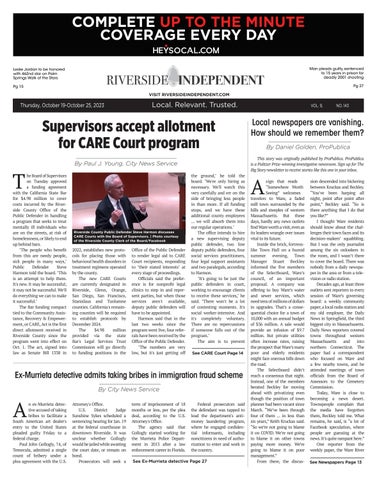
Riverside County Public Defender Steve Harmon discusses CARE Courts with the Board of Supervisors. | Photo courtesy of the Riverside County Clerk of the Board/Facebook
2022, establishes new protocols for placing those with behavioral health disorders in treatment regimens operated by the county. The new CARE Courts are currently designated in Riverside, Glenn, Orange, San Diego, San Francisco, Stanislaus and Tuolumne counties. California's remaining counties will be required to establish protocols by December 2024. The $4.98 million provided via the state Bar's Legal Services Trust Commission will go directly to funding positions in the
Office of the Public Defender to render legal aid to CARE Court recipients, responding to "their stated interests" at every stage of proceedings. Officials said the preference is for nonprofit legal clinics to step in and represent parties, but when those services aren't available, deputy public defenders will have to be appointed. Harmon said that in the last two weeks since the program went live, four referrals have been received by the Office of the Public Defender. "The numbers are very low, but it's just getting off
the ground," he told the board. "We're only hiring as necessary. We'll watch this very carefully and err on the side of bringing less people in than more. If all funding stops, and we have these additional county employees ... we will absorb them into our regular operations." The office intends to hire a new supervising deputy public defender, two line deputy public defenders, four social services practitioners, four legal support assistants and two paralegals, according to Harmon. "It's going to be just the public defenders in court, working to encourage clients to receive these services," he said. "There won't be a lot of contesting moments. It's social worker-intensive. And it's completely voluntary. There are no repercussions if someone falls out of the program." The aim is to prevent See CARE Court Page 14
Ex-Murrieta detective admits taking bribes in immigration fraud scheme By City News Service
A
n ex-Murrieta detective accused of taking bribes to facilitate a South American art dealer's entry to the United States pleaded guilty Friday to a federal charge. Paul John Gollogly, 74, of Temecula, admitted a single count of bribery under a plea agreement with the U.S.
Attorney's Office. U.S. District Judge Sunshine Sykes scheduled a sentencing hearing for Jan. 19 at the federal courthouse in downtown Riverside. It was unclear whether Gollogly would be jailed while awaiting the court date, or remain on bond. Prosecutors will seek a
term of imprisonment of 18 months or less, per the plea deal, according to the U.S. Attorney's Office. The agency said that Gollogly started working for the Murrieta Police Department in 2013 after a law enforcement career in Florida.
NO. 143
Local newspapers are vanishing. How should we remember them? By Daniel Golden, ProPublica This story was originally published by ProPublica. ProPublica is a Pulitzer Prize-winning investigative newsroom. Sign up for The Big Story newsletter to receive stories like this one in your inbox.
By Paul J. Young, City News Service he Board of Supervisors on Tuesday approved a funding agreement with the California State Bar for $4.98 million to cover costs incurred by the Riverside County Office of the Public Defender in handling a program that seeks to treat mentally ill individuals who are on the streets, at risk of homelessness, or likely to end up behind bars. "The people who benefit from this are needy people, sick people in many ways," Public Defender Steve Harmon told the board. "This is an attempt to help them. It's new. It may be successful; it may not be successful. We'll do everything we can to make it successful." The Bar funding compact tied to the Community Assistance, Recovery & Empowerment, or CARE, Act is the first direct allotment received in Riverside County since the program went into effect on Oct. 1. The act, signed into law as Senate Bill 1338 in
VOL. 9,
Federal prosecutors said the defendant was tapped to lead the department's antimoney laundering program, where he engaged confidential informants, including noncitizens in need of authorization to enter and work in the country.
See Ex-Murrieta detective Page 27
A
sign that reads “Somewhere Worth Seeing” welcomes travelers to Ware, a faded mill town surrounded by the hills and steeples of western Massachusetts. But these days, hardly any news outlets find Ware worth a visit, even as its leaders wrangle over issues vital to its future. Inside the brick, fortresslike Town Hall on a humid summer evening, Town Manager Stuart Beckley informed the five members of the Selectboard, Ware’s council, of an important proposal. A company was offering to buy Ware’s water and sewer services, which need tens of millions of dollars in upgrades. That’s a consequential choice for a town of 10,000 with an annual budget of $36 million. A sale would provide an infusion of $9.7 million. But private utilities often increase rates, raising the prospect that Ware’s many poor and elderly residents might face onerous bills down the road. The Selectboard didn’t reach a consensus that night. Instead, one of the members berated Beckley for moving ahead with privatizing even though the position of town planner had been vacant since March. “We’ve been through four of them ... in less than six years,” Keith Kruckas said. “So we’re not going to blame it on COVID. We’re not going to blame it on other towns paying more money. We’re going to blame it on poor management.” From there, the discus-
sion descended into bickering between Kruckas and Beckley. “You’ve been harping all night, point after point after point,” Beckley said. “So is there anything that I do that you like?” I thought Ware residents should know about the challenges their town faces and its decision-makers’ squabbling. But I was the only journalist among the six onlookers in the room, and I wasn’t there to cover the board. There was nobody from a daily newspaper in the area or from a television or radio station. Decades ago, at least three outlets sent reporters to every session of Ware’s governing board: a weekly community paper, a local radio station and my old employer, the Daily News in Springfield, the third biggest city in Massachusetts. Daily News reporters covered towns throughout western Massachusetts and into northern Connecticut. The paper had a correspondent who focused on Ware and a few nearby towns, and he attended meetings of town officials from the Board of Assessors to the Cemetery Commission. Today, Ware is close to becoming a news desert. Townspeople complain that the media have forgotten them, Beckley told me. What remains, he said, is “a lot of Facebook speculation, where people are guessing at the news. It’s quite rampant here.” One reporter from the weekly paper, the Ware River See Newspapers Page 13