FREE
Semi crash causes oil spill, lane closures on 710 Freeway
County again asks judge to compel Villanueva testimony
M O N D AY, S E P T E M B E R 05- S E P T E M B E R 11, 2022
VISIT CORONANEWSPRESS.COM
N O. 84
V O L U M E 6,
‘Animal Farm’ — How the sausage is made An interview with theater actor Rafael Goldstein and director Julia Rodriguez-Elliott BY ELOIN BARAHONA-GARCIA
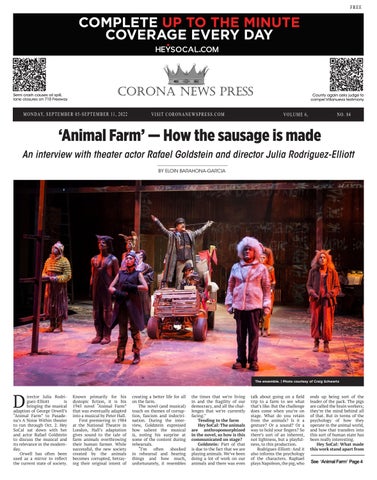
The ensemble. | Photo courtesy of Craig Schwartz
D
irector Julia Rodriguez-Elliott is bringing the musical adaption of George Orwell’s “Animal Farm” to Pasadena’s A Noise Within theater to run through Oct. 2. Hey SoCal sat down with her and actor Rafael Goldstein to discuss the musical and its relevance in the modernday. Orwell has often been used as a mirror to reflect the current state of society.
Known primarily for his dystopic fiction, it is his 1945 novel “Animal Farm” that was eventually adapted into a musical by Peter Hall. First premiering in 1984 at the National Theatre in London, Hall’s adaptation gives sound to the tale of farm animals overthrowing their human farmer. While successful, the new society created by the animals becomes corrupted, betraying their original intent of
creating a better life for all on the farm. The novel (and musical) touch on themes of corruption, fascism and indoctrination. During the interview, Goldstein expressed how salient the musical is, noting his surprise at some of the content during rehearsals. “I’m often shocked in rehearsal and hearing things and how much, unfortunately, it resembles
the times that we’re living in and the fragility of our democracy, and all the challenges that we’re currently facing.” Tending to the farm Hey SoCal: The animals are anthropomorphized in the novel, so how is this communicated on stage? Goldstein: Part of that is due to the fact that we are playing animals. We’ve been doing a lot of work on our animals and there was even
talk about going on a field trip to a farm to see what that’s like. But the challenge does come when you’re on stage. What do you retain from the animals? Is it a gesture? Or a sound? Or a way to hold your fingers? So there’s sort of an inherent, not lightness, but a playfulness, to this production. Rodriguez-Elliott: And it also informs the psychology of the characters. Raphael plays Napoleon, the pig, who
ends up being sort of the leader of the pack. The pigs are called the brain workers; they’re the mind behind all of that. But in terms of the psychology of how they operate in the animal world, and how that transfers into this sort of human state has been really interesting. Hey SoCal: What made this work stand apart from
See ‘Animal Farm’ Page 4