

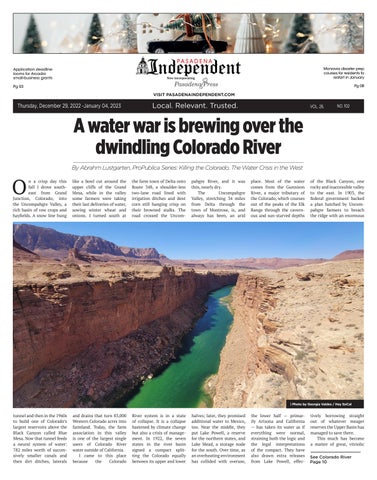

On a crisp day this fall I drove southeast from Grand Junction, Colorado, into the Uncompahgre Valley, a rich basin of row crops and hayfields. A snow line hung
like a bowl cut around the upper cliffs of the Grand Mesa, while in the valley some farmers were taking their last deliveries of water, sowing winter wheat and onions. I turned south at
the farm town of Delta onto Route 348, a shoulder-less two-lane road lined with irrigation ditches and dent corn still hanging crisp on their browned stalks. The road crossed the Uncom-
pahgre River, and it was thin, nearly dry.
The Uncompahgre Valley, stretching 34 miles from Delta through the town of Montrose, is, and always has been, an arid
place. Most of the water comes from the Gunnison River, a major tributary of the Colorado, which courses out of the peaks of the Elk Range through the cavernous and sun-starved depths
of the Black Canyon, one rocky and inaccessible valley to the east. In 1903, the federal government backed a plan hatched by Uncompahgre farmers to breach the ridge with an enormous
tunnel and then in the 1960s to build one of Colorado’s largest reservoirs above the Black Canyon called Blue Mesa. Now that tunnel feeds a neural system of water: 782 miles worth of successively smaller canals and then dirt ditches, laterals
and drains that turn 83,000 Western Colorado acres into farmland. Today, the farm association in this valley is one of the largest single users of Colorado River water outside of California.
I came to this place because the Colorado
River system is in a state of collapse. It is a collapse hastened by climate change but also a crisis of management. In 1922, the seven states in the river basin signed a compact splitting the Colorado equally between its upper and lower
halves; later, they promised additional water to Mexico, too. Near the middle, they put Lake Powell, a reserve for the northern states, and Lake Mead, a storage node for the south. Over time, as an overheating environment has collided with overuse,
the lower half — primarily Arizona and California — has taken its water as if everything were normal, straining both the logic and the legal interpretations of the compact. They have also drawn extra releases from Lake Powell, effec-
tively borrowing straight out of whatever meager reserves the Upper Basin has managed to save there. This much has become a matter of great, vitriolic
State of California.
The Temple City Tribune has been adjudicated as a newspaper of general circulation in court case number GS 012440 City of Temple City, County of Los Angeles, State of California.
The El Monte Examiner has been adjudicated as a newspaper of general circulation in court case number KS 015872 City of El Monte, County of Los Angeles, State of California.
The Azusa Beacon has been adjudicated as a newspaper of general circulation in court case number KS 015970 City of Azusa, County of Los Angeles, State of California.

The San Gabriel Sun has been adjudicated as a newspaper of general circulation in court case number GS 013808 City of San Gabriel, County of Los Angeles, State of California.
The Duarte Dispatch has been adjudicated as a newspaper of general circulation in court case number GS 013893 City of Duarte, County of Los Angeles, State of California.
The Rosemead Reader has been adjudicated as a newspaper of general circulation in court case number GS 048894 City of Rosemead, County of Los Angeles, State of California.
The Alhambra Press has been adjudicated as a newspaper of general circulation in court case number ES016581 City of Alhambra, County of Los Angeles, State of California.
The Baldwin Park Press has been adjudicated as a newspaper of general circulation in court case number KS017174 City of Baldwin Park, County of Los Angeles, State of California.
The Burbank Independent has been adjudicated as a newspaper of general circulation in court case number ES016728 City of Burbank, County of Los Angeles, State of California.
The Glendale Independent has been adjudicated as a newspaper of general circulation in court case number ES016579 City of Glendale, County of Los Angeles, State of California.
The Monterey Park Press has been adjudicated as a newspaper of general circulation in court case number ES016580 City of Monterey Park, County of Los Angeles, State of California.
The West Covina Press has been adjudicated as a newspaper of general circulation in court case number KS017304 City of West Covina, County of Los Angeles, State of California.


The San Bernardino Press has been adjudicated as a newspaper of general circulation in court case number CIVDS 1506881 City of San Bernardino, County of San Bernardino, State of California.
The Riverside Independent has been adjudicated as a newspaper of general circulation in court case number RIC1505351 City of Riverside, County of Riverside, State of California.
The Pasadena Press has been adjudicated as a newspaper of general circulation in court case number ES018815 City of Pasadena, County of Los Angeles, State of California.


The Belmont Beacon has been adjudicated as a newspaper of general circulation in court case number NSO30275 City of Long Beach, County of Los Angeles, State of California.


The Anaheim Press has been adjudicated as a newspaper of general circulation in court case number 30-2017-00942735-CU-PT-CJC City of Anaheim, County of Orange, State of California.
The Ontario News Press has been adjudicated as a newspaper of general circulation in court case number CIVDS 1506881 City of Ontario, County of San Bernardino, State of California.
The Corona News Press has been adjudicated as a newspaper of general circulation in court case number RIC1723524 City of Corona, County of Riverside, State of California.

Robinson Stadium at Pasadena City College | 1570 E. Colorado Blvd., Pasadena, CA 91106 | Dec. 30-31 | tickets.sharpseating.com See bands from all over the world, from Los Angeles to Taiwan, perform before they march down Colorado Boulevard for the Rose Parade.
Grand Park | 200 N. Grand Ave., Los Angeles, CA 90012 | Jan. 1 | grandparkla.org
The largest free New Year’s celebration on the West Coast returns with Grammy-nominated Cimafunk (Cuban funk), the 3D countdown light show projected onto City Hall, DJs playing diverse music genres, live musical performances, dance troupes and food trucks.

Renée and Henry Segerstrom Concert Hall | 600 Town Center Drive, Costa Mesa, CA 92626 | Jan. 1 | scfta.org

Sizzling with energy, the performance is a glorious re-creation of the beloved Neujahrskonzert, the concert that has welcomed the New Year for more than 80 years in Vienna, and all over the world. It brings the music of Johann Strauss to life with singers, dancers and costumes. Backed by the Strauss Symphony of America, the performance is rich with selections from beloved operettas, elegant dances, lively overtures, and the beautiful “Blue Danube Waltz.”
Floatfest: A Rose Parade Showcase

E. Sierra Madre Blvd. and E. Washington Blvd., Pasadena, CA 91107 Jan. 2-3 | tournamentofroses.com
This is your chance to see up close all the floats that traveled down Colorado Boulevard during the Rose Parade. Walk along two miles and appreciate the artistry behind these beautiful floats.
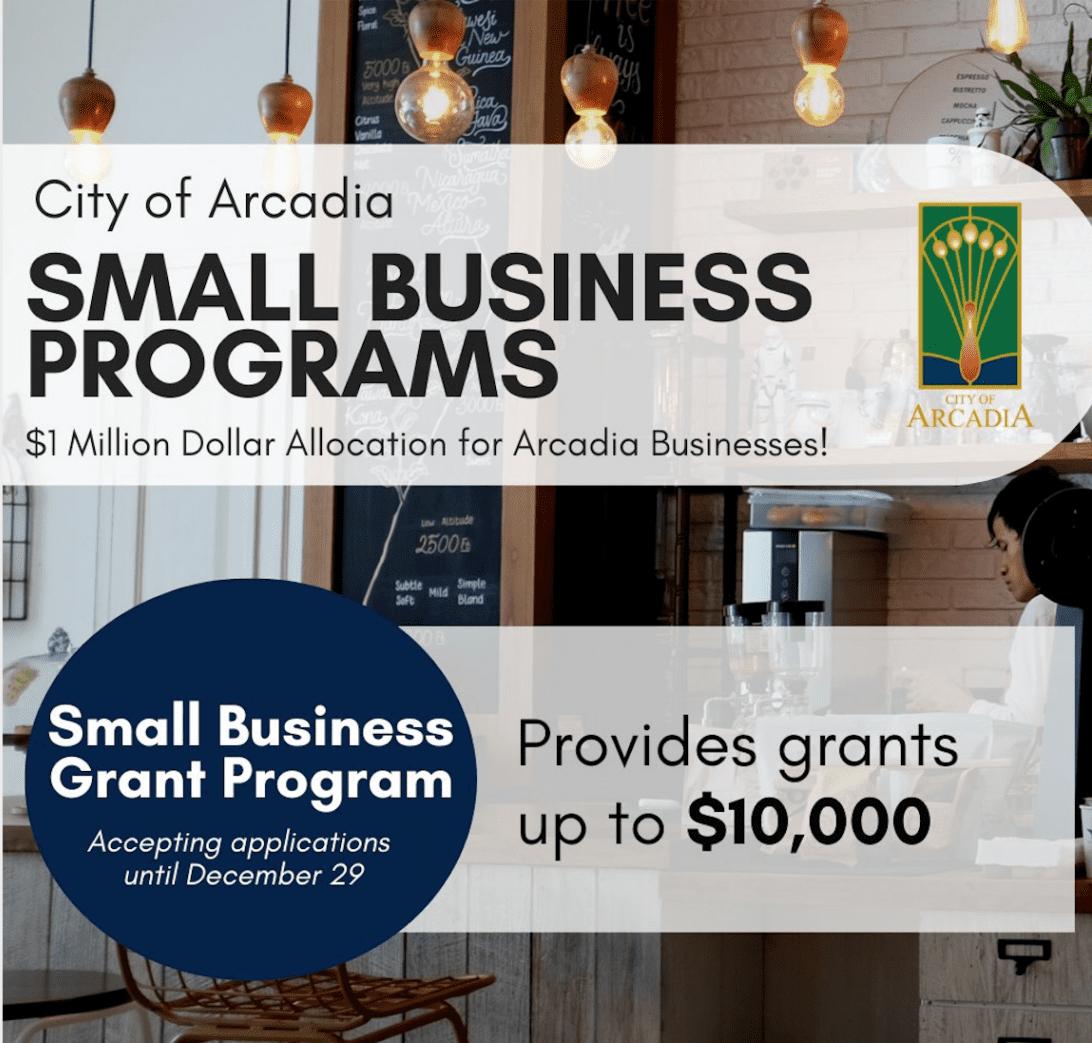
Pandemic relief grants totaling $1 million are still up for grabs for small businesses in Arcadia.
Applications for a program funded through the federal American Rescue Plan Act are due by Thursday, Dec. 29.
“The Arcadia small business community has weathered the worst of the COVID-19 pandemic. However, the coming year will continue to be a critical time for many small businesses in the City,” former Mayor Tom Beck said in a statement in October after the City Council approved the grant programs. “By allocating $1 million in ARPA funding to the business grant and assistance programs, the City is making a long-term investment into the well-being of our local community and
economy.”
Arcadia’s ARPA Small Business Grant Program has received $750,000 in funding to provide grants up to $10,000 to Arcadia small businesses, according to the city. The grants can be for physical improvements to a company’s place of business, updating digital marketing and branding or other improvements focused on attracting new customers. After the Thursday deadline, city officials will review applications and award the funding based on program criteria and eligibility requirements.
The ARPA Small Business Permit Assistance Program provides $250,000 to pay as much as $5,000 to cover city planning and building fees for entrepreneurs who are opening a new business, expanding an existing business or doing
construction improvements to their current workspace, according to the city. Officials began accepting applications for this relief program on Nov. 15, but unlike the Small Business Grant Program, permit assistance applications will be accepted and approved on an ongoing basis until the funds run out.
These two current COVID relief programs, which the Arcadia Economic Development Division administers, add to $375,000 in small business grants that the city distributed in 2020 and 2021 via the Coronavirus Aid, Relief, and Economic Security Act and the Community Development Block Grant program, according to the city.
The Economic Development Division can be reached at EconDev@ArcadiaCA.gov or 626-574-5409.
that's specifically prohibited under one of the rules we enforce. And so it is really unlikely to be a legitimate company," she said.

The president's debtcancellation plan is currently on hold while the litigation continues, so it is not processing any applications. The website of the U.S. Department of Education, studentaid.gov, has a link to sign up to be notified if the program is restarted. The pause on federal student loan payments has been extended until the litigation is resolved. The best place to start for accurate information about your loans is to contact your federal loan servicer.
sounds too good to be true, it probably is," she said.
"It could be loan forgiveness. It could be, 'Hey, pay us X amount, and we'll get your loans forgiven right now, or we'll get some large amounts of your principal balance forgiven or canceled,' right? And that might be a benefit that the consumer doesn't actually qualify for," she said.
Scammers targeting student-loan borrowers are shifting into high gear - spurred by the uncertainty surrounding President Joseph R. Biden's
debt-cancellation plan. The Supreme Court will hear a case in late February that seeks to strike down the administration's plan to offer up to $20,000 in debt relief
to low-income student loan borrowers.
Michelle Grajales, staff attorney with the Federal Trade Commission attorney, said fraudsters are playing on
people's anxieties.
"A major red flag is any company that calls you up and asks you to pay now for help with your loans later. Because that's something
Some scams promise to reduce or zero out your monthly payment, and some target parents who have co-signed on Parent Plus loans. Grijales said the familiar adage applies: "if it
She added that other scams are circulating where they purport to be your loan servicer and ask that you route your payment through them. Other scams are intended primarily to get people to divulge their personal identity or banking information. For more tips, go to the Federal Trade Commission website.
References - Fraud tips: https://consumer.ftc.gov, Oct. 18, 2022. Student aid report Dept. of Education 2022

A retirement celebration for the presumptive 2022 Horse of the Year Flightline was held Monday at Santa Anita in connection with the opening day of the Arcadia track's Classic Meet. A mural depicting Flightline's 11-1/2-length victory in the $300,000 Grade 1 Malibu Stakes was unveiled. The track conducted a giveaway of 2,000 prints of the mural, which was available on a first-come, first-served basis. Flightline's jockey, Flavien Prat, and trainer, John Sadler, signed prints in front of Santa Anita's Kingsbury Fountain from 9:45 to 10:15 a.m. Flightline concluded his undefeated career with an 8 1/4-length victory in the Breeders' Cup Classic on Nov. 5.
A woman was in custody Friday for allegedly killing another woman in Pasadena, authorities said. Officers were sent to the 400 block of North Los Robles Avenue
about 4:40 p.m. Thursday on a report of a "fight" at the location, according to the Pasadena Police Department. "Upon arrival, officers located an unresponsive female in the parking lot suffering from head trauma," police said in a statement. "Paramedics from the Pasadena Fire Department attempted life-saving medical treatment." Corina Monroy, 60, of Pasadena was pronounced dead at the scene, police said..
Baldwin Park
A Christmas morning gamble paid out a $300,000 prize at Pechanga Resort & Casino, officials announced Monday. A casino guest from Baldwin Park, who wished to remain anonymous, won the jackpot at 4:45 a.m. Sunday, according to a statement from Pechanga. The winner was playing the popular 5 Times-10 Times Pay slot machine, getting two 10x symbols plus one symbol with three bars to line up across the screen for $300,000, casino officials said..
Man with airsoft gun arrested by Long Beach SWAT team
Long Beach police surrounded a business in the city's East Village area for about three hours after a man with a gun was spotted inside, authorities said Tuesday. Officers responded at 9:21 p.m. Monday to a business in the 600 block of Atlantic Avenue and evacuated employees and customers from the business, said Long Beach police Lt. Danielle Quinones. The officers then took up positions around the business. "Officers attempted to call out the suspect, but he refused to exit the establishment," Quinones said. "SWAT resources responded to the scene and the suspect surrendered without incident."
Stolen vehicle pursued from Orange County through LA County
A vehicle reported stolen in Orange County led police and the California Highway Patrol on a pursuit from the city of Orange to downtown Los Angeles early Tuesday morning. The pursuit entered Los Angeles County at about 11:50 p.m. on the northbound San Diego (405) Freeway and during the course of an hour wound up to the Altadena area via the 110 Freeway, the Foothill (210) Freeway and surface streets, according to California Highway Patrol Officer Patrick Kimball. A spike strip flattened one tire and eventually ended the pursuit at San Pedro and First streets downtown, Kimball said. The suspect was taken into custody.
A 29-year-old man pleaded guilty Friday and was immediately sentenced to six years in prison for an alcohol-fueled, three-car crash in Anaheim that killed a Los Angeles man. Arturo Jerson GomezRamirez of Anaheim pleaded guilty to gross vehicular manslaughter while intoxicated, driving under the influence of alcohol causing injury, and driving under the influence
with a blood-alcohol level above the legal limit of 0.08 or more causing injury. He also admitted sentencing enhancements for inflicting great bodily injury and a misdemeanor count of driving without a valid driver's license. GomezRamirez killed 49-year-old Luis Cuara in the Dec. 5, 2021, crash, according to Lt. Shane Carringer of the Anaheim Police Department.
A hiker was rescued Monday after suffering an injury near Massacre Canyon. Crews responded around 9:30 a.m. near the hills of Highway 79 and Soboba Road, according to the Riverside Fire Department. A Riverside County Sheriff's Department helicopter team rescued the victim and took the person to a ground ambulance, which then took the victim to a hospital. No further details were immediately available.
Some Riverside police officers saved Christmas for a family whose presents were stolen right out from under their tree in a burglary, authorities said Tuesday. Late Christmas Eve the single mother and her two sons returned to their apartment and discovered the burglary, according to a Riverside Police Department press release. The patrol officers who responded took a report and left, but decided to do more for the family, officials said. They retrieved extra toys that were collected at the station and other officers and dispatchers donated $700 to save the family's Christmas, police said.
A 27-year-old Corona man was arrested Wednesday on federal charges of eight
armed robberies and two attempted robberies during a spree of holdups in Orange County in November. George Arizon is charged with a count of interference with commerce by robbery and a count of brandishing a firearm in furtherance of a crime of violence. Arizon is expected to make his first appearance in federal court in Santa Ana on Thursday. Detective David Prewett of the Santa Ana Police Department, who works with the Bureau of Alcohol, Tobacco, Firearms and Explosives, said in an affidavit that the defendant is accused of eight robberies and two attempted holdups of restaurants, a hair salon and a 7-Eleven store from Nov. 1-8.
San Bernardino County Workforce Development’s Rapid Response helps displaced workers and other job seekers
When Sal Monica, San Bernardino County Workforce Development Board (WDB) business service representative received an early morning call from Mario Gonzalez, United Furniture Industries (UFI) Director of Operations, he did not hesitate. Gonzalez, along with the 300 UFI employees he supervised, had just received a layoff notification from their employer and knew that he could reach out to WDB for Rapid Response assistance. Local employers such as Ashley Furniture, Big Lots, Walmart and Plastipak Packaging began to recruit displaced UFI employees almost immediately. The event and job fair, which took place on Dec. 8, through a partnership with Victor Valley College’s High Desert Training Center, had nearly 400 participants and 37 resource providers and employers. Resources included individualized job search and resume assistance, and information on veterans services, skills certifications and on-thejob training, and financial assistance for training.
converter thieves from San Bernardino apprehended in Oceanside
Three suspects allegedly interrupted in the act of stealing a vehicle's catalytic converter in Oceanside Monday were apprehended a short time later near police headquarters. The suspects were allegedly in the middle of a theft about 7 a.m. in the 200 block of El Camino Real, when they were caught in the act by a bystander who managed to smash the windshield of the suspects' vehicle as it fled the scene, according to Oceanside Police Department Public Information Officer Jennifer Atenza. Descriptions of the suspects were sent over police radios, and "within minutes, police observed two subjects walking west on Mission Avenue, and they were detained," Atenza said. The suspects were identified as 29-year-old Jonathan Garcia, 28-yearold John Gonzalez and 32-year-old Jonathan Valledares Pineda, all residents of San Bernardino.
Debra Porada appointed Ontario’s Mayor pro Tem
Ontario’s Mayor and City Council last week unanimously appointed Debra Porada to serve as Mayor pro Tem, for a two-year term, through 2024. Porada was first elected to the Ontario City Council in December 2008. Prior to her election to the Ontario City Council, Porada served as an elected member of the OntarioMontclair School Board, an appointed member of the Ontario Planning Commission, a member of the Ontario Community Block Grant Committee, a San Bernardino County Museum Commissioner, and a member of the Ontario-Montclair School
District Measure T Oversight Committee. Porada has been a champion for Downtown revitalization. Her engagement is reflected in the development of Ontario Town Square and the Arts and Culture District which is home to both the Ontario Museum of History and Art and the Chaffey Community Museum of Art.
December 15
At 7:36 p.m., a caller in the 100 block of North Fifth reported their juvenile son ran away. Officers exhausted all means to locate the minor, and could not locate him. The juvenile was entered into the missing person’s database. This investigation is continuing.
At 7:43 p.m., a witness in the 700 block of East Huntington reported seeing a male subject acting strange. Officers arrived and located an intoxicated male. He was arrested and transported to the MPD jail to be held for a sobering period.
At 10:39 p.m., an employee from a business in the 900 block of West Huntington reported a male subject entered and was restrained from the location. Officers arrived and located the male on the business property. He was arrested and taken into custody for trespassing.
At 11:25 p.m., an officer was on patrol in the area of Fifth and Chestnut when he saw a bicyclist commit a traffic violation. The subject was stopped and a computer check revealed he had two outstanding warrants. He was arrested and taken into custody.
December 16
At 12:43 a.m., an officer observed a moving violation and stopped the vehicle near Peck and Duarte. The driver was contacted and he showed signs of intoxication. After a DUI investigation, the driver was arrested and transported to the MPD jail to be held for a sobering period.
At 2:09 a.m., while on patrol, an officer observed a moving violation and stopped the vehicle in the area of Myrtle and Camino Real. The driver was contacted who showed signs of intoxication. After a DUI investigation, the driver was arrested and transported to the MPD jail to be held for a sobering period.
At 4:13 p.m., a witness reported a physical altercation between two subjects in the 200 block of East Foothill. Officers arrived and spoke with all involved parties. This investigation is continuing.
At 6:04 p.m., a business in the 500 block of West Huntington, called to report a possible shoplifting in progress. Officers arrived but the female suspect had already fled with
the stolen property. Officers located the suspect's vehicle nearby. The suspect was later located and was detained. A field show-up was conducted and she was identified. The stolen property was recovered. She was arrested and taken into custody.
At 8:07 p.m., a caller reported male juveniles jumping on the hoods of vehicles in the area of Fifth and Walnut. Officers arrived but the juveniles had already fled. Victims were located and a report was taken. This investigation is continuing.
At 9:56 p.m., a victim reported a vehicle had just crashed into her and fled the scene in the 700 block of West Huntington. Officers arrived and conducted a traffic and criminal investigation. This investigation is continuing.
At 11:32 p.m., a mother from the 600 block of South Fifth called to report her daughter was missing. Officers searched all known locations but could not find her. She was entered into the missing person's database. This investigation is continuing.
December 17
At 12:09 a.m., officers were in the 800 block of West Duarte conducting a search for stolen property and located a male subject hiding who was wanted for assault with a deadly weapon and felony elder abuse. He was arrested and taken into custody.
At 9:22 a.m., a caller reported a traffic collision occurred at the intersection of Mountain and Huntington. Officers arrived and checked on the well-being of the occupants. One of the occupants complained of pain. The driver at fault was issued a citation.
At 12:19 p.m., a caller reported a subject was passed out in the 200 block of South Myrtle. Officers arrived and contacted the subject who displayed symptoms of being under the influence of alcohol. He could not care for himself. He was arrested and transported to the MPD to be held for a sobering period.
December 19
At 3:12 a.m., a resident in the 600 block of South Magnolia reported a male subject tried to force open the rear door to his home. The resident activated his vehicle's alarm to scare the male subject who fled the scene. Officers arrived and located the male subject in the area. It was determined
the male subject lived across the street from the caller and was heavily intoxicated. The male thought he was entering his own home. The subject was arrested and transported to the MPD jail to be held for a sobering period.
At 3:31 a.m., an alarm company reported a "glass break" to the front entry door to a business in the 600 block of West Huntington. Officers arrived and saw the front door was forced open. Officers checked the interior and determined the business had been burglarized. No one was located inside, officers searched the area for the suspects, but none were located. This investigation is continuing.
At 11:59 a.m., officers were dispatched to the 100 block of West Foothill on a report of an injury traffic accident. They arrived and spoke to both parties involved. The same driver complained of pain in her leg and was transported to the hospital for further treatment. Her vehicle was stored.
At 3:38 p.m., an employee from a business in the 400 block of East Huntington called to say one of the exemployees had bought personal items with the company credit card. This investigation is continuing.
At 4:04 pm., the victim called from the 1300 block of South Primrose saying a male subject opened her door and walked into her house. She asked him to leave and he did. He went to a neighbor’s house and went into an unlocked shed. Officers arrived and detained him. When speaking with the individual, it was determined that he was a danger to himself and others. He was taken to a hospital for a mental health evaluation.
At 7:29 p.m., a battery was reported in a store in the 900 block of West Foothill. The victim said she started arguing with another employee and during the argument, she started filming the employee with her cell phone. The employee became upset and hit the phone in her hand. When the victim complained to the manager about the incident, the manager and victim started to argue and the victim punched the manager. This investigation is continuing.
December 20
At 1:39 a.m., officers responded to the 200 block of
Fig regarding a subject with a history of mental illness. The subject was threatening to kill family members. MFD responded and transported the subject to a hospital for a mental evaluation.
At 10:52 a.m., an officer was patrolling the area of Monterey and Huntington when he saw a subject slumped over a bus bench. He checked on the well-being of the subject and discovered he had several warrants for his arrest and he was in possession of drug paraphernalia. He was arrested, issued a citation, and released at the scene.
At 11:23 a.m., a caller reported a male and female in an argument in the area of May and Foothill. The caller stated the subjects left in a vehicle. Officers arrived and saw the vehicle leaving the scene. A traffic stop was conducted. The driver displayed signs of intoxication. He was arrested and transported to the MPD jail to be held for a sobering period.
At 11:56 p.m., an officer patrolling the area of Peck & Longden did a computer check of a vehicle and discovered the driver had a no-bail warrant. When the officer attempted to conduct a traffic stop, the suspect fled at a high rate of speed and entered the freeway. The pursuit was canceled and CHP was notified. This investigation is continuing.
sued a citation.
At 11:13 a.m., an officer responded to Sunglass Hut, located at 400 S. Baldwin Ave., regarding a grand theft report. An investigation revealed an unidentified male suspect stole numerous pairs of sunglasses resulting in a loss of nearly $2,300. The Black male, approximately 6-feet tall suspect fled in a white Range Rover.
At 11:06 p.m., an officer responded to a parking lot at The Shops at Santa Anita, located at 400 S. Baldwin Ave., regarding a vehicle burglary report. The victim stated someone smashed one of his windows and fled with a purse and cash. The crime happened sometime between 9:30 p.m. and 10:55 p.m. on Dec. 19.
December 20
At 2:33 p.m., an officer responded to a parking lot at The Shops at Santa Anita, located at 400 S. Baldwin Ave., regarding a vandalism incident. The officer discovered someone scratched both the driver and passenger sides of the victim’s vehicle. The crime may be related to an incident of road rage that occurred before the victim parked.
December 21
from her Toyota Prius. Another catalytic converter was stolen nearby in the 00 block of Bonita Street.
At 4:55 p.m., an officer responded to the 1100 block of Drake Road regarding a grand theft incident. The officer determined someone entered the victim’s unlocked vehicle and stole two wallets. The suspects then used the stolen debit cards to complete fraudulent transactions. The total loss was more than $6,000. The suspect was captured on surveillance footage and is described as a Hispanic male with a medium build, and driving a black, four-door Dodge truck.
At 5:13 a.m., an officer responded to Knockout Warehouse, located at 1550 E. Clark St., regarding a commercial burglary. An investigation revealed unidentified suspect(s) entered the business by breaking a glass door and once inside, they ransacked the business. The loss is unknown as of the date of this report.
18
At 2:48 p.m., an officer responded to the 1200 block of South Baldwin Avenue regarding a stolen vehicle report. Sometime between Dec. 16 at 9:45 p.m. and Dec. 17 at 2 a.m., someone stole the victim’s Mercedes E300 from a back parking lot.
At 3:31 p.m., an officer responded to a residence in the 1000 block of Sunset Boulevard regarding a domestic dispute. The officer discovered an argument between the married couple that resulted in the male half-twisting the female victim’s arm, causing her pain. The investigation is ongoing.
At 12:41 a.m., an officer responded to the intersection of Baldwin Avenue and Las Tunas Drive regarding an incident of illegal camping. The officer located the 66-year-old male transient, and he was is-
At 10:21 a.m., an officer responded to a residence in the 900 block of Palo Alto Drive regarding a burglary in progress. The victim reported seeing two male suspects in her rear yard via CCTV footage. A review of the footage and an investigation resulted in the arrest of an 18-yearold male from Los Angeles, a 40-year-old female from Santa Fe Springs, two 17-year-old males from Compton, and a 14-year-old male from Los Angeles. Two additional burglaries were found to have been committed by this crew, one in the 100 block of Kari Way and another one in the 1800 block of Watson Drive.
At 11:18 a.m., an officer responded to a residence in the 200 block of South Golden West Avenue regarding a burglary report. The officer determined someone broke the rear laundry room window and ransacked the master bedroom. The loss is unknown.
December 22
At 9:12 a.m., an officer responded to the 800 block of West Camino Real Avenue regarding a theft from vehicle report. Sometime during the previous night, someone stole the victim’s catalytic converter
At 4:06 a.m., an officer responded to the intersection of Temple City Boulevard and West Longden Avenue regarding the notification of a wanted vehicle in the area. Upon contacting the driver, the officer discovered the suspect and passenger were in possession of stolen mail, a stolen license plate, counterfeit keys, and drug paraphernalia. A 38-year-old male from Diamond Bar and a 40-year-old male from Rosemead were arrested and transported to the Arcadia City Jail for booking. A records check revealed the 40-year-old male also had an outstanding misdemeanor warrant.
At 9:10 p.m., an officer responded to a residence in the 100 block of El Dorado Street regarding a petty theft report. The officer determined someone stole the victim’s house key from a box that had been left on the porch. The crime occurred sometime between Dec. 21 and 23.
At 5:51 p.m., an officer responded to The Shops at Santa Anita, located at 400 S. Baldwin Ave., regarding a grand theft report. The victim discovered his bicycle had been stolen from the bike rack at the mall. The crime occurred between 2 p.m. and 5:30 p.m.
NEW AUTHORS WANTED! Page Publishing will help you self-publish your own book. FREE author submission kit! Limited offer! Why wait? Call now: 1-855-6670380 (Cal-SCAN)
Become a Published Author. We want to Read Your Book! Dorrance Publishing-Trusted by Authors Since 1920. Book manuscript submissions currently being reviewed. Comprehensive Services: Consultation, Production, Promotion and Distribution. Call for Your Free Author`s Guide 1-877-5389554 or visit http://dorranceinfo. com/Cali (Cal-SCAN)
Prepare for power outages today with a GENERAC home standby generator. $0 Money Down + Low Monthly Payment Options. Request a FREE Quote -Call now before the next power outage: 1-844-439-5645 (SCAN)
Eliminate gutter cleaning forever! LeafFilter, the most ad-
vanced debris-blocking gutter protection. Schedule a FREE LeafFilter estimate today. 15% off Entire Purchase. 10% Senior & Military Discounts. Call 1-855424-7581 (Cal-SCAN)
DONATE YOUR CAR TO KIDS Fast Free Pickup – Running or Not - 24 Hour Response - Maximum Tax Donation – Help Find Missing Kids! Call 1-888-491-1453. (CalSCAN)
DONATE YOUR CAR OR TRUCK TO HERITAGE FOR THE BLIND. Free 3 Day Vacation, Tax Deductible, Free Towing, All Paperwork Taken Care Of. CALL 1-844-4912884 (Cal-SCAN)

Get DIRECTV for $64.99/mo for 12 months with CHOICE Package. Save an additional $120 over 1st year. First 3 months of HBO Max, Cinemax, Showtime, Starz and Epix included! Directv is #1 in

Customer Satisfaction (JD Power & Assoc.) Some restrictions apply. Call 1-888-641-5762 (CalSCAN)


Over $10K in Debt? Be debt free in 24 to 48 months. No upfront fees to enroll. A+ BBB rated. Call National Debt Relief 1-888-2314274. (Cal-SCAN)
SAVE BIG on HOME INSURANCE! Compare 20 A-rated insurances companies. Get a quote within minutes. Average savings of $444/year! Call 1-844-4109609! (M-F 8am-8pm Central) (Cal-SCAN)
FREE high speed internet for those that qualify. Government program for recipients of select programs incl. Medicaid, SNAP, Housing Assistance, WIC, Veterans Pension, Survivor Benefits, Lifeline, Tribal.
15 GB internet service. Bonus offer: Android tablet FREE with one-time $20 copay. Free shipping & handling. Call Maxsip Telecom today! 1-855-480-0769 (Cal-SCAN)
Switch and save up to $250/year on your talk, text and data. No contract and no hidden fees. Unlimited talk and text with flexible data plans. Premium nationwide coverage. 100% U.S. based customer service. Limited time offer get $50 off on any new account. Use code GIFT50. For more information, call 1-844-908-0605 (SCAN)
The difference in winning and losing market share is how businesses use their advertising dollars. CNPA’s Advertising Services’ power to connect to nearly 13 million of the state’s readers who are an engaged audience, makes our services an indispensable marketing solution. For more info call Cecelia @ (916) 288-6011 or cecelia@cnpa.com

DID YOU KNOW Newspaper-generated content is so valuable it’s taken and repeated, condensed, broadcast, tweeted, discussed, posted, copied, edited, and emailed countless times throughout the day by others? Discover the Power of Newspaper Advertising. For a free brochure call 916-288-6011 or email cecelia@ cnpa.com (Cal-SCAN)
RETIRED COUPLE $$$$ for business purpose Real Estate loans. Credit unimportant. V.I.P. Trust Deed Company www.viploan.com Call 1-818248-0000. Broker-principal DRE 01041073. No consumer loans. (Cal-SCAN)
NO DOC 2nd Mortgage or HELOC. Loans from $30,000 to $2M. No Tax Returns and No W2s. Good for SFRs, 1-4 units. Contact (310) 737-8420. NMLS#469849 DRE#01105429 (Cal-SCAN)

COMPUTER & IT TRAINING PROGRAM! Train ONLINE to get the skills to become a Computer & Help Desk Professional now! Grants and Scholarships available for certain programs for qualified applicants. Call CTI for details! 1-877-806-0935 (M-F 8am-6pm ET). Computer with internet is required. (Cal-SCAN)
Costa Rica Tour 9 Days $995. Fully guided tour. Includes all hotels, all meals, all activities. Tax, fees extra. Call 1-800-CARAVAN. Book online at Caravan. com. (Cal-SCAN)
TOP CA$H PAID FOR OLD GUITARS! 1920-1980 Gibson, Martin, Fender, Gretsch, Epiphone, Guild, Mosrite, Rickenbacker, Prairie State, D’Angelico, Stromberg. And Gibson Mandolins / Banjos. 1-844-910-1960. (Cal-SCAN)
Geography matters in how likely you are to go to college or earn a degree. In California, more than one in three residents has a bachelor's degree. But in many of the state's rural Central Valley counties, not even one in five do.
The valley, in fact, is home to four of the six counties in the state where fewer than 15 percent of adults over 25 have a four-year degree. We traveled there to talk with people about their experiences with college as part of our year-long series that focuses on telling the stories of Californians who live in parts of the state where college-going has long lagged behind. (Read the first and second set of interviews in this series.)
What really gets in the way of college dreams? What barriers are too high, what needs are more pressing? And how do others find their way? What, or who, keeps them going? Why do they persevere?
Gemini Lopez & Michael Dinkins: 'There aren't many ways to get out'
Gemini Lopez, a running back, and Michael Dinkins, a cornerback and wide receiver, are 19-year-old teammates playing football and studying business at Merced College.
Lopez: We played on the same team together at Le Grand High School, about a half hour away. It's a small community, very rural, not much to do. We've got a few other classmates who decided to go to school here, but most people went straight into working.
Dinkins: Of course, we're not happy we're in Merced. Got a few small offers to play at other JUCOs [junior colleges]. I looked at Modesto. But then I would have had to drive out there every day, like an hour each way. Or pay for student housing.
Lopez: Business is a big field, so not exactly sure what I'll do if football doesn't work out. I'm not even thinking about it right now.
Dinkins: Just focused on football. The goal is the same it's always been: Transfer to
a Division 1 school, just keep playing. I've lived here my whole life, so I'm ready to leave. I want to see the world. I want to travel.
If football doesn't work out, I'll probably do heavy machinery. Forklifts, that sort of thing. I was always interested in that. I'd need to go and get the certificate but don't need another degree or anything.
Most kids in Le Grand, their families have small businesses, so they work in agriculture, or have farms that they go and work in straight out of school.
There aren't many ways to get out. If you have money, you can. But otherwise, it's tough.
Margaret Salas: 'It felt like something I should have accomplished'
Margaret Salas, 68, works in the counseling office at Merced College and has an associate degree from Merced College and a bachelor's degree in business from California State University, Stanislaus.
My parents were migrant workers from Texas who thought high school was enough. I was an honors student, but we were very sheltered. Without that emotional support, I was afraid.
This was in the '70s, and it always bothered me, because my best friends had gone and gotten degrees.
Instead, I worked as an instructional aide in a rural school for three years. I married my husband at 24. Kept working, had two kids. And then, when my daughter was in high school, the thought about going to college just popped into my head. I was tired of working minimum wage jobs, and hoped to be able to make more. But it was also just a personal goal: It felt like something I should have accomplished right out of high school, and didn't.
I was worried about how I was going to juggle it. I worked part-time, had a family. I didn't know financial aid would be available.

I thought about how long it would take. But I ran it by a teacher, and she told me, "The years are going to go by anyway." At that point, I had been out of school for 30 years. I wondered, 'Can I really compete with these kids?' So I took one political science class to test the waters, and when I got an A, I said, "Yeah, this is it."
It took me a total of six years, and my daughter always said I was raining on her parade: When I graduated with my associate's, she was graduating high school. When I finished my bachelor's, she was graduating from Merced College with an associate's degree - she later received a B.A. in anthropology from UC Merced and is now changing her career plans, getting a second degree in networking from Fresno City College.
One regret I have is that I never really used my business degree: We had a home, my husband had a job as a custodian established here, it was hard for me to move to where the jobs were. But it was worth it, and I'm shocked how many students
think they can't go because of the finances - if you're lowincome, it's surprising how many people in California can qualify. My daughter and I graduated with no student loans.
Trinaty Ann Renee: 'It's just not for me'
Trinaty Ann Renee, 28, is a bartender in Visalia who takes classes part-time at College of the Sequoias.
In general, I think college is a scam. It costs an insane amount of money to get a degree, and then you aren't going to be able to get a job with your degree. Now you're in debt, and, nowadays, there are some entry- level jobs requiring master's degrees and graduate degrees. I think it's just another way for America to make something corporate.
I don't mean to shame anybody who decides a fouryear university is for them, it's just not for me. My sister just graduated from Los AngelesPacific University. She worked very hard for it. But it costs so much money. She had a great experience ... and she's going to be in debt her entire life.
I do love knowledge, and I love learning new things. I qualify for a shit ton of financial aid as a single mother over 25, I don't pay anything, and get paid about $8,000 extra to go. You have to be full time, and get good grades. I'm like three credits short of graduating, but I take different classes each semester, so that I don't get the degree - this next semester, I'm thinking about taking sewing.
I just don't think we live in the same day and age that we did 20 years ago. Where college was the goal: You go to college, start a family, buy a house. I can't afford a house. I just don't think we should place such importance on it. It's way too much pressure on these fucking kids.
I'm going to be a career bartender. I'm in love with the bar culture, and I am really good at it. In my last job, I specialized in prohibitionstyle cocktails. I would love to open my own bar somewhere.
Carlos Romo: 'I spent almost the whole decade inside trying to better myself' Carlos Romo, 30, earned his associate degree at the
California Correctional Center and is now remotely enrolled in a fire sciences bachelor's degree program at California State University, Los Angeles.
I was incarcerated at 18, and was released in September 2021 - and two days later, I was on the Lassen campus.
You have a lot of time to think about things, and I decided in my early 20s that getting an education would be key. I spent almost the whole decade inside trying to better myself. Participate in classes, go to college. But I just couldn't get in anywhere. It was really hard. The process was too long, or I couldn't get the textbooks, or even the Scantrons that I needed.
It wasn't until CCC that I ended up getting into a good college program. I stopped by the CCC firehouse, and could see they were pro-education. It was a whole different environment. I didn't expect to be able to go outside of the prison and respond to emergencies as an actual firefighter.
I got used to it: I was already committed anyway, and I knew I wanted to get my degree. I started the program
The Monrovia Fire Department is gearing up for another round of disaster preparedness and emergency response training courses for residents.
The Community Emergency Resiliency Team and the Business Emergency Resiliency Training program provide community members and businesses with crucial, possibly life-saving skills for when disaster strikes.
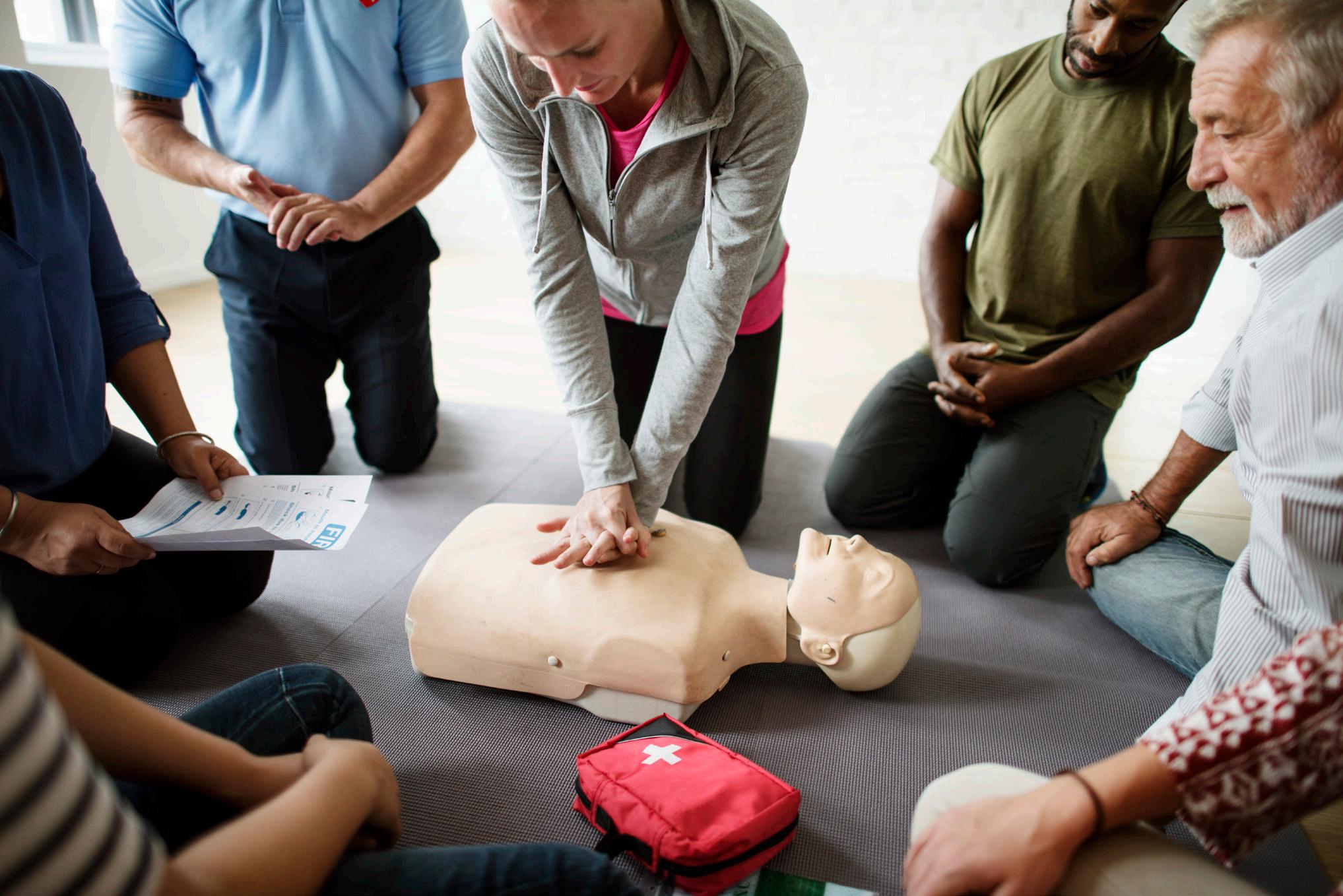
CERT courses focus on readiness and knowledge to put in play when public safety is put in harm's way, while BERT tailors emergency preparedness to specific businesses with the goal of enabling local companies to continue operations after a disaster hits, officials told Monrovia Weekly.
Over three consecutive Saturdays -- with the next round of training starting Jan. 28 -- CERT participants learn emergency preparedness techniques, fire suppression and safety, disaster medical operations, light search and rescue, disaster psychology, team organization skills and how to conduct a disaster drill.
BERT curriculum takes place over six, two-hour sessions this year between Jan. 18 and Oct. 26. Participants receive instruction on
emergency response, emergency preparedness, fire safety and utility awareness, emergency operations and business continuity plans, disaster exercise planning and safety awareness as it pertains to crime and terrorism.
"BERT is more a planning kind of class, CERT is hand on skills," said Suzanne Dobson, emergency preparedness coordinator with Monrovia Fire & Rescue. "BERT is about being prepared, having a plan in place, surviving the disaster as a business.
"Hurricane Sandy is a good example, most of those businesses were wiped out," Dobson said. "How do they keep going, how do you keep going and meet your contracts after a large disaster? BERT is a mix of dealing with the immediate disaster and how you keep going after the immediate disaster."
CERT volunteers assist the community before, during and after disasters and provide crucial assistance to maxed-out first responders, according to the city's website. The program educates residents about how to prepare for hazards and teaches know-how in disaster response skills such as fire safety, search and rescue, team organization
and disaster medical operations.
"Training our business owners and community members to help supplement the fire department until mutual aid from another department can get here to help is crucial during disasters," Monrovia Fire Department Capt. Nick Board said.
When public safety agencies' resources and personnel are spread thin because of multiple emer-
gencies happening all at once, first responders "can send help but it takes time, we need help from residents," Board said.
Monrovia has 50 certified CERT members, who the fire department mobilizes during disasters and who also participate in public events and provide assistance to the community such as smoke alarm installation, Dobson said. Over 200 people have received CERT training.
BERT currently has 22 businesses currently going through the program.
"We have a robust program in Monrovia for being such a small community in Southern California," Board said. "A lot of the smaller communities look at ours for guidance."
Monrovia's CERT program started in 2007, and several volunteers from that first class are involved in the program, Dobson recalled.
"In fact, several of them are now FEMA-certified CERT instructors and volunteer their time to teach our CERT Basic class," Dobson said.
Free registration for CERT and BERT courses is available at monroviafireandrescue.eventbrite.com
"CERT and BERT are basically community risk reduction, being proactive instead of reactive," Board said. "It's about neighbors helping neighbors."
Groupspromoting Latino political participation are keen to get rid of the stereotype of Latino voters as a "sleeping giant," especially in light of the 2022 elections.

In the midterms, Latino voters in Nevada reelected the country's first Latina U.S. Senator, thus helping Democrats keep control of the upper chamber.
Hatzune Aguilar, director of strategic engagement for the nonprofit Communities for a New California, said
politicians need to engage continuously with the Latino community, not just bombard them with ads every couple of years.
"When they show up in the last two weeks before an election, that is a transactional relationship," Aguilar pointed out. "It's not transformational; there's not a sense that we are a part of something."
Aguilar noted many Latinos live every day with the consequences of government inaction on issues like climate change, air pollution
and clean water. She advised political parties to hire more Spanish-speaking staff and connect with the community to develop real-life solutions. California is home to 8.3 million eligible Hispanic voters, just over a quarter of the nationwide total.
Héctor Malvido, grassroots partnerships coordinator for the group Liberation in a Generation, said cities need to invest the time and money necessary to start communicating with people in their first language.
"The basic 'ask' for any body of government that is hosting public-facing forums is that they have the documents that they're presenting translated fully, at least in Spanish," Malvido explained. "But it needs to be translated into other languages, as well as being able to provide simultaneous interpretation."
More than a dozen California cities already offer Spanish translation services at their meetings, but the majority of public meetings statewide do not.
Disclosure: Liberation in a Generation contributes to Public News Service fund for reporting on Civil Rights, Housing/Homelessness,
Poverty Issues, and Social Justice.
References: Hispanic voter data Pew Research Oct. 12, 2022.
back in 2020, and ended up graduating in the fall of 2021. When you have all day just to study, you can make it happen for sure.
I'm continuing my education, and I just got accepted to CSU Los Angeles. The thing about the fire classes is that those are offered online, asynchronous. So that's perfect for me, as I can keep doing my career as a firefighter for CAL Fire here, and still continue my education.
Transitioning out of prison was a little easier because I had been going out into the community for the last two years at the firehouse. We would fight fires, go to traffic collisions, answer medical calls, you know, deal with the public. Sometimes evacuations. Being around people was great.
I used to think my parents didn't encourage much education. But as I've gotten older, I realized that they probably wanted us to pursue it, but they just never said it. They never finished college or even high school, they came to the United States when they were young. They wanted me to succeed, but just being immigrants, they didn't really know how.
As a first generation American, I have to kind of figure things out. I'm the oldest of six kids, and I have one little brother that is doing a vocational technical school, but the rest are in their 20s and started working immediately without any other education.
I work 24-hour-shifts, three times a week, I'm taking five classes right now, I hardly have any downtime to myself. I know for sure I can be a mentor someday. But, at this moment in my life, I've been away for so long. I feel like I've still got to prove myself, lead by example, and then provide some advice after they see my success.
Jeremiah Storment: 'It's about the collective experience'
Jeremiah Storment, 22, is from Kings County and initially attended West Hills College Lemoore. He is now in his second year studying music at the College of the Sequoias. This is the closest place to me that offered music. I wanted to learn theory. I had
been to college when I was 18, but I dropped out because I was just jamming with the homies.
I was getting good grades, but I just felt like it was so boring.
I just thought: "I don't want to be here."
Going back to school, it was mainly to make connections. To play music with people. I don't plan on transferring to a four-year college. Unless I come up on some money, I just don't see it happening. But I knew there was something to gain by coming.
It's about the collective experience. You meet different people you know, the days go by, and you have an experience. I'm in a jazz band here, and before I knew very little about jazz. I knew jazz musicians are "big brain," so I just threw myself in to try to get something out of it.
I play the drums. Genrewise, it's usually a mix. It's whatever I'm feeling. I need to figure out how to monetize my stuff and come up with a solid plan. There are snippets here and there of my education that feel valuable. But I'm also learning more of my own discipline. Just looking back, realizing what's lacking - usually it's deeper than just college. You can learn things from classes, but you can also just take things from being there.
Jo Cook: 'I switched majors anyway'
Jo Cook is a 19-year-old from Tulare County, studying art at the College of the Sequoias.
I was working at Target during the holidays, and I was talking to an art teacher that had come through my lane. She was buying stuff for her students, and we talked about art, and how much she loves her job. She had switched careers from something else into art, and she is so much happier, because she's finally enjoying her passion, right?
And I was like, dang, I really don't want to do nursing. And I've always liked painting. In school, I had an English project. I asked the teacher if I could paint instead of writing a report - she said yeah, and she still has it and displays it to all of her new students.
My parents really dislike the idea. My mom was an artist. She liked art in college
too, and didn't make money with it, and that's why she switched careers - she works with the county now, and my dad works in waste management.
I don't get any financial aid because of their income. And I'm in a tough situation with them because they're holding finances over me, since I still live with them because I can't afford to live anywhere else.
For a while I was working at two jobs. Target, like 30 hours a week, plus another 30 hours waitressing. That was last semester, and I was super drained and exhausted. It really took a toll on my mental health.
I've struggled with depression, and I've been in therapy for a while. I should not have been in school. It was a lot of pressure for me, especially since I started as a nursing major because that's what my parents were telling me would be a good career to get into.
I switched majors anyway. I'm getting my associate's in art, but I'm going to transfer to get a bachelor's degree in art education. My dream is Chico State, but I'm also looking at the Fresno State satellite campus here that has a teaching credential for art. If I were to move to Chico, I would have the costs of moving and would have to also be working ... although then I could maybe qualify for aid, which would help.
Luz Gonzalez: 'It was a big no, no'
Luz Gonzalez, 29, is a Madera County native and works in sales in the Fresno region.
I am the daughter of immigrants, the youngest of five children. In Madera, there are three or four Spanish congregations. Every summer, we were sent to Bakersfield for a three-day weekend, and they would rent out this huge arena with like thousands of Jehovah's Witnesses.
There, the young adults were taught that this life is borrowed, and that it's best to live your life preaching Jehovah versus going to school, which won't take you anywhere in the long run. Get an education, and that would mean getting a career that would take you away from the meetings ... it was a big no, no.
I started homeschooling
after my dad was deported when I was 14. My mom was working seasonal jobs, and taking us to Jehovah Witness assemblies when she wasn't. When I was 18, she told me that I needed to get a job or go to school. I didn't really know how it worked, but I picked journalism as my major because I remembered my dad always turning on the news, and there would be these very likable and very charismatic women on the TV. I figured I could travel, I could write.
I loved that first year of college. For the first time, I was interacting with lots of new faces, people who thought differently than I did. In my personal life everything was very controlled and repetitive. I got to see exactly how much diversity there was. At a community college, you see all these different age groups, too. There, I learned how to be professional. My favorite class was psychology. In my faith, they didn't teach us about science, they actually condemned it.
I ended up having to move out because of my home situation: My older brother drank a lot, and kind of spiraled out of control after my dad was deported. I moved in with my boyfriend at the time, who I had been dating for three months, but I felt like I couldn't do both work and school. I just felt like, if things didn't work out between us, I needed to have money. So I stopped going, and started working two jobs.
One was in retail, first as a cashier, but they saw that I was really good at selling - I could sell people on donating to charity, signing up for credit cards. That's where I realized I had a knack for sales. Jehovah's Witnesses don't take no for an answer.
Yemíma Rodriguez: 'I was open to anything'
When we spoke to her in May, Yemíma Rodriguez, 20, was a biology major from Guatemala attending Lassen Community College who planned to transfer to either the University of California, Santa Cruz or Evangel University, in Missouri.
It's a very different culture. You don't see it until you arrive. Sometimes people would get angry at me, or I would get angry at them, and it was just
a misunderstanding. People used to say, "Yeah, that's the Mexican girl," and I corrected them. I was asked if I was a Democrat or a Republican, and I was like, "I'm a Guatemalan?"
After high school, I was open to anything, going to Europe, taking a year off to work. But while I was graduating in May 2020, the soccer coach at Lassen College reached out to me. There are a lot of international students, especially the athletes in the dorms here. We all just came together and were figuring it out.
I've been studying English since I was young, so I helped a lot of the others understand classes - not just tutoring, but translating everything. There's a local prison, where I've been helping translate at, too. A friend of mine from Spain was recently arrested, so sometimes the attorney reaches out. "I can't understand the one translator,' he says, 'can you come and help?"
I had never been to Lassen County before enrolling, but I've loved it here in Susanville: I just like going on walks, on trails, sometimes biking. There's not much to do, to be truthful, but we've found a way to have fun, play around, go to church.
I've always loved the research part of biology. My country needs a lot of help, especially with environmental issues. We have all these resources, but we don't know exactly how to take care of them, and there's a need for professionals in these areas. That's where my heart still is: I'd like to get my education here, do the research, and then go back.
Danny Malone: 'I knew I had to go to college'
Danny Malone, 19, is from Tulare County and is studying music at the College of the Sequoias.
I'm a multi-instrumentalist: I play the bass, a little bit of piano, violin, and I can drum. I've got a really good sense of rhythm.
I'm in all the ensembles we have to offer: jazz band, symphonic band, symphonic orchestra, music theater. I have a lot of different traits, and I want to use music to teach other kids how to express themselves in different ways.
Here in the Central Valley,
we're often not really given that choice. We have really good instructors and smart professors who try to work with us, but there's a gap between the music students and the professors. We get each other, but everybody has a different mentality.
It's a generational thing. There's this sense from the teachers that you're always supposed to practice, you're always supposed to be getting things done. But we're a really lax generation, I feel, and we want to indulge in a more feeling type of sense. We have a different mentality, and different relationship, different goals, with music.
The idea is that I'll graduate and have a degree, but I'm also going to cultivate a lot of experiences throughout this time.
I'd like to be a conductor and teach classical music. A lot of people dread teaching little kids. But if you can impact kids at that level, it helps to build them into musicians later on.
I've had a lot of teachers and conductors that have helped me build my sense of self. It's not just music. It's life things, too.
I'm here because I knew I had to go to college. That's just something that was always embedded in me by my parents. My dad was a labor worker in construction, he only graduated high school. My mom works in insurance and she did get a degree, but in medicine, so she never really used it.
I'm not going to say they were against me going into music, but they were definitely more excited when I said I wanted to get a doctorate in psychology instead of a doctorate in performance cello or performance jazz. I'm trying to teach guitar lessons, bass, jazz. I'm working at the mall right now. I'm going to school. It's tough, but I definitely think it's going to pay off in the long run.
The payoff. That's what a lot of people miss out on, and they don't want to vouch for college.
But a lot of people fall off, and they're just like: "It's not worth it, and I'm not worth it." And the truth is, in this society, you need it. You need an education to really profit and in order to understand how to survive in this world.
dispute. What is undeniable is that the river flows as a much-diminished version of its historical might. When the original compact gave each half the rights to 7.5 million acre-feet of water, the river is estimated to have flowed with as much as 18 million acre-feet each year. Over the 20th century, it averaged closer to 15. Over the past two decades, the flow has dropped to a little more than 12. In recent years, it has trickled at times with as little as 8.5. All the while the Lower Basin deliveries have remained roughly the same. And those reservoirs? They are fast becoming obsolete. Now the states must finally face the consequential question of which regions will make their sacrifice first. There are few places that reveal how difficult it will be to arrive at an answer than the Western Slope of Colorado.
In Montrose, I found the manager of the Uncompahgre Valley Water Users Association, Steve Pope, in his office atop the squeaky stairs of the same Foursquare that the group had built at the turn of the last century. Pope, bald, with a trimmed white beard, sat amid stacks of plat maps and paper diagrams of the canals, surrounded by LCD screens with spreadsheets marking volumes of water and their destinations. On the wall, a historic map showed the farms, wedged between the Uncompahgre River and where it joins the Gunnison in Delta, before descending to their confluence with the Colorado in Grand Junction. “I’m sorry for the mess,” he said, plowing loose papers aside.
What Pope wanted to impress upon me most despite the enormousness of the infrastructure all around the valley was that in the Upper Basin of the Colorado River system, there are no mammoth dams that can simply be opened to meter out a steady release of water. Here, only natural precipitation and temperature dictate how much is
available. Conservation isn’t a management decision, he said. It was forced upon them by the hydrological conditions of the moment. The average amount of water flowing in the system has dropped by nearly 20%. The snowpack melts and evaporates faster than it used to, and the rainfall is unpredictable. In fact, the Colorado River District, an influential water conservancy for the western part of the state, had described its negotiating position with the Lower Basin states by claiming Colorado has already conserved about 28% of its water by making do with the recent conditions brought by drought.
You get what you get, Pope tells me, and for 15 of the past 20 years, unlike the farmers in California and Arizona, the people in this valley have gotten less than what they are due.
“We don’t have that luxury of just making a phone call and having water show up,” he said, not veiling his contempt for the Lower Basin states’ reliance on lakes Mead and Powell. “We’ve not been insulated from this climate change by having a big reservoir above our heads.”
He didn’t have to point further back than the previous winter. In 2021, the rain and snow fell heavily across the Rocky Mountains and the plateau of the Grand Mesa, almost as if it were normal times. Precipitation was 80% of average — not bad in the midst of an epochal drought. But little made it into the Colorado River. Instead, soils parched by the lack of rain and rising temperatures soaked up every ounce of moisture. By the time water reached the rivers around Montrose and then the gauges above Lake Powell, the flow was less than 30% of normal.
The Upper Basin states used just 3.5 million acre-feet last year, less than half their legal right under the 1922 compact. The Lower Basin states took nearly their full amount, 7 million acre-feet.
All of this matters now not just because the
river, an unwieldy network of human-controlled plumbing, is approaching a threshold where it could become inoperable, but because much of the recent legal basis for the system is about to dissolve. In 2026, the Interim Guidelines the states rely on, a Drought Contingency Plan and agreements with Mexico will all expire. At the very least, this will require new agreements. It also demands a new way of thinking that matches the reality of the heating climate and the scale of human need. But before that can happen, the states will need to restore something that has become even more scarce than the water: trust.
The northern states see California and Arizona reveling in profligate use, made possible by the anachronistic rules of the compact that effectively promise them water when others have none. It’s enabled by the mechanistic controls at the Hoover Dam, which releases the same steady flow no matter how little snow falls across the Rocky Mountains. California flood-irrigates alfalfa crops destined for cattle markets in the Middle East, while Arizona takes water it does not need and pumps it underground to build up its own reserves. In 2018, an Arizona water agency admitted it was gaming the timing of its orders to avoid rations from the river (though it characterized the moves as smart use of the rules). In 2021, in a sign of the growing wariness, at least one Colorado water official alleged California was repeating the scheme. California water officials say this is a misunderstanding. Yet to this day, because California holds the most senior legal rights on the river, the state has avoided having a single gallon of reductions imposed on it.
By this spring, Lake Powell shrank to 24% of its capacity, its lowest levels since the reservoir filled in the 1960s. Cathedral-like sandstone canyons were resurrected, and sunlight
reached the silt-clogged floors for the first time in generations. The Glen Canyon Dam itself towered more than 150 feet above the waterline. The water was just a few dozen feet above the last intake pipe that feeds the hydropower generators. If it dropped much lower, the system would no longer be able to produce the power it distributes across six states. After that, it would approach the point where no water at all could flow into the Grand Canyon and further downstream. All the savings that the Upper Basin states had banked there were as good as gone.
In Western Colorado, meanwhile, people have been suffering. South of the Uncompahgre Valley, the Ute Mountain Ute tribe subsists off agriculture, but over the past 12 months it has seen its water deliveries cut by 90%; the tribe laid off half of its farmworkers. McPhee Reservoir, near the town of Cortez, has teetered on failure, and other communities in Southwestern Colorado that also depend on it have been rationed to 10% of their normal water.
Across the Upper Basin, the small reservoirs that provide the region’s only buffer against bad years are also emptying out. Flaming Gorge, on the WyomingUtah border, is the largest, and it is 68% full. The second largest, Navajo Reservoir in New Mexico, is at 50% of its capacity. Blue Mesa Reservoir, on the Gunnison, is just 34% full. Each represents savings accounts that have been slowly pilfered to supplement Lake Powell as it declines, preserving the federal government’s ability to generate power there and obscuring the scope of the losses. Last summer, facing the latest emergency at the Glen Canyon Dam, the Department of Interior ordered huge releases from Flaming Gorge, Blue Mesa and other Upper Basin reservoirs. At Blue Mesa, the water levels dropped 8 feet in a matter of days, and boaters there were given
a little more than a week to get their equipment off the water. Soon after, the reservoir’s marinas, which are vital to that part of Colorado’s summer economy, closed. They did not reopen in 2022.
As the Blue Mesa Reservoir was being emptied last fall, Steve Pope kept the Gunnison Tunnel open at its full capacity, diverting as much water as he possibly could. He says this was legal, well within his water rights and normal practice, and the state’s chief engineer agrees. Pope’s water is accounted for out of another reservoir higher in the system. But in the twin takings, it’s hard not to see the bare-knuckled competition between urgent needs. Over the past few years, as water has become scarcer and conservation more important, Uncompahgre Valley water diversions from the Gunnison River have remained steady and at times even increased. The growing season has gotten longer and the alternative sources, including the Uncompahgre River, less reliable. And Pope leans more than ever on the Gunnison to maintain his 3,500 shareholders’ supply. “Oh, we are taking it,” he told me, “and there’s still just not enough.”
On June 14, Camille Touton, the commissioner of the U.S. Bureau of Reclamation, the Department of Interior division that runs Western water infrastructure, testified before the Senate Committee on Energy and Natural Resources and delivered a stunning ultimatum: Western states had 60 days to figure out how to conserve as much as 4 million acre-feet of “additional” water from the Colorado River or the federal government would, acting unilaterally, do it for them.
The West’s system of water rights, which guarantees the greatest amount of water to the settlers who arrived in the West and claimed it first, has been a sacrosanct pillar of law and states’ rights both — and so her statement came as a shock.
Would the depart-
ment impose restrictions “without regard to river priority?” Mark Kelly,, the Democratic senator from Arizona, asked her.
“Yes,” Touton responded.
For Colorado, this was tantamount to a declaration of war. “The feds have no ability to restrict our state decree and privately owned ditches,” the general manager of the Colorado River District, Andy Mueller, told me. “They can’t go after that.” Mueller watches over much of the state.Pope faces different stakes. His system depends on the tunnel, a federal project, and his water rights are technically leased from the Bureau of Reclamation, too. Touton’s threat raised the possibility that she could shut the Uncompahgre Valley’s water off. Even if it was legal, the demands seemed fundamentally unfair to Pope.
“The first steps need to come in the Lower Basin,” he insisted.
Each state retreated to its corners, where they remain. The 60-day deadline came and went, with no commitments toward any specific reductions in water use and no consequences. The Bureau of Reclamation has since set a new deadline: Jan. 31. Touton, who has publicly said little since her testimony to Congress, declined to be interviewed for this story. In October, California finally offered a plan to surrender roughly 9% of the water it used, albeit with expensive conditions. Some Colorado officials dismissed the gesture as a non-starter. Ever since, Colorado has become more defiant, enacting policies that seem aimed at defending the water the state already has — perhaps even its right to use more.
For one, Colorado has long had to contend with the inefficiencies that come with a “use it or lose it” culture. State water law threatens to confiscate water rights that don’t get utilized, so landowners have long maximized the water
they put on their fields just to prove up their long-term standing in the system. This same reflexive instinct is now evident among policymakers and water managers across the state, as they seek to establish the baseline for where negotiated cuts might begin. Would cuts be imposed by the federal government based on Pope’s full allocation of water or on the lesser amount with which he’s been forced to make do? Would the proportion be adjusted down in a year with no snow? “We don’t have a starting point,” he told me. And so the higher the use now, the more affordable the conservation later.
Colorado and other Upper Basin states have also long hid behind the complexity of accurately accounting for their water among infinite tributaries and interconnected soils. The state’s ranchers like to say their water is recycled five times over, because water poured over fields in one place invariably seeps underground down to the next. In the Uncompahgre Valley, it can take months for the land at its tail to dry out after ditches that flood the head of the valley are turned off. The measure of what’s been consumed and what has transpired from plants or been absorbed by soils is frustratingly elusive. That, too, leaves the final number open to argument and interpretation.
All the while, the Upper Basin states are all attempting to store more water within their boundaries.
Colorado has at least 10 new dams and reservoirs either being built or planned. Across the Upper Basin, an additional 15 projects are being considered, including Utah’s audacious $2.4 billion plan to run a new pipeline from Lake Powell, which would allow it to transport something closer to its full legal right to Colorado River water to its growing southern cities. Some of these projects are aimed at securing existing
water and making its timing more predictable. But they are also part of the Upper Colorado River Commission’s vision to expand the Upper Basin states’ Colorado River usage to 5.4 million acre-feet a year by 2060.
It is fair to say few people in the state are trying hard to send more of their water downstream. In our conversation, Mueller would not offer any specific conservation savings Colorado might make. The state’s chief engineer and director of its Division of Water Resources, Kevin Rein, who oversees water rights, made a similar sentiment clear to the Colorado River District board last July. “There’s nothing telling me that I should encourage people to conserve,” Rein said. “It’s a public resource. It’s a property right. It’s part of our economy.”
In November, Democratic Gov. Jared Polis proposed the creation of a new state task force that would help him capture every drop of water it can before it crosses the state line. It would direct money and staff to make Colorado’s water governance more sophisticated, defensive and influential.
I called Polis’ chief water confidante, Rebecca Mitchell, who is also the director of the Colorado Water Conservation Board and the state’s representative on the Upper Colorado River Commission. If the mood was set by the idea that California was taking too much from the river, Mitchell thought that it had shifted now to a more personal grievance — they are taking from us.
Last month, Mitchell flew to California for a tour of its large irrigation districts. She stood beside a wide canal brimming with more water than ever flows through the Uncompahgre River, and the executive of the farming company beside her explained that he uses whatever he wants because he holds the highest priority rights to the water. She thought about the Ute Mountain Ute communities
and the ranchers of Cortez: “It was like: ‘Wouldn’t we love to be able to count on something? Wouldn’t we love to be feel so entitled that no matter what, we get what we get?’” she told me.
What if Touton followed through, curtailing Colorado’s water? I asked. Mitchell’s voice steadied, and then she essentially leveled a threat. “We would be very responsive. I’m not saying that in a positive way,” she said. “I think everybody that’s about to go through pain wants others to feel pain also.”
Here’s the terrible truth: There is no such thing as a return to normal on the Colorado River, or to anything that resembles the volumes of water its users are accustomed to taking from it. With each degree Celsius of warming to come, modelers estimate that the river’s flow will decrease further, by an additional 9%. At current rates of global warming, the basin is likely to sustain at least an additional 18% drop in its water supplies over the next several decades, if not far more. Pain, as Mitchell puts it, is inevitable.
The thing about 4 million acre-feet of cuts is that it’s merely the amount already gone, an adjustment that should have been made 20 years ago. Colorado’s argument makes sense on paper and perhaps through the lens of fairness. But the motivation behind the decades of delay was to protect against the very argument that is unfolding now — that the reductions should be split equally, and that they may one day be imposed against the Upper Basin’s will. It was to preserve the northern states’ inalienable birthright to growth, the promise made to them 100 years ago. At some point, though, circumstances change, and a century-old promise, unfulfilled, might no longer be worth much at all. Meanwhile, the politics of holding out are colliding with climate change in a terrifying crash, because while the parties fight,
the supply continues to dwindle.
Recently, Brad Udall, a leading and longtime analyst of the Colorado River and now a senior water and climate scientist at Colorado State University, teamed with colleagues to game out what they thought it would take to bring the river and the twin reservoirs of Mead and Powell into balance. Their findings, published in July in the journal Science, show that stability could be within reach but will require sacrifice.
If the Upper Basin states limited their claim to 4 million acre-feet, or 53% of their due under the original compact, and the Lower Basin states and Mexico increased their maximum emergency cuts by an additional 45%, the two big reservoirs will stay at roughly their current levels for the next several decades. If the basins could commit to massive reductions below even 2021 levels for the Upper Basin and to more than doubling the most ambitious conservation goals for the south, the reservoirs could once again begin to grow, providing the emergency buffer and the promise of economic stability for 40 million Americans that was originally intended. Still, by 2060, they would only be approximately 45% full.
Any of the scenarios involve cuts that would slice to the bone. Plus, there’s still the enormous challenge of how to incorporate Native tribes, which also hold huge water rights but continue to be largely left out of negotiations. What to do next? Israel provides one compelling example. After decades of fighting over the meager trickles of the Jordan River and the oversubscription of a pipeline from the Sea of Galilee, Israel went back to the drawing board on its irrigated crops. It made drip irrigation standard, built desalination plants to supply water for its industry and cities, and reused that water again and again; today, 86% of the country’s
municipal wastewater is recycled, and Israel and its farmers have an adequate supply. That would cost a lot across the scale and reach of a region like the Western United States. But to save the infrastructure and culture that produces 80% of this country’s winter vegetables and is a hub of the nation’s food system for 333 million people? It might be worth it.
A different course was charted by Australia, which recoiled against a devastating millennium drought that ended 13 years ago. It jettisoned its coveted system of water rights, breaking free of history and prior appropriation similar to the system of first-comefirst-served the American West relies on. That left it with a large pool of free water and political room to invent a new method of allocating it that better matched the needs in a modern, more populous and more urban Australia and better matched the reality of the environment.
In America, too, prior appropriation, as legally and culturally revered as it is, may have become more cumbersome and obstructive than it needs to be. Western water rights, according to Newsha Ajami, a leading expert at Lawrence Berkeley National Laboratory and the former director of the urban water policy program at Stanford University, were set up by people measuring with sticks and buckets, long before anyone had ever even considered climate change. Today, they largely serve powerful legacy interests and, because they must be used to be maintained, tend to dissuade conservation. “It’s kind of very archaic,” she said. “The water rights system would be the first thing I would just dismantle or revisit in a very different way.”
This is probably not going to happen, Ajami said. “It could be seen as political suicide.” But that doesn’t make it the wrong solution. In fact, what’s best for the Colorado, for the Western United States, for
the whole country might be a combination of what Israel and Australia mapped out. Deploy the full extent of the technology that is available to eliminate waste and maximize efficiency. Prioritize which crops and uses are “beneficial” in a way that attaches the true value of the resource to the societal benefit produced from using it. Grow California and Arizona’s crops in the wintertime but not in the summer heat. And rewrite the system of water allocation as equitably as possible so that it ensures the modern population of the West has the resources it needs while the nation’s growers produce what they can.
What would that look like in Colorado? It might turn the system upside down. Lawsuits could fly. The biggest, wealthiest ranches with the oldest water rights stand to lose a lot. The Lower and Upper Basin states, though, could all divide the water in the river proportionately, each taking a percentage of what flowed. The users would, if not benefit, at least equally and predictably share the misery. Pope’s irrigation district and the smallholder farmers who depend on it would likely get something closer to what they need and, combined with new irrigation equipment subsidized by the government, could produce what they want. It wouldn’t be pretty. But something there would survive.
The alternative is worse. The water goes away or gets bought up or both. The land of Western Colorado dries up, and the economies around it shrivel. Montrose, with little left to offer, boards up its windows, consolidates its schools as people move away, and the few who remain have less. Until one day, there is nothing left at all.
ProPublica is a Pulitzer Prize-winning investigative newsroom. Sign up for The Big Story newsletter to receive stories like this one in your inbox.
Republished with Creative Commons License (CC BY-NC-ND 3.0).
after 5:30 PM on Thursday, January 5, 2023. For more information you may also visit the City’s website at www.ArcadiaCA.gov/noticesanddecisions. City Hall will be closed on Friday, December 30, 2022, and on Monday, January 2, 2023 in observance of the New Year’s public holiday. Per Government Code Section 65009 – If you challenge this project in court or in administrative hearing, you may be limited to raising only those issues you or someone else raised at the public hearing described in this notice, or


Notice is hereby given that a Public Hearing will be held at 7:30 P.M. or as soon thereafter before the City Council of the City of Monrovia on Tuesday, January 17, 2023, in Council Chambers at Monrovia City Hall, 415 South Ivy Avenue, Monrovia, California, 91016. The purpose of the Public Hearing will be to obtain views from citizens on the proposed 49th Year (Fiscal Year 2023-2024) Community Development Block Grant (CDBG) Allocation.
Further details regarding the use of CDBG funds you may call (626) 932-5525, email amenasakanian@ci.monrovia.ca.us, or visit the Community Development Department at Monrovia City Hall, 415 South Ivy Avenue, Monrovia, California, 91016, between the hours of 7:00 A.M. and 6:00 P.M., Monday through Thursday.
Este aviso es para informarle sobre una junta pública acerca del asunto indicada mas arriba. Si necesita información adicional en español, favor de ponerse en contacto del Departamento Servicios Comerciales y Vecindarios al número (626) 932-5525.
Aleksandra Menasakanian Neighborhood Services Program Coordinator
PLEASE PUBLISH ON DECEMBER 29, 2022. MONROVIA WEEKLY
NOTICE IS HEREBY GIVEN that the Rosemead City Council will consider a Mitigated Negative Declaration and will conduct a public hearing to consider the Mission Villas Residential Project on Tuesday, January 10, 2023 at 7:00 PM, at Rosemead City Hall, 8838 Valley Boulevard, Rosemead. Remote public comments will be received by calling (626) 569-2100 or via email at publiccomment@ cityofrosemead.org by 5:00 p.m. on January 10, 2023. A live phone call option may also be requested by calling the number provided above. All comments are public record and will be recorded in the official record of the City. If you have a request for an accommodation under the ADA, please contact Ericka Hernandez, City Clerk, at (626) 569- 2100.
CASE NO.: GENERAL PLAN AMENDMENT 22-01, ZONE CHANGE 22-01, PLANNED DEVELOPMENT 22-01, AND TENTATIVE TRACT MAP NO. 83705 – The City of Rosemead (hereafter referred to as “Lead Agency”) has completed an Initial Study (IS) of the proposed Mission Villas Residential Project located at 8601 Mission Drive (APNs: 5389-009-029, 5389-009-030, and 5389-009031). The Project is located on a 3.435 gross acre site at the northeast corner of the intersection of Mission Drive and Walnut Grove Avenue in the City of Rosemead, California and is currently vacant. The Applicant (Mission Villas, LLC) is proposing the development of 37 two-story dwelling units, each with an enclosed two-car garage. The units would include 29 single family dwelling units and eight duplex units (four of which will be affordable units). The dwellings will range in size from 1,546 to 2,351 square feet. Of the 37 units, 29 would be four-bedroom single family dwelling units, four would be three-bedroom duplexes, and four would be four-bedroom duplexes. The Project also includes 25 guest parking spaces. Access would be provided via one 40-foot-wide driveway on Mission Drive. In addition, the project will include new landscaping, decorative hardscape, exterior walls and lighting, and open space areas.
On December 19, 2022, the City of Rosemead Planning Commission conducted a duly noticed public hearing. Upon hearing all testimonies from the public, the Planning Commission recommended approval of this request to the City Council.
ENVIRONMENTAL DETERMINATION: The Initial Study has been undertaken to determine if the proposed project may have a significant effect on the environment. The Initial Study was prepared and completed in accordance with the California Environmental Quality Act (CEQA) Guidelines. On the basis of the Initial Study, the City of Rosemead has concluded that the project would have a significant impact, unless mitigated, therefore a Draft Mitigated Negative Declaration (MND) was prepared. The MND reflects the independent judgment of the City as a lead agency per CEQA Guidelines. The project site is not on a list compiled pursuant to Government Code Section 65962.5.
A Notice of Intent to Adopt a Mitigated Negative Declaration was distributed for a 20-calender day public review period from November 10, 2022 through November 30, 2022.
Pursuant to Government Code section 65009, if you challenge this matter in court, you may be limited to raising only those issues you or someone else raised at the public hearing described in this notice, or in written correspondence delivered to the City Council at, or prior to, the public hearing.
Pursuant to California Government Code Section 65091, this public hearing notice has been published in at least one newspaper of general circulation within the local agency and has been mailed to all owners of real property as shown on the latest equalized assessment roll within 300 feet of the real property that is the subject of the hearing. Lastly, this notice is also posted onsite and in six (6) public locations, specifying the availability of the application, plus the date, time, and location of the public hearing. For further details on this proposal, please contact Annie Lao, Associate Planner, at (626) 569-2144 or alao@cityofrosemead.org. In addition, the City Council Agenda and Staff Report will be available on the City’s website under “City Calendar” (www.cityofrosemead.org) at least 72 hours in advance of the public hearing. Any person interested in the above proceedings may provide comments in support of, or in opposition to, the item(s) indicated in this notice by submitting in writing through email at publiccomment@cityofrosemead.org or by calling (626) 569-2100. Public hearing comments received before 5:00 p.m. on Tuesday, January 10, 2023, will be read out for the record.
Notice and Publication Date: December 29, 2022
ROSEMEAD READERHablamos Español favor de hablar con Jeni Colon (626) 580-2088
TO: All Interested Parties
FROM: City of El Monte Building Division
PROPERTY LOCATION: Citywide
APPLICATION: 2023 LA County Code Standards adoption
REQUEST: The City Council of the City of El Monte, California, will conduct a public hearing to consider an Urgency Ordinance amending Chapters 15.01 through 15.05 and 15.38 of the El Monte Municipal Code to adopt the 2023 Los Angeles County Titles 26, 27, 28, 29, 30, 31, and 33 amendments to the 2022 Edition of the California Building Codes, including the Building, Electrical, Plumbing, Mechanical, Residential, Green Building Standards, and Existing Building Codes.
APPLICANT: City of El Monte
ENVIRONMENTAL DOCUMENTATION: Adoption of the proposed Urgency Ordinance is exempt from the California Environmental Quality Act (CEQA) in that it can be seen with certainty that there is no possibility that the Urgency Ordinance may have a significant effect on the environment pursuant to State CEQA Guidelines Section 15061(b)(3). The adoption of the proposed Urgency Ordinance is covered by the general rule that CEQA applies only to projects that have the potential for causing a significant effect on the environment. The adoption of the proposed Urgency Ordinance does not have such potential.
PLACE OF HEARING: Pursuant to State Law, the City Council will hold a public hearing to receive testimony, orally and in writing regarding Urgency Ordinance. The public hearing is scheduled for:
Date: Tuesday, January 10, 2023
Time: 7:00 p.m.
Place: El Monte City Council Chambers 11333 Valley Boulevard, El Monte, California
Members of the public wishing to observe the meeting may do so in one of the following ways:
(1) Turn your TV to Channel 3; (2) City’s website at http://www.elmonteca.gov/378/Council-Meeting-Videos; or (3) In Person.
Persons wishing to offer public comment for this meeting may do so in one of the following ways:
(1) By directly addressing the City Council in person at the time(s) allotted on the agenda for such comment. Persons wishing to address the City Council in person are asked to fill-out a blue speaker card providing their name and indicating the specific agenda item(s) they wish to comment on or if they wish to speak during the portion of the agenda designated for comment on non-agendized matters. Speaker cards should be handed to the City Clerk or the Sergeant at Arms (a uniformed El Monte Police officer) before the City Council’s approval of the agenda, if possible. The City Council shall be under no obligation to recognize a speaker who submits a speaker card on a particular agenda item after the City Council has completed its handling of the agenda item and has moved on to the next item of business on the agenda. Persons wishing to comment on closed session matters must submit their speaker card before the City Council goes into closed session. As members of the public are
now free to attend City Council meetings in person, the City Council will no longer receive public comment by telephone.
(2) By submitting written comments, provided such written comments are received by the City Clerk at least 30 minutes prior to the posted meeting time. Written comments may be submitted via electronic mail at: cityclerk@elmonteca.gov. Written comments will be provided to members of the City Council and will be entered into the record of the proceedings to the extent they relate to matters listed on the posted agenda or otherwise address matters/issues within the subject matter jurisdiction of the City Council. Persons submitting written comments are encouraged to identify the specific item(s) on the agenda their comment(s) relate to or whether they relate to non-agendized matters. Written comments will not be read aloud
If you challenge the decision of the City Council, in court, you may be limited to raising only those issues you or someone else raised at the public hearing described in this notice, or in written correspondence delivered to the City Council at, or prior to, the public hearing. For further information regarding this application please contact Jess McCloskey at (626)580-2050 or jmccloskey@elmonteca.gov, Monday through Thursday, except legal holidays, between the hours of 7:00 a.m. and 5:30 p.m.
Published & mailed on: Thursday, December 29, 2022
City of El Monte City Council
Gabriel Ramirez, City Clerk
Publish December 29, 2022
EL MONTE EXAMINER
Notice is hereby given that the City Council of the City of Temple City will consider the use of Community Development Block Grant (CDBG) Funds for Fiscal Year (FY) 2023-2024 at their meeting of January 17, 2023, at 7:30 p.m. in the City Council Chambers of the City Hall, located at 5938 Kauffman Avenue, Temple City.
CDBG Funds must be used to achieve the stated national objectives of the Department of Housing and Urban Development (HUD) program. Specifically, the Federal-Government funds must be used to eliminate slum and blight conditions, assist low and moderate-income households, address “spot blight”, emergency purposes, or meet the needs of special population groups like individuals that are disabled.
The City of Temple City is anticipated to have an allocation of $230,079 and an additional $112,768 of unallocated prior years’ funds available for FY 2023-2024, for a total of $342,847. The City’s approved CDBG projects and accompanying budget will be submitted to the County of Los Angeles Community Development Authority (LACDA) for inclusion in its application to HUD. The City Council will consider the following CDBG programs and budgets listed below:
Housing Rehabilitation Program – This ongoing program offers deferred loans (maximum $35,000) to below moderate-income homeowners to make necessary major home repairs and/or correct Building and Zoning Code violations. The program also includes grants to assist income-eligible households with necessary and essential home repairs (maximum $10,000). The program is geared towards smaller repairs to help improve the quality of life, such as: roof repairs or replacement, window replacement, painting, stucco, electrical, and plumbing repairs or replacement. Recommended budget $250,000.
Lead and Asbestos Testing and Removal Program – This ongoing program offers grants to home improvement loan and handyworker grant participants whose homes have tested positive for asbestos and/or lead-based paint. The grant is used to mitigate or abate hazardous conditions in conjunction with the loan and grant programs; such abatement is required since federal funds are being utilized. Recommended budget $47,847.
Youth Scholarship Program – This is an ongoing program enabling Temple City youth under the age of 18 to participate in various Citysponsored recreation activities. The scholarship amount covers a portion of the recreation activity fee for members of eligible households. Recommended budget: $45,000.
Any interested persons wishing to provide input on housing and community development as it relates to the use of the 2023-2024 CDBG funds may contact the Community Development Department at City Hall by phone (626) 285-2171. Written comments may also be submitted to: City of Temple City Community Development Department, 9701 Las Tunas Drive, Temple City, CA 91780. Comments will be received through January 17, 2023.
Peggy Kuo City ClerkPublished: Temple City Tribune Date: December 29, 2022
You are invited to participate in a public hearing before the San Gabriel City Council. Members of the public may submit public comment by U.S. Mail addressed to City Clerk Department, Attn: Public Hearing Comment, 425 S. Mission Drive, San Gabriel, CA 91776, which must be received by the hearing date, or by email to cityclerk@sgch.org, with Subject Line, “PUBLIC COMMENT: Public Hearing” by 5:00 p.m. of the hearing date to be considered by the City Council. The meeting will be broadcast on the City of San Gabriel’s YouTube channel at the link: https://www.youtube.com/ CityofSanGabriel
HEARING DATE: Tuesday, January 17, 2023 TIME: 6:30 p.m.
LOCATION OF HEARING: Council Chambers located on the second floor of San Gabriel City Hall (425 South Mission Drive, San Gabriel, CA 91776) The meeting can be viewed live at: https://www. youtube.com/CityofSanGabriel
PROJECT: Proposed Fiscal Year (FY) 2023-2024 Community Development Block Grant (CDBG) Program and Budget Plan
DESCRIPTION: The City of San Gabriel City Council will hold a public hearing on Tuesday, January 17, 2023. The purpose of the hearing is to consider the proposed FY 2023-2024 Community Development Block Grant (CDBG) Program and Budget Plan.:
I. The Los Angeles County Development Authority has informed the City of San Gabriel that the preliminary federal CDBG funding allocation estimate for the 2023-2024 fiscal year is not to exceed $323,025, this includes an anticipated 2% decrease from the current year’s allocation amount. These funds may be used for a broad range of activities that advance community development goals of providing decent housing, a suitable living environment, and expanded economic opportunities for low- and moderate-income persons. For the upcoming fiscal year, Code Enforcement, Graffiti Control Program and the Youth Services Programs from the previous year are recommended for continuation in addition to a street improvement project consisting of several streets within the CDBG eligible service area. The proposed programs/projects for the 20232024 fiscal year are listed in the table below. Please note that the proposed budgets for specific projects are subject to change.
I. The Los Angeles County Development Authority has informed the City of San Gabriel that the preliminary federal CDBG funding allocation estimate for the 2023-2024 fiscal year is not to exceed $323,025, this includes an anticipated 2% decrease from the current year’s allocation amount. These funds may be used for a broad range of activities that advance community development goals of providing decent housing, a suitable living environment, and expanded economic opportunities for low- and moderate-income persons. For the upcoming fiscal year, Code Enforcement, Graffiti Control Program and the Youth Services Programs from the previous year are recommended for continuation in addition to a street improvement project consisting of several streets within the CDBG eligible service area. The proposed programs/projects for the 2023-2024 fiscal year are listed in the table below. Please note that the proposed budgets for specific projects are subject to change.
Proposed Use of CDBG Funds Proposed FY 2023-24 Allocation
Code Enforcement Identification of code deficiencies as they relate to planning, zoning, health & safety and substandard housing issues. $85,000
$151,993
Street Improvement Project
Construction of street repairs to include the following streets:
• California St (from Dewey Ave to Marshall St)
• Dewey Ave (from Walnut St to San Gabriel Blvd)
• Norwood Pl (from Walnut St to West End)
• Norwood Pl (from Walnut St to California St)
• Norwood Pl (from California St to San Gabriel Blvd)
• Pine St (from Norwood Pl to Marshall St)
• Walnut St (from Dewey Ave to Marshall St)
• Walnut St (from Valley Blvd to Dewey Ave)
• Vincent Lugo Park - Parking Lot Re-pavement
Graffiti Removal Program Removal of graffiti on public and private property in residential and neighborhood commercial properties within the low- and moderateincome service areas.
Youth Services Program (Public Service)
$24,000
After-school and recreational program for students for 2nd-5th grade residing in the City. $35,245
Tota $ 296,238
II. The Los Angeles County Development Authority has informed the City of San Gabriel that there is an unallocated balance of $26,787 in CDBG funding available for use in the Street Improvement Project for Fiscal Year 2023-2024
II. The Los Angeles County Development Authority has informed the City of San Gabriel that there is an unallocated balance of $26,787 in CDBG funding available for use in the Street Improvement Project for Fiscal Year 2023-2024.
QUESTIONS: For further information on the Community Development Block Grant (CDBG) Program administered by the City of San Gabriel, please contact the Community Development Department at (626) 308-2806
Per Government Code Section 65009, if you challenge the nature of this proposed action in court,
QUESTIONS: For further information on the Community Development Block Grant (CDBG) Program administered by the City of San Gabriel, please contact the Community Development Department at (626) 308-2806.
Per Government Code Section 65009, if you challenge the nature of this proposed action in court, you may be limited to only raising those issues you or someone else raised at the public hearing described in this notice, or in written correspondence delivered to the Planning Division at or prior to the public hearing.
Publish December 29, 2022
SAN GABRIEL SUN
persons who may otherwise be interested in the will or estate, or both, of MANUEL SANDOVAL-LUNG
A PETITION FOR PROBATE has been filed by Benjamin Sando-
val in the Superior Court of California, County of LOS ANGELES.
THE PETITION FOR PROBATE requests that Benjamin Sandoval be appointed as personal representative to administer the estate of the decedent.
THE PETITION requests authority to administer the estate under the Independent Administration of Estates Act. (This authority will allow the personal representative to take many actions without obtaining court approval. Before taking certain very important actions, however, the per-
The unions representing striking University of California graduate student workers and researchers have reached final agreement on new contracts -- ending a 40-day walkout by some 48,000 workers with what the unions called "historic gains," while making the workers "among the best supported in public higher education in the country," according to the UC.
Voting by members of the United Auto Workers began earlier this week, and results were announced Friday night after a tentative agreement had been announced last Friday.
The final results came in separate votes by UAW 2865 and Student Researchers United-UAW. The vote for UAW 2865 was 11,386 to 7,097, while the vote for SRU-UAW was 10,057 to 4,640, the unions said.
The new contracts go into effect immediately and will be in place through May 31, 2025.
"The agreements make historic gains in compensation, childcare subsidies and paid leaves, and include groundbreaking new protections against bullying and discrimination," the unions said in a statement.
According to Rafael Jaime, president of UAW 2865, "The dramatic improvements to our salaries and working conditions are the result of tens of thousands of workers striking together in unity."
"These agreements redefine what is possible in terms of how universities support their workers, who are the backbone of their research and education enterprise," Jaime added. "They include especially significant improvements for parents and marginalized workers, and will improve the quality of life for every single academic employee at the University of California."
Added Tarini Hardikar, a member of the SRU-UAW Bargaining Team at UC Berkeley: "For the first time ever, student researchers now have legal contractual protec-
tions at UC."
"The rights we secured today will help ensure that victims of harassment and discrimination aren't forced off their career paths, will make UC more family-friendly, and take important steps towards paying us what we are worth," Hardikar said. "It will help ensure that UC can support a diverse workforce, which will improve the quality of research and teaching across the system."
About 48,000 workers, including 17,000 student researchers, at UCLA, UC Irvine, the eight other University of California campuses and Lawrence Berkeley National Laboratory, went on strike in mid-November, seeking higher salaries and greater annual raises, free public transit passes, improved child care benefits and greater job security.
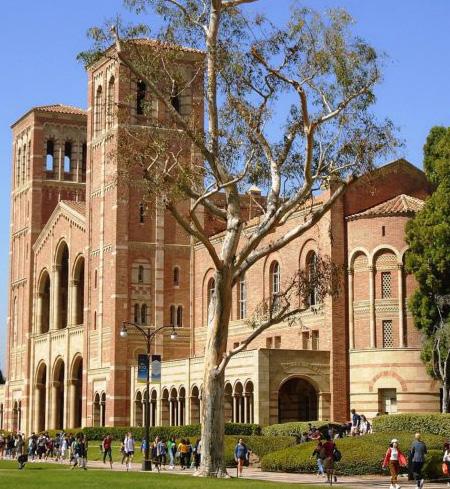
A UC statement Friday night said the university "welcomes the ratification of these agreements with our valued graduate student employees."
"The university believed that the assistance of a thirdparty mediator would help the parties reach agreement, which is why we are so grateful that the union accepted our invitation to mediation and partnered with us in selecting Sacramento Mayor Darrell Steinberg to serve as the mediator," said Letitia Silas, executive director of UC's systemwide labor relations.
"As a result of this collaboration, the parties were ultimately able to reach tentative agreements on the contracts as a whole in just a few days following months of negotiations. The University of California has negotiated several fair labor agreements over the last year with our represented employees.

"Today's ratification demonstrates yet again the university's strong commitment to providing every one of our hardworking employees with competitive compensation and benefit packages that honor their many contributions to our institution, to our
community, and to the state of California."

The strike was the nation's largest since 2019, the largest at any academic institution, and first by postdoctoral scholars and academic researchers, according to the union.
According to the unions, terms of the 2 1/2-year contracts guarantee that wages will rise significantly for all workers -- including up to 80% for some of the lowest paid.
"Other improvements in childcare and dependent coverage mean that more parents will be able to provide health care for their children," the unions said.
"First-of-their kind antibullying measures will allow workers to finally address the systemic power imbalance in academia. And three years of remission of NonResident Student Tuition are now codified, meaning that international workers will be able to enforce this right and UC will not be able to take it away."
Said UAW President Ray Curry, "This is a tremendous victory for not only the members of UAW Local 2865 and SRU-UAW but for all academic workers. The entire UAW family celebrates this victory with them."
According to the UC, the deal would set minimum pay for graduate student research-
ers at $34,564.50 for 50% time work by Oct. 1, 2024. The minimum nine-month salary for teaching assistants would be $34,000 for 50% time work by Oct. 1, 2024, although the rate will be $36,500 at UC Berkeley, UC San Francisco and UCLA.
"This is a positive step forward for the university and for our students, and I am grateful for the progress we have made together," UC President Michael Drake said in a statement last week.
"Our Academic Student Employees and Graduate Student Researchers are central to our academic enterprise and make incredible contributions to the university's mission of research and education. These agreements will place our graduate student employees among the best supported in public higher education."
Postdoctoral scholars and academic researchers each overwhelmingly ratified their new contracts in voting that concluded Dec. 9.
The final count was 89.4% of postdoctoral scholars and 79.5% of academic researchers voting in favor of ratification, the union announced.
The groups reached tentative labor deals with the university Nov. 29 but continued striking in solidarity with the other workers while those negotiations continued.

As most of you know, our beloved City Historian and Treasurer Steve Baker passed away last April. Although his “positions” have been filled, his passing leaves an utterly irreplaceable void within our community. Steve’s love and knowledge of California history, genealogy and authentic architecture made him the consummate chronicler of our city’s history. It certainly didn’t hurt that he lived in one of Monrovia’s first homes, The Arthur House, built by his great-great-grandfather in 1887. The Blair House, which was originally built on Ivy and Olive Ave. was moved to 319 W. Duarte Rd. in 1927.

Steve Baker purchased The Blair House in 1992, and true to fashion or in this case, historic accuracy, he moved the house in a two-day trek to 508 S. Olive Ave., next door to The Arthur House.
It’s no surprise that many
offers were placed on the two properties, upon the passing of Steve Baker. I’m sure there were quite a few developers with dollar signs in their eyes. You can call it good timing or luck, but I call it divine intervention because Joshua Cain, of Saxony Design Build in Monrovia, reached out to Steve’s sister, Susan, and shared his thoughts on turning the two properties into a bed and breakfast.
Susan revealed that turning the historic homes into a hotel had been a long-term goal of Steve’s. With what I can only imagine as guidance from a very special angel, Susan overlooked the many and some of them higher offers and sold the properties to Saxony Design Build, headed by Jeff Godbold and Joshua Cain.
If you’re not familiar with Saxony, their design portfolio is nothing short of stunning. While their résumé boasts projects
ranging from modest homes to large hotels and elegant country clubs, they are very passionate about architectural authenticity. It is no surprise that Joshua and Steve Baker became fast friends. The two met when Joshua was renovating the Tillapaugh House, and their
friendship grew from there. Steve was a frequent visitor when Joshua bought and restored a lovely historic Queen Anne Victorian that was built in 1887 and was originally owned by Captain Johnson, a very prominent citizen and former Mayor of Monrovia. Captain Johnson
was also one of the first orange growers in Monrovia.
The restoration and renovation of The Arthur and Blair Houses are already underway. While still in the permitting process, Saxony hopes to break ground in April 2023. There will be an addition added to the back of The Blair House to mimic The Arthur House. The bed and breakfast will have 11 suites in total and will also have a pool built on the property as well as a café. Steve’s family donated the contents of the houses, photos and memorabilia which will proudly be displayed. Since the houses are not ADA accessible, one of the structures on the property will be converted to a 2-suite cottage that will be completely ADA accessible. The bed and breakfast will be available to individuals that prefer an alternative to a hotel stay, as well as groups and events, such as weddings and company team-building
getaways. I’m sure this B&B will also serve as a favorite location for filming. In keeping with the spirit of Steve Baker, they also hope to incorporate some walking tours around Monrovia.
I haven’t been this excited about a project in Monrovia for some time. Ok, I’m a little bit excited about In-N-Out, but this B&B is not even in the same ballpark. It is so much cooler. I love how everything came together like it was meant to be. I love the vision of Joshua and the friendship he shared with Steve. I love that Susan knew what her brother’s wishes were and that she loved him so much that she brought his dreams to fruition. I know that Saxony Design Build is going to make Monrovia very proud with this project. I know that Steve Baker, our very own Mr. Monopoly, will watch every step they take and smile with appreciation and approval.
Getting in shape physically and mentally shouldn’t be a punishment. It’s an amazing, empowering lifestyle decision that anyone can make. I believe in finding the pleasurable side of wellness; and while there may be a sore muscle or two along the way, the benefits of health and wellness are worth the journey.


SOUTHERN CALIFORNIA (2). SEAS OF SOCAL , 340 NORTH ALTA VISTA AVE, MONROVIA, CA 91016.
This business is conducted by a individual. Registrant has not yet begun to transact business under the fictitious business name or names listed herein. Signed: daniel m carbone, 340 NORTH ALTA VISTA AVE, MONROVIA, CA 91016 (Owner). The statement was filed with the County Clerk of Los Angeles on November 16, 2022.
NOTICE: This fictitious business name statement expires five years from the date it was filed in the office of the County Clerk. A new fictitious business name statement must be filed prior to that date. The filing of this statement does not of itself authorize the use in this state of a fictitious business name in violation of the rights of another under federal, state or common law (See Section 14400 et seq., Business and Professional Code).
Pub. Monrovia Weekly 12/08/2022, 12/15/2022, 12/22/2022, 12/29/2022
FICTITIOUS BUSINESS NAME STATEMENT FILE NO. 2022263768 NEW FILING.
The following person(s) is (are) doing business as SOIGNE GARDEN, 125 N Lincoln Pl, Monrovia, CA 91016. This business is conducted by a individual. Registrant commenced to transact business under the fictitious business name or names listed herein on September 2022.
Signed: Hung M. Nguyen, 125 N Lincoln Pl, Monrovia, CA 91016 (Owner). The statement was filed with the County Clerk of Los Angeles on December 6, 2022.
NOTICE: This fictitious business name statement expires five years from the date it was filed in the office of the County Clerk. A new fictitious business name statement must be filed prior to that date. The filing of this statement does not of itself authorize the use in this state of a fictitious business name in violation of the rights of another under federal, state or common law (See Section 14400 et seq., Business and Professional Code).
Pub. Monrovia Weekly 12/08/2022, 12/15/2022, 12/22/2022, 12/29/2022
FICTITIOUS BUSINESS NAME STATEMENT FILE NO. 2022263968 NEW FILING.
The following person(s) is (are) doing business as URBN LEAF, 8477 Sunset Blvd, West Hollywood, CA 90069. This business is conducted by a limited liability company (llc). Registrant has not yet begun to transact business under the fictitious business name or names listed herein. Signed: PDLP JV LLC (CA-202032410069), 2300 S Sepulveda, Los Angeles, CA 90064; Soheil Yamini, Managing Member. The statement was filed with the County Clerk of Los Angeles on December 7, 2022. NOTICE: This fictitious business name statement expires five years from the date it was filed in the office of the County Clerk. A new fictitious business name statement must be filed prior to that date. The filing of this statement does not of itself authorize the use in this state of a fictitious business name in violation of the rights of another under federal, state or common law (See Section 14400 et seq., Business and Professional Code).
Pub. Monrovia Weekly 12/08/2022, 12/15/2022, 12/22/2022, 12/29/2022
FICTITIOUS BUSINESS NAME STATEMENT FILE NO. 2022264095 NEW FILING.
The following person(s) is (are) doing business as VISIONTECH, 2940 Ashmont Ave, Arcadia, CA 91006. This business is conducted by a individual. Registrant has not yet begun to transact business under the fictitious business name or names listed herein. Signed: Gabriel Jimenez, 2940 Ashmont Ave, Arcadia, CA 91006 (Owner). The statement was filed with the County Clerk of Los Angeles on December 7, 2022. NOTICE: This fictitious business name statement expires five years from the date it was filed in the office of the County Clerk. A new fictitious business name statement must be filed prior to that date. The filing of this statement does not of itself authorize the use in this state of a fictitious business name in violation of the rights of another under federal, state or common law (See Section 14400 et seq., Business and Professional Code).
Pub. Monrovia Weekly 12/08/2022, 12/15/2022, 12/22/2022, 12/29/2022
FICTITIOUS BUSINESS NAME STATEMENT FILE NO. 2022263592 NEW FILING.
The following person(s) is (are) doing business as TOP DEVELOPER ACADEMY, 130 White Oak Alley, Monrovia, CA 91016. This business is conducted by a individual. Registrant has not yet begun to transact business under the fictitious business name or names listed herein. Signed: Michael Pogrebinsky, 130 White Oak Alley, Monrovia, CA 91016 (Owner). The statement was filed with the County Clerk of Los Angeles on December
6, 2022. NOTICE: This fictitious business name statement expires five years from the date it was filed in the office of the County Clerk. A new fictitious business name statement must be filed prior to that date. The filing of this statement does not of itself authorize the use in this state of a fictitious business name in violation of the rights of another under federal, state or common law (See Section 14400 et seq., Business and Professional Code).
Pub. Monrovia Weekly 12/08/2022, 12/15/2022, 12/22/2022, 12/29/2022
FICTITIOUS BUSINESS NAME STATEMENT FILE NO. 2022265120 NEW FILING.
The following person(s) is (are) doing business as 24 HOUR MOBILE NOTARY SERVICE, 9854 National Blvd #1020, Los Angeles, CA 90034. This business is conducted by a limited liability company (llc). Registrant has not yet begun to transact business under the fictitious business name or names listed herein. Signed: Same Day Serve LA LLC (CA-202102510910), 9854 National Blvd #1020, Los Angeles, CA 90034; Enrique OrtegaRubio, Managing Member. The statement was filed with the County Clerk of Los Angeles on December 8, 2022. NOTICE: This fictitious business name statement expires five years from the date it was filed in the office of the County Clerk. A new fictitious business name statement must be filed prior to that date. The filing of this statement does not of itself authorize the use in this state of a fictitious business name in violation of the rights of another under federal, state or common law (See Section 14400 et seq., Business and Professional Code).
Pub. Monrovia Weekly 12/15/2022, 12/22/2022, 12/29/2022, 01/05/2023
FICTITIOUS BUSINESS NAME STATEMENT FILE NO. 2022268192 NEW FILING.
The following person(s) is (are) doing business as OKU-NIKU JAPANESE BBQ, 4013 W Riverside Drive, Burbank, CA 91505. Mailing Address, 573 Monterey Pass Rd Ste B, MONTEREY PARK, CA 91754. This business is conducted by a corporation. Registrant commenced to transact business under the fictitious business name or names listed herein on December 2022.
Signed: Bunker Hill Restaurant Inc. (CA-C3504149), 4013 W Riverside Drive, burbank, CA 91505; Ka Wai Kwan, Secretary. The statement was filed with the County Clerk of Los Angeles on December 13, 2022.
NOTICE: This fictitious business name statement expires five years from the date it was filed in the office of the County Clerk. A new fictitious business name statement must be filed prior to that date. The filing of this statement does not of itself authorize the use in this state of a fictitious business name in violation of the rights of another under federal, state or common law (See Section 14400 et seq., Business and Professional Code).
Pub. Monrovia Weekly 12/15/2022, 12/22/2022, 12/29/2022, 01/05/2023
FICTITIOUS BUSINESS NAME STATEMENT FILE NO. 2022268210 NEW FILING.
The following person(s) is (are) doing business as J’S GOMEZ EXPRESS INC, 142 S VIRGINIA AVE APT 3, AZUSA, CA 91702. This business is conducted by a corporation. Registrant commenced to transact business under the fictitious business name or names listed herein on November 2022.
Signed: J’S GOMEZ EXPRESS INC (CA-5364755), 142 S VIRGINIA AVE APT 3, AZUSA, CA 91702; ADRIAN GOMEZ, CEO. The statement was filed with the County Clerk of Los Angeles on December 13, 2022.
NOTICE: This fictitious business name statement expires five years from the date it was filed in the office of the County Clerk. A new fictitious business name statement must be filed prior to that date. The filing of this statement does not of itself authorize the use in this state of a fictitious business name in violation of the rights of another under federal, state or common law (See Section 14400 et seq., Business and Professional Code).
Pub. Monrovia Weekly 12/15/2022, 12/22/2022, 12/29/2022, 01/05/2023
FICTITIOUS BUSINESS NAME STATEMENT FILE NO. 2022263711
NEW FILING.
The following person(s) is (are) doing business as NDY 900, 1700 Santa Fe Ave no 845, Los Angeles, CA 90813. This business is conducted by a individual. Registrant has not yet begun to transact business under the fictitious business name or names listed herein. Signed: Yasmin Altagracia A, 1700 S Santa Fe Ave No 845, Los Angeles, CA 90813 (Owner). The statement was filed with the County Clerk of Los Angeles on December 6, 2022.
NOTICE: This fictitious business name statement expires five years from the date it was filed in the office of the County Clerk. A new
fictitious business name statement must be filed prior to that date. The filing of this statement does not of itself authorize the use in this state of a fictitious business name in violation of the rights of another under federal, state or common law (See Section 14400 et seq., Business and Professional Code).
Pub. Monrovia Weekly 12/15/2022, 12/22/2022, 12/29/2022, 01/05/2023
FICTITIOUS BUSINESS NAME STATEMENT FILE NO. 2022268296 NEW FILING.
The following person(s) is (are) doing business as MUSIC LAND, 9123-1/2 Las Tunas Drive, Temple City, CA 91780. This business is conducted by a corporation.
Registrant commenced to transact business under the fictitious business name or names listed herein on December 2022. Signed: Music Land School (CA-C4601774), 9123-1/2 Las Tunas Drive, Temple City, CA 91780; Li Ling, CEO. The statement was filed with the County Clerk of Los Angeles on December 13, 2022. NOTICE: This fictitious business name statement expires five years from the date it was filed in the office of the County Clerk. A new fictitious business name statement must be filed prior to that date. The filing of this statement does not of itself authorize the use in this state of a fictitious business name in violation of the rights of another under federal, state or common law (See Section 14400 et seq., Business and Professional Code).
Pub. Monrovia Weekly 12/15/2022, 12/22/2022, 12/29/2022, 01/05/2023
FICTITIOUS BUSINESS NAME STATEMENT FILE NO. 2022267011 NEW FILING.
The following person(s) is (are) doing business as LUTRICK CONSULTING, 639 Alder Ln, Walnut, CA 91789. This business is conducted by a corporation. Registrant commenced to transact business under the fictitious business name or names listed herein on December 2022. Signed: TaskOn Inc. (CA-5151967), 639 Alder Ln, Walnut, CA 91789; Nicholas Lutrick, CEO. The statement was filed with the County Clerk of Los Angeles on December 9, 2022.
NOTICE: This fictitious business name statement expires five years from the date it was filed in the office of the County Clerk. A new fictitious business name statement must be filed prior to that date. The filing of this statement does not of itself authorize the use in this state of a fictitious business name in violation of the rights of another under federal, state or common law (See Section 14400 et seq., Business and Professional Code).
Pub. Monrovia Weekly 12/15/2022, 12/22/2022, 12/29/2022, 01/05/2023
FICTITIOUS BUSINESS NAME STATEMENT FILE NO. 2022264971 NEW FILING.
The following person(s) is (are) doing business as EVANS NURSING SERVICES, 13030 Ramona Blvd, 68, Baldwin Park, CA 91706. This business is conducted by a individual. Registrant has not yet begun to transact business under the fictitious business name or names listed herein. Signed: Kathy Velasquez, 13030 Ramona Blvd, 68, Baldwin Park, CA 91706 (Owner). The statement was filed with the County Clerk of Los Angeles on December 7, 2022. NOTICE: This fictitious business name statement expires five years from the date it was filed in the office of the County Clerk. A new fictitious business name statement must be filed prior to that date. The filing of this statement does not of itself authorize the use in this state of a fictitious business name in violation of the rights of another under federal, state or common law (See Section 14400 et seq., Business and Professional Code).
Pub. Monrovia Weekly 12/15/2022, 12/22/2022, 12/29/2022, 01/05/2023
FICTITIOUS BUSINESS NAME STATEMENT FILE NO. 2022263061 NEW FILING.
The following person(s) is (are) doing business as CRYSTAL ROSE DRY CLEANERS, 16402 Whittier Blvd, Whittier, CA 90603. This business is conducted by a individual. Registrant commenced to transact business under the fictitious business name or names listed herein on October 2022.
Signed: Denice R Giorge, 10010 San Miguel Ave, South Gate, CA 90280 (Owner). The statement was filed with the County Clerk of Los Angeles on December 6, 2022.
NOTICE: This fictitious business name statement expires five years from the date it was filed in the office of the County Clerk. A new fictitious business name statement must be filed prior to that date. The filing of this statement does not of itself authorize the use in this state of a fictitious business name in violation of the rights of another under federal, state or common law (See Section 14400 et seq., Business and Professional Code).
Pub. Monrovia Weekly 12/15/2022, 12/22/2022, 12/29/2022, 01/05/2023
FICTITIOUS BUSINESS NAME STATEMENT FILE NO. 2022258386 NEW FILING.
The following person(s) is (are) doing business as HATCH PRO, 1407 Wesley Ave, Pasadena, CA 91104. Mailing Address, 568 N Valencia Place, Covina, CA 91723. This business is conducted by a individual. Registrant commenced to transact business under the fictitious business name or names listed herein on November 2022.
Signed: Hagop Nalbandian, 568 N Valencia Place, Covina, CA 91723 (Owner). The statement was filed with the County Clerk of Los Angeles on November 30, 2022.
NOTICE: This fictitious business name statement expires five years from the date it was filed in the office of the County Clerk. A new fictitious business name statement must be filed prior to that date. The filing of this statement does not of itself authorize the use in this state of a fictitious business name in violation of the rights of another under federal, state or common law (See Section 14400 et seq., Business and Professional Code).
Pub. Monrovia Weekly 12/15/2022, 12/22/2022, 12/29/2022, 01/05/2023
FICTITIOUS BUSINESS NAME STATEMENT FILE NO. 2022263196 NEW FILING.
The following person(s) is (are) doing business as SHIN DANCE ACADEMY, 5703 Kauffman Ave, Temple City, CA 91780. This business is conducted by a individual. Registrant has not yet begun to transact business under the fictitious business name or names listed herein. Signed: Oscar TBustamante, 5703 Kauffman Ave, Temple City, CA 91780 (Owner). The statement was filed with the County Clerk of Los Angeles on December 6, 2022. NOTICE: This fictitious business name statement expires five years from the date it was filed in the office of the County Clerk. A new fictitious business name statement must be filed prior to that date. The filing of this statement does not of itself authorize the use in this state of a fictitious business name in violation of the rights of another under federal, state or common law (See Section 14400 et seq., Business and Professional Code).
Pub. Monrovia Weekly 12/15/2022, 12/22/2022, 12/29/2022, 01/05/2023
FICTITIOUS BUSINESS NAME STATEMENT FILE NO. 2022266289 NEW FILING.
The following person(s) is (are) doing business as MENG-HSUAN LIN CHIROPRACTIC PROFESSIONAL , 10137 GROVESIDE AVE, WHITTIER, CA 90603-1549. This business is conducted by a individual. Registrant commenced to transact business under the fictitious business name or names listed herein on December 2022.
Signed: MENG HSUAN LIN, 10137 GROVESIDE AVE, WHITTIER, CA 90603-1549 (Owner). The statement was filed with the County Clerk of Los Angeles on December 9, 2022.
NOTICE: This fictitious business name statement expires five years from the date it was filed in the office of the County Clerk. A new fictitious business name statement must be filed prior to that date. The filing of this statement does not of itself authorize the use in this state of a fictitious business name in violation of the rights of another under federal, state or common law (See Section 14400 et seq., Business and Professional Code).
Pub. Monrovia Weekly 12/15/2022, 12/22/2022, 12/29/2022, 01/05/2023
FICTITIOUS BUSINESS NAME STATEMENT FILE NO. 2022266853 NEW FILING.
The following person(s) is (are) doing business as MONROVIA TAILORING, 124 S Myrtle Ave, Monrovia, CA 91016. This business is conducted by a individual. Registrant commenced to transact business under the fictitious business name or names listed herein on December 2022. Signed: Debra Lee Ortega, 124 S Myrtle Ave, Monrovia, CA 91016 (Owner). The statement was filed with the County Clerk of Los Angeles on December 9, 2022. NOTICE: This fictitious business name statement expires five years from the date it was filed in the office of the County Clerk. A new fictitious business name statement must be filed prior to that date. The filing of this statement does not of itself authorize the use in this state of a fictitious business name in violation of the rights of another under federal, state or common law (See Section 14400 et seq., Business and Professional Code).
Pub. Monrovia Weekly 12/15/2022, 12/22/2022, 12/29/2022, 01/05/2023
FICTITIOUS BUSINESS NAME STATEMENT FILE NO. 2022264258
NEW FILING.
The following person(s) is (are) doing business as VIETNOODLEBAR, 1661 Colorado Blvd, Los Angeles, CA 90041. Mailing Address, 3133 Glendale Blvd, Los Angeles, CA 90039. This business is conducted
by a corporation. Registrant commenced to transact business under the fictitious business name or names listed herein on December 2022. Signed: Vietnoodlebar (CA2947110), 3133 Glendale Blvd, Los Angeles, CA 90039; Viet Tran, President. The statement was filed with the County Clerk of Los Angeles on December 7, 2022.
NOTICE: This fictitious business name statement expires five years from the date it was filed in the office of the County Clerk. A new fictitious business name statement must be filed prior to that date. The filing of this statement does not of itself authorize the use in this state of a fictitious business name in violation of the rights of another under federal, state or common law (See Section 14400 et seq., Business and Professional Code).
Pub. Monrovia Weekly 12/15/2022, 12/22/2022, 12/29/2022, 01/05/2023
FICTITIOUS BUSINESS NAME STATEMENT FILE NO. 2022262701
NEW FILING.
The following person(s) is (are) doing business as YOTEA, 8449 Garvey Ave 104, Rosemead, CA 91770. Mailing Address, 4442 Bartlett Ave, Rosemead, CA 91770. This business is conducted by a limited liability company (llc). Registrant has not yet begun to transact business under the fictitious business name or names listed herein. Signed: YOTEA LLC (CA-202253214920), 4442 Bartlett Ave, Rosemead, CA 91770; Zenbi Trinh, Manager. The statement was filed with the County Clerk of Los Angeles on December 5, 2022.
NOTICE: This fictitious business name statement expires five years from the date it was filed in the office of the County Clerk. A new fictitious business name statement must be filed prior to that date. The filing of this statement does not of itself authorize the use in this state of a fictitious business name in violation of the rights of another under federal, state or common law (See Section 14400 et seq., Business and Professional Code).
Pub. Monrovia Weekly 12/15/2022, 12/22/2022, 12/29/2022, 01/05/2023
FICTITIOUS BUSINESS NAME STATEMENT FILE NO. 2022268306
NEW FILING.
The following person(s) is (are) doing business as FASOLI CONSULTING SERVICES, 21256 Gerndal St, Diamond Bar, CA 91789. This business is conducted by a individual. Registrant has not yet begun to transact business under the fictitious business name or names listed herein. Signed: Liliana Soto, 21256 Gerndal St, Diamond Bar, CA 91789 (Owner). The statement was filed with the County Clerk of Los Angeles on December 13, 2022. NOTICE: This fictitious business name statement expires five years from the date it was filed in the office of the County Clerk. A new fictitious business name statement must be filed prior to that date. The filing of this statement does not of itself authorize the use in this state of a fictitious business name in violation of the rights of another under federal, state or common law (See Section 14400 et seq., Business and Professional Code).
Pub. Monrovia Weekly 12/15/2022, 12/22/2022, 12/29/2022, 01/05/2023
statement was filed with the County Clerk of Los Angeles on December 2, 2022. NOTICE: This fictitious business name statement expires five years from the date it was filed in the office of the County Clerk. A new fictitious business name statement must be filed prior to that date. The filing of this statement does not of itself authorize the use in this state of a fictitious business name in violation of the rights of another under federal, state or common law (See Section 14400 et seq., Business and Professional Code).
Pub. Monrovia Weekly 12/22/2022, 12/29/2022, 01/05/2023, 01/12/2023 sc
FICTITIOUS BUSINESS NAME STATEMENT FILE NO. 2022260960 NEW FILING.
The following person(s) is (are) doing business as DILALLO CONSULTING BEAUTY BRAND ARCHITECTS, 2160 Century Park East Ste 405, Los Angeles, CA 90067. This business is conducted by a individual. Registrant commenced to transact business under the fictitious business name or names listed herein on April 2018.
Signed: Natalie Dilallo, 2160 Century Park East Ste 405, Los Angeles, CA 90067 (Owner). The statement was filed with the County Clerk of Los Angeles on December 2, 2022.
NOTICE: This fictitious business name statement expires five years from the date it was filed in the office of the County Clerk. A new fictitious business name statement must be filed prior to that date. The filing of this statement does not of itself authorize the use in this state of a fictitious business name in violation of the rights of another under federal, state or common law (See Section 14400 et seq., Business and Professional Code).
Pub. Monrovia Weekly 12/22/2022, 12/29/2022, 01/05/2023, 01/12/2023 sc
FICTITIOUS BUSINESS NAME STATEMENT FILE NO. 2022260964 NEW FILING.
The following person(s) is (are) doing business as EVERREADY PALLETS, 4327 Benito St, Montclair, CA 91763. This business is conducted by a individual. Registrant commenced to transact business under the fictitious business name or names listed herein on September 2017. Signed: Francisco Z Angeles, 4327 Benito St, Montclair, CA 91763 (Owner). The statement was filed with the County Clerk of Los Angeles on December 2, 2022. NOTICE: This fictitious business name statement expires five years from the date it was filed in the office of the County Clerk. A new fictitious business name statement must be filed prior to that date. The filing of this statement does not of itself authorize the use in this state of a fictitious business name in violation of the rights of another under federal, state or common law (See Section 14400 et seq., Business and Professional Code).
Pub. Monrovia Weekly 12/22/2022, 12/29/2022, 01/05/2023, 01/12/2023 sc
FICTITIOUS BUSINESS NAME STATEMENT FILE NO. 2022260968 NEW FILING.
FICTITIOUS BUSINESS NAME STATEMENT FILE NO. 2022260956
NEW FILING.
The following person(s) is (are) doing business as AGOURA HILLS NAILS, 30313 Canwood St #29, Agoura Hills, CA 91301. This business is conducted by a individual. Registrant commenced to transact business under the fictitious business name or names listed herein on January 2009.
Signed: Truc Thah Thi Lam, 30313 Canwood St #29, Agoura Hills, CA 91301 (Owner). The statement was filed with the County Clerk of Los Angeles on December 2, 2022.
NOTICE: This fictitious business name statement expires five years from the date it was filed in the office of the County Clerk. A new fictitious business name statement must be filed prior to that date. The filing of this statement does not of itself authorize the use in this state of a fictitious business name in violation of the rights of another under federal, state or common law (See Section 14400 et seq., Business and Professional Code).
Pub. Monrovia Weekly 12/22/2022, 12/29/2022, 01/05/2023, 01/12/2023 sc
FICTITIOUS BUSINESS NAME
STATEMENT FILE NO. 2022260958
NEW FILING.
The following person(s) is (are) doing business as DBSCONSULTING, 19211 Haynes St #4, Reseda, CA 91335. This business is conducted by a individual. Registrant commenced to transact business under the fictitious business name or names listed herein on May 2017. Signed: David Ben Shimol, 19211 Haynes #4, Reseda, CA 91335 (Owner). The
The following person(s) is (are) doing business as GRT ELECTRIC, 7171 E Wardlow Rd, Lond Beach, CA 90808. This business is conducted by a individual. Registrant commenced to transact business under the fictitious business name or names listed herein on September 2017. Signed: Richard P Tobin, 7171 E Wardlow Rd, Long Beach, CA 90808 (Owner). The statement was filed with the County Clerk of Los Angeles on December 2, 2022.
NOTICE: This fictitious business name statement expires five years from the date it was filed in the office of the County Clerk. A new fictitious business name statement must be filed prior to that date. The filing of this statement does not of itself authorize the use in this state of a fictitious business name in violation of the rights of another under federal, state or common law (See Section 14400 et seq., Business and Professional Code).
Pub. Monrovia Weekly 12/22/2022, 12/29/2022, 01/05/2023, 01/12/2023
sc
FICTITIOUS BUSINESS NAME STATEMENT FILE NO. 2022260962 NEW FILING.
The following person(s) is (are) doing business as JADE SIAM RESTAURANT, 2570 E Slauson Ave Ste A, Huntington park, CA 90255. This business is conducted by a individual. Registrant commenced to transact business under the fictitious business name or names listed herein on January 2018.
Signed: Jarinetorn Soukchareon, 10110 Somerset Blvd, Bellflower, CA 90706 (Owner). The statement was filed with the County Clerk of Los Angeles on December 2, 2022.
NOTICE: This fictitious business name statement expires five years from the date it was filed in the office of the County Clerk. A new fictitious business name statement
must be filed prior to that date. The filing of this statement does not of itself authorize the use in this state of a fictitious business name in violation of the rights of another under federal, state or common law (See Section 14400 et seq., Business and Professional Code).
Pub. Monrovia Weekly 12/22/2022, 12/29/2022, 01/05/2023, 01/12/2023 sc
FICTITIOUS BUSINESS NAME
STATEMENT FILE NO. 2022260950 NEW FILING.
The following person(s) is (are) doing business as (1). JAIME MONROY STUDIOS (2). JAIME MONROY STYLE & LICENSING , 269 S Beverly Hills #734, Beverly Hills, CA 90212.
This business is conducted by a individual. Registrant commenced to transact business under the fictitious business name or names listed herein on May 2018.
Signed: Alejandro X Monroy, 330 N Screenland Dr #130, Burbank, CA 91505 (Owner). The statement was filed with the County Clerk of Los Angeles on December 2, 2022.
NOTICE: This fictitious business name statement expires five years from the date it was filed in the office of the County Clerk. A new fictitious business name statement must be filed prior to that date. The filing of this statement does not of itself authorize the use in this state of a fictitious business name in violation of the rights of another under federal, state or common law (See Section 14400 et seq., Business and Professional Code).
Pub. Monrovia Weekly 12/22/2022, 12/29/2022, 01/05/2023, 01/12/2023 sc
FICTITIOUS BUSINESS NAME STATEMENT FILE NO. 2022260937 NEW FILING.
The following person(s) is (are) doing business as LITEFLY, 19035 Miranda St, Tarzana, CA 91356. This business is conducted by a individual. Registrant commenced to transact business under the fictitious business name or names listed herein on December 2017.
Signed: Samuel Owen Kleinman, 19035 Miranda St, Tarzana, CA 91356 (Owner). The statement was filed with the County Clerk of Los Angeles on December 2, 2022.
NOTICE: This fictitious business name statement expires five years from the date it was filed in the office of the County Clerk. A new fictitious business name statement must be filed prior to that date. The filing of this statement does not of itself authorize the use in this state of a fictitious business name in violation of the rights of another under federal, state or common law (See Section 14400 et seq., Business and Professional Code).
Pub. Monrovia Weekly 12/22/2022, 12/29/2022, 01/05/2023, 01/12/2023 sc
FICTITIOUS BUSINESS NAME STATEMENT FILE NO. 2022260966 NEW FILING.
The following person(s) is (are) doing business as PRIYANKA’S KITCHEN, 7850 Agnes Ave, North Hollywood, CA 91605. This business is conducted by a individual. Registrant commenced to transact business under the fictitious business name or names listed herein on May 2018. Signed: Priyanka K Yamasinghage, 7850 Agnes Ave, North Hollywood, CA 91605 (Owner). The statement was filed with the County Clerk of Los Angeles on December 2, 2022.
NOTICE: This fictitious business name statement expires five years from the date it was filed in the office of the County Clerk. A new fictitious business name statement must be filed prior to that date. The filing of this statement does not of itself authorize the use in this state of a fictitious business name in violation of the rights of another under federal, state or common law (See Section 14400 et seq., Business and Professional Code).
Pub. Monrovia Weekly 12/22/2022, 12/29/2022, 01/05/2023, 01/12/2023 sc
under federal, state or common law (See Section 14400 et seq., Business and Professional Code).
Pub. Monrovia Weekly 12/22/2022, 12/29/2022, 01/05/2023, 01/12/2023 sc
FICTITIOUS BUSINESS NAME STATEMENT FILE NO. 2022262893
NEW FILING.
The following person(s) is (are) doing business as CANDLELIT SOIRÉE, 16840 Minnehaha Street, Granada Hills, CA 91344. This business is conducted by a individual. Registrant commenced to transact business under the fictitious business name or names listed herein on October 2022.
Signed: Vartan Ourfalian, 16840 Minnehaha Street, Granada Hills, CA 91344 (Owner). The statement was filed with the County Clerk of Los Angeles on December 6, 2022.
NOTICE: This fictitious business name statement expires five years from the date it was filed in the office of the County Clerk. A new fictitious business name statement must be filed prior to that date. The filing of this statement does not of itself authorize the use in this state of a fictitious business name in violation of the rights of another under federal, state or common law (See Section 14400 et seq., Business and Professional Code).
Pub. Monrovia Weekly 12/22/2022, 12/29/2022, 01/05/2023, 01/12/2023
FICTITIOUS BUSINESS NAME STATEMENT FILE NO. 2022266428 NEW FILING.
The following person(s) is (are) doing business as GRZ GARDENING, 11315 Medina Ct, El Monte, CA 91731. This business is conducted by a individual. Registrant has not yet begun to transact business under the fictitious business name or names listed herein. Signed: Brian Arthur Rozales, 11315 Medina Ct, El Monte, CA 91731 (Owner). The statement was filed with the County Clerk of Los Angeles on December 9, 2022. NOTICE: This fictitious business name statement expires five years from the date it was filed in the office of the County Clerk. A new fictitious business name statement must be filed prior to that date. The filing of this statement does not of itself authorize the use in this state of a fictitious business name in violation of the rights of another under federal, state or common law (See Section 14400 et seq., Business and Professional Code). Pub. Monrovia Weekly 12/22/2022, 12/29/2022, 01/05/2023, 01/12/2023
FICTITIOUS BUSINESS NAME STATEMENT FILE NO. 2022269695 NEW FILING.
The following person(s) is (are) doing business as (1). PROFESSIONAL FINANCIAL SOLUTIONS (2). CPA RESOLUTION (3). PFS GLOBAL (4). PFS TAX (5). PFS BOOKKEEPING (6). YORKE & ASSOCIATES CPAS (7). PFS TAX CPAS (8). PFS TECHNOLOGY (9). PFS HCM (10). PFS PAYROLL (11). PFS LAW , 556 N Diamond Bar Blvd #101, Diamond Bar, CA 91765. This business is conducted by a limited liability company (llc). Registrant has not yet begun to transact business under the fictitious business name or names listed herein. Signed: PF Solutions, LLC (CA-201304210148), 556 N Diamond Bar Blvd #101, Diamond Bar, CA 91765; Aaron C. Stocks, CEO. The statement was filed with the County Clerk of Los Angeles on December 14, 2022.
NOTICE: This fictitious business name statement expires five years from the date it was filed in the office of the County Clerk. A new fictitious business name statement must be filed prior to that date. The filing of this statement does not of itself authorize the use in this state of a fictitious business name in violation of the rights of another under federal, state or common law (See Section 14400 et seq., Business and Professional Code).
Pub. Monrovia Weekly 12/22/2022, 12/29/2022, 01/05/2023, 01/12/2023
filing of this statement does not of itself authorize the use in this state of a fictitious business name in violation of the rights of another under federal, state or common law (See Section 14400 et seq., Business and Professional Code).
Pub. Monrovia Weekly 12/22/2022, 12/29/2022, 01/05/2023, 01/12/2023
FICTITIOUS BUSINESS NAME STATEMENT FILE NO. 2022263971
NEW FILING.
The following person(s) is (are) doing business as MONICA’S MEXICAN FOOD, 2727 S Reservoir St, Pomona, CA 91766. Mailing Address, 2540 Titus Ave, Pomona, CA 91677. This business is conducted by a corporation. Registrant commenced to transact business under the fictitious business name or names listed herein on December 2022. Signed: MONJERU Inc. (CA-5309661), 2540 Titus Ave, Pomona, CA 91766; Monica C Ruvalcaba, President. The statement was filed with the County Clerk of Los Angeles on December 7, 2022. NOTICE: This fictitious business name statement expires five years from the date it was filed in the office of the County Clerk. A new fictitious business name statement must be filed prior to that date. The filing of this statement does not of itself authorize the use in this state of a fictitious business name in violation of the rights of another under federal, state or common law (See Section 14400 et seq., Business and Professional Code).
Pub. Monrovia Weekly 12/22/2022, 12/29/2022, 01/05/2023, 01/12/2023
FICTITIOUS BUSINESS NAME STATEMENT FILE NO. 2022263606 NEW FILING.
The following person(s) is (are) doing business as (1). A1 ACADEMY ZHUOYUE JIAOYU (2). A1 ACADEMY , 9447 Las Tunas Dr, Temple City, CA 91780. This business is conducted by a corporation. Registrant commenced to transact business under the fictitious business name or names listed herein on December 2022. Signed: Brilliant Education Incorporated (CA-4525515), 9447 Las Tunas Dr, Temple City, CA 91780; Stacey Feng, CEO. The statement was filed with the County Clerk of Los Angeles on December 6, 2022.
NOTICE: This fictitious business name statement expires five years from the date it was filed in the office of the County Clerk. A new fictitious business name statement must be filed prior to that date. The filing of this statement does not of itself authorize the use in this state of a fictitious business name in violation of the rights of another under federal, state or common law (See Section 14400 et seq., Business and Professional Code).
Pub. Monrovia Weekly 12/22/2022, 12/29/2022, 01/05/2023, 01/12/2023
FICTITIOUS BUSINESS NAME STATEMENT FILE NO. 2022271402 NEW FILING.
The following person(s) is (are) doing business as MYRRH STREET PUBLISHING, 230 North Valley Street # 108, Burbank, CA 91505. This business is conducted by a individual. Registrant commenced to transact business under the fictitious business name or names listed herein on December 2022.
Signed: Kimberly Peters, 230 North Valley Street #108, Burbank, CA 91505 (Owner). The statement was filed with the County Clerk of Los Angeles on December 16, 2022.
NOTICE: This fictitious business name statement expires five years from the date it was filed in the office of the County Clerk. A new fictitious business name statement must be filed prior to that date. The filing of this statement does not of itself authorize the use in this state of a fictitious business name in violation of the rights of another under federal, state or common law (See Section 14400 et seq., Business and Professional Code).
Pub. Monrovia Weekly 12/22/2022, 12/29/2022, 01/05/2023, 01/12/2023
FICTITIOUS BUSINESS NAME STATEMENT FILE NO. 2022270707 NEW FILING.
under federal, state or common law (See Section 14400 et seq., Business and Professional Code).
Pub. Monrovia Weekly 12/22/2022, 12/29/2022, 01/05/2023, 01/12/2023
FICTITIOUS BUSINESS NAME STATEMENT FILE NO. 2022266671 NEW FILING.
The following person(s) is (are) doing business as ENIGMA PRODUCTION, 6935 Wish Ave, Van Nuys, CA 91406. This business is conducted by a individual. Registrant commenced to transact business under the fictitious business name or names listed herein on December 2022.
Signed: Syuzan Harutyunyan, 6935 Wish Ave, Van Nuys, CA 91406 (Owner). The statement was filed with the County Clerk of Los Angeles on December 9, 2022.
NOTICE: This fictitious business name statement expires five years from the date it was filed in the office of the County Clerk. A new fictitious business name statement must be filed prior to that date. The filing of this statement does not of itself authorize the use in this state of a fictitious business name in violation of the rights of another under federal, state or common law (See Section 14400 et seq., Business and Professional Code).
Pub. Monrovia Weekly 12/22/2022, 12/29/2022, 01/05/2023, 01/12/2023
FICTITIOUS BUSINESS NAME STATEMENT FILE NO. 2022271814 NEW FILING. The following person(s) is (are) doing business as (1). M.A.S. PLASTICS LLC (2). M.A.S. PLASTICS , 14229 oxnard st, Van Nuys, CA 91401. This business is conducted by a limited liability company (llc). Registrant commenced to transact business under the fictitious business name or names listed herein on November 2017. Signed: M.A.S. Plastics LLC (CA-201901910032), 29861 Wistaria Valley Rd, Canyon Country, CA 91387; Miguel Santos, President. The statement was filed with the County Clerk of Los Angeles on December 16, 2022. NOTICE: This fictitious business name statement expires five years from the date it was filed in the office of the County Clerk. A new fictitious business name statement must be filed prior to that date. The filing of this statement does not of itself authorize the use in this state of a fictitious business name in violation of the rights of another under federal, state or common law (See Section 14400 et seq., Business and Professional Code).
Pub. Monrovia Weekly 12/22/2022, 12/29/2022, 01/05/2023, 01/12/2023
FICTITIOUS BUSINESS NAME STATEMENT FILE NO. 2022272103 NEW FILING. The following person(s) is (are) doing business as DAVID CHO, CPA, 412 S Wilton Pl. Apt 201, Los Angeles, CA 90020. This business is conducted by a individual. Registrant commenced to transact business under the fictitious business name or names listed herein on December 2022. Signed: Nam Hoon Cho, 412 S Wilton Pl. Apt 201, Los Angeles, CA 90020 (Owner). The statement was filed with the County Clerk of Los Angeles on December 16, 2022. NOTICE: This fictitious business name statement expires five years from the date it was filed in the office of the County Clerk. A new fictitious business name statement must be filed prior to that date. The filing of this statement does not of itself authorize the use in this state of a fictitious business name in violation of the rights of another under federal, state or common law (See Section 14400 et seq., Business and Professional Code).
Pub. Monrovia Weekly 12/22/2022, 12/29/2022, 01/05/2023, 01/12/2023
FICTITIOUS BUSINESS NAME STATEMENT FILE NO. 2022270247 NEW FILING.
TEMPLE CITY, CA 91780. This business is conducted by a corporation. Registrant commenced to transact business under the fictitious business name or names listed herein on November 2022.
Signed: YANG XIE HEALTHCARE INCORPORATION (CA-5350087), 9235 HECLA AVE, TEMPLE CITY, CA 91780; DIANA XIE, PRESIDENT. The statement was filed with the County Clerk of Los Angeles on December 5, 2022. NOTICE: This fictitious business name statement expires five years from the date it was filed in the office of the County Clerk. A new fictitious business name statement must be filed prior to that date. The filing of this statement does not of itself authorize the use in this state of a fictitious business name in violation of the rights of another under federal, state or common law (See Section 14400 et seq., Business and Professional Code). Pub. Monrovia Weekly 12/22/2022, 12/29/2022, 01/05/2023, 01/12/2023
FICTITIOUS BUSINESS NAME STATEMENT FILE NO. 2022261855 NEW FILING.
The following person(s) is (are) doing business as CANAAN SELECT CORPORATION, 16633 Gale Ave, City of Industry, CA 91745. This business is conducted by a corporation. Registrant commenced to transact business under the fictitious business name or names listed herein on December 2022.
Signed: Canaan Select Corporation (CA-5300367), 16633 Gale Ave, City of Industry, CA 91745; Wanching LI, President. The statement was filed with the County Clerk of Los Angeles on December 5, 2022.
NOTICE: This fictitious business name statement expires five years from the date it was filed in the office of the County Clerk. A new fictitious business name statement must be filed prior to that date. The filing of this statement does not of itself authorize the use in this state of a fictitious business name in violation of the rights of another under federal, state or common law (See Section 14400 et seq., Business and Professional Code).
Pub. Monrovia Weekly 12/22/2022, 12/29/2022, 01/05/2023, 01/12/2023
FICTITIOUS BUSINESS NAME STATEMENT FILE NO. 2022270884 NEW FILING.
The following person(s) is (are) doing business as BERG FEINFIELD VISION CORRECTION CENTER, 2625 W ALAMEDA AVE 208, BURBANK, CA 91505. This business is conducted by a general partnership. Registrant commenced to transact business under the fictitious business name or names listed herein on July 1999. Signed: (1). ALAN BERG, M.D., Inc, 2625 W ALAMEDA AVE 208, BURBANK, CA 91505 (2). ROBERT E. FEINFIELD, M.D., Inc, 2625 W ALAMEDA AVE 208, BURBANK, CA 91505 (General Partner). The statement was filed with the County Clerk of Los Angeles on December 15, 2022.
NOTICE: This fictitious business name statement expires five years from the date it was filed in the office of the County Clerk. A new fictitious business name statement must be filed prior to that date. The filing of this statement does not of itself authorize the use in this state of a fictitious business name in violation of the rights of another under federal, state or common law (See Section 14400 et seq., Business and Professional Code).
Pub. Monrovia Weekly 12/22/2022, 12/29/2022, 01/05/2023, 01/12/2023
FICTITIOUS BUSINESS NAME STATEMENT FILE NO. 2022265487
fictitious business name or names listed herein on June 2013. Signed: Xiao Yun Yu, 1402 South California Ave Unit B, Monrovia, CA 91016 (Owner). The statement was filed with the County Clerk of Los Angeles on December 20, 2022.
NOTICE: This fictitious business name statement expires five years from the date it was filed in the office of the County Clerk. A new fictitious business name statement must be filed prior to that date. The filing of this statement does not of itself authorize the use in this state of a fictitious business name in violation of the rights of another under federal, state or common law (See Section 14400 et seq., Business and Professional Code).
Pub. Monrovia Weekly 12/22/2022, 12/29/2022, 01/05/2023, 01/12/2023
STATEMENT OF ABANDONMENT OF USE OF FICTITIOUS BUSINESS NAME 2022273555.
The following person(s) have abandoned the use of the fictitious business name: (1). PRIMAVOCE VIOLINS, (2). PRIMAVOCE MUSIC (3). PRIMAVOCE (4). PRIMAVOCE MUSIC , 8011 Canby Avenue Unit 3, Reseda, CA 91335. The fictitious business name referred to above was filed on: September 3, 2021 in the County of Los Angeles. Original File No. 2021198457. Signed: Ekaterina Gray, 8011 Canby Avenue Unit 3, Reseda, CA 91335 (Owner). This business is conducted by: a individual. This statement was filed with the Los Angeles County Registrar-Recorder on December 20, 2022. Pub. Monrovia Weekly 12/22/2022, 12/29/2022, 01/05/2023, 01/12/2023
FICTITIOUS BUSINESS NAME STATEMENT FILE NO. 2022273525 NEW FILING.
The following person(s) is (are) doing business as BLACKLABELTRANSPORTER.COM, 20961 S Lamberton Ave, Carson, CA 90810. This business is conducted by a individual. Registrant has not yet begun to transact business under the fictitious business name or names listed herein. Signed: Victor M Garcia Zagal, 24719 S Avalon Blvd Apt 3, Wilmington, CA 90744 (Owner). The statement was filed with the County Clerk of Los Angeles on December 20, 2022.
NOTICE: This fictitious business name statement expires five years from the date it was filed in the office of the County Clerk. A new fictitious business name statement must be filed prior to that date. The filing of this statement does not of itself authorize the use in this state of a fictitious business name in violation of the rights of another under federal, state or common law (See Section 14400 et seq., Business and Professional Code).
Pub. Monrovia Weekly 12/22/2022, 12/29/2022, 01/05/2023, 01/12/2023
FICTITIOUS BUSINESS NAME STATEMENT FILE NO. 2022274861 NEW FILING.
The following person(s) is (are) doing business as SAFETY JOURNEY, 1717 West Commonwealth Avenue apt c, Alhambra, CA 91803. This business is conducted by a individual. Registrant has not yet begun to transact business under the fictitious business name or names listed herein. Signed: yuewu liu, 1717 West Commonwealth Avenue apt c, Alhambra, CA 91803 (Owner). The statement was filed with the County Clerk of Los Angeles on December 21, 2022.
FICTITIOUS
STATEMENT FILE NO. 2022260939 NEW FILING.
The following person(s) is (are) doing business as SMITH’S ALL AMERICAN MOVERS INC, 907 E Walnut St, Carson, CA 90746. This business is conducted by a corporation. Registrant commenced to transact business under the fictitious business name or names listed herein on November 2003.
Signed: Smith’s All american movers, Inc (CA-2031827), 907 E Walnut St, Carson, CA 90746; Jon Charles Smith, CEO. The statement was filed with the County Clerk of Los Angeles on December 2, 2022.
NOTICE: This fictitious business name statement expires five years from the date it was filed in the office of the County Clerk. A new fictitious business name statement must be filed prior to that date. The filing of this statement does not of itself authorize the use in this state of a fictitious business name in violation of the rights of another
FICTITIOUS BUSINESS NAME STATEMENT FILE NO. 2022270514
NEW FILING.
The following person(s) is (are) doing business as (1).
AND (2). ZERO PLUS (3).
(4). 0&,0+ (5). HANABI (6). HANABI CAKE (7). HANABI DESSERT (8). FUJI FRUIT TEA (9). FUJI TEA (10). FUJI , 1355 Nogales Street, Rowland Heights, CA 91748-2224.This business is conducted by a limited liability company (llc). Registrant commenced to transact business under the fictitious business name or names listed herein on December 2022. Signed: FUJI LA METRO 2201 LLC (CA-202201310339), 5988 Newpark Mall Rd, Newark, CA 94560; WEIY AO SUN, Manager. The statement was filed with the County Clerk of Los Angeles on December 15, 2022. NOTICE: This fictitious business name statement expires five years from the date it was filed in the office of the County Clerk. A new fictitious business name statement must be filed prior to that date. The
The following person(s) is (are) doing business as BALDWIN PARK INJURY CENTER, 14135 Francisquito Ave Ste 205, Baldwin Park, CA 91706. This business is conducted by a corporation. Registrant commenced to transact business under the fictitious business name or names listed herein on January 2019. Signed: Tuan M Ly D.C. A Professional Chiropractic Inc (CA-5278616), 14135 Francisquito Ave Ste 205, Baldwin Park, CA 91706; Tuan M Ly, President. The statement was filed with the County Clerk of Los Angeles on December 15, 2022.
NOTICE: This fictitious business name statement expires five years from the date it was filed in the office of the County Clerk. A new fictitious business name statement must be filed prior to that date. The filing of this statement does not of itself authorize the use in this state of a fictitious business name in violation of the rights of another
The following person(s) is (are) doing business as UMBRELLA ED, 7425 Arizona Avenue, Los Angeles, CA 90045. This business is conducted by a individual. Registrant commenced to transact business under the fictitious business name or names listed herein on December 2022. Signed: Callan Howard, 7425 Arizona Avenue, Los Angeles, CA 90045 (Owner). The statement was filed with the County Clerk of Los Angeles on December 15, 2022.
NOTICE: This fictitious business name statement expires five years from the date it was filed in the office of the County Clerk. A new fictitious business name statement must be filed prior to that date. The filing of this statement does not of itself authorize the use in this state of a fictitious business name in violation of the rights of another under federal, state or common law (See Section 14400 et seq., Business and Professional Code).
Pub. Monrovia Weekly 12/22/2022, 12/29/2022, 01/05/2023, 01/12/2023
FICTITIOUS BUSINESS NAME STATEMENT FILE NO. 2022262748 NEW FILING.
The following person(s) is (are) doing business as TAI YANG PHARMACY, 9235 HECLA AVE,
NEW FILING. The following person(s) is (are) doing business as LA FLEET CARWASH DETAIL, 2052 Wesleygrove Avenue, Duarte, CA 91010. This business is conducted by a individual. Registrant commenced to transact business under the fictitious business name or names listed herein on January 2022. Signed: WILBERTH A FIGUEROA, 2052 Wesleygrove Avenue, Duarte, CA 91010 (Owner). The statement was filed with the County Clerk of Los Angeles on December 8, 2022.
NOTICE: This fictitious business name statement expires five years from the date it was filed in the office of the County Clerk. A new fictitious business name statement must be filed prior to that date. The filing of this statement does not of itself authorize the use in this state of a fictitious business name in violation of the rights of another under federal, state or common law (See Section 14400 et seq., Business and Professional Code).
Pub. Monrovia Weekly 12/22/2022, 12/29/2022, 01/05/2023, 01/12/2023
FICTITIOUS BUSINESS NAME STATEMENT FILE NO. 2022273284
NEW FILING. The following person(s) is (are) doing business as HEAVENLY VACATION, 1402 South California Ave Unit B, Monrovia, CA 91016. This business is conducted by a individual. Registrant commenced to transact business under the
NOTICE: This fictitious business name statement expires five years from the date it was filed in the office of the County Clerk. A new fictitious business name statement must be filed prior to that date. The filing of this statement does not of itself authorize the use in this state of a fictitious business name in violation of the rights of another under federal, state or common law (See Section 14400 et seq., Business and Professional Code).
Pub. Monrovia Weekly 12/22/2022, 12/29/2022, 01/05/2023, 01/12/2023
STATEMENT FILE NO. 2022 261330 NEW FILING.
The following person(s) is (are) doing business as OUT OF SOCIETY, 612 South Broadway 4th Floor, Los Angeles, CA 90014. This business is conducted by a limited liability company (llc). Registrant commenced to transact business under the fictitious business name or names listed herein on December 2022. Signed: Out of Society LLC (CA-201915010362), 612 South Broadway 4th Floor, Los Angeles, CA 90014; Johnny Carlos Vigil III, CEO. The statement was filed with the County Clerk of Los Angeles on December 2, 2022. NOTICE: This fictitious business name statement expires five years from the date it was filed in the office of the County Clerk. A new fictitious business name statement must be filed prior to that date. The filing of this statement does not of itself
authorize the use in this state of a fictitious business name in violation of the rights of another under federal, state or common law (See Section 14400 et seq., Business and Professional Code).
Pub. Monrovia Weekly 12/29/2022, 01/05/2023, 01/12/2023, 01/19/2023
FICTITIOUS BUSINESS NAME STATEMENT FILE NO. 2022277055 NEW FILING.
The following person(s) is (are) doing business as SUGA BROWN PASTRIES & CATERING, 140 W 220th Street Unit 118, Carson, CA 90745. This business is conducted by a individual. Registrant has not yet begun to transact business under the fictitious business name or names listed herein. Signed: Jamie Alexis Harnage, 140 W 220th St Unit 118, Carson, CA 90745 (Owner). The statement was filed with the County Clerk of Los Angeles on December 27, 2022.
NOTICE: This fictitious business name statement expires five years from the date it was filed in the office of the County Clerk. A new fictitious business name statement must be filed prior to that date. The filing of this statement does not of itself authorize the use in this state of a fictitious business name in violation of the rights of another under federal, state or common law (See Section 14400 et seq., Business and Professional Code).
Pub. Monrovia Weekly 12/29/2022, 01/05/2023, 01/12/2023, 01/19/2023
FICTITIOUS BUSINESS NAME STATEMENT FILE NO. 2022276797 NEW FILING.
The following person(s) is (are) doing business as LINIA DESIGN, 3579 E Foothill Blvd #753, Pasadena, CA 91107. This business is conducted by a individual. Registrant has not yet begun to transact business under the fictitious business name or names listed herein. Signed: Krikor Dergarabedian, 1489 Atchison Street, Pasadena, CA 91104 (Owner). The statement was filed with the County Clerk of Los Angeles on December 27, 2022.
NOTICE: This fictitious business name statement expires five years from the date it was filed in the office of the County Clerk. A new fictitious business name statement must be filed prior to that date. The filing of this statement does not of itself authorize the use in this state of a fictitious business name in violation of the rights of another under federal, state or common law (See Section 14400 et seq., Business and Professional Code).
Pub. Monrovia Weekly 12/29/2022, 01/05/2023, 01/12/2023, 01/19/2023
FICTITIOUS BUSINESS NAME STATEMENT FILE NO. 2022275804 NEW FILING.
The following person(s) is (are) doing business as RICHFIELD BEDDING INC., 1160 Monterey Pass Road, Monterey Park, CA 91754. This business is conducted by a corporation. Registrant commenced to transact business under the fictitious business name or names listed herein on December 2012.
Signed: Richfield Bedding Inc. (CA3505845), 1160 Monterey Pass Road, Monterey Park, CA 91754; Chanh Tuong Ly, President. The statement was filed with the County Clerk of Los Angeles on December 22, 2022.
NOTICE: This fictitious business name statement expires five years from the date it was filed in the office of the County Clerk. A new fictitious business name statement must be filed prior to that date. The filing of this statement does not of itself authorize the use in this state of a fictitious business name in violation of the rights of another under federal, state or common law (See Section 14400 et seq., Business and Professional Code).
Pub. Monrovia Weekly 12/29/2022, 01/05/2023, 01/12/2023, 01/19/2023
FICTITIOUS BUSINESS NAME STATEMENT FILE NO. 2022276799
NEW FILING.
The following person(s) is (are) doing business as LIGHTSPEED PRODUCTIONS, 6328 Babcock Ave, North Hollywood, CA 91606. This business is conducted by a individual. Registrant commenced to transact business under the fictitious business name or names listed herein on December 2022.
Signed: Brian Tanke, 6328 Babcock Ave, North Hollywood, CA 91606 (Owner). The statement was filed with the County Clerk of Los Angeles on December 27, 2022.
NOTICE: This fictitious business name statement expires five years from the date it was filed in the office of the County Clerk. A new fictitious business name statement must be filed prior to that date. The filing of this statement does not of itself authorize the use in this state of a fictitious business name in violation of the rights of another under federal, state or common law (See Section 14400 et seq., Business and Professional Code).
Pub. Monrovia Weekly 12/29/2022, 01/05/2023, 01/12/2023, 01/19/2023
FICTITIOUS BUSINESS NAME STATEMENT FILE NO. 2022276699
NEW FILING.
The following person(s) is (are) doing business as (1). DATE MY MAKEUP (2). THE ART OF CONTINUITY , 1013 Cabrillo Dr, Duarte, CA 91010. This business is conducted by a individual. Registrant commenced to transact business under the fictitious business name or names listed herein on May 2020. Signed: Dawn Gilliam, 1013 S Cabrillo Dr., Duarte, CA 91010 (Owner). The statement was filed with the County Clerk of Los Angeles on December 23, 2022. NOTICE: This fictitious business name statement expires five years from the date it was filed in the office of the County Clerk. A new fictitious business name statement must be filed prior to that date. The filing of this statement does not of itself authorize the use in this state of a fictitious business name in violation of the rights of another under federal, state or common law (See Section 14400 et seq., Business and Professional Code).
Pub. Monrovia Weekly 12/29/2022, 01/05/2023, 01/12/2023, 01/19/2023
FICTITIOUS BUSINESS NAME STATEMENT FILE NO. 2022276557 NEW FILING.
The following person(s) is (are) doing business as TOMMY’S BARBEQUE, 1559 E Amar Rd Ste I, West Covina, CA 91792. This business is conducted by a limited liability company (llc). Registrant has not yet begun to transact business under the fictitious business name or names listed herein. Signed: NNB Enterprise LLC (CA-201627410266), 1559 E Amar Rd Ste I, West Covina, CA 91792; Marife Lacson Barraquio, President. The statement was filed with the County Clerk of Los Angeles on December 23, 2022. NOTICE: This fictitious business name statement expires five years from the date it was filed in the office of the County Clerk. A new fictitious business name statement must be filed prior to that date. The filing of this statement does not of itself authorize the use in this state of a fictitious business name in violation of the rights of another under federal, state or common law (See Section 14400 et seq., Business and Professional Code).
Pub. Monrovia Weekly 12/29/2022, 01/05/2023, 01/12/2023, 01/19/2023
FICTITIOUS BUSINESS NAME STATEMENT FILE NO. 2022260567 NEW FILING.
The following person(s) is (are) doing business as ECOWASTE SOLUTIONS, 7949 Ajay Drive Unit A, Sun valley, CA 91352. Mailing Address, 1812 W Burbank Blvd #1018, Burbank, CA 91506. This business is conducted by a corporation. Registrant has not yet begun to transact business under the fictitious business name or names listed herein. Signed: Ecowaste Services, Inc (CA3883165), 1812 W Burbank Blvd #1018, Burbank, CA 91506; Arman Zeytounyan, CEO. The statement was filed with the County Clerk of Los Angeles on December 1, 2022.
NOTICE: This fictitious business name statement expires five years from the date it was filed in the office of the County Clerk. A new fictitious business name statement must be filed prior to that date. The filing of this statement does not of itself authorize the use in this state of a fictitious business name in violation of the rights of another under federal, state or common law (See Section 14400 et seq., Business and Professional Code).
Pub. Monrovia Weekly 12/29/2022, 01/05/2023, 01/12/2023, 01/19/2023
FICTITIOUS BUSINESS NAME STATEMENT FILE NO. 2022275785 NEW FILING.
The following person(s) is (are) doing business as J&H INTL., 15845 Hill st, La Puente, CA 91744. This business is conducted by a individual. Registrant commenced to transact business under the fictitious business name or names listed herein on December 2022.
Signed: Jinpyo Hong, 15845 Hill st, La Puente, CA 91744 (Owner). The statement was filed with the County Clerk of Los Angeles on December 22, 2022. NOTICE: This fictitious business name statement expires five years from the date it was filed in the office of the County Clerk. A new fictitious business name statement must be filed prior to that date. The filing of this statement does not of itself authorize the use in this state of a fictitious business name in violation of the rights of another under federal, state or common law (See Section 14400 et seq., Business and Professional Code).
Pub. Monrovia Weekly 12/29/2022, 01/05/2023, 01/12/2023, 01/19/2023
FICTITIOUS BUSINESS NAME STATEMENT FILE NO. 2022276284 NEW FILING.
The following person(s) is (are) doing business as (1). CATALYST DISTRIBUTION 2 (2). CATALYST CANNABIS – DISTRIBUTION 2 (3). CATALYST DISTRIBUTION #2 (4). CATALYST – DISTRIBUTION 2 (5).
CATALYST-MANUFACTURING (6). CATALYST CANNABIS-
MANUFACTURING (7). CATALYST MANUFACTURING (8). CATALYST CANNABIS MANUFACTURING (9). CATALYST CANNABIS CO. MANUFACTURING , 9032 Artesia Blvd Bldg C Suite 201, Bellflower, CA 90706. Mailing Address, 401 Pine Ave, Long Beach, CA 90802. This business is conducted by a limited liability company (llc). Registrant commenced to transact business under the fictitious business name or names listed herein on June 2021.
Signed: EEL HOLDINGS LLC (CA201100610140), 6700 Pacific Coast Highway Suite 201, Long Beach, CA 90803; Elliot Lewis, MANAGING MEMBER. The statement was filed with the County Clerk of Los Angeles on December 23, 2022.
NOTICE: This fictitious business name statement expires five years from the date it was filed in the office of the County Clerk. A new fictitious business name statement must be filed prior to that date. The filing of this statement does not of itself authorize the use in this state of a fictitious business name in violation of the rights of another under federal, state or common law (See Section 14400 et seq., Business and Professional Code).
Pub. Monrovia Weekly 12/29/2022, 01/05/2023, 01/12/2023, 01/19/2023
FICTITIOUS BUSINESS NAME STATEMENT FILE NO. 2022268250 NEW FILING.
The following person(s) is (are) doing business as DIRIGE DRUMMER PRIEST, 4001 Wilshire Blvd F166, Los Angeles, CA 90010. This business is conducted by a individual. Registrant commenced to transact business under the fictitious business name or names listed herein on December 2022.
Signed: Ida Pettaway, 4001 Wilshire Blvd F166, Los Angeles, CA 90010 (Owner). The statement was filed with the County Clerk of Los Angeles on December 13, 2022.
NOTICE: This fictitious business name statement expires five years from the date it was filed in the office of the County Clerk. A new fictitious business name statement must be filed prior to that date. The filing of this statement does not of itself authorize the use in this state of a fictitious business name in violation of the rights of another under federal, state or common law (See Section 14400 et seq., Business and Professional Code).
Pub. Monrovia Weekly 12/29/2022, 01/05/2023, 01/12/2023, 01/19/2023
FICTITIOUS BUSINESS NAME STATEMENT FILE NO. 2022270508
FIRST FILING.
The following person(s) is (are) doing business as THE KEY MAKER, 124 E Front St, Covina, CA 91723. This business is conducted by a individual. Registrant commenced to transact business under the fictitious business name or names listed herein on December 2022.
Signed: SEAN BRIAN, 124 E Front St, Covina, CA 91723 (Owner). The statement was filed with the County Clerk of Los Angeles on December 15, 2022. NOTICE: This fictitious business name statement expires five years from the date it was filed in the office of the County Clerk. A new fictitious business name statement must be filed prior to that date. The filing of this statement does not of itself authorize the use in this state of a fictitious business name in violation of the rights of another under federal, state or common law (See Section 14400 et seq., Business and Professional Code).
Pub. Monrovia Weekly 12/29/2022, 01/05/2023, 01/12/2023, 01/19/2023
STATEMENT OF ABANDONMENT OF USE OF FICTITIOUS BUSINESS NAME 2022275187.
The following person(s) have abandoned the use of the fictitious business name: EARTH & SKY PIXELS, 12120 Celine Street, El Monte, CA 91732. The fictitious business name referred to above was filed on: October 13, 2022 in the County of Los Angeles. Original File No. 2022223442. Signed: Earth & Sky Studios LLC (CA-), 12120 Celine Street, El Monte, CA 91732; Victor Manuel Hatem, Member. This business is conducted by: a limited liability company (llc). This statement was filed with the Los Angeles County RegistrarRecorder on December 21, 2022. Pub. Monrovia Weekly 12/29/2022, 01/05/2023, 01/12/2023, 01/19/2023
FICTITIOUS BUSINESS NAME STATEMENT FILE NO. 2022275419 NEW FILING.
The following person(s) is (are) doing business as ARCE SHIPPING & LOGISTICS, 11555 Santa Gertrudes Ave 120, Whittier, CA 90604. This business is conducted by a limited liability company (llc). Registrant commenced to transact business under the fictitious business name or names listed herein on June 2017. Signed: Arce Shipping & Logistics, LLC (CA-201717010126), 11555 Santa Gertrudes Ave #120, Whittier, CA 90604; David Arce, President. The statement was filed with the County Clerk of Los Angeles on December
22, 2022. NOTICE: This fictitious business name statement expires five years from the date it was filed in the office of the County Clerk. A new fictitious business name statement must be filed prior to that date. The filing of this statement does not of itself authorize the use in this state of a fictitious business name in violation of the rights of another under federal, state or common law (See Section 14400 et seq., Business and Professional Code).
Pub. Monrovia Weekly 12/29/2022, 01/05/2023, 01/12/2023, 01/19/2023
FICTITIOUS BUSINESS NAME STATEMENT FILE NO. 2022269427 NEW FILING. The following person(s) is (are) doing business as (1). CATALYST –SILVER LAKE (2). CATALYT SILVER LAKE (3). CATALYST CANNABIS SILVER LAKE (4). CATALYST CANNABIS – SILVER LAKE (5). CATALYST CANNABIS CO. – SILVER LAKE , 2334 N Fletcher Drive, Los Angeles, CA 90039. Mailing Address, 401 pine avenue, long beach, CA 90802. This business is conducted by a limited liability company (llc). Registrant commenced to transact business under the fictitious business name or names listed herein on December 2022. Signed: Puradora LLC (CA-201924110569), 620 9th Street, Manhattan Beach, CA 90266; Oliver Barroso, CEO. The statement was filed with the County Clerk of Los Angeles on December 14, 2022. NOTICE: This fictitious business name statement expires five years from the date it was filed in the office of the County Clerk. A new fictitious business name statement must be filed prior to that date. The filing of this statement does not of itself authorize the use in this state of a fictitious business name in violation of the rights of another under federal, state or common law (See Section 14400 et seq., Business and Professional Code).
Pub. Monrovia Weekly 12/29/2022, 01/05/2023, 01/12/2023, 01/19/2023
FICTITIOUS BUSINESS NAME STATEMENT FILE NO. 2022265267 NEW FILING. The following person(s) is (are) doing business as PIANO4EVERYONE, 6047 Tampa Ave, suite 104, Tarzana, CA 91356. This business is conducted by a individual. Registrant has not yet begun to transact business under the fictitious business name or names listed herein. Signed: Ekaterina Gliadkovsky, 23019 Gilmore St, West Hills, CA 91307 (Owner). The statement was filed with the County Clerk of Los Angeles on December 8, 2022. NOTICE: This fictitious business name statement expires five years from the date it was filed in the office of the County Clerk. A new fictitious business name statement must be filed prior to that date. The filing of this statement does not of itself authorize the use in this state of a fictitious business name in violation of the rights of another under federal, state or common law (See Section 14400 et seq., Business and Professional Code).
Pub. Monrovia Weekly 12/29/2022, 01/05/2023, 01/12/2023, 01/19/2023
FICTITIOUS BUSINESS NAME STATEMENT FILE NO. 2022266282 NEW FILING.
The following person(s) is (are) doing business as WEST COAST EUROS, 23019 Gilmore St, West Hills, CA 91307. This business is conducted by a general partnership. Registrant commenced to transact business under the fictitious business name or names listed herein on December 2022. Signed: (1). Andre Minosian, 23019 Gilmore St, West Hills, CA 91307 (2). Bhavya Raturi, 6601 Woodlake Ave, West Hills, CA 91307 (General Partner). The statement was filed with the County Clerk of Los Angeles on December 9, 2022.
NOTICE: This fictitious business name statement expires five years from the date it was filed in the office of the County Clerk. A new fictitious business name statement must be filed prior to that date. The filing of this statement does not of itself authorize the use in this state of a fictitious business name in violation of the rights of another under federal, state or common law (See Section 14400 et seq., Business and Professional Code).
Pub. Monrovia Weekly 12/29/2022, 01/05/2023, 01/12/2023, 01/19/2023
FICTITIOUS BUSINESS NAME STATEMENT FILE NO. 2022274455 NEW FILING.
The following person(s) is (are) doing business as ART’S UNISERVICE, 1169 Spazier Ave Apt. 3, Glendale, CA 91201. This business is conducted by a individual. Registrant commenced to transact business under the fictitious business name or names listed herein on December 2022.
Signed: Ashot Martirosyan, 1169 Spazier Ave Apt. 3, Glendale, CA 91201 (Owner). The statement was filed with the County Clerk of Los Angeles on December 21, 2022.
NOTICE: This fictitious business name statement expires five years
from the date it was filed in the office of the County Clerk. A new fictitious business name statement must be filed prior to that date. The filing of this statement does not of itself authorize the use in this state of a fictitious business name in violation of the rights of another under federal, state or common law (See Section 14400 et seq., Business and Professional Code).
Pub. Monrovia Weekly 12/29/2022, 01/05/2023, 01/12/2023, 01/19/2023
FICTITIOUS BUSINESS NAME STATEMENT FILE NO. 2022275191
FIRST FILING.
The following person(s) is (are) doing business as ARTSAKH JENGYAL, 1636 North Verdugo Road Apartment 214, Glendale, CA 91208. This business is conducted by a individual. Registrant has not yet begun to transact business under the fictitious business name or names listed herein. Signed: Gevorg Kagramanian, 1636 N Verdugo Rd Apartment 214, Glendale, CA 91208 (Owner). The statement was filed with the County Clerk of Los Angeles on December 21, 2022.
NOTICE: This fictitious business name statement expires five years from the date it was filed in the office of the County Clerk. A new fictitious business name statement must be filed prior to that date. The filing of this statement does not of itself authorize the use in this state of a fictitious business name in violation of the rights of another under federal, state or common law (See Section 14400 et seq., Business and Professional Code).
Pub. Monrovia Weekly 12/29/2022, 01/05/2023, 01/12/2023, 01/19/2023
FICTITIOUS BUSINESS NAME STATEMENT FILE NO. 2022272752
FIRST FILING.
The following person(s) is (are) doing business as MOJAVE DRYWALL, 1035 S Normandie Ave, Los Angeles, CA 90006. This business is conducted by a individual. Registrant has not yet begun to transact business under the fictitious business name or names listed herein. Signed: Werner Alonzo, 1035 S Normandie Ave, Los Angeles, CA 90006 (Owner). The statement was filed with the County Clerk of Los Angeles on December 19, 2022. NOTICE: This fictitious business name statement expires five years from the date it was filed in the office of the County Clerk. A new fictitious business name statement must be filed prior to that date. The filing of this statement does not of itself authorize the use in this state of a fictitious business name in violation of the rights of another under federal, state or common law (See Section 14400 et seq., Business and Professional Code).
Pub. Monrovia Weekly 12/29/2022, 01/05/2023, 01/12/2023, 01/19/2023
FICTITIOUS BUSINESS NAME STATEMENT FILE NO. 2022264182
NEW FILING.
The following person(s) is (are) doing business as REGIA STUDIO, 13687 Van Nuys BLVD , pacoima, CA 91331. This business is conducted by a individual. Registrant commenced to transact business under the fictitious business name or names listed herein on December 2022. Signed: Vanessa Lopez, 10570 Haddon Ave, Apt 212, Los Ángeles, CA 91331 (Owner). The statement was filed with the County Clerk of Los Angeles on December 7, 2022.
NOTICE: This fictitious business name statement expires five years from the date it was filed in the office of the County Clerk. A new fictitious business name statement must be filed prior to that date. The filing of this statement does not of itself authorize the use in this state of a fictitious business name in violation of the rights of another under federal, state or common law (See Section 14400 et seq., Business and Professional Code).
Pub. Monrovia Weekly 12/29/2022, 01/05/2023, 01/12/2023, 01/19/2023
FICTITIOUS BUSINESS NAME STATEMENT FILE NO. 2022276456
NEW FILING.
The following person(s) is (are) doing business as HEALING RESTORATION BODY CARE, 400 S FERNWOOD STREET, WEST COVINA, CA 91791. This business is conducted by a individual. Registrant commenced to transact business under the fictitious business name or names listed herein on December 2022. Signed: NITZE DEL CARMEN HAIK, 400 S Fernwood Street, West Covina, CA 91791 (Owner). The statement was filed with the County Clerk of Los Angeles on December 23, 2022.
NOTICE: This fictitious business name statement expires five years from the date it was filed in the office of the County Clerk. A new fictitious business name statement must be filed prior to that date. The filing of this statement does not of itself authorize the use in this state of a fictitious business name in violation of the rights of another under federal, state or common law (See Section 14400 et seq., Business and Professional Code).
Pub. Monrovia Weekly 12/29/2022, 01/05/2023, 01/12/2023, 01/19/2023
FICTITIOUS BUSINESS NAME STATEMENT FILE NO. 2022277894
NEW FILING.
The following person(s) is (are) doing business as COMPLETE CONSTRUCTION RESOURCE, INC., 601 E Dalton Ave., Glendora, CA 91741. This business is conducted by a corporation. Registrant commenced to transact business under the fictitious business name or names listed herein on February 2022. Signed: Complete Construction Resources Inc. (CA-4847419), 601 E Dalton Ave., Glendora, CA 91741; Chesiree M Garcia, President. The statement was filed with the County Clerk of Los Angeles on December 28, 2022.
NOTICE: This fictitious business name statement expires five years from the date it was filed in the office of the County Clerk. A new fictitious business name statement must be filed prior to that date. The filing of this statement does not of itself authorize the use in this state of a fictitious business name in violation of the rights of another under federal, state or common law (See Section 14400 et seq., Business and Professional Code).
Pub. Monrovia Weekly 12/29/2022, 01/05/2023, 01/12/2023, 01/19/2023
FICTITIOUS BUSINESS NAME STATEMENT FILE NO. 2022277884 NEW FILING.
The following person(s) is (are) doing business as FLUID VISION STUDIO, 5703 Kauffman Ave, Temple City, CA 91780. This business is conducted by a individual. Registrant commenced to transact business under the fictitious business name or names listed herein on December 2022. Signed: Oscar T. Bustamante, 5703 Kauffman Ave, Temple City, CA 91780 (Owner). The statement was filed with the County Clerk of Los Angeles on December 28, 2022.
NOTICE: This fictitious business name statement expires five years from the date it was filed in the office of the County Clerk. A new fictitious business name statement must be filed prior to that date. The filing of this statement does not of itself authorize the use in this state of a fictitious business name in violation of the rights of another under federal, state or common law (See Section 14400 et seq., Business and Professional Code).
Pub. Monrovia Weekly 12/29/2022, 01/05/2023, 01/12/2023, 01/19/2023
FICTITIOUS BUSINESS NAME STATEMENT FILE NO. 2022277920
NEW FILING.
The following person(s) is (are) doing business as (1). TGW WHOLESALE (2). BUST DOWN BOYZ , 822 N Monterey St unit b, Alhambra, CA 91801. This business is conducted by a limited liability company (llc). Registrant commenced to transact business under the fictitious business name or names listed herein on December 2022. Signed: TGW LLC (CA-202253816511), 822 N Monterey St UNIT B, Alhambra, CA 91801; JUNWEN DENG, Managing member. The statement was filed with the County Clerk of Los Angeles on December 28, 2022.
NOTICE: This fictitious business name statement expires five years from the date it was filed in the office of the County Clerk. A new fictitious business name statement must be filed prior to that date. The filing of this statement does not of itself authorize the use in this state of a fictitious business name in violation of the rights of another under federal, state or common law (See Section 14400 et seq., Business and Professional Code).
Pub. Monrovia Weekly 12/29/2022, 01/05/2023, 01/12/2023, 01/19/2023
FICTITIOUS BUSINESS NAME STATEMENT FILE NO. 2022277005
NEW FILING. The following person(s) is (are) doing business as HZZZB, 9443 longden Ave, Tecple City, CA 91780. This business is conducted by a corporation. Registrant has not yet begun to transact business under the fictitious business name or names listed herein. Signed: HZZB Inc (CA-4655922), 9443 longden Ave, Temple City, CA 91780; Xu Chen, CEO. The statement was filed with the County Clerk of Los Angeles on December 27, 2022. NOTICE: This fictitious business name statement expires five years from the date it was filed in the office of the County Clerk. A new fictitious business name statement must be filed prior to that date. The filing of this statement does not of itself authorize the use in this state of a fictitious business name in violation of the rights of another under federal, state or common law (See Section 14400 et seq., Business and Professional Code).
Pub. Monrovia Weekly 12/29/2022, 01/05/2023, 01/12/2023, 01/19/2023
The project is categorically exempt from California Environmental Quality Act (CEQA) review under Section 15301 “Existing Facilities” because the uses and building are existing. The property does not appear to be eligible for historic designation at the federal, state, or local level and is therefore not considered a historic resource under CEQA.
The Planning Hearing Officer will conduct a public hearing regarding the above project at 613 E. Broadway, 2nd floor (Council Chambers), Glendale, CA 91206, on JANUARY 11, 2023 at 9:30 am or as soon thereafter as possible. The purpose of the hearing is to hear comments from the public with respect to the application.
The hearing will be open to the public. For public comments and questions during the meeting, the public may call 818-937-8100. City staff will be submitting these questions and comments in real time to the appropriate person during the meeting. You may also testify in person at the hearing if you wish to do so. Written comments may be submitted to the planner above prior to the hearing.
The meeting can be viewed on Charter Cable Channel 6 or by streaming online at: https:// www.glendaleca.gov/government/departments/management-services/gtv6/live-video-stream
Anyone interested in the above case may participate in the meeting as outlined above, or contact the case planner. If the final decision is challenged in court, testimony may be limited to issues raised before or at the public hearing.
If you would like more information on the proposal, please contact the case planner Nikki Laureola in the Planning Division at (818) 548-2140 or (818) 937-8158 (email: nlaureola@ glendaleca.gov). The staff report and case materials will be available before the hearing date at www.glendaleca.gov/agendas.
Any person having an interest in the subject project may participate in the hearing, by phone as outlined above, and may be heard in support of his/her opinion. Any person protesting may file a duly signed and acknowledged written protest with the Director of Community Development not later than the hour set for public hearing before the Hearing Officer. "Acknowledged" shall mean a declaration of property ownership (or occupant if not owner) under penalty of perjury. If you challenge the decision of this project in court, you may be limited to raising only those issues you or someone else raised at the public hearing described in this notice, or in written correspondence delivered to the City of Glendale, at or prior to the public hearing. In compliance with the Americans with Disabilities Act (ADA) of 1990, please notify the Community Development Department at least 48 hours (or two business days) for requests regarding sign language translation and Braille transcription services.
When a final decision is rendered, a decision letter will be posted online at www.glendaleca. gov/planning/decisions. An appeal may be filed within 15 days of the final decision date. Appeal forms are available at https://www.glendaleca.gov/home/showdocument?id=11926.
Dr. S. Abajian, The City Clerk of the City of Glendale
Publish December 29, 2022 GLENDALE INDEPENDENT
each comparable in scope and scale to this Project, within three (3) years prior to the Bid Deadline and with a dollar value in excess of the Bid submitted for this Project. Additionally, Bidder satisfactorily completed at least two similar projects involving similar work and scope within the last five years with the City of Glendale; has satisfied the specialty contractor qualifications required for this project, and has less than five (5) Department of Industrial Relations violations on file with the DIR in the past 5 years.
General Scope of Work: Contractor shall furnish labor, materials, equipment, services, and specialized skills to perform work involved in the Project. The Work included in the Bid is defined in in accordance with Specifications No. 3927 and Plan Nos. 1-3105, 50-688, 50-689, 50-690, 50-689R, 50-690R, 50-696, AND 50-696R. The work generally includes: Installation of Rectangular Rapid Flashing Beacon (RRFB), Pedestrian Hybrid Beacon, Construction of new ADA Ramps, and installation of striping and other pavement markings, as shown on the project plans and specifications, Standard Plans for Public Works Construction (SPPWC 2021 Edition), and the Standard Specifications for Public Works Construction (2021 Edition), including all supplements thereto issued prior to bid opening date.
Other Bidding Information:
Number of Contract Working Days: 80 Working Days
Phase 1 - Prior to Signal Pole Shipment – 60 Working Days
Amount of Liquidated Damages: $1,700 per each calendar day occurring after the expiration of the Contract Time for Substantial Completion until Contractor achieves Substantial Completion of the entire Work, as required by Article 3 of the General Conditions for this phase
Phase 2 - After Signal Pole Arrival – 20 Working Days
Amount of Liquidated Damages: $3,200 per each calendar day occurring after the expiration of the Contract Time for Substantial Completion until Contractor achieves Substantial Completion of the entire Work, as required by Article 3 of the General Conditions for this phase
Other Bidding Information:
1. Bidding Documents: Bids must be made on the Bidder’s Proposal form contained herein. Bidding Documents may be obtained in the Public Works Engineering Department, 633 E. Broadway, Room 205, Glendale, CA 91206 where they may be examined. Electronic copy of bidding documents can be obtained at no cost from: https:// www.glendaleca.gov/government/departments/finance/purchasing/rfp-rfq-page/-fsiteid-1. Future addendums, if any will be available for download on the same page as the bidding documents. The city will not mail/deliver the addendums to the prospective bidders. It is the bidders’ sole responsibility to check the website to obtain future addendums to this bid documents.
2. Engineer’s Estimate. The preliminary cost of construction of this Work has been prepared. The estimate is in the range of $1,400,000 to $1,500,000.
3. Completion: This Work must be completed within (80) Working days from the Date of Commencement as established by the City’s written Notice to Proceed.
4. Acceptance or Rejection of Bids. The City reserves the right to reject any and all Bids, to award all or any individual part/item of the Bid, and to waive any informalities, irregularities or technical defects in such Bids and determine the lowest responsible Bidder, whichever may be in the best interests of the City. No late Bids will be accepted, nor will any oral, facsimile or electronic Bids be accepted by the City.
5. Contractor License. At the time of the Bid Deadline and at all times during performance of the Work, including full completion of all corrective work during the Correction Period, the Contractor must possess a California contractor license or licenses, current and active, of the classification required for the Work, in accordance with the provisions of Chapter 9, Division 3, Section 7000 et seq. of the Business and Professions Code. In compliance with Public Contract Code Section 3300, the City has determined that the Bidder must possess the following license(s):
• a. Pursuant to Section 3300, of the Public Contract Code, the classification of the bidder’s Contractor’s License shall be “Class A” and “C-10”. Failure of a bidder to obtain adequate licensing at the time the contract is awarded shall constitute a failure to execute the Contract and shall result in the forfeiture of the Bidder’s Bond.
• b. For federally funded projects, the Contractor shall be properly licensed at the time of award. The successful Bidder will not receive a Contract award if the successful Bidder is unlicensed, does not have all of the required licenses, or one or more of the licenses are not current and active. If the City discovers after the Contract’s award that the Contractor is unlicensed, does not have all of the required licenses, or one or more of the licenses are not current and active, the City may cancel the award, reject the Bid, declare the Bid Bond as forfeited, keep the Bid Bond’s proceeds, and exercise any one or more of the remedies in the Contract Documents.
6. Subcontractors’ Licenses and Listing. At the time of the Bid Deadline and at all times during performance of the Work, each listed Subcontractor must possess a current and active California contractor license or licenses appropriate for the portion of the Work listed for such Subcontractor and shall hold all specialty certifications required for such Work. When the Bidder submits its Bid to the City, the Bidder must list each Subcontractor whom the Bidder must disclose under Public Contract Code Section 4104 (Subcontractor Listing Law), and the Bidder must provide all of the Subcontractor information that Section 4104 requires (name, the location (address) of the Subcontractor’s place of business, California Contractor license number, California Department of Industrial Relations contractor registration number, and portion of the Work). In addition, the City requires that the Bidder list the dollar value of each Subcontractor’s labor or services. The City’s disqualification of a Subcontractor does not disqualify a Bidder. However, prior to and as a condition to award of the Contract, the successful Bidder shall substitute a properly licensed and qualified Subcontractor— without an adjustment of the Bid Amount.
7. Permits, Inspections, Plan Checks, Governmental Approvals, Utility Fees and Similar Authorizations: All other Governmental Approvals and Utility Fees shall be obtained and paid for by Contractor and will be reimbursed based on Contractor’s actual direct cost without markup. See Instructions to Bidders Paragraph 14, and General Conditions Paragraph 1.01 for definitions and Paragraph 1.03 for Contractor responsibilities.
8. Bid Forms and Bid Security: Each Bid must be made on the Bid Forms obtainable from the City’s Bidding website listed in the paragraph 1 above. Each Bid shall be accompanied by a cashier’s check or certified check drawn on a solvent bank, payable to “City of Glendale,” for an amount equal to ten percent (10%) of the total maximum amount of the Bid. Alternatively, a satisfactory corporate surety Bid Bond for an amount equal to ten percent (10%) of the total maximum amount of the Bid may accompany the Bid. Said security shall serve as a guarantee that the successful Bidder, within fourteen (14) calendar days after the City’s Notice of Award of the Contract, will enter into a valid contract with the City for said Work in accordance with the Contract Documents.
9. Bid Irrevocability. Bids shall remain open and valid for ninety (90) calendar days after the Bid Deadline.
10. Substitution of Securities. Pursuant to California Public Contract Code Section 22300, substitution of securities for withheld funds is permitted in accordance therewith.
11. Prevailing Wage Resolution. Bidders are hereby notified that in accordance with the provisions of the Labor Code of the State of California, the City Council of the City has ascertained and determined by Resolution No. 18,626 (as amended), the general prevailing rate of per diem wages of a similar character in the locality in which the Work is performed and the general prevailing rate for legal holiday and overtime Work for each craft or type of worker needed in the execution of agreements with the City. Said resolution is on file in the Office of the City Clerk and is hereby incorporated and made a part hereof by the same as though fully set forth herein. Copies of said resolution may be obtained at the Office of the City Clerk.
12. Prevailing Wages. This Project is subject to the provisions of California Labor Code Section 1720. Contractor awarded this Contract and all Subcontractors of any tier shall not pay less than the minimum prevailing rate of per diem wages for each craft, classification, or type of worker needed to perform the Work. The Director of Industrial Relations of the State of California, pursuant to the California Labor Code, and the United States Secretary of Labor, pursuant to the Davis-Bacon Act, have determined the general prevailing rates of wages in the locality in which the Work is to be performed. The rates determined by the California Director of Industrial Relations are available online at www. dir.ca.gov/DLSR/PWD/. Davis-Bacon wage rates are available online at www.wdol.gov/. To the extent that there are any differences in the federal and state prevailing wage rates for similar classifications of labor, Contractor and its Subcontractors shall pay the highest wage rate.
13. California Department of Industrial Relations Public Works Contractor Registration.
Beginning July 1, 2014, under the Public Works Contractor Registration Law (California Senate Bill No. 854 - See Labor Code Section 1725.5), contractors must register and meet requirements using the online application https://efiling.dir.ca.gov/PWCR/ActionServlet?actio n=displayPWCRegistrationForm before bidding on public works contracts in California. The application also provides agencies that administer public works programs with a searchable database of qualified contractors. Application and renewal are completed online with a nonrefundable fee of $300. More information is available at the following links:
http://www.dir.ca.gov/DLSE/PublicWorks/SB854FactSheet_6.30.14.pdf http://www.dir.ca.gov/Public-Works/PublicWorks.html
Beginning April 1, 2015, the City must award public works projects only to contractors and subcontractors who comply with the Public Works Contractor Registration Law.
Notice to Bidders and Subcontractors:
• No contractor or subcontractor may be listed on a Bid proposal for a public works project (submitted on or after March 1, 2015) unless registered with the Department of Industrial Relations pursuant to Labor Code Section 1725.5 [with limited exceptions from this requirement for bid purposes only under Labor Code Section 1771.1(a)].
• No contractor or subcontractor may be awarded a contract for public work on a public works project (awarded on or after April 1, 2015) unless registered with the Department of Industrial Relations pursuant to Labor Code Section 1725.5.
• This Project is subject to compliance monitoring and enforcement by the Department of Industrial Relations.
• The prime contractor must post job site notices prescribed by regulation. (See 8 Calif. Code Reg. Section 16451(d) for the notice that previously was required for projects monitored by the DIR Compliance Monitoring Unit.)
Furnishing of Electronic Certified Payroll Records to Labor Commissioner. For all new projects awarded on or after April 1, 2015, contractors and subcontractors must furnish electronic certified payroll records directly to the Labor Commissioner (aka Division of Labor Standards Enforcement).
Dated this day of _______, 20___, City of Glendale, California.
Suzie Abajian, Ph.D., City Clerk of the City of Glendale
Publish December 29, 2022 & January 2, 2023
Case No. 22STPB12504
To all heirs, beneficiaries, creditors, contingent creditors, and persons who may otherwise be interested in the will or estate, or both, of EMI YANO
A PETITION FOR PROBATE has been filed by Ronaldo P. Fernando in the Superior Court of California, County of LOS ANGELES.
THE PETITION FOR PROBATE requests that Ronaldo P. Fernando be appointed as personal representative to administer the estate of the decedent.
THE PETITION requests authority to administer the estate under the Independent Administration of Estates Act. (This authority will allow the personal representative to take many actions without obtaining court ap-proval. Before taking certain very important actions, however, the personal representative will be required to give notice to interested persons unless they have waived notice or consented to the proposed action.) The independent administration authority will be granted unless an interested person files an objection to the petition and shows good cause why the court should not grant the authority.
A HEARING on the petition will be held on Feb. 2, 2023 at 8:30 AM in Dept. No. 5 located at 111 N. Hill St., Los Angeles, CA 90012.
IF YOU OBJECT to the granting of the petition, you should appear at the hearing and state your objections or file written objections with the court before the hearing. Your appearance may be in person or by your attorney.
IF YOU ARE A CREDITOR or a contingent creditor of the decedent, you must file your claim with the court and mail a copy to the personal representative appointed by the court within the later of either (1) four months from the date of first issuance of letters to a general personal representative, as defined in section 58(b) of the California Probate Code, or (2) 60 days from the date of mailing or personal delivery to you of a notice under section 9052 of the California Probate Code.
Other California statutes and legal authority may affect your rights as a creditor. You may want to consult with an attorney knowledgeable in California law.
YOU MAY EXAMINE the file kept by the court. If you are a person interested in the estate, you may file with the court a Request for Special Notice (form DE-154) of the filing of an inventory and appraisal of estate assets or of any petition or account as provided in Probate Code section 1250. A Request for Special Notice form is available from the court clerk.
Attorney for petitioner: RODNEY GOULD ESQ SBN 219234 LAW OFFICE OF RODNEY GOULD 14827 VENTURA BLVD STE 210 SHERMAN OAKS CA 91403 CN992640 YANO Dec 22,26,29, 2022 ALHAMBRA PRESS
TO
ested in the will or estate, or both, of JEFFREY JOHN JULIAN
A PETITION FOR PROBATE has been filed by Emma Julian in the Superior Court of California, County of LOS ANGELES.
THE PETITION FOR PROBATE requests that Emma Julian be appointed as personal representative to administer the estate of the decedent.
THE PETITION requests the decedent’s will and codicils, if any, be admitted to probate. The will and any codicils are available for examination in the file kept by the court.
THE PETITION requests authority to administer the estate under the Independent Administration of Estates Act. (This authority will allow the personal representative to take many actions without obtaining court approval. Before taking certain very important actions, however, the personal representative will be required to give notice to interested persons unless they have waived notice or consented to the proposed action.)
The independent administra-tion authority will be granted unless an interested person files an objec-tion to the petition and shows good cause why the court should not grant the authority.
A HEARING on the petition will be held on January 13, 2023 at 8:30 AM in Dept. No. 4 located at 111 N. Hill St., Los Angeles, CA 90012.
IF YOU OBJECT to the granting of the petition, you should appear at the hearing and state your objections or file written objections with the court before the hearing. Your ap-pearance may be in person or by your attorney.
IF YOU ARE A CREDITOR or a contingent creditor of the decedent, you must file your claim with the court and mail a copy to the personal representative appointed by the court within the later of either (1) four months from the date of first issuance of letters to a general personal representative, as defined in section 58(b) of the California Probate Code, or (2) 60 days from the date of mailing or personal delivery to you of a notice under section 9052 of the California Probate Code.
Other California statutes and legal authority may affect your rights as a creditor. You may want to consult with an attorney knowl-edgeable in California law.
YOU MAY EXAMINE the file kept by the court. If you are a person interested in the estate, you may file with the court a Request for Special Notice (form DE-154) of the filing of an inventory and appraisal of estate assets or of any petition or account as provided in Probate Code section 1250. A Request for Special Notice form is available from the court clerk.
Attorney for petitioner:
CASEY A REAGAN ESQ SBN 301228
KEYSTONE LAW GROUP PC 11300 W OLYMPIC BLVD STE 910
LOS ANGELES CA 90064 CN992820 JULIAN Dec 22,26,29, 2022
BURBANK INDEPENDENT
ESTATE OF JEFFREY JOHN JULIAN Case No. 22STPB11957
To all heirs, beneficiaries, creditors, contingent creditors, and persons who may otherwise be inter-
DOROTHY IRENE OCHOA AKA IRENE OCHOA CASE NO. PROSB2201701 To all heirs, beneficiaries, creditors, contingent creditors, and persons who may otherwise be interested in the WILL or estate, or both of DOROTHY IRENE OCHOA AKA IRENE OCHOA. A PETITION FOR PROBATE has been filed by JOANN FLOREZ-FARNAM in the Superior Court of Califor-
nia, County of SAN BERNARDINO.
THE PETITION FOR PROBATE requests that JOANN FLOREZFARNAM be appointed as personal representative to administer the estate of the decedent.
THE PETITION requests authority to administer the estate under the Independent Administration of Estates Act. (This authority will allow the personal representative to take many actions without obtaining court approval. Before taking certain very important actions, however, the personal representative will be required to give notice to interested persons unless they have waived notice or consented to the proposed action.)
The independent administration authority will be granted unless an interested person files an objection to the petition and shows good cause why the court should not grant the authority.
A HEARING on the petition will be held in this court as follows: 01/17/23 at 9:00AM in Dept. S35 located at 247 W. 3RD STREET, SAN BERNARDINO, CA 92415
IF YOU OBJECT to the granting of the petition, you should appear at the hearing and state your objections or file written objections with the court before the hearing. Your appearance may be in person or by your attorney.
IF YOU ARE A CREDITOR or a contingent creditor of the decedent, you must file your claim with the court and mail a copy to the personal representative appointed by the court within the later of either (1) four months from the date of first issuance of letters to a general personal representative, as defined in section 58(b) of the California Probate Code, or (2) 60 days from the date of mailing or personal delivery to you of a notice under section 9052 of the California Probate Code.
Other California statutes and legal authority may affect your rights as a creditor. You may want to consult with an attorney knowledgeable in California law.
YOU MAY EXAMINE the file kept by the court. If you are a person interested in the estate, you may file with the court a Request for Special Notice (form DE-154) of the filing of an inventory and appraisal of estate assets or of any petition or account as provided in Probate Code section 1250. A Request for Special Notice form is available from the court clerk.
Attorney for Petitioner
JASON L. GAUDY - SBN 228975, GAUDY LAW, INC. 267 D STREET UPLAND CA 91786 12/22, 12/26, 12/29/22 CNS-3653825#
ONTARIO NEWS PRESS
NOTICE OF PETITION TO ADMINISTER ESTATE OF: VICTOR J. YEPEZ, SR. CASE NO. PROSB2201716
To all heirs, beneficiaries, creditors, contingent creditors, and persons who may otherwise be interested in the WILL or estate, or both of VICTOR J. YEPEZ, SR..
A PETITION FOR PROBATE has been filed by CYNTHIA STONE in the Superior Court of California, County of SAN BERNARDINO.
THE PETITION FOR PROBATE requests that CYNTHIA STONE be appointed as personal representative to administer the estate of the decedent.
THE PETITION requests authority to administer the estate under the Independent Administration of Estates Act. (This authority will allow the personal representative to take many actions without obtaining court approval. Before taking certain very important actions, however, the personal representative will be required to give notice to interested persons unless they have waived notice or consented to the proposed action.)
The independent administration authority will be granted unless an interested person files an objection to the petition and shows good cause why the court should not grant the authority.
A HEARING on the petition will be held in this court as follows: 01/17/23 at 9:00AM in Dept. S36 located at 247 W. 3RD STREET, SAN BERNARDINO, CA 92415
IF YOU OBJECT to the granting of the petition, you should appear at the hearing and state your objections or file written objections with the court before the hearing. Your appearance may be in person or by your attorney.
IF YOU ARE A CREDITOR or a contingent creditor of the decedent, you must file your claim with the court and mail a copy to the personal representative appointed by the court within the later of either (1) four months from
the date of first issuance of letters to a general personal representative, as defined in section 58(b) of the California Probate Code, or (2) 60 days from the date of mailing or personal delivery to you of a notice under section 9052 of the California Probate Code.
Other California statutes and legal authority may affect your rights as a creditor. You may want to consult with an attorney knowledgeable in California law.
YOU MAY EXAMINE the file kept by the court. If you are a person interested in the estate, you may file with the court a Request for Special Notice (form DE-154) of the filing of an inventory and appraisal of estate assets or of any petition or account as provided in Probate Code section 1250. A Request for Special Notice form is available from the court clerk.
Attorney for Petitioner GENENE N. DUNN - SBN 300855, HUNSBERGER DUNN LLP 14751 PLAZA DR STE G TUSTIN CA 92780 BSC 222681 12/22, 12/26, 12/29/22 CNS-3653972#
ONTARIO NEWS PRESS
JUDY MOREY Case No. 22STPB12469
To all heirs, beneficiaries, creditors, contingent creditors, and persons who may otherwise be interested in the will or estate, or both, of JUDY MOREY
A PETITION FOR PROBATE has been filed by Lisa Dempsey in the Superior Court of California, County of LOS ANGELES.
THE PETITION FOR PROBATE requests that Lisa Dempsey be appointed as personal representative to administer the estate of the decedent.
THE PETITION requests authority to administer the estate under the Independent Administration of Estates Act. (This authority will allow the personal representative to take many actions without obtaining court approval. Before taking certain very important actions, however, the personal representative will be required to give notice to interested persons unless they have waived notice or consented to the proposed action.) The independent administra-tion authority will be granted unless an interested person files an objec-tion to the petition and shows good cause why the court should not grant the authority.
A HEARING on the petition will be held on January 27, 2023 at 8:30 AM in Dept. No. 29 located at 111 N. Hill St., Los Angeles, CA 90012.
IF YOU OBJECT to the granting of the petition, you should appear at the hearing and state your objections or file written objections with the court before the hearing. Your ap-pearance may be in person or by your attorney.
IF YOU ARE A CREDITOR or a contingent creditor of the decedent, you must file your claim with the court and mail a copy to the personal representative appointed by the court within the later of either (1) four months from the date of first issuance of letters to a general personal representative, as defined in section 58(b) of the California Probate Code, or (2) 60 days from the date of mailing or personal delivery to you of a notice under section 9052 of the California Probate Code.
Other California statutes and legal authority may affect your rights as a creditor. You may want to consult with an attorney knowl-edgeable in California law.
YOU MAY EXAMINE the file kept by the court. If you are a person interested in the estate, you may file with the court a Request for Special Notice (form DE-154) of the filing of an inventory and appraisal of estate assets or of any petition or account as provided in Probate Code section 1250. A Request for Special Notice form is available from the court clerk.
Attorney for petitioner:
ROBERT CLAVEL ESQ SBN 315608 CLAVEL LAW 5857 PINE AVE STE B CHINO HILLS CA 91709 CN992823 MOREY Dec 26,29, 2022, Jan 2, 2023
GLENDALE INDEPENDENT
NOTICE OF PETITION TO ADMINISTER ESTATE OF CONNIE LEE Case No. 22STPB12306
To all heirs, beneficiaries, creditors, contingent creditors, and per-
sons who may otherwise be interested in the will or estate, or both, of CONNIE LEE
A PETITION FOR PROBATE has been filed by Sarah Silverstein and Catherine Lee in the Superior Court of California, County of LOS ANGELES.
THE PETITION FOR PROBATE requests that Sarah Silverstein and Catherine Lee be appointed as personal representative to administer the estate of the decedent.
THE PETITION requests the decedent’s will and codicils, if any, be admitted to probate. The will and any codicils are available for examination in the file kept by the court.
THE PETITION requests authority to administer the estate under the Independent Administration of Estates Act. (This authority will allow the personal representative to take many actions without obtaining court approval. Before taking certain very important actions, however, the personal representative will be required to give notice to interested persons unless they have waived notice or consented to the proposed action.)
The independent administra-tion authority will be granted unless an interested person files an objec-tion to the petition and shows good cause why the court should not grant the authority.
A HEARING on the petition will be held on January 19, 2023 at 8:30 AM in Dept. No. 11 located at 111 N. Hill St., Los Angeles, CA 90012.
IF YOU OBJECT to the granting of the petition, you should appear at the hearing and state your objections or file written objections with the court before the hearing. Your ap-pearance may be in person or by your attorney.
IF YOU ARE A CREDITOR or a contingent creditor of the decedent, you must file your claim with the court and mail a copy to the personal representative appointed by the court within the later of either (1) four months from the date of first issuance of letters to a general personal representative, as defined in section 58(b) of the California Probate Code, or (2) 60 days from the date of mailing or personal delivery to you of a notice under section 9052 of the California Probate Code.
Other California statutes and legal authority may affect your rights as a creditor. You may want to consult with an attorney knowl-edgeable in California law.
YOU MAY EXAMINE the file kept by the court. If you are a person interested in the estate, you may file with the court a Request for Special Notice (form DE-154) of the filing of an inventory and appraisal of estate assets or of any petition or account as provided in Probate Code section 1250. A Request for Special Notice form is available from the court clerk.
Attorney for petitioner: MEGAN E WAUGH ESQ SBN 294391 WAUGH LAW 401 WILSHIRE BLVD 12TH FLR NO 813 SANTA MONICA CA 90401 CN992828 LEE Dec 26,29, 2022, Jan 2, 2023
GLENDALE INDEPENDENT
cause why the court should not grant the authority.
A HEARING on the petition will be held in this court as follows: 01/27/23 at 8:30AM in Dept. 29 located at 111 N. HILL ST., LOS ANGELES, CA 90012
IF YOU OBJECT to the granting of the petition, you should appear at the hearing and state your objections or file written objections with the court before the hearing. Your appearance may be in person or by your attorney.
IF YOU ARE A CREDITOR or a contingent creditor of the decedent, you must file your claim with the court and mail a copy to the personal representative appointed by the court within the later of either (1) four months from the date of first issuance of letters to a general personal representative, as defined in section 58(b) of the California Probate Code, or (2) 60 days from the date of mailing or personal delivery to you of a notice under section 9052 of the California Probate Code.
Other California statutes and legal authority may affect your rights as a creditor. You may want to consult with an attorney knowledgeable in California law.
YOU MAY EXAMINE the file kept by the court. If you are a person interested in the estate, you may file with the court a Request for Special Notice (form DE-154) of the filing of an inventory and appraisal of estate assets or of any petition or account as provided in Probate Code section 1250. A Request for Special Notice form is available from the court clerk.
Attorney for Petitioner
LISA WEINMANN - SBN 320109, PROBATE CALIFORNIA 17765 CALLE GRANADA MORGAN HILL CA 95037 12/29/22, 1/2, 1/5/23 CNS-3654883# WEST COVINA PRESS
EDWARD BERTIG
CASE NO. 22STPB06001
To all heirs, beneficiaries, creditors, contingent creditors, and persons who may otherwise be interested in the WILL or estate, or both of EDWARD BERTIG.
A PETITION FOR PROBATE has been filed by STEVEN BURNS in the Superior Court of California, County of LOS ANGELES.
THE PETITION FOR PROBATE requests that STEVEN BURNS be appointed as personal representative to administer the estate of the decedent.
THE PETITION requests authority to administer the estate under the Independent Administration of Estates Act. (This authority will allow the personal representative to take many actions without obtaining court approval. Before taking certain very important actions, however, the personal representative will be required to give notice to interested persons unless they have waived notice or consented to the proposed action.)
form is available from the court clerk.
Attorney for Petitioner
ABBAS K. GOKAL, ESQ. - SBN 264653, NICHOLAS D. PORRAZZO - SBN 309235, GOKAL LAW GROUP, INC. 505 TECHNOLOGY DR., STE. 150 IRVINE CA 92618 BSC 222698 12/29/22, 1/2, 1/5/23 CNS-3655256# PASADENA PRESS
ESTATE OF: MELODIE F. MALOOF CASE NO. 22STPB11301
To all heirs, beneficiaries, creditors, contingent creditors, and persons who may otherwise be interested in the WILL or estate, or both of MELODIE F. MALOOF.
A PETITION FOR PROBATE has been filed by MICHAEL D. MALOOF in the Superior Court of California, County of LOS ANGELES.
THE PETITION FOR PROBATE requests that MICHAEL D. MALOOF be appointed as personal representative to administer the estate of the decedent.
THE PETITION requests authority to administer the estate under the Independent Administration of Estates Act. (This authority will allow the personal representative to take many actions without obtaining court approval. Before taking certain very important actions, however, the personal representative will be required to give notice to interested persons unless they have waived notice or consented to the proposed action.)
The independent administration authority will be granted unless an interested person files an objection to the petition and shows good cause why the court should not grant the authority.
A HEARING on the petition will be held in this court as follows: 01/13/23 at 8:30AM in Dept. 4 located at 111 N. HILL ST., LOS ANGELES, CA 90012
IF YOU OBJECT to the granting of the petition, you should appear at the hearing and state your objections or file written objections with the court before the hearing. Your appearance may be in person or by your attorney.
IF YOU ARE A CREDITOR or a contingent creditor of the decedent, you must file your claim with the court and mail a copy to the personal representative appointed by the court within the later of either (1) four months from the date of first issuance of letters to a general personal representative, as defined in section 58(b) of the California Probate Code, or (2) 60 days from the date of mailing or personal delivery to you of a notice under section 9052 of the California Probate Code.
Other California statutes and legal authority may affect your rights as a creditor. You may want to consult with an attorney knowledgeable in California law.
unless they have waived notice or consented to the proposed action.) The independent administra-tion authority will be granted unless an interested person files an objec-tion to the petition and shows good cause why the court should not grant the authority.
A HEARING on the petition will be held on Feb. 10, 2023 at 8:30 AM in Dept. No. 8 located at 4050 Main St., Riverside, CA 92501.
IF YOU OBJECT to the granting of the petition, you should appear at the hearing and state your objections or file written objections with the court before the hearing. Your ap-pearance may be in person or by your attorney.
IF YOU ARE A CREDITOR or a contingent creditor of the decedent, you must file your claim with the court and mail a copy to the personal representative appointed by the court within the later of either (1) four months from the date of first issuance of letters to a general personal representative, as defined in section 58(b) of the California Probate Code, or (2) 60 days from the date of mailing or personal delivery to you of a notice under section 9052 of the California Probate Code.
Other California statutes and legal authority may affect your rights as a creditor. You may want to consult with an attorney knowl-edgeable in California law.
YOU MAY EXAMINE the file kept by the court. If you are a person interested in the estate, you may file with the court a Request for Special Notice (form DE-154) of the filing of an inventory and appraisal of estate assets or of any petition or account as provided in Probate Code section 1250. A Request for Special Notice form is available from the court clerk.
Attorney for petitioner: EVANE K ABBASSI ESQ SBN 335491 ABBASSI LAW FIRM 6320 CANOGA AVE (TRILLIUM TWR) STE 1525 WOODLAND HILLS CA 91367 CN992832 TAYLOR Dec 26,29, 2022, Jan 2, 2023
CORONA NEWS PRESS
NOTICE OF PETITION TO ADMINISTER ESTATE OF: ANDREW JAMES MOR CASE NO. 30-2022-01297823-PR-LACJC
To all heirs, beneficiaries, creditors, contingent creditors, and persons who may otherwise be interested in the WILL or estate, or both of ANDREW JAMES MOR.
A PETITION FOR PROBATE has been filed by WILLIAM JAMES MOR in the Superior Court of California, County of ORANGE.
THE PETITION FOR PROBATE requests that WILLIAM JAMES MOR be appointed as personal representative to administer the estate of the decedent.
OF:
GORDON CARLTON DUVALL AKA GORDON C. DUVALL
CASE NO. 22STPB12640
To all heirs, beneficiaries, creditors, contingent creditors, and persons who may otherwise be interested in the WILL or estate, or both of GORDON CARLTON DUVALL AKA GORDON C. DUVALL.
A PETITION FOR PROBATE has been filed by RANDY DUVALL in the Superior Court of California, County of LOS ANGELES.
THE PETITION FOR PROBATE requests that RANDY DUVALL be appointed as personal representative to administer the estate of the decedent.
THE PETITION requests the decedent’s WILL and codicils, if any, be admitted to probate. The WILL and any codicils are available for examination in the file kept by the court.
THE PETITION requests authority to administer the estate under the Independent Administration of Estates Act with limited authority. (This authority will allow the personal representative to take many actions without obtaining court approval. Before taking certain very important actions, however, the personal representative will be required to give notice to interested persons unless they have waived notice or consented to the proposed action.)
The independent administration authority will be granted unless an interested person files an objection to the petition and shows good
The independent administration authority will be granted unless an interested person files an objection to the petition and shows good cause why the court should not grant the authority.
A HEARING on the petition will be held in this court as follows: 02/03/23 at 8:30AM in Dept. 79 located at 111 N. HILL ST., LOS ANGELES, CA 90012
IF YOU OBJECT to the granting of the petition, you should appear at the hearing and state your objections or file written objections with the court before the hearing. Your appearance may be in person or by your attorney.
IF YOU ARE A CREDITOR or a contingent creditor of the decedent, you must file your claim with the court and mail a copy to the personal representative appointed by the court within the later of either (1) four months from the date of first issuance of letters to a general personal representative, as defined in section 58(b) of the California Probate Code, or (2) 60 days from the date of mailing or personal delivery to you of a notice under section 9052 of the California Probate Code.
Other California statutes and legal authority may affect your rights as a creditor. You may want to consult with an attorney knowledgeable in California law.
YOU MAY EXAMINE the file kept by the court. If you are a person interested in the estate, you may file with the court a Request for Special Notice (form DE-154) of the filing of an inventory and appraisal of estate assets or of any petition or account as provided in Probate Code section 1250. A Request for Special Notice
YOU MAY EXAMINE the file kept by the court. If you are a person interested in the estate, you may file with the court a Request for Special Notice (form DE-154) of the filing of an inventory and appraisal of estate assets or of any petition or account as provided in Probate Code section 1250. A Request for Special Notice form is available from the court clerk. Attorney for Petitioner
JIYOUNG KYM - SBN 125974, LAW OFFICES OF JIYOUNG KYM 3130 WILSHIRE BLVD., #213 LOS ANGELES CA 90010 12/26, 12/29/22, 1/2/23 CNS-3655290# BURBANK INDEPENDENT
Case No. PRRI2201567
To all heirs, beneficiaries, creditors, contingent creditors, and persons who may otherwise be interested in the will or estate, or both, of ANDREA RENAY TAYLOR
A PETITION FOR PROBATE has been filed by Jeffrey Taylor in the Superior Court of California, County of RIVERSIDE.
THE PETITION FOR PROBATE requests that Jeffrey Taylor be appointed as personal representative to administer the estate of the decedent.
THE PETITION requests authority to administer the estate under the Independent Administration of Estates Act. (This authority will allow the personal representative to take many actions without obtaining court approval. Before taking certain very important actions, however, the personal representative will be required to give notice to interested persons
THE PETITION requests authority to administer the estate under the Independent Administration of Estates Act. (This authority will allow the personal representative to take many actions without obtaining court approval. Before taking certain very important actions, however, the personal representative will be required to give notice to interested persons unless they have waived notice or consented to the proposed action.)
The independent administration authority will be granted unless an interested person files an objection to the petition and shows good cause why the court should not grant the authority.
A HEARING on the petition will be held in this court as follows: 02/09/23 at 1:30PM in Dept. C08 located at 700 CIVIC CENTER DRIVE WEST, SANTA ANA, CA 92701
The court is providing the convenience to appear for hearing by video using the court’s designated video platform. This is a no cost service to the public. Go to the Court’s website at The Superior Court of CaliforniaCounty of Orange (occourts.org) to appear remotely for Probate hearings and for remote hearing instructions.
If you have difficulty connecting or are unable to connect to your remote hearing, call 657-622-8278 for assistance. If you prefer to appear in-person, you can appear in the department on the day/time set for your hearing.
IF YOU OBJECT to the granting of the petition, you should appear at the hearing and state your objections or file written objections with the court before the hearing. Your appearance may be in person or by your attorney.