Fearless Iranian youth lead demands for end to ‘bloody’ dictatorship
Georgia Valdes
gvaldes@beaconmedianews.com
“ Zan, Zendegi, Azadi” (“Women, Life, Freedom”) is the chant coined by Kurdish women fighting for autonomy in the early 2000s. Today, it is elevated by protest ers in Iran who, despite incredi ble violence and rolling internet shutdowns, demand an end to the Islamic regime following the Sept. 13 arrest and subse quent death of 22-year-old Mahsa Amini, also known by her Kurdish name Jîna Emînî. Her life ended at the hands of Iranian morality police after detainment for “improperly” wearing her hijab. Once again, young women, and even children, are risking and losing their lives at the front of the charge.
As of this report, protests have spread to at least 19 cities in Iran and 233 have been reported dead, but human rights groups assume more deaths have gone unreported.
“(Military) violence has even reached the point of beating and arresting a pregnant woman in the street and attacking a primary school for girls whose ages are between 7 and 12-13 years old, and their videos have been broadcast on the internet, and there are many reports of arresting high school students in schools,” an anonymous Iranian told Hey SoCal on Oct. 13. “People don’t have any weapons and they fight with their handmade weapons but (the) government uses real weapons, toxic fumes and
bullets.”
The individual’s identity is protected for fear of retribu tion.
Amini’s tombstone Kurdish inscription reads, ¨Jîna gyan to namirî. Nawit ebête remz¨(Beloved Žina (Mahsa), you will not die. Your name will become a code.) “#Mahsaa mini” hit social media and as anger grows so does the outreach, as of this reporting the hashtag use has surged well into the millions. Iranian officials continue to try and block internet access, but tech savvy Iranians have managed to break past barriers to send messages and videos all over the world.
On the ground, to minimize bloodshed and increase demonstrator stamina, protes tors’ tactics have been random ized and sporadic. These types of demonstrations are able to mobilize and scatter quickly. Otherwise, the cause relies on media exposure and attention from the online world commu nity.
“In Iran, everyone helps others in some way. We prevent the arrest of others by informing on social networks, distributing leaflets and the (forming a) wall (around) the leader of the demonstration,” the anonymous source said, “Our concern is the closure of virtual networks and severe filtering of the government's use of violent suppression tools. Communication in Iran at this time has been difficult,
most of the time the internet is completely cut off and it is not possible to bypass filter ing, and some times of the day using some filter breakers it is possible to communicate with low internet speed.”

The U.S. eased internet sanctions on Sept. 23, and President Biden released an Oct. 3 statement support ing protests stating, “This week, the United States will be imposing further costs on perpetrators of violence against peaceful protestors. We will continue holding Iranian officials accountable and supporting the rights of Iranians to protest freely.” This, ANON source said, is not enough. In their opinion, political leaders of Iran should be restricted from traveling and benefiting from Western
economics.
“According to the opinion of the majority of the people of Iran, (Western countries) have supported (the Islamic regime). The president, despite the opposition of the Iranian people in Iran and the Iranians in America, easily travels to America and brings a souvenir truck for his family. Despite the ban on the entry of American goods for ordinary people, even the entry of American vaccines was banned for ordinary people and caused the death of many people in the beginning of the CORONA pandemic. We know that banning (President Ebrahim) Raesi from travel ing to America is against the rules of the United Nations but this person is a criminal and he committed crimes so there is no reason to deal
with him according to law. In addition, many officials and their children have dual citi zenship in the United States and European countries and have bank accounts in the United States…it is the request of the Iranian people, and the United States can say whether it supports the Iranian people for this request or not. Not with words but with actions.”
For Iranians, including Iranian-American academic activist Neyereh Tohidi, profes sor emerita and former chair of gender & women’s studies and the founding director of the Middle Eastern and Islamic studies at Cali fornia State University, North ridge, the issue has moved past the possibility of elected refor mation, and that this mobiliza tion of resistance by the youth


in Iran is on course for possible revolutionary change.
“Many people boycotted the elections because they have become convinced that the elections are not working. This regime is not capable of reforming itself,” she said, “We have 3 million university students. We have 6 million high school children. These are themselves, majority, over whelming majority of them are against this regime. All of them young, fearless and fed up and frustrated and angry. Not only because they have been humiliated, (but) they have been repressed, oppressed (from) having a normal life or living like a young person. Their dress code, what music they listen to, what leisure
Local. Relevant. Trusted.
VOL.
8, NO. 91
Thursday, October 20 -October 26,
2022
LA Council votes to explore ballot measure adding districts
MacKenzie Scott donates nearly $5M to Girl Scouts of Greater LA
See Fearless Iranians Page 6
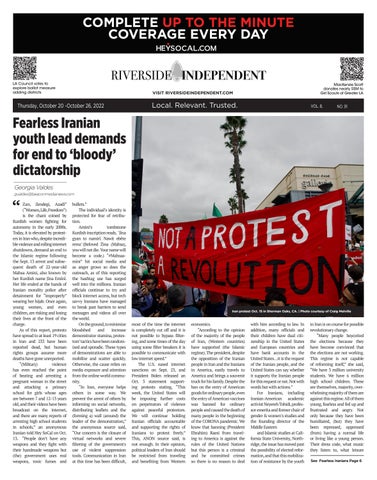
Iran protest Oct. 15 in Sherman Oaks, CA. | Photo courtesy of Craig Melville
VISIT
RIVERSIDEINDEPENDENT.COM
CALENDAR

Oct. 21
Fairplex Presents Oktoberfest Fairplex | 1101 W. McKinley Ave., Pomona, CA 91768 | Oct. 21-22 | fairplex.com

These are the last two days to catch Oktoberfest at Fairplex featuring Bavarian music, authentic German food, the chicken dance, games, prizes, tribute bands, live Dj and beer.

Oct. 22

National Theatre Live: “Frankenstein” Boston Court Pasadena | 70 N. Mentor Ave., Pasadena, CA 91106 | Oct. 22 | bostoncourtpasadena.org

Watch Benedict Cumberbatch and Jonny Lee Miller alternate between the roles of Victor Frankenstein and the Monster in this 2011 production captured live on stage. Tickets are $20.
Oct. 23
La Feria De Los Moles Grand Park | 200 N. Grand Ave., Los Angeles, CA 90012 | Oct. 23 | feriadelosmoles.com

Celebrating its quinceañera, join this festival of pre-Hispanic dishes and traditions with free entry. There will also be dancing, music and traditional moles from Puebla and Oaxaca.

Oct. 24
Secret Concerts: Halloween 1827 S. Hope St., Los Angeles, CA 90015 | Oct. 24 | eventbrite.com
Listen to The Artifact Trio and soprano Molly Flanagan perform Halloween songs surrounded by candlelight creating a spooky night of music.
Oct. 25
AFI

House of Blues Anaheim | 400 Disney Way #337, Anaheim, CA 92802 | Oct. 25-26 | houseofblues.com
The rock band behind “Miss Murder” performs with Drab Majesty opening. Oct. 26

Lola Boutée Presents TRiPTease Burlesque
TRIP Santa Monica | 2101 Lincoln Blvd., Santa Monica, CA 90405 l Oct. 26 l eventbrite.com

Lower your inhibitions and see what’s hot at LA’s longest running weekly burlesque and variety show. Every Wednesday features a fresh new lineup of talent hosted by the original dame herself, Lola Boutée. Oct. 27

The Haunting Of Old Pasadena

The Bunker Experience | 20 N. Raymond Ave., Pasadena, CA 91103 | Oct. 27 | thebunkerexperience.com
Head over to The Bunker Experience for an immersive ghost tour followed by a seance with your group of friends.
2 OCTOBER 20-OCTOBER 26, 2022 BeaconMediaNews.com Alhambra PRESS Baldwin Park INDEPENDENT INDEPENDENT San Bernardino Press Belmont Beacon CityTemple Tribune SGabriel an Sun A zusa B eacon Rosemead Reader Beacon Media, Inc. Publication D uarte ispatch News . . . 1, 3,6-8, 10 Calendar . . . 2 Regional . . . 4 Blotters . . . 5 Classifieds . . . 7 Opinion . . . 8 TABLE OF CONTENTS Publisher Von Raees COO Andrea Olivas Vice President Sam Kubert Editorial Jordan Green Georgia Valdes Fabiola Diaz Joe Taglieri Designer/ Production Renia Barouni Weekly Contributors May S. Ruiz Sales Fred Bankston José Luis Correa Steven Nguyen Legal Advertising Annette Reyes Marketing Jamaire Accounting Vera Shamon All Inquiries info@beaconmedianews.com info@hlrmedia.com BEACON MEDIA ADDRESS: 125 E. Chestnut Ave. Monrovia, CA 91016 Phone: (626) 301-1010 www.beaconmedianews.com HLR MEDIA ADDRESS: 820 S. Myrtle Ave. Monrovia, CA 91016 Phone: (626) 301-1010 www.HLRmedia.com PRESS RELEASE SUBMISSIONS editor@beaconmedianews.com editor@hlrmedia.com Submissions Policy Beacon Media, Inc. and HLR Media, LLC All contents herein are copyrighted and may not be reproduced in any manner, either in whole or in part, without the express written consent of the publisher. The Views and opinions expressed in this paper are not necessarily that of the management and staff at Beacon Media, Inc. or HLR Media, LLC. The Arcadia Weekly has been adjudicated as a newspaper of general circulation in court case number GS 004333 for the City of Arcadia, County of Los Angeles, State of California. The Monrovia Weekly has been adjudicated as a newspaper of General Circulation in Court Case GS 004759 City of Monrovia, County of Los Angeles, State of California. The Temple City Tribune has been adjudicated as a newspaper of general circulation in court case number GS 012440 City of Temple City, County of Los Angeles, State of California. The El Monte Examiner has been adjudicated as a newspaper of general circulation in court case number KS 015872 City of El Monte, County of Los Angeles, State of California. The Azusa Beacon has been adjudicated as a newspaper of general circulation in court case number KS 015970 City of Azusa, County of Los Angeles, State of California. The San Gabriel Sun has been adjudicated as a newspaper of general circulation in court case number GS 013808 City of San Gabriel, County of Los Angeles, State of California. The Duarte Dispatch has been adjudicated as a newspaper of general circulation in court case number GS 013893 City of Duarte, County of Los Angeles, State of California. The Rosemead Reader has been adjudicated as a newspaper of general circulation in court case number GS 048894 City of Rosemead, County of Los Angeles, State of California. The Alhambra Press has been adjudicated as a newspaper of general circulation in court case number ES016581 City of Alhambra, County of Los Angeles, State of California. The Baldwin Park Press has been adjudicated as a newspaper of general circulation in court case number KS017174 City of Baldwin Park, County of Los Angeles, State of California. The Burbank Independent has been adjudicated as a newspaper of general circulation in court case number ES016728 City of Burbank, County of Los Angeles, State of California. The Glendale Independent has been adjudicated as a newspaper of general circulation in court case number ES016579 City of Glendale, County of Los Angeles, State of California. The Monterey Park Press has been adjudicated as a newspaper of general circulation in court case number ES016580 City of Monterey Park, County of Los Angeles, State of California. The West Covina Press has been adjudicated as a newspaper of general circulation in court case number KS017304 City of West Covina, County of Los Angeles, State of California. The San Bernardino Press has been adjudicated as a newspaper of general circulation in court case number CIVDS 1506881 City of San Bernardino, County of San Bernardino, State of California. The Riverside Independent has been adjudicated as a newspaper of general circulation in court case number RIC1505351 City of Riverside, County of Riverside, State of California. The Pasadena Press has been adjudicated as a newspaper of general circulation in court case number ES018815 City of Pasadena, County of Los Angeles, State of California. The Belmont Beacon has been adjudicated as a newspaper of general circulation in court case number NSO30275 City of Long Beach, County of Los Angeles, State of California. The Anaheim Press has been adjudicated as a newspaper of general circulation in court case number 30-2017-00942735-CU-PT-CJC City of Anaheim, County of Orange, State of California. The Ontario News Press has been adjudicated as a newspaper of general circulation in court case number CIVDS 1506881 City of Ontario, County of San Bernardino, State of California. The Corona News Press has been adjudicated as a newspaper of general circulation in court case number RIC1723524 City of Corona, County of Riverside, State of California.
LA Council elects Paul Krekorian as president amid continued turmoil
By Eric He/City News Service
The Los Angeles City Council elected Paul Krekorian as its new president Tuesday, follow ing a four-hour meeting that was held virtually due to COVID-19 exposure after last week's meetings were disrupt ed by protesters amid the City Hall racism scandal.
Krekorian will be immedi ately tasked with leading the council through a turbulent stretch, with Councilmen Kevin de León and Gil Cedillo facing intense calls to resign for their involvement in a recorded conversation that included racist comments and discussions over favor able redistricting that led to former Council President Nury Martinez resigning her council seat last week. De León and Cedillo have been under mounting pressure to resign since the release of the tape Oct. 9.
Krekorian -- elected on a 10-0 vote, with de León, Cedillo, Curren Price and Monica Rodriguez absent -- stressed collaboration in his first remarks as council president, in a likely attempt to contrast with Martinez's efforts on the leaked tape to work behind the scenes to consolidate power during redistricting, as well as comments she made insulting her colleagues.
"The presidency will be a collective enterprise," Krekorian said. "It is criti cally important to me that our leadership includes disagree ment. Because that's how we move forward as a community. By listening to each other and working together."
Krekorian, speaking in front of a virtual background of the council chamber, said he will make efforts to reduce the power of the council presi dent.
"The era of unilateral deci sion-making on this council ... that ends today," Krekorian said. "Through this work, we make clear that no one in this city ever again feels excluded or belittled, demeaned or disrespected, or left behind by the people that they elected to represent them."
Krekorian, 62, has served

on the council since 2010 and is in his third term represent ing the 2nd District, which covers a wide swath of the central San Fernando Valley. He chairs the Budget and Finance Committee. Kreko rian previously served in the state Assembly, winning election in 2006 after a 20-year career as an attorney in the private sector.
In what appeared to be an effort to show unity, each of the 10 council members mentioned Krekorian by name as they voted in favor.
Mayor Eric Garcetti applauded Krekorian's election in a statement, calling him a "committed and conscientious leader who can bring a smart, collaborative, and effective approach to a painful moment when Angelenos deserve steady leadership on the City Council."
"I am confident that he'll assemble a leadership team of bridge builders, and I'll work
closely with the council to help heal the wounds caused by the hateful words of a few," Garcetti said.
The vote was preceded by roughly three-and-a-half hours of public comment, with many residents using their time to once again demand that de León and Cedillo step down immedi ately.
The council operated through most of the meeting with 10 members present, the minimum to establish a quorum. Rodriguez left partially through the meeting due to a family emer gency. Price, who was also a contender for the council presidency, did not attend, saying he was protesting the decision to hold the meeting virtually. With de León and Cedillo absent, the meeting would have ended had any remaining member chosen to leave.
"I made a conscious
decision to not attend this morning's council meeting because as a city leader, I could not support a virtual hearing that silenced the public outcry and shut out Angelenos who continue to reel from this breach of trust," Price said in a statement.
Krekorian hinted that Price could play a role in the new council leadership team, stating that Price will play a key role in bridging divisions made worse by the leaked recording.
Councilman Marqueece Harris-Dawson moved to elect Krekorian as president, and it was seconded by Coun cilman Bob Blumenfield.
Harris-Dawson said Krekorian "has a track record of conducting processes to include lots of voices: ones that he agrees with, ones that he doesn't agree with."
"Mr. Krekorian is the right person to lead us right now as council president," Blumen
field said. "But not to rule us, but to lead us. To work with us as a team."
The council also voted to begin the process of placing a measure on the 2024 ballot or sooner that would create an independent redistricting commission for both the city and the Los Angeles Unified School District and to explore a ballot measure that would increase the number of council districts in Los Angeles.
A couple of dozen protest ers gathered outside City Hall, trying to enter the locked building during the meeting and chanting "No resigna tions, no meeting." The protesters were confronted by police in riot gear, and a video posted by Spectrum News on Twitter showed one officer grabbing a protester on the back of the neck to keep him out of the building as another protester was trying to push him into City Hall.
Acting President Mitch
O'Farrell presided over an empty chamber except for staff and media, as the council conducted business for the first time in a week after disruptions forced the adjournment or cancellation of two meetings last week.
Tuesday's meeting came one day after O'Farrell said he would remove de León and Cedillo from their committee assignments.
"This is a moment where the City Council gets to re-earn Los Angeles' trust," said Maia Ferdman, project manager at UCLA's Initiative to Study Hate and a consul tant in intergroup relations, before Tuesday's meeting.
"It's both structural, and it is cultural. This is not just a question of a couple of people on the council. It's also a question of: `Can we trust our leaders?' So there's a lot hanging in this moment right now and how our leaders respond."
Fernando Guerra, profes sor of political science at Loyola Marymount University, told CNS on Monday that the new president should only commit to serving until the elections in November, after which there could be as many as four new council members. Guerra said the new president will have to re-envision the role, especially because of Martinez's resignation.
"A lot of it is about norms, and it always starts at the top," Guerra said. "It's not just a functionary (role) that sets the agenda, makes committee assignments. It's about setting the values, of what the council and the city is all about."
Krekorian pledged to continue holding meetings even if de León and Cedillo continue to resist calls to resign. He said the council can't allow two members who have "dishonored their offices" to hold the business of the city hostage, though he will keep pushing for resignations.
"We cannot wait to continue to do the business of Los Angeles," Krekorian said.
He ended his speech with: "Let's get to work."
OCTOBER 20-OCTOBER 26, 2022 3BeaconMediaNews.com NEWS
Paul Krekorian.
|
Photo courtesy of Idthomp/Wikimedia Commons (CC BY 4.0)
LA COUNTY
Arcadia senior citizens invited to ‘Boo Bash’ thi s H a lloween
The Arcadia Recreatio n & Community Services Department is hosting the Senior Boo Bash on Mo nday, Oct. 31, 2022, fr om 11:30 a.m. to 1: 30 p.m. The event will in c lude a costume contest, l unch, games, and pr izes. Yo u c an register online a t www.ArcadiaCa.gov or in person for $15. This event is for individua l s 50 a nd older and will be held a t the Arcadia Commu nity Center, 365 Campu s D rive, Arcadia. For mo re i nformation, call th e Ar c a d ia Community Center of fice at (626) 574-5130.
West Covina
Former West Covina PD of ficer alleges ex-colleagues called him 'wuhan'
A gay former West Covina police officer of Chinese descent is suing the city, alleging management did nothing when colleagues called him "Wuhan" af ter the breakout of the coronavirus in 2020 and also made derogatory re marks about his sexual orientation. Christopher T.Huynh's Los Angeles Superior Court lawsuit alleges discrimination, harassment and retalia tion. He seeks unspeci fied damages. West Covi na City Attorney Thomas P.Duarte did not immedi ately reply to an email re quest for comment on the suit brought Thursday. A seafood market in Wu han, China, is believed by many to be the early epi center of the COVID-19 pandemic. Officers began calling Huynh "Wuhan" in March 2020, according to the suit, which further states they uttered of fensive comments both about food that Asians eat and the plaintiff's status as a gay man.
Burbank
3 men arrested for alleg edly stealing catalytic con
verters in Burbank
Three men have been ar rested on suspicion of felony catalytic converter theft, Burbank police said Wednesday. Jesus Garci aramos, 26, of Sun Valley, Herbert Terceroescobar, 40, of Los Angeles, and 29-year-old Victor Tru jillo, 29, of Los Angeles, were arrested Tuesday and booked on suspicion of conspiracy to commit grand theft, according to Sgt. Brent Fekety of the Burbank Police Depart ment. The men were each being held in lieu of a $20,000 bond, and were due to appear in court Thursday, Fekety said. Formal charges are pend ing review by the Los Angeles County District Attorney's Office. The in vestigation began on Oct. 5 at about 3:15 p.m., when police received a report of a catalytic converter theft in progress in the 3000 block of North Ken wood Street, Fekety said.
Long Beach
4 stabbed, 1 fatally, in Long Beach; suspect in custody
A 21-year-old man who police said appeared to be homeless was in custody Tuesday in connection with a series of stabbings in Long Beach that left a woman dead and three men injured. The first stab bing occurred at about 5:35 a.m. Monday in the 1100 block of Atlantic Avenue, Brandon Fahey of the Long Beach Police Department told City News Service. A woman with stab wounds to her upper body was taken to a hospital, where she died, Fahey said. Yo hance Sharp was arrested at the Ocean Boulevard and Fourth Place scene and was in possession of a knife, police said. He was booked on one count of murder and his bail has been set at $2 million, ac cording to jail records.
SAN BERNARDINO
REGIONALS
earthquake, emergency preparedness expo
The San Bernardino County Museum is host ing a Free Earthquake and Emergency Preparedness Expo on Saturday, Oct. 22 from 11 a.m. to 4 p.m. in the museum parking lot. Everyone plays a part in the emergency planning process and it takes the whole community in cluding government, first responders and the com munity, working together to respond to and recover from an emergency or dis aster. The Earthquake and Emergency Preparedness Expo is a great opportuni ty for community members to learn more about how to prepare for emergen cies and disasters as well as the potential risks and hazards in San Bernardino County. General admission is $10 (adult), $8 (military or senior), $7 (student), and $5 (child ages 5 to 12). Children under five and Museum Association members are admitted free. Parking is also free.
San Bernardino
San Bernardino celebrates and congratulates Citizens of the Month recipients
In October, the San Ber nardino City Council rec ognized C&F Boxing and Harry Hatch as San Ber nardino's Citizens of the Month. C&F Boxing offers boxing as a pathway to success for youth and as an alternative to violence, while Harry Hatch has long been a crusader against illegal fireworks. “Con gratulations to both of you for your commitment to San Bernardino!”, the city said on its Facebook page. Also during the celebra tion, the city introduced two new city employees.
Rakayla D. Simpson, from Ward 6, was sworn in as the newest member of the Charter Review Com mission, and Ivan Garcia was sworn in as the new est member of the Plan ning Commission as well.
Ontario
Byron Lee, 35, was found guilty by a San Diego jury of second-degree murder, plus a knife allegation, in the June 26, 2021, kill ing of 34-year-old Ya coub Abdallah. Abdallah, a resident of Midlothian, Illinois, was in San Diego on a vacation, according to his family. Police said they initially received calls just before 3 p.m. that day regarding a car crash at 900 First Ave., where Abdallah was found with “trauma to his upper body.” Lee was arrested in September of last year in the city of Ontario. At Lee's sentencing hearing, Deputy District Attorney Christina Eastman de scribed the defendant as “an individual who took the life of somebody over a petty driving error.”
RIVERSIDE
Riverside County
Duplication error results in some Riverside County voters receiving 2 ballots
Some voters in Riverside County will receive two mail-in ballots for the Nov. 8 general election -- a mis take that Registrar of Vot ers Rebecca Spencer said Monday was caught after the ballots had already been mailed. "It is impor tant to note that none of the duplicate ballots will result in a voter be ing able to cast more than one ballot," Spencer said. "I take election integrity seriously and apologize for the inconvenience." She said about 5,000 duplicate ballots were distributed to absentee voters in Canyon Lake, Menifee, Murrieta, Wildomar and Winchester. According to the registrar, the duplication was due to a "computer system er ror" which has since been fixed, with new procedures established "to prevent the error in the future."
Riverside
21-year-old man accused of stabbing two partygo ers, one fatally, during an altercation involving a mass of people gathered in the Santa Ana River bottom in Riverside. Raul Sanchez of Rialto was ar rested in March 2021 fol lowing a month-long investigation into the slaying of 19-year-old Raul Saldana beneath a Po mona (60) Freeway over pass. Sanchez is charged with murder, attempted murder and assault with a deadly weapon result ing in great bodily injury.
Corona
Half of 91 Freeway in Co rona set for third weekend shutdown
The eastbound Riverside (91)Freeway in downtown Corona is slated to be shut down this weekend — for the third time in five weeks — to enable crews to continue re-surfacing work, and motorists were "strongly urged" to use al ternate routes to avoid po tential hours-long travel delays. The full eastbound closure is slated to start at 10 p.m. Friday, Oct. 21, be tween Lincoln Avenue and Main Street, with all five lanes out of service until 5 a.m. Monday, according to the Riverside County Transportation Commis sion. "Lengthy travel de lays on eastbound 91 are expected between the 241 toll road (in Orange County) and Interstate 15 in Corona," according to an agency statement.
ORANGE
Orange County
Bus mechanics avoid strike in Orange County
employees broke off con tract talks. The strike was scheduled to begin just after midnight Monday morning. But late Sunday night, the sides agreed to go back to the negotiating table, averting a walkout. OCTA officials said despite the strike being averted, some customers could ex perience delays on some lines as talk continues. The OCTA and the union were contacted by Gov. Gavin Newsom's office Sunday requesting par ties continue negotiating.
Anaheim
Palm Springs Air Museum hosted viewing party for ‘The Mouse’ plane in Ana heim
The Palm Springs Air Mu seum hosted an exclusive private viewing party Sat urday for Walt Disney's Grumman Gulfstream I plane, which traveled from Anaheim to Palm Springs. The viewing party was held at the air museum, 745 N. Gene Autry Trail, at 5:30 p.m. with drinks and light hors d'ouevres. "We are so happy to have Walt's plane make a ‘landing’ at the Palm Springs Air Museum, just a few miles from where Walt and his family had vacation homes at Smoke Tree Ranch," said Walt Disney Archives di rector Rebecca Cline. "It is the ideal setting for this incredible icon." The plane, also known as "The Mouse," joined the air mu seum's collection display for the general public on Sunday. A new exhibit will also be constructed by Dec. 5, Walt Disney's birthday, to highlight the plane's history and its rel evance to Palm Springs.
San Bernardino County
San Bernardino County Museum hosting free
Man arrested in Ontario sentenced 16 years to life for road rage stabbing
Trial date set for man ac cused of killing partygoer in Santa Ana River
A Jan. 31 trial date was confirmed Monday for a
Orange County bus service operated on a mostly nor mal schedule this week, thanks to an 11th-hour agreement between the Orange County Transpor tation Authority and the union representing 150 maintenance employees to resume contract talks. Orange County had been bracing for a bus strike as OCTA maintenance
4 OCTOBER 20-OCTOBER 26, 2022 BeaconMediaNews.com4 OCTOBER 20-OCTOBER 26, 2022 BeaconMediaNews.com
Arcadia
STARTING A NEW BUSINESS? VISITE: NOTICEFILING.COM
Oct. 9
At 6:17 p.m., an officer re sponded to a residence in the 500 block of Foothill Boule vard regarding the report of a theft of a catalytic converter. The victim witnessed two male suspects removing the catalyt ic converter from his vehicle. The suspects loaded the cata lytic converter into the trunk of a white sedan and fled the scene westbound on Foothill Boulevard.
At 10:23 p.m., an officer responded to a residence in the 600 block of West Duarte Road regarding the report of a missing person. An investiga tion revealed an elderly male walked away from his resi dence. A search was conducted with negative results. The el derly male returned home in good health four days later.
Oct. 10
At 4:18 a.m., officers were dispatched to Daniel’s Jewelers, 400 S. Baldwin Ave., regarding a burglary that had just occurred. Three masked suspects broke into the loca tion by smashing a glass door. They then smashed a dis play case, stole an unknown amount of jewelry, and fled the scene in a white four-door sedan.
At 6:55 p.m., an officer responded to a residence in the 00 block of West Le Roy Avenue regarding the report of an at-risk missing male adult. Arcadia officers conducted a search with the assistance of
the Pasadena Airship and a Claremont Police K-9 officer. The missing person was lo cated and found to be in good health.
At 8:39 p.m., officers responded to a residence in the 1600 block of South Fifth Avenue regarding an audible alarm. An investigation re vealed three male suspects, wearing dark clothing and masks, smashed a rear slid ing glass door and made entry into the residence. They fled the scene in a dark-colored SUV.
Oct. 11
At 2:39 a.m., an officer responded to the 100 block of East Huntington Drive regard ing a traffic collision that had just occurred. An investiga tion revealed the driver had crashed into a fire hydrant. Upon contacting the driver, the officer detected a strong odor of alcohol emitting from the driver. Through a series of tests, the officer deter mined the 32-year-old male from Texas was driving under the influence of an alcoholic beverage. The suspect was ar rested and transported to the Arcadia City Jail for booking.
At 11:40 p.m., an officer responded to the parking lot of Westfield Santa Anita, 400 S. Baldwin Ave., regarding the report of a battery and rob bery that had just occurred. An investigation revealed the female suspect waited for her ex-boyfriend and his date to leave the movie theatre. She struck his date on the head with her cellphone, stole her ex-boyfriend's chain he was
BLOTTERS

wearing around his neck and fled the scene in her vehicle.
Oct. 12
At 1:05 a.m., an officer conducted a traffic stop on a bicyclist for traffic violations. An investigation revealed the male subject had an outstand ing warrant for his arrest. The 34-year-old male from Duarte was arrested and transported to the Arcadia City Jail for booking.
At 6:23 p.m., officers re sponded to a residence in the 1100 block of West Hunting ton Drive regarding a suspi cious person. An officer wit nessed the subject hide a meth pipe underneath a parked car. Further investigation revealed the 35-year-old male from La Puente had an outstanding warrant for his arrest. He was arrested and transported to the Arcadia City Jail for book ing.
Oct. 13
At 7:24 p.m., an officer responded to Arcadia City Hall, 240 W. Huntington Dr., regarding the report of a tran sient in the bushes yelling profanities at children playing on the soccer field. The tran sient was contacted and was found to have an outstanding warrant for her arrest. The 42-year-old female from El Monte was arrested and trans
ported to the Arcadia City Jail for booking.
MONROVIA
Oct. 6
At 4:45 a.m., a caller in the 900 block of South Can yon reported someone had stolen his catalytic converter from his work vehicle. This investigation is continuing.
At 8:22 a.m., a caller in the 900 block of South Can yon reported someone had stolen his catalytic converter from his work vehicle. This investigation is continuing.
At 8:57 a.m., a caller in the 200 block of East Chest nut reported someone had stolen his catalytic converter from his work vehicle. This investigation is continuing.
At 10:47 a.m., a business in the 100 block of South Myrtle reported a subject was loitering in their bathroom. Officers responded and de termined the suspect had a warrant. The suspect was arrested and taken into cus tody.
At 11:07 a.m., a parking control officer responded to the 500 block of California regarding a parking problem. An investigation revealed one of the vehicles was re
ported as stolen in Monrovia. The owner responded and took possession of her vehi cle. This investigation is con tinuing.
At 3:36 p.m., an officer in the area of Mayflower and Huntington saw a vehicle commit a traffic violation and conducted a traffic stop. An investigation revealed the driver was in possession of drugs. He was arrested and taken into custody.
At 8:23 p.m., an officer saw a driver commit a traffic violation in the area of Myrtle and California. A traffic stop was conducted and the driver showed signs of impairment. A DUI investigation was con ducted. The driver was ar rested and was transported to a nearby hospital for a blood draw. The driver was then transported to the MPD jail to be held for a sobering period.
At 10:52 p.m., a witness in the 1600 block of South Myrtle reported a male sub ject walking around a com plex and removing his cloth ing. Officers located the male subject and ordered him to stop. He refused to comply.
Officers detained the subject who had an unknown object in his hand and would not let it go despite the officer's or ders. The subject then tried to break free from the officers as he threw the object from his
hand. Officers recovered the object, which contained meth. He was arrested and taken into custody.
Oct.7
At 1:38 a.m., a resident in the 300 block of North Myrtle reported someone had stolen the catalytic converter from his vehicle. This investigation is continuing.
At 2:09 a.m., a caller in the 150 block of North Alta Vista reported someone had stolen the catalytic converter from his vehicle. This investi gation is continuing.
At 2:15 a.m., a passerby in the 900 block of West Foothills reported a female subject was laying on the sidewalk unresponsive. Of ficers arrived and determined the female was unresponsive and not breathing. They ad vised it was an overdose and started life-saving measures immediately and adminis tered doses of Narcan before a pulse was detected. MFD took over the care of the fe male and she was transported to the hospital.
At 3:10 p.m. a resident in the 1400 block of South Magnolia called to report that several of his deceased brother's handguns were sto len. This investigation is con tinuing.
OCTOBER 20-OCTOBER 26, 2022 5BeaconMediaNews.com
ARCADIA
V.I.P. TRUST DEED COMPANY OVER 40 YEARS OF FAST FUNDING Principal (818) 248-0000 Broker WWW.VIPLOAN.COM *Sufficient equity required - no consumer loans Real Estate License #01041073 CA Department of Real Estate, NMLS #339217 Private Party loans generally have higher interest rates, points & fees than conventional discount loans RETIRED COUPLE Has $1Mil to lend on California Real Estate*
10 Questions to Ask Before You Hire a Real Estate Agent
San Gabriel Valley – Not all real estate agents are the same. Before you seek the help of an agent when selling or buying your next home, you will need some good information before you make any decisions. Choosing a real estate agent is one of those criti cal issues that can cost you thousands, or save you thousands of dollars. A


new report has been re leased by industry insiders that offers the exact infor mation you need. In this FREE special report, we provide you the specific questions you should be asking to ensure that you get the best representation for your needs. Before you hire any real estate agent, call and get your copy of this FREE Report entitled
“10 questions to Ask Be fore You Hire an Agent”. To order your copy of this FREE Special Report, call toll-free 1-888-300-4632 and enter 1006. You can call any time, 24 hours a day, 7 days a week. Get your free special re port NOW to find out the questions the others would prefer you never ask!
time they have – everything is controlled and denied. They are angry and besides, the middle class people are becoming poor, because of the economic stagnation and corruption and embezzlement.”
Tohidi’s research focuses on gender, Islam, and feminism and ethno-religios movements as well as civil society building, democracy and human rights with a focus on Iran and Azerbaijan. She served as a consultant for two UN agencies (UNICEF and UNDP) on issues concern ing children and women’s status in the Caucasus and Middle East. She believes that the intersection of econmic pressure, ethnic (Kurdish) and gender discrimination and the patriarchal regime’s abuse fuels Iranian youth’s anger and resolve in these protests. According to World Bank data, Iran’s 2021 unemployment rate is 11.5% and inflation was at 30.6% in 2020. Yet, worker strikes, including in the oil and petroleum industry, are holding strong for the cause.
“The Regime is afraid of the working class. They need them. So when (the government) try to take on the streets, they get scared,” Tohidi said, “(The) young generation doesn’t see a future for themselves. Their parents (are not) gonna be even able to support them. They have to find work and rely on their own jobs. Unem ployment is rising, especially among women, especially among educated women…they are fighting not only for the dignity (but) for their freedom, but also because economically they have nothing to lose.”
Former president Obama criticised his own response to previous protesting, includ ing the 2009 Iranian Green Movement. Currently, the Biden administration is navigating the possibility of a nuclear deal with Iran but activists call for a pause in negotiations as the uprising continues.
In an interview with PBS’ Firing Line, Iranian journal ist Masih Alinejad said, “You cannot be pro-democracy, you cannot say that we are for women’s rights. You cannot say, we care about freedom of expression, but at the same
Fearless Iranians
time, send billions of dollars to autocracy, to dictators. This nuclear deal is going to empower Revolutionary Guards, the killers, the murder ers. And that is why I’m angry with the U.S. government.”
According to an Oct. 17 HAARETZ report, a nuclear deal is far from occurring. For Tohidi, the movement is only in its beginning and the world should tread carefully so as not to repeat political mistakes, incite state violence or overshadow the voices of the oppressed.
“We don't want to do what we did in Iraq…what (the U.S.) can do is more political support, technological support, which is very important. We really need to compensate (for) this shutdown of the internet. And sure, America can do that with information security, or hacking or all sorts of ways to sabotage the regime. It doesn't have to be like putting soldiers in Iran,” she added, “Of course it is against the national inter ests of Iranians for the regime to have (a) bomb and it is against the national interests of I would say everybody. But on the other hand, if Biden comes into a compromise with the regime and agreement about sanctions, and about this nuclear issue, then they are going to pay lots of money back to Iran. And that money can strengthen this regime. So we are worried about that. It's a tricky question. Honestly, I don't have an answer to that except to say that Biden should wait until this movement becomes stronger. And when the movement becomes stronger, then Biden can have a better negotiation with the regime. Or the regime’s hands become very weak, because when people are uprising against it, they cannot ask for a lot of money. This regime is bloody and has done so many criminal things … it’s really a challenge for many of us to see how we can end this regime
without getting into a civil war or bloodshed.”
Currently, many are left wondering what they can do to support the protesters in Iran. Action items from the Persian diaspora include:
Nationwide protest – Host a protest against the Islamic regime in solidarity.

Donate to support VPNs and other boundary breakers that protesters use to commu nicate with the world through encrypted messaging soft wares such as Telegram.
There are many includ ing the Torproject, a nonprofit organization working to provide private internet access. It provides download instruc tions in many languages including Farsi.
Focused and intentional social media presence. Follow accounts that elevate protester experiences and demands. Many Persian Americans, including actress and writer Nazanin Nour, advocate for this consistent social media engagement for the cause.
Write to senators and U.S. government officials to submit letters to the Biden administration in support of U.N. Investigative Mechanism to investigate crimes against humanity by the Islamic Republic.
Stay up to date on the progress of events and work to understand the history of the Iranian Revolution.
For the diaspora, this pivotal moment is terrifying yet exciting. Persians living outside of Iran work to stay in contact with their loved ones as the world witnesses their bravery.
“We are hopeful, but we are worried too. It is a mixed feeling because it is possible that (the regime) is going to crush this.,” Tohidi said, “But it’s not reversible. Meaning that (the) things that have happened (and) the ideas that have been shared publicly – it has caused a paradigm shift that the regime can’t reverse.”
6 OCTOBER 20-OCTOBER 26, 2022 BeaconMediaNews.com
PAID ADVERTISEMENT
Continued From Page 1
Image Courtesy of Anonymous Protester in Iran via Telegram message
LA Board to send letter in support of Iranian protesters
By City News Service
The Los Angeles Board of Supervisors agreed Tuesday to send a letter to President Joe Biden in support of protesters in Iran advocat ing for women’s rights and greater social, civil and political freedoms.
Proposed in a motion by Supervisors Hilda Solis and Sheila Kuehl, and unanimously approved by the board, the letter will commend the Biden admin istration for sanctioning Iran’s morality police and security and government officials, and express L.A. County’s opposition to the Iranian government’s efforts to restrict its citizens’ internet access.
The letter will also proclaim the county’s “support of women’s rights in Iran and for Iranians protesting for women’s rights and freedom abroad
and here in the United States.”
Last month, a woman named Mahsa Amini died in police custody in Tehran after being detained and beaten by Iran’s religious morality police for not wearing a hijab properly.
In Iran, women are required by law to wear hijabs in public.
Mass protests around Iran erupted after Amini’s funeral. Under the slogan “women, life, freedom,” protesters have called for a number of reforms, including the end of Iran’s morality police, the end of Iran’s mandatory hijab law, and even the end of the country’s religious govern ment establishment.
Solis said the women and girls leading the protests in Iran are inspiring for the fight for women’s rights everywhere.
L.A. County is home to the largest Iranian popu lation outside of Iran. Sympathy protests and demonstrations in support of the protests in Iran have been regularly held around Southern California since the protests in Iran began.

According to the Iran Human Rights group, 215 people, including 27 children, have been killed by Iranian government forces and Iranian police since the protests began last month.
“This is not just one woman’s case, this is a reform movement now led by young women, old women, all women across all of our different commu nities,” Kuehl said. “I hope that this serves as a wake-up call for oppressive regimes worldwide, and I don’t let us escape in that panoply.”
ANNOUNCEMENTS
NEW AUTHORS WANTED! Page Publishing will help you self-pub lish your own book. FREE author submission kit! Limited offer! Why wait? Call now: 1-855-667-0380 (Cal-SCAN)
Become a Published Author. We want to Read Your Book! Dorrance Publishing-Trusted by Authors Since 1920. Book manuscript sub missions currently being reviewed. Comprehensive Services: Con sultation, Production, Promotion and Distribution. Call for Your Free Author`s Guide 1-877-538-9554 or visit http://dorranceinfo.com/Cali (Cal-SCAN)
Prepare for power outages today with a GENERAC home standby generator. $0 Money Down + Low Monthly Payment Options. Re quest a FREE Quote -Call now be fore the next power outage: 1-844439-5645 (SCAN)
Eliminate gutter cleaning forev er! LeafFilter, the most advanced debris-blocking gutter protec tion. Schedule a FREE LeafFilter estimate today. 15% off Entire Purchase. 10% Senior & Military Discounts. Call 1-855-424-7581 (Cal-SCAN)
AUTOS WANTED
DONATE YOUR CAR TO KIDS Fast Free Pickup – Running or Not - 24 Hour Response - Maximum Tax Donation – Help Find Missing Kids! Call 1-888-491-1453. (Cal-SCAN)
DONATE YOUR CAR OR TRUCK TO HERITAGE FOR THE BLIND. Free 3 Day Vacation, Tax Deductible, Free Towing, All Paperwork Taken Care Of. CALL 1-844-491-2884 (CalSCAN)
AUTOS WANTED/ LUXURY
WANTED! Old Porsche 356/911/912 for restoration by hobbyist 19481973 Only. Any condition, top $ paid! PLEASE LEAVE MES SAGE 1-707-339-5994. Email: porscherestoration@yahoo.com (Cal-SCAN)
CABLE / SATELLITE TV

DIRECTV for $79.99/mo for 12 months with CHOICE Package. Watch your favorite live sports, news & entertainment anywhere. First 3 months of HBO Max, Cin emax, Showtime, Starz and Epix
included! Directv is #1 in Customer Satisfaction (JD Power & Assoc.) Some restrictions apply. Call 1-888-641-5762. (Cal-SCAN)
FINANCIAL SERVICES
Over $10K in Debt? Be debt free in 24 to 48 months. No upfront fees to enroll. A+ BBB rated. Call Na tional Debt Relief 1-888-231-4274. (Cal-SCAN)
INSURANCE
SAVE BIG on HOME INSURANCE! Compare 20 A-rated insurances companies. Get a quote with in minutes. Average savings of $444/year! Call 1-844-410-9609! (M-F 8am-8pm Central) (CalSCAN)
MISCELLANEOUS
The difference in winning and losing market share is how busi nesses use their advertising dol lars. CNPA’s Advertising Services’ power to connect to nearly 13 million of the state’s readers who are an engaged audience, makes our services an indispensable marketing solution. For more info call Cecelia @ (916) 288-6011 or cecelia@cnpa.com
The difference in winning and losing an election is how cam paign dollars are spent. Get the best ROI by using our deep re lationships in every community in California. Our on-the-ground knowledge is indispensable to campaigns that want results. For more info on multi-market ethnic and non-ethnic solutions call Cecelia @ (916) 288-6011 or cecelia@cnpa.com
DID YOU KNOW Newspa per-generated content is so valuable it’s taken and repeated, condensed, broadcast, tweeted, discussed, posted, copied, edit ed, and emailed countless times throughout the day by others?
Discover the Power of Newspa per Advertising. For a free bro chure call 916-288-6011 or email cecelia@cnpa.com (Cal-SCAN)
REAL ESTATE LOANS
RETIRED COUPLE $$$$ for busi ness purpose Real Estate loans. Credit unimportant. V.I.P. Trust Deed Company www.viploan. com Call 1-818-248-0000. Bro ker-principal DRE 01041073. No consumer loans. (Cal-SCAN)
WANTED TO BUY
FREON WANTED: Certified buyer looking to buy R11, R12, R500 and more. Call Joe at 312-697-1976. (Cal-SCAN)
OCTOBER 20-OCTOBER 26, 2022 7BeaconMediaNews.com NEWS | CLASSIFIEDS
| Photo courtesy of Craig Melville
OPINION
Monrovia Old Town Report: It takes a village
 By Shawn Spencer shawn@girlfridaysolutions.net
These past weeks, I have been greeted daily by some of our city staff. They have been busy little bees, as usual. They have been hanging seasonal banners, decorat ing for the fall, trimming, and cleaning. You name it; they have been doing it. This morning, on my way into the office, I saw two staff members scrubbing the sidewalk with soap, water and a scrub brush. I’m used to seeing Athens power washing our sidewalks, so I said, “Helping out Athens today?” They laughed and said, “Nope. Cleaning up after someone’s dog.” Of course, I posted a brief rant on social media to which a kind-hearted neighbor replied, “Maybe it was a coyote.” Seeing the good ... I love our community!
We have department after department of staff dedicated to the upkeep of our town and the enrich ment of our environment. The staff at the Community Center does a spectacular job bringing us family fun events all year long. They work tirelessly to decorate Old Town, staff events for our enjoyment and coor dinate so many different activities and gatherings. I have worked closely with them, and I still have no idea how they do what they do. They are such a gift to our community. The name “Community Center” is so aptly put, but it just does not do them justice. I’d like
to get them all capes with a big M on it.
Our Public Works Department is this city’s secret weapon; its best kept secret. I’m going to out them right now. This brings to mind the old Army slogan from the ‘80s: “We do more before 9 a.m., than most people do all day.” Public Works is responsible for the day-to-day running of the well-oiled machine that is Monrovia: water, sewer, streets, sidewalks, parks, transportation. So much! No one ever says, “Hey, great job!” These are the
people that only get called out when a lightbulb is out or a tree branch is covering a street sign. They should be thanked every day, but we don’t really know they are there because they are THAT good. I love the countdown clock on the city’s website that shows that not only is Public Works working 24 hours a day, 365 days a year, they are responsible for 9,300 water services, 90 miles of streets and 122 acres of parks. Thank you so much!
Obviously, my space here is limited and I cannot
thank every city staff member. Our council is made up of five incredible members that genuinely care about this city and us, its residents. We are truly blessed to have amazing police and fire depart ments. They are all wonder ful, hardworking, caring and dedicated to our safety and well-being. Our police and fire chiefs Alan Sanvic tores and Jeremy Sanchez are exceptional leaders of exceptional teams. We also have a Community Devel opment Department that takes immense pride in
maintaining the integrity, history and charm of our beautiful city. Monrovia is proud to be McMansionfree. The Gem of the Foot hills, for sure!
Again, I can’t mention every staff member here. Each person plays an integral role in making Monrovia so very special. Each person deserves a sincere thank you. I will, however, end this Hallmark Special with a shout out to one city staffer in particular: Mr. Dylan Feik. He joined us in 2019 and Monrovia said, “Hold
my beer.” He was tossed into the deep end with the Bobcat Fire and then COVID. Dylan has proven to be a thoughtful, caring and extraordinary city manager. He is calm, cool and collected under pressure. He is compassionate and he makes himself avail able to all. He is not just an employee of Monrovia, he is a community member, a neighbor. I know I am not alone when I say how lucky we are to have him repre sent Monrovia. Thank you, Dylan. For all that you do! You are a class act.
RE: ‘Nury Martinez resigns from LA City Council …’ (Oct. 13 issue)
If those three repentant politicians, Nury Martinez, Kevin de León and Gil Cedillo, are sincerely remorseful for
displaying their bigotry, they should do something exem plary to redeem themselves — besides saying how sorry they are.
Those three office holders have achieved laudable success in their political careers — but like
Send your letters to tmiller@beaconmedianews.com - Please be brief.

many others, they too have fallen from grace.
Nevertheless, their serious blunders should not, in my opinion, permanently close the curtain on the stage of their life. So, like a terrible accident or a serious illness from which the patient
takes a long time to recover, anyone who causes his own downfall must make diligent efforts to restore his (or her) good name.
If I were Martinez, De León, or Cedillo, this is what I’d do to gradually recover my reputation: I’d become
a social worker or a teacher, and insist on working in poor Black neighborhoods.
I’m sure that the Black folks I’d help, or the parents of the Black children I taught, would not only forgive my trespasses, but they’d grow to love me as much as the
father of the prodigal son loved him when he returned home after he had strayed from the right path. From my own experi ence, most people have the gift of forgiving.
David Quintero Monrovia
8 OCTOBER 20-OCTOBER 26, 2022 BeaconMediaNews.com
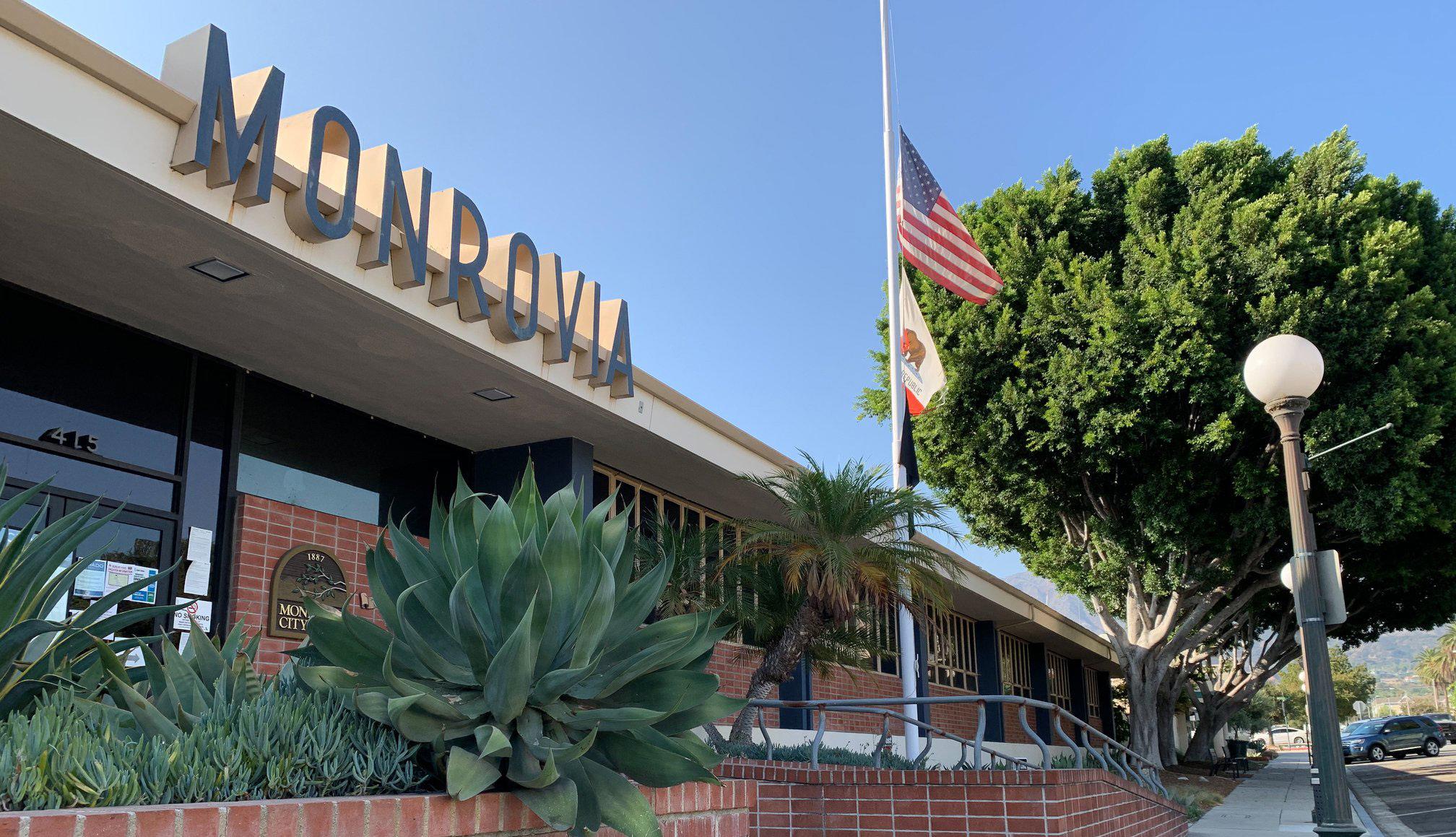
Monrovia City Hall. | Photo courtesy of City of Monrovia
‘Meet in Shanghai, Share the Future’ conference in LA previews 5th annual China International Import Expo
The fifth China Interna tional Import Expo (CIIEE) will be hosted in Shanghai on Nov. 5, 2022 which is the key event highlighted during the “Meet in Shanghai, Share the Future” confer ence.
To address the upcoming China International Import Expo and send a warm welcome to California’s participating enterprises and organizations, the “Meet in Shanghai, Share the Future” conference was hosted on Oct. 13 in downtown Los Angeles by the Shanghai Municipal Commission of Commerce and co-organized by World Trade Center Los Angeles and Shanghai Foreign Investment Development board. The conference aimed to promote trade between Los Angeles and Shanghai, which are the twin cities of trade, business, and culture. Bringing together over 80 change makers, the list included the representative of the CIIE exhibitors, Cali fornia state and county offi cials, Chinese government consulates, and industry leaders from both countries.
Deputy Mayor of Los Angeles Erin Bromaghim expressed that Shanghai and LA, the two largest

ports of their countries, have many great oppor tunities to work with one another. In her address, she summarized the feats of LA’s technological advancement in develop
ing clean energy transpor tation, such as the newly opened K Line. Bromaghim highlighted advancements in the manufacturing industry for fashion and tech as well as the sports
entertainment industry. Through these highlights, she acknowledged and encouraged the strength ening of the bond between the U.S. and China.
Martin Breidspre
cher, COO of the LA Area Chamber of Commerce, pointed out that the LA Chamber of Commerce has been dedicated to facilitat ing international trading and providing access,
advocacy and support to local businesses since 1888.
Trading between China and California has been notable in both import and exports. Last year, China was Cali fornia’s third largest export destination, bringing in approximately $150 billion.
Michael McClune, senior director of international trade of WTCLA, demon strated how the investments from LA and Shanghai have been proactively facilitat ing the economy of both regions. Chinese companies such as Tencent, Wanda, and Alibaba are paying an estimated $290 million in wages. Conversely, American companies like Disney and Tesla are launch ing business initiatives in Shanghai. McClune hopes that more U.S. companies would go into China to expand their business.
Andre Morgan, co-chair of CAFF and CATF, producer of Academy Award-winning film “Million Dollar Baby,” said that for anyone consid ering doing business in China, he would recommend starting in Shanghai. The municipal government is very thorough and proac tive in encouraging the growth of international businesses.
Newsom says COVID-19 emergency declaration to end in February
By City News Service

California's COVID-19 state of emergency will be lifted on Feb. 28, Gov. Gavin Newsom announced Monday, saying the timeline will ensure the state's healthcare system can withstand any possible winter surge of virus infec tions.
According to Newsom's office, the timeline will also give state and local officials time to prepare for the phaseout.
"Throughout the pandemic, we've been guided by the science and data -moving quickly and strategi
cally to save lives," Newsom said in a statement. "The state of emergency was an effective and necessary tool that we utilized to protect our state, and we wouldn't have gotten to this point without it. With the operational prepared ness that we've built up and the measures that we'll continue to employ moving forward, California is ready to phase out this tool."
The emergency decla ration, imposed at the onset of the pandemic, was aimed at expediting state
acquisition of materials such as personal protective equipment and setting up
testing centers and later vaccination locations.
According to the gover
nor's office, the state has administered roughly 81 million vaccine doses, distributed 1 billion units of PPE and processed 186 million tests, while also allocating billions of dollars to hospitals, commu nity groups and schools to respond to the pandemic -- as well as distribut ing billions of dollars in stimulus payments to resi dents, renters and small businesses.
When the state Legisla ture reconvenes, Newsom will seek statutory changes allowing nurses to continue
dispending COVID-19 therapeutics and continue allowing laboratory workers to solely process COVID-19 tests.
"California's response to the COVID-19 pandemic has prepared us for whatever comes next," state Health & Human Services Agency Secretary Dr. Mark Ghaly said in a statement. "As we move into this next phase, the infrastruc ture and processes we've invested in and built up will provide us the tools to manage any ups and downs in the future."
OCTOBER 20-OCTOBER 26, 2022 9BeaconMediaNews.com
| Courtesy photo
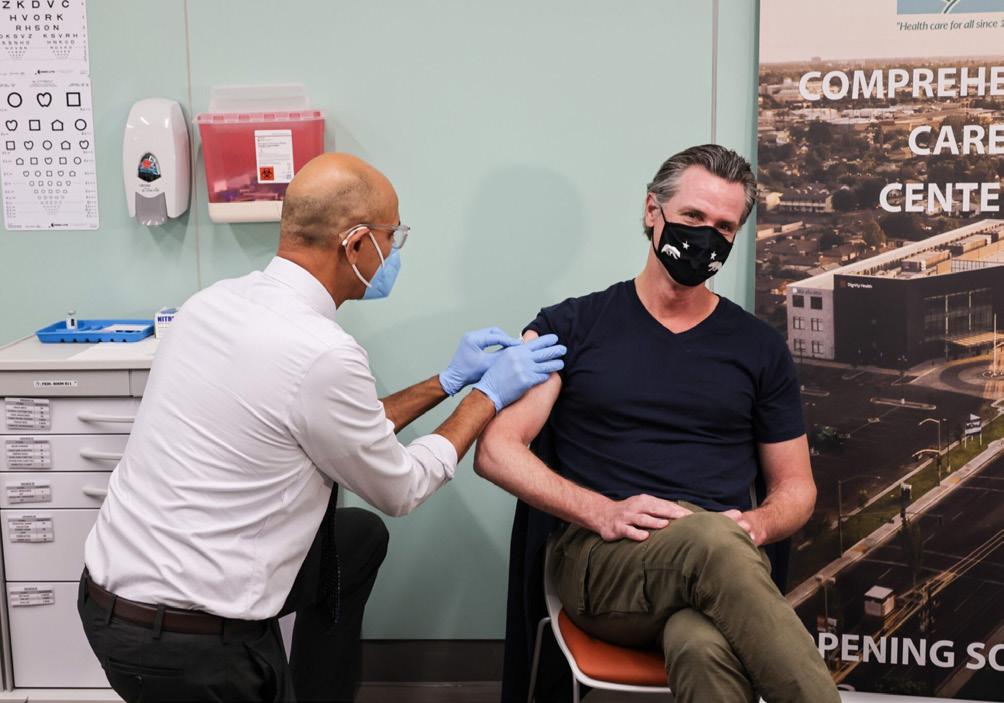
Gov. Gavin Newsom receives on May 18 his second booster shot of Moderna's COVID-19 vaccine. | Photo courtesy of the California Governor's Office
Alex Villanueva: Latest whistleblower case ‘yet another frivolous lawsuit’

 By City News Service



Sheriff Alex Villanueva responded Tuesday to the latest whistle blower case brought against him as well as Los Angeles County, calling a sheriff's lieutenant's allegation Villan ueva quashed an investiga tion into a police dog's death part of "yet another frivolous lawsuit."
Lt. Joseph Garrido's Los Angeles Superior Court lawsuit was filed Monday and alleges whistleblower retaliation, civil rights violations, violation of the state Civil Code, intention al infliction of emotional distress, defamation, false light and defamation.
Garrido seeks at least $5 million in general damages and another $5 million in special damages.
In a response with a caption, "Advisory: Yet Another Frivolous Lawsuit," Villanueva downplayed Garrido's case.
"Several months after a criminal and administra tive investigation began regarding alleged miscon duct by Joseph Garrido, he has filed a lawsuit and claimed whistleblower status," Villanueva said. " Absent from this lawsuit is any explanation as to


why Mr. Garrido suppos edly witnessed misconduct, yet took no action for years until after he was under investigation."
Garrido worked in the Special Enforcement Bureau and oversaw the Canine Services and Special Enforcement details. His lawsuit states that he supported and donated money to the campaign of one of Villanueva's rivals, retired sheriff's depart ment veteran Eli Vera, in the June primary; spoke out against the denial of explosive breacher pay to some deputies, forcing the department to shell out $3 million; and reported the death of a police dog, Spike, who allegedly succumbed to overheating after being left in a hot car by his sher iff's department sergeant handler.
Garrido alleges Villan ueva quashed an investiga tion into the dog's death to avoid "bad media" for himself and the department.
"Shockingly, Villanueva did not even do a tribute, internally at LASD and/ or publicly, for Spike, and talk of Spike's years of loyal service before his tragic death," Garrido's court
papers state.

In retaliation, the department reversed a promotion Garrido had been granted, made the plaintiff the subject of a trumped up criminal investigation and told his neighbors in a letter that he had stolen a vehicle, destroying his career and slandering his name, his court papers state.
But a copy of a memo attached to Villanueva's statement explains that a sheriff's department captain reviewed the animal's death and concluded that the sergeant "followed the protocols" in place for all police dog handlers and was not negligent. The sergeant's car had previ ously had problems with its air conditioning, according to the memo.
According to Garrido's lawsuit, his emotional distress has kept him out of work for months and he has been "constructively termi nated" by the county.
Cmdr. Allen Castellano, former Assistant Sheriff Robin Limon and retired Chief LaJuana Haselrig are among those who have also filed whistleblower lawsuits against the county and Villanueva.
10 OCTOBER 20-OCTOBER 26, 2022 BeaconMediaNews.comNEWS SUE COOK REALTOR® 626 253 1323 suecookrealtor@gmail com Real Estate Cooked to Perfection! CalRE #02015404 PAID ADVERTISEMENT Prep Your Home For Sale In 3 Easy Steps Buyers are more impressed by improvements they can see than those they can’t and first impressions are everything. Let’s start with the outside – The key to maximizing curb appeal is to make sure everything is groomed –cut back overgrowth, pull weeds, add pops of color with annuals in flower beds or pots, and finish it off with spreading a dark brown mulch in the beds for a look of healthy rich soil. Now the inside - You want potential buyers to walk in and be wowed. Nothing impresses buyers more than a clean, sparkling home. Have your home professionally cleaned. Start with the floors – you don’t have to refinish floors or put in new carpeting – just clean them thoroughly. Have all carpets cleaned to remove any stains and polish your wood floors til they shine. And finally – let the sunshine in. Have all windows professionally cleaned. Remove drapes. Open blinds. Maximizing natural light is the cheapest way to impress buyers. In this shifting market buyers are harder to come by and easier to turn off so make sure you’re working with a great Realtor that can help you wow your buyers. HEYSOCAL.COM
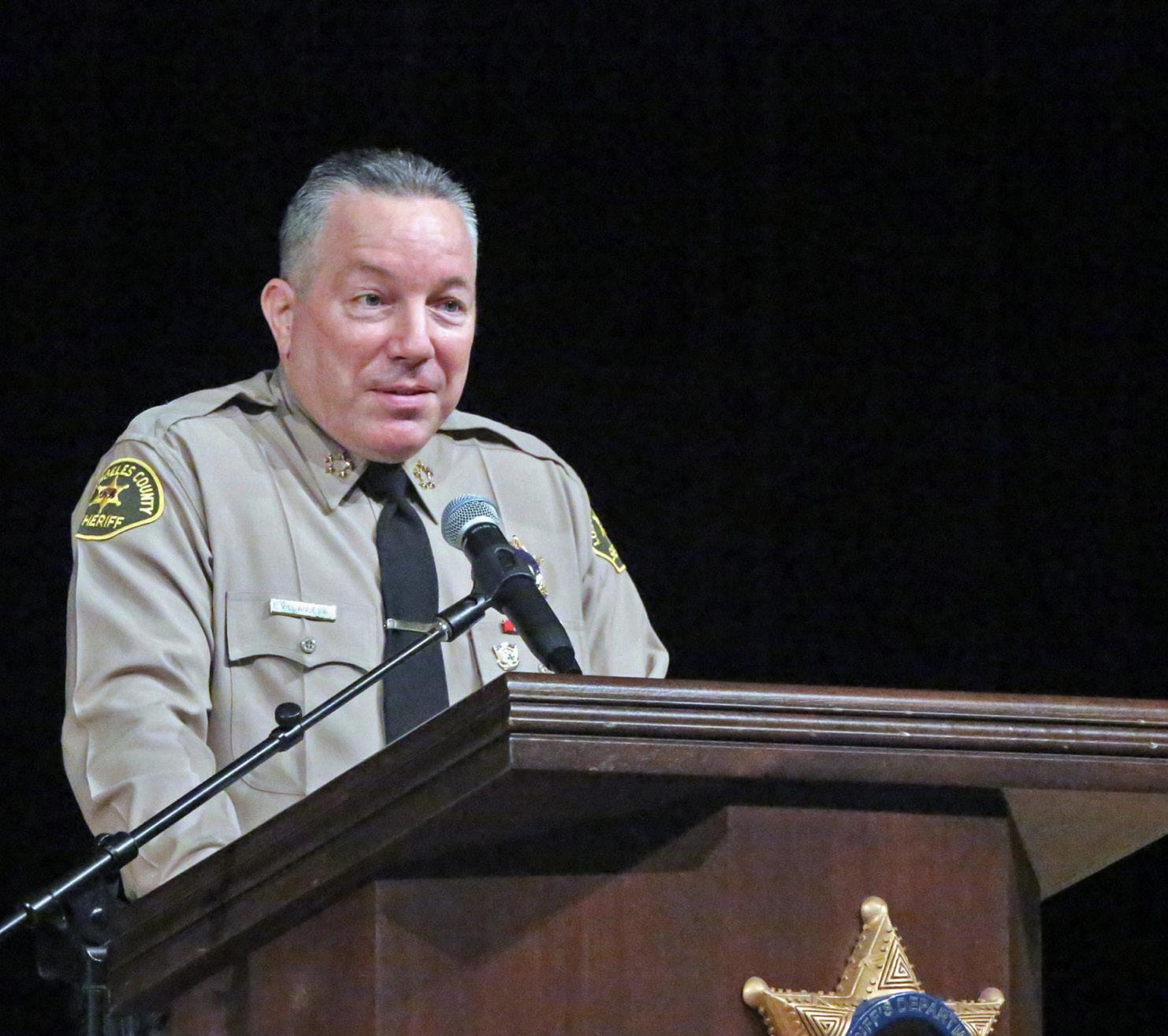
Sheriff Alex Villanueva. | Photo courtesy of the Los Angeles County Sheriff's Department
Starting a new business? Go to filedba.com
El Monte City Notices
CITY OF EL MONTE CITY COUNCIL NOTICE OF PUBLIC HEARING
Hablamos Español favor de hablar con Jeni Colon (626) 258-8626
TO: All Interested Parties
FROM: City of El Monte City Council
PROJECT NAME: Esperanza Village
PROPERTY LOCATION: 4024 Durfee Avenue (APN: 8549-004-900 and 8549-005-900 [Lots 5, 6, 7, 8, and 9)
APPLICATIONS: General Plan Amendment (GPA) No. 0422, Zone Change (ZC) No. 05-22, Specific Plan (SP) No. 06-22, Code Amendment No. 802, Design Review Nos. 06-22 & 0822, Tentative Tract Map (TTM) No. 83843, and Development Agreement (DA) No. 0722
REQUEST: The Applicant is requesting approval of the following:
• General Plan Amendment to change the General Plan land use designation from Public Facilities (PF) to Specific Plan (SP) for the entire MacLaren Hall property (13.66 acres).
• Zone Change to change the zoning of the MacLaren Hall property from PF to Spe cific Plan (SP) for the entire MacLaren Hall property (13.66 acres). With the proposed zone change, the MacLaren Hall property would be within the proposed Esperanza Village Specific Plan (SP-5) Zoning Dis trict.
• Specific Plan to establish development standards and design guidelines for the entire MacLaren Hall property (13.66 acres).
• Code Amendment to codify the Specific Plan development standards for the entire MacLaren Hall property (13.66 acres) in the City’s Zoning Code.
• Design Review for the construction of four (4) new four-story residential buildings and one (1) new two-story 36,000-square foot mixed-use building on 6.11 acres of the MacLaren Hall property.
• Tentative Tract Map to consolidate two (2) parcels (six lots) and create eight (8) new parcels on the entire MacLaren Hall prop erty.
• Development Agreement to define the residential and mixed-use project’s rules, regulations, commitments, and policies.
The Applicant is requesting to demolish the existing buildings and consolidate two (2) parcels (six [6] lots) and create eight (8) new parcels to construct four (4) four- (4-) story residential buildings and one (1) two- (2-) story 35,875-square foot non-residential mixed-use building with community-serving uses. The residential buildings would provide 340 affordable housing units for low- and extremely lowincome families and seniors, and the nonresidential mixed-use building would have a vocational center, medical clinics, and a senior health center. The proposed devel opment would be located on 6.11 acres of the larger 13.66-acre MacLaren Hall prop erty
This request is made pursuant to the re quirements of El Monte Municipal Code (EMMC) Chapters 16.10 (Tentative Tract Map), 17.122 (Design and Minor Design Reviews), 17.128 (General Plan and Zon ing Amendments), 17.129 (Development Agreements), and 17.130 (Specific Plan).
APPLICANT: Prima Development 12401 Woodruff Avenue, Suite 10 Downey, CA 90241
ENVIRONMENTAL
An Initial Study (IS) that was prepared for DOCUMENTATION: the project in accordance with the Cali fornia Environmental Quality Act (CEQA) determined that the project will have lessthan-significant impacts to the environ ment because mitigation measures will be incorporated into the project. Therefore, a Mitigated Negative Declaration (MND) has been prepared. Mitigation measures are provided to lessen potential impacts re lated to migratory wildlife; archaeological, paleontological, and tribal resources; haz ards and hazardous materials; and noise.
A Notice of Availability (NOA) and Notice of Intent (NOI) to Adopt an MND was cir culated on August 22, 2022, and the public review period to provide comments on the environmental document was from August 23, 2022 to September 15, 2022.
An Environmental Assessment (EA) was prepared in accordance with the National Environmental Policy Act (NEPA) to as sess the potential environmental impacts, the conditions that would change, and the effects on the human environment as a result of the Proposed Project. Based on the analysis in the EA, the City determined that the Proposed Project is not an action that would result in a significant impact on the quality of the human environment and makes a Finding of No Significant Impact (FONSI). The EA and the associated En vironmental Review Record are available for public review from October 13, 2022 to October 31, 2022.
The IS/MND, EA, FONSI, and supporting technical studies are available for public review at the Planning Division’s public counter at El Monte City Hall West and on the City’s website at: http://ci.el-monte. ca.us/499/Current-Projects
PLACE OF HEARING: The City Council will hold a public hearing to receive testimony, orally and in writing, on the proposed project. The public hear ing to consider the adoption of the MND and approval of the proposed project is scheduled on the following date, time, and location:
Dates: Tuesday, November 1, 2022 Time: 7:00 p.m.
Place: El Monte City Hall East – Council Chambers 11333 Valley Boulevard, El Monte, California
Members of the public wishing to observe the meeting may do so in one of the following ways:
(1) Turn your TV to Channel 3; (2) City’s website at http://www.elmonteca.gov/378/Council-Meet ing-Videos; or (3) In Person.
Persons wishing to offer public comment for this meeting may do so in one of the following ways:
(1) By directly addressing the City Council in person at the time(s) allotted on the agenda for such comment. Persons wishing to ad dress the City Council in person are asked to fill-out a blue speaker card providing their name and indicating the specific agenda item(s) they wish to comment on or if they wish to speak during the portion of the agenda designated for comment on non-agendized matters. Speaker cards should be handed to the City Clerk or the Sergeant at Arms (a uniformed El Monte Police officer) before the City Coun cil’s approval of the agenda, if possible. The City Council shall be under no obligation to recognize a speaker who submits a speaker card on a particular agenda item after the City Council has com pleted its handling of the agenda item and has moved on to the next item of business on the agenda. Persons wishing to comment on closed session matters must submit their speaker card before the City Council goes into closed session. As members of the public are now free to attend City Council meetings in person, the City Council will no longer receive public comment by telephone.
(2) By submitting written comments, provided such written com ments are received by the City Clerk at least 30 minutes prior to the posted meeting time. Written comments may be submitted via electronic mail at: cityclerk@elmonteca.gov. Written comments will be provided to members of the City Council and will be entered into the record of the proceedings to the extent they relate to matters listed on the posted agenda or otherwise address matters/issues within the subject matter jurisdiction of the City Council. Persons submitting written comments are encouraged to identify the specific item(s) on the agenda their comment(s) relate to or whether they relate to non-agendized matters. Written comments will not be read aloud.
The staff report on this matter will be available before the City Coun cil meeting on the City of El Monte website, which may be accessed
at https://www.ci.el-monte.ca.us/AgendaCenter/ or by e-mailing tli@ elmonteca.gov.
Persons wishing to comment on the proposed application may do so orally at the public hearing or in writing prior to the meeting date and must be received by 12:00 pm the day of the meeting. Written comments shall be sent to Teresa Li, AICP; El Monte City Hall West; 11333 Valley Boulevard; El Monte, CA 91731 or at tli@elmonteca. gov. If you challenge the decision of the City Council, in court, you may be limited to raising only those issues you or someone else raised at the public hearing described in this notice, or in written correspondence delivered to the City Council at, or prior to, the public hearing. For further information regarding this application please contact Teresa Li, AICP, Contract Planner at (626) 580-2057 or through email at tli@elmonteca.gov Monday through Thursday, except legal holidays, between the hours of 7:00 a.m. and 5:30 p.m.
Published and Mailed On: Thursday, October 20, 2022
Catherine A. Eredia, City of El Monte City Clerk
EL MONTE EXAMINER
CITY OF EL MONTE CITY COUNCIL NOTICE OF PUBLIC HEARING
Hablamos Español favor de hablar con Jeni Colon (626) 258-8626
TO: All Interested Parties
FROM: City of El Monte City Council
PROPERTY 3449 Santa Anita Avenue / APN No. 8578LOCATION: 020-908 (A full legal description of the prop erty is on file in the office of the El Monte Planning Division).
APPLICATIONS: Development Agreement No. 06-22 and De sign Review No. 18-22
REQUEST: The applicant is requesting the construction of an electronic reader board billboard on a 7.58 acre property currently developed with a bus maintenance and parking facility for Los Angeles County Metropolitan Transit Au thority (Metro). The property is located south of the El Monte Bus Station. The billboard will be located at the southwest corner of the property, adjacent to the I-10 San Bernardino (westbound) freeway. Entitlements include a Design Review to review the aesthetics of the billboard and a Development Agreement between the City of El Monte and All Vision, LLC. The subject property is within the Gate way Specific Plan and is zoned Specific Plan No. 1 (SP-1).
The Planning Commission reviewed the item on October 11, 2022 and made a rec ommendation for the City Council. The final determination will be made by the City Coun cil. The request is made pursuant to Chap ters 17.122 (Design and Minor Review) and 17.129 (Development Agreements) of the El Monte Municipal Code (EMMC).
APPLICANT: All Vision, LLC 125 Park Avenue, 25th Floor New York, NY 10017
PROPERTY OWNER: Los Angeles County Metropolitan Transit Au thority 1 Gateway Plaza Los Angeles, CA 90012
ENVIRONMENTAL
An Initial Study (IS) was completed as part DOCUMENTATION: of the Billboard Ordinance and Freeway Overlay Zone. The project established seven (7) Freeway Overlay Zones to allow the construction of electronic billboards. A Mitigated Negative Declaration (MND) was circulated from April 7, 2017 to May 8, 2017. The MND was adopted by the City Council on July 18, 2017. A total of four (4) mitiga tion measures were incorporated including one on aesthetics, two on cultural resources and one on hazardous and hazardous ma terials. If the project is approved, the mitiga tion measures will be incorporated as part of the resolution. No additional environmental impacts are foreseen as part of this appli cation, therefore no further environmental analysis is required.
PLACE OF HEARING: The City Council will hold a public hearing to receive testimony, orally and in writing, on the proposed project. The public hearing to consider the adoption of the MND and ap proval of the proposed project is scheduled on the following date, time, and location:
OCTOBER 20-OCTOBER 26, 2022 11BeaconMediaNews.com LEGALS
Dates: Tuesday, November 1, 2022
Time: 7:00 p.m.
Place: El Monte City Hall East – Council Chambers 11333 Valley Boulevard, El Monte, California
Members of the public wishing to observe the meeting may do so in one of the following ways: (1) Turn your TV to Channel 3; (2) City’s website at http://www.elmonteca.gov/378/Council-Meet ing-Videos; or (3) In Person.
Persons wishing to offer public comment for this meeting may do so in one of the following ways:
(1) By directly addressing the City Council in person at the time(s) allotted on the agenda for such comment. Persons wishing to ad dress the City Council in person are asked to fill-out a blue speaker card providing their name and indicating the specific agenda item(s) they wish to comment on or if they wish to speak during the portion of the agenda designated for comment on non-agendized matters. Speaker cards should be handed to the City Clerk or the Sergeant at Arms (a uniformed El Monte Police officer) before the City Coun cil’s approval of the agenda, if possible. The City Council shall be under no obligation to recognize a speaker who submits a speaker card on a particular agenda item after the City Council has com pleted its handling of the agenda item and has moved on to the next item of business on the agenda. Persons wishing to comment on closed session matters must submit their speaker card before the City Council goes into closed session. As members of the public are now free to attend City Council meetings in person, the City Council will no longer receive public comment by telephone.
(2) By submitting written comments, provided such written com ments are received by the City Clerk at least 30 minutes prior to the posted meeting time. Written comments may be submitted via electronic mail at: cityclerk@elmonteca.gov. Written comments will be provided to members of the City Council and will be entered into the record of the proceedings to the extent they relate to matters listed on the posted agenda or otherwise address matters/issues within the subject matter jurisdiction of the City Council. Persons submitting written comments are encouraged to identify the specific item(s) on the agenda their comment(s) relate to or whether they relate to non-agendized matters. Written comments will not be read aloud.
LEGALS
fornia Environmental Quality Act (CEQA) guidelines exempts proj ects consisting of the operation, repair, maintenance, permitting, leasing, licensing, or minor alteration of existing public or private structures, facilities, mechanical equipment, or topographical fea tures, involving negligible or no expansion of existing or former use. Accordingly, Administrative Use Permit 22-06 is classified as a Class 1 Categorical Exemption, pursuant to Section 15301 of the California Environmental Quality Act guidelines. Written comments should be received before October 31, 2022. Comments should be sent to: 8838 E. Valley Boulevard, Rosemead, CA 91770, Attention: Annie Lao, Associate Planner.
Pursuant to Government Code Section 65009 (b), if this matter is subsequently challenged in court, the challenge may be limited to only those issues raised at the public hearing described in this no tice or in written correspondence delivered to the City of Rosemead at, or prior to, the public hearing.
For further details on this proposal, please contact Annie Lao at (626) 569-2144 or alao@cityofrosemead.org. Any person interested in the above proceedings may appear at the time and place indi cated above to testify in support of, or in opposition to, the item(s) indicated in this notice.
Notice and Publication Date: October 20, 2022 ROSEMEAD READER
City of Monrovia Monrovia City Council 415 South Ivy Avenue Monrovia, CA 91016
Plan and must be updated on a regular basis, as set forth in Govern ment Code Sections 65580 - 65589.8.8. The Housing Element con sists of the following components: 1) housing needs, 2) constraints to housing development, 3) housing resources (available sites and funding sources), 4) past accomplishments 5) a housing plan, and 6) affirmatively furthering fair housing strategies. The implementa tion of the Monrovia Housing Plan identifies a series of zoning text amendments to the Monrovia Municipal Code. Those zoning text amendments need to be considered in order to respond to a number of State law requirements. The specific text amendments of the Zon ing Code will be prepared by the City and adopted at a later time. The 2021- 2029 Housing Element applies to all properties within the City of Monrovia on which existing and proposed General Plan land use designations and zoning districts allow residential and/or mixed-use development.
Monrovia City Notices
NOTICE OF PUBLIC HEARING
City of Monrovia Monrovia City Council 415 South Ivy Avenue Monrovia, CA 91016
In conjunction with this Housing Element Update, the City is also undertaking an update to the General Plan's Safety Element to align it with recently enacted State Laws and adopt new climate adapta tion and wildfire strategies. Lastly, the City developed a new En vironmental Justice Element for the General Plan to comply with Senate Bill (SB 1000) and Senate Bill (SB 244). The purpose of the Environmental Justice Element is to address public health risks and environmental justice concerns of those living in disadvantaged communities as defined in Government Code, §65302(h)(4)(A), many of which are the result of geographic or procedural inequities. Since these policy documents do not specifically authorize the con struction of any development, nor do these documents specifically indicate where and when specific housing projects will occur, this Initial Study and Mitigated Negative Declaration (IS/MND) examines the potential environmental impacts at a programmatic level.
ENVIRONMENTAL EFFECTS: Environmental issues related to the proposed project were fully analyzed in the IS/MND, which is a document that provides the public and decision makers with specific information regarding the environmental effects associated with the project. The IS/MND also identifies mitigation measures that will re duce the project's potentially significant effects.
A public hearing will be held by the City Council of the City of Monrovia at 7:30 p.m. or as soon thereafter as possible on Tuesday, November 1, 2022 to consider adoption of the Mitigated Negative Declaration (MND) and Mitigation Monitoring and Reporting Program (MMRP) and the adoption of the Focused General Plan Update which includes the 2021 2029 Housing Element Update, the new Environmental Justice Element, and the Safety Element Update.
The staff report on this matter will be available before the City Coun cil meeting on the City of El Monte website, which may be accessed at https://www.ci.el-monte.ca.us/AgendaCenter/ or by e-mailing jmi kaelian@elmonteca.gov.
NOTICE OF PUBLIC HEARING
A public hearing will be held by the City Council of the City of Mon rovia at 7:30 p.m. or as soon thereafter as possible on Tuesday, No vember 1, 2022 to consider adoption of the Mitigated Negative Dec laration (MND) and Mitigation Monitoring and Reporting Program (MMRP) and the adoption of the Focused General Plan Update which includes the 2021-2029 Housing Element Update, the new Environmental Justice Element, and the Safety Element Update.
PROJECT TITLE: City of Monrovia 2021 2029 Housing Element Update (GPA2022 0002), Safety Element Update (GPA2022 0003), and new Environmental Justice Element (GPA2022 0004) (“Focused General Plan Update”)
PROJECT TITLE: City of Monrovia 2021-2029 Housing Element Update (GPA2022-0002), Safety Element Update (GPA2022-0003), and new Environmental Justice Element (GPA2022-0004) (“Fo cused General Plan Update”)
A 30-day public review period was provided between September 1, 2022 and October 3, 2022. The City received three comments which were addressed, and added to the Response to Comments Final MND. Copies of the Response to Comments Final MND, the comments/responses to comments, the Mitigation Monitoring and Reporting Program, all relevant materials are available for public review and comment at the locations listed below:
• City of Monrovia City Hall, 415 South Ivy Avenue, Monrovia, CA 91016;
PROJECT LOCTION: The project area includes the City of Monrovia and its unincorporated Sphere of Influence ("planning area"). The City covers an area of approximately 14 square miles and is bounded by Arcadia to the west, Angeles National Forest to the north, Bradbury and Duarte to the east, and unincorporated Los Angeles County and Irwindale to the south.
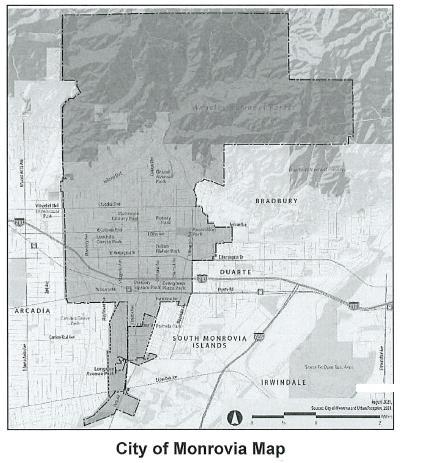
Persons wishing to comment on the proposed application may do so orally at the public hearing or in writing prior to the meeting date and must be received by 12:00 pm the day of the meeting. Writ ten comments shall be sent to Jason C. Mikaelian, AICP; El Monte City Hall West; 11333 Valley Boulevard; El Monte, CA 91731 or at jmikaelian@elmonteca.gov. If you challenge the decision of the City Council, in court, you may be limited to raising only those issues you or someone else raised at the public hearing described in this notice, or in written correspondence delivered to the City Council at, or prior to, the public hearing. For further information regarding this application please contact Jason C. Mikaelian, AICP, Deputy Direc tor of Community and Economic Development at (626) 580-2064 or through email at jmikaelian@elmonteca.gov Monday through Thursday, except legal holidays, between the hours of 7:00 a.m. and 5:30 p.m.
EL MONTE EXAMINER
Rosemead City Notices
NOTICE OF PUBLIC HEARING BEFORE THE DIRECTOR OF COMMUNITY DEVELOPMENT OF THE CITY OF ROSEMEAD ON OCTOBER 31, 2022
NOTICE IS HEREBY GIVEN that the Director of Community Devel opment will conduct a public hearing on Monday, October 31, 2022, at 9:30 A.M., at Rosemead City Hall, located at 8838 East Valley Boulevard, Rosemead, CA 91770.
CASE NO.: ADMINISTRATIVE USE PERMIT 22-06 – Michelle Zhang of YYDS, Inc. has submitted an Administrative Use Permit application for a new On-Sale Beer and Wine (Type 41) ABC license in conjunction with an existing bona fide sit-down restaurant located at 8526 Valley Boulevard, Unit 112 and 113 (APN: 5371-011-017). Per Rosemead Municipal Code (RMC) Table 17.16.020.1, alcohol sales for a sit-down restaurant with 1,000 square feet of floor area or larger that sells beer/wine for on-site consumption is subject to an Administrative Use Permit per RMC Section 17.30.040(E)(1)(b).
PROJECT LOCTION: The project area includes the City of Mon rovia and its unincorporated Sphere of Influence ("planning area"). The City covers an area of approximately 14 square miles and is bounded by Arcadia to the west, Angeles National Forest to the north, Bradbury and Duarte to the east, and unincorporated Los An geles County and Irwindale to the south.
Operating Hours: Monday through Thursday: 7am to 6pm, and Friday: 7am to 5:30pm
• City of Monrovia Library (Reference Desk), 321 S. Myrtle Av enue, Monrovia, CA 91016;
Operating Hours: Monday – Wednesday: 10am to 8pm, and Thursday through Saturday: 12pm to 5:00pm
• City of Monrovia Website, https://www.cityofmonrovia.org/yourgovernment/community-development/planning/general-plan
PLANNING COMMISSION REVIEW: The Monrovia Planning Com mission reviewed the proposed MND, including the Responses to Comments prepared in response to comments received during the public comment period, the MMRP, and the Focused General Plan Update at a public hearing held on October 12, 2022. At the close of the hearing, the Planning Commission adopted Planning Com mission Resolutions Nos. 2022-0005, 2022-0006, 2022-0007, and 2022-0008 recommending that the City Council adopt the MND and MMRP, as well as the Housing Element Update (GPA2022-0002), the Safety Element Update (GPA2022-0003), and the Environmen tal Justice Element (GPA2022-0004), respectively.
PUBLIC HEARING SCHEDULED: A public hearing will be held be fore the Monrovia City Council to discuss the proposed project on Tuesday, November 1, 2022 at 7:30 p.m., or soon thereafter as pos sible at:
Monrovia City Hall (Council Chambers) 415 South Ivy Avenue Monrovia, CA 91006
PUBLIC COMMENTS ACCEPTED: Written public comment will be accepted by email to cityclerk@ci.monrovia.ca.us before 5:00 p.m. on November 1, 2022. Public comment may be summarized in the interest of time, however the full text will be provided to all members of the City Council prior to the meeting. If the comments are specifi cally in support or with concerns regarding this item, please clearly state so in the introduction. Public input related to this Public Hear ing will also be accepted by email to prior to the close of the Public Hearing.
LEAD AGENCY: City of Monrovia
LEAD AGENCY: City of Monrovia
The proposed project would be an incidental use to an existing res taurant and would not increase the floor area of the existing building. The project site is located in the Medium Commercial with a Design Overlay (C-3/D-O) zone.
ENVIRONMENTAL DETERMINATION: Section 15301 of the Cali
PROJECT DESCRIPTION: The Housing Element is a policy docu ment setting forth the City’s plan to accommodate its share of re gional housing needs, as determined by the Southern California Association of Governments (SCAG). The City of Monrovia’s share for the 2021-2029 planning period is 1,670 new housing units. This allocation is referred to as the Regional Housing Needs Assessment (RHNA). The Housing Element does not specifically authorize the construction of any housing development, nor does it indicate where and when specific housing projects will occur.
The Staff Report pertaining to this item will be available on Thurs day, October 27, 2022 after 4 p.m. on-line at the following hyperlink: https://www.cityofmonrovia.org/your-government/meeting-agendasminutes
PROJECT DESCRIPTION: The Housing Element is a policy document setting forth the City’s plan to accommodate its share of regional housing needs, as determined by the Southern California Association of Governments (SCAG). The City of Monrovia’s sh are for the 2021 2029 planning period is 1,670 new housing units. This allocation is referred to as the Regional Housing Needs Assessment (RHNA). The Housing Element does not specifically authorize the construction of any housing development, nor does it indicate where and when specific housing projects will occur.
If you challenge this application in court, you may be limited to rais ing only those issues you or someone else raised at the public hear ing described in this notice, or in written correspondence delivered to the Planning Division at, or prior to, the public hearing. This ap plication will not alter the zoning status of your property. For further information regarding this application, please contact the Planning Division at (626) 932-5565.
The Housing Element is a required component of the City's General
Plan and must be updated on
12 OCTOBER 20-OCTOBER 26, 2022 BeaconMediaNews.com
Published On: October 20, 2022 Catherine A. Eredia, City of El Monte City Clerk
The Housing Element is a required component of the City's General
Adjusting your spending to deal with inflation
It’s no secret that many Americans are experienc ing shrinking savings as high inflation persists. While many people have come to terms with rising costs, there are minor adjustments that can make a big difference to help reduce the sting on your finances. Here are some tactics to consider.
Pare back on convenience services. During the pandemic, many of us turned to conve nience services that come at an extra cost. Did you get in the habit of takeout delivery from your favorite restaurants? Are you paying to have your groceries delivered? Are you shopping online and spending extra for shipping? You might be surprised by how you can save by running your own errands.

Cancel unused subscrip tions and memberships. Do you subscribe to multiple stream ing services? Are you getting packages in the mail from box subscriptions that became popular during lockdown? Are you paying for one or more club memberships that you’re not using? Decide what you can live without, then cancel any that aren’t necessary and keep more dollars in your bank account each month.
Look for deals. Talk to your cell phone provider to review your plan. Shop around for better rates on home and auto insurance and bundle if it makes sense. Consider eliminating cable or satellite if you can get by with a cheaper entertainment alternative. Coupons, rebates, and thrift ing are back in fashion.
Don’t pay for your own money. Stop paying conve nience fees charged by many ATMs. Check with your bank to locate cash machines with no fees. Many grocery stores offer cash back options if you need a few bills in your wallet.
Avoid late fees. Pay your bills on time to avoid late fees. Enroll in automated payments whenever possible so you don’t have to worry about forgetting payment deadlines.
Postpone big-ticket purchases. If your vehicle is still a good runner, and your appliances are working, put off plans to trade in for newer models. With prices surging, you’ll pay top dollar for inven tory that is still scarce due to supply chain challenges. For financed purchases, higher interest rates will drive up your overall cost.

Stick to the essentials. If you can curtail indulgences,
for now, you’ll do your budget a favor. If you’re going to the store, make a shopping list to resist impulse buys.
Review your housing expense. You may not have much control over your monthly rent or mortgage payment, but you can address the extras. It may be time to let go of your covered parking space or the extra storage unit. Consider getting a roommate to share costs. Downsize if you can no longer afford your current living arrangement.
There’s no way to know just how long this period of high inflation will last. Never theless, taking these steps can help you save money.
Jean D. Koehler, CLTC®, CRPC®, RICP®, CKA®, is a Financial Advisor with Ameri prise Financial Services, LLC. in Arcadia. She specializes in feebased financial planning and asset management strategies and has been in practice for 21 years. She is also the winner of the 2020 Ameriprise Client Service Award. To contact her, please visit her website at https://www.ameriprisead visors.com/jean.d.koehler/ or call her office at (626) 254-0455. 55 East Huntington Drive Suite 340, Arcadia Cali fornia 91006.

16 OCTOBER 20-OCTOBER 26, 2022 BeaconMediaNews.com
Jean D. Koehler.
| Courtesy photo



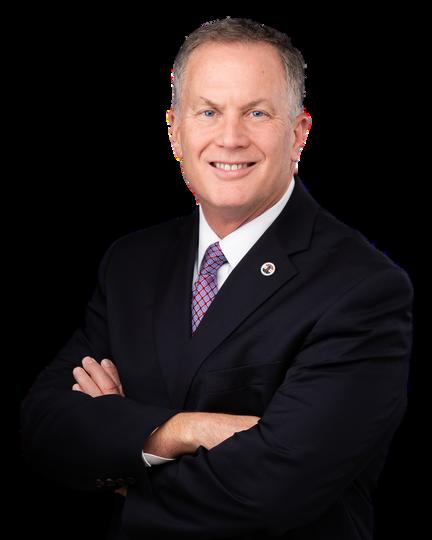





OCTOBER 20-OCTOBER 26, 2022 17BeaconMediaNews.com F A L L H O M E O W N E R S ' R E S O U R C E F A I R FREE AND OPEN TO THE PUBLIC REGISTER TODAY October 28, 2022 9am to 12pm Hacienda Heights Community & Rec. Center 1234 Valencia Ave, Hacienda Heights T O P I C S : ADUs and New Construction Parent Child Transfers (Prop. 19) Property Tax Savings Programs Death of a Property Owner D E T A I L S : GRATUITO Y ABIERTO AL PÚBLICO REGÍSTRESE HOY 今天免费向公众注册
Pasadena City Notices
NOTICE INVITING BIDS
PASADENA COMMUNITY HEALTH DEPARTMENT PARKING LOT DRAINAGE IMPROVEMENTS
In the City of Pasadena, California
Bids will be received electronically through Planet Bids (www.planet bids.com) prior to 2:00 pm on Thursday, October 27, 2022. A bid re ceived after the time set for the bid opening shall not be considered. Bidders are required to submit (upload) all items listed in the BID DER’S CHECKLIST including acknowledgement of all addendums; AND the full Bidder’s Proposal as a PDF file.
Plans and Specifications are available on the City website at: https:// www.planetbids.com/portal/portal.cfm?CompanyID=14770.
The Pasadena Supplements and Modifications to the Standard Specifications for Public Works Construction (“Greenbook”) is avail able, if needed, online at: https://ww5.cityofpasadena.net/public-works/wp-content/uploads/ sites/52/2016/10/Supplements-and-Modifications-to-the-GreenBook-2006-Edition.pdf
PASADENA COMMUNITY HEALTH DEPARTMENT PARKING LOT DRAINAGE IMPROVEMENTS PROJECT
From time to time, the City finds it necessary to issue addendum(a) to bid specifications after those bid specifications have been re leased. Only those parties that have registered with the City as a plan holder on a particular project will receive the addendum(a) for that project. The City is not responsible for notifications to those parties who do not directly register as a plan holder on the City’s database. It is the responsibility of all perspective bidders to register on the City’s database to ensure receipt of any addendum(a) prior to bid submittals. Additionally, information on any addendum(a) issued for any bid specifications for any project will be available on the City website at: https://www.planetbids.com/portal/portal. cfm?CompanyID=14770
The City reserves the right to reject as nonresponsive any bid that fails to include the information required by any addendum(a) posted on the City website.
Each Bidder must hold an active Class A License at the time of bid submission, except as to joint venture Bidders, who shall be li censed as provided in Business and Professions Code §§7029.1 and 7028.15(c).
Pursuant to the provisions of Section 1770 to 1782 of the California Labor Code, the California Department of Industrial Relations has ascertained the general prevailing rate of wages in the county in which work is to be done. A copy of the general prevailing rate of wages is on file with the City Engineer and is available for inspection and reference during regular business hours The administrative fees is $373.31 (Non-Refundable), and deposit of $2,250.00 (Refundable).
All Bidder’s questionnaires and/or request for equal substitution re quests shall be submitted to City’s Project Manager, Joe Conroy, via email at jconroy@cityofpasadena.net by 4:00 PM on October 24, 2022. Any questions or substitution request received after 4:00 PM on October 24, 2022 will not be considered. All addendum will be responded by October 25, 2022.
A contractor or subcontractor shall not be qualified to bid on, be listed in a bid proposal, subject to the requirements of Section 4104 of the Public Contract Code, or engage in the performance of this public works project unless currently registered and qualified to per form public work pursuant to Labor Code Section 1725.5. It is not a violation of Labor Code Section 1771.1 for an unregistered con tractor to submit a bid that is authorized by Section 7029.1 of the Business and Professions Code or by Section 10164 or 20103.5 of the Public Contract Code, provided the contractor is registered to perform public work pursuant to Section 1725.5 at the time the contract is awarded.
This Project is subject to compliance monitoring and enforcement by the Department of Industrial Relations.
The Contractor must post job site notices prescribed by regulation (See e.g. 8 Cal. Code Reg. Section 16451(d).
Contractors and Subcontractors must furnish electronic certified payroll records directly to the California Labor Commissioner (aka Division of Labor Standards Enforcement).
Electronic Bid bond is required. Bidders must provide all required information for the city to verify the bond with their bid (PDF file).
The bond must meet the following requirements and characteris tics: Bid security in the amount of five percent (5%) of the total bid price in the form of a redeemable or callable electronic surety bond, meeting City requirements, must accompany all bids. If the Bidder to whom the contract is awarded shall for fifteen (15) calendar days after such award fail or neglect to enter into the contract with the re quired insurance documentation and the Construction & Demolition Waste Management Plan, and file the required bonds, the City may deposit in its treasury said bid security and, under no circumstances, shall it be returned to the defaulting Bidder. Failure to return signed contract with all the attachments stated above may result in having the project awarded to the next lowest bidder.
LEGALS
Refer to the Specifications for complete details and bid require ments. Specifications and this notice shall be considered a part of any contract made pursuant thereto.
MIGUEL MARQUEZ City Manager
Date: October 3, 2022 (Authorized by City Attorney)
Publish: Oct 13 and 20, 2022 PASADENA PRESS
NOTICE INVITING BIDS CITYWIDE SIDEWALK IMPROVEMENT PROGRAM City Project No. 73913 CDBG Funded Project
In the City of Pasadena, California
Bids will be received electronically through Planet Bids (www.plan etbids.com) prior to 2:00 pm on Thursday, November 3, 2022. A bid received after the time set for the bid opening shall not be con sidered. Bidders are required to submit (upload) all items listed in the BIDDER’S CHECKLIST including acknowledgement of all ad dendums; AND the full Bidder’s Proposal as a PDF file. This is a Community Development Block Grant (CDBG) funded project. All Bidders shall adhere to “Summary of contract Provisions for Inclu sion in the Federally Funded Project - (see Appendix F).
Plans and Specifications are available on the City website at: https:// www.planetbids.com/portal/portal.cfm?CompanyID=14770.
The Pasadena Supplements and Modifications to the Standard Specifications for Public Works Construction (“Greenbook”) is avail able, if needed, online at: https://ww5.cityofpasadena.net/public-works/wp-content/uploads/ sites/52/2016/10/Supplements-and-Modifications-to-the-GreenBook-2006-Edition.pdf
There is a non-mandatory pre-bid meeting via MS Team on October 20, 2022 at 9:00 AM. The pre-bid meeting will cover the bid sched ule, CDBG provisions, and required bid forms to submit.
https://teams.microsoft.com/l/meetup-join/19%3ameeting_MDUyM TIxZDEtMWY2Yy00MDI1LWI5NDAtOTMzZmI3YTcyMWRh%40thr ead.v2/0?context=%7b%22Tid%22%3a%2282d9fc00-2c66-4402a28f-c6bcdc32e491%22%2c%22Oid%22%3a%22dd88d55a-12d34f3a-9be7-c78c4f61b5e5%22%7d
Meeting ID: 213 661 676 037 Passcode: VHHho8 Download Teams | Join on the web Or call in (audio only) +1 213-493-7443,,211001687# United States, Los Angeles Phone Conference ID: 211 001 687#
From time to time, the City finds it necessary to issue addendum(a) to bid specifications after those bid specifications have been re leased. Only those parties that have registered with the City as a plan holder on a particular project will receive the addendum(a) for that project. The City is not responsible for notifications to those parties who do not directly register as a plan holder on the City’s database. It is the responsibility of all perspective bidders to register on the City’s database to ensure receipt of any addendum(a) prior to bid submittals. Additionally, information on any addendum(a) issued for any bid specifications for any project will be available on the City website at: https://www.planetbids.com/portal/portal. cfm?CompanyID=14770
The City reserves the right to reject as nonresponsive any bid that fails to include the information required by any addendum(a) posted on the City website.
Each Bidder must hold an active Class A License at the time of bid submission.
Pursuant to the provisions of Section 1770 to 1782 of the California Labor Code, the California Department of Industrial Relations has ascertained the general prevailing rate of wages in the county in which work is to be done. A copy of the general prevailing rate of wages is on file with the City Engineer and is available for inspection and reference during regular business hours.
The administrative fees is $2,090.54 (Non-Refundable), and deposit of $10,500.00 (Refundable).
All Bidder’s questionnaires and/or request for equal substitution re quests shall be submitted to City’s Project Manager, Joe Conroy, via email at jconroy@cityofpasadena.net by 4:00 PM on October 27, 2022. Any questions or substitution request received after 4:00 PM on October 27, 2022 will not be considered. All addendum will be responded by October 28, 2022.
A contractor or subcontractor shall not be qualified to bid on, be listed in a bid proposal, subject to the requirements of Section 4104 of the Public Contract Code, or engage in the performance of this public works project unless currently registered and qualified to per form public work pursuant to Labor Code Section 1725.5. It is not a violation of Labor Code Section 1771.1 for an unregistered con tractor to submit a bid that is authorized by Section 7029.1 of the Business and Professions Code or by Section 10164 or 20103.5
of the Public Contract Code, provided the contractor is registered to perform public work pursuant to Section 1725.5 at the time the contract is awarded.
This Project is subject to compliance monitoring and enforcement by the Department of Industrial Relations.
The Contractor must post job site notices prescribed by regulation (See e.g. 8 Cal. Code Reg. Section 16451(d).
Contractors and Subcontractors must furnish electronic certified payroll records directly to the California Labor Commissioner (aka Division of Labor Standards Enforcement).
Electronic Bid bond is required. Bidders must provide all required information for the city to verify the bond with their bid (PDF file). The bond must meet the following requirements and characteris tics: Bid security in the amount of five percent (5%) of the total bid price in the form of a redeemable or callable electronic surety bond, meeting City requirements, must accompany all bids. If the Bidder to whom the contract is awarded shall for fifteen (15) calendar days after such award fail or neglect to enter into the contract with the re quired insurance documentation and the Construction & Demolition Waste Management Plan, and file the required bonds, the City may deposit in its treasury said bid security and, under no circumstances, shall it be returned to the defaulting Bidder. Failure to return signed contract with all the attachments stated above may result in having the project awarded to the next lowest bidder.
Refer to the Specifications for complete details and bid require ments. Specifications and this notice shall be considered a part of any contract made pursuant thereto.
MIGUEL MARQUEZ City Manager
Dated: January 5, 2022 (Authorized by City Attorney)
Publish: October 13 and 20, 2022 PASADENA PRESS
NOTICE INVITING BIDS
FOR TRAFFIC SIGNAL CABINET PURCHASE
DEPARTMENT: Public Works Department
Delivery Instructions
Bids will be received electronically through Planet Bids (www.planet bids.com). A bid received after the time set for the bid opening shall not be considered. Bidders are required to submit (upload) all items listed in the BIDDER’S CHECKLIST including acknowledgement of all addendums. Bids will be received prior to 2:00 pm Thursday, November 3, 2022, and will be opened online at that time. The bids shall be clearly titled:
TRAFFIC SIGNAL CABINET PURCHASE
Copies of the Specifications may be obtained by mail or in person from the Purchasing Division, 100 N. Garfield Ave., Room S-349, Pasadena, CA 91109, Telephone No. (626) 744-6755.
Refer to the Specifications for complete details and bidding require ments. The Specification and this Notice shall be considered a part of any contract made pursuant thereunder.
Bid Conference
The City does not plan to hold a pre-bid conference. Instead, the City will accept written questions via email.
Release Date
Release Dated: Thursday, October 20, 2022
MIGUEL MÁRQUEZ City Manager
Publish October 20, 2022
PASADENA PRESS
NOTICE INVITING BIDS for
NORTH HILL COMPLETE STREETS PROJECT CITY PROJECT NO. 75093
In the City of Pasadena, California
Bids will be received electronically through Planet Bids (www.plan etbids.com) prior to 2:00 pm on Wednesday, November 16, 2022. A bid received after the time set for the bid opening shall not be considered. Bidders are required to submit (upload) all items listed in the BIDDER’S CHECKLIST including acknowledgement of all ad dendums; AND the full Bidder’s Proposal as a PDF file.
Plans and Specifications are available on the City website at: https:// www.planetbids.com/portal/portal.cfm?CompanyID=14770.
The Pasadena Supplements and Modifications to the Standard Specifications for Public Works Construction (“Greenbook”) is avail able, if needed, online at:
OCTOBER 20-OCTOBER 26, 2022 21BeaconMediaNews.com
https://ww5.cityofpasadena.net/public-works/wp-content/uploads/ sites/52/2016/10/Supplements-and-Modifications-to- the-GreenBook-2006-Edition.pdf
From time to time, the City finds it necessary to issue addendum (a) to bid specifications after those bid specifications have been re leased. Only those parties that have registered with the City as a plan holder on a particular project will receive the addendum (a) for that project. The City is not responsible for notifications to those parties who do not directly register as a plan holder on the City’s database. It is the responsibility of all perspective bidders to reg ister on the City’s database to ensure receipt of any addendum (a) prior to bid submittals. Additionally, information on any addendum(a) issued for any bid specifications for any project will be available on the City website at: https://www.planetbids.com/portal/portal. cfm?CompanyID=14770 The City reserves the right to reject as nonresponsive any bid that fails to include the information required by any addendum(a) posted on the City website. Each Bidder must hold an active Class A License (in addition, if a bidder intends to perform electrical work with its own work forces, it must hold an ac tive C10 License) at the time of bid submission, except as to joint venture Bidders, who shall be licensed as provided in Business and Professions Code §§7029.1 and 7028.15(c). Electrical subcontrac tors shall hold an active Class C-10 License. Workers of Class C-10 Contractors shall have the appropriate special certification.
The administrative fees is $373.31 (Non-Refundable), and deposit of $21,150.00 (Refundable).
All Bidder’s questionnaires and/or requests for equal substitution requests shall be submitted to the City’s Project Manager, Michael Vartanians, via email at mvartanians@cityofpasadena.net by 2:00 PM November 9, 2022. Any questions or substitution request re ceived after 2:00 PM Wednesday November 9, 2022 will not be con sidered. All addendum will be responded by November 14, 2022.
A contractor or subcontractor shall not be qualified to bid on, be listed in a bid proposal, subject to the requirements of Section 4104 of the Public Contract Code, or engage in the performance of this public works project unless currently registered and qualified to per form public work pursuant to Labor Code Section 1725.5. It is not a violation of Labor Code Section 1771.1 for an unregistered con tractor to submit a bid that is authorized by Section 7029.1 of the Business and Professions Code or by Section 10164 or 20103.5 of the Public Contract Code, provided the contractor is registered to perform public work pursuant to Section 1725.5 at the time the contract is awarded.
This Project is subject to compliance monitoring and enforcement by the Department of Industrial Relations. The Contractor must post job site notices prescribed by regulation (See e.g. 8 Cal. Code Reg. Section 16451(d).
Contractors and Subcontractors must furnish electronic certified payroll records directly to the California Labor Commissioner (aka Division of Labor Standards Enforcement).
There is not a pre-bid meeting scheduled for this project.
Electronic Bid bond is required. Bidders must provide all required information for the city to verify the bond with their bid (PDF file). The bond must meet the following requirements and characteris tics: Bid security in the amount of five percent (5%) of the total bid price in the form of a redeemable or callable electronic surety bond, meeting City requirements, must accompany all bids. If the Bidder to whom the contract is awarded shall for fifteen (15) calendar days after such award fail or neglect to enter into the contract with the re quired insurance documentation and the Construction & Demolition Waste Management Plan, and file the required bonds, the City may deposit in its treasury said bid security and, under no circumstances, shall it be returned to the defaulting Bidder. Failure to return signed contract with all the attachments stated above may result in having the project awarded to the next lowest bidder.
Refer to the Specifications for complete details and bid require ments. Specifications and this notice shall be considered a part of any contract made pursuant thereto.
Miguel Marquez City Manager
Dated: September 16, 2022 (Authorized by City Attorney)
Publish: October 20, 2022 and October 27,2022
NOTICE INVITING BIDS for VICTORY PARK – CONCRETE RECONSTRUC TION In the City of Pasadena, California
General work description: The project scope includes, but is not lim ited to, minor grading and removal and reconstruction of concrete hardscape, cross gutter, and driveway apron to allow proper drain age per Pasadena City Standard. Re-installation of bollards and truncated domes.
Length of contract to complete (including procurement and all
LEGALS
punchlist items): 20 working days
The estimate bid range: $30,000 - $40,000
Bids shall be received electronically through Planet Bids (www.plan etbids.com) prior to 2:00 pm on November 10, 2022. A bid received after the time set shall not be considered. Bidders are required to submit (upload) all items listed in the BIDDER’S CHECKLIST includ ing acknowledgement of all addendums.
A copy of the bid package is available on the City website at:https:// www.planetbids.com/portal/portal.cfm?CompanyID=14770.
The Pasadena Supplements and Modifications to the Standard Specifications for Public Works Construction (“Greenbook”) is avail able, if needed, online at: https://ww5.cityofpasadena.net/public-works/wp-content/uploads/ sites/52/2016/10/Supplements-and-Modifications-to-the-GreenBook-2006-Edition.pdf
From time to time, the City finds it necessary to issue addendum(a) to bid specifications after those bid specifications have been re leased. Only those parties that have registered with the City as a plan holder on a particular project will receive the addendum(a) for that project. The City is not responsible for notifications to those parties who do not directly register as a plan holder on the City’s database. It is the responsibility of all perspective bidders to register on the City’s database to ensure receipt of any addendum(a) prior to bid submittals. Additionally, information on any addendum(a) issued for any bid specifications for any project will be available on the City website at: https://www.planetbids.com/portal/portal. cfm?CompanyID=14770 The City reserves the right to reject as nonresponsive any bid that fails to include the information required by any addendum(a) posted on the City website.
A non-mandatory pre-bid meeting is scheduled for October 31, 2022 at 10:00 a.m. at 2575 Paloma Street, Pasadena, California, 91107. This meeting is to answer any questions regarding the project plans and specifications, and review site conditions.
ATTENDANCE IS NON-MANDATORY
Deadline for Bidder Request for Information and/or Equal Substitu tion Request must be submitted to the Agency Representative by November 4, 2022, at 2:00 p.m. All RFIs and/or Substitution request must be submitted via e-mail to Tiffiny Chen, email: tchen@cityof pasadena.net.
Each Bidder must hold an active Class A or B License with the State of California Contractors License Board and at the time of bid sub mission, except as to joint venture Bidders, who shall be licensed as provided in Business and Professions Code §§ 7029.1 and 7028.15(c). In addition, the Bidder or a listed Subcontractor must hold all applicable certifications/registrations from the following reg ulatory agencies relevant to the project.
Pursuant to the provisions of Section 1770 to 1782 of the California Labor Code, the California Department of Industrial Relations has ascertained the general prevailing rate of wages in the county in which work is to be done. A copy of the general prevailing rate of wages is on file with the City Engineer and is available for inspection and reference during regular business hours.
A contractor or subcontractor shall not be qualified to bid on, be listed in a bid proposal, subject to the requirements of Section 4104 of the Public Contract Code, or engage in the performance of this public works project unless currently registered and qualified to per form public work pursuant to Labor Code Section 1725.5. It is not a violation of Labor Code Section 1771.1 for an unregistered con tractor to submit a bid that is authorized by Section 7029.1 of the Business and Professions Code or by Section 10164 or 20103.5 of the Public Contract Code, provided the contractor is registered to perform public work pursuant to Section 1725.5 at the time the contract is awarded.
This Project is subject to compliance monitoring and enforcement by the Department of Industrial Relations.
The Contractor must post job site notices prescribed by regulation (See e.g. 8 Cal. Code Reg. Section 16451(d).
Contractors and Subcontractors must furnish electronic certified payroll records directly to the California Labor Commissioner (aka Division of Labor Standards Enforcement).
Electronic Bid bond is required: Bidders must provide all required information for the city to verify the bond with their bid (PDF file). The bond must meet the following requirements and characteris tics: Bid security in the amount of five percent (5%) of the total bid price in the form of a redeemable or callable electronic surety bond, meeting City requirements, must accompany all bids. If the Bidder to whom the contract is awarded shall for fifteen (15) calendar days after such award fail or neglect to enter into the contract with the re quired insurance documentation and the Construction & Demolition Waste Management Plan, and file the required bonds, the City may deposit in its treasury said bid security and, under no circumstances, shall it be returned to the defaulting Bidder. Failure to return signed contract with all the attachments stated above may result in having the project awarded to the next lowest bidder.
Refer to the Specifications for complete details and bid require ments. Specifications and this notice shall be considered a part of
any contract made pursuant thereto.
MIGUEL MÁRQUEZ City Manager
Dated: 9/16/22 (Authorized by City Attorney)
Publish: 10/20/22 and 10/27/22 PASADENA PRESS
NOTICE INVITING BIDS for RELOCATION OF TEMPORARY SHELTER STRUCTURE
In the City of Pasadena, California
General work description: The project scope includes, but is not lim ited to, minor grading and removal and reconstruction of concrete hardscape, cross gutter, and driveway apron to allow proper drain age per Pasadena City Standard. Re-installation of bollards and truncated domes.
Length of contract to complete (including procurement and all punchlist items): 15 working days
The estimate bid range: $30,000 - $40,000
Bids shall be received electronically through Planet Bids (www.plan etbids.com) prior to 2:00 pm on November 10 2022. A bid received after the time set shall not be considered. Bidders are required to submit (upload) all items listed in the BIDDER’S CHECKLIST includ ing acknowledgement of all addendums.
A copy of the bid package is available on the City website at:https:// www.planetbids.com/portal/portal.cfm?CompanyID=14770. The Pasadena Supplements and Modifications to the Standard Specifications for Public Works Construction (“Greenbook”) is avail able, if needed, online at: https://ww5.cityofpasadena.net/public-works/wp-content/uploads/ sites/52/2016/10/Supplements-and-Modifications-to-the-GreenBook-2006-Edition.pdf
From time to time, the City finds it necessary to issue addendum(a) to bid specifications after those bid specifications have been re leased. Only those parties that have registered with the City as a plan holder on a particular project will receive the addendum(a) for that project. The City is not responsible for notifications to those parties who do not directly register as a plan holder on the City’s database. It is the responsibility of all perspective bidders to register on the City’s database to ensure receipt of any addendum(a) prior to bid submittals. Additionally, information on any addendum(a) issued for any bid specifications for any project will be available on the City website at: https://www.planetbids.com/portal/portal. cfm?CompanyID=14770 The City reserves the right to reject as nonresponsive any bid that fails to include the information required by any addendum(a) posted on the City website.
A mandatory pre-bid meeting is scheduled for October 27, 2022 at 10:00 a.m. at 2180 E. Foothill Blvd, Pasadena, California, 91107. This meeting is to answer any questions regarding the project plans and specifications, and review site conditions.
ATTENDANCE IS MANDATORY
Deadline for Bidder Request for Information and/or Equal Substitu tion Request must be submitted to the Agency Representative by November 4, 2022, at 2:00 p.m. All RFIs and/or Substitution request must be submitted via e-mail to Tiffiny Chen, email: tchen@cityof pasadena.net.
Each Bidder must hold an active Class A or B License with the State of California Contractors License Board and at the time of bid sub mission, except as to joint venture Bidders, who shall be licensed as provided in Business and Professions Code §§ 7029.1 and 7028.15(c). In addition, the Bidder or a listed Subcontractor must hold all applicable certifications/registrations from the following reg ulatory agencies relevant to the project.
Pursuant to the provisions of Section 1770 to 1782 of the California Labor Code, the California Department of Industrial Relations has ascertained the general prevailing rate of wages in the county in which work is to be done. A copy of the general prevailing rate of wages is on file with the City Engineer and is available for inspection and reference during regular business hours.
A contractor or subcontractor shall not be qualified to bid on, be listed in a bid proposal, subject to the requirements of Section 4104 of the Public Contract Code, or engage in the performance of this public works project unless currently registered and qualified to per form public work pursuant to Labor Code Section 1725.5. It is not a violation of Labor Code Section 1771.1 for an unregistered con tractor to submit a bid that is authorized by Section 7029.1 of the Business and Professions Code or by Section 10164 or 20103.5 of the Public Contract Code, provided the contractor is registered to perform public work pursuant to Section 1725.5 at the time the contract is awarded.
This Project is subject to compliance monitoring and enforcement by the Department of Industrial Relations.
22 OCTOBER 20-OCTOBER 26, 2022 BeaconMediaNews.com
PASADENA PRESS
The Contractor must post job site notices prescribed by regulation (See e.g. 8 Cal. Code Reg. Section 16451(d).
Contractors and Subcontractors must furnish electronic certified payroll records directly to the California Labor Commissioner (aka Division of Labor Standards Enforcement).
Electronic Bid bond is required: Bidders must provide all required information for the city to verify the bond with their bid (PDF file). The bond must meet the following requirements and characteris tics: Bid security in the amount of five percent (5%) of the total bid price in the form of a redeemable or callable electronic surety bond, meeting City requirements, must accompany all bids. If the Bidder to whom the contract is awarded shall for fifteen (15) calendar days after such award fail or neglect to enter into the contract with the re quired insurance documentation and the Construction & Demolition Waste Management Plan, and file the required bonds, the City may deposit in its treasury said bid security and, under no circumstances, shall it be returned to the defaulting Bidder. Failure to return signed contract with all the attachments stated above may result in having the project awarded to the next lowest bidder.
Refer to the Specifications for complete details and bid require ments. Specifications and this notice shall be considered a part of any contract made pursuant thereto.
MIGUEL MÁRQUEZ City Manager
Dated: 10/4/22 (Authorized by City Attorney)
Publish: 10/20/22 and 10/27/22 PASADENA PRESS
Professional Services for Planning, Environmen tal and Design of Colorado Street Bridge - Barrier Enhancements
Request for Proposals (Competitive Selection PMC 4.08.047)
Summary
The City is seeking Professional Services for Environmental Report and Design Development for Colorado Street Bridge - Barrier En hancements as outlined in this RFP.
The proposals submitted in response to this RFP will be used as a basis for selecting the Consultant for this project. The Consultant’s proposal will be evaluated and ranked according to the criteria pro vided in Section 05 – Proposal Evaluation of this RFP.
The project is partially funded with American Rescue Plan Act (ARPA) Federal dollars. Consequently, the City is proceeding in ac cordance with Federal Aid project funding procedures. Proposers are required to certify that they meet all federal requirements identi fied in this RFP, including but not limited to all applicable equal op portunity laws and regulations.
Proposers are required to certify that they have not been suspend ed, debarred, voluntarily excluded, or determined ineligible by any federal agency. Proposers must be willing to comply with all terms and conditions prescribed for third party contracts by the governing federal agency or organization.
The California Labor Code section 1770, et seq., requires that cer tain consultants on public works projects pay their workers based on the prevailing wage rates which are established and issued by the Department of Industrial Relations, (http://www.dir.ca.gov). Propos ers of this RFP agree to adhere to the Prevailing Wage requirement and use the wage schedules applicable at the time the work is per formed, which can be obtained from the Department of Industrial Relations internet site at (http://www.dir.ca.gov/OPRL/DPreWage Determination.htm).
If the contract is awarded, the firm awarded the contract will be re quired to comply with all applicable laws and regulations including but not limited to, equal opportunity laws and regulations.
Firms using sub-consultants are encouraged to subcontract with small and disadvantaged businesses to the maximum extent pos sible.
This RFP does not commit the City of Pasadena to award a contract, to pay any costs incurred in the preparation of a proposal for this request, or to procure or contract for services. The City of Pasadena reserves the right to accept or reject any or all proposals received as a result of this request, to negotiate with any qualified Consultant, or to modify or cancel in part or in its entirety the RFP if it is in the best interests of the City of Pasadena to do so. Furthermore, a contract award may not be made based solely on price.
Proposers are advised that all contract/procurement transactions must be carried out in a manner consistent with Title 2 of the Code of Federal Regulations (2 CFR) Part 200 – Uniform Administrative Requirements, Cost Principles, and Audit Requirements for Federal Awards.
Electronic Submission and Delivery Instructions
Parties interested in responding are required to submit proposals
LEGALS
electronically through Planet Bids no later than 2:00 pm on Thurs day, November 17, 2022.
The entire proposal must be formatted on standard-size 8½”x11” pages; 12 point font only and no more than 50 grand total pages including all required attachments.
Parties interested in responding are asked to submit one (1) un bound original hard copy (marked “Original”), three (3) bound hard copies, and one (1) electronic copy in PDF format uploaded into Planet Bids. In the case that hard copies and electronic copies are received on different dates by the City, the time and date uploaded and submitted on Planet Bids by the Proposer shall be considered the official date of submission.
Hard copies shall be submitted to: City of Pasadena Attention: Tiffiny Chen, P.E. Department of Public Works
Professional Services for Environmental Report and Design Devel opment for Colorado Street Bridge - Barrier Enhancements 100 N. Garfield Avenue Room N306 Pasadena, CA 91101
Upload sufficiently early electronically through Planet Bids before the time and day listed in the Notice Inviting Proposals. Proposals must be received in the system prior to the deadline.
Proposals received after the Proposal Deadline may not be accept ed by the City.
Any proposals received prior to the time and date specified above may be withdrawn or modified by written request of the Consultant. To be considered, however, the modified Proposal must be received prior to 2:00 pm, Thursday, November 17, 2022
Publish October 20, 2022 PASADENA PRESS
Introduced by: Councilmember Madison ORDINANCE NO. 7405
AN ORDINANCE OF THE CITY OF PASADENA AMENDING VARI OUS SECTIONS OF TITLE 17 (ZONING CODE) OF THE CITY OF PASADENA MUNICIPAL CODE TO IMPLEMENT THE SOUTH FAIR OAKS SPECIFIC PLAN UPDATE, AMENDING THE OF FICIAL ZONING MAP ESTABLISHED BY THE ZONING CODE, CHAPTER 17.20, SECTION 17.20.020 TO MODIFY THE BOUND ARIES OF THE SOUTH FAIR OAKS SPECIFIC PLAN, REDESIG NATE ZONES WITHIN THE SOUTH FAIR OAKS SPECIFIC PLAN UPDATE AREA, AND AMENDING CHAPTER 17.30 TO MODIFY THE CENTRAL DISTRICT SPECIFIC PLAN
The People of the City of Pasadena ordain as follows:
SECTION 1. This ordinance, due to its length and correspond ing cost of publication, will be published by title and summary as per mitted in Section 508 of the Pasadena City Charter. The approved summary of this ordinance is as follows:
“Summary
This proposed ordinance will amend various sections of Title 17 (Zoning Code) of the City of Pasadena Municipal Code to imple ment the South Fair Oaks Specific Plan Update, as shown in Exhibit 1, attached to the full text of the ordinance and on file in the City Clerk’s Office. This proposed ordinance further amends the offi cial Zoning Map of the City of Pasadena to implement the South Fair Oaks Specific Plan Update, including modifying the boundaries of the South Fair Oaks Specific Plan, and reclassifying parcels lo cated within the new South Fair Oaks Specific Plan area. Changes to the South Fair Oaks Specific Plan boundary and corresponding changes to the Central District Specific Plan, and zoning designa tions within the new South Fair Oaks Specific Plan area are shown as Exhibits 2 and 3, attached to the full text of the ordinance and on file in the City Clerk’s Office
Ordinance No. 7405 shall take effect 30 days from its publication.”
SECTION 2. The City Clerk shall certify the adoption of this ordinance and shall cause this ordinance to be published by title and summary.
SECTION 3. This ordinance shall take effect 30 days from its publication.
Signed and approved this 17th day of October, 2022.
Victor M. Gordo Mayor of the City of Pasadena
I HEREBY CERTIFY that the foregoing ordinance was adopted by the City Council of the City of Pasadena at its meeting held this 17th day of October 2022, by the following vote:
AYES: Councilmembers Hampton, Jones, Masuda, Williams, Vice Mayor Wilson, Mayor Gordo NOES: Councilmember Rivas
ABSENT: Councilmember Madison ABSTAIN: None
Date Published: October 20, 2022
APPROVED AS TO FORM: Theresa E. Fuentes Assistant City Attorney
Publish October 20, 2022 PASADENA PRESS
Mark Jomsky City Clerk
Glendale City Notices
NOTICE OF PLANNING COMMISSION PUBLIC HEARING ALLEY VACATION CASE NO. 187V
LOCATION: 900 EAST BROADWAY, ALLEY 502
APPLICANT: 900 East Broadway LP.
ZONES: “C3-I” - (Commercial Services, Height District I) and “R-2250” - (Medium Density Residential) zones
LEGAL DESCRIPTION: Alley 502: Portion of the First alley easterly of Cedar Street, Southerly of Broadway
PROJECT DESCRIPTION
The Glendale Housing Authority is developing 126 units of affordable rental housing for seniors (and one manager unit) as part of the Citrus Crossing Affordable Housing project at 900 East Broadway. Vacation of the alley (Alley 502) will allow development of a public pedestrian paseo adjacent to the project for use by the project and neighborhood residents.
ENVIRONMENTAL DETERMINATION: The project is exempt from CEQA review as a Class 32 “Infill Development Project” exemption as it meets all threshold criteria set forth in Section 15332(a) through (e).
HEARING INFORMATION: The Planning Commission will conduct a public hearing regarding the above project, on November 2, 2022, at 5:00 pm or as soon thereafter as possible. The purpose of the hearing is to hear comments from the public with respect to the proposed alley vacation. The hearing will be held in accordance with Glendale Municipal Code, Title 30, Chapter 30.36. The Planning Commission will be making a recommendation to City Council.
The meeting can be viewed on Charter Cable Channel 6 or streamed online at: https://www.glendaleca.gov/government/departments/management-services/gtv6/livevideo-stream. For public comments and questions during the meeting, call 818-937-8100. City staff will be submitting these questions and comments in real time to the appropriate person during the Planning Commission meeting. You may also testify in person at the hearing if you wish to do so.
If the final decision is challenged in court, testimony may be limited to issues raised before or at the public hearing.
The staff report and case materials will be available before the hearing date at www. glendaleca.gov/agendas.
QUESTIONS OR COMMENTS: If you desire more information on the proposal, please contact the case planner, Roger Kiesel in the Planning Division at (818) 937-8152 or (818) 548-2140 (email: rkiesel@glendaleca.gov).
Any person having an interest in the subject project may participate in the hearing, by phone as outlined above, and may be heard in support of his/her opinion. Any person protesting may file a duly signed and acknowledged written protest with the Director of Community Development not later than the hour set for public hearing before the Hearing Officer. "Ac knowledged" shall mean a declaration of property ownership (or occupant if not owner) under penalty of perjury. If you challenge the decision of this project in court, you may be limited to raising only those issues you or someone else raised at the public hearing described in this notice, or in written correspondence delivered to the City of Glendale, at or prior to the public hearing. In compliance with the Americans with Disabilities Act (ADA) of 1990, please notify the Community Development Department at least 48 hours (or two business days) for requests regarding sign language translation and Braille transcription services.
When a final decision is rendered, a decision letter will be posted online at www.glendaleca. gov/planning/decisions. An appeal may be filed within 15 days of the final decision date. Appeal forms are available at https://www.glendaleca.gov/home/showdocument?id=11926. Dr. S. Abajian, The City Clerk of the City of Glendale
Publish October 20, 2022 GLENDALE INDEPENDENT
Monterey Park City Notices
CITY OF MONTEREY PARK
TAKE NOTICE that the Monterey Park City Council will con duct a public hearing to consider adopting a resolution establishing an in-lieu inclusionary housing fee which will be contingent upon the City Council’s adoption of Zoning Code Amendment No. 22-01 (ZCA 22-01), an ordinance amending Title 21 of the Monterey Park Mu nicipal Code to establish inclusionary housing requirements citywide for certain residential and mixed-use development projects.
WHEN: November 2, 2022, 6:30 p.m.
WHERE: City Hall Council Chambers – 320 W. Newmark Avenue
PURSUANT to the California Environmental Quality Act (“CEQA”) and the CEQA Guidelines, the proposed resolution is not subject to further review under the California Environmental Qual ity Act (Public Resources Code §§ 21000, et seq.; “CEQA”) for the following reasons: (1) it will not result in a direct or reasonably foreseeable indirect physical change in the environment (14 Cal. Code Regs. § 15060(c)(2)); (2) there is no possibility that the or dinance may have a significant effect on the environment (14 Cal. Code Regs. § 15061(b)(3)); and (3) the resolution, by itself, does not constitute a “project” because it involves government funding mechanisms and fiscal activities that do not involve any commitment to a specific project that may result in a potentially significant physi cal impact on the environment (14 Cal. Code Regs. § 15378(b)(4)).
DOCUMENTS, including copies of the proposed resolution, are on file with the Community Development Department – Plan ning Division located at Monterey Park City Hall, 320 W. Newmark
OCTOBER 20-OCTOBER 26, 2022 23BeaconMediaNews.com
Avenue. The staff report on this matter will be available in the Com munity Development Department – Planning Division on or about October 28, 2022 and available on the City’s website at http://www. montereypark.ca.gov/AgendaCenter. Copies may be obtained at cost. For additional information, please call (626) 307-1315 or email planningpermitcounter@montereypark.ca.gov.
PERSONS INTERESTED IN THIS MATTER are invited to at tend this hearing to express their opinion on the above matter. If you challenge the proposed action in court, you may be limited to raising only those issues you or someone else raised at the public hearing described in this notice, or in written correspondence deliv ered to the City Council at, or prior to the public hearing. You may mail or deliver comments to 320 W. Newmark Ave, Monterey Park, CA, attention Community Development Department, Planning Divi sion.
Vincent D. Chang City Clerk, City of Monterey Park Publish October 20, 2022 MONTEREY PARK PRESS
CITY OF MONTEREY PARK
TAKE NOTICE that the Monterey Park City Council will conduct a public hearing to consider adopting Zoning Code Amendment No. 22-01 (ZCA 22-01), an ordinance amending Title 21 of the Monterey Park Municipal Code to establish inclusionary housing requirements citywide for certain residential and mixed-use development projects, with alternative compliance measures, including, without limitation, payment of an in-lieu fee.
WHEN: November 2, 2022, 6:30 p.m.
WHERE: City Hall Council Chambers – 320 W. Newmark Avenue
PURSUANT to the California Environmental Quality Act (“CEQA”) and the CEQA Guidelines, the proposed ordinance is not subject to further review under the California Environmental Qual ity Act (Public Resources Code §§ 21000, et seq.; “CEQA”) for the following reasons: (1) it will not result in a direct or reasonably fore seeable indirect physical change in the environment (14 Cal. Code Regs. § 15060(c)(2)); (2) there is no possibility that the ordinance may have a significant effect on the environment (14 Cal. Code Regs. § 15061(b)(3)); and (3) the ordinance, by itself, does not con stitute a “project” as defined in the CEQA Guidelines (14 Cal. Code Regs. § 15378).
DOCUMENTS, including copies of the proposed ordinance, are on file with the Community Development Department – Plan ning Division located at Monterey Park City Hall, 320 W. Newmark Avenue. The staff report on this matter will be available in the Com munity Development Department – Planning Division on or about October 28, 2022 and available on the City’s website at http://www. montereypark.ca.gov/AgendaCenter. Copies may be obtained at cost. For additional information, please call (626) 307-1315 or email planningpermitcounter@montereypark.ca.gov.
PERSONS INTERESTED IN THIS MATTER are invited to attend this hearing to express their opinion on the above matter. If you chal lenge the proposed action in court, you may be limited to raising only those issues you or someone else raised at the public hearing de scribed in this notice, or in written correspondence delivered to the City Council at, or prior to the public hearing. You may mail or deliver comments to 320 W. Newmark Ave, Monterey Park, CA, attention Community Development Department, Planning Division.
Vincent D. Chang City Clerk, City of Monterey Park
Publish October 20, 2022 MONTEREY PARK PRESS
City of Monterey Park Engineering Division 320 West Newmark Avenue Monterey Park, CA 91754 Tel. No: (626) 307-1320 Fax: (626) 307-2500
NOTICE INVITING BIDS
CITY HALL EMERGENCY GENERATOR INSTALLATION, SPEC. NO. 2022-014
Contract Time: 160 Working Days; Liquidated Damages: $1,000 per working day.
DESCRIPTION OF WORK
The project is a turnkey project which consists of submitting plans for Fire Department, and Building & Safety Department review and ap proval, removal and disposal of existing generator, and installation of new generator SD250 as per technical specifications. Prevailing wages required. A 10% Bidder’s Bond is required with bid. Success ful contractor will be required to provide: (1) Liability insurance with City of Monterey Park as addition insured endorsement; (2) Proof of workers’ compensation insurance coverage; (3) 100% Faithful Per formance, (4) 100% Labor and Material Bond, (5) DIR Registration, (6) Federal Requirements. Plans are available to download for a
fee from QuestCDN; link on the City’s website www.montereypark. ca.gov/444/Bids-Proposals. Bid Package Cost: $15.00.
Bid Due Date and Time: Bids will be received via the online elec tronic bid service, Quest Construction Data Network (QuestCDN), www.questcdn.com, until 10:00 AM, Tuesday, November 8, 2022. Questions? Please call: Anthony Bendezu, Contract Project Man ager at (626) 307-1283.
Publish October 20 & 27, 2022
MONTEREY PARK PRESS
Probate Notices
NOTICE OF PETITION TO ADMINISTER ESTATE OF: JOHN PAUL DE LA ROSA AKA JOHN P. DE LA ROSA CASE NO. PRRI2201901
To all heirs, beneficiaries, creditors, contingent creditors, and persons who may otherwise be interested in the WILL or estate, or both of JOHN PAUL DE LA ROSA AKA JOHN P. DE LA ROSA.
A PETITION FOR PROBATE has been filed by KATHERINE DE LA ROSA in the Superior Court of Cali fornia, County of RIVERSIDE.
THE PETITION FOR PROBATE requests that KATHERINE DE LA ROSA be appointed as personal rep resentative to administer the estate of the decedent.
THE PETITION requests authority to administer the estate under the Inde pendent Administration of Estates Act with limited authority. (This authority will allow the personal representative to take many actions without obtaining court approval. Before taking certain very important actions, however, the personal representative will be required to give notice to interested persons unless they have waived notice or consented to the proposed action.) The independent administra tion authority will be granted unless an interested person files an objec tion to the petition and shows good cause why the court should not grant the authority.
A HEARING on the petition will be held in this court as follows: 11/23/22 at 8:30AM in Dept. 11 located at 4050 MAIN STREET, RIVERSIDE, CA 92501
IF YOU OBJECT to the granting of the petition, you should appear at the hearing and state your objections or file written objections with the court before the hearing. Your appearance may be in person or by your attorney.
IF YOU ARE A CREDITOR or a con tingent creditor of the decedent, you must file your claim with the court and mail a copy to the personal represen tative appointed by the court within the later of either (1) four months from the date of first issuance of letters to a general personal representative, as defined in section 58(b) of the Califor nia Probate Code, or (2) 60 days from the date of mailing or personal delivery to you of a notice under section 9052 of the California Probate Code.
Other California statutes and legal authority may affect your rights as a creditor. You may want to consult with an attorney knowledgeable in California law.
YOU MAY EXAMINE the file kept by the court. If you are a person interested in the estate, you may file with the court a Request for Special Notice (form DE-154) of the filing of an inventory and appraisal of estate assets or of any petition or account as provided in Probate Code section 1250. A Request for Special Notice form is available from the court clerk.
Attorney for Petitioner SIBYLLE GREBE - SBN 141553, LORENZO C. STOLLER - SBN 291581, THE PROBATE HOUSE, L.C. 3424 WEST CARSON STREET, SUITE 320 TORRANCE CA 90503 10/13, 10/17, 10/20/22 CNS-3633136#
CORONA NEWS PRESS
NOTICE OF PETITION TO ADMINISTER ESTATE OF: SUSIE S. SATO CASE NO. 30-2022-01283284-PR-PWCJC
To all heirs, beneficiaries, creditors, contingent creditors, and persons who may otherwise be interested in the WILL or estate, or both of SUSIE S. SATO.
A PETITION FOR PROBATE has been filed by VINCENT B. SATO in the Superior Court of California, County of ORANGE.
THE PETITION FOR PROBATE re
quests that VINCENT B. SATO be ap pointed as personal representative to administer the estate of the decedent.
THE PETITION requests the dece dent’s WILL and codicils, if any, be admitted to probate. The WILL and any codicils are available for examina tion in the file kept by the court.
THE PETITION requests authority to administer the estate under the Inde pendent Administration of Estates Act. (This authority will allow the personal representative to take many actions without obtaining court approval. Before taking certain very important actions, however, the personal repre sentative will be required to give notice to interested persons unless they have waived notice or consented to the proposed action.) The independent administration authority will be granted unless an interested person files an objection to the petition and shows good cause why the court should not grant the authority.
A HEARING on the petition will be held in this court as follows: 12/01/22 at 1:30PM in Dept. C08 located at 700 CIVIC CENTER DRIVE WEST, SANTA ANA, CA 92701
NOTICE IN PROBATE CASES
The court is providing the convenience to appear for hearing by video using the court’s designated video platform. This is a no cost service to the public. Go to the Court’s website at The Superior Court of California - County of Orange (occourts.org) to appear remotely for Probate hearings and for remote hearing instructions. If you have difficulty connecting or are unable to connect to your remote hear ing, call 657-622-8278 for assistance.
If you prefer to appear in-person, you can appear in the department on the day/time set for your hearing.
IF YOU OBJECT to the granting of the petition, you should appear at the hearing and state your objections or file written objections with the court before the hearing. Your appearance may be in person or by your attorney.
IF YOU ARE A CREDITOR or a con tingent creditor of the decedent, you must file your claim with the court and mail a copy to the personal represen tative appointed by the court within the later of either (1) four months from the date of first issuance of letters to a general personal representative, as defined in section 58(b) of the Califor nia Probate Code, or (2) 60 days from the date of mailing or personal delivery to you of a notice under section 9052 of the California Probate Code. Other California statutes and legal authority may affect your rights as a creditor. You may want to consult with an attorney knowledgeable in California law.
YOU MAY EXAMINE the file kept by the court. If you are a person interested in the estate, you may file with the court a Request for Special Notice (form DE-154) of the filing of an inventory and appraisal of estate assets or of any petition or account as provided in Probate Code section 1250. A Request for Special Notice form is available from the court clerk.
Attorney for Petitioner
JAKE F. TORII - SBN 337317,
LAW OFFICE OF JOHN S. TORII 406 AMAPOLA AVE., #125 TORRANCE CA 90501 10/13, 10/17, 10/20/22
CNS-3633588#
ANAHEIM PRESS
NOTICE OF PETITION TO ADMINISTER ESTATE OF: ELISABETH LENCHES
CASE NO. 21STPB03234
To all heirs, beneficiaries, creditors, contingent creditors, and persons who may otherwise be interested in the WILL or estate, or both of ELISABETH LENCHES.
A PETITION FOR PROBATE has been filed by CHRISTINE LENCHESHINKEL in the Superior Court of California, County of LOS ANGELES.
THE PETITION FOR PROBATE requests that CHRISTINE LENCHESHINKEL be appointed as personal representative to administer the estate of the decedent.
THE PETITION requests authority to administer the estate under the Inde pendent Administration of Estates Act.
(This authority will allow the personal representative to take many actions without obtaining court approval. Before taking certain very important actions, however, the personal repre sentative will be required to give notice to interested persons unless they have waived notice or consented to the proposed action.) The independent administration authority will be granted unless an interested person files an objection to the petition and shows good cause why the court should not grant the authority.
A HEARING on the petition will be held in this court as follows: 12/02/22 at 8:30AM in Dept. 67 located at 111 N. HILL ST., LOS ANGELES, CA 90012
IF YOU OBJECT to the granting of the petition, you should appear at the hearing and state your objections or file written objections with the court before the hearing. Your appearance may be in person or by your attorney.
IF YOU ARE A CREDITOR or a con tingent creditor of the decedent, you must file your claim with the court and mail a copy to the personal represen tative appointed by the court within the later of either (1) four months from the date of first issuance of letters to a general personal representative, as defined in section 58(b) of the Califor nia Probate Code, or (2) 60 days from the date of mailing or personal delivery to you of a notice under section 9052 of the California Probate Code.
Other California statutes and legal authority may affect your rights as a creditor. You may want to consult with an attorney knowledgeable in California law.
YOU MAY EXAMINE the file kept by the court. If you are a person interested in the estate, you may file with the court a Request for Special Notice (form DE-154) of the filing of an inventory and appraisal of estate assets or of any petition or account as provided in Probate Code section 1250. A Request for Special Notice form is available from the court clerk.
Attorney for Petitioner DEBBY S. DOITCH, ESQ. - SBN 266731, KJMLAW Partners, PLC 301 EAST COLORADO BLVD., SUITE 600 PASADENA CA 91101 10/13, 10/17, 10/20/22 CNS-3633797# PASADENA PRESS
NOTICE OF PETITION TO ADMINISTER ESTATE OF: MARY ELIZABETH IRENE FOLK
CASE NO. PRRI2201146
To all heirs, beneficiaries, creditors, contingent creditors, and persons who may otherwise be interested in the WILL or estate, or both of MARY ELIZABETH IRENE FOLK.
A PETITION FOR PROBATE has been filed by RUTH L. HENRICKS in the Superior Court of California, County of RIVERSIDE.
THE PETITION FOR PROBATE requests that RUTH L. HENRICKS be appointed as personal represen tative to administer the estate of the decedent.
THE PETITION requests authority to administer the estate under the Inde pendent Administration of Estates Act. (This authority will allow the personal representative to take many actions without obtaining court approval. Before taking certain very important actions, however, the personal repre sentative will be required to give notice to interested persons unless they have waived notice or consented to the proposed action.) The independent administration authority will be granted unless an interested person files an objection to the petition and shows good cause why the court should not grant the authority.
A HEARING on the petition will be held in this court as follows: 10/31/22 at 8:30AM in Dept. 8 located at 4050 MAIN STREET, RIVERSIDE, CA 92501
IF YOU OBJECT to the granting of the petition, you should appear at the hearing and state your objections or file written objections with the court before the hearing. Your appearance may be in person or by your attorney.
IF YOU ARE A CREDITOR or a con tingent creditor of the decedent, you must file your claim with the court and mail a copy to the personal represen tative appointed by the court within the later of either (1) four months from the date of first issuance of letters to a general personal representative, as defined in section 58(b) of the Califor nia Probate Code, or (2) 60 days from the date of mailing or personal delivery to you of a notice under section 9052 of the California Probate Code.
Other California statutes and legal authority may affect your rights as
a creditor. You may want to consult with an attorney knowledgeable in California law.
YOU MAY EXAMINE the file kept by the court. If you are a person interested in the estate, you may file with the court a Request for Special Notice (form DE-154) of the filing of an inventory and appraisal of estate assets or of any petition or account as provided in Probate Code section 1250. A Request for Special Notice form is available from the court clerk.
Attorney for Petitioner
BRYAN C. HARTNELL - SBN 066138, HARTNELL LAW GROUP, APC 25757 REDLANDS BLVD. REDLANDS CA 92373-8453 10/13, 10/17, 10/20/22 CNS-3633954#
CORONA NEWS PRESS
NOTICE OF PETITION TO ADMINISTER ESTATE OF CAROL ANN CAVANAUGH Case No. PRRI2102310
To all heirs, beneficiaries, creditors, contingent creditors, and persons who may otherwise be interested in the will or estate, or both, of CAROL ANN CAVANAUGH
A PETITION FOR PROBATE has been filed by William Joseph Cava naugh and Christopher Cavanaugh in the Superior Court of California, County of RIVERSIDE.
THE PETITION FOR PROBATE requests that William Joseph Cava naugh and Christopher Cavanaugh be appointed as personal represen tative to administer the estate of the decedent.
THE PETITION requests authority to administer the estate under the Inde pendent Administration of Estates Act. (This authority will allow the personal representative to take many actions without obtaining court approval. Before taking certain very important actions, however, the personal repre sentative will be required to give notice to interested persons unless they have waived notice or consented to the proposed action.) The independent administration authority will be granted unless an interested person files an objection to the petition and shows good cause why the court should not grant the authority.
A HEARING on the petition will be held on November 4, 2022 at 8:30 AM in Dept. 11. located at 4050 N. Main St, Riverside, Ca 92501.
IF YOU OBJECT to the granting of the petition, you should appear at the hearing and state your objections or file written objections with the court before the hearing. Your appearance may be in person or by your attorney.
IF YOU ARE A CREDITOR or a con tingent creditor of the decedent, you must file your claim with the court and mail a copy to the personal represen tative appointed by the court within the later of either (1) four months from the date of first issuance of letters to a general personal representative, as defined in section 58(b) of the Califor nia Probate Code, or (2) 60 days from the date of mailing or personal delivery to you of a notice under section 9052 of the California Probate Code.
Other California statutes and legal authority may affect your rights as a creditor. You may want to consult with an attorney knowledgeable in California law.
YOU MAY EXAMINE the file kept by the court. If you are a person interested in the estate, you may file with the court a Request for Special Notice (form DE-154) of the filing of an inventory and appraisal of estate assets or of any petition or account as provided in Probate Code section 1250. A Request for Special Notice form is available from the court clerk.
Attorney for petitioner: PATRICIA ASHCRAFT SBN 109661
THE ASHCRAFT FIRM 29970 TECHNOLOGY DRIVE SUITE 217 RIVERSIDE, CA 92501 (951) 304 – 3431 OCTOBER 13, 17, 20, 2022
CORONA NEWS PRESS
NOTICE OF PETITION TO ADMINISTER ESTATE OF RAYMOND COVARRUBIAS, SR.
CASE NO. 22STPB09648
To all heirs, beneficiaries, creditors, contingent creditors, and persons who may otherwise be interested in the will or estate, or both, of RAYMOND COVARRUBIAS, SR.
A PETITION FOR PROBATE has been filed by DAVID COVARRUBIAS in the Superior Court of California, County of LOS ANGELES.
24 OCTOBER 20-OCTOBER 26, 2022 BeaconMediaNews.comLEGALS
THE PETITION FOR PROBATE re quests that DAVID COVARRUBIAS be appointed as personal represen tative to administer the estate of the decedent.
THE PETITION requests the de cedent’s will and codicils, if any, be admitted to probate. The will and any codicils are available for examination in the file kept by the court.
THE PETITION requests authority to administer the estate under the Inde pendent Administration of Estates Act. (This authority will allow the personal representative to take many actions without obtaining court approval. Before taking certain very important actions, however, the personal repre sentative will be required to give notice to interested persons unless they have waived notice or consented to the proposed action.) The independent administration authority will be granted unless an interested person files an objection to the petition and shows good cause why the court should not grant the authority.
A HEARING on the petition will be held on NOVEMBER 2, 2022 at 8:30 A.M. in Dept.: “9” located at: 111 N. Hill Street, Los Angeles, CA Central District
IF YOU OBJECT to the granting of the petition, you should appear at the hearing and state your objections or file written objections with the court before the hearing. Your appearance may be in person or by your attorney.
IF YOU ARE A CREDITOR or a con tingent creditor of the decedent, you must file your claim with the court and mail a copy to the personal represen tative appointed by the court within the later of either (1) four months from the date of first issuance of letters to a general personal representative, as defined in section 58(b) of the Califor nia Probate Code, or (2) 60 days from the date of mailing or personal delivery to you of a notice under section 9052 of the California Probate Code.
OTHER CALIFORNIA statutes and legal authority may affect your rights as a creditor. You may want to consult with an attorney knowledgeable in California law.
YOU MAY EXAMINE the file kept by the court. If you are a person inter ested in the estate, you may file with the court a formal Request for Special Notice (form DE-154) of the filing of an inventory and appraisal of estate assets or of any petition or account as provided in Probate Code section 1250. A Request for Special Notice form is available from the court clerk.
MARC S. ROTHENBERB, SB# 72448
Attorney for Petitioner
THE LAW OFFICE OF MARC S. ROTHENBERG 4326 Atlantic Avenue Long Beach, CA 90807
PNSB# 107344
Published in: Alhambra Press Pub Dates: October 13, 17, 20, 2022
NOTICE OF PETITION TO ADMINISTER ESTATE OF: GLORIA ANNE BARRACK CASE NO. 22STPB09932
To all heirs, beneficiaries, creditors, contingent creditors, and persons who may otherwise be interested in the WILL or estate, or both of GLORIA ANNE BARRACK.
A PETITION FOR PROBATE has been filed by NORMAN BILLINGS in the Superior Court of California, County of LOS ANGELES.
THE PETITION FOR PROBATE requests that NORMAN BILLINGS be appointed as personal represen tative to administer the estate of the decedent.
THE PETITION requests the dece dent’s WILL and codicils, if any, be admitted to probate. The WILL and any codicils are available for examina tion in the file kept by the court.
THE PETITION requests authority to administer the estate under the Inde pendent Administration of Estates Act.
(This authority will allow the personal representative to take many actions without obtaining court approval.
Before taking certain very important actions, however, the personal repre sentative will be required to give notice to interested persons unless they have waived notice or consented to the proposed action.) The independent administration authority will be granted unless an interested person files an objection to the petition and shows good cause why the court should not grant the authority.
A HEARING on the petition will be held in this court as follows: 11/10/22 at 8:30AM in Dept. 11 located at 111 N. HILL ST., LOS ANGELES, CA 90012
IF YOU OBJECT to the granting of the petition, you should appear at the hearing and state your objections or file written objections with the court before the hearing. Your appearance
may be in person or by your attorney.
IF YOU ARE A CREDITOR or a con tingent creditor of the decedent, you must file your claim with the court and mail a copy to the personal represen tative appointed by the court within the later of either (1) four months from the date of first issuance of letters to a general personal representative, as defined in section 58(b) of the Califor nia Probate Code, or (2) 60 days from the date of mailing or personal delivery to you of a notice under section 9052 of the California Probate Code.
Other California statutes and legal authority may affect your rights as a creditor. You may want to consult with an attorney knowledgeable in California law.
YOU MAY EXAMINE the file kept by the court. If you are a person interested in the estate, you may file with the court a Request for Special Notice (form DE-154) of the filing of an inventory and appraisal of estate assets or of any petition or account as provided in Probate Code section 1250. A Request for Special Notice form is available from the court clerk.
Attorney for Petitioner BRUCE J. LURIE - SBN 51033, M. DAMIEN HOLCOMB - SBN 239406, LURIE, ZEPEDA, SCHMALZ, HO GAN & MARTIN, APC 1875 CENTURY PARK EAST, SUITE 2100 LOS ANGELES CA 90067 10/17, 10/20, 10/24/22 CNS-3633999# PASADENA PRESS
NOTICE OF PETITION TO ADMINISTER ESTATE OF: JAMES HUANG CASE NO. 22STPB10101
To all heirs, beneficiaries, creditors, contingent creditors, and persons who may otherwise be interested in the WILL or estate, or both of JAMES HUANG.
A PETITION FOR PROBATE has been filed by WOH JER LEE in the Superior Court of California, County of LOS ANGELES.
THE PETITION FOR PROBATE requests that WOH JER LEE be ap pointed as personal representative to administer the estate of the decedent.
THE PETITION requests authority to administer the estate under the Inde pendent Administration of Estates Act. (This authority will allow the personal representative to take many actions without obtaining court approval. Before taking certain very important actions, however, the personal repre sentative will be required to give notice to interested persons unless they have waived notice or consented to the proposed action.) The independent administration authority will be granted unless an interested person files an objection to the petition and shows good cause why the court should not grant the authority.
A HEARING on the petition will be held in this court as follows: 12/02/22 at 8:30AM in Dept. 29 located at 111 N. HILL ST., LOS ANGELES, CA 90012
IF YOU OBJECT to the granting of the petition, you should appear at the hearing and state your objections or file written objections with the court before the hearing. Your appearance may be in person or by your attorney.
IF YOU ARE A CREDITOR or a con tingent creditor of the decedent, you must file your claim with the court and mail a copy to the personal represen tative appointed by the court within the later of either (1) four months from the date of first issuance of letters to a general personal representative, as defined in section 58(b) of the Califor nia Probate Code, or (2) 60 days from the date of mailing or personal delivery to you of a notice under section 9052 of the California Probate Code.
Other California statutes and legal authority may affect your rights as a creditor. You may want to consult with an attorney knowledgeable in California law.
YOU MAY EXAMINE the file kept by the court. If you are a person interested in the estate, you may file with the court a Request for Special Notice (form DE-154) of the filing of an inventory and appraisal of estate assets or of any petition or account as provided in Probate Code section 1250. A Request for Special Notice form is available from the court clerk.
Attorney for Petitioner NATHAN K. WATANABE - SBN 233897, WATANABE & SUEMORI, LLP 3820 DEL AMO BLVD. SUITE 352 TORRANCE CA 90503 10/17, 10/20, 10/24/22 CNS-3634316#
PASADENA PRESS
NOTICE OF PETITION TO
LEGALS
ADMINISTER ESTATE OF: EDWARD MORRIS RUSSELL CASE NO. 30-2021-01210844-PR-LA-CJC
To all heirs, beneficiaries, creditors, contingent creditors, and persons who may otherwise be interested in the WILL or estate, or both of EDWARD MORRIS RUSSELL.
A PETITION FOR PROBATE has been filed by NAI BRITTANY FENTON in the Superior Court of California, County of ORANGE.
THE PETITION FOR PROBATE re quests that NAI BRITTANY FENTON be appointed as personal represen tative to administer the estate of the decedent.
THE PETITION requests authority to administer the estate under the Inde pendent Administration of Estates Act with limited authority. (This authority will allow the personal representative to take many actions without obtaining court approval. Before taking certain very important actions, however, the personal representative will be required to give notice to interested persons unless they have waived notice or consented to the proposed action.) The independent administra tion authority will be granted unless an interested person files an objec tion to the petition and shows good cause why the court should not grant the authority.
A HEARING on the petition will be held in this court as follows: 12/07/22 at 1:30PM in Dept. C08 located at 700 CIVIC CENTER DRIVE WEST, SANTA ANA, CA 92701
NOTICE IN PROBATE CASES
The court is providing the convenience to appear for hearing by video using the court’s designated video platform. This is a no cost service to the public. Go to the Court’s website at The Superior Court of California - County of Orange (occourts.org) to appear remotely for Probate hearings and for remote hearing instructions. If you have difficulty connecting or are unable to connect to your remote hear ing, call 657-622-8278 for assistance. If you prefer to appear in-person, you can appear in the department on the day/time set for your hearing.
IF YOU OBJECT to the granting of the petition, you should appear at the hearing and state your objections or file written objections with the court before the hearing. Your appearance may be in person or by your attorney.
IF YOU ARE A CREDITOR or a con tingent creditor of the decedent, you must file your claim with the court and mail a copy to the personal represen tative appointed by the court within the later of either (1) four months from the date of first issuance of letters to a general personal representative, as defined in section 58(b) of the Califor nia Probate Code, or (2) 60 days from the date of mailing or personal delivery to you of a notice under section 9052 of the California Probate Code.
Other California statutes and legal authority may affect your rights as a creditor. You may want to consult with an attorney knowledgeable in California law.
YOU MAY EXAMINE the file kept by the court. If you are a person interested in the estate, you may file with the court a Request for Special Notice (form DE-154) of the filing of an inventory and appraisal of estate assets or of any petition or account as provided in Probate Code section 1250. A Request for Special Notice form is available from the court clerk.
Attorney for Petitioner
TATIANNA Y. METTERS - SBN 243998, LAW OFFICES OF TATI ANNA Y. METTERS, APC 1631 BEVERLY BOULEVARD LOS ANGELES CA 90026 10/17, 10/20, 10/24/22 CNS-3634548#
ANAHEIM PRESS
NOTICE OF PETITION TO ADMINISTER ESTATE OF MELBA M. ORCUTT Case No. 22STPB10051
To all heirs, beneficiaries, creditors, contingent creditors, and per sons who may otherwise be interested in the will or estate, or both, of MELBA M. ORCUTT
A PETITION FOR PROBATE has been filed by Lisa Conti in the Supe-rior Court of California, County of LOS ANGELES.
THE PETITION FOR PROBATE requests that Lisa Conti be appointed as personal representative to administer the estate of the decedent.
THE PETITION requests authority to administer the estate under the Independent Administration of Estates Act. (This authority will allow the personal representative to take many actions without obtaining court approval. Before taking certain very
important actions, however, the per sonal representative will be required to give notice to interested persons unless they have waived notice or consented to the proposed action.) The independent administra-tion authority will be granted unless an interested person files an objec-tion to the petition and shows good cause why the court should not grant the authority.
A HEARING on the petition will be held on Nov. 17, 2022 at 8:30 AM in Dept. No. 79 located at 111 N. Hill St., Los Angeles, CA 90012.
IF YOU OBJECT to the granting of the petition, you should appear at the hearing and state your objections or file written objections with the court before the hearing. Your ap-pearance may be in person or by your attorney.
IF YOU ARE A CREDITOR or a contingent creditor of the decedent, you must file your claim with the court and mail a copy to the personal repre sentative appointed by the court within the later of either (1) four months from the date of first issu-ance of letters to a general personal representative, as defined in section 58(b) of the Califor nia Probate Code, or (2) 60 days from the date of mailing or personal delivery to you of a notice under section 9052 of the California Probate Code.
Other California statutes and legal authority may affect your rights as a creditor. You may want to consult with an attorney knowl-edgeable in California law.
YOU MAY EXAMINE the file kept by the court. If you are a person interested in the estate, you may file with the court a Request for Special Notice (form DE-154) of the filing of an inventory and appraisal of estate assets or of any petition or account as provided in Probate Code section 1250. A Request for Special Notice form is available from the court clerk. Attorney for petitioner:
JAMES G MORRIS ESQ SBN 110955
THE BURBANK FIRM L C 2312 WEST VICTORY BLVD STE 100 BURBANK CA 91506 CN991017 ORCUTT Oct 17,20,24, 2022 BURBANK INDEPENDENT
NOTICE OF PETITION TO ADMINISTER ESTATE OF MICHAEL JAMES BOYNE Case No. 22STPB10124
To all heirs, beneficiaries, creditors, contingent creditors, and per sons who may otherwise be inter ested in the will or estate, or both, of MICHAEL JAMES BOYNE
A PETITION FOR PROBATE has been filed by Kenneth Connor in the Superior Court of California, County of LOS ANGELES.
THE PETITION FOR PROBATE requests that Kenneth Connor be ap pointed as personal representative to administer the estate of the decedent.
THE PETITION requests authority to administer the estate under the Independent Administration of Estates Act. (This authority will allow the personal representative to take many actions without obtaining court approval. Before taking certain very important actions, however, the per sonal representative will be required to give notice to interested persons unless they have waived notice or consented to the proposed action.) The independent administra-tion authority will be granted unless an interested person files an objec-tion to the petition and shows good cause why the court should not grant the authority.
A HEARING on the petition will be held on Nov. 18, 2022 at 8:30 AM in Dept. No. 9 located at 111 N. Hill St., Los Angeles, CA 90012.
IF YOU OBJECT to the granting of the petition, you should appear at the hearing and state your objections or file written objections with the court before the hearing. Your ap-pearance may be in person or by your attorney.
IF YOU ARE A CREDITOR or a contingent creditor of the decedent, you must file your claim with the court and mail a copy to the personal repre sentative appointed by the court within the later of either (1) four months from the date of first issu-ance of letters to a general personal representative, as defined in section 58(b) of the Califor nia Probate Code, or (2) 60 days from the date of mailing or personal delivery to you of a notice under section 9052 of the California Probate Code.
Other California statutes and legal authority may affect your rights as a creditor. You may want to consult with an attorney knowl-edgeable in California law.
YOU MAY EXAMINE the file kept by the court. If you are a person interested in the estate, you may file
with the court a Request for Special Notice (form DE-154) of the filing of an inventory and appraisal of estate assets or of any petition or account as provided in Probate Code section 1250. A Request for Special Notice form is available from the court clerk. Attorney for petitioner:
CLARK E SELTERS ESQ SBN 306892
SELTERS & SELTERS 399 W MISSION BLVD STE K POMONA CA 91766 CN991029 BOYNE Oct 20,24,27, 2022
WEST COVINA PRESS
NOTICE OF PETITION TO ADMINISTER ESTATE OF: MARILYN KATHLEEN AULT AKA MARILYN K. AULT AKA MARILYN AULT AKA MARILYN KATHLEEN MURTHA CASE NO. PRRI2201978
To all heirs, beneficiaries, creditors, contingent creditors, and persons who may otherwise be interested in the WILL or estate, or both of MARILYN KATHLEEN AULT AKA MARILYN K. AULT AKA MARILYN AULT AKA MARILYN KATHLEEN MURTHA.
A PETITION FOR PROBATE has been filed by NEIL R. AULT in the Superior Court of California, County of RIVERSIDE.
THE PETITION FOR PROBATE requests that NEIL R. AULT be ap pointed as personal representative to administer the estate of the decedent.
THE PETITION requests the dece dent’s WILL and codicils, if any, be admitted to probate. The WILL and any codicils are available for examina tion in the file kept by the court.
THE PETITION requests authority to administer the estate under the Inde pendent Administration of Estates Act.
(This authority will allow the personal representative to take many actions without obtaining court approval. Before taking certain very important actions, however, the personal repre sentative will be required to give notice to interested persons unless they have waived notice or consented to the proposed action.) The independent administration authority will be granted unless an interested person files an objection to the petition and shows good cause why the court should not grant the authority.
A HEARING on the petition will be held in this court as follows: 11/21/22 at 8:30AM in Dept. 8 located at 4050 MAIN STREET, RIVERSIDE, CA 92501
IF YOU OBJECT to the granting of the petition, you should appear at the hearing and state your objections or file written objections with the court before the hearing. Your appearance may be in person or by your attorney.
IF YOU ARE A CREDITOR or a con tingent creditor of the decedent, you must file your claim with the court and mail a copy to the personal represen tative appointed by the court within the later of either (1) four months from the date of first issuance of letters to a general personal representative, as defined in section 58(b) of the Califor nia Probate Code, or (2) 60 days from the date of mailing or personal delivery to you of a notice under section 9052 of the California Probate Code.
Other California statutes and legal authority may affect your rights as a creditor. You may want to consult with an attorney knowledgeable in California law.
YOU MAY EXAMINE the file kept by the court. If you are a person interested in the estate, you may file with the court a Request for Special Notice (form DE-154) of the filing of an inventory and appraisal of estate assets or of any petition or account as provided in Probate Code section 1250. A Request for Special Notice form is available from the court clerk.
Attorney for Petitioner
JOHN J. STANTON - SBN 162432 1370 N. BREA BOULEVARD FULLERTON CA 92835 10/20, 10/24, 10/27/22 CNS-3635928#
CORONA NEWS PRESS
NOTICE OF PETITION TO ADMINISTER ESTATE OF: STEVEN LESTER CASE NO. 30-2022-01286291-PR-LA-CJC
To all heirs, beneficiaries, creditors, contingent creditors, and persons who may otherwise be interested in the WILL or estate, or both of STEVEN LESTER.
A PETITION FOR PROBATE has been filed by STEVEN MICHAEL
LESTER in the Superior Court of California, County of ORANGE.
THE PETITION FOR PROBATE requests that STEVEN MICHAEL LESTER be appointed as personal representative to administer the estate of the decedent.
THE PETITION requests authority to administer the estate under the Inde pendent Administration of Estates Act. (This authority will allow the personal representative to take many actions without obtaining court approval. Before taking certain very important actions, however, the personal repre sentative will be required to give notice to interested persons unless they have waived notice or consented to the proposed action.) The independent administration authority will be granted unless an interested person files an objection to the petition and shows good cause why the court should not grant the authority.
A HEARING on the petition will be held in this court as follows: 12/08/22 at 1:30PM in Dept. C08 located at 700 CIVIC CENTER DRIVE WEST, SANTA ANA, CA 92701
NOTICE IN PROBATE CASES
The court is providing the convenience to appear for hearing by video using the court’s designated video platform. This is a no cost service to the public.
Go to the Court’s website at The Superior Court of California - County of Orange (occourts.org) to appear remotely for Probate hearings and for remote hearing instructions. If you have difficulty connecting or are unable to connect to your remote hear ing, call 657-622-8278 for assistance.
If you prefer to appear in-person, you can appear in the department on the day/time set for your hearing.
IF YOU OBJECT to the granting of the petition, you should appear at the hearing and state your objections or file written objections with the court before the hearing. Your appearance may be in person or by your attorney.
IF YOU ARE A CREDITOR or a con tingent creditor of the decedent, you must file your claim with the court and mail a copy to the personal represen tative appointed by the court within the later of either (1) four months from the date of first issuance of letters to a general personal representative, as defined in section 58(b) of the Califor nia Probate Code, or (2) 60 days from the date of mailing or personal delivery to you of a notice under section 9052 of the California Probate Code.
Other California statutes and legal authority may affect your rights as a creditor. You may want to consult with an attorney knowledgeable in California law.
YOU MAY EXAMINE the file kept by the court. If you are a person interested in the estate, you may file with the court a Request for Special Notice (form DE-154) of the filing of an inventory and appraisal of estate assets or of any petition or account as provided in Probate Code section 1250. A Request for Special Notice form is available from the court clerk.
Attorney for Petitioner
ROBERT L. COHEN, ESQ.SBN 150913, LAW OFFICES OF ROBERT L. COHEN, INC. 8081 ORANGETHORPE AVE. BUENA PARK CA 90621 10/20, 10/24, 10/27/22
CNS-3636085# ANAHEIM PRESS
NOTICE OF ANCILLARY PETITION TO ADMINISTER ESTATE OF:
CANDICE MARY BUHL
CASE NO. 22STPB10346
To all heirs, beneficiaries, creditors, contingent creditors, and persons who may otherwise be interested in the WILL or estate, or both of CANDICE MARY BUHL.
AN ANCILLARY PETITION FOR PROBATE has been filed by DENNIS KENT BUHL in the Superior Court of California, County of LOS ANGELES.
THE ANCILLARY PETITION FOR PROBATE requests that DENNIS KENT BUHL be appointed as personal representative to administer the estate of the decedent.
THE ANCILLARY PETITION requests the decedent’s WILL and codicils, if any, be admitted to probate. The WILL and any codicils are available for ex amination in the file kept by the court.
THE ANCILLARY PETITION requests authority to administer the estate un der the Independent Administration of Estates Act. (This authority will allow the personal representative to take many actions without obtaining court approval. Before taking certain very important actions, however, the per sonal representative will be required to give notice to interested persons unless they have waived notice or con sented to the proposed action.) The
OCTOBER 20-OCTOBER 26, 2022 25BeaconMediaNews.com

32 OCTOBER 20-OCTOBER 26, 2022 BeaconMediaNews.com