FREE
Wally Hebeish to succeed Robert Luna as Long Beach police chief
Officials remind Angelenos how to recycle Christmas trees
Go to SanGabrielSun.com for San Gabriel Specific News M O N D AY, D E C E M B E R 2021, 2021- J A N U A RY 02, 2022
V O L U M E 10,
N O. 50
LA County designates ‘green zones’ to restrict large industrial businesses ELIZABETH MARCELLINO BY CITY NEWS SERVICE
T
he Los Angeles County Board of Supervisors unanimously approved a plan for “green zones” in 11 unincorporated areas of the county that have been disproportionately affected by polluting businesses. In the newly designated green zones, zoning regulations will prohibit certain heavy industrial uses and set stricter standards for other industrial, recycling and solid waste operations, as well as gas stations. Supervisor Hilda Solis commended the plan and called out a particular scrap metal business in the Florence-Firestone area. “Over the years, the county has investigated multiple complaints of violations against Central Metal, including illegal storage of hazardous waste, contaminated soil piles, failure to minimize hazards and unpermitted expansion of operations,” Solis said. “Residents have also reported foul odors, metallic taste in mouth, loud noises, severe vibrations and increased truck traffic caused by this facility.” A U.S. Environmental Protection Agency report from
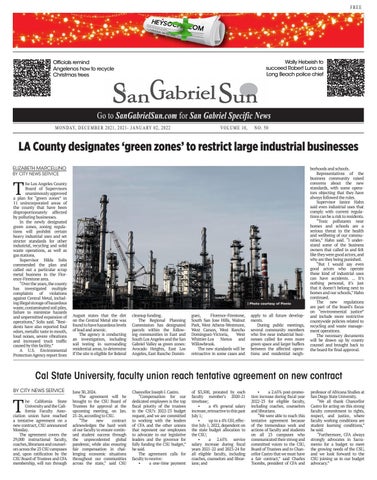
| Photo courtesy of Pixnio
August states that the dirt on the Central Metal site was found to have hazardous levels of lead and arsenic. The agency is conducting an investigation, including soil testing in surrounding residential areas, to determine if the site is eligible for federal
cleanup funding. The Regional Planning Commission has designated parcels within the following communities in East and South Los Angeles and the San Gabriel Valley as green zones: Avocado Heights, East Los Angeles, East Rancho Domin-
guez, Florence-Firestone, South San Jose Hills, Walnut Park, West Athens-Westmont, West Carson, West Rancho Dominguez-Victoria, West Whittier-Los Nietos and Willowbrook. The new standards will be retroactive in some cases and
apply to all future developments. During public meetings, several community members who live near industrial businesses called for even more green space and larger buffers between the affected operations and residential neigh-
borhoods and schools. Representatives of the business community raised concerns about the new standards, with some operators objecting that they have always followed the rules. Supervisor Janice Hahn said even industrial uses that comply with current regulations can be a risk to residents. “Toxic pollutants near homes and schools are a serious threat to the health and wellbeing of our communities,” Hahn said. “I understand some of the business owners that called in and felt like they were good actors, and why are they being punished. “But I would say even good actors who operate these kind of industrial uses can have accidents. ... It’s nothing personal, it’s just that it doesn’t belong next to homes and our schools,” Hahn continued. The new regulations are part of the board’s focus on “environmental justice” and include more restrictive countywide policies related to recycling and waste management operations. The necessary documents will be drawn up by county counsel and brought back to the board for final approval.
Cal State University, faculty union reach tentative agreement on new contract BY CITY NEWS SERVICE
T
he California State University and the California Faculty Association union have reached a tentative agreement on a new contract, CSU announced Monday. The agreement covers the 29,000 instructional faculty, coaches, librarians and counselors across the 23 CSU campuses and, upon ratification by the CSU Board of Trustees and CFA membership, will run through
June 30, 2024. The agreement will be brought to the CSU Board of Trustees for approval at the upcoming meeting, on Jan. 25-26, according to CSU. “The new contract acknowledges the hard work of our faculty to ensure continued student success through the unprecedented global pandemic, while also ensuring fair compensation in challenging economic situations throughout our communities across the state,” said CSU
Chancellor Joseph I. Castro. “Compensation for our dedicated employees is the top fiscal priority of the trustees in the CSU’s 2022-23 budget request, and we are committed to working with the leaders of CFA and the other unions that represent our employees to advocate to our legislative leaders and the governor for fully funding the CSU budget,” he said. The agreement calls for faculty to receive: • a one-time payment
of $3,500, prorated by each faculty member’s 2020-21 timebase; • a 4% general salary increase, retroactive to this past July 1; • up to a 4% GSI, effective July 1, 2022, dependent on the state budget allocation to the CSU; • a 2.65% service salary increase during fiscal years 2021-22 and 2023-24 for all eligible faculty, including coaches, counselors and librarians; and
• a 2.65% post-promotion increase during fiscal year 2022-23 for eligible faculty, including coaches, counselors and librarians. “We were able to reach this tentative agreement because of the tremendous work and actions of faculty and students on all 23 campuses who communicated their strong and committed voices to the CSU, Board of Trustees and to Chancellor Castro that we must have a fair contract,” said Charles Toombs, president of CFA and
professor of Africana Studies at San Diego State University. “We all thank Chancellor Castro for acting on this strong faculty commitment to rights, respect, and justice, where faculty working conditions are student learning conditions,” he said. “Furthermore, CFA always strongly advocates in Sacramento for a budget to meet the growing needs of the CSU, and we look forward to the CSU joining us in our budget advocacy.”
BeaconMediaNews.com
2 DECEMBER 27, 2021 - JANUARY 02, 2022
LA Music Center to require COVID booster
Some UC schools shift to online classes
shots for attendees
in January; COVID boosters mandated
BY CITY NEWS SERVICE
A
ttending a performance at The Music Center in downtown Los Angeles will require full COVID-19 vaccination and a booster shot starting Jan. 17, officials announced Wednesday. The policy will affect all indoor performances and events at the Ahmanson Theatre, Dorothy Chandler Pavilion, Mark Taper Forum and the Walt Disney Concert Hall, including performances by the Los Angeles Philharmonic, Los Angeles Master Chorale and the Center Theatre Group. According to The Music Center, the policy “is in line with its commitment both to safety and the importance of creating a welcoming, inclusive environment for all who visit the campus.” Center officials said audience members who are eligible for the booster but have been unable to get
View of The Music Center toward the Mark Taper Forum. | Photo by Andreas Praefcke via Wikimedia Commons (CC BY 3.0)
one will likely be given a “one-month grace period.” The Music Center’s policy allows people without a booster to show proof of a negative PCR test within 48 hours of the event or a rapid test within 24 hours. At-home tests will not be accepted. But the testing option could vary by event depending on the production company.
Vaccination policies published by the LA Philharmonic and Master Chorale make no mention of a testing option for audience members. The Music Center policy will also apply to all staff and vendors accessing building on the campus, including The Music Center Annex and Grand Park offices.
UCLA. | Photo by ACasualPenguin from Pixabay
BY CITY NEWS SERVICE
U
C Irvine will revert to remote classes for the first two weeks of the winter term in January, the school chancellor announced Tuesday, and other University of California campuses such as UCLA could do the same in response to surging COVID-19 cases. UC system President Dr. Michael Drake sent a letter to all 10 system chancellors Tuesday, stressing that COVID vaccine booster shots will be required for eligible students and staff. He also directed all chancellors to develop “a plan for a January return to campus that mitigates public health impacts, responds to the unique circumstances facing your campus and maintains our teaching and research operations.” “This may require campuses to begin the term using remote instruction in order to allow students to complete an appropriate testing protocol as they return to campus,” Drake wrote. “Given the differences in local conditions and campus operations across the university, the length of this remote instruction period may vary from campus to
campus.” Responding to that call, UC Irvine Chancellor Howard Gillman announced that all classes will be held remotely from Jan. 3 through Jan. 13. “While we recognize that change is a constant in this pandemic environment, we are committed to doing all we can to maintain in-person instruction for the remainder of the academic year,” Gillman wrote in a campus message. “At the present time, however, we know it is not prudent to return to in-person instruction immediately after winter break. “Many members of our community will be traveling and gathering in the weeks before classes are scheduled to begin on January 3, increasing the risks of exposure to the virus, and the transmission of the Omicron variant is predicted to be especially intense toward the end of December and early January.” He said that while classes will be held remotely, “the campus will remain fully operational, with the same staffing policies we have followed for the past few months.” UC Riverside and UC San Diego also announced
temporary shifts to remote learning for January. There was no immediate word from UCLA. In his letter to campus chancellors, Drake stressed that “evidence is clear that receiving a booster is essential to protecting yourself and those around you from Omicron and other variants.” “Under existing UC policy, students, faculty and staff are required to keep their vaccination status up to date,” Drake wrote. “The policy mandates COVID-19 boosters for those who are eligible.” He also wrote that campuses should not be holding any large gatherings. “In line with public health best practices, your return plan should also emphasize the importance of preventive measures on campus, particularly during the initial return phase when students are still in the testing protocol,” he wrote. “This should include vigilance around masking and a responsible approach to in-person gatherings. Large, congregant events, particularly indoors, should be avoided in the opening weeks of your winter quarter or spring semester.”
HLRMedia.com
DECEMBER 27, 2021 - JANUARY 02, 2022 3
Man pleads guilty to scheme involving OC ring broker and Super Bowl rings
Editorial editorial@beaconmedianews.com editor@hlrmedia.com Graphics/Production production@beaconmedianews.com production@hlrmedia.com Advertising advertising@beaconmedianews.com advertising@hlrmedia.com Legal Advertising legals@beaconmedianews.com legals@hlrmedia.com Business accounting@beaconmedianews.com accounting@hlrmedia.com
BEACON MEDIA ADDRESS:
125 E. Chestnut Ave., Monrovia, CA 91016 PHONE: (626) 301-1010 WEBSITE
Temple Tribune City
SanGabriel Sun
www.beaconmedianews.com
HLR MEDIA ADDRESS:
121 E. Chestnut Ave. Monrovia, CA 91016 PHONE: (626) 386-3457 www.HLRmedia.com
A zusa B eacon
Rosemead Reader A Beacon Media, Inc. Publication
Dispatch uarte
PRESS RELEASE SUBMISSIONS editor@beaconmedianews.com editor@hlrmedia.com
SUBMISSIONS POLICY
Beacon Media, Inc. and HLR Media, LLC All contents herein are copyrighted and may not be reproduced in any manner, either in whole or in part, without the express written consent of the publisher. The Views and opinions expressed in this paper are not necessarily that of the management and staff at Beacon Media, Inc. or HLR Media, LLC.
The Arcadia Weekly has been adjudicated as a newspaper of general circulation in court case number GS 004333 for the City of Arcadia, County of Los Angeles, State of California. The Monrovia Weekly has been adjudicated as a newspaper of General Circulation in Court Case GS 004759 City of Monrovia, County of Los Angeles, State of California. The Temple City Tribune has been adjudicated as a newspaper of general circulation in court case number GS 012440 City of Temple City, County of Los Angeles, State of California. The El Monte Examiner has been adjudicated as a newspaper of general circulation in court case number KS 015872 City of El Monte, County of Los Angeles, State of California.
Alhambra PRESS Baldwin Park
The Azusa Beacon has been adjudicated as a newspaper of general circulation in court case number KS 015970 City of Azusa, County of Los Angeles, State of California. The San Gabriel Sun has been adjudicated as a newspaper of general circulation in court case number GS 013808 City of San Gabriel, County of Los Angeles, State of California.
INDEPENDENT
The Duarte Dispatch has been adjudicated as a newspaper of general circulation in court case number GS 013893 City of Duarte, County of Los Angeles, State of California. The Rosemead Reader has been adjudicated as a newspaper of general circulation in court case number GS 048894 City of Rosemead, County of Los Angeles, State of California.
INDEPENDENT
The Alhambra Press has been adjudicated as a newspaper of general circulation in court case number ES016581 City of Alhambra, County of Los Angeles, State of California. The Baldwin Park Press has been adjudicated as a newspaper of general circulation in court case number KS017174 City of Baldwin Park, County of Los Angeles, State of California. The Burbank Independent has been adjudicated as a newspaper of general circulation in court case number ES016728 City of Burbank, County of Los Angeles, State of California. The Glendale Independent has been adjudicated as a newspaper of general circulation in court case number ES016579 City of Glendale, County of Los Angeles, State of California. The Monterey Park Press has been adjudicated as a newspaper of general circulation in court case number ES016580 City of Monterey Park, County of Los Angeles, State of California. The West Covina Press has been adjudicated as a newspaper of general circulation in court case number KS017304 City of West Covina, County of Los Angeles, State of California. The San Bernardino Press has been adjudicated as a newspaper of general circulation in court case number CIVDS 1506881 City of San Bernardino, County of San Bernardino, State of California. The Riverside Independent has been adjudicated as a newspaper of general circulation in court case number RIC1505351 City of Riverside, County of Riverside, State of California.
Pasadena Press
Belmont Beacon
The Pasadena Press has been adjudicated as a newspaper of general circulation in court case number ES018815 City of Pasadena, County of Los Angeles, State of California. The Belmont Beacon has been adjudicated as a newspaper of general circulation in court case number NSO30275 City of Long Beach, County of Los Angeles, State of California. The Anaheim Press has been adjudicated as a newspaper of general circulation in court case number 30-2017-00942735-CU-PT-CJC City of Anaheim, County of Orange, State of California. The Ontario News Press has been adjudicated as a newspaper of general circulation in court case number CIVDS 1506881 City of Ontario, County of San Bernardino, State of California. The Corona News Press has been adjudicated as a newspaper of general circulation in court case number RIC1723524 City of Corona, County of Riverside, State of California.
San Bernardino Press
Three models of the New England Patriots Super Bowl Championship rings. | Photo courtesy of Ron Kikuchi/Flickr (CC BY 2.0)
BY CITY NEWS SERVICE
A
man pleaded guilty to defrauding an Orange County ring broker by posing as a former player for the New England Patriots, which allowed him to purchase family versions of the team’s 2016 Super Bowl championship ring -- supposedly as gifts to relatives of quarterback Tom Brady -- one of which was sold at auction for more than $337,000. Scott V. Spina Jr., 24, of Roseland, New Jersey, was charged with one count of mail fraud, three counts of wire fraud and one count of aggravated identity theft in the scheme that allowed him to purchase three Super Bowl rings engraved with the name “Brady” on them and offer them for sale with the false claim that Tom Brady had given the rings to relatives, according to the U.S. Attorney’s Office. In a plea agreement filed in Los Angeles federal court, Spina agreed to plead guilty to the five felony offenses at a later date.
Court documents detail the scheme that started in 2017 when Spina purchased a Super Bowl LI ring awarded to a Patriots player who subsequently left the team. Spina, who bilked the former player by paying for the ring with at least one bad check, sold the ring soon after for $63,000 to an Orange County-based broker of championship rings identified by the initials S.W. The initials correspond to Scott Welkowsky, an Orange County man who runs the website Rings Of Champions and deals in genuine championship rings. When Spina obtained the player ring, he also received the information that allowed the former player to purchase Super Bowl rings for family and friends that are slightly smaller than the player rings. “Spina then called the Ring Company, fraudulently identified himself as (the former player), and started ordering three family and friend Super Bowl LI rings with the name `Brady’
engraved on each one, which he falsely represented were gifts for the baby of quarterback Tom Brady,” according to documents filed Monday. “The rings were at no time authorized by Tom Brady. Defendant Spina intended to obtain the three rings by fraud and to sell them at a substantial profit.” Spina entered into an agreement with S.W. to sell him the three family rings that Spina now claimed Brady had given to his nephews. After agreeing to buy the three rings for $81,500 -- nearly three times what Spina paid for the rings -- the buyer started to believe that Brady did not have nephews, and he tried to withdraw from the deal. The same day that the buyer tried to back out, and the same day that Spina actually received the rings in November 2017, Spina immediately sold them to an auction house for $100,000. During an auction in February 2018, one of the family rings was sold for $337,219.
In his plea agreement, Spina admitted that he defrauded the Orange County ring broker when he falsely claimed that the rings “were ordered for Tom Brady directly from (the Ring Company) for select family members.” Spina also admitted that he defrauded S.W. in relation to three wire transfers for the deposit on the family rings. Spina further admitted he committed identity theft when he posed as the former Patriot to purchase the rings. Spina agreed to make his first appearance in this case in federal court in Los Angeles on Jan. 31. Once he formally enters the guilty pleas, Spina will face up to 92 years in federal prison, but the actual sentence will likely be substantially less once a federal judge considers federal sentencing guidelines and other factors. As part of the plea agreement, Spina agreed to pay restitution to the former Patriots player who sold his Super Bowl ring and other memorabilia.
BeaconMediaNews.com
4 DECEMBER 27, 2021 - JANUARY 02, 2022
With cyberattacks on the rise, here are 6 cybersecurity trends to be aware of for 2022
Ex-Azusa man sentenced to prison for role in kidnapping of luxury car dealer
| Photo courtesy Ecole polytechnique/Flickr (CC BY 2.0) Alexis Romero-Velez in an undated photo. | Photo courtesy of
Netwrix, a cybersecurity vendor, released key cybersecurity trends that will affect organizations in 2022 earlier this month. With cyberattacks — especially ransomware — on the rise, IT teams and security professionals must be on the alert as never before. Here are six specific predictions from Ilia Sotnikov, cybersecurity expert and VP of User Experience & Security Strategist at Netwrix: — Legislation will increase as security incidents at private companies affect national security. The impact of ransomware and other cyberattacks is no longer limited to just the victim company anymore; attacks are now affecting entire regions. For instance, attacks on companies that supply food or fuel have led to empty shelves in supermarkets and long queues at gas stations. Therefore, we can expect that security requirements for private organizations in critical sectors to become tougher. In particular, notification rules will be affected, as governments need more visibility into the specifics of cyberattacks in order to improve legislation. In some cases, governments may opt to use proverbial carrots as well as sticks, such as tax breaks that reward organizations for investing in cyber
defenses. — Cyber insurance costs will increase and policies will mandate higher security standards. With insurance payouts becoming both more frequent and more costly, the cost of cyber insurance has already skyrocketed: Prices rose 96% in the US and 73% in the UK for the third quarter of 2021 compared to the same quarter last year. We expect continued increases in 2022. Moreover, insurance policies will require implementation of critical controls that reduce the risk of cybersecurity incidents. With attacks becoming increasingly common, insurance companies will pay in exceptional cases only. — More attacks will target MSPs as a path to infiltrate large enterprises or government agencies. Attackers have seized upon a very effective strategy for getting access to large organizations through the relatively weaker IT infrastructures of SMBs that provide them with services. Accordingly, managed service providers (MSPs) will need to increase both the breadth and depth of their security measures, since many SMBs rely upon them on their security. — Quantum computing will begin to disrupt encryption. Most cryptographic algorithms today
rely on the premise that there’s no processor sufficiently powerful to crack them in a reasonable timeframe — but quantum computing will allow such a processor to exist. While this technology is still far from any practical application, concern is growing. For example, the U.S. has announced export controls on eight Chinese quantum computing companies because of worries about China’s ability to break encryption. As the technology matures, we can expect more widespread adoption of post-quantum encryption standards. — Companies will need to address challenges in machine learning. Well over half (59%) of large enterprises today are already using data science (DS) and machine learning (ML). However, these techniques bring risks as well as benefits. ML algorithms are especially vulnerable in the learning phase because bad actors can poison the input in order to subvert the results, which can break critical processes and even put lives in danger in cases such as healthcare or traffic lights in a smart city. Organizations using ML must understand these threats and redouble their efforts to defend against them. — Attackers will use residential home networks as their infrastructure. A home network is much
easier to infect with malicious software than a professionally secured enterprise IT environment. With processing power and bandwidth connectivity in residences increasing, home networks will become more attractive to bad actors. For example, by infecting many devices, they will be able to change IP addresses or even domain names dynamically during malware campaigns, thwarting common defenses like IP blocking and DNS filtering. IT teams should keep this new threat vector in mind when reviewing their security strategies and incident response plans. Moreover, the IT industry should seek to increase user awareness and best practices adoption to reduce the number of easy victims. “Prioritization is the only way for organizations to manage the risk of cyberattacks in this new era of advanced technologies that can be used for both good and evil,” says Sotnikov. “Simply put, organizations need to focus on securing their most important and valuable assets from the most likely incidents, and update their policies regularly. It is increasingly obvious that cyber insurance is not a lifebuoy. Risk assessment is first and foremost our own responsibility.”
the Federal Bureau of Investigation
BY CITY NEWS SERVICE
A
former Azusa resident was sentenced Tuesday to nearly eight years and sixth months in federal prison for participating in the kidnapping of a Southern California luxury car dealer who was held for $2 million ransom, beaten, killed and buried in the Mojave desert. Alexis Romero-Velez, 26, was also ordered to pay restitution in the amount of $33,090, according to the U.S. Attorney’s Office. He pleaded guilty last year to a federal kidnapping conspiracy charge. Romero-Velez admitted driving a minivan used in the kidnapping, which prosecutors allege was orchestrated by two Chinese nationals, Guangyao Yang and Peicheng Shen. In October, Anthony Valladares, 29, of Pasadena, was sentenced to more than 16 years behind bars for his role in the four-person scheme in which Tony Liao was grabbed from the San Gabriel Square shopping plaza on July 16, 2018. Valladares -- who also pleaded guilty to conspiracy to kidnap -- was used as the “muscle” in the operation. After 28-year-old Liao was abducted, his parents in China received ransom
demands suggesting he had been badly beaten, blindfolded and tied up with duct tape. The parents were told to deposit a $2 million ransom payment into Chinese bank accounts within three hours. Liao’s family did not pay the ransom, papers filed in Los Angeles federal court show. Investigators believe Liao was stashed in a closet at a home in Corona and shocked with a Taser until the battery ran out. After the car dealer died from his injuries a day or so later, Yang and Shen drove to the desert near the town of Mojave to bury the body, prosecutors allege. In July 2019, the FBI laboratory used DNA testing to identify Liao’s remains, which were recovered following a search by the FBI’s Evidence Response Team. Yang, 28, and Shen, 35, whose last known U.S. residences were in West Covina, were charged with conspiracy to kidnap, kidnapping, attempted extortion in violation of the Hobbs Act, and threat by foreign communication. They are currently in custody in China on charges filed there related to the kidnapping, prosecutors said.
HLRMedia.com
DECEMBER 27, 2021 - JANUARY 02, 2022 5
San Bernardino Board of Supervisors vote to expedite abatement of illegal cannabis sites The San Bernardino Board of Supervisors unanimously approved ordinances allowing Code Enforcement to immediately issue citations related to illegal cannabis grows and make it easier to abate or clean up those sites. Over the past several months the county has taken an aggressive approach in fighting against illegal cannabis grows with Operation Hammer Strike. Illegal grows negatively impact the wellbeing and safety of area residents and have devastating impacts on the environment. The vote will do several things to help mitigate the impacts of illegal cannabis sites in unincorporated San Bernardino County. The new ordinance creates streamlined and expedited procedures for abatement and passes the cost of clean-up
on to the property owners, not the taxpayers. It will also authorize issuance of immediate administrative citations where there are proven violations related to the illegal cultivation of cannabis. Moreover, it allows for the items used in the cultivation of illegal cannabis to be declared a public nuisance and therefore subject to abatement and discarding. Items include things such as trailers, hoop houses, electrical equipment, fencing, greenhouses, sheds, and irrigation systems. “This vote is a big step forward in our fight against illegal cannabis and the dangers associated with it,” said Dawn Rowe, Vice Chair of the Board of Supervisors. “While we continue to make significant progress in shutting down these sites, we need to do more to ensure
| Photo courtesy of San Bernardino Police Department
that we clean up the mess that these criminals leave behind. All of our residents deserve to live in safe and clean environment.” From Nov. 29 to Dec. 5, the Sheriff’s Marijuana
Enforcement Team along with deputies from several patrol stations served 22 search warrants after receiving numerous complaints about large outdoor and indoor marijuana cultiva-
tions in these areas. Sheriff’s personnel located and arrested 21 suspects. Investigators seized 19,117 marijuana plants, 10,844 pounds of processed marijuana, nine guns and
over $99,000. A total of 312 greenhouses were eradicated from these locations and four indoor grow locations. Investigators mitigated one electrical bypass and one THC extraction lab.
Fire season ends, popular Riverside LA County Health Department awarded $1M for telehealth services County hiking sites now open
Bautista Canyon. | Photo courtesy of the Western Riverside County Regional Conservation Authority
BY CITY NEWS SERVICE
| Photo courtesy of Pixabay
BY CITY NEWS SERVICE
T
he Federal Communications Commission Tuesday approved a $1 million award to the Los Angeles County Department of Health Services for the purchase of telehealth software, services and equipment to deliver real-time video visits with patients. The FCC’s COVID-19 Telehealth Program supports the efforts of health care providers to serve patients
by providing reimbursement for telecommunications services, information services and connected devices necessary to enable telehealth during the pandemic. “As the impact of new variants continue to challenge our healthcare system, the FCC has worked diligently to review and approve funding commitments as part of our COVID-19 Telehealth Program,” said FCC Chairwoman Jessica Rosenworcel.
“As we head into 2022, the ability to treat patients and loved ones from the safety of their home is of vital importance.” The L.A. grant was one of 68 applications approved for funding nationwide, totaling more than $42 million. It was the federal agency’s fifth funding announcement of Round 2 applications, bringing the total to more than $208 million to health care providers around the country.
A
ccess to a half-dozen popular outdoor recreational locations in the central and west sides of Riverside County are now open after a six-month closure to minimize public safety risks amid wildfire season. “I am happy that we are able to reopen these beautiful recreational areas for everyone to enjoy safely,” county fire Chief Bill Weiser said. In early June, the Board of Supervisors authorized Weiser to implement an order establishing fines for anyone entering the sites due to potential brush fire hazards. Since 2007, fire officials have sought and received permission from the board to shut down
general access to the areas, while permitting residents to come and go without interruption. Wildfires in the locations are difficult to manage, given their terrain and remoteness. “Although long-term weather reports suggest a mild winter, our resources and personnel remain in a year-round readiness mode, and so should our residents and visitors be,” Weiser said. The locations where the county’s closure order has been lifted are: - Bautista Canyon, southeast of Hemet; - Eagle Canyon, between Lake Mathews and the county landfill, just north of Cajalco Road; - Indian Canyon and
North Mountain, around San Jacinto; - Ramona Bowl, south of Hemet; - Steel Peek, west of Meadowbrook and north of Highway 74; and - Whitewater Canyon, near Cabazon. By reducing foot and off-road vehicle traffic in each location, the chances of a wildfire starting were much slimmer during the warm months, according to the fire department. Violators who chanced ignoring closure signs and entering the areas faced fines and other penalties. First offenses usually result in a minimum $100 ticket. The closures are generally always lifted at year’s end, but depend on the timing of winter rains.
LEGALS
6 DECEMBER 27, 2021 - JANUARY 02, 2022
Starting a new business?
File your DBA with us at filedba.com
Arcadia City Notices CITY OF ARCADIA NOTICE INVITING BIDS The City of Arcadia (“City”) will receive in a sealed envelope plainly marked on the outside “SEALED BID FOR 2021/2022 Annual Slurry Seal Project / Project No. 55331022 - DO NOT OPEN WITH REGULAR MAIL” at the office of the City Clerk, located at 240 W. Huntington Drive, Arcadia, CA 91007, no later than Tuesday, January 4, 2022 at 11:00 A.M., at which time or thereafter said Bids will be opened and read aloud. Bids received after this time will be returned unopened. Bids shall be valid for sixty (60) calendar days after the Bid opening date. Bids must be submitted to the City on the City’s Contract Bid Forms. Prospective Bidders may obtain Bid Documents only from the Public Works Services Department at the following address: 11800 Goldring Road, Arcadia, California 91006. Please contact the Public Works Services Department at (626) 254-2720 for more information, including availability of Bid Documents and costs. One or more Pre-Bid Conference and Site Walks will be held on the date(s), at the time(s) and under the conditions indicated in the Bid Documents. Bidder SHOULD attend. All Bids must be addressed, sealed in an envelope and received by the office of the City Clerk no later than 11:00 A.M. on Tuesday, January 4, 2022. All Bids will be publicly opened, examined and read aloud at the City’s Clerk’s office at that time. Bids shall be valid for 60 days after the bid opening date. Bids must be accompanied by cash, a certified or cashier’s check, or a Bid Bond in favor of the City in an amount not less than ten percent (10%) of the submitted Total Bid Price. The successful Bidder will be required to furnish the City with a Performance Bond and a Payment Bond, each equal to 100% of the successful Bid, prior to execution of the Contract. All bonds are to be secured from a surety that meets all of the State of California bonding requirements, as defined in Code of Civil Procedure Section 995.120, and is admitted by the State of California. Each Bidder shall be a licensed contractor pursuant to the Business and Professions Code and shall be licensed in the following appropriate classification(s) of contractor’s license(s), for the work Bid upon, and must maintain the license(s) throughout the duration of the Contract: Class A or Class C-12. Bidders are advised that this Contract is a public work for purposes of the California Labor Code, which requires payment of prevailing wages. City has obtained from the Director of the Department of Industrial Relations the general prevailing rates, and will place them on file at the City’s office and make them available to any interested party upon request. Pursuant to Labor Code sections 1725.5 and 1771.1, all contractors and subcontractors that wish to bid on, be listed in a bid proposal, or enter into a contract to perform public work must be registered with the Department of Industrial Relations. No bid will be accepted nor any contract entered into without proof of the contractor’s and subcontractors’ current registration with the Department of Industrial Relations to perform public work. City reserves the right to reject any or all Bids, to waive any informality or irregularity in any Bid received, and to be the sole judge of the merits of the respective Bids received. CITY OF ARCADIA Monday, December 13, December 20, and December 27, 2021 ARCADIA WEEKLY
SUMMARY OF URGENCY ORDINANCE NO. 2385, AN URGENCY ORDINANCE OF THE CITY COUNCIL OF THE CITY OF ARCADIA AMENDING DIVISIONS 2 AND 5 OF CHAPTER 1, ARTICLE IX, OF THE ARCADIA MUNICIPAL CODE RELATED TO URBAN LOT SPLITS AND TWO-UNIT PROJECTS AND DETERMINING THE ORDINANCE TO BE STATUTORILY EXEMPT FROM THE CALIFORNIA ENVIRONMENTAL QUALITY ACT Pursuant to Government Code Section 36933 (c), the following constitutes a summary of Ordinance No. 2385 that was adopted by the Arcadia City Council at their regular meeting held on December 21, 2021. Governor Newsom signed Senate Bill 9 – Housing Development: Approvals (“SB 9”) into law on September 16, 2021. Among other provisions, SB 9 requires local governments to ministerially approve housing developments containing two residential units on single-family zoned parcels, and to ministerially approve subdivisions of single-family zoned parcels into two parcels. SB 9 goes into effect on January 1, 2022. Because the new law dramatically changes how development can occur in single-family zones, the Development Services Department has been working with the City Attorney to develop Urgency Ordinance No. 2385 to put allowable regulations in place related to SB 9 prior to the effective date of
January 1. Below are the primary tenets of the Ordinance. • The regulations are divided into two sections, one specifically dealing with Urban Lot Splits and one for Two-Unit Projects. Fees for Urban Lot Splits will be set at the same cost as Lot Line Adjustments ($1,770) and fees for Two-Unit Projects will be set at the same cost as Preliminary Plan Review for Multi-Family Projects ($1,617). The costs of these processes are very similar in scope and effort and these two existing processes. • Urban lot splits will not be allowed in areas that are not zoned Single-Family Residential, are in a historic district, have an impact on protected housing (such as existing low-income housing or will impact existing tenants), or result in a lot that contains more than 60% of the frontage or area of the original lot or less than 40% of the frontage or area of the original lot. • The allowable unit size of a unit built following an Urban Lot Split OR for units built as a second unit of a two-unit project is no greater than 800 square feet. This is the size of unit that is specifically mentioned in the text of SB 9. • All new units are subject to height, setback, lot coverage, floor area ratio, and parking requirements within the Code as well as objective development standards related to architecture and appearance, landscaping, fences and walls, and parking. All of these standards are enforceable to the extent they do not prevent the development of two 800 square foot units on a qualifying lot. In a case where an 800 square foot unit cannot be built, the standards must yield to the extent that the unit could be built. • Units created through these processes may not be used for commercial purposes or used as short-term rentals, and owners must live on the property for three years after the units are completed. The City Council finds that this Ordinance is not subject to the California Environmental Quality Act (“CEQA”) because under California Government Code sections 65852.21, subd. (j) and 66411.7, subd. (n), the adoption of an ordinance by a city or county implementing the provisions of Government Code sections 66411.7 and 65852.21 and regulating urban lot splits and two-unit projects is statutorily exempt from the requirements of CEQA. Therefore, the proposed ordinance is statutorily exempt from CEQA in that the proposed ordinance implements these new laws enacted by SB 9. A certified copy of the full text of the Ordinance is available for review in the City Clerk’s Office at 240 W. Huntington Drive, Arcadia, California. This Ordinance was adopted by the City Council of the City of Arcadia on December 21, 2021, by the following vote: AYES: Beck, Verlato, Cheng, and Tay NOES: None ABSENT: None /s/ Linda Rodriguez Assistant City Clerk Date: December 22, 2021 Publish Date: December 27, and December 30, 2021 ARCADIA WEEKLY
Probate Notices NOTICE OF PETITION TO ADMINISTER ESTATE OF: JAMES S. PIERCE AKA JAMES STEVEN PIERCE AKA JIM PIERCE CASE NO. 21STPB11789
To all heirs, beneficiaries, creditors, contingent creditors, and persons who may otherwise be interested in the WILL or estate, or both of JAMES S. PIERCE AKA JAMES STEVEN PIERCE AKA JIM PIERCE. A PETITION FOR PROBATE has been filed by JEAN PIERCE MEZA AKA JEAN M. KERSHAW in the Superior Court of California, County of LOS ANGELES. THE PETITION FOR PROBATE requests that JEAN PIERCE MEZA AKA JEAN M. KERSHAW be appointed as personal representative to administer the estate of the decedent. THE PETITION requests the decedent’s WILL and codicils, if any, be admitted to probate. The WILL and any codicils are available for examination in the file kept by the court. THE PETITION requests authority to administer the estate under the Independent Administration of Estates Act. (This authority will allow the personal representative to take many actions without obtaining court approval. Before taking certain very important actions, however, the personal representative will be required to give notice to interested persons unless they have waived notice or
consented to the proposed action.) The independent administration authority will be granted unless an interested person files an objection to the petition and shows good cause why the court should not grant the authority. A HEARING on the petition will be held in this court as follows: 01/18/22 at 8:30AM in Dept. 79 located at 111 N. HILL ST., LOS ANGELES, CA 90012 IF YOU OBJECT to the granting of the petition, you should appear at the hearing and state your objections or file written objections with the court before the hearing. Your appearance may be in person or by your attorney. IF YOU ARE A CREDITOR or a contingent creditor of the decedent, you must file your claim with the court and mail a copy to the personal representative appointed by the court within the later of either (1) four months from the date of first issuance of letters to a general personal representative, as defined in section 58(b) of the California Probate Code, or (2) 60 days from the date of mailing or personal delivery to you of a notice under section 9052 of the California Probate Code. Other California statutes and legal authority may affect your rights as a creditor. You may want to consult with an attorney knowledgeable in California law. YOU MAY EXAMINE the file kept by the court. If you are a person interested in the estate, you may file with the court a Request for Special Notice (form DE-154) of the filing of
BeaconMediaNews.com an inventory and appraisal of estate assets or of any petition or account as provided in Probate Code section 1250. A Request for Special Notice form is available from the court clerk. Attorney for Petitioner JASON L. GAUDY - SBN 228975 GAUDY LAW, INC. 267 D STREET UPLAND CA 91786 12/20, 12/23, 12/27/21 CNS-3539041# DUARTE DISPATCH
NOTICE OF PETITION TO ADMINISTER ESTATE OF: RICHARD CHARLES AUDET CASE NO. 21STPB11738
To all heirs, beneficiaries, creditors, contingent creditors, and persons who may otherwise be interested in the WILL or estate, or both of RICHARD CHARLES AUDET. A PETITION FOR PROBATE has been filed by HAZEL WADIA AUDET in the Superior Court of California, County of LOS ANGELES. THE PETITION FOR PROBATE requests that HAZEL WADIA AUDET be appointed as personal representative to administer the estate of the decedent. THE PETITION requests the decedent’s WILL and codicils, if any, be admitted to probate. The WILL and any codicils are available for examination in the file kept by the court. THE PETITION requests authority to administer the estate under the Independent Administration of Estates Act. (This authority will allow the personal representative to take many actions without obtaining court approval. Before taking certain very important actions, however, the personal representative will be required to give notice to interested persons unless they have waived notice or consented to the proposed action.) The independent administration authority will be granted unless an interested person files an objection to the petition and shows good cause why the court should not grant the authority. A HEARING on the petition will be held in this court as follows: 01/19/22 at 8:30AM in Dept. 67 located at 111 N. HILL ST., LOS ANGELES, CA 90012 IF YOU OBJECT to the granting of the petition, you should appear at the hearing and state your objections or file written objections with the court before the hearing. Your appearance may be in person or by your attorney. IF YOU ARE A CREDITOR or a contingent creditor of the decedent, you must file your claim with the court and mail a copy to the personal representative appointed by the court within the later of either (1) four months from the date of first issuance of letters to a general personal representative, as defined in section 58(b) of the California Probate Code, or (2) 60 days from the date of mailing or personal delivery to you of a notice under section 9052 of the California Probate Code. Other California statutes and legal authority may affect your rights as a creditor. You may want to consult with an attorney knowledgeable in California law. YOU MAY EXAMINE the file kept by the court. If you are a person interested in the estate, you may file with the court a Request for Special Notice (form DE-154) of the filing of an inventory and appraisal of estate assets or of any petition or account as provided in Probate Code section 1250. A Request for Special Notice form is available from the court clerk. Attorney for Petitioner LESLIE E. RILEY - SBN 265987 VARNER & BRANDT LLP 3237 E GUASTI RD #220 ONTARIO CA 91761 12/20, 12/23, 12/27/2021 CNS-3538756# ROSEMEAD READER
NOTICE OF PETITION TO ADMINISTER ESTATE OF: VERA LIRA AKA VERA RIRA CASE NO. 21STPB12014
To all heirs, beneficiaries, creditors, contingent creditors, and persons who may otherwise be interested in the WILL or estate, or both of VERA LIRA AKA VERA RIRA. A PETITION FOR PROBATE has been filed by COUNTY OF LOS ANGELES PUBLIC ADMINISTRATOR in the Superior Court of California, County of LOS ANGELES. THE PETITION FOR PROBATE requests that COUNTY OF LOS ANGELES PUBLIC ADMINISTRATOR be appointed as personal representative to administer the estate of the
decedent. THE PETITION requests authority to administer the estate under the Independent Administration of Estates Act with limited authority. (This authority will allow the personal representative to take many actions without obtaining court approval. Before taking certain very important actions, however, the personal representative will be required to give notice to interested persons unless they have waived notice or consented to the proposed action.) The independent administration authority will be granted unless an interested person files an objection to the petition and shows good cause why the court should not grant the authority. A HEARING on the petition will be held in this court as follows: 01/26/22 at 8:30AM in Dept. 5 located at 111 N. HILL ST., LOS ANGELES, CA 90012 IF YOU OBJECT to the granting of the petition, you should appear at the hearing and state your objections or file written objections with the court before the hearing. Your appearance may be in person or by your attorney. IF YOU ARE A CREDITOR or a contingent creditor of the decedent, you must file your claim with the court and mail a copy to the personal representative appointed by the court within the later of either (1) four months from the date of first issuance of letters to a general personal representative, as defined in section 58(b) of the California Probate Code, or (2) 60 days from the date of mailing or personal delivery to you of a notice under section 9052 of the California Probate Code. Other California statutes and legal authority may affect your rights as a creditor. You may want to consult with an attorney knowledgeable in California law. YOU MAY EXAMINE the file kept by the court. If you are a person interested in the estate, you may file with the court a Request for Special Notice (form DE-154) of the filing of an inventory and appraisal of estate assets or of any petition or account as provided in Probate Code section 1250. A Request for Special Notice form is available from the court clerk. Attorney for Petitioner SYNA N. DENNIS, PRINCIPAL DEPUTY COUNTY COUNSEL SBN 134511 OFFICE OF THE COUNTY COUNSEL, PROBATE DIVISION 500 W. TEMPLE ST., #652 LOS ANGELES CA 90012 12/27, 12/30/21, 1/3/22 CNS-3541165# TEMPLE CITY TRIBUNE
Public Notices NOTICE IS HEREBY GIVEN the undersigned intends to sell the personal property described below to enforce a lien imposed on said property pursuant to Sections 21700-21716 of the Business & Professions Code, Section 2328 of the UCC, Section 535 of the Penal Code and provisions of the Civil Code. Any vehicles sold will be under Section 3071 of motor vehicle code. The Online bidding starts on 12/20/2021 and ends at 9:00AM on 01/03/2022. Full access to this auction can be viewed at www.bid13.com. The undersigned will be sold by competitive bidding at BID13 on or after the 12/20/2021 at 9:00AM or later, on the premises where said property has been stored and which are located at: Mt.Olive Storage 1500 Crestfeild Dr. Duarte, CA 91010 County of Los Angeles State of California Unit sold appear to contain: Misc. furniture, household goods, and boxes, tools, luggage, clothes, electronics, toys Belonging to: K19 Susan B Burris E54 Tom R Medrano E37 Tom R Medrano D37 Cynthia Williams C46 Patrice Fayley B13 Lisa M Brown Purchases must be paid for at the time of purchase in CASH ONLY. All purchased items sold as is and must be removed at the time of sale. Sale subject to cancellation in the event of settlement between owner and obligated party. Bid 13 HST License #864431754 This notice will be published on the following dates: December 20, 2021, and December 27, 2021 in the Duarte Dispatch NOTICE OF PUBLIC HEARING Notice of Oak Tree Permit Filing The Los Angeles County Hearing Officer will conduct a public hearing to consider the project described below. You will have an opportunity to testify, or you can submit
LEGALS
HLRMedia.com written comments to the planner below or at the public hearing. If the final decision on this proposal is challenged in court, testimony may be limited to issues raised before or at the public hearing. Hearing Date and Time: Tuesday February 1, 2022 at 9:00 a.m. Hearing Location: 320 West Temple St., Rm. 150, Los Angeles, CA 90012, and Online. Please note that due to the COVID-19 pandemic, a virtual public hearing may be held. County facilities may still be closed to the public at this time. Visit http://planning.lacounty.gov/ho and select hearing date for more information. Project & Permit: PRJ2020-002254-(5), Oak Tree Permit RPPL2020007042 Project Location: 998 Lehigh Street, Altadena within the West San Gabriel Valley Planning Area CEQA Categorical Exemptions: Class 3 (New Construction or Conversion of Small Structures) and Class 4 (Minor Alterations to Land) Project Description: A request to authorize the encroachment of construction activity into the protected zone of two oak trees pursuant to section 22.174.030 of the Los Angeles County Code. For more information contact Michele Bush , 320 W. Temple St., Los Angeles, CA 90012. Telephone: (213) 974-6411, E-mail: mbush@ planning.lacounty.gov. Case materials are available online at http://planning.lacounty. gov/case. All correspondence received by DRP shall be considered a public record. If you need reasonable accommodations or auxiliary aids, contact the Americans with Disabilities Act (ADA) Coordinator at (213) 974-6488 (Voice) or (213) 617-2292 (TDD) with at least 3 business days’ notice. Si necesita más información por favor llame al (213) 974-6411. 12/27/21 CNS-3539551# SAN GABRIEL SUN NOTICE IS HEREBY GIVEN the undersigned intends to sell the personal property described below to enforce a lien imposed on said property pursuant to Sections 21700-21716 of the Business & Professions Code, Section 2328 of the UCC, Section 535 of the Penal Code and provisions of the Civil Code. Any vehicles sold will be under Section 3071 of motor vehicle code. The Online bidding starts on 12/27/2021 and ends at 10:00 AM 1/10/2022. Full access to this auction can be viewed at www. bid13.com. The undersigned will be sold by competitive bidding at BID13 on or after the 1/10/2022 at 10:00 AM or later, on the premises where said property has been stored and which are located at: Stor-Mor Self Storage 8635 E. Valley Blvd. Rosemead CA 91770 626-287-3865 Unit sold appear to contain: Misc. furniture, household goods, and boxes, electronics, toys, tools Belonging to: Unit# A618, Lichty, Loren Unit# B509, Ritson, Paula Unit# A315, Steinberg, Christopher Unit# A302, Gutierrez, Tracy Unit# B408, Dang, Todd Unit# B732, Merendino, Micah Unit# A928, Trujeque, Tracy Unit# B501, Rodriguez, Steven Unit# A408, Ybarra, Tracy Unit# B336, Lytle, Stephan Purchases must be paid for at the time of purchase in CASH ONLY. All purchased items sold as is and must be removed at the time of sale. Sale subject to cancellation in the event of settlement between owner and obligated party. Bid 13 HST License #864431754 Publish December 27, 2021 & January 3, 2022 in THE ROSEMEAD READER
Trustee Notices APN: 8268-015-016 TS No: CA0700012821-1 TO No: 210440675-CA-VOI NOTICE OF TRUSTEE’S SALE (The above statement is made pursuant to CA Civil Code Section 2923.3(d)(1). The Summary will be provided to Trustor(s) and/or vested owner(s) only, pursuant to CA Civil Code Section 2923.3(d)(2).) YOU ARE IN DEFAULT UNDER A DEED OF TRUST DATED May 28, 2009. UNLESS YOU TAKE ACTION TO PROTECT YOUR PROPERTY, IT MAY BE SOLD AT A PUBLIC SALE. IF YOU NEED AN EXPLANATION OF THE NATURE OF THE PROCEEDINGS AGAINST YOU, YOU SHOULD CONTACT A LAWYER. On February 3, 2022 at 10:00 AM, behind the fountain located in the Civic Center Plaza, 400 Civic Center Plaza, Pomona CA 91766, MTC Financial Inc. dba Trustee Corps, as the duly Appointed Trustee, under and pursuant to the power of sale contained in that certain Deed of Trust recorded on June 3, 2009 as Instrument No. 20090821878, of official records in the Office of the Recorder of Los Angeles County, California, executed by JIN WHITE, AS HER SEPARATE PROPERTY, as Trustor(s), in favor of MORTGAGE ELECTRONIC REGISTRATION SYSTEMS, INC, as Beneficiary, as nominee for SUN WEST MORTGAGE COMPANY, INC as Beneficiary, WILL SELL AT PUBLIC AUCTION TO THE HIGHEST BIDDER, in lawful money of the United States, all payable at the time of sale, that certain property situated in said County, California describing the land therein as: AS MORE FULLY DESCRIBED IN SAID DEED OF TRUST The property heretofore described is being sold “as is”. The street address and other common designation, if any, of the real property described above is purported to be: 18207 LA CORTITA STREET, ROWLAND HEIGHTS, CA 91748-3507 The undersigned Trustee disclaims any liability for any incorrectness of the street
address and other common designation, if any, shown herein. Said sale will be made without covenant or warranty, express or implied, regarding title, possession, or encumbrances, to pay the remaining principal sum of the Note(s) secured by said Deed of Trust, with interest thereon, as provided in said Note(s), advances if any, under the terms of the Deed of Trust, estimated fees, charges and expenses of the Trustee and of the trusts created by said Deed of Trust. The total amount of the unpaid balance of the obligations secured by the property to be sold and reasonable estimated costs, expenses and advances at the time of the initial publication of this Notice of Trustee’s Sale is estimated to be $368,263.00 (Estimated). However, prepayment premiums, accrued interest and advances will increase this figure prior to sale. Beneficiary’s bid at said sale may include all or part of said amount. In addition to cash, the Trustee will accept a cashier’s check drawn on a state or national bank, a check drawn by a state or federal credit union or a check drawn by a state or federal savings and loan association, savings association or savings bank specified in Section 5102 of the California Financial Code and authorized to do business in California, or other such funds as may be acceptable to the Trustee. In the event tender other than cash is accepted, the Trustee may withhold the issuance of the Trustee’s Deed Upon Sale until funds become available to the payee or endorsee as a matter of right. The property offered for sale excludes all funds held on account by the property receiver, if applicable. If the Trustee is unable to convey title for any reason, the successful bidder’s sole and exclusive remedy shall be the return of monies paid to the Trustee and the successful bidder shall have no further recourse. Notice to Potential Bidders If you are considering bidding on this property lien, you should understand that there are risks involved in bidding at a Trustee auction. You will be bidding on a lien, not on the property itself. Placing the highest bid at a Trustee auction does not automatically entitle you to free and clear ownership of the property. You should also be aware that the lien being auctioned off may be a junior lien. If you are the highest bidder at the auction, you are or may be responsible for paying off all liens senior to the lien being auctioned off, before you can receive clear title to the property. You are encouraged to investigate the existence, priority, and size of outstanding liens that may exist on this property by contacting the county recorder’s office or a title insurance company, either of which may charge you a fee for this information. If you consult either of these resources, you should be aware that the same Lender may hold more than one mortgage or Deed of Trust on the property. Notice to Property Owner The sale date shown on this Notice of Sale may be postponed one or more times by the Mortgagee, Beneficiary, Trustee, or a court, pursuant to Section 2924g of the California Civil Code. The law requires that information about Trustee Sale postponements be made available to you and to the public, as a courtesy to those not present at the sale. If you wish to learn whether your sale date has been postponed, and, if applicable, the rescheduled time and date for the sale of this property, you may call In Source Logic at 702-659-7766 for information regarding the Trustee’s Sale or visit the Internet Website www.insourcelogic.com for information regarding the sale of this property, using the file number assigned to this case, CA07000128-21-1. Information about postponements that are very short in duration or that occur close in time to the scheduled sale may not immediately be reflected in the telephone information or on the Internet Website. The best way to verify postponement information is to attend the scheduled sale. Notice to Tenant NOTICE TO TENANT FOR FORECLOSURES AFTER JANUARY 1, 2021 You may have a right to purchase this property after the trustee auction pursuant to Section 2924m of the California Civil Code. If you are an “eligible tenant buyer,” you can purchase the property if you match the last and highest bid placed at the trustee auction. If you are an “eligible bidder,” you may be able to purchase the property if you exceed the last and highest bid placed at the trustee auction. There are three steps to exercising this right of purchase. First, 48 hours after the date of the trustee sale, you can call 702-659-7766, or visit this internet website www.insourcelogic.com, using the file number assigned to this case CA07000128-21-1 to find the date on which the trustee’s sale was held, the amount of the last and highest bid, and the address of the trustee. Second, you must send a written notice of intent to place a bid so that the trustee receives it no more than 15 days after the trustee’s sale. Third, you must submit a bid so that the trustee receives it no more than 45 days after the trustee’s sale. If you think you may qualify as an “eligible tenant buyer” or “eligible bidder,” you should consider contacting an attorney or appropriate real estate professional immediately for advice regarding this potential right to purchase. Date: December 3, 2021 MTC Financial Inc. dba Trustee Corps TS No. CA07000128-21-1 17100 Gillette Ave Irvine, CA 92614 Phone: 949-252-8300 TDD: 866-660-4288 Amy Lemus, Authorized Signatory SALE INFORMATION CAN BE OBTAINED ON LINE AT www. insourcelogic.com FOR AUTOMATED SALES INFORMATION PLEASE CALL: In Source Logic AT 702-659-7766 Trustee Corps may be acting as a debt collector attempting to collect a debt. Any information obtained may be used for that purpose. Order Number 78911, Pub Dates: 12/13/2021, 12/20/2021, 12/27/2021, AZUSA BEACON APN: 8608-028-024 TS No: CA0700033020-1 TO No: 200037877-CA-VOI NOTICE OF TRUSTEE’S SALE (The above statement is made pursuant to CA Civil Code Section 2923.3(d)(1). The Summary will be provided to Trustor(s) and/or vested owner(s) only, pursuant to CA Civil Code
Section 2923.3(d)(2).) YOU ARE IN DEFAULT UNDER A DEED OF TRUST DATED April 23, 2015. UNLESS YOU TAKE ACTION TO PROTECT YOUR PROPERTY, IT MAY BE SOLD AT A PUBLIC SALE. IF YOU NEED AN EXPLANATION OF THE NATURE OF THE PROCEEDINGS AGAINST YOU, YOU SHOULD CONTACT A LAWYER. On February 15, 2022 at 10:00 AM, behind the fountain located in the Civic Center Plaza, 400 Civic Center Plaza, Pomona CA 91766, MTC Financial Inc. dba Trustee Corps, as the duly Appointed Trustee, under and pursuant to the power of sale contained in that certain Deed of Trust recorded on May 1, 2015 as Instrument No. 20150500463, of official records in the Office of the Recorder of Los Angeles County, California, executed by SANDRA J MARTINEZ, AN UNMARRIED WOMAN, as Trustor(s), in favor of MORTGAGE ELECTRONIC REGISTRATION SYSTEMS, INC., as Beneficiary, as nominee for LIBERTY HOME EQUITY SOLUTIONS, INC as Beneficiary, WILL SELL AT PUBLIC AUCTION TO THE HIGHEST BIDDER, in lawful money of the United States, all payable at the time of sale, that certain property situated in said County, California describing the land therein as: AS MORE FULLY DESCRIBED IN SAID DEED OF TRUST The property heretofore described is being sold “as is”. The street address and other common designation, if any, of the real property described above is purported to be: 339 E 8TH ST, AZUSA, CA 91702-2547 The undersigned Trustee disclaims any liability for any incorrectness of the street address and other common designation, if any, shown herein. Said sale will be made without covenant or warranty, express or implied, regarding title, possession, or encumbrances, to pay the remaining principal sum of the Note(s) secured by said Deed of Trust, with interest thereon, as provided in said Note(s), advances if any, under the terms of the Deed of Trust, estimated fees, charges and expenses of the Trustee and of the trusts created by said Deed of Trust. The total amount of the unpaid balance of the obligations secured by the property to be sold and reasonable estimated costs, expenses and advances at the time of the initial publication of this Notice of Trustee’s Sale is estimated to be $256,878.79 (Estimated). However, prepayment premiums, accrued interest and advances will increase this figure prior to sale. Beneficiary’s bid at said sale may include all or part of said amount. In addition to cash, the Trustee will accept a cashier’s check drawn on a state or national bank, a check drawn by a state or federal credit union or a check drawn by a state or federal savings and loan association, savings association or savings bank specified in Section 5102 of the California Financial Code and authorized to do business in California, or other such funds as may be acceptable to the Trustee. In the event tender other than cash is accepted, the Trustee may withhold the issuance of the Trustee’s Deed Upon Sale until funds become available to the payee or endorsee as a matter of right. The property offered for sale excludes all funds held on account by the property receiver, if applicable. If the Trustee is unable to convey title for any reason, the successful bidder’s sole and exclusive remedy shall be the return of monies paid to the Trustee and the successful bidder shall have no further recourse. Notice to Potential Bidders If you are considering bidding on this property lien, you should understand that there are risks involved in bidding at a Trustee auction. You will be bidding on a lien, not on the property itself. Placing the highest bid at a Trustee auction does not automatically entitle you to free and clear ownership of the property. You should also be aware that the lien being auctioned off may be a junior lien. If you are the highest bidder at the auction, you are or may be responsible for paying off all liens senior to the lien being auctioned off, before you can receive clear title to the property. You are encouraged to investigate the existence, priority, and size of outstanding liens that may exist on this property by contacting the county recorder’s office or a title insurance company, either of which may charge you a fee for this information. If you consult either of these resources, you should be aware that the same Lender may hold more than one mortgage or Deed of Trust on the property. Notice to Property Owner The sale date shown on this Notice of Sale may be postponed one or more times by the Mortgagee, Beneficiary, Trustee, or a court, pursuant to Section 2924g of the California Civil Code. The law requires that information about Trustee Sale postponements be made available to you and to the public, as a courtesy to those not present at the sale. If you wish to learn whether your sale date has been postponed, and, if applicable, the rescheduled time and date for the sale of this property, you may call In Source Logic at 702-659-7766 for information regarding the Trustee’s Sale or visit the Internet Website www.insourcelogic.com for information regarding the sale of this property, using the file number assigned to this case, CA07000330-20-1. Information about postponements that are very short in duration or that occur close in time to the scheduled sale may not immediately be reflected in the telephone information or on the Internet Website. The best way to verify postponement information is to attend the scheduled sale. Notice to Tenant NOTICE TO TENANT FOR FORECLOSURES AFTER JANUARY 1, 2021 You may have a right to purchase this property after the trustee auction pursuant to Section 2924m of the California Civil Code. If you are an “eligible tenant buyer,” you can purchase the property if you match the last and highest bid placed at the trustee auction. If you are an “eligible bidder,” you may be able to purchase the property if you exceed the last and highest bid placed at the trustee auction. There are three steps to exercising this right of purchase. First, 48 hours after the date of the trustee sale, you can call 702-659-7766, or visit this internet website www.insourcelogic.com, using the file number assigned to this
case CA07000330-20-1 to find the date on which the trustee’s sale was held, the amount of the last and highest bid, and the address of the trustee. Second, you must send a written notice of intent to place a bid so that the trustee receives it no more than 15 days after the trustee’s sale. Third, you must submit a bid so that the trustee receives it no more than 45 days after the trustee’s sale. If you think you may qualify as an “eligible tenant buyer” or “eligible bidder,” you should consider contacting an attorney or appropriate real estate professional immediately for advice regarding this potential right to purchase. Date: December 13, 2021 MTC Financial Inc. dba Trustee Corps TS No. CA0700033020-1 17100 Gillette Ave Irvine, CA 92614 Phone: 949-252-8300 TDD: 866-660-4288 Amy Lemus, Authorized Signatory SALE INFORMATION CAN BE OBTAINED ON LINE AT www.insourcelogic.com FOR AUTOMATED SALES INFORMATION PLEASE CALL: In Source Logic AT 702659-7766 Trustee Corps may be acting as a debt collector attempting to collect a debt. Any information obtained may be used for that purpose. Order Number 79039, Pub Dates: 12/20/2021, 12/27/2021, 1/3/2022, AZUSA BEACON
Fictitious Business Name Filings FICTITIOUS BUSINESS NAME STATEMENT 2021259239 The following person(s) is/are doing business as: ALEXANDER BEVERLY HILLS, 9454 WILSHIRE BLVD #803, BEVERLY HILLS, CA 91436 LOS ANGELES. Mailing address if different: N/A. Articles of Incorporation or Organization Number: 4083861. The full name(s) of registrant(s) is/are: ALEXANDER JEWELS & GEMS, INC., 9454 WILSHIRE BLVD #803, BEVERLY HILLS, CA 90212 (State of Incorporation/Organization: CALIFORNIA). This business is conducted by: CORPORATION. I declare that all information in this statement is true and correct. (A registrant who declares as true information which he or she knows to be false is guilty of a crime.) Signed: ALEXANDER BOYADJIAN, CEO. The registrant commenced to transact business under the fictitious business name listed above on (date): N/A. This statement was filed with the County Clerk of Los Angeles County on (Date) 11/30/2021. NOTICE: This fictitious name statement expires five years from the date it was filed in the office of the county clerk. A new fictitious business name statement must be filed before that time. The filing of this statement does not of itself authorize the use in this state of a fictitious business name in violation of the rights of another under federal, state, or common law (see Section 14411 et seq. Business and Professions Code). Publish: 12/06/2021, 12/13/2021, 12/20/2021, 12/27/2021. ARCADIA WEEKLY. AAA942074. FICTITIOUS BUSINESS NAME STATEMENT 2021260113 The following person(s) is/are doing business as: DAVANNEE FASHION & CANDLES, 9700 ZELZAH AVENUE #110, NORTHRIDGE, CA 91325 LOS ANGELES. Mailing address if different: N/A. The full name(s) of registrant(s) is/are: NINETT ACEVEDO, 9700 ZELZAH AVENUE #110, NORTHRIDGE, CA 91325. This business is conducted by: INDIVIDUAL. I declare that all information in this statement is true and correct. (A registrant who declares as true information which he or she knows to be false is guilty of a crime.) Signed: NINETT ACEVEDO, OWNER. The registrant commenced to transact business under the fictitious business name listed above on (date): N/A. This statement was filed with the County Clerk of Los Angeles County on (Date) 12/01/2021. NOTICE: This fictitious name statement expires five years from the date it was filed in the office of the county clerk. A new fictitious business name statement must be filed before that time. The filing of this statement does not of itself authorize the use in this state of a fictitious business name in violation of the rights of another under federal, state, or common law (see Section 14411 et seq. Business and Professions Code). Publish: 12/06/2021, 12/13/2021, 12/20/2021, 12/27/2021. ARCADIA WEEKLY. AAA949732.
FICTITIOUS BUSINESS NAME STATEMENT 2021245916 The following person(s) is/are doing business as: FISHUB, 20219 BLYTHE ST, WINNETKA, CA 91306 LOS ANGELES. Mailing address if different: N/A. The full name(s) of registrant(s) is/ are: MICHELLE ZAINAB MULK, 20219 BLYTHE ST, WINNETKA, CA 91306. This business is conducted by: INDIVIDUAL. I declare that all information in this statement is true and correct. (A registrant who declares as true information which he or she knows to be false is guilty of a crime.) Signed: MICHELLE ZAINAB MULK, OWNER. The registrant commenced to transact business under the fictitious business name listed above on (date): 10/2021. This statement was filed with the County Clerk of Los Angeles County on (Date) 11/08/2021. NOTICE: This fictitious name statement expires five years from the date it was filed in the office of the county clerk. A new fictitious business name statement must be filed before that time. The filing of this statement does not of itself authorize the use in this state of a fictitious business name
DECEMBER 27, 2021 - JANUARY 02, 2022 7 in violation of the rights of another under federal, state, or common law (see Section 14411 et seq. Business and Professions Code). Publish: 12/06/2021, 12/13/2021, 12/20/2021, 12/27/2021. ARCADIA WEEKLY. AAA954049. FICTITIOUS BUSINESS NAME STATEMENT 2021245964 The following person(s) is/are doing business as: HIGHLIGHT DENTAL STUDIO, 621 S. VIRGIL AVE. 415, LOS ANGELES, CA 90005 LOS ANGELES. Mailing address if different: 3183 WILSHIRE BLVD. 513, LOS ANGELES, CA 90010. The full name(s) of registrant(s) is/are: KRISTI KIM DENTAL CORPORATION, 3183 WILSHIRE BLVD. 513, LOS ANGELES, CA 90010 (State of Incorporation/ Organization: CALIFORNIA). This business is conducted by: CORPORATION. I declare that all information in this statement is true and correct. (A registrant who declares as true information which he or she knows to be false is guilty of a crime.) Signed: KRISTI KIM, PRESIDENT. The registrant commenced to transact business under the fictitious business name listed above on (date): 10/2021. This statement was filed with the County Clerk of Los Angeles County on (Date) 11/09/2021. NOTICE: This fictitious name statement expires five years from the date it was filed in the office of the county clerk. A new fictitious business name statement must be filed before that time. The filing of this statement does not of itself authorize the use in this state of a fictitious business name in violation of the rights of another under federal, state, or common law (see Section 14411 et seq. Business and Professions Code). Publish: 12/06/2021, 12/13/2021, 12/20/2021, 12/27/2021. ARCADIA WEEKLY. AAA954062. FICTITIOUS BUSINESS NAME STATEMENT 2021245967 The following person(s) is/are doing business as: DEBCO MANUFACTURING, 1808 EVERGREEN STREET, DUARTE, CA 91010 LA. Mailing address if different: P.O. BOX 5148, PASADENA, CA 91117. Articles of Incorporation or Organization Number: C1621729. The full name(s) of registrant(s) is/are: DECCO AWARDS, 315 W SCENIC DR, MONROVIA, CA 91016 (State of Incorporation/Organization: CALIFORNIA). This business is conducted by: CORPORATION. I declare that all information in this statement is true and correct. (A registrant who declares as true information which he or she knows to be false is guilty of a crime.) Signed: DAVID CURRAN, PRESIDENT. The registrant commenced to transact business under the fictitious business name listed above on (date): 06/2003. This statement was filed with the County Clerk of Los Angeles County on (Date) 11/09/2021. NOTICE: This fictitious name statement expires five years from the date it was filed in the office of the county clerk. A new fictitious business name statement must be filed before that time. The filing of this statement does not of itself authorize the use in this state of a fictitious business name in violation of the rights of another under federal, state, or common law (see Section 14411 et seq. Business and Professions Code). Publish: 12/06/2021, 12/13/2021, 12/20/2021, 12/27/2021. ARCADIA WEEKLY. AAA954063. FICTITIOUS BUSINESS NAME STATEMENT 2021246034 The following person(s) is/are doing business as: SUSHI Q, 6660 W. SUNSET BLVD. UNIT M, LOS ANGELES, CA 90028 LA COUNTY. Mailing address if different: N/A. The full name(s) of registrant(s) is/are: SIGNAL HIGHLAND INVESTMENT CORP, 6660 W. SUNSET BLVD. M, LOS ANGELES, CA 90028 (State of Incorporation/Organization: CALIFORNIA). This business is conducted by: CORPORATION. I declare that all information in this statement is true and correct. (A registrant who declares as true information which he or she knows to be false is guilty of a crime.) Signed: YOUNSOO JUN, PRESIDENT. The registrant commenced to transact business under the fictitious business name listed above on (date): 10/2021. This statement was filed with the County Clerk of Los Angeles County on (Date) 11/09/2021. NOTICE: This fictitious name statement expires five years from the date it was filed in the office of the county clerk. A new fictitious business name statement must be filed before that time. The filing of this statement does not of itself authorize the use in this state of a fictitious business name in violation of the rights of another under federal, state, or common law (see Section 14411 et seq. Business and Professions Code). Publish: 12/06/2021, 12/13/2021, 12/20/2021, 12/27/2021. ARCADIA WEEKLY. AAA954085. FICTITIOUS BUSINESS NAME STATEMENT 2021246070 The following person(s) is/are doing business as: THE CRYPTIC COMPANY, 1207 E WALNUT AVE, GLENDORA, CA 91741-3716 LOS ANGELES. Mailing address if different: N/A. The full name(s) of registrant(s) is/are: STEPHANIE N. CORDERO, 1207 E WALNUT AVE, GLENDORA, CA 91741-3716. This business is conducted by: INDIVIDUAL. I declare that all information in this statement is true and correct. (A registrant who declares as true information which he or she knows to be false is guilty of a crime.) Signed: STEPHANIE N. CORDERO, OWNER. The registrant commenced to transact business under the fictitious business name listed above
on (date): 10/2021. This statement was filed with the County Clerk of Los Angeles County on (Date) 11/09/2021. NOTICE: This fictitious name statement expires five years from the date it was filed in the office of the county clerk. A new fictitious business name statement must be filed before that time. The filing of this statement does not of itself authorize the use in this state of a fictitious business name in violation of the rights of another under federal, state, or common law (see Section 14411 et seq. Business and Professions Code). Publish: 12/06/2021, 12/13/2021, 12/20/2021, 12/27/2021. ARCADIA WEEKLY. AAA954095. FICTITIOUS BUSINESS NAME STATEMENT 2021246166 The following person(s) is/are doing business as: 1. THE APPLIANCE DOCTOR, 2. MOBILE APPLIANCE DOCTOR, 716 N 7TH ST., MONTEBELLO, CA 90640 LA COUNTY. Mailing address if different: N/A. The full name(s) of registrant(s) is/are: SOLET KAO, 716 N 7TH ST., MONTEBELLO, CA 90640. This business is conducted by: INDIVIDUAL. I declare that all information in this statement is true and correct. (A registrant who declares as true information which he or she knows to be false is guilty of a crime.) Signed: SOLET KAO, OWNER. The registrant commenced to transact business under the fictitious business names listed above on (date): 07/2016. This statement was filed with the County Clerk of Los Angeles County on (Date) 11/09/2021. NOTICE: This fictitious name statement expires five years from the date it was filed in the office of the county clerk. A new fictitious business name statement must be filed before that time. The filing of this statement does not of itself authorize the use in this state of a fictitious business name in violation of the rights of another under federal, state, or common law (see Section 14411 et seq. Business and Professions Code). Publish: 12/06/2021, 12/13/2021, 12/20/2021, 12/27/2021. ARCADIA WEEKLY. AAA954115. FICTITIOUS BUSINESS NAME STATEMENT 2021247233 The following person(s) is/are doing business as: HANDY K, 643 1/2 IMOGEN AVENUE, LOS ANGELES, CA 90026 LOS ANGELES. Mailing address if different: N/A. The full name(s) of registrant(s) is/are: KIRK ADAM CALDERON, 643 1/2 IMOGEN AVENUE, LOS ANGELES, CA 90026. This business is conducted by: INDIVIDUAL. I declare that all information in this statement is true and correct. (A registrant who declares as true information which he or she knows to be false is guilty of a crime.) Signed: KIRK ADAM CALDERON, OWNER. The registrant commenced to transact business under the fictitious business name listed above on (date): N/A. This statement was filed with the County Clerk of Los Angeles County on (Date) 11/10/2021. NOTICE: This fictitious name statement expires five years from the date it was filed in the office of the county clerk. A new fictitious business name statement must be filed before that time. The filing of this statement does not of itself authorize the use in this state of a fictitious business name in violation of the rights of another under federal, state, or common law (see Section 14411 et seq. Business and Professions Code). Publish: 12/06/2021, 12/13/2021, 12/20/2021, 12/27/2021. ARCADIA WEEKLY. AAA954401. FICTITIOUS BUSINESS NAME STATEMENT 2021248711 The following person(s) is/are doing business as: AZULU MUSIC PRODUCTIONS, INC, 7143 RANCHITO AVE, VAN NUYS, CA 91405 LOS ANGELES. Mailing address if different: N/A. Articles of Incorporation or Organization Number: C4762083. The full name(s) of registrant(s) is/are: AZULU MUSIC PRODUCTIONS, INC, 7143 RANCHITO AVE, VAN NUYS, CA 91405 (State of Incorporation/Organization: CALIFORNIA). This business is conducted by: CORPORATION. I declare that all information in this statement is true and correct. (A registrant who declares as true information which he or she knows to be false is guilty of a crime.) Signed: LUIS E. GONZALEZ ABREU, PRESIDENT. The registrant commenced to transact business under the fictitious business name listed above on (date): 10/2021. This statement was filed with the County Clerk of Los Angeles County on (Date) 11/12/2021. NOTICE: This fictitious name statement expires five years from the date it was filed in the office of the county clerk. A new fictitious business name statement must be filed before that time. The filing of this statement does not of itself authorize the use in this state of a fictitious business name in violation of the rights of another under federal, state, or common law (see Section 14411 et seq. Business and Professions Code). Publish: 12/06/2021, 12/13/2021, 12/20/2021, 12/27/2021. ARCADIA WEEKLY. AAA954770. FICTITIOUS BUSINESS NAME STATEMENT 2021248843 The following person(s) is/are doing business as: SUNSET OPTOMETRIC CENTER, 4445 W SUNSET BLVD, LOS ANGELES, CA 90027 LOS ANGELES CO. Mailing address if different: N/A. Articles of Incorporation or Organization Number: 4217670. The full name(s) of registrant(s) is/are: DR. AIRA CANLAS, OD, INC, 4445 W SUNSET BLVD, LOS ANGELES, CA 90027 (State of Incorporation/Organization: CA). This business
LEGALS
8 DECEMBER 27, 2021 - JANUARY 02, 2022 is conducted by: CORPORATION. I declare that all information in this statement is true and correct. (A registrant who declares as true information which he or she knows to be false is guilty of a crime.) Signed: AIRA-LYNNE CANLAS, PRESIDENT. The registrant commenced to transact business under the fictitious business name listed above on (date): 12/2018. This statement was filed with the County Clerk of Los Angeles County on (Date) 11/12/2021. NOTICE: This fictitious name statement expires five years from the date it was filed in the office of the county clerk. A new fictitious business name statement must be filed before that time. The filing of this statement does not of itself authorize the use in this state of a fictitious business name in violation of the rights of another under federal, state, or common law (see Section 14411 et seq. Business and Professions Code). Publish: 12/06/2021, 12/13/2021, 12/20/2021, 12/27/2021. ARCADIA WEEKLY. AAA954807. FICTITIOUS BUSINESS NAME STATEMENT 2021249759 The following person(s) is/are doing business as: KILLA CAM PRODUCTIONS, 2013 W. 78TH PLACE, LOS ANGELES, CA 90047 LOS ANGELES. Mailing address if different: N/A. The full name(s) of registrant(s) is/are: CAMERON SIMMS, 2013 W. 78TH PLACE, LOS ANGELES, CA 90047. This business is conducted by: INDIVIDUAL. I declare that all information in this statement is true and correct. (A registrant who declares as true information which he or she knows to be false is guilty of a crime.) Signed: CAMERON SIMMS, OWNER. The registrant commenced to transact business under the fictitious business name listed above on (date): 10/2021. This statement was filed with the County Clerk of Los Angeles County on (Date) 11/15/2021. NOTICE: This fictitious name statement expires five years from the date it was filed in the office of the county clerk. A new fictitious business name statement must be filed before that time. The filing of this statement does not of itself authorize the use in this state of a fictitious business name in violation of the rights of another under federal, state, or common law (see Section 14411 et seq. Business and Professions Code). Publish: 12/06/2021, 12/13/2021, 12/20/2021, 12/27/2021. ARCADIA WEEKLY. AAA956223. FICTITIOUS BUSINESS NAME STATEMENT 2021250152 The following person(s) is/are doing business as: RIVERA’S AUTO REPAIR, 13109 SHERMAN WAY UNIT B, NORTH HOLLYWOOD, CA 91605 LOS ANGELES. Mailing address if different: 14227 GILMORE ST APT 205, VAN NUYS, CA 91401. The full name(s) of registrant(s) is/are: CARLOS MAURICIO RIVERA DUARTE, 13109 SHERMAN WAY UNIT B, NORTH HOLLYWOOD, CA 91605 (State of Incorporation/Organization: CA). This business is conducted by: INDIVIDUAL. I declare that all information in this statement is true and correct. (A registrant who declares as true information which he or she knows to be false is guilty of a crime.) Signed: CARLOS MAURICIO RIVERA DUARTE, OWNER. The registrant commenced to transact business under the fictitious business name listed above on (date): N/A. This statement was filed with the County Clerk of Los Angeles County on (Date) 11/15/2021. NOTICE: This fictitious name statement expires five years from the date it was filed in the office of the county clerk. A new fictitious business name statement must be filed before that time. The filing of this statement does not of itself authorize the use in this state of a fictitious business name in violation of the rights of another under federal, state, or common law (see Section 14411 et seq. Business and Professions Code). Publish: 12/06/2021, 12/13/2021, 12/20/2021, 12/27/2021. ARCADIA WEEKLY. AAA956348. FICTITIOUS BUSINESS NAME STATEMENT 2021250183 The following person(s) is/are doing business as: JEGS HANDYMAN, 3620 WEST AVENUE J 2, LANCASTER, CA 93536 LOS ANGELES COUNTY. Mailing address if different: N/A. The full name(s) of registrant(s) is/are: ERNESTO G SARIA, 3620 WEST AVENUE J 2, LANCASTER, CA 93536. This business is conducted by: INDIVIDUAL. I declare that all information in this statement is true and correct. (A registrant who declares as true information which he or she knows to be false is guilty of a crime.) Signed: ERNESTO G SARIA, OWNER. The registrant commenced to transact business under the fictitious business name listed above on (date): 10/2021. This statement was filed with the County Clerk of Los Angeles County on (Date) 11/15/2021. NOTICE: This fictitious name statement expires five years from the date it was filed in the office of the county clerk. A new fictitious business name statement must be filed before that time. The filing of this statement does not of itself authorize the use in this state of a fictitious business name in violation of the rights of another under federal, state, or common law (see Section 14411 et seq. Business and Professions Code). Publish: 12/06/2021, 12/13/2021, 12/20/2021, 12/27/2021. ARCADIA WEEKLY. AAA956359. FICTITIOUS BUSINESS NAME STATEMENT 2021250660 The following person(s) is/are doing business as: EMILIO REYES LABOR,
18526 YUCCA AVE, HESPERIA, CA 92345 CA. Mailing address if different: N/A. The full name(s) of registrant(s) is/ are: EMILIO RUIZ REYES, 18526 YUCCA AVE, HESPERIA, CA 92345. This business is conducted by: INDIVIDUAL. I declare that all information in this statement is true and correct. (A registrant who declares as true information which he or she knows to be false is guilty of a crime.) Signed: EMILIO RUIZ REYES, OWNER. The registrant commenced to transact business under the fictitious business name listed above on (date): N/A. This statement was filed with the County Clerk of Los Angeles County on (Date) 11/16/2021. NOTICE: This fictitious name statement expires five years from the date it was filed in the office of the county clerk. A new fictitious business name statement must be filed before that time. The filing of this statement does not of itself authorize the use in this state of a fictitious business name in violation of the rights of another under federal, state, or common law (see Section 14411 et seq. Business and Professions Code). Publish: 12/06/2021, 12/13/2021, 12/20/2021, 12/27/2021. ARCADIA WEEKLY. AAA956492. FICTITIOUS BUSINESS NAME STATEMENT 2021251058 The following person(s) is/are doing business as: METASYMBIOSIS, 105 S ST ANDREWS PL #4, LOS ANGELES, CA 90004 LOS ANGELES. Mailing address if different: N/A. The full name(s) of registrant(s) is/are: METASYMBIOSIS LLC, 105 S ST ANDREWS PL #4, LOS ANGELES, CA 90004 (State of Incorporation/Organization: CA). This business is conducted by: LIMITED LIABILITY COMPANY. I declare that all information in this statement is true and correct. (A registrant who declares as true information which he or she knows to be false is guilty of a crime.) Signed: ARIA BEHVAR, PRESIDENT. The registrant commenced to transact business under the fictitious business name listed above on (date): 11/2021. This statement was filed with the County Clerk of Los Angeles County on (Date) 11/16/2021. NOTICE: This fictitious name statement expires five years from the date it was filed in the office of the county clerk. A new fictitious business name statement must be filed before that time. The filing of this statement does not of itself authorize the use in this state of a fictitious business name in violation of the rights of another under federal, state, or common law (see Section 14411 et seq. Business and Professions Code). Publish: 12/06/2021, 12/13/2021, 12/20/2021, 12/27/2021. ARCADIA WEEKLY. AAA956595. FICTITIOUS BUSINESS NAME STATEMENT 2021251716 The following person(s) is/are doing business as: MOONLIGHT BEAUTY SUPPLY, 2517 CARDILLO AVE., HACIENDA HEIGHTS, CA 91745 LOS ANGELES. Mailing address if different: N/A. The full name(s) of registrant(s) is/are: WENDY WONG, 2517 CARDILLO AVE, HACIENDA HEIGHTS, CA 91745. This business is conducted by: INDIVIDUAL. I declare that all information in this statement is true and correct. (A registrant who declares as true information which he or she knows to be false is guilty of a crime.) Signed: WENDY WONG, OWNER. The registrant commenced to transact business under the fictitious business name listed above on (date): 11/2021. This statement was filed with the County Clerk of Los Angeles County on (Date) 11/17/2021. NOTICE: This fictitious name statement expires five years from the date it was filed in the office of the county clerk. A new fictitious business name statement must be filed before that time. The filing of this statement does not of itself authorize the use in this state of a fictitious business name in violation of the rights of another under federal, state, or common law (see Section 14411 et seq. Business and Professions Code). Publish: 12/06/2021, 12/13/2021, 12/20/2021, 12/27/2021. ARCADIA WEEKLY. AAA956754. FICTITIOUS BUSINESS NAME STATEMENT 2021251785 The following person(s) is/are doing business as: 1. TONTO DINERO PUBLISHING, 2. TONTO DINERO CLOTHING, 3. TONTO DINERO, 4343 CRENSHAW BLVD. SUITE 103, LOS ANGELES, CA 90008 LOS ANGELES. Mailing address if different: 13915 S. ZAMORA AVE, COMPTON, CA 90222. The full name(s) of registrant(s) is/are: TRENTON NELSON, 13915 S. ZAMORA AVE, COMPTON, CA 90222. This business is conducted by: INDIVIDUAL. I declare that all information in this statement is true and correct. (A registrant who declares as true information which he or she knows to be false is guilty of a crime.) Signed: TRENTON NELSON, OWNER. The registrant commenced to transact business under the fictitious business names listed above on (date): 08/2019. This statement was filed with the County Clerk of Los Angeles County on (Date) 11/17/2021. NOTICE: This fictitious name statement expires five years from the date it was filed in the office of the county clerk. A new fictitious business name statement must be filed before that time. The filing of this statement does not of itself authorize the use in this state of a fictitious business name in violation of the rights of another under federal, state, or common law (see Section 14411 et seq. Business and Professions Code). Publish: 12/06/2021, 12/13/2021, 12/20/2021, 12/27/2021. AR-
CADIA WEEKLY. AAA956766. FICTITIOUS BUSINESS NAME STATEMENT 2021259242 The following person(s) is/are doing business as: SPECIAL RESPIRATORY CARE, 20123 NORDOFF ST., CHATSWORTH, CA 91311 LOS ANGELES. Mailing address if different: 4220 166TH ST., OAK FOREST, IL 60452. Articles of Incorporation or Organization Number: C4708127. The full name(s) of registrant(s) is/are: FITZSIMMONS SURGICAL SUPPLY INC, 8000 W. 186TH STREET, TINLEY PARK, IL 60487 (State of Incorporation/Organization: DELAWARE). This business is conducted by: CORPORATION. I declare that all information in this statement is true and correct. (A registrant who declares as true information which he or she knows to be false is guilty of a crime.) Signed: JAMES FITZSIMMONS, CEO. The registrant commenced to transact business under the fictitious business name listed above on (date): N/A. This statement was filed with the County Clerk of Los Angeles County on (Date) 11/30/2021. NOTICE: This fictitious name statement expires five years from the date it was filed in the office of the county clerk. A new fictitious business name statement must be filed before that time. The filing of this statement does not of itself authorize the use in this state of a fictitious business name in violation of the rights of another under federal, state, or common law (see Section 14411 et seq. Business and Professions Code). Publish: 12/06/2021, 12/13/2021, 12/20/2021, 12/27/2021. ARCADIA WEEKLY. AAA956922. FICTITIOUS BUSINESS NAME STATEMENT 2021252649 The following person(s) is/are doing business as: BOLT STYLEZ, 22728 VENTURA BLVD STE B, WOODLAND HILLS, CA 91364 LOS ANGELES. Mailing address if different: N/A. The full name(s) of registrant(s) is/are: DAISY BOLTON, 22728 VENTURA BLVD STE B, WOODLAND HILLS, CA 91364. This business is conducted by: INDIVIDUAL. I declare that all information in this statement is true and correct. (A registrant who declares as true information which he or she knows to be false is guilty of a crime.) Signed: DAISY BOLTON, OWNER. The registrant commenced to transact business under the fictitious business name listed above on (date): 11/2021. This statement was filed with the County Clerk of Los Angeles County on (Date) 11/18/2021. NOTICE: This fictitious name statement expires five years from the date it was filed in the office of the county clerk. A new fictitious business name statement must be filed before that time. The filing of this statement does not of itself authorize the use in this state of a fictitious business name in violation of the rights of another under federal, state, or common law (see Section 14411 et seq. Business and Professions Code). Publish: 12/06/2021, 12/13/2021, 12/20/2021, 12/27/2021. ARCADIA WEEKLY. AAA956963. FICTITIOUS BUSINESS NAME STATEMENT 2021259245 The following person(s) is/are doing business as: 1. XOOTICZ BY KELLZ, 2. GLAMZLA REALTY, 335 E ALBERTONI ST SUITE #200-77, CARSON, CA 90746 LOS ANGELES. Mailing address if different: N/A. Articles of Incorporation or Organization Number: 202110310821. The full name(s) of registrant(s) is/are: CASSANDRA ANN BESS FOUNDATION LLC, 335 E ALBERTONI ST SUITE #20077, CARSON, CA 90746 (State of Incorporation/Organization: CALIFORNIA). This business is conducted by: LIMITED LIABILITY COMPANY. I declare that all information in this statement is true and correct. (A registrant who declares as true information which he or she knows to be false is guilty of a crime.) Signed: RAKELL MCKELL, PRESIDENT. The registrant commenced to transact business under the fictitious business names listed above on (date): N/A. This statement was filed with the County Clerk of Los Angeles County on (Date) 11/30/2021. NOTICE: This fictitious name statement expires five years from the date it was filed in the office of the county clerk. A new fictitious business name statement must be filed before that time. The filing of this statement does not of itself authorize the use in this state of a fictitious business name in violation of the rights of another under federal, state, or common law (see Section 14411 et seq. Business and Professions Code). Publish: 12/06/2021, 12/13/2021, 12/20/2021, 12/27/2021. ARCADIA WEEKLY. AAA957155. FICTITIOUS BUSINESS NAME STATEMENT 2021253539 The following person(s) is/are doing business as: MOONA HOME, 6100 BUCKINGHAM PKWY APT# 209, CULVER CITY, CA 90230 LOS ANGELES. Mailing address if different: N/A. The full name(s) of registrant(s) is/are: NANA WEBSTER, 6100 BUCKINGHAM PKWY, CULVER CITY, CA 90230. This business is conducted by: INDIVIDUAL. I declare that all information in this statement is true and correct. (A registrant who declares as true information which he or she knows to be false is guilty of a crime.) Signed: NANA WEBSTER, OWNER. The registrant commenced to transact business under the fictitious business name listed above on (date): 09/2021. This statement was filed with the County Clerk of Los Angeles County on (Date) 11/19/2021. NOTICE: This fictitious name statement expires five
years from the date it was filed in the office of the county clerk. A new fictitious business name statement must be filed before that time. The filing of this statement does not of itself authorize the use in this state of a fictitious business name in violation of the rights of another under federal, state, or common law (see Section 14411 et seq. Business and Professions Code). Publish: 12/06/2021, 12/13/2021, 12/20/2021, 12/27/2021. ARCADIA WEEKLY. AAA957161. FICTITIOUS BUSINESS NAME STATEMENT 2021253778 The following person(s) is/are doing business as: BEACH CITIES INCOME TAX, 727 2ND ST. SUITE 201, HERMOSA BEACH, CA 90254 LOS ANGELES. Mailing address if different: N/A. Articles of Incorporation or Organization Number: C4765626. The full name(s) of registrant(s) is/are: GYERMAN, INC., 727 2ND ST. SUITE 201, HERMOSA BEACH, CA 90254 (State of Incorporation/Organization: CALIFORNIA). This business is conducted by: CORPORATION. I declare that all information in this statement is true and correct. (A registrant who declares as true information which he or she knows to be false is guilty of a crime.) Signed: ELIZABETH GYERMAN, PRESIDENT. The registrant commenced to transact business under the fictitious business name listed above on (date): 11/2021. This statement was filed with the County Clerk of Los Angeles County on (Date) 11/19/2021. NOTICE: This fictitious name statement expires five years from the date it was filed in the office of the county clerk. A new fictitious business name statement must be filed before that time. The filing of this statement does not of itself authorize the use in this state of a fictitious business name in violation of the rights of another under federal, state, or common law (see Section 14411 et seq. Business and Professions Code). Publish: 12/06/2021, 12/13/2021, 12/20/2021, 12/27/2021. ARCADIA WEEKLY. AAA957231. FICTITIOUS BUSINESS NAME STATEMENT 2021253801 The following person(s) is/are doing business as: UNION PAX, 8700 GLENOAKS BLVD 109, SUN VALLEY, CA 91352 LOS ANGELES. Mailing address if different: N/A. The full name(s) of registrant(s) is/are: LUSINE NIAZYAN, 8700 GLENOAKS BLVD 109, SUN VALLEY, CA 91352. This business is conducted by: INDIVIDUAL. I declare that all information in this statement is true and correct. (A registrant who declares as true information which he or she knows to be false is guilty of a crime.) Signed: LUSINE NIAZYAN, OWNER. The registrant commenced to transact business under the fictitious business name listed above on (date): N/A. This statement was filed with the County Clerk of Los Angeles County on (Date) 11/19/2021. NOTICE: This fictitious name statement expires five years from the date it was filed in the office of the county clerk. A new fictitious business name statement must be filed before that time. The filing of this statement does not of itself authorize the use in this state of a fictitious business name in violation of the rights of another under federal, state, or common law (see Section 14411 et seq. Business and Professions Code). Publish: 12/06/2021, 12/13/2021, 12/20/2021, 12/27/2021. ARCADIA WEEKLY. AAA957234. FICTITIOUS BUSINESS NAME STATEMENT 2021253971 The following person(s) is/are doing business as: FESTOON, 11914 WEST WASHINGTON BOUVEVARD, LOS ANGELES, CA 90066 LA COUNTY. Mailing address if different: N/A. The full name(s) of registrant(s) is/are: THE FESTOONERY LLC, 11914 WEST WASHINGTON BOUVEVARD, LOS ANGELES, CA 90066 (State of Incorporation/Organization: CA). This business is conducted by: LIMITED LIABILITY COMPANY. I declare that all information in this statement is true and correct. (A registrant who declares as true information which he or she knows to be false is guilty of a crime.) Signed: JILLIAN CLARK, MANAGER. The registrant commenced to transact business under the fictitious business name listed above on (date): 03/2018. This statement was filed with the County Clerk of Los Angeles County on (Date) 11/19/2021. NOTICE: This fictitious name statement expires five years from the date it was filed in the office of the county clerk. A new fictitious business name statement must be filed before that time. The filing of this statement does not of itself authorize the use in this state of a fictitious business name in violation of the rights of another under federal, state, or common law (see Section 14411 et seq. Business and Professions Code). Publish: 12/06/2021, 12/13/2021, 12/20/2021, 12/27/2021. ARCADIA WEEKLY. AAA957267. FICTITIOUS BUSINESS NAME STATEMENT 2021254049 The following person(s) is/are doing business as: EAGLE DELIVERY, 1224 N HOBART BLVD, LOS ANGELES, CA 90029 LOS ANGELES. Mailing address if different: N/A. The full name(s) of registrant(s) is/are: ESTER DIAZ, 1224 N HOBART BLVD, LOS ANGELES, CA 90029 (State of Incorporation/Organization: CALIFORNIA). This business is conducted by: INDIVIDUAL. I declare that all information in this statement is true and correct. (A registrant who
BeaconMediaNews.com declares as true information which he or she knows to be false is guilty of a crime.) Signed: ESTER DIAZ, OWNER. The registrant commenced to transact business under the fictitious business name listed above on (date): 06/2012. This statement was filed with the County Clerk of Los Angeles County on (Date) 11/19/2021. NOTICE: This fictitious name statement expires five years from the date it was filed in the office of the county clerk. A new fictitious business name statement must be filed before that time. The filing of this statement does not of itself authorize the use in this state of a fictitious business name in violation of the rights of another under federal, state, or common law (see Section 14411 et seq. Business and Professions Code). Publish: 12/06/2021, 12/13/2021, 12/20/2021, 12/27/2021. ARCADIA WEEKLY. AAA957288. FICTITIOUS BUSINESS NAME STATEMENT 2021254207 The following person(s) is/are doing business as: PENNY ENTERPRISE, 309 E. HILLCREST BLVD 308, INGLEWOOD, CA 90301 LOS ANGELES. Mailing address if different: N/A. The full name(s) of registrant(s) is/are: PENNY MILLER, 309 E. HILLCREST BLVD 308, INGLEWOOD, CA 90301. This business is conducted by: INDIVIDUAL. I declare that all information in this statement is true and correct. (A registrant who declares as true information which he or she knows to be false is guilty of a crime.) Signed: PENNY MILLER, OWNER. The registrant commenced to transact business under the fictitious business name listed above on (date): 11/2021. This statement was filed with the County Clerk of Los Angeles County on (Date) 11/19/2021. NOTICE: This fictitious name statement expires five years from the date it was filed in the office of the county clerk. A new fictitious business name statement must be filed before that time. The filing of this statement does not of itself authorize the use in this state of a fictitious business name in violation of the rights of another under federal, state, or common law (see Section 14411 et seq. Business and Professions Code). Publish: 12/06/2021, 12/13/2021, 12/20/2021, 12/27/2021. ARCADIA WEEKLY. AAA957344. FICTITIOUS BUSINESS NAME STATEMENT 2021254304 The following person(s) is/are doing business as: SMILEYS, 5554 LA DENEY STREET, MONTCLAIR, CA 91763 SAN BERNARDINO. Mailing address if different: N/A. The full name(s) of registrant(s) is/are: RICHARD GALVAN, 5554 LA DENEY STREET, MONTCLAIR, CA 91763. This business is conducted by: INDIVIDUAL. I declare that all information in this statement is true and correct. (A registrant who declares as true information which he or she knows to be false is guilty of a crime.) Signed: RICHARD GALVAN, OWNER. The registrant commenced to transact business under the fictitious business name listed above on (date): 11/2021. This statement was filed with the County Clerk of Los Angeles County on (Date) 11/19/2021. NOTICE: This fictitious name statement expires five years from the date it was filed in the office of the county clerk. A new fictitious business name statement must be filed before that time. The filing of this statement does not of itself authorize the use in this state of a fictitious business name in violation of the rights of another under federal, state, or common law (see Section 14411 et seq. Business and Professions Code). Publish: 12/06/2021, 12/13/2021, 12/20/2021, 12/27/2021. ARCADIA WEEKLY. AAA957365. FICTITIOUS BUSINESS NAME STATEMENT 2021254563 The following person(s) is/are doing business as: EL CUBANITO TILE, 8926 BURNET AVE APT 201, NORTH HILLS, CA 91343 LOS ANGELES. Mailing address if different: N/A. The full name(s) of registrant(s) is/are: ERNESTO PEREZ-GONZALEZ, 8926 BURNET AVE APT #291, NORTH HILLS, CA 91343. This business is conducted by: INDIVIDUAL. I declare that all information in this statement is true and correct. (A registrant who declares as true information which he or she knows to be false is guilty of a crime.) Signed: ERNESTO PEREZ-GONZALEZ, OWNER. The registrant commenced to transact business under the fictitious business name listed above on (date): 01/2013. This statement was filed with the County Clerk of Los Angeles County on (Date) 11/20/2021. NOTICE: This fictitious name statement expires five years from the date it was filed in the office of the county clerk. A new fictitious business name statement must be filed before that time. The filing of this statement does not of itself authorize the use in this state of a fictitious business name in violation of the rights of another under federal, state, or common law (see Section 14411 et seq. Business and Professions Code). Publish: 12/06/2021, 12/13/2021, 12/20/2021, 12/27/2021. ARCADIA WEEKLY. AAA958081. FICTITIOUS BUSINESS NAME STATEMENT 2021254676 The following person(s) is/are doing business as: BIRTHRIGHT CIGARETTES, 789 N MYRTLE AVE, POMONA, CA 91768 LOS ANGELES. Mailing address if different: N/A. The full name(s) of registrant(s) is/are: BRYANA RAMIREZ, 789 N MYRTLE AVE, POMONA, CA 91768. This business is conducted by: INDIVIDUAL. I declare that all information in this statement
is true and correct. (A registrant who declares as true information which he or she knows to be false is guilty of a crime.) Signed: BRYANA RAMIREZ, OWNER. The registrant commenced to transact business under the fictitious business name listed above on (date): N/A. This statement was filed with the County Clerk of Los Angeles County on (Date) 11/20/2021. NOTICE: This fictitious name statement expires five years from the date it was filed in the office of the county clerk. A new fictitious business name statement must be filed before that time. The filing of this statement does not of itself authorize the use in this state of a fictitious business name in violation of the rights of another under federal, state, or common law (see Section 14411 et seq. Business and Professions Code). Publish: 12/06/2021, 12/13/2021, 12/20/2021, 12/27/2021. ARCADIA WEEKLY. AAA958126. FICTITIOUS BUSINESS NAME STATEMENT 2021254839 The following person(s) is/are doing business as: SWEETCHUQS, 1013 N NEW HAMPSHIRE AVE, LOS ANGELES, CA 90029 LA COUNTY. Mailing address if different: N/A. The full name(s) of registrant(s) is/are: MILDRED KOCH, 1013 N NEW HAMPSHIRE AVE, LOS ANGELES, CA 90029. This business is conducted by: INDIVIDUAL. I declare that all information in this statement is true and correct. (A registrant who declares as true information which he or she knows to be false is guilty of a crime.) Signed: MILDRED KOCH, OWNER. The registrant commenced to transact business under the fictitious business name listed above on (date): 06/2021. This statement was filed with the County Clerk of Los Angeles County on (Date) 11/20/2021. NOTICE: This fictitious name statement expires five years from the date it was filed in the office of the county clerk. A new fictitious business name statement must be filed before that time. The filing of this statement does not of itself authorize the use in this state of a fictitious business name in violation of the rights of another under federal, state, or common law (see Section 14411 et seq. Business and Professions Code). Publish: 12/06/2021, 12/13/2021, 12/20/2021, 12/27/2021. ARCADIA WEEKLY. AAA958185. FICTITIOUS BUSINESS NAME STATEMENT 2021254960 The following person(s) is/are doing business as: FLOWER SHOP SAL91, 766 S. SAN PEDRO ST UNIT B, LOS ANGELES, CA 90014 LOS ANGELES. Mailing address if different: N/A. The full name(s) of registrant(s) is/are: ENRIQUE CEBALLOS GALLEGOS, 766 S. SAN PEDRO ST UNIT B, LOS ANGELES, CA 90014. This business is conducted by: INDIVIDUAL. I declare that all information in this statement is true and correct. (A registrant who declares as true information which he or she knows to be false is guilty of a crime.) Signed: ENRIQUE CEBALLOS GALLEGOS, OWNER. The registrant commenced to transact business under the fictitious business name listed above on (date): N/A. This statement was filed with the County Clerk of Los Angeles County on (Date) 11/20/2021. NOTICE: This fictitious name statement expires five years from the date it was filed in the office of the county clerk. A new fictitious business name statement must be filed before that time. The filing of this statement does not of itself authorize the use in this state of a fictitious business name in violation of the rights of another under federal, state, or common law (see Section 14411 et seq. Business and Professions Code). Publish: 12/06/2021, 12/13/2021, 12/20/2021, 12/27/2021. ARCADIA WEEKLY. AAA958229. FICTITIOUS BUSINESS NAME STATEMENT 2021254984 The following person(s) is/are doing business as: N G HAPPY FASHION, 18414 E COLIMA RD UNIT D, ROWLAND HEIGHTS, CA 91748 LOS ANGELES. Mailing address if different: N/A. The full name(s) of registrant(s) is/are: ANGIE WIDYASARI, 15445 ECTOR ST, LA PUENTE, CA 91744. This business is conducted by: INDIVIDUAL. I declare that all information in this statement is true and correct. (A registrant who declares as true information which he or she knows to be false is guilty of a crime.) Signed: ANGIE WIDYASARI, OWNER. The registrant commenced to transact business under the fictitious business name listed above on (date): 10/2021. This statement was filed with the County Clerk of Los Angeles County on (Date) 11/20/2021. NOTICE: This fictitious name statement expires five years from the date it was filed in the office of the county clerk. A new fictitious business name statement must be filed before that time. The filing of this statement does not of itself authorize the use in this state of a fictitious business name in violation of the rights of another under federal, state, or common law (see Section 14411 et seq. Business and Professions Code). Publish: 12/06/2021, 12/13/2021, 12/20/2021, 12/27/2021. ARCADIA WEEKLY. AAA958237. FICTITIOUS BUSINESS NAME STATEMENT 2021259839 The following person(s) is/are doing business as: 1. BAUMANN LIVING, 2. BAUMANN LIVING MKTG, 2720 KIMBALL AVENUE, POMONA, CA 91767 LOS ANGELES. Mailing address if different: N/A. Articles of Incorporation or Organization Number: C4801962. The full name(s) of registrant(s) is/are: FOR-
LEGALS
HLRMedia.com TUNE CORNERSTONE INC., 2720 KIMBALL AVENUE, POMONA, CA 91767 (State of Incorporation/Organization: CALIFORNIA). This business is conducted by: CORPORATION. I declare that all information in this statement is true and correct. (A registrant who declares as true information which he or she knows to be false is guilty of a crime.) Signed: ZILLAH TOBIANO, CFO. The registrant commenced to transact business under the fictitious business names listed above on (date): N/A. This statement was filed with the County Clerk of Los Angeles County on (Date) 11/30/2021. NOTICE: This fictitious name statement expires five years from the date it was filed in the office of the county clerk. A new fictitious business name statement must be filed before that time. The filing of this statement does not of itself authorize the use in this state of a fictitious business name in violation of the rights of another under federal, state, or common law (see Section 14411 et seq. Business and Professions Code). Publish: 12/06/2021, 12/13/2021, 12/20/2021, 12/27/2021. ARCADIA WEEKLY. AAA958390. FICTITIOUS BUSINESS NAME STATEMENT 2021256288 The following person(s) is/are doing business as: TORRANCE ENDODONTIX, 2225 SEPULVEDA BLVD. UNIT B, TORRANCE, CA 90501 LA COUNTY. Mailing address if different: 960 E GREEN ST STE 111, PASADENA, CA 91106-2401. Articles of Incorporation or Organization Number: 2485934. The full name(s) of registrant(s) is/are: YOUNES SAFA, D.D.S., INC., 2225 SEPULVEDA BLVD UNIT B, TORRANCE, CA 90501 (State of Incorporation/Organization: CALIFORNIA). This business is conducted by: CORPORATION. I declare that all information in this statement is true and correct. (A registrant who declares as true information which he or she knows to be false is guilty of a crime.) Signed: YOUNES SAFA, PRESIDENT. The registrant commenced to transact business under the fictitious business name listed above on (date): 01/2021. This statement was filed with the County Clerk of Los Angeles County on (Date) 11/23/2021. NOTICE: This fictitious name statement expires five years from the date it was filed in the office of the county clerk. A new fictitious business name statement must be filed before that time. The filing of this statement does not of itself authorize the use in this state of a fictitious business name in violation of the rights of another under federal, state, or common law (see Section 14411 et seq. Business and Professions Code). Publish: 12/06/2021, 12/13/2021, 12/20/2021, 12/27/2021. ARCADIA WEEKLY. AAA958622. FICTITIOUS BUSINESS NAME STATEMENT 2021256413 The following person(s) is/are doing business as: ART RESURRECTED, 41420 ALMOND AVE, PALMDALE, CA 93551 LA. Mailing address if different: N/A. The full name(s) of registrant(s) is/are: TRACY ALDEN, 41420 ALMOND AVE, PALMDALE, CA 93551 (State of Incorporation/Organization: CA). This business is conducted by: INDIVIDUAL. I declare that all information in this statement is true and correct. (A registrant who declares as true information which he or she knows to be false is guilty of a crime.) Signed: TRACY ALDEN, OWNER. The registrant commenced to transact business under the fictitious business name listed above on (date): 05/2012. This statement was filed with the County Clerk of Los Angeles County on (Date) 11/23/2021. NOTICE: This fictitious name statement expires five years from the date it was filed in the office of the county clerk. A new fictitious business name statement must be filed before that time. The filing of this statement does not of itself authorize the use in this state of a fictitious business name in violation of the rights of another under federal, state, or common law (see Section 14411 et seq. Business and Professions Code). Publish: 12/06/2021, 12/13/2021, 12/20/2021, 12/27/2021. ARCADIA WEEKLY. AAA958650. FICTITIOUS BUSINESS NAME STATEMENT 2021256537 The following person(s) is/are doing business as: MERCADO LANDSCAPING SERVICES, 8908 BEACH ST, LOS ANGELES, CA 90002 LA COUNTY. Mailing address if different: N/A. The full name(s) of registrant(s) is/are: MARTIN MERCADO-PARTIDA, 8908 BEACH ST, LOS ANGELES, CA 90002, MARISOL DIAZ BANUELOS, 8908 BEACH ST, LOS ANGELES, CA 90002. This business is conducted by: MARRIED COUPLE. I declare that all information in this statement is true and correct. (A registrant who declares as true information which he or she knows to be false is guilty of a crime.) Signed: MARTIN MERCADOPARTIDA, OWNER. The registrant commenced to transact business under the fictitious business name listed above on (date): 11/2019. This statement was filed with the County Clerk of Los Angeles County on (Date) 11/23/2021. NOTICE: This fictitious name statement expires five years from the date it was filed in the office of the county clerk. A new fictitious business name statement must be filed before that time. The filing of this statement does not of itself authorize the use in this state of a fictitious business name in violation of the rights of another under federal, state, or common law (see Section 14411 et seq. Business and Professions Code). Pub-
lish: 12/06/2021, 12/13/2021, 12/20/2021, 12/27/2021. ARCADIA WEEKLY. AAA958689. FICTITIOUS BUSINESS NAME STATEMENT 2021256837 The following person(s) is/are doing business as: VALLEY GIRL BODY BAR, 5934 LINDLEY AVE, ENCINO, CA 91316 LOS ANGELES. Mailing address if different: N/A. Articles of Incorporation or Organization Number: C4806433. The full name(s) of registrant(s) is/are: VALLEY GIRL BODY BAR, 5934 LINDLEY AVE, ENCINO, CA 91316 (State of Incorporation/Organization: CALIFORNIA). This business is conducted by: CORPORATION. I declare that all information in this statement is true and correct. (A registrant who declares as true information which he or she knows to be false is guilty of a crime.) Signed: DIANE RODRIGUEZ, PRESIDENT. The registrant commenced to transact business under the fictitious business name listed above on (date): 11/2021. This statement was filed with the County Clerk of Los Angeles County on (Date) 11/23/2021. NOTICE: This fictitious name statement expires five years from the date it was filed in the office of the county clerk. A new fictitious business name statement must be filed before that time. The filing of this statement does not of itself authorize the use in this state of a fictitious business name in violation of the rights of another under federal, state, or common law (see Section 14411 et seq. Business and Professions Code). Publish: 12/06/2021, 12/13/2021, 12/20/2021, 12/27/2021. ARCADIA WEEKLY. AAA958787. FICTITIOUS BUSINESS NAME STATEMENT 2021257339 The following person(s) is/are doing business as: GALAXY PHARMACY, INC, 1295 E ANAHEIM ST, LONG BEACH, CA 90813 LOS ANGELES. Mailing address if different: N/A. The full name(s) of registrant(s) is/are: GALAXY PHARMACY, INC, 1295 E. ANAHEIM ST, LONG BEACH, CA 90813 (State of Incorporation/Organization: CALIFORNIA). This business is conducted by: CORPORATION. I declare that all information in this statement is true and correct. (A registrant who declares as true information which he or she knows to be false is guilty of a crime.) Signed: KENNY VO, CEO. The registrant commenced to transact business under the fictitious business name listed above on (date): N/A. This statement was filed with the County Clerk of Los Angeles County on (Date) 11/24/2021. NOTICE: This fictitious name statement expires five years from the date it was filed in the office of the county clerk. A new fictitious business name statement must be filed before that time. The filing of this statement does not of itself authorize the use in this state of a fictitious business name in violation of the rights of another under federal, state, or common law (see Section 14411 et seq. Business and Professions Code). Publish: 12/06/2021, 12/13/2021, 12/20/2021, 12/27/2021. ARCADIA WEEKLY. AAA958927. FICTITIOUS BUSINESS NAME STATEMENT 2021257493 The following person(s) is/are doing business as: ENDLESS SUMMERS GROUP, 12319 ERWIN STREET, NORTH HOLLYWOOD, CA 91606 LOS ANGELES. Mailing address if different: N/A. The full name(s) of registrant(s) is/are: SARAH DANIEL, 12319 ERWIN STREET, NORTH HOLLYWOOD, CA 91606. This business is conducted by: INDIVIDUAL. I declare that all information in this statement is true and correct. (A registrant who declares as true information which he or she knows to be false is guilty of a crime.) Signed: SARAH DANIEL, OWNER. The registrant commenced to transact business under the fictitious business name listed above on (date): 11/2021. This statement was filed with the County Clerk of Los Angeles County on (Date) 11/24/2021. NOTICE: This fictitious name statement expires five years from the date it was filed in the office of the county clerk. A new fictitious business name statement must be filed before that time. The filing of this statement does not of itself authorize the use in this state of a fictitious business name in violation of the rights of another under federal, state, or common law (see Section 14411 et seq. Business and Professions Code). Publish: 12/06/2021, 12/13/2021, 12/20/2021, 12/27/2021. ARCADIA WEEKLY. AAA958967. FICTITIOUS BUSINESS NAME STATEMENT 2021260115 The following person(s) is/are doing business as: GA MASTER AUTO DETAILING, 9559 1/2 OLIVE ST, BELLFLOWER, CA 90706 LOS ANGELES. Mailing address if different: N/A. The full name(s) of registrant(s) is/are: FREDIS A. GARCIA LOPEZ, 9559 1/2 OLIVE ST, BELLFLOWER, CA 90706. This business is conducted by: INDIVIDUAL. I declare that all information in this statement is true and correct. (A registrant who declares as true information which he or she knows to be false is guilty of a crime.) Signed: FREDIS A. GARCIA LOPEZ, OWNER. The registrant commenced to transact business under the fictitious business name listed above on (date): 11/2021. This statement was filed with the County Clerk of Los Angeles County on (Date) 12/01/2021. NOTICE: This fictitious name statement expires five years from the date it was filed in the office of the county clerk. A
new fictitious business name statement must be filed before that time. The filing of this statement does not of itself authorize the use in this state of a fictitious business name in violation of the rights of another under federal, state, or common law (see Section 14411 et seq. Business and Professions Code). Publish: 12/06/2021, 12/13/2021, 12/20/2021, 12/27/2021. ARCADIA WEEKLY. AAA958971. STATEMENT OF ABANDONMENT OF USE OF FICTITIOUS BUSINESS NAME 2021257870 The following person(s) has abandoned the use of the fictitious business name(s): GARFIELD DRIVING SCHOOL, 6635 FLORENCE AVE UNIT 311, BELL GARDENS, CA 90201 . The fictitious business name(s) referred to above was filed on: AUGUST 29, 2017 in the County of Los Angeles. Original File No. 2017240654. Full name of Registrant(s): CARLOS ANTONIO MARTINEZ, 5514 SANTA ANA ST, CUDAHY, CA 90201 (State of Incorporation/Organization: CA). This business is conducted by: INDIVIDUAL. I declare that all information in this statement is true and correct. (A registrant who declares as true, information which he or she knows to be false, is guilty of a crime.) Signed: CARLOS ANTONIO MARTINEZ, OWNER. This statement was filed with the Los Angeles County Clerk on 11/24/2021. Publish: 12/06/2021, 12/13/2021, 12/20/2021, 12/27/2021. ARCADIA WEEKLY. AAA959076. FICTITIOUS BUSINESS NAME STATEMENT 2021257782 The following person(s) is/are doing business as: BYO OVERLAND, 137 EAST AVENUE 44, LOS ANGELES, UN ST . Mailing address if different: N/A. Articles of Incorporation or Organization Number: C4808235. The full name(s) of registrant(s) is/are: BYOOVERLAND, 137 EAST AVENUE 44, LOS ANGELES, CA 90031 (State of Incorporation/Organization: CA). This business is conducted by: CORPORATION. I declare that all information in this statement is true and correct. (A registrant who declares as true information which he or she knows to be false is guilty of a crime.) Signed: JOHN LUC, PRESIDENT. The registrant commenced to transact business under the fictitious business name listed above on (date): N/A. This statement was filed with the County Clerk of Los Angeles County on (Date) 11/24/2021. NOTICE: This fictitious name statement expires five years from the date it was filed in the office of the county clerk. A new fictitious business name statement must be filed before that time. The filing of this statement does not of itself authorize the use in this state of a fictitious business name in violation of the rights of another under federal, state, or common law (see Section 14411 et seq. Business and Professions Code). Publish: 12/06/2021, 12/13/2021, 12/20/2021, 12/27/2021. ARCADIA WEEKLY. AAA959774. FICTITIOUS BUSINESS NAME STATEMENT 2021258828 The following person(s) is/are doing business as: THE LUXURY TRANSPORTER, 23092 BOUQUET CANYON, MISSION VIEJO, CA 92692 ORANGE. Mailing address if different: N/A. The full name(s) of registrant(s) is/are: COCHISE R. PENDLETON, 23092 BOUQUET CANYON, MISION VIEJO, CA 92692. This business is conducted by: INDIVIDUAL. I declare that all information in this statement is true and correct. (A registrant who declares as true information which he or she knows to be false is guilty of a crime.) Signed: COCHISE R. PENDLETON, OWNER. The registrant commenced to transact business under the fictitious business name listed above on (date): N/A. This statement was filed with the County Clerk of Los Angeles County on (Date) 11/29/2021. NOTICE: This fictitious name statement expires five years from the date it was filed in the office of the county clerk. A new fictitious business name statement must be filed before that time. The filing of this statement does not of itself authorize the use in this state of a fictitious business name in violation of the rights of another under federal, state, or common law (see Section 14411 et seq. Business and Professions Code). Publish: 12/06/2021, 12/13/2021, 12/20/2021, 12/27/2021. ARCADIA WEEKLY. AAA960118. FICTITIOUS BUSINESS NAME STATEMENT 2021259445 The following person(s) is/are doing business as: BREANA CANADY, 25398 VERMONT AVE, HARBOR CITY, CA 90710 LOS ANGELES. Mailing address if different: 552 E CARSON STREET SPE 104-PMB491, CARSON, CA 90745. Articles of Incorporation or Organization Number: 202104911198. The full name(s) of registrant(s) is/are: BUSY BEES FINANCIAL SOLUTIONS LLC, 25398 VERMONT AVE, HARBOR CITY, CA 90710 (State of Incorporation/Organization: CALIFORNIA). This business is conducted by: LIMITED LIABILITY COMPANY. I declare that all information in this statement is true and correct. (A registrant who declares as true information which he or she knows to be false is guilty of a crime.) Signed: BREANA CANADY, BREANA CANADY. The registrant commenced to transact business under the fictitious business name listed above on (date): 11/2021. This statement was filed with the County Clerk of Los Angeles County on (Date) 11/30/2021. NOTICE: This fictitious name statement expires five years from
the date it was filed in the office of the county clerk. A new fictitious business name statement must be filed before that time. The filing of this statement does not of itself authorize the use in this state of a fictitious business name in violation of the rights of another under federal, state, or common law (see Section 14411 et seq. Business and Professions Code). Publish: 12/06/2021, 12/13/2021, 12/20/2021, 12/27/2021. ARCADIA WEEKLY. AAA960247. FICTITIOUS BUSINESS NAME STATEMENT 2021260147 The following person(s) is/are doing business as: SUNNY HAIR & NAILS, 15851 IMPERIAL HWY, LA MIRADA, CA 90638 LA. Mailing address if different: 9031 OASIS AVE, WESTMISTER, CA 92683. The full name(s) of registrant(s) is/are: TIMMY NGO, 9031 OASIS AVE, WESTMINSTER, CA 92683. This business is conducted by: INDIVIDUAL. I declare that all information in this statement is true and correct. (A registrant who declares as true information which he or she knows to be false is guilty of a crime.) Signed: TIMMY NGO, OWNER. The registrant commenced to transact business under the fictitious business name listed above on (date): 10/2021. This statement was filed with the County Clerk of Los Angeles County on (Date) 12/01/2021. NOTICE: This fictitious name statement expires five years from the date it was filed in the office of the county clerk. A new fictitious business name statement must be filed before that time. The filing of this statement does not of itself authorize the use in this state of a fictitious business name in violation of the rights of another under federal, state, or common law (see Section 14411 et seq. Business and Professions Code). Publish: 12/06/2021, 12/13/2021, 12/20/2021, 12/27/2021. ARCADIA WEEKLY. AAA960363. FICTITIOUS BUSINESS NAME STATEMENT 2021260111 The following person(s) is/are doing business as: TACOS EL PECAS, 1001 S SOTO ST, LOS ANGELES, CA 90023 LOS ANGELES. Mailing address if different: 5959 MAYWOOD AVE, HUNTINGTON PARK, CA 90255. The full name(s) of registrant(s) is/are: DAVID GUSTAVO BADAJOZ RODRIGUEZ, 1001 S SOTO ST, LOS ANGELES, CA 90023. This business is conducted by: INDIVIDUAL. I declare that all information in this statement is true and correct. (A registrant who declares as true information which he or she knows to be false is guilty of a crime.) Signed: DAVID GUSTAVO BADAJOZ RODRIGUEZ, OWNER. The registrant commenced to transact business under the fictitious business name listed above on (date): 11/2021. This statement was filed with the County Clerk of Los Angeles County on (Date) 12/01/2021. NOTICE: This fictitious name statement expires five years from the date it was filed in the office of the county clerk. A new fictitious business name statement must be filed before that time. The filing of this statement does not of itself authorize the use in this state of a fictitious business name in violation of the rights of another under federal, state, or common law (see Section 14411 et seq. Business and Professions Code). Publish: 12/06/2021, 12/13/2021, 12/20/2021, 12/27/2021. ARCADIA WEEKLY. AAA960365. FICTITIOUS BUSINESS NAME STATEMENT 2021260902 The following person(s) is/are doing business as: SPEEDY AUTO TUNE-UP, 100 W. VALLEY BLVD, SAN GABRIEL, CA 91776 LA COUNTY. Mailing address if different: N/A. The full name(s) of registrant(s) is/are: JULIO CESAR PEREZ, 100 W. VALLEY BLVD, SAN GABRIEL, CA 91776. This business is conducted by: INDIVIDUAL. I declare that all information in this statement is true and correct. (A registrant who declares as true information which he or she knows to be false is guilty of a crime.) Signed: JULIO CESAR PEREZ, OWNER. The registrant commenced to transact business under the fictitious business name listed above on (date): 12/2021. This statement was filed with the County Clerk of Los Angeles County on (Date) 12/01/2021. NOTICE: This fictitious name statement expires five years from the date it was filed in the office of the county clerk. A new fictitious business name statement must be filed before that time. The filing of this statement does not of itself authorize the use in this state of a fictitious business name in violation of the rights of another under federal, state, or common law (see Section 14411 et seq. Business and Professions Code). Publish: 12/06/2021, 12/13/2021, 12/20/2021, 12/27/2021. ARCADIA WEEKLY. AAA960368. FICTITIOUS BUSINESS NAME STATEMENT 2021260900 The following person(s) is/are doing business as: ZHONGMIN CLEANERS, 3327 SAN GABRIEL BLVD UNIT C, ROSEMEAD, CA 91770-2584 LOS ANGELES. Mailing address if different: N/A. The full name(s) of registrant(s) is/are: ZHONGMIN LU, 3327 SAN GABRIEL BLVD UNIT C, ROSEMEAD, CA 91770-2584. This business is conducted by: INDIVIDUAL. I declare that all information in this statement is true and correct. (A registrant who declares as true information which he or she knows to be false is guilty of a crime.) Signed: ZHONGMIN LU, OWNER. The registrant commenced to transact business under the fictitious business name
DECEMBER 27, 2021 - JANUARY 02, 2022 9 listed above on (date): 11/2021. This statement was filed with the County Clerk of Los Angeles County on (Date) 12/01/2021. NOTICE: This fictitious name statement expires five years from the date it was filed in the office of the county clerk. A new fictitious business name statement must be filed before that time. The filing of this statement does not of itself authorize the use in this state of a fictitious business name in violation of the rights of another under federal, state, or common law (see Section 14411 et seq. Business and Professions Code). Publish: 12/06/2021, 12/13/2021, 12/20/2021, 12/27/2021. ARCADIA WEEKLY. AAA960369. FICTITIOUS BUSINESS NAME STATEMENT 2021260898 The following person(s) is/are doing business as: FLOWERS MASSAGE, 102 S. MISSION DR., SAN GABRIEL, CA 91776 LA COUNTY. Mailing address if different: N/A. The full name(s) of registrant(s) is/are: JESSICA CHENG, 102 S. MISSION DR., SAN GABRIEL, CA 91776. This business is conducted by: INDIVIDUAL. I declare that all information in this statement is true and correct. (A registrant who declares as true information which he or she knows to be false is guilty of a crime.) Signed: JESSICA CHENG, OWNER. The registrant commenced to transact business under the fictitious business name listed above on (date): 12/2021. This statement was filed with the County Clerk of Los Angeles County on (Date) 12/01/2021. NOTICE: This fictitious name statement expires five years from the date it was filed in the office of the county clerk. A new fictitious business name statement must be filed before that time. The filing of this statement does not of itself authorize the use in this state of a fictitious business name in violation of the rights of another under federal, state, or common law (see Section 14411 et seq. Business and Professions Code). Publish: 12/06/2021, 12/13/2021, 12/20/2021, 12/27/2021. ARCADIA WEEKLY. AAA960370. FICTITIOUS BUSINESS NAME STATEMENT FILE NO. 2021258334 FIRST FILING. The following person(s) is (are) doing business as IWAGYU BBQ, 1945 Rosemead Blvd , South El Monte, CA 91733. This business is conducted by a corporation. Registrant has not yet begun to transact business under the fictitious business name or names listed herein. Signed: HG Brothers Group Inc. (CA- 4790640), 1945 Rosemead Blvd , South El Monte, CA 91733; Lawrence Li, President. The statement was filed with the County Clerk of Los Angeles on November 29, 2021. NOTICE: This fictitious business name statement expires five years from the date it was filed in the office of the County Clerk. A new fictitious business name statement must be filed prior to that date. The filing of this statement does not of itself authorize the use in this state of a fictitious business name in violation of the rights of another under federal, state or common law (See Section 14400 et seq., Business and Professional Code). Pub. Monrovia Weekly December 6, 2021, December 13, 2021, December 20, 2021, December 27, 2021 FICTITIOUS BUSINESS NAME STATEMENT FILE NO. 2021256936 FIRST FILING. The following person(s) is (are) doing business as THE SECRET JAZZ BAND, 960 E. Bonita Ave. Unit 84, Pomona, CA 91767. This business is conducted by co-partners. Registrant commenced to transact business under the fictitious business name or names listed herein on March 2008. Signed: Thomas Brayton, 960 E. Bonita Ave. Unit 84, Pomona, CA 91767; Katherine Harris, 960 E. Bonita Ave. Unit 84, Pomona, CA 91767. (General Partner) The statement was filed with the County Clerk of Los Angeles on November 23, 2021. NOTICE: This fictitious business name statement expires five years from the date it was filed in the office of the County Clerk. A new fictitious business name statement must be filed prior to that date. The filing of this statement does not of itself authorize the use in this state of a fictitious business name in violation of the rights of another under federal, state or common law (See Section 14400 et seq., Business and Professional Code). Pub. Monrovia Weekly December 6, 2021, December 13, 2021, December 20, 2021, December 27, 2021 FICTITIOUS BUSINESS NAME STATEMENT FILE NO. 2021259659 FIRST FILING. The following person(s) is (are) doing business as BURBANK INFECTIOUS DISEASES, PC, 14140 Moorpark Street, Apt. 303 , Sherman Oaks, CA 91423. This business is conducted by a corporation. Registrant has not yet begun to transact business under the fictitious business name or names listed herein. Signed: Burbank Infectious Diseases, PC (CA- 4765728), 14140 Moorpark Street, Apt. 303 , Sherman Oaks, CA 91423; Ahmet Tural, President. The statement was filed with the County Clerk of Los Angeles on November 30, 2021. NOTICE: This fictitious business name statement expires five years from the date it was filed in the office of the County Clerk. A new fictitious business name statement must be filed prior to that date. The filing of this statement does not of itself authorize the use in this state of a fictitious business name
in violation of the rights of another under federal, state or common law (See Section 14400 et seq., Business and Professional Code). Pub. Monrovia Weekly December 6, 2021, December 13, 2021, December 20, 2021, December 27, 2021 FICTITIOUS BUSINESS NAME STATEMENT FILE NO. 2021245550 FIRST FILING. The following person(s) is (are) doing business as INKTENTIONAL, 600 n poplar ave , montebello, CA 90640. This business is conducted by an individual. Registrant commenced to transact business under the fictitious business name or names listed herein on November 2021. Signed: Michelle Velazquez, 600 n poplar ave , montebello, CA 90640. (Owner). The statement was filed with the County Clerk of Los Angeles on November 8, 2021. NOTICE: This fictitious business name statement expires five years from the date it was filed in the office of the County Clerk. A new fictitious business name statement must be filed prior to that date. The filing of this statement does not of itself authorize the use in this state of a fictitious business name in violation of the rights of another under federal, state or common law (See Section 14400 et seq., Business and Professional Code). Pub. Monrovia Weekly December 6, 2021, December 13, 2021, December 20, 2021, December 27, 2021 FICTITIOUS BUSINESS NAME STATEMENT FILE NO. 2021249007 FIRST FILING. The following person(s) is (are) doing business as JAG MASTER PAINTING, 2269 El Sol Ave Unit B, Altadena, CA 91001. This business is conducted by an individual. Registrant has not yet begun to transact business under the fictitious business name or names listed herein. Signed: Jorge Antonio Godinez Castellanos, 2269 El Sol Ave Unit B, Altadena, CA 91001. (Owner). The statement was filed with the County Clerk of Los Angeles on November 12, 2021. NOTICE: This fictitious business name statement expires five years from the date it was filed in the office of the County Clerk. A new fictitious business name statement must be filed prior to that date. The filing of this statement does not of itself authorize the use in this state of a fictitious business name in violation of the rights of another under federal, state or common law (See Section 14400 et seq., Business and Professional Code). Pub. Monrovia Weekly December 6, 2021, December 13, 2021, December 20, 2021, December 27, 2021 FICTITIOUS BUSINESS NAME STATEMENT FILE NO. 2021248931 FIRST FILING. The following person(s) is (are) doing business as MAGLEE CONSTRUCTION, 12521 grevillea ave unit 13 , hawthorne, CA 90250. This business is conducted by an individual. Registrant has not yet begun to transact business under the fictitious business name or names listed herein. Signed: Alan magana benitez, 12521 grevillea ave unit 13 , hawthorne, CA 90250. (Owner). The statement was filed with the County Clerk of Los Angeles on November 12, 2021. NOTICE: This fictitious business name statement expires five years from the date it was filed in the office of the County Clerk. A new fictitious business name statement must be filed prior to that date. The filing of this statement does not of itself authorize the use in this state of a fictitious business name in violation of the rights of another under federal, state or common law (See Section 14400 et seq., Business and Professional Code). Pub. Monrovia Weekly December 6, 2021, December 13, 2021, December 20, 2021, December 27, 2021 FICTITIOUS BUSINESS NAME STATEMENT FILE NO. 2021262350 FIRST FILING. The following person(s) is (are) doing business as LIEN TRADING USA CO., LTD, 223 south cherrywood st , west covina, CA 91791. This business is conducted by an General Partnership. Registrant commenced to transact business under the fictitious business name or names listed herein on November 2021. Signed: Ayako Senyoshi, 223 South Cherrywood St , West Covina, CA 91791 ; Takao Senyoshi, 223 South Cherrywood St , West Covina, CA 91791. (General Partner). The statement was filed with the County Clerk of Los Angeles on December 3, 2021. NOTICE: This fictitious business name statement expires five years from the date it was filed in the office of the County Clerk. A new fictitious business name statement must be filed prior to that date. The filing of this statement does not of itself authorize the use in this state of a fictitious business name in violation of the rights of another under federal, state or common law (See Section 14400 et seq., Business and Professional Code). Pub. Monrovia Weekly December 6, 2021, December 13, 2021, December 20, 2021, December 27, 2021 ________________ FICTITIOUS BUSINESS NAME STATEMENT 2021249663 The following person(s) is/are doing business as: OCEANICO, SEPULVEDA BLVD, HARBOR CITY, CA 90710 LOS ANGELES. Mailing address if different: 16205 GARO STREET, HACIENDA HEIGHTS, CA 91745. The full name(s)
10 DECEMBER 27, 2021 - JANUARY 02, 2022 of registrant(s) is/are: OSCAR GOMEZ, 16205 GARO STREET, HACIENDA HEIGHTS, CA 91745. This business is conducted by: INDIVIDUAL. I declare that all information in this statement is true and correct. (A registrant who declares as true information which he or she knows to be false is guilty of a crime.) Signed: OSCAR GOMEZ, OWNER. The registrant commenced to transact business under the fictitious business name listed above on (date): 02/2021. This statement was filed with the County Clerk of Los Angeles County on (Date) 11/15/2021. NOTICE: This fictitious name statement expires five years from the date it was filed in the office of the county clerk. A new fictitious business name statement must be filed before that time. The filing of this statement does not of itself authorize the use in this state of a fictitious business name in violation of the rights of another under federal, state, or common law (see Section 14411 et seq. Business and Professions Code). Publish: 12/13/2021, 12/20/2021, 12/27/2021, 01/03/2022. ARCADIA WEEKLY. AAA956193. FICTITIOUS BUSINESS NAME STATEMENT 2021249715 The following person(s) is/are doing business as: C.B.B., 21031 VENTURA BLVD SUITE 550, WOODLAND HILLS, CA 91364 LOS ANGELES. Mailing address if different: N/A. Articles of Incorporation or Organization Number: 3055339. The full name(s) of registrant(s) is/are: CBB OF TN INC., 21031 VENTURA BLVD SUITE 550, WOODLAND HILLS, CA 91364 (State of Incorporation/Organization: TENNESSEE). This business is conducted by: CORPORATION. I declare that all information in this statement is true and correct. (A registrant who declares as true information which he or she knows to be false is guilty of a crime.) Signed: CRAIG BREWER, PRESIDENT. The registrant commenced to transact business under the fictitious business name listed above on (date): 10/2016. This statement was filed with the County Clerk of Los Angeles County on (Date) 11/15/2021. NOTICE: This fictitious name statement expires five years from the date it was filed in the office of the county clerk. A new fictitious business name statement must be filed before that time. The filing of this statement does not of itself authorize the use in this state of a fictitious business name in violation of the rights of another under federal, state, or common law (see Section 14411 et seq. Business and Professions Code). Publish: 12/13/2021, 12/20/2021, 12/27/2021, 01/03/2022. ARCADIA WEEKLY. AAA956211. FICTITIOUS BUSINESS NAME STATEMENT 2021249739 The following person(s) is/are doing business as: GONZALEZ HARDWOOD FLOORING, 13559 PHILLIPPI AVE., SYLMAR, CA 91342 LOS ANGELES. Mailing address if different: N/A. The full name(s) of registrant(s) is/are: ESMERALDA GONZALEZ GARCIA, 13559 PHILLIPPI AVE., SYLMAR, CA 91342 (State of Incorporation/Organization: CA). This business is conducted by: INDIVIDUAL. I declare that all information in this statement is true and correct. (A registrant who declares as true information which he or she knows to be false is guilty of a crime.) Signed: ESMERALDA GONZALEZ GARCIA, OWNER. The registrant commenced to transact business under the fictitious business name listed above on (date): 09/2021. This statement was filed with the County Clerk of Los Angeles County on (Date) 11/15/2021. NOTICE: This fictitious name statement expires five years from the date it was filed in the office of the county clerk. A new fictitious business name statement must be filed before that time. The filing of this statement does not of itself authorize the use in this state of a fictitious business name in violation of the rights of another under federal, state, or common law (see Section 14411 et seq. Business and Professions Code). Publish: 12/13/2021, 12/20/2021, 12/27/2021, 01/03/2022. ARCADIA WEEKLY. AAA956220. FICTITIOUS BUSINESS NAME STATEMENT 2021250073 The following person(s) is/are doing business as: NATHAN’S TRUCKING, 12722 CEDAR AVE, HAWTHORNE, CA 90250 LOS ANGELES. Mailing address if different: N/A. The full name(s) of registrant(s) is/are: ADRIAN PRIETO, 12722 CEDAR AVE, HAWTHORNE, CA 90039. This business is conducted by: INDIVIDUAL. I declare that all information in this statement is true and correct. (A registrant who declares as true information which he or she knows to be false is guilty of a crime.) Signed: ADRIAN PRIETO, OWNER. The registrant commenced to transact business under the fictitious business name listed above on (date): N/A. This statement was filed with the County Clerk of Los Angeles County on (Date) 11/15/2021. NOTICE: This fictitious name statement expires five years from the date it was filed in the office of the county clerk. A new fictitious business name statement must be filed before that time. The filing of this statement does not of itself authorize the use in this state of a fictitious business name in violation of the rights of another under federal, state, or common law (see Section 14411 et seq. Business and Professions Code). Publish: 12/13/2021, 12/20/2021, 12/27/2021, 01/03/2022. ARCADIA WEEKLY. AAA956321.
FICTITIOUS BUSINESS NAME STATEMENT 2021264767 The following person(s) is/are doing business as: CRUZIE’S CLEANING SERVICES, 10030 SAN LUIS AVE, SOUTH GATE, CA 90280 LOS ANGELES. Mailing address if different: N/A. The full name(s) of registrant(s) is/are: CRUZ A GARCIA, 10030 SAN LUIS AVE, SOUTH GATE, CA 90280. This business is conducted by: INDIVIDUAL. I declare that all information in this statement is true and correct. (A registrant who declares as true information which he or she knows to be false is guilty of a crime.) Signed: CRUZ A GARCIA, OWNER. The registrant commenced to transact business under the fictitious business name listed above on (date): N/A. This statement was filed with the County Clerk of Los Angeles County on (Date) 12/07/2021. NOTICE: This fictitious name statement expires five years from the date it was filed in the office of the county clerk. A new fictitious business name statement must be filed before that time. The filing of this statement does not of itself authorize the use in this state of a fictitious business name in violation of the rights of another under federal, state, or common law (see Section 14411 et seq. Business and Professions Code). Publish: 12/13/2021, 12/20/2021, 12/27/2021, 01/03/2022. ARCADIA WEEKLY. AAA956332. FICTITIOUS BUSINESS NAME STATEMENT 2021250447 The following person(s) is/are doing business as: LS NAIL STUDIO, 24251 TOWN CENTER DRIVE STE 116, VALENCIA, CA 91355 LOS ANGELES. Mailing address if different: 632 S. CAJON AVE, WEST COVINA, CA 91791. Articles of Incorporation or Organization Number: 3636528. The full name(s) of registrant(s) is/are: NAILS LIFE INC, 632 S. CAJON AVE., WEST COVINA, CA 91791 (State of Incorporation/Organization: CA). This business is conducted by: CORPORATION. I declare that all information in this statement is true and correct. (A registrant who declares as true information which he or she knows to be false is guilty of a crime.) Signed: LYNDA LAM, PRESIDENT. The registrant commenced to transact business under the fictitious business name listed above on (date): 10/2021. This statement was filed with the County Clerk of Los Angeles County on (Date) 11/16/2021. NOTICE: This fictitious name statement expires five years from the date it was filed in the office of the county clerk. A new fictitious business name statement must be filed before that time. The filing of this statement does not of itself authorize the use in this state of a fictitious business name in violation of the rights of another under federal, state, or common law (see Section 14411 et seq. Business and Professions Code). Publish: 12/13/2021, 12/20/2021, 12/27/2021, 01/03/2022. ARCADIA WEEKLY. AAA956425. FICTITIOUS BUSINESS NAME STATEMENT 2021251220 The following person(s) is/are doing business as: 1. RAD FRIENDS DEVELOPMENT, 2. RAD FRIENDS, 525 TEMPLE AVE, LONG BEACH, CA 90814 LOS ANGELES. Mailing address if different: N/A. The full name(s) of registrant(s) is/ are: JULIO MARIN, 525 TEMPLE AVE, LONG BEACH, CA 90814. This business is conducted by: INDIVIDUAL. I declare that all information in this statement is true and correct. (A registrant who declares as true information which he or she knows to be false is guilty of a crime.) Signed: JULIO MARIN, OWNER. The registrant commenced to transact business under the fictitious business names listed above on (date): 08/2021. This statement was filed with the County Clerk of Los Angeles County on (Date) 11/16/2021. NOTICE: This fictitious name statement expires five years from the date it was filed in the office of the county clerk. A new fictitious business name statement must be filed before that time. The filing of this statement does not of itself authorize the use in this state of a fictitious business name in violation of the rights of another under federal, state, or common law (see Section 14411 et seq. Business and Professions Code). Publish: 12/13/2021, 12/20/2021, 12/27/2021, 01/03/2022. ARCADIA WEEKLY. AAA956637. FICTITIOUS BUSINESS NAME STATEMENT 2021264762 The following person(s) is/are doing business as: BOH2K, 20715 DEARBORN STREET, CHATSWORTH, CA 91311 LOS ANGELES. Mailing address if different: N/A. Articles of Incorporation or Organization Number: C1405452. The full name(s) of registrant(s) is/are: COOK STREET DEVELOPMENT CORPORATION, 20715 DEARBORN STREET, CHATSWORTH, CA 91311 (State of Incorporation/Organization: CALIFORNIA). This business is conducted by: CORPORATION. I declare that all information in this statement is true and correct. (A registrant who declares as true information which he or she knows to be false is guilty of a crime.) Signed: JEFFERY COUCH, PRESIDENT. The registrant commenced to transact business under the fictitious business name listed above on (date): 09/1987. This statement was filed with the County Clerk of Los Angeles County on (Date) 12/07/2021. NOTICE: This fictitious name statement expires five years from the date it was filed in the office of the county clerk. A new fictitious business name statement must be filed before that time. The filing of this statement does not of itself
LEGALS authorize the use in this state of a fictitious business name in violation of the rights of another under federal, state, or common law (see Section 14411 et seq. Business and Professions Code). Publish: 12/13/2021, 12/20/2021, 12/27/2021, 01/03/2022. ARCADIA WEEKLY. AAA956643. FICTITIOUS BUSINESS NAME STATEMENT 2021251446 The following person(s) is/are doing business as: NOURISH THE PEOPLE, 2451 FEDERAL AVE., LOS ANGELES, CA 90064 LOS ANGELES. Mailing address if different: N/A. The full name(s) of registrant(s) is/are: KRISTIN MITCHELL, 2451 FEDERAL AVE., LOS ANGELES, CA 90064 (State of Incorporation/ Organization: CA). This business is conducted by: INDIVIDUAL. I declare that all information in this statement is true and correct. (A registrant who declares as true information which he or she knows to be false is guilty of a crime.) Signed: KRISTIN MITCHELL, OWNER. The registrant commenced to transact business under the fictitious business name listed above on (date): 01/2021. This statement was filed with the County Clerk of Los Angeles County on (Date) 11/17/2021. NOTICE: This fictitious name statement expires five years from the date it was filed in the office of the county clerk. A new fictitious business name statement must be filed before that time. The filing of this statement does not of itself authorize the use in this state of a fictitious business name in violation of the rights of another under federal, state, or common law (see Section 14411 et seq. Business and Professions Code). Publish: 12/13/2021, 12/20/2021, 12/27/2021, 01/03/2022. ARCADIA WEEKLY. AAA956690. FICTITIOUS BUSINESS NAME STATEMENT 2021251814 The following person(s) is/are doing business as: JYT CONSULTING, 1373 E 23RD ST, SIGNAL HILL, CA 90755 LOS ANGELES. Mailing address if different: N/A. The full name(s) of registrant(s) is/ are: JULES YEONAH TAK, 1373 E 23RD ST., SIGNAL HILL, CA 90755. This business is conducted by: INDIVIDUAL. I declare that all information in this statement is true and correct. (A registrant who declares as true information which he or she knows to be false is guilty of a crime.) Signed: JULES YEONAH TAK, OWNER. The registrant commenced to transact business under the fictitious business name listed above on (date): 11/2021. This statement was filed with the County Clerk of Los Angeles County on (Date) 11/17/2021. NOTICE: This fictitious name statement expires five years from the date it was filed in the office of the county clerk. A new fictitious business name statement must be filed before that time. The filing of this statement does not of itself authorize the use in this state of a fictitious business name in violation of the rights of another under federal, state, or common law (see Section 14411 et seq. Business and Professions Code). Publish: 12/13/2021, 12/20/2021, 12/27/2021, 01/03/2022. ARCADIA WEEKLY. AAA956777. FICTITIOUS BUSINESS NAME STATEMENT 2021252310 The following person(s) is/are doing business as: CA LIVING REAL ESTATE, 2079 BONITA AVE STE 200, LA VERNE, CA 91750 LOS ANGELES. Mailing address if different: N/A. The full name(s) of registrant(s) is/are: REALTY MASTERS & ASSOCIATES, INC., 2079 BONITA AVE. SUITE 200, LA VERNE, CA 91750 (State of Incorporation/Organization: CALIFORNIA). This business is conducted by: CORPORATION. I declare that all information in this statement is true and correct. (A registrant who declares as true information which he or she knows to be false is guilty of a crime.) Signed: MAX MCDERMOTT, PRESIDENT. The registrant commenced to transact business under the fictitious business name listed above on (date): 10/2021. This statement was filed with the County Clerk of Los Angeles County on (Date) 11/17/2021. NOTICE: This fictitious name statement expires five years from the date it was filed in the office of the county clerk. A new fictitious business name statement must be filed before that time. The filing of this statement does not of itself authorize the use in this state of a fictitious business name in violation of the rights of another under federal, state, or common law (see Section 14411 et seq. Business and Professions Code). Publish: 12/13/2021, 12/20/2021, 12/27/2021, 01/03/2022. ARCADIA WEEKLY. AAA956901. FICTITIOUS BUSINESS NAME STATEMENT 2021264373 The following person(s) is/are doing business as: FOREVER YOUNG BEAUTY SALON, 6235 FOOTHILL BLVD, TUJUNGA, CA 91042 LOS ANGELES. Mailing address if different: N/A. The full name(s) of registrant(s) is/are: LUCY BARBARIAN, 6235 FOOTHILL BLVD, TUJUNGA, CA 91042. This business is conducted by: INDIVIDUAL. I declare that all information in this statement is true and correct. (A registrant who declares as true information which he or she knows to be false is guilty of a crime.) Signed: LUCY BARBARIAN, OWNER. The registrant commenced to transact business under the fictitious business name listed above on (date): 03/2004. This statement was filed with the County Clerk of Los Angeles County on (Date) 12/06/2021. NOTICE: This fictitious name statement expires five years from the date it was filed in the of-
fice of the county clerk. A new fictitious business name statement must be filed before that time. The filing of this statement does not of itself authorize the use in this state of a fictitious business name in violation of the rights of another under federal, state, or common law (see Section 14411 et seq. Business and Professions Code). Publish: 12/13/2021, 12/20/2021, 12/27/2021, 01/03/2022. ARCADIA WEEKLY. AAA956916. FICTITIOUS BUSINESS NAME STATEMENT 2021252900 The following person(s) is/are doing business as: ROMAN’S CATERING SERVICE, 4380 W 136TH ST APT A, LOS ANGELES, CA 90250 LOS ANGELES. Mailing address if different: N/A. The full name(s) of registrant(s) is/are: CARLOS ALFREDO ROMAN, 4380 W 136TH ST APT A, LOS ANGELES, CA 90250. This business is conducted by: INDIVIDUAL. I declare that all information in this statement is true and correct. (A registrant who declares as true information which he or she knows to be false is guilty of a crime.) Signed: CARLOS ALFREDO ROMAN, OWNER. The registrant commenced to transact business under the fictitious business name listed above on (date): 11/2021. This statement was filed with the County Clerk of Los Angeles County on (Date) 11/18/2021. NOTICE: This fictitious name statement expires five years from the date it was filed in the office of the county clerk. A new fictitious business name statement must be filed before that time. The filing of this statement does not of itself authorize the use in this state of a fictitious business name in violation of the rights of another under federal, state, or common law (see Section 14411 et seq. Business and Professions Code). Publish: 12/13/2021, 12/20/2021, 12/27/2021, 01/03/2022. ARCADIA WEEKLY. AAA957011. FICTITIOUS BUSINESS NAME STATEMENT 2021253211 The following person(s) is/are doing business as: 1. TATTLETAILS, 2. TATTLETAILS -TAIL BAGS FOR HORSES, 16810 MAGNOLIA BLVD., ENCINO, CA 91436 LOS ANGELES. Mailing address if different: N/A. The full name(s) of registrant(s) is/are: LINDA NAMM, 16810 MAGNOLIA BLVD., ENCINO, CA 91436. This business is conducted by: INDIVIDUAL. I declare that all information in this statement is true and correct. (A registrant who declares as true information which he or she knows to be false is guilty of a crime.) Signed: LINDA NAMM, OWNER. The registrant commenced to transact business under the fictitious business names listed above on (date): N/A. This statement was filed with the County Clerk of Los Angeles County on (Date) 11/18/2021. NOTICE: This fictitious name statement expires five years from the date it was filed in the office of the county clerk. A new fictitious business name statement must be filed before that time. The filing of this statement does not of itself authorize the use in this state of a fictitious business name in violation of the rights of another under federal, state, or common law (see Section 14411 et seq. Business and Professions Code). Publish: 12/13/2021, 12/20/2021, 12/27/2021, 01/03/2022. ARCADIA WEEKLY. AAA957082. FICTITIOUS BUSINESS NAME STATEMENT 2021253213 The following person(s) is/are doing business as: IF YOU KNOW YOU KNOW, 800 S ORANGE GROVE BLVD, PASADENA, CA 91105 LOS ANGELES. Mailing address if different: N/A. The full name(s) of registrant(s) is/are: CONNOR CHRISTOPHER MIKAMI-TAPLEY, 800 S ORANGE GROVE BLVD, PASADENA, CA 91105. This business is conducted by: INDIVIDUAL. I declare that all information in this statement is true and correct. (A registrant who declares as true information which he or she knows to be false is guilty of a crime.) Signed: CONNOR CHRISTOPHER MIKAMI-TAPLEY, OWNER. The registrant commenced to transact business under the fictitious business name listed above on (date): N/A. This statement was filed with the County Clerk of Los Angeles County on (Date) 11/18/2021. NOTICE: This fictitious name statement expires five years from the date it was filed in the office of the county clerk. A new fictitious business name statement must be filed before that time. The filing of this statement does not of itself authorize the use in this state of a fictitious business name in violation of the rights of another under federal, state, or common law (see Section 14411 et seq. Business and Professions Code). Publish: 12/13/2021, 12/20/2021, 12/27/2021, 01/03/2022. ARCADIA WEEKLY. AAA957083. FICTITIOUS BUSINESS NAME STATEMENT 2021264765 The following person(s) is/are doing business as: PROACTIVE OCCUPATIONAL THERAPY, 2628 E FENMEAD ST, WEST COVINA, CA 91792 LOS ANGELES. Mailing address if different: N/A. The full name(s) of registrant(s) is/ are: JASON TSE, 2628 E FENMEAD ST, WEST COVINA, CA 91792. This business is conducted by: INDIVIDUAL. I declare that all information in this statement is true and correct. (A registrant who declares as true information which he or she knows to be false is guilty of a crime.) Signed: JASON TSE, OWNER. The registrant commenced to transact business under the fictitious business name listed above on (date): N/A. This
BeaconMediaNews.com statement was filed with the County Clerk of Los Angeles County on (Date) 12/07/2021. NOTICE: This fictitious name statement expires five years from the date it was filed in the office of the county clerk. A new fictitious business name statement must be filed before that time. The filing of this statement does not of itself authorize the use in this state of a fictitious business name in violation of the rights of another under federal, state, or common law (see Section 14411 et seq. Business and Professions Code). Publish: 12/13/2021, 12/20/2021, 12/27/2021, 01/03/2022. ARCADIA WEEKLY. AAA958061. FICTITIOUS BUSINESS NAME STATEMENT 2021254782 The following person(s) is/are doing business as: MASON ACES INC., 24338 DARRIN DRIVE, DIAMOND BAR, CA 91765 LOS ANGELES. Mailing address if different: N/A. Articles of Incorporation or Organization Number: 4624846. The full name(s) of registrant(s) is/are: MASON ACES INC., 24338 DARRIN DRIVE, DIAMOND BAR, CA 91765 (State of Incorporation/Organization: CALIFORNIA). This business is conducted by: CORPORATION. I declare that all information in this statement is true and correct. (A registrant who declares as true information which he or she knows to be false is guilty of a crime.) Signed: FALLON GRAHAM, CEO. The registrant commenced to transact business under the fictitious business name listed above on (date): 10/2021. This statement was filed with the County Clerk of Los Angeles County on (Date) 11/20/2021. NOTICE: This fictitious name statement expires five years from the date it was filed in the office of the county clerk. A new fictitious business name statement must be filed before that time. The filing of this statement does not of itself authorize the use in this state of a fictitious business name in violation of the rights of another under federal, state, or common law (see Section 14411 et seq. Business and Professions Code). Publish: 12/13/2021, 12/20/2021, 12/27/2021, 01/03/2022. ARCADIA WEEKLY. AAA958164. FICTITIOUS BUSINESS NAME STATEMENT 2021254860 The following person(s) is/are doing business as: HARMONYHOMES, 326 S RENO ST #208, LOS ANGELES, CA 90057 LOS ANGELES. Mailing address if different: N/A. The full name(s) of registrant(s) is/are: CHAD BRADY, 326 S RENO ST #208, LOS ANGELES, CA 90057. This business is conducted by: INDIVIDUAL. I declare that all information in this statement is true and correct. (A registrant who declares as true information which he or she knows to be false is guilty of a crime.) Signed: CHAD BRADY, OWNER. The registrant commenced to transact business under the fictitious business name listed above on (date): 09/2021. This statement was filed with the County Clerk of Los Angeles County on (Date) 11/20/2021. NOTICE: This fictitious name statement expires five years from the date it was filed in the office of the county clerk. A new fictitious business name statement must be filed before that time. The filing of this statement does not of itself authorize the use in this state of a fictitious business name in violation of the rights of another under federal, state, or common law (see Section 14411 et seq. Business and Professions Code). Publish: 12/13/2021, 12/20/2021, 12/27/2021, 01/03/2022. ARCADIA WEEKLY. AAA958193. FICTITIOUS BUSINESS NAME STATEMENT 2021255263 The following person(s) is/are doing business as: BAGAN BURMESE KITCHEN, 615 N. WESTERN AVENUE K29, LOS ANGELES, CA 90004 LOS ANGELES. Mailing address if different: 628 HARDING AVE, MONTEREY PARK, CA 91754. Articles of Incorporation or Organization Number: C4781784. The full name(s) of registrant(s) is/are: MSL-USA INC., 628 HARDING AVE, MONTEREY PARK, CA 91754 (State of Incorporation/Organization: CALIFORNIA). This business is conducted by: CORPORATION. I declare that all information in this statement is true and correct. (A registrant who declares as true information which he or she knows to be false is guilty of a crime.) Signed: LOTUS KYI LOO, TREASURER. The registrant commenced to transact business under the fictitious business name listed above on (date): N/A. This statement was filed with the County Clerk of Los Angeles County on (Date) 11/21/2021. NOTICE: This fictitious name statement expires five years from the date it was filed in the office of the county clerk. A new fictitious business name statement must be filed before that time. The filing of this statement does not of itself authorize the use in this state of a fictitious business name in violation of the rights of another under federal, state, or common law (see Section 14411 et seq. Business and Professions Code). Publish: 12/13/2021, 12/20/2021, 12/27/2021, 01/03/2022. ARCADIA WEEKLY. AAA958344. FICTITIOUS BUSINESS NAME STATEMENT 2021255389 The following person(s) is/are doing business as: PRO HAND PAINTING, 3677 JASMINE AVE APT. 3, LOS ANGELES, CA 90034 LOS ANGELES COUNTY. Mailing address if different: N/A. The full name(s) of registrant(s) is/ are: JOSEPH ELLIOTT, 3677 JASMINE AVE APT. 3, LOS ANGELES, CA 90034.
This business is conducted by: INDIVIDUAL. I declare that all information in this statement is true and correct. (A registrant who declares as true information which he or she knows to be false is guilty of a crime.) Signed: JOSEPH ELLIOTT, OWNER. The registrant commenced to transact business under the fictitious business name listed above on (date): N/A. This statement was filed with the County Clerk of Los Angeles County on (Date) 11/22/2021. NOTICE: This fictitious name statement expires five years from the date it was filed in the office of the county clerk. A new fictitious business name statement must be filed before that time. The filing of this statement does not of itself authorize the use in this state of a fictitious business name in violation of the rights of another under federal, state, or common law (see Section 14411 et seq. Business and Professions Code). Publish: 12/13/2021, 12/20/2021, 12/27/2021, 01/03/2022. ARCADIA WEEKLY. AAA958398. FICTITIOUS BUSINESS NAME STATEMENT 2021256224 The following person(s) is/are doing business as: CHERYL’S FAB FURNITURE REHAB, 1720 LA CRESTA DRIVE, PASADENA, CA 91103 LOS ANGELES. Mailing address if different: N/A. The full name(s) of registrant(s) is/are: CHERYL PENARANDA, 1720 LA CRESTA DRIVE, PASADENA, CA 91103 (State of Incorporation/Organization: CA). This business is conducted by: INDIVIDUAL. I declare that all information in this statement is true and correct. (A registrant who declares as true information which he or she knows to be false is guilty of a crime.) Signed: CHERYL PENARANDA, OWNER. The registrant commenced to transact business under the fictitious business name listed above on (date): 09/2021. This statement was filed with the County Clerk of Los Angeles County on (Date) 11/23/2021. NOTICE: This fictitious name statement expires five years from the date it was filed in the office of the county clerk. A new fictitious business name statement must be filed before that time. The filing of this statement does not of itself authorize the use in this state of a fictitious business name in violation of the rights of another under federal, state, or common law (see Section 14411 et seq. Business and Professions Code). Publish: 12/13/2021, 12/20/2021, 12/27/2021, 01/03/2022. ARCADIA WEEKLY. AAA958602. FICTITIOUS BUSINESS NAME STATEMENT 2021256325 The following person(s) is/are doing business as: ARMEN’S PIANO SERVICES, 5131 CAMPO RD, WOODLAND HILLS, CA 91364 LOS ANGELES. Mailing address if different: N/A. The full name(s) of registrant(s) is/are: ARMEN TARPINIANS, 5131 CAMPO RD, WOODLAND HILLS, CA 91364. This business is conducted by: INDIVIDUAL. I declare that all information in this statement is true and correct. (A registrant who declares as true information which he or she knows to be false is guilty of a crime.) Signed: ARMEN TARPINIANS, OWNER. The registrant commenced to transact business under the fictitious business name listed above on (date): 11/2021. This statement was filed with the County Clerk of Los Angeles County on (Date) 11/23/2021. NOTICE: This fictitious name statement expires five years from the date it was filed in the office of the county clerk. A new fictitious business name statement must be filed before that time. The filing of this statement does not of itself authorize the use in this state of a fictitious business name in violation of the rights of another under federal, state, or common law (see Section 14411 et seq. Business and Professions Code). Publish: 12/13/2021, 12/20/2021, 12/27/2021, 01/03/2022. ARCADIA WEEKLY. AAA958628. FICTITIOUS BUSINESS NAME STATEMENT 2021256363 The following person(s) is/are doing business as: 1. VERTICA ESTATES, 2. FM ESTATES, 3. FM HOMES, 4. THE FM GROUP, 5. VERTICA REALTY & INVESTMENTS, 1300 J. LEE CIRCLE, GLENDALE, CA 91208 LOS ANGELES. Mailing address if different: N/A. Articles of Incorporation or Organization Number: 20200901117. The full name(s) of registrant(s) is/are: JAGADEEN LLC, 1300 J. LEE CIRCLE, GLENDALE, CA 91208 (State of Incorporation/Organization: CALIFORNIA). This business is conducted by: LIMITED LIABILITY COMPANY. I declare that all information in this statement is true and correct. (A registrant who declares as true information which he or she knows to be false is guilty of a crime.) Signed: VACHE DARAKDJIAN, MANAGER. The registrant commenced to transact business under the fictitious business names listed above on (date): 03/2020. This statement was filed with the County Clerk of Los Angeles County on (Date) 11/23/2021. NOTICE: This fictitious name statement expires five years from the date it was filed in the office of the county clerk. A new fictitious business name statement must be filed before that time. The filing of this statement does not of itself authorize the use in this state of a fictitious business name in violation of the rights of another under federal, state, or common law (see Section 14411 et seq. Business and Professions Code). Publish: 12/13/2021, 12/20/2021, 12/27/2021, 01/03/2022. ARCADIA WEEKLY. AAA958636. FICTITIOUS BUSINESS NAME STATEMENT 2021256496
LEGALS
HLRMedia.com The following person(s) is/are doing business as: GLOBAL UTILITY SERVICES, 914 W 59TH PLACE, LOS ANGELES, CA 90044 LOS ANGELES. Mailing address if different: N/A. The full name(s) of registrant(s) is/are: SANTOS A ZARAT HERNANDEZ, 914 W 59TH PLACE, LOS ANGELES, CA 90044. This business is conducted by: INDIVIDUAL. I declare that all information in this statement is true and correct. (A registrant who declares as true information which he or she knows to be false is guilty of a crime.) Signed: SANTOS A ZARAT HERNANDEZ, OWNER. The registrant commenced to transact business under the fictitious business name listed above on (date): 11/2021. This statement was filed with the County Clerk of Los Angeles County on (Date) 11/23/2021. NOTICE: This fictitious name statement expires five years from the date it was filed in the office of the county clerk. A new fictitious business name statement must be filed before that time. The filing of this statement does not of itself authorize the use in this state of a fictitious business name in violation of the rights of another under federal, state, or common law (see Section 14411 et seq. Business and Professions Code). Publish: 12/13/2021, 12/20/2021, 12/27/2021, 01/03/2022. ARCADIA WEEKLY. AAA958679. FICTITIOUS BUSINESS NAME STATEMENT 2021256508 The following person(s) is/are doing business as: CRYPTOCRACY, 6045 BEEMAN AVE, NORTH HOLLYWOOD, CA 91606 LOS ANGELES. Mailing address if different: N/A. The full name(s) of registrant(s) is/are: ARSEN VARDANYAN, 6045 BEEMAN AVE, NORTH HOLLYWOOD, CA 91606. This business is conducted by: INDIVIDUAL. I declare that all information in this statement is true and correct. (A registrant who declares as true information which he or she knows to be false is guilty of a crime.) Signed: ARSEN VARDANYAN, OWNER. The registrant commenced to transact business under the fictitious business name listed above on (date): 11/2021. This statement was filed with the County Clerk of Los Angeles County on (Date) 11/23/2021. NOTICE: This fictitious name statement expires five years from the date it was filed in the office of the county clerk. A new fictitious business name statement must be filed before that time. The filing of this statement does not of itself authorize the use in this state of a fictitious business name in violation of the rights of another under federal, state, or common law (see Section 14411 et seq. Business and Professions Code). Publish: 12/13/2021, 12/20/2021, 12/27/2021, 01/03/2022. ARCADIA WEEKLY. AAA958682. FICTITIOUS BUSINESS NAME STATEMENT 2021256729 The following person(s) is/are doing business as: MARCO’S MAINTENANCE, 12144 ALGARDI ST, NORWALK, CA 90650 LOS ANGELES. Mailing address if different: 11902 ROSECRANS AVE SUITE B, NORWALK, CA 90650. The full name(s) of registrant(s) is/are: MARCO A ORTIZ, 12144 ALGARDI ST, NORWALK, CA 90650. This business is conducted by: INDIVIDUAL. I declare that all information in this statement is true and correct. (A registrant who declares as true information which he or she knows to be false is guilty of a crime.) Signed: MARCO A ORTIZ, OWNER. The registrant commenced to transact business under the fictitious business name listed above on (date): N/A. This statement was filed with the County Clerk of Los Angeles County on (Date) 11/23/2021. NOTICE: This fictitious name statement expires five years from the date it was filed in the office of the county clerk. A new fictitious business name statement must be filed before that time. The filing of this statement does not of itself authorize the use in this state of a fictitious business name in violation of the rights of another under federal, state, or common law (see Section 14411 et seq. Business and Professions Code). Publish: 12/13/2021, 12/20/2021, 12/27/2021, 01/03/2022. ARCADIA WEEKLY. AAA958760. FICTITIOUS BUSINESS NAME STATEMENT 2021257110 The following person(s) is/are doing business as: KONQUERORZ BEAUTI., 9606 MCKINLEY AVE, LOS ANGELES, CA 90002 LOS ANGELES. Mailing address if different: N/A. The full name(s) of registrant(s) is/are: DA’SHA MCCALL, 9606 MCKINLEY AVE, LOS ANGELES, CA 90002 (State of Incorporation/Organization: CA). This business is conducted by: INDIVIDUAL. I declare that all information in this statement is true and correct. (A registrant who declares as true information which he or she knows to be false is guilty of a crime.) Signed: DA’SHA MCCALL, OWNER. The registrant commenced to transact business under the fictitious business name listed above on (date): 09/2021. This statement was filed with the County Clerk of Los Angeles County on (Date) 11/23/2021. NOTICE: This fictitious name statement expires five years from the date it was filed in the office of the county clerk. A new fictitious business name statement must be filed before that time. The filing of this statement does not of itself authorize the use in this state of a fictitious business name in violation of the rights of another under federal, state, or common law (see Section 14411 et seq. Business and Professions Code). Publish: 12/13/2021, 12/20/2021, 12/27/2021, 01/03/2022. ARCADIA WEEKLY. AAA958858.
FICTITIOUS BUSINESS NAME STATEMENT 2021264371 The following person(s) is/are doing business as: HG ESTATE PLANNING, 1136 W. MACARTHUR AVENUE, SAN PEDRO, CA 90732 LOS ANGELES. Mailing address if different: N/A. The full name(s) of registrant(s) is/are: HAJIME YAMADA, 1136 W. MACARTHUR AVE., SAN PEDRO, CA 90732. This business is conducted by: INDIVIDUAL. I declare that all information in this statement is true and correct. (A registrant who declares as true information which he or she knows to be false is guilty of a crime.) Signed: HAJIME YAMADA, OWNER. The registrant commenced to transact business under the fictitious business name listed above on (date): N/A. This statement was filed with the County Clerk of Los Angeles County on (Date) 12/06/2021. NOTICE: This fictitious name statement expires five years from the date it was filed in the office of the county clerk. A new fictitious business name statement must be filed before that time. The filing of this statement does not of itself authorize the use in this state of a fictitious business name in violation of the rights of another under federal, state, or common law (see Section 14411 et seq. Business and Professions Code). Publish: 12/13/2021, 12/20/2021, 12/27/2021, 01/03/2022. ARCADIA WEEKLY. AAA958972. FICTITIOUS BUSINESS NAME STATEMENT 2021257677 The following person(s) is/are doing business as: 1. 7HEAVENSCO, 2. 7HEAVENS, 350 GROVE STREET, SIERRA MADRE, CA 91024 LOS ANGELES. Mailing address if different: N/A. The full name(s) of registrant(s) is/are: OLIVIA CAFARO, 920 ARCADIA AVE, ARCADIA, CA 91007, WESLEY DEVORE, 350 GROVE STREET, SIERRA MADRE, CA 91024. This business is conducted by: COPARTNERS. I declare that all information in this statement is true and correct. (A registrant who declares as true information which he or she knows to be false is guilty of a crime.) Signed: WESLEY DEVORE, GENERAL PARTNER. The registrant commenced to transact business under the fictitious business names listed above on (date): N/A. This statement was filed with the County Clerk of Los Angeles County on (Date) 11/24/2021. NOTICE: This fictitious name statement expires five years from the date it was filed in the office of the county clerk. A new fictitious business name statement must be filed before that time. The filing of this statement does not of itself authorize the use in this state of a fictitious business name in violation of the rights of another under federal, state, or common law (see Section 14411 et seq. Business and Professions Code). Publish: 12/13/2021, 12/20/2021, 12/27/2021, 01/03/2022. ARCADIA WEEKLY. AAA959556. FICTITIOUS BUSINESS NAME STATEMENT 2021258111 The following person(s) is/are doing business as: ANGELL BEAUTY SALON, 12505 OXNARD ST, NORTH HOLLYWOOD, CA 91606 LOS ANGELES. Mailing address if different: 13448 EBELL ST, PANORAMA CITY, CA 91402. Articles of Incorporation or Organization Number: C4640223. The full name(s) of registrant(s) is/are: IRINA ANGEL CORP, 12505 OXNARD ST, NORTH HOLLYWOOD, CA 91606 (State of Incorporation/Organization: CALIFORNIA). This business is conducted by: CORPORATION. I declare that all information in this statement is true and correct. (A registrant who declares as true information which he or she knows to be false is guilty of a crime.) Signed: IRINA ZILFUGHARYAN, PRESIDENT. The registrant commenced to transact business under the fictitious business name listed above on (date): 01/2021. This statement was filed with the County Clerk of Los Angeles County on (Date) 11/24/2021. NOTICE: This fictitious name statement expires five years from the date it was filed in the office of the county clerk. A new fictitious business name statement must be filed before that time. The filing of this statement does not of itself authorize the use in this state of a fictitious business name in violation of the rights of another under federal, state, or common law (see Section 14411 et seq. Business and Professions Code). Publish: 12/13/2021, 12/20/2021, 12/27/2021, 01/03/2022. ARCADIA WEEKLY. AAA959799. FICTITIOUS BUSINESS NAME STATEMENT 2021264375 The following person(s) is/are doing business as: THE HIGHNESS OFFICE, 311 N. ROBERTSON BLVD # 206, BEVERLY HILLS, CA 90211 LOS ANGELES. Mailing address if different: N/A. The full name(s) of registrant(s) is/are: MARION OLIVIA BRONOWICKA, 311 N. ROBERTSON BLVD # 206, BEVERLY HILLS, CA 90211. This business is conducted by: INDIVIDUAL. I declare that all information in this statement is true and correct. (A registrant who declares as true information which he or she knows to be false is guilty of a crime.) Signed: MARION OLIVIA BRONOWICKA, OWNER. The registrant commenced to transact business under the fictitious business name listed above on (date): 05/2018. This statement was filed with the County Clerk of Los Angeles County on (Date) 12/06/2021. NOTICE: This fictitious name statement expires five years from the date it was filed in the office of the county clerk. A new fictitious business name statement must be filed before that time. The fil-
ing of this statement does not of itself authorize the use in this state of a fictitious business name in violation of the rights of another under federal, state, or common law (see Section 14411 et seq. Business and Professions Code). Publish: 12/13/2021, 12/20/2021, 12/27/2021, 01/03/2022. ARCADIA WEEKLY. AAA959980. FICTITIOUS BUSINESS NAME STATEMENT 2021259536 The following person(s) is/are doing business as: MS. MOMENT MAKER, 15603 DEBLYNN AVE, GARDENA, CA 90248 LOS ANGELES. Mailing address if different: N/A. The full name(s) of registrant(s) is/are: JAMIE NAPPER, 15603 DEBLYNN AVE, GARDENA, CA 90248. This business is conducted by: INDIVIDUAL. I declare that all information in this statement is true and correct. (A registrant who declares as true information which he or she knows to be false is guilty of a crime.) Signed: JAMIE NAPPER, OWNER. The registrant commenced to transact business under the fictitious business name listed above on (date): 11/2021. This statement was filed with the County Clerk of Los Angeles County on (Date) 11/30/2021. NOTICE: This fictitious name statement expires five years from the date it was filed in the office of the county clerk. A new fictitious business name statement must be filed before that time. The filing of this statement does not of itself authorize the use in this state of a fictitious business name in violation of the rights of another under federal, state, or common law (see Section 14411 et seq. Business and Professions Code). Publish: 12/13/2021, 12/20/2021, 12/27/2021, 01/03/2022. ARCADIA WEEKLY. AAA960267. FICTITIOUS BUSINESS NAME STATEMENT 2021259971 The following person(s) is/are doing business as: ELY’S JEWELRY, 600 S BROADWAY ST, LOS ANGELES, CA 90014 LOS ANGELES. Mailing address if different: 36859 DESERT WILLOW DR, PALMDALE, CA 93550. The full name(s) of registrant(s) is/are: MAYRA ELIZABETH AVALOS GUILLEN, 36859 DESERT WILLOW DR, PALMDALE, CA 93550 (State of Incorporation/Organization: CA). This business is conducted by: INDIVIDUAL. I declare that all information in this statement is true and correct. (A registrant who declares as true information which he or she knows to be false is guilty of a crime.) Signed: MAYRA ELIZABETH AVALOS GUILLEN, OWNER. The registrant commenced to transact business under the fictitious business name listed above on (date): N/A. This statement was filed with the County Clerk of Los Angeles County on (Date) 12/01/2021. NOTICE: This fictitious name statement expires five years from the date it was filed in the office of the county clerk. A new fictitious business name statement must be filed before that time. The filing of this statement does not of itself authorize the use in this state of a fictitious business name in violation of the rights of another under federal, state, or common law (see Section 14411 et seq. Business and Professions Code). Publish: 12/13/2021, 12/20/2021, 12/27/2021, 01/03/2022. ARCADIA WEEKLY. AAA960372. FICTITIOUS BUSINESS NAME STATEMENT 2021260186 The following person(s) is/are doing business as: THUNDERWOLF MOBILE NOTARY, 5020 HAZELTINE AVE #16, SHERMAN OAKS, CA 91423 LOS ANGELES. Mailing address if different: N/A. The full name(s) of registrant(s) is/ are: YOLANDA THUNDERWOLF, 5020 HAZELTINE AVE UNIT 16, SHERMAN OAKS, CA 91423, THUNDERWOLF THUNDERWOLF, 5020 HAZELTINE AVE #16, SHERMAN OAKS, CA 91423. This business is conducted by: MARRIED COUPLE. I declare that all information in this statement is true and correct. (A registrant who declares as true information which he or she knows to be false is guilty of a crime.) Signed: YOLANDA THUNDERWOLF, WIFE. The registrant commenced to transact business under the fictitious business name listed above on (date): 01/2015. This statement was filed with the County Clerk of Los Angeles County on (Date) 12/01/2021. NOTICE: This fictitious name statement expires five years from the date it was filed in the office of the county clerk. A new fictitious business name statement must be filed before that time. The filing of this statement does not of itself authorize the use in this state of a fictitious business name in violation of the rights of another under federal, state, or common law (see Section 14411 et seq. Business and Professions Code). Publish: 12/13/2021, 12/20/2021, 12/27/2021, 01/03/2022. ARCADIA WEEKLY. AAA960425. FICTITIOUS BUSINESS NAME STATEMENT 2021261051 The following person(s) is/are doing business as: SETTI SKIN, 1736 WESTWOOD BLVD SUIT 100, LOS ANGELES, CA 90024 LOS ANGELES. Mailing address if different: N/A. The full name(s) of registrant(s) is/are: SETAREH AHMADMONFARED, 1241 BARRY AVE UNIT 4, LOS ANGELES, CA 90025. This business is conducted by: INDIVIDUAL. I declare that all information in this statement is true and correct. (A registrant who declares as true information which he or she knows to be false is guilty of a crime.) Signed: SETAREH AHMADMONFARED, OWNER. The registrant commenced to transact busi-
ness under the fictitious business name listed above on (date): 11/2021. This statement was filed with the County Clerk of Los Angeles County on (Date) 12/01/2021. NOTICE: This fictitious name statement expires five years from the date it was filed in the office of the county clerk. A new fictitious business name statement must be filed before that time. The filing of this statement does not of itself authorize the use in this state of a fictitious business name in violation of the rights of another under federal, state, or common law (see Section 14411 et seq. Business and Professions Code). Publish: 12/13/2021, 12/20/2021, 12/27/2021, 01/03/2022. ARCADIA WEEKLY. AAA960643. FICTITIOUS BUSINESS NAME STATEMENT 2021261119 The following person(s) is/are doing business as: CONFETTI CRAZE, 866 S PASADENA AVE, PASADENA, CA 91105 LOS ANGELES. Mailing address if different: N/A. The full name(s) of registrant(s) is/are: SUZANNE M ZIMMER, 866 S PASADENA AVE, PASADENA, CA 91105. This business is conducted by: INDIVIDUAL. I declare that all information in this statement is true and correct. (A registrant who declares as true information which he or she knows to be false is guilty of a crime.) Signed: SUZANNE M ZIMMER, OWNER. The registrant commenced to transact business under the fictitious business name listed above on (date): N/A. This statement was filed with the County Clerk of Los Angeles County on (Date) 12/02/2021. NOTICE: This fictitious name statement expires five years from the date it was filed in the office of the county clerk. A new fictitious business name statement must be filed before that time. The filing of this statement does not of itself authorize the use in this state of a fictitious business name in violation of the rights of another under federal, state, or common law (see Section 14411 et seq. Business and Professions Code). Publish: 12/13/2021, 12/20/2021, 12/27/2021, 01/03/2022. ARCADIA WEEKLY. AAA960667. STATEMENT OF ABANDONMENT OF USE OF FICTITIOUS BUSINESS NAME 2021261837 The following person(s) has abandoned the use of the fictitious business name(s): J AND D CLEAN SERVICE, 919 N HARRIS AV, COMPTON, CA 90221 . The fictitious business name(s) referred to above was filed on: JUNE 13, 2019 in the County of Los Angeles. Original File No. 2019163004. Full name of Registrant(s): JOSE G REYES, 919 N HARRIS AV, COMPTON, CA 90221. This business is conducted by: INDIVIDUAL. I declare that all information in this statement is true and correct. (A registrant who declares as true, information which he or she knows to be false, is guilty of a crime.) Signed: JOSE G REYES, OWNER. This statement was filed with the Los Angeles County Clerk on 12/02/2021. Publish: 12/13/2021, 12/20/2021, 12/27/2021, 01/03/2022. ARCADIA WEEKLY. AAA960833. FICTITIOUS BUSINESS NAME STATEMENT 2021261932 The following person(s) is/are doing business as: J AND D CLEANING SERVICE, 919 N HARRIS AVE, COMPTON, CA 90221 LOS ANGELES. Mailing address if different: N/A. The full name(s) of registrant(s) is/are: DIANA PATRICIA GONZALEZ CENTENERO, 919 N HARRIS AVE, COMPTON, CA 90221. This business is conducted by: INDIVIDUAL. I declare that all information in this statement is true and correct. (A registrant who declares as true information which he or she knows to be false is guilty of a crime.) Signed: DIANA PATRICIA GONZALEZ CENTENERO, OWNER. The registrant commenced to transact business under the fictitious business name listed above on (date): 12/2021. This statement was filed with the County Clerk of Los Angeles County on (Date) 12/02/2021. NOTICE: This fictitious name statement expires five years from the date it was filed in the office of the county clerk. A new fictitious business name statement must be filed before that time. The filing of this statement does not of itself authorize the use in this state of a fictitious business name in violation of the rights of another under federal, state, or common law (see Section 14411 et seq. Business and Professions Code). Publish: 12/13/2021, 12/20/2021, 12/27/2021, 01/03/2022. ARCADIA WEEKLY. AAA960848. FICTITIOUS BUSINESS NAME STATEMENT 2021262834 The following person(s) is/are doing business as: 1. MAX MADE MARKETING AND SEO SERVICES, 2. MAX MADE MARKETING, 1491 BRIARCROFT RD., CLAREMONT, CA 91711 LOS ANGELES. Mailing address if different: N/A. The full name(s) of registrant(s) is/are: MAXIMILIAN PAUL FREDERICK, 1491 BRIARCROFT RD., CLAREMONT, CA 91711. This business is conducted by: INDIVIDUAL. I declare that all information in this statement is true and correct. (A registrant who declares as true information which he or she knows to be false is guilty of a crime.) Signed: MAXIMILIAN PAUL FREDERICK, OWNER. The registrant commenced to transact business under the fictitious business names listed above on (date): 08/2020. This statement was filed with the County Clerk of Los Angeles County on (Date) 12/03/2021. NOTICE: This fictitious name statement expires five years from the date it was filed in the office of the county clerk. A new fictitious
DECEMBER 27, 2021 - JANUARY 02, 2022 11 business name statement must be filed before that time. The filing of this statement does not of itself authorize the use in this state of a fictitious business name in violation of the rights of another under federal, state, or common law (see Section 14411 et seq. Business and Professions Code). Publish: 12/13/2021, 12/20/2021, 12/27/2021, 01/03/2022. ARCADIA WEEKLY. AAA961020. FICTITIOUS BUSINESS NAME STATEMENT 2021262919 The following person(s) is/are doing business as: YUKON ENTERPRISE, 6958 NAGLE AVE, NORTH HOLLYWOOD, CA 91605 LOS ANGELES. Mailing address if different: N/A. The full name(s) of registrant(s) is/are: NORMA YUKON, 6958 NAGLE AVE, NORTH HOLLYWOOD, CA 91605. This business is conducted by: INDIVIDUAL. I declare that all information in this statement is true and correct. (A registrant who declares as true information which he or she knows to be false is guilty of a crime.) Signed: NORMA YUKON, OWNER. The registrant commenced to transact business under the fictitious business name listed above on (date): N/A. This statement was filed with the County Clerk of Los Angeles County on (Date) 12/03/2021. NOTICE: This fictitious name statement expires five years from the date it was filed in the office of the county clerk. A new fictitious business name statement must be filed before that time. The filing of this statement does not of itself authorize the use in this state of a fictitious business name in violation of the rights of another under federal, state, or common law (see Section 14411 et seq. Business and Professions Code). Publish: 12/13/2021, 12/20/2021, 12/27/2021, 01/03/2022. ARCADIA WEEKLY. AAA961034. FICTITIOUS BUSINESS NAME STATEMENT 2021265765 The following person(s) is/are doing business as: ALL CLEAN FOR YOU, 2121 MORTIMER ST, HUNTINGTON PARK, CA 90255 LOS ANGELES. Mailing address if different: N/A. The full name(s) of registrant(s) is/are: PATRICIA HERNANDEZ, 2121 MORTIMER ST, HUNTINGTON PARK, CA 90255. This business is conducted by: INDIVIDUAL. I declare that all information in this statement is true and correct. (A registrant who declares as true information which he or she knows to be false is guilty of a crime.) Signed: PATRICIA HERNANDEZ, OWNER. The registrant commenced to transact business under the fictitious business name listed above on (date): 05/2019. This statement was filed with the County Clerk of Los Angeles County on (Date) 12/07/2021. NOTICE: This fictitious name statement expires five years from the date it was filed in the office of the county clerk. A new fictitious business name statement must be filed before that time. The filing of this statement does not of itself authorize the use in this state of a fictitious business name in violation of the rights of another under federal, state, or common law (see Section 14411 et seq. Business and Professions Code). Publish: 12/13/2021, 12/20/2021, 12/27/2021, 01/03/2022. ARCADIA WEEKLY. AAA961719. FICTITIOUS BUSINESS NAME STATEMENT 2021265767 The following person(s) is/are doing business as: ASHLEY NICOLE MARKET DEL AHORRO, 5326 S. AVALON BLVD # A1, LOS ANGELES, CA 90011 LOS ANGELES. Mailing address if different: N/A. The full name(s) of registrant(s) is/ are: ELSI M VELASQUEZ HERNANDEZ, 5326 S. AVALON BLVD # A1, LOS ANGELES, CA 90011, ELMER ABAC, 5326 S. AVALON BLVD # A1, LOS ANGELES, CA 90011. This business is conducted by: GENERAL PARTNERSHIP. I declare that all information in this statement is true and correct. (A registrant who declares as true information which he or she knows to be false is guilty of a crime.) Signed: ELSI M VELASQUEZ HERNANDEZ, GENERAL PARTNER. The registrant commenced to transact business under the fictitious business name listed above on (date): 12/2021. This statement was filed with the County Clerk of Los Angeles County on (Date) 12/07/2021. NOTICE: This fictitious name statement expires five years from the date it was filed in the office of the county clerk. A new fictitious business name statement must be filed before that time. The filing of this statement does not of itself authorize the use in this state of a fictitious business name in violation of the rights of another under federal, state, or common law (see Section 14411 et seq. Business and Professions Code). Publish: 12/13/2021, 12/20/2021, 12/27/2021, 01/03/2022. ARCADIA WEEKLY. AAA961722. FICTITIOUS BUSINESS NAME STATEMENT 2021265769 The following person(s) is/are doing business as: BELLA’S JEWELRY, 606 S. BROADWAY BOOTH B-17, LOS ANGELES, CA 90014 LOS ANGELES. Mailing address if different: N/A. The full name(s) of registrant(s) is/are: SANDRA JUAREZ, 606 S. BROADWAY BOOTH B-17, LOS ANGELES, CA 90014. This business is conducted by: INDIVIDUAL. I declare that all information in this statement is true and correct. (A registrant who declares as true information which he or she knows to be false is guilty of a crime.) Signed: SANDRA JUAREZ, OWNER. The registrant commenced to transact business under the fictitious business name listed above on (date): 12/2016. This statement was
filed with the County Clerk of Los Angeles County on (Date) 12/07/2021. NOTICE: This fictitious name statement expires five years from the date it was filed in the office of the county clerk. A new fictitious business name statement must be filed before that time. The filing of this statement does not of itself authorize the use in this state of a fictitious business name in violation of the rights of another under federal, state, or common law (see Section 14411 et seq. Business and Professions Code). Publish: 12/13/2021, 12/20/2021, 12/27/2021, 01/03/2022. ARCADIA WEEKLY. AAA961729. FICTITIOUS BUSINESS NAME STATEMENT 2021266552 The following person(s) is/are doing business as: TACOS Y MARISCOS EL JEFE, 730 S. MAPLE ST., MONTEBELLO, CA 90640 LOS ANGELES. Mailing address if different: N/A. The full name(s) of registrant(s) is/are: TERESA NAVARRO, 730 S. MAPLE STREET, MONTEBELLO, CA 90640. This business is conducted by: INDIVIDUAL. I declare that all information in this statement is true and correct. (A registrant who declares as true information which he or she knows to be false is guilty of a crime.) Signed: TERESA NAVARRO, OWNER. The registrant commenced to transact business under the fictitious business name listed above on (date): N/A. This statement was filed with the County Clerk of Los Angeles County on (Date) 12/08/2021. NOTICE: This fictitious name statement expires five years from the date it was filed in the office of the county clerk. A new fictitious business name statement must be filed before that time. The filing of this statement does not of itself authorize the use in this state of a fictitious business name in violation of the rights of another under federal, state, or common law (see Section 14411 et seq. Business and Professions Code). Publish: 12/13/2021, 12/20/2021, 12/27/2021, 01/03/2022. ARCADIA WEEKLY. AAA961730. FICTITIOUS BUSINESS NAME STATEMENT 2021264704 The following person(s) is/are doing business as: CAROLYN SUZUKI GOODS, 1222 N AVE 63, LOS ANGELES, CA 90042 LOS ANGELES. Mailing address if different: N/A. Articles of Incorporation or Organization Number: C4228366. The full name(s) of registrant(s) is/are: CAROLYN SUZUKI STUDIO, 1222 N AVE 63, LOS ANGELES, CA 90042 (State of Incorporation/ Organization: CALIFORNIA). This business is conducted by: INDIVIDUAL. I declare that all information in this statement is true and correct. (A registrant who declares as true information which he or she knows to be false is guilty of a crime.) Signed: CAROLYN SUZUKI, PRESIDENT. The registrant commenced to transact business under the fictitious business name listed above on (date): 01/2019. This statement was filed with the County Clerk of Los Angeles County on (Date) 12/07/2021. NOTICE: This fictitious name statement expires five years from the date it was filed in the office of the county clerk. A new fictitious business name statement must be filed before that time. The filing of this statement does not of itself authorize the use in this state of a fictitious business name in violation of the rights of another under federal, state, or common law (see Section 14411 et seq. Business and Professions Code). Publish: 12/13/2021, 12/20/2021, 12/27/2021, 01/03/2022. ARCADIA WEEKLY. AAA961837. FICTITIOUS BUSINESS NAME STATEMENT 2021266554 The following person(s) is/are doing business as: MIRACLE SOUL, 2815 PIETRO DR, HACIENDA HEIGHTS, CA 91745 LOS ANGELES. Mailing address if different: N/A. The full name(s) of registrant(s) is/are: ARTURO ROBERTO DELGADO-CORRALES, 2815 PIETRO DR, HACIENDA HEIGHTS, CA 91745, CHRISTOPER JAMES ARTHUR CORRALES, 2815 PIETRO DR, HACIENDA HEIGHTS, CA 91745. This business is conducted by: COPARTNERS. I declare that all information in this statement is true and correct. (A registrant who declares as true information which he or she knows to be false is guilty of a crime.) Signed: ARTURO ROBERTO DELGADO-CORRALES, GENERAL PARTNER. The registrant commenced to transact business under the fictitious business name listed above on (date): N/A. This statement was filed with the County Clerk of Los Angeles County on (Date) 12/08/2021. NOTICE: This fictitious name statement expires five years from the date it was filed in the office of the county clerk. A new fictitious business name statement must be filed before that time. The filing of this statement does not of itself authorize the use in this state of a fictitious business name in violation of the rights of another under federal, state, or common law (see Section 14411 et seq. Business and Professions Code). Publish: 12/13/2021, 12/20/2021, 12/27/2021, 01/03/2022. ARCADIA WEEKLY. AAA962137. FICTITIOUS BUSINESS NAME STATEMENT 2021266849 The following person(s) is/are doing business as: ISELA’S TRUCKING, 719 E 85TH ST, LOS ANGELES, CA 90001 LOS ANGELES. Mailing address if different: N/A. The full name(s) of registrant(s) is/ are: ISELA RIOS, 719 E 85TH ST, LOS ANGELES, CA 90001. This business is conducted by: INDIVIDUAL. I declare that all information in this statement
12 DECEMBER 27, 2021 - JANUARY 02, 2022 is true and correct. (A registrant who declares as true information which he or she knows to be false is guilty of a crime.) Signed: ISELA RIOS, OWNER. The registrant commenced to transact business under the fictitious business name listed above on (date): N/A. This statement was filed with the County Clerk of Los Angeles County on (Date) 12/08/2021. NOTICE: This fictitious name statement expires five years from the date it was filed in the office of the county clerk. A new fictitious business name statement must be filed before that time. The filing of this statement does not of itself authorize the use in this state of a fictitious business name in violation of the rights of another under federal, state, or common law (see Section 14411 et seq. Business and Professions Code). Publish: 12/13/2021, 12/20/2021, 12/27/2021, 01/03/2022. ARCADIA WEEKLY. AAA962143. FICTITIOUS BUSINESS NAME STATEMENT 2021266851 The following person(s) is/are doing business as: ISELA’S TOWING, 719 E 85TH ST, LOS ANGELES, CA 90001 LOS ANGELES. Mailing address if different: N/A. The full name(s) of registrant(s) is/are: GUSTAVO RIOS-ROSAS, 719 E 85TH ST, LOS ANGELES, CA 90001. This business is conducted by: INDIVIDUAL. I declare that all information in this statement is true and correct. (A registrant who declares as true information which he or she knows to be false is guilty of a crime.) Signed: GUSTAVO RIOS-ROSAS, OWNER. The registrant commenced to transact business under the fictitious business name listed above on (date): 01/2013. This statement was filed with the County Clerk of Los Angeles County on (Date) 12/08/2021. NOTICE: This fictitious name statement expires five years from the date it was filed in the office of the county clerk. A new fictitious business name statement must be filed before that time. The filing of this statement does not of itself authorize the use in this state of a fictitious business name in violation of the rights of another under federal, state, or common law (see Section 14411 et seq. Business and Professions Code). Publish: 12/13/2021, 12/20/2021, 12/27/2021, 01/03/2022. ARCADIA WEEKLY. AAA962144. FICTITIOUS BUSINESS NAME STATEMENT 2021266847 The following person(s) is/are doing business as: PHO & CRAWFISH HOUSE, 5751 E. PACIFIC COAST HWY SUITE E3, LONG BEACH, CA 90803 LOS ANGELES. Mailing address if different: N/A. The full name(s) of registrant(s) is/ are: JENNIE CHAU NGUYEN, 5751 E. PACIFIC COAST HWY SUITE E3, LONG BEACH, CA 90803. This business is conducted by: INDIVIDUAL. I declare that all information in this statement is true and correct. (A registrant who declares as true information which he or she knows to be false is guilty of a crime.) Signed: JENNIE CHAU NGUYEN, OWNER. The registrant commenced to transact business under the fictitious business name listed above on (date): N/A. This statement was filed with the County Clerk of Los Angeles County on (Date) 12/08/2021. NOTICE: This fictitious name statement expires five years from the date it was filed in the office of the county clerk. A new fictitious business name statement must be filed before that time. The filing of this statement does not of itself authorize the use in this state of a fictitious business name in violation of the rights of another under federal, state, or common law (see Section 14411 et seq. Business and Professions Code). Publish: 12/13/2021, 12/20/2021, 12/27/2021, 01/03/2022. ARCADIA WEEKLY. AAA962320. FICTITIOUS BUSINESS NAME STATEMENT 2021263398 The following person(s) is/are doing business as: DIAMOND FLEET TRANSPORTATION, 531 E HAZEL ST APT 6, INGLEWOOD, CA 90302 LOS ANGELES. Mailing address if different: N/A. The full name(s) of registrant(s) is/are: ALLEN & SANCHEZ LLC, 531 E HAZEL ST, APT 6, INGLEWOOD, CA 90302 (State of Incorporation/Organization: CALIFORNIA). This business is conducted by: LIMITED LIABILITY COMPANY. I declare that all information in this statement is true and correct. (A registrant who declares as true information which he or she knows to be false is guilty of a crime.) Signed: CHRISTOPHER SANCHEZ RAMIREZ, PRESIDENT. The registrant commenced to transact business under the fictitious business name listed above on (date): 08/2021. This statement was filed with the County Clerk of Los Angeles County on (Date) 12/03/2021. NOTICE: This fictitious name statement expires five years from the date it was filed in the office of the county clerk. A new fictitious business name statement must be filed before that time. The filing of this statement does not of itself authorize the use in this state of a fictitious business name in violation of the rights of another under federal, state, or common law (see Section 14411 et seq. Business and Professions Code). Publish: 12/13/2021, 12/20/2021, 12/27/2021, 01/03/2022. ARCADIA WEEKLY. AAA962356. FICTITIOUS BUSINESS NAME STATEMENT FILE NO. 2021261652 FIRST FILING. The following person(s) is (are) doing business as GD EXPRESS, 8150 Garvey Ave, #117C , Rosemead, CA 91770.
This business is conducted by a limited liability company (llc). Registrant has not yet begun to transact business under the fictitious business name or names listed herein. Signed: QXN LLC (CA- 202003510801), 8150 Garvey Ave, #117C , Rosemead, CA 91770; Quynh Nguyen, Manager. The statement was filed with the County Clerk of Los Angeles on December 2, 2021. NOTICE: This fictitious business name statement expires five years from the date it was filed in the office of the County Clerk. A new fictitious business name statement must be filed prior to that date. The filing of this statement does not of itself authorize the use in this state of a fictitious business name in violation of the rights of another under federal, state or common law (See Section 14400 et seq., Business and Professional Code). Pub. Monrovia Weekly December 13, 2021, December 20, 2021, December 27, 2021, January 3, 2022 FICTITIOUS BUSINESS NAME STATEMENT FILE NO. 2021261648 FIRST FILING. The following person(s) is (are) doing business as AVID CAREGIVING SERVICES, 930 FIGUEROA TERRACE APT 515 , LOS ANGELES, CA 90012. This business is conducted by co-partners. Registrant has not yet begun to transact business under the fictitious business name or names listed herein. Signed: EDITHA MANGOSING,930 Figueroa Terrace unit 515, Los Angeles, Ca 90012; RICHARD ANTHONY H. UYBENGKEE, 9431 Burnet Ave, North Hills, Ca 91343. (General Partner). The statement was filed with the County Clerk of Los Angeles on December 2, 2021. NOTICE: This fictitious business name statement expires five years from the date it was filed in the office of the County Clerk. A new fictitious business name statement must be filed prior to that date. The filing of this statement does not of itself authorize the use in this state of a fictitious business name in violation of the rights of another under federal, state or common law (See Section 14400 et seq., Business and Professional Code). Pub. Monrovia Weekly December 13, 2021, December 20, 2021, December 27, 2021, January 3, 2022 FICTITIOUS BUSINESS NAME STATEMENT FILE NO. 2021261673 FIRST FILING. The following person(s) is (are) doing business as SCHILLER PROPERTIES, 1225 N Hollywood Way #C, Burbank, CA 91505. This business is conducted by an individual. Registrant has not yet begun to transact business under the fictitious business name or names listed herein. Signed: Harris Schiller, 1225 N Hollywood Way #C, Burbank, CA 91505. (Owner). The statement was filed with the County Clerk of Los Angeles on December 2, 2021. NOTICE: This fictitious business name statement expires five years from the date it was filed in the office of the County Clerk. A new fictitious business name statement must be filed prior to that date. The filing of this statement does not of itself authorize the use in this state of a fictitious business name in violation of the rights of another under federal, state or common law (See Section 14400 et seq., Business and Professional Code). Pub. Monrovia Weekly December 13, 2021, December 20, 2021, December 27, 2021, January 3, 2022 FICTITIOUS BUSINESS NAME STATEMENT FILE NO. 2021261671 FIRST FILING. The following person(s) is (are) doing business as BOLT ELECTRIC SECURITY CONSULTANTS, 9662 Jumilla Ave , Chatsworth, CA 91311. This business is conducted by an individual. Registrant commenced to transact business under the fictitious business name or names listed herein on January 2016. Signed: Shant Hovsepian, 9662 Jumilla Ave , Chatsworth, CA 91311. (Owner). The statement was filed with the County Clerk of Los Angeles on December 2, 2021. NOTICE: This fictitious business name statement expires five years from the date it was filed in the office of the County Clerk. A new fictitious business name statement must be filed prior to that date. The filing of this statement does not of itself authorize the use in this state of a fictitious business name in violation of the rights of another under federal, state or common law (See Section 14400 et seq., Business and Professional Code). Pub. Monrovia Weekly December 13, 2021, December 20, 2021, December 27, 2021, January 3, 2022 FICTITIOUS BUSINESS NAME STATEMENT FILE NO. 2021261222 FIRST FILING. The following person(s) is (are) doing business as YHSGR CARES, 8932 Mission Drive Ste. 102, Rosemead, CA 91770. This business is conducted by a corporation. Registrant has not yet begun to transact business under the fictitious business name or names listed herein. Signed: Carsten Philips Inc (CA), 8932 Mission Drive Ste. 102, Rosemead, CA 91770; Rudy Lira Kusuma, President . The statement was filed with the County Clerk of Los Angeles on December 2, 2021. NOTICE: This fictitious business name statement expires five years from the date it was filed in the office of the County Clerk. A new fictitious business name statement must be filed prior to that date. The filing of this statement does not of itself authorize the use in this state of a fictitious business name in violation of the
LEGALS rights of another under federal, state or common law (See Section 14400 et seq., Business and Professional Code). Pub. Monrovia Weekly December 13, 2021, December 20, 2021, December 27, 2021, January 3, 2022 FICTITIOUS BUSINESS NAME STATEMENT FILE NO. 2021261623 FIRST FILING. The following person(s) is (are) doing business as PREMIER CHOICE BOOKKEEPING, 415 Sefton Ave #D , Monterey Park, CA 91755. This business is conducted by an individual. Registrant has not yet begun to transact business under the fictitious business name or names listed herein. Signed: David Van Horn, 415 Sefton Ave #D , Monterey Park, CA 91755. (Owner). The statement was filed with the County Clerk of Los Angeles on December 2, 2021. NOTICE: This fictitious business name statement expires five years from the date it was filed in the office of the County Clerk. A new fictitious business name statement must be filed prior to that date. The filing of this statement does not of itself authorize the use in this state of a fictitious business name in violation of the rights of another under federal, state or common law (See Section 14400 et seq., Business and Professional Code). Pub. Monrovia Weekly December 13, 2021, December 20, 2021, December 27, 2021, January 3, 2022 FICTITIOUS BUSINESS NAME STATEMENT FILE NO. 2021260841 NEW FILING. The following person(s) is (are) doing business as DELTA DISTRIBUTING, 111 S. 1st Ave , Arcadia, CA 91006. This business is conducted by an individual. Registrant commenced to transact business under the fictitious business name or names listed herein on June 1992. Signed: Adam Kline, 111 S. 1st Ave , Arcadia, CA 91006. (Owner). The statement was filed with the County Clerk of Los Angeles on December 1, 2021. NOTICE: This fictitious business name statement expires five years from the date it was filed in the office of the County Clerk. A new fictitious business name statement must be filed prior to that date. The filing of this statement does not of itself authorize the use in this state of a fictitious business name in violation of the rights of another under federal, state or common law (See Section 14400 et seq., Business and Professional Code). Pub. Monrovia Weekly December 13, 2021, December 20, 2021, December 27, 2021, January 3, 2022 FICTITIOUS BUSINESS NAME STATEMENT FILE NO. 2021262733 FIRST FILING. The following person(s) is (are) doing business as ASSIGNMENTS INTERNATIONAL, 25 S 1st Avenue Ste G , Arcadia, CA 91006. This business is conducted by a corporation. Registrant has not yet begun to transact business under the fictitious business name or names listed herein. Signed: Assignments International Inc. (CA- 4035277), 25 S 1st Avenue Ste G , Arcadia, CA 91006; Carolyn Iga, President. The statement was filed with the County Clerk of Los Angeles on December 3, 2021. NOTICE: This fictitious business name statement expires five years from the date it was filed in the office of the County Clerk. A new fictitious business name statement must be filed prior to that date. The filing of this statement does not of itself authorize the use in this state of a fictitious business name in violation of the rights of another under federal, state or common law (See Section 14400 et seq., Business and Professional Code). Pub. Monrovia Weekly December 13, 2021, December 20, 2021, December 27, 2021, January 3, 2022 FICTITIOUS BUSINESS NAME STATEMENT FILE NO. 2021263100 FIRST FILING. The following person(s) is (are) doing business as LIVSUSTAINABLY HOUSING & COMMUNITY REVITALIZATION, 1401 21st Street, Suite R , Sacramento, CA 95811. This business is conducted by an individual. Registrant has not yet begun to transact business under the fictitious business name or names listed herein. Signed: Linda Phan, 501 W Maple Ave, Monrovia, Ca 91016. The statement was filed with the County Clerk of Los Angeles on December 3, 2021. NOTICE: This fictitious business name statement expires five years from the date it was filed in the office of the County Clerk. A new fictitious business name statement must be filed prior to that date. The filing of this statement does not of itself authorize the use in this state of a fictitious business name in violation of the rights of another under federal, state or common law (See Section 14400 et seq., Business and Professional Code). Pub. Monrovia Weekly December 13, 2021, December 20, 2021, December 27, 2021, January 3, 2022 FICTITIOUS BUSINESS NAME STATEMENT FILE NO. 2021263748 FIRST FILING. The following person(s) is (are) doing business as POTATOYS, 138 S Gardenglen St , west covina, CA 91790. This business is conducted by an individual. Registrant has not yet begun to transact business under the fictitious business name or names listed herein. Signed: see yun chin, 138 S Gardenglen St , west covina, CA 91790. (owner). The
statement was filed with the County Clerk of Los Angeles on December 6, 2021. NOTICE: This fictitious business name statement expires five years from the date it was filed in the office of the County Clerk. A new fictitious business name statement must be filed prior to that date. The filing of this statement does not of itself authorize the use in this state of a fictitious business name in violation of the rights of another under federal, state or common law (See Section 14400 et seq., Business and Professional Code). Pub. Monrovia Weekly December 13, 2021, December 20, 2021, December 27, 2021, January 3, 2022 FICTITIOUS BUSINESS NAME STATEMENT FILE NO. 2021262007 FIRST FILING. The following person(s) is (are) doing business as AFTERGLOW COMPANY, 5709 hesperia Ave , encino, CA 91316. This business is conducted by a limited liability company (llc). Registrant has not yet begun to transact business under the fictitious business name or names listed herein. Signed: Afterglow Family LLC (CA- 202120110690), 5709 hesperia Ave , encino, CA 91316; Daisy Mikhnevich, CEO. The statement was filed with the County Clerk of Los Angeles on December 2, 2021. NOTICE: This fictitious business name statement expires five years from the date it was filed in the office of the County Clerk. A new fictitious business name statement must be filed prior to that date. The filing of this statement does not of itself authorize the use in this state of a fictitious business name in violation of the rights of another under federal, state or common law (See Section 14400 et seq., Business and Professional Code). Pub. Monrovia Weekly December 13, 2021, December 20, 2021, December 27, 2021, January 3, 2022 FICTITIOUS BUSINESS NAME STATEMENT FILE NO. 2021261650 FIRST FILING. The following person(s) is (are) doing business as OLE OPERATIONS, 17700 castleton street, suite 566 , city of industry, CA 91748. This business is conducted by a corporation. Registrant commenced to transact business under the fictitious business name or names listed herein on November 2021. Signed: Ole solutions, inc (CA3876843), 17700 castleton street, suite 566 , city of industry, CA 91748; hongwen li, secretary. The statement was filed with the County Clerk of Los Angeles on December 2, 2021. NOTICE: This fictitious business name statement expires five years from the date it was filed in the office of the County Clerk. A new fictitious business name statement must be filed prior to that date. The filing of this statement does not of itself authorize the use in this state of a fictitious business name in violation of the rights of another under federal, state or common law (See Section 14400 et seq., Business and Professional Code). Pub. Monrovia Weekly December 13, 2021, December 20, 2021, December 27, 2021, January 3, 2022 FICTITIOUS BUSINESS NAME STATEMENT FILE NO. 2021258427 FIRST FILING. The following person(s) is (are) doing business as R&B SOUL CATS; ROCKY PADILLA; CLOUD NYYNE, 1339 coble Ave , hacienda heights, CA 91745. This business is conducted by an individual. Registrant commenced to transact business under the fictitious business name or names listed herein on October 2021. Signed: Fidel nicholas padilla, 1339 coble Ave , hacienda heights, CA 91745.(Owner). The statement was filed with the County Clerk of Los Angeles on November 29, 2021. NOTICE: This fictitious business name statement expires five years from the date it was filed in the office of the County Clerk. A new fictitious business name statement must be filed prior to that date. The filing of this statement does not of itself authorize the use in this state of a fictitious business name in violation of the rights of another under federal, state or common law (See Section 14400 et seq., Business and Professional Code). Pub. Monrovia Weekly December 13, 2021, December 20, 2021, December 27, 2021, January 3, 2022 FICTITIOUS BUSINESS NAME STATEMENT FILE NO. 2021258409 FIRST FILING. The following person(s) is (are) doing business as SAUCEDOS LANDSCAPING, 13916 Flyn St , la puente, CA 91746. This business is conducted by co-partners. Registrant commenced to transact business under the fictitious business name or names listed herein on January 2009. Signed: Jesus saucedo, 13916 Flyn St , la puente, CA 91746; jose saucedo, 13916 Flyn St , la puente, CA 91746. (General Partner). The statement was filed with the County Clerk of Los Angeles on November 29, 2021. NOTICE: This fictitious business name statement expires five years from the date it was filed in the office of the County Clerk. A new fictitious business name statement must be filed prior to that date. The filing of this statement does not of itself authorize the use in this state of a fictitious business name in violation of the rights of another under federal, state or common law (See Section 14400 et seq., Business and Professional Code). Pub. Monrovia Weekly December 13, 2021, December 20, 2021, December 27, 2021, January 3, 2022
BeaconMediaNews.com FICTITIOUS BUSINESS NAME STATEMENT FILE NO. 2021263431 FIRST FILING. The following person(s) is (are) doing business as LP CLEANING & LOGISTICS, 2114 Sastre Ave , South El Monte, CA 91733. This business is conducted by an individual. Registrant commenced to transact business under the fictitious business name or names listed herein on October 1, 2021. Signed: Luis Alberto Pineda. The statement was filed with the County Clerk of Los Angeles on December 6, 2021. NOTICE: This fictitious business name statement expires five years from the date it was filed in the office of the County Clerk. A new fictitious business name statement must be filed prior to that date. The filing of this statement does not of itself authorize the use in this state of a fictitious business name in violation of the rights of another under federal, state or common law (See Section 14400 et seq., Business and Professional Code). Pub. Monrovia Weekly December 13, 2021, December 20, 2021, December 27, 2021, January 3, 2022 ___________________________ FICTITIOUS BUSINESS NAME STATEMENT 2021271975 The following person(s) is/are doing business as: U S DONUTS, 17237 E. VALLEY BLVD, LA PUENTE, CA 91744 LOS ANGELES. Mailing address if different: N/A. The full name(s) of registrant(s) is/are: ALVIN LAO, 1321 PRINCETON DR, WALNUT, CA 91789. This business is conducted by: INDIVIDUAL. I declare that all information in this statement is true and correct. (A registrant who declares as true information which he or she knows to be false is guilty of a crime.) Signed: ALVIN LAO, OWNER. The registrant commenced to transact business under the fictitious business name listed above on (date): 01/2000. This statement was filed with the County Clerk of Los Angeles County on (Date) 12/15/2021. NOTICE: This fictitious name statement expires five years from the date it was filed in the office of the county clerk. A new fictitious business name statement must be filed before that time. The filing of this statement does not of itself authorize the use in this state of a fictitious business name in violation of the rights of another under federal, state, or common law (see Section 14411 et seq. Business and Professions Code). Publish: 12/20/2021, 12/27/2021, 01/03/2022, 01/10/2022. ARCADIA WEEKLY. AAA951513. FICTITIOUS BUSINESS NAME STATEMENT 2021272600 The following person(s) is/are doing business as: LB CUTTING SERVICE, 1620 NAOMI AVE, LOS ANGELES, CA 90021 LOS ANGELES. Mailing address if different: N/A. The full name(s) of registrant(s) is/are: JOSE GABINO NAJAR, 1659 E. JACKSON ST, LONG BEACH, CA 90805. This business is conducted by: INDIVIDUAL. I declare that all information in this statement is true and correct. (A registrant who declares as true information which he or she knows to be false is guilty of a crime.) Signed: JOSE GABINO NAJAR, OWNER. The registrant commenced to transact business under the fictitious business name listed above on (date): N/A. This statement was filed with the County Clerk of Los Angeles County on (Date) 12/16/2021. NOTICE: This fictitious name statement expires five years from the date it was filed in the office of the county clerk. A new fictitious business name statement must be filed before that time. The filing of this statement does not of itself authorize the use in this state of a fictitious business name in violation of the rights of another under federal, state, or common law (see Section 14411 et seq. Business and Professions Code). Publish: 12/20/2021, 12/27/2021, 01/03/2022, 01/10/2022. ARCADIA WEEKLY. AAA954193. FICTITIOUS BUSINESS NAME STATEMENT 2021273077 The following person(s) is/are doing business as: YUS TRUCKING, 243 E GARVEY AVE, MONTEREY PARK, CA 91755 LOS ANGELES. Mailing address if different: N/A. The full name(s) of registrant(s) is/are: YANG YU, 243 E GARVEY AVE, MONTEREY PARK, CA 91755. This business is conducted by: INDIVIDUAL. I declare that all information in this statement is true and correct. (A registrant who declares as true information which he or she knows to be false is guilty of a crime.) Signed: YANG YU, OWNER. The registrant commenced to transact business under the fictitious business name listed above on (date): 10/2021. This statement was filed with the County Clerk of Los Angeles County on (Date) 12/16/2021. NOTICE: This fictitious name statement expires five years from the date it was filed in the office of the county clerk. A new fictitious business name statement must be filed before that time. The filing of this statement does not of itself authorize the use in this state of a fictitious business name in violation of the rights of another under federal, state, or common law (see Section 14411 et seq. Business and Professions Code). Publish: 12/20/2021, 12/27/2021, 01/03/2022, 01/10/2022. ARCADIA WEEKLY. AAA956913. FICTITIOUS BUSINESS NAME STATEMENT 2021255016 The following person(s) is/are doing business as: 1. JC MAXIMUS REALTY,
2. METROCENTRO LATINO INCOME TAX, 3. JC MAXIMUS INCOME TAX, 9425 TELEGRAPH RD SUITE 202, PICO RIVERA, CA 90660 LOS ANGELES. Mailing address if different: N/A. The full name(s) of registrant(s) is/are: JULIUS CAESAR MAXIMUS, 9425 TELEGRAPH RD SUITE 202, PICO RIVERA, CA 90660 (State of Incorporation/Organization: CA). This business is conducted by: INDIVIDUAL. I declare that all information in this statement is true and correct. (A registrant who declares as true information which he or she knows to be false is guilty of a crime.) Signed: JULIUS CAESAR MAXIMUS, OWNER. The registrant commenced to transact business under the fictitious business names listed above on (date): N/A. This statement was filed with the County Clerk of Los Angeles County on (Date) 11/20/2021. NOTICE: This fictitious name statement expires five years from the date it was filed in the office of the county clerk. A new fictitious business name statement must be filed before that time. The filing of this statement does not of itself authorize the use in this state of a fictitious business name in violation of the rights of another under federal, state, or common law (see Section 14411 et seq. Business and Professions Code). Publish: 12/20/2021, 12/27/2021, 01/03/2022, 01/10/2022. ARCADIA WEEKLY. AAA958250. FICTITIOUS BUSINESS NAME STATEMENT 2021255054 The following person(s) is/are doing business as: HOOVERHAUS, 622 N. HOOVER ST., SILVER LAKE, CA 90004 LOS ANGELES. Mailing address if different: 622 N. HOOVER ST, LOS ANGELES, CA 90004. The full name(s) of registrant(s) is/are: SADIE WILKING, 622 N. HOOVER ST., LOS ANGELES, CA 90004. This business is conducted by: INDIVIDUAL. I declare that all information in this statement is true and correct. (A registrant who declares as true information which he or she knows to be false is guilty of a crime.) Signed: SADIE WILKING, OWNER. The registrant commenced to transact business under the fictitious business name listed above on (date): 10/2021. This statement was filed with the County Clerk of Los Angeles County on (Date) 11/21/2021. NOTICE: This fictitious name statement expires five years from the date it was filed in the office of the county clerk. A new fictitious business name statement must be filed before that time. The filing of this statement does not of itself authorize the use in this state of a fictitious business name in violation of the rights of another under federal, state, or common law (see Section 14411 et seq. Business and Professions Code). Publish: 12/20/2021, 12/27/2021, 01/03/2022, 01/10/2022. ARCADIA WEEKLY. AAA958262. FICTITIOUS BUSINESS NAME STATEMENT 2021256487 The following person(s) is/are doing business as: THE CANTINERO, 1705 253RD ST APT 4, LOMITA, CA 90717 LOS ANGELES. Mailing address if different: N/A. The full name(s) of registrant(s) is/are: JORGE NIEVES, 1705 253RD ST. APT 4, LOMITA, CA 90717 (State of Incorporation/Organization: CA). This business is conducted by: INDIVIDUAL. I declare that all information in this statement is true and correct. (A registrant who declares as true information which he or she knows to be false is guilty of a crime.) Signed: JORGE NIEVES, OWNER. The registrant commenced to transact business under the fictitious business name listed above on (date): 09/2021. This statement was filed with the County Clerk of Los Angeles County on (Date) 11/23/2021. NOTICE: This fictitious name statement expires five years from the date it was filed in the office of the county clerk. A new fictitious business name statement must be filed before that time. The filing of this statement does not of itself authorize the use in this state of a fictitious business name in violation of the rights of another under federal, state, or common law (see Section 14411 et seq. Business and Professions Code). Publish: 12/20/2021, 12/27/2021, 01/03/2022, 01/10/2022. ARCADIA WEEKLY. AAA958676. FICTITIOUS BUSINESS NAME STATEMENT 2021256489 The following person(s) is/are doing business as: JORGE ALEJANDRO PRODUCTIONS, 1705 253RD ST APT 4, LOMITA, CA 90717 LOS ANGELES. Mailing address if different: N/A. The full name(s) of registrant(s) is/are: JORGE NIEVES, 1705 253RD ST APT 4, LOMITA, CA 90717. This business is conducted by: INDIVIDUAL. I declare that all information in this statement is true and correct. (A registrant who declares as true information which he or she knows to be false is guilty of a crime.) Signed: JORGE NIEVES, OWNER. The registrant commenced to transact business under the fictitious business name listed above on (date): N/A. This statement was filed with the County Clerk of Los Angeles County on (Date) 11/23/2021. NOTICE: This fictitious name statement expires five years from the date it was filed in the office of the county clerk. A new fictitious business name statement must be filed before that time. The filing of this statement does not of itself authorize the use in this state of a fictitious business name in violation of the rights of another under federal, state, or common law (see Section 14411 et seq. Business and Professions Code). Publish: 12/20/2021,
LEGALS
HLRMedia.com 12/27/2021, 01/03/2022, 01/10/2022. ARCADIA WEEKLY. AAA958677. FICTITIOUS BUSINESS NAME STATEMENT 2021257133 The following person(s) is/are doing business as: OUR KAPWA, 3163 HELMS AVE, LOS ANGELES, CA 90034 LOS ANGELES. Mailing address if different: N/A. The full name(s) of registrant(s) is/are: KAYZELYN MAGSINO, 3163 HELMS AVE, LOS ANGELES, CA 90034. This business is conducted by: INDIVIDUAL. I declare that all information in this statement is true and correct. (A registrant who declares as true information which he or she knows to be false is guilty of a crime.) Signed: KAYZELYN MAGSINO, OWNER. The registrant commenced to transact business under the fictitious business name listed above on (date): 11/2021. This statement was filed with the County Clerk of Los Angeles County on (Date) 11/23/2021. NOTICE: This fictitious name statement expires five years from the date it was filed in the office of the county clerk. A new fictitious business name statement must be filed before that time. The filing of this statement does not of itself authorize the use in this state of a fictitious business name in violation of the rights of another under federal, state, or common law (see Section 14411 et seq. Business and Professions Code). Publish: 12/20/2021, 12/27/2021, 01/03/2022, 01/10/2022. ARCADIA WEEKLY. AAA958862. FICTITIOUS BUSINESS NAME STATEMENT 2021272605 The following person(s) is/are doing business as: SERENITY GRACE DETOX, 17847 BELLFLOWER BLVD, BELLFLOWER, CA 90706 LOS ANGELES. Mailing address if different: N/A. The full name(s) of registrant(s) is/are: VALARIE HOLYFIELD, 115 W TICHENOR ST, COMPTON, CA 90220, ASHLEY DICKERSON, 8240 ALAMEDA ST, DOWNEY, CA 90242. This business is conducted by: GENERAL PARTNERSHIP. I declare that all information in this statement is true and correct. (A registrant who declares as true information which he or she knows to be false is guilty of a crime.) Signed: ASHLEY DICKERSON, GENERAL PARTNER. The registrant commenced to transact business under the fictitious business name listed above on (date): 11/2021. This statement was filed with the County Clerk of Los Angeles County on (Date) 12/16/2021. NOTICE: This fictitious name statement expires five years from the date it was filed in the office of the county clerk. A new fictitious business name statement must be filed before that time. The filing of this statement does not of itself authorize the use in this state of a fictitious business name in violation of the rights of another under federal, state, or common law (see Section 14411 et seq. Business and Professions Code). Publish: 12/20/2021, 12/27/2021, 01/03/2022, 01/10/2022. ARCADIA WEEKLY. AAA960175. FICTITIOUS BUSINESS NAME STATEMENT 2021259057 The following person(s) is/are doing business as: ZEN WEB HELP, 28950 OAK CREEK LANE # 1810, AGOURA HILLS, CA 91301 LA COUNTY. Mailing address if different: 5627 KANAN RD PMB 455, AGOURA HILLS, CA 91301. The full name(s) of registrant(s) is/are: MARJORIE ELAINE RHEA, 28950 OAK CREEK LN # 1810, AGOURA HILLS, CA 91301 (State of Incorporation/Organization: CA). This business is conducted by: INDIVIDUAL. I declare that all information in this statement is true and correct. (A registrant who declares as true information which he or she knows to be false is guilty of a crime.) Signed: MARJORIE ELAINE RHEA, OWNER. The registrant commenced to transact business under the fictitious business name listed above on (date): 10/2018. This statement was filed with the County Clerk of Los Angeles County on (Date) 11/30/2021. NOTICE: This fictitious name statement expires five years from the date it was filed in the office of the county clerk. A new fictitious business name statement must be filed before that time. The filing of this statement does not of itself authorize the use in this state of a fictitious business name in violation of the rights of another under federal, state, or common law (see Section 14411 et seq. Business and Professions Code). Publish: 12/20/2021, 12/27/2021, 01/03/2022, 01/10/2022. ARCADIA WEEKLY. AAA960183. FICTITIOUS BUSINESS NAME STATEMENT 2021271970 The following person(s) is/are doing business as: STYLE BARRE, 432 N. PALM DR., #305, BEVERLY HILLS, CA 90210 LOS ANGELES. Mailing address if different: N/A. The full name(s) of registrant(s) is/are: JOY BULLARD, 432 N. PALM DR., #305, BEVERLY HILLS, CA 90210. This business is conducted by: INDIVIDUAL. I declare that all information in this statement is true and correct. (A registrant who declares as true information which he or she knows to be false is guilty of a crime.) Signed: JOY BULLARD, FOUNDER. The registrant commenced to transact business under the fictitious business name listed above on (date): 06/2016. This statement was filed with the County Clerk of Los Angeles County on (Date) 12/15/2021. NOTICE: This fictitious name statement expires five years from the date it was filed in the office of the county clerk. A new fictitious business name statement must be filed before that time. The filing of this statement
does not of itself authorize the use in this state of a fictitious business name in violation of the rights of another under federal, state, or common law (see Section 14411 et seq. Business and Professions Code). Publish: 12/20/2021, 12/27/2021, 01/03/2022, 01/10/2022. ARCADIA WEEKLY. AAA960364. FICTITIOUS BUSINESS NAME STATEMENT 2021271972 The following person(s) is/are doing business as: 1. SPIDER CUES, 2. SHOCK FILES, 3. LABRADOR GREAT MUSIC, 4. LABRADOR GOOD MUSIC, 5. LAB GOOD MUSIC, 6. RED GREAT MUSIC, 7. MASS LAB MUSIC, 8. TEN LAB MUSIC, 9. CAN LAB MUSIC, 10. BOSTON LAB MUSIC, 11. CALABASAS MUSIC FESTIVAL, 12. BOSTON BAY RECORDS, 13. BOSTON BAY MUSIC, 14. SPIDER QS, 15. SHOCKED FILES SOUNDS, 16. SHOCKED FILES, 17. SHOCKINGFILES, 18. SHOCKING FILES, 19. RED LAB RECORDS, 20. LA LAB MUSIC, 23679 CALABASAS RD, SUITE 1087, CALABASAS, CA 91302 LOS ANGELES. Mailing address if different: N/A. Articles of Incorporation or Organization Number: 201630910049. The full name(s) of registrant(s) is/are: LABRADOR ENTERTAINMENT, LLC, 23679 CALABASAS RD. SUITE 1087, CALABASAS, CA 91302 (State of Incorporation/Organization: CALIFORNIA). This business is conducted by: LIMITED LIABILITY COMPANY. I declare that all information in this statement is true and correct. (A registrant who declares as true information which he or she knows to be false is guilty of a crime.) Signed: NOEL WEBB, MANAGING MEMBER. The registrant commenced to transact business under the fictitious business names listed above on (date): 12/2016. This statement was filed with the County Clerk of Los Angeles County on (Date) 12/15/2021. NOTICE: This fictitious name statement expires five years from the date it was filed in the office of the county clerk. A new fictitious business name statement must be filed before that time. The filing of this statement does not of itself authorize the use in this state of a fictitious business name in violation of the rights of another under federal, state, or common law (see Section 14411 et seq. Business and Professions Code). Publish: 12/20/2021, 12/27/2021, 01/03/2022, 01/10/2022. ARCADIA WEEKLY. AAA960470. FICTITIOUS BUSINESS NAME STATEMENT 2021261154 The following person(s) is/are doing business as: BRIDGE TRAINING CONSULTANTS, 318 AVENUE I APT 137, REDONDO BEACH, CA 90277 LOS ANGELES COUNTY. Mailing address if different: N/A. Articles of Incorporation or Organization Number: C2489315. The full name(s) of registrant(s) is/are: BRIDGE CONSULTANTS, INC., 318 AVENUE I APT 137, REDONDO BEACH, CA 90277 (State of Incorporation/Organization: CALIFORNIA). This business is conducted by: CORPORATION. I declare that all information in this statement is true and correct. (A registrant who declares as true information which he or she knows to be false is guilty of a crime.) Signed: JOSEPH STEVENS, PRESIDENT. The registrant commenced to transact business under the fictitious business name listed above on (date): 11/2021. This statement was filed with the County Clerk of Los Angeles County on (Date) 12/02/2021. NOTICE: This fictitious name statement expires five years from the date it was filed in the office of the county clerk. A new fictitious business name statement must be filed before that time. The filing of this statement does not of itself authorize the use in this state of a fictitious business name in violation of the rights of another under federal, state, or common law (see Section 14411 et seq. Business and Professions Code). Publish: 12/20/2021, 12/27/2021, 01/03/2022, 01/10/2022. ARCADIA WEEKLY. AAA960679. FICTITIOUS BUSINESS NAME STATEMENT 2021261488 The following person(s) is/are doing business as: ALPHA HORMONES, 84 S PALM AVE, ALHAMBRA, CA 91801 LA COUNTY. Mailing address if different: 468 N CAMDEN DR SUITE 5500, BEVERLY HILLS, CA 90210. The full name(s) of registrant(s) is/are: ALPHA HORMONES INC., 84 S PALM AVE, ALHAMBRA, CA 91801 (State of Incorporation/ Organization: CALIFORNIA). This business is conducted by: CORPORATION. I declare that all information in this statement is true and correct. (A registrant who declares as true information which he or she knows to be false is guilty of a crime.) Signed: ROTANA STEVEN TEK, CEO. The registrant commenced to transact business under the fictitious business name listed above on (date): 01/2019. This statement was filed with the County Clerk of Los Angeles County on (Date) 12/02/2021. NOTICE: This fictitious name statement expires five years from the date it was filed in the office of the county clerk. A new fictitious business name statement must be filed before that time. The filing of this statement does not of itself authorize the use in this state of a fictitious business name in violation of the rights of another under federal, state, or common law (see Section 14411 et seq. Business and Professions Code). Publish: 12/20/2021, 12/27/2021, 01/03/2022, 01/10/2022. ARCADIA WEEKLY. AAA960758. FICTITIOUS BUSINESS NAME STATE-
MENT 2021261765 The following person(s) is/are doing business as: THAI GLASS & MIRROR, 5735 N VISTA STREET, SAN GABRIEL, CA 91775 LOS ANGELES. Mailing address if different: N/A. The full name(s) of registrant(s) is/are: HUNG THAI, 5735 N VISTA STREET, SAN GABRIEL, CA 91775. This business is conducted by: INDIVIDUAL. I declare that all information in this statement is true and correct. (A registrant who declares as true information which he or she knows to be false is guilty of a crime.) Signed: HUNG THAI, OWNER. The registrant commenced to transact business under the fictitious business name listed above on (date): N/A. This statement was filed with the County Clerk of Los Angeles County on (Date) 12/02/2021. NOTICE: This fictitious name statement expires five years from the date it was filed in the office of the county clerk. A new fictitious business name statement must be filed before that time. The filing of this statement does not of itself authorize the use in this state of a fictitious business name in violation of the rights of another under federal, state, or common law (see Section 14411 et seq. Business and Professions Code). Publish: 12/20/2021, 12/27/2021, 01/03/2022, 01/10/2022. ARCADIA WEEKLY. AAA960816. FICTITIOUS BUSINESS NAME STATEMENT 2021263466 The following person(s) is/are doing business as: O.R. RESTAURANT MEXICAN PIZZA AND MORE, 7395 STEWART AND GRAY RD., DOWNEY, CA 90241 LOS ANGELES. Mailing address if different: N/A. The full name(s) of registrant(s) is/are: ANTONIO ULISES RAMIREZ, 6508 RITA AVE 325, HUNTINGTON PARK, CA 90255. This business is conducted by: INDIVIDUAL. I declare that all information in this statement is true and correct. (A registrant who declares as true information which he or she knows to be false is guilty of a crime.) Signed: ANTONIO ULISES RAMIREZ, OWNER. The registrant commenced to transact business under the fictitious business name listed above on (date): 11/2021. This statement was filed with the County Clerk of Los Angeles County on (Date) 12/06/2021. NOTICE: This fictitious name statement expires five years from the date it was filed in the office of the county clerk. A new fictitious business name statement must be filed before that time. The filing of this statement does not of itself authorize the use in this state of a fictitious business name in violation of the rights of another under federal, state, or common law (see Section 14411 et seq. Business and Professions Code). Publish: 12/20/2021, 12/27/2021, 01/03/2022, 01/10/2022. ARCADIA WEEKLY. AAA961508. FICTITIOUS BUSINESS NAME STATEMENT 2021273075 The following person(s) is/are doing business as: EMPRESS NAILS AND SPA, 411 E HUNTINGTON DR, ARCADIA, CA 91006 LOS ANGELES. Mailing address if different: N/A. The full name(s) of registrant(s) is/are: THI THAU NGUYEN, 5423 BARTLETT AVE, SAN GABRIEL, CA 91776. This business is conducted by: INDIVIDUAL. I declare that all information in this statement is true and correct. (A registrant who declares as true information which he or she knows to be false is guilty of a crime.) Signed: THI THAU NGUYEN, OWNER. The registrant commenced to transact business under the fictitious business name listed above on (date): N/A. This statement was filed with the County Clerk of Los Angeles County on (Date) 12/16/2021. NOTICE: This fictitious name statement expires five years from the date it was filed in the office of the county clerk. A new fictitious business name statement must be filed before that time. The filing of this statement does not of itself authorize the use in this state of a fictitious business name in violation of the rights of another under federal, state, or common law (see Section 14411 et seq. Business and Professions Code). Publish: 12/20/2021, 12/27/2021, 01/03/2022, 01/10/2022. ARCADIA WEEKLY. AAA961728. FICTITIOUS BUSINESS NAME STATEMENT 2021264543 The following person(s) is/are doing business as: SUCCESS AUTO LUXURY, 879 WEST 190TH STREET SUITE 400 ROOM 70, GARDENA, CA 90248 LOS ANGELES. Mailing address if different: N/A. The full name(s) of registrant(s) is/are: SUCCESS AUTO LUXURY LLC, 879 WEST 190TH STREET SUITE 400 ROOM 70, GARDENA, CA 90248. This business is conducted by: LIMITED LIABILITY COMPANY. I declare that all information in this statement is true and correct. (A registrant who declares as true information which he or she knows to be false is guilty of a crime.) Signed: SUCCESS NWOKOLO, CEO. The registrant commenced to transact business under the fictitious business name listed above on (date): N/A. This statement was filed with the County Clerk of Los Angeles County on (Date) 12/06/2021. NOTICE: This fictitious name statement expires five years from the date it was filed in the office of the county clerk. A new fictitious business name statement must be filed before that time. The filing of this statement does not of itself authorize the use in this state of a fictitious business name in violation of the rights of another under federal, state, or common law (see
Section 14411 et seq. Business and Professions Code). Publish: 12/20/2021, 12/27/2021, 01/03/2022, 01/10/2022. ARCADIA WEEKLY. AAA961800. FICTITIOUS BUSINESS NAME STATEMENT 2021264814 The following person(s) is/are doing business as: BURGER PLAZA GRILL, 3655 S GRAND AVE, LOS ANGELES, CA 90007 LOS ANGELES. Mailing address if different: N/A. The full name(s) of registrant(s) is/are: FATIMA FLORES, 735 N. SUNSET AVE APT B26, WEST COVINA, CA 91790. This business is conducted by: INDIVIDUAL. I declare that all information in this statement is true and correct. (A registrant who declares as true information which he or she knows to be false is guilty of a crime.) Signed: FATIMA FLORES, OWNER. The registrant commenced to transact business under the fictitious business name listed above on (date): 10/2021. This statement was filed with the County Clerk of Los Angeles County on (Date) 12/07/2021. NOTICE: This fictitious name statement expires five years from the date it was filed in the office of the county clerk. A new fictitious business name statement must be filed before that time. The filing of this statement does not of itself authorize the use in this state of a fictitious business name in violation of the rights of another under federal, state, or common law (see Section 14411 et seq. Business and Professions Code). Publish: 12/20/2021, 12/27/2021, 01/03/2022, 01/10/2022. ARCADIA WEEKLY. AAA961857. FICTITIOUS BUSINESS NAME STATEMENT 2021264866 The following person(s) is/are doing business as: KEISHAS CREATIONS, 301 SAPPHIRE ST APT B, REDONDO BEACH, CA 90277 LOS ANGELES. Mailing address if different: N/A. The full name(s) of registrant(s) is/are: KEISHA ZEPEDA, 301 SAPPHIRE ST APT B, REDONDO BEACH, CA 90277. This business is conducted by: INDIVIDUAL. I declare that all information in this statement is true and correct. (A registrant who declares as true information which he or she knows to be false is guilty of a crime.) Signed: KEISHA ZEPEDA, OWNER. The registrant commenced to transact business under the fictitious business name listed above on (date): N/A. This statement was filed with the County Clerk of Los Angeles County on (Date) 12/07/2021. NOTICE: This fictitious name statement expires five years from the date it was filed in the office of the county clerk. A new fictitious business name statement must be filed before that time. The filing of this statement does not of itself authorize the use in this state of a fictitious business name in violation of the rights of another under federal, state, or common law (see Section 14411 et seq. Business and Professions Code). Publish: 12/20/2021, 12/27/2021, 01/03/2022, 01/10/2022. ARCADIA WEEKLY. AAA961868. FICTITIOUS BUSINESS NAME STATEMENT 2021265269 The following person(s) is/are doing business as: 1. KOSMONT MUNICIPAL TREASURY CONSULTING, 2. KMTC, 1230 ROSECRANS AVENUE, STE. 630, MANHATTAN BEACH, CA 90266 LOS ANGELES. Mailing address if different: N/A. The full name(s) of registrant(s) is/ are: KOSMONT TRANSACTIONS SERVICES, INC., 1230 ROSECRANS AVENUE, STE. 630, MANHATTAN BEACH, CA 90266 (State of Incorporation/Organization: CALIFORNIA). This business is conducted by: CORPORATION. I declare that all information in this statement is true and correct. (A registrant who declares as true information which he or she knows to be false is guilty of a crime.) Signed: SUSAN PERRY, SECRETARY. The registrant commenced to transact business under the fictitious business names listed above on (date): 11/2021. This statement was filed with the County Clerk of Los Angeles County on (Date) 12/07/2021. NOTICE: This fictitious name statement expires five years from the date it was filed in the office of the county clerk. A new fictitious business name statement must be filed before that time. The filing of this statement does not of itself authorize the use in this state of a fictitious business name in violation of the rights of another under federal, state, or common law (see Section 14411 et seq. Business and Professions Code). Publish: 12/20/2021, 12/27/2021, 01/03/2022, 01/10/2022. ARCADIA WEEKLY. AAA961963. FICTITIOUS BUSINESS NAME STATEMENT 2021265389 The following person(s) is/are doing business as: PONTOS IMPERIAL GROUP, 232 N. CRESCENT DR. SUITE #304, BEVERLY HILLS, CA 90210 LOS ANGELES. Mailing address if different: N/A. The full name(s) of registrant(s) is/ are: KARIN C. SAVA, 232 N. CRESCENT DR. SUITE 304, BEVERLY HILLS, CA 90210. This business is conducted by: INDIVIDUAL. I declare that all information in this statement is true and correct. (A registrant who declares as true information which he or she knows to be false is guilty of a crime.) Signed: KARIN C. SAVA, OWNER. The registrant commenced to transact business under the fictitious business name listed above on (date): 01/2016. This statement was filed with the County Clerk of Los Angeles County on (Date) 12/07/2021. NOTICE: This fictitious name statement expires five years from the date it was filed in the office of the county clerk. A new fictitious business name statement must be filed before
DECEMBER 27, 2021 - JANUARY 02, 2022 13 that time. The filing of this statement does not of itself authorize the use in this state of a fictitious business name in violation of the rights of another under federal, state, or common law (see Section 14411 et seq. Business and Professions Code). Publish: 12/20/2021, 12/27/2021, 01/03/2022, 01/10/2022. ARCADIA WEEKLY. AAA961995. FICTITIOUS BUSINESS NAME STATEMENT 2021265448 The following person(s) is/are doing business as: 1. HOTOYAN JEWELRY, 2. GEORGE’S CONSULTING GROUP, 1225 RODEO RD, ARCADIA, CA 91006 LOS ANGELES. Mailing address if different: N/A. The full name(s) of registrant(s) is/ are: GEORGE HOTOYAN, 1225 RODEO RD, ARCADIA, CA 91006, CAROLEAN HOTOYAN, 1225 RODEO RD, ARCADIA, CA 91006. This business is conducted by: GENERAL PARTNERSHIP. I declare that all information in this statement is true and correct. (A registrant who declares as true information which he or she knows to be false is guilty of a crime.) Signed: GEORGE HOTOYAN, GENERAL PARTNER. The registrant commenced to transact business under the fictitious business names listed above on (date): 01/2011. This statement was filed with the County Clerk of Los Angeles County on (Date) 12/07/2021. NOTICE: This fictitious name statement expires five years from the date it was filed in the office of the county clerk. A new fictitious business name statement must be filed before that time. The filing of this statement does not of itself authorize the use in this state of a fictitious business name in violation of the rights of another under federal, state, or common law (see Section 14411 et seq. Business and Professions Code). Publish: 12/20/2021, 12/27/2021, 01/03/2022, 01/10/2022. ARCADIA WEEKLY. AAA962009. FICTITIOUS BUSINESS NAME STATEMENT 2021265707 The following person(s) is/are doing business as: FREYALADY, 2071 VISTA DEL MAR AVE. APT.9, LOS ANGELES, CA 90068 LA COUNTY. Mailing address if different: N/A. The full name(s) of registrant(s) is/are: ANDREEA RADUTOIU, 2071 VISTA DEL MAR AVE. 9, LOS ANGELES, CA 90068, NINA BERGMAN, 1415 N. STANLEY AVE., LOS ANGELES, CA 90046. This business is conducted by: JOINT VENTURE. I declare that all information in this statement is true and correct. (A registrant who declares as true information which he or she knows to be false is guilty of a crime.) Signed: ANDREEA RADUTOIU, GENERAL PARTNER. The registrant commenced to transact business under the fictitious business name listed above on (date): 10/2021. This statement was filed with the County Clerk of Los Angeles County on (Date) 12/07/2021. NOTICE: This fictitious name statement expires five years from the date it was filed in the office of the county clerk. A new fictitious business name statement must be filed before that time. The filing of this statement does not of itself authorize the use in this state of a fictitious business name in violation of the rights of another under federal, state, or common law (see Section 14411 et seq. Business and Professions Code). Publish: 12/20/2021, 12/27/2021, 01/03/2022, 01/10/2022. ARCADIA WEEKLY. AAA962078. FICTITIOUS BUSINESS NAME STATEMENT 2021266276 The following person(s) is/are doing business as: CHOICE REALTY AND INVESTMENT, 2515 TORO DRIVE, ROWLAND HEIGHTS, CA 91748 LAS ANGELES. Mailing address if different: N/A. The full name(s) of registrant(s) is/ are: KESAR KALRA, 2515 TORO DRIVE, ROWLAND HEIGHTS, CA 91748. This business is conducted by: TRUST. I declare that all information in this statement is true and correct. (A registrant who declares as true information which he or she knows to be false is guilty of a crime.) Signed: KESAR KALRA, TRUSTEE. The registrant commenced to transact business under the fictitious business name listed above on (date): 12/2021. This statement was filed with the County Clerk of Los Angeles County on (Date) 12/08/2021. NOTICE: This fictitious name statement expires five years from the date it was filed in the office of the county clerk. A new fictitious business name statement must be filed before that time. The filing of this statement does not of itself authorize the use in this state of a fictitious business name in violation of the rights of another under federal, state, or common law (see Section 14411 et seq. Business and Professions Code). Publish: 12/20/2021, 12/27/2021, 01/03/2022, 01/10/2022. ARCADIA WEEKLY. AAA962221. FICTITIOUS BUSINESS NAME STATEMENT 2021266381 The following person(s) is/are doing business as: ON THE SHORE LENDING, 5612 SECOND ST, LONG BEACH, CA 90803 LOS ANGELES. Mailing address if different: N/A. Articles of Incorporation or Organization Number: 3469966. The full name(s) of registrant(s) is/ are: BRISENO & ASSOCIATES, INC., 240 POMONA AVE, LONG BEACH, CA 90815 (State of Incorporation/Organization: CA). This business is conducted by: CORPORATION. I declare that all information in this statement is true and correct. (A registrant who declares as true information which he or she knows to be false is guilty of a crime.) Signed: GEORGE E. BRISENO, PRESIDENT. The registrant commenced to
transact business under the fictitious business name listed above on (date): 09/2021. This statement was filed with the County Clerk of Los Angeles County on (Date) 12/08/2021. NOTICE: This fictitious name statement expires five years from the date it was filed in the office of the county clerk. A new fictitious business name statement must be filed before that time. The filing of this statement does not of itself authorize the use in this state of a fictitious business name in violation of the rights of another under federal, state, or common law (see Section 14411 et seq. Business and Professions Code). Publish: 12/20/2021, 12/27/2021, 01/03/2022, 01/10/2022. ARCADIA WEEKLY. AAA962245. FICTITIOUS BUSINESS NAME STATEMENT 2021266606 The following person(s) is/are doing business as: LEGENDARYJAH, 4812 HOLLOW CORNER RD UNIT 252, CULVER CITY, CA 90230 LOS ANGELES. Mailing address if different: N/A. The full name(s) of registrant(s) is/are: LINDA K TATUM, 4812 HOLLOW CORNER RD UNIT 252, CULVER CITY, CA 90230. This business is conducted by: INDIVIDUAL. I declare that all information in this statement is true and correct. (A registrant who declares as true information which he or she knows to be false is guilty of a crime.) Signed: LINDA K TATUM, OWNER. The registrant commenced to transact business under the fictitious business name listed above on (date): N/A. This statement was filed with the County Clerk of Los Angeles County on (Date) 12/08/2021. NOTICE: This fictitious name statement expires five years from the date it was filed in the office of the county clerk. A new fictitious business name statement must be filed before that time. The filing of this statement does not of itself authorize the use in this state of a fictitious business name in violation of the rights of another under federal, state, or common law (see Section 14411 et seq. Business and Professions Code). Publish: 12/20/2021, 12/27/2021, 01/03/2022, 01/10/2022. ARCADIA WEEKLY. AAA962303. FICTITIOUS BUSINESS NAME STATEMENT 2021267264 The following person(s) is/are doing business as: ANTHONY’S TOYS, 8225 S. BROADWAY, LOS ANGELES, CA 90003 LOS ANGELES. Mailing address if different: N/A. The full name(s) of registrant(s) is/are: ANTONIO OCAMPO, 153 E. 76TH PL., LOS ANGELES, CA 90003. This business is conducted by: INDIVIDUAL. I declare that all information in this statement is true and correct. (A registrant who declares as true information which he or she knows to be false is guilty of a crime.) Signed: ANTONIO OCAMPO, OWNER. The registrant commenced to transact business under the fictitious business name listed above on (date): 12/2011. This statement was filed with the County Clerk of Los Angeles County on (Date) 12/09/2021. NOTICE: This fictitious name statement expires five years from the date it was filed in the office of the county clerk. A new fictitious business name statement must be filed before that time. The filing of this statement does not of itself authorize the use in this state of a fictitious business name in violation of the rights of another under federal, state, or common law (see Section 14411 et seq. Business and Professions Code). Publish: 12/20/2021, 12/27/2021, 01/03/2022, 01/10/2022. ARCADIA WEEKLY. AAA962436. FICTITIOUS BUSINESS NAME STATEMENT 2021267641 The following person(s) is/are doing business as: SUNSET VETERINARY CENTER, 220 E. BONITA AVE 175, SAN DIMAS, CA 91773 LOS ANGELES. Mailing address if different: N/A. Articles of Incorporation or Organization Number: C4766446. The full name(s) of registrant(s) is/are: PHILLIP AN, DVM VETERINARY SERVICES, INC., 220 E. BONITA AVE, 175, SAN DIMAS, CA 91773 (State of Incorporation/Organization: CALIFORNIA). This business is conducted by: CORPORATION. I declare that all information in this statement is true and correct. (A registrant who declares as true information which he or she knows to be false is guilty of a crime.) Signed: PHILLIP AN, PRESIDENT. The registrant commenced to transact business under the fictitious business name listed above on (date): 11/2021. This statement was filed with the County Clerk of Los Angeles County on (Date) 12/09/2021. NOTICE: This fictitious name statement expires five years from the date it was filed in the office of the county clerk. A new fictitious business name statement must be filed before that time. The filing of this statement does not of itself authorize the use in this state of a fictitious business name in violation of the rights of another under federal, state, or common law (see Section 14411 et seq. Business and Professions Code). Publish: 12/20/2021, 12/27/2021, 01/03/2022, 01/10/2022. ARCADIA WEEKLY. AAA962504. FICTITIOUS BUSINESS NAME STATEMENT 2021268487 The following person(s) is/are doing business as: DYNASTY BUILDERS ACADEMY, 8673 HAYDEN PL, CULVER CITY, CA 90232-2901 LOS ANGELES COUNTY. Mailing address if different: N/A. The full name(s) of registrant(s) is/are: OBIMDINACHI IROEZI, 8673 HAYDEN PL, CULVER CITY, CA 902322901. This business is conducted by: INDIVIDUAL. I declare that all informa-
14 DECEMBER 27, 2021 - JANUARY 02, 2022 tion in this statement is true and correct. (A registrant who declares as true information which he or she knows to be false is guilty of a crime.) Signed: OBIMDINACHI IROEZI, OWNER. The registrant commenced to transact business under the fictitious business name listed above on (date): 11/2021. This statement was filed with the County Clerk of Los Angeles County on (Date) 12/10/2021. NOTICE: This fictitious name statement expires five years from the date it was filed in the office of the county clerk. A new fictitious business name statement must be filed before that time. The filing of this statement does not of itself authorize the use in this state of a fictitious business name in violation of the rights of another under federal, state, or common law (see Section 14411 et seq. Business and Professions Code). Publish: 12/20/2021, 12/27/2021, 01/03/2022, 01/10/2022. ARCADIA WEEKLY. AAA962707. FICTITIOUS BUSINESS NAME STATEMENT 2021268707 The following person(s) is/are doing business as: HOPE ENERGY SAVINGS, 16617 ALWOOD ST, LA PUENTE, CA 91744 LOS ANGELES. Mailing address if different: N/A. The full name(s) of registrant(s) is/are: ITZIRI PAMANIAN, 16617 ALWOOD ST, LA PUENTE, CA 91744. This business is conducted by: INDIVIDUAL. I declare that all information in this statement is true and correct. (A registrant who declares as true information which he or she knows to be false is guilty of a crime.) Signed: ITZIRI PAMANIAN, OWNER. The registrant commenced to transact business under the fictitious business name listed above on (date): N/A. This statement was filed with the County Clerk of Los Angeles County on (Date) 12/10/2021. NOTICE: This fictitious name statement expires five years from the date it was filed in the office of the county clerk. A new fictitious business name statement must be filed before that time. The filing of this statement does not of itself authorize the use in this state of a fictitious business name in violation of the rights of another under federal, state, or common law (see Section 14411 et seq. Business and Professions Code). Publish: 12/20/2021, 12/27/2021, 01/03/2022, 01/10/2022. ARCADIA WEEKLY. AAA962755. FICTITIOUS BUSINESS NAME STATEMENT 2021268799 The following person(s) is/are doing business as: FOCAL CORD CREATIVE, 507 WEST PALM AVE, EL SEGUNDO, CA 90245 LOS ANGELES. Mailing address if different: N/A. The full name(s) of registrant(s) is/are: ANDREW OLLEN, 507 WEST PALM AVE, EL SEGUNDO, CA 90245. This business is conducted by: INDIVIDUAL. I declare that all information in this statement is true and correct. (A registrant who declares as true information which he or she knows to be false is guilty of a crime.) Signed: ANDREW OLLEN, OWNER. The registrant commenced to transact business under the fictitious business name listed above on (date): 11/2021. This statement was filed with the County Clerk of Los Angeles County on (Date) 12/10/2021. NOTICE: This fictitious name statement expires five years from the date it was filed in the office of the county clerk. A new fictitious business name statement must be filed before that time. The filing of this statement does not of itself authorize the use in this state of a fictitious business name in violation of the rights of another under federal, state, or common law (see Section 14411 et seq. Business and Professions Code). Publish: 12/20/2021, 12/27/2021, 01/03/2022, 01/10/2022. ARCADIA WEEKLY. AAA962766. FICTITIOUS BUSINESS NAME STATEMENT 2021268922 The following person(s) is/are doing business as: INSTA LANGUAGE ONLINE, 6326 LEXINGTON AVE, LOS ANGELES, CA 90038 LOS ANGELES. Mailing address if different: N/A. The full name(s) of registrant(s) is/are: IRINA MOVSESIAN, 6326 LEXINGTON AVE, LOS ANGELES, CA 90038. This business is conducted by: INDIVIDUAL. I declare that all information in this statement is true and correct. (A registrant who declares as true information which he or she knows to be false is guilty of a crime.) Signed: IRINA MOVSESIAN, OWNER. The registrant commenced to transact business under the fictitious business name listed above on (date): N/A. This statement was filed with the County Clerk of Los Angeles County on (Date) 12/10/2021. NOTICE: This fictitious name statement expires five years from the date it was filed in the office of the county clerk. A new fictitious business name statement must be filed before that time. The filing of this statement does not of itself authorize the use in this state of a fictitious business name in violation of the rights of another under federal, state, or common law (see Section 14411 et seq. Business and Professions Code). Publish: 12/20/2021, 12/27/2021, 01/03/2022, 01/10/2022. ARCADIA WEEKLY. AAA962794. FICTITIOUS BUSINESS NAME STATEMENT 2021268967 The following person(s) is/are doing business as: THE OUTLET FITNESS, 8847 IMPERIAL HWY, DOWNEY, CA 90242 LOS ANGELES. Mailing address if different: 12658 IZETTA AVE, DOWNEY, CA 90242. Articles of Incorporation or Organization Number: C4749277. The full name(s) of registrant(s) is/are:
RENIC CO., 8847 IMPERIAL HWY L, DOWNEY, CA 90242 (State of Incorporation/Organization: CALIFORNIA). This business is conducted by: CORPORATION. I declare that all information in this statement is true and correct. (A registrant who declares as true information which he or she knows to be false is guilty of a crime.) Signed: ERIC POLO, VICE PRESIDENT. The registrant commenced to transact business under the fictitious business name listed above on (date): N/A. This statement was filed with the County Clerk of Los Angeles County on (Date) 12/10/2021. NOTICE: This fictitious name statement expires five years from the date it was filed in the office of the county clerk. A new fictitious business name statement must be filed before that time. The filing of this statement does not of itself authorize the use in this state of a fictitious business name in violation of the rights of another under federal, state, or common law (see Section 14411 et seq. Business and Professions Code). Publish: 12/20/2021, 12/27/2021, 01/03/2022, 01/10/2022. ARCADIA WEEKLY. AAA962802. FICTITIOUS BUSINESS NAME STATEMENT 2021269474 The following person(s) is/are doing business as: CERVANTEZ BEARD COMPANY LLC, 8163 COLDWATER CANYON AVE., NORTH HOLLYWOOD, CA 91605 LOS ANGELES. Mailing address if different: N/A. Articles of Incorporation or Organization Number: 202123910128. The full name(s) of registrant(s) is/are: CERVANTEZ BEARD COMPANY LLC, 8163 COLDWATER CANYON AVE., NORTH HOLLYWOOD, CA 91605 (State of Incorporation/Organization: CALIFORNIA). This business is conducted by: LIMITED LIABILITY COMPANY. I declare that all information in this statement is true and correct. (A registrant who declares as true information which he or she knows to be false is guilty of a crime.) Signed: JESSE CERVANTEZ, MANAGING MEMBER. The registrant commenced to transact business under the fictitious business name listed above on (date): 08/2021. This statement was filed with the County Clerk of Los Angeles County on (Date) 12/13/2021. NOTICE: This fictitious name statement expires five years from the date it was filed in the office of the county clerk. A new fictitious business name statement must be filed before that time. The filing of this statement does not of itself authorize the use in this state of a fictitious business name in violation of the rights of another under federal, state, or common law (see Section 14411 et seq. Business and Professions Code). Publish: 12/20/2021, 12/27/2021, 01/03/2022, 01/10/2022. ARCADIA WEEKLY. AAA962946. FICTITIOUS BUSINESS NAME STATEMENT 2021270048 The following person(s) is/are doing business as: TUTUFABULOUS1, 11914 CENTRALIA RD. #201, HAWAIIAN GARDENS, CA 90716 LOS ANGELES. Mailing address if different: N/A. The full name(s) of registrant(s) is/are: BELINDA HAMILTON, 11914 CENTRALIA RD. #201, HAWAIIAN GARDENS, CA 90716. This business is conducted by: INDIVIDUAL. I declare that all information in this statement is true and correct. (A registrant who declares as true information which he or she knows to be false is guilty of a crime.) Signed: BELINDA HAMILTON, OWNER. The registrant commenced to transact business under the fictitious business name listed above on (date): N/A. This statement was filed with the County Clerk of Los Angeles County on (Date) 12/13/2021. NOTICE: This fictitious name statement expires five years from the date it was filed in the office of the county clerk. A new fictitious business name statement must be filed before that time. The filing of this statement does not of itself authorize the use in this state of a fictitious business name in violation of the rights of another under federal, state, or common law (see Section 14411 et seq. Business and Professions Code). Publish: 12/20/2021, 12/27/2021, 01/03/2022, 01/10/2022. ARCADIA WEEKLY. AAA963082. FICTITIOUS BUSINESS NAME STATEMENT 2021270944 The following person(s) is/are doing business as: DUKE SZECHUAN RESTAURANT, 4303 MAINE AVE, BALDWIN PARK, CA 91706 LOS ANGELES. Mailing address if different: N/A. The full name(s) of registrant(s) is/are: JUN YANG, 4303 MAINE AVE, BALDWIN PARK, CA 91706. This business is conducted by: INDIVIDUAL. I declare that all information in this statement is true and correct. (A registrant who declares as true information which he or she knows to be false is guilty of a crime.) Signed: JUN YANG, OWNER. The registrant commenced to transact business under the fictitious business name listed above on (date): N/A. This statement was filed with the County Clerk of Los Angeles County on (Date) 12/14/2021. NOTICE: This fictitious name statement expires five years from the date it was filed in the office of the county clerk. A new fictitious business name statement must be filed before that time. The filing of this statement does not of itself authorize the use in this state of a fictitious business name in violation of the rights of another under federal, state, or common law (see Section 14411 et seq. Business and Professions Code). Publish: 12/20/2021, 12/27/2021, 01/03/2022, 01/10/2022. ARCADIA WEEKLY. AAA963101.
LEGALS FICTITIOUS BUSINESS NAME STATEMENT 2021271636 The following person(s) is/are doing business as: KOLORDROP, 9141 SLAUSON AVE #B, PICO RIVERA, CA 90660 LOS ANGELES. Mailing address if different: N/A. The full name(s) of registrant(s) is/are: CLAUDIA MARTINEZ, 9141 SLAUSON AVE #B, PICO RIVERA, CA 90660, JOSE MARTINEZ, 9141 SLAUSON AVE #B, PICO RIVERA, CA 90660. This business is conducted by: MARRIED COUPLE. I declare that all information in this statement is true and correct. (A registrant who declares as true information which he or she knows to be false is guilty of a crime.) Signed: CLAUDIA MARTINEZ, WIFE. The registrant commenced to transact business under the fictitious business name listed above on (date): 03/2021. This statement was filed with the County Clerk of Los Angeles County on (Date) 12/15/2021. NOTICE: This fictitious name statement expires five years from the date it was filed in the office of the county clerk. A new fictitious business name statement must be filed before that time. The filing of this statement does not of itself authorize the use in this state of a fictitious business name in violation of the rights of another under federal, state, or common law (see Section 14411 et seq. Business and Professions Code). Publish: 12/20/2021, 12/27/2021, 01/03/2022, 01/10/2022. ARCADIA WEEKLY. AAA963326. FICTITIOUS BUSINESS NAME STATEMENT 2021273073 The following person(s) is/are doing business as: LEYENDA CONSTRUCTION, 14059 COTEAU DR # 1, WHITTIER, CA 90604 LOS ANGELES. Mailing address if different: N/A. The full name(s) of registrant(s) is/are: JOSE DE JESUS MATA, 14059 COTEAU DR # 1, WHITTIER, CA 90604. This business is conducted by: INDIVIDUAL. I declare that all information in this statement is true and correct. (A registrant who declares as true information which he or she knows to be false is guilty of a crime.) Signed: JOSE DE JESUS MATA, OWNER. The registrant commenced to transact business under the fictitious business name listed above on (date): N/A. This statement was filed with the County Clerk of Los Angeles County on (Date) 12/16/2021. NOTICE: This fictitious name statement expires five years from the date it was filed in the office of the county clerk. A new fictitious business name statement must be filed before that time. The filing of this statement does not of itself authorize the use in this state of a fictitious business name in violation of the rights of another under federal, state, or common law (see Section 14411 et seq. Business and Professions Code). Publish: 12/20/2021, 12/27/2021, 01/03/2022, 01/10/2022. ARCADIA WEEKLY. AAA963536. FICTITIOUS BUSINESS NAME STATEMENT 2021272602 The following person(s) is/are doing business as: CAKE HOUSE CANNABIS, 22523 PACIFIC COAST HWY, MALIBU, CA 90265 LOS ANGELES. Mailing address if different: N/A. Articles of Incorporation or Organization Number: C3607977. The full name(s) of registrant(s) is/are: MALIBU COMMUNITY COLLECTIVE INC., 350 W. 9TH AVE UNIT 106B, ESCONDIDO, CA 92025 (State of Incorporation/Organization: CALIFORNIA). This business is conducted by: CORPORATION. I declare that all information in this statement is true and correct. (A registrant who declares as true information which he or she knows to be false is guilty of a crime.) Signed: DANIEL WISE, CEO. The registrant commenced to transact business under the fictitious business name listed above on (date): N/A. This statement was filed with the County Clerk of Los Angeles County on (Date) 12/16/2021. NOTICE: This fictitious name statement expires five years from the date it was filed in the office of the county clerk. A new fictitious business name statement must be filed before that time. The filing of this statement does not of itself authorize the use in this state of a fictitious business name in violation of the rights of another under federal, state, or common law (see Section 14411 et seq. Business and Professions Code). Publish: 12/20/2021, 12/27/2021, 01/03/2022, 01/10/2022. ARCADIA WEEKLY. AAA963537. FICTITIOUS BUSINESS NAME STATEMENT FILE NO. 2021265955 FIRST FILING. The following person(s) is (are) doing business as NEIGHBORHOOD MUSIC; NEIGHBORHOOD MUSIC SCHOOL, 25 s 1st Ave , arcadia, CA 91006. This business is conducted by a corporation. Registrant commenced to transact business under the fictitious business name or names listed herein on November 2021. Signed: Neighborhood Music school, Inc (CA), 25 s 1st Ave , arcadia, CA 91006; Caroyln Iga, President. The statement was filed with the County Clerk of Los Angeles on December 7, 2021. NOTICE: This fictitious business name statement expires five years from the date it was filed in the office of the County Clerk. A new fictitious business name statement must be filed prior to that date. The filing of this statement does not of itself authorize the use in this state of a fictitious business name in violation of the rights of another under federal, state or common law (See Section 14400 et seq., Business and Professional Code).
Pub. Monrovia Weekly December 20, 2021, December 27, 2021, January 3, 2022, January 10, 2022
FICTITIOUS BUSINESS NAME STATEMENT FILE NO. 2021267346 FIRST FILING. The following person(s) is (are) doing business as RILL SPA, 1414 S Azusa ave Suite b15, West Covina , CA 91791. This business is conducted by an individual. Registrant has not yet begun to transact business under the fictitious business name or names listed herein. Signed: Juan Ortega, 2617 High Castle St, west covina, ca 91792. (Owner). The statement was filed with the County Clerk of Los Angeles on December 9, 2021. NOTICE: This fictitious business name statement expires five years from the date it was filed in the office of the County Clerk. A new fictitious business name statement must be filed prior to that date. The filing of this statement does not of itself authorize the use in this state of a fictitious business name in violation of the rights of another under federal, state or common law (See Section 14400 et seq., Business and Professional Code). Pub. Monrovia Weekly December 20, 2021, December 27, 2021, January 3, 2022, January 10, 2022 FICTITIOUS BUSINESS NAME STATEMENT FILE NO. 2021265235 FIRST FILING. The following person(s) is (are) doing business as ROY’S FORKLIFT SERVICE LLC, 11114 Ste A, E Edna Pl , covina, CA 91724. This business is conducted by a limited liability company (llc). Registrant has not yet begun to transact business under the fictitious business name or names listed herein. Signed: Roy’s forklift service llc (CA), 11114 Ste A, E Edna Pl , covina, CA 91724; roy haynes II, ceo. The statement was filed with the County Clerk of Los Angeles on December 7, 2021. NOTICE: This fictitious business name statement expires five years from the date it was filed in the office of the County Clerk. A new fictitious business name statement must be filed prior to that date. The filing of this statement does not of itself authorize the use in this state of a fictitious business name in violation of the rights of another under federal, state or common law (See Section 14400 et seq., Business and Professional Code). Pub. Monrovia Weekly December 20, 2021, December 27, 2021, January 3, 2022, January 10, 2022 FICTITIOUS BUSINESS NAME STATEMENT FILE NO. 2021269755 FIRST FILING. The following person(s) is (are) doing business as CALIFORNIA PRIME REALTY, 1401 hillcrest avenue , glendale, CA 91202. This business is conducted by an individual. Registrant commenced to transact business under the fictitious business name or names listed herein on December 2021. Signed: sameh mounier nicola, 1401 hillcrest avenue , glendale, CA 91202. (Owner). The statement was filed with the County Clerk of Los Angeles on December 13, 2021. NOTICE: This fictitious business name statement expires five years from the date it was filed in the office of the County Clerk. A new fictitious business name statement must be filed prior to that date. The filing of this statement does not of itself authorize the use in this state of a fictitious business name in violation of the rights of another under federal, state or common law (See Section 14400 et seq., Business and Professional Code). Pub. Monrovia Weekly December 20, 2021, December 27, 2021, January 3, 2022, January 10, 2022 FICTITIOUS BUSINESS NAME STATEMENT FILE NO. 2021267200 FIRST FILING. The following person(s) is (are) doing business as SHELDON CERAMICS, 2190 e 14th st #143 , los angeles, CA 90021. This business is conducted by an individual. Registrant commenced to transact business under the fictitious business name or names listed herein on November 2015. Signed: peter sheldon, 1359 Quintero St, Los Angeles, Ca 90028. (Owner). The statement was filed with the County Clerk of Los Angeles on December 9, 2021. NOTICE: This fictitious business name statement expires five years from the date it was filed in the office of the County Clerk. A new fictitious business name statement must be filed prior to that date. The filing of this statement does not of itself authorize the use in this state of a fictitious business name in violation of the rights of another under federal, state or common law (See Section 14400 et seq., Business and Professional Code). Pub. Monrovia Weekly December 20, 2021, December 27, 2021, January 3, 2022, January 10, 2022 FICTITIOUS BUSINESS NAME STATEMENT FILE NO. 2021269177 FIRST FILING. The following person(s) is (are) doing business as GHETTO PRESSURE, 446 1/2 west 80th street , los angeles, CA 90003. This business is conducted by an individual. Registrant commenced to transact business under the fictitious business name or names listed herein on November 2021. Signed: Desonity lillis johnson, 446 1/2 west 80th street , los angeles, CA 90003. (Owner). The statement was filed with the County
BeaconMediaNews.com Clerk of Los Angeles on December 13, 2021. NOTICE: This fictitious business name statement expires five years from the date it was filed in the office of the County Clerk. A new fictitious business name statement must be filed prior to that date. The filing of this statement does not of itself authorize the use in this state of a fictitious business name in violation of the rights of another under federal, state or common law (See Section 14400 et seq., Business and Professional Code). Pub. Monrovia Weekly December 20, 2021, December 27, 2021, January 3, 2022, January 10, 2022
FICTITIOUS BUSINESS NAME STATEMENT FILE NO. 2021262617 FIRST FILING. The following person(s) is (are) doing business as CRISTOS BURGER CAFETERIA, 6101 Variel Ave , woodland hills, CA 91367. This business is conducted by an individual. Registrant commenced to transact business under the fictitious business name or names listed herein on January 2008. Signed: Juan jose heredia garcia, 7961 De Soto Ave, Canoga Park, Ca 91304. (Owner). The statement was filed with the County Clerk of Los Angeles on December 3, 2021. NOTICE: This fictitious business name statement expires five years from the date it was filed in the office of the County Clerk. A new fictitious business name statement must be filed prior to that date. The filing of this statement does not of itself authorize the use in this state of a fictitious business name in violation of the rights of another under federal, state or common law (See Section 14400 et seq., Business and Professional Code). Pub. Monrovia Weekly December 20, 2021, December 27, 2021, January 3, 2022, January 10, 2022 sc FICTITIOUS BUSINESS NAME STATEMENT FILE NO. 2021262632 FIRST FILING. The following person(s) is (are) doing business as DR OCK PRODUCTIONS, 355 Kirby St , Los Angeles, CA 90042. This business is conducted by an individual. Registrant commenced to transact business under the fictitious business name or names listed herein on March 2017. Signed: Derek M. Milton, 355 Kirby St, Los Angeles, Ca 90042. (Owner). The statement was filed with the County Clerk of Los Angeles on December 3, 2021. NOTICE: This fictitious business name statement expires five years from the date it was filed in the office of the County Clerk. A new fictitious business name statement must be filed prior to that date. The filing of this statement does not of itself authorize the use in this state of a fictitious business name in violation of the rights of another under federal, state or common law (See Section 14400 et seq., Business and Professional Code). Pub. Monrovia Weekly December 20, 2021, December 27, 2021, January 3, 2022, January 10, 2022 sc FICTITIOUS BUSINESS NAME STATEMENT FILE NO. 2021262613 FIRST FILING. The following person(s) is (are) doing business as GLAMOUR BY SUZY, 4315 Woodman Ave , Sherman Oaks, CA 91423. This business is conducted by an individual. Registrant commenced to transact business under the fictitious business name or names listed herein on December 2016. Signed: Susan Christine Shirinian, 4315 Woodman Ave , Sherman Oaks, CA 91423. (Owner). The statement was filed with the County Clerk of Los Angeles on December 3, 2021. NOTICE: This fictitious business name statement expires five years from the date it was filed in the office of the County Clerk. A new fictitious business name statement must be filed prior to that date. The filing of this statement does not of itself authorize the use in this state of a fictitious business name in violation of the rights of another under federal, state or common law (See Section 14400 et seq., Business and Professional Code). Pub. Monrovia Weekly December 20, 2021, December 27, 2021, January 3, 2022, January 10, 2022 sc FICTITIOUS BUSINESS NAME STATEMENT FILE NO. 202262619 FIRST FILING. The following person(s) is (are) doing business as LOVELY LUCILE, 1404 lucile ave , los ageles, CA 90026. This business is conducted by an individual. Registrant commenced to transact business under the fictitious business name or names listed herein on June 2012. Signed: Linda l sparks, 1404 lucile ave , los ageles, CA 90026. (Owner). The statement was filed with the County Clerk of Los Angeles on December 3, 2021. NOTICE: This fictitious business name statement expires five years from the date it was filed in the office of the County Clerk. A new fictitious business name statement must be filed prior to that date. The filing of this statement does not of itself authorize the use in this state of a fictitious business name in violation of the rights of another under federal, state or common law (See Section 14400 et seq., Business and Professional Code). Pub. Monrovia Weekly December 20, 2021, December 27, 2021, January 3, 2022, January 10, 2022 sc
FICTITIOUS BUSINESS NAME STATEMENT FILE NO. 2021262634 FIRST FILING. The following person(s) is (are) doing business as MARBLE AND STONELIFE, 15608 hill View Lane , granada hills, CA 91344. This business is conducted by an individual. Registrant commenced to transact business under the fictitious business name or names listed herein on January 2010. Signed: Christopher chai, 15608 hill View Lane , granada hills, CA 91344. (Owner). The statement was filed with the County Clerk of Los Angeles on December 3, 2021. NOTICE: This fictitious business name statement expires five years from the date it was filed in the office of the County Clerk. A new fictitious business name statement must be filed prior to that date. The filing of this statement does not of itself authorize the use in this state of a fictitious business name in violation of the rights of another under federal, state or common law (See Section 14400 et seq., Business and Professional Code). Pub. Monrovia Weekly December 20, 2021, December 27, 2021, January 3, 2022, January 10, 2022 sc FICTITIOUS BUSINESS NAME STATEMENT FILE NO. 2021262621 FIRST FILING. The following person(s) is (are) doing business as MARCELINA ENTERPRISES, 1201 n virgil ave #L , los angeles, CA 90029. This business is conducted by an individual. Registrant commenced to transact business under the fictitious business name or names listed herein on February 2017. Signed: Marcelina cardona, 1201 n virgil ave #L , los angeles, CA 90029. (Owner). The statement was filed with the County Clerk of Los Angeles on December 3, 2021. NOTICE: This fictitious business name statement expires five years from the date it was filed in the office of the County Clerk. A new fictitious business name statement must be filed prior to that date. The filing of this statement does not of itself authorize the use in this state of a fictitious business name in violation of the rights of another under federal, state or common law (See Section 14400 et seq., Business and Professional Code). Pub. Monrovia Weekly December 20, 2021, December 27, 2021, January 3, 2022, January 10, 2022 sc FICTITIOUS BUSINESS NAME STATEMENT FILE NO. 2021262615 FIRST FILING. The following person(s) is (are) doing business as MILINDA GUATEMALA, 2400 W. 7th St, Ste 114 , los angeles, CA 90057. Mailing Address, 9224, Brookshire Blvd #38, Downey, Ca 92240. This business is conducted by an individual. Registrant commenced to transact business under the fictitious business name or names listed herein on January 2017. Signed: Edgar l catalan, 9224 Brookshire #38, Downey, Ca 92240. (Owner).. The statement was filed with the County Clerk of Los Angeles on December 3, 2021. NOTICE: This fictitious business name statement expires five years from the date it was filed in the office of the County Clerk. A new fictitious business name statement must be filed prior to that date. The filing of this statement does not of itself authorize the use in this state of a fictitious business name in violation of the rights of another under federal, state or common law (See Section 14400 et seq., Business and Professional Code). Pub. Monrovia Weekly December 20, 2021, December 27, 2021, January 3, 2022, January 10, 2022 sc FICTITIOUS BUSINESS NAME STATEMENT FILE NO. 2021262627 FIRST FILING. The following person(s) is (are) doing business as MIRANDA TRUCKING EXPRESS, 1789 asbusry dr , pasadena, CA 91104. This business is conducted by a limited liability company (llc). Registrant commenced to transact business under the fictitious business name or names listed herein on March 2017. Signed: miranda trucking express, llc (CA- 201834110147), 1789 asbusry dr , pasadena, CA 91104; Carlos A Guerrero, managing member. The statement was filed with the County Clerk of Los Angeles on December 3, 2021. NOTICE: This fictitious business name statement expires five years from the date it was filed in the office of the County Clerk. A new fictitious business name statement must be filed prior to that date. The filing of this statement does not of itself authorize the use in this state of a fictitious business name in violation of the rights of another under federal, state or common law (See Section 14400 et seq., Business and Professional Code). Pub. Monrovia Weekly December 20, 2021, December 27, 2021, January 3, 2022, January 10, 2022 sc FICTITIOUS BUSINESS NAME STATEMENT FILE NO. 2021262636 FIRST FILING. The following person(s) is (are) doing business as MM. CAREGIVER SERVICES, 3130 Garnet Lane Apt A , fullerton , CA 92831. This business is conducted by an individual. Registrant commenced to transact business under the fictitious business name or names listed herein on March 2017. Signed: Marcelo M Monte, 3130 Garnet Lane Apt
LEGALS
HLRMedia.com A , fullerton , CA 92831. (Owner).. The statement was filed with the County Clerk of Los Angeles on December 3, 2021. NOTICE: This fictitious business name statement expires five years from the date it was filed in the office of the County Clerk. A new fictitious business name statement must be filed prior to that date. The filing of this statement does not of itself authorize the use in this state of a fictitious business name in violation of the rights of another under federal, state or common law (See Section 14400 et seq., Business and Professional Code). Pub. Monrovia Weekly December 20, 2021, December 27, 2021, January 3, 2022, January 10, 2022 sc FICTITIOUS BUSINESS NAME STATEMENT FILE NO. 2021262611 FIRST FILING. The following person(s) is (are) doing business as PASADENA FAMILY CHIROPRACTIC, 600 S Lake Ave #104 , Pasadena, CA 91106. This business is conducted by an individual. Registrant commenced to transact business under the fictitious business name or names listed herein on December 2011. Signed: Michael S De Napoli, 600 S Lake Ave #104 , Pasadena, CA 91106. (Owner). The statement was filed with the County Clerk of Los Angeles on December 3, 2021. NOTICE: This fictitious business name statement expires five years from the date it was filed in the office of the County Clerk. A new fictitious business name statement must be filed prior to that date. The filing of this statement does not of itself authorize the use in this state of a fictitious business name in violation of the rights of another under federal, state or common law (See Section 14400 et seq., Business and Professional Code). Pub. Monrovia Weekly December 20, 2021, December 27, 2021, January 3, 2022, January 10, 2022 sc FICTITIOUS BUSINESS NAME STATEMENT FILE NO. 2021262623 FIRST FILING. The following person(s) is (are) doing business as TANKMAN COMPUTER SERVICES, 25385 Pine Creek Ln , Wilmington, CA 90744. This business is conducted by an individual. Registrant commenced to transact business under the fictitious business name or names listed herein on June 2006. Signed: Carl Tank, 25385 Pine Creek Ln , Wilmington, CA 90744. (Owner). The statement was filed with the County Clerk of Los Angeles on October 3, 2021. NOTICE: This fictitious business name statement expires five years from the date it was filed in the office of the County Clerk. A new fictitious business name statement must be filed prior to that date. The filing of this statement does not of itself authorize the use in this state of a fictitious business name in violation of the rights of another under federal, state or common law (See Section 14400 et seq., Business and Professional Code). Pub. Monrovia Weekly December 20, 2021, December 27, 2021, January 3, 2022, January 10, 2022 sc FICTITIOUS BUSINESS NAME STATEMENT FILE NO. 2021262630 FIRST FILING. The following person(s) is (are) doing business as THE ANIME SHOP, 3319 Isabel Ave , Rosemead, CA 91770. This business is conducted by an individual. Registrant commenced to transact business under the fictitious business name or names listed herein on March 2017. Signed: Jeffrie T Tang, 3319 Isabel Ave , Rosemead, CA 91770. (Owner). The statement was filed with the County Clerk of Los Angeles on December 3, 2021. NOTICE: This fictitious business name statement expires five years from the date it was filed in the office of the County Clerk. A new fictitious business name statement must be filed prior to that date. The filing of this statement does not of itself authorize the use in this state of a fictitious business name in violation of the rights of another under federal, state or common law (See Section 14400 et seq., Business and Professional Code). Pub. Monrovia Weekly December 20, 2021, December 27, 2021, January 3, 2022, January 10, 2022 sc FICTITIOUS BUSINESS NAME STATEMENT FILE NO. 2021262625 FIRST FILING. The following person(s) is (are) doing business as THERAPEUTIC MASSAGE, 4040 W Washington Blvd Stage 80 , Los Angeles, CA 90018. Mailing Address, 1501 Lemoli Ave 6, Gardena, Ca 90249 This business is conducted by an individual. Registrant commenced to transact business under the fictitious business name or names listed herein on February 2017. Signed: Veronica Orellana, 1501 Lemoli Ave 6, Gardena, Ca 90249. (Owner). The statement was filed with the County Clerk of Los Angeles on December 3, 2021. NOTICE: This fictitious business name statement expires five years from the date it was filed in the office of the County Clerk. A new fictitious business name statement must be filed prior to that date. The filing of this statement does not of itself authorize the use in this state of a fictitious business name in violation of the rights of another under federal, state or common law (See Section 14400 et seq., Business and Professional Code). Pub. Monrovia Weekly December 20,
2021, December 27, 2021, January 3, 2022, January 10, 2022 sc FICTITIOUS BUSINESS NAME STATEMENT FILE NO. 2021262609 FIRST FILING. The following person(s) is (are) doing business as YUMMY BELLY L.A., 751 S Mariposa Ave 302 , Los Angeles, CA 90005. This business is conducted by an individual. Registrant commenced to transact business under the fictitious business name or names listed herein on January 2017. Signed: Nicolas Dumaguing Bobis, Jr, 751 S Mariposa Ave 302 , Los Angeles, CA 90005. (Owner). The statement was filed with the County Clerk of Los Angeles on December 3, 2021. NOTICE: This fictitious business name statement expires five years from the date it was filed in the office of the County Clerk. A new fictitious business name statement must be filed prior to that date. The filing of this statement does not of itself authorize the use in this state of a fictitious business name in violation of the rights of another under federal, state or common law (See Section 14400 et seq., Business and Professional Code). Pub. Monrovia Weekly December 20, 2021, December 27, 2021, January 3, 2022, January 10, 2022 sc __________________________ FICTITIOUS BUSINESS NAME STATEMENT 2021275178 The following person(s) is/are doing business as: 1. JREY DEZIGN CO., 2. JREY DEZIGN, 3. TRIFECTA SOCIETY, 4. JREY, 1258 S. BOYLE AVE, LOS ANGELES, CA 90023 LOS ANGELES. Mailing address if different: 15030 VENTURA BLVD STE 124, SHERMAN OAKS, CA 91403. Articles of Incorporation or Organization Number: C4739539. The full name(s) of registrant(s) is/are: TRIFECTA SOCIETY INC., 1258 S. BOYLE AVE, LOS ANGELES, CA 90023 (State of Incorporation/Organization: CALIFORNIA). This business is conducted by: CORPORATION. I declare that all information in this statement is true and correct. (A registrant who declares as true information which he or she knows to be false is guilty of a crime.) Signed: JONATHAN R. NAVARRO, PRESIDENT. The registrant commenced to transact business under the fictitious business names listed above on (date): 01/2018. This statement was filed with the County Clerk of Los Angeles County on (Date) 12/21/2021. NOTICE: This fictitious name statement expires five years from the date it was filed in the office of the county clerk. A new fictitious business name statement must be filed before that time. The filing of this statement does not of itself authorize the use in this state of a fictitious business name in violation of the rights of another under federal, state, or common law (see Section 14411 et seq. Business and Professions Code). Publish: 12/27/2021, 01/03/2022, 01/10/2022, 01/17/2022. ARCADIA WEEKLY. AAA956644. FICTITIOUS BUSINESS NAME STATEMENT 2021275181 The following person(s) is/are doing business as: C F KENT CONTRACT INC, 5822 SMITHWAY STREET, CITY OF COMMERCE, CA 90040 LOS ANGELES. Mailing address if different: N/A. The full name(s) of registrant(s) is/are: AMERICAN HOSPITALITY CONCEPT INC, 5822 SMITHWAY STREET, CITY OF COMMERCE, CA 90040 (State of Incorporation/Organization: CALIFORNIA). This business is conducted by: CORPORATION. I declare that all information in this statement is true and correct. (A registrant who declares as true information which he or she knows to be false is guilty of a crime.) Signed: LAWRENCE FU, PRESIDENT. The registrant commenced to transact business under the fictitious business name listed above on (date): 12/2016. This statement was filed with the County Clerk of Los Angeles County on (Date) 12/21/2021. NOTICE: This fictitious name statement expires five years from the date it was filed in the office of the county clerk. A new fictitious business name statement must be filed before that time. The filing of this statement does not of itself authorize the use in this state of a fictitious business name in violation of the rights of another under federal, state, or common law (see Section 14411 et seq. Business and Professions Code). Publish: 12/27/2021, 01/03/2022, 01/10/2022, 01/17/2022. ARCADIA WEEKLY. AAA960886. FICTITIOUS BUSINESS NAME STATEMENT 2021262179 The following person(s) is/are doing business as: KTM AUTOMOTIVE, 26858 RUETHER AVE #3, SANTA CLARITA, CA 91351 LOS ANGELES. Mailing address if different: N/A. The full name(s) of registrant(s) is/are: KEVIN TORRES, 26858 RUETHER AVE, #E, SANTA CLARITA, CA 91351. This business is conducted by: INDIVIDUAL. I declare that all information in this statement is true and correct. (A registrant who declares as true information which he or she knows to be false is guilty of a crime.) Signed: KEVIN TORRES, OWNER. The registrant commenced to transact business under the fictitious business name listed above on (date): 11/2021. This statement was filed with the County Clerk of Los Angeles County on (Date) 12/02/2021. NOTICE: This fictitious name statement expires five
years from the date it was filed in the office of the county clerk. A new fictitious business name statement must be filed before that time. The filing of this statement does not of itself authorize the use in this state of a fictitious business name in violation of the rights of another under federal, state, or common law (see Section 14411 et seq. Business and Professions Code). Publish: 12/27/2021, 01/03/2022, 01/10/2022, 01/17/2022. ARCADIA WEEKLY. AAA960907. FICTITIOUS BUSINESS NAME STATEMENT 2021275626 The following person(s) is/are doing business as: 1. TWINKLE BOBA & TEA, 2. GUANYIN TEA HOUSE, 550 S GLENDORA AVE, STE 202, WEST COVINA, CA 91790 LOS ANGELES. Mailing address if different: N/A. Articles of Incorporation or Organization Number: C3644179. The full name(s) of registrant(s) is/are: TVC INDUSTRIAL, INC., 315 E. BROADWAY #318, SAN GABRIEL, CA 91775 (State of Incorporation/Organization: CALIFORNIA). This business is conducted by: CORPORATION. I declare that all information in this statement is true and correct. (A registrant who declares as true information which he or she knows to be false is guilty of a crime.) Signed: SUE CHUN WANG, SECRETARY. The registrant commenced to transact business under the fictitious business names listed above on (date): N/A. This statement was filed with the County Clerk of Los Angeles County on (Date) 12/21/2021. NOTICE: This fictitious name statement expires five years from the date it was filed in the office of the county clerk. A new fictitious business name statement must be filed before that time. The filing of this statement does not of itself authorize the use in this state of a fictitious business name in violation of the rights of another under federal, state, or common law (see Section 14411 et seq. Business and Professions Code). Publish: 12/27/2021, 01/03/2022, 01/10/2022, 01/17/2022. ARCADIA WEEKLY. AAA961727. FICTITIOUS BUSINESS NAME STATEMENT 2021264609 The following person(s) is/are doing business as: THE VITAMIN SHOPPE #742, 12136 LAKEWOOD BLVD., DOWNEY, CA 90242 LOS ANGELES. Mailing address if different: 400 PLAZA DRIVE, SECAUCUS, NJ 07094. The full name(s) of registrant(s) is/are: VITAMIN SHOPPE INDUSTRIES LLC, 400 PLAZA DRIVE, SECAUCUS, NJ 07094 (State of Incorporation/Organization: NEW YORK). This business is conducted by: LIMITED LIABILITY COMPANY. I declare that all information in this statement is true and correct. (A registrant who declares as true information which he or she knows to be false is guilty of a crime.) Signed: MICHAEL GUALTIERI, MEMBER. The registrant commenced to transact business under the fictitious business name listed above on (date): 12/2020. This statement was filed with the County Clerk of Los Angeles County on (Date) 12/07/2021. NOTICE: This fictitious name statement expires five years from the date it was filed in the office of the county clerk. A new fictitious business name statement must be filed before that time. The filing of this statement does not of itself authorize the use in this state of a fictitious business name in violation of the rights of another under federal, state, or common law (see Section 14411 et seq. Business and Professions Code). Publish: 12/27/2021, 01/03/2022, 01/10/2022, 01/17/2022. ARCADIA WEEKLY. AAA961816. FICTITIOUS BUSINESS NAME STATEMENT 2021264612 The following person(s) is/are doing business as: THE VITAMIN SHOPPE #653, 4741 FIRESTONE BLVD. SUITE #P6-G, SOUTHGATE, CA 90280 LOS ANGELES. Mailing address if different: 400 PLAZA DRIVE, SECAUCUS, NJ 07094. The full name(s) of registrant(s) is/are: VITAMIN SHOPPE INDUSTRIES LLC, 400 PLAZA DRIVE, SECAUCUS, NJ 07094 (State of Incorporation/Organization: NEW YORK). This business is conducted by: LIMITED LIABILITY COMPANY. I declare that all information in this statement is true and correct. (A registrant who declares as true information which he or she knows to be false is guilty of a crime.) Signed: MICHAEL GUALTIERI, MEMBER. The registrant commenced to transact business under the fictitious business name listed above on (date): 12/2020. This statement was filed with the County Clerk of Los Angeles County on (Date) 12/07/2021. NOTICE: This fictitious name statement expires five years from the date it was filed in the office of the county clerk. A new fictitious business name statement must be filed before that time. The filing of this statement does not of itself authorize the use in this state of a fictitious business name in violation of the rights of another under federal, state, or common law (see Section 14411 et seq. Business and Professions Code). Publish: 12/27/2021, 01/03/2022, 01/10/2022, 01/17/2022. ARCADIA WEEKLY. AAA961817. FICTITIOUS BUSINESS NAME STATEMENT 2021264682 The following person(s) is/are doing business as: ISRAELECTRIC, 50726 3 POINTS RD, LANCASTER, CA UNITED ST . Mailing address if different: N/A. The full name(s) of registrant(s) is/are: ISRAEL BALDERAS, 50726 3 POINTS RD, LANCASTER, CA 93536. This business is conducted by: INDIVIDUAL. I
declare that all information in this statement is true and correct. (A registrant who declares as true information which he or she knows to be false is guilty of a crime.) Signed: ISRAEL BALDERAS, OWNER. The registrant commenced to transact business under the fictitious business name listed above on (date): 05/2020. This statement was filed with the County Clerk of Los Angeles County on (Date) 12/07/2021. NOTICE: This fictitious name statement expires five years from the date it was filed in the office of the county clerk. A new fictitious business name statement must be filed before that time. The filing of this statement does not of itself authorize the use in this state of a fictitious business name in violation of the rights of another under federal, state, or common law (see Section 14411 et seq. Business and Professions Code). Publish: 12/27/2021, 01/03/2022, 01/10/2022, 01/17/2022. ARCADIA WEEKLY. AAA961833. FICTITIOUS BUSINESS NAME STATEMENT 2021264993 The following person(s) is/are doing business as: SKYLINE LIMO SERVICE INC., 6133 WHITSETT AVE UNIT 27, NORTH HOLLYWOOD, CA 91606 LOS ANGELES. Mailing address if different: N/A. The full name(s) of registrant(s) is/ are: SKYLINE LIMO SERVICE INC, 6133 WHITSETT AVE, UNIT 27, NORTH HOLLYWOOD, CA 91606 (State of Incorporation/Organization: CALIFORNIA). This business is conducted by: CORPORATION. I declare that all information in this statement is true and correct. (A registrant who declares as true information which he or she knows to be false is guilty of a crime.) Signed: AIDA TOPUCHYAN, PRESIDENT. The registrant commenced to transact business under the fictitious business name listed above on (date): N/A. This statement was filed with the County Clerk of Los Angeles County on (Date) 12/07/2021. NOTICE: This fictitious name statement expires five years from the date it was filed in the office of the county clerk. A new fictitious business name statement must be filed before that time. The filing of this statement does not of itself authorize the use in this state of a fictitious business name in violation of the rights of another under federal, state, or common law (see Section 14411 et seq. Business and Professions Code). Publish: 12/27/2021, 01/03/2022, 01/10/2022, 01/17/2022. ARCADIA WEEKLY. AAA961898. FICTITIOUS BUSINESS NAME STATEMENT 2021265210 The following person(s) is/are doing business as: RAVI & RYE LLC, 5062 LANKERSHIM BLVD, #34, NORTH HOLLYWOOD, CA 91601 LOS ANGELES. Mailing address if different: N/A. The full name(s) of registrant(s) is/are: RAVI & RYE LLC, 5062 LANKERSHIM BLVD, #34, NORTH HOLLYWOOD, CA 91601 (State of Incorporation/Organization: CALIFORNIA). This business is conducted by: LIMITED LIABILITY COMPANY. I declare that all information in this statement is true and correct. (A registrant who declares as true information which he or she knows to be false is guilty of a crime.) Signed: RAVI NAIDU, MANAGER. The registrant commenced to transact business under the fictitious business name listed above on (date): N/A. This statement was filed with the County Clerk of Los Angeles County on (Date) 12/07/2021. NOTICE: This fictitious name statement expires five years from the date it was filed in the office of the county clerk. A new fictitious business name statement must be filed before that time. The filing of this statement does not of itself authorize the use in this state of a fictitious business name in violation of the rights of another under federal, state, or common law (see Section 14411 et seq. Business and Professions Code). Publish: 12/27/2021, 01/03/2022, 01/10/2022, 01/17/2022. ARCADIA WEEKLY. AAA961949. FICTITIOUS BUSINESS NAME STATEMENT 2021265682 The following person(s) is/are doing business as: 1. JORDAN VANNINI CONTRACTOR, 2. JORDAN VANNINI NEXT GEN CONTRACTOR, 14200 VENTURA BLVD SUITE 108, SHERMAN OAKS, CA 91423 LOS ANGELES. Mailing address if different: PO BOX 91536, PASADENA, CA 91109. The full name(s) of registrant(s) is/are: JORDAN VANNINI, 773 BELVIDERE STREET, PASADENA, CA 91104. This business is conducted by: INDIVIDUAL. I declare that all information in this statement is true and correct. (A registrant who declares as true information which he or she knows to be false is guilty of a crime.) Signed: JORDAN VANNINI, OWNER. The registrant commenced to transact business under the fictitious business names listed above on (date): 09/2021. This statement was filed with the County Clerk of Los Angeles County on (Date) 12/07/2021. NOTICE: This fictitious name statement expires five years from the date it was filed in the office of the county clerk. A new fictitious business name statement must be filed before that time. The filing of this statement does not of itself authorize the use in this state of a fictitious business name in violation of the rights of another under federal, state, or common law (see Section 14411 et seq. Business and Professions Code). Publish: 12/27/2021, 01/03/2022, 01/10/2022, 01/17/2022. ARCADIA WEEKLY. AAA962070. FICTITIOUS BUSINESS NAME STATEMENT 2021265699
DECEMBER 27, 2021 - JANUARY 02, 2022 15 The following person(s) is/are doing business as: LUCYGLAM BEAUTY, 13740 VANOWEN ST 206, VAN NUYS, CA 91405 LOS ANGELES. Mailing address if different: N/A. The full name(s) of registrant(s) is/are: LUZ EDILMA MORENO USAQUEN, 13740 VANOWEN ST 206, VAN NUYS, CA 90405. This business is conducted by: INDIVIDUAL. I declare that all information in this statement is true and correct. (A registrant who declares as true information which he or she knows to be false is guilty of a crime.) Signed: LUZ EDILMA MORENO USAQUEN, OWNER. The registrant commenced to transact business under the fictitious business name listed above on (date): N/A. This statement was filed with the County Clerk of Los Angeles County on (Date) 12/07/2021. NOTICE: This fictitious name statement expires five years from the date it was filed in the office of the county clerk. A new fictitious business name statement must be filed before that time. The filing of this statement does not of itself authorize the use in this state of a fictitious business name in violation of the rights of another under federal, state, or common law (see Section 14411 et seq. Business and Professions Code). Publish: 12/27/2021, 01/03/2022, 01/10/2022, 01/17/2022. ARCADIA WEEKLY. AAA962075. FICTITIOUS BUSINESS NAME STATEMENT 2021265712 The following person(s) is/are doing business as: ESTHETICS BY DREA, 4748 COOLIDGE AVE, CULVER CITY, CA 90230 LOS ANGELES. Mailing address if different: N/A. The full name(s) of registrant(s) is/are: ANDREA ESPALIN, 4748 COOLIDGE AVE, CULVER CITY, CA 90230. This business is conducted by: INDIVIDUAL. I declare that all information in this statement is true and correct. (A registrant who declares as true information which he or she knows to be false is guilty of a crime.) Signed: ANDREA ESPALIN, OWNER. The registrant commenced to transact business under the fictitious business name listed above on (date): N/A. This statement was filed with the County Clerk of Los Angeles County on (Date) 12/07/2021. NOTICE: This fictitious name statement expires five years from the date it was filed in the office of the county clerk. A new fictitious business name statement must be filed before that time. The filing of this statement does not of itself authorize the use in this state of a fictitious business name in violation of the rights of another under federal, state, or common law (see Section 14411 et seq. Business and Professions Code). Publish: 12/27/2021, 01/03/2022, 01/10/2022, 01/17/2022. ARCADIA WEEKLY. AAA962080. FICTITIOUS BUSINESS NAME STATEMENT 2021267688 The following person(s) is/are doing business as: 1. HAYASTAN CAPITAL, 2. 1-833-HAYASTAN, 3. 1-833-MRJEODANG, 4. WWW.HAYASTANCAPITAL. COM, 5. WWW.JEODANG.COM, 5340 FRANKLIN AVE APT 302, LOS ANGELES, CA 90027 LOS ANGELES. Mailing address if different: N/A. The full name(s) of registrant(s) is/are: VLADIMIR ROZUMNY, 5340 FRANKLIN AVE APT 302, LOS ANGELES, CA 90027. This business is conducted by: INDIVIDUAL. I declare that all information in this statement is true and correct. (A registrant who declares as true information which he or she knows to be false is guilty of a crime.) Signed: VLADIMIR ROZUMNY, OWNER. The registrant commenced to transact business under the fictitious business names listed above on (date): N/A. This statement was filed with the County Clerk of Los Angeles County on (Date) 12/09/2021. NOTICE: This fictitious name statement expires five years from the date it was filed in the office of the county clerk. A new fictitious business name statement must be filed before that time. The filing of this statement does not of itself authorize the use in this state of a fictitious business name in violation of the rights of another under federal, state, or common law (see Section 14411 et seq. Business and Professions Code). Publish: 12/27/2021, 01/03/2022, 01/10/2022, 01/17/2022. ARCADIA WEEKLY. AAA962520. STATEMENT OF ABANDONMENT OF USE OF FICTITIOUS BUSINESS NAME 2021275625 The following person(s) has abandoned the use of the fictitious business name(s): UNIT SECURITY, 11045 RIO HONDO DR, DOWNEY, CA 90241 . The fictitious business name(s) referred to above was filed on: MAY 13, 2017 in the County of Los Angeles. Original File No. 2017123891. Full name of Registrant(s): JONATHAN ARAGON, 11045 RIO HONDO DR, DOWNEY, CA 90241. This business is conducted by: INDIVIDUAL. I declare that all information in this statement is true and correct. (A registrant who declares as true, information which he or she knows to be false, is guilty of a crime.) Signed: JONATHAN ARAGON, OWNER. This statement was filed with the Los Angeles County Clerk on 12/21/2021. Publish: 12/27/2021, 01/03/2022, 01/10/2022, 01/17/2022. ARCADIA WEEKLY. AAA962541. FICTITIOUS BUSINESS NAME STATEMENT 2021275629 The following person(s) is/are doing business as: 1. HELEN’S OFFICE, 2. CPANTAX, 3. HELEN’S SERVICE, 7940 E GARVEY AVE STE 106, ROSEMEAD, CA 91770 LOS ANGELES. Mailing ad-
dress if different: N/A. The full name(s) of registrant(s) is/are: HELEN WANGPAN, 7940 E GARVEY AVE. #106, ROSEMEAD, CA 91770. This business is conducted by: INDIVIDUAL. I declare that all information in this statement is true and correct. (A registrant who declares as true information which he or she knows to be false is guilty of a crime.) Signed: HELEN WANG-PAN, OWNER. The registrant commenced to transact business under the fictitious business names listed above on (date): N/A. This statement was filed with the County Clerk of Los Angeles County on (Date) 12/21/2021. NOTICE: This fictitious name statement expires five years from the date it was filed in the office of the county clerk. A new fictitious business name statement must be filed before that time. The filing of this statement does not of itself authorize the use in this state of a fictitious business name in violation of the rights of another under federal, state, or common law (see Section 14411 et seq. Business and Professions Code). Publish: 12/27/2021, 01/03/2022, 01/10/2022, 01/17/2022. ARCADIA WEEKLY. AAA962596. FICTITIOUS BUSINESS NAME STATEMENT 2021268236 The following person(s) is/are doing business as: THE VITAMIN SHOPPE #578, 16624 VENTURA BLVD, ENCINO, CA 91436 LOS ANGELES. Mailing address if different: 400 PLAZA DRIVE, SECAUCUS, NJ 07094. The full name(s) of registrant(s) is/are: VITAMIN SHOPPE INDUSTRIES, LLC, 400 PLAZA DRIVE, SECAUCUS, NJ 07094 (State of Incorporation/Organization: NEW YORK). This business is conducted by: LIMITED LIABILITY COMPANY. I declare that all information in this statement is true and correct. (A registrant who declares as true information which he or she knows to be false is guilty of a crime.) Signed: MICHAEL GUALTIERI, MEMBER. The registrant commenced to transact business under the fictitious business name listed above on (date): 12/2020. This statement was filed with the County Clerk of Los Angeles County on (Date) 12/10/2021. NOTICE: This fictitious name statement expires five years from the date it was filed in the office of the county clerk. A new fictitious business name statement must be filed before that time. The filing of this statement does not of itself authorize the use in this state of a fictitious business name in violation of the rights of another under federal, state, or common law (see Section 14411 et seq. Business and Professions Code). Publish: 12/27/2021, 01/03/2022, 01/10/2022, 01/17/2022. ARCADIA WEEKLY. AAA962655. FICTITIOUS BUSINESS NAME STATEMENT 2021268584 The following person(s) is/are doing business as: TOPDOWN ENTERTAINMENT, 1404 N GARDNER ST APT 1, LOS ANGELES, CA 90046 LA COUNTY. Mailing address if different: N/A. The full name(s) of registrant(s) is/are: RUSSELL MANNING, 1404 N GARDNER ST APT 1, LOS ANGELES, CA 90046. This business is conducted by: INDIVIDUAL. I declare that all information in this statement is true and correct. (A registrant who declares as true information which he or she knows to be false is guilty of a crime.) Signed: RUSSELL MANNING, OWNER. The registrant commenced to transact business under the fictitious business name listed above on (date): 10/2019. This statement was filed with the County Clerk of Los Angeles County on (Date) 12/10/2021. NOTICE: This fictitious name statement expires five years from the date it was filed in the office of the county clerk. A new fictitious business name statement must be filed before that time. The filing of this statement does not of itself authorize the use in this state of a fictitious business name in violation of the rights of another under federal, state, or common law (see Section 14411 et seq. Business and Professions Code). Publish: 12/27/2021, 01/03/2022, 01/10/2022, 01/17/2022. ARCADIA WEEKLY. AAA962722. FICTITIOUS BUSINESS NAME STATEMENT 2021275863 The following person(s) is/are doing business as: AMBERTONE STUDIOS, 361 W CEDAR AVE, BURBANK, CA 91506 LOS ANGELES. Mailing address if different: N/A. The full name(s) of registrant(s) is/are: MICHAEL ENG, 361 W. CEDAR AVE, BURBANK, CA 91506. This business is conducted by: INDIVIDUAL. I declare that all information in this statement is true and correct. (A registrant who declares as true information which he or she knows to be false is guilty of a crime.) Signed: MICHAEL ENG, OWNER. The registrant commenced to transact business under the fictitious business name listed above on (date): 01/2021. This statement was filed with the County Clerk of Los Angeles County on (Date) 12/22/2021. NOTICE: This fictitious name statement expires five years from the date it was filed in the office of the county clerk. A new fictitious business name statement must be filed before that time. The filing of this statement does not of itself authorize the use in this state of a fictitious business name in violation of the rights of another under federal, state, or common law (see Section 14411 et seq. Business and Professions Code). Publish: 12/27/2021, 01/03/2022, 01/10/2022, 01/17/2022. ARCADIA WEEKLY. AAA962849.
16 DECEMBER 27, 2021 - JANUARY 02, 2022 FICTITIOUS BUSINESS NAME STATEMENT 2021275867 The following person(s) is/are doing business as: GLO AESTHETICS BY JML, 4200 PECK RD, SUITE B, EL MONTE, CA 91732 LOS ANGELES. Mailing address if different: N/A. Articles of Incorporation or Organization Number: C4782051. The full name(s) of registrant(s) is/are: JML MEDICAL GROUP INC, 4200 PECK RD, SUITE B, EL MONTE, CA 91732 (State of Incorporation/Organization: CALIFORNIA). This business is conducted by: CORPORATION. I declare that all information in this statement is true and correct. (A registrant who declares as true information which he or she knows to be false is guilty of a crime.) Signed: LUIS CARLOS MUNOZ, SECRETARY. The registrant commenced to transact business under the fictitious business name listed above on (date): 12/2021. This statement was filed with the County Clerk of Los Angeles County on (Date) 12/22/2021. NOTICE: This fictitious name statement expires five years from the date it was filed in the office of the county clerk. A new fictitious business name statement must be filed before that time. The filing of this statement does not of itself authorize the use in this state of a fictitious business name in violation of the rights of another under federal, state, or common law (see Section 14411 et seq. Business and Professions Code). Publish: 12/27/2021, 01/03/2022, 01/10/2022, 01/17/2022. ARCADIA WEEKLY. AAA963100. FICTITIOUS BUSINESS NAME STATEMENT 2021270213 The following person(s) is/are doing business as: LUCY ROSE, 11856 BALBOA BLVD # 505, GRANADA HILLS, CA 91344 LOS ANGELES. Mailing address if different: N/A. The full name(s) of registrant(s) is/are: LILIT HOVAKIMYAN, 11856 BALBOA BLVD # 505, GRANADA HILLS, CA 91344. This business is conducted by: INDIVIDUAL. I declare that all information in this statement is true and correct. (A registrant who declares as true information which he or she knows to be false is guilty of a crime.) Signed: LILIT HOVAKIMYAN, OWNER. The registrant commenced to transact business under the fictitious business name listed above on (date): N/A. This statement was filed with the County Clerk of Los Angeles County on (Date) 12/14/2021. NOTICE: This fictitious name statement expires five years from the date it was filed in the office of the county clerk. A new fictitious business name statement must be filed before that time. The filing of this statement does not of itself authorize the use in this state of a fictitious business name in violation of the rights of another under federal, state, or common law (see Section 14411 et seq. Business and Professions Code). Publish: 12/27/2021, 01/03/2022, 01/10/2022, 01/17/2022. ARCADIA WEEKLY. AAA963118. FICTITIOUS BUSINESS NAME STATEMENT 2021271258 The following person(s) is/are doing business as: VENICE CLEANERS, 11277 VENICE BLVD, LOS ANGELES, CA 90066 LOS ANGELES. Mailing address if different: N/A. Articles of Incorporation or Organization Number: C4171334. The full name(s) of registrant(s) is/are: MHENRIQUEZ CORPORATION, 11277 VENICE BLVD, LOS ANGELES, CA 90066 (State of Incorporation/Organization: CALIFORNIA). This business is conducted by: CORPORATION. I declare that all information in this statement is true and correct. (A registrant who declares as true information which he or she knows to be false is guilty of a crime.) Signed: MARIA ELENA HENRIQUEZ, PRESIDENT. The registrant commenced to transact business under the fictitious business name listed above on (date): 04/2007. This statement was filed with the County Clerk of Los Angeles County on (Date) 12/15/2021. NOTICE: This fictitious name statement expires five years from the date it was filed in the office of the county clerk. A new fictitious business name statement must be filed before that time. The filing of this statement does not of itself authorize the use in this state of a fictitious business name in violation of the rights of another under federal, state, or common law (see Section 14411 et seq. Business and Professions Code). Publish: 12/27/2021, 01/03/2022, 01/10/2022, 01/17/2022. ARCADIA WEEKLY. AAA963380. FICTITIOUS BUSINESS NAME STATEMENT 2021271964 The following person(s) is/are doing business as: SOVEREIGN GROUP, 1811 N CHEROKEE AVE #12, LOS ANGELES, CA 90028 CALIFORNIA. Mailing address if different: N/A. The full name(s) of registrant(s) is/are: SHAKIRA C POWERS, 1811 N CHEROKEE AVE 12, HOLLYWOOD, CA 90028 (State of Incorporation/Organization: CA). This business is conducted by: INDIVIDUAL. I declare that all information in this statement is true and correct. (A registrant who declares as true information which he or she knows to be false is guilty of a crime.) Signed: SHAKIRA C POWERS, OWNER. The registrant commenced to transact business under the fictitious business name listed above on (date): 11/2021. This statement was filed with the County Clerk of Los Angeles County on (Date) 12/15/2021. NOTICE: This fictitious name statement expires five years from the date it was filed in the office of the county clerk. A new fictitious business name statement must be filed
LEGALS
before that time. The filing of this statement does not of itself authorize the use in this state of a fictitious business name in violation of the rights of another under federal, state, or common law (see Section 14411 et seq. Business and Professions Code). Publish: 12/27/2021, 01/03/2022, 01/10/2022, 01/17/2022. ARCADIA WEEKLY. AAA963527.
before that time. The filing of this statement does not of itself authorize the use in this state of a fictitious business name in violation of the rights of another under federal, state, or common law (see Section 14411 et seq. Business and Professions Code). Publish: 12/27/2021, 01/03/2022, 01/10/2022, 01/17/2022. ARCADIA WEEKLY. AAA963710.
FICTITIOUS BUSINESS NAME STATEMENT 2021271981 The following person(s) is/are doing business as: SQ SERVICE, 5714 E.BEVERLY BL, LOS ANGELES, CA 90022 LOS ANGELES. Mailing address if different: N/A. The full name(s) of registrant(s) is/are: YAMIL J SLIM, 5714 E. BEVERLY BL, LOS ANGELES, CA 90022. This business is conducted by: INDIVIDUAL. I declare that all information in this statement is true and correct. (A registrant who declares as true information which he or she knows to be false is guilty of a crime.) Signed: YAMIL J SLIM, OWNER. The registrant commenced to transact business under the fictitious business name listed above on (date): N/A. This statement was filed with the County Clerk of Los Angeles County on (Date) 12/15/2021. NOTICE: This fictitious name statement expires five years from the date it was filed in the office of the county clerk. A new fictitious business name statement must be filed before that time. The filing of this statement does not of itself authorize the use in this state of a fictitious business name in violation of the rights of another under federal, state, or common law (see Section 14411 et seq. Business and Professions Code). Publish: 12/27/2021, 01/03/2022, 01/10/2022, 01/17/2022. ARCADIA WEEKLY. AAA963530.
FICTITIOUS BUSINESS NAME STATEMENT 2021272737 The following person(s) is/are doing business as: LB MASTER DRYWALL, 1283 CHESTNUT AVE APT B, LONG BEACH, CA 90813 UNITED STATES. Mailing address if different: N/A. The full name(s) of registrant(s) is/are: JUAN HERNANDEZ, 1283 CHESTNUT AVE B, LONG BEACH, CA 90813. This business is conducted by: INDIVIDUAL. I declare that all information in this statement is true and correct. (A registrant who declares as true information which he or she knows to be false is guilty of a crime.) Signed: JUAN HERNADEZ, OWNER. The registrant commenced to transact business under the fictitious business name listed above on (date): 10/2021. This statement was filed with the County Clerk of Los Angeles County on (Date) 12/16/2021. NOTICE: This fictitious name statement expires five years from the date it was filed in the office of the county clerk. A new fictitious business name statement must be filed before that time. The filing of this statement does not of itself authorize the use in this state of a fictitious business name in violation of the rights of another under federal, state, or common law (see Section 14411 et seq. Business and Professions Code). Publish: 12/27/2021, 01/03/2022, 01/10/2022, 01/17/2022. ARCADIA WEEKLY. AAA963729.
FICTITIOUS BUSINESS NAME STATEMENT 2021272387 The following person(s) is/are doing business as: ANNIMA ARTIST MANAGEMENT, 4238 RHODES AVENUE, STUDIO CITY, CA 91604 LOS ANGELES. Mailing address if different: N/A. The full name(s) of registrant(s) is/are: ANN T CHIEN, 4238 RHODES AVENUE, STUDIO CITY, CA 91604. This business is conducted by: INDIVIDUAL. I declare that all information in this statement is true and correct. (A registrant who declares as true information which he or she knows to be false is guilty of a crime.) Signed: ANN T CHIEN, OWNER. The registrant commenced to transact business under the fictitious business name listed above on (date): 10/2021. This statement was filed with the County Clerk of Los Angeles County on (Date) 12/16/2021. NOTICE: This fictitious name statement expires five years from the date it was filed in the office of the county clerk. A new fictitious business name statement must be filed before that time. The filing of this statement does not of itself authorize the use in this state of a fictitious business name in violation of the rights of another under federal, state, or common law (see Section 14411 et seq. Business and Professions Code). Publish: 12/27/2021, 01/03/2022, 01/10/2022, 01/17/2022. ARCADIA WEEKLY. AAA963645. FICTITIOUS BUSINESS NAME STATEMENT 2021272609 The following person(s) is/are doing business as: LOCKSMARTS365, 5320 CORTEEN PLACE #6, VALLEY VILLAGE, CA 91607 LOS ANGELES. Mailing address if different: N/A. The full name(s) of registrant(s) is/are: SIGALIT BENABOU, 5320 CORTEEN PLACE #6, VALLY VILLAGE, CA 91607. This business is conducted by: INDIVIDUAL. I declare that all information in this statement is true and correct. (A registrant who declares as true information which he or she knows to be false is guilty of a crime.) Signed: SIGALIT BENABOU, OWNER. The registrant commenced to transact business under the fictitious business name listed above on (date): 12/2021. This statement was filed with the County Clerk of Los Angeles County on (Date) 12/16/2021. NOTICE: This fictitious name statement expires five years from the date it was filed in the office of the county clerk. A new fictitious business name statement must be filed before that time. The filing of this statement does not of itself authorize the use in this state of a fictitious business name in violation of the rights of another under federal, state, or common law (see Section 14411 et seq. Business and Professions Code). Publish: 12/27/2021, 01/03/2022, 01/10/2022, 01/17/2022. ARCADIA WEEKLY. AAA963696. FICTITIOUS BUSINESS NAME STATEMENT 2021272663 The following person(s) is/are doing business as: LESS IS MORE, 17220 ELGAR AVE, TORRANCE, CA 90504 LOS ANGELES. Mailing address if different: N/A. The full name(s) of registrant(s) is/are: AISHA VO ROSS, 17220 ELGAR AVE, TORRANCE, CA 90504. This business is conducted by: INDIVIDUAL. I declare that all information in this statement is true and correct. (A registrant who declares as true information which he or she knows to be false is guilty of a crime.) Signed: AISHA VO ROSS, OWNER. The registrant commenced to transact business under the fictitious business name listed above on (date): 11/2021. This statement was filed with the County Clerk of Los Angeles County on (Date) 12/16/2021. NOTICE: This fictitious name statement expires five years from the date it was filed in the office of the county clerk. A new fictitious business name statement must be filed
FICTITIOUS BUSINESS NAME STATEMENT 2021272875 The following person(s) is/are doing business as: J.U.A.N.ENT, 28933 N. PRAIRIE LN., SUITE 205, SANTA CLARITA, CA 91387 LOS ANGELES. Mailing address if different: N/A. The full name(s) of registrant(s) is/are: JUAN VAN DUNK, 28933 N. PRAIRIE LANE, SANTA CLARITA, CA 91387. This business is conducted by: INDIVIDUAL. I declare that all information in this statement is true and correct. (A registrant who declares as true information which he or she knows to be false is guilty of a crime.) Signed: JUAN VAN DUNK, OWNER. The registrant commenced to transact business under the fictitious business name listed above on (date): 10/2013. This statement was filed with the County Clerk of Los Angeles County on (Date) 12/16/2021. NOTICE: This fictitious name statement expires five years from the date it was filed in the office of the county clerk. A new fictitious business name statement must be filed before that time. The filing of this statement does not of itself authorize the use in this state of a fictitious business name in violation of the rights of another under federal, state, or common law (see Section 14411 et seq. Business and Professions Code). Publish: 12/27/2021, 01/03/2022, 01/10/2022, 01/17/2022. ARCADIA WEEKLY. AAA963768. FICTITIOUS BUSINESS NAME STATEMENT 2021272996 The following person(s) is/are doing business as: PADRON VISUALS, 143 W 118TH PL, LOS ANGELES, CA 90061 LOS ANGELES. Mailing address if different: N/A. The full name(s) of registrant(s) is/are: RAYMUNDO RAMIREZ, 143 W 118TH PL, LOS ANGELES, CA 90061. This business is conducted by: INDIVIDUAL. I declare that all information in this statement is true and correct. (A registrant who declares as true information which he or she knows to be false is guilty of a crime.) Signed: RAYMUNDO RAMIREZ, OWNER. The registrant commenced to transact business under the fictitious business name listed above on (date): 10/2018. This statement was filed with the County Clerk of Los Angeles County on (Date) 12/16/2021. NOTICE: This fictitious name statement expires five years from the date it was filed in the office of the county clerk. A new fictitious business name statement must be filed before that time. The filing of this statement does not of itself authorize the use in this state of a fictitious business name in violation of the rights of another under federal, state, or common law (see Section 14411 et seq. Business and Professions Code). Publish: 12/27/2021, 01/03/2022, 01/10/2022, 01/17/2022. ARCADIA WEEKLY. AAA963814. FICTITIOUS BUSINESS NAME STATEMENT 2021273332 The following person(s) is/are doing business as: KIDS 1ST CLINIC, 1022 LONG BEACH BLVD., LONG BEACH, CA 90813 LOS ANGELES. Mailing address if different: P.O. BOX 8500, NEWPORT BEACH, CA 92658-8500. The full name(s) of registrant(s) is/are: SWEIDAN, SOHL & EMAMIAN MEDICAL GROUP, INC., 5785 CORPORATE AVENUE, CYPRESS, CA 90630-4726 (State of Incorporation/Organization: CALIFORNIA). This business is conducted by: CORPORATION. I declare that all information in this statement is true and correct. (A registrant who declares as true information which he or she knows to be false is guilty of a crime.) Signed: JACOB SWEIDAN, M.D., PRESIDENT. The registrant commenced to transact business under the fictitious business name listed above on (date): 06/2011. This statement was
filed with the County Clerk of Los Angeles County on (Date) 12/17/2021. NOTICE: This fictitious name statement expires five years from the date it was filed in the office of the county clerk. A new fictitious business name statement must be filed before that time. The filing of this statement does not of itself authorize the use in this state of a fictitious business name in violation of the rights of another under federal, state, or common law (see Section 14411 et seq. Business and Professions Code). Publish: 12/27/2021, 01/03/2022, 01/10/2022, 01/17/2022. ARCADIA WEEKLY. AAA963906. FICTITIOUS BUSINESS NAME STATEMENT 2021273426 The following person(s) is/are doing business as: SOFCIETY, 2925 4TH ST #10, SANTA MONICA, CA 90405 LOS ANGELES. Mailing address if different: N/A. The full name(s) of registrant(s) is/ are: CHRISTINE SCHNEIDER, 2925 4TH ST # 10, SANTA MONICA, CA 90405 (State of Incorporation/Organization: CA). This business is conducted by: INDIVIDUAL. I declare that all information in this statement is true and correct. (A registrant who declares as true information which he or she knows to be false is guilty of a crime.) Signed: CHRISTINE SCHNEIDER, OWNER. The registrant commenced to transact business under the fictitious business name listed above on (date): 03/2021. This statement was filed with the County Clerk of Los Angeles County on (Date) 12/17/2021. NOTICE: This fictitious name statement expires five years from the date it was filed in the office of the county clerk. A new fictitious business name statement must be filed before that time. The filing of this statement does not of itself authorize the use in this state of a fictitious business name in violation of the rights of another under federal, state, or common law (see Section 14411 et seq. Business and Professions Code). Publish: 12/27/2021, 01/03/2022, 01/10/2022, 01/17/2022. ARCADIA WEEKLY. AAA963926. STATEMENT OF ABANDONMENT OF USE OF FICTITIOUS BUSINESS NAME 2021273465 The following person(s) has abandoned the use of the fictitious business name(s): TRANS AMERICA TRADING, 1503 DEERHAVEN DRIVE, HACIENDA HEIGHTS, CA 91745 LOS ANGELES. The fictitious business name(s) referred to above was filed on: OCT 1, 2019 in the County of Los Angeles. Original File No. 2019262652. Full name of Registrant(s): ISMAEL TING TAN, 1503 DEERHAVEN DRIVE, HACIENDA HEIGHTS, CA 91745. This business is conducted by: INDIVIDUAL. I declare that all information in this statement is true and correct. (A registrant who declares as true, information which he or she knows to be false, is guilty of a crime.) Signed: EDWIN TAN, SON OF OWNER. This statement was filed with the Los Angeles County Clerk on 12/17/2021. Publish: 12/27/2021, 01/03/2022, 01/10/2022, 01/17/2022. ARCADIA WEEKLY. AAA963934. FICTITIOUS BUSINESS NAME STATEMENT 2021273477 The following person(s) is/are doing business as: SHADY ELMS MOBILE HOME & RV PARK, 43155 NORTH SIERRA HIGHWAY, LANCASTER, CA 93534 LOS ANGELES. Mailing address if different: PO BOX 1593, ARROYO GRANDE, CA 93421. The full name(s) of registrant(s) is/are: LOWMAC LLC, 139 COUNTRY HILLS LANE, ARROYO GRANDE, CA 93420 (State of Incorporation/Organization: CALIFORNIA). This business is conducted by: LIMITED LIABILITY COMPANY. I declare that all information in this statement is true and correct. (A registrant who declares as true information which he or she knows to be false is guilty of a crime.) Signed: ROBERT N LOWERY, MANAGER. The registrant commenced to transact business under the fictitious business name listed above on (date): 11/2003. This statement was filed with the County Clerk of Los Angeles County on (Date) 12/17/2021. NOTICE: This fictitious name statement expires five years from the date it was filed in the office of the county clerk. A new fictitious business name statement must be filed before that time. The filing of this statement does not of itself authorize the use in this state of a fictitious business name in violation of the rights of another under federal, state, or common law (see Section 14411 et seq. Business and Professions Code). Publish: 12/27/2021, 01/03/2022, 01/10/2022, 01/17/2022. ARCADIA WEEKLY. AAA963935. FICTITIOUS BUSINESS NAME STATEMENT 2021273514 The following person(s) is/are doing business as: RUSSELL MOBILE DETAILING, 1514 TORRANCE BOULEVARD, TORRANCE, CA 90501 LOS ANGELES. Mailing address if different: N/A. The full name(s) of registrant(s) is/are: RUSSELL CHRISTOPHER TUNGETT, 1514 TORRANCE BOULEVARD, TORRANCE, CA 90501. This business is conducted by: INDIVIDUAL. I declare that all information in this statement is true and correct. (A registrant who declares as true information which he or she knows to be false is guilty of a crime.) Signed: RUSSELL CHRISTOPHER TUNGETT, OWNER. The registrant commenced to transact business under the fictitious business name listed above on (date): 12/2021. This statement was filed with the County
BeaconMediaNews.com Clerk of Los Angeles County on (Date) 12/17/2021. NOTICE: This fictitious name statement expires five years from the date it was filed in the office of the county clerk. A new fictitious business name statement must be filed before that time. The filing of this statement does not of itself authorize the use in this state of a fictitious business name in violation of the rights of another under federal, state, or common law (see Section 14411 et seq. Business and Professions Code). Publish: 12/27/2021, 01/03/2022, 01/10/2022, 01/17/2022. ARCADIA WEEKLY. AAA963940. FICTITIOUS BUSINESS NAME STATEMENT 2021273559 The following person(s) is/are doing business as: THE NEURO SCENE, 11040 SANTA MONICA BLVD., SUITE 430, LOS ANGELES, CA 90025 LOS ANGELES. Mailing address if different: N/A. The full name(s) of registrant(s) is/are: SHINA HALAVI, 11040 SANTA MONICA BOULEVARD, SUITE 430, LOS ANGELES, CA 90025. This business is conducted by: INDIVIDUAL. I declare that all information in this statement is true and correct. (A registrant who declares as true information which he or she knows to be false is guilty of a crime.) Signed: SHINA HALAVI, OWNER. The registrant commenced to transact business under the fictitious business name listed above on (date): 01/2021. This statement was filed with the County Clerk of Los Angeles County on (Date) 12/17/2021. NOTICE: This fictitious name statement expires five years from the date it was filed in the office of the county clerk. A new fictitious business name statement must be filed before that time. The filing of this statement does not of itself authorize the use in this state of a fictitious business name in violation of the rights of another under federal, state, or common law (see Section 14411 et seq. Business and Professions Code). Publish: 12/27/2021, 01/03/2022, 01/10/2022, 01/17/2022. ARCADIA WEEKLY. AAA963950. FICTITIOUS BUSINESS NAME STATEMENT 2021274209 The following person(s) is/are doing business as: CURIO PLUS, 45048 PALO VISTA DR., LANCASTER, CA 93535 LOS ANGELES. Mailing address if different: N/A. The full name(s) of registrant(s) is/are: JOYCE LYN ESTRIBILLO SANCHEZ, 45048 PALO VISTA DR, LANCASTER, CA 93535. This business is conducted by: INDIVIDUAL. I declare that all information in this statement is true and correct. (A registrant who declares as true information which he or she knows to be false is guilty of a crime.) Signed: JOYCE LYN ESTRIBILLO SANCHEZ, OWNER. The registrant commenced to transact business under the fictitious business name listed above on (date): 02/2017. This statement was filed with the County Clerk of Los Angeles County on (Date) 12/17/2021. NOTICE: This fictitious name statement expires five years from the date it was filed in the office of the county clerk. A new fictitious business name statement must be filed before that time. The filing of this statement does not of itself authorize the use in this state of a fictitious business name in violation of the rights of another under federal, state, or common law (see Section 14411 et seq. Business and Professions Code). Publish: 12/27/2021, 01/03/2022, 01/10/2022, 01/17/2022. ARCADIA WEEKLY. AAA964076.
FICTITIOUS BUSINESS NAME STATEMENT FILE NO. 2021267081 FIRST FILING. The following person(s) is (are) doing business as EVARN CO, 1880 Veteran Ave 305 , Los Angeles, CA 90025. This business is conducted by an individual. Registrant commenced to transact business under the fictitious business name or names listed herein on March 1, 2012. Signed: Kate Scheinman, 1880 Veteran Ave 305, Los Angeles, CA 90025 (Owner). The statement was filed with the County Clerk of Los Angeles on December 9, 2021. NOTICE: This fictitious business name statement expires five years from the date it was filed in the office of the County Clerk. A new fictitious business name statement must be filed prior to that date. The filing of this statement does not of itself authorize the use in this state of a fictitious business name in violation of the rights of another under federal, state or common law (See Section 14400 et seq., Business and Professional Code). Pub. Monrovia Weekly December 27, 2021, January 3, 2022, January 10, 2022, January 17, 2022 sc FICTITIOUS BUSINESS NAME STATEMENT FILE NO. 2021267085 FIRST FILING. The following person(s) is (are) doing business as ICHI BAN ROOFING; ICHI BAN ENTERPRISES, 1504 N La Brea Ave , Inglewood , CA 90302. This business is conducted by a corporation. Registrant commenced to transact business under the fictitious business name or names listed herein on November 1, 2016. Signed: The Latham Corporation, Inc. (CA- C2266135), 1504 N La Brea Ave , Inglewood , CA 90302; Rondie Latham, CEO. The statement was filed with the County Clerk of Los Angeles on December 9, 2021. NOTICE: This fictitious business name statement expires five years from the date
it was filed in the office of the County Clerk. A new fictitious business name statement must be filed prior to that date. The filing of this statement does not of itself authorize the use in this state of a fictitious business name in violation of the rights of another under federal, state or common law (See Section 14400 et seq., Business and Professional Code). Pub. Monrovia Weekly December 27, 2021, January 3, 2022, January 10, 2022, January 17, 2022 sc FICTITIOUS BUSINESS NAME STATEMENT FILE NO. 2021267079 FIRST FILING. The following person(s) is (are) doing business as NEGRON AUTO DETAIL, 23769 Newhall Ave , Newhall, CA 91321. This business is conducted by an individual. Registrant commenced to transact business under the fictitious business name or names listed herein on December 1, 2016. Signed: Guillermo Negron, 27330 Altamere Ave, Canyon Country, CA 91351 (Owner). The statement was filed with the County Clerk of Los Angeles on December 9, 2021. NOTICE: This fictitious business name statement expires five years from the date it was filed in the office of the County Clerk. A new fictitious business name statement must be filed prior to that date. The filing of this statement does not of itself authorize the use in this state of a fictitious business name in violation of the rights of another under federal, state or common law (See Section 14400 et seq., Business and Professional Code). Pub. Monrovia Weekly December 27, 2021, January 3, 2022, January 10, 2022, January 17, 2022 sc FICTITIOUS BUSINESS NAME STATEMENT FILE NO. 2021267083 FIRST FILING. The following person(s) is (are) doing business as TEMPEST CLEANING, 3119 Merced Ave #10 , El Monte, CA 91733. This business is conducted by an individual. Registrant commenced to transact business under the fictitious business name or names listed herein on October 1, 2016. Signed: Bryan Alexander Mireles, 3119 Merced Ave #10, El Monte, CA 91733 (Owner). The statement was filed with the County Clerk of Los Angeles on December 9, 2021. NOTICE: This fictitious business name statement expires five years from the date it was filed in the office of the County Clerk. A new fictitious business name statement must be filed prior to that date. The filing of this statement does not of itself authorize the use in this state of a fictitious business name in violation of the rights of another under federal, state or common law (See Section 14400 et seq., Business and Professional Code). Pub. Monrovia Weekly December 27, 2021, January 3, 2022, January 10, 2022, January 17, 2022 sc FICTITIOUS BUSINESS NAME STATEMENT FILE NO. 2021271236 FIRST FILING. The following person(s) is (are) doing business as SERGIO’S PAINTING, 8507 Elnora St. , Pico Rivera, CA 90660. This business is conducted by an individual. Registrant has not yet begun to transact business under the fictitious business name or names listed herein. Signed: Sergio I. Lopez, 8507 Elnora St. , Pico Rivera, CA 90660 (Owner). The statement was filed with the County Clerk of Los Angeles on December 15, 2021. NOTICE: This fictitious business name statement expires five years from the date it was filed in the office of the County Clerk. A new fictitious business name statement must be filed prior to that date. The filing of this statement does not of itself authorize the use in this state of a fictitious business name in violation of the rights of another under federal, state or common law (See Section 14400 et seq., Business and Professional Code). Pub. Monrovia Weekly December 27, 2021, January 3, 2022, January 10, 2022, January 17, 2022 FICTITIOUS BUSINESS NAME STATEMENT FILE NO. 2021270504 FIRST FILING. The following person(s) is (are) doing business as L.A. SKATE CLUB; LOS ANGELES SKATE CLUB, 5401 Santa Monica blvd , Los Angeles, CA 900292305. This business is conducted by an individual. Registrant has not yet begun to transact business under the fictitious business name or names listed herein. Signed: DAVID H. WHITE, 5401 Santa Monica blvd , Los Angeles, CA 900292305 (Owner). The statement was filed with the County Clerk of Los Angeles on December 14, 2021. NOTICE: This fictitious business name statement expires five years from the date it was filed in the office of the County Clerk. A new fictitious business name statement must be filed prior to that date. The filing of this statement does not of itself authorize the use in this state of a fictitious business name in violation of the rights of another under federal, state or common law (See Section 14400 et seq., Business and Professional Code). Pub. Monrovia Weekly December 27, 2021, January 3, 2022, January 10, 2022, January 17, 2022
LEGALS
HLRMedia.com
Pasadena City Notices Notice of Public Hearing Planning Commission Amendments to the Historic Preservation Ordinance PLEASE TAKE NOTICE THAT THIS HEARING WILL TAKE PLACE AT A MEETING HELD SOLELY BY ELECTRONIC MEANS. PROJECT DESCRIPTION: The proposed project is a series of amendments to the City’s Historic Preservation Ordinance (Chapter 17.62 of the Zoning Code). The proposed amendments are intended to address the Historic Resource Evaluation process, determinations of Landmark District eligibility and other minor clean-up items. PROJECT LOCATION: Citywide; affects both designated historical properties and properties eligible for historical designation. ENVIRONMENTAL DETERMINATION: The Commission will be asked to consider whether the proposed amendments are categorically exempt from the California Environmental Quality Act (CEQA) California Admin. Code Title 14 Chapter 3, Article 19, Class 8, Section 15308, Actions by Regulatory Agencies for Protection of the Environment. Class 8 exempts from environmental review actions taken by a regulatory agency that involve procedures for protection of the environment. APPROVALS NEEDED: The Planning Commission will conduct a public hearing and consider the proposed Zoning Code Text Amendments and the CEQA determination on January 12, 2022. The Planning Commission will forward its recommendation to the City Council. The City Council will make a final decision on the proposed amendments and CEQA determination at a separately noticed public hearing. NOTICE IS HEREBY GIVEN that the Planning Commission will hold a public hearing to receive testimony on the above proposed CEQA determination and Zoning Code Text Amendments. The hearing is scheduled for: Date: Time: Place:
Wednesday, January 12, 2022 6:30 p.m. Please see the Planning Commission agenda for instructions on how to access the meeting via webcast. The meeting agenda will be posted on Friday, January 7, 2022 at: https://www.cityofpasadena.net/ commissions/planning-commission/
PUBLIC INFORMATION: Members of the public may submit correspondence of any length up to the close of the public hearing. Comments must be sent to htam@cityofpasadena.net. Also, during the meeting, members of the public may provide live public comment on an agenda item, at the time the Chair solicits public comment, by either (a) if using the Zoom application, selecting the “raise hand” function; or (b) if participating by telephone, pressing *9 to raise your hand. If you challenge the matter in Court, you may be limited to raising those issues you or someone else raised at the public hearing, or in written correspondence sent to the Commission or the case planner at, or prior to, the public hearing. Contact Person: Kevin Johnson, Senior Planner Phone: (626) 744-7806 E-mail: kevinjohnson@cityofpasadena.net Website: www.cityofpasadena.net/planning Mailing Address: Design & Historic Preservation Section Planning & Community Development Dept. 175 North Garfield Avenue Pasadena, CA 91101 ADA: To request a disability-related modification or accommodation necessary to facilitate meeting participation, please contact the Planning & Community Development Department as soon as possible at (626) 744-4009 or (626) 744-4371 (TDD) or gnunez@ cityofpasadena.net. Providing at least 72 hours advance notice will help ensure availability. Language translation services may also be requested with 72-hour advance notice by calling (626) 744-4009. Publish December 27, 2021, January 6, 10, 2022 PASADENA PRESS
Probate Notices NOTICE OF PETITION TO ADMINISTER ESTATE OF: TASDIQ AHMAD CASE NO. PRRI2102219
To all heirs, beneficiaries, creditors, contingent creditors, and persons who may otherwise be interested in the WILL or estate, or both of TASDIQ AHMAD. A PETITION FOR PROBATE has been filed by MAHMOOD I. AHMAD in the Superior Court of California, County of RIVERSIDE. THE PETITION FOR PROBATE requests that MAHMOOD I. AHMAD be appointed as personal represen-
tative to administer the estate of the decedent. THE PETITION requests authority to administer the estate under the Independent Administration of Estates Act. (This authority will allow the personal representative to take many actions without obtaining court approval. Before taking certain very important actions, however, the personal representative will be required to give notice to interested persons unless they have waived notice or consented to the proposed action.) The independent administration authority will be granted unless an interested person files an objection to the petition and shows good cause why the court should not grant the authority. A HEARING on the petition will be
held in this court as follows: 01/28/22 at 8:30AM in Dept. 8 located at 4050 MAIN STREET, RIVERSIDE, CA 92501 Notice of Telephonic Hearing Department 8 Call 1-844-621-3956 (toll free) or 1-213-306-3065, enter meeting number: 805677178. Or, join by URL: https://riversidecourts.webex.com/ meet/hchdept8webex. Go to court’s website under Probate Division to locate your calendar matter number (01, 02, etc.) and name yourself before joining the hearing as: ex. “02 Atty Smith” or “02 Betty Jones”. IF YOU OBJECT to the granting of the petition, you should appear at the hearing and state your objections or file written objections with the court before the hearing. Your appearance may be in person or by your attorney. IF YOU ARE A CREDITOR or a contingent creditor of the decedent, you must file your claim with the court and mail a copy to the personal representative appointed by the court within the later of either (1) four months from the date of first issuance of letters to a general personal representative, as defined in section 58(b) of the California Probate Code, or (2) 60 days from the date of mailing or personal delivery to you of a notice under section 9052 of the California Probate Code. Other California statutes and legal authority may affect your rights as a creditor. You may want to consult with an attorney knowledgeable in California law. YOU MAY EXAMINE the file kept by the court. If you are a person interested in the estate, you may file with the court a Request for Special Notice (form DE-154) of the filing of an inventory and appraisal of estate assets or of any petition or account as provided in Probate Code section 1250. A Request for Special Notice form is available from the court clerk. Attorney for Petitioner NAVEEN MADALA - SBN 219817 MADALA LAW 89 SAPPHIRE IRVINE CA 92602 BSC 220955 12/20, 12/23, 12/27/21 CNS-3539038# CORONA NEWS PRESS
NOTICE OF PETITION TO ADMINISTER ESTATE OF: SUZANNE SMITH CASE NO. PROSB2100989
To all heirs, beneficiaries, creditors, contingent creditors, and persons who may otherwise be interested in the WILL or estate, or both of SUZANNE SMITH. A PETITION FOR PROBATE has been filed by MELANIE SMITH in the Superior Court of California, County of SAN BERNARDINO. THE PETITION FOR PROBATE requests that MELANIE SMITH be appointed as personal representative to administer the estate of the decedent. THE PETITION requests authority to administer the estate under the Independent Administration of Estates Act. (This authority will allow the personal representative to take many actions without obtaining court approval. Before taking certain very important actions, however, the personal representative will be required to give notice to interested persons unless they have waived notice or consented to the proposed action.) The independent administration authority will be granted unless an interested person files an objection to the petition and shows good cause why the court should not grant the authority. A HEARING on the petition will be held in this court as follows: 01/05/22 at 9:00AM in Dept. S37 located at 247 W. 3RD STREET, SAN BERNARDINO, CA 92415 IF YOU OBJECT to the granting of the petition, you should appear at the hearing and state your objections or file written objections with the court before the hearing. Your appearance may be in person or by your attorney. IF YOU ARE A CREDITOR or a contingent creditor of the decedent, you must file your claim with the court and mail a copy to the personal representative appointed by the court within the later of either (1) four months from the date of first issuance of letters to a general personal representative, as defined in section 58(b) of the California Probate Code, or (2) 60 days from the date of mailing or personal delivery to you of a notice under section 9052 of the California Probate Code. Other California statutes and legal authority may affect your rights as a creditor. You may want to consult with an attorney knowledgeable in California law.
YOU MAY EXAMINE the file kept by the court. If you are a person interested in the estate, you may file with the court a Request for Special Notice (form DE-154) of the filing of an inventory and appraisal of estate assets or of any petition or account as provided in Probate Code section 1250. A Request for Special Notice form is available from the court clerk. Attorney for Petitioner MONICA GOEL - SBN 211549 TREDWAY, LUMSDAINE & DOYLE 3900 KILROY AIRPORT WAY, STE 240 LONG BEACH CA 90806 BSC 220954 12/20, 12/23, 12/27/21 CNS-3539021# ONTARIO NEWS PRESS
NOTICE OF PETITION TO ADMINISTER ESTATE OF: BARBARA ELIZABETH SOGER AKA BARBARA E. SOGER AKA BARBARA SOGER CASE NO. PROSB2101027
To all heirs, beneficiaries, creditors, contingent creditors, and persons who may otherwise be interested in the WILL or estate, or both of BARBARA ELIZABETH SOGER AKA BARBARA E. SOGER AKA BARBARA SOGER. A PETITION FOR PROBATE has been filed by MARK SOGER in the Superior Court of California, County of SAN BERNARDINO. THE PETITION FOR PROBATE requests that MARK SOGER be appointed as personal representative to administer the estate of the decedent. THE PETITION requests authority to administer the estate under the Independent Administration of Estates Act. (This authority will allow the personal representative to take many actions without obtaining court approval. Before taking certain very important actions, however, the personal representative will be required to give notice to interested persons unless they have waived notice or consented to the proposed action.) The independent administration authority will be granted unless an interested person files an objection to the petition and shows good cause why the court should not grant the authority. A HEARING on the petition will be held in this court as follows: 01/12/22 at 9:00AM in Dept. S37 located at 247 W. 3RD STREET, SAN BERNARDINO, CA 92415-0212 IF YOU OBJECT to the granting of the petition, you should appear at the hearing and state your objections or file written objections with the court before the hearing. Your appearance may be in person or by your attorney. IF YOU ARE A CREDITOR or a contingent creditor of the decedent, you must file your claim with the court and mail a copy to the personal representative appointed by the court within the later of either (1) four months from the date of first issuance of letters to a general personal representative, as defined in section 58(b) of the California Probate Code, or (2) 60 days from the date of mailing or personal delivery to you of a notice under section 9052 of the California Probate Code. Other California statutes and legal authority may affect your rights as a creditor. You may want to consult with an attorney knowledgeable in California law. YOU MAY EXAMINE the file kept by the court. If you are a person interested in the estate, you may file with the court a Request for Special Notice (form DE-154) of the filing of an inventory and appraisal of estate assets or of any petition or account as provided in Probate Code section 1250. A Request for Special Notice form is available from the court clerk. Attorney for Petitioner THOMAS W. DOMINICK - SBN 120525 FULLERTON LEMANN SCHAEFER & DOMINICK, LLP 215 N. D STREET, FIRST FLOOR SAN BERNARDINO CA 924011712 12/20, 12/23, 12/27/21 CNS-3539308# ONTARIO NEWS PRESS
NOTICE OF PETITION TO ADMINISTER ESTATE OF BETTY KUNKLE BRADLEY Case No. PROSB2101021
To all heirs, beneficiaries, creditors, contingent creditors, and persons who may otherwise be interested in the will or estate, or both, of BETTY KUNKLE BRADLEY A PETITION FOR PROBATE has been filed by Lynne Marie Weigand
DECEMBER 27, 2021 - JANUARY 02, 2022 17 in the Superior Court of California, County of SAN BERNARDINO. THE PETITION FOR PROBATE requests that Lynne Marie Weigand be appointed as personal representative to administer the estate of the decedent. THE PETITION requests authority to administer the estate under the Independent Administration of Estates Act. (This authority will allow the personal representative to take many actions without obtaining court approval. Before taking certain very important actions, however, the personal representative will be required to give notice to interested persons unless they have waived notice or consented to the proposed action.) The independent administration authority will be granted unless an interested person files an objection to the petition and shows good cause why the court should not grant the authority. A HEARING on the petition will be held on January 11, 2022 at 9:00 AM in Dept. S35. located at 247 W. Third Street, San Bernardino, Ca 92415. IF YOU OBJECT to the granting of the petition, you should appear at the hearing and state your objections or file written objections with the court before the hearing. Your appearance may be in person or by your attorney. IF YOU ARE A CREDITOR or a contingent creditor of the decedent, you must file your claim with the court and mail a copy to the personal representative appointed by the court within the later of either (1) four months from the date of first issuance of letters to a general personal representative, as defined in section 58(b) of the California Probate Code, or (2) 60 days from the date of mailing or personal delivery to you of a notice under section 9052 of the California Probate Code. Other California statutes and legal authority may affect your rights as a creditor. You may want to consult with an attorney knowledgeable in California law. YOU MAY EXAMINE the file kept by the court. If you are a person interested in the estate, you may file with the court a Request for Special Notice (form DE-154) of the filing of an inventory and appraisal of estate assets or of any petition or account as provided in Probate Code section 1250. A Request for Special Notice form is available from the court clerk. Attorney for petitioner: MARK W. REGUS II SBN 279653 LAW OFFICES OF MARK W. REGUS II 1365 W. FOOTHILL BLVD SUITE 2 UPLAND, CA 91786 (909) 938- 2289 DECEMBER 20, 23, 27, 2021 SAN BERNARDINO PRESS
NOTICE OF PETITION TO ADMINISTER ESTATE OF: FRANKIE L. YOUNG AKA FRANKIE LEE YOUNG CASE NO. PRRI2102307
To all heirs, beneficiaries, creditors, contingent creditors, and persons who may otherwise be interested in the WILL or estate, or both of FRANKIE L. YOUNG AKA FRANKIE LEE YOUNG. A PETITION FOR PROBATE has been filed by KAREN SUZANNE YOUNG in the Superior Court of California, County of RIVERSIDE. THE PETITION FOR PROBATE requests that KAREN SUZANNE YOUNG be appointed as personal representative to administer the estate of the decedent. THE PETITION requests authority to administer the estate under the Independent Administration of Estates Act. (This authority will allow the personal representative to take many actions without obtaining court approval. Before taking certain very important actions, however, the personal representative will be required to give notice to interested persons unless they have waived notice or consented to the proposed action.) The independent administration authority will be granted unless an interested person files an objection to the petition and shows good cause why the court should not grant the authority. A HEARING on the petition will be held in this court as follows: 02/14/22 at 8:30AM in Dept. 8 located at 4050 MAIN STREET, RIVERSIDE, CA 92501 Notice of Telephonic Hearing Department 8 Call 1-844-621-3956 (toll free) or 1-213-306-3065, enter meeting number: 805677178. Or, join by URL: https://riversidecourts.webex.com/ meet/hchdept8webex. Go to court’s
website under Probate Division to locate your calendar matter number (01, 02, etc.) and name yourself before joining the hearing as: ex. “02 Atty Smith” or “02 Betty Jones”. IF YOU OBJECT to the granting of the petition, you should appear at the hearing and state your objections or file written objections with the court before the hearing. Your appearance may be in person or by your attorney. IF YOU ARE A CREDITOR or a contingent creditor of the decedent, you must file your claim with the court and mail a copy to the personal representative appointed by the court within the later of either (1) four months from the date of first issuance of letters to a general personal representative, as defined in section 58(b) of the California Probate Code, or (2) 60 days from the date of mailing or personal delivery to you of a notice under section 9052 of the California Probate Code. Other California statutes and legal authority may affect your rights as a creditor. You may want to consult with an attorney knowledgeable in California law. YOU MAY EXAMINE the file kept by the court. If you are a person interested in the estate, you may file with the court a Request for Special Notice (form DE-154) of the filing of an inventory and appraisal of estate assets or of any petition or account as provided in Probate Code section 1250. A Request for Special Notice form is available from the court clerk. Attorney for Petitioner PAUL HORN, ESQ. - SBN 243227 PAUL HORN LAW GROUP, PC 11404 SOUTH STREET CERRITOS CA 90703 12/27, 12/30/21, 1/3/22 CNS-3540273# CORONA NEWS PRESS
NOTICE OF PETITION TO ADMINISTER ESTATE OF: MARIA LUISA PLANTILLAS DE GONZALEZ AKA MARIA GONZALEZ CASE NO. 21STPB11942
To all heirs, beneficiaries, creditors, contingent creditors, and persons who may otherwise be interested in the WILL or estate, or both of MARIA LUISA PLANTILLAS DE GONZALEZ AKA MARIA GONZALEZ. A PETITION FOR PROBATE has been filed by LORENA GONZALEZ in the Superior Court of California, County of LOS ANGELES. THE PETITION FOR PROBATE requests that LORENA GONZALEZ be appointed as personal representative to administer the estate of the decedent. THE PETITION requests authority to administer the estate under the Independent Administration of Estates Act with limited authority. (This authority will allow the personal representative to take many actions without obtaining court approval. Before taking certain very important actions, however, the personal representative will be required to give notice to interested persons unless they have waived notice or consented to the proposed action.) The independent administration authority will be granted unless an interested person files an objection to the petition and shows good cause why the court should not grant the authority. A HEARING on the petition will be held in this court as follows: 01/21/22 at 8:30AM in Dept. 29 located at 111 N. HILL ST., LOS ANGELES, CA 90012 IF YOU OBJECT to the granting of the petition, you should appear at the hearing and state your objections or file written objections with the court before the hearing. Your appearance may be in person or by your attorney. IF YOU ARE A CREDITOR or a contingent creditor of the decedent, you must file your claim with the court and mail a copy to the personal representative appointed by the court within the later of either (1) four months from the date of first issuance of letters to a general personal representative, as defined in section 58(b) of the California Probate Code, or (2) 60 days from the date of mailing or personal delivery to you of a notice under section 9052 of the California Probate Code. Other California statutes and legal authority may affect your rights as a creditor. You may want to consult with an attorney knowledgeable in California law. YOU MAY EXAMINE the file kept by the court. If you are a person interested in the estate, you may file with the court a Request for Special Notice (form DE-154) of the filing of an inventory and appraisal of estate assets or of any petition or account as provided in Probate Code section
18 DECEMBER 27, 2021 - JANUARY 02, 2022 1250. A Request for Special Notice form is available from the court clerk. Attorney for Petitioner LEONARD PLOTKIN - SBN 58031, LAW OFFICE OF LEONARD PLOTKIN 301 E. COLORADO BLVD., SUITE 716 PASADENA CA 91101 12/27, 12/30/21, 1/3/22 CNS-3540755# PASADENA PRESS
NOTICE OF PETITION TO ADMINISTER ESTATE OF JANE T. ICHIKAWA Case No. 21STPB11657
To all heirs, beneficiaries, cred-itors, contingent creditors, and persons who may otherwise be interested in the will or estate, or both, of JANE T. ICHIKAWA A PETITION FOR PROBATE has been filed by Julia N. Kawahira in the Superior Court of California, County of LOS ANGELES. THE PETITION FOR PROBATE requests that Julia N. Kawahira be appointed as personal representative to administer the estate of the decedent. THE PETITION requests the decedent’s will and codicils, if any, be admitted to probate. The will and any codicils are available for examination in the file kept by the court. THE PETITION requests authority to administer the estate under the Independent Administration of Estates Act. (This authority will allow the personal representative to take many actions without obtaining court approval. Before taking certain very important actions, however, the personal representative will be required to give notice to interested persons unless they have waived notice or consented to the proposed action.) The independent administra-tion authority will be granted unless an interested person files an objec-tion to the petition and shows good cause why the court should not grant the authority. A HEARING on the petition will be held on January 19, 2022 at 8:30 AM in Dept. No. 29 located at 111 N. Hill St., Los Angeles, CA 90012. IF YOU OBJECT to the granting of the petition, you should appear at the hearing and state your objections or file written objections with the court before the hearing. Your ap-pearance may be in person or by your attorney. IF YOU ARE A CREDITOR or a contingent creditor of the decedent, you must file your claim with the court and mail a copy to the personal representative appointed by the court within the later of either (1) four months from the date of first issuance of letters to a general personal representative, as defined in section 58(b) of the California Probate Code, or (2) 60 days from the date of mailing or personal delivery to you of a notice under section 9052 of the California Probate Code. Other California statutes and legal authority may affect your rights as a creditor. You may want to consult with an attorney knowl-edgeable in California law. YOU MAY EXAMINE the file kept by the court. If you are a person interested in the estate, you may file with the court a Request for Special Notice (form DE-154) of the filing of an inventory and appraisal of estate assets or of any petition or account as provided in Probate Code section 1250. A Request for Special Notice form is available from the court clerk. Attorney for petitioner: HOWARD L DODSON ESQ SBN 171762 LAW OFFICE OF HOWARD L DODSON 122-A E FOOTHILL BLVD STE 412 ARCADIA CA 91006 CN983070 ICHIKAWA Dec 27,30, 2021, Jan 3, 2022 MONTEREY PARK PRESS
NOTICE OF PETITION TO ADMINISTER ESTATE OF: RICHARD AYUSO AKA RICK AYUSO CASE NO. 21STPB11970
To all heirs, beneficiaries, creditors, contingent creditors, and persons who may otherwise be interested in the WILL or estate, or both of RICHARD AYUSO AKA RICK AYUSO. A PETITION FOR PROBATE has been filed by BARBARA J. AYUSO in the Superior Court of California, County of LOS ANGELES. THE PETITION FOR PROBATE requests that BARBARA J. AYUSO be appointed as personal representative to administer the estate of the decedent.
THE PETITION requests authority to administer the estate under the Independent Administration of Estates Act. (This authority will allow the personal representative to take many actions without obtaining court approval. Before taking certain very important actions, however, the personal representative will be required to give notice to interested persons unless they have waived notice or consented to the proposed action.) The independent administration authority will be granted unless an interested person files an objection to the petition and shows good cause why the court should not grant the authority. A HEARING on the petition will be held in this court as follows: 01/24/22 at 8:30AM in Dept. 11 located at 111 N. HILL ST., LOS ANGELES, CA 90012 IF YOU OBJECT to the granting of the petition, you should appear at the hearing and state your objections or file written objections with the court before the hearing. Your appearance may be in person or by your attorney. IF YOU ARE A CREDITOR or a contingent creditor of the decedent, you must file your claim with the court and mail a copy to the personal representative appointed by the court within the later of either (1) four months from the date of first issuance of letters to a general personal representative, as defined in section 58(b) of the California Probate Code, or (2) 60 days from the date of mailing or personal delivery to you of a notice under section 9052 of the California Probate Code. Other California statutes and legal authority may affect your rights as a creditor. You may want to consult with an attorney knowledgeable in California law. YOU MAY EXAMINE the file kept by the court. If you are a person interested in the estate, you may file with the court a Request for Special Notice (form DE-154) of the filing of an inventory and appraisal of estate assets or of any petition or account as provided in Probate Code section 1250. A Request for Special Notice form is available from the court clerk. Attorney for Petitioner MELINDA M. ELLIS - SBN 232988 LAW OFFICE OF MELINDA ELLIS 3780 KILROY AIRPORT WAY #200 LONG BEACH CA 90806 BSC 220985 12/27, 12/30/21, 1/3/22 CNS-3541074# BURBANK INDEPENDENT
NOTICE OF COMPETING PETITION TO ADMINISTER ESTATE OF: ROBERT VERNON NELSON AKA ROBERT V. NELSON AKA ROBERT NELSON CASE NO. 30-2021-01229049-PR-LA-CJC
To all heirs, beneficiaries, creditors, contingent creditors, and persons who may otherwise be interested in the WILL or estate, or both of ROBERT VERNON NELSON AKA ROBERT V. NELSON AKA ROBERT NELSON. A COMPETING PETITION FOR PROBATE has been filed by RICHARD VERNON NELSON in the Superior Court of California, County of ORANGE. THE COMPETING PETITION FOR PROBATE requests that RICHARD VERNON NELSON be appointed as personal representative to administer the estate of the decedent. THE COMPETING PETITION requests authority to administer the estate under the Independent Administration of Estates Act. (This authority will allow the personal representative to take many actions without obtaining court approval. Before taking certain very important actions, however, the personal representative will be required to give notice to interested persons unless they have waived notice or consented to the proposed action.) The independent administration authority will be granted unless an interested person files an objection to the petition and shows good cause why the court should not grant the authority. A HEARING on the competing petition will be held in this court as follows: 02/24/22 at 2:00PM in Dept. C08 located at 700 CIVIC CENTER DRIVE WEST, SANTA ANA, CA 92701 Notice in Probate Cases (1) If you plan to appear, you must attend the hearing by video remote using the court’s designated video platform; (2) Go to the Court’s website at http://www.occourts.org/media-relations/probate-mental-health. html to appear for probate hearings and for remote hearing instructions;
LEGALS (3) If you have difficulty connecting to your remote hearing, call 657-6228278 for assistance. IF YOU OBJECT to the granting of the petition, you should appear at the hearing and state your objections or file written objections with the court before the hearing. Your appearance may be in person or by your attorney. IF YOU ARE A CREDITOR or a contingent creditor of the decedent, you must file your claim with the court and mail a copy to the personal representative appointed by the court within the later of either (1) four months from the date of first issuance of letters to a general personal representative, as defined in section 58(b) of the California Probate Code, or (2) 60 days from the date of mailing or personal delivery to you of a notice under section 9052 of the California Probate Code. Other California statutes and legal authority may affect your rights as a creditor. You may want to consult with an attorney knowledgeable in California law. YOU MAY EXAMINE the file kept by the court. If you are a person interested in the estate, you may file with the court a Request for Special Notice (form DE-154) of the filing of an inventory and appraisal of estate assets or of any petition or account as provided in Probate Code section 1250. A Request for Special Notice form is available from the court clerk. Attorney for Petitioner ROBERT L. COHEN, ESQ. - SBN 150913 LAW OFFICES OF ROBERT L. COHEN, INC. 8081 ORANGETHORPE AVE. BUENA PARK CA 90621 12/27, 12/30/21, 1/3/22 CNS-3541169# ANAHEIM PRESS
NOTICE OF PETITION TO ADMINISTER ESTATE OF RICHARD ANTON SCHMITTER Case No. 21STPB12004
To all heirs, beneficiaries, creditors, contingent creditors, and persons who may otherwise be interested in the will or estate, or both, of RICHARD ANTON SCHMITTER A PETITION FOR PROBATE has been filed by Susan Schmitter in the Superior Court of California, County of LOS ANGELES. THE PETITION FOR PROBATE requests that Susan Schmitter be appointed as personal representative to administer the estate of the decedent. THE PETITION requests the decedent’s will and codicils, if any, be admitted to probate. The will and any codicils are available for examination in the file kept by the court. THE PETITION requests authority to administer the estate under the Independent Administration of Estates Act. (This authority will allow the personal representative to take many actions without obtaining court approval. Before taking certain very important actions, however, the personal representative will be required to give notice to interested persons unless they have waived notice or consented to the proposed action.) The independent administration authority will be granted unless an interested person files an objection to the petition and shows good cause why the court should not grant the authority. A HEARING on the petition will be held on January 26, 2022, at 8:30 AM. Located at 111 N. Hill St., Los Angeles, CA 90012. IF YOU OBJECT to the granting of the petition, you should appear at the hearing and state your objections or file written objections with the court before the hearing. Your appearance may be in person or by your attorney. IF YOU ARE A CREDITOR or a contingent creditor of the decedent, you must file your claim with the court and mail a copy to the personal representative appointed by the court within the later of either (1) four months from the date of first issuance of letters to a general personal representative, as defined in section 58(b) of the California Probate Code, or (2) 60 days from the date of mailing or personal delivery to you of a notice under section 9052 of the California Probate Code. Other California statutes and legal authority may affect your rights as a creditor. You may want to consult with an attorney knowledgeable in California law. YOU MAY EXAMINE the file kept by the court. If you are a person interested in the estate, you may file with the court a Request for Special Notice (form DE-154) of the filing of an inventory and appraisal of estate
assets or of any petition or account as provided in Probate Code section 1250. A Request for Special Notice form is available from the court clerk. Petitioner: Susan Schmitter 3641 E Chevy Chase Dr Glendale, CA 91206 GLENDALE INDEPENDENT December 27, 30, 2021 January 03, 2022
Public Notices AMENDED ORDER TO SHOW CAUSE FOR CHANGE OF NAME PETITION OF Ashley Marie Navarra FOR CHANGE OF NAME CASE NUMBER: 21BBCP00341 Superior Court of California, County of Los Angeles 300 East Olive Avenue, Burbank, CA 91502, North Central District TO ALL INTERESTED PERSONS: 1. Petitioner Ashley Marie Navarra filed a petition with this court for a decree changing names as follows: Present name a. Ashley Marie Navarra to Proposed name Ashley Marie Haskins 2. THE COURT ORDERS that all persons interested in this matter shall appear before this court at the hearing indicated below to show cause, if any, why the petition for change of name should not be granted. Any person objecting to the name changes described above must file a written objection that includes the reason for the objection at least two court days before the matter is scheduled to be heard and must appear at the hearing to show cause why the petition should not be granted. If no written objection is timely filed, the court may grant the petition without a hearing NOTICE OF HEARING a. Date: 01/14/2022 Time: 8:30AM Dept: NCB-A. Room: The address of the court is same as noted above. 3. a. A copy of this Order to Show Cause shall be published at least once each week for four successive weeks prior to the day set for hearing on the petition in the following newspaper of general circulation, printed in this county: Glendale Independent DATED: November 10, 2021 Darrell Mavis JUDGE OF THE SUPERIOR COURT Pub. Dec 06, 13, 20, 27, 2021 GLENDALE INDEPENDENT NOTICE OF LIEN SALE Notice is given that pursuant to sections 21700-21713 of the Business and Professions Code, Section 2328 of the Commercial Code, Section 535 of the Penal Code, that E Street Self Storage at 1723 S. E Street, San Bernardino, CA 92408 will sell by competitive bidding, on or after January 11, 2022 at 10:30am, property belonging to those listed below. Auction will be held at the above address. Property to be sold as follows: household goods, furniture, personal items, clothing, electronics, tools, auto parts, and miscellaneous unknown boxes belonging to the following: Lawers, Giradi and Keese Devlin, Heather Lillie, Anthony L. Anton, Michael Rivet, Valerie Fearence, Kenny B. Gutierrez, Teresa Salazar, Edward F. Fernandez, Frank Duplissis, Dakotah Valdivia, Eileen M. Hernandez, Cindy Lopez, Miguel Garcia, Jonathan T. Ledbetter, Eugene P. McFann, Valori Schaublin, Troy Garcia, Jacqueline Sanchez, Roxanna Adame, Oscar Magana, Gabriel Orona, Ricardo Soboslay, Carolyn Amarillas, Anna Hayes, Steven R. Nevarez, Marie E. Brown, David Publish December 20, 2021 & December 27, 2021 in The San Bernardino Press ORDER TO SHOW CAUSE FOR CHANGE OF NAME PETITION OF Gevorg Tsarukyan FOR CHANGE OF NAME CASE NUMBER: 21VECP00629 Superior Court of California, County of Los Angeles 6230 Sylmar Ave, Van Nuys, CA 91401, Northwest District TO ALL INTERESTED PERSONS: 1. Petitioner Gevorg Tsarukyan filed a petition with this court for a decree changing names as follows: Present name a. Gevorg Tsarukyan to Proposed name George Tsarukyan 2. THE COURT ORDERS that all persons interested in this matter shall appear before this court at the hearing indicated below to show cause, if any, why the petition for change of name should not be granted. Any person objecting to the name changes described above must file a written objection that includes the reason for the objection at least two court days before the matter is scheduled to be heard and must appear at the hearing to show cause why the petition should not be granted. If no written objection is timely filed, the court may grant the petition without a hearing NOTICE OF HEARING a. Date: 01/24/2022 Time: 8:30AM Dept: W. Room: 610. The address of the court is same as noted above. 3. a. A copy of this Order to Show Cause shall be published at least once each week for four successive weeks prior to the day set for hearing on the petition in the following newspaper of general circulation, printed in this county: Burbank Independent DATED: Dec 03, 2021 Virginia Keeny JUDGE OF THE SUPERIOR COURT Pub. December 20, 27, 2021 & January 03, 10, 2022 BURBANK INDEPENDENT
BeaconMediaNews.com Order To Show Cause For Change of Name Case No. 21FL000860 To All Interested Persons: Jacquelyn Sutkowi and Michael Gunn on behalf of Beckham Boyd Gunn, a minor filed a petition with this court for a decree changing names as follows: PRESENT NAME Beckham Boyd Gunn PROPOSED NAME Beckham Boyd Gunn Sutkowi. The Court Orders that all persons interested in this matter shall appear before this court at the hearing indicated below to show cause, if any, why the petition for change of name should not be granted. Any person objecting to the name changes described above must file a written objection that includes the reasons for the objection at least two court days before the matter is scheduled to be heard and must appear at the hearing to show cause why the petition should not be granted. If no written objection is timely filed, the court may grant the petition without a hearing. Notice Of Hearing Date: 04/01/2022 Time: 1:45pm Dept. L67. Room: REMOTE HEARING. https://www. occourts.org/directory/family/ The address of the court is Central Justice Center 341 The City Drive South, Orange, CA 92614. A copy of this Order to Show Cause shall be published at least once each week for four successive weeks prior to the date set for hearing on the petition in the following newspaper of general circulation, printed in this county: Anaheim Press Date: Julie A. Palafox Judge of the Superior Court Pub Dates: December 20, 27, 2021, January 3, 10, 2022 ANAHEIM PRESS NOTICE TO CREDITORS OF BULK SALE (UCC Sec. 6105) Escrow No. 17314 NOTICE IS HEREBY GIVEN that a bulk sale is about to be made. The name(s), business address(es) of the Seller(s), are: MIX & MATCH BURGERS, INC., A CALIFORNIA CORPORATION, 112 W. CALIFORNIA AVENUE, GLENDALE, CA 91203 The location in California of the chief executive office of the Seller is: SAME AS ABOVE As listed by the seller, all other business name(s) and address(es) used by the Seller(s) within three years before the date such list was sent or delivered to the Buyer are: NONE The name(s) and business address of the Buyer(s) is/are: TRES BROTHERS INC., A CALIFORNIA CORPORATION, 112 W. CALIFORNIA AVENUE, GLENDALE, CA 91203 The assets being sold are generally described as: RESTAURANT and are located at: 112 W. CALIFORNIA AVENUE, GLENDALE, CA 91203 The business named used by the Seller at that location is: MIX & MATCH BURGER The bulk sale is intended to be consummated at the office of: SEPLUVEDA ESCROW CORPORATION, 10550 Sepulveda Boulevard, Suite 105, Mission Hills, CA 91345 on or after January 13, 2022. The bulk sale is subject to California Uniform Commercial Code Section 6106.2 The name and address of the person with whom claims may be filed is: Sepulveda Escrow Corporation, 10550 Sepulveda Blvd. Suite 105, Mission Hills, CA 91345 and the last date for filing claims by any creditor shall be January 12, 2022, which is the business day before the sale date specified above. Dated: December 14, 2021 TRES BROTHERS INC., A CALIFORNIA CORPORATION By: S/ DAVID SONG U CHO, President 12/27/21 CNS-3541315# GLENDALE INDEPENDENT NOTICE TO CREDITORS OF BULK SALE (UCC Sec. 6105) Escrow No. 54426-LM NOTICE IS HEREBY GIVEN that a bulk sale is about to be made. The name(s), business address(es) of the Seller(s), are: PMIS Education Academy, Inc., 2200 Hamner Avenue Suite 110 Norco, CA 92860 Doing Business as: NORCO MONTESSORI SCHOOL All other business name(s) and address(es) used by the Seller(s) within the past three years, as stated by the Seller(s), is/are: None The location in California of the Chief Executive Officer of the Seller(s) is: 2200 Hammer Avenue Suite 110 Norco, CA 92860 The name(s) and address of the Buyer(s) is/are: Sawin Academies Norco, Inc., 2435 Tampa Street, Pomona, CA 91766 The assets being sold are described in general as: Furniture, fixtures, equipment, inventory of supplies, business, leasehold, leasehold improvements, goodwill, covenant not to compete, trade name, phone numbers, domain name and website and are located at: 2200 Hammer Avenue, Suite 110, Norco, CA 92860 The bulk sale is intended to be consummated at the office of: Penn Escrow, Inc., 1818 W. Beverly Blvd., Suite 103, Montebello, CA 90640 and the anticipated sale date is 01/13/22 The bulk sale is subject to California Uniform Commercial Code Section 6106.2 YES The name and address of the person with whom claims may be filed is: Penn Escrow, Inc., 1818 W. Beverly Blvd., Suite 103 Montebello, CA 90640 and the last date for filing claims by any creditor shall be 01/12/22, which is the business day before the sale date specified above. Dated: 12/20/2021 BUYER: Sawin Academies Norco, Inc. By: S/ Hemahtha Manjula Geekiyanage, Authorized Signer 12/27/21 CNS-3541323# CORONA NEWS PRESS
Trustee Notices NOTICE OF TRUSTEE’S SALE TS No. CA14-614658-HL Order No.: 140045976-CAMAI YOU ARE IN DEFAULT UNDER A DEED OF TRUST DATED 6/25/2007. UNLESS YOU TAKE ACTION TO PROTECT YOUR PROPERTY, IT MAY BE SOLD AT A PUBLIC SALE. IF YOU NEED AN EXPLANATION OF THE NATURE OF THE PROCEEDING AGAINST YOU, YOU SHOULD CONTACT A LAWYER. A public auction sale to the highest bidder for cash, cashier’s check drawn on a state or national bank, check drawn by state or federal credit union, or a check drawn by a state or federal savings and loan association, or savings association, or savings bank specified in Section 5102 to the Financial Code and authorized to do business in this state, will be held by duly appointed trustee. The sale will be made, but without covenant or warranty, expressed or implied, regarding title, possession, or encumbrances, to pay the remaining principal sum of the note(s) secured by the Deed of Trust, with interest and late charges thereon, as provided in the note(s), advances, under the terms of the Deed of Trust, interest thereon, fees, charges and expenses of the Trustee for the total amount (at the time of the initial publication of the Notice of Sale) reasonably estimated to be set forth below. The amount may be greater on the day of sale. BENEFICIARY MAY ELECT TO BID LESS THAN THE TOTAL AMOUNT DUE. Trustor(s): JOAN THACKRAY, AN UNMARRIED WOMAN Recorded: 7/2/2007 as Instrument No. 20071574257 of Official Records in the office of the Recorder of LOS ANGELES County, California; Date of Sale: 2/1/2022 at 10:00 AM Place of Sale: Behind the fountain located in Civic Center Plaza, located at 400 Civic Center Plaza, Pomona CA 91766 Amount of unpaid balance and other charges: $1,891,627.23 The purported property address is: 4701 GOULD AVE, LA CANADA FLINTRIDGE, CA 91011 Assessor’s Parcel No.: 5815023-024 NOTICE TO POTENTIAL BIDDERS: If you are considering bidding on this property lien, you should understand that there are risks involved in bidding at a trustee auction. You will be bidding on a lien, not on the property itself. Placing the highest bid at a trustee auction does not automatically entitle you to free and clear ownership of the property. You should also be aware that the lien being auctioned off may be a junior lien. If you are the highest bidder at the auction, you are or may be responsible for paying off all liens senior to the lien being auctioned off, before you can receive clear title to the property. You are encouraged to investigate the existence, priority, and size of outstanding liens that may exist on this property by contacting the county recorder’s office or a title insurance company, either of which may charge you a fee for this information. If you consult either of these resources, you should be aware that the same lender may hold more than one mortgage or deed of trust on the property. NOTICE TO PROPERTY OWNER: The sale date shown on this notice of sale may be postponed one or more times by the mortgagee, beneficiary, trustee, or a court, pursuant to Section 2924g of the California Civil Code. The law requires that information about trustee sale postponements be made available to you and to the public, as a courtesy to those not present at the sale. If you wish to learn whether your sale date has been postponed, and, if applicable, the rescheduled time and date for the sale of this property, you may call 916-939-0772 for information regarding the trustee’s sale or visit this internet website http://www.qualityloan.com, using the file number assigned to this foreclosure by the Trustee: CA-14-614658-HL. Information about postponements that are very short in duration or that occur close in time to the scheduled sale may not immediately be reflected in the telephone information or on the internet website. The best way to verify postponement information is to attend the scheduled sale. NOTICE TO TENANT: You may have a right to purchase this property after the trustee auction pursuant to Section 2924m of the California Civil Code. If you are an “eligible tenant buyer,” you can purchase the property if you match the last and highest bid placed at the trustee auction. If you are an “eligible bidder,” you may be able to purchase the property if you exceed the last and highest bid placed at the trustee auction. There are three steps to exercising this right of purchase. First, 48 hours after the date of the trustee sale, you can call 916-939-0772, or visit this internet website http://www.qualityloan. com, using the file number assigned to this foreclosure by the Trustee: CA-14-614658HL to find the date on which the trustee’s sale was held, the amount of the last and highest bid, and the address of the trustee. Second, you must send a written notice of intent to place a bid so that the trustee receives it no more than 15 days after the trustee’s sale. Third, you must submit a bid so that the trustee receives it no more than 45 days after the trustee’s sale. If you think you may qualify as an “eligible tenant buyer” or “eligible bidder,” you should consider contacting an attorney or appropriate real estate professional immediately for advice regarding this potential right to purchase. The undersigned Trustee disclaims any liability for any incorrectness of the property address or other common designation, if any, shown herein. If no street address or other common designation is shown, directions to the location of the property may be obtained by sending a written request to the beneficiary within 10 days of the date of first publication of this Notice of Sale. If the sale is set aside for any reason, including if the Trustee is unable to convey title, the Purchaser at the sale shall be entitled only to a return of the monies paid to the Trustee. This shall be the Purchaser’s sole and exclusive remedy. The purchaser shall have no further recourse against the Trustor, the Trustee, the Beneficiary, the Beneficiary’s Agent, or the Beneficiary’s Attorney.
LEGALS
HLRMedia.com If you have previously been discharged through bankruptcy, you may have been released of personal liability for this loan in which case this letter is intended to exercise the note holders right’s against the real property only. Date: Quality Loan Service Corporation 2763 Camino Del Rio South San Diego, CA 92108 619-6457711 For NON SALE information only Sale Line: 916-939-0772 Or Login to: http:// www.qualityloan.com Reinstatement Line: (866) 645-7711 Ext 5318 Quality Loan Service Corp. TS No.: CA-14-614658-HL IDSPub #0175715 12/13/2021 12/20/2021 12/27/2021 GLENDALE INDEPENDENT NOTICE OF TRUSTEE’S SALE TS No. CA19-864905-RY Order No.: 191005446-CAVOI YOU ARE IN DEFAULT UNDER A DEED OF TRUST DATED 12/20/2006. UNLESS YOU TAKE ACTION TO PROTECT YOUR PROPERTY, IT MAY BE SOLD AT A PUBLIC SALE. IF YOU NEED AN EXPLANATION OF THE NATURE OF THE PROCEEDING AGAINST YOU, YOU SHOULD CONTACT A LAWYER. A public auction sale to the highest bidder for cash, cashier’s check drawn on a state or national bank, check drawn by state or federal credit union, or a check drawn by a state or federal savings and loan association, or savings association, or savings bank specified in Section 5102 to the Financial Code and authorized to do business in this state, will be held by duly appointed trustee. The sale will be made, but without covenant or warranty, expressed or implied, regarding title, possession, or encumbrances, to pay the remaining principal sum of the note(s) secured by the Deed of Trust, with interest and late charges thereon, as provided in the note(s), advances, under the terms of the Deed of Trust, interest thereon, fees, charges and expenses of the Trustee for the total amount (at the time of the initial publication of the Notice of Sale) reasonably estimated to be set forth below. The amount may be greater on the day of sale. BENEFICIARY MAY ELECT TO BID LESS THAN THE TOTAL AMOUNT DUE. Trustor(s): JOSE LUIS ROMERO AND JOSEFINA ROMERO HUSBAND AND WIFE AS JOINT TENANTS Recorded: 1/2/2007 as Instrument No. 20070003114 of Official Records in the office of the Recorder of LOS ANGELES County, California; Date of Sale: 2/10/2022 at 9:00 AM Place of Sale: At the Doubletree Hotel Los Angeles-Norwalk, 13111 Sycamore Drive, Norwalk, CA 90650, in the Vineyard Ballroom Amount of unpaid balance and other charges: $270,719.15 The purported property address is: 1650 S TAMAR DRIVE, WEST COVINA, CA 91790 Assessor’s Parcel No.: 8467-003002 NOTICE TO POTENTIAL BIDDERS: If you are considering bidding on this property lien, you should understand that there are risks involved in bidding at a trustee auction. You will be bidding on a lien, not on the property itself. Placing the highest bid at a trustee auction does not automatically entitle you to free and clear ownership of the property. You should also be aware that the lien being auctioned off may be a junior lien. If you are the highest bidder at the auction, you are or may be responsible for paying off all liens senior to the lien being auctioned off, before you can receive clear title to the property. You are encouraged to investigate the existence, priority, and size of outstanding liens that may exist on this property by contacting the county recorder’s office or a title insurance company, either of which may charge you a fee for this information. If you consult either of these resources, you should be aware that the same lender may hold more than one mortgage or deed of trust on the property. NOTICE TO PROPERTY OWNER: The sale date shown on this notice of sale may be postponed one or more times by the mortgagee, beneficiary, trustee, or a court, pursuant to Section 2924g of the California Civil Code. The law requires that information about trustee sale postponements be made available to you and to the public, as a courtesy to those not present at the sale. If you wish to learn whether your sale date has been postponed, and, if applicable, the rescheduled time and date for the sale of this property, you may call 800-280-2832 for information regarding the trustee’s sale or visit this internet website http://www. qualityloan.com, using the file number assigned to this foreclosure by the Trustee: CA-19-864905-RY. Information about postponements that are very short in duration or that occur close in time to the scheduled sale may not immediately be reflected in the telephone information or on the internet website. The best way to verify postponement information is to attend the scheduled sale. NOTICE TO TENANT: You may have a right to purchase this property after the trustee auction pursuant to Section 2924m of the California Civil Code. If you are an “eligible tenant buyer,” you can purchase the property if you match the last and highest bid placed at the trustee auction. If you are an “eligible bidder,” you may be able to purchase the property if you exceed the last and highest bid placed at the trustee auction. There are three steps to exercising this right of purchase. First, 48 hours after the date of the trustee sale, you can call 800-280-2832, or visit this internet website http://www.qualityloan.com, using the file number assigned to this foreclosure by the Trustee: CA-19-864905-RY to find the date on which the trustee’s sale was held, the amount of the last and highest bid, and the address of the trustee. Second, you must send a written notice of intent to place a bid so that the trustee receives it no more than 15 days after the trustee’s sale. Third, you must submit a bid so that the trustee receives it no more than 45 days after the trustee’s sale. If you think you may qualify as an “eligible tenant buyer” or “eligible bidder,” you should consider contacting an attorney or appropriate real estate professional immediately for advice regarding this potential right to purchase. The undersigned Trustee disclaims any liability for any incorrectness of the property address or other common designation, if any, shown herein. If no street address or
other common designation is shown, directions to the location of the property may be obtained by sending a written request to the beneficiary within 10 days of the date of first publication of this Notice of Sale. If the sale is set aside for any reason, including if the Trustee is unable to convey title, the Purchaser at the sale shall be entitled only to a return of the monies paid to the Trustee. This shall be the Purchaser’s sole and exclusive remedy. The purchaser shall have no further recourse against the Trustor, the Trustee, the Beneficiary, the Beneficiary’s Agent, or the Beneficiary’s Attorney. If you have previously been discharged through bankruptcy, you may have been released of personal liability for this loan in which case this letter is intended to exercise the note holders right’s against the real property only. Date: Quality Loan Service Corporation 2763 Camino Del Rio South San Diego, CA 92108 619-6457711 For NON SALE information only Sale Line: 800-280-2832 Or Login to: http:// www.qualityloan.com Reinstatement Line: (866) 645-7711 Ext 5318 Quality Loan Service Corp. TS No.: CA-19-864905-RY IDSPub #0175718 12/13/2021 12/20/2021 12/27/2021 WEST COVINA PRESS T.S. No. 16-20324-SP-CA Title No. 160225582-CA-VOI A.P.N. 2455-006-050 NOTICE OF TRUSTEE’S SALE. YOU ARE IN DEFAULT UNDER A DEED OF TRUST DATED 05/20/2005. UNLESS YOU TAKE ACTION TO PROTECT YOUR PROPERTY, IT MAY BE SOLD AT A PUBLIC SALE. IF YOU NEED AN EXPLANATION OF THE NATURE OF THE PROCEEDING AGAINST YOU, YOU SHOULD CONTACT A LAWYER. A public auction sale to the highest bidder for cash, (cashier’s check(s) must be made payable to National Default Servicing Corporation), drawn on a state or national bank, a check drawn by a state or federal credit union, or a check drawn by a state or federal savings and loan association, savings association, or savings bank specified in Section 5102 of the Financial Code and authorized to do business in this state; will be held by the duly appointed trustee as shown below, of all right, title, and interest conveyed to and now held by the trustee in the hereinafter described property under and pursuant to a Deed of Trust described below. The sale will be made in an “as is” condition, but without covenant or warranty, expressed or implied, regarding title, possession, or encumbrances, to pay the remaining principal sum of the note(s) secured by the Deed of Trust, with interest and late charges thereon, as provided in the note(s), advances, under the terms of the Deed of Trust, interest thereon, fees, charges and expenses of the Trustee for the total amount (at the time of the initial publication of the Notice of Sale) reasonably estimated to be set forth below. The amount may be greater on the day of sale. Trustor: Hyun Jin Hwang, a single woman Duly Appointed Trustee: National Default Servicing Corporation Recorded 05/31/2005 as Instrument No. 05 1260072 (or Book, Page) of the Official Records of Los Angeles County, CA. Date of Sale: 01/21/2022 at 11:00 AM Place of Sale: By the fountain located at 400 Civic Center Plaza, Pomona, CA 91766 Estimated amount of unpaid balance and other charges: $918,360.19 Street Address or other common designation of real property: 555 East Santa Anita Avenue No. 105 Burbank, CA 91501 A.P.N.: 2455-006-050 The undersigned Trustee disclaims any liability for any incorrectness of the street address or other common designation, if any, shown above. If no street address or other common designation is shown, directions to the location of the property may be obtained by sending a written request to the beneficiary within 10 days of the date of first publication of this Notice of Sale. If the Trustee is unable to convey title for any reason, the successful bidder’s sole and exclusive remedy shall be the return of monies paid to the Trustee, and the successful bidder shall have no further recourse. The requirements of California Civil Code Section 2923.5(b)/2923.55(c) were fulfilled when the Notice of Default was recorded. NOTICE TO POTENTIAL BIDDERS: If you are considering bidding on this property lien, you should understand that there are risks involved in bidding at a trustee auction. You will be bidding on a lien, not on the property itself. Placing the highest bid at a trustee auction does not automatically entitle you to free and clear ownership of the property. You should also be aware that the lien being auctioned off may be a junior lien. If you are the highest bidder at the auction, you are or may be responsible for paying off all liens senior to the lien being auctioned off, before you can receive clear title to the property. You are encouraged to investigate the existence, priority, and size of outstanding liens that may exist on this property by contacting the county recorder’s office or a title insurance company, either of which may charge you a fee for this information. If you consult either of these resources, you should be aware that the same lender may hold more than one mortgage or deed of trust on the property. NOTICE TO PROPERTY OWNER: The sale date shown on this notice of sale may be postponed one or more times by the mortgagee, beneficiary, trustee, or a court, pursuant to Section 2924g of the California Civil Code. The law requires that information about trustee sale postponements be made available to you and to the public, as a courtesy to those not present at the sale. If you wish to learn whether your sale date has been postponed, and, if applicable, the rescheduled time and date for the sale of this property, you may call or visit this Internet Web site www.ndscorp. com/sales, using the file number assigned to this case 16-20324-SP-CA. Information about postponements that are very short in duration or that occur close in time to the scheduled sale may not immediately be reflected in the telephone information or on the Internet Web site. The best way to verify postponement information is to attend the scheduled sale. Date: 12/14/2021 National Default Servicing Corporation
c/o Tiffany & Bosco, P.A., its agent, 1455 Frazee Road, Suite 820 San Diego, CA 92108 Toll Free Phone: 888-264-4010 Sales Line 855-219-8501; Sales Website: www.ndscorp.com By: Rachael Hamilton, Trustee Sales Representative 12/20/2021, 12/27/2021, 01/03/2022 CPP351781 BURBANK INDEPENDENT T.S. No.: 21-00101 Title Order: 8770002 Loan No.: HM20200716002 APN: 8552012-022 NOTICE OF TRUSTEE’S SALE YOU ARE IN DEFAULT UNDER A DEED OF TRUST DATED 7/24/2020. UNLESS YOU TAKE ACTION TO PROTECT YOUR PROPERTY, IT MAY BE SOLD AT A PUBLIC SALE. IF YOU NEED AN EXPLANATION OF THE NATURE OF THE PROCEEDING AGAINST YOU, YOU SHOULD CONTACT A LAWYER. On 1/11/2022 at 10:00 AM, Real Property Trustee, Inc., as duly appointed or substituted Trustee, under that certain Deed of Trust executed by JORGE ANTONIO RAYGOZA, A MARRIED MAN AS HIS SOLE AND SEPARATE PROPERTY, as Trustor, to secure obligations in favor of AYKEM, LLC, as Beneficiary, recorded on 7/29/2020 as Instrument No. 20200853418 in book xxx, page xxx of Official Records of the office of the County Recorder of Los Angeles County, California, WILL SELL AT PUBLIC AUCTION TO THE HIGHEST BIDDER FOR CASH (payable at time of sale in lawful money of the United States, by cash, a cashier’s check drawn on a state or national bank, check drawn by a state or federal credit union, or a check drawn by a state or federal savings and loan association, or savings association, or savings bank specified in Section 5102 of the Financial Code and authorized to do business in this state), Behind the fountain located in Civic Center Plaza, 400 Civic Center Plaza, Pomona, CA 91766, all right, title, and interest conveyed to and now held by it under and pursuant to said Deed of Trust in and to the following described real property situated in the aforesaid County and State, to wit: AS MORE FULLY DESCRIBED IN SAID DEED OF TRUST. The property heretofore described is being sold “as is.” The street address and other common designation, if any, of the real property described herein is purported to be: 3735-3739 Kenmore Ave, Baldwin Park, CA 91706. A.P.N.: 8552-012-022. The undersigned Trustee disclaims any liability for any incorrectness of the street address or other common designation, if any, shown herein. Said sale will be made, but without covenant or warranty, expressed or implied, regarding title, possession, or encumbrances, to pay the remaining principal sum of the note(s) secured by said Deed of Trust, with interest thereon, as provided in the note(s), advances, if any, under the terms of the Deed of Trust, estimated fees, charges and expenses of the Trustee and of the trusts created by said Deed of Trust, to wit: $219,634.74 estimated, accrued interest and additional advances, fees, charges and expenses, if any, will increase this figure prior to sale. The beneficiary under said Deed of Trust heretofore executed and delivered to the undersigned a written Declaration of Default and Demand for Sale, and a written Notice of Default and Election to Sell. The undersigned Trustee, or predecessor Trustee, has caused said Notice of Default and Election to Sell to be recorded in the county where the real property is located and more than three months have elapsed since such recordation. NOTICE TO POTENTIAL BIDDERS: If you are considering bidding on this property lien, you should understand that there are risks involved in bidding at a trustee auction. You will be bidding on a lien, not on the property itself. Placing the highest bid at a trustee auction does not automatically entitle you to free and clear ownership of the property. You should also be aware that the lien being auctioned off may be a junior lien. If you are the highest bidder at the auction, you are or may be responsible for paying off all liens senior to the lien being auctioned off, before you can receive clear title to the property. You are encouraged to investigate the existence, priority, and size of outstanding liens that may exist on this property by contacting the county recorder’s office or a title insurance company, either of which may charge you a fee for this information. If you consult either of these resources, you should be aware that the same lender may hold more than one mortgage or deed of trust on the property. NOTICE TO PROPERTY OWNER: The sale date shown on this notice of sale may be postponed one or more times by the mortgagee, beneficiary, trustee, or a court, pursuant to Section 2924g of the California Civil Code. The law requires that information about trustee sale postponements be made available to you and to the public, as a courtesy to those not present at the sale. If you wish to learn whether your sale date has been postponed, and, if applicable, the rescheduled time and date for the sale of this property, you may call (916) 939-0772 or visit this internet website www.nationwideposting.com, using the file number assigned to this case 21-00101. Information about postponements that are very short in duration or that occur close in time to the scheduled sale may not immediately be reflected in the telephone information or on the internet website. The best way to verify postponement information is to attend the scheduled sale. NOTICE TO TENANT: You may have a right to purchase this property after the trustee auction pursuant to Section 2924m of the California Civil Code. If you are an “eligible tenant buyer,” you can purchase the property if you match the last and highest bid placed at the trustee auction. If you are an “eligible bidder,” you may be able to purchase the property if you exceed the last and highest bid placed at the trustee auction. There are three steps to exercising this right of purchase. First, 48 hours after the date of the trustee sale, you can call (916) 939-0772, or visit this internet website www.nationwideposting. com, using the file number assigned to this case 21-00101 to find the date on which the trustee’s sale was held, the amount of the last and highest bid, and the address of
the trustee. Second, you must send a written notice of intent to place a bid so that the trustee receives it no more than 15 days after the trustee’s sale. Third, you must submit a bid so that the trustee receives it no more than 45 days after the trustee’s sale. If you think you may qualify as an “eligible tenant buyer” or “eligible bidder,” you should consider contacting an attorney or appropriate real estate professional immediately for advice regarding this potential right to purchase. PLEASE TAKE NOTICE THAT if the Trustee is unable to convey title for any reason, the successful bidder’s sole and exclusive remedy shall be return of monies paid to the Trustee, and the successful bidder shall have no further recourse. Further, if the foreclosure sale is set aside for any reason, the purchaser at the sale shall be entitled only to a return of the deposit paid and shall have no further recourse or remedy against the Mortgagor, Mortgagee, or Trustee herein. If you have previously been discharged in bankruptcy, you may have been release of personal liability for this loan in which case this notice is intended to exercise the note holder’s rights against the real property only. As required by law, you are notified that a negative credit reporting may be submitted to a credit report agency if you fail to fulfill the terms of your credit obligation. For Trustee’s Sale dates, bid and postponement information, please call (916) 939-0772 or visit www.nationwideposting.com. For any other inquiries, including litigation or bankruptcy matters, please call or fax to (877) 770-2132. Date: 12/14/2021 Real Property Trustee, Inc. Mike Kemel, Trustee Sale Officer Real Property Trustee, Inc. 9100 Wilshire Blvd., Suite 725E Beverly Hills, CA 90212 NPP0397648 To: BALDWIN PARK PRESS 12/20/2021, 12/27/2021, 01/03/2022
Fictitious Business Name Filings The following person(s) is (are) doing business as SILVER DOLLAR RANCHO 44200 Palm Av Hemet, Ca 92544 Riverside County Mailing address 836 N Fig st, 836 N Fig St Escondido, Ca 92026 San Diego County Alejandro – Linares Sanchez 836 N Fig St Escondido, Ca 92026 San Diego County This business is conducted by: a Individual. Registrant commenced to transact business under the fictitious business name(s) listed above n/a. I declare that all the information in this statement is true and correct. (A registrant who declares as true any material matter pursuant to Section 17913 of the Business and Professions Code, that the registrant knows to be false, is guilty of a misdemeanor punishable by a fine not to exceed one thousands dollars ($1000).) s. Alejandro – Linares Sanchez Statement filed with the County of Riverside on 12/01/2021 NOTICE: In accordance with subdivision (a) of section 17920, a fictitious name statement generally expires at the end of the five years from the date on which it was filed in the office of the county clerk, except, as provided in subdivision (b) of section 17920, where it expires 40 days after any changes in the facts set forth in the statement pursuant to section 17913 other than a change in the residence address of a registered owner. A new Fictitious Business Name Statement must be filed before the expiration. The filing of this statement does not of itself authorize the use this state of a fictitious business name in violation of the rights of another under federal, state, or common law (see Section 14411 Et Seq., business and professions code). I hereby certify that this copy is a correct copy of the original statement on file in my office. Peter Aldana, County, Clerk File# R-202116276 Pub. December 13, 20, 27, 2021, January 3, 2022 RIVERSIDE INDEPENDENT The following person(s) is (are) doing business as TWILIGHT STONES 1299 Galleria at tyler Riverside, Ca 92503 Riverside County Kevin – Michael 761 W Margarita St Rialto, Ca 92376 Riverside County This business is conducted by: a Individual. Registrant commenced to transact business under the fictitious business name(s) listed above n/a. I declare that all the information in this statement is true and correct. (A registrant who declares as true any material matter pursuant to Section 17913 of the Business and Professions Code, that the registrant knows to be false, is guilty of a misdemeanor punishable by a fine not to exceed one thousands dollars ($1000).) s. Kevin - Michel Statement filed with the County of Riverside on 11/15/2021 NOTICE: In accordance with subdivision (a) of section 17920, a fictitious name statement generally expires at the end of the five years from the date
DECEMBER 27, 2021 - JANUARY 02, 2022 19 on which it was filed in the office of the county clerk, except, as provided in subdivision (b) of section 17920, where it expires 40 days after any changes in the facts set forth in the statement pursuant to section 17913 other than a change in the residence address of a registered owner. A new Fictitious Business Name Statement must be filed before the expiration. The filing of this statement does not of itself authorize the use this state of a fictitious business name in violation of the rights of another under federal, state, or common law (see Section 14411 Et Seq., business and professions code). I hereby certify that this copy is a correct copy of the original statement on file in my office. Peter Aldana, County, Clerk File# R-202115765 Pub. December 13, 20, 27, 2021, January 3, 2022 RIVERSIDE INDEPENDENT The following person(s) is (are) doing business as DOT & DOUGH 14135 Limonite Avenue, Suite 210 Eastvale, Ca 92880 Riverside County Mailing address 6776 Piedmont Street Chino, Ca 91710 Riverside County SAY Food Group Corporation 6776 Piedmont Street Chino, Ca 91710 Riverside County This business is conducted by: a Corporation. Registrant commenced to transact business under the fictitious business name(s) listed above n/a. I declare that all the information in this statement is true and correct. (A registrant who declares as true any material matter pursuant to Section 17913 of the Business and Professions Code, that the registrant knows to be false, is guilty of a misdemeanor punishable by a fine not to exceed one thousands dollars ($1000).) s. Airra Billedo, CEO Statement filed with the County of Riverside on 11/18/2021 NOTICE: In accordance with subdivision (a) of section 17920, a fictitious name statement generally expires at the end of the five years from the date on which it was filed in the office of the county clerk, except, as provided in subdivision (b) of section 17920, where it expires 40 days after any changes in the facts set forth in the statement pursuant to section 17913 other than a change in the residence address of a registered owner. A new Fictitious Business Name Statement must be filed before the expiration. The filing of this statement does not of itself authorize the use this state of a fictitious business name in violation of the rights of another under federal, state, or common law (see Section 14411 Et Seq., business and professions code). I hereby certify that this copy is a correct copy of the original statement on file in my office. Peter Aldana, County, Clerk File# R-202115912 Pub. December 13, 20, 27, 2021, January 3, 2022 FICTITIOUS BUSINESS NAME STATEMENT File No. 20210012174 The following persons are doing business as: RESULTA2 MEDIA GROUP, 9455 Charles Smith Ave, Rancho Cucamonga, CA 91730. AGI Business Group, Inc., 9445 Charles Smith Ave, Rancho Cucamonga, CA 91730. County of Principal Place of Business: SAN BERNARDINO This business is conducted by: A Corporation. Began transacting business on 08/25/2010. By signing below, I declare that I have read and understand the reverse side of this form and that all information in this statement is true and correct. A registrant who declares as true any material matter pursuant to Section 17913 of the Business and Professions Code that the registrant knows to be false is guilty of a misdemeanor punishable by a fine not to exceed one thousand dollars ($1,000). I am also aware that all information on this statement becomes Public Record upon filing pursuant to the California Public Records Act (Government Code Sections 6250- 6277). /s/ Adriana Gallardo- President. This statement was filed with the County Clerk of San Bernardino on 12/09/2021 Notice- In accordance with subdivision (a) of Section 17920. A Fictitious Name Statement generally expires at the end of five years from the date on which it was filed in the office of the County Clerk, except, as provided in subdivision (b) of Section 17920, where it expires 40 days after any change in the facts set forth in the statement pursuant to Section 17913 other than a change in the residence address of a registered owner. A new Fictitious Business Name Statement must be filed before the expiration. The filing of this statement does not of itself authorize the use in this state of a fictitious business name in violation of the rights of another under federal, state, or common law (see Section 14411 et seq., Business and Professions Code) File#:
20210012174 Pub: December 13, 20, 27, 2021 & January 03, 2022 SAN BERNARDINO PRESS ________________________ The following person(s) is (are) doing business as ONE STEP LEGAL 19890 Katy Way Corona, CA 92881 Riverside County Rachel Hamilton Delgado 19890 Katy Way Corona, CA 92881 Riverside County This business is conducted by: an Individual. Registrant commenced to transact business under the fictitious business name(s) listed above n/a. I declare that all the information in this statement is true and correct. (A registrant who declares as true any material matter pursuant to Section 17913 of the Business and Professions Code, that the registrant knows to be false, is guilty of a misdemeanor punishable by a fine not to exceed one thousands dollars ($1000).) s. Rachel Hamilton Delgado Statement filed with the County of Riverside on 11/24/2021 NOTICE: In accordance with subdivision (a) of section 17920, a fictitious name statement generally expires at the end of the five years from the date on which it was filed in the office of the county clerk, except, as provided in subdivision (b) of section 17920, where it expires 40 days after any changes in the facts set forth in the statement pursuant to section 17913 other than a change in the residence address of a registered owner. A new Fictitious Business Name Statement must be filed before the expiration. The filing of this statement does not of itself authorize the use this state of a fictitious business name in violation of the rights of another under federal, state, or common law (see Section 14411 Et Seq., business and professions code). I hereby certify that this copy is a correct copy of the original statement on file in my office. Peter Aldana, County, Clerk File# R-20216098 Pub. December 20, 27, 2021 & January 03,10, 2022 RIVERSIDE INDEPENDENT The following person(s) is (are) doing business as DEIJO’S BAKERY 5603 E Homecoming Cir, Unit A Eastvale, Ca 91752 Riverside County Desijo’s Bakery LLC 5603 E Homecoming Circle, Unit A Eastvale, Ca 91752 Riverside County This business is conducted by: an Limited Liability Company. Registrant commenced to transact business under the fictitious business name(s) listed above n/a. I declare that all the information in this statement is true and correct. (A registrant who declares as true any material matter pursuant to Section 17913 of the Business and Professions Code, that the registrant knows to be false, is guilty of a misdemeanor punishable by a fine not to exceed one thousands dollars ($1000).) s. Jonathan Johnson, CEO Statement filed with the County of Riverside on 12/06/2021 NOTICE: In accordance with subdivision (a) of section 17920, a fictitious name statement generally expires at the end of the five years from the date on which it was filed in the office of the county clerk, except, as provided in subdivision (b) of section 17920, where it expires 40 days after any changes in the facts set forth in the statement pursuant to section 17913 other than a change in the residence address of a registered owner. A new Fictitious Business Name Statement must be filed before the expiration. The filing of this statement does not of itself authorize the use this state of a fictitious business name in violation of the rights of another under federal, state, or common law (see Section 14411 Et Seq., business and professions code). I hereby certify that this copy is a correct copy of the original statement on file in my office. Peter Aldana, County, Clerk File# R-202116456 Pub. December 20, 27, 2021 & January 03,10, 2022 RIVERSIDE INDEPENDENT ____________________________ FICTITIOUS BUSINESS NAME STATEMENT 20216623071 The following person(s) is (are) doing business as: FAST GUARD ALARMS, 17595 Harvard Ave Unit 175, Irvine, Ca 92614. Full Name of Registrant(s) 1. Lando Fehrenbach, 17595 Harvard Ave Unit 175, Irvine, Ca 92614. This business is conducted by a Individual. The registrant commenced to transact business under the fictitious business name or names listed above on: 10/01/2021. /S/ Lando Fegrenbach This statement was filed with the County Clerk of Orange County on 12/17/2021. Publish: ANAHEIM PRESS December 27, 2021, January 3, 10, 17, 2022
20 DECEMBER 27, 2021 - JANUARY 02, 2022
BeaconMediaNews.com