FREE
Complete up to the minute coverage every day. Read more on www.heysocal.com. What to do for Halloween in LA County
Man set on fire in Santa Monica, police seek suspect
Go to ArcadiaWeekly.com for Arcadia Specific News M O N D AY, O C T O B E R 25- O C T O B E R 31, 2021
V O L U M E 25,
N O. 42
Port of LA: 2021 cargo surge likely to upend clean air progress BY CITY NEWS SERVICE
T
he Port of Los Angeles said Thursday that the cargo surge in 2021 will likely upend some of its progress toward achieving cleaner air at and around the port. “Operational efficiency benefits both business and the environment,” said Port Director of Environmental Management Christopher Cannon. “The heavy volume of inbound cargo has led to disruptions across the supply chain, and those impacts will be reflected in next year’s (Inventory of Air Emissions report).” President Joe Biden announced on Oct. 13 that the port would begin operating 24 hours a day, seven days a week as part of a push from the White House to clear supply chain disruptions threatening the holiday shopping season and slowing the nation’s economic recovery from the coronavirus pandemic. The announcement came after cargo ships had been anchored offshore from the Port of Los Angeles and the Port of Long Beach for weeks waiting to enter the facilities. On Wednesday, there were 70 ships waiting to get into one of the ports. The pollutants at the port were slightly reduced in 2020 compared to 2019 during an unprecedented pandemic
year in which cargo volume both plunged and surged, according to the Port’s Inventory of Air Emissions for 2020. Diesel particulate matter decreased 1%, nitrogen oxides decreased 3% and sulfur oxides decreased 1%, according to port officials. The decrease in 2020 was attributed to container trade falling 19% during the first five months of 2020 due to the pandemic. Cargo surged in the third quarter by more than 50% for the remainder of the year, but the total cargo volume for the year was slightly lower than 2019. The year 2020 finished as the fourth-busiest year in the port’s history, with more than 9.2 million 20-foot equivalent units moved in 2020. The reduction in cargo offset in the beginning of the year offset the emissions increase during the second half of the year, the port said. “The tremendous drop in emissions during the first part of 2020 offset the increase at the end of the year,” said Cannon. “The cargo surge has continued well into this year, so we expect to see an increase in emissions for calendar year 2021. The port also attributes the 2020 reduction in pollutants in part to high compliance with mandatory and voluntary pollution control reduction programs, including switching to cleanest-
available low-sulfur fuel, using incentives to attract cleaner, newer ships to the port and plugging most container, refrigerated cargo and cruise ships into shoreside electrical power at berth. The pandemic’s shutdown of cruise operations, which began on March 15, 2020, also reduced emissions, as did a reduction in ferry and excursion boats. The port said that 40% of the trucks in the drayage fleet are either from 2014 or newer, making them cleaner and more efficient than older models. The port aims to eliminate tailpipe emissions from drayage trucks by 2035. Railroad and terminal operators have also upgraded locomotives and cargo handling equipment with newer engines, and 28% of the cargo handling equipment at the port run on electricity or alternative fuels. By 2030, the port aims to eliminate tailpipe emissions from cargo handling equipment. Emissions fluctuate annually at the port, and in 2020, greenhouse gases decreased by 12%. “The technology that reduces particulate matter and nitrogen oxides can sometimes increase greenhouse gases,” Cannon said. “This makes our zero emissions demonstration projects all the more critical because they reduce both criteria pollutants and greenhouse gas levels.”
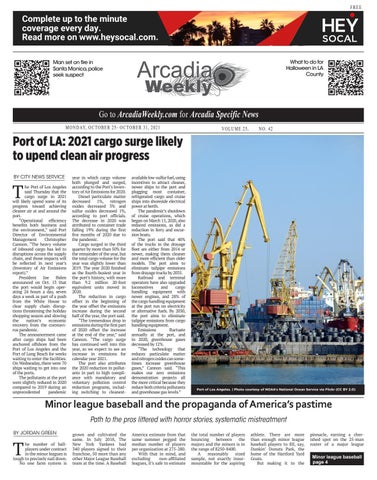
Port of Los Angeles. | Photo courtesy of NOAA’s National Ocean Service via Flickr (CC BY 2.0)
Minor league baseball and the propaganda of America’s pastime Path to the pros littered with horror stories, systematic mistreatment BY JORDAN GREEN
T
he number of ballplayers under contract in the minor leagues is tough to precisely nail down. No one farm system is
grown and cultivated the same. In July 2018, The New York Yankees had 340 players signed to their franchise, 50 more than any other Major League Baseball team at the time. A Baseball
America estimate from that same summer pegged the median number of players per organization at 275-280. With that in mind, and excluding non-affiliated leagues, it’s safe to estimate
the total number of players bouncing between the majors and the minors is in the range of 8250-8400. A reasonably sized sample, not exactly insurmountable for the aspiring
athlete. There are more than enough minor league baseball players to fill, say, Dunkin’ Donuts Park, the home of the Hartford Yard Goats. But making it to the
pinnacle, earning a cherished spot on the 25-man roster of a major league
Minor league baseball page 4
BeaconMediaNews.com
2 OCTOBER 25 - OCTOBER 31, 2021
Riverside teacher suspended after mimicking Native Americans in viral video
Arcadia to recognize senior veterans during multiple events The City of Arcadia is hosting a senior Veterans Day lunch on Wednesday, Nov. 10, 2021 at the Arcadia Community Center, located at 365 Campus Drive, Arcadia. This lunch will include “A Walk Down Military Memory Lane” at the Community Center, followed by a tour of the Gilb Museum of Arcadia
Heritage, where veterans can register themselves or family members who have served in the new Military Kiosk. The lunch is $13 but veterans eat free with proof of service at time of registration. Lunch slots are as follows: 10:30 a.m., 11 a.m., and 11:30 a.m. Register online at www.ArcadiaCA.
gov or in person at the Community Center. The city would also like to honor, recognize, and thank local Arcadia veterans with a Lawn sign program. If you know an Arcadia senior veteran and would like to honor that person through this program, call the Arcadia Community Center at (626) 574-5130 by Oct. 29.
Riverside County man pleads guilty to child cruelty, child porn of 18-month-old son BY CITY NEWS SERVICE
A
A screenshot from the viral video. | Photo via Instagram user corn_maiden_designs
BY CITY NEWS SERVICE
A
Riverside Unified School District math teacher was on suspension Thursday following social media posts from her classroom showing her performing as if she were engaged in a Native American war dance. “These behaviors are completely unacceptable and an offensive depiction of the vast and expansive Native American cultures and practices,” according to an RUSD statement. “Her actions do not represent the values of our district ... The Riverside Unified School District values diversity, equity and inclusion, and does not condone behavior against these values. “We are deeply committed to implementing inclusive practices and policies that honor the rich diversity of our district and the greater region. We will be
working with our students, families, staff and community to regain your trust,” the statement concluded. The video, evidently recorded by a student of Native American descent, captured the masked instructor from North High School wearing head feathers, chanting and moving around her desk as if in the middle of a war dance or some other ritual, which was not identified in the video. Published reports indicated the teacher has worked at North for over a decade, but RUSD has not confirmed that information, nor her identity. Some students chuckled during the episode, according to the video. The reasons for the instructor’s behavior and how they might have related to the lesson plan were unclear. The video clips were circulated widely via social
media and came to the attention of RUSD administrators Wednesday. The teacher was placed on paid administrative leave pending an investigation, according to the school district. Assembly members Sabrina Cervantes, D-Corona, Jose Medina, D- Riverside, and James Ramos, D-Highland, issued a collective statement expressing condemnation of what transpired. “It is damaging and disheartening to see Native American and indigenous culture represented in such a trite and insensitive way,” according to the legislators. “However, this is not an isolated incident, as such teaching practices have been used across the nation. It is time that we stop this behavior. We need to ensure that students learn about themselves in positive, accurate, and appropriate ways.”
35-year-old Desert Hot Springs man pleaded guilty Thursday to child cruelty and possessing child pornography, but he will stand trial for allegedly molesting his 18-monthold son and capturing it on film. Michael James Flaherty was arrested in August 2017, along with 25-yearold Cynthia Fuentes, of Coachella, who allegedly filmed the molestation, according to the Riverside County District Attorney’s Office. Flaherty and Fuentes were each charged with three counts of committing lewd acts on a child under 14 years old using force, two counts of committing sex acts on a child under 10 years old and one count of using a minor for obscene matter. On Thursday, Flaherty pleaded guilty to a number of charges related to lewd acts that he alone was
charged with, including two felony counts of persuading a child lewd act and one felony count each of possessing matter of a minor engaging in a sex act, willful child cruelty and aiding a felon in escaping arrest. He also pleaded guilty to the felony charge of using a minor for obscene matter. He will be sentenced on those charges after his trial on the remaining counts. During a preliminary hearing in January, Desert Hot Springs Police Detective Christopher Tooth said a woman whom Flaherty met on a dating app initially reported the abuse to Child Protective Services, then to police, saying Flaherty sought to convince her to assist him in molesting his son, and provided photographs and videos purporting to show several acts of molestation during several of their conversations. The investigation eventually expanded to include
Fuentes, who allegedly admitted in text messages to participating in the abuse. According to Deputy District Attorney AnneMarie Lofthouse, both Flaherty and Fuentes were captured on camera engaging in sex acts on the toddler. At the time of his arrest, Flaherty was also the subject of a child pornography investigation initiated by the Royal Canadian Mounted Police, which forwarded the case to investigators with the U.S. Department of Homeland Security, according to Lofthouse. Federal investigators eventually teamed with Desert Hot Springs police in the case. Flaherty has prior felony convictions for burglary and vehicle theft. He also has an unresolved felony forcible rape case. Fuentes has no documented felony convictions in Riverside County. Both defendants remain behind bars, each on $1.5 million bail.
Firefighter pleads guilty to groping 12-year-old girl in Newport Beach, possessing child porn BY CITY NEWS SERVICE
A
U.S. Forest Service firefighter pleaded guilty Thursday and was immediately sentenced to nearly four years in prison for possessing child pornography and groping a 12-year-old girl in Newport Beach. Jacob Daniel Carothers rode by on a bicycle and grabbed a 12-year-old girl
on two occasions as she and her swimwear-clad friends walked on the Balboa Peninsula on May 29, 2020, according to the Orange County District Attorney’s Office. When police arrested Carothers in an alley nearby, they determined he was in possession of a “significant amount of pornographic photos and videos” involving children. Carothers, 39, of San Jacinto, pleaded guilty
to two counts of lewd or lascivious acts with a minor younger than 14 and a count of possession of over 600 images of child pornography, according to court records. Carothers was sentenced to three years and eight months in prison and was ordered to surrender to jail by Oct. 29. Carothers was assigned to the Cleveland National Forest.
HLRMedia.com
OCTOBER 25 - OCTOBER 31, 2021 3
Orange County sheriff’s officials offer timeline details on oil spill response
Editorial editorial@beaconmedianews.com editor@hlrmedia.com Graphics/Production production@beaconmedianews.com production@hlrmedia.com Advertising advertising@beaconmedianews.com advertising@hlrmedia.com Legal Advertising legals@beaconmedianews.com legals@hlrmedia.com Business accounting@beaconmedianews.com accounting@hlrmedia.com
BEACON MEDIA ADDRESS:
125 E. Chestnut Ave., Monrovia, CA 91016 PHONE: (626) 301-1010 WEBSITE
Temple Tribune City
SanGabriel Sun
www.beaconmedianews.com
HLR MEDIA ADDRESS:
121 E. Chestnut Ave. Monrovia, CA 91016 PHONE: (626) 386-3457 www.HLRmedia.com
A zusa B eacon
Rosemead Reader
Dispatch
SUBMISSIONS POLICY
Beacon Media, Inc. and HLR Media, LLC All contents herein are copyrighted and may not be reproduced in any manner, either in whole or in part, without the express written consent of the publisher. The Views and opinions expressed in this paper are not necessarily that of the management and staff at Beacon Media, Inc. or HLR Media, LLC.
The Arcadia Weekly has been adjudicated as a newspaper of general circulation in court case number GS 004333 for the City of Arcadia, County of Los Angeles, State of California. The Monrovia Weekly has been adjudicated as a newspaper of General Circulation in Court Case GS 004759 City of Monrovia, County of Los Angeles, State of California. The Temple City Tribune has been adjudicated as a newspaper of general circulation in court case number GS 012440 City of Temple City, County of Los Angeles, State of California. The El Monte Examiner has been adjudicated as a newspaper of general circulation in court case number KS 015872 City of El Monte, County of Los Angeles, State of California.
Alhambra PRESS Baldwin Park
The Azusa Beacon has been adjudicated as a newspaper of general circulation in court case number KS 015970 City of Azusa, County of Los Angeles, State of California. The San Gabriel Sun has been adjudicated as a newspaper of general circulation in court case number GS 013808 City of San Gabriel, County of Los Angeles, State of California.
INDEPENDENT
The Duarte Dispatch has been adjudicated as a newspaper of general circulation in court case number GS 013893 City of Duarte, County of Los Angeles, State of California. The Rosemead Reader has been adjudicated as a newspaper of general circulation in court case number GS 048894 City of Rosemead, County of Los Angeles, State of California.
INDEPENDENT
The Alhambra Press has been adjudicated as a newspaper of general circulation in court case number ES016581 City of Alhambra, County of Los Angeles, State of California. The Baldwin Park Press has been adjudicated as a newspaper of general circulation in court case number KS017174 City of Baldwin Park, County of Los Angeles, State of California.
The Glendale Independent has been adjudicated as a newspaper of general circulation in court case number ES016579 City of Glendale, County of Los Angeles, State of California. The Monterey Park Press has been adjudicated as a newspaper of general circulation in court case number ES016580 City of Monterey Park, County of Los Angeles, State of California.
The San Bernardino Press has been adjudicated as a newspaper of general circulation in court case number CIVDS 1506881 City of San Bernardino, County of San Bernardino, State of California. The Riverside Independent has been adjudicated as a newspaper of general circulation in court case number RIC1505351 City of Riverside, County of Riverside, State of California.
Pasadena Press
Belmont Beacon
The Pasadena Press has been adjudicated as a newspaper of general circulation in court case number ES018815 City of Pasadena, County of Los Angeles, State of California. The Belmont Beacon has been adjudicated as a newspaper of general circulation in court case number NSO30275 City of Long Beach, County of Los Angeles, State of California. The Anaheim Press has been adjudicated as a newspaper of general circulation in court case number 30-2017-00942735-CU-PT-CJC City of Anaheim, County of Orange, State of California. The Ontario News Press has been adjudicated as a newspaper of general circulation in court case number CIVDS 1506881 City of Ontario, County of San Bernardino, State of California. The Corona News Press has been adjudicated as a newspaper of general circulation in court case number RIC1723524 City of Corona, County of Riverside, State of California.
| U.S. Coast Guard photo by Petty Officer 3rd Class Janessa Warschkow
BY CITY NEWS SERVICE
L
ast Thursday, Orange County sheriff’s officials offered more details on the timeline of the response to the oil spill in Huntington Beach that corroborated much of what officials have already revealed. Orange County Sheriff’s Department Harbor Patrol deputies on duty for the Huntington Beach Airshow on Oct. 1 began hearing chatter from other watercraft in the ocean about 5:30 p.m. that they could smell a possible fuel spill. That prompted sheriff’s deputies to seek the source of the odor, but they couldn’t find a fuel spill, said Carrie Braun, a spokeswoman for the sheriff’s department. About 6:15 p.m., dispatchers for the harbor patrol overheard a cargo ship crew report a possible fuel spill in federal waters near the oil rig, Braun said.
By that time, it was dark and more difficult to find an oil spill and deputies did not respond because it was not within their jurisdiction, Braun said. About 8 p.m., the U.S. Coast Guard contacted harbor patrol deputies in Newport Beach to help respond to reports of an oil spill, which Coast Guard officials have previously released. Because it was too dark to try to find an oil slick, officials decided to set out from Huntington Harbor on Saturday morning to look for a spill, Braun said. A Coast Guard hazardous materials investigator was on board with sheriff’s deputies on a patrol boat when it set out to find a source of oil about 7:45 a.m. Oct. 2. They discovered evidence of a spill about 100 yards in diameter about two miles off Pacific Coast Highway in Huntington Beach by 9 a.m., Braun said.
It was not clear then what was the source of the oil, Braun said. While collecting samples of the oil, additional reports from mariners deeper out to sea reported seeing a larger plume of oil about 5 miles offshore, Braun said. By 10:30 a.m., the Coast Guard had taken over the investigation and all notifications. Officials have said reports of the odor of oil is not uncommon and are usually because of fuel spills from boats. Coast Guard officials believe the pipeline may have been damaged several months to a year ago, but it was unclear when it cracked and started oozing oil into the water. They have theorized a ship’s anchor may have hooked it, bending it 105 feet out of place, and then it could have been struck multiple times since then by other anchors. Officials were also
considering whether a Jan. 24-25 winter storm may have contributed to the positioning of ships’ anchors in the area. According to an internal memo from sheriff’s officials on Oct. 3, dispatchers “received multiple phone calls from citizens living around Huntington and Newport Harbors” that they could smell the “pungent odor of petroleum in the air emitting from an unknown source” Friday evening. “The Harbor Patrol and multiple landside agencies could not locate a source of the smell,” according to the memo. A Coast Guard official called workers at the oil rig just before 9:30 a.m. Oct. 2 saying “crude oil” was “discovered near the platform, and he informed us he would initiate safety protocols immediately and then call us with the results,” according to the memo.
San Bernardino county launches campaign to increase awareness of childhood lead poisoning
The Burbank Independent has been adjudicated as a newspaper of general circulation in court case number ES016728 City of Burbank, County of Los Angeles, State of California.
The West Covina Press has been adjudicated as a newspaper of general circulation in court case number KS017304 City of West Covina, County of Los Angeles, State of California.
ball collection on Orange County beaches has decreased, and recovered tar balls are increasingly smaller in size and more dispersed.
A Beacon Media, Inc. Publication
uarte
PRESS RELEASE SUBMISSIONS editor@beaconmedianews.com editor@hlrmedia.com
Members from a contracted cleanup team pick up a tar ball on Crystal Cove Beach in Newport Beach, California, Oct. 14, 2021. Tar
San Bernardino Press
The Department of Public Health will commemorate Childhood Lead Poisoning Prevention Week, Oct. 24-30, with a week-long information campaign about the issue, San Bernardino County announced Friday. The campaign’s message to families is “Even small amounts of lead can harm a child’s health. Ask your child’s doctor about a blood lead test.” Part of the information campaign is aimed at educating families and community members about ways to prevent lead poisoning and the importance of testing children for lead.
The campaign will include the display of street banners in the cities of Colton, Fontana and Ontario, mailing out information and materials to local agencies and businesses and social media posts. Public Health will also partner with cities including Fontana, Redlands and Upland to proclaim October as National Lead Poisoning Prevention Week. “The purpose of this campaign is to remind parents that lead poisoning can be detrimental to young children’s health and development. It’s important for parents to ask
their child’s doctor about blood lead testing,” County Health Officer Dr. Michael A. Sequeira said in a statement. Lead poisoning can seriously impact a child’s brain and nervous system. It can cause learning and behavioral problems. A blood lead test is the only way to identify and confirm lead poisoning in children. In California, children can be exposed to lead by ingesting lead-contaminated dust, paint chips from deteriorating lead-based paint, and lead-contaminated soil. Other sources of lead poisoning include lead
dust brought home on parents’ work clothes, certain imported ceramic pottery, painted objects, traditional home remedies and imported spices, candies and other food products. Additionally, activities that involve lead products such as soldering, making stained glass and handling bullets or fishing sinkers can put children at risk. All parents and caregivers of young children are invited to call (909) 383-3022 or visit www.cdph.ca.gov/programs/ clppb for more information on program services or ways to protect their children from this environmental disease.
BeaconMediaNews.com
4 OCTOBER 25 - OCTOBER 31, 2021
Minor league baseball club, that’s a much tighter target. Simplified, over 8,000 dreams remain alive at a given time in professional baseball. In recent years, the public has learned the climb to the clouds isn’t a pretty one. In fact, many of the stories are nothing short of repellent. Multiple players from the Brewers’ Triple-A system came together to pay for a one-bedroom apartment in Nashville, only to find a space that was completely infested by cockroaches. The Mets’ Double-A roster lived in a facility that lost running water and electricity and didn’t get it back for three straight days. Countless pictures of food have circulated that show meals laughable by most standards, let alone the standards of premier athletes. Much like the potential of making a big league roster, having a positive experience in Minor League Baseball (MiLB) is a rarity — it takes a near-perfect situation to make it feel worthwhile. Ethan Chapman, a California-based baseball agent for Full Circle Sports Management, only managed a positive experience thanks to plenty of support and variables swinging in his favor. Chapman was drafted by the Kansas City Royals in the 30th round of the 2012 draft. The Upland native played for Cal State San Bernardino ahead of his selection. He grew up in a very supportive family, and he stated that the Royals organization took great care of their players. “I was just married, and my wife made a stable enough income for me to keep playing. My family was very supportive, helping out financially and buying us meals. And truly I wasn’t in a position where I had to pay for much as a ballplayer.
Kansas City took care of us. But I know we’ve been hearing stories that aren’t consistent with that,” said Chapman. He noticed that players would be drafted and enter the world of the major leagues without proper guidance. Chapman wanted to be the person that could prepare upcoming talent for the glories and failures that come from a lifestyle in baseball. After a stint with the Phillies organization and some time spent playing in Mexico, he retired from the sport he loves to become an agent. He believes he can lend some of that fortunate support he had. “They need to know the ups and downs of this sport,” he mentioned. “Being in this sport right after college ball means there will be times when you strike out three or four times in a game, or that you’ll give up multiple home runs in consecutive innings. For me, it’s about teaching them how to get over those mental hurdles.” Adaptability remains the most important factor for any professional athlete. So often, guys that get drafted experience glory before their names get called. They are the stars of their teams. They play for a college club that has a stout following. The shift to the minors can be a shock to the system. The MiLB, particularly lower affiliate teams, generally fail to mimic similar fan interest — all while presenting stronger talent with a lot more to prove - on a lot less relative compensation. “Most of these guys that are scouted are coming from power five schools,” Jared Schlehuber, a scout for the San Fransisco Giants and former teammate of Chapman, said. “And let’s face it, the minor leagues compared to college ball is just a completely different environment. Once
With minor league players continuing to discuss their mistreatment, players for the Rocket City Trash Pandas and the entire Los Angeles Angels organization are looking at owner Arte Moreno (center) for answers. | Graphic designed by Jordan Green.
you make it to the minors, you are playing professional ballplayers. There’s nothing easy about that, and I think that’s initially lost on kids who are drafted.” Being drafted and placed in a farm system, nevertheless, is an outlier. A majority of minor leaguers and independent ballplayers are attempting to reach their dream in the form of a tryout; crawling their way through club after club for a shot at the pros. So was the case for Eric Dawson, a former Hope College Flying Dutchman. His college career kicked off in furious fashion; between his freshman and junior year, he struck out just 13 times in over 500 at-bats. “I was voted most diffi-
cult out in NCAA baseball, or something like that, my sophomore year,” Dawson said. But when his senior season rolled around in 2014, he decided to hang up his cleats, at least temporarily. Until the bug came back a few years later. He decided he was going to test his mettle at a high level again, joining an independent minor league team in New York at age 26. “It was one of the best summers of my life when playing again,” he mentioned. “I started going to cages every day and working on my game. And for a moment I thought to myself ‘Damn, maybe I’m better at this than I initially thought.” He decided to chase that coveted baseball dream — a dream that led him into a
few different extreme environments. He drove his Prius through a blizzard into Ontario, Canada for a tryout. He played with a Florida-based group of self-proclaimed “baseball bastards” named the Black Sox. He readily uprooted routines and regularity to hustle after that highest high of America’s pastime, learning along the way that the valleys probably should be a little bit more advertised than the peaks. “As a kid, my parents reminded me of how tough it is to become a professional player. My dad who pursued professional baseball himself mentioned that the best advice he ever received was to not waste his time. And they passed that on to me. But I eventually did start to dream later in life,” Dawson
said. “I’ve learned now that the ‘dream’ is more propaganda than anything else.” Failure has just become part of the experience, and for independent players and top prospects alike preparing for the worst seems to be the most feasible lesson to learn. Regardless of expectation, though, the so-called dream regularly dies after being in a position where a more obtainable career and salary is the only option left to survive in the real world. Read More on HeySoCal.com
LEGALS
HLRMedia.com
Starting a new business?
File your DBA with us at filedba.com
Arcadia City Notices CITY OF ARCADIA REQUEST FOR PROPOSALS OCTOBER 2021 Notice is hereby issued by the City of Arcadia to seek proposals for the design and construction of the Newcastle Park Renovation Project (“Project”). The work shall be proposed as a DesignBuild project under the authority of Arcadia Municipal Code Article 1, Chapters 12 and 13. Following completion, the Project will be owned and operated by the City of Arcadia. A copy of the Request for Proposal can be obtained from the City of Arcadia Public Works Services Department located at 11800 Goldring Road in Arcadia, CA 91006, on the City’s website at www. ArcadiaCA.gov/bidsandrfps, or by contacting the Department at publicworks@arcadiaca.gov or (626) 254-2720. Proposals are due by 2:00 p.m. on Tuesday, November 16, 2021. Please submit three (3) hard copies and one (1) digital PDF copy of the proposal to: City of Arcadia Office of the City Clerk 240 W. Huntington Drive PO Box 60021 Arcadia, CA 91066-6021 Attention: Eddie Chan, P.E., Principal Civil Engineer Proposals must comply with the Instructions to Proposers, including all Appendices. Firms mailing or shipping their proposals must allow sufficient delivery time to ensure timely receipt of their proposals by the specified time. Proposals received after the deadline will not be considered. Submissions by fax or other electronic media will not be accepted under any circumstances. The City of Arcadia reserves the right to reject any or all Proposals, to waive any informality or irregularity in any Proposal received, and to be the sole judge of the merits of the respective Proposal received. CITY OF ARCADIA Publish October 18 & 25, 2021 ARCADIA WEEKLY
CITY OF ARCADIA NOTICE INVITING BIDS OCTOBER 2021 NOTICE IS HEREBY GIVEN that the City of Arcadia (“City”) invites and will receive sealed Bids up to but not later than 11 a.m. on Thursday, November 18, 2021 at the office of the City Clerk, located at 240 West Huntington Drive, Arcadia, California 91066, for the furnishing to City of all labor, equipment, materials, tools, services, transportation, permits, utilities, and all other items necessary for Traffic Signal Fiber Optics Network Extension (the “Project”). At said time, Bids will be publicly opened and read aloud at the City Clerk’s Office. Bids received after said time shall be returned unopened. Bids shall be valid for a period of 90 calendar days after the Bid opening date. The work consists of; the installation of fiber optic cable, complete with fabric innerduct, tracer wire, splicing and connector panels. Furnishing and installation of fiber optic connector panel housings, power supply systems and Ethernet switches to the City of Arcadia. Bids must be submitted on the City’s Bid Forms. Bidders may obtain a copy of the Contract Documents from https://www.arcadiaca. gov/ , 240 West Huntington Dr, Arcadia, California 91066, or (626) 574-5411. Unless otherwise provided in the Instructions for Bidders, each Bidder shall be a licensed contractor pursuant to sections 7000 et seq. of the Business and Professions Code in the following classification(s) throughout the time it submits its Bid and for the duration of the contract: C10 Each Bid shall be accompanied by cash, a certified or cashier’s check, or Bid Bond secured from a surety company satisfactory to the City, the amount of which shall not be less than ten percent (10%) of the submitted Total Bid Price, made payable to City of Arcadia as bid security. The bid security shall be provided as a guarantee that within five (5) working days after the City provides the successful bidder the Notice of Award, the successful Bidder will enter into a contract and provide the necessary bonds and certificates of insurance. The bid security will be declared forfeited if the successful Bidder fails to comply within said time. No interest will be paid on funds deposited with City. City shall award the contract for the Project to the lowest responsive, responsible Bidder as determined by the City from the BASE
BID ALONE. City reserves the right to reject any or all bids or to waive any irregularities or informalities in any bids or in the bidding process. For further information, contact Ryan Huey, Assistant Engineer at rhuey@arcadiaca.gov or (626) 574-5486. Publish October 18 & 25, 2021 ARCADIA WEEKLY
San Gabriel City Notices CITY OF SAN GABRIEL DEPARTMENT OF PUBLIC WORKS “SAN GABRIEL POLICE DEPARTMENT HVAC PROJECT” CONTRACT NO. 21-08 NOTICE TO CONTRACTORS - INVITATION FOR BIDS Date of Bid Opening: Notice is hereby given that sealed bids for the “SAN GABRIEL POLICE DEPARTMENT HVAC PROJECT” will be received at the office of the City Clerk of the City of San Gabriel, 425 South Mission Drive, San Gabriel, CA 91776, California, until 3:00 p.m. on Wednesday, November 10, 2021. At 3:05 p.m., they will be opened and read aloud at San Gabriel City Hall. A mandatory job walk meeting for interested bidders will be conducted on Thursday, October 28, 2021, at 9:00 a.m. at the employee parking lot located behind the Police Department Building, at 625 Del Mar Avenue, San Gabriel, CA, 91776. Please call the Project Manager Alan Mai at (626) 308-2825, or email at amai@ sgch.org, should you require further information. Description of Work: The work to be done consists of furnishing all necessary labor, tools, transportation, and other incidental and appurtenant work necessary for the replacement of the existing central HVAC system with the five new HVAC packaged units and all associated required installations for complete functional systems, which shall include all new electrical conduits, wiring, disconnect switches, insulated flexible ductwork, MERV 13 rating air filters, UV lamps, and new R410a refrigerant for the new systems, etc.. The work also includes patch and repair of any damaged roof and ceiling which have been damaged by the scope of work. All work shown or described in the Contract Documents shall be furnished and installed complete, in-place by the Contractor, and ready for occupancy and use. The contract is to be executed within 7 calendar days after award of contract by City Council. Time for completion of the work is thirty (45) working days for all work from the date of the Notice to Proceed with all related mechanical and electrical installation and construction. Contract Documents: To obtain the project documents please contact San Gabriel Public Works Project Manager, Alan Mai, at (626) 308-2825 or email: amai@sgch.org Bid Security: Each bid shall be accompanied by a certified or cashier’s check, cash, or Bid Bond in the amount of ten percent (10%) of the total bid price payable to City of San Gabriel as a guarantee that the awarded bidder will execute the Contract and provide the required bonds, certificates of insurance, and endorsements within 7 calendars days of the of the award of contract by City Council. Award of Contract: The City reserves the right after opening bids to reject any or all bids, to waive any informality (non-responsiveness) in a bid, or to make award to the lowest responsive, responsible bidder, and reject all other bids, as it may best serve the interest of the City. The Bidder shall guarantee the Total Bid Price for a period of 90 calendar days from the date of bid opening. Labor Code Compliance: Attention is directed to the provisions of Labor Code § 1725.5: No contractor or subcontractor may be listed on a bid proposal for a public works project (submitted on or after March 1, 2015) unless registered with the Department of Industrial Relations (with limited exceptions for this requirement for bid purposes only under Labor Code Section 1771.1a). No contractor or subcontractor may be awarded a contract for public work on a public works project (awarded on or after April 1, 2015) unless registered with the Department of Industrial Relations (DIR). All contractors and subcontractors must furnish electronic certified payroll records to the Labor Commissioner for all new projects awarded on or after April 1, 2015. The Labor Commissioner may excuse contractors and subcontractors on a project that is under the jurisdiction of one of the four legacy DIR-approved labor compliance programs (Caltrans, City of Los Angeles, Los Angeles Unified School District and County of Sacramento) or that is covered by a qualified project labor agreement. This project is subject to compliance monitoring and enforcement by the Department of Industrial Relations. Any contract entered into pursuant to this Notice will incorporate the provisions of the State Labor. Pursuant to the provisions of Section 1773.2 of the Labor Code of the State of California, the minimum prevailing rate of per diem wages for each craft, classification, or type of workman needed to execute the contract shall be those determined by the Director of Industrial Relations of the State of California, which are on file in the Office of the City Clerk, City of San Gabriel and are available to any interested party on request. Attention is directed to the provisions of Sections 1777.5 and 1777.6
OCTOBER 25 - OCTOBER 31, 2021 5 of the Labor Code concerning the employment of apprentices by the Contractor or any subcontractor under them. The Contractor or any subcontractor shall comply with the requirements of said sections in the employment of apprentices. Information relative to apprenticeship standards and administration of the apprenticeship program may be obtained from the Director of Industrial Relations, San Francisco, CA, or the Division of Apprenticeship Standards and its branch offices. All bidders shall be licensed in accordance with provisions of the Business and Professions Code and shall possess a Class “C20” State Contractor’s License at the time this contract is awarded. The Successful Contractor and his/her subcontractors will be required to possess business licenses from the City of San Gabriel and maintain current until completion of the project. Business licenses can be purchased or renewed at the Finance Department in City Hall, 425 S Mission Drive, San Gabriel, CA. Questions: All questions relative to this project prior to the opening of bids shall be in writing or email and received no later than 4:00 p.m. on Wednesday, November 03, 2021 and shall be directed to: Project Manager, Alan Mai, at (626) 308-2825 or email: amai@ sgch.org. Publish: San Gabriel Sun Date: October 18, 2021 & October 25, 2021
CITY OF SAN GABRIEL SUMMARY OF ORDINANCE NO. 678 AN ORDINANCE OF THE CITY COUNCIL OF THE CITY OF SAN GABRIEL, CALIFORNIA, APPROVING PLANNING CASE NO. ZC18-001, FOR A ZONE CHANGE/PLANNED DEVELOPMENT OVERLAY AND A DEVELOPMENT AGREEMENT FOR THE PACIFIC SQUARE MIXED-USE PROJECT AT 700-800 SOUTH SAN GABRIEL BOULEVARD The proposed project is a mixed-use development consisting of 243 residential units, 8 live/work units, and approximately 76,000 square feet of commercial area on a 5.85-acre site. The project will require a Zone Change/Planned Development Overlay Zone/Development Agreement application to change the zoning from C-1 to C-1/PD, a Tentative Tract Map application for condominium purposes, and an Environmental Impact Report for the environmental review. Ordinance No. 678 was introduced by a vote of 4-1 without any changes. AYES: Councilmember- Menchaca, Pu, Ding, Liao NOES: Councilmember- Harrington ABSENT, ABSTAIN: Councilmember- None Ordinance No. 678 was introduced and given first reading at the City Council Regular Meeting of September 21, 2021. City Council waived the reading of Ordinance No. 678 in full and adopted Ordinance No. 678 by title on October 19, 2021 by a vote of 5-0. AYES: Councilmember- Harrington, Menchaca, Pu, Ding, Liao NOES, ABSENT, ABSTAIN: Councilmember- None A copy of the full text of the ordinance is available at the City Clerk Department or by e-mailing cityclerk@sgch.org. Julie Nguyen, City Clerk Publish on October 25, 2021 SAN GABRIEL SUN
CITY OF SAN GABRIEL SUMMARY OF ORDINANCE NO. 679 AN ORDINANCE OF THE CITY COUNCIL OF THE CITY OF SAN GABRIEL, CALIFORNIA, AMENDING TITLE XV, CHAPTER 153 (ZONING) RELATING TO TERM LIMITS AND NOMINATION PROCEDURES FOR HISTORIC RESOURCES Ordinance No. 679 will update the existing code relating to term limits to bring the Historic Preservation and Cultural Resource Commission into conformity with all other City Commissions. The Ordinance will also amend the code to remove the automatic nomination of properties listed on the National Register of Historic Places or California Register of Historical Resources for inclusion on the City Register, as opposed to following the outlines procedures for inclusion. The proposed amendment will not affect the designation process outline for new designations. Ordinance No. 679 was approved for introduction and first reading at the City Council Regular Meeting of October 5, 2021. City Council waived the reading of Ordinance No. 679 in full and adopted Ordinance No. 679 by title on October 19, 2021 by a vote of 5-0. AYES: Councilmember- Harrington, Menchaca, Pu, Ding, Liao NOES, ABSENT, ABSTAIN: Councilmember- None A copy of the full text of the ordinance is available at the City Clerk Department or by e-mailing cityclerk@sgch.org. Julie Nguyen, City Clerk Publish on October 25, 2021 SAN GABRIEL SUN
LEGALS
6 OCTOBER 25 - OCTOBER 31, 2021
CITY OF SAN GABRIEL SUMMARY OF ORDINANCE NO. 680 AN ORDINANCE OF THE CITY COUNCIL OF THE CITY OF SAN GABRIEL, CALIFORNIA, AMENDING TITLE V OF THE CITY’S CODE TO COMPLY WITH SB 1383 REQUIREMENTS BY ADDING CHAPTER 50.016 MANDATORY ORGANIC WASTE DISPOSAL REGULATIONS Senate Bill 1383 (“SB 1383), the Short-lived Climate Pollutant Reduction Act of 2016, requires the California Department of Resources, Recycling, and Recovery (“CalRecycle”) to develop regulations to reduce organics in landfills as a source of methane. The regulations place requirements on multiple entities including cities, residential households, commercial businesses, business owners, edible food generators, food recovery organizations, food recovery services and waste haulers to support achievement of statewide organic waste disposal reduction targets. SB 1383 requires cities to adopt and enforce an ordinance or enforceable mechanism to implement relevant provisions of SB 1383 Regulations. Ordinance No. 680 was approved for introduction and first reading at the City Council Regular Meeting of October 19, 2021, by the following vote: AYES: Councilmember- Harrington, Menchaca, Pu, Ding, Liao NOES, ABSENT, ABSTAIN: Councilmember- None The Ordinance will be considered for adoption by the City Council at its November 2, 2021, regular meeting. Anyone having questions may contact the City Clerk at (626) 308-2816 or cityclerk@sgch.org. Julie Nguyen, City Clerk Publish on October 25, 2021 SAN GABRIEL SUN
CITY OF SAN GABRIEL SUMMARY OF ORDINANCE NO. 681 AN ORDINANCE OF THE CITY COUNCIL OF THE CITY OF SAN GABRIEL, CALIFORNIA, AMENDING TITLE III: ADMINISTRATION, CHAPER 34: FINANCE AND REVENUE OF THE CITY’S MUNICIPAL CODE BY ADDING SECTION 34.80 RECOVERED ORGANIC WASTE PRODUCT PROCUREMENT POLICY Senate Bill 1383 (“SB 1383), the Short-lived Climate Pollutant Reduction Act of 2016, requires the California Department of Resources, Recycling, and Recovery (“CalRecycle”) to develop regulations to reduce organics in landfills as a source of methane. The regulations place requirements on multiple entities including cities, residential households, commercial businesses, business owners, edible food generators, food recovery organizations, food recovery services and waste haulers to support achievement of statewide organic waste disposal reduction targets. SB 1383 requires cities to adopt and enforce an ordinance or enforceable mechanism to implement relevant provisions of SB 1383 Regulations. Ordinance No. 681 was approved for introduction and first reading at the City Council Regular Meeting of October 19, 2021, by the following vote: AYES: Councilmember- Harrington, Menchaca, Pu, Ding, Liao NOES, ABSENT, ABSTAIN: Councilmember- None The Ordinance will be considered for adoption by the City Council at its November 2, 2021, regular meeting. Anyone having questions may contact the City Clerk at (626) 308-2816 or cityclerk@sgch.org. Julie Nguyen, City Clerk Publish on October 25, 2021 SAN GABRIEL SUN
Temple City Notices CITY COUNCIL ORDINANCE SUMMARY OF ORDINANCE AS REQUIRED BY GOVERNMENT CODE SECTION 36933(c) NOTICE IS HEREBY GIVEN THAT AT ITS REGULARLY SCHEDULED CITY COUNCIL MEETING ON TUESDAY, OCTOBER 19, 2021, THE CITY COUNCIL ADOPTED: ORDINANCE 21-1057 AN ORDINANCE OF THE CITY COUNCIL OF THE CITY OF TEMPLE CITY, CALIFORNIA, ORDINANCE NO. 21-1057, AMENDING TITLE 2 (ADMINISTRATION), CHAPTER 6 (CITY COMMISSIONS), ARTICLE C (ART IN PUBLIC PLACES PROGRAM), SECTION 5 (DONATIONS AND OTHER CHARITABLE GIFTS) THE FOLLOWING SUMMARIZES ORDINANCE 21-1057:
Ordinance No. 21-1057 amends Section 5 (Donations and Other Charitable Gifts) of the Art in Public Places Program. Ordinance No. 21-1057 was introduced for first reading at the City Council Regular Meeting of October 5, 2021 and adopted at the City Council Regular Meeting of October 19, 2021, by the following vote: AYES: NOES: ABSENT: ABSTAIN:
Councilmember- Chavez, Man, Sternquist, Yu Councilmember- None Councilmember- Vizcarra Councilmember- None
A certified copy of the full text of the ordinance is available for review on the City’s website, www.templecity.us. Anyone having questions may contact the City Clerk at (626) 285-2171. Dated: Peggy Kuo, City Clerk Published: October 25, 2021 TEMPL CITY TRIBUNE
Probate Notices NOTICE OF PETITION TO ADMINISTER ESTATE OF: FRANCES EVELYN RODRIGUEZ CASE NO. 21STPB07855
To all heirs, beneficiaries, creditors, contingent creditors, and persons who may otherwise be interested in the WILL or estate, or both of FRANCES EVELYN RODRIGUEZ. A PETITION FOR PROBATE has been filed by CECILIA INEZ RODRIGUEZ in the Superior Court of California, County of LOS ANGELES. THE PETITION FOR PROBATE requests that CECILIA INEZ RODRIGUEZ be appointed as personal representative to administer the estate of the decedent. THE PETITION requests the decedent’s WILL and codicils, if any, be admitted to probate. The WILL and any codicils are available for examination in the file kept by the court. THE PETITION requests authority to administer the estate under the Independent Administration of Estates Act with limited authority. (This authority will allow the personal representative to take many actions without obtaining court approval. Before taking certain very important actions, however, the personal representative will be required to give notice to interested persons unless they have waived notice or consented to the proposed action.) The independent administration authority will be granted unless an interested person files an objection to the petition and shows good cause why the court should not grant the authority. A HEARING on the petition will be held in this court as follows: 11/02/21 at 9:30AM in Dept. 4 located at 111 N. HILL ST., LOS ANGELES, CA 90012 IF YOU OBJECT to the granting of the petition, you should appear at the hearing and state your objections or file written objections with the court before the hearing. Your appearance may be in person or by your attorney. IF YOU ARE A CREDITOR or a contingent creditor of the decedent, you must file your claim with the court and mail a copy to the personal representative appointed by the court within the later of either (1) four months from the date of first issuance of letters to a general personal representative, as defined in section 58(b) of the California Probate Code, or (2) 60 days from the date of mailing or personal delivery to you of a notice under section 9052 of the California Probate Code. Other California statutes and legal authority may affect your rights as a creditor. You may want to consult with an attorney knowledgeable in California law. YOU MAY EXAMINE the file kept by the court. If you are a person interested in the estate, you may file with the court a Request for Special Notice (form DE-154) of the filing of an inventory and appraisal of estate assets or of any petition or account as provided in Probate Code section 1250. A Request for Special Notice form is available from the court clerk. Attorney for Petitioner CINDY T. NGUYEN, ESQ. - SBN 273886, AMITY LAW GROUP LLP 3733 ROSEMEAD BLVD. STE 201 ROSEMEAD CA 91770 10/18, 10/21, 10/25/21 CNS-3521756# EL MONTE EXAMINER
NOTICE OF PETITION TO ADMINISTER ESTATE OF DAVID TE-CHENG CHANG Case No. 21STPB09051
To all heirs, beneficiaries, cred-itors, contingent creditors, and persons who may otherwise be interested in the will or estate, or both, of DAVID TE-CHENG CHANG A PETITION FOR PROBATE has been filed by Leo S. Chang in the Superior Court of California, County of LOS ANGELES. THE PETITION FOR PROBATE requests that Leo S. Chang be appointed as personal representative to administer the estate of the decedent. THE PETITION requests authority to administer the estate under the Independent Administration of Estates Act. (This authority will allow the personal representative to take many actions without obtaining court approval. Before taking certain very important actions, however, the personal representative will be required to give notice to interested persons unless they have waived notice or consented to the proposed action.) The independent administra-tion authority will be granted unless an interested person files an objec-tion to the petition and shows good cause why the court should not grant the authority. A HEARING on the petition will be held on Nov. 23, 2021 at 8:30 AM in Dept. No. 5 located at 111 N. Hill St., Los Angeles, CA 90012. IF YOU OBJECT to the granting of the petition, you should appear at the hearing and state your objections or file written objections with the court before the hearing. Your ap-pearance may be in person or by your attorney. IF YOU ARE A CREDITOR or a contingent creditor of the decedent, you must file your claim with the court and mail a copy to the personal representative appointed by the court within the later of either (1) four months from the date of first issuance of letters to a general personal representative, as defined in section 58(b) of the California Probate Code, or (2) 60 days from the date of mailing or personal delivery to you of a notice under section 9052 of the California Probate Code. Other California statutes and legal authority may affect your rights as a creditor. You may want to consult with an attorney knowl-edgeable in California law. YOU MAY EXAMINE the file kept by the court. If you are a person interested in the estate, you may file with the court a Request for Special Notice (form DE-154) of the filing of an inventory and appraisal of estate assets or of any petition or account as provided in Probate Code section 1250. A Request for Special Notice form is available from the court clerk. Attorney for petitioner: JOHN S MORRIS ESQ SBN 173014 MORRIS & MORRIS ATTORNEYS AT LAW 150 N SANTA ANITA AVE STE 300 ARCADIA CA 91006 CN981684 CHANG Oct 21,25,28, 2021 SAN GABRIEL SUN
NOTICE OF PETITION TO ADMINISTER ESTATE OF TERESA RIOS FRUCTUOSO aka TERESA FRUCTUOSO aka TERESA RIOS
BeaconMediaNews.com Case No. 21STPB09785
To all heirs, beneficiaries, cred-itors, contingent creditors, and persons who may otherwise be interested in the will or estate, or both, of TERESA RIOS FRUCTUOSO aka TERESA FRUCTUOSO aka TERESA RIOS A PETITION FOR PROBATE has been filed by Jennifer Pinzon and Patricia Rios-Romo in the Superior Court of California, County of LOS ANGELES. THE PETITION FOR PROBATE requests that Jennifer Pinzon and Patricia Rios-Romo be appointed as personal representative to administer the estate of the decedent. THE PETITION requests authority to administer the estate under the Independent Administration of Estates Act. (This authority will allow the personal representative to take many actions without obtaining court approval. Before taking certain very important actions, however, the personal representative will be required to give notice to interested persons unless they have waived notice or consented to the proposed action.) The independent administra-tion authority will be granted unless an interested person files an objec-tion to the petition and shows good cause why the court should not grant the authority. A HEARING on the petition will be held on Nov. 15, 2021 at 8:30 AM in Dept. No. 4 located at 111 N. Hill St., Los Angeles, CA 90012. IF YOU OBJECT to the granting of the petition, you should appear at the hearing and state your objections or file written objections with the court before the hearing. Your ap-pearance may be in person or by your attorney. IF YOU ARE A CREDITOR or a contingent creditor of the decedent, you must file your claim with the court and mail a copy to the personal representative appointed by the court within the later of either (1) four months from the date of first issuance of letters to a general personal representative, as defined in section 58(b) of the California Probate Code, or (2) 60 days from the date of mailing or personal delivery to you of a notice under section 9052 of the California Probate Code. Other California statutes and legal authority may affect your rights as a creditor. You may want to consult with an attorney knowl-edgeable in California law. YOU MAY EXAMINE the file kept by the court. If you are a person interested in the estate, you may file with the court a Request for Special Notice (form DE-154) of the filing of an inventory and appraisal of estate assets or of any petition or account as provided in Probate Code section 1250. A Request for Special Notice form is available from the court clerk. Attorney for petitioner: HAROUN R NABHAN ESQ SBN272273 NABHAN LAW 500 MOUND AVE SOUTH PASADENA CA 91030 CN981679 FRUCTUOSO Oct 21,25,28, 2021 ARCADIA WEEKLY
NOTICE OF PETITION TO ADMINISTER ESTATE OF: PATRICIA R. MITSUUCHI AKA PATRICIA RUMIKO MITSUUCHI CASE NO. 21STPB09949
To all heirs, beneficiaries, creditors, contingent creditors, and persons who may otherwise be interested in the WILL or estate, or both of PATRICIA R. MITSUUCHI AKA PATRICIA RUMIKO MITSUUCHI. A PETITION FOR PROBATE has been filed by RODNY TADASHI MITSUUCHI in the Superior Court of California, County of LOS ANGELES. THE PETITION FOR PROBATE requests that RODNY TADASHI MITSUUCHI be appointed as personal representative to administer the estate of the decedent. THE PETITION requests authority to administer the estate under the Independent Administration of Estates Act. (This authority will allow the personal representative to take many actions without obtaining court approval. Before taking certain very important actions, however, the personal representative will be required to give notice to interested persons unless they have waived notice or consented to the proposed action.) The independent administration authority will be granted unless an interested person files an objection to the petition and shows good cause why the court should not grant the
authority. A HEARING on the petition will be held in this court as follows: 12/08/21 at 8:30AM in Dept. 79 located at 111 N. HILL ST., LOS ANGELES, CA 90012 IF YOU OBJECT to the granting of the petition, you should appear at the hearing and state your objections or file written objections with the court before the hearing. Your appearance may be in person or by your attorney. IF YOU ARE A CREDITOR or a contingent creditor of the decedent, you must file your claim with the court and mail a copy to the personal representative appointed by the court within the later of either (1) four months from the date of first issuance of letters to a general personal representative, as defined in section 58(b) of the California Probate Code, or (2) 60 days from the date of mailing or personal delivery to you of a notice under section 9052 of the California Probate Code. Other California statutes and legal authority may affect your rights as a creditor. You may want to consult with an attorney knowledgeable in California law. YOU MAY EXAMINE the file kept by the court. If you are a person interested in the estate, you may file with the court a Request for Special Notice (form DE-154) of the filing of an inventory and appraisal of estate assets or of any petition or account as provided in Probate Code section 1250. A Request for Special Notice form is available from the court clerk. Attorney for Petitioner VICKY H. CHIEN - SBN 290574 LAW OFFICES OF YVONNE HSU 1170 ROOSEVELT IRVINE CA 92620 10/21, 10/25, 10/28/21 CNS-3522194# ROSEMEAD READER
NOTICE OF PETITION TO ADMINISTER ESTATE OF: MARGARET ANN LUDWIG CASE NO. 21STPB09097
To all heirs, beneficiaries, creditors, contingent creditors, and persons who may otherwise be interested in the WILL or estate, or both of MARGARET ANN LUDWIG. A PETITION FOR PROBATE has been filed by BATINA LUDWIG in the Superior Court of California, County of LOS ANGELES. THE PETITION FOR PROBATE requests that BATINA LUDWIG be appointed as personal representative to administer the estate of the decedent. THE PETITION requests authority to administer the estate under the Independent Administration of Estates Act. (This authority will allow the personal representative to take many actions without obtaining court approval. Before taking certain very important actions, however, the personal representative will be required to give notice to interested persons unless they have waived notice or consented to the proposed action.) The independent administration authority will be granted unless an interested person files an objection to the petition and shows good cause why the court should not grant the authority. A HEARING on the petition will be held in this court as follows: 11/19/21 at 8:30AM in Dept. 5 located at 111 N. HILL ST., LOS ANGELES, CA 90012 IF YOU OBJECT to the granting of the petition, you should appear at the hearing and state your objections or file written objections with the court before the hearing. Your appearance may be in person or by your attorney. IF YOU ARE A CREDITOR or a contingent creditor of the decedent, you must file your claim with the court and mail a copy to the personal representative appointed by the court within the later of either (1) four months from the date of first issuance of letters to a general personal representative, as defined in section 58(b) of the California Probate Code, or (2) 60 days from the date of mailing or personal delivery to you of a notice under section 9052 of the California Probate Code. Other California statutes and legal authority may affect your rights as a creditor. You may want to consult with an attorney knowledgeable in California law. YOU MAY EXAMINE the file kept by the court. If you are a person interested in the estate, you may file with the court a Request for Special Notice (form DE-154) of the filing of an inventory and appraisal of estate assets or of any petition or account as provided in Probate Code section 1250. A Request for Special Notice form is available from the court clerk.
LEGALS
HLRMedia.com Attorney for Petitioner CINDY T. NGUYEN, ESQ. - SBN 273886 AMITY LAW GROUP LLP 3733 ROSEMEAD BLVD., SUITE 201 ROSEMEAD CA 91770 10/25, 10/28, 11/1/21 CNS-3520172# EL MONTE EXAMINER
Public Notices NOTICE OF $10,000 REWARD OFFERED BY THE LOS ANGELES COUNTY BOARD OF SUPERVISORS
Notice is hereby given that the Board of Supervisors of the County of Los Angeles has reestablished the $10,000 reward offered in exchange for information leading to the ap-prehension and/or conviction of the person or persons responsible for the fatal shooting of 10-year-old Enrique Sebastian Falcon, while riding in the back seat of his family's vehicle near the intersection of Hacienda Boule-vard and Amar Road in the City of La Puente on May 17, 2020 at ap-proximately 9:00 p.m. Si no entiende esta noticia o necesita mas infor-macion, favor de llamar al (213) 974-1579. Any person having any information related to this crime is requested to call Detective Jonathan Bailey at the Los Angeles County Sheriff's Department, Homicide Bureau at (323) 890-5500 and refer to Report No. 020-05046-1431-011. The terms of the reward provide that: The information given that leads to the determination of the identity, the apprehension and conviction of any person or persons must be given no later than November 28, 2021. All reward claims must be in writing and shall be received no later than Jan-uary 27, 2022. The total County payment of any and all rewards shall in no event exceed $10,000 and no claim shall be paid prior to conviction unless the Board of Supervisors makes a finding of impossibility of conviction due to the death or inca-pacity of the person or persons responsible for the crime or crimes. The County reward may be appor-tioned between various persons and/or paid for the conviction of various persons as the circum-stances fairly dictate. Any claims for the reward funds should be filed no later than January 27, 2022, with the Executive Office of the Board of Supervisors, 500 West Temple Street, Room 383 Kenneth Hahn Hall of Administration, Los Angeles, Cali-fornia 90012, Attention: Enrique Sebastian Falcon Reward Fund. For further information, please call (213) 974-1579. CELIA ZAVALA EXECU-TIVE OFFICER BOARD OF SU-PERVISORS OF THE COUNTY OF LOS ANGELES CN980935 03750 Sep 23,27,30, Oct 4,7,11,14,18,21,25, 2021 AZUSA BEACON NOTICE IS HEREBY GIVEN the undersigned intends to sell the personal property described below to enforce a lien imposed on said property pursuant to Sections 21700-21716 of the Business & Professions Code, Section 2328 of the UCC, Section 535 of the Penal Code and provisions of the Civil Code. Any vehicles sold will be under Section 3071 of motor vehicle code. The Online bidding starts on 10/18/2021 and ends at 9:00AM on 11/01/2021. Full access to this auction can be viewed at www.bid13.com. The undersigned will be sold by competitive bidding at BID13 on or after the 11/01/2021 at 9:00AM or later, on the premises where said property has been stored and which are located at: Mt.Olive Storage 1500 Crestfeild Dr. Duarte, CA 91010 County of Los Angeles State of California ss Unit sold appear to contain: Misc. furniture, household goods, and boxes, tools, luggage, clothes, electronics, toys Belonging to: K44: Complete Interior Staging c/o Fayley Patrice C33: Complete Interior Staging c/o Fayley Patrice Purchases must be paid for at the time of purchase in CASH ONLY. All purchased items sold as is and must be removed at the time of sale. Sale subject to cancellation in the event of settlement between owner and obligated party. Bid 13 HST License #864431754 This notice will be published on the following dates 10/18/2021 and 10/25/2021 in the DUARTE DISPATCH NOTICE TO CREDITORS OF BULK SALE (Secs. 6104, 6105 U.C.C.) Escrow No. 27469-001 Notice is hereby given to creditors of the within named seller that a bulk sale is about to be made of the assets described below. The names and business addresses of the seller are: Roy Gasparini, 4 West Foothill Blvd. Arcadia, CA 91006
The location in California of the chief executive office of the seller is: Above As listed by the seller, all other business names and addresses used by the seller within three years before the date such list was sent or delivered to the buyer are: None The name(s) and business addresses of the buyer are: Armag Oil #8 Inc, 1638 N. San Fernando Blvd., Burbank, CA 91504 The assets to be sold are described in general as: Furniture, Fixtures, Equipment, & Goodwill, and which are located at: 4 West Foothill Blvd., Arcadia, CA 91006 The business name used by the seller at that location is: Roy Gasparini Unocal Service, Roy Gasparini Union Service, Roy’s Union 76 Service, and Roy’s Union 76 Auto Care Center. The anticipated date of the bulk sale is 11/10/2021 at the office of Covina Escrow Company, 167 East College Street, P.O. Box 266, Covina, CA 91723. This bulk sale is subject to California Uniform Commercial Code Section 6106.2. If so subject, the name and address of the person with whom claims may be filed is Covina Escrow Company, 167 East College Street P.O. Box 266, Covina, CA 91723, and the last date for filing claims shall be 11/09/2021, which is the business day before the sale date specified above. Dated: October 7, 2021 Armag Oil #8 Inc By: S/ Vladimir Vardanian, President 10/25/21 CNS-3523588# ARCADIA WEEKLY ORDER TO SHOW CAUSE FOR CHANGE OF NAME PETITION OF Mariko Yukari Harper FOR CHANGE OF NAME CASE NUMBER: 21PSCP00479 Superior Court of California, County of Los Angeles 400 Civic Center Plaza, Pomona, Ca 91706, East District TO ALL INTERESTED PERSONS: 1. Petitioner Mariko Yukari Harper filed a petition with this court for a decree changing names as follows: Present name a. Laila Emiko Andrews to Proposed name Laila Emiko Harper 2. THE COURT ORDERS that all persons interested in this matter shall appear before this court at the hearing indicated below to show cause, if any, why the petition for change of name should not be granted. Any person objecting to the name changes described above must file a written objection that includes the reason for the objection at least two court days before the matter is scheduled to be heard and must appear at the hearing to show cause why the petition should not be granted. If no written objection is timely filed, the court may grant the petition without a hearing NOTICE OF HEARING a. Date: 12/10/2021 Time: 8:30AM Dept: O. Room: 543 The address of the court is same as noted above. 3. a. A copy of this Order to Show Cause shall be published at least once each week for four successive weeks prior to the day set for hearing on the petition in the following newspaper of general circulation, printed in this county: Azusa Beacon DATED: October 15, 2021 Peter A. Hernandez JUDGE OF THE SUPERIOR COURT Pub. October 25, November 1, 8, 15, 2021 AZUSA BEACON
Fictitious Business Name Filings FICTITIOUS BUSINESS NAME STATEMENT 2021212614 The following person(s) is/are doing business as: RCC CLIENT SERVICES, 444 HERMOSA AVE 101, HERMOSA BEACH, CA 90254 LA COUNTY. Mailing address if different: N/A. Articles of Incorporation or Organization Number: 4589926. The full name(s) of registrant(s) is/are: REALTY COORDINATION COORDINATION COMPANY INC., 444 HERMOSA AVE, 101, HERMOSA BEACH, CA 90254 (State of Incorporation/Organization: CA). This business is conducted by: CORPORATION. I declare that all information in this statement is true and correct. (A registrant who declares as true information which he or she knows to be false is guilty of a crime.) Signed: MICHAEL MANCUSO, PRESIDENT. The registrant commenced to transact business under the fictitious business name listed above on (date): N/A. This statement was filed with the County Clerk of Los Angeles County on (Date) 09/25/2021. NOTICE: This fictitious name statement expires five years from the date it was filed in the office of the county clerk. A new fictitious business name statement must be filed before that time. The filing of this statement does not of itself authorize the use in this state of a fictitious business name in violation of the rights of another under federal, state, or common law (see Section 14411 et seq. Business and Professions Code). Publish: 10/04/2021, 10/11/2021, 10/18/2021, 10/25/2021. ARCADIA WEEKLY. AAA916342. STATEMENT OF ABANDONMENT OF USE OF FICTITIOUS BUSINESS NAME 2021212609 The following person(s) has abandoned the use of the fictitious business name(s): CREAMISTRY, 3510 WEST 8TH ST #A, LOS ANGELES, CA 90005 . The fictitious business name(s) referred to above was filed on: NOVEMBER 30, 2020 in the County of Los Angeles. Original File No. 2020199736. Full name of Registrant(s): DEZHI JIANG, 9040 TELSTAR AVE #138, EL MONTE, CA 91731. This business is conducted by: CORPORATION. I declare that all information in this statement is true and correct. (A registrant who declares as true, information which he or she knows to be false, is
guilty of a crime.) Signed: DEZHI JIANG, PRESIDENT. This statement was filed with the Los Angeles County Clerk on 09/25/2021. Publish: 10/04/2021, 10/11/2021, 10/18/2021, 10/25/2021. ARCADIA WEEKLY. AAA929563. FICTITIOUS BUSINESS NAME STATEMENT 2021212606 The following person(s) is/are doing business as: 1. YY CONSTRUCTION, 2. YY, 5042 WILSHIRE BLVD UNIT 369, LOS ANGELES, CA 90036 LOS ANGELES COUNTY. Mailing address if different: N/A. Articles of Incorporation or Organization Number: 4780800. The full name(s) of registrant(s) is/are: DO ALL CONSTRUCTION, 5042 WILSHIRE BLVD UNIT 369, LOS ANGELES, CA 90036 (State of Incorporation/Organization: CALIFORNIA). This business is conducted by: CORPORATION. I declare that all information in this statement is true and correct. (A registrant who declares as true information which he or she knows to be false is guilty of a crime.) Signed: YAKOV COHEN, PRESIDENT. The registrant commenced to transact business under the fictitious business names listed above on (date): N/A. This statement was filed with the County Clerk of Los Angeles County on (Date) 09/25/2021. NOTICE: This fictitious name statement expires five years from the date it was filed in the office of the county clerk. A new fictitious business name statement must be filed before that time. The filing of this statement does not of itself authorize the use in this state of a fictitious business name in violation of the rights of another under federal, state, or common law (see Section 14411 et seq. Business and Professions Code). Publish: 10/04/2021, 10/11/2021, 10/18/2021, 10/25/2021. ARCADIA WEEKLY. AAA933802. FICTITIOUS BUSINESS NAME STATEMENT 2021212610 The following person(s) is/are doing business as: R.D. SNACK AND VENDING SERVICES, 1000 W. 8TH STREET, #1102, LOS ANGELES, CA 90017 LOS ANGELES COUNTY. Mailing address if different: N/A. The full name(s) of registrant(s) is/are: RAYMOND DYER, 1000 W. 8TH STREET, #1102, LOS ANGELES, CA 90017. This business is conducted by: INDIVIDUAL. I declare that all information in this statement is true and correct. (A registrant who declares as true information which he or she knows to be false is guilty of a crime.) Signed: RAYMOND DYER, OWNER. The registrant commenced to transact business under the fictitious business name listed above on (date): N/A. This statement was filed with the County Clerk of Los Angeles County on (Date) 09/25/2021. NOTICE: This fictitious name statement expires five years from the date it was filed in the office of the county clerk. A new fictitious business name statement must be filed before that time. The filing of this statement does not of itself authorize the use in this state of a fictitious business name in violation of the rights of another under federal, state, or common law (see Section 14411 et seq. Business and Professions Code). Publish: 10/04/2021, 10/11/2021, 10/18/2021, 10/25/2021. ARCADIA WEEKLY. AAA933804. FICTITIOUS BUSINESS NAME STATEMENT 2021212612 The following person(s) is/are doing business as: JOEY HERNANDEZ INSURANCE SOLUTIONS, 15260 VENTURA BLVD., SUITE 1200, SHERMAN OAKS, CA 91403 LOS ANGELES COUNTY. Mailing address if different: N/A. The full name(s) of registrant(s) is/ are: JOSE J. HERNANDEZ, 14372 SPA DR, HUNTINGTON BEACH, CA 92647. This business is conducted by: INDIVIDUAL. I declare that all information in this statement is true and correct. (A registrant who declares as true information which he or she knows to be false is guilty of a crime.) Signed: JOSE J. HERNANDEZ, OWNER. The registrant commenced to transact business under the fictitious business name listed above on (date): 01/2014. This statement was filed with the County Clerk of Los Angeles County on (Date) 09/25/2021. NOTICE: This fictitious name statement expires five years from the date it was filed in the office of the county clerk. A new fictitious business name statement must be filed before that time. The filing of this statement does not of itself authorize the use in this state of a fictitious business name in violation of the rights of another under federal, state, or common law (see Section 14411 et seq. Business and Professions Code). Publish: 10/04/2021, 10/11/2021, 10/18/2021, 10/25/2021. ARCADIA WEEKLY. AAA935872. FICTITIOUS BUSINESS NAME STATEMENT 2021200030 The following person(s) is/are doing business as: MITCHELL MANAGEMENT, 25225 ESHELMAN AVENUE, LOMITA, CA 90717 LA COUNTY. Mailing address if different: 2017 LOMITA BLVD #116, LOMITA, CA 90717. The full name(s) of registrant(s) is/are: JULIANN MITCHELL, 2017 LOMITA BLVD #116, LOMITA, CA 90717. This business is conducted by: INDIVIDUAL. I declare that all information in this statement is true and correct. (A registrant who declares as true information which he or she knows to be false is guilty of a crime.) Signed: JULIANN MITCHELL, OWNER. The registrant commenced to
transact business under the fictitious business name listed above on (date): 02/2021. This statement was filed with the County Clerk of Los Angeles County on (Date) 09/08/2021. NOTICE: This fictitious name statement expires five years from the date it was filed in the office of the county clerk. A new fictitious business name statement must be filed before that time. The filing of this statement does not of itself authorize the use in this state of a fictitious business name in violation of the rights of another under federal, state, or common law (see Section 14411 et seq. Business and Professions Code). Publish: 10/04/2021, 10/11/2021, 10/18/2021, 10/25/2021. ARCADIA WEEKLY. AAA935908. FICTITIOUS BUSINESS NAME STATEMENT 2021212598 The following person(s) is/are doing business as: REEVA BEAUTY SALON, 4224 E. SLAUSON AVE, MAYWOOD, CA 90270 LOS ANGELES. Mailing address if different: N/A. The full name(s) of registrant(s) is/are: DIL BAHADUR SHRESTHA, 4224 E. SLAUSON AVE, MAYWOOD, CA 90270, JAMUNA RAWAT, 4224 E. SLAUSON AVE, MAYWOOD, CA 90270, GEETA CHHETRI RAUTH, 4224 E. SLAUSON AVE, MAYWOOD, CA 90270. This business is conducted by: GENERAL PARTNERSHIP. I declare that all information in this statement is true and correct. (A registrant who declares as true information which he or she knows to be false is guilty of a crime.) Signed: DIL BAHADUR SHRESTHA, GENERAL PARTNER. The registrant commenced to transact business under the fictitious business name listed above on (date): N/A. This statement was filed with the County Clerk of Los Angeles County on (Date) 09/25/2021. NOTICE: This fictitious name statement expires five years from the date it was filed in the office of the county clerk. A new fictitious business name statement must be filed before that time. The filing of this statement does not of itself authorize the use in this state of a fictitious business name in violation of the rights of another under federal, state, or common law (see Section 14411 et seq. Business and Professions Code). Publish: 10/04/2021, 10/11/2021, 10/18/2021, 10/25/2021. ARCADIA WEEKLY. AAA936357. FICTITIOUS BUSINESS NAME STATEMENT 2021212618 The following person(s) is/are doing business as: STATEWIDE REAL ESTATE CO, 609 DEEP VALLEY DR. SUITE 200, ROLLING HILLS ESTATES, CA 90274 LOS ANGELES. Mailing address if different: P.O. BOX 2550, ROLLING HILLS ESTATES, CA 902748550. The full name(s) of registrant(s) is/are: MARISA ECHECOPAR WOODS, 609 DEEP VALLEY DR. SUITE 200, ROLLING HILLS ESTATES, CA 90274. This business is conducted by: INDIVIDUAL. I declare that all information in this statement is true and correct. (A registrant who declares as true information which he or she knows to be false is guilty of a crime.) Signed: MARISA ECHECOPAR WOODS, OWNER. The registrant commenced to transact business under the fictitious business name listed above on (date): 04/2007. This statement was filed with the County Clerk of Los Angeles County on (Date) 09/25/2021. NOTICE: This fictitious name statement expires five years from the date it was filed in the office of the county clerk. A new fictitious business name statement must be filed before that time. The filing of this statement does not of itself authorize the use in this state of a fictitious business name in violation of the rights of another under federal, state, or common law (see Section 14411 et seq. Business and Professions Code). Publish: 10/04/2021, 10/11/2021, 10/18/2021, 10/25/2021. ARCADIA WEEKLY. AAA936448. FICTITIOUS BUSINESS NAME STATEMENT 2021202841 The following person(s) is/are doing business as: THE SHAWARMA BROTHERS, 735 S MCBRIDE AVE, LOS ANGELES, CA 90022 LOS ANGELES. Mailing address if different: N/A. The full name(s) of registrant(s) is/ are: ANTONIO SOLIS, 735 S MCBRIDE AVE, LOS ANGELES, CA 90022, NIKIT DAVOUDIAN, 1340 ORANGE GROVE AVE, GLENDALE, CA 91205. This business is conducted by: GENERAL PARTNERSHIP. I declare that all information in this statement is true and correct. (A registrant who declares as true information which he or she knows to be false is guilty of a crime.) Signed: ANTONIO SOLIS, GENERAL PARTNER. The registrant commenced to transact business under the fictitious business name listed above on (date): 07/2021. This statement was filed with the County Clerk of Los Angeles County on (Date) 09/10/2021. NOTICE: This fictitious name statement expires five years from the date it was filed in the office of the county clerk. A new fictitious business name statement must be filed before that time. The filing of this statement does not of itself authorize the use in this state of a fictitious business name in violation of the rights of another under federal, state, or common law (see Section 14411 et seq. Business and Professions Code). Publish: 10/04/2021, 10/11/2021, 10/18/2021, 10/25/2021. ARCADIA WEEKLY. AAA936521. FICTITIOUS BUSINESS NAME STATE-
OCTOBER 25 - OCTOBER 31, 2021 7 MENT 2021212616 The following person(s) is/are doing business as: EAG UPHOLSTERY, 6069 STATE ST., HUNTINGTON PARK, CA 90255 LOS ANGELES. Mailing address if different: N/A. The full name(s) of registrant(s) is/are: OSCAR AUGUSTO GARCIA VILLALBA, 6069 STATE ST., HUNTINGTON PARK, CA 90255. This business is conducted by: INDIVIDUAL. I declare that all information in this statement is true and correct. (A registrant who declares as true information which he or she knows to be false is guilty of a crime.) Signed: OSCAR AUGUSTO GARCIA VILLALBA, OWNER. The registrant commenced to transact business under the fictitious business name listed above on (date): N/A. This statement was filed with the County Clerk of Los Angeles County on (Date) 09/25/2021. NOTICE: This fictitious name statement expires five years from the date it was filed in the office of the county clerk. A new fictitious business name statement must be filed before that time. The filing of this statement does not of itself authorize the use in this state of a fictitious business name in violation of the rights of another under federal, state, or common law (see Section 14411 et seq. Business and Professions Code). Publish: 10/04/2021, 10/11/2021, 10/18/2021, 10/25/2021. ARCADIA WEEKLY. AAA936589. FICTITIOUS BUSINESS NAME STATEMENT 2021203169 The following person(s) is/are doing business as: NATHALIA’S BIRRIERIA & TACOS, 14669 RAYEN ST #19, PANORAMA, CA 91402 LOS ANGELES. Mailing address if different: N/A. The full name(s) of registrant(s) is/are: FABIOLA RAMIREZ, 14669 RAYEN ST #19, PANORAMA CITY, CA 91402, JOSE ISAAC CONTRERAS DELGADO, 14669 RAYEN ST #19, PANORAMA CITY, CA 91402. This business is conducted by: MARRIED COUPLE. I declare that all information in this statement is true and correct. (A registrant who declares as true information which he or she knows to be false is guilty of a crime.) Signed: FABIOLA RAMIREZ, GENERAL PARTNER. The registrant commenced to transact business under the fictitious business name listed above on (date): 08/2021. This statement was filed with the County Clerk of Los Angeles County on (Date) 09/10/2021. NOTICE: This fictitious name statement expires five years from the date it was filed in the office of the county clerk. A new fictitious business name statement must be filed before that time. The filing of this statement does not of itself authorize the use in this state of a fictitious business name in violation of the rights of another under federal, state, or common law (see Section 14411 et seq. Business and Professions Code). Publish: 10/04/2021, 10/11/2021, 10/18/2021, 10/25/2021. ARCADIA WEEKLY. AAA937406. FICTITIOUS BUSINESS NAME STATEMENT 2021212620 The following person(s) is/are doing business as: GRANNYS DONUTS NO 27, 7920 ATLANTIC AVE SUITE A, CUDAHY, CA 90201 LOS ANGELES. Mailing address if different: 7920 ATLANTIC AVE SUITE A, CUDAHY, CA 90201. The full name(s) of registrant(s) is/are: SENSOMSAK CHUM, 1126 W CUBBON ST, SANTA ANA, CA 92703. This business is conducted by: INDIVIDUAL. I declare that all information in this statement is true and correct. (A registrant who declares as true information which he or she knows to be false is guilty of a crime.) Signed: SENSOMSAK CHUM, OWNER. The registrant commenced to transact business under the fictitious business name listed above on (date): N/A. This statement was filed with the County Clerk of Los Angeles County on (Date) 09/25/2021. NOTICE: This fictitious name statement expires five years from the date it was filed in the office of the county clerk. A new fictitious business name statement must be filed before that time. The filing of this statement does not of itself authorize the use in this state of a fictitious business name in violation of the rights of another under federal, state, or common law (see Section 14411 et seq. Business and Professions Code). Publish: 10/04/2021, 10/11/2021, 10/18/2021, 10/25/2021. ARCADIA WEEKLY. AAA937486. FICTITIOUS BUSINESS NAME STATEMENT 2021203781 The following person(s) is/are doing business as: LJ SERVICES, 10304 TUJUNGA CANYON BLVD., APT. 412, TUJUNGA, CA 91042 LA COUNTY. Mailing address if different: N/A. The full name(s) of registrant(s) is/ are: LIANNA ITCHMELIAN, 10304 TUJUNGA CANYON BLVD., APT. 412, TUJUNGA, CA 91042. This business is conducted by: INDIVIDUAL. I declare that all information in this statement is true and correct. (A registrant who declares as true information which he or she knows to be false is guilty of a crime.) Signed: LIANNA ITCHMELIAN, OWNER. The registrant commenced to transact business under the fictitious business name listed above on (date): N/A. This statement was filed with the County Clerk of Los Angeles County on (Date) 09/13/2021. NOTICE: This fictitious name statement expires five years from the date it was filed in the office of the county clerk. A new fictitious business name statement must
be filed before that time. The filing of this statement does not of itself authorize the use in this state of a fictitious business name in violation of the rights of another under federal, state, or common law (see Section 14411 et seq. Business and Professions Code). Publish: 10/04/2021, 10/11/2021, 10/18/2021, 10/25/2021. ARCADIA WEEKLY. AAA937595. FICTITIOUS BUSINESS NAME STATEMENT 2021204823 The following person(s) is/are doing business as: TEE’S TAXES & FINANCIAL SERVICES, 850 W 157TH ST UNIT 7, GARDENA, CA 90247 LOS ANGELES. Mailing address if different: N/A. The full name(s) of registrant(s) is/ are: TASCHA WILLIAMS, 850 W 157TH ST UNIT 7, GARDENA, CA 90247. This business is conducted by: INDIVIDUAL. I declare that all information in this statement is true and correct. (A registrant who declares as true information which he or she knows to be false is guilty of a crime.) Signed: TASCHA WILLIAMS, OWNER. The registrant commenced to transact business under the fictitious business name listed above on (date): 08/2013. This statement was filed with the County Clerk of Los Angeles County on (Date) 09/14/2021. NOTICE: This fictitious name statement expires five years from the date it was filed in the office of the county clerk. A new fictitious business name statement must be filed before that time. The filing of this statement does not of itself authorize the use in this state of a fictitious business name in violation of the rights of another under federal, state, or common law (see Section 14411 et seq. Business and Professions Code). Publish: 10/04/2021, 10/11/2021, 10/18/2021, 10/25/2021. ARCADIA WEEKLY. AAA937828. FICTITIOUS BUSINESS NAME STATEMENT 2021205059 The following person(s) is/are doing business as: MYMA, 6678 DELCO AVE, WINNETKA, CA 91306 LOS ANGELES. Mailing address if different: N/A. The full name(s) of registrant(s) is/are: GERALDINA GALLICCHIO, 6678 DELCO AVE, WINNETKA, CA 91306. This business is conducted by: INDIVIDUAL. I declare that all information in this statement is true and correct. (A registrant who declares as true information which he or she knows to be false is guilty of a crime.) Signed: GERALDINA GALLICCHIO, OWNER. The registrant commenced to transact business under the fictitious business name listed above on (date): 08/2021. This statement was filed with the County Clerk of Los Angeles County on (Date) 09/14/2021. NOTICE: This fictitious name statement expires five years from the date it was filed in the office of the county clerk. A new fictitious business name statement must be filed before that time. The filing of this statement does not of itself authorize the use in this state of a fictitious business name in violation of the rights of another under federal, state, or common law (see Section 14411 et seq. Business and Professions Code). Publish: 10/04/2021, 10/11/2021, 10/18/2021, 10/25/2021. ARCADIA WEEKLY. AAA937874. FICTITIOUS BUSINESS NAME STATEMENT 2021205608 The following person(s) is/are doing business as: CALIBABEOFFICIAL, 708 S CORRIDA DR, COVINA, CA 91724 LA COUNTY. Mailing address if different: N/A. The full name(s) of registrant(s) is/are: CAROLINA Y PEREZ, 708 S CORRIDA DR, COVINA, CA 91724 (State of Incorporation/Organization: CALIFORNIA). This business is conducted by: INDIVIDUAL. I declare that all information in this statement is true and correct. (A registrant who declares as true information which he or she knows to be false is guilty of a crime.) Signed: CAROLINA Y PEREZ, OWNER. The registrant commenced to transact business under the fictitious business name listed above on (date): N/A. This statement was filed with the County Clerk of Los Angeles County on (Date) 09/15/2021. NOTICE: This fictitious name statement expires five years from the date it was filed in the office of the county clerk. A new fictitious business name statement must be filed before that time. The filing of this statement does not of itself authorize the use in this state of a fictitious business name in violation of the rights of another under federal, state, or common law (see Section 14411 et seq. Business and Professions Code). Publish: 10/04/2021, 10/11/2021, 10/18/2021, 10/25/2021. ARCADIA WEEKLY. AAA938014. FICTITIOUS BUSINESS NAME STATEMENT 2021205696 The following person(s) is/are doing business as: CALM BUDDY BOX, 11122 LANDALE ST, NORTH HOLLYWOOD, CA 91602 LOS ANGELES. Mailing address if different: N/A. The full name(s) of registrant(s) is/are: WELLSPROUT LLC, 11122 LANDALE ST, NORTH HOLLYWOOD, CA 91602 (State of Incorporation/Organization: CALIFORNIA). This business is conducted by: LIMITED LIABILITY COMPANY. I declare that all information in this statement is true and correct. (A registrant who declares as true information which he or she knows to be false is guilty of a crime.) Signed: ASH WILLIAMS, MANAGING MEMBER. The registrant commenced
8 OCTOBER 25 - OCTOBER 31, 2021 to transact business under the fictitious business name listed above on (date): 08/2021. This statement was filed with the County Clerk of Los Angeles County on (Date) 09/15/2021. NOTICE: This fictitious name statement expires five years from the date it was filed in the office of the county clerk. A new fictitious business name statement must be filed before that time. The filing of this statement does not of itself authorize the use in this state of a fictitious business name in violation of the rights of another under federal, state, or common law (see Section 14411 et seq. Business and Professions Code). Publish: 10/04/2021, 10/11/2021, 10/18/2021, 10/25/2021. ARCADIA WEEKLY. AAA938057. FICTITIOUS BUSINESS NAME STATEMENT 2021205899 The following person(s) is/are doing business as: 1. FEMED, 2. FEMALE HEALTH COLLECTIVE, 4564 AMBROSE AVE, LOS ANGELES, CA 90027 LOS ANGELES. Mailing address if different: N/A. The full name(s) of registrant(s) is/are: FEMALE HEALTH EDUCATION, 4564 AMBROSE AVE, LOS ANGELES, CA 90027 (State of Incorporation/Organization: CALIFORNIA). This business is conducted by: CORPORATION. I declare that all information in this statement is true and correct. (A registrant who declares as true information which he or she knows to be false is guilty of a crime.) Signed: ALYSSA QUIMBY, PRESIDENT. The registrant commenced to transact business under the fictitious business names listed above on (date): N/A. This statement was filed with the County Clerk of Los Angeles County on (Date) 09/15/2021. NOTICE: This fictitious name statement expires five years from the date it was filed in the office of the county clerk. A new fictitious business name statement must be filed before that time. The filing of this statement does not of itself authorize the use in this state of a fictitious business name in violation of the rights of another under federal, state, or common law (see Section 14411 et seq. Business and Professions Code). Publish: 10/04/2021, 10/11/2021, 10/18/2021, 10/25/2021. ARCADIA WEEKLY. AAA938126. FICTITIOUS BUSINESS NAME STATEMENT 2021205981 The following person(s) is/are doing business as: MARTIN & MIKE PROPERTIES, 1625 W. GLENOAKS BLVD., GLENDALE, CA 91201 LOS ANGELES. Mailing address if different: N/A. The full name(s) of registrant(s) is/are: MARTIN L. & ASSOCIATE, INC., 1251 ELM AVE.., GLENDALE, CA 91201 (State of Incorporation/Organization: CALIFORNIA). This business is conducted by: CORPORATION. I declare that all information in this statement is true and correct. (A registrant who declares as true information which he or she knows to be false is guilty of a crime.) Signed: MARTIN LAZARIAN, PRESIDENT. The registrant commenced to transact business under the fictitious business name listed above on (date): N/A. This statement was filed with the County Clerk of Los Angeles County on (Date) 09/15/2021. NOTICE: This fictitious name statement expires five years from the date it was filed in the office of the county clerk. A new fictitious business name statement must be filed before that time. The filing of this statement does not of itself authorize the use in this state of a fictitious business name in violation of the rights of another under federal, state, or common law (see Section 14411 et seq. Business and Professions Code). Publish: 10/04/2021, 10/11/2021, 10/18/2021, 10/25/2021. ARCADIA WEEKLY. AAA938144. FICTITIOUS BUSINESS NAME STATEMENT 2021206073 The following person(s) is/are doing business as: TECH TEAM ARCADIA, 643 SHARON RD, ARCADIA, CA 91007 LOS ANGELES. Mailing address if different: N/A. The full name(s) of registrant(s) is/are: SATISH M WADHWA, 643 SHARON RD, ARCADIA, CA 91007, SHITAL S WADHWA, 643 SHARON RD, ARCADIA, CA 91007. This business is conducted by: GENERAL PARTNERSHIP. I declare that all information in this statement is true and correct. (A registrant who declares as true information which he or she knows to be false is guilty of a crime.) Signed: SATISH M WADHWA, GENERAL PARTNER. The registrant commenced to transact business under the fictitious business name listed above on (date): 08/2021. This statement was filed with the County Clerk of Los Angeles County on (Date) 09/15/2021. NOTICE: This fictitious name statement expires five years from the date it was filed in the office of the county clerk. A new fictitious business name statement must be filed before that time. The filing of this statement does not of itself authorize the use in this state of a fictitious business name in violation of the rights of another under federal, state, or common law (see Section 14411 et seq. Business and Professions Code). Publish: 10/04/2021, 10/11/2021, 10/18/2021, 10/25/2021. ARCADIA WEEKLY. AAA938165. FICTITIOUS BUSINESS NAME STATEMENT 2021206644 The following person(s) is/are doing business as: COCINA LA GUADALUPANA, 247 N. BURLINGTON AVE. APT. B, LOS ANGELES, CA 90026 LOS
ANGELES. Mailing address if different: N/A. The full name(s) of registrant(s) is/are: PAULA ORTEGA, 247 N. BURLINGTON AVE. APT. B, LOS ANGELES, CA 90026 (State of Incorporation/Organization: CALIFORNIA). This business is conducted by: INDIVIDUAL. I declare that all information in this statement is true and correct. (A registrant who declares as true information which he or she knows to be false is guilty of a crime.) Signed: PAULA ORTEGA, OWNER. The registrant commenced to transact business under the fictitious business name listed above on (date): 08/2021. This statement was filed with the County Clerk of Los Angeles County on (Date) 09/16/2021. NOTICE: This fictitious name statement expires five years from the date it was filed in the office of the county clerk. A new fictitious business name statement must be filed before that time. The filing of this statement does not of itself authorize the use in this state of a fictitious business name in violation of the rights of another under federal, state, or common law (see Section 14411 et seq. Business and Professions Code). Publish: 10/04/2021, 10/11/2021, 10/18/2021, 10/25/2021. ARCADIA WEEKLY. AAA938256. FICTITIOUS BUSINESS NAME STATEMENT 2021206651 The following person(s) is/are doing business as: USITA LONG BEACH, 16504 HARBOUR LN, HUNTINGTON BEACH, CA 92649 ORANGE. Mailing address if different: N/A. Articles of Incorporation or Organization Number: 3227145. The full name(s) of registrant(s) is/are: UNITED STATES INTERNATIONAL TEMPEST ASSOCIATION, 16504 HARBOUR LN, HUNTINGTON BEACH, CA 92649 (State of Incorporation/Organization: CALIFORNIA). This business is conducted by: CORPORATION. I declare that all information in this statement is true and correct. (A registrant who declares as true information which he or she knows to be false is guilty of a crime.) Signed: DOMINIC MEO III, PRESIDENT. The registrant commenced to transact business under the fictitious business name listed above on (date): 01/2021. This statement was filed with the County Clerk of Los Angeles County on (Date) 09/16/2021. NOTICE: This fictitious name statement expires five years from the date it was filed in the office of the county clerk. A new fictitious business name statement must be filed before that time. The filing of this statement does not of itself authorize the use in this state of a fictitious business name in violation of the rights of another under federal, state, or common law (see Section 14411 et seq. Business and Professions Code). Publish: 10/04/2021, 10/11/2021, 10/18/2021, 10/25/2021. ARCADIA WEEKLY. AAA938258. FICTITIOUS BUSINESS NAME STATEMENT 2021206748 The following person(s) is/are doing business as: FIREPOINT BURBANK, 500 N. CENTRAL AVE. STE 325, GLENDALE, CA 91203 LOS ANGELES. Mailing address if different: N/A. Articles of Incorporation or Organization Number: 3509137. The full name(s) of registrant(s) is/are: FIREPOINT CHURCH, INC., 500 N. CENTRAL AVE STE 325, GLENDALE, CA 91203 (State of Incorporation/Organization: CALIFORNIA). This business is conducted by: CORPORATION. I declare that all information in this statement is true and correct. (A registrant who declares as true information which he or she knows to be false is guilty of a crime.) Signed: HARRY BEESON, CFO. The registrant commenced to transact business under the fictitious business name listed above on (date): N/A. This statement was filed with the County Clerk of Los Angeles County on (Date) 09/16/2021. NOTICE: This fictitious name statement expires five years from the date it was filed in the office of the county clerk. A new fictitious business name statement must be filed before that time. The filing of this statement does not of itself authorize the use in this state of a fictitious business name in violation of the rights of another under federal, state, or common law (see Section 14411 et seq. Business and Professions Code). Publish: 10/04/2021, 10/11/2021, 10/18/2021, 10/25/2021. ARCADIA WEEKLY. AAA938289. FICTITIOUS BUSINESS NAME STATEMENT 2021207741 The following person(s) is/are doing business as: 1. EPOCH TIMES LOS ANGELES, 2. NTDTV LOS ANGELES, 10962 MAIN STREET, UNIT#101, EL MONTE, CA 91731 LOS ANGELES. Mailing address if different: N/A. Articles of Incorporation or Organization Number: 4646003. The full name(s) of registrant(s) is/are: EPOCH & NTD MEDIA GROUP LA, 10962 MAIN STREET, UNIT# 101, EL MONTE, CA 91731 (State of Incorporation/Organization: CALIFORNIA). This business is conducted by: CORPORATION. I declare that all information in this statement is true and correct. (A registrant who declares as true information which he or she knows to be false is guilty of a crime.) Signed: TINA CHIEN, CFO. The registrant commenced to transact business under the fictitious business names listed above on (date): N/A. This statement was filed with the County Clerk of Los Angeles County on (Date) 09/16/2021. NOTICE: This fictitious name statement expires five
LEGALS years from the date it was filed in the office of the county clerk. A new fictitious business name statement must be filed before that time. The filing of this statement does not of itself authorize the use in this state of a fictitious business name in violation of the rights of another under federal, state, or common law (see Section 14411 et seq. Business and Professions Code). Publish: 10/04/2021, 10/11/2021, 10/18/2021, 10/25/2021. ARCADIA WEEKLY. AAA938586. FICTITIOUS BUSINESS NAME STATEMENT 2021208154 The following person(s) is/are doing business as: HEY YOU! BARBER & SHOP, 1024 CORONADO TERRACE, LOS ANGELES, CA 90026 LA COUNTY. Mailing address if different: N/A. The full name(s) of registrant(s) is/are: CHRISTINA PHELAN, 1024 CORONADO TERRACE, LOS ANGELES, CA 90026. This business is conducted by: INDIVIDUAL. I declare that all information in this statement is true and correct. (A registrant who declares as true information which he or she knows to be false is guilty of a crime.) Signed: CHRISTINA PHELAN, OWNER. The registrant commenced to transact business under the fictitious business name listed above on (date): N/A. This statement was filed with the County Clerk of Los Angeles County on (Date) 09/17/2021. NOTICE: This fictitious name statement expires five years from the date it was filed in the office of the county clerk. A new fictitious business name statement must be filed before that time. The filing of this statement does not of itself authorize the use in this state of a fictitious business name in violation of the rights of another under federal, state, or common law (see Section 14411 et seq. Business and Professions Code). Publish: 10/04/2021, 10/11/2021, 10/18/2021, 10/25/2021. ARCADIA WEEKLY. AAA938687. FICTITIOUS BUSINESS NAME STATEMENT 2021208252 The following person(s) is/are doing business as: CRUZ CONSULTING, 6324 E COLORADO ST, LONG BEACH, CA, CA 90803 LOS ANGELES. Mailing address if different: N/A. The full name(s) of registrant(s) is/are: GRACE CRUZ HOLDINGS LLC, 6324 E COLORADO ST, LONG BEACH, CA 90803 (State of Incorporation/Organization: CALIFORNIA). This business is conducted by: LIMITED LIABILITY COMPANY. I declare that all information in this statement is true and correct. (A registrant who declares as true information which he or she knows to be false is guilty of a crime.) Signed: RONALD J CRUZ, MANAGING MEMBER. The registrant commenced to transact business under the fictitious business name listed above on (date): 07/2021. This statement was filed with the County Clerk of Los Angeles County on (Date) 09/17/2021. NOTICE: This fictitious name statement expires five years from the date it was filed in the office of the county clerk. A new fictitious business name statement must be filed before that time. The filing of this statement does not of itself authorize the use in this state of a fictitious business name in violation of the rights of another under federal, state, or common law (see Section 14411 et seq. Business and Professions Code). Publish: 10/04/2021, 10/11/2021, 10/18/2021, 10/25/2021. ARCADIA WEEKLY. AAA938715. FICTITIOUS BUSINESS NAME STATEMENT 2021208386 The following person(s) is/are doing business as: PRO INCOMETAX EXPERTS 2, 7630 VINELAND AVE STE 110, SUN VALLEY, CA 91352 LOS ANGELES. Mailing address if different: 14447 ROSCOE BLVD, PANORAMA CITY, CA 91402. Articles of Incorporation or Organization Number: 4723155. The full name(s) of registrant(s) is/are: PRO TAX EXPERTS, INC., 7630 VINELAND AVE STE 110, SUN VALLEY, CA 91352 (State of Incorporation/Organization: CALIFORNIA). This business is conducted by: CORPORATION. I declare that all information in this statement is true and correct. (A registrant who declares as true information which he or she knows to be false is guilty of a crime.) Signed: MARIA T GARCIA, CEO. The registrant commenced to transact business under the fictitious business name listed above on (date): 04/2021. This statement was filed with the County Clerk of Los Angeles County on (Date) 09/17/2021. NOTICE: This fictitious name statement expires five years from the date it was filed in the office of the county clerk. A new fictitious business name statement must be filed before that time. The filing of this statement does not of itself authorize the use in this state of a fictitious business name in violation of the rights of another under federal, state, or common law (see Section 14411 et seq. Business and Professions Code). Publish: 10/04/2021, 10/11/2021, 10/18/2021, 10/25/2021. ARCADIA WEEKLY. AAA938755. FICTITIOUS BUSINESS NAME STATEMENT 2021208505 The following person(s) is/are doing business as: SHARPE RECORDS, 11260 OVERLAND AVE 21B, CULVER CITY, CA 90230 LA COUNTY. Mailing address if different: N/A. The full name(s) of registrant(s) is/are: IRMA SHARPE, 11260 OVERLAND AVE 21B, CULVER
CITY, CA 90230. This business is conducted by: INDIVIDUAL. I declare that all information in this statement is true and correct. (A registrant who declares as true information which he or she knows to be false is guilty of a crime.) Signed: IRMA SHARPE, OWNER. The registrant commenced to transact business under the fictitious business name listed above on (date): 08/2021. This statement was filed with the County Clerk of Los Angeles County on (Date) 09/17/2021. NOTICE: This fictitious name statement expires five years from the date it was filed in the office of the county clerk. A new fictitious business name statement must be filed before that time. The filing of this statement does not of itself authorize the use in this state of a fictitious business name in violation of the rights of another under federal, state, or common law (see Section 14411 et seq. Business and Professions Code). Publish: 10/04/2021, 10/11/2021, 10/18/2021, 10/25/2021. ARCADIA WEEKLY. AAA938785. FICTITIOUS BUSINESS NAME STATEMENT 2021208968 The following person(s) is/are doing business as: CAMACHO’S MPC, 3275 E ARTESIA BLVD #103, LONG BEACH, CA 90805 LA COUNTY. Mailing address if different: N/A. The full name(s) of registrant(s) is/are: DANIEL ARMANDO CAMACHO-MEJIA, 3275 E ARTESIA BLVD #103, LONG BEACH, CA 90805. This business is conducted by: INDIVIDUAL. I declare that all information in this statement is true and correct. (A registrant who declares as true information which he or she knows to be false is guilty of a crime.) Signed: DANIEL ARMANDO CAMACHO-MEJIA, OWNER. The registrant commenced to transact business under the fictitious business name listed above on (date): 02/2021. This statement was filed with the County Clerk of Los Angeles County on (Date) 09/20/2021. NOTICE: This fictitious name statement expires five years from the date it was filed in the office of the county clerk. A new fictitious business name statement must be filed before that time. The filing of this statement does not of itself authorize the use in this state of a fictitious business name in violation of the rights of another under federal, state, or common law (see Section 14411 et seq. Business and Professions Code). Publish: 10/04/2021, 10/11/2021, 10/18/2021, 10/25/2021. ARCADIA WEEKLY. AAA939748. FICTITIOUS BUSINESS NAME STATEMENT 2021209047 The following person(s) is/are doing business as: 1. AREPA+58 LATIN FOOD, 2. YUMMY FINGERS, 14814 GALE AVE, #A-04, HACIENDA HEIGHTS, CA 91745 LOS ANGELES. Mailing address if different: N/A. The full name(s) of registrant(s) is/are: ELVIS BLADIMIR BELLO ANGARITA, 14814 GALE AVE #A-04, HACIENDA HEIGHTS, CA 91745. This business is conducted by: INDIVIDUAL. I declare that all information in this statement is true and correct. (A registrant who declares as true information which he or she knows to be false is guilty of a crime.) Signed: ELVIS BLADIMIR BELLO ANGARITA, OWNER. The registrant commenced to transact business under the fictitious business names listed above on (date): N/A. This statement was filed with the County Clerk of Los Angeles County on (Date) 09/20/2021. NOTICE: This fictitious name statement expires five years from the date it was filed in the office of the county clerk. A new fictitious business name statement must be filed before that time. The filing of this statement does not of itself authorize the use in this state of a fictitious business name in violation of the rights of another under federal, state, or common law (see Section 14411 et seq. Business and Professions Code). Publish: 10/04/2021, 10/11/2021, 10/18/2021, 10/25/2021. ARCADIA WEEKLY. AAA939769. FICTITIOUS BUSINESS NAME STATEMENT 2021209415 The following person(s) is/are doing business as: MIDNIGHT GEM, 22227 S EDGAR ST, CARSON, CA 90745 LOS ANGELES. Mailing address if different: N/A. The full name(s) of registrant(s) is/are: JASMINE CABRERA, 22227 S EDGAR ST, CARSON, CA 90745. This business is conducted by: INDIVIDUAL. I declare that all information in this statement is true and correct. (A registrant who declares as true information which he or she knows to be false is guilty of a crime.) Signed: JASMINE CABRERA, OWNER. The registrant commenced to transact business under the fictitious business name listed above on (date): N/A. This statement was filed with the County Clerk of Los Angeles County on (Date) 09/20/2021. NOTICE: This fictitious name statement expires five years from the date it was filed in the office of the county clerk. A new fictitious business name statement must be filed before that time. The filing of this statement does not of itself authorize the use in this state of a fictitious business name in violation of the rights of another under federal, state, or common law (see Section 14411 et seq. Business and Professions Code). Publish: 10/04/2021, 10/11/2021, 10/18/2021, 10/25/2021. ARCADIA WEEKLY. AAA939825. FICTITIOUS BUSINESS NAME STATEMENT 2021209474
BeaconMediaNews.com The following person(s) is/are doing business as: 626 PRINT SHOP, 209 E LIVE OAK ST APT. 8, SAN GABRIEL, CA 91776 LOS ANGELES. Mailing address if different: N/A. The full name(s) of registrant(s) is/are: ROGER DONALD GALLANT, JR., 209 E LIVE OAK ST APT 8, SAN GABRIEL, CA 91776, HANNAH DAH-JUNG GALLANT, 209 E LIVE OAK ST APT. 8, SAN GABRIEL, CA 91776. This business is conducted by: MARRIED COUPLE. I declare that all information in this statement is true and correct. (A registrant who declares as true information which he or she knows to be false is guilty of a crime.) Signed: HANNAH DAH-JUNG GALLANT, WIFE. The registrant commenced to transact business under the fictitious business name listed above on (date): 09/2021. This statement was filed with the County Clerk of Los Angeles County on (Date) 09/20/2021. NOTICE: This fictitious name statement expires five years from the date it was filed in the office of the county clerk. A new fictitious business name statement must be filed before that time. The filing of this statement does not of itself authorize the use in this state of a fictitious business name in violation of the rights of another under federal, state, or common law (see Section 14411 et seq. Business and Professions Code). Publish: 10/04/2021, 10/11/2021, 10/18/2021, 10/25/2021. ARCADIA WEEKLY. AAA939869. FICTITIOUS BUSINESS NAME STATEMENT 2021209634 The following person(s) is/are doing business as: EXECUTIVE MAGIC TOUCH AUTO CARE, 744 N. GRAND AVE, COVINA, CA 91724 LOS ANGELES. Mailing address if different: N/A. The full name(s) of registrant(s) is/are: EXECUTIVE GLASS TINT & MAGIC TOUCH INC., 744 N GRAND AVE, COVINA, CA 91724. This business is conducted by: CORPORATION. I declare that all information in this statement is true and correct. (A registrant who declares as true information which he or she knows to be false is guilty of a crime.) Signed: JORGE FRANCO, PRESIDENT. The registrant commenced to transact business under the fictitious business name listed above on (date): N/A. This statement was filed with the County Clerk of Los Angeles County on (Date) 09/21/2021. NOTICE: This fictitious name statement expires five years from the date it was filed in the office of the county clerk. A new fictitious business name statement must be filed before that time. The filing of this statement does not of itself authorize the use in this state of a fictitious business name in violation of the rights of another under federal, state, or common law (see Section 14411 et seq. Business and Professions Code). Publish: 10/04/2021, 10/11/2021, 10/18/2021, 10/25/2021. ARCADIA WEEKLY. AAA939894. FICTITIOUS BUSINESS NAME STATEMENT 2021209637 The following person(s) is/are doing business as: NATULIQUE CALIFORNIA LLC, 20802 HILLSIDE DRIVE, TOPANGA, CA 90290 LOS ANGELES. Mailing address if different: N/A. The full name(s) of registrant(s) is/are: NATULIQUE CALIFORNIA LLC, 20802 HILLSIDE DRIVE, TOPANGA, CA 90290 (State of Incorporation/Organization: CALIFORNIA). This business is conducted by: LIMITED LIABILITY COMPANY. I declare that all information in this statement is true and correct. (A registrant who declares as true information which he or she knows to be false is guilty of a crime.) Signed: STEVEN SHERMAN, PRESIDENT. The registrant commenced to transact business under the fictitious business name listed above on (date): 01/2020. This statement was filed with the County Clerk of Los Angeles County on (Date) 09/21/2021. NOTICE: This fictitious name statement expires five years from the date it was filed in the office of the county clerk. A new fictitious business name statement must be filed before that time. The filing of this statement does not of itself authorize the use in this state of a fictitious business name in violation of the rights of another under federal, state, or common law (see Section 14411 et seq. Business and Professions Code). Publish: 10/04/2021, 10/11/2021, 10/18/2021, 10/25/2021. ARCADIA WEEKLY. AAA939895. FICTITIOUS BUSINESS NAME STATEMENT 2021209945 The following person(s) is/are doing business as: S.E. WRIGHT PROPERTIES, 9018 BALBOA BLVD. #231, NORTHRIDGE, CA 91325 LOS ANGELES. Mailing address if different: N/A. The full name(s) of registrant(s) is/ are: BRADLEY SCOTT WRIGHT, 9018 BALBOA BLVD. #231, NORTHRIDGE, CA 91325, EILEEN M. WRIGHT, 9018 BALBOA BLVD. #231, NORTHRIDGE, CA 91325. This business is conducted by: MARRIED COUPLE. I declare that all information in this statement is true and correct. (A registrant who declares as true information which he or she knows to be false is guilty of a crime.) Signed: BRADLEY SCOTT WRIGHT, HUSBAND. The registrant commenced to transact business under the fictitious business name listed above on (date): 09/2021. This statement was filed with the County Clerk of Los Angeles County on (Date) 09/21/2021. NOTICE: This fictitious name statement expires five years from the date
it was filed in the office of the county clerk. A new fictitious business name statement must be filed before that time. The filing of this statement does not of itself authorize the use in this state of a fictitious business name in violation of the rights of another under federal, state, or common law (see Section 14411 et seq. Business and Professions Code). Publish: 10/04/2021, 10/11/2021, 10/18/2021, 10/25/2021. ARCADIA WEEKLY. AAA939970. FICTITIOUS BUSINESS NAME STATEMENT 2021209954 The following person(s) is/are doing business as: 1. CRUMBL COOKIESLOS ANGELES, CA, 2. CRUMBL COOKIES INGLEWOOD, CA, 3111 W CENTURY BLVD SUITE 104, LOS ANGELES, CA 90303 LOS ANGELES. Mailing address if different: 7520 SHORE CLIFF DRIVE, LOS ANGELES, CA 90045. Articles of Incorporation or Organization Number: 202102510613. The full name(s) of registrant(s) is/ are: JLST ENTERPRISES, LLC, 7520 SHORE CLIFF DRIVE, LOS ANGELES, CA 90045 (State of Incorporation/Organization: CA). This business is conducted by: LIMITED LIABILITY COMPANY. I declare that all information in this statement is true and correct. (A registrant who declares as true information which he or she knows to be false is guilty of a crime.) Signed: LINDA KATREENA GALVAN, PRESIDENT. The registrant commenced to transact business under the fictitious business names listed above on (date): 09/1/2021. This statement was filed with the County Clerk of Los Angeles County on (Date) 09/21/2021. NOTICE: This fictitious name statement expires five years from the date it was filed in the office of the county clerk. A new fictitious business name statement must be filed before that time. The filing of this statement does not of itself authorize the use in this state of a fictitious business name in violation of the rights of another under federal, state, or common law (see Section 14411 et seq. Business and Professions Code). Publish: 10/04/2021, 10/11/2021, 10/18/2021, 10/25/2021. ARCADIA WEEKLY. AAA939973. FICTITIOUS BUSINESS NAME STATEMENT 2021209997 The following person(s) is/are doing business as: STREET COUNTRY, 463 W CALDWELL ST, COMPTON, CA 90220 LOS ANGELES. Mailing address if different: N/A. The full name(s) of registrant(s) is/are: RANDALL LOUIS HOOK, 463 W CALDWELL ST, COMPTON, CA 90220. This business is conducted by: INDIVIDUAL. I declare that all information in this statement is true and correct. (A registrant who declares as true information which he or she knows to be false is guilty of a crime.) Signed: RANDALL LOUIS HOOK, OWNER. The registrant commenced to transact business under the fictitious business name listed above on (date): 06/2021. This statement was filed with the County Clerk of Los Angeles County on (Date) 09/21/2021. NOTICE: This fictitious name statement expires five years from the date it was filed in the office of the county clerk. A new fictitious business name statement must be filed before that time. The filing of this statement does not of itself authorize the use in this state of a fictitious business name in violation of the rights of another under federal, state, or common law (see Section 14411 et seq. Business and Professions Code). Publish: 10/04/2021, 10/11/2021, 10/18/2021, 10/25/2021. ARCADIA WEEKLY. AAA939985. FICTITIOUS BUSINESS NAME STATEMENT 2021210015 The following person(s) is/are doing business as: JAW ENTERTAINMENT, 2530 6TH AVENUE, LOS ANGELES, CA 90018 LOS ANGELES. Mailing address if different: N/A. Articles of Incorporation or Organization Number: 2871152. The full name(s) of registrant(s) is/are: JAW YAW INC., 2530 6TH AVENUE, LOS ANGELES, CA 90018 (State of Incorporation/Organization: CALIFORNIA). This business is conducted by: CORPORATION. I declare that all information in this statement is true and correct. (A registrant who declares as true information which he or she knows to be false is guilty of a crime.) Signed: JUSTIN A. WADE, PRESIDENT. The registrant commenced to transact business under the fictitious business name listed above on (date): 09/2021. This statement was filed with the County Clerk of Los Angeles County on (Date) 09/21/2021. NOTICE: This fictitious name statement expires five years from the date it was filed in the office of the county clerk. A new fictitious business name statement must be filed before that time. The filing of this statement does not of itself authorize the use in this state of a fictitious business name in violation of the rights of another under federal, state, or common law (see Section 14411 et seq. Business and Professions Code). Publish: 10/04/2021, 10/11/2021, 10/18/2021, 10/25/2021. ARCADIA WEEKLY. AAA939987. FICTITIOUS BUSINESS NAME STATEMENT 2021210075 The following person(s) is/are doing business as: NAY TRANSPORT, 5767 LINCOLN AVE, SOUTH GATE, CA 90280 LOS ANGELES. Mailing address if different: N/A. The full name(s) of registrant(s) is/are: CLAUDIO ER-
LEGALS
HLRMedia.com NESTO ORTEGA, 5767 LINCOLN AVE, SOUTH GATE, CA 90280. This business is conducted by: INDIVIDUAL. I declare that all information in this statement is true and correct. (A registrant who declares as true information which he or she knows to be false is guilty of a crime.) Signed: CLAUDIO ERNESTO ORTEGA, OWNER. The registrant commenced to transact business under the fictitious business name listed above on (date): 09/2021. This statement was filed with the County Clerk of Los Angeles County on (Date) 09/21/2021. NOTICE: This fictitious name statement expires five years from the date it was filed in the office of the county clerk. A new fictitious business name statement must be filed before that time. The filing of this statement does not of itself authorize the use in this state of a fictitious business name in violation of the rights of another under federal, state, or common law (see Section 14411 et seq. Business and Professions Code). Publish: 10/04/2021, 10/11/2021, 10/18/2021, 10/25/2021. ARCADIA WEEKLY. AAA940007. FICTITIOUS BUSINESS NAME STATEMENT 2021210403 The following person(s) is/are doing business as: SS ADMIN SERVICES, 5822 WOODMAN AVENUE APT 3, VAN NUYS, CA 91401 LOS ANGELES. Mailing address if different: N/A. The full name(s) of registrant(s) is/are: SONA SARGSYAN, 5822 WOODMAN AVENUE, APT 3, VAN NUYS, CA 91401 (State of Incorporation/Organization: CALIFORNIA). This business is conducted by: INDIVIDUAL. I declare that all information in this statement is true and correct. (A registrant who declares as true information which he or she knows to be false is guilty of a crime.) Signed: SONA SARGSYAN, OWNER. The registrant commenced to transact business under the fictitious business name listed above on (date): 08/2021. This statement was filed with the County Clerk of Los Angeles County on (Date) 09/22/2021. NOTICE: This fictitious name statement expires five years from the date it was filed in the office of the county clerk. A new fictitious business name statement must be filed before that time. The filing of this statement does not of itself authorize the use in this state of a fictitious business name in violation of the rights of another under federal, state, or common law (see Section 14411 et seq. Business and Professions Code). Publish: 10/04/2021, 10/11/2021, 10/18/2021, 10/25/2021. ARCADIA WEEKLY. AAA940086. FICTITIOUS BUSINESS NAME STATEMENT 2021210488 The following person(s) is/are doing business as: JDC MECHANICAL, 15445 COBALT ST SPC 236, SYLMAR, CA 91342 LOS ANGELES. Mailing address if different: N/A. The full name(s) of registrant(s) is/are: RICHARD GONZALEZ, 15445 COBALT ST SPC 236, SYLMAR, CA 91342. This business is conducted by: INDIVIDUAL. I declare that all information in this statement is true and correct. (A registrant who declares as true information which he or she knows to be false is guilty of a crime.) Signed: RICHARD GONZALEZ, OWNER. The registrant commenced to transact business under the fictitious business name listed above on (date): N/A. This statement was filed with the County Clerk of Los Angeles County on (Date) 09/22/2021. NOTICE: This fictitious name statement expires five years from the date it was filed in the office of the county clerk. A new fictitious business name statement must be filed before that time. The filing of this statement does not of itself authorize the use in this state of a fictitious business name in violation of the rights of another under federal, state, or common law (see Section 14411 et seq. Business and Professions Code). Publish: 10/04/2021, 10/11/2021, 10/18/2021, 10/25/2021. ARCADIA WEEKLY. AAA940122. FICTITIOUS BUSINESS NAME STATEMENT 2021210550 The following person(s) is/are doing business as: HIDDEN FALLS APARTMENTS, 3240 W AVENUE L-6, LANCASTER, CA 93536 LOS ANGELES. Mailing address if different: 1667 E LINCOLN AVE, ORANGE, CA 92865. The full name(s) of registrant(s) is/ are: HIDDEN FALLS 67, LP, 1667 E LINCOLN AVE, ORANGE, CA 92865 (State of Incorporation/Organization: CALIFORNIA), INVESTMENT CONCEPTS, INC., 1667 E LINCOLN AVE, ORANGE, CA 92865 (State of Incorporation/Organization: CALIFORNIA). This business is conducted by: LIMITED PARTNERSHIP. I declare that all information in this statement is true and correct. (A registrant who declares as true information which he or she knows to be false is guilty of a crime.) Signed: SANDRA POISER, GENERAL PARTNER. The registrant commenced to transact business under the fictitious business name listed above on (date): 08/2017. This statement was filed with the County Clerk of Los Angeles County on (Date) 09/22/2021. NOTICE: This fictitious name statement expires five years from the date it was filed in the office of the county clerk. A new fictitious business name statement must be filed before that time. The filing of this statement does not of itself authorize the use in this state of a fictitious business name in violation of the rights of another under federal, state,
or common law (see Section 14411 et seq. Business and Professions Code). Publish: 10/04/2021, 10/11/2021, 10/18/2021, 10/25/2021. ARCADIA WEEKLY. AAA940139. FICTITIOUS BUSINESS NAME STATEMENT 2021210579 The following person(s) is/are doing business as: CHANA BRYANT LUXURY JEWELS & DIAMONDS, 640 S. HILL ST STE. 565A, LOS ANGELES, CA 90014 LOS ANGELES. Mailing address if different: N/A. The full name(s) of registrant(s) is/are: PEOURACHANA PEN, 5901 LINDENHURST AVE, LOS ANGELES, CA 90036 (State of Incorporation/Organization: CALIFORNIA), BRYANT SCOTT, 5901 LINDENHURST AVE, LOS ANGELES, CA 90036 (State of Incorporation/Organization: CALIFORNIA). This business is conducted by: GENERAL PARTNERSHIP. I declare that all information in this statement is true and correct. (A registrant who declares as true information which he or she knows to be false is guilty of a crime.) Signed: PEOURACHANA PEN, GENERAL PARTNER. The registrant commenced to transact business under the fictitious business name listed above on (date): 09/2021. This statement was filed with the County Clerk of Los Angeles County on (Date) 09/22/2021. NOTICE: This fictitious name statement expires five years from the date it was filed in the office of the county clerk. A new fictitious business name statement must be filed before that time. The filing of this statement does not of itself authorize the use in this state of a fictitious business name in violation of the rights of another under federal, state, or common law (see Section 14411 et seq. Business and Professions Code). Publish: 10/04/2021, 10/11/2021, 10/18/2021, 10/25/2021. ARCADIA WEEKLY. AAA940146. FICTITIOUS BUSINESS NAME STATEMENT 2021210615 The following person(s) is/are doing business as: 1. THE PERFECT 3, 2. THEPERFECT3, 3. TP3, 1701 SOUTH FIGUEROA #1080, LOS ANGELES, CA 90015 LA COUNTY. Mailing address if different: 1206 S PALM AVE, ALHAMBRA, 91803. The full name(s) of registrant(s) is/are: JENNIFER DITZHAZY, 3126 LENNOX COURT, PALMDALE, CA 93551 (State of Incorporation/Organization: CA). This business is conducted by: INDIVIDUAL. I declare that all information in this statement is true and correct. (A registrant who declares as true information which he or she knows to be false is guilty of a crime.) Signed: JENNIFER DITZHAZY, CEO. The registrant commenced to transact business under the fictitious business names listed above on (date): 08/2021. This statement was filed with the County Clerk of Los Angeles County on (Date) 09/22/2021. NOTICE: This fictitious name statement expires five years from the date it was filed in the office of the county clerk. A new fictitious business name statement must be filed before that time. The filing of this statement does not of itself authorize the use in this state of a fictitious business name in violation of the rights of another under federal, state, or common law (see Section 14411 et seq. Business and Professions Code). Publish: 10/04/2021, 10/11/2021, 10/18/2021, 10/25/2021. ARCADIA WEEKLY. AAA940154. FICTITIOUS BUSINESS NAME STATEMENT 2021210636 The following person(s) is/are doing business as: 1. THE MARIGOLD MERCANTILE, 2. THE MARIGOLD CAFE, 4756 ADMIRALTY WAY, MARINA DEL REY, CA 90292 LA COUNTY. Mailing address if different: 4640 ADMIRALTY WAY SUITE 500, MARINA DEL REY, CA 90292. The full name(s) of registrant(s) is/are: MDR MARKET 1, 4640 ADMIRALTY WAY SUITE 500, MARINA DEL REY, CA 90292 (State of Incorporation/Organization: CALIFORNIA). This business is conducted by: CORPORATION. I declare that all information in this statement is true and correct. (A registrant who declares as true information which he or she knows to be false is guilty of a crime.) Signed: ANTHONY MILLER, PRESIDENT. The registrant commenced to transact business under the fictitious business names listed above on (date): 12/2019. This statement was filed with the County Clerk of Los Angeles County on (Date) 09/22/2021. NOTICE: This fictitious name statement expires five years from the date it was filed in the office of the county clerk. A new fictitious business name statement must be filed before that time. The filing of this statement does not of itself authorize the use in this state of a fictitious business name in violation of the rights of another under federal, state, or common law (see Section 14411 et seq. Business and Professions Code). Publish: 10/04/2021, 10/11/2021, 10/18/2021, 10/25/2021. ARCADIA WEEKLY. AAA940160. FICTITIOUS BUSINESS NAME STATEMENT 2021210863 The following person(s) is/are doing business as: FLIP YOUR ENERGY, 414 2ND STREET APT 334, HERMOSA BEACH, CA 90254 LOS ANGELES. Mailing address if different: N/A. The full name(s) of registrant(s) is/are: KACI MCCROSSEN, 414 2ND STREET 334, HERMOSA BEACH, CA 90254. This business is conducted by: INDI-
VIDUAL. I declare that all information in this statement is true and correct. (A registrant who declares as true information which he or she knows to be false is guilty of a crime.) Signed: KACI MCCROSSEN, OWNER. The registrant commenced to transact business under the fictitious business name listed above on (date): 09/2021. This statement was filed with the County Clerk of Los Angeles County on (Date) 09/22/2021. NOTICE: This fictitious name statement expires five years from the date it was filed in the office of the county clerk. A new fictitious business name statement must be filed before that time. The filing of this statement does not of itself authorize the use in this state of a fictitious business name in violation of the rights of another under federal, state, or common law (see Section 14411 et seq. Business and Professions Code). Publish: 10/04/2021, 10/11/2021, 10/18/2021, 10/25/2021. ARCADIA WEEKLY. AAA940206. FICTITIOUS BUSINESS NAME STATEMENT 2021211020 The following person(s) is/are doing business as: CAROL’S SMART TEAM, 19685 E GOLDEN BOUGH DR, COVINA, CA 91724 LA COUNTY. Mailing address if different: N/A. The full name(s) of registrant(s) is/are: CAROL LYNN AVILA, 19685 E GOLDEN BOUGH DR, COVINA, CA 91724. This business is conducted by: INDIVIDUAL. I declare that all information in this statement is true and correct. (A registrant who declares as true information which he or she knows to be false is guilty of a crime.) Signed: CAROL LYNN AVILA, OWNER. The registrant commenced to transact business under the fictitious business name listed above on (date): 04/2008. This statement was filed with the County Clerk of Los Angeles County on (Date) 09/23/2021. NOTICE: This fictitious name statement expires five years from the date it was filed in the office of the county clerk. A new fictitious business name statement must be filed before that time. The filing of this statement does not of itself authorize the use in this state of a fictitious business name in violation of the rights of another under federal, state, or common law (see Section 14411 et seq. Business and Professions Code). Publish: 10/04/2021, 10/11/2021, 10/18/2021, 10/25/2021. ARCADIA WEEKLY. AAA940228. FICTITIOUS BUSINESS NAME STATEMENT 2021211271 The following person(s) is/are doing business as: ELIZ AUTO REGISTRATION SVCS, 2512 W 54TH ST, LOS ANGELES, CA 90043 LA COUNTY. Mailing address if different: 1623 W 37TH ST, LOS ANGELES, CA 90018. The full name(s) of registrant(s) is/ are: BRETHANIE E CORDOVA, 1623 W 37TH ST, LOS ANGELES, CA 90018. This business is conducted by: INDIVIDUAL. I declare that all information in this statement is true and correct. (A registrant who declares as true information which he or she knows to be false is guilty of a crime.) Signed: BRETHANIE E CORDOVA, OWNER. The registrant commenced to transact business under the fictitious business name listed above on (date): 04/2021. This statement was filed with the County Clerk of Los Angeles County on (Date) 09/23/2021. NOTICE: This fictitious name statement expires five years from the date it was filed in the office of the county clerk. A new fictitious business name statement must be filed before that time. The filing of this statement does not of itself authorize the use in this state of a fictitious business name in violation of the rights of another under federal, state, or common law (see Section 14411 et seq. Business and Professions Code). Publish: 10/04/2021, 10/11/2021, 10/18/2021, 10/25/2021. ARCADIA WEEKLY. AAA940286. FICTITIOUS BUSINESS NAME STATEMENT 2021211374 The following person(s) is/are doing business as: STUDIO CLAREMONT, 522 W 1ST, CLAREMONT, CA 91711 LOS ANGELES. Mailing address if different: N/A. The full name(s) of registrant(s) is/are: NICOLE JARAMILLO, 1974 LOOKING GLASS WAY, UPLAND, CA 91784. This business is conducted by: INDIVIDUAL. I declare that all information in this statement is true and correct. (A registrant who declares as true information which he or she knows to be false is guilty of a crime.) Signed: NICOLE JARAMILLO, OWNER. The registrant commenced to transact business under the fictitious business name listed above on (date): 08/2021. This statement was filed with the County Clerk of Los Angeles County on (Date) 09/23/2021. NOTICE: This fictitious name statement expires five years from the date it was filed in the office of the county clerk. A new fictitious business name statement must be filed before that time. The filing of this statement does not of itself authorize the use in this state of a fictitious business name in violation of the rights of another under federal, state, or common law (see Section 14411 et seq. Business and Professions Code). Publish: 10/04/2021, 10/11/2021, 10/18/2021, 10/25/2021. ARCADIA WEEKLY. AAA940310. FICTITIOUS BUSINESS NAME STATEMENT 2021211399 The following person(s) is/are doing business as: US DONUTS AND
YOGURT, 11719 WHITTIER BLVD., WHITTIER, CA 90601 LA COUNTY. Mailing address if different: N/A. The full name(s) of registrant(s) is/are: CHHAY NY, 11719 WHITTIER BLVD., WHITTIER, CA 90601, MICHELLE NY, 11719 WHITTIER BLVD., WHITTIER, CA 90601. This business is conducted by: MARRIED COUPLE. I declare that all information in this statement is true and correct. (A registrant who declares as true information which he or she knows to be false is guilty of a crime.) Signed: CHHAY NY, OWNER. The registrant commenced to transact business under the fictitious business name listed above on (date): 09/1993. This statement was filed with the County Clerk of Los Angeles County on (Date) 09/23/2021. NOTICE: This fictitious name statement expires five years from the date it was filed in the office of the county clerk. A new fictitious business name statement must be filed before that time. The filing of this statement does not of itself authorize the use in this state of a fictitious business name in violation of the rights of another under federal, state, or common law (see Section 14411 et seq. Business and Professions Code). Publish: 10/04/2021, 10/11/2021, 10/18/2021, 10/25/2021. ARCADIA WEEKLY. AAA940318. FICTITIOUS BUSINESS NAME STATEMENT 2021211746 The following person(s) is/are doing business as: 1. GOLDEN BONITA ENTERTAINMENT, 2. GOLDEN BONITA FILMS, 3. GOLDEN BONITA PRODUCTIONS, 4. SCRIPT TABLE, 5. SCRIPT TABLE STORY SERVICES, 8735 INDEPENDENCE AVE. APT #50, CANOGA PARK, CA 91304 LOS ANGELES. Mailing address if different: N/A. The full name(s) of registrant(s) is/are: KAMAR ARARAT KALPAKCIYAN, 8735 INDEPENDENCE AVE. APT #50, CANOGA PARK, CA 91304. This business is conducted by: INDIVIDUAL. I declare that all information in this statement is true and correct. (A registrant who declares as true information which he or she knows to be false is guilty of a crime.) Signed: KAMAR ARARAT KALPAKCIYAN, OWNER. The registrant commenced to transact business under the fictitious business names listed above on (date): N/A. This statement was filed with the County Clerk of Los Angeles County on (Date) 09/24/2021. NOTICE: This fictitious name statement expires five years from the date it was filed in the office of the county clerk. A new fictitious business name statement must be filed before that time. The filing of this statement does not of itself authorize the use in this state of a fictitious business name in violation of the rights of another under federal, state, or common law (see Section 14411 et seq. Business and Professions Code). Publish: 10/04/2021, 10/11/2021, 10/18/2021, 10/25/2021. ARCADIA WEEKLY. AAA940382. FICTITIOUS BUSINESS NAME STATEMENT 2021212008 The following person(s) is/are doing business as: DIGITAL SOUND SOLUTIONS, 230 ANCONA DRIVE, LONG BEACH, CA 90803 LOS ANGELES. Mailing address if different: N/A. The full name(s) of registrant(s) is/are: STEPHENS SOUND SERVICES,INC., 230 ANCONA DRIVE, LONG BEACH, CA 90803 (State of Incorporation/Organization: CALIFORNIA). This business is conducted by: CORPORATION. I declare that all information in this statement is true and correct. (A registrant who declares as true information which he or she knows to be false is guilty of a crime.) Signed: LARRY STEPHENS, PRESIDENT. The registrant commenced to transact business under the fictitious business name listed above on (date): N/A. This statement was filed with the County Clerk of Los Angeles County on (Date) 09/24/2021. NOTICE: This fictitious name statement expires five years from the date it was filed in the office of the county clerk. A new fictitious business name statement must be filed before that time. The filing of this statement does not of itself authorize the use in this state of a fictitious business name in violation of the rights of another under federal, state, or common law (see Section 14411 et seq. Business and Professions Code). Publish: 10/04/2021, 10/11/2021, 10/18/2021, 10/25/2021. ARCADIA WEEKLY. AAA940439. FICTITIOUS BUSINESS NAME STATEMENT 2021212126 The following person(s) is/are doing business as: LQE LOCKSMITH, 6932 GROSS AVE, WEST HILLS, CA 91307 LOS ANGELES COUNTY. Mailing address if different: N/A. The full name(s) of registrant(s) is/are: JONATHAN LABRECQUE, 6932 GROSS AVE, WEST HILLS, CA 91307 (State of Incorporation/Organization: CALIFORNIA). This business is conducted by: INDIVIDUAL. I declare that all information in this statement is true and correct. (A registrant who declares as true information which he or she knows to be false is guilty of a crime.) Signed: JONATHAN LABRECQUE, OWNER. The registrant commenced to transact business under the fictitious business name listed above on (date): N/A. This statement was filed with the County Clerk of Los Angeles County on (Date) 09/24/2021. NOTICE: This fictitious name statement expires five years from the date it was filed in the office of the county clerk. A new fictitious business name statement must
OCTOBER 25 - OCTOBER 31, 2021 9 be filed before that time. The filing of this statement does not of itself authorize the use in this state of a fictitious business name in violation of the rights of another under federal, state, or common law (see Section 14411 et seq. Business and Professions Code). Publish: 10/04/2021, 10/11/2021, 10/18/2021, 10/25/2021. ARCADIA WEEKLY. AAA940462. FICTITIOUS BUSINESS NAME STATEMENT 2021212196 The following person(s) is/are doing business as: KAY’S TRUCK COLLISION CENTER, 1600 BLUFF ROAD, MONTEBELLO, CA 90640 LOS ANGELES. Mailing address if different: N/A. The full name(s) of registrant(s) is/ are: ANTONIO BLANCO CAMARENA, 1600 BLUFF ROAD, MONTEBELLO, CA 90640 (State of Incorporation/Organization: CALIFORNIA). This business is conducted by: INDIVIDUAL. I declare that all information in this statement is true and correct. (A registrant who declares as true information which he or she knows to be false is guilty of a crime.) Signed: ANTONIO BLANCO CAMARENA, OWNER. The registrant commenced to transact business under the fictitious business name listed above on (date): N/A. This statement was filed with the County Clerk of Los Angeles County on (Date) 09/24/2021. NOTICE: This fictitious name statement expires five years from the date it was filed in the office of the county clerk. A new fictitious business name statement must be filed before that time. The filing of this statement does not of itself authorize the use in this state of a fictitious business name in violation of the rights of another under federal, state, or common law (see Section 14411 et seq. Business and Professions Code). Publish: 10/04/2021, 10/11/2021, 10/18/2021, 10/25/2021. ARCADIA WEEKLY. AAA940483. FICTITIOUS BUSINESS NAME STATEMENT 2021212243 The following person(s) is/are doing business as: GGDESIGN, 15942 HARVEST ST, GRANADA HILLS, CA 91344 LOS ANGELES. Mailing address if different: N/A. The full name(s) of registrant(s) is/are: GABY ZULEMA GUTIERREZ DE CAMACHO, 15942 HARVEST ST, GRANADA HILLS, CA 91344. This business is conducted by: INDIVIDUAL. I declare that all information in this statement is true and correct. (A registrant who declares as true information which he or she knows to be false is guilty of a crime.) Signed: GABY ZULEMA GUTIERREZ DE CAMACHO, OWNER. The registrant commenced to transact business under the fictitious business name listed above on (date): N/A. This statement was filed with the County Clerk of Los Angeles County on (Date) 09/24/2021. NOTICE: This fictitious name statement expires five years from the date it was filed in the office of the county clerk. A new fictitious business name statement must be filed before that time. The filing of this statement does not of itself authorize the use in this state of a fictitious business name in violation of the rights of another under federal, state, or common law (see Section 14411 et seq. Business and Professions Code). Publish: 10/04/2021, 10/11/2021, 10/18/2021, 10/25/2021. ARCADIA WEEKLY. AAA940493. FICTITIOUS BUSINESS NAME STATEMENT 2021212367 The following person(s) is/are doing business as: TYBU STUDIOS, 5050 SEPULVEDA BLVD. 201, SHERMAN OAKS, CA 91403 LOS ANGELES. Mailing address if different: N/A. The full name(s) of registrant(s) is/are: TYREESE BURNETT, 5050 SEPULVEDA BLVD. 201, SHERMAN OAKS, CA 91403. This business is conducted by: INDIVIDUAL. I declare that all information in this statement is true and correct. (A registrant who declares as true information which he or she knows to be false is guilty of a crime.) Signed: TYREESE BURNETT, OWNER. The registrant commenced to transact business under the fictitious business name listed above on (date): 09/2021. This statement was filed with the County Clerk of Los Angeles County on (Date) 09/25/2021. NOTICE: This fictitious name statement expires five years from the date it was filed in the office of the county clerk. A new fictitious business name statement must be filed before that time. The filing of this statement does not of itself authorize the use in this state of a fictitious business name in violation of the rights of another under federal, state, or common law (see Section 14411 et seq. Business and Professions Code). Publish: 10/04/2021, 10/11/2021, 10/18/2021, 10/25/2021. ARCADIA WEEKLY. AAA941445. FICTITIOUS BUSINESS NAME STATEMENT 2021213036 The following person(s) is/are doing business as: 1. ANIMUS PRESS, 2. OPHELIA BELL, 22545 BASSETT ST, WEST HILLS, CA 91307 LOS ANGELES. Mailing address if different: N/A. The full name(s) of registrant(s) is/ are: JESSE THURSTON, 22545 BASSETT ST, WEST HILLS, CA 91307. This business is conducted by: INDIVIDUAL. I declare that all information in this statement is true and correct. (A registrant who declares as true information which he or she knows to be false is guilty of a crime.) Signed: JESSE THURSTON, OWNER. The registrant commenced to transact busi-
ness under the fictitious business names listed above on (date): 04/2014. This statement was filed with the County Clerk of Los Angeles County on (Date) 09/27/2021. NOTICE: This fictitious name statement expires five years from the date it was filed in the office of the county clerk. A new fictitious business name statement must be filed before that time. The filing of this statement does not of itself authorize the use in this state of a fictitious business name in violation of the rights of another under federal, state, or common law (see Section 14411 et seq. Business and Professions Code). Publish: 10/04/2021, 10/11/2021, 10/18/2021, 10/25/2021. ARCADIA WEEKLY. AAA941690.
FICTITIOUS BUSINESS NAME STATEMENT FILE NO. 2021211136 FIRST FILING. The following person(s) is (are) doing business as OPEN MAT PHYSIO, 620 Citadel Dr , WALNUT, CA 91789. This business is conducted by a corporation. Registrant commenced to transact business under the fictitious business name or names listed herein on August 2021. Signed: Open Mat Physical Therapy & Performance Consulting Inc. (CA), 620 Citadel Dr , WALNUT, CA 91789; Diana Wang, CEO. The statement was filed with the County Clerk of Los Angeles on September 29, 2021. NOTICE: This fictitious business name statement expires five years from the date it was filed in the office of the County Clerk. A new fictitious business name statement must be filed prior to that date. The filing of this statement does not of itself authorize the use in this state of a fictitious business name in violation of the rights of another under federal, state or common law (See Section 14400 et seq., Business and Professional Code). Pub. Monrovia Weekly October 4, 2021, October 11, 2021, October 18, 2021, October 25, 2021 FICTITIOUS BUSINESS NAME STATEMENT FILE NO. 2021213036 FIRST FILING. The following person(s) is (are) doing business as ANIMUS PRESS; OPHELIA BELL, 22545 Bassett St , West Hills, CA 91307. This business is conducted by an individual. Registrant commenced to transact business under the fictitious business name or names listed herein on April 2014. Signed: Jesse Thurston, 22545 Bassett St , West Hills, CA 91307 (. The statement was filed with the County Clerk of Los Angeles on September 27, 2021. NOTICE: This fictitious business name statement expires five years from the date it was filed in the office of the County Clerk. A new fictitious business name statement must be filed prior to that date. The filing of this statement does not of itself authorize the use in this state of a fictitious business name in violation of the rights of another under federal, state or common law (See Section 14400 et seq., Business and Professional Code). Pub. Monrovia Weekly October 4, 2021, October 11, 2021, October 18, 2021, October 25, 2021
FICTITIOUS BUSINESS NAME STATEMENT FILE NO. 2021199951 FIRST FILING. The following person(s) is (are) doing business as REAL ESTATE FIRST, 670 W. San Jose Ave #36, Claremont, CA 91711. Mailing Address, 670 W. San Jose Ave #36, Claremont, CA 91711. This business is conducted by an individual. Registrant commenced to transact business under the fictitious business name or names listed herein on August 2021. Signed: Natalie Masley, 670 W. San Jose Ave #36, Claremont, CA 91711. (Owner). The statement was filed with the County Clerk of Los Angeles on September 8, 2021. NOTICE: This fictitious business name statement expires five years from the date it was filed in the office of the County Clerk. A new fictitious business name statement must be filed prior to that date. The filing of this statement does not of itself authorize the use in this state of a fictitious business name in violation of the rights of another under federal, state or common law (See Section 14400 et seq., Business and Professional Code). Pub. Monrovia Weekly October 4, 2021, October 11, 2021, October 18, 2021, October 25, 2021 FICTITIOUS BUSINESS NAME STATEMENT FILE NO. 2021212240 FIRST FILING. The following person(s) is (are) doing business as SCHOOLEY MITCHELL OF THE SANE GABRIEL VALLEY WILSON, 1426 Encino Ave , Monrvoia, CA 91016. This business is conducted by a corporation. Registrant has not yet begun to transact business under the fictitious business name or names listed herein. Signed: Savway Inc (CA), 1426 Encino Ave , Monrvoia, CA 91016; Robert F Wilson, President. The statement was filed with the County Clerk of Los Angeles on September 24, 2021. NOTICE: This fictitious business name statement expires five years from the date it was filed in the office of the County Clerk. A new fictitious business name statement must be filed prior to that date. The filing of this statement does not of itself authorize the use in this state of a fictitious busi-
10 OCTOBER 25 - OCTOBER 31, 2021 ness name in violation of the rights of another under federal, state or common law (See Section 14400 et seq., Business and Professional Code). Pub. Monrovia Weekly October 4, 2021, October 11, 2021, October 18, 2021, October 25, 2021 FICTITIOUS BUSINESS NAME STATEMENT FILE NO. 2021199116 FIRST FILING. The following person(s) is (are) doing business as THE KEBAB SHOP, 515 North Hollywood Way , Burbank, CA 91505. Mailing Address, 12600 Hill Country Blvd, Suite R-275, Austin, Tx 78738. This business is conducted by a limited liability company (llc). Registrant commenced to transact business under the fictitious business name or names listed herein on August 2021. Signed: TKS Restaurants, Llc (CA), 12600 Hill Country Blvd, Suite R-275, Austin, Tx 78738; Ajmal Akbar, Managing Member. The statement was filed with the County Clerk of Los Angeles on September 7, 2021. NOTICE: This fictitious business name statement expires five years from the date it was filed in the office of the County Clerk. A new fictitious business name statement must be filed prior to that date. The filing of this statement does not of itself authorize the use in this state of a fictitious business name in violation of the rights of another under federal, state or common law (See Section 14400 et seq., Business and Professional Code). Pub. Monrovia Weekly October 4, 2021, October 11, 2021, October 18, 2021, October 25, 2021 FICTITIOUS BUSINESS NAME STATEMENT FILE NO. FIRST FILING. The following person(s) is (are) doing business as CHA CHA CUTERIE BOARD, 17434 Bellflower Blvd, Ste 247, Long Beach, CA 90706. This business is conducted by an individual. Registrant commenced to transact business under the fictitious business name or names listed herein on September 2021. Signed: Karla Tomas, 17434 Bellflower Blvd, Ste 247 , Long Beach, CA 90706. (Owner). The statement was filed with the County Clerk of Los Angeles on September 24, 2021. NOTICE: This fictitious business name statement expires five years from the date it was filed in the office of the County Clerk. A new fictitious business name statement must be filed prior to that date. The filing of this statement does not of itself authorize the use in this state of a fictitious business name in violation of the rights of another under federal, state or common law (See Section 14400 et seq., Business and Professional Code). Pub. Monrovia Weekly October 4, 2021, October 11, 2021, October 18, 2021, October 25, 2021 __________________________ FICTITIOUS BUSINESS NAME STATEMENT 2021203981 The following person(s) is/are doing business as: TULACO, 227 BROADWAY STE 302, SANTA MONICA, CA 90401 LOS ANGELES. Mailing address if different: N/A. The full name(s) of registrant(s) is/are: TULA CONSULTING, LLC, 227 BROADWAY STE 302, SANTA MONICA, CA 90401 (State of Incorporation/Organization: CALIFORNIA). This business is conducted by: LIMITED LIABILITY COMPANY. I declare that all information in this statement is true and correct. (A registrant who declares as true information which he or she knows to be false is guilty of a crime.) Signed: STEVE LACKENBY, MANAGING MEMBER. The registrant commenced to transact business under the fictitious business name listed above on (date): 12/2010. This statement was filed with the County Clerk of Los Angeles County on (Date) 09/13/2021. NOTICE: This fictitious name statement expires five years from the date it was filed in the office of the county clerk. A new fictitious business name statement must be filed before that time. The filing of this statement does not of itself authorize the use in this state of a fictitious business name in violation of the rights of another under federal, state, or common law (see Section 14411 et seq. Business and Professions Code). Publish: 10/11/2021, 10/18/2021, 10/25/2021, 11/01/2021. ARCADIA WEEKLY. AAA937661. FICTITIOUS BUSINESS NAME STATEMENT 2021204241 The following person(s) is/are doing business as: INTEGRITY LEARNER, 3651 S. LA BREA AVE. 1200, LOS ANGELES, CA 90016 LA COUNTY. Mailing address if different: N/A. The full name(s) of registrant(s) is/are: JESSICA JACQUELINE JUAREZ, 1135 N HERITAGE CT, TULARE, CA 93274. This business is conducted by: INDIVIDUAL. I declare that all information in this statement is true and correct. (A registrant who declares as true information which he or she knows to be false is guilty of a crime.) Signed: JESSICA JACQUELINE JUAREZ, CEO. The registrant commenced to transact business under the fictitious business name listed above on (date): N/A. This statement was filed with the County Clerk of Los Angeles County on (Date) 09/13/2021. NOTICE: This fictitious name statement expires five years from the date it was filed in the office of the county clerk. A new fictitious business name statement must
be filed before that time. The filing of this statement does not of itself authorize the use in this state of a fictitious business name in violation of the rights of another under federal, state, or common law (see Section 14411 et seq. Business and Professions Code). Publish: 10/11/2021, 10/18/2021, 10/25/2021, 11/01/2021. ARCADIA WEEKLY. AAA937704. FICTITIOUS BUSINESS NAME STATEMENT 2021204320 The following person(s) is/are doing business as: 1. KAYZEK, 2. ZADIMZA, 3. KAYZEK FASHION, 18429 PRAIRIE ST APT 14, NORTHRIDGE, CA 91325 LA COUNTY. Mailing address if different: N/A. The full name(s) of registrant(s) is/are: ALSAV LLC, 18429 PRAIRIE ST APT 14, NORTHRIDGE, CA 91325 (State of Incorporation/Organization: CALIFORNIA). This business is conducted by: LIMITED LIABILITY COMPANY. I declare that all information in this statement is true and correct. (A registrant who declares as true information which he or she knows to be false is guilty of a crime.) Signed: MEHMET ALI SAV, MANAGER. The registrant commenced to transact business under the fictitious business names listed above on (date): N/A. This statement was filed with the County Clerk of Los Angeles County on (Date) 09/13/2021. NOTICE: This fictitious name statement expires five years from the date it was filed in the office of the county clerk. A new fictitious business name statement must be filed before that time. The filing of this statement does not of itself authorize the use in this state of a fictitious business name in violation of the rights of another under federal, state, or common law (see Section 14411 et seq. Business and Professions Code). Publish: 10/11/2021, 10/18/2021, 10/25/2021, 11/01/2021. ARCADIA WEEKLY. AAA937715. FICTITIOUS BUSINESS NAME STATEMENT 2021204887 The following person(s) is/are doing business as: SURFACE OPTIONS, 1421 E. 28TH ST., SIGNAL HILL, CA 90755 LOS ANGELES. Mailing address if different: N/A. The full name(s) of registrant(s) is/are: JASON LOCKHART, 6251 ALBION DR., HUNTINGTON BEACH, CA 92647. This business is conducted by: INDIVIDUAL. I declare that all information in this statement is true and correct. (A registrant who declares as true information which he or she knows to be false is guilty of a crime.) Signed: JASON LOCKHART, OWNER. The registrant commenced to transact business under the fictitious business name listed above on (date): 03/2014. This statement was filed with the County Clerk of Los Angeles County on (Date) 09/14/2021. NOTICE: This fictitious name statement expires five years from the date it was filed in the office of the county clerk. A new fictitious business name statement must be filed before that time. The filing of this statement does not of itself authorize the use in this state of a fictitious business name in violation of the rights of another under federal, state, or common law (see Section 14411 et seq. Business and Professions Code). Publish: 10/11/2021, 10/18/2021, 10/25/2021, 11/01/2021. ARCADIA WEEKLY. AAA937844. FICTITIOUS BUSINESS NAME STATEMENT 2021205137 The following person(s) is/are doing business as: CMBAGS, 15381 PROCTOR AVE., CITY OF INDUSTRY, CA 91745 LA COUNTY. Mailing address if different: N/A. Articles of Incorporation or Organization Number: 1383238. The full name(s) of registrant(s) is/are: CONTINENTAL MARKETING SERVICE, INC., 15381 E. PROCTOR AVE., CITY OF INDUSTRY, CA 91745 (State of Incorporation/Organization: CA). This business is conducted by: CORPORATION. I declare that all information in this statement is true and correct. (A registrant who declares as true information which he or she knows to be false is guilty of a crime.) Signed: RAYMOND AUDUONG, PRESIDENT. The registrant commenced to transact business under the fictitious business name listed above on (date): 06/2000. This statement was filed with the County Clerk of Los Angeles County on (Date) 09/14/2021. NOTICE: This fictitious name statement expires five years from the date it was filed in the office of the county clerk. A new fictitious business name statement must be filed before that time. The filing of this statement does not of itself authorize the use in this state of a fictitious business name in violation of the rights of another under federal, state, or common law (see Section 14411 et seq. Business and Professions Code). Publish: 10/11/2021, 10/18/2021, 10/25/2021, 11/01/2021. ARCADIA WEEKLY. AAA937898. FICTITIOUS BUSINESS NAME STATEMENT 2021205171 The following person(s) is/are doing business as: MANUEL’S LANDSCAPING, 5457 HEATHDALE AVE., AZUSA, CA 91702 LA COUNTY. Mailing address if different: N/A. The full name(s) of registrant(s) is/are: MANUEL MEJIA CEJA, 5457 HEATHDALE AVE., AZUSA, CA 91702. This business is conducted by: INDIVIDUAL. I declare that all information in this statement is true and correct. (A registrant who declares as true information which he or she knows to be false is guilty of a
LEGALS crime.) Signed: MANUEL MEJIA CEJA, OWNER. The registrant commenced to transact business under the fictitious business name listed above on (date): 03/2015. This statement was filed with the County Clerk of Los Angeles County on (Date) 09/14/2021. NOTICE: This fictitious name statement expires five years from the date it was filed in the office of the county clerk. A new fictitious business name statement must be filed before that time. The filing of this statement does not of itself authorize the use in this state of a fictitious business name in violation of the rights of another under federal, state, or common law (see Section 14411 et seq. Business and Professions Code). Publish: 10/11/2021, 10/18/2021, 10/25/2021, 11/01/2021. ARCADIA WEEKLY. AAA937910. FICTITIOUS BUSINESS NAME STATEMENT 2021205395 The following person(s) is/are doing business as: 1. EVANS ACCS, 2. EVANS INCOME TAX, 3. EACCS - BOOKKEEPING & TAX, 4202 ATLANTIC AVE 207, LONG BEACH, CA 90807 LOS ANGELES. Mailing address if different: N/A. The full name(s) of registrant(s) is/are: VANROY EVAN SMITH, 4202 ATLANTIC AVE, #207, LONG BEACH, CA 90807 (State of Incorporation/Organization: CALIFORNIA). This business is conducted by: INDIVIDUAL. I declare that all information in this statement is true and correct. (A registrant who declares as true information which he or she knows to be false is guilty of a crime.) Signed: VANROY EVAN SMITH, OWNER. The registrant commenced to transact business under the fictitious business names listed above on (date): N/A. This statement was filed with the County Clerk of Los Angeles County on (Date) 09/14/2021. NOTICE: This fictitious name statement expires five years from the date it was filed in the office of the county clerk. A new fictitious business name statement must be filed before that time. The filing of this statement does not of itself authorize the use in this state of a fictitious business name in violation of the rights of another under federal, state, or common law (see Section 14411 et seq. Business and Professions Code). Publish: 10/11/2021, 10/18/2021, 10/25/2021, 11/01/2021. ARCADIA WEEKLY. AAA937969. FICTITIOUS BUSINESS NAME STATEMENT 2021206211 The following person(s) is/are doing business as: QUANTUM LINK TECHNOLOGIES, 3220 MERRILL DR APT #15, TORRANCE, CA 90503 LOS ANGELES. Mailing address if different: N/A. The full name(s) of registrant(s) is/are: KAMBIZ SAYARI, 3220 MERRILL DR APT #15, TORRANCE, CA 90503. This business is conducted by: INDIVIDUAL. I declare that all information in this statement is true and correct. (A registrant who declares as true information which he or she knows to be false is guilty of a crime.) Signed: KAMBIZ SAYARI, OWNER. The registrant commenced to transact business under the fictitious business name listed above on (date): 09/2021. This statement was filed with the County Clerk of Los Angeles County on (Date) 09/15/2021. NOTICE: This fictitious name statement expires five years from the date it was filed in the office of the county clerk. A new fictitious business name statement must be filed before that time. The filing of this statement does not of itself authorize the use in this state of a fictitious business name in violation of the rights of another under federal, state, or common law (see Section 14411 et seq. Business and Professions Code). Publish: 10/11/2021, 10/18/2021, 10/25/2021, 11/01/2021. ARCADIA WEEKLY. AAA938193. FICTITIOUS BUSINESS NAME STATEMENT 2021206443 The following person(s) is/are doing business as: IZIPHOTOBOOTHS, 2539 CINCINNATI ST., LOS ANGELES, CA 90033 LOS ANGELES. Mailing address if different: 2219 W ARLINGTON ST., LONG BEACH, CA 90810. The full name(s) of registrant(s) is/are: JAZMIN OLMOS, 2219 W. ARLINGTON ST, LONG BEACH, CA 90810. This business is conducted by: INDIVIDUAL. I declare that all information in this statement is true and correct. (A registrant who declares as true information which he or she knows to be false is guilty of a crime.) Signed: JAZMIN OLMOS, OWNER. The registrant commenced to transact business under the fictitious business name listed above on (date): 04/2021. This statement was filed with the County Clerk of Los Angeles County on (Date) 09/15/2021. NOTICE: This fictitious name statement expires five years from the date it was filed in the office of the county clerk. A new fictitious business name statement must be filed before that time. The filing of this statement does not of itself authorize the use in this state of a fictitious business name in violation of the rights of another under federal, state, or common law (see Section 14411 et seq. Business and Professions Code). Publish: 10/11/2021, 10/18/2021, 10/25/2021, 11/01/2021. ARCADIA WEEKLY. AAA938232. FICTITIOUS BUSINESS NAME STATEMENT 2021207617 The following person(s) is/are doing business as: MAGE GROUP, 12338 VALLEY BLVD, EL MONTE, CA 91732 LOS ANGELES. Mailing address if dif-
ferent: N/A. Articles of Incorporation or Organization Number: C4783326. The full name(s) of registrant(s) is/ are: MAGE USA GROUP, 12338 VALLEY BLVD, EL MONTE, CA 91732 (State of Incorporation/Organization: CALIFORNIA). This business is conducted by: CORPORATION. I declare that all information in this statement is true and correct. (A registrant who declares as true information which he or she knows to be false is guilty of a crime.) Signed: QIANLI ZHAO, CEO. The registrant commenced to transact business under the fictitious business name listed above on (date): N/A. This statement was filed with the County Clerk of Los Angeles County on (Date) 09/16/2021. NOTICE: This fictitious name statement expires five years from the date it was filed in the office of the county clerk. A new fictitious business name statement must be filed before that time. The filing of this statement does not of itself authorize the use in this state of a fictitious business name in violation of the rights of another under federal, state, or common law (see Section 14411 et seq. Business and Professions Code). Publish: 10/11/2021, 10/18/2021, 10/25/2021, 11/01/2021. ARCADIA WEEKLY. AAA938554. FICTITIOUS BUSINESS NAME STATEMENT 2021207907 The following person(s) is/are doing business as: ARELLANO’S SUPPLIES, 5931 RUGBY AVE UNIT C, HUNTINGTON PARK, CA 90255 LOS ANGELES. Mailing address if different: N/A. The full name(s) of registrant(s) is/are: RAMON ARELLANO ARELLANO, 5931 RUGBY AVE UNIT C, HUNTINGTON PARK, CA 90255. This business is conducted by: INDIVIDUAL. I declare that all information in this statement is true and correct. (A registrant who declares as true information which he or she knows to be false is guilty of a crime.) Signed: RAMON ARELLANO ARELLANO, OWNER. The registrant commenced to transact business under the fictitious business name listed above on (date): N/A. This statement was filed with the County Clerk of Los Angeles County on (Date) 09/17/2021. NOTICE: This fictitious name statement expires five years from the date it was filed in the office of the county clerk. A new fictitious business name statement must be filed before that time. The filing of this statement does not of itself authorize the use in this state of a fictitious business name in violation of the rights of another under federal, state, or common law (see Section 14411 et seq. Business and Professions Code). Publish: 10/11/2021, 10/18/2021, 10/25/2021, 11/01/2021. ARCADIA WEEKLY. AAA938605. FICTITIOUS BUSINESS NAME STATEMENT 2021208089 The following person(s) is/are doing business as: SHARE A MEAL CAFE, 1433 W. JEFFERSON BLVD., LOS ANGELES, CA 90007 LOS ANGELES. Mailing address if different: 2245 OLD WATERMAN CANYON RD., SAN BERNARDINO, CA 92404. The full name(s) of registrant(s) is/are: KHALSA PEACE CORPS, 1431 W. JEFFERSON BLVD., LOS ANGELES, CA 90007 (State of Incorporation/Organization: CALIFORNIA). This business is conducted by: CORPORATION. I declare that all information in this statement is true and correct. (A registrant who declares as true information which he or she knows to be false is guilty of a crime.) Signed: JACQUELIN SINGH, VICE PRESIDENT. The registrant commenced to transact business under the fictitious business name listed above on (date): N/A. This statement was filed with the County Clerk of Los Angeles County on (Date) 09/17/2021. NOTICE: This fictitious name statement expires five years from the date it was filed in the office of the county clerk. A new fictitious business name statement must be filed before that time. The filing of this statement does not of itself authorize the use in this state of a fictitious business name in violation of the rights of another under federal, state, or common law (see Section 14411 et seq. Business and Professions Code). Publish: 10/11/2021, 10/18/2021, 10/25/2021, 11/01/2021. ARCADIA WEEKLY. AAA938669. FICTITIOUS BUSINESS NAME STATEMENT 2021208304 The following person(s) is/are doing business as: RIGOBERTO & DENISSE LANDSCAPING COMPANY, 1083 LIME AVE, LONG BEACH, CA 90813 LOS ANGELES. Mailing address if different: N/A. The full name(s) of registrant(s) is/are: RIGOBERTO PEREZ, 1083 LIME AVE, LONG BEACH, CA 90813. This business is conducted by: INDIVIDUAL. I declare that all information in this statement is true and correct. (A registrant who declares as true information which he or she knows to be false is guilty of a crime.) Signed: RIGOBERTO PEREZ, OWNER. The registrant commenced to transact business under the fictitious business name listed above on (date): 09/2021. This statement was filed with the County Clerk of Los Angeles County on (Date) 09/17/2021. NOTICE: This fictitious name statement expires five years from the date it was filed in the office of the county clerk. A new fictitious business name statement must be filed before that time. The filing of this statement does not of itself authorize the use in this state of a fictitious business name in violation of the rights of another under federal, state, or common law (see Section
BeaconMediaNews.com 14411 et seq. Business and Professions Code). Publish: 10/11/2021, 10/18/2021, 10/25/2021, 11/01/2021. ARCADIA WEEKLY. AAA938732. FICTITIOUS BUSINESS NAME STATEMENT 2021208664 The following person(s) is/are doing business as: STATIONERY BY LESLIE, 4922 S SLAUSON AVE APT 101, CULVER CITY, CA 90230 LA COUNTY. Mailing address if different: N/A. The full name(s) of registrant(s) is/are: LESLIE SANDOVAL, 4922 S SLAUSON AVE APT 101, CULVER CITY, CA 90230. This business is conducted by: INDIVIDUAL. I declare that all information in this statement is true and correct. (A registrant who declares as true information which he or she knows to be false is guilty of a crime.) Signed: LESLIE SANDOVAL, OWNER. The registrant commenced to transact business under the fictitious business name listed above on (date): 06/2021. This statement was filed with the County Clerk of Los Angeles County on (Date) 09/17/2021. NOTICE: This fictitious name statement expires five years from the date it was filed in the office of the county clerk. A new fictitious business name statement must be filed before that time. The filing of this statement does not of itself authorize the use in this state of a fictitious business name in violation of the rights of another under federal, state, or common law (see Section 14411 et seq. Business and Professions Code). Publish: 10/11/2021, 10/18/2021, 10/25/2021, 11/01/2021. ARCADIA WEEKLY. AAA939083. FICTITIOUS BUSINESS NAME STATEMENT 2021208761 The following person(s) is/are doing business as: ATS-AXIS LIMO SERVICE, INC., 807 VISTA STREET, LOS ANGELES, CA 90045 LOS ANGELES COUNTY. Mailing address if different: N/A. The full name(s) of registrant(s) is/are: ATS-AXIS LIMO SERVICE, INC., 807 N VISTA STREET, LOS ANGELES, CA 90046 (State of Incorporation/ Organization: CALIFORNIA). This business is conducted by: CORPORATION. I declare that all information in this statement is true and correct. (A registrant who declares as true information which he or she knows to be false is guilty of a crime.) Signed: ALEXANDER TUMANOV, PRESIDENT. The registrant commenced to transact business under the fictitious business name listed above on (date): 02/2002. This statement was filed with the County Clerk of Los Angeles County on (Date) 09/17/2021. NOTICE: This fictitious name statement expires five years from the date it was filed in the office of the county clerk. A new fictitious business name statement must be filed before that time. The filing of this statement does not of itself authorize the use in this state of a fictitious business name in violation of the rights of another under federal, state, or common law (see Section 14411 et seq. Business and Professions Code). Publish: 10/11/2021, 10/18/2021, 10/25/2021, 11/01/2021. ARCADIA WEEKLY. AAA939661. FICTITIOUS BUSINESS NAME STATEMENT 2021209166 The following person(s) is/are doing business as: MB COMPUTER SOLUTIONS, 1033 CAMINO REAL, REDONDO BEACH, CA 90277 LOS ANGELES. Mailing address if different: N/A. The full name(s) of registrant(s) is/are: MOISES BERMUDEZ, 1033 CAMINO REAL, REDONDO BEACH, CA 90277. This business is conducted by: INDIVIDUAL. I declare that all information in this statement is true and correct. (A registrant who declares as true information which he or she knows to be false is guilty of a crime.) Signed: MOISES BERMUDEZ, OWNER. The registrant commenced to transact business under the fictitious business name listed above on (date): N/A. This statement was filed with the County Clerk of Los Angeles County on (Date) 09/20/2021. NOTICE: This fictitious name statement expires five years from the date it was filed in the office of the county clerk. A new fictitious business name statement must be filed before that time. The filing of this statement does not of itself authorize the use in this state of a fictitious business name in violation of the rights of another under federal, state, or common law (see Section 14411 et seq. Business and Professions Code). Publish: 10/11/2021, 10/18/2021, 10/25/2021, 11/01/2021. ARCADIA WEEKLY. AAA939787. FICTITIOUS BUSINESS NAME STATEMENT 2021210025 The following person(s) is/are doing business as: ANGELICA GUEST HOME, 12613 LONG BEACH BLVD, LYNWOOD, CA 90262 LOS ANGELES. Mailing address if different: N/A. The full name(s) of registrant(s) is/are: ANGELICA GUEST HOME CARE, INCORPORATED, 12613 LONG BEACH BLVD, LYNWOOD, CA 90262 (State of Incorporation/Organization: CA). This business is conducted by: CORPORATION. I declare that all information in this statement is true and correct. (A registrant who declares as true information which he or she knows to be false is guilty of a crime.) Signed: MARCELO MENDOZA, VICE PRESIDENT. The registrant commenced to transact business under the fictitious business name listed above on (date): 06/2006. This statement was filed with
the County Clerk of Los Angeles County on (Date) 09/21/2021. NOTICE: This fictitious name statement expires five years from the date it was filed in the office of the county clerk. A new fictitious business name statement must be filed before that time. The filing of this statement does not of itself authorize the use in this state of a fictitious business name in violation of the rights of another under federal, state, or common law (see Section 14411 et seq. Business and Professions Code). Publish: 10/11/2021, 10/18/2021, 10/25/2021, 11/01/2021. ARCADIA WEEKLY. AAA939990. FICTITIOUS BUSINESS NAME STATEMENT 2021210188 The following person(s) is/are doing business as: TVS CONSTRUCTION SERVICES, 1305 DUBUQUE AVE, WALNUT, CA 91789 LOS ANGELES. Mailing address if different: N/A. The full name(s) of registrant(s) is/are: TIMOTHY JOSEPH V. SURLA, 1305 DUBUQUE AVE, WALNUT, CA 91789. This business is conducted by: INDIVIDUAL. I declare that all information in this statement is true and correct. (A registrant who declares as true information which he or she knows to be false is guilty of a crime.) Signed: TIMOTHY JOSEPH V. SURLA, OWNER. The registrant commenced to transact business under the fictitious business name listed above on (date): 10/2013. This statement was filed with the County Clerk of Los Angeles County on (Date) 09/21/2021. NOTICE: This fictitious name statement expires five years from the date it was filed in the office of the county clerk. A new fictitious business name statement must be filed before that time. The filing of this statement does not of itself authorize the use in this state of a fictitious business name in violation of the rights of another under federal, state, or common law (see Section 14411 et seq. Business and Professions Code). Publish: 10/11/2021, 10/18/2021, 10/25/2021, 11/01/2021. ARCADIA WEEKLY. AAA940036. FICTITIOUS BUSINESS NAME STATEMENT 2021210438 The following person(s) is/are doing business as: AIRE MOMENTS, 6922 HAZELTINE AVE APT 14, VAN NUYS, CA 91405 LOS ANGELES. Mailing address if different: N/A. The full name(s) of registrant(s) is/are: JANET GARCIA, 6922 HAZELTINE AVE APT 14, VAN NUYS, CA 91405. This business is conducted by: INDIVIDUAL. I declare that all information in this statement is true and correct. (A registrant who declares as true information which he or she knows to be false is guilty of a crime.) Signed: JANET GARCIA, OWNER. The registrant commenced to transact business under the fictitious business name listed above on (date): N/A. This statement was filed with the County Clerk of Los Angeles County on (Date) 09/22/2021. NOTICE: This fictitious name statement expires five years from the date it was filed in the office of the county clerk. A new fictitious business name statement must be filed before that time. The filing of this statement does not of itself authorize the use in this state of a fictitious business name in violation of the rights of another under federal, state, or common law (see Section 14411 et seq. Business and Professions Code). Publish: 10/11/2021, 10/18/2021, 10/25/2021, 11/01/2021. ARCADIA WEEKLY. AAA940102. FICTITIOUS BUSINESS NAME STATEMENT 2021211015 The following person(s) is/are doing business as: CDV HOLDINGS, 15456 VENTURA BLVD #202, SHERMAN OAKS, CA 91403 LOS ANGELES. Mailing address if different: N/A. The full name(s) of registrant(s) is/are: CHLOE ERNEST, 15456 VENTURA BLVD #202, SHERMAN OAKS, CA 91403. This business is conducted by: INDIVIDUAL. I declare that all information in this statement is true and correct. (A registrant who declares as true information which he or she knows to be false is guilty of a crime.) Signed: CHLOE ERNEST, OWNER. The registrant commenced to transact business under the fictitious business name listed above on (date): N/A. This statement was filed with the County Clerk of Los Angeles County on (Date) 09/23/2021. NOTICE: This fictitious name statement expires five years from the date it was filed in the office of the county clerk. A new fictitious business name statement must be filed before that time. The filing of this statement does not of itself authorize the use in this state of a fictitious business name in violation of the rights of another under federal, state, or common law (see Section 14411 et seq. Business and Professions Code). Publish: 10/11/2021, 10/18/2021, 10/25/2021, 11/01/2021. ARCADIA WEEKLY. AAA940226. FICTITIOUS BUSINESS NAME STATEMENT 2021211126 The following person(s) is/are doing business as: J AND S SILVEIRA CABINETS, 10356 COMMERCE AVE APT 112, TUJUNGA, CA 91042 LOS ANGELES COUNTY. Mailing address if different: N/A. The full name(s) of registrant(s) is/are: JOSEPH SILVEIRA, 10356 COMMERCE AVE APT 112, TUJUNGA, CA 91042, STEPHANIE SILVEIRA, 10356 COMMERCE AVE APT 112, TUJUNGA, CA 91042. This business is conducted by: MARRIED COUPLE.
LEGALS
HLRMedia.com I declare that all information in this statement is true and correct. (A registrant who declares as true information which he or she knows to be false is guilty of a crime.) Signed: STEPHANIE SILVEIRA, WIFE. The registrant commenced to transact business under the fictitious business name listed above on (date): 04/2021. This statement was filed with the County Clerk of Los Angeles County on (Date) 09/23/2021. NOTICE: This fictitious name statement expires five years from the date it was filed in the office of the county clerk. A new fictitious business name statement must be filed before that time. The filing of this statement does not of itself authorize the use in this state of a fictitious business name in violation of the rights of another under federal, state, or common law (see Section 14411 et seq. Business and Professions Code). Publish: 10/11/2021, 10/18/2021, 10/25/2021, 11/01/2021. ARCADIA WEEKLY. AAA940253. FICTITIOUS BUSINESS NAME STATEMENT 2021211277 The following person(s) is/are doing business as: FINGERS, 11455 VINELAND COURT, PORTER RANCH, CA 91326 LOS ANGELES. Mailing address if different: N/A. The full name(s) of registrant(s) is/are: DIANA BOSNA, 11455 VINELAND COURT, PORTER RANCH, CA 91326. This business is conducted by: INDIVIDUAL. I declare that all information in this statement is true and correct. (A registrant who declares as true information which he or she knows to be false is guilty of a crime.) Signed: DIANA BOSNA, OWNER. The registrant commenced to transact business under the fictitious business name listed above on (date): N/A. This statement was filed with the County Clerk of Los Angeles County on (Date) 09/23/2021. NOTICE: This fictitious name statement expires five years from the date it was filed in the office of the county clerk. A new fictitious business name statement must be filed before that time. The filing of this statement does not of itself authorize the use in this state of a fictitious business name in violation of the rights of another under federal, state, or common law (see Section 14411 et seq. Business and Professions Code). Publish: 10/11/2021, 10/18/2021, 10/25/2021, 11/01/2021. ARCADIA WEEKLY. AAA940288. FICTITIOUS BUSINESS NAME STATEMENT 2021211360 The following person(s) is/are doing business as: BEAUTIFUL CREATURE, 10650 MOORPARK STREET #208, NORTH HOLLYWOOD, CA 91602 LOS ANGELES. Mailing address if different: N/A. The full name(s) of registrant(s) is/are: KIMBERLY KING, 10650 MOORPARK STREET, SUITE 208, NORTH HOLLYWOOD, CA 91602. This business is conducted by: INDIVIDUAL. I declare that all information in this statement is true and correct. (A registrant who declares as true information which he or she knows to be false is guilty of a crime.) Signed: KIMBERLY KING, OWNER. The registrant commenced to transact business under the fictitious business name listed above on (date): N/A. This statement was filed with the County Clerk of Los Angeles County on (Date) 09/23/2021. NOTICE: This fictitious name statement expires five years from the date it was filed in the office of the county clerk. A new fictitious business name statement must be filed before that time. The filing of this statement does not of itself authorize the use in this state of a fictitious business name in violation of the rights of another under federal, state, or common law (see Section 14411 et seq. Business and Professions Code). Publish: 10/11/2021, 10/18/2021, 10/25/2021, 11/01/2021. ARCADIA WEEKLY. AAA940304. FICTITIOUS BUSINESS NAME STATEMENT 2021211430 The following person(s) is/are doing business as: SINGHS LIQUOR AND MARKET, 3241 CITY TERRACE DR, LOS ANGELES, CA 90063 LA COUNTY. Mailing address if different: N/A. The full name(s) of registrant(s) is/are: SARBSUKH ENTERPRISE INC., 3241 CITY TERRACE DR, LOS ANGELES, CA 90063 (State of Incorporation/Organization: CALIFORNIA). This business is conducted by: CORPORATION. I declare that all information in this statement is true and correct. (A registrant who declares as true information which he or she knows to be false is guilty of a crime.) Signed: SUKHDAV SINGH, PRESIDENT. The registrant commenced to transact business under the fictitious business name listed above on (date): 07/2021. This statement was filed with the County Clerk of Los Angeles County on (Date) 09/23/2021. NOTICE: This fictitious name statement expires five years from the date it was filed in the office of the county clerk. A new fictitious business name statement must be filed before that time. The filing of this statement does not of itself authorize the use in this state of a fictitious business name in violation of the rights of another under federal, state, or common law (see Section 14411 et seq. Business and Professions Code). Publish: 10/11/2021, 10/18/2021, 10/25/2021, 11/01/2021. ARCADIA WEEKLY. AAA940326. FICTITIOUS BUSINESS NAME STATEMENT 2021211485 The following person(s) is/are doing
business as: RECYCLENOW, 6255 RIVERSIDE AVE, BELL, CA 90201 LOS ANGELES COUNTY. Mailing address if different: N/A. The full name(s) of registrant(s) is/are: ANDREW TORRES, 6255 RIVERSIDE AVE, BELL, CA 90201. This business is conducted by: INDIVIDUAL. I declare that all information in this statement is true and correct. (A registrant who declares as true information which he or she knows to be false is guilty of a crime.) Signed: ANDREW TORRES, OWNER. The registrant commenced to transact business under the fictitious business name listed above on (date): N/A. This statement was filed with the County Clerk of Los Angeles County on (Date) 09/23/2021. NOTICE: This fictitious name statement expires five years from the date it was filed in the office of the county clerk. A new fictitious business name statement must be filed before that time. The filing of this statement does not of itself authorize the use in this state of a fictitious business name in violation of the rights of another under federal, state, or common law (see Section 14411 et seq. Business and Professions Code). Publish: 10/11/2021, 10/18/2021, 10/25/2021, 11/01/2021. ARCADIA WEEKLY. AAA940335. FICTITIOUS BUSINESS NAME STATEMENT 2021211860 The following person(s) is/are doing business as: VIXEN BUSINESS BOUTIQUE, 18520 VINCENNES ST. APT.2, NORTHRIDGE, CA 91324 LOS ANGELES. Mailing address if different: N/A. The full name(s) of registrant(s) is/are: MEKA LOWERY, 18520 VINCENNES ST. 2, NORTHRIDGE, CA 91324 (State of Incorporation/Organization: CA). This business is conducted by: INDIVIDUAL. I declare that all information in this statement is true and correct. (A registrant who declares as true information which he or she knows to be false is guilty of a crime.) Signed: MEKA LOWERY, OWNER. The registrant commenced to transact business under the fictitious business name listed above on (date): 09/2021. This statement was filed with the County Clerk of Los Angeles County on (Date) 09/24/2021. NOTICE: This fictitious name statement expires five years from the date it was filed in the office of the county clerk. A new fictitious business name statement must be filed before that time. The filing of this statement does not of itself authorize the use in this state of a fictitious business name in violation of the rights of another under federal, state, or common law (see Section 14411 et seq. Business and Professions Code). Publish: 10/11/2021, 10/18/2021, 10/25/2021, 11/01/2021. ARCADIA WEEKLY. AAA940405. FICTITIOUS BUSINESS NAME STATEMENT 2021212319 The following person(s) is/are doing business as: INSIDE AND OUT DOMESTIC SERVICE, 7012 S AVALON BLVD., LOS ANGELES, CA 90003 LA COUNTY. Mailing address if different: N/A. The full name(s) of registrant(s) is/ are: HENRY M LUNA, 7012 S AVALON BLVD., LOS ANGELES, CA 90003. This business is conducted by: INDIVIDUAL. I declare that all information in this statement is true and correct. (A registrant who declares as true information which he or she knows to be false is guilty of a crime.) Signed: HENRY M LUNA, OWNER. The registrant commenced to transact business under the fictitious business name listed above on (date): N/A. This statement was filed with the County Clerk of Los Angeles County on (Date) 09/24/2021. NOTICE: This fictitious name statement expires five years from the date it was filed in the office of the county clerk. A new fictitious business name statement must be filed before that time. The filing of this statement does not of itself authorize the use in this state of a fictitious business name in violation of the rights of another under federal, state, or common law (see Section 14411 et seq. Business and Professions Code). Publish: 10/11/2021, 10/18/2021, 10/25/2021, 11/01/2021. ARCADIA WEEKLY. AAA940519. FICTITIOUS BUSINESS NAME STATEMENT 2021212504 The following person(s) is/are doing business as: COCO’S BOUTIQUE OUTLET, 14604 WHITTIER BLVD, WHITTIER, CA 90605 LA COUNTY. Mailing address if different: N/A. The full name(s) of registrant(s) is/are: ALMA CELINA SANCHEZ, 14604 WHITTIER BLVD, WHITTIER, CA 90605. This business is conducted by: INDIVIDUAL. I declare that all information in this statement is true and correct. (A registrant who declares as true information which he or she knows to be false is guilty of a crime.) Signed: ALMA CELINA SANCHEZ, OWNER. The registrant commenced to transact business under the fictitious business name listed above on (date): 08/2016. This statement was filed with the County Clerk of Los Angeles County on (Date) 09/25/2021. NOTICE: This fictitious name statement expires five years from the date it was filed in the office of the county clerk. A new fictitious business name statement must be filed before that time. The filing of this statement does not of itself authorize the use in this state of a fictitious business name in violation of the rights of another under federal, state, or common law (see Section 14411 et seq. Business and Professions
Code). Publish: 10/11/2021, 10/18/2021, 10/25/2021, 11/01/2021. ARCADIA WEEKLY. AAA941493. FICTITIOUS BUSINESS NAME STATEMENT 2021212695 The following person(s) is/are doing business as: R&B TEA ROWLAND HEIGHTS, 19745 COLIMA RD #11, ROWLAND HEIGHTS, CA 91748 LOS ANGELES. Mailing address if different: 9667 SEVILLE WAY, CYPRESS, CA 90630. The full name(s) of registrant(s) is/are: KALLY LLC, 9667 SEVILLE WAY, CYPRESS, CA 90630 (State of Incorporation/Organization: CALIFORNIA). This business is conducted by: LIMITED LIABILITY COMPANY. I declare that all information in this statement is true and correct. (A registrant who declares as true information which he or she knows to be false is guilty of a crime.) Signed: KY LUONG, MANAGING MEMBER. The registrant commenced to transact business under the fictitious business name listed above on (date): 08/2021. This statement was filed with the County Clerk of Los Angeles County on (Date) 09/25/2021. NOTICE: This fictitious name statement expires five years from the date it was filed in the office of the county clerk. A new fictitious business name statement must be filed before that time. The filing of this statement does not of itself authorize the use in this state of a fictitious business name in violation of the rights of another under federal, state, or common law (see Section 14411 et seq. Business and Professions Code). Publish: 10/11/2021, 10/18/2021, 10/25/2021, 11/01/2021. ARCADIA WEEKLY. AAA941572. FICTITIOUS BUSINESS NAME STATEMENT 2021212823 The following person(s) is/are doing business as: SVETLANA CARE FOR SKIN, 328 SO BEVERLY DR STE #B, BEVERLY HILLS, CA 90212 3663 KEYSTONE AVE # 2. Mailing address if different: 3663 KEYSTONE AVE UNIT # 2, LA, CA 90034. The full name(s) of registrant(s) is/are: SVETLANA BUBNOVA, 3663 KEYSTONE AVE # 2, LA, CA 90034. This business is conducted by: INDIVIDUAL. I declare that all information in this statement is true and correct. (A registrant who declares as true information which he or she knows to be false is guilty of a crime.) Signed: SVETLANA BUBNOVA, OWNER. The registrant commenced to transact business under the fictitious business name listed above on (date): N/A. This statement was filed with the County Clerk of Los Angeles County on (Date) 09/25/2021. NOTICE: This fictitious name statement expires five years from the date it was filed in the office of the county clerk. A new fictitious business name statement must be filed before that time. The filing of this statement does not of itself authorize the use in this state of a fictitious business name in violation of the rights of another under federal, state, or common law (see Section 14411 et seq. Business and Professions Code). Publish: 10/11/2021, 10/18/2021, 10/25/2021, 11/01/2021. ARCADIA WEEKLY. AAA941622. FICTITIOUS BUSINESS NAME STATEMENT 2021213120 The following person(s) is/are doing business as: CANNERY ROW STUDIOS, 401 S. MESA ST, SAN PEDRO, CA 90731 LOS ANGELES. Mailing address if different: 2423 RUHLAND AVE, REDONDO BEACH, CA 90278. The full name(s) of registrant(s) is/are: RICHARD STEPHENS, 2423 RUHLAND AVE, REDONDO BEACH, CA 90278. This business is conducted by: INDIVIDUAL. I declare that all information in this statement is true and correct. (A registrant who declares as true information which he or she knows to be false is guilty of a crime.) Signed: RICHARD STEPHENS, OWNER. The registrant commenced to transact business under the fictitious business name listed above on (date): 11/2000. This statement was filed with the County Clerk of Los Angeles County on (Date) 09/27/2021. NOTICE: This fictitious name statement expires five years from the date it was filed in the office of the county clerk. A new fictitious business name statement must be filed before that time. The filing of this statement does not of itself authorize the use in this state of a fictitious business name in violation of the rights of another under federal, state, or common law (see Section 14411 et seq. Business and Professions Code). Publish: 10/11/2021, 10/18/2021, 10/25/2021, 11/01/2021. ARCADIA WEEKLY. AAA941713. FICTITIOUS BUSINESS NAME STATEMENT 2021214171 The following person(s) is/are doing business as: SACRED REHAB, 1052 S ARDMORE AVE 104, LOS ANGELES, CA 90006 LOS ANGELES. Mailing address if different: N/A. The full name(s) of registrant(s) is/are: SAINTASH LLC, 1052 S ARDMORE AVE, LOS ANGELES, CA 90006 (State of Incorporation/Organization: CALIFORNIA). This business is conducted by: LIMITED LIABILITY COMPANY. I declare that all information in this statement is true and correct. (A registrant who declares as true information which he or she knows to be false is guilty of a crime.) Signed: ASHLEY YOUNG, PRESIDENT. The registrant commenced to transact business under the fictitious business name listed above on (date): 09/2021. This statement was filed with the
County Clerk of Los Angeles County on (Date) 09/28/2021. NOTICE: This fictitious name statement expires five years from the date it was filed in the office of the county clerk. A new fictitious business name statement must be filed before that time. The filing of this statement does not of itself authorize the use in this state of a fictitious business name in violation of the rights of another under federal, state, or common law (see Section 14411 et seq. Business and Professions Code). Publish: 10/11/2021, 10/18/2021, 10/25/2021, 11/01/2021. ARCADIA WEEKLY. AAA941976. FICTITIOUS BUSINESS NAME STATEMENT 2021214265 The following person(s) is/are doing business as: LYKE TIGERS, 7526 LAUREL CANYON BLVD 105, NORTH HOLLYWOOD, CA 91605 LOS ANGELES. Mailing address if different: N/A. The full name(s) of registrant(s) is/are: JONAS ALEXANDER SANSONE, 7526 LAUREL CANYON BLVD 105, NORTH HOLLYWOOD, CA 91605. This business is conducted by: INDIVIDUAL. I declare that all information in this statement is true and correct. (A registrant who declares as true information which he or she knows to be false is guilty of a crime.) Signed: JONAS ALEXANDER SANSONE, OWNER. The registrant commenced to transact business under the fictitious business name listed above on (date): N/A. This statement was filed with the County Clerk of Los Angeles County on (Date) 09/28/2021. NOTICE: This fictitious name statement expires five years from the date it was filed in the office of the county clerk. A new fictitious business name statement must be filed before that time. The filing of this statement does not of itself authorize the use in this state of a fictitious business name in violation of the rights of another under federal, state, or common law (see Section 14411 et seq. Business and Professions Code). Publish: 10/11/2021, 10/18/2021, 10/25/2021, 11/01/2021. ARCADIA WEEKLY. AAA942010. FICTITIOUS BUSINESS NAME STATEMENT 2021214279 The following person(s) is/are doing business as: EARLY BIRD FIRE PREVENTION, 1344 1/2 ANAHEIM ST., HARBOR CITY, CA 90710 LOS ANGELS. Mailing address if different: N/A. The full name(s) of registrant(s) is/are: JAMES EDWARD PEARSON, 1344 1/2 ANAHEIM ST, HARBOR CITY, CA 90710. This business is conducted by: INDIVIDUAL. I declare that all information in this statement is true and correct. (A registrant who declares as true information which he or she knows to be false is guilty of a crime.) Signed: JAMES EDWARD PEARSON, OWNER. The registrant commenced to transact business under the fictitious business name listed above on (date): N/A. This statement was filed with the County Clerk of Los Angeles County on (Date) 09/28/2021. NOTICE: This fictitious name statement expires five years from the date it was filed in the office of the county clerk. A new fictitious business name statement must be filed before that time. The filing of this statement does not of itself authorize the use in this state of a fictitious business name in violation of the rights of another under federal, state, or common law (see Section 14411 et seq. Business and Professions Code). Publish: 10/11/2021, 10/18/2021, 10/25/2021, 11/01/2021. ARCADIA WEEKLY. AAA942013. STATEMENT OF ABANDONMENT OF USE OF FICTITIOUS BUSINESS NAME 2021214350 The following person(s) has abandoned the use of the fictitious business name(s): PALLETS SERVICE, 8701 ELM ST #B, LOS ANGELES, CA 90002 . The fictitious business name(s) referred to above was filed on: 06/16/2021 in the County of Los Angeles. Original File No. 2021135323. Full name of Registrant(s): CLAUDIA CORTEZ, 8701 ELM ST #B, LOS ANGELES, CA 90002. This business is conducted by: INDIVIDUAL. I declare that all information in this statement is true and correct. (A registrant who declares as true, information which he or she knows to be false, is guilty of a crime.) Signed: CLAUDIA CORTEZ, OWNER. This statement was filed with the Los Angeles County Clerk on 09/28/2021. Publish: 10/11/2021, 10/18/2021, 10/25/2021, 11/01/2021. ARCADIA WEEKLY. AAA942033. FICTITIOUS BUSINESS NAME STATEMENT 2021214434 The following person(s) is/are doing business as: J.C MOBILE CARWASH & DETAILING, 16020 S. DENKER AVE #1, GARDENA, CA 90247 LA COUNTY. Mailing address if different: 16020 S. DENKER AVE #1, GARDENA, CA 90247. The full name(s) of registrant(s) is/are: JUAN CARLOS MEJIA SEVILLA, 16020 S. DENKER AVE #1, GARDENA, CA 90247. This business is conducted by: INDIVIDUAL. I declare that all information in this statement is true and correct. (A registrant who declares as true information which he or she knows to be false is guilty of a crime.) Signed: JUAN CARLOS MEJIA SEVILLA, OWNER. The registrant commenced to transact business under the fictitious business name listed above on (date): N/A. This statement was filed with the County Clerk of Los Angeles County on (Date) 09/28/2021. NOTICE:
OCTOBER 25 - OCTOBER 31, 2021 11 This fictitious name statement expires five years from the date it was filed in the office of the county clerk. A new fictitious business name statement must be filed before that time. The filing of this statement does not of itself authorize the use in this state of a fictitious business name in violation of the rights of another under federal, state, or common law (see Section 14411 et seq. Business and Professions Code). Publish: 10/11/2021, 10/18/2021, 10/25/2021, 11/01/2021. ARCADIA WEEKLY. AAA942056. FICTITIOUS BUSINESS NAME STATEMENT 2021214578 The following person(s) is/are doing business as: DINOSAUR’S SHOP, 18448 COLIMA ROAD, ROWLAND HEIGHTS, CA 91748 LOS ANGELES. Mailing address if different: 1200 RICHARD PLACE, GLENDALE, CA 91206. The full name(s) of registrant(s) is/ are: GAYANE PETROSYAN, 18448 COLIMA ROAD, ROWLAND HEIGHTS, CA 91748. This business is conducted by: INDIVIDUAL. I declare that all information in this statement is true and correct. (A registrant who declares as true information which he or she knows to be false is guilty of a crime.) Signed: GAYANE PETROSYAN, OWNER. The registrant commenced to transact business under the fictitious business name listed above on (date): 08/2021. This statement was filed with the County Clerk of Los Angeles County on (Date) 09/28/2021. NOTICE: This fictitious name statement expires five years from the date it was filed in the office of the county clerk. A new fictitious business name statement must be filed before that time. The filing of this statement does not of itself authorize the use in this state of a fictitious business name in violation of the rights of another under federal, state, or common law (see Section 14411 et seq. Business and Professions Code). Publish: 10/11/2021, 10/18/2021, 10/25/2021, 11/01/2021. ARCADIA WEEKLY. AAA942091. FICTITIOUS BUSINESS NAME STATEMENT 2021214518 The following person(s) is/are doing business as: THE FEATURE FACTORY, 824 N WILSON AVENUE, PASADENA, CA 91104 LOS ANGELES. Mailing address if different: N/A. The full name(s) of registrant(s) is/are: HALE ANDERSON, 824 N WILSON AVENUE, PASADENA, CA 91104. This business is conducted by: INDIVIDUAL. I declare that all information in this statement is true and correct. (A registrant who declares as true information which he or she knows to be false is guilty of a crime.) Signed: HALE ANDERSON, OWNER. The registrant commenced to transact business under the fictitious business name listed above on (date): N/A. This statement was filed with the County Clerk of Los Angeles County on (Date) 09/28/2021. NOTICE: This fictitious name statement expires five years from the date it was filed in the office of the county clerk. A new fictitious business name statement must be filed before that time. The filing of this statement does not of itself authorize the use in this state of a fictitious business name in violation of the rights of another under federal, state, or common law (see Section 14411 et seq. Business and Professions Code). Publish: 10/11/2021, 10/18/2021, 10/25/2021, 11/01/2021. ARCADIA WEEKLY. AAA942101. FICTITIOUS BUSINESS NAME STATEMENT 2021214876 The following person(s) is/are doing business as: TOPRANK ELECTRIC, 10508 PINEWOOD AVE, TUJUNGA, CA 91042 UNITED STATES. Mailing address if different: N/A. The full name(s) of registrant(s) is/are: ADIS CHOLAKIAN, 10508 PINEWOOD AVE,, TUJUNGA, CA 91042. This business is conducted by: INDIVIDUAL. I declare that all information in this statement is true and correct. (A registrant who declares as true information which he or she knows to be false is guilty of a crime.) Signed: ADIS CHOLAKIAN, OWNER. The registrant commenced to transact business under the fictitious business name listed above on (date): N/A. This statement was filed with the County Clerk of Los Angeles County on (Date) 09/29/2021. NOTICE: This fictitious name statement expires five years from the date it was filed in the office of the county clerk. A new fictitious business name statement must be filed before that time. The filing of this statement does not of itself authorize the use in this state of a fictitious business name in violation of the rights of another under federal, state, or common law (see Section 14411 et seq. Business and Professions Code). Publish: 10/11/2021, 10/18/2021, 10/25/2021, 11/01/2021. ARCADIA WEEKLY. AAA942136. FICTITIOUS BUSINESS NAME STATEMENT 2021218704 The following person(s) is/are doing business as: SIRE STRATEGIES, 6709 WASHINGTON AVE #63, WHITTIER, CA 90608 LOS ANGELES. Mailing address if different: P.O. BOX #63, WHITTIER, CA 90608. The full name(s) of registrant(s) is/are: JOSHUA POLANCO, 6709 WASHINGTON AVE #63, WHITTIER, CA 90608. This business is conducted by: INDIVIDUAL. I declare that all information in this statement is true and correct. (A registrant who declares as true information which he or she knows to be false is guilty of a
crime.) Signed: JOSHUA POLANCO, OWNER. The registrant commenced to transact business under the fictitious business name listed above on (date): N/A. This statement was filed with the County Clerk of Los Angeles County on (Date) 10/06/2021. NOTICE: This fictitious name statement expires five years from the date it was filed in the office of the county clerk. A new fictitious business name statement must be filed before that time. The filing of this statement does not of itself authorize the use in this state of a fictitious business name in violation of the rights of another under federal, state, or common law (see Section 14411 et seq. Business and Professions Code). Publish: 10/11/2021, 10/18/2021, 10/25/2021, 11/01/2021. ARCADIA WEEKLY. AAA942178. FICTITIOUS BUSINESS NAME STATEMENT 2021215223 The following person(s) is/are doing business as: 1. BIG HYDRAULICS DIESEL MAN, 2. JUST MAKING IT HAPPEN, 13650 KALNOR AVE, NORWALK, CA 90605 LA COUNTY. Mailing address if different: N/A. The full name(s) of registrant(s) is/are: JEREMIAH LOPEZ, 13650 KALNOR AVE, NORWALK, CA 90605, JACQUELINE LOPEZ, 13650 KALNOR AVE, NORWALK, CA 90650. This business is conducted by: GENERAL PARTNERSHIP. I declare that all information in this statement is true and correct. (A registrant who declares as true information which he or she knows to be false is guilty of a crime.) Signed: JACQUELINE LOPEZ, GENERAL PARTNER. The registrant commenced to transact business under the fictitious business names listed above on (date): 07/2021. This statement was filed with the County Clerk of Los Angeles County on (Date) 09/29/2021. NOTICE: This fictitious name statement expires five years from the date it was filed in the office of the county clerk. A new fictitious business name statement must be filed before that time. The filing of this statement does not of itself authorize the use in this state of a fictitious business name in violation of the rights of another under federal, state, or common law (see Section 14411 et seq. Business and Professions Code). Publish: 10/11/2021, 10/18/2021, 10/25/2021, 11/01/2021. ARCADIA WEEKLY. AAA942181. FICTITIOUS BUSINESS NAME STATEMENT 2021215243 The following person(s) is/are doing business as: AOL CHURCH, 4117 WEST 59TH STREET, LOS ANGELES, CA 90043 LOS ANGELES. Mailing address if different: N/A. The full name(s) of registrant(s) is/are: ART OF LIVING RELIGIOUS SCIENCE MINISTRIES, 4117 WEST 59TH STREET, LOS ANGELES, CA 90043 (State of Incorporation/ Organization: CALIFORNIA). This business is conducted by: CORPORATION. I declare that all information in this statement is true and correct. (A registrant who declares as true information which he or she knows to be false is guilty of a crime.) Signed: DOROTHY WATTS, CEO. The registrant commenced to transact business under the fictitious business name listed above on (date): 08/2021. This statement was filed with the County Clerk of Los Angeles County on (Date) 09/29/2021. NOTICE: This fictitious name statement expires five years from the date it was filed in the office of the county clerk. A new fictitious business name statement must be filed before that time. The filing of this statement does not of itself authorize the use in this state of a fictitious business name in violation of the rights of another under federal, state, or common law (see Section 14411 et seq. Business and Professions Code). Publish: 10/11/2021, 10/18/2021, 10/25/2021, 11/01/2021. ARCADIA WEEKLY. AAA942184. FICTITIOUS BUSINESS NAME STATEMENT 2021215782 The following person(s) is/are doing business as: 1. JESONI LLC, 2. SCHUBOX CARDS, 5726 W AVENUE J13, LANCASTER, CA 93536 LOS ANGELES. Mailing address if different: N/A. The full name(s) of registrant(s) is/ are: JESONI LLC, 5726 W AVENUE J13, LANCASTER, CA 93536 (State of Incorporation/Organization: CALIFORNIA). This business is conducted by: LIMITED LIABILITY COMPANY. I declare that all information in this statement is true and correct. (A registrant who declares as true information which he or she knows to be false is guilty of a crime.) Signed: DANIEL SCHUMACHER, MANAGER. The registrant commenced to transact business under the fictitious business names listed above on (date): 09/2021. This statement was filed with the County Clerk of Los Angeles County on (Date) 09/30/2021. NOTICE: This fictitious name statement expires five years from the date it was filed in the office of the county clerk. A new fictitious business name statement must be filed before that time. The filing of this statement does not of itself authorize the use in this state of a fictitious business name in violation of the rights of another under federal, state, or common law (see Section 14411 et seq. Business and Professions Code). Publish: 10/11/2021, 10/18/2021, 10/25/2021, 11/01/2021. ARCADIA WEEKLY. AAA942244. FICTITIOUS BUSINESS NAME STATEMENT 2021215864 The following person(s) is/are doing business as: POWER PRIME ELEC-
LEGALS
12 OCTOBER 25 - OCTOBER 31, 2021 TRIC, 1121 THOMPSON AVENUE UNIT 106, GLENDALE, CA 91201 LOS ANGELES. Mailing address if different: N/A. The full name(s) of registrant(s) is/are: RAZMIK HAKOUPIAN, 1121 THOMPSON AVENUE UNIT 106, GLENDALE, CA 91201. This business is conducted by: INDIVIDUAL. I declare that all information in this statement is true and correct. (A registrant who declares as true information which he or she knows to be false is guilty of a crime.) Signed: RAZMIK HAKOUPIAN, OWNER. The registrant commenced to transact business under the fictitious business name listed above on (date): 09/2021. This statement was filed with the County Clerk of Los Angeles County on (Date) 09/30/2021. NOTICE: This fictitious name statement expires five years from the date it was filed in the office of the county clerk. A new fictitious business name statement must be filed before that time. The filing of this statement does not of itself authorize the use in this state of a fictitious business name in violation of the rights of another under federal, state, or common law (see Section 14411 et seq. Business and Professions Code). Publish: 10/11/2021, 10/18/2021, 10/25/2021, 11/01/2021. ARCADIA WEEKLY. AAA942251. FICTITIOUS BUSINESS NAME STATEMENT 2021215881 The following person(s) is/are doing business as: CONVICTED TO LOVE, 1428 GLENWOOD ROAD 101, GLENDALE, CA 91201 LA COUNTY. Mailing address if different: N/A. The full name(s) of registrant(s) is/are: ADRIANA KANAMU, 1428 GLENWOOD ROAD. 101, GLENDALE, CA 91201. This business is conducted by: INDIVIDUAL. I declare that all information in this statement is true and correct. (A registrant who declares as true information which he or she knows to be false is guilty of a crime.) Signed: ADRIANA KANAMU, OWNER. The registrant commenced to transact business under the fictitious business name listed above on (date): 06/2021. This statement was filed with the County Clerk of Los Angeles County on (Date) 09/30/2021. NOTICE: This fictitious name statement expires five years from the date it was filed in the office of the county clerk. A new fictitious business name statement must be filed before that time. The filing of this statement does not of itself authorize the use in this state of a fictitious business name in violation of the rights of another under federal, state, or common law (see Section 14411 et seq. Business and Professions Code). Publish: 10/11/2021, 10/18/2021, 10/25/2021, 11/01/2021. ARCADIA WEEKLY. AAA942253. FICTITIOUS BUSINESS NAME STATEMENT 2021218706 The following person(s) is/are doing business as: CHING HAI CHINESE FAST FOOD, 1514 S VERMONT AVE STE B, LOS ANGELES, CA 90006 LOS ANGELES. Mailing address if different: N/A. The full name(s) of registrant(s) is/are: SAVUTH KEM, 1514 S VERMONT AVE STE B, LOS ANGELES, CA 90006, THEAREN SRENG, 1514 S VERMONT AVE STE B, LOS ANGELES, CA 90006. This business is conducted by: MARRIED COUPLE. I declare that all information in this statement is true and correct. (A registrant who declares as true information which he or she knows to be false is guilty of a crime.) Signed: SAVUTH KEM, HUSBAND. The registrant commenced to transact business under the fictitious business name listed above on (date): N/A. This statement was filed with the County Clerk of Los Angeles County on (Date) 10/06/2021. NOTICE: This fictitious name statement expires five years from the date it was filed in the office of the county clerk. A new fictitious business name statement must be filed before that time. The filing of this statement does not of itself authorize the use in this state of a fictitious business name in violation of the rights of another under federal, state, or common law (see Section 14411 et seq. Business and Professions Code). Publish: 10/11/2021, 10/18/2021, 10/25/2021, 11/01/2021. ARCADIA WEEKLY. AAA942265. FICTITIOUS BUSINESS NAME STATEMENT 2021218708 The following person(s) is/are doing business as: BUTTERFLY AVA BOUTIQUE, 11032 ATLANTIC AVE APT D, LYNWOOD, CA 90262 LOS ANGELES. Mailing address if different: N/A. The full name(s) of registrant(s) is/are: MINERVA N SOLIS, 11032 ATLANTIC AVE APT D, LYNWOOD, CA 90262. This business is conducted by: INDIVIDUAL. I declare that all information in this statement is true and correct. (A registrant who declares as true information which he or she knows to be false is guilty of a crime.) Signed: MINERVA N SOLIS, OWNER. The registrant commenced to transact business under the fictitious business name listed above on (date): N/A. This statement was filed with the County Clerk of Los Angeles County on (Date) 10/06/2021. NOTICE: This fictitious name statement expires five years from the date it was filed in the office of the county clerk. A new fictitious business name statement must be filed before that time. The filing of this statement does not of itself authorize the use in this state of a fictitious business name in violation of the rights of another under federal, state, or common law (see Sec-
tion 14411 et seq. Business and Professions Code). Publish: 10/11/2021, 10/18/2021, 10/25/2021, 11/01/2021. ARCADIA WEEKLY. AAA942266. FICTITIOUS BUSINESS NAME STATEMENT 2021216384 The following person(s) is/are doing business as: JOHN K. CENTAUR INTERNATIONAL ARCHITECTURAL FIRM SINCE 1992 LA,CA,USA, 635 WEST COLORADO ST., STE. 201, GLENDALE, CA 91204 LOS ANGELES. Mailing address if different: N/A. The full name(s) of registrant(s) is/ are: HOVHANESS KARABEKIAN, 635 WEST COLORADO ST., STE. 201, GLENDALE, CA 91204. This business is conducted by: INDIVIDUAL. I declare that all information in this statement is true and correct. (A registrant who declares as true information which he or she knows to be false is guilty of a crime.) Signed: HOVHANESS KARABEKIAN, OWNER. The registrant commenced to transact business under the fictitious business name listed above on (date): N/A. This statement was filed with the County Clerk of Los Angeles County on (Date) 10/01/2021. NOTICE: This fictitious name statement expires five years from the date it was filed in the office of the county clerk. A new fictitious business name statement must be filed before that time. The filing of this statement does not of itself authorize the use in this state of a fictitious business name in violation of the rights of another under federal, state, or common law (see Section 14411 et seq. Business and Professions Code). Publish: 10/11/2021, 10/18/2021, 10/25/2021, 11/01/2021. ARCADIA WEEKLY. AAA942596. FICTITIOUS BUSINESS NAME STATEMENT 2021217092 The following person(s) is/are doing business as: KFK ARTS, 209 N. 2ND ST., MONTEBELLO, CA 0640 LA COUNTY. Mailing address if different: 4815 E. COLONIA DE LOS PINOS BLDG7, LOS ANGELES, CA 90022. The full name(s) of registrant(s) is/are: KENNETH LOPEZ, 4815 E. COLONIA DE LOS PINOS B7, LOS ANGELES, CA 90022. This business is conducted by: INDIVIDUAL. I declare that all information in this statement is true and correct. (A registrant who declares as true information which he or she knows to be false is guilty of a crime.) Signed: KENNETH LOPEZ, OWNER. The registrant commenced to transact business under the fictitious business name listed above on (date): N/A. This statement was filed with the County Clerk of Los Angeles County on (Date) 10/04/2021. NOTICE: This fictitious name statement expires five years from the date it was filed in the office of the county clerk. A new fictitious business name statement must be filed before that time. The filing of this statement does not of itself authorize the use in this state of a fictitious business name in violation of the rights of another under federal, state, or common law (see Section 14411 et seq. Business and Professions Code). Publish: 10/11/2021, 10/18/2021, 10/25/2021, 11/01/2021. ARCADIA WEEKLY. AAA942960. FICTITIOUS BUSINESS NAME STATEMENT 2021217323 The following person(s) is/are doing business as: DE BOAT POTATOTES & TACO SHACK, 1022 N MARKET ST #2, INGLEWOOD, CA 90302 UNITED STATES. Mailing address if different: N/A. The full name(s) of registrant(s) is/are: NAKEYA JACKSON, 1022 N MARKET ST #2, INGLEWOOD, CA 90302. This business is conducted by: INDIVIDUAL. I declare that all information in this statement is true and correct. (A registrant who declares as true information which he or she knows to be false is guilty of a crime.) Signed: NAKEYA JACKSON, OWNER. The registrant commenced to transact business under the fictitious business name listed above on (date): 09/2021. This statement was filed with the County Clerk of Los Angeles County on (Date) 10/04/2021. NOTICE: This fictitious name statement expires five years from the date it was filed in the office of the county clerk. A new fictitious business name statement must be filed before that time. The filing of this statement does not of itself authorize the use in this state of a fictitious business name in violation of the rights of another under federal, state, or common law (see Section 14411 et seq. Business and Professions Code). Publish: 10/11/2021, 10/18/2021, 10/25/2021, 11/01/2021. ARCADIA WEEKLY. AAA943032. FICTITIOUS BUSINESS NAME STATEMENT 2021217626 The following person(s) is/are doing business as: EVERYTHING GOODZ, 7020 PROSPECT AVE, BELL, CA 90201 LA COUNTY. Mailing address if different: N/A. The full name(s) of registrant(s) is/are: MOHAMAD MATAR, 7020 PROSPECT AVE., BELL, CA 90201. This business is conducted by: INDIVIDUAL. I declare that all information in this statement is true and correct. (A registrant who declares as true information which he or she knows to be false is guilty of a crime.) Signed: MOHAMAD MATAR, OWNER. The registrant commenced to transact business under the fictitious business name listed above on (date): 07/2021. This statement was filed with the County Clerk of Los Angeles County on (Date) 10/04/2021. NOTICE: This fictitious name statement expires five
years from the date it was filed in the office of the county clerk. A new fictitious business name statement must be filed before that time. The filing of this statement does not of itself authorize the use in this state of a fictitious business name in violation of the rights of another under federal, state, or common law (see Section 14411 et seq. Business and Professions Code). Publish: 10/11/2021, 10/18/2021, 10/25/2021, 11/01/2021. ARCADIA WEEKLY. AAA943090. _________________ FICTITIOUS BUSINESS NAME STATEMENT 2021222900 The following person(s) is/are doing business as: THE CYBER BOX, 17813 DEANA LANE #202, CANYON COUNTRY, CA 91387 LOS ANGELES COUNTY. Mailing address if different: N/A. The full name(s) of registrant(s) is/are: MONICA ISABEL ESCOBAR, 17813 DEANA LANE #202, CANYON COUNTRY, CA 91387. This business is conducted by: INDIVIDUAL. I declare that all information in this statement is true and correct. (A registrant who declares as true information which he or she knows to be false is guilty of a crime.) Signed: MONICA ISABEL ESCOBAR, OWNER. The registrant commenced to transact business under the fictitious business name listed above on (date): N/A. This statement was filed with the County Clerk of Los Angeles County on (Date) 10/13/2021. NOTICE: This fictitious name statement expires five years from the date it was filed in the office of the county clerk. A new fictitious business name statement must be filed before that time. The filing of this statement does not of itself authorize the use in this state of a fictitious business name in violation of the rights of another under federal, state, or common law (see Section 14411 et seq. Business and Professions Code). Publish: 10/18/2021, 10/25/2021, 11/01/2021, 11/08/2021. ARCADIA WEEKLY. AAA935871. FICTITIOUS BUSINESS NAME STATEMENT 2021224039 The following person(s) is/are doing business as: G.R. ELECTRIC & MAINTENANCE, 884 SAN MARCUS LN, DUARTE, CA 91010 LOS ANGELES. Mailing address if different: N/A. The full name(s) of registrant(s) is/are: GARARDO RAMIREZ OROZCO, 884 SAN MARCUS LN, DUARTE, CA 91010. This business is conducted by: INDIVIDUAL. I declare that all information in this statement is true and correct. (A registrant who declares as true information which he or she knows to be false is guilty of a crime.) Signed: GARARDO RAMIREZ OROZCO, OWNER. The registrant commenced to transact business under the fictitious business name listed above on (date): 08/2000. This statement was filed with the County Clerk of Los Angeles County on (Date) 10/14/2021. NOTICE: This fictitious name statement expires five years from the date it was filed in the office of the county clerk. A new fictitious business name statement must be filed before that time. The filing of this statement does not of itself authorize the use in this state of a fictitious business name in violation of the rights of another under federal, state, or common law (see Section 14411 et seq. Business and Professions Code). Publish: 10/18/2021, 10/25/2021, 11/01/2021, 11/08/2021. ARCADIA WEEKLY. AAA936590. FICTITIOUS BUSINESS NAME STATEMENT 2021209260 The following person(s) is/are doing business as: COMMERCE GLUTTONY, 8451 ELIZABETH AVE, SOUTH GATE, CA 90280 LOS ANGELES. Mailing address if different: PO BOX 1418, SOUTH GATE, CA 90280-1418. The full name(s) of registrant(s) is/are: ERIC PINAYA, 8451 ELIZABETH AVE, SOUTH GATE, CA 90280. This business is conducted by: INDIVIDUAL. I declare that all information in this statement is true and correct. (A registrant who declares as true information which he or she knows to be false is guilty of a crime.) Signed: ERIC PINAYA, OWNER. The registrant commenced to transact business under the fictitious business name listed above on (date): 08/2021. This statement was filed with the County Clerk of Los Angeles County on (Date) 09/20/2021. NOTICE: This fictitious name statement expires five years from the date it was filed in the office of the county clerk. A new fictitious business name statement must be filed before that time. The filing of this statement does not of itself authorize the use in this state of a fictitious business name in violation of the rights of another under federal, state, or common law (see Section 14411 et seq. Business and Professions Code). Publish: 10/18/2021, 10/25/2021, 11/01/2021, 11/08/2021. ARCADIA WEEKLY. AAA939800. FICTITIOUS BUSINESS NAME STATEMENT 2021221860 The following person(s) is/are doing business as: 1. TREXY ESTATES, 2. COPI, 3. HIKARU, 930 FIGUEROA TERRACE UNIT 739, LOS ANGELES, CA 90012 LOS ANGELES. Mailing address if different: N/A. Articles of Incorporation or Organization Number: 202124410430. The full name(s) of registrant(s) is/are: NEW TAB HOLDINGS LLC, 930 FIGUEROA TERRACE UNIT 739, LOS ANGELES, CA 90012
(State of Incorporation/Organization: CALIFORNIA). This business is conducted by: LIMITED LIABILITY COMPANY. I declare that all information in this statement is true and correct. (A registrant who declares as true information which he or she knows to be false is guilty of a crime.) Signed: HENRY TREXT FROST, MANAGER. The registrant commenced to transact business under the fictitious business names listed above on (date): N/A. This statement was filed with the County Clerk of Los Angeles County on (Date) 10/12/2021. NOTICE: This fictitious name statement expires five years from the date it was filed in the office of the county clerk. A new fictitious business name statement must be filed before that time. The filing of this statement does not of itself authorize the use in this state of a fictitious business name in violation of the rights of another under federal, state, or common law (see Section 14411 et seq. Business and Professions Code). Publish: 10/18/2021, 10/25/2021, 11/01/2021, 11/08/2021. ARCADIA WEEKLY. AAA939828. FICTITIOUS BUSINESS NAME STATEMENT 2021209820 The following person(s) is/are doing business as: SWEET GATHERINGS, 22750 HAWTHORNE BLVD #214, TORRANCE, CA 90505 LA COUNTY. Mailing address if different: N/A. The full name(s) of registrant(s) is/are: ANDREA MONTANI, 28203 RIDGEPOINT COURT, RANCHO PALOS VERDES, CA 90275. This business is conducted by: INDIVIDUAL. I declare that all information in this statement is true and correct. (A registrant who declares as true information which he or she knows to be false is guilty of a crime.) Signed: ANDREA MONTANI, OWNER. The registrant commenced to transact business under the fictitious business name listed above on (date): 08/2021. This statement was filed with the County Clerk of Los Angeles County on (Date) 09/21/2021. NOTICE: This fictitious name statement expires five years from the date it was filed in the office of the county clerk. A new fictitious business name statement must be filed before that time. The filing of this statement does not of itself authorize the use in this state of a fictitious business name in violation of the rights of another under federal, state, or common law (see Section 14411 et seq. Business and Professions Code). Publish: 10/18/2021, 10/25/2021, 11/01/2021, 11/08/2021. ARCADIA WEEKLY. AAA939944. FICTITIOUS BUSINESS NAME STATEMENT 2021210073 The following person(s) is/are doing business as: HEADLINE MEDIA, 2400 PALOS VERDES DRIVE WEST #19, PALOS VERDES ESTATES, CA 90274 LOS ANGELES. Mailing address if different: N/A. The full name(s) of registrant(s) is/are: CHRISTIAN PETERSON, 2400 PALOS VERDES DRIVE WEST #19, PALOS VERDES ESTATES, CA 90274. This business is conducted by: INDIVIDUAL. I declare that all information in this statement is true and correct. (A registrant who declares as true information which he or she knows to be false is guilty of a crime.) Signed: CHRISTIAN PETERSON, OWNER. The registrant commenced to transact business under the fictitious business name listed above on (date): 10/1996. This statement was filed with the County Clerk of Los Angeles County on (Date) 09/21/2021. NOTICE: This fictitious name statement expires five years from the date it was filed in the office of the county clerk. A new fictitious business name statement must be filed before that time. The filing of this statement does not of itself authorize the use in this state of a fictitious business name in violation of the rights of another under federal, state, or common law (see Section 14411 et seq. Business and Professions Code). Publish: 10/18/2021, 10/25/2021, 11/01/2021, 11/08/2021. ARCADIA WEEKLY. AAA940006. FICTITIOUS BUSINESS NAME STATEMENT 2021210172 The following person(s) is/are doing business as: NIKKI KOUTURE, 6742 6TH AVE., LOS ANGELES, CA 90043 LOS ANGELES. Mailing address if different: N/A. The full name(s) of registrant(s) is/are: NICKCOLE STEPHENS, 6742 6TH AVE., LOS ANGELES, CA 90043. This business is conducted by: INDIVIDUAL. I declare that all information in this statement is true and correct. (A registrant who declares as true information which he or she knows to be false is guilty of a crime.) Signed: NICKCOLE STEPHENS, OWNER. The registrant commenced to transact business under the fictitious business name listed above on (date): 08/2021. This statement was filed with the County Clerk of Los Angeles County on (Date) 09/21/2021. NOTICE: This fictitious name statement expires five years from the date it was filed in the office of the county clerk. A new fictitious business name statement must be filed before that time. The filing of this statement does not of itself authorize the use in this state of a fictitious business name in violation of the rights of another under federal, state, or common law (see Section 14411 et seq. Business and Professions Code). Publish: 10/18/2021, 10/25/2021, 11/01/2021, 11/08/2021. ARCADIA WEEKLY. AAA940032.
BeaconMediaNews.com FICTITIOUS BUSINESS NAME STATEMENT 2021210264 The following person(s) is/are doing business as: TRUE NORTH COUNSELING, 136 E. SUNSET STREET, LONG BEACH, CA 90805 LOS ANGELES. Mailing address if different: N/A. The full name(s) of registrant(s) is/are: JOHN J. RAASCH, LICENSED CLINICAL SOCIAL WORKER, INC., 136 E. SUNSET STREET, LONG BEACH, CA 90805 (State of Incorporation/Organization: CA). This business is conducted by: CORPORATION. I declare that all information in this statement is true and correct. (A registrant who declares as true information which he or she knows to be false is guilty of a crime.) Signed: JOHN J. RAASCH, PRESIDENT. The registrant commenced to transact business under the fictitious business name listed above on (date): 08/2021. This statement was filed with the County Clerk of Los Angeles County on (Date) 09/21/2021. NOTICE: This fictitious name statement expires five years from the date it was filed in the office of the county clerk. A new fictitious business name statement must be filed before that time. The filing of this statement does not of itself authorize the use in this state of a fictitious business name in violation of the rights of another under federal, state, or common law (see Section 14411 et seq. Business and Professions Code). Publish: 10/18/2021, 10/25/2021, 11/01/2021, 11/08/2021. ARCADIA WEEKLY. AAA940053. FICTITIOUS BUSINESS NAME STATEMENT 2021221858 The following person(s) is/are doing business as: BAJA MOBILE WASH, 9528 BALFOUR ST, PICO RIVERA, CA 90660 LOS ANGELES COUNTY. Mailing address if different: N/A. The full name(s) of registrant(s) is/are: CARLOS M REQUENA, 9528 BALFOUR ST, PICO RIVERA, CA 90660. This business is conducted by: INDIVIDUAL. I declare that all information in this statement is true and correct. (A registrant who declares as true information which he or she knows to be false is guilty of a crime.) Signed: CARLOS M REQUENA, OWNER. The registrant commenced to transact business under the fictitious business name listed above on (date): N/A. This statement was filed with the County Clerk of Los Angeles County on (Date) 10/12/2021. NOTICE: This fictitious name statement expires five years from the date it was filed in the office of the county clerk. A new fictitious business name statement must be filed before that time. The filing of this statement does not of itself authorize the use in this state of a fictitious business name in violation of the rights of another under federal, state, or common law (see Section 14411 et seq. Business and Professions Code). Publish: 10/18/2021, 10/25/2021, 11/01/2021, 11/08/2021. ARCADIA WEEKLY. AAA940072. FICTITIOUS BUSINESS NAME STATEMENT 2021210471 The following person(s) is/are doing business as: PROTECTIVE STYLES HAIR, 4340 LEIMERT BLVD SUITE 100, LOS ANGELES, CA 90008 LOS ANGELES. Mailing address if different: N/A. The full name(s) of registrant(s) is/are: STACEE LYNN LEE, 4340 LEIMERT BLVD SUITE 100, LOS ANGELES, CA 90008. This business is conducted by: INDIVIDUAL. I declare that all information in this statement is true and correct. (A registrant who declares as true information which he or she knows to be false is guilty of a crime.) Signed: STACEE LYNN LEE, OWNER. The registrant commenced to transact business under the fictitious business name listed above on (date): 08/2021. This statement was filed with the County Clerk of Los Angeles County on (Date) 09/22/2021. NOTICE: This fictitious name statement expires five years from the date it was filed in the office of the county clerk. A new fictitious business name statement must be filed before that time. The filing of this statement does not of itself authorize the use in this state of a fictitious business name in violation of the rights of another under federal, state, or common law (see Section 14411 et seq. Business and Professions Code). Publish: 10/18/2021, 10/25/2021, 11/01/2021, 11/08/2021. ARCADIA WEEKLY. AAA940114. FICTITIOUS BUSINESS NAME STATEMENT 2021211297 The following person(s) is/are doing business as: 1ELEVEN, 5302 CAHUENGA BLVD 201, NORTH HOLLYWOOD, CA 91601 LA COUNTY. Mailing address if different: N/A. The full name(s) of registrant(s) is/ are: ARMANDO ESTRADA, 5302 CAHUENGA BLVD. 201, NORTH HOLLYWOOD, CA 91601. This business is conducted by: INDIVIDUAL. I declare that all information in this statement is true and correct. (A registrant who declares as true information which he or she knows to be false is guilty of a crime.) Signed: ARMANDO ESTRADA, OWNER. The registrant commenced to transact business under the fictitious business name listed above on (date): N/A. This statement was filed with the County Clerk of Los Angeles County on (Date) 09/23/2021. NOTICE: This fictitious name statement expires five years from the date it was filed in the office of the county clerk. A new fictitious business name statement must be filed before that time. The filing of this statement does not of itself au-
thorize the use in this state of a fictitious business name in violation of the rights of another under federal, state, or common law (see Section 14411 et seq. Business and Professions Code). Publish: 10/18/2021, 10/25/2021, 11/01/2021, 11/08/2021. ARCADIA WEEKLY. AAA940291. FICTITIOUS BUSINESS NAME STATEMENT 2021211649 The following person(s) is/are doing business as: BRIDGEFONT, 819 WEST 99TH STREET, LOS ANGELES, CA 90044 LOS ANGELES. Mailing address if different: N/A. The full name(s) of registrant(s) is/are: BRIDGETTE NALTY, 819 WEST 99TH STREET, LOS ANGELES, CA 90044 (State of Incorporation/Organization: CA). This business is conducted by: INDIVIDUAL. I declare that all information in this statement is true and correct. (A registrant who declares as true information which he or she knows to be false is guilty of a crime.) Signed: BRIDGETTE NALTY, OWNER. The registrant commenced to transact business under the fictitious business name listed above on (date): N/A. This statement was filed with the County Clerk of Los Angeles County on (Date) 09/23/2021. NOTICE: This fictitious name statement expires five years from the date it was filed in the office of the county clerk. A new fictitious business name statement must be filed before that time. The filing of this statement does not of itself authorize the use in this state of a fictitious business name in violation of the rights of another under federal, state, or common law (see Section 14411 et seq. Business and Professions Code). Publish: 10/18/2021, 10/25/2021, 11/01/2021, 11/08/2021. ARCADIA WEEKLY. AAA940372. FICTITIOUS BUSINESS NAME STATEMENT 2021212478 The following person(s) is/are doing business as: HAPPY LITTLE BLUE, 3817 SUNSET AVENUE, MONTROSE, CA 91020 LOS ANGELES. Mailing address if different: N/A. The full name(s) of registrant(s) is/are: AWESOME INDIE PRODUCTIONS, 3817 SUNSET AVENUE, MONTROSE, CA 91020 (State of Incorporation/Organization: CA). This business is conducted by: CORPORATION. I declare that all information in this statement is true and correct. (A registrant who declares as true information which he or she knows to be false is guilty of a crime.) Signed: TRACY ANDRONEK, SECRETARY. The registrant commenced to transact business under the fictitious business name listed above on (date): 09/2021. This statement was filed with the County Clerk of Los Angeles County on (Date) 09/25/2021. NOTICE: This fictitious name statement expires five years from the date it was filed in the office of the county clerk. A new fictitious business name statement must be filed before that time. The filing of this statement does not of itself authorize the use in this state of a fictitious business name in violation of the rights of another under federal, state, or common law (see Section 14411 et seq. Business and Professions Code). Publish: 10/18/2021, 10/25/2021, 11/01/2021, 11/08/2021. ARCADIA WEEKLY. AAA941484. FICTITIOUS BUSINESS NAME STATEMENT 2021212855 The following person(s) is/are doing business as: LUCKY CHOICE PAINTING, 2651 PROSPECT AVE, LA CRESCENTA, CA 91214 LA COUNTY. Mailing address if different: N/A. The full name(s) of registrant(s) is/are: JOHNNY HWAN KYEONG CHOI, 2651 PROSPECT AVE, LA CRESCENTA, CA 91214. This business is conducted by: INDIVIDUAL. I declare that all information in this statement is true and correct. (A registrant who declares as true information which he or she knows to be false is guilty of a crime.) Signed: JOHNNY HWAN KYEONG CHOI, OWNER. The registrant commenced to transact business under the fictitious business name listed above on (date): 03/2021. This statement was filed with the County Clerk of Los Angeles County on (Date) 09/27/2021. NOTICE: This fictitious name statement expires five years from the date it was filed in the office of the county clerk. A new fictitious business name statement must be filed before that time. The filing of this statement does not of itself authorize the use in this state of a fictitious business name in violation of the rights of another under federal, state, or common law (see Section 14411 et seq. Business and Professions Code). Publish: 10/18/2021, 10/25/2021, 11/01/2021, 11/08/2021. ARCADIA WEEKLY. AAA941632. FICTITIOUS BUSINESS NAME STATEMENT 2021213047 The following person(s) is/are doing business as: EAGLE APPRAISALS AND SERVICES, 10926 LAUREL CANYON BLVD., SAN FERNANDO, CA 91340 LOS ANGELES. Mailing address if different: N/A. The full name(s) of registrant(s) is/are: CONSUELO RAMOS, 10926 LAUREL CANYON BLVD., SAN FERNANDO, CA 91340. This business is conducted by: INDIVIDUAL. I declare that all information in this statement is true and correct. (A registrant who declares as true information which he or she knows to be false is guilty of a crime.) Signed: CONSUELO RAMOS, OWNER. The registrant commenced to transact business under the fictitious business name listed above
LEGALS
HLRMedia.com on (date): N/A. This statement was filed with the County Clerk of Los Angeles County on (Date) 09/27/2021. NOTICE: This fictitious name statement expires five years from the date it was filed in the office of the county clerk. A new fictitious business name statement must be filed before that time. The filing of this statement does not of itself authorize the use in this state of a fictitious business name in violation of the rights of another under federal, state, or common law (see Section 14411 et seq. Business and Professions Code). Publish: 10/18/2021, 10/25/2021, 11/01/2021, 11/08/2021. ARCADIA WEEKLY. AAA941694. FICTITIOUS BUSINESS NAME STATEMENT 2021214358 The following person(s) is/are doing business as: OAKWOOD PROPERTY MANAGEMENT, 32129 LINDERO CYN. RD. SUITE 109, WESTLAKE VILLAGE, CA 91361 LOS ANGELES. Mailing address if different: N/A. The full name(s) of registrant(s) is/are: OAKWOOD MORTGAGE & REAL ESTATE, INC., 32129 LINDERO CANYON RD. STE 109, WESTLAKE VILLAGE, CA 91361 (State of Incorporation/Organization: CA). This business is conducted by: CORPORATION. I declare that all information in this statement is true and correct. (A registrant who declares as true information which he or she knows to be false is guilty of a crime.) Signed: HOWARD NEHDAR, SECRETARY. The registrant commenced to transact business under the fictitious business name listed above on (date): N/A. This statement was filed with the County Clerk of Los Angeles County on (Date) 09/28/2021. NOTICE: This fictitious name statement expires five years from the date it was filed in the office of the county clerk. A new fictitious business name statement must be filed before that time. The filing of this statement does not of itself authorize the use in this state of a fictitious business name in violation of the rights of another under federal, state, or common law (see Section 14411 et seq. Business and Professions Code). Publish: 10/18/2021, 10/25/2021, 11/01/2021, 11/08/2021. ARCADIA WEEKLY. AAA942035. FICTITIOUS BUSINESS NAME STATEMENT 2021215251 The following person(s) is/are doing business as: EL MEXICANO SHOE REPAIR, 3711 E 1ST STREET, LOS ANGELES, CA 90063 LOS ANGELES. Mailing address if different: N/A. The full name(s) of registrant(s) is/are: SALVADOR TORRES, 3711 E 1ST STREET, LOS ANGELES, CA 90063. This business is conducted by: INDIVIDUAL. I declare that all information in this statement is true and correct. (A registrant who declares as true information which he or she knows to be false is guilty of a crime.) Signed: SALVADOR TORRES, OWNER. The registrant commenced to transact business under the fictitious business name listed above on (date): 09/2021. This statement was filed with the County Clerk of Los Angeles County on (Date) 09/29/2021. NOTICE: This fictitious name statement expires five years from the date it was filed in the office of the county clerk. A new fictitious business name statement must be filed before that time. The filing of this statement does not of itself authorize the use in this state of a fictitious business name in violation of the rights of another under federal, state, or common law (see Section 14411 et seq. Business and Professions Code). Publish: 10/18/2021, 10/25/2021, 11/01/2021, 11/08/2021. ARCADIA WEEKLY. AAA942188. FICTITIOUS BUSINESS NAME STATEMENT 2021215675 The following person(s) is/are doing business as: HERNANDEZ DEMOLITION, 1031 E 48TH ST, LOS ANGELES, CA 90011 LOS ANGELES. Mailing address if different: N/A. The full name(s) of registrant(s) is/are: CELERINO HERNANDEZ, 1031 E 48TH ST, LOS ANGELES, CA 90011. This business is conducted by: INDIVIDUAL. I declare that all information in this statement is true and correct. (A registrant who declares as true information which he or she knows to be false is guilty of a crime.) Signed: CELERINO HERNANDEZ, OWNER. The registrant commenced to transact business under the fictitious business name listed above on (date): N/A. This statement was filed with the County Clerk of Los Angeles County on (Date) 09/30/2021. NOTICE: This fictitious name statement expires five years from the date it was filed in the office of the county clerk. A new fictitious business name statement must be filed before that time. The filing of this statement does not of itself authorize the use in this state of a fictitious business name in violation of the rights of another under federal, state, or common law (see Section 14411 et seq. Business and Professions Code). Publish: 10/18/2021, 10/25/2021, 11/01/2021, 11/08/2021. ARCADIA WEEKLY. AAA942225. FICTITIOUS BUSINESS NAME STATEMENT 2021216607 The following person(s) is/are doing business as: BUILD DAILY CLOTHING, 13930 HAWTHORNE WAY, UNIT 1, HAWTHORNE, CA 90250 LOS ANGELES. Mailing address if different: 12816 INGLEWOOD AVE. #42, HAWTHORNE, CA 90250. The full name(s) of registrant(s) is/are: BD WEST LLC, 13930 HAWTHORNE WAY, UNIT 1, HAWTHORNE, CA 90250 (State of
Incorporation/Organization: CALIFORNIA). This business is conducted by: LIMITED LIABILITY COMPANY. I declare that all information in this statement is true and correct. (A registrant who declares as true information which he or she knows to be false is guilty of a crime.) Signed: BRANDON WILLIAMS, CEO. The registrant commenced to transact business under the fictitious business name listed above on (date): 03/2021. This statement was filed with the County Clerk of Los Angeles County on (Date) 10/01/2021. NOTICE: This fictitious name statement expires five years from the date it was filed in the office of the county clerk. A new fictitious business name statement must be filed before that time. The filing of this statement does not of itself authorize the use in this state of a fictitious business name in violation of the rights of another under federal, state, or common law (see Section 14411 et seq. Business and Professions Code). Publish: 10/18/2021, 10/25/2021, 11/01/2021, 11/08/2021. ARCADIA WEEKLY. AAA942337. FICTITIOUS BUSINESS NAME STATEMENT 2021222898 The following person(s) is/are doing business as: STARLIGHT LIMOUSINE SEDAN & SHUTTLE, 15188 DEL NORTE DR, VICTORVILLE, CA 92394 LOS ANGELES COUNTY. Mailing address if different: N/A. The full name(s) of registrant(s) is/are: DAVID L ALEMAN, 15188 DEL NORTE DR, VICTORVILLE, CA 92394. This business is conducted by: INDIVIDUAL. I declare that all information in this statement is true and correct. (A registrant who declares as true information which he or she knows to be false is guilty of a crime.) Signed: DAVID L ALEMAN, OWNER. The registrant commenced to transact business under the fictitious business name listed above on (date): 04/2009. This statement was filed with the County Clerk of Los Angeles County on (Date) 10/13/2021. NOTICE: This fictitious name statement expires five years from the date it was filed in the office of the county clerk. A new fictitious business name statement must be filed before that time. The filing of this statement does not of itself authorize the use in this state of a fictitious business name in violation of the rights of another under federal, state, or common law (see Section 14411 et seq. Business and Professions Code). Publish: 10/18/2021, 10/25/2021, 11/01/2021, 11/08/2021. ARCADIA WEEKLY. AAA943106. FICTITIOUS BUSINESS NAME STATEMENT 2021219221 The following person(s) is/are doing business as: INFLATED DECOR, 3025 ARTESIA BLVD, SUITE 173, TORRANCE, CA 90504 LOS ANGELES. Mailing address if different: N/A. The full name(s) of registrant(s) is/are: SACHI, INC., 3025 ARTESIA BLVD, SUITE 173, TORRANCE, CA 90504 (State of Incorporation/Organization: CA). This business is conducted by: CORPORATION. I declare that all information in this statement is true and correct. (A registrant who declares as true information which he or she knows to be false is guilty of a crime.) Signed: ELLIE WU, PRESIDENT. The registrant commenced to transact business under the fictitious business name listed above on (date): N/A. This statement was filed with the County Clerk of Los Angeles County on (Date) 10/06/2021. NOTICE: This fictitious name statement expires five years from the date it was filed in the office of the county clerk. A new fictitious business name statement must be filed before that time. The filing of this statement does not of itself authorize the use in this state of a fictitious business name in violation of the rights of another under federal, state, or common law (see Section 14411 et seq. Business and Professions Code). Publish: 10/18/2021, 10/25/2021, 11/01/2021, 11/08/2021. ARCADIA WEEKLY. AAA943450. FICTITIOUS BUSINESS NAME STATEMENT 2021219742 The following person(s) is/are doing business as: 1. HUMAN QUALITY, 2. ROYAL PRESTIGE HUMAN QUALITY, 1074 PARK VIEW DR. STE 104, COVINA, CA 91724 L.A. Mailing address if different: N/A. The full name(s) of registrant(s) is/are: ROBERTO JONATHAN GALVEZ SILVA, 4907 E. WILBARN ST, COMPTON, CA 90221, MARGARITA RIVERA FERNANDEZ, 4907 E. WILBARN ST, COMPTON, CA 90221. This business is conducted by: COPARTNERS. I declare that all information in this statement is true and correct. (A registrant who declares as true information which he or she knows to be false is guilty of a crime.) Signed: MARGARITA RIVERA FERNANDEZ, GENERAL PARTNER. The registrant commenced to transact business under the fictitious business names listed above on (date): 09/2021. This statement was filed with the County Clerk of Los Angeles County on (Date) 10/07/2021. NOTICE: This fictitious name statement expires five years from the date it was filed in the office of the county clerk. A new fictitious business name statement must be filed before that time. The filing of this statement does not of itself authorize the use in this state of a fictitious business name in violation of the rights of another under federal, state, or common law (see Section 14411 et seq. Business and Professions Code). Publish: 10/18/2021, 10/25/2021, 11/01/2021, 11/08/2021. ARCADIA
WEEKLY. AAA943597. FICTITIOUS BUSINESS NAME STATEMENT 2021220517 The following person(s) is/are doing business as: COPACAVENICE, 645 N SPAULDING AVE, LOS ANGELES, CA 90036 LOS ANGELES COUNTY. Mailing address if different: N/A. The full name(s) of registrant(s) is/are: CAROLINA RHEINHEIMER, 645 N SPAULDING AVE, LOS ANGELES, CA 90036 (State of Incorporation/Organization: CA). This business is conducted by: INDIVIDUAL. I declare that all information in this statement is true and correct. (A registrant who declares as true information which he or she knows to be false is guilty of a crime.) Signed: CAROLINA RHEINHEIMER, OWNER. The registrant commenced to transact business under the fictitious business name listed above on (date): N/A. This statement was filed with the County Clerk of Los Angeles County on (Date) 10/07/2021. NOTICE: This fictitious name statement expires five years from the date it was filed in the office of the county clerk. A new fictitious business name statement must be filed before that time. The filing of this statement does not of itself authorize the use in this state of a fictitious business name in violation of the rights of another under federal, state, or common law (see Section 14411 et seq. Business and Professions Code). Publish: 10/18/2021, 10/25/2021, 11/01/2021, 11/08/2021. ARCADIA WEEKLY. AAA943802. FICTITIOUS BUSINESS NAME STATEMENT 2021220625 The following person(s) is/are doing business as: MY THANH JEWELRY, 120 E VALLEY BLVD STE E, SAN GABRIEL, CA 91776 LOS ANGELES. Mailing address if different: N/A. Articles of Incorporation or Organization Number: C4762761. The full name(s) of registrant(s) is/are: LE JEWELRY DESIGNER, 120 E VALLEY BLVD STE E, SAN GABRIEL, CA 91776 (State of Incorporation/Organization: CA). This business is conducted by: CORPORATION. I declare that all information in this statement is true and correct. (A registrant who declares as true information which he or she knows to be false is guilty of a crime.) Signed: TRANG QUYNH TONG, PRESIDENT. The registrant commenced to transact business under the fictitious business name listed above on (date): 09/2021. This statement was filed with the County Clerk of Los Angeles County on (Date) 10/07/2021. NOTICE: This fictitious name statement expires five years from the date it was filed in the office of the county clerk. A new fictitious business name statement must be filed before that time. The filing of this statement does not of itself authorize the use in this state of a fictitious business name in violation of the rights of another under federal, state, or common law (see Section 14411 et seq. Business and Professions Code). Publish: 10/18/2021, 10/25/2021, 11/01/2021, 11/08/2021. ARCADIA WEEKLY. AAA943848. FICTITIOUS BUSINESS NAME STATEMENT 2021220917 The following person(s) is/are doing business as: ARTISTICOTOWELS, 5717 CANTALOUPE AVE, VAN NUYS, CA 91401 LOS ANGELES. Mailing address if different: N/A. The full name(s) of registrant(s) is/are: YOTAM LEVY, 5717 CANTALOUPE AVE, VAN NUYS, CA 91401. This business is conducted by: INDIVIDUAL. I declare that all information in this statement is true and correct. (A registrant who declares as true information which he or she knows to be false is guilty of a crime.) Signed: YOTAM LEVY, OWNER. The registrant commenced to transact business under the fictitious business name listed above on (date): 09/2021. This statement was filed with the County Clerk of Los Angeles County on (Date) 10/08/2021. NOTICE: This fictitious name statement expires five years from the date it was filed in the office of the county clerk. A new fictitious business name statement must be filed before that time. The filing of this statement does not of itself authorize the use in this state of a fictitious business name in violation of the rights of another under federal, state, or common law (see Section 14411 et seq. Business and Professions Code). Publish: 10/18/2021, 10/25/2021, 11/01/2021, 11/08/2021. ARCADIA WEEKLY. AAA943908. FICTITIOUS BUSINESS NAME STATEMENT 2021220971 The following person(s) is/are doing business as: INTELLIGENT SURVEILLANCE SYSTEMS, 10533 FERNGLEN AVE, TUJUNGA, CA 91042 LA COUNTY. Mailing address if different: N/A. The full name(s) of registrant(s) is/are: ARBI EBRAHIMIAN, 10533 FERNGLEN AVE, TUJUNGA, CA 91042. This business is conducted by: INDIVIDUAL. I declare that all information in this statement is true and correct. (A registrant who declares as true information which he or she knows to be false is guilty of a crime.) Signed: ARBI EBRAHIMIAN, OWNER. The registrant commenced to transact business under the fictitious business name listed above on (date): 09/2018. This statement was filed with the County Clerk of Los Angeles County on (Date) 10/08/2021. NOTICE: This fictitious name statement expires five years from the date it was filed in the office of the county clerk. A new fictitious business name state-
ment must be filed before that time. The filing of this statement does not of itself authorize the use in this state of a fictitious business name in violation of the rights of another under federal, state, or common law (see Section 14411 et seq. Business and Professions Code). Publish: 10/18/2021, 10/25/2021, 11/01/2021, 11/08/2021. ARCADIA WEEKLY. AAA943920. FICTITIOUS BUSINESS NAME STATEMENT 2021221049 The following person(s) is/are doing business as: FABIO ZINI MUSIC, 8834 RESEDA BLVD, SUITE 219, NORTHRIDGE, CA 91324 LOS ANGELES. Mailing address if different: N/A. The full name(s) of registrant(s) is/are: KOCH MUSIC LLC, 8834 RESEDA BLVD SUITE 219, NORTHRIDGE, CA 91324 (State of Incorporation/Organization: CALIFORNIA). This business is conducted by: LIMITED LIABILITY COMPANY. I declare that all information in this statement is true and correct. (A registrant who declares as true information which he or she knows to be false is guilty of a crime.) Signed: FABIO ZINI, MANAGER. The registrant commenced to transact business under the fictitious business name listed above on (date): 09/2021. This statement was filed with the County Clerk of Los Angeles County on (Date) 10/08/2021. NOTICE: This fictitious name statement expires five years from the date it was filed in the office of the county clerk. A new fictitious business name statement must be filed before that time. The filing of this statement does not of itself authorize the use in this state of a fictitious business name in violation of the rights of another under federal, state, or common law (see Section 14411 et seq. Business and Professions Code). Publish: 10/18/2021, 10/25/2021, 11/01/2021, 11/08/2021. ARCADIA WEEKLY. AAA943934. FICTITIOUS BUSINESS NAME STATEMENT 2021221260 The following person(s) is/are doing business as: 1. DRAGON DIGITAL MANAGEMENT, 2. DONUT DIGITAL, 3. STUDIO RODRIGUEZ, 620 1/4 N PLYMOUTH BLVD, LOS ANGELES, CA 90004 LOS ANGELES. Mailing address if different: N/A. The full name(s) of registrant(s) is/are: DAVID ANGEL RODRIGUEZ, 620 1/4 N PLYMOUTH BLVD, LOS ANGELES, CA 90004. This business is conducted by: INDIVIDUAL. I declare that all information in this statement is true and correct. (A registrant who declares as true information which he or she knows to be false is guilty of a crime.) Signed: DAVID ANGEL RODRIGUEZ, OWNER. The registrant commenced to transact business under the fictitious business names listed above on (date): 09/2021. This statement was filed with the County Clerk of Los Angeles County on (Date) 10/08/2021. NOTICE: This fictitious name statement expires five years from the date it was filed in the office of the county clerk. A new fictitious business name statement must be filed before that time. The filing of this statement does not of itself authorize the use in this state of a fictitious business name in violation of the rights of another under federal, state, or common law (see Section 14411 et seq. Business and Professions Code). Publish: 10/18/2021, 10/25/2021, 11/01/2021, 11/08/2021. ARCADIA WEEKLY. AAA943981. FICTITIOUS BUSINESS NAME STATEMENT 2021221281 The following person(s) is/are doing business as: BUNNY PRODUCTION SERVICES, 6327 ARROYO GLEN ST., LOS ANGELES, CA 90042 LOS ANGELES. Mailing address if different: N/A. The full name(s) of registrant(s) is/ are: ABEL GALLARDO, 6327 ARROYO GLEN ST., LOS ANGELES, CA 90042. This business is conducted by: INDIVIDUAL. I declare that all information in this statement is true and correct. (A registrant who declares as true information which he or she knows to be false is guilty of a crime.) Signed: ABEL GALLARDO, OWNER. The registrant commenced to transact business under the fictitious business name listed above on (date): N/A. This statement was filed with the County Clerk of Los Angeles County on (Date) 10/08/2021. NOTICE: This fictitious name statement expires five years from the date it was filed in the office of the county clerk. A new fictitious business name statement must be filed before that time. The filing of this statement does not of itself authorize the use in this state of a fictitious business name in violation of the rights of another under federal, state, or common law (see Section 14411 et seq. Business and Professions Code). Publish: 10/18/2021, 10/25/2021, 11/01/2021, 11/08/2021. ARCADIA WEEKLY. AAA943990. FICTITIOUS BUSINESS NAME STATEMENT 2021221323 The following person(s) is/are doing business as: AMINODA, 28528 VISTA MADERA, RANCHO PALOS VERDES, CA 90275-0852 LOS ANGELES. Mailing address if different: N/A. The full name(s) of registrant(s) is/are: AMINA DRAME, 28528 VISTA MADERA, RANCHO PALOS VERDES, CA 90275-0852. This business is conducted by: INDIVIDUAL. I declare that all information in this statement is true and correct. (A registrant who declares as true information which he or she knows to be false is guilty of a crime.) Signed: AMINA DRAME, OWNER. The registrant
OCTOBER 25 - OCTOBER 31, 2021 13 commenced to transact business under the fictitious business name listed above on (date): N/A. This statement was filed with the County Clerk of Los Angeles County on (Date) 10/08/2021. NOTICE: This fictitious name statement expires five years from the date it was filed in the office of the county clerk. A new fictitious business name statement must be filed before that time. The filing of this statement does not of itself authorize the use in this state of a fictitious business name in violation of the rights of another under federal, state, or common law (see Section 14411 et seq. Business and Professions Code). Publish: 10/18/2021, 10/25/2021, 11/01/2021, 11/08/2021. ARCADIA WEEKLY. AAA943998. FICTITIOUS BUSINESS NAME STATEMENT 2021224035 The following person(s) is/are doing business as: GALE PHYSICAL THERAPY CENTER, 15582 GALE AVE, HACIENDA HEIGHTS, CA 91745 LOS ANGELES. Mailing address if different: N/A. Articles of Incorporation or Organization Number: C4775708. The full name(s) of registrant(s) is/are: GALE PHYSICAL THERAPY INC, 15582 GALE AVE, HACIENDA HEIGHTS, CA 91745 (State of Incorporation/Organization: CALIFORNIA). This business is conducted by: CORPORATION. I declare that all information in this statement is true and correct. (A registrant who declares as true information which he or she knows to be false is guilty of a crime.) Signed: CHARLES CHAO PANG, PRESIDENT. The registrant commenced to transact business under the fictitious business name listed above on (date): 10/2021. This statement was filed with the County Clerk of Los Angeles County on (Date) 10/14/2021. NOTICE: This fictitious name statement expires five years from the date it was filed in the office of the county clerk. A new fictitious business name statement must be filed before that time. The filing of this statement does not of itself authorize the use in this state of a fictitious business name in violation of the rights of another under federal, state, or common law (see Section 14411 et seq. Business and Professions Code). Publish: 10/18/2021, 10/25/2021, 11/01/2021, 11/08/2021. ARCADIA WEEKLY. AAA944029. FICTITIOUS BUSINESS NAME STATEMENT 2021221490 The following person(s) is/are doing business as: MIRADA MISERICORDIOSA ORG, 830 W FLORENCE AVE, INGLEWOOD, CA 90301 LOS ANGELES. Mailing address if different: N/A. Articles of Incorporation or Organization Number: 4612010. The full name(s) of registrant(s) is/are: DUC IN ALTUM GROUP, INC, 830 W FLORENCE AVE, INGLEWOOD, CA 90301 (State of Incorporation/Organization: CALIFORNIA). This business is conducted by: CORPORATION. I declare that all information in this statement is true and correct. (A registrant who declares as true information which he or she knows to be false is guilty of a crime.) Signed: SALVADOR SOTO, PRESIDENT. The registrant commenced to transact business under the fictitious business name listed above on (date): N/A. This statement was filed with the County Clerk of Los Angeles County on (Date) 10/08/2021. NOTICE: This fictitious name statement expires five years from the date it was filed in the office of the county clerk. A new fictitious business name statement must be filed before that time. The filing of this statement does not of itself authorize the use in this state of a fictitious business name in violation of the rights of another under federal, state, or common law (see Section 14411 et seq. Business and Professions Code). Publish: 10/18/2021, 10/25/2021, 11/01/2021, 11/08/2021. ARCADIA WEEKLY. AAA944406. FICTITIOUS BUSINESS NAME STATEMENT 2021221950 The following person(s) is/are doing business as: PARS DRIVING SCHOOL, 7108 DESOTO AVE #206B, CANOGA PARK, CA 91303 LOS ANGELES. Mailing address if different: N/A. The full name(s) of registrant(s) is/are: HASSAN ARDAKAN, 18550 HATTERAS ST. #67, TARZANA, CA 91356. This business is conducted by: INDIVIDUAL. I declare that all information in this statement is true and correct. (A registrant who declares as true information which he or she knows to be false is guilty of a crime.) Signed: HASSAN ARDAKAN, OWNER. The registrant commenced to transact business under the fictitious business name listed above on (date): N/A. This statement was filed with the County Clerk of Los Angeles County on (Date) 10/12/2021. NOTICE: This fictitious name statement expires five years from the date it was filed in the office of the county clerk. A new fictitious business name statement must be filed before that time. The filing of this statement does not of itself authorize the use in this state of a fictitious business name in violation of the rights of another under federal, state, or common law (see Section 14411 et seq. Business and Professions Code). Publish: 10/18/2021, 10/25/2021, 11/01/2021, 11/08/2021. ARCADIA WEEKLY. AAA944551. FICTITIOUS BUSINESS NAME STATEMENT 2021222375 The following person(s) is/are doing business as: GET ORGANIZED LA, LLC, 4116 W KLING STREET, BUR-
BANK, CA 91505 LOS ANGELES. Mailing address if different: N/A. The full name(s) of registrant(s) is/are: GET ORGANIZED LA, LLC, 4116 WEST KLING STREET, BURBANK, CA 91505 (State of Incorporation/Organization: CALIFORNIA). This business is conducted by: INDIVIDUAL. I declare that all information in this statement is true and correct. (A registrant who declares as true information which he or she knows to be false is guilty of a crime.) Signed: BRIAN YETWIN, MANAGING MEMBER. The registrant commenced to transact business under the fictitious business name listed above on (date): N/A. This statement was filed with the County Clerk of Los Angeles County on (Date) 10/12/2021. NOTICE: This fictitious name statement expires five years from the date it was filed in the office of the county clerk. A new fictitious business name statement must be filed before that time. The filing of this statement does not of itself authorize the use in this state of a fictitious business name in violation of the rights of another under federal, state, or common law (see Section 14411 et seq. Business and Professions Code). Publish: 10/18/2021, 10/25/2021, 11/01/2021, 11/08/2021. ARCADIA WEEKLY. AAA944654. FICTITIOUS BUSINESS NAME STATEMENT 2021222384 The following person(s) is/are doing business as: DRS CONSULTING, 8018 CROSNOE AVE., PANORAMA CITY, CA 91402 LOS ANGELES. Mailing address if different: N/A. The full name(s) of registrant(s) is/are: DIANA SOIBATIAN, 8018 CROSNOE AVE., PANORAMA CITY, CA 91402. This business is conducted by: INDIVIDUAL. I declare that all information in this statement is true and correct. (A registrant who declares as true information which he or she knows to be false is guilty of a crime.) Signed: DIANA SOIBATIAN, OWNER. The registrant commenced to transact business under the fictitious business name listed above on (date): N/A. This statement was filed with the County Clerk of Los Angeles County on (Date) 10/12/2021. NOTICE: This fictitious name statement expires five years from the date it was filed in the office of the county clerk. A new fictitious business name statement must be filed before that time. The filing of this statement does not of itself authorize the use in this state of a fictitious business name in violation of the rights of another under federal, state, or common law (see Section 14411 et seq. Business and Professions Code). Publish: 10/18/2021, 10/25/2021, 11/01/2021, 11/08/2021. ARCADIA WEEKLY. AAA944657. FICTITIOUS BUSINESS NAME STATEMENT 2021222399 The following person(s) is/are doing business as: IROZURU VENTURES, 13535 YUKON AVE APT. 09, HAWTHORNE, CA 90250 LOS ANGELES. Mailing address if different: N/A. The full name(s) of registrant(s) is/are: WILSON GOODNESS UKACHI, 13535 YUKON AVE 09, HAWTHORNE, CA 90250. This business is conducted by: INDIVIDUAL. I declare that all information in this statement is true and correct. (A registrant who declares as true information which he or she knows to be false is guilty of a crime.) Signed: WILSON GOODNESS UKACHI, OWNER. The registrant commenced to transact business under the fictitious business name listed above on (date): N/A. This statement was filed with the County Clerk of Los Angeles County on (Date) 10/12/2021. NOTICE: This fictitious name statement expires five years from the date it was filed in the office of the county clerk. A new fictitious business name statement must be filed before that time. The filing of this statement does not of itself authorize the use in this state of a fictitious business name in violation of the rights of another under federal, state, or common law (see Section 14411 et seq. Business and Professions Code). Publish: 10/18/2021, 10/25/2021, 11/01/2021, 11/08/2021. ARCADIA WEEKLY. AAA944664. FICTITIOUS BUSINESS NAME STATEMENT 2021224236 The following person(s) is/are doing business as: QUALITY APPLIANCE SERVICES, 4915 NELSON DR, BELL, CA 90201 LOS ANGELES. Mailing address if different: N/A. The full name(s) of registrant(s) is/are: LUIS OSORIO DIAZ, 4915 NELSON DR, BELL, CA 90201. This business is conducted by: INDIVIDUAL. I declare that all information in this statement is true and correct. (A registrant who declares as true information which he or she knows to be false is guilty of a crime.) Signed: LUIS OSORIO DIAZ, OWNER. The registrant commenced to transact business under the fictitious business name listed above on (date): 07/2021. This statement was filed with the County Clerk of Los Angeles County on (Date) 10/14/2021. NOTICE: This fictitious name statement expires five years from the date it was filed in the office of the county clerk. A new fictitious business name statement must be filed before that time. The filing of this statement does not of itself authorize the use in this state of a fictitious business name in violation of the rights of another under federal, state, or common law (see Section 14411 et seq. Business and Professions Code). Publish: 10/18/2021, 10/25/2021, 11/01/2021, 11/08/2021. ARCADIA WEEKLY. AAA944671.
14 OCTOBER 25 - OCTOBER 31, 2021
FICTITIOUS BUSINESS NAME STATEMENT 2021224238 The following person(s) is/are doing business as: SUNRISE EXPRESS, 3926 S SOMERSTON WAY, ONTARIO, CA 91761 SAN BERNARDINO. Mailing address if different: N/A. The full name(s) of registrant(s) is/are: XU WANG, 3926 S SOMERSTON WAY, ONTARIO, CA 91761. This business is conducted by: INDIVIDUAL. I declare that all information in this statement is true and correct. (A registrant who declares as true information which he or she knows to be false is guilty of a crime.) Signed: XU WANG, OWNER. The registrant commenced to transact business under the fictitious business name listed above on (date): 10/2021. This statement was filed with the County Clerk of Los Angeles County on (Date) 10/14/2021. NOTICE: This fictitious name statement expires five years from the date it was filed in the office of the county clerk. A new fictitious business name statement must be filed before that time. The filing of this statement does not of itself authorize the use in this state of a fictitious business name in violation of the rights of another under federal, state, or common law (see Section 14411 et seq. Business and Professions Code). Publish: 10/18/2021, 10/25/2021, 11/01/2021, 11/08/2021. ARCADIA WEEKLY. AAA944672. FICTITIOUS BUSINESS NAME STATEMENT 2021224234 The following person(s) is/are doing business as: LS SWAP, 1007 S ALAMEDA ST, COMPTON, CA 90221 LOS ANGELES. Mailing address if different: N/A. The full name(s) of registrant(s) is/ are: JESUS M ALVAREZ, 206 S ROSE AVE APT B, COMPTON, CA 90221. This business is conducted by: INDIVIDUAL. I declare that all information in this statement is true and correct. (A registrant who declares as true information which he or she knows to be false is guilty of a crime.) Signed: JESUS M ALVAREZ, OWNER. The registrant commenced to transact business under the fictitious business name listed above on (date): 10/2021. This statement was filed with the County Clerk of Los Angeles County on (Date) 10/14/2021. NOTICE: This fictitious name statement expires five years from the date it was filed in the office of the county clerk. A new fictitious business name statement must be filed before that time. The filing of this statement does not of itself authorize the use in this state of a fictitious business name in violation of the rights of another under federal, state, or common law (see Section 14411 et seq. Business and Professions Code). Publish: 10/18/2021, 10/25/2021, 11/01/2021, 11/08/2021. ARCADIA WEEKLY. AAA944673. FICTITIOUS BUSINESS NAME STATEMENT 2021224037 The following person(s) is/are doing business as: 1. AVK REALTY, 2. AVK REALTY GROUP, 450 N. BRAND BLVD. SUITE 600, GLENDALE, CA 91203 LA COUNTY. Mailing address if different: N/A. The full name(s) of registrant(s) is/are: ARAM VATCHE KHATCHADOURIAN, 450 N. BRAND BLVD. SUITE 600, GLENDALE, CA 91203. This business is conducted by: INDIVIDUAL. I declare that all information in this statement is true and correct. (A registrant who declares as true information which he or she knows to be false is guilty of a crime.) Signed: ARAM VATCHE KHATCHADOURIAN, OWNER. The registrant commenced to transact business under the fictitious business names listed above on (date): 07/2021. This statement was filed with the County Clerk of Los Angeles County on (Date) 10/14/2021. NOTICE: This fictitious name statement expires five years from the date it was filed in the office of the county clerk. A new fictitious business name statement must be filed before that time. The filing of this statement does not of itself authorize the use in this state of a fictitious business name in violation of the rights of another under federal, state, or common law (see Section 14411 et seq. Business and Professions Code). Publish: 10/18/2021, 10/25/2021, 11/01/2021, 11/08/2021. ARCADIA WEEKLY. AAA944863.
FICTITIOUS BUSINESS NAME STATEMENT FILE NO. 2021216080 FIRST FILING. The following person(s) is (are) doing business as FIT FORWARD, 522 Chuck Wagon Circle , Walnut, CA 91789. This business is conducted by an individual. Registrant commenced to transact business under the fictitious business name or names listed herein on July 2021. Signed: Nancy Lim, 522 Chuck Wagon Circle, Walnut, Ca 91789. (Owner). The statement was filed with the County Clerk of Los Angeles on October 1, 2021. NOTICE: This fictitious business name statement expires five years from the date it was filed in the office of the County Clerk. A new fictitious business name statement must be filed prior to that date. The filing of this statement does not of itself authorize the use in this state of a fictitious business name in violation of the rights of another under federal, state or common law (See Section 14400 et seq., Business and Professional Code). Pub. Monrovia Weekly October 18,
2021, October 25, 2021, November 1, 2021, November 8, 2021 FICTITIOUS BUSINESS NAME STATEMENT FILE NO. 2021215984 FIRST FILING. The following person(s) is (are) doing business as NAYBIRD; MADE BY NAYBIRD, 2034 Norwalk Avenue , Los Angeles, CA 90041. This business is conducted by an individual. Registrant has not yet begun to transact business under the fictitious business name or names listed herein. Signed: Courtnay Robbins Bragagnolo, 2034 Norwalk Avenue, Los Angeles, Ca 90041. (owner). The statement was filed with the County Clerk of Los Angeles on September 30, 2021. NOTICE: This fictitious business name statement expires five years from the date it was filed in the office of the County Clerk. A new fictitious business name statement must be filed prior to that date. The filing of this statement does not of itself authorize the use in this state of a fictitious business name in violation of the rights of another under federal, state or common law (See Section 14400 et seq., Business and Professional Code). Pub. Monrovia Weekly October 18, 2021, October 25, 2021, November 1, 2021, November 8, 2021 FICTITIOUS BUSINESS NAME STATEMENT FILE NO. 2021219734 FIRST FILING. The following person(s) is (are) doing business as DIVERGENT SOLUTIONS; SYNERGY SOLUTION SYSTEMS; MAJOR GENERAL SERVICES; MAJ COUNSELING; MAJ CONSULTING, 5622 Cochin Ave , ARCADIA, CA 91006. This business is conducted by an individual. Registrant commenced to transact business under the fictitious business name or names listed herein on February 2006. Signed: Mark Juarez, 5622 Cochin ve, Arcadia, Ca 91006. (owner). The statement was filed with the County Clerk of Los Angeles on October 7, 2021. NOTICE: This fictitious business name statement expires five years from the date it was filed in the office of the County Clerk. A new fictitious business name statement must be filed prior to that date. The filing of this statement does not of itself authorize the use in this state of a fictitious business name in violation of the rights of another under federal, state or common law (See Section 14400 et seq., Business and Professional Code). Pub. Monrovia Weekly October 18, 2021, October 25, 2021, November 1, 2021, November 8, 2021 FICTITIOUS BUSINESS NAME STATEMENT FILE NO. 2021214055 FIRST FILING. The following person(s) is (are) doing business as CRAFTSMAN SEWERS, 1912 Fernridge Drive , San dimas, CA 91773. P.O. Box 128, San Dimas, Ca 91773. This business is conducted by an individual. Registrant has not yet begun to transact business under the fictitious business name or names listed herein. Signed: Felix Michael Morua, 1912 Fernridge Drive, San Dimas, Ca 91773. (owner) The statement was filed with the County Clerk of Los Angeles on September 28, 2021. NOTICE: This fictitious business name statement expires five years from the date it was filed in the office of the County Clerk. A new fictitious business name statement must be filed prior to that date. The filing of this statement does not of itself authorize the use in this state of a fictitious business name in violation of the rights of another under federal, state or common law (See Section 14400 et seq., Business and Professional Code). Pub. Monrovia Weekly October 18, 2021, October 25, 2021, November 1, 2021, November 8, 2021 FICTITIOUS BUSINESS NAME STATEMENT FILE NO. 2021218123 FIRST FILING. The following person(s) is (are) doing business as ALBANIA & ASSOCIATES REALTY, 1508 W Verdugo Ave Ste B , Burbank, CA 91506. This business is conducted by a corporation. Registrant commenced to transact business under the fictitious business name or names listed herein on February 2012. Signed: Ice castle Group Inc (CA), 1454 Stanley Avenue #B, Glendale, Ca 91206; Rogin T Albania, President. The statement was filed with the County Clerk of Los Angeles on October 5, 2021. NOTICE: This fictitious business name statement expires five years from the date it was filed in the office of the County Clerk. A new fictitious business name statement must be filed prior to that date. The filing of this statement does not of itself authorize the use in this state of a fictitious business name in violation of the rights of another under federal, state or common law (See Section 14400 et seq., Business and Professional Code). Pub. Monrovia Weekly October 18, 2021, October 25, 2021, November 1, 2021, November 8, 2021 ______________________ FICTITIOUS BUSINESS NAME STATEMENT 2021224958 The following person(s) is/are doing business as: YOALLY BEAUTY, 109 S ALMANSOR ST APT 13, ALHAMBRA, CA 91801 LOS ANGELES. Mailing address if different: N/A. Articles of
LEGALS Incorporation or Organization Number: 202114110932. The full name(s) of registrant(s) is/are: NEILLY DJIMI ENTERPRISE LLC LLC, 109 S ALMANSOR ST APT 13, ALHAMBRA, CA 91801 (State of Incorporation/Organization: CALIFORNIA). This business is conducted by: LIMITED LIABILITY COMPANY. I declare that all information in this statement is true and correct. (A registrant who declares as true information which he or she knows to be false is guilty of a crime.) Signed: NEILLY DJIMI, PRESIDENT. The registrant commenced to transact business under the fictitious business name listed above on (date): 06/2021. This statement was filed with the County Clerk of Los Angeles County on (Date) 10/15/2021. NOTICE: This fictitious name statement expires five years from the date it was filed in the office of the county clerk. A new fictitious business name statement must be filed before that time. The filing of this statement does not of itself authorize the use in this state of a fictitious business name in violation of the rights of another under federal, state, or common law (see Section 14411 et seq. Business and Professions Code). Publish: 10/25/2021, 11/01/2021, 11/08/2021, 11/15/2021. ARCADIA WEEKLY. AAA938718. FICTITIOUS BUSINESS NAME STATEMENT 2021224956 The following person(s) is/are doing business as: RESTAURANT EL PATRON, 16502 S MAIN ST, GARDENA, CA 90248 LOS ANGELES. Mailing address if different: N/A. The full name(s) of registrant(s) is/are: NEIDY YANIRA BONILLA, 16502 S MAIN ST SUITE 1, GARDENA, CA 90248. This business is conducted by: INDIVIDUAL. I declare that all information in this statement is true and correct. (A registrant who declares as true information which he or she knows to be false is guilty of a crime.) Signed: NEIDY YANIRA BONILLA, OWNER. The registrant commenced to transact business under the fictitious business name listed above on (date): N/A. This statement was filed with the County Clerk of Los Angeles County on (Date) 10/15/2021. NOTICE: This fictitious name statement expires five years from the date it was filed in the office of the county clerk. A new fictitious business name statement must be filed before that time. The filing of this statement does not of itself authorize the use in this state of a fictitious business name in violation of the rights of another under federal, state, or common law (see Section 14411 et seq. Business and Professions Code). Publish: 10/25/2021, 11/01/2021, 11/08/2021, 11/15/2021. ARCADIA WEEKLY. AAA940066. FICTITIOUS BUSINESS NAME STATEMENT 2021224961 The following person(s) is/are doing business as: TOKYO URGENT CARE, 333 SOUTH ALAMEDA ST. STE 203, LOS ANGELES, CA 90013 LOS ANGELES. Mailing address if different: N/A. Articles of Incorporation or Organization Number: 4770718. The full name(s) of registrant(s) is/ are: JOSEPH DINGLASAN MD PLASTIC SURGERY AND MED SPA CLINIC INC, 333 SOUTH ALAMEDA ST. STE 203, LOS ANGELES, CA 90013 (State of Incorporation/Organization: CALIFORNIA). This business is conducted by: CORPORATION. I declare that all information in this statement is true and correct. (A registrant who declares as true information which he or she knows to be false is guilty of a crime.) Signed: MYRNA GARCIA LORENZO, VICE PRESIDENT. The registrant commenced to transact business under the fictitious business name listed above on (date): 08/2021. This statement was filed with the County Clerk of Los Angeles County on (Date) 10/15/2021. NOTICE: This fictitious name statement expires five years from the date it was filed in the office of the county clerk. A new fictitious business name statement must be filed before that time. The filing of this statement does not of itself authorize the use in this state of a fictitious business name in violation of the rights of another under federal, state, or common law (see Section 14411 et seq. Business and Professions Code). Publish: 10/25/2021, 11/01/2021, 11/08/2021, 11/15/2021. ARCADIA WEEKLY. AAA940518. FICTITIOUS BUSINESS NAME STATEMENT 2021225909 The following person(s) is/are doing business as: DYNASTY GENERAL CONSTRUCTION, 5843 MULLER ST., BELL GARDENS, CA 90201 LOS ANGELES. Mailing address if different: N/A. The full name(s) of registrant(s) is/are: LUIS FERNANDO AVALOS, 5843 MULLER ST., BELL GARDENS, CA 90201. This business is conducted by: INDIVIDUAL. I declare that all information in this statement is true and correct. (A registrant who declares as true information which he or she knows to be false is guilty of a crime.) Signed: LUIS FERNANDO AVALOS, OWNER. The registrant commenced to transact business under the fictitious business name listed above on (date): N/A. This statement was filed with the County Clerk of Los Angeles County on (Date) 10/18/2021. NOTICE: This fictitious name statement expires five years from the date it was filed in the office of the county clerk. A new fictitious business name statement must be filed before that time. The filing of this statement does not of itself au-
thorize the use in this state of a fictitious business name in violation of the rights of another under federal, state, or common law (see Section 14411 et seq. Business and Professions Code). Publish: 10/25/2021, 11/01/2021, 11/08/2021, 11/15/2021. ARCADIA WEEKLY. AAA940536. FICTITIOUS BUSINESS NAME STATEMENT 2021225907 The following person(s) is/are doing business as: RACING JLM TRANSPORT, 5168 PACIFIC AVE # A, LONG BEACH, CA 90805 LOS ANGELES. Mailing address if different: N/A. The full name(s) of registrant(s) is/are: JAIME LARA, 5168 PACIFIC AVE # A, LONG BEACH, CA 90805. This business is conducted by: INDIVIDUAL. I declare that all information in this statement is true and correct. (A registrant who declares as true information which he or she knows to be false is guilty of a crime.) Signed: JAIME LARA, OWNER. The registrant commenced to transact business under the fictitious business name listed above on (date): 01/2005. This statement was filed with the County Clerk of Los Angeles County on (Date) 10/18/2021. NOTICE: This fictitious name statement expires five years from the date it was filed in the office of the county clerk. A new fictitious business name statement must be filed before that time. The filing of this statement does not of itself authorize the use in this state of a fictitious business name in violation of the rights of another under federal, state, or common law (see Section 14411 et seq. Business and Professions Code). Publish: 10/25/2021, 11/01/2021, 11/08/2021, 11/15/2021. ARCADIA WEEKLY. AAA940538. FICTITIOUS BUSINESS NAME STATEMENT 2021225904 The following person(s) is/are doing business as: NOVA TRANSPORT LLC, 16124 ROSECRANS AVE #K17, LA MIRADA, CA 90638 LOS ANGELES. Mailing address if different: N/A. Articles of Incorporation or Organization Number: 202126010193. The full name(s) of registrant(s) is/are: NOVA TRANSPORT LLC, 16124 ROSECRANS AVE #K17, LA MIRADA, CA 90638 (State of Incorporation/Organization: CALIFORNIA). This business is conducted by: LIMITED LIABILITY COMPANY. I declare that all information in this statement is true and correct. (A registrant who declares as true information which he or she knows to be false is guilty of a crime.) Signed: ALBERT JOSEPH WILLIE, PRESIDENT. The registrant commenced to transact business under the fictitious business name listed above on (date): 09/2021. This statement was filed with the County Clerk of Los Angeles County on (Date) 10/18/2021. NOTICE: This fictitious name statement expires five years from the date it was filed in the office of the county clerk. A new fictitious business name statement must be filed before that time. The filing of this statement does not of itself authorize the use in this state of a fictitious business name in violation of the rights of another under federal, state, or common law (see Section 14411 et seq. Business and Professions Code). Publish: 10/25/2021, 11/01/2021, 11/08/2021, 11/15/2021. ARCADIA WEEKLY. AAA940539. FICTITIOUS BUSINESS NAME STATEMENT 2021225911 The following person(s) is/are doing business as: ANGEL BABY SHOP PARTNERSHIP, 9650 CORTADA STREET, EL MONTE, CA 91733 LOS ANGELES. Mailing address if different: N/A. The full name(s) of registrant(s) is/ are: DIANA VAN BUI, 9650 CORTADA STREET, EL MONTE, CA 91733, THUY SAU LUC, 9650 CORTADA STREET, EL MONTE, CA 91733. This business is conducted by: GENERAL PARTNERSHIP. I declare that all information in this statement is true and correct. (A registrant who declares as true information which he or she knows to be false is guilty of a crime.) Signed: DIANA VAN BUI, GENERAL PARTNER. The registrant commenced to transact business under the fictitious business name listed above on (date): N/A. This statement was filed with the County Clerk of Los Angeles County on (Date) 10/18/2021. NOTICE: This fictitious name statement expires five years from the date it was filed in the office of the county clerk. A new fictitious business name statement must be filed before that time. The filing of this statement does not of itself authorize the use in this state of a fictitious business name in violation of the rights of another under federal, state, or common law (see Section 14411 et seq. Business and Professions Code). Publish: 10/25/2021, 11/01/2021, 11/08/2021, 11/15/2021. ARCADIA WEEKLY. AAA941736. FICTITIOUS BUSINESS NAME STATEMENT 2021213576 The following person(s) is/are doing business as: YOSEMITE HOUSE, 5777 W CENTURY BLVD 1110-2047, LOS ANGELES, CA 90045 LA COUNTY. Mailing address if different: 11024 BALBOA BLVD 1439, GRANADA HILLS, CA 91344. The full name(s) of registrant(s) is/are: EXPERIENCING PEOPLE LLC, 5777 W. CENTURY BLVD 1110-2047, LOS ANGELES, CA 90045 (State of Incorporation/Organization: CALIFORNIA). This business is conducted by: LIMITED LIABILITY COMPANY. I declare that all information in this
BeaconMediaNews.com statement is true and correct. (A registrant who declares as true information which he or she knows to be false is guilty of a crime.) Signed: ARISTELA ROBERSON, CEO. The registrant commenced to transact business under the fictitious business name listed above on (date): 10/2020. This statement was filed with the County Clerk of Los Angeles County on (Date) 09/27/2021. NOTICE: This fictitious name statement expires five years from the date it was filed in the office of the county clerk. A new fictitious business name statement must be filed before that time. The filing of this statement does not of itself authorize the use in this state of a fictitious business name in violation of the rights of another under federal, state, or common law (see Section 14411 et seq. Business and Professions Code). Publish: 10/25/2021, 11/01/2021, 11/08/2021, 11/15/2021. ARCADIA WEEKLY. AAA941828. FICTITIOUS BUSINESS NAME STATEMENT 2021214340 The following person(s) is/are doing business as: CERDA’S CUSTOM UPHOLSTERY, 1812 E. 1ST STREET, LOS ANGELES, CA 90033 LOS ANGELES. Mailing address if different: N/A. The full name(s) of registrant(s) is/ are: FERNANDO CERDA, 1812 E. 1ST STREET, LOS ANGELES, CA 90033. This business is conducted by: INDIVIDUAL. I declare that all information in this statement is true and correct. (A registrant who declares as true information which he or she knows to be false is guilty of a crime.) Signed: FERNANDO CERDA, OWNER. The registrant commenced to transact business under the fictitious business name listed above on (date): N/A. This statement was filed with the County Clerk of Los Angeles County on (Date) 09/28/2021. NOTICE: This fictitious name statement expires five years from the date it was filed in the office of the county clerk. A new fictitious business name statement must be filed before that time. The filing of this statement does not of itself authorize the use in this state of a fictitious business name in violation of the rights of another under federal, state, or common law (see Section 14411 et seq. Business and Professions Code). Publish: 10/25/2021, 11/01/2021, 11/08/2021, 11/15/2021. ARCADIA WEEKLY. AAA942030. FICTITIOUS BUSINESS NAME STATEMENT 2021215451 The following person(s) is/are doing business as: PHEE’S TEAS, 825 VICTOR AVE APT 15, INGLEWOOD, CA 90302 LOS ANGELES. Mailing address if different: N/A. The full name(s) of registrant(s) is/are: PHYLICIA WISSA, 825 VICTOR AVE APT15, INGLEWOOD, CA 90302. This business is conducted by: INDIVIDUAL. I declare that all information in this statement is true and correct. (A registrant who declares as true information which he or she knows to be false is guilty of a crime.) Signed: PHYLICIA WISSA, OWNER. The registrant commenced to transact business under the fictitious business name listed above on (date): 09/2021. This statement was filed with the County Clerk of Los Angeles County on (Date) 09/30/2021. NOTICE: This fictitious name statement expires five years from the date it was filed in the office of the county clerk. A new fictitious business name statement must be filed before that time. The filing of this statement does not of itself authorize the use in this state of a fictitious business name in violation of the rights of another under federal, state, or common law (see Section 14411 et seq. Business and Professions Code). Publish: 10/25/2021, 11/01/2021, 11/08/2021, 11/15/2021. ARCADIA WEEKLY. AAA942208. FICTITIOUS BUSINESS NAME STATEMENT 2021216090 The following person(s) is/are doing business as: SANDRA LUNA CONSULTING, 1701 SOUTH NORMANDIE AVE, LOS ANGELES, CA 90006 LOS ANGELES. Mailing address if different: N/A. The full name(s) of registrant(s) is/are: SANDRA LUNA, 1701 SOUTH NORMANDIE AVE, LOS ANGELES, CA 90006. This business is conducted by: INDIVIDUAL. I declare that all information in this statement is true and correct. (A registrant who declares as true information which he or she knows to be false is guilty of a crime.) Signed: SANDRA LUNA, OWNER. The registrant commenced to transact business under the fictitious business name listed above on (date): 09/2021. This statement was filed with the County Clerk of Los Angeles County on (Date) 10/01/2021. NOTICE: This fictitious name statement expires five years from the date it was filed in the office of the county clerk. A new fictitious business name statement must be filed before that time. The filing of this statement does not of itself authorize the use in this state of a fictitious business name in violation of the rights of another under federal, state, or common law (see Section 14411 et seq. Business and Professions Code). Publish: 10/25/2021, 11/01/2021, 11/08/2021, 11/15/2021. ARCADIA WEEKLY. AAA942276. FICTITIOUS BUSINESS NAME STATEMENT 2021217073 The following person(s) is/are doing business as: PARVEEN SHAH PRODUCTIONS, 4336 WEST 171ST STREET, LAWNDALE, CA 90260 LOS
ANGELES. Mailing address if different: N/A. The full name(s) of registrant(s) is/are: IRAM PARVEEN BILAL, 4336 WEST 171ST STREET, LAWNDALE, CA 90260. This business is conducted by: INDIVIDUAL. I declare that all information in this statement is true and correct. (A registrant who declares as true information which he or she knows to be false is guilty of a crime.) Signed: IRAM PARVEEN BILAL, OWNER. The registrant commenced to transact business under the fictitious business name listed above on (date): N/A. This statement was filed with the County Clerk of Los Angeles County on (Date) 10/04/2021. NOTICE: This fictitious name statement expires five years from the date it was filed in the office of the county clerk. A new fictitious business name statement must be filed before that time. The filing of this statement does not of itself authorize the use in this state of a fictitious business name in violation of the rights of another under federal, state, or common law (see Section 14411 et seq. Business and Professions Code). Publish: 10/25/2021, 11/01/2021, 11/08/2021, 11/15/2021. ARCADIA WEEKLY. AAA942953. FICTITIOUS BUSINESS NAME STATEMENT 2021217227 The following person(s) is/are doing business as: SOUL DELICIOUS LA, 1066 SOUTH FAIRFAX AVENUE, LOS ANGELES, CA 90019 LOS ANGELES. Mailing address if different: N/A. Articles of Incorporation or Organization Number: 202107010178. The full name(s) of registrant(s) is/are: MUST BE MAGIC, 1066 S. FAIRFAX AVE., LOS ANGELES, CA 90019 (State of Incorporation/Organization: CALIFORNIA). This business is conducted by: LIMITED LIABILITY COMPANY. I declare that all information in this statement is true and correct. (A registrant who declares as true information which he or she knows to be false is guilty of a crime.) Signed: ANNALISA MARIE MASTROIANNI-JOHNSON, MANAGING MEMBER. The registrant commenced to transact business under the fictitious business name listed above on (date): N/A. This statement was filed with the County Clerk of Los Angeles County on (Date) 10/04/2021. NOTICE: This fictitious name statement expires five years from the date it was filed in the office of the county clerk. A new fictitious business name statement must be filed before that time. The filing of this statement does not of itself authorize the use in this state of a fictitious business name in violation of the rights of another under federal, state, or common law (see Section 14411 et seq. Business and Professions Code). Publish: 10/25/2021, 11/01/2021, 11/08/2021, 11/15/2021. ARCADIA WEEKLY. AAA943005. FICTITIOUS BUSINESS NAME STATEMENT 2021217791 The following person(s) is/are doing business as: MAZESOBA HERO, 1247 N GRAND AVE, WALNUT, CA 91789 LOS ANGELES. Mailing address if different: 316 E LEMON AVE, MONROVIA, CA 91016. Articles of Incorporation or Organization Number: C4693298. The full name(s) of registrant(s) is/are: GOLDEN OAK TREE INVESTMENT INC, 316 E LEMON AVE, MONROVIA, CA 91016 (State of Incorporation/Organization: CALIFORNIA). This business is conducted by: CORPORATION. I declare that all information in this statement is true and correct. (A registrant who declares as true information which he or she knows to be false is guilty of a crime.) Signed: PHUOC VAN LUU, CEO. The registrant commenced to transact business under the fictitious business name listed above on (date): 10/2021. This statement was filed with the County Clerk of Los Angeles County on (Date) 10/05/2021. NOTICE: This fictitious name statement expires five years from the date it was filed in the office of the county clerk. A new fictitious business name statement must be filed before that time. The filing of this statement does not of itself authorize the use in this state of a fictitious business name in violation of the rights of another under federal, state, or common law (see Section 14411 et seq. Business and Professions Code). Publish: 10/25/2021, 11/01/2021, 11/08/2021, 11/15/2021. ARCADIA WEEKLY. AAA943116. FICTITIOUS BUSINESS NAME STATEMENT 2021218026 The following person(s) is/are doing business as: HANDY HOME REPAIR SOLUTIONS, 1247 W 166TH ST UNIT C, GARDENA, CA 90247 LA COUNTY. Mailing address if different: N/A. The full name(s) of registrant(s) is/are: TONY PEDROZA, 1247 W 166TH ST UNIT C, GARDENA, CA 90247. This business is conducted by: INDIVIDUAL. I declare that all information in this statement is true and correct. (A registrant who declares as true information which he or she knows to be false is guilty of a crime.) Signed: TONY PEDROZA, OWNER. The registrant commenced to transact business under the fictitious business name listed above on (date): 06/2021. This statement was filed with the County Clerk of Los Angeles County on (Date) 10/05/2021. NOTICE: This fictitious name statement expires five years from the date it was filed in the office of the county clerk. A new fictitious business name statement must be filed before that time. The filing of this statement does not of itself authorize the use in this state of
LEGALS
HLRMedia.com a fictitious business name in violation of the rights of another under federal, state, or common law (see Section 14411 et seq. Business and Professions Code). Publish: 10/25/2021, 11/01/2021, 11/08/2021, 11/15/2021. ARCADIA WEEKLY. AAA943160. FICTITIOUS BUSINESS NAME STATEMENT 2021218264 The following person(s) is/are doing business as: CONSTRUCTION DE LA CRUZ, 5908 1/2 S. SAN PEDRO ST, LOS ANGELES, CA 90003 LOS ANGELES. Mailing address if different: N/A. The full name(s) of registrant(s) is/ are: VALENTINA DE LA LUZ, 5908 1/2 S. SAN PEDRO ST, LOS ANGELES, CA 90003. This business is conducted by: INDIVIDUAL. I declare that all information in this statement is true and correct. (A registrant who declares as true information which he or she knows to be false is guilty of a crime.) Signed: VALENTINA DE LA LUZ, OWNER. The registrant commenced to transact business under the fictitious business name listed above on (date): N/A. This statement was filed with the County Clerk of Los Angeles County on (Date) 10/05/2021. NOTICE: This fictitious name statement expires five years from the date it was filed in the office of the county clerk. A new fictitious business name statement must be filed before that time. The filing of this statement does not of itself authorize the use in this state of a fictitious business name in violation of the rights of another under federal, state, or common law (see Section 14411 et seq. Business and Professions Code). Publish: 10/25/2021, 11/01/2021, 11/08/2021, 11/15/2021. ARCADIA WEEKLY. AAA943210. FICTITIOUS BUSINESS NAME STATEMENT 2021219007 The following person(s) is/are doing business as: EL GATO SHOES, 3010 WHITTIER BLVD, LOS ANGELES, CA 90023 LOS ANGELES. Mailing address if different: N/A. The full name(s) of registrant(s) is/are: LUIS E. CANO ANGEL, 3010 E. WHITTIER BLVD, LOS ANGELES, CA 90023. This business is conducted by: INDIVIDUAL. I declare that all information in this statement is true and correct. (A registrant who declares as true information which he or she knows to be false is guilty of a crime.) Signed: LUIS E. CANO ANGEL, OWNER. The registrant commenced to transact business under the fictitious business name listed above on (date): 07/2015. This statement was filed with the County Clerk of Los Angeles County on (Date) 10/06/2021. NOTICE: This fictitious name statement expires five years from the date it was filed in the office of the county clerk. A new fictitious business name statement must be filed before that time. The filing of this statement does not of itself authorize the use in this state of a fictitious business name in violation of the rights of another under federal, state, or common law (see Section 14411 et seq. Business and Professions Code). Publish: 10/25/2021, 11/01/2021, 11/08/2021, 11/15/2021. ARCADIA WEEKLY. AAA943412. FICTITIOUS BUSINESS NAME STATEMENT 2021219294 The following person(s) is/are doing business as: PORTFOLIO RECOVERY SOLUTIONS, 335 N ADAMS ST #108, GLENDALE, CA 91206 LOS ANGELES. Mailing address if different: N/A. The full name(s) of registrant(s) is/are: JJM CONSULTING LLC, 335 N ADAMS ST #108, GLENDALE, CA 91206 (State of Incorporation/Organization: CALIFORNIA). This business is conducted by: LIMITED LIABILITY COMPANY. I declare that all information in this statement is true and correct. (A registrant who declares as true information which he or she knows to be false is guilty of a crime.) Signed: HOVSEP MANUKYAN, MANAGING MEMBER. The registrant commenced to transact business under the fictitious business name listed above on (date): 09/2021. This statement was filed with the County Clerk of Los Angeles County on (Date) 10/06/2021. NOTICE: This fictitious name statement expires five years from the date it was filed in the office of the county clerk. A new fictitious business name statement must be filed before that time. The filing of this statement does not of itself authorize the use in this state of a fictitious business name in violation of the rights of another under federal, state, or common law (see Section 14411 et seq. Business and Professions Code). Publish: 10/25/2021, 11/01/2021, 11/08/2021, 11/15/2021. ARCADIA WEEKLY. AAA943477. FICTITIOUS BUSINESS NAME STATEMENT 2021219586 The following person(s) is/are doing business as: FOOD DESIRE CATERING, 1635 NORTH MARTEL AVE UNIT 320, LOS ANGELES, CA 90046 LOS ANGELES. Mailing address if different: N/A. The full name(s) of registrant(s) is/are: DERICK O GARCIA MENENDEZ, 1635 NORTH MARTEL AVE UNIT 320, LOS ANGELES, CA 90046. This business is conducted by: INDIVIDUAL. I declare that all information in this statement is true and correct. (A registrant who declares as true information which he or she knows to be false is guilty of a crime.) Signed: DERICK O GARCIA MENENDEZ, OWNER. The registrant commenced to transact business under the fictitious business name listed above on (date): 07/2021. This statement was filed with the
County Clerk of Los Angeles County on (Date) 10/06/2021. NOTICE: This fictitious name statement expires five years from the date it was filed in the office of the county clerk. A new fictitious business name statement must be filed before that time. The filing of this statement does not of itself authorize the use in this state of a fictitious business name in violation of the rights of another under federal, state, or common law (see Section 14411 et seq. Business and Professions Code). Publish: 10/25/2021, 11/01/2021, 11/08/2021, 11/15/2021. ARCADIA WEEKLY. AAA943549. FICTITIOUS BUSINESS NAME STATEMENT 2021219662 The following person(s) is/are doing business as: BEST MEDICAL CERTIFICATIONS, 830 MONTEREY RD. APT. 18, SOUTH PASADENA, CA 91030 LOS ANGELES. Mailing address if different: N/A. The full name(s) of registrant(s) is/are: NOANIE ROFOLI, 830 MONTEREY RD. APT. 18, SOUTH PASADENA, CA 91030. This business is conducted by: INDIVIDUAL. I declare that all information in this statement is true and correct. (A registrant who declares as true information which he or she knows to be false is guilty of a crime.) Signed: NOANIE ROFOLI, OWNER. The registrant commenced to transact business under the fictitious business name listed above on (date): N/A. This statement was filed with the County Clerk of Los Angeles County on (Date) 10/07/2021. NOTICE: This fictitious name statement expires five years from the date it was filed in the office of the county clerk. A new fictitious business name statement must be filed before that time. The filing of this statement does not of itself authorize the use in this state of a fictitious business name in violation of the rights of another under federal, state, or common law (see Section 14411 et seq. Business and Professions Code). Publish: 10/25/2021, 11/01/2021, 11/08/2021, 11/15/2021. ARCADIA WEEKLY. AAA943573. FICTITIOUS BUSINESS NAME STATEMENT 2021219776 The following person(s) is/are doing business as: COLLAGENE AESTHETICS & WELLNESS, 1102 HICREST ROAD, GLENDORA, CA 91741 LOS ANGELES. Mailing address if different: N/A. Articles of Incorporation or Organization Number: C2103181. The full name(s) of registrant(s) is/ are: FRANCISCO ORNELAS, M.D., A MEDICAL CORPORATION, 449 WEST FOOTHILL BLVD. SUITE 151, GLENDORA, CA 91741 (State of Incorporation/Organization: CALIFORNIA). This business is conducted by: CORPORATION. I declare that all information in this statement is true and correct. (A registrant who declares as true information which he or she knows to be false is guilty of a crime.) Signed: FRANCISCO ORNELAS JR, CEO. The registrant commenced to transact business under the fictitious business name listed above on (date): 03/2021. This statement was filed with the County Clerk of Los Angeles County on (Date) 10/07/2021. NOTICE: This fictitious name statement expires five years from the date it was filed in the office of the county clerk. A new fictitious business name statement must be filed before that time. The filing of this statement does not of itself authorize the use in this state of a fictitious business name in violation of the rights of another under federal, state, or common law (see Section 14411 et seq. Business and Professions Code). Publish: 10/25/2021, 11/01/2021, 11/08/2021, 11/15/2021. ARCADIA WEEKLY. AAA943608. FICTITIOUS BUSINESS NAME STATEMENT 2021219847 The following person(s) is/are doing business as: CHANEY THERAPY, 837 N WEST KNOLL DRIVE UNIT 118, WEST HOLLYWOOD, CA 90069 LOS ANGELES. Mailing address if different: N/A. The full name(s) of registrant(s) is/ are: MARK CHANEY-GAY, 837 N WEST KNOLL DRIVE UNIT 118, WEST HOLLYWOOD, CA 90069. This business is conducted by: INDIVIDUAL. I declare that all information in this statement is true and correct. (A registrant who declares as true information which he or she knows to be false is guilty of a crime.) Signed: MARK CHANEY-GAY, OWNER. The registrant commenced to transact business under the fictitious business name listed above on (date): N/A. This statement was filed with the County Clerk of Los Angeles County on (Date) 10/07/2021. NOTICE: This fictitious name statement expires five years from the date it was filed in the office of the county clerk. A new fictitious business name statement must be filed before that time. The filing of this statement does not of itself authorize the use in this state of a fictitious business name in violation of the rights of another under federal, state, or common law (see Section 14411 et seq. Business and Professions Code). Publish: 10/25/2021, 11/01/2021, 11/08/2021, 11/15/2021. ARCADIA WEEKLY. AAA943622. FICTITIOUS BUSINESS NAME STATEMENT 2021219952 The following person(s) is/are doing business as: LAWNDALE DENTAL GROUP, 15228 #A-B HAWTHORNE BLVD, LAWNDALE, CA 90260 LOS ANGELES. Mailing address if different: N/A. The full name(s) of registrant(s) is/are: HAKIMZADEH AND REYHANI
DENTAL OFFICE OF LAWNDALE , INC, 6470 FLORENCE AVE, BELL GARDENS, CA 90201 (State of Incorporation/Organization: CALIFORNIA). This business is conducted by: CORPORATION. I declare that all information in this statement is true and correct. (A registrant who declares as true information which he or she knows to be false is guilty of a crime.) Signed: BEHNOUD REYHANI, CFO. The registrant commenced to transact business under the fictitious business name listed above on (date): 08/2021. This statement was filed with the County Clerk of Los Angeles County on (Date) 10/07/2021. NOTICE: This fictitious name statement expires five years from the date it was filed in the office of the county clerk. A new fictitious business name statement must be filed before that time. The filing of this statement does not of itself authorize the use in this state of a fictitious business name in violation of the rights of another under federal, state, or common law (see Section 14411 et seq. Business and Professions Code). Publish: 10/25/2021, 11/01/2021, 11/08/2021, 11/15/2021. ARCADIA WEEKLY. AAA943652. FICTITIOUS BUSINESS NAME STATEMENT 2021219965 The following person(s) is/are doing business as: CERRITOS DENTAL CARE, 20106 S. PIONEER BLVD, CERRITOS, CA 90701 LOS ANGELES. Mailing address if different: N/A. The full name(s) of registrant(s) is/are: HAKIMZADEH & REYHANI DENTAL OFFICE OF CERRITOS, INC, 6470 FLORENCE AVE, BELL GARDENS, CA 90201 (State of Incorporation/Organization: CALIFORNIA). This business is conducted by: CORPORATION. I declare that all information in this statement is true and correct. (A registrant who declares as true information which he or she knows to be false is guilty of a crime.) Signed: BEHNOUD REYHANI, CFO. The registrant commenced to transact business under the fictitious business name listed above on (date): 04/2021. This statement was filed with the County Clerk of Los Angeles County on (Date) 10/07/2021. NOTICE: This fictitious name statement expires five years from the date it was filed in the office of the county clerk. A new fictitious business name statement must be filed before that time. The filing of this statement does not of itself authorize the use in this state of a fictitious business name in violation of the rights of another under federal, state, or common law (see Section 14411 et seq. Business and Professions Code). Publish: 10/25/2021, 11/01/2021, 11/08/2021, 11/15/2021. ARCADIA WEEKLY. AAA943654. FICTITIOUS BUSINESS NAME STATEMENT 2021220141 The following person(s) is/are doing business as: 1. ANGELS SCRAP METAL, 2. ASM, 3438 1/2 PERCY ST, LOS ANGELES, CA 90023 LOS ANGELES. Mailing address if different: N/A. The full name(s) of registrant(s) is/are: JOSE O MARAVILLAS-ROJAS, 3438 1/2 PERCY ST, LOS ANGELES, CA 90023. This business is conducted by: INDIVIDUAL. I declare that all information in this statement is true and correct. (A registrant who declares as true information which he or she knows to be false is guilty of a crime.) Signed: JOSE O MARAVILLAS-ROJAS, OWNER. The registrant commenced to transact business under the fictitious business names listed above on (date): N/A. This statement was filed with the County Clerk of Los Angeles County on (Date) 10/07/2021. NOTICE: This fictitious name statement expires five years from the date it was filed in the office of the county clerk. A new fictitious business name statement must be filed before that time. The filing of this statement does not of itself authorize the use in this state of a fictitious business name in violation of the rights of another under federal, state, or common law (see Section 14411 et seq. Business and Professions Code). Publish: 10/25/2021, 11/01/2021, 11/08/2021, 11/15/2021. ARCADIA WEEKLY. AAA943697. FICTITIOUS BUSINESS NAME STATEMENT 2021220339 The following person(s) is/are doing business as: BENCH MOVIES, 1900 ALDER DRIVE, LOS ANGELES, CA 90065 LOS ANGELES. Mailing address if different: N/A. The full name(s) of registrant(s) is/are: EDWARD LANDLER, 1900 ALDER DRIVE, LOS ANGELES, CA 90065, VICTORIA YUAN BYER, 3548 VETERAN AVENUE, LOS ANGELES, CA 90034. This business is conducted by: GENERAL PARTNERSHIP. I declare that all information in this statement is true and correct. (A registrant who declares as true information which he or she knows to be false is guilty of a crime.) Signed: EDWARD LANDLER, GENERAL PARTNER. The registrant commenced to transact business under the fictitious business name listed above on (date): 06/1988. This statement was filed with the County Clerk of Los Angeles County on (Date) 10/07/2021. NOTICE: This fictitious name statement expires five years from the date it was filed in the office of the county clerk. A new fictitious business name statement must be filed before that time. The filing of this statement does not of itself authorize the use in this state of a fictitious business name in violation of the rights of another under federal, state, or common law (see Section 14411
et seq. Business and Professions Code). Publish: 10/25/2021, 11/01/2021, 11/08/2021, 11/15/2021. ARCADIA WEEKLY. AAA943763. FICTITIOUS BUSINESS NAME STATEMENT 2021220369 The following person(s) is/are doing business as: CALIFORNIACULTOURS, 3654 BARHAM BLVD Q111, LOS ANGELES, CA 90068 LOS ANGELES. Mailing address if different: N/A. The full name(s) of registrant(s) is/are: LUCA MERCURI, 3654 BARHAM BLVD Q111, LOS ANGELES, CA 90068 (State of Incorporation/Organization: CA). This business is conducted by: INDIVIDUAL. I declare that all information in this statement is true and correct. (A registrant who declares as true information which he or she knows to be false is guilty of a crime.) Signed: LUCA MERCURI, OWNER. The registrant commenced to transact business under the fictitious business name listed above on (date): N/A. This statement was filed with the County Clerk of Los Angeles County on (Date) 10/07/2021. NOTICE: This fictitious name statement expires five years from the date it was filed in the office of the county clerk. A new fictitious business name statement must be filed before that time. The filing of this statement does not of itself authorize the use in this state of a fictitious business name in violation of the rights of another under federal, state, or common law (see Section 14411 et seq. Business and Professions Code). Publish: 10/25/2021, 11/01/2021, 11/08/2021, 11/15/2021. ARCADIA WEEKLY. AAA943770. FICTITIOUS BUSINESS NAME STATEMENT 2021220686 The following person(s) is/are doing business as: 1. GANGSTAR, 2. GANGSTAR LABEL, 3. GANGSTAR APPAREL, 4. GANGSTAR BRAND, 5. GANGSTAR CLOTHING, 6. GANGSTAR DESIGN, 7. GANGSTAR ENTERPRISE, 8. GANGSTAR MUSIC, 7140 LA TIJERA BLVD 401, LOS ANGELES, CA 90045 LA COUNTY. Mailing address if different: N/A. The full name(s) of registrant(s) is/are: BLAKE DANILO CELI-FOUNTAIN, 7140 LA TIJERA BLVD 401, LOS ANGELES, CA 90045. This business is conducted by: INDIVIDUAL. I declare that all information in this statement is true and correct. (A registrant who declares as true information which he or she knows to be false is guilty of a crime.) Signed: BLAKE DANILO CELI-FOUNTAIN, OWNER. The registrant commenced to transact business under the fictitious business names listed above on (date): 07/2021. This statement was filed with the County Clerk of Los Angeles County on (Date) 10/07/2021. NOTICE: This fictitious name statement expires five years from the date it was filed in the office of the county clerk. A new fictitious business name statement must be filed before that time. The filing of this statement does not of itself authorize the use in this state of a fictitious business name in violation of the rights of another under federal, state, or common law (see Section 14411 et seq. Business and Professions Code). Publish: 10/25/2021, 11/01/2021, 11/08/2021, 11/15/2021. ARCADIA WEEKLY. AAA943862. FICTITIOUS BUSINESS NAME STATEMENT 2021221163 The following person(s) is/are doing business as: MARYS LACE N CRAFT, 1629 N HACIENDA BLVD, LA PUENTE, CA 91744 LOS ANGELES. Mailing address if different: N/A. The full name(s) of registrant(s) is/are: ROSA M CERDA, 4138 SUNNYSAGE DRIVE, JURUPA VALLEY, CA 92509, JAVIER L CERDA, 4138 SUNNYSAGE DRIVE, JURUPA VALLEY, CA 92509. This business is conducted by: MARRIED COUPLE. I declare that all information in this statement is true and correct. (A registrant who declares as true information which he or she knows to be false is guilty of a crime.) Signed: ROSA M CERDA, WIFE. The registrant commenced to transact business under the fictitious business name listed above on (date): 06/2006. This statement was filed with the County Clerk of Los Angeles County on (Date) 10/08/2021. NOTICE: This fictitious name statement expires five years from the date it was filed in the office of the county clerk. A new fictitious business name statement must be filed before that time. The filing of this statement does not of itself authorize the use in this state of a fictitious business name in violation of the rights of another under federal, state, or common law (see Section 14411 et seq. Business and Professions Code). Publish: 10/25/2021, 11/01/2021, 11/08/2021, 11/15/2021. ARCADIA WEEKLY. AAA943959. FICTITIOUS BUSINESS NAME STATEMENT 2021221262 The following person(s) is/are doing business as: TREATS HEALINGS, 6225 COLDWATER CANYON AVE APT 311, NORTH HOLLYWOOD, CA 91606 LOS ANGELES. Mailing address if different: N/A. The full name(s) of registrant(s) is/ are: TIMOTHY BYER, 6225 COLDWATER CANYON AVE APT 311, NORTH HOLLYWOOD, CA 91606. This business is conducted by: INDIVIDUAL. I declare that all information in this statement is true and correct. (A registrant who declares as true information which he or she knows to be false is guilty of a crime.) Signed: TIMOTHY BYER, OWNER. The registrant commenced to transact business under the fictitious business name listed above
OCTOBER 25 - OCTOBER 31, 2021 15 on (date): 09/2021. This statement was filed with the County Clerk of Los Angeles County on (Date) 10/08/2021. NOTICE: This fictitious name statement expires five years from the date it was filed in the office of the county clerk. A new fictitious business name statement must be filed before that time. The filing of this statement does not of itself authorize the use in this state of a fictitious business name in violation of the rights of another under federal, state, or common law (see Section 14411 et seq. Business and Professions Code). Publish: 10/25/2021, 11/01/2021, 11/08/2021, 11/15/2021. ARCADIA WEEKLY. AAA943982. FICTITIOUS BUSINESS NAME STATEMENT 2021221314 The following person(s) is/are doing business as: ASSURED INVESTMENTS, 15111 WHITTIER BLVD 450, WHITTIER, CA 90603 LOS ANGELES. Mailing address if different: P.O. BOX 1052, WHITTIER, CA 90609. The full name(s) of registrant(s) is/are: JOHN RODRIGUEZ, 15111 WHITTIER BLVD 450, WHITTIER, CA 90603. This business is conducted by: INDIVIDUAL. I declare that all information in this statement is true and correct. (A registrant who declares as true information which he or she knows to be false is guilty of a crime.) Signed: JOHN RODRIGUEZ, OWNER. The registrant commenced to transact business under the fictitious business name listed above on (date): 09/2021. This statement was filed with the County Clerk of Los Angeles County on (Date) 10/08/2021. NOTICE: This fictitious name statement expires five years from the date it was filed in the office of the county clerk. A new fictitious business name statement must be filed before that time. The filing of this statement does not of itself authorize the use in this state of a fictitious business name in violation of the rights of another under federal, state, or common law (see Section 14411 et seq. Business and Professions Code). Publish: 10/25/2021, 11/01/2021, 11/08/2021, 11/15/2021. ARCADIA WEEKLY. AAA943997. FICTITIOUS BUSINESS NAME STATEMENT 2021222366 The following person(s) is/are doing business as: 1. AWOL, 2. AWOL VENICE, 3. ALWAYS WEST OF LINCOLN, 4. WEST OF LINCOLN, 5. WOL, 6. WOL BAR, 2431 1/2 ABBOT KINNEY BLVD, VENICE, CA 90291 LOS ANGELES. Mailing address if different: N/A. The full name(s) of registrant(s) is/are: GWOL LLC, 2431 1/2 ABBOT KINNEY BLVD, VENICE, CA 90291 (State of Incorporation/Organization: CALIFORNIA). This business is conducted by: LIMITED LIABILITY COMPANY. I declare that all information in this statement is true and correct. (A registrant who declares as true information which he or she knows to be false is guilty of a crime.) Signed: BENJAMIN TILLOTSON, PRESIDENT. The registrant commenced to transact business under the fictitious business names listed above on (date): N/A. This statement was filed with the County Clerk of Los Angeles County on (Date) 10/12/2021. NOTICE: This fictitious name statement expires five years from the date it was filed in the office of the county clerk. A new fictitious business name statement must be filed before that time. The filing of this statement does not of itself authorize the use in this state of a fictitious business name in violation of the rights of another under federal, state, or common law (see Section 14411 et seq. Business and Professions Code). Publish: 10/25/2021, 11/01/2021, 11/08/2021, 11/15/2021. ARCADIA WEEKLY. AAA944653. FICTITIOUS BUSINESS NAME STATEMENT 2021223375 The following person(s) is/are doing business as: CARSON UNITS, 539 E. 223RD ST, CARSON, CA 90745 LA COUNTY. Mailing address if different: 10383 LOS ALAMITOS BLVD, LOS ALAMITOS, CA 90720. The full name(s) of registrant(s) is/are: THE DESMET LIVING TRUST, 3105 JULIAN AVE, LONG BEACH, CA 90808, RAD REAL ESTATE MANAGEMENT, INC., 10383 LOS ALAMITOS BLVD, LOS ALAMITOS, CA 90720 (State of Incorporation/Organization: CALIFORNIA), RON JIMENEZ, 8051 DAMARST, LONG BEACH, CA 90808, ANTHONY M DESMET, 10383 LOS ALAMITOS BLVD, LOS ALAMITOS, CA 90720. This business is conducted by: JOINT VENTURE. I declare that all information in this statement is true and correct. (A registrant who declares as true information which he or she knows to be false is guilty of a crime.) Signed: ANTHONY M. DESMET, GENERAL PARTNER. The registrant commenced to transact business under the fictitious business name listed above on (date): N/A. This statement was filed with the County Clerk of Los Angeles County on (Date) 10/13/2021. NOTICE: This fictitious name statement expires five years from the date it was filed in the office of the county clerk. A new fictitious business name statement must be filed before that time. The filing of this statement does not of itself authorize the use in this state of a fictitious business name in violation of the rights of another under federal, state, or common law (see Section 14411 et seq. Business and Professions Code). Publish: 10/25/2021, 11/01/2021, 11/08/2021, 11/15/2021. ARCADIA WEEKLY. AAA944895.
FICTITIOUS BUSINESS NAME STATEMENT 2021223882 The following person(s) is/are doing business as: SPORT CUTS, 5846 W. MANCHESTER AVE. #B, LOS ANGELES, CA 90045 LOS ANGELES. Mailing address if different: N/A. The full name(s) of registrant(s) is/are: YADIRA GONZALEZ, 10145 MONTARA AVE, SOUTH GATE, CA 90280. This business is conducted by: INDIVIDUAL. I declare that all information in this statement is true and correct. (A registrant who declares as true information which he or she knows to be false is guilty of a crime.) Signed: YADIRA GONZALEZ, OWNER. The registrant commenced to transact business under the fictitious business name listed above on (date): 02/2016. This statement was filed with the County Clerk of Los Angeles County on (Date) 10/14/2021. NOTICE: This fictitious name statement expires five years from the date it was filed in the office of the county clerk. A new fictitious business name statement must be filed before that time. The filing of this statement does not of itself authorize the use in this state of a fictitious business name in violation of the rights of another under federal, state, or common law (see Section 14411 et seq. Business and Professions Code). Publish: 10/25/2021, 11/01/2021, 11/08/2021, 11/15/2021. ARCADIA WEEKLY. AAA945004. FICTITIOUS BUSINESS NAME STATEMENT 2021224059 The following person(s) is/are doing business as: 1. POP OF UNITY, 2. POP OF UNITY LA, 4640 ARDEN WAY #48, EL MONTE, CA 91731 LOS ANGELES COUNTY. Mailing address if different: N/A. The full name(s) of registrant(s) is/are: MODERN ENLIGHTENMENT, INC., 11820 VALLEY BLVD. #7A, EL MONTE, CA 91732 (State of Incorporation/Organization: CALIFORNIA). This business is conducted by: CORPORATION. I declare that all information in this statement is true and correct. (A registrant who declares as true information which he or she knows to be false is guilty of a crime.) Signed: ANTONIO LAM VU, PRESIDENT. The registrant commenced to transact business under the fictitious business names listed above on (date): N/A. This statement was filed with the County Clerk of Los Angeles County on (Date) 10/14/2021. NOTICE: This fictitious name statement expires five years from the date it was filed in the office of the county clerk. A new fictitious business name statement must be filed before that time. The filing of this statement does not of itself authorize the use in this state of a fictitious business name in violation of the rights of another under federal, state, or common law (see Section 14411 et seq. Business and Professions Code). Publish: 10/25/2021, 11/01/2021, 11/08/2021, 11/15/2021. ARCADIA WEEKLY. AAA945042. FICTITIOUS BUSINESS NAME STATEMENT 2021224224 The following person(s) is/are doing business as: 1. BRIDGES INTERGROUP RELATIONS CONSULTING, 2. BRIDGES CONSULTING, 3. INTERGROUP RELATIONS CONSULTING, 4. BRIDGES INTERGROUP RELATIONS, 1525 HI POINT STREET APT 104, LOS ANGELES, CA 90035-3991 LOS ANGELES. Mailing address if different: N/A. The full name(s) of registrant(s) is/are: MAIA FERDMAN, 1525 HI POINT ST, LOS ANGELES, CA 90035. This business is conducted by: INDIVIDUAL. I declare that all information in this statement is true and correct. (A registrant who declares as true information which he or she knows to be false is guilty of a crime.) Signed: MAIA FERDMAN, OWNER. The registrant commenced to transact business under the fictitious business names listed above on (date): N/A. This statement was filed with the County Clerk of Los Angeles County on (Date) 10/14/2021. NOTICE: This fictitious name statement expires five years from the date it was filed in the office of the county clerk. A new fictitious business name statement must be filed before that time. The filing of this statement does not of itself authorize the use in this state of a fictitious business name in violation of the rights of another under federal, state, or common law (see Section 14411 et seq. Business and Professions Code). Publish: 10/25/2021, 11/01/2021, 11/08/2021, 11/15/2021. ARCADIA WEEKLY. AAA945083. FICTITIOUS BUSINESS NAME STATEMENT 2021224278 The following person(s) is/are doing business as: JARDIN MARAVILLA, 341 STICHMAN AVE, LA PUENTE, CA 91746 LOS ANGELES. Mailing address if different: N/A. The full name(s) of registrant(s) is/are: INEZ VEGA AMARILLAS, 341 STICHMAN AVE, LA PUENTE, CA 91746-2317 (State of Incorporation/Organization: CA). This business is conducted by: INDIVIDUAL. I declare that all information in this statement is true and correct. (A registrant who declares as true information which he or she knows to be false is guilty of a crime.) Signed: INEZ VEGA AMARILLAS, OWNER. The registrant commenced to transact business under the fictitious business name listed above on (date): 09/2021. This statement was filed with the County Clerk of Los Angeles County on (Date) 10/14/2021. NOTICE: This fictitious name statement expires five years from the date it was filed in the
16 OCTOBER 25 - OCTOBER 31, 2021 office of the county clerk. A new fictitious business name statement must be filed before that time. The filing of this statement does not of itself authorize the use in this state of a fictitious business name in violation of the rights of another under federal, state, or common law (see Section 14411 et seq. Business and Professions Code). Publish: 10/25/2021, 11/01/2021, 11/08/2021, 11/15/2021. ARCADIA WEEKLY. AAA945093. FICTITIOUS BUSINESS NAME STATEMENT 2021224779 The following person(s) is/are doing business as: NXTAVI, 1720 PACIFIC AVE, APT 204, VENICE, CA 90291 LOS ANGELES. Mailing address if different: N/A. The full name(s) of registrant(s) is/are: COLE WILLIAM PETERS, 1720 PACIFIC AVE, APT 204, VENICE, CA 90291. This business is conducted by: INDIVIDUAL. I declare that all information in this statement is true and correct. (A registrant who declares as true information which he or she knows to be false is guilty of a crime.) Signed: COLE WILLIAM PETERS, OWNER. The registrant commenced to transact business under the fictitious business name listed above on (date): N/A. This statement was filed with the County Clerk of Los Angeles County on (Date) 10/15/2021. NOTICE: This fictitious name statement expires five years from the date it was filed in the office of the county clerk. A new fictitious business name statement must be filed before that time. The filing of this statement does not of itself authorize the use in this state of a fictitious business name in violation of the rights of another under federal, state, or common law (see Section 14411 et seq. Business and Professions Code). Publish: 10/25/2021, 11/01/2021, 11/08/2021, 11/15/2021. ARCADIA WEEKLY. AAA945199. FICTITIOUS BUSINESS NAME STATEMENT 2021224800 The following person(s) is/are doing business as: TREASURY CLAIM CHECKS, 524 ANDERSON WAY, SAN GABRIEL, CA 91776 LOS ANGELES. Mailing address if different: N/A. Articles of Incorporation or Organization Number: B20190913217934. The full name(s) of registrant(s) is/are: SUPERORDINATE UTILITIES, LLC, 524 ANDERSON WAY, SAN GABRIEL, CA 91776 (State of Incorporation/Organization: NEVADA). This business is conducted by: LIMITED LIABILITY COMPANY. I declare that all information in this statement is true and correct. (A registrant who declares as true information which he or she knows to be false is guilty of a crime.) Signed: CONNIE L GORDEN CAVE, PRESIDENT. The registrant commenced to transact business under the fictitious business name listed above on (date): N/A. This statement was filed with the County Clerk of Los Angeles County on (Date) 10/15/2021. NOTICE: This fictitious name statement expires five years from the date it was filed in the office of the county clerk. A new fictitious business name statement must be filed before that time. The filing of this statement does not of itself authorize the use in this state of a fictitious business name in violation of the rights of another under federal, state, or common law (see Section 14411 et seq. Business and Professions Code). Publish: 10/25/2021, 11/01/2021, 11/08/2021, 11/15/2021. ARCADIA WEEKLY. AAA945206. FICTITIOUS BUSINESS NAME STATEMENT 2021224842 The following person(s) is/are doing business as: M.R. CLEANING SERVICES, 3144 W. SLAUSON AVE. APT 4, LOS ANGELES, CA 90043 LOS ANGELES. Mailing address if different: N/A. The full name(s) of registrant(s) is/are: KATHERINE ROSAS, 3144 W. SLAUSON AVE. APT #4, LOS ANGELES, CA 90043, ALEXANDER ROSAS, 3144 W. SLAUSON AVE. APT #4, LOS ANGELES, CA 90043. This business is conducted by: GENERAL PARTNERSHIP. I declare that all information in this statement is true and correct. (A registrant who declares as true information which he or she knows to be false is guilty of a crime.) Signed: KATHERINE ROSAS, GENERAL PARTNER. The registrant commenced to transact business under the fictitious business name listed above on (date): 09/2021. This statement was filed with the County Clerk of Los Angeles County on (Date) 10/15/2021. NOTICE: This fictitious name statement expires five years from the date it was filed in the office of the county clerk. A new fictitious business name statement must be filed before that time. The filing of this statement does not of itself authorize the use in this state of a fictitious business name in violation of the rights of another under federal, state, or common law (see Section 14411 et seq. Business and Professions Code). Publish: 10/25/2021, 11/01/2021, 11/08/2021, 11/15/2021. ARCADIA WEEKLY. AAA945218. FICTITIOUS BUSINESS NAME STATEMENT 2021225231 The following person(s) is/are doing business as: 1. HONEY DRIP L.A, 2. HONEY DRIP, 3. H D, 302 NORTH TAMARIND AVENUE APT#123, COMPTON, CA 90220 LA COUNTY. Mailing address if different: N/A. The full name(s) of registrant(s) is/are: TAMIKA WILLIAMS, 302 NORTH TAMARIND AVENUE APT#123, COMPTON, CA 90220.
This business is conducted by: INDIVIDUAL. I declare that all information in this statement is true and correct. (A registrant who declares as true information which he or she knows to be false is guilty of a crime.) Signed: TAMIKA WILLIAMS, OWNER. The registrant commenced to transact business under the fictitious business names listed above on (date): 01/2021. This statement was filed with the County Clerk of Los Angeles County on (Date) 10/15/2021. NOTICE: This fictitious name statement expires five years from the date it was filed in the office of the county clerk. A new fictitious business name statement must be filed before that time. The filing of this statement does not of itself authorize the use in this state of a fictitious business name in violation of the rights of another under federal, state, or common law (see Section 14411 et seq. Business and Professions Code). Publish: 10/25/2021, 11/01/2021, 11/08/2021, 11/15/2021. ARCADIA WEEKLY. AAA945311. FICTITIOUS BUSINESS NAME STATEMENT 2021225336 The following person(s) is/are doing business as: MARIA’S CLEANING SERVICES & CARPET CLEANING, 12560 IRONSTONE PL, VICTORVILLE, CA 92392-6286 SAN BERNARDINO. Mailing address if different: N/A. The full name(s) of registrant(s) is/are: MARIA RAQUEL SOTELO, 1229 N BRONSON AVE, LOS ANGELES, CA 90038. This business is conducted by: INDIVIDUAL. I declare that all information in this statement is true and correct. (A registrant who declares as true information which he or she knows to be false is guilty of a crime.) Signed: MARIA RAQUEL SOTELO, OWNER. The registrant commenced to transact business under the fictitious business name listed above on (date): N/A. This statement was filed with the County Clerk of Los Angeles County on (Date) 10/15/2021. NOTICE: This fictitious name statement expires five years from the date it was filed in the office of the county clerk. A new fictitious business name statement must be filed before that time. The filing of this statement does not of itself authorize the use in this state of a fictitious business name in violation of the rights of another under federal, state, or common law (see Section 14411 et seq. Business and Professions Code). Publish: 10/25/2021, 11/01/2021, 11/08/2021, 11/15/2021. ARCADIA WEEKLY. AAA945330. FICTITIOUS BUSINESS NAME STATEMENT 2021225350 The following person(s) is/are doing business as: SC PERMITS, 815 N LAS PALMAS AVE APT 102, LOS ANGELES, CA 90038 LOS ANGELES. Mailing address if different: N/A. The full name(s) of registrant(s) is/are: SHARONE CHANTAL YIFFI, 815 N LAS PALMAS AVE APT 102, LOS ANGELES, CA 90038. This business is conducted by: INDIVIDUAL. I declare that all information in this statement is true and correct. (A registrant who declares as true information which he or she knows to be false is guilty of a crime.) Signed: SHARONE CHANTAL YIFFI, OWNER. The registrant commenced to transact business under the fictitious business name listed above on (date): 10/2021. This statement was filed with the County Clerk of Los Angeles County on (Date) 10/15/2021. NOTICE: This fictitious name statement expires five years from the date it was filed in the office of the county clerk. A new fictitious business name statement must be filed before that time. The filing of this statement does not of itself authorize the use in this state of a fictitious business name in violation of the rights of another under federal, state, or common law (see Section 14411 et seq. Business and Professions Code). Publish: 10/25/2021, 11/01/2021, 11/08/2021, 11/15/2021. ARCADIA WEEKLY. AAA945332. FICTITIOUS BUSINESS NAME STATEMENT 2021225394 The following person(s) is/are doing business as: ARSH LUXURY TRANSPORTATION, 2270 PEPPERWOOD LANE, CORONA, CA 92882 RIVERSIDE. Mailing address if different: N/A. The full name(s) of registrant(s) is/are: BALWINDER SINGH, 2270 PEPPERWOOD LANE, CORONA, CA 92882. This business is conducted by: INDIVIDUAL. I declare that all information in this statement is true and correct. (A registrant who declares as true information which he or she knows to be false is guilty of a crime.) Signed: BALWINDER SINGH, OWNER. The registrant commenced to transact business under the fictitious business name listed above on (date): N/A. This statement was filed with the County Clerk of Los Angeles County on (Date) 10/15/2021. NOTICE: This fictitious name statement expires five years from the date it was filed in the office of the county clerk. A new fictitious business name statement must be filed before that time. The filing of this statement does not of itself authorize the use in this state of a fictitious business name in violation of the rights of another under federal, state, or common law (see Section 14411 et seq. Business and Professions Code). Publish: 10/25/2021, 11/01/2021, 11/08/2021, 11/15/2021. ARCADIA WEEKLY. AAA945341. FICTITIOUS BUSINESS NAME STATE-
LEGALS MENT 2021225431 The following person(s) is/are doing business as: 1. LUMINOUS EXPOSURE, 2. PLANET POISON, 3341 1/2 PERLITA AVE., LOS ANGELES, CA 90039 LOS ANGELES. Mailing address if different: N/A. The full name(s) of registrant(s) is/are: CRAIG SAMUELS, 3341 1/2 PERLITA AVE, LOS ANGELES, CA 90039. This business is conducted by: INDIVIDUAL. I declare that all information in this statement is true and correct. (A registrant who declares as true information which he or she knows to be false is guilty of a crime.) Signed: CRAIG SAMUELS, OWNER. The registrant commenced to transact business under the fictitious business names listed above on (date): N/A. This statement was filed with the County Clerk of Los Angeles County on (Date) 10/15/2021. NOTICE: This fictitious name statement expires five years from the date it was filed in the office of the county clerk. A new fictitious business name statement must be filed before that time. The filing of this statement does not of itself authorize the use in this state of a fictitious business name in violation of the rights of another under federal, state, or common law (see Section 14411 et seq. Business and Professions Code). Publish: 10/25/2021, 11/01/2021, 11/08/2021, 11/15/2021. ARCADIA WEEKLY. AAA945348. FICTITIOUS BUSINESS NAME STATEMENT 2021225487 The following person(s) is/are doing business as: 1. PROFESSIONAL IMMIGRATION & TAX SERVICES, 2. PROFESSIONAL IMMIGRATION SERVICES, 205 S BROADWAY SUITE 408, LOS ANGELES, CA 90012 LOS ANGELES. Mailing address if different: N/A. The full name(s) of registrant(s) is/ are: JENNIPHER LOUISE NAHUE, 205 S BROADWAY SUITE 408, LOS ANGELES, CA 90012. This business is conducted by: INDIVIDUAL. I declare that all information in this statement is true and correct. (A registrant who declares as true information which he or she knows to be false is guilty of a crime.) Signed: JENNIPHER LOUISE NAHUE, OWNER. The registrant commenced to transact business under the fictitious business names listed above on (date): 09/2021. This statement was filed with the County Clerk of Los Angeles County on (Date) 10/15/2021. NOTICE: This fictitious name statement expires five years from the date it was filed in the office of the county clerk. A new fictitious business name statement must be filed before that time. The filing of this statement does not of itself authorize the use in this state of a fictitious business name in violation of the rights of another under federal, state, or common law (see Section 14411 et seq. Business and Professions Code). Publish: 10/25/2021, 11/01/2021, 11/08/2021, 11/15/2021. ARCADIA WEEKLY. AAA945358. STATEMENT OF ABANDONMENT OF USE OF FICTITIOUS BUSINESS NAME 2021225977 The following person(s) has abandoned the use of the fictitious business name(s): 1. KNET-CD, 2. KNLACD, 1990 S BUNDY DR SUITE 850, LOS ANGELES, CA 90025 . The fictitious business name(s) referred to above was filed on: MARCH 27, 2018 in the County of Los Angeles. Original File No. 2018073663. Full name of Registrant(s): NRJ TV III CA OPCO, LLC, 722 S DENTON TAP ROAD NO. 130, COPPELL, TX 75019 (State of Incorporation/Organization: DE). This business is conducted by: LIMITED LIABILITY COMPANY. I declare that all information in this statement is true and correct. (A registrant who declares as true, information which he or she knows to be false, is guilty of a crime.) Signed: JEFFREY HAZELRIGG, CFO. This statement was filed with the Los Angeles County Clerk on 10/18/2021. Publish: 10/25/2021, 11/01/2021, 11/08/2021, 11/15/2021. ARCADIA WEEKLY. AAA946303. FICTITIOUS BUSINESS NAME STATEMENT 2021226187 The following person(s) is/are doing business as: A HEALING START COUNSELING, 21213B HAWTHORNE BLVD #3013, TORRANCE, CA 90503 LOS ANGELES. Mailing address if different: 153 E 140TH STREET, LOS ANGELES, CA 90061. The full name(s) of registrant(s) is/are: JONEé WATT, 153 E 140TH STREET, , CA 90061. This business is conducted by: INDIVIDUAL. I declare that all information in this statement is true and correct. (A registrant who declares as true information which he or she knows to be false is guilty of a crime.) Signed: JONEé WATT, OWNER. The registrant commenced to transact business under the fictitious business name listed above on (date): N/A. This statement was filed with the County Clerk of Los Angeles County on (Date) 10/18/2021. NOTICE: This fictitious name statement expires five years from the date it was filed in the office of the county clerk. A new fictitious business name statement must be filed before that time. The filing of this statement does not of itself authorize the use in this state of a fictitious business name in violation of the rights of another under federal, state, or common law (see Section 14411 et seq. Business and Professions Code). Publish: 10/25/2021, 11/01/2021, 11/08/2021, 11/15/2021. ARCADIA WEEKLY. AAA946360.
FICTITIOUS BUSINESS NAME STATEMENT 2021229078 The following person(s) is/are doing business as: SQUEAKY SERVICE, 1237 LE BORGNE AVE, LA PUENTE, CA 91746 LA. Mailing address if different: N/A. The full name(s) of registrant(s) is/are: LUIS ANGEL MARTINEZ BAHENA, 1237 LE BORGNE AVE, LA PUENTE, CA 91746. This business is conducted by: INDIVIDUAL. I declare that all information in this statement is true and correct. (A registrant who declares as true information which he or she knows to be false is guilty of a crime.) Signed: LUIS ANGEL MARTINEZ BAHENA, OWNER. The registrant commenced to transact business under the fictitious business name listed above on (date): 06/2015. This statement was filed with the County Clerk of Los Angeles County on (Date) 10/20/2021. NOTICE: This fictitious name statement expires five years from the date it was filed in the office of the county clerk. A new fictitious business name statement must be filed before that time. The filing of this statement does not of itself authorize the use in this state of a fictitious business name in violation of the rights of another under federal, state, or common law (see Section 14411 et seq. Business and Professions Code). Publish: 10/25/2021, 11/01/2021, 11/08/2021, 11/15/2021. ARCADIA WEEKLY. AAA946746. FICTITIOUS BUSINESS NAME STATEMENT 2021230439 The following person(s) is/are doing business as: QUICK TOWING, 501 W GLENOAKS BLVD #106, GLENDALE, CA 91202 LOS ANGELES. Mailing address if different: N/A. The full name(s) of registrant(s) is/are: EDWIN ASLANYAN, 501 W GLENOAKS BLVD #106, GLENDALE, CA 91202. This business is conducted by: INDIVIDUAL. I declare that all information in this statement is true and correct. (A registrant who declares as true information which he or she knows to be false is guilty of a crime.) Signed: EDWIN ASLANYAN, OWER. The registrant commenced to transact business under the fictitious business name listed above on (date): N/A. This statement was filed with the County Clerk of Los Angeles County on (Date) 10/21/2021. NOTICE: This fictitious name statement expires five years from the date it was filed in the office of the county clerk. A new fictitious business name statement must be filed before that time. The filing of this statement does not of itself authorize the use in this state of a fictitious business name in violation of the rights of another under federal, state, or common law (see Section 14411 et seq. Business and Professions Code). Publish: 10/25/2021, 11/01/2021, 11/08/2021, 11/15/2021. ARCADIA WEEKLY. AAA946959.
FICTITIOUS BUSINESS NAME STATEMENT FILE NO. 2021217598 FIRST FILING. The following person(s) is (are) doing business as HQ ENGINEERING, 125 S PINE ST , SAN GABRIEL, CA 91776. This business is conducted by a limited liability company (llc). Registrant commenced to transact business under the fictitious business name or names listed herein on September 2021. Signed: HQ AUTO CENTER LLC (CA), 125 S PINE ST , SAN GABRIEL, CA 91776; RYAN HUNG, PRESIDENT. The statement was filed with the County Clerk of Los Angeles on October 4, 2021. NOTICE: This fictitious business name statement expires five years from the date it was filed in the office of the County Clerk. A new fictitious business name statement must be filed prior to that date. The filing of this statement does not of itself authorize the use in this state of a fictitious business name in violation of the rights of another under federal, state or common law (See Section 14400 et seq., Business and Professional Code). Pub. Monrovia Weekly October 25, 2021, November 1, 2021, November 8, 2021, November 15, 2021 FICTITIOUS BUSINESS NAME STATEMENT FILE NO. 202122771 FIRST FILING. The following person(s) is (are) doing business as SAN FRANCISCO SHIPPING CENTER; LAS VEGAS SHIPPING CENTER; BURBANK SHIPPING CENTER; GLENDALE SHIPPING CENTER; BSC MAIL CENTER, 1812 W Burbank Blvd , Burbank, CA 91506. This business is conducted by a corporation. Registrant commenced to transact business under the fictitious business name or names listed herein on October 2021. Signed: Adamand Corp (CA), 1812 W Burbank Blvd , Burbank, CA 91506; Mary Garabedian, President. The statement was filed with the County Clerk of Los Angeles on October 19, 2021. NOTICE: This fictitious business name statement expires five years from the date it was filed in the office of the County Clerk. A new fictitious business name statement must be filed prior to that date. The filing of this statement does not of itself authorize the use in this state of a fictitious business name in violation of the rights of another under federal, state or common law (See Section 14400 et seq., Business and Professional Code). Pub. Monrovia Weekly October 25, 2021, November 1, 2021, November 8, 2021, November 15, 2021
BeaconMediaNews.com FICTITIOUS BUSINESS NAME STATEMENT FILE NO. 2021222902 FIRST FILING. The following person(s) is (are) doing business as ZMR PROMOPRINT, 14506 Maryton Ave , Norwalk, CA 90605. This business is conducted by Co-partners. Registrant has not yet begun to transact business under the fictitious business name or names listed herein. Signed: Rafael Mendoza Palafox, 14506 Maryton Ave , Norwalk, CA 90605 ; Martha Becerra, 9849 Firebird Ave, Whittier, Ca 90605; (General Partner). The statement was filed with the County Clerk of Los Angeles on October 13, 2021. NOTICE: This fictitious business name statement expires five years from the date it was filed in the office of the County Clerk. A new fictitious business name statement must be filed prior to that date. The filing of this statement does not of itself authorize the use in this state of a fictitious business name in violation of the rights of another under federal, state or common law (See Section 14400 et seq., Business and Professional Code). Pub. Monrovia Weekly October 25, 2021, November 1, 2021, November 8, 2021, November 15, 2021 FICTITIOUS BUSINESS NAME STATEMENT FILE NO. 202129097 FIRST FILING. The following person(s) is (are) doing business as CSJ TRANSORT, 4533 Harlan Ave , Baldwin Park, CA 91706. This business is conducted by an individual. Registrant has not yet begun to transact business under the fictitious business name or names listed herein. Signed: Gustavo Juarez Jr, 4533 Harlan Ave , Baldwin Park, CA 91706. The statement was filed with the County Clerk of Los Angeles on October 20, 2021. NOTICE: This fictitious business name statement expires five years from the date it was filed in the office of the County Clerk. A new fictitious business name statement must be filed prior to that date. The filing of this statement does not of itself authorize the use in this state of a fictitious business name in violation of the rights of another under federal, state or common law (See Section 14400 et seq., Business and Professional Code). Pub. Monrovia Weekly October 25, 2021, November 1, 2021, November 8, 2021, November 15, 2021 FICTITIOUS BUSINESS NAME STATEMENT FILE NO. 2021225446 FIRST FILING. The following person(s) is (are) doing business as SHAKEYS PIZZA RESTAURANT, 1880 N Hacienda Blvd , La Puente, CA 91744. This business is conducted by a corporation. Registrant has not yet begun to transact business under the fictitious business name or names listed herein. Signed: N and J, Food Inc (CA), 1880 N Hacienda Blvd , La Puente, CA 91744; Nisar Ahmed, President. The statement was filed with the County Clerk of Los Angeles on October 15, 2021. NOTICE: This fictitious business name statement expires five years from the date it was filed in the office of the County Clerk. A new fictitious business name statement must be filed prior to that date. The filing of this statement does not of itself authorize the use in this state of a fictitious business name in violation of the rights of another under federal, state or common law (See Section 14400 et seq., Business and Professional Code). Pub. Monrovia Weekly October 25, 2021, November 1, 2021, November 8, 2021, November 15, 2021 FICTITIOUS BUSINESS NAME STATEMENT FILE NO. 2021223387 FIRST FILING. The following person(s) is (are) doing business as IKKA SIZZLING POT, 301 W valley Blvd Ste 105 , San Gabriel, CA 91776. This business is conducted by an individual. Registrant commenced to transact business under the fictitious business name or names listed herein on April 2019. Signed: Ziyuan Peng, 301 W valley Blvd Ste 105 , San Gabriel, CA 91776. The statement was filed with the County Clerk of Los Angeles on October 13, 2021. NOTICE: This fictitious business name statement expires five years from the date it was filed in the office of the County Clerk. A new fictitious business name statement must be filed prior to that date. The filing of this statement does not of itself authorize the use in this state of a fictitious business name in violation of the rights of another under federal, state or common law (See Section 14400 et seq., Business and Professional Code). Pub. Monrovia Weekly October 25, 2021, November 1, 2021, November 8, 2021, November 15, 2021 FICTITIOUS BUSINESS NAME STATEMENT FILE NO. 2021224103 FIRST FILING. The following person(s) is (are) doing business as COMPREHENSIVE COMMUNITY HEALTH CENTERS MEDICAL ASSISTANT SCHOOL, 801 S Chevy Drive Ste 20, Glendale , CA 91205. This business is conducted by a corporation. Registrant commenced to transact business under the fictitious business name or names listed herein on August 2021. Signed: Comprehensive Community Health Centers, Inc (CA), 801 S Chevy Drive Ste 20, Glendale , CA 91205; David Lontok, CEO. The statement was filed with the County Clerk of Los Angeles on October 14,
2021. NOTICE: This fictitious business name statement expires five years from the date it was filed in the office of the County Clerk. A new fictitious business name statement must be filed prior to that date. The filing of this statement does not of itself authorize the use in this state of a fictitious business name in violation of the rights of another under federal, state or common law (See Section 14400 et seq., Business and Professional Code). Pub. Monrovia Weekly October 25, 2021, November 1, 2021, November 8, 2021, November 15, 2021 FICTITIOUS BUSINESS NAME STATEMENT FILE NO. 2021222576 FIRST FILING. The following person(s) is (are) doing business as EL@AB MANAGEMENT SERVICES, 800 E Windsor Rd Apt #10, Glendale, CA 91205. This business is conducted by an individual. Registrant commenced to transact business under the fictitious business name or names listed herein on September 2021. Signed: Gohar Partizpanyan, 800 E Windsor Rd Apt #10, Glendale, CA 91205. (Owner). The statement was filed with the County Clerk of Los Angeles on October 12, 2021. NOTICE: This fictitious business name statement expires five years from the date it was filed in the office of the County Clerk. A new fictitious business name statement must be filed prior to that date. The filing of this statement does not of itself authorize the use in this state of a fictitious business name in violation of the rights of another under federal, state or common law (See Section 14400 et seq., Business and Professional Code). Pub. Monrovia Weekly October 25, 2021, November 1, 2021, November 8, 2021, November 15, 2021 FICTITIOUS BUSINESS NAME STATEMENT FILE NO. 2021222993 FIRST FILING. The following person(s) is (are) doing business as 4AUCTIONCARS.COM, 13516 Telegraph Rd #J, Whittier, CA 90605. Mailing Address, 1157 Arcadia Avenue #C, Arcadia, Ca 91007. This business is conducted by a limited liability company (llc). Registrant has not yet begun to transact business under the fictitious business name or names listed herein. Signed: Maezaki Trading LLC (CA), 13516 Telegraph Rd #J, Whittier, CA 90605; Takamasa Maezaki, CEO. The statement was filed with the County Clerk of Los Angeles on October 13, 2021. NOTICE: This fictitious business name statement expires five years from the date it was filed in the office of the County Clerk. A new fictitious business name statement must be filed prior to that date. The filing of this statement does not of itself authorize the use in this state of a fictitious business name in violation of the rights of another under federal, state or common law (See Section 14400 et seq., Business and Professional Code). Pub. Monrovia Weekly October 25, 2021, November 1, 2021, November 8, 2021, November 15, 2021 FICTITIOUS BUSINESS NAME STATEMENT FILE NO. 2021215798 FIRST FILING. The following person(s) is (are) doing business as YOM NAIL LACQUER, 1931 N Summit Ave #1, Pasadena, CA 91103. This business is conducted by an individual. Registrant commenced to transact business under the fictitious business name or names listed herein on July 2021. Signed: Eddi Yom, 1931 N Summit Ave #1, Pasadena, CA 91103. (Owner). The statement was filed with the County Clerk of Los Angeles on September 30, 2021. NOTICE: This fictitious business name statement expires five years from the date it was filed in the office of the County Clerk. A new fictitious business name statement must be filed prior to that date. The filing of this statement does not of itself authorize the use in this state of a fictitious business name in violation of the rights of another under federal, state or common law (See Section 14400 et seq., Business and Professional Code). Pub. Monrovia Weekly October 25, 2021, November 1, 2021, November 8, 2021, November 15, 2021 FICTITIOUS BUSINESS NAME STATEMENT FILE NO. 2021226939 FIRST FILING. The following person(s) is (are) doing business as JAPAT, 30 oak cliff drive , pomona, CA 91766. This business is conducted by an individual. Registrant has not yet begun to transact business under the fictitious business name or names listed herein. Signed: Nnenna Iheaka, 30 oak cliff drive , pomona, CA 91766. (Owner). The statement was filed with the County Clerk of Los Angeles on October 19, 2021. NOTICE: This fictitious business name statement expires five years from the date it was filed in the office of the County Clerk. A new fictitious business name statement must be filed prior to that date. The filing of this statement does not of itself authorize the use in this state of a fictitious business name in violation of the rights of another under federal, state or common law (See Section 14400 et seq., Business and Professional Code). Pub. Monrovia Weekly October 25, 2021, November 1, 2021, November 8, 2021, November 15, 2021
LEGALS
HLRMedia.com
Starting a new business?
ba.com
Go to filed
Probate Notices NOTICE OF PETITION TO ADMINISTER ESTATE OF CLYDE H. KANEKO Case No. 21STPB09884
To all heirs, beneficiaries, cred-itors, contingent creditors, and persons who may otherwise be interested in the will or estate, or both, of CLYDE H. KANEKO A PETITION FOR PROBATE has been filed by Hisako G. Yamamoto in the Superior Court of California, County of LOS ANGELES. THE PETITION FOR PROBATE requests that Hisako G. Yamamoto be appointed as personal repre-sentative to administer the estate of the decedent. THE PETITION requests authority to administer the estate under the Independent Administration of Estates Act. (This authority will allow the personal representative to take many actions without obtaining court approval. Before taking certain very important actions, however, the personal representative will be required to give notice to interested persons unless they have waived notice or consented to the proposed action.) The independent administra-tion authority will be granted unless an interested person files an objec-tion to the petition and shows good cause why the court should not grant the authority. A HEARING on the petition will be held on Dec. 6, 2021 at 8:30 AM in Dept. No. 9 located at 111 N. Hill St., Los Angeles, CA 90012. IF YOU OBJECT to the granting of the petition, you should appear at the hearing and state your objections or file written objections with the court before the hearing. Your ap-pearance may be in person or by your attorney. IF YOU ARE A CREDITOR or a contingent creditor of the decedent, you must file your claim with the court and mail a copy to the personal representative appointed by the court within the later of either (1) four months from the date of first issu-ance of letters to a general personal representative, as defined in section 58(b) of the California Probate Code, or (2) 60 days from the date of mailing or personal delivery to you of a notice under section 9052 of the California Probate Code. Other California statutes and legal authority may affect your rights as a creditor. You may want to consult with an attorney knowl-edgeable in California law. YOU MAY EXAMINE the file kept by the court. If you are a person interested in the estate, you may file with the court a Request for Special Notice (form DE-154) of the filing of an inventory and appraisal of estate assets or of any petition or account as provided in Probate Code section 1250. A Request for Special Notice form is available from the court clerk. Attorney for petitioner: JUDD MATSUNAGA ESQ SBN 177920 ELDER LAW SERVICES OF CALIFORNIA APLC 1609 CRAVENS AVENUE TORRANCE CA 90501 CN981687 KANEKO Oct 21,25,28, 2021 MONTEREY PARK PRESS
NOTICE OF PETITION TO ADMINISTER ESTATE OF: ARMONDO FRANK VALDEZ CASE NO. PRRI2101489
To all heirs, beneficiaries, creditors, contingent creditors, and persons who may otherwise be interested in the WILL or estate, or both of ARMONDO FRANK VALDEZ. A PETITION FOR PROBATE has been filed by RONALD ALLEN VALDEZ in the Superior Court of California, County of RIVERSIDE. THE PETITION FOR PROBATE requests that RONALD ALLEN VALDEZ be appointed as personal representative to administer the estate of the decedent. THE PETITION requests authority to administer the estate under the Independent Administration of Es-
tates Act. (This authority will allow the personal representative to take many actions without obtaining court approval. Before taking certain very important actions, however, the personal representative will be required to give notice to interested persons unless they have waived notice or consented to the proposed action.) The independent administration authority will be granted unless an interested person files an objection to the petition and shows good cause why the court should not grant the authority. A HEARING on the petition will be held in this court as follows: 11/16/21 at 8:30AM in Dept. 11 located at 4050 MAIN STREET, RIVERSIDE, CA 92501 Notice of Telephonic Hearing Department 11 Call 1-844-621-3956 (toll free) or 1-213-306-3065, enter meeting number: 804837437. Or, join by URL: https://riversidecourts.webex. com/meet/hchdept11webex. Go to court’s website under Probate Division to locate your calendar matter number (01, 02, etc.) and name yourself before joining the hearing as: ex. “02 Atty Smith” or “02 Betty Jones”. IF YOU OBJECT to the granting of the petition, you should appear at the hearing and state your objections or file written objections with the court before the hearing. Your appearance may be in person or by your attorney. IF YOU ARE A CREDITOR or a contingent creditor of the decedent, you must file your claim with the court and mail a copy to the personal representative appointed by the court within the later of either (1) four months from the date of first issuance of letters to a general personal representative, as defined in section 58(b) of the California Probate Code, or (2) 60 days from the date of mailing or personal delivery to you of a notice under section 9052 of the California Probate Code. Other California statutes and legal authority may affect your rights as a creditor. You may want to consult with an attorney knowledgeable in California law. YOU MAY EXAMINE the file kept by the court. If you are a person interested in the estate, you may file with the court a Request for Special Notice (form DE-154) of the filing of an inventory and appraisal of estate assets or of any petition or account as provided in Probate Code section 1250. A Request for Special Notice form is available from the court clerk. Attorney for Petitioner CHRISTOPHER P. AYAYO, ESQ. - SBN 172594, DEBORAH YOUNG, ESQ. - SBN 173161, AYAYO LAW OFFICES, APC 4100 CAMPUS DRIVE, SUITE 210 NEWPORT BEACH CA 92660 BSC 220712 10/21, 10/25, 10/28/21 CNS-3522327# CORONA NEWS PRESS
NOTICE OF PETITION TO ADMINISTER ESTATE OF: GLORIA GARCIA CASE NO. 21STPB03988
To all heirs, beneficiaries, creditors, contingent creditors, and persons who may otherwise be interested in the WILL or estate, or both of GLORIA GARCIA. A PETITION FOR PROBATE has been filed by GLADYS BARBER in the Superior Court of California, County of LOS ANGELES. THE PETITION FOR PROBATE requests that DAWN MILLS be appointed as personal representative to administer the estate of the decedent. A HEARING on the petition will be held in this court as follows: 12/08/21 at 8:30AM in Dept. 2D located at 111 N. HILL ST., LOS ANGELES, CA 90012 IF YOU OBJECT to the granting of the petition, you should appear at the hearing and state your objections or file written objections with the court before the hearing. Your appearance may be in person or by your attorney. IF YOU ARE A CREDITOR or a contingent creditor of the decedent, you must file your claim with the court and mail a copy to the personal representative appointed by the court
within the later of either (1) four months from the date of first issuance of letters to a general personal representative, as defined in section 58(b) of the California Probate Code, or (2) 60 days from the date of mailing or personal delivery to you of a notice under section 9052 of the California Probate Code. Other California statutes and legal authority may affect your rights as a creditor. You may want to consult with an attorney knowledgeable in California law. YOU MAY EXAMINE the file kept by the court. If you are a person interested in the estate, you may file with the court a Request for Special Notice (form DE-154) of the filing of an inventory and appraisal of estate assets or of any petition or account as provided in Probate Code section 1250. A Request for Special Notice form is available from the court clerk. Attorney for Petitioner VIKRAM BRAR - SBN 162639 AND MANISHA V. KAPOOR - SBN 232695 LAW OFFICE OF VIKRAM BRAR 700 N. BRAND BLVD., SUITE 970 GLENDALE CA 91203 10/25, 10/28, 11/1/21 CNS-3522819# GLENDALE INDEPENDENT
NOTICE OF PETITION TO ADMINISTER ESTATE OF JOHN WILLIS ALBORG aka JOHN W. ALBORG Case No. 21STPB09983
To all heirs, beneficiaries, creditors, contingent creditors, and persons who may otherwise be interested in the will or estate, or both, of JOHN WILLIS ALBORG aka JOHN W. ALBORG A PETITION FOR PROBATE has been filed by Kathleen J. Moss in the Superior Court of California, County of LOS ANGELES. THE PETITION FOR PROBATE requests that Kathleen J. Moss be appointed as personal representative to administer the estate of the decedent. THE PETITION requests the decedent’s will and codicils, if any, be admitted to probate. The will and any codicils are available for examination in the file kept by the court. THE PETITION requests authority to administer the estate under the Independent Administration of Estates Act. (This authority will allow the personal representative to take many actions without obtaining court approval. Before taking certain very important actions, however, the personal representative will be required to give notice to interested persons unless they have waived notice or consented to the proposed action.) The independent administration authority will be granted unless an interested person files an objection to the petition and shows good cause why the court should not grant the authority. A HEARING on the petition will be held in the Superior Court of California, County of Los Angeles, on January 10, 2022 at 8:30 AM in Dept. 44. located at 111 N. Hill St., Los Angeles, CA 90012. IF YOU OBJECT to the granting of the petition, you should appear at the hearing and state your objections or file written objections with the court before the hearing. Your appearance may be in person or by your attorney. IF YOU ARE A CREDITOR or a contingent creditor of the decedent, you must file your claim with the court and mail a copy to the personal representative appointed by the court within the later of either (1) four months from the date of first issuance of letters to a general personal representative, as defined in section 58(b) of the California Probate Code, or (2) 60 days from the date of mailing or personal delivery to you of a notice under section 9052 of the California Probate Code. Other California statutes and legal authority may affect your rights as a creditor. You may want to consult with an attorney knowledgeable in California law. YOU MAY EXAMINE the file kept by the court. If you are a person interested in the estate, you may file with the court a Request for Special Notice (form DE-154) of the filing of an inventory and appraisal of estate assets or of any petition or account as provided in Probate Code section 1250. A Request for Special Notice form is available from the court clerk. Attorney for petitioner: NANETTE M. BEAUMONT SBN 210898 JAMISON CHAPPEL & BEAUMONT 49430 ROAD 426, SUITE F
P.O. BOX 517 OAKHURST, CA 93644 (559) 683 – 2950 Publish October 25, 28, November 1, 2021 BURBANK INDEPENDENT
NOTICE OF PETITION TO ADMINISTER ESTATE OF: JOHN SANDOVAL RAMIREZ AKA JOHNNY SANDOVAL RAMIREZ CASE NO. PROSB2100784
To all heirs, beneficiaries, creditors, contingent creditors, and persons who may otherwise be interested in the WILL or estate, or both of JOHN SANDOVAL RAMIREZ AKA JOHNNY SANDOVAL RAMIREZ. A PETITION FOR PROBATE has been filed by JOSEPH M. RAMIREZ in the Superior Court of California, County of SAN BERNARDINO. THE PETITION FOR PROBATE requests that JOSEPH M. RAMIREZ be appointed as personal representative to administer the estate of the decedent. THE PETITION requests authority to administer the estate under the Independent Administration of Estates Act. (This authority will allow the personal representative to take many actions without obtaining court approval. Before taking certain very important actions, however, the personal representative will be required to give notice to interested persons unless they have waived notice or consented to the proposed action.) The independent administration authority will be granted unless an interested person files an objection to the petition and shows good cause why the court should not grant the authority. A HEARING on the petition will be held in this court as follows: 11/16/21 at 9:00AM in Dept. S36 located at 247 W. THIRD STREET, SAN BERNARDINO, CA 92415 IF YOU OBJECT to the granting of the petition, you should appear at the hearing and state your objections or file written objections with the court before the hearing. Your appearance may be in person or by your attorney. IF YOU ARE A CREDITOR or a contingent creditor of the decedent, you must file your claim with the court and mail a copy to the personal representative appointed by the court within the later of either (1) four months from the date of first issuance of letters to a general personal representative, as defined in section 58(b) of the California Probate Code, or (2) 60 days from the date of mailing or personal delivery to you of a notice under section 9052 of the California Probate Code. Other California statutes and legal authority may affect your rights as a creditor. You may want to consult with an attorney knowledgeable in California law. YOU MAY EXAMINE the file kept by the court. If you are a person interested in the estate, you may file with the court a Request for Special Notice (form DE-154) of the filing of an inventory and appraisal of estate assets or of any petition or account as provided in Probate Code section 1250. A Request for Special Notice form is available from the court clerk. Attorney for Petitioner JASON L. GAUDY - SBN 228975 GAUDY LAW INC. 267 D STREET UPLAND CA 91786 10/25, 10/28, 11/1/21 CNS-3523263# ONTARIO NEWS PRESS
NOTICE OF PETITION TO ADMINISTER ESTATE OF ELKE RENEE YOUNG Case No. PRRI2101854
To all heirs, beneficiaries, creditors, contingent creditors, and persons who may otherwise be interested in the will or estate, or both, of ELKE RENEE YOUNG A PETITION FOR PROBATE has been filed by Carla Gironas in the Superior Court of California, County of RIVERSIDE. THE PETITION FOR PROBATE requests that Carla Gironas be appointed as personal representative to administer the estate of the decedent. THE PETITION requests the decedent’s will and codicils, if any, be admitted to probate. The will and any codicils are available for examination in the file kept by the court. THE PETITION requests authority to administer the estate under the Independent Administration of Estates Act. (This authority will allow
OCTOBER 25 - OCTOBER 31, 2021 17 the personal representative to take many actions without obtaining court approval. Before taking certain very important actions, however, the personal representative will be required to give notice to interested persons unless they have waived notice or consented to the proposed action.) The independent administration authority will be granted unless an interested person files an objection to the petition and shows good cause why the court should not grant the authority. A HEARING on the petition will be held on November 23, 2021 at 8:30 AM in Dept. 11. located at 4050 Main Street, Riverside, Ca 92504. IF YOU OBJECT to the granting of the petition, you should appear at the hearing and state your objections or file written objections with the court before the hearing. Your appearance may be in person or by your attorney. IF YOU ARE A CREDITOR or a contingent creditor of the decedent, you must file your claim with the court and mail a copy to the personal representative appointed by the court within the later of either (1) four months from the date of first issuance of letters to a general personal representative, as defined in section 58(b) of the California Probate Code, or (2) 60 days from the date of mailing or personal delivery to you of a notice under section 9052 of the California Probate Code. Other California statutes and legal authority may affect your rights as a creditor. You may want to consult with an attorney knowledgeable in California law. YOU MAY EXAMINE the file kept by the court. If you are a person interested in the estate, you may file with the court a Request for Special Notice (form DE-154) of the filing of an inventory and appraisal of estate assets or of any petition or account as provided in Probate Code section 1250. A Request for Special Notice form is available from the court clerk. Attorney for petitioner: GORDON L. DAYTON, ESQ SBN 208379 LAW OFFICES OF GORDON L. DAYTON 7130 MAGNOLIA AVE, SUITE M RIVERSIDE, CA 92506 (951) 684 – 6644 Publish October 25, November 1, 8, 2021 CORONA NEWS PRESS
Public Notices ORDER TO SHOW CAUSE FOR CHANGE OF NAME PETITION OF Tam Hoang Ly FOR CHANGE OF NAME CASE NUMBER: 21PSCP00431 Superior Court of California, County of Los Angeles 400 Civic Center Plaza, Pomona, CA 91766, East Judicial District TO ALL INTERESTED PERSONS: 1. Petitioner Tam Hoang Ly filed a petition with this court for a decree changing names as follows: Present name a. Tam Hoang Ly to Proposed name Tam Dinh Tran 2. THE COURT ORDERS that all persons interested in this matter shall appear before this court at the hearing indicated below to show cause, if any, why the petition for change of name should not be granted. Any person objecting to the name changes described above must file a written objection that includes the reason for the objection at least two court days before the matter is scheduled to be heard and must appear at the hearing to show cause why the petition should not be granted. If no written objection is timely filed, the court may grant the petition without a hearing NOTICE OF HEARING a. Date: 12/01/2021 Time: 8:30AM Dept: R. Room: The address of the court is same as noted above. 3. a. A copy of this Order to Show Cause shall be published at least once each week for four successive weeks prior to the day set for hearing on the petition in the following newspaper of general circulation, printed in this county: Monterey Park DATED: 09/10/2021 Thomas C Falls JUDGE OF THE SUPERIOR COURT Pub. October 18, 25 & November 01, 08, 2021 MONTEREY PARK PRESS NOTICE TO CREDITORS OF BULK SALE AND OF INTENTION TO TRANSFER ALCOHOLIC BEVERAGE LICENSE (U.C.C. 6101 et seq. and B & P 24074 et seq.) Escrow No.: 66925-KH Notice is hereby given that a bulk sale of assets and a transfer of alcoholic beverage license is about to be made. The names and address of the Seller/ Licensee are: Choktipa Candy Chatchaiyan, 405 S. Brookhurst Street, Anaheim, CA 92804 The business is known as: Sugars Bikini Bar The names and addresses of the Buyer/ Transferee are: Ana J. Aguilar Barrera, 405 S. Brookhurst Street, Anaheim, CA 92804 As listed by the Seller/Licensee, all other business names and addresses used by the Seller/Licensee within three years before the date such list was sent or delivered to the Buyer/Transferee are: None The location and general description of all assets normally found and used in the operation of within named Business, includ-
ing but not limited to goodwill, tradename, inventory of stock in trade, accounts, contract rights, leases, leasehold improvement, furniture, fixtures and equipment Located at 405 S. Brookhust Street, Anaheim, CA 92804 The kind of license to be transferred is: 42-563790 On-Sale Beer and Wine - Public Premises now issued for the premises located at: 405 S. Brookhurst Street, Anaheim, CA 92804 The anticipated date of the sale/transfer is 11/10/21 or upon transfer and issuance of Buyer’s permanent license by the State of California Dept. of Alcoholic Beverage Control at the office of Inland Empire Escrow, Inc. 12794 Central Avenue, Chino, CA 91710. The amount of the purchase price or consideration in connection with the transfer of the license and business, including the estimated inventory $1,000.00, is the sum of $40,000.00 which consists of the following: Cash in the amount of … $40,000.00 The purchase price of said assets shall be the sum of … $40,000.00 It has been agreed between the Seller/ Licensee and the intended Buyer/Transferee, as required by Sec. 24073 of the Business and Professions Code, that the consideration for the transfer of the business and license is to be paid only after the transfer has been approved by the Department of Alcoholic Beverage Control. Exempt from fee per GC27388.1(a)(1): not related to real property. DATED: August 19, 2021 SELLERS: /s/ Choktipa Candy Chatchaiyan BUYERS: /s/ Ana J. Aguilar Barrera 10/25/21 CNS-3522883# ANAHEIM PRESS NOTICE TO CREDITORS OF BULK SALE AND OF INTENTION TO TRANSFER ALCOHOLIC BEVERAGE LICENSE (U.C.C. 6101 et seq. and B & P 24073 et seq.) Escrow No. 17289 Notice is hereby given that a bulk sale of assets and a transfer of alcoholic beverage license is about to be made. The names and addresses of the Seller/Licensee are: ISHMEET INC., A CALIFORNIA CORPORATION, 416 SOUTH HARBOR BLVD. FULLERTON, CA 92832 The Business is known as: CIRCLE K The names and addresses of the Buyer/ Transferee are: F&M BELLFLOWER INC., 416 SOUTH HARBOR BLVD. FULLERTON, CA 92832 As listed by the Seller/Licensee, all other business names and addresses used by the Seller/Licensee within three years before the date such list was sent or delivered to the Buyer/Transferee: NONE The assets to be sold are described in general as: All stock in trade, fixtures, equipment and good will of certain LIQUOR STORE and located at: 416 SOUTH HARBOR BLVD. FULLERTON, CA 92832 The kind of license to be transferred is: Off-Sale General Number 21-548378 now issued for the premises located at: 416 SOUTH HARBOR BLVD. FULLERTON, CA 92832 The amount of the purchase price or consideration in connection with the transfer of the license and business, including the estimated inventory, is the sum of $735,000.00, which consists of the following: Cash $735,000.00 It has been agreed between the Seller/ Licensee and the intended Buyer/Transferee, as required by Sec. 24073 of the Business and Professions Code, that the consideration for the transfer of the business and license is to be paid only after the transfer has been approved by the Department of Alcoholic Beverage Control. The anticipated date of the sale/transfer is January 17, 2022 at the office of Sepulveda Escrow Corporation at 10550 Sepulveda Boulevard, Suite 105, Mission Hills, CA 91345. Dated: October 19, 2021 Transferee and Intended Transferee F&M BELLFLOWER INC By: /s/ Fadi Maksoud, President Transferor and Licensee ISHMEET INC., A CALIFORNIA CORPORATION By: /s/ AMARJIT SINGH, President By: /s/ SUKHJINDER SINGH, Chief Financial Officer 10/25/21 CNS-3523306# ANAHEIM PRESS NOTICE TO CREDITORS OF BULK SALE (UCC Sec. 6105) Escrow No. 21-3308-KK NOTICE IS HEREBY GIVEN that a bulk sale is about to be made. The name(s), business address(es) to the Seller(s) are: EL CAJON CELLULARS, INC., 685 W. BASELINE STREET, SUITE M, SAN BERNARDINO, CA 92410 Doing Business as: METRO BY T-MOBILE AND/OR METRO PCS All other business name(s) and address(es) used by the Seller(s) within three years, as stated by the Seller(s), is/ are: NONE The location in California of the Chief Executive Officer of the Seller(s) is: NONE The name(s) and address of the Buyer(s) is/are: LAXCA DF INC., 721 BREA CANYON ROAD, #6 WALNUT, CA 91789 The assets to be sold are described in general as: FURNITURE, FIXTURES, EQUIPMENT, TOOLS, GOODWILL, TRADENAME, LEASEHOLD INTEREST, LEASEHOLD IMPROVEMENTS, ALL TRANSFERABLE PERMITS AND LICENSES AND INVENTORY OF STOCK IN TRADE and are located at: 25073 SUNNYMEAD BLVD., SUITE D17, MORENO VALLEY, CA 92553; 85 RAMON EXPY, SUITE 8, PERRIS, CA 92571; 15928 PERRIS BLVD., SUITE E, MORENO VALLEY, CA 92551; 685 W. BASE LINE STREET,
18 OCTOBER 25 - OCTOBER 31, 2021 SAN BERNARDINO, CA 92410 The bulk sale is intended to be consummated at the office of: ACE ESCROW INC, 1725 S. NOGALES ST #104, ROWLAND HEIGHTS, CA 91748 and the anticipated sale date is NOVEMBER 16, 2021 The bulk sale is subject to California Uniform Commercial Code Section 6106.2. [If the sale is subject to Sec. 6106.2, the following information must be provided.] The name and address of the person with whom claims may be filed is: ACE ESCROW INC, 1725 S. NOGALES ST #104, ROWLAND HEIGHTS, CA 91748 and the last day for filing claims shall be NOVEMBER 15, 2021, which is the business day before the sale date specified above. Dated: BUYER: LAXCA DF INC. ORD-522911-2 SAN BERNARDINO 10/25/21 NOTICE TO CREDITORS OF BULK SALE (UCC Sec. 6105) Escrow No. 21-2308-CP NOTICE IS HEREBY GIVEN that a bulk sale is about to be made. The name(s), business address(es) to the Seller(s) are: SOBOK USA, INC., 5444 BEACH BLVD., BUENA PARK, CA 90621 Doing Business as: CAFÉ BORA All other business name(s) and address(es) used by the Seller(s) within three years, as stated by the Seller(s), is/ are: NONE The location in California of the Chief Executive Officer of the Seller(s) is: SAME The name(s) and address of the Buyer(s) is/are: KRAK BOBA BUENA PARK LLC, 5444 BEACH BLVD., BUENA PARK, CA 90621 The assets to be sold are described in general as: TOOLS, GOODWILL, LEASEHOLD INTEREST, LEASEHOLD IMPROVEMENTS, ALL TRANSFERABLE PERMITS AND LICENSES and are located at: 5444 BEACH BLVD., BUENA PARK, CA 90621 The bulk sale is intended to be consummated at the office of: ACE ESCROW INC, 6871 BEACH BLVD, BUENA PARK, CA 90621 and the anticipated sale date is NOVEMBER 10, 2021 The bulk sale is subject to California Uniform Commercial Code Section 6106.2. [If the sale is subject to Sec. 6106.2, the following information must be provided.] The name and address of the person with whom claims may be filed is: ACE ESCROW INC, 6871 BEACH BLVD, BUENA PARK, CA 90621 and the last date for filing claims shall be NOVEMBER 9, 2021, which is the business day before the sale date specified above. Dated: 10/14/2021 BUYER: KRAK BOBA BUENA PARK LLC ORD-523048 ANAHEIM PRESS 10/25/21 NOTICE TO CREDITORS OF BULK SALE AND OF INTENTION TO TRANSFER ALCOHOLIC BEVERAGE LICENSE(S) (UCC Sec. 6101 et seq. and B & P Sec. 24074 et seq.) Escrow No. 53166 NOTICE IS HEREBY GIVEN that a bulk sale of assets and a transfer of alcoholic beverage license is about to be made. The names, and address of the Seller/Licensee are: ROBERT KHAYAT, 1021 E BROADWAY BLVD, GLENDALE, CA 91205 The business is known as: ARA DELI & GROCERY The names, and addresses of the Buyer/ Transferee are: EDMOND SARKISSIAN, 1021 E BROADWAY BLVD, GLENDALE, CA 91205 As listed by the seller/licensee, all other business names and addresses used by the seller/licensee within three years before the date such list was sent or delivered to the Buyer/Transferee are: NONE The assets to be sold are described in general as: FURNITURE, FIXTURES, AND EQUIPMENT and are located at: 1021 E BROADWAY BLVD, GLENDALE, CA 91205 The kind of license to be transferred is: 20-OFF-SALE BEER AND WINE, now issued for the premises located at: 1021 E BROADWAY BLVD, GLENDALE, CA 91205 The anticipated date of the sale/transfer is NOVEMBER 19, 2021 at the office of: OAK ESCROW, INC., 301 EAST GLENOAKS BLVD., SUITE 2 GLENDALE, CA 91207 The amount of the purchase price or consideration in connection with the transfer of the license and business, including estimated inventory, is the sum of $220,000.00, which consists of the following: DESCRIPTION, AMOUNT: CASH 220,000.00; TOTAL ALLOCATION 220,000.00 It has been agreed between the Seller/ Licensee and the intended Buyer/Transferee, as required by Sec. 24073 of the Business and Professions code, that the consideration for transfer of the business and license is to be paid only after the transfer has been approved by the Department of Alcoholic Beverage Control. Dated: OCTOBER 4, 2021 EDMOND SARKISSIAN, Buyer/Transferee ORD-525276 GLENDALE INDEPENDENT 10/25/21 NOTICE TO CREDITORS OF BULK SALE (UCC Sec. 6105) Escrow No. 10172-JH NOTICE IS HEREBY GIVEN that a bulk sale is about to be made. The name(s), business address(es) to the Seller(s) are: LILYSCOTTE, LLC., A CALIFORNIA LIMITED LIABILITY COMPANY-12880 BEACH BLVD., SUITE A-1, STANTON. CA 90680 Doing Business as: ALOHA HAWAIIAN BBQ All other business name(s) and address(es) used by the Seller(s) within three years, as stated by the Seller(s), is/are: ALOHA HAWAIIAN BBQ-730 N. BROOKHURST ST.,
ANAHEIM, CA 92801 The name(s) and business address of the Buyer(s) is/are: JS ALOHA, INC., A CALIFORNIA CORPORATION-12880 BEACH BLVD., SUITE A-1, STANTON. CA 90680 The assets to be sold are described in general as: FURNITURE, FIXTURES, AND EQUIPMENT, GOODWILL, COVENANT NOT TO COMPETE, LEASE AND LEASEHOLD IMPROVEMENT and are located at: 12880 BEACH BLVD., SUITE A-1, STANTON. CA 90680 The bulk sale is intended to be consummated at the office of: DETAIL ESCROW, INC, 13737 ARTESIA BLVD. #105 CERRITOS, CA 90703 and the anticipated sale date is NOVEMBER 10, 2021 The bulk sale is subject to California Uniform Commercial Code Section 6106.2. [If the sale is subject to Sec. 6106.2, the following information must be provided.] The name and address of the person with whom claims may be filed is: DETAIL ESCROW, INC, 13737 ARTESIA BLVD #105 , CERRITOS, CA 90703 and the last date for filing claims shall be NOVEMBER 9, 2021, which is the business day before the sale date specified above. BUYER: JS ALOHA, INC., A CALIFORNIA CORPORATION 527260 ANAHEIM PRESS 10/25/21 NOTICE OF PUBLIC HEARING REGARDING ISSUANCE OF MULTIFAMILY HOUSING REVENUE BONDS FOR CITRUS CROSSING NOTICE IS HEREBY GIVEN that on Tuesday, November 2, 2021, the City Council of the City of Glendale and the Housing Authority of the City of Glendale (collectively, the “City”) will conduct a public hearing at 2:00 p.m. or shortly thereafter via teleconference in accordance with State of California Executive Order No. N-29-20 and as required by Section 147(f) of the Internal Revenue Code of 1986 (the “Code”), at which it will: 1) consider becoming an Additional Member of the California Public Finance Authority (CalPFA); and 2) hear and consider information concerning a proposed plan of financing providing for the issuance by CalPFA of exempt facility bonds for a qualified residential rental project pursuant to Section 142(a)(7) of the Code in one or more series issued from time to time, including bonds issued to refund such exempt facility bonds in one or more series from time to time, and at no time to exceed $33,000,000 in outstanding aggregate principal amount, to finance or refinance the acquisition and construction of a senior multifamily rental housing project located at 900 East Broadway, Glendale, California. The facilities are to be owned by 900 E Broadway, L.P. (the “Borrower”) or a partnership of which Meta Housing Corporation (the “Developer”) or a related person to the Developer is the general partner (the “Project”). City meetings may be observed live at: glendaleca.gov/live or on Spectrum Cable channel 6 or AT&T U-verse channel 99. Those wishing to comment on the proposed financing or refinancing and the nature and location of the Project may call 1-833-979-8100 or submit written comments prior to the hearing. Written comments may be sent to the Office of the City Clerk, 613 E. Broadway, RM 110, Glendale, California 91206. CITY CLERK CITY OF GLENDALE Dated: October 25, 2021 GLENDALE INDEPENDENT NOTICE TO CREDITORS OF BULK SALE (Division 6 of the Commercial Code) Escrow No. 51505 (1) Notice is hereby given to creditors of the within named Seller(s) that a bulk sale is about to be made on personal property hereinafter described. (2) The name and business addresses of the seller are: JAMCO Parts, Inc., 10533 Progress Way, Ste. D, Cypress, CA 90630 (3) The location in California of the chief executive office of the Seller is: 10533 Progress Way, Ste. D, Cypress, CA 90630 (4) The names and business address of the Buyer(s) are: Global AL Investment, LLC, 3149 Kerry Lane, Costa Mesa, CA 92626 (5) The location and general description of the assets to be sold are All assets of the business, not limited to inventory, equipment, trade fixtures, business records, customer lists, marketing material, telephone and fax numbers, websites, domain names, email addresses, email addresses and sales order backlog of that certain business located at: 10533 Progress Way, Ste. D, Cypress, CA 90630. (6) The business name used by the seller(s) at that location is: JAMCO PARTS, INC., (7) The anticipated date of the bulk sale is 10/27/21 at the office of Cavalcade Escrow, 17480 E. 17th Street #101 Tustin, CA 92780, Escrow No. 51505, Escrow Officer: Debbie Holmes. (8) Claims may be filed with Same as “7” above. (9) The last date for filing claims is 10/26/21. (10) This Bulk Sale is subject to Section 6106.2 of the Uniform Commercial Code. (11) As listed by the Seller, all other business names and addresses used by the Seller within three years before the date such list was sent or delivered to the Buyer are: “NONE”. DATED: September 29, 2021 TRANSFEREES: Global AL Investment, LLC, a California Limited Liability Company By: /S/ Aaron Wang, Authorized signatory 10/25/21 CNS-3518800# ANAHEIM PRESS
LEGALS Trustee Notices T.S. No. 21000149-1 CA APN: 8467-035002 NOTICE OF TRUSTEE’S SALE YOU ARE IN DEFAULT UNDER A DEED OF TRUST DATED 08/22/2007. UNLESS YOU TAKE ACTION TO PROTECT YOUR PROPERTY, IT MAY BE SOLD AT A PUBLIC SALE. IF YOU NEED AN EXPLANATION OF THE NATURE OF THE PROCEEDING AGAINST YOU, YOU SHOULD CONTACT A LAWYER. A public auction sale to the highest bidder for cash, cashier’s check drawn on a state or national bank, check drawn by a state or federal credit union, or a check drawn by a state or federal savings and loan association, or savings association, or savings bank specified in Section 5102 of the Financial Code and authorized to do business in this state will be held by the duly appointed trustee as shown below, of all right, title, and interest conveyed to and now held by the trustee in the hereinafter described property under and pursuant to a Deed of Trust described below. The sale will be made, but without covenant or warranty, expressed or implied, regarding title, possession, or encumbrances, to pay the remaining principal sum of the note(s) secured by the Deed of Trust, with interest and late charges thereon, as provided in the note(s), advances, under the terms of the Deed of Trust, interest thereon, fees, charges and expenses of the Trustee for the total amount (at the time of the initial publication of the Notice of Sale) reasonably estimated to be set forth below. The amount may be greater on the day of sale. Trustor: GERARDO LOPEZ AND GUADALUPE LOPEZ, HUSBAND AND WIFE AS JOINT TENANTS MARRIED Duly Appointed Trustee: ZBS Law, LLP Deed of Trust Recorded on 08/24/2007, as Instrument No. 20071986949 of Official Records of Los Angeles County, California; Date of Sale: 11/02/2021 at 11:00 AM Place of Sale: By the fountain located at 400 Civic Center Plaza, Pomona, CA 91766 Estimated amount of unpaid balance and other charges: $190,884.75 Note: Because the Beneficiary reserves the right to bid less than the total debt owed, it is possible that at the time of the sale the opening bid may be less than the total debt owed. Street Address or other common designation of real property: 1515 W DELHAVEN ST WEST COVINA , CA 91790-4531 Described as follows: As more fully described on said Deed of Trust. A.P.N #.: 8467-035-002 The undersigned Trustee disclaims any liability for any incorrectness of the street address or other common designation, if any, shown above. If no street address or other common designation is shown, directions to the location of the property may be obtained by sending a written request to the beneficiary within 10 days of the date of first publication of this Notice of Sale. NOTICE TO POTENTIAL BIDDERS: If you are considering bidding on this property lien, you should understand that there are risks involved in bidding at a trustee auction. You will be bidding on a lien, not on the property itself. Placing the highest bid at a trustee auction does not automatically entitle you to free and clear ownership of the property. You should also be aware that the lien being auctioned off may be a junior lien. If you are the highest bidder at the auction, you are or may be responsible for paying off all liens senior to the lien being auctioned off, before you can receive clear title to the property. You are encouraged to investigate the existence, priority, and size of outstanding liens that may exist on this property by contacting the county recorder’s office or a title insurance company, either of which may charge you a fee for this information. If you consult either of these resources, you should be aware that the same lender may hold more than one mortgage or deed of trust on the property. NOTICE TO PROPERTY OWNER: The sale date shown on this notice of sale may be postponed one or more times by the mortgagee, beneficiary, trustee, or a court, pursuant to Section 2924g of the California Civil Code. The law requires that information about trustee sale postponements be made available to you and to the public, as a courtesy to those not present at the sale. If you wish to learn whether your sale date has been postponed, and, if applicable, the rescheduled time and date for the sale of this property, you may call 866-266-7512 or visit this Internet Web site www.elitepostandpub.com using the file number assigned to this case 21000149-1 CA. Information about postponements that are very short in duration or that occur close in time to the scheduled sale may not immediately be reflected in the telephone information or on the Internet Web site. The best way to verify postponement information is to attend the scheduled sale. NOTICE TO TENANT: You may have a right to purchase this property after the trustee auction pursuant to Section 2924m of the California Civil Code. If you are an “eligible tenant buyer,” you can purchase the property if you match the last and highest bid placed at the trustee auction. If you are an “eligible bidder,” you may be able to purchase the property if you exceed the last and highest bid placed at the trustee auction. There are three steps to exercising this right of purchase. First, 48 hours after the date of the trustee sale, you can call 866-266-7512 or visit this Internet Web site www.elitepostandpub.com using the file number assigned to this case 21000149-1 CA to find the date on which the trustee’s sale was held, the amount of the last and highest bid, and the address of the trustee. Second, you must send a written notice of intent to place a bid so that the trustee receives it no more than 15 days after the trustee’s sale. Third, you must submit a bid so that the trustee receives it no more than 45 days after the trustee’s
sale. If you think you may qualify as an “eligible tenant buyer” or “eligible bidder,” you should consider contacting an attorney or appropriate real estate professional immediately for advice regarding this potential right to purchase. Dated: 10/04/2021 ZBS Law, LLP, as Trustee 30 Corporate Park, Suite 450, Irvine, CA 92606 For Non-Automated Sale Information, call: (714) 848-7920 For Sale Information: 866-266-7512 or www.elitepostandpub.com ____________________________ Michael Busby, Trustee Sale Officer EPP 33432 10/11, 10/18, 10/25/2021 WEST COVINA PRESS T.S. No. 21000136-1 CA APN: 8402-024006 NOTICE OF TRUSTEE’S SALE YOU ARE IN DEFAULT UNDER A DEED OF TRUST DATED 08/18/2005. UNLESS YOU TAKE ACTION TO PROTECT YOUR PROPERTY, IT MAY BE SOLD AT A PUBLIC SALE. IF YOU NEED AN EXPLANATION OF THE NATURE OF THE PROCEEDING AGAINST YOU, YOU SHOULD CONTACT A LAWYER. A public auction sale to the highest bidder for cash, cashier’s check drawn on a state or national bank, check drawn by a state or federal credit union, or a check drawn by a state or federal savings and loan association, or savings association, or savings bank specified in Section 5102 of the Financial Code and authorized to do business in this state will be held by the duly appointed trustee as shown below, of all right, title, and interest conveyed to and now held by the trustee in the hereinafter described property under and pursuant to a Deed of Trust described below. The sale will be made, but without covenant or warranty, expressed or implied, regarding title, possession, or encumbrances, to pay the remaining principal sum of the note(s) secured by the Deed of Trust, with interest and late charges thereon, as provided in the note(s), advances, under the terms of the Deed of Trust, interest thereon, fees, charges and expenses of the Trustee for the total amount (at the time of the initial publication of the Notice of Sale) reasonably estimated to be set forth below. The amount may be greater on the day of sale. Trustor: RAMIRO OCHOA A MARRIED MAN AS HIS SOLE AND SEPARATE PROPERTY Duly Appointed Trustee: ZBS Law, LLP Deed of Trust Recorded on 08/23/2005, as Instrument No. 05-2016111 of Official Records of Los Angeles County, California; Date of Sale: 11/09/2021 at 11:00 AM Place of Sale: By the fountain located at 400 Civic Center Plaza, Pomona, CA 91766 Estimated amount of unpaid balance and other charges: $166,984.93 Note: Because the Beneficiary reserves the right to bid less than the total debt owed, it is possible that at the time of the sale the opening bid may be less than the total debt owed. Street Address or other common designation of real property: 673 N LYMAN ST COVINA , CA 91724 Described as follows: As more fully described on said Deed of Trust. A.P.N #.: 8402-024-006 The undersigned Trustee disclaims any liability for any incorrectness of the street address or other common designation, if any, shown above. If no street address or other common designation is shown, directions to the location of the property may be obtained by sending a written request to the beneficiary within 10 days of the date of first publication of this Notice of Sale. NOTICE TO POTENTIAL BIDDERS: If you are considering bidding on this property lien, you should understand that there are risks involved in bidding at a trustee auction. You will be bidding on a lien, not on the property itself. Placing the highest bid at a trustee auction does not automatically entitle you to free and clear ownership of the property. You should also be aware that the lien being auctioned off may be a junior lien. If you are the highest bidder at the auction, you are or may be responsible for paying off all liens senior to the lien being auctioned off, before you can receive clear title to the property. You are encouraged to investigate the existence, priority, and size of outstanding liens that may exist on this property by contacting the county recorder’s office or a title insurance company, either of which may charge you a fee for this information. If you consult either of these resources, you should be aware that the same lender may hold more than one mortgage or deed of trust on the property. NOTICE TO PROPERTY OWNER: The sale date shown on this notice of sale may be postponed one or more times by the mortgagee, beneficiary, trustee, or a court, pursuant to Section 2924g of the California Civil Code. The law requires that information about trustee sale postponements be made available to you and to the public, as a courtesy to those not present at the sale. If you wish to learn whether your sale date has been postponed, and, if applicable, the rescheduled time and date for the sale of this property, you may call 866-266-7512 or visit this Internet Web site www.elitepostandpub.com using the file number assigned to this case 21000136-1 CA. Information about postponements that are very short in duration or that occur close in time to the scheduled sale may not immediately be reflected in the telephone information or on the Internet Web site. The best way to verify postponement information is to attend the scheduled sale. NOTICE TO TENANT: You may have a right to purchase this property after the trustee auction pursuant to Section 2924m of the California Civil Code. If you are an “eligible tenant buyer,” you can purchase the property if you match the last and highest bid placed at the trustee auction. If you are an “eligible bidder,” you may be able to purchase the property if you exceed the last and highest bid placed at the trustee
BeaconMediaNews.com auction. There are three steps to exercising this right of purchase. First, 48 hours after the date of the trustee sale, you can call 866-266-7512 or visit this Internet Web site www.elitepostandpub.com using the file number assigned to this case 21000136-1 CA to find the date on which the trustee’s sale was held, the amount of the last and highest bid, and the address of the trustee. Second, you must send a written notice of intent to place a bid so that the trustee receives it no more than 15 days after the trustee’s sale. Third, you must submit a bid so that the trustee receives it no more than 45 days after the trustee’s sale. If you think you may qualify as an “eligible tenant buyer” or “eligible bidder,” you should consider contacting an attorney or appropriate real estate professional immediately for advice regarding this potential right to purchase. Dated: 10/01/2021 ZBS Law, LLP, as Trustee 30 Corporate Park, Suite 450, Irvine, CA 92606 For Non-Automated Sale Information, call: (714) 848-7920 For Sale Information: 866-266-7512 or www.elitepostandpub.com _________________________________ Michael Busby, Trustee Sale Officer EPP 33413 10/18, 10/25, 11/1/2021 WEST COVINA PRESS T.S. No. 19-00682-CE-CA Title No. 1078375 A.P.N. 101-274-039-1 NOTICE OF TRUSTEE’S SALE. YOU ARE IN DEFAULT UNDER A DEED OF TRUST DATED 01/02/2014. UNLESS YOU TAKE ACTION TO PROTECT YOUR PROPERTY, IT MAY BE SOLD AT A PUBLIC SALE. IF YOU NEED AN EXPLANATION OF THE NATURE OF THE PROCEEDING AGAINST YOU, YOU SHOULD CONTACT A LAWYER. A public auction sale to the highest bidder for cash, (cashier’s check(s) must be made payable to National Default Servicing Corporation), drawn on a state or national bank, a check drawn by a state or federal credit union, or a check drawn by a state or federal savings and loan association, savings association, or savings bank specified in Section 5102 of the Financial Code and authorized to do business in this state; will be held by the duly appointed trustee as shown below, of all right, title, and interest conveyed to and now held by the trustee in the hereinafter described property under and pursuant to a Deed of Trust described below. The sale will be made in an “as is” condition, but without covenant or warranty, expressed or implied, regarding title, possession, or encumbrances, to pay the remaining principal sum of the note(s) secured by the Deed of Trust, with interest and late charges thereon, as provided in the note(s), advances, under the terms of the Deed of Trust, interest thereon, fees, charges and expenses of the Trustee for the total amount (at the time of the initial publication of the Notice of Sale) reasonably estimated to be set forth below. The amount may be greater on the day of sale. Trustor: Guadalupe Duarte, an unmarried woman and Joseph Arellano, a single man as joint tenants Duly Appointed Trustee: National Default Servicing Corporation Recorded 01/08/2014 as Instrument No. 2014-0007607 (or Book, Page) of the Official Records of Riverside County, CA. Date of Sale: 11/17/2021 at 09:00 AM Place of Sale: 2410 Wardlow Road #111, Corona, CA 92880 - Auction. com Room Estimated amount of unpaid balance and other charges: $242,146.60 Street Address or other common designation of real property: 11455 Foxglove Lane Corona, CA 92880 A.P.N.: 101-274-039-1 The undersigned Trustee disclaims any liability for any incorrectness of the street address or other common designation, if any, shown above. If no street address or other common designation is shown, directions to the location of the property may be obtained by sending a written request to the beneficiary within 10 days of the date of first publication of this Notice of Sale. If the Trustee is unable to convey title for any reason, the successful bidder’s sole and exclusive remedy shall be the return of monies paid to the Trustee, and the successful bidder shall have no further recourse. The requirements of California Civil Code Section 2923.5(b)/2923.55(c) were fulfilled when the Notice of Default was recorded. NOTICE TO POTENTIAL BIDDERS: If you are considering bidding on this property lien, you should understand that there are risks involved in bidding at a trustee auction. You will be bidding on a lien, not on the property itself. Placing the highest bid at a trustee auction does not automatically entitle you to free and clear ownership of the property. You should also be aware that the lien being auctioned off may be a junior lien. If you are the highest bidder at the auction, you are or may be responsible for paying off all liens senior to the lien being auctioned off, before you can receive clear title to the property. You are encouraged to investigate the existence, priority, and size of outstanding liens that may exist on this property by contacting the county recorder’s office or a title insurance company, either of which may charge you a fee for this information. If you consult either of these resources, you should be aware that the same lender may hold more than one mortgage or deed of trust on the property. NOTICE TO PROPERTY OWNER: The sale date shown on this notice of sale may be postponed one or more times by the mortgagee, beneficiary, trustee, or a court, pursuant to Section 2924g of the California Civil Code. The law requires that information about trustee sale postponements be made available to you and to the public, as a courtesy to those not present at the sale. If you wish to learn whether your sale date has been postponed, and, if applicable, the rescheduled time and date for the sale of this property, you may call or visit this Internet Web site www.ndscorp. com/sales, using the file number assigned to this case 19-00682-CE-CA. Information about postponements that are very short in duration or that occur close in time to the scheduled sale may not immediately
be reflected in the telephone information or on the Internet Web site. The best way to verify postponement information is to attend the scheduled sale. Date: 10/12/2021 National Default Servicing Corporation c/o Tiffany & Bosco, P.A., its agent, 1455 Frazee Road, Suite 820 San Diego, CA 92108 Toll Free Phone: 888-264-4010 Sales Line 855-219-8501; Sales Website: www.ndscorp.com By: Rachael Hamilton, Trustee Sales Representative 10/18/2021, 10/25/2021, 11/01/2021 CPP351587 CORONA NEWS PRESS T.S. No.: 9462-6205 TSG Order No.: 191280289-CA-VOI A.P.N.: 0482-18331-0-000 NOTICE OF TRUSTEE’S SALE YOU ARE IN DEFAULT UNDER A DEED OF TRUST DATED 03/18/2005. UNLESS YOU TAKE ACTION TO PROTECT YOUR PROPERTY, IT MAY BE SOLD AT A PUBLIC SALE. IF YOU NEED AN EXPLANATION OF THE NATURE OF THE PROCEEDING AGAINST YOU, YOU SHOULD CONTACT A LAWYER. Affinia Default Services, LLC, as the duly appointed Trustee, under and pursuant to the power of sale contained in that certain Deed of Trust Recorded 04/04/2005 as Document No.: 2005-0228972, of Official Records in the office of the Recorder of San Bernardino County, California, executed by: PAMELA SUZANNE SPAGNUOLO AND ANTHONY JOSEPH SPAGNUOLO, WIFE AND HUSBAND AS COMMUNITY PROPERTY WITH RIGHT OF SURVIVORSHIP, as Trustor, WILL SELL AT PUBLIC AUCTION TO THE HIGHEST BIDDER FOR CASH (payable in full at time of sale by cash, a cashier’s check drawn by a state or national bank, a check drawn by a state or federal credit union, or a check drawn by a state or federal savings and loan association, savings association, or savings bank specified in section 5102 of the Financial Code and authorized to do business in this state). All right, title and interest conveyed to and now held by it under said Deed of Trust in the property situated in said County and state, and as more fully described in the attached legal description. Sale Date & Time: 11/15/2021 at 01:00 PM Sale Location: At the main (south) entrance to the City of Chino Civic Center, 13220 Central Ave., Chino, CA 91710 The street address and other common designation, if any, of the real property described above is purported to be: 18201 KALIN RANCH DRIVE (VICTORVILLE AREA) Unincorporated Area), SAN BERNARDINO, CA 92392 The undersigned Trustee disclaims any liability for any incorrectness of the street address and other common designation, if any, shown herein. Said sale will be made in an “AS IS” condition, but without covenant or warranty, expressed or implied, regarding title, possession, or encumbrances, to pay the remaining principal sum of the note(s) secured by said Deed of Trust, with interest thereon, as provided in said note(s), advances, if any, under the terms of the Deed of Trust, estimated fees, charges and expenses of the Trustee and of the trusts created by said Deed of Trust, to-wit: $67,624.46 (Estimated). Accrued interest and additional advances, if any, will increase this figure prior to sale. It is possible that at the time of sale the opening bid may be less than the total indebtedness due. NOTICE TO POTENTIAL BIDDERS: If you are considering bidding on this property lien, you should understand that there are risks involved in bidding at a trustee auction. You will be bidding on a lien, not on the property itself. Placing the highest bid at a trustee auction does not automatically entitle you to free and clear ownership of the property. You should also be aware that the lien being auctioned off may be a junior lien. If you are the highest bidder at the auction, you are or may be responsible for paying off all liens senior to the lien being auctioned off, before you can receive clear title to the property. You are encouraged to investigate the existence, priority, and size of outstanding liens that may exist on this property by contacting the county recorder’s office or a title insurance company, either of which may charge you a fee for this information. If you consult either of these resources, you should be aware that the same lender may hold more than one mortgage or deed of trust on the property. NOTICE TO PROPERTY OWNER: The sale date shown on this notice of sale may be postponed one or more times by the mortgagee, beneficiary, trustee, or a court, pursuant to Section 2924g of the California Civil Code. The law requires that information about trustee sale postponements be made available to you and to the public, as a courtesy to those not present at the sale. If you wish to learn whether your sale date has been postponed, and, if applicable, the rescheduled time and date for the sale of this property, you may call, 916-939-0772 for information regarding the trustee’s sale or visit this internet website, www.nationwideposting.com, for information regarding the sale of this property, using the file number assigned to this case, T.S.# 94626205. Information about postponements that are very short in duration or that occur close in time to the scheduled sale may not immediately be reflected in the telephone information or on the internet website. The best way to verify postponement information is to attend the scheduled sale. NOTICE TO TENANT: You may have a right to purchase this property after the trustee auction pursuant to Section 2924m of the California Civil Code. If you are an “eligible tenant buyer,” you can purchase the property if you match the last and highest bid placed at the trustee auction. If you are an “eligible bidder,” you may be able to purchase the property if you exceed the last and highest bid placed at the trustee auction. There are three steps to exercising this right of purchase. First, 48 hours after the date of the trustee sale, you can call 916-939-0772, or visit this internet website www.nationwideposting.com, using the file number assigned to this case, 9462-6205, to find the date on which the trustee’s sale was held, the amount of the last and highest bid, and the address of the
LEGALS
HLRMedia.com trustee. Second, you must send a written notice of intent to place a bid so that the trustee receives it no more than 15 days after the trustee’s sale. Third, you must submit a bid so that the trustee receives it no more than 45 days after the trustee’s sale. If you think you may qualify as an “eligible tenant buyer” or “eligible bidder,” you should consider contacting an attorney or appropriate real estate professional immediately for advice regarding this potential right to purchase. If the Trustee is unable to convey title for any reason, the successful bidder’s sole and exclusive remedy shall be the return of monies paid to the Trustee and the successful bidder shall have no further recourse. Affinia Default Services, LLC 301 E. Ocean Blvd. Suite 1720 Long Beach, CA 90802 833-290-7452 For Trustee Sale Information Log On To: www.nationwideposting. com or Call: 916-939-0772. Affinia Default Services, LLC, Samantha Snyder, Foreclosure Associate This communication is an attempt to collect a debt and any information obtained will be used for that purpose. However, if you have received a discharge of the debt referenced herein in a bankruptcy proceeding, this is not an attempt to impose personal liability upon you for payment of that debt. In the event you have received a bankruptcy discharge, any action to enforce the debt will be taken against the property only. LEGAL DESCRIPTION LOT(S) 132 OF TRACT NO. 8098, IN THE COUNTY OF SAN BERNARDINO, STATE OF CALIFORNIA, AS PER MAP RECORDED IN BOOK 104, PAGE(S) 71-75 INCLUSIVE OF MAPS, IN THE OFFICE OF THE COUNTY RECORDER OF SAID COUNTY NPP0396547 To: SAN BERNARDINO PRESS 10/25/2021, 11/01/2021, 11/08/2021 SAN BERNARDINO PRESS
Fictitious Business Name Filings The following person(s) is (are) doing business as FINANCIAL CASH SERVICES 1788 University Ave, Unit 116 Riverside, Ca 92507 Riverside County Mailing Address 1108 E. 17th Street Santa Ana, Ca 92701 Orange County Continental Curency Services, Inc 1108 E 17th St Santa Ana, Ca 92701 Orange County This business is conducted by: a Corporation. Registrant commenced to transact business under the fictitious business name(s) listed above n/a. I declare that all the information in this statement is true and correct. (A registrant who declares as true any material matter pursuant to Section 17913 of the Business and Professions Code, that the registrant knows to be false, is guilty of a misdemeanor punishable by a fine not to exceed one thousands dollars ($1000).) s. Fred Kunik, President Statement filed with the County of Riverside on 09/21/2021 NOTICE: In accordance with subdivision (a) of section 17920, a fictitious name statement generally expires at the end of the five years from the date on which it was filed in the office of the county clerk, except, as provided in subdivision (b) of section 17920, where it expires 40 days after any changes in the facts set forth in the statement pursuant to section 17913 other than a change in the residence address of a registered owner. A new Fictitious Business Name Statement must be filed before the expiration. The filing of this statement does not of itself authorize the use this state of a fictitious business name in violation of the rights of another under federal, state, or common law (see Section 14411 Et Seq., business and professions code). I hereby certify that this copy is a correct copy of the original statement on file in my office. Peter Aldana, County Clerk File# R-202113270 Pub. October 4, 11, 18, 25, 2021 RIVERSIDE INDEPENDENT The following person(s) is (are) doing business as CLUB PILATES EASTVALE-NORCO 2420 River Road, Suite 210 Norco, Ca 92860 Riverside County Mailing Address 8242 Bryn Glen Way San Diego, Ca 92129 San Diego County DJD Pilates LLC 8242 Bryn Glen Way San Diego, Ca 92129 San Diego County This business is conducted by: a Limited Liability Company. Registrant commenced to transact business under the fictitious business name(s) listed above 08/05/2021. I declare that all the information in this statement is true and correct. (A registrant who declares as true any material matter pursuant to Section 17913 of the Business and Professions Code, that the registrant knows to be false, is guilty of a misdemeanor punishable by a fine not to exceed one thousands dollars ($1000).) s. Dan Danzig, Managing Member Statement filed with the County of Riverside on 09/24/2021 NOTICE: In accordance with subdivision (a) of section 17920, a fictitious name statement generally expires at the end of the five years from the date on which it was filed in the office of the county clerk, except, as provided in subdivision (b) of section 17920, where it expires 40 days after any changes in the facts set forth in the statement pursuant to section 17913 other than a change in the residence address of a registered owner. A new Fictitious Business Name Statement must be filed before the
expiration. The filing of this statement does not of itself authorize the use this state of a fictitious business name in violation of the rights of another under federal, state, or common law (see Section 14411 Et Seq., business and professions code). I hereby certify that this copy is a correct copy of the original statement on file in my office. Peter Aldana, County Clerk File# R-202113483 Pub. October 4, 11, 18, 25, 2021 RIVERSIDE INDEPENDENT The following person(s) is (are) doing business as CLUB PILATES CORONA 2790 Cabot Drive, Suite 4-137 Corona, Ca 92883 Riverside County Mailing Address 8242 Bryn Glen Way San Diego, Ca 92129 San Diego County DJD Pilates LLC 8242 Bryn Glen Way San Diego, Ca 92129 SAn Diego County This business is conducted by: a Limited Liability Company. Registrant commenced to transact business under the fictitious business name(s) listed above 08/05/2021. I declare that all the information in this statement is true and correct. (A registrant who declares as true any material matter pursuant to Section 17913 of the Business and Professions Code, that the registrant knows to be false, is guilty of a misdemeanor punishable by a fine not to exceed one thousands dollars ($1000).) s. Dan Danzig, Managing Member Statement filed with the County of Riverside on 09/24/2021 NOTICE: In accordance with subdivision (a) of section 17920, a fictitious name statement generally expires at the end of the five years from the date on which it was filed in the office of the county clerk, except, as provided in subdivision (b) of section 17920, where it expires 40 days after any changes in the facts set forth in the statement pursuant to section 17913 other than a change in the residence address of a registered owner. A new Fictitious Business Name Statement must be filed before the expiration. The filing of this statement does not of itself authorize the use this state of a fictitious business name in violation of the rights of another under federal, state, or common law (see Section 14411 Et Seq., business and professions code). I hereby certify that this copy is a correct copy of the original statement on file in my office. Peter Aldana, County Clerk File# R-202113482 Pub. October 4, 11, 18, 25, 2021 RIVERSIDE INDEPENDENT FICTITIOUS BUSINESS NAME STATEMENT File No. 20210009914 The following persons are doing business as: J & M, 5803 Reagon Dr, Fontana, Ca 92336. Atef Ibrahim, 5803 Reagon Dr, Fontana, Ca 92336. County of Principal Place of Business: SAN BERNARDINO This business is conducted by: A Individual. Began transacting business on 09/21/2021 By signing below, I declare that I have read and understand the reverse side of this form and that all information in this statement is true and correct. A registrant who declares as true any material matter pursuant to Section 17913 of the Business and Professions Code that the registrant knows to be false is guilty of a misdemeanor punishable by a fine not to exceed one thousand dollars ($1,000). I am also aware that all information on this statement becomes Public Record upon filing pursuant to the California Public Records Act (Government Code Sections 6250- 6277). /s/ Atef Ibrahim. This statement was filed with the County Clerk of San Bernardino on 09/29/2021 Notice- In accordance with subdivision (a) of Section 17920. A Fictitious Name Statement generally expires at the end of five years from the date on which it was filed in the office of the County Clerk, except, as provided in subdivision (b) of Section 17920, where it expires 40 days after any change in the facts set forth in the statement pursuant to Section 17913 other than a change in the residence address of a registered owner. A new Fictitious Business Name Statement must be filed before the expiration. The filing of this statement does not of itself authorize the use in this state of a fictitious business name in violation of the rights of another under federal, state, or common law (see Section 14411 et seq., Business and Professions Code) File#: FBN2021009914 October 4, 11, 18, 25, 2021SAN BERNARDINO PRESS _____________________ The following person(s) is (are) doing business as BRIJAYLEE’S NOTARY SERVICES 13459 Leafwood Dr Corona, CA 92883 Riverside County Sara Patricia Figueroa 13459 Leafwood Dr Corona, CA 92883 Riverside County This business is conducted by: an Individual. Registrant commenced to transact business under the fictitious business name(s) listed above n/a. I declare that all the information in this statement is true and correct. (A registrant who declares as true any material matter pursuant to Section 17913 of the Business and Professions Code, that the registrant knows to be false, is guilty of a misdemeanor punishable by a fine not to exceed one thousands dollars ($1000).) s. Sara Patricia Figueroa Statement filed with the County of Riverside on 10/05/2021 NOTICE: In accordance with subdivision (a) of section 17920, a fictitious name statement generally expires at the end of
the five years from the date on which it was filed in the office of the county clerk, except, as provided in subdivision (b) of section 17920, where it expires 40 days after any changes in the facts set forth in the statement pursuant to section 17913 other than a change in the residence address of a registered owner. A new Fictitious Business Name Statement must be filed before the expiration. The filing of this statement does not of itself authorize the use this state of a fictitious business name in violation of the rights of another under federal, state, or common law (see Section 14411 Et Seq., business and professions code). I hereby certify that this copy is a correct copy of the original statement on file in my office. Peter Aldana, County, Clerk File# R-202113892 Pub. October 11, 18, 25, November 01, 2021 RIVERSIDE INDEPENDENT The following person(s) is (are) doing business as ACCESS HOMES ; ACCESS REALTY & REO ; LACCESSHOMES.COM 1101 California Ave, Ste. 100-23 Corona, CA 92881 Riverside County Access Holdings 1101 California Ave, Ste 100 Corona, CA 92881 Riverside County This business is conducted by: a Corporation. Registrant commenced to transact business under the fictitious business name(s) listed above 09/01/2021. I declare that all the information in this statement is true and correct. (A registrant who declares as true any material matter pursuant to Section 17913 of the Business and Professions Code, that the registrant knows to be false, is guilty of a misdemeanor punishable by a fine not to exceed one thousands dollars ($1000).) s. Bernadette S. Steiner- Vice President Statement filed with the County of Riverside on 10/06/2021 NOTICE: In accordance with subdivision (a) of section 17920, a fictitious name statement generally expires at the end of the five years from the date on which it was filed in the office of the county clerk, except, as provided in subdivision (b) of section 17920, where it expires 40 days after any changes in the facts set forth in the statement pursuant to section 17913 other than a change in the residence address of a registered owner. A new Fictitious Business Name Statement must be filed before the expiration. The filing of this statement does not of itself authorize the use this state of a fictitious business name in violation of the rights of another under federal, state, or common law (see Section 14411 Et Seq., business and professions code). I hereby certify that this copy is a correct copy of the original statement on file in my office. Peter Aldana, County, Clerk File# R-202113977 Pub. October 11, 18, 25, November 01, 2021 RIVERSIDE INDEPENDENT The following person(s) is (are) doing business as RAYMOND WEST INTRALOGISTICS SOLUTIONS 4602 E Brickell St Ontario, CA 91761 San Bernardino County Mailing Address 9939 Norwalk Blvd Santa Fe Springs, CA 90670 Los Angeles County Raymond Handling Solutions, Inc. 9939 Norwalk Blvd Santa Fe Springs, CA 90670 Los Angeles County This business is conducted by: a Corporation. Registrant commenced to transact business under the fictitious business name(s) listed above 09/01/2021. I declare that all the information in this statement is true and correct. (A registrant who declares as true any material matter pursuant to Section 17913 of the Business and Professions Code, that the registrant knows to be false, is guilty of a misdemeanor punishable by a fine not to exceed one thousands dollars ($1000).) s. Sheila Alvarado- Vice President Statement filed with the County of Riverside on 09/30/2021 NOTICE: In accordance with subdivision (a) of section 17920, a fictitious name statement generally expires at the end of the five years from the date on which it was filed in the office of the county clerk, except, as provided in subdivision (b) of section 17920, where it expires 40 days after any changes in the facts set forth in the statement pursuant to section 17913 other than a change in the residence address of a registered owner. A new Fictitious Business Name Statement must be filed before the expiration. The filing of this statement does not of itself authorize the use this state of a fictitious business name in violation of the rights of another under federal, state, or common law (see Section 14411 Et Seq., business and professions code). I hereby certify that this copy is a correct copy of the original statement on file in my office. Peter Aldana, County, Clerk File# R-20210009952 Pub. October 11, 18, 25, November 01, 2021 RIVERSIDE INDEPENDENT FILE NO. FBN20210009625 NEW FILING - this is a: FILING FICTITIOUS BUSINESS NAME STATEMENT THE FOLLOWING PERSON(S) IS (ARE) DOING BUSINESS AS: MOBIL, 1390 E. MAIN STREET BARSTOW CA 92311; MAILING ADDRESS: 31435 CORTE SONORA TEMECULA CA 92592 County of SAN BERNARDINO. The full name of registrant(s) is/are: K & S PETROLEUM, INC [CA] [C4740686], 31435 CORTE SONORA TEMECULA CA 92592. This Business is conducted by a/an: CORPORATION. The registrant commenced to transact business under the fictitious busi-
ness name/names listed above on: NOT APPLICABLE. I declare that all information in this statement is true and correct. (A registrant who declares as true any material matter pursuant to Section 17913 of the Business and Professions Code that the registrant knows to be false is guilty of a misdemeanor punishable by a fine not to exceed one thousand dollars ($1,000). /s/ K & S PETROLEUM, INC BY: KARAM ABDULWAHID, PRESIDENT This statement was filed with the County Clerk of SAN BERNARDINO County on 09/22/2021 indicated by file stamp above. NOTICE--in accordance with subdivision (a) of section 17920, a Fictitious name statement generally expires at the end of five years From the date on which it was filed in the office of the county clerk, except, as provided in subdivision (b) of section 17920, where it expires 40 days after any change in the facts set forth in the statement pursuant to section 17913 other than a change in the residence address of a registered owner. A new fictitious business name statement must be filed before the expiration. The filing of this statement does not of itself authorize the use in this state of a fictitious business name in violation of the rights of another under federal, state, or common law (see section 14411 et seq., business and professions code) 508817 SAN BERNARDINO PRESS 10/11,18,25 11/1 2021 --------------------------------FICTITIOUS BUSINESS NAME STATEMENT File No. 202100010237 The following persons are doing business as: MC CLEANER7, 7221 Boulder Ave, Highland, Ca 92346. Lee’s Dry Cleaners Inc, 2903 Stonewall Drive, Corona, Ca 92882. County of Principal Place of Business: SAN BERNARDINO This business is conducted by: A Corporation. Began transacting business on 08/15/2021 By signing below, I declare that I have read and understand the reverse side of this form and that all information in this statement is true and correct. A registrant who declares as true any material matter pursuant to Section 17913 of the Business and Professions Code that the registrant knows to be false is guilty of a misdemeanor punishable by a fine not to exceed one thousand dollars ($1,000). I am also aware that all information on this statement becomes Public Record upon filing pursuant to the California Public Records Act (Government Code Sections 6250- 6277). /s/ Yong Min Lee, President. This statement was filed with the County Clerk of San Bernardino on 10/06/2021 Notice- In accordance with subdivision (a) of Section 17920. A Fictitious Name Statement generally expires at the end of five years from the date on which it was filed in the office of the County Clerk, except, as provided in subdivision (b) of Section 17920, where it expires 40 days after any change in the facts set forth in the statement pursuant to Section 17913 other than a change in the residence address of a registered owner. A new Fictitious Business Name Statement must be filed before the expiration. The filing of this statement does not of itself authorize the use in this state of a fictitious business name in violation of the rights of another under federal, state, or common law (see Section 14411 et seq., Business and Professions Code) File#: FBN20210010237 Pub: October 18, 25, November 1, 8, 2021 SAN BERNARDINO PRESS FICTITIOUS BUSINESS NAME STATEMENT File No. 20210010380 The following persons are doing business as: SUCCESS PRO ACCOUNTING AND TAX SERVICES, 316 Cornell Drive, Apt D, Burbank, Ca 91504. Mailing Address, Po Box 664, Burbank, Ca 91504. Saif J Haddad, 316 Cornell Drive, Apt D, Burbank, Ca 91504. County of Principal Place of Business: SAN BERNARDINO This business is conducted by: A Individual. Began transacting business on 10/06/2021 By signing below, I declare that I have read and understand the reverse side of this form and that all information in this statement is true and correct. A registrant who declares as true any material matter pursuant to Section 17913 of the Business and Professions Code that the registrant knows to be false is guilty of a misdemeanor punishable by a fine not to exceed one thousand dollars ($1,000). I am also aware that all information on this statement becomes Public Record upon filing pursuant to the California Public Records Act (Government Code Sections 6250- 6277). /s/ Saif J Haddad. This statement was filed with the County Clerk of San Bernardino on 10/13/2021 Notice- In accordance with subdivision (a) of Section 17920. A Fictitious Name Statement generally expires at the end of five years from the date on which it was filed in the office of the County Clerk, except, as provided in subdivision (b) of Section 17920, where it expires 40 days after any change in the facts set forth in the statement pursuant to Section 17913 other than a change in the residence address of a registered owner. A new Fictitious Business Name Statement must be filed before the expiration. The filing of this statement does not of itself authorize the use in this state of a fictitious business name in violation of the rights of another under federal, state, or common law (see Section 14411 et seq., Business and Professions Code) File#: FBN20210010380 Pub: October 18, 25, November 1, 8, 2021 SAN BERNARDINO PRESS FICTITIOUS BUSINESS NAME STATEMENT File No. 20210009773 The following persons are doing business as: BEST OUTDOOR POWER INLAND, LLC, 9593 E. 9th St, Rancho Cucamonga,
OCTOBER 25 - OCTOBER 31, 2021 19 Ca 91730. Best Outdoor Power inland LLC, 9593 E. 9th St, Ranch Cucamonga, Ca 91730. County of Principal Place of Business: SAN BERNARDINO This business is conducted by: A Limited Liability Company. Began transacting business on 09/01/2021. By signing below, I declare that I have read and understand the reverse side of this form and that all information in this statement is true and correct. A registrant who declares as true any material matter pursuant to Section 17913 of the Business and Professions Code that the registrant knows to be false is guilty of a misdemeanor punishable by a fine not to exceed one thousand dollars ($1,000). I am also aware that all information on this statement becomes Public Record upon filing pursuant to the California Public Records Act (Government Code Sections 6250- 6277). /s/ Hannah Sykes, Managing Member. This statement was filed with the County Clerk of San Bernardino on 09/27/2021. Notice- In accordance with subdivision (a) of Section 17920. A Fictitious Name Statement generally expires at the end of five years from the date on which it was filed in the office of the County Clerk, except, as provided in subdivision (b) of Section 17920, where it expires 40 days after any change in the facts set forth in the statement pursuant to Section 17913 other than a change in the residence address of a registered owner. A new Fictitious Business Name Statement must be filed before the expiration. The filing of this statement does not of itself authorize the use in this state of a fictitious business name in violation of the rights of another under federal, state, or common law (see Section 14411 et seq., Business and Professions Code) File#: FBN20210009773s Pub: October 18, 25, November 1, 8, 2021 SAN BERNARDINO PRESS The following person(s) is (are) doing business as KC ELECTRICAL SERVICE 36392 Wandering Rill St Wildomar, Ca 92595 Riverside County Carl Gus Winzen 36382 Wandering Rill St Wildomar, Ca 92595 Riverside County Kraig – Novak 17265 Rodeo Road Lake Elsinore, Ca 92530 Riverside County This business is conducted by: a General Partnership. Registrant commenced to transact business under the fictitious business name(s) listed above n/a. I declare that all the information in this statement is true and correct. (A registrant who declares as true any material matter pursuant to Section 17913 of the Business and Professions Code, that the registrant knows to be false, is guilty of a misdemeanor punishable by a fine not to exceed one thousands dollars ($1000).) s. Carl Gus Winzen Statement filed with the County of Riverside on 10/06/2021 NOTICE: In accordance with subdivision (a) of section 17920, a fictitious name statement generally expires at the end of the five years from the date on which it was filed in the office of the county clerk, except, as provided in subdivision (b) of section 17920, where it expires 40 days after any changes in the facts set forth in the statement pursuant to section 17913 other than a change in the residence address of a registered owner. A new Fictitious Business Name Statement must be filed before the expiration. The filing of this statement does not of itself authorize the use this state of a fictitious business name in violation of the rights of another under federal, state, or common law (see Section 14411 Et Seq., business and professions code). I hereby certify that this copy is a correct copy of the original statement on file in my office. Peter Aldana, County Clerk File# R-202113949 Pub October 18, 25, November 1, 8, 2021 RIVERSIDE INDEPENDENT The following person(s) is (are) doing business as SIERRA CLEANER 2621 Green River Road, Suite 102 Corona, Ca 92882 Riverside County Mailing Address 2903 Stonewall Drive Corona, Ca 92882 Riverside County Lee’s Dry Cleaners Inc 2903 Stonewall Dr Corona, Ca 92882 Riverside County This business is conducted by: a Corporation. Registrant commenced to transact business under the fictitious business name(s) listed above n/a. I declare that all the information in this statement is true and correct. (A registrant who declares as true any material matter pursuant to Section 17913 of the Business and Professions Code, that the registrant knows to be false, is guilty of a misdemeanor punishable by a fine not to exceed one thousands dollars ($1000).) s. Yong Min Lee, President Statement filed with the County of Riverside on 09/21/2021 NOTICE: In accordance with subdivision (a) of section 17920, a fictitious name statement generally expires at the end of the five years from the date on which it was filed in the office of the county clerk, except, as provided in subdivision (b) of section 17920, where it expires 40 days after any changes in the facts set forth in the statement pursuant to section 17913 other than a change in the residence address of a registered owner. A new Fictitious Business Name Statement must be filed before the expiration. The filing of this statement does not of itself authorize the use this state of a fictitious business name in violation of the rights of another under federal, state, or
common law (see Section 14411 Et Seq., business and professions code). I hereby certify that this copy is a correct copy of the original statement on file in my office. Peter Aldana, County Clerk File# R-202113241s Pub October 18, 25, November 1, 8, 2021 RIVERSIDE INDEPENDENT The following person(s) is (are) doing business as CALIFORNIA PLUMBING PARTS 738 Meridian Cir Corona, Ca 92882 Riverside County Mailing Address 738 Meridian Cir Corona, Ca 92882 Riverside County California Marketing & Sales, Inc 1912 N Batavia St, Suite F Orange, Ca 92865 Orange County This business is conducted by: a Corporation. Registrant commenced to transact business under the fictitious business name(s) listed above 04/01/2015. I declare that all the information in this statement is true and correct. (A registrant who declares as true any material matter pursuant to Section 17913 of the Business and Professions Code, that the registrant knows to be false, is guilty of a misdemeanor punishable by a fine not to exceed one thousands dollars ($1000).) s. William Fawzy, President Statement filed with the County of Riverside on 10/06/2021 NOTICE: In accordance with subdivision (a) of section 17920, a fictitious name statement generally expires at the end of the five years from the date on which it was filed in the office of the county clerk, except, as provided in subdivision (b) of section 17920, where it expires 40 days after any changes in the facts set forth in the statement pursuant to section 17913 other than a change in the residence address of a registered owner. A new Fictitious Business Name Statement must be filed before the expiration. The filing of this statement does not of itself authorize the use this state of a fictitious business name in violation of the rights of another under federal, state, or common law (see Section 14411 Et Seq., business and professions code). I hereby certify that this copy is a correct copy of the original statement on file in my office. Peter Aldana, County Clerk File# R-202113956ss Pub October 18, 25, November 1, 8, 2021 RIVERSIDE INDEPENDENT STATEMENT OF ABANDONMENT OF USE OF FICTITIOUS BUSINESS NAME The following fictitious business name PROVIDENCE PROFESSIONAL INSURANCE SERVICES, 1295 Corona Pointe Ct, Suite 101, Corona, Ca 92879, County: Riverside; Business Address: 1295 Corona Pointe Ct, Suite 101, Corona, Ca 92879, Riverside County, has been abandoned by the following persons: Providence Wealth Planning, Inc., 1295 Corona Pointe Ct, Suite 101, Corona, Ca 92879 . This business is conducted by an Corporation. The fictitious business name referred to above was filed in Riverside County on 07/07/2021. I declare that all the information in this statement is true and correct. (A registrant who declares as true, information which he or she knows to be false is guilty of a crime.) Signed: Jon Mark Massey Statement filed with the County Clerk of Riverside County on 10/12/2021. FILE NO.: R-202109262 Pub. : October 18, 25, November 1, 8, 2021 RIVERSIDE INDEPENDENT ________________________ The following person(s) is (are) doing business as MOTIVATE AND CONQUER 36491 Yamas Dr, 1109 Wildomar, Ca 92595 Riverside County Matthew Alan Hamilton 36491 Yamas Dr, 1109 Wildomar, Ca 92595 Riverside County This business is conducted by: a Individual. Registrant commenced to transact business under the fictitious business name(s) listed above n/a. I declare that all the information in this statement is true and correct. (A registrant who declares as true any material matter pursuant to Section 17913 of the Business and Professions Code, that the registrant knows to be false, is guilty of a misdemeanor punishable by a fine not to exceed one thousands dollars ($1000).) s. Matthew Alan Hamilton Statement filed with the County of Riverside on 10/06/2021 NOTICE: In accordance with subdivision (a) of section 17920, a fictitious name statement generally expires at the end of the five years from the date on which it was filed in the office of the county clerk, except, as provided in subdivision (b) of section 17920, where it expires 40 days after any changes in the facts set forth in the statement pursuant to section 17913 other than a change in the residence address of a registered owner. A new Fictitious Business Name Statement must be filed before the expiration. The filing of this statement does not of itself authorize the use this state of a fictitious business name in violation of the rights of another under federal, state, or common law (see Section 14411 Et Seq., business and professions code). I hereby certify that this copy is a correct copy of the original statement on file in my office. Peter Aldana, County Clerk File# R-202113935 Pub. October 25, November 1, 8, 15, 2021 RIVERSIDE INDEPENDENT
20 OCTOBER 25 - OCTOBER 31, 2021
BeaconMediaNews.com
READERS’ CHOICE 2021 IS HERE!