MONDAY, NOVEMBER 17, 2014 - NOVEMBER 23, 2014
riversideindependent.com
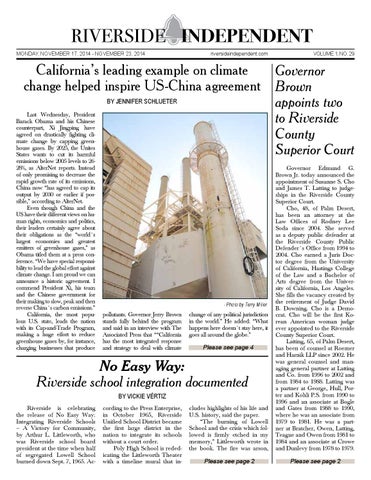
California’s leading example on climate change helped inspire US-China agreement by jennifer schlueter Last Wednesday, President Barack Obama and his Chinese counterpart, Xi Jingping have agreed on drastically fighting climate change by capping greenhouse gases. By 2025, the Unites States wants to cut its harmful emissions below 2005 levels to 2628%, as AlterNet reports. Instead of only promising to decrease the rapid growth rate of its emissions, China now “has agreed to cap its output by 2030 or earlier if possible,” according to AlterNet. Even though China and the US have their different views on human rights, economics and politics, their leaders certainly agree about their obligations as the “world’s largest economies and greatest emitters of greenhouse gases,” as Obama titled them at a press conference. “We have special responsibility to lead the global effort against climate change. I am proud we can announce a historic agreement. I commend President Xi, his team and the Chinese government for their making to slow, peak and then reverse China’s carbon emissions.” California, the most populous U.S. state, leads the nation with its Cap-and-Trade Program, making a huge effort to reduce greenhouse gases by, for instance, charging businesses that produce
cludes highlights of his life and U.S. history, said the paper. “The burning of Lowell School and the crisis which followed is firmly etched in my memory,” Littleworth wrote in the book. The fire was arson, Please see page 2
Please see page 2
change of any political jurisdiction in the world.” He added: “What happens here doesn’t stay here, it goes all around the globe.” Please see page 4
No Easy Way: Riverside school integration documented by Vickie Vértiz Riverside is celebrating the release of No Easy Way: Integrating Riverside Schools – A Victory for Community, by Arthur L. Littleworth, who was Riverside school board president at the time when half of segregated Lowell School burned down Sept. 7, 1965. Ac-
cording to the Press Enterprise, in October 1965, Riverside Unified School District became the first large district in the nation to integrate its schools without a court order. Poly High School is rededicating the Littleworth Theater with a timeline mural that in-
Governor Brown appoints two to Riverside County Superior Court Governor Edmund G. Brown Jr. today announced the appointment of Susanne S. Cho and James T. Latting to judgeships in the Riverside County Superior Court. Cho, 48, of Palm Desert, has been an attorney at the Law Offices of Rodney Lee Soda since 2004. She served as a deputy public defender at the Riverside County Public Defender’s Office from 1994 to 2004. Cho earned a Juris Doctor degree from the University of California, Hastings College of the Law and a Bachelor of Arts degree from the University of California, Los Angeles. She fills the vacancy created by the retirement of Judge David B. Downing. Cho is a Democrat. Cho will be the first Korean American woman judge ever appointed to the Riverside County Superior Court. Latting, 65, of Palm Desert, has been of counsel at Roemer and Harnik LLP since 2002. He was general counsel and managing general partner at Latting and Co. from 1996 to 2002 and from 1984 to 1988. Latting was a partner at George, Hull, Porter and Kohli P.S. from 1990 to 1996 and an associate at Bogle and Gates from 1988 to 1990, where he was an associate from 1979 to 1981. He was a partner at Bratcher, Owen, Latting, Teague and Owen from 1981 to 1984 and an associate at Crowe and Dunlevy from 1978 to 1979.
- Photo by Terry Miller
pollutants. Governor Jerry Brown stands fully behind the program and said in an interview with The Associated Press that ““California has the most integrated response and strategy to deal with climate
VOLUME 1, NO. 29
2 | NOVEMBER 17, 2014 - NOVEMBER 23, 2014
$250 million available in pathway grants State Superintendent of Public Instruction Tom Torlakson today invited school districts and community colleges to apply for $250 million in California Career Pathways Trust grants for programs that provide skills and practical experience to help students prepare for success in college and careers. “This program is a great example of teamwork among educators and employers,” said Torlakson. “By giving students a taste of the working world before they graduate, these programs motivate and excite students, reduce the drop-out rate, and increase the college attendance rate.” A career pathway program helps students chart the classes they need in high school and community college to prepare for work in a particular industry. These programs lead students to two-year degrees, certificates, or four-year degrees that prepare them for highly skilled jobs in growing industries.
In the first round of funding last May, grant requests exceeded the $250 million available for funding. In this second round, an additional $250 million is available. The grants pay for collaboration efforts among school districts, community colleges, business, and community leaders, and the development of courses. For application information, visit the California Department of Education’s (CDE) California Career Pathways Trust Implementation Grant and California Career Pathways Consortium Development Grant Web pages. The CDE also will hold several Grant Workshops in November for prospective applicants. The CDE is working with the California Community Colleges Chancellor’s Office and the California Workforce Investment Board to offer this grant. This effort furthers Torlakson’s Career Readiness initiative to curb dropouts and support career technical education.
Change lives. Make wishes come true.
Become a Make-A-Wish ®
VOLUNTEER
Volunteers for Make-A-Wish give their time and talents to help bring hope, strength and joy to children who are battling life-threatening medical conditions. We have a special need for volunteers in the Inland Empire to help local children.
Get Involved Today ocie.wish.org | 714-573-9474
Superior Court judge appointment Continued from page 1
Latting earned a Juris Doctor degree from the University of Oklahoma College of Law, a Master of Science degree from the London School of Economics and a Bachelor of Arts degree from
Yale University. He fills the vacancy created by the retirement of Judge Gary B. Tranbarger. Latting is a Democrat. The compensation for each of these positions is $184, 610.
Susanne S. Choand James T. Latting -Courtesy Photos
School integration documented Continued from page 1
as it was in many other U.S. cities in the middle of school integration, but authorities never found out who set the fire, said the paper. Littleworth, who is now 91, has been an attorney for decades and wrote the book by hand. Like many other cities, Anglos families in Riverside also showed serious and violent resistance to having black students bused to schools in their neighborhoods, said the paper. In the book, a former school employee tells of angry white parents at Alcott “yelling at young black and Latino children as they got off the bus.” The employee confronted those people to shame them into stopping. No Easy Way was published by the Inlandia Institute and edited by Dawn Hassett. She told the Enterprise that the book brings a clearer picture of the experience of people of color in Riverside. Hassett said that “people [...] have an odd and mistaken notion of what it was like in California and the
West, [...] for people who were Mexican American and African American. What people think of as the Jim Crow South kind of existed everywhere.” According to the Enterprise, in 1965, enrollment in Lowell and Irving were almost all minority students at the time. Littleworth told the Press Enterprise that, looking back, he had not realized how exclusive Anglo people were to minority students and their communities. Across the state and in Riverside, Anglos are no longer a majority of students. In Riverside schools, enrollment was nearly 60 percent Latino in 2013-14, said the paper. Families of color live all over the city, although income disparities still persist. In an email to the Enterprise, Littleworth wrote that, by integrating schools almost 50 years ago, the district wanted to reduce discrimination and “to treat a Riverside community as one people. This hopefully remains.”
NOVEMBER 17, 2014 - NOVEMBER 23, 2014 | 3
hlr media EDITORIAL editor@riversideindependent.com Editor Jennifer Schlueter Publisher HLR Media Advertising advertising@hlrmedia.com Submissions:
Please send all press releases to: editor@riversideindependent.com HLR Media, LLC .All contents herein are copyrighted and may not be reproduced in any manner, either in whole or in part, without the express written consent of the publisher. The views and opinions expressed in this paper are not necessarily that of the management and staff at HLR Media, LLC 3800 Orange street Riverside CA, 92501
Phone: (626) 386-3457 Fax: (626) 600-4452
Alhambra PRESS
Baldwin Park
INDEPENDENT
INDEPENDENT
Aethlon Medical announces undetectable Ebola virus in patient treated with Hemopurifier® therapy Aethlon Medical, Inc. (OTCBB:AEMD), the pioneer in developing targeted therapeutic devices to address infectious disease and cancer, announced recently that officials at Frankfurt University Hospital have reported undetectable virus in an ebola patient previously disclosed to have received Hemopurifier® therapy. In an article entitled: “Ugandan Doctor Cured of Ebola in Germany,” The Wall Street Journal has reported that hospital officials indicated the patient is no longer infected with ebola virus and is heading toward a full recovery. The Aethlon Hemopurifier® is a first-in-class bio-filtration device that targets the rapid elimination of viruses and immunosuppressive proteins from the circulatory system of infected individuals. At present, no antiviral therapy or vaccine has proven to be effective against Ebola virus infection in humans. According to the World Health Organization (WHO), more than 5,000 deaths have been attributed to the current ebola virus epidemic. The patient at Frankfurt University Hospital was administered Hemopurifier® therapy through special approval from The Federal Institute for Drugs and Medical Devices (Bundesinstitut fur Arzneimittel und Medizinprodukte, BfArM), an independent federal higher authority within the portfolio of the Federal Ministry of Health of Germany. “It is truly wonderful that the patient, who was reported to be suffering from multiple organ failure, is now recovering from ebola infection,” stated Aethlon founder and CEO, Jim Joyce. “In the coming days, we will disclose the venue of a public presentation that will report treatment data including the quantification of viral load reduction and viruses captured by our Hemopurifier during the treatment of this patient.” In the care of ebola-infected individuals, the Hemopurifier targets two unmet medical needs: the rapid elimination of circulating viruses to inhibit continued progeny virus replication and the direct
targeting of shed glycoproteins that overwhelm the host immune response. The device can be deployed for use within the global infrastructure of dialysis and CRRT machines already located in hospitals and clinics. Aethlon further disclosed that it is preparing to initiate U.S. clinical studies of Hemopurifier therapy based on the United States Food and Drug Administration’s (FDA) approval of an Investigational Device Exemption (IDE) that was previously submitted by the Company. The study will contribute safety data to advance the device as a broad-spectrum countermeasure against pandemic threats, including ebola and chronic viral pathogens such as HIV
and Hepatitis C (HCV). To date, Hemopurifier therapy has been successfully administered in approximately one hundred treatment experiences in health compromised HIV and HCV infected individuals. These studies were conducted at the Apollo Hospital, Fortis Hospital, Sigma New Life Hospital, and the Medanta Medicity Institute, all located in India. In vitro validation studies that demonstrated the ability of the Hemopurifier to capture Zaire and other strains of ebola virus were conducted by researchers at the United States Army Medical Research Institute for Infectious Diseases (USAMRIID) and the United States Centers for Disease Control and Prevention (CDC).
Long Beach Office 3780 Kilroy Airport Way Suite 360 Long Beach, CA 90806 Ph. (562) 472-0071 Fx. (562) 689-0071 Los Angeles Office 5701 South Eastern Avenue Suite 100 Los Angeles, CA 90040 Ph. (323) 727-1144 Fx. (323) 727-9198 www.heger-industrial.com Lic. #00814086
4 | NOVEMBER 17, 2014 - NOVEMBER 23, 2014
New tech aims to improve communication between dogs and humans North Carolina State University researchers have developed a suite of technologies that can be used to enhance communication between dogs and humans, which has applications in everything from search and rescue to service dogs to training our pets. “We’ve developed a platform for computer-mediated communication between humans and dogs that opens the door to new avenues for interpreting dogs’ behavioral signals and sending them clear and unambiguous cues in return,” says Dr. David Roberts, an assistant professor of computer science at NC State and co-lead author of a paper on the work. “We have a fully functional prototype, but we’ll be refining the design as we explore more and more applications for the platform.” The platform itself is a harness that fits comfortably onto the dog, and which is equipped with a variety of technologies. “There are two types of communication technologies,” says Dr. Alper Bozkurt, an assistant professor of electrical and computer engineering at NC State
and co-lead author of a paper on the work. “One that allows us to communicate with the dogs, and one that allows them to communicate with us.” “Dogs communicate primarily through body language, and one of our challenges was to develop sensors that tell us about their behavior by observing their posture remotely,” Roberts says. “So we can determine when they’re sitting, standing, running, etc., even when they’re out of sight – a harness-mounted computer the size of a deck of cards transmits those data wirelessly. “At the same time, we’ve incorporated speakers and vibrating motors, called haptics, into the harness, which enable us to communicate with the dogs.” “We developed software to collect, interpret and communicate those data, and to translate human requests into signals on the harness,” says Rita Brugarolas, an NC State Ph.D. student and coauthor of the paper. The technology also includes physiological sensors that monitor things like heart rate and body
temperature. The sensors not only track a dog’s physical wellbeing, but can offer information on a dog’s emotional state, such as whether it is excited or stressed. These technologies form the core of the platform, but it can be customized with additional devices depending on the specific application. “For example, for search and rescue, we’ve added environmental sensors that can detect hazards such as gas leaks, as well as a camera and microphone for collecting additional information,” Bozkurt says. “We’re also very interested in addressing stress in working dogs, such as guide dogs for the blind,” says Sean Mealin, an NC State Ph.D. student and co-author of the paper. “We’re reliant on the physiological and behavioral sensors to give us a picture of the dog’s mental and emotional state. “This can help handlers identify and mitigate stress for the dogs, improving the length and quality of a dog’s life,” Mealin adds. “It’s an important issue. Particularly because guide dogs are bred and
trained not to display signs of stress in their behavior.” In addition to disaster response research, the research team has already done work that uses the platform to assist in dog training. They are now in the early stages of miniaturizing the technologies and improving the physiological sensors for use in animal shelters and hospitals. “This platform is an amazing tool, and we’re excited about using it to improve the bond between dogs and their humans,” says Dr. Barbara Sherman, a clinical professor of animal behavior at the NC State College of Veterinary Medicine and co-author of the paper. The paper, “Towards CyberEnhanced Working Dogs for Search and Rescue,” is published online in IEEE Intelligent Systems. The paper was co-authored by NC State Ph.D. students John Majikes and Robert Loftin, and by former NC State Ph.D. student Dr. Pu Yang. The work was supported by the National Science Foundation under Cyber Physical System Program grant number 1329738.
California's leading example on climate change helped inspire US-China agreement Continued from page 1
California currently aims at reducing “emissions of heat-trapping gases to 1990 levels by 2020,” according to the Huffington Post; and Brown will continue push for
even lower levels by 2030. Additionally, companies producing gasoline and other fuels will be charged starting 2015, which most likely calls for higher prices for
consumers, says the website. KPCC quotes California Air Resources Board spokesman Stanley Young: “I think California has shown the leadership, and in essence it has set the stage for the kind of nation-to-nation agreement that we’ve seen today.” By signing agreements with “China’s Ministry of Commerce, the National Ministry of Environmental Protection, the provinces of Jiangsu and Guangdong, and the Beijing Ministry of Environmental Protection,” Brown has brought his state and the U.S. closer (KPCC). Furthermore, The California Air Resources Board and the Shenzhen province share data about climate research and emission prevention methods, according to KPCC. While decreasing its green-
house gases, California’s economy has rather grown than suffered, which is important to note, tells David Pettit, a lawyer for the Natural Resources Defense Council who has worked in China, the KPCC. “That’s one of the talks I give when I go over there, about how we’ve dealt with a lot of these pollution issues while the economy has pretty much grown in a linear straight line since the 40s,” Pettit says. “And that seems to be impressive to people who hear it.” Los Angeles Mayor Eric Garcetti supports California’s efforts against pollution and said in a statement that he “will work with [the] local green tech, scientific and investment communities to see how we can play a leading role to achieve them and, in doing so, catalyze L.A. jobs and industry.”