SEE PAGE 3 for gnurses endorsing water bond
SEE PAGE 2 for preschool expansion slots for ca residents MONDAY, OCTOBER 20, 2014 - OCTOBER 26, 2014
cypressnewspress.com
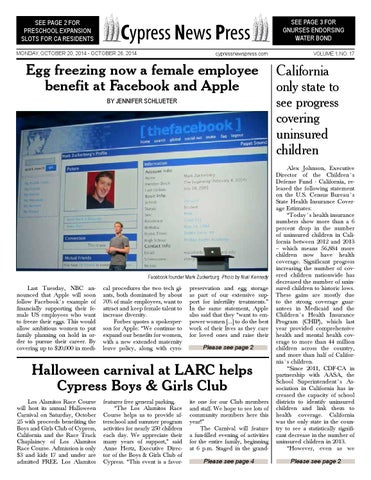
Egg freezing now a female employee benefit at Facebook and Apple by jennifer schlueter
cal procedures the two tech giants, both dominated by about 70% of male employees, want to attract and keep female talent to increase diversity. Forbes quotes a spokesperson for Apple: “We continue to expand our benefits for women, with a new extended maternity leave policy, along with cyro-
ite one for our Club members and staff. We hope to see lots of community members here this year!” The Carnival will feature a fun-filled evening of activities for the entire family, beginning at 6 p.m. Staged in the grandPlease see page 4
Please see page 2
preservation and egg storage as part of our extensive support for infertility treatments.” In the same statement, Apple also said that they “want to empower women […] to do the best work of their lives as they care for loved ones and raise their Please see page 2
Halloween carnival at LARC helps Cypress Boys & Girls Club Los Alamitos Race Course will host its annual Halloween Carnival on Saturday, October 25 with proceeds benefiting the Boys and Girls Club of Cypress, California and the Race Track Chaplaincy of Los Alamitos Race Course. Admission is only $3 and kids 17 and under are admitted FREE. Los Alamitos
features free general parking. “The Los Alamitos Race Course helps us to provide afterschool and summer program activities for nearly 250 children each day. We appreciate their many years of support,” said Anne Hertz, Executive Director of the Boys & Girls Club of Cypress. “This event is a favor-
California only state to see progress covering uninsured children Alex Johnson, Executive Director of the Children’s Defense Fund - California, released the following statement on the U.S. Census Bureau’s State Health Insurance Coverage Estimates: “Today’s health insurance numbers show more than a 6 percent drop in the number of uninsured children in California between 2012 and 2013 – which means 56,884 more children now have health coverage. Significant progress increasing the number of covered children nationwide has decreased the number of uninsured children to historic lows. These gains are mostly due to the strong coverage guarantees in Medicaid and the Children’s Health Insurance Program (CHIP), which last year provided comprehensive health and mental health coverage to more than 44 million children across the country, and more than half of California’s children. “Since 2011, CDF-CA in partnership with AASA, the School Superintendent’s Association in California has increased the capacity of school districts to identify uninsured children and link them to health coverage. California was the only state in the country to see a statistically significant decrease in the number of uninsured children in 2013. “However, even as we
Facebook founder Mark Zuckerburg -Photo by Niall Kennedy
Last Tuesday, NBC announced that Apple will soon follow Facebook’s example of financially supporting their female US employees who want to freeze their eggs. This would allow ambitious women to put family planning on hold in order to pursue their career. By covering up to $20,000 in medi-
VOLUME 1, NO. 17
2 | OCTOBER 20, 2014 - OCTOBER 26, 2014
Preschool expansion slots for California’s youngest residents Superintendent of Public Instruction Tom Torlakson and State Senate President pro Tem Darrell Steinberg (D-Sacramento) announced that the California Department of Education has allocated $67 million to add 7,500 preschool slots for low-income Californians. “This is a great investment in our future. The expansion of high-quality preschool gives more children the opportunity to obtain the emotional and social skills they need to become lifelong learners,” Torlakson said. “It will help them succeed in school, at the workplace, and in their communities.” These funds are part of the $264 million that will be spent on expanding early childhood education this budget year, which includes adding a total of 11,500 preschool slots and 1,000 slots with priority given to infants and toddlers. Eventually, the state will be creating preschool opportunities for an additional 31,500 young children. “By age five, low-income children are more than two years behind in language development,” said Steinberg. “They bring this achievement gap into kindergarten and through no fault of their own, before they even started school, California’s kids have fallen behind. It is smarter and more prudent to make this investment in success up front, than paying for the costs of failure at the end.”
The state also has allocated an additional $10 million for facility renovation and safety improvements and $50 million to improve the quality of early learning by assisting California State Preschool Programs (CSPP) that will increase parental involvement in children’s education, provide developmental screening, and hire teachers with a bachelor’s degree. During the recession, 100,000 subsidized preschool and child care slots were eliminated because of the dramatic decline in state revenues, causing hardships for working families. Torlakson and Steinberg made their announcement at the Ralph Hawley Elementary School, which houses a YMCA preschool program. The program, which serves about 60 students, will receive about $177,000 to add slots for 20 more preschool children. Torlakson called the current expansion a big step forward, but said more needs to be done to make sure that all children have access to high-quality preschool. Providing low-income families access to high-quality preschool helps eliminate gaps in learning, saving society more than $7 for every dollar invested. These children are less likely to drop out of high school or commit crimes and have higher lifetime earnings than their peers who do not attend high-quality preschool.
Egg freezing new employee benefit Continued from page 1
families.” Both companies already offer financial assistance with adoption and fertility treatment and up to 18 weeks maternity leave. Facebook additionally pays “new parents $4,000 in so-called “baby cash” to use however they’d like,” as NBC reports. Supporters see the idea as an empowerment for women, who, instead of fearing their biological clocks, are now able to hold off a career-hindering pregnancy and fully establish themselves in the workforce. Christy Jones, a promoter of the egg freezing technique and founder of Extend Fertility told NBC that the companies’ new benefits “can help women be more productive human beings.” Also according to NBC, Lynn Westphal, Associate Professor of Obstetrics and Gynecology at Stanford University Medical Center, states that “the benefit will likely encourage women to stay with their employer longer, cutting down on recruiting and hiring costs. And practically speaking, when women freeze their eggs early, firms may save on pregnancy costs in the long run.” Opponents view the new measure not only as an intervention in nature, but also warn of the short- and long-term health risks for mothers and their children associated with the not yet
fully researched process of egg freezing. Even worse, the procedure is never a guaranteed success to become pregnant. Naomi Cahn, law professor at George Washington University who writes about reproductive technology told MarketWatch. com: “Egg freezing creates the opportunity to transcend the biological clock, but it also creates the illusion that we will always be able to transcend the biological clock.” Moreover, detractors such as Glenn Cohen, faculty director at Harvard Law School’s Petrie-Flom Center for Health Law Policy, Biotechnology and Bioethics, are skeptical about the companies’ message: “Facebook should be careful it isn’t sending the message that women at 25 can’t get pregnant if they want to be successful there instead of creating a work environment where young mothers can also thrive,” he said according to MarketWatch.com. Jessica Cussins, Project Associate at the Center for Genetics and Society criticizes the companies’ motives in a Huffington Post article: “Unfortunately, when you work for a company that wants you to spend your entire life at the office, in a society that underprioritizes all occupations traditionally undertaken by women, there will never be an ideal time to start a family.”
CA covers uninsured children Continued from page 1
celebrate progress in providing children a healthy start, CHIP faces a very real threat. If Congress doesn’t take action, there will be no new funding for CHIP starting this time next year. If that happens, millions of children could lose their health coverage, and millions more would pay more for less coverage. Since CHIP’s bipartisan beginning in 1997, it has been a lifeline for millions
of children in working families and has played a critical role in reducing the rate of uninsured children by half. CHIP remains a crucial source of coverage for millions of children, even in the post- Affordable Care Act (ACA) world. Congress must act to extend funding for CHIP this year to ensure that children’s health coverage and outcomes continue to improve.”
OCTOBER 20, 2014 - OCTOBER 26, 2014 | 3
hlr media EDITORIAL
jschlueter@hlrmedia.com
Editor
Jennifer Schlueter
Publisher HLR Media
Advertising
advertising@hlrmedia.com
Submissions:
Please send all press releases to: jschlueter@hlrmedia.com HLR Media, LLC .All contents herein are copyrighted and may not be reproduced in any manner, either in whole or in part, without the express written consent of the publisher. The views and opinions expressed in this paper are not necessarily that of the management and staff at HLR Media, LLC
Phone: (626) 386-3457 Fax: (626) 600-4452
Alhambra PRESS
Baldwin Park
INDEPENDENT
INDEPENDENT
California nurses endorse water bond, Proposition 1 Citing the importance of stabilizing the state’s water supply in an era of drought and climate change as a public health priority, the California Nurses Association announced its endorsement of Proposition 1, the Water Bond measure, on the November 4 ballot. The measure would upon approval, enact general obligation bonds for state water supply infrastructure projects, such as public water system improvements, surface and groundwater storage, drinking water protection, water recycling and advanced water treatment technology, water supply management and conveyance, wastewater treatment, drought relief, emergency water supplies, and ecosystem and watershed protection and restoration. “Access to a clean and adequate water supply is vital for public health,” said CNA Copresident Deborah Burger, RN. “Water is life sustaining, critical for drinking, for hygiene, for cleaning our food, clothes, and living spaces. Lack of adequate and steady supplies of water can lead to unsafe sanitation and the spread of infectious diseases and pandemics.” “With the erosion of our water supply in the current drought – and the likelihood that more droughts, directly associated with the climate crisis – this becomes a critical issue for the future of all Californians. That’s why nurses are joining with Governor Brown and many state lawmakers and organizations in supporting Proposition 1,” Burger said. CNA, the largest state organization of nurses with 86,000 California members, said that Proposition 1 will clean up our contaminated groundwater which serves as a critical buffer against drought by providing additional water in years when there is not enough rainfall or snow. Proposition 1 provides funding for clean drinking water in communities where water is contaminated and will invest in new water storage increas-
-Photo by Terry Miller
ing the amount of water that can be stored during wet years for the dry years sure to come, said CNA. Proposition 1 protects California’s rivers, lakes, and
streams from pollution and contamination, which is also critical for public health, and provides for the restoration of our fish and wildlife resources.
Long Beach Office 3780 Kilroy Airport Way Suite 360 Long Beach, CA 90806 Ph. (562) 472-0071 Fx. (562) 689-0071 Los Angeles Office 5701 South Eastern Avenue Suite 100 Los Angeles, CA 90040 Ph. (323) 727-1144 Fx. (323) 727-9198 www.heger-industrial.com Lic. #00814086
4 | OCTOBER 20, 2014 - OCTOBER 26, 2014
Math and Science - Not Just for Rocket Scientists By Dick Resch Looking to get rich? Try welding. For the third consecutive year, positions in the skilled trades are the hardest to fill, according to a Manpower Group survey of American employers. This shortage is why a master welder can earn a six-figure salary -- without a college degree. There aren’t enough skilled tradesmen because our nation’s schools aren’t producing graduates with the math and science knowledge needed to fill these skilled jobs. That has to change. Educators must rethink the way they teach math and science -- especially to students who may not go to college. The best way to reach these kids is to scrap the age-old lecture and empower them to learn by doing. International rankings reveal the depths of America’s underachievement. Among 34 developed nations, the United States ranks 27th in math and 20th in science. More than one-quarter of U.S. students lack even basic proficiency in math. That’s 13
percent higher than the global average. This poor performance is concerning, as these students risk economic marginalization. A million people drop out of high school each year. Most don’t participate in the labor force. Those that do face an unemployment rate 50 percent higher than their graduating peers. That low-performing quarter of students also includes many who complete high school yet still lack the math skills needed for most entry-level manufacturing jobs -- let alone the skilled-trade positions that could vault them into the middle class. Philadelphia Federal Reserve President Charles Plosser said earlier this year, “We are seeing a mismatch of skills in the workforce and the jobs that are being created.” To fill these jobs -- and provide livelihoods for millions -- we must keep students who struggle with math in school and find ways to boost their achievement. According to the National Training Laboratories, the tradi-
tional lecture format yields only a 5 percent learning retention rate. Allowing students to practice by doing, in contrast, results in a whopping 75 percent retention rate. The way forward is clear: Embrace technology, collaboration, and hands-on learning. Already, colleges are adopting this approach. The University of Pennsylvania has built a new classroom with customized, powered round tables so students can collaborate using all manner of technology. It plans to add three to four more such classrooms over the next year. MIT’s Technology-Enabled Active Learning (TEAL) Project merges lecture, simulation, collaborative learning, and handson experiments in one classroom. Failure rates for freshmen in a TEAL physics course were one-third those in the traditional setting. Average gains in understanding were more than double. Gains were highest among students at the bottom of the achievement ladder. Engaged learning models
are trickling down into elementary and secondary schools, too. In Philadelphia, several schools are using the Full Option Science System, a hands-on, activity-based approach that empowers students to investigate, experiment, and collaborate to discover the material in each lesson. Students at FOSS schools have scored higher on standardized tests. The longer they’re in the program, the greater the gains in achievement. Administrators across the country are enlisting the firm I lead, KI, to help them transform their traditional classrooms into technology-enhanced learning environments, where students work in small groups while instructors rove about, offering individualized help and coaching. To refill the ranks of the middle class with good-paying manufacturing jobs, we must address our nation’s math and science achievement gap. The instructional status quo isn’t working. There’s ample evidence that a more active, engaged approach will.
Halloween carnival at LARC helps Cypress Boys & Girls Club Continued from page 1
stand apron in front of the finish line, the Halloween Carnival provides a safe, enclosed place for children from around the area to enjoy more than 20 carnival game, prizes, Halloween
Derby racing game, pony rides, arcade games, candy for all the children, jockey autographs and a photography booth. The carnival highlight is the costume contest, which attracts
nearly 500 participants each year. There is a Grand Prize of $700 and many other cash prizes for various age divisions. The evening’s activities will also feature live Quarter Horse and Thoroughbred racing with the first race slated for approximately 6 p.m. Los Alamitos Race Course hosts
the premier quarter horse race meeting in the world with live year-around racing taking place on a Friday through Sunday night basis. Los Alamitos Race Course also hosts daytime Thoroughbred racing with the next daytime season schedule to open on Thursday, December 4 for a three week meeting.
Boys & Girls Club of Cypress staff members are looking forward to seeing lots of Boys & Girls Club members at this year’s carnival at the Los Alamitos Race Course. Pictured are: Front (Breanna Blashford, Samantha Johnson, Aly Mejia, Erika Gary) Back (Kyle Crawford, Sam Macdonald, Isaac Rivera) - Courtesy Photo