Belmont Beacon
MONDAY, OCTOBER 6, 2014 - OCTOBER 12, 2014
belmontbeacon.com
VOLUME 1, NO. 23
Family members can ask court to seize Recycledguns from unstable loved ones water bill by Jennifer schlueter signed by Governor Brown as drought persists
infected person coughs, sneezes, or touches contaminated surfaces. “We always urge residents to wash their hands with soap and water to prevent disease transmission,” said Dr. Mitchell Kushner, Long Beach City Health Officer. Additional recommendations include: -Wash hands often with soap and water for 20 seconds, especially after changing diapers.
Most homeowners want cheaper water bills. If provided the infrastructure, they’d gladly use recycled water to wash cars and irrigate lawns. Many cities have vast reservoirs of recycled water. If provided a market, they’d gladly allow the water to be used for more than just landscaping medians. Drought-scorched California took bold action to make these visions a reality as Governor Brown signed AB 2282. The groundbreaking legislation by Assemblyman Mike Gatto (D-Los Angeles) would require the state to adopt building standards for recycled water in newly constructed commercial and residential buildings. “The drought is a reminder that we need to make the best use of our limited water resources,” noted Gatto. “Recycled water is cleaner than most of the water in our natural aquifers. It’s wasteful and inefficient to dump this water into the ocean when we could use it for productive purposes.” It is expected that providing this new source will reduce water bills for many. Gatto’s bill specifically protects homeowners and businesses by requiring state agencies to consider the cost of various recycled-water infrastructure and determine which methods will provide the greatest cost savings for consumers. AB 2282 continues Gatto’s legislative efforts to address important water-policy issues. In 2011, the legislature passed Gatto’s AB 849, which fostered the use of gray-
Please see page 2
Please see page 2
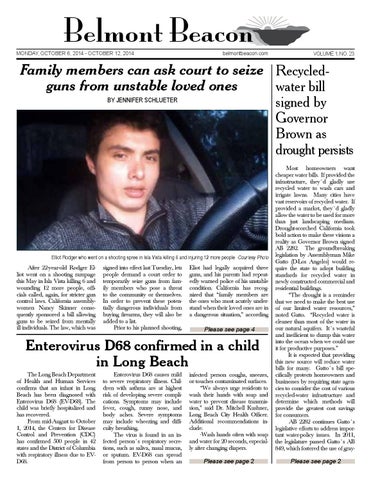
Elliot Rodger who went on a shooting spree in Isla Vista killing 6 and injuring 12 more people -Courtesy Photo
After 22-year-old Rodger Elliot went on a shooting rampage this May in Isla Vista killing 6 and wounding 12 more people, officials called, again, for stricter gun control laws. California assemblywomen Nancy Skinner consequently sponsored a bill allowing guns to be seized from mentally ill individuals. The law, which was
signed into effect last Tuesday, lets people demand a court order to temporarily seize guns from family members who pose a threat to the community or themselves. In order to prevent these potentially dangerous individuals from buying firearms, they will also be added to a list. Prior to his planned shooting,
Eliot had legally acquired three guns, and his parents had repeatedly warned police of his unstable condition. California has recognized that “family members are the ones who most acutely understand when their loved ones are in a dangerous situation,” according Please see page 4
Enterovirus D68 confirmed in a child in Long Beach The Long Beach Department of Health and Human Services confirms that an infant in Long Beach has been diagnosed with Enterovirus D68 (EV-D68). The child was briefly hospitalized and has recovered. From mid-August to October 1, 2014, the Centers for Disease Control and Prevention (CDC) has confirmed 500 people in 42 states and the District of Columbia with respiratory illness due to EVD68.
Enterovirus D68 causes mild to severe respiratory illness. Children with asthma are at highest risk of developing severe complications. Symptoms may include fever, cough, runny nose, and body aches. Severe symptoms may include wheezing and difficulty breathing. The virus is found in an infected person’s respiratory secretions, such as saliva, nasal mucus, or sputum. EV-D68 can spread from person to person when an
2 | OCTOBER 6, 2014 - OCTOBER 12, 2014
Single-use plastic bags are history in California Governor Edmund G. Brown Jr. today signed the nation’s first statewide ban on single-use plastic bags – SB 270 – aligning state law with ordinances passed by a growing number of local governments in California to reduce plastic waste. The legislation, authored by Senator Alex Padilla (D-Pacoima), prohibits grocery stores and pharmacies from distributing single-use plastic bags after July 2015 and enacts the same ban for convenience stores and liquor stores the following year. It will also provide up to $2 million in competitive loans – administered by CalRecycle – to businesses transitioning to the manufacture of reusable bags. Thus far, over 120 local governments in California have passed ordinances banning single-use bags in some fashion, with widespread support from community and environmental groups. SB 270 is supported by many of these same groups, along with local governments, businesses and labor organizations. “The California coast is a national treasure and a calling card for the world, helping us attract visitors and business from around the globe. Removing the harmful blight of single-use plastic bags, especially along our coastline and waterways, helps ensure the kind of clean and healthy environment we need to have a stronger econ-
omy and a brighter future,” said Assembly Speaker Toni Atkins. “California is the first state in the U.S. to ban the most ubiquitous consumer item on the planet, in an effort to drive consumers towards sustainable behavior change. Data from the over 127 local plastic bag bans has proven that bans are effective at reducing litter and changing consumer attitudes, and have refuted industry’s claims of apocalyptic impacts on jobs and poor communities. A state plastic bag ban saves taxpayers the huge amount of money spent on litter cleanup, and protects the environment,” said Clean Seas Coalition and Seventh Generation Advisors director Leslie Tamminen. “SB 270 is a great victory for all of California. We’ve seen locally that plastic bag bans lead to cleaner water and healthier wildlife, keeping trash off our beaches and out of our creeks. The success of bag bans in our local communities has empowered state legislators to make the right decision for the health of California’s waterways. Governor Brown’s signature of this statewide bag ban is an important moment for our state, demonstrating that California is once again willing to take the lead on important environmental issues,” said Save the Bay executive director David Lewis.
Kareem Abdul-Jabbar to be honored at “All for the Love of Kids” Supervisor Michael D. Antonovich will honor NBA great Kareem Abdul-Jabbar at the 19th annual “All for the Love of Kids” awards program and fundraiser on Wednesday, October 8, 2014 at the Los Angeles County Kenneth Hahn Hall of Administration in Los Angeles. Donations raised at this event help provide Los Angeles County foster kids with programs and services not typically available through government resources. This includes:
•College scholarships •Specialized medical and dental services •Educational field trips •Uniforms for sports and enrichment activities •Music lessons and instruments “All for the Love of Kids” was initiated in 1995 by Supervisor Antonovich to support the Los Angeles County Department of Children and Family Services (DCFS) and the Children’s Trust Fund.
Two free lip reading classes Monday and Wednesday free Lip Reading classes are offered in October through the Hearing Loss Association of America Long Beach/Lakewood Chapter at Weingart Senior Center, 5220 Oliva Avenue, Lakewood, CA. October dates on Mondays are: October 6, 13, 20, and 27 from 10 a.m.-noon. On Wednesday are: October 8,
15, 22, and 29 from 9:30-11:30 a.m. The class meets Monday and Wednesday all year except July, August, and Christmas to New Years. Beginning lessons are repeated each January but beginners are welcome at any time. The Wednesday class is the “teaching” class. For more information, call 562-438-0597 or ww.hlalongbeachlakewood.org.
Recycled-water bill Continued from page 1
water technology, and in 2012, the legislature passed Gatto’s bill AB 2230, requiring all new carwashes to use 60% recycled water by 2014. In 2012 and 2013, Gatto authored legislation to create CalConserve, a revolving loan fund for efficiency retrofits. “Single-family homes use
about 60% of their water outside. If people could water their lawns and wash their cars with recycled water, there would be much more water available for drinking and growing food,” said Gatto. “I am grateful to the Governor for recognizing the importance of this legislation for the future of California.”
Enterovirus D68 confirmed Continued from page 1
-Avoid touching eyes, nose and mouth with unwashed hands. -Avoid kissing, hugging, and sharing cups or eating utensils with people who are sick. -Disinfect frequently touched surfaces, such as toys and doorknobs, especially if
someone is sick. To reduce risk of severe respiratory illness, people with asthma should regularly take their medication and maintain control of their illness. People with asthma are also encouraged to get the influenza vaccine.
OCTOBER 6, 2014 - OCTOBER 12, 2014 | 3
hlr media EDITORIAL editor@belmontbeacon.com Editor Jennifer Schlueter Publisher HLR Media Advertising advertising@hlrmedia.com Submissions:
Please send all press releases to: editor@belmontbeacon.com HLR Media, LLC .All contents herein are copyrighted and may not be reproduced in any manner, either in whole or in part, without the express written consent of the publisher. The views and opinions expressed in this paper are not necessarily that of the management and staff at HLR Media, LLC 525 E Seaside Way, Suite 101B Long Beach 90802
Phone: (626) 386-3457 Fax: (626) 600-4452
Alhambra PRESS
Baldwin Park
INDEPENDENT
INDEPENDENT
Governor Brown reinforces access to healthy food options on state property SB 912 will require healthy options in vending machines Governor Edmund G. Brown, Jr. today signed legislation that will ensure current nutritional standards for foods and beverages sold in vending machines on state property remain in effect permanently. “California is facing an obesity epidemic that demands we do everything we can to ensure access to healthier food options,” said Senator Mitchell, author of Senate Bill 912 (SB 912). “For most of us the workplace is our home away from home, so our state facilities should offer nutritional choices onsite and within sight, both for employees and the public we serve.” Since 2008, state law has required that one-third of beverages sold on state property meet minimal nutritional standards and since 2011, 35 percent of the food. SB 912 simply preserves current law by removing the sunset on these guidelines. “California is facing a public health crisis as more than half of adults and teens are classified as overweight or obese,” said Dr. Diane Sobkowicz, president of the board of directors for the American Heart Association’s Sacramento division. “We know that sugar-sweetened beverages are a huge contributing factor to this problem and we applaud Governor Brown for taking this step to ensure that state workers and visitors to the state will continue to have access to healthier options. The workplace is a key environment for maintaining the health of the population but we still have a long way to go and this is just one aspect of our multifaceted effort to combat obesity in connection with heart diseases and stroke.” Heart disease and stroke are the number one and number three killers of Californians, respectively. Obesity greatly increases the risk of heart disease, stroke, high blood pressure, diabetes and some forms of cancer.
Lost productivity and medical care costs related to obesity, overweight and physical inactivity are estimated to cost California $52 billion annually. “Fighting the obesity epidemic will take a multipronged approach and continuing to ensure access to healthy food and beverage options for our state workers is a good start,” said Sobkowicz. “We must also ensure access to healthy foods for all Californians while reducing consumption of sugar-sweetened beverages and promoting increased physical activity for adults and children.” Co-sponsors of SB 912 in-
-Photo by Yukihiro Matsuda
clude the American Heart Association, the California Center for Public Health Advocacy and the California Pan-Ethnic Health Network.
Long Beach Office 3780 Kilroy Airport Way Suite 360 Long Beach, CA 90806 Ph. (562) 472-0071 Fx. (562) 689-0071 Los Angeles Office 5701 South Eastern Avenue Suite 100 Los Angeles, CA 90040 Ph. (323) 727-1144 Fx. (323) 727-9198 www.heger-industrial.com Lic. #00814086
4 | OCTOBER 6, 2014 - OCTOBER 12, 2014
Campus crime victims are now protected A closely watched and highly anticipated bill by Assemblyman Mike Gatto (D-Los Angeles) to ensure that crimes committed on college campuses are properly reported and investigated was signed into law by Governor Brown yesterday. The legislation, AB 1433, requires colleges to report certain violent crimes (like sexual assault and hate crimes), occurring on or near campus, to local law enforcement, with the permission of the victim. The legislation comes as President Barack Obama is beginning to discuss the problem nationally. Senators Claire McCaskill and Kirsten Gillibrand introduced federal legislation in July, but the bill has yet to be heard in any committees and only has a 1% chance of being enacted according to congressional watchdog govtrack.us.
Gatto introduced his legislation in January, after several California colleges were accused of covering up on-campus sexual assaults because of concerns that higher crime statistics would lead prospective students to choose elsewhere. The lack of clear laws regarding immediate campuscrime reporting, and unwillingness of campus officials to involve proper law-enforcement professionals, greatly diminishes the chance that a perpetrator is arrested and convicted. This, of course, can allow a perpetrator to strike again. “Victims of crime should not see their chances of justice hurt, nor should perpetrators be allowed to victimize others, because a school values its public image more than victims’ rights,” said Gatto. “Simple communication between campus officials and lo-
cal law enforcement will ensure a greater understanding of crime in a community and increased public safety.” Current law regarding sharing of campus crime and investigations is muddled. The only way for concerned students, parents, or media to get these crime statistics is within a university’s once-a-year Clery Act report, required by federal law. There is no simple or timely way for local police (who keep almost all crime stats) to analyze it or to participate in the investigation of the crimes. The challenges faced by victims of oncampus crimes (as well Assemblyman Gatto’s efforts to assist these victims) were featured as the lead story in the January 6, 2014 issue of Newsweek, after several California colleges became the subject of a federal lawsuit alleging violations
-Photo by Terry Miller
of the Clery Act. Since then, Gatto has been proactive in responding to community feedback to the legislation and even amended the bill to reflect suggestions that the legislation could also provide protections for people that are falsely accused of committing crimes on college campuses.
Torlakson announces grant to strengthen mental health training in schools State Superintendent of Public Instruction Tom Torlakson today announced the California Department of Education will receive up to $9.7 million for a pilot project that will ultimately make schools safer places for students to learn. The Now is the Time Project Advancing Wellness and Resilience in Education grant comes from the federal Substance Abuse and Mental Health Services Administration. “With the help of this grant,
I am pleased California is working to strengthen and increase the current mental health programs we have for students,” said Torlakson. “There is a clear need for school workers to receive mental health and wellness training to identify and support students who are experiencing emotional issues.” The federal grant will pay for 1,875 school staff members and other people who interact with students to receive training
to improve their mental health literacy. The trainees will learn, for example, how to identify and respond to mental health issues in students, get them and their families the appropriate help, and create safe school environments. The trainees will then train others around the state. The five-year pilot project will be in three educational agencies:
Garden Grove Unified in Orange County, Santa Rosa City Schools in Sonoma County, and the San Diego County Office of Education. This grant helps further Torlakson’s initiative, A Blueprint for Great Schools, which calls for leadership in helping districts develop their mental health services for students.
New gun control law Continued from page 1
to the executive director of the Coalition to Stop Gun Violence Josh Horwitz, and thus, has now become the first state of the country to allow them to ask for a court order seizing firearms. In other states with similar only law enforcement officials have the right to do so. Skinner told the New York Times: “This puts California in the leadership on efforts to stop gun violence, and it gives a very effective tool to law enforcement and families to intervene before a shooting tragedy occurs.”
Opponents of the bill argue against it because it would take away the rights of the Second Amendment and is not an adequate measure to prevent mass shootings. According to the NY Times, Gun rights supporter and California assemblyman Tim Donnelly said: “Every one of us wants to prevent a mass shooting. The question is: Would this bill stop that? I don’t believe you can ever stop that with laws. I don’t believe you can legislate evil out of the hearts of men.”