SEE PAGE 2 for single-use plastic bags banned in california
ANAHEIM PRESS
MONDAY, OCTOBER 6, 2014 - OCTOBER 12, 2014
anaheimpress.com
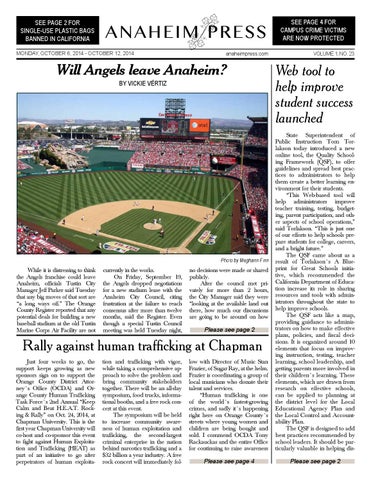
Will Angels leave Anaheim? by Vickie Vértiz
currently in the works. On Friday, September 19, the Angels dropped negotiations for a new stadium lease with the Anaheim City Council, citing frustration at the failure to reach consensus after more than twelve months, said the Register. Even though a special Tustin Council meeting was held Tuesday night,
tion and trafficking with vigor, while taking a comprehensive approach to solve the problem and bring community stakeholders together. There will be an all-day symposium, food trucks, informational booths, and a free rock concert at this event. The symposium will be held to increase community awareness of human exploitation and trafficking, the second-largest criminal enterprise in the nation behind narcotics trafficking and a $32 billion a year industry. A free rock concert will immediately fol-
Web tool to help improve student success launched
low with Director of Music Stan Frazier, of Sugar Ray, at the helm. Frazier is coordinating a group of local musicians who donate their talent and services. “Human trafficking is one of the world’s fastest-growing crimes, and sadly it’s happening right here on Orange County’s streets where young women and children are being bought and sold. I commend OCDA Tony Rackauckas and the entire Office for continuing to raise awareness Please see page 4
Please see page 2
no decisions were made or shared publicly. After the council met privately for more than 2 hours, the City Manager said they were “looking at the available land out there, how much our discussions are going to be around on how Please see page 2
Rally against human trafficking at Chapman Just four weeks to go, the support keeps growing as new sponsors sign on to support the Orange County District Attorney’s Office (OCDA) and Orange County Human Trafficking Task Force’s 2nd Annual “Keep Calm and Beat H.E.A.T. Rocking & Rally” on Oct. 24, 2014, at Chapman University. This is the first year Chapman University will co-host and co-sponsor this event to fight against Human Exploitation and Trafficking (HEAT) as part of an initiative to go after perpetrators of human exploita-
VOLUME 1, NO. 23
State Superintendent of Public Instruction Tom Torlakson today introduced a new online tool, the Quality Schooling Framework (QSF), to offer guidelines and spread best practices to administrators to help them create a better learning environment for their students. “This Web-based tool will help administrators improve teacher training, testing, budgeting, parent participation, and other aspects of school operations,” said Torlakson. “This is just one of our efforts to help schools prepare students for college, careers, and a bright future.” The QSF came about as a result of Torlakson’s A Blueprint for Great Schools initiative, which recommended the California Department of Education increase its role in sharing resources and tools with administrators throughout the state to help improve schools. The QSF acts like a map, providing guidance to administrators on how to make effective plans, policies, and fiscal decisions. It is organized around 10 elements that focus on improving instruction, testing, teacher learning, school leadership, and getting parents more involved in their children’s learning. These elements, which are drawn from research on effective schools, can be applied to planning at the district level for the Local Educational Agency Plan and the Local Control and Accountability Plan. The QSF is designed to add best practices recommended by school leaders. It should be particularly valuable in helping dis-
-Photo by Meghann Finn
While it is distressing to think the Angels franchise could leave Anaheim, officials Tustin City Manager Jeff Parker said Tuesday that any big moves of that sort are “a long ways off.” The Orange County Register reported that any potential deals for building a new baseball stadium at the old Tustin Marine Corps Air Facility are not
SEE PAGE 4 for campus crime victims are now protected
2 | OCTOBER 6, 2014 - OCTOBER 12, 2014
Single-use plastic bags are history in California Governor Edmund G. Brown Jr. today signed the nation’s first statewide ban on single-use plastic bags – SB 270 – aligning state law with ordinances passed by a growing number of local governments in California to reduce plastic waste. The legislation, authored by Senator Alex Padilla (D-Pacoima), prohibits grocery stores and pharmacies from distributing single-use plastic bags after July 2015 and enacts the same ban for convenience stores and liquor stores the following year. It will also provide up to $2 million in competitive loans – administered by CalRecycle – to businesses transitioning to the manufacture of reusable bags. Thus far, over 120 local governments in California have passed ordinances banning single-use bags in some fashion, with widespread support from community and environmental groups. SB 270 is supported by many of these same groups, along with local governments, businesses and labor organizations. “The California coast is a national treasure and a calling card for the world, helping us attract visitors and business from around the globe. Removing the harmful blight of single-use plastic bags, especially along our coastline and waterways, helps ensure the kind of clean and healthy environment we need to have a stronger econ-
omy and a brighter future,” said Assembly Speaker Toni Atkins. “California is the first state in the U.S. to ban the most ubiquitous consumer item on the planet, in an effort to drive consumers towards sustainable behavior change. Data from the over 127 local plastic bag bans has proven that bans are effective at reducing litter and changing consumer attitudes, and have refuted industry’s claims of apocalyptic impacts on jobs and poor communities. A state plastic bag ban saves taxpayers the huge amount of money spent on litter cleanup, and protects the environment,” said Clean Seas Coalition and Seventh Generation Advisors director Leslie Tamminen. “SB 270 is a great victory for all of California. We’ve seen locally that plastic bag bans lead to cleaner water and healthier wildlife, keeping trash off our beaches and out of our creeks. The success of bag bans in our local communities has empowered state legislators to make the right decision for the health of California’s waterways. Governor Brown’s signature of this statewide bag ban is an important moment for our state, demonstrating that California is once again willing to take the lead on important environmental issues,” said Save the Bay executive director David Lewis.
Plastic bag ban hurts financially depressed communities Los Angeles County Supervisor Michael D. Antonovich sharply criticized the Governor’s signing of a law banning plastic bags and imposing a $0.10 fee on all paper bags that the grocery stores will collect. “The $0.10 per bag fee will force lower income residents in impoverished communities around the state to pay for paper bags, with little indication of how the money will be spent,” said Antonovich.
“This law only further hurts the California economy by jeopardizing thousands of manufacturing jobs and forcing consumers to pay additional fees to grocery stores,” he added. The Progressive Bag Alliance has vowed to collect the necessary signatures to place this issue on the ballot and let the voters decide if the State should continue with such a flawed economic proposal.
Will Angels leave Anaheim? Continued from page 1
much land they actually need to build the stadium and for the appropriate parking.” He confirmed that any big decisions are “…a long ways off at this point in time, so it’s really starting the process.” Delayed discussions to renew a lease have sparked rumors and worry that it will not be renewed, pushing out the team and possibly affecting the income generated for the city. Team owner Arte Moreno and his development firm, Pacific Coast Investors, have been negotiating with the City of Tustin since March, lining up with failing lease negotiations between the Angels and Anaheim. Marie Garvey, an Angels spokeswoman, told the Register on Tuesday that they are still looking at all of their options. One of the stadium location options is a section of land of about 120 to 150 acres Warner and Armstrong avenues, and at Red Hill Avenue and Barranca Parkway. Parker told the Register that the proximity to three freeways makes that region a top choice, located near the five, fifty-five and four-ohfive freeways, making increased
traffic more manageable on game days. But that is not how local residents might have the inverse feelings about a new stadium location. For some residents the Register spoke to like Natalie Wong, “the stadium would be an ‘eyesore’ that would bring down property values and increase traffic for surrounding neighborhoods at the airfield.” The Register also spoke to Laurelwood resident Mike Krupa who also expressed worry about increased traffic, but also noise pollution from fireworks that are sometimes used at stadium events. “The quality of life of residents should be the top priority over whatever business wants to come to the city,” he told the paper. The question is, how would quality of life be affected if the franchise moved away from the city completely? Furthermore, what threshold of traffic and activity are residents are willing to put up with to call the Angels their team? Eventually, the city, the team, and residents wills’ and wishes will be tested once a final decision is made.
Web tool for student success Continued from page 1
tricts and schools as they move toward greater local flexibility and decision-making. The QSF was developed
by the California Department of Education with the help of the California Comprehensive Center at WestEd.
OCTOBER 6, 2014 - OCTOBER 12, 2014 | 3
hlr media EDITORIAL
editor@anaheimpress.com
Editor
Jennifer Schlueter
Publisher HLR Media
Advertising
advertising@hlrmedia.com
Submissions:
Please send all press releases to: editor@anaheimpress.com HLR Media, LLC .All contents herein are copyrighted and may not be reproduced in any manner, either in whole or in part, without the express written consent of the publisher. The views and opinions expressed in this paper are not necessarily that of the management and staff at HLR Media, LLC
950 N Tustin Ave Anaheim CA 92807
Phone: (626) 386-3457 Fax: (626) 600-4452
Alhambra PRESS
Baldwin Park
INDEPENDENT
INDEPENDENT
Governor Brown reinforces access to healthy food options on state property SB 912 will require healthy options in vending machines Governor Edmund G. Brown, Jr. today signed legislation that will ensure current nutritional standards for foods and beverages sold in vending machines on state property remain in effect permanently. “California is facing an obesity epidemic that demands we do everything we can to ensure access to healthier food options,” said Senator Mitchell, author of Senate Bill 912 (SB 912). “For most of us the workplace is our home away from home, so our state facilities should offer nutritional choices onsite and within sight, both for employees and the public we serve.” Since 2008, state law has required that one-third of beverages sold on state property meet minimal nutritional standards and since 2011, 35 percent of the food. SB 912 simply preserves current law by removing the sunset on these guidelines. “California is facing a public health crisis as more than half of adults and teens are classified as overweight or obese,” said Dr. Diane Sobkowicz, president of the board of directors for the American Heart Association’s Sacramento division. “We know that sugar-sweetened beverages are a huge contributing factor to this problem and we applaud Governor Brown for taking this step to ensure that state workers and visitors to the state will continue to have access to healthier options. The workplace is a key environment for maintaining the health of the population but we still have a long way to go and this is just one aspect of our multifaceted effort to combat obesity in connection with heart diseases and stroke.” Heart disease and stroke are the number one and number three killers of Californians, respectively. Obesity greatly increases the risk of heart disease, stroke, high blood pressure, diabetes and some forms of cancer.
Lost productivity and medical care costs related to obesity, overweight and physical inactivity are estimated to cost California $52 billion annually. “Fighting the obesity epidemic will take a multipronged approach and continuing to ensure access to healthy food and beverage options for our state workers is a good start,” said Sobkowicz. “We must also ensure access to healthy foods for all Californians while reducing consumption of sugar-sweetened beverages and promoting increased physical activity for adults and children.” Co-sponsors of SB 912 in-
-Photo by Yukihiro Matsuda
clude the American Heart Association, the California Center for Public Health Advocacy and the California Pan-Ethnic Health Network.
Long Beach Office 3780 Kilroy Airport Way Suite 360 Long Beach, CA 90806 Ph. (562) 472-0071 Fx. (562) 689-0071 Los Angeles Office 5701 South Eastern Avenue Suite 100 Los Angeles, CA 90040 Ph. (323) 727-1144 Fx. (323) 727-9198 www.heger-industrial.com Lic. #00814086
4 | OCTOBER 6, 2014 - OCTOBER 12, 2014
Campus crime victims are now protected A closely watched and highly anticipated bill by Assemblyman Mike Gatto (D-Los Angeles) to ensure that crimes committed on college campuses are properly reported and investigated was signed into law by Governor Brown yesterday. The legislation, AB 1433, requires colleges to report certain violent crimes (like sexual assault and hate crimes), occurring on or near campus, to local law enforcement, with the permission of the victim. The legislation comes as President Barack Obama is beginning to discuss the problem nationally. Senators Claire McCaskill and Kirsten Gillibrand introduced federal legislation in July, but the bill has yet to be heard in any committees and only has a 1% chance of being enacted according to congressional watchdog govtrack.us.
Gatto introduced his legislation in January, after several California colleges were accused of covering up on-campus sexual assaults because of concerns that higher crime statistics would lead prospective students to choose elsewhere. The lack of clear laws regarding immediate campuscrime reporting, and unwillingness of campus officials to involve proper law-enforcement professionals, greatly diminishes the chance that a perpetrator is arrested and convicted. This, of course, can allow a perpetrator to strike again. “Victims of crime should not see their chances of justice hurt, nor should perpetrators be allowed to victimize others, because a school values its public image more than victims’ rights,” said Gatto. “Simple communication between campus officials and lo-
cal law enforcement will ensure a greater understanding of crime in a community and increased public safety.” Current law regarding sharing of campus crime and investigations is muddled. The only way for concerned students, parents, or media to get these crime statistics is within a university’s once-a-year Clery Act report, required by federal law. There is no simple or timely way for local police (who keep almost all crime stats) to analyze it or to participate in the investigation of the crimes. The challenges faced by victims of oncampus crimes (as well Assemblyman Gatto’s efforts to assist these victims) were featured as the lead story in the January 6, 2014 issue of Newsweek, after several California colleges became the subject of a federal lawsuit alleging violations
-Photo by Terry Miller
of the Clery Act. Since then, Gatto has been proactive in responding to community feedback to the legislation and even amended the bill to reflect suggestions that the legislation could also provide protections for people that are falsely accused of committing crimes on college campuses.
“Keep Calm And Beat H.E.A.T. Rocking & Rally” against human trafficking Continued from page 1
of both the criminals that commit this heinous crime as well as the innocent victims that need to be returned to their families,” said U.S. Representative Ed Royce (RFullerton). “As Chairman of the House Foreign Affairs Committee, I’ll continue to ensure that federal law enforcement agencies are given the tools they need to work effectively with local authorities to keep our communities safe.” In April 2013, OCDA formed the HEAT Unit, which targets perpetrators who sexually
exploit and traffic women and underage girls for financial gain, including pimps, panderers, and human traffickers. Often the perpetrators are gang members and/ or career criminals. To date, the Unit has completed the prosecution of 56 cases with a 100 percent conviction rate, with sentences up to life in state prison. The HEAT Unit also targets defendants who create a demand for prostitution by soliciting and purchasing sex, which increases the commercial sexual exploita-
tion of women and children. The OCDA publicizes the name and identity of all those who are convicted of committing these offenses after. In October, the OCDA will also publish accompanying booking photos. The HEAT Unit uses a tactical plan called PERP: Prosecution of human trafficking perpetrators and sex purchasers; Education for law enforcement to properly handle human trafficking and pandering cases; Resources to raise public awareness and provide assistance to the victims; and Publicity to inform the community about the problem and notify human traffickers and sex purchasers that this crime cannot be perpetrated without suffering severe consequences. The OCDA would like to thank the co-sponsors for this event. Elected Officials: U.S. Representative Ed Royce, Chairman of the House Foreign Affairs Committee; U.S. Representative Loretta Sanchez; State Board of Equalization Vice Chair Michelle Steel; Senator Lou Correa; Senator Mimi Walters; Assemblyman Donald Wagner; Chairman of the Orange County Board of Su-
pervisors Shawn Nelson; Orange County Supervisor Janet Nguyen; Rancho Santa Margarita Councilman Steve Baric; Diamond Bar Councilwoman Ling Ling Chang; and Anaheim Councilwoman Kris Murray and more... Anyone interested in becoming a co-sponsor can contact Chief of Staff Susan Kang Schroeder at (714) 347-8408 or email beatHEAT@da.ocgov.com. Additional sponsors will be named in the weeks to come. Tax deductible event sponsorship opportunities are available at $500, $1,000 and $5,000 levels. All event sponsors will receive two tickets to the luncheon event and access to the VIP area at the concert, as well as program recognition. Supporters who contribute on the $1,000 and $5,000 levels will be given full table sponsorship, as well as additional tickets to the VIP areas of the concert. All funds will go to underwrite the event and any money left over will go directly to help victims. For more information, and to RSVP on Facebook, please visit http://bit.ly/BeatHEAT.